US11639330B2 - Fluorine-containing ether compound, lubricant for magnetic recording medium, and magnetic recording medium - Google Patents
Fluorine-containing ether compound, lubricant for magnetic recording medium, and magnetic recording medium Download PDFInfo
- Publication number
- US11639330B2 US11639330B2 US16/640,132 US201816640132A US11639330B2 US 11639330 B2 US11639330 B2 US 11639330B2 US 201816640132 A US201816640132 A US 201816640132A US 11639330 B2 US11639330 B2 US 11639330B2
- Authority
- US
- United States
- Prior art keywords
- formula
- group
- compound
- compound represented
- polymerization
- Prior art date
- Legal status (The legal status is an assumption and is not a legal conclusion. Google has not performed a legal analysis and makes no representation as to the accuracy of the status listed.)
- Active, expires
Links
Images


Classifications
-
- G—PHYSICS
- G11—INFORMATION STORAGE
- G11B—INFORMATION STORAGE BASED ON RELATIVE MOVEMENT BETWEEN RECORD CARRIER AND TRANSDUCER
- G11B5/00—Recording by magnetisation or demagnetisation of a record carrier; Reproducing by magnetic means; Record carriers therefor
- G11B5/62—Record carriers characterised by the selection of the material
- G11B5/72—Protective coatings, e.g. anti-static or antifriction
- G11B5/725—Protective coatings, e.g. anti-static or antifriction containing a lubricant, e.g. organic compounds
- G11B5/7253—Fluorocarbon lubricant
- G11B5/7257—Perfluoropolyether lubricant
-
- C—CHEMISTRY; METALLURGY
- C07—ORGANIC CHEMISTRY
- C07C—ACYCLIC OR CARBOCYCLIC COMPOUNDS
- C07C255/00—Carboxylic acid nitriles
- C07C255/01—Carboxylic acid nitriles having cyano groups bound to acyclic carbon atoms
- C07C255/11—Carboxylic acid nitriles having cyano groups bound to acyclic carbon atoms containing cyano groups and singly-bound oxygen atoms bound to the same saturated acyclic carbon skeleton
- C07C255/13—Carboxylic acid nitriles having cyano groups bound to acyclic carbon atoms containing cyano groups and singly-bound oxygen atoms bound to the same saturated acyclic carbon skeleton containing cyano groups and etherified hydroxy groups bound to the carbon skeleton
-
- C—CHEMISTRY; METALLURGY
- C07—ORGANIC CHEMISTRY
- C07C—ACYCLIC OR CARBOCYCLIC COMPOUNDS
- C07C255/00—Carboxylic acid nitriles
- C07C255/01—Carboxylic acid nitriles having cyano groups bound to acyclic carbon atoms
- C07C255/17—Carboxylic acid nitriles having cyano groups bound to acyclic carbon atoms containing cyano groups and doubly-bound oxygen atoms bound to the same acyclic carbon skeleton
-
- C—CHEMISTRY; METALLURGY
- C07—ORGANIC CHEMISTRY
- C07C—ACYCLIC OR CARBOCYCLIC COMPOUNDS
- C07C255/00—Carboxylic acid nitriles
- C07C255/01—Carboxylic acid nitriles having cyano groups bound to acyclic carbon atoms
- C07C255/19—Carboxylic acid nitriles having cyano groups bound to acyclic carbon atoms containing cyano groups and carboxyl groups, other than cyano groups, bound to the same saturated acyclic carbon skeleton
-
- C—CHEMISTRY; METALLURGY
- C07—ORGANIC CHEMISTRY
- C07C—ACYCLIC OR CARBOCYCLIC COMPOUNDS
- C07C255/00—Carboxylic acid nitriles
- C07C255/49—Carboxylic acid nitriles having cyano groups bound to carbon atoms of six-membered aromatic rings of a carbon skeleton
- C07C255/50—Carboxylic acid nitriles having cyano groups bound to carbon atoms of six-membered aromatic rings of a carbon skeleton to carbon atoms of non-condensed six-membered aromatic rings
-
- C—CHEMISTRY; METALLURGY
- C07—ORGANIC CHEMISTRY
- C07C—ACYCLIC OR CARBOCYCLIC COMPOUNDS
- C07C43/00—Ethers; Compounds having groups, groups or groups
- C07C43/02—Ethers
- C07C43/20—Ethers having an ether-oxygen atom bound to a carbon atom of a six-membered aromatic ring
- C07C43/205—Ethers having an ether-oxygen atom bound to a carbon atom of a six-membered aromatic ring the aromatic ring being a non-condensed ring
- C07C43/2055—Ethers having an ether-oxygen atom bound to a carbon atom of a six-membered aromatic ring the aromatic ring being a non-condensed ring containing more than one ether bond
-
- C—CHEMISTRY; METALLURGY
- C07—ORGANIC CHEMISTRY
- C07D—HETEROCYCLIC COMPOUNDS
- C07D333/00—Heterocyclic compounds containing five-membered rings having one sulfur atom as the only ring hetero atom
- C07D333/02—Heterocyclic compounds containing five-membered rings having one sulfur atom as the only ring hetero atom not condensed with other rings
- C07D333/04—Heterocyclic compounds containing five-membered rings having one sulfur atom as the only ring hetero atom not condensed with other rings not substituted on the ring sulphur atom
- C07D333/06—Heterocyclic compounds containing five-membered rings having one sulfur atom as the only ring hetero atom not condensed with other rings not substituted on the ring sulphur atom with only hydrogen atoms, hydrocarbon or substituted hydrocarbon radicals, directly attached to the ring carbon atoms
- C07D333/14—Radicals substituted by singly bound hetero atoms other than halogen
- C07D333/16—Radicals substituted by singly bound hetero atoms other than halogen by oxygen atoms
-
- C—CHEMISTRY; METALLURGY
- C08—ORGANIC MACROMOLECULAR COMPOUNDS; THEIR PREPARATION OR CHEMICAL WORKING-UP; COMPOSITIONS BASED THEREON
- C08G—MACROMOLECULAR COMPOUNDS OBTAINED OTHERWISE THAN BY REACTIONS ONLY INVOLVING UNSATURATED CARBON-TO-CARBON BONDS
- C08G65/00—Macromolecular compounds obtained by reactions forming an ether link in the main chain of the macromolecule
- C08G65/02—Macromolecular compounds obtained by reactions forming an ether link in the main chain of the macromolecule from cyclic ethers by opening of the heterocyclic ring
- C08G65/04—Macromolecular compounds obtained by reactions forming an ether link in the main chain of the macromolecule from cyclic ethers by opening of the heterocyclic ring from cyclic ethers only
- C08G65/06—Cyclic ethers having no atoms other than carbon and hydrogen outside the ring
- C08G65/08—Saturated oxiranes
-
- C—CHEMISTRY; METALLURGY
- C08—ORGANIC MACROMOLECULAR COMPOUNDS; THEIR PREPARATION OR CHEMICAL WORKING-UP; COMPOSITIONS BASED THEREON
- C08G—MACROMOLECULAR COMPOUNDS OBTAINED OTHERWISE THAN BY REACTIONS ONLY INVOLVING UNSATURATED CARBON-TO-CARBON BONDS
- C08G65/00—Macromolecular compounds obtained by reactions forming an ether link in the main chain of the macromolecule
- C08G65/02—Macromolecular compounds obtained by reactions forming an ether link in the main chain of the macromolecule from cyclic ethers by opening of the heterocyclic ring
- C08G65/32—Polymers modified by chemical after-treatment
- C08G65/329—Polymers modified by chemical after-treatment with organic compounds
- C08G65/333—Polymers modified by chemical after-treatment with organic compounds containing nitrogen
-
- C—CHEMISTRY; METALLURGY
- C10—PETROLEUM, GAS OR COKE INDUSTRIES; TECHNICAL GASES CONTAINING CARBON MONOXIDE; FUELS; LUBRICANTS; PEAT
- C10M—LUBRICATING COMPOSITIONS; USE OF CHEMICAL SUBSTANCES EITHER ALONE OR AS LUBRICATING INGREDIENTS IN A LUBRICATING COMPOSITION
- C10M107/00—Lubricating compositions characterised by the base-material being a macromolecular compound
- C10M107/38—Lubricating compositions characterised by the base-material being a macromolecular compound containing halogen
-
- C—CHEMISTRY; METALLURGY
- C10—PETROLEUM, GAS OR COKE INDUSTRIES; TECHNICAL GASES CONTAINING CARBON MONOXIDE; FUELS; LUBRICANTS; PEAT
- C10M—LUBRICATING COMPOSITIONS; USE OF CHEMICAL SUBSTANCES EITHER ALONE OR AS LUBRICATING INGREDIENTS IN A LUBRICATING COMPOSITION
- C10M2213/00—Organic macromolecular compounds containing halogen as ingredients in lubricant compositions
- C10M2213/06—Perfluoro polymers
- C10M2213/0606—Perfluoro polymers used as base material
-
- C—CHEMISTRY; METALLURGY
- C10—PETROLEUM, GAS OR COKE INDUSTRIES; TECHNICAL GASES CONTAINING CARBON MONOXIDE; FUELS; LUBRICANTS; PEAT
- C10N—INDEXING SCHEME ASSOCIATED WITH SUBCLASS C10M RELATING TO LUBRICATING COMPOSITIONS
- C10N2040/00—Specified use or application for which the lubricating composition is intended
- C10N2040/14—Electric or magnetic purposes
- C10N2040/18—Electric or magnetic purposes in connection with recordings on magnetic tape or disc
-
- C—CHEMISTRY; METALLURGY
- C10—PETROLEUM, GAS OR COKE INDUSTRIES; TECHNICAL GASES CONTAINING CARBON MONOXIDE; FUELS; LUBRICANTS; PEAT
- C10N—INDEXING SCHEME ASSOCIATED WITH SUBCLASS C10M RELATING TO LUBRICATING COMPOSITIONS
- C10N2050/00—Form in which the lubricant is applied to the material being lubricated
- C10N2050/023—Multi-layer lubricant coatings
- C10N2050/025—Multi-layer lubricant coatings in the form of films or sheets
Definitions
- the present invention relates to a fluorine-containing ether compound suitable for use as a lubricant for magnetic recording media, a lubricant for magnetic recording media containing the same, and a magnetic recording medium.
- a protective layer and a lubricant layer are provided on the magnetic recording layer formed on the substrate in order to ensure the durability and reliability of the magnetic recording medium.
- various characteristics such as long-term stability, chemical substance resistance (preventing contamination such as siloxane) and wear resistance are required for the lubricant layer used for the outermost surface.
- a perfluoropolyether lubricant having a polar group such as a hydroxy group at the terminal of a fluorine polymer having a repeating structure containing CF 2 has been often used.
- a perfluoropolyether lubricant having a polar group such as a hydroxy group at the terminal of a fluorine polymer having a repeating structure containing CF 2 has been often used.
- Patent Document 1 discloses a compound in which a substituent, having a plurality of hydroxy groups and having a shortest distance of 3 atoms or more between the hydroxy groups, is provided at both terminal portions.
- Patent Document 2 discloses a fluoropolyether compound having an aromatic group at one terminal and a hydroxy group at the other terminal.
- Patent Document 3 discloses a compound having a perfluoropolyether main chain, having an aromatic group and a hydroxy group at the terminals of the molecule, wherein the aromatic group and the hydroxy group are bonded to different carbon atoms.
- a perfluoropolyether lubricant having a plurality of hydroxy groups in the molecule has been preferably used.
- the adhesion (adhesive strength) of the lubricant to the protective layer cannot be sufficiently enhanced unless the polar groups are effectively involved in bonding with the active point on the protective layer when the lubricant molecules are deposited on the protective layer.
- a lubricant having low (inadequate) adhesion to a protective layer is bulky, and it is difficult to obtain a lubricant layer having a uniform film thickness with good coverage. For this reason, unless the film thickness is made relatively thick, the wear resistance and chemical substance resistance deteriorate, resulting in a problem that magnetic spacing cannot be reduced.
- the present invention has been made in view of the above circumstances, and an object of the present invention is to provide a fluorine-containing ether compound capable of forming a lubricant layer having excellent chemical substance resistance and wear resistance even when the thickness is small, which can be suitably used as a material for a lubricant for a magnetic recording medium.
- Another object of the present invention is to provide a lubricant for magnetic recording medium containing the fluorine-containing ether compound of the present invention.
- Another object of the present invention is to provide a magnetic recording medium having a lubricant layer containing the fluorine-containing ether compound of the present invention.
- the present inventors have conducted extensive research to solve the above problems.
- a fluorine-containing ether compound in which a divalent linkage group having a polar group is linked to both terminals of a perfluoropolyether chain, and a terminal group, which is an organic group having 1 to 8 carbon atoms and at least one of hydrogen atoms of the organic group is substituted with a cyano group, is bonded to at least one of the linkage groups.
- the present invention relates to the following matters.
- R 3 is a perfluoropolyether chain
- R 2 and R 4 are divalent linkage groups having a polar group and may be the same or different
- R 1 and R 5 are terminal groups bonded to R 2 or R 4 and may be the same or different
- at least one of R 1 and R 5 is an organic group having 1 to 8 carbon atoms wherein one or more hydrogen atoms of the organic group is substituted with a cyano group.
- a represents an integer of 1 to 3
- X represents an oxygen atom or CH 2
- two X may be the same or different.
- c and d in the formula (3) represent an average degree of polymerization and each represents 0 to 20, and c or d is 0.1 or more; —CF(CF 3 )—(OCF(CF 3 )CF 2 ) e —OCF(CF 3 )— (4)
- e represents an average degree of polymerization and represents 0.1 to 20; and —CF 2 CF 2 —(OCF 2 CF 2 CF 2 ) f —OCF 2 CF 2 — (5)
- f represents an average degree of polymerization and represents 0.1 to 20.
- a lubricant for magnetic recording media comprising the fluorine-containing ether compound according to any one of [1] to [10].
- a magnetic recording medium in which at least a magnetic layer, a protective layer, and a lubricant layer are sequentially provided on a substrate, wherein the lubricant layer contains the fluorine-containing ether compound according to any one of [1] to [10].
- the fluorine-containing ether compound of the present invention is suitable to be used as a material for a lubricant for magnetic recording media. Since the lubricant for magnetic recording media of the present invention contains the fluorine-containing ether compound of the present invention, a lubricant layer having excellent chemical substance resistance and wear resistance can be formed even if the thickness is small.
- the magnetic recording medium of the present invention has a lubricant layer having excellent chemical substance resistance and wear resistance, it is excellent in reliability and durability.
- FIG. 1 is a schematic cross-sectional view showing an embodiment of a magnetic recording medium of the present invention.
- the fluorine-containing ether compound of this embodiment is represented by the following formula (1).
- R 3 is a perfluoropolyether chain
- R 2 and R 4 are divalent linkage groups having a polar group and may be the same or different
- R 1 and R 5 are terminal groups bonded to R 2 or R 4 and may be the same or different
- at least one of R 1 and R 5 is an organic group having 1 to 8 carbon atoms wherein one or more hydrogen atoms of the organic group is substituted with a cyano group.
- R 1 and R 5 are terminal groups bonded to R 2 and R 4 respectively and may be the same or different.
- the organic group forming the terminal group may contain an oxygen atom, a sulfur atom, a nitrogen atom, or the like.
- At least one of R and R 5 is a group in which one or more hydrogen atoms of an organic group having 1 to 8 carbon atoms are substituted with a cyano group (—CN) (hereinafter referred to as “a cyano group-substituted organic group”).
- the cyano group (—CN) in R 1 and the polar group in R 2 , and/or the cyano group in R 5 and the polar group in R 4 show good interaction with the protective layer in the lubricant layer containing the fluorinated ether compound.
- the carbon forming the cyano group is difficult to rotate freely because it has an SP hybrid orbital. Therefore, the intramolecular interaction (affinity) of the cyano group in the fluorine-containing ether compound is relatively low. Therefore, it is presumed that each of the cyano group-substituted organic group of at least one of R 1 and R 5 and the polar group (for example, a hydroxy group) of R 2 or R 4 independently interacts with a large number of functional groups on the surface of the protective layer, and as a result, affinity with the protective layer increases.
- affinity with the protective layer is weak, as compared with the fluorine-containing ether compound of the present embodiment. It is presumed that this is because the degree of freedom of rotation of the hydroxy group is higher than that of the cyano group, and the organic group substituted with the hydroxy group and the polar group (for example, hydroxy group) of R 2 or R 4 are likely to interact with each other.
- the type of the cyano group-substituted organic group can be appropriately selected according to the performance required for the lubricant containing the fluorine-containing ether compound.
- the number of cyano groups (—CN) in the cyano group-substituted organic group at at least one of R 1 and R 5 is not particularly limited, and may be one or two or more.
- the number of cyano groups (—CN) is 3 or more, the polarity of the fluorine-containing ether compound becomes too high, and there is a possibility that pickup, in which the fluorine-containing ether compound adheres to the magnetic head as foreign substance (smear), may occur. It is preferable that the number of the cyano groups (—CN) is 2 or less, because pickup can be prevented.
- the number of carbon atoms of the organic group in the cyano group-substituted organic group is 1 to 8.
- the affinity between the lubricant layer containing the fluorinated ether compound and the protective layer is further improved.
- the organic group having 1 to 8 carbon atoms is preferably a phenyl group or an alkyl group having 1 to 5 carbon atoms.
- a phenyl group excellent wear resistance is obtained.
- an alkyl group having 1 to 5 carbon atoms steric hindrance is suppressed, and an effect of large affinity between the protective layer and the cyano group can thus be obtained.
- Examples of the cyano group-substituted organic groups include organic groups substituted with cyano groups represented by any one of the formulas (6-1) to (12).
- organic groups substituted with the cyano groups from the viewpoint of good affinity with the protective layer of the magnetic recording medium, cyano group-substituted organic groups represented by the formulas (6-1) to (6-4), (7), (10), and (11) are preferable.
- cyano group-substituted organic groups represented by the formulas (9-1) to (9-5) are preferable.
- the dotted line in any one of the formulas (6-1) to (12) is a bond bonded to R 2 or R 4 .
- the other terminal group that is not a cyano group-substituted organic group
- the other terminal group is preferably an organic group having at least one double bond or triple bond, and examples thereof include a group containing an aromatic ring, a group containing a heterocyclic ring, a group containing an alkenyl group, and a group containing an alkynyl group.
- the other terminal group is preferably an alkyl group having 1 to 8 carbon atoms and the alkyl group may have a substituent.
- the other terminal group may be a phenyl group, a methoxyphenyl group, a fluorinated phenyl group, a naphthyl group, a phenethyl group, a methoxyphenethyl group, a fluorinated phenethyl group, a benzyl group, a methoxybenzyl group, a naphthylmethyl group, a methoxynaphthyl group, a pyrrolyl group, a pyrazolyl group, a methylpyrazolylmethyl group, an imidazolyl group, a furyl group, a furfuryl group, an oxazolyl group, an isoxazolyl group, a thienyl group, a thienylethyl group, a thiazolyl group, a methylthiazolylethyl group, an isothiazolyl group, a pyridyl
- the other terminal group is a phenyl group, a methoxyphenyl group, a thienylethyl group, a butenyl group, an allyl group, a propargyl group, a phenethyl group, a methoxyphenethyl group, or a fluorinated phenethyl group. It is more preferable that the other terminal group is a phenyl group, a thienylethyl group, or an allyl group. In this case, the obtained fluorine-containing ether compound can form a lubricant layer having better wear resistance.
- the other terminal group may have a substituent such as an alkyl group, an alkoxy group, a hydroxy group, a mercapto group, a carboxy group, a carbonyl group, or an amino group.
- the other terminal group (for example, R 1 ) that is not a cyano group-substituted organic group is an organic group having at least one polar group.
- the terminal group having a hydroxy group represented by the formula (13) may be used.
- p represents an integer of 0 to 5.
- the affinity between the lubricant layer containing the fluorine-containing ether compound and the protective layer is further improved, which is preferable.
- p represents an integer of 0 to 5, and preferably p represents an integer of 0 to 2. It is preferable that p is 5 or less because the surface free energy of the whole molecule does not become too high due to the low proportion of fluorine atoms in the molecule.
- R 1 and R 5 in the formula (1) are different and only one terminal group of R 1 and R 5 is a cyano group-substituted organic group, it is more preferable that one of R 1 and R 5 is a phenyl group substituted with at least one or more cyano groups or an alkyl group having 1 to 5 carbon atoms substituted with one or more cyano groups; and the other of R 1 and R 5 is an organic group having at least one selected from the group of an aromatic ring, a heterocyclic ring, an alkenyl group, an alkynyl group or a hydroxy group.
- R 2 and R 4 in the formula (1) are divalent linkage groups having a polar group.
- R 2 and R 4 may be the same or different. Since R 2 and R 4 in the formula (1) have a polar group, when the lubricant layer is formed on the protective layer using the lubricant containing the fluorine-containing ether compound of this embodiment, a suitable interaction between the lubricant layer and the protective layer occurs.
- the divalent linkage group having a polar group can be appropriately selected according to the performance required for the lubricant containing the fluorine-containing ether compound.
- Examples of the polar group of the divalent linkage group having a polar group include a hydroxy group (—OH), an amino group (—NH 2 ), a carboxy group (—COOH), a formyl group (—COH), a carbonyl group (—CO—), a sulfonic acid group (—SO 3 H) and the like.
- the polar group is particularly preferably a hydroxy group.
- the hydroxy group interacts strongly with a protective layer, particularly a protective layer formed of a carbon-based material. Therefore, when the polar group is a hydroxy group, the lubricant layer containing the fluorine-containing ether compound has high adhesion to the protective layer.
- R 2 and R 4 in the formula (1) are preferably the following formula (2-1). —(X—CH 2 CH(OH)CH 2 ) a —X— (2-1)
- a is an integer of 1 to 3
- X represents 0 (oxygen atom) or CH 2 .
- a is 1 or more, the interaction between the polar groups of R 2 and R 4 and the protective layer becomes even stronger. As a result, by using the fluorine-containing ether compound, it is possible to obtain a lubricant layer having higher adhesion to the protective layer. Further, when the above a is 3 or less, it is possible to prevent pickup, in which the fluorine-containing ether compound adheres to the magnetic head as a foreign substance (smear) due to high polarity of the fluorine-containing ether compound.
- a is preferably 1 or 2.
- the two X in the formula (2-1) may be the same or different.
- At least one is preferably an oxygen atom, and more preferably both are oxygen atoms.
- the interaction between the polar group and the protective layer becomes stronger as compared to the case where the two X are both CH 2 .
- the interaction between both the cyano group and the polar group and a large number of functional groups present on the surface of the protective layer is relatively strong compared to the case where the cyano group and the polar group are bonded to the same carbon.
- the affinity between the lubricant layer and the protective layer increases when the lubricant layer is formed on the protective layer using the lubricant containing the fluorine-containing ether compound.
- the lubricant layer formed using the lubricant containing the fluorine-containing ether compound has better chemical resistance and wear resistance.
- the total number of chain-bonded carbon atoms and oxygen atoms present between the carbon to which a polar group is bonded in R 2 and/or R 4 , which is bonded to a cyano group-substituted organic group of R 1 and/or R 5 , and the cyano group is preferably 2 to 4.
- R 3 in the formula (1) is a perfluoropolyether chain (hereinafter sometimes abbreviated as “PFPE chain”).
- PFPE chain covers the surface of the protective layer and reduces the frictional force between the magnetic head and the protective layer.
- the PFPE chain can be appropriately selected according to the performance required for the lubricant containing the fluorine-containing ether compound.
- Examples of the PFPE chain include a perfluoromethylene oxide polymer, a perfluoroethylene oxide polymer, a perfluoro-n-propylene oxide polymer, a perfluoroisopropylene oxide polymer, and a copolymer thereof.
- R 3 in the formula (1) is preferably any one of the following formulas (3) to (5).
- R 3 is any one of the formulas (3) to (5), a fluorine-containing ether compound which may be used for a lubricant layer having good lubricity can be obtained.
- (CF 2 CF 2 O) and (CF 2 O) which are repeating units in the formula (3) may be bonded in a block manner, or a part or all of them may be bonded at random.
- c and d represent the average degree of polymerization and each represents 0 to 20, and c or d is 0.1 or more.
- e represents the average degree of polymerization and represents 0.1 to 20.
- f represents the average degree of polymerization and represents 0.1 to 20.
- e and f are each 0.1 to 20 (or in the formula (3), c and d are each 0 to 20 and c or d is 0.1 or more).
- a fluorine-containing ether compound which may be used to produce a lubricant layer having good lubricity can be obtained.
- c, d, e, and f exceed 20, the viscosity of the fluorine-containing ether compound increases, and it may be difficult to apply a lubricant containing the compound. Therefore, c, d, e, and f are preferably 20 or less.
- R 1 and R 5 may be the same or different.
- R 1 and R 5 are preferably the same in view of ease of production.
- R 2 and R 4 may be the same or different.
- R 2 and R 4 are preferably the same in view of ease of production.
- R and R 5 of the fluorine-containing ether compound represented by the formula (1) are the same and that R 2 and R 4 of the fluorine-containing ether compound represented by the formula (1) are the same in view of ease of production.
- R 1 and R 5 are the same, and R 2 and R 4 are the same, it is more preferable that R and R 5 are alkyl groups having 1 to 5 carbon atoms, which is substituted with at least one cyano group in view of improving adhesion between the lubricant layer and the protective layer.
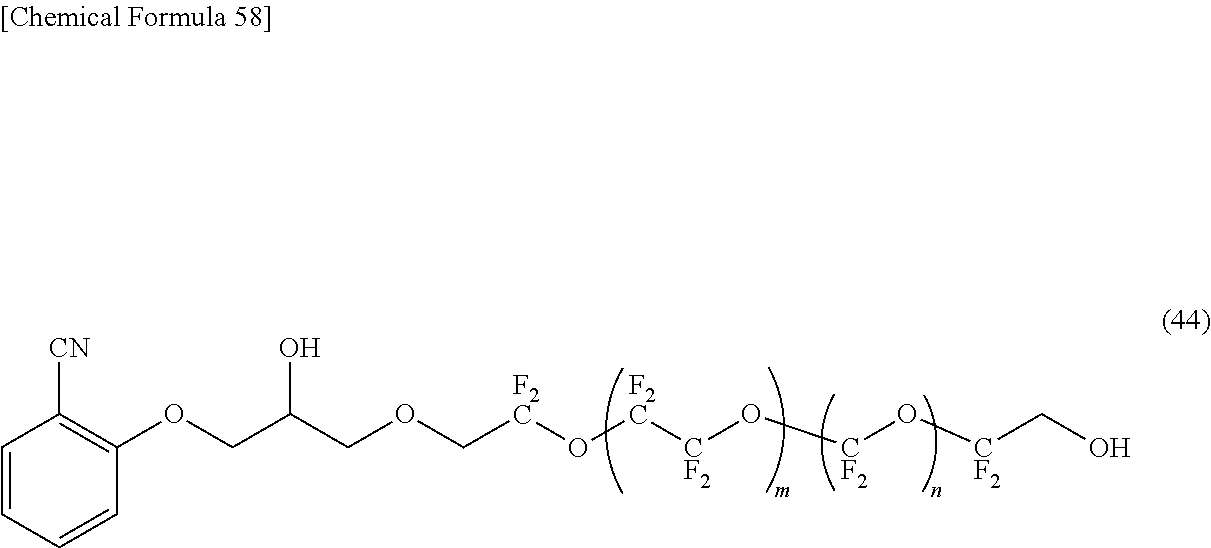
- the fluorine-containing ether compound represented by the formula (1) is preferably any one of compounds represented by the following formulas (A) to (R) and (V) to (AR).
- the repetition numbers m and n in the formulas (A) to (R) and (V) to (AR) are values indicating average values, and are not necessarily integers.
- R 1 and R 5 are each one of cyano group-substituted organic groups represented by formulas (6) to (12);
- R 2 and R 4 are each represented by the formula (2-1) in which a is 1 and X is O (oxygen atom);
- R and R 5 are the same and R 2 and R 4 are the same;
- R 3 is represented by the formula (3).
- R 1 and R 5 are different, R 5 is one of cyano group-substituted organic groups represented by formulas (6) to (10), R 1 is one of a phenyl group, a thienylethyl group, and an allyl group; R 2 and R 4 are the same, and R 2 and R 4 are each represented by the formula (2-1) in which a is 1 and X is O (oxygen atom); and R 3 is represented by the formula (3).
- R 1 and R 5 are different;
- R 5 is a cyano group-substituted organic group represented by the formula (6),
- R 1 is an allyl group;
- R 2 and R 4 are different,
- R 2 is represented by the formula (2-1) in which a is 2 and X is O, and
- R 4 is represented by the formula (2-1) in which a is 1 and X is O;
- R 3 is formula (3).
- R 1 and R 5 are different, R 5 is a cyano group-substituted organic group represented by the formula (6), and R 1 is a cyano group-substituted organic group represented by the formula (12); R 2 and R 4 are the same, R 2 is represented by the formula (2-1) in which a is 1 and X is O; and R 3 is formula (3).
- R 1 and R 5 are different, R 5 is represented by the formula (13) in which p is 1, and R is a cyano group-substituted organic group represented by the formula (12); R 2 and R 4 are the same, R 2 is represented by the formula (2-1) in which a is 1 and X is O; and R 3 is formula (3).
- R 1 and R 5 are different, R 5 is a cyano group-substituted organic group represented by the formula (6), and R 1 is an allyl group; R 2 and R 4 are different, R 2 is represented by the formula (2-1) in which a is 2 and X is O, and R 4 is represented by the formula (2-1), in which a is 1 and X is O; and R 3 is represented by the formula (5).
- R 1 and R 5 are each a cyano group-substituted organic group represented by the formula (6-2); and R 2 and R 4 are each represented by the formula (2-1) in which a is 1 and X is O (oxygen atom); R 1 and R 5 are the same and R 2 and R 4 are the same; and R 3 is represented by the formula (3).
- R 1 and R 5 are different, R 5 is represented by the formula (13) in which p is 1, and R 1 is a cyano group-substituted organic group represented by the formula (6-2); R 2 and R 4 are the same, R 2 is represented by the formula (2-1) in which a is 1 and X is O; and R 3 is represented by the formula (3).
- R 1 and R 5 are different, R 5 is an organic group represented by the formula (13) in which p is 1 and R 1 is a cyano group-substituted organic group represented by the formula (6-2); R 2 and R 4 are different, R 2 is represented by the formula (2-1) in which a is 1 and X is O, and R 4 is represented by the formula (2-1) in which a is 2 and X is O; and R 3 is represented by the formula (3).
- R 1 and R 5 are different, R 5 is a cyano group-substituted organic group represented by (6-2), and R 1 is an allyl group; R 2 and R 4 are different, R 2 is represented by the formula (2-1) in which a is 2 and X is O, and R 4 is represented by the formula (2-1) in which a is 1 and X is O; and R 3 is represented by the formula (3).
- R 1 and R 5 are different, R 5 is a cyano group-substituted organic group represented by the formula (6-2), and R 1 is a thienylethyl group; R 2 and R 4 are different, R 2 is represented by the formula (2-1) in which a is 2 and X is O, and R 4 is represented by the formula (2-1) in which a is 1 and X is O; and R 3 is formula (3).
- R 1 and R 5 are each a cyano group-substituted organic group represented by the formula (6-2), and R 2 and R 4 are each represented by the formula (2-1) in which a is 2 and X is O (oxygen atom); and R 3 is represented by the formula (3).
- R 1 and R 5 are different, R 5 is represented by the formula (13) in which p is 1 and R 1 is a cyano group-substituted organic group represented by the formula (6-2); R 2 and R 4 are different, R 2 is represented by the formula (2-1) in which a is 2 and X is O, and R 4 is represented by the formula (2-1) in which a is 1 and X is O; and R 3 is represented by the formula (3).
- R 1 and R 5 are different, R 5 is an organic group represented by the formula (13) in which p is 1 and R 1 is a cyano group-substituted organic group represented by the formula (6-2); R 2 and R 4 are each represented by the formula (2-1) in which a is 2 and X is O (oxygen atom); and R 3 is represented by the formula (3).
- R 1 and R 5 are different, R 5 is a cyano group-substituted organic group represented by (6-2), and R 1 is an allyl group; R 2 and R 4 are each represented by the formula (2-1) in which a is 2 and X is O (oxygen atom); and R 3 is represented by the formula (3).
- R 1 and R 5 are different, R 5 is a cyano group-substituted organic group represented by the formula (6-2), and R 1 is a thienylethyl group; R 2 and R 4 are each represented by the formula (2-1) in which a is 2 and X is O (oxygen atom); and R 3 is formula (3).
- R 1 and R 5 are different, R 5 is represented by the formula (13) in which p is 1, and R 1 is a cyano group-substituted organic group represented by the formula (6-2); R 2 and R 4 are different, R 2 is represented by the formula (2-1) in which a is 2 and X is O, R 4 is represented by the formula (2-1) in which a is 1 and two X are each O or CH 2 ; R 3 is represented by the formula (3).
- R 1 and R 5 are different, R 5 is represented by the formula (13) in which p is 1 and R 1 is a cyano group-substituted organic group represented by the formula (9-1); R 2 and R 4 are each represented by the formula (2-1) in which a is 1 and X is O (oxygen atom); and R 3 is formula (3).
- R 1 and R 5 are each a cyano group-substituted organic group represented by the formula (9-1);
- R 2 and R 4 are each represented by the formula (2-1) in which a is 2 and X is O (oxygen atom); and
- R 3 is represented by the formula (3).
- R 1 and R 5 are different, R 5 is represented by the formula (13) in which p is 1, and R is any one of cyano group-substituted organic groups represented by formulas (9-1) to (9-3); R 2 and R 4 are different, R 2 is represented by the formula (2-1) in which a is 2 and X is O, R 4 is represented by the formula (2-1) in which a is 1 and X is O; and R 3 is represented by the formula (3).
- R 1 and R 5 are different, and R 5 is represented by the formula (13) in which p is 1 and R 1 is a cyano group-substituted organic group represented by the formula (9-2); R 2 and R 4 are each represented by the formula (2-1) in which a is 2 and X is O (oxygen atom); and R 3 is the formula (3).
- R 1 and R 5 are different, R 5 is a cyano group-substituted organic group represented by the formula (6-2), and R 1 is a cyano group-substituted organic group represented by the formula (9-2); R 2 and R 4 are different, R 2 is the formula (2-1) in which a is 2 and X is O, and R 4 is the formula (2-1) in which a is 1 and X is O; and R 3 is the formula (3).
- R 1 and R 5 are different, R 5 is a cyano group-substituted organic group represented by the formula (6-2), and R 1 is a cyano group-substituted organic group represented by the formula (9-2); R 2 and R 4 are each represented by the formula (2-1) in which a is 2 and X is O (oxygen atom); and R 3 is the formula (3).
- R 1 and R 5 are each a cyano group-substituted organic group represented by the formula (6-2); R 2 and R 4 are different, R 2 is the formula (2-1) in which a is 1 and X is O and R 4 is the formula (2-1) in which a is 2 and X is O; and R 3 is the formula (3).
- R 1 and R 5 are different, R 5 is represented by the formula (13) in which p is 1 and R 1 is a cyano group-substituted organic group represented by the formula (9-2); R 2 and R 4 are each represented by the formula (2-1) in which a is 1 and X is O (oxygen atom); and R 3 is the formula (5).
- R 1 and R 5 are different, R 5 is represented by the formula (13) in which p is 1 and R 1 is a cyano group-substituted organic group represented by the formula (9-2); R 2 and R 4 are each represented by the formula (2-1) in which a is 1 and X is O (oxygen atom); and R 3 is represented by the formula (3) in which d is 0.
- m and n represent the average degree of polymerization and are each 0.1 to 20.
- m and n represent the average degree of polymerization and are each 0.1 to 20.
- m and n represent the average degree of polymerization and are each 0.1 to 20.
- m and n represent the average degree of polymerization and are each 0.1 to 20.
- m and n represent the average degree of polymerization and are each 0.1 to 20.
- m and n represent the average degree of polymerization and are each 0.1 to 20.
- m and n represent the average degree of polymerization and are each 0.1 to 20.
- m and n represent the average degree of polymerization and are each 0.1 to 20.
- m and n represent the average degree of polymerization and are each 0.1 to 20.
- m and n represent the average degree of polymerization and are each 0.1 to 20.
- m and n represent the average degree of polymerization and are each 0.1 to 20.
- m and n represent the average degree of polymerization and are each 0.1 to 20.
- m and n represent the average degree of polymerization and are each 0.1 to 20.
- m and n represent the average degree of polymerization and are each 0.1 to 20.
- m and n represent the average degree of polymerization and are each 0.1 to 20.
- m and n represent the average degree of polymerization and are each 0.1 to 20.
- m and n represent the average degree of polymerization and are each 0.1 to 20.
- m represents the average degree of polymerization and is 0.1 to 20.
- m and n represent the average degree of polymerization and are each 0.1 to 20.
- m and n represent the average degree of polymerization and are each 0.1 to 20.
- m and n represent the average degree of polymerization and are each 0.1 to 20.
- m and n represent the average degree of polymerization and are each 0.1 to 20.
- m and n represent the average degree of polymerization and are each 0.1 to 20.
- m and n represent the average degree of polymerization and are each 0.1 to 20.
- m and n represent the average degree of polymerization and are each 0.1 to 20.
- m and n represent the average degree of polymerization and are each 0.1 to 20.
- m and n represent the average degree of polymerization and are each 0.1 to 20.
- m and n represent the average degree of polymerization and are each 0.1 to 20.
- m and n represent the average degree of polymerization and are each 0.1 to 20.
- m and n represent the average degree of polymerization and are each 0.1 to 20.
- m and n represent the average degree of polymerization and are each 0.1 to 20.
- m and n represent the average degree of polymerization and are each 0.1 to 20.
- m and n represent the average degree of polymerization and are each 0.1 to 20.
- m and n represent the average degree of polymerization and are each 0.1 to 20.
- m and n represent the average degree of polymerization and are each 0.1 to 20.
- m and n represent the average degree of polymerization and are each 0.1 to 20.
- m and n represent the average degree of polymerization and are each 0.1 to 20.
- m and n represent the average degree of polymerization and are each 0.1 to 20.
- m represents the average degree of polymerization and is 0.1 to 20.
- m represents the average degree of polymerization and is 0.1 to 20.
- the number average molecular weight (Mn) of the fluorine-containing ether compound represented by the formula (1) is preferably in the range of 500 to 10,000, particularly preferably 1,000 to 5,000.
- the lubricant layer containing the fluorine-containing ether compound of the present embodiment has excellent heat resistance.
- the number average molecular weight of the fluorinated ether compound is more preferably 1000 or more. Further, when the number average molecular weight is 10,000 or less, the viscosity of the fluorine-containing ether compound becomes appropriate, and a thin lubricant layer can be easily formed by applying a lubricant containing the fluorine-containing ether compound.
- the number average molecular weight of the fluorine-containing ether compound is preferably 5000 or less because the viscosity of the lubricant using the fluorine-containing ether compound becomes easy to handle.
- the number average molecular weight (Mn) of the fluorine-containing ether compound is a value measured by 1 H-NMR and 19 F-NMR by using AVANCE III-400 manufactured by Bruker BioSpin. Specifically, the number of repeating units of the PFPE chain are calculated from the integral value measured by 19 F-NMR, and then the number average molecular weight are calculated.
- NMR nuclear magnetic resonance
- the sample is diluted in deuterated acetone solvent (hexafluorobenzene is added as a reference substance) and is used for measurement.
- the standard of 19 F-NMR chemical shift was set to ⁇ 164.7 ppm for the peak of hexafluorobenzene, and the standard of 1 H-NMR chemical shift was set to 2.05 ppm for the peak of acetone.
- the fluorine-containing ether compound represented by the formula (1) preferably has a molecular weight dispersity (ratio (Mw/Mn) of weight average molecular weight (Mw) and number average molecular weight (Mn)) of 1.3 or less, by carrying out molecular weight fractionation.
- the method of carrying out molecular weight fractionation need not be particularly limited.
- molecular weight fractionation may be carried out by silica gel column chromatography method, gel permeation chromatography (GPC) method, or the like.
- Molecular weight fractionation may also be carried out by supercritical extraction method.
- the method for producing the fluorine-containing ether compound of the present embodiment is not particularly limited, and the fluorine-containing ether compound can be produced using a conventionally known production method.
- the fluorine-containing ether compound of this embodiment can be produced using the method shown below, for example.
- a method of reacting a perfluoropolyether compound, having a perfluoropolyether main chain in the molecule and having hydroxy groups at both terminals, with a compound including an epoxy group at one terminal and a cyano group-substituted organic group at the other terminal may be used.
- the compound having an epoxy group at one terminal and a cyano group-substituted organic group at the other terminal include the compounds represented by the following formulas (14) to (20), (34), (40), (45), (47) and (49).
- a divalent linkage group having a polar group represented by R 2 and R 4 is linked to both terminals of the PFPE chain represented by R 3 .
- a cyano group-substituted organic group is bonded to at least one of them (R 1 and/or R 5 ).
- the PFPE chain covers the surface of the protective layer and reduces the frictional force between the magnetic head and the protective layer.
- the lubricant for magnetic recording medium of this embodiment contains a fluorine-containing ether compound represented by the formula (1).
- the lubricant of the present embodiment may use one or more known materials as a lubricant material by mixing them as necessary, as long as the known material does not impair the characteristics obtained by containing the fluorine-containing ether compound represented by the formula (1).
- known materials include, for example, FOMBLIN (registered trademark) ZDIAC, FOBLIN ZDEAL, FOMBLIN AM-2001 (the above materials are manufactured by Solvay Solexis), Moresco A20H (manufactured by Moresco) and the like.
- the known material used in combination with the lubricant of this embodiment preferably has a number average molecular weight of 1000 to 10,000.
- the amount of the fluorine-containing ether compound represented by formula (1) in the lubricant of this embodiment is preferably 50% by mass or more, and more preferably 70% by mass or more.
- the lubricant of this embodiment contains the fluorine-containing ether compound represented by the formula (1), the surface of the protective layer can be coated with a high coverage rate even when the thickness is reduced. As a result, a lubricant layer having excellent chemical resistance and wear resistance can be formed.
- the magnetic recording medium of the present embodiment is obtained by providing at least a magnetic layer, a protective layer, and a lubricant layer sequentially on a substrate.
- one or more base layers can be provided between the substrate and the magnetic layer as necessary. Further, an adhesion layer and/or a soft magnetic layer can be provided between the base layer and the substrate.
- FIG. 1 is a schematic cross-sectional view showing an embodiment of the magnetic recording medium of the present invention.
- the magnetic recording medium 10 of this embodiment has a structure in which an adhesion layer 12 , a soft magnetic layer 13 , a first base layer 14 , a second base layer 15 , a magnetic layer 16 , a protective layer 17 and a lubricant layer 18 are sequentially provided on a substrate 11 .
- a nonmagnetic substrate in which a film made of NiP or NiP alloy is formed on a base made of a metal or alloy material such as Al or Al alloy can be used.
- the substrate 11 may use a nonmagnetic substrate made of a nonmetallic material such as glass, ceramics, silicon, silicon carbide, carbon, or resin; or may use a nonmagnetic substrate obtained by forming a film made of NiP or NiP alloy on a base made of these nonmetallic materials.
- a nonmetallic material such as glass, ceramics, silicon, silicon carbide, carbon, or resin
- the glass substrate is suitable for increasing the recording density because it has rigidity and excellent smoothness.
- the glass substrates include an aluminosilicate glass substrate, and a chemically strengthened aluminosilicate glass substrate, which is particularly preferable.
- the roughness of the main surface of the substrate 11 is preferably ultra-smooth with Rmax of 6 nm or less and Ra of 0.6 nm or less.
- the surface roughness Rmax and Ra are based on the standards of JIS B0601.
- the adhesion layer 12 prevents the progress of corrosion of the substrate 11 that occurs when the substrate 11 and the soft magnetic layer 13 provided on the adhesion layer 12 are disposed in contact with each other.
- the material of the adhesion layer 12 may be appropriately selected from, for example, Cr, Cr alloy, Ti, Ti alloy, CrTi, NiAl, AlRu alloy and the like.
- the adhesion layer 12 can be formed by, for example, a sputtering method.
- the soft magnetic layer 13 preferably has a structure in which a first soft magnetic film, an intermediate layer made of a Ru film, and a second soft magnetic film are sequentially stacked. That is, it is preferable that the soft magnetic layer 13 has a structure in which the soft magnetic films above and below the intermediate layer are linked by antiferromagnetic coupling (AFC) by sandwiching the intermediate layer made of a Ru film between the two soft magnetic films.
- AFC antiferromagnetic coupling
- Examples of the material of the first soft magnetic film and the second soft magnetic film include a CoZrTa alloy and a CoFe alloy.
- any one of Zr, Ta, and Nb is added to the CoFe alloy used for the first soft magnetic film and the second soft magnetic film. This promotes the amorphization of the first soft magnetic film and the second soft magnetic film, and as a result, it becomes possible to improve the orientation of the first base layer (seed layer) and reduce the floating height of the magnetic head.
- the soft magnetic layer 13 can be formed by, for example, a sputtering method.
- the first base layer 14 is a layer for controlling the orientation and crystal sizes of the second base layer 15 and the magnetic layer 16 provided on top of the first base layer 14 .
- Examples of the first base layer 14 include a Cr layer, a Ta layer, a Ru layer, a CrMo alloy layer, a CoW alloy layer, a CrW alloy layer, a CrV alloy layer, and a CrTi alloy layer.
- the first base layer 14 can be formed by, for example, a sputtering method.
- the second base layer 15 is a layer for turning the magnetic layer 16 to a more favorable orientation.
- the second base layer 15 is preferably a layer made of Ru or a Ru alloy.
- the second base layer 15 may be composed of a single layer or may be composed of a plurality of layers. When the second base layer 15 is composed of a plurality of layers, all the layers may be formed from the same material, or at least one layer may be formed from a different material.
- the second base layer 15 can be formed by, for example, a sputtering method.
- the magnetic layer 16 is made of a magnetic film whose easy magnetization axis is oriented perpendicularly or horizontally to the substrate surface.
- the magnetic layer 16 is a layer containing Co and Pt, and may be a layer containing an oxide, Cr, B, Cu, Ta, Zr or the like in order to further improve the SNR characteristics.
- Examples of the oxide contained in the magnetic layer 16 include SiO 2 , SiO, Cr 2 O 3 , CoO, Ta 2 O 3 , and TiO 2 .
- the magnetic layer 16 may be composed of one layer, or may be composed of a plurality of magnetic layers made of materials having different compositions.
- the first magnetic layer 16 when the magnetic layer 16 is composed of three layers of a first magnetic layer, a second magnetic layer, and a third magnetic layer that are stacked in order from the bottom, it is preferable that the first magnetic layer has a granular structure that includes a material containing Co, Cr, and Pt and further containing an oxide.
- the oxide contained in the first magnetic layer for example, an oxide of each Cr, Si, Ta, Al, Ti, Mg, and Co is preferably used. Among these, TiO 2 , Cr 2 O 3 , SiO 2 or the like can be preferably used.
- the first magnetic layer is preferably made of a composite oxide in which two or more types of oxides are added. Of these, Cr 2 O 3 —SiO 2 , Cr 2 O 3 —TiO 2 , SiO 2 —TiO 2 or the like can be preferably used.
- the first magnetic layer may include at least one element selected from B, Ta, Mo, Cu, Nd, W, Nb, Sm, Tb, Ru, and Re in addition to Co, Cr, Pt, and oxide.
- the same material as those used for the first magnetic layer can be used for the second magnetic layer.
- the second magnetic layer preferably has a granular structure.
- the third magnetic layer preferably has a non-granular structure made of a material containing Co, Cr, Pt but containing no oxide.
- the third magnetic layer may contain one or more elements selected from B, Ta, Mo, Cu, Nd, W, Nb, Sm, Tb, Ru, Re, and Mn in addition to Co, Cr, and Pt.
- the magnetic layer 16 When the magnetic layer 16 is formed of a plurality of magnetic layers, it is preferable to provide a nonmagnetic layer between adjacent magnetic layers. When the magnetic layer 16 is composed of three layers of the first magnetic layer, the second magnetic layer, and the third magnetic layer, it is preferable to provide a nonmagnetic layer between the first magnetic layer and the second magnetic layer, and between the second magnetic layer and the third magnetic layer.
- Examples of materials that can be used favorably for the non-magnetic layers provided between the adjacent magnetic layers of the magnetic layer 16 include Ru, a Ru alloy, a CoCr alloy, and a CoCrX1 alloy (wherein X1 represents one or more elements selected from among Pt, Ta, Zr, Re, Ru, Cu, Nb, Ni, Mn, Ge, Si, O, N, W, Mo, Ti, V and B) and the like.
- an alloy material containing an oxide, a metal nitride, or a metal carbide for the nonmagnetic layer provided between the adjacent magnetic layers of the magnetic layer 16 .
- oxides that may be used include SiO 2 , Al 2 O 3 , Ta 2 O 5 , Cr 2 O 3 , MgO, Y 2 O 3 , TiO 2 , and the like.
- metal nitrides that may be used include AlN, Si 3 N 4 , TaN, CrN, and the like.
- metal carbides that may be used include TaC, BC, SiC, and the like.
- the nonmagnetic layer can be formed by, for example, a sputtering method.
- the magnetic layer 16 is preferably a magnetic layer for perpendicular magnetic recording in which the easy magnetization axis is oriented in a direction perpendicular to the substrate surface in order to achieve a higher recording density.
- the magnetic layer 16 may be in-plane magnetic recording.
- the magnetic layer 16 may be formed by using any conventionally known method such as a vapor deposition method, an ion beam sputtering method, or a magnetron sputtering method.
- the magnetic layer 16 is usually formed by a sputtering method.
- the protective layer 17 protects the magnetic layer 16 .
- the protective layer 17 may be composed of one layer or may be composed of a plurality of layers.
- a carbon-based protective layer can be preferably used, and an amorphous carbon protective layer is particularly preferable. It is preferable that the protective layer 17 is a carbon-based protective layer because interaction with a polar group (particularly a hydroxy group) contained in the fluorine-containing ether compound in the lubricant layer 18 is further increased.
- the adhesion between the carbon-based protective layer and the lubricant layer 18 can be controlled by making the carbon-based protective layer to contain hydrogenated carbon and/or nitrogenated carbon, and then adjusting the hydrogen content and/or the nitrogen content in the carbon-based protective layer.
- the hydrogen content in the carbon-based protective layer is preferably 3 to 20 atomic % as measured by the hydrogen forward scattering method (HFS).
- the nitrogen content in the carbon-based protective layer is preferably 4 to 15 atomic % as measured by X-ray photoelectron spectroscopy (XPS).
- the hydrogen and/or nitrogen contained in the carbon-based protective layer need not be uniformly contained in the entire carbon-based protective layer.
- the carbon-based protective layer is preferably a composition gradient layer in which nitrogen is contained on the lubricant layer 18 side of the protective layer 17 and hydrogen is contained on the magnetic layer 16 side of the protective layer 17 .
- the adhesion between the magnetic layer 16 and the carbon-based protective layer and the adhesion between the lubricant layer 18 and the carbon-based protective layer are further improved.
- the film thickness of the protective layer 17 is preferably 1 nm to 7 nm. When the thickness of the protective layer 17 is 1 nm or more, the performance of the protective layer 17 is sufficiently obtained.
- the thickness of the protective layer 17 is preferably 7 nm or less from the viewpoint of reducing the thickness of the protective layer 17 .
- a sputtering method using a target material containing carbon a chemical vapor deposition (CVD) method using a hydrocarbon raw material such as ethylene or toluene, an ion beam deposition (IBD) method, or the like can be used.
- CVD chemical vapor deposition
- IBD ion beam deposition
- a carbon-based protective layer When a carbon-based protective layer is formed as the protective layer 17 , it can be formed by, for example, a DC magnetron sputtering method. In particular, when a carbon-based protective layer is formed as the protective layer 17 , it is preferable to form an amorphous carbon protective layer by plasma CVD.
- the amorphous carbon protective layer formed by the plasma CVD method has a uniform surface and small roughness.
- the lubricant layer 18 prevents contamination of the magnetic recording medium 10 . Further, the lubricant layer 18 reduces the frictional force of the magnetic head of the magnetic recording/reproducing apparatus that slides on the magnetic recording medium 10 , and improves the durability of the magnetic recording medium 10 .
- the lubricant layer 18 is formed on and is in contact with the protective layer 17 , as shown in FIG. 1 .
- the lubricant layer 18 includes the above-described fluorine-containing ether compound.
- the protective layer 17 disposed under the lubricant layer 18 is a carbon-based protective layer
- the protective layer 17 is bonded to the fluorine-containing ether compound contained in the lubricant layer 18 with a particularly high bonding strength.
- the lubricant layer 18 is thin, it is easy to obtain the magnetic recording medium 10 in which the surface of the protective layer 17 is coated with a high coverage rate, and contamination of the surface of the magnetic recording medium 10 can be effectively prevented.
- the average film thickness of the lubricant layer 18 is preferably 0.5 nm (5 ⁇ ) to 2 nm (20 ⁇ ).
- the average film thickness of the lubricant layer 18 is 0.5 nm or more, the lubricant layer 18 is formed with a uniform film thickness without forming an island shape or a mesh shape. For this reason, the surface of the protective layer 17 can be covered with the lubricant layer 18 at a high coverage rate.
- the average film thickness of the lubricant layer 18 can be made sufficiently thin, and the floating height of the magnetic head can be sufficiently reduced.
- a method of forming the lubricant layer for example, a method of preparing a magnetic recording medium in the middle of production in which the layers up to the protective layer 17 are formed on the substrate 11 , applying a solution for forming a lubricant layer on the protective layer 17 , and then drying the layer, may be used.
- the lubricant layer-forming solution can be obtained by dispersing and dissolving the lubricant for magnetic recording medium of the above-described embodiment in a solvent as necessary to obtain a viscosity and concentration suitable for the coating method.
- solvents used in the lubricant layer-forming solution include fluorinated solvents such as Vertrel (registered trademark) XF (trade name, manufactured by Mitsui DuPont Fluorochemical Co., Ltd.).
- the method for applying the lubricant layer-forming solution is not particularly limited, and examples thereof include a spin-coating method, a spray method, a paper coating method, and a dip method.
- the following method can be used. First, the substrate 11 on which the layers up to the protective layer 17 are formed is dipped in the lubricant layer-forming solution placed in the dipping tank of the dip coater. Subsequently, the substrate 11 is pulled up from the dipping tank at a predetermined speed. Thus, the lubricant layer-forming solution is applied to the surface of the protective layer 17 on the substrate 11 .
- the lubricant layer-forming solution can be applied uniformly to the surface of the protective layer 17 , and the lubricant layer 18 can be formed on the protective layer 17 with a uniform film thickness.
- the substrate 11 on which the lubricant layer 18 is formed it is preferable to heat the substrate 11 on which the lubricant layer 18 is formed.
- the adhesion between the lubricant layer 18 and the protective layer 17 is improved, and the adhesive strength between the lubricant layer 18 and the protective layer 17 is improved.
- the heat treatment temperature is preferably 100 to 180° C.
- the heat treatment time is preferably 10 to 120 minutes.
- the lubricant layer 18 of the substrate 11 before or after the heat treatment may be subjected to a process of irradiating ultraviolet rays (UV).
- UV ultraviolet rays
- the magnetic recording medium 10 of the present embodiment is obtained by sequentially providing at least a magnetic layer 16 , a protective layer 17 , and a lubricant layer 18 on a substrate 11 .
- the lubricant layer 18 containing the above-mentioned fluorine-containing ether compound is formed on and in contact with the protective layer 17 .
- the lubricant layer 18 has excellent chemical substance resistance and wear resistance even when the thickness is small. Therefore, the magnetic recording medium 10 according to the present embodiment is excellent in reliability, and in particular, is excellent in suppression of silicon contamination and wear resistance.
- the magnetic recording medium 10 of the present embodiment which has a low magnetic head floating height (for example, 10 nm or less), and which has high reliability that operates stably over a long period of time even in a severe environment due to diversification of applications, can be obtained.
- the magnetic recording medium 10 of this embodiment is particularly suitable as a magnetic disk mounted in a LUL type magnetic disk device.
- a compound represented by the above formula (15) was synthesized in the same manner as Compound (14) except that lactonitrile was used instead of 2-cyanoethanol.
- a compound represented by the above formula (16) was synthesized in the same manner as Compound (14) except that 3-hydroxybutyronitrile was used instead of 2-cyanoethanol.
- a compound represented by the above formula (17) was synthesized in the same manner as Compound (14) except that 3-hydroxyglutaronitrile was used instead of 2-cyanoethanol.
- the compound represented by the above formula (18) was synthesized by oxidizing allyl cyanoacetate using metachloroperbenzoic acid.
- a compound represented by the above formula (19) was synthesized in the same manner as Compound (14) except that 2-cyanophenol was used in place of 2-cyanoethanol.
- a compound represented by the following formula (26) was synthesized using 1,3-diallyloxy-2-propanol, pyridine, and paratoluenesulfonyl chloride. Subsequently, the compound represented by the formula (27) was synthesized using the compound represented by the formula (26), trimethylsilylcyanide and tetra-n-butylammonium fluoride. Finally, an epoxy compound represented by the formula (20) was synthesized by oxidizing the compound represented by the formula (27) using metachloroperbenzoic acid.
- An epoxy compound represented by the formula (28) was synthesized using thiophene ethanol and epibromohydrin. 4.35 g of Compound (1) was synthesized in the same manner as in Example 8, except that 1.84 g of the epoxy compound represented by the formula (28) was used instead of the phenyl glycidyl ether in Example 8 and the compound represented by the formula (22) was synthesized as an intermediate.
- a compound represented by the following formula (30) was synthesized using diallyl glycidyl ether, 3,4-dihydro-2H-pyran and p-toluenesulfonic acid. Furthermore, the compound represented by the formula (30) was oxidized using metachloroperbenzoic acid to synthesize the epoxy compound represented by the formula (31).
- reaction product was cooled to 25° C., extracted with Vertrel XF, the organic layer was washed with water and dehydrated with anhydrous sodium sulfate. After the desiccant was filtered off, the filtrate was concentrated, and the residue was purified by silica gel column chromatography to obtain 8.01 g of a compound represented by the following formula (24).
- reaction product was cooled to 25° C., 20 g of hydrogen chloride methanol solution was added, and the mixture was stirred at 25° C. for 16 hours to be reacted. Then, it was neutralized with saturated sodium hydrogen carbonate aqueous solution, the reaction liquid was extracted with Vertrel XF, the organic layer was washed with water, and was dehydrated with anhydrous sodium sulfate. After the desiccant was filtered off, the filtrate was concentrated. The residue was purified by silica gel column chromatography to obtain 4.90 g of Compound (K).
- a compound represented by the following formula (32) was synthesized using ethylene glycol monoallyl ether, 3,4-dihydro-2H-pyran and p-toluenesulfonic acid. Furthermore, the epoxy compound represented by the following formula (33) was synthesized by oxidizing the compound represented by the formula (32) using metachloroperbenzoicacid.
- a compound represented by the above formula (34) was synthesized in the same manner as Compound (14) except that 3-cyanopropanol was used instead of 2-cyanoethanol.
- a compound represented by the following formula (36) was synthesized using ethylene glycol tert-butyl ether and allyl glycidyl ether. Furthermore, the epoxy compound represented by the following formula (37) was synthesized by oxidizing the compound represented by the formula (36) using metachloroperbenzoic acid.
- a compound represented by the following formula (38) was synthesized by the method shown below.
- the compound represented by the above formula (28) was hydrolyzed, and the primary hydroxyl group of the obtained compound was protected with a t-butyldimethylsilyl group. Thereafter, the secondary hydroxyl group was protected with a methoxymethyl group, and the t-butyldimethylsilyl group was removed from the resulting compound.
- the compound represented by the following formula (38) was obtained by reacting epibromohydrin with the resulting primary hydroxyl group.
- the compound represented by the above formula (40) was synthesized by the method shown below.
- the compound represented by the above formula (34) was hydrolyzed, and the primary hydroxyl group of the obtained compound was protected with a t-butyldimethylsilyl group. Thereafter, the secondary hydroxyl group was protected with a methoxymethyl group, and the t-butyldimethylsilyl group was removed from the resulting compound.
- the compound represented by the above formula (40) was obtained by reacting epibromohydrin with the resulting primary hydroxyl group.
- the compound represented by the above formula (AD) (in the formula (AD), m indicating the average degree of polymerization is 4.5 and n indicating the average degree of polymerization is 4.5) was obtained.
- the compound represented by the formula (AD) is referred to as Compound (AD).
- the compound represented by the above formula (AF) (in the formula (AF), m indicating the average degree of polymerization is 4.5 and n indicating the average degree of polymerization is 4.5) was obtained.
- the compound represented by the formula (AF) is referred to as Compound (AF).
- a compound represented by the following formula (42) was synthesized using 5-hexen-1-ol, 3,4-dihydro-2H-pyran and p-toluenesulfonic acid. Furthermore, the epoxy compound represented by the following formula (43) was synthesized by oxidizing the compound represented by the formula (42) using metachloroperbenzoic acid.
- the compound represented by the above formula (AH) (in the formula (AH), m indicating the average degree of polymerization is 4.5 and n indicating the average degree of polymerization is 4.5) was obtained.
- the compound represented by the formula (AH) is referred to as Compound (AH).
- the compound represented by the above formula (AI) (in the formula (A), m indicating the average degree of polymerization is 4.5 and n indicating the average degree of polymerization is 4.5) was obtained.
- the compound represented by the above formula (AI) is referred to as Compound (A).
- the compound represented by the above formula (45) was synthesized by the method shown below.
- a reaction product of 2-cyanophenol and allyl glycidyl ether was oxidized to synthesize a compound represented by the above formula (45).
- the compound represented by the above formula (AK) (in the formula (AK), m indicating the average degree of polymerization is 4.5 and n indicating the average degree of polymerization is 4.5) was obtained.
- the compound represented by the formula (AK) is referred to as Compound (AK).
- the compound represented by the above formula (47) was synthesized by the method shown below.
- a reaction product of 3-cyanophenol and allyl glycidyl ether was oxidized to synthesize a compound represented by the above formula (47).
- the compound represented by the above formula (AL) (in the formula (AL), m indicating the average degree of polymerization is 4.5 and n indicating the average degree of polymerization is 4.5) was obtained.
- the compound represented by the formula (AL) is referred to as Compound (AL).
- the compound represented by the above formula (49) was synthesized by the method shown below.
- a reaction product of 4-cyanophenol and allyl glycidyl ether was oxidized to synthesize a compound represented by the above formula (49).
- m indicating the average degree of polymerization is 4.5
- n indicating the average degree of polymerization is 4.5
- the compound represented by the above formula (AM) (in the formula (AM), m indicating the average degree of polymerization is 4.5 and n indicating the average degree of polymerization is 4.5) was obtained.
- the compound represented by the formula (AM) is referred to as Compound (AM).
- the compound represented by the above formula (AN) (in the formula (AN), m indicating the average degree of polymerization is 4.5 and n indicating the average degree of polymerization is 4.5) was obtained.
- the compound represented by the above formula (AN) is referred to as Compound (AN).
- the compound represented by the above formula (AO) (in the formula (AO), m indicating the average degree of polymerization is 4.5 and n indicating the average degree of polymerization is 4.5) was obtained.
- the compound represented by the above formula (AO) is referred to as Compound (AO).
- the compound represented by the above formula (AP) (in the formula (AP), m indicating the average degree of polymerization is 4.5, and n indicating the average degree of polymerization is 4.5) was obtained.
- the compound represented by the formula (AP) is referred to as Compound (AP).
- a compound represented by the following formula (S) was synthesized by the method described in Patent Document 1.
- a compound represented by the following formula (T) was synthesized by the method described in Patent Document 2.
- a compound represented by the following formula (U) was synthesized by the method described in Patent Document 3.
- a lubricant layer-forming solution was prepared by using the compounds obtained in Examples 1 to 40 and Comparative Examples 1 to 3 by the method described below. Then, using the obtained lubricant layer-forming solution, a lubricant layer of a magnetic recording medium was formed by the following method, and magnetic recording media of Examples 1 to 40 and Comparative Examples 1 to 3 were obtained.
- the compounds obtained in Examples 1 to 40 and Comparative Examples 1 to 3 were each dissolved in Vertrel (registered trademark) XF (trade name, manufactured by Mitsui DuPont Fluoro Chemical Co., Ltd.), which is a fluorine-based solvent, and diluted with Vertrel so that the film thickness would be 8.5 ⁇ to 10 ⁇ when applied onto the protective layer, and a lubricant layer-forming solution of 0.001 to 0.01% by mass was obtained.
- Vertrel registered trademark
- XF trade name, manufactured by Mitsui DuPont Fluoro Chemical Co., Ltd.
- a magnetic recording medium in which an adhesion layer, a soft magnetic layer, a first base layer, a second base layer, a magnetic layer, and a protective layer were sequentially provided on a 65 mm diameter substrate was prepared.
- the protective layer was made of carbon.
- the lubricant layer-forming solutions of Examples 1 to 40 and Comparative Examples 1 to 3 were applied by a dip method on the protective layer of the magnetic recording medium on which the layers up to the protective layer were formed.
- the magnetic recording medium coated with the lubricant layer-forming solution was placed in a thermostatic chamber at 120° C. and subjected to heat treatment for 10 minutes. As a result, a lubricant layer was formed on the protective layer to obtain a magnetic recording medium.
- the film thicknesses of the lubricant layers of the obtained magnetic recording media of Examples 1 to 40 and Comparative Examples 1 to 3 were measured using FT-IR (trade name: Nicolet iS50, manufactured by Thermo Fisher Scientific). The results are shown in Table 1.
- the film thickness of the lubricant layer was determined based on the correlation between the FT-IR method and the ellipsometry method.
- the main chain of the fluorine-containing ether compound of the present embodiment is mainly formed of C and F. Since the density of C—F in one molecule is different for each type of the compounds, even if the FT-IR peak height is the same, the actual film thickness may be different. Therefore, a disk having each film thickness of 6 to 20 ⁇ (in increments of 2 ⁇ ) was prepared, and an increase in film thickness from the disk surface without a lubricant was determined by using an ellipsometer.
- the peak height in C—F stretching vibration was measured using FT-IR, and a correlation equation was obtained from the obtained peak value and the ellipsometer value.
- the film thickness of the lubricant layers can be easily obtained by the FT-IR measurement.
- an alumina ball having a diameter of 2 mm was used as a contact and was slid on the lubricant layer of the magnetic recording medium with a load of 40 gf at a sliding speed of 0.25 m/sec, to measure a coefficient of friction of the surface of the lubricant layer.
- the sliding time until the coefficient of friction sharply increases was measured on the surface of the lubricant layer.
- the sliding time until the coefficient of friction sharply increases was measured four times for the lubricant layer of each magnetic recording medium, and an average value (time) thereof was used as an indicator of the wear resistance of the lubricant coating film.
- the time until the coefficient of friction sharply increases can be used as an indicator of the wear resistance of the lubricant layer for the following reason.
- wear progresses according to use of the magnetic recording medium.
- the contact and the protective layer are in direct contact with each other to cause the coefficient of friction to sharply increase.
- the magnetic recording media of Examples 1 to 40 have a longer sliding time until the coefficient of friction increases sharply than the magnetic recording media of Comparative Examples 1 to 3, and have good wear resistance.
- R 1 and R 5 are organic groups having 1 to 8 carbon atoms wherein one or more hydrogen atoms of the organic group is substituted with a cyano group, and R 2 and R 4 are divalent linkage groups having a polar group.
- the following evaluation method was used to examine the contamination of magnetic recording media with environmental substances that generate contaminants in a high temperature environment.
- Si ions were used as the environmental substance, and the amount of Si adsorption was measured as the amount of contaminants that contaminate the magnetic recording medium and that were generated by the environmental substance.
- the magnetic recording medium to be evaluated was held for 240 hours in the presence of a siloxane-based Si rubber in a high-temperature environment at a temperature of 85° C. and a humidity of 0%.
- the amount of Si adsorption existing on the surface of the magnetic recording medium was analyzed and measured using secondary ion mass spectrometry (SIMS), and the degree of contamination by Si ions was evaluated based on the amount of Si adsorption.
- SIMS secondary ion mass spectrometry
- the Si adsorption amount was evaluated using numerical values when the result of Comparative Example 1 was set to 1.00.
- the magnetic recording media of Examples 1 to 40 have a smaller amount of Si adsorption than the magnetic recording media of Comparative Examples 1 to 3, and are not easily contaminated by environmental substances in a high temperature environment.
Landscapes
- Chemical & Material Sciences (AREA)
- Organic Chemistry (AREA)
- Chemical Kinetics & Catalysis (AREA)
- General Chemical & Material Sciences (AREA)
- Oil, Petroleum & Natural Gas (AREA)
- Health & Medical Sciences (AREA)
- Medicinal Chemistry (AREA)
- Polymers & Plastics (AREA)
- Lubricants (AREA)
- Heterocyclic Compounds Containing Sulfur Atoms (AREA)
- Organic Low-Molecular-Weight Compounds And Preparation Thereof (AREA)
- Magnetic Record Carriers (AREA)
Abstract
Description
- [Patent Document 1] Japanese Patent No. 4632144
- [Patent Document 2] Japanese Patent No. 59909375909837
- [Patent Document 3] Japanese Patent No. 5465454
R1—R2—CH2—R3—CH2—R4—R5 (1)
—(X—CH2CH(OH)CH2)a—X— (2-1)
—CF2O—(CF2CF2O)c—(CF2O)a—CF2— (3)
—CF(CF3)—(OCF(CF3)CF2)e—OCF(CF3)— (4)
—CF2CF2—(OCF2CF2CF2)f—OCF2CF2— (5)
R1—R2—CH2—R3—CH2—R4—R5 (1)


—(X—CH2CH(OH)CH2)a—X— (2-1)
—CF2O—(CF2CF2O)c—(CF2O)a—CF2— (3)
—CF(CF3)—(OCF(CF3)CF2)c—OCF(CF3)— (4)
—CF2CF2—(OCF2CF2CF2)f—OCF2CF2— (5)




| TABLE 1 | |||||
| Time Until | |||||
| Coefficient | |||||
| Number | of Friction | ||||
| average | Film | Sharply | Si | ||
| Com- | molecular | thickness | Increases | Adsorption | |
| pound | weight | (Å) | (sec) | amount | |
| Example 1 | (A) | 1251 | 9.0 | 598 | 0.72 |
| Example 2 | (B) | 1251 | 9.0 | 602 | 0.75 |
| Example 3 | (C) | 1279 | 9.0 | 601 | 0.72 |
| Example 4 | (D) | 1329 | 9.0 | 624 | 0.70 |
| Example 5 | (E) | 1279 | 9.0 | 627 | 0.60 |
| Example 6 | (F) | 1347 | 9.5 | 684 | 0.65 |
| Example 7 | (G) | 1391 | 9.5 | 675 | 0.64 |
| Example 8 | (H) | 1274 | 9.5 | 675 | 0.64 |
| Example 9 | (I) | 1308 | 9.5 | 687 | 0.60 |
| Example 10 | (J) | 1238 | 9.0 | 661 | 0.59 |
| Example 11 | (K) | 1312 | 9.0 | 650 | 0.52 |
| Example 12 | (L) | 1252 | 9.0 | 649 | 0.64 |
| Example 13 | (M) | 1277 | 9.0 | 629 | 0.60 |
| Example 14 | (N) | 1252 | 9.0 | 633 | 0.61 |
| Example 15 | (O) | 1286 | 9.5 | 680 | 0.60 |
| Example 16 | (P) | 1321 | 9.5 | 680 | 0.60 |
| Example 17 | (Q) | 1312 | 9.5 | 680 | 0.60 |
| Example 18 | (R) | 1362 | 9.0 | 644 | 0.52 |
| Comparative | (S) | 1233 | 9.5 | 468 | 1.00 |
| Example 1 | |||||
| TABLE 2 | |||||
| Time Until | |||||
| Coefficient | |||||
| Number | of Friction | ||||
| average | Film | Sharply | Si | ||
| Com- | molecular | thickness | Increases | Adsorption | |
| pound | weight | (Å) | (sec) | amount | |
| Example 19 | (V) | 1282 | 9.0 | 610 | 0.72 |
| Example 20 | (W) | 1259 | 9.0 | 602 | 0.60 |
| Example 21 | (Y) | 1333 | 9.0 | 651 | 0.51 |
| Example 22 | (Z) | 1329 | 9.0 | 664 | 0.64 |
| Example 23 | (AA) | 1399 | 9.0 | 689 | 0.69 |
| Example 24 | (AB) | 1430 | 9.0 | 699 | 0.50 |
| Example 25 | (AC) | 1333 | 9.0 | 605 | 0.54 |
| Example 26 | (AD) | 1407 | 9.0 | 692 | 0.48 |
| Example 27 | (AE) | 1403 | 9.0 | 705 | 0.58 |
| Example 28 | (AF) | 1473 | 9.0 | 710 | 0.61 |
| Example 29 | (AG) | 1329 | 9.0 | 620 | 0.68 |
| Example 30 | (AH) | 1293 | 9.0 | 695 | 0.68 |
| Example 31 | (AI) | 1498 | 9.0 | 782 | 0.59 |
| Example 32 | (AJ) | 1367 | 8.5 | 631 | 0.62 |
| Example 33 | (AK) | 1365 | 8.5 | 635 | 0.65 |
| Example 34 | (AL) | 1366 | 8.5 | 642 | 0.67 |
| Example 35 | (AM) | 1441 | 8.5 | 669 | 0.55 |
| Example 36 | (AN) | 1390 | 8.5 | 701 | 0.66 |
| Example 37 | (AO) | 1464 | 8.5 | 727 | 0.55 |
| Example 38 | (AP) | 1356 | 9.0 | 654 | 0.52 |
| Example 39 | (AQ) | 1365 | 9.0 | 643 | 0.65 |
| Example 40 | (AR) | 1365 | 9.0 | 672 | 0.70 |
| Comparative | (T) | 1254 | 9.5 | 486 | 1.02 |
| Example 2 | |||||
| Comparative | (U) | 1300 | 9.5 | 492 | 1.10 |
| Example 3 | |||||
-
- 10 . . . Magnetic recording medium,
- 11 . . . Substrate,
- 12 . . . Adhesion layer,
- 13 . . . Soft magnetic layer,
- 14 . . . First base layer,
- 15 . . . Second base layer,
- 16 . . . Magnetic layer,
- 17 . . . Protective layer,
- 18 . . . Lubricant layer.
Claims (11)
R1—R2—CH2—R3—CH2—R4—R5 (1)
—(X—CH2CH(OH)CH2)a—X— (2-1)
—CF2O—(CF2CF2O)c—(CF2O)d—CF2— (3)
—CF(CF3)—(OCF(CF3)CF2)e—OCF(CF3)— (4)
—CF2CF2—(OCF2CF2CF2)f—OCF2CF2— (5)
Applications Claiming Priority (4)
| Application Number | Priority Date | Filing Date | Title |
|---|---|---|---|
| JPJP2017-158650 | 2017-08-21 | ||
| JP2017158650 | 2017-08-21 | ||
| JP2017-158650 | 2017-08-21 | ||
| PCT/JP2018/028455 WO2019039200A1 (en) | 2017-08-21 | 2018-07-30 | Fluorinated ether compound, lubricant for magnetic recording medium, and magnetic recording medium |
Publications (2)
| Publication Number | Publication Date |
|---|---|
| US20210188766A1 US20210188766A1 (en) | 2021-06-24 |
| US11639330B2 true US11639330B2 (en) | 2023-05-02 |
Family
ID=65438776
Family Applications (1)
| Application Number | Title | Priority Date | Filing Date |
|---|---|---|---|
| US16/640,132 Active 2040-03-07 US11639330B2 (en) | 2017-08-21 | 2018-07-30 | Fluorine-containing ether compound, lubricant for magnetic recording medium, and magnetic recording medium |
Country Status (4)
| Country | Link |
|---|---|
| US (1) | US11639330B2 (en) |
| JP (1) | JP7149947B2 (en) |
| CN (1) | CN111032625B (en) |
| WO (1) | WO2019039200A1 (en) |
Cited By (6)
| Publication number | Priority date | Publication date | Assignee | Title |
|---|---|---|---|---|
| US20220372390A1 (en) * | 2019-09-18 | 2022-11-24 | Showa Denko K.K. | Fluorine-containing ether compound, lubricant for magnetic recording medium, and magnetic recording medium |
| US20230002696A1 (en) * | 2019-11-07 | 2023-01-05 | Showa Denko K.K. | Fluorine-containing ether compound, lubricant for magnetic recording medium, and magnetic recording medium |
| US20230115042A1 (en) * | 2020-02-07 | 2023-04-13 | Showa Denko K.K. | Fluorine-containing ether compound, lubricant for magnetic recording medium, and magnetic recording medium |
| US11767483B2 (en) | 2018-09-12 | 2023-09-26 | Resonac Corporation | Fluorine-containing ether compound, lubricant for magnetic recording medium, and magnetic recording medium |
| US11820953B2 (en) | 2019-03-12 | 2023-11-21 | Resonac Corporation | Fluorine-containing ether compound, lubricant for magnetic recording medium and magnetic recording medium |
| US11905365B2 (en) | 2019-12-26 | 2024-02-20 | Resonac Corporation | Fluorine-containing ether compound, lubricant for magnetic recording medium, and magnetic recording medium |
Families Citing this family (11)
| Publication number | Priority date | Publication date | Assignee | Title |
|---|---|---|---|---|
| WO2020054420A1 (en) * | 2018-09-12 | 2020-03-19 | 昭和電工株式会社 | Fluorine-containing ether compound, magnetic recording medium lubricant and magnetic recording medium |
| US11873275B2 (en) * | 2019-06-10 | 2024-01-16 | Moresco Corporation | Perfluoropolyether compound, lubricant, and magnetic disk |
| JP7447903B2 (en) * | 2019-07-31 | 2024-03-12 | 株式会社レゾナック | Fluorine-containing ether compounds, lubricants for magnetic recording media, and magnetic recording media |
| JP7567801B2 (en) * | 2019-10-01 | 2024-10-16 | 株式会社レゾナック | Fluorine-containing ether compound, lubricant for magnetic recording medium, and magnetic recording medium |
| CN114845984B (en) * | 2019-12-23 | 2023-10-03 | 株式会社力森诺科 | Fluorine-containing ether compounds, lubricants for magnetic recording media and magnetic recording media |
| WO2021251335A1 (en) | 2020-06-11 | 2021-12-16 | 昭和電工株式会社 | Fluorine-containing ether compound, lubricant for magnetic recording medium, and magnetic recording medium |
| US20240101759A1 (en) * | 2020-12-18 | 2024-03-28 | Resonac Corporation | Fluorine-containing ether compound, lubricant for magnetic recording medium, and magnetic recording medium |
| US11414617B2 (en) * | 2021-01-13 | 2022-08-16 | Western Digital Technologies, Inc. | Lubricants and methods to determine dewetting thickness thereof |
| WO2023276954A1 (en) * | 2021-06-29 | 2023-01-05 | 昭和電工株式会社 | Fluorine-containing ether compound, lubricant for magnetic recording medium, and magnetic recording medium |
| JPWO2023033044A1 (en) * | 2021-09-02 | 2023-03-09 | ||
| JPWO2023112813A1 (en) * | 2021-12-15 | 2023-06-22 |
Citations (23)
| Publication number | Priority date | Publication date | Assignee | Title |
|---|---|---|---|---|
| JPS57176973A (en) | 1981-04-03 | 1982-10-30 | Du Pont | Perfluoroglycidyl ethers |
| US4526833A (en) | 1983-10-03 | 1985-07-02 | Minnesota Mining And Manufacturing Company | Magnetic recording medium having a perfluoropolyether polymer protective coating |
| JPH037798A (en) | 1989-06-05 | 1991-01-14 | Asahi Chem Ind Co Ltd | Lubricating oil for refrigerators |
| US5157066A (en) | 1988-09-26 | 1992-10-20 | Hitachi, Ltd. | Fluoroalkyl ether, surface modifying composition and method for modifying surface |
| JPH0512655A (en) | 1991-07-05 | 1993-01-22 | Konica Corp | Magnetic recording medium |
| US5221494A (en) | 1989-06-05 | 1993-06-22 | Asahi Kasei Kogyo Kabushiki Kaisha | Refrigerant composition comprising tetrafluoroethane refrigerant and lubricant having miscibility therewith at low temperature |
| JPH08259882A (en) | 1995-03-10 | 1996-10-08 | Ausimont Spa | Coatings based on fluorinated polyethers |
| JPH10106822A (en) | 1996-09-26 | 1998-04-24 | Nok Corp | Fluorine-based magnetic fluid |
| JPH1160720A (en) | 1997-08-22 | 1999-03-05 | Showa Denko Kk | Polyether compound and magnetic recording medium |
| CN1705698A (en) | 2002-10-18 | 2005-12-07 | 索尼化学株式会社 | Perfluoropolyether ester compounds, lubricants and magnetic recording media |
| WO2009035075A1 (en) | 2007-09-14 | 2009-03-19 | Fuji Electric Device Technology Co., Ltd. | Magnetic recording medium |
| JP2009266360A (en) | 2008-03-30 | 2009-11-12 | Hoya Corp | Magnetic disk and process for producing magnetic disk |
| JP2010143855A (en) | 2008-12-18 | 2010-07-01 | Moresco Corp | Perfluoropolyether compound, method for producing the same, lubricant containing the compound and magnetic disk |
| JP2010282707A (en) | 2009-06-08 | 2010-12-16 | Showa Denko HD Singapore Pte Ltd | Magnetic recording medium, magnetic recording medium manufacturing method, and magnetic recording / reproducing apparatus |
| JP2012009090A (en) | 2010-06-22 | 2012-01-12 | Wd Media (Singapore) Pte. Ltd | Method for manufacturing magnetic disk |
| CN102639477A (en) | 2009-11-26 | 2012-08-15 | 旭硝子株式会社 | Ether Compound, Lubricant Containing Same, and Composition For Lubricant Containing Same |
| US20130209837A1 (en) | 2012-02-13 | 2013-08-15 | Moresco Corporation | Fluoropolyether compound, lubricant and magnetic disk each containing the same |
| WO2016084781A1 (en) | 2014-11-28 | 2016-06-02 | 株式会社Moresco | Fluoropolyether compound, lubricant, magnetic disk, and method for producing same |
| US20160203839A1 (en) | 2013-12-17 | 2016-07-14 | Moresco Corporation | Fluoropolyether compound, lubricant containing same, and magnetic disk |
| WO2017145995A1 (en) | 2016-02-22 | 2017-08-31 | 昭和電工株式会社 | Fluorine-containing ether compound, lubricant for magnetic recording medium, and magnetic recording medium |
| US20170331155A1 (en) * | 2016-05-10 | 2017-11-16 | Seeo, Inc | Fluorinated electrolytes with nitrile groups |
| US20180127543A1 (en) | 2016-11-07 | 2018-05-10 | Showa Denko K.K. | Organic fluorine compound and lubricant |
| US20210062102A1 (en) | 2017-09-13 | 2021-03-04 | Showa Denko K.K. | Fluorine-containing ether compound, lubricant for magnetic recording media, and magnetic recording medium |
-
2018
- 2018-07-30 JP JP2019538022A patent/JP7149947B2/en active Active
- 2018-07-30 CN CN201880053594.9A patent/CN111032625B/en active Active
- 2018-07-30 WO PCT/JP2018/028455 patent/WO2019039200A1/en not_active Ceased
- 2018-07-30 US US16/640,132 patent/US11639330B2/en active Active
Patent Citations (35)
| Publication number | Priority date | Publication date | Assignee | Title |
|---|---|---|---|---|
| US4360645A (en) | 1981-04-03 | 1982-11-23 | E. I. Du Pont De Nemours And Company | Perfluoroglycidyl ethers |
| JPS57176973A (en) | 1981-04-03 | 1982-10-30 | Du Pont | Perfluoroglycidyl ethers |
| US4526833A (en) | 1983-10-03 | 1985-07-02 | Minnesota Mining And Manufacturing Company | Magnetic recording medium having a perfluoropolyether polymer protective coating |
| US5157066A (en) | 1988-09-26 | 1992-10-20 | Hitachi, Ltd. | Fluoroalkyl ether, surface modifying composition and method for modifying surface |
| US5221494A (en) | 1989-06-05 | 1993-06-22 | Asahi Kasei Kogyo Kabushiki Kaisha | Refrigerant composition comprising tetrafluoroethane refrigerant and lubricant having miscibility therewith at low temperature |
| JPH037798A (en) | 1989-06-05 | 1991-01-14 | Asahi Chem Ind Co Ltd | Lubricating oil for refrigerators |
| JPH0512655A (en) | 1991-07-05 | 1993-01-22 | Konica Corp | Magnetic recording medium |
| JPH08259882A (en) | 1995-03-10 | 1996-10-08 | Ausimont Spa | Coatings based on fluorinated polyethers |
| US5959058A (en) | 1995-03-10 | 1999-09-28 | Ausimont S.P.A. | Coatings based on fluoropolyethers |
| JPH10106822A (en) | 1996-09-26 | 1998-04-24 | Nok Corp | Fluorine-based magnetic fluid |
| JPH1160720A (en) | 1997-08-22 | 1999-03-05 | Showa Denko Kk | Polyether compound and magnetic recording medium |
| CN1705698A (en) | 2002-10-18 | 2005-12-07 | 索尼化学株式会社 | Perfluoropolyether ester compounds, lubricants and magnetic recording media |
| US20100233513A1 (en) | 2007-09-14 | 2010-09-16 | Fuji Electric Device Technology Co. Ltd. | Magnetic recording medium |
| WO2009035075A1 (en) | 2007-09-14 | 2009-03-19 | Fuji Electric Device Technology Co., Ltd. | Magnetic recording medium |
| JP4632144B2 (en) | 2007-09-14 | 2011-02-16 | 富士電機デバイステクノロジー株式会社 | Magnetic recording medium |
| US20100261039A1 (en) | 2008-03-30 | 2010-10-14 | Hoya Corporation | Magnetic disk and method of manufacturing the same |
| JP2009266360A (en) | 2008-03-30 | 2009-11-12 | Hoya Corp | Magnetic disk and process for producing magnetic disk |
| JP5465454B2 (en) | 2008-03-30 | 2014-04-09 | ダブリュディ・メディア・シンガポール・プライベートリミテッド | Magnetic disk and manufacturing method thereof |
| JP2010143855A (en) | 2008-12-18 | 2010-07-01 | Moresco Corp | Perfluoropolyether compound, method for producing the same, lubricant containing the compound and magnetic disk |
| JP2010282707A (en) | 2009-06-08 | 2010-12-16 | Showa Denko HD Singapore Pte Ltd | Magnetic recording medium, magnetic recording medium manufacturing method, and magnetic recording / reproducing apparatus |
| CN102639477A (en) | 2009-11-26 | 2012-08-15 | 旭硝子株式会社 | Ether Compound, Lubricant Containing Same, and Composition For Lubricant Containing Same |
| US20120225217A1 (en) | 2010-06-22 | 2012-09-06 | Wd Media (Singapore) Pte. Ltd. | Method of producing a magnetic recording disc |
| JP2012009090A (en) | 2010-06-22 | 2012-01-12 | Wd Media (Singapore) Pte. Ltd | Method for manufacturing magnetic disk |
| US20130209837A1 (en) | 2012-02-13 | 2013-08-15 | Moresco Corporation | Fluoropolyether compound, lubricant and magnetic disk each containing the same |
| JP2013163667A (en) | 2012-02-13 | 2013-08-22 | Moresco Corp | Fluoropolyether compound, lubricant and magnetic disc each containing the same |
| JP5909837B2 (en) | 2012-02-13 | 2016-04-27 | 株式会社Moresco | Fluoropolyether compound, lubricant containing the same, and magnetic disk |
| US20160203839A1 (en) | 2013-12-17 | 2016-07-14 | Moresco Corporation | Fluoropolyether compound, lubricant containing same, and magnetic disk |
| WO2016084781A1 (en) | 2014-11-28 | 2016-06-02 | 株式会社Moresco | Fluoropolyether compound, lubricant, magnetic disk, and method for producing same |
| US20170260472A1 (en) | 2014-11-28 | 2017-09-14 | Moresco Corporation | Fluoropolyether compound, lubricant, magnetic disk, and method for producing same |
| WO2017145995A1 (en) | 2016-02-22 | 2017-08-31 | 昭和電工株式会社 | Fluorine-containing ether compound, lubricant for magnetic recording medium, and magnetic recording medium |
| US20170331155A1 (en) * | 2016-05-10 | 2017-11-16 | Seeo, Inc | Fluorinated electrolytes with nitrile groups |
| US20180127543A1 (en) | 2016-11-07 | 2018-05-10 | Showa Denko K.K. | Organic fluorine compound and lubricant |
| JP2018076404A (en) | 2016-11-07 | 2018-05-17 | 昭和電工株式会社 | Organofluorine compound and lubricant |
| US20210062102A1 (en) | 2017-09-13 | 2021-03-04 | Showa Denko K.K. | Fluorine-containing ether compound, lubricant for magnetic recording media, and magnetic recording medium |
| US11261394B2 (en) * | 2017-09-13 | 2022-03-01 | Showa Denko K.K. | Fluorine-containing ether compound, lubricant for magnetic recording media, and magnetic recording medium |
Non-Patent Citations (6)
| Title |
|---|
| First Office Action dated May 7, 2022 issued by the Chinese Patent Office in Chinese Application No. 201880053594.9. |
| International Search Report for PCT/JP2018/031161 dated, Nov. 27, 2018 (PCT/ISA/210). |
| International Search Report of PCT/JP2018/028455 dated Oct. 2, 2018 [PCT/ISA/210]. |
| Notice of Allowance dated Dec. 2, 2021 in U.S. Appl. No. 16/644,586. |
| Notice of Allowance dated Nov. 9, 2021 in U.S. Appl. No. 16/644,586. |
| Office Action dated Jul. 23, 2021 in U.S. Appl. No. 16/644,586. |
Cited By (9)
| Publication number | Priority date | Publication date | Assignee | Title |
|---|---|---|---|---|
| US11767483B2 (en) | 2018-09-12 | 2023-09-26 | Resonac Corporation | Fluorine-containing ether compound, lubricant for magnetic recording medium, and magnetic recording medium |
| US11820953B2 (en) | 2019-03-12 | 2023-11-21 | Resonac Corporation | Fluorine-containing ether compound, lubricant for magnetic recording medium and magnetic recording medium |
| US20220372390A1 (en) * | 2019-09-18 | 2022-11-24 | Showa Denko K.K. | Fluorine-containing ether compound, lubricant for magnetic recording medium, and magnetic recording medium |
| US11879109B2 (en) * | 2019-09-18 | 2024-01-23 | Resonac Corporation | Fluorine-containing ether compound, lubricant for magnetic recording medium, and magnetic recording medium |
| US20230002696A1 (en) * | 2019-11-07 | 2023-01-05 | Showa Denko K.K. | Fluorine-containing ether compound, lubricant for magnetic recording medium, and magnetic recording medium |
| US12338407B2 (en) * | 2019-11-07 | 2025-06-24 | Resonac Corporation | Fluorine-containing ether compound, lubricant for magnetic recording medium, and magnetic recording medium |
| US11905365B2 (en) | 2019-12-26 | 2024-02-20 | Resonac Corporation | Fluorine-containing ether compound, lubricant for magnetic recording medium, and magnetic recording medium |
| US20230115042A1 (en) * | 2020-02-07 | 2023-04-13 | Showa Denko K.K. | Fluorine-containing ether compound, lubricant for magnetic recording medium, and magnetic recording medium |
| US12100434B2 (en) * | 2020-02-07 | 2024-09-24 | Resonac Corporation | Fluorine-containing ether compound, lubricant for magnetic recording medium, and magnetic recording medium |
Also Published As
| Publication number | Publication date |
|---|---|
| CN111032625B (en) | 2022-12-09 |
| WO2019039200A1 (en) | 2019-02-28 |
| US20210188766A1 (en) | 2021-06-24 |
| JP7149947B2 (en) | 2022-10-07 |
| CN111032625A (en) | 2020-04-17 |
| JPWO2019039200A1 (en) | 2020-07-30 |
Similar Documents
| Publication | Publication Date | Title |
|---|---|---|
| US20210188766A1 (en) | Fluorine-containing ether compound, lubricant for magnetic recording medium, and magnetic recording medium | |
| US11479641B2 (en) | Fluorine-containing ether compound, lubricant for magnetic recording medium, and magnetic recording medium | |
| US11261394B2 (en) | Fluorine-containing ether compound, lubricant for magnetic recording media, and magnetic recording medium | |
| US11180457B2 (en) | Fluorine-containing ether compound, lubricant for magnetic recording medium, and magnetic recording medium | |
| US11220649B2 (en) | Fluorine-containing ether compound, lubricant for magnetic recording medium, and magnetic recording medium | |
| US11905365B2 (en) | Fluorine-containing ether compound, lubricant for magnetic recording medium, and magnetic recording medium | |
| US12057151B2 (en) | Fluorine-containing ether compound, lubricant for magnetic recording medium, and magnetic recording medium | |
| US20190084911A1 (en) | Fluorine-containing ether compound, lubricant for magnetic recording medium, and magnetic recording medium | |
| WO2018139174A1 (en) | Fluoroether compound, lubricant for magnetic recording medium, and magnetic recording medium | |
| US12531088B2 (en) | Fluorine-containing ether compound, lubricant for magnetic recording medium, and magnetic recording medium | |
| US20250326980A1 (en) | Fluorine-containing ether compound, lubricant for magnetic recording medium and magnetic recording medium | |
| CN115038685B (en) | Fluorine-containing ether compound, lubricant for magnetic recording medium, and magnetic recording medium | |
| US11661408B2 (en) | Fluorine-containing ether compound, lubricant for magnetic recording medium, and magnetic recording medium | |
| US11767483B2 (en) | Fluorine-containing ether compound, lubricant for magnetic recording medium, and magnetic recording medium | |
| CN118382611A (en) | Fluorine-containing ether compound, lubricant for magnetic recording medium, and magnetic recording medium | |
| US20250283008A1 (en) | Fluorine-containing ether compound, lubricant for magnetic recording medium, and magnetic recording medium | |
| US12275911B2 (en) | Fluorine-containing ether compound, lubricant for magnetic recording medium, and magnetic recording medium | |
| US20250297063A1 (en) | Fluorine-containing ether compound, method for producing same, lubricant for magnetic recording media, and magnetic recording media | |
| WO2025220682A1 (en) | Fluorine-containing ether compound, coated product, lubricant for magnetic recording medium, and magnetic recording medium |
Legal Events
| Date | Code | Title | Description |
|---|---|---|---|
| AS | Assignment |
Owner name: SHOWA DENKO K.K., JAPAN Free format text: ASSIGNMENT OF ASSIGNORS INTEREST;ASSIGNORS:NANKO, MASAKI;FUKUMOTO, NAOYA;YAGYU, DAISUKE;AND OTHERS;REEL/FRAME:051857/0876 Effective date: 20200212 |
|
| FEPP | Fee payment procedure |
Free format text: ENTITY STATUS SET TO UNDISCOUNTED (ORIGINAL EVENT CODE: BIG.); ENTITY STATUS OF PATENT OWNER: LARGE ENTITY |
|
| STPP | Information on status: patent application and granting procedure in general |
Free format text: APPLICATION DISPATCHED FROM PREEXAM, NOT YET DOCKETED |
|
| STPP | Information on status: patent application and granting procedure in general |
Free format text: DOCKETED NEW CASE - READY FOR EXAMINATION |
|
| STPP | Information on status: patent application and granting procedure in general |
Free format text: NON FINAL ACTION MAILED |
|
| STPP | Information on status: patent application and granting procedure in general |
Free format text: RESPONSE TO NON-FINAL OFFICE ACTION ENTERED AND FORWARDED TO EXAMINER |
|
| STCF | Information on status: patent grant |
Free format text: PATENTED CASE |
|
| AS | Assignment |
Owner name: RESONAC CORPORATION, JAPAN Free format text: CHANGE OF NAME;ASSIGNOR:SHOWA DENKO K.K.;REEL/FRAME:064082/0513 Effective date: 20230623 |
|
| AS | Assignment |
Owner name: RESONAC CORPORATION, JAPAN Free format text: CHANGE OF ADDRESS;ASSIGNOR:RESONAC CORPORATION;REEL/FRAME:066599/0037 Effective date: 20231001 |