US11637310B2 - Lithium secondary battery including sulfone-based additive - Google Patents
Lithium secondary battery including sulfone-based additive Download PDFInfo
- Publication number
- US11637310B2 US11637310B2 US16/101,927 US201816101927A US11637310B2 US 11637310 B2 US11637310 B2 US 11637310B2 US 201816101927 A US201816101927 A US 201816101927A US 11637310 B2 US11637310 B2 US 11637310B2
- Authority
- US
- United States
- Prior art keywords
- secondary battery
- lithium secondary
- lithium
- active material
- combination
- Prior art date
- Legal status (The legal status is an assumption and is not a legal conclusion. Google has not performed a legal analysis and makes no representation as to the accuracy of the status listed.)
- Active, expires
Links
Classifications
-
- H—ELECTRICITY
- H01—ELECTRIC ELEMENTS
- H01M—PROCESSES OR MEANS, e.g. BATTERIES, FOR THE DIRECT CONVERSION OF CHEMICAL ENERGY INTO ELECTRICAL ENERGY
- H01M4/00—Electrodes
- H01M4/02—Electrodes composed of, or comprising, active material
- H01M4/36—Selection of substances as active materials, active masses, active liquids
- H01M4/48—Selection of substances as active materials, active masses, active liquids of inorganic oxides or hydroxides
- H01M4/50—Selection of substances as active materials, active masses, active liquids of inorganic oxides or hydroxides of manganese
- H01M4/505—Selection of substances as active materials, active masses, active liquids of inorganic oxides or hydroxides of manganese of mixed oxides or hydroxides containing manganese for inserting or intercalating light metals, e.g. LiMn2O4 or LiMn2OxFy
-
- H—ELECTRICITY
- H01—ELECTRIC ELEMENTS
- H01M—PROCESSES OR MEANS, e.g. BATTERIES, FOR THE DIRECT CONVERSION OF CHEMICAL ENERGY INTO ELECTRICAL ENERGY
- H01M10/00—Secondary cells; Manufacture thereof
- H01M10/05—Accumulators with non-aqueous electrolyte
- H01M10/052—Li-accumulators
- H01M10/0525—Rocking-chair batteries, i.e. batteries with lithium insertion or intercalation in both electrodes; Lithium-ion batteries
-
- C—CHEMISTRY; METALLURGY
- C07—ORGANIC CHEMISTRY
- C07C—ACYCLIC OR CARBOCYCLIC COMPOUNDS
- C07C317/00—Sulfones; Sulfoxides
- C07C317/14—Sulfones; Sulfoxides having sulfone or sulfoxide groups bound to carbon atoms of six-membered aromatic rings
-
- H—ELECTRICITY
- H01—ELECTRIC ELEMENTS
- H01M—PROCESSES OR MEANS, e.g. BATTERIES, FOR THE DIRECT CONVERSION OF CHEMICAL ENERGY INTO ELECTRICAL ENERGY
- H01M10/00—Secondary cells; Manufacture thereof
- H01M10/05—Accumulators with non-aqueous electrolyte
- H01M10/056—Accumulators with non-aqueous electrolyte characterised by the materials used as electrolytes, e.g. mixed inorganic/organic electrolytes
- H01M10/0564—Accumulators with non-aqueous electrolyte characterised by the materials used as electrolytes, e.g. mixed inorganic/organic electrolytes the electrolyte being constituted of organic materials only
- H01M10/0565—Polymeric materials, e.g. gel-type or solid-type
-
- H—ELECTRICITY
- H01—ELECTRIC ELEMENTS
- H01M—PROCESSES OR MEANS, e.g. BATTERIES, FOR THE DIRECT CONVERSION OF CHEMICAL ENERGY INTO ELECTRICAL ENERGY
- H01M10/00—Secondary cells; Manufacture thereof
- H01M10/05—Accumulators with non-aqueous electrolyte
- H01M10/056—Accumulators with non-aqueous electrolyte characterised by the materials used as electrolytes, e.g. mixed inorganic/organic electrolytes
- H01M10/0564—Accumulators with non-aqueous electrolyte characterised by the materials used as electrolytes, e.g. mixed inorganic/organic electrolytes the electrolyte being constituted of organic materials only
- H01M10/0566—Liquid materials
- H01M10/0567—Liquid materials characterised by the additives
-
- H—ELECTRICITY
- H01—ELECTRIC ELEMENTS
- H01M—PROCESSES OR MEANS, e.g. BATTERIES, FOR THE DIRECT CONVERSION OF CHEMICAL ENERGY INTO ELECTRICAL ENERGY
- H01M10/00—Secondary cells; Manufacture thereof
- H01M10/05—Accumulators with non-aqueous electrolyte
- H01M10/056—Accumulators with non-aqueous electrolyte characterised by the materials used as electrolytes, e.g. mixed inorganic/organic electrolytes
- H01M10/0564—Accumulators with non-aqueous electrolyte characterised by the materials used as electrolytes, e.g. mixed inorganic/organic electrolytes the electrolyte being constituted of organic materials only
- H01M10/0566—Liquid materials
- H01M10/0568—Liquid materials characterised by the solutes
-
- H—ELECTRICITY
- H01—ELECTRIC ELEMENTS
- H01M—PROCESSES OR MEANS, e.g. BATTERIES, FOR THE DIRECT CONVERSION OF CHEMICAL ENERGY INTO ELECTRICAL ENERGY
- H01M10/00—Secondary cells; Manufacture thereof
- H01M10/05—Accumulators with non-aqueous electrolyte
- H01M10/056—Accumulators with non-aqueous electrolyte characterised by the materials used as electrolytes, e.g. mixed inorganic/organic electrolytes
- H01M10/0564—Accumulators with non-aqueous electrolyte characterised by the materials used as electrolytes, e.g. mixed inorganic/organic electrolytes the electrolyte being constituted of organic materials only
- H01M10/0566—Liquid materials
- H01M10/0569—Liquid materials characterised by the solvents
-
- H—ELECTRICITY
- H01—ELECTRIC ELEMENTS
- H01M—PROCESSES OR MEANS, e.g. BATTERIES, FOR THE DIRECT CONVERSION OF CHEMICAL ENERGY INTO ELECTRICAL ENERGY
- H01M4/00—Electrodes
- H01M4/02—Electrodes composed of, or comprising, active material
- H01M4/36—Selection of substances as active materials, active masses, active liquids
- H01M4/48—Selection of substances as active materials, active masses, active liquids of inorganic oxides or hydroxides
- H01M4/485—Selection of substances as active materials, active masses, active liquids of inorganic oxides or hydroxides of mixed oxides or hydroxides for inserting or intercalating light metals, e.g. LiTi2O4 or LiTi2OxFy
-
- H—ELECTRICITY
- H01—ELECTRIC ELEMENTS
- H01M—PROCESSES OR MEANS, e.g. BATTERIES, FOR THE DIRECT CONVERSION OF CHEMICAL ENERGY INTO ELECTRICAL ENERGY
- H01M4/00—Electrodes
- H01M4/02—Electrodes composed of, or comprising, active material
- H01M4/36—Selection of substances as active materials, active masses, active liquids
- H01M4/48—Selection of substances as active materials, active masses, active liquids of inorganic oxides or hydroxides
- H01M4/52—Selection of substances as active materials, active masses, active liquids of inorganic oxides or hydroxides of nickel, cobalt or iron
- H01M4/525—Selection of substances as active materials, active masses, active liquids of inorganic oxides or hydroxides of nickel, cobalt or iron of mixed oxides or hydroxides containing iron, cobalt or nickel for inserting or intercalating light metals, e.g. LiNiO2, LiCoO2 or LiCoOxFy
-
- H—ELECTRICITY
- H01—ELECTRIC ELEMENTS
- H01M—PROCESSES OR MEANS, e.g. BATTERIES, FOR THE DIRECT CONVERSION OF CHEMICAL ENERGY INTO ELECTRICAL ENERGY
- H01M4/00—Electrodes
- H01M4/02—Electrodes composed of, or comprising, active material
- H01M2004/026—Electrodes composed of, or comprising, active material characterised by the polarity
- H01M2004/027—Negative electrodes
-
- H—ELECTRICITY
- H01—ELECTRIC ELEMENTS
- H01M—PROCESSES OR MEANS, e.g. BATTERIES, FOR THE DIRECT CONVERSION OF CHEMICAL ENERGY INTO ELECTRICAL ENERGY
- H01M4/00—Electrodes
- H01M4/02—Electrodes composed of, or comprising, active material
- H01M2004/026—Electrodes composed of, or comprising, active material characterised by the polarity
- H01M2004/028—Positive electrodes
-
- H—ELECTRICITY
- H01—ELECTRIC ELEMENTS
- H01M—PROCESSES OR MEANS, e.g. BATTERIES, FOR THE DIRECT CONVERSION OF CHEMICAL ENERGY INTO ELECTRICAL ENERGY
- H01M2300/00—Electrolytes
- H01M2300/0017—Non-aqueous electrolytes
- H01M2300/0025—Organic electrolyte
- H01M2300/0028—Organic electrolyte characterised by the solvent
- H01M2300/0037—Mixture of solvents
-
- Y—GENERAL TAGGING OF NEW TECHNOLOGICAL DEVELOPMENTS; GENERAL TAGGING OF CROSS-SECTIONAL TECHNOLOGIES SPANNING OVER SEVERAL SECTIONS OF THE IPC; TECHNICAL SUBJECTS COVERED BY FORMER USPC CROSS-REFERENCE ART COLLECTIONS [XRACs] AND DIGESTS
- Y02—TECHNOLOGIES OR APPLICATIONS FOR MITIGATION OR ADAPTATION AGAINST CLIMATE CHANGE
- Y02E—REDUCTION OF GREENHOUSE GAS [GHG] EMISSIONS, RELATED TO ENERGY GENERATION, TRANSMISSION OR DISTRIBUTION
- Y02E60/00—Enabling technologies; Technologies with a potential or indirect contribution to GHG emissions mitigation
- Y02E60/10—Energy storage using batteries
Definitions
- the present disclosure relates to a lithium secondary battery including a sulfone-based additive.
- Lithium batteries may be used as power sources for portable electronic devices, such as video cameras, mobile phones, laptop computers, and the like.
- a rechargeable lithium battery e.g., a lithium secondary battery, may have a specific energy that is three or more times greater than a lead storage battery, a nickel-cadmium battery, a nickel-hydrogen battery, a nickel-zinc battery, and the like, and may be rapidly charged.
- a lithium secondary battery utilizes a lithium-containing metal oxide as a positive active material included in a positive electrode.
- a lithium-containing metal oxide as a positive active material included in a positive electrode.
- a composite oxide of lithium and a metal such as cobalt (Co), manganese (Mn), nickel (Ni), or a combination thereof, may be used.
- a positive active material containing a relatively high content of Ni has the potential to implement a higher-capacity battery, as compared to a battery including, for example, a lithium cobalt oxide.
- the positive electrode may have a weak surface structure, resulting in poor lifetime characteristics and increased battery resistance.
- lithium secondary battery including a high-Ni positive active material and having high capacity and improved lifetime characteristics.
- a lithium secondary battery having a novel structure.
- a lithium secondary battery includes: a positive electrode; a negative electrode; and an electrolyte between the positive electrode and the negative electrode, wherein the positive electrode includes a positive active material represented by Formula 1, and the electrolyte includes a lithium salt, a non-aqueous solvent, and a sulfone compound represented by Formula 2:
- M includes Al, Mg, Mn, Co, Fe, Cr, V, Ti, Cu, B, Ca, Zn, Zr, Nb, Mo, Sr, Sb, W, Bi, or a combination thereof;
- A includes a monovalent anion, a divalent anion, a trivalent anion or a combination thereof, and in Formula 2,
- R 1 and R 2 are each independently a halogen, an unsubstituted C 1 -C 10 alkyl group, or a C 1 -C 10 alkyl group substituted with a halogen,
- a1 and a2 are each independently an integer of 0 to 5, and
- each R 1 is the same or different when a1 is 2 or greater;
- each R 2 is the same or different when a2 is 2 or greater.
- a method of preparing the lithium secondary battery includes disposing the electrolyte between the positive electrode and the negative electrode.
- a method of preparing a lithium secondary battery includes: providing a positive electrode and a negative electrode; and disposing an electrolyte between the positive electrode and the negative electrode, wherein the positive electrode comprises a positive active material represented by Formula 1, and the electrolyte comprises a lithium salt, a non-aqueous solvent, and a sulfone compound represented by Formula 2:
- M comprises Al, Mg, Mn, Co, Fe, Cr, V, Ti, Cu, B, Ca, Zn, Zr, Nb, Mo, Sr, Sb, W, Bi, or a combination thereof
- A is a monovalent anion, a divalent anion, a trivalent anion or a combination thereof
- R 1 and R 2 are each independently a halogen, an unsubstituted C 1 -C 10 alkyl group, or a C 1 -C 10 alkyl group substituted with a halogen
- a1 and a2 are each independently an integer from 0 to 5
- each R 1 is the same or different when a1 is 2 or greater
- each R 2 is the same or different when a2 is 2 or greater.
- “About” or “approximately” as used herein is inclusive of the stated value and means within an acceptable range of deviation for the particular value as determined by one of ordinary skill in the art, considering the measurement in question and the error associated with measurement of the particular quantity (i.e., the limitations of the measurement system). For example, “about” can mean within one or more standard deviations, or within ⁇ 30%, 20%, 10% or 5% of the stated value.
- alkyl means a straight or branched chain, saturated, monovalent hydrocarbon group (e.g., methyl or hexyl).
- a “halogen” means one of the elements of Group 17 of the periodic table (e.g., fluorine, chlorine, bromine, iodine, and astatine).
- a “vinyl” group includes any group having terminal unsaturation (—CH 2 ⁇ CH 2 ), including acrylate groups (—OC(O)CH ⁇ CH 2 ).
- a lithium secondary battery includes: a positive electrode; a negative electrode; an electrolyte disposed between the positive electrode and the negative electrode, wherein the positive electrode includes a positive active material represented by Formula 1, and the electrolyte includes a lithium salt, a non-aqueous solvent, and a sulfone compound represented by Formula 2.
- M includes Al, Mg, Mn, Co, Fe, Cr, V, Ti, Cu, B, Ca, Zn, Zr, Nb, Mo, Sr, Sb, W, Bi, or a combination thereof;
- A is a monovalent anion, a divalent anion, a trivalent anion or a combination thereof.
- R 1 and R 2 may each independently be a halogen, an unsubstituted C 1 -C 10 alkyl group, or a C 1 -C 10 alkyl group substituted with a halogen;
- a1 and a2 may each independently be an integer selected from 0 to 5;
- R 1 may be the same or differ from one another when a1 is 2 or greater;
- R 2 may be the same or different when a2 is 2 or greater.
- the a1 and a2 satisfies the following equation: a1+a2 ⁇ 1
- a lithium metal composite oxide having a high Ni content may cause serious deterioration in the lifetime characteristics of a lithium battery, specifically reduced capacity retention or an increased internal resistance, in spite of the ability of the lithium metal composite oxide to implement a high-capacity battery. Due to these drawbacks, it has been difficult to commercialize the lithium metal composite oxide having a high Ni content.
- the reduced capacity retention and/or increase in the internal resistance are primarily caused by the release of Ni 3+ cations from the positive electrode to the electrolyte or from irreversible disproportionation of the lithium nickel composite oxide in which NiO is formed via conversion of some of the Ni 3+ cations to Ni 4+ cations during discharging of the battery.
- a sulfone compound also referred to herein as a sulfone-based compound
- Formula 2 in the electrolyte
- the sulfone-based compound of Formula 2 has a high affinity for Ni 3+ cations and thus may inhibit the side reactions attributed to Ni 3+ cations, and in particular, may maintain a high affinity for the Ni 3+ cations even when a battery is operated at a high voltage, thereby inhibiting the release of Ni 3+ cations, the oxidation of Ni 3+ cations into Ni 4+ cations, and disproportionation.
- the amount of the sulfone-based compound in the electrolyte may be about 3 weight percent (wt %) or less, based on a total weight of the electrolyte.
- the sulfone-based compound may be added in an amount sufficient to protect Ni 3+ cations and maintain lifetime characteristics of the battery.
- the amount of the sulfone-based compound exceeds 3 wt %, the sulfone-based compound itself may be seriously decomposed, thereby increasing film resistance, e.g., resistance of a solid electrolyte interphase (SEI), and deteriorating battery capacity, storage stability, and cycle characteristics.
- SEI solid electrolyte interphase
- the amount of the sulfone-based compound may be from about 0.5 wt % or greater to about 3 wt % or less, based on a total weight of the electrolyte.
- the amount of the sulfone-based compound may be from about 0.5 wt % or greater to about 2.5 wt % or less, and in some other embodiments, about 0.5 wt % or greater to about 2.0 wt % or less, and in still other embodiments, about 0.5 wt % or greater to about 1.5 wt % or less, and in yet other embodiments, about 0.5 wt % or greater to about 1 wt % or less, based on a total weight of the electrolyte.
- the amount of the sulfone-based compound may be about 0.5 wt %, 0.6 wt %, 0.7 wt %, 0.8 wt % or about 0.9 wt % to about 3 wt %, 2.8 wt %, 2.6 wt %, 2.4 wt %, about 2.2 wt %, or about 2 wt %, based on a total weight of the electrolyte
- the effect of the sulfone-based compound on suppressing gas generation in the battery is understood to be minimal.
- the sulfone-based compound may inhibit gas generation caused by reaction of a positive electrode or a negative electrode with a solvent of the electrolyte, thus providing a resistance reduction effect and preventing thickness expansion in a battery during charging, or during storage after charging of the battery.
- an ester-based compound for example, ⁇ -butyrolactone
- the release of Ni 3+ cations or the oxidation of Ni 3+ cations into Ni 4+ cations and disproportionation may not be sufficiently inhibited, even with use of 0.5 wt % or greater of the sulfone-based compound, leading to concern about deterioration in battery capacity, storage stability, and cycle characteristics.
- R 1 and R 2 may each independently be a halogen, an unsubstituted C 1 -C 10 alkyl group, or a substituted C 1 -C 10 alkyl group.
- the C 1 -C 10 alkyl group may be a methyl group, an ethyl group, a n-propyl group, an iso-propyl group, a butyl group, a sec-butyl group, a tert-butyl group, or an iso-butyl group.
- embodiments are not limited thereto.
- R 1 and R 2 may each independently be —F, —Cl, —Br, —I, a methyl group, an ethyl group, a n-propyl group, an iso-propy group, an n-butyl group, an iso-butyl group, a t-butyl group, a trifluoromethyl group, or a tetrafluoroethyl group.
- R 1 and R 2 may each independently be —F, —Cl, —Br, —I, or a trifluoromethyl group.
- at least one of a1 and a2 is 1 to 5.
- R 1 and R 2 may be the same or may differ from one another.
- R 1 and R 2 may each be a fluoro group (—F) or a trifluoromethyl group (—CF 3 ).
- R 1 may be a fluoro group (—F)
- R 2 may be a trifluoromethyl group (—CF 3 ).
- the sulfone-based compound may include a compound of Compounds 1 to 16, or a combination thereof.
- the electrolyte may include a lithium salt.
- the lithium salt may serve as a source of lithium ions in the battery, and may be dissolved in an organic solvent, for example, to facilitate migration of lithium ions between the positive electrode and the negative electrode.
- An anion of the lithium salt in the electrolyte may include PF 6 ⁇ , BF 4 ⁇ , SbF 6 ⁇ , AsF 6 ⁇ , C 4 F 9 SO 3 ⁇ , ClO 4 ⁇ , AlO 2 ⁇ , AlCl 4 ⁇ , C x F 2x+1 SO 3 ⁇ (wherein x is a natural number, e.g., 1 ⁇ x ⁇ 8), (C x F 2x+1 SO 2 )(C y F 2y+1 SO 2 )N ⁇ (wherein x and y are natural numbers, e.g., 1 ⁇ x ⁇ 8 and 1 ⁇ y ⁇ 8), a halide, or a combination thereof.
- the lithium salt may include lithium difluoro(oxalato)borate (LiDFOB), lithium bis(oxalato)borate (LiBOB), lithium difluorobis(oxalato)phosphate (LiDFOP), LiBF 4 , LiPF 6 , LiCF 3 SO 3 , (CF 3 SO 2 ) 2 NLi, (FSO 2 ) 2 NLi, or a combination thereof.
- the lithium salt may be LiPF 6 .
- the lithium salt may include LiPF 6 as a primary (main) salt, and one or more additional salts, for example, lithium difluoro(oxalato)borate(LiDFOB), LiBOB(lithium bis(oxalate)borate), LiDFOP(lithium difluoro bis(oxalate) phosphate), LiBF 4 , LiCF 3 SO 3 , (CF 3 SO 2 ) 2 NLi, (FSO 2 ) 2 NLi, or a combination thereof, in an amount not exceeding the amount of the primary salt.
- the amount of LiPF 6 may be about 0.6 molar (M) to about 2.0 M LiPF 6 , or about 0.8 M to about 1.8 M, or about 1 M to about 1.5 M.
- the lithium salt may include about 1 M to 1.5 M LiPF 6 as a primary salt, and one or more additional salts, for example, lithium difluoro(oxalato)borate (LiDFOB), lithium bis(oxalate)borate (LiBOB), lithium difluorobis(oxalate) phosphate (LiDFOP), LiBF 4 , LiCF 3 SO 3 , (CF 3 SO 2 ) 2 NLi, (FSO 2 ) 2 NLi, or a combination thereof, in an amount of about 0.5 wt % to about 10 wt %, or about 0.5 wt % to about 7.5 wt %, or about 1 wt % to about 5 wt %, based on a total weight of the electrolyte.
- additional salts for example, lithium difluoro(oxalato)borate (LiDFOB), lithium bis(oxalate)borate (LiBOB), lithium difluorobis(oxa
- the non-aqueous solvent may include a carbonate solvent, a ketone solvent, an ester solvent, an aprotic solvent, or a combination thereof.
- Non-limiting examples of the carbonate solvent include carbonate-based solvents such as dimethyl carbonate (DMC), diethyl carbonate (DEC), ethyl methyl carbonate (EMC), dipropyl carbonate (DPC), methylpropyl carbonate (MPC), ethylpropyl carbonate (EPC), ethylene carbonate (EC), propylene carbonate (PC), butylene carbonate (BC), or a combination thereof.
- An example of the ketone solvent is a ketone-based solvent such as cyclohexane.
- ester solvent examples include ester-based solvents such as methyl acetate, ethyl acetate, n-propyl acetate, t-butyl acetate, methyl propionate, ethyl propionate, ⁇ -butyrolactone, decanolide, valerolactone, mevalonolactone, caprolactone, or a combination thereof.
- the aprotic solvent may be used alone or in combination with at least one of the other solvents.
- a volume ratio of these solvents may be appropriately selected according to the performance of a battery.
- aprotic solvent refers to a solvent which cannot donate hydrogen to form a hydrogen bond.
- the non-aqueous solvent may be a mixed solvent including a cyclic carbonate and a linear carbonate.
- a ratio of the linear carbonate to the cyclic carbonate is about 1:1 to about 9:1 by volume, or about 2:1 to about 8:1, or about 3:1 to about 6:1, the electrolyte may have improved performance.
- the non-aqueous solvent may further include fluoroethylene carbonate (FEC), vinylene carbonate (VC), vinyl ethylene carbonate (VEC), a phosphorus (P)—containing compound, a sulfur (S)—containing compound other than the sulfone compound represented by Formula 2, or the like.
- FEC fluoroethylene carbonate
- VC vinylene carbonate
- VEC vinyl ethylene carbonate
- P phosphorus
- S sulfur
- the non-aqueous solvent may include vinylene carbonate (VC).
- An amount of the VC is about 3 volume percent (vol %) or less, or about 2 vol % or less, or about 1.5 vol % or less, or about 1 vol % or less, based on a total volume of the non-aqueous solvent.
- the lithium secondary battery may include about 0.1 volume percent (vol %) to about 3 vol % of VC based on a total volume of the non-aqueous solvent.
- the lithium secondary battery may include about 0.1 vol % to about 2 vol % of VC, and in an embodiment, about 0.1 vol % to about 1.5 vol %, and in some other embodiments, about 0.1 vol % to about 1 vol %, based on a total volume of the non-aqueous solvent.
- the amount of the VC in the non-aqueous solvent is within the above-described ranges, decomposition of the sulfone-based compound may be prevented.
- the non-aqueous solvent may include fluoroethylene carbonate (FEC).
- FEC fluoroethylene carbonate
- An amount of the FEC is about 0.1 volume percent (vol %) or greater, or about 0.5 vol % or greater, or about 1 vol % or greater, and about 10 volume percent (vol %) or less, or about 7 vol % or less, or about 5 vol % or less, based on a total volume of the non-aqueous solvent.
- the lithium secondary battery may include FEC in an amount of about 0.1 vol % to about 10 vol % based on a total volume of the non-aqueous solvent.
- the lithium secondary battery may include FEC in an amount of about 0.5 vol % to about 7 vol %, about 0.5 vol % to about 5 vol %, and in an embodiment, about 1 vol % to about 7 vol %, and in another embodiment, about 2 vol % to about 7 vol %, each based on a total volume of the non-aqueous solvent.
- FEC solid-electrolyte interphase
- the electrolyte may include a carbonate including a carbon-carbon single bond, a carbon-carbon double bond, or a carbon-carbon triple bond, a carboxylic anhydride including a carbon-carbon double bond or a carbon-carbon triple bond, or a combination thereof.
- the carbonate and the carboxylic anhydride may be linear or cyclic.
- the electrolyte may further include vinyl ethylene carbonate (VEC), a maleic anhydride, a succinic anhydride, or a combination thereof.
- VEC vinyl ethylene carbonate
- the lithium secondary battery may further include VEC, a maleic anhydride, a succinic anhydride, or a combination thereof in an amount of about 0.1 wt % to about 3 wt %, or about 0.1 wt % to about 2.5 wt %, and in an embodiment, about 0.1 wt % to about 2 wt %, based on a total weight of the electrolyte.
- the electrolyte may further include a maleic anhydride.
- the lithium secondary battery may further include a maleic anhydride in an amount of about 0.1 wt % to about 1.5 wt %, and in an embodiment, about 0.1 wt % to about 1.0 wt %, and in some other embodiments, about 0.1 wt % to about 0.5 wt %, based on a total weight of the electrolyte.
- the electrolyte may further include a phosphorous (P)—containing compound, a sulfur (S)—containing compound other than the sulfone compound represented by Formula 2, or a combination thereof.
- the electrolyte may further include a phosphorous (P)—containing compound, a sulfur (S)—containing compound other than the sulfone compound represented by Formula 2, or a mixture thereof in an amount of about 4 wt % or less, in an embodiment, about 0.1 wt % or greater to about 3 wt % or less, and in some other embodiments, about 0.1 wt % or greater to about 2 wt % or less, and in still other embodiments, about 0.5 wt % to about 2 wt %, each based on a total weight of the electrolyte.
- the P—containing compound may include a phosphine compound, a phosphite compound, a phosphate compound, or a combination thereof.
- the S-containing compound other than the sulfone compound represented by Formula 2 may include a sulfone compound, a sulfonate compound, a disulfonate compound, or a combination thereof.
- the phosphine compound may be, for example, triphenylphosphine, tris(o-tolyl)phosphine, or tris(butyl)phosphine.
- the phosphite compound may be triethylphosphite (TEPi), trimethylphosphite, tripropylphosphite, tributylphosphite, tris (trimethylsilyl) phosphite, triphenylphosphite, or a combination thereof.
- the sulfone compound may include, for example, ethylmethyl sulfone, divinyl sulfone, tetramethylene sulfone, bisphenylsulfone, or a combination thereof.
- the sulfonate compound may be methyl methane sulfonate, ethyl methane sulfonate, allyl allylsulfonate, or a combination thereof.
- the disulfonate compound may be, for example, methylene methane disulfonate (MMDS), busulfan, tosyloxydisulfonate, methylene bis(methanesulfonate), or a combination thereof.
- a lithium metal oxide having a high Ni content may lead to poor lifetime characteristics and increased resistance in a battery due to an increased amount of Ni 3+ cations.
- the sulfone-based compound of Formula 2 reacts with and stabilizes Ni 3+ cations, and thus reduces resistance in the battery.
- the sulfone-based compound when the amount of the sulfone-based compound is greater than 3 wt % based on a total weight of the electrolyte, the sulfone-based compound may form a lithium salt through an irreversible reaction with lithium cations generated from the positive active material, and thus the lithium cation is not involved in the battery characteristics and is consumed.
- the sulfone-based compound represented by Formula 2 may be susceptible to being decomposed by a reaction with the negative electrode.
- a gas may be generated by a catalytic reaction that occurs at a high temperature, and as a result, lifetime characteristics of the battery may be deteriorated.
- a passivation film i.e., a SEI
- a SEI may be formed on a portion of or on an entirety of a surface of the negative electrode.
- the SEI may prevent generation of gas by the lithium secondary battery during storage at a high temperature, and thus improve the overall safety and performance of the lithium secondary battery.
- the positive electrode may include a positive active material represented by Formula 1, as described above.
- A may be a halogen, S, N, or a combination thereof.
- embodiments are not limited thereto.
- y which indicates an amount ratio of Ni in the positive active material, may satisfy that 0.7 ⁇ y ⁇ 0.98, and in an embodiment, 0.8 ⁇ y ⁇ 0.98, and in some other embodiments, 0.8 ⁇ y ⁇ 0.9, and in still other embodiments, 0.8 ⁇ y ⁇ 0.88.
- the amount of Ni in the positive active material is less than 70% (i.e., in Formula 1, y ⁇ 0.7), even though the amount of Ni may be sufficient to stabilize the surface of the positive electrode and inhibit deterioration in lifetime characteristics, due to the release of Ni 3+ cations or disproportionation which occur when using a high-Ni positive active material, resistance may be increased since the sulfone-based compound having a high affinity for Ni 3+ cations is located on a surface of the positive electrode, thus leading to reduced lifetime characteristics and resistance characteristics.
- the positive active material may be represented by Formula 3 or Formula 4.
- the positive electrode may include, as a positive active material, LiNi 0.80 Co 0.15 Mn 0.05 O 2 , LiNi 0.85 CO 0.1 Mn 0.05 O 2 , LiNi 0.88 Co 0.08 Mn 0.04 O 2 , LiNi 0.88 Co 0.08 Al 0.04 O 2 , Li 1.02 Ni 0.80 Co 0.15 Mn 0.05 O 2 , Li 1.02 Ni 0.85 Co 0.10 Mn 0.05 O 2 , Li 1.02 Ni 0.88 Co 0.08 Mn 0.04 O 2 , Li 1.02 Ni 0.88 Co 0.08 Al 0.04 O 2 , LiNi 0.8 Co 0.15 Al 0.05 O 2 , LiNi 0.88 Co 0.1 Al 0.02 O 2 , LiNi 0.85 Co 0.1 Al 0.05 O 2 , LiNi 0.88 Co 0.1 Mn 0.02 O 2 , or a combination thereof.
- the positive electrode may include as a positive active material, LiNi 0.8 Co 0.15 Mn 0.05 O 2 , LiNi 0.85 Co 0.1 Mn 0.05 O 2 , LiNi 0.88 Co 0.05 Mn 0.04 O 2 , LiNi 0.88 Co 0.08 Al 0.04 O 2 , Li 1.02 Ni 0.80 Co 0.15 Mn 0.05 O 2 , Li 1.02 Ni 0.85 Co 0.1 Mn 0.05 O 2 , Li 1.02 Ni 0.88 Co 0.08 Mn 0.04 O 2 , Li 1.02 Ni 0.88 Co 0.08 Al 0.04 O 2 , or a combination thereof.
- embodiments are not limited thereto.
- the positive electrode may further include, in addition to the positive active material as described above, lithium cobalt oxide, lithium nickel cobalt manganese oxide, lithium nickel cobalt aluminum oxide, lithium iron phosphate, lithium manganese oxide, or a combination thereof.
- the positive electrode may further include any suitable positive active material.
- the positive electrode may further include a compound represented by one of the following formulae: Li a A 1-b B′ b D 2 (wherein 0.90 ⁇ a ⁇ 1.8, and 0 ⁇ b ⁇ 0.5); Li a E 1-b B′ b O 2-c D c (wherein 0.90 ⁇ a ⁇ 1.8, 0 ⁇ b ⁇ 0.5, and 0 ⁇ c ⁇ 0.05); LiE 2-b B′ b O 4-c D c (wherein 0 ⁇ b ⁇ 0.5, and 0 ⁇ c ⁇ 0.05); Li a Ni 1-b-c Co b B′ c D ⁇ (wherein 0.90 ⁇ a ⁇ 1.8, 0 ⁇ b ⁇ 0.5, 0 ⁇ c ⁇ 0.05, and 0 ⁇ 2); Li a Ni 1-b-c Co b B′ c CO 2- ⁇ F′ ⁇ (wherein 0.90 ⁇ a ⁇ 1.8, 0 ⁇ b ⁇ 0.5, 0 ⁇ c ⁇ 0.05, and 0 ⁇ 2); Li a Ni 1-b-c Mn b B′ c D ⁇ (wherein 0.90 ⁇ a ⁇ 1.8, 0 ⁇ b
- A may be Ni, Co, Mn, or a combination thereof;
- B′ may be Al, Ni, Co, Mn, Cr, Fe, Mg, Sr, V, a rare earth element, or a combination thereof;
- D may be O, F, S, P, or a combination thereof;
- E may be Co, Mn, or a combination thereof;
- F′ may be F, S, P, or a combination thereof;
- G may be Al, Cr, Mn, Fe, Mg, La, Ce, Sr, V, or a combination thereof;
- Q may be Ti, Mo, Mn, or a combination thereof;
- the positive electrode of the lithium secondary battery according to an embodiment may be prepared according to the following method.
- the positive electrode may be formed by coating, drying, and then pressing a positive active material composition onto a positive electrode current collector.
- a positive active material composition may be prepared as a mixture of the positive active material as described above, a binder, and a solvent.
- a conducting agent, a filler, or the like may be further added to the positive active material composition.
- the positive active material composition may be directly coated on the positive electrode current collector and then dried to form a positive electrode.
- the positive active material composition may be cast on a separate support to form a positive active material film. This positive active material film may then be separated from the support and laminated on the positive electrode current collector, to thereby form the positive electrode.
- a loading level of the prepared positive active material composition may be about 30 milligrams per square centimeter (mg/cm 2 ) or greater, and in an embodiment, about 35 mg/cm 2 or greater, and in another embodiment, about 40 mg/cm 2 or greater.
- the positive electrode may have an electrode density of about 3 grams per cubic centimeter (g/cc) or greater, and in an embodiment, about 3.5 g/cc or greater, or about 4 g/cc or greater.
- the loading level of the positive active material composition may be about 35 mg/cm 2 or greater to about 50 mg/cm 2 or less, and the electrode density of the positive electrode may be about 3.5 g/cc or greater to about 4.2 g/cc or less.
- the positive active material composition may be loaded onto both surfaces of the positive electrode current collector to a loading level of about 37 mg/cm 2 in order to achieve an electrode density of about 3.6 g/cc.
- a lithium secondary battery including the positive active material may have an increased cell energy density of, for example, about 500 watt hours per liter (Wh/L) or greater to about 900 Wh/L or less.
- the solvent may be, for example, N-methylpyrrolidone (NMP), acetone, or water.
- NMP N-methylpyrrolidone
- the amount of the solvent in the positive active material composition may be about 10 parts to about 100 parts by weight, or about 10 parts to about 75 parts by weight, or about 30 parts to about 56 parts by weight based on 100 parts by weight of the positive active material. When the amount of the solvent is within the above-described ranges, formation of the positive active material film may be facilitated.
- the conducting agent in the positive active material composition may be present in an amount of about 1 wt % to about 30 wt %, or about 5 wt % to about 25 wt %, or about 10 wt % to about 20 wt %, based on a total weight of positive active material composition.
- the conducting agent may be any material having electrical conductivity, and which does not cause a chemical change in the lithium secondary battery.
- Non-limiting examples of the conducting agent may include graphite such as natural graphite or artificial graphite; carbon black, acetylene black, Ketjen black, channel black, furnace black, lamp black, or summer black; conductive fibers, such as carbon fibers or metal fibers; carbon fluoride; metal powder, such as aluminum or nickel powder; conductive whiskers, such as zinc oxide or potassium titanate; a conductive metal oxide, such as a titanium oxide; and a conductive polymer material, such as a polyphenylene derivative.
- graphite such as natural graphite or artificial graphite
- conductive fibers such as carbon fibers or metal fibers
- carbon fluoride such as aluminum or nickel powder
- conductive whiskers such as zinc oxide or potassium titanate
- a conductive metal oxide such as a titanium oxide
- a conductive polymer material such as a polyphenylene derivative.
- the binder in the positive active material composition may facilitate binding between the positive active material and the conducting agent, and binding of the positive active material and the conducting agent to the current collector.
- the amount of the binder may be about 1 wt % to about 30 wt %, or about 5 wt % to about 25 wt %, or about 7.5 wt % to about 20 wt % based on a total weight of the positive active material composition.
- Non-limiting examples of the binder include polyvinylidene fluoride (PVdF), polyvinylidene chloride, polybenzimidazole, polyimide, polyvinyl acetate, polyacrylonitrile, polyvinyl alcohol, carboxymethyl cellulose (CMC), starch, hydroxypropyl cellulose, regenerated cellulose, polyvinylpyrrolidone, polyethylene, polypropylene, polystyrene, polymethyl methacrylate, polyaniline, acrylonitrile butadiene styrene copolymer, phenol resin, epoxy resin, polyethylene terephthalate, polytetrafluoroethylene, polyphenylene sulfide, polyamide imide, polyether imide, polyethylene sulfone, polyamide, polyacetal, polyphenylene oxide, polybutylene terephthalate, an ethylene-propylene-diene monomer (EPDM), sulfonated EPDM, styrene-but
- the filler in the positive active material composition may inhibit expansion of the positive electrode.
- the filler is optional.
- the filler may be any suitable fibrous material that does not cause a chemical change in the lithium secondary battery.
- the filler may be an olefin-based polymer such as polyethylene or polypropylene; or a fibrous material such as glass fiber, carbon fiber, or the like. A combination comprising at least two of the foregoing fillers may also be used.
- the amounts of the positive active material, the conducting agent, the filler, the binder, and the solvent may be determined by the person of skill in the art without undue experimentation. At least one of the conducting agent, the filler, the binder, and the solvent may be omitted depending on the use and structure of the lithium secondary battery.
- NMP N-methylpyrrolidone
- PVdF or a PVdF copolymer may be used as the binder
- carbon black or acetylene black may be used as the conducting agent.
- NMP N-methylpyrrolidone
- about 94 wt % of the positive active material, about 3 wt % of the binder, and about 3 wt % of the conducting agent may be mixed together to obtain a mixture in power form, and then NMP may be added to the mixture to prepare a slurry having a solids content of about 70 wt %. This slurry may then be coated, dried, and roll-pressed, to thereby manufacture a positive electrode.
- the positive electrode current collector may have a thickness of about 3 micrometers ( ⁇ m) to about 50 ⁇ m.
- the positive electrode current collector is not particularly limited, and may be any material having a high conductivity without causing chemical changes in the fabricated battery.
- the positive electrode current collector may be stainless steel, aluminum, nickel, titanium, sintered carbon, aluminum or stainless steel that is surface-treated with carbon, nickel, titanium, or silver, or a combination thereof.
- the positive electrode current collector may be processed to have an uneven surface with fine projections and recesses to enhance the adhesion of the positive active material composition to the surface of the positive electrode current collector.
- the positive electrode current collector may be in any of various forms, including a film, a sheet, a foil, a net, a porous structure, a foam, and a non-woven fabric.
- the negative electrode of the lithium secondary battery may include a negative active material containing a metalloid that is alloyable with lithium and/or a carbonaceous negative active material.
- the negative active material containing a metalloid that is alloyable with lithium may include silicon (Si), a Si—C composite material, a silicon oxide (SiO a′ , wherein 0 ⁇ a′ ⁇ 2), or a combination thereof.
- the Si—C composite material may include Si particles having an average particle diameter of about 200 nanometers (nm) or less, or about 100 nanometers (nm) or less, or about 50 nanometers (nm) or less.
- the Si—C composite material may have a capacity of about 600 milliampere hours per gram (mAh/g) to about 2000 mAh/g, or about 700 mAh/g to about 1750 mAh/g, and in an embodiment, about 800 mAh/g to about 1600 mAh/g.
- the silicon oxide (SiO a′ ) or the Si—C composite material may combined with graphite.
- a mixture of about 12 wt % of the Si—C composite material having a capacity of about 1300 mAh/g, 85 wt % of graphite, and about 3 wt % of a binder may be used to provide a negative electrode having a capacity of about 500 mAh/g.
- This negative electrode may have improved performance, relative to the use of only a silicon oxide (SiO a′ ) having a capacity of about 500 mAh/g or Si—C composite material.
- the negative electrode may include Sn, Al, Ge, Pb, Bi, Sb, an Si—Y′ alloy (wherein Y′ may be an alkaline metal, an alkaline earth metal, a Group 13 element, a Group 14 element, a Group 15 element, a Group 16 element, a transition metal, a rare earth element, or a combination thereof, but may not be Si), an Sn—Y′ alloy (wherein Y′ may be an alkaline metal, an alkaline earth metal, a Group 13 element, a Group 14 element, a Group 15 element, a Group 16 element, a transition metal, a rare earth element, or a combination thereof, but may not be Sn), or a combination thereof.
- Si—Y′ alloy wherein Y′ may be an alkaline metal, an alkaline earth metal, a Group 13 element, a Group 14 element, a Group 15 element, a Group 16 element, a transition metal, a rare earth element, or a combination thereof, but may not be Si
- the element Y′ may be magnesium (Mg), calcium (Ca), strontium (Sr), barium (Ba), radium (Ra), scandium (Sc), yttrium (Y), titanium (Ti), zirconium (Zr), hafnium (Hf), rutherfordium (Rf), vanadium (V), niobium (Nb), tantalum (Ta), dubnium (Db), chromium (Cr), molybdenum (Mo), tungsten (W), seaborgium (Sg), technetium (Tc), rhenium (Re), bohrium (Bh), iron (Fe), lead (Pb), ruthenium (Ru), osmium (Os), hassium (Hs), rhodium (Rh), iridium (Ir), palladium (Pd), platinum (Pt), copper (Cu), silver (Ag), gold (Au), zinc (Zn), cadmium (Cd), boron
- the negative electrode of the lithium secondary battery according to any of the embodiments may be prepared according to the following method.
- the negative electrode may be formed by coating, drying, and the pressing a negative active material composition onto a negative electrode current collector.
- the negative active material composition may be prepared as a mixture of such a negative active material as described above, a binder, and a solvent as needed.
- a conducting agent, a filler, or the like may be further added to the negative active material composition.
- the binder, the solvent, conducting agent, and the filler used in the negative active material composition may be the same as those used in the positive active material composition.
- the negative active material composition may include water as a solvent, unlike the positive active material composition.
- the negative active material composition may include water as a solvent; carboxymethyl cellulose (CMC), styrene-butadiene rubber (SBR), an acrylate polymer, a methacrylate polymer, or a combination thereof as a binder; and carbon black, acetylene black, graphite, or a combination thereof as a conducting agent.
- a negative active material including a Si—C composite material and graphite, about 3 wt % of the binder, and about 3 wt % of the conducting agent may be mixed together to obtain a mixture in powder form, and water may be added to the mixture to prepare a slurry having a solids content of about 70 wt %. This slurry may then be coated, dried, and roll-pressed, to thereby manufacture a negative electrode.
- a loading level of the negative active material composition may be determined according to the loading level of the positive active material composition.
- a loading level of the negative active material composition may be about 12 mg/cm 2 or greater, and in some example embodiments, about 15 mg/cm 2 or greater, or about 20 mg/cm 2 or greater, depending on the capacity per gram of the negative active material composition.
- the negative electrode may have an electrode density of about 1.5 g/cc or greater, and in some example embodiments, about 1.6 g/cc or greater, or about 1.7 g/cc or greater.
- the negative electrode may have a capacity of about 380 mAh/g to about 800 mAh/g, or about 400 mAh/g to about 800 mAh/g, or about 450 mAh/g to about 650 mAh/g.
- the capacity per gram may be controlled by adjusting a weight ratio of the graphite and the Si—C composite material.
- a mixture of about 84 wt % of graphite having a capacity of about 360 mAh/g, about 14 wt % of the Si—C composite material having a capacity of about 1300 mAh/g, and about 2 wt % of a binder, may be used to provide a negative electrode having a capacity of about 500 mAh/g.
- a mixture of the Si—C composite material and the silicon oxide (SiO a′ ) may be used to provide a negative electrode having a capacity of about 380 mAh/g to about 800 mAh/g.
- a capacity of the negative electrode is less than 380 mAh/g, an expected effect of the mixture may not be obtained.
- the capacity of the negative electrode exceeds 800 mAh/g, a significant reduction in capacity retention may occur.
- a loading level of the negative active material composition may be about 15 mg/cm 2 or greater to about 25 mg/cm 2 or less, and an electrode density of the negative electrode may be about 1.6 g/cc or greater to about 2.3 g/cc or less.
- a lithium secondary battery including such a negative active material may exhibit a high cell energy density of about 500 Wh/L or greater, or about 600 Wh/L or greater, or about 650 Wh/L or greater.
- the negative electrode current collector may have a thickness of about 3 ⁇ m to about 50 ⁇ m, or about 5 ⁇ m to about 45 ⁇ m, or about 10 ⁇ m to about 40 ⁇ m.
- the negative electrode current collector is not particularly limited, and may be any material having suitable conductivity, that does not cause a chemical change in the fabricated battery.
- the negative electrode current collector may be copper; stainless steel; aluminum; nickel; titanium; sintered carbon; copper or stainless steel that is surface-treated with carbon, nickel, titanium, or silver; an aluminum-cadmium alloy; or a combination thereof.
- the negative electrode current collector may be processed to have an uneven surface with fine projections and recesses to enhance the adhesion of the negative active material composition to the surface of the negative electrode current collector.
- the negative electrode current collector may be in any of various forms, including a film, a sheet, a foil, a net, a porous structure, a foam, and a non-woven fabric.
- the lithium secondary battery may have a direct current internal resistance (DCIR) increase rate of about 150% or less, or about 145% or less, or about 140% or less.
- DCIR direct current internal resistance
- the lithium secondary battery has a DCIR increase rate which is at least 25% lower, or at least 30% lower than a DCIR increase rate of a lithium secondary battery including an electrolyte including the lithium salt and the non-aqueous solvent, and not including the sulfone compound represented by Formula 2.
- a C rate means a current which will discharge a battery in one hour, e.g., a C rate for a battery having a discharge capacity of 1.6 ampere-hours would be 1.6 amperes.
- the lithium secondary battery according to any of the embodiments may have a significantly reduced DCIR increase rate and improved battery characteristics, compared to a conventional high-Ni lithium secondary battery.
- an operating voltage of the lithium secondary battery may be from about 2.8 V to about 4.2 to 4.3 V.
- the lithium secondary battery may have an energy density of about 500 Wh/L or greater, or about 600 Wh/L or greater, or about 750 Wh/L or greater.
- the lithium secondary battery according to one or more embodiments may further include a separator between the positive electrode and the negative electrode.
- the separator may be an insulating thin film having excellent ionic permeability and strong mechanical strength.
- the separator may have a pore diameter of about 0.001 ⁇ m to about 1 ⁇ m, or about 0.01 ⁇ m to about 1 ⁇ m, or about 0.05 ⁇ m to about 0.1 ⁇ m, and a thickness of about 3 ⁇ m to about 30 ⁇ m, or about 5 ⁇ m to about 25 ⁇ m, or about 10 ⁇ m to about 20 ⁇ m.
- the separator may be, for example, an olefin-based polymer such as polypropylene or the like having resistance to chemicals and hydrophobic characteristics; or a sheet or non-woven fabric made of glass fiber, polyethylene, or the like.
- an olefin-based polymer such as polypropylene or the like having resistance to chemicals and hydrophobic characteristics
- a sheet or non-woven fabric made of glass fiber, polyethylene, or the like When a solid electrolyte, for example, a polymer electrolyte is used, the solid electrolyte may also serve as the separator.
- the electrolyte may further include an organic solid electrolyte, an inorganic solid electrolyte, or a combination thereof.
- the organic solid electrolyte may include, for example, a polyethylene derivative, a polyethylene oxide derivative, a polypropylene oxide derivative, a phosphoric acid ester polymer, polyester sulfide, polyvinyl alcohol, polyvinylidene fluoride, a polymer including ionic dissociative groups, or a combination thereof.
- the inorganic solid electrolyte may include a lithium nitride, a lithium halide, or a lithium sulfate, for example, Li 3 N, LiI, Li 5 NI 2 , Li 3 N—LiI—LiOH, Li 2 SiS 3 , Li 4 SiO 4 , Li 4 SiO 4 —LiI—LiOH, or Li 3 PO 4 —Li 2 S—SiS 2 .
- a combination comprising at least two of the foregoing inorganic solid electrolytes may also be used.
- the lithium secondary battery according to one or more embodiments may be manufactured using any suitable method, for example, by injecting an electrolyte solution between the positive electrode and the negative electrode.
- the above-described positive electrode, negative electrode, and separator may be wound or folded, and then housed in a battery case. Subsequently, an electrolyte may be injected into the battery case, and the battery case may then be sealed with a cap assembly to thereby complete the manufacture of a lithium secondary battery.
- the battery case may be a cylindrical type, a rectangular type, or a thin-film type.
- the lithium secondary battery according to one or more embodiments may be a winding or a stack type according to a shape of the electrodes.
- the lithium secondary battery according to one or more embodiments may be classified into a cylindrical type, a rectangular type, a coin type, or a pouch type according to the type of exterior material.
- a method of manufacturing the lithium secondary battery according to one or more embodiments may be determined by the person of skill in the art without undue experimentation, and thus a detailed description thereof is omitted herein.
- a plurality of lithium secondary batteries may be used together as a unit cell in a battery module.
- the battery module may be included in a battery pack.
- the battery pack may be included in a device.
- this device may be used in, for example, power tools actuated by electric motors; electric vehicles (EVs), including hybrid electric vehicles (HEVs), plug-in hybrid electric vehicles (PHEV), and the like; electric two-wheeled vehicles, including electric bicycles and electric scooters; electric golf carts; or power storage systems.
- EVs electric vehicles
- HEVs hybrid electric vehicles
- PHEV plug-in hybrid electric vehicles
- electric two-wheeled vehicles including electric bicycles and electric scooters
- electric golf carts or power storage systems.
- embodiments are not limited thereto.
- a lithium secondary battery according to one or more embodiments may be used for various purposes under high-power, high-voltage, and high-temperature operating conditions.
- LiNi 0.8 Co 0.15 Mn 0.05 O 2 as a positive active material, carbon black as a conducting agent, and PVdF as a binder were added in a weight ratio of about 94:3:3 to N-methylpyrrolidone (NMP) and mixed together to prepare a positive active material slurry.
- NMP N-methylpyrrolidone
- This positive active material slurry was coated on both surfaces of an aluminum film having a thickness of about 16 ⁇ m, such that about 37 mg/cm 2 of the positive active material slurry was dispersed on each surface, followed by drying and roll pressing, thereby manufacturing a positive electrode having an electrode density of about 3.6 g/cc.
- Graphite, CMC, and SBR were added in a weight ratio of about 98:1.5:0.5 to NMP and mixed together to prepare a negative active material slurry.
- This negative active material slurry was coated on both surfaces of a copper foil having a thickness of about 10 ⁇ m such that about 21.86 mg/cm 2 of the negative active material slurry was dispersed on each surface, dried, and then roll-pressed, thereby manufacturing a negative electrode having an electrode density of about 1.65 g/cc.
- An electrolyte was prepared by adding about 1.5 wt % of vinylene carbonate (VC) and about 1 wt % of bis(4-fluorophenyl)sulfone (“4FS”), based on a total weight of the electrolyte, to a mixture of EC/EMC/DMC (in a volume ratio of about 2:4:4) including 1.15 M LiPF 6 .
- VC vinylene carbonate
- 4FS bis(4-fluorophenyl)sulfone
- a lithium secondary battery was manufactured by injecting the electrolyte in between the positive electrode and the negative electrode with a polypropylene separator having a thickness of about 16 ⁇ m disposed between the positive and negative electrodes.
- a lithium secondary battery was manufactured in the same manner as in Example 1, except that about 2 wt % of 4FS was used, instead of about 1 wt % of 4FS.
- a lithium secondary battery was manufactured in the same manner as in Example 1, except that LiNi 0.85 Co 0.1 Mn 0.05 O 2 was used as the positive active material, instead of LiNi 0.8 Co 0.15 Mn 0.05 O 2 .
- a lithium secondary battery was manufactured in the same manner as in Example 1, except that LiNi 0.88 Co 0.08 Mn 0.04 O 2 was used as the positive active material, instead of LiNi 0.8 Co 0.15 Mn 0.05 O 2 .
- a lithium secondary battery was manufactured in the same manner as in Example 4, except that about 2 wt % of 4FS was used, instead of about 1 wt % of 4FS.
- a lithium secondary battery was manufactured in the same manner as in Example 1, except that LiNi 0.88 Co 0.08 Al 0.04 O 2 was used as the positive active material, instead of LiNi 0.8 Co 0.15 Mn 0.05 O 2 .
- a lithium secondary battery was manufactured in the same manner as in Example 6, except that about 1 wt % of bis(3,4-difluorophenyl)sulfone (“4BFS”) was used, instead of about 1 wt % of 4FS.
- 4BFS bis(3,4-difluorophenyl)sulfone
- a lithium secondary battery was manufactured in the same manner as in Example 1, except that the electrolyte was prepared without 1 wt % of 4FS.
- a lithium secondary battery was manufactured in the same manner as in Example 1, except that about 5 wt % of 4,4-dicarboxy diphenyl sulfone was used, instead of about 1 wt % of 4FS.
- a lithium secondary battery was manufactured in the same manner as in Example 1, except that about 5 wt % of methylphenyl sulfone was used, instead of about 1 wt % of 4FS.
- a lithium secondary battery was manufactured in the same manner as in Example 1, except that a mixture of about 0.5 wt % of 4FS and about 10 wt % of ⁇ -butyrolactone was used, instead of about 1 wt % of 4FS.
- a lithium secondary battery was manufactured in the same manner as in Example 1, except that LiNi 0.60 Co 0.20 Mn 0.20 O 2 was used as the positive active material, instead of LiNi 0.8 Co 0.15 Mn 0.05 O 2 .
- a positive electrode was manufactured in the same manner as in Example 1.
- SCN an active material prepared by dispersing Si particles having an average particle diameter of 100 nm on graphite particles, followed by carbon coating to have a capacity of about 1300 mAh/g, available from BTR
- graphite, CMC, and SBR were added in a weight ratio of about 14:84:1.5:0.5 to NMP, and mixed to prepare a negative active material slurry.
- This negative active material slurry was coated on both surfaces of a copper foil having a thickness of about 10 ⁇ m, such that about 16.5 mg/cm 2 of the negative active slurry was dispersed on each surface, followed by drying and roll pressing, thereby manufacturing a negative electrode having an electrode density of about 1.65 g/cc.
- the SCN included Si particles on graphite.
- An electrolyte was prepared by adding about 1.5 wt % of vinylene carbonate (VC) and about 1 wt % of bis(4-fluorophenyl)sulfone (“4FS”), based on a total weight of the electrolyte, to a mixture of FEC/EC/EMC/DMC (in a volume ratio of about 7:7:46:40) including 1.15 M LiPF 6 .
- VC vinylene carbonate
- 4FS bis(4-fluorophenyl)sulfone
- a lithium secondary battery was manufactured by injecting the electrolyte in between the positive electrode and the negative electrode with a polypropylene separator having a thickness of about 16 ⁇ m disposed between the positive and negative electrodes.
- a lithium secondary battery was manufactured in the same manner as in Example 8, except that about 2 wt % of 4FS was used, instead of about 1 wt % of 4FS.
- a lithium secondary battery was manufactured in the same manner as in Example 8, except that LiNi 0.85 Co 0.1 Mn 0.05 O 2 was used as the positive active material, instead of LiNi 0.8 Co 0.15 Mn 0.05 O 2 .
- a lithium secondary battery was manufactured in the same manner as in Example 8, except that LiNi 0.88 Co 0.08 Mn 0.04 O 2 was used as the positive active material, instead of LiNi 0.8 Co 0.15 Mn 0.05 O 2 .
- a lithium secondary battery was manufactured in the same manner as in Example 11, except that about 1 wt % of 4BFS was used, instead of about 1 wt % of 4FS.
- a lithium secondary battery was manufactured in the same manner as in Example 8, except that LiNi 0.88 Co 0.08 Al 0.04 O 2 was used as the positive active material, instead of LiNi 0.8 Co 0.15 Mn 0.05 O 2 .
- a lithium secondary battery was manufactured in the same manner as in Example 13, except that about 1 wt % of 4BFS was used, instead of about 1 wt % of 4FS.
- a lithium secondary battery was manufactured in the same manner as in Example 8, except that the electrolyte was prepared without about 1 wt % of 4FS.
- a lithium secondary battery was manufactured in the same manner as in Example 8, except that about 5 wt % of 4,4-dicarboxy diphenylsulfone was used, instead of about 1 wt % of 4FS.
- a lithium secondary battery was manufactured in the same manner as in Example 8, except that a mixture of graphite and PVDF in a weight ratio of about 92:8 was used, instead of the mixture of SCN, graphite, CMC, and SBR in a weight ratio of about 14:84:1.5:0.5, and a mixture of about 0.5 wt % of 4FS and about 10 wt % of ⁇ -butyrolactone was used, instead of about 1 wt % of 4FS.
- a lithium secondary battery was manufactured in the same manner as in Example 8, except that LiNi 0.06 Co 0.20 Mn 0.20 O 2 was used as the positive active material, instead of LiNi 0.8 Co 0.15 Mn 0.05 O 2 .
- the increased resistance is due to the sulfone-based compound present on the surface of the positive electrode, having an affinity for Ni 3+ cations.
- the lithium secondary batteries of Comparative Examples 2 and 3 including a sulfone-based compound not containing a halogen were found to have a reduced lifetime and a greater DCIR increase rate, since the release of Ni 3+ cations was not effectively blocked.
- the lithium secondary battery of Comparative Example 4 including about 0.5 wt % of the sulfone-based compound was found to have a reduced lifetime and a greater DCIR increase rate, which are attributed to the amount of the sulfone-based compound as being insufficient to effectively block the release of Ni 3+ cations.
- the lithium secondary batteries of Examples 8 to 14, each containing the electrolyte including a sulfone-based compound, were found to have improved lifetime characteristics and reduced DCIR increase rates, compared to the lithium secondary battery of Comparative Example 6 not including a sulfone-based compound.
- the lithium secondary battery of Comparative Example 9 using the positive electrode including a lower amount of Ni, relative to the lithium secondary batteries of Examples 8 to 14, was found to have an increased resistance and consequently a reduced lifetime and an greater DCIR increase rate, due to the sulfone-based compound present on the surface of the positive electrode, having an affinity to Ni 3+ cations.
- the lithium secondary battery of Comparative Example 7 including a sulfone-based compound not containing a halogen was found to have a reduced lifetime and an increased DCIR increase rate, since the release of Ni 3+ cations was not effectively blocked.
- the lithium secondary battery of Comparative Example 8 including about 0.5 wt % of the sulfone-based compound was found to have a reduced lifetime and a greater DCIR increase rate, which are attributed to the amount of the sulfone-based compound being insufficient to effectively block the release of Ni 3+ cations.
- a lithium secondary battery may have improved lifetime characteristics and resistance characteristics.
Landscapes
- Chemical & Material Sciences (AREA)
- General Chemical & Material Sciences (AREA)
- Chemical Kinetics & Catalysis (AREA)
- Electrochemistry (AREA)
- Inorganic Chemistry (AREA)
- Engineering & Computer Science (AREA)
- Manufacturing & Machinery (AREA)
- General Physics & Mathematics (AREA)
- Condensed Matter Physics & Semiconductors (AREA)
- Physics & Mathematics (AREA)
- Organic Chemistry (AREA)
- Materials Engineering (AREA)
- Dispersion Chemistry (AREA)
- Secondary Cells (AREA)
- Battery Electrode And Active Subsutance (AREA)
Abstract

Description
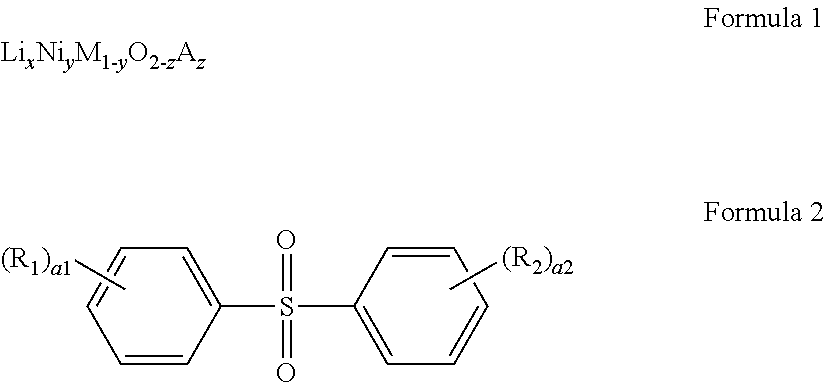
wherein, in Formula 1,

wherein, in Formula 1, 0.9≤x≤1.2, 0.7≤y≤0.98, 0≤z<0.2, M comprises Al, Mg, Mn, Co, Fe, Cr, V, Ti, Cu, B, Ca, Zn, Zr, Nb, Mo, Sr, Sb, W, Bi, or a combination thereof, and A is a monovalent anion, a divalent anion, a trivalent anion or a combination thereof, and in Formula 2, R1 and R2 are each independently a halogen, an unsubstituted C1-C10 alkyl group, or a C1-C10 alkyl group substituted with a halogen, a1 and a2 are each independently an integer from 0 to 5, each R1 is the same or different when a1 is 2 or greater, and each R2 is the same or different when a2 is 2 or greater.

In Formula 1,


LiNiy′ Co 1-y′-z′ Al z′ O 2 Formula 3
LiNiy′ Co 1-y′-z′ Mn z′ O 2 Formula 4
| TABLE 1 | ||
| Example | Lifetime (%) | DCIR increase rate (%) |
| Example 1 | 89 | 131 |
| Example 2 | 87 | 136 |
| Example 3 | 88 | 138 |
| Example 4 | 86 | 138 |
| Example 5 | 86 | 133 |
| Example 6 | 85 | 136 |
| Example 7 | 84 | 131 |
| Comparative Example 1 | 82 | 162 |
| Comparative Example 2 | 73 | 181 |
| Comparative Example 3 | 75 | 172 |
| Comparative Example 4 | 71 | 177 |
| Comparative Example 5 | 78 | 162 |
| TABLE 2 | ||
| Example | Lifetime (%) | DCIR increase rate (%) |
| Example 8 | 84 | 133 |
| Example 9 | 85 | 136 |
| Example 10 | 83 | 133 |
| Example 11 | 83 | 133 |
| Example 12 | 84 | 132 |
| Example 13 | 82 | 134 |
| Example 14 | 81 | 134 |
| Comparative Example 6 | 76 | 172 |
| Comparative Example 7 | 65 | 188 |
| Comparative Example 8 | 64 | 177 |
| Comparative Example 9 | 73 | 165 |
Claims (15)
Li x Ni y M 1-y O 2-z A z Formula 1
9≤x≤1.2,0.8≤y≤0.98,0≤z≤0.2 Formula 1


LiNiy′ Co 1-y′-z′ Al z′ O 2, or Formula 3
LiNiy′ Co 1-y′-z′ Mn z′ O 2, Formula 4
Applications Claiming Priority (2)
| Application Number | Priority Date | Filing Date | Title |
|---|---|---|---|
| KR10-2017-0103719 | 2017-08-16 | ||
| KR1020170103719A KR102472907B1 (en) | 2017-08-16 | 2017-08-16 | Lithium secondary battery comprising sulfone-based additive |
Publications (2)
| Publication Number | Publication Date |
|---|---|
| US20190058213A1 US20190058213A1 (en) | 2019-02-21 |
| US11637310B2 true US11637310B2 (en) | 2023-04-25 |
Family
ID=63254572
Family Applications (1)
| Application Number | Title | Priority Date | Filing Date |
|---|---|---|---|
| US16/101,927 Active 2039-05-26 US11637310B2 (en) | 2017-08-16 | 2018-08-13 | Lithium secondary battery including sulfone-based additive |
Country Status (4)
| Country | Link |
|---|---|
| US (1) | US11637310B2 (en) |
| EP (1) | EP3444879B1 (en) |
| KR (1) | KR102472907B1 (en) |
| CN (1) | CN109411815B (en) |
Families Citing this family (4)
| Publication number | Priority date | Publication date | Assignee | Title |
|---|---|---|---|---|
| CN109037780A (en) * | 2018-09-19 | 2018-12-18 | 中国科学院过程工程研究所 | A kind of difunctional lithium-ion battery electrolytes additive |
| KR20220005051A (en) | 2019-04-29 | 2022-01-12 | 케미라 오와이제이 | stable formulation |
| KR102764219B1 (en) * | 2019-10-31 | 2025-02-05 | 삼성에스디아이 주식회사 | Electrolyte for rechargeable lithium battery and rechargeable lithium battery |
| CN115275351A (en) * | 2022-08-30 | 2022-11-01 | 湖南法恩莱特新能源科技有限公司 | Electrolyte overcharge-preventing additive and application thereof |
Citations (29)
| Publication number | Priority date | Publication date | Assignee | Title |
|---|---|---|---|---|
| US5580684A (en) | 1994-07-07 | 1996-12-03 | Mitsui Petrochemical Industries, Ltd. | Non-aqueous electrolytic solutions and non-aqueous electrolyte cells comprising the same |
| US5993997A (en) | 1991-11-12 | 1999-11-30 | Sanyo Electric Co., Ltd | Lithium secondary battery |
| KR20010057369A (en) | 1999-12-22 | 2001-07-04 | 안복현 | Nonaqueous battery electrolyte |
| US20010009744A1 (en) | 2000-01-21 | 2001-07-26 | Jin-Sung Kim | Electrolyte for lithium secondary battery and lithium secondary battary comprising same |
| US20040048163A1 (en) | 2002-09-06 | 2004-03-11 | Yong-Chul Park | Electrolyte for a lithium battery and a lithium battery and a lithium battery comprising the same |
| US6723473B1 (en) | 1999-07-02 | 2004-04-20 | Matsushita Electric Industrial Co., Ltd. | Nonaqueous electrolyte secondary cell |
| US20040157133A1 (en) | 2001-01-19 | 2004-08-12 | Jin-Sung Kim | Electrolyte for lithium secondary battery and lithium secondary battery comprising same |
| US20040214091A1 (en) | 2003-04-28 | 2004-10-28 | Samsung Sdi Co., Ltd. | Electrolyte for a lithium battery and a lithium battery comprising the same |
| US20050164087A1 (en) * | 1999-09-20 | 2005-07-28 | Shigeru Fujita | Secondary battery |
| US20060275668A1 (en) * | 2005-05-13 | 2006-12-07 | Saft | Nanocomposite material for the anode of a lithium cell |
| CN101197455A (en) | 2006-12-08 | 2008-06-11 | 索尼株式会社 | Electrolyte and battery |
| US7709142B2 (en) | 2005-12-13 | 2010-05-04 | Sony Corporation | Electrolytic solution containing 4-fluoro-1, 3-dioxolane-2-one solvent |
| JP2011071098A (en) | 2009-08-31 | 2011-04-07 | Mitsubishi Chemicals Corp | Nonaqueous electrolyte and lithium secondary battery using the same |
| JP2011175959A (en) | 2010-01-29 | 2011-09-08 | Mitsubishi Chemicals Corp | Non-aqueous electrolytic solution and non-aqueous electrolyte battery using the same |
| WO2012105510A1 (en) | 2011-01-31 | 2012-08-09 | 三菱化学株式会社 | Non-aqueous electrolytic solution, and non-aqueous electrolyte secondary battery using same |
| US20120219866A1 (en) | 2009-08-31 | 2012-08-30 | Mitsubishi Chemical Corporation | Nonaqueous electrolytic solution and nonaqueous-electrolyte battery employing the same |
| KR20130011154A (en) | 2011-07-20 | 2013-01-30 | 충남대학교산학협력단 | Secondary battery having improved charging and discharging properties |
| US20130177822A1 (en) | 2010-11-16 | 2013-07-11 | Adeka Corporation | Non-aqueous electrolyte secondary battery |
| JP2014003029A (en) | 2006-04-27 | 2014-01-09 | Mitsubishi Chemicals Corp | Nonaqueous electrolyte and nonaqueous electrolyte secondary battery using the same |
| WO2014035583A1 (en) | 2012-08-29 | 2014-03-06 | Apple Inc. | Increased energy density and swelling control in batteries for portable electronic devices |
| US20150064549A1 (en) | 2012-06-12 | 2015-03-05 | A123 Systems, LLC | Electrolyte formulation for reduced gassing wide temperature range cycling |
| US9029022B2 (en) | 2005-10-20 | 2015-05-12 | Mitsubishi Chemical Corporation | Lithium secondary batteries and nonaqueous electrolyte for use in the same |
| KR101542420B1 (en) | 2013-09-16 | 2015-08-07 | 전자부품연구원 | Lithium Ion Battery and Lithium and Manufacturing Method thereof |
| US20150303417A1 (en) * | 2014-04-17 | 2015-10-22 | Robert Bosch Gmbh | Rechargeable battery device |
| KR20150145980A (en) | 2014-06-20 | 2015-12-31 | 전자부품연구원 | Vinyl-sulfones electrolyte for Ni-rich positive electrode materials and lithium secondary battery having the same |
| KR20160055083A (en) | 2014-11-07 | 2016-05-17 | 에이일이삼 시스템즈, 엘엘씨 | Electrolyte formulation for reduced gassing wide temperature range cycling |
| US20180013168A1 (en) * | 2015-03-31 | 2018-01-11 | Lg Chem, Ltd. | Non-aqueous electrolyte and lithium secondary battery comprising same |
| US20180065997A1 (en) | 2016-09-02 | 2018-03-08 | Samsung Electronics Co., Ltd. | Electrolyte for lithium secondary battery and lithium secondary battery including the electrolyte |
| US20180219258A1 (en) | 2017-01-31 | 2018-08-02 | Samsung Electronics Co., Ltd. | Lithium secondary battery including electrolyte containing monofluorosilane compound |
Family Cites Families (1)
| Publication number | Priority date | Publication date | Assignee | Title |
|---|---|---|---|---|
| JP4241815B2 (en) * | 2006-12-07 | 2009-03-18 | ソニー株式会社 | Electrolyte and battery |
-
2017
- 2017-08-16 KR KR1020170103719A patent/KR102472907B1/en active Active
-
2018
- 2018-08-13 CN CN201810914179.XA patent/CN109411815B/en active Active
- 2018-08-13 US US16/101,927 patent/US11637310B2/en active Active
- 2018-08-14 EP EP18188875.1A patent/EP3444879B1/en active Active
Patent Citations (34)
| Publication number | Priority date | Publication date | Assignee | Title |
|---|---|---|---|---|
| US5993997A (en) | 1991-11-12 | 1999-11-30 | Sanyo Electric Co., Ltd | Lithium secondary battery |
| US5580684A (en) | 1994-07-07 | 1996-12-03 | Mitsui Petrochemical Industries, Ltd. | Non-aqueous electrolytic solutions and non-aqueous electrolyte cells comprising the same |
| US6723473B1 (en) | 1999-07-02 | 2004-04-20 | Matsushita Electric Industrial Co., Ltd. | Nonaqueous electrolyte secondary cell |
| US20050164087A1 (en) * | 1999-09-20 | 2005-07-28 | Shigeru Fujita | Secondary battery |
| KR20010057369A (en) | 1999-12-22 | 2001-07-04 | 안복현 | Nonaqueous battery electrolyte |
| US20010009744A1 (en) | 2000-01-21 | 2001-07-26 | Jin-Sung Kim | Electrolyte for lithium secondary battery and lithium secondary battary comprising same |
| KR20010086281A (en) | 2000-01-21 | 2001-09-10 | 김순택 | A electrolyte for a lithium secondary battery |
| US8252465B2 (en) | 2001-01-19 | 2012-08-28 | Samsung Sdi Co., Ltd. | Electrolyte for lithium secondary battery and lithium secondary battery comprising same |
| US20040157133A1 (en) | 2001-01-19 | 2004-08-12 | Jin-Sung Kim | Electrolyte for lithium secondary battery and lithium secondary battery comprising same |
| US20040048163A1 (en) | 2002-09-06 | 2004-03-11 | Yong-Chul Park | Electrolyte for a lithium battery and a lithium battery and a lithium battery comprising the same |
| CN1543005A (en) | 2003-04-28 | 2004-11-03 | 三星Sdi株式会社 | Lithium battery electrolyte and lithium battery containing such electrolyte |
| US20040214091A1 (en) | 2003-04-28 | 2004-10-28 | Samsung Sdi Co., Ltd. | Electrolyte for a lithium battery and a lithium battery comprising the same |
| US20060275668A1 (en) * | 2005-05-13 | 2006-12-07 | Saft | Nanocomposite material for the anode of a lithium cell |
| US9029022B2 (en) | 2005-10-20 | 2015-05-12 | Mitsubishi Chemical Corporation | Lithium secondary batteries and nonaqueous electrolyte for use in the same |
| US7709142B2 (en) | 2005-12-13 | 2010-05-04 | Sony Corporation | Electrolytic solution containing 4-fluoro-1, 3-dioxolane-2-one solvent |
| JP2014003029A (en) | 2006-04-27 | 2014-01-09 | Mitsubishi Chemicals Corp | Nonaqueous electrolyte and nonaqueous electrolyte secondary battery using the same |
| CN101197455A (en) | 2006-12-08 | 2008-06-11 | 索尼株式会社 | Electrolyte and battery |
| US8241795B2 (en) | 2006-12-08 | 2012-08-14 | Sony Corporation | Electrolytic solutions and battery |
| JP2011071098A (en) | 2009-08-31 | 2011-04-07 | Mitsubishi Chemicals Corp | Nonaqueous electrolyte and lithium secondary battery using the same |
| US20120219866A1 (en) | 2009-08-31 | 2012-08-30 | Mitsubishi Chemical Corporation | Nonaqueous electrolytic solution and nonaqueous-electrolyte battery employing the same |
| JP2011175959A (en) | 2010-01-29 | 2011-09-08 | Mitsubishi Chemicals Corp | Non-aqueous electrolytic solution and non-aqueous electrolyte battery using the same |
| US20130177822A1 (en) | 2010-11-16 | 2013-07-11 | Adeka Corporation | Non-aqueous electrolyte secondary battery |
| WO2012105510A1 (en) | 2011-01-31 | 2012-08-09 | 三菱化学株式会社 | Non-aqueous electrolytic solution, and non-aqueous electrolyte secondary battery using same |
| US20200144670A1 (en) | 2011-01-31 | 2020-05-07 | Mitsubishi Chemical Corporation | Nonaqueous electrolytic solution and nonaqueous electrolytic solution secondary battery using same |
| KR20130011154A (en) | 2011-07-20 | 2013-01-30 | 충남대학교산학협력단 | Secondary battery having improved charging and discharging properties |
| US20150064549A1 (en) | 2012-06-12 | 2015-03-05 | A123 Systems, LLC | Electrolyte formulation for reduced gassing wide temperature range cycling |
| WO2014035583A1 (en) | 2012-08-29 | 2014-03-06 | Apple Inc. | Increased energy density and swelling control in batteries for portable electronic devices |
| KR101542420B1 (en) | 2013-09-16 | 2015-08-07 | 전자부품연구원 | Lithium Ion Battery and Lithium and Manufacturing Method thereof |
| US20150303417A1 (en) * | 2014-04-17 | 2015-10-22 | Robert Bosch Gmbh | Rechargeable battery device |
| KR20150145980A (en) | 2014-06-20 | 2015-12-31 | 전자부품연구원 | Vinyl-sulfones electrolyte for Ni-rich positive electrode materials and lithium secondary battery having the same |
| KR20160055083A (en) | 2014-11-07 | 2016-05-17 | 에이일이삼 시스템즈, 엘엘씨 | Electrolyte formulation for reduced gassing wide temperature range cycling |
| US20180013168A1 (en) * | 2015-03-31 | 2018-01-11 | Lg Chem, Ltd. | Non-aqueous electrolyte and lithium secondary battery comprising same |
| US20180065997A1 (en) | 2016-09-02 | 2018-03-08 | Samsung Electronics Co., Ltd. | Electrolyte for lithium secondary battery and lithium secondary battery including the electrolyte |
| US20180219258A1 (en) | 2017-01-31 | 2018-08-02 | Samsung Electronics Co., Ltd. | Lithium secondary battery including electrolyte containing monofluorosilane compound |
Non-Patent Citations (5)
| Title |
|---|
| Cheralathan et al., "Preparation of spherical LiNi0.80Co0.15Mn0.0502 lithium-ion cathode material by continuous co-precipitation", Journal of Powers Sources, 195, 2010, pp. 1486-1494. |
| CN Office Action dated Feb. 28, 2023 of CN Patent Application No. 201810914179.X. |
| European Search Report for corresponding European Patent Application No. 18188875.1, dated Dec. 7, 2018. |
| KR Office Action dated Mar. 7, 2022 of KR Patent Application No. 10-2017-0103719. |
| Liu et al. , "Synthesis of spherical LiNi0.8Co0.15AI0.05O2 cathode materials for lithium-ion batteries by a co-oxidation-controlled crystallization method", Chinese Chemical Letters, 22, 2011, pp. 1099-1102. |
Also Published As
| Publication number | Publication date |
|---|---|
| US20190058213A1 (en) | 2019-02-21 |
| CN109411815A (en) | 2019-03-01 |
| EP3444879A1 (en) | 2019-02-20 |
| KR20190018940A (en) | 2019-02-26 |
| CN109411815B (en) | 2024-03-22 |
| EP3444879B1 (en) | 2020-11-25 |
| KR102472907B1 (en) | 2022-12-02 |
Similar Documents
| Publication | Publication Date | Title |
|---|---|---|
| JP7436102B2 (en) | Lithium secondary batteries containing phosphate additives | |
| US10886564B2 (en) | Electrolyte for lithium secondary battery and lithium secondary battery including the electrolyte | |
| US10665897B2 (en) | Lithium secondary battery including phosphite additive | |
| US11527773B2 (en) | Lithium battery | |
| US10622677B2 (en) | Lithium secondary battery comprising disulfonate additive and method of preparing the same | |
| US20200251780A1 (en) | Electrolyte, lithium battery including the same, and method of manufacturing the lithium battery | |
| US11251466B2 (en) | Lithium secondary battery including electrolyte containing trialkoxyalkylsilane compound | |
| US20190305372A1 (en) | Lithium secondary battery including an electrolyte additive | |
| EP3506411A1 (en) | Organic electrolyte solution and lithium battery including the same | |
| JP2020095957A (en) | Electrolyte containing phosphite-based additive and sulfone-based additive, and lithium secondary battery containing the same | |
| US11038202B2 (en) | Bis(phenyl) methanedisulfonate-based additive and lithium secondary battery comprising the same | |
| KR102895755B1 (en) | Lithium secondary battery comprising disilane-based additive | |
| US11637310B2 (en) | Lithium secondary battery including sulfone-based additive | |
| EP3696901B1 (en) | Lithium secondary battery |
Legal Events
| Date | Code | Title | Description |
|---|---|---|---|
| FEPP | Fee payment procedure |
Free format text: ENTITY STATUS SET TO UNDISCOUNTED (ORIGINAL EVENT CODE: BIG.); ENTITY STATUS OF PATENT OWNER: LARGE ENTITY |
|
| AS | Assignment |
Owner name: SAMSUNG SDI CO., LTD., KOREA, REPUBLIC OF Free format text: ASSIGNMENT OF ASSIGNORS INTEREST;ASSIGNORS:KOH, MYONGCHUN;PARK, INSUN;JANG, JIHYUN;AND OTHERS;REEL/FRAME:046815/0333 Effective date: 20180726 Owner name: SAMSUNG ELECTRONICS CO., LTD., KOREA, REPUBLIC OF Free format text: ASSIGNMENT OF ASSIGNORS INTEREST;ASSIGNORS:KOH, MYONGCHUN;PARK, INSUN;JANG, JIHYUN;AND OTHERS;REEL/FRAME:046815/0333 Effective date: 20180726 |
|
| STPP | Information on status: patent application and granting procedure in general |
Free format text: DOCKETED NEW CASE - READY FOR EXAMINATION |
|
| AS | Assignment |
Owner name: SAMSUNG ELECTRONICS CO., LTD., KOREA, REPUBLIC OF Free format text: ASSIGNMENT OF ASSIGNORS INTEREST;ASSIGNORS:SAMSUNG ELECTRONICS CO., LTD.;SAMSUNG SDI CO., LTD.;REEL/FRAME:051366/0480 Effective date: 20191205 Owner name: SAMSUNG SDI CO., LTD., KOREA, REPUBLIC OF Free format text: ASSIGNMENT OF ASSIGNORS INTEREST;ASSIGNORS:SAMSUNG ELECTRONICS CO., LTD.;SAMSUNG SDI CO., LTD.;REEL/FRAME:051366/0480 Effective date: 20191205 |
|
| STPP | Information on status: patent application and granting procedure in general |
Free format text: NON FINAL ACTION MAILED |
|
| STPP | Information on status: patent application and granting procedure in general |
Free format text: FINAL REJECTION MAILED |
|
| STPP | Information on status: patent application and granting procedure in general |
Free format text: RESPONSE AFTER FINAL ACTION FORWARDED TO EXAMINER |
|
| STPP | Information on status: patent application and granting procedure in general |
Free format text: ADVISORY ACTION MAILED |
|
| STPP | Information on status: patent application and granting procedure in general |
Free format text: DOCKETED NEW CASE - READY FOR EXAMINATION |
|
| STPP | Information on status: patent application and granting procedure in general |
Free format text: NON FINAL ACTION MAILED |
|
| STPP | Information on status: patent application and granting procedure in general |
Free format text: RESPONSE TO NON-FINAL OFFICE ACTION ENTERED AND FORWARDED TO EXAMINER |
|
| STPP | Information on status: patent application and granting procedure in general |
Free format text: FINAL REJECTION MAILED |
|
| STPP | Information on status: patent application and granting procedure in general |
Free format text: RESPONSE AFTER FINAL ACTION FORWARDED TO EXAMINER |
|
| STPP | Information on status: patent application and granting procedure in general |
Free format text: ADVISORY ACTION MAILED |
|
| STPP | Information on status: patent application and granting procedure in general |
Free format text: DOCKETED NEW CASE - READY FOR EXAMINATION |
|
| STPP | Information on status: patent application and granting procedure in general |
Free format text: NON FINAL ACTION MAILED |
|
| STPP | Information on status: patent application and granting procedure in general |
Free format text: RESPONSE TO NON-FINAL OFFICE ACTION ENTERED AND FORWARDED TO EXAMINER |
|
| STPP | Information on status: patent application and granting procedure in general |
Free format text: NOTICE OF ALLOWANCE MAILED -- APPLICATION RECEIVED IN OFFICE OF PUBLICATIONS |
|
| STCF | Information on status: patent grant |
Free format text: PATENTED CASE |