US11633486B2 - Polymer materials for delivery of short-chain fatty acids to the intestine for applications in human health and treatment of disease - Google Patents
Polymer materials for delivery of short-chain fatty acids to the intestine for applications in human health and treatment of disease Download PDFInfo
- Publication number
- US11633486B2 US11633486B2 US16/605,449 US201816605449A US11633486B2 US 11633486 B2 US11633486 B2 US 11633486B2 US 201816605449 A US201816605449 A US 201816605449A US 11633486 B2 US11633486 B2 US 11633486B2
- Authority
- US
- United States
- Prior art keywords
- block
- poly
- methacrylamide
- methacrylate
- copolymer
- Prior art date
- Legal status (The legal status is an assumption and is not a legal conclusion. Google has not performed a legal analysis and makes no representation as to the accuracy of the status listed.)
- Active, expires
Links
- 150000004666 short chain fatty acids Chemical class 0.000 title abstract description 107
- 235000021391 short chain fatty acids Nutrition 0.000 title abstract description 44
- 201000010099 disease Diseases 0.000 title abstract description 23
- 208000037265 diseases, disorders, signs and symptoms Diseases 0.000 title abstract description 23
- 238000011282 treatment Methods 0.000 title abstract description 13
- 210000000936 intestine Anatomy 0.000 title abstract description 6
- 230000036541 health Effects 0.000 title abstract description 5
- 239000002861 polymer material Substances 0.000 title abstract description 4
- -1 poly(2-butanoyloxyethyl methacrylamide) Polymers 0.000 claims description 145
- 229920001577 copolymer Polymers 0.000 claims description 76
- 239000000203 mixture Substances 0.000 claims description 76
- 229920001400 block copolymer Polymers 0.000 claims description 40
- 229920001562 poly(N-(2-hydroxypropyl)methacrylamide) Polymers 0.000 claims description 20
- 229920005604 random copolymer Polymers 0.000 claims description 19
- 229920000642 polymer Polymers 0.000 abstract description 93
- 230000000172 allergic effect Effects 0.000 abstract description 33
- 208000026935 allergic disease Diseases 0.000 abstract description 11
- 238000003776 cleavage reaction Methods 0.000 abstract description 7
- 230000007062 hydrolysis Effects 0.000 abstract description 7
- 238000006460 hydrolysis reaction Methods 0.000 abstract description 7
- 208000030159 metabolic disease Diseases 0.000 abstract description 7
- 230000007017 scission Effects 0.000 abstract description 7
- 230000001363 autoimmune Effects 0.000 abstract description 4
- 208000015114 central nervous system disease Diseases 0.000 abstract description 4
- 230000002255 enzymatic effect Effects 0.000 abstract description 4
- 208000027866 inflammatory disease Diseases 0.000 abstract description 4
- 230000002757 inflammatory effect Effects 0.000 abstract description 4
- 239000002086 nanomaterial Substances 0.000 abstract description 4
- 208000023345 Autoimmune Diseases of the Nervous System Diseases 0.000 abstract description 3
- 208000035362 autoimmune disorder of the nervous system Diseases 0.000 abstract description 3
- 244000005702 human microbiome Species 0.000 abstract description 3
- 230000002503 metabolic effect Effects 0.000 abstract description 3
- 239000000178 monomer Substances 0.000 description 86
- 125000000217 alkyl group Chemical group 0.000 description 43
- 238000009472 formulation Methods 0.000 description 40
- FQPSGWSUVKBHSU-UHFFFAOYSA-N methacrylamide Chemical group CC(=C)C(N)=O FQPSGWSUVKBHSU-UHFFFAOYSA-N 0.000 description 39
- 208000010668 atopic eczema Diseases 0.000 description 33
- 235000017060 Arachis glabrata Nutrition 0.000 description 32
- 244000105624 Arachis hypogaea Species 0.000 description 32
- 235000010777 Arachis hypogaea Nutrition 0.000 description 32
- 235000018262 Arachis monticola Nutrition 0.000 description 32
- 235000020232 peanut Nutrition 0.000 description 32
- 150000003384 small molecules Chemical class 0.000 description 32
- OKKJLVBELUTLKV-UHFFFAOYSA-N Methanol Chemical compound OC OKKJLVBELUTLKV-UHFFFAOYSA-N 0.000 description 30
- 241000699670 Mus sp. Species 0.000 description 30
- 238000000034 method Methods 0.000 description 28
- FERIUCNNQQJTOY-UHFFFAOYSA-N Butyric acid Chemical compound CCCC(O)=O FERIUCNNQQJTOY-UHFFFAOYSA-N 0.000 description 26
- 239000000243 solution Substances 0.000 description 26
- CERQOIWHTDAKMF-UHFFFAOYSA-M Methacrylate Chemical compound CC(=C)C([O-])=O CERQOIWHTDAKMF-UHFFFAOYSA-M 0.000 description 25
- 125000002496 methyl group Chemical group [H]C([H])([H])* 0.000 description 23
- 125000002887 hydroxy group Chemical group [H]O* 0.000 description 19
- FERIUCNNQQJTOY-UHFFFAOYSA-M Butyrate Chemical compound CCCC([O-])=O FERIUCNNQQJTOY-UHFFFAOYSA-M 0.000 description 18
- 206010020751 Hypersensitivity Diseases 0.000 description 18
- 150000001412 amines Chemical class 0.000 description 18
- 239000003795 chemical substances by application Substances 0.000 description 18
- 102000004169 proteins and genes Human genes 0.000 description 18
- 108090000623 proteins and genes Proteins 0.000 description 18
- 229910052736 halogen Inorganic materials 0.000 description 17
- 150000002367 halogens Chemical class 0.000 description 17
- 125000003636 chemical group Chemical group 0.000 description 16
- 150000002148 esters Chemical class 0.000 description 16
- KQNPFQTWMSNSAP-UHFFFAOYSA-N isobutyric acid Chemical compound CC(C)C(O)=O KQNPFQTWMSNSAP-UHFFFAOYSA-N 0.000 description 16
- 125000000956 methoxy group Chemical group [H]C([H])([H])O* 0.000 description 16
- 150000003573 thiols Chemical class 0.000 description 16
- 238000005160 1H NMR spectroscopy Methods 0.000 description 14
- IAZDPXIOMUYVGZ-WFGJKAKNSA-N Dimethyl sulfoxide Chemical compound [2H]C([2H])([2H])S(=O)C([2H])([2H])[2H] IAZDPXIOMUYVGZ-WFGJKAKNSA-N 0.000 description 14
- HEDRZPFGACZZDS-MICDWDOJSA-N Trichloro(2H)methane Chemical compound [2H]C(Cl)(Cl)Cl HEDRZPFGACZZDS-MICDWDOJSA-N 0.000 description 14
- 210000002966 serum Anatomy 0.000 description 14
- ICPGINZNNHNDDR-UHFFFAOYSA-N 2-(2-methylprop-2-enoylamino)ethyl butanoate Chemical group C(C(=C)C)(=O)NCCOC(CCC)=O ICPGINZNNHNDDR-UHFFFAOYSA-N 0.000 description 13
- 102000009016 Cholera Toxin Human genes 0.000 description 13
- 108010049048 Cholera Toxin Proteins 0.000 description 13
- 239000003814 drug Substances 0.000 description 13
- BSCJIBOZTKGXQP-UHFFFAOYSA-N n-(2-hydroxyethyl)-2-methylprop-2-enamide Chemical compound CC(=C)C(=O)NCCO BSCJIBOZTKGXQP-UHFFFAOYSA-N 0.000 description 13
- 239000008194 pharmaceutical composition Substances 0.000 description 13
- 230000001225 therapeutic effect Effects 0.000 description 13
- 241000699666 Mus <mouse, genus> Species 0.000 description 12
- ZMANZCXQSJIPKH-UHFFFAOYSA-N Triethylamine Chemical compound CCN(CC)CC ZMANZCXQSJIPKH-UHFFFAOYSA-N 0.000 description 12
- 239000002105 nanoparticle Substances 0.000 description 12
- 239000002245 particle Substances 0.000 description 12
- 239000000047 product Substances 0.000 description 12
- 239000000463 material Substances 0.000 description 11
- 125000001424 substituent group Chemical group 0.000 description 11
- 125000000547 substituted alkyl group Chemical group 0.000 description 11
- WMZOLPCYBGNJJA-UHFFFAOYSA-N 2-(2-methylprop-2-enoyloxy)ethyl 4-butanoyloxybenzoate Chemical group C(C(=C)C)(=O)OCCOC(C1=CC=C(C=C1)OC(CCC)=O)=O WMZOLPCYBGNJJA-UHFFFAOYSA-N 0.000 description 10
- RTZKZFJDLAIYFH-UHFFFAOYSA-N Diethyl ether Chemical compound CCOCC RTZKZFJDLAIYFH-UHFFFAOYSA-N 0.000 description 10
- 101000980580 Mus musculus Mast cell protease 1 Proteins 0.000 description 10
- ISWSIDIOOBJBQZ-UHFFFAOYSA-N Phenol Chemical compound OC1=CC=CC=C1 ISWSIDIOOBJBQZ-UHFFFAOYSA-N 0.000 description 10
- 206010070834 Sensitisation Diseases 0.000 description 10
- VYPSYNLAJGMNEJ-UHFFFAOYSA-N Silicium dioxide Chemical compound O=[Si]=O VYPSYNLAJGMNEJ-UHFFFAOYSA-N 0.000 description 10
- 239000002671 adjuvant Substances 0.000 description 10
- 125000004432 carbon atom Chemical group C* 0.000 description 10
- LOKCTEFSRHRXRJ-UHFFFAOYSA-I dipotassium trisodium dihydrogen phosphate hydrogen phosphate dichloride Chemical compound P(=O)(O)(O)[O-].[K+].P(=O)(O)([O-])[O-].[Na+].[Na+].[Cl-].[K+].[Cl-].[Na+] LOKCTEFSRHRXRJ-UHFFFAOYSA-I 0.000 description 10
- 239000007924 injection Substances 0.000 description 10
- 238000002347 injection Methods 0.000 description 10
- 238000003305 oral gavage Methods 0.000 description 10
- 229910052760 oxygen Inorganic materials 0.000 description 10
- 239000002953 phosphate buffered saline Substances 0.000 description 10
- 239000011541 reaction mixture Substances 0.000 description 10
- 230000008313 sensitization Effects 0.000 description 10
- MFBOGIVSZKQAPD-UHFFFAOYSA-M sodium butyrate Chemical compound [Na+].CCCC([O-])=O MFBOGIVSZKQAPD-UHFFFAOYSA-M 0.000 description 10
- OZAIFHULBGXAKX-UHFFFAOYSA-N 2-(2-cyanopropan-2-yldiazenyl)-2-methylpropanenitrile Chemical compound N#CC(C)(C)N=NC(C)(C)C#N OZAIFHULBGXAKX-UHFFFAOYSA-N 0.000 description 9
- LFQSCWFLJHTTHZ-UHFFFAOYSA-N Ethanol Chemical compound CCO LFQSCWFLJHTTHZ-UHFFFAOYSA-N 0.000 description 9
- 208000030961 allergic reaction Diseases 0.000 description 9
- 230000007815 allergy Effects 0.000 description 9
- 238000000429 assembly Methods 0.000 description 9
- 230000000712 assembly Effects 0.000 description 9
- 229940079593 drug Drugs 0.000 description 9
- 235000013305 food Nutrition 0.000 description 9
- 230000008685 targeting Effects 0.000 description 9
- 210000001519 tissue Anatomy 0.000 description 9
- 238000012546 transfer Methods 0.000 description 9
- 229920002818 (Hydroxyethyl)methacrylate Polymers 0.000 description 8
- QTBSBXVTEAMEQO-UHFFFAOYSA-M Acetate Chemical compound CC([O-])=O QTBSBXVTEAMEQO-UHFFFAOYSA-M 0.000 description 8
- IJGRMHOSHXDMSA-UHFFFAOYSA-N Atomic nitrogen Chemical compound N#N IJGRMHOSHXDMSA-UHFFFAOYSA-N 0.000 description 8
- 108060003951 Immunoglobulin Proteins 0.000 description 8
- PEEHTFAAVSWFBL-UHFFFAOYSA-N Maleimide Chemical compound O=C1NC(=O)C=C1 PEEHTFAAVSWFBL-UHFFFAOYSA-N 0.000 description 8
- XBDQKXXYIPTUBI-UHFFFAOYSA-M Propionate Chemical compound CCC([O-])=O XBDQKXXYIPTUBI-UHFFFAOYSA-M 0.000 description 8
- 125000006295 amino methylene group Chemical group [H]N(*)C([H])([H])* 0.000 description 8
- 230000036757 core body temperature Effects 0.000 description 8
- 230000002550 fecal effect Effects 0.000 description 8
- 125000004404 heteroalkyl group Chemical group 0.000 description 8
- 125000005842 heteroatom Chemical group 0.000 description 8
- 102000018358 immunoglobulin Human genes 0.000 description 8
- 239000007788 liquid Substances 0.000 description 8
- 150000004667 medium chain fatty acids Chemical class 0.000 description 8
- 239000013642 negative control Substances 0.000 description 8
- 238000006116 polymerization reaction Methods 0.000 description 8
- 239000013641 positive control Substances 0.000 description 8
- 125000006239 protecting group Chemical group 0.000 description 8
- 239000007787 solid Substances 0.000 description 8
- 229910052717 sulfur Inorganic materials 0.000 description 8
- 238000002560 therapeutic procedure Methods 0.000 description 8
- NYFYPLLPDFAFFX-UHFFFAOYSA-N 2-(2-methylprop-2-enoyloxy)ethyl 4-hydroxybenzoate Chemical compound CC(=C)C(=O)OCCOC(=O)C1=CC=C(O)C=C1 NYFYPLLPDFAFFX-UHFFFAOYSA-N 0.000 description 7
- 125000003342 alkenyl group Chemical group 0.000 description 7
- 125000000304 alkynyl group Chemical group 0.000 description 7
- 238000002296 dynamic light scattering Methods 0.000 description 7
- 230000000694 effects Effects 0.000 description 7
- 210000001035 gastrointestinal tract Anatomy 0.000 description 7
- 238000003304 gavage Methods 0.000 description 7
- 208000025864 peanut allergic reaction Diseases 0.000 description 7
- 201000010853 peanut allergy Diseases 0.000 description 7
- QTBSBXVTEAMEQO-UHFFFAOYSA-N Acetic acid Chemical compound CC(O)=O QTBSBXVTEAMEQO-UHFFFAOYSA-N 0.000 description 6
- UIIMBOGNXHQVGW-UHFFFAOYSA-M Sodium bicarbonate Chemical compound [Na+].OC([O-])=O UIIMBOGNXHQVGW-UHFFFAOYSA-M 0.000 description 6
- 239000003937 drug carrier Substances 0.000 description 6
- 125000000449 nitro group Chemical group [O-][N+](*)=O 0.000 description 6
- 238000002360 preparation method Methods 0.000 description 6
- 210000002784 stomach Anatomy 0.000 description 6
- AOUSBQVEVZBMNI-UHFFFAOYSA-N 2-bromoethyl 2-methylprop-2-enoate Chemical compound CC(=C)C(=O)OCCBr AOUSBQVEVZBMNI-UHFFFAOYSA-N 0.000 description 5
- 239000002253 acid Substances 0.000 description 5
- 230000004888 barrier function Effects 0.000 description 5
- 230000015572 biosynthetic process Effects 0.000 description 5
- 230000037396 body weight Effects 0.000 description 5
- 239000012986 chain transfer agent Substances 0.000 description 5
- 238000006243 chemical reaction Methods 0.000 description 5
- 238000011260 co-administration Methods 0.000 description 5
- 239000000693 micelle Substances 0.000 description 5
- 239000003208 petroleum Substances 0.000 description 5
- 239000000377 silicon dioxide Substances 0.000 description 5
- 208000024891 symptom Diseases 0.000 description 5
- 238000003786 synthesis reaction Methods 0.000 description 5
- XLYOFNOQVPJJNP-UHFFFAOYSA-N water Substances O XLYOFNOQVPJJNP-UHFFFAOYSA-N 0.000 description 5
- IDSLBLWCPSAZBL-UHFFFAOYSA-N 2-cyanopropan-2-yl benzenecarbodithioate Chemical compound N#CC(C)(C)SC(=S)C1=CC=CC=C1 IDSLBLWCPSAZBL-UHFFFAOYSA-N 0.000 description 4
- 125000005916 2-methylpentyl group Chemical group 0.000 description 4
- 125000004337 3-ethylpentyl group Chemical group [H]C([H])([H])C([H])([H])C([H])(C([H])([H])C([H])([H])[H])C([H])([H])C([H])([H])* 0.000 description 4
- 206010002198 Anaphylactic reaction Diseases 0.000 description 4
- 208000023275 Autoimmune disease Diseases 0.000 description 4
- 238000002965 ELISA Methods 0.000 description 4
- OAKJQQAXSVQMHS-UHFFFAOYSA-N Hydrazine Chemical compound NN OAKJQQAXSVQMHS-UHFFFAOYSA-N 0.000 description 4
- CSNNHWWHGAXBCP-UHFFFAOYSA-L Magnesium sulfate Chemical compound [Mg+2].[O-][S+2]([O-])([O-])[O-] CSNNHWWHGAXBCP-UHFFFAOYSA-L 0.000 description 4
- 230000036783 anaphylactic response Effects 0.000 description 4
- 208000003455 anaphylaxis Diseases 0.000 description 4
- 230000001580 bacterial effect Effects 0.000 description 4
- 229910052794 bromium Inorganic materials 0.000 description 4
- 239000011203 carbon fibre reinforced carbon Substances 0.000 description 4
- 229910052801 chlorine Inorganic materials 0.000 description 4
- 125000004093 cyano group Chemical group *C#N 0.000 description 4
- GHVNFZFCNZKVNT-UHFFFAOYSA-N decanoic acid Chemical compound CCCCCCCCCC(O)=O GHVNFZFCNZKVNT-UHFFFAOYSA-N 0.000 description 4
- XBDQKXXYIPTUBI-UHFFFAOYSA-N dimethylselenoniopropionate Natural products CCC(O)=O XBDQKXXYIPTUBI-UHFFFAOYSA-N 0.000 description 4
- POULHZVOKOAJMA-UHFFFAOYSA-N dodecanoic acid Chemical compound CCCCCCCCCCCC(O)=O POULHZVOKOAJMA-UHFFFAOYSA-N 0.000 description 4
- 229910052731 fluorine Inorganic materials 0.000 description 4
- FUZZWVXGSFPDMH-UHFFFAOYSA-N hexanoic acid Chemical compound CCCCCC(O)=O FUZZWVXGSFPDMH-UHFFFAOYSA-N 0.000 description 4
- 229920001477 hydrophilic polymer Polymers 0.000 description 4
- 230000003993 interaction Effects 0.000 description 4
- 239000007928 intraperitoneal injection Substances 0.000 description 4
- 229910052740 iodine Inorganic materials 0.000 description 4
- 239000010410 layer Substances 0.000 description 4
- 210000003097 mucus Anatomy 0.000 description 4
- 229910052757 nitrogen Inorganic materials 0.000 description 4
- 239000002417 nutraceutical Substances 0.000 description 4
- 235000021436 nutraceutical agent Nutrition 0.000 description 4
- WWZKQHOCKIZLMA-UHFFFAOYSA-N octanoic acid Chemical compound CCCCCCCC(O)=O WWZKQHOCKIZLMA-UHFFFAOYSA-N 0.000 description 4
- 239000000843 powder Substances 0.000 description 4
- 238000002390 rotary evaporation Methods 0.000 description 4
- NQPDZGIKBAWPEJ-UHFFFAOYSA-N valeric acid Chemical compound CCCCC(O)=O NQPDZGIKBAWPEJ-UHFFFAOYSA-N 0.000 description 4
- 230000003442 weekly effect Effects 0.000 description 4
- KIUKXJAPPMFGSW-DNGZLQJQSA-N (2S,3S,4S,5R,6R)-6-[(2S,3R,4R,5S,6R)-3-Acetamido-2-[(2S,3S,4R,5R,6R)-6-[(2R,3R,4R,5S,6R)-3-acetamido-2,5-dihydroxy-6-(hydroxymethyl)oxan-4-yl]oxy-2-carboxy-4,5-dihydroxyoxan-3-yl]oxy-5-hydroxy-6-(hydroxymethyl)oxan-4-yl]oxy-3,4,5-trihydroxyoxane-2-carboxylic acid Chemical compound CC(=O)N[C@H]1[C@H](O)O[C@H](CO)[C@@H](O)[C@@H]1O[C@H]1[C@H](O)[C@@H](O)[C@H](O[C@H]2[C@@H]([C@@H](O[C@H]3[C@@H]([C@@H](O)[C@H](O)[C@H](O3)C(O)=O)O)[C@H](O)[C@@H](CO)O2)NC(C)=O)[C@@H](C(O)=O)O1 KIUKXJAPPMFGSW-DNGZLQJQSA-N 0.000 description 3
- FHVDTGUDJYJELY-UHFFFAOYSA-N 6-{[2-carboxy-4,5-dihydroxy-6-(phosphanyloxy)oxan-3-yl]oxy}-4,5-dihydroxy-3-phosphanyloxane-2-carboxylic acid Chemical compound O1C(C(O)=O)C(P)C(O)C(O)C1OC1C(C(O)=O)OC(OP)C(O)C1O FHVDTGUDJYJELY-UHFFFAOYSA-N 0.000 description 3
- 206010009944 Colon cancer Diseases 0.000 description 3
- XFXPMWWXUTWYJX-UHFFFAOYSA-N Cyanide Chemical compound N#[C-] XFXPMWWXUTWYJX-UHFFFAOYSA-N 0.000 description 3
- 229920000858 Cyclodextrin Polymers 0.000 description 3
- 102000004190 Enzymes Human genes 0.000 description 3
- 108090000790 Enzymes Proteins 0.000 description 3
- XEKOWRVHYACXOJ-UHFFFAOYSA-N Ethyl acetate Chemical compound CCOC(C)=O XEKOWRVHYACXOJ-UHFFFAOYSA-N 0.000 description 3
- PEDCQBHIVMGVHV-UHFFFAOYSA-N Glycerine Chemical compound OCC(O)CO PEDCQBHIVMGVHV-UHFFFAOYSA-N 0.000 description 3
- JCXJVPUVTGWSNB-UHFFFAOYSA-N Nitrogen dioxide Chemical compound O=[N]=O JCXJVPUVTGWSNB-UHFFFAOYSA-N 0.000 description 3
- 229920002125 Sokalan® Polymers 0.000 description 3
- 230000002411 adverse Effects 0.000 description 3
- 229940072056 alginate Drugs 0.000 description 3
- 229920000615 alginic acid Polymers 0.000 description 3
- 235000010443 alginic acid Nutrition 0.000 description 3
- 125000001931 aliphatic group Chemical group 0.000 description 3
- 125000003545 alkoxy group Chemical group 0.000 description 3
- 208000029560 autism spectrum disease Diseases 0.000 description 3
- 235000013361 beverage Nutrition 0.000 description 3
- 239000002775 capsule Substances 0.000 description 3
- 210000003169 central nervous system Anatomy 0.000 description 3
- 230000003247 decreasing effect Effects 0.000 description 3
- 235000014113 dietary fatty acids Nutrition 0.000 description 3
- 125000001495 ethyl group Chemical group [H]C([H])([H])C([H])([H])* 0.000 description 3
- 238000002474 experimental method Methods 0.000 description 3
- 229930195729 fatty acid Natural products 0.000 description 3
- 239000000194 fatty acid Substances 0.000 description 3
- 150000004665 fatty acids Chemical class 0.000 description 3
- 210000003608 fece Anatomy 0.000 description 3
- 238000004817 gas chromatography Methods 0.000 description 3
- 229920002674 hyaluronan Polymers 0.000 description 3
- 229960003160 hyaluronic acid Drugs 0.000 description 3
- 230000002209 hydrophobic effect Effects 0.000 description 3
- 125000001841 imino group Chemical group [H]N=* 0.000 description 3
- 230000004968 inflammatory condition Effects 0.000 description 3
- 239000003999 initiator Substances 0.000 description 3
- 230000010354 integration Effects 0.000 description 3
- 125000005647 linker group Chemical group 0.000 description 3
- 230000004048 modification Effects 0.000 description 3
- 238000012986 modification Methods 0.000 description 3
- 229920006030 multiblock copolymer Polymers 0.000 description 3
- VLKZOEOYAKHREP-UHFFFAOYSA-N n-Hexane Chemical compound CCCCCC VLKZOEOYAKHREP-UHFFFAOYSA-N 0.000 description 3
- 238000000655 nuclear magnetic resonance spectrum Methods 0.000 description 3
- 239000003921 oil Substances 0.000 description 3
- 125000004043 oxo group Chemical group O=* 0.000 description 3
- NCAIGTHBQTXTLR-UHFFFAOYSA-N phentermine hydrochloride Chemical compound [Cl-].CC(C)([NH3+])CC1=CC=CC=C1 NCAIGTHBQTXTLR-UHFFFAOYSA-N 0.000 description 3
- 229920001603 poly (alkyl acrylates) Polymers 0.000 description 3
- 229920000191 poly(N-vinyl pyrrolidone) Polymers 0.000 description 3
- 229920002401 polyacrylamide Polymers 0.000 description 3
- 229920001184 polypeptide Polymers 0.000 description 3
- 229920001282 polysaccharide Polymers 0.000 description 3
- 239000005017 polysaccharide Substances 0.000 description 3
- 150000004804 polysaccharides Chemical class 0.000 description 3
- 229920002451 polyvinyl alcohol Polymers 0.000 description 3
- 230000002265 prevention Effects 0.000 description 3
- 102000004196 processed proteins & peptides Human genes 0.000 description 3
- 108090000765 processed proteins & peptides Proteins 0.000 description 3
- 238000012712 reversible addition−fragmentation chain-transfer polymerization Methods 0.000 description 3
- HFHDHCJBZVLPGP-UHFFFAOYSA-N schardinger α-dextrin Chemical compound O1C(C(C2O)O)C(CO)OC2OC(C(C2O)O)C(CO)OC2OC(C(C2O)O)C(CO)OC2OC(C(O)C2O)C(CO)OC2OC(C(C2O)O)C(CO)OC2OC2C(O)C(O)C1OC2CO HFHDHCJBZVLPGP-UHFFFAOYSA-N 0.000 description 3
- 229910000030 sodium bicarbonate Inorganic materials 0.000 description 3
- 125000000464 thioxo group Chemical group S=* 0.000 description 3
- XYHKNCXZYYTLRG-UHFFFAOYSA-N 1h-imidazole-2-carbaldehyde Chemical compound O=CC1=NC=CN1 XYHKNCXZYYTLRG-UHFFFAOYSA-N 0.000 description 2
- HZAXFHJVJLSVMW-UHFFFAOYSA-N 2-Aminoethan-1-ol Chemical compound NCCO HZAXFHJVJLSVMW-UHFFFAOYSA-N 0.000 description 2
- GWYFCOCPABKNJV-UHFFFAOYSA-M 3-Methylbutanoic acid Natural products CC(C)CC([O-])=O GWYFCOCPABKNJV-UHFFFAOYSA-M 0.000 description 2
- FJKROLUGYXJWQN-UHFFFAOYSA-N 4-hydroxybenzoic acid Chemical compound OC(=O)C1=CC=C(O)C=C1 FJKROLUGYXJWQN-UHFFFAOYSA-N 0.000 description 2
- 208000024827 Alzheimer disease Diseases 0.000 description 2
- NLXLAEXVIDQMFP-UHFFFAOYSA-N Ammonia chloride Chemical compound [NH4+].[Cl-] NLXLAEXVIDQMFP-UHFFFAOYSA-N 0.000 description 2
- 208000012657 Atopic disease Diseases 0.000 description 2
- 208000019838 Blood disease Diseases 0.000 description 2
- 239000005632 Capric acid (CAS 334-48-5) Substances 0.000 description 2
- 239000005635 Caprylic acid (CAS 124-07-2) Substances 0.000 description 2
- 208000015943 Coeliac disease Diseases 0.000 description 2
- 206010009900 Colitis ulcerative Diseases 0.000 description 2
- 208000001333 Colorectal Neoplasms Diseases 0.000 description 2
- 208000035473 Communicable disease Diseases 0.000 description 2
- 208000011231 Crohn disease Diseases 0.000 description 2
- 206010012735 Diarrhoea Diseases 0.000 description 2
- 206010013700 Drug hypersensitivity Diseases 0.000 description 2
- 208000027244 Dysbiosis Diseases 0.000 description 2
- 206010064212 Eosinophilic oesophagitis Diseases 0.000 description 2
- 108090000371 Esterases Proteins 0.000 description 2
- 208000004262 Food Hypersensitivity Diseases 0.000 description 2
- 208000022559 Inflammatory bowel disease Diseases 0.000 description 2
- 239000005639 Lauric acid Substances 0.000 description 2
- 238000005481 NMR spectroscopy Methods 0.000 description 2
- 208000018737 Parkinson disease Diseases 0.000 description 2
- 229920003171 Poly (ethylene oxide) Polymers 0.000 description 2
- 206010039085 Rhinitis allergic Diseases 0.000 description 2
- 206010067584 Type 1 diabetes mellitus Diseases 0.000 description 2
- 201000006704 Ulcerative Colitis Diseases 0.000 description 2
- 150000007513 acids Chemical class 0.000 description 2
- 239000004480 active ingredient Substances 0.000 description 2
- 239000000654 additive Substances 0.000 description 2
- 125000004450 alkenylene group Chemical group 0.000 description 2
- 125000002947 alkylene group Chemical group 0.000 description 2
- 125000004419 alkynylene group Chemical group 0.000 description 2
- 201000009961 allergic asthma Diseases 0.000 description 2
- 201000010105 allergic rhinitis Diseases 0.000 description 2
- 238000004458 analytical method Methods 0.000 description 2
- 208000006673 asthma Diseases 0.000 description 2
- 230000008901 benefit Effects 0.000 description 2
- GWYFCOCPABKNJV-UHFFFAOYSA-N beta-methyl-butyric acid Natural products CC(C)CC(O)=O GWYFCOCPABKNJV-UHFFFAOYSA-N 0.000 description 2
- 150000004648 butanoic acid derivatives Chemical class 0.000 description 2
- YHASWHZGWUONAO-UHFFFAOYSA-N butanoyl butanoate Chemical compound CCCC(=O)OC(=O)CCC YHASWHZGWUONAO-UHFFFAOYSA-N 0.000 description 2
- 125000003178 carboxy group Chemical group [H]OC(*)=O 0.000 description 2
- 230000015556 catabolic process Effects 0.000 description 2
- 230000008859 change Effects 0.000 description 2
- 239000012230 colorless oil Substances 0.000 description 2
- 150000001875 compounds Chemical class 0.000 description 2
- 235000015872 dietary supplement Nutrition 0.000 description 2
- 230000007140 dysbiosis Effects 0.000 description 2
- 201000000708 eosinophilic esophagitis Diseases 0.000 description 2
- 238000000855 fermentation Methods 0.000 description 2
- 230000004151 fermentation Effects 0.000 description 2
- 239000000945 filler Substances 0.000 description 2
- 235000020932 food allergy Nutrition 0.000 description 2
- 230000010243 gut motility Effects 0.000 description 2
- 208000014951 hematologic disease Diseases 0.000 description 2
- 208000018706 hematopoietic system disease Diseases 0.000 description 2
- 125000000623 heterocyclic group Chemical group 0.000 description 2
- 230000013632 homeostatic process Effects 0.000 description 2
- FGKJLKRYENPLQH-UHFFFAOYSA-N isocaproic acid Chemical compound CC(C)CCC(O)=O FGKJLKRYENPLQH-UHFFFAOYSA-N 0.000 description 2
- 229910052943 magnesium sulfate Inorganic materials 0.000 description 2
- 238000004519 manufacturing process Methods 0.000 description 2
- VHRYZQNGTZXDNX-UHFFFAOYSA-N methacryloyl chloride Chemical compound CC(=C)C(Cl)=O VHRYZQNGTZXDNX-UHFFFAOYSA-N 0.000 description 2
- 230000000877 morphologic effect Effects 0.000 description 2
- 201000006417 multiple sclerosis Diseases 0.000 description 2
- 125000004123 n-propyl group Chemical group [H]C([H])([H])C([H])([H])C([H])([H])* 0.000 description 2
- 231100000252 nontoxic Toxicity 0.000 description 2
- 230000003000 nontoxic effect Effects 0.000 description 2
- 229960002446 octanoic acid Drugs 0.000 description 2
- 239000012044 organic layer Substances 0.000 description 2
- 229920002187 poly[N-2-(hydroxypropyl) methacrylamide] polymer Polymers 0.000 description 2
- 229920001223 polyethylene glycol Polymers 0.000 description 2
- 239000000651 prodrug Substances 0.000 description 2
- 229940002612 prodrug Drugs 0.000 description 2
- 235000019260 propionic acid Nutrition 0.000 description 2
- IUVKMZGDUIUOCP-BTNSXGMBSA-N quinbolone Chemical compound O([C@H]1CC[C@H]2[C@H]3[C@@H]([C@]4(C=CC(=O)C=C4CC3)C)CC[C@@]21C)C1=CCCC1 IUVKMZGDUIUOCP-BTNSXGMBSA-N 0.000 description 2
- 206010039073 rheumatoid arthritis Diseases 0.000 description 2
- 239000003381 stabilizer Substances 0.000 description 2
- 239000011550 stock solution Substances 0.000 description 2
- 239000004094 surface-active agent Substances 0.000 description 2
- 239000003826 tablet Substances 0.000 description 2
- 229940124597 therapeutic agent Drugs 0.000 description 2
- 229940005605 valeric acid Drugs 0.000 description 2
- 239000003981 vehicle Substances 0.000 description 2
- ZVEMACCDKBQNGX-KALODSIISA-N (2s)-2-amino-5-(diaminomethylideneamino)pentanoic acid;butanoic acid Chemical compound CCCC(O)=O.CCCC(O)=O.CCCC(O)=O.CCCC(O)=O.OC(=O)[C@@H](N)CCCN=C(N)N.OC(=O)[C@@H](N)CCCN=C(N)N.OC(=O)[C@@H](N)CCCN=C(N)N ZVEMACCDKBQNGX-KALODSIISA-N 0.000 description 1
- VUAXHMVRKOTJKP-UHFFFAOYSA-N 2,2-dimethylbutyric acid Chemical compound CCC(C)(C)C(O)=O VUAXHMVRKOTJKP-UHFFFAOYSA-N 0.000 description 1
- OBPQOEUYNKDOPG-UHFFFAOYSA-N 2-(2-methylprop-2-enoylamino)ethyl 4-butanoyloxybenzoate Chemical group C(C(=C)C)(=O)NCCOC(C1=CC=C(C=C1)OC(CCC)=O)=O OBPQOEUYNKDOPG-UHFFFAOYSA-N 0.000 description 1
- VWNZBJCVRXPCKG-UHFFFAOYSA-N 2-(2-methylprop-2-enoyloxy)ethyl butanoate Chemical group CCCC(=O)OCCOC(=O)C(C)=C VWNZBJCVRXPCKG-UHFFFAOYSA-N 0.000 description 1
- LDLCZOVUSADOIV-UHFFFAOYSA-N 2-bromoethanol Chemical compound OCCBr LDLCZOVUSADOIV-UHFFFAOYSA-N 0.000 description 1
- OQEBBZSWEGYTPG-UHFFFAOYSA-N 3-aminobutanoic acid Chemical compound CC(N)CC(O)=O OQEBBZSWEGYTPG-UHFFFAOYSA-N 0.000 description 1
- 229940090248 4-hydroxybenzoic acid Drugs 0.000 description 1
- OCKGFTQIICXDQW-ZEQRLZLVSA-N 5-[(1r)-1-hydroxy-2-[4-[(2r)-2-hydroxy-2-(4-methyl-1-oxo-3h-2-benzofuran-5-yl)ethyl]piperazin-1-yl]ethyl]-4-methyl-3h-2-benzofuran-1-one Chemical compound C1=C2C(=O)OCC2=C(C)C([C@@H](O)CN2CCN(CC2)C[C@H](O)C2=CC=C3C(=O)OCC3=C2C)=C1 OCKGFTQIICXDQW-ZEQRLZLVSA-N 0.000 description 1
- VVNCNSJFMMFHPL-VKHMYHEASA-N D-penicillamine Chemical group CC(C)(S)[C@@H](N)C(O)=O VVNCNSJFMMFHPL-VKHMYHEASA-N 0.000 description 1
- 206010012289 Dementia Diseases 0.000 description 1
- WQZGKKKJIJFFOK-GASJEMHNSA-N Glucose Natural products OC[C@H]1OC(O)[C@H](O)[C@@H](O)[C@@H]1O WQZGKKKJIJFFOK-GASJEMHNSA-N 0.000 description 1
- 206010061218 Inflammation Diseases 0.000 description 1
- UEZVMMHDMIWARA-UHFFFAOYSA-N Metaphosphoric acid Chemical compound OP(=O)=O UEZVMMHDMIWARA-UHFFFAOYSA-N 0.000 description 1
- UUIQMZJEGPQKFD-UHFFFAOYSA-N Methyl butyrate Chemical class CCCC(=O)OC UUIQMZJEGPQKFD-UHFFFAOYSA-N 0.000 description 1
- 239000007832 Na2SO4 Substances 0.000 description 1
- 208000008589 Obesity Diseases 0.000 description 1
- IGVPBCZDHMIOJH-UHFFFAOYSA-N Phenyl butyrate Chemical class CCCC(=O)OC1=CC=CC=C1 IGVPBCZDHMIOJH-UHFFFAOYSA-N 0.000 description 1
- PMZURENOXWZQFD-UHFFFAOYSA-L Sodium Sulfate Chemical compound [Na+].[Na+].[O-]S([O-])(=O)=O PMZURENOXWZQFD-UHFFFAOYSA-L 0.000 description 1
- FAPWRFPIFSIZLT-UHFFFAOYSA-M Sodium chloride Chemical compound [Na+].[Cl-] FAPWRFPIFSIZLT-UHFFFAOYSA-M 0.000 description 1
- 208000002903 Thalassemia Diseases 0.000 description 1
- UYXTWWCETRIEDR-UHFFFAOYSA-N Tributyrin Chemical compound CCCC(=O)OCC(OC(=O)CCC)COC(=O)CCC UYXTWWCETRIEDR-UHFFFAOYSA-N 0.000 description 1
- 241000251539 Vertebrata <Metazoa> Species 0.000 description 1
- 238000010306 acid treatment Methods 0.000 description 1
- 239000011149 active material Substances 0.000 description 1
- 239000013543 active substance Substances 0.000 description 1
- 239000000443 aerosol Substances 0.000 description 1
- 150000001335 aliphatic alkanes Chemical class 0.000 description 1
- 150000001336 alkenes Chemical class 0.000 description 1
- 150000001345 alkine derivatives Chemical class 0.000 description 1
- 229920005603 alternating copolymer Polymers 0.000 description 1
- 230000009435 amidation Effects 0.000 description 1
- 238000007112 amidation reaction Methods 0.000 description 1
- 238000010171 animal model Methods 0.000 description 1
- 125000003118 aryl group Chemical group 0.000 description 1
- 230000009286 beneficial effect Effects 0.000 description 1
- UHOVQNZJYSORNB-UHFFFAOYSA-N benzene Substances C1=CC=CC=C1 UHOVQNZJYSORNB-UHFFFAOYSA-N 0.000 description 1
- 208000005980 beta thalassemia Diseases 0.000 description 1
- WQZGKKKJIJFFOK-VFUOTHLCSA-N beta-D-glucose Chemical compound OC[C@H]1O[C@@H](O)[C@H](O)[C@@H](O)[C@@H]1O WQZGKKKJIJFFOK-VFUOTHLCSA-N 0.000 description 1
- 239000011230 binding agent Substances 0.000 description 1
- 230000000975 bioactive effect Effects 0.000 description 1
- 229920005605 branched copolymer Polymers 0.000 description 1
- 239000007975 buffered saline Substances 0.000 description 1
- DNSISZSEWVHGLH-UHFFFAOYSA-N butanamide Chemical compound CCCC(N)=O DNSISZSEWVHGLH-UHFFFAOYSA-N 0.000 description 1
- PASOAYSIZAJOCT-UHFFFAOYSA-N butanoic acid Chemical group CCCC(O)=O.CCCC(O)=O PASOAYSIZAJOCT-UHFFFAOYSA-N 0.000 description 1
- 238000011088 calibration curve Methods 0.000 description 1
- 150000001720 carbohydrates Chemical class 0.000 description 1
- 235000014633 carbohydrates Nutrition 0.000 description 1
- 125000002915 carbonyl group Chemical group [*:2]C([*:1])=O 0.000 description 1
- 150000001732 carboxylic acid derivatives Chemical class 0.000 description 1
- 150000001735 carboxylic acids Chemical class 0.000 description 1
- 239000000969 carrier Substances 0.000 description 1
- 210000004027 cell Anatomy 0.000 description 1
- 150000005829 chemical entities Chemical class 0.000 description 1
- 238000000576 coating method Methods 0.000 description 1
- 208000029742 colonic neoplasm Diseases 0.000 description 1
- 229910000365 copper sulfate Inorganic materials 0.000 description 1
- ARUVKPQLZAKDPS-UHFFFAOYSA-L copper(II) sulfate Chemical compound [Cu+2].[O-][S+2]([O-])([O-])[O-] ARUVKPQLZAKDPS-UHFFFAOYSA-L 0.000 description 1
- 230000002596 correlated effect Effects 0.000 description 1
- 230000000875 corresponding effect Effects 0.000 description 1
- 239000006184 cosolvent Substances 0.000 description 1
- 125000000753 cycloalkyl group Chemical group 0.000 description 1
- 238000006731 degradation reaction Methods 0.000 description 1
- 239000008121 dextrose Substances 0.000 description 1
- 206010012601 diabetes mellitus Diseases 0.000 description 1
- 235000005911 diet Nutrition 0.000 description 1
- 230000037213 diet Effects 0.000 description 1
- 239000003085 diluting agent Substances 0.000 description 1
- 208000016097 disease of metabolism Diseases 0.000 description 1
- 239000007884 disintegrant Substances 0.000 description 1
- 238000009826 distribution Methods 0.000 description 1
- 238000012377 drug delivery Methods 0.000 description 1
- 239000013583 drug formulation Substances 0.000 description 1
- 238000010828 elution Methods 0.000 description 1
- 239000000839 emulsion Substances 0.000 description 1
- 230000002708 enhancing effect Effects 0.000 description 1
- 239000002662 enteric coated tablet Substances 0.000 description 1
- 238000001704 evaporation Methods 0.000 description 1
- 230000007717 exclusion Effects 0.000 description 1
- 239000000835 fiber Substances 0.000 description 1
- 238000013467 fragmentation Methods 0.000 description 1
- 238000006062 fragmentation reaction Methods 0.000 description 1
- 239000012458 free base Substances 0.000 description 1
- 238000004108 freeze drying Methods 0.000 description 1
- 239000000446 fuel Substances 0.000 description 1
- 235000013376 functional food Nutrition 0.000 description 1
- 125000000524 functional group Chemical group 0.000 description 1
- 239000007789 gas Substances 0.000 description 1
- 244000005709 gut microbiome Species 0.000 description 1
- 125000005843 halogen group Chemical group 0.000 description 1
- 230000026030 halogenation Effects 0.000 description 1
- 238000005658 halogenation reaction Methods 0.000 description 1
- 235000013402 health food Nutrition 0.000 description 1
- 125000001072 heteroaryl group Chemical group 0.000 description 1
- 125000000592 heterocycloalkyl group Chemical group 0.000 description 1
- 125000000717 hydrazino group Chemical group [H]N([*])N([H])[H] 0.000 description 1
- 229910052739 hydrogen Inorganic materials 0.000 description 1
- 239000001257 hydrogen Substances 0.000 description 1
- 125000004435 hydrogen atom Chemical class [H]* 0.000 description 1
- 125000004356 hydroxy functional group Chemical group O* 0.000 description 1
- 210000003405 ileum Anatomy 0.000 description 1
- 230000028993 immune response Effects 0.000 description 1
- 239000012535 impurity Substances 0.000 description 1
- 238000000338 in vitro Methods 0.000 description 1
- 238000001727 in vivo Methods 0.000 description 1
- 238000010348 incorporation Methods 0.000 description 1
- 208000015181 infectious disease Diseases 0.000 description 1
- 230000004054 inflammatory process Effects 0.000 description 1
- 239000004615 ingredient Substances 0.000 description 1
- 210000005027 intestinal barrier Anatomy 0.000 description 1
- 230000007358 intestinal barrier function Effects 0.000 description 1
- 230000000968 intestinal effect Effects 0.000 description 1
- 210000002490 intestinal epithelial cell Anatomy 0.000 description 1
- 238000001361 intraarterial administration Methods 0.000 description 1
- 238000007918 intramuscular administration Methods 0.000 description 1
- 238000007912 intraperitoneal administration Methods 0.000 description 1
- 238000007913 intrathecal administration Methods 0.000 description 1
- 238000001990 intravenous administration Methods 0.000 description 1
- 230000001788 irregular Effects 0.000 description 1
- 210000002429 large intestine Anatomy 0.000 description 1
- 229920005684 linear copolymer Polymers 0.000 description 1
- 239000000314 lubricant Substances 0.000 description 1
- 210000004072 lung Anatomy 0.000 description 1
- 229920002521 macromolecule Polymers 0.000 description 1
- 230000000873 masking effect Effects 0.000 description 1
- 239000002207 metabolite Substances 0.000 description 1
- 230000011987 methylation Effects 0.000 description 1
- 238000007069 methylation reaction Methods 0.000 description 1
- 108700026460 mouse core Proteins 0.000 description 1
- 210000002200 mouth mucosa Anatomy 0.000 description 1
- 230000003843 mucus production Effects 0.000 description 1
- UUORTJUPDJJXST-UHFFFAOYSA-N n-(2-hydroxyethyl)prop-2-enamide Chemical compound OCCNC(=O)C=C UUORTJUPDJJXST-UHFFFAOYSA-N 0.000 description 1
- ZTUGCJNAJJDKDC-UHFFFAOYSA-N n-(3-hydroxypropyl)-2-methylprop-2-enamide Chemical compound CC(=C)C(=O)NCCCO ZTUGCJNAJJDKDC-UHFFFAOYSA-N 0.000 description 1
- 235000020824 obesity Nutrition 0.000 description 1
- 238000005457 optimization Methods 0.000 description 1
- 210000000056 organ Anatomy 0.000 description 1
- 239000012074 organic phase Substances 0.000 description 1
- 235000019629 palatability Nutrition 0.000 description 1
- 230000007170 pathology Effects 0.000 description 1
- 125000005010 perfluoroalkyl group Chemical group 0.000 description 1
- 230000035699 permeability Effects 0.000 description 1
- 239000000546 pharmaceutical excipient Substances 0.000 description 1
- 239000000825 pharmaceutical preparation Substances 0.000 description 1
- 239000006187 pill Substances 0.000 description 1
- 229920001713 poly(ethylene-co-vinyl alcohol) Polymers 0.000 description 1
- 125000002924 primary amino group Chemical group [H]N([H])* 0.000 description 1
- 230000008569 process Effects 0.000 description 1
- 238000012545 processing Methods 0.000 description 1
- 230000035755 proliferation Effects 0.000 description 1
- 230000001698 pyrogenic effect Effects 0.000 description 1
- 230000002829 reductive effect Effects 0.000 description 1
- 210000003289 regulatory T cell Anatomy 0.000 description 1
- 230000002441 reversible effect Effects 0.000 description 1
- 150000003839 salts Chemical class 0.000 description 1
- 229920006395 saturated elastomer Polymers 0.000 description 1
- 230000035945 sensitivity Effects 0.000 description 1
- 210000003491 skin Anatomy 0.000 description 1
- 210000000813 small intestine Anatomy 0.000 description 1
- 235000017557 sodium bicarbonate Nutrition 0.000 description 1
- 239000011780 sodium chloride Substances 0.000 description 1
- 229910052938 sodium sulfate Inorganic materials 0.000 description 1
- 239000002904 solvent Substances 0.000 description 1
- 239000007921 spray Substances 0.000 description 1
- 238000007920 subcutaneous administration Methods 0.000 description 1
- 239000006228 supernatant Substances 0.000 description 1
- 230000001502 supplementing effect Effects 0.000 description 1
- 239000000829 suppository Substances 0.000 description 1
- 230000002194 synthesizing effect Effects 0.000 description 1
- 238000012360 testing method Methods 0.000 description 1
- 125000002813 thiocarbonyl group Chemical group *C(*)=S 0.000 description 1
- 231100000331 toxic Toxicity 0.000 description 1
- 230000002588 toxic effect Effects 0.000 description 1
- 231100000419 toxicity Toxicity 0.000 description 1
- 230000001988 toxicity Effects 0.000 description 1
- 230000001960 triggered effect Effects 0.000 description 1
Images


Classifications
-
- A—HUMAN NECESSITIES
- A61—MEDICAL OR VETERINARY SCIENCE; HYGIENE
- A61K—PREPARATIONS FOR MEDICAL, DENTAL OR TOILETRY PURPOSES
- A61K47/00—Medicinal preparations characterised by the non-active ingredients used, e.g. carriers or inert additives; Targeting or modifying agents chemically bound to the active ingredient
- A61K47/50—Medicinal preparations characterised by the non-active ingredients used, e.g. carriers or inert additives; Targeting or modifying agents chemically bound to the active ingredient the non-active ingredient being chemically bound to the active ingredient, e.g. polymer-drug conjugates
- A61K47/51—Medicinal preparations characterised by the non-active ingredients used, e.g. carriers or inert additives; Targeting or modifying agents chemically bound to the active ingredient the non-active ingredient being chemically bound to the active ingredient, e.g. polymer-drug conjugates the non-active ingredient being a modifying agent
- A61K47/56—Medicinal preparations characterised by the non-active ingredients used, e.g. carriers or inert additives; Targeting or modifying agents chemically bound to the active ingredient the non-active ingredient being chemically bound to the active ingredient, e.g. polymer-drug conjugates the non-active ingredient being a modifying agent the modifying agent being an organic macromolecular compound, e.g. an oligomeric, polymeric or dendrimeric molecule
- A61K47/58—Medicinal preparations characterised by the non-active ingredients used, e.g. carriers or inert additives; Targeting or modifying agents chemically bound to the active ingredient the non-active ingredient being chemically bound to the active ingredient, e.g. polymer-drug conjugates the non-active ingredient being a modifying agent the modifying agent being an organic macromolecular compound, e.g. an oligomeric, polymeric or dendrimeric molecule obtained by reactions only involving carbon-to-carbon unsaturated bonds, e.g. poly[meth]acrylate, polyacrylamide, polystyrene, polyvinylpyrrolidone, polyvinylalcohol or polystyrene sulfonic acid resin
-
- A—HUMAN NECESSITIES
- A61—MEDICAL OR VETERINARY SCIENCE; HYGIENE
- A61K—PREPARATIONS FOR MEDICAL, DENTAL OR TOILETRY PURPOSES
- A61K47/00—Medicinal preparations characterised by the non-active ingredients used, e.g. carriers or inert additives; Targeting or modifying agents chemically bound to the active ingredient
- A61K47/30—Macromolecular organic or inorganic compounds, e.g. inorganic polyphosphates
- A61K47/32—Macromolecular compounds obtained by reactions only involving carbon-to-carbon unsaturated bonds, e.g. carbomers, poly(meth)acrylates, or polyvinyl pyrrolidone
-
- A—HUMAN NECESSITIES
- A61—MEDICAL OR VETERINARY SCIENCE; HYGIENE
- A61K—PREPARATIONS FOR MEDICAL, DENTAL OR TOILETRY PURPOSES
- A61K47/00—Medicinal preparations characterised by the non-active ingredients used, e.g. carriers or inert additives; Targeting or modifying agents chemically bound to the active ingredient
- A61K47/50—Medicinal preparations characterised by the non-active ingredients used, e.g. carriers or inert additives; Targeting or modifying agents chemically bound to the active ingredient the non-active ingredient being chemically bound to the active ingredient, e.g. polymer-drug conjugates
- A61K47/69—Medicinal preparations characterised by the non-active ingredients used, e.g. carriers or inert additives; Targeting or modifying agents chemically bound to the active ingredient the non-active ingredient being chemically bound to the active ingredient, e.g. polymer-drug conjugates the conjugate being characterised by physical or galenical forms, e.g. emulsion, particle, inclusion complex, stent or kit
- A61K47/6905—Medicinal preparations characterised by the non-active ingredients used, e.g. carriers or inert additives; Targeting or modifying agents chemically bound to the active ingredient the non-active ingredient being chemically bound to the active ingredient, e.g. polymer-drug conjugates the conjugate being characterised by physical or galenical forms, e.g. emulsion, particle, inclusion complex, stent or kit the form being a colloid or an emulsion
- A61K47/6907—Medicinal preparations characterised by the non-active ingredients used, e.g. carriers or inert additives; Targeting or modifying agents chemically bound to the active ingredient the non-active ingredient being chemically bound to the active ingredient, e.g. polymer-drug conjugates the conjugate being characterised by physical or galenical forms, e.g. emulsion, particle, inclusion complex, stent or kit the form being a colloid or an emulsion the form being a microemulsion, nanoemulsion or micelle
- A61K47/6909—Micelles formed by phospholipids
-
- A—HUMAN NECESSITIES
- A61—MEDICAL OR VETERINARY SCIENCE; HYGIENE
- A61K—PREPARATIONS FOR MEDICAL, DENTAL OR TOILETRY PURPOSES
- A61K47/00—Medicinal preparations characterised by the non-active ingredients used, e.g. carriers or inert additives; Targeting or modifying agents chemically bound to the active ingredient
- A61K47/50—Medicinal preparations characterised by the non-active ingredients used, e.g. carriers or inert additives; Targeting or modifying agents chemically bound to the active ingredient the non-active ingredient being chemically bound to the active ingredient, e.g. polymer-drug conjugates
- A61K47/69—Medicinal preparations characterised by the non-active ingredients used, e.g. carriers or inert additives; Targeting or modifying agents chemically bound to the active ingredient the non-active ingredient being chemically bound to the active ingredient, e.g. polymer-drug conjugates the conjugate being characterised by physical or galenical forms, e.g. emulsion, particle, inclusion complex, stent or kit
- A61K47/6921—Medicinal preparations characterised by the non-active ingredients used, e.g. carriers or inert additives; Targeting or modifying agents chemically bound to the active ingredient the non-active ingredient being chemically bound to the active ingredient, e.g. polymer-drug conjugates the conjugate being characterised by physical or galenical forms, e.g. emulsion, particle, inclusion complex, stent or kit the form being a particulate, a powder, an adsorbate, a bead or a sphere
- A61K47/6927—Medicinal preparations characterised by the non-active ingredients used, e.g. carriers or inert additives; Targeting or modifying agents chemically bound to the active ingredient the non-active ingredient being chemically bound to the active ingredient, e.g. polymer-drug conjugates the conjugate being characterised by physical or galenical forms, e.g. emulsion, particle, inclusion complex, stent or kit the form being a particulate, a powder, an adsorbate, a bead or a sphere the form being a solid microparticle having no hollow or gas-filled cores
- A61K47/6929—Medicinal preparations characterised by the non-active ingredients used, e.g. carriers or inert additives; Targeting or modifying agents chemically bound to the active ingredient the non-active ingredient being chemically bound to the active ingredient, e.g. polymer-drug conjugates the conjugate being characterised by physical or galenical forms, e.g. emulsion, particle, inclusion complex, stent or kit the form being a particulate, a powder, an adsorbate, a bead or a sphere the form being a solid microparticle having no hollow or gas-filled cores the form being a nanoparticle, e.g. an immuno-nanoparticle
- A61K47/6931—Medicinal preparations characterised by the non-active ingredients used, e.g. carriers or inert additives; Targeting or modifying agents chemically bound to the active ingredient the non-active ingredient being chemically bound to the active ingredient, e.g. polymer-drug conjugates the conjugate being characterised by physical or galenical forms, e.g. emulsion, particle, inclusion complex, stent or kit the form being a particulate, a powder, an adsorbate, a bead or a sphere the form being a solid microparticle having no hollow or gas-filled cores the form being a nanoparticle, e.g. an immuno-nanoparticle the material constituting the nanoparticle being a polymer
- A61K47/6933—Medicinal preparations characterised by the non-active ingredients used, e.g. carriers or inert additives; Targeting or modifying agents chemically bound to the active ingredient the non-active ingredient being chemically bound to the active ingredient, e.g. polymer-drug conjugates the conjugate being characterised by physical or galenical forms, e.g. emulsion, particle, inclusion complex, stent or kit the form being a particulate, a powder, an adsorbate, a bead or a sphere the form being a solid microparticle having no hollow or gas-filled cores the form being a nanoparticle, e.g. an immuno-nanoparticle the material constituting the nanoparticle being a polymer the polymer being obtained by reactions only involving carbon to carbon, e.g. poly(meth)acrylate, polystyrene, polyvinylpyrrolidone or polyvinylalcohol
-
- A—HUMAN NECESSITIES
- A61—MEDICAL OR VETERINARY SCIENCE; HYGIENE
- A61P—SPECIFIC THERAPEUTIC ACTIVITY OF CHEMICAL COMPOUNDS OR MEDICINAL PREPARATIONS
- A61P37/00—Drugs for immunological or allergic disorders
- A61P37/08—Antiallergic agents
-
- C—CHEMISTRY; METALLURGY
- C08—ORGANIC MACROMOLECULAR COMPOUNDS; THEIR PREPARATION OR CHEMICAL WORKING-UP; COMPOSITIONS BASED THEREON
- C08F—MACROMOLECULAR COMPOUNDS OBTAINED BY REACTIONS ONLY INVOLVING CARBON-TO-CARBON UNSATURATED BONDS
- C08F2/00—Processes of polymerisation
- C08F2/38—Polymerisation using regulators, e.g. chain terminating agents, e.g. telomerisation
-
- C—CHEMISTRY; METALLURGY
- C08—ORGANIC MACROMOLECULAR COMPOUNDS; THEIR PREPARATION OR CHEMICAL WORKING-UP; COMPOSITIONS BASED THEREON
- C08F—MACROMOLECULAR COMPOUNDS OBTAINED BY REACTIONS ONLY INVOLVING CARBON-TO-CARBON UNSATURATED BONDS
- C08F293/00—Macromolecular compounds obtained by polymerisation on to a macromolecule having groups capable of inducing the formation of new polymer chains bound exclusively at one or both ends of the starting macromolecule
- C08F293/005—Macromolecular compounds obtained by polymerisation on to a macromolecule having groups capable of inducing the formation of new polymer chains bound exclusively at one or both ends of the starting macromolecule using free radical "living" or "controlled" polymerisation, e.g. using a complexing agent
-
- A—HUMAN NECESSITIES
- A61—MEDICAL OR VETERINARY SCIENCE; HYGIENE
- A61K—PREPARATIONS FOR MEDICAL, DENTAL OR TOILETRY PURPOSES
- A61K45/00—Medicinal preparations containing active ingredients not provided for in groups A61K31/00 - A61K41/00
- A61K45/06—Mixtures of active ingredients without chemical characterisation, e.g. antiphlogistics and cardiaca
-
- A—HUMAN NECESSITIES
- A61—MEDICAL OR VETERINARY SCIENCE; HYGIENE
- A61K—PREPARATIONS FOR MEDICAL, DENTAL OR TOILETRY PURPOSES
- A61K47/00—Medicinal preparations characterised by the non-active ingredients used, e.g. carriers or inert additives; Targeting or modifying agents chemically bound to the active ingredient
- A61K47/50—Medicinal preparations characterised by the non-active ingredients used, e.g. carriers or inert additives; Targeting or modifying agents chemically bound to the active ingredient the non-active ingredient being chemically bound to the active ingredient, e.g. polymer-drug conjugates
- A61K47/69—Medicinal preparations characterised by the non-active ingredients used, e.g. carriers or inert additives; Targeting or modifying agents chemically bound to the active ingredient the non-active ingredient being chemically bound to the active ingredient, e.g. polymer-drug conjugates the conjugate being characterised by physical or galenical forms, e.g. emulsion, particle, inclusion complex, stent or kit
- A61K47/6905—Medicinal preparations characterised by the non-active ingredients used, e.g. carriers or inert additives; Targeting or modifying agents chemically bound to the active ingredient the non-active ingredient being chemically bound to the active ingredient, e.g. polymer-drug conjugates the conjugate being characterised by physical or galenical forms, e.g. emulsion, particle, inclusion complex, stent or kit the form being a colloid or an emulsion
- A61K47/6907—Medicinal preparations characterised by the non-active ingredients used, e.g. carriers or inert additives; Targeting or modifying agents chemically bound to the active ingredient the non-active ingredient being chemically bound to the active ingredient, e.g. polymer-drug conjugates the conjugate being characterised by physical or galenical forms, e.g. emulsion, particle, inclusion complex, stent or kit the form being a colloid or an emulsion the form being a microemulsion, nanoemulsion or micelle
-
- A—HUMAN NECESSITIES
- A61—MEDICAL OR VETERINARY SCIENCE; HYGIENE
- A61K—PREPARATIONS FOR MEDICAL, DENTAL OR TOILETRY PURPOSES
- A61K47/00—Medicinal preparations characterised by the non-active ingredients used, e.g. carriers or inert additives; Targeting or modifying agents chemically bound to the active ingredient
- A61K47/50—Medicinal preparations characterised by the non-active ingredients used, e.g. carriers or inert additives; Targeting or modifying agents chemically bound to the active ingredient the non-active ingredient being chemically bound to the active ingredient, e.g. polymer-drug conjugates
- A61K47/69—Medicinal preparations characterised by the non-active ingredients used, e.g. carriers or inert additives; Targeting or modifying agents chemically bound to the active ingredient the non-active ingredient being chemically bound to the active ingredient, e.g. polymer-drug conjugates the conjugate being characterised by physical or galenical forms, e.g. emulsion, particle, inclusion complex, stent or kit
- A61K47/6921—Medicinal preparations characterised by the non-active ingredients used, e.g. carriers or inert additives; Targeting or modifying agents chemically bound to the active ingredient the non-active ingredient being chemically bound to the active ingredient, e.g. polymer-drug conjugates the conjugate being characterised by physical or galenical forms, e.g. emulsion, particle, inclusion complex, stent or kit the form being a particulate, a powder, an adsorbate, a bead or a sphere
- A61K47/6927—Medicinal preparations characterised by the non-active ingredients used, e.g. carriers or inert additives; Targeting or modifying agents chemically bound to the active ingredient the non-active ingredient being chemically bound to the active ingredient, e.g. polymer-drug conjugates the conjugate being characterised by physical or galenical forms, e.g. emulsion, particle, inclusion complex, stent or kit the form being a particulate, a powder, an adsorbate, a bead or a sphere the form being a solid microparticle having no hollow or gas-filled cores
- A61K47/6929—Medicinal preparations characterised by the non-active ingredients used, e.g. carriers or inert additives; Targeting or modifying agents chemically bound to the active ingredient the non-active ingredient being chemically bound to the active ingredient, e.g. polymer-drug conjugates the conjugate being characterised by physical or galenical forms, e.g. emulsion, particle, inclusion complex, stent or kit the form being a particulate, a powder, an adsorbate, a bead or a sphere the form being a solid microparticle having no hollow or gas-filled cores the form being a nanoparticle, e.g. an immuno-nanoparticle
-
- C—CHEMISTRY; METALLURGY
- C08—ORGANIC MACROMOLECULAR COMPOUNDS; THEIR PREPARATION OR CHEMICAL WORKING-UP; COMPOSITIONS BASED THEREON
- C08F—MACROMOLECULAR COMPOUNDS OBTAINED BY REACTIONS ONLY INVOLVING CARBON-TO-CARBON UNSATURATED BONDS
- C08F2438/00—Living radical polymerisation
- C08F2438/03—Use of a di- or tri-thiocarbonylthio compound, e.g. di- or tri-thioester, di- or tri-thiocarbamate, or a xanthate as chain transfer agent, e.g . Reversible Addition Fragmentation chain Transfer [RAFT] or Macromolecular Design via Interchange of Xanthates [MADIX]
Definitions
- polymers that find use in, for example, delivery of short-chain fatty acids.
- polymers are provided that form stable nanoscale structures and release their payload, for example, by cleavage of a covalent bond (e.g., via hydrolysis or enzymatic cleavage).
- the polymers are useful, for example, for delivery of payloads (e.g., short-chain fatty acids (SCFAs)) to the intestine for applications in health and treatment of disease, and have broad applicability in diseases linked to changes in the human microbiota including inflammatory, autoimmune, allergic, metabolic, and central nervous system diseases, among others.
- payloads e.g., short-chain fatty acids (SCFAs)
- SCFAs short-chain fatty acids
- Dysbiosis can lead to reduced concentrations of bacterial metabolites crucial for maintaining gut homeostasis, in particular short-chain fatty acids that are produced by bacterial fermentation of carbohydrates in the gut.
- Shortages of these acids have been correlated to a variety of conditions, including inflammatory, autoimmune, and allergic disease (Sandin et al., 2009, Nylund et al., 2015, Berni-Canani et al., 2016, incorporated by reference in their entireties), metabolic disease (Meijer et al., 2010, incorporated by reference in its entirety), and central nervous system disorders (Haghikia et al., 2015, MacFabe, 2015, incorporated by reference in their entireties), among others.
- Short-chain fatty acids derived from gut bacteria fermentation regulate both the proportions and functional capabilities of intestinal Treg cells (Arpaia et al., 2013; Furusawa et al., 2013; Smith et al., 2013, incorporated by reference in their entireties).
- Supplementing diets with short-chain fatty acids has demonstrated therapeutic effects in animal models of allergy, obesity, and others.
- copolymers e.g., random or block
- copolymers that are delivery vehicles for short- to medium-chain hydrophobic or amphiphilic carboxylic acids (e.g., 3-12 carbon atoms in the chain, collectively referred to herein are short-chain fatty acids [“SCFA”s]) and functionalized derivatives of those acids.
- the polymers provide delivery of the SCFAs to the gut, including the mucosal lining of the small and large intestine, and in particular embodiments, the ileum.
- the SCFAs and/or their derivatives are attached to the copolymer backbone with a covalent bond, which is cleavable by hydrolysis or enzyme, thereby releasing the SCFA to have a desired therapeutic effect on human disease.
- autoimmune diseases e.g. rheumatoid arthritis, celiac disease
- allergic and atopic diseases e.g., food allergies of all types, eosinophilic esophagitis, allergic rhinitis, allergic asthma, pet allergies, drug allergies
- inflammatory conditions e.g. inflammatory bowel disease, ulcerative colitis, Crohn's disease
- infectious diseases metabolic disorders, diseases of the central nervous system (e.g.
- the copolymers are administered by any suitable route of administration (e.g., orally, rectally, etc.), and overcome the known limitations associated with the administration of short-chain fatty acids on their own.
- Embodiments herein relate to copolymers (e.g., random or block) of (i) a polymer of hydrophilic monomers and (ii) a monomer that displays an SCFA moiety and is attached to the copolymer by a methacrylate or methacrylamide group, supramolecular assemblies thereof, nanoparticles comprising such copolymers, and methods of use thereof.
- the copolymers comprise a random, or pseudo-random distribution of the two types of monomers.
- the copolymer is a block copolymer comprising a hydrophilic block and a block comprising monomers that display an SCFA moiety and are attached to the copolymer by a methacrylate or methacrylamide group (e.g., SFCA-displaying poly(N-oxyethyl methacrylate) block, SFCA-displaying poly(N-oxyethyl methacrylamide) block, SFCA-displaying poly(N-(4-hydroxybenzoyloxy)alkyl methacrylamide) block, SFCA-displaying poly(N-(4-hydroxybenzoyloxy)alkyl methacrylate) block, etc.).
- a methacrylate or methacrylamide group e.g., SFCA-displaying poly(N-oxyethyl methacrylate) block, SFCA-displaying poly(N-oxyethyl methacrylamide) block, SFCA-displaying poly(N-(4-hydroxybenzoyloxy)alkyl methacryl
- the polymer drug delivery systems described herein in which the pharmaceutically-active SCFAs are covalently attached to the polymer chain, include: masking odor of SCFAs, enhancing palatability of SCFAs, and increasing the bioavailability of SCFAs, especially in the distal gut, which are otherwise ill-suited for therapeutic use.
- polymer nanoparticles carrying SCFAs can further pack more densely, delivering therapeutically relevant doses of the bioactive molecule.
- the delivery systems described herein can survive stomach transit and deliver a therapeutic payload of SCFAs targeted at the intestinal barrier upon hydrolysis, triggered by pH change, or by enzymatic cleavage, e.g. by bacterial or host esterases, and therefore represent attractive options for short-chain fatty acid delivery.
- copolymers e.g., block or random
- a polymer of hydrophilic monomers or a poly-hydrophilic block
- a N-oxyalkyl methacrylamide monomer or poly(N-oxyalkyl methacrylamide) block
- SCFA moiety or other pharmaceutically-relevant small molecule attached to this block via a covalent bond
- the N-oxyalkyl methacrylamide monomer (or poly(N-oxyalkyl methacrylamide) block) comprises monomers selected from the group consisting of oxymethyl methacrylamide, 2-oxyethyl methacrylamide, 3-oxypropyl methacrylamide, N-oxyisopropyl methacrylamide, 4-oxybutyl methacrylamide, N-oxyisobutyl methacrylamide, or N-oxyalkyl methacrylamide with longer or otherwise branched or substituted alkyl chains.
- the N-oxyalkyl methacrylamide (or poly(N-oxyalkyl methacrylamide) block) comprises a linear alkyl chain of 1-20 carbons (e.g., 1, 2, 3, 4, 5, 6, 7, 8, 9, 10, 11, 12, 13, 14, 15, 16, 17, 18, 19, 20, or ranges therebetween (e.g., 2-8)).
- the N-oxyalkyl methacrylamide (or poly(N-oxyalkyl methacrylamide) block) comprises a branched alkyl group of 1-20 carbons (e.g., 1, 2, 3, 4, 5, 6, 7, 8, 9, 10, 11, 12, 13, 14, 15, 16, 17, 18, 19, 20, or ranges therebetween (e.g., 2-8)), such as 2-methylpentyl, 3-ethylpentyl, 3,3-dimethylhexyl, 2,3-dimethylhexyl, 4-ethyl-2-methylhexyl, or any other suitable branched alkyl groups.
- a branched alkyl group of 1-20 carbons e.g., 1, 2, 3, 4, 5, 6, 7, 8, 9, 10, 11, 12, 13, 14, 15, 16, 17, 18, 19, 20, or ranges therebetween (e.g., 2-8)
- 2-methylpentyl 3-ethylpentyl
- 3,3-dimethylhexyl 2,3-dimethylhexyl
- the N-oxyalkyl methacrylamide (or poly(N-oxyalkyl methacrylamide) block) comprises one or more double or triple carbon-carbon bonds (e.g., alkenyl or alkynyl instead of alkanyl).
- the N-oxyalkyl methacrylamide (or poly(N-oxyalkyl methacrylamide) block) comprises a hetero alkyl group comprising one of the aforementioned alkyl groups (e.g., linear or branched) with one or more heteroatoms (e.g., O, S, NH, etc.) substituted for one of the carbons in the alkyl group (e.g., (CH 2 ) n X(CH 2 ) m , wherein m and n are independently 1-10 and X is O, S, or NH).
- a hetero alkyl group comprising one of the aforementioned alkyl groups (e.g., linear or branched) with one or more heteroatoms (e.g., O, S, NH, etc.) substituted for one of the carbons in the alkyl group (e.g., (CH 2 ) n X(CH 2 ) m , wherein m and n are independently 1-10 and X is O
- the N-oxyalkyl methacrylamide (or poly(N-oxyalkyl methacrylamide) block) comprises a substituted alkyl group comprising one of the aforementioned alkyl groups (e.g., linear or branched) with one or more pendant substituent groups (e.g., OH, NH2, ⁇ O, halogen, (e.g., Cl, F, Br, I), CN, CF3, etc.).
- the poly(N-oxyalkyl methacrylamide) comprises a linear or branched alkyl group comprising any suitable combination of heteroatoms, pendant substituents, double bonds, etc.
- the N-oxyalkyl methacrylamide (or poly(N-oxyalkyl methacrylamide) block) is 2-oxyalkyl methacrylamide (or poly(2-oxyalkyl methacrylamide) block).
- copolymers e.g., block or random
- a polymer of hydrophilic monomers or a poly-hydrophilic block
- a N-oxyalkyl phenol ester methacrylamide or poly(N-oxyalkyl phenol ester methacrylamide) block
- SCFA moiety or other pharmaceutically-relevant small molecule attached to this block via a covalent bond
- the N-oxyalkyl 4-phenol ester methacrylamide monomer (or poly(N-oxyalkyl 4-phenol ester methacrylamide) block) comprises monomers selected from the group consisting of oxymethyl 4-phenol methacrylamide, 2-oxyethyl 4-phenol methacrylamide, 3-oxypropyl 4-phenol methacrylamide, 4-oxybutyl 4-phenol methacrylamide, or N-oxyalkyl 4-phenol methacrylamide with longer or otherwise branched or substituted alkyl chains.
- the N-oxyalkyl 4-phenol ester methacrylamide monomer (or poly(N-oxyalkyl 4-phenol ester methacrylamide) block) comprises a linear alkyl chain of 1-20 carbons (e.g., 1, 2, 3, 4, 5, 6, 7, 8, 9, 10, 11, 12, 13, 14, 15, 16, 17, 18, 19, 20, or ranges therebetween (e.g., 2-8)).
- the N-oxyalkyl 4-phenol ester methacrylamide monomer (or poly(N-oxyalkyl 4-phenol ester methacrylamide) block) comprises a branched alkyl group of 1-20 carbons (e.g., 1, 2, 3, 4, 5, 6, 7, 8, 9, 10, 11, 12, 13, 14, 15, 16, 17, 18, 19, 20, or ranges therebetween (e.g., 2-8)), such as 2-methylpentyl, 3-ethylpentyl, 3,3-dimethylhexyl, 2,3-dimethylhexyl, 4-ethyl-2-methylhexyl, or any other suitable branched alkyl groups.
- a branched alkyl group of 1-20 carbons e.g., 1, 2, 3, 4, 5, 6, 7, 8, 9, 10, 11, 12, 13, 14, 15, 16, 17, 18, 19, 20, or ranges therebetween (e.g., 2-8)
- 2-methylpentyl 3-ethylpentyl
- 3,3-dimethylhexyl 2,3-dimethylhexyl
- the N-oxyalkyl 4-phenol ester methacrylamide monomer (or poly(N-oxyalkyl 4-phenol ester methacrylamide) block) comprises one or more double or triple carbon-carbon bonds (e.g., alkenyl or alkynyl instead of alkanyl).
- the N-oxyalkyl 4-phenol ester methacrylamide monomer (or poly(N-oxyalkyl 4-phenol ester methacrylamide) block) comprises a hetero alkyl group comprising one of the aforementioned alkyl groups (e.g., linear or branched) with one or more heteroatoms (e.g., O, S, NH, etc.) substituted for one of the carbons in the alkyl group (e.g., (CH 2 ) n X(CH 2 ) m , wherein m and n are independently 1-10 and X is O, S, or NH).
- a hetero alkyl group comprising one of the aforementioned alkyl groups (e.g., linear or branched) with one or more heteroatoms (e.g., O, S, NH, etc.) substituted for one of the carbons in the alkyl group (e.g., (CH 2 ) n X(CH 2 ) m , wherein m and
- the N-oxyalkyl 4-phenol ester methacrylamide monomer (or poly(N-oxyalkyl 4-phenol ester methacrylamide) block) comprises a substituted alkyl group comprising one of the aforementioned alkyl groups (e.g., linear or branched) with one or more pendant substituent groups (e.g., OH, NH2, ⁇ O, halogen, (e.g., Cl, F, Br, I), CN, CF3, etc.).
- the poly(N-oxyalkyl methacrylamide) comprises a linear or branched alkyl group comprising any suitable combination of heteroatoms, pendant substituents, double bonds, etc.
- the N-oxyalkyl 4-phenol methacrylamide is poly(2-oxyethyl 4-phenol methacrylamide).
- poly(N-oxyalkyl 4-phenol methacrylamide), with or without any alkyl modifications described above, is substituted at any position on the phenol ring with moieties selected from the groups including, but not limited to, alkyl, hydroxyl, alkoxyl, amine, N-alkyl amine, carboxyl, halogen, nitro, and derivatives thereof.
- copolymers e.g., block or random
- a polymer of hydrophilic monomers or a poly-hydrophilic block
- a N-oxyalkyl methacrylate monomer or poly(N-oxyalkyl methacrylate) block
- SCFA moiety or other pharmaceutically-relevant small molecule attached to this block via a covalent bond
- the N-oxyalkyl methacrylate monomer (or poly(N-oxyalkyl methacrylate) block) comprises monomers selected from the group consisting of oxymethyl methacrylate, 2-oxyethyl methacrylate, 3-oxypropyl methacrylate, N-oxyisopropyl methacrylate, 4-oxybutyl methacrylate, N-oxyisobutyl methacrylate, or N-oxyalkyl methacrylate with longer or otherwise branched or substituted alkyl chains.
- the N-oxyalkyl methacrylate (or poly(N-oxyalkyl methacrylate) block) comprises a linear alkyl chain of 1-20 carbons (e.g., 1, 2, 3, 4, 5, 6, 7, 8, 9, 10, 11, 12, 13, 14, 15, 16, 17, 18, 19, 20, or ranges therebetween (e.g., 2-8)).
- the N-oxyalkyl methacrylate (or poly(N-oxyalkyl methacrylate) block) comprises a branched alkyl group of 1-20 carbons (e.g., 1, 2, 3, 4, 5, 6, 7, 8, 9, 10, 11, 12, 13, 14, 15, 16, 17, 18, 19, 20, or ranges therebetween (e.g., 2-8)), such as 2-methylpentyl, 3-ethylpentyl, 3,3-dimethylhexyl, 2,3-dimethylhexyl, 4-ethyl-2-methylhexyl, or any other suitable branched alkyl groups.
- a branched alkyl group of 1-20 carbons e.g., 1, 2, 3, 4, 5, 6, 7, 8, 9, 10, 11, 12, 13, 14, 15, 16, 17, 18, 19, 20, or ranges therebetween (e.g., 2-8)
- 2-methylpentyl 3-ethylpentyl
- 3,3-dimethylhexyl 2,3-dimethylhexyl
- the N-oxyalkyl methacrylate (or poly(N-oxyalkyl methacrylate) block) comprises one or more double or triple carbon-carbon bonds (e.g., alkenyl or alkynyl instead of alkanyl).
- the N-oxyalkyl methacrylate (or poly(N-oxyalkyl methacrylate) block) comprises a hetero alkyl group comprising one of the aforementioned alkyl groups (e.g., linear or branched) with one or more heteroatoms (e.g., O, S, NH, etc.) substituted for one of the carbons in the alkyl group (e.g., (CH 2 ) n X(CH 2 ) m , wherein m and n are independently 1-10 and X is O, S, or NH).
- a hetero alkyl group comprising one of the aforementioned alkyl groups (e.g., linear or branched) with one or more heteroatoms (e.g., O, S, NH, etc.) substituted for one of the carbons in the alkyl group (e.g., (CH 2 ) n X(CH 2 ) m , wherein m and n are independently 1-10 and X is O
- the N-oxyalkyl methacrylate (or poly(N-oxyalkyl methacrylate) block) comprises a substituted alkyl group comprising one of the aforementioned alkyl groups (e.g., linear or branched) with one or more pendant substituent groups (e.g., OH, NH2, ⁇ O, halogen, (e.g., Cl, F, Br, I), CN, CF3, etc.).
- the poly(N-oxyalkyl methacrylate) comprises a linear or branched alkyl group comprising any suitable combination of heteroatoms, pendant substituents, double bonds, etc.
- the N-oxyalkyl methacrylate (or poly(N-oxyalkyl methacrylate) block) is 2-oxyalkyl methacrylate (or poly(2-oxyalkyl methacrylate) block).
- copolymers e.g., block or random
- a polymer of hydrophilic monomers or a poly-hydrophilic block
- a N-oxyalkyl phenol ester methacrylate or poly(N-oxyalkyl phenol ester methacrylate) block
- SCFA moiety or other pharmaceutically-relevant small molecule attached to this block via a covalent bond
- the N-oxyalkyl 4-phenol ester methacrylate monomer (or poly(N-oxyalkyl 4-phenol ester methacrylate) block) comprises monomers selected from the group consisting of oxymethyl 4-phenol methacrylate, 2-oxyethyl 4-phenol methacrylate, 3-oxypropyl 4-phenol methacrylate, 4-oxybutyl 4-phenol methacrylate, or N-oxyalkyl 4-phenol methacrylate with longer or otherwise branched or substituted alkyl chains.
- the N-oxyalkyl 4-phenol ester methacrylate monomer (or poly(N-oxyalkyl 4-phenol ester methacrylate) block) comprises a linear alkyl chain of 1-20 carbons (e.g., 1, 2, 3, 4, 5, 6, 7, 8, 9, 10, 11, 12, 13, 14, 15, 16, 17, 18, 19, 20, or ranges therebetween (e.g., 2-8)).
- the N-oxyalkyl 4-phenol ester methacrylate monomer (or poly(N-oxyalkyl 4-phenol ester methacrylate) block) comprises a branched alkyl group of 1-20 carbons (e.g., 1, 2, 3, 4, 5, 6, 7, 8, 9, 10, 11, 12, 13, 14, 15, 16, 17, 18, 19, 20, or ranges therebetween (e.g., 2-8)), such as 2-methylpentyl, 3-ethylpentyl, 3,3-dimethylhexyl, 2,3-dimethylhexyl, 4-ethyl-2-methylhexyl, or any other suitable branched alkyl groups.
- a branched alkyl group of 1-20 carbons e.g., 1, 2, 3, 4, 5, 6, 7, 8, 9, 10, 11, 12, 13, 14, 15, 16, 17, 18, 19, 20, or ranges therebetween (e.g., 2-8)
- 2-methylpentyl 3-ethylpentyl
- 3,3-dimethylhexyl 2,3-dimethylhexyl
- the N-oxyalkyl 4-phenol ester methacrylate monomer (or poly(N-oxyalkyl 4-phenol ester methacrylate) block) comprises one or more double or triple carbon-carbon bonds (e.g., alkenyl or alkynyl instead of alkanyl).
- the N-oxyalkyl 4-phenol ester methacrylate monomer (or poly(N-oxyalkyl 4-phenol ester methacrylate) block) comprises a hetero alkyl group comprising one of the aforementioned alkyl groups (e.g., linear or branched) with one or more heteroatoms (e.g., O, S, NH, etc.) substituted for one of the carbons in the alkyl group (e.g., (CH 2 ) n X(CH 2 ) m , wherein m and n are independently 1-10 and X is O, S, or NH).
- a hetero alkyl group comprising one of the aforementioned alkyl groups (e.g., linear or branched) with one or more heteroatoms (e.g., O, S, NH, etc.) substituted for one of the carbons in the alkyl group (e.g., (CH 2 ) n X(CH 2 ) m , wherein m and
- the N-oxyalkyl 4-phenol ester methacrylate monomer (or poly(N-oxyalkyl 4-phenol ester methacrylate) block) comprises a substituted alkyl group comprising one of the aforementioned alkyl groups (e.g., linear or branched) with one or more pendant substituent groups (e.g., OH, NH2, ⁇ O, halogen, (e.g., Cl, F, Br, I), CN, CF3, etc.).
- the poly(N-oxyalkyl methacrylate) comprises a linear or branched alkyl group comprising any suitable combination of heteroatoms, pendant substituents, double bonds, etc.
- the N-oxyalkyl 4-phenol methacrylate is poly(2-oxyethyl 4-phenol methacrylate).
- poly(N-oxyalkyl 4-phenol methacrylate), with or without any alkyl modifications described above, is substituted at any position on the phenol ring with moieties selected from the groups including, but not limited to, alkyl, hydroxyl, alkoxyl, amine, N-alkyl amine, carboxyl, halogen, nitro, and derivatives thereof.
- the polymer of hydrophilic monomers is selected from the group consisting of poly(ethylene oxide) (“PEG”), poly(ethylene oxide)-co-poly(propylene oxide) random, di- or multiblock copolymers, poly(vinyl alcohol), poly(ethylene-co-vinyl alcohol), poly(N-vinyl pyrrolidone), poly(acrylic acid), poly(methyloxazoline) (“PMOXA”), poly(ethyloxazoline), poly(alkylacrylates), poly(acrylamide), poly(N-alkylacrylamides), hydrophilic polypeptide, polysaccharide, poly(N,N-dialkylacrylamides), hyaluronic acid, alginate, cyclodextrin, or poly(N-acryloylmorpholine).
- PEG poly(ethylene oxide)
- PEG poly(ethylene oxide)-co-poly(propylene oxide) random, di- or multiblock copolymers
- polymer of hydrophilic monomers are attached to the copolymer by a methacrylate or methacrylamide group.
- the hydrophilic block is poly(N-(2-hydroxypropyl)methacrylamide) (“pHPMA” or “polyHPMA”).
- the molecular weight of the polyHPMA block is 7000-15,000 Da (e.g., 7000 Da, 8000 Da, 9000 Da, 10000 Da, 11000 Da, 12000 Da, 13000 Da, 14000 Da, 15000 Da, or ranges therebetween (e.g., 9000-14000 Da)).
- the copolymer comprises a covalently-attached SCFA moiety or other pharmaceutically-relevant small molecule.
- the SCFA moiety is selected from the group consisting of acetic acid, propionic acid, isopropionic acid, butyric acid, isobutyric acid, valeric acid, isovaleric acid, caproic acid, caprylic acid, capric acid, lauric acid, and derivatives thereof.
- any fatty acids with an aliphatic tail of 12 or fewer carbons e.g., 1, 2, 3, 4, 5, 6, 7, 8, 9, 10, 11, 12, or any ranges therein (e.g., 3-10) may find use in embodiments herein.
- the SCFA moiety is butyrate (butyric acid) or iso-butyrate (iso-butyric acid).
- the ratio of the hydrophilic block to the SCFA-displaying (or other pharmaceutically-relevant-small-molecule-displaying) block is between 0.25 and 3.5 (e.g., 0.25, 0.3, 0.35, 0.4, 0.45, 0.5, 0.6, 0.7, 0.8, 0.9, 1.0, 1.1, 1.2, 1.3, 1.4, 1.5, 1.6, 1.7, 1.8, 1.9, 2.0, 2.1, 2.2, 2.3, 2.4, 2.5, 2.6, 2.7, 2.8, 2.9, 3.0, 3.1, 3.2, 3.3, 3.4, 3.5, or ranges therebetween (e.g., 0.7-1.8)).
- the ratio of the hydrophilic monomer to the SCFA-displaying (or other pharmaceutically-relevant-small-molecule-displaying) monomer is between 0.5 and 2.0 (e.g., 0.5, 0.6, 0.7, 0.8, 0.9, 1.0, 1.1, 1.2, 1.3, 1.4, 1.5, 1.6, 1.7, 1.8, 1.9, 2.0, or ranges therebetween (e.g., 0.7-1.8)).
- a polymer comprises hydrophilic monomer to hydrophobic monomer incorporation ratio of 20:1, 19:1, 18:1, 17:1, 16:1, 15:1, 14:1, 13:1, 12:1, 11:1, 10:1, 9:1, 8:1, 7:1, 6:1, 5:1, 4:1, 3:1, 2:1, 1:1, 1:2, 1:3, 1:4, 1:5, 1:6, 1:7, 1:8, 1:9, 1:10, 1:11, 1:12, 1:13, 1:14, 1:15, 1:16, 1:17, 1:18, 1:19, 1:20 (or any ranges therebetween).
- a polymer comprises 20-80 percent by weight (e.g., 20 wt %, 25 wt %, 30 wt %, 35 wt %, 40 wt %, 45 wt %, 50 wt %, 55 wt %, 60 wt %, 65 wt %, 70 wt %, 75 wt %, 80 wt %, or ranges therebetween) hydrophilic monomer.
- 20 wt %, 25 wt %, 30 wt %, 35 wt %, 40 wt %, 45 wt %, 50 wt %, 55 wt %, 60 wt %, 65 wt %, 70 wt %, 75 wt %, 80 wt %, or ranges therebetween hydrophilic monomer.
- a polymer comprises 20-80 percent by weight (e.g., 20 wt %, 25 wt %, 30 wt %, 35 wt %, 40 wt %, 45 wt %, 50 wt %, 55 wt %, 60 wt %, 65 wt %, 70 wt %, 75 wt %, 80 wt %, or ranges therebetween) hydrophobic monomer.
- 20 wt %, 25 wt %, 30 wt %, 35 wt %, 40 wt %, 45 wt %, 50 wt %, 55 wt %, 60 wt %, 65 wt %, 70 wt %, 75 wt %, 80 wt %, or ranges therebetween hydrophobic monomer.
- copolymers comprising HPMA monomers (or a polyHPMA block), and SCFA moieties (e.g., butyrate or iso-butyrate) or other pharmaceutically-relevant small molecule covalently attached, via a linker group, to the copolymer by a methacrylate or methacrylamide group.
- SCFA moieties e.g., butyrate or iso-butyrate
- supramolecular assemblies comprising a plurality of the copolymers (e.g., comprising SCFAs or other small molecular cargo) described herein (e.g. dispersed in a liquid).
- an assembly is a nanoparticle between 10-1000 nm in diameter (e.g., 10, 20, 50, 100, 200, 500, 1000 nm, or ranges therebetween (e.g., 50-500 nm)).
- the plurality of block copolymers comprises linear and branched copolymers self-assembled or covalently linked to form the nanoparticle.
- the assembly is a micelle.
- the supramolecular assemblies are isolated (e.g. as a powder) and redispersed (e.g. in a liquid).
- a target molecule e.g., SCFA
- a subject e.g., a human subject, a male subject, a female subject, etc.
- the method comprising providing a supramolecular assembly of the copolymers described herein, wherein the supramolecular assembly comprises the target molecule (e.g., SCFA); and contacting the subject with the supramolecular assembly, thereby delivering the target molecule to the subject.
- a composition e.g., pharmaceutical composition
- a composition comprising the block copolymers described herein and/or supramolecular assemblies thereof are administered to a subject by any suitable route of administration.
- the target molecule e.g., SCFA
- the supramolecular assembly is covalently attached to the supramolecular assembly.
- the supramolecular assembly is contacted (e.g., administered) orally when given to the subject.
- the supramolecular assembly is dispersed in a liquid carrier when contacted with the subject.
- the supramolecular assembly is a solid when contacted with the subject.
- the supramolecular assembly is for use as a medicament.
- provided herein is the use of a supramolecular assembly of the copolymers described herein in the manufacture of a medicament.
- compositions comprising the supramolecular assemblies described herein.
- a supramolecular assembly is combined with a pharmaceutically acceptable carrier (e.g., considered to be safe and effective) and is administered to a subject (e.g., without causing undesirable biological side effects or unwanted interactions).
- compositions comprising a copolymer of (i) a hydrophilic monomer and (ii) a monomer of formula (I):
- X is O, NH, or S; wherein L is a linker selected from an alkyl chain, an heteroalkyl chain, a substituted alkyl chain, or a substituted heteroalkyl chain; wherein the copolymer displays one or more short-chain fatty acid (SCFA) moieties.
- SCFA short-chain fatty acid
- compositions comprising a copolymer of (i) a hydrophilic monomer and (ii) a monomer of formula (II):
- X is O, NH, or S; wherein L is a linker selected from an alkyl chain, an heteroalkyl chain, a substituted alkyl chain, or a substituted heteroalkyl chain; and wherein SCFA is a short-chain fatty acid.
- the hydrophilic monomer forms a polymer selected from the group consisting of poly(ethylene oxide) (“PEG”), poly(ethylene oxide)-co-poly(propylene oxide) random, di- or multiblock copolymers, poly(vinyl alcohol), poly ethylene-co-vinyl alcohol), poly(N-vinyl pyrrolidone), poly(acrylic acid), poly(methyloxazoline) (“PMOXA”), poly(ethyloxazoline), poly(alkylacrylates), poly(acrylamide), poly(N-alkylacrylamides), hydrophilic polypeptide, polysaccharide, poly(N,N-dialkylacrylamides), hyaluronic acid, alginate, cyclodextrin, poly(N-acryloylmorpholine), and poly(N-(2-hydroxypropyl)methacrylamide) (“polyHPMA”).
- the hydrophilic monomer comprises a methacrylamide or methacrylate terminus for poly
- L of formula (I) or formula (II) is (CH 2 ) n , wherein n is 1-16 (e.g., 1, 2, 3, 4, 5, 6, 7, 8, 9, 10, 11, 12, 13, 14, 15, 16, or ranges therebetween). In some embodiments, L is (CH 2 ) n O(CO)-benzene.
- the SCFA is covalently attached to the monomer of formula (I). In some embodiments, the SCFA attached to the monomer of formula (I) comprises formula (II):
- the SCFA attached to the monomer of formula (I) or formula (II) comprises formula (III):
- the SCFA is selected from the group consisting of acetic acid, propionic acid, isopropionic acid, butyric acid, isobutyric acid, valeric acid, isovaleric acid, caproic acid, caprylic acid, capric acid, lauric acid, branched versions thereof, and derivatives thereof. In some embodiments, the SCFA is butyric acid.
- the copolymer is a block copolymer comprising a hydrophilic block and a block of formula (I) or formula (II). In some embodiments, the block copolymer comprises the formula (IV)
- M h is the side chain of the hydrophilic monomer
- M F2 is the side chain of the monomer of Formula (II):
- a is 1-1000 (e.g., 10, 20, 30, 40, 50, 60, 70, 80, 90, 100, 125, 133, 150, 175, 200, 250, 300, 400, 500, 600, 700, 800, 900, 1000, or ranges therebetween) and b is 1-1000 (e.g., 10, 20, 30, 40, 50, 60, 70, 80, 90, 100, 125, 133, 150, 175, 200, 250, 300, 400, 500, 600, 700, 800, 900, 1000, or ranges therebetween).
- b is 1-1000 (e.g., 10, 20, 30, 40, 50, 60, 70, 80, 90, 100, 125, 133, 150, 175, 200, 250, 300, 400, 500, 600, 700, 800, 900, 1000, or ranges therebetween).
- the copolymer is a random copolymer.
- the random copolymer comprises formula (V):
- each Y is independently selected from the side chain of a polymer formed from formula (II):
- the monomer of formula (II) comprises N-butanoyloxyalkyl methacrylamide.
- the N-butanoyloxyalkyl methacrylamide monomer is 2-butanoyloxyethyl methacrylamide.
- the copolymer is a block copolymer and comprises formula (VI):
- the copolymer is a random copolymer and comprises formula (V):
- each Y is independently selected from (i) the side chain of polyHPMA:
- the monomer of formula (II) comprises an N-butanoyloxyalkyl methacrylate.
- the N-butanoyloxyalkyl methacrylate monomer is an 2-butanoyloxyethyl methacrylate.
- the copolymer is a block copolymer and comprises formula (VII):
- the copolymer is a random copolymer and comprises formula (V):
- each Y is independently selected from (i) the side chain of polyHPMA:
- poly(2-butanoyloxyethyl methacrylate) there are 2, 5, 10, 20, 30, 40, 50, 75, 100, 125, 150, 175, 200, 250, 300, 350, 400, 450, 500, 550, 600, 650, 700, 750, 800, 850, 900, or ranges therebetween of the repeated Y-displaying groups.
- the monomer of formula (II) comprises an N-(4-butanoyloxybenzoyloxy)alkyl methacrylate.
- the N-(4-butanoyloxybenzoyloxy)alkyl methacrylate monomer is 2-(4-butanoyloxybenzoyloxy)ethyl methacrylate.
- the copolymer is a block copolymer and comprises formula (VIII):
- the copolymer is a random copolymer and comprises formula (V):
- each Y is independently selected from (i) the side chain of polyHPMA:
- the monomer of formula (II) comprises an N-(4-butanoyloxybenzoyloxy)alkyl methacrylamide.
- the N-(4-butanoyloxybenzoyloxy)alkyl methacrylamide monomer is 2-(4-butanoyloxybenzoyloxy)ethyl methacrylamide.
- the copolymer is a block copolymer and comprises formula (IX):
- the copolymer is a random copolymer and comprises formula (V):
- each Y is independently selected from (i) the side chain of polyHPMA:
- supramolecular assemblies of the copolymers described herein are provided herein.
- the supramolecular assembly is a micelle or nanoparticle.
- compositions comprising the supramolecular assemblies or copolymers described herein and a pharmaceutically-acceptable carrier.
- compositions comprising the supramolecular assemblies or copolymers described herein.
- provided herein are methods comprising administering to a subject a pharmaceutical composition, food, or nutraceutical composition described herein.
- the method is performed to treat or prevent a disease or condition.
- the disease or condition is selected from the group consisting of autoimmune diseases, allergies, inflammatory conditions, infections, metabolic disorders, diseases of the central nervous system, colon cancer, diabetes, autism spectrum disorders.
- provided herein are methods of synthesizing or manufacturing a copolymer, supramolecular assembly, pharmaceutical composition, food, and/or nutraceutical composition described herein.
- provided herein is the use of a copolymer, supramolecular assembly, pharmaceutical composition, food, and/or nutraceutical composition described herein for the treatment or prevention of a disease or condition.
- FIG. 1 Synthesis of N-oxyalkyl methacrylamide monomer with pharmaceutically-active small molecule
- FIG. 2 A-B Synthesis of (A) 2-(4-hydroxybenzoyloxy)alkyl methacrylamide) and (B) 2-(4-hydroxybenzoyloxy)alkyl methacrylate monomers with pharmaceutically-active small molecule.
- FIG. 3 Synthesis of the monomer for the control vehicle.
- FIG. 4 Synthesis of the block copolymer pHPMA-b-pBMA.
- FIG. 5 Synthesis of the block copolymer pHPMA-b-pBBOMA.
- FIG. 6 1 H-NMR of N-(2-hydroxyethyl) methacrylamide (2) (500 MHz, CDCl 3 ).
- FIG. 7 1 H-NMR of N-butanoyloxyethyl methacrylamide (3) (500 MHz, CDCl 3 ).
- FIG. 8 1 H-NMR of pHPMA (5) (500 MHz, DMSO-d6).
- FIG. 9 1 H-NMR of pHPMA-b-pBMA (6) (500 MHz, DMSO-d6).
- FIG. 11 Concentration of butyrate in feces for one day after oral administration of block copolymer at time 0.
- FIG. 12 Concentration of butyrate in feces after daily oral administration of block copolymer for five days, followed by block copolymer withdrawal for two days.
- FIG. 13 Core body temperature over time after challenge with peanut protein with and without polymer treatment.
- Allergic positive control or “allergic” means an allergy to peanuts was induced in mice by sensitization via intragastric gavage with 5 mg peanut protein+10 ⁇ g cholera toxin as adjuvant.
- Non-allergic negative control means 10 ⁇ g cholera toxin adjuvant only was used and did not induce an allergy.
- FIG. 14 Concentration of peanut-specific IgE in serum 24 hours after challenge with peanut protein with and without polymer treatment.
- Allergic positive control or “allergic” means an allergy to peanuts was induced in mice by sensitization via intragastric gavage with 5 mg peanut protein+10 ⁇ g cholera toxin as adjuvant.
- Non-allergic negative control means 10 ⁇ g cholera toxin adjuvant only was used and did not induce an allergy.
- FIG. 15 Concentration of peanut-specific IgG1 in serum 24 hours after challenge with peanut protein with and without polymer treatment.
- Allergic positive control or “allergic” means an allergy to peanuts was induced in mice by sensitization via intragastric gavage with 5 mg peanut protein+10 ⁇ g cholera toxin as adjuvant.
- Non-allergic negative control means 10 ⁇ g cholera toxin adjuvant only was used and did not induce an allergy.
- FIG. 16 Concentration of mouse mast cell protease-1 in serum 90 minutes after challenge with peanut protein with and without polymer treatment.
- Allergic positive control or “allergic” means an allergy to peanuts was induced in mice by sensitization via intragastric gavage with 5 mg peanut protein+10 ⁇ g cholera toxin as adjuvant.
- Non-allergic negative control means 10 ⁇ g cholera toxin adjuvant only was used and did not induce an allergy.
- FIG. 17 Comparison of markers of allergic sensitivity in mice treated with sodium butyrate or not treated (labeled as “positive control” or “PN+CT” or “CT-only”) after challenge with peanut protein. Left is the change in mouse core body temperature, middle is amount of peanut-specific IgE, and right is amount of peanut-specific IgG1.
- FIG. 18 DLS of polymer particles with the HPMA to BMA ratio listed in 1 ⁇ PBS at 53.3 mg/mL
- FIG. 20 Comparison of pHPMA-b-pBMA formulations as characterized by GPC, NMR, and DLS.
- FIGS. 21 A-C A. GPC trace of pHPMA-b-pBMA Formulation 1; B. DLS trace of pHPMA-b-pBMA Formulation 1; C. NMR spectrum and integrations used to determine the molecular weight and HPMA:BMA block ratio for Formulation 1.
- FIGS. 22 A-C A. GPC trace of pHPMA-b-pBMA Formulation 4; B. DLS trace of pHPMA-b-pBMA Formulation 4; C. NMR spectrum and integrations used to determine the molecular weight and HPMA:BMA block ratio for Formulation 4.
- FIGS. 23 A-C A. GPC trace of pHPMA-b-pBMA Formulation 3; B. DLS trace of pHPMA-b-pBMA Formulation 3; C. NMR spectrum and integrations used to determine the molecular weight and HPMA:BMA block ratio for Formulation 3.
- FIGS. 24 A-C A. Overlaid GPC traces of different batches of polymer pHPMA-b-pBMA; B. Overlaid detail of peak in (A.) at about 16 min corresponding to polymer pHPMA-b-pBMA demonstrating differences in molecular weight and elution time; C. Overlaid DLS traces of different batches of polymer pHPMA-b-pBMA demonstrating that different molecular weights lead to different particle sizes.
- FIG. 25 Photographs of different pHPMA-b-pBMA solutions showing differences in solution color and opacity depending on the particle size and molecular weight.
- FIG. 26 Percent of butyrate released from polymer backbone, either Formulation 1 or Formulation 3, after a single dose to mice.
- FIGS. 27 A-D Comparison of (A) core body temperature over time after challenge, (B) concentration of peanut-specific IgE in serum 24 hours before challenge, (C) concentration of peanut-specific IgG1 in serum 24 hours before challenge, and (D) concentration of mouse mast cell protease-1 in serum 90 minutes after challenge with peanut protein when mice are treated daily with Formulation 3 or sodium butyrate or are untreated.
- the term “comprise” and linguistic variations thereof denote the presence of recited feature(s), element(s), method step(s), etc. without the exclusion of the presence of additional feature(s), element(s), method step(s), etc.
- the term “consisting of” and linguistic variations thereof denotes the presence of recited feature(s), element(s), method step(s), etc. and excludes any unrecited feature(s), element(s), method step(s), etc., except for ordinarily-associated impurities.
- the phrase “consisting essentially of” denotes the recited feature(s), element(s), method step(s), etc. and any additional feature(s), element(s), method step(s), etc.
- compositions, system, or method that do not materially affect the basic nature of the composition, system, or method.
- Many embodiments herein are described using open “comprising” language. Such embodiments encompass multiple closed “consisting of” and/or “consisting essentially of” embodiments, which may alternatively be claimed or described using such language.
- SCFA short-chain fatty acid
- fatty acid derivative refers to a small molecular compounds that are obtained by making simple modifications (e.g., amidation, methylation, halogenation, etc.) to fatty acid molecules (e.g., SCFA molecules).
- Other butyrate derivatives and similar derivatives of other SCFAs are within the scope of the SCFA derivatives described herein.
- copolymer refers to a polymer formed from two or more different monomer subunits.
- exemplary copolymers include alternating copolymers, random copolymers, block copolymers, etc.
- block copolymer refers to copolymers wherein the repeating subunits are polymeric blocks, i.e. a polymer of polymers.
- a and B each represent polymeric entities themselves, obtained by the polymerization of monomers.
- Exemplary configurations of such block copolymers include branched, star, di-block, tri-block and so on.
- siramolecular refers to the non-covalent interactions between molecules and/or solution (e.g., polymers, macromolecules, etc.) and the multicomponent assemblies, complexes, systems, and/or fibers that form as a result.
- the term “pharmaceutically acceptable carrier” refers to non-toxic solid, semisolid, or liquid filler, diluent, encapsulating material, formulation auxiliary, excipient, or carrier conventional in the art for use with a therapeutic agent for administration to a subject.
- a pharmaceutically acceptable carrier is non-toxic to recipients at the dosages and concentrations employed and is compatible with other ingredients of the formulation.
- the pharmaceutically acceptable carrier is appropriate for the formulation employed.
- the carrier may be a gel capsule.
- a “pharmaceutical composition” typically comprises at least one active agent (e.g., the copolymers described herein) and a pharmaceutically acceptable carrier.
- an effective amount refers to the amount of a composition (e.g., pharmaceutical composition) sufficient to effect beneficial or desired results.
- An effective amount can be administered in one or more administrations, applications or dosages and is not intended to be limited to a particular formulation or administration route.
- the term “administration” refers to the act of giving a drug, prodrug, or other agent, or therapeutic treatment (e.g., pharmaceutical compositions of the present invention) to a subject or in vivo, in vitro, or ex vivo cells, tissues, and organs.
- exemplary routes of administration to the human body can be through the eyes (e.g., intraocularly, intravitreally, periocularly, ophthalmic, etc.), mouth (oral), skin (transdermal), nose (nasal), lungs (inhalant), oral mucosa (buccal), ear, rectal, by injection (e.g., intravenously, subcutaneously, intratumorally, intraperitoneally, etc.) and the like.
- co-administration refers to the administration of at least two agent(s) or therapies to a subject.
- the co-administration of two or more agents or therapies is concurrent (e.g., in the same or separate formulations).
- a first agent/therapy is administered prior to a second agent/therapy.
- the appropriate dosage for co-administration can be readily determined by one skilled in the art.
- agents or therapies are co-administered, the respective agents or therapies are administered at lower dosages than appropriate for their administration alone.
- co-administration is especially desirable in embodiments where the co-administration of the agents or therapies lowers the requisite dosage of a potentially harmful (e.g., toxic) agent(s).
- nanoparticles refers to particles having mean dimensions (e.g., diameter, width, length, etc.) of less than 1 ⁇ m (e.g., ⁇ 500 nm (“sub-500-nm nanoparticles”), ⁇ 100 nm (“sub-100-nm nanoparticles”), ⁇ 50 nm (“sub-50-nm nanoparticles”).
- biocompatible refers to materials, compounds, or compositions means that do not cause or elicit significant adverse effects when administered to a subject.
- examples of possible adverse effects that limit biocompatibility include, but are not limited to, excessive inflammation, excessive or adverse immune response, and toxicity.
- biostable refers to compositions or materials that do not readily break-down or degrade in a physiological or similar aqueous environment.
- biodegradeable refers herein to compositions or materials that readily decompose (e.g., depolymerize, hydrolyze, are enzymatically degraded, disassociate, etc.) in a physiological or other environment.
- substituted refers to a group (e.g., alkyl, etc.) that is modified with one or more additional group(s).
- substituents include, for example: halogen, hydroxy, oxo ( ⁇ O), thioxo ( ⁇ S), cyano (—CN), nitro (—NO 2 ), imino ( ⁇ N—H), oximo ( ⁇ N—OH), hydrazino ( ⁇ N—NH2), NH 2 )—R b —OR a , —R b —OC(O)—R a , —R b —OC(O)—OR a , —R b —OC(O)—N(R a ) 2 , —R b —N(R a ) 2 , —R b —C(O)R a , —R b —C(O)OR a , —R b —C(O)OR a , —R
- Substituent groups may be selected from, but are not limited to: alkyl, alkenyl, alkynyl, cycloalkyl, aryl, heteroaryl, heterocycloalkyl, hydroxyl, alkoxy, mercaptyl, cyano, halo, carbonyl, thiocarbonyl, isocyanato, thiocyanato, isothiocyanato, nitro, perhaloalkyl, perfluoroalkyl, and amino, including mono- and di-substituted amino groups, and the protected derivatives thereof.
- a “substituted alkyl” encompasses alkynes and alkenes, in addition to alkanes displaying substituent moieties.
- display refers to the presentation of solvent-exposed functional group by a molecule, monomer, polymer, nanostructure or other chemical entity.
- polymers that find use in, for example, delivery of short-chain fatty acids.
- polymers are provided that form stable nanoscale structures and release their payload, for example, by cleavage of a covalent bond (e.g., via hydrolysis or enzymatic cleavage).
- the polymers are useful, for example, for delivery of payloads (e.g., SCFAs) to the intestine for applications in health and treatment of disease, and have broad applicability in diseases linked to changes in the human microbiota including inflammatory, autoimmune, allergic, metabolic, and central nervous system diseases, among others.
- copolymers e.g., block or random
- hydrophilic monomers or a block thereof
- methacrylamide or methacrylate monomers or a block thereof
- methods are provided for the assembly of these copolymers into nanoparticles, micelles, or other delivery systems.
- methods are provided for the administration of the copolymers, and delivery systems comprising such copolymers, for the treatment or prevention of various diseases and conditions.
- polymers are functionalized to deliver a pharmaceutically-relevant small molecule moiety (e.g., SCFA) relevant for treating human disease with a covalent bond that is broken (e.g., by hydrolysis or enzyme activity).
- copolymers are obtained using reversible addition-fragmentation chain-transfer (“RAFT”) polymerization of an appropriate monomer with an initiator.
- RAFT reversible addition-fragmentation chain-transfer
- polymers are random copolymers comprising N-hydroxypropyl methacrylamide (HPMA) monomers.
- HPMA N-hydroxypropyl methacrylamide
- Other synthetic natural molecules or polymers may be used as hydrophilic monomers.
- an HPMA-(N-hydroxyethyl methacrylamide) copolymer is a copolymer (e.g., random copolymer) of HPMA monomers and N-hydroxyethyl methacrylamide monomers.
- a free HPMA terminus (e.g., not connected to the N-hydroxyethyl acrylamide block) may be one of a number of chemical groups, including but not limited to hydroxyl, methoxy, thiol, amine, maleimide, halogen, polymer chain transfer agents, protecting groups, drug, biomolecule, or tissue targeting moiety.
- N-hydroxyethyl methacrylamide monomers display a pharmaceutically-relevant small molecule covalently attached to the hydroxyethyl functional group.
- a preferred embodiment of the pharmaceutically-relevant small molecule is short- and medium-chain fatty acids (“SCFA”s) and their derivatives containing up to 12 carbon atoms in the chain, for example, between 3 and 10 carbon atoms in the chain.
- the chain may be linear or branched.
- SCFAs include, but are not limited to, acetate, propionate, iso-propionate, butyrate, iso-butyrate, and other SCFAs described herein, as well as derivatives thereof.
- a free SCFA terminus may be one of a number of chemical groups including but not limited to methyl, hydroxyl, methoxy, thiol, amine, N-alkyl amine, and others.
- an HPMA-(N-hydroxyethyl methacrylate) copolymer is a copolymer (e.g., random copolymer) of HPMA monomers and N-hydroxyethyl methacrylate monomers.
- a free HPMA terminus may be one of a number of chemical groups, including but not limited to hydroxyl, methoxy, thiol, amine, maleimide, halogen, polymer chain transfer agents, protecting groups, drug, biomolecule, or tissue targeting moiety.
- Some or all N-hydroxyethyl methacrylate monomers display a pharmaceutically-relevant small molecule covalently attached to the hydroxyethyl functional group.
- a preferred embodiment of the pharmaceutically-relevant small molecule is short- and medium-chain fatty acids (“SCFA”s) and their derivatives containing, for example, between 3 and 12 (e.g., 3, 4, 5, 6, 7, 8, 9, 10, 11, 12, or ranges therebetween) carbon atoms in the chain.
- the chain may be linear or branched.
- SCFAs include, but are not limited to, acetate, propionate, iso-propionate, butyrate, iso-butyrate, and other SCFAs described herein, as well as derivatives thereof.
- a free SCFA terminus may be one of a number of chemical groups including but not limited to methyl, hydroxyl, methoxy, thiol, amine, N-alkyl amine, and others.
- an HPMA-(N-(4-hydroxybenzoyloxy)alkyl methacrylate) copolymer is a copolymer (e.g., random copolymer) of HPMA monomers and N-(4-hydroxybenzoyloxy)alkyl methacrylate monomers.
- a free HPMA terminus may be one of a number of chemical groups, including but not limited to hydroxyl, methoxy, thiol, amine, maleimide, halogen, polymer chain transfer agents, protecting groups, drug, biomolecule, or tissue targeting moiety.
- N-(4-hydroxybenzoyloxy)alkyl methacrylate monomers display a pharmaceutically-relevant small molecule covalently attached to the hydroxyethyl functional group.
- a preferred embodiment of the pharmaceutically-relevant small molecule is short- and medium-chain fatty acids (“SCFA”s) and their derivatives containing, for example, between 3 and 12 (e.g., 3, 4, 5, 6, 7, 8, 9, 10, 11, 12, or ranges therebetween) carbon atoms in the chain.
- the chain may be linear or branched.
- SCFAs include, but are not limited to, acetate, propionate, iso-propionate, butyrate, iso-butyrate, and other SCFAs described herein, as well as derivatives thereof.
- a free SCFA terminus may be one of a number of chemical groups including but not limited to methyl, hydroxyl, methoxy, thiol, amine, N-alkyl amine, and others.
- an HPMA-(N-(4-hydroxybenzoyloxy)alkyl methacrylamide) copolymer is copolymer (e.g., random copolymer) of HPMA monomers and N-(4-hydroxybenzoyloxy)alkyl methacrylamide monomers.
- a free HPMA terminus may be one of a number of chemical groups, including but not limited to hydroxyl, methoxy, thiol, amine, maleimide, halogen, polymer chain transfer agents, protecting groups, drug, biomolecule, or tissue targeting moiety.
- N-(4-hydroxybenzoyloxy)alkyl methacrylamide monomers display a pharmaceutically-relevant small molecule covalently attached to the hydroxyethyl functional group.
- a preferred embodiment of the pharmaceutically-relevant small molecule is short- and medium-chain fatty acids (“SCFA”s) and their derivatives containing, for example, between 3 and 12 (e.g., 3, 4, 5, 6, 7, 8, 9 10, 11, 12, or ranges therebetween)carbon atoms in the chain.
- the chain may be linear or branched.
- SCFAs include, but are not limited to, acetate, propionate, iso-propionate, butyrate, iso-butyrate, and other SCFAs described herein, as well as derivatives thereof.
- a free SCFA terminus may be one of a number of chemical groups including but not limited to methyl, hydroxyl, methoxy, thiol, amine, N-alkyl amine, and others.
- polymers are block copolymers comprising poly(N-hydroxypropyl methacrylamide) as a hydrophilic block.
- Other synthetic natural molecules or polymers may be used as hydrophilic blocks.
- an HPMA-(N-hydroxyethyl methacrylamide) copolymer is composed of the hydrophilic polyHPMA block covalently attached to the N-hydroxyethyl methacrylamide block.
- the free HPMA terminus not connected to the N-hydroxyethyl methacrylamide block may be one of a number of chemical groups, including but not limited to hydroxyl, methoxy, thiol, amine, maleimide, halogen, polymer chain transfer agents, protecting groups, drug, biomolecule, or tissue targeting moiety.
- the N-hydroxyethyl methacrylamide block displays a pharmaceutically-relevant small molecule covalently attached to the hydroxyethyl functional group.
- a preferred embodiment of the pharmaceutically-relevant small molecule is short- and medium-chain fatty acids (“SCFA”s) and their derivatives containing, for example, between 3 and 12 (e.g., 3, 4, 5, 6, 7, 8, 9 10, 11, 12, or ranges therebetween) carbon atoms in the chain.
- SCFAs include, but are not limited to, acetate, propionate, iso-propionate, butyrate, iso-butyrate, and other SCFAs described herein, as well as derivatives thereof.
- the free SCFA terminus not connect to the N-hydroxyethyl methacrylamide block may be one of a number of chemical groups including but not limited to methyl, hydroxyl, methoxy, thiol, amine, N-alkyl amine, and others.
- an HPMA-(N-hydroxyethyl methacrylate) copolymer is composed of the hydrophilic polyHPMA block covalently attached to the N-hydroxyethyl methacrylate block.
- the free HPMA terminus not connected to the N-hydroxyethyl methacrylate block may be one of a number of chemical groups, including but not limited to hydroxyl, methoxy, thiol, amine, maleimide, halogen, polymer chain transfer agents, protecting groups, drug, biomolecule, or tissue targeting moiety.
- the N-hydroxyethyl methacrylate block displays a pharmaceutically-relevant small molecule covalently attached to the hydroxyethyl functional group.
- a preferred embodiment of the pharmaceutically-relevant small molecule is short- and medium-chain fatty acids (“SCFA”s) and their derivatives containing, for example, between 3 and 12 (e.g., 3, 4, 5, 6, 7, 8, 9 10, 11, 12, or ranges therebetween)carbon atoms in the chain.
- SCFAs include, but are not limited to, acetate, propionate, iso-propionate, butyrate, iso-butyrate, and other SCFAs described herein, as well as derivatives thereof.
- the free SCFA terminus not connect to the N-hydroxyethyl methacrylate block may be one of a number of chemical groups including but not limited to methyl, hydroxyl, methoxy, thiol, amine, N-alkyl amine, and others.
- an HPMA-(N-(4-hydroxybenzoyloxy)alkyl methacrylate) copolymer is composed of the hydrophilic polyHPMA block covalently attached to the N-(4-hydroxybenzoyloxy)alkyl methacrylate block.
- the free HPMA terminus not connected to the N-(4-hydroxybenzoyloxy)alkyl methacrylate block may be one of a number of chemical groups, including but not limited to hydroxyl, methoxy, thiol, amine, maleimide, halogen, polymer chain transfer agents, protecting groups, drug, biomolecule, or tissue targeting moiety.
- the N-(4-hydroxybenzoyloxy)alkyl methacrylate block displays a pharmaceutically-relevant small molecule covalently attached to the hydroxyethyl functional group.
- a preferred embodiment of the pharmaceutically-relevant small molecule is short- and medium-chain fatty acids (“SCFA”s) and their derivatives containing, for example, between 3 and 12 (e.g., 3, 4, 5, 6, 7, 8, 9 10, 11, 12, or ranges therebetween)carbon atoms in the chain.
- SCFAs include, but are not limited to, acetate, propionate, iso-propionate, butyrate, iso-butyrate, and other SCFAs described herein, as well as derivatives thereof.
- the free SCFA terminus not connect to the N-(4-hydroxybenzoyloxy)alkyl methacrylate block may be one of a number of chemical groups including but not limited to methyl, hydroxyl, methoxy, thiol, amine, N-alkyl amine, and others.
- an HPMA-(N-(4-hydroxybenzoyloxy)alkyl methacrylamide) copolymer is composed of the hydrophilic polyHPMA block covalently attached to the N-(4-hydroxybenzoyloxy)alkyl methacrylamide block.
- the free HPMA terminus not connected to the N-(4-hydroxybenzoyloxy)alkyl methacrylamide block may be one of a number of chemical groups, including but not limited to hydroxyl, methoxy, thiol, amine, maleimide, halogen, polymer chain transfer agents, protecting groups, drug, biomolecule, or tissue targeting moiety.
- the N-(4-hydroxybenzoyloxy)alkyl methacrylamide block displays a pharmaceutically-relevant small molecule covalently attached to the hydroxyethyl functional group.
- a preferred embodiment of the pharmaceutically-relevant small molecule is short- and medium-chain fatty acids (“SCFA”s) and their derivatives containing, for example, between 3 and 12 (e.g., 3, 4, 5, 6, 7, 8, 9 10, 11, 12, or ranges therebetween)carbon atoms in the chain.
- SCFAs include, but are not limited to, acetate, propionate, iso-propionate, butyrate, iso-butyrate, and other SCFAs described herein, as well as derivatives thereof.
- the free SCFA terminus not connect to the N-(4-hydroxybenzoyloxy)alkyl methacrylamide block may be one of a number of chemical groups including but not limited to methyl, hydroxyl, methoxy, thiol, amine, N-alkyl amine, and others.
- Blocks may vary in molecular weight and therefore size, the adjustment of which alters the ratio of inert, unfunctionalized, pharmaceutically inactive material and active, functionalized pharmaceutically-active material.
- Some embodiments are a linear HPMA-(N-oxyethyl methacrylamide) block copolymer whose relative block sizes are between 0.25 and 3.5 (e.g., 0.25, 0.3, 0.35, 0.4, 0.45, 0.5, 0.6, 0.7, 0.8, 0.9, 1.0, 1.1, 1.2, 1.3, 1.4, 1.5, 1.6, 1.7, 1.8, 1.9, 2.0, 2.1, 2.2, 2.3, 2.4, 2.5, 2.6, 2.7, 2.8, 2.9, 3.0, 3.1, 3.2, 3.3, 3.4, 3.5, and ranges therebetween (e.g., 0.7-1.8)).
- FIG. 1 Other embodiments are a linear HPMA-(2-(4-hydroxybenzoyloxy)ethyl methacrylate) block copolymer whose relative block sizes are between 0.25 and 3.5 (e.g., 0.25, 0.3, 0.35, 0.4, 0.45, 0.5, 0.6, 0.7, 0.8, 0.9, 1.0, 1.1, 1.2, 1.3, 1.4, 1.5, 1.6, 1.7, 1.8, 1.9, 2.0, 2.1, 2.2, 2.3, 2.4, 2.5, 2.6, 2.7, 2.8, 2.9, 3.0, 3.1, 3.2, 3.3, 3.4, 3.5, and ranges therebetween (e.g., 0.7-1.8)).
- a “relative block size” of 0.25-3.5 means that for every 1 mole of HPMA weight, the N-oxyethyl methacrylamide block (or a SCFA functionalized derivative) is 0.25 mole-3.5 mole).
- block copolymers described herein form nanoparticles or micelles of diameter 10-1000 nm (e.g., 10, 20, 50, 100, 200, 500, 1000 nm, or ranges therebetween (e.g., 50-500 nm) when dispersed (e.g. in a liquid).
- the nanoparticles or micelles thus formed can then be isolated as a solid (e.g. in a powder, by lyophilization, etc.) with or without stabilizers (e.g. surfactants).
- polyHPMA poly(ethylene oxide)-co-poly(propylene oxide) random, di- or multiblock copolymers, poly(vinyl alcohol), poly ethylene-co-vinyl alcohol), poly(N-vinyl pyrrolidone), poly(acrylic acid), poly(methyloxazoline) (“PMOXA”), poly(ethyloxazoline), poly(alkylacrylates), poly(acrylamide), poly(N-alkylacrylamides), hydrophilic polypeptide, polysaccharide, poly(N,N-dialkylacrylamides), hyaluronic acid, alginate, cyclodextrin, or poly(N-acryloylmorpholine).
- the hydrophilic block may be present at a molecular weight of between 3000 and 50,000 Da (e.g., 3000, 4000, 5000 Da, 6000 Da, 7000 Da, 8000 Da, 9000 Da, 10000 Da, 11000 Da, 12000 Da, 13000 Da, 14000 Da, 15000 Da, 20000 Da, 25000 Da, 30000 Da, 35000 Da, 40000 Da, 45000 Da, 50000 Da, or ranges therebetween (e.g., 9000-14000 Da, 14000-30000)).
- the copolymer compositions herein are administered in the form of a pharmaceutical composition, a dietary supplement, or a food or beverage.
- the food or beverage can be, e.g. a health food, a functional food, a food for a specified health use, a dietary supplement, or a food for patients.
- the composition may be administered once or more than once. If administered more than once, it can be administered on a regular basis (e.g. two times per day, once a day, once every two days, once a week, once a month, once a year) or on as needed, or irregular basis.
- the frequency of administration of the composition can be determined empirically by those skilled in the art.
- the pharmaceutically-active small molecule e.g., SCFA
- the pharmaceutically-active small molecule may be cleaved from the polymer backbone under suitable biological conditions, including hydrolysis (e.g. at certain pH) and enzyme activity (e.g. an esterase).
- the copolymer may be termed a prodrug.
- the pharmaceutical composition includes about 10-80% (e.g., 10%, 11%, 12%, 13%, 14%, 15%, 20%, 25%, 30%, 35%, 40%, 45%, 50%, 60%, 70%, 80%, or ranges therebetween) of pharmaceutically-active small molecule, e.g. a SCFA or derivative thereof, by weight.
- Release of the pharmaceutically-active small molecule necessarily has a therapeutic effect recapitulating the therapeutic effects of SCFAs, including targeting the barrier function of the intestine and the mucus layer of the gut and all diseases in which SCFAs have been implicated to have a therapeutic benefit, including increasing mucus layer thickness or barrier function are implicated may be treated.
- the human diseases that are treatable include, but are not limited to, rheumatoid arthritis, celiac disease and other autoimmune diseases, food allergies of all types, eosinophilic esophagitis, allergic rhinitis, allergic asthma, pet allergies, drug allergies, and other allergic and atopic diseases, inflammatory bowel disease, ulcerative colitis, Crohn's dieases, and additional inflammatory conditions, infectious diseases, metabolic disorders, multiple sclerosis, Alzheimer's disease, Parkinson's disease, dementia, and other diseases of the central nervous system, thalassemia and other blood disorders, colorectal cancer, diarrhea and related diseases effecting gut motility, Type I diabetes, and autism spectrum disorders, among others.
- This list is not exhaustive, and those skilled in the art can readily treat additional indications that have been shown to have therapeutic effect of SCFAs.
- compositions of the invention can be formulated from the composition of the invention by drug formulation methods known to those skilled in the art.
- Formulations are prepared using a pharmaceutically acceptable “carrier” composed of materials that are considered safe and effective, without causing undesirable biological side effects or unwanted interactions.
- Suitable carriers include, but are not limited to, saline, buffered saline, dextrose, water, glycerol, ethanol, and combinations thereof.
- the composition can be adapted for the mode of administration and can be in the form of, e.g., a pill, tablet, capsule, spray, powder, or liquid.
- the pharmaceutical composition contains one or more pharmaceutically acceptable additives suitable for the selected route and mode of administration, such as coatings, fillers, binders, lubricant, disintegrants, stabilizers, or surfactants.
- these compositions may be administered by, without limitation, any parenteral route, including intravenous, intra-arterial, intramuscular, subcutaneous, intradermal, intraperitoneal, intrathecal, as well as topically, orally, and by mucosal routes of delivery such as intranasal, inhalation, rectal, vaginal, buccal, and sublingual.
- the pharmaceutical compositions of the invention are prepared for administration to vertebrate (e.g. mammalian) subjects in the form of liquids, including sterile, non-pyrogenic liquids for injection, emulsions, powders, aerosols, tablets, capsules, enteric coated tablets, or suppositories.
- N-(2-hydroxyethyl) methacrylamide (2) was obtained as colorless oil (3.42 g, 86.3%) and analyzed by 1H-NMR (500 MHz, CDCl 3 ) ⁇ H ppm 1.93 (s, 3H, C(CH 2 )—CH 3 ), 3.43 (m, 2H, NH— CH 2 ), 3.71 (m, 2H, O—CH 2 ), 5.32 (s, 1H, CCH 2 ), 5.70 (s, 1H, CCH 2 ), 6.44 (br s, 1H, NH).
- N-(2-hydroxyethyl) methacrylamide (3.30 mL, 25.6 mmol, 1.0 eq)
- triethylamine (7.15 mL, 51.2 mmol, 2.0 eq)
- 50 mL DCM 50 mL DCM
- butyric anhydride (5.00 mL, 30.7 mmol, 1.2 eq) was added dropwise under the protection of nitrogen.
- the system was allowed to react overnight.
- the reaction mixture was filtered and washed by NH 4 Cl solution, NaHCO 3 solution, and water.
- pHPMA was prepared using 2-cyano-2-propyl benzodithioate as the RAFT chain transfer agent and 2,2′-Azobis(2-methylpropionitrile) (AIBN) as the initiator. Briefly, HPMA (4) (1.0 g, 7.0 mmol, 1.0 eq), 2-cyano-2-propyl benzodithioate (15 mg, 0.07 mmol, 1/100 eq), and AIBN (2.9 mg, 0.017 mmol, 1/400 eq) were dissolved in 2.0 mL MeOH in a Schlenk tube. The reaction mixture was subjected to four freeze-pump-thaw cycles. The polymerization was conducted at 70° C. for 15 h.
- the polymer was precipitated in petroleum ether for five times and dried in the vacuum chamber overnight.
- the product poly(HPMA) (5) was obtained as light pink solid (0.79 g, 79%) and analyzed by 1H-NMR (500 MHz, DMSO-d6), ⁇ H ppm 0.8-1.2 (m, 6H, CH(OH)—CH 3 and backbone CH 3 ), 1.5-1.8 (m, 2H, backbone CH 2 ), 2.91 (m, 2H, NH—CH 2 ), 3.68 (m, 1H, C(OH)—H), 4.70 (m, 1H, CH—OH), 7.18 (m, 1H, NH).
- the block copolymer was prepared using pHPMA as the macro-RAFT chain transfer agent and N-butanoyloxyethyl methacrylamide (3) as the monomer of the second RAFT polymerization. Briefly, pHPMA (0.71 g, 1.0 eq), N-butanoyloxyethyl methacrylamide (2.0 g, 10.0 mmol, 100 eq), and AIBN (4.1 mg, 0.025 mmol, 0.25 eq) were dissolved in 4.0 mL MeOH in a Schlenk tube. The reaction mixture was subjected to four freeze-pump-thaw cycles. The polymerization was conducted at 70° C. for 15 h.
- molecular weights varying from 5 kD and 14 kD for each block respectively can be readily obtained, leading to a variety of ratios of inert and active blocks in the polymer.
- the range of pharmaceutically-active ingredient thereby incorporated can be about 10-80% of the total polymer weight.
- the product 2-bromoethyl methacrylate (7) was obtained as colorless oil (6.62 g, 84.1%) and analyzed by 1H-NMR (500 MHz, CDCl 3 ) ⁇ H ppm 1.95 (s, 3H, C(CH 2 )—CH 3 ), 3.57 (m, 2H, Br—CH 2 ), 4.45 (m, 2H, O—CH 2 ), 5.62 (s, 1H, CCH 2 ), 6.18 (s, 1H, CCH 2 ).
- pHPMA was prepared using 2-cyano-2-propyl benzodithioate as the RAFT chain transfer agent and 2,2′-Azobis(2-methylpropionitrile) (AIBN) as the initiator. Briefly, HPMA (4) (1.0 g, 7.0 mmol, 1.0 eq), 2-cyano-2-propyl benzodithioate (15 mg, 0.07 mmol, 1/100 eq), and AIBN (2.9 mg, 0.017 mmol, 1/400 eq) were dissolved in 2.0 mL MeOH in a Schlenk tube. The reaction mixture was subjected to four freeze-pump-thaw cycles. The polymerization was conducted at 70° C. for 15 h.
- the polymer was precipitated in petroleum ether for five times and dried in the vacuum chamber overnight.
- the product poly(HPMA) (5) was obtained as light pink solid (0.79 g, 79%) and analyzed by 1H-NMR (500 MHz, DMSO-d6), ⁇ H ppm 0.8-1.2 (m, 6H, CH(OH)—CH 3 and backbone CH 3 ), 1.5-1.8 (m, 2H, backbone CH 2 ), 2.91 (m, 2H, NH—CH 2 ), 3.68 (m, 1H, C(OH)—H), 4.70 (m, 1H, CH—OH), 7.18 (m, 1H, NH)
- the block copolymer (pHPMA-b-pBMA) was prepared using pHPMA as the macro-RAFT chain transfer agent and N-butanoyloxyethyl methacrylamide (3) as the monomer of the second RAFT polymerization. Briefly, pHPMA (0.71 g, 1.0 eq), N-butanoyloxyethyl methacrylamide (2.0 g, 10.0 mmol, 100 eq), and AIBN (4.1 mg, 0.025 mmol, 0.25 eq) were dissolved in 4.0 mL MeOH in a Schlenk tube. The reaction mixture was subjected to four freeze-pump-thaw cycles. The polymerization was conducted at 70° C. for 15 h.
- molecular weights varying from 5 kD and 14 kD for each block respectively can be readily obtained, leading to a variety of ratios of inert and active blocks in the polymer.
- the range of pharmaceutically-active ingredient thereby incorporated can be about 10-80% of the total polymer weight.
- the block copolymer (pHPMA-b-pBBOMA) was prepared using pHPMA as the macro-RAFT chain transfer agent and 2-(4-butanoyloxybenzoyloxy)ethyl methacrylate (10) as the monomer of the second RAFT polymerization. Briefly, pHPMA (0.50 g, 1.0 eq), 2-(4-butanoyloxybenzoyloxy)ethyl methacrylate (1.12 g, 3.5 mmol, 50 eq), and AIBN (3.0 mg, 0.018 mmol, 0.005 eq) were dissolved in 4.0 mL MeOH in a Schlenk tube. The reaction mixture was subjected to four freeze-pump-thaw cycles.
- the polymer solutions were prepared using cosolvent evaporation method. 80 mg pHPMA-b-pBMA was dissolved in 1.0 mL ethanol in a beaker. Then, 1.0 mL 1 ⁇ phosphate buffered saline (PBS) was added into the beaker. The solution was stirred vigorously for 6 hours to let ethanol evaporate. The polymeric solution was obtained at 80 mg/mL in 1 ⁇ PBS and was stored at 4° C. The size of the polymeric formulation was measured by dynamic light scattering. This example demonstrates the assembly into particles in solution. Particles can be prepared using other solutions and additives in solutions as embodied in this example. Particle sizes from 10-1000 nm are attainable as embodied in this example.
- Example 6 Administration of the Polymer Solutions Via Oral Gavage and Increase in Fecal SCFA
- mice were orally gavaged using the polymer solutions prepared. 125 ⁇ L of a 80 mg/mL solution was administered by oral gavage into the stomach of a mouse using a needle. Mouse fecal samples were obtained every 4 hours and the fecal samples processed for gas chromatography. Gas chromatography samples were prepared as adapted from Kaur, 2012 by adding 0.4 mL of phosphate buffered saline to 0.1 g of feces and homogenizing by vortex.
- Example 7 Administration of the Polymer Solutions Via Oral Gavage and Decrease in Physiological Markers of Allergic Reaction and Anaphylaxis
- mice An allergy to peanuts was induced in mice by sensitization via intragastric gavage with 5 mg peanut protein+10 ⁇ g cholera toxin as adjuvant (“allergic positive control” or “allergic” in this example and FIGS. 13 , 14 , 15 , and 16 ) or 10 ⁇ g cholera toxin adjuvant only (“non-allergic negative control” in this example and FIGS. 13 , 14 , 15 , and 16 ) at weaning and once weekly for 5 weeks total following a procedure previously reported and known to those skilled in the art. Data is reported for male mice only to control for subject weight and dosing.
- 80 mg/mL stock solutions of polymer were prepared, then diluted to 13.3 mg/mL (for a 2 mg daily dose of polymer) and 53.3 mg/mL (for a 8 mg daily dose of polymer) using phosphate buffered saline.
- 150 ⁇ L of the polymer solution was administered daily by intragastric gavage into the stomach of “allergic” mice using a needle.
- the 13.3 mg/mL solution was used;
- mice 150 ⁇ L of 1 ⁇ PBS was dosed daily as control.
- the mice were given 5 mg of peanut protein via intraperitoneal injection. Core body temperature was monitored rectally for 90 minutes after injection and mouse serum was collected 90 minutes and 24 hours after injection. Serum was processed for ELISA and peanut-specific Immunoglobulin E (IgE), peanut-specific Immunoglobulin G1 (IgG1), and mouse mast cell protease-1 (mMCP-1) was determined.
- IgE peanut-specific Immunoglobulin E
- IgG1 peanut-specific Immunoglobulin G1
- mMCP-1 mouse mast cell protease-1
- Example 8 Administration of Sodium Butyrate Solutions Via Oral Gavage and Inferiority of Sodium Butyrate Compared to Polymer in Decreasing Physiological Markers of Allergic Reaction and Anaphylaxis
- Mice received a dose of 2.83 mg sodium butyrate per g of mouse body weight daily by oral gavage of sodium butyrate dissolved in phosphate buffered saline into the stomach of a “allergic” mice using a needle. This dose is equivalent to the dose administered by polymer at 0.8 mg polymer per g of mouse body weight. Mice were weighed once weekly and the amount of solution adjusted based on the new weight.
- mice were given 5 mg of peanut protein via intraperitoneal injection. Core body temperature was monitored rectally for 90 minutes after injection and mouse serum was collected 90 minutes and 24 hours after injection. Serum was processed for ELISA and peanut-specific Immunoglobulin E (IgE), peanut-specific Immunoglobulin G1 (IgG1), and mouse mast cell protease-1 (mMCP-1) was determined.
- IgE peanut-specific Immunoglobulin E
- IgG1 peanut-specific Immunoglobulin G1
- mMCP-1 mouse mast cell protease-1
- Two formulations of polymer were prepared using the methods described in Examples 3 and 5.
- One polymer was characterized and demonstrated to have a ratio of HPMA:BMA block in the copolymer of 1.01 and a particle diameter of 329 nm by dynamic light scattering (“Formulation 2”).
- the other polymer was characterized and demonstrated to have a ratio of HPMA:BMA block in the copolymer of 0.75 and a particle diameter of 64.6 nm by dynamic light scattering (“Formulation 1”) ( FIG. 18 ).
- 80 mg/mL stock solutions of Formulation 2 polymer were prepared as in Example 3, then diluted to 53.3 mg/mL.
- 0.8 mg of polymer per g of mouse body weight was administered daily by oral gavage into the stomach of a “allergic” mice using a needle.
- Another group of “allergic” mice received 2.83 mg of sodium butyrate identically to Example 7.
- mice received a 0.8 mg per g of mouse body weight daily dose of a control polymer that could not release butyric acid.
- a control polymer that could not release butyric acid.
- volume-matched solution of 1 ⁇ PBS was used as control.
- non-allergic negative control mice 0.8 mg of control polymer per g of mouse body weight was dosed daily as control.
- mice were given 5 mg of peanut protein via intraperitoneal injection. Core body temperature was monitored rectally for 90 minutes after injection and mouse serum was collected 90 minutes and 24 hours after injection ( FIG. 19 ).
- Serum was processed for ELISA and peanut-specific Immunoglobulin E (IgE), peanut-specific Immunoglobulin G1 (IgG1), and mouse mast cell protease-1 (mMCP-1) was determined.
- IgE insulin-specific Immunoglobulin E
- IgG1 peanut-specific Immunoglobulin G1
- mMCP-1 mouse mast cell protease-1
- Three formulations of polymer were prepared using the methods described in Examples 3 and 5 ( FIG. 20 ).
- One polymer was characterized and demonstrated to have a ratio of HPMA:BMA block in the copolymer of 0.75, a molecular weight of about 40,000 g/mol, and a particle diameter of 60-70 nm by dynamic light scattering (“Formulation 1”).
- a second polymer was characterized and demonstrated to have a ratio of HPMA:BMA block in the copolymer of 0.71, a molecular weight of about 52,000 g/mol, and a particle diameter of 120-130 nm by dynamic light scattering (“Formulation 3”).
- a third polymer was characterized and demonstrated to have a ratio of HPMA:BMA block in the copolymer of 0.77, a molecular weight of 39,000 g/mol, and a particle diameter of 75-82 nm by dynamic light scattering (“Formulation 4”).
- FIGS. 21 - 24 Analysis of the three formulations by GPC, DLS, and NMR are depicted in FIGS. 21 - 24 .
- the samples were processed for gas chromatography and the concentration of free butyrate was determined using the method described in Example 6. The ratio of free butyrate to theoretically released butyrate was determined and converted to percent release ( FIG. 26 ).
- mice were given 5 mg of peanut protein via intraperitoneal injection, core body temperature was monitored rectally for 90 minutes after injection and mouse serum was collected 90 minutes and 24 hours after injection. Serum was processed for ELISA and peanut-specific Immunoglobulin E (IgE), peanut-specific Immunoglobulin G1 (IgG1), and mouse mast cell protease-1 (mMCP-1) was determined. These results demonstrate that molecular weight differences, and not block ratio differences, lead to differences in therapeutic effect.
- IgE peanut-specific Immunoglobulin E
- IgG1 peanut-specific Immunoglobulin G1
- mMCP-1 mouse mast cell protease-1
- Formulation 2 which does not differ significantly in block ratio from Formulations 1 and 3, but does differ in molecular weight and morphology does not reduce the physiological markers and symptoms of an allergic reaction when dosed daily.
- Formulations 1 and 3 which differ only slightly in molecular and morphological characteristics, do reduce the physiological markers and symptoms of an allergic reaction when dosed daily.
Landscapes
- Health & Medical Sciences (AREA)
- Chemical & Material Sciences (AREA)
- Medicinal Chemistry (AREA)
- Life Sciences & Earth Sciences (AREA)
- Engineering & Computer Science (AREA)
- General Health & Medical Sciences (AREA)
- Pharmacology & Pharmacy (AREA)
- Animal Behavior & Ethology (AREA)
- Public Health (AREA)
- Veterinary Medicine (AREA)
- Bioinformatics & Cheminformatics (AREA)
- Epidemiology (AREA)
- Organic Chemistry (AREA)
- Chemical Kinetics & Catalysis (AREA)
- Nanotechnology (AREA)
- Polymers & Plastics (AREA)
- Immunology (AREA)
- General Chemical & Material Sciences (AREA)
- Nuclear Medicine, Radiotherapy & Molecular Imaging (AREA)
- Pulmonology (AREA)
- Biophysics (AREA)
- Molecular Biology (AREA)
- Dispersion Chemistry (AREA)
- Inorganic Chemistry (AREA)
- Medicinal Preparation (AREA)
- Coloring Foods And Improving Nutritive Qualities (AREA)
- Acyclic And Carbocyclic Compounds In Medicinal Compositions (AREA)
Abstract
Description

wherein X is O, NH, or S; wherein L is a linker selected from an alkyl chain, an heteroalkyl chain, a substituted alkyl chain, or a substituted heteroalkyl chain; wherein the copolymer displays one or more short-chain fatty acid (SCFA) moieties.

wherein X is O, NH, or S; wherein L is a linker selected from an alkyl chain, an heteroalkyl chain, a substituted alkyl chain, or a substituted heteroalkyl chain; and wherein SCFA is a short-chain fatty acid.

In some embodiments, the SCFA attached to the monomer of formula (I) or formula (II) comprises formula (III):

In some embodiments, the SCFA is selected from the group consisting of acetic acid, propionic acid, isopropionic acid, butyric acid, isobutyric acid, valeric acid, isovaleric acid, caproic acid, caprylic acid, capric acid, lauric acid, branched versions thereof, and derivatives thereof. In some embodiments, the SCFA is butyric acid.

wherein Mh is the side chain of the hydrophilic monomer, MF2 is the side chain of the monomer of Formula (II):

wherein a is 1-1000 (e.g., 10, 20, 30, 40, 50, 60, 70, 80, 90, 100, 125, 133, 150, 175, 200, 250, 300, 400, 500, 600, 700, 800, 900, 1000, or ranges therebetween) and b is 1-1000 (e.g., 10, 20, 30, 40, 50, 60, 70, 80, 90, 100, 125, 133, 150, 175, 200, 250, 300, 400, 500, 600, 700, 800, 900, 1000, or ranges therebetween).

wherein each Y is independently selected from the side chain of a polymer formed from formula (II):

and
the side chain of polyHPMA:

In some embodiments, there are 2, 5, 10, 20, 30, 40, 50, 75, 100, 125, 150, 175, 200, 250, 300, 350, 400, 450, 500, 550, 600, 650, 700, 750, 800, 850, 900, or ranges therebetween of the repeated Y-displaying groups.

wherein a and b are independently 1-1000 (e.g., 10, 20, 30, 40, 50, 60, 70, 80, 90, 100, 125, 133, 150, 175, 200, 250, 300, 400, 500, 600, 700, 800, 900, 1000, or ranges therebetween). In some embodiments, the copolymer is a random copolymer and comprises formula (V):

wherein each Y is independently selected from (i) the side chain of polyHPMA:

and (ii) the side chain of poly(2-butanoyloxyethyl methacrylamide). In some embodiments, there are 2, 5, 10, 20, 30, 40, 50, 75, 100, 125, 150, 175 200, 250, 300, 350, 400, 450, 500, 550, 600, 650, 700, 750, 800, 850, 900, or ranges therebetween of the repeated Y-displaying groups.

wherein a and b are independently 1-1000 (e.g., 10, 20, 30, 40, 50, 60, 70, 80, 90, 100, 125, 133, 150, 175, 200, 250, 300, 400, 500, 600, 700, 800, 900, 1000, or ranges therebetween). In some embodiments, the copolymer is a random copolymer and comprises formula (V):

wherein each Y is independently selected from (i) the side chain of polyHPMA:

and (ii) the side chain of poly(2-butanoyloxyethyl methacrylate). In some embodiments, there are 2, 5, 10, 20, 30, 40, 50, 75, 100, 125, 150, 175, 200, 250, 300, 350, 400, 450, 500, 550, 600, 650, 700, 750, 800, 850, 900, or ranges therebetween of the repeated Y-displaying groups.

wherein a and b are independently 1-1000 (e.g., 10, 20, 30, 40, 50, 60, 70, 80, 90, 100, 125, 133, 150, 175, 200, 250, 300, 400, 500, 600, 700, 800, 900, 1000, or ranges therebetween). In some embodiments, the copolymer is a random copolymer and comprises formula (V):
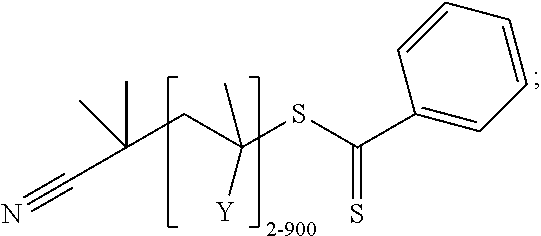
wherein each Y is independently selected from (i) the side chain of polyHPMA:

and (ii) the side chain of poly(2-(4-butanoyloxybenzoyloxy)ethyl methacrylate):

In some embodiments, there are 2, 5, 10, 20, 30, 40, 50, 75, 100, 125, 150, 175, 200, 250, 300, 350, 400, 450, 500, 550, 600, 650, 700, 750, 800, 850, 900, or ranges therebetween of the repeated Y-displaying groups.

wherein a and b are independently 1-1000 (e.g., 10, 20, 30, 40, 50, 60, 70, 80, 90, 100, 125, 133, 150, 175, 200, 250, 300, 400, 500, 600, 700, 800, 900, 1000, or ranges therebetween). In some embodiments, the copolymer is a random copolymer and comprises formula (V):

wherein each Y is independently selected from (i) the side chain of polyHPMA:

and (ii) the side chain of poly(2-(4-butanoyloxybenzoyloxy)ethyl methacrylamide):

In some embodiments, there are 2, 5, 10, 20, 30, 40, 50, 75, 100, 125, 150, 175, 200, 250, 300, 350, 400, 450, 500, 550, 600, 650, 700, 750, 800, 850, 900, or ranges therebetween of the repeated Y-displaying groups.
- Arpaia, N., Campbell, C., Fan, X., Dikiy, S., van der Veeken, J., deRoos, P., Liu, H., Cross, J. R., Pfeffer, K., Coffer, P. J., and Rudensky, A. Y. (2013). Metabolites produced by commensal bacteria promote peripheral regulatory T-cell generation. Nature 504, 451-455.
- Berni Canani, R., Gilbert, J. A., and Nagler, C. R. (2015). The role of the commensal microbiota in the regulation of tolerance to dietary allergens. Curr Opin Allergy Clin Immunol, 15, 243-249.
- Berni Canani, R., Sangwan, N., Stefka, A. T., Nocerino, R., Papro, L., Aitoro, R., Calignano, A., Kahn, A. A., Gilbert, J. A., and Nagler, C. R. (2016). Lactobacillus rhamnosus GG-supplemented formula expands butyrate-producing bacterial strains in food allergic infants. ISME J, 10, 742-750.
- Furusawa, Y., Obata, Y., Fukuda, S., Endo, T. A., Nakato, G.,Takahashi, D., Nakanishi, Y., Uetake, C., Kato, K., Kato, T., Takahashi, M., Fukuda, N. N., Murakami, S., Miyauchi, E., Hino, S., Atarashi, K., Onawa, S., Fujimura, Y., Lockett, T., Clarke, J. M., Topping, D. L., Tomita, M., Hori, S., Ohara, O., Morita, T., Koseki, H., Kikuchi, J., Honda, K., Hase, K., and Ohno, H., (2013). Commensal microbe-derived butyrate induces the differentiation of colonic regulatory T cells. Nature 504, 446-450.
- Haghikia, A., Jorg, S., Duscha, A., Berg, J., Arndt, M., Waschbisch, A., Hammer, A., Lee, D.-H., May, C., Wilck, N., Balogh, A., Ostermann, A. I., Schebb, N. H., Akkad, D. A., Grohme, D. A., Kleinewietfeld, M., Kempa, S., Thöne, J., Demir, S., Müller, D. N., Gold, R., and Linker, R. A. (2015). Dietary Fatty Acids Directly Impact Central Nervous System Autoimmunity via the Small Intestine. Immunity, 43, 817-829.
- Kaur, A., (2012) Modulation of gut microbiota and its environment using starch-entrapped microspheres and cereal arabinoxylans. Purdue.
- MacFabe, D. F. (2015) Enteric short-chain fatty acids: microbial messengers of metabolism, mitochondria, and mind: implications in autism spectrum disorders. Microb Ecol Health Dis, 26, 28177.
- Meijer, K. de Vos, P., and Priebe, M. G. (2010). Butyrate and other short-chain fatty acids as modulators of immunity: what relevance for health? Curr Opin Clin Nutr Metab Care. 13, 715-721.
- Nylund, L., Nermes, M., Isolauri, E., Salminen, S., de Vos, W. M., and Satokari, R. (2015). Severity of atopic disease inversely correlates with intestinal microbiota diversity and butyrate-producing bacteria. Allergy, 70, 241-244.
- Sandin, A., Briback, L., Norin, E., and Bengt Björkstén, B. (2009). Faecal short chain fatty acid pattern and allergy in early childhood. Acta Paediatrica, 98, 823-827.
- Smith, P. M., Howitt, M. R., Panikov, N., Michaud, M., Gallini, C. A., Bohlooly-Y, M., Glickman, J. N., and Garrett, W. S. (2013). The microbial metabolites, short chain fatty acids, regulate colonic Treg cell homeostasis. Science 341, 569-573.
Claims (12)


Priority Applications (1)
| Application Number | Priority Date | Filing Date | Title |
|---|---|---|---|
| US16/605,449 US11633486B2 (en) | 2017-04-17 | 2018-04-17 | Polymer materials for delivery of short-chain fatty acids to the intestine for applications in human health and treatment of disease |
Applications Claiming Priority (3)
| Application Number | Priority Date | Filing Date | Title |
|---|---|---|---|
| US201762486124P | 2017-04-17 | 2017-04-17 | |
| PCT/US2018/027955 WO2018195067A1 (en) | 2017-04-17 | 2018-04-17 | Polymer materials for delivery of short-chain fatty acids to the intestine for applications in human health and treatment of disease |
| US16/605,449 US11633486B2 (en) | 2017-04-17 | 2018-04-17 | Polymer materials for delivery of short-chain fatty acids to the intestine for applications in human health and treatment of disease |
Related Parent Applications (1)
| Application Number | Title | Priority Date | Filing Date |
|---|---|---|---|
| PCT/US2018/027955 A-371-Of-International WO2018195067A1 (en) | 2017-04-17 | 2018-04-17 | Polymer materials for delivery of short-chain fatty acids to the intestine for applications in human health and treatment of disease |
Related Child Applications (1)
| Application Number | Title | Priority Date | Filing Date |
|---|---|---|---|
| US18/303,292 Division US12186402B2 (en) | 2017-04-17 | 2023-04-19 | Polymer materials for delivery of short-chain fatty acids to the intestine for applications in human health and treatment of disease |
Publications (2)
| Publication Number | Publication Date |
|---|---|
| US20200048390A1 US20200048390A1 (en) | 2020-02-13 |
| US11633486B2 true US11633486B2 (en) | 2023-04-25 |
Family
ID=63856398
Family Applications (2)
| Application Number | Title | Priority Date | Filing Date |
|---|---|---|---|
| US16/605,449 Active 2038-12-10 US11633486B2 (en) | 2017-04-17 | 2018-04-17 | Polymer materials for delivery of short-chain fatty acids to the intestine for applications in human health and treatment of disease |
| US18/303,292 Active US12186402B2 (en) | 2017-04-17 | 2023-04-19 | Polymer materials for delivery of short-chain fatty acids to the intestine for applications in human health and treatment of disease |
Family Applications After (1)
| Application Number | Title | Priority Date | Filing Date |
|---|---|---|---|
| US18/303,292 Active US12186402B2 (en) | 2017-04-17 | 2023-04-19 | Polymer materials for delivery of short-chain fatty acids to the intestine for applications in human health and treatment of disease |
Country Status (7)
| Country | Link |
|---|---|
| US (2) | US11633486B2 (en) |
| EP (1) | EP3612570A4 (en) |
| JP (2) | JP7136807B2 (en) |
| KR (1) | KR102665545B1 (en) |
| CN (1) | CN110891982B (en) |
| AU (1) | AU2018255269B2 (en) |
| WO (1) | WO2018195067A1 (en) |
Families Citing this family (3)
| Publication number | Priority date | Publication date | Assignee | Title |
|---|---|---|---|---|
| WO2020097077A1 (en) * | 2018-11-05 | 2020-05-14 | The University Of Chicago | Methods and compositions for treating infectious, autoimmune, and allergic disease |
| WO2021024906A1 (en) * | 2019-08-05 | 2021-02-11 | 国立大学法人筑波大学 | Hydrophilic-hydrophobic copolymer carrying short-chain fatty acid ester |
| WO2023081765A2 (en) | 2021-11-03 | 2023-05-11 | The University Of Chicago | Prodrug copolymers and polymeric micelles thereof for the delivery of short-chain fatty acids, the promotion of gut health, and the treatment of immune and/or inflammatory conditions and food allergy |
Citations (128)
| Publication number | Priority date | Publication date | Assignee | Title |
|---|---|---|---|---|
| US4054722A (en) * | 1975-06-23 | 1977-10-18 | Fuji Photo Film Co., Ltd. | Acyloxy substituted acrylate timing layers for color diffusion transfer |
| JPS62178502A (en) | 1986-01-31 | 1987-08-05 | Tokuyama Soda Co Ltd | Dental restorative agent |
| US4735967A (en) | 1985-05-28 | 1988-04-05 | Neesby Torben E | Method for desensitizing the gastrointestinal tract from food allergies |
| US4865946A (en) * | 1983-03-28 | 1989-09-12 | Eastman Kodak Company | Temporary barrier layer for photographic element |
| US5037883A (en) | 1985-01-04 | 1991-08-06 | Ceskoslovenska Akademie Ved | Synthetic polymeric drugs |
| US5039703A (en) | 1989-11-16 | 1991-08-13 | Breuer Richard I | Method for treating inflammatory bowel disorders |
| EP0451750A2 (en) | 1990-04-10 | 1991-10-16 | Clintec Nutrition Company | Use of short chain fatty acid containing lipids to maintain gastrointestinal integrity and function in patients |
| US5258453A (en) | 1992-01-21 | 1993-11-02 | University Of Utah | Drug delivery system for the simultaneous delivery of drugs activatable by enzymes and light |
| WO1995010271A2 (en) | 1993-10-12 | 1995-04-20 | The Government Of The United States Of America, Represented By The Secretary, Department Of Health And Human Services | Phenylacetate and derivatives alone or in combination with other compounds against neoplastic conditions and other disorders |
| WO1995011699A1 (en) | 1993-10-29 | 1995-05-04 | The Trustees Of Boston University | Physiologically stable compositions of butyric acid, and butyric acid salts and derivatives as anti-neoplastic agents |
| WO1995013801A1 (en) | 1993-11-17 | 1995-05-26 | Commonwealth Scientific And Industrial Research Organisation | Fatty acid delivery system |
| US5569680A (en) | 1995-02-13 | 1996-10-29 | Trustees Of The Univ. Of Penna | Method of treating inflammatory bowel disease with tributyrin |
| JPH08292611A (en) | 1995-02-24 | 1996-11-05 | Fuji Photo Film Co Ltd | Method for making electrophotographic engraving printing plate |
| WO1996035440A1 (en) | 1995-05-09 | 1996-11-14 | Probi Ab | Pharmaceutical composition comprising lactobacillus plantarum and arginine |
| US5698611A (en) | 1995-03-13 | 1997-12-16 | Gc Corporation | Denture base relining resins |
| US6197743B1 (en) | 1996-07-26 | 2001-03-06 | The Trustees Of Boston University | Compositions and methods for the treatment of viral disorders |
| US6203797B1 (en) | 1998-01-06 | 2001-03-20 | Stephen C. Perry | Dietary supplement and method for use as a probiotic, for alleviating the symptons associated with irritable bowel syndrome |
| WO2002002102A1 (en) | 2000-06-30 | 2002-01-10 | Commonwealth Scientific And Industrial Research Organisation | Rapid fatty acid delivery |
| US20030017202A1 (en) | 2001-06-29 | 2003-01-23 | Bunick Frank J. | Brittle-coating, soft core dosage form |
| WO2003057730A1 (en) | 2002-01-07 | 2003-07-17 | Euroscreen S.A. | Ligand for g-protein coupled receptor gpr43 and uses thereof |
| WO2003075839A2 (en) | 2002-03-04 | 2003-09-18 | Aton Pharma, Inc. | Methods of inducing terminal differentiation |
| WO2003090557A1 (en) | 2002-04-24 | 2003-11-06 | The Procter & Gamble Company | Compositions comprising short and long chain fatty acids and methods of their use for the management of body weight |
| US20050004007A1 (en) | 2000-09-12 | 2005-01-06 | Steven Grant | Promotion of adoptosis in cancer cells by co-administration of cyclin dependent kinase inhibitiors and cellular differentiation agents |
| WO2005000040A1 (en) | 2003-06-24 | 2005-01-06 | University Of Kansas Medical Center | Infant formula |
| WO2005023179A2 (en) | 2003-08-29 | 2005-03-17 | Aton Pharma, Inc. | Combination methods of treating cancer |
| US20050063903A1 (en) | 2003-02-06 | 2005-03-24 | Zeligs Michael A. | Combined use of cruciferous indoles and chelators for the treatment of papilloma virus-related conditions |
| US20050070607A1 (en) | 2003-08-19 | 2005-03-31 | James Andrus | N-acetylcysteine compositions and methods for the treatment and prevention of cysteine/glutathione deficiency in diseases and conditions |
| EP1574213A1 (en) | 2004-03-11 | 2005-09-14 | Yih-Lin Chung | Use of histone deacetylase inhibitors for increasing therapeutic gain in radiotherapy and chemotherapy |
| US20050245439A1 (en) | 2002-04-26 | 2005-11-03 | Yih-Lin Chung | Prevention of joint destruction |
| US20050272644A1 (en) | 2002-07-25 | 2005-12-08 | Yih-Lin Chung | Method for increasing therapeutic gain in radiotherapy and chemotherapy |
| CA2569678A1 (en) | 2004-06-09 | 2005-12-22 | Kurume University | Regulator of physiological function of ghrelin and use thereof |
| WO2005122790A1 (en) | 2004-06-22 | 2005-12-29 | N.V. Nutricia | Improvement of intestinal barrier integrity |
| WO2006017692A2 (en) | 2004-08-06 | 2006-02-16 | Transform Pharmaceuticals, Inc. | Novel fenofibrate formulations and related methods of treatment |
| US20060068039A1 (en) | 2002-11-11 | 2006-03-30 | Pharmalett A/S | Composition for the treatment of gastrointestinal disorders |
| EP1699449A1 (en) | 2003-12-19 | 2006-09-13 | Pronova Biocare AS | Use of a fatty acid composition comprising at least one of epa and dha or any combinations thereof |
| WO2006099396A2 (en) | 2005-03-11 | 2006-09-21 | The Regents Of The University Of Colorado | Histone deacetylase inhibitors sensitize cancer cells to epidermal growth factor inhibitors |
| WO2006115412A2 (en) | 2005-04-27 | 2006-11-02 | N.V. Nutricia | Nutrition with lipids and non-digestible saccharides |
| EP1719508A1 (en) | 2005-05-06 | 2006-11-08 | Yih-Lin Chung | Use of histone deacetylase inhibitors for the prevention or treatment of joint destruction |
| EP1723951A1 (en) | 2005-04-21 | 2006-11-22 | N.V. Nutricia | Nutritional supplement with oligosaccharides for a category of HIV patients |
| US20060275370A1 (en) | 2002-07-25 | 2006-12-07 | Yih-Lin Chung | Method and compositions for treatment of epithelial damage |
| US20070004639A1 (en) | 2005-07-01 | 2007-01-04 | Bodybio, Inc. | Methods and compositions for treating Parkinson's disease |
| US20070021508A1 (en) | 2005-07-19 | 2007-01-25 | Antromed Inc | Method for treatment of Helicobacter pylori infection and/or an associated disease |
| WO2007036230A1 (en) | 2005-09-28 | 2007-04-05 | Nordisk Rebalance A/S | Treatment of ibd and ibs using both probiotic bacteria and fermented cereal as treatment effectors |
| US20070078083A1 (en) | 2005-09-07 | 2007-04-05 | Braincells, Inc. | MODULATION OF NEUORGENESIS BY HDac INHIBITION |
| WO2007049262A1 (en) | 2005-10-27 | 2007-05-03 | Berand Limited | Methods and compositions for the promotion of neuronal growth and the treatment of asociality and affective disorders |
| WO2007053596A1 (en) | 2005-10-31 | 2007-05-10 | Braincells, Inc. | Gaba receptor mediated modulation of neurogenesis |
| WO2007056243A2 (en) | 2005-11-04 | 2007-05-18 | Merck & Co. Inc. | Methods of treating cancers with saha and fluorouracil and other combination therapies |
| US20070117815A1 (en) | 2005-11-04 | 2007-05-24 | James Pluda | Method of treating cancers with SAHA and pemetrexed |
| EP1790333A1 (en) | 2005-10-21 | 2007-05-30 | Promefarm s.r.l. | Gastroresistant tablet comprising a butyric acid compound |
| US20070128266A1 (en) | 2004-02-06 | 2007-06-07 | Cosmo Technologies Ltd. | Pharmaceutical or dietary compositions based on short-chain fatty acids and complex sugars, for intestinal disorders |
| US20070208075A1 (en) | 1994-10-26 | 2007-09-06 | Sylvain Cottens | Pharmaceutical compositions |
| US20070207950A1 (en) | 2005-12-21 | 2007-09-06 | Duke University | Methods and compositions for regulating HDAC6 activity |
| WO2007134077A2 (en) | 2006-05-09 | 2007-11-22 | Braincells, Inc. | 5 ht receptor mediated neurogenesis |
| WO2007146730A2 (en) | 2006-06-08 | 2007-12-21 | Gloucester Pharmaceuticals | Deacetylase inhibitor therapy |
| EP1868454A2 (en) | 2005-04-06 | 2007-12-26 | Novartis AG | A method and composition for nutritionally improving glucose control and insulin action |
| US20080015166A1 (en) | 2004-06-22 | 2008-01-17 | N.V. Nutricia | Barrier Integrity in Hiv Patients |
| US20080045445A1 (en) | 2006-07-20 | 2008-02-21 | Herbert Chen | Modulating Notch1 Signaling Pathway for Treating Neuroendocrine Tumors |
| US20080103165A1 (en) | 2006-09-19 | 2008-05-01 | Braincells, Inc. | Ppar mediated modulation of neurogenesis |
| US20080113003A1 (en) | 2004-04-06 | 2008-05-15 | University Of Saskatchewan | Sinapic Acid Supplementation |
| WO2008090534A1 (en) | 2007-01-26 | 2008-07-31 | Berand Limited | Methods and compositions for inhibition of excessive weight gain, reduction of inappropriate eating behaviours and inhibition of binge eating for the treatment of obesity |
| WO2008091170A1 (en) | 2007-01-25 | 2008-07-31 | Biolek Sp. Z O.O. | A preparation containing sodium butyrate and the application of a preparation containing sodium butyrate |
| EP2030616A1 (en) | 2007-08-31 | 2009-03-04 | Asan Laboratories Company (Cayman) Limited | Short-chain fatty acid derivatives for treating pruritus |
| US20090123388A1 (en) | 2005-01-14 | 2009-05-14 | Medical College Of Georgia Research Institute | Prodrugs of Short-Chain Fatty Acids and Treatment Methods |
| WO2009072097A1 (en) | 2007-12-04 | 2009-06-11 | Westgate Biological Limited | Antimicrobial compositions comprising fatty acids and milk proteins |
| WO2009087474A2 (en) | 2008-01-08 | 2009-07-16 | Akthelia Pharmaceuticals | Agonists for antimicrobial peptide systems |
| WO2009108755A2 (en) | 2008-02-27 | 2009-09-03 | Wyeth | Pharmaceutical combinations for the treatment of cancer |
| WO2009154463A2 (en) | 2008-06-20 | 2009-12-23 | Stichting Top Institute Food And Nutrition | Butyrate as a medicament to improve visceral perception in humans |
| US20100008923A1 (en) | 2006-06-26 | 2010-01-14 | Novartis Ag | Organic Compounds |
| US20100022444A1 (en) | 2008-07-24 | 2010-01-28 | Bodybio, Inc. | Combination therapy for modulation of activity and development of cells and tissues |
| US20100048595A1 (en) | 2005-03-23 | 2010-02-25 | Washington University In St. Louis | Use of archaea to modulate the nutrient harvesting functions of the gastrointestinal microbiota |
| US20100113392A1 (en) | 2006-11-03 | 2010-05-06 | Badros Ashraf Z | Methods of using saha and bortezomib for treating multiple myeloma |
| US20100112088A1 (en) | 2003-08-29 | 2010-05-06 | Jay Pravda | Materials and methods for treatment of disorders associated with oxidative stress |
| US7718824B2 (en) | 1999-08-17 | 2010-05-18 | Immunopath Profile, Inc. | Therapeutic stem cell growth factor composition, anti-inflammatory composition, and uses thereof |
| US20100197758A1 (en) | 2007-04-12 | 2010-08-05 | Andrews Matthew T | Ischemia/reperfusion protection compositions and methods of using |
| US20100222271A1 (en) | 2007-10-14 | 2010-09-02 | Josef Neu | Formulation to Improve Gastrointestinal Function |
| WO2010142456A1 (en) | 2009-06-11 | 2010-12-16 | Photocure Asa | Solid compositions comprising 5-aminolevulinic acid |
| WO2010148572A1 (en) | 2009-06-26 | 2010-12-29 | Asan Laboratories Co., Ltd. | Method for treating or ameliorating mucocutaneous or ocular toxicities |
| US20110077300A1 (en) | 2009-03-26 | 2011-03-31 | Jianping Ye | Metabolic Benefits to Butyrate as a Chronic Diet Supplement |
| WO2011038224A1 (en) | 2009-09-24 | 2011-03-31 | Trustees Of Boston University | Methods for treating viral disorders |
| WO2011038014A2 (en) | 2009-09-23 | 2011-03-31 | Biokier, Inc. | Composition and method for treatment of diabetes |
| EP2323638A1 (en) | 2008-07-18 | 2011-05-25 | Hill's Pet Nutrition, Inc. | Compositions and methods for treating osteoarthritis |
| WO2011060492A1 (en) | 2009-11-18 | 2011-05-26 | The University Of Sydney | Combination for treating metabolic disorders |
| EP2338476A1 (en) | 2009-12-02 | 2011-06-29 | Bettina Heil | Suppository for rectal, vaginal or urethral administration containing a probiotic, an antibiotic and an unsaturated non-esterified fatty acid |
| WO2011082111A1 (en) | 2009-12-30 | 2011-07-07 | Baylor Research Institute | Anaplerotic therapy for alzheimer's disease and the aging brain |
| WO2011113013A2 (en) | 2010-03-11 | 2011-09-15 | Hemaquest Pharmaceuticals, Inc. | Methods and compositions for treating viral or virally-induced conditions |
| WO2011119228A1 (en) | 2010-03-23 | 2011-09-29 | Virun, Inc. | Nanoemulsion including sucrose fatty acid ester |
| US20110251149A1 (en) | 2009-12-08 | 2011-10-13 | Trustees Of Boston University | Methods and low dose regimens for treating red blood cell disorders |
| WO2011135107A1 (en) | 2010-04-26 | 2011-11-03 | Angel Manuel Gago De Santos | Compositions for the symptomatic relief of stomach pain or gastro-oesophageal reflux |
| US20110294767A1 (en) | 2010-05-26 | 2011-12-01 | Satiogen Pharmaceuticals, Inc. | Bile acid recycling inhibitors and satiogens for treatment of diabetes, obesity, and inflammatory gastrointestinal conditions |
| US20110293784A1 (en) | 2010-05-28 | 2011-12-01 | Anja Wittke | Milk-based nutritional compositions |
| EP2444082A2 (en) | 2004-03-26 | 2012-04-25 | Abbott Laboratories | Hydroxymethylbutyrate compositions and uses thereof |
| WO2012140504A1 (en) | 2011-04-11 | 2012-10-18 | Rubhana Raqib | Therapeutic compounds |
| WO2012149472A2 (en) | 2011-04-27 | 2012-11-01 | Ignite Institute For Individualized Health | Methods, compositions, and kits for treating and preventing neurological conditions |
| US20130115280A1 (en) | 2010-07-29 | 2013-05-09 | Cosmo Technologies Ltd | Pharmaceutical and/or dietary compositions based on sort chain fatty acids |
| WO2014049363A1 (en) | 2012-09-27 | 2014-04-03 | The University Of Sheffield | Block copolymer synthesis |
| US20140179782A1 (en) | 2011-10-14 | 2014-06-26 | Mead Johnson Nutrition Company | Neurogenesis screening method and uses thereof |
| WO2014150558A1 (en) | 2013-03-15 | 2014-09-25 | Mjn U.S. Holdings Llc | Nutritional compositions containing a peptide component with anti-inflammatory properties and uses thereof |
| WO2014150556A1 (en) | 2013-03-15 | 2014-09-25 | Mjn U.S. Holdings Llc | Nutritional compositions containing a peptide component and uses thereof |
| WO2014150571A1 (en) | 2013-03-15 | 2014-09-25 | Mjn U.S. Holdings Llc | Reducing proinflammatory response |
| WO2014159802A1 (en) | 2013-03-14 | 2014-10-02 | Bristol-Myers Squibb Company | Bicyclo [2.2.2] acid gpr120 modulators |
| US20140349923A1 (en) | 2012-01-16 | 2014-11-27 | Glaxosmithkline Intellectual Property (No. 2) Limited | Compositions And Methods For Treating Diabetes And/Or Obesity |
| US20140370080A1 (en) | 2011-10-27 | 2014-12-18 | Trustees Of Boston University | Histone deacetylase (hdac) inhibitors for treatment of post-surgical adhesions |
| WO2015006355A2 (en) | 2013-07-09 | 2015-01-15 | Puretech Ventures, Llc | Compositions containing combinations of bioactive molecules derived from microbiota for treatment of disease |
| US20150023922A1 (en) | 2013-07-16 | 2015-01-22 | Mead Johnson Nutrition Company | Methods for promoting neuronal development and/or health |
| US20150023923A1 (en) | 2013-07-16 | 2015-01-22 | Mead Johnson Nutrition Company | Methods for promoting neuronal development and/or health |
| US20150037455A1 (en) | 2013-07-31 | 2015-02-05 | Mead Johnson Nutrition Company | Nutritional compositions containing synergistic combination and uses thereof |
| FI124918B (en) | 2013-05-14 | 2015-03-31 | Hankkija Maatalous Oy | tall oil fatty acids |
| US20150119322A1 (en) | 2013-07-31 | 2015-04-30 | Mead Johnson Nutrition Company | Nutritional compositions containing a prebiotic and lactoferrin and uses thereof |
| US20150132396A1 (en) | 2013-11-08 | 2015-05-14 | Sigmoid Pharma Limited | Formulations |
| US20150157048A1 (en) | 2013-12-11 | 2015-06-11 | Mead Johnson Nutrition Company | Nutritional compositions containing stearidonic acid and uses thereof |
| US20150164833A1 (en) | 2013-12-17 | 2015-06-18 | Mead Johnson Nutrition Company | Nutritional composition containing a neurologic component of ursolic acid and uses thereof |
| US20150224054A1 (en) | 2012-08-28 | 2015-08-13 | Imperial Innovations Ltd | Nanoparticle formulation |
| US20150231213A1 (en) | 2013-07-31 | 2015-08-20 | Mead Johnson Nutrition Company | Nutritional compositions containing a prebiotic and lactoferrin and uses thereof |
| US20150293123A1 (en) | 2012-12-10 | 2015-10-15 | The Regents Of The University Of California | Cathelicidin as novel inflammatory bowel disease marker and therapy for colitis-associated intestinal fibrosis |
| WO2015175388A1 (en) | 2014-05-12 | 2015-11-19 | Rush University Medical Center | Biomarkers for risk assessment, diagnosis and target microbiome and intestinal homeostasis for prevention and treatment of amyotrophic lateral sclerosis |
| US20160038447A1 (en) | 2013-03-15 | 2016-02-11 | President And Fellows Of Harvard College | Modulation of regulatory t cells via g-coupled protein receptor 43 |
| WO2016025747A1 (en) | 2014-08-13 | 2016-02-18 | Stayton Patrick S | Nonlinear copolymers as intracellular delivery vehicles and related methods |
| US9301966B2 (en) | 2013-01-11 | 2016-04-05 | Mead Johnson Nutrition Company | Nutritional compositions containing magnesium threonate and uses thereof |
| US20160129071A1 (en) | 2014-11-06 | 2016-05-12 | Mead Johnson Nutrition Company | Nutritional supplements containing a peptide component and uses thereof |
| US20160136122A1 (en) | 2014-10-16 | 2016-05-19 | Jose U. Scher | Methods for treating psoriatic arthritis |
| US20160158174A1 (en) | 2014-12-09 | 2016-06-09 | Intercontinental Great Brands Llc | Enteric-Coated Functional Food Ingredients And Methods For Making The Enteric-Coated Functional Food Ingredients |
| US20160206666A1 (en) | 2014-12-22 | 2016-07-21 | Synlogic, Inc. | Bacteria engineered to treat diseases that benefit from reduced gut inflammation and/or tighten gut mucosal barrier |
| WO2016118730A1 (en) | 2015-01-23 | 2016-07-28 | Temple University-Of The Commonwealth System Of Higher Education | Use of short chain fatty acids in cancer prevention |
| US20160220520A1 (en) | 2014-01-29 | 2016-08-04 | Steve Beaudin | Apparatus, system and method for the treatment of atherosclerosis, heart disease and stroke |
| US20160250269A1 (en) | 2013-11-13 | 2016-09-01 | Hankkija Oy | Feed Supplement and a Feed Composition Comprising Resin Acid Based Composition |
| US20160271086A1 (en) | 2013-10-31 | 2016-09-22 | Sloan-Kettering Institute For Cancer Research | Methods and compositions for inducing regulatory t-cell generation |
| WO2016154730A1 (en) | 2015-04-02 | 2016-10-06 | University Health Network | Gut anti-inflammatory agents for regulation of high blood glucose levels |
| WO2016172658A2 (en) | 2015-04-23 | 2016-10-27 | Kaleido Biosciences, Inc. | Microbiome regulators and related uses thereof |
Family Cites Families (5)
| Publication number | Priority date | Publication date | Assignee | Title |
|---|---|---|---|---|
| CN104105718B (en) | 2011-12-14 | 2017-05-10 | 联邦科学和工业研究组织 | RAFT polymers |
| EP2958557B1 (en) * | 2013-02-25 | 2019-11-27 | University Of Rochester | Nanoparticles for controlled release of anti-biofilm agents |
| US9512249B2 (en) * | 2013-03-15 | 2016-12-06 | University Of Delaware | Bio-based block polymers derived from lignin and fatty acids |
| WO2014182713A1 (en) | 2013-05-06 | 2014-11-13 | The Regents Of The University Of Minnesota | Sugar free, statistical copolymers made from at least three monomers |
| CZ306039B6 (en) * | 2015-05-07 | 2016-07-07 | Ústav makromolekulární chemie AV ČR, v. v. i. | Polymeric brushes resistant to deposition of biological media components, process for their preparation and their use |
-
2018
- 2018-04-17 JP JP2019556663A patent/JP7136807B2/en active Active
- 2018-04-17 US US16/605,449 patent/US11633486B2/en active Active
- 2018-04-17 AU AU2018255269A patent/AU2018255269B2/en active Active
- 2018-04-17 EP EP18788367.3A patent/EP3612570A4/en active Pending
- 2018-04-17 KR KR1020197033820A patent/KR102665545B1/en active Active
- 2018-04-17 WO PCT/US2018/027955 patent/WO2018195067A1/en not_active Ceased
- 2018-04-17 CN CN201880025751.5A patent/CN110891982B/en active Active
-
2022
- 2022-07-05 JP JP2022108522A patent/JP7436576B2/en active Active
-
2023
- 2023-04-19 US US18/303,292 patent/US12186402B2/en active Active
Patent Citations (140)
| Publication number | Priority date | Publication date | Assignee | Title |
|---|---|---|---|---|
| US4054722A (en) * | 1975-06-23 | 1977-10-18 | Fuji Photo Film Co., Ltd. | Acyloxy substituted acrylate timing layers for color diffusion transfer |
| US4865946A (en) * | 1983-03-28 | 1989-09-12 | Eastman Kodak Company | Temporary barrier layer for photographic element |
| US5037883A (en) | 1985-01-04 | 1991-08-06 | Ceskoslovenska Akademie Ved | Synthetic polymeric drugs |
| US4735967A (en) | 1985-05-28 | 1988-04-05 | Neesby Torben E | Method for desensitizing the gastrointestinal tract from food allergies |
| JPS62178502A (en) | 1986-01-31 | 1987-08-05 | Tokuyama Soda Co Ltd | Dental restorative agent |
| US5039703A (en) | 1989-11-16 | 1991-08-13 | Breuer Richard I | Method for treating inflammatory bowel disorders |
| EP0451750A2 (en) | 1990-04-10 | 1991-10-16 | Clintec Nutrition Company | Use of short chain fatty acid containing lipids to maintain gastrointestinal integrity and function in patients |
| US5258453A (en) | 1992-01-21 | 1993-11-02 | University Of Utah | Drug delivery system for the simultaneous delivery of drugs activatable by enzymes and light |
| WO1995010271A2 (en) | 1993-10-12 | 1995-04-20 | The Government Of The United States Of America, Represented By The Secretary, Department Of Health And Human Services | Phenylacetate and derivatives alone or in combination with other compounds against neoplastic conditions and other disorders |
| WO1995011699A1 (en) | 1993-10-29 | 1995-05-04 | The Trustees Of Boston University | Physiologically stable compositions of butyric acid, and butyric acid salts and derivatives as anti-neoplastic agents |
| WO1995013801A1 (en) | 1993-11-17 | 1995-05-26 | Commonwealth Scientific And Industrial Research Organisation | Fatty acid delivery system |
| US5840860A (en) | 1993-11-17 | 1998-11-24 | Commonwealth Scientific And Industrial Research Organization | Fatty acid delivery system comprising a hydrolyzable bond |
| US20070208075A1 (en) | 1994-10-26 | 2007-09-06 | Sylvain Cottens | Pharmaceutical compositions |
| US5569680A (en) | 1995-02-13 | 1996-10-29 | Trustees Of The Univ. Of Penna | Method of treating inflammatory bowel disease with tributyrin |
| JPH08292611A (en) | 1995-02-24 | 1996-11-05 | Fuji Photo Film Co Ltd | Method for making electrophotographic engraving printing plate |
| US5698611A (en) | 1995-03-13 | 1997-12-16 | Gc Corporation | Denture base relining resins |
| WO1996035440A1 (en) | 1995-05-09 | 1996-11-14 | Probi Ab | Pharmaceutical composition comprising lactobacillus plantarum and arginine |
| US6197743B1 (en) | 1996-07-26 | 2001-03-06 | The Trustees Of Boston University | Compositions and methods for the treatment of viral disorders |
| US6203797B1 (en) | 1998-01-06 | 2001-03-20 | Stephen C. Perry | Dietary supplement and method for use as a probiotic, for alleviating the symptons associated with irritable bowel syndrome |
| US7718824B2 (en) | 1999-08-17 | 2010-05-18 | Immunopath Profile, Inc. | Therapeutic stem cell growth factor composition, anti-inflammatory composition, and uses thereof |
| WO2002002102A1 (en) | 2000-06-30 | 2002-01-10 | Commonwealth Scientific And Industrial Research Organisation | Rapid fatty acid delivery |
| US20050004007A1 (en) | 2000-09-12 | 2005-01-06 | Steven Grant | Promotion of adoptosis in cancer cells by co-administration of cyclin dependent kinase inhibitiors and cellular differentiation agents |
| US20030017202A1 (en) | 2001-06-29 | 2003-01-23 | Bunick Frank J. | Brittle-coating, soft core dosage form |
| WO2003057730A1 (en) | 2002-01-07 | 2003-07-17 | Euroscreen S.A. | Ligand for g-protein coupled receptor gpr43 and uses thereof |
| WO2003075839A2 (en) | 2002-03-04 | 2003-09-18 | Aton Pharma, Inc. | Methods of inducing terminal differentiation |
| US7399787B2 (en) | 2002-03-04 | 2008-07-15 | Merck Hdac Research, Llc | Methods of treating cancer with HDAC inhibitors |
| WO2003090557A1 (en) | 2002-04-24 | 2003-11-06 | The Procter & Gamble Company | Compositions comprising short and long chain fatty acids and methods of their use for the management of body weight |
| US20050245439A1 (en) | 2002-04-26 | 2005-11-03 | Yih-Lin Chung | Prevention of joint destruction |
| US20060275370A1 (en) | 2002-07-25 | 2006-12-07 | Yih-Lin Chung | Method and compositions for treatment of epithelial damage |
| US20050272644A1 (en) | 2002-07-25 | 2005-12-08 | Yih-Lin Chung | Method for increasing therapeutic gain in radiotherapy and chemotherapy |
| US20060068039A1 (en) | 2002-11-11 | 2006-03-30 | Pharmalett A/S | Composition for the treatment of gastrointestinal disorders |
| US20050063903A1 (en) | 2003-02-06 | 2005-03-24 | Zeligs Michael A. | Combined use of cruciferous indoles and chelators for the treatment of papilloma virus-related conditions |
| WO2005000040A1 (en) | 2003-06-24 | 2005-01-06 | University Of Kansas Medical Center | Infant formula |
| US20050070607A1 (en) | 2003-08-19 | 2005-03-31 | James Andrus | N-acetylcysteine compositions and methods for the treatment and prevention of cysteine/glutathione deficiency in diseases and conditions |
| US20100112088A1 (en) | 2003-08-29 | 2010-05-06 | Jay Pravda | Materials and methods for treatment of disorders associated with oxidative stress |
| WO2005023179A2 (en) | 2003-08-29 | 2005-03-17 | Aton Pharma, Inc. | Combination methods of treating cancer |
| EP1699449A1 (en) | 2003-12-19 | 2006-09-13 | Pronova Biocare AS | Use of a fatty acid composition comprising at least one of epa and dha or any combinations thereof |
| US20070128266A1 (en) | 2004-02-06 | 2007-06-07 | Cosmo Technologies Ltd. | Pharmaceutical or dietary compositions based on short-chain fatty acids and complex sugars, for intestinal disorders |
| EP1574213A1 (en) | 2004-03-11 | 2005-09-14 | Yih-Lin Chung | Use of histone deacetylase inhibitors for increasing therapeutic gain in radiotherapy and chemotherapy |
| US8217077B2 (en) | 2004-03-26 | 2012-07-10 | Abbott Laboratories | HMB uses thereof |
| EP2444082A2 (en) | 2004-03-26 | 2012-04-25 | Abbott Laboratories | Hydroxymethylbutyrate compositions and uses thereof |
| US20080113003A1 (en) | 2004-04-06 | 2008-05-15 | University Of Saskatchewan | Sinapic Acid Supplementation |
| CA2569678A1 (en) | 2004-06-09 | 2005-12-22 | Kurume University | Regulator of physiological function of ghrelin and use thereof |
| WO2005122790A1 (en) | 2004-06-22 | 2005-12-29 | N.V. Nutricia | Improvement of intestinal barrier integrity |
| US20080015166A1 (en) | 2004-06-22 | 2008-01-17 | N.V. Nutricia | Barrier Integrity in Hiv Patients |
| WO2006017692A2 (en) | 2004-08-06 | 2006-02-16 | Transform Pharmaceuticals, Inc. | Novel fenofibrate formulations and related methods of treatment |
| US20090149533A1 (en) | 2004-08-06 | 2009-06-11 | Transform Pharmaceuticals, Inc. | Novel fenofibrate formulations and related methods of treatment |
| US20090123388A1 (en) | 2005-01-14 | 2009-05-14 | Medical College Of Georgia Research Institute | Prodrugs of Short-Chain Fatty Acids and Treatment Methods |
| WO2006099396A2 (en) | 2005-03-11 | 2006-09-21 | The Regents Of The University Of Colorado | Histone deacetylase inhibitors sensitize cancer cells to epidermal growth factor inhibitors |
| US20100048595A1 (en) | 2005-03-23 | 2010-02-25 | Washington University In St. Louis | Use of archaea to modulate the nutrient harvesting functions of the gastrointestinal microbiota |
| EP1868454A2 (en) | 2005-04-06 | 2007-12-26 | Novartis AG | A method and composition for nutritionally improving glucose control and insulin action |
| EP1723951A1 (en) | 2005-04-21 | 2006-11-22 | N.V. Nutricia | Nutritional supplement with oligosaccharides for a category of HIV patients |
| WO2006115412A2 (en) | 2005-04-27 | 2006-11-02 | N.V. Nutricia | Nutrition with lipids and non-digestible saccharides |
| EP1719508A1 (en) | 2005-05-06 | 2006-11-08 | Yih-Lin Chung | Use of histone deacetylase inhibitors for the prevention or treatment of joint destruction |
| US20070004639A1 (en) | 2005-07-01 | 2007-01-04 | Bodybio, Inc. | Methods and compositions for treating Parkinson's disease |
| US20070021508A1 (en) | 2005-07-19 | 2007-01-25 | Antromed Inc | Method for treatment of Helicobacter pylori infection and/or an associated disease |
| US20070078083A1 (en) | 2005-09-07 | 2007-04-05 | Braincells, Inc. | MODULATION OF NEUORGENESIS BY HDac INHIBITION |
| WO2007036230A1 (en) | 2005-09-28 | 2007-04-05 | Nordisk Rebalance A/S | Treatment of ibd and ibs using both probiotic bacteria and fermented cereal as treatment effectors |
| US8846029B2 (en) | 2005-09-28 | 2014-09-30 | Nordisk Rebalance A/S | Treatment of IBD and IBS using both probiotic bacteria and fermented cereal as treatment effectors |
| EP1790333A1 (en) | 2005-10-21 | 2007-05-30 | Promefarm s.r.l. | Gastroresistant tablet comprising a butyric acid compound |
| WO2007049262A1 (en) | 2005-10-27 | 2007-05-03 | Berand Limited | Methods and compositions for the promotion of neuronal growth and the treatment of asociality and affective disorders |
| WO2007053596A1 (en) | 2005-10-31 | 2007-05-10 | Braincells, Inc. | Gaba receptor mediated modulation of neurogenesis |
| US20070117815A1 (en) | 2005-11-04 | 2007-05-24 | James Pluda | Method of treating cancers with SAHA and pemetrexed |
| WO2007056243A2 (en) | 2005-11-04 | 2007-05-18 | Merck & Co. Inc. | Methods of treating cancers with saha and fluorouracil and other combination therapies |
| US20070207950A1 (en) | 2005-12-21 | 2007-09-06 | Duke University | Methods and compositions for regulating HDAC6 activity |
| WO2007134077A2 (en) | 2006-05-09 | 2007-11-22 | Braincells, Inc. | 5 ht receptor mediated neurogenesis |
| WO2007146730A2 (en) | 2006-06-08 | 2007-12-21 | Gloucester Pharmaceuticals | Deacetylase inhibitor therapy |
| US20100008923A1 (en) | 2006-06-26 | 2010-01-14 | Novartis Ag | Organic Compounds |
| US20080045445A1 (en) | 2006-07-20 | 2008-02-21 | Herbert Chen | Modulating Notch1 Signaling Pathway for Treating Neuroendocrine Tumors |
| US20080103165A1 (en) | 2006-09-19 | 2008-05-01 | Braincells, Inc. | Ppar mediated modulation of neurogenesis |
| US20100113392A1 (en) | 2006-11-03 | 2010-05-06 | Badros Ashraf Z | Methods of using saha and bortezomib for treating multiple myeloma |
| WO2008091170A1 (en) | 2007-01-25 | 2008-07-31 | Biolek Sp. Z O.O. | A preparation containing sodium butyrate and the application of a preparation containing sodium butyrate |
| WO2008090534A1 (en) | 2007-01-26 | 2008-07-31 | Berand Limited | Methods and compositions for inhibition of excessive weight gain, reduction of inappropriate eating behaviours and inhibition of binge eating for the treatment of obesity |
| US20100197758A1 (en) | 2007-04-12 | 2010-08-05 | Andrews Matthew T | Ischemia/reperfusion protection compositions and methods of using |
| EP2030616A1 (en) | 2007-08-31 | 2009-03-04 | Asan Laboratories Company (Cayman) Limited | Short-chain fatty acid derivatives for treating pruritus |
| US20100222271A1 (en) | 2007-10-14 | 2010-09-02 | Josef Neu | Formulation to Improve Gastrointestinal Function |
| WO2009072097A1 (en) | 2007-12-04 | 2009-06-11 | Westgate Biological Limited | Antimicrobial compositions comprising fatty acids and milk proteins |
| WO2009087474A2 (en) | 2008-01-08 | 2009-07-16 | Akthelia Pharmaceuticals | Agonists for antimicrobial peptide systems |
| US9078864B2 (en) | 2008-01-08 | 2015-07-14 | Akthelia Pharmaceuticals | Agonists for antimicrobial peptide systems |
| WO2009108755A2 (en) | 2008-02-27 | 2009-09-03 | Wyeth | Pharmaceutical combinations for the treatment of cancer |
| WO2009154463A2 (en) | 2008-06-20 | 2009-12-23 | Stichting Top Institute Food And Nutrition | Butyrate as a medicament to improve visceral perception in humans |
| EP2323638A1 (en) | 2008-07-18 | 2011-05-25 | Hill's Pet Nutrition, Inc. | Compositions and methods for treating osteoarthritis |
| US20100022444A1 (en) | 2008-07-24 | 2010-01-28 | Bodybio, Inc. | Combination therapy for modulation of activity and development of cells and tissues |
| US20110077300A1 (en) | 2009-03-26 | 2011-03-31 | Jianping Ye | Metabolic Benefits to Butyrate as a Chronic Diet Supplement |
| WO2010142456A1 (en) | 2009-06-11 | 2010-12-16 | Photocure Asa | Solid compositions comprising 5-aminolevulinic acid |
| WO2010148572A1 (en) | 2009-06-26 | 2010-12-29 | Asan Laboratories Co., Ltd. | Method for treating or ameliorating mucocutaneous or ocular toxicities |
| WO2011038014A2 (en) | 2009-09-23 | 2011-03-31 | Biokier, Inc. | Composition and method for treatment of diabetes |
| US9301938B2 (en) | 2009-09-23 | 2016-04-05 | Biokier, Inc. | Composition and method for treatment of diabetes |
| WO2011038224A1 (en) | 2009-09-24 | 2011-03-31 | Trustees Of Boston University | Methods for treating viral disorders |
| WO2011060492A1 (en) | 2009-11-18 | 2011-05-26 | The University Of Sydney | Combination for treating metabolic disorders |
| EP2338476A1 (en) | 2009-12-02 | 2011-06-29 | Bettina Heil | Suppository for rectal, vaginal or urethral administration containing a probiotic, an antibiotic and an unsaturated non-esterified fatty acid |
| US20110251149A1 (en) | 2009-12-08 | 2011-10-13 | Trustees Of Boston University | Methods and low dose regimens for treating red blood cell disorders |
| WO2011082111A1 (en) | 2009-12-30 | 2011-07-07 | Baylor Research Institute | Anaplerotic therapy for alzheimer's disease and the aging brain |
| WO2011113013A2 (en) | 2010-03-11 | 2011-09-15 | Hemaquest Pharmaceuticals, Inc. | Methods and compositions for treating viral or virally-induced conditions |
| WO2011119228A1 (en) | 2010-03-23 | 2011-09-29 | Virun, Inc. | Nanoemulsion including sucrose fatty acid ester |
| WO2011135107A1 (en) | 2010-04-26 | 2011-11-03 | Angel Manuel Gago De Santos | Compositions for the symptomatic relief of stomach pain or gastro-oesophageal reflux |
| US20110294767A1 (en) | 2010-05-26 | 2011-12-01 | Satiogen Pharmaceuticals, Inc. | Bile acid recycling inhibitors and satiogens for treatment of diabetes, obesity, and inflammatory gastrointestinal conditions |
| US20110293784A1 (en) | 2010-05-28 | 2011-12-01 | Anja Wittke | Milk-based nutritional compositions |
| US20130115280A1 (en) | 2010-07-29 | 2013-05-09 | Cosmo Technologies Ltd | Pharmaceutical and/or dietary compositions based on sort chain fatty acids |
| WO2012140504A1 (en) | 2011-04-11 | 2012-10-18 | Rubhana Raqib | Therapeutic compounds |
| WO2012149472A2 (en) | 2011-04-27 | 2012-11-01 | Ignite Institute For Individualized Health | Methods, compositions, and kits for treating and preventing neurological conditions |
| US20140179782A1 (en) | 2011-10-14 | 2014-06-26 | Mead Johnson Nutrition Company | Neurogenesis screening method and uses thereof |
| US20140370080A1 (en) | 2011-10-27 | 2014-12-18 | Trustees Of Boston University | Histone deacetylase (hdac) inhibitors for treatment of post-surgical adhesions |
| US20140349923A1 (en) | 2012-01-16 | 2014-11-27 | Glaxosmithkline Intellectual Property (No. 2) Limited | Compositions And Methods For Treating Diabetes And/Or Obesity |
| US20150224054A1 (en) | 2012-08-28 | 2015-08-13 | Imperial Innovations Ltd | Nanoparticle formulation |
| WO2014049363A1 (en) | 2012-09-27 | 2014-04-03 | The University Of Sheffield | Block copolymer synthesis |
| US20150293123A1 (en) | 2012-12-10 | 2015-10-15 | The Regents Of The University Of California | Cathelicidin as novel inflammatory bowel disease marker and therapy for colitis-associated intestinal fibrosis |
| US9301966B2 (en) | 2013-01-11 | 2016-04-05 | Mead Johnson Nutrition Company | Nutritional compositions containing magnesium threonate and uses thereof |
| WO2014159802A1 (en) | 2013-03-14 | 2014-10-02 | Bristol-Myers Squibb Company | Bicyclo [2.2.2] acid gpr120 modulators |
| US9598390B2 (en) | 2013-03-14 | 2017-03-21 | Bristol-Myers Squibb Company | Bicyclo[2.2.2]acid GPR120 modulators |
| US20160038447A1 (en) | 2013-03-15 | 2016-02-11 | President And Fellows Of Harvard College | Modulation of regulatory t cells via g-coupled protein receptor 43 |
| WO2014150558A1 (en) | 2013-03-15 | 2014-09-25 | Mjn U.S. Holdings Llc | Nutritional compositions containing a peptide component with anti-inflammatory properties and uses thereof |
| US9352020B2 (en) | 2013-03-15 | 2016-05-31 | Mead Johnson Nutrition Company | Reducing proinflammatory response |
| US9345727B2 (en) | 2013-03-15 | 2016-05-24 | Mead Johnson Nutrition Company | Nutritional compositions containing a peptide component and uses thereof |
| WO2014150556A1 (en) | 2013-03-15 | 2014-09-25 | Mjn U.S. Holdings Llc | Nutritional compositions containing a peptide component and uses thereof |
| WO2014150571A1 (en) | 2013-03-15 | 2014-09-25 | Mjn U.S. Holdings Llc | Reducing proinflammatory response |
| US8889633B2 (en) | 2013-03-15 | 2014-11-18 | Mead Johnson Nutrition Company | Nutritional compositions containing a peptide component with anti-inflammatory properties and uses thereof |
| FI124918B (en) | 2013-05-14 | 2015-03-31 | Hankkija Maatalous Oy | tall oil fatty acids |
| US9919013B2 (en) | 2013-05-14 | 2018-03-20 | Hankkija Oy | Use of tall oil fatty acid |
| WO2015006355A2 (en) | 2013-07-09 | 2015-01-15 | Puretech Ventures, Llc | Compositions containing combinations of bioactive molecules derived from microbiota for treatment of disease |
| US20150023922A1 (en) | 2013-07-16 | 2015-01-22 | Mead Johnson Nutrition Company | Methods for promoting neuronal development and/or health |
| US20150023923A1 (en) | 2013-07-16 | 2015-01-22 | Mead Johnson Nutrition Company | Methods for promoting neuronal development and/or health |
| US20150231213A1 (en) | 2013-07-31 | 2015-08-20 | Mead Johnson Nutrition Company | Nutritional compositions containing a prebiotic and lactoferrin and uses thereof |
| US20150119322A1 (en) | 2013-07-31 | 2015-04-30 | Mead Johnson Nutrition Company | Nutritional compositions containing a prebiotic and lactoferrin and uses thereof |
| US20150037455A1 (en) | 2013-07-31 | 2015-02-05 | Mead Johnson Nutrition Company | Nutritional compositions containing synergistic combination and uses thereof |
| US20160271086A1 (en) | 2013-10-31 | 2016-09-22 | Sloan-Kettering Institute For Cancer Research | Methods and compositions for inducing regulatory t-cell generation |
| US20150132396A1 (en) | 2013-11-08 | 2015-05-14 | Sigmoid Pharma Limited | Formulations |
| US20160250269A1 (en) | 2013-11-13 | 2016-09-01 | Hankkija Oy | Feed Supplement and a Feed Composition Comprising Resin Acid Based Composition |
| US20150157048A1 (en) | 2013-12-11 | 2015-06-11 | Mead Johnson Nutrition Company | Nutritional compositions containing stearidonic acid and uses thereof |
| US20150164833A1 (en) | 2013-12-17 | 2015-06-18 | Mead Johnson Nutrition Company | Nutritional composition containing a neurologic component of ursolic acid and uses thereof |
| US20160220520A1 (en) | 2014-01-29 | 2016-08-04 | Steve Beaudin | Apparatus, system and method for the treatment of atherosclerosis, heart disease and stroke |
| WO2015175388A1 (en) | 2014-05-12 | 2015-11-19 | Rush University Medical Center | Biomarkers for risk assessment, diagnosis and target microbiome and intestinal homeostasis for prevention and treatment of amyotrophic lateral sclerosis |
| WO2016025747A1 (en) | 2014-08-13 | 2016-02-18 | Stayton Patrick S | Nonlinear copolymers as intracellular delivery vehicles and related methods |
| US20160136122A1 (en) | 2014-10-16 | 2016-05-19 | Jose U. Scher | Methods for treating psoriatic arthritis |
| US20160129071A1 (en) | 2014-11-06 | 2016-05-12 | Mead Johnson Nutrition Company | Nutritional supplements containing a peptide component and uses thereof |
| US20160158174A1 (en) | 2014-12-09 | 2016-06-09 | Intercontinental Great Brands Llc | Enteric-Coated Functional Food Ingredients And Methods For Making The Enteric-Coated Functional Food Ingredients |
| US20160206666A1 (en) | 2014-12-22 | 2016-07-21 | Synlogic, Inc. | Bacteria engineered to treat diseases that benefit from reduced gut inflammation and/or tighten gut mucosal barrier |
| WO2016118730A1 (en) | 2015-01-23 | 2016-07-28 | Temple University-Of The Commonwealth System Of Higher Education | Use of short chain fatty acids in cancer prevention |
| WO2016154730A1 (en) | 2015-04-02 | 2016-10-06 | University Health Network | Gut anti-inflammatory agents for regulation of high blood glucose levels |
| WO2016172658A2 (en) | 2015-04-23 | 2016-10-27 | Kaleido Biosciences, Inc. | Microbiome regulators and related uses thereof |
Non-Patent Citations (24)
| Title |
|---|
| Arbuzova et al., Synthesis and polymerization of methylolmethacrylamide esters. Polymer Science USSR, Pergamon Press, Jan. 1, 1966;8(7)1438-41. |
| Arpaia et al., Metabolites produced by commensal bacteria promote peripheral regulatory T-cell generation. Nature. Dec. 19, 2013;504(7480):451-5. |
| Belkaid et al., Role of the Microbiota in Immunity and Inflammation. Cell. Mar. 27, 2014;157(1):121-41. |
| Berni Canani et al., Lactobacillus rhamnosus GG-supplemented formula expands butyrate-producing bacterial strains in food allergic infants. ISME J. Mar. 2016; 10(3):742-750. |
| Berni Canani et al., The role of the commensal microbiota in the regulation of tolerance to dietary allergens. Curr Opin Allergy Clin Immunol. Jun. 2015; 15(3): 243-249. |
| Chiefari, J., Chong, Y.K., Ercole, F., Kristina, J., Jeffery, J., Le, T.P.T., Mayadunne, R.T.A., Meijs, G.F., Moad, C.L., Moad, G., Rizzardo, E., Thang, S.H., "Living Free-Radical Polymerization by Reversible Addition-Fragmentation Chain Transfer: The RAFT Process", Macromolecules, 1998, 31, 5559-5562 (Year: 1998). * |
| Duncan et al., Do HPMA Copolymer Conjugates Have a Future as Clinically Useful Nanomedicines? A Critical Overview of Current Status and Future Opportunities. Adv Drug Deliv Rev. Feb. 17, 2010;62(2):272-82. |
| Extended EP Search Report for EP18788367.3, dated Dec. 15, 2020, 8 pages. |
| Furusawa et al., Commensal microbe-derived butyrate induces the differentiation of colonic regulatory T cells. Nature. Dec. 19, 2013;504(7480):446-50. |
| Haag et al., Polymer Therapeutics: Concepts and Applications. Angew Chem Int Ed Engl. Feb. 13, 2006;45(8):1198-215. |
| Haghikia et al., Dietary Fatty Acids Directly Impact Central Nervous System Autoimmunity via the Small Intestine. Immunity. Oct. 20, 2015;43(4):817-29. |
| International Search Report and Written Opinion for PCT/US2018/027955, dated Sep. 18, 2018, 12 pages. |
| Japanese Office Action for JP2019-556663, dated Apr. 5, 2022. |
| Kaur, Modulation of gut microbiota and its environment using starch-entrapped microspheres and cereal arabinoxylans. Ph.D. Dissertation, Purdue University, Apr. 23, 2012, 194 pages. |
| Kopecek et al., HPMA Copolymer-Anticancer Drug Conjugates: Design, Activity, and Mechanism of Action. Eur J Pharm Biopharm. Jul. 2000;50(1):61-81. |
| Kopecek et al., HPMA Copolymers: Origins, Early Developments, Present, and Future. Adv Drug Deliv Rev. Feb. 17, 2010;62(2):122-49. |
| Lub et al., A Static-Secondary-Ion-Mass-Spectrometry study of the surfaces of poly(hydroxyalkyl methacrylates) before and after chemical modificatoin. Recuil Des Travaux Chimiques Des Pays-Bas. Sep. 2, 1990;109(9):367-74. |
| Macfabe, Enteric short-chain fatty acids: microbial messengers of metabolism, mitochondria, and mind: implications in autism spectrum disorders. Microb Ecol Health Dis. May 29, 2015;26:28177. |
| Maiti et al., RAFT polymerization of fatty acid containing monomers: controlled synthesis of polymers from renewable resources. RSC Adv. 2013;3:24983. |
| Maiti, B., and De., P., "RAFT polymerization of fatty acid containing monomers: controlled synthesis of polymers from renewable resources", RSC Adv., 2013, 3, 24983-24990 (Year: 2013). * |
| Meijer et al., Butyrate and other short-chain fatty acids as modulators of immunity: what relevance for health? Curr Opin Clin Nutr Metab Care. Nov. 2010;13(6):715-21. |
| Nylund et al., Severity of atopic disease inversely correlates with intestinal microbiota diversity and butyrate-producing bacteria. Allergy. Feb. 2015;70(2):241-4. |
| Sandin et al., Faecal short chain fatty acid pattern and allergy in early childhood. Acta Paediatr. May 2009;98(5):823-7. |
| Smith et al., The microbial metabolites, short chain fatty acids, regulate colonic Treg cell homeostasis. Science. Aug. 2, 2013;341(6145):569-73. |
Also Published As
| Publication number | Publication date |
|---|---|
| JP7136807B2 (en) | 2022-09-13 |
| WO2018195067A1 (en) | 2018-10-25 |
| AU2018255269B2 (en) | 2023-03-09 |
| JP7436576B2 (en) | 2024-02-21 |
| CN110891982B (en) | 2023-12-22 |
| CN110891982A (en) | 2020-03-17 |
| KR20200010246A (en) | 2020-01-30 |
| US12186402B2 (en) | 2025-01-07 |
| US20230293703A1 (en) | 2023-09-21 |
| JP2022133394A (en) | 2022-09-13 |
| US20200048390A1 (en) | 2020-02-13 |
| CA3060243A1 (en) | 2018-10-25 |
| EP3612570A1 (en) | 2020-02-26 |
| EP3612570A4 (en) | 2021-01-13 |
| KR102665545B1 (en) | 2024-05-13 |
| BR112019021742A2 (en) | 2020-05-05 |
| AU2018255269A1 (en) | 2019-11-07 |
| JP2020516675A (en) | 2020-06-11 |
Similar Documents
| Publication | Publication Date | Title |
|---|---|---|
| US12186402B2 (en) | Polymer materials for delivery of short-chain fatty acids to the intestine for applications in human health and treatment of disease | |
| Chen et al. | Orally deliverable sequence-targeted astaxanthin nanoparticles for colitis alleviation | |
| Jiang et al. | The potential of mannosylated chitosan microspheres to target macrophage mannose receptors in an adjuvant-delivery system for intranasal immunization | |
| JP5369137B2 (en) | Novel block copolymer, micelle preparation, and anticancer agent containing the same as an active ingredient | |
| CN101808651B (en) | Polymer conjugate of steroid | |
| EP2872120B1 (en) | Therapeutic nanoparticles with a polymyxin b as targeting agent | |
| Praphakar et al. | Targeted delivery of rifampicin to tuberculosis-infected macrophages: design, in-vitro, and in-vivo performance of rifampicin-loaded poly (ester amide) s nanocarriers | |
| Liu et al. | Quantum dot-pulsed dendritic cell vaccines plus macrophage polarization for amplified cancer immunotherapy | |
| Liu et al. | Lentinan-functionalized graphene oxide is an effective antigen delivery system that modulates innate immunity and improves adaptive immunity | |
| CN104487481A (en) | Block copolymers for stable micelles | |
| US9161962B2 (en) | Targeted therapeutic nanoparticles | |
| CN108721250A (en) | A kind of boric acid class Nano medication compound of bio-compatible and its preparation method and application | |
| CA3060243C (en) | Polymer materials for delivery of short-chain fatty acids to the intestine for applications in human health and treatment of disease | |
| CN118785923A (en) | Prodrug copolymers and polymer micelles thereof for delivering short-chain fatty acids, promoting intestinal health and treating diseases | |
| Marasini et al. | Poly-L-lysine-coated nanoparticles are ineffective in inducing mucosal immunity against group a streptococcus | |
| CN103154012A (en) | Glycodendrimers of polypropyletherimine | |
| BR112019021742B1 (en) | COMPOSITION, SYSTEM, PHARMACEUTICAL COMPOSITION, FOOD OR NUTRACEUTICAL COMPOSITION, METHOD AND USE OF THE COMPOSITION | |
| US20230201118A1 (en) | Prodrug copolymers and polymeric micelles thereof for the delivery of short-chain fatty acids, the promotion of gut health, and the treatment of immune and/or inflammatory conditions and food allergy | |
| CA2828098A1 (en) | Pharmaceutical formulation comprising compounds jasmonate family | |
| WO2026006790A2 (en) | Targeted polymeric nanoparticles loaded with dual therapeutic agents and methods thereof | |
| US20220133895A1 (en) | Camptothecin-based dimer compound, anticancer drug and method of eliminating cancer stem cell | |
| Wang | Developing Polymeric Materials for Immunoengineering | |
| CN120398706A (en) | Copolymers with tissue adhesion and ROS response properties, drug-loaded nanoparticles, and preparation methods and applications thereof |
Legal Events
| Date | Code | Title | Description |
|---|---|---|---|
| FEPP | Fee payment procedure |
Free format text: ENTITY STATUS SET TO UNDISCOUNTED (ORIGINAL EVENT CODE: BIG.); ENTITY STATUS OF PATENT OWNER: SMALL ENTITY |
|
| FEPP | Fee payment procedure |
Free format text: ENTITY STATUS SET TO SMALL (ORIGINAL EVENT CODE: SMAL); ENTITY STATUS OF PATENT OWNER: SMALL ENTITY |
|
| AS | Assignment |
Owner name: THE UNIVERSITY OF CHICAGO, ILLINOIS Free format text: ASSIGNMENT OF ASSIGNORS INTEREST;ASSIGNORS:HUBBELL, JEFFREY A.;WANG, RUYI;WILSON, D. SCOTT;AND OTHERS;SIGNING DATES FROM 20180111 TO 20180115;REEL/FRAME:051809/0418 |
|
| STPP | Information on status: patent application and granting procedure in general |
Free format text: APPLICATION DISPATCHED FROM PREEXAM, NOT YET DOCKETED |
|
| STPP | Information on status: patent application and granting procedure in general |
Free format text: DOCKETED NEW CASE - READY FOR EXAMINATION |
|
| STPP | Information on status: patent application and granting procedure in general |
Free format text: NON FINAL ACTION MAILED |
|
| STPP | Information on status: patent application and granting procedure in general |
Free format text: RESPONSE TO NON-FINAL OFFICE ACTION ENTERED AND FORWARDED TO EXAMINER |
|
| STPP | Information on status: patent application and granting procedure in general |
Free format text: NON FINAL ACTION MAILED |
|
| STPP | Information on status: patent application and granting procedure in general |
Free format text: RESPONSE TO NON-FINAL OFFICE ACTION ENTERED AND FORWARDED TO EXAMINER |
|
| STPP | Information on status: patent application and granting procedure in general |
Free format text: NOTICE OF ALLOWANCE MAILED -- APPLICATION RECEIVED IN OFFICE OF PUBLICATIONS |
|
| STPP | Information on status: patent application and granting procedure in general |
Free format text: WITHDRAW FROM ISSUE AWAITING ACTION |
|
| STPP | Information on status: patent application and granting procedure in general |
Free format text: DOCKETED NEW CASE - READY FOR EXAMINATION |
|
| STPP | Information on status: patent application and granting procedure in general |
Free format text: NOTICE OF ALLOWANCE MAILED -- APPLICATION RECEIVED IN OFFICE OF PUBLICATIONS |
|
| STCF | Information on status: patent grant |
Free format text: PATENTED CASE |