US11623420B2 - Method for manufacturing polarizing plate using mask film and polarizing plate manufactured by same - Google Patents
Method for manufacturing polarizing plate using mask film and polarizing plate manufactured by same Download PDFInfo
- Publication number
- US11623420B2 US11623420B2 US17/260,454 US201917260454A US11623420B2 US 11623420 B2 US11623420 B2 US 11623420B2 US 201917260454 A US201917260454 A US 201917260454A US 11623420 B2 US11623420 B2 US 11623420B2
- Authority
- US
- United States
- Prior art keywords
- polarizer
- polarizing plate
- present disclosure
- weight
- mask film
- Prior art date
- Legal status (The legal status is an assumption and is not a legal conclusion. Google has not performed a legal analysis and makes no representation as to the accuracy of the status listed.)
- Active, expires
Links
- 238000000034 method Methods 0.000 title claims abstract description 51
- 238000004519 manufacturing process Methods 0.000 title claims abstract description 24
- 230000001681 protective effect Effects 0.000 claims description 48
- 238000004061 bleaching Methods 0.000 claims description 46
- 239000012790 adhesive layer Substances 0.000 claims description 33
- 238000010030 laminating Methods 0.000 claims description 13
- NIXOWILDQLNWCW-UHFFFAOYSA-M Acrylate Chemical compound [O-]C(=O)C=C NIXOWILDQLNWCW-UHFFFAOYSA-M 0.000 description 54
- 239000000243 solution Substances 0.000 description 50
- -1 polyethylene Polymers 0.000 description 42
- 239000000853 adhesive Substances 0.000 description 35
- 230000001070 adhesive effect Effects 0.000 description 35
- 229920006026 co-polymeric resin Polymers 0.000 description 28
- 239000004372 Polyvinyl alcohol Substances 0.000 description 23
- 229920002451 polyvinyl alcohol Polymers 0.000 description 23
- ZCYVEMRRCGMTRW-UHFFFAOYSA-N 7553-56-2 Chemical compound [I] ZCYVEMRRCGMTRW-UHFFFAOYSA-N 0.000 description 22
- 229910052740 iodine Inorganic materials 0.000 description 22
- 239000011630 iodine Substances 0.000 description 22
- 238000002360 preparation method Methods 0.000 description 17
- 230000000052 comparative effect Effects 0.000 description 16
- 230000008569 process Effects 0.000 description 16
- 229920005989 resin Polymers 0.000 description 14
- 239000011347 resin Substances 0.000 description 14
- 238000007665 sagging Methods 0.000 description 14
- XEKOWRVHYACXOJ-UHFFFAOYSA-N Ethyl acetate Chemical compound CCOC(C)=O XEKOWRVHYACXOJ-UHFFFAOYSA-N 0.000 description 12
- 239000010410 layer Substances 0.000 description 12
- 230000003287 optical effect Effects 0.000 description 12
- 230000010287 polarization Effects 0.000 description 12
- 238000002834 transmittance Methods 0.000 description 12
- KWYUFKZDYYNOTN-UHFFFAOYSA-M Potassium hydroxide Chemical compound [OH-].[K+] KWYUFKZDYYNOTN-UHFFFAOYSA-M 0.000 description 11
- 125000000217 alkyl group Chemical group 0.000 description 11
- 239000000126 substance Substances 0.000 description 11
- 239000007844 bleaching agent Substances 0.000 description 10
- 239000003795 chemical substances by application Substances 0.000 description 10
- LFQSCWFLJHTTHZ-UHFFFAOYSA-N Ethanol Chemical compound CCO LFQSCWFLJHTTHZ-UHFFFAOYSA-N 0.000 description 9
- 239000011248 coating agent Substances 0.000 description 9
- 238000000576 coating method Methods 0.000 description 9
- 239000004973 liquid crystal related substance Substances 0.000 description 9
- CERQOIWHTDAKMF-UHFFFAOYSA-N Methacrylic acid Chemical compound CC(=C)C(O)=O CERQOIWHTDAKMF-UHFFFAOYSA-N 0.000 description 8
- KGBXLFKZBHKPEV-UHFFFAOYSA-N boric acid Chemical compound OB(O)O KGBXLFKZBHKPEV-UHFFFAOYSA-N 0.000 description 8
- 239000003431 cross linking reagent Substances 0.000 description 8
- 238000003754 machining Methods 0.000 description 8
- 239000004327 boric acid Substances 0.000 description 7
- 238000006243 chemical reaction Methods 0.000 description 7
- 125000002768 hydroxyalkyl group Chemical group 0.000 description 7
- HEMHJVSKTPXQMS-UHFFFAOYSA-M Sodium hydroxide Chemical compound [OH-].[Na+] HEMHJVSKTPXQMS-UHFFFAOYSA-M 0.000 description 6
- 239000002253 acid Substances 0.000 description 6
- 230000007423 decrease Effects 0.000 description 6
- 238000002156 mixing Methods 0.000 description 6
- 238000005406 washing Methods 0.000 description 6
- SMZOUWXMTYCWNB-UHFFFAOYSA-N 2-(2-methoxy-5-methylphenyl)ethanamine Chemical compound COC1=CC=C(C)C=C1CCN SMZOUWXMTYCWNB-UHFFFAOYSA-N 0.000 description 5
- NIXOWILDQLNWCW-UHFFFAOYSA-N 2-Propenoic acid Natural products OC(=O)C=C NIXOWILDQLNWCW-UHFFFAOYSA-N 0.000 description 5
- 125000000954 2-hydroxyethyl group Chemical group [H]C([*])([H])C([H])([H])O[H] 0.000 description 5
- 230000008901 benefit Effects 0.000 description 5
- 230000000694 effects Effects 0.000 description 5
- 239000000178 monomer Substances 0.000 description 5
- 229920000139 polyethylene terephthalate Polymers 0.000 description 5
- 239000005020 polyethylene terephthalate Substances 0.000 description 5
- OZAIFHULBGXAKX-UHFFFAOYSA-N 2-(2-cyanopropan-2-yldiazenyl)-2-methylpropanenitrile Chemical compound N#CC(C)(C)N=NC(C)(C)C#N OZAIFHULBGXAKX-UHFFFAOYSA-N 0.000 description 4
- IJGRMHOSHXDMSA-UHFFFAOYSA-N Atomic nitrogen Chemical compound N#N IJGRMHOSHXDMSA-UHFFFAOYSA-N 0.000 description 4
- CURLTUGMZLYLDI-UHFFFAOYSA-N Carbon dioxide Chemical compound O=C=O CURLTUGMZLYLDI-UHFFFAOYSA-N 0.000 description 4
- PXIPVTKHYLBLMZ-UHFFFAOYSA-N Sodium azide Chemical compound [Na+].[N-]=[N+]=[N-] PXIPVTKHYLBLMZ-UHFFFAOYSA-N 0.000 description 4
- CQEYYJKEWSMYFG-UHFFFAOYSA-N butyl acrylate Chemical compound CCCCOC(=O)C=C CQEYYJKEWSMYFG-UHFFFAOYSA-N 0.000 description 4
- 229910001873 dinitrogen Inorganic materials 0.000 description 4
- QTBSBXVTEAMEQO-UHFFFAOYSA-N Acetic acid Chemical compound CC(O)=O QTBSBXVTEAMEQO-UHFFFAOYSA-N 0.000 description 3
- KFZMGEQAYNKOFK-UHFFFAOYSA-N Isopropanol Chemical compound CC(C)O KFZMGEQAYNKOFK-UHFFFAOYSA-N 0.000 description 3
- OKKJLVBELUTLKV-UHFFFAOYSA-N Methanol Chemical compound OC OKKJLVBELUTLKV-UHFFFAOYSA-N 0.000 description 3
- 239000004743 Polypropylene Substances 0.000 description 3
- 239000001569 carbon dioxide Substances 0.000 description 3
- 229910002092 carbon dioxide Inorganic materials 0.000 description 3
- KRKNYBCHXYNGOX-UHFFFAOYSA-N citric acid Chemical compound OC(=O)CC(O)(C(O)=O)CC(O)=O KRKNYBCHXYNGOX-UHFFFAOYSA-N 0.000 description 3
- 238000004132 cross linking Methods 0.000 description 3
- 230000002708 enhancing effect Effects 0.000 description 3
- XMBWDFGMSWQBCA-UHFFFAOYSA-M iodide Chemical compound [I-] XMBWDFGMSWQBCA-UHFFFAOYSA-M 0.000 description 3
- 239000000463 material Substances 0.000 description 3
- 229920001155 polypropylene Polymers 0.000 description 3
- 238000004080 punching Methods 0.000 description 3
- 239000000758 substrate Substances 0.000 description 3
- LRHPLDYGYMQRHN-UHFFFAOYSA-N N-Butanol Chemical compound CCCCO LRHPLDYGYMQRHN-UHFFFAOYSA-N 0.000 description 2
- NBIIXXVUZAFLBC-UHFFFAOYSA-N Phosphoric acid Chemical compound OP(O)(O)=O NBIIXXVUZAFLBC-UHFFFAOYSA-N 0.000 description 2
- 239000004698 Polyethylene Substances 0.000 description 2
- QAOWNCQODCNURD-UHFFFAOYSA-N Sulfuric acid Chemical compound OS(O)(=O)=O QAOWNCQODCNURD-UHFFFAOYSA-N 0.000 description 2
- WNLRTRBMVRJNCN-UHFFFAOYSA-N adipic acid Chemical compound OC(=O)CCCCC(O)=O WNLRTRBMVRJNCN-UHFFFAOYSA-N 0.000 description 2
- 150000001336 alkenes Chemical class 0.000 description 2
- 239000007864 aqueous solution Substances 0.000 description 2
- QVGXLLKOCUKJST-UHFFFAOYSA-N atomic oxygen Chemical compound [O] QVGXLLKOCUKJST-UHFFFAOYSA-N 0.000 description 2
- 239000011247 coating layer Substances 0.000 description 2
- 239000003086 colorant Substances 0.000 description 2
- 238000001816 cooling Methods 0.000 description 2
- 229920001577 copolymer Polymers 0.000 description 2
- 238000009792 diffusion process Methods 0.000 description 2
- 238000004043 dyeing Methods 0.000 description 2
- 239000003999 initiator Substances 0.000 description 2
- JVTAAEKCZFNVCJ-UHFFFAOYSA-N lactic acid Chemical compound CC(O)C(O)=O JVTAAEKCZFNVCJ-UHFFFAOYSA-N 0.000 description 2
- 239000007788 liquid Substances 0.000 description 2
- 239000011159 matrix material Substances 0.000 description 2
- 239000000203 mixture Substances 0.000 description 2
- JRZJOMJEPLMPRA-UHFFFAOYSA-N olefin Natural products CCCCCCCC=C JRZJOMJEPLMPRA-UHFFFAOYSA-N 0.000 description 2
- 239000001301 oxygen Substances 0.000 description 2
- 229910052760 oxygen Inorganic materials 0.000 description 2
- 229920003229 poly(methyl methacrylate) Polymers 0.000 description 2
- 229920000573 polyethylene Polymers 0.000 description 2
- 229920000642 polymer Polymers 0.000 description 2
- 239000004926 polymethyl methacrylate Substances 0.000 description 2
- 238000007639 printing Methods 0.000 description 2
- 150000003839 salts Chemical class 0.000 description 2
- 230000003746 surface roughness Effects 0.000 description 2
- 230000008961 swelling Effects 0.000 description 2
- XLYOFNOQVPJJNP-UHFFFAOYSA-N water Substances O XLYOFNOQVPJJNP-UHFFFAOYSA-N 0.000 description 2
- ORTVZLZNOYNASJ-UPHRSURJSA-N (z)-but-2-ene-1,4-diol Chemical compound OC\C=C/CO ORTVZLZNOYNASJ-UPHRSURJSA-N 0.000 description 1
- OHVLMTFVQDZYHP-UHFFFAOYSA-N 1-(2,4,6,7-tetrahydrotriazolo[4,5-c]pyridin-5-yl)-2-[4-[2-[[3-(trifluoromethoxy)phenyl]methylamino]pyrimidin-5-yl]piperazin-1-yl]ethanone Chemical compound N1N=NC=2CN(CCC=21)C(CN1CCN(CC1)C=1C=NC(=NC=1)NCC1=CC(=CC=C1)OC(F)(F)F)=O OHVLMTFVQDZYHP-UHFFFAOYSA-N 0.000 description 1
- LDXJRKWFNNFDSA-UHFFFAOYSA-N 2-(2,4,6,7-tetrahydrotriazolo[4,5-c]pyridin-5-yl)-1-[4-[2-[[3-(trifluoromethoxy)phenyl]methylamino]pyrimidin-5-yl]piperazin-1-yl]ethanone Chemical compound C1CN(CC2=NNN=C21)CC(=O)N3CCN(CC3)C4=CN=C(N=C4)NCC5=CC(=CC=C5)OC(F)(F)F LDXJRKWFNNFDSA-UHFFFAOYSA-N 0.000 description 1
- JQMFQLVAJGZSQS-UHFFFAOYSA-N 2-[4-[2-(2,3-dihydro-1H-inden-2-ylamino)pyrimidin-5-yl]piperazin-1-yl]-N-(2-oxo-3H-1,3-benzoxazol-6-yl)acetamide Chemical compound C1C(CC2=CC=CC=C12)NC1=NC=C(C=N1)N1CCN(CC1)CC(=O)NC1=CC2=C(NC(O2)=O)C=C1 JQMFQLVAJGZSQS-UHFFFAOYSA-N 0.000 description 1
- 125000006176 2-ethylbutyl group Chemical group [H]C([H])([H])C([H])([H])C([H])(C([H])([H])*)C([H])([H])C([H])([H])[H] 0.000 description 1
- YLZOPXRUQYQQID-UHFFFAOYSA-N 3-(2,4,6,7-tetrahydrotriazolo[4,5-c]pyridin-5-yl)-1-[4-[2-[[3-(trifluoromethoxy)phenyl]methylamino]pyrimidin-5-yl]piperazin-1-yl]propan-1-one Chemical compound N1N=NC=2CN(CCC=21)CCC(=O)N1CCN(CC1)C=1C=NC(=NC=1)NCC1=CC(=CC=C1)OC(F)(F)F YLZOPXRUQYQQID-UHFFFAOYSA-N 0.000 description 1
- SXIFAEWFOJETOA-UHFFFAOYSA-N 4-hydroxy-butyl Chemical group [CH2]CCCO SXIFAEWFOJETOA-UHFFFAOYSA-N 0.000 description 1
- 238000012935 Averaging Methods 0.000 description 1
- 229910015444 B(OH)3 Inorganic materials 0.000 description 1
- 229920002284 Cellulose triacetate Polymers 0.000 description 1
- 239000004380 Cholic acid Substances 0.000 description 1
- 241000694440 Colpidium aqueous Species 0.000 description 1
- 239000004593 Epoxy Substances 0.000 description 1
- IMROMDMJAWUWLK-UHFFFAOYSA-N Ethenol Chemical compound OC=C IMROMDMJAWUWLK-UHFFFAOYSA-N 0.000 description 1
- CERQOIWHTDAKMF-UHFFFAOYSA-M Methacrylate Chemical compound CC(=C)C([O-])=O CERQOIWHTDAKMF-UHFFFAOYSA-M 0.000 description 1
- AFCARXCZXQIEQB-UHFFFAOYSA-N N-[3-oxo-3-(2,4,6,7-tetrahydrotriazolo[4,5-c]pyridin-5-yl)propyl]-2-[[3-(trifluoromethoxy)phenyl]methylamino]pyrimidine-5-carboxamide Chemical compound O=C(CCNC(=O)C=1C=NC(=NC=1)NCC1=CC(=CC=C1)OC(F)(F)F)N1CC2=C(CC1)NN=N2 AFCARXCZXQIEQB-UHFFFAOYSA-N 0.000 description 1
- GRYLNZFGIOXLOG-UHFFFAOYSA-N Nitric acid Chemical compound O[N+]([O-])=O GRYLNZFGIOXLOG-UHFFFAOYSA-N 0.000 description 1
- 239000002202 Polyethylene glycol Substances 0.000 description 1
- ZJCCRDAZUWHFQH-UHFFFAOYSA-N Trimethylolpropane Chemical compound CCC(CO)(CO)CO ZJCCRDAZUWHFQH-UHFFFAOYSA-N 0.000 description 1
- XTXRWKRVRITETP-UHFFFAOYSA-N Vinyl acetate Chemical compound CC(=O)OC=C XTXRWKRVRITETP-UHFFFAOYSA-N 0.000 description 1
- NNLVGZFZQQXQNW-ADJNRHBOSA-N [(2r,3r,4s,5r,6s)-4,5-diacetyloxy-3-[(2s,3r,4s,5r,6r)-3,4,5-triacetyloxy-6-(acetyloxymethyl)oxan-2-yl]oxy-6-[(2r,3r,4s,5r,6s)-4,5,6-triacetyloxy-2-(acetyloxymethyl)oxan-3-yl]oxyoxan-2-yl]methyl acetate Chemical compound O([C@@H]1O[C@@H]([C@H]([C@H](OC(C)=O)[C@H]1OC(C)=O)O[C@H]1[C@@H]([C@@H](OC(C)=O)[C@H](OC(C)=O)[C@@H](COC(C)=O)O1)OC(C)=O)COC(=O)C)[C@@H]1[C@@H](COC(C)=O)O[C@@H](OC(C)=O)[C@H](OC(C)=O)[C@H]1OC(C)=O NNLVGZFZQQXQNW-ADJNRHBOSA-N 0.000 description 1
- 125000002339 acetoacetyl group Chemical group O=C([*])C([H])([H])C(=O)C([H])([H])[H] 0.000 description 1
- 239000001361 adipic acid Substances 0.000 description 1
- 235000011037 adipic acid Nutrition 0.000 description 1
- 229910000147 aluminium phosphate Inorganic materials 0.000 description 1
- 239000003637 basic solution Substances 0.000 description 1
- 125000004432 carbon atom Chemical group C* 0.000 description 1
- 229920002678 cellulose Polymers 0.000 description 1
- 239000001913 cellulose Substances 0.000 description 1
- 230000000295 complement effect Effects 0.000 description 1
- 238000011109 contamination Methods 0.000 description 1
- 238000010924 continuous production Methods 0.000 description 1
- 230000008602 contraction Effects 0.000 description 1
- 238000007334 copolymerization reaction Methods 0.000 description 1
- 238000005520 cutting process Methods 0.000 description 1
- 150000001925 cycloalkenes Chemical class 0.000 description 1
- 125000002704 decyl group Chemical group [H]C([H])([H])C([H])([H])C([H])([H])C([H])([H])C([H])([H])C([H])([H])C([H])([H])C([H])([H])C([H])([H])C([H])([H])* 0.000 description 1
- 230000007547 defect Effects 0.000 description 1
- 229920005994 diacetyl cellulose Polymers 0.000 description 1
- FGRVOLIFQGXPCT-UHFFFAOYSA-L dipotassium;dioxido-oxo-sulfanylidene-$l^{6}-sulfane Chemical compound [K+].[K+].[O-]S([O-])(=O)=S FGRVOLIFQGXPCT-UHFFFAOYSA-L 0.000 description 1
- 125000003438 dodecyl group Chemical group [H]C([H])([H])C([H])([H])C([H])([H])C([H])([H])C([H])([H])C([H])([H])C([H])([H])C([H])([H])C([H])([H])C([H])([H])C([H])([H])C([H])([H])* 0.000 description 1
- 150000002148 esters Chemical class 0.000 description 1
- VIBDJEWPNNCFQO-UHFFFAOYSA-N ethane-1,1,2-triol Chemical compound OCC(O)O VIBDJEWPNNCFQO-UHFFFAOYSA-N 0.000 description 1
- 125000001495 ethyl group Chemical group [H]C([H])([H])C([H])([H])* 0.000 description 1
- 239000005038 ethylene vinyl acetate Substances 0.000 description 1
- 238000007646 gravure printing Methods 0.000 description 1
- 239000001257 hydrogen Substances 0.000 description 1
- 229910052739 hydrogen Inorganic materials 0.000 description 1
- 238000007641 inkjet printing Methods 0.000 description 1
- 150000002497 iodine compounds Chemical class 0.000 description 1
- 239000012948 isocyanate Substances 0.000 description 1
- 150000002513 isocyanates Chemical class 0.000 description 1
- 125000001449 isopropyl group Chemical group [H]C([H])([H])C([H])(*)C([H])([H])[H] 0.000 description 1
- 239000004310 lactic acid Substances 0.000 description 1
- 235000014655 lactic acid Nutrition 0.000 description 1
- 238000003475 lamination Methods 0.000 description 1
- 239000002346 layers by function Substances 0.000 description 1
- 125000002960 margaryl group Chemical group [H]C([*])([H])C([H])([H])C([H])([H])C([H])([H])C([H])([H])C([H])([H])C([H])([H])C([H])([H])C([H])([H])C([H])([H])C([H])([H])C([H])([H])C([H])([H])C([H])([H])C([H])([H])C([H])([H])C([H])([H])[H] 0.000 description 1
- 238000005259 measurement Methods 0.000 description 1
- 238000000691 measurement method Methods 0.000 description 1
- 230000007246 mechanism Effects 0.000 description 1
- 230000028161 membrane depolarization Effects 0.000 description 1
- 125000002496 methyl group Chemical group [H]C([H])([H])* 0.000 description 1
- 239000011259 mixed solution Substances 0.000 description 1
- 125000001421 myristyl group Chemical group [H]C([*])([H])C([H])([H])C([H])([H])C([H])([H])C([H])([H])C([H])([H])C([H])([H])C([H])([H])C([H])([H])C([H])([H])C([H])([H])C([H])([H])C([H])([H])C([H])([H])[H] 0.000 description 1
- 125000004108 n-butyl group Chemical group [H]C([H])([H])C([H])([H])C([H])([H])C([H])([H])* 0.000 description 1
- 125000004123 n-propyl group Chemical group [H]C([H])([H])C([H])([H])C([H])([H])* 0.000 description 1
- 238000006386 neutralization reaction Methods 0.000 description 1
- 229910017604 nitric acid Inorganic materials 0.000 description 1
- 125000001400 nonyl group Chemical group [H]C([*])([H])C([H])([H])C([H])([H])C([H])([H])C([H])([H])C([H])([H])C([H])([H])C([H])([H])C([H])([H])[H] 0.000 description 1
- 125000002347 octyl group Chemical group [H]C([*])([H])C([H])([H])C([H])([H])C([H])([H])C([H])([H])C([H])([H])C([H])([H])C([H])([H])[H] 0.000 description 1
- 125000000913 palmityl group Chemical group [H]C([*])([H])C([H])([H])C([H])([H])C([H])([H])C([H])([H])C([H])([H])C([H])([H])C([H])([H])C([H])([H])C([H])([H])C([H])([H])C([H])([H])C([H])([H])C([H])([H])C([H])([H])C([H])([H])[H] 0.000 description 1
- 125000002958 pentadecyl group Chemical group [H]C([*])([H])C([H])([H])C([H])([H])C([H])([H])C([H])([H])C([H])([H])C([H])([H])C([H])([H])C([H])([H])C([H])([H])C([H])([H])C([H])([H])C([H])([H])C([H])([H])C([H])([H])[H] 0.000 description 1
- 125000001147 pentyl group Chemical group C(CCCC)* 0.000 description 1
- 238000000053 physical method Methods 0.000 description 1
- 229920002401 polyacrylamide Polymers 0.000 description 1
- 229920002647 polyamide Polymers 0.000 description 1
- 229920000515 polycarbonate Polymers 0.000 description 1
- 239000004417 polycarbonate Substances 0.000 description 1
- 229920001223 polyethylene glycol Polymers 0.000 description 1
- 229920006254 polymer film Polymers 0.000 description 1
- 239000002861 polymer material Substances 0.000 description 1
- 229920000098 polyolefin Polymers 0.000 description 1
- 229920001296 polysiloxane Polymers 0.000 description 1
- 239000011118 polyvinyl acetate Substances 0.000 description 1
- 229920002689 polyvinyl acetate Polymers 0.000 description 1
- ZOCLAPYLSUCOGI-UHFFFAOYSA-M potassium hydrosulfide Chemical compound [SH-].[K+] ZOCLAPYLSUCOGI-UHFFFAOYSA-M 0.000 description 1
- 238000003825 pressing Methods 0.000 description 1
- 230000002250 progressing effect Effects 0.000 description 1
- 230000002062 proliferating effect Effects 0.000 description 1
- BDERNNFJNOPAEC-UHFFFAOYSA-N propan-1-ol Chemical compound CCCO BDERNNFJNOPAEC-UHFFFAOYSA-N 0.000 description 1
- 230000009257 reactivity Effects 0.000 description 1
- 125000002914 sec-butyl group Chemical group [H]C([H])([H])C([H])([H])C([H])(*)C([H])([H])[H] 0.000 description 1
- HYHCSLBZRBJJCH-UHFFFAOYSA-M sodium hydrosulfide Chemical compound [Na+].[SH-] HYHCSLBZRBJJCH-UHFFFAOYSA-M 0.000 description 1
- 239000002904 solvent Substances 0.000 description 1
- 125000004079 stearyl group Chemical group [H]C([*])([H])C([H])([H])C([H])([H])C([H])([H])C([H])([H])C([H])([H])C([H])([H])C([H])([H])C([H])([H])C([H])([H])C([H])([H])C([H])([H])C([H])([H])C([H])([H])C([H])([H])C([H])([H])C([H])([H])C([H])([H])[H] 0.000 description 1
- 125000000999 tert-butyl group Chemical group [H]C([H])([H])C(*)(C([H])([H])[H])C([H])([H])[H] 0.000 description 1
- DVKJHBMWWAPEIU-UHFFFAOYSA-N toluene 2,4-diisocyanate Chemical compound CC1=CC=C(N=C=O)C=C1N=C=O DVKJHBMWWAPEIU-UHFFFAOYSA-N 0.000 description 1
- 125000002889 tridecyl group Chemical group [H]C([*])([H])C([H])([H])C([H])([H])C([H])([H])C([H])([H])C([H])([H])C([H])([H])C([H])([H])C([H])([H])C([H])([H])C([H])([H])C([H])([H])C([H])([H])[H] 0.000 description 1
- WUUHFRRPHJEEKV-UHFFFAOYSA-N tripotassium borate Chemical compound [K+].[K+].[K+].[O-]B([O-])[O-] WUUHFRRPHJEEKV-UHFFFAOYSA-N 0.000 description 1
- 230000037303 wrinkles Effects 0.000 description 1
Images



Classifications
-
- B—PERFORMING OPERATIONS; TRANSPORTING
- B29—WORKING OF PLASTICS; WORKING OF SUBSTANCES IN A PLASTIC STATE IN GENERAL
- B29D—PRODUCING PARTICULAR ARTICLES FROM PLASTICS OR FROM SUBSTANCES IN A PLASTIC STATE
- B29D11/00—Producing optical elements, e.g. lenses or prisms
- B29D11/00009—Production of simple or compound lenses
- B29D11/00317—Production of lenses with markings or patterns
-
- B—PERFORMING OPERATIONS; TRANSPORTING
- B29—WORKING OF PLASTICS; WORKING OF SUBSTANCES IN A PLASTIC STATE IN GENERAL
- B29D—PRODUCING PARTICULAR ARTICLES FROM PLASTICS OR FROM SUBSTANCES IN A PLASTIC STATE
- B29D11/00—Producing optical elements, e.g. lenses or prisms
- B29D11/0073—Optical laminates
-
- B—PERFORMING OPERATIONS; TRANSPORTING
- B29—WORKING OF PLASTICS; WORKING OF SUBSTANCES IN A PLASTIC STATE IN GENERAL
- B29D—PRODUCING PARTICULAR ARTICLES FROM PLASTICS OR FROM SUBSTANCES IN A PLASTIC STATE
- B29D11/00—Producing optical elements, e.g. lenses or prisms
- B29D11/00634—Production of filters
- B29D11/00644—Production of filters polarizing
-
- B—PERFORMING OPERATIONS; TRANSPORTING
- B32—LAYERED PRODUCTS
- B32B—LAYERED PRODUCTS, i.e. PRODUCTS BUILT-UP OF STRATA OF FLAT OR NON-FLAT, e.g. CELLULAR OR HONEYCOMB, FORM
- B32B27/00—Layered products comprising a layer of synthetic resin
- B32B27/18—Layered products comprising a layer of synthetic resin characterised by the use of special additives
- B32B27/20—Layered products comprising a layer of synthetic resin characterised by the use of special additives using fillers, pigments, thixotroping agents
-
- B—PERFORMING OPERATIONS; TRANSPORTING
- B32—LAYERED PRODUCTS
- B32B—LAYERED PRODUCTS, i.e. PRODUCTS BUILT-UP OF STRATA OF FLAT OR NON-FLAT, e.g. CELLULAR OR HONEYCOMB, FORM
- B32B27/00—Layered products comprising a layer of synthetic resin
- B32B27/30—Layered products comprising a layer of synthetic resin comprising vinyl (co)polymers; comprising acrylic (co)polymers
- B32B27/306—Layered products comprising a layer of synthetic resin comprising vinyl (co)polymers; comprising acrylic (co)polymers comprising vinyl acetate or vinyl alcohol (co)polymers
-
- B—PERFORMING OPERATIONS; TRANSPORTING
- B32—LAYERED PRODUCTS
- B32B—LAYERED PRODUCTS, i.e. PRODUCTS BUILT-UP OF STRATA OF FLAT OR NON-FLAT, e.g. CELLULAR OR HONEYCOMB, FORM
- B32B27/00—Layered products comprising a layer of synthetic resin
- B32B27/30—Layered products comprising a layer of synthetic resin comprising vinyl (co)polymers; comprising acrylic (co)polymers
- B32B27/308—Layered products comprising a layer of synthetic resin comprising vinyl (co)polymers; comprising acrylic (co)polymers comprising acrylic (co)polymers
-
- B—PERFORMING OPERATIONS; TRANSPORTING
- B32—LAYERED PRODUCTS
- B32B—LAYERED PRODUCTS, i.e. PRODUCTS BUILT-UP OF STRATA OF FLAT OR NON-FLAT, e.g. CELLULAR OR HONEYCOMB, FORM
- B32B3/00—Layered products comprising a layer with external or internal discontinuities or unevennesses, or a layer of non-planar shape; Layered products comprising a layer having particular features of form
- B32B3/10—Layered products comprising a layer with external or internal discontinuities or unevennesses, or a layer of non-planar shape; Layered products comprising a layer having particular features of form characterised by a discontinuous layer, i.e. formed of separate pieces of material
-
- B—PERFORMING OPERATIONS; TRANSPORTING
- B32—LAYERED PRODUCTS
- B32B—LAYERED PRODUCTS, i.e. PRODUCTS BUILT-UP OF STRATA OF FLAT OR NON-FLAT, e.g. CELLULAR OR HONEYCOMB, FORM
- B32B37/00—Methods or apparatus for laminating, e.g. by curing or by ultrasonic bonding
- B32B37/12—Methods or apparatus for laminating, e.g. by curing or by ultrasonic bonding characterised by using adhesives
-
- B—PERFORMING OPERATIONS; TRANSPORTING
- B32—LAYERED PRODUCTS
- B32B—LAYERED PRODUCTS, i.e. PRODUCTS BUILT-UP OF STRATA OF FLAT OR NON-FLAT, e.g. CELLULAR OR HONEYCOMB, FORM
- B32B37/00—Methods or apparatus for laminating, e.g. by curing or by ultrasonic bonding
- B32B37/14—Methods or apparatus for laminating, e.g. by curing or by ultrasonic bonding characterised by the properties of the layers
- B32B37/26—Methods or apparatus for laminating, e.g. by curing or by ultrasonic bonding characterised by the properties of the layers with at least one layer which influences the bonding during the lamination process, e.g. release layers or pressure equalising layers
-
- B—PERFORMING OPERATIONS; TRANSPORTING
- B32—LAYERED PRODUCTS
- B32B—LAYERED PRODUCTS, i.e. PRODUCTS BUILT-UP OF STRATA OF FLAT OR NON-FLAT, e.g. CELLULAR OR HONEYCOMB, FORM
- B32B38/00—Ancillary operations in connection with laminating processes
- B32B38/04—Punching, slitting or perforating
-
- B—PERFORMING OPERATIONS; TRANSPORTING
- B32—LAYERED PRODUCTS
- B32B—LAYERED PRODUCTS, i.e. PRODUCTS BUILT-UP OF STRATA OF FLAT OR NON-FLAT, e.g. CELLULAR OR HONEYCOMB, FORM
- B32B38/00—Ancillary operations in connection with laminating processes
- B32B38/10—Removing layers, or parts of layers, mechanically or chemically
-
- B—PERFORMING OPERATIONS; TRANSPORTING
- B32—LAYERED PRODUCTS
- B32B—LAYERED PRODUCTS, i.e. PRODUCTS BUILT-UP OF STRATA OF FLAT OR NON-FLAT, e.g. CELLULAR OR HONEYCOMB, FORM
- B32B7/00—Layered products characterised by the relation between layers; Layered products characterised by the relative orientation of features between layers, or by the relative values of a measurable parameter between layers, i.e. products comprising layers having different physical, chemical or physicochemical properties; Layered products characterised by the interconnection of layers
- B32B7/02—Physical, chemical or physicochemical properties
- B32B7/023—Optical properties
-
- B—PERFORMING OPERATIONS; TRANSPORTING
- B32—LAYERED PRODUCTS
- B32B—LAYERED PRODUCTS, i.e. PRODUCTS BUILT-UP OF STRATA OF FLAT OR NON-FLAT, e.g. CELLULAR OR HONEYCOMB, FORM
- B32B7/00—Layered products characterised by the relation between layers; Layered products characterised by the relative orientation of features between layers, or by the relative values of a measurable parameter between layers, i.e. products comprising layers having different physical, chemical or physicochemical properties; Layered products characterised by the interconnection of layers
- B32B7/04—Interconnection of layers
- B32B7/12—Interconnection of layers using interposed adhesives or interposed materials with bonding properties
-
- G—PHYSICS
- G02—OPTICS
- G02B—OPTICAL ELEMENTS, SYSTEMS OR APPARATUS
- G02B5/00—Optical elements other than lenses
- G02B5/30—Polarising elements
- G02B5/3025—Polarisers, i.e. arrangements capable of producing a definite output polarisation state from an unpolarised input state
-
- G—PHYSICS
- G02—OPTICS
- G02B—OPTICAL ELEMENTS, SYSTEMS OR APPARATUS
- G02B5/00—Optical elements other than lenses
- G02B5/30—Polarising elements
- G02B5/3025—Polarisers, i.e. arrangements capable of producing a definite output polarisation state from an unpolarised input state
- G02B5/3033—Polarisers, i.e. arrangements capable of producing a definite output polarisation state from an unpolarised input state in the form of a thin sheet or foil, e.g. Polaroid
-
- B—PERFORMING OPERATIONS; TRANSPORTING
- B32—LAYERED PRODUCTS
- B32B—LAYERED PRODUCTS, i.e. PRODUCTS BUILT-UP OF STRATA OF FLAT OR NON-FLAT, e.g. CELLULAR OR HONEYCOMB, FORM
- B32B37/00—Methods or apparatus for laminating, e.g. by curing or by ultrasonic bonding
- B32B37/14—Methods or apparatus for laminating, e.g. by curing or by ultrasonic bonding characterised by the properties of the layers
- B32B37/26—Methods or apparatus for laminating, e.g. by curing or by ultrasonic bonding characterised by the properties of the layers with at least one layer which influences the bonding during the lamination process, e.g. release layers or pressure equalising layers
- B32B2037/268—Release layers
-
- B—PERFORMING OPERATIONS; TRANSPORTING
- B32—LAYERED PRODUCTS
- B32B—LAYERED PRODUCTS, i.e. PRODUCTS BUILT-UP OF STRATA OF FLAT OR NON-FLAT, e.g. CELLULAR OR HONEYCOMB, FORM
- B32B38/00—Ancillary operations in connection with laminating processes
- B32B38/04—Punching, slitting or perforating
- B32B2038/047—Perforating
-
- B—PERFORMING OPERATIONS; TRANSPORTING
- B32—LAYERED PRODUCTS
- B32B—LAYERED PRODUCTS, i.e. PRODUCTS BUILT-UP OF STRATA OF FLAT OR NON-FLAT, e.g. CELLULAR OR HONEYCOMB, FORM
- B32B2255/00—Coating on the layer surface
- B32B2255/10—Coating on the layer surface on synthetic resin layer or on natural or synthetic rubber layer
-
- B—PERFORMING OPERATIONS; TRANSPORTING
- B32—LAYERED PRODUCTS
- B32B—LAYERED PRODUCTS, i.e. PRODUCTS BUILT-UP OF STRATA OF FLAT OR NON-FLAT, e.g. CELLULAR OR HONEYCOMB, FORM
- B32B2255/00—Coating on the layer surface
- B32B2255/20—Inorganic coating
-
- B—PERFORMING OPERATIONS; TRANSPORTING
- B32—LAYERED PRODUCTS
- B32B—LAYERED PRODUCTS, i.e. PRODUCTS BUILT-UP OF STRATA OF FLAT OR NON-FLAT, e.g. CELLULAR OR HONEYCOMB, FORM
- B32B2255/00—Coating on the layer surface
- B32B2255/24—Organic non-macromolecular coating
-
- B—PERFORMING OPERATIONS; TRANSPORTING
- B32—LAYERED PRODUCTS
- B32B—LAYERED PRODUCTS, i.e. PRODUCTS BUILT-UP OF STRATA OF FLAT OR NON-FLAT, e.g. CELLULAR OR HONEYCOMB, FORM
- B32B2270/00—Resin or rubber layer containing a blend of at least two different polymers
-
- B—PERFORMING OPERATIONS; TRANSPORTING
- B32—LAYERED PRODUCTS
- B32B—LAYERED PRODUCTS, i.e. PRODUCTS BUILT-UP OF STRATA OF FLAT OR NON-FLAT, e.g. CELLULAR OR HONEYCOMB, FORM
- B32B2309/00—Parameters for the laminating or treatment process; Apparatus details
- B32B2309/08—Dimensions, e.g. volume
- B32B2309/10—Dimensions, e.g. volume linear, e.g. length, distance, width
- B32B2309/105—Thickness
-
- B—PERFORMING OPERATIONS; TRANSPORTING
- B32—LAYERED PRODUCTS
- B32B—LAYERED PRODUCTS, i.e. PRODUCTS BUILT-UP OF STRATA OF FLAT OR NON-FLAT, e.g. CELLULAR OR HONEYCOMB, FORM
- B32B2551/00—Optical elements
-
- G—PHYSICS
- G02—OPTICS
- G02F—OPTICAL DEVICES OR ARRANGEMENTS FOR THE CONTROL OF LIGHT BY MODIFICATION OF THE OPTICAL PROPERTIES OF THE MEDIA OF THE ELEMENTS INVOLVED THEREIN; NON-LINEAR OPTICS; FREQUENCY-CHANGING OF LIGHT; OPTICAL LOGIC ELEMENTS; OPTICAL ANALOGUE/DIGITAL CONVERTERS
- G02F1/00—Devices or arrangements for the control of the intensity, colour, phase, polarisation or direction of light arriving from an independent light source, e.g. switching, gating or modulating; Non-linear optics
- G02F1/01—Devices or arrangements for the control of the intensity, colour, phase, polarisation or direction of light arriving from an independent light source, e.g. switching, gating or modulating; Non-linear optics for the control of the intensity, phase, polarisation or colour
- G02F1/13—Devices or arrangements for the control of the intensity, colour, phase, polarisation or direction of light arriving from an independent light source, e.g. switching, gating or modulating; Non-linear optics for the control of the intensity, phase, polarisation or colour based on liquid crystals, e.g. single liquid crystal display cells
- G02F1/133—Constructional arrangements; Operation of liquid crystal cells; Circuit arrangements
- G02F1/1333—Constructional arrangements; Manufacturing methods
- G02F1/1335—Structural association of cells with optical devices, e.g. polarisers or reflectors
- G02F1/133528—Polarisers
Definitions
- the present disclosure relates to a mask film used for manufacturing a polarizing plate having a locally bleached area through chemical treatment, and a method for manufacturing a polarizing plate using the same.
- Polarizing plates have been used in various display devices such as liquid crystal display devices and organic light emitting diodes.
- Polarizing plates currently used mostly are used in a form of dyeing a polyvinyl alcohol (hereinafter, PVA)-based film with iodine and/or a dichroic dye, crosslinking the iodine and/or the dichroic dye using boric acid and the like, and orienting the result using a method of elongation to prepare a PVA polarizer, and laminating a protective film on one surface or both surfaces of the prepared PVA polarizer.
- PVA polyvinyl alcohol
- the whole area of the polarizing plate is dyed with iodine and/or a dichroic dye, and therefore, the polarizing plate shows a dark black color, and as a result, it is difficult to provide various colors to a display device, and particularly, when a polarizing plate is placed on a component such as a camera, the polarizing plate absorbs 50% or greater of the quantity of light causing a problem such as visibility decline in a camera lens.
- the present disclosure has been made in view of the above, and is directed to providing a mask film used for manufacturing a polarizing plate having a locally bleached area through chemical treatment, a polarizing plate having excellent surface roughness and haze by minimizing wrinkles in a polarization-removed area while removing polarization without physically punching a hole as in the art.
- the present disclosure is directed to providing a method for manufacturing a polarizing plate using a mask film used for manufacturing a polarizing plate having a locally bleached area through chemical treatment with excellent process efficiency, and a polarizing plate manufactured using the same.
- One embodiment of the present disclosure provides a method for manufacturing a polarizing plate having a non-polarized portion, the method including providing a mask film having a protective film, an adhesive layer disposed on one surface of the protective film, and a perforated portion integrally passing through the protective film and the adhesive layer, wherein the adhesive layer has a thickness of 6 ⁇ m to 80 ⁇ m; laminating the mask film on both surfaces of a polarizer; bleaching a part corresponding to the perforated portion of the mask film; and removing the mask film from the polarizer.
- Another embodiment of the present disclosure provides a laminate including a polarizer; and a mask film disposed on both surfaces of the polarizer, wherein the mask film has a protective film; an adhesive layer disposed on one surface of the protective film, and a perforated portion integrally passing through the protective film and the adhesive layer.
- Another embodiment of the present disclosure provides a polarizing plate having a non-polarized portion manufactured according to the method for manufacturing a polarizing plate of the present disclosure.
- Another embodiment of the present disclosure provides an image display device including the polarizing plate described above.
- a mask film according to an embodiment of the present disclosure is, by adjusting a thickness of an adhesive within a specific range, capable of enhancing accuracy of perforation when forming a perforated portion in the mask film, and preventing an adhesive from flowing out during a roll to roll process, and, by laminating the mask film on both surfaces of a polarizer having iodine or a dichroic dye and conducting bleaching, the bleaching rate is high, and only a target part can be bleached providing an advantage of excellent process efficiency.
- FIG. 1 illustrates a mask film formed with a protective film and an adhesive layer according to an embodiment of the present disclosure.
- FIG. 2 illustrates a mask film formed with a protective film, an adhesive layer and a release film according to an embodiment of the present disclosure.
- FIG. 4 schematically shows a method of measuring edge roughness according to an embodiment of the present disclosure.
- FIG. 5 shows a phenomenon of adhesive slip.
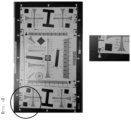
- FIG. 6 is a picture photographed using a polarizer having a bleached portion satisfying edge roughness of 30 ⁇ m or less in a lens.
- FIG. 7 is a picture photographed using a polarizer having a bleached portion with edge roughness of greater than 30 ⁇ m in a lens.
- a “perforated portion” means a part having a hole.
- (meth)acrylic acid means acrylic acid or methacrylic acid.
- (meth)acrylate means acrylate or methacrylate.
- An embodiment of the present disclosure provides a method for manufacturing a polarizing plate having a non-polarized portion, the method including providing a mask film having a protective film, an adhesive layer disposed on one surface of the protective film, and a perforated portion integrally passing through the protective film and the adhesive layer, wherein the adhesive layer has a thickness of 6 ⁇ m to 80 ⁇ m; laminating the mask film on both surfaces of a polarizer; bleaching a part corresponding to the perforated portion of the mask film; and removing the mask film from the polarizer. By laminating the mask film on both surfaces, local bleaching of the polarizer may be quickly conducted.
- the adhesive may have a thickness of 6 ⁇ m to 80 ⁇ m, and preferably 6 ⁇ m to 30 ⁇ m.
- the adhesive thickness being less than 6 ⁇ m has a problem of reducing coating uniformity, and when removing the mask film after the bleaching reaction, a phenomenon of the adhesive being transferred to the polarizer surface occurs.
- the adhesive having a thickness of greater than 80 ⁇ m has problems in that perforation is not accurate due to adhesive slip occurring when perforating the mask film, or the adhesive flows out due to adhesive pressing, and the adhesive also flows out when laminating the perforated mask film on the polarizer.
- the mask film may further have a release film attached to the adhesive layer, and the release film is detachable from the adhesive layer.
- the mask film may have a perforated portion integrally passing through the protective film, the adhesive layer and the release film.
- the perforated portions there are two or more of the perforated portions, and they are disposed in a length direction of the mask film at a predetermined interval.
- FIG. 1 illustrates a mask film formed with a protective film and an adhesive layer according to an embodiment of the present disclosure.
- FIG. 2 illustrates a mask film formed with a protective film, an adhesive layer and a release film according to an embodiment of the present disclosure.
- a relatively dark part in each of FIG. 1 and FIG. 2 means a perforated portion passing through the mask film.
- the forming of a perforated portion in the mask film is not particularly limited, and may be conducted through film perforating methods well known in the art such as mold machining, knife machining or laser machining.
- the forming of a perforated portion may be conducted through laser machining.
- the laser machining may be conducted using laser machining devices generally known in the art, and is not particularly limited.
- the condition of the laser machining such as a laser device type, output and a laser pulse repetition rate may be different depending on the material and the thickness of the film, the shape of the perforated portion and the like, and those skilled in the art may properly select a laser machining condition considering factors such as above.
- a perforated portion may be formed using a carbon dioxide (CO 2 ) laser device having a peak wavelength of approximately 9 ⁇ m to 11 ⁇ m or an ultraviolet (UV) device having a peak wavelength of approximately 300 nm to 400 nm, and herein, the maximum average output of the laser device may be approximately from 0.1 W to 30 W, and the pulse repetition rate may be from approximately 0 kHz to 50 kHz, however, the condition is not limited thereto.
- CO 2 carbon dioxide
- UV ultraviolet
- the protective film of the mask film of the present disclosure olefin-based films such as polyethylene (PE), polypropylene (PP) or polyethylene terephthalate (PET); or vinyl acetate-based films such as ethylene vinyl acetate (EVA) or polyvinyl acetate may be used, however, the protective film of the mask film is not limited thereto.
- the thickness of the mask film may be approximately from 10 ⁇ m to 100 ⁇ m, and preferably approximately from 10 ⁇ m to 70 ⁇ m.
- One embodiment of the present disclosure provides a laminate including a polarizer; and the mask film described above provided on each of both surfaces of the polarizer.
- the locally bleached area of the present disclosure may be a depolarized area.
- the laminating of the mask film on both surfaces of a polarizer may be conducted using film lamination methods well known in the art such as a method of attaching a mask film and a polarizing element through an adhesive layer, and herein, adhesives such as acryl-based adhesives, silicone-based adhesives, epoxy-based adhesives or rubber-based adhesives may be used as the adhesive layer, however, the adhesive layer is not limited thereto.
- the adhesive layer includes two different types of acryl-based copolymer resins.
- the adhesive layer may further include a crosslinking agent. Modulus and adhesive strength of the adhesive may be controlled depending on the content of the crosslinking agent.
- the two types of acryl-based copolymer resins may each be expressed as a first acryl-based copolymer resin and a second acryl-based copolymer resin.
- the first acryl-based copolymer resin may be expressed as copolymer resin A
- the second acryl-based copolymer resin may be expressed as copolymer resin B.
- the adhesive layer may use an adhesive obtained by mixing two different types of acryl-based copolymer resins in a certain ratio, and adding and mixing a crosslinking agent thereto. Modulus and adhesive strength of the adhesive may be controlled depending on the content of the crosslinking agent.
- the adhesive layer may include a first acryl-based copolymer resin; a second acryl-based copolymer resin; and a crosslinking agent.
- the adhesive layer may be obtained by mixing a first acryl-based copolymer resin and a second acryl-based copolymer resin, and adding and mixing a crosslinking agent thereto.
- the first acryl-based copolymer resin may be mixed in a ratio of 6 parts by weight to 12 parts by weight, and preferably 8 parts by weight to 10 parts by weight based on 1 parts by weight of the second acryl-based copolymer resin.
- the first acryl-based copolymer resin includes alkyl (meth)acrylate; hydroxyalkyl (meth)acrylate; and (meth)acrylic acid.
- the first acryl-based copolymer resin may include alkyl (meth)acrylate in 90 parts by weight to 98 parts by weight; hydroxyalkyl (meth)acrylate in 0.5 parts by weight to 2 parts by weight; and (meth)acrylic acid in 1 parts by weight to 8 parts by weight based on 100 parts by weight of total monomers of the first acryl-based copolymer resin, and preferably alkyl (meth)acrylate in 92 parts by weight to 96 parts by weight; hydroxyalkyl (meth)acrylate in 0.5 parts by weight to 1.5 parts by weight; and (meth)acrylic acid in 3 parts by weight to 7 parts by weight based on 100 parts by weight of total monomers of the first acryl-based copolymer resin.
- the second acryl-based copolymer resin includes alkyl (meth)acrylate; hydroxyalkyl (meth)acrylate; (meth)acrylic acid; and polyalkyl (meth)acrylate.
- the first acryl-based copolymer resin may include alkyl (meth)acrylate in 89 parts by weight to 96 parts by weight; hydroxyalkyl (meth)acrylate in 0.5 parts by weight to 2 parts by weight; (meth)acrylic acid in 1 parts by weight to 8 parts by weight; and polyalkyl (meth)acrylate in 1 parts by weight to 8 parts by weight based on 100 parts by weight of total monomers of the first acryl-based copolymer resin, and preferably alkyl (meth)acrylate in 90 parts by weight to 95 parts by weight; hydroxyalkyl (meth)acrylate in 0.5 parts by weight to 1.5 parts by weight; (meth)acrylic acid in 2 parts by weight to 6 parts by weight; and polyalkyl (meth)acrylate in 2 parts by weight to 6 parts by weight based on 100 parts by weight of total monomers of the first acryl-based copolymer resin.
- the alkyl group included in the alkyl (meth)acrylate may be linear or branched, and the number of carbon atoms of the alkyl group may be from 1 to 20.
- the alkyl (meth)acrylate may include one, two or more types selected from the group consisting of methyl (meth)acrylate, ethyl (meth)acrylate, n-propyl (meth)acrylate, isopropyl (meth)acrylate, n-butyl (meth)acrylate, t-butyl (meth)acrylate, sec-butyl (meth)acrylate, pentyl (meth)acrylate, 2-ethylbutyl (meth)acrylate, 2-ethylhexyl (meth)acrylate, octyl (meth)acrylate, isooctyl (meth)acrylate, nonyl (meth)acrylate, isononyl (meth)acrylate, decyl
- the polyalkyl (meth)acrylate means a plurality of the alkyl groups bonding in a repeated form in the alkyl (meth)acrylate.
- the hydroxyalkyl (meth)acrylate may include one, two or more types selected from the group consisting of 2-hydroxyethyl (meth)acrylate, 2-hydroxypropyl (meth)acrylate, 4-hydroxybutyl (meth)acrylate, 6-hydroxyhexyl (meth)acrylate, 8-hydroxyoctyl (meth)acrylate and 2-hydroxyethylene glycol (meth)acrylate, but is not limited thereto.
- the first acryl-based copolymer resin includes butyl acrylate; 2-hydroxyethyl (meth)acrylate; and acrylic acid.
- the second acryl-based copolymer resin includes butyl acrylate; 2-hydroxyethyl (meth)acrylate; acrylic acid; and methacryloyl polymethyl methacrylate.
- the bleaching solution when immersing a polarizer having the mask film including a perforated portion laminated thereon into a bleaching solution, the bleaching solution is in contact with the polyvinyl alcohol-based polarizer through the perforated portion, and as a result, bleaching partially occurs only in a part corresponding to the perforated portion area.
- the perforated portion may be formed so as to correspond to the form of an area to bleach, and the shape or forming location is not particularly limited.
- the perforated portion may be formed on a location at which a component such as a camera is installed to correspond to the shape of the component, may be formed to have a product logo shape in an area in which the product logo is printed, or may be formed in a frame form on the edge part of the polarizer when attempting to provide a color on the edge part of the polarizer.
- a step of providing a release film on a surface opposite to the surface facing the polarizer of the protective film of the mask film may be further included before the forming of a bleached area.
- Conducting a bleaching process after further providing a release film has an advantage of minimizing sagging caused by MD contraction occurring due to polarizer swelling.
- the protective film of the mask film is removed after local bleaching, and is different from the protective film of the polarizing plate for protecting the polarizing plate.
- the removing of the mask film may be conducted using a method of peeling the mask film from the polarizer. More specifically, the removing of the mask film may be conducted using a method of peeling the mask film from the polarizer using a peeling roll or the like.
- a bleaching solution may be used when treating a part corresponding to the perforated portion.
- the bleaching solution is preferably a strong basic solution having a pH of 11 to 14, and more specifically, may include one or more types of bleaching agents selected from the group consisting of sodium hydroxide (NaOH), sodium hydrosulfide (NaSH), sodium azide (NaN 3 ), potassium hydroxide (KOH), potassium hydrosulfide (KSH) and potassium thiosulfate (KS 2 O 3 ).
- the bleaching agent in the bleaching solution preferably has a concentration of approximately 1% by weight to 30% by weight, and the bleaching solution may have viscosity of approximately 1 cps to 2000 cps, and preferably approximately 5 cps to 2000 cps.
- the viscosity of the bleaching solution satisfies the above-mentioned numerical range, a printing process may be smoothly conducted, and diffusing or flowing down to the printed bleaching solution by the movement of the polarizing element in a continuous process line may be prevented, and accordingly, the bleached area may be formed in a target area in a target shape.
- the viscosity of the bleaching solution may properly vary depending on a printing device used, surface properties of the polarizer, and the like.
- the bleaching solution when using a gravure printing method, may have viscosity of approximately 1 cps to 2000 cps and preferably approximately 5 cps to 200 cps, and when using an inkjet printing method, the bleaching solution may have viscosity of approximately 1 cps to 55 cps and preferably approximately 5 cps to 20 cps.
- the bleaching solution may further include a viscosity agent.
- a method of further adding a viscosity agent is preferred in order to have the viscosity of the bleaching solution satisfying the above-mentioned range. Accordingly, the viscosity agent suppresses diffusion of the solution by enhancing viscosity of the bleaching solution, and helps with forming a bleached area in target size and location.
- Coating a solution having high viscosity on a fast-moving polarizer prevents the solution from diffusing to unwanted parts by reducing a difference in the relative velocity between the liquid produced during the coating and the polarizer, and reduces the flow of the coated solution during the time of bleaching after coating and before washing, and as a result, a bleached area having target location or size may be formed.
- the viscosity agent is not particularly limited as long as it has low reactivity and is capable of increasing solution viscosity.
- the viscosity agent includes one or more types selected from the group consisting of polyvinyl alcohol-based resins, polyvinylacetoacetate-based resins, acetoacetyl group-modified polyvinyl alcohol-based resins, butenediol vinyl alcohol-based resins, polyethylene glycol-based resins and polyacrylamide-based resins.
- the viscosity agent may be included in 0.5% by weight to 30% by weight with respect to the total weight of the bleaching solution. Specifically, according to one embodiment of the present disclosure, the viscosity agent may be included in 2.5% by weight to 15% by weight with respect to the total weight of the bleaching solution.
- the viscosity agent content is greater than the above-mentioned range, viscosity becomes too high and washing is not effective, and when the viscosity agent content is too low, viscosity is low making it difficult to obtain a bleached area having target shape and size due to diffusion and flow of the liquid.
- the bleaching solution may include the bleaching agent in 1% by weight to 30% by weight; the viscosity agent in 0.5% by weight to 30% by weight; and water in 40% by weight to 70% by weight with respect to the total weight.
- An iodine and/or dichroic dye-dyed polyvinyl alcohol complex is known to absorb light in a visible range having a wavelength range of 400 nm to 800 nm.
- the iodine and/or dichroic dye absorbing light in a visible wavelength range present in the polarizer is decomposed bleaching the polarizer, and transmittance increases and a degree of polarization decreases.
- the iodine when bringing an aqueous solution including potassium hydroxide (KOH), the bleaching agent, into contact with some areas of the iodine-dyed polyvinyl alcohol-based polarizer, the iodine is decomposed in a series of processes such as the following Chemical Equation 1 and Chemical Equation 2. Meanwhile, when going through a boric acid crosslinking process when preparing the iodine-dyed polyvinyl alcohol-based polarizer, potassium hydroxide directly decomposes boric acid as described in the following Chemical Equation 3 removing a crosslinking effect through hydrogen bonding of the polyvinyl alcohol and the boric acid.
- KOH potassium hydroxide
- iodine and/or iodine ion complex such as I 5 ⁇ (620 nm), I 3 ⁇ (340 nm) or I 2 ⁇ (460 nm) is decomposed by absorbing light in a visible region to produce I ⁇ (300 nm or less) or a salt, and most of the light in a visible region transmits.
- polarization function is removed in a region of approximately 400 nm to 800 nm, a visible region, in the polarizer increasing overall transmittance and making the polarizer transparent.
- polarization function may be removed by decomposing the arranged iodine complex absorbing visible light into a monomolecular form that does not absorb visible light in order to make polarized light in the polarizer.
- a step of washing using an alcohol or acid solution may be further included after the forming of a bleached area.
- the bleaching solution remaining in the forming of a bleached area is not properly washed, the solution diffuses or remains on the polarizer, and the bleached area may be formed in unwanted size and shape, and a bleached area having a fine size is difficult to form.
- the alcohol may be suitably used since it is readily dried and is thereby readily removed, and does not affect transmittance or a degree of polarization of the polarizer other than the bleached area.
- the alcohol is preferably, although not limited thereto, ethanol, methanol, propanol, butanol, isopropyl alcohol or a mixture thereof.
- the acid solution the remaining bleaching agent that is mostly basic is removed while going through a neutralization reaction with the acid solution
- the acid solution may include an aqueous acetic acid solution, an aqueous adipic acid solution, an aqueous boric acid solution, an aqueous phosphoric acid solution, an aqueous lactic acid solution, an aqueous sulfuric acid solution, an aqueous nitric acid solution or a mixed solution thereof, but are not limited thereto.
- the washing may be conducted by immersing the polarizer into the alcohol for 1 second to 180 seconds, and more preferably for 3 seconds to 30 seconds, or coating the alcohol or the acid solution on the local area bleached by being in contact with the bleaching solution using a dispenser, inkjet or the like.
- the method for manufacturing a polarizing plate including a bleached area includes washing with the alcohol or the acid solution after using the bleaching agent, and as discussed above, the iodine compound, salt and the like formed by the bleaching agent are washed away, and the content of the iodine and the iodine ion complex in the bleached area is minimized. Accordingly, the remaining iodine and iodine ion complex in the bleached area absorb less light, and an effect of more transparency is obtained.
- edge roughness of the bleached portion is 30 ⁇ m or less, preferably 20 ⁇ m or less, and favorably 0 ⁇ m or closer to 0 ⁇ m.
- the edge roughness means a sum of an outside maximum difference and an inside maximum difference in a circle at a line drawn for every 2 degrees at any point of the bleached portion.
- FIG. 4 schematically shows a method of measuring the edge roughness.
- the edge roughness is 30 ⁇ m or less, the bleached portion shape becomes clearer. This value is favorably 0 ⁇ m or closer to 0 ⁇ m. This means that the function of the device does not decline when placing the bleached portion on a lens part of a device such as a camera module.
- FIG. 6 and FIG. 7 respectively shows a case photographed using a polarizer having the bleached portion satisfying edge roughness of 30 ⁇ m or less in a lens, and a case photographed using a polarizer having the bleached portion with edge roughness of greater than 30 ⁇ m in a lens.
- FIG. 6 and FIG. 7 it may be identified that the image corresponding to a side (part expressed as circle in FIG. 6 and FIG. 7 ) is blurred in the image photographed using a polarizer having the bleached portion satisfying edge roughness of greater than 30 ⁇ m in a lens.
- edge roughness of the perforated portion of the mask film is 30 ⁇ m or less, preferably 20 ⁇ m or less, and favorably 0 ⁇ m or closer to 0 ⁇ m.
- Edge roughness of the perforated portion of the mask film means a sum of an outside maximum difference and an inside maximum difference in a circle at a line drawn for every 2 degrees at any point of the perforated portion.
- edge roughness of the bleached portion of the polarizer more readily becomes 30 ⁇ m or less when progressing a bleaching process of the polarizer using the mask film.
- a step of forming an optical layer on at least one surface of the polarizer may be further included after the forming of a bleached area.
- the optical layer may be a polymer film layer such as a protective film or a retardation film, may be a functional film layer such as a brightness enhancement film, may be a functional layer such as a hard coating layer, an anti-reflection layer or an adhering layer.
- the optical layer is formed on the other surface of the polarizer.
- the optical layer is formed on a surface on which the protective film and the release film are not provided of the polarizer.
- the optical layer may be directly attached or formed on the surface of the polyvinyl alcohol-based polarizer, or may also be attached on the protective film or other coating layers attached on one surface of the polyvinyl alcohol-based polarizer.
- the method of forming the optical layer may be different depending on the type of the optical layer to form, and for example, methods of forming an optical layer well known in the art may be used, and the method is not particularly limited.
- a step of removing the release film may be further included after the forming of a bleached area.
- the removing of the release film may be conducted using a method of peeling the release film from the protective film. More specifically, the removing of the release film may be conducted using a method of peeling the release film from the protective film using a peeling roll or the like.
- the release film performs a role of suppressing sagging occurrences (stretched in protective film direction) in the forming of a bleached area, and is preferably removed after the forming of a bleached area.
- the bleached area of the present disclosure may mean a non-polarized portion. Accordingly, a polarizer having a non-polarized portion may be manufactured using the mask film.
- the polarizer is not particularly limited, and polarizers well known in the art, for example, films formed with polyvinyl alcohol (PVA) including iodine or a dichroic dye are used.
- PVA polyvinyl alcohol
- the polarizer may have a thickness of 1 ⁇ m or greater, 3 ⁇ m or greater, 5 ⁇ m or greater, 7 ⁇ m or greater, 10 ⁇ m or greater, or 20 ⁇ m or greater. At the same time, the polarizer may have a thickness of 30 ⁇ m or less, and preferably 25 ⁇ m or less.
- the bleached portion of the present specification may function as a non-polarized portion.
- a polarizer having a non-polarized portion may be manufactured using the mask film.
- the polarizer of the present disclosure as above may be used in manufacturing a polarizing plate.
- the polarizer is not particularly limited, and polarizers well known in the art, for example, films formed with polyvinyl alcohol (PVA) including iodine or a dichroic dye are used.
- PVA polyvinyl alcohol
- the method for manufacturing a polarizing plate of the present disclosure may include laminating a polarizer protective film on the surface from which the mask film is removed.
- polarizer protective film those generally known in the art may be used, and for example, cellulose-based resins such as diacetyl cellulose or triacetyl cellulose, (meth)acryl-based resins, cycloolefin-based resins, olefin-based resins such as polypropylene, ester-based resins such as polyethylene terephthalate-based resins, polyamide-based resins, polycarbonate-based resins, or copolymer resins thereof may be used, however, the protective film is not limited thereto.
- the polarizing plate manufactured using the manufacturing method of the present disclosure includes the polarizer having a non-polarized portion; and a protective film of the polarizing plate on at least one surface of the polarizer.
- a polarizing plate in which the polarizer has at least one bleached area, the bleached area has single body transmittance of 80% or greater and a degree of polarization of 10% or less in a wavelength range of 400 nm to 800 nm, and the bleached area has a maximum sagging depth of 10 ⁇ m or less is provided.
- the area of the at least one bleached area may be greater than or equal to 0.5 mm 2 and less than or equal to 500 mm 2 , and preferably greater than or equal to 0.5 mm 2 and less than or equal to 200 mm 2 .
- a polarizing plate including a non-polarized portion having a size of greater than or equal to 0.5 mm 2 and less than or equal to 500 mm 2 , and the non-polarized portion having edge roughness of 30 ⁇ m or less may be provided.
- the sagging means sagging in a protective film direction occurring when the polyvinyl alcohol (PVA)-based polarizer is brought into contact with the bleaching solution.
- PVA polyvinyl alcohol
- a degree of sagging is smaller as the sagging depth is shallower, and, since appearance distortion is minimized in the polarizing plate, it has an advantage of uniformly coating an adhesive when laminating a protective film and the like on the other surface. As a result, defect occurrences may be reduced when manufacturing a polarizing plate having a structure including a protective film on both surfaces of the polarizer.
- the bleached area may have a maximum sagging depth of 8 ⁇ m or less, 7 ⁇ m or less, or 6 ⁇ m or less.
- the sagging depth may be measured using a white light three-dimensional measuring device (optical profiler) or a confocal laser scanning microscope (CLSM).
- optical profiler optical profiler
- CLSM confocal laser scanning microscope
- the sagging depth may mean a value obtained by subtracting a minimum value from a maximum value of a distance between a surface facing the protective film of the polarizer and a surface opposite to the surface facing the protective film.
- the sagging depth may mean, when placing the polarizing plate on a flat surface, a difference in the height between the bleached area and the area that is not bleached on the protective film surface.
- the polarizing plate according to one embodiment of the present disclosure has a bleached area in which single body transmittance is 80% or greater in a 400 nm to 800 nm wavelength range included in a visible region, arithmetic mean roughness (Ra) is 200 nm or less, and a degree of polarization is 10% or less.
- the bleached area refers to an area formed by going through a process of selectively bringing a bleaching solution into contact with some areas of an iodine and/or dichroic dye-dyed polyvinyl alcohol-based polarizer.
- the bleached area has single body transmittance of 80% or greater, preferably 90% or greater and more preferably 92% or greater in a wavelength range of 400 nm to 800 nm and more preferably 450 nm to 750 nm, which is a visible region.
- the bleached area has a degree of polarization of 10% or less and more preferably 5% or less. As the bleached area has higher single body transmittance and a lower degree of polarization, visibility is enhanced, and performances and image qualities of a camera lens to be located in the area may be further enhanced.
- single body transmittance of the area other than the bleached area of the polarizing plate is preferably from 40% to 47% and more preferably from 42% to 47%. Furthermore, the area other than the bleached area of the polarizing plate preferably has a degree of polarization of 99% or greater. This is due to the fact that the rest of the area other the bleached area needs to exhibit excellent optical properties shown in the range described above by performing a primary function as a polarizing plate.
- the bleached area may have arithmetic mean roughness (Ra) of 200 nm or less, and specifically, the arithmetic mean roughness (Ra) may be 100 nm or less or 80 nm or less, and more specifically 50 nm or less.
- the bleached area may have root mean square roughness (Rq) of 200 nm or less, and specifically, the root mean square roughness (Rq) may be 100 nm or less or 80 nm or less, and more specifically 50 nm or less.
- the arithmetic mean roughness (Ra) is a value defined in JIS B0601-1994, and represents a value obtained by extracting from a roughness curve by a reference length in a direction of the average line, summing absolve values of the deviations from the average line of this extracted portion to the measurement curve, and averaging the result.
- the root mean square roughness (Rq) is defined in JIS B0601-2001.
- the arithmetic mean roughness (Ra) and the root mean square roughness (Rq) are measured using an optical profiler (Nanoview E1000, Nanosystem Co., Ltd.).
- the bleached area has haze of 3% or less, preferably 2% or less, and more preferably 1% or less.
- the bleached area has an iodine and/or dichroic dye content of 0.1% by weight to 0.5% by weight, and preferably 0.1% by weight to 0.35% by weight. This is due to the fact that, as discussed above, iodine present in a complex form on the polarizer by the reaction of the bleaching agent and the iodine is washed away resulting in a significant decrease in the iodine and/or dichroic dye content, and as a result, transmittance is greatly enhanced.
- the area other than the bleached area has an iodine and/or dichroic dye content of 1% by weight to 4% by weight, and preferably 2% by weight to 4% by weight.
- the iodine and/or dichroic dye content is measured using an optical x-ray analyzer (manufactured by Rigaku Corporation, trade name ⁇ ZSX Primus II ⁇ ).
- average % by weight per a volume of 19.2 mm 3 is measured using a polarizer sheet-type sample having a size of 40 mm ⁇ 40 mm and a thickness of 12 ⁇ m.
- the bleached area may be from 0.005% to 40% with respect to the total area of the polarizing plate.
- An image display device may be manufactured using the polarizing plate according to the present disclosure as above.
- the present disclosure provides an image display device including a display panel; and the polarizing plate according to the embodiment described above attached to one surface or both surfaces of the display panel.
- the display panel may include a liquid crystal panel, a plasma panel and an organic light emitting panel
- the image display device may include a liquid crystal display device (LCD), a plasma display panel (PDP) and an organic light emitting diode (OLED).
- LCD liquid crystal display device
- PDP plasma display panel
- OLED organic light emitting diode
- the image display device may be a liquid crystal display device including a liquid crystal panel and polarizing plates each provided on both surfaces of the liquid crystal panel, and herein, at least one of the polarizing plates may be the polarizing plate including the polarizer according to one embodiment of the present disclosure described above.
- the polarizing plate includes an iodine and/or dichroic dye-dyed polyvinyl alcohol-based polarizer, and a protective film provided on at least one surface of the polyvinyl alcohol-based polarizer, wherein a bleached area having single body transmittance of 80% or greater in a 400 nm to 800 nm wavelength range is locally included, the bleached area has arithmetic mean roughness (Ra) of 200 nm or less, a degree of polarization of 10% or less, and sagging of 10 ⁇ m or less.
- Ra mean roughness
- types of the liquid crystal panel included in the liquid crystal display device are not particularly limited.
- known panels including panels using a passive matrix method such as a twisted nematic (TN) type, a super twisted nematic (STN) type, a ferroelectric (F) type or a polymer dispersed (PD) type; panels using an active matrix method such as a two terminal type or a three terminal type; and an in plane switching (IPS) panel and a vertical alignment (VA) type panel may all be used without being limited by the types.
- types of other constitutions forming a liquid crystal display device such as upper and lower substrates (for example, color filter substrate or array substrate) are not particularly limited as well, and constitutions known in the art may be employed without limit.
- the image display device may be an image display device further including a camera module provided in a bleached area of the polarizing plate.
- a camera module provided in a bleached area of the polarizing plate.
- a monomer mixture formed with 91 parts by weight of butyl acrylate, 1 parts by weight of 2-hydroxyethyl (meth)acrylate, 4 parts by weight of acrylic acid and 4 parts by weight of methacryloyl polymethyl methacrylate with respect to 100 parts by weight of the whole reaction material was introduced, and 100 parts by weight of ethyl acetate was introduced thereto as a solvent.
- the reactor was purged with nitrogen gas for 20 minutes to remove oxygen in the reactor, and the temperature of the reactor was maintained at 65° C.
- a polyvinyl alcohol-based film (Mitsubishi Chemical Corporation (former Nippon Synthetic Chemical Industry Co., Ltd.), M3000 grade, thickness 30 ⁇ m) went through a swelling process for 15 seconds in a 25° C. pure water solution, and then went through a dyeing process for 60 seconds in a 25° C. iodine solution having a concentration of 0.2 wt %. After that, the result went through a washing process for 30 seconds in a 45° C. solution having 1 wt % boric acid, and then a process of six times elongation was progressed in a 52° C. solution having 2.5 wt % boric acid.
- the result went through a complementary color process in a 5 wt % KI solution, and then dried for 5 minutes in a 60° C. oven to prepare a polarizer having a thickness of 12 ⁇ m.
- an acryl-based adhesive was coated to a thickness of 6 ⁇ m to form an adhesive layer, and a 15 ⁇ m PET release film was laminated on the adhesive layer to prepare a mask film. After that, a hole (perforated portion) having a diameter of 3 mm was perforated at an interval of 30 cm on the mask film with an output of 10 W and a pulse repetition rate of 20 kHz using a CO 2 laser.
- the perforated mask film had the release film removed, and was laminated on both surfaces of the polarizer manufactured in the preparation example, and after bleaching a part coinciding with the mask film hole (perforated portion) by immersing into a 50° C. solution having 10 wt % KOH for 15 seconds, the result was neutralized by immersing for 10 seconds in a 50° C. aqueous solution having 5 wt % citric acid, and then dried for 5 minutes at 60° C. After that, the mask film was removed, and on both the removed surfaces, a TAC protective film was laminated using an adhesive to manufacture a polarizing plate having a locally bleached portion.
- Polarizing plates having a locally bleached area were manufactured in the same manner as in Preparation Example 1 except that the adhesive layer was formed by coating the adhesive to a thickness of 10 ⁇ m, 15 ⁇ m, 30 ⁇ m and 80 ⁇ m, respectively.
- Polarizing plates having a locally bleached area were manufactured in the same manner as in Preparation Example 1 except that the adhesive layer was formed by coating the adhesive to a thickness of 3 ⁇ m, 5 ⁇ m, 100 ⁇ m, 150 ⁇ m and 210 ⁇ m, respectively.
- Polarizing plates having a locally bleached area were manufactured in the same manner as in Preparation Example 1 except that the perforated mask film had the release film removed, and was laminated on one surface of the polarizer manufactured in the preparation example, bleaching was conducted on a part of the polarizing plate coinciding with the mask film hole (perforated portion) by immersing into a 50° C. solution having 10 wt % KOH for 15 seconds, and the adhesive layer was formed by coating the adhesive to a thickness of 3 ⁇ m, 5 ⁇ m, 6 ⁇ m, 10 ⁇ m, 15 ⁇ m, 30 ⁇ m, 80 ⁇ m, 100 ⁇ m, 150 ⁇ m and 210 ⁇ m, respectively.
- Time taken for bleaching when manufacturing the polarizing plate corresponding to each of Preparation Examples 1 to 20 was measured.
- the time taken for bleaching the time for transmittance of the bleached portion reaching 80% or higher was measured as a time completing bleaching.
- Edge roughness was measured by calculating a sum of an outside maximum difference and an inside maximum difference in a circle at a line drawn for every 2 degrees at any point of the bleached portion of each of the polarizing plates corresponding to Preparation Examples 1 to 20.
- edge roughness was measured to be greater than 1000 ⁇ m due to the adhesive being transferred to the polarizer surface when removing the mask film after the bleaching reaction, and when the thickness was greater than 80 ⁇ m, edge roughness was greater than 30 ⁇ m due to adhesive slip and the like as in FIG. 5 during mask perforation.
- edge roughness had a value of 30 ⁇ m or less while reducing time taken for bleaching only when the adhesive had a thickness of 6 ⁇ m to 30 ⁇ m and the mask film was laminated on both surfaces of the polarizer.
- a polarizing plate having a proper non-polarized portion with no decline in the device function may be manufactured when placing the bleached portion on a lens part of a device such as a camera module in a shorter period of time.
Landscapes
- Engineering & Computer Science (AREA)
- Mechanical Engineering (AREA)
- Physics & Mathematics (AREA)
- Health & Medical Sciences (AREA)
- Manufacturing & Machinery (AREA)
- Ophthalmology & Optometry (AREA)
- General Physics & Mathematics (AREA)
- Optics & Photonics (AREA)
- Polarising Elements (AREA)
- Liquid Crystal (AREA)
Abstract
Description
12KOH+6I2→2KIO3+10KI+6H2O [Chemical Equation 1]
I5 −+IO3 −+6H+→3I2+3H2O
I3 −→I−+I2 [Chemical Equation 2]
B(OH)3+3KOH→K3BO3+3H2O [Chemical Equation 3]
| TABLE 1 | ||||
| Number of | Adhesive | Time Taken | Edge | |
| Mask Film | Thickness | for Bleaching | Roughness | |
| (Sheet) | (pm) | (s) | (μm) | |
| Example 1 | 2 | 6 | 5 | 20 |
| Example 2 | 2 | 10 | 5 | 23 |
| Example 3 | 2 | 15 | 5 | 25 |
| Example 4 | 2 | 30 | 5 | 27 |
| Example 5 | 2 | 80 | 5 | 30 |
| Comparative | 2 | 3 | 5 | >1000 |
| Example 1 | ||||
| Comparative | 2 | 5 | 5 | >1000 |
| Example 2 | ||||
| Comparative | 2 | 100 | 5 | 43 |
| Example 3 | ||||
| Comparative | 2 | 150 | 5 | 50 |
| Example 4 | ||||
| Comparative | 2 | 210 | 5 | 100 |
| Example 5 | ||||
| |
1 | 3 | 10 | >1000 |
| Example 6 | ||||
| |
1 | 5 | 10 | >1000 |
| Example 7 | ||||
| |
1 | 6 | 10 | 20 |
| Example 8 | ||||
| |
1 | 10 | 10 | 23 |
| Example 9 | ||||
| |
1 | 15 | 10 | 25 |
| Example 10 | ||||
| |
1 | 30 | 10 | 27 |
| Example 11 | ||||
| |
1 | 80 | 10 | 30 |
| Example 12 | ||||
| |
1 | 100 | 10 | 43 |
| Example 13 | ||||
| |
1 | 150 | 10 | 50 |
| Example 14 | ||||
| |
1 | 210 | 10 | 100 |
| Example 15 | ||||
Claims (5)
Applications Claiming Priority (3)
| Application Number | Priority Date | Filing Date | Title |
|---|---|---|---|
| KR10-2018-0097780 | 2018-08-22 | ||
| KR1020180097780A KR102239441B1 (en) | 2018-08-22 | 2018-08-22 | Method for preparing polarizing plate using mask film and polarizing plate same |
| PCT/KR2019/010696 WO2020040569A1 (en) | 2018-08-22 | 2019-08-22 | Method for manufacturing polarizing plate using mask film and polarizing plate manufactured by same |
Publications (2)
| Publication Number | Publication Date |
|---|---|
| US20210268754A1 US20210268754A1 (en) | 2021-09-02 |
| US11623420B2 true US11623420B2 (en) | 2023-04-11 |
Family
ID=69592035
Family Applications (1)
| Application Number | Title | Priority Date | Filing Date |
|---|---|---|---|
| US17/260,454 Active 2039-09-02 US11623420B2 (en) | 2018-08-22 | 2019-08-22 | Method for manufacturing polarizing plate using mask film and polarizing plate manufactured by same |
Country Status (6)
| Country | Link |
|---|---|
| US (1) | US11623420B2 (en) |
| JP (1) | JP7210084B2 (en) |
| KR (1) | KR102239441B1 (en) |
| CN (1) | CN112423971B (en) |
| TW (1) | TWI717811B (en) |
| WO (1) | WO2020040569A1 (en) |
Families Citing this family (2)
| Publication number | Priority date | Publication date | Assignee | Title |
|---|---|---|---|---|
| JP6945286B2 (en) * | 2016-09-13 | 2021-10-06 | 日東電工株式会社 | Polarizer manufacturing method |
| KR102269201B1 (en) | 2018-08-22 | 2021-06-25 | 주식회사 엘지화학 | Mask film and method for preparing polarizing plate using same |
Citations (20)
| Publication number | Priority date | Publication date | Assignee | Title |
|---|---|---|---|---|
| JPS6241386A (en) | 1985-08-09 | 1987-02-23 | 村山 元司 | Production of kogasuri fabric |
| US5868947A (en) | 1991-09-20 | 1999-02-09 | Canon Kabushiki Kaisha | Si substrate and method of processing the same |
| JP2006267555A (en) | 2005-03-24 | 2006-10-05 | Sumitomo Chemical Co Ltd | Polarizing plate with adhesive and liquid crystal display device |
| US20080233329A1 (en) | 2007-03-19 | 2008-09-25 | Tetsuji Mori | Minute structure and information recording medium |
| JP2009205135A (en) | 2008-01-31 | 2009-09-10 | Nitto Denko Corp | Polarizer protective film, polarizing plate, and apparatus for displaying an image |
| US20100294954A1 (en) | 2007-12-12 | 2010-11-25 | 3M Innovative Properties Company | Method for making structures with improved edge definition |
| JP2012173487A (en) | 2011-02-21 | 2012-09-10 | Sekisui Chem Co Ltd | Optical film and method for manufacturing optical film |
| JP2014081482A (en) | 2012-10-16 | 2014-05-08 | Nitto Denko Corp | Polarizer and image display device |
| KR20160006795A (en) | 2014-06-27 | 2016-01-19 | 닛토덴코 가부시키가이샤 | Long polarizer, long polarizing plate, and image display device |
| KR20160016904A (en) | 2014-06-27 | 2016-02-15 | 닛토덴코 가부시키가이샤 | Method of manufacturing long polarizer |
| JP2016027135A (en) | 2014-06-27 | 2016-02-18 | 日東電工株式会社 | Manufacturing method of long adhesive film |
| US20160299272A1 (en) | 2014-03-26 | 2016-10-13 | Lg Chem, Ltd. | Method for manufacturing polarizer having locally depolarized area, and polarizer, polarizing plate and image display device manufactured by using same |
| US20160313480A1 (en) | 2014-06-30 | 2016-10-27 | Lg Chem, Ltd. | Method for producing polarizing plate and polarizing plate (as amended) |
| WO2016182017A1 (en) | 2015-05-13 | 2016-11-17 | 日東電工株式会社 | Polarizer production method |
| JP2017009907A (en) | 2015-06-25 | 2017-01-12 | 日東電工株式会社 | Polarizer having non-polarization part |
| CN106662695A (en) | 2014-10-06 | 2017-05-10 | 株式会社Lg化学 | Method for manufacturing polarizing plate and polarizing plate manufactured using same |
| US20170137671A1 (en) * | 2014-06-27 | 2017-05-18 | Nitto Denko Corporation | Long adhesive film |
| JP2017194568A (en) | 2016-04-20 | 2017-10-26 | 日東電工株式会社 | Polarizing plate and manufacturing method thereof, and image display device using the polarizing plate |
| CN107533182A (en) | 2015-05-13 | 2018-01-02 | 日东电工株式会社 | Manufacturing method of polarizer |
| US20210292604A1 (en) | 2018-08-22 | 2021-09-23 | Lg Chem, Ltd. | Mask film and method for manufacturing polarizing plate by using same |
Family Cites Families (7)
| Publication number | Priority date | Publication date | Assignee | Title |
|---|---|---|---|---|
| US4396646A (en) * | 1981-07-20 | 1983-08-02 | Polaroid Corporation | Method of making patterned polarizers |
| JPS59172610A (en) * | 1983-03-22 | 1984-09-29 | Nitto Electric Ind Co Ltd | Manufacture of polarizing film |
| KR100916955B1 (en) | 2003-04-21 | 2009-09-14 | 닛토덴코 가부시키가이샤 | Polarizer, method for producing same, polarizing plate, optical film and image display |
| KR20100125537A (en) * | 2009-05-21 | 2010-12-01 | 동우 화인켐 주식회사 | Manufacturing method of polarizing grating screen, polarizing grating screen and three-dimensional image display device provided with the same |
| JP6096944B1 (en) * | 2016-01-22 | 2017-03-15 | 互応化学工業株式会社 | Dry film laminate |
| WO2017150099A1 (en) * | 2016-02-29 | 2017-09-08 | 富士フイルム株式会社 | Composite body |
| KR102259415B1 (en) * | 2018-08-29 | 2021-06-01 | 주식회사 엘지에너지솔루션 | Battery management apparatus, battery management method, battery pack and electric vehicle |
-
2018
- 2018-08-22 KR KR1020180097780A patent/KR102239441B1/en active Active
-
2019
- 2019-08-22 US US17/260,454 patent/US11623420B2/en active Active
- 2019-08-22 WO PCT/KR2019/010696 patent/WO2020040569A1/en not_active Ceased
- 2019-08-22 TW TW108130075A patent/TWI717811B/en active
- 2019-08-22 JP JP2021501286A patent/JP7210084B2/en active Active
- 2019-08-22 CN CN201980046786.1A patent/CN112423971B/en active Active
Patent Citations (31)
| Publication number | Priority date | Publication date | Assignee | Title |
|---|---|---|---|---|
| JPS6241386A (en) | 1985-08-09 | 1987-02-23 | 村山 元司 | Production of kogasuri fabric |
| US5868947A (en) | 1991-09-20 | 1999-02-09 | Canon Kabushiki Kaisha | Si substrate and method of processing the same |
| JP2006267555A (en) | 2005-03-24 | 2006-10-05 | Sumitomo Chemical Co Ltd | Polarizing plate with adhesive and liquid crystal display device |
| US20060227263A1 (en) | 2005-03-24 | 2006-10-12 | Sumitomo Chemical Company, Limited | Polarizing plate with adhesive and liquid crystal display |
| US20080233329A1 (en) | 2007-03-19 | 2008-09-25 | Tetsuji Mori | Minute structure and information recording medium |
| US20100294954A1 (en) | 2007-12-12 | 2010-11-25 | 3M Innovative Properties Company | Method for making structures with improved edge definition |
| CN101946305A (en) | 2007-12-12 | 2011-01-12 | 3M创新有限公司 | Be used to prepare the method for the structure of marginal definition with improvement |
| JP2009205135A (en) | 2008-01-31 | 2009-09-10 | Nitto Denko Corp | Polarizer protective film, polarizing plate, and apparatus for displaying an image |
| US20100284072A1 (en) | 2008-01-31 | 2010-11-11 | Nitto Denko Corporation | Polarizer protective film, polarizing plate, and image display apparatus |
| JP2012173487A (en) | 2011-02-21 | 2012-09-10 | Sekisui Chem Co Ltd | Optical film and method for manufacturing optical film |
| JP2014081482A (en) | 2012-10-16 | 2014-05-08 | Nitto Denko Corp | Polarizer and image display device |
| US20160299272A1 (en) | 2014-03-26 | 2016-10-13 | Lg Chem, Ltd. | Method for manufacturing polarizer having locally depolarized area, and polarizer, polarizing plate and image display device manufactured by using same |
| KR20160129819A (en) | 2014-03-26 | 2016-11-09 | 주식회사 엘지화학 | Methods for manufacturing for polarizing element, polarizing element roll and single sheet type polarizing element having locally bleaching areas |
| US20170131451A1 (en) | 2014-06-27 | 2017-05-11 | Nitto Denko Corporation | Long polarizer, long polarizing plate, and image display device |
| US20170137671A1 (en) * | 2014-06-27 | 2017-05-18 | Nitto Denko Corporation | Long adhesive film |
| JP2016027135A (en) | 2014-06-27 | 2016-02-18 | 日東電工株式会社 | Manufacturing method of long adhesive film |
| US20170129197A1 (en) | 2014-06-27 | 2017-05-11 | Nitto Denko Corporation | Method for manufacturing long polarizer |
| KR20160016904A (en) | 2014-06-27 | 2016-02-15 | 닛토덴코 가부시키가이샤 | Method of manufacturing long polarizer |
| KR20160006795A (en) | 2014-06-27 | 2016-01-19 | 닛토덴코 가부시키가이샤 | Long polarizer, long polarizing plate, and image display device |
| US20160313480A1 (en) | 2014-06-30 | 2016-10-27 | Lg Chem, Ltd. | Method for producing polarizing plate and polarizing plate (as amended) |
| KR20170083995A (en) | 2014-06-30 | 2017-07-19 | 주식회사 엘지화학 | Method for manufacturing polarizing plate and polarizing plate |
| US20170254939A1 (en) | 2014-10-06 | 2017-09-07 | Lg Chem, Ltd. | Method for manufacturing polarizing plate and polarizing plate manufactured using same |
| CN106662695A (en) | 2014-10-06 | 2017-05-10 | 株式会社Lg化学 | Method for manufacturing polarizing plate and polarizing plate manufactured using same |
| CN107533182A (en) | 2015-05-13 | 2018-01-02 | 日东电工株式会社 | Manufacturing method of polarizer |
| WO2016182017A1 (en) | 2015-05-13 | 2016-11-17 | 日東電工株式会社 | Polarizer production method |
| US20180120489A1 (en) | 2015-05-13 | 2018-05-03 | Nitto Denko Corporation | Polarizer production method |
| JP2017009907A (en) | 2015-06-25 | 2017-01-12 | 日東電工株式会社 | Polarizer having non-polarization part |
| US20180188430A1 (en) | 2015-06-25 | 2018-07-05 | Nitto Denko Corporation | Polarizer having non-polarizing part |
| JP2017194568A (en) | 2016-04-20 | 2017-10-26 | 日東電工株式会社 | Polarizing plate and manufacturing method thereof, and image display device using the polarizing plate |
| US20210292604A1 (en) | 2018-08-22 | 2021-09-23 | Lg Chem, Ltd. | Mask film and method for manufacturing polarizing plate by using same |
| JP2021530001A (en) | 2018-08-22 | 2021-11-04 | エルジー・ケム・リミテッド | Mask film and method for manufacturing a polarizing plate using the mask film |
Also Published As
| Publication number | Publication date |
|---|---|
| KR20200022088A (en) | 2020-03-03 |
| TWI717811B (en) | 2021-02-01 |
| TW202016583A (en) | 2020-05-01 |
| JP2021530737A (en) | 2021-11-11 |
| KR102239441B1 (en) | 2021-04-12 |
| WO2020040569A1 (en) | 2020-02-27 |
| CN112423971A (en) | 2021-02-26 |
| JP7210084B2 (en) | 2023-01-23 |
| US20210268754A1 (en) | 2021-09-02 |
| CN112423971B (en) | 2022-08-09 |
Similar Documents
| Publication | Publication Date | Title |
|---|---|---|
| US10527769B2 (en) | Method for preparing polarizing plate locally having depolarization region, and polarizing plate prepared by using same | |
| US10436962B2 (en) | Preparing method for polarizer having locally depolarized area, polarizer and polarizing plate manufactured by using the same | |
| CN106662695B (en) | Method for manufacturing polarizer and polarizer manufactured using the same | |
| CN101718885B (en) | High contrast polarizer and liquid crystal display | |
| US12312511B2 (en) | Mask film and method for manufacturing polarizing plate by using same | |
| US20210268754A1 (en) | Method for manufacturing polarizing plate using mask film and polarizing plate manufactured by same | |
| KR20200022092A (en) | Mask film and method for preparing polarizing plate using same | |
| TWI738040B (en) | Mask film, polarizing plate and manufacturing method thereof, and image display device |
Legal Events
| Date | Code | Title | Description |
|---|---|---|---|
| AS | Assignment |
Owner name: LG CHEM, LTD., KOREA, REPUBLIC OF Free format text: ASSIGNMENT OF ASSIGNORS INTEREST;ASSIGNORS:LEE, BYUNG SUN;RAH, KYUN IL;REEL/FRAME:054924/0213 Effective date: 20200520 |
|
| FEPP | Fee payment procedure |
Free format text: ENTITY STATUS SET TO UNDISCOUNTED (ORIGINAL EVENT CODE: BIG.); ENTITY STATUS OF PATENT OWNER: LARGE ENTITY |
|
| STPP | Information on status: patent application and granting procedure in general |
Free format text: DOCKETED NEW CASE - READY FOR EXAMINATION |
|
| STPP | Information on status: patent application and granting procedure in general |
Free format text: NON FINAL ACTION MAILED |
|
| STPP | Information on status: patent application and granting procedure in general |
Free format text: RESPONSE TO NON-FINAL OFFICE ACTION ENTERED AND FORWARDED TO EXAMINER |
|
| STPP | Information on status: patent application and granting procedure in general |
Free format text: FINAL REJECTION MAILED |
|
| STPP | Information on status: patent application and granting procedure in general |
Free format text: RESPONSE AFTER FINAL ACTION FORWARDED TO EXAMINER |
|
| STPP | Information on status: patent application and granting procedure in general |
Free format text: NOTICE OF ALLOWANCE MAILED -- APPLICATION RECEIVED IN OFFICE OF PUBLICATIONS |
|
| STCF | Information on status: patent grant |
Free format text: PATENTED CASE |
|
| AS | Assignment |
Owner name: SHANJIN OPTOELECTRONICS (SUZHOU) CO., LTD., CHINA Free format text: ASSIGNMENT OF ASSIGNORS INTEREST;ASSIGNOR:LG CHEM LTD.;REEL/FRAME:070629/0273 Effective date: 20250317 |