US11614686B2 - Resist composition and patterning process - Google Patents
Resist composition and patterning process Download PDFInfo
- Publication number
- US11614686B2 US11614686B2 US16/274,416 US201916274416A US11614686B2 US 11614686 B2 US11614686 B2 US 11614686B2 US 201916274416 A US201916274416 A US 201916274416A US 11614686 B2 US11614686 B2 US 11614686B2
- Authority
- US
- United States
- Prior art keywords
- formula
- methyl
- acetate
- compound
- ether
- Prior art date
- Legal status (The legal status is an assumption and is not a legal conclusion. Google has not performed a legal analysis and makes no representation as to the accuracy of the status listed.)
- Active, expires
Links
Images


Classifications
-
- G—PHYSICS
- G03—PHOTOGRAPHY; CINEMATOGRAPHY; ANALOGOUS TECHNIQUES USING WAVES OTHER THAN OPTICAL WAVES; ELECTROGRAPHY; HOLOGRAPHY
- G03F—PHOTOMECHANICAL PRODUCTION OF TEXTURED OR PATTERNED SURFACES, e.g. FOR PRINTING, FOR PROCESSING OF SEMICONDUCTOR DEVICES; MATERIALS THEREFOR; ORIGINALS THEREFOR; APPARATUS SPECIALLY ADAPTED THEREFOR
- G03F7/00—Photomechanical, e.g. photolithographic, production of textured or patterned surfaces, e.g. printing surfaces; Materials therefor, e.g. comprising photoresists; Apparatus specially adapted therefor
- G03F7/004—Photosensitive materials
-
- G—PHYSICS
- G03—PHOTOGRAPHY; CINEMATOGRAPHY; ANALOGOUS TECHNIQUES USING WAVES OTHER THAN OPTICAL WAVES; ELECTROGRAPHY; HOLOGRAPHY
- G03F—PHOTOMECHANICAL PRODUCTION OF TEXTURED OR PATTERNED SURFACES, e.g. FOR PRINTING, FOR PROCESSING OF SEMICONDUCTOR DEVICES; MATERIALS THEREFOR; ORIGINALS THEREFOR; APPARATUS SPECIALLY ADAPTED THEREFOR
- G03F7/00—Photomechanical, e.g. photolithographic, production of textured or patterned surfaces, e.g. printing surfaces; Materials therefor, e.g. comprising photoresists; Apparatus specially adapted therefor
- G03F7/004—Photosensitive materials
- G03F7/0042—Photosensitive materials with inorganic or organometallic light-sensitive compounds not otherwise provided for, e.g. inorganic resists
-
- G—PHYSICS
- G03—PHOTOGRAPHY; CINEMATOGRAPHY; ANALOGOUS TECHNIQUES USING WAVES OTHER THAN OPTICAL WAVES; ELECTROGRAPHY; HOLOGRAPHY
- G03F—PHOTOMECHANICAL PRODUCTION OF TEXTURED OR PATTERNED SURFACES, e.g. FOR PRINTING, FOR PROCESSING OF SEMICONDUCTOR DEVICES; MATERIALS THEREFOR; ORIGINALS THEREFOR; APPARATUS SPECIALLY ADAPTED THEREFOR
- G03F7/00—Photomechanical, e.g. photolithographic, production of textured or patterned surfaces, e.g. printing surfaces; Materials therefor, e.g. comprising photoresists; Apparatus specially adapted therefor
- G03F7/004—Photosensitive materials
- G03F7/0045—Photosensitive materials with organic non-macromolecular light-sensitive compounds not otherwise provided for, e.g. dissolution inhibitors
-
- G—PHYSICS
- G03—PHOTOGRAPHY; CINEMATOGRAPHY; ANALOGOUS TECHNIQUES USING WAVES OTHER THAN OPTICAL WAVES; ELECTROGRAPHY; HOLOGRAPHY
- G03F—PHOTOMECHANICAL PRODUCTION OF TEXTURED OR PATTERNED SURFACES, e.g. FOR PRINTING, FOR PROCESSING OF SEMICONDUCTOR DEVICES; MATERIALS THEREFOR; ORIGINALS THEREFOR; APPARATUS SPECIALLY ADAPTED THEREFOR
- G03F7/00—Photomechanical, e.g. photolithographic, production of textured or patterned surfaces, e.g. printing surfaces; Materials therefor, e.g. comprising photoresists; Apparatus specially adapted therefor
- G03F7/004—Photosensitive materials
- G03F7/027—Non-macromolecular photopolymerisable compounds having carbon-to-carbon double bonds, e.g. ethylenic compounds
- G03F7/028—Non-macromolecular photopolymerisable compounds having carbon-to-carbon double bonds, e.g. ethylenic compounds with photosensitivity-increasing substances, e.g. photoinitiators
- G03F7/031—Organic compounds not covered by group G03F7/029
-
- G—PHYSICS
- G03—PHOTOGRAPHY; CINEMATOGRAPHY; ANALOGOUS TECHNIQUES USING WAVES OTHER THAN OPTICAL WAVES; ELECTROGRAPHY; HOLOGRAPHY
- G03F—PHOTOMECHANICAL PRODUCTION OF TEXTURED OR PATTERNED SURFACES, e.g. FOR PRINTING, FOR PROCESSING OF SEMICONDUCTOR DEVICES; MATERIALS THEREFOR; ORIGINALS THEREFOR; APPARATUS SPECIALLY ADAPTED THEREFOR
- G03F7/00—Photomechanical, e.g. photolithographic, production of textured or patterned surfaces, e.g. printing surfaces; Materials therefor, e.g. comprising photoresists; Apparatus specially adapted therefor
- G03F7/004—Photosensitive materials
- G03F7/075—Silicon-containing compounds
- G03F7/0755—Non-macromolecular compounds containing Si-O, Si-C or Si-N bonds
-
- G—PHYSICS
- G03—PHOTOGRAPHY; CINEMATOGRAPHY; ANALOGOUS TECHNIQUES USING WAVES OTHER THAN OPTICAL WAVES; ELECTROGRAPHY; HOLOGRAPHY
- G03F—PHOTOMECHANICAL PRODUCTION OF TEXTURED OR PATTERNED SURFACES, e.g. FOR PRINTING, FOR PROCESSING OF SEMICONDUCTOR DEVICES; MATERIALS THEREFOR; ORIGINALS THEREFOR; APPARATUS SPECIALLY ADAPTED THEREFOR
- G03F7/00—Photomechanical, e.g. photolithographic, production of textured or patterned surfaces, e.g. printing surfaces; Materials therefor, e.g. comprising photoresists; Apparatus specially adapted therefor
- G03F7/004—Photosensitive materials
- G03F7/075—Silicon-containing compounds
- G03F7/0757—Macromolecular compounds containing Si-O, Si-C or Si-N bonds
-
- G—PHYSICS
- G03—PHOTOGRAPHY; CINEMATOGRAPHY; ANALOGOUS TECHNIQUES USING WAVES OTHER THAN OPTICAL WAVES; ELECTROGRAPHY; HOLOGRAPHY
- G03F—PHOTOMECHANICAL PRODUCTION OF TEXTURED OR PATTERNED SURFACES, e.g. FOR PRINTING, FOR PROCESSING OF SEMICONDUCTOR DEVICES; MATERIALS THEREFOR; ORIGINALS THEREFOR; APPARATUS SPECIALLY ADAPTED THEREFOR
- G03F7/00—Photomechanical, e.g. photolithographic, production of textured or patterned surfaces, e.g. printing surfaces; Materials therefor, e.g. comprising photoresists; Apparatus specially adapted therefor
- G03F7/20—Exposure; Apparatus therefor
- G03F7/2002—Exposure; Apparatus therefor with visible light or UV light, through an original having an opaque pattern on a transparent support, e.g. film printing, projection printing; by reflection of visible or UV light from an original such as a printed image
- G03F7/2004—Exposure; Apparatus therefor with visible light or UV light, through an original having an opaque pattern on a transparent support, e.g. film printing, projection printing; by reflection of visible or UV light from an original such as a printed image characterised by the use of a particular light source, e.g. fluorescent lamps or deep UV light
-
- G—PHYSICS
- G03—PHOTOGRAPHY; CINEMATOGRAPHY; ANALOGOUS TECHNIQUES USING WAVES OTHER THAN OPTICAL WAVES; ELECTROGRAPHY; HOLOGRAPHY
- G03F—PHOTOMECHANICAL PRODUCTION OF TEXTURED OR PATTERNED SURFACES, e.g. FOR PRINTING, FOR PROCESSING OF SEMICONDUCTOR DEVICES; MATERIALS THEREFOR; ORIGINALS THEREFOR; APPARATUS SPECIALLY ADAPTED THEREFOR
- G03F7/00—Photomechanical, e.g. photolithographic, production of textured or patterned surfaces, e.g. printing surfaces; Materials therefor, e.g. comprising photoresists; Apparatus specially adapted therefor
- G03F7/26—Processing photosensitive materials; Apparatus therefor
- G03F7/30—Imagewise removal using liquid means
-
- G—PHYSICS
- G03—PHOTOGRAPHY; CINEMATOGRAPHY; ANALOGOUS TECHNIQUES USING WAVES OTHER THAN OPTICAL WAVES; ELECTROGRAPHY; HOLOGRAPHY
- G03F—PHOTOMECHANICAL PRODUCTION OF TEXTURED OR PATTERNED SURFACES, e.g. FOR PRINTING, FOR PROCESSING OF SEMICONDUCTOR DEVICES; MATERIALS THEREFOR; ORIGINALS THEREFOR; APPARATUS SPECIALLY ADAPTED THEREFOR
- G03F7/00—Photomechanical, e.g. photolithographic, production of textured or patterned surfaces, e.g. printing surfaces; Materials therefor, e.g. comprising photoresists; Apparatus specially adapted therefor
- G03F7/26—Processing photosensitive materials; Apparatus therefor
- G03F7/30—Imagewise removal using liquid means
- G03F7/32—Liquid compositions therefor, e.g. developers
-
- G—PHYSICS
- G03—PHOTOGRAPHY; CINEMATOGRAPHY; ANALOGOUS TECHNIQUES USING WAVES OTHER THAN OPTICAL WAVES; ELECTROGRAPHY; HOLOGRAPHY
- G03F—PHOTOMECHANICAL PRODUCTION OF TEXTURED OR PATTERNED SURFACES, e.g. FOR PRINTING, FOR PROCESSING OF SEMICONDUCTOR DEVICES; MATERIALS THEREFOR; ORIGINALS THEREFOR; APPARATUS SPECIALLY ADAPTED THEREFOR
- G03F7/00—Photomechanical, e.g. photolithographic, production of textured or patterned surfaces, e.g. printing surfaces; Materials therefor, e.g. comprising photoresists; Apparatus specially adapted therefor
- G03F7/26—Processing photosensitive materials; Apparatus therefor
- G03F7/30—Imagewise removal using liquid means
- G03F7/32—Liquid compositions therefor, e.g. developers
- G03F7/325—Non-aqueous compositions
-
- G—PHYSICS
- G03—PHOTOGRAPHY; CINEMATOGRAPHY; ANALOGOUS TECHNIQUES USING WAVES OTHER THAN OPTICAL WAVES; ELECTROGRAPHY; HOLOGRAPHY
- G03F—PHOTOMECHANICAL PRODUCTION OF TEXTURED OR PATTERNED SURFACES, e.g. FOR PRINTING, FOR PROCESSING OF SEMICONDUCTOR DEVICES; MATERIALS THEREFOR; ORIGINALS THEREFOR; APPARATUS SPECIALLY ADAPTED THEREFOR
- G03F7/00—Photomechanical, e.g. photolithographic, production of textured or patterned surfaces, e.g. printing surfaces; Materials therefor, e.g. comprising photoresists; Apparatus specially adapted therefor
- G03F7/26—Processing photosensitive materials; Apparatus therefor
- G03F7/40—Treatment after imagewise removal, e.g. baking
-
- H—ELECTRICITY
- H10—SEMICONDUCTOR DEVICES; ELECTRIC SOLID-STATE DEVICES NOT OTHERWISE PROVIDED FOR
- H10P—GENERIC PROCESSES OR APPARATUS FOR THE MANUFACTURE OR TREATMENT OF DEVICES COVERED BY CLASS H10
- H10P76/00—Manufacture or treatment of masks on semiconductor bodies, e.g. by lithography or photolithography
Definitions
- This invention relates to a resist composition and a patterning process.
- the candidates for the next generation 32-nm node include ultra-high NA lens immersion lithography using a liquid having a higher refractive index than water in combination with a high refractive index lens and a high refractive index resist film, EUV lithography of 13.5 nm wavelength, and double patterning version of the ArF lithography, on which active research efforts have been made.
- the current technology is approaching to the processing size which is reduced below 50 nm as minimum line width.
- the thickness of resist film must be reduced below 100 nm, depending on the surface material of the substrate to be processed, because of such factors as the structural strength to maintain the pattern against the surface tension of developer and the adhesion strength to the substrate.
- LER line edge roughness
- Non-Patent Document 1 As the feature size is reduced, image blurs due to acid diffusion become a problem (see Non-Patent Document 1). To insure resolution for fine patterns with a size of 45 nm et seq., not only an improvement in dissolution contrast as intended in the prior art is requisite, but control of acid diffusion is also important (see Non-Patent Document 2). Since chemically amplified resist compositions are designed such that sensitivity and contrast are enhanced by acid diffusion, an attempt to minimize acid diffusion by reducing the temperature and/or time of post-exposure bake (PEB) results in drastic reductions of sensitivity and contrast.
- PEB post-exposure bake
- Addition of an acid generator capable of generating a bulky acid is effective for suppressing acid diffusion. It is then proposed to copolymerize a polymer with an acid generator in the form of an onium salt having polymerizable olefin. With respect to the patterning of a resist film to a feature size of 16 nm et seq., it is believed impossible in the light of acid diffusion to form such a pattern from a chemically amplified resist film. It would be desirable to have a non-chemically amplified resist material.
- a typical non-chemically amplified resist material is polymethyl methacrylate (PMMA). It is a positive resist material which increases solubility in organic solvent developer through the mechanism that the molecular weight decreases as a result of scission of the main chain upon exposure to EB or EUV. Due to the lack of cyclic structure, it has the drawbacks of poor etch resistance and substantial outgassing during exposure.
- PMMA polymethyl methacrylate
- Hydrogensilsesquioxane is a negative resist material which turns insoluble in alkaline developer through crosslinking by condensation reaction of silanol generated upon exposure to EB or EUV. Also chlorine-substituted calixarene functions as negative resist material. Since these negative resist materials have a small molecular size prior to crosslinking and are free of blur by acid diffusion, they exhibit reduced edge roughness and very high resolution. They are thus used as a pattern transfer material for representing the resolution limit of the exposure tool. However, these materials are insufficient in sensitivity, with further improvements being needed.
- the EB writing of a resist film encounters a problem that the point of writing is shifted by electrostatic charges on the resist film. It is proposed to overlay the resist film with an antistatic film to prevent the resist film from being charged. Undesirably coating of the antistatic film adds to the cost of the overall process.
- Patent Document 3 shows pattern-forming examples using complexes of silicon, titanium, zirconium, tantalum, barium, strontium, and hafnium with acetylacetone ligands.
- Patent Document 2 discloses a pattern forming method using salts of copper, chromium, cerium, yttrium, barium, and aluminum with carboxyl and amino-containing ligands. Once a pattern is formed, it is converted into a pattern of metal oxide by heat treatment at 300° C.
- Patent Document 3 discloses exemplary pattern formation using a positive resist material comprising a partial condensate of titanium, zirconium or hafnium alkoxide coordinated with a diol or triol. This material can form a pattern at a high resolution and minimal edge roughness, but is still insufficient in sensitivity. Further improvements are needed.
- An object of the invention is to provide a resist composition which has both high resolution and sensitivity, and forms a pattern with a satisfactory profile and minimal LER after exposure and development, and a patterning process using the same.
- a resist composition comprising a metal compound of specific structure and a metal salt sensitizer exhibits an improved dissolution contrast in organic solvent development after EB or EUV exposure and thus forms a pattern of satisfactory profile.
- the invention provides a resist composition adapted to change a solubility in developer upon exposure to high-energy radiation, comprising
- (A) at least one compound selected from a metal compound having the formula (A-1), a hydrolysate of the metal compound having formula (A-1), a hydrolytic condensate of the metal compound having formula (A-1), and the reaction product of the metal compound having formula (A-1), hydrolysate or hydrolytic condensate thereof with a di- or trihydric alcohol having the formula (A-2):
- R A1 to R A4 are each independently a C 1 -C 20 monovalent organic group optionally having a hydroxyl group, a pair of R A1 and R A2 may bond together to form a ring with the O and M A to which they are attached, a pair of R A1 and R A2 or R A3 and R A4 may bond together to form a spiro-ring with the O and M A to which they are attached, R A5 is a C 2 -C 20 m-valent organic group, m is 2 or 3, and
- X ⁇ in formula (B-1) is an anion selected from the following formulae (B-2) to (B-4):
- R B1 is a C 5 -C 30 monovalent hydrocarbon group having at least one fluorine atom, which may contain halogen, thiol, ether, ester, carbonate, carbonyl, amide, amino, azide, carbamate, nitro, cyano, hydroxyl, carboxyl, sulfo, sulfonic acid ester, sultone moiety, lactone ring or lactam ring
- R B2 , R B3 , R B4 , R B5 and R B6 are each independently fluorine, trifluoromethyl, pentafluoroethyl, trifluoroethyl, octafluorobutyl or nonafluorobutyl
- R B2 and R B3 may bond together to form a ring with the SO 2 and N to which they are attached.
- the resist composition may further comprise (C) at least one compound selected from a silane compound having the formula (C-1), a hydrolysate of the silane compound having formula (C-1), and a hydrolytic condensate of the silane compound having formula (C-1): (R C1 ) p —Si—(OR C2 ) (4-p) (C-1) wherein R C1 is hydrogen or a C 1 -C 30 monovalent organic group free of iodine, R C2 is C 1 -C 6 alkyl, and p is an integer of 0 to 3.
- the resist composition may further comprise (C) at least one compound selected from a silane compound having the formula (C-2), a hydrolysate of the silane compound having formula (C-2), and a hydrolytic condensate of the silane compound having formula (C-2): (R C3 ) q —Si—(OR C4 ) (4-q) (C-2) wherein R C3 is a C 1 -C 30 monovalent organic group substituted with at least one iodine, R C4 is C 1 -C 6 alkyl, and q is an integer of 1 to 3.
- the resist composition may further comprise (C) a hydrolytic condensate of at least one silane compound having the formula (C-1) and at least one silane compound having the formula (C-2): (R C1 ) p —Si—(OR C2 ) (4-p) (C-1) (R C3 ) q —Si—(OR C4 ) (4-q) (C-2) wherein R C1 is hydrogen or a C 1 -C 30 monovalent organic group free of iodine, R C2 is C 1 -C 6 alkyl, R C3 is a C 1 -C 30 monovalent organic group substituted with at least one iodine, R C4 is C 1 -C 6 alkyl, p is an integer of 0 to 3, and q is an integer of 1 to 3.
- the invention provides a pattern forming process comprising the steps of coating the resist composition defined above onto a substrate, prebaking the composition to form a resist film, exposing the resist film to high-energy radiation, baking, and developing the resist film in a developer.
- the developer contains an organic solvent.
- the developer contains at least one solvent selected from the group consisting of 2-octanone, 2-nonanone, 2-heptanone, 3-heptanone, 4-heptanone, 2-hexanone, 3-hexanone, diisobutyl ketone, methylcyclohexanone, acetophenone, methylacetophenone, propyl acetate, butyl acetate, isobutyl acetate, pentyl acetate, isopentyl acetate, butenyl acetate, propyl formate, butyl formate, isobutyl formate, pentyl formate, isopentyl formate, methyl valerate, methyl pentenoate, methyl crotonate, ethyl crotonate, methyl lactate, ethyl lactate, propyl lactate, butyl lactate, isobutyl lactate, pentyl lactate, pen
- the high-energy radiation is EUV of wavelength 3 to 15 nm or EB at an accelerating voltage of 1 to 150 kV.
- the resist composition has improved shelf stability in that resist properties remain unchanged even when it is in contact with the preparation apparatus. From a resist film of the resist composition, a fine size pattern of satisfactory profile having a high resolution and improved edge roughness is formed. Since the resist composition has an electroconductive function, it prevents any charge buildup during image writing.
- the resist composition is thus suited as the micropatterning material for fabrication of VLSIs and photomasks, and the patterning material in the EB and EUV lithography.
- FIG. 1 is a diagram showing a contrast curve of Resist #6 in Example.
- FIG. 2 is a diagram showing a contrast curve of Resist #7 in Example.
- FIG. 3 is a diagram showing a contrast curve of Resist #10 in Example.
- C n -C m means a group containing from n to m carbon atoms per group. Me stands for methyl, and Et for ethyl.
- UV ultraviolet radiation
- EUV extreme ultraviolet
- PEB post-exposure bake
- Component (A) in the resist composition is a metal compound that is a metal compound having the formula (A-1), a hydrolysate or hydrolytic condensate of the metal compound having formula (A-1) alone, or the reaction product of the metal compound having formula (A-1), hydrolysate or hydrolytic condensate thereof with a di- or trihydric alcohol having the formula (A-2).
- hydrolytic condensate refers to a product obtained from condensation of a hydrolysate.
- M A is titanium (Ti), zirconium (Zr) or hafnium (Hf).
- R A1 to R A4 are each independently a C 1 -C 20 monovalent organic group which may or may not have one hydroxyl group.
- a pair of R A1 and R A2 may bond together to form a ring with the O and M A to which they are attached.
- a pair of R A1 and R A2 or R A3 and R A4 may bond together to form a spiro-ring with the O and M A to which they are attached.
- the monovalent organic groups may be straight, branched or cyclic.
- Examples include monovalent saturated hydrocarbon groups such as methyl, ethyl, n-propyl, isopropyl, cyclopropyl, n-butyl, isobutyl, sec-butyl, tert-butyl, cyclobutyl, n-pentyl, isopentyl, sec-pentyl, tert-pentyl, neopentyl, cyclopentyl, n-hexyl, cyclohexyl, n-heptyl, cycloheptyl, n-octyl, cyclooctyl, n-nonyl, cyclononyl, n-decyl, cyclodecyl, adamantyl and norbornyl; monovalent unsaturated hydrocarbon groups such as cyclohexenyl, cyclohex
- the organic group may have one hydroxyl group.
- the hydroxy-containing organic groups are preferably groups having a tertiary alcohol structure.
- Examples of the metal compound having formula (A-1) wherein M A is titanium include titanium methoxide, titanium ethoxide, titanium propoxide, titanium isopropoxide, titanium butoxide, titanium pentoxide, titanium hexyloxide, titanium cyclopentoxide, titanium cyclohexyloxide, titanium allyloxide, titanium phenoxide, titanium methoxyethoxide, titanium ethoxyethoxide, titanium 2-ethyl-1,3-hexane dioleate, titanium 2-ethylhexoxide, titanium tetrahydrofurfuryloxide, titanium bis(triethanolaminate)diisopropoxide, titanium dipropoxybisethylacetoacetate, titanium dibutoxybisethylacetacetate, titanium dipropoxybis(2,4-pentanedionate), and titanium dibutoxybis(2,4-pentanedionate).
- Examples of the metal compound having formula (A-1) wherein M A is zirconium include methoxyzirconium, ethoxyzirconium, propoxyzirconium, butoxyzirconium, phenoxyzirconium, zirconium dibutoxide bis(2,4-pentanedionate), and zirconium dipropoxide bis(2,2,6,6-tetramethyl-3,5-heptanedionate).
- Examples of the metal compound having formula (A-1) wherein M A is hafnium include hafnium methoxide, hafnium ethoxide, hafnium propoxide, hafnium butoxide, hafnium pentoxide, hafnium hexyloxide, hafnium cyclopentoxide, hafnium cyclohexyloxide, hafnium allyloxide, hafnium phenoxide, hafnium methoxyethoxide, hafnium ethoxyethoxide, hafnium dipropoxybisethylacetacetate, hafnium dibutoxybisethylacetacetate, hafnium dipropoxybis(2,4-pentanedionate), and hafnium dibutoxybis(2,4-pentanedionate).
- R A5 is a C 2 -C 20 m-valent organic group, and m is 2 or 3.
- the m-valent organic groups are preferably C 2 -C 20 hydrocarbon groups from which a number m of hydrogen atoms have been eliminated.
- the m-valent organic groups may be straight, branched or cyclic and examples include those groups derived from aliphatic hydrocarbons such as alkanes, alkenes and alkynes, and aromatic hydrocarbons.
- alkanes such as ethane, propane, butane, pentane, hexane, heptane, octane, nonane, decane, undecane, dodecane, tridecane, tetradecane, pentadecane, hexadecane, heptadecane, octadecane, nonadecane, and icosane.
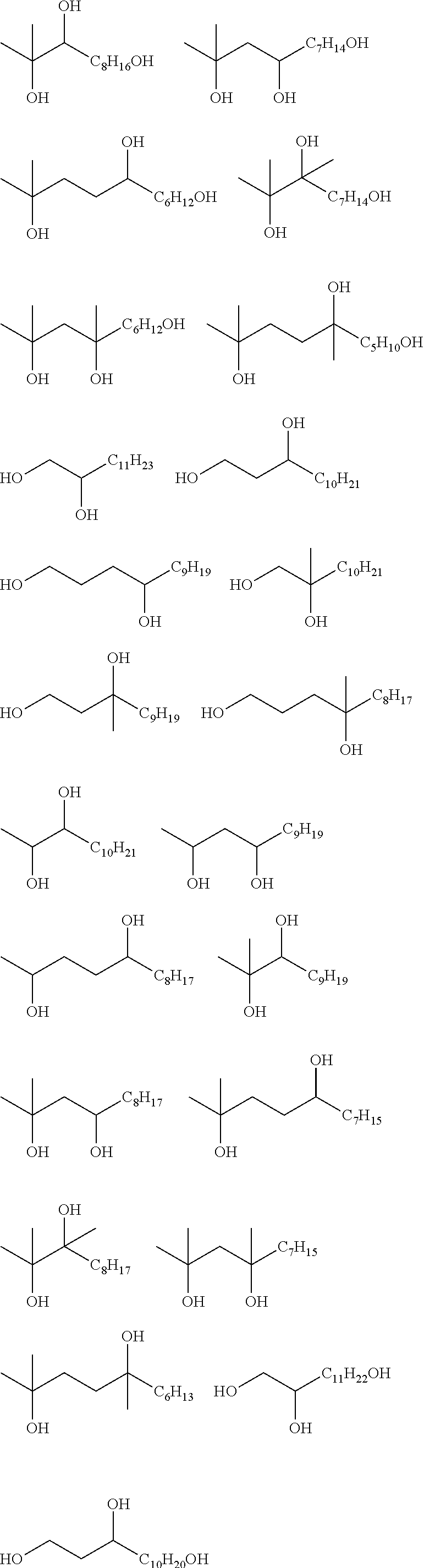
- Examples of the di- or trihydric alcohol having formula (A-2) are given below, but not limited thereto.
- di- and trihydric alcohols having formula (A-2) those of tertiary alcohol structure are preferred. Most preferred examples are given below.
- either one or both of the metal compound having formula (A-1) and the di- or trihydric alcohol having formula (A-2) have at least one tertiary alcohol structure.
- the organic group has a carbon atom bonded to a metal atom via an oxygen atom
- the organic group differs in solubility in solvent or stability to heat, depending on the surrounding skeleton structure.
- the solubility of the metal compound in a solvent, especially organic solvent increases in the order that the skeleton structure that the carbon atom in the organic group or the carbon atom in the alcohol to be reacted assumes is a primary, secondary and tertiary alcohol structure.
- a tertiary alcohol structure is incorporated, then the solubility of the metal compound in organic solvent is improved, whereby precipitation of the metal compound is prevented.
- the pyrolytic temperature of the metal compound decreases in the order that the skeleton structure that the carbon atom assumes is a primary, secondary and tertiary alcohol structure. If a tertiary alcohol structure is incorporated, then film deposition is possible at a temperature in the range of 100 to 350° C. which is compatible with the general process for the fabrication of semiconductor devices.
- the hydrolysate or hydrolytic condensate obtained from the metal compound having formula (A-1) alone, or the reaction product thereof with the di- or trihydric alcohol having formula (A-2) may be prepared from hydrolysis or hydrolysis and condensation (referred to as hydrolytic condensation, hereinafter) of the metal compound having formula (A-1) alone, or a mixture of a hydrolysate or hydrolytic condensate of the metal compound having formula (A-1) alone and the di- or trihydric alcohol having formula (A-2), in the presence or absence of an acid or alkali catalyst.
- the acid catalyst used herein may be at least one compound selected from among inorganic acids, aliphatic sulfonic acids, aromatic sulfonic acids, aliphatic carboxylic acids, and aromatic carboxylic acids.
- Suitable acid catalysts include hydrofluoric acid, hydrochloric acid, hydrobromic acid, sulfuric acid, nitric acid, perchloric acid, phosphoric acid, methanesulfonic acid, benzenesulfonic acid, toluenesulfonic acid, formic acid, acetic acid, propionic acid, oxalic acid, malonic acid, maleic acid, fumaric acid, and benzoic acid.
- the acid catalyst is preferably used in an amount of 10 ⁇ 6 to 10 moles, more preferably 10 ⁇ 5 to 5 moles, even more preferably 10 ⁇ 4 to 1 mole per mole of the metal compound.
- Suitable alkaline catalysts include methylamine, ethylamine, propylamine, butylamine, ethylenediamine, hexamethylenediamine, dimethylamine, diethylamine, ethylmethylamine, trimethylamine, triethylamine, tripropylamine, tributylamine, cyclohexylamine, dicyclohexylamine, monoethanolamine, diethanolamine, dimethylmonoethanolamine, monomethyldiethanolamine, triethanolamine, diazabicyclooctane, diazabicyclocyclononene, diazabicycloundecene, hexamethylenetetramine, aniline, N,N-dimethylaniline, pyridine, N,N-dimethylethanolamine, N,N-diethylethanolamine, N-( ⁇ -aminoethyl)ethanolamine, N-methylethanolamine, N-methyldiethanolamine, N-ethylethanolamine, N-n-
- the amount of water used when the desired compound is obtained from hydrolysis or hydrolytic condensation of the reactant(s) is preferably 0.01 to 10 moles, more preferably 0.05 to 5 moles, even more preferably 0.1 to 3 moles per mole of hydrolyzable substituent group on the reactant(s). As long as the amount of water is up to 10 moles, the procedure is economical because the reactor is not of extra size, and preferable because the stability of the metal compound is not adversely affected.
- One exemplary procedure is by adding the reactant(s) to an aqueous solution of the catalyst to start hydrolytic condensation reaction.
- an organic solvent may be added to the catalyst aqueous solution and/or the reactant(s) may be diluted with an organic solvent.
- the reaction temperature is preferably 0 to 200° C., more preferably 5 to 150° C.
- the reaction time is preferably 0.5 to 24 hours, more preferably 1 to 12 hours.
- the reaction system is maintained at a temperature of 5 to 150° C. during dropwise addition of the reactant(s) and aged at 20 to 150° C. for 1 to 12 hours.
- Another procedure is by adding water or water-containing organic solvent to the reactant(s) or an organic solvent containing the reactant(s) to start hydrolytic reaction.
- the catalyst Prior to the reaction, the catalyst may be added to the reactant(s) or the organic solvent containing the reactant(s), or water or water-containing organic solvent.
- the reaction temperature is preferably 0 to 200° C., more preferably 5 to 150° C.
- the reaction system is maintained at a temperature of 5 to 150° C. during dropwise addition of the reactant(s) and aged at 20 to 150° C. for 1 to 12 hours.
- Examples of the organic solvent which can be added to the catalyst aqueous solution or with which the metal compound can be diluted include methanol, ethanol, 1-propanol, 2-propanol, 1-butanol, 2-butanol, 2-methyl-1-propanol, acetone, acetonitrile, tetrahydrofuran, toluene, hexane, ethyl acetate, cyclohexanone, methyl pentyl ketone, butanediol monomethyl ether, propylene glycol monomethyl ether, ethylene glycol monomethyl ether, butanediol monoethyl ether, propylene glycol monoethyl ether, ethylene glycol monoethyl ether, propylene glycol dimethyl ether, diethylene glycol dimethyl ether, propylene glycol monomethyl ether acetate, propylene glycol monoethyl ether acetate, ethyl pyru
- the organic solvent is preferably used in an amount of 0 to 1,000 mL, more preferably 0 to 500 mL per mole of the metal compound. As long as the amount of the organic solvent is up to 1,000 mL, the procedure is economical because the reactor is not of extra size.
- the amount of alkali or acid used for neutralization is preferably 0.1 to 2 equivalents relative to the acid or alkali catalyst. Any compound may be used as long as the reaction solution becomes neutral.
- the alcohol or by-product formed during hydrolytic condensation reaction are preferably removed from the reaction solution.
- the reaction solution is heated at a temperature under a pressure.
- the heating temperature is preferably 0 to 200° C., more preferably 10 to 150° C., even more preferably 15 to 150° C., depending on the type of the organic solvent added and the by-product formed during reaction.
- the pressure is preferably up to atmospheric, more preferably up to 80 kPa, even more preferably up to 50 kPa in absolute pressure, depending on the type of the organic solvent and by-product to be removed, vacuum unit, condensation unit, and heating temperature.
- a final solvent is added to the reaction solution.
- the solvent include butanediol monomethyl ether, propylene glycol monomethyl ether, ethylene glycol monoethyl ether, butanediol monoethyl ether, propylene glycol monoethyl ether, ethylene glycol monoethyl ether, butanediol monopropyl ether, propylene glycol monopropyl ether, ethylene glycol monopropyl ether, ethylene glycol monobutyl ether, diethylene glycol monomethyl ether, diethylene glycol monoethyl ether, diethylene glycol monopropyl ether, diethylene glycol monobutyl ether, propylene glycol monobutyl ether, 1-butanol, 2-butanol, 2-methyl-1-propanol, 4-methyl-2-pentanol, acetone, tetrahydrofuran, toluene, he
- the molecular weight of the hydrolytic condensate of the metal compound having formula (A-1) or the reaction product thereof with the di- or trihydric alcohol having formula (A-2) may be adjusted by selecting a particular metal compound and controlling the reaction conditions during hydrolytic condensation.
- the hydrolytic condensate or reaction product preferably has a weight average molecular weight (Mw) of up to 100,000, more preferably 200 to 50,000, even more preferably 300 to 30,000. As long as Mw is up to 100,000, neither foreign particles nor coating spots form.
- Mw is measured versus polystyrene standards by gel permeation chromatography (GPC) using an RI detector and tetrahydrofuran (THF) eluent.
- the resist composition using the above-defined component (A) has improved shelf stability, that is, its properties remain unchanged over a long period of time. It may be processed to form a fine size pattern of satisfactory profile. A resist film formed from the resist composition may be heated at a relatively low temperature for the purpose of reaction promotion.
- Component (A) may be used alone or in combination of two or more.
- the resist composition also comprises (B) a sensitizer containing a compound or metal salt having the formula (B-1).
- the sensitizer By virtue of the sensitizer, the resist composition is improved in sensitivity.
- M n+ is a metal ion selected from the group consisting of Mg, Ca, Ce, Zn, Cu, In, Fe, Yb, Y, Tm, Sn, Ni, Sc, Hf, Nb, Ti, Zr, Ba, Ho, Tb, Lu, La, Ag, Eu, Dy, Gd, Rb, Sr, and Cs.
- X ⁇ is an alkylsulfonic acid anion, arylsulfonic acid anion, alkylsulfonimidic acid anion or alkylsulfonemethidic acid anion, each having at least one fluorine atom, and n is an integer of 1 to 4 (1 ⁇ n ⁇ 4).
- X ⁇ is preferably an anion selected from the following formulae (B-2) to (B-4).
- R B1 is a C 5 -C 30 monovalent hydrocarbon group having at least one fluorine atom, which may contain another halogen atom, thiol, ether, ester, carbonate, carbonyl, amide, amino, azide, carbamate, nitro, cyano, hydroxyl, carboxyl, sulfo, sulfonic acid ester, sultone moiety, lactone ring or lactam ring.
- the monovalent hydrocarbon group may be straight, branched or cyclic. Examples include C 5 -C 30 alkyl, alkenyl and alkynyl groups, C 6 -C 30 aryl groups, and C 6 -C 30 aralkyl groups.
- R B2 and R B3 are each independently fluorine, trifluoromethyl, pentafluoroethyl, trifluoroethyl, octafluorobutyl or nonafluorobutyl.
- R B2 and R B3 may bond together to form a ring with the linkage: —SO 2 N ⁇ SO 2 —, and in this case, preferably R B2 and R B3 bond together to form —(CF 2 ) k — wherein k is an integer of 2 to 5.
- R B4 , R B5 and R B6 are each independently fluorine, trifluoromethyl, pentafluoroethyl, trifluoroethyl, octafluorobutyl or nonafluorobutyl.
- Component (B) is preferably present in an amount of 0.01 to 100 parts by weight, more preferably 0.1 to 50 parts by weight per 100 parts by weight of component (A). Component (B) may be used alone or in combination of two or more.
- the resist composition may further comprise (C) a silicon-containing compound for the purposes of enhancing reactivity and sensitivity.
- the silicon-containing compound is typically selected from a silane compound having the formula (C-1), a hydrolysate of the silane compound having formula (C-1), and a hydrolytic condensate of the silane compound having formula (C-1).
- R C1 is hydrogen or a C 1 -C 30 monovalent organic group free of iodine.
- the monovalent organic groups may be straight, branched or cyclic. Examples include monovalent saturated hydrocarbon groups such as methyl, ethyl, n-propyl, isopropyl, cyclopropyl, n-butyl, isobutyl, sec-butyl, tert-butyl, cyclobutyl, n-pentyl, isopentyl, sec-pentyl, tert-pentyl, neopentyl, cyclopentyl, n-hexyl, cyclohexyl, n-heptyl, cycloheptyl, n-octyl, cyclooctyl, cyclooctyl, n-nonyl, cyclononyl, n-decyl, cyclodecyl,
- one or more or all hydrogen atoms may be substituted by halogen atoms other than iodine.
- the halogen is preferably fluorine or chlorine.
- Examples of the organic group substituted with halogen other than iodine include fluorophenyl, difluorophenyl, chlorophenyl, dichlorophenyl, fluoronaphthyl, difluoronaphthyl, chloronaphthyl, dichloronaphthyl, fluorobenzyl, difluorobenzyl, chlorobenzyl, dichlorobenzyl, fluorophenethyl, difluorophenethyl, chlorophenethyl, and dichlorophenethyl.
- one or more or all hydrogen atoms may be substituted by silicon-containing moieties.
- Typical of the silicon-containing moiety is trialkylsilyl in which each alkyl is preferably of 1 to 6 carbon atoms.
- Examples of the organic group substituted with a silicon-containing moiety include (trimethylsilyl)phenyl, (triethylsilyl)phenyl, (tert-butyldimethylsilyl)phenyl, (trimethylsilyl)naphthyl, (triethylsilyl)naphthyl, (tert-butyldimethylsilyl)naphthyl, (trimethylsilyl)benzyl, (triethylsilyl)benzyl, (tert-butyldimethylsilyl)benzyl, (trimethylsilyl)phenethyl, (triethylsilyl)phenethyl, and (tert-butyld
- organic group examples include those having a hydroxyl or carboxyl group substituted with an acid labile group.
- Examples of the organic group having a hydroxyl or carboxyl group substituted with an acid labile group are shown below, but not limited thereto.
- (Si) indicates the bonding site to a silicon atom.
- R C2 is a C 1 -C 6 alkyl group, examples of which include methyl, ethyl, n-propyl, isopropyl, cyclopropyl, n-butyl, isobutyl, sec-butyl, tert-butyl, cyclobutyl, n-pentyl, isopentyl, sec-pentyl, tert-pentyl, neopentyl, cyclopentyl, n-hexyl, and cyclohexyl.
- p is an integer of 0 to 3 (0 ⁇ p ⁇ 3), preferably 1 or 2.
- Examples of the silane compound having formula (C-1) include trimethoxysilane, triethoxysilane, tripropoxysilane, triisopropoxysilane, methyltrimethoxysilane, methyltriethoxysilane, methyltripropoxysilane, methyltriisopropoxysilane, ethyltrimethoxysilane, ethyltriethoxysilane, ethyltripropoxysilane, ethyltriisopropoxysilane, vinyltrimethoxysilane, vinyltriethoxysilane, vinyltripropoxysilane, vinyltriisopropoxysilane, propyltrimethoxysilane, propyltriethoxysilane, propyltripropoxysilane, propyltriisopropoxysilane, isopropyltrimethoxysilane, isopropyltriethoxysilane, isopropyltripropoxysilane
- component (C) Also included in component (C) are a silane compound having the formula (C-2), a hydrolysate of the silane compound having formula (C-2), and a hydrolytic condensate of the silane compound having formula (C-2), which may be used alone or in admixture.
- R C3 is a C 1 -C 30 monovalent organic group substituted with at least one iodine
- R C4 is a C 1 -C 6 alkyl group
- q is an integer of 1 to 3 (1 ⁇ q ⁇ 3).
- (Si) indicates the bonding site to a silicon atom.
- component (C) Also included in component (C) is a hydrolytic condensate of at least one silane compound having formula (C-1) and at least one silane compound having formula (C-2).
- the hydrolytic condensate of silane compounds may be obtained from hydrolytic condensation of the silane compounds in the presence of an acid catalyst selected from inorganic acids, aliphatic sulfonic acids and aromatic sulfonic acids.
- Suitable acid catalysts include hydrofluoric acid, hydrochloric acid, hydrobromic acid, sulfuric acid, nitric acid, perchloric acid, phosphoric acid, methanesulfonic acid, benzenesulfonic acid, and toluenesulfonic acid.
- the acid catalyst is preferably used in an amount of 10 ⁇ 6 to 10 moles, more preferably 10 ⁇ 5 to 5 moles, even more preferably 10 ⁇ 4 to 1 mole per mole of the silane compounds combined.
- the amount of water used when the hydrolytic condensate is obtained from silane compounds is preferably 0.01 to 100 moles, more preferably 0.05 to 50 moles, even more preferably 0.1 to 30 moles per mole of hydrolyzable substituent group on the silane compounds. As long as the amount of water is up to 100 moles, the procedure is economical because a reactor of extra size is not required.
- One exemplary procedure is by adding the silane compounds to an aqueous solution of the catalyst to start hydrolytic condensation reaction.
- an organic solvent may be added to the catalyst aqueous solution and/or the silane compounds may be diluted with an organic solvent.
- the reaction temperature is preferably 0 to 100° C., more preferably 5 to 80° C.
- the reaction time is preferably 0.5 to 60 hours, more preferably 1 to 50 hours.
- the reaction system is maintained at a temperature of 5 to 80° C. during dropwise addition of the silane compounds and aged at 20 to 80° C. for 1 to 50 hours.
- Examples of the organic solvent which can be added to the catalyst aqueous solution or with which the silane compounds can be diluted include methanol, ethanol, 1-propanol, 2-propanol, 1-butanol, 2-butanol, 2-methyl-1-propanol, acetone, acetonitrile, tetrahydrofuran, toluene, hexane, ethyl acetate, cyclohexanone, methyl pentyl ketone, butanediol monomethyl ether, propylene glycol monomethyl ether, ethylene glycol monomethyl ether, butanediol monoethyl ether, propylene glycol monoethyl ether, ethylene glycol monoethyl ether, propylene glycol dimethyl ether, diethylene glycol dimethyl ether, propylene glycol monomethyl ether acetate, propylene glycol monoethyl ether acetate, ethyl pyr
- water-soluble solvents are preferred.
- Suitable water-soluble solvents include alcohols such as methanol, ethanol, 1-propanol, 2-propanol, polyhydric alcohols such as ethylene glycol and propylene glycol, polyhydric alcohol condensation derivatives such as butanediol monomethyl ether, propylene glycol monomethyl ether, ethylene glycol monomethyl ether, butanediol monoethyl ether, propylene glycol monoethyl ether, ethylene glycol monoethyl ether, butanediol monopropyl ether, propylene glycol monopropyl ether, and ethylene glycol monopropyl ether, acetone, acetonitrile, and tetrahydrofuran.
- those solvents having a boiling point of up to 100° C. are especially preferred.
- the organic solvent is preferably used in an amount of 0 to 1,000 mL, more preferably 0 to 500 mL per mole of the silane compounds. As long as the amount of the organic solvent is up to 1,000 mL, the procedure is economical because a reactor of extra size is not required.
- the catalyst is neutralized if necessary.
- the amount of alkali used for neutralization is preferably 0.1 to 2 equivalents relative to the acid catalyst. Any alkaline compound may be used as long as it exhibits alkalinity in water.
- the alcohol or by-product formed during hydrolytic condensation reaction is preferably removed from the reaction solution.
- the reaction solution is heated at a temperature under a pressure.
- the heating temperature is preferably 0 to 100° C., more preferably 10 to 90° C., even more preferably 15 to 80° C., depending on the type of the organic solvent added and the by-product formed during reaction.
- the pressure is preferably up to atmospheric, more preferably up to 80 kPa, even more preferably up to 50 kPa in absolute pressure, depending on the type of the organic solvent and by-product to be removed, vacuum unit, condensation unit, and heating temperature.
- the acid catalyst used for hydrolytic condensation may be removed from the reaction solution.
- the acid catalyst may be removed, for example, by mixing the reaction solution with water and extracting the hydrolytic condensate with an organic solvent.
- the organic solvent used herein is preferably such that the hydrolytic condensate is dissolved in the solvent and a solvent/water mixture separates into two layers.
- Suitable organic solvents include methanol, ethanol, 1-propanol, 2-propanol, 1-butanol, 2-butanol, 2-methyl-1-propanol, acetone, tetrahydrofuran, toluene, hexane, ethyl acetate, cyclohexanone, methyl pentyl ketone, butanediol monomethyl ether, propylene glycol monomethyl ether, ethylene glycol monomethyl ether, butanediol monoethyl ether, propylene glycol monoethyl ether, ethylene glycol monoethyl ether, butanediol monopropyl ether, propylene glycol monopropyl ether, ethylene glycol monopropyl ether, propylene glycol dimethyl ether, diethylene glycol dimethyl ether, propylene glycol monomethyl ether acetate, propylene glycol monoethyl ether acetate,
- Suitable mixtures include, but are not limited to, a mixture of methanol/ethyl acetate, ethanol/ethyl acetate, 1-propanol/ethyl acetate, 2-propanol/ethyl acetate, butanediol monomethyl ether/ethyl acetate, propylene glycol monomethyl ether/ethyl acetate, ethylene glycol monomethyl ether/ethyl acetate, butanediol monoethyl ether/ethyl acetate, propylene glycol monoethyl ether/ethyl acetate, ethylene glycol monoethyl ether/ethyl acetate, butanediol monopropyl ether/ethyl acetate, propylene glycol monopropyl ether/ethyl acetate, propylene glycol monopropyl ether/ethyl acetate, propylene glycol mono
- the mixing ratio of water-soluble organic solvent to substantially water-insoluble organic solvent may be selected as appropriate.
- 100 parts by weight of the substantially water-insoluble organic solvent is mixed with 0.1 to 1,000 parts, more preferably 1 to 500 parts, even more preferably 2 to 100 parts by weight of the water-soluble organic solvent.
- the reaction solution may be washed with neutral water.
- the water used herein may be so-called deionized water or ultrapure water. Water is used in an amount of preferably 0.01 to 100 L, more preferably 0.05 to 50 L, even more preferably 0.1 to 5 L per liter of the reaction solution.
- the washing procedure may be by feeding the reaction solution and water into a common vessel, agitating them, and holding the mixture statically for allowing the water layer to separate. With respect to the number of washing cycles, at least one cycle is sufficient, and 1 to about 5 cycles of washing are preferable because no further effects are obtainable from 10 or more cycles of washing.
- Other means for removing the acid catalyst include ion exchange resins and neutralization with an epoxy compound such as ethylene oxide or propylene oxide. An appropriate removal means may be selected in accordance with a particular acid catalyst used in the reaction.
- part of the hydrolytic condensate of silane compounds can escape into the water layer, achieving a substantially equivalent effect to the fractional operation.
- the number of water washing cycles and the volume of washing water may be selected as appropriate in view of the catalyst removal effect and the fractional effect.
- the desired solution is obtained from the hydrolytic condensate solution by adding a final solvent thereto and performing solvent exchange under reduced pressure.
- the temperature of solvent exchange is preferably 0 to 100° C., more preferably 10 to 90° C., even more preferably 15 to 80° C. depending on the type of reaction solvent and extracting solvent to be removed.
- the pressure is preferably up to atmospheric, more preferably up to 80 kPa, even more preferably up to 50 kPa in absolute pressure, depending on the type of the extracting solvent to be removed, vacuum unit, condensation unit, and heating temperature.
- the hydrolytic condensate becomes unstable as a result of solvent exchange. Instability is attributable to the compatibility of the hydrolytic condensate with the final solvent.
- a mono-, di- or polyhydric alcohol having a cyclic ether substituent may be added as a stabilizer as described in JP-A 2009-126940, paragraphs [0181]-[0182].
- the amount of the stabilizer added is preferably 0 to 25 parts, more preferably 0 to 15 parts, even more preferably 0 to 5 parts by weight per 100 parts by weight of the hydrolytic condensate in the solution prior to the solvent exchange. When added, the amount of the stabilizer is preferably at least 0.5 part by weight.
- a mono-, di- or polyhydric alcohol having a cyclic ether substituent may be added to the solution prior to the solvent exchange, followed by solvent exchange operation.
- hydrolytic condensate solution As the hydrolytic condensate solution is concentrated above a certain concentration, condensation reaction proceeds such that the hydrolytic condensate may sometimes turn to be undissolvable in the organic solvent. With this in mind, it is recommended that the solution is maintained at an appropriate concentration. Also, a solution which is not so thin is economical because the volume of solvent is not excessive. An appropriate concentration is 0.1 to 20% by weight.
- the final solvent added to the hydrolytic condensate solution is preferably selected from alcohol solvents, more preferably monoalkyl ether derivatives of alcohols such as ethylene glycol, diethylene glycol, triethylene glycol, propylene glycol, dipropylene glycol, and butanediol.
- alcohol solvents more preferably monoalkyl ether derivatives of alcohols such as ethylene glycol, diethylene glycol, triethylene glycol, propylene glycol, dipropylene glycol, and butanediol.
- Preferred examples include butanediol monomethyl ether, propylene glycol monomethyl ether, ethylene glycol monomethyl ether, butanediol monoethyl ether, propylene glycol monoethyl ether, ethylene glycol monoethyl ether, butanediol monopropyl ether, propylene glycol monopropyl ether, and ethylene glycol monopropyl ether.
- a non-alcohol solvent may be added as an auxiliary solvent.
- Suitable auxiliary solvents include acetone, tetrahydrofuran, toluene, hexane, ethyl acetate, cyclohexanone, methyl pentyl ketone, propylene glycol dimethyl ether, diethylene glycol dimethyl ether, propylene glycol monomethyl ether acetate, propylene glycol monoethyl ether acetate, ethyl pyruvate, butyl acetate, methyl 3-methoxypropionate, ethyl 3-ethoxypropionate, tert-butyl acetate, tert-butyl propionate, propylene glycol mono-tert-butyl ether acetate, ⁇ -butyrolactone, methyl isobutyl ketone, and cyclopentyl methyl ether.
- the hydrolytic condensate of silane compounds may also be obtained from hydrolytic condensation of the silane compounds in the presence of a base catalyst.
- the base catalyst include methylamine, ethylamine, propylamine, butylamine, ethylenediamine, hexamethylenediamine, dimethylamine, diethylamine, ethylmethylamine, trimethylamine, triethylamine, tripropylamine, tributylamine, cyclohexylamine, dicyclohexylamine, monoethanolamine, diethanolamine, dimethylmonoethanolamine, monomethyldiethanolamine, triethanolamine, diazabicyclooctane, diazabicyclocyclononene, diazabicycloundecene, hexamethylenetetramine, aniline, N,N-dimethylaniline, pyridine, N,N-dimethylaminopyridine, pyrrole, piperazine, pyrrolidine, piperidine, pico
- the amount of water used when the hydrolytic condensate is obtained from hydrolytic condensation of silane compounds is preferably 0.1 to 50 moles per mole of hydrolyzable substituent group on the silane compounds. As long as the amount of water is up to 50 moles, the procedure is economical because the reactor is not of extra size.
- One exemplary procedure is by adding the silane compounds to an aqueous solution of the catalyst to start hydrolytic condensation reaction.
- an organic solvent may be added to the catalyst aqueous solution and/or the silane compounds may be diluted with an organic solvent.
- the reaction temperature is preferably 0 to 100° C., more preferably 5 to 80° C.
- the reaction system is maintained at a temperature of 5 to 80° C. during dropwise addition of the silane compounds and aged at 20 to 80° C.
- Examples of the organic solvent which can be added to the base catalyst aqueous solution or with which the silane compounds can be diluted are the same as the aforementioned examples of the organic solvent which can be added to the acid catalyst aqueous solution.
- the organic solvent is preferably used in an amount of 0 to 1,000 mL per mole of the silane compounds to ensure that the reaction takes place in an economically acceptable manner.
- the base catalyst is neutralized if necessary.
- the amount of an acidic compound used for neutralization is preferably 0.1 to 2 equivalents relative to the base catalyst. Any acidic compound may be used as long as it exhibits acidity in water.
- the alcohol or by-product formed during hydrolytic condensation reaction is preferably removed from the reaction mixture.
- the reaction mixture is heated at a temperature under a pressure.
- the heating temperature is preferably 0 to 100° C., more preferably 10 to 90° C., even more preferably 15 to 80° C., depending on the type of the organic solvent added and the alcohol formed during reaction.
- the pressure is preferably up to atmospheric, more preferably up to 80 kPa, even more preferably up to 50 kPa in absolute pressure, depending on the type of the organic solvent and alcohol to be removed, vacuum unit, condensation unit, and heating temperature.
- the base catalyst used for hydrolytic condensation is removed from the reaction solution, for example, by extracting the silicon-containing compound with an organic solvent.
- the organic solvent used herein is preferably such that the silicon-containing compound is dissolved in the solvent and a solvent/water mixture separates into two layers.
- a mixture of water-soluble organic solvent and substantially water-insoluble organic solvent is also useful.
- Examples of the organic solvent which can be used for removal of the base catalyst are the same as the aforementioned examples of the organic solvent which can be used for removal of the acid catalyst and the mixture of water-soluble organic solvent and substantially water-insoluble organic solvent.
- the mixing ratio of water-soluble organic solvent to substantially water-insoluble organic solvent may be selected as appropriate.
- 100 parts by weight of the substantially water-insoluble organic solvent is mixed with 0.1 to 1,000 parts, more preferably 1 to 500 parts, even more preferably 2 to 100 parts by weight of the water-soluble organic solvent.
- the reaction solution may be washed with neutral water.
- the water used herein may be so-called deionized water or ultrapure water. Water is used in an amount of preferably 0.01 to 100 L, more preferably 0.05 to 50 L, even more preferably 0.1 to 5 L per liter of the silicon-containing compound solution.
- the washing procedure may be by feeding the reaction solution and water into a common vessel, agitating them, and holding the mixture statically for allowing the water layer to separate. At least one cycle of washing is sufficient, and 1 to about 5 cycles of washing are preferable because no further effects are obtainable from 10 or more cycles of washing.
- the desired silicon-containing compound solution is obtained by adding a final solvent to the silicon-containing compound solution as washed and performing solvent exchange under reduced pressure.
- the temperature of solvent exchange is preferably 0 to 100° C., more preferably 10 to 90° C., even more preferably 15 to 80° C. depending on the type of extracting solvent to be removed.
- the pressure is preferably up to atmospheric, more preferably up to 80 kPa, even more preferably up to 50 kPa in absolute pressure, depending on the type of the extracting solvent to be removed, vacuum unit, condensation unit, and heating temperature.
- the final solvent added to the silicon-containing compound solution is preferably selected from alcohol solvents, more preferably monoalkyl ethers of ethylene glycol, diethylene glycol, triethylene glycol, propylene glycol, and dipropylene glycol.
- Preferred examples include propylene glycol monomethyl ether, ethylene glycol monomethyl ether, propylene glycol monoethyl ether, ethylene glycol monoethyl ether, propylene glycol monopropyl ether, and ethylene glycol monopropyl ether.
- the hydrolysate of the silane compound may be prepared by adding water or water-containing organic solvent to the silane compound or silane compound-containing organic solvent and effecting hydrolytic reaction.
- a catalyst may be added to the silane compound or silane compound-containing organic solvent, or water or water-containing organic solvent.
- the reaction temperature is preferably 0 to 100° C., more preferably 10 to 80° C.
- the reaction time is preferably 0.5 to 60 hours, more preferably 1 to 50 hours.
- One preferred procedure involves heating at a temperature of 10 to 50° C. during dropwise addition of water, then heating at 20 to 80° C., and aging at the temperature for 1 to 50 hours.
- water-soluble solvents are preferred. Suitable water-soluble solvents include methanol, ethanol, 1-propanol, 2-propanol, 1-butanol, 2-butanol, 2-methyl-1-propanol, acetone, tetrahydrofuran, acetonitrile, and polyhydric alcohol condensation derivatives such as butanediol monomethyl ether, propylene glycol monomethyl ether, ethylene glycol monomethyl ether, butanediol monoethyl ether, propylene glycol monoethyl ether, ethylene glycol monoethyl ether, butanediol monopropyl ether, propylene glycol monopropyl ether, ethylene glycol monopropyl ether, propylene glycol dimethyl ether, diethylene glycol dimethyl ether, propylene glycol monomethyl ether acetate, propylene glycol monoethyl ether acetate, propylene glycol monoethyl ether
- the amount of the organic solvent used may be the same as described above.
- the reaction mixture is post-treated by the same technique as described above, obtaining the silicon-containing compound.
- the molecular weight of the hydrolytic condensate of the silane compound may be adjusted by selecting a particular silane compound and controlling the reaction conditions during hydrolytic condensation.
- the hydrolytic condensate preferably has a Mw of up to 100,000, more preferably 200 to 50,000, even more preferably 300 to 30,000. As long as Mw is up to 100,000, neither foreign particles nor coating spots form.
- Component (C) is preferably present in an amount of 1 to 60 parts by weight, more preferably 5 to 50 parts by weight per 100 parts by weight of component (A). Component (C) may be used alone or in combination of two or more.
- a solvent may be added to the resist composition.
- the solvent used herein is not particularly limited as long as various components of the resist composition are dissolved therein.
- the solvent used herein is identical with the solvent which is finally added during preparation of components (A) and (C).
- Suitable solvents include butanediol monomethyl ether, propylene glycol monomethyl ether, ethylene glycol monomethyl ether, butanediol monoethyl ether, propylene glycol monoethyl ether, ethylene glycol monoethyl ether, butanediol monopropyl ether, propylene glycol monopropyl ether, ethylene glycol monopropyl ether, ethylene glycol monobutyl ether, diethylene glycol monomethyl ether, diethylene glycol monoethyl ether, diethylene glycol monopropyl ether, diethylene glycol monobutyl ether, propylene glycol monobutyl ether, 1-butanol, 2-butanol, 2-methyl-1-propanol, 4-methyl-2-pentanol, acetone, tetrahydrofuran, toluene, hexane, ethyl acetate, cyclohexanone, methyl
- the organic solvent When the organic solvent is added, it is preferably used in an amount of 100 to 10,000 parts by weight, more preferably 500 to 7,000 parts by weight per 100 parts by weight of component (A).
- the organic solvent may be used alone or in combination of two or more.
- an acid generator is added to the resist composition.
- a photoacid generator capable of generating an acid in response to actinic light or radiation.
- PAG may be any compound capable of generating an acid upon exposure to high-energy radiation.
- Suitable PAGs include sulfonium salts, iodonium salts, sulfonyldiazomethane, N-sulfonyloxyimide, and oxime-O-sulfonate acid generators.
- Exemplary acid generators are described in U.S. Pat. No.
- JP-A 2008-111103 paragraphs [0122]-[0142]
- JP-A 2009-080474 JP-A 2015-026064.
- the PAGs may be used alone or in admixture.
- the acid generator is preferably added in an amount of 0.1 to 50 parts by weight per 100 parts by weight of component (A).
- a surfactant is added to the resist composition, if necessary. Suitable surfactants are described in JP-A 2009-126940, paragraph [0129].
- Another embodiment of the invention is a pattern forming process comprising the steps of coating the resist composition onto a substrate, prebaking the composition to form a resist film, exposing the resist film to high-energy radiation, baking, and developing the resist film in a developer.
- the resist composition is coated onto a substrate for integrated circuit fabrication or a processable layer thereon (e.g., Si, SiO 2 , SiN, SiON, TiN, WSi, BPSG, SOG, or organic antireflective coating) or a substrate for mask circuit fabrication or a processable layer thereon (e.g., Cr, CrO, CrON, MoSi 2 , or SiO 2 ) by any suitable technique such as spin coating, roll coating, flow coating, dip coating, spray coating or doctor coating.
- the coating is prebaked on a hot plate at a temperature of 60 to 350° C. for 10 seconds to 30 minutes, preferably 100 to 300° C. for 30 seconds to 20 minutes to form a resist film having a thickness of 0.01 to 2.0 ⁇ m.
- the resist film is exposed imagewise to high-energy radiation directly or through a mask having the desired pattern.
- the radiation is selected from among excimer laser radiation such as KrF, ArF, Xe, F 2 or Ar 2 excimer laser radiation, EUV, and EB.
- the resist composition is adapted to change a solubility in developer upon exposure to high-energy radiation. Upon receipt of exposure energy, the resist composition turns insoluble in organic solvent through the mechanism that organic groups are eliminated and crosslinking reaction takes place. That is, the resist composition functions as negative tone resist material.
- the high-energy radiation used herein is preferably EUV of wavelength 3 to 15 nm, or EB at an accelerating voltage of 1 to 150 kV, more preferably 5 to 120 kV, even more preferably up to 50 kV, and especially low accelerated EB at an accelerating voltage of up to 10 kV.
- the dose of high-energy radiation is preferably 1 to 1,000 mJ/cm 2 , especially 10 to 500 mJ/cm 2 , or 0.1 to 1,000 ⁇ C/cm 2 , especially 0.5 to 500 ⁇ C/cm 2 .
- PEB baking
- the resist film is then developed in an organic solvent developer, preferably for 0.1 to 3 minutes, more preferably 0.5 to 2 minutes, by any conventional techniques such as dip, puddle and spray techniques. Since the unexposed region of resist film is dissolved in the developer, the desired negative pattern is formed on the substrate.
- the organic solvent used as the developer is preferably selected from 2-octanone, 2-nonanone, 2-heptanone, 3-heptanone, 4-heptanone, 2-hexanone, 3-hexanone, diisobutyl ketone, methylcyclohexanone, acetophenone, methylacetophenone, propyl acetate, butyl acetate, isobutyl acetate, pentyl acetate, isopentyl acetate, butenyl acetate, propyl formate, butyl formate, isobutyl formate, pentyl formate, isopentyl formate, methyl valerate, methyl pentenoate, methyl crotonate, ethyl crotonate, methyl lactate, ethyl lactate, propyl lactate, butyl lactate, isobutyl lactate, pentyl lactate, isopentyl lactate, methyl 2-hydroxy
- the resist film is rinsed.
- a solvent which is miscible with the developer and does not dissolve the resist film is preferred.
- Suitable solvents include alcohols of 3 to 10 carbon atoms, ether compounds of 8 to 12 carbon atoms, alkanes, alkenes, and alkynes of 6 to 12 carbon atoms, and aromatic solvents.
- suitable alcohols of 3 to 10 carbon atoms include n-propyl alcohol, isopropyl alcohol, 1-butyl alcohol, 2-butyl alcohol, isobutyl alcohol, t-butyl alcohol, 1-pentanol, 2-pentanol, 3-pentanol, t-pentyl alcohol, neopentyl alcohol, 2-methyl-1-butanol, 3-methyl-1-butanol, 3-methyl-3-pentanol, cyclopentanol, 1-hexanol, 2-hexanol, 3-hexanol, 2,3-dimethyl-2-butanol, 3,3-dimethyl-1-butanol, 3,3-dimethyl-2-butanol, 2-ethyl-1-butanol, 2-methyl-1-pentanol, 2-methyl-2-pentanol, 2-methyl-3-pentanol, 3-methyl-1-pentanol, 3-methyl-2-pentanol, 3-methyl-2
- Suitable ether compounds of 8 to 12 carbon atoms include di-n-butyl ether, diisobutyl ether, di-s-butyl ether, di-n-pentyl ether, diisopentyl ether, di-s-pentyl ether, di-t-pentyl ether, and di-n-hexyl ether.
- Suitable alkanes of 6 to 12 carbon atoms include hexane, heptane, octane, nonane, decane, undecane, dodecane, methylcyclopentane, dimethylcyclopentane, cyclohexane, methylcyclohexane, dimethylcyclohexane, cycloheptane, cyclooctane, and cyclononane.
- Suitable alkenes of 6 to 12 carbon atoms include hexene, heptene, octene, cyclohexene, methylcyclohexene, dimethylcyclohexene, cycloheptene, and cyclooctene.
- Suitable alkynes of 6 to 12 carbon atoms include hexyne, heptyne, and octyne.
- Suitable aromatic solvents include toluene, xylene, ethylbenzene, isopropylbenzene, t-butylbenzene and mesitylene. The solvents may be used alone or in admixture.
- MIBC 4-methyl-2-pentanol
- a mixture of 100 g of 4-chlorostyrene and 220 g of THF was added dropwise to a mixture of 20 g of THF, 17.5 g of magnesium, and 0.2 g of 1,2-dibromoethane. The resulting mixture was held at 55° C. for 4 hours.
- a mixture of 78.4 g of chlorotrimethylsilane and 200 g of THF was added to the solution, which was held at 40° C. for 2 hours to effect Grignard reaction.
- a mixture of 72.2 g of ammonium chloride, 72.2 g of 20 wt % hydrochloric acid aqueous solution, and 216.6 g of ultrapure water was added dropwise to the reaction solution at 0° C.
- 77.6 g of tetramethoxysilane was added dropwise at 45° C., followed by stirring at 90° C. for 12 hours.
- Hexane, 100 g was added to the solution, from which the precipitate was filtered off.
- a mixture of 1.65 g of silicon-containing compound C1, 10.2 g of tetramethoxysilane, and 3.8 g of methyltrimethoxysilane was added dropwise to a mixture of 25.2 g of deionized water and 0.18 g of 7 wt % nitric acid at 5° C. over 2 hours.
- the solution was stirred at 25° C. for 24 hours to effect hydrolytic condensation.
- PGEE propylene glycol monoethyl ether
- 0.16 g of 24 wt % maleic acid aqueous solution was added to the reaction solution, from which the alcohol by-product was removed in vacuum.
- a mixture of 10.7 g of tetramethoxysilane, 8.95 g of (4-tert-butoxyphenethyl)trimethoxysilane, and 2.1 g of methyl isobutyl ketone (MIBK) was added dropwise to a mixture of 25.2 g of deionized water and 0.18 g of 7 wt % nitric acid at 0° C. over 1 hour. The solution was stirred at 25° C. for 48 hours to effect hydrolytic condensation. At the end of reaction, a mixture of 60 g of PGEE and 0.23 g of 24 wt % maleic acid aqueous solution was added to the reaction solution, from which the alcohol by-product was removed in vacuum.
- MIBK methyl isobutyl ketone
- Negative resist compositions were prepared by mixing titanium-containing compound A1 to A4 as component (A), metal salt sensitizer B1 shown below by the formula (B1) as component (B), silicon-containing compound C1 to C4 or phenyltrimethoxysilane as component (C), and a solvent in accordance with the recipe shown in Table 1, and filtering the solution through a fluoroplastic filter having a pore size of 0.1 ⁇ m.
- a silicon substrate having a diameter of 6 inches was vapor primed with hexamethyldisilazane (HMDS).
- HMDS hexamethyldisilazane
- Resist #6, #7 or #10 was spin coated onto the primed silicon substrate and prebaked on a hot plate at 180° C. for 60 seconds to form a resist film of 80 nm thick.
- a system JBX-9000MV (JEOL) the resist film was irradiated imagewise with EB at an accelerating voltage of 50 kV in a vacuum chamber in a varying dose of 3 to 160 ⁇ C/cm 2 .
- FIGS. 1 to 3 show the contrast curves of Resists #6, #7 and #10 in Examples.
- a silicon substrate having a diameter of 6 inches was vapor primed with HMDS.
- the resist composition (Resist #1 to #10 or Comparative Resist #1) was spin coated onto the primed silicon substrate and prebaked on a hot plate at 180° C. for 60 seconds to form a resist film of 60 nm thick.
- the resist film was irradiated imagewise with EB at an accelerating voltage of 50 kV in a vacuum chamber.
- the system Clean Track ACT8 immediately after the imagewise exposure, the resist film was PEB on a hotplate at the temperature shown in Table 2 for 60 seconds and puddle developed in butyl acetate for 20 seconds, yielding a negative pattern.
- the resist pattern was evaluated as follows. Sensitivity was the exposure dose that provided a 1:1 resolution of a 100-nm line-and-space pattern. Resolution was a minimum size at that exposure dose. The 100-nm L/S pattern was measured for line width roughness (LWR) under SEM (Hitachi High-Tech Fielding Corp.). The results are shown in Table 2.
- the resist compositions within the scope of the invention exhibit a higher sensitivity than the comparative resist composition, while maintaining satisfactory resolution and fully reduced edge roughness.
Landscapes
- Physics & Mathematics (AREA)
- General Physics & Mathematics (AREA)
- Spectroscopy & Molecular Physics (AREA)
- Chemical & Material Sciences (AREA)
- Organic Chemistry (AREA)
- Materials For Photolithography (AREA)
- Polymers With Sulfur, Phosphorus Or Metals In The Main Chain (AREA)
- Photosensitive Polymer And Photoresist Processing (AREA)
- Exposure And Positioning Against Photoresist Photosensitive Materials (AREA)
Abstract
Description
- Patent Document 1: JP-A 2005-505691 (U.S. Pat. No. 6,849,305)
- Patent Document 2: U.S. Pat. No. 5,534,312
- Patent Document 3: JP 6119544 (U.S. Pat. No. 9,274,425)
- Non-Patent Document 1: SPIE Vol. 5039 p1 (2003)
- Non-Patent Document 2: SPIE Vol. 6520 p65203L-1 (2007)
- Non-Patent Document 3: J. Vac. Sci. Technol. B27(6), November/December p3164 (2009)

wherein MA is Ti, Zr or Hf, RA1 to RA4 are each independently a C1-C20 monovalent organic group optionally having a hydroxyl group, a pair of RA1 and RA2 may bond together to form a ring with the O and MA to which they are attached, a pair of RA1 and RA2 or RA3 and RA4 may bond together to form a spiro-ring with the O and MA to which they are attached, RA5 is a C2-C20 m-valent organic group, m is 2 or 3, and
Mn+(X−)n (B-1)
wherein Mn+ is a metal ion selected from the group consisting of Mg, Ca, Ce, Zn, Cu, In, Fe, Yb, Y, Tm, Sn, Ni, Sc, Hf, Nb, Ti, Zr, Ba, Ho, Tb, Lu, La, Ag, Eu, Dy, Gd, Rb, Sr, and Cs, X− is an alkylsulfonic acid anion, arylsulfonic acid anion, alkylsulfonimidic acid anion or alkylsulfonemethidic acid anion, each having at least one fluorine atom, and n is an integer of 1 to 4.

wherein RB1 is a C5-C30 monovalent hydrocarbon group having at least one fluorine atom, which may contain halogen, thiol, ether, ester, carbonate, carbonyl, amide, amino, azide, carbamate, nitro, cyano, hydroxyl, carboxyl, sulfo, sulfonic acid ester, sultone moiety, lactone ring or lactam ring, RB2, RB3, RB4, RB5 and RB6 are each independently fluorine, trifluoromethyl, pentafluoroethyl, trifluoroethyl, octafluorobutyl or nonafluorobutyl, RB2 and RB3 may bond together to form a ring with the SO2 and N to which they are attached.
(RC1)p—Si—(ORC2)(4-p) (C-1)
wherein RC1 is hydrogen or a C1-C30 monovalent organic group free of iodine, RC2 is C1-C6 alkyl, and p is an integer of 0 to 3.
(RC3)q—Si—(ORC4)(4-q) (C-2)
wherein RC3 is a C1-C30 monovalent organic group substituted with at least one iodine, RC4 is C1-C6 alkyl, and q is an integer of 1 to 3.
(RC1)p—Si—(ORC2)(4-p) (C-1)
(RC3)q—Si—(ORC4)(4-q) (C-2)
wherein RC1 is hydrogen or a C1-C30 monovalent organic group free of iodine, RC2 is C1-C6 alkyl, RC3 is a C1-C30 monovalent organic group substituted with at least one iodine, RC4 is C1-C6 alkyl, p is an integer of 0 to 3, and q is an integer of 1 to 3.




Mn+(X−)n (B-1)


(RC1)p—Si—(ORC2)(4-p) (C-1)


(RC3)q—Si—(ORC4)(4-q) (C-2)


| TABLE 1 | ||||||
| Compo- | Compo- | Compo- | ||||
| nent A | nent B | nent C | Solvent | |||
| Resist | (pbw) | (pbw) | (pbw) | (pbw) | ||
| Example | 1-1 | Resist #1 | A1 | B1 | — | MIBC |
| (100) | (1) | (2,000) | ||||
| 1-2 | Resist #2 | A2 | B1 | — | MIBC | |
| (100) | (1) | (2,000) | ||||
| 1-3 | Resist #3 | A3 | B1 | — | PGMEA | |
| (100) | (1) | (2,000) | ||||
| 1-4 | Resist #4 | A4 | B1 | — | PGMEA | |
| (100) | (1) | (2,000) | ||||
| 1-5 | Resist #5 | A2 | B1 | C1 | PGMEA | |
| (80) | (1) | (20) | (2,000) | |||
| 1-6 | Resist #6 | A3 | B1 | C1 | PGMEA | |
| (80) | (1) | (20) | (2,000) | |||
| 1-7 | Resist #7 | A3 | B1 | C2 | PGMEA | |
| (80) | (1) | (20) | (2,000) | |||
| 1-8 | Resist #8 | A3 | B1 | C3 | PGMEA | |
| (80) | (1) | (20) | (2,000) | |||
| 1-9 | Resist #9 | A3 | B1 | C4 | PGMEA | |
| (80) | (1) | (20) | (2,000) | |||
| 1-10 | Resist #10 | A4 | B1 | phenyl- | PGMEA | |
| (80) | (1) | trimeth- | (2,000) | |||
| oxysilane | ||||||
| (20) | ||||||
| Compar- | 1-1 | Compar- | A2 | — | — | MIBC |
| ative | ative | (100) | (2,000) | |||
| Example | Resist #1 | |||||
| TABLE 2 | ||||||
| PEB temp. | Sensitivity | Resolution | LWR | |||
| Resist | (° C.) | (μC/cm2) | (nm) | (nm) | ||
| Example | 3-1 | Resist #1 | 200 | 240 | 65 | 2.3 |
| 3-2 | Resist #2 | 230 | 250 | 60 | 2.3 | |
| 3-3 | Resist #3 | 180 | 220 | 60 | 2.4 | |
| 3-4 | Resist #4 | 180 | 230 | 65 | 2.3 | |
| 3-5 | Resist #5 | 200 | 210 | 60 | 2.3 | |
| 3-6 | Resist #6 | 200 | 180 | 60 | 2.2 | |
| 3-7 | Resist #7 | 200 | 180 | 60 | 2.2 | |
| 3-8 | Resist #8 | 200 | 195 | 65 | 2.3 | |
| 3-9 | Resist #9 | 200 | 185 | 60 | 2.3 | |
| 3-10 | Resist #10 | 200 | 160 | 60 | 2.2 | |
| Compar- | 2-1 | Compar- | 230 | 400 | 60 | 2.3 |
| ative | ative | |||||
| Example | Resist #1 | |||||
Claims (10)

Mn+(X−)n (B-1)
(RC3)q—Si—(ORC4)(4-q) (C-2)
(RC1)p—Si—(ORC2)(4-p) (C-1)
(RC3)q—Si—(ORC4)(4-q) (C-2)

Applications Claiming Priority (3)
| Application Number | Priority Date | Filing Date | Title |
|---|---|---|---|
| JPJP2018-029264 | 2018-02-22 | ||
| JP2018029264 | 2018-02-22 | ||
| JP2018-029264 | 2018-02-22 |
Publications (2)
| Publication Number | Publication Date |
|---|---|
| US20190258160A1 US20190258160A1 (en) | 2019-08-22 |
| US11614686B2 true US11614686B2 (en) | 2023-03-28 |
Family
ID=67616863
Family Applications (1)
| Application Number | Title | Priority Date | Filing Date |
|---|---|---|---|
| US16/274,416 Active 2041-01-18 US11614686B2 (en) | 2018-02-22 | 2019-02-13 | Resist composition and patterning process |
Country Status (4)
| Country | Link |
|---|---|
| US (1) | US11614686B2 (en) |
| JP (1) | JP7024744B2 (en) |
| KR (1) | KR102244574B1 (en) |
| TW (1) | TWI696037B (en) |
Families Citing this family (16)
| Publication number | Priority date | Publication date | Assignee | Title |
|---|---|---|---|---|
| JP7024744B2 (en) | 2018-02-22 | 2022-02-24 | 信越化学工業株式会社 | Resist material and pattern formation method using it |
| JP7406300B2 (en) * | 2018-11-12 | 2023-12-27 | 信越化学工業株式会社 | Method for producing iodine-containing silicon compound |
| US11327398B2 (en) * | 2019-04-30 | 2022-05-10 | Samsung Electronics Co., Ltd. | Photoresist compositions and methods for fabricating semiconductor devices using the same |
| CN114270266A (en) | 2019-06-28 | 2022-04-01 | 朗姆研究公司 | Photoresist with multiple patterned radiation absorbing elements and/or vertical compositional gradients |
| JP7589179B2 (en) | 2019-06-28 | 2024-11-25 | ラム リサーチ コーポレーション | Baking method for improving lithographic performance of metal-containing resists - Patents.com |
| JP7149241B2 (en) * | 2019-08-26 | 2022-10-06 | 信越化学工業株式会社 | Resist material and pattern forming method |
| JP7264771B2 (en) * | 2019-08-30 | 2023-04-25 | 信越化学工業株式会社 | Resist material and pattern forming method |
| JP7240301B2 (en) | 2019-11-07 | 2023-03-15 | 信越化学工業株式会社 | Resist composition and pattern forming method |
| JP2021086993A (en) * | 2019-11-29 | 2021-06-03 | 株式会社Screenホールディングス | Substrate processing method and substrate processing device |
| CN115398336A (en) * | 2020-03-31 | 2022-11-25 | 朗姆研究公司 | Apparatus and process for sensitizing EUV dry resists with vapor phase injection sensitizers |
| KR20230041688A (en) | 2020-06-22 | 2023-03-24 | 램 리써치 코포레이션 | Surface modification for metal-containing photoresist deposition |
| US12050402B2 (en) * | 2021-01-21 | 2024-07-30 | Shin-Etsu Chemical Co., Ltd. | Resist composition and patterning process |
| US20220334474A1 (en) * | 2021-04-16 | 2022-10-20 | Samsung Electronics Co., Ltd. | Photoresist composition and method of fabricating semiconductor device |
| US20220365427A1 (en) * | 2021-04-30 | 2022-11-17 | Taiwan Semiconductor Manufacturing Company, Ltd. | Photoresist composition and method for manufacturing a semiconductor device |
| EP4542306A4 (en) * | 2022-06-20 | 2025-11-26 | Fujifilm Corp | Structuring process and method for manufacturing an electronic device |
| WO2026009862A1 (en) * | 2024-07-05 | 2026-01-08 | 三菱瓦斯化学株式会社 | Removal method, solution composition, and method for manufacturing semiconductor device |
Citations (29)
| Publication number | Priority date | Publication date | Assignee | Title |
|---|---|---|---|---|
| US5534312A (en) | 1994-11-14 | 1996-07-09 | Simon Fraser University | Method for directly depositing metal containing patterned films |
| US5554664A (en) * | 1995-03-06 | 1996-09-10 | Minnesota Mining And Manufacturing Company | Energy-activatable salts with fluorocarbon anions |
| US20040248032A1 (en) * | 2003-03-03 | 2004-12-09 | Anthony Zampini | Polymers and photoresists comprising same |
| US6849305B2 (en) | 2000-04-28 | 2005-02-01 | Ekc Technology, Inc. | Photolytic conversion process to form patterned amorphous film |
| JP2005505691A (en) | 2001-10-05 | 2005-02-24 | イーケーシー テクノロジー,インコーポレイティド | Photolytic conversion process to form patterned amorphous film |
| US7537880B2 (en) * | 2006-10-04 | 2009-05-26 | Shin-Etsu Chemical Co., Ltd. | Polymer, resist composition, and patterning process |
| US20090136869A1 (en) * | 2007-11-22 | 2009-05-28 | Tsutomu Ogihara | Metal oxide-containing film-forming composition, metal oxide-containing film, metal oxide-containing film-bearing substrate, and patterning method |
| US20100086872A1 (en) * | 2008-10-02 | 2010-04-08 | Shin-Etsu Chemical Co., Ltd. | Metal oxide-containing film-forming composition, metal oxide-containing film-formed substrate, and patterning process |
| US20120208127A1 (en) | 2011-02-15 | 2012-08-16 | Shin-Etsu Chemical Co., Ltd. | Resist composition and patterning process |
| US20130005150A1 (en) | 2011-06-28 | 2013-01-03 | Shin-Etsu Chemical Co., Ltd. | Composition for forming resist underlayer film and patterning process using the same |
| US8759220B1 (en) * | 2013-02-28 | 2014-06-24 | Shin-Etsu Chemical Co., Ltd. | Patterning process |
| US20140193975A1 (en) * | 2013-01-08 | 2014-07-10 | Shin-Etsu Chemical Co., Ltd. | Composition for forming titanium-containing resist underlayer film and patterning process |
| US20140273448A1 (en) * | 2013-03-15 | 2014-09-18 | Shin-Etsu Chemical Co., Ltd. | Composition for forming titanium-containing resist underlayer film and patterning process |
| US20140273447A1 (en) * | 2013-03-15 | 2014-09-18 | Shin-Etsu Chemical Co., Ltd. | Composition for forming titanium-containing resist underlayer film and patterning process |
| WO2014185435A1 (en) | 2013-05-15 | 2014-11-20 | ラサ工業株式会社 | Insulating material composition |
| US20140377957A1 (en) * | 2012-02-01 | 2014-12-25 | Nissan Chemical Industries, Ltd. | Method for manufacturing semiconductor device using silicon-containing resist underlayer film forming composition for solvent development |
| US20150099228A1 (en) * | 2013-10-04 | 2015-04-09 | Shin-Etsu Chemical Co., Ltd. | Resist composition and patterning process |
| US20150210829A1 (en) * | 2012-07-30 | 2015-07-30 | Nissan Chemical Industries, Ltd. | Silicon-containing euv resist underlayer film-forming composition containing onium sulfonate |
| US20160231652A1 (en) | 2015-02-09 | 2016-08-11 | Shin-Etsu Chemical Co., Ltd. | Resist composition and patterning process |
| WO2016140057A1 (en) | 2015-03-05 | 2016-09-09 | Jsr株式会社 | Radiation-sensitive composition and pattern formation method |
| US20170115565A1 (en) | 2015-10-23 | 2017-04-27 | Shin-Etsu Chemical Co., Ltd. | Resist composition and patterning process |
| WO2018043506A1 (en) | 2016-08-29 | 2018-03-08 | Jsr株式会社 | Radiation sensitive composition and pattern forming method |
| US20180088463A1 (en) * | 2016-09-27 | 2018-03-29 | Shin-Etsu Chemical Co., Ltd. | Resist composition and patterning process |
| US20180101094A1 (en) * | 2016-10-06 | 2018-04-12 | Shin-Etsu Chemical Co., Ltd. | Resist composition and patterning process |
| US20180267406A1 (en) * | 2015-12-01 | 2018-09-20 | Jsr Corporation | Radiation-sensitive composition, pattern-forming method and radiation-sensitive acid generating agent |
| US20190113846A1 (en) * | 2017-10-18 | 2019-04-18 | Shin-Etsu Chemical Co., Ltd. | Resist composition, patterning process, and barium salt |
| US20190258160A1 (en) | 2018-02-22 | 2019-08-22 | Shin-Etsu Chemical Co., Ltd. | Resist composition and patterning process |
| US20190354016A1 (en) * | 2018-05-21 | 2019-11-21 | Shin-Etsu Chemical Co., Ltd. | Patterning process |
| US20190354017A1 (en) * | 2018-05-21 | 2019-11-21 | Shin-Etsu Chemical Co., Ltd. | Patterning process |
Family Cites Families (9)
| Publication number | Priority date | Publication date | Assignee | Title |
|---|---|---|---|---|
| JPS5793861A (en) | 1980-11-29 | 1982-06-11 | Teijin Seiki Co Ltd | Winding bobbin with magnet |
| JP2000298352A (en) | 1999-04-14 | 2000-10-24 | Jsr Corp | Materials for electronic components and methods of using the same |
| US6740469B2 (en) * | 2002-06-25 | 2004-05-25 | Brewer Science Inc. | Developer-soluble metal alkoxide coatings for microelectronic applications |
| US8158203B2 (en) * | 2004-05-06 | 2012-04-17 | William Marsh Rice University | Methods of attaching or grafting carbon nanotubes to silicon surfaces and composite structures derived therefrom |
| ATE426190T1 (en) * | 2005-11-18 | 2009-04-15 | Agfa Graphics Nv | METHOD FOR PRODUCING A LITHOGRAPHIC PRINTING FORM |
| EP2604644A4 (en) * | 2010-08-13 | 2015-10-28 | Asahi Kasei E Materials Corp | PHOTOSENSITIVE SILICONE RESIN COMPOSITION |
| TW201224190A (en) * | 2010-10-06 | 2012-06-16 | Applied Materials Inc | Atomic layer deposition of photoresist materials and hard mask precursors |
| JP5453361B2 (en) * | 2011-08-17 | 2014-03-26 | 信越化学工業株式会社 | Silicon-containing resist underlayer film forming composition and pattern forming method |
| US20170243737A1 (en) * | 2014-03-26 | 2017-08-24 | Toray Industries, Inc. | Method for manufacturing semiconductor device and semiconductor device |
-
2019
- 2019-02-12 JP JP2019022218A patent/JP7024744B2/en active Active
- 2019-02-13 US US16/274,416 patent/US11614686B2/en active Active
- 2019-02-20 KR KR1020190019973A patent/KR102244574B1/en active Active
- 2019-02-20 TW TW108105532A patent/TWI696037B/en active
Patent Citations (38)
| Publication number | Priority date | Publication date | Assignee | Title |
|---|---|---|---|---|
| US5534312A (en) | 1994-11-14 | 1996-07-09 | Simon Fraser University | Method for directly depositing metal containing patterned films |
| US5554664A (en) * | 1995-03-06 | 1996-09-10 | Minnesota Mining And Manufacturing Company | Energy-activatable salts with fluorocarbon anions |
| US6849305B2 (en) | 2000-04-28 | 2005-02-01 | Ekc Technology, Inc. | Photolytic conversion process to form patterned amorphous film |
| JP2005505691A (en) | 2001-10-05 | 2005-02-24 | イーケーシー テクノロジー,インコーポレイティド | Photolytic conversion process to form patterned amorphous film |
| US20040248032A1 (en) * | 2003-03-03 | 2004-12-09 | Anthony Zampini | Polymers and photoresists comprising same |
| US7537880B2 (en) * | 2006-10-04 | 2009-05-26 | Shin-Etsu Chemical Co., Ltd. | Polymer, resist composition, and patterning process |
| US20090136869A1 (en) * | 2007-11-22 | 2009-05-28 | Tsutomu Ogihara | Metal oxide-containing film-forming composition, metal oxide-containing film, metal oxide-containing film-bearing substrate, and patterning method |
| US20100086872A1 (en) * | 2008-10-02 | 2010-04-08 | Shin-Etsu Chemical Co., Ltd. | Metal oxide-containing film-forming composition, metal oxide-containing film-formed substrate, and patterning process |
| US20120208127A1 (en) | 2011-02-15 | 2012-08-16 | Shin-Etsu Chemical Co., Ltd. | Resist composition and patterning process |
| JP2012185484A (en) | 2011-02-15 | 2012-09-27 | Shin Etsu Chem Co Ltd | Resist material and patterning method using the same |
| US20130005150A1 (en) | 2011-06-28 | 2013-01-03 | Shin-Etsu Chemical Co., Ltd. | Composition for forming resist underlayer film and patterning process using the same |
| TW201305737A (en) | 2011-06-28 | 2013-02-01 | Shinetsu Chemical Co | Composition for forming resist underlayer film and patterning process using the same |
| US20140377957A1 (en) * | 2012-02-01 | 2014-12-25 | Nissan Chemical Industries, Ltd. | Method for manufacturing semiconductor device using silicon-containing resist underlayer film forming composition for solvent development |
| US20150210829A1 (en) * | 2012-07-30 | 2015-07-30 | Nissan Chemical Industries, Ltd. | Silicon-containing euv resist underlayer film-forming composition containing onium sulfonate |
| US20140193975A1 (en) * | 2013-01-08 | 2014-07-10 | Shin-Etsu Chemical Co., Ltd. | Composition for forming titanium-containing resist underlayer film and patterning process |
| US8759220B1 (en) * | 2013-02-28 | 2014-06-24 | Shin-Etsu Chemical Co., Ltd. | Patterning process |
| US20140273448A1 (en) * | 2013-03-15 | 2014-09-18 | Shin-Etsu Chemical Co., Ltd. | Composition for forming titanium-containing resist underlayer film and patterning process |
| US20140273447A1 (en) * | 2013-03-15 | 2014-09-18 | Shin-Etsu Chemical Co., Ltd. | Composition for forming titanium-containing resist underlayer film and patterning process |
| WO2014185435A1 (en) | 2013-05-15 | 2014-11-20 | ラサ工業株式会社 | Insulating material composition |
| US20150099228A1 (en) * | 2013-10-04 | 2015-04-09 | Shin-Etsu Chemical Co., Ltd. | Resist composition and patterning process |
| US9274425B2 (en) | 2013-10-04 | 2016-03-01 | Shin-Etsu Chemical Co., Ltd. | Resist composition and patterning process |
| JP6119544B2 (en) | 2013-10-04 | 2017-04-26 | 信越化学工業株式会社 | Resist material and pattern forming method using the same |
| JP2015075500A (en) | 2013-10-04 | 2015-04-20 | 信越化学工業株式会社 | Resist material and pattern forming method using the same |
| US20160231652A1 (en) | 2015-02-09 | 2016-08-11 | Shin-Etsu Chemical Co., Ltd. | Resist composition and patterning process |
| KR20160098059A (en) | 2015-02-09 | 2016-08-18 | 신에쓰 가가꾸 고교 가부시끼가이샤 | Resist composition and patterning process |
| WO2016140057A1 (en) | 2015-03-05 | 2016-09-09 | Jsr株式会社 | Radiation-sensitive composition and pattern formation method |
| US20170115565A1 (en) | 2015-10-23 | 2017-04-27 | Shin-Etsu Chemical Co., Ltd. | Resist composition and patterning process |
| TW201716866A (en) | 2015-10-23 | 2017-05-16 | 信越化學工業股份有限公司 | Resist composition and patterning process |
| US20180267406A1 (en) * | 2015-12-01 | 2018-09-20 | Jsr Corporation | Radiation-sensitive composition, pattern-forming method and radiation-sensitive acid generating agent |
| WO2018043506A1 (en) | 2016-08-29 | 2018-03-08 | Jsr株式会社 | Radiation sensitive composition and pattern forming method |
| US20190227432A1 (en) | 2016-08-29 | 2019-07-25 | Jsr Corporation | Radiation-sensitive composition and pattern-forming method |
| US20180088463A1 (en) * | 2016-09-27 | 2018-03-29 | Shin-Etsu Chemical Co., Ltd. | Resist composition and patterning process |
| US20180101094A1 (en) * | 2016-10-06 | 2018-04-12 | Shin-Etsu Chemical Co., Ltd. | Resist composition and patterning process |
| US20190113846A1 (en) * | 2017-10-18 | 2019-04-18 | Shin-Etsu Chemical Co., Ltd. | Resist composition, patterning process, and barium salt |
| US20190258160A1 (en) | 2018-02-22 | 2019-08-22 | Shin-Etsu Chemical Co., Ltd. | Resist composition and patterning process |
| US20190354016A1 (en) * | 2018-05-21 | 2019-11-21 | Shin-Etsu Chemical Co., Ltd. | Patterning process |
| US20190354017A1 (en) * | 2018-05-21 | 2019-11-21 | Shin-Etsu Chemical Co., Ltd. | Patterning process |
| US11231649B2 (en) * | 2018-05-21 | 2022-01-25 | Shin-Etsu Chemical Co., Ltd. | Patterning process |
Non-Patent Citations (6)
| Title |
|---|
| Hinsberg et al., "Extendibility of Chemically Amplified Resists: Another Brick Wall?", SPIE, 2003, vol. 5039, pp. 1-14, cited in Specification (14 pages). |
| Jones et al., "Fabrication of nanoscale ZnO field effect transistors using the functional precursor zinc neodecanoate directly as a negative electron beam lithography resist", J. Vac. Sci. Technol. B, vol. 27, No. 6, 2009, pp. 3164-3168, cited in Specification (5 pages). |
| Kishikawa et al., "Assessment of trade-off between resist resolution and sensitivity for optimization of hyper-NA immersion lithography", SPIE, 2007, vol. 6520, pp. 65203L-1-65203L-9, cited in Specification (9 pages). |
| Office Action dated Dec. 23, 2019, issued in counterpart TW Application No. 108105532 (8 pages). |
| Office Action dated Jul. 21, 2020, issued in counterpart KR Application No. 10-2019-0019973, with English Translation. (11 page). |
| Office Action dated Oct. 5, 2021, issued in counterpart JP application No. 2019-022218, with English translation. (5 pages). |
Also Published As
| Publication number | Publication date |
|---|---|
| JP2019144542A (en) | 2019-08-29 |
| TWI696037B (en) | 2020-06-11 |
| TW201937282A (en) | 2019-09-16 |
| KR20190101296A (en) | 2019-08-30 |
| JP7024744B2 (en) | 2022-02-24 |
| US20190258160A1 (en) | 2019-08-22 |
| KR102244574B1 (en) | 2021-04-23 |
Similar Documents
| Publication | Publication Date | Title |
|---|---|---|
| US20190258160A1 (en) | Resist composition and patterning process | |
| JP5882776B2 (en) | Resist underlayer film forming composition and pattern forming method | |
| JP5650086B2 (en) | Resist underlayer film forming composition and pattern forming method | |
| JP5453361B2 (en) | Silicon-containing resist underlayer film forming composition and pattern forming method | |
| JP5739360B2 (en) | Silicon-containing resist underlayer film forming composition and pattern forming method | |
| US11231649B2 (en) | Patterning process | |
| KR20130060138A (en) | Silicon-containing resist underlayer film-forming composition and patterning process | |
| TWI800134B (en) | Composition for forming silicon-containing resist underlayer film and patterning process | |
| US11366386B2 (en) | Patterning process | |
| US20250218768A1 (en) | Composition For Forming Silicon-Containing Anti-Reflective Film And Patterning Method | |
| JP2016041791A (en) | Ultraviolet absorber, composition for forming resist under layer film, and patterning process | |
| EP4557002A2 (en) | Patterning process | |
| TWI917054B (en) | Pattern forming process | |
| EP4692941A2 (en) | Composition for forming silicon-containing resist film and patterning process | |
| US20250289931A1 (en) | Polyvalent ammonium salt compound, composition for forming silicon-containing resist underlayer film, and patterning process | |
| KR20260027828A (en) | Photomask blank, method for processing photomask blank, and method for manufacturing photomask blank | |
| JP2025113920A (en) | Composition for forming metal-containing film, pattern forming method |
Legal Events
| Date | Code | Title | Description |
|---|---|---|---|
| AS | Assignment |
Owner name: SHIN-ETSU CHEMICAL CO., LTD., JAPAN Free format text: ASSIGNMENT OF ASSIGNORS INTEREST;ASSIGNORS:SATOH, HIRONORI;WATANABE, TSUKASA;TACHIBANA, SEIICHIRO;AND OTHERS;REEL/FRAME:048317/0816 Effective date: 20181225 |
|
| FEPP | Fee payment procedure |
Free format text: ENTITY STATUS SET TO UNDISCOUNTED (ORIGINAL EVENT CODE: BIG.); ENTITY STATUS OF PATENT OWNER: LARGE ENTITY |
|
| STPP | Information on status: patent application and granting procedure in general |
Free format text: NON FINAL ACTION MAILED |
|
| STPP | Information on status: patent application and granting procedure in general |
Free format text: RESPONSE TO NON-FINAL OFFICE ACTION ENTERED AND FORWARDED TO EXAMINER |
|
| STPP | Information on status: patent application and granting procedure in general |
Free format text: FINAL REJECTION MAILED |
|
| STPP | Information on status: patent application and granting procedure in general |
Free format text: RESPONSE AFTER FINAL ACTION FORWARDED TO EXAMINER |
|
| STPP | Information on status: patent application and granting procedure in general |
Free format text: ADVISORY ACTION MAILED |
|
| STPP | Information on status: patent application and granting procedure in general |
Free format text: DOCKETED NEW CASE - READY FOR EXAMINATION |
|
| STPP | Information on status: patent application and granting procedure in general |
Free format text: NON FINAL ACTION MAILED |
|
| STPP | Information on status: patent application and granting procedure in general |
Free format text: RESPONSE TO NON-FINAL OFFICE ACTION ENTERED AND FORWARDED TO EXAMINER |
|
| STPP | Information on status: patent application and granting procedure in general |
Free format text: NOTICE OF ALLOWANCE MAILED -- APPLICATION RECEIVED IN OFFICE OF PUBLICATIONS |
|
| STCF | Information on status: patent grant |
Free format text: PATENTED CASE |