US11602739B2 - Catalysts, methods of making, and methods of hydrofluorination - Google Patents
Catalysts, methods of making, and methods of hydrofluorination Download PDFInfo
- Publication number
- US11602739B2 US11602739B2 US17/259,282 US201917259282A US11602739B2 US 11602739 B2 US11602739 B2 US 11602739B2 US 201917259282 A US201917259282 A US 201917259282A US 11602739 B2 US11602739 B2 US 11602739B2
- Authority
- US
- United States
- Prior art keywords
- resin
- composition
- catalyst
- anion
- organic compound
- Prior art date
- Legal status (The legal status is an assumption and is not a legal conclusion. Google has not performed a legal analysis and makes no representation as to the accuracy of the status listed.)
- Active, expires
Links
Images


Classifications
-
- B—PERFORMING OPERATIONS; TRANSPORTING
- B01—PHYSICAL OR CHEMICAL PROCESSES OR APPARATUS IN GENERAL
- B01J—CHEMICAL OR PHYSICAL PROCESSES, e.g. CATALYSIS OR COLLOID CHEMISTRY; THEIR RELEVANT APPARATUS
- B01J31/00—Catalysts comprising hydrides, coordination complexes or organic compounds
- B01J31/02—Catalysts comprising hydrides, coordination complexes or organic compounds containing organic compounds or metal hydrides
- B01J31/06—Catalysts comprising hydrides, coordination complexes or organic compounds containing organic compounds or metal hydrides containing polymers
- B01J31/08—Ion-exchange resins
-
- B—PERFORMING OPERATIONS; TRANSPORTING
- B01—PHYSICAL OR CHEMICAL PROCESSES OR APPARATUS IN GENERAL
- B01J—CHEMICAL OR PHYSICAL PROCESSES, e.g. CATALYSIS OR COLLOID CHEMISTRY; THEIR RELEVANT APPARATUS
- B01J37/00—Processes, in general, for preparing catalysts; Processes, in general, for activation of catalysts
- B01J37/22—Halogenating
- B01J37/26—Fluorinating
-
- B—PERFORMING OPERATIONS; TRANSPORTING
- B01—PHYSICAL OR CHEMICAL PROCESSES OR APPARATUS IN GENERAL
- B01J—CHEMICAL OR PHYSICAL PROCESSES, e.g. CATALYSIS OR COLLOID CHEMISTRY; THEIR RELEVANT APPARATUS
- B01J37/00—Processes, in general, for preparing catalysts; Processes, in general, for activation of catalysts
- B01J37/30—Ion-exchange
-
- B—PERFORMING OPERATIONS; TRANSPORTING
- B01—PHYSICAL OR CHEMICAL PROCESSES OR APPARATUS IN GENERAL
- B01J—CHEMICAL OR PHYSICAL PROCESSES, e.g. CATALYSIS OR COLLOID CHEMISTRY; THEIR RELEVANT APPARATUS
- B01J41/00—Anion exchange; Use of material as anion exchangers; Treatment of material for improving the anion exchange properties
- B01J41/04—Processes using organic exchangers
-
- B—PERFORMING OPERATIONS; TRANSPORTING
- B01—PHYSICAL OR CHEMICAL PROCESSES OR APPARATUS IN GENERAL
- B01J—CHEMICAL OR PHYSICAL PROCESSES, e.g. CATALYSIS OR COLLOID CHEMISTRY; THEIR RELEVANT APPARATUS
- B01J41/00—Anion exchange; Use of material as anion exchangers; Treatment of material for improving the anion exchange properties
- B01J41/08—Use of material as anion exchangers; Treatment of material for improving the anion exchange properties
- B01J41/12—Macromolecular compounds
-
- B—PERFORMING OPERATIONS; TRANSPORTING
- B01—PHYSICAL OR CHEMICAL PROCESSES OR APPARATUS IN GENERAL
- B01J—CHEMICAL OR PHYSICAL PROCESSES, e.g. CATALYSIS OR COLLOID CHEMISTRY; THEIR RELEVANT APPARATUS
- B01J47/00—Ion-exchange processes in general; Apparatus therefor
- B01J47/02—Column or bed processes
-
- C—CHEMISTRY; METALLURGY
- C07—ORGANIC CHEMISTRY
- C07B—GENERAL METHODS OF ORGANIC CHEMISTRY; APPARATUS THEREFOR
- C07B39/00—Halogenation
-
- C—CHEMISTRY; METALLURGY
- C07—ORGANIC CHEMISTRY
- C07C—ACYCLIC OR CARBOCYCLIC COMPOUNDS
- C07C209/00—Preparation of compounds containing amino groups bound to a carbon skeleton
- C07C209/68—Preparation of compounds containing amino groups bound to a carbon skeleton from amines, by reactions not involving amino groups, e.g. reduction of unsaturated amines, aromatisation, or substitution of the carbon skeleton
- C07C209/74—Preparation of compounds containing amino groups bound to a carbon skeleton from amines, by reactions not involving amino groups, e.g. reduction of unsaturated amines, aromatisation, or substitution of the carbon skeleton by halogenation, hydrohalogenation, dehalogenation, or dehydrohalogenation
-
- C—CHEMISTRY; METALLURGY
- C07—ORGANIC CHEMISTRY
- C07C—ACYCLIC OR CARBOCYCLIC COMPOUNDS
- C07C67/00—Preparation of carboxylic acid esters
- C07C67/28—Preparation of carboxylic acid esters by modifying the hydroxylic moiety of the ester, such modification not being an introduction of an ester group
- C07C67/287—Preparation of carboxylic acid esters by modifying the hydroxylic moiety of the ester, such modification not being an introduction of an ester group by introduction of halogen; by substitution of halogen atoms by other halogen atoms
-
- C—CHEMISTRY; METALLURGY
- C07—ORGANIC CHEMISTRY
- C07D—HETEROCYCLIC COMPOUNDS
- C07D213/00—Heterocyclic compounds containing six-membered rings, not condensed with other rings, with one nitrogen atom as the only ring hetero atom and three or more double bonds between ring members or between ring members and non-ring members
- C07D213/02—Heterocyclic compounds containing six-membered rings, not condensed with other rings, with one nitrogen atom as the only ring hetero atom and three or more double bonds between ring members or between ring members and non-ring members having three double bonds between ring members or between ring members and non-ring members
- C07D213/04—Heterocyclic compounds containing six-membered rings, not condensed with other rings, with one nitrogen atom as the only ring hetero atom and three or more double bonds between ring members or between ring members and non-ring members having three double bonds between ring members or between ring members and non-ring members having no bond between the ring nitrogen atom and a non-ring member or having only hydrogen or carbon atoms directly attached to the ring nitrogen atom
- C07D213/60—Heterocyclic compounds containing six-membered rings, not condensed with other rings, with one nitrogen atom as the only ring hetero atom and three or more double bonds between ring members or between ring members and non-ring members having three double bonds between ring members or between ring members and non-ring members having no bond between the ring nitrogen atom and a non-ring member or having only hydrogen or carbon atoms directly attached to the ring nitrogen atom with hetero atoms or with carbon atoms having three bonds to hetero atoms with at the most one bond to halogen, e.g. ester or nitrile radicals, directly attached to ring carbon atoms
- C07D213/78—Carbon atoms having three bonds to hetero atoms, with at the most one bond to halogen, e.g. ester or nitrile radicals
- C07D213/79—Acids; Esters
- C07D213/803—Processes of preparation
-
- C—CHEMISTRY; METALLURGY
- C07—ORGANIC CHEMISTRY
- C07D—HETEROCYCLIC COMPOUNDS
- C07D309/00—Heterocyclic compounds containing six-membered rings having one oxygen atom as the only ring hetero atom, not condensed with other rings
- C07D309/02—Heterocyclic compounds containing six-membered rings having one oxygen atom as the only ring hetero atom, not condensed with other rings having no double bonds between ring members or between ring members and non-ring members
- C07D309/08—Heterocyclic compounds containing six-membered rings having one oxygen atom as the only ring hetero atom, not condensed with other rings having no double bonds between ring members or between ring members and non-ring members with hetero atoms or with carbon atoms having three bonds to hetero atoms with at the most one bond to halogen, e.g. ester or nitrile radicals, directly attached to ring carbon atoms
-
- B—PERFORMING OPERATIONS; TRANSPORTING
- B01—PHYSICAL OR CHEMICAL PROCESSES OR APPARATUS IN GENERAL
- B01J—CHEMICAL OR PHYSICAL PROCESSES, e.g. CATALYSIS OR COLLOID CHEMISTRY; THEIR RELEVANT APPARATUS
- B01J2231/00—Catalytic reactions performed with catalysts classified in B01J31/00
- B01J2231/30—Addition reactions at carbon centres, i.e. to either C-C or C-X multiple bonds
- B01J2231/32—Addition reactions to C=C or C-C triple bonds
-
- B—PERFORMING OPERATIONS; TRANSPORTING
- B01—PHYSICAL OR CHEMICAL PROCESSES OR APPARATUS IN GENERAL
- B01J—CHEMICAL OR PHYSICAL PROCESSES, e.g. CATALYSIS OR COLLOID CHEMISTRY; THEIR RELEVANT APPARATUS
- B01J2231/00—Catalytic reactions performed with catalysts classified in B01J31/00
- B01J2231/30—Addition reactions at carbon centres, i.e. to either C-C or C-X multiple bonds
- B01J2231/34—Other additions, e.g. Monsanto-type carbonylations, addition to 1,2-C=X or 1,2-C-X triplebonds, additions to 1,4-C=C-C=X or 1,4-C=-C-X triple bonds with X, e.g. O, S, NH/N
-
- B—PERFORMING OPERATIONS; TRANSPORTING
- B01—PHYSICAL OR CHEMICAL PROCESSES OR APPARATUS IN GENERAL
- B01J—CHEMICAL OR PHYSICAL PROCESSES, e.g. CATALYSIS OR COLLOID CHEMISTRY; THEIR RELEVANT APPARATUS
- B01J2231/00—Catalytic reactions performed with catalysts classified in B01J31/00
- B01J2231/40—Substitution reactions at carbon centres, e.g. C-C or C-X, i.e. carbon-hetero atom, cross-coupling, C-H activation or ring-opening reactions
- B01J2231/48—Ring-opening reactions
Definitions
- alkenes can sometimes be important functionalities, finding a broadly applicable alkene hydrofluorination protocol, for example, can help in the preparation of fluorinated compounds.
- hydrofluorination protocols have been developed for alkenes and for other molecules, but they have deficiencies, such as, one or more of: limited to certain alkenes, harsh reaction conditions, use of environmentally undesirable atoms or compounds, required reductants, required expensive electrophilic fluorination reagents, required metal catalysts, use of strong reductants, or use of strong oxidants.
- inventions of the invention address one or more of the deficiencies described above.
- inventive catalysts e.g., catalysts of Formula (I)
- Other embodiments include compositions comprising the inventive catalysts.
- Some embodiments include methods of using the inventive catalysts (e.g., in hydrofluorination of an organic compound). Further embodiments include methods for making the inventive catalysts. Additional embodiments of the invention are also discussed herein.
- Some embodiments of the present invention include a catalyst selected from Formula (I) resin-anion-xHF (I), where resin is an anion exchange resin, the anion is HSO 4 ⁇ , BzO ⁇ , AcO ⁇ , H 2 PO 4 ⁇ , HPO 4 2 ⁇ , PO 4 3 ⁇ , MeSO 3 ⁇ , NO 3 ⁇ , ReO 4 ⁇ , CF 3 SO 3 ⁇ , ClO 4 ⁇ , or CF 3 (CF 2 ) 3 SO 3 ⁇ , and x is 1, 2, 3, 4, 5, 6, 7, 8, 9, 10, 11, 12, 13, 14, 15, 16, 17, 18, 19, 20, 21, 22, 23, 24, or 25.
- resin is an anion exchange resin
- the anion is HSO 4 ⁇ , BzO ⁇ , AcO ⁇ , H 2 PO 4 ⁇ , HPO 4 2 ⁇ , PO 4 3 ⁇ , MeSO 3 ⁇ , NO 3 ⁇ , ReO 4 ⁇ , CF 3 SO 3 ⁇ , ClO 4 ⁇
- the resin comprises a secondary ammonium group, a tertiary ammonium group, or a quaternary ammonium group.
- x is 5, 6, 7, 8, 9, 10, 11, 12, 13, 14, 15, 16, 17, 18, 19, or 20.
- x is 5, 10, or 15.
- the anion is HSO 4 ⁇ , BzO ⁇ , AcO ⁇ , H 2 PO 4 ⁇ , HPO 4 2 ⁇ , or PO 4 3 ⁇ . In some embodiments, the anion is HSO 4 ⁇ .
- the catalyst is resin-HSO 4 ⁇ -5HF, resin-HSO 4 ⁇ -10HF, or resin-HSO 4 ⁇ -15HF, (2) the resin comprises a quaternary ammonium group or trimethylammonium, or (3) both.
- Some embodiments of the present invention include a composition comprising any catalyst disclosed herein, and a solvent.
- the solvent is DCM (dichloromethane), DCE (1,2 dichloroethane), dioxane, Et 2 O (diethylether), CH 3 CN, EtOAc (ethyl acetate), DMSO (dimethyl sulfoxide), DMF (dimethyl formamide), or toluene.
- the solvent is DCM, DCE, or toluene.
- Some embodiments of the present invention include methods for hydrofluorination of a reactant organic compound, the method comprising contacting a composition comprising the reactant organic compound with a composition comprising a catalyst of Formula (I).
- the reactant organic compound is (1) an organic compound comprising one or more alkenes or (2) an organic compound comprising an aziridine.
- the composition comprising the reactant organic compound optionally comprises a solvent
- the composition comprising the catalyst of Formula (I) optionally comprises a solvent, or both.
- the solvent optionally in each composition can be the same or different.
- the composition comprising the reactant organic compound comprises a solvent, the composition comprising a catalyst of Formula (I) comprises a solvent, or both; and the solvent is the same in each composition.
- the reactant organic compound comprises one or more alkenes and the composition comprising the reactant organic compound further comprises a reactant aldehyde.
- the method comprises (a) providing a composition comprising the solvent and the organic compound comprising one or more alkenes; and (b) contacting the composition of (a) with a composition comprising the catalyst of Formula (I), where the product molecule comprises one F on one of the carbons where an alkene was in the organic compound comprising one or more alkenes.
- the composition comprising the reactant organic compound further comprises a reactant aldehyde and the product molecule further comprises a cyclization with the reactant aldehyde.
- the method comprises (a) providing a composition comprising the solvent and the organic compound comprising an aziridine; and (b) contacting the composition of (a) with a composition comprising the catalyst of Formula (I), where the product molecule comprises an opened aziridine ring and an F added to one of the two aziridine ring carbons.
- the contacting in step (b) comprises (i) mixing the composition of (a) with the composition comprising the catalyst of Formula (I) or (ii) moving the composition of (a) through a column with the composition comprising a catalyst of Formula (I).
- the composition comprising the catalyst further comprises a solvent which may be the same or different as the solvent in step (a).
- the solvent in step (a), step (b) or both is DCE.
- the catalyst is resin-anion-xHF and x is 5, 10, or 15.
- the catalyst is resin-HSO 4 ⁇ -5HF, resin-HSO 4 ⁇ -10HF, or resin-HSO 4 ⁇ -15HF, (2) the resin comprises a quaternary ammonium group or trimethylammonium, or (3) both.
- the amount of the reactant organic molecule is at least about 0.01 mmol.
- the contacting occurs for at least about 0.01 hours.
- the contacting occurs for from about 5 hours to about 100 hours.
- the temperature during the contacting is at least about 15° C.
- the molecular weight of the reactant organic compound, the reactant aldehyde, or both is no more than about 3,000 daltons.
- Some embodiments of the present invention include a method for preparing any catalyst disclosed herein comprising (a) optionally contacting the resin with the anion or a salt of anion to produce resin-anion and (b) contacting HF with resin-anion.
- the contacting in step (b) is at a temperature of no more than about 20° C.
- the mole ratio of HF to anion (in the resin-anion) is at least about 5.
- FIG. 1 Scheme 1. Preparation of polymer supported HF reagent.
- FIG. 2 Scheme 2. Complex modified resin with anhydrous hydrogen fluoride.
- FIG. 3 Thermostability test of polymer supported HF reagent by measuring loss of HF in open air.
- A Thermostability test of polymer supported HF reagent at room temperature.
- B Thermostability test of polymer supported HF reagent at 50° C.
- FIG. 4 Scheme 3. Flow reaction with polymer supported HF reagent.
- FIG. 5 Use of polymer supported HF reagent in flow reaction.
- inventive catalysts e.g., catalysts of Formula (I)
- compositions comprising the inventive catalysts.
- Some embodiments include methods of using the inventive catalysts (e.g., in hydrofluorination of an organic compound). Further embodiments include methods for making the inventive catalysts. Additional embodiments of the invention are also discussed herein.
- Some embodiments of the invention include catalysts (e.g., hydrofluorination catalysts) of Formula (I): resin-anion- x HF (I).
- catalysts e.g., hydrofluorination catalysts of Formula (I): resin-anion- x HF (I).
- the resin can be any suitable resin, such as an anion exchange resin.
- the resin comprises a secondary ammonium group, a tertiary ammonium group, or quaternary ammonium group (e.g., trimethylammonium).
- the resin can be Amberlyst A21, Amberlyst A26, Amberlite IRN78, Amberlite IRA743, Amberlite IRA-67 free base, Amberlite IRA-96 free base, Lewatit VP OC 1065, Lewatit MP-62 free base, diaion WA30 free base, diaion WA21J free base, Dowex 66 free base, or TOYOPEARL GigaCap Q-650M/S Bulk Media; these resins can be purchased at Sigma Aldrich (also known as Millipore Sigma and owned by Merck KGaA), St. Louis, Mo.
- the resin can be Amberlyst A21, Amberlyst A26, or Amberlite IRN78.
- the resin can be Amberlite A26.
- the anion can be HSO 4 ⁇ , BzO ⁇ , AcO ⁇ , H 2 PO 4 ⁇ , HPO 4 2 ⁇ , PO 4 3 ⁇ , MeSO 3 ⁇ , NO 3 ⁇ , ReO 4 ⁇ , CF 3 SO 3 ⁇ , ClO 4 ⁇ , or CF 3 (CF 2 ) 3 SO 3 ⁇ .
- the anion can be HSO 4 ⁇ , BzO ⁇ , AcO ⁇ , H 2 PO 4 ⁇ , HPO 4 2 ⁇ , or PO 4 3 ⁇ .
- the anion can be HSO 4 ⁇ .
- the anion is a hydrogen bond acceptor, such as a strong hydrogen bond acceptor.
- x can be 1, 2, 3, 4, 5, 6, 7, 8, 9, 10, 11, 12, 13, 14, 15, 16, 17, 18, 19, 20, 21, 22, 23, 24, or 25.
- x can be 5, 6, 7, 8, 9, 10, 11, 12, 13, 14, 15, 16, 17, 18, 19, or 20.
- x can be 9, 10, 11, 12, 13, 14, 15, or 16.
- x can be 10, 11, 12, 13, 14, or 15.
- x can be 5, 10, or 15.
- x can be 15.
- the anion has a hydrogen bond basicity ( ⁇ ) of about 7, about 8, about 9, about 10, about 11, about 12, about 13, about 14, about 15, or about 16. In other embodiments, the anion has a hydrogen bond basicity ( ⁇ ) of about 10, about 11, about 12, or about 13. In yet other embodiments, the anion has a pKa of about 0.5, about 0.6, about 0.7, about 0.8, about 0.9, about 1.0, about 1.1, about 1.2, about 1.3, about 1.4, about 1.5, about 1.6, about 1.7, about 1.8, about 1.9, about 2.0, about 2.1, about 2.2, about 2.3, about 2.4, or about 2.5. In some embodiments, the anion has a pKa of about 1.4, about 1.5, about 1.6, about 1.7, about 1.8, about 1.9, about 2.0, about 2.1, about 2.2, or about 2.3.
- the catalyst is resin-HSO 4 ⁇ -5HF, resin-HSO 4 ⁇ -10HF, or resin-HSO 4 ⁇ -15HF, (2) the resin comprises a quaternary ammonium group or trimethylammonium, or (3) both.
- the catalyst is resin-HSO 4 ⁇ -5HF, resin-HSO 4 ⁇ -10HF, or resin-HSO 4 ⁇ -15HF and (2) the resin comprises a quaternary ammonium group or trimethylammonium.
- Some embodiments of the invention include methods for making catalysts of Formula (I) comprising (a) optionally contacting the resin with an anion (e.g., H 2 SO 4 ) or a salt of the anion (e.g., a salt of H 2 SO 4 ) to produce resin-anion and (b) contacting HF with resin-anion to produce Formula (I).
- step (a) is not optional.
- the resin-anion can be dried prior to step (b).
- the anion can be HSO 4 ⁇ , BzO ⁇ , AcO ⁇ , H 2 PO 4 ⁇ , HPO 4 2 ⁇ , PO 4 3 ⁇ , MeSO 3 ⁇ , NO 3 ⁇ , ReO 4 ⁇ , CF 3 SO 3 ⁇ , ClO 4 ⁇ , or CF 3 (CF 2 ) 3 SO 3 ⁇ .
- the anion can be HSO 4 ⁇ , BzO ⁇ , AcO ⁇ , H 2 PO 4 ⁇ , HPO 4 2 ⁇ , or PO 4 3 ⁇ .
- the anion can be HSO 4 ⁇ .
- the salt of the anion can comprise a monovalent cation (e.g., Li + , Na + , K + , Rb + , Cs + , or NH 4 + ), a divalent cation (e.g., Ba 2+ , Be 2+ , Cd 2+ , Ca 2+ , Co 2+ , Cu 2+ , Fe 2+ , Mg 2+ , or Mn 2+ ), or a trivalent cation (e.g., Fe 3+ , Al +3 , Cr +3 , As 3+ , or Bi 3+ ) or a combination thereof with or without one or more hydrogens (i.e., H + ).
- a monovalent cation e.g., Li + , Na + , K + , Rb + , Cs + , or NH 4 +
- a divalent cation e.g., Ba 2+ , Be 2+ , Cd 2+ , Ca 2+ , Co
- the contacting in step (a) can be any suitable form of contacting including but not limited soaking the resin in a composition comprising the anion or a salt of the anion, with or without sonication.
- the contacting in step (b) can be any suitable form of contacting including but not limited to contacting the resin-anion with gaseous HF.
- resin-anion is added to a Teflon tube and HF gas (e.g., anhydrous HF gas) is added to the Teflon tube (e.g., with stirring or with shaking).
- the Teflon tube (e.g., prior to adding the HF) can be cooled to any suitable temperature including but not limited to about ⁇ 20° C., about ⁇ 10° C., about ⁇ 5° C., about 0° C., about 5° C., or about 10° C.
- the Teflon tube during the addition and/or after the addition can be at any suitable temperature (e.g., maintained at a temperature) including but not limited to about ⁇ 20° C., about ⁇ 10° C., about ⁇ 5° C., about 0° C., about 5° C., about 10° C., about 15° C., about 20° C., about 25° C., at least about ⁇ 20° C., at least about ⁇ 10° C., at least about 0° C., no more than about 20° C., no more than about 10° C., no more than about 5° C., or no more than about 0° C.
- the mole ratio of added HF to added anion can be any suitable mole ratio including but not limited to about 0.1, about 0.5, about 1, about 2, about 3, about 4, about 5, about 6, about 7, about 8, about 9, about 10, about 11, about 12, about 13, about 14, about 15, about 16, about 17, about 18, about 19, about 20, about 21, about 22, about 23, about 24, about 25, at least about 0.1, at least about 1, at least about 5, at least about 10, at least about 15, at least about 20, no more than about 20, or no more than about 25.
- Formula (I) can be stable at room temperature (e.g., about 23° C., or from about 20° C. to about 25° C.) or can be stable at about 4° C. In other embodiments, there is no loss, less than about 0.1% loss, less than about 0.5% loss, or less than about 1.0% loss of HF in a closed container of Formula (I) at room temperature over less than about 0.5 months, less than about 1 month, less than about 2 months, less than about 3 months, less than about 4 months, or less than about 5 months.
- compositions comprising catalysts (e.g., hydrofluorination catalysts) of Formulas (I).
- the compositions comprise catalysts of Formula (I) and a solvent.
- the solvent is any suitable solvent (e.g., for performing hydrofluorination) including but not limited to DCM (dichloromethane), DCE (1,2 dichloroethane), dioxane, Et 2 O (diethylether), CH 3 CN, EtOAc (ethyl acetate), DMSO (dimethyl sulfoxide), DMF (dimethyl formamide), or toluene.
- the solvent is DCM, DCE, or toluene.
- the solvent is a weak hydrogen bond acceptor.
- the composition further comprises an organic compound comprising one or more alkenes or an organic compound comprising an aziridine.
- Some embodiments of the present invention include methods for hydrofluorination of a reactant organic compound.
- the reactant organic compound comprises one or more alkenes and the hydrofluorination product can be an altered reactant organic compound which as a result of hydrofluorination has one or more additional fluorines at carbons which previously were part of the one or more alkenes in the reactant organic compound.
- the reactant organic compound comprises one or more alkenes which is a reactant in a Fluoro-Prins reaction.
- the reactant organic compound comprises an aziridine and the hydrofluorination opens the aziridine ring and adds an F to one of the two aziridine ring carbons.
- the reactant organic compound can be (a) an organic compound comprising one or more alkenes or (b) an organic compound comprising an aziridine.
- the reactant organic compound comprising one or more alkenes can comprise any suitable alkene including but not limited to alkenes that are:
- At least one alkene in the reactant organic compound comprising one or more alkenes is not monosubstituted.
- R 1 , R 2 , and R 3 can comprise or be any suitable moiety, such as but not limited to those provided in the Examples.
- one or more of R 1 , R 2 , or R 3 can comprise one or more of any moiety such as but not limited to one or more of ester, sulfonate, amide, ether, nitro, nitrile, aldehyde, amine, heterocycle, quinoline, furan, thiophene, pyridine, indazole, benzotriazole, pyrrole, thiazole, alcohol, primary alcohol, secondary alcohol, tertiary alcohol, ketones, ⁇ , ⁇ unsaturated ketone, carboxylic acid, halogen, aryl, benzyl, phenyl, heteroaryl, alkyl, alkenyl, alkynyl, alkoxy, —CN, sulfo, morpholinyl, —CONH 2 , —CON(CH 3 ) 2 , C 1 -C 3 perfluoronated alkyl, —CF 3 , —OCF 3 , or cyclic
- the reactant organic compound comprising one or more alkenes may or may not comprise an aziridine.
- the alkene comprises basic moieties.
- one or more of R 1 , R 2 , or R 3 can be a short alkyl (e.g., C 1 , C 2 , C 3 , C 4 , C 5 , C 6 , or C 7 alkyl).
- hydrofluorination can occur at the alkene carbon that has more substitutions (e.g., as per Markovnikov's rule).
- the hydrofluorination can occur at the alkene that is more electron rich (e.g., having a higher HOMO orbital energy and/or density). In yet other embodiments, hydrofluorination does not occur at monosubstituted alkenes. In still other embodiments, the hydrofluorination does not open a cyclopentyl moiety.
- the organic compound comprising one or more alkenes can be a reactant in a Fluoro-Prins reaction where the organic compound comprising one or more alkenes reacts with a reactant aldehyde (e.g.,
- At least one of the alkenes in the organic compound comprising one or more alkenes is a monosubstituted alkene, a disubstituted alkene, or a trisubstituted alkene.
- at least one of the alkenes in the organic compound comprising one or more alkenes is a monosubstituted alkene or a disubstituted alkene.
- R 4 can comprise one or more of any moiety such as but not limited those shown or inferred from the Examples.
- R 4 can comprise one or more of any moiety such as but not limited to one or more of ester, sulfonate, amide, ether, nitro, nitrile, aldehyde, amine, heterocycle, quinoline, furan, thiophene, pyridine, indazole, benzotriazole, pyrrole, thiazole, alcohol, primary alcohol, secondary alcohol, tertiary alcohol, ketones, ⁇ , ⁇ unsaturated ketone, carboxylic acid, halogen, aryl, benzyl, phenyl, heteroaryl, alkyl, alkenyl, alkynyl, alkoxy, —CN, sulfo, morpholinyl, —CONH 2 , —CON(CH 3 ) 2 , C 1 -C 3 perfluoronated alkyl, —CF 3 , —OCF 3 , or cyclic alkyl (e.g., cyclo
- the reactant aldehyde comprises a cyclic structure (e.g., substituted or unsubstituted aryl (e.g., phenyl), substituted or unsubstituted heteroaryl, substituted or unsubstituted cycloalkyl, or substituted or unsubstituted heterocyclyl).
- the reactant organic compound comprising one or more alkenes has at least one alkene in a C 4 linear portion of the organic compound. In other embodiments, the reactant organic compound comprising one or more alkenes is
- cyclization with the reactant aldehyde can occur.
- the cyclization proceeds through a chair transition states with a syn addition of the nucleophile across an alkene.
- the reactant organic compound comprises an aziridine (e.g., a)
- R 5 , R 6 , and R 7 can comprise or be any suitable moiety, such as but not limited to those provided in the Examples.
- one or more of R 5 , R 6 , or R 7 can comprise one or more of any moiety such as but not limited to one or more of ester, sulfonate, amide, ether, nitro, nitrile, aldehyde, amine, heterocycle, quinoline, furan, thiophene, pyridine, indazole, benzotriazole, pyrrole, thiazole, alcohol, primary alcohol, secondary alcohol, tertiary alcohol, ketones, ⁇ , ⁇ unsaturated ketone, carboxylic acid, halogen, aryl, benzyl, phenyl, heteroaryl, alkyl, alkenyl, alkynyl, alkoxy, —CN, sulfo, morpholinyl, —CONH 2 , —CON(CH 3
- the R 5 , R 6 , or R 7 comprise basic moieties.
- one or more of R 5 , R 6 , or R 7 can be a short alkyl (e.g., C 1 , C 2 , C 3 , C 4 , C 5 , C 6 , or C 7 alkyl).
- one or more of R 5 , R 6 , or R 7 comprises an N-protecting group such as but not limited to tosyl, benzoyl, or carboxybenzyl.
- the reactant organic compound comprising an aziridine (e.g., none R 5 , R 6 , and R 7 ) that does not comprise an alkene.
- the reactant organic compound comprising an aziridine (e.g., one or more of R 5 , R 6 , or R 7 ) that does comprise an alkene.
- an aziridine e.g., one or more of R 5 , R 6 , or R 7
- at least one N-protecting group is not chemically changed by the hydrofluorination reaction.
- the reactant organic compound e.g., comprising one or more alkenes or comprising an aziridine
- the reactant aldehyde can have any suitable molecular weight including but not limited to about 28 daltons, about 100 daltons, about 200 daltons, about 300 daltons, about 400 daltons, about 500 daltons, about 600 daltons, about 700 daltons, about 800 daltons, about 900 daltons, about 1,000 daltons, about 5,000 daltons, about 10,000 daltons, about 20,000 daltons, about 30,000 daltons, about 40,000 daltons, about 50,000 daltons, about 75,000 daltons, about 100,000 daltons, about 250,000 daltons, about 1,000,000 daltons, at least about 28 daltons, at least about 100 daltons, at least about 200 daltons, no more than about 100 daltons, no more than about 1,000 daltons, no more than about 5,000 daltons, no more than about 10,000 daltons, no more than about
- methods for hydrofluorination can comprise contacting a composition comprising a reactant organic compound (e.g., comprising one or more alkenes or comprising an aziridine) with a catalyst of Formula (I) to provide a product molecule.
- a reactant organic compound e.g., comprising one or more alkenes or comprising an aziridine
- a catalyst of Formula (I) to provide a product molecule.
- the contacting is in the presence of a solvent (e.g., with the organic compound, with the catalyst, or both).
- methods for hydrofluorination can comprise (a) providing a composition comprising a solvent and the reactant organic compound (e.g., comprising one or more alkenes or comprising an aziridine) (e.g., adding the solvent to the organic compound or adding the organic compound to the solvent), and then (b) contacting the composition of (a) with a composition comprising a catalyst of Formula (I) to provide a product molecule.
- the composition comprising a catalyst of Formula (I) further comprises a solvent, which can be the same or different from the solvent in step (a).
- the contacting is step (b) can be any suitable method such as but not limited to (i) mixing the composition of (a) with a catalyst of Formula (I) or (ii) moving the composition of (a) through a column comprising a catalyst of Formula (I) with or without the solvent (the solvent of step (b) can be the same or different as the solvent of the composition of (a)).
- the solvent can be added (e.g., flashed) to the column prior to step (b).
- the column can be any suitable size including but not limited to 6 mm ⁇ 250 mm.
- Formula (I) can be any Formula (I) disclosed herein.
- the resin can be any suitable resin, such as an anion exchange resin.
- the resin comprises a secondary ammonium group, a tertiary ammonium group, or quaternary ammonium group (e.g., trimethylammonium).
- the resin can be Amberlyst A21, Amberlyst A26, Amberlite IRN78, Amberlite IRA743, Amberlite IRA-67 free base, Amberlite IRA-96 free base, Lewatit VP OC 1065, Lewatit MP-62 free base, diaion WA30 free base, diaion WA21J free base, Dowex 66 free base, or TOYOPEARL GigaCap Q-650M/S Bulk Media.
- the resin can be Amberlyst A21, Amberlyst A26, or Amberlite IRN78.
- the resin can be Amberlite A26.
- the anion can be HSO 4 ⁇ , BzO ⁇ , AcO ⁇ , H 2 PO 4 ⁇ , HPO 4 2 ⁇ , PO 4 3 ⁇ , MeSO 3 ⁇ , NO 3 ⁇ , ReO 4 ⁇ , CF 3 SO 3 ⁇ , ClO 4 ⁇ , or CF 3 (CF 2 ) 3 SO 3 ⁇ .
- the anion can be HSO 4 ⁇ , BzO ⁇ , AcO ⁇ , H 2 PO 4 ⁇ , HPO 4 2 ⁇ , or PO 4 3 ⁇ .
- the anion can be HSO 4 ⁇ .
- x can be 1, 2, 3, 4, 5, 6, 7, 8, 9, 10, 11, 12, 13, 14, 15, 16, 17, 18, 19, 20, 21, 22, 23, 24, or 25. In certain embodiments, x can be 5, 6, 7, 8, 9, 10, 11, 12, 13, 14, 15, 16, 17, 18, 19, or 20. In some embodiments, x can be 9, 10, 11, 12, 13, 14, 15, or 16. In some embodiments, x can be 10, 11, 12, 13, 14, or 15. In some embodiments, x can be 5, 10, or 15. In other embodiments, x can be 15.
- the solvent is any suitable solvent (e.g., for performing hydrofluorination) including but not limited to DCM (dichloromethane), DCE (1,2 dichloroethane), dioxane, Et 2 O (diethylether), CH 3 CN, EtOAc (ethyl acetate), DMSO (dimethyl sulfoxide), DMF (dimethyl formamide), or toluene.
- the solvent is DCM, DCE, or toluene.
- the solvent is a weak hydrogen bond acceptor.
- the amount of the reactant organic molecule (e.g., comprising one or more alkenes or comprising an aziridine) (e.g., in (a) or in (b)) or the reactant aldehyde can be any suitable amount including but not limited to about 0.01 mmol, about 0.05 mmol, about 0.1 mmol, about 0.2 mmol, about 0.3 mmol, about 0.4 mmol, about 0.5 mmol, about 1 mmol, about 2 mmol, about 3 mmol, about 4 mmol, about 5 mmol, about 6 mmol, about 7 mmol, about 8 mmol, about 9 mmol, about 10 mmol, about 12 mmol, about 15 mmol, about 20 mmol, about 30 mmol, about 50 mmol, about 70 mmol, at least about 0.01 mmol, at least about 0.1 mmol, at least about 1 mmol, no more than about 1 mmol, no more than
- the amount of the reactant organic molecule (e.g., comprising one or more alkenes or comprising an aziridine) (e.g., in (a) or in (b)) or the reactant aldehyde can be any suitable amount including but not limited to about 0.001 M, about 0.01 M, about 0.05 M, about 0.1 M, about 0.2 M, about 0.3 M, about 0.4 M, about 0.5 M, about 0.6 M, about 0.7 M, about 0.8 M, about 0.9 M, about 1.0 M, about 1.5 M, about 2.0 M, about 2.5 M, about 3.0 M, about 4.0 M, about 5.0 M, about 6.0 M, about 7.0 M, about 8.0 M, about 9.0 M, about 10.0 M, at least about 0.001 M, at least about 0.01 M, at least about 0.05 M, at least about 0.1 M, no more than about 10.0 M, no more than about 7.0 M, no more than about 5.0 M, no more than about 3.0 M, or no more than
- the catalyst is resin-anion-xHF and x is 5, 10, or 15. In other embodiments, the catalyst is resin-HSO 4 ⁇ -xHF and x is 5, 10, or 15. In certain embodiments, (1) the catalyst is resin-HSO 4 ⁇ -5HF, resin-HSO 4 ⁇ -10HF, or resin-HSO 4 ⁇ -15HF, (2) the resin comprises a quaternary ammonium group or trimethylammonium, or (3) both. In certain embodiments, (1) the catalyst is resin-HSO 4 ⁇ -5HF, resin-HSO 4 ⁇ -10HF, or resin-HSO 4 ⁇ -15HF and (2) the resin comprises a quaternary ammonium group or trimethylammonium.
- the composition of (a) can be at any suitable temperature including but not limited to about room temperature (e.g., about 23° C., or from about 20° C. to about 25° C.), about ⁇ 10° C., about ⁇ 5° C., about 0° C., about 10° C., about 15° C., about 20° C., about 23° C., about 25° C., about 30° C., about 35° C., about 40° C., about 50° C., about 55° C., about 60° C., about 70° C., about 80° C., no more than about 60° C., no more than about 50° C., at least about ⁇ 10° C., at least about 10° C., or at least about 20° C.
- room temperature e.g., about 23° C., or from about 20° C. to about 25° C.
- about ⁇ 10° C., about ⁇ 5° C. about 0° C.
- about 10° C. about 15° C
- the contacting can occur under any suitable pressure including but not limited to about 0.1 atm, about 0.5 atm, about 1.0 atm, about 1.5 atm, about 2.0 atm, at least about 0.1 atm, at least about 0.5 atm, no more than 1.5 atm, or no more than 2.0 atm.
- the pressure can be the same or different in each step in the method.
- the composition of (a) is added to a composition comprising a catalyst of Formula (I) in one portion, two portions, three portions, five portions, at least two portions, at least five portions, or no more than five portions.
- the composition comprising a catalyst of Formula (I) is added to the composition of (a) in one portion, two portions, three portions, five portions, at least two portions, at least five portions, or no more than five portions.
- the catalyst can be at any suitable temperature (e.g., prior to or when being added to a solution, or prior to or if a solution is being added to it) including but not limited to about room temperature (e.g., about 23° C., or from about 20° C.
- the contacting occurs by mixing, stirring, shaking, or being in a column, any of which can occur at any suitable temperature including but not limited to about room temperature (e.g., about 23° C., or from about 20° C.
- the amount of time of contacting can be any suitable time including but not limited to about 0.01 hours (h), about 0.1 h, about 0.2 h, about 0.3 h, about 0.4 h, about 0.5 h, about 0.6 h, about 0.7 h, about 0.8 h, about 0.9 h, about 1.0 h, about 1.5 h, about 2.0 h, about 3.0 h, about 4.0 h, about 5.0 h, about 10 h, about 15 h, about 18 h, about 20 h, about 25 h, about 30 h, about 40 h, about 50 h, about 100 h, at least about 0.01 h, at least about 0.1 h, at least about 0.5 h, no more than about 100 h, no more than about 20 h, no more than about 5.0 h, or no more than about 1 h.
- the HF equivalence of the catalyst of Formula (I) to the reactant organic compound (e.g., comprising one or more alkenes or comprising an aziridine) or to the reactant aldehyde can be any suitable value including but not limited to about 0.001, about 0.01, about 0.05, about 0.1, about 0.2, about 0.3, about 0.4, about 0.5, about 0.6, about 0.7, about 0.8, about 0.9, about 1.0, about 1.5, about 2.0, about 2.5, about 3.0, about 4.0, about 5.0, about 10, about 15, about 20, about 30, about 40, about 50, at least about 0.001, at least about 0.01, at least about 0.1, at least about 0.5, at least about 1.0, at least about 5.0, no more than about 1.0, no more than about 5.0, no more than about 30, or no more than about 50.
- the reaction can be monitored using any suitable method including but not limited to using TLC.
- the reaction can be cooled (e.g., to about 0° C.). In still other embodiments, the reaction can be quenched using any suitable method such as but not limited to cooling or adding CaCO 3 .
- the product molecule can be optionally or further recovered.
- Recovery can occur using any suitable method including but not limited to one or more of HPLC (e.g., reverse phase), LC, filtration (e.g., through kieselguhr), precipitation, concentrated, centrifugation, column chromatography (e.g., size exclusion chromatography, ion exchange chromatography, or flash chromatography), use of silica gel, washings (e.g., one or more time with one or more solvents or solvent mixtures), or combinations thereof.
- HPLC e.g., reverse phase
- LC e.g., LC
- filtration e.g., through kieselguhr
- precipitation e.g., concentrated, centrifugation
- column chromatography e.g., size exclusion chromatography, ion exchange chromatography, or flash chromatography
- silica gel e.g., one or more time with one or more solvents or solvent mixtures
- the presently-disclosed subject matter is further illustrated by the following specific but non-limiting examples.
- the following examples may include compilations of data that are representative of data gathered at various times during the course of development and experimentation related to the present invention.
- Solvents like DCM, Et 2 O, Toluene, DMF were chemically dried using a commercial solvent purification system. Other solvents like DCE, dioxane, EtOAc and DMSO were dried with activated 4 ⁇ molecular sieves overnight.
- Anhydrous hydrogen fluoride (HF) gas cylinder was purchased from Synquest Laboratories Inc.
- the three anionic ion exchange resins—Amberlite IRN78 hydroxide form, Amberlyst A21 free base and Amberlyst A26 hydroxide form were from sigma Aldrich.
- Amberlite IRN78 hydroxide form (capacity: 1.1 meq/mL by wetted bed volume), Amberlyst A21 free base (capacity: 1.3 meq/mL by wetted bed volume), and Amberlyst A26 hydroxide form (capacity: 0.8 meq/mL by wetted bed volume).
- Scheme 1 in FIG. 1 shows the preparation of polymer supported HF reagent.
- the modified resin (5 g) was added into a long Teflon tube (Tube A) which was cooled to 0° C. Anhydrous HF gas was then condensed into the Teflon tube A under stirring. The obtained complex was poured to a High-density polyethylene (HDPE) bottle (30 mL) with a screw cap. It is bench stable, but for long term storage, it was stored in a refrigerator (4° C.).
- HDPE High-density polyethylene
- NMR data for all of the ⁇ -fluoroamine products are in accord with the literature. For example, see OKOROMOBA et al. 2016 (OKOROMOBA et al. (2016) “Achieving regio- and stereo-control in the fluorination of aziridines under acidic conditions” Chem. Commun., Vol. 52, pp. 13353-13356.). NMR spectra can be found in the Supporting Information of LU et al. (2019) “Multifaceted ion exchange resin-supported hydrogen fluoride: a path to flow hydrofluorination” Green Chemistry, Vol. 21, pp. 2224-2228, which is herein incorporated by reference in its entirety.
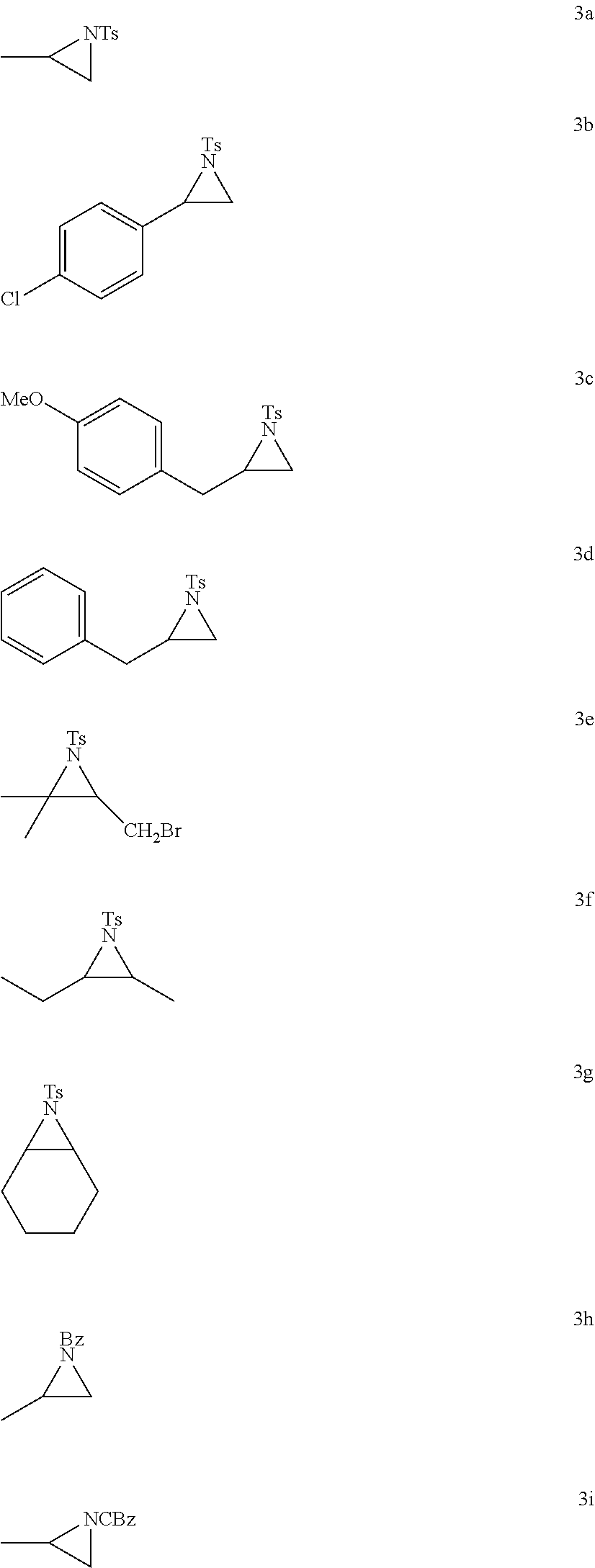
- N-protecting groups such as tosyl (4a-4g), benzoyl (4h), and Cbz (carboxybenzyl) (4i) were well tolerated under the reaction conditions, affording the corresponding products in the shown yields and regioselectivity.
- PVP-HF poly-4-vinylpyridium poly(hydrogen fluoride)
- the thermal stability of the polymeric HF reagent was also investigated ( FIG. 3 A ). We found only a 2 wt % HF loss when an open vial containing the resin was placed in a well vented fume hood for 30 h. The stability of this reagent should facilitate its packing, transportation and storage (see above).
- a” or “an” means one or more than one, unless otherwise specified.
- the words “a” or “an” means one or more than one, unless otherwise specified.
- “another” means at least a second or more, unless otherwise specified.
- the phrases “such as”, “for example”, and “e.g.” mean “for example, but not limited to” in that the list following the term (“such as”, “for example”, or “e.g.”) provides some examples but the list is not necessarily a fully inclusive list.
- the word “comprising” means that the items following the word “comprising” may include additional unrecited elements or steps; that is, “comprising” does not exclude additional unrecited steps or elements.
- the term “about,” when referring to a value or to an amount of mass, weight, time, volume, concentration or percentage is meant to encompass variations of in some embodiments ⁇ 20%, in some embodiments ⁇ 10%, in some embodiments ⁇ 5%, in some embodiments ⁇ 1%, in some embodiments ⁇ 0.5%, and in some embodiments ⁇ 0.1% from the specified amount, as such variations are appropriate to perform the disclosed method.
Landscapes
- Chemical & Material Sciences (AREA)
- Organic Chemistry (AREA)
- Chemical Kinetics & Catalysis (AREA)
- Engineering & Computer Science (AREA)
- Materials Engineering (AREA)
- Organic Low-Molecular-Weight Compounds And Preparation Thereof (AREA)
Abstract
Description
resin-anion-xHF (I).

to provide


to provide

to provide

or

to provide

In some embodiments, at least one alkene in the reactant organic compound comprising one or more alkenes is not monosubstituted. In some embodiments, R1, R2, and R3 can comprise or be any suitable moiety, such as but not limited to those provided in the Examples. In other embodiments, one or more of R1, R2, or R3 can comprise one or more of any moiety such as but not limited to one or more of ester, sulfonate, amide, ether, nitro, nitrile, aldehyde, amine, heterocycle, quinoline, furan, thiophene, pyridine, indazole, benzotriazole, pyrrole, thiazole, alcohol, primary alcohol, secondary alcohol, tertiary alcohol, ketones, α, β unsaturated ketone, carboxylic acid, halogen, aryl, benzyl, phenyl, heteroaryl, alkyl, alkenyl, alkynyl, alkoxy, —CN, sulfo, morpholinyl, —CONH2, —CON(CH3)2, C1-C3 perfluoronated alkyl, —CF3, —OCF3, or cyclic alkyl (e.g., cyclopropyl). In some embodiments, the reactant organic compound comprising one or more alkenes may or may not comprise an aziridine. In certain embodiments, the alkene comprises basic moieties. In some embodiments, one or more of R1, R2, or R3 can be a short alkyl (e.g., C1, C2, C3, C4, C5, C6, or C7 alkyl). In certain embodiments, hydrofluorination can occur at the alkene carbon that has more substitutions (e.g., as per Markovnikov's rule). In other embodiments, if there is more than one alkene, the hydrofluorination can occur at the alkene that is more electron rich (e.g., having a higher HOMO orbital energy and/or density). In yet other embodiments, hydrofluorination does not occur at monosubstituted alkenes. In still other embodiments, the hydrofluorination does not open a cyclopentyl moiety.

to produce a cyclic structure with one or more oxygens in the ring. In certain embodiments, at least one of the alkenes in the organic compound comprising one or more alkenes is a monosubstituted alkene, a disubstituted alkene, or a trisubstituted alkene. In other embodiments, at least one of the alkenes in the organic compound comprising one or more alkenes is a monosubstituted alkene or a disubstituted alkene. In other embodiments, R4 can comprise one or more of any moiety such as but not limited those shown or inferred from the Examples. In yet other embodiments, R4 can comprise one or more of any moiety such as but not limited to one or more of ester, sulfonate, amide, ether, nitro, nitrile, aldehyde, amine, heterocycle, quinoline, furan, thiophene, pyridine, indazole, benzotriazole, pyrrole, thiazole, alcohol, primary alcohol, secondary alcohol, tertiary alcohol, ketones, α, β unsaturated ketone, carboxylic acid, halogen, aryl, benzyl, phenyl, heteroaryl, alkyl, alkenyl, alkynyl, alkoxy, —CN, sulfo, morpholinyl, —CONH2, —CON(CH3)2, C1-C3 perfluoronated alkyl, —CF3, —OCF3, or cyclic alkyl (e.g., cyclopropyl). In other embodiments, the reactant aldehyde comprises a cyclic structure (e.g., substituted or unsubstituted aryl (e.g., phenyl), substituted or unsubstituted heteroaryl, substituted or unsubstituted cycloalkyl, or substituted or unsubstituted heterocyclyl). In certain embodiments, the reactant organic compound comprising one or more alkenes has at least one alkene in a C4 linear portion of the organic compound. In other embodiments, the reactant organic compound comprising one or more alkenes is

In some embodiments, cyclization with the reactant aldehyde can occur. In certain embodiments, the cyclization proceeds through a chair transition states with a syn addition of the nucleophile across an alkene.

In some embodiments, R5, R6, and R7 can comprise or be any suitable moiety, such as but not limited to those provided in the Examples. In other embodiments, one or more of R5, R6, or R7 can comprise one or more of any moiety such as but not limited to one or more of ester, sulfonate, amide, ether, nitro, nitrile, aldehyde, amine, heterocycle, quinoline, furan, thiophene, pyridine, indazole, benzotriazole, pyrrole, thiazole, alcohol, primary alcohol, secondary alcohol, tertiary alcohol, ketones, α, β unsaturated ketone, carboxylic acid, halogen, aryl, benzyl, phenyl, heteroaryl, alkyl, alkenyl, alkynyl, alkoxy, —CN, sulfo, morpholinyl, —CONH2, —CON(CH3)2, C1-C3 perfluoronated alkyl, —CF3, —OCF3, or cyclic alkyl (e.g., cyclopropyl). In certain embodiments, the R5, R6, or R7 comprise basic moieties. In some embodiments, one or more of R5, R6, or R7 can be a short alkyl (e.g., C1, C2, C3, C4, C5, C6, or C7 alkyl). In some embodiments, one or more of R5, R6, or R7 comprises an N-protecting group such as but not limited to tosyl, benzoyl, or carboxybenzyl. In some embodiments, the reactant organic compound comprising an aziridine (e.g., none R5, R6, and R7) that does not comprise an alkene. In some embodiments, the reactant organic compound comprising an aziridine (e.g., one or more of R5, R6, or R7) that does comprise an alkene. In other embodiments when one or more of R5, R6, or R7 is an N-protecting group, at least one N-protecting group is not chemically changed by the hydrofluorination reaction.
40 mL resin×0.8 meq/mL×3 equiv H2SO4×0.001 mol/mmol×98 g/mol÷98%÷1.84 g/mL=5.2 mL H2SO4.




| TABLE 1 |
| Reaction condition optimization for hydrofluorination of |
| alkene. |
 |
 |
 |
 |
 |
| HF | yield | |||
| entry | resin - HF (wt/wt%) | equiv | solvent | (%)a |
| 1 | HSO4 - A21 resin- HF (30%) | 10 | DCE | 19 |
| 2 | HSO4 - IRN78 resin- HF (28%) | 10 | DCE | 23 |
| 3 | IR-120-Na+ resin - HF (23%) | 10 | |
0 |
| 4 | HSO4 -A26 resin - HF (30%) | 10 | DCE | 28 |
| 5 | HSO4 - A26 resin - HF (30%) | 15 | DCE | 58 |
| 6 | HSO4 - A26 resin - HF (30%) | 5 | DCE | 7 |
| 7 | HSO4 - A26 resin - HF (30%) | 10 | CH3CN | 0 |
| 8 | HSO4 - A26 resin - HF (30%) | 10 | DCM | 22 |
| 9 | HSO4 - A26 resin - HF (30%) | 10 | |
0 |
| 10 | HSO4 - A26 resin - HF (30%) | 10 | |
0 |
| 11 | HSO4 - A26 resin - HF (30%) | 10 | |
0 |
| 12 | HSO4 - A26 resin - HF (30%) | 10 | Et2O | 0 |
| 13 | HSO4 - A26 resin - HF (30%) | 10 | |
0 |
| 14 | HSO4 - A26 resin - HF (30%) | 10 | Toluene | 51 |
| 15b | HSO4 - A26 resin - HF (30%) | 15 | DCE | 87 |
| aNMR yield with benzotrifluoride as internal standard; | ||||
| b15 hours. | ||||
| TABLE 2 |
| Hydrofluorination of alkenes.a |
 |
 |
 |
 |
 |
 |
 |
 |
 |
 |
 |
 |
 |
 |
 |
 |
 |
 |
 |
 |
| aReaction conditions: 1 (0.2 mmol), A26 Resin - HF(15 equiv HF), DCE (0.4 mL), room temperature, 15h. All yields are for the isolated product. |
| TABLE 3 |
| Ring-opening of |
 |
 |
 |
 |
 |
 |
 |
 |
 |
 |
 |
 |
| a Reaction conditions: 3 (0.2 mmol), A26 Resin - HF (5 equiv HF), DCE (0.4 mL), room temperature, 3h. All yields are for the isolated product. |
| b Numbers in parenthesis are regioisomeric ratio determined by 19F NMR. |
| cstarting aziridine are mixture of cis- and trans-isomers. |
| TABLE 4 |
| Fluoro-Prins reaction.a |
  |
 |
 |
 |
 |
 |
 |
 |
 |
 |
 |
| aReaction conditions: 5 (0.2 mmol), 6 (0.2 mmol), A26 Resin - HF(10 equiv HF), DCE (0.4 mL), room temperature, 5 h. All yields are for the isolated product |


Claims (29)
resin-anion-xHF (I)
Priority Applications (1)
| Application Number | Priority Date | Filing Date | Title |
|---|---|---|---|
| US17/259,282 US11602739B2 (en) | 2018-07-23 | 2019-07-22 | Catalysts, methods of making, and methods of hydrofluorination |
Applications Claiming Priority (4)
| Application Number | Priority Date | Filing Date | Title |
|---|---|---|---|
| US201862702173P | 2018-07-23 | 2018-07-23 | |
| US201862775718P | 2018-12-05 | 2018-12-05 | |
| US17/259,282 US11602739B2 (en) | 2018-07-23 | 2019-07-22 | Catalysts, methods of making, and methods of hydrofluorination |
| PCT/US2019/042770 WO2020023354A1 (en) | 2018-07-23 | 2019-07-22 | Catalysts, methods of making, and methods of hydrofluorination |
Publications (2)
| Publication Number | Publication Date |
|---|---|
| US20210275998A1 US20210275998A1 (en) | 2021-09-09 |
| US11602739B2 true US11602739B2 (en) | 2023-03-14 |
Family
ID=67742944
Family Applications (1)
| Application Number | Title | Priority Date | Filing Date |
|---|---|---|---|
| US17/259,282 Active 2039-07-26 US11602739B2 (en) | 2018-07-23 | 2019-07-22 | Catalysts, methods of making, and methods of hydrofluorination |
Country Status (2)
| Country | Link |
|---|---|
| US (1) | US11602739B2 (en) |
| WO (1) | WO2020023354A1 (en) |
Families Citing this family (1)
| Publication number | Priority date | Publication date | Assignee | Title |
|---|---|---|---|---|
| ES2646237B2 (en) | 2017-09-28 | 2018-07-27 | Avanzare Innovacion Tecnologica S.L. | Formulation for the biting of polymeric materials prior to coating them |
Citations (6)
| Publication number | Priority date | Publication date | Assignee | Title |
|---|---|---|---|---|
| US20130274357A1 (en) * | 2012-04-12 | 2013-10-17 | Lehigh University | Hybrid anion exchanger impregnated with hydrated zirconium oxide for selective removal of contaminating ligand and methods of manufacture and use thereof |
| US20160187305A1 (en) * | 2014-12-31 | 2016-06-30 | Dionex Corporation | Current-efficient suppressor and pretreatment device and method |
| US20160354770A1 (en) * | 2015-06-02 | 2016-12-08 | TechSource, Inc. | Ion Exchange Resins Selective for the Complexation of Univalent Anions in Aqueous Solutions |
| US20180273401A1 (en) * | 2017-03-23 | 2018-09-27 | Lehigh University | Contaminants Removal with Simultaneous Desalination Using Carbon Dioxide Regenerated Hybrid Ion Exchanger Nanomaterials |
| US20190291094A1 (en) * | 2018-03-22 | 2019-09-26 | Dionex Corporation | Anion exchange stationary phases based on crosslinked hydroxyalkylamine layer and glycidol |
| EP3960777A1 (en) * | 2019-04-26 | 2022-03-02 | Daikin Industries, Ltd. | Fluoropolymer aqueous dispersion production method and fluoropolymer aqueous dispersion |
-
2019
- 2019-07-22 WO PCT/US2019/042770 patent/WO2020023354A1/en not_active Ceased
- 2019-07-22 US US17/259,282 patent/US11602739B2/en active Active
Patent Citations (6)
| Publication number | Priority date | Publication date | Assignee | Title |
|---|---|---|---|---|
| US20130274357A1 (en) * | 2012-04-12 | 2013-10-17 | Lehigh University | Hybrid anion exchanger impregnated with hydrated zirconium oxide for selective removal of contaminating ligand and methods of manufacture and use thereof |
| US20160187305A1 (en) * | 2014-12-31 | 2016-06-30 | Dionex Corporation | Current-efficient suppressor and pretreatment device and method |
| US20160354770A1 (en) * | 2015-06-02 | 2016-12-08 | TechSource, Inc. | Ion Exchange Resins Selective for the Complexation of Univalent Anions in Aqueous Solutions |
| US20180273401A1 (en) * | 2017-03-23 | 2018-09-27 | Lehigh University | Contaminants Removal with Simultaneous Desalination Using Carbon Dioxide Regenerated Hybrid Ion Exchanger Nanomaterials |
| US20190291094A1 (en) * | 2018-03-22 | 2019-09-26 | Dionex Corporation | Anion exchange stationary phases based on crosslinked hydroxyalkylamine layer and glycidol |
| EP3960777A1 (en) * | 2019-04-26 | 2022-03-02 | Daikin Industries, Ltd. | Fluoropolymer aqueous dispersion production method and fluoropolymer aqueous dispersion |
Non-Patent Citations (46)
Also Published As
| Publication number | Publication date |
|---|---|
| US20210275998A1 (en) | 2021-09-09 |
| WO2020023354A1 (en) | 2020-01-30 |
Similar Documents
| Publication | Publication Date | Title |
|---|---|---|
| CA2248446C (en) | Fluorination with aminosulfur trifluorides | |
| US8481756B1 (en) | Succinic anhydrides from epoxides | |
| US11602739B2 (en) | Catalysts, methods of making, and methods of hydrofluorination | |
| US10590099B1 (en) | Processes for producing beta-lactone with heterogenous catalysts | |
| US8710283B2 (en) | Isoselective polymerization of epoxides | |
| Lu et al. | Multifaceted ion exchange resin-supported hydrogen fluoride: a path to flow hydrofluorination | |
| Sharghi et al. | The halogen-mediated opening of epoxides in the presence of pyridine-containing macrocycles | |
| Naemura et al. | Preparation of homochiral phenolic crown ethers containing para-substituted phenol moiety and chiral subunits derived from (S)-1-phenylethane-1, 2-diol: Their chiral recognition behaviour in complexation with neutral amines | |
| US9365674B2 (en) | Polyethers, methods of making same, and uses thereof | |
| US10702858B2 (en) | Methods of hydrofluorination | |
| US10882824B2 (en) | Method for purifying trifluoromethylpyridines | |
| CN113061077A (en) | Alpha, alpha-dideuteroalcohol compounds, deuterated drugs and preparation method thereof | |
| JPS59155385A (en) | Preparation of spiro ortho-carbonate | |
| WO2007083839A1 (en) | Method for producing tertiary amine | |
| Walker et al. | Some reactions of potassium perfluoro-t-butoxide with strong oxidizing agents | |
| Wuitschik | Oxetanes in drug discovery | |
| JP4378995B2 (en) | Process for producing ω-mercaptoalkylpyridines | |
| JP5004067B2 (en) | Method for producing benzyloxy nitrogen-containing cyclic compound | |
| Okada et al. | Synthesis and characterization of new chiral calix [4] arenes | |
| Paek et al. | Facile synthesis and binding properties of C2ν container hosts based on resorcin [4] arene | |
| WO1997032835A1 (en) | Process for producing fluorine compounds | |
| Burchell-Reyes | Noyori-Ikariya asymmetric transfer hydrogenation of prochiral a-CF3 and a-SF5 ketones, and the expedited synthesis of a-SF5 ketones | |
| US20250353811A1 (en) | A continuous flow process for synthesis of organic azides | |
| KR20230167094A (en) | Solutions of alkylated piperidinamine- and piperidinaminium-derivatives for the preparation of purified solutions of TEMPO-derivatives for use as electrolytes in redox-flow cells | |
| Torrisi | Intramolecular 1, 3 dipolar cycloaddition: a powerful tool to synthetize fused heterocycles |
Legal Events
| Date | Code | Title | Description |
|---|---|---|---|
| FEPP | Fee payment procedure |
Free format text: ENTITY STATUS SET TO UNDISCOUNTED (ORIGINAL EVENT CODE: BIG.); ENTITY STATUS OF PATENT OWNER: SMALL ENTITY |
|
| STPP | Information on status: patent application and granting procedure in general |
Free format text: APPLICATION UNDERGOING PREEXAM PROCESSING |
|
| FEPP | Fee payment procedure |
Free format text: ENTITY STATUS SET TO SMALL (ORIGINAL EVENT CODE: SMAL); ENTITY STATUS OF PATENT OWNER: SMALL ENTITY |
|
| STPP | Information on status: patent application and granting procedure in general |
Free format text: APPLICATION DISPATCHED FROM PREEXAM, NOT YET DOCKETED |
|
| STPP | Information on status: patent application and granting procedure in general |
Free format text: DOCKETED NEW CASE - READY FOR EXAMINATION |
|
| STPP | Information on status: patent application and granting procedure in general |
Free format text: NON FINAL ACTION MAILED |
|
| STPP | Information on status: patent application and granting procedure in general |
Free format text: RESPONSE TO NON-FINAL OFFICE ACTION ENTERED AND FORWARDED TO EXAMINER |
|
| STPP | Information on status: patent application and granting procedure in general |
Free format text: NON FINAL ACTION MAILED |
|
| STPP | Information on status: patent application and granting procedure in general |
Free format text: NOTICE OF ALLOWANCE MAILED -- APPLICATION RECEIVED IN OFFICE OF PUBLICATIONS |
|
| AS | Assignment |
Owner name: UNIVERSITY OF LOUISVILLE RESEARCH FOUNDATION, INC., KENTUCKY Free format text: ASSIGNMENT OF ASSIGNORS INTEREST;ASSIGNORS:LU, ZHICHAO;HAMMOND, GERALD B.;XU, BO;SIGNING DATES FROM 20221122 TO 20221215;REEL/FRAME:062179/0067 |
|
| STCF | Information on status: patent grant |
Free format text: PATENTED CASE |