US11556726B2 - Dynamic product labels for compiling custom data from supply chain nodes - Google Patents
Dynamic product labels for compiling custom data from supply chain nodes Download PDFInfo
- Publication number
- US11556726B2 US11556726B2 US17/228,200 US202117228200A US11556726B2 US 11556726 B2 US11556726 B2 US 11556726B2 US 202117228200 A US202117228200 A US 202117228200A US 11556726 B2 US11556726 B2 US 11556726B2
- Authority
- US
- United States
- Prior art keywords
- data
- product
- dynamic label
- dynamic
- label
- Prior art date
- Legal status (The legal status is an assumption and is not a legal conclusion. Google has not performed a legal analysis and makes no representation as to the accuracy of the status listed.)
- Active
Links
Images




Classifications
-
- G—PHYSICS
- G06—COMPUTING OR CALCULATING; COUNTING
- G06K—GRAPHICAL DATA READING; PRESENTATION OF DATA; RECORD CARRIERS; HANDLING RECORD CARRIERS
- G06K7/00—Methods or arrangements for sensing record carriers, e.g. for reading patterns
- G06K7/10—Methods or arrangements for sensing record carriers, e.g. for reading patterns by electromagnetic radiation, e.g. optical sensing; by corpuscular radiation
- G06K7/10009—Methods or arrangements for sensing record carriers, e.g. for reading patterns by electromagnetic radiation, e.g. optical sensing; by corpuscular radiation sensing by radiation using wavelengths larger than 0.1 mm, e.g. radio-waves or microwaves
- G06K7/10297—Methods or arrangements for sensing record carriers, e.g. for reading patterns by electromagnetic radiation, e.g. optical sensing; by corpuscular radiation sensing by radiation using wavelengths larger than 0.1 mm, e.g. radio-waves or microwaves arrangements for handling protocols designed for non-contact record carriers such as RFIDs NFCs, e.g. ISO/IEC 14443 and 18092
-
- G—PHYSICS
- G06—COMPUTING OR CALCULATING; COUNTING
- G06Q—INFORMATION AND COMMUNICATION TECHNOLOGY [ICT] SPECIALLY ADAPTED FOR ADMINISTRATIVE, COMMERCIAL, FINANCIAL, MANAGERIAL OR SUPERVISORY PURPOSES; SYSTEMS OR METHODS SPECIALLY ADAPTED FOR ADMINISTRATIVE, COMMERCIAL, FINANCIAL, MANAGERIAL OR SUPERVISORY PURPOSES, NOT OTHERWISE PROVIDED FOR
- G06Q30/00—Commerce
- G06Q30/018—Certifying business or products
-
- G—PHYSICS
- G06—COMPUTING OR CALCULATING; COUNTING
- G06K—GRAPHICAL DATA READING; PRESENTATION OF DATA; RECORD CARRIERS; HANDLING RECORD CARRIERS
- G06K19/00—Record carriers for use with machines and with at least a part designed to carry digital markings
- G06K19/06—Record carriers for use with machines and with at least a part designed to carry digital markings characterised by the kind of the digital marking, e.g. shape, nature, code
- G06K19/067—Record carriers with conductive marks, printed circuits or semiconductor circuit elements, e.g. credit or identity cards also with resonating or responding marks without active components
- G06K19/07—Record carriers with conductive marks, printed circuits or semiconductor circuit elements, e.g. credit or identity cards also with resonating or responding marks without active components with integrated circuit chips
- G06K19/0723—Record carriers with conductive marks, printed circuits or semiconductor circuit elements, e.g. credit or identity cards also with resonating or responding marks without active components with integrated circuit chips the record carrier comprising an arrangement for non-contact communication, e.g. wireless communication circuits on transponder cards, non-contact smart cards or RFIDs
Definitions
- the label and/or packaging may make claims as to the composition, purity, potency, safety, and/or efficacy of the product. Besides these printed claims, there is no reliable, trusted, or easy way for the consumer to verify the claims.
- Some products may be tampered with or contaminated at some point in the supply chain before reaching the consumer. Some products may be fraudulently produced by third-parties to resemble the original products, and may be introduced into the supply chain or at the point of sale where they become indistinguishable from the original products. Still other products may be made and/or packaged at different facilities of the same manufacturer. The facilities may use different sourced goods, processes, and/or equipment, any of which can lead to a lack of uniformity or consistency in the end product that is provided to the consumer. The static labels and containers cannot account for any of these variances, and cannot verify that the products were not tampered with, contaminated, or fraudulently produced.
- FIG. 1 illustrates an example of linking product data from different points in a supply chain to a dynamic label that is included on the container and/or package of the product in accordance with some embodiments presented herein.
- FIG. 2 illustrates an example of using the dynamic product label to access data from different points in the supply chain in accordance with some embodiments presented herein.
- FIG. 3 illustrates examples of two custom data sets that may be accessed using the dynamic product labeling in accordance with some embodiments presented herein.
- FIG. 4 presents a process for linking data from different nodes in the supply chain to the dynamic product label that a consumer may use to subsequently access the linked data in accordance with some embodiments presented herein.
- FIG. 5 illustrates an example of different data being associated with the dynamic labels of the same product produced by different supply chain nodes in accordance with some embodiments presented herein.
- FIG. 6 illustrates an example of dynamically updating data for a product using the dynamic product label in accordance with some embodiments presented herein.
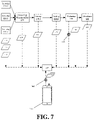
- FIG. 7 illustrates an example architecture for the dynamic product labeling of some embodiments.
- FIG. 8 illustrates an alternative architecture for the dynamic product labeling of some embodiments.
- FIG. 9 illustrates example functional components of one or more devices, in accordance with one or more embodiments described herein.
- the dynamic product label may provide information that is customized on a per unit basis or per group basis to account for the product path through the supply chain.
- the dynamic product label may provide different nodes in the supply chain with the ability to dynamically add data to the dynamic label or modify data that is accessible via the dynamic label even after the product has been distributed to consumers.
- the dynamic product label may be used in conjunction with any product including medicines, supplements, products that are ingested, products with topical applications (e.g., lotions, creams, oils, etc.), cleaning products, products associated with food preparation, and/or other products where a dynamic label is preferred over a static label.
- the dynamic label may include a Near Field Communication (“NFC”) tag, Radio-Frequency Identification (“RFID”) tag, integrated circuit, or other identifier (e.g., barcode, Quick Response (“QR”) code) that can be scanned and/or read using a sensor on a user device.
- NFC Near Field Communication
- RFID Radio-Frequency Identification
- QR Quick Response
- the dynamic label for a product may be encoded with a machine-readable value that is directly or indirectly linked to the data that is generated for the product by the different supply chain nodes.
- FIG. 1 illustrates an example of linking product data from different nodes 110 , 120 , 130 , 140 , and 150 in a supply chain to dynamic label 105 that is included on the container and/or package of the product in accordance with some embodiments presented herein.
- dynamic label 105 may be or may include an NFC tag.
- dynamic label 105 may include a RFID tag, integrated circuit, or encoded image (e.g., barcode, QR code) that can be scanned via a sensor on a user device.
- the supply chain may include sourcing nodes 110 - 1 , 110 - 2 , and 110 - 3 (herein sometimes collectively referred to as “sourcing nodes 110 ” or individually as “sourcing node 110 ”), processing/manufacturing node 120 , testing nodes 130 - 1 and 130 - 2 (herein sometimes collectively referred to as “testing nodes 130 ” or individually as “testing node 130 ”), packaging node 140 , and distribution node 150 . Operations of each node 110 - 150 may be performed at the same location (e.g., warehouse or facility) or different locations.
- nodes 110 - 150 may represent different entities and/or actors that contribute to the production of the product that is provided to or offered for sale to consumers. In some embodiments, one or more of nodes 110 - 150 may be controlled by the same or different entities. In some embodiments, the supply chain may include more or less nodes, different nodes, and/or may consolidate or partition the operations performed by the illustrated nodes for sourcing 110 , processing/manufacturing 120 , testing 130 , packaging 140 , and distribution 150 .
- One or more devices at sourcing nodes 110 may track and/or capture data set 115 that results from the inputs, outputs, and operations at sourcing nodes 110 , and may directly or indirectly associate the data to dynamic label 105 .
- sourcing nodes 110 may generate data set 115 that verifies the point of origin for the goods, the quality of the goods, how the goods were created, and/or other properties.
- sourcing nodes 110 may generate data set 115 to verify that the organic matter was grown without pesticides, antibiotics, hormones, genetic engineering, and/or toxins, and to verify the harvesting date and location of the organic matter.
- Processing/manufacturing node 120 may be responsible for producing the product via the goods obtained from sourcing nodes 110 . Accordingly, processing/manufacturing node 120 may mix, compile, blend, and/or otherwise combine the goods from sourcing nodes 110 in a manner that yields individual units of the desired product.
- One or more devices at processing/manufacturing node 120 may track and/or capture data set 125 that results from the inputs, outputs, and operations at processing/manufacturing node 120 , and may directly or indirectly associate the data to dynamic label 105 .
- processing/manufacturing node 120 may generate data set 125 that verifies the composition of the goods used to produce the product or product batch, point of origin (e.g., sourcing nodes 110 ) for the goods used for producing the product or product batch, the facility at which the product or product batch is produced, the assembly line, equipment, and/or workers that contributed to the manufacturing of the product or product batch, the manufacturing date, conditions (e.g., temperature, humidity, etc.) at the time of manufacturing, and/or other information related to processing and/or manufacturing of the product or product batch.
- point of origin e.g., sourcing nodes 110
- the facility at which the product or product batch is produced the assembly line, equipment, and/or workers that contributed to the manufacturing of the product or product batch
- Testing nodes 130 may include facilities (e.g., laboratories) at which the composition, purity, potency, safety, efficacy, and/or other properties of the manufactured product are tested and measured by a third-party (e.g., an entity other than processing/manufacturing node 120 ). Testing nodes 130 may also perform tests to verify that the products satisfy compliance, regulatory, and/or other safety standards. Testing nodes 130 - 1 and 130 - 2 may perform the same tests to ensure consistency in the results and testing procedures. Testing nodes 130 - 1 and 130 - 2 may perform different tests when each node 130 has different equipment or specializes in performing different tests.
- Testing nodes 130 may generate test results (e.g., third set of data 135 ) that can be used verify the composition, purity, potency, safety, efficacy, and/or other properties of the manufactured product. Testing nodes 130 may also generate certifications (e.g., third set of data 135 ) to indicate that the manufactured product satisfies compliance, regulatory, and/or other safety standards. One or more devices at testing nodes 130 may track and/or capture data set 135 generated at testing nodes 130 , and may directly or indirectly associate data set 135 to dynamic label 105 .
- test results e.g., third set of data 135
- Testing nodes 130 may also generate certifications (e.g., third set of data 135 ) to indicate that the manufactured product satisfies compliance, regulatory, and/or other safety standards.
- One or more devices at testing nodes 130 may track and/or capture data set 135 generated at testing nodes 130 , and may directly or indirectly associate data set 135 to dynamic label 105 .
- Packaging node 140 may represent one or more facilities at which the manufactured products are packaged and/or labeled.
- manufacturing/processing node 120 may be at the same location as packaging node 140 .
- the individual products that are produced by manufacturing/processing node 120 may be shipped to packaging node 140 where the products are placed in containers and/or boxes bearing dynamic label 105 , and/or where the containers and/or boxes are placed in palettes for shipment to vendors.
- Packaging node 140 may generate data set 145 that verifies the handling of the product (e.g., operations to prevent tampering), the contents of the containers and/or boxes (e.g., prevent fraudulent products by identifying manufacturing/processing node 120 as the provider of the manufactured product), and/or the cleanliness of the facility at which the packaging is performed (e.g., operations to prevent contamination).
- Other packaging data e.g., data set 145
- One or more devices at packaging node 140 may track and/or capture data set 145 generated at packaging node 140 , and may directly or indirectly associate data set 145 to dynamic label 105 .
- packaging node 140 is also the point in the supply chain at which dynamic label 105 is associated with the manufactured products. For instance, packaging node 140 may add dynamic label 105 to the product container or package, may scan dynamic label 105 , may package a set of products in the container or box, and may link the data sets that are generated at packaging node 140 and other nodes in the supply chain (e.g., sourcing nodes 110 , processing/manufacturing node 120 , and testing nodes 130 ) to dynamic label 105 . The linking of the data sets to dynamic label 105 is explained in greater detail below. In some embodiments, the same dynamic label 105 may be used on containers or packages of different products when the products are part of a common batch that was produced by the same nodes in the supply chain and/or at the same time.
- packaging node 140 may add dynamic label 105 to the product container or package, may scan dynamic label 105 , may package a set of products in the container or box, and may link the data sets that are generated at packaging node 140 and other nodes in
- Distribution node 150 may ship or move the packaged product from packaging node 140 to wholesalers or retailers that then make the product available to consumers. Distribution node 150 may generate data set 155 that verifies which products are shipped to which locations, the handling of the products, and/or operations to prevent tampering, contamination, spoilage, and/or damage to the product during transport. One or more devices at distribution node 150 may track and/or capture data set 155 generated at distribution node 150 or as the products are in transit, and may directly or indirectly associate data set 155 to dynamic label 105 .
- FIG. 2 illustrates an example of using dynamic label 105 of a product to access data for that product from one or more data sets 115 , 125 , 135 , 145 , and 155 generated by different nodes 110 - 150 in the supply chain in accordance with some embodiments presented herein.
- User device 210 may scan (at 1 ) dynamic label 105 from the product container and/or package.
- user device 210 may use an embedded NFC chip to read a value from dynamic label 105 via magnetic inductance.
- user device 210 may use an integrated circuit, radio, camera, or other sensor to read and/or decode the value from dynamic label 105
- User device 210 may access (at 2 ) host 220 using the value that is read from dynamic label 105 .
- host 220 may be a network-accessible device that provides a website, network-accessible interface, and/or Application Programming Interface (“API”) from which product data generated by the supply chain nodes 110 - 150 can be accessed.
- API Application Programming Interface
- the value read from dynamic label 105 corresponds to a Uniform Resource Locator (“URL”) with the product data.
- URL Uniform Resource Locator
- the value read from dynamic label 105 may be used as a query parameter for querying host 220 for the product data.
- host may provide user device 210 with data for the product from one or more data sets 115 , 125 , 135 , 145 , and 155 .
- User device 210 may use a wired or wireless network (e.g., WiFi, Long Term Evolution (“LTE”) connectivity, Fifth Generation New Radio (“5G NR”), etc.) to access (at 2 ) host 220 .
- a wired or wireless network e.g., WiFi, Long Term Evolution (“LTE”) connectivity, Fifth Generation New Radio (“5G NR”), etc.
- FIG. 3 illustrates examples of two custom data sets 310 and 320 that may be accessed from host 220 using dynamic label 105 in accordance with some embodiments presented herein. Specifically, data sets 310 and 320 may be accessed in response to user device 210 scanning dynamic label 105 from a product container or package, and requesting a website that is targeted by a value that is read from dynamic label 105 by user device 210 .
- First data set 310 may be generated by one or more of processing/manufacturing node 120 and testing nodes 130 , and may present the chemical composition of the product.
- a user may reference first data set 310 to verify the composition, purity, potency, safety, efficacy, and/or other properties of the product.
- Second data set 320 may be generated by a different node in the product supply chain than the node that generated first data set 310 .
- second data set 320 may be generated by packaging node 140 .
- Second data set 320 may present information about who, where, and how the product was packaged. The user may reference second data set 320 to verify that the product was not tampered with, contaminated, or otherwise varies from compliance and/or consistency standards.
- FIG. 4 presents a process 400 for linking data from different nodes in the supply chain to dynamic label 105 , and for providing a consumer access to the linked data via dynamic label 105 in accordance with some embodiments presented herein.
- Process 400 may include generating (at 410 ) a unique identifier for a new product or product batch.
- the first node e.g., sourcing nodes 110
- another node in the supply chain may generate (at 410 ) the unique identifier, and may provide the unique identifier to the other nodes in the supply chain path involved in the production of the same product.
- the unique identifier may include an alphanumeric character sequence to be used in identifying the product data that is generated at each node involved in the production of the product.
- Process 400 may include generating (at 420 ) data for the product at a next node in the supply chain.
- sourcing 110 may be the first node in the supply chain, and may generate (at 420 ) first data set 115 for the product.
- sourcing 110 may provide the raw materials that are used by processing/manufacturing node 120 to manufacture the product. Accordingly, sourcing nodes 110 may generate (at 420 ) data that provides information about the raw materials.
- Process 400 may include associating (at 430 ) the generated data to the unique identifier. Associating (at 430 ) the generated data to the unique identifier may include linking, tagging, or storing the data with the unique identifier. For instance, sourcing node 110 may associate (at 430 ) data about the raw materials used in the product with the unique identifier, whereas processing/manufacturing node 120 may associate (at 430 ) different data about manufacturing the product from the raw materials to the unique identifier. Each supply chain node may have storage for storing the data that is generated (at 420 ) by that node along with the unique identifier.
- each supply chain node may upload the data generated (at 420 ) by that node along with the unique identifier to a common repository.
- the supply chain node generating (at 420 ) the data may receive the unique identifier from a node that is earlier in the supply chain.
- one node may generate data, associate the data to the unique identifier, then pass the unique identifier along with the product at some production stage to a next node so that the next node can generate and associate additional product data to the same unique identifier as the product evolves through the supply chain.
- Process 400 may include determining (at 440 ) if the current node in the supply chain (e.g., the current node generating data and associating data to the unique identifier) corresponds to a particular supply chain node at which dynamic label 105 is added to or associated with the product.
- dynamic label 105 is added to a container or package of the product by packaging node 140 .
- process 400 may include moving to the next node in the supply chain where additional data may be generated (at 420 ) and associated (at 430 ) with the unique identifier. In particular, process 400 may resume with the generation (at 420 ) of a new data set once the product at its current unfinished state (and the unique identifier for the product) is provided to a next node in the supply chain.
- process 400 may link the generated data to dynamic label 105 .
- Linking the generated data to dynamic label 105 may include placing (at 450 ) dynamic label 105 on the product, product container, or product package.
- dynamic label 105 may include a printed label and/or sticker with an integrated NFC tag.
- dynamic label 105 may include an NFC tag that is attached to the product container or package independent of other labels and/or stickers.
- Placing (at 450 ) dynamic label 105 may include sticking the NFC tag to the product container or package with an adhesive or integrating the NFC tag directly into the product container or package.
- each unit of a product may receive a different dynamic label.
- all products in a particular may receive the same dynamic label.
- Linking the generated data to dynamic label 105 may further include connecting (at 460 ) dynamic label 105 , that is placed (at 450 ) on the product container or package, to the unique identifier that is associated (at 430 ) with the data generated (at 420 ) by different supply chain nodes.
- connecting (at 460 ) dynamic label 105 to the unique identifier may include identifying a value of dynamic label 105 by scanning dynamic label 105 or by programming dynamic label 105 with the value.
- Connecting (at 460 ) dynamic label 105 to the unique identifier may further include linking the value of dynamic label 105 to the unique identifier such that the product data that is associated (at 430 ) with the unique identifier also becomes associated with the value of dynamic label 105 and/or becomes accessible using the value of dynamic label 105 .
- Process 400 may include providing (at 470 ) the product with dynamic label 105 to a consumer.
- the product may be shipped to retailers where consumers may purchase or otherwise acquire the product.
- Process 400 may include receiving (at 480 ) a scan of dynamic label 105 from user device 210 .
- the NFC chip of user device 210 may read the value from dynamic label 105 , and may wirelessly provide the value to host 220 where the data linked to dynamic label 105 can be accessed.
- the value from dynamic label 105 may specify a URL, address, or other identifier for reaching host 220 , and for directly or indirectly (e.g., via the link established between the value of dynamic label 105 and the unique identifier for the product) identifying the product data that is linked to dynamic label 105 .
- Process 400 may include identifying (at 490 ) the unique identifier that is connected to received value from dynamic label 105 .
- the identification (at 490 ) may include performing a database query or other lookup using the value that is read from dynamic label 105 in order to determine the unique identifier that is connected to the value of dynamic label 105 .
- Process 400 may then include providing (at 495 ), to user device 210 , the product data that is associated (at 430 ) with the unique identifier by different nodes in the supply chain.
- the product data may be wirelessly transmitted to user device 210 over a data network.
- the data is presented on user device 210 in a graphical user interface or application.
- FIG. 5 illustrates an example of different data being associated with dynamic labels 510 and 520 of the same product produced by different supply chain nodes in accordance with some embodiments presented herein.
- production of first product batch 515 begins by obtaining ingredients, raw materials, or other source items from sourcing node 110 - 1 and 110 - 2
- production of second product batch 525 begins by obtaining ingredients, raw materials, or other source items from sourcing nodes 110 - 2 and 110 - 3 .
- sourcing nodes 110 - 1 and 110 - 3 may provide the same source items for first product batch 515 and second product batch 525 , but may grow, manufacture, or otherwise provide the source items from different locations with different equipment, workers, conditions, nutrients, chemicals, and/or other variances in how the source items are produced or obtained. In some other embodiments, sourcing nodes 110 - 1 and 110 - 3 may provide different source items for different compositions, potencies, and/or other variances in first product batch 515 and second product batch 525 .
- sourcing nodes 110 - 1 , 110 - 2 , and 110 - 3 may generate different data sets 530 and 540 .
- Data set 530 may include product data from sourcing nodes 110 - 1 and 110 - 2 , and may be associated with a first unique identifier (e.g., “ID X”). The first unique identifier may be used by the supply chain nodes to tag product data that is generated for first product batch 515 .
- Data set 540 may include product data from sourcing nodes 110 - 2 and 110 - 3 , and may be associated with a second unique identifier (e.g., “ID_Y”). The second unique identifier may be used by the supply chain nodes to tag product data that is generated for second product batch 525 .
- First product batch 515 may be manufactured at processing/manufacturing node 120 using the materials obtained from sourcing nodes 110 - 1 and 110 - 2
- second product batch 525 may be also be manufactured at processing/manufacturing node 120 using different materials obtained from sourcing nodes 110 - 2 and 110 - 3 . Accordingly, even though product batches 515 and 525 are manufactured at the same facility using the same equipment and/or workers, different data may again be generated for each product batch 515 and 525 at processing/manufacturing node 120 because of the different materials from different sourcing nodes 110 used in the manufacturing process.
- products of first product batch 515 and second product batch 525 may have slight variances due to the different sourced materials, and the slight variances may be indicated in data sets 530 and 540 by the data that is generated for each product batch 515 and 525 by processing/manufacturing node 120 .
- processing/manufacturing node 120 may generate first data as a result of manufacturing first product batch 515 , and may associate the first data to the first unique identifier used in identifying first product batch 515 .
- processing/manufacturing node 120 may generate second data as a result of manufacturing second product batch 525 , and may associate the second data to the second unique identifier used in identifying second product batch 525 .
- First product batch 515 may be tested by testing node 130 - 1 at a first facility, and second product batch 525 may be tested by testing node 130 - 2 at a second facility.
- the test results from testing node 130 - 1 may be associated with first product batch 515 by linking the test results to the first unique identifier, and the test results from testing node 130 - 2 may be associated with second product batch 525 by linking the test results to the second unique identifier.
- the test results may be the same and/or indicate compliance, regulatory, and/or safety standards being met, the different data sets allow consumers of each product batch 515 and 525 to identify where, how, and/or when each batch 515 and 525 was tested.
- First product batch 515 may be packaged at first packaging node 140 - 1 where first dynamic label 510 may be placed on the container and/or package of each product in first product batch 515 .
- First packaging node 140 - 1 may associate additional data that is generated during the packaging process of first product batch 515 to the first unique identifier, and may connect the first unique identifier to first dynamic label 510 so that all data that has been associated with the first unique identifier throughout the supply chain becomes accessible via first dynamic label 510 .
- first packaging node 140 - 1 may program the NFC tag of first dynamic label 510 with a URL that points to a site where the data associated with first unique identifier is accessible.
- the NFC tag of first dynamic label 510 may be programmed with the first unique identifier, and user device 210 may read and transmit the first unique identifier to host 220 where the data associated with the first unique identifier is provided.
- the NFC tag of first dynamic label 510 may already be encoded with a value, and first packaging node 140 - 1 may read the value from the NFC tag and link the value from the NFC tag to the first unique identifier. Accordingly, when user device 210 queries host 220 with the value from the NFC tag, host 220 can identify the link between the value and the first unique identify, and may provide the data that is associated with the first unique identifier in response to the query.
- second product batch 525 may be packaged at second packaging node 140 - 2 where second dynamic label 520 may be placed on the container and/or package of each product in second product batch 525 .
- Second packaging node 140 - 2 may associate data that is generated during the packaging process of second product batch 525 to the second unique identifier, and may connect the second unique identifier to second dynamic label 520 so that all data that has been associated with the second unique identifier throughout the supply chain becomes accessible via second dynamic label 520 .
- Additional data may be generated and associated with the first unique identifier of first product batch 515 and with the second unique identifier of second product batch 525 at distribution node 150 .
- the generated data can be added to the unique identifier even after dynamic labels 510 and 520 have been connected to the unique identifiers used in the supply chain to associate data to the respective products or product batches 515 and 525 .
- FIG. 5 therefore illustrates an example of different data being dynamically added to dynamic product labels 510 and 520 for different units or batches of the same product.
- user device 210 may receive different data when scanning dynamic product label 510 and 520 from different units or batches of the same product.
- the different data provides the user with more accurate verification of the product lifecycle throughout the supply chain while also verifying composition, purity, potency, safety, and/or efficacy of the product in a manner that is more accurate than what is printed on a static label, wherein the static label provides the same data for all units or batches of the product even when variances may exist in the different units or batches.
- dynamic product labels 510 and 520 Another benefit of dynamic product labels 510 and 520 is the ability for any node in the supply chain to modify or update the data it generated for a product even after the product has left that node in the supply chain and/or has shipped to consumers.
- the dynamic updating of the data that is accessed from dynamic product labels 510 and 520 can be used to notify consumers of important safety information and/or disclose new information. For instance, some time after first product batch 515 is shipped to consumers, sourcing node 110 - 1 may determine that the materials it provided for the manufacturing of first product batch 515 were contaminated, and may therefore update the data that is accessed via first dynamic label 510 to notify consumers of the issue while the data for dynamic product label 520 for second product batch 525 may be left unchanged.
- FIG. 6 illustrates an example of dynamically updating data for a product and conveying the updated data via dynamic product label 105 in accordance with some embodiments presented herein.
- user device 210 may read the NFC tag or other identifier from dynamic product label 105 of a product.
- User device 210 may obtain a value from reading the dynamic product label 105 , and may pass the value to host 220 .
- Host 220 may return first data set 615 that is associated with dynamic product label 105 (e.g., data that is associated with the unique identifier assigned to the product and that is connected to the value from dynamic product label 105 ), and that is generated by sourcing node 110 , processing/manufacturing node 120 , and testing node 130 by first time 610 .
- first data set 615 that is associated with dynamic product label 105 (e.g., data that is associated with the unique identifier assigned to the product and that is connected to the value from dynamic product label 105 ), and that is generated by sourcing node 110 , processing/manufacturing node 120 , and testing node 130 by first time 610 .
- sourcing node 110 and processing/manufacturing node 120 may change the data that was contributed to first data set 615 .
- sourcing node 110 may receive additional certification for its materials (e.g., certified vegan) that can be added to the data for the product.
- Processing/manufacturing node 120 may add a new regulatory statement to the product as a result of newly passed legislation.
- the new data can be associated with the unique identifier of the product that is connected to dynamic product label 105 placed on the product container or packaging.
- host 220 may return different second data set 625 to user device 210 at second time 620 , and user device 210 may present the updated information.
- FIG. 7 illustrates an example architecture for the dynamic product labeling of some embodiments.
- Supply chain nodes 110 - 150 may provide generated product data to host 220 . More specifically, supply chain nodes 110 - 150 may provide the data that they generate for a product along with the unique identifier that is assigned to the product to host 220 .
- Host 220 may include one or more devices with storage and network connectivity. Host 220 may be accessed via an Internet Protocol (“IP”) address, URL, and/or other identifiers. Host 220 may aggregate the data that is generated by different nodes 110 - 150 for different product unique identifiers, wherein each unique identifier may be associated with the data of a different product, product batch, or other sets of products. In some embodiments, host 220 may generate and distribute the unique identifiers to supply chain nodes 110 - 150 .
- IP Internet Protocol
- Host 220 may also receive dynamic product label 105 and/or the value of dynamic product label 105 that is used to access the data associated with a unique identifier.
- packaging node 140 may connect dynamic product label 105 to a unique identifier, and may identify the link between dynamic product label 105 and the unique identifier to host 220 .
- Host 220 may provide an interface with which user device 210 may access the product data.
- user device 210 may issue HyperText Transfer Protocol (“HTTP”) messages to host 220 in order to request specific product data.
- HTTP HyperText Transfer Protocol
- user device 210 may read a value from the NFC tag and/or other identifier of dynamic label 105 on the container, package, or elsewhere on the product, and may submit the value to host 220 .
- Host 220 may identify the unique identifier that is connected and/or linked with the value extracted from dynamic product label 105 , may retrieve the data that is associated with the unique identifier, and may provide the retrieved data to user device 210 via one or more data packets.
- FIG. 8 illustrates an alternative architecture for the dynamic product labeling of some embodiments.
- supply chain nodes 110 - 150 may include one or more storage devices 810 for storing the data that is generated by that node and the unique identifier associated with the data.
- Host 220 may compile the product data from storage devices 810 , and may return the compiled data to user device 210 in response to a request for the product data from user device 210 .
- host 220 may store a mapping of dynamic product label 105 to the corresponding product unique identifier. Upon receiving a request with the value extracted from dynamic product label 105 , host 220 may determine the unique identifier that is linked to that dynamic product label 105 value. Host 220 may then retrieve the data that is associated with the unique identifier from storage devices 810 , and may return the retrieved data to user device 210 . In this alternative architecture, host 220 may serve as an interface from which product data may be accessed despite disparate storage of the data at storage devices 810 .
- FIG. 9 is a diagram of example components of device 900 .
- Device 900 may be used to implement one or more of the devices or systems described above (e.g., user device 210 , host 220 , sourcing nodes 110 , processing/manufacturing node 120 , testing nodes 130 , packaging node 140 , distribution node 150 , etc.).
- Device 900 may include bus 910 , processor 920 , memory 930 , input component 940 , output component 950 , and communication interface 960 .
- device 900 may include additional, fewer, different, or differently arranged components.
- Bus 910 may include one or more communication paths that permit communication among the components of device 900 .
- Processor 920 may include a processor, microprocessor, or processing logic that may interpret and execute instructions.
- Memory 930 may include any type of dynamic storage device that may store information and instructions for execution by processor 920 , and/or any type of non-volatile storage device that may store information for use by processor 920 .
- Input component 940 may include a mechanism that permits an operator to input information to device 900 , such as a keyboard, a keypad, a button, a switch, etc.
- Output component 950 may include a mechanism that outputs information to the operator, such as a display, a speaker, one or more light emitting diodes (“LEDs”), etc.
- Communication interface 960 may include any transceiver-like mechanism that enables device 900 to communicate with other devices and/or systems.
- communication interface 960 may include an Ethernet interface, an optical interface, a coaxial interface, or the like.
- Communication interface 960 may include a wireless communication device, such as an infrared (“IR”) receiver, a Bluetooth® radio, or the like.
- the wireless communication device may be coupled to an external device, such as a remote control, a wireless keyboard, a mobile telephone, etc.
- device 900 may include more than one communication interface 960 .
- device 900 may include an optical interface and an Ethernet interface.
- Device 900 may perform certain operations relating to one or more processes described above. Device 900 may perform these operations in response to processor 920 executing software instructions stored in a computer-readable medium, such as memory 930 .
- a computer-readable medium may be defined as a non-transitory memory device.
- a memory device may include space within a single physical memory device or spread across multiple physical memory devices.
- the software instructions may be read into memory 930 from another computer-readable medium or from another device.
- the software instructions stored in memory 930 may cause processor 920 to perform processes described herein.
- hardwired circuitry may be used in place of or in combination with software instructions to implement processes described herein. Thus, implementations described herein are not limited to any specific combination of hardware circuitry and software.
- connections or devices are shown, in practice, additional, fewer, or different, connections or devices may be used.
- additional, fewer, or different, connections or devices may be used.
- various devices and networks are shown separately, in practice, the functionality of multiple devices may be performed by a single device, or the functionality of one device may be performed by multiple devices.
- some devices are shown as communicating with a network, some such devices may be incorporated, in whole or in part, as a part of the network.
- thresholds may be described in conjunction with thresholds.
- the term “less than” (or similar terms) as used herein to describe a relationship of a value to a threshold may be used interchangeably with the term “less than or equal to” (or similar terms).
- “exceeding” a threshold may be used interchangeably with “being greater than a threshold,” “being greater than or equal to a threshold,” “being less than a threshold,” “being less than or equal to a threshold,” or other similar terms, depending on the context which the threshold is used.
Landscapes
- Engineering & Computer Science (AREA)
- Physics & Mathematics (AREA)
- Theoretical Computer Science (AREA)
- General Physics & Mathematics (AREA)
- Toxicology (AREA)
- Health & Medical Sciences (AREA)
- Computer Networks & Wireless Communication (AREA)
- Business, Economics & Management (AREA)
- Electromagnetism (AREA)
- Computer Hardware Design (AREA)
- Computer Vision & Pattern Recognition (AREA)
- Artificial Intelligence (AREA)
- General Health & Medical Sciences (AREA)
- Microelectronics & Electronic Packaging (AREA)
- Computer Security & Cryptography (AREA)
- Finance (AREA)
- General Business, Economics & Management (AREA)
- Marketing (AREA)
- Economics (AREA)
- Strategic Management (AREA)
- Entrepreneurship & Innovation (AREA)
- Accounting & Taxation (AREA)
- Development Economics (AREA)
- Management, Administration, Business Operations System, And Electronic Commerce (AREA)
Abstract
Description
Claims (20)
Priority Applications (1)
| Application Number | Priority Date | Filing Date | Title |
|---|---|---|---|
| US17/228,200 US11556726B2 (en) | 2019-12-17 | 2021-04-12 | Dynamic product labels for compiling custom data from supply chain nodes |
Applications Claiming Priority (2)
| Application Number | Priority Date | Filing Date | Title |
|---|---|---|---|
| US16/717,658 US10977456B1 (en) | 2019-12-17 | 2019-12-17 | Dynamic product labels for compiling custom data from supply chain nodes |
| US17/228,200 US11556726B2 (en) | 2019-12-17 | 2021-04-12 | Dynamic product labels for compiling custom data from supply chain nodes |
Related Parent Applications (1)
| Application Number | Title | Priority Date | Filing Date |
|---|---|---|---|
| US16/717,658 Continuation US10977456B1 (en) | 2019-12-17 | 2019-12-17 | Dynamic product labels for compiling custom data from supply chain nodes |
Publications (2)
| Publication Number | Publication Date |
|---|---|
| US20210232780A1 US20210232780A1 (en) | 2021-07-29 |
| US11556726B2 true US11556726B2 (en) | 2023-01-17 |
Family
ID=75394597
Family Applications (2)
| Application Number | Title | Priority Date | Filing Date |
|---|---|---|---|
| US16/717,658 Expired - Fee Related US10977456B1 (en) | 2019-12-17 | 2019-12-17 | Dynamic product labels for compiling custom data from supply chain nodes |
| US17/228,200 Active US11556726B2 (en) | 2019-12-17 | 2021-04-12 | Dynamic product labels for compiling custom data from supply chain nodes |
Family Applications Before (1)
| Application Number | Title | Priority Date | Filing Date |
|---|---|---|---|
| US16/717,658 Expired - Fee Related US10977456B1 (en) | 2019-12-17 | 2019-12-17 | Dynamic product labels for compiling custom data from supply chain nodes |
Country Status (1)
| Country | Link |
|---|---|
| US (2) | US10977456B1 (en) |
Cited By (3)
| Publication number | Priority date | Publication date | Assignee | Title |
|---|---|---|---|---|
| US11720906B2 (en) | 2020-02-26 | 2023-08-08 | Touch Point Worldwide, Inc. | Blockchain-based product authentication system |
| US12236419B2 (en) | 2020-02-26 | 2025-02-25 | Touch Point Worldwide, Inc. | Blockchain-based product authentication system |
| US12470254B2 (en) | 2019-10-03 | 2025-11-11 | collectID AG | Methods and systems for authenticating physical products via near field communication tags and recording authentication transactions on a blockchain |
Families Citing this family (1)
| Publication number | Priority date | Publication date | Assignee | Title |
|---|---|---|---|---|
| CN119862902A (en) * | 2025-03-24 | 2025-04-22 | 江苏恒达激光图像有限公司 | Electronic tag wireless radio frequency intelligent recognition system based on Internet of things |
Citations (12)
| Publication number | Priority date | Publication date | Assignee | Title |
|---|---|---|---|---|
| US20060280149A1 (en) * | 2003-07-22 | 2006-12-14 | Carmen Kuhl | Reader device for radio frequency identification transponder with transponder functionality |
| US20080218354A1 (en) | 2007-03-09 | 2008-09-11 | Lorentz Robert D | Non-networked rfid system |
| US20090187583A1 (en) * | 2008-01-18 | 2009-07-23 | Aginfolink Holdings, Inc., A Bvi Corporation | Enhanced label claim validation |
| US20090198596A1 (en) | 2008-01-18 | 2009-08-06 | Aginfolink, Holdings, Inc., A Bvi Corporation | Third-Party Certification Using Enhanced Claim Validation |
| CN102622693A (en) * | 2012-02-11 | 2012-08-01 | 海南亚元防伪技术研究所 | Video tag system |
| US20130176113A1 (en) | 2012-01-09 | 2013-07-11 | Jason Mallin | Wireless bidirectional information interchange system |
| CA2818052A1 (en) * | 2013-03-15 | 2014-09-15 | Keith S. Lerner | Dynamic customizable personalized label |
| CN104823200A (en) * | 2012-09-21 | 2015-08-05 | 维萨国际服务协会 | A dynamic object tag and systems and methods relating thereto |
| AU2009283243B2 (en) * | 2008-08-18 | 2016-04-21 | Sensormatic Electronics Llc | Mobile wireless network for asset tracking and supply chain monitoring |
| US20170103419A1 (en) | 2015-10-09 | 2017-04-13 | Xerox Corporation | Product package and associated system for improving user-product engagement |
| CN108961622A (en) * | 2018-07-12 | 2018-12-07 | 北京京东金融科技控股有限公司 | Settlement method, checkout apparatus and supermarket system |
| CN113366518A (en) * | 2019-02-21 | 2021-09-07 | Inl-国际伊比利亚纳米技术实验室 | Marking of objects |
-
2019
- 2019-12-17 US US16/717,658 patent/US10977456B1/en not_active Expired - Fee Related
-
2021
- 2021-04-12 US US17/228,200 patent/US11556726B2/en active Active
Patent Citations (12)
| Publication number | Priority date | Publication date | Assignee | Title |
|---|---|---|---|---|
| US20060280149A1 (en) * | 2003-07-22 | 2006-12-14 | Carmen Kuhl | Reader device for radio frequency identification transponder with transponder functionality |
| US20080218354A1 (en) | 2007-03-09 | 2008-09-11 | Lorentz Robert D | Non-networked rfid system |
| US20090187583A1 (en) * | 2008-01-18 | 2009-07-23 | Aginfolink Holdings, Inc., A Bvi Corporation | Enhanced label claim validation |
| US20090198596A1 (en) | 2008-01-18 | 2009-08-06 | Aginfolink, Holdings, Inc., A Bvi Corporation | Third-Party Certification Using Enhanced Claim Validation |
| AU2009283243B2 (en) * | 2008-08-18 | 2016-04-21 | Sensormatic Electronics Llc | Mobile wireless network for asset tracking and supply chain monitoring |
| US20130176113A1 (en) | 2012-01-09 | 2013-07-11 | Jason Mallin | Wireless bidirectional information interchange system |
| CN102622693A (en) * | 2012-02-11 | 2012-08-01 | 海南亚元防伪技术研究所 | Video tag system |
| CN104823200A (en) * | 2012-09-21 | 2015-08-05 | 维萨国际服务协会 | A dynamic object tag and systems and methods relating thereto |
| CA2818052A1 (en) * | 2013-03-15 | 2014-09-15 | Keith S. Lerner | Dynamic customizable personalized label |
| US20170103419A1 (en) | 2015-10-09 | 2017-04-13 | Xerox Corporation | Product package and associated system for improving user-product engagement |
| CN108961622A (en) * | 2018-07-12 | 2018-12-07 | 北京京东金融科技控股有限公司 | Settlement method, checkout apparatus and supermarket system |
| CN113366518A (en) * | 2019-02-21 | 2021-09-07 | Inl-国际伊比利亚纳米技术实验室 | Marking of objects |
Cited By (5)
| Publication number | Priority date | Publication date | Assignee | Title |
|---|---|---|---|---|
| US12470254B2 (en) | 2019-10-03 | 2025-11-11 | collectID AG | Methods and systems for authenticating physical products via near field communication tags and recording authentication transactions on a blockchain |
| US11720906B2 (en) | 2020-02-26 | 2023-08-08 | Touch Point Worldwide, Inc. | Blockchain-based product authentication system |
| US11720907B2 (en) | 2020-02-26 | 2023-08-08 | Touch Point Worldwide, Inc. | Blockchain-based product authentication system |
| US11798008B2 (en) | 2020-02-26 | 2023-10-24 | Touch Point Worldwide, Inc. | Blockchain-based product authentication system |
| US12236419B2 (en) | 2020-02-26 | 2025-02-25 | Touch Point Worldwide, Inc. | Blockchain-based product authentication system |
Also Published As
| Publication number | Publication date |
|---|---|
| US20210232780A1 (en) | 2021-07-29 |
| US10977456B1 (en) | 2021-04-13 |
Similar Documents
| Publication | Publication Date | Title |
|---|---|---|
| US11556726B2 (en) | Dynamic product labels for compiling custom data from supply chain nodes | |
| EP3877932B1 (en) | Fork chain product label and method of use | |
| CN111105250B (en) | Data processing method executed by tracing device, tracing device and system | |
| KR101183334B1 (en) | Device service provider interface | |
| BR112021016005A2 (en) | FOOD CHAIN PRODUCT LABEL AND METHOD OF USE, AND FOOD TRUST IDENTIFIER SYSTEM | |
| CN101833710B (en) | Semantics-based article information tracking and tracing method for Internet of things | |
| CN101067843B (en) | System and method for processing automatic identification data | |
| Kassahun et al. | Enabling chain-wide transparency in meat supply chains based on the EPCIS global standard and cloud-based services | |
| EP3702986B1 (en) | Telemetry-based supply chain system | |
| JP5878262B1 (en) | Delivery management system and delivery management method | |
| CN110178152A (en) | Physical distribution management apparatus, commodity distribution control method and program | |
| CN104709717A (en) | Food packaging system | |
| CN111598410B (en) | Product spot inspection method and device, computer readable medium and terminal equipment | |
| WO2021128588A1 (en) | Tracing method and system for item circulation system | |
| KR20160067807A (en) | Smart distribution management system capable of real-time stock reporting | |
| CN111445178A (en) | Monitoring method, system, computer equipment and storage medium for linen circulation track | |
| CN108347487A (en) | Internet of things system for article quality monitoring and the method by Internet of things system monitoring article quality | |
| JP2017057043A (en) | Article management system, article management device, article management method and article management program | |
| US9684730B1 (en) | Systems and methods for determining food miles | |
| CN111667281B (en) | Block chain agricultural product tracing system and tracing method based on electronic scale nodes | |
| KR20160120576A (en) | System and method for lifecycle history management of products | |
| CN117522426A (en) | Digital identity processing method, device, equipment and storage medium for geographic mark product | |
| CN111553707A (en) | Food safety credible tracing method based on two-dimensional code | |
| EP4619916A1 (en) | A method is provided of operating information flow for a product while transporting the product in a supply chain from a primary transport leg to a last-mile transport leg | |
| KR101933276B1 (en) | Internet of things device with architecture defining property including gs1 code information and service providing method using the same |
Legal Events
| Date | Code | Title | Description |
|---|---|---|---|
| AS | Assignment |
Owner name: ORIGIN LABS, INC., CALIFORNIA Free format text: ASSIGNMENT OF ASSIGNORS INTEREST;ASSIGNOR:OFFSTAGE HOLDINGS, INC.;REEL/FRAME:055894/0385 Effective date: 20201117 Owner name: OFFSTAGE HOLDINGS, INC., CALIFORNIA Free format text: ASSIGNMENT OF ASSIGNORS INTEREST;ASSIGNOR:DAVIS, DANNY;REEL/FRAME:055894/0280 Effective date: 20191217 |
|
| FEPP | Fee payment procedure |
Free format text: ENTITY STATUS SET TO UNDISCOUNTED (ORIGINAL EVENT CODE: BIG.); ENTITY STATUS OF PATENT OWNER: SMALL ENTITY |
|
| FEPP | Fee payment procedure |
Free format text: ENTITY STATUS SET TO SMALL (ORIGINAL EVENT CODE: SMAL); ENTITY STATUS OF PATENT OWNER: SMALL ENTITY |
|
| STPP | Information on status: patent application and granting procedure in general |
Free format text: APPLICATION DISPATCHED FROM PREEXAM, NOT YET DOCKETED |
|
| STPP | Information on status: patent application and granting procedure in general |
Free format text: DOCKETED NEW CASE - READY FOR EXAMINATION |
|
| AS | Assignment |
Owner name: OFFSTAGE HOLDINGS, INC., CALIFORNIA Free format text: ASSIGNMENT OF ASSIGNORS INTEREST;ASSIGNOR:ORIGIN LABS, INC.;REEL/FRAME:058799/0603 Effective date: 20220127 |
|
| STPP | Information on status: patent application and granting procedure in general |
Free format text: NON FINAL ACTION MAILED |
|
| STPP | Information on status: patent application and granting procedure in general |
Free format text: RESPONSE TO NON-FINAL OFFICE ACTION ENTERED AND FORWARDED TO EXAMINER |
|
| STPP | Information on status: patent application and granting procedure in general |
Free format text: NON FINAL ACTION MAILED |
|
| STPP | Information on status: patent application and granting procedure in general |
Free format text: RESPONSE TO NON-FINAL OFFICE ACTION ENTERED AND FORWARDED TO EXAMINER |
|
| STPP | Information on status: patent application and granting procedure in general |
Free format text: NOTICE OF ALLOWANCE MAILED -- APPLICATION RECEIVED IN OFFICE OF PUBLICATIONS |
|
| STPP | Information on status: patent application and granting procedure in general |
Free format text: PUBLICATIONS -- ISSUE FEE PAYMENT VERIFIED |
|
| STCF | Information on status: patent grant |
Free format text: PATENTED CASE |