US11537726B2 - Secret computation system and method - Google Patents

Secret computation system and method Download PDF

Info

Publication number
US11537726B2
US11537726B2 US16/772,543 US201816772543A US11537726B2 US 11537726 B2 US11537726 B2 US 11537726B2 US 201816772543 A US201816772543 A US 201816772543A US 11537726 B2 US11537726 B2 US 11537726B2
Authority
US
United States
Prior art keywords
computation
cyphertext
secret
basic statistics
generates
Prior art date
Legal status (The legal status is an assumption and is not a legal conclusion. Google has not performed a legal analysis and makes no representation as to the accuracy of the status listed.)
Active, expires
Application number
US16/772,543
Other versions
US20200387616A1 (en
Inventor
Satoshi Tanaka
Ryo Kikuchi
Koji Chida
Current Assignee (The listed assignees may be inaccurate. Google has not performed a legal analysis and makes no representation or warranty as to the accuracy of the list.)
NTT Inc
Original Assignee
Nippon Telegraph and Telephone Corp
Priority date (The priority date is an assumption and is not a legal conclusion. Google has not performed a legal analysis and makes no representation as to the accuracy of the date listed.)
Filing date
Publication date
Application filed by Nippon Telegraph and Telephone Corp filed Critical Nippon Telegraph and Telephone Corp
Assigned to NIPPON TELEGRAPH AND TELEPHONE CORPORATION reassignment NIPPON TELEGRAPH AND TELEPHONE CORPORATION ASSIGNMENT OF ASSIGNORS INTEREST (SEE DOCUMENT FOR DETAILS). Assignors: TANAKA, SATOSHI, CHIDA, KOJI, KIKUCHI, RYO
Publication of US20200387616A1 publication Critical patent/US20200387616A1/en
Application granted granted Critical
Publication of US11537726B2 publication Critical patent/US11537726B2/en
Active legal-status Critical Current
Adjusted expiration legal-status Critical

Links

Images

Classifications

    • GPHYSICS
    • G06COMPUTING OR CALCULATING; COUNTING
    • G06FELECTRIC DIGITAL DATA PROCESSING
    • G06F21/00Security arrangements for protecting computers, components thereof, programs or data against unauthorised activity
    • G06F21/60Protecting data
    • G06F21/602Providing cryptographic facilities or services
    • GPHYSICS
    • G06COMPUTING OR CALCULATING; COUNTING
    • G06FELECTRIC DIGITAL DATA PROCESSING
    • G06F21/00Security arrangements for protecting computers, components thereof, programs or data against unauthorised activity
    • G06F21/60Protecting data
    • G06F21/62Protecting access to data via a platform, e.g. using keys or access control rules
    • G06F21/6218Protecting access to data via a platform, e.g. using keys or access control rules to a system of files or objects, e.g. local or distributed file system or database
    • G06F21/6245Protecting personal data, e.g. for financial or medical purposes
    • G06F21/6254Protecting personal data, e.g. for financial or medical purposes by anonymising data, e.g. decorrelating personal data from the owner's identification
    • GPHYSICS
    • G09EDUCATION; CRYPTOGRAPHY; DISPLAY; ADVERTISING; SEALS
    • G09CCIPHERING OR DECIPHERING APPARATUS FOR CRYPTOGRAPHIC OR OTHER PURPOSES INVOLVING THE NEED FOR SECRECY
    • G09C1/00Apparatus or methods whereby a given sequence of signs, e.g. an intelligible text, is transformed into an unintelligible sequence of signs by transposing the signs or groups of signs or by replacing them by others according to a predetermined system
    • HELECTRICITY
    • H04ELECTRIC COMMUNICATION TECHNIQUE
    • H04LTRANSMISSION OF DIGITAL INFORMATION, e.g. TELEGRAPHIC COMMUNICATION
    • H04L9/00Cryptographic mechanisms or cryptographic arrangements for secret or secure communications; Network security protocols
    • H04L9/08Key distribution or management, e.g. generation, sharing or updating, of cryptographic keys or passwords
    • H04L9/0894Escrow, recovery or storing of secret information, e.g. secret key escrow or cryptographic key storage
    • GPHYSICS
    • G06COMPUTING OR CALCULATING; COUNTING
    • G06FELECTRIC DIGITAL DATA PROCESSING
    • G06F2221/00Indexing scheme relating to security arrangements for protecting computers, components thereof, programs or data against unauthorised activity
    • G06F2221/21Indexing scheme relating to G06F21/00 and subgroups addressing additional information or applications relating to security arrangements for protecting computers, components thereof, programs or data against unauthorised activity
    • G06F2221/2107File encryption
    • GPHYSICS
    • G06COMPUTING OR CALCULATING; COUNTING
    • G06FELECTRIC DIGITAL DATA PROCESSING
    • G06F2221/00Indexing scheme relating to security arrangements for protecting computers, components thereof, programs or data against unauthorised activity
    • G06F2221/21Indexing scheme relating to G06F21/00 and subgroups addressing additional information or applications relating to security arrangements for protecting computers, components thereof, programs or data against unauthorised activity
    • G06F2221/2115Third party
    • HELECTRICITY
    • H04ELECTRIC COMMUNICATION TECHNIQUE
    • H04LTRANSMISSION OF DIGITAL INFORMATION, e.g. TELEGRAPHIC COMMUNICATION
    • H04L2209/00Additional information or applications relating to cryptographic mechanisms or cryptographic arrangements for secret or secure communication H04L9/00
    • H04L2209/46Secure multiparty computation, e.g. millionaire problem

Definitions

  • the present invention relates to a technical field of secret computation that performs data processing while keeping data concealed.
  • the present invention relates to a technique of secret multivariate analysis.
  • Patent literature 1 As a conventional art of secret computation for performing data processing while keeping data concealed, a technique described in Patent literature 1 is known. In the conventional art of secret computation, the following three phases are performed.
  • Encryption phase to encrypt data to make it concealed.
  • Decryption phase to decrypt the cyphertext obtained as a result of processing in the secret computation phase to obtain a target computation result.
  • Patent literature 1 Japanese Patent Application Laid-Open No. 2017-028617
  • secret computation algorithms are more complicated in processing than algorithms that compute data without encrypting. For this reason, time necessary for processing computation by secret computation algorithms is longer than time necessary for processing computation by plaintext computation algorithms. Therefore, if all algorithms that use complicated computation such as linear regression that requires solving linear equations and principal component analysis that requires computing eigenvalues and eigenvectors of matrices are processed by secret computation, the time required for the processing may become enormous.
  • An object of the present invention is to provide a secret computation system and method that can perform secret computation at faster speed than before while keeping data concealed.
  • a secret computation system is a secret computation system for performing computation while keeping data concealed, comprising a cyphertext generation device that generates cyphertext by encrypting the data, a secret computation device that generates encrypted basic statistics by performing secret computation of predetermined basic statistics using the cyphertext while keeping the cyphertext concealed, and a computation device that generates decrypted basic statistics by decrypting the encrypted basic statistics and performs predetermined computation using the decrypted basic statistics.
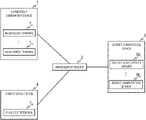
  • FIG. 1 is a block diagram showing an example of a secret computation system
  • FIG. 2 is a flowchart for illustrating an example of a secret computation method
  • FIG. 3 is a diagram for illustrating a first embodiment.
  • Each of “m” and “L” is a natural number of one or more.
  • a single piece of data is described as “a.”
  • T means transportation of a vector or matrix.
  • FIG. 3 shows an example of statistics used in the present invention.
  • FIG. 3 shows the symbol and notation, definition, and formula equivalent to the definition of each statistic.
  • At least one of five statistics of a number of records, a number of attributes, the sum, the sum of squares, and the sum of products is referred to as a basic statistic.
  • the embodiment described later safely computes basic statistics (that is, for example, at least one of the number of records, the number of attributes, the sum, the sum of squares, and the sum of products) by secret computation, and decrypts the basic statistics into plaintext to perform computation such as analysis at high speed.
  • the embodiment described later performs processing divided into the following three phases.
  • Encryption phase to encrypt data to make it concealed.
  • Computation phase to decrypt cyphertext of the computed basic statistics and use the decrypted basic statistics to process target computation in plaintext.
  • the embodiment described later is different from a conventional approach in that secret computation is applied only to computation processes of the basic statistics.
  • computation such as linear regression and principal component analysis, that relatively takes time for processing can be processed at higher speed than before.
  • a linear equation used in linear regression is composed of basic statistics as shown, for example, in the following formula (1).
  • variance covariance matrices can be calculated from the basic statistics. Furthermore, also correlation coefficient matrices can be calculated from variance and covariance. Consequently, in the case of using any matrix, if basic statistics can be computed safely, principal component analysis can be achieved by using the computed basic statistics after that.
  • the present invention uses an encryption method that can carry out, for example, the following arithmetic without decrypting cyphertext.
  • Reference literatures 1 and 2 are known.
  • Multiplication to generate a cyphertext [ab] of multiplication ab using [a] and [b] as input.
  • the embodiment of a secret computation system includes a cyphertext generation device 1 , a management server 2 , a secret computation device 3 , and a computation device 4 as shown in FIG. 1 as an example.
  • the cyphertext generation device 1 is a plurality of registered terminals T H .
  • the secret computation device 3 is n secret computation servers M 1 , . . . , M n .
  • the character “n” is a predetermined integer of two or more.
  • the computation device 4 is an analysis terminal T A .
  • the cyphertext generation device 1 , management server 2 , secret computation device 3 , and computation device 4 can communicate with each other through a network, and can transmit and receive data to/from each other.
  • the secret computation system uses the secret computation servers M 1 , . . . , M capable of processing the arithmetic described in [Encryption Method].
  • a secret computation method is implemented by, for example, the devices included in the secret computation system performing processes of steps S 1 to S 11 described below and in FIG. 2 .
  • the cyphertext generation device 1 generates cyphertext by encrypting data (step S 1 ).
  • the generated cyphertext is transmitted to the management server 2 (step S 2 ).
  • the cyphertext generation device is, for example, a plurality of registered terminals T H .
  • each of the plurality of registered terminals T H generates a share of data by performing secret distribution of the data held by the own terminal by, for example, an approach described in Reference literatures 1 and 2.
  • the generated share is an example of cyphertext.
  • the management server 2 transmits the received cyphertext to the secret computation device 3 (step S 3 ).
  • the secret computation device 3 causes a storage part to store the received cyphertext (step S 4 ).
  • the computation device 4 transmits a computation request to the management server 2 (step S 5 ).
  • the computation device 4 is, for example, an analysis terminal T A .
  • the analysis terminal T A transmits an analysis request as the computation request to the management server 2 .
  • the management server 2 transmits a basic statistic computation request which is a computation request for basic statistics necessary for performing computation corresponding to the received computation request to the secret computation device 3 (step S 6 ).
  • the secret computation device 3 generates encrypted basic statistics by performing secret computation of predetermined basic statistics using the cyphertext read from the storage part while keeping the cyphertext concealed (step S 7 ).
  • the secret computation device 3 is, for example, secret computation servers M 1 , . . . , M n .
  • the secret computation servers M 1 , . . . , M n jointly use, for example, the approach described in Reference literatures 1 and 2 and use the cyphertext read from the storage part to perform secret computation of the predetermined basic statistics while keeping the cyphertext concealed.
  • the generated encrypted basic statistics are transmitted to the management server 2 (step S 8 ).
  • the predetermined basic statistics are basic statistics corresponding to the received basic statistic computation request.
  • the management server 2 transmits the received encrypted basic statistics to the computation device 4 (step S 9 ).
  • the computation device 4 generates decrypted basic statistics by decrypting the received encrypted basic statistics (step S 10 ).
  • the computation device 4 uses the decrypted basic statistics to perform predetermined computation (step S 11 ).
  • One of points of the above embodiment lies in a combination of features of analysis that can be calculated only with statistics and the character of secret computation.
  • Statistics such as the number of records, sum, mean, and variance are not individual pieces of data but numerical values indicating features of a data set. Therefore, analysis that performs computation only using these statistics only needs to solve the data set but does not need individual pieces of data themselves. However, computation of statistics is inevitable from the algorithm of analysis and individual pieces of data must be touched for computing the statistics.
  • management server 2 and computation device 4 are described as separate devices, but the management server 2 and computation device 4 may be implemented in the same device.
  • the registered terminals T H encrypt “a,” “b,” and “m” using, for example, the encryption method in Reference literatures 1 and 2.
  • the registered terminals T II transmit shares [a] i , [b] i , and [m] i , which are cyphertext, and plaintext in to the secret computation servers M 1 , . . . M n .
  • Each secret computation server M i uses [a] i and [b] i to find [s a ] i and [s b ] i by the secret computation of the sum indicated in the paragraphs of [Encryption Method].
  • Each secret computation server M i uses [a] i and [b] i to find [s a ⁇ 2 ] i and [s ab ] i by the secret computation of the sum of products indicated in the paragraphs of [Encryption Method].
  • Each secret computation server M i transmits the found [s a ] i , [s b ] i , [s a ⁇ 2 ] i , [s ab ] i , and [m] i to the analysis terminal T A .
  • the analysis terminal T A uses the received shares to decrypt s a , s b , s a ⁇ 2 , s ab , and m.
  • the registered terminals T H encrypt “A,” “b,” “m,” and “L” using, for example, the encryption method in Reference literatures 1 and 2.
  • the registered terminals T H transmit shares [A] i , [b] i , [m] i , and [L] i , which are cyphertext, and plaintext m and L to the secret computation servers M 1 , . . . , M n .
  • Each secret computation server M i transmits the found [s A ] i , [s b ] i , [S A ] i , and [s Ab ] i , and [m] i and [L] i to the analysis terminal T A .
  • the analysis terminal T A uses the received shares to decrypt s A , s b , S A , s Ab , m, and L.
  • the analysis terminal T A uses s a , s b , S A , s Ab , m, and L to compose the linear equation of Formula (1).
  • the registered terminals T H encrypt “A,” “m,” and “L” using, for example, the encryption method in Reference literatures 1 and 2.
  • the registered terminals T H transmit shares [A] i , [m] i , and [L] i , which are cyphertext, and plaintext “m” and “L” to the secret computation servers M 1 , . . . , M n .
  • Each secret computation server M i transmits the found [s] i and [S] i , and [m] i and [L] i to the analysis terminal T A .
  • the analysis terminal T A uses the received shares to decrypt “s,” “S,” “m,” and “L.”
  • ⁇ aj 2 (1/m)s aj ⁇ 2 ⁇ (1/m 2 )s aj 2
  • ⁇ ak 2 (1/m)s ak ⁇ 2 ⁇ (1/m 2 )s ak 2 .
  • processing in each device is implemented by a computer
  • processing contents of a function which each part of each device should have are written by a program.
  • the program is executed by the computer and thereby the processing of each device is implemented on the computer.
  • the program describing the processing contents can be recorded on a computer-readable recording medium.
  • the computer-readable recording medium may be any of, for example, a magnetic recording device, an optical disk, a magneto-optical recording medium, and a semiconductor memory.
  • each part may be implemented by executing a predetermined program on the computer, or at least part of the processing may be implemented by hardware.

Landscapes

  • Engineering & Computer Science (AREA)
  • Theoretical Computer Science (AREA)
  • Physics & Mathematics (AREA)
  • Computer Security & Cryptography (AREA)
  • General Physics & Mathematics (AREA)
  • Health & Medical Sciences (AREA)
  • Bioethics (AREA)
  • General Health & Medical Sciences (AREA)
  • General Engineering & Computer Science (AREA)
  • Computer Hardware Design (AREA)
  • Software Systems (AREA)
  • Databases & Information Systems (AREA)
  • Medical Informatics (AREA)
  • Signal Processing (AREA)
  • Computer Networks & Wireless Communication (AREA)
  • Complex Calculations (AREA)
  • Storage Device Security (AREA)
  • Financial Or Insurance-Related Operations Such As Payment And Settlement (AREA)

Abstract

A secret computation system is a secret computation system for performing computation while keeping data concealed, and comprises a cyphertext generation device that generates cyphertext by encrypting the data, a secret computation device that generates encrypted basic statistics by performing secret computation of predetermined basic statistics using the cyphertext while keeping the cyphertext concealed, and a computation device that generates decrypted basic statistics by decrypting the encrypted basic statistics and performs predetermined computation using the decrypted basic statistics.

Description

TECHNICAL FIELD
The present invention relates to a technical field of secret computation that performs data processing while keeping data concealed. For example, the present invention relates to a technique of secret multivariate analysis.
BACKGROUND ART
As a conventional art of secret computation for performing data processing while keeping data concealed, a technique described in Patent literature 1 is known. In the conventional art of secret computation, the following three phases are performed.
1. Encryption phase: to encrypt data to make it concealed.
2. Secret computation phase: to use an algorithm or a protocol capable of target computation for the original data while keeping the encrypted data, that is, cyphertext as is and to process the cyphertext.
3. Decryption phase: to decrypt the cyphertext obtained as a result of processing in the secret computation phase to obtain a target computation result.
PRIOR ART LITERATURE Patent Literature
Patent literature 1: Japanese Patent Application Laid-Open No. 2017-028617
SUMMARY OF THE INVENTION Problems to be Solved by the Invention
The above conventional art performs all of target computation processing in “2. Secret computation phase.”
In general, secret computation algorithms are more complicated in processing than algorithms that compute data without encrypting. For this reason, time necessary for processing computation by secret computation algorithms is longer than time necessary for processing computation by plaintext computation algorithms. Therefore, if all algorithms that use complicated computation such as linear regression that requires solving linear equations and principal component analysis that requires computing eigenvalues and eigenvectors of matrices are processed by secret computation, the time required for the processing may become enormous.
An object of the present invention is to provide a secret computation system and method that can perform secret computation at faster speed than before while keeping data concealed.
Means to Solve the Problems
A secret computation system according to one aspect of the present invention is a secret computation system for performing computation while keeping data concealed, comprising a cyphertext generation device that generates cyphertext by encrypting the data, a secret computation device that generates encrypted basic statistics by performing secret computation of predetermined basic statistics using the cyphertext while keeping the cyphertext concealed, and a computation device that generates decrypted basic statistics by decrypting the encrypted basic statistics and performs predetermined computation using the decrypted basic statistics.
Effects of the Invention
It is possible to perform secret computation at faster speed than before while keeping data concealed.
BRIEF DESCRIPTION OF THE DRAWINGS
FIG. 1 is a block diagram showing an example of a secret computation system;
FIG. 2 is a flowchart for illustrating an example of a secret computation method;
FIG. 3 is a diagram for illustrating a first embodiment.
DETAILED DESCRIPTION OF THE EMBODIMENTS
Hereinafter, an embodiment of the present invention will be described with reference to the drawings.
[Notation]
Each of “m” and “L” is a natural number of one or more. A single piece of data is described as “a.” An mth order vector is described as a=(a1, . . . , am). A matrix of m rows and L columns is described as A=(aj,k)1≤j≤m, 1≤k≤L or A=(a1 T, . . . , aL T). Furthermore, ai(i=1, . . . , L) is an m-dimensional vector. T means transportation of a vector or matrix.
A character “n” is a natural number of one or more. Cyphertext of “a” is described as [a]=([a]1, . . . , [a]n). Here, [a]i is referred to as an “i-th share.” However, when n=1, [a]=[a]1. In addition, [a]=([a]1, . . . , [a]m) is cyphertext of an mth order vector a. Similarly, [A]=([aj,k])1≤j≤m, 1≤k≤L is cyphertext of a matrix A of in rows and L columns.
The sum Sa of the elements in the vector a is described as the following formula:
s aj=1 m a j.
In addition, a product ab of the elements of the vector a and a vector b is described as the following formula:
ab=(a 1 b 1 , . . . ,a m b m).
Furthermore, a2=aa.
[Statistic]
A quantity indicating a property of “a” or “A” is referred to as a statistic. FIG. 3 shows an example of statistics used in the present invention. FIG. 3 shows the symbol and notation, definition, and formula equivalent to the definition of each statistic.
Among the statistics of FIG. 3 , at least one of five statistics of a number of records, a number of attributes, the sum, the sum of squares, and the sum of products is referred to as a basic statistic.
In FIG. 3 , the number of records, the number of attributes, the sum, the sum of squares, and the sum of products are defined as follows:
the number of records m: the number of elements of “a” or the number of rows of “A;”
the number of attributes L: the number of columns of “A;”
the sum sa: Σj=1 maj;
the sum of squares s(a∧2): Σj=1 maj 2; and
the sum of products sab: Σj=1 majbj.
[Outline of Technique]
The embodiment described later safely computes basic statistics (that is, for example, at least one of the number of records, the number of attributes, the sum, the sum of squares, and the sum of products) by secret computation, and decrypts the basic statistics into plaintext to perform computation such as analysis at high speed. The embodiment described later performs processing divided into the following three phases.
1. Encryption phase: to encrypt data to make it concealed.
2. Secret computation phase: to process computation of the basic statistics from individual pieces of data while keeping cyphertext as is.
3. Computation phase: to decrypt cyphertext of the computed basic statistics and use the decrypted basic statistics to process target computation in plaintext.
The embodiment described later is different from a conventional approach in that secret computation is applied only to computation processes of the basic statistics. By applying this approach, computation, such as linear regression and principal component analysis, that relatively takes time for processing can be processed at higher speed than before.
A linear equation used in linear regression is composed of basic statistics as shown, for example, in the following formula (1).
[ Formula 1 ] ( m s a 1 s a L s a 1 s a 1 2 s a 1 a L s a L s a L a 1 s a L a L ) ( w 0 w 1 w L ) = ( s b s a 1 b s a L b ) ( 1 )
Therefore, it is possible to efficiently estimate parameters by, for example, solving a linear equation in plaintext after safely computing basic statistics by secret computation.
In addition, it is possible to implement principal component analysis by performing computation of eigenvalues and eigenvectors for, for example, a variance covariance matrix V=(σas,at)1≤s, t≤L or a correlation coefficient matrix C=(ρas,at)1≤s, t≤L of “A”.
It is understood from FIG. 3 that variance covariance matrices can be calculated from the basic statistics. Furthermore, also correlation coefficient matrices can be calculated from variance and covariance. Consequently, in the case of using any matrix, if basic statistics can be computed safely, principal component analysis can be achieved by using the computed basic statistics after that.
[Encryption Method]
The present invention uses an encryption method that can carry out, for example, the following arithmetic without decrypting cyphertext. As a measure for implementing such an encryption method, Reference literatures 1 and 2 are known.
1. Addition: to generate a cyphertext [a+b] of addition a+b using [a] and [b] as input.
2. Multiplication: to generate a cyphertext [ab] of multiplication ab using [a] and [b] as input.
3. Sum: to generate a cyphertext [sa] of sum sa using [a] as input.
4. Sum of products: to generate a cyphertext [sab] of sum of products sab using [a] and [b] as input.
  • [Reference literature 1] SHAMIR, Adi. “How to share a secret”, Communications of the ACM, 1979, 22.11: p. 612-613.
  • [Reference literature 2] GENTRY, Craig, et al. “Fully homomorphic encryption using ideal lattices”, In: STOC. 2009. p. 169-178.
Embodiment
The embodiment of a secret computation system includes a cyphertext generation device 1, a management server 2, a secret computation device 3, and a computation device 4 as shown in FIG. 1 as an example. In this example, the cyphertext generation device 1 is a plurality of registered terminals TH. The secret computation device 3 is n secret computation servers M1, . . . , Mn. The character “n” is a predetermined integer of two or more. Furthermore, the computation device 4 is an analysis terminal TA.
The cyphertext generation device 1, management server 2, secret computation device 3, and computation device 4 can communicate with each other through a network, and can transmit and receive data to/from each other.
The secret computation system uses the secret computation servers M1, . . . , M capable of processing the arithmetic described in [Encryption Method]. Each secret computation server Mi (i=1, . . . , n) can access another secret computation server Mj through the network, and can transmit and receive data to/from each other.
A secret computation method is implemented by, for example, the devices included in the secret computation system performing processes of steps S1 to S11 described below and in FIG. 2 .
The cyphertext generation device 1 generates cyphertext by encrypting data (step S1). The generated cyphertext is transmitted to the management server 2 (step S2).
The cyphertext generation device is, for example, a plurality of registered terminals TH. In this case, each of the plurality of registered terminals TH generates a share of data by performing secret distribution of the data held by the own terminal by, for example, an approach described in Reference literatures 1 and 2. The generated share is an example of cyphertext.
The management server 2 transmits the received cyphertext to the secret computation device 3 (step S3).
The secret computation device 3 causes a storage part to store the received cyphertext (step S4). For example, the received cyphertext is stored in an unshown storage part of the secret computation server Mi (i=1, . . . , n) of the secret computation device 3.
The computation device 4 transmits a computation request to the management server 2 (step S5). The computation device 4 is, for example, an analysis terminal TA. In this case, the analysis terminal TA transmits an analysis request as the computation request to the management server 2.
The management server 2 transmits a basic statistic computation request which is a computation request for basic statistics necessary for performing computation corresponding to the received computation request to the secret computation device 3 (step S6).
The secret computation device 3 generates encrypted basic statistics by performing secret computation of predetermined basic statistics using the cyphertext read from the storage part while keeping the cyphertext concealed (step S7).
The secret computation device 3 is, for example, secret computation servers M1, . . . , Mn. In this case, the secret computation servers M1, . . . , Mn jointly use, for example, the approach described in Reference literatures 1 and 2 and use the cyphertext read from the storage part to perform secret computation of the predetermined basic statistics while keeping the cyphertext concealed.
The generated encrypted basic statistics are transmitted to the management server 2 (step S8).
The predetermined basic statistics are basic statistics corresponding to the received basic statistic computation request.
The management server 2 transmits the received encrypted basic statistics to the computation device 4 (step S9).
The computation device 4 generates decrypted basic statistics by decrypting the received encrypted basic statistics (step S10).
The computation device 4 uses the decrypted basic statistics to perform predetermined computation (step S11). One of points of the above embodiment lies in a combination of features of analysis that can be calculated only with statistics and the character of secret computation.
Statistics such as the number of records, sum, mean, and variance are not individual pieces of data but numerical values indicating features of a data set. Therefore, analysis that performs computation only using these statistics only needs to solve the data set but does not need individual pieces of data themselves. However, computation of statistics is inevitable from the algorithm of analysis and individual pieces of data must be touched for computing the statistics.
On the other hand, secret computation can safely compute while data is kept concealed by cyphertext, but is generally slower than computation by plaintext. In particular, since speed difference appears remarkably for a complicated computation process such as division, it is costly to implement by secret computation all of analysis requiring complicated computation. On the contrary, the addition and multiplication indicated in the paragraphs of [Encryption Method] are sufficiently fast even in secret computation, and basic statistics based on the arithmetic can be processed at high speed by secret computation.
Therefore, in analysis that can be computed from statistics based on the basic statistics, contents of individual pieces of data are kept concealed by processing only a part where the basic statistics are computed by secret computation, the computed basic statistics are decrypted into plaintext, and thereby the computation of analysis can be processed at high speed. Thereby, analysis with both safety and high speed can be achieved.
In the above embodiment, the management server 2 and computation device 4 are described as separate devices, but the management server 2 and computation device 4 may be implemented in the same device.
EXAMPLE Example 1
Example 1 is an example in which linear single regression analysis is performed. More specifically, Example 1 is an example in which the analysis terminal TA, which is the computation device 4, uses the n secret computation servers M1, . . . , which is Mn, the secret computation device 3, to estimate parameters w0 and w1 for the following linear model
b=w 0 +w 1 a
between in households' income data a and expenditure data b held by the registered terminals TH, which is the cyphertext generation device 1.
<Encryption Phase>
As the encryption phase, the following processes are performed in steps S1 to S3.
The registered terminals TH encrypt “a,” “b,” and “m” using, for example, the encryption method in Reference literatures 1 and 2.
The registered terminals TII transmit shares [a]i, [b]i, and [m]i, which are cyphertext, and plaintext in to the secret computation servers M1, . . . Mn.
<Secret Computation Phase>
As the secret computation phase, the following processes are performed in steps S7 to S9.
Each secret computation server Mi uses [a]i and [b]i to find [sa]i and [sb]i by the secret computation of the sum indicated in the paragraphs of [Encryption Method]. Here, saj=1 maj assuming that a=(a1, . . . , am) and sbj=1 mbj assuming that b=(b1, . . . , bm).
Each secret computation server Mi uses [a]i and [b]i to find [sa∧2]i and [sab]i by the secret computation of the sum of products indicated in the paragraphs of [Encryption Method]. Here, sa∧2j=1 maj 2 and sabj=1 majbj assuming that a=(a1, . . . , am) and b=(b1, . . . , bm).
Each secret computation server Mi transmits the found [sa]i, [sb]i, [sa∧2]i, [sab]i, and [m]i to the analysis terminal TA.
<Computation Phase>
As the computation phase, the following processes are performed in steps S10 and S11.
The analysis terminal TA uses the received shares to decrypt sa, sb, sa∧2, sab, and m.
The analysis terminal TA uses sa, sb, and in to compute μa=(1/m)sa and μb=(1/m)sb.
The analysis terminal TΛ uses sa, sb, sa∧2, sab, and in to compute σa 2=(1/m)sa∧2−(1/m2)sa 2 and σa,b=(1/m)sab−(1/m2)sasb.
The analysis terminal TA calculates W1=(σa,b)/(θa 2).
The analysis terminal TΛ calculates w0b−w1μa.
Example 2
Example 2 is an example in which linear regression analysis is performed. More specifically, Example 2 is an example in which the analysis terminal TA, which is the computation device 4, uses the n secret computation servers M1, . . . , Mn, which is the secret computation device 3, to estimate a parameter w=(w0, w1, . . . , wL) for the following linear model
b=w 0 +w 1 a 1 + . . . +w L a L
between a matrix A of a number of records in and a number of attributes L and a vector b of the number of records in held by the registered terminals TH, which is the cyphertext generation device 1.
<Encryption Phase>
As the encryption phase, the following processes are performed in steps S1 to S3.
The registered terminals TH encrypt “A,” “b,” “m,” and “L” using, for example, the encryption method in Reference literatures 1 and 2.
The registered terminals TH transmit shares [A]i, [b]i, [m]i, and [L]i, which are cyphertext, and plaintext m and L to the secret computation servers M1, . . . , Mn.
<Secret Computation Phase>
As the secret computation phase, the following processes are performed in steps S7 to S9.
Each secret computation server Mi uses [A]i and [b]i to find [sΛ]i=([sa1]i, . . . , [saL]i) and [sb]i by the secret computation of the sum indicated in the paragraphs of [Encryption Method]. Here, saqj=1 maj,q assuming that q=1, . . . , L, and sbj=1 mbj assuming that b=(b1, . . . , bm).
Each secret computation server Mi uses [A]i and [b]i to calculate [SA]i=([sajak]i)1≤j,k≤L=and [sAb]i ([salb]i, . . . , [saLb]i) by the sum of products indicated in the paragraphs of [Encryption Method]. Here, sajakr=1 mar,jar,k, and assuming that q=1, . . . , L, saqbr=1 mar,qbr.
Each secret computation server Mi transmits the found [sA]i, [sb]i, [SA]i, and [sAb]i, and [m]i and [L]i to the analysis terminal TA.
<Computation Phase>
As the computation phase, the following processes are performed in steps S10 and S11.
The analysis terminal TA uses the received shares to decrypt sA, sb, SA, sAb, m, and L.
The analysis terminal TA uses sa, sb, SA, sAb, m, and L to compose the linear equation of Formula (1).
The analysis terminal TA solves Formula (1) using, for example, Gauss' elimination method to find w=(w0, . . . , wL).
Example 3
Example 3 is an example in which principal component analysis is performed. More specifically, Example 3 is an example in which the analysis terminal TA, which is the computation device 4, uses the n secret computation servers M1, . . . , Mn, which is the secret computation device 3, to performs principal component analysis for data A which is a matrix of a number of records m and a number of attributes L held by the registered terminals TH, which is the cyphertext generation device 1, and finds each principal component p=(p1, . . . , pL).
<Encryption Phase>
As the encryption phase, the following processes are performed in steps S1 to S3.
The registered terminals TH encrypt “A,” “m,” and “L” using, for example, the encryption method in Reference literatures 1 and 2.
The registered terminals TH transmit shares [A]i, [m]i, and [L]i, which are cyphertext, and plaintext “m” and “L” to the secret computation servers M1, . . . , Mn.
<Secret Computation Phase>
As the secret computation phase, the following processes are performed in steps S7 to S9.
Each secret computation server Mi uses [A]i to find [s]i=([sa1]i, . . . , [saL]i) by the sum indicated in the paragraphs of [Encryption Method]. Here, saij=1 maq,j assuming that q=1, . . . , L.
Each secret computation server Mi uses [A]i to calculate [S]i=([sajak]i)1≤j,k≤L by the sum of products indicated in the paragraphs of [Encryption Method]. Here, sajakr=1 mar,jar,k.
Each secret computation server Mi transmits the found [s]i and [S]i, and [m]i and [L]i to the analysis terminal TA.
<Computation Phase>
As the computation phase, the following processes are performed in steps S10 and S11.
The analysis terminal TA uses the received shares to decrypt “s,” “S,” “m,” and “L.”
The analysis terminal TA uses “s,” “S,” “in,” and “L” to find V=(σaj,ak)1≤j,k≤L=((1/m)sajak−(1/m2)sajsak)1≤j,k≤L.
The analysis terminal TA uses “V” to find C=((σaj,ak)/(σaj 2ak2)1/2)1≤j,k≤L. Here, σaj 2=(1/m)saj∧2−(1/m2)saj 2 and σak 2=(1/m)sak∧2−(1/m2)sak 2.
The analysis terminal TA performs computation of eigenvalues and eigenvectors for “C” to find p=(p1, . . . , pL).
[Program and Recording Medium]
For example, if processing in each device is implemented by a computer, processing contents of a function which each part of each device should have are written by a program. Then, the program is executed by the computer and thereby the processing of each device is implemented on the computer.
The program describing the processing contents can be recorded on a computer-readable recording medium. The computer-readable recording medium may be any of, for example, a magnetic recording device, an optical disk, a magneto-optical recording medium, and a semiconductor memory.
The processing of each part may be implemented by executing a predetermined program on the computer, or at least part of the processing may be implemented by hardware.
In addition, it goes without saying that modifications are possible as appropriate within a range not departing from the spirit of the present invention.

Claims (6)

What is claimed is:
1. A secret computation system for performing computation while keeping data concealed, comprising:
a cyphertext generation device that generates cyphertext by encrypting the data;
a secret computation device that generates encrypted basic statistics by performing secret computation of predetermined basic statistics using the cyphertext while keeping the cyphertext concealed from the secret computation device; and
a computation device that generates decrypted basic statistics by decrypting the encrypted basic statistics and performs predetermined computation using the decrypted basic statistics,
wherein the cyphertext generation device, the secret computation device, and the computation device communicate with each other over a network, and
wherein the predetermined computation is a computation for estimating parameters w0 and w1 for a following linear model

b=w 0 +w 1 a
between m data a and m data b held by a registered terminals TH,
the cyphertext generation device is the registered terminals TH,
the secret computation device is n secret computation servers M1, . . . , Mn,
the computation device is an analysis terminal TA,
cyphertext of “x” is described as [x]=([x]1, . . . ,[x]n),
provided that i=1, . . . ,n, the registered terminals TH generates [a]i, [b]i and [m]i as the cyphertext and transmit [a]i, [b]i and [m]i and plaintext m to the secret computation servers Mi,
such that each of the secure computation servers Mi receives, over the network, an input of one or more respective shares of original data a and b, and the data a and b are concealed from each of the secure computation servers, provided that i=1, . . . ,n, a=(a1, . . . ,am), b=(b1, . . . ,bm), saj=1 m aj, sbj=1 m bj, sa∧2j=1 m aj 2 and sabj=1 m ajbj, the secret computation servers Mi generates [sa]i, [Sb]i, [sa∧2]i and [sab]i as the basic statistics and transmits [sa]i,[Sb]i, [sa∧2]i, [sab]i and [m]i to the analysis terminal TA, and
the analysis terminal TA generates sa, Sb, sa∧2, sab and m as the decrypted basic statistics and calculates μa=(1/m)sab=(1/m)sb, σa 2=(1/m)sa∧2−(1/m2)sa 2, σa,b=(1/m)sab−(1/m2)sasb
wherein the analysis terminal TA obtains parameters w0 and w1 for the linear model by calculating w0b−w1μa and W1=(σa,b)/(σa 2).
2. A secret computation method for performing computation while keeping data concealed, comprising:
a cyphertext generation step in which a cyphertext generation device generates cyphertext by encrypting the data;
a secret computation step in which a secret computation device generates encrypted basic statistics by performing secret computation of predetermined basic statistics using the cyphertext while keeping the cyphertext concealed from the secret computation device; and
a computation step in which a computation device generates decrypted basic statistics by decrypting the encrypted basic statistics and performs predetermined computation using the decrypted basic statistics,
wherein the cyphertext generation device, the secret computation device, and the computation device communicate with each other over a network, and
wherein the predetermined computation is a computation for estimating parameters w0 and w1 for a following linear model

b=w 0 +w 1 a
between m data a and m data b held by a registered terminals TH,
the cyphertext generation device is the registered terminals TH,
the secret computation device is n secret computation servers M1, . . . , Mn,
the computation device is an analysis terminal TA,
cyphertext of “x” is described as [x]=([x]1, . . . ,[x]n),
provided that i=1, . . . ,n, the registered terminals TH generates [a]i, [b]i and [m]i as the cyphertext and transmit [a]i, [b]i and [m]i and plaintext m to the secret computation servers Mi,
such that each of the secure computation servers Mi receives, over the network, an input of one or more respective shares of original data a and b, and the data a and b are concealed from each of the secure computation servers, provided that i=1, . . . ,n, a=(a1, . . . ,am), b=(b1, . . . ,bm), saj=1 m aj, sbj=1 m bj, sa∧2j=1 m aj 2 and sabj=1 m ajbj, the secret computation servers Mi generates [sa]i, [Sb]i, [sa∧2]i and [sab]i as the basic statistics and transmits [sa]i,[Sb]i, [sa∧2]i, [sab]i and [m]i to the analysis terminal TA, and
the analysis terminal TA generates sa, Sb, sa∧2, sab and m as the decrypted basic statistics and calculates μa=(1/m)sab=(1/m)sb, σa 2=(1/m)sa∧2−(1/m2)sa 2, σa,b=(1/m)sab−(1/m2)sasb,
wherein the analysis terminal TA obtains parameters w0 and w1 for the linear model by calculating w0b−w1μa and W1=(σa,b)/(σa 2).
3. A secret computation system for performing computation while keeping data concealed, comprising:
a cyphertext generation device that generates cyphertext by encrypting the data;
a secret computation device that generates encrypted basic statistics by performing secret computation of predetermined basic statistics using the cyphertext while keeping the cyphertext concealed from the secret computation device; and
a computation device that generates decrypted basic statistics by decrypting the encrypted basic statistics and performs predetermined computation using the decrypted basic statistics,
wherein the cyphertext generation device, the secret computation device, and the computation device communicate with each other over a network, and
wherein the predetermined computation is a computation for estimating a parameter w=(w0,w1, . . . ,wL) for the following linear model

b=w 0 +w 1a1 + . . . +w LaL,
between a matrix A of a number of records m and a number of attributes L and a vector b of the number of records m held by a registered terminals TH,
the cyphertext generation device is the registered terminals TH,
the secret computation device is n secret computation servers M1, . . . , Mn,
the computation device is an analysis terminal TA,
cyphertext of “x” is described as [x]=([x]1, . . . ,[x]n),
provided that i=1, . . . ,n, the registered terminals TH generates [A]i, [b]i, [m]i, and [L]i as the cyphertext and transmit [A]i, [b]i, [m]i, [L]i, and plaintext m and L to the secret computation servers Mi,
such that each of the secure computation servers Mi receives, over the network, an input of one or more respective shares of original data A and b, and the data A and b are concealed from each of the secure computation servers, provided that i=1, . . . ,n, A=(aj,k)1≤j≤m, 1≤k≤L, q=1, . . . , L, saqj=1 maj,q,, saqbr=1 mar,qbr, b=(b1, . . . ,bm), sbj=1 m bj and Sajakr=1 mar,jar,k the secret computation servers Mi generates [SA]i=([Sa1]i), [Sb]i, [SA]i=([Sajak]i)1≤j,k≤L and [SAb]i=([Salb]i, . . . ,[SaLb]i) as the basic statistics and transmits [SA]i, [Sb]i, [SA]i, and [SAb]i, [m]i and [L]i to the analysis terminal TA, the analysis terminal TA solves Formula (1) to find W=(W0, . . . ,WL)
( m s a 1 s a L s a 1 s a 1 2 s a 1 a L s a L s a L a 1 s a L a L ) ( w 0 w 1 w L ) = ( s b s a 1 b s a L b ) . ( 1 )
4. A secret computation system for performing computation while keeping data concealed, comprising:
a cyphertext generation device that generates cyphertext by encrypting the data;
a secret computation device that generates encrypted basic statistics by performing secret computation of predetermined basic statistics using the cyphertext while keeping the cyphertext concealed from the secret computation device; and
a computation device that generates decrypted basic statistics by decrypting the encrypted basic statistics and performs predetermined computation using the decrypted basic statistics,
wherein the cyphertext generation device, the secret computation device, and the computation device communicate with each other over a network, and
wherein the predetermined computation is a computation for performing principal component analysis for data A which is a matrix of a number of records m and a number of attributes L held by a registered terminals TH,
the cyphertext generation device is the registered terminals TH,
the secret computation device is n secret computation servers M1, . . . , Mn,
the computation device is an analysis terminal TA,
cyphertext of “x” is described as [x]=([x]1, . . . ,[x]n),
provided that i=1, . . . ,n, the registered terminals TH generates [A]i, [m]i, and [L]i as the cyphertext and transmit [A]i, [m]i and [L]i and plaintext m and L to the secret computation servers Mi,
such that each of the secure computation servers Mi receives, over the network, an input of one or more respective shares of original data A, and the data A are concealed from each of the secure computation servers, provided that i=1, . . . ,n, A=(aj,k)1≤j≤m, 1≤k≤L, q=1, . . . ,L, Saij=1 maq,j and Sajakr=1 m ar,jar,k, the secret computation servers Mi generates [s]i=([sa1]i, . . . , [SaL]i) and [S]i=([sajak]i)1≤j,k≤L as the basic statistics and transmits [s]i, [S]i, [m]i and [L]i to the analysis terminal TA, and
provided that σaj 2=(1/m)saj∧2−(1/m2)saj 2, σak 2=(1/m)sak∧2−(1/m2)sak 2 the analysis terminal TA generates s, S, m and L as the decrypted basic statistics, calculates V=(σaj,ak)1≤j,k≤L=((1/m)sajak−(1/m2)sajsak)1≤j,k≤L, C=((σaj,ak)/(σaj 2σak 2)1/2)1≤j,k≤L and performs computation of eigenvalues and eigenvectors for C to find p=(p1, . . . ,pL), which are the principal components for data A.
5. A secret computation method for performing computation while keeping data concealed, comprising:
a cyphertext generation step in which a cyphertext generation device generates cyphertext by encrypting the data;
a secret computation step in which a secret computation device generates encrypted basic statistics by performing secret computation of predetermined basic statistics using the cyphertext while keeping the cyphertext concealed from the secret computation device; and
a computation step in which a computation device generates decrypted basic statistics by decrypting the encrypted basic statistics and performs predetermined computation using the decrypted basic statistics,
wherein the cyphertext generation device, the secret computation device, and the computation device communicate with each other over a network, and
wherein the predetermined computation is a computation for estimating a parameter w=(w0,w1, . . . ,wL) for the following linear model

b=w 0 +w 1a1 + . . . +w LaL
between a matrix A of a number of records m and a number of attributes L and a vector b of the number of records m held by a registered terminals TH,
the cyphertext generation device is the registered terminals TH,
the secret computation device is n secret computation servers M1, . . . , Mn,
the computation device is an analysis terminal TA,
cyphertext of “x” is described as [x]=([x]1, . . . ,[x]n),
provided that i=1, . . . ,n, the registered terminals TH generates [A]i, [b]i, [m]i, and [L]i as the cyphertext and transmit [A]i, [m]i and [L]i and plaintext m and L to the secret computation servers Mi,
such that each of the secure computation servers M receives, over the network, an input of one or more respective shares of original data A and b, and the data A and b are concealed from each of the secure computation servers, provided that provided that i=1, . . . ,n, A=(aj,k)1≤j≤m, 1≤k≤L, q=1, . . . ,L, Saqj=1 maj,q, Saqbr=1 mar,q br, b=(b1, . . . , bm) Sbj=1 mabj and Sajakr=1 m ar,jar,k, the secret computation servers Mi generates [sA]i=([sa1]i, . . . , [SaL]i),[Sb]i, [SA]i=([sajak]i)1≤j,k≤L and [SAb]i=([Salb]i, . . . ,[SaLb]i) as the basic statistics and transmits [sA]i, [sb]i, [SA]i, and [sAb]i, [m]i, and [L]i, to the analysis terminal TA,
the analysis terminal TA solves Formula (1) to find w=(w0, . . . ,wL)
( m s a 1 s a L s a 1 s a 1 2 s a 1 a L s a L s a L a 1 s a L a L ) ( w 0 w 1 w L ) = ( s b s a 1 b s a L b ) . ( 1 )
6. A secret computation method for performing computation while keeping data concealed, comprising:
a cyphertext generation step in which a cyphertext generation device generates cyphertext by encrypting the data;
a secret computation step in which a secret computation device generates encrypted basic statistics by performing secret computation of predetermined basic statistics using the cyphertext while keeping the cyphertext concealed from the secret computation device; and
a computation step in which a computation device generates decrypted basic statistics by decrypting the encrypted basic statistics and performs predetermined computation using the decrypted basic statistics,
wherein the cyphertext generation device, the secret computation device, and the computation device communicate with each other over a network, and
wherein the predetermined computation is a computation for performing principal component analysis for data A which is a matrix of a number of records m and a number of attributes L held by a registered terminals TH,
the cyphertext generation device is the registered terminals TH,
the secret computation device is n secret computation servers M1, Mn,
the computation device is an analysis terminal TA,
cyphertext of “x” is described as [x]=([x]1, . . . ,[x]n),
provided that i=1, . . . ,n, the registered terminals TH generates [A]i, [m]i, and [L]i as the cyphertext and transmit [A]i, [m]i and [L]i and plaintext m and L to the secret computation servers Mi,
such that each of the secure computation servers Mi receives, over the network, an input of one or more respective shares of original data A, and the data A are concealed from each of the secure computation servers, provided that i=1, . . . ,n, A=(aj,k)1≤j≤m, 1≤k≤L, q=1, . . . ,L, Saij=1 maq,j and Sajakr=1 m ar,jar,k, the secret computation servers Mi generates [s]i=([sa1]i, . . . , [SaL]i) and [S]i=([sajak]i)1≤j,k≤L as the basic statistics and transmits [s]i, [S]i, [m]i and [L]i to the analysis terminal TA, and
provided that σaj 2=(1/m)saj∧2−(1/m2)saj 2, σak 2=(1/m)sak∧2−(1/m2)sak 2 the analysis terminal TA generates s, S, m and L as the decrypted basic statistics, calculates V=(σaj,ak)1≤j,k≤L=((1/m)sajak−(1/m2)sajsak)1≤j,k≤L, C=((σaj,ak)/(σaj 2ak2)1/2)1≤j,k≤L and performs computation of eigenvalues and eigenvectors for C to find p=(p1, . . . ,pL), which are the principal components for data A.
US16/772,543 2017-12-18 2018-12-14 Secret computation system and method Active 2039-02-13 US11537726B2 (en)

Applications Claiming Priority (4)

Application Number Priority Date Filing Date Title
JP2017-241895 2017-12-18
JP2017241895 2017-12-18
JPJP2017-241895 2017-12-18
PCT/JP2018/046130 WO2019124260A1 (en) 2017-12-18 2018-12-14 Secure computation system and method

Publications (2)

Publication Number Publication Date
US20200387616A1 US20200387616A1 (en) 2020-12-10
US11537726B2 true US11537726B2 (en) 2022-12-27

Family

ID=66994679

Family Applications (1)

Application Number Title Priority Date Filing Date
US16/772,543 Active 2039-02-13 US11537726B2 (en) 2017-12-18 2018-12-14 Secret computation system and method

Country Status (4)

Country Link
US (1) US11537726B2 (en)
JP (1) JP6988918B2 (en)
AU (1) AU2018387969B2 (en)
WO (1) WO2019124260A1 (en)

Cited By (1)

* Cited by examiner, † Cited by third party
Publication number Priority date Publication date Assignee Title
US12505235B2 (en) 2021-03-26 2025-12-23 Ntt Communications Corporation Processing system, processing method, and processing program

Families Citing this family (7)

* Cited by examiner, † Cited by third party
Publication number Priority date Publication date Assignee Title
US11190336B2 (en) * 2019-05-10 2021-11-30 Sap Se Privacy-preserving benchmarking with interval statistics reducing leakage
JP7456514B2 (en) * 2020-10-16 2024-03-27 日本電信電話株式会社 Parameter estimation device, parameter estimation system, parameter estimation method, and program
JP7118199B1 (en) 2021-03-26 2022-08-15 エヌ・ティ・ティ・コミュニケーションズ株式会社 Processing system, processing method and processing program
JP7662034B2 (en) * 2021-06-17 2025-04-15 日本電信電話株式会社 MODEL GENERATION SYSTEM, SECURE COMPUTING DEVICE, ANALYSIS DEVICE, MODEL GENERATION METHOD, AND PROGRAM
JP2023057848A (en) * 2021-10-12 2023-04-24 株式会社Acompany Calculation server, calculation method and program for secret calculation
JP7720512B2 (en) * 2022-03-31 2025-08-08 Nttドコモビジネス株式会社 Information providing device, information providing method, and information providing program
JP2024160635A (en) * 2023-05-01 2024-11-14 エヌ・ティ・ティ・コミュニケーションズ株式会社 Analytical device, analytical method, and analytical program

Citations (9)

* Cited by examiner, † Cited by third party
Publication number Priority date Publication date Assignee Title
US20120159180A1 (en) * 2010-12-17 2012-06-21 Microsoft Corporation Server-side Encrypted Pattern Matching
US20150371059A1 (en) * 2014-06-18 2015-12-24 Palo Alto Research Center Incorporated Privacy-sensitive ranking of user data
US20150371062A1 (en) * 2013-02-25 2015-12-24 Mitsubishi Electric Corporation Server device, concealed search program, recording medium, and concealed search system
US9224000B1 (en) * 2011-06-14 2015-12-29 Ionic Security, Inc. Systems and methods for providing information security using context-based keys
US20150381349A1 (en) * 2013-03-04 2015-12-31 Thomson Licensing Privacy-preserving ridge regression using masks
US20160292430A1 (en) * 2015-04-01 2016-10-06 Microsoft Technology Licensing, Llc Computing on encrypted data using deferred evaluation
WO2016178291A1 (en) 2015-05-07 2016-11-10 日本電気株式会社 System, method, device, and program for using secret calculation data
JP2017028617A (en) 2015-07-27 2017-02-02 日本電信電話株式会社 Secret computing system, secret computing device and program
US20170147835A1 (en) * 2015-11-25 2017-05-25 International Business Machines Corporation Efficient two party oblivious transfer using a leveled fully homomorphic encryption

Patent Citations (11)

* Cited by examiner, † Cited by third party
Publication number Priority date Publication date Assignee Title
US20120159180A1 (en) * 2010-12-17 2012-06-21 Microsoft Corporation Server-side Encrypted Pattern Matching
US9224000B1 (en) * 2011-06-14 2015-12-29 Ionic Security, Inc. Systems and methods for providing information security using context-based keys
US20150371062A1 (en) * 2013-02-25 2015-12-24 Mitsubishi Electric Corporation Server device, concealed search program, recording medium, and concealed search system
US20150381349A1 (en) * 2013-03-04 2015-12-31 Thomson Licensing Privacy-preserving ridge regression using masks
US20150371059A1 (en) * 2014-06-18 2015-12-24 Palo Alto Research Center Incorporated Privacy-sensitive ranking of user data
US20160292430A1 (en) * 2015-04-01 2016-10-06 Microsoft Technology Licensing, Llc Computing on encrypted data using deferred evaluation
WO2016178291A1 (en) 2015-05-07 2016-11-10 日本電気株式会社 System, method, device, and program for using secret calculation data
US20180139045A1 (en) 2015-05-07 2018-05-17 Nec Corporation Secure computation data utilization system, method, apparatus and non-transitory medium
JP2017028617A (en) 2015-07-27 2017-02-02 日本電信電話株式会社 Secret computing system, secret computing device and program
US20180225431A1 (en) 2015-07-27 2018-08-09 Nippon Telegraph And Telephone Corporation Secure computation system, secure computation device, secure computation method, and program
US20170147835A1 (en) * 2015-11-25 2017-05-25 International Business Machines Corporation Efficient two party oblivious transfer using a leveled fully homomorphic encryption

Non-Patent Citations (7)

* Cited by examiner, † Cited by third party
Title
A. Shamir, "How to share a secret", Communications of the ACM, 1979, 22.11: p. 612-613.
C. Gentry, "Fully homomorphic encryption using ideal lattices", In: STOC. 2009. p. 169-178.
International Search Report dated Mar. 12, 2019 in PCT/JP2018/046130 filed Dec. 14, 2018, 1 page.
S. Tanaka et al., "Analyzing Microdata of Official Statistic with Secure Computation", with Partial translation, 2017, 10 total pages.
Satoshi Tanaka et al., "Secure Statistical Computation System on Encrypted Data: An Empirical Study of Secure Regression Analysis for Official Statistics", NTT, Sep. 22, 2017, 16 pages.
Satoshi Tanaka et al., "Secure statistical computation system on encrypted data: An empirical study of secure regression analysis for official statistics", UNECE Work Session on Statistical Data Confidentiality, Jun. 30, 2017, pp. 1-14.
Satoshi Tanaka et al., "Secure statistical computation system on encrypted data: An empirical study of secure regression analysis for official statistics", UNECE Work Session on Statistical Data Confidentiality, Sep. 20, 2017, pp. 1-14.

Cited By (1)

* Cited by examiner, † Cited by third party
Publication number Priority date Publication date Assignee Title
US12505235B2 (en) 2021-03-26 2025-12-23 Ntt Communications Corporation Processing system, processing method, and processing program

Also Published As

Publication number Publication date
US20200387616A1 (en) 2020-12-10
AU2018387969A1 (en) 2020-07-02
WO2019124260A1 (en) 2019-06-27
AU2018387969B2 (en) 2021-07-22
JP6988918B2 (en) 2022-01-05
JPWO2019124260A1 (en) 2020-12-10

Similar Documents

Publication Publication Date Title
US11537726B2 (en) Secret computation system and method
EP3688921B1 (en) Method for faster secure multiparty inner product computation with spdz
US11606203B2 (en) Method for faster secure multiparty inner product with SPDZ
EP2924911B1 (en) Secure pattern matching using somewhat homomorphic encryption
US9350543B2 (en) Method and system for homomorphicly randomizing an input
US9432188B2 (en) Secret sharing system, data distribution apparatus, distributed data transform apparatus, secret sharing method and program
US9973334B2 (en) Homomorphically-created symmetric key
US10171440B2 (en) Method and apparatus for managing encryption keys for cloud service
US11374742B2 (en) Conversion key generation device, ciphertext conversion device, privacy-preserving information processing system, conversion key generation method, ciphertext conversion method, and computer
US9960905B2 (en) Cryptographic processing device and cryptographic processing method
US11139952B2 (en) Homomorphic computation device, encryption system, and computer readable medium
GB2623040A (en) Privacy-preserving computing with third-party service
JP6499519B2 (en) Cryptographic scheme for securely exchanging messages and apparatus and system for implementing the scheme
US8891762B2 (en) Method for privacy-preserving order selection of encrypted element
CN113904808B (en) Private key distribution and decryption method, device, equipment and medium
EP2881930A1 (en) Encryption system, encryption method, encryption program and decryption device
EP3364398B1 (en) Secret random number synthesizing device, secret random number synthesizing method, and program
US20230299953A1 (en) Quantum cryptographic communication system, key management device, and key management method
KR101249394B1 (en) Proxy re-encryption method from lattices and apparatus therefor
CN112913184A (en) Computing the key rotation period of a block cipher-based encryption scheme system and method
US7773753B2 (en) Efficient remotely-keyed symmetric cryptography for digital rights management
CN116015595B (en) A data security aggregation method for smart meters
Pathak et al. Efficient Protocols for Principal Eigenvector Computation over Private Data.
CN114266063B (en) Safety comparison method and system
US20250373421A1 (en) Server device for using homomorphic encrypted master key and methods thereof

Legal Events

Date Code Title Description
FEPP Fee payment procedure

Free format text: ENTITY STATUS SET TO UNDISCOUNTED (ORIGINAL EVENT CODE: BIG.); ENTITY STATUS OF PATENT OWNER: LARGE ENTITY

AS Assignment

Owner name: NIPPON TELEGRAPH AND TELEPHONE CORPORATION, JAPAN

Free format text: ASSIGNMENT OF ASSIGNORS INTEREST;ASSIGNORS:TANAKA, SATOSHI;KIKUCHI, RYO;CHIDA, KOJI;SIGNING DATES FROM 20200609 TO 20200611;REEL/FRAME:053138/0334

STPP Information on status: patent application and granting procedure in general

Free format text: APPLICATION DISPATCHED FROM PREEXAM, NOT YET DOCKETED

STPP Information on status: patent application and granting procedure in general

Free format text: DOCKETED NEW CASE - READY FOR EXAMINATION

STPP Information on status: patent application and granting procedure in general

Free format text: NON FINAL ACTION MAILED

STPP Information on status: patent application and granting procedure in general

Free format text: RESPONSE TO NON-FINAL OFFICE ACTION ENTERED AND FORWARDED TO EXAMINER

STPP Information on status: patent application and granting procedure in general

Free format text: NON FINAL ACTION MAILED

STPP Information on status: patent application and granting procedure in general

Free format text: RESPONSE TO NON-FINAL OFFICE ACTION ENTERED AND FORWARDED TO EXAMINER

STPP Information on status: patent application and granting procedure in general

Free format text: NOTICE OF ALLOWANCE MAILED -- APPLICATION RECEIVED IN OFFICE OF PUBLICATIONS

STPP Information on status: patent application and granting procedure in general

Free format text: PUBLICATIONS -- ISSUE FEE PAYMENT VERIFIED

STCF Information on status: patent grant

Free format text: PATENTED CASE

CC Certificate of correction