US11535716B2 - (Meth)acrylic-modified siloxane compound - Google Patents
(Meth)acrylic-modified siloxane compound Download PDFInfo
- Publication number
- US11535716B2 US11535716B2 US16/498,989 US201816498989A US11535716B2 US 11535716 B2 US11535716 B2 US 11535716B2 US 201816498989 A US201816498989 A US 201816498989A US 11535716 B2 US11535716 B2 US 11535716B2
- Authority
- US
- United States
- Prior art keywords
- meth
- integer
- acrylic
- siloxane compound
- modified siloxane
- Prior art date
- Legal status (The legal status is an assumption and is not a legal conclusion. Google has not performed a legal analysis and makes no representation as to the accuracy of the status listed.)
- Active, expires
Links
- -1 siloxane compound Chemical class 0.000 title claims abstract description 52
- 239000003973 paint Substances 0.000 claims abstract description 31
- 239000000654 additive Substances 0.000 claims abstract description 25
- 230000000996 additive effect Effects 0.000 claims abstract description 23
- 125000005702 oxyalkylene group Chemical group 0.000 claims abstract description 3
- 239000000976 ink Substances 0.000 claims description 29
- 125000001183 hydrocarbyl group Chemical group 0.000 claims description 13
- NIXOWILDQLNWCW-UHFFFAOYSA-N acrylic acid group Chemical group C(C=C)(=O)O NIXOWILDQLNWCW-UHFFFAOYSA-N 0.000 claims description 12
- 125000003545 alkoxy group Chemical group 0.000 claims description 10
- 125000002496 methyl group Chemical group [H]C([H])([H])* 0.000 claims description 8
- 238000007639 printing Methods 0.000 claims description 8
- 239000003795 chemical substances by application Substances 0.000 claims description 7
- 125000004435 hydrogen atom Chemical group [H]* 0.000 claims description 6
- 238000010146 3D printing Methods 0.000 claims description 4
- 125000003647 acryloyl group Chemical group O=C([*])C([H])=C([H])[H] 0.000 abstract 1
- 150000001875 compounds Chemical class 0.000 description 27
- 0 *[Si]([36*])(O[Si]([37*])([38*])[39*])O[Si]([34*])([35*])O[Si]([31*])([32*])[33*] Chemical compound *[Si]([36*])(O[Si]([37*])([38*])[39*])O[Si]([34*])([35*])O[Si]([31*])([32*])[33*] 0.000 description 17
- 238000005160 1H NMR spectroscopy Methods 0.000 description 12
- 238000000034 method Methods 0.000 description 11
- 238000006243 chemical reaction Methods 0.000 description 7
- KPUWHANPEXNPJT-UHFFFAOYSA-N disiloxane Chemical class [SiH3]O[SiH3] KPUWHANPEXNPJT-UHFFFAOYSA-N 0.000 description 7
- 238000006116 polymerization reaction Methods 0.000 description 7
- 238000002360 preparation method Methods 0.000 description 7
- YXFVVABEGXRONW-UHFFFAOYSA-N Toluene Chemical compound CC1=CC=CC=C1 YXFVVABEGXRONW-UHFFFAOYSA-N 0.000 description 6
- 238000004458 analytical method Methods 0.000 description 6
- 230000015572 biosynthetic process Effects 0.000 description 6
- 230000000740 bleeding effect Effects 0.000 description 6
- 239000003112 inhibitor Substances 0.000 description 6
- BASFCYQUMIYNBI-UHFFFAOYSA-N platinum Chemical compound [Pt] BASFCYQUMIYNBI-UHFFFAOYSA-N 0.000 description 6
- 238000003786 synthesis reaction Methods 0.000 description 6
- 125000004432 carbon atom Chemical group C* 0.000 description 5
- 238000000576 coating method Methods 0.000 description 4
- 239000002904 solvent Substances 0.000 description 4
- 239000007858 starting material Substances 0.000 description 4
- NLZUEZXRPGMBCV-UHFFFAOYSA-N Butylhydroxytoluene Chemical compound CC1=CC(C(C)(C)C)=C(O)C(C(C)(C)C)=C1 NLZUEZXRPGMBCV-UHFFFAOYSA-N 0.000 description 3
- 239000003054 catalyst Substances 0.000 description 3
- 239000011248 coating agent Substances 0.000 description 3
- NWVVVBRKAWDGAB-UHFFFAOYSA-N p-methoxyphenol Chemical compound COC1=CC=C(O)C=C1 NWVVVBRKAWDGAB-UHFFFAOYSA-N 0.000 description 3
- 125000001997 phenyl group Chemical group [H]C1=C([H])C([H])=C(*)C([H])=C1[H] 0.000 description 3
- 239000000049 pigment Substances 0.000 description 3
- 229910052697 platinum Inorganic materials 0.000 description 3
- 230000009257 reactivity Effects 0.000 description 3
- GWEWXAKVLVOWNZ-UHFFFAOYSA-N 8-[dimethoxy(methyl)silyl]octyl 2-methylprop-2-enoate Chemical compound CO[Si](C)(CCCCCCCCOC(=O)C(C)=C)OC GWEWXAKVLVOWNZ-UHFFFAOYSA-N 0.000 description 2
- QIGBRXMKCJKVMJ-UHFFFAOYSA-N Hydroquinone Chemical compound OC1=CC=C(O)C=C1 QIGBRXMKCJKVMJ-UHFFFAOYSA-N 0.000 description 2
- HEDRZPFGACZZDS-MICDWDOJSA-N Trichloro(2H)methane Chemical compound [2H]C(Cl)(Cl)Cl HEDRZPFGACZZDS-MICDWDOJSA-N 0.000 description 2
- 125000001301 ethoxy group Chemical group [H]C([H])([H])C([H])([H])O* 0.000 description 2
- 238000011156 evaluation Methods 0.000 description 2
- 125000000956 methoxy group Chemical group [H]C([H])([H])O* 0.000 description 2
- 239000000203 mixture Substances 0.000 description 2
- FSDNTQSJGHSJBG-UHFFFAOYSA-N piperidine-4-carbonitrile Chemical compound N#CC1CCNCC1 FSDNTQSJGHSJBG-UHFFFAOYSA-N 0.000 description 2
- URQQDYIVGXOEDA-UHFFFAOYSA-N 2-(2-ethenoxyethoxy)ethyl prop-2-enoate Chemical compound C=COCCOCCOC(=O)C=C URQQDYIVGXOEDA-UHFFFAOYSA-N 0.000 description 1
- PUBNJSZGANKUGX-UHFFFAOYSA-N 2-(dimethylamino)-2-[(4-methylphenyl)methyl]-1-(4-morpholin-4-ylphenyl)butan-1-one Chemical compound C=1C=C(N2CCOCC2)C=CC=1C(=O)C(CC)(N(C)C)CC1=CC=C(C)C=C1 PUBNJSZGANKUGX-UHFFFAOYSA-N 0.000 description 1
- KTALPKYXQZGAEG-UHFFFAOYSA-N 2-propan-2-ylthioxanthen-9-one Chemical compound C1=CC=C2C(=O)C3=CC(C(C)C)=CC=C3SC2=C1 KTALPKYXQZGAEG-UHFFFAOYSA-N 0.000 description 1
- 125000003903 2-propenyl group Chemical group [H]C([*])([H])C([H])=C([H])[H] 0.000 description 1
- LZMNXXQIQIHFGC-UHFFFAOYSA-N 3-[dimethoxy(methyl)silyl]propyl 2-methylprop-2-enoate Chemical compound CO[Si](C)(OC)CCCOC(=O)C(C)=C LZMNXXQIQIHFGC-UHFFFAOYSA-N 0.000 description 1
- IJGRMHOSHXDMSA-UHFFFAOYSA-N Atomic nitrogen Chemical compound N#N IJGRMHOSHXDMSA-UHFFFAOYSA-N 0.000 description 1
- DXEZHBCTLKSRCR-UHFFFAOYSA-N C=C(C)C(=O)OCCOCCCC.C=C(C)C(=O)OCCOCCOCCCC Chemical compound C=C(C)C(=O)OCCOCCCC.C=C(C)C(=O)OCCOCCOCCCC DXEZHBCTLKSRCR-UHFFFAOYSA-N 0.000 description 1
- LXGTYUAXSYBVFR-UHFFFAOYSA-N C=CCCOC(=O)C(=C)C Chemical compound C=CCCOC(=O)C(=C)C LXGTYUAXSYBVFR-UHFFFAOYSA-N 0.000 description 1
- HWPHTLANAMJFDR-UHFFFAOYSA-N C=CCOCCOC(=O)C(=C)C.[H][Si](C)(C)O[Si]([H])(C)O[Si](C)(C)O[Si]([H])(C)C Chemical compound C=CCOCCOC(=O)C(=C)C.[H][Si](C)(C)O[Si]([H])(C)O[Si](C)(C)O[Si]([H])(C)C HWPHTLANAMJFDR-UHFFFAOYSA-N 0.000 description 1
- GQNCFVPJZVPADU-UHFFFAOYSA-N C=CCOCCOCCOC(=O)C(=C)C Chemical compound C=CCOCCOCCOC(=O)C(=C)C GQNCFVPJZVPADU-UHFFFAOYSA-N 0.000 description 1
- PXGOKWXKJXAPGV-UHFFFAOYSA-N Fluorine Chemical compound FF PXGOKWXKJXAPGV-UHFFFAOYSA-N 0.000 description 1
- KFZMGEQAYNKOFK-UHFFFAOYSA-N Isopropanol Chemical compound CC(C)O KFZMGEQAYNKOFK-UHFFFAOYSA-N 0.000 description 1
- BGNXCDMCOKJUMV-UHFFFAOYSA-N Tert-Butylhydroquinone Chemical compound CC(C)(C)C1=CC(O)=CC=C1O BGNXCDMCOKJUMV-UHFFFAOYSA-N 0.000 description 1
- MPIAGWXWVAHQBB-UHFFFAOYSA-N [3-prop-2-enoyloxy-2-[[3-prop-2-enoyloxy-2,2-bis(prop-2-enoyloxymethyl)propoxy]methyl]-2-(prop-2-enoyloxymethyl)propyl] prop-2-enoate Chemical compound C=CC(=O)OCC(COC(=O)C=C)(COC(=O)C=C)COCC(COC(=O)C=C)(COC(=O)C=C)COC(=O)C=C MPIAGWXWVAHQBB-UHFFFAOYSA-N 0.000 description 1
- HFBMWMNUJJDEQZ-UHFFFAOYSA-N acryloyl chloride Chemical compound ClC(=O)C=C HFBMWMNUJJDEQZ-UHFFFAOYSA-N 0.000 description 1
- 230000002411 adverse Effects 0.000 description 1
- 125000003342 alkenyl group Chemical group 0.000 description 1
- 125000000217 alkyl group Chemical group 0.000 description 1
- 230000003373 anti-fouling effect Effects 0.000 description 1
- 125000003710 aryl alkyl group Chemical group 0.000 description 1
- 125000003118 aryl group Chemical group 0.000 description 1
- 125000004429 atom Chemical group 0.000 description 1
- QVGXLLKOCUKJST-UHFFFAOYSA-N atomic oxygen Chemical compound [O] QVGXLLKOCUKJST-UHFFFAOYSA-N 0.000 description 1
- 125000001797 benzyl group Chemical group [H]C1=C([H])C([H])=C(C([H])=C1[H])C([H])([H])* 0.000 description 1
- 238000007664 blowing Methods 0.000 description 1
- 238000009835 boiling Methods 0.000 description 1
- 125000000484 butyl group Chemical group [H]C([*])([H])C([H])([H])C([H])([H])C([H])([H])[H] 0.000 description 1
- 150000001721 carbon Chemical group 0.000 description 1
- 229910052799 carbon Inorganic materials 0.000 description 1
- 239000006229 carbon black Substances 0.000 description 1
- 229910052801 chlorine Inorganic materials 0.000 description 1
- 125000001309 chloro group Chemical group Cl* 0.000 description 1
- 125000000753 cycloalkyl group Chemical group 0.000 description 1
- 125000000113 cyclohexyl group Chemical group [H]C1([H])C([H])([H])C([H])([H])C([H])(*)C([H])([H])C1([H])[H] 0.000 description 1
- 229910001873 dinitrogen Inorganic materials 0.000 description 1
- VFHVQBAGLAREND-UHFFFAOYSA-N diphenylphosphoryl-(2,4,6-trimethylphenyl)methanone Chemical compound CC1=CC(C)=CC(C)=C1C(=O)P(=O)(C=1C=CC=CC=1)C1=CC=CC=C1 VFHVQBAGLAREND-UHFFFAOYSA-N 0.000 description 1
- 239000002270 dispersing agent Substances 0.000 description 1
- 239000006185 dispersion Substances 0.000 description 1
- 238000001035 drying Methods 0.000 description 1
- 230000007613 environmental effect Effects 0.000 description 1
- 238000011067 equilibration Methods 0.000 description 1
- 125000001495 ethyl group Chemical group [H]C([H])([H])C([H])([H])* 0.000 description 1
- 238000001914 filtration Methods 0.000 description 1
- 229910052731 fluorine Inorganic materials 0.000 description 1
- 239000011737 fluorine Substances 0.000 description 1
- 125000005843 halogen group Chemical group 0.000 description 1
- UQEAIHBTYFGYIE-UHFFFAOYSA-N hexamethyldisiloxane Chemical compound C[Si](C)(C)O[Si](C)(C)C UQEAIHBTYFGYIE-UHFFFAOYSA-N 0.000 description 1
- 125000004051 hexyl group Chemical group [H]C([H])([H])C([H])([H])C([H])([H])C([H])([H])C([H])([H])C([H])([H])* 0.000 description 1
- 239000001257 hydrogen Substances 0.000 description 1
- 229910052739 hydrogen Inorganic materials 0.000 description 1
- 238000006459 hydrosilylation reaction Methods 0.000 description 1
- 238000007641 inkjet printing Methods 0.000 description 1
- 239000007788 liquid Substances 0.000 description 1
- 238000005259 measurement Methods 0.000 description 1
- 239000012528 membrane Substances 0.000 description 1
- QSHDDOUJBYECFT-UHFFFAOYSA-N mercury Chemical compound [Hg] QSHDDOUJBYECFT-UHFFFAOYSA-N 0.000 description 1
- 229910052753 mercury Inorganic materials 0.000 description 1
- 239000000178 monomer Substances 0.000 description 1
- 125000001624 naphthyl group Chemical group 0.000 description 1
- 239000001301 oxygen Substances 0.000 description 1
- 229910052760 oxygen Inorganic materials 0.000 description 1
- 125000004430 oxygen atom Chemical group O* 0.000 description 1
- 125000001147 pentyl group Chemical group C(CCCC)* 0.000 description 1
- ISWSIDIOOBJBQZ-UHFFFAOYSA-N phenol group Chemical group C1(=CC=CC=C1)O ISWSIDIOOBJBQZ-UHFFFAOYSA-N 0.000 description 1
- 125000000951 phenoxy group Chemical group [H]C1=C([H])C([H])=C(O*)C([H])=C1[H] 0.000 description 1
- 125000000286 phenylethyl group Chemical group [H]C1=C([H])C([H])=C(C([H])=C1[H])C([H])([H])C([H])([H])* 0.000 description 1
- 125000004344 phenylpropyl group Chemical group 0.000 description 1
- DOIRQSBPFJWKBE-UHFFFAOYSA-N phthalic acid di-n-butyl ester Natural products CCCCOC(=O)C1=CC=CC=C1C(=O)OCCCC DOIRQSBPFJWKBE-UHFFFAOYSA-N 0.000 description 1
- 229920001296 polysiloxane Polymers 0.000 description 1
- 239000011148 porous material Substances 0.000 description 1
- 125000001436 propyl group Chemical group [H]C([*])([H])C([H])([H])C([H])([H])[H] 0.000 description 1
- 230000035484 reaction time Effects 0.000 description 1
- 238000007650 screen-printing Methods 0.000 description 1
- 239000007787 solid Substances 0.000 description 1
- 238000003756 stirring Methods 0.000 description 1
- 239000000126 substance Substances 0.000 description 1
- 239000000758 substrate Substances 0.000 description 1
- 238000001308 synthesis method Methods 0.000 description 1
- 125000003944 tolyl group Chemical group 0.000 description 1
- ITMCEJHCFYSIIV-UHFFFAOYSA-N triflic acid Chemical compound OS(=O)(=O)C(F)(F)F ITMCEJHCFYSIIV-UHFFFAOYSA-N 0.000 description 1
- 125000000391 vinyl group Chemical group [H]C([*])=C([H])[H] 0.000 description 1
- 229920002554 vinyl polymer Polymers 0.000 description 1
- XLYOFNOQVPJJNP-UHFFFAOYSA-N water Substances O XLYOFNOQVPJJNP-UHFFFAOYSA-N 0.000 description 1
Classifications
-
- C—CHEMISTRY; METALLURGY
- C08—ORGANIC MACROMOLECULAR COMPOUNDS; THEIR PREPARATION OR CHEMICAL WORKING-UP; COMPOSITIONS BASED THEREON
- C08G—MACROMOLECULAR COMPOUNDS OBTAINED OTHERWISE THAN BY REACTIONS ONLY INVOLVING UNSATURATED CARBON-TO-CARBON BONDS
- C08G77/00—Macromolecular compounds obtained by reactions forming a linkage containing silicon with or without sulfur, nitrogen, oxygen or carbon in the main chain of the macromolecule
- C08G77/04—Polysiloxanes
- C08G77/38—Polysiloxanes modified by chemical after-treatment
-
- C—CHEMISTRY; METALLURGY
- C08—ORGANIC MACROMOLECULAR COMPOUNDS; THEIR PREPARATION OR CHEMICAL WORKING-UP; COMPOSITIONS BASED THEREON
- C08G—MACROMOLECULAR COMPOUNDS OBTAINED OTHERWISE THAN BY REACTIONS ONLY INVOLVING UNSATURATED CARBON-TO-CARBON BONDS
- C08G77/00—Macromolecular compounds obtained by reactions forming a linkage containing silicon with or without sulfur, nitrogen, oxygen or carbon in the main chain of the macromolecule
- C08G77/04—Polysiloxanes
- C08G77/20—Polysiloxanes containing silicon bound to unsaturated aliphatic groups
-
- C—CHEMISTRY; METALLURGY
- C08—ORGANIC MACROMOLECULAR COMPOUNDS; THEIR PREPARATION OR CHEMICAL WORKING-UP; COMPOSITIONS BASED THEREON
- C08F—MACROMOLECULAR COMPOUNDS OBTAINED BY REACTIONS ONLY INVOLVING CARBON-TO-CARBON UNSATURATED BONDS
- C08F290/00—Macromolecular compounds obtained by polymerising monomers on to polymers modified by introduction of aliphatic unsaturated end or side groups
- C08F290/08—Macromolecular compounds obtained by polymerising monomers on to polymers modified by introduction of aliphatic unsaturated end or side groups on to polymers modified by introduction of unsaturated side groups
- C08F290/14—Polymers provided for in subclass C08G
-
- C—CHEMISTRY; METALLURGY
- C08—ORGANIC MACROMOLECULAR COMPOUNDS; THEIR PREPARATION OR CHEMICAL WORKING-UP; COMPOSITIONS BASED THEREON
- C08G—MACROMOLECULAR COMPOUNDS OBTAINED OTHERWISE THAN BY REACTIONS ONLY INVOLVING UNSATURATED CARBON-TO-CARBON BONDS
- C08G77/00—Macromolecular compounds obtained by reactions forming a linkage containing silicon with or without sulfur, nitrogen, oxygen or carbon in the main chain of the macromolecule
- C08G77/42—Block-or graft-polymers containing polysiloxane sequences
- C08G77/46—Block-or graft-polymers containing polysiloxane sequences containing polyether sequences
-
- C—CHEMISTRY; METALLURGY
- C08—ORGANIC MACROMOLECULAR COMPOUNDS; THEIR PREPARATION OR CHEMICAL WORKING-UP; COMPOSITIONS BASED THEREON
- C08L—COMPOSITIONS OF MACROMOLECULAR COMPOUNDS
- C08L83/00—Compositions of macromolecular compounds obtained by reactions forming in the main chain of the macromolecule a linkage containing silicon with or without sulfur, nitrogen, oxygen or carbon only; Compositions of derivatives of such polymers
- C08L83/04—Polysiloxanes
-
- C—CHEMISTRY; METALLURGY
- C09—DYES; PAINTS; POLISHES; NATURAL RESINS; ADHESIVES; COMPOSITIONS NOT OTHERWISE PROVIDED FOR; APPLICATIONS OF MATERIALS NOT OTHERWISE PROVIDED FOR
- C09D—COATING COMPOSITIONS, e.g. PAINTS, VARNISHES OR LACQUERS; FILLING PASTES; CHEMICAL PAINT OR INK REMOVERS; INKS; CORRECTING FLUIDS; WOODSTAINS; PASTES OR SOLIDS FOR COLOURING OR PRINTING; USE OF MATERIALS THEREFOR
- C09D183/00—Coating compositions based on macromolecular compounds obtained by reactions forming in the main chain of the macromolecule a linkage containing silicon, with or without sulfur, nitrogen, oxygen, or carbon only; Coating compositions based on derivatives of such polymers
- C09D183/10—Block or graft copolymers containing polysiloxane sequences
- C09D183/12—Block or graft copolymers containing polysiloxane sequences containing polyether sequences
-
- C—CHEMISTRY; METALLURGY
- C09—DYES; PAINTS; POLISHES; NATURAL RESINS; ADHESIVES; COMPOSITIONS NOT OTHERWISE PROVIDED FOR; APPLICATIONS OF MATERIALS NOT OTHERWISE PROVIDED FOR
- C09D—COATING COMPOSITIONS, e.g. PAINTS, VARNISHES OR LACQUERS; FILLING PASTES; CHEMICAL PAINT OR INK REMOVERS; INKS; CORRECTING FLUIDS; WOODSTAINS; PASTES OR SOLIDS FOR COLOURING OR PRINTING; USE OF MATERIALS THEREFOR
- C09D201/00—Coating compositions based on unspecified macromolecular compounds
-
- C—CHEMISTRY; METALLURGY
- C09—DYES; PAINTS; POLISHES; NATURAL RESINS; ADHESIVES; COMPOSITIONS NOT OTHERWISE PROVIDED FOR; APPLICATIONS OF MATERIALS NOT OTHERWISE PROVIDED FOR
- C09D—COATING COMPOSITIONS, e.g. PAINTS, VARNISHES OR LACQUERS; FILLING PASTES; CHEMICAL PAINT OR INK REMOVERS; INKS; CORRECTING FLUIDS; WOODSTAINS; PASTES OR SOLIDS FOR COLOURING OR PRINTING; USE OF MATERIALS THEREFOR
- C09D7/00—Features of coating compositions, not provided for in group C09D5/00; Processes for incorporating ingredients in coating compositions
- C09D7/40—Additives
- C09D7/65—Additives macromolecular
-
- C—CHEMISTRY; METALLURGY
- C08—ORGANIC MACROMOLECULAR COMPOUNDS; THEIR PREPARATION OR CHEMICAL WORKING-UP; COMPOSITIONS BASED THEREON
- C08G—MACROMOLECULAR COMPOUNDS OBTAINED OTHERWISE THAN BY REACTIONS ONLY INVOLVING UNSATURATED CARBON-TO-CARBON BONDS
- C08G77/00—Macromolecular compounds obtained by reactions forming a linkage containing silicon with or without sulfur, nitrogen, oxygen or carbon in the main chain of the macromolecule
- C08G77/04—Polysiloxanes
- C08G77/12—Polysiloxanes containing silicon bound to hydrogen
Definitions
- the present invention relates to a (meth)acrylic-modified siloxane having a specific structure.
- it relates to an additive for paints (e.g., printing ink, topcoat agent) having a good leveling property, a defoaming property and reactivity.
- active energy ray-curable paints have been increasingly used, because of their advantages, such as reduced costs owing to simplification of a drying step, and a reduced amount of volatile solvents as an environmental countermeasure.
- Conventional applications of such paints include printing inks and topcoat agents.
- the active energy ray-curable printing inks are used in a wide variety of fields, as screen printing inks and inkjet printing inks, because of their enhanced printing speed, applicability for various substrates and good water resistance.
- Patent 1 discloses an ink having improved dispersibility of pigments
- Patent Literature 2 discloses an ink having improved curability
- Patent Literature 3 discloses an ink attaining good print head performance and wettability, and mentions a variety of additives.
- Patent Literature 4 discloses an ink having an improved leveling property.
- Patent Literature 1 JP 4154941-B2
- Patent Literature 2 JP 2016-160280-A
- Patent Literature 3 JP 4801901-B2
- Patent Literature 4 JP 5584868-B2
- the present invention aims to provide an additive which has a reactive group with good, active energy ray curability. When incorporated in paint, the additive does not bleed over time and imparts an excellent leveling property to the paint.
- the present invention also aims to provide an additive which imparts a combination of an excellent leveling property and an excellent defoaming property.
- the present invention provides a (meth)acrylic-modified siloxane compound of the following formula (a1):
- A is a group of the following formula (a2):
- the siloxane compound according to the invention may be used as an additive for paints.
- an ink has an excellent leveling property without causing bleeding of the additive over time.
- an ink having a combination of an excellent leveling property and an excellent defoaming property can be provided.
- the siloxane compound according to the invention imparts an excellent antifouling property when used as a topcoat agent.
- the (meth)acrylic-modified siloxane compound according to the invention is represented by the formula (a1) shown above, and will be described in more detail.
- d is an integer of 1 to 500, preferably an integer of 10 to 400, and more preferably an integer of 20 to 300. If d exceeds 500, the compound may have reduced compatibility with other paint components, or may cause a reduced leveling property.
- e is an integer of 1 to 30, preferably an integer of 1 to 20, and, more preferably an integer of 3 to 15.
- the polymerization reactivity will be insufficient if e is 0. Even if e exceeds 30, no noticeable improvement in the reactivity is attained, but rather the defoaming property may be adversely affected.
- e when none of R 31 and R 39 is A, e is an integer of at least 3, preferably an integer of at least 4, more preferably an integer of at least 6. When either one of R 31 and R 39 is A, e is preferably an integer of at least 2. When both of R 31 and R 39 are A, e may be an integer of at least 1. The upper limit of e is as described above.
- d+e is preferably from 2 to 500, more preferably from 20 to 400, and especially from 30 to 300.
- A is a group of the following formula (a2):
- R 30 is a hydrogen atom or a methyl group.
- a is an integer of 2 to 5, preferably an integer of 2 to 4 in view of the availability of the starting material.
- b is an integer of 0 to 50, preferably an integer of 0 to 30, more preferably 0 or 1 to 20, even more preferably 0 or 1 to 10, and especially preferably 0 or 1 to 3. Most preferably, b is 1, 2 or 3. If b exceeds 50, the compound has a low content of the siloxane moiety, resulting in reduced defoaming property when the compound is used as a paint additive.
- the amount of the oxyalkylene moiety of the formula —(C a H 2a O) b — in the whole molecule is preferably less than 25% by weight, more preferably less than 20% by weight, and especially preferably less than 10% by weight. If the amount exceeds the upper limit indicated above, the paint containing the compound as an additive may exhibit a reduced defoaming property.
- c is an integer of 0 to 18, preferably 2 to 15, and more preferably 3 to 12. When b is 0, however, c is an integer of 5 to 12.
- the compound according to the invention preferably has 3 to 30, more preferably 3 to 20, and especially preferably 5 to 20, of A per molecule.
- One preferable embodiment of the invention is a compound of formula (a1), wherein b is an integer of 1 to 20, c is an integer of 3 to 12, and e is an integer of 1 to 20. It is preferable that e has such a value that the number of A is 3 to 22 per molecule. It is more e that a is an integer of 2 to 4, and d is an integer of 10 to 300.
- Another preferable embodiment is a compound, of formula (a1), wherein b is 0, c is an integer of 5 to 12, d is an integer of 10 to 300, and e is an integer of 1 to 20. It is preferable that e has such a value that the number of A is 3 to 22 per molecule.
- R 31 and R 39 are, independently from each other, A as defined above, a substituted or unsubstituted monovalent hydrocarbon group having no (meth)acrylic group, or an alkoxy group.
- (meth)acrylic group means an acryloyloxy methacryloyloxy group.
- the substituted or unsubstituted monovalent hydrocarbon group having no (meth)acrylic group is preferably a substituted or unsubstituted monovalent hydrocarbon group having 1 to 18 carbon atoms, and more preferably an unsubstituted monovalent hydrocarbon group having 1 to 8 carbon atoms.
- Examples of the monovalent hydrocarbon group include alkyl groups, such as methyl, ethyl, propyl, butyl, pentyl and hexyl groups; cycloalkyl groups, such as cyclohexyl group; aryl groups, such as phenyl, tolyl and naphthyl groups; aralkyl groups, such as benzyl, phenylethyl and phenylpropyl groups; and alkenyl groups, such as vinyl and allyl groups.
- a part or all of the hydrogen, atoms each bonded to a carbon atom of the aforementioned groups may be substituted with a halogen atom, such as fluorine or chlorine atom.
- the alkoxy group preferably has 1 to 6 carbon atoms, and more preferably 1 to 4 carbon atoms.
- Examples of the alkoxy group include methoxy, ethoxy, propoxy, 1-methylethoxy, 1-methylpropoxy, 2-methyl propoxy, pentyloxy, 3-methylbutyloxy, hexyloxy, cyclohexyloxy, and phenoxy groups. Among these, methyl, phenyl, methoxy and ethoxy group are preferred in view of the ease of synthesis.
- R 32 -R 38 are, independently from each other, a substituted or unsubstituted monovalent hydrocarbon group having no (meth)acrylic group, or an alkoxy group. Examples hereof are those mentioned above for R 31 and R 39 . Methyl, phenyl, methoxy and ethoxy groups are preferred in view of the ease of synthesis.
- the siloxane units the parentheses with subscript d and the siloxane units in the parentheses with subscript e may be arranged at random or in blocks.
- the groups denoted by R 30 -R 39 are independent from each other, and may be the same or different.
- the compound of formula (a1) may be prepared in any method known in the art, and there is no particular limitation on the method of its synthesis.
- the compound may be prepared in any of the synthesis methods (1) to (3) described below.
- the resulting compound typically has distribution in the structures, and b, d and e may be each an average value per molecule.
- R 40 is a monovalent hydrocarbon group having 1 to 8 carbon atoms
- R 30 , R 36 , a, b and c are as defined above.
- R 31 -R 39 and a to e are as defined above.
- R 40 , R 41 are, independently from each other, a hydrogen atom, a substituted or unsubstituted monovalent hydrocarbon group having no (meth)acrylic group, or an alkoxy group, and R 32 -R 38 , d and e are as defined above.
- z is an integer of 0 to 16; and R 30 , a and b are as defined above.
- reaction temperature and time in each of the methods described above may be suitably set in a manner known in the art.
- the reaction temperature is preferably in the range of 0 to 100° C., and the reaction time is preferably in the range of 1 to 20 hours.
- the reaction may be carried out using a suitable solvent in which the starting compounds are solvable. For instance, 2-propyl alcohol or toluene may be used as the solvent.
- the platinum catalyst may be any conventional one known in the art.
- a polymerization inhibitor may be used, if necessary, in each of the aforementioned reactions.
- the polymerization inhibitor may be any compound conventionally used for (meth)acrylic compounds.
- phenolic polymerization inhibitors such as hydroquinone, hydroquinone monomethyl ether, 2-t-butylhydroquinone, 4-methoxyphenol and 2,6-di-t-butyl-4-methylphenol (BHT), may be used. These polymerization inhibitors may be used alone or in combination.
- the amount of the polymerization inhibitor is preferably from 5 to 500 ppm, mere preferably from 10 to 200 ppm, relative to the mass of the compound to be obtained.
- the siloxane compound according to the invention may be used as an additive for a variety of paints, in particular as an additive for an active energy ray curable paints.
- the polymerizable monomer according to the invention may be of one and the same structure, or may have a structural distribution (i.e., a mixture of compounds having different values of b, d and e) and may be used as a paint additive.
- the term paint encompasses not only exterior paints for buildings and automobiles, but also printing inks, inks for 3D printing, and topcoat agents for buildings.
- the paint to which the siloxane compound of the invention is added as an additive may have any composition as known for conventional paints, and may be prepared by any method as known for conventional paints, without any particular limitation.
- a one-liter, four-neck flask, fitted with a condenser and a thermometer was charged with 30 g of 1,1,1,3,3,3-hexamethyldisiloxane, 545 g of 1,1,3,3,5,5,7,7-octamethylcyclotetrasiloxane, and 226 g of 8-methacryloyloxyoctylmethyl dimethoxysilane oligomer (viscosity: 140 mm 2 /s). Then, 1.6 g of trifluoromethane sulfonic acid was added and allowed to react at 60° C. for 4 hours.
- Example 1 The procedures of Example 1 were repeated, except that the starting materials were replaced with 546 g of hydrogensiloxane of formula (A3′) shown above wherein d is 120 on average and e is, however, 4 on average, and 80 g of a compound of formula (B3′′) shown below.
- the product thus obtained had a yield of 610 g, a viscosity 780 mm 2 /s, and a refractive index of 1.4156.
- the 1 H-NMR analysis confirmed that the compound thus obtained was a methacrylic-modified siloxane compound of formula (a-3) shown below in formula (a-3), the amount of the (C 2 H 4 O) moiety relative to the total weight of the molecule was about 5% by weight.
- Example 2 The procedures of Example 1 were repeated, except that the starting materials were replaced with 395 g of hydrogensiloxane of formula (A3′) shown above wherein d is, however, 100 on average and e is 6 on average, and 235 g of a compound of formula (B3′′′) shown below.
- the 1 H-NMR analysis confirmed that the compound thus obtained was a methacrylic-modified siloxane compound of formula (r-2)
- the product thus obtained had a yield of 620 g, a viscosity of 3,200 mm 2 /s, and a refractive index of 1.451.
- the amount of the (C 2 H 4 O) moiety relative to the total weight of the molecule was about 20% by weight.
- Inks containing each of the methacrylic-modified siloxane compounds obtained above were prepared and subjected to various evaluations.
- a pigment dispersion (containing 17.5 wt. % of carbon black, 6.5 wt. % of a pigment dispersant (SolsperseTM 32000, Lubrizol), and 76 wt. % of dipropylene glycol diacrylate), 25 parts by weight of dipropylene glycol diacrylate, 25 parts by weight of 2-(2-vinyloxyethoxy)ethyl acrylate, 10 parts by weight of 2,4,6-trimethylbenzoyl-diphenylphosphine oxide, 4 parts by weight of 2-(dimethyl amino)-2-[(4-methylphenyl)methyl]-1-[4-(4-morpholinyl)phenyl]-1-butanone, 3 parts by weight of dipentaerythritol hexaacrylate, 2 parts by weight of 2-isopropylthioxanthone, and 2 parts by weight of the methacrylic-modified siloxane compound (a-1) were combined with stirring and
- Each of inks A to F was applied to an OK TOPCCAT+ paper (Oji Paper Co., Ltd.) to a thickness of about 6 ⁇ m, and cured using two 120 W/cm high-pressure mercury lamps at an irradiation dose of 200 mJ/cm 2 .
- the coatings thus obtained were evaluated for leveling, defoaming and bleeding properties as described below. The results are shown in Table 1 below.
- the inks containing the methacrylic-modified siloxane compound according to the invention show the good leveling property and no bleeding.
- the compound also provides an ink with a good defoaming property.
- the (meth)acrylic-modified siloxane compound of the invention provides an ink with a good leveling property. It also provides an ink with good leveling and defoaming properties.
- the (meth)acrylic-modified siloxane compound of the invention is useful as an additive for paints.
Landscapes
- Chemical & Material Sciences (AREA)
- Organic Chemistry (AREA)
- Chemical Kinetics & Catalysis (AREA)
- Health & Medical Sciences (AREA)
- Medicinal Chemistry (AREA)
- Polymers & Plastics (AREA)
- Materials Engineering (AREA)
- Life Sciences & Earth Sciences (AREA)
- Engineering & Computer Science (AREA)
- Wood Science & Technology (AREA)
- General Chemical & Material Sciences (AREA)
- Silicon Polymers (AREA)
- Macromonomer-Based Addition Polymer (AREA)
- Inks, Pencil-Leads, Or Crayons (AREA)
- Paints Or Removers (AREA)
Abstract
Description

wherein A is a group of the following formula (a2):

wherein R30 is a hydrogen atom or a methyl group; a is an integer of 2 to 5; b is an integer of 0 to 50; and c is an integer of 0 to 18, provided that c is an integer of 5 to 12 when b=0;
wherein d is an integer of 1 to 500; e is an integer of 1 to 30; R31 and R39 are, independently from each other, an alkoxy group, A as defined above, or a substituted or unsubstituted monovalent hydrocarbon group having no (meth)acrylic group; and R32-R38 are, independently from each other, a substituted or unsubstituted monovalent hydrocarbon group having no (meth)acrylic group, or an alkoxy group, with the proviso that e is an integer of 3 to 30 when none of R31 and R39 is A.


wherein x is an integer of 1 to 100, R40 is a monovalent hydrocarbon group having 1 to 8 carbon atoms, and R30, R36, a, b and c are as defined above.

wherein y is an integer of 1 to 3, and R34 and R35 are as defined above.

wherein R31-R33 and R37-R39 are as defined above.
(2) A method of synthesis by the reaction of a siloxane of formula (A2) shown below with (meth)acryloyl chloride

wherein R31-R39 and a to e are as defined above.

wherein R40, R41 are, independently from each other, a hydrogen atom, a substituted or unsubstituted monovalent hydrocarbon group having no (meth)acrylic group, or an alkoxy group, and R32-R38, d and e are as defined above.

wherein z is an integer of 0 to 16; and R30, a and b are as defined above.


wherein d is 160 on average, and e is 6 on average.
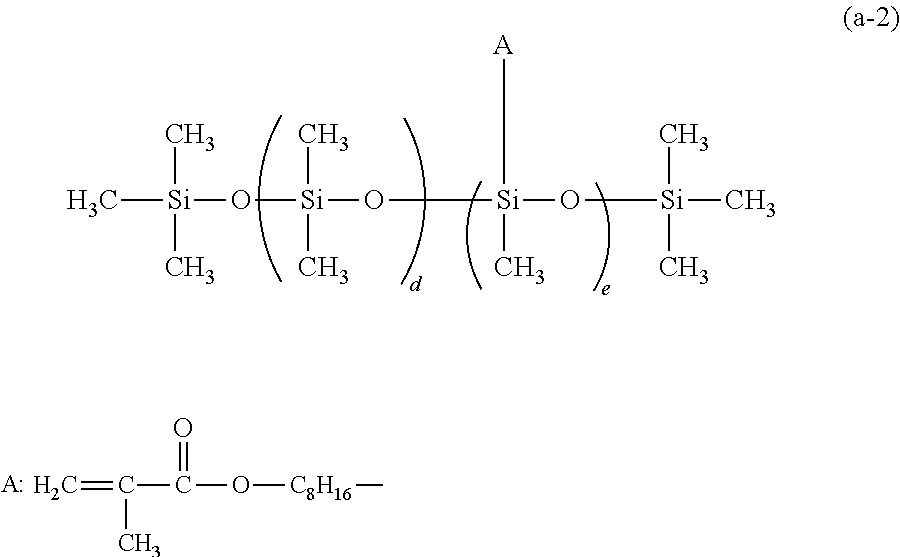
wherein d is 80 on average, and e is 10 on average.


wherein d is 120 on, average, and e is 4 on average.

wherein d is 80 on average, and e is 10 on average.

wherein b is 10 on average.

wherein b is 10 on average, d is 100 on average, and is 6 on average.
-
- Leveling property: The surface condition of the coating was visually inspected.
- G: good;
- M: unevenness observed on a part of the surface;
- B: unevenness observed over the entire surface.
- Defoaming property: The coating surface was visually inspected for the presence or absence of bubbles.
- G: no bubble observed on the surface;
- B: bubble observed on the surface.
- Bleeding property: The coating surface was evaluated by touch feeling.
- G: no sliminess felt on the surface;
- B: sliminess felt on the surface.
| TABLE 1 | |||||||
| Ink A | Ink B | Ink C | Ink D | Ink E | Ink F | ||
| Additive | (a-1) | (a-2) | (a-3) | (r-1) | (r-2) | KF-353 |
| Leveling | G | G | G | B | G | M |
| property | ||||||
| Defoaming | G | G | G | G | B | G |
| property | ||||||
| Bleeding | G | G | G | G | G | B |
| property | ||||||
Claims (15)


Applications Claiming Priority (4)
| Application Number | Priority Date | Filing Date | Title |
|---|---|---|---|
| JP2017064219 | 2017-03-29 | ||
| JP2017-064219 | 2017-03-29 | ||
| JPJP2017-064219 | 2017-03-29 | ||
| PCT/JP2018/013095 WO2018181650A1 (en) | 2017-03-29 | 2018-03-29 | (meth)acrylic modified siloxane compound |
Publications (2)
| Publication Number | Publication Date |
|---|---|
| US20200055990A1 US20200055990A1 (en) | 2020-02-20 |
| US11535716B2 true US11535716B2 (en) | 2022-12-27 |
Family
ID=63677719
Family Applications (1)
| Application Number | Title | Priority Date | Filing Date |
|---|---|---|---|
| US16/498,989 Active 2039-08-08 US11535716B2 (en) | 2017-03-29 | 2018-03-29 | (Meth)acrylic-modified siloxane compound |
Country Status (5)
| Country | Link |
|---|---|
| US (1) | US11535716B2 (en) |
| EP (1) | EP3604393A4 (en) |
| JP (1) | JP6831905B2 (en) |
| CN (1) | CN110446742B (en) |
| WO (1) | WO2018181650A1 (en) |
Families Citing this family (4)
| Publication number | Priority date | Publication date | Assignee | Title |
|---|---|---|---|---|
| EP3604394A4 (en) * | 2017-03-29 | 2020-12-30 | Shin-Etsu Chemical Co., Ltd. | (meth)acrylic modified silicone macromonomer |
| EP4146724A1 (en) * | 2020-05-07 | 2023-03-15 | Dow Silicones Corporation | (meth)acrylate functional silicone and methods for its preparation and use |
| CN111500189B (en) * | 2020-05-22 | 2022-08-16 | 眉山拓利科技有限公司 | UV-cured organic silicon-acrylic acid hybrid system coating |
| CN116057140B (en) * | 2020-09-02 | 2024-03-19 | 毕克化学有限公司 | Improvement of surface properties of radiation-cured coatings |
Citations (11)
| Publication number | Priority date | Publication date | Assignee | Title |
|---|---|---|---|---|
| EP0130731A2 (en) | 1983-06-30 | 1985-01-09 | Loctite Corporation | Methacrylated siloxanes |
| US20060142414A1 (en) | 2002-10-07 | 2006-06-29 | Garlito B.V. | Ink composition |
| JP4154941B2 (en) | 2002-07-23 | 2008-09-24 | コニカミノルタホールディングス株式会社 | Inkjet ink composition and image forming method |
| US20110092660A1 (en) | 2008-01-15 | 2011-04-21 | Tadashi Okawa | Polyorganosiloxane Containing Methacryloxy Group Or Acryloxy Group And Method For Producing The Same |
| WO2012111286A1 (en) * | 2011-02-14 | 2012-08-23 | 株式会社ブリヂストン | Photopolymerizable composition, and wet-area member and functional panel using same |
| US20130303682A1 (en) | 2012-04-09 | 2013-11-14 | Toyo Ink Co., Ltd. | Active energy ray-curable inkjet ink set |
| JP2014210871A (en) | 2013-04-19 | 2014-11-13 | Dic株式会社 | Active energy ray-curable compositions and ink compositions for inkjet recording using the same |
| WO2016002670A1 (en) | 2014-06-30 | 2016-01-07 | 横浜ゴム株式会社 | Ultraviolet-curable resin composition and laminate using same |
| JP2016160280A (en) | 2015-02-26 | 2016-09-05 | 東洋インキScホールディングス株式会社 | Active energy ray curable inkjet ink |
| JP2017065457A (en) * | 2015-09-30 | 2017-04-06 | 三菱マヒンドラ農機株式会社 | Travel vehicle for work |
| US20200010697A1 (en) * | 2017-03-29 | 2020-01-09 | Mitsubishi Chemical Corporation | (meth)acrylic copolymer, method for producing same, resin composition and antifouling paint composition |
Family Cites Families (8)
| Publication number | Priority date | Publication date | Assignee | Title |
|---|---|---|---|---|
| CA1242447A (en) * | 1983-06-30 | 1988-09-27 | Samuel Q.S. Lin | Methacrylated siloxanes |
| CA2322345A1 (en) * | 1999-10-14 | 2001-04-14 | Rohm And Haas Company | Method for preparing ultraviolet radiation-absorbing compositions |
| CN100560592C (en) * | 2006-12-13 | 2009-11-18 | 中国科学院广州化学研究所 | A kind of siliceous (methyl) acrylate monomer and multipolymer thereof and their preparation method |
| DE102008041920A1 (en) * | 2008-09-09 | 2010-03-11 | Evonik Degussa Gmbh | New catalysts for the crosslinking of functional silanes or functional siloxanes, especially with substrates |
| US8246168B2 (en) * | 2008-11-10 | 2012-08-21 | Bausch & Lomb Incorporated | Methacrylate-based bulky side-chain siloxane cross linkers for optical medical devices |
| DE102009047351A1 (en) * | 2009-12-01 | 2011-06-09 | Evonik Goldschmidt Gmbh | Composite silicone membranes with high separation efficiency |
| WO2012051749A1 (en) * | 2010-10-19 | 2012-04-26 | Ablestik (Shanghai) Ltd. | Hybrid silicone composition for light emitting device |
| JP2012211237A (en) * | 2011-03-31 | 2012-11-01 | Asahi Kasei Chemicals Corp | Organopolysiloxane and thermosetting resin composition using the same |
-
2018
- 2018-03-29 WO PCT/JP2018/013095 patent/WO2018181650A1/en not_active Ceased
- 2018-03-29 CN CN201880021860.XA patent/CN110446742B/en active Active
- 2018-03-29 US US16/498,989 patent/US11535716B2/en active Active
- 2018-03-29 EP EP18777865.9A patent/EP3604393A4/en not_active Withdrawn
- 2018-03-29 JP JP2019510092A patent/JP6831905B2/en active Active
Patent Citations (14)
| Publication number | Priority date | Publication date | Assignee | Title |
|---|---|---|---|---|
| EP0130731A2 (en) | 1983-06-30 | 1985-01-09 | Loctite Corporation | Methacrylated siloxanes |
| JP4154941B2 (en) | 2002-07-23 | 2008-09-24 | コニカミノルタホールディングス株式会社 | Inkjet ink composition and image forming method |
| US20060142414A1 (en) | 2002-10-07 | 2006-06-29 | Garlito B.V. | Ink composition |
| JP4801901B2 (en) | 2002-10-07 | 2011-10-26 | ガルリト ベスローテン フェンノートシャップ | Ink composition |
| US20110092660A1 (en) | 2008-01-15 | 2011-04-21 | Tadashi Okawa | Polyorganosiloxane Containing Methacryloxy Group Or Acryloxy Group And Method For Producing The Same |
| JP2012167185A (en) | 2011-02-14 | 2012-09-06 | Bridgestone Corp | Photopolymerizable composition, and wet area member and functional panel using the same |
| WO2012111286A1 (en) * | 2011-02-14 | 2012-08-23 | 株式会社ブリヂストン | Photopolymerizable composition, and wet-area member and functional panel using same |
| US20130303682A1 (en) | 2012-04-09 | 2013-11-14 | Toyo Ink Co., Ltd. | Active energy ray-curable inkjet ink set |
| JP5584868B2 (en) | 2012-04-09 | 2014-09-10 | 東洋インキScホールディングス株式会社 | Active energy ray curable inkjet ink set |
| JP2014210871A (en) | 2013-04-19 | 2014-11-13 | Dic株式会社 | Active energy ray-curable compositions and ink compositions for inkjet recording using the same |
| WO2016002670A1 (en) | 2014-06-30 | 2016-01-07 | 横浜ゴム株式会社 | Ultraviolet-curable resin composition and laminate using same |
| JP2016160280A (en) | 2015-02-26 | 2016-09-05 | 東洋インキScホールディングス株式会社 | Active energy ray curable inkjet ink |
| JP2017065457A (en) * | 2015-09-30 | 2017-04-06 | 三菱マヒンドラ農機株式会社 | Travel vehicle for work |
| US20200010697A1 (en) * | 2017-03-29 | 2020-01-09 | Mitsubishi Chemical Corporation | (meth)acrylic copolymer, method for producing same, resin composition and antifouling paint composition |
Non-Patent Citations (3)
| Title |
|---|
| Extended European Search Report, dated Nov. 27, 2020, for European Application No. 18777865.9. |
| International Search Report (PCT/ISA/210) issued in PCT/JP2018/013095, dated Jun. 19, 2018. |
| Written Opinion (PCT/ISA/237) issued in PCT/JP2018/013095, dated Jun. 19, 2018. |
Also Published As
| Publication number | Publication date |
|---|---|
| CN110446742A (en) | 2019-11-12 |
| CN110446742B (en) | 2022-03-22 |
| US20200055990A1 (en) | 2020-02-20 |
| JP6831905B2 (en) | 2021-02-17 |
| EP3604393A4 (en) | 2020-12-30 |
| JPWO2018181650A1 (en) | 2020-05-21 |
| WO2018181650A1 (en) | 2018-10-04 |
| EP3604393A1 (en) | 2020-02-05 |
Similar Documents
| Publication | Publication Date | Title |
|---|---|---|
| US11827799B2 (en) | Ultraviolet curable silicone composition and cured product of same | |
| KR102385524B1 (en) | Fluorine-containing acryl composition and method for preparing the same, activation energy radiation-curable fluorine-containing composition, and article | |
| EP1170320B1 (en) | Curable fluoropolyether base rubber compositions | |
| EP1595909B1 (en) | Use of novel polysiloxanes, containing over SiOC-group bonded (meth)acrylic ester groups, as additives for radiation-curable coatings | |
| EP2112189A1 (en) | (Meth)acrylic-modified siloxane compounds | |
| US20200055990A1 (en) | (meth)acrylic-modified siloxane compound | |
| KR20150113882A (en) | Fluorine-containing acryl compound and method for making the same, curable composition, and substrate | |
| JP2020186284A (en) | Radiation-curable organopolysiloxane composition and release sheet | |
| RU2414480C2 (en) | Anti-frictional and levelling additive | |
| CN107849173B (en) | Fluorine-containing compound, curable composition and cured product | |
| KR20240168280A (en) | Fluorine-containing curable composition and article | |
| KR20240135001A (en) | Perfluoropolyether-organopolysiloxane block copolymer | |
| JP7576299B2 (en) | Polyglycerin-based alkoxysilane | |
| US20210107926A1 (en) | (meth)acrylic-modified silicone macromonomer | |
| JP5527433B2 (en) | Method for producing reactive polysiloxane solution | |
| TWI868296B (en) | Polyalkylene glycol mono (meth) acrylate and plymer thereof, and film composition | |
| JP7738881B2 (en) | Coating composition containing (poly)glycerin-based monomer | |
| JP2020152894A (en) | Curable composition and cured product | |
| KR20240121289A (en) | Fluorine-containing active energy ray curable composition, cured product and article | |
| WO2022065019A1 (en) | Ultraviolet curable silicone composition and cured product | |
| TWI917636B (en) | Glass component | |
| JP2022075082A (en) | Photocurable resin composition | |
| CN119948120A (en) | Fluoropolymer composition for coating | |
| JPH11189651A (en) | Production of curable resin |
Legal Events
| Date | Code | Title | Description |
|---|---|---|---|
| AS | Assignment |
Owner name: SHIN-ETSU CHEMICAL CO., LTD., JAPAN Free format text: ASSIGNMENT OF ASSIGNORS INTEREST;ASSIGNOR:GOTO, TOMOYUKI;REEL/FRAME:050525/0717 Effective date: 20190905 |
|
| FEPP | Fee payment procedure |
Free format text: ENTITY STATUS SET TO UNDISCOUNTED (ORIGINAL EVENT CODE: BIG.); ENTITY STATUS OF PATENT OWNER: LARGE ENTITY |
|
| STPP | Information on status: patent application and granting procedure in general |
Free format text: DOCKETED NEW CASE - READY FOR EXAMINATION |
|
| STPP | Information on status: patent application and granting procedure in general |
Free format text: NON FINAL ACTION MAILED |
|
| STPP | Information on status: patent application and granting procedure in general |
Free format text: RESPONSE TO NON-FINAL OFFICE ACTION ENTERED AND FORWARDED TO EXAMINER |
|
| STPP | Information on status: patent application and granting procedure in general |
Free format text: NON FINAL ACTION MAILED |
|
| STPP | Information on status: patent application and granting procedure in general |
Free format text: RESPONSE TO NON-FINAL OFFICE ACTION ENTERED AND FORWARDED TO EXAMINER |
|
| STPP | Information on status: patent application and granting procedure in general |
Free format text: NOTICE OF ALLOWANCE MAILED -- APPLICATION RECEIVED IN OFFICE OF PUBLICATIONS |
|
| STPP | Information on status: patent application and granting procedure in general |
Free format text: PUBLICATIONS -- ISSUE FEE PAYMENT VERIFIED |
|
| STCF | Information on status: patent grant |
Free format text: PATENTED CASE |