US11528854B2 - Adjusting a sod harvester's stacking position to form vertically aligned stacks - Google Patents
Adjusting a sod harvester's stacking position to form vertically aligned stacks Download PDFInfo
- Publication number
- US11528854B2 US11528854B2 US17/177,619 US202117177619A US11528854B2 US 11528854 B2 US11528854 B2 US 11528854B2 US 202117177619 A US202117177619 A US 202117177619A US 11528854 B2 US11528854 B2 US 11528854B2
- Authority
- US
- United States
- Prior art keywords
- stacking
- pallet
- sod
- orientation
- harvester
- Prior art date
- Legal status (The legal status is an assumption and is not a legal conclusion. Google has not performed a legal analysis and makes no representation as to the accuracy of the status listed.)
- Active, expires
Links
Images






Classifications
-
- A—HUMAN NECESSITIES
- A01—AGRICULTURE; FORESTRY; ANIMAL HUSBANDRY; HUNTING; TRAPPING; FISHING
- A01G—HORTICULTURE; CULTIVATION OF VEGETABLES, FLOWERS, RICE, FRUIT, VINES, HOPS OR SEAWEED; FORESTRY; WATERING
- A01G20/00—Cultivation of turf, lawn or the like; Apparatus or methods therefor
- A01G20/10—Pre-cultivated sod or turf; Apparatus therefor
- A01G20/12—Apparatus for cutting sods or turfs
- A01G20/15—Apparatus for cutting sods or turfs specially adapted for stacking sods or sod rolls
-
- B—PERFORMING OPERATIONS; TRANSPORTING
- B65—CONVEYING; PACKING; STORING; HANDLING THIN OR FILAMENTARY MATERIAL
- B65G—TRANSPORT OR STORAGE DEVICES, e.g. CONVEYORS FOR LOADING OR TIPPING, SHOP CONVEYOR SYSTEMS OR PNEUMATIC TUBE CONVEYORS
- B65G61/00—Use of pick-up or transfer devices or of manipulators for stacking or de-stacking articles not otherwise provided for
-
- B—PERFORMING OPERATIONS; TRANSPORTING
- B65—CONVEYING; PACKING; STORING; HANDLING THIN OR FILAMENTARY MATERIAL
- B65G—TRANSPORT OR STORAGE DEVICES, e.g. CONVEYORS FOR LOADING OR TIPPING, SHOP CONVEYOR SYSTEMS OR PNEUMATIC TUBE CONVEYORS
- B65G2203/00—Indexing code relating to control or detection of the articles or the load carriers during conveying
- B65G2203/02—Control or detection
- B65G2203/0208—Control or detection relating to the transported articles
- B65G2203/0225—Orientation of the article
-
- B—PERFORMING OPERATIONS; TRANSPORTING
- B65—CONVEYING; PACKING; STORING; HANDLING THIN OR FILAMENTARY MATERIAL
- B65G—TRANSPORT OR STORAGE DEVICES, e.g. CONVEYORS FOR LOADING OR TIPPING, SHOP CONVEYOR SYSTEMS OR PNEUMATIC TUBE CONVEYORS
- B65G2203/00—Indexing code relating to control or detection of the articles or the load carriers during conveying
- B65G2203/02—Control or detection
- B65G2203/0208—Control or detection relating to the transported articles
- B65G2203/0258—Weight of the article
Definitions
- Turf grass is a living organism that must be handled properly to ensure its survival when it is removed from one location and transplanted to another. Sod is generally harvested using large machinery such as sod harvester 100 shown in FIG. 1 and sod harvester 200 shown in FIG. 2 .
- Sod harvesters 100 and 200 are both in the form of a tractor and include a cutting head 101 , 201 that cuts slabs of sod from the ground, inclined conveyor(s) 102 , 202 that elevate the slabs from the ground towards a stacking conveyor 103 , 203 , a stacking head 105 , 205 that is mounted to a support mechanism 104 , 204 , and a pallet dispenser 106 , 206 that is positioned adjacent a pallet support (not visible) on which stacking head 105 , 205 stacks slabs that it has removed from stacking conveyor 103 , 203 .
- slab harvesters such as sod harvester 100
- roll harvesters such as sod harvester 200
- a roll harvester forms the slabs of sod into rolls (e.g., utilizing a roll forming mechanism 207 ) which are then accumulated on the stacking conveyor for pick up.
- a slab harvester on the other hand, directly stacks the slabs in their flat form.
- the harvester With both slab and roll harvesters, the harvester supports a pallet on which the sod is stacked. Once the stack has been completed, the harvester will place the stacked pallet on the ground where it will typically be retrieved by a forklift and transferred to a trailer or truck bed for transport to the customer's premises. If the sod is not stacked properly on the pallet, the stack may tip over or otherwise create difficulties during transport.
- the present invention extends to techniques for adjusting a sod harvester's stacking position to form vertically aligned stacks. More particularly, a sod harvester's control system can be configured to automatically adjust the stacking position as a stack is being formed based on a sensed orientation of the pallet. In this way, the control system can ensure that a slab of sod that is dropped from the stacking head will fall into the intended location on the stack regardless of the orientation of the pallet relative to the stacking head.
- the present invention may be implemented as a method for adjusting a sod harvester's stacking position to form vertically aligned stacks.
- a stacking head a sod harvester can be positioned at a stacking position while stacking sod on a pallet that is supported by the sod harvester. While stacking sod on the pallet, an orientation of the pallet can be sensed. In response to sensing that the orientation of the pallet has changed, the stacking head can be positioned at an adjusted stacking position while stacking sod on the pallet.
- the present invention may be implemented as a control system of a sod harvester that is configured to adjust the sod harvester's stacking position to form vertically aligned stacks.
- the control system can continuously sense an orientation of a pallet on which a stacking head of the sod harvester is stacking sod. Based on the sensing, the control system can calculate an adjusted stacking position. The control system can then cause the stacking head to be positioned at the adjusted stacking position when stacking sod on the pallet to thereby cause a vertically aligned stack to be formed on the pallet.
- the present invention may be implemented as a sod harvester that includes: a cutting head for removing sod from the ground; one or more inclined conveyors for conveying the sod from the cutting head to a stacking conveyor; the stacking conveyor; a stacking head for removing the sod from the stacking conveyor and stacking the sod on a pallet; and a control system that detects an orientation of the pallet while the stacking head stacks the sod on the pallet and adjusts a stacking position of the stacking head based on the orientation of the pallet.
- FIG. 1 illustrates a prior art sod harvester that harvests sod in slabs
- FIG. 2 illustrates a prior art sod harvester that harvest sod in rolls
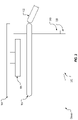
- FIG. 3 provides an example of various components that a sod harvester may include to enable sod to be stacked on a pallet using a stacking head
- FIGS. 3 A and 3 B provide an example of how the components of FIG. 3 operate to stack sod
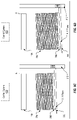
- FIGS. 4 A- 4 E provide an example of how a vertically misaligned stack may be formed due to an increasing deflection of a pallet support from the horizontal due to the increasing weight of the pallet;
- FIG. 4 F represents that the same vertical misalignment can occur when stacking rolls of sod
- FIGS. 5 A- 5 D provide an example of how a vertically misaligned stack may be formed due to the sod harvester travelling over a sloped area;
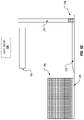
- FIGS. 6 A- 6 E provide an example of how a control system of a sod harvester can dynamically adjust the stacking position of the stacking head while stacking sod on a pallet based on a changing horizontal orientation of the pallet caused by the increasing weight of the stacked sod;
- FIGS. 7 A- 7 D provide an example of how a control system of a sod harvester can dynamically adjust the stacking position of the stacking head while the sod harvester is travelling over a sloped area;
- FIG. 8 is a flowchart of an example method for adjusting a sod harvester's stacking position to form vertically aligned stacks.
- the term “sod harvester” should be construed as machinery that is configured to receive and stack sod that has been cut from the ground. This machinery could be in the form of a vehicle, such as a tractor, or in the form of a trailer that is pulled by another vehicle.
- the sod harvester may stack the sod as slabs or rolls.
- the term “control system” should encompass any combination of hardware and/or software.
- a control system may include hardware- and/or software-based circuitry such as, but not limited to, a central processing unit, a microprocessor, a microcontroller, a field programming gate array, an application-specific integrated circuit, a system on a chip, etc.
- the “x, y plane” of a sod harvester can represent the plane that extends from front to back and from side to side of the sod harvester. Therefore, when the sod harvester is on flat ground, the x, y plane would be horizontal.
- FIG. 3 provides a simplified side view of various components of sod harvester 100 that are employed to stack sod on a pallet.
- Sod harvester 200 may include similar components. These components include inclined conveyor 102 , stacking conveyor 103 , support mechanism 104 and stacking head 105 as introduced in the background along with a pallet support assembly that includes a pallet support 330 (which may in the form of forks), a vertical channel 310 and a travelling mechanism 320 that couples pallet support 330 to vertical channel 310 . Travelling mechanism 320 can be moved vertically within vertical channel 310 to cause pallet support 330 to initially be positioned towards stacking head 105 and to be incrementally lowered to accommodate additional layers of sod. In such cases, stacking head 105 may not descend to place the sod on pallet 390 but may drop it from some distance above pallet 390 .
- a pallet support assembly that includes a pallet support 330 (which may in the form of forks), a vertical channel 310 and a travelling mechanism 320 that couples pallet support 330 to vertical channel
- FIGS. 3 A and 3 B provide an example of how pallet support 330 can be moved downwardly as sod 395 is stacked on a pallet 390 that it supports.
- a stack is beginning to be formed on pallet 390 .
- pallet support 330 is positioned upwardly towards stacking head 105 .
- the sod harvester may be configured with temporary pallet supports that support the pallet initially while sod is being stacked thereon and while pallet support 330 lowers the completed pallet to the ground. In such cases, one or more layers of sod may already be stacked on pallet 390 before pallet support 330 is raised up to support pallet 390 .
- travelling mechanism 320 could be driven to incrementally lower pallet 390 to await the next layer. This process can be repeated until a complete stack is formed. Once a complete stack is formed, travelling mechanism 320 can be driven to lower pallet support 330 to the ground as represented in FIG. 3 B . A push arm (not shown) can then be advanced to push pallet 390 off pallet support 330 and onto the ground. Although not shown, during this process, sod may continue to be stacked on a pallet that is supported by temporary pallet supports. Once pallet 390 has been removed from pallet support 330 , travelling mechanism 320 can be driven to lift pallet support 330 upwardly to support the next pallet, and the process can be repeated.
- stacking head 105 when stacking head 105 picks up sod from stacking conveyor 103 , it could travel overtop pallet 390 and drop the sod onto the stack.
- the position that stacking head 105 is in when it drops the sod (or otherwise causes the sod to be released onto pallet 390 ) will be referred to as the stacking position.
- the stacking position correlates with the shape and position of pallet 390 .
- each layer includes two slabs of sod with each layer being rotated 90 degrees relative to the previous layer.
- stacking head 105 stacks a single slab of sod at a time. Accordingly, in this example, the stacking head may have four different stacking positions—one for each possible orientation of a slab of sod.
- a sod harvester's control system can be configured to move stacking head 105 to stacking positions that are directly above the respective location on pallet 390 . These stacking positions could be considered default stacking positions.
- a vertically aligned stack should be formed as represented in FIG. 3 B .
- each slab of sod should be dropped directly on top of any slab that has the same orientation in the stack. In practice, however, this oftentimes is not the case.
- FIGS. 4 A- 4 E and 5 A- 5 D represent two scenarios that can cause the stack to be vertically misaligned.
- FIGS. 4 A- 4 E are based on FIGS. 3 A and 3 B but show that pallet support 330 may deflect downwardly as sod 395 is stacked on pallet 390 due to the weight of sod 395 .
- FIG. 4 A only three layers of sod have been stacked on pallet 390 and the weight is insufficient to deflect pallet support 330 from the x, y plane.
- pallet support 330 When pallet support 330 is not deflected, it will be substantially parallel with stacking head 105 . For example, assuming the sod harvester is on flat ground, both stacking head 105 and pallet support 330 will be aligned with the horizontal. Therefore, as stacking head 105 drops sod and the sod falls straight down onto pallet 390 , the stack will remain vertically aligned.
- FIG. 4 B nine layers of sod have been stacked which has caused pallet support 330 to deflect downwardly from the x, y plane. Because the front end of pallet support 330 is supported by vertical channel 310 , the rear end of pallet support 330 deflects downwardly thereby causing pallet support 330 and pallet 390 to be angled toward the rear.
- stacking head 105 remains aligned with the x, y plane, and as a result, pallet support 330 is no longer directly below stacking head 105 . In other words, the stacking positions of the stacking head will no longer align with the intended locations on the pallet.
- FIGS. 4 C and 4 D represent the vertical misalignment that is created in the stack as additional sod is stacked while pallet support 330 is deflected from the x, y plane.
- pallet support 330 As the rear end of pallet support 330 is deflected downwardly, it causes the rear side of pallet 390 to pivot downwardly which, in essence, causes the stack, and particularly the top of the stack, to shift rearwardly relative to stacking head 105 . Therefore, as additional slabs are dropped onto the stack from the static stacking positions, they will be positioned frontwardly of the previously stacked slabs. Although this frontward shift may be small between each additional layer, the end result is a frontward leaning stack as represented in FIG. 4 E .
- the sod is heavy, such as may be the case when harvesting sod after a rainstorm or irrigation, the deflection of pallet support 330 may be sufficient to compromise the integrity of the stack.
- FIGS. 5 A- 5 D provide a rear view of the components shown in FIG. 3 and represent how a vertically misaligned stack may be formed when the sod harvester is travelling over a sloped area (e.g., when harvesting sod on a hill). In such cases, the x, y plane of the sod harvester will not be aligned with the horizontal.
- FIG. 5 A it is assumed that the sod harvester has not yet reached the sloped area and therefore pallet support 330 and stacking head 105 remain parallel with the horizontal.
- FIG. 5 B the sod harvester has reached an area that slopes downwardly to the left. As a result, both pallet support 330 and stacking head 105 are angled downwardly to the left. Although pallet support 330 and stacking head 105 may remain parallel, sod dropped from stacking head 105 will fall straight down and land to the left of slabs that were stacked prior to the sod harvester reaching the sloped area.
- FIG. 5 C it is assumed that the sod harvester has travelled into an area that slopes downwardly to the right. At this point, the slabs will fall straight down and land to the right of the previously stacked slabs.
- FIG. 5 D then represents the completed stack. As shown, there is a section of layers that are offset to the left and a section of layers that are offset to the right corresponding to the times when the sod harvester was harvesting on the leftward and rightward sloped areas respectively.
- This vertical misalignment can occur whenever the sod harvester harvests a sloped area including when going downhill or uphill.
- the sod when going downhill, the sod may be forwardly offset, whereas when going uphill, the sod may be rearwardly offset.
- the sod even if the entire pallet is stacked when harvesting on the same sloped area, the sod itself may be vertically aligned but it would be offset relative to the pallet (e.g., the sod may be hanging over an edge of the pallet).
- this vertical misalignment from harvesting on a sloped area may occur in conjunction with the vertical misalignment that occurs when pallet support 330 deflects from the x, y plane of the sod harvester.
- a sod harvester can include a control system that is configured to dynamically adjust the stacking position of the stacking head to prevent the stack from becoming vertically misaligned.
- the control system can employ one or more sensors to detect when the orientation of the pallet has changed (e.g., when the pallet support is deflected from the x, y plane) and in response can adjust the stacking position of the stacking head to ensure that sod is stacked in vertical alignment.
- the control system can employ one or more sensors to detect when the sod harvester is travelling over a sloped area (which again would cause the orientation of the pallet to change) and in response can adjust the stacking position of the stacking head to ensure that sod is stacked in vertical alignment.
- FIGS. 6 A- 6 E provide an example of how a control system 600 of a sod harvester (e.g., sod harvester 100 or 200 ) can employ a sensor (or multiple sensors) 610 to detect when pallet support 330 is deflected from the x, y plane and in response can adjust the stacking position of stacking head 105 .
- Sensor 610 can represent any of variety of sensors that could be used and is drawn in dashed lines to represent that it/they may be positioned at various locations on the sod harvester's stacking components.
- sensor 610 could measure a load (or weight) on pallet support 330 , an angle of sensor support 330 relative to vertical channel 310 (e.g., whether and to what extent the angle is greater than 90 degrees), a position of the rear end (or rear portion) of pallet support 330 relative to travelling mechanism 320 , etc.
- control system 600 can calculate the amount of deflection from the x,y plane based on the currently measured weight.
- Control system 600 could receive signals from sensor 610 during the stacking process and use such signals to determine whether deflection is occurring and the extent of deflection for purposes of determining an “adjusted stacking position.”
- An adjusted stacking position should be construed as a stacking position that control system 600 dynamically determines based on a current orientation of the pallet such as, for example, when the pallet is angled rearwardly due to deflection of pallet support 330 .
- control system 600 could receive signals defining the current load from sensor 610 and use the current load to select an adjustment to apply to the stacking position(s) of the stacking head (e.g., using a mapping table that maps loads to stacking position offsets). In such cases, control system 600 could apply such adjustments or offsets to “default stacking position(s)” that would otherwise be used if pallet support 330 was not deflected.
- control system 600 can cause stacking head 105 to be moved to the default stacking positions when stacking sod on pallet 390 .
- stacking head 105 is shown as having the same width as pallet 390 and therefore aligns with pallet 390 when in the depicted default stacking position, but this need not be the case.
- FIG. 6 B the additional layers of sod on pallet 390 have caused the rear end of pallet support 330 to deflect downwardly from the x, y plane.
- Sensor 610 can detect this deflection in any suitable manner and report it to control system 600 .
- Control system 600 can respond by causing stacking head 105 to be moved to adjusted stacking positions.
- the depicted adjusted stacking position is shifted rearwardly within the x, y plane by an offset (A) relative to the default stacking position depicted in FIG. 6 A .
- This offset accounts for the fact that the deflection of pallet support 330 causes the front, top edge of the stack to be shifted rearwardly.
- the sod will fall directly on top of the topmost layer as opposed to falling slightly frontward of the topmost layer.
- the other three stacking positions are not shown in the figures, a similar rearward offset could be applied to ensure that all slabs in the layers are shifted appropriately to account for the deflection.
- FIG. 6 C and as additional layers are stacked on pallet 390 thereby causing the rear end of pallet support 330 to deflect farther, sensor 610 can continue to report the deflection to control system 600 which in turn can continue to adjust the stacking positions.
- control system 600 can increase the offset ( ⁇ ) to account for the increased deflection and increased rearward pivoting of the top of the stack.
- FIG. 6 D likewise shows this continued adjustment to the stacking position.
- FIG. 6 E once the stack is complete and pallet 390 is lowered to the ground, the stack will be vertically aligned due to the continuous adjustment in the stacking position.
- FIGS. 7 A- 7 D provide an example of how control system 600 can employ a sensor (or multiple sensors) 611 to detect when the sod harvester is travelling over a sloped area and in response can adjust the stacking position of stacking head 105 .
- sensor 611 is shown as being located on stacking head 105 .
- any number of sensors 611 could be located anywhere on the sod harvester where they will be able to detect when the sod harvester is on sloped ground (i.e., to detect when the x, y plane deviates from the horizontal).
- sensor 611 could represent an accelerometer.
- sensor 611 could represent a GPS component that can detect the location of the sod harvester and use known slope information for the area where the sod harvester is operating to determine when the sod harvester is travelling over sloped ground.
- This sloped scenario differs from the deflected pallet support scenario in that the entire sod harvester—including stacking head 105 —will deviate from the horizontal when harvesting in a sloped area as opposed to only pallet support 330 deviating from the x, y plane.
- a similar technique of adjusting the stacking position can be employed in the sloped scenario to ensure that vertically aligned stacks are formed except that the direction of the adjustment is opposite the direction used in the deflected pallet support scenario.
- FIG. 7 A it is assumed that the sod harvester travels on flat ground while stacking the first eight layers of the stack.
- stacking head 105 aligns with pallet 390 when in the default stacking position as represented by the dashed line. Accordingly, when on flat ground and when stacking head 105 is in the default stacking position, sod 395 will fall straight down onto the intended location on pallet 390 .
- FIG. 7 B it is assumed that the sod harvester travels into a leftwardly sloped area. As a result, both stacking head 105 and pallet support 330 (and therefore the partially formed stack) pivot towards the left.
- stacking head 105 is still shown in the default stacking position which aligns with pallet 390 .
- the line of alignment is no longer vertical. Therefore, as described in FIGS. 5 A- 5 D , if additional sod 395 is dropped from the default stacking position and falls straight down due to gravity, it will not land in the intended location on the stack. To the contrary, it will be shifted to the left (i.e., shifted downhill of any layers that were stacked while the sod harvester was on flat ground).
- control system 600 can receive signals from sensor 611 to detect when and in which direction the sod harvester's x, y plane deviates from the horizontal. In response to detecting that the sod harvester's x, y plane is deviated from the horizontal, control system 600 can determine an adjusted stacking position to be used. Turning to FIG. 7 C , it is assumed that control system 600 determines the adjusted stacking position by applying an offset (A) to the default stacking position. For example, control system 600 could maintain mappings between deviations and offsets. In effect, using an adjusted stacking position causes stacking head 105 to be shifted uphill so that, when sod 395 falls directly downward as represented by the arrow in FIG. 7 C , it will land in the intended location on the stack as represented in FIG. 7 D .
- offset offset
- Control system 600 could perform this technique to detect and account for vertical misalignment that would otherwise occur whenever the sod harvester is harvesting on a sloped area regardless of the direction of the slope. For example, if control system 600 determines that the sod harvester is harvesting while travelling downhill, it could apply an appropriate offset to the default stacking position to cause the resulting adjusted stacking position to be rearward (or uphill) from the default stacking position. Likewise, if control system 600 determines that the sod harvester is harvesting uphill while also being sloped downward to the right (i.e., when not travelling directly up the hill), it could apply an appropriate offset to the default stacking position to cause the resulting adjusted stacking position to be frontward and to the left. In more technical terms, the offset could be in both the x and y directions to offset any deviation from the horizontal in the x, y plane.
- control system 600 could simultaneously make adjustments to account for the deflection.
- control system 600 could calculate what the offset should be to account for the slope and separately calculate what the offset should be to account for deflection of pallet support 330 and then sum the offsets together to determine how far and in which direction(s) the stacking position should be shifted.
- the adjusted stacking position could be determined by incrementing or decrementing the x and/or y by the calculated offset that control system 600 determines based on the signals received from sensor 610 and/or sensor 611 .
- FIG. 8 provides a flowchart of an example method 800 for adjusting a sod harvester's stacking position to form vertically aligned stacks.
- Method 800 could be performed by control system 600 of any suitable sod harvester and to account for a variety of scenarios that may otherwise cause a stack to be vertically misaligned.
- Method 800 includes an act 801 of positioning a stacking head of a sod harvester at a stacking position while stacking sod on a pallet that is supported by the sod harvester.
- control system 600 could cause stacking head 105 to be positioned in a default stacking position or a previous adjusted stacking position while stacking sod 395 on pallet 390 that is supported by pallet support 330 .
- Method 800 includes an act 802 of sensing an orientation of the pallet while stacking sod on the pallet.
- control system 600 could receive signals from sensor(s) 610 representing whether pallet support 330 is deflected.
- control system 600 could receive signals from sensor(s) 611 representing whether the sod harvester is travelling over a sloped area.
- Method 800 includes an act 803 of, in response to sensing that the orientation of the pallet has changed, positioning the stacking head at an adjusted stacking position while stacking sod on the pallet. For example, in response to detecting that a deflection of pallet support 330 has changed or that the slope of the ground over which the sod harvester is travelling has changed, control system 600 can cause stacking head 105 to be positioned at one or more adjusted stacking positions. Control system 600 may calculate the one or more stacking positions based on the detected deflection of pallet support 300 and/or the detected slope of the ground over which the sod harvester is travelling.
Landscapes
- Life Sciences & Earth Sciences (AREA)
- Environmental Sciences (AREA)
- Stacking Of Articles And Auxiliary Devices (AREA)
- Harvesting Machines For Root Crops (AREA)
- Agricultural Machines (AREA)
Abstract
Description
Claims (17)
Priority Applications (5)
| Application Number | Priority Date | Filing Date | Title |
|---|---|---|---|
| US17/177,619 US11528854B2 (en) | 2021-02-17 | 2021-02-17 | Adjusting a sod harvester's stacking position to form vertically aligned stacks |
| CA3178721A CA3178721C (en) | 2021-02-17 | 2022-02-11 | Adjusting a sod harvester's stacking position to form vertically aligned stacks |
| PCT/US2022/016158 WO2022177826A1 (en) | 2021-02-17 | 2022-02-11 | Adjusting a sod harvester's stacking position to form vertically aligned stacks |
| EP22756738.5A EP4145984A4 (en) | 2021-02-17 | 2022-02-11 | ADJUSTING THE STACKING POSITION OF A TURF HARVESTING MACHINE TO FORM VERTICALLY ALIGNED STACKS |
| AU2022223401A AU2022223401B2 (en) | 2021-02-17 | 2022-02-11 | Adjusting a sod harvester's stacking position to form vertically aligned stacks |
Applications Claiming Priority (1)
| Application Number | Priority Date | Filing Date | Title |
|---|---|---|---|
| US17/177,619 US11528854B2 (en) | 2021-02-17 | 2021-02-17 | Adjusting a sod harvester's stacking position to form vertically aligned stacks |
Publications (2)
| Publication Number | Publication Date |
|---|---|
| US20220256783A1 US20220256783A1 (en) | 2022-08-18 |
| US11528854B2 true US11528854B2 (en) | 2022-12-20 |
Family
ID=82801608
Family Applications (1)
| Application Number | Title | Priority Date | Filing Date |
|---|---|---|---|
| US17/177,619 Active 2041-02-25 US11528854B2 (en) | 2021-02-17 | 2021-02-17 | Adjusting a sod harvester's stacking position to form vertically aligned stacks |
Country Status (5)
| Country | Link |
|---|---|
| US (1) | US11528854B2 (en) |
| EP (1) | EP4145984A4 (en) |
| AU (1) | AU2022223401B2 (en) |
| CA (1) | CA3178721C (en) |
| WO (1) | WO2022177826A1 (en) |
Families Citing this family (1)
| Publication number | Priority date | Publication date | Assignee | Title |
|---|---|---|---|---|
| NL2033646B1 (en) * | 2022-11-30 | 2024-06-04 | Van Vuuren Machines B V | Slab harvester |
Citations (3)
| Publication number | Priority date | Publication date | Assignee | Title |
|---|---|---|---|---|
| US5812409A (en) * | 1996-08-23 | 1998-09-22 | Advantest Corporation | Semiconductor device transport system with deformed tray compensation |
| US9022720B2 (en) * | 2012-04-02 | 2015-05-05 | Firefly Equipment, Llc | Electrically operated turf stacking system for sod harvesting machine |
| US10155632B2 (en) * | 2014-06-12 | 2018-12-18 | Firefly Automatix, Inc. | Removing sod from a stacking conveyor |
Family Cites Families (2)
| Publication number | Priority date | Publication date | Assignee | Title |
|---|---|---|---|---|
| US20060102363A1 (en) * | 2004-11-15 | 2006-05-18 | Michael Tvetene | Sod handler |
| US9894824B2 (en) * | 2015-07-31 | 2018-02-20 | Firefly Automatix, Inc. | Sod harvester having preliminary stacking head |
-
2021
- 2021-02-17 US US17/177,619 patent/US11528854B2/en active Active
-
2022
- 2022-02-11 CA CA3178721A patent/CA3178721C/en active Active
- 2022-02-11 EP EP22756738.5A patent/EP4145984A4/en not_active Withdrawn
- 2022-02-11 WO PCT/US2022/016158 patent/WO2022177826A1/en not_active Ceased
- 2022-02-11 AU AU2022223401A patent/AU2022223401B2/en active Active
Patent Citations (3)
| Publication number | Priority date | Publication date | Assignee | Title |
|---|---|---|---|---|
| US5812409A (en) * | 1996-08-23 | 1998-09-22 | Advantest Corporation | Semiconductor device transport system with deformed tray compensation |
| US9022720B2 (en) * | 2012-04-02 | 2015-05-05 | Firefly Equipment, Llc | Electrically operated turf stacking system for sod harvesting machine |
| US10155632B2 (en) * | 2014-06-12 | 2018-12-18 | Firefly Automatix, Inc. | Removing sod from a stacking conveyor |
Also Published As
| Publication number | Publication date |
|---|---|
| EP4145984A4 (en) | 2024-05-15 |
| AU2022223401B2 (en) | 2023-01-19 |
| US20220256783A1 (en) | 2022-08-18 |
| CA3178721C (en) | 2023-03-14 |
| WO2022177826A1 (en) | 2022-08-25 |
| EP4145984A1 (en) | 2023-03-15 |
| AU2022223401A1 (en) | 2022-12-15 |
| CA3178721A1 (en) | 2022-08-25 |
Similar Documents
| Publication | Publication Date | Title |
|---|---|---|
| AU2020203384B2 (en) | Harvester stability monitoring and control | |
| US7992369B2 (en) | Agricultural harvester and header height control system | |
| AU2015234578B2 (en) | Controlling cutting height and angle of a combine header | |
| US10701854B2 (en) | Agricultural implement with row unit leveling system | |
| CA3178721C (en) | Adjusting a sod harvester's stacking position to form vertically aligned stacks | |
| US20180338423A1 (en) | Structural set for assembly of a header and harvesting machine | |
| US10267820B2 (en) | Apparatus, systems and methods for cross track error calculation from active sensors | |
| US20100212276A1 (en) | Automatic lateral tilt control of a header in stubble height mode using machine level sensor | |
| NL7905031A (en) | DEVICE FOR AUTOMATICALLY CONTROLLING THE OPERATING POSITION OF A RECEIVER OF A HARVESTING MACHINE. | |
| DK2769613T3 (en) | CONTROL DEVICE FOR CONTROL OF AN AUTUMN MACHINE, AND THE AUTUMN MACHINE WITH SUCH A CONTROL DEVICE | |
| US9078390B2 (en) | Conveyor system for controlling spacing between sod slabs | |
| JP2018201373A (en) | Transplanter | |
| CA3135602C (en) | Forming a sod roll | |
| JP2019004776A (en) | Seedling transplanter | |
| US9894824B2 (en) | Sod harvester having preliminary stacking head | |
| CA2596924A1 (en) | Method and apparatus for harvesting and picking up sod | |
| US20050074311A1 (en) | Large bale handler | |
| EP0023369A1 (en) | Tuber, bulb and root lifter | |
| US20220279709A1 (en) | Tractor-Assisted Multi-Row Harvester for Root Vegetables | |
| JP7711691B2 (en) | seedling transplanter | |
| AU6557701A (en) | Combine harvesters | |
| JPH08242641A (en) | Root crop harvester | |
| JPS6211383Y2 (en) | ||
| AU2006324387A1 (en) | Turf guide for automatic turf harvesters | |
| ITVR20010112A1 (en) | VEGETABLE HARVESTING EQUIPMENT |
Legal Events
| Date | Code | Title | Description |
|---|---|---|---|
| AS | Assignment |
Owner name: FIREFLY AUTOMATIX, INC., UTAH Free format text: ASSIGNMENT OF ASSIGNORS INTEREST;ASSIGNORS:APOSHIAN, STEVEN R;ASTON, ERIC E;DECKER, WILLIAM M;AND OTHERS;SIGNING DATES FROM 20210203 TO 20210213;REEL/FRAME:055295/0777 |
|
| FEPP | Fee payment procedure |
Free format text: ENTITY STATUS SET TO UNDISCOUNTED (ORIGINAL EVENT CODE: BIG.); ENTITY STATUS OF PATENT OWNER: SMALL ENTITY |
|
| FEPP | Fee payment procedure |
Free format text: ENTITY STATUS SET TO SMALL (ORIGINAL EVENT CODE: SMAL); ENTITY STATUS OF PATENT OWNER: SMALL ENTITY |
|
| STPP | Information on status: patent application and granting procedure in general |
Free format text: NON FINAL ACTION MAILED |
|
| STPP | Information on status: patent application and granting procedure in general |
Free format text: RESPONSE TO NON-FINAL OFFICE ACTION ENTERED AND FORWARDED TO EXAMINER |
|
| STPP | Information on status: patent application and granting procedure in general |
Free format text: PUBLICATIONS -- ISSUE FEE PAYMENT VERIFIED |
|
| STCF | Information on status: patent grant |
Free format text: PATENTED CASE |
|
| AS | Assignment |
Owner name: KIRTON MCCONKIE PC, UTAH Free format text: SECURITY INTEREST;ASSIGNOR:FIREFLY AUTOMATIX, INC.;REEL/FRAME:070785/0875 Effective date: 20250331 |
|
| MAFP | Maintenance fee payment |
Free format text: PAYMENT OF MAINTENANCE FEE, 4TH YR, SMALL ENTITY (ORIGINAL EVENT CODE: M2551); ENTITY STATUS OF PATENT OWNER: SMALL ENTITY Year of fee payment: 4 |