US11476287B2 - Image sensor with light blocking layer - Google Patents

Image sensor with light blocking layer Download PDF

Info

Publication number
US11476287B2
US11476287B2 US16/928,263 US202016928263A US11476287B2 US 11476287 B2 US11476287 B2 US 11476287B2 US 202016928263 A US202016928263 A US 202016928263A US 11476287 B2 US11476287 B2 US 11476287B2
Authority
US
United States
Prior art keywords
layer
photoelectric conversion
semiconductor layer
image sensor
substrate
Prior art date
Legal status (The legal status is an assumption and is not a legal conclusion. Google has not performed a legal analysis and makes no representation as to the accuracy of the status listed.)
Active, expires
Application number
US16/928,263
Other versions
US20210118927A1 (en
Inventor
Gwi Deok Ryan Lee
Jae Kyu LEE
Sang Chun Park
Tae Yon LEE
Jae Hoon Jeon
Myung Lae Chu
Current Assignee (The listed assignees may be inaccurate. Google has not performed a legal analysis and makes no representation or warranty as to the accuracy of the list.)
Samsung Electronics Co Ltd
Original Assignee
Samsung Electronics Co Ltd
Priority date (The priority date is an assumption and is not a legal conclusion. Google has not performed a legal analysis and makes no representation as to the accuracy of the date listed.)
Filing date
Publication date
Application filed by Samsung Electronics Co Ltd filed Critical Samsung Electronics Co Ltd
Assigned to SAMSUNG ELECTRONICS CO., LTD. reassignment SAMSUNG ELECTRONICS CO., LTD. ASSIGNMENT OF ASSIGNORS INTEREST (SEE DOCUMENT FOR DETAILS). Assignors: PARK, SANG CHUN, CHU, MYUNG LAE, JEON, JAE HOON, LEE, GWI DEOK RYAN, LEE, JAE KYU, LEE, TAE YON
Publication of US20210118927A1 publication Critical patent/US20210118927A1/en
Application granted granted Critical
Publication of US11476287B2 publication Critical patent/US11476287B2/en
Active legal-status Critical Current
Adjusted expiration legal-status Critical

Links

Images

Classifications

    • HELECTRICITY
    • H10SEMICONDUCTOR DEVICES; ELECTRIC SOLID-STATE DEVICES NOT OTHERWISE PROVIDED FOR
    • H10FINORGANIC SEMICONDUCTOR DEVICES SENSITIVE TO INFRARED RADIATION, LIGHT, ELECTROMAGNETIC RADIATION OF SHORTER WAVELENGTH OR CORPUSCULAR RADIATION
    • H10F39/00Integrated devices, or assemblies of multiple devices, comprising at least one element covered by group H10F30/00, e.g. radiation detectors comprising photodiode arrays
    • H10F39/80Constructional details of image sensors
    • H10F39/803Pixels having integrated switching, control, storage or amplification elements
    • H10F39/8037Pixels having integrated switching, control, storage or amplification elements the integrated elements comprising a transistor
    • H10F39/80373Pixels having integrated switching, control, storage or amplification elements the integrated elements comprising a transistor characterised by the gate of the transistor
    • H01L27/14614
    • HELECTRICITY
    • H10SEMICONDUCTOR DEVICES; ELECTRIC SOLID-STATE DEVICES NOT OTHERWISE PROVIDED FOR
    • H10FINORGANIC SEMICONDUCTOR DEVICES SENSITIVE TO INFRARED RADIATION, LIGHT, ELECTROMAGNETIC RADIATION OF SHORTER WAVELENGTH OR CORPUSCULAR RADIATION
    • H10F39/00Integrated devices, or assemblies of multiple devices, comprising at least one element covered by group H10F30/00, e.g. radiation detectors comprising photodiode arrays
    • H10F39/10Integrated devices
    • H10F39/12Image sensors
    • H10F39/18Complementary metal-oxide-semiconductor [CMOS] image sensors; Photodiode array image sensors
    • H01L27/14623
    • H01L27/14636
    • H01L27/307
    • H01L29/7869
    • HELECTRICITY
    • H04ELECTRIC COMMUNICATION TECHNIQUE
    • H04NPICTORIAL COMMUNICATION, e.g. TELEVISION
    • H04N25/00Circuitry of solid-state image sensors [SSIS]; Control thereof
    • H04N25/70SSIS architectures; Circuits associated therewith
    • H04N5/369
    • HELECTRICITY
    • H10SEMICONDUCTOR DEVICES; ELECTRIC SOLID-STATE DEVICES NOT OTHERWISE PROVIDED FOR
    • H10DINORGANIC ELECTRIC SEMICONDUCTOR DEVICES
    • H10D30/00Field-effect transistors [FET]
    • H10D30/60Insulated-gate field-effect transistors [IGFET]
    • H10D30/67Thin-film transistors [TFT]
    • H10D30/674Thin-film transistors [TFT] characterised by the active materials
    • H10D30/6755Oxide semiconductors, e.g. zinc oxide, copper aluminium oxide or cadmium stannate
    • HELECTRICITY
    • H10SEMICONDUCTOR DEVICES; ELECTRIC SOLID-STATE DEVICES NOT OTHERWISE PROVIDED FOR
    • H10FINORGANIC SEMICONDUCTOR DEVICES SENSITIVE TO INFRARED RADIATION, LIGHT, ELECTROMAGNETIC RADIATION OF SHORTER WAVELENGTH OR CORPUSCULAR RADIATION
    • H10F39/00Integrated devices, or assemblies of multiple devices, comprising at least one element covered by group H10F30/00, e.g. radiation detectors comprising photodiode arrays
    • H10F39/10Integrated devices
    • H10F39/12Image sensors
    • H10F39/191Photoconductor image sensors
    • HELECTRICITY
    • H10SEMICONDUCTOR DEVICES; ELECTRIC SOLID-STATE DEVICES NOT OTHERWISE PROVIDED FOR
    • H10FINORGANIC SEMICONDUCTOR DEVICES SENSITIVE TO INFRARED RADIATION, LIGHT, ELECTROMAGNETIC RADIATION OF SHORTER WAVELENGTH OR CORPUSCULAR RADIATION
    • H10F39/00Integrated devices, or assemblies of multiple devices, comprising at least one element covered by group H10F30/00, e.g. radiation detectors comprising photodiode arrays
    • H10F39/80Constructional details of image sensors
    • H10F39/802Geometry or disposition of elements in pixels, e.g. address-lines or gate electrodes
    • HELECTRICITY
    • H10SEMICONDUCTOR DEVICES; ELECTRIC SOLID-STATE DEVICES NOT OTHERWISE PROVIDED FOR
    • H10FINORGANIC SEMICONDUCTOR DEVICES SENSITIVE TO INFRARED RADIATION, LIGHT, ELECTROMAGNETIC RADIATION OF SHORTER WAVELENGTH OR CORPUSCULAR RADIATION
    • H10F39/00Integrated devices, or assemblies of multiple devices, comprising at least one element covered by group H10F30/00, e.g. radiation detectors comprising photodiode arrays
    • H10F39/80Constructional details of image sensors
    • H10F39/805Coatings
    • H10F39/8057Optical shielding
    • HELECTRICITY
    • H10SEMICONDUCTOR DEVICES; ELECTRIC SOLID-STATE DEVICES NOT OTHERWISE PROVIDED FOR
    • H10FINORGANIC SEMICONDUCTOR DEVICES SENSITIVE TO INFRARED RADIATION, LIGHT, ELECTROMAGNETIC RADIATION OF SHORTER WAVELENGTH OR CORPUSCULAR RADIATION
    • H10F39/00Integrated devices, or assemblies of multiple devices, comprising at least one element covered by group H10F30/00, e.g. radiation detectors comprising photodiode arrays
    • H10F39/80Constructional details of image sensors
    • H10F39/811Interconnections
    • HELECTRICITY
    • H10SEMICONDUCTOR DEVICES; ELECTRIC SOLID-STATE DEVICES NOT OTHERWISE PROVIDED FOR
    • H10FINORGANIC SEMICONDUCTOR DEVICES SENSITIVE TO INFRARED RADIATION, LIGHT, ELECTROMAGNETIC RADIATION OF SHORTER WAVELENGTH OR CORPUSCULAR RADIATION
    • H10F39/00Integrated devices, or assemblies of multiple devices, comprising at least one element covered by group H10F30/00, e.g. radiation detectors comprising photodiode arrays
    • H10F39/80Constructional details of image sensors
    • H10F39/812Arrangements for transferring the charges in the image sensor perpendicular to the imaging plane, e.g. buried regions used to transfer generated charges to circuitry under the photosensitive region
    • HELECTRICITY
    • H10SEMICONDUCTOR DEVICES; ELECTRIC SOLID-STATE DEVICES NOT OTHERWISE PROVIDED FOR
    • H10KORGANIC ELECTRIC SOLID-STATE DEVICES
    • H10K39/00Integrated devices, or assemblies of multiple devices, comprising at least one organic radiation-sensitive element covered by group H10K30/00
    • H10K39/30Devices controlled by radiation
    • H10K39/32Organic image sensors

Definitions

  • the present disclosure relates generally to image sensors, and more particularly to image sensors including a light blocking layer.
  • An image sensor is a semiconductor device that converts optical information into an electrical signal.
  • image sensors include charge coupled device (CCD) image sensors and complementary metal-oxide semiconductor (CMOS) image sensors.
  • CCD charge coupled device
  • CMOS complementary metal-oxide semiconductor
  • CMOS image sensors may be classified into front side illumination (FSI) CMOS image sensors in which light is incident upon a front side of a substrate and back side illumination (BSI) CMOS image sensors in which light is incident upon a back side of a substrate.
  • FSI front side illumination
  • BSI back side illumination
  • aspects of the present disclosure provide an image sensor having improved performance due to reduced leakage current and noise.
  • an image sensor comprising a substrate having a first surface and a second surface on opposite sides, a first transistor having a first gate disposed on the first surface, a photoelectric conversion layer which generates photocharges from light incident in a first direction, a second transistor having a transistor structure disposed between the first surface and the photoelectric conversion layer and spaced from the photoelectric conversion layer, and includes a semiconductor layer composed of a metal oxide semiconductor material.
  • the semiconductor layer may have a third surface facing the first direction and a fourth surface opposite the third surface, with a second gate disposed on the semiconductor layer.
  • the semiconductor layer may be connected to the first gate.
  • a light blocking layer may be disposed between the third surface and the photoelectric conversion layer, and spaced from the photoelectric conversion layer.
  • an image sensor comprising a substrate with a first surface and a second surface on opposite sides, a source follower transistor having a first gate disposed on the first surface, a first photoelectric conversion layer, separate from the substrate, that generates first photocharges from incident light, a transistor structure which is disposed proximate to the first surface and comprises a semiconductor layer comprising a metal oxide semiconductor material and a second gate disposed on a central region of the semiconductor layer and a light blocking layer which is disposed between the first photoelectric conversion layer and the transistor structure, is spaced from the first photoelectric conversion layer, and covers at least a part of the semiconductor layer to block the semiconductor layer from the incident light.
  • a first part of the semiconductor layer, located on a side of the second gate is connected to the first gate and the first photoelectric conversion layer.
  • an image sensor comprising a substrate with a first surface and a second surface on opposite sides, a first transistor having a first gate disposed on the first surface of the substrate, a photoelectric conversion layer which is disposed in the substrate and generates photocharges from incident light, a second transistor having a transistor structure disposed proximate to the first surface of the substrate and comprises a semiconductor layer comprising a metal oxide semiconductor material and a second gate electrode disposed on the semiconductor layer, a light blocking layer which is disposed on the first surface of the substrate and covers at least a part of the semiconductor layer to block the semiconductor layer from the incident light and a capacitor structure, where a first part of the semiconductor layer located at an end portion of the semiconductor layer is connected to the first gate and the capacitor structure.
  • FIG. 1 is a block diagram of an image sensor according to an embodiment
  • FIG. 2 is an example circuit diagram of a unit pixel region PU of the image sensor according to an embodiment
  • FIG. 3 is a schematic plan view of an image sensor according to an embodiment
  • FIG. 4 is a schematic layout view of a unit pixel region PU of the image sensor according to an embodiment
  • FIG. 5 is a cross-sectional view taken along line A-A of FIG. 4 ;
  • FIGS. 6A, 6B, 6C, 6D and 6E depict various alternative configurations that may be used for a transistor structure and connection structures in region S 1 of FIG. 5 ;
  • FIG. 7 is an example timing diagram for explaining the operation of an image sensor according to an embodiment
  • FIG. 8 is a schematic layout view of a unit pixel region PU of an image sensor according to an embodiment
  • FIG. 9 is a cross-sectional view taken along line B-B of FIG. 8 ;
  • FIGS. 10A, 10B, 10C, 10D and 10E are various enlarged views of respective examples for region S 2 of FIG. 9 ;
  • FIG. 11 is a cross-sectional view of an image sensor according to an embodiment
  • FIGS. 12 and 13 are partial perspective views of structures representing different respective examples of a first light blocking layer 250 of FIG. 11 ;
  • FIG. 14 is an example circuit diagram of a unit pixel region PU of an image sensor according to an embodiment
  • FIGS. 15 and 16 are cross-sectional views of respective image sensors according to an embodiment
  • FIG. 17 is an example circuit diagram of a unit pixel region PU of an image sensor according to an embodiment
  • FIGS. 18 and 19 are cross-sectional views of respective image sensors according to various embodiments.
  • FIG. 20 is an example circuit diagram of a unit pixel region PU of an image sensor according to an embodiment
  • FIG. 21 is a schematic layout view of the unit pixel region PU of the image sensor according to an embodiment
  • FIG. 22 is a cross-sectional view taken along line C-C of FIG. 21 ;
  • FIGS. 23A, 23B, 23C, 23D and 23E are respective enlarged views of region S 3 of FIG. 22 .
  • Image sensors according to various embodiments will now be described with reference to FIGS. 1 through 23E .
  • an element of layer when said to be “on” or “disposed on”, “connected to” or “coupled to” another element or layer, it can be directly on (i.e., a direct physical interface exists), directly connected or directly coupled to the other element or layer, or, an intervening element(s) or layer(s) may be present.
  • a first element or layer being “on” a second element or layer, and refers to a drawing showing the relevant elements or layers physically interfacing, then the drawing provides an example of the first element or layer being “directly on” the second element or layer, without an intervening element or layer, but it is understood that the addition of an intervening element or layer may be possible in an alternative embodiment to that illustrated.
  • a gate dielectric layer such as a gate oxide layer may be interposed between the gate electrode and the surface or substrate.
  • the combination of the gate electrode and the gate dielectric layer may be referred to as a “gate” of a transistor.
  • the layer when a layer is said to include a particular material, the layer may be composed partially or wholly of that particular material.
  • FIG. 1 is a block diagram of an image sensor 5 according to an embodiment.
  • the image sensor 5 may include an active pixel sensor (APS) array 10 , a row decoder 20 , a row driver 30 , a column decoder 40 , a timing generator 50 , a correlated double sampler (CDS) 60 , an analog-to-digital converter (ADC) 70 , and an input/output (I/O) buffer 80 .
  • APS active pixel sensor
  • CDS correlated double sampler
  • ADC analog-to-digital converter
  • I/O input/output
  • the APS array 10 may include a plurality of unit pixel regions PU arranged in two dimensions and may convert optical signals into electrical signals.
  • the APS array 10 may be driven by a plurality of driving signals such as a pixel selection signal, a reset signal, and a charge transfer signal received from the row driver 30 .
  • the electrical signals output from the APS array 10 may be provided to the CDS 60 .
  • the row driver 30 may provide a plurality of driving signals for driving a plurality of unit pixel regions PU to the APS array 10 according to the decoding result of the row decoder 20 .
  • the driving signals may be provided to each row.
  • the timing generator 50 may provide a timing signal and a control signal to the row decoder 20 and the column decoder 40 .
  • the CDS 60 may receive the electrical signals generated by the APS array 10 and sample and hold the received electrical signals.
  • the CDS 60 may double-sample a specific noise level and signal levels of the electrical signals and output difference levels between the noise level and the signal levels.
  • the ADC 70 may convert analog signals corresponding to the difference levels output from the CDS 60 into digital signals and output the digital signals.
  • the I/O buffer 80 may latch the digital signals and sequentially output the latched signals to an image signal processor (not illustrated) according to the decoding result of the column decoder 40 .
  • FIG. 2 schematically illustrates an example circuit within the unit pixel region PU of the image sensor 5 (interchangeably, “pixel circuit PU”).
  • the pixel circuit PU may include a first photoelectric converter PD 1 , a first floating diffusion region FD 1 , a first reset transistor RG 1 , a first source follower transistor SF 1 , and a first selection transistor SEL 1 .
  • the first photoelectric converter PD 1 may absorb light and accumulate charges corresponding to the amount of light.
  • the first photoelectric converter PD 1 may be, for example, a photodiode, a phototransistor, a photogate, a pinned photodiode, an organic photodiode, quantum dots, or a combination of the same.
  • the charges accumulated in the first photoelectric converter PD 1 may be stored in the first floating diffusion region FD 1 .
  • the first floating diffusion region FD 1 is a region that converts charges into a voltage and may cumulatively store charges due to its parasitic capacitance.
  • the first source follower transistor SF 1 may serve as a source follower buffer amplifier controlled by the first floating diffusion region FD 1 .
  • the first source follower transistor SF 1 may amplify a change in an electric potential of the first floating diffusion region FD 1 and output the amplified change to a first output line OL 1 .
  • a predetermined electric potential e.g., a first power supply voltage V DD 1
  • V DD 1 a predetermined electric potential provided to a drain of the first source follower transistor SF 1 may be provided to the first output line OL 1 under the control of the first floating diffusion region FD 1 .
  • the first selection transistor SEL 1 may select unit pixel regions to be read on a row-by-row basis.
  • the first selection transistor SEL 1 may be driven by a selection line which applies a predetermined bias. For example, when the first selection transistor SEL 1 is turned on by a signal SEL applied to its gate terminal, a predetermined electric potential (e.g., an electric potential provided from a source of the first source follower transistor SF 1 ) provided to a drain of the first selection transistor SEL 1 may be output to the first output line OL 1 .
  • a predetermined electric potential e.g., an electric potential provided from a source of the first source follower transistor SF 1
  • the first reset transistor RG 1 may periodically reset the first floating diffusion region FD 1 .
  • the first reset transistor RG 1 may be driven by a reset line which applies a predetermined bias. For example, when the first reset transistor RG 1 is turned on by a signal RG applied to its gate terminal, a predetermined electric potential (e.g., a second power supply voltage V DD 2 ) provided to a drain of the first reset transistor RG 1 may be transferred to the first floating diffusion region FD 1 ,
  • a predetermined electric potential e.g., a second power supply voltage V DD 2
  • FIG. 3 is a schematic plan view of the image sensor 5 according to an embodiment.
  • FIG. 4 is an example schematic layout view of a unit pixel region PU of the image sensor 5 As shown in FIG. 3 , the image sensor 5 may include a sensor array region I and a peripheral circuit region PU.
  • the sensor array region I may be, for example, a region in which the APS array 10 of FIG. 1 is formed.
  • the sensor array region I may include a plurality of unit pixel regions II.
  • the peripheral circuit region II may be, for example, a region in which the CDS 60 , the ADC 70 , etc. of FIG. 1 are formed. In FIG. 3 , the peripheral circuit region II surrounds the sensor array region I. In other embodiments, the peripheral circuit region II overlaps the sensor array region I.
  • the peripheral circuit region II may be formed in a lower substrate, and the sensor array region I may be formed in an upper substrate stacked on the lower substrate.
  • the example unit pixel region PU illustrated in FIG. 4 depicts regions where the transistors SEL 1 , SF 1 and RG 1 may be arranged.
  • the source follower transistor has a first gate electrode G 1 and the first reset transistor RG 1 has a second gate electrode G 2 .
  • the region 120 may be an active region forming a circuit path between source and drain of each of transistors SEL 1 and SF 1 . Note that in the example of FIG. 4 , only one pixel is formed in a unit pixel region PU, but in other embodiments, a plurality of pixels may be formed in a unit pixel region PU.
  • FIG. 5 is a cross-sectional view taken along line A-A of FIG. 4
  • an exemplary pixel unit PU of the image sensor 5 includes a substrate 100 , a device isolation layer 130 , a first interlayer insulating film 200 , a first gate electrode G 1 , a first photoelectric conversion layer 320 , a first transistor structure TR 1 , a first light blocking layer 250 , and a microlens 340 .
  • the substrate 100 may be, for example, bulk silicon or silicon-on-insulator (SOI).
  • the substrate 100 may be a silicon substrate or a substrate made of another material such as silicon germanium, indium antimonide, lead telluride, indium arsenide, indium phosphide, gallium arsenide, or gallium antimonide.
  • the substrate 100 may be composed of a base substrate and an epitaxial layer formed on the base substrate.
  • the substrate 100 may include a first surface 100 a and a second surface 100 b on opposite sides thereof.
  • the first surface 100 a may be a front side of the substrate 100
  • the second surface 100 b may be a back side of the substrate 100 .
  • the first surface 100 a of the substrate 100 may be used to place various transistors for processing an electrical signal generated by the first photoelectric conversion layer 320 .
  • the first source follower transistor SF 1 and the selection transistor SEL 1 may each include the active region 120 (a doped region) formed within the substrate 100 , and may each have gate, source and drain electrodes formed on the first surface 100 a .
  • the first reset transistor RG 1 may have a transistor structure TR 1 partially supported by a first interlayer insulating film 200 formed over the first surface 100 a.
  • Incident light IL may be incident on the first surface 100 a of the substrate 100 .
  • the incident light IL may be incident in a first direction from outside the image sensor.
  • the first surface 100 a may face the first direction.
  • the active region 120 may be a doped region of the substrate 100 surrounded by the device isolation layer 130 ,
  • the device isolation layer 130 may be formed in the substrate 100 from the first surface 100 a .
  • the device isolation layer 130 may be formed by filling an insulating material in a trench formed by patterning the substrate 100 , Accordingly, edges of the device isolation layer 130 may define a part of the unit pixel region PU as the active region 120 .
  • the surface 100 a although mainly described herein as a surface of the substrate 100 , may be a planar surface that extends across an area of the device isolation area 130 and therefore may be defined as partially a surface of the device isolation area 130 and partially a surface of the substrate 100 .
  • reference to the surface 100 a will be a general reference to any portion of the surface unless the context dictates otherwise.
  • the first interlayer insulating film 200 may be formed on the first surface 100 a .
  • the first interlayer insulating film 200 may include at least one of, fix example, silicon oxide, silicon nitride, silicon oxynitride, and a low dielectric constant (low-k) material having a lower dielectric constant than silicon oxide.
  • the first gate electrode ( 31 may be formed on the first surface 100 a of the substrate 100 .
  • a gate electrode may be considered to be disposed “on” a surface even though a gate dielectric layer, such as the first gate dielectric layer 122 discussed below, is present between the gate electrode and the surface.
  • the first gate electrode G 1 may be formed in the first interlayer insulating film 200 , and may function as a gate electrode of the first source follower transistor SF 1 .
  • the first gate electrode G 1 may be part of a patterned metal layer that forms other gate electrodes (not shown) such as a gate electrode for the first selection transistor SEL 1 .
  • the first gate electrode G 1 may be formed directly on a first gate dielectric layer 122 , which is formed directly on the active region 120 .
  • the first gate electrode G 1 and the first gate dielectric layer 122 may together constitute a first gate GT 1 , which is a gate of the source follower transistor SF 1 .
  • the first gate GT 1 may be disposed on the surface 100 a as illustrated in FIG. 5 .
  • the first gate dielectric layer 122 may include, for example, silicon oxide, silicon nitride, silicon oxynitride, or a high dielectric constant (high-k) material having a higher dielectric constant than silicon oxide.
  • the first gate electrode G 1 may include a metal material such as tungsten (W), titanium (Ti), titanium nitride (TiN), copper (Cu), or aluminum (Al).
  • the first gate electrode G 1 may include a metal oxide such as indium tin oxide (ITO) or indium zinc oxide (IZO) or a semiconductor material such as doped silicon.
  • the first photoelectric conversion layer 320 may generate first photocharges in proportion to the amount of the incident light IL incident from the exterior. That is, the first photoelectric conversion layer 320 may receive light and convert an optical signal into an electrical signal.
  • the first photoelectric conversion layer 320 may correspond to the first photoelectric converter PD 1 of FIG. 2 .
  • the first photoelectric conversion layer 320 is formed spaced from the substrate 100 .
  • the first photoelectric conversion layer 320 may be formed on a top surface of the first interlayer insulating film 200 , whereby it is spaced from the first surface 100 a by the first interlayer insulating film 200 .
  • a first lower electrode 322 and a first upper electrode 324 may each be formed adjacent to the first photoelectric conversion layer 320 on opposite sides.
  • the first photoelectric conversion layer 320 may be interposed between the first lower electrode 322 and the first upper electrode 324 .
  • the first lower electrode 322 may extend along a bottom surface of the first photoelectric conversion layer 320
  • the first upper electrode 324 may extend along an upper surface of the first photoelectric conversion layer 320 .
  • the first lower electrode 322 is illustrated as having edges abutting a top portion of the first interlayer insulating film 200 beneath the first photoelectric conversion layer 320 , but in other examples the first lower electrode 322 extends completely across a lower surface of first photoelectric conversion layer 320 .
  • Different levels of voltages may be applied to the first lower electrode 322 and the first upper electrode 324 , respectively.
  • different respective levels of voltages may be applied to the first lower electrode 322 and the first upper electrode 324 so that an electrical signal generated by the first photoelectric conversion layer 320 is directed to the first lower electrode 322 .
  • the first lower electrode 322 and the first upper electrode 324 may include a transparent conductive material.
  • the first lower electrode 322 and the first upper electrode 324 may include indium tin oxide (ITO), zinc oxide (ZnO), tin dioxide (SnO 2 ), antimony-doped tin oxide (ATO), aluminum-doped zinc oxide (AZO), gallium-doped zinc oxide (GZO), titanium dioxide (TiO 2 ), fluorine-doped tin oxide (FTO), or combinations of the same.
  • the first lower electrode 322 and the first upper electrode 324 may include the same material or different materials.
  • the first photoelectric conversion layer 320 may include an organic photoelectric conversion layer.
  • the first transistor structure TR 1 may be formed proximate to the first surface 100 a
  • the first transistor structure TR 1 may be formed in the first interlayer insulating film 200 .
  • the first transistor structure TR 1 may be spaced apart from each of the substrate 100 and the first photoelectric conversion layer 320 , interposed between the substrate 100 and the first photoelectric conversion layer 320 , and closer to the substrate 100 than to the first photoelectric conversion layer 320 .
  • the first transistor structure TR 1 may include a first semiconductor layer 242 , a second gate dielectric layer 244 , and a second gate electrode G 2 .
  • the first semiconductor layer 242 may include a semiconductor material.
  • the first semiconductor layer 242 may include a metal oxide semiconductor material such as indium gallium zinc oxide (IGZO) or indium tin zinc oxide (ITZO), an elemental semiconductor material such as polysilicon or amorphous silicon, an organic semiconductor material, a carbon semiconductor material such as graphene or carbon nanotubes (CNTs), or combinations of the same.
  • the first semiconductor layer 242 may include any one of CdSe, CdS, ZnO, SnO 2 , MoS 2 , TiO 2 , Fe 2 O 3 , WO 3 , InGaZnO, ZnO—Rh 2 O 3 , In 2 O 3 , ZnSnO, InGaO, InZnO, ZnSnO, or combinations of the same.
  • leakage current may be effectively reduced.
  • FIG. 6A is an enlarged view of the region Si shown in FIG. 5 .
  • the first semiconductor layer 242 may include a third surface 242 a and a fourth surface 242 b which are opposite each other.
  • the third surface 242 a of the first semiconductor layer 242 may be defined as a direction facing the first direction in which the incident light IL is incident. That is, the incident light IL may be incident from outside the image sensor toward the third surface 242 a of the first semiconductor layer 242 .
  • the second gate electrode G 2 may be formed on the first semiconductor layer 242 .
  • the second gate electrode G 2 may be formed on the fourth surface 242 b . Accordingly, the second gate electrode G 2 may be interposed between the substrate 100 and the first semiconductor layer 242 .
  • the second gate electrode G 2 may be formed directly below a central portion of the first semiconductor layer 242 , where the central portion is between a first part SP 1 and a second part SP 2 of the first semiconductor layer 242 .
  • the first parts SP 1 and SP 2 may be respective end portions of the first semiconductor layer 242 on opposite ends thereof.
  • the second gate electrode G 2 may include a conductive material.
  • the second gate electrode G 2 may include a metal material such as tungsten (W), titanium (Ti), titanium nitride (TiN), copper (Cu), or aluminum (Al).
  • the second gate electrode G 2 may include, for example, a metal oxide such as indium tin oxide (ITO) or indium zinc oxide (IZO) or a semiconductor material such as doped silicon.
  • the second gate dielectric layer 244 may be interposed between the first semiconductor layer 242 and the second gate electrode G 2 .
  • the second gate dielectric layer 244 may extend conformally along the profile of the fourth surface 242 b .
  • the second gate electrode G 2 and the second gate dielectric layer 244 may together constitute a second gate GT 2 which is formed on the fourth surface 242 b in the central region of the first semiconductor layer 242 .
  • the second gate dielectric layer 244 may include, for example, silicon oxide, silicon nitride, silicon oxynitride, or a high-k material having a higher dielectric constant than silicon oxide.
  • the first part SP 1 of the first semiconductor layer 242 may form the first floating diffusion region FD 1 discussed earlier.
  • the first part SP 1 may form a source region (interchangeably, just “source” or source electrode) of the first reset transistor RG 1 and may be electrically connected to each of the first gate electrode G 1 and the first photoelectric conversion layer 320 .
  • the second part SP 2 may form a drain of the first reset transistor RG 1 .
  • the first part SP 1 forms the drain and the second part SP 2 forms the source of the first reset transistor RG 1 .
  • the first photocharges generated by the first photoelectric conversion layer 320 may be stored in the first part SP 1 .
  • the first source follower transistor SF 1 including the first gate electrode G 1 may amplify a change in an electric potential of the first part SP 1 .
  • the first floating diffusion region FD 1 of the image sensor does not contact the substrate 100 , a contact leakage current between the first floating diffusion region FD 1 and the substrate 100 can be effectively reduced.
  • the first transistor structure TR 1 including the first semiconductor layer 242 may form the first reset transistor RG 1 .
  • a predetermined electric potential e.g., a second power supply voltage V DD 2
  • V DD 2 a second power supply voltage
  • the predetermined electric potential provided to the second part SP 2 may be channeled to the first part SP 1 . Accordingly, the second gate electrode G 2 may function to periodically reset the first part SP 1 .
  • the first gate electrode G 1 may be connected to the fourth surface 242 b
  • the first photoelectric conversion layer 320 may be connected to the third surface 242 a.
  • a first via 220 connected to the fourth surface 242 b and a second via 230 connected to the third surface 242 a may be formed in the first interlayer insulating film 200 .
  • a via may be a vertically oriented conductive conduit, typically formed by filling a through hole with conductive material, that electrically connects conductive elements at different vertical levels of a circuit structure (where the vertical direction is in a thickness direction of the circuit structure.)
  • the first gate electrode G 1 may be connected to the first semiconductor layer 242 through the first via 220
  • the first photoelectric conversion layer 320 may be connected to the first semiconductor layer 242 through the second via 230 and a third via 260 .
  • a first conductive pad 210 a and a second conductive pad 210 b may be formed on the first semiconductor layer 242 .
  • the first conductive pad 210 a may be connected to the first part SP 1 and the second conductive pad 210 b may be connected to the second part SP 2 .
  • the first conductive pad 210 a and the second conductive pad 210 b may each be formed on the fourth surface 242 b .
  • the first via 220 may be connected to the first semiconductor layer 242 through the first conductive pad 210 a .
  • the second conductive pad 210 b may provide a predetermined electric potential (e.g., the second power supply voltage V DD 2 ) to the second part SP 2 .
  • the first light blocking layer 250 may be formed proximate to the third surface 242 a .
  • the first light blocking layer 250 may be formed in a portion of the first interlayer insulating film 200 directly above the third surface 242 a .
  • the first light blocking layer 250 may be spaced apart from the first photoelectric conversion layer 320 by an upper portion of the first interlayer insulating film 200 .
  • the first light blocking layer 250 may be interposed between the first transistor structure TR 1 and the first photoelectric conversion layer 320 .
  • the first light blocking layer 250 may cover at least a part of the third surface 242 a (e.g., the entire third surface 242 a ) to block it from the incident light IL. That is, the first light blocking layer 250 may prevent penetration of the incident light IL into the first semiconductor layer 242 . Accordingly, noise generated in the first semiconductor layer 242 due to the incident light IL can be reduced, and as a result the image sensor 5 may have improved performance relative to conventional image sensors.
  • the first light blocking layer 250 may be made of an electrically conductive material, and may be electrically connected to the first semiconductor layer 242 .
  • the first light blocking layer 250 may be connected to the second via 230 .
  • the first light blocking layer 250 may be connected to the first photoelectric conversion layer 320 .
  • the third via 260 may be formed in the first interlayer insulating film 200 to connect the first light blocking layer 250 and the first lower electrode 322 .
  • the first photoelectric conversion layer 320 may be connected to the third surface 242 a by the first lower electrode 322 , the third via 260 , the first light blocking layer 250 , and the second via 230 .
  • another via (not shown) may be formed within the first light blocking layer to connect the first via 230 and the third via 260 .
  • the microlens 340 may be formed on the first upper electrode 324 .
  • the microlens 340 may have a convex shape and a predetermined radius of curvature. Accordingly, the microlens 340 may concentrate the incident light IL.
  • the microlens 340 may include, for example, an organic material such as a light transmitting resin.
  • the image sensor 5 may further include a protective layer 330 interposed between the first upper electrode 324 and the microlens 340 .
  • the protective layer 330 may include a transparent insulating material.
  • the protective layer 330 may include, for example, silicon oxide or metal oxide.
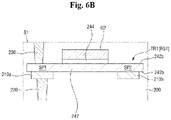
  • FIG. 6B illustrates another example for a structure of circuit elements in the region S 1 of the image sensor 5 .
  • a second gate electrode G 2 and a second gate dielectric layer 244 may be formed on a third surface 242 a of a first semiconductor layer 242 .
  • FIG. 6C shows still another example for the structure of elements within the region S 1 in the image sensor 5 .
  • a second gate electrode G 2 and a second gate dielectric layer 244 may be formed on both the third surface 242 a and the fourth surface 242 b of the first semiconductor layer 242 .
  • the second gate electrode G 2 may include an upper gate electrode G 2 a and a lower gate electrode G 2 b
  • the second gate dielectric layer 244 may include an upper gate dielectric layer 244 a and a lower gate dielectric layer 244 b .
  • the upper gate electrode G 2 a and the upper gate dielectric layer 244 a may be formed on the third surface 242 a
  • the lower gate electrode G 2 b and the lower gate dielectric layer 244 b may be formed on the fourth surface 242 b.
  • FIG. 6D depicts still another example for the structure of circuit elements in the region S 1 .
  • the first gate electrode G 1 (seen in FIG. 5 ) and a first photoelectric conversion layer 320 may be connected to a fourth surface 242 b of a first semiconductor layer 242 .
  • a second via 230 connected to the first photoelectric conversion layer 320 may be connected to a first via 220 connected to the fourth surface 242 b .
  • a first conductive wiring 232 , a fourth via 234 , and a second conductive wiring 236 may be formed in a first interlayer insulating film 200 to connect a bottom surface of the second via 230 and a bottom surface of the first via 220 .
  • a first part SP 1 of the first semiconductor layer 242 may be connected to the first photoelectric conversion layer 320 through the first via 220 , the second conductive wiring 236 , the fourth via 234 , the first conductive wiring 232 , and the second via 230 .
  • the first part SP 1 may be connected to the first gate electrode G 1 through the first via 220 , the second conductive wiring 236 , and a fifth via 238 .
  • FIG. 6E depicts yet another example for the structure of elements in the region Si in the image sensor 5 .
  • a first gate electrode G 1 (seen in FIG. 5 ) and a first photoelectric conversion layer 320 may be connected to a third surface 242 a of a first semiconductor layer 242 .
  • a first via 220 connected to the first gate electrode G 1 may be connected to a second via 230 connected to the third surface 242 a of the first semiconductor layer 242 .
  • a third conductive wiring 222 , a sixth via 224 , and a fourth conductive wiring 226 may be formed in a first interlayer insulating film 200 to connect an upper surface of the first via 220 and an upper surface of the second via 230 .
  • a first part SP 1 of the first semiconductor layer 242 may be connected to the first gate electrode G 1 through the second via 230 , the fourth conductive wiring 226 , the sixth via 224 , the third conductive wiring 222 , and the first via 220 .
  • the first part SP 1 of the first semiconductor layer 242 may be connected to the first gate electrode G 1 through the second via 230 , the fourth conductive wiring 226 , and a seventh via 228 .
  • FIG. 7 is an example timing diagram for explaining the operation of an image sensor 5 .
  • FIG. 7 is an example timing diagram for explaining the operation of an image sensor 5 .
  • FIGS. 1 through 6E For ease of description, a description of elements and features described above in connection with FIGS. 1 through 6E will be given briefly or omitted.
  • the image sensor 5 may perform a global shutter operation.
  • electrical signals for all unit pixel regions PU of an APS array 10 may be stored.
  • first reset transistors RG 1 of all unit pixel regions PU may be turned on by a pulse of the signal RG to reset electrical signals for first floating diffusion regions FD 1 of all unit pixel regions PU (“RG (shutter)” applied during time period T 1 ).
  • first photoelectric converters PD 1 of all unit pixel regions PU may generate first photoelectric charges (“V PD (shutter)”). Accordingly, electrical signals may be stored in the first floating diffusion regions FD 1 of all unit pixel regions PU.
  • first selection transistor SEL 1 may be turned on to select unit pixel regions to be read on a row-by-row basis (during the pulse of the SEL signal, i.e., when SEL is at a high level). Then, electrical signals of the selected row of unit pixel regions PU may be output to first output line OL 1 (“signal reading”, which occurs while the SEL signal is high). Next, the electrical signals of the selected row of unit pixel regions PU may be reset (RG (reading) while the SEL signal is high).
  • a CDS 60 may output difference levels corresponding to differences between the noise level and the signal level.
  • FIG. 8 is a schematic layout view of another example of a unit pixel region PU of the image sensor 5 according to an embodiment.
  • FIG. 9 is a cross-sectional view taken along line B-B of FIG. 8 .
  • FIGS. 10A through 10E are various enlarged views of respective examples for region S 2 of FIG. 9 .
  • FIGS. 1 through 7 For ease of description, a description of elements and features described above in connection with FIGS. 1 through 7 will be given briefly or omitted.
  • incident light IL may be incident on a second surface 100 b of a substrate 100 .
  • the second surface 100 b of the substrate 100 may face the incident light IL incident in the first direction.
  • a first photoelectric conversion layer 320 may be formed on the second surface 100 b of the substrate 100 .
  • a second interlayer insulating film 300 may be formed on the second surface 100 b of the substrate 100 , and the first photoelectric conversion layer 320 may be formed on the second interlayer insulating film 300 . That is, the first photoelectric conversion layer 320 may be spaced apart from the substrate 100 by the second interlayer insulating film 300 .
  • a first gate electrode G 1 and the first photoelectric conversion layer 320 may be connected to a third surface 242 a of a first semiconductor layer 242 .
  • a first via 220 connected to the third surface 242 a of the first semiconductor layer 242 may be formed in a first interlayer insulating film 200 .
  • the first gate electrode G 1 may be connected to the first semiconductor layer 242 through the first via 220 .
  • a first “through via” 160 may penetrate the substrate 100 and may be connected to the third surface 242 a of the first semiconductor layer 242 .
  • the first photoelectric conversion layer 320 may be connected to the first semiconductor layer 242 through the first through via 160 .
  • the first through via 160 may include a first “plug pattern” 162 (a conductive plug) including a conductive material and first spacers 164 including an insulating material.
  • the first plug pattern 162 may be electrically insulated from the substrate 100 by the first spacers 164 .
  • the spacers 164 may be hollow cylindrical structures.
  • a first light blocking layer 250 may contact the third surface 242 a of the first semiconductor layer 242 .
  • the first light blocking layer 250 may include a first sub-blocking layer 250 a which contacts a first part SP 1 of the first semiconductor layer 242 and a second sub-blocking layer 250 b which contacts a second part SP 2 of the first semiconductor layer 242 .
  • the first sub-blocking layer 250 a may cover a part of the third surface 242 a of the first semiconductor layer 242
  • the second sub-blocking layer 250 b may cover another part of the third surface 242 a of the first semiconductor layer 242 .
  • the first light blocking layer 250 may be a composed of a conductive material and may be electrically connected to the first gate electrode G 1 and the first photoelectric conversion layer 320 .
  • the first through via 160 and the first via 220 may contact the first sub-blocking layer 250 a.
  • a second gate electrode G 2 and a second gate dielectric layer 244 may be formed on a fourth surface 242 b of a first semiconductor layer 242 .
  • a first light blocking layer 250 may further include a third sub-blocking layer 250 c .
  • the third sub-blocking layer 250 c may be interposed between a first sub-blocking layer 250 a and a second sub-blocking layer 250 b to cover a region of a third surface 242 a of the first semiconductor layer 242 which is not covered by the first sub-blocking layer 250 a and the second sub-blocking layer 250 b.
  • a second gate electrode G 2 and a second gate dielectric layer 244 may be formed on both a third surface 242 a and a fourth surface 242 b of a first semiconductor layer 242 .
  • an upper gate electrode G 2 a and an upper gate dielectric layer 244 a may be formed on the third surface 242 a of the first semiconductor layer 242
  • a lower gate electrode G 2 b and a lower gate dielectric layer 244 b may be formed on the fourth surface 242 b of the first semiconductor layer 242 .
  • a first gate electrode G 1 and a first photoelectric conversion layer 320 may be connected to a fourth surface 242 b of a first semiconductor layer 242 .
  • a first light blocking layer 250 connected to the first gate electrode G 1 and the first photoelectric conversion layer 320 may be connected to the fourth surface 242 b of the first semiconductor layer 242 .
  • a fourth via 234 , a second conductive wiring 236 , and a fifth via 238 may be formed in a first interlayer insulating film 200 to connect a bottom surface of the first light blocking layer 250 and the fourth surface 242 b of the first semiconductor layer 242 .
  • the first light blocking layer 250 may cover the entire third surface 242 a of the first semiconductor layer 242 .
  • the first light blocking layer 250 may be connected to a first part SP 1 of the first semiconductor layer 242 .
  • an eighth via 212 and a fifth conductive wiring 214 connected to a second part SP 2 of the first semiconductor layer 242 may be formed.
  • the eighth via 212 and the fifth conductive wiring 214 may be connected to the fourth surface 242 b of the first semiconductor layer 242 .
  • the eighth via 212 and the fifth conductive wiring 214 may provide a predetermined electric potential (e.g., a second power supply voltage V DD 2 ) to the second part SP 2 of the first semiconductor layer 242 .
  • a first light blocking layer 250 may include a first sub-blocking layer 250 a and a second sub-blocking layer 250 b spaced apart from each other.
  • the first sub-blocking layer 250 a may cover a part of a third surface 242 a of a first semiconductor layer 242
  • the second sub-blocking layer 250 b may cover another part of the third surface 242 a of the first semiconductor layer 242 .
  • the first sub-blocking layer 250 a may be connected to a first gate electrode G 1 and a first photoelectric conversion layer 320 .
  • the first sub-blocking layer 250 a may be connected to a first part SP 1 of the first semiconductor layer 242 .
  • FIG. 11 is a cross-sectional view of a pixel unit region PU within the image sensor 5 according to another embodiment.
  • FIGS. 12 and 13 are partial perspective views of structures representing different respective examples of a first light blocking layer 250 of FIG. 11 .
  • FIGS. 1 through 7 For ease of description, a description of elements and features described above in connection with FIGS. 1 through 7 will be given briefly or omitted.
  • the first light blocking layer 250 may include an upper surface part 250 P and a side part 250 V.
  • the upper surface part 250 P may cover at least a part of a third surface 242 a of a first semiconductor layer 242 .
  • the side part 250 V may cover side surfaces of the first semiconductor layer 242 .
  • the side part 250 V may extend from the upper surface part 250 P toward the first semiconductor layer 242 .
  • the first upper surface 250 P of the first light blocking layer 250 may cover the entire third surface 242 a of the first semiconductor layer 242 . As illustrated in FIG.
  • the side part 250 V of the first light blocking layer 250 may include a plurality of vias surrounding the side surfaces of the first semiconductor layer 242 . As illustrated in FIG. 13 , the side part 250 V of the first light blocking layer 250 may completely cover the side surfaces of the first semiconductor layer 242 .
  • FIG. 14 is an example circuit diagram of a unit pixel region PU of the image sensor 5 according to another embodiment.
  • FIGS. 15 and 16 are cross-sectional views of different examples of pixel unit regions PU in the image sensor 5 employing the circuit arrangement of FIG. 14 .
  • FIGS. 1 through 13 For ease of description, a description of elements and features described above using FIGS. 1 through 13 will be given briefly or omitted.
  • the unit pixel region PU of the image sensor may further include a second photoelectric converter PD 2 , a first transfer transistor TG, a second floating diffusion region FD 2 , a second reset transistor RG 2 , a second source follower transistor SF 2 , and a second selection transistor SEL 2 .
  • the second photoelectric converter PD 2 may absorb light and accumulate charges corresponding to the amount of light.
  • the second photoelectric converter PD 2 may be, for example, a photodiode, a phototransistor, a photogate, a pinned photodiode, an organic photodiode, quantum dots, or a combination of the same.
  • the second photoelectric converter PD 2 may be coupled to the first transfer transistor TG which transfers accumulated charges to the second floating diffusion region FD 2 .
  • the first transfer transistor TG may transfer charges generated by the second photoelectric converter PD 2 to the second floating diffusion region FD 2 .
  • the first transfer transistor TG may be driven by a transfer line which applies a predetermined bias. When the first transfer transistor TG is turned on, charges generated by the second photoelectric converter PD 2 may be transferred to the second floating diffusion region FD 2 .
  • the second source follower transistor SF 2 may amplify a change in an electric potential of the second floating diffusion region FD 2 and output the amplified change to a second output line OL 2 .
  • a predetermined electric potential e.g., a third power supply voltage V DD 3
  • V DD 3 a third power supply voltage
  • the second selection transistor SEL 2 may select unit pixel regions to be read on a row-by-row basis.
  • a predetermined electric potential e.g., an electric potential provided from a source of the second source follower transistor SF 2
  • a drain of the second selection transistor SEL 2 may be output to the second output line OL 2 .
  • the second reset transistor RG 2 may periodically reset the second floating diffusion region FD 2 .
  • a predetermined electric potential e.g., a fourth power supply voltage V DD 4
  • V DD 4 a fourth power supply voltage
  • an image sensor may further include a second photoelectric conversion layer 110 .
  • the second photoelectric conversion layer 110 may generate second photocharges in proportion to the amount of incident light IL incident from the outside.
  • the second photoelectric conversion layer 110 may correspond to the second photoelectric converter PD 2 of FIG. 14 .
  • the second photoelectric conversion layer 110 may be formed in a substrate 100 .
  • the second photoelectric conversion layer 110 may be formed by doping the substrate 100 with impurities.
  • the second photoelectric conversion layer 110 may be formed in a structure in which a plurality of impurity regions are stacked.
  • various transistors connected to the second photoelectric conversion layer 110 to process an electrical signal are not illustrated. However, some regions of the substrate 100 may be utilized to place the various transistors for processing an electrical signal generated by the second photoelectric conversion layer 110 .
  • a second transfer transistor TG (see FIG. 14 ), a second reset transistor RG 2 (see FIG. 14 ), a second source follower transistor SF 2 (see FIG. 14 ), and a second selection transistor SEL 2 (see FIG. 14 ) may be formed on a first surface 100 a of the substrate 100 .
  • the second photoelectric conversion layer 110 may include a semiconductor photoelectric conversion layer.
  • a color filter 310 may be formed in a first interlayer insulating film 200 .
  • the color filter 310 may include one of, for example, a red filter and a blue filter. However, this is merely an example, and the color filter 310 may also include one of a green filter, a yellow filter, a magenta filter, a cyan filter, and a white filter.
  • the second photoelectric conversion layer 110 may detect light having a different wavelength from light detected by a first photoelectric conversion layer 320 .
  • the first photoelectric conversion layer 320 may detect green light
  • the second photoelectric conversion layer 110 may detect red or blue light.
  • the incident light IL light having a green wavelength may be absorbed by the first wavelength conversion layer 320 .
  • the first photoelectric conversion layer 320 may provide an electrical signal for the green light.
  • Light having wavelengths other than the green light may pass through the first photoelectric conversion layer 320 .
  • the light passing through the first photoelectric conversion layer 320 may pass through the color filter 310 .
  • red light or blue light may be provided to the second photoelectric conversion layer 110 .
  • the second photoelectric conversion layer 110 may provide an electrical signal for the red light or the blue light.
  • incident light IL may be incident on a second surface 100 b of a substrate 100 .
  • a color filter 310 may be formed in a second interlayer insulating film 300 .
  • FIG. 17 is an example circuit diagram of a unit pixel region PU of the image sensor 5 according to an alternative embodiment.
  • FIGS. 18 and 19 are cross-sectional views of example pixel unit regions PU in an image sensor employing the circuit diagram of FIG. 17 .
  • FIGS. 1 through 16 For ease of description, a description of elements and features described above in connection with FIGS. 1 through 16 will be given briefly or omitted.
  • the unit pixel region PU of the image sensor may further include a third photoelectric converter PD 3 , a third floating diffusion region FD 3 , a third reset transistor RG 3 , a third source follower transistor SF 3 , and a third selection transistor SEL 3 .
  • the third photoelectric converter PD 3 may absorb light and accumulate charges corresponding to the amount of light.
  • the third photoelectric converter PD 3 may be, for example, a photodiode, a phototransistor, a photogate, a pinned photodiode, an organic photodiode, quantum dots, or a combination of the same.
  • the charges accumulated in the third photoelectric converter PD 3 may be stored in the third floating diffusion region FD 3 .
  • the third source follower transistor SF 3 may amplify a change in an electric potential of the third floating diffusion region FD 3 and output the amplified change to a third output line OL 3 .
  • a predetermined electric potential e.g., a fifth power supply voltage V DD 5
  • V DD 5 a fifth power supply voltage
  • the third selection transistor SEL 3 may select unit pixel regions to be read on a row-by-row basis.
  • a predetermined electric potential e.g., an electric potential provided from a source of the third source follower transistor SF 3
  • a drain of the third selection transistor SEL 3 may be output to the third output line OL 3 .
  • the third reset transistor RG 3 may periodically reset the third floating diffusion region FD 3 .
  • a predetermined electric potential e.g, a sixth power supply voltage V DD 6
  • V DD 6 a sixth power supply voltage
  • an image sensor may further include a third photoelectric conversion layer 420 , a third gate electrode G 3 , a second transistor structure TR 2 , and a second light blocking layer 2502 .
  • the third photoelectric conversion layer 420 may generate third photocharges in proportion to the amount of incident light IL incident from the outside.
  • the third photoelectric conversion layer 420 may correspond to the third photoelectric converter PD 3 of FIG. 17 .
  • the third photoelectric conversion layer 420 may be formed outside a substrate 100 .
  • the third photoelectric conversion layer 420 may be formed on a third interlayer insulating film 400 on a second photoelectric conversion layer 110 .
  • the third photoelectric conversion layer 420 may be formed on a first surface 100 a of the substrate 100 and may be spaced apart from the substrate 100 by a first interlayer insulating film 200 and the third interlayer insulating film 400 .
  • a second lower electrode 422 and a second upper electrode 424 may be formed adjacent to the third photoelectric conversion layer 420 .
  • the third photoelectric conversion layer 420 may be interposed between the second lower electrode 422 and the second upper electrode 424 .
  • Different levels of voltages may be applied to the second lower electrode 422 and the second upper electrode 424 , respectively.
  • different levels of voltages may be applied to the second lower electrode 422 and the second upper electrode 424 so that an electrical signal generated by the third photoelectric conversion layer 420 is directed to the second lower electrode 422 .
  • the second lower electrode 422 and the second upper electrode 424 may include a transparent conductive material.
  • the third photoelectric conversion layer 420 may include an organic photoelectric conversion layer.
  • the third gate electrode G 3 may be formed on the first surface 100 a of the substrate 100 .
  • the third gate electrode G 3 may form a third source follower transistor SF 3 .
  • the third source follower transistor SF 3 may include a third gate dielectric layer 1222 and the third gate electrode G 3 which are formed on an active region 120 .
  • the second transistor structure TR 2 may be formed on the first surface 100 a of the substrate 100 .
  • the second transistor structure TR 2 may be formed in the first interlayer insulating film 200 .
  • the second transistor structure TR 2 may include a second semiconductor layer 2422 , a fourth gate dielectric layer 2442 , and a fourth gate electrode G 4 .
  • the second transistor structure TR 2 may be similar to a first transistor structure TR 1 , and thus a detailed description thereof will be omitted.
  • the second semiconductor layer 2422 may form a third floating diffusion region FD 3 .
  • an end of the second semiconductor layer 2422 may be connected to the third gate electrode G 3 and the third photoelectric conversion layer 420 .
  • a second through via 2602 may penetrate a first photoelectric conversion layer 320 and may be connected to a first semiconductor layer 242 .
  • the third photoelectric conversion layer 420 may be connected to the first semiconductor layer 242 through the second through via 2602 .
  • the second through via 2602 may be electrically insulated from the first photoelectric conversion layer 320 , a first lower electrode 322 and a first upper electrode 324 by second spacers 2604 .
  • the second transistor structure TR 2 including the second semiconductor layer 2422 may form a third reset transistor RG 3 .
  • the second light blocking layer 2502 may cover at least a part of the second semiconductor layer 2422 to block it from the incident light IL.
  • the second through via 2602 may connect the second lower electrode 422 and the second light blocking layer 2502 .
  • incident light IL may be incident on a second surface 100 b of a substrate 100 .
  • a third through via 1602 may penetrate the substrate 100 and a first photoelectric conversion layer 320 and may be connected to a second semiconductor layer 2422 .
  • a third photoelectric conversion layer 420 may be connected to the second semiconductor layer 2422 through the third through via 1602 .
  • the third through via 1602 may include a third plug pattern 1622 including a conductive material and third spacers 1642 including an insulating material.
  • the third plug pattern 1622 may be electrically insulated from the substrate 100 , the first photoelectric conversion layer 320 , a first lower electrode 322 , and a first upper electrode 324 by the third spacers 1642 .
  • a second light blocking layer 2502 may contact the second semiconductor layer 2422 .
  • FIG. 20 is an example circuit diagram of a unit pixel region PU of an image sensor 5 according to yet another embodiment.
  • FIG. 21 is a schematic layout view of the unit pixel region PU of the image sensor according to the embodiments.
  • FIG. 22 is a cross-sectional view taken along line C-C of FIG. 21 .
  • FIGS. 23A through 23E are various enlarged views of region S 3 of FIG. 22 .
  • FIGS. 1 through 7 will be given briefly or omitted.
  • the unit pixel region PU in this embodiment may further include a second transfer transistor TX, a storage device CAP, a control transistor CAL, and a fourth source follower transistor SF 4 .
  • a first photoelectric converter PD 1 may be coupled to the second transfer transistor TX which transfers accumulated charges to a first floating diffusion region FD 1 .
  • the second transfer transistor TX may transfer charges generated by the first photoelectric converter PD 1 to the first floating diffusion region FD 1 .
  • the second transfer transistor TX may be driven by a transfer line which applies a predetermined bias. When the second transfer transistor TX is tuned on, charges generated by the first photoelectric converter PD 1 may be transferred to the first floating diffusion region FD 1 .
  • a first source follower transistor SF 1 may amplify a change in an electric potential of the first floating diffusion region FD 1 and provide the amplified change to the storage device CAP.
  • a predetermined electric potential e.g., a first power supply voltage V DD 1
  • V DD 1 a first power supply voltage
  • the control transistor CAL may control an electric potential of a first node Y.
  • the control transistor CAL may be driven by a control line which applies a predetermined bias.
  • a predetermined electric potential e.g., a second power supply voltage V DD 2 provided from a second node X
  • V DD 2 a second power supply voltage provided from a second node X
  • the storage device CAP may be interposed between a source of the first source follower transistor SF 1 and the first node Y and store an electrical signal provided by the first source follower transistor SF 1 .
  • Some examples of the storage device CAP are a high-capacity capacitor (a supercapacitor or an ultracapacitor) such as an electric double layer capacitor (EDLC) or a metal-insulator-metal (MIM) capacitor.
  • EDLC electric double layer capacitor
  • MIM metal-insulator-metal
  • the fourth source follower transistor SF 4 may serve as a source follower buffer amplifier controlled by the first node Y.
  • the fourth source follower transistor SF 4 may amplify a change in an electric potential of the first node Y and output the amplified change to a fourth output line OL 4 .
  • a predetermined electric potential e.g., the first power supply voltage V DD 1
  • V DD 1 the first power supply voltage
  • the image sensor 5 in according to the embodiments may include a fifth gate electrode G 5 , a first source/drain region FD 1 (e.g., the first floating diffusion region FD 1 of FIG. 20 ), a sixth gate electrode G 6 , a second source/drain region 105 a , a third source/drain region 105 b , and a capacitor structure 500 .
  • the fifth gate electrode G 5 may be formed on a first surface 100 a of a substrate 100 . In some embodiments, the fifth gate electrode G 5 may form the second transfer transistor TX.
  • the first source/drain region FD 1 may be formed in an active region 120 disposed on a side of the fifth gate electrode G 5 .
  • the first source/drain region FD 1 may be formed by doping the active region 120 with impurities.
  • the first source/drain region FD 1 may form the first floating diffusion region FD 1 of FIG. 20 .
  • the second transfer transistor TX may transfer first photocharges generated by a second photoelectric conversion layer 110 to the first source/drain region FD 1 (or the first floating diffusion region FD 1 of FIG. 20 ).
  • the second photoelectric conversion layer 110 may correspond to the first photoelectric converter PD 1 of FIG. 20 .
  • the sixth gate electrode G 6 may be formed on the first surface 100 a of the substrate 100 .
  • the sixth gate electrode G 6 may form the first source follower transistor SF 1 .
  • the first source/drain region FD 1 may be connected to the sixth gate electrode G 6 .
  • the second source/drain region 105 a and the third source/drain region 105 b may be formed in the active region 120 disposed on both sides of the sixth gate electrode G 6 .
  • the second source/drain region 105 a and the third source/drain region 105 b may be formed by doping the active region 120 with impurities.
  • a predetermined electric potential (e.g., the first power supply voltage V DD 1 ) may be provided to the second source/drain region 105 a . Accordingly, the first source/follower transistor SF 1 may amplify a change in an electric potential of the first source/drain region FD 1 and provide the amplified change to the third source/drain region 105 b.
  • the capacitor structure 500 may be connected to a first gate electrode G 1 , a first semiconductor layer 242 , and the third source/drain region 105 b .
  • the capacitor structure 500 may include a first capacitor electrode 510 , a second capacitor electrode 530 , and a capacitor dielectric layer 520 .
  • the first capacitor electrode 510 may be connected to a first part SP 1 of the first semiconductor layer 242 by a ninth via 280 formed in a first interlayer insulating film 200 .
  • the first part SP 1 of the first semiconductor layer 242 may be connected to the first gate electrode G 1 by a first via 220 .
  • the first gate electrode G 1 may form the fourth source follower transistor SF 4 .
  • a first transistor structure TR 1 may form the control transistor CAL. That is, the first part SP 1 of the first semiconductor layer 242 may correspond to the first node Y of FIG. 20 .
  • the second capacitor electrode 530 may be connected to the third source/drain region 105 b by a sixth conductive wiring 290 and a tenth via 292 formed in the first interlayer insulating film 200 .
  • the capacitor dielectric layer 520 may be interposed between the first capacitor electrode 510 and the second capacitor electrode 530 .
  • the capacitor structure 500 may form the storage device CAP.
  • the capacitor structure 500 may store charges in the capacitor dielectric layer 520 using a potential difference between the first capacitor electrode 510 and the second capacitor electrode 530 . Accordingly, the capacitor structure 500 may store an electrical signal provided by the sixth gate electrode G 6 .
  • the first gate electrode G 1 may be connected to a third surface 242 a of the first semiconductor layer 242
  • the first capacitor electrode 510 may be connected to a fourth surface 242 b of the first semiconductor layer 242 .
  • a second gate electrode G 2 and a second gate dielectric layer 244 may be formed on a fourth surface 242 b of a first semiconductor layer 242 .
  • a second gate electrode G 2 and a second gate dielectric layer 244 may be formed on both a third surface 242 a and a fourth surface 242 b of a first semiconductor layer 242 .
  • a second gate electrode G 2 and a second gate dielectric layer 244 may be connected to a fourth surface 242 b of a first semiconductor layer 242 .
  • a first light blocking layer 250 may include a first sub-blocking layer 250 a and a second sub-blocking layer 250 b spaced apart from each other.

Landscapes

  • Engineering & Computer Science (AREA)
  • Multimedia (AREA)
  • Signal Processing (AREA)
  • Solid State Image Pick-Up Elements (AREA)
  • Transforming Light Signals Into Electric Signals (AREA)
  • Metal-Oxide And Bipolar Metal-Oxide Semiconductor Integrated Circuits (AREA)

Abstract

An image sensor may include a substrate having a first surface and a second surface on opposite sides, a first transistor having a first gate disposed on the first surface, a photoelectric conversion layer which generates photocharges from light incident in a first direction, a second transistor having a transistor structure disposed between the first surface and the photoelectric conversion layer and spaced from the photoelectric conversion layer, and includes a semiconductor layer composed of a metal oxide semiconductor material. The semiconductor layer may have a third surface facing the first direction and a fourth surface opposite the third surface, with a second gate disposed on the semiconductor layer. The semiconductor layer may be connected to the first gate. A light blocking layer may be disposed between the third surface and the photoelectric conversion layer, and spaced from the photoelectric conversion layer.

Description

This application claims the benefit of Korean Patent Application No. 10-2019-0130339, filed on Oct. 21, 2019, in the Korean Intellectual Property Office, the disclosure of which is incorporated herein by reference in its entirety.
FIELD
The present disclosure relates generally to image sensors, and more particularly to image sensors including a light blocking layer.
DISCUSSION OF THE RELATED ART
An image sensor is a semiconductor device that converts optical information into an electrical signal. Examples of such image sensors include charge coupled device (CCD) image sensors and complementary metal-oxide semiconductor (CMOS) image sensors.
CMOS image sensors may be classified into front side illumination (FSI) CMOS image sensors in which light is incident upon a front side of a substrate and back side illumination (BSI) CMOS image sensors in which light is incident upon a back side of a substrate.
SUMMARY
Aspects of the present disclosure provide an image sensor having improved performance due to reduced leakage current and noise.
According to an aspect of the present disclosure, there is provided an image sensor comprising a substrate having a first surface and a second surface on opposite sides, a first transistor having a first gate disposed on the first surface, a photoelectric conversion layer which generates photocharges from light incident in a first direction, a second transistor having a transistor structure disposed between the first surface and the photoelectric conversion layer and spaced from the photoelectric conversion layer, and includes a semiconductor layer composed of a metal oxide semiconductor material. The semiconductor layer may have a third surface facing the first direction and a fourth surface opposite the third surface, with a second gate disposed on the semiconductor layer. The semiconductor layer may be connected to the first gate. A light blocking layer may be disposed between the third surface and the photoelectric conversion layer, and spaced from the photoelectric conversion layer.
According to another aspect of the present disclosure, there is provided an image sensor comprising a substrate with a first surface and a second surface on opposite sides, a source follower transistor having a first gate disposed on the first surface, a first photoelectric conversion layer, separate from the substrate, that generates first photocharges from incident light, a transistor structure which is disposed proximate to the first surface and comprises a semiconductor layer comprising a metal oxide semiconductor material and a second gate disposed on a central region of the semiconductor layer and a light blocking layer which is disposed between the first photoelectric conversion layer and the transistor structure, is spaced from the first photoelectric conversion layer, and covers at least a part of the semiconductor layer to block the semiconductor layer from the incident light. A first part of the semiconductor layer, located on a side of the second gate, is connected to the first gate and the first photoelectric conversion layer.
According to another aspect of the present disclosure, there is provided an image sensor comprising a substrate with a first surface and a second surface on opposite sides, a first transistor having a first gate disposed on the first surface of the substrate, a photoelectric conversion layer which is disposed in the substrate and generates photocharges from incident light, a second transistor having a transistor structure disposed proximate to the first surface of the substrate and comprises a semiconductor layer comprising a metal oxide semiconductor material and a second gate electrode disposed on the semiconductor layer, a light blocking layer which is disposed on the first surface of the substrate and covers at least a part of the semiconductor layer to block the semiconductor layer from the incident light and a capacitor structure, where a first part of the semiconductor layer located at an end portion of the semiconductor layer is connected to the first gate and the capacitor structure.
BRIEF DESCRIPTION OF THE DRAWINGS
These and/or other aspects will become apparent and more readily appreciated from the following description of the embodiments, taken in conjunction with the accompanying drawings in which:
FIG. 1 is a block diagram of an image sensor according to an embodiment;
FIG. 2 is an example circuit diagram of a unit pixel region PU of the image sensor according to an embodiment;
FIG. 3 is a schematic plan view of an image sensor according to an embodiment;
FIG. 4 is a schematic layout view of a unit pixel region PU of the image sensor according to an embodiment;
FIG. 5 is a cross-sectional view taken along line A-A of FIG. 4;
FIGS. 6A, 6B, 6C, 6D and 6E depict various alternative configurations that may be used for a transistor structure and connection structures in region S1 of FIG. 5;
FIG. 7 is an example timing diagram for explaining the operation of an image sensor according to an embodiment;
FIG. 8 is a schematic layout view of a unit pixel region PU of an image sensor according to an embodiment;
FIG. 9 is a cross-sectional view taken along line B-B of FIG. 8;
FIGS. 10A, 10B, 10C, 10D and 10E are various enlarged views of respective examples for region S2 of FIG. 9;
FIG. 11 is a cross-sectional view of an image sensor according to an embodiment;
FIGS. 12 and 13 are partial perspective views of structures representing different respective examples of a first light blocking layer 250 of FIG. 11;
FIG. 14 is an example circuit diagram of a unit pixel region PU of an image sensor according to an embodiment;
FIGS. 15 and 16 are cross-sectional views of respective image sensors according to an embodiment;
FIG. 17 is an example circuit diagram of a unit pixel region PU of an image sensor according to an embodiment;
FIGS. 18 and 19 are cross-sectional views of respective image sensors according to various embodiments;
FIG. 20 is an example circuit diagram of a unit pixel region PU of an image sensor according to an embodiment;
FIG. 21 is a schematic layout view of the unit pixel region PU of the image sensor according to an embodiment;
FIG. 22 is a cross-sectional view taken along line C-C of FIG. 21;
FIGS. 23A, 23B, 23C, 23D and 23E are respective enlarged views of region S3 of FIG. 22.
DETAILED DESCRIPTION
Image sensors according to various embodiments will now be described with reference to FIGS. 1 through 23E.
Herein, when an element of layer is said to be “on” or “disposed on”, “connected to” or “coupled to” another element or layer, it can be directly on (i.e., a direct physical interface exists), directly connected or directly coupled to the other element or layer, or, an intervening element(s) or layer(s) may be present. If the context discusses a first element or layer being “on” a second element or layer, and refers to a drawing showing the relevant elements or layers physically interfacing, then the drawing provides an example of the first element or layer being “directly on” the second element or layer, without an intervening element or layer, but it is understood that the addition of an intervening element or layer may be possible in an alternative embodiment to that illustrated.
Herein, when a gate electrode is said to be “on” a surface or substrate, a gate dielectric layer such as a gate oxide layer may be interposed between the gate electrode and the surface or substrate. The combination of the gate electrode and the gate dielectric layer may be referred to as a “gate” of a transistor.
Herein, when a layer is said to include a particular material, the layer may be composed partially or wholly of that particular material.
FIG. 1 is a block diagram of an image sensor 5 according to an embodiment. The image sensor 5 may include an active pixel sensor (APS) array 10, a row decoder 20, a row driver 30, a column decoder 40, a timing generator 50, a correlated double sampler (CDS) 60, an analog-to-digital converter (ADC) 70, and an input/output (I/O) buffer 80.
The APS array 10 may include a plurality of unit pixel regions PU arranged in two dimensions and may convert optical signals into electrical signals. The APS array 10 may be driven by a plurality of driving signals such as a pixel selection signal, a reset signal, and a charge transfer signal received from the row driver 30. In addition, the electrical signals output from the APS array 10 may be provided to the CDS 60.
The row driver 30 may provide a plurality of driving signals for driving a plurality of unit pixel regions PU to the APS array 10 according to the decoding result of the row decoder 20. When the unit pixel regions PU are arranged in a matrix, the driving signals may be provided to each row.
The timing generator 50 may provide a timing signal and a control signal to the row decoder 20 and the column decoder 40.
The CDS 60 may receive the electrical signals generated by the APS array 10 and sample and hold the received electrical signals. The CDS 60 may double-sample a specific noise level and signal levels of the electrical signals and output difference levels between the noise level and the signal levels.
The ADC 70 may convert analog signals corresponding to the difference levels output from the CDS 60 into digital signals and output the digital signals.
The I/O buffer 80 may latch the digital signals and sequentially output the latched signals to an image signal processor (not illustrated) according to the decoding result of the column decoder 40.
FIG. 2 schematically illustrates an example circuit within the unit pixel region PU of the image sensor 5 (interchangeably, “pixel circuit PU”). The pixel circuit PU may include a first photoelectric converter PD1, a first floating diffusion region FD1, a first reset transistor RG1, a first source follower transistor SF1, and a first selection transistor SEL1.
The first photoelectric converter PD1 may absorb light and accumulate charges corresponding to the amount of light. The first photoelectric converter PD1 may be, for example, a photodiode, a phototransistor, a photogate, a pinned photodiode, an organic photodiode, quantum dots, or a combination of the same.
The charges accumulated in the first photoelectric converter PD1 may be stored in the first floating diffusion region FD1. The first floating diffusion region FD1 is a region that converts charges into a voltage and may cumulatively store charges due to its parasitic capacitance.
The first source follower transistor SF1 may serve as a source follower buffer amplifier controlled by the first floating diffusion region FD1. The first source follower transistor SF1 may amplify a change in an electric potential of the first floating diffusion region FD1 and output the amplified change to a first output line OL1. For example, a predetermined electric potential (e.g., a first power supply voltage VDD 1) provided to a drain of the first source follower transistor SF1 may be provided to the first output line OL1 under the control of the first floating diffusion region FD1.
The first selection transistor SEL1 may select unit pixel regions to be read on a row-by-row basis. The first selection transistor SEL1 may be driven by a selection line which applies a predetermined bias. For example, when the first selection transistor SEL1 is turned on by a signal SEL applied to its gate terminal, a predetermined electric potential (e.g., an electric potential provided from a source of the first source follower transistor SF1) provided to a drain of the first selection transistor SEL1 may be output to the first output line OL1.
The first reset transistor RG1 may periodically reset the first floating diffusion region FD1. The first reset transistor RG1 may be driven by a reset line which applies a predetermined bias. For example, when the first reset transistor RG1 is turned on by a signal RG applied to its gate terminal, a predetermined electric potential (e.g., a second power supply voltage VDD 2) provided to a drain of the first reset transistor RG1 may be transferred to the first floating diffusion region FD1,
FIG. 3 is a schematic plan view of the image sensor 5 according to an embodiment. FIG. 4 is an example schematic layout view of a unit pixel region PU of the image sensor 5 As shown in FIG. 3, the image sensor 5 may include a sensor array region I and a peripheral circuit region PU.
The sensor array region I may be, for example, a region in which the APS array 10 of FIG. 1 is formed. For example, the sensor array region I may include a plurality of unit pixel regions II.
The peripheral circuit region II may be, for example, a region in which the CDS 60, the ADC 70, etc. of FIG. 1 are formed. In FIG. 3, the peripheral circuit region II surrounds the sensor array region I. In other embodiments, the peripheral circuit region II overlaps the sensor array region I. For example, the peripheral circuit region II may be formed in a lower substrate, and the sensor array region I may be formed in an upper substrate stacked on the lower substrate.
The example unit pixel region PU illustrated in FIG. 4 depicts regions where the transistors SEL1, SF1 and RG1 may be arranged. In examples described hereafter, the source follower transistor has a first gate electrode G1 and the first reset transistor RG1 has a second gate electrode G2. The region 120 may be an active region forming a circuit path between source and drain of each of transistors SEL1 and SF1. Note that in the example of FIG. 4, only one pixel is formed in a unit pixel region PU, but in other embodiments, a plurality of pixels may be formed in a unit pixel region PU.
FIG. 5 is a cross-sectional view taken along line A-A of FIG. 4, FIGS. 6A through 6E depict various alternative configurations that may be used for a transistor structure and connection structures of region S1 of FIG. 5. Referring to FIGS. 2 through 6A, an exemplary pixel unit PU of the image sensor 5 includes a substrate 100, a device isolation layer 130, a first interlayer insulating film 200, a first gate electrode G1, a first photoelectric conversion layer 320, a first transistor structure TR1, a first light blocking layer 250, and a microlens 340.
The substrate 100 may be, for example, bulk silicon or silicon-on-insulator (SOI). Alternatively, the substrate 100 may be a silicon substrate or a substrate made of another material such as silicon germanium, indium antimonide, lead telluride, indium arsenide, indium phosphide, gallium arsenide, or gallium antimonide. Alternatively, the substrate 100 may be composed of a base substrate and an epitaxial layer formed on the base substrate.
The substrate 100 may include a first surface 100 a and a second surface 100 b on opposite sides thereof. The first surface 100 a may be a front side of the substrate 100, and the second surface 100 b may be a back side of the substrate 100. For example, the first surface 100 a of the substrate 100 may be used to place various transistors for processing an electrical signal generated by the first photoelectric conversion layer 320. For example, the first source follower transistor SF1 and the selection transistor SEL1 may each include the active region 120 (a doped region) formed within the substrate 100, and may each have gate, source and drain electrodes formed on the first surface 100 a. The first reset transistor RG1 may have a transistor structure TR1 partially supported by a first interlayer insulating film 200 formed over the first surface 100 a.
Incident light IL may be incident on the first surface 100 a of the substrate 100. For example, the incident light IL may be incident in a first direction from outside the image sensor. Here, the first surface 100 a may face the first direction.
The active region 120 may be a doped region of the substrate 100 surrounded by the device isolation layer 130, The device isolation layer 130 may be formed in the substrate 100 from the first surface 100 a. The device isolation layer 130 may be formed by filling an insulating material in a trench formed by patterning the substrate 100, Accordingly, edges of the device isolation layer 130 may define a part of the unit pixel region PU as the active region 120. Note that the surface 100 a, although mainly described herein as a surface of the substrate 100, may be a planar surface that extends across an area of the device isolation area 130 and therefore may be defined as partially a surface of the device isolation area 130 and partially a surface of the substrate 100. Hereafter, reference to the surface 100 a will be a general reference to any portion of the surface unless the context dictates otherwise.
The first interlayer insulating film 200 may be formed on the first surface 100 a. The first interlayer insulating film 200 may include at least one of, fix example, silicon oxide, silicon nitride, silicon oxynitride, and a low dielectric constant (low-k) material having a lower dielectric constant than silicon oxide.
The first gate electrode (31 may be formed on the first surface 100 a of the substrate 100. (As mentioned above, herein, a gate electrode may be considered to be disposed “on” a surface even though a gate dielectric layer, such as the first gate dielectric layer 122 discussed below, is present between the gate electrode and the surface.) The first gate electrode G1 may be formed in the first interlayer insulating film 200, and may function as a gate electrode of the first source follower transistor SF1. The first gate electrode G1 may be part of a patterned metal layer that forms other gate electrodes (not shown) such as a gate electrode for the first selection transistor SEL1.
The first gate electrode G1 may be formed directly on a first gate dielectric layer 122, which is formed directly on the active region 120. The first gate electrode G1 and the first gate dielectric layer 122 may together constitute a first gate GT1, which is a gate of the source follower transistor SF1. The first gate GT1 may be disposed on the surface 100 a as illustrated in FIG. 5.
The first gate dielectric layer 122 may include, for example, silicon oxide, silicon nitride, silicon oxynitride, or a high dielectric constant (high-k) material having a higher dielectric constant than silicon oxide. The first gate electrode G1 may include a metal material such as tungsten (W), titanium (Ti), titanium nitride (TiN), copper (Cu), or aluminum (Al). Alternatively, the first gate electrode G1 may include a metal oxide such as indium tin oxide (ITO) or indium zinc oxide (IZO) or a semiconductor material such as doped silicon.
The first photoelectric conversion layer 320 may generate first photocharges in proportion to the amount of the incident light IL incident from the exterior. That is, the first photoelectric conversion layer 320 may receive light and convert an optical signal into an electrical signal. For example, the first photoelectric conversion layer 320 may correspond to the first photoelectric converter PD1 of FIG. 2.
In the embodiment of FIG. 5, the first photoelectric conversion layer 320 is formed spaced from the substrate 100. For example, the first photoelectric conversion layer 320 may be formed on a top surface of the first interlayer insulating film 200, whereby it is spaced from the first surface 100 a by the first interlayer insulating film 200.
A first lower electrode 322 and a first upper electrode 324 may each be formed adjacent to the first photoelectric conversion layer 320 on opposite sides. Thus, the first photoelectric conversion layer 320 may be interposed between the first lower electrode 322 and the first upper electrode 324. For example, the first lower electrode 322 may extend along a bottom surface of the first photoelectric conversion layer 320, and the first upper electrode 324 may extend along an upper surface of the first photoelectric conversion layer 320. In FIG. 5, the first lower electrode 322 is illustrated as having edges abutting a top portion of the first interlayer insulating film 200 beneath the first photoelectric conversion layer 320, but in other examples the first lower electrode 322 extends completely across a lower surface of first photoelectric conversion layer 320.
Different levels of voltages may be applied to the first lower electrode 322 and the first upper electrode 324, respectively. For example, different respective levels of voltages may be applied to the first lower electrode 322 and the first upper electrode 324 so that an electrical signal generated by the first photoelectric conversion layer 320 is directed to the first lower electrode 322.
The first lower electrode 322 and the first upper electrode 324 may include a transparent conductive material. For example, the first lower electrode 322 and the first upper electrode 324 may include indium tin oxide (ITO), zinc oxide (ZnO), tin dioxide (SnO2), antimony-doped tin oxide (ATO), aluminum-doped zinc oxide (AZO), gallium-doped zinc oxide (GZO), titanium dioxide (TiO2), fluorine-doped tin oxide (FTO), or combinations of the same. The first lower electrode 322 and the first upper electrode 324 may include the same material or different materials.
The first photoelectric conversion layer 320 may include an organic photoelectric conversion layer.
The first transistor structure TR1 may be formed proximate to the first surface 100 a For example, the first transistor structure TR1 may be formed in the first interlayer insulating film 200. The first transistor structure TR1 may be spaced apart from each of the substrate 100 and the first photoelectric conversion layer 320, interposed between the substrate 100 and the first photoelectric conversion layer 320, and closer to the substrate 100 than to the first photoelectric conversion layer 320.
The first transistor structure TR1 may include a first semiconductor layer 242, a second gate dielectric layer 244, and a second gate electrode G2. The first semiconductor layer 242 may include a semiconductor material. For example, the first semiconductor layer 242 may include a metal oxide semiconductor material such as indium gallium zinc oxide (IGZO) or indium tin zinc oxide (ITZO), an elemental semiconductor material such as polysilicon or amorphous silicon, an organic semiconductor material, a carbon semiconductor material such as graphene or carbon nanotubes (CNTs), or combinations of the same. Additionally or alternatively, the first semiconductor layer 242 may include any one of CdSe, CdS, ZnO, SnO2, MoS2, TiO2, Fe2O3, WO3, InGaZnO, ZnO—Rh2O3, In2O3, ZnSnO, InGaO, InZnO, ZnSnO, or combinations of the same.
When the first semiconductor layer 242 includes IGZO, leakage current may be effectively reduced.
FIG. 6A is an enlarged view of the region Si shown in FIG. 5. In the example of FIG. 6A, the first semiconductor layer 242 may include a third surface 242 a and a fourth surface 242 b which are opposite each other. The third surface 242 a of the first semiconductor layer 242 may be defined as a direction facing the first direction in which the incident light IL is incident. That is, the incident light IL may be incident from outside the image sensor toward the third surface 242 a of the first semiconductor layer 242.
The second gate electrode G2 may be formed on the first semiconductor layer 242.
The second gate electrode G2 may be formed on the fourth surface 242 b. Accordingly, the second gate electrode G2 may be interposed between the substrate 100 and the first semiconductor layer 242.
The second gate electrode G2 may be formed directly below a central portion of the first semiconductor layer 242, where the central portion is between a first part SP1 and a second part SP2 of the first semiconductor layer 242. The first parts SP1 and SP2 may be respective end portions of the first semiconductor layer 242 on opposite ends thereof.
The second gate electrode G2 may include a conductive material. For example, the second gate electrode G2 may include a metal material such as tungsten (W), titanium (Ti), titanium nitride (TiN), copper (Cu), or aluminum (Al). Alternatively, the second gate electrode G2 may include, for example, a metal oxide such as indium tin oxide (ITO) or indium zinc oxide (IZO) or a semiconductor material such as doped silicon.
The second gate dielectric layer 244 may be interposed between the first semiconductor layer 242 and the second gate electrode G2. For example, the second gate dielectric layer 244 may extend conformally along the profile of the fourth surface 242 b. The second gate electrode G2 and the second gate dielectric layer 244 may together constitute a second gate GT2 which is formed on the fourth surface 242 b in the central region of the first semiconductor layer 242.
The second gate dielectric layer 244 may include, for example, silicon oxide, silicon nitride, silicon oxynitride, or a high-k material having a higher dielectric constant than silicon oxide.
The first part SP1 of the first semiconductor layer 242 may form the first floating diffusion region FD1 discussed earlier. For example, referring to FIG. 5, the first part SP1 may form a source region (interchangeably, just “source” or source electrode) of the first reset transistor RG1 and may be electrically connected to each of the first gate electrode G1 and the first photoelectric conversion layer 320. (The second part SP2 may form a drain of the first reset transistor RG1. Alternatively, the first part SP1 forms the drain and the second part SP2 forms the source of the first reset transistor RG1.) Accordingly, the first photocharges generated by the first photoelectric conversion layer 320 may be stored in the first part SP1. In addition, the first source follower transistor SF1 including the first gate electrode G1 may amplify a change in an electric potential of the first part SP1.
Since the first floating diffusion region FD1 of the image sensor according to the embodiments does not contact the substrate 100, a contact leakage current between the first floating diffusion region FD1 and the substrate 100 can be effectively reduced.
As mentioned, the first transistor structure TR1 including the first semiconductor layer 242 may form the first reset transistor RG1. For example, a predetermined electric potential (e.g., a second power supply voltage VDD 2) may be provided to the second part SP2. When the second gate electrode G2 is turned on, the predetermined electric potential provided to the second part SP2 may be channeled to the first part SP1. Accordingly, the second gate electrode G2 may function to periodically reset the first part SP1.
With continuing reference to FIGS. 5 and 6A, in the image sensor 5, the first gate electrode G1 may be connected to the fourth surface 242 b, and the first photoelectric conversion layer 320 may be connected to the third surface 242 a.
For example, a first via 220 connected to the fourth surface 242 b and a second via 230 connected to the third surface 242 a may be formed in the first interlayer insulating film 200. Herein, a via may be a vertically oriented conductive conduit, typically formed by filling a through hole with conductive material, that electrically connects conductive elements at different vertical levels of a circuit structure (where the vertical direction is in a thickness direction of the circuit structure.) The first gate electrode G1 may be connected to the first semiconductor layer 242 through the first via 220, and the first photoelectric conversion layer 320 may be connected to the first semiconductor layer 242 through the second via 230 and a third via 260.
A first conductive pad 210 a and a second conductive pad 210 b may be formed on the first semiconductor layer 242. The first conductive pad 210 a may be connected to the first part SP1 and the second conductive pad 210 b may be connected to the second part SP2. The first conductive pad 210 a and the second conductive pad 210 b may each be formed on the fourth surface 242 b. In this case, the first via 220 may be connected to the first semiconductor layer 242 through the first conductive pad 210 a. The second conductive pad 210 b may provide a predetermined electric potential (e.g., the second power supply voltage VDD 2) to the second part SP2.
The first light blocking layer 250 may be formed proximate to the third surface 242 a. For example, the first light blocking layer 250 may be formed in a portion of the first interlayer insulating film 200 directly above the third surface 242 a. The first light blocking layer 250 may be spaced apart from the first photoelectric conversion layer 320 by an upper portion of the first interlayer insulating film 200. The first light blocking layer 250 may be interposed between the first transistor structure TR1 and the first photoelectric conversion layer 320.
The first light blocking layer 250 may cover at least a part of the third surface 242 a (e.g., the entire third surface 242 a) to block it from the incident light IL. That is, the first light blocking layer 250 may prevent penetration of the incident light IL into the first semiconductor layer 242. Accordingly, noise generated in the first semiconductor layer 242 due to the incident light IL can be reduced, and as a result the image sensor 5 may have improved performance relative to conventional image sensors.
The first light blocking layer 250 may be made of an electrically conductive material, and may be electrically connected to the first semiconductor layer 242. For example, the first light blocking layer 250 may be connected to the second via 230. The first light blocking layer 250 may be connected to the first photoelectric conversion layer 320. For example, the third via 260 may be formed in the first interlayer insulating film 200 to connect the first light blocking layer 250 and the first lower electrode 322. Accordingly, the first photoelectric conversion layer 320 may be connected to the third surface 242 a by the first lower electrode 322, the third via 260, the first light blocking layer 250, and the second via 230. If the first light blocking layer 250 is composed of a non-conductive material, another via (not shown) may be formed within the first light blocking layer to connect the first via 230 and the third via 260.
The microlens 340 may be formed on the first upper electrode 324. The microlens 340 may have a convex shape and a predetermined radius of curvature. Accordingly, the microlens 340 may concentrate the incident light IL.
The microlens 340 may include, for example, an organic material such as a light transmitting resin.
The image sensor 5 may further include a protective layer 330 interposed between the first upper electrode 324 and the microlens 340. The protective layer 330 may include a transparent insulating material. The protective layer 330 may include, for example, silicon oxide or metal oxide.
FIG. 6B illustrates another example for a structure of circuit elements in the region S1 of the image sensor 5. In this embodiment, a second gate electrode G2 and a second gate dielectric layer 244 may be formed on a third surface 242 a of a first semiconductor layer 242.
FIG. 6C shows still another example for the structure of elements within the region S1 in the image sensor 5. Here, a second gate electrode G2 and a second gate dielectric layer 244 may be formed on both the third surface 242 a and the fourth surface 242 b of the first semiconductor layer 242. For example, the second gate electrode G2 may include an upper gate electrode G2 a and a lower gate electrode G2 b, and the second gate dielectric layer 244 may include an upper gate dielectric layer 244 a and a lower gate dielectric layer 244 b. The upper gate electrode G2 a and the upper gate dielectric layer 244 a may be formed on the third surface 242 a, and the lower gate electrode G2 b and the lower gate dielectric layer 244 b may be formed on the fourth surface 242 b.
FIG. 6D depicts still another example for the structure of circuit elements in the region S1. In this case, the first gate electrode G1 (seen in FIG. 5) and a first photoelectric conversion layer 320 may be connected to a fourth surface 242 b of a first semiconductor layer 242.
For example, a second via 230 connected to the first photoelectric conversion layer 320 may be connected to a first via 220 connected to the fourth surface 242 b. For example, a first conductive wiring 232, a fourth via 234, and a second conductive wiring 236 may be formed in a first interlayer insulating film 200 to connect a bottom surface of the second via 230 and a bottom surface of the first via 220. (Note that various conductive wirings discussed herein, such as the conductive wirings 232 and 236, may be substituted with contact pads or wires.) Accordingly, a first part SP1 of the first semiconductor layer 242 may be connected to the first photoelectric conversion layer 320 through the first via 220, the second conductive wiring 236, the fourth via 234, the first conductive wiring 232, and the second via 230. Thus, the first part SP1 may be connected to the first gate electrode G1 through the first via 220, the second conductive wiring 236, and a fifth via 238.
FIG. 6E depicts yet another example for the structure of elements in the region Si in the image sensor 5. In this case, a first gate electrode G1 (seen in FIG. 5) and a first photoelectric conversion layer 320 may be connected to a third surface 242 a of a first semiconductor layer 242.
For example, a first via 220 connected to the first gate electrode G1 may be connected to a second via 230 connected to the third surface 242 a of the first semiconductor layer 242. For example, a third conductive wiring 222, a sixth via 224, and a fourth conductive wiring 226 may be formed in a first interlayer insulating film 200 to connect an upper surface of the first via 220 and an upper surface of the second via 230. Accordingly, a first part SP1 of the first semiconductor layer 242 may be connected to the first gate electrode G1 through the second via 230, the fourth conductive wiring 226, the sixth via 224, the third conductive wiring 222, and the first via 220. The first part SP1 of the first semiconductor layer 242 may be connected to the first gate electrode G1 through the second via 230, the fourth conductive wiring 226, and a seventh via 228.
FIG. 7 is an example timing diagram for explaining the operation of an image sensor 5. For ease of description, a description of elements and features described above in connection with FIGS. 1 through 6E will be given briefly or omitted.
Referring to FIG. 7, the image sensor 5 may perform a global shutter operation. First, during a first time period T1, electrical signals for all unit pixel regions PU of an APS array 10 may be stored. For example, first reset transistors RG1 of all unit pixel regions PU may be turned on by a pulse of the signal RG to reset electrical signals for first floating diffusion regions FD1 of all unit pixel regions PU (“RG (shutter)” applied during time period T1). Then, first photoelectric converters PD1 of all unit pixel regions PU may generate first photoelectric charges (“VPD(shutter)”). Accordingly, electrical signals may be stored in the first floating diffusion regions FD1 of all unit pixel regions PU.
Next, during a second time T2, electrical signals for each row of unit pixel regions PU may be output. For example, first selection transistor SEL1 may be turned on to select unit pixel regions to be read on a row-by-row basis (during the pulse of the SEL signal, i.e., when SEL is at a high level). Then, electrical signals of the selected row of unit pixel regions PU may be output to first output line OL1 (“signal reading”, which occurs while the SEL signal is high). Next, the electrical signals of the selected row of unit pixel regions PU may be reset (RG (reading) while the SEL signal is high). Then, the electrical signals of the selected row of unit pixel regions PU may be output again to the first output lines OL1 (“reference reading”, which also occurs while the SEL signal is high). Accordingly, a CDS 60 may output difference levels corresponding to differences between the noise level and the signal level.
FIG. 8 is a schematic layout view of another example of a unit pixel region PU of the image sensor 5 according to an embodiment. FIG. 9 is a cross-sectional view taken along line B-B of FIG. 8. FIGS. 10A through 10E are various enlarged views of respective examples for region S2 of FIG. 9. For ease of description, a description of elements and features described above in connection with FIGS. 1 through 7 will be given briefly or omitted.
Referring to FIGS. 8 through 10A, in this example of the image sensor 5, incident light IL may be incident on a second surface 100 b of a substrate 100. For example, the second surface 100 b of the substrate 100 may face the incident light IL incident in the first direction. A first photoelectric conversion layer 320 may be formed on the second surface 100 b of the substrate 100. For example, a second interlayer insulating film 300 may be formed on the second surface 100 b of the substrate 100, and the first photoelectric conversion layer 320 may be formed on the second interlayer insulating film 300. That is, the first photoelectric conversion layer 320 may be spaced apart from the substrate 100 by the second interlayer insulating film 300.
Referring to FIGS. 9 and 10A, in the image sensor according to the embodiments, a first gate electrode G1 and the first photoelectric conversion layer 320 may be connected to a third surface 242 a of a first semiconductor layer 242.
For example, a first via 220 connected to the third surface 242 a of the first semiconductor layer 242 may be formed in a first interlayer insulating film 200. The first gate electrode G1 may be connected to the first semiconductor layer 242 through the first via 220.
In some embodiments, a first “through via” 160 may penetrate the substrate 100 and may be connected to the third surface 242 a of the first semiconductor layer 242. The first photoelectric conversion layer 320 may be connected to the first semiconductor layer 242 through the first through via 160. The first through via 160 may include a first “plug pattern” 162 (a conductive plug) including a conductive material and first spacers 164 including an insulating material. The first plug pattern 162 may be electrically insulated from the substrate 100 by the first spacers 164. The spacers 164 may be hollow cylindrical structures.
A first light blocking layer 250 may contact the third surface 242 a of the first semiconductor layer 242. For example, the first light blocking layer 250 may include a first sub-blocking layer 250 a which contacts a first part SP1 of the first semiconductor layer 242 and a second sub-blocking layer 250 b which contacts a second part SP2 of the first semiconductor layer 242. The first sub-blocking layer 250 a may cover a part of the third surface 242 a of the first semiconductor layer 242, and the second sub-blocking layer 250 b may cover another part of the third surface 242 a of the first semiconductor layer 242.
The first light blocking layer 250 may be a composed of a conductive material and may be electrically connected to the first gate electrode G1 and the first photoelectric conversion layer 320. For example, the first through via 160 and the first via 220 may contact the first sub-blocking layer 250 a.
Referring to FIGS. 9 and 10B, in an image sensor 5 that employs an alternative example structure for the region S2, a second gate electrode G2 and a second gate dielectric layer 244 may be formed on a fourth surface 242 b of a first semiconductor layer 242. A first light blocking layer 250 may further include a third sub-blocking layer 250 c. The third sub-blocking layer 250 c may be interposed between a first sub-blocking layer 250 a and a second sub-blocking layer 250 b to cover a region of a third surface 242 a of the first semiconductor layer 242 which is not covered by the first sub-blocking layer 250 a and the second sub-blocking layer 250 b.
Referring to FIGS. 9 and 10C, in an image sensor 5 utilizing still another alternative example structure for the region S2, a second gate electrode G2 and a second gate dielectric layer 244 may be formed on both a third surface 242 a and a fourth surface 242 b of a first semiconductor layer 242. For example, an upper gate electrode G2 a and an upper gate dielectric layer 244 a may be formed on the third surface 242 a of the first semiconductor layer 242, and a lower gate electrode G2 b and a lower gate dielectric layer 244 b may be formed on the fourth surface 242 b of the first semiconductor layer 242.
Referring to FIGS. 9 and 10D, in an image sensor 5 according to another alternative embodiment, a first gate electrode G1 and a first photoelectric conversion layer 320 may be connected to a fourth surface 242 b of a first semiconductor layer 242. For example, a first light blocking layer 250 connected to the first gate electrode G1 and the first photoelectric conversion layer 320 may be connected to the fourth surface 242 b of the first semiconductor layer 242. For example, a fourth via 234, a second conductive wiring 236, and a fifth via 238 may be formed in a first interlayer insulating film 200 to connect a bottom surface of the first light blocking layer 250 and the fourth surface 242 b of the first semiconductor layer 242. The first light blocking layer 250 may cover the entire third surface 242 a of the first semiconductor layer 242. The first light blocking layer 250 may be connected to a first part SP1 of the first semiconductor layer 242. In some embodiments, an eighth via 212 and a fifth conductive wiring 214 connected to a second part SP2 of the first semiconductor layer 242 may be formed. The eighth via 212 and the fifth conductive wiring 214 may be connected to the fourth surface 242 b of the first semiconductor layer 242. The eighth via 212 and the fifth conductive wiring 214 may provide a predetermined electric potential (e.g., a second power supply voltage VDD 2) to the second part SP2 of the first semiconductor layer 242.
Referring to FIGS. 9 and 10E, in an image sensor 5 according to yet another alternative embodiment, a first light blocking layer 250 may include a first sub-blocking layer 250 a and a second sub-blocking layer 250 b spaced apart from each other. The first sub-blocking layer 250 a may cover a part of a third surface 242 a of a first semiconductor layer 242, and the second sub-blocking layer 250 b may cover another part of the third surface 242 a of the first semiconductor layer 242. The first sub-blocking layer 250 a may be connected to a first gate electrode G1 and a first photoelectric conversion layer 320. The first sub-blocking layer 250 a may be connected to a first part SP1 of the first semiconductor layer 242.
FIG. 11 is a cross-sectional view of a pixel unit region PU within the image sensor 5 according to another embodiment. FIGS. 12 and 13 are partial perspective views of structures representing different respective examples of a first light blocking layer 250 of FIG. 11. For ease of description, a description of elements and features described above in connection with FIGS. 1 through 7 will be given briefly or omitted.
Referring to FIGS. 11 through 13, in the image sensor according to the embodiments, the first light blocking layer 250 may include an upper surface part 250P and a side part 250V. The upper surface part 250P may cover at least a part of a third surface 242 a of a first semiconductor layer 242. The side part 250V may cover side surfaces of the first semiconductor layer 242. For example, the side part 250V may extend from the upper surface part 250P toward the first semiconductor layer 242. The first upper surface 250P of the first light blocking layer 250 may cover the entire third surface 242 a of the first semiconductor layer 242. As illustrated in FIG. 12, the side part 250V of the first light blocking layer 250 may include a plurality of vias surrounding the side surfaces of the first semiconductor layer 242. As illustrated in FIG. 13, the side part 250V of the first light blocking layer 250 may completely cover the side surfaces of the first semiconductor layer 242.
FIG. 14 is an example circuit diagram of a unit pixel region PU of the image sensor 5 according to another embodiment. FIGS. 15 and 16 are cross-sectional views of different examples of pixel unit regions PU in the image sensor 5 employing the circuit arrangement of FIG. 14. For ease of description, a description of elements and features described above using FIGS. 1 through 13 will be given briefly or omitted.
Referring to FIG. 14, the unit pixel region PU of the image sensor according to the embodiments may further include a second photoelectric converter PD2, a first transfer transistor TG, a second floating diffusion region FD2, a second reset transistor RG2, a second source follower transistor SF2, and a second selection transistor SEL2.
The second photoelectric converter PD2 may absorb light and accumulate charges corresponding to the amount of light. The second photoelectric converter PD2 may be, for example, a photodiode, a phototransistor, a photogate, a pinned photodiode, an organic photodiode, quantum dots, or a combination of the same.
The second photoelectric converter PD2 may be coupled to the first transfer transistor TG which transfers accumulated charges to the second floating diffusion region FD2. The first transfer transistor TG may transfer charges generated by the second photoelectric converter PD2 to the second floating diffusion region FD2. The first transfer transistor TG may be driven by a transfer line which applies a predetermined bias. When the first transfer transistor TG is turned on, charges generated by the second photoelectric converter PD2 may be transferred to the second floating diffusion region FD2.
The second source follower transistor SF2 may amplify a change in an electric potential of the second floating diffusion region FD2 and output the amplified change to a second output line OL2. For example, a predetermined electric potential (e.g., a third power supply voltage VDD 3) provided to a drain of the second source follower transistor SF2 may be provided to the second output line OL2 under the control of the second floating diffusion region FD2.
The second selection transistor SEL2 may select unit pixel regions to be read on a row-by-row basis. When the second selection transistor SEL2 is turned on, a predetermined electric potential (e.g., an electric potential provided from a source of the second source follower transistor SF2) provided to a drain of the second selection transistor SEL2 may be output to the second output line OL2.
The second reset transistor RG2 may periodically reset the second floating diffusion region FD2. When the second reset transistor RG2 is turned on, a predetermined electric potential (e.g., a fourth power supply voltage VDD 4) provided to a drain of the second reset transistor RG2 may be transferred to the second floating diffusion region FD2.
Referring to FIGS. 14 and 15, an image sensor according to embodiments may further include a second photoelectric conversion layer 110.
The second photoelectric conversion layer 110 may generate second photocharges in proportion to the amount of incident light IL incident from the outside. For example, the second photoelectric conversion layer 110 may correspond to the second photoelectric converter PD2 of FIG. 14.
In some embodiments, the second photoelectric conversion layer 110 may be formed in a substrate 100. For example, the second photoelectric conversion layer 110 may be formed by doping the substrate 100 with impurities. In addition, there may be a difference in impurity concentration between an upper part and a lower part of the second photoelectric conversion layer 110 so that the second photoelectric conversion layer 110 can have a potential slope. For example, the second photoelectric conversion layer 110 may be formed in a structure in which a plurality of impurity regions are stacked.
For ease of description, various transistors connected to the second photoelectric conversion layer 110 to process an electrical signal are not illustrated. However, some regions of the substrate 100 may be utilized to place the various transistors for processing an electrical signal generated by the second photoelectric conversion layer 110. For example, a second transfer transistor TG (see FIG. 14), a second reset transistor RG2 (see FIG. 14), a second source follower transistor SF2 (see FIG. 14), and a second selection transistor SEL2 (see FIG. 14) may be formed on a first surface 100 a of the substrate 100.
In some embodiments, the second photoelectric conversion layer 110 may include a semiconductor photoelectric conversion layer.
In some embodiments, a color filter 310 may be formed in a first interlayer insulating film 200. The color filter 310 may include one of, for example, a red filter and a blue filter. However, this is merely an example, and the color filter 310 may also include one of a green filter, a yellow filter, a magenta filter, a cyan filter, and a white filter.
In some embodiments, the second photoelectric conversion layer 110 may detect light having a different wavelength from light detected by a first photoelectric conversion layer 320.
For example, the first photoelectric conversion layer 320 may detect green light, and the second photoelectric conversion layer 110 may detect red or blue light. Specifically, of the incident light IL, light having a green wavelength may be absorbed by the first wavelength conversion layer 320. Accordingly, the first photoelectric conversion layer 320 may provide an electrical signal for the green light. Light having wavelengths other than the green light may pass through the first photoelectric conversion layer 320. The light passing through the first photoelectric conversion layer 320 may pass through the color filter 310. As a result, red light or blue light may be provided to the second photoelectric conversion layer 110. Accordingly, the second photoelectric conversion layer 110 may provide an electrical signal for the red light or the blue light.
Referring to FIGS. 14 and 16, in an image sensor according to embodiments, incident light IL may be incident on a second surface 100 b of a substrate 100. A color filter 310 may be formed in a second interlayer insulating film 300.
FIG. 17 is an example circuit diagram of a unit pixel region PU of the image sensor 5 according to an alternative embodiment. FIGS. 18 and 19 are cross-sectional views of example pixel unit regions PU in an image sensor employing the circuit diagram of FIG. 17. For ease of description, a description of elements and features described above in connection with FIGS. 1 through 16 will be given briefly or omitted.
Referring to FIG. 17, the unit pixel region PU of the image sensor according to the embodiments may further include a third photoelectric converter PD3, a third floating diffusion region FD3, a third reset transistor RG3, a third source follower transistor SF3, and a third selection transistor SEL3.
The third photoelectric converter PD3 may absorb light and accumulate charges corresponding to the amount of light. The third photoelectric converter PD3 may be, for example, a photodiode, a phototransistor, a photogate, a pinned photodiode, an organic photodiode, quantum dots, or a combination of the same.
The charges accumulated in the third photoelectric converter PD3 may be stored in the third floating diffusion region FD3.
The third source follower transistor SF3 may amplify a change in an electric potential of the third floating diffusion region FD3 and output the amplified change to a third output line OL3. For example, a predetermined electric potential (e.g., a fifth power supply voltage VDD 5) provided to a drain of the third source follower transistor SF3 may be provided to the third output line OL3 under the control of the third floating diffusion region FD3.
The third selection transistor SEL3 may select unit pixel regions to be read on a row-by-row basis. When the third selection transistor SEL3 is turned on, a predetermined electric potential (e.g., an electric potential provided from a source of the third source follower transistor SF3) provided to a drain of the third selection transistor SEL3 may be output to the third output line OL3.
The third reset transistor RG3 may periodically reset the third floating diffusion region FD3. When the third reset transistor RG3 is turned on, a predetermined electric potential (e.g, a sixth power supply voltage VDD 6) provided to a drain of the third reset transistor RG3 may be transferred to the third floating diffusion region FD3.
Referring to FIGS. 17 and 18, an image sensor according to embodiments may further include a third photoelectric conversion layer 420, a third gate electrode G3, a second transistor structure TR2, and a second light blocking layer 2502. The third photoelectric conversion layer 420 may generate third photocharges in proportion to the amount of incident light IL incident from the outside. For example, the third photoelectric conversion layer 420 may correspond to the third photoelectric converter PD3 of FIG. 17.
The third photoelectric conversion layer 420 may be formed outside a substrate 100. For example, the third photoelectric conversion layer 420 may be formed on a third interlayer insulating film 400 on a second photoelectric conversion layer 110. The third photoelectric conversion layer 420 may be formed on a first surface 100 a of the substrate 100 and may be spaced apart from the substrate 100 by a first interlayer insulating film 200 and the third interlayer insulating film 400.
A second lower electrode 422 and a second upper electrode 424 may be formed adjacent to the third photoelectric conversion layer 420. The third photoelectric conversion layer 420 may be interposed between the second lower electrode 422 and the second upper electrode 424.
Different levels of voltages may be applied to the second lower electrode 422 and the second upper electrode 424, respectively. For example, different levels of voltages may be applied to the second lower electrode 422 and the second upper electrode 424 so that an electrical signal generated by the third photoelectric conversion layer 420 is directed to the second lower electrode 422.
The second lower electrode 422 and the second upper electrode 424 may include a transparent conductive material. The third photoelectric conversion layer 420 may include an organic photoelectric conversion layer.
The third gate electrode G3 may be formed on the first surface 100 a of the substrate 100. In some embodiments, the third gate electrode G3 may form a third source follower transistor SF3. For example, the third source follower transistor SF3 may include a third gate dielectric layer 1222 and the third gate electrode G3 which are formed on an active region 120.
The second transistor structure TR2 may be formed on the first surface 100 a of the substrate 100. For example, the second transistor structure TR2 may be formed in the first interlayer insulating film 200.
The second transistor structure TR2 may include a second semiconductor layer 2422, a fourth gate dielectric layer 2442, and a fourth gate electrode G4. The second transistor structure TR2 may be similar to a first transistor structure TR1, and thus a detailed description thereof will be omitted.
The second semiconductor layer 2422 may form a third floating diffusion region FD3. For example, an end of the second semiconductor layer 2422 may be connected to the third gate electrode G3 and the third photoelectric conversion layer 420.
A second through via 2602 may penetrate a first photoelectric conversion layer 320 and may be connected to a first semiconductor layer 242. The third photoelectric conversion layer 420 may be connected to the first semiconductor layer 242 through the second through via 2602. The second through via 2602 may be electrically insulated from the first photoelectric conversion layer 320, a first lower electrode 322 and a first upper electrode 324 by second spacers 2604.
The second transistor structure TR2 including the second semiconductor layer 2422 may form a third reset transistor RG3.
The second light blocking layer 2502 may cover at least a part of the second semiconductor layer 2422 to block it from the incident light IL. In some embodiments, the second through via 2602 may connect the second lower electrode 422 and the second light blocking layer 2502.
Referring to FIGS. 17 and 19, in an image sensor according to embodiments, incident light IL may be incident on a second surface 100 b of a substrate 100.
A third through via 1602 may penetrate the substrate 100 and a first photoelectric conversion layer 320 and may be connected to a second semiconductor layer 2422. A third photoelectric conversion layer 420 may be connected to the second semiconductor layer 2422 through the third through via 1602. The third through via 1602 may include a third plug pattern 1622 including a conductive material and third spacers 1642 including an insulating material. The third plug pattern 1622 may be electrically insulated from the substrate 100, the first photoelectric conversion layer 320, a first lower electrode 322, and a first upper electrode 324 by the third spacers 1642.
In some embodiments, a second light blocking layer 2502 may contact the second semiconductor layer 2422.
FIG. 20 is an example circuit diagram of a unit pixel region PU of an image sensor 5 according to yet another embodiment. FIG. 21 is a schematic layout view of the unit pixel region PU of the image sensor according to the embodiments. FIG. 22 is a cross-sectional view taken along line C-C of FIG. 21. FIGS. 23A through 23E are various enlarged views of region S3 of FIG. 22. For ease of description, a description of elements and features described above in connection with FIGS. 1 through 7 will be given briefly or omitted.
Referring to FIG. 20, the unit pixel region PU in this embodiment may further include a second transfer transistor TX, a storage device CAP, a control transistor CAL, and a fourth source follower transistor SF4.
A first photoelectric converter PD1 may be coupled to the second transfer transistor TX which transfers accumulated charges to a first floating diffusion region FD1. The second transfer transistor TX may transfer charges generated by the first photoelectric converter PD1 to the first floating diffusion region FD1. The second transfer transistor TX may be driven by a transfer line which applies a predetermined bias. When the second transfer transistor TX is tuned on, charges generated by the first photoelectric converter PD1 may be transferred to the first floating diffusion region FD1.
A first source follower transistor SF1 may amplify a change in an electric potential of the first floating diffusion region FD1 and provide the amplified change to the storage device CAP. For example, a predetermined electric potential (e.g., a first power supply voltage VDD 1) provided to a drain of the first source follower transistor SF1 may be provided to a side of the storage device CAP under the control of the first floating diffusion region FD1.
The control transistor CAL may control an electric potential of a first node Y. The control transistor CAL may be driven by a control line which applies a predetermined bias.
For example, when the control transistor CAL is turned on, a predetermined electric potential (e.g., a second power supply voltage V DD 2 provided from a second node X) provided to a drain of the control transistor CAL may be transferred to the first node Y.
The storage device CAP may be interposed between a source of the first source follower transistor SF1 and the first node Y and store an electrical signal provided by the first source follower transistor SF1. Some examples of the storage device CAP are a high-capacity capacitor (a supercapacitor or an ultracapacitor) such as an electric double layer capacitor (EDLC) or a metal-insulator-metal (MIM) capacitor.
The fourth source follower transistor SF4 may serve as a source follower buffer amplifier controlled by the first node Y. The fourth source follower transistor SF4 may amplify a change in an electric potential of the first node Y and output the amplified change to a fourth output line OL4. For example, a predetermined electric potential (e.g., the first power supply voltage VDD 1) provided to the drain of the first source follower transistor SF1 may be provided to the fourth output line OL4 under the control of the first floating diffusion region FD1.
Referring to FIGS. 20 through 23A, the image sensor 5 in according to the embodiments may include a fifth gate electrode G5, a first source/drain region FD1 (e.g., the first floating diffusion region FD1 of FIG. 20), a sixth gate electrode G6, a second source/drain region 105 a, a third source/drain region 105 b, and a capacitor structure 500.
The fifth gate electrode G5 may be formed on a first surface 100 a of a substrate 100. In some embodiments, the fifth gate electrode G5 may form the second transfer transistor TX.
The first source/drain region FD1 may be formed in an active region 120 disposed on a side of the fifth gate electrode G5. For example, the first source/drain region FD1 may be formed by doping the active region 120 with impurities. In some embodiments, the first source/drain region FD1 may form the first floating diffusion region FD1 of FIG. 20. Accordingly, the second transfer transistor TX may transfer first photocharges generated by a second photoelectric conversion layer 110 to the first source/drain region FD1 (or the first floating diffusion region FD1 of FIG. 20).
In some embodiments, the second photoelectric conversion layer 110 may correspond to the first photoelectric converter PD1 of FIG. 20.
The sixth gate electrode G6 may be formed on the first surface 100 a of the substrate 100. In some embodiments, the sixth gate electrode G6 may form the first source follower transistor SF1. For example, the first source/drain region FD1 may be connected to the sixth gate electrode G6.
The second source/drain region 105 a and the third source/drain region 105 b may be formed in the active region 120 disposed on both sides of the sixth gate electrode G6. For example, the second source/drain region 105 a and the third source/drain region 105 b may be formed by doping the active region 120 with impurities.
A predetermined electric potential (e.g., the first power supply voltage VDD 1) may be provided to the second source/drain region 105 a. Accordingly, the first source/follower transistor SF1 may amplify a change in an electric potential of the first source/drain region FD1 and provide the amplified change to the third source/drain region 105 b.
The capacitor structure 500 may be connected to a first gate electrode G1, a first semiconductor layer 242, and the third source/drain region 105 b. For example, the capacitor structure 500 may include a first capacitor electrode 510, a second capacitor electrode 530, and a capacitor dielectric layer 520.
The first capacitor electrode 510 may be connected to a first part SP1 of the first semiconductor layer 242 by a ninth via 280 formed in a first interlayer insulating film 200. The first part SP1 of the first semiconductor layer 242 may be connected to the first gate electrode G1 by a first via 220.
In some embodiments, the first gate electrode G1 may form the fourth source follower transistor SF4. In addition, in some embodiments, a first transistor structure TR1 may form the control transistor CAL. That is, the first part SP1 of the first semiconductor layer 242 may correspond to the first node Y of FIG. 20.
The second capacitor electrode 530 may be connected to the third source/drain region 105 b by a sixth conductive wiring 290 and a tenth via 292 formed in the first interlayer insulating film 200.
The capacitor dielectric layer 520 may be interposed between the first capacitor electrode 510 and the second capacitor electrode 530. In some embodiments, the capacitor structure 500 may form the storage device CAP. For example, the capacitor structure 500 may store charges in the capacitor dielectric layer 520 using a potential difference between the first capacitor electrode 510 and the second capacitor electrode 530. Accordingly, the capacitor structure 500 may store an electrical signal provided by the sixth gate electrode G6.
Referring to FIGS. 22 and 23A, in the image sensor according to the embodiments, the first gate electrode G1 may be connected to a third surface 242 a of the first semiconductor layer 242, and the first capacitor electrode 510 may be connected to a fourth surface 242 b of the first semiconductor layer 242.
Referring to FIGS. 22 and 23B, in an image sensor according to embodiments, a second gate electrode G2 and a second gate dielectric layer 244 may be formed on a fourth surface 242 b of a first semiconductor layer 242.
Referring to FIGS. 22 and 23C, in an image sensor according to embodiments, a second gate electrode G2 and a second gate dielectric layer 244 may be formed on both a third surface 242 a and a fourth surface 242 b of a first semiconductor layer 242.
Referring to FIGS. 22 and 23D, in an image sensor according to embodiments, a second gate electrode G2 and a second gate dielectric layer 244 may be connected to a fourth surface 242 b of a first semiconductor layer 242.
Referring to FIGS. 22 and 23E, in an image sensor according to embodiments, a first light blocking layer 250 may include a first sub-blocking layer 250 a and a second sub-blocking layer 250 b spaced apart from each other.
In concluding the detailed description, those skilled in the art will appreciate that many variations and modifications may be made to the disclosed embodiments without departing from the principles of the present inventive concept. Therefore, the disclosed embodiments of the inventive concept are used in a generic and descriptive sense only and not for purposes of limitation.

Claims (19)

What is claimed is:
1. An image sensor comprising:
a substrate which comprises a first surface and a second surface on opposite sides;
a first transistor having a first gate disposed on the first surface of the substrate;
a photoelectric conversion layer which is disposed in the substrate and generates photocharges from incident light;
a second transistor having a transistor structure which is disposed proximate to the first surface of the substrate and comprises a semiconductor layer comprising a metal oxide semiconductor material and a second gate disposed on a central region of the semiconductor layer;
a light blocking layer which is disposed proximate to the first surface of the substrate and covers at least a part of the semiconductor layer to block the semiconductor layer from the incident light; and
a capacitor structure,
wherein a first part of the semiconductor layer located at an end portion of the semiconductor layer is connected to the first gate and the capacitor structure.
2. The image sensor of claim 1, further comprising:
a first source/drain region which is disposed in the substrate and stores the photocharges generated by the photoelectric conversion layer; and
a first source follower transistor which is disposed on the first surface of the substrate and comprises a third gate connected to the first source/drain region and a second source/drain region disposed on a side of the third gate,
wherein the capacitor structure is connected to the second source/drain region.
3. The image sensor of claim 2, wherein the capacitor structure comprises a first capacitor electrode, a second capacitor electrode, and a capacitor dielectric layer interposed between the first capacitor electrode and the second capacitor electrode, wherein the first capacitor electrode is connected to the first part of the semiconductor layer and the first gate, and the second capacitor electrode is connected to the second source/drain region.
4. An image sensor comprising:
a substrate having a first surface and a second surface on opposite sides;
a source follower transistor having a first gate disposed on the first surface of the substrate;
a first photoelectric conversion layer, separate from the substrate, that generates first photocharges from incident light;
a transistor structure which is disposed proximate to the first surface of the substrate and comprises a semiconductor layer comprising a metal oxide semiconductor material and a second gate disposed on a central region of the semiconductor layer; and
a light blocking layer which is disposed between the first photoelectric conversion layer and the transistor structure, is spaced from the first photoelectric conversion layer, and covers at least a part of the semiconductor layer to block the semiconductor layer from the incident light,
wherein a first part of the semiconductor layer located on a side of the central region is connected to the first gate and the first photoelectric conversion layer.
5. The image sensor of claim 4, wherein the first part of the semiconductor layer is a floating diffusion region which stores the first photocharges generated by the first photoelectric conversion layer, and the transistor structure is structure of a reset transistor which periodically resets the floating diffusion region.
6. The image sensor of claim 4, wherein the first photoelectric conversion layer is disposed on the first surface of the substrate, and the transistor structure is interposed between the substrate and the first photoelectric conversion layer.
7. The image sensor of claim 4, further comprising a second photoelectric conversion layer which is disposed in the substrate and generates second photocharges from the incident light.
8. The image sensor of claim 7, wherein the first photoelectric conversion layer comprises an organic photoelectric conversion layer, and the second photoelectric conversion layer comprises a semiconductor photoelectric conversion layer.
9. The image sensor of claim 4, wherein the first photoelectric conversion layer is disposed on the second surface of the substrate.
10. The image sensor of claim 9, further comprising a through via which penetrates the substrate to connect the first photoelectric conversion layer and the first part of the semiconductor layer.
11. An image sensor comprising:
a substrate having a first surface and a second surface on opposite sides;
a first transistor having a first gate disposed on the first surface;
a photoelectric conversion layer which generates photocharges from light incident in a first direction;
a second transistor having a transistor structure disposed between the first surface and the photoelectric conversion layer and spaced from the photoelectric conversion layer, and comprises a semiconductor layer composed of a metal oxide semiconductor material, and having a third surface facing the first direction and a fourth surface opposite the third surface, with a second gate disposed on the semiconductor layer, the semiconductor layer being connected to the first gate; and
a light blocking layer disposed between the third surface and the photoelectric conversion layer, and spaced from the photoelectric conversion layer, wherein the light blocking layer comprises an upper surface part which covers at least a part of the third surface of the semiconductor layer and a side part which covers at least a part of each side surface of the semiconductor layer.
12. The image sensor of claim 11, wherein the light blocking layer comprises:
a first sub-blocking layer which covers a part of the third surface of the semiconductor layer; and
a second sub-blocking layer which is spaced apart from the first sub-blocking layer and covers another part of the third surface of the semiconductor layer.
13. The image sensor of claim 11, further comprising:
a first via which connects a first part of the semiconductor layer disposed on a side of the second gate to the first gate; and
a second via which is connected to the first part of the semiconductor layer.
14. The image sensor of claim 11, wherein the side part of the light blocking layer comprises a plurality of vias connected to the upper surface part of the light blocking layer.
15. The image sensor of claim 11, wherein the light blocking layer contacts the third surface of the semiconductor layer.
16. The image sensor of claim 1, wherein the second gate is disposed on the fourth surface of the semiconductor layer.
17. The image sensor of claim 11, wherein the semiconductor layer comprises indium gallium zinc oxide (IGZO).
18. The image sensor of claim 1, wherein the second gate is disposed on the third surface of the semiconductor layer.
19. The image sensor of claim 18, wherein the transistor structure further comprises a third gate disposed on the fourth surface of the semiconductor layer.
US16/928,263 2019-10-21 2020-07-14 Image sensor with light blocking layer Active 2041-01-06 US11476287B2 (en)

Applications Claiming Priority (2)

Application Number Priority Date Filing Date Title
KR10-2019-0130339 2019-10-21
KR1020190130339A KR102730122B1 (en) 2019-10-21 2019-10-21 Image sensor

Publications (2)

Publication Number Publication Date
US20210118927A1 US20210118927A1 (en) 2021-04-22
US11476287B2 true US11476287B2 (en) 2022-10-18

Family

ID=72964602

Family Applications (1)

Application Number Title Priority Date Filing Date
US16/928,263 Active 2041-01-06 US11476287B2 (en) 2019-10-21 2020-07-14 Image sensor with light blocking layer

Country Status (4)

Country Link
US (1) US11476287B2 (en)
EP (1) EP3813118B1 (en)
JP (1) JP7622936B2 (en)
KR (1) KR102730122B1 (en)

Cited By (1)

* Cited by examiner, † Cited by third party
Publication number Priority date Publication date Assignee Title
US11978751B1 (en) * 2023-01-10 2024-05-07 Taiwan Semiconductor Manufacturing Company, Ltd. Pixel sensors and methods of forming the same

Families Citing this family (1)

* Cited by examiner, † Cited by third party
Publication number Priority date Publication date Assignee Title
US20250081640A1 (en) * 2023-08-28 2025-03-06 Omnivision Technologies, Inc. Pixel Circuit and Image Sensor

Citations (22)

* Cited by examiner, † Cited by third party
Publication number Priority date Publication date Assignee Title
US7268369B2 (en) * 2004-07-06 2007-09-11 Fujifilm Corporation Functional device and method for producing the same
JP2011119950A (en) 2009-12-02 2011-06-16 Panasonic Corp Solid-state image pickup device and drive method
US8455971B2 (en) 2011-02-14 2013-06-04 Taiwan Semiconductor Manufacturing Company, Ltd. Apparatus and method for improving charge transfer in backside illuminated image sensor
US20140218578A1 (en) 2013-02-04 2014-08-07 Kabushiki Kaisha Toshiba Camera module, solid-state imaging device, and method of manufacturing the same
US20150340394A1 (en) 2014-05-23 2015-11-26 Panasonic Intellectual Property Management Co., Ltd. Imaging device
US20150349008A1 (en) 2013-01-16 2015-12-03 Sony Corporation Solid-state image pickup unit and electronic apparatus
US20160191833A1 (en) 2013-09-10 2016-06-30 Kabushiki Kaisha Toshiba Imaging element, imaging device and semiconductor device
US9443893B2 (en) 2012-04-25 2016-09-13 Semiconductor Energy Laboratory Co., Ltd. Semiconductor device and method of manufacturing the same
US20160284749A1 (en) 2015-03-24 2016-09-29 Semiconductor Energy Laboratory Co., Ltd. Imaging device and electronic device
US20160293654A1 (en) 2015-04-02 2016-10-06 Panasonic Intellectual Property Management Co., Ltd. Imaging device comprising multilayer wiring structure
US9761636B2 (en) 2014-07-31 2017-09-12 Samsung Electronics Co., Ltd. Image sensors including semiconductor channel patterns
US9793324B2 (en) * 2013-07-04 2017-10-17 Sony Corporation Solid-state image-pickup device, method of manufacturing the same, and electronic apparatus
US9837549B2 (en) 2015-11-17 2017-12-05 Kabushiki Kaisha Toshiba Oxide semiconductor and semiconductor device
US9947700B2 (en) 2016-02-03 2018-04-17 Semiconductor Energy Laboratory Co., Ltd. Imaging device and electronic device
US20180286922A1 (en) 2015-10-06 2018-10-04 Sony Semiconductor Solutions Corporation Solid-state image sensor, and electronic device
US20180301509A1 (en) 2017-04-12 2018-10-18 Samsung Electronics Co., Ltd. Image sensors
US10157952B2 (en) 2014-05-23 2018-12-18 Panasonic Intellectual Property Management Co., Ltd. Imaging device including semiconductor substrate and unit pixel cell
US10164123B2 (en) 2014-05-23 2018-12-25 Panasonic Intellectual Property Management Co., Ltd. Imaging device including semiconductor substrate and unit pixel cell
US10276818B2 (en) * 2015-11-12 2019-04-30 Panasonic Intellectual Property Management Co., Ltd. Optical sensor
US10727262B2 (en) * 2016-01-13 2020-07-28 Sony Corporation Photoelectric conversion element, imaging device, and electronic apparatus comprising a photoelectric conversion layer having at least a subphthalocyanine or a subphthalocyanine derivative and a carrier dopant
US10903278B2 (en) * 2016-10-05 2021-01-26 Sony Semiconductor Solutions Corporation Solid-state imaging element and solid-state imaging apparatus having a photoelectric conversion layer and a pair of electrodes
US20210313381A1 (en) * 2018-07-26 2021-10-07 Sony Corporation Solid-state image capturing element, solid-state image capturing device, and solid-state image capturing element reading method

Family Cites Families (4)

* Cited by examiner, † Cited by third party
Publication number Priority date Publication date Assignee Title
JP5584103B2 (en) 2009-12-04 2014-09-03 株式会社半導体エネルギー研究所 Semiconductor device
JP6499006B2 (en) * 2015-05-07 2019-04-10 株式会社半導体エネルギー研究所 Imaging device
WO2018021053A1 (en) 2016-07-28 2018-02-01 ソニーセミコンダクタソリューションズ株式会社 Image pickup element
KR102598041B1 (en) * 2018-02-28 2023-11-07 삼성전자주식회사 Image sensor chip

Patent Citations (23)

* Cited by examiner, † Cited by third party
Publication number Priority date Publication date Assignee Title
US7268369B2 (en) * 2004-07-06 2007-09-11 Fujifilm Corporation Functional device and method for producing the same
JP2011119950A (en) 2009-12-02 2011-06-16 Panasonic Corp Solid-state image pickup device and drive method
US8455971B2 (en) 2011-02-14 2013-06-04 Taiwan Semiconductor Manufacturing Company, Ltd. Apparatus and method for improving charge transfer in backside illuminated image sensor
US9443893B2 (en) 2012-04-25 2016-09-13 Semiconductor Energy Laboratory Co., Ltd. Semiconductor device and method of manufacturing the same
US10074697B2 (en) 2013-01-16 2018-09-11 Sony Semiconductor Solutions Corporation Solid-state image pickup unit and electronic apparatus
US20150349008A1 (en) 2013-01-16 2015-12-03 Sony Corporation Solid-state image pickup unit and electronic apparatus
US20140218578A1 (en) 2013-02-04 2014-08-07 Kabushiki Kaisha Toshiba Camera module, solid-state imaging device, and method of manufacturing the same
US9793324B2 (en) * 2013-07-04 2017-10-17 Sony Corporation Solid-state image-pickup device, method of manufacturing the same, and electronic apparatus
US20160191833A1 (en) 2013-09-10 2016-06-30 Kabushiki Kaisha Toshiba Imaging element, imaging device and semiconductor device
US20150340394A1 (en) 2014-05-23 2015-11-26 Panasonic Intellectual Property Management Co., Ltd. Imaging device
US10164123B2 (en) 2014-05-23 2018-12-25 Panasonic Intellectual Property Management Co., Ltd. Imaging device including semiconductor substrate and unit pixel cell
US10157952B2 (en) 2014-05-23 2018-12-18 Panasonic Intellectual Property Management Co., Ltd. Imaging device including semiconductor substrate and unit pixel cell
US9761636B2 (en) 2014-07-31 2017-09-12 Samsung Electronics Co., Ltd. Image sensors including semiconductor channel patterns
US20160284749A1 (en) 2015-03-24 2016-09-29 Semiconductor Energy Laboratory Co., Ltd. Imaging device and electronic device
US20160293654A1 (en) 2015-04-02 2016-10-06 Panasonic Intellectual Property Management Co., Ltd. Imaging device comprising multilayer wiring structure
US20180286922A1 (en) 2015-10-06 2018-10-04 Sony Semiconductor Solutions Corporation Solid-state image sensor, and electronic device
US10276818B2 (en) * 2015-11-12 2019-04-30 Panasonic Intellectual Property Management Co., Ltd. Optical sensor
US9837549B2 (en) 2015-11-17 2017-12-05 Kabushiki Kaisha Toshiba Oxide semiconductor and semiconductor device
US10727262B2 (en) * 2016-01-13 2020-07-28 Sony Corporation Photoelectric conversion element, imaging device, and electronic apparatus comprising a photoelectric conversion layer having at least a subphthalocyanine or a subphthalocyanine derivative and a carrier dopant
US9947700B2 (en) 2016-02-03 2018-04-17 Semiconductor Energy Laboratory Co., Ltd. Imaging device and electronic device
US10903278B2 (en) * 2016-10-05 2021-01-26 Sony Semiconductor Solutions Corporation Solid-state imaging element and solid-state imaging apparatus having a photoelectric conversion layer and a pair of electrodes
US20180301509A1 (en) 2017-04-12 2018-10-18 Samsung Electronics Co., Ltd. Image sensors
US20210313381A1 (en) * 2018-07-26 2021-10-07 Sony Corporation Solid-state image capturing element, solid-state image capturing device, and solid-state image capturing element reading method

Non-Patent Citations (1)

* Cited by examiner, † Cited by third party
Title
European Search Report dated Mar. 12, 2021 in corresponding European Application No. 20202908.8 (6 pages).

Cited By (2)

* Cited by examiner, † Cited by third party
Publication number Priority date Publication date Assignee Title
US11978751B1 (en) * 2023-01-10 2024-05-07 Taiwan Semiconductor Manufacturing Company, Ltd. Pixel sensors and methods of forming the same
US12170301B2 (en) 2023-01-10 2024-12-17 Taiwan Semiconductor Manufacturing Company, Ltd. Pixel sensors and methods of forming the same

Also Published As

Publication number Publication date
EP3813118B1 (en) 2024-08-28
US20210118927A1 (en) 2021-04-22
JP2021068900A (en) 2021-04-30
EP3813118A1 (en) 2021-04-28
KR102730122B1 (en) 2024-11-13
KR20210046929A (en) 2021-04-29
JP7622936B2 (en) 2025-01-28

Similar Documents

Publication Publication Date Title
US12349489B2 (en) Image sensor
US10529755B2 (en) Image sensor having a photoelectric conversion layer coupled to a storage node through a pinning layer with P-type impurities
US8946794B2 (en) Image sensor
JP5530839B2 (en) Solid-state imaging device
US10916587B2 (en) Image sensor
US12166049B2 (en) Image sensor having a gate electrode on a semiconductor pattern side wall
KR102551483B1 (en) Image sensor and method for fabricating the same
US11476287B2 (en) Image sensor with light blocking layer
CN111477643B (en) Image Sensor
JP2014146820A (en) Solid-state image pickup device
US20230299116A1 (en) Image sensor
US12514006B2 (en) Image sensors
US20240162257A1 (en) Image sensor
CN110880519B (en) Image Sensor
KR20250166574A (en) Image sensors
JP2008130975A (en) Solid-state imaging element, and its manufacturing method

Legal Events

Date Code Title Description
AS Assignment

Owner name: SAMSUNG ELECTRONICS CO., LTD., KOREA, REPUBLIC OF

Free format text: ASSIGNMENT OF ASSIGNORS INTEREST;ASSIGNORS:LEE, GWI DEOK RYAN;LEE, JAE KYU;PARK, SANG CHUN;AND OTHERS;SIGNING DATES FROM 20200624 TO 20200629;REEL/FRAME:053202/0081

FEPP Fee payment procedure

Free format text: ENTITY STATUS SET TO UNDISCOUNTED (ORIGINAL EVENT CODE: BIG.); ENTITY STATUS OF PATENT OWNER: LARGE ENTITY

STPP Information on status: patent application and granting procedure in general

Free format text: DOCKETED NEW CASE - READY FOR EXAMINATION

STPP Information on status: patent application and granting procedure in general

Free format text: NON FINAL ACTION MAILED

STPP Information on status: patent application and granting procedure in general

Free format text: RESPONSE TO NON-FINAL OFFICE ACTION ENTERED AND FORWARDED TO EXAMINER

STPP Information on status: patent application and granting procedure in general

Free format text: NOTICE OF ALLOWANCE MAILED -- APPLICATION RECEIVED IN OFFICE OF PUBLICATIONS

STPP Information on status: patent application and granting procedure in general

Free format text: NOTICE OF ALLOWANCE MAILED -- APPLICATION RECEIVED IN OFFICE OF PUBLICATIONS

STPP Information on status: patent application and granting procedure in general

Free format text: PUBLICATIONS -- ISSUE FEE PAYMENT RECEIVED

STPP Information on status: patent application and granting procedure in general

Free format text: PUBLICATIONS -- ISSUE FEE PAYMENT VERIFIED

STCF Information on status: patent grant

Free format text: PATENTED CASE