US11466163B2 - Laminated coating film, coated article, and method for forming laminated coating film - Google Patents
Laminated coating film, coated article, and method for forming laminated coating film Download PDFInfo
- Publication number
- US11466163B2 US11466163B2 US16/482,537 US201816482537A US11466163B2 US 11466163 B2 US11466163 B2 US 11466163B2 US 201816482537 A US201816482537 A US 201816482537A US 11466163 B2 US11466163 B2 US 11466163B2
- Authority
- US
- United States
- Prior art keywords
- base layer
- ultraviolet absorbing
- absorbing agent
- coating film
- laminated coating
- Prior art date
- Legal status (The legal status is an assumption and is not a legal conclusion. Google has not performed a legal analysis and makes no representation as to the accuracy of the status listed.)
- Active, expires
Links
Images


Classifications
-
- C—CHEMISTRY; METALLURGY
- C09—DYES; PAINTS; POLISHES; NATURAL RESINS; ADHESIVES; COMPOSITIONS NOT OTHERWISE PROVIDED FOR; APPLICATIONS OF MATERIALS NOT OTHERWISE PROVIDED FOR
- C09D—COATING COMPOSITIONS, e.g. PAINTS, VARNISHES OR LACQUERS; FILLING PASTES; CHEMICAL PAINT OR INK REMOVERS; INKS; CORRECTING FLUIDS; WOODSTAINS; PASTES OR SOLIDS FOR COLOURING OR PRINTING; USE OF MATERIALS THEREFOR
- C09D7/00—Features of coating compositions, not provided for in group C09D5/00; Processes for incorporating ingredients in coating compositions
- C09D7/40—Additives
- C09D7/41—Organic pigments; Organic dyes
-
- B—PERFORMING OPERATIONS; TRANSPORTING
- B32—LAYERED PRODUCTS
- B32B—LAYERED PRODUCTS, i.e. PRODUCTS BUILT-UP OF STRATA OF FLAT OR NON-FLAT, e.g. CELLULAR OR HONEYCOMB, FORM
- B32B1/00—Layered products having a non-planar shape
-
- B—PERFORMING OPERATIONS; TRANSPORTING
- B05—SPRAYING OR ATOMISING IN GENERAL; APPLYING FLUENT MATERIALS TO SURFACES, IN GENERAL
- B05D—PROCESSES FOR APPLYING FLUENT MATERIALS TO SURFACES, IN GENERAL
- B05D1/00—Processes for applying liquids or other fluent materials
- B05D1/36—Successively applying liquids or other fluent materials, e.g. without intermediate treatment
-
- B—PERFORMING OPERATIONS; TRANSPORTING
- B05—SPRAYING OR ATOMISING IN GENERAL; APPLYING FLUENT MATERIALS TO SURFACES, IN GENERAL
- B05D—PROCESSES FOR APPLYING FLUENT MATERIALS TO SURFACES, IN GENERAL
- B05D5/00—Processes for applying liquids or other fluent materials to surfaces to obtain special surface effects, finishes or structures
- B05D5/06—Processes for applying liquids or other fluent materials to surfaces to obtain special surface effects, finishes or structures to obtain multicolour or other optical effects
-
- B—PERFORMING OPERATIONS; TRANSPORTING
- B05—SPRAYING OR ATOMISING IN GENERAL; APPLYING FLUENT MATERIALS TO SURFACES, IN GENERAL
- B05D—PROCESSES FOR APPLYING FLUENT MATERIALS TO SURFACES, IN GENERAL
- B05D5/00—Processes for applying liquids or other fluent materials to surfaces to obtain special surface effects, finishes or structures
- B05D5/06—Processes for applying liquids or other fluent materials to surfaces to obtain special surface effects, finishes or structures to obtain multicolour or other optical effects
- B05D5/065—Processes for applying liquids or other fluent materials to surfaces to obtain special surface effects, finishes or structures to obtain multicolour or other optical effects having colour interferences or colour shifts or opalescent looking, flip-flop, two tones
- B05D5/066—Processes for applying liquids or other fluent materials to surfaces to obtain special surface effects, finishes or structures to obtain multicolour or other optical effects having colour interferences or colour shifts or opalescent looking, flip-flop, two tones achieved by multilayers
-
- B—PERFORMING OPERATIONS; TRANSPORTING
- B05—SPRAYING OR ATOMISING IN GENERAL; APPLYING FLUENT MATERIALS TO SURFACES, IN GENERAL
- B05D—PROCESSES FOR APPLYING FLUENT MATERIALS TO SURFACES, IN GENERAL
- B05D7/00—Processes, other than flocking, specially adapted for applying liquids or other fluent materials to particular surfaces or for applying particular liquids or other fluent materials
- B05D7/14—Processes, other than flocking, specially adapted for applying liquids or other fluent materials to particular surfaces or for applying particular liquids or other fluent materials to metal, e.g. car bodies
- B05D7/142—Auto-deposited coatings, i.e. autophoretic coatings
-
- B—PERFORMING OPERATIONS; TRANSPORTING
- B05—SPRAYING OR ATOMISING IN GENERAL; APPLYING FLUENT MATERIALS TO SURFACES, IN GENERAL
- B05D—PROCESSES FOR APPLYING FLUENT MATERIALS TO SURFACES, IN GENERAL
- B05D7/00—Processes, other than flocking, specially adapted for applying liquids or other fluent materials to particular surfaces or for applying particular liquids or other fluent materials
- B05D7/24—Processes, other than flocking, specially adapted for applying liquids or other fluent materials to particular surfaces or for applying particular liquids or other fluent materials for applying particular liquids or other fluent materials
-
- B—PERFORMING OPERATIONS; TRANSPORTING
- B05—SPRAYING OR ATOMISING IN GENERAL; APPLYING FLUENT MATERIALS TO SURFACES, IN GENERAL
- B05D—PROCESSES FOR APPLYING FLUENT MATERIALS TO SURFACES, IN GENERAL
- B05D7/00—Processes, other than flocking, specially adapted for applying liquids or other fluent materials to particular surfaces or for applying particular liquids or other fluent materials
- B05D7/50—Multilayers
- B05D7/56—Three layers or more
- B05D7/57—Three layers or more the last layer being a clear coat
- B05D7/572—Three layers or more the last layer being a clear coat all layers being cured or baked together
-
- B—PERFORMING OPERATIONS; TRANSPORTING
- B22—CASTING; POWDER METALLURGY
- B22F—WORKING METALLIC POWDER; MANUFACTURE OF ARTICLES FROM METALLIC POWDER; MAKING METALLIC POWDER; APPARATUS OR DEVICES SPECIALLY ADAPTED FOR METALLIC POWDER
- B22F1/00—Metallic powder; Treatment of metallic powder, e.g. to facilitate working or to improve properties
- B22F1/08—Metallic powder characterised by particles having an amorphous microstructure
-
- B—PERFORMING OPERATIONS; TRANSPORTING
- B22—CASTING; POWDER METALLURGY
- B22F—WORKING METALLIC POWDER; MANUFACTURE OF ARTICLES FROM METALLIC POWDER; MAKING METALLIC POWDER; APPARATUS OR DEVICES SPECIALLY ADAPTED FOR METALLIC POWDER
- B22F1/00—Metallic powder; Treatment of metallic powder, e.g. to facilitate working or to improve properties
- B22F1/14—Treatment of metallic powder
-
- B—PERFORMING OPERATIONS; TRANSPORTING
- B32—LAYERED PRODUCTS
- B32B—LAYERED PRODUCTS, i.e. PRODUCTS BUILT-UP OF STRATA OF FLAT OR NON-FLAT, e.g. CELLULAR OR HONEYCOMB, FORM
- B32B27/00—Layered products comprising a layer of synthetic resin
- B32B27/18—Layered products comprising a layer of synthetic resin characterised by the use of special additives
-
- B—PERFORMING OPERATIONS; TRANSPORTING
- B32—LAYERED PRODUCTS
- B32B—LAYERED PRODUCTS, i.e. PRODUCTS BUILT-UP OF STRATA OF FLAT OR NON-FLAT, e.g. CELLULAR OR HONEYCOMB, FORM
- B32B27/00—Layered products comprising a layer of synthetic resin
- B32B27/18—Layered products comprising a layer of synthetic resin characterised by the use of special additives
- B32B27/20—Layered products comprising a layer of synthetic resin characterised by the use of special additives using fillers, pigments, thixotroping agents
-
- B—PERFORMING OPERATIONS; TRANSPORTING
- B44—DECORATIVE ARTS
- B44F—SPECIAL DESIGNS OR PICTURES
- B44F1/00—Designs or pictures characterised by special or unusual light effects
- B44F1/08—Designs or pictures characterised by special or unusual light effects characterised by colour effects
-
- B—PERFORMING OPERATIONS; TRANSPORTING
- B44—DECORATIVE ARTS
- B44F—SPECIAL DESIGNS OR PICTURES
- B44F1/00—Designs or pictures characterised by special or unusual light effects
- B44F1/08—Designs or pictures characterised by special or unusual light effects characterised by colour effects
- B44F1/14—Iridescent effects
-
- C—CHEMISTRY; METALLURGY
- C09—DYES; PAINTS; POLISHES; NATURAL RESINS; ADHESIVES; COMPOSITIONS NOT OTHERWISE PROVIDED FOR; APPLICATIONS OF MATERIALS NOT OTHERWISE PROVIDED FOR
- C09B—ORGANIC DYES OR CLOSELY-RELATED COMPOUNDS FOR PRODUCING DYES, e.g. PIGMENTS; MORDANTS; LAKES
- C09B5/00—Dyes with an anthracene nucleus condensed with one or more heterocyclic rings with or without carbocyclic rings
- C09B5/62—Cyclic imides or amidines of peri-dicarboxylic acids of the anthracene, benzanthrene, or perylene series
-
- C—CHEMISTRY; METALLURGY
- C09—DYES; PAINTS; POLISHES; NATURAL RESINS; ADHESIVES; COMPOSITIONS NOT OTHERWISE PROVIDED FOR; APPLICATIONS OF MATERIALS NOT OTHERWISE PROVIDED FOR
- C09D—COATING COMPOSITIONS, e.g. PAINTS, VARNISHES OR LACQUERS; FILLING PASTES; CHEMICAL PAINT OR INK REMOVERS; INKS; CORRECTING FLUIDS; WOODSTAINS; PASTES OR SOLIDS FOR COLOURING OR PRINTING; USE OF MATERIALS THEREFOR
- C09D201/00—Coating compositions based on unspecified macromolecular compounds
-
- C—CHEMISTRY; METALLURGY
- C09—DYES; PAINTS; POLISHES; NATURAL RESINS; ADHESIVES; COMPOSITIONS NOT OTHERWISE PROVIDED FOR; APPLICATIONS OF MATERIALS NOT OTHERWISE PROVIDED FOR
- C09D—COATING COMPOSITIONS, e.g. PAINTS, VARNISHES OR LACQUERS; FILLING PASTES; CHEMICAL PAINT OR INK REMOVERS; INKS; CORRECTING FLUIDS; WOODSTAINS; PASTES OR SOLIDS FOR COLOURING OR PRINTING; USE OF MATERIALS THEREFOR
- C09D7/00—Features of coating compositions, not provided for in group C09D5/00; Processes for incorporating ingredients in coating compositions
- C09D7/40—Additives
-
- C—CHEMISTRY; METALLURGY
- C09—DYES; PAINTS; POLISHES; NATURAL RESINS; ADHESIVES; COMPOSITIONS NOT OTHERWISE PROVIDED FOR; APPLICATIONS OF MATERIALS NOT OTHERWISE PROVIDED FOR
- C09D—COATING COMPOSITIONS, e.g. PAINTS, VARNISHES OR LACQUERS; FILLING PASTES; CHEMICAL PAINT OR INK REMOVERS; INKS; CORRECTING FLUIDS; WOODSTAINS; PASTES OR SOLIDS FOR COLOURING OR PRINTING; USE OF MATERIALS THEREFOR
- C09D7/00—Features of coating compositions, not provided for in group C09D5/00; Processes for incorporating ingredients in coating compositions
- C09D7/40—Additives
- C09D7/48—Stabilisers against degradation by oxygen, light or heat
-
- C—CHEMISTRY; METALLURGY
- C09—DYES; PAINTS; POLISHES; NATURAL RESINS; ADHESIVES; COMPOSITIONS NOT OTHERWISE PROVIDED FOR; APPLICATIONS OF MATERIALS NOT OTHERWISE PROVIDED FOR
- C09D—COATING COMPOSITIONS, e.g. PAINTS, VARNISHES OR LACQUERS; FILLING PASTES; CHEMICAL PAINT OR INK REMOVERS; INKS; CORRECTING FLUIDS; WOODSTAINS; PASTES OR SOLIDS FOR COLOURING OR PRINTING; USE OF MATERIALS THEREFOR
- C09D7/00—Features of coating compositions, not provided for in group C09D5/00; Processes for incorporating ingredients in coating compositions
- C09D7/40—Additives
- C09D7/66—Additives characterised by particle size
- C09D7/67—Particle size smaller than 100 nm
-
- B—PERFORMING OPERATIONS; TRANSPORTING
- B05—SPRAYING OR ATOMISING IN GENERAL; APPLYING FLUENT MATERIALS TO SURFACES, IN GENERAL
- B05D—PROCESSES FOR APPLYING FLUENT MATERIALS TO SURFACES, IN GENERAL
- B05D2202/00—Metallic substrate
- B05D2202/10—Metallic substrate based on Fe
-
- C—CHEMISTRY; METALLURGY
- C09—DYES; PAINTS; POLISHES; NATURAL RESINS; ADHESIVES; COMPOSITIONS NOT OTHERWISE PROVIDED FOR; APPLICATIONS OF MATERIALS NOT OTHERWISE PROVIDED FOR
- C09D—COATING COMPOSITIONS, e.g. PAINTS, VARNISHES OR LACQUERS; FILLING PASTES; CHEMICAL PAINT OR INK REMOVERS; INKS; CORRECTING FLUIDS; WOODSTAINS; PASTES OR SOLIDS FOR COLOURING OR PRINTING; USE OF MATERIALS THEREFOR
- C09D133/00—Coating compositions based on homopolymers or copolymers of compounds having one or more unsaturated aliphatic radicals, each having only one carbon-to-carbon double bond, and at least one being terminated by only one carboxyl radical, or of salts, anhydrides, esters, amides, imides, or nitriles thereof; Coating compositions based on derivatives of such polymers
- C09D133/02—Homopolymers or copolymers of acids; Metal or ammonium salts thereof
-
- C—CHEMISTRY; METALLURGY
- C09—DYES; PAINTS; POLISHES; NATURAL RESINS; ADHESIVES; COMPOSITIONS NOT OTHERWISE PROVIDED FOR; APPLICATIONS OF MATERIALS NOT OTHERWISE PROVIDED FOR
- C09D—COATING COMPOSITIONS, e.g. PAINTS, VARNISHES OR LACQUERS; FILLING PASTES; CHEMICAL PAINT OR INK REMOVERS; INKS; CORRECTING FLUIDS; WOODSTAINS; PASTES OR SOLIDS FOR COLOURING OR PRINTING; USE OF MATERIALS THEREFOR
- C09D175/00—Coating compositions based on polyureas or polyurethanes; Coating compositions based on derivatives of such polymers
- C09D175/04—Polyurethanes
-
- Y—GENERAL TAGGING OF NEW TECHNOLOGICAL DEVELOPMENTS; GENERAL TAGGING OF CROSS-SECTIONAL TECHNOLOGIES SPANNING OVER SEVERAL SECTIONS OF THE IPC; TECHNICAL SUBJECTS COVERED BY FORMER USPC CROSS-REFERENCE ART COLLECTIONS [XRACs] AND DIGESTS
- Y10—TECHNICAL SUBJECTS COVERED BY FORMER USPC
- Y10T—TECHNICAL SUBJECTS COVERED BY FORMER US CLASSIFICATION
- Y10T428/00—Stock material or miscellaneous articles
- Y10T428/24—Structurally defined web or sheet [e.g., overall dimension, etc.]
- Y10T428/24802—Discontinuous or differential coating, impregnation or bond [e.g., artwork, printing, retouched photograph, etc.]
- Y10T428/24851—Intermediate layer is discontinuous or differential
- Y10T428/24868—Translucent outer layer
- Y10T428/24876—Intermediate layer contains particulate material [e.g., pigment, etc.]
Definitions
- the present invention relates to a laminated coating film, a coated article, and a laminated coating film formation method.
- Patent Document 1 describes a molding multilayer sheet useful for, e.g., an automobile-relating member, and describes that a design with the sense of depth is obtained. That is, in the multilayer sheet configured such that a colored layer is stacked on a metal glossy layer, the brightness L* of transmitted light of the colored layer is 20 to 80, the gloss value of the metal glossy layer is equal to or greater than 200, and the chroma C* of regularly-reflected light at 45 degrees is equal to or greater than 150.
- the above-described molding multilayer sheet is limited in terms of use applications.
- Patent Document 1 Japanese Unexamined Patent Publication No. 2006-281451
- a laminated coating film configured such that a first base layer (a metallic base layer) containing a lustrous material, a second base layer (a color clear layer) containing an organic pigment, and a transparent clear layer are stacked on each other in this order on a coating target object is provided.
- a coating color with a high designability can be obtained, but deterioration of the organic pigment due to ultraviolet light, i.e., color deterioration, has been observed.
- An object of the present invention is to reliably protect an organic pigment of a second base layer from ultraviolet light and reduce color deterioration of a laminated coating film for a long period of time.
- first and second base layers For solving the above-described problem, the same type of organic ultraviolet absorbing agent having a great molecular weight is added to first and second base layers according to the present invention.
- a laminated coating film disclosed herein includes a first base layer stacked on a surface of a coating target object and containing a lustrous material, a translucent second base layer stacked on a surface of the first base layer and containing an organic pigment, and a transparent clear layer stacked on a surface of the second base layer.
- the coating target object is a vehicle body of an automobile or an interior or exterior part for the automobile,
- the first and second base layers contains the same type of organic ultraviolet absorbing agent having a molecular weight of equal to or greater than 500, and
- the organic pigment is a red pigment.
- the organic ultraviolet absorbing agent in the second base layer has a great molecular weight, and therefore, an ultraviolet absorbing effect is provided for a longer period of time as compared to an ultraviolet absorbing agent having a low molecular weight.
- the same type of ultraviolet absorbing agent is added not only to the second base layer but also to the first base layer for reducing transfer of the ultraviolet absorbing agent from the second base layer to the first base layer.
- the ultraviolet absorbing agent is on a transparent clear layer side with respect to the red pigment so that such a pigment can be effectively protected from ultraviolet light.
- the ultraviolet absorbing agent is merely dispersed in the second base layer, such an ultraviolet absorbing agent is not always on the transparent clear layer side with respect to the red pigment.
- the present invention does not discourage addition of the ultraviolet absorbing agent to the transparent clear layer.
- the transparent clear layer is a top coat layer of the laminated coating film, and a surface thereof is exposed to the outside. That is, the surface is directly exposed to rainwater and light. For this reason, even when the ultraviolet absorbing agent is added to the transparent clear layer, such an ultraviolet absorbing agent is easily lost from the surface of the transparent clear surface, and the decrease rate of the ultraviolet absorbing agent is high.
- the organic ultraviolet absorbing agent is added only to the second base layer and is not added to the first base layer, the ultraviolet absorbing agent of the second base layer not only moves to the transparent clear layer side but also to a first base layer side, and therefore, the amount of movement to the transparent clear layer side is smaller. Rather, more ultraviolet absorbing agent of the second base layer does not move to the transparent clear layer side but to the first base layer side. Thus, the amount of ultraviolet absorbing agent on the transparent clear layer side with respect to the red pigment of the second base layer is not so much as expected.
- the ultraviolet absorbing agent is added not only to the second base layer but also to the first base layer, and therefore, movement of the ultraviolet absorbing agent to the first base layer side is reduced and more ultraviolet absorbing agent relatively moves to the transparent clear layer side.
- the red pigment of the second base layer is effectively protected, and therefore, a laminated coating film color deterioration prevention effect is obtained for a long period of time.
- the concentration of the ultraviolet absorbing agent of the second base layer is equal to or higher than 1 ⁇ 3 times and equal to or lower than three times as high as the concentration of the ultraviolet absorbing agent of the first base layer.
- the average particle size (a “number average particle size,” the same applies to the following) of the red pigment of the second base layer is equal to or less than 100 nm.
- the particle size thereof is smaller than the wavelength of visible light, and therefore, diffused reflected light of the visible light due to pigment particles is reduced. Moreover, a light transmission for a wavelength of equal to or lower than 600 nm decreases, and a light transmission for red exceeding a wavelength of 600 nm increases. That is, it is advantageous in obtaining of sort of a transparent red coating color with a high chroma.
- the organic ultraviolet absorbing agent is added to both of the first and second base layers, and therefore, the effect of protecting the pigment from ultraviolet light and the effect of absorbing Rayleigh scattered light are obtained.
- a much higher chroma can be realized by a nanosized pigment particle size, and a high-chroma color can be maintained for a long period of time.
- At least the second base layer contains an inorganic ultraviolet absorbing agent having a particle size of equal to or less than 100 nm.
- the organic ultraviolet absorbing agent is effective for absorbing ultraviolet light, but due to characteristics thereof, absorbability of light with a wavelength of around 400 nm is not so high. For this reason, in this embodiment, the inorganic nanoparticle ultraviolet absorbing agent having a small particle size is added to the second base layer.
- a light transmission for a wavelength of equal to or lower than 450 nm can be greatly decreased, and therefore, it is advantageous in protection of the first base layer or a base (e.g., an electrodeposition coating) of the first base layer from ultraviolet light.
- the ultraviolet absorbing effect can be obtained without interference with generation of a high-chroma coating color by the nanoparticle pigment.
- the inorganic ultraviolet absorbing agent leads to almost no deterioration due to ultraviolet light, and does not substantially move in the coating.
- the ultraviolet absorbing effect is maintained for a long period of time. Consequently, the additive amount of the organic ultraviolet absorbing agent to the second base layer can be decreased by addition of the inorganic nanoparticle ultraviolet absorbing agent to the second base layer, and it is advantageous in generation of a high-chroma coating color by the nanoparticle pigment.
- the coating target object has the electrodeposition coating on a surface, and the first base layer is stacked on a surface of the electrodeposition coating.
- the inorganic ultraviolet absorbing agent further protects the electrodeposition coating from ultraviolet light. Thus, deterioration of a surface layer portion of the electrodeposition coating is prevented, and detachment of the laminated coating film on such a coating is prevented.
- the inorganic ultraviolet absorbing agent is preferably added not only to the second base layer but also to the first base layer.
- the first base layer contains a pigment.
- the pigment of the first base layer contains a pigment.
- a laminated coating film formation method disclosed herein includes the step of coating a surface of a coating target object with first base paint to form an uncured first base layer, the step of coating a surface of the uncured first base layer with second base paint to form an uncured second base layer having translucency, the step of coating a surface of the uncured second base layer with clear paint to form an uncured transparent clear layer, and the step of simultaneously heating and curing the uncured first base layer, the uncured second base layer, and the uncured transparent clear layer.
- the coating target object is an automobile vehicle body or an automobile interior or exterior part having a cured electrodeposition coating on a surface
- the first base paint contains a lustrous material and an organic ultraviolet absorbing agent having a molecular weight of equal to or greater than 500, and
- the second base paint contains an organic red pigment and an organic ultraviolet absorbing agent identical to the ultraviolet absorbing agent of the first base paint, the ultraviolet absorbing agent having a molecular weight of equal to or greater than 500.
- the laminated coating film configured such that color deterioration and deterioration of the electrodeposition coating due to ultraviolet light are reduced for a long period of time can be formed.
- the average particle size of the red pigment is equal to or less than 100 nm.
- the red pigment is perylene red.
- the second base paint contains an inorganic ultraviolet absorbing agent having a particle size of equal to or less than 100 nm.
- the inorganic ultraviolet absorbing agent is an iron oxide nanoparticle.
- the first base paint contains a red pigment.
- the automobile interior or exterior parts include, for example, automobile interior parts such as a console panel, an instrument panel, each pillar trim, and a door trim and automobile exterior parts such as a bumper, a side sill garnish, a side mirror housing, a front under spoiler, a rear under spoiler, and a radiator grille panel.
- automobile interior parts such as a console panel, an instrument panel, each pillar trim, and a door trim
- automobile exterior parts such as a bumper, a side sill garnish, a side mirror housing, a front under spoiler, a rear under spoiler, and a radiator grille panel.
- the laminated coating film includes the first base layer stacked on the surface of the coating target object and containing the lustrous material, the translucent second base layer stacked on the surface of the first base layer and containing the red pigment, and the transparent clear layer stacked on the surface of the second base layer, and the first and second base layers contain the same type of organic ultraviolet absorbing agent having a molecular weight of equal to or greater than 500.
- the first and second base layers contain the same type of organic ultraviolet absorbing agent having a molecular weight of equal to or greater than 500.
- transfer of the ultraviolet absorbing agent from the second base layer to the first base layer side is reduced, and more ultraviolet absorbing agent relatively moves to the transparent clear layer side.
- the red pigment of the second base layer is effectively protected by the ultraviolet absorbing agent, and the laminated coating film color deterioration prevention effect is obtained for a long period of time.
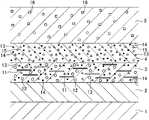
- FIG. 1 illustrates a schematic sectional view of a coated article.
- FIG. 2 illustrates views for describing a difference in a phenomenon due to a pigment particle size when visible light enters a red pigment.
- FIG. 3 illustrates a graph of a light transmission spectrum regarding various second base layers.
- a coated article according to the present embodiment illustrated in FIG. 1 is configured such that a laminated coating film including a first base layer 3 and a second base layer 4 and a transparent clear layer 5 having translucency is provided on a coating target object provided with a cation electrodeposition coating 2 on a surface of a vehicle body (steel plate) 1 of an automobile.
- the first base layer 3 dispersively contains, in resin, a lustrous material 11 , a red pigment 12 , an organic high-molecular-weight ultraviolet absorbing agent 13 having a molecular weight of equal to or greater than 500, and an inorganic nanoparticle ultraviolet absorbing agent 14 .
- the second base layer 4 dispersively contains, in resin, an organic red pigment 15 , an organic high-molecular-weight ultraviolet absorbing agent 13 having a molecular weight of equal to or greater than 500, and an inorganic nanoparticle ultraviolet absorbing agent 14 .
- the transparent clear layer 5 dispersively contains an organic ultraviolet absorbing agent 16 in resin.
- a flake-shaped lustrous material is preferably employed as the lustrous material 11 of the first base layer 3 .
- quinacridone diketo-pyrrolo-pyrrole, anthraquinone, perylene, perinone, or indigoid can be, for example, employed as the red pigment 12 of the first base layer 3 .
- perylene red is preferably employed.
- a high-molecular-weight benzotriazole-based ultraviolet absorbing agent such as CAS No. 103597-45-1 (a molecular weight of 659) or a triazine-based ultraviolet absorbing agent such as CAS No. 371146-04-2 (a molecular weight of 512), CAS No. 222529-65-9 (a molecular weight of 700), or CAS No. 153519-44-9 (a molecular weight of 647) can be, for example, employed as the ultraviolet absorbing agent 13 of the first base layer 3 and the second base layer 4 with a molecular weight of equal to or greater than 500.
- the molecular weight is preferably equal to or less than 700.
- metal oxide nanoparticles such as zinc oxide or iron oxide can be employed as the inorganic nanoparticle ultraviolet absorbing agent 14 of the first base layer 3 and the second base layer 4 .
- the iron oxide ( ⁇ -Fe 2 O 3 ) nano particles are preferably employed.
- a light transmission for a wavelength of equal to or lower than 600 nm is low (a light transmission for a range from blue to ultraviolet is substantially zero), and a light transmission for red exceeding a wavelength of 600 nm is high.
- quinacridone diketo-pyrrolo-pyrrole, anthraquinone, perylene, perinone, or indigoid can be, for example, employed as the organic red pigment 15 of the second base layer 4 .
- perylene red is preferably employed.
- a benzotriazole-based ultraviolet absorbing agent such as CAS No. 2440-22-4 (a molecular weight of 225), CAS No. 3896-11-5 (a molecular weight of 315), or CAS No. 70321-86-7 (a molecular weight of 447) or a benzophenone-based ultraviolet absorbing agent such as CAS No. 1843-05-6 (a molecular weight of 326) can be, for example, employed as the organic ultraviolet absorbing agent 16 of the transparent clear layer 5 .
- the first base layer 3 and the second base layer 4 can be formed by coating with water-based base paint or oil-based (solvent-type) base paint.
- water-based base paint acrylic resin, polyester resin, polyurethane resin, or vinyl resin can be, although not specifically limited, used as water-based resin as a main component, for example.
- paint additive agents such as a cross-linker, a flat pigment, a curing catalyst, a thickener, an organic solvent, a basic neutralizer, a light stabilizer, a surface conditioner, an oxidation inhibitor, and a silane coupling agent can be mixed with the water-based base paint, for example.
- two-component urethane clear paint contains hydroxy-containing acrylic resin and a polyisocyanate compound.
- the organic solvent include, for example, a hydrocarbon-based solvent, an ester-based solvent, a ketone-based solvent, an alcohol-based solvent, an ether-based solvent, and an aromatic petroleum-based solvent.
- pigments non-water dispersible resin, polymer microparticles, a curing catalyst, a light stabilizer, a coating surface conditioner, an oxidation inhibitor, a fluidity conditioner, and wax can be mixed with the clear paint, for example.
- FIG. 2( a ) when the particle size of the red pigment is large (e.g., about 500 nm), a visible light beam having entered the pigment is geometric-optically reflected or scattered across an entire wavelength, and a light transmission for red transmitting through the pigment is low.
- the pigment particle size decreases as illustrated in FIGS. 2( b ) and 2( c ) ( FIG. 2( b ) is, e.g., 100 nm and FIG. 2( c ) is, e.g., 50 nm)
- geometric-optical reflection is less, and the light transmission for red is higher. Meanwhile, blue scattered light (Rayleigh scattering) occurs.
- the average particle size of the red pigment is equal to or less than 100 nm, preferably equal to or less than 70 nm, and more preferably equal to or less than 50 nm.
- the ultraviolet absorbing agent is necessary not only for prevention of deterioration of the red pigment 15 of the second base layer 4 due to ultraviolet light and protection of the electrodeposition coating 2 from ultraviolet light but also for avoidance of degradation of the red chroma due to bluish coloration caused by Rayleigh scattering.
- FIG. 3 relates to the second base layer, and illustrates a light transmission spectrum in each of the case of adding only the perylene red as the red pigment 15 , the case of adding the perylene red and the organic ultraviolet absorbing agent (the organic UVA), the case of adding the perylene red and nano iron oxide (the iron oxide nanoparticles as the inorganic ultraviolet absorbing agent), and the case of adding the perylene red, the organic UVA, and the nano iron oxide.
- the thickness of the second base layer is 12 ⁇ m.
- the average particle size of the perylene red is 50 nm, and the additive amount of the perylene red is 2% by mass.
- the organic UVA is a benzotriazole-based UVA with a molecular weight of 659, and the additive amount of the organic UVA is 3% by mass.
- the average particle size of the nano iron oxide is 50 nm, and the additive amount of the nano iron oxide is 2% by mass.
- Cation electrodeposition paint was electrodeposited on a dull steel plate (substrate) subjected to zinc phosphate treatment such that the thickness in a dried state is 20 ⁇ m, and was baked at 160° C. for 30 minutes.
- the resultant electrodeposition coating on the coating target object was coated with first base paint (acrylic emulsion-based water-based paint) by a rotary spray electrostatic coating machine, thereby forming an uncured first base layer.
- This paint was mixed with aluminum flakes of 12% by mass as a lustrous material, perylene red of 8% by mass as a pigment having an average particle size of 50 nm, a high-molecular-weight benzotriazole-based UVA (CAS No.
- % by mass is a percentage with respect to the entire mass of the solid content of the paint (the same applies to the following).
- the first base layer was coated with second base paint (acrylic emulsion-based water-based paint) by the rotary spray electrostatic coating machine, thereby forming an uncured second base layer having translucency.
- This paint was mixed with perylene red of 2% by mass as an organic pigment, a high-molecular-weight benzotriazole-based UVA (CAS No. 103597-45-1 (a molecular weight of 659)) of 3% by mass as an organic ultraviolet absorbing agent, and iron oxide nanoparticles (an average particle size of 50 nm) of 2% by mass as an inorganic ultraviolet absorbing agent.
- the second base layer was coated with two-component urethane clear paint by the rotary spray electrostatic coating machine, thereby forming an uncured transparent clear layer.
- This clear paint was mixed with a low-molecular-weight benzotriazole-based UVA (CAS No. 70321-86-7 (a molecular weight of 447)) of 5% by mass as an organic ultraviolet absorbing agent.
- the uncured first base layer, the uncured second base layer, and the uncured transparent clear layer were simultaneously heated (heated at 140° C. for 20 minutes) and cured.
- the thickness of each of the first base layer and the second base layer in the dried state was 12 ⁇ m, and the thickness of the transparent clear layer in the dried state was 30 ⁇ m.
- pre-heating heating at 80° C. for three minutes
- baking heating at 140° C. for 20 minutes
- UVA indicates an ultraviolet absorbing agent.
- MW 659
- MW 225
- MW 760
- MW 512
- the inorganic UVA is iron oxide.
- the second to fourth samples use, for the first and second base layers, the organic ultraviolet absorbing agents having different molecular weights from that of the first sample. That is, the second sample uses a triazine-based ultraviolet absorbing agent (a molecular weight of 512) of CAS No. 371146-04-2, the third sample uses a triazine-based ultraviolet absorbing agent (a molecular weight of 700) of CAS No. 222529-65-9, and the fourth sample uses a benzotriazole-based ultraviolet absorbing agent (a molecular weight of 225) of CAS No. 2440-22-4.
- a triazine-based ultraviolet absorbing agent a molecular weight of 512
- the third sample uses a triazine-based ultraviolet absorbing agent (a molecular weight of 700) of CAS No. 222529-65-9
- the fourth sample uses a benzotriazole-based ultraviolet absorbing agent (a molecular weight of 225) of CAS No. 2440-22-4.
- the fifth sample is different from the first sample in that perylene red with an average particle size of 400 nm was used as the organic pigment of the second base layer.
- the sixth sample is different from the first sample in that the mixing amount of the organic ultraviolet absorbing agent of the first base layer was zero.
- the seventh sample is different from the first sample in that the mixing amount of the inorganic ultraviolet absorbing agent of the second base layer was zero and the amount of the organic ultraviolet absorbing agent of the second base layer was increased.
- the eighth sample is different from the first sample in that a benzotriazole-based ultraviolet absorbing agent of CAS No. 84268-08-6 with a molecular weight of 760 was used as the organic ultraviolet absorbing agents of the first and second base layers.
- a chroma (an initial chroma) right after paint finish for each of the first to eighth samples and a chroma after a weather resistance test were measured.
- the weather resistance test was performed by a method specified according to JASO M 351 (Automotive Exterior Parts: Accelerated Weather Resistance Test by Xenon Arc Lamp) such that a radiant exposure is 600 MJ/m 2 . Results are shown in Table 1.
- the first to third samples show a high initial chroma and no great decrease in chroma after the weather resistance test.
- the fourth sample shows a high initial chroma, but shows a low chroma after the weather resistance test.
- the organic ultraviolet absorbing agents used for the first and second base layers have low molecular weights, and therefore, it is recognized that deterioration of the pigment perylene red of the second base layer is accelerated due to deterioration of these organic ultraviolet absorbing agents.
- the fifth sample shows a lower initial chroma as compared to the first sample, and as a result, also shows a lower chroma after the weather resistance test. It is recognized as described above because the particle size of the perylene red used for the second base layer is great.
- the sixth sample shows a high initial chroma, but shows a low chroma after the weather resistance test. It is recognized as described above because the content of the organic ultraviolet absorbing agent of the first base layer is zero and the amount of transfer of the organic ultraviolet absorbing agent from the second base layer to the first base layer increases accordingly. That is, it is recognized as described above because protection of the perylene red from ultraviolet light by the organic ultraviolet absorbing agent of the second base layer becomes insufficient.
- the seventh sample shows a lower initial chroma as compared to the first sample. It is recognized as described above because the amount of the high-molecular-weight organic ultraviolet absorbing agent of the second base layer is great. The chroma after the weather resistance test also shows a great decrement.
- the ultraviolet absorbing agent added to the second base layer is only the organic agent, and it is recognized as described above due to transfer and deterioration of the ultraviolet absorbing agent.
- the eighth sample shows a lower initial chroma as compared to the first sample, and as a result, also shows a lower chroma after the weather resistance test. It is recognized as described above because the molecular weights of the organic ultraviolet absorbing agents used for the first and second base layers are excessively great and the chroma accordingly decreases due to an increase in diffused reflex caused by the ultraviolet absorbing agents.
Landscapes
- Chemical & Material Sciences (AREA)
- Engineering & Computer Science (AREA)
- Life Sciences & Earth Sciences (AREA)
- Wood Science & Technology (AREA)
- Organic Chemistry (AREA)
- Materials Engineering (AREA)
- Nanotechnology (AREA)
- Crystallography & Structural Chemistry (AREA)
- Mechanical Engineering (AREA)
- Laminated Bodies (AREA)
- Application Of Or Painting With Fluid Materials (AREA)
- Paints Or Removers (AREA)
Abstract
Description
| TABLE 1 | ||||||||
| Sample | 1 | 2 | 3 | 4 | 5 | 6 | 7 | 8 |
| Second Base | Perylene | 2% | 2% | 2% | 2% | 2% | 2% | 2% | 2% |
| Layer | Red | (MN = 50 nm) | (MN = 50 nm) | (MN = 50 nm) | (MN = 50 nm) | (MN = 400 nm) | (MN = 50 nm) | (MN = | (MN = |
| Acrylic | (mass %) | 50 nm) | 50 nm) | ||||||
| Emulsion- | Organic | 3% | 3% | 3% | 3% | 3% | 3% | 3% | 3% |
| Based | UVA | (MW = 659) | (MW = 512) | (MW = 700) | (MW = 225) | (MW = 659) | (MW = 659) | (MW = | (MW = |
| Water-Based | (mass %) | 659) | 760) | ||||||
| Paint | Inorganic | 2% | 2% | 2% | 2% | 2% | 2% | 0% | 2% |
| UVA | (MN = 50 nm) | (MN = 50 nm) | (MN = 50 nm) | (MN = 50 nm) | (MN = 50 nm) | (MN = 50 nm) | (MN = | ||
| (mass %) | 50 nm) | ||||||||
| First Base | Perylene | 8% | 8% | 8% | 8% | 8% | 8% | 8% | 8% |
| Layer | Red | (MN = 50 nm) | (MN = 50 nm) | (MN = 50 nm) | (MN = 50 nm) | (MN = 50 nm) | (MN = 50 nm) | (MN = | (MN = |
| Acrylic | (mass %) | 50 nm) | 50 nm) | ||||||
| Emulsion- | Organic | 3% | 3% | 3% | 3% | 3% | 0% | 3% | 3% |
| Based | UVA | (MW = 659) | (MW = 5 12) | (MW = 700) | (MW = 225) | (MW = 659) | (MW = | (MW = | |
| Water-Based | (mass %) | 659) | 760) | ||||||
| Paint | Inorganic | 2% | 2% | 2% | 2% | 2% | 2% | 2% | 2% |
| UVA | (MN = 50 nm) | (MN = 50 nm) | (MN = 50 nm) | (MN = 50 nm) | (MN = 50 nm) | (MN = 50 nm) | (MN = | (MN = | |
| (mass %) | 50 nm) | 50 nm) | |||||||
| Aluminum | 12% | 12% | 12% | 12% | 12% | 12% | 12% | 12% | |
| Flakes | |||||||||
| (mass %) | |||||||||
| Evaluation | Initial | 34 | 35 | 33 | 33 | 24 | 33 | 31 | 28 |
| Chroma | |||||||||
| (C*) | |||||||||
| Chroma | 32 | 32 | 30 | 25 | 21 | 25 | 26 | 24 | |
| (C*) after | |||||||||
| Weather | |||||||||
| Resistance | |||||||||
| Test | |||||||||
| “MN” indicates a number average particle size. | |||||||||
| “MW” indicates a molecular weight. | |||||||||
| “UVA” indicates an ultraviolet absorbing agent. | |||||||||
| Regarding the organic UVA, “MW = 659,” “MW = 225,” and “MW = 760” indicate a benzotriazole-based UVA, and “MW = 512” and “MW = 700” indicate a triazine-based UVA. | |||||||||
| The inorganic UVA is iron oxide. | |||||||||
-
- 1 vehicle body (steel plate) of automobile
- 2 electrodeposition coating
- 3 first base layer
- 4 second base layer
- 5 transparent clear layer
- 11 lustrous material
- 12 red pigment
- 13 organic high-molecular-weight ultraviolet absorbing agent
- 14 inorganic nanoparticle ultraviolet absorbing agent
- 15 organic red pigment
- 16 organic ultraviolet absorbing agent
Claims (14)
Applications Claiming Priority (4)
| Application Number | Priority Date | Filing Date | Title |
|---|---|---|---|
| JP2017017047A JP6875138B2 (en) | 2017-02-01 | 2017-02-01 | Method for forming laminated coating film, coated material and laminated coating film |
| JPJP2017-017047 | 2017-02-01 | ||
| JP2017-017047 | 2017-02-01 | ||
| PCT/JP2018/003033 WO2018143219A1 (en) | 2017-02-01 | 2018-01-30 | Laminated coating film, coated article, and method for forming laminated coating film |
Publications (2)
| Publication Number | Publication Date |
|---|---|
| US20200354589A1 US20200354589A1 (en) | 2020-11-12 |
| US11466163B2 true US11466163B2 (en) | 2022-10-11 |
Family
ID=63039672
Family Applications (1)
| Application Number | Title | Priority Date | Filing Date |
|---|---|---|---|
| US16/482,537 Active 2039-07-08 US11466163B2 (en) | 2017-02-01 | 2018-01-30 | Laminated coating film, coated article, and method for forming laminated coating film |
Country Status (8)
| Country | Link |
|---|---|
| US (1) | US11466163B2 (en) |
| JP (1) | JP6875138B2 (en) |
| CN (1) | CN110325291B (en) |
| DE (1) | DE112018000299T5 (en) |
| MX (1) | MX2019008783A (en) |
| MY (1) | MY190662A (en) |
| RU (1) | RU2734222C1 (en) |
| WO (1) | WO2018143219A1 (en) |
Families Citing this family (9)
| Publication number | Priority date | Publication date | Assignee | Title |
|---|---|---|---|---|
| JP6997149B2 (en) * | 2019-09-13 | 2022-01-17 | ダイハツ工業株式会社 | How to paint the car body |
| JP7587945B2 (en) * | 2020-09-10 | 2024-11-21 | 日本ペイント・オートモーティブコーティングス株式会社 | Red multi-layer coating and vehicle |
| JP7694018B2 (en) * | 2020-11-13 | 2025-06-18 | マツダ株式会社 | Multilayer coatings and painted objects |
| JP7694016B2 (en) * | 2020-11-13 | 2025-06-18 | マツダ株式会社 | Multilayer coatings and painted objects |
| JP7694017B2 (en) | 2020-11-13 | 2025-06-18 | マツダ株式会社 | Multilayer coatings and painted objects |
| JP7397026B2 (en) * | 2021-08-04 | 2023-12-12 | 日本ペイント・オートモーティブコーティングス株式会社 | paint composition set |
| EP4546956A4 (en) * | 2022-09-08 | 2025-10-22 | Samsung Electronics Co Ltd | Housing, electronic device comprising the housing and method for producing the housing |
| JP2024079381A (en) * | 2022-11-30 | 2024-06-11 | マツダ株式会社 | Multilayer coatings and painted objects |
| JP7417334B1 (en) | 2023-05-30 | 2024-01-18 | シー・ファースト株式会社 | Painting method and paint kit |
Citations (10)
| Publication number | Priority date | Publication date | Assignee | Title |
|---|---|---|---|---|
| JPH09214976A (en) | 1996-02-02 | 1997-08-15 | Sony Corp | Still image data generation device and still image data generation method |
| JP2001347223A (en) | 2000-06-06 | 2001-12-18 | Nippon Paint Co Ltd | Method for forming highly-designed multilayer coating film for automobile body |
| JP2006281451A (en) | 2005-03-31 | 2006-10-19 | Dainippon Ink & Chem Inc | Molded laminated sheet |
| JP2007167720A (en) | 2005-12-20 | 2007-07-05 | Honda Motor Co Ltd | Formation method of multilayer coating film |
| EP1826233A1 (en) | 2006-02-28 | 2007-08-29 | Shin-Etsu Chemical Co., Ltd. | Curable composition and coated article |
| JP2011240255A (en) | 2010-05-18 | 2011-12-01 | Mazda Motor Corp | Laminated coating film structure |
| JP2014042891A (en) | 2012-08-28 | 2014-03-13 | Nippon Paint Co Ltd | Method of forming highly designed multilayer coating film |
| CN105228827A (en) | 2013-09-30 | 2016-01-06 | 马自达汽车株式会社 | Multi-layer coating film and painting object |
| JP2016185527A (en) | 2015-03-27 | 2016-10-27 | 日本ペイント・オートモーティブコーティングス株式会社 | Formation method of multilayer coating film |
| JP2016188332A (en) | 2015-03-30 | 2016-11-04 | トヨタ自動車東日本株式会社 | Clear coating composition for automobile body, method for forming multilayer coating film for automobile body, and multilayer coating film for automobile body |
Family Cites Families (1)
| Publication number | Priority date | Publication date | Assignee | Title |
|---|---|---|---|---|
| JP3516543B2 (en) * | 1995-10-27 | 2004-04-05 | 株式会社小糸製作所 | Colored coating agent for turn signal lamp and turn signal lamp |
-
2017
- 2017-02-01 JP JP2017017047A patent/JP6875138B2/en active Active
-
2018
- 2018-01-30 MY MYPI2019004390A patent/MY190662A/en unknown
- 2018-01-30 CN CN201880009807.8A patent/CN110325291B/en active Active
- 2018-01-30 DE DE112018000299.3T patent/DE112018000299T5/en active Pending
- 2018-01-30 US US16/482,537 patent/US11466163B2/en active Active
- 2018-01-30 RU RU2019127047A patent/RU2734222C1/en active
- 2018-01-30 WO PCT/JP2018/003033 patent/WO2018143219A1/en not_active Ceased
- 2018-01-30 MX MX2019008783A patent/MX2019008783A/en unknown
Patent Citations (14)
| Publication number | Priority date | Publication date | Assignee | Title |
|---|---|---|---|---|
| JPH09214976A (en) | 1996-02-02 | 1997-08-15 | Sony Corp | Still image data generation device and still image data generation method |
| JP2001347223A (en) | 2000-06-06 | 2001-12-18 | Nippon Paint Co Ltd | Method for forming highly-designed multilayer coating film for automobile body |
| JP2006281451A (en) | 2005-03-31 | 2006-10-19 | Dainippon Ink & Chem Inc | Molded laminated sheet |
| JP2007167720A (en) | 2005-12-20 | 2007-07-05 | Honda Motor Co Ltd | Formation method of multilayer coating film |
| EP1826233A1 (en) | 2006-02-28 | 2007-08-29 | Shin-Etsu Chemical Co., Ltd. | Curable composition and coated article |
| JP2011240255A (en) | 2010-05-18 | 2011-12-01 | Mazda Motor Corp | Laminated coating film structure |
| CN102933317A (en) | 2010-05-18 | 2013-02-13 | 马自达汽车株式会社 | Laminated coating film structure |
| US20130048501A1 (en) | 2010-05-18 | 2013-02-28 | Mazda Motor Corporation | Laminated coating film structure |
| JP2014042891A (en) | 2012-08-28 | 2014-03-13 | Nippon Paint Co Ltd | Method of forming highly designed multilayer coating film |
| US20150217332A1 (en) | 2012-08-28 | 2015-08-06 | Nippon Paint Co., Ltd. | Method for forming excellent multi-layer coating film |
| CN105228827A (en) | 2013-09-30 | 2016-01-06 | 马自达汽车株式会社 | Multi-layer coating film and painting object |
| US20160122561A1 (en) | 2013-09-30 | 2016-05-05 | Mazda Motor Corporation | Multilayer coating film and coated article |
| JP2016185527A (en) | 2015-03-27 | 2016-10-27 | 日本ペイント・オートモーティブコーティングス株式会社 | Formation method of multilayer coating film |
| JP2016188332A (en) | 2015-03-30 | 2016-11-04 | トヨタ自動車東日本株式会社 | Clear coating composition for automobile body, method for forming multilayer coating film for automobile body, and multilayer coating film for automobile body |
Non-Patent Citations (3)
| Title |
|---|
| BASF TINUVIN 384-2 Technical Data Sheet. * |
| Computer-generated English-language translation of JP-2016185527-A. * |
| International Search Report issued in PCT/JP2018/003033; dated Apr. 17, 2018. |
Also Published As
| Publication number | Publication date |
|---|---|
| DE112018000299T5 (en) | 2019-10-02 |
| JP6875138B2 (en) | 2021-05-19 |
| US20200354589A1 (en) | 2020-11-12 |
| JP2018123248A (en) | 2018-08-09 |
| RU2734222C1 (en) | 2020-10-13 |
| CN110325291A (en) | 2019-10-11 |
| MY190662A (en) | 2022-05-09 |
| MX2019008783A (en) | 2019-12-11 |
| CN110325291B (en) | 2022-09-23 |
| WO2018143219A1 (en) | 2018-08-09 |
Similar Documents
| Publication | Publication Date | Title |
|---|---|---|
| US11466163B2 (en) | Laminated coating film, coated article, and method for forming laminated coating film | |
| US10052658B2 (en) | Laminated coating film structure | |
| CN104685015B (en) | Gloss coating composition, method and multilayer film using said composition production multilayer film | |
| JP5187622B2 (en) | Thermal barrier coating composition, method of forming thermal barrier coating using the same, and thermal barrier coating | |
| CN103260775B (en) | Method for forming multi-layer paint film | |
| JP2011136317A (en) | Method of forming bright multilayer coating film | |
| JP5405394B2 (en) | Multi-layer coating formation method | |
| US6727310B2 (en) | Water-based metallic coating composition | |
| JP5213049B2 (en) | Laminated coating film and method for forming the same | |
| JP7499214B2 (en) | Multi-layer coating film and method for forming multi-layer coating film | |
| KR20240051222A (en) | Dark primer coating with high LiDAR reflectance | |
| JP2022047724A (en) | Multi-layer coating film and method for forming the multi-layer coating film | |
| JP2012050908A (en) | Method of forming multi-layer coating film | |
| JP7688968B2 (en) | Multi-layer coating film and method for forming multi-layer coating film | |
| JP2011251253A (en) | Method of forming multilayer coating film | |
| KR20230021093A (en) | Paint composition and method for producing the paint composition | |
| JP5552407B2 (en) | Formation method of multilayer coating film | |
| JP7587945B2 (en) | Red multi-layer coating and vehicle | |
| KR102831780B1 (en) | Paint composition and method for producing paint composition | |
| JP2016188332A (en) | Clear coating composition for automobile body, method for forming multilayer coating film for automobile body, and multilayer coating film for automobile body | |
| JP4712630B2 (en) | Method for repairing multilayer coating film and article obtained therefrom | |
| JP7557364B2 (en) | Universal coating composition set for forming coating film on exterior and interior panels of automobiles, coating film on exterior and interior panels of automobiles, and method for forming coating film on exterior and interior panels of automobiles | |
| US9878348B2 (en) | Coating composition with improved sense of sparkle and coating method using coating composition | |
| JP2024085074A (en) | Water-based paint composition, coated article, and method for producing coated article | |
| JP2003253211A (en) | Aqueous intermediate coating composition and coating film forming method |
Legal Events
| Date | Code | Title | Description |
|---|---|---|---|
| FEPP | Fee payment procedure |
Free format text: ENTITY STATUS SET TO UNDISCOUNTED (ORIGINAL EVENT CODE: BIG.); ENTITY STATUS OF PATENT OWNER: LARGE ENTITY |
|
| AS | Assignment |
Owner name: MAZDA MOTOR CORPORATION, JAPAN Free format text: ASSIGNMENT OF ASSIGNORS INTEREST;ASSIGNORS:YAMANAKA, EIJI;ARASHI, MASAHARU;KIYONAGA, HIROSHI;AND OTHERS;SIGNING DATES FROM 20190718 TO 20190807;REEL/FRAME:050143/0231 Owner name: NIPPON PAINT AUTOMOTIVE COATINGS CO., LTD., JAPAN Free format text: ASSIGNMENT OF ASSIGNORS INTEREST;ASSIGNORS:YAMANAKA, EIJI;ARASHI, MASAHARU;KIYONAGA, HIROSHI;AND OTHERS;SIGNING DATES FROM 20190718 TO 20190807;REEL/FRAME:050143/0231 |
|
| STPP | Information on status: patent application and granting procedure in general |
Free format text: APPLICATION DISPATCHED FROM PREEXAM, NOT YET DOCKETED |
|
| STPP | Information on status: patent application and granting procedure in general |
Free format text: DOCKETED NEW CASE - READY FOR EXAMINATION |
|
| STPP | Information on status: patent application and granting procedure in general |
Free format text: NON FINAL ACTION MAILED |
|
| STPP | Information on status: patent application and granting procedure in general |
Free format text: RESPONSE TO NON-FINAL OFFICE ACTION ENTERED AND FORWARDED TO EXAMINER |
|
| STPP | Information on status: patent application and granting procedure in general |
Free format text: NOTICE OF ALLOWANCE MAILED -- APPLICATION RECEIVED IN OFFICE OF PUBLICATIONS |
|
| STPP | Information on status: patent application and granting procedure in general |
Free format text: PUBLICATIONS -- ISSUE FEE PAYMENT VERIFIED |
|
| STCF | Information on status: patent grant |
Free format text: PATENTED CASE |
|
| MAFP | Maintenance fee payment |
Free format text: PAYMENT OF MAINTENANCE FEE, 4TH YEAR, LARGE ENTITY (ORIGINAL EVENT CODE: M1551); ENTITY STATUS OF PATENT OWNER: LARGE ENTITY Year of fee payment: 4 |