US11460609B2 - Hybrid polymer waveguide and methods for making the same - Google Patents
Hybrid polymer waveguide and methods for making the same Download PDFInfo
- Publication number
- US11460609B2 US11460609B2 US17/044,798 US201917044798A US11460609B2 US 11460609 B2 US11460609 B2 US 11460609B2 US 201917044798 A US201917044798 A US 201917044798A US 11460609 B2 US11460609 B2 US 11460609B2
- Authority
- US
- United States
- Prior art keywords
- waveguide
- light
- waveguides
- core layer
- auxiliary layer
- Prior art date
- Legal status (The legal status is an assumption and is not a legal conclusion. Google has not performed a legal analysis and makes no representation as to the accuracy of the status listed.)
- Active, expires
Links
Images




Classifications
-
- G—PHYSICS
- G02—OPTICS
- G02B—OPTICAL ELEMENTS, SYSTEMS OR APPARATUS
- G02B1/00—Optical elements characterised by the material of which they are made; Optical coatings for optical elements
- G02B1/04—Optical elements characterised by the material of which they are made; Optical coatings for optical elements made of organic materials, e.g. plastics
- G02B1/045—Light guides
- G02B1/046—Light guides characterised by the core material
-
- G—PHYSICS
- G02—OPTICS
- G02B—OPTICAL ELEMENTS, SYSTEMS OR APPARATUS
- G02B1/00—Optical elements characterised by the material of which they are made; Optical coatings for optical elements
- G02B1/04—Optical elements characterised by the material of which they are made; Optical coatings for optical elements made of organic materials, e.g. plastics
- G02B1/045—Light guides
-
- G—PHYSICS
- G02—OPTICS
- G02B—OPTICAL ELEMENTS, SYSTEMS OR APPARATUS
- G02B1/00—Optical elements characterised by the material of which they are made; Optical coatings for optical elements
- G02B1/04—Optical elements characterised by the material of which they are made; Optical coatings for optical elements made of organic materials, e.g. plastics
- G02B1/045—Light guides
- G02B1/048—Light guides characterised by the cladding material
-
- G—PHYSICS
- G02—OPTICS
- G02B—OPTICAL ELEMENTS, SYSTEMS OR APPARATUS
- G02B27/00—Optical systems or apparatus not provided for by any of the groups G02B1/00 - G02B26/00, G02B30/00
- G02B27/0081—Optical systems or apparatus not provided for by any of the groups G02B1/00 - G02B26/00, G02B30/00 with means for altering, e.g. enlarging, the entrance or exit pupil
-
- G—PHYSICS
- G02—OPTICS
- G02B—OPTICAL ELEMENTS, SYSTEMS OR APPARATUS
- G02B27/00—Optical systems or apparatus not provided for by any of the groups G02B1/00 - G02B26/00, G02B30/00
- G02B27/01—Head-up displays
- G02B27/0101—Head-up displays characterised by optical features
-
- G—PHYSICS
- G02—OPTICS
- G02B—OPTICAL ELEMENTS, SYSTEMS OR APPARATUS
- G02B27/00—Optical systems or apparatus not provided for by any of the groups G02B1/00 - G02B26/00, G02B30/00
- G02B27/01—Head-up displays
- G02B27/017—Head mounted
- G02B27/0172—Head mounted characterised by optical features
-
- G—PHYSICS
- G02—OPTICS
- G02B—OPTICAL ELEMENTS, SYSTEMS OR APPARATUS
- G02B5/00—Optical elements other than lenses
- G02B5/18—Diffraction gratings
- G02B5/1814—Diffraction gratings structurally combined with one or more further optical elements, e.g. lenses, mirrors, prisms or other diffraction gratings
- G02B5/1819—Plural gratings positioned on the same surface, e.g. array of gratings
-
- G—PHYSICS
- G02—OPTICS
- G02B—OPTICAL ELEMENTS, SYSTEMS OR APPARATUS
- G02B5/00—Optical elements other than lenses
- G02B5/18—Diffraction gratings
- G02B5/1842—Gratings for image generation
-
- G—PHYSICS
- G02—OPTICS
- G02B—OPTICAL ELEMENTS, SYSTEMS OR APPARATUS
- G02B6/00—Light guides; Structural details of arrangements comprising light guides and other optical elements, e.g. couplings
-
- G—PHYSICS
- G02—OPTICS
- G02B—OPTICAL ELEMENTS, SYSTEMS OR APPARATUS
- G02B6/00—Light guides; Structural details of arrangements comprising light guides and other optical elements, e.g. couplings
- G02B6/0001—Light guides; Structural details of arrangements comprising light guides and other optical elements, e.g. couplings specially adapted for lighting devices or systems
- G02B6/0011—Light guides; Structural details of arrangements comprising light guides and other optical elements, e.g. couplings specially adapted for lighting devices or systems the light guides being planar or of plate-like form
- G02B6/0075—Arrangements of multiple light guides
- G02B6/0078—Side-by-side arrangements, e.g. for large area displays
- G02B6/008—Side-by-side arrangements, e.g. for large area displays of the partially overlapping type
-
- G—PHYSICS
- G02—OPTICS
- G02B—OPTICAL ELEMENTS, SYSTEMS OR APPARATUS
- G02B27/00—Optical systems or apparatus not provided for by any of the groups G02B1/00 - G02B26/00, G02B30/00
- G02B27/01—Head-up displays
- G02B27/0101—Head-up displays characterised by optical features
- G02B2027/0123—Head-up displays characterised by optical features comprising devices increasing the field of view
- G02B2027/0125—Field-of-view increase by wavefront division
-
- G—PHYSICS
- G02—OPTICS
- G02B—OPTICAL ELEMENTS, SYSTEMS OR APPARATUS
- G02B27/00—Optical systems or apparatus not provided for by any of the groups G02B1/00 - G02B26/00, G02B30/00
- G02B27/01—Head-up displays
- G02B27/017—Head mounted
- G02B27/0172—Head mounted characterised by optical features
- G02B2027/0174—Head mounted characterised by optical features holographic
-
- G—PHYSICS
- G02—OPTICS
- G02B—OPTICAL ELEMENTS, SYSTEMS OR APPARATUS
- G02B27/00—Optical systems or apparatus not provided for by any of the groups G02B1/00 - G02B26/00, G02B30/00
- G02B27/01—Head-up displays
- G02B27/017—Head mounted
- G02B2027/0178—Eyeglass type
Definitions
- the present disclosure relates to display systems and, more particularly, to augmented reality display systems.
- a virtual reality, or “VR”, scenario typically involves presentation of digital or virtual image information without transparency to other actual real-world visual input;
- an augmented reality, or “AR”, scenario typically involves presentation of digital or virtual image information as an augmentation to visualization of the actual world around the user.
- a mixed reality, or “MR”, scenario is a type of AR scenario and typically involves virtual objects that are integrated into, and responsive to, the natural world. For example, in an MR scenario, AR image content may be blocked by or otherwise be perceived as interacting with objects in the real world.
- an augmented reality scene 10 is depicted wherein a user of an AR technology sees a real-world park-like setting 20 featuring people, trees, buildings in the background, and a concrete platform 30 .
- the user of the AR technology also perceives that he “sees” “virtual content” such as a robot statue 40 standing upon the real-world platform 30 , and a cartoon-like avatar character 50 flying by which seems to be a personification of a bumble bee, even though these elements 40 , 50 do not exist in the real world.
- the human visual perception system is complex, it is challenging to produce an AR technology that facilitates a comfortable, natural-feeling, rich presentation of virtual image elements amongst other virtual or real-world imagery elements.
- an optical device comprises a waveguide.
- the waveguide comprises: an optically transmissive core layer having a major surface opposite an other major surface; and an optically transmissive auxiliary layer on the major surface, the auxiliary layer having a nanophotonic structure.
- the auxiliary layer is thinner than the core layer and is formed of a material different from material forming the core layer.
- an optical system comprises a set of stacked, spaced-apart waveguides. At least one of the waveguides comprises: an optically transmissive core layer having a major surface opposite an other major surface; and an optically transmissive auxiliary layer on the major surface.
- the auxiliary layer comprises a nanophotonic structure. The auxiliary layer is thinner than the core layer and is formed of a material different from material forming the core layer.
- a method for making an optical device comprises forming a waveguide.
- Forming the waveguide comprises providing upper and lower imprint molds, wherein the imprint molds face one another.
- a first polymer material is provided between the imprint molds.
- a second polymer material is provided over the first polymer material and between the imprint molds.
- the second polymer material is in the liquid state.
- the second polymer material is contacted with the upper imprint mold.
- the first polymer material and the second polymer material is exposed to a hardening process.
- the first polymer material forms a first layer and the second polymer material forms a second layer.
- the upper imprint mold is then removed.
- Example 1 An optical device comprising:
- Example 2 The optical device of Example 1, wherein the nanaphotonic structure comprises an optical grating.
- Example 3 The optical device of any of Examples 1 to 2, wherein the core layer and the auxiliary layer are each formed of a polymer or a resin.
- Example 4 The optical device of any of Examples 1 to 3, wherein material forming the auxiliary layer has a refractive index differing by about 0.05 or more from the refractive index of material forming the core layer.
- Example 5 The optical device of any of Examples 1 to 4, wherein the core layer has a thickness of 100-5000 ⁇ m, and the auxiliary layer has a thickness of between 0.01-5 ⁇ m.
- Example 6 The optical device of any of Examples 1 to 5, further comprising an additional auxiliary layer thinner than the core layer and immediately adjacent the other major surface
- Example 7 The optical device of Example 6, wherein the additional auxiliary layer comprises an optical grating.
- Example 8 The waveguide of any of Examples 1 to 7, further comprising an additional core layer disposed on an opposite side of the auxiliary layer from the core layer.
- Example 9 The optical device of any of Examples 1 to 8, further comprising a plurality of core layers alternating with auxiliary layers thinner than the core layers, the auxiliary layers formed of material different from the core layers.
- Example 10 The optical device of Example 9, wherein the core layers are formed of a same material.
- Example 11 The optical device of any of Examples 9 to 10, wherein the auxiliary layers are formed of a same material.
- Example 12 The optical device of any of Examples 9 to 11, wherein one or more of the auxiliary layers comprise optical gratings different from one or more other auxiliary layers.
- Example 13 An optical system comprising:
- Example 14 The optical system of Example 13, wherein each waveguide is separated by an air gap.
- Example 15 The optical system of any of Examples 13 to 14, wherein each waveguide is spaced apart by one or more spacers disposed between the waveguides.
- Example 16 The optical system of any of Examples 13 to 15, wherein each of the waveguides comprises a core layer and an auxiliary layer, wherein the one or more spacers are integral with one of the core layer or auxiliary layer.
- Example 17 The optical system of any of Examples 13 to 16, wherein each of the waveguides comprises a core layer and an auxiliary layer, wherein a core layer of each waveguide is formed of a different material from core layers of other waveguides of the set of stacked, spaced-apart waveguides.
- Example 18 The optical system of any of Examples 13 to 17, wherein the optical system is an augmented reality system, and further comprises:
- Example 19 The optical system of Example 18, wherein the spatial light modulator is part of a light projection system configured to project images onto the incoupling diffractive optical elements.
- Example 20 The optical system of any of Examples 18 to 19, wherein the spatial light modulator modulates light for a scanning fiber display.
- Example 21 The optical system of any of Examples 13 to 20, further comprising a plurality of sets of stacked, space-apart waveguides, wherein each waveguide comprises:
- an optically transmissive core layer having a major surface opposite an other major surface
- the auxiliary layer comprising a nanophotonic structure
- auxiliary layer is thinner than the core layer and is formed of a material different from material forming the core layer.
- Example 22 A method for making an optical device, the method comprising:
- Example 23 The method of Example 22, wherein the upper imprint mold comprises a pattern of protrusions and indentations, wherein contacting the second polymer material with the upper imprint mold transfers a corresponding pattern of protrusions and indentations into the second polymer material.
- Example 24 The method of any of Examples 22 to 23, wherein the lower imprint mold comprises a pattern of protrusions and indentations, and wherein the first layer comprises a matching pattern of protrusions and indentations.
- Example 25 The method of any of Examples 22 to 24, wherein the first polymer material is in the liquid state.
- Example 26 The method of any of Examples 22 to 25, wherein providing the first polymer material comprises:
- Example 27 The method of any of Examples 22 to 26, wherein exposing the first and second polymer material to a hardening process comprises exposing the first and second polymer material to ultraviolet light.
- Example 28 The method of any of Examples 22 to 27, further comprising:
- Example 29 The method of Example 28, further comprising:
- Example 30 The method of Example 29, further comprising:
- Example 31 The method of Example 30, wherein the first, third, and fifth polymer materials are a same material.
- Example 32 The method of any of Examples 29 to 31, wherein the second and fourth polymer materials are a same material.
- Example 33 The method of any of Examples 30 to 32, wherein the first, third, and fifth layers comprise a pattern of protrusions and indentations forming diffractive optical elements.
- Example 34 The method of any of the Examples 22 to 33, further comprising:
- FIG. 1 illustrates a user's view of augmented reality (AR) through an AR device.
- AR augmented reality
- FIG. 2 illustrates a conventional display system for simulating three-dimensional imagery for a user.
- FIGS. 3A-3C illustrate relationships between radius of curvature and focal radius.
- FIG. 4A illustrates a representation of the accommodation-vergence response of the human visual system.
- FIG. 4B illustrates examples of different accommodative states and vergence states of a pair of eyes of the user.
- FIG. 4C illustrates an example of a representation of a top-down view of a user viewing content via a display system.
- FIG. 4D illustrates another example of a representation of a top-down view of a user viewing content via a display system.
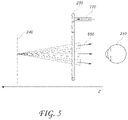
- FIG. 5 illustrates aspects of an approach for simulating three-dimensional imagery by modifying wavefront divergence.
- FIG. 6 illustrates an example of a waveguide stack for outputting image information to a user.
- FIG. 7 illustrates an example of exit beams outputted by a waveguide.
- FIG. 8 illustrates an example of a stacked waveguide assembly in which each depth plane includes images formed using multiple different component colors.
- FIG. 9A illustrates a cross-sectional side view of an example of a set of stacked waveguides that each includes an incoupling optical element.
- FIG. 9B illustrates a perspective view of an example of the plurality of stacked waveguides of FIG. 9A .
- FIG. 9C illustrates a top-down plan view of an example of the plurality of stacked waveguides of FIGS. 9A and 9B .
- FIG. 9D illustrates an example of wearable display system.
- FIG. 10 illustrates an example of a hybrid waveguide with a core layer and an auxiliary layer.
- FIG. 11 illustrates an example of a hybrid waveguide with a core layer and multiple auxiliary layers.
- FIG. 12 illustrates an example of a hybrid waveguide with multiple core layers and an auxiliary layer.
- FIG. 13 illustrates an example of a hybrid waveguide with multiple core layers and multiple auxiliary layers.
- FIG. 14 illustrates an example of a stack of hybrid waveguides.
- FIGS. 15 a -15 e illustrate a method of forming a hybrid waveguide with a core layer and an auxiliary layer.
- FIGS. 16 a -16 d illustrate another method of forming a hybrid waveguide with a core layer and an auxiliary layer.
- FIGS. 17 a -17 g illustrate a method of forming a hybrid waveguide with a core layer and multiple auxiliary layers.
- FIGS. 18 a -18 d illustrate a method of forming a hybrid waveguide with a patterned core layer and an auxiliary layer.
- FIGS. 19 a -19 g illustrate a method of forming a hybrid waveguide with integral spacers.
- Waveguides may be utilized to direct light, such as in display devices including head-mounted augmented reality display systems.
- the waveguides may be incorporated into eyewear and the viewer may see the ambient environment through the waveguides.
- the waveguides may display images by receiving light containing image information and directing that light into the eyes of a viewer.
- the received light may be incoupled into the waveguides using nanophotonic structures such as diffractive optical elements.
- the incoupled light may subsequently be outcoupled out of the waveguides also using nanophotonic structures such as diffractive optical elements.
- the nanophotonic structures may take the form of indentations and protrusions in the waveguide.
- the requirements for forming and supporting the functionality of the nanophotonic structures may be in tension with requirements for forming a waveguide that has desired properties for propagating light.
- a material with a high refractive index at the interface where light is outcoupled out of the waveguide is beneficial for providing a display with a large field of view, and for providing a waveguide with high compactness and highly efficient light outcoupling and incoupling.
- the waveguide is preferably highly transparent and homogeneous, to limit optical losses for light propagating within it, and preferably can also be formed on a bulk scale, that is, to a thickness and area suitable for a waveguide.
- materials with high transparency and homogeneity and that are formable on a bulk scale may not have desired high refractive indices, and conversely materials with high refractive indices may not have the desired high transparency and homogeneity, and ease of being formed on the bulk scale, for use to form a waveguide.
- a hybrid waveguide is provided with multiple layers of different materials.
- the hybrid waveguide may include a core layer and an auxiliary layer.
- the core layer is formed of a highly transparent material and the auxiliary layer is formed of a thinner layer of material, in which nanophotonic structures are provided.
- the material forming the core layer is a highly transparent polymer, e.g., having a transparency relay transmission of greater than 85%, greater than 90%, or greater than 96% in the visible light spectrum across the thickness of the core layer.
- the material may be a flowable material (e.g., a flowable polymer) which may be flowed onto a surface and subsequently hardened, e.g., by curing.
- the auxiliary layer may be thinner than the core layer and is preferably formed of a different material than the core layer.
- the core layer may have a thickness of between about 100 ⁇ m and 1000 ⁇ m
- the auxiliary layer may have a thickness of between about 5 nm and about 5000 nm (0.01 ⁇ m to about 5 ⁇ m), including about 50 nm to about 5000 nm.
- the auxiliary layer is formed of a polymer (e.g., an organic polymer), an inorganic material, a hybrid organic/inorganic material, or combinations thereof.
- the auxiliary layer may have lower transparency in the visible spectrum and/or have lower homogeneity (in composition and/or optical properties such as transparency) than the core layer.
- this lower transparency may be ameliorated by the relative thinness of the auxiliary layer in comparison to the core layer.
- the hybrid waveguide is formed of material with high refractive indices, which may provide an advantageously large field of view for display devices utilizing the core layer in the waveguide.
- the materials forming the core layer and auxiliary layer may have a refractive index of about 1.65 or more, about 1.70 or more, or about 1.80 or more.
- the auxiliary layer may be formed of a material with a different refractive index than the core layer. It will be appreciated that differences in refractive indices at an interface between nanophotonic structures and another material can facilitate the ability of the nanophotonic structure to redirect light.
- the nanophotonic structures comprise indentations filled with another material.
- the other material may be a subsequently formed core layer.
- the material forming the auxiliary layer has a refractive index that differs from the refractive index of the material filling the indentations of the nanophotonic structures by about 0.05 or more, about 0.1 or more, or about 0.2 or more.
- the material filling the indentations of the nanophotonic structures may be the material of a core layer formed after forming the nanophotonic structures in the auxiliary layer.
- the material forming the auxiliary layer has a refractive index that differs from the material forming the core layer, which fills the indentations of the nanophotonic structure, by about 0.05 or more, about 0.1 or more, or about 0.2 or more.
- the refractive index of the material forming the auxiliary layer may be higher than that of the core layer filling the indentations and may be about 1.65 or more, about 1.70 or more, or about 1.80 or more. In some other embodiments, the refractive index of the material forming the auxiliary layer may be lower than that of the core layer filling the indentations.
- the nanophotonic structures may take the form of repeating lines of material with intervening indentations or open volumes in the auxiliary layer.
- the nanophotonic structures have critical dimensions (e.g., the widths of the lines of material) that are less than the wavelength of light in the visible spectrum.
- the nanophotonic structures may be surface relief features, including diffractive optical elements such as diffractive gratings.
- the nanophotonic structures may be a meta-surface.
- the nanophotonic structures may include features that extend partially or completely through the auxiliary layer.
- one or more of the nanophotonic structures may extend into an immediately neighboring core layer.
- the core layer may provide additional flexibility to form features of desired sizes, depending, for example, on the desired optical functionality.
- the indentations between lines of materials in the auxiliary layer may extend into the core layer to form features in the nanophotonic structure with larger aspect ratios than would be possible if those features are formed only using the auxiliary layer.
- the use of layers of different materials as disclosed herein allows the functionality of a layer to be better matched with the material forming that layer.
- the core layer may be formed of a homogeneous, highly transparent material.
- the material forming the core layer may be readily processed to form a thick layer while maintaining the desired homogeneity and transparency. In some embodiments, such a material may be relatively soft or pliable.
- the auxiliary layers may be formed of material having a sufficiently large refractive index difference with the core layer to allow the formation of diffractive optical elements with the light redirecting capabilities as disclosed. As discussed herein, the refractive index of the material forming the auxiliary layer is preferably different than that of the core layer.
- auxiliary layer material may be mechanically hard and/or strong (e.g., mechanically harder or stronger than the core layer).
- a relatively thick core layer may be utilized to provide light propagation with little optical loss, while a relatively thin auxiliary layer having a high refractive index is utilized to form photonic structures and to also mechanically protect/or reinforce the core layer.
- the waveguide may comprise multiple core and/or auxiliary layers.
- the core layer may be provided with auxiliary layers on either side of it, e.g., on top and bottom major surfaces, or two core layers may be provided, one on either side of an auxiliary layer.
- auxiliary layers may be provided alternating with core layers.
- the ability to provide multiple auxiliary layers can advantageously provide additional optical functionality.
- different auxiliary layers may have different nanophotonic structures, which may be configured to provide different optical functionality.
- different nanophotonic structures to be configured to address the shortcomings of other nanophotonic structures, such that the aggregate functionality of all of the nanophotonic structures is improved relative to a single structure.
- some nanophotonic structures such as optical gratings, may operate in a narrow band of wavelengths of light and/or incident angles.
- the aggregate bands of wavelengths of light and/or incident angles acted upon by the waveguide may be increased.
- FIG. 2 illustrates a conventional display system for simulating three-dimensional imagery for a user.
- a user's eyes are spaced apart and that, when looking at a real object in space, each eye will have a slightly different view of the object and may form an image of the object at different locations on the retina of each eye. This may be referred to as binocular disparity and may be utilized by the human visual system to provide a perception of depth.
- Conventional display systems simulate binocular disparity by presenting two distinct images 190 , 200 with slightly different views of the same virtual object—one for each eye 210 , 220 —corresponding to the views of the virtual object that would be seen by each eye were the virtual object a real object at a desired depth. These images provide binocular cues that the user's visual system may interpret to derive a perception of depth.
- the images 190 , 200 are spaced from the eyes 210 , 220 by a distance 230 on a z-axis.
- the z-axis is parallel to the optical axis of the viewer with their eyes fixated on an object at optical infinity directly ahead of the viewer.
- the images 190 , 200 are flat and at a fixed distance from the eyes 210 , 220 .
- the eyes may naturally rotate such that an image of the object falls on corresponding points on the retinas of each of the eyes, to maintain single binocular vision.
- This rotation may cause the lines of sight of each of the eyes 210 , 220 to converge onto a point in space at which the virtual object is perceived to be present.
- providing three-dimensional imagery conventionally involves providing binocular cues that may manipulate the vergence of the user's eyes 210 , 220 , and that the human visual system interprets to provide a perception of depth.
- FIGS. 3A-3C illustrate relationships between distance and the divergence of light rays.
- the distance between the object and the eye 210 is represented by, in order of decreasing distance, R 1 , R 2 , and R 3 .
- R 1 , R 2 , and R 3 the distance between the object and the eye 210.
- R 3 the distance between the object and the eye 210.
- the light rays become more divergent as distance to the object decreases.
- the light rays become more collimated.
- the light field produced by a point (the object or a part of the object) has a spherical wavefront curvature, which is a function of how far away the point is from the eye of the user.
- the curvature increases with decreasing distance between the object and the eye 210 . While only a single eye 210 is illustrated for clarity of illustration in FIGS. 3A-3C and other figures herein, the discussions regarding eye 210 may be applied to both eyes 210 and 220 of a viewer.
- light from an object that the viewer's eyes are fixated on may have different degrees of wavefront divergence. Due to the different amounts of wavefront divergence, the light may be focused differently by the lens of the eye, which in turn may require the lens to assume different shapes to form a focused image on the retina of the eye. Where a focused image is not formed on the retina, the resulting retinal blur acts as a cue to accommodation that causes a change in the shape of the lens of the eye until a focused image is formed on the retina.
- the cue to accommodation may trigger the ciliary muscles surrounding the lens of the eye to relax or contract, thereby modulating the force applied to the suspensory ligaments holding the lens, thus causing the shape of the lens of the eye to change until retinal blur of an object of fixation is eliminated or minimized, thereby forming a focused image of the object of fixation on the retina (e.g., fovea) of the eye.
- the process by which the lens of the eye changes shape may be referred to as accommodation, and the shape of the lens of the eye required to form a focused image of the object of fixation on the retina (e.g., fovea) of the eye may be referred to as an accommodative state.
- FIG. 4A a representation of the accommodation-vergence response of the human visual system is illustrated.
- the movement of the eyes to fixate on an object causes the eyes to receive light from the object, with the light forming an image on each of the retinas of the eyes.
- the presence of retinal blur in the image formed on the retina may provide a cue to accommodation, and the relative locations of the image on the retinas may provide a cue to vergence.
- the cue to accommodation causes accommodation to occur, resulting in the lenses of the eyes each assuming a particular accommodative state that forms a focused image of the object on the retina (e.g., fovea) of the eye.
- the cue to vergence causes vergence movements (rotation of the eyes) to occur such that the images formed on each retina of each eye are at corresponding retinal points that maintain single binocular vision.
- the eyes may be said to have assumed a particular vergence state.
- accommodation may be understood to be the process by which the eye achieves a particular accommodative state
- vergence may be understood to be the process by which the eye achieves a particular vergence state.
- the accommodative and vergence states of the eyes may change if the user fixates on another object.
- the accommodated state may change if the user fixates on a new object at a different depth on the z-axis.
- vergence movements e.g., rotation of the eyes so that the pupils move toward or away from each other to converge the lines of sight of the eyes to fixate upon an object
- vergence movements e.g., rotation of the eyes so that the pupils move toward or away from each other to converge the lines of sight of the eyes to fixate upon an object
- vergence movements e.g., rotation of the eyes so that the pupils move toward or away from each other to converge the lines of sight of the eyes to fixate upon an object
- accommodation of the lenses of the eyes are closely associated with accommodation of the lenses of the eyes.
- changing the shapes of the lenses of the eyes to change focus from one object to another object at a different distance will automatically cause a matching change in vergence to the same distance, under a relationship known as the “accommodation-vergence reflex.”
- a change in vergence will trigger a matching change in lens shape under normal conditions.
- the pair of eyes 222 a is fixated on an object at optical infinity, while the pair eyes 222 b are fixated on an object 221 at less than optical infinity.
- the vergence states of each pair of eyes is different, with the pair of eyes 222 a directed straight ahead, while the pair of eyes 222 converge on the object 221 .
- the accommodative states of the eyes forming each pair of eyes 222 a and 222 b are also different, as represented by the different shapes of the lenses 210 a , 220 a.
- the human eye typically may interpret a finite number of depth planes to provide depth perception. Consequently, a highly believable simulation of perceived depth may be achieved by providing, to the eye, different presentations of an image corresponding to each of these limited numbers of depth planes.
- the different presentations may provide both cues to vergence and matching cues to accommodation, thereby providing physiologically correct accommodation-vergence matching.
- two depth planes 240 corresponding to different distances in space from the eyes 210 , 220 , are illustrated.
- vergence cues may be provided by the displaying of images of appropriately different perspectives for each eye 210 , 220 .
- light forming the images provided to each eye 210 , 220 may have a wavefront divergence corresponding to a light field produced by a point at the distance of that depth plane 240 .
- the distance, along the z-axis, of the depth plane 240 containing the point 221 is 1 m.
- distances or depths along the z-axis may be measured with a zero-point located at the exit pupils of the user's eyes.
- a depth plane 240 located at a depth of 1 m corresponds to a distance of 1 m away from the exit pupils of the user's eyes, on the optical axis of those eyes with the eyes directed towards optical infinity.
- the depth or distance along the z-axis may be measured from the display in front of the user's eyes (e.g., from the surface of a waveguide), plus a value for the distance between the device and the exit pupils of the user's eyes. That value may be called the eye relief and corresponds to the distance between the exit pupil of the user's eye and the display worn by the user in front of the eye.
- the value for the eye relief may be a normalized value used generally for all viewers.
- the eye relief may be assumed to be 20 mm and a depth plane that is at a depth of 1 m may be at a distance of 980 mm in front of the display.
- the display system may provide images of a virtual object to each eye 210 , 220 .
- the images may cause the eyes 210 , 220 to assume a vergence state in which the eyes converge on a point 15 on a depth plane 240 .
- the images may be formed by a light having a wavefront curvature corresponding to real objects at that depth plane 240 .
- the eyes 210 , 220 assume an accommodative state in which the images are in focus on the retinas of those eyes.
- the user may perceive the virtual object as being at the point 15 on the depth plane 240 .
- each of the accommodative and vergence states of the eyes 210 , 220 are associated with a particular distance on the z-axis.
- an object at a particular distance from the eyes 210 , 220 causes those eyes to assume particular accommodative states based upon the distances of the object.
- the distance associated with a particular accommodative state may be referred to as the accommodation distance, A d .
- there are particular vergence distances, V d associated with the eyes in particular vergence states, or positions relative to one another. Where the accommodation distance and the vergence distance match, the relationship between accommodation and vergence may be said to be physiologically correct. This is considered to be the most comfortable scenario for a viewer.
- images displayed to the eyes 210 , 220 may be displayed with wavefront divergence corresponding to depth plane 240 , and the eyes 210 , 220 may assume a particular accommodative state in which the points 15 a , 15 b on that depth plane are in focus.
- the images displayed to the eyes 210 , 220 may provide cues for vergence that cause the eyes 210 , 220 to converge on a point 15 that is not located on the depth plane 240 .
- the accommodation distance corresponds to the distance from the exit pupils of the eyes 210 , 220 to the depth plane 240
- the vergence distance corresponds to the larger distance from the exit pupils of the eyes 210 , 220 to the point 15 , in some embodiments.
- the accommodation distance is different from the vergence distance. Consequently, there is an accommodation-vergence mismatch. Such a mismatch is considered undesirable and may cause discomfort in the user. It will be appreciated that the mismatch corresponds to distance (e.g., V d ⁇ A d ) and may be characterized using diopters.
- a reference point other than exit pupils of the eyes 210 , 220 may be utilized for determining distance for determining accommodation-vergence mismatch, so long as the same reference point is utilized for the accommodation distance and the vergence distance.
- the distances could be measured from the cornea to the depth plane, from the retina to the depth plane, from the eyepiece (e.g., a waveguide of the display device) to the depth plane, from the center of rotation of an eye, and so on.
- display systems disclosed herein present images to the viewer having accommodation-vergence mismatch of about 0.5 diopter or less.
- the accommodation-vergence mismatch of the images provided by the display system is about 0.33 diopter or less.
- the accommodation-vergence mismatch of the images provided by the display system is about 0.25 diopter or less, including about 0.1 diopter or less.
- FIG. 5 illustrates aspects of an approach for simulating three-dimensional imagery by modifying wavefront divergence.
- the display system includes a waveguide 270 that is configured to receive light 770 that is encoded with image information, and to output that light to the user's eye 210 .
- the waveguide 270 may output the light 650 with a defined amount of wavefront divergence corresponding to the wavefront divergence of a light field produced by a point on a desired depth plane 240 .
- the same amount of wavefront divergence is provided for all objects presented on that depth plane.
- the other eye of the user may be provided with image information from a similar waveguide.
- a single waveguide may be configured to output light with a set amount of wavefront divergence corresponding to a single or limited number of depth planes and/or the waveguide may be configured to output light of a limited range of wavelengths. Consequently, in some embodiments, a plurality or stack of waveguides may be utilized to provide different amounts of wavefront divergence for different depth planes and/or to output light of different ranges of wavelengths.
- a depth plane may follow the contours of a flat or a curved surface. In some embodiments, advantageously for simplicity, the depth planes may follow the contours of flat surfaces.
- FIG. 6 illustrates an example of a waveguide stack for outputting image information to a user.
- a display system 250 includes a stack of waveguides, or stacked waveguide assembly, 260 that may be utilized to provide three-dimensional perception to the eye/brain using a plurality of waveguides 270 , 280 , 290 , 300 , 310 . It will be appreciated that the display system 250 may be considered a light field display in some embodiments.
- the waveguide assembly 260 may also be referred to as an eyepiece.
- the display system 250 may be configured to provide substantially continuous cues to vergence and multiple discrete cues to accommodation.
- the cues to vergence may be provided by displaying different images to each of the eyes of the user, and the cues to accommodation may be provided by outputting the light that forms the images with selectable discrete amounts of wavefront divergence.
- the display system 250 may be configured to output light with variable levels of wavefront divergence.
- each discrete level of wavefront divergence corresponds to a particular depth plane and may be provided by a particular one of the waveguides 270 , 280 , 290 , 300 , 310 .
- the waveguide assembly 260 may also include a plurality of features 320 , 330 , 340 , 350 between the waveguides.
- the features 320 , 330 , 340 , 350 may be one or more lenses.
- the waveguides 270 , 280 , 290 , 300 , 310 and/or the plurality of lenses 320 , 330 , 340 , 350 may be configured to send image information to the eye with various levels of wavefront curvature or light ray divergence. Each waveguide level may be associated with a particular depth plane and may be configured to output image information corresponding to that depth plane.
- Image injection devices 360 , 370 , 380 , 390 , 400 may function as a source of light for the waveguides and may be utilized to inject image information into the waveguides 270 , 280 , 290 , 300 , 310 , each of which may be configured, as described herein, to distribute incoming light across each respective waveguide, for output toward the eye 210 .
- each of the input surfaces 460 , 470 , 480 , 490 , 500 may be an edge of a corresponding waveguide, or may be part of a major surface of the corresponding waveguide (that is, one of the waveguide surfaces directly facing the world 510 or the viewer's eye 210 ).
- a single beam of light may be injected into each waveguide to output an entire field of cloned collimated beams that are directed toward the eye 210 at particular angles (and amounts of divergence) corresponding to the depth plane associated with a particular waveguide.
- a single one of the image injection devices 360 , 370 , 380 , 390 , 400 may be associated with and inject light into a plurality (e.g., three) of the waveguides 270 , 280 , 290 , 300 , 310 .
- the image injection devices 360 , 370 , 380 , 390 , 400 are discrete displays that each produce image information for injection into a corresponding waveguide 270 , 280 , 290 , 300 , 310 , respectively.
- the image injection devices 360 , 370 , 380 , 390 , 400 are the output ends of a single multiplexed display which may, e.g., pipe image information via one or more optical conduits (such as fiber optic cables) to each of the image injection devices 360 , 370 , 380 , 390 , 400 .
- the image information provided by the image injection devices 360 , 370 , 380 , 390 , 400 may include light of different wavelengths, or colors (e.g., different component colors, as discussed herein).
- the light injected into the waveguides 270 , 280 , 290 , 300 , 310 is provided by a light projector system 520 , which comprises a light module 530 , which may include a light emitter, such as a light emitting diode (LED).
- the light from the light module 530 may be directed to and modified by a light modulator 540 , e.g., a spatial light modulator, via a beam splitter 550 .
- the light modulator 540 may be configured to change the perceived intensity of the light injected into the waveguides 270 , 280 , 290 , 300 , 310 to encode the light with image information.
- Examples of spatial light modulators include liquid crystal displays (LCD) including a liquid crystal on silicon (LCOS) displays.
- LCD liquid crystal displays
- LCOS liquid crystal on silicon
- the image injection devices 360 , 370 , 380 , 390 , 400 are illustrated schematically and, in some embodiments, these image injection devices may represent different light paths and locations in a common projection system configured to output light into associated ones of the waveguides 270 , 280 , 290 , 300 , 310 .
- the waveguides of the waveguide assembly 260 may function as ideal lens while relaying light injected into the waveguides out to the user's eyes.
- the object may be the spatial light modulator 540 and the image may be the image on the depth plane.
- the display system 250 may be a scanning fiber display comprising one or more scanning fibers configured to project light in various patterns (e.g., raster scan, spiral scan, Lissajous patterns, etc.) into one or more waveguides 270 , 280 , 290 , 300 , 310 and ultimately to the eye 210 of the viewer.
- the illustrated image injection devices 360 , 370 , 380 , 390 , 400 may schematically represent a single scanning fiber or a bundle of scanning fibers configured to inject light into one or a plurality of the waveguides 270 , 280 , 290 , 300 , 310 .
- the illustrated image injection devices 360 , 370 , 380 , 390 , 400 may schematically represent a plurality of scanning fibers or a plurality of bundles of scanning fibers, each of which are configured to inject light into an associated one of the waveguides 270 , 280 , 290 , 300 , 310 .
- one or more optical fibers may be configured to transmit light from the light module 530 to the one or more waveguides 270 , 280 , 290 , 300 , 310 .
- one or more intervening optical structures may be provided between the scanning fiber, or fibers, and the one or more waveguides 270 , 280 , 290 , 300 , 310 to, e.g., redirect light exiting the scanning fiber into the one or more waveguides 270 , 280 , 290 , 300 , 310 .
- a controller 560 controls the operation of one or more of the stacked waveguide assembly 260 , including operation of the image injection devices 360 , 370 , 380 , 390 , 400 , the light source 530 , and the light modulator 540 .
- the controller 560 is part of the local data processing module 140 .
- the controller 560 includes programming (e.g., instructions in a non-transitory medium) that regulates the timing and provision of image information to the waveguides 270 , 280 , 290 , 300 , 310 according to, e.g., any of the various schemes disclosed herein.
- the controller may be a single integral device, or a distributed system connected by wired or wireless communication channels.
- the controller 560 may be part of the processing modules 140 or 150 ( FIG. 9D ) in some embodiments.
- the waveguides 270 , 280 , 290 , 300 , 310 may be configured to propagate light within each respective waveguide by total internal reflection (TIR).
- the waveguides 270 , 280 , 290 , 300 , 310 may each be planar or have another shape (e.g., curved), with major top and bottom surfaces and edges extending between those major top and bottom surfaces.
- the waveguides 270 , 280 , 290 , 300 , 310 may each include out-coupling optical elements 570 , 580 , 590 , 600 , 610 that are configured to extract light out of a waveguide by redirecting the light, propagating within each respective waveguide, out of the waveguide to output image information to the eye 210 .
- Extracted light may also be referred to as out-coupled light and the out-coupling optical elements light may also be referred to light extracting optical elements.
- An extracted beam of light may be outputted by the waveguide at locations at which the light propagating in the waveguide strikes a light extracting optical element.
- the out-coupling optical elements 570 , 580 , 590 , 600 , 610 may, for example, be gratings, including diffractive optical features, as discussed further herein. While illustrated disposed at the bottom major surfaces of the waveguides 270 , 280 , 290 , 300 , 310 , for ease of description and drawing clarity, in some embodiments, the out-coupling optical elements 570 , 580 , 590 , 600 , 610 may be disposed at the top and/or bottom major surfaces, and/or may be disposed directly in the volume of the waveguides 270 , 280 , 290 , 300 , 310 , as discussed further herein.
- the out-coupling optical elements 570 , 580 , 590 , 600 , 610 may be formed in a layer of material that is attached to a transparent substrate to form the waveguides 270 , 280 , 290 , 300 , 310 .
- the waveguides 270 , 280 , 290 , 300 , 310 may be a monolithic piece of material and the out-coupling optical elements 570 , 580 , 590 , 600 , 610 may be formed on a surface and/or in the interior of that piece of material.
- each waveguide 270 , 280 , 290 , 300 , 310 is configured to output light to form an image corresponding to a particular depth plane.
- the waveguide 270 nearest the eye may be configured to deliver collimated light (which was injected into such waveguide 270 ), to the eye 210 .
- the collimated light may be representative of the optical infinity focal plane.
- the next waveguide up 280 may be configured to send out collimated light which passes through the first lens 350 (e.g., a negative lens) before it may reach the eye 210 ; such first lens 350 may be configured to create a slight convex wavefront curvature so that the eye/brain interprets light coming from that next waveguide up 280 as coming from a first focal plane closer inward toward the eye 210 from optical infinity.
- first lens 350 e.g., a negative lens
- the third up waveguide 290 passes its output light through both the first 350 and second 340 lenses before reaching the eye 210 ; the combined optical power of the first 350 and second 340 lenses may be configured to create another incremental amount of wavefront curvature so that the eye/brain interprets light coming from the third waveguide 290 as coming from a second focal plane that is even closer inward toward the person from optical infinity than was light from the next waveguide up 280 .
- the other waveguide layers 300 , 310 and lenses 330 , 320 are similarly configured, with the highest waveguide 310 in the stack sending its output through all of the lenses between it and the eye for an aggregate focal power representative of the closest focal plane to the person.
- a compensating lens layer 620 may be disposed at the top of the stack to compensate for the aggregate power of the lens stack 320 , 330 , 340 , 350 below.
- Such a configuration provides as many perceived focal planes as there are available waveguide/lens pairings.
- Both the out-coupling optical elements of the waveguides and the focusing aspects of the lenses may be static (i.e., not dynamic or electro-active). In some alternative embodiments, either or both may be dynamic using electro-active features.
- two or more of the waveguides 270 , 280 , 290 , 300 , 310 may have the same associated depth plane.
- multiple waveguides 270 , 280 , 290 , 300 , 310 may be configured to output images set to the same depth plane, or multiple subsets of the waveguides 270 , 280 , 290 , 300 , 310 may be configured to output images set to the same plurality of depth planes, with one set for each depth plane. This may provide advantages for forming a tiled image to provide an expanded field of view at those depth planes.
- the out-coupling optical elements 570 , 580 , 590 , 600 , 610 may be configured to both redirect light out of their respective waveguides and to output this light with the appropriate amount of divergence or collimation for a particular depth plane associated with the waveguide.
- waveguides having different associated depth planes may have different configurations of out-coupling optical elements 570 , 580 , 590 , 600 , 610 , which output light with a different amount of divergence depending on the associated depth plane.
- the light extracting optical elements 570 , 580 , 590 , 600 , 610 may be volumetric or surface features, which may be configured to output light at specific angles.
- the light extracting optical elements 570 , 580 , 590 , 600 , 610 may be volume holograms, surface holograms, and/or diffraction gratings.
- the features 320 , 330 , 340 , 350 may not be lenses; rather, they may simply be spacers (e.g., cladding layers and/or structures for forming air gaps).
- the out-coupling optical elements 570 , 580 , 590 , 600 , 610 are diffractive features that form a diffraction pattern, or “diffractive optical element” (also referred to herein as a “DOE”).
- the DOE's have a sufficiently low diffraction efficiency so that only a portion of the light of the beam is deflected away toward the eye 210 with each intersection of the DOE, while the rest continues to move through a waveguide via TIR.
- the light carrying the image information is thus divided into a number of related exit beams that exit the waveguide at a multiplicity of locations and the result is a fairly uniform pattern of exit emission toward the eye 210 for this particular collimated beam bouncing around within a waveguide.
- one or more DOEs may be switchable between “on” states in which they actively diffract, and “off” states in which they do not significantly diffract.
- a switchable DOE may comprise a layer of polymer dispersed liquid crystal, in which microdroplets comprise a diffraction pattern in a host medium, and the refractive index of the microdroplets may be switched to substantially match the refractive index of the host material (in which case the pattern does not appreciably diffract incident light) or the microdroplet may be switched to an index that does not match that of the host medium (in which case the pattern actively diffracts incident light).
- a camera assembly 630 may be provided to capture images of the eye 210 and/or tissue around the eye 210 to, e.g., detect user inputs and/or to monitor the physiological state of the user.
- a camera may be any image capture device.
- the camera assembly 630 may include an image capture device and a light source to project light (e.g., infrared light) to the eye, which may then be reflected by the eye and detected by the image capture device.
- the camera assembly 630 may be attached to the frame 80 ( FIG. 9D ) and may be in electrical communication with the processing modules 140 and/or 150 , which may process image information from the camera assembly 630 .
- one camera assembly 630 may be utilized for each eye, to separately monitor each eye.
- FIG. 7 an example of exit beams outputted by a waveguide is shown.
- One waveguide is illustrated, but it will be appreciated that other waveguides in the waveguide assembly 260 ( FIG. 6 ) may function similarly, where the waveguide assembly 260 includes multiple waveguides.
- Light 640 is injected into the waveguide 270 at the input surface 460 of the waveguide 270 and propagates within the waveguide 270 by TIR. At points where the light 640 impinges on the DOE 570 , a portion of the light exits the waveguide as exit beams 650 .
- the exit beams 650 are illustrated as substantially parallel but, as discussed herein, they may also be redirected to propagate to the eye 210 at an angle (e.g., forming divergent exit beams), depending on the depth plane associated with the waveguide 270 . It will be appreciated that substantially parallel exit beams may be indicative of a waveguide with out-coupling optical elements that out-couple light to form images that appear to be set on a depth plane at a large distance (e.g., optical infinity) from the eye 210 .
- waveguides or other sets of out-coupling optical elements may output an exit beam pattern that is more divergent, which would require the eye 210 to accommodate to a closer distance to bring it into focus on the retina and would be interpreted by the brain as light from a distance closer to the eye 210 than optical infinity.
- a full color image may be formed at each depth plane by overlaying images in each of the component colors, e.g., three or more component colors.
- FIG. 8 illustrates an example of a stacked waveguide assembly in which each depth plane includes images formed using multiple different component colors.
- the illustrated embodiment shows depth planes 240 a - 240 f , although more or fewer depths are also contemplated.
- Each depth plane may have three or more component color images associated with it, including: a first image of a first color, G; a second image of a second color, R; and a third image of a third color, B.
- Different depth planes are indicated in the figure by different numbers for diopters (dpt) following the letters G, R, and B.
- the numbers following each of these letters indicate diopters (1/m), or inverse distance of the depth plane from a viewer, and each box in the figures represents an individual component color image.
- the exact placement of the depth planes for different component colors may vary. For example, different component color images for a given depth plane may be placed on depth planes corresponding to different distances from the user. Such an arrangement may increase visual acuity and user comfort and/or may decrease chromatic aberrations.
- each depth plane may have multiple waveguides associated with it.
- each box in the figures including the letters G, R, or B may be understood to represent an individual waveguide, and three waveguides may be provided per depth plane where three component color images are provided per depth plane. While the waveguides associated with each depth plane are shown adjacent to one another in this drawing for ease of description, it will be appreciated that, in a physical device, the waveguides may all be arranged in a stack with one waveguide per level. In some other embodiments, multiple component colors may be outputted by the same waveguide, such that, e.g., only a single waveguide may be provided per depth plane.
- G is the color green
- R is the color red
- B is the color blue.
- other colors associated with other wavelengths of light including magenta and cyan, may be used in addition to or may replace one or more of red, green, or blue.
- references to a given color of light throughout this disclosure will be understood to encompass light of one or more wavelengths within a range of wavelengths of light that are perceived by a viewer as being of that given color.
- red light may include light of one or more wavelengths in the range of about 620-780 nm
- green light may include light of one or more wavelengths in the range of about 492-577 nm
- blue light may include light of one or more wavelengths in the range of about 435-493 nm.
- the light source 530 may be configured to emit light of one or more wavelengths outside the visual perception range of the viewer, for example, infrared and/or ultraviolet wavelengths.
- the in-coupling, out-coupling, and other light redirecting structures of the waveguides of the display 250 may be configured to direct and emit this light out of the display towards the user's eye 210 , e.g., for imaging and/or user stimulation applications.
- FIG. 9A illustrates a cross-sectional side view of an example of a plurality or set 660 of stacked waveguides that each includes an in-coupling optical element.
- the waveguides may each be configured to output light of one or more different wavelengths, or one or more different ranges of wavelengths. It will be appreciated that the stack 660 may correspond to the stack 260 ( FIG.
- the illustrated waveguides of the stack 660 may correspond to part of the plurality of waveguides 270 , 280 , 290 , 300 , 310 , except that light from one or more of the image injection devices 360 , 370 , 380 , 390 , 400 is injected into the waveguides from a position that requires light to be redirected for in-coupling.
- the illustrated set 660 of stacked waveguides includes waveguides 670 , 680 , and 690 .
- Each waveguide includes an associated in-coupling optical element (which may also be referred to as a light input area on the waveguide), with, e.g., in-coupling optical element 700 disposed on a major surface (e.g., an upper major surface) of waveguide 670 , in-coupling optical element 710 disposed on a major surface (e.g., an upper major surface) of waveguide 680 , and in-coupling optical element 720 disposed on a major surface (e.g., an upper major surface) of waveguide 690 .
- in-coupling optical element 700 disposed on a major surface (e.g., an upper major surface) of waveguide 670
- in-coupling optical element 710 disposed on a major surface (e.g., an upper major surface) of waveguide 680
- in-coupling optical element 720 disposed on a major surface (e.g
- one or more of the in-coupling optical elements 700 , 710 , 720 may be disposed on the bottom major surface of the respective waveguide 670 , 680 , 690 (particularly where the one or more in-coupling optical elements are reflective, deflecting optical elements). As illustrated, the in-coupling optical elements 700 , 710 , 720 may be disposed on the upper major surface of their respective waveguide 670 , 680 , 690 (or the top of the next lower waveguide), particularly where those in-coupling optical elements are transmissive, deflecting optical elements. In some embodiments, the in-coupling optical elements 700 , 710 , 720 may be disposed in the body of the respective waveguide 670 , 680 , 690 .
- the in-coupling optical elements 700 , 710 , 720 are wavelength selective, such that they selectively redirect one or more wavelengths of light, while transmitting other wavelengths of light. While illustrated on one side or corner of their respective waveguide 670 , 680 , 690 , it will be appreciated that the in-coupling optical elements 700 , 710 , 720 may be disposed in other areas of their respective waveguide 670 , 680 , 690 in some embodiments.
- each in-coupling optical element 700 , 710 , 720 may be laterally offset from one another.
- each in-coupling optical element may be offset such that it receives light without that light passing through another in-coupling optical element.
- each in-coupling optical element 700 , 710 , 720 may be configured to receive light from a different image injection device 360 , 370 , 380 , 390 , and 400 as shown in FIG. 6 , and may be separated (e.g., laterally spaced apart) from other in-coupling optical elements 700 , 710 , 720 such that it substantially does not receive light from the other ones of the in-coupling optical elements 700 , 710 , 720 .
- Each waveguide also includes associated light distributing elements, with, e.g., light distributing elements 730 disposed on a major surface (e.g., a top major surface) of waveguide 670 , light distributing elements 740 disposed on a major surface (e.g., a top major surface) of waveguide 680 , and light distributing elements 750 disposed on a major surface (e.g., a top major surface) of waveguide 690 .
- the light distributing elements 730 , 740 , 750 may be disposed on a bottom major surface of associated waveguides 670 , 680 , 690 , respectively.
- the light distributing elements 730 , 740 , 750 may be disposed on both top and bottom major surface of associated waveguides 670 , 680 , 690 , respectively; or the light distributing elements 730 , 740 , 750 , may be disposed on different ones of the top and bottom major surfaces in different associated waveguides 670 , 680 , 690 , respectively.
- the waveguides 670 , 680 , 690 may be spaced apart and separated by, e.g., gas, liquid, and/or solid layers of material.
- layer 760 a may separate waveguides 670 and 680 ; and layer 760 b may separate waveguides 680 and 690 .
- the layers 760 a and 760 b are formed of low refractive index materials (that is, materials having a lower refractive index than the material forming the immediately adjacent one of waveguides 670 , 680 , 690 ).
- the refractive index of the material forming the layers 760 a , 760 b is 0.05 or more, or 0.10 or less than the refractive index of the material forming the waveguides 670 , 680 , 690 .
- the lower refractive index layers 760 a , 760 b may function as cladding layers that facilitate total internal reflection (TIR) of light through the waveguides 670 , 680 , 690 (e.g., TIR between the top and bottom major surfaces of each waveguide).
- the layers 760 a , 760 b are formed of air. While not illustrated, it will be appreciated that the top and bottom of the illustrated set 660 of waveguides may include immediately neighboring cladding layers.
- the material forming the waveguides 670 , 680 , 690 are similar or the same, and the material forming the layers 760 a , 760 b are similar or the same.
- the material forming the waveguides 670 , 680 , 690 may be different between one or more waveguides, and/or the material forming the layers 760 a , 760 b may be different, while still holding to the various refractive index relationships noted above.
- light rays 770 , 780 , 790 are incident on the set 660 of waveguides. It will be appreciated that the light rays 770 , 780 , 790 may be injected into the waveguides 670 , 680 , 690 by one or more image injection devices 360 , 370 , 380 , 390 , 400 ( FIG. 6 ).
- the light rays 770 , 780 , 790 have different properties, e.g., different wavelengths or different ranges of wavelengths, which may correspond to different colors.
- the incoupling optical elements 700 , 710 , 720 each deflect the incident light such that the light propagates through a respective one of the waveguides 670 , 680 , 690 by TIR.
- the incoupling optical elements 700 , 710 , 720 each selectively deflect one or more particular wavelengths of light, while transmitting other wavelengths to an underlying waveguide and associated incoupling optical element.
- in-coupling optical element 700 may be configured to deflect ray 770 , which has a first wavelength or range of wavelengths, while transmitting rays 780 and 790 , which have different second and third wavelengths or ranges of wavelengths, respectively.
- the transmitted ray 780 impinges on and is deflected by the in-coupling optical element 710 , which is configured to deflect light of a second wavelength or range of wavelengths.
- the ray 790 is deflected by the in-coupling optical element 720 , which is configured to selectively deflect light of third wavelength or range of wavelengths.
- the deflected light rays 770 , 780 , 790 are deflected so that they propagate through a corresponding waveguide 670 , 680 , 690 ; that is, the in-coupling optical elements 700 , 710 , 720 of each waveguide deflects light into that corresponding waveguide 670 , 680 , 690 to in-couple light into that corresponding waveguide.
- the light rays 770 , 780 , 790 are deflected at angles that cause the light to propagate through the respective waveguide 670 , 680 , 690 by TIR.
- the light rays 770 , 780 , 790 propagate through the respective waveguide 670 , 680 , 690 by TIR until impinging on the waveguide's corresponding light distributing elements 730 , 740 , 750 .
- FIG. 9B a perspective view of an example of the plurality of stacked waveguides of FIG. 9A is illustrated.
- the in-coupled light rays 770 , 780 , 790 are deflected by the in-coupling optical elements 700 , 710 , 720 , respectively, and then propagate by TIR within the waveguides 670 , 680 , 690 , respectively.
- the light rays 770 , 780 , 790 then impinge on the light distributing elements 730 , 740 , 750 , respectively.
- the light distributing elements 730 , 740 , 750 deflect the light rays 770 , 780 , 790 so that they propagate towards the out-coupling optical elements 800 , 810 , 820 , respectively.
- the light distributing elements 730 , 740 , 750 are orthogonal pupil expanders (OPE's).
- OPE's deflect or distribute light to the out-coupling optical elements 800 , 810 , 820 and, in some embodiments, may also increase the beam or spot size of this light as it propagates to the out-coupling optical elements.
- the light distributing elements 730 , 740 , 750 may be omitted and the in-coupling optical elements 700 , 710 , 720 may be configured to deflect light directly to the out-coupling optical elements 800 , 810 , 820 .
- the light distributing elements 730 , 740 , 750 may be replaced with out-coupling optical elements 800 , 810 , 820 , respectively.
- the out-coupling optical elements 800 , 810 , 820 are exit pupils (EP's) or exit pupil expanders (EPE's) that direct light in a viewer's eye 210 ( FIG. 7 ).
- the OPE's may be configured to increase the dimensions of the eye box in at least one axis and the EPE's may be to increase the eye box in an axis crossing, e.g., orthogonal to, the axis of the OPEs.
- each OPE may be configured to redirect a portion of the light striking the OPE to an EPE of the same waveguide, while allowing the remaining portion of the light to continue to propagate down the waveguide.
- another portion of the remaining light is redirected to the EPE, and the remaining portion of that portion continues to propagate further down the waveguide, and so on.
- a portion of the impinging light is directed out of the waveguide towards the user, and a remaining portion of that light continues to propagate through the waveguide until it strikes the EP again, at which time another portion of the impinging light is directed out of the waveguide, and so on.
- a single beam of incoupled light may be “replicated” each time a portion of that light is redirected by an OPE or EPE, thereby forming a field of cloned beams of light, as shown in FIG. 6 .
- the OPE and/or EPE may be configured to modify a size of the beams of light.
- the set 660 of waveguides includes waveguides 670 , 680 , 690 ; in-coupling optical elements 700 , 710 , 720 ; light distributing elements (e.g., OPE's) 730 , 740 , 750 ; and out-coupling optical elements (e.g., EP's) 800 , 810 , 820 for each component color.
- the waveguides 670 , 680 , 690 may be stacked with an air gap/cladding layer between each one.
- the in-coupling optical elements 700 , 710 , 720 redirect or deflect incident light (with different in-coupling optical elements receiving light of different wavelengths) into its waveguide. The light then propagates at an angle which will result in TIR within the respective waveguide 670 , 680 , 690 .
- light ray 770 e.g., blue light
- the first in-coupling optical element 700 is deflected by the first in-coupling optical element 700 , and then continues to bounce down the waveguide, interacting with the light distributing element (e.g., OPE's) 730 and then the out-coupling optical element (e.g., EPs) 800 , in a manner described earlier.
- the light distributing element e.g., OPE's
- the out-coupling optical element e.g., EPs
- the light rays 780 and 790 (e.g., green and red light, respectively) will pass through the waveguide 670 , with light ray 780 impinging on and being deflected by in-coupling optical element 710 .
- the light ray 780 then bounces down the waveguide 680 via TIR, proceeding on to its light distributing element (e.g., OPEs) 740 and then the out-coupling optical element (e.g., EP's) 810 .
- light ray 790 (e.g., red light) passes through the waveguide 690 to impinge on the light in-coupling optical elements 720 of the waveguide 690 .
- the light in-coupling optical elements 720 deflect the light ray 790 such that the light ray propagates to light distributing element (e.g., OPEs) 750 by TIR, and then to the out-coupling optical element (e.g., EPs) 820 by TIR.
- the out-coupling optical element 820 then finally out-couples the light ray 790 to the viewer, who also receives the out-coupled light from the other waveguides 670 , 680 .
- FIG. 9C illustrates a top-down plan view of an example of the plurality of stacked waveguides of FIGS. 9A and 9B .
- the waveguides 670 , 680 , 690 along with each waveguide's associated light distributing element 730 , 740 , 750 and associated out-coupling optical element 800 , 810 , 820 , may be vertically aligned.
- the in-coupling optical elements 700 , 710 , 720 are not vertically aligned; rather, the in-coupling optical elements are preferably non-overlapping (e.g., laterally spaced apart as seen in the top-down view).
- this nonoverlapping spatial arrangement facilitates the injection of light from different resources into different waveguides on a one-to-one basis, thereby allowing a specific light source to be uniquely coupled to a specific waveguide.
- arrangements including nonoverlapping spatially-separated in-coupling optical elements may be referred to as a shifted pupil system, and the in-coupling optical elements within these arrangements may correspond to sub pupils.
- FIG. 9D illustrates an example of wearable display system 60 into which the various waveguides and related systems disclosed herein may be integrated.
- the display system 60 is the system 250 of FIG. 6 , with FIG. 6 schematically showing some parts of that system 60 in greater detail.
- the waveguide assembly 260 of FIG. 6 may be part of the display 70 .
- the display system 60 includes a display 70 , and various mechanical and electronic modules and systems to support the functioning of that display 70 .
- the display 70 may be coupled to a frame 80 , which is wearable by a display system user or viewer 90 and which is configured to position the display 70 in front of the eyes of the user 90 .
- the display 70 may be considered eyewear in some embodiments.
- a speaker 100 is coupled to the frame 80 and configured to be positioned adjacent the ear canal of the user 90 (in some embodiments, another speaker, not shown, may optionally be positioned adjacent the other ear canal of the user to provide stereo/shapeable sound control).
- the display system 60 may also include one or more microphones 110 or other devices to detect sound.
- the microphone is configured to allow the user to provide inputs or commands to the system 60 (e.g., the selection of voice menu commands, natural language questions, etc.), and/or may allow audio communication with other persons (e.g., with other users of similar display systems.
- the microphone may further be configured as a peripheral sensor to collect audio data (e.g., sounds from the user and/or environment).
- the display system 60 may further include one or more outwardly-directed environmental sensors 112 configured to detect objects, stimuli, people, animals, locations, or other aspects of the world around the user.
- environmental sensors 112 may include one or more cameras, which may be located, for example, facing outward so as to capture images similar to at least a portion of an ordinary field of view of the user 90 .
- the display system may also include a peripheral sensor 120 a , which may be separate from the frame 80 and attached to the body of the user 90 (e.g., on the head, torso, an extremity, etc. of the user 90 ).
- the peripheral sensor 120 a may be configured to acquire data characterizing a physiological state of the user 90 in some embodiments.
- the sensor 120 a may be an electrode.
- the display 70 is operatively coupled by communications link 130 , such as by a wired lead or wireless connectivity, to a local data processing module 140 which may be mounted in a variety of configurations, such as fixedly attached to the frame 80 , fixedly attached to a helmet or hat worn by the user, embedded in headphones, or otherwise removably attached to the user 90 (e.g., in a backpack-style configuration, in a belt-coupling style configuration).
- the sensor 120 a may be operatively coupled by communications link 120 b , e.g., a wired lead or wireless connectivity, to the local processor and data module 140 .
- the local processing and data module 140 may comprise a hardware processor, as well as digital memory, such as non-volatile memory (e.g., flash memory or hard disk drives), both of which may be utilized to assist in the processing, caching, and storage of data.
- the local processor and data module 140 may include one or more central processing units (CPUs), graphics processing units (GPUs), dedicated processing hardware, and so on.
- the data may include data a) captured from sensors (which may be, e.g., operatively coupled to the frame 80 or otherwise attached to the user 90 ), such as image capture devices (such as cameras), microphones, inertial measurement units, accelerometers, compasses, GPS units, radio devices, gyros, and/or other sensors disclosed herein; and/or b) acquired and/or processed using remote processing module 150 and/or remote data repository 160 (including data relating to virtual content), possibly for passage to the display 70 after such processing or retrieval.
- sensors which may be, e.g., operatively coupled to the frame 80 or otherwise attached to the user 90
- image capture devices such as cameras
- microphones such as cameras
- inertial measurement units such as cameras
- accelerometers compasses
- GPS units GPS units
- radio devices radio devices
- gyros gyros
- the local processing and data module 140 may be operatively coupled by communication links 170 , 180 , such as via a wired or wireless communication links, to the remote processing module 150 and remote data repository 160 such that these remote modules 150 , 160 are operatively coupled to each other and available as resources to the local processing and data module 140 .
- the local processing and data module 140 may include one or more of the image capture devices, microphones, inertial measurement units, accelerometers, compasses, GPS units, radio devices, and/or gyros. In some other embodiments, one or more of these sensors may be attached to the frame 80 , or may be standalone structures that communicate with the local processing and data module 140 by wired or wireless communication pathways.
- the remote processing module 150 may comprise one or more processors configured to analyze and process data and/or image information, for instance including one or more central processing units (CPUs), graphics processing units (GPUs), dedicated processing hardware, and so on.
- the remote data repository 160 may comprise a digital data storage facility, which may be available through the internet or other networking configuration in a “cloud” resource configuration.
- the remote data repository 160 may include one or more remote servers, which provide information, e.g., information for generating augmented reality content, to the local processing and data module 140 and/or the remote processing module 150 .
- all data is stored and all computations are performed in the local processing and data module, allowing fully autonomous use from a remote module.
- an outside system e.g., a system of one or more processors, one or more computers
- CPUs, GPUs, and so on may perform at least a portion of processing (e.g., generating image information, processing data) and provide information to, and receive information from, modules 140 , 150 , 160 , for instance via wireless or wired connections.
- Hybrid waveguide 1000 includes a relatively thick core layer 1010 on which a relatively thin auxiliary layer 1020 is disposed; that is, the core layer 1010 is thicker than the overlying auxiliary layer 1020 .
- the core layer 1010 may have a thickness of between about 50 ⁇ m and about 1000 ⁇ m, including between about 100 ⁇ m and about 1000 ⁇ m, between about 300 ⁇ m and about 800 ⁇ m, between about 300 ⁇ m and about 500 ⁇ m, and between about 310 ⁇ m and about 450 ⁇ m.
- the auxiliary layer may have a thickness of between about 5 nm and about 5000 nm (about 0.01 ⁇ m to about 5 ⁇ m), including between about 50 nm and about 5000 nm, between about 10 nm and about 3000 nm, between about 20 nm and about 1000 nm, between about 30 nm and about 400 nm, and between about 50 nm and about 300 nm.
- the core layer is sufficiently thick to facilitate the propagation of light across the hybrid waveguide 1000 by total internal reflection, and the auxiliary layer is sufficiently thick to allow the formation of diffractive optical elements therein.
- the auxiliary layer is preferably at least as thick as the tallest diffractive optical element formed therein.
- the core layer 1010 directly contacts the auxiliary layer 1020 .
- the core layer 1010 and the auxiliary layer 1020 may be formed of different materials.
- the material forming the core layer 1010 is highly transparent to wavelengths of light in the visible spectrum, e.g., 390-700 nm.
- the core layer 1010 preferably transmits greater than 85%, greater than 90%, or greater than 96% of the light, in the visible light spectrum, across its thickness.
- the requirements for transparency for the auxiliary layer 1020 , per unit volume may be relaxed in comparison to that of the core layer 1010 , due to auxiliary layer 1020 being thinner than the core layer 1010 .
- the auxiliary layer 1020 may be formed of a material that provides lower transparency in the visible spectrum than the core layer 1010 ; that is, for the same material thickness, the auxiliary layer 1020 may transmit less light than the core layer 1010 .
- the material forming the auxiliary layer 1020 may have a different refractive index than the material forming the core layer 1010 , particularly where material of the core layer 1010 extends into the indentations of nanophotonic structures formed in the auxiliary layer 1020 .
- the material forming auxiliary layer 1020 has a refractive index that differs from the refractive index of the material forming the core layer 1010 by about 0.05 or more, about 0.1 or more, or about 0.2 or more.
- the core layer 1010 may be formed of a highly transparent polymer material, e.g., an organic polymer material, and the auxiliary layer 1020 may be formed of a different polymer material (e.g., a different organic or inorganic polymer material) or a hybrid organic/inorganic material.
- high refractive index materials e.g., having a refractive index higher than 1.65
- examples of high refractive index materials include polyimide-based high index resins, halogen-containing (e.g., bromine or iodine-containing) polymers, phosphorous containing polymers, thiol-ene based polymers, and high refractive index resin materials.
- high refractive index resin materials include those commercially available from NTT-AT of Kawasaki-shi, Kanagawa, Japan, such as the high refractive index resins sold under the name #565 and #566; and high refractive index resin materials commercially available from Akron Polymer System of Akron, Ohio, USA, such as the high refractive index resins sold under the name APS-1000, APS2004, APS-4001, and as part of the APS 3000 series.
- lower refractive index materials examples include organic polymer materials, low refractive index resins, sol-gel based hybrid polymers (e.g., TiO 2 , ZrO 2 , and ITO sol-gel materials), polymers doped with nanoparticles (such as TiO 2 , ZrO 2 ), and active materials (e.g., polymers doped with quantum dots).
- low refractive index organic polymer materials include those commercially available from Sigma-Aldrich of St.
- low refractive index resins include those commercially available from Miwon of the Nagase Group, Osaka, Japan.
- one or more nanophotonic structures 1022 , 1024 may be provided in the auxiliary layer 1020 .
- the nanophotonic structures 1022 , 1024 comprise lines of material and intervening indentations or open volumes.
- the nanophotonic structures 1022 , 1024 may include features that extend partially or completely through the auxiliary layer 1020 .
- the nanophotonic structures 1024 may extend into the underlying core layer 1010 , thereby forming features having higher aspect ratios than possible using only the thickness of the auxiliary layer 1020 .
- FIG. 11 an example of a hybrid waveguide with a core layer and multiple auxiliary layers is illustrated.
- the illustrated hybrid waveguide 1002 is similar to the hybrid waveguide 1000 of FIG.
- both opposing major surfaces of the core layer 1010 may directly contact one of the auxiliary layers 1020 , 1030 .
- the additional auxiliary layer 1030 may be similar to the auxiliary layer 1020 and, for example, is preferably formed of a different material from the core layer 1010 and preferably has a higher refractive index than that core layer 1010 .
- auxiliary layer 1030 may be formed of the same material as the auxiliary layer 1020 .
- the auxiliary layers 1020 and 1030 may be formed of different materials.
- One or more nanophotonic structures may be provided in the auxiliary layer 1030 .
- a single nanophotonic structure 1032 is shown.
- the nanophotonic structure 1032 may be similar to the nanophotonic structures 1022 , 1024 , and may take the form of localized volumes of material and intervening indentations or open volumes.
- the openings may extend partially through the auxiliary layer 1030 , as illustrated. In some other embodiments, the openings defining the nanophotonic structure 1032 may extend completely through the auxiliary layer 1030 and, optionally, into the underlying core layer 1010 .
- providing nanophotonic structures on opposing surfaces of the core layer 1010 can effectively increase the number of nanophotonic structures across a given area of the core layer 1010 , thereby, e.g., increasing the amount of light outcoupled or incoupled into the waveguide 1004 across that area.
- the illustrated hybrid waveguide 1004 is similar to the hybrid waveguide 1000 of FIG. 10 , except that an additional core layer 1040 is provided on an opposite side of the auxiliary layer 1020 from the core layer 1010 .
- Each of the opposing major surfaces of the auxiliary layer 1020 may directly contact a corresponding one of the core layers 1010 , 1040 .
- the auxiliary layer 1020 may include one or more nanophotonic structures 1020 , 1024 .
- the additional core layer 1040 may increase the overall thickness of the waveguide 1004 relative to the waveguide 1000 , thereby facilitating the lateral propagation of light across the length of the waveguide.
- light propagating laterally through the waveguide 1004 may strike a nanophotonic structure twice (e.g., once after reflecting off a major surface of the core layer 1040 and once after reflecting off a major surface of the core layer 1010 ), which can increase the efficiency of the nanophotonic structure for, e.g., out coupling light from the waveguide 1004 .
- the nanophotonic structures 1022 may include a plurality of indentations in the auxiliary layer 1020 and those indentations may be filled by material of the overlying additional core layer 1040 .
- the refractive indices of the auxiliary layer 1020 and the additional core layer 1040 are preferably selected to be different to support the optical functionality of the nanophotonic structures 1022 .
- the refractive indices of the auxiliary layer 1020 and the additional core layer 1040 differ by about 0.05 or more, about 0.1 or more, or about 0.2 or more in some embodiments.
- the material of the additional core layer 1040 may also have a different refractive index than that of the core layer 1010 .
- the refractive indices of the additional core layer 1040 and the core layer 1010 may differ by about 0.05 or more, about 0.1 or more, or about 0.2 or more in such embodiments.
- the illustrated hybrid waveguide 1004 is similar to the hybrid waveguide 1002 of FIG. 11 , except the auxiliary layer 1020 is overlaid by the additional core layer 1040 , which is overlaid by a third auxiliary layer 1050 , which is overlaid by a third core layer 1060 , which is overlaid by a fourth auxiliary layer 1070 .
- Each of the auxiliary layers 1030 , 1020 , 1050 , 1070 may comprise one or more nanophotonic structures.
- the auxiliary layer 1050 may comprise nanophotonic structures 1052 , 1054
- the auxiliary layer 1070 may comprise the nanophotonic structures 1072 .
- the nanophotonic structures may be multitiered structures.
- the nanophotonic structure 1054 is a multitiered structure having a baseline tier 1054 a and an upper tier 1054 b and a lower tier 1054 c .
- material of a given core layer may extend into openings defining the nanophotonic structures in immediately neighboring auxiliary and/or core layers.
- the sizes, shapes, and/or periodicity of features forming the various nanophotonic structures 1022 , 1032 , 1052 , 1072 , 1024 , 1054 may be different.
- the physical dimensions and patterns made out by the features may be selected to achieve desired light redirecting functionality for a given wavelength or color of light.
- the nanophotonic structures at each level may be selected to redirect light of different wavelengths, different incident angles, and/or output light towards different directions.
- the different nanophotonic structures may provide a broader band response, over a larger range of wavelengths, incident angles, and/or output directions than a waveguide with a single or more limited number of nanophotonic structures.
- FIG. 14 illustrates an example of a stack of hybrid waveguides.
- Hybrid waveguide 1000 a is stacked over hybrid waveguide 1000 b , which is stacked over hybrid waveguide 1000 c .
- Each of the hybrid waveguides 1000 a , 1000 b , 1000 c may correspond to one of the hybrid waveguides 1000 , 1002 , 1004 , 1006 ( FIGS. 10-13 , respectively).
- the various hybrid waveguides 1000 a , 1000 b , 1000 c may be similar to one another, or may have a different structure.
- the hybrid waveguides 1000 a , 1000 b , 1000 c may each be similar to the hybrid waveguide 1006 ( FIG. 13 ).
- the nanophotonic structures in the auxiliary layers of the various hybrid waveguides 1000 a , 1000 b , 1000 c may differ.
- the nanophotonic structures in each of the hybrid waveguides 1000 a , 1000 b , 1000 c may be configured to redirect light of one color (corresponding to one wavelength or a range of wavelengths), while nanophotonic structures of other ones of the hybrid waveguides 1000 a , 1000 b , 1000 c may be configured to redirect light of other different colors.
- the hybrid waveguides 1000 a , 1000 b , 1000 c may be configured to redirect light with wavelengths corresponding to the colors red, blue, and green, respectively.
- spacers may be provided between the waveguides.
- the spacers may be provided as part of one hybrid waveguide and a matching opening, into Which the spacers may fit, may be provided in the other hybrid waveguide at that interface.
- the hybrid waveguide 1000 c may include a plurality of spacers 1074 c and the directly overlying and interfacing hybrid waveguide 1000 b may include a plurality of openings 1034 b into which the spacers 1074 c may be accommodated on a one-to-one basis.
- the spacers and the openings may be formed in auxiliary layers.
- the spacers 1074 c may be formed in the auxiliary layer 1071 c and the openings 1034 b may be formed in the auxiliary layer 1031 b .
- the spacers 1074 b may be formed in the auxiliary layer 1071 b and the openings 1034 a may be formed in the auxiliary layer 1031 a .
- the spacers are sufficiently tall to space apart two hybrid waveguides and form a gap (e.g., an air gap) between individual ones of the hybrid waveguides 1000 a , 1000 b , 1000 c . It will be appreciated that the gap provides a low refractive index volume which can facilitate the redirection of light by the nanophotonic structures and the propagation of light through each hybrid waveguide.
- the various materials for the core and auxiliary layers 1010 , 1040 , 1060 and 1030 , 1020 , 1050 , 1070 are generally as described above for the core layer 1010 and auxiliary layer 1020 , respectively, although the specific material may be the same, or may be different.
- the material forming the outer auxiliary layers 1030 , 1070 may be selected for hardness and mechanical stability, while these properties may be relaxed for the auxiliary layers 1020 , 1050 such that those layers 1020 , 1050 may be formed of materials that are less hard and/or mechanically stable.
- Each of illustrated layers may directly contact a directly neighboring layer.
- the material forming the auxiliary layer preferably has a refractive index that is different from the refractive index of the material forming an immediately adjacent core layers (e.g., a core layer in which material from the core layer extends directly into openings in the nanophotonic structures).
- the refractive indices differ by about 0.05 or more, about 0.1 or more, or about 0.2 or more.
- any of the hybrid waveguides 1000 , 1002 , 1004 , 1006 , or combinations thereof, may be utilized as one of the waveguides of the waveguide stacks 260 ( FIG. 6 ) or 660 ( FIGS. 9A-9C ), e.g., as one of the waveguides 270 , 280 , 290 , 300 or 310 ( FIG. 6 ) or 670 , 680 , or 690 ( FIGS. 9A-9C ).
- some of the nanophotonic structures 1022 , 1032 , 1052 , 1072 , 1024 , 1054 may correspond to the incoupling optical elements 700 , 710 , 720 ( FIGS.
- nanophotonic structures 1022 , 1032 , 1052 , 1072 , 1024 , 1054 may correspond to the light distributing elements 730 , 740 , 750 and/or out-coupling optical elements 800 , 810 , 820 ( FIGS. 9A-9C ).
- the nanophotonic structures 1024 , 1054 may correspond to the incoupling optical elements 700 , 710 , 720 and the nanophotonic structures 1022 , 1032 , 1052 , 1072 may correspond to the light distributing elements 730 , 740 , 750 and/or out-coupling optical elements 800 , 810 , 820 .
- the core and auxiliary layers may be formed using flowable materials, without vapor deposition.
- patterns e.g., patterns defining nanophotonic structures
- the nanophotonic structures may be formed by imprinting and subsequently hardening or curing of the imprinted material.
- FIGS. 15 a -15 e illustrate a method of forming a hybrid waveguide with a core layer and an auxiliary layer.
- a pair of molds 1200 , 1202 is provided.
- the mold 1202 comprises a pattern of raised features 1232 , which may be the negative of a desired nanophotonic structure pattern to be defined in the auxiliary layer to be formed.
- a mass of material 1230 for forming the auxiliary layer is deposited on the mold 1202 .
- the molds 1200 , 1202 are brought together to compress the material 1230 , thereby forming the auxiliary layer 1030 .
- the compressed material 1230 may be subjected to a curing process (e.g., exposure to UV light) to harden that material to form a solid auxiliary layer 1030 .
- the negative pattern 1232 defines the nanophotonic structures 1032 . It will be appreciated that additional negative patterns may be provided on the mold 1202 to form an additional nanophotonic structures as desired.
- the molds 1200 , 1202 are moved apart relative to one another and a mass of material 1210 for forming the core layer is deposited on the auxiliary layer 1030 .
- the molds 1200 , 1202 are moved closer together to compress the mass of material 1210 , thereby forming the core layer 1010 .
- the compressed material 1210 may be subjected to a curing process (e.g., exposure to UV light), which hardens that material to form a solid core layer 1030 .
- the molds 1200 , 1202 are moved apart relative to one another and the core layer 1010 and the auxiliary layer 1030 are released from the molds, thereby forming the hybrid waveguide 1000 .
- FIGS. 16 a -16 d illustrate another method of forming a hybrid waveguide with a core layer and an auxiliary layer. Unlike the method of FIGS. 15 a -15 e , the materials forming the core layers and auxiliary layers are cured together rather than separately.
- the pair of molds 1200 , 1202 is provided, with the mold 1202 comprising a pattern of raised features 1232 for forming a nanophotonic structure pattern in the auxiliary layer to be formed.
- the mass of material 1230 for forming the auxiliary layer is subsequently deposited on the mold 1202 .
- the mass of material 1210 for forming the core layer is deposited on the mass of material 1230 for forming the auxiliary layer.
- the materials forming the masses 1230 , 1210 are immiscible to guard against intermixing of those materials.
- the molds 1200 , 1202 are moved closer together to simultaneously compress the masses of materials 1210 , 1230 , thereby forming the core layer 1010 and the auxiliary layer 1030 simultaneously.
- the compressed materials 1210 , 1230 may be subjected to a curing process (e.g., by exposure to UV light), which hardens those materials to form a solid core layer 1010 and a solid auxiliary layer 1030 , respectively.
- a curing process e.g., by exposure to UV light
- the molds 1200 , 1202 are removed and the core layer 1010 and the auxiliary layer 1030 are released from the molds to form the hybrid waveguide 1000 .
- FIGS. 17 a -17 g illustrate a method of forming a hybrid waveguide with a core layer and multiple auxiliary layers.
- FIGS. 17 a -17 d progress as described above for FIGS. 15 a -15 d .
- the molds 1200 , 1202 are moved apart relative to one another and the mold 1200 is replaced with another mode 1204 .
- the mold 1204 includes a pattern of protrusions 1222 for defining nanophotonic structures in an addition auxiliary layer.
- An additional mass of material 1220 for forming the additional auxiliary layer is deposited on the core layer 1010 .
- the molds 1204 , 1202 are moved closer together to compress the mass of material 1220 to form the auxiliary layer 1220 . It will be appreciated that the pattern of features 1222 imprints the desired nanophotonic structure 1022 in the auxiliary layer 1020 .
- the compressed material 1220 may be subjected to a curing process to harden that material to form the auxiliary layer 1020 .
- the molds 1204 , 1202 are moved apart and a hybrid waveguide comprising the core layer 1010 and the auxiliary layers 1030 , 1020 is released from the molds.
- FIGS. 18 a -18 d illustrate a method of forming a hybrid waveguide with a patterned core layer and an auxiliary layer.
- the mold in contact with the core layer comprises a patterned surface 1222 ′ for defining nanophotonic structures in the core layer.
- the method illustrated in FIGS. 18 a -18 d proceeds in the same manner as that described above for FIGS. 16 a -16 d except that the mold 1200 is replaced with a mold 1204 ′ having a pattern of protrusions 1222 ′ for patterning features in the core layer.
- the mold 1204 imprints a nanophotonic structure 1022 ′ into the core layer 1010 ′.
- the masses of material 1230 , 1210 are cured to form the core layer 1010 ′ and the auxiliary layer 1030 .
- the molds 1202 , 1204 ′ are subsequently moved apart and a hybrid waveguide this released.
- the hybrid waveguide comprises the auxiliary layer 1030 and the core layer 1010 ′ having the nanophotonic structure 1022 ′.
- the mass of material 1230 for forming the auxiliary layer 1030 may be compressed using a flat mold such as the mold 1200 (not shown) and cured before depositing the mass of material 1210 on the auxiliary layer 1030 .
- the overlying mold may subsequently be replaced with the mold 1204 ′ to print the nanophotonic structure 1022 ′ into mass of material 1210 .
- FIGS. 19 a -19 d illustrate a method of forming a hybrid waveguide with integral spacers.
- the method illustrated in FIGS. 19 a -19 d is similar to that discussed herein regarding FIGS. 17 a -17 d except that the mold 1202 ′ replaces the mode 1202 and includes vertically protruding features for defining the open volumes 1034 in the auxiliary layer 1031 to be formed. It will be appreciated the open volumes are sized, shaped, and located to accommodate vertically extending spacers from another waveguide. With reference to FIG.
- the molds 1200 , 1202 ′ are separated and the mold 1200 is replaced with another mold 1206 , which may include a pattern of openings 1274 for defining spacers in an overlying auxiliary layer.
- the additional mass of material 1220 for forming the overlying auxiliary layer is deposited on the core layer 1210 .
- the molds 1206 , 1202 are moved closer together and compress the mass of material 1220 to form the auxiliary layer 1021 .
- the resulting structure is cured to harden the auxiliary layer 1021 .
- FIG. 17 f the molds 1206 , 1202 are moved closer together and compress the mass of material 1220 to form the auxiliary layer 1021 .
- the molds 1206 , 1202 are moved apart and a hybrid waveguide comprising the core layer 1210 and the auxiliary layers 1071 , 1031 are released from the molds, thereby forming a hybrid waveguide having spacers 1074 and openings 1034 for receiving spacers from other waveguides.
- deposited materials deposited on materials forming other auxiliary or core layers preferably have sufficient wettability to allow the deposit materials to maintain contact and possibly spread over the underlying layer of material.
- additional layers of material may be formed on the illustrated layers of material by depositing masses of material, compressing that material, and curing that material.
- nanophotonic structures may be formed in these additional layers using an appropriate mode to imprint the nanophotonic structures into the layers before curing those layers.
- conditional language used herein such as, among others, “can,” “could,” “might,” “may,” “e.g.,” and the like, unless specifically stated otherwise, or otherwise understood within the context as used, is generally intended to convey that certain embodiments include, while other embodiments do not include, certain features, elements and/or steps. Thus, such conditional language is not generally intended to imply that features, elements and/or steps are in any way required for one or more embodiments or that one or more embodiments necessarily include logic for deciding, with or without author input or prompting, whether these features, elements and/or steps are included or are to be performed in any particular embodiment.
Landscapes
- Physics & Mathematics (AREA)
- General Physics & Mathematics (AREA)
- Optics & Photonics (AREA)
- Diffracting Gratings Or Hologram Optical Elements (AREA)
- Optical Elements Other Than Lenses (AREA)
Priority Applications (1)
| Application Number | Priority Date | Filing Date | Title |
|---|---|---|---|
| US17/044,798 US11460609B2 (en) | 2018-04-02 | 2019-04-01 | Hybrid polymer waveguide and methods for making the same |
Applications Claiming Priority (3)
| Application Number | Priority Date | Filing Date | Title |
|---|---|---|---|
| US201862651507P | 2018-04-02 | 2018-04-02 | |
| US17/044,798 US11460609B2 (en) | 2018-04-02 | 2019-04-01 | Hybrid polymer waveguide and methods for making the same |
| PCT/US2019/025224 WO2019195186A1 (en) | 2018-04-02 | 2019-04-01 | Hybrid polymer waveguide and methods for making the same |
Related Parent Applications (1)
| Application Number | Title | Priority Date | Filing Date |
|---|---|---|---|
| PCT/US2019/025224 A-371-Of-International WO2019195186A1 (en) | 2018-04-02 | 2019-04-01 | Hybrid polymer waveguide and methods for making the same |
Related Child Applications (1)
| Application Number | Title | Priority Date | Filing Date |
|---|---|---|---|
| US17/902,729 Continuation US12216242B2 (en) | 2018-04-02 | 2022-09-02 | Hybrid polymer waveguide and methods for making the same |
Publications (2)
| Publication Number | Publication Date |
|---|---|
| US20210157032A1 US20210157032A1 (en) | 2021-05-27 |
| US11460609B2 true US11460609B2 (en) | 2022-10-04 |
Family
ID=68101110
Family Applications (3)
| Application Number | Title | Priority Date | Filing Date |
|---|---|---|---|
| US17/044,798 Active 2039-04-28 US11460609B2 (en) | 2018-04-02 | 2019-04-01 | Hybrid polymer waveguide and methods for making the same |
| US17/902,729 Active 2039-04-01 US12216242B2 (en) | 2018-04-02 | 2022-09-02 | Hybrid polymer waveguide and methods for making the same |
| US18/987,684 Pending US20250130350A1 (en) | 2018-04-02 | 2024-12-19 | Hybrid polymer waveguide and methods for making the same |
Family Applications After (2)
| Application Number | Title | Priority Date | Filing Date |
|---|---|---|---|
| US17/902,729 Active 2039-04-01 US12216242B2 (en) | 2018-04-02 | 2022-09-02 | Hybrid polymer waveguide and methods for making the same |
| US18/987,684 Pending US20250130350A1 (en) | 2018-04-02 | 2024-12-19 | Hybrid polymer waveguide and methods for making the same |
Country Status (5)
| Country | Link |
|---|---|
| US (3) | US11460609B2 (enExample) |
| EP (1) | EP3776029A4 (enExample) |
| JP (3) | JP7323547B2 (enExample) |
| CN (1) | CN112041716A (enExample) |
| WO (1) | WO2019195186A1 (enExample) |
Cited By (4)
| Publication number | Priority date | Publication date | Assignee | Title |
|---|---|---|---|---|
| US11822078B2 (en) | 2017-03-07 | 2023-11-21 | Apple Inc. | Head-mounted display system |
| US12216242B2 (en) | 2018-04-02 | 2025-02-04 | Magic Leap, Inc. | Hybrid polymer waveguide and methods for making the same |
| US12442961B1 (en) | 2021-07-23 | 2025-10-14 | Apple Inc. | Methods of forming holographic gratings for optical systems |
| US12474585B1 (en) * | 2022-09-21 | 2025-11-18 | Apple Inc. | Display devices having grating substrates with sub-wavelength patterns |
Families Citing this family (10)
| Publication number | Priority date | Publication date | Assignee | Title |
|---|---|---|---|---|
| WO2019195193A1 (en) | 2018-04-02 | 2019-10-10 | Magic Leap, Inc. | Waveguides having integrated spacers, waveguides having edge absorbers, and methods for making the same |
| WO2020263866A1 (en) | 2019-06-24 | 2020-12-30 | Magic Leap, Inc. | Waveguides having integral spacers and related systems and methods |
| CN115190837A (zh) | 2020-02-28 | 2022-10-14 | 奇跃公司 | 制造用于形成具有一体间隔件的目镜的模具的方法 |
| US20220082739A1 (en) * | 2020-09-17 | 2022-03-17 | Facebook Technologies, Llc | Techniques for manufacturing variable etch depth gratings using gray-tone lithography |
| CN116615331A (zh) | 2020-12-18 | 2023-08-18 | 3M创新有限公司 | 结构化膜和包括结构化膜的光学制品 |
| CN113820768B (zh) * | 2021-09-26 | 2024-05-28 | 维沃移动通信有限公司 | 镜片组、摄像头模组及电子设备 |
| JP2023140643A (ja) | 2022-03-23 | 2023-10-05 | ソニーグループ株式会社 | 導光板積層体、表示装置、及び表示装置用モジュール |
| CN115356803B (zh) * | 2022-10-19 | 2023-03-10 | 北京驭光科技发展有限公司 | 衍射光波导及其设计方法、近眼显示设备 |
| EP4605794A1 (en) * | 2022-10-21 | 2025-08-27 | Magic Leap, Inc. | Method and system for hybrid surface relief waveguide structures for augmented reality devices |
| CN120981746A (zh) * | 2023-07-05 | 2025-11-18 | 应用材料公司 | 作为用于增强现实波导组合器的抗反射涂层的图案化薄膜 |
Citations (33)
| Publication number | Priority date | Publication date | Assignee | Title |
|---|---|---|---|---|
| US6542684B2 (en) | 2001-05-01 | 2003-04-01 | Corning Incorporated | Optimized multi-layer optical waveguiding system |
| US6850221B1 (en) | 1995-09-05 | 2005-02-01 | Interlink Electronics, Inc. | Trigger operated electronic device |
| US20060028436A1 (en) | 1992-03-05 | 2006-02-09 | Armstrong Brad A | Image controller |
| US20070081123A1 (en) | 2005-10-07 | 2007-04-12 | Lewis Scott W | Digital eyewear |
| US7248773B2 (en) | 2004-08-20 | 2007-07-24 | Agency For Science, Technology, And Research | Method to trim and smooth high index contrast waveguide structures |
| US20080031584A1 (en) | 2006-08-02 | 2008-02-07 | National Semiconductor Corporation | Apparatus and method for a singulation of polymer waveguides using photolithography |
| US20090141324A1 (en) | 2007-11-29 | 2009-06-04 | Sony Corporation | Image display device |
| US20120127062A1 (en) | 2010-11-18 | 2012-05-24 | Avi Bar-Zeev | Automatic focus improvement for augmented reality displays |
| US20120162549A1 (en) | 2010-12-24 | 2012-06-28 | Chunyu Gao | Ergonomic Head Mounted Display Device And Optical System |
| US8411536B1 (en) | 2011-09-29 | 2013-04-02 | Seagate Technology Llc | Light delivery guide |
| US20130082922A1 (en) | 2011-09-29 | 2013-04-04 | Samuel A. Miller | Tactile glove for human-computer interaction |
| US20130117377A1 (en) | 2011-10-28 | 2013-05-09 | Samuel A. Miller | System and Method for Augmented and Virtual Reality |
| US20130125027A1 (en) | 2011-05-06 | 2013-05-16 | Magic Leap, Inc. | Massive simultaneous remote digital presence world |
| US8503841B2 (en) | 2008-06-12 | 2013-08-06 | Commissariat A L'energie Atomique Et Aux Energies Alternatives | Device for coupling an optical fiber and a nanophotonic component |
| US20130208234A1 (en) | 2005-10-07 | 2013-08-15 | Percept Technologies Inc. | Enhanced optical and perceptual digital eyewear |
| US20130242262A1 (en) | 2005-10-07 | 2013-09-19 | Percept Technologies Inc. | Enhanced optical and perceptual digital eyewear |
| US20140071539A1 (en) | 2012-09-11 | 2014-03-13 | Magic Leap, Inc. | Ergonomic head mounted display device and optical system |
| US20140177023A1 (en) | 2012-04-05 | 2014-06-26 | Augmented Vision Inc. | Apparatus for optical see-through head mounted display with mutual occlusion and opaqueness control capability |
| US20140267420A1 (en) | 2013-03-15 | 2014-09-18 | Magic Leap, Inc. | Display system and method |
| US20150016777A1 (en) | 2012-06-11 | 2015-01-15 | Magic Leap, Inc. | Planar waveguide apparatus with diffraction element(s) and system employing same |
| US20150103306A1 (en) | 2013-10-16 | 2015-04-16 | Magic Leap, Inc. | Virtual or augmented reality headsets having adjustable interpupillary distance |
| US20150178939A1 (en) | 2013-11-27 | 2015-06-25 | Magic Leap, Inc. | Virtual and augmented reality systems and methods |
| US20150205126A1 (en) | 2013-11-27 | 2015-07-23 | Magic Leap, Inc. | Virtual and augmented reality systems and methods |
| US20150326570A1 (en) | 2014-05-09 | 2015-11-12 | Eyefluence, Inc. | Systems and methods for discerning eye signals and continuous biometric identification |
| US20150346495A1 (en) | 2014-05-30 | 2015-12-03 | Magic Leap, Inc. | Methods and system for creating focal planes in virtual and augmented reality |
| US20160011419A1 (en) | 2010-12-24 | 2016-01-14 | Magic Leap, Inc. | Methods and systems for displaying stereoscopy with a freeform optical system with addressable focus for virtual and augmented reality |
| US20160026253A1 (en) | 2014-03-11 | 2016-01-28 | Magic Leap, Inc. | Methods and systems for creating virtual and augmented reality |
| US20160216416A1 (en) | 2013-11-27 | 2016-07-28 | Magic Leap, Inc. | Manufacturing for virtual and augmented reality systems and components |
| WO2016123145A1 (en) | 2015-01-26 | 2016-08-04 | Magic Leap, Inc. | Virtual and augmented reality systems and methods having improved diffractive grating structures |
| US20170059892A1 (en) | 2012-07-27 | 2017-03-02 | Faquir Chand Jain | Article and Method for Implementing Electronic Devices on a Substrate Using Quantum Dot Layers |
| US20170322418A1 (en) | 2016-05-06 | 2017-11-09 | Magic Leap, Inc. | Metasurfaces with asymmetric gratings for redirecting light and methods for fabricating |
| US20180031584A1 (en) | 2015-02-10 | 2018-02-01 | University Of Utah Research Foundation | Methods of detecting analytes and diagnosing tuberculosis |
| WO2019195186A1 (en) | 2018-04-02 | 2019-10-10 | Magic Leap, Inc. | Hybrid polymer waveguide and methods for making the same |
Family Cites Families (13)
| Publication number | Priority date | Publication date | Assignee | Title |
|---|---|---|---|---|
| US4227769A (en) * | 1978-07-24 | 1980-10-14 | Rca Corporation | Planar optical waveguide comprising thin metal oxide film incorporating a relief phase grating |
| JPS61155829A (ja) | 1984-12-28 | 1986-07-15 | Yokogawa Electric Corp | 圧力計 |
| JP2007017521A (ja) | 2005-07-05 | 2007-01-25 | Lintec Corp | 平面型光導波路作製用樹脂シート |
| WO2013027006A1 (en) | 2011-08-24 | 2013-02-28 | Milan Momcilo Popovich | Improvements to holographic polymer dispersed liquid crystal materials and devices |
| US9933684B2 (en) * | 2012-11-16 | 2018-04-03 | Rockwell Collins, Inc. | Transparent waveguide display providing upper and lower fields of view having a specific light output aperture configuration |
| US9239432B2 (en) | 2013-03-14 | 2016-01-19 | Micron Technology, Inc. | Photonics grating coupler and method of manufacture |
| US9971228B2 (en) * | 2013-10-31 | 2018-05-15 | President And Fellows Of Harvard College | Direct entangled triplet-photon sources and methods for their design and fabrication |
| WO2015091282A1 (en) | 2013-12-19 | 2015-06-25 | Bae Systems Plc | Improvements in and relating to waveguides |
| US10437064B2 (en) | 2015-01-12 | 2019-10-08 | Digilens Inc. | Environmentally isolated waveguide display |
| WO2016141372A1 (en) | 2015-03-05 | 2016-09-09 | Magic Leap, Inc. | Improved manufacturing for virtual and augmented reality systems and components |
| IL313492A (en) | 2016-05-12 | 2024-08-01 | Magic Leap Inc | Manipulation of diffused light during Galbo imaging |
| JP6988800B2 (ja) | 2016-06-13 | 2022-01-05 | 大日本印刷株式会社 | 導光フィルム、偽造防止用構造体及び偽造防止物品 |
| US10315371B2 (en) | 2016-07-28 | 2019-06-11 | Microsoft Technology Licensing, Llc | Multiphase optical grating |
-
2019
- 2019-04-01 JP JP2020551858A patent/JP7323547B2/ja active Active
- 2019-04-01 EP EP19781544.2A patent/EP3776029A4/en active Pending
- 2019-04-01 WO PCT/US2019/025224 patent/WO2019195186A1/en not_active Ceased
- 2019-04-01 US US17/044,798 patent/US11460609B2/en active Active
- 2019-04-01 CN CN201980029278.2A patent/CN112041716A/zh active Pending
-
2022
- 2022-09-02 US US17/902,729 patent/US12216242B2/en active Active
-
2023
- 2023-06-15 JP JP2023098443A patent/JP7573691B2/ja active Active
-
2024
- 2024-07-10 JP JP2024110784A patent/JP7775381B2/ja active Active
- 2024-12-19 US US18/987,684 patent/US20250130350A1/en active Pending
Patent Citations (36)
| Publication number | Priority date | Publication date | Assignee | Title |
|---|---|---|---|---|
| US20060028436A1 (en) | 1992-03-05 | 2006-02-09 | Armstrong Brad A | Image controller |
| US6850221B1 (en) | 1995-09-05 | 2005-02-01 | Interlink Electronics, Inc. | Trigger operated electronic device |
| US6542684B2 (en) | 2001-05-01 | 2003-04-01 | Corning Incorporated | Optimized multi-layer optical waveguiding system |
| US7248773B2 (en) | 2004-08-20 | 2007-07-24 | Agency For Science, Technology, And Research | Method to trim and smooth high index contrast waveguide structures |
| US20070081123A1 (en) | 2005-10-07 | 2007-04-12 | Lewis Scott W | Digital eyewear |
| US20130242262A1 (en) | 2005-10-07 | 2013-09-19 | Percept Technologies Inc. | Enhanced optical and perceptual digital eyewear |
| US20130208234A1 (en) | 2005-10-07 | 2013-08-15 | Percept Technologies Inc. | Enhanced optical and perceptual digital eyewear |
| US20080031584A1 (en) | 2006-08-02 | 2008-02-07 | National Semiconductor Corporation | Apparatus and method for a singulation of polymer waveguides using photolithography |
| US20090141324A1 (en) | 2007-11-29 | 2009-06-04 | Sony Corporation | Image display device |
| JP4450058B2 (ja) | 2007-11-29 | 2010-04-14 | ソニー株式会社 | 画像表示装置 |
| US8503841B2 (en) | 2008-06-12 | 2013-08-06 | Commissariat A L'energie Atomique Et Aux Energies Alternatives | Device for coupling an optical fiber and a nanophotonic component |
| US20120127062A1 (en) | 2010-11-18 | 2012-05-24 | Avi Bar-Zeev | Automatic focus improvement for augmented reality displays |
| US20120162549A1 (en) | 2010-12-24 | 2012-06-28 | Chunyu Gao | Ergonomic Head Mounted Display Device And Optical System |
| US20160011419A1 (en) | 2010-12-24 | 2016-01-14 | Magic Leap, Inc. | Methods and systems for displaying stereoscopy with a freeform optical system with addressable focus for virtual and augmented reality |
| US20130125027A1 (en) | 2011-05-06 | 2013-05-16 | Magic Leap, Inc. | Massive simultaneous remote digital presence world |
| US20130082922A1 (en) | 2011-09-29 | 2013-04-04 | Samuel A. Miller | Tactile glove for human-computer interaction |
| US8411536B1 (en) | 2011-09-29 | 2013-04-02 | Seagate Technology Llc | Light delivery guide |
| US20130117377A1 (en) | 2011-10-28 | 2013-05-09 | Samuel A. Miller | System and Method for Augmented and Virtual Reality |
| US20140177023A1 (en) | 2012-04-05 | 2014-06-26 | Augmented Vision Inc. | Apparatus for optical see-through head mounted display with mutual occlusion and opaqueness control capability |
| US20140218468A1 (en) | 2012-04-05 | 2014-08-07 | Augmented Vision Inc. | Wide-field of view (fov) imaging devices with active foveation capability |
| US20150016777A1 (en) | 2012-06-11 | 2015-01-15 | Magic Leap, Inc. | Planar waveguide apparatus with diffraction element(s) and system employing same |
| US20150309263A2 (en) | 2012-06-11 | 2015-10-29 | Magic Leap, Inc. | Planar waveguide apparatus with diffraction element(s) and system employing same |
| US20170059892A1 (en) | 2012-07-27 | 2017-03-02 | Faquir Chand Jain | Article and Method for Implementing Electronic Devices on a Substrate Using Quantum Dot Layers |
| US20140071539A1 (en) | 2012-09-11 | 2014-03-13 | Magic Leap, Inc. | Ergonomic head mounted display device and optical system |
| US20140267420A1 (en) | 2013-03-15 | 2014-09-18 | Magic Leap, Inc. | Display system and method |
| US20150103306A1 (en) | 2013-10-16 | 2015-04-16 | Magic Leap, Inc. | Virtual or augmented reality headsets having adjustable interpupillary distance |
| US20150178939A1 (en) | 2013-11-27 | 2015-06-25 | Magic Leap, Inc. | Virtual and augmented reality systems and methods |
| US20150205126A1 (en) | 2013-11-27 | 2015-07-23 | Magic Leap, Inc. | Virtual and augmented reality systems and methods |
| US20160216416A1 (en) | 2013-11-27 | 2016-07-28 | Magic Leap, Inc. | Manufacturing for virtual and augmented reality systems and components |
| US20160026253A1 (en) | 2014-03-11 | 2016-01-28 | Magic Leap, Inc. | Methods and systems for creating virtual and augmented reality |
| US20150326570A1 (en) | 2014-05-09 | 2015-11-12 | Eyefluence, Inc. | Systems and methods for discerning eye signals and continuous biometric identification |
| US20150346495A1 (en) | 2014-05-30 | 2015-12-03 | Magic Leap, Inc. | Methods and system for creating focal planes in virtual and augmented reality |
| WO2016123145A1 (en) | 2015-01-26 | 2016-08-04 | Magic Leap, Inc. | Virtual and augmented reality systems and methods having improved diffractive grating structures |
| US20180031584A1 (en) | 2015-02-10 | 2018-02-01 | University Of Utah Research Foundation | Methods of detecting analytes and diagnosing tuberculosis |
| US20170322418A1 (en) | 2016-05-06 | 2017-11-09 | Magic Leap, Inc. | Metasurfaces with asymmetric gratings for redirecting light and methods for fabricating |
| WO2019195186A1 (en) | 2018-04-02 | 2019-10-10 | Magic Leap, Inc. | Hybrid polymer waveguide and methods for making the same |
Non-Patent Citations (8)
| Title |
|---|
| ARToolKit: https://web.archive.org/web/20051013062315/http://www.hitl.washington.edu:80/artoolkit/documentation/hardware.htm, archived Oct. 13, 2005. |
| Azuma, "a Survey of Augmented Reality," Teleoperators and Virtual Environments 6, (Aug. 4, 1997), pp. 355-385. https://web.archive.org/web/20010604100006/http://www.cs.unc.edu/˜azuma/ARpresence.pdf. |
| Azuma, "Predictive Tracking for Augmented Realty," TR95-007, Department of Computer Science, UNC—Chapel Hill, NC, Feb. 1995. |
| Bimber, et al., "Spatial Augmented Reality—Merging Real and Virtual Worlds," 2005 https://web.media.mit.edu/˜raskar/book/BlmberRaskarAugmentedRealltyBook.pdf. |
| International Preliminary Report for Patentability, re PCT Application No. PCT/US2019/025224, dated Oct. 15, 2020. |
| International Search Report and Written Opinion, re PCT Application No. PCT/US2019/025224, dated Aug. 2, 2019. |
| Jacob, "Eye fracking in Advanced Interface Design," Human-Computer Interaction Lab Naval Research Laboratory, Washington, D.C. / paper/ in Virtual Environments and Advanced Interface Design, ed. by W. Barfield and T.A. Furness, pp. 258-288, Oxford University Press, New York (1995). |
| Tanriverdi and Jacob, "Interacting With Eye Movements in Virtual Environments," Department of Electrical Engineering and Computer Science, Tufts University, Medford, MA—paper/Proc. ACM CHI 2000 Human Factors in Computing Systems Conference, pp. 265-272. Addison-Wesley/ACM Press (2000). |
Cited By (4)
| Publication number | Priority date | Publication date | Assignee | Title |
|---|---|---|---|---|
| US11822078B2 (en) | 2017-03-07 | 2023-11-21 | Apple Inc. | Head-mounted display system |
| US12216242B2 (en) | 2018-04-02 | 2025-02-04 | Magic Leap, Inc. | Hybrid polymer waveguide and methods for making the same |
| US12442961B1 (en) | 2021-07-23 | 2025-10-14 | Apple Inc. | Methods of forming holographic gratings for optical systems |
| US12474585B1 (en) * | 2022-09-21 | 2025-11-18 | Apple Inc. | Display devices having grating substrates with sub-wavelength patterns |
Also Published As
| Publication number | Publication date |
|---|---|
| US20250130350A1 (en) | 2025-04-24 |
| JP7775381B2 (ja) | 2025-11-25 |
| US20210157032A1 (en) | 2021-05-27 |
| JP2024133144A (ja) | 2024-10-01 |
| JP2023112025A (ja) | 2023-08-10 |
| EP3776029A1 (en) | 2021-02-17 |
| EP3776029A4 (en) | 2022-06-29 |
| US20220413185A1 (en) | 2022-12-29 |
| JP7323547B2 (ja) | 2023-08-08 |
| WO2019195186A1 (en) | 2019-10-10 |
| CN112041716A (zh) | 2020-12-04 |
| US12216242B2 (en) | 2025-02-04 |
| JP2021519445A (ja) | 2021-08-10 |
| JP7573691B2 (ja) | 2024-10-25 |
Similar Documents
| Publication | Publication Date | Title |
|---|---|---|
| US12216242B2 (en) | Hybrid polymer waveguide and methods for making the same | |
| US20230273450A1 (en) | Antireflection coatings for metasurfaces | |
| US20240159956A1 (en) | Waveguides having integrated spacers, waveguides having edge absorbers, and methods for making the same | |
| US11567371B2 (en) | Patterning of liquid crystals using soft-imprint replication of surface alignment patterns | |
| US12306412B2 (en) | Waveguides with integrated optical elements and methods of making the same | |
| JP2022554279A (ja) | 複数の材料を含む光再指向構造を伴うメタ表面およびその加工方法 |
Legal Events
| Date | Code | Title | Description |
|---|---|---|---|
| FEPP | Fee payment procedure |
Free format text: ENTITY STATUS SET TO UNDISCOUNTED (ORIGINAL EVENT CODE: BIG.); ENTITY STATUS OF PATENT OWNER: LARGE ENTITY |
|
| STPP | Information on status: patent application and granting procedure in general |
Free format text: APPLICATION DISPATCHED FROM PREEXAM, NOT YET DOCKETED |
|
| AS | Assignment |
Owner name: MAGIC LEAP, INC., FLORIDA Free format text: ASSIGNMENT OF ASSIGNORS INTEREST;ASSIGNORS:PEROZ, CHRISTOPHE;CHANG, CHIEH;BHAGAT, SHARAD D.;SIGNING DATES FROM 20201008 TO 20201016;REEL/FRAME:056377/0102 |
|
| STPP | Information on status: patent application and granting procedure in general |
Free format text: DOCKETED NEW CASE - READY FOR EXAMINATION |
|
| STPP | Information on status: patent application and granting procedure in general |
Free format text: NON FINAL ACTION MAILED |
|
| STPP | Information on status: patent application and granting procedure in general |
Free format text: RESPONSE TO NON-FINAL OFFICE ACTION ENTERED AND FORWARDED TO EXAMINER |
|
| AS | Assignment |
Owner name: CITIBANK, N.A., AS COLLATERAL AGENT, NEW YORK Free format text: SECURITY INTEREST;ASSIGNORS:MOLECULAR IMPRINTS, INC.;MENTOR ACQUISITION ONE, LLC;MAGIC LEAP, INC.;REEL/FRAME:060338/0665 Effective date: 20220504 |
|
| STPP | Information on status: patent application and granting procedure in general |
Free format text: AWAITING TC RESP., ISSUE FEE NOT PAID |
|
| STPP | Information on status: patent application and granting procedure in general |
Free format text: NOTICE OF ALLOWANCE MAILED -- APPLICATION RECEIVED IN OFFICE OF PUBLICATIONS |
|
| STPP | Information on status: patent application and granting procedure in general |
Free format text: PUBLICATIONS -- ISSUE FEE PAYMENT VERIFIED |
|
| STCF | Information on status: patent grant |
Free format text: PATENTED CASE |
|
| CC | Certificate of correction | ||
| AS | Assignment |
Owner name: CITIBANK, N.A., AS COLLATERAL AGENT, NEW YORK Free format text: SECURITY INTEREST;ASSIGNORS:MAGIC LEAP, INC.;MENTOR ACQUISITION ONE, LLC;MOLECULAR IMPRINTS, INC.;REEL/FRAME:062681/0065 Effective date: 20230201 |