US11458976B2 - Vehicle control device - Google Patents
Vehicle control device Download PDFInfo
- Publication number
- US11458976B2 US11458976B2 US17/209,565 US202117209565A US11458976B2 US 11458976 B2 US11458976 B2 US 11458976B2 US 202117209565 A US202117209565 A US 202117209565A US 11458976 B2 US11458976 B2 US 11458976B2
- Authority
- US
- United States
- Prior art keywords
- torque
- drive
- drive torque
- time
- zero
- Prior art date
- Legal status (The legal status is an assumption and is not a legal conclusion. Google has not performed a legal analysis and makes no representation as to the accuracy of the status listed.)
- Active, expires
Links
Images



Classifications
-
- B—PERFORMING OPERATIONS; TRANSPORTING
- B60—VEHICLES IN GENERAL
- B60W—CONJOINT CONTROL OF VEHICLE SUB-UNITS OF DIFFERENT TYPE OR DIFFERENT FUNCTION; CONTROL SYSTEMS SPECIALLY ADAPTED FOR HYBRID VEHICLES; ROAD VEHICLE DRIVE CONTROL SYSTEMS FOR PURPOSES NOT RELATED TO THE CONTROL OF A PARTICULAR SUB-UNIT
- B60W30/00—Purposes of road vehicle drive control systems not related to the control of a particular sub-unit, e.g. of systems using conjoint control of vehicle sub-units
- B60W30/18—Propelling the vehicle
- B60W30/18181—Propulsion control with common controlling member for different functions
-
- B—PERFORMING OPERATIONS; TRANSPORTING
- B60—VEHICLES IN GENERAL
- B60W—CONJOINT CONTROL OF VEHICLE SUB-UNITS OF DIFFERENT TYPE OR DIFFERENT FUNCTION; CONTROL SYSTEMS SPECIALLY ADAPTED FOR HYBRID VEHICLES; ROAD VEHICLE DRIVE CONTROL SYSTEMS FOR PURPOSES NOT RELATED TO THE CONTROL OF A PARTICULAR SUB-UNIT
- B60W30/00—Purposes of road vehicle drive control systems not related to the control of a particular sub-unit, e.g. of systems using conjoint control of vehicle sub-units
- B60W30/18—Propelling the vehicle
- B60W30/20—Reducing vibrations in the driveline
-
- B—PERFORMING OPERATIONS; TRANSPORTING
- B60—VEHICLES IN GENERAL
- B60L—PROPULSION OF ELECTRICALLY-PROPELLED VEHICLES; SUPPLYING ELECTRIC POWER FOR AUXILIARY EQUIPMENT OF ELECTRICALLY-PROPELLED VEHICLES; ELECTRODYNAMIC BRAKE SYSTEMS FOR VEHICLES IN GENERAL; MAGNETIC SUSPENSION OR LEVITATION FOR VEHICLES; MONITORING OPERATING VARIABLES OF ELECTRICALLY-PROPELLED VEHICLES; ELECTRIC SAFETY DEVICES FOR ELECTRICALLY-PROPELLED VEHICLES
- B60L15/00—Methods, circuits, or devices for controlling the traction-motor speed of electrically-propelled vehicles
- B60L15/20—Methods, circuits, or devices for controlling the traction-motor speed of electrically-propelled vehicles for control of the vehicle or its driving motor to achieve a desired performance, e.g. speed, torque, programmed variation of speed
- B60L15/2009—Methods, circuits, or devices for controlling the traction-motor speed of electrically-propelled vehicles for control of the vehicle or its driving motor to achieve a desired performance, e.g. speed, torque, programmed variation of speed for braking
-
- B—PERFORMING OPERATIONS; TRANSPORTING
- B60—VEHICLES IN GENERAL
- B60L—PROPULSION OF ELECTRICALLY-PROPELLED VEHICLES; SUPPLYING ELECTRIC POWER FOR AUXILIARY EQUIPMENT OF ELECTRICALLY-PROPELLED VEHICLES; ELECTRODYNAMIC BRAKE SYSTEMS FOR VEHICLES IN GENERAL; MAGNETIC SUSPENSION OR LEVITATION FOR VEHICLES; MONITORING OPERATING VARIABLES OF ELECTRICALLY-PROPELLED VEHICLES; ELECTRIC SAFETY DEVICES FOR ELECTRICALLY-PROPELLED VEHICLES
- B60L15/00—Methods, circuits, or devices for controlling the traction-motor speed of electrically-propelled vehicles
- B60L15/20—Methods, circuits, or devices for controlling the traction-motor speed of electrically-propelled vehicles for control of the vehicle or its driving motor to achieve a desired performance, e.g. speed, torque, programmed variation of speed
- B60L15/2072—Methods, circuits, or devices for controlling the traction-motor speed of electrically-propelled vehicles for control of the vehicle or its driving motor to achieve a desired performance, e.g. speed, torque, programmed variation of speed for drive off
-
- B—PERFORMING OPERATIONS; TRANSPORTING
- B60—VEHICLES IN GENERAL
- B60W—CONJOINT CONTROL OF VEHICLE SUB-UNITS OF DIFFERENT TYPE OR DIFFERENT FUNCTION; CONTROL SYSTEMS SPECIALLY ADAPTED FOR HYBRID VEHICLES; ROAD VEHICLE DRIVE CONTROL SYSTEMS FOR PURPOSES NOT RELATED TO THE CONTROL OF A PARTICULAR SUB-UNIT
- B60W10/00—Conjoint control of vehicle sub-units of different type or different function
- B60W10/04—Conjoint control of vehicle sub-units of different type or different function including control of propulsion units
- B60W10/06—Conjoint control of vehicle sub-units of different type or different function including control of propulsion units including control of combustion engines
-
- B—PERFORMING OPERATIONS; TRANSPORTING
- B60—VEHICLES IN GENERAL
- B60W—CONJOINT CONTROL OF VEHICLE SUB-UNITS OF DIFFERENT TYPE OR DIFFERENT FUNCTION; CONTROL SYSTEMS SPECIALLY ADAPTED FOR HYBRID VEHICLES; ROAD VEHICLE DRIVE CONTROL SYSTEMS FOR PURPOSES NOT RELATED TO THE CONTROL OF A PARTICULAR SUB-UNIT
- B60W10/00—Conjoint control of vehicle sub-units of different type or different function
- B60W10/04—Conjoint control of vehicle sub-units of different type or different function including control of propulsion units
- B60W10/08—Conjoint control of vehicle sub-units of different type or different function including control of propulsion units including control of electric propulsion units, e.g. motors or generators
-
- B—PERFORMING OPERATIONS; TRANSPORTING
- B60—VEHICLES IN GENERAL
- B60W—CONJOINT CONTROL OF VEHICLE SUB-UNITS OF DIFFERENT TYPE OR DIFFERENT FUNCTION; CONTROL SYSTEMS SPECIALLY ADAPTED FOR HYBRID VEHICLES; ROAD VEHICLE DRIVE CONTROL SYSTEMS FOR PURPOSES NOT RELATED TO THE CONTROL OF A PARTICULAR SUB-UNIT
- B60W10/00—Conjoint control of vehicle sub-units of different type or different function
- B60W10/119—Conjoint control of vehicle sub-units of different type or different function including control of all-wheel-driveline means, e.g. transfer gears or clutches for dividing torque between front and rear axle
-
- B—PERFORMING OPERATIONS; TRANSPORTING
- B60—VEHICLES IN GENERAL
- B60W—CONJOINT CONTROL OF VEHICLE SUB-UNITS OF DIFFERENT TYPE OR DIFFERENT FUNCTION; CONTROL SYSTEMS SPECIALLY ADAPTED FOR HYBRID VEHICLES; ROAD VEHICLE DRIVE CONTROL SYSTEMS FOR PURPOSES NOT RELATED TO THE CONTROL OF A PARTICULAR SUB-UNIT
- B60W20/00—Control systems specially adapted for hybrid vehicles
- B60W20/10—Controlling the power contribution of each of the prime movers to meet required power demand
-
- B—PERFORMING OPERATIONS; TRANSPORTING
- B60—VEHICLES IN GENERAL
- B60W—CONJOINT CONTROL OF VEHICLE SUB-UNITS OF DIFFERENT TYPE OR DIFFERENT FUNCTION; CONTROL SYSTEMS SPECIALLY ADAPTED FOR HYBRID VEHICLES; ROAD VEHICLE DRIVE CONTROL SYSTEMS FOR PURPOSES NOT RELATED TO THE CONTROL OF A PARTICULAR SUB-UNIT
- B60W30/00—Purposes of road vehicle drive control systems not related to the control of a particular sub-unit, e.g. of systems using conjoint control of vehicle sub-units
- B60W30/18—Propelling the vehicle
- B60W30/188—Controlling power parameters of the driveline, e.g. determining the required power
-
- B—PERFORMING OPERATIONS; TRANSPORTING
- B60—VEHICLES IN GENERAL
- B60L—PROPULSION OF ELECTRICALLY-PROPELLED VEHICLES; SUPPLYING ELECTRIC POWER FOR AUXILIARY EQUIPMENT OF ELECTRICALLY-PROPELLED VEHICLES; ELECTRODYNAMIC BRAKE SYSTEMS FOR VEHICLES IN GENERAL; MAGNETIC SUSPENSION OR LEVITATION FOR VEHICLES; MONITORING OPERATING VARIABLES OF ELECTRICALLY-PROPELLED VEHICLES; ELECTRIC SAFETY DEVICES FOR ELECTRICALLY-PROPELLED VEHICLES
- B60L2220/00—Electrical machine types; Structures or applications thereof
- B60L2220/40—Electrical machine applications
- B60L2220/42—Electrical machine applications with use of more than one motor
-
- B—PERFORMING OPERATIONS; TRANSPORTING
- B60—VEHICLES IN GENERAL
- B60L—PROPULSION OF ELECTRICALLY-PROPELLED VEHICLES; SUPPLYING ELECTRIC POWER FOR AUXILIARY EQUIPMENT OF ELECTRICALLY-PROPELLED VEHICLES; ELECTRODYNAMIC BRAKE SYSTEMS FOR VEHICLES IN GENERAL; MAGNETIC SUSPENSION OR LEVITATION FOR VEHICLES; MONITORING OPERATING VARIABLES OF ELECTRICALLY-PROPELLED VEHICLES; ELECTRIC SAFETY DEVICES FOR ELECTRICALLY-PROPELLED VEHICLES
- B60L2240/00—Control parameters of input or output; Target parameters
- B60L2240/40—Drive Train control parameters
- B60L2240/42—Drive Train control parameters related to electric machines
- B60L2240/423—Torque
-
- B—PERFORMING OPERATIONS; TRANSPORTING
- B60—VEHICLES IN GENERAL
- B60L—PROPULSION OF ELECTRICALLY-PROPELLED VEHICLES; SUPPLYING ELECTRIC POWER FOR AUXILIARY EQUIPMENT OF ELECTRICALLY-PROPELLED VEHICLES; ELECTRODYNAMIC BRAKE SYSTEMS FOR VEHICLES IN GENERAL; MAGNETIC SUSPENSION OR LEVITATION FOR VEHICLES; MONITORING OPERATING VARIABLES OF ELECTRICALLY-PROPELLED VEHICLES; ELECTRIC SAFETY DEVICES FOR ELECTRICALLY-PROPELLED VEHICLES
- B60L2250/00—Driver interactions
- B60L2250/26—Driver interactions by pedal actuation
-
- B—PERFORMING OPERATIONS; TRANSPORTING
- B60—VEHICLES IN GENERAL
- B60L—PROPULSION OF ELECTRICALLY-PROPELLED VEHICLES; SUPPLYING ELECTRIC POWER FOR AUXILIARY EQUIPMENT OF ELECTRICALLY-PROPELLED VEHICLES; ELECTRODYNAMIC BRAKE SYSTEMS FOR VEHICLES IN GENERAL; MAGNETIC SUSPENSION OR LEVITATION FOR VEHICLES; MONITORING OPERATING VARIABLES OF ELECTRICALLY-PROPELLED VEHICLES; ELECTRIC SAFETY DEVICES FOR ELECTRICALLY-PROPELLED VEHICLES
- B60L2260/00—Operating Modes
- B60L2260/20—Drive modes; Transition between modes
- B60L2260/28—Four wheel or all wheel drive
-
- B—PERFORMING OPERATIONS; TRANSPORTING
- B60—VEHICLES IN GENERAL
- B60L—PROPULSION OF ELECTRICALLY-PROPELLED VEHICLES; SUPPLYING ELECTRIC POWER FOR AUXILIARY EQUIPMENT OF ELECTRICALLY-PROPELLED VEHICLES; ELECTRODYNAMIC BRAKE SYSTEMS FOR VEHICLES IN GENERAL; MAGNETIC SUSPENSION OR LEVITATION FOR VEHICLES; MONITORING OPERATING VARIABLES OF ELECTRICALLY-PROPELLED VEHICLES; ELECTRIC SAFETY DEVICES FOR ELECTRICALLY-PROPELLED VEHICLES
- B60L2270/00—Problem solutions or means not otherwise provided for
- B60L2270/10—Emission reduction
- B60L2270/14—Emission reduction of noise
-
- B—PERFORMING OPERATIONS; TRANSPORTING
- B60—VEHICLES IN GENERAL
- B60W—CONJOINT CONTROL OF VEHICLE SUB-UNITS OF DIFFERENT TYPE OR DIFFERENT FUNCTION; CONTROL SYSTEMS SPECIALLY ADAPTED FOR HYBRID VEHICLES; ROAD VEHICLE DRIVE CONTROL SYSTEMS FOR PURPOSES NOT RELATED TO THE CONTROL OF A PARTICULAR SUB-UNIT
- B60W2520/00—Input parameters relating to overall vehicle dynamics
- B60W2520/10—Longitudinal speed
- B60W2520/105—Longitudinal acceleration
-
- B—PERFORMING OPERATIONS; TRANSPORTING
- B60—VEHICLES IN GENERAL
- B60W—CONJOINT CONTROL OF VEHICLE SUB-UNITS OF DIFFERENT TYPE OR DIFFERENT FUNCTION; CONTROL SYSTEMS SPECIALLY ADAPTED FOR HYBRID VEHICLES; ROAD VEHICLE DRIVE CONTROL SYSTEMS FOR PURPOSES NOT RELATED TO THE CONTROL OF A PARTICULAR SUB-UNIT
- B60W2520/00—Input parameters relating to overall vehicle dynamics
- B60W2520/40—Torque distribution
-
- B—PERFORMING OPERATIONS; TRANSPORTING
- B60—VEHICLES IN GENERAL
- B60W—CONJOINT CONTROL OF VEHICLE SUB-UNITS OF DIFFERENT TYPE OR DIFFERENT FUNCTION; CONTROL SYSTEMS SPECIALLY ADAPTED FOR HYBRID VEHICLES; ROAD VEHICLE DRIVE CONTROL SYSTEMS FOR PURPOSES NOT RELATED TO THE CONTROL OF A PARTICULAR SUB-UNIT
- B60W2540/00—Input parameters relating to occupants
- B60W2540/10—Accelerator pedal position
-
- B—PERFORMING OPERATIONS; TRANSPORTING
- B60—VEHICLES IN GENERAL
- B60W—CONJOINT CONTROL OF VEHICLE SUB-UNITS OF DIFFERENT TYPE OR DIFFERENT FUNCTION; CONTROL SYSTEMS SPECIALLY ADAPTED FOR HYBRID VEHICLES; ROAD VEHICLE DRIVE CONTROL SYSTEMS FOR PURPOSES NOT RELATED TO THE CONTROL OF A PARTICULAR SUB-UNIT
- B60W2540/00—Input parameters relating to occupants
- B60W2540/12—Brake pedal position
-
- B—PERFORMING OPERATIONS; TRANSPORTING
- B60—VEHICLES IN GENERAL
- B60W—CONJOINT CONTROL OF VEHICLE SUB-UNITS OF DIFFERENT TYPE OR DIFFERENT FUNCTION; CONTROL SYSTEMS SPECIALLY ADAPTED FOR HYBRID VEHICLES; ROAD VEHICLE DRIVE CONTROL SYSTEMS FOR PURPOSES NOT RELATED TO THE CONTROL OF A PARTICULAR SUB-UNIT
- B60W2710/00—Output or target parameters relating to a particular sub-units
- B60W2710/08—Electric propulsion units
- B60W2710/083—Torque
-
- B—PERFORMING OPERATIONS; TRANSPORTING
- B60—VEHICLES IN GENERAL
- B60W—CONJOINT CONTROL OF VEHICLE SUB-UNITS OF DIFFERENT TYPE OR DIFFERENT FUNCTION; CONTROL SYSTEMS SPECIALLY ADAPTED FOR HYBRID VEHICLES; ROAD VEHICLE DRIVE CONTROL SYSTEMS FOR PURPOSES NOT RELATED TO THE CONTROL OF A PARTICULAR SUB-UNIT
- B60W2710/00—Output or target parameters relating to a particular sub-units
- B60W2710/08—Electric propulsion units
- B60W2710/083—Torque
- B60W2710/085—Torque change rate
-
- B—PERFORMING OPERATIONS; TRANSPORTING
- B60—VEHICLES IN GENERAL
- B60W—CONJOINT CONTROL OF VEHICLE SUB-UNITS OF DIFFERENT TYPE OR DIFFERENT FUNCTION; CONTROL SYSTEMS SPECIALLY ADAPTED FOR HYBRID VEHICLES; ROAD VEHICLE DRIVE CONTROL SYSTEMS FOR PURPOSES NOT RELATED TO THE CONTROL OF A PARTICULAR SUB-UNIT
- B60W2710/00—Output or target parameters relating to a particular sub-units
- B60W2710/10—Change speed gearings
- B60W2710/105—Output torque
- B60W2710/1055—Output torque change rate
Definitions
- This disclosure generally relates to a vehicle control device.
- a known vehicle especially such as a hybrid vehicle or a motor vehicle including a motor as a drive source operates a so-called zero-cross process, the process reducing the change rate of drive torque when the drive torque is included in a predetermined range including zero smaller than the change rate of the drive torque included in the other range to reduce noises or vibrations (oscillations) caused by contact noises of gears on a power transmission path when the drive torque changes from positive torque to negative torque (or from negative torque to positive torque).
- a technology includes a torque generation device generating the drive torque of the vehicle using the torque of the motor, and a control device operating the zero-cross process by controlling the torque generation device.
- the control device sets an upper limit of the change rate for a power mode greater than an upper limit of the change rate for a non-power mode, the power mode in which the acceleration responsibility is expected to be greater than the non-power mode.
- Patent reference 1 suppose the vehicle is mounted with the plural torque generation devices at the front and rear (or the right and left) of the vehicle (in a case where, for example, two of the torque generation devices are mounted on the vehicle, one of the torque generation devices controls front wheels of the vehicle, and the other of the torque generation devices controls rear wheels of the vehicle), as shown in FIG. 1 , and when the control device controls the plural torque generation devices in the same manner, the control device operates the zero-cross processes for the front-wheel torque applied on the front wheels of the vehicle (Fr torque in FIG. 1 ) and for the rear-wheel torque applied to the rear wheels of the vehicle (Rr torque in FIG. 1 ) at substantially the same timing.
- the switch timing of the negativity and positivity of the front-wheel torque and rear-wheel torque is substantially the same, and contact noises of the gears in accordance with the change of the reduced front-wheel torque and the contact noises of the gears in accordance with the change of the reduced rear-wheel torque occur at substantially the same time.
- noises and vibrations (oscillations) caused by the contact noises of the gears may occur.
- the vehicle control device includes a first drive unit configured to output a first drive torque to a first drive wheel, a second drive unit configured to output a second drive torque to a second drive wheel, and a control unit configured to obtain information relating to a drive state of a vehicle from a sensor group including at least an accelerator sensor and a brake sensor, calculate a requirement torque required by a driver of the vehicle based on the obtained information relating to the drive state of the vehicle, compute, after the calculation of the requirement torque, a first target torque relating to the first drive torque distributed based on the requirement torque, a second target torque relating to the second drive torque distributed based on the requirement torque, and an ideal change rate of a total torque of the first drive torque and the second drive torque in a first term from a first time point in which the driver performs an acceleration operation or a brake operation to a second time point in which the total torque reaches the requirement torque, and at least control a magnitude of the first drive torque outputted from the first drive unit in the first term and
- the control unit is configured to control the first drive unit to operate a first zero-cross process which makes a change rate of the first drive torque be equal to or smaller than a predetermined value in a case where the first drive torque is within a predetermined range including zero when the negativity and the positivity of the first drive torque switches through zero, and control the second drive unit to operate a second zero-cross process after the first zero-cross process ends, the second-zero process which makes a change rate of the second drive torque be equal to or smaller than the predetermined value in a
- FIG. 1 is a characteristic diagram schematically illustrating a state where a front-wheel torque, a rear-wheel torque, and a total torque of the front and rear wheel torque change when a drive state of a vehicle changes from a decelerated state to an accelerated state by turning on an accelerator; and a known control method for setting a switch timing of positivity and negativity of the front-wheel torque and the rear-wheel torque to be substantially the same;
- FIG. 2 is a block diagram schematically illustrating a configuration of an example of the vehicle on which a vehicle control device of an embodiment is mounted;
- FIG. 3 is a characteristic diagram illustrating a first pattern in which a first drive torque and a second drive torque are controlled and changed by a control unit of the vehicle control device of the embodiment in a case where the drive state of the vehicle changes from the decelerated state to the accelerated state;
- FIG. 4 is a characteristic diagram illustrating a second pattern in which the first drive torque and the second drive torque are controlled and changed by the control unit of the vehicle control device of the embodiment in a case where the drive state of the vehicle changes from the decelerated state to the accelerated state;
- FIG. 5 is a characteristic diagram illustrating a third pattern in which the first drive torque and the second drive torque are controlled and changed by the control unit of the vehicle control device of the embodiment in a case where the drive state of the vehicle changes from the decelerated state to the accelerated state;
- FIG. 6 is a characteristic diagram illustrating a fourth pattern in which the first drive torque and the second drive torque are controlled and changed by the control unit of the vehicle control device of the embodiment in a case where the drive state of the vehicle changes from the decelerated state to the accelerated state;
- FIG. 7 is a characteristic diagram illustrating a fifth pattern in which the first drive torque and the second drive torque are controlled and changed by the control unit of the vehicle control device of the embodiment in a case where the drive state of the vehicle changes from the decelerated state to the accelerated state;
- FIG. 8 is a characteristic diagram illustrating a sixth pattern in which the first drive torque and the second drive torque are controlled and changed by the control unit of the vehicle control device of the embodiment in a case where the drive state of the vehicle changes from the decelerated state to the accelerated state;
- FIG. 9 is a partial characteristic diagram schematically illustrating a derivative pattern of the sixth pattern.
- FIG. 10 is a characteristic diagram schematically illustrating a state where the first drive torque, the second drive torque, a third drive torque and a fourth drive torque are controlled and changed by the control unit of the vehicle control device of the embodiment in a case where the drive state of the vehicle changes from the decelerated state to the accelerated state;
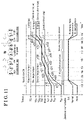
- FIG. 11 is a characteristic diagram schematically illustrating a state in which the first pattern illustrated in FIG. 3 is combined with the control with respect to an electronic control buffer;
- FIG. 12 a flow chart illustrating an example of an operation performed by the control unit of the vehicle control device of the embodiment.
- FIG. 1 to FIG. 11 shows the posture or position of a vehicle in response to each state (each time), and the inertia of the vehicle or the gradient of a road surface are not considered.
- a configuration of a vehicle on which a vehicle control device is mounted A summary of a vehicle on which a vehicle control device of the embodiment is mounted will hereunder be explained with reference to FIG. 2 .
- a vehicle 1 as an example of the embodiment mainly includes a left-front wheel 2 , a right-front wheel 3 , a left-rear wheel 4 , a right-rear wheel 5 , a first drive unit 10 , a second drive unit 20 , a first gear box 12 , a first drive shaft 14 , a second gear box 22 , a second drive shaft 24 , a brake device 30 , a steering mechanism 40 , an electronic control buffer 50 , an accelerator sensor 60 , a brake sensor 61 , a wheel speed sensor 62 , a steering angle sensor 63 , an acceleration sensor 64 , and a control unit 100 .
- the first drive unit 10 outputs a first drive torque to the left-front wheel 2 and the right-front wheel 3 .
- the second drive unit 20 outputs a second drive torque to the left-rear wheel 4 and the right-rear wheel 5 .
- the first gear box 12 and the first drive shaft 14 transmit the first drive torque outputted from the first drive unit 10 to the left-front wheel 2 and the right-front wheel 3 .
- the second gear box 22 and the second drive shaft 24 transmit the second drive torque outputted from the second drive unit 20 to the left-rear wheel 4 and the right-rear wheel 5 .
- the steering mechanism 40 steers the left-front wheel 2 and the right-front wheel 3 .
- the accelerator sensor 60 detects the opening of an accelerator pedal.
- the brake sensor 61 detects a position of a master cylinder in the brake device 30 .
- the wheel speed sensor 62 detects at least one of the wheel speed (speed of the vehicle) of the left-front wheel 2 , the right-front wheel 3 , the left-rear wheel 4 , and the right-rear wheel 5 .
- the steering angle sensor 63 detects a steering angle of the steering mechanism 40 .
- the acceleration sensor 64 detects the acceleration of the vehicle 1 .
- a vehicle control device 500 of the disclosure includes the first drive unit 10 , the second drive unit 20 , and the control unit 100 .
- the vehicle 1 shown in FIG. 2 is configured by two drive units which are the first drive unit 10 outputting the first drive torque to the left-front wheel 2 and the right-front wheel 3 (also collectively referred to as a first drive wheel in the disclosure), and the second drive unit 20 outputting the second drive torque to the left-rear wheel 4 and the right-rear wheel 5 (also collectively referred to as a second drive wheel in the disclosure), which is not limited as above.
- the vehicle 1 may include four drive units which drive the left-front wheel 2 , the right-front wheel 3 , the left-rear wheel 4 and the right-rear wheel 5 individually. In this case, four gear boxes in total may be provided for the four drive units, respectively.
- the first drive unit 10 is configured to output the first drive torque to the front wheels (the left-front wheel 2 and the right-front wheel 3 ) and the second drive unit 20 is configured to output the second drive torque to the rear wheels (the left-rear wheel 4 and the right-rear wheel 5 ), which is not limited as above.
- the first drive unit 10 may output the first drive torque to the rear wheels and the second drive unit 20 may output the second drive torque to the front wheels (each of the reference numerals 10 and 20 is shown with a bracket in FIG. 2 ).
- first drive unit 10 may output the first drive torque to left wheels (the left-front wheel 2 and the left-rear wheel 4 ), and the second drive unit 20 may output the second drive torque to right wheels (the right-front wheel 3 and the right-rear wheel 5 ).
- first drive wheel 2 and the left-rear wheel 4 are collectively referred to as a first drive wheel
- right-front wheel 3 and the right-rear wheel 5 are collectively referred to as a second drive wheel.
- Each of the first drive unit 10 and the second drive unit 20 may use, for example, a motor.
- the vehicle 1 shown in FIG. 2 may be mounted with other sensors such as a vehicle height sensor and a shift position sensor in addition to the aforementioned sensors.
- the accelerator sensor 60 may be provided at another means substituting an accelerator pedal.
- Each of the first gear box 12 and the second gear box 22 is a gear mechanism including plural gears such as a known planetary gear mechanism.
- the first gear box 12 shall transmit the first drive torque to the left-rear wheel 4 and the right-rear wheel 5
- the second gear box 22 shall transmit the second drive torque to the left-front wheel 2 and the right-front wheel 3 .
- the control unit 100 mounted on the vehicle as an example of the embodiment mainly includes a receiver 110 , a calculation unit 120 , and an output unit 130 .
- the receiver 110 obtains (receives) information relating to a drive state of the vehicle 1 from the sensors.
- the calculation unit 120 operates calculations based on the various information obtained (received) by the receiver 110 .
- the output unit 130 outputs the information calculated by the calculation unit 120 to at least the first drive unit 10 , the second drive unit 20 , the brake device 30 , and the electronic control buffer 50 .
- the configuration of the control unit 100 is not limited to that the single receiver 110 , the single calculation unit 120 , and the single output unit 130 are provided, and each of them may be separated multiply and integrally controlled.
- the receiver 110 of the control unit 100 obtains (receives) the information relating to the drive state of the vehicle 1 from such as the accelerator sensor 60 , the brake sensor 61 , the wheel speed sensor 62 , the steering angle sensor 63 , and the acceleration sensor 64 (also collectively referred to as a sensor group).
- the receiver 110 receives the information relating to the acceleration opening (the acceleration operation amount) operated by the driver of the vehicle 1 .
- the receiver 110 receives the information relating to the brake operation amount from the brake sensor 61 , the wheel speed (the speed of the vehicle) from the wheel speed sensor 62 , the steering angle from the steering angle sensor 63 , and the acceleration speed of the vehicle 1 from the acceleration sensor 64 .
- the receiver 110 may receive various information relating to the drive state of the vehicle 1 from other sensors in a case where the vehicle 1 includes other sensors in addition to the sensor group.
- the receiver 110 transmits the information relating to the drive state of the vehicle 1 received from the sensors to the calculation unit 120 .
- the calculation unit 120 calculates a requirement torque in which the driver and/or each of the control devices of the vehicle 1 requires to the vehicle 1 (the control unit 100 ) based on, for example, a predetermined map or a predetermined calculation formula using the information and a value as a parameter, the various information relating to the drive state of the vehicle 1 received by the receiver 110 , especially the acceleration opening, the brake operation amount, and the speed of the vehicle 1 (the value received by the receiver 110 ) and the values of the first drive torque and the second drive torque outputted by the first drive unit 10 and the second drive unit 20 , respectively, at a first time point in which the acceleration operation (and/or the brake operation) of the vehicle 1 is operated by the driver and/or the control devices mounted to achieve the drive support or the automatic driving operation.
- the calculation unit 120 mainly calculates the requirement torque based on the information relating to the acceleration opening and the speed of the vehicle and on the values of the first and second drive torque at the time point in which the accelerator pedal is operated by the driver and/or the aforementioned control devices.
- the calculation unit 120 calculates a first target torque relating to the first drive torque and a second target torque relating to the second drive torque which are divided ideally based on the calculated requirement torque to stabilize the position or the posture of the vehicle 1 receiving the effect of the requirement torque.
- Wf is a front-wheel weight
- W is a weight of a center point of the vehicle 1
- L is a wheelbase
- Lr is a distance to a center of the left-rear wheel 4 (or the right-rear wheel 5 ) of the vehicle 1 from the center point of the vehicle 1
- ⁇ is a target acceleration speed calculated by the requirement torque
- H is a height of the center point of the vehicle 1
- g is an acceleration of gravity.
- Wr is a rear-wheel weight
- Lf is a distance to a center of the left-front wheel 2 (or the right-front wheel 3 ) from the center point of the vehicle 1 .
- the moments of center points of contact points of tyres or tires are considerably balanced, the tyres such as the left-front wheel 2 , the right-front wheel 3 , the left-rear wheel 4 , and the right-rear wheel 5 .
- TQx is the first target torque
- TQ is the requirement torque
- TQy is the second target torque.
- the formulas 3 and 4 are based on the premise that the first drive torque is outputted to the rear wheels and the second drive torque is outputted to the front wheels. In a case where the first drive torque is outputted to the front wheels and the second drive torque is outputted to the rear wheels, TQx is the second target torque and TQy is the first target torque.
- the calculation unit 120 calculates an ideal change rate of a total torque (the ideal change rate as a change amount per time of the total torque in a case where the time is illustrated in a horizontal axis and the magnitude of the total torque is illustrated in a vertical axis) in a term (a first term) from the first time point to a second time point, the first time point in which the driver or the control devices operate the acceleration operation (or the brake operation), the second time point in which the total torque of the first and second drive torque reaches the requirement torque (the first drive torque reaches the first target torque, and the second drive torque reaches the second target torque).
- the ideal change rate of the total torque is determined in consideration of such as the characteristics of the vehicle 1 , the speed of the vehicle at the first time point, the characteristics of the first drive unit 10 , and the characteristics of the second drive unit 20 . (Specifically, it is favorable that a map relating to the ideal change rate and a calculation formula determining the ideal change rate are prepared at a compatible operation in advance.)
- the control of the first and second drive torque operated by the control unit The control unit 100 (the calculation unit 120 ) controls the magnitude of the first drive torque outputted by the first drive unit 10 and the magnitude of the second drive torque outputted by the second drive unit 20 in the first term with reference to the first target torque, the second target torque and the ideal change rate of the total torque calculated or computed as above.
- the control unit 100 controls the magnitude of the first drive torque outputted by the first drive unit 10 and the magnitude of the second drive torque outputted by the second drive unit 20 in the first term with reference to the first target torque, the second target torque and the ideal change rate of the total torque calculated or computed as above.
- a first pattern The details of the control of a first pattern with respect to the first and second drive torque operated by the control unit 100 will be explained with reference to FIG. 3 .
- the first drive unit 10 outputs the first drive torque to the rear wheels (the left-rear wheel 4 , and the right-rear wheel 5 in FIG. 2 ), and the second drive unit 20 outputs the second torque to the front wheels (the left-front wheel 2 , the right-front wheel 3 in FIG. 2 ).
- the drive state of the vehicle 1 is in the decelerated state (a first drive state), and the first and second drive torque which are negative torque are outputted by the first and second drive units 10 , 20 , respectively.
- a total torque TQz (Tqx+Tqy) at the time t 100 is naturally the negative torque.
- the control unit 100 calculates a requirement torque TQ based on the information relating to the acceleration opening and the speed of the vehicle, the value of first drive torque (Tqx) and the value of second drive torque (Tqy) at the time t 100 when the operation for the accelerator pedal is operated.
- the calculation unit 120 calculates the first target torque TQx and the and second target torque TQy based on the calculated requirement torque TQ and the formulas 1 to 4 at the time t 100 (the first time point).
- the calculation unit 120 calculates an ideal change rate z 10 of the total torque by the aforementioned method.
- the calculation unit 120 controls the first drive unit 10 and the second drive unit 20 to change the first drive torque and the second torque at an appropriate change rate as the time goes by based on the calculated or computed requirement torque TQ, first target torque TQx, second target torque TQy, and the ideal change rate z 10 of the total torque Specifically, as shown in FIG. 3 , the first drive torque (also referred to as Rr torque in FIG. 3 ) is gradually changed to reach the first target torque TQx, the second drive torque (also referred to as Fr torque in FIG. 3 ) is gradually changed to reach the second target torque TQy, in a term from the time t 100 to a time t 101 .
- the summation of a change rate x 10 of the first drive torque and a change rate y 10 of the second drive torque is the ideal change rate z 10 to maintain the ideal change rate z 10 of the total torque from the time t 100 to the time t 101 .
- (the change rate x 10 of) the first drive torque and (the change rate y 10 of) the second drive torque are maintained to include an ideal distribution ratio with respect to the first drive torque and the second drive torque in accordance with the predetermined maps and formulas on the position control of the vehicle.
- the position control of the vehicle is configured to calculate continually the ideal distribution ratio (the ideal distribution ratio with respect to the first drive torque and the ideal distribution ratio with respect to the second drive torque) in accordance with the actual torque of the real time by the similar formulas of the aforementioned formulas 1 to 4 based on the information of the real torque of the real time (which is the same meaning as the total torque of the real time and for example, corresponds to the total torque Tqz at the time t 100 as the real time) and the speed of the vehicle at the real time.
- the ideal distribution ratio the ideal distribution ratio with respect to the first drive torque and the ideal distribution ratio with respect to the second drive torque
- the calculation unit 120 controls the first drive unit 10 via the output unit 130 to operate (start) the first zero-cross process in which the change rate of the first drive torque is set equal to or less than a predetermined value when the first drive torque reaches a first predetermined torque Tq 1 at the time t 101 .
- the calculation unit 120 operates the control setting the upper limit of the change rate of the first drive torque to be a predetermined value when (as a turning point in which) the first drive torque reaches the first predetermined torque Tq 1 .
- a change rate x 20 of the first drive torque after the time t 101 changes to be smaller than the change rate x 10 .
- the first zero-cross process operates when the first drive torque is within a predetermined range at a time point in which the positivity and the negativity of the first drive torque switches through zero (0 Nm).
- the second zero-cross process operates when the second drive torque is within a predetermined range at a time point in which the positivity and the negativity of the torque of the second drive torque switches through zero (0 Nm).
- the description that the first drive torque is within the predetermined range means that the first drive torque is smaller than an absolute value of a predetermined torque.
- the description that the second drive torque is within the predetermined range means that the second drive torque is smaller than an absolute value of a predetermined torque. That is, as shown in FIG.
- the first drive torque (the second drive torque) is within the range between the first predetermined torque Tq 1 specified on the negative side and a second predetermined torque Tq 2 specified on the positive side (strictly speaking, the first predetermined torque Tq 1 and the second predetermined torque Tq 2 are not included in the predetermined range because they are threshold values of the predetermined range). As shown in FIG.
- the absolute values of the first predetermined torque Tq 1 and the second predetermined torque Tq 2 may be the same or may be different from each other (including a case where the absolute value of the first predetermined torque Tq 1 is smaller than the absolute value of the second predetermined torque Tq 2 , and a case where the absolute value of the first predetermined torque Tq 1 is greater than the absolute value of the second predetermined torque Tq 2 ).
- FIG. 3 shows an example of a case where the first predetermined torque Tq 1 and the second predetermined torque Tq 2 are commonly applied to the first drive torque and the second drive torque, respectively.
- the first predetermined torque Tq 1 and the second predetermined torque Tq 2 may be specified or set with respect to the first drive torque in accordance with the difference of the drive characteristics of the first drive unit 10 and the second drive unit 20 , and a third predetermined torque Tq 3 and a fourth predetermined torque Tq 4 which are different from the first predetermined torque Tq 1 and the second predetermined torque Tq 2 may be exclusively specified or set with respect to the second drive torque.
- the absolute values of the third predetermined torque Tq 3 and the fourth predetermined torque Tq 4 may be the same or different from each other.
- the first zero-cross process is operated for the term from the time t 101 when the first drive torque reaches the first predetermined torque Tq 1 (a third time point) to the time t 105 when the first drive torque reaches the second predetermined torque Tq 2 .
- the first zero-cross process is operated to make the change rate of the first drive torque be at a smallest rate x 21 which is close to zero for a predetermined time (from a time t 103 to a time t 104 in FIG. 3 ) to keep or maintain the term (time) when the first drive torque reaches zero (0 Nm) for a while so as to minimize the occurrence of noises or vibrations (oscillations) due to a backrush at the first gear box 12 .
- the change rate of the first drive torque changes from x 10 to x 20 (from the time t 101 to the time t 103 ) or x 22 (from the time t 104 to the time t 105 ) at the time t 101 in accordance with the start of the first zero-cross process from the time t 101 .
- the calculation unit 120 changes the change rate of the second drive torque from y 10 to y 20 (y 10 is greater than y 20 ) in accordance with that the change rate of the first drive unit 10 changes from x 10 to x 20 to maintain (the change rate x 10 of) the first drive torque and (the change rate y 10 of) the second drive torque at the ideal distribution ratio from the time t 101 to the time t 102 , similar to from the time t 100 to the time 101 , the ideal distribution ratio which is in accordance with the predetermined map and/or formula on the position control of the vehicle.
- the change rate of the total torque changes from the ideal change rate z 10 to z 20 at the time t 101 . That is, the calculation unit 120 allows that the ideal change rate of the total torque does not maintain at the time t 101 (from the time t 101 to the time t 102 ).
- the calculation unit 120 operates a guard control making the change rate of the second drive torque be zero forcibly (to maintain the second drive torque at the first predetermined torque Tq 1 ) so as not to operate the second zero-cross operation with respect to the second drive torque (so as not to include the second drive torque in the predetermined range).
- the guard control allows the second zero-cross process to operate immediately after the end of the first zero-cross process while inhibiting the second zero-cross process from operating during the first zero-cross process.
- the calculation unit 120 prioritizes the first and second zero-cross processes by allowing that the ideal change rate of the total torque is not maintained from the time t 102 to the time t 105 similarly to the term from the time t 101 to the time t 102 .
- the change rate of the total torque from the time t 102 to the time t 105 is the same as the change rate x 20 , x 21 or x 22 of the first drive torque during the first zero-cross process because the change rate of the second torque is zero.
- the first zero-cross process ends when the first drive torque in which the first zero-cross process is operated reaches the second predetermined torque Tq 2 at the time t 105 .
- the second drive unit 20 is controlled via the output unit 130 to operate (start) the second zero-cross process to make the change rate of the second drive torque equal to or smaller than the predetermined rate with respect to the second drive torque which is maintained at the first predetermined torque Tq 1 .
- the change rate of the second drive torque changes from zero to y 30 (from the time t 105 to a time t 106 ) or y 32 (from a time t 107 to a time t 108 ) at the time t 105 .
- the change rate y 30 of the second drive torque from the time t 105 to the time t 106 may be the same as the change rate x 20 of the first drive torque from the time t 101 to the time t 103 , or different therefrom.
- the change rate y 32 of the second drive torque from a time t 107 to a time t 108 may be the same as the change rate x 22 of the first drive torque from the time t 104 to the time t 105 , or different therefrom.
- the second zero-cross process is operated to, similarly to the first zero-cross process, make the change rate of the second drive torque be at a smallest rate y 31 which is close to zero fora predetermined time (from the time t 106 to the time t 107 in FIG. 3 ) to keep the term (time) when the second drive torque reaches zero (0 Nm) for a while so as to minimize the occurrence of noises or vibrations (oscillations) due to the backrush at the second gear box 12 .
- the change rate y 31 of the second drive torque from the time t 106 to the time t 107 may be the same as the change rate x 21 of the first drive torque from the time t 1103 to the time t 1104 , or different therefrom.
- the change rate of the first drive torque in which the first zero-cross process ends maintains or keeps at the second predetermined torque Tq 2 (the change rate is zero) from the time t 105 when the second zero-cross process is operated with respect to the second drive torque to a time t 108 immediately before the end of the second zero-cross process.
- the calculation unit 120 changes the change rate of the first drive torque from zero to x 30 with reference to the change rate y 32 of the second drive torque during the same term so as to maintain again (the change rate x 30 of) the first drive torque and (the change rate y 32 of) the second drive torque at the ideal distribution ratio according to the predetermined map and/or formula on the position control of the vehicle.
- the calculation unit 120 allows that the ideal change rate of the total torque does not maintain, and make the change rate of the total torque for the same term (from the time t 108 to the time t 109 ) different from the ideal change rate z 10 , which is z 25 .
- the calculation unit 120 controls, similarly to the term from the time t 100 to the time t 101 , the first drive unit 10 and the second drive unit 20 to make the change rate of the first drive torque be x 11 , and the change rate of the second drive torque be y 11 from the time t 109 to the time t 110 to maintain the ideal change rate z 11 of the total torque.
- the ideal change rate z 11 of the total torque after the time t 109 may be the same as the ideal change rate z 10 of the total torque from the time t 100 to the time t 101 , or different therefrom.
- the change rate x 11 of the first drive torque after the time t 109 may be the same as or different from the change rate x 10 of the first drive torque from the time t 100 to the time t 101 , and similarly, the change rate y 11 of the second drive torque after the time t 109 may be the same as or different from the change rate y 10 of the second drive torque from the time t 100 to the time t 101 in accordance with the relation between the ideal change rates z 10 and z 11 .
- the ideal distribution ratio is maintained for (the change rate x 30 of) the first drive torque and (the change rate y 32 of) the second drive torque at the term from the time t 109 to the time t 110 in accordance with the predetermined map and/or formula on the position control of the vehicle.
- the first drive torque reaches the first target toque TQx and the second drive torque reaches the second target toque TQy at the time t 110 .
- the total torque reaches the requirement torque TQ.
- the shift of the drive state of the vehicle 1 ends from the decelerated state (the first drive state) at the time t 100 (the first time point) to the accelerated state (the second drive state) at the time t 110 (the second time point).
- the first drive unit 10 and the second drive unit 20 output the first drive torque and the second drive torque which are negative torque at the time t 100 (the first time point).
- the drive state of the vehicle 1 is in the accelerated state (the second drive state) at the time t 110 (the second time point), as shown in FIG. 3 , the first drive unit 10 and the second drive unit 20 output the first drive torque and the second drive torque which are positive torque which is the opposite sign of the negative torque.
- the total torque (the requirement torque TQ) at the time t 100 is naturally the positive torque.
- the first and second zero-cross processes may be operated in the different timing, and therefore, as a whole of the vehicle control device, the noises or the vibrations (oscillations) may be efficiently reduced.
- a second pattern The details of the control of a second pattern with respect to the first and second drive torque operated by the control unit 100 will be explained with reference to FIG. 4 .
- the first drive unit 10 outputs the first drive torque to the rear wheels (the left-rear wheel 4 , and the right-rear wheel 5 in FIG. 2 ), and the second drive unit 20 outputs the second torque to the front wheels (the left-front wheel 2 , the right-front wheel 3 in FIG. 2 ).
- the second pattern operated by the control unit 100 is basically the same as the above-described first pattern, however, the change rate of the second drive torque from the time t 101 to the time t 102 in the first pattern is different from the change rate y 20 of the first pattern.
- the change rate of the first drive torque from the time t 105 to the time t 09 is different from the change rates of the first drive torque, zero and x 30 , of the first pattern.
- the second pattern is the same as the first pattern. The details of the second pattern different from the first pattern will hereunder be explained.
- the change rate of the second drive torque after the time t 101 is smaller than the change rate y 20 of the first pattern, which is y 40 .
- the second drive torque reaches the first predetermined torque Tq 1 to start the second zero-cross process immediately at the time t 105 when the first zero-cross process ends at the latest. Conversely speaking, the second drive torque may have only to reach a predetermined Tqz 1 at the time t 105 .
- the calculation unit 120 may estimate the time t 105 (a fourth time point) when the first zero-cross process ends with reference to the change rates of the first drive torque x 20 , x 21 and x 22 , and control to use the change rate y 40 gained by the division of the difference between a second drive torque Tqy 101 and the first predetermined torque Tq 1 at the time t 101 (Tq 1 ⁇ Tqy 101 ) by a time from the time t 101 to the estimated time t 105 (the time t 105 ⁇ the time t 101 ) as the change rate of the second drive torque.
- the change rate of the total torque from the time t 101 to the time t 105 does not maintain the ideal change rate z 10 , and is the summation of the change rates x 20 , x 21 , and x 22 of the first drive torque and the change rate y 40 of the second drive torque. That is, the change rate of the total torque from the time t 101 to the time 103 is z 30 which is the summation of the change rate x 20 of the first drive torque and the change rate y 40 of the second drive torque.
- the change rate of the total torque from the time t 103 to the time 104 is z 40 which is the summation of the change rate x 21 of the first drive torque and the change rate y 40 of the second drive torque.
- the change rate of the total torque from the time t 104 to the time 105 is z 50 which is the summation of the change rate x 22 of the first drive torque and the change rate y 40 of the second drive torque.
- the change rate of the first drive torque from the time t 105 to the time t 109 is x 40 which is different from the change rates of the first pattern, which are zero and x 30 .
- the change rate of the first drive torque from the time t 105 to the time t 109 is x 40 which is smaller than x 30 .
- the change rate x 40 of the first drive torque may be the same as the aforementioned y 40 or different therefrom.
- the calculation unit 120 firstly estimates a time t 109 when the second zero-cross process ends with reference to the change rates y 30 , y 31 , and y 32 of the second drive torque at the time t 105 when the second zero-cross process starts.
- the calculation unit 120 may estimate a target value (Tqx 109 ) of the first drive torque at the time t 109 based on that the second drive torque is Tq 2 at the time t 109 , and that the ideal distribution ratio according to the predetermined map and/or the formula on the position control of the vehicle is applied at the time t 109 , and use x 40 gained by the division of the difference between the Tqx 109 and the first drive torque Tq 2 at the time t 105 (Tqx 109 ⁇ Tq 2 ) by the time from the time t 105 to the estimated time t 109 (time t 109 ⁇ time t 105 ) as the change rate of the first drive torque.
- Tqx 109 target value of the first drive torque at the time t 109 based on that the second drive torque is Tq 2 at the time t 109 , and that the ideal distribution ratio according to the predetermined map and/or the formula on the position control of the vehicle is applied at the time t 109 , and
- the change rate of the total torque from the time t 105 to the time t 109 does not maintain the ideal change rate z 10 (or z 11 ), and is the summation of the change rate x 40 of the first drive torque and the change rates y 30 , y 31 , and y 32 of the second drive torque. That is, the change rate of the total torque from the time t 105 to the time 106 is z 60 which is the summation of the change rate x 40 of the first drive torque and the change rate y 30 of the second drive torque.
- the change rate of the total torque from the time t 106 to the time 107 is z 70 which is the summation of the change rate x 40 of the first drive torque and the change rate y 31 of the second drive torque.
- the change rate of the total torque from the time t 107 to the time 109 is z 80 which is the summation of the change rate x 40 of the first drive torque and the change rate y 32 of the second drive torque.
- the change rate of the total torque from the time t 109 to the time t 110 maintains at the ideal change rate z 11 as described above.
- FIG. 5 similarly to FIG. 3 , the first drive unit 10 outputs the first drive torque to the rear wheels (the left-rear wheel 4 , and the right-rear wheel 5 in FIG. 2 ), and the second drive unit 20 outputs the second torque to the front wheels (the left-front wheel 2 , the right-front wheel 3 in FIG. 2 )
- the same control as that of the first pattern is operated from a time t 200 which is the first time point to a time t 205 when the first zero-cross process ends.
- the term from the time t 200 to the time t 205 corresponds to the term from the time t 100 to the t 105 of the first pattern.
- the change rate of the second drive torque changes from y 10 to y 20 in accordance with the change of the change rate of the first drive torque from x 10 to x 20 to maintain the ideal distribution ratio according to the predetermined map and/or formula of the position control of the vehicle.
- the calculation unit 120 changes the change rate of the second drive torque from y 10 to y 50 (y 50 is greater than y 10 ) to maintain the change rate of the total torque in the same term while allowing that the ideal distribution ratio is not maintained or while allowing not to maintain the ideal distribution ratio. That is, the change rate of the first drive torque decreased from x 10 to x 20 by the zero-cross process is offset or compensated by the change rate of the second drive torque to maintain the change rate of the total torque at the ideal change rate z 10 .
- the first zero-cross process ends.
- the second zero-cross process is operated (starts) for the second drive torque which is maintained at the first predetermined torque Tq 1 .
- the change rate of the second drive torque changes, at the t 205 , from zero to y 30 (from the time t 205 to a time t 207 ), y 31 (from a time t 207 to a time t 208 , and y 32 (from a time t 208 to a time t 209 ) (y 30 and y 32 may be the same value or different values).
- the change rate y 30 of the second drive torque from the time t 205 to the time t 207 may be the same as the change rate x 20 of the first drive torque from the time t 201 to the time t 203 , or different from each other.
- the change rate y 31 of the second drive torque from the time t 207 to the time t 208 may be the same as the change rete x 21 of the first drive torque from the time t 203 to the time t 204 , or different from each other.
- the change rate y 32 of the second drive torque from the time t 208 to the time t 209 may be the same as the change rate x 22 of the first drive torque from the time t 204 to the time t 205 , or different from each other.
- the second zero-cross process in the third pattern is operated similarly to that of the first pattern between the time t 205 to the time t 209 .
- the first drive torque in which the first zero-cross process ends is controlled to be the change rate x 50 so that the change rate of the total torque becomes the ideal change rate z 12 from the time t 205 when the second zero-cross process is operated with respect to the second drive torque (when the first zero-cross process ends).
- the change rate x 50 of the first drive torque after the time t 205 is determined with reference to the ideal change rate z 12 of the total torque and the change rate y 30 of the second drive torque in which the second zero-cross process starts.
- the summation of the change rate x 50 of the first drive torque and the change rate y 30 of the second drive torque is the ideal change rate z 12 .
- the ideal change rate z 12 of the total torque after the time t 205 may be the same as the ideal change rates z 10 and z 11 of the first pattern, or may be different therefrom.
- the calculation unit 120 operate the guard control to make the change rate of the first drive torque zero.
- the change rate of the first drive torque is changed to x 50 after the time t 205 so that the first drive torque may reach the first target torque TQx promptly.
- the torque close to the requirement torque may be applied to the vehicle 1 faster than the first pattern.
- the calculation unit 120 controls the second drive unit 20 to increase the second drive torque by the same change rate as the ideal change rate z 11 of the total torque. Accordingly, the ideal change rate z 11 of the total torque may be maintained from the time t 209 to a time 210 , and the second drive torque may reach the second target torque TQy promptly.
- the second drive torque reaches the second target torque TQy, and at the same time, the total torque reaches the requirement torque TQ at the time t 210 .
- the shift of the drive state of the vehicle 1 from the decelerated state (the first drive state) at the time t 200 (the first time point) to the accelerated state (the second drive state) at the time t 210 ends.
- the first drive unit 10 and the second drive unit 20 output the first drive torque and the second drive torque, which are negative torque respectively, at the time t 200 (the first time point).
- the drive state of the vehicle 1 is accelerated state (the second drive state) at the time t 210 (the second time point), and as shown in FIG.
- the first drive unit 10 and the second drive unit 20 output the first drive torque and the second drive torque, which are positive torque, which is the opposite sign to that of the first drive state.
- the total torque (the requirement torque TQ) at the time t 210 is naturally the positive torque.
- FIG. 6 similarly to FIG. 3 , the first drive unit 10 outputs the first drive torque to the rear wheels (the left-rear wheel 4 , and the right-rear wheel 5 in FIG. 2 ), and the second drive unit 20 outputs the second torque to the front wheels (the left-front wheel 2 , the right-front wheel 3 in FIG. 2 ).
- the fourth pattern is a pattern making the total torque reach the requirement torque faster than the first to the third patterns by practically ignoring the ideal distribution ratio of the first drive torque and the second drive torque.
- the calculation unit 120 calculates the requirement torque TQ based on the information relating to the acceleration opening and the vehicle speed, the value of the first drive torque (Tqx) and the value of the second drive torque ‘Tqy) at the time t 300 .
- the calculation unit 120 calculates the ideal change rate z 10 of the total torque similarly to the first pattern.
- the calculation unit 120 controls the first drive unit 10 to make the change rate x 60 of the first drive torque the upper limit of the performance of the first drive unit 10 to make the first drive torque reach the predetermined torque Tq 1 promptly from a time t 300 to a time t 301 (the second term). Accordingly, the first zero-cross process may be operated (start) promptly with respect to the first drive torque.
- the calculation unit 120 calculates the change rate y 60 of the second drive torque with reference to the change rate x 60 of the first drive torque and the ideal change rate z 10 of the total torque to maintain the ideal change rate z 10 of the total torque from the time t 300 to the time t 301 (the first time point).
- the change rate y 60 of the second drive torque may be the change rate including the opposite sign of the change rate x 60 of the first drive torque.
- the change rate of the first drive torque changes from x 60 to x 20 at the time t 301 in accordance with the first zero-cross process which starts at the time t 301 (the third time point).
- the calculation unit 120 changes the change rate of the second drive torque from y 60 to y 70 to maintain the ideal change rate z 10 of the total torque from the time t 301 to a time t 302 (y 70 is greater than y 60 ). That is, the change rate of the second drive torque increases from y 60 to y 70 to offset or compensate the decrease of the change rate of the first drive torque from x 60 to x 20 .
- the calculation unit 120 operates the guard control to make the change rate of the second drive torque zero forcibly (to maintain the second drive torque at the first predetermined torqueTq 1 ) so that, similarly to the first pattern, the second zero-cross process is not operated with respect to the second drive torque (so that the second drive torque is not included in the predetermined range).
- the calculation unit 120 controls the second drive unit 20 via the output unit 130 to operate (start) the second zero-cross process with respect to the second drive torque maintained at Tq 1 by setting the change rate of the second drive torque at y 30 (a predetermined value).
- the change rate of the second drive torque changes from zero to y 30 at (the turning point of) the time t 305 .
- the change rate y 30 in this case may be the same as the change rate y 30 of the first pattern and the second pattern or different therefrom.
- the first drive torque in which the first zero-cross process ends is controlled to include the change rate in which the change rate of the total torque becomes the ideal change rate z 11 from the time t 305 (corresponding to the time t 205 in the second pattern) when the second zero-cross process is operated with respect to the second drive torque (when the first zero-cross process ends).
- the change rate x 70 of the first drive torque after the time t 305 is determined with reference to the ideal change rate z 11 and the change rate y 30 of the second drive torque in which the second zero-cross process starts.
- the summation of the change rate x 70 of the first drive torque and the change rate y 30 of the second drive torque is the ideal change rate z 11 .
- the change rate x 70 of the first drive torque and the change rate x 50 of the first drive torque in the third pattern are the same as long as the change rate y 30 of the second drive torque is the same in the third pattern and the fourth pattern.
- the guard control is not operated with respect to the first drive torque at the time t 206 in the third pattern.
- the change rate of the first drive torque is maintained at x 70 after the time t 306 .
- the change rate of the first drive torque changes from x 70 to z 11 to maintain the ideal change rate z 11 of the total torque when the second drive torque is close to zero (0 Nm) and the change rate thereof becomes a smallest value y 31 which is close to zero at the time t 307 .
- the total torque reaches the requirement torque TQ at the time t 308 during the operation of the second zero-cross process.
- the total torque means or is equal to the first drive torque. Accordingly, in the fourth pattern, the total torque may reach the requirement torque faster than the first to third patterns.
- the first drive torque is decreased to be converged at the first target torque TQx to correspond to the change rate of the second drive torque in which the second zero-cross is in operation. That is, after the time t 309 , the calculation unit 120 controls the first drive unit 10 and the second drive unit 20 to offset the change rate y 80 of the second drive torque and the change rate x 90 of the first drive torque. Finally, at a time t 311 , the first drive torque reaches the first target torque TQx, and the second drive torque reaches the second target torque TQy at the time t 311 . Meanwhile, the total torque is maintained at the requirement torque TQ after the time t 308 .
- the shift of the drive state of the vehicle 1 from the decelerated state (the first drive state) at the time t 300 (the first time point) to the accelerated state (the second drive state) at the time t 311 (the second time point) ends.
- the first drive unit 10 and the second drive unit 20 output the first drive torque and the second drive torque, which are negative torque respectively, at the time t 300 (the first time point).
- the drive state of the vehicle 1 is accelerated state (the second drive state) at the time t 311 (the second time point), and as shown in FIG. 6 , the first drive unit 10 and the second drive unit 20 output the first drive torque and the second drive torque, which are positive torque, the opposite sign to that of the first drive state.
- the total torque (the requirement torque TQ) at the time t 311 is naturally the positive torque.
- FIG. 7 not similarly to FIG. 3 , the first drive unit 10 outputs the first drive torque to the front wheels (the left-front wheel 2 , the right-front wheel 3 in FIG. 2 ), and the second drive unit 20 outputs the second torque to the rear wheels (the left-rear wheel 4 , and the right-rear wheel 5 in FIG. 2 ).
- the control operated in the fifth pattern shown in FIG. 7 is the same as that of the fourth pattern, and the details will not be explained.
- the first drive torque is away farther from zero (0 zm) than the second drive torque at the first time point (a time t 400 ) which is in the decelerated state (the first drive state).
- the first drive torque at the first time point (the time t 100 , the time t 200 , and the time t 300 ) is closer to zero than the second drive torque.
- This may be the control pattern for operating the first zero-cross process promptly.
- This control pattern may make the total torque of the first drive torque and the second drive torque reach the requirement torque promptly by shortening the whole control time until the first and second zero cross processes end.
- the orientation stability of the vehicle 1 is prior to these objectives (to make the total torque reach the requirement torque promptly by quickly operating the first zero-cross process) depending on the drive state of the vehicle 1 .
- the fifth pattern is useful.
- FIGS. 8 and 9 similarly to FIG. 3 , the first drive unit 10 outputs the first drive torque to the rear wheels (the left-rear wheel 4 , and the right-rear wheel 5 in FIG. 2 ), and the second drive unit 20 outputs the second torque to the front wheels (the left-front wheel 2 , the right-front wheel 3 in FIG. 2 ).
- the first drive unit 10 outputs the first drive torque to the rear wheels, and the first drive torque is applied with the first zero-torque process firstly.
- the drive unit 10 may output the first drive torque to the front wheels, and the first drive torque may be applied with the first zero-torque process firstly.
- This control process may be applied to a case where the first drive unit 10 outputs the first drive torque to the left wheels (the left-front wheel 2 and the left-rear wheel 4 ) and the second drive unit 20 outputs the second drive torque to the right wheels (the right-front wheel 3 and the right-rear wheel 5 ), a case where the first drive unit 10 outputs the first drive torque to the right wheels (the right-front wheel 3 and the right-rear wheel 5 ) and the second drive unit 20 outputs the second drive torque to the left wheels (the left-front wheel 2 and the left-rear wheel 4 ) or for example, a case where the drive state of the vehicle 1 shifts from a rotation decelerated state to a rotation accelerated state.
- control of the sixth pattern may be operated by calculating the torque distribution ratio of the first drive torque and the second drive torque based on, for example, the information relating to the steering angle from the steering sensor 63 , the vehicle characteristics, and the torque vectoring requirement (the requirement relating to the degree of assistance of the right and left of the vehicle 1 in accordance with the steering angle).
- the sixth pattern explained with reference to FIG. 8 has been explained on the premise that the first drive torque Tqx and the second drive torque Tqy are out of range of the first predetermined torque Tq 1 and the second predetermined torque q 2 , respectively, at the time t 500 when the acceleration operation is operated by the driver and/or the control devices.
- the first drive torque Tqx and/or the second drive torque Tqy are within the range of the first predetermined torque Tq 1 and the second predetermined torque q 2 , respectively, at the time t 500 .
- This specific control will be explained with reference to FIG. 9 .
- the operation performed from the time t 500 to the time t 501 as in the sixth pattern which was explained with reference to FIG. 8 is not applied (does not have to be operated with respect) to the first drive torque.
- the first zero-cross process is immediately applied at the time t 500 , and is operated from the time t 500 to the time t 504 .
- the time t 500 is defined as or is equal to the time t 501 in FIG. 9 .
- the calculation unit 120 changes the second drive torque Tqy to the first predetermined torque Tq 1 via a predetermined change rate y 90 at the time t 500 to start the second zero-cross process immediately after the end of the first zero-cross process at the time t 504 (see P 1 in FIG. 9 ).
- the calculation unit 120 may maintain the second drive torque Tqy at the time t 500 through the time t 504 in consideration that the second drive torque Tqy at the time t 500 is within the range of the first predetermined torque Tq 1 and the second predetermined torque Tq 2 , the range which is the condition of the second zero-cross process (see P 2 in FIG. 9 ).
- the control for the second drive torque relating to P 1 in FIG. 9 means that the magnitude of the second drive torque is kept away from zero during the operation of the first zero-cross process, leading to the decrease of vibrations or oscillations occurring in the second drive torque. Meanwhile, in the control relating to P 2 in FIG. 9 , because the second zero-cross process starts from the magnitude Tqy of the second drive torque, the second zero-cross process may end promptly. Thus, the total torque of the first drive torque and the second drive torque may reach the requirement torque promptly. In FIG. 9 , because the first zero-cross process starts from the magnitude Tqx of the first drive torque, the first zero-cross process may end promptly. All things considered, the total torque may reach the requirement torque faster than the case shown in, for example, FIG. 3 .
- the control for the first drive torque and the second drive torque after the time t 504 is generally common with the case shown in FIG. 8 , and the details thereof will not be explained.
- the vehicle 1 includes a third drive unit and a fourth drive unit in addition to the first drive unit 10 and the second drive unit 20 , and the control unit 100 controls the first drive torque outputted from the first drive unit 10 , the second drive torque outputted from the second drive unit 20 , a third drive torque outputted from the third drive unit, and a fourth drive torque outputted from the fourth drive unit.
- the first drive unit 10 outputs the first drive torque to the right-rear wheel (the right-rear wheel 5 in FIG.
- the second drive unit 20 outputs the second torque to the left-front wheel (the left-front wheel 2 in FIG. 2 ), the third drive unit outputs the third torque to the left-rear wheel (the left-rear wheel 4 in FIG. 2 ), and the fourth drive unit outputs the fourth torque to the right-front wheel (the right-front wheel 3 in FIG. 2 ).
- the control unit 100 operates the basic calculation process such as the calculation or the computation of the requirement torque, the first target torque relating to the first drive torque, the second target torque relating to the second drive torque.
- the third drive unit outputting the third torque and the fourth drive unit outputting the fourth torque are provided.
- the control unit 100 calculates a first total target toque relating to a first total torque which is the summation of the first drive torque and the third drive torque outputting the drive torque to the rear wheels based on the aforementioned formulas 1 to 4.
- control unit 100 calculates a second total target toque relating to a second total torque which is the summation of the second drive torque and the fourth drive torque outputting the drive torque to the front wheels.
- the summation of the first total torque and the second total torque is the total torque
- the summation of the first total target torque and the second total target torque is the requirement torque.
- the calculation unit 120 calculates the first target torque TQx relating to the first drive torque and a third target torque TQz relating to the third drive torque based on a predetermined distribution ratio from the first total target torque calculated as above.
- the predetermined distribution ratio is calculated based on the predetermined map or formula based on, for example, the steering angle at the first time point (a time t 700 in FIG. 10 ) (the distribution ratio is 50% and 50% in FIG. 10 for convenience).
- the modified pattern 1 is on the assumption that the steering angle is zero (straight forward) at the time t 700 , and the magnitude of the first target torque TQx and the third target torque TQz is the same.
- the first drive torque Tqx 1 and the third drive torque Tqx 2 are the same at the time t 700 .
- the calculation unit 120 calculates the second target torque TQy relating to the second drive torque and the fourth target torque TQw relating to the fourth drive torque based on the predetermined distribution ratio from the second total target torque calculated as above.
- the predetermined distribution ratio is calculated based on the predetermined map or formula based on, for example, the steering angle at the first time point (the time t 700 in FIG. 10 ) (the distribution ratio is 50% and 50% in FIG. 10 for convenience).
- the modified pattern 1 on the assumption that the steering angle is zero (straight forward) at the time t 700 , and the magnitude of the second target torque TQy and the fourth target torque TQw is the same.
- the second drive torque Tqy 1 and the fourth drive torque Tqy 2 are the same at the time t 700 .
- the calculation unit 120 calculates the ideal change rate of the total torque which is the summation of the first to the fourth drive torque.
- the calculation method of the ideal change rate in the modified pattern 1 is the same as the aforementioned calculation method.
- the calculation unit 120 controls the first to the fourth drive torque based on the ideal change rate of the calculated requirement torque, the first target torque to the fourth target torque, and the total torque.
- the specific control method is basically the same as the aforementioned first pattern.
- the first zero-cross process is operated with respect to the first drive torque (a time t 701 to a time t 702 )
- the second zero-cross process is operated with respect to the second drive torque (a time t 702 to a time t 703 )
- the third zero-cross process is operated with respect to the third drive torque (a time t 703 to a time t 704 )
- the fourth zero-cross process is operated with respect to the fourth drive torque (a time t 704 to a time t 705 ).
- the second drive torque to the fourth drive torque are maintained at the first predetermined torque Tq 1 during the first zero-cross process, and accordingly, the first zero-cross process to the fourth zero-cross process are effectively operated in order without wasting the time.
- the values of the first drive torque to the fourth drive torque increase by the change rate in which the ideal change rate is maintained.
- the vehicle 1 may be exclusively provided with a known device configured to control the position or posture of the vehicle 1 by automatically cancelling the yaw by the modification of the steering angle, for example, a steer-by-wire device.
- FIG. 11 similarly to FIG. 3 , the first drive unit 10 outputs the first drive torque to the rear wheels (the left-rear wheel 4 , and the right-rear wheel 5 in FIG. 2 ), and the second drive unit 20 outputs the second torque to the front wheels (the left-front wheel 2 , the right-front wheel 3 in FIG. 2 ).
- the control of the modified pattern 2 is the same as that of the first pattern, and the details will not be explained.
- the control with respect to the electronic control buffer 50 will be explained.
- the control unit controls the damping force of the rear wheel (Rr damping force in FIG. 11 ) and the damping force of the front wheel (Fr damping force in FIG. 11 ) with respect to the electronic control buffer 50 in response to or in accordance with control commands against the first drive unit 10 and the second drive unit 20 (for example, control commands relating to the first and second zero-cross processes).
- the calculation unit 120 controls the Rr damping force and the Fr damping force during the first and second zero-cross processes, that is, from the time t 101 to the time t 109 to be greater than the other time (the time t 100 to the time t 101 , and the time t 109 to the time t 110 ).
- the first and second zero-cross processes may end promptly by the electronic control buffer 50 which buffers (absorbs) disturbances even the disturbances such as vibration or oscillation in response to the change of the road surface during the first and second zero-cross processes.
- the control unit 100 receives various information relating to the drive state of the vehicle 1 from the sensor group such as accelerator sensor 60 via a receiver 110 in Step ST 1000 . It is favorable that the control unit 100 continually receives various information relating to the drive state of the vehicle 1 from the sensor group.
- the control unit 100 calculates or computes the ideal change rate z 10 (z 11 , z 12 ) of the requirement torque RQ, the first target torque TQx, the second target torque TQy, and the total torque at the time point in which the acceleration operation or the brake operation is performed (corresponding to the first time point and the time t 100 in FIG. 3 ) in ST 1002 .
- the control unit 100 (the calculation unit 120 ) firstly calculates the requirement torque TQ, and secondly calculates the ideal change rate z 10 (z 11 , z 12 ) of the total torque based on the information relating to the acceleration opening, the information relating to the vehicle speed, the values of the first drive torque and the second drive torque at the time point in which the accelerator pedal is operated by the driver and/or the control devices.
- the control unit 100 thirdly calculates the first target torque TQx and, subsequently, the second target torque TQy ideally distributed based on the requirement torque TQ.
- the control unit 100 increases (decreases) the first drive torque and the second drive torque from the first time point to maintain the ideal change rate z 1 of the total torque calculated in ST 1002 .
- the increase rate (or the decrease rate) of the first drive torque in ST 1003 may be controlled as that of the aforementioned third pattern based on such as the characteristics of the vehicle 1 and the drive state of the vehicle 1 at the first time point.
- the control operation may exclusively include a process for selecting the first pattern or the third pattern based on the drive state of the vehicle 1 at the first time point on the control flow.
- the control unit 100 determines whether the first drive torque reaches the predetermined torque (corresponding to the first predetermine torque Tq 1 or the second predetermined torque Tq 2 in FIG. 3 , for example) in ST 1004 . In a case where the control unit 100 (the calculation unit 120 ) does not determine that the first drive torque reaches the predetermined torque (NO in ST 1004 ), the process goes back to ST 1003 .
- the control unit 100 In a case of determining that the first drive torque reaches the predetermined torque (YES in ST 1004 ), the control unit 100 (the calculation unit 120 ) operates (starts) the first zero-cross process with respect to the first drive torque. During the first zero-cross process with respect to the first drive torque, the control unit 100 (the calculation unit 120 ) controls the second drive unit 20 to maintain the second drive torque at the predetermined torque after increasing the same thereto.
- control unit 100 determines whether the first zero-cross process ends in ST 1006 .
- control unit 100 determines that the first zero-cross process is in operation (NO in ST 1006 )
- the process goes back to ST 1005 .
- control unit 100 (the calculation unit 120 ) operates (starts) the second zero-cross process with respect to the second drive torque.
- the control unit 100 refers to the information relating to the drive mode of the vehicle 1 among the various information relating to the drive state of the vehicle 1 received from the sensor group. For example, in a case where the vehicle 1 includes a normal mode and a power mode (of which the output torque when the vehicle 1 moves is set greater than the normal mode) which are appropriately switchable by the driver, the calculation unit 120 determines whether the power mode is selected in ST 1008 .
- the control unit 100 (the calculation unit 120 ) increases the first drive torque and the second drive torque to prioritize the maintenance of the aforementioned ideal distribution ratio (the ideal distribution ratio with respect to the first drive torque and the ideal distribution ratio with respect to the second drive torque on the position control of the vehicle) as the basic control thought. That is, the control unit 100 controls the first drive torque and the second drive torque as described in the first pattern explained with reference to FIG. 3 and the sixth pattern explained with reference to FIG. 8 .
- the control ends when the first drive torque reaches the first target torque TQx and the second drive torque reaches the second target torque TQy (and the total torque reaches the requirement torque TQ).
- the process goes to ST 1020 .
- the control unit 100 increases (decreases) the first drive torque and the second drive torque to prioritize the maintenance of change rate of the total torque at the aforementioned ideal distribution ratio. That is, the control unit 100 controls the first drive torque and the second drive torque as described in the third pattern explained with reference to FIG. 5 , the fourth pattern with reference to FIG. 6 , and the fifth pattern explained with reference to FIG. 7 .
- the control ends when the first drive torque reaches the first target torque TQx and the second drive torque reaches the second target torque TQy (and the total torque reaches the requirement torque TQ).
- the control operation by the control unit 100 is described as above.
- the process of ST 1008 is not necessarily required, and in a case where the characteristics of the vehicle 1 is set at the power mode continually (that is, the vehicle 1 does not include the function in which the driver may select the normal mode or the power mode), the control unit 100 mounted on the vehicle 1 is not provided with the processes of ST 1010 and ST 1011 , and is adapted with the control method in accordance with a pattern (for example, the third pattern) corresponding to the so-called power mode.
- the control unit 100 mounted on the vehicle 1 is not provided with the processes of ST 1020 and ST 1021 , and is adapted with the control method in accordance with a pattern (for example, the first pattern) corresponding to the so-called normal mode.
- the control unit 100 of the vehicle control device 500 operates the process similarly to the flow of the aforementioned example of the operation. However, in ST 1002 , the control unit 100 calculates the additional values, such as the third target torque TQz and the fourth target torque TQw in addition to the first target toque TQx and the second target torque TQy, to accord with the modified pattern 1 .
- FIGS. 3 to 11 illustrate the shift from the decelerated state or the no-speed state (the first drive state) to the accelerated state (the second drive state).
- the shift is established from the accelerated state (the first drive state) to the decelerated state (the second drive state).
- the vehicle control device 500 includes a first drive unit 10 configured to output a first drive torque Tqx, Tqx 1 to a first drive wheel, a second drive unit 20 configured to output a second drive torque Tqy, Tqy 1 to a second drive wheel, and a control unit configured to obtain information relating to a drive state of a vehicle 1 from a sensor group including at least an accelerator sensor 60 and a brake sensor 61 , calculate a requirement torque TQ required by a driver of the vehicle 1 based on the obtained information relating to the drive state of the vehicle 1 , compute, after the calculation of the requirement torque TQ, a first target torque TQx relating to the first drive torque Tqx, Tqx 1 distributed based on the requirement torque TQ, a second target torque TQy relating to the second drive torque Tqy, Tqy 1 distributed based on the requirement torque TQ, and an ideal change rate z 10 , z 11 , z 12 , z 20 , z 25
- the control unit 100 is configured to control the first drive unit 10 to operate a first zero-cross process which makes a change rate of the first drive torque Tqx, Tqx 1 be equal to or smaller than a predetermined value in a case where the first drive torque Tqx, Tqx 1 is within a predetermined range including zero when the negativity and the
- the vehicle control device 500 may operate the first and second zero-cross processes in the different timing.
- the timing when the occurrence of noises and vibrations (oscillations) in accordance with the torque change of the first drive torque Tqx, Tqx 1 decreased by the first zero-cross process and the timing when the occurrence of noises and vibrations (oscillations) in accordance with the torque change of the second drive torque Tqy, Tqy 1 decreased by the second zero-cross process may be set different from each other.
- the occurrence of noises and vibrations (oscillations) may be effectively reduced as a whole of the vehicle control device 500 .
- the predetermined range is between a first predetermined torque Tq 1 set at a negative side and a second predetermined torque Tq 2 set at a positive side.
- the first and second zero-cross processes may be securely operated.
- the first drive torque Tq 1 in the first drive state is closer to zero than the second drive torque.
- the first zero-cross process may be operated promptly while efficiently reducing the occurrence of noises and vibrations (oscillations) as a whole of the vehicle control device 500 .
- the whole control time until the first and second zero-cross processes end may be shortened and the total torque Tqz of the first and second drive torque may reach the requirement torque TQ promptly.
- control unit 100 is configured to control the second drive unit 20 to inhibit the second drive torque from being included in the predetermined range during the first zero-cross process.
- the first and second zero-cross processes may be inhibited from being operated at substantially the same time.
- control unit 100 is configured to estimate a fourth time point in which the first zero-cross process ends by at least referring to the predetermined value relating to the change rate x 20 , x 21 , x 22 of the first drive torque Tqx at a third time point in which the first zero-cross process starts, and control the second drive unit 20 to change the second drive torque from the third time point to make the second drive torque be an absolute value of one of the first predetermined torque Tq 1 and the second predetermined torque Tq 2 at the fourth time point.
- the second zero-cross process may be operated immediately after the end of the first zero-cross process while efficiently reducing the occurrence of noises and vibrations (oscillations) as a whole of the vehicle control device 500 .
- the whole control time until the first and second zero-cross processes end may be further shortened and the total torque Tqz of the first and second drive torque may reach the requirement torque TQ promptly.
- control unit 100 is configured to control the first drive unit 10 to make the change rate x 60 of the first drive torque Tqx be an upper limit in the second term from the first time point to a third time point in which the first zero-cross process starts.
- the first zero-cross process may be operated even faster while efficiently reducing the occurrence of noises and vibrations (oscillations) as a whole of the vehicle control device 500 .
- the whole control time until the first and second zero-cross processes end may be further shortened and the total torque Tqz of the first and second drive torque may reach the requirement torque TQ promptly.
- control unit 100 is configured to control the second drive unit 20 to change the second drive torque in the second term by a change rate calculated by referring to the change rate x 60 of the first drive torque Tqx and the ideal change rate z 10 in the second term.
- the ideal change rate z 10 of the total torque Tqz may be maintained in the second term. Accordingly, the total torque Tqz of the first and second drive torque may reach the requirement torque TQ promptly.
- control unit 100 is configured to control the first drive unit 10 to change the first drive torque Tqx at least in a part of the term from a fourth time point in which the first zero-cross process ends to the second time point by a change rate calculated by referring to the ideal change rate z 11 , z 12 and the change rate y 30 , y 31 , y 32 of the second drive torque during the second zero-cross process.
- the ideal change rate z 12 of the total torque Tqz may be maintained at least at a part of the term from the fourth time point to the second time point. Accordingly, the total torque Tqz of the first and second drive torque may reach the requirement torque TQ promptly.
- damping force of an electronic control buffer mounted on the vehicle 1 is set greater than damping force in a term other than the third term.
- the electronic control buffer 50 buffers (absorbs) disturbances, and accordingly, the first and second zero-cross processes may end promptly.
- the first drive wheel is one of a front wheel 2 , 3 and a rear wheel 4 , 5
- the second drive wheel is the other of the front wheel 2 , 3 and the rear wheel 4 , 5 .
- the vehicle control device 500 may be used at various circumstances.
- the first drive wheel is one of a right wheel 3 , 5 and a left wheel 2 , 4
- the second drive wheel is the other of the right wheel 3 , 5 and the left wheel 2 , 4 .
- the vehicle control device 500 may be used at various circumstances.
- the vehicle control device 500 may efficiently reduce noises and vibrations (oscillations).
Landscapes
- Engineering & Computer Science (AREA)
- Transportation (AREA)
- Mechanical Engineering (AREA)
- Chemical & Material Sciences (AREA)
- Combustion & Propulsion (AREA)
- Automation & Control Theory (AREA)
- Power Engineering (AREA)
- Electric Propulsion And Braking For Vehicles (AREA)
- Control Of Driving Devices And Active Controlling Of Vehicle (AREA)
- Vehicle Body Suspensions (AREA)
- Control Of Vehicle Engines Or Engines For Specific Uses (AREA)
Abstract
Description
Claims (11)
Applications Claiming Priority (3)
| Application Number | Priority Date | Filing Date | Title |
|---|---|---|---|
| JP2020054563A JP7540176B2 (en) | 2020-03-25 | 2020-03-25 | Vehicle control device |
| JP2020-054563 | 2020-03-25 | ||
| JPJP2020-054563 | 2020-03-25 |
Publications (2)
| Publication Number | Publication Date |
|---|---|
| US20210300380A1 US20210300380A1 (en) | 2021-09-30 |
| US11458976B2 true US11458976B2 (en) | 2022-10-04 |
Family
ID=75438557
Family Applications (1)
| Application Number | Title | Priority Date | Filing Date |
|---|---|---|---|
| US17/209,565 Active 2041-03-26 US11458976B2 (en) | 2020-03-25 | 2021-03-23 | Vehicle control device |
Country Status (4)
| Country | Link |
|---|---|
| US (1) | US11458976B2 (en) |
| EP (1) | EP3885221B1 (en) |
| JP (1) | JP7540176B2 (en) |
| CN (1) | CN113442927B (en) |
Families Citing this family (12)
| Publication number | Priority date | Publication date | Assignee | Title |
|---|---|---|---|---|
| US12545266B2 (en) * | 2021-10-22 | 2026-02-10 | Harbinger Motors Inc. | Operating commercial vehicles using weight estimates |
| CN119095736A (en) * | 2022-04-26 | 2024-12-06 | 吉凯恩汽车有限公司 | Drive system |
| EP4431354A4 (en) | 2022-07-28 | 2025-03-05 | Zhejiang Zeekr Intelligent Technology Co., Ltd. | ELECTRIC VEHICLE, ASSOCIATED MOTOR CONTROL METHOD, APPARATUS AND STORAGE MEDIUM |
| CN115402112A (en) * | 2022-08-18 | 2022-11-29 | 一汽奔腾轿车有限公司 | Control method for torque zero crossing of new energy automobile |
| KR20240031445A (en) * | 2022-08-29 | 2024-03-08 | 현대자동차주식회사 | Method for controlling manual driving mode transition of autonomous driving vehicle |
| CN115871634B (en) * | 2023-01-09 | 2026-03-17 | 长城汽车股份有限公司 | Electric vehicle control method, control device, electric vehicle and storage medium |
| CN115946682B (en) * | 2023-01-09 | 2026-03-17 | 长城汽车股份有限公司 | Parking control methods, parking control devices, electric vehicles and storage media |
| CN118618338A (en) * | 2023-03-09 | 2024-09-10 | 本田技研工业株式会社 | Vehicle Behavior Control Device |
| CN116461270A (en) * | 2023-05-05 | 2023-07-21 | 东风汽车集团股份有限公司 | A control method for damping adjustment of electronically controlled air suspension based on torque rate of change |
| FR3152269B1 (en) * | 2023-08-25 | 2025-07-18 | Psa Automobiles Sa | METHOD FOR DYNAMIC CONTROL OF FOUR-WHEEL DRIVE MOTOR VEHICLE ASSEMBLIES, CONTROL MEANS, VEHICLE AND PROGRAM BASED ON SUCH A METHOD |
| CN117021976A (en) * | 2023-09-26 | 2023-11-10 | 尼得科(苏州)有限公司 | Electric drive system and its torque zero-crossing control method |
| CN119078544B (en) * | 2024-10-09 | 2025-09-30 | 东风汽车集团股份有限公司 | A hub motor torque positive and negative switching control method and controller |
Citations (6)
| Publication number | Priority date | Publication date | Assignee | Title |
|---|---|---|---|---|
| US20130035838A1 (en) | 2010-04-19 | 2013-02-07 | Audi Ag | Device for operating a drive unit of a motor vehicle |
| WO2013035179A1 (en) | 2011-09-08 | 2013-03-14 | トヨタ自動車株式会社 | Vehicle and vehicle control method |
| DE102016123071A1 (en) * | 2015-12-25 | 2017-06-29 | Toyota Jidosha Kabushiki Kaisha | Driving force control system for a vehicle |
| JP2018057169A (en) | 2016-09-29 | 2018-04-05 | 株式会社Subaru | Vehicle control apparatus and vehicle control method |
| US20200369277A1 (en) | 2019-05-21 | 2020-11-26 | Aisin Seiki Kabushiki Kaisha | Vehicle control device |
| US20210179056A1 (en) * | 2019-12-16 | 2021-06-17 | Hyundai Motor Company | Eco-friendly vehicle and method of controlling driving force for the same |
Family Cites Families (8)
| Publication number | Priority date | Publication date | Assignee | Title |
|---|---|---|---|---|
| JP5444829B2 (en) * | 2009-05-13 | 2014-03-19 | 日産自動車株式会社 | Electric vehicle and control method thereof |
| JP2013121231A (en) * | 2011-12-07 | 2013-06-17 | Hitachi Automotive Systems Ltd | Electric vehicle controller |
| JP5858055B2 (en) * | 2012-02-16 | 2016-02-10 | 日産自動車株式会社 | Vehicle system vibration control device |
| JP6481329B2 (en) * | 2014-10-28 | 2019-03-13 | トヨタ自動車株式会社 | Sprung vibration suppression device for vehicle |
| GB2544763B (en) * | 2015-11-25 | 2019-03-27 | Jaguar Land Rover Ltd | Controller for a motor vehicle and method |
| JP6819526B2 (en) * | 2017-09-21 | 2021-01-27 | トヨタ自動車株式会社 | Control device for four-wheel drive vehicles |
| JP2020005401A (en) * | 2018-06-28 | 2020-01-09 | 本田技研工業株式会社 | Control device of automatic operation vehicle |
| CN110303899B (en) * | 2019-06-20 | 2021-05-14 | 中国第一汽车股份有限公司 | Method for controlling driving torque of electric four-wheel drive automobile |
-
2020
- 2020-03-25 JP JP2020054563A patent/JP7540176B2/en active Active
-
2021
- 2021-03-15 CN CN202110277614.4A patent/CN113442927B/en active Active
- 2021-03-23 US US17/209,565 patent/US11458976B2/en active Active
- 2021-03-25 EP EP21165076.7A patent/EP3885221B1/en active Active
Patent Citations (7)
| Publication number | Priority date | Publication date | Assignee | Title |
|---|---|---|---|---|
| US20130035838A1 (en) | 2010-04-19 | 2013-02-07 | Audi Ag | Device for operating a drive unit of a motor vehicle |
| WO2013035179A1 (en) | 2011-09-08 | 2013-03-14 | トヨタ自動車株式会社 | Vehicle and vehicle control method |
| DE102016123071A1 (en) * | 2015-12-25 | 2017-06-29 | Toyota Jidosha Kabushiki Kaisha | Driving force control system for a vehicle |
| JP2018057169A (en) | 2016-09-29 | 2018-04-05 | 株式会社Subaru | Vehicle control apparatus and vehicle control method |
| US20200369277A1 (en) | 2019-05-21 | 2020-11-26 | Aisin Seiki Kabushiki Kaisha | Vehicle control device |
| JP2020189547A (en) | 2019-05-21 | 2020-11-26 | アイシン精機株式会社 | Vehicle control device |
| US20210179056A1 (en) * | 2019-12-16 | 2021-06-17 | Hyundai Motor Company | Eco-friendly vehicle and method of controlling driving force for the same |
Non-Patent Citations (1)
| Title |
|---|
| The extended European Search Report dated Aug. 9, 2021, by the European Patent Office in corresponding European Patent Application No. 21165076.7-1012. (8 pages). |
Also Published As
| Publication number | Publication date |
|---|---|
| EP3885221A1 (en) | 2021-09-29 |
| JP2021154776A (en) | 2021-10-07 |
| US20210300380A1 (en) | 2021-09-30 |
| CN113442927B (en) | 2026-05-01 |
| CN113442927A (en) | 2021-09-28 |
| JP7540176B2 (en) | 2024-08-27 |
| EP3885221B1 (en) | 2024-03-13 |
Similar Documents
| Publication | Publication Date | Title |
|---|---|---|
| US20210300380A1 (en) | Vehicle control device | |
| US8718872B2 (en) | Vehicle attitude controller | |
| JP4515201B2 (en) | Vehicle stabilization control system | |
| JP5471811B2 (en) | Braking control device | |
| JP5540894B2 (en) | Vehicle vibration suppression control device | |
| JP5488203B2 (en) | Vehicle vibration suppression control device | |
| US6064930A (en) | Yaw moment control system in vehicle | |
| JP6233608B2 (en) | Vehicle driving force control device | |
| US20210094534A1 (en) | Apparatus and method for improving ride comfort of vehicle | |
| US10023192B2 (en) | Vibration control device and vibration control system | |
| US20200369277A1 (en) | Vehicle control device | |
| WO2012032870A1 (en) | Vehicle body vibration damping control device | |
| US20090125199A1 (en) | Driving Force Control Device and Driving Force Control Method | |
| US9199650B2 (en) | Vehicle driving force control device | |
| KR20210018653A (en) | Wheel slip control method for vehicle | |
| JP2008213556A (en) | Vehicle vibration suppression control device | |
| JP2018144646A (en) | Attitude control device | |
| JP4423961B2 (en) | Motor output control device for electric vehicle | |
| JP4729871B2 (en) | Vehicle turning control device | |
| JP4747722B2 (en) | Vehicle rollover prevention device | |
| KR20240033823A (en) | Method for controlling driving of vehicle | |
| JP4443582B2 (en) | Understeer suppression device | |
| US20210155211A1 (en) | Braking force control system | |
| JP2011161957A (en) | Central controller | |
| US12077140B2 (en) | Vehicle control system |
Legal Events
| Date | Code | Title | Description |
|---|---|---|---|
| AS | Assignment |
Owner name: AISIN SEIKI KABUSHIKI KAISHA, JAPAN Free format text: ASSIGNMENT OF ASSIGNORS INTEREST;ASSIGNORS:HARADA, SHINYA;KOKUBO, SATOSHI;SUGAI, MASAYA;AND OTHERS;SIGNING DATES FROM 20210121 TO 20210127;REEL/FRAME:055686/0050 |
|
| FEPP | Fee payment procedure |
Free format text: ENTITY STATUS SET TO UNDISCOUNTED (ORIGINAL EVENT CODE: BIG.); ENTITY STATUS OF PATENT OWNER: LARGE ENTITY |
|
| STPP | Information on status: patent application and granting procedure in general |
Free format text: DOCKETED NEW CASE - READY FOR EXAMINATION |
|
| AS | Assignment |
Owner name: AISIN CORPORATION, JAPAN Free format text: MERGER AND CHANGE OF NAME;ASSIGNORS:AISIN SEIKI KABUSHIKI KAISHA;AISIN CORPORATION;REEL/FRAME:058570/0853 Effective date: 20210401 |
|
| STPP | Information on status: patent application and granting procedure in general |
Free format text: NOTICE OF ALLOWANCE MAILED -- APPLICATION RECEIVED IN OFFICE OF PUBLICATIONS |
|
| STPP | Information on status: patent application and granting procedure in general |
Free format text: PUBLICATIONS -- ISSUE FEE PAYMENT VERIFIED |
|
| STCF | Information on status: patent grant |
Free format text: PATENTED CASE |
|
| MAFP | Maintenance fee payment |
Free format text: PAYMENT OF MAINTENANCE FEE, 4TH YEAR, LARGE ENTITY (ORIGINAL EVENT CODE: M1551); ENTITY STATUS OF PATENT OWNER: LARGE ENTITY Year of fee payment: 4 |