US11429981B2 - Machine learning system for detecting fraud in product warranty services - Google Patents
Machine learning system for detecting fraud in product warranty services Download PDFInfo
- Publication number
- US11429981B2 US11429981B2 US16/514,455 US201916514455A US11429981B2 US 11429981 B2 US11429981 B2 US 11429981B2 US 201916514455 A US201916514455 A US 201916514455A US 11429981 B2 US11429981 B2 US 11429981B2
- Authority
- US
- United States
- Prior art keywords
- dispatch
- dispatch request
- historical
- warranty
- request
- Prior art date
- Legal status (The legal status is an assumption and is not a legal conclusion. Google has not performed a legal analysis and makes no representation as to the accuracy of the status listed.)
- Active, expires
Links
Images




Classifications
-
- G—PHYSICS
- G06—COMPUTING OR CALCULATING; COUNTING
- G06Q—INFORMATION AND COMMUNICATION TECHNOLOGY [ICT] SPECIALLY ADAPTED FOR ADMINISTRATIVE, COMMERCIAL, FINANCIAL, MANAGERIAL OR SUPERVISORY PURPOSES; SYSTEMS OR METHODS SPECIALLY ADAPTED FOR ADMINISTRATIVE, COMMERCIAL, FINANCIAL, MANAGERIAL OR SUPERVISORY PURPOSES, NOT OTHERWISE PROVIDED FOR
- G06Q30/00—Commerce
- G06Q30/01—Customer relationship services
- G06Q30/012—Providing warranty services
-
- G—PHYSICS
- G06—COMPUTING OR CALCULATING; COUNTING
- G06N—COMPUTING ARRANGEMENTS BASED ON SPECIFIC COMPUTATIONAL MODELS
- G06N20/00—Machine learning
-
- G—PHYSICS
- G06—COMPUTING OR CALCULATING; COUNTING
- G06N—COMPUTING ARRANGEMENTS BASED ON SPECIFIC COMPUTATIONAL MODELS
- G06N20/00—Machine learning
- G06N20/20—Ensemble learning
-
- G—PHYSICS
- G06—COMPUTING OR CALCULATING; COUNTING
- G06N—COMPUTING ARRANGEMENTS BASED ON SPECIFIC COMPUTATIONAL MODELS
- G06N5/00—Computing arrangements using knowledge-based models
- G06N5/01—Dynamic search techniques; Heuristics; Dynamic trees; Branch-and-bound
-
- G—PHYSICS
- G06—COMPUTING OR CALCULATING; COUNTING
- G06Q—INFORMATION AND COMMUNICATION TECHNOLOGY [ICT] SPECIALLY ADAPTED FOR ADMINISTRATIVE, COMMERCIAL, FINANCIAL, MANAGERIAL OR SUPERVISORY PURPOSES; SYSTEMS OR METHODS SPECIALLY ADAPTED FOR ADMINISTRATIVE, COMMERCIAL, FINANCIAL, MANAGERIAL OR SUPERVISORY PURPOSES, NOT OTHERWISE PROVIDED FOR
- G06Q30/00—Commerce
- G06Q30/018—Certifying business or products
- G06Q30/0185—Product, service or business identity fraud
Definitions
- the present invention relates to information handling systems. More specifically, embodiments of the invention relate to a machine learning system for detecting fraud in product warranty services.
- a system of one or more computers can be configured to perform particular operations or actions by virtue of having software, firmware, hardware, or a combination of them installed on the system that in operation causes or cause the system to implement a machine learning system to detect fraudulent warranty dispatch requests.
- One general aspect includes a computer-implemented method for detecting fraud in product warranty requests, including: receiving a dispatch request, where the dispatch request includes one or more attributes, where the one or more attributes include attributes related to the requester of the dispatch request, and attributes related to an asset that is a subject of the dispatch request; executing a network analysis on the dispatch request to identify whether the one or more attributes can be linked to known fraudulent dispatch requests, where the network analysis provides an output corresponding to a degree to which the dispatch request may be linked to a known fraudulent dispatch request; executing an outlier analysis on the dispatch request to determine whether the one or more attributes can be linked to historical dispatch request outliers, where the outlier analysis provides an output indicative of a degree of centrality the dispatch request has with respect to the historical dispatch requests; applying a random forest model to the
- Another general aspect includes a system including: a processor; a data bus coupled to the processor; and a non-transitory, computer-readable storage medium embodying computer program code, the non-transitory, computer-readable storage medium being coupled to the data bus, the computer program code interacting with a plurality of computer operations and including instructions executable by the processor and configured for: receiving a dispatch request, where the dispatch request includes one or more attributes, where the one or more attributes include attributes related to the requester of the dispatch request, and attributes related to an asset that is a subject of the dispatch request; executing a network analysis on the dispatch request to identify whether the one or more attributes can be linked to known fraudulent dispatch requests, where the network analysis provides an output corresponding to a degree to which the dispatch request may be linked to a known fraudulent dispatch request; executing an outlier analysis on the dispatch request to determine whether the one or more attributes can be linked to historical dispatch request outliers, where the outlier analysis provides an output indicative of a degree of centrality the dispatch request has with respect to the historical dispatch requests; applying a random
- Another general aspect includes a non-transitory, computer-readable storage medium embodying computer program code, the computer program code including computer executable instructions configured for: receiving a dispatch request, where the dispatch request includes one or more attributes, where the one or more attributes include attributes related to the requester of the dispatch request, and attributes related to an asset that is a subject of the dispatch request; executing a network analysis on the dispatch request to identify whether the one or more attributes can be linked to known fraudulent dispatch requests, where the network analysis provides an output corresponding to a degree to which the dispatch request may be linked to a known fraudulent dispatch request; executing an outlier analysis on the dispatch request to determine whether the one or more attributes can be linked to historical dispatch request outliers, where the outlier analysis provides an output indicative of a degree of centrality the dispatch request has with respect to the historical dispatch requests; applying a random forest model to the attributes of the dispatch request, the degree to which the dispatch request may be linked to a known fraudulent warranty request, and the output corresponding to the degree of centrality of the dispatch request to determine a first probability that the dispatch
- FIG. 1 shows a general illustration of components of an information handling system as implemented in the system and method of the present invention
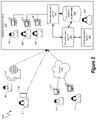
- FIG. 2 is a block diagram of an electronic environment in which certain embodiments of the invention may be employed
- FIG. 3 is a flowchart depicting exemplary operations that may be executed by the fraud detection system during fraud detection training
- FIG. 4 is a pictorial diagram showing an example of links between dispatch nodes for a plurality of requesters and attributes of a confirmed fraudulent dispatch request;
- FIG. 5 illustrates operations that may be executed to identify outliers in the historical dispatch data in certain embodiments
- FIG. 6 depicts one example of a random forest model that has been trained on a training set of historical dispatch data and its application to a new dispatch request
- FIG. 7 illustrates one manner in which a boost model may be trained and its application to a new dispatch request
- FIG. 8 depicts a flowchart showing operations that may be applied to a new dispatch request by the fraud detection system.
- a system, method, and computer-readable medium are disclosed for using machine learning to detect fraud in product warranty service dispatches. Certain aspects of the invention reflect an appreciation that fraudulent warranty dispatch requests may have limited visibility within the organization responsible for executing such warranty dispatches.
- the term “organization” includes, without limitation, any entity that sells, leases, repairs, supports, etc., the use of a product, such as an information processing system, to a customer subject to warranty provisions.
- the term “customer” includes, without limitation, an entity purchasing the product, an entity leasing the product, an end user of the product, etc.
- the term “dispatch” includes, without limitation, demands by a customer that may include warranty services like part or product replacement, claims for missing parts or products, onsite engineer support etc.
- warranty services like part or product replacement
- claims for missing parts or products onsite engineer support etc.
- present disclosure discusses the implementation of the machine learning system in the context of warranty services relating to an information processing system, it will be recognized, in view of the present disclosure, that the principles disclosed herein may be applicable to warranties relating to other types of products.
- counterfeit fraud may occur when there is an open market sale of a counterfeit part to a customer or the return of a part that has not originated from the organization, but has been altered by a defrauding party to appear genuine. Examples of such alterations may include labeling the counterfeit part with counterfeit serial number or service tags.
- One example of counterfeit fraud includes replacement of a 1 terabyte hard drive by the defrauding entity with internals from a 30-gigbyte hard drive to give the appearance of a 1 terabyte hard drive, and return of that altered drive to the organization for replacement or service.
- exchange fraud occurs a defrauding entity returns a part for exchange, where the part has been improperly altered in violation of the warranty or is otherwise out of warranty.
- exchange fraud occurs when an out of warranty part is returned to receive a replacement for that part.
- exchange fraud occurs when a customer has altered the part (e.g., broken the seal of the case, attempted self-repair, etc.) in violation of the warranty terms but nevertheless attempts to return the altered part for a replacement part.
- dispatch fraud relates to float fraud.
- a replacement part may be dispatched to a customer before the customer returns the defective part to the supplier.
- a party may commit fraud by taking advantage of such warranty terms when the customer requests and receives the replacement part without the intention of returning the defective part.
- Another form of dispatch fraud relates to retail fraud.
- a party may proffer a warranty claim for a product that has been purportedly sold through or by a recorded owning entity but which has never been purchased.
- An example of retail fraud occurs when a person enters a retailer, obtains the service tag information off a demonstration model, and makes a warranty claim based on the purchase of the product using a forged proof of purchase.
- service tag fraud occurs when a claim on a service tag that is legitimately owned by another person or entity is made by a defrauding entity.
- defect fraud occurs when an entity makes a false claim of product failure or alleges a safety issue that is not the result of the natural failure of the product. Rather, the product failure or safety issue is a direct result of intentional damage to the product by the customer. Defect fraud often occurs in a noticeable manner close to the expiration of a warranty for the part.
- Another form of dispatch fraud relates to shipping claim fraud.
- shipping claim fraud occurs when a customer falsely claims that it did not receive an item when it has, in fact, been received.
- Another example of ship claim fraud occurs when the item is shipped to an address that has been fraudulently changed so that the item is shipped to the fraudulent address.
- point-of-sale fraud occurs when a fraudulent entity, pretending to be a known customer, creates an order in the name of that customer, lets the item be shipped to the official address of the customer. However, after the system is shipped, the defrauding entity changes the delivery address. In such instances, the defrauding entity receives the system for free because the organization loses visibility of the item once the delivery address has been changed.
- attributes of the dispatch requests as found in the electronic records may include information that can be used to provide a system that uses machine learning to detect fraudulent dispatch requests for warranty services.
- various fraud detection techniques may be trained using historical dispatch requests. In certain embodiments, multiple fraud detection techniques are combined with one another to provide an accurate assessment of whether a new dispatch request is fraudulent.
- an information handling system may include any instrumentality or aggregate of instrumentalities operable to compute, classify, process, transmit, receive, retrieve, originate, switch, store, display, manifest, detect, record, reproduce, handle, or utilize any form of information, intelligence, or data for business, scientific, control, or other purposes.
- an information handling system may be a personal computer, a network storage device, or any other suitable device and may vary in size, shape, performance, functionality, and price.
- the information handling system may include random access memory (RAM), one or more processing resources such as a central processing unit (CPU) or hardware or software control logic, ROM, and/or other types of non-volatile memory.
- Additional components of the information handling system may include one or more disk drives, one or more network ports for communicating with external devices as well as various input and output (I/O) devices, such as a keyboard, a mouse, and a video display.
- the information handling system may also include one or more buses operable to transmit communications between the various hardware components.
- FIG. 1 is a generalized illustration of an information handling system that is configured as a fraud detection system 100 in accordance with certain embodiments of the system and method of the present disclosure.
- the fraud detection system 100 includes a processor (e.g., central processor unit or “CPU”) 102 , input/output (I/O) devices 104 , such as a display, a keyboard, a mouse, and associated controllers, a hard drive or disk storage 106 , and various other subsystems 108 .
- the information handling system 100 also includes network port 110 operable to connect to a network 140 , which is likewise accessible by a service provider server 142 .
- the information handling system 100 likewise includes system memory 112 , which is interconnected to the foregoing via one or more buses 114 .
- System memory 112 further comprises operating system (OS) 116 and in various embodiments may also comprise a fraud detection modules 118 .
- OS operating system
- memory 112 may also include historical warranty dispatch data 122 including data relating to historical dispatches (both legitimate and fraudulent) that may be used to train various prediction models used to determine whether a subsequently received new dispatch request is likely to be fraudulent.
- the historical warranty dispatch data 122 may be stored in local volatile memory, retrieved from non-volatile storage, such as drive(s) 106 , and/or accessed from one or more network storage devices 124 .
- the fraud detection system 100 may be downloaded from a service provider server 142 .
- one or more portions of the fraud detection system 118 may be provided as a service from the service provider server 142 . It will be recognized, based on the teachings of the present disclosure, that the disclosed arrangement of storage and functional modules are merely exemplary and are not intended to limit the present invention to other combinations of storage and functional modules.
- the fraud detection modules 118 include an attribute extraction engine 126 .
- the attribute extraction engine 126 is configured to extract attributes from features in the historical warranty dispatch data 122 .
- a feature is selected for attribute extraction based on whether the feature is useful in detecting fraudulent dispatches, as described herein.
- the attributes extracted from the historical warranty dispatch data 122 are provided to a network analysis engine 128 .
- the network analysis engine 128 generates a linked network model that is used to determine the degree to which a dispatch request is linked to known fraudulent dispatch requests, as described herein.
- the attributes extracted from the historical warranty dispatch data 122 are provided to an outlier identification and analysis engine 130 .
- the outlier identification and analysis engine 130 identifies dispatch requests having outliers as determined in a multivariate distribution analysis.
- the outlier analysis may be used to provide an output corresponding to the degree of centrality that a new dispatch request has with respect to the multivariate mean distribution of the corresponding attributes of the historical warranty dispatches.
- the attributes extracted from the historical warranty dispatch data 122 , the output of the network analysis engine 128 , and the output of the outlier identification and analysis engine 130 are provided to train an ensemble of machine learning models.
- the ensemble of machine learning models includes a random forest model 132 and a boost model 134 .
- the attributes of the historical dispatch requests, the relationships between the historical dispatch requests and known fraudulent dispatch requests as determined by the network analysis engine 128 , and the relationship between historical dispatch requests and outliers identified by the outlier identification and analysis engine 130 may be applied to train the random forest model 132 and boost model 134 .
- the fraud detection system 100 may include a fraud prediction user interface module 138 .
- the user interface module 138 provides a means for a user to interact with the fraud detection system 100 to receive and/or enter information at a user interface relating to a dispatch request.
- information relating to the likelihood that a new dispatch request is fraudulent may be presented at the user interface.
- the user interface may be used to enter information relating to a new dispatch request. It will be recognized, based on the teachings of the present disclosure, that the fraud prediction user interface module 138 may be used to allow a user to interact with the fraud detection system 100 in any number of different manners.
- FIG. 2 is a block diagram of an electronic environment 200 in which certain embodiments of the fraud detection system 100 may be employed.
- the electronic environment 200 may include a customer service center 202 that is configured to receive warranty dispatch requests from a plurality of customers 208 , 210 , 212 , and 214 using various means of communication.
- the customer service center 202 includes a plurality of service center operators 204 interacting with a plurality of information processing systems 206 .
- customer 208 is in communication with the customer service center 202 using a telephone 216 .
- Customer 210 is in communication with the customer service center 202 using a smart phone 218 .
- Customers 212 and 214 are in communication with the customer service center 202 using, for example, respective computers 220 and 222 that are connected to a network, such as the Internet 224 .
- customer 212 uses computer 220 to communicate via a chat center operated at the customer service center 202 .
- customer 214 communicates with the customer service center 202 using email, a web form, etc.
- customers may communicate warranty dispatch request to the customer service center 202 and/or inquire as to the status of a dispatch request. Based on the teachings of the present disclosure, it will be recognized that various means of communication may be used by customers to submit service requests and inquire as to their status, the foregoing merely being non-limiting examples.
- warranty dispatch requests are entered through information processing systems 206 operated by service center operators 204 .
- operators 204 may access a warranty dispatch system 226 through information processing systems 206 to facilitate entry of warranty dispatch requests, update dispatch requests, and obtain information regarding the status of such dispatch requests.
- warranty dispatch requests and corresponding attribute data are stored in and retrieved from a datastore of warranty dispatch data 228 .
- the warranty dispatch data 228 is accessible and editable by service center operators 204 through the warranty dispatch system 226 .
- the customer service center 202 may include artificial intelligence processing systems that automatically generate warranty dispatch requests and/or update such requests in response to communications from the customers 208 , 210 , 212 , and 214 .
- the warranty dispatch data 228 includes data that may be used by the fraud detection system 100 to predict the likelihood that a warranty dispatch request is fraudulent.
- the escalation prediction system 100 accesses the warranty dispatch data from the datastore of warranty dispatch data 228 and uses the data to determine whether a dispatch request is likely to be fraudulent, as described herein.
- information relating to whether a dispatch request is likely to be fraudulent is provided to a service center operator 204 through the warranty dispatch system 226 as the operator 204 is in communication with a customer.
- a warranty dispatch request may be flagged as a potential fraudulent request to an operator 204 as the operator is in communication with the customer thereby allowing the operator 204 to take immediate action to potentially mitigate damages that may otherwise have been caused by the fraudulent request.
- the fraud detection system 100 may provide information relating to the likelihood that one or more dispatch requests are fraudulent to a fraud resolution operator 234 using a fraud resolution system 232 .
- the fraud resolution system 100 may provide the fraud resolution operator 234 with a human interface that allows the operator 234 to identify a plurality of warranty dispatch requests that have a high probability of being fraudulent.
- the operator 234 may use the information regarding the warranty dispatch requests to proactively engage the other portions of the organization to take steps to ensure that measures internal to the organization are taken to address a fraudulent dispatch request.
- the fraud resolution system 232 may provide information to the operator 234 that allows the operator 234 to identify specific actions that may be taken to expedite and/or resolve the fraudulent dispatch request.
- the fraud resolution system 232 may provide information that allows the operator 234 to identify specific customers that may have committed fraud, ensure the proper parts are not shipped to fraudulent addresses address, notify authorities, etc.
- the warranty dispatch data 228 includes records having attributes of the dispatch request.
- the attributes may include requester phone number, requester work phone number, requester email address, requester address, request date, shipping address, shipping postal code, requester postal code, requester company name, asset identifiers for the item that is the subject of the dispatch request, etc.
- the records may include an attribute added by an investigator that identifies the dispatch request as having been verifiably fraudulent.
- the attributes are extracted from the dispatch records and used to provide features that are relevant to whether a warranty dispatch request is likely to be fraudulent.
- the attributes may be used to derive features that are related to the dispatch requests, such as repeat dispatches under the same home phone number, repeat dispatches under the same work phone number, repeat dispatches from the same IP address, repeat dispatch requests from the same email address. In certain instances, the repetitive receipt of certain dispatch requests over a predetermined period of time may be indicate that the requests are fraudulent.
- the attributes may be used to derive features related to the dispatch requesters including, for example, discrepancies in requester information such as postal code, phone number, email mismatches, etc.
- the attributes may be used to derive features related to the asset (e.g., serial number, tag, proof of purchase, etc.) that is the subject of the dispatch request. As an example, if a given asset is associated with distinct counts of home phone numbers, work phone numbers, email addresses, IP addresses, postal code, requester name, and requester company, then there is a higher likelihood that a dispatch request related to the asset is fraudulent.
- Certain embodiments employ an exemplary set of features that define potential risk indicators (PRI), including the following:
- PRI 1 Mismatch of information in multiple dispatches under same service tag.
- PRI 2 Mismatch of information registered in service request v. system ownership and system shipment information.
- PRI 3 Same personal identity with dispatches being sent to different postal codes.
- FRU Field Replaceable Unit
- PRI 6 Dispatches with missing Phone Number and Email.
- PRI 7 Dispatches with known fraud indicators including one or more of:
- FIG. 3 is a flowchart depicting exemplary operations that may be executed by the fraud detection system 100 during fraud detection training.
- historical dispatch data including dispatches that have been flagged as fraudulent, are accessed at operation 305 .
- attributes are extracted from the historical dispatch data.
- the attributes are used at operation 310 to derive features that are relevant to a determination of whether a dispatch request is likely fraudulent.
- a network analysis is applied to the attributes of the historical dispatch data at operation 315 .
- Network analysis is a data-analysis technique used to assess relationships between nodes.
- network analysis identifies relationships among dispatch requests using dispatch addresses, home phone numbers, work phone numbers and email addresses.
- the known fraud dispatch requests are collated and the requester attributes such as phone numbers, email and delivery address are extracted.
- links are generated using these attributes between known fraud dispatches and other dispatch requests.
- Certain embodiments use the dispatch requests as the nodes of the network and the several types of links as the edges between the nodes.
- linked nodes have at least one edge connecting the nodes.
- dispatch requests and the historical data having all or some attributes that are as same as that of the known fraud dispatches get linked to the known fraud dispatches.
- a request linked to a known fraud dispatch denotes a higher vulnerability to possible fraudulent behavior which had been experienced in the past as well.
- requests with no common attribute with known fraud dispatches do not get linked into the network and, therefore, do not form a part of the linked network.
- each dispatch request may be assigned a binary Yes/No field denoting whether the request is linked to a known fraudulent dispatch.
- each dispatch request may be assigned a numeric field which uses the concept of link strength. As an example, link strength may be assessed based on the number of links in terms of email, home phone number, work phone number, and address that a dispatch request has with a known fraudulent dispatch.
- the fields capturing the properties of the dispatch request nodes within linked network may be used to train one or more supervised machine learning models.
- FIG. 4 is a pictorial diagram showing an example of links between dispatch nodes for requesters (Requester 1 , Requester 2 , and Requester 3 ) and attributes of a confirmed fraudulent dispatch request.
- a confirmed fraudulent dispatch is linked to Requester 1 through a telephone number that matches the telephone number used by the confirmed fraudulent dispatch.
- Requester 1 has at least one link representing a direct relationship with a confirmed fraudulent dispatch.
- Requester 1 has a further link to the confirmed fraudulent dispatch through an address that matches the address of the confirmed fraudulent dispatch.
- Dispatch requests from Requester 1 may therefore be treated as having a higher likelihood of being fraudulent in the fraud detection system.
- Requester 2 is directly linked to the confirmed fraudulent dispatch through and address that matches the address of the confirmed fraudulent dispatch.
- dispatch requests from Requester 2 may be treated as having a likelihood of being fraudulent in the fraud detection system.
- certain embodiments may treat dispatch requests from Requester 2 with less scrutiny than dispatch requests from Requester 1 since there are fewer links between the dispatch request from Requester 1 and the confirmed fraudulent dispatch then there are links between Requester 2 and the confirmed fraudulent dispatch.
- Requester 3 is indirectly linked to the confirmed fraudulent dispatch through Requester 1 . More particularly, in this example, Requester 3 and Requester 1 are linked by virtue of use of the same email address thereby creating an indirect link between Requester 3 and the known fraudulent dispatch.
- dispatch requests from Requester 3 may be treated as having a likelihood of being fraudulent in the fraud detection system. However, certain embodiments may treat dispatch requests from Requester 3 with less scrutiny than dispatch requests from Requesters 1 and 2 since the link between the dispatch request from Requester 3 and the confirmed fraudulent dispatch is indirect.
- links between historical dispatches in the network may correspond to different degrees of relationships.
- direct links may be given more importance than indirect links.
- links between certain attribute types may be given more importance (e.g., links associated with addresses) than links associated with the same telephone number. Therefore, it is to be understood FIG. 4 merely describe non-limiting examples of relationships that may exist between historical dispatch requests that may exist in certain embodiments.
- certain embodiments may identify outliers in the historical dispatch data at operation 320 .
- an outlier itself may not be associated with a fraudulent dispatch, linkages between such outliers and dispatch requests may be used to ascertain whether the new dispatch request is suspicious.
- FIG. 5 illustrates operations that may be executed to identify outliers in the historical dispatch data in certain embodiments.
- vectors generated from the attributes of historical dispatches are accessed at operation 505 .
- the vectors are normalized at operation 510 and, in certain embodiments, a principal component analysis is applied.
- the operations executed at 510 result in a set of historical dispatch vectors having reduced dimensionality.
- historical dispatch vectors with reduced dimensionality are subject to multivariate outlier detection at operation 520 .
- certain embodiments determine a mean distribution of the dimensionally reduced vectors over the attribute space.
- a dispatch request is identified as an outlier if the dispatch request has a distance greater than a predetermined threshold from the mean distribution.
- the outliers are determined using a Mahalanobis distance analysis.
- the Mahalanobis distance is a measure of how far a given observation is from the mean of the distribution.
- the outlier analysis may be used to determine the degree of centrality that a new dispatch request has with respect to the historical outliers.
- the degree of centrality for the outliers may be used to train one or more machine learning models, as described herein.
- the historical dispatch data may be imbalanced in that fraudulent dispatches are underrepresented in the sample population. Accordingly, at operation 325 of FIG. 3 , certain embodiments may execute an over-sampling operation on the historical dispatch data to alter this imbalance and effectively increase the representation of the fraudulent dispatches in the sample space.
- the imbalance may be altered using a Synthetic Minority Over-Sampling Technique (SMOTE) to effectively increase the population of fraudulent dispatches that are subsequently used to train the machine learning models.
- SMOTEd data e.g., historical dispatch data that has been subject to the SMOTE operation
- the use of SMOTEd data results in a more accurate model than would be generated using the original historical dispatch data sample population.
- the SMOTEd data may be divided into a training set and a validation/test set.
- an ensemble of machine learning models are trained at operation 330 using the training set of the SMOTEd historical dispatch data.
- operation 330 includes training of a random forest model 335 and boost model 340 .
- a random forest is a form of supervised machine learning in which an ensemble of random forest decision trees are trained using a “bagging” method that combines learning models to increase the accuracy of the overall result.
- Random Forest Models can be used with both classification and regression analysis. Certain embodiments of the disclosure may use classification analysis, regression analysis, or a combination of both analyses to in the random forest model.
- FIG. 6 depicts one example of a random forest model 600 that has been trained on the training set of the SMOTEd data.
- the random forest model 600 includes a plurality of random forest trees RFT 1 through RFT n .
- Each random forest tree RFT 1 through RFT n includes a plurality of decision nodes (e.g., node 604 ) corresponding to attributes or features at which the random forest tree is split.
- each random forest tree RFT 1 through RFTn includes branches (e.g., branch 606 ) used to establish the criterion for transition to a subsequent node.
- node 604 may correspond to the feature PRI 1 (see above).
- RFT 1 may branch to node 608 if the conditions of branch 606 (e.g., the value of PRI 1 meets a first criterion, and branch to node 612 if the conditions of branch 610 (e.g. the value of PRI 1) are met.
- a new dispatch request vector 602 is provided to the random forest model 600 .
- one or more attributes or features of the dispatch request vector 602 are provided to the random forest trees RFT 1 through RFT n .
- the decisions with respect to vector 602 in RTF 1 are shown proceeding along branches 606 , 614 , 616 , and 618 to arrive at decision node 620 .
- decision node 620 is associated with a probability and/or classification value P 1 that the dispatch request is fraudulent based on the criterion of random forest tree RFT 1 .
- decision node 628 is associated with a probability and/or classification P n that the dispatch request is fraudulent based on the criterion of random forest tree RFT n .
- the outputs of the decision nodes e.g. 620 through 628 of RFT 1 through RFT n
- P 1 fraud corresponding to the likelihood that the dispatch request (e.g., the dispatch associated with dispatch request vector 602 ) is fraudulent.
- multiple nodes within the same random forest tree may use the same attributes and/or features. Additionally, or on the alternative, in certain embodiments, multiple nodes within different random forest trees may use the same attributes and/or features. It will be recognized, based on the teachings of the present disclosure, that the combination of attributes and/or features used at the nodes of the random forest trees is dependent on the final version of the random forest model trained at operation 335 of FIG. 3 .
- the ensemble machine learning operations 330 may also include training of a boost model 340 .
- boosting is a machine learning ensemble model for reducing bias and variance in supervised learning using machine learning algorithms that convert weak learners to strong ones.
- the boosting model is iteratively trained using weak classifiers with respect to a distribution and adding the classifiers to a generate a final strong classifier.
- FIG. 7 illustrates one manner in which a boost model may be trained and subsequently used to classify and/or determine the probability that a new dispatch request is likely to be fraudulent.
- classifier 710 is trained using, for example, the training set of historical dispatch data 705 . Once the classifier 710 is trained, the classifier 710 is tested using, for example, the test/validation set of historical dispatch data. In certain embodiments, a further classifier 715 is trained on the historical dispatch data 720 resulting from the validation testing of classifier 710 . In certain embodiments, historical dispatches that were erroneously classified by classifier 710 are given a greater weight than other historical dispatches in historical dispatch data 720 during training of the classifier 715 .
- classifier 715 is validated and generates a set of historical dispatch data 725 including historical dispatches that were improperly classified by the classifier 715 .
- historical dispatches that were erroneously classified by classifier 715 are given a greater weight than other historical dispatches in historical dispatch data 725 during training of the classifier 730 .
- classifier 715 is validated and generates a set of historical dispatch data 725 including historical dispatches that were improperly classified by the classifier 715 . In certain embodiments, this iterative training of multiple classifiers using weighted historical dispatches continues until a desired number of classifiers have been trained.
- certain embodiments of the boost model receive a new dispatch request vector 700 generated from a new dispatch request.
- decisions are made at the nodes of each classifier to arrive at respective decision nodes.
- application of the dispatch request vector row 700 to the output of classifier 710 results in a probability and/or classification P(c 1 ) that the dispatch request used to generate from dispatch request vector 700 is likely to be fraudulent.
- application of the dispatch request vector 700 to the classifier 715 results in a probability and/or classification P(c 2 ) that the dispatch request used to generate dispatch request vector 700 is likely to be fraudulent.
- the dispatch request vector 700 applies to the output of classifier 730 results in a probability and/or classification P(c 3 ) that the dispatch request used to generate dispatch request vector 700 is likely to be fraudulent.
- the remaining classifiers of the boost model likewise make respective probabilities and/or classifications that the dispatch request generated from dispatch request vector 700 is likely to be fraudulent.
- the results P(c 1 ) through P(cn) are combined (e.g., averaged, weighted averaged, etc.) to generate an output P 2 fraud corresponding to the likelihood that the dispatch request generated from the dispatch request vector 700 is fraudulent.
- the new dispatch request vector 700 may be formatted and/or include the same information as dispatch request vector 602 of FIG. 6 .
- FIG. 8 depicts a flowchart showing operations that may be applied to a new dispatch request by the fraud detection system.
- the new dispatch request is received at operation 805 .
- attributes and/or features of the new dispatch request are extracted at operation 810 .
- certain embodiments determine the degree to which the new dispatch request may be linked to known fraudulent requests.
- operation 815 employs the linked network generated at operation 315 of FIG. 3 and searches for edges that may exist between the new dispatch request and nodes of the linked network.
- operation 815 is used to generate the binary link value and link strength value that are subsequently provided to the trained machine learning models.
- the degree of centrality of the new dispatch request is determined at operation 820 . In certain embodiments, the degree of centrality is based on the relationship between outliers identified at operation 320 of FIG. 3 and a vector generated from the attributes and/or features of the new dispatch request.
- the degree of centrality captures the number of outliers linked to the new dispatch.
- new dispatch 545 has vector components common to two outliers and, therefore, is linked by two corresponding edges.
- the degree of centrality assigned to new dispatch 545 is 2 based on the number of outliers to which the new dispatch 545 is linked.
- new dispatch 550 has vector components common to three outliers and, therefore, is linked by three corresponding edges.
- the degree of centrality assigned to new dispatch 550 is 3 based on the number of outliers to which new dispatch 550 is linked.
- the extracted attributes and/or features, linked degree information generated at operation 815 , and degree of centrality determined at operation 820 are applied to the input of the ensemble models.
- the information is applied as one or more vectors.
- the vectors are applied to the trained random forest tree model and trained boost model.
- the trained random forest tree model and trained boost model generate respective classification probabilities P 1 fraud and P 2 fraud , which are then used to make a final determination as to the likelihood that the new dispatch request is fraudulent at operation 830 . In certain embodiments, this determination is made by comparing the value of P 1 fraud and P 2 fraud against one or more predetermined threshold values.
- only the value P 1 fraud or P 2 fraud corresponding to the highest probability of fraud is used as the baseline for the determination as to whether the new dispatch request is fraudulent.
- P 1 fraud may be used as a baseline for a determination of the likelihood that a dispatch request is fraudulent.
- P 2 fraud may be used as a baseline for a determination of the likelihood that a dispatch request is fraudulent.
- a determination as to likelihood that a dispatch request is fraudulent may be based on an average of P 1 fraud and P 2 fraud , weighted average of P 1 fraud and P 2 fraud , or some other mathematical relationship between these values.
- the information relating to the determination may be stored, for example, in a datastore (e.g., warranty dispatch datastore 228 of FIG. 2 ).
- a datastore e.g., warranty dispatch datastore 228 of FIG. 2
- Such information may include, for example, identification of the dispatch request, the address(es) associated with the dispatch request, phone number(s) associated with the dispatch request, requester names associated with the dispatch request, a quantitative value for the likelihood that the dispatch request is fraudulent, a qualitative value for the likelihood that the dispatch request is fraudulent, etc.
- this information may be provided to operators 204 using, for example, warranty dispatch system 226 . Additionally, or on the alternative, this information may be provided to fraud resolution operator 234 .
- the present invention may be embodied as a method, system, or computer program product. Accordingly, embodiments of the invention may be implemented in hardware, in software (including firmware, resident software, micro-code, etc.) or in an embodiment combining software and hardware. Furthermore, the present invention may take the form of a computer program product on a computer-usable storage medium having computer-usable program code embodied in the medium.
- the computer-usable or computer-readable medium may be, for example, but not limited to, an electronic, magnetic, optical, electromagnetic, infrared, or semiconductor system, apparatus, or device. More specific examples (a non-exhaustive list) of the computer-readable medium would include the following: a portable computer diskette, a hard disk, a random access memory (RAM), a read-only memory (ROM), an erasable programmable read-only memory (EPROM or Flash memory), a portable compact disc read-only memory (CD-ROM), an optical storage device, or a magnetic storage device.
- a computer-usable or computer-readable medium may be any medium that can contain, store, communicate, or transport the program for use by or in connection with the instruction execution system, apparatus, or device.
- Computer program code for carrying out operations of the present invention may be written in an object oriented programming language such as Java, Smalltalk, C++ or the like. However, the computer program code for carrying out operations of the present invention may also be written in conventional procedural programming languages, such as the “C” programming language, R, or similar programming languages.
- the program code may execute entirely on the user's computer, partly on the user's computer, as a stand-alone software package, partly on the user's computer and partly on a remote computer or entirely on the remote computer or server.
- the remote computer may be connected to the user's computer through a local area network (LAN) or a wide area network (WAN), or the connection may be made to an external computer (for example, through the Internet using an Internet Service Provider).
- LAN local area network
- WAN wide area network
- Internet Service Provider for example, AT&T, MCI, Sprint, EarthLink, MSN, GTE, etc.
- Embodiments of the invention are described with reference to flowchart illustrations and/or block diagrams of methods, apparatus (systems) and computer program products according to embodiments of the invention. It will be understood that each block of the flowchart illustrations and/or block diagrams, and combinations of blocks in the flowchart illustrations and/or block diagrams, can be implemented by computer program instructions. These computer program instructions may be provided to a processor of a general purpose computer, special purpose computer, or other programmable data processing apparatus to produce a machine, such that the instructions, which execute via the processor of the computer or other programmable data processing apparatus, create means for implementing the functions/acts specified in the flowchart and/or block diagram block or blocks.
- These computer program instructions may also be stored in a computer-readable memory that can direct a computer or other programmable data processing apparatus to function in a particular manner, such that the instructions stored in the computer-readable memory produce an article of manufacture including instruction means which implement the function/act specified in the flowchart and/or block diagram block or blocks.
- the computer program instructions may also be loaded onto a computer or other programmable data processing apparatus to cause a series of operational steps to be performed on the computer or other programmable apparatus to produce a computer-implemented process such that the instructions which execute on the computer or other programmable apparatus provide steps for implementing the functions/acts specified in the flowchart and/or block diagram block or blocks.
Landscapes
- Engineering & Computer Science (AREA)
- Business, Economics & Management (AREA)
- Theoretical Computer Science (AREA)
- General Physics & Mathematics (AREA)
- Physics & Mathematics (AREA)
- Software Systems (AREA)
- Marketing (AREA)
- Strategic Management (AREA)
- General Business, Economics & Management (AREA)
- Finance (AREA)
- Economics (AREA)
- Development Economics (AREA)
- Accounting & Taxation (AREA)
- Data Mining & Analysis (AREA)
- Evolutionary Computation (AREA)
- Mathematical Physics (AREA)
- Artificial Intelligence (AREA)
- General Engineering & Computer Science (AREA)
- Computing Systems (AREA)
- Entrepreneurship & Innovation (AREA)
- Computer Vision & Pattern Recognition (AREA)
- Medical Informatics (AREA)
- Computational Linguistics (AREA)
- Management, Administration, Business Operations System, And Electronic Commerce (AREA)
Abstract
Description
-
- Flag #1: Repeat dispatches by Home phone #;
- Flag #2: Repeat dispatches by Work phone #;
- Flag #3: Repeat dispatches by email address;
- Flag #4: Repeat dispatches by email address; and
- Flag #5: Repeat dispatches by service tag.
-
- Flag #1: Count of dispatch by Home phone #;
- Flag #2: Count of dispatch by Work phone #;
- Flag #3: Count of dispatch by email address;
- Flag #4: Count of dispatch by IP address;
- Flag #5: Count of dispatch by Customer name; and
- Flag #6: Count of dispatch by service tag.
Claims (20)
Priority Applications (1)
| Application Number | Priority Date | Filing Date | Title |
|---|---|---|---|
| US16/514,455 US11429981B2 (en) | 2019-07-17 | 2019-07-17 | Machine learning system for detecting fraud in product warranty services |
Applications Claiming Priority (1)
| Application Number | Priority Date | Filing Date | Title |
|---|---|---|---|
| US16/514,455 US11429981B2 (en) | 2019-07-17 | 2019-07-17 | Machine learning system for detecting fraud in product warranty services |
Publications (2)
| Publication Number | Publication Date |
|---|---|
| US20210019761A1 US20210019761A1 (en) | 2021-01-21 |
| US11429981B2 true US11429981B2 (en) | 2022-08-30 |
Family
ID=74344039
Family Applications (1)
| Application Number | Title | Priority Date | Filing Date |
|---|---|---|---|
| US16/514,455 Active 2040-05-06 US11429981B2 (en) | 2019-07-17 | 2019-07-17 | Machine learning system for detecting fraud in product warranty services |
Country Status (1)
| Country | Link |
|---|---|
| US (1) | US11429981B2 (en) |
Families Citing this family (3)
| Publication number | Priority date | Publication date | Assignee | Title |
|---|---|---|---|---|
| US11182807B1 (en) * | 2020-05-08 | 2021-11-23 | International Business Machines Corporation | Oligopoly detection |
| US11456917B2 (en) * | 2020-06-01 | 2022-09-27 | Cisco Technology, Inc. | Analyzing deployed networks with respect to network solutions |
| CN115512844B (en) * | 2021-06-03 | 2023-05-23 | 四川大学 | Metabolic syndrome risk prediction method based on SMOTE technology and random forest algorithm |
Citations (4)
| Publication number | Priority date | Publication date | Assignee | Title |
|---|---|---|---|---|
| WO2018055589A1 (en) * | 2016-09-26 | 2018-03-29 | Harman International Industries, Incorporated | Systems and methods for prediction of automotive warranty fraud |
| US20190311301A1 (en) * | 2018-04-10 | 2019-10-10 | Ebay Inc. | Dynamically generated machine learning models and visualization thereof |
| US20200279180A1 (en) * | 2019-05-17 | 2020-09-03 | Mengjie Yu | Artificial intelligence customer support case management system |
| US20210019657A1 (en) * | 2018-03-23 | 2021-01-21 | Welab Information Technology (Shenzhen) Limited | Fraud detection and risk assessment method, system, device, and storage medium |
-
2019
- 2019-07-17 US US16/514,455 patent/US11429981B2/en active Active
Patent Citations (5)
| Publication number | Priority date | Publication date | Assignee | Title |
|---|---|---|---|---|
| WO2018055589A1 (en) * | 2016-09-26 | 2018-03-29 | Harman International Industries, Incorporated | Systems and methods for prediction of automotive warranty fraud |
| US20190213605A1 (en) * | 2016-09-26 | 2019-07-11 | Harman International Industries, Incorporated | Systems and methods for prediction of automotive warranty fraud |
| US20210019657A1 (en) * | 2018-03-23 | 2021-01-21 | Welab Information Technology (Shenzhen) Limited | Fraud detection and risk assessment method, system, device, and storage medium |
| US20190311301A1 (en) * | 2018-04-10 | 2019-10-10 | Ebay Inc. | Dynamically generated machine learning models and visualization thereof |
| US20200279180A1 (en) * | 2019-05-17 | 2020-09-03 | Mengjie Yu | Artificial intelligence customer support case management system |
Non-Patent Citations (1)
| Title |
|---|
| Collaris et al., "Instance-Level Explanations for Fraud Detection: A Case Study," published Jun. 19, 2018, available online at https://arxiv.org/pdf/1806.07129.pdf (Year: 2018). * |
Also Published As
| Publication number | Publication date |
|---|---|
| US20210019761A1 (en) | 2021-01-21 |
Similar Documents
| Publication | Publication Date | Title |
|---|---|---|
| CN110874778A (en) | Abnormal order detection method and device | |
| US9075848B2 (en) | Methods, systems, and computer program products for generating data quality indicators for relationships in a database | |
| US8862491B2 (en) | System and method for creating and expressing risk-extended business process models | |
| US11429981B2 (en) | Machine learning system for detecting fraud in product warranty services | |
| US20140136440A1 (en) | System and process of associating import and/or export data with a corporate identifier relating to buying and supplying goods | |
| US20230206323A1 (en) | Intelligent data matching and validation system | |
| JP2004537781A (en) | E-commerce transaction fraud risk evaluation method and apparatus | |
| US7840455B1 (en) | System and method of detecting fraudulent or erroneous invoices | |
| KR102304231B1 (en) | compliance management support system using hierarchical structure and method therefor | |
| CN113591932A (en) | User abnormal behavior processing method and device based on support vector machine | |
| CN119295170A (en) | E-commerce business behavior risk monitoring and early warning method and device | |
| US11170384B2 (en) | Return fraud prevention | |
| CN117501285A (en) | Verification components for validating artificial intelligence AI models | |
| Flegel et al. | A state of the art survey of fraud detection technology | |
| Hines et al. | Machine learning applied to point-of-sale fraud detection | |
| Digiampietri et al. | Uses of artificial intelligence in the Brazilian customs fraud detection system. | |
| WO2022020070A9 (en) | Self learning machine learning pipeline for enabling binary decision making | |
| CN113935802A (en) | Information processing method, apparatus, equipment and storage medium | |
| US12182818B2 (en) | Order processing based on predicted delay time to increase likelihood of order fulfillment within an authorization period | |
| CN114511379B (en) | Product anomaly prediction model training, product recommendation method, device and equipment | |
| Antonio | The Effectiveness of Continuous Auditing Implementation: Developing Automated Audit Systems for Fraud and Error Detections | |
| CN116645049A (en) | E-commerce infringement analysis system and method | |
| Skanderson | Managing Discrimination Risk of Machine Learning and AI Models | |
| CN114581004A (en) | Data capture and management method, device, equipment and storage medium | |
| JP2025004321A (en) | Supply chain risk management device, supply chain risk management method, and supply chain risk management system |
Legal Events
| Date | Code | Title | Description |
|---|---|---|---|
| AS | Assignment |
Owner name: DELL PRODUCTS L.P., TEXAS Free format text: ASSIGNMENT OF ASSIGNORS INTEREST;ASSIGNORS:DHEKANE, ADITYA P.;TUNGARE, OMKAR;DECUIR, CARY P.;SIGNING DATES FROM 20190702 TO 20190703;REEL/FRAME:049780/0411 |
|
| FEPP | Fee payment procedure |
Free format text: ENTITY STATUS SET TO UNDISCOUNTED (ORIGINAL EVENT CODE: BIG.); ENTITY STATUS OF PATENT OWNER: LARGE ENTITY |
|
| AS | Assignment |
Owner name: CREDIT SUISSE AG, CAYMAN ISLANDS BRANCH, NORTH CAROLINA Free format text: SECURITY AGREEMENT;ASSIGNORS:DELL PRODUCTS L.P.;EMC CORPORATION;EMC IP HOLDING COMPANY LLC;REEL/FRAME:050406/0421 Effective date: 20190917 |
|
| AS | Assignment |
Owner name: THE BANK OF NEW YORK MELLON TRUST COMPANY, N.A., AS COLLATERAL AGENT, TEXAS Free format text: PATENT SECURITY AGREEMENT (NOTES);ASSIGNORS:DELL PRODUCTS L.P.;EMC CORPORATION;EMC IP HOLDING COMPANY LLC;REEL/FRAME:050724/0571 Effective date: 20191010 |
|
| AS | Assignment |
Owner name: THE BANK OF NEW YORK MELLON TRUST COMPANY, N.A., TEXAS Free format text: SECURITY AGREEMENT;ASSIGNORS:CREDANT TECHNOLOGIES INC.;DELL INTERNATIONAL L.L.C.;DELL MARKETING L.P.;AND OTHERS;REEL/FRAME:053546/0001 Effective date: 20200409 |
|
| AS | Assignment |
Owner name: THE BANK OF NEW YORK MELLON TRUST COMPANY, N.A., AS COLLATERAL AGENT, TEXAS Free format text: SECURITY INTEREST;ASSIGNORS:DELL PRODUCTS L.P.;EMC CORPORATION;EMC IP HOLDING COMPANY LLC;REEL/FRAME:053311/0169 Effective date: 20200603 |
|
| STPP | Information on status: patent application and granting procedure in general |
Free format text: NON FINAL ACTION MAILED |
|
| STPP | Information on status: patent application and granting procedure in general |
Free format text: RESPONSE TO NON-FINAL OFFICE ACTION ENTERED AND FORWARDED TO EXAMINER |
|
| AS | Assignment |
Owner name: EMC IP HOLDING COMPANY LLC, TEXAS Free format text: RELEASE OF SECURITY INTEREST AT REEL 050406 FRAME 421;ASSIGNOR:CREDIT SUISSE AG, CAYMAN ISLANDS BRANCH;REEL/FRAME:058213/0825 Effective date: 20211101 Owner name: EMC CORPORATION, MASSACHUSETTS Free format text: RELEASE OF SECURITY INTEREST AT REEL 050406 FRAME 421;ASSIGNOR:CREDIT SUISSE AG, CAYMAN ISLANDS BRANCH;REEL/FRAME:058213/0825 Effective date: 20211101 Owner name: DELL PRODUCTS L.P., TEXAS Free format text: RELEASE OF SECURITY INTEREST AT REEL 050406 FRAME 421;ASSIGNOR:CREDIT SUISSE AG, CAYMAN ISLANDS BRANCH;REEL/FRAME:058213/0825 Effective date: 20211101 |
|
| STPP | Information on status: patent application and granting procedure in general |
Free format text: FINAL REJECTION MAILED |
|
| STPP | Information on status: patent application and granting procedure in general |
Free format text: RESPONSE AFTER FINAL ACTION FORWARDED TO EXAMINER |
|
| STPP | Information on status: patent application and granting procedure in general |
Free format text: ADVISORY ACTION MAILED |
|
| STPP | Information on status: patent application and granting procedure in general |
Free format text: DOCKETED NEW CASE - READY FOR EXAMINATION |
|
| AS | Assignment |
Owner name: EMC IP HOLDING COMPANY LLC, TEXAS Free format text: RELEASE OF SECURITY INTEREST IN PATENTS PREVIOUSLY RECORDED AT REEL/FRAME (053311/0169);ASSIGNOR:THE BANK OF NEW YORK MELLON TRUST COMPANY, N.A., AS NOTES COLLATERAL AGENT;REEL/FRAME:060438/0742 Effective date: 20220329 Owner name: EMC CORPORATION, MASSACHUSETTS Free format text: RELEASE OF SECURITY INTEREST IN PATENTS PREVIOUSLY RECORDED AT REEL/FRAME (053311/0169);ASSIGNOR:THE BANK OF NEW YORK MELLON TRUST COMPANY, N.A., AS NOTES COLLATERAL AGENT;REEL/FRAME:060438/0742 Effective date: 20220329 Owner name: DELL PRODUCTS L.P., TEXAS Free format text: RELEASE OF SECURITY INTEREST IN PATENTS PREVIOUSLY RECORDED AT REEL/FRAME (053311/0169);ASSIGNOR:THE BANK OF NEW YORK MELLON TRUST COMPANY, N.A., AS NOTES COLLATERAL AGENT;REEL/FRAME:060438/0742 Effective date: 20220329 Owner name: EMC IP HOLDING COMPANY LLC, TEXAS Free format text: RELEASE OF SECURITY INTEREST IN PATENTS PREVIOUSLY RECORDED AT REEL/FRAME (050724/0571);ASSIGNOR:THE BANK OF NEW YORK MELLON TRUST COMPANY, N.A., AS NOTES COLLATERAL AGENT;REEL/FRAME:060436/0088 Effective date: 20220329 Owner name: EMC CORPORATION, MASSACHUSETTS Free format text: RELEASE OF SECURITY INTEREST IN PATENTS PREVIOUSLY RECORDED AT REEL/FRAME (050724/0571);ASSIGNOR:THE BANK OF NEW YORK MELLON TRUST COMPANY, N.A., AS NOTES COLLATERAL AGENT;REEL/FRAME:060436/0088 Effective date: 20220329 Owner name: DELL PRODUCTS L.P., TEXAS Free format text: RELEASE OF SECURITY INTEREST IN PATENTS PREVIOUSLY RECORDED AT REEL/FRAME (050724/0571);ASSIGNOR:THE BANK OF NEW YORK MELLON TRUST COMPANY, N.A., AS NOTES COLLATERAL AGENT;REEL/FRAME:060436/0088 Effective date: 20220329 Owner name: DELL MARKETING L.P. (ON BEHALF OF ITSELF AND AS SUCCESSOR-IN-INTEREST TO CREDANT TECHNOLOGIES, INC.), TEXAS Free format text: RELEASE OF SECURITY INTEREST IN PATENTS PREVIOUSLY RECORDED AT REEL/FRAME (053546/0001);ASSIGNOR:THE BANK OF NEW YORK MELLON TRUST COMPANY, N.A., AS NOTES COLLATERAL AGENT;REEL/FRAME:071642/0001 Effective date: 20220329 Owner name: DELL INTERNATIONAL L.L.C., TEXAS Free format text: RELEASE OF SECURITY INTEREST IN PATENTS PREVIOUSLY RECORDED AT REEL/FRAME (053546/0001);ASSIGNOR:THE BANK OF NEW YORK MELLON TRUST COMPANY, N.A., AS NOTES COLLATERAL AGENT;REEL/FRAME:071642/0001 Effective date: 20220329 Owner name: DELL PRODUCTS L.P., TEXAS Free format text: RELEASE OF SECURITY INTEREST IN PATENTS PREVIOUSLY RECORDED AT REEL/FRAME (053546/0001);ASSIGNOR:THE BANK OF NEW YORK MELLON TRUST COMPANY, N.A., AS NOTES COLLATERAL AGENT;REEL/FRAME:071642/0001 Effective date: 20220329 Owner name: DELL USA L.P., TEXAS Free format text: RELEASE OF SECURITY INTEREST IN PATENTS PREVIOUSLY RECORDED AT REEL/FRAME (053546/0001);ASSIGNOR:THE BANK OF NEW YORK MELLON TRUST COMPANY, N.A., AS NOTES COLLATERAL AGENT;REEL/FRAME:071642/0001 Effective date: 20220329 Owner name: EMC CORPORATION, MASSACHUSETTS Free format text: RELEASE OF SECURITY INTEREST IN PATENTS PREVIOUSLY RECORDED AT REEL/FRAME (053546/0001);ASSIGNOR:THE BANK OF NEW YORK MELLON TRUST COMPANY, N.A., AS NOTES COLLATERAL AGENT;REEL/FRAME:071642/0001 Effective date: 20220329 Owner name: DELL MARKETING CORPORATION (SUCCESSOR-IN-INTEREST TO FORCE10 NETWORKS, INC. AND WYSE TECHNOLOGY L.L.C.), TEXAS Free format text: RELEASE OF SECURITY INTEREST IN PATENTS PREVIOUSLY RECORDED AT REEL/FRAME (053546/0001);ASSIGNOR:THE BANK OF NEW YORK MELLON TRUST COMPANY, N.A., AS NOTES COLLATERAL AGENT;REEL/FRAME:071642/0001 Effective date: 20220329 Owner name: EMC IP HOLDING COMPANY LLC, TEXAS Free format text: RELEASE OF SECURITY INTEREST IN PATENTS PREVIOUSLY RECORDED AT REEL/FRAME (053546/0001);ASSIGNOR:THE BANK OF NEW YORK MELLON TRUST COMPANY, N.A., AS NOTES COLLATERAL AGENT;REEL/FRAME:071642/0001 Effective date: 20220329 |
|
| STPP | Information on status: patent application and granting procedure in general |
Free format text: PUBLICATIONS -- ISSUE FEE PAYMENT RECEIVED |
|
| STPP | Information on status: patent application and granting procedure in general |
Free format text: PUBLICATIONS -- ISSUE FEE PAYMENT VERIFIED |
|
| STCF | Information on status: patent grant |
Free format text: PATENTED CASE |
|
| MAFP | Maintenance fee payment |
Free format text: PAYMENT OF MAINTENANCE FEE, 4TH YEAR, LARGE ENTITY (ORIGINAL EVENT CODE: M1551); ENTITY STATUS OF PATENT OWNER: LARGE ENTITY Year of fee payment: 4 |