US11428940B2 - High-dimming-ratio avionics display - Google Patents

High-dimming-ratio avionics display Download PDF

Info

Publication number
US11428940B2
US11428940B2 US16/837,712 US202016837712A US11428940B2 US 11428940 B2 US11428940 B2 US 11428940B2 US 202016837712 A US202016837712 A US 202016837712A US 11428940 B2 US11428940 B2 US 11428940B2
Authority
US
United States
Prior art keywords
light
light emitting
emitting diode
display
light source
Prior art date
Legal status (The legal status is an assumption and is not a legal conclusion. Google has not performed a legal analysis and makes no representation as to the accuracy of the status listed.)
Active, expires
Application number
US16/837,712
Other versions
US20210311309A1 (en
Inventor
Iain P. Gillan
Steven A. Stringfellow
Ryan K. Eakin
Current Assignee (The listed assignees may be inaccurate. Google has not performed a legal analysis and makes no representation or warranty as to the accuracy of the list.)
Garmin International Inc
Original Assignee
Garmin International Inc
Priority date (The priority date is an assumption and is not a legal conclusion. Google has not performed a legal analysis and makes no representation as to the accuracy of the date listed.)
Filing date
Publication date
Application filed by Garmin International Inc filed Critical Garmin International Inc
Priority to US16/837,712 priority Critical patent/US11428940B2/en
Publication of US20210311309A1 publication Critical patent/US20210311309A1/en
Assigned to GARMIN INTERNATIONAL, INC. reassignment GARMIN INTERNATIONAL, INC. ASSIGNMENT OF ASSIGNORS INTEREST (SEE DOCUMENT FOR DETAILS). Assignors: Gillan, Iain P., Eakin, Ryan K., STRINGFELLOW, STEVEN A.
Priority to US17/814,885 priority patent/US20220365350A1/en
Application granted granted Critical
Publication of US11428940B2 publication Critical patent/US11428940B2/en
Active legal-status Critical Current
Adjusted expiration legal-status Critical

Links

Images

Classifications

    • GPHYSICS
    • G02OPTICS
    • G02BOPTICAL ELEMENTS, SYSTEMS OR APPARATUS
    • G02B27/00Optical systems or apparatus not provided for by any of the groups G02B1/00 - G02B26/00, G02B30/00
    • G02B27/01Head-up displays
    • G02B27/017Head mounted
    • G02B27/0172Head mounted characterised by optical features
    • GPHYSICS
    • G02OPTICS
    • G02BOPTICAL ELEMENTS, SYSTEMS OR APPARATUS
    • G02B27/00Optical systems or apparatus not provided for by any of the groups G02B1/00 - G02B26/00, G02B30/00
    • G02B27/01Head-up displays
    • G02B27/0101Head-up displays characterised by optical features
    • GPHYSICS
    • G03PHOTOGRAPHY; CINEMATOGRAPHY; ANALOGOUS TECHNIQUES USING WAVES OTHER THAN OPTICAL WAVES; ELECTROGRAPHY; HOLOGRAPHY
    • G03BAPPARATUS OR ARRANGEMENTS FOR TAKING PHOTOGRAPHS OR FOR PROJECTING OR VIEWING THEM; APPARATUS OR ARRANGEMENTS EMPLOYING ANALOGOUS TECHNIQUES USING WAVES OTHER THAN OPTICAL WAVES; ACCESSORIES THEREFOR
    • G03B21/00Projectors or projection-type viewers; Accessories therefor
    • G03B21/14Details
    • G03B21/20Lamp housings
    • G03B21/2053Intensity control of illuminating light
    • GPHYSICS
    • G03PHOTOGRAPHY; CINEMATOGRAPHY; ANALOGOUS TECHNIQUES USING WAVES OTHER THAN OPTICAL WAVES; ELECTROGRAPHY; HOLOGRAPHY
    • G03BAPPARATUS OR ARRANGEMENTS FOR TAKING PHOTOGRAPHS OR FOR PROJECTING OR VIEWING THEM; APPARATUS OR ARRANGEMENTS EMPLOYING ANALOGOUS TECHNIQUES USING WAVES OTHER THAN OPTICAL WAVES; ACCESSORIES THEREFOR
    • G03B21/00Projectors or projection-type viewers; Accessories therefor
    • G03B21/14Details
    • G03B21/20Lamp housings
    • G03B21/2066Reflectors in illumination beam
    • GPHYSICS
    • G02OPTICS
    • G02BOPTICAL ELEMENTS, SYSTEMS OR APPARATUS
    • G02B27/00Optical systems or apparatus not provided for by any of the groups G02B1/00 - G02B26/00, G02B30/00
    • G02B27/01Head-up displays
    • G02B27/0101Head-up displays characterised by optical features
    • G02B2027/0118Head-up displays characterised by optical features comprising devices for improving the contrast of the display / brillance control visibility
    • GPHYSICS
    • G02OPTICS
    • G02BOPTICAL ELEMENTS, SYSTEMS OR APPARATUS
    • G02B27/00Optical systems or apparatus not provided for by any of the groups G02B1/00 - G02B26/00, G02B30/00
    • G02B27/01Head-up displays
    • G02B27/0179Display position adjusting means not related to the information to be displayed
    • G02B2027/0187Display position adjusting means not related to the information to be displayed slaved to motion of at least a part of the body of the user, e.g. head, eye
    • GPHYSICS
    • G02OPTICS
    • G02BOPTICAL ELEMENTS, SYSTEMS OR APPARATUS
    • G02B27/00Optical systems or apparatus not provided for by any of the groups G02B1/00 - G02B26/00, G02B30/00
    • G02B27/01Head-up displays
    • G02B27/0179Display position adjusting means not related to the information to be displayed
    • GPHYSICS
    • G02OPTICS
    • G02BOPTICAL ELEMENTS, SYSTEMS OR APPARATUS
    • G02B27/00Optical systems or apparatus not provided for by any of the groups G02B1/00 - G02B26/00, G02B30/00
    • G02B27/10Beam splitting or combining systems
    • G02B27/14Beam splitting or combining systems operating by reflection only
    • G02B27/145Beam splitting or combining systems operating by reflection only having sequential partially reflecting surfaces
    • GPHYSICS
    • G03PHOTOGRAPHY; CINEMATOGRAPHY; ANALOGOUS TECHNIQUES USING WAVES OTHER THAN OPTICAL WAVES; ELECTROGRAPHY; HOLOGRAPHY
    • G03BAPPARATUS OR ARRANGEMENTS FOR TAKING PHOTOGRAPHS OR FOR PROJECTING OR VIEWING THEM; APPARATUS OR ARRANGEMENTS EMPLOYING ANALOGOUS TECHNIQUES USING WAVES OTHER THAN OPTICAL WAVES; ACCESSORIES THEREFOR
    • G03B21/00Projectors or projection-type viewers; Accessories therefor
    • G03B21/14Details
    • G03B21/20Lamp housings
    • G03B21/2006Lamp housings characterised by the light source
    • G03B21/2033LED or laser light sources
    • HELECTRICITY
    • H05ELECTRIC TECHNIQUES NOT OTHERWISE PROVIDED FOR
    • H05BELECTRIC HEATING; ELECTRIC LIGHT SOURCES NOT OTHERWISE PROVIDED FOR; CIRCUIT ARRANGEMENTS FOR ELECTRIC LIGHT SOURCES, IN GENERAL
    • H05B41/00Circuit arrangements or apparatus for igniting or operating discharge lamps
    • H05B41/14Circuit arrangements
    • H05B41/36Controlling
    • H05B41/38Controlling the intensity of light
    • H05B41/39Controlling the intensity of light continuously
    • H05B41/392Controlling the intensity of light continuously using semiconductor devices, e.g. thyristor
    • H05B41/3921Controlling the intensity of light continuously using semiconductor devices, e.g. thyristor with possibility of light intensity variations
    • H05B41/3927Controlling the intensity of light continuously using semiconductor devices, e.g. thyristor with possibility of light intensity variations by pulse width modulation
    • HELECTRICITY
    • H05ELECTRIC TECHNIQUES NOT OTHERWISE PROVIDED FOR
    • H05BELECTRIC HEATING; ELECTRIC LIGHT SOURCES NOT OTHERWISE PROVIDED FOR; CIRCUIT ARRANGEMENTS FOR ELECTRIC LIGHT SOURCES, IN GENERAL
    • H05B45/00Circuit arrangements for operating light-emitting diodes [LED]
    • H05B45/10Controlling the intensity of the light

Definitions

  • avionics displays It's desirable for avionics displays to exhibit a proper range of brightness. At one extreme, when an aircraft is flying above the clouds and the sun is shining down on the aircraft and reflecting on the surface of the clouds, the ambient light is so bright that to be seen a display must be extremely bright. At the opposite extreme, when an aircraft is being piloted at night, the display should be quite dim. Accordingly, augmented reality technologies such as Head-Up Displays (HUD's) or Head Mounted Displays (HMD's) are required to operate in a range of environments. These displays must be able to reach high luminance levels and low luminance levels, with a smooth transition for all points in between.
  • HUD's Head-Up Displays
  • HMD's Head Mounted Displays
  • the display has a first light source comprising a first light emitting diode and a first light emitting diode drive circuit, the first light source projecting light of a first light source intensity in the direction of the digital light processing projector.
  • the display further includes a second light source comprising a second light emitting diode and a second light emitting diode drive circuit, the second light source projecting light in a direction that is angularly disposed to that of the first light source projection, the second light source having a second light source intensity that is lower than the first light source intensity.
  • a beam splitter adapted to pass a substantial portion of the light from the first light emitting diode and to reflect a minority portion of the light from the second light emitting diode and a substantially transparent, selectively reflective substrate adapted to reflect light within a notch of visible wavelengths to reflect the rendered visual display toward a viewer of the display.
  • FIG. 1 is a block diagram of a light generation system providing high-intensity light to an optical system that is operable with a high-dimming ratio head-up avionics display;
  • FIG. 2 is a block diagram of a light generation system providing low-intensity light to an optical system that is operable with a high-dimming ratio head-up avionics display;
  • FIG. 3 is a schematic depiction of elements of a high-dimming ratio head-up avionics display
  • FIG. 4 is a schematic depiction of electronic elements of a high-dimming ratio head-up avionics display
  • FIG. 5 is a schematic diagram of an LED driver circuit operable in connection with a light generation system providing high-intensity light to an optical system that is operable with a high-dimming ratio head-up avionics display;
  • FIG. 6 is a line graph of reflectance percentage to wavelength (expressed in nm) for a combiner to reflect a displayed image in a high-dimming ratio head-up avionics display.
  • references to “one embodiment”, “an embodiment”, or “embodiments” mean that the feature or features being referred to are included in at least one embodiment of the technology.
  • references to “one embodiment”, “an embodiment”, or “embodiments” in this description do not necessarily refer to the same embodiment and are also not mutually exclusive unless so stated and/or except as will be readily apparent to those skilled in the art from the description.
  • a feature, structure, act, etc. described in one embodiment may also be included in other embodiments, but is not necessarily included.
  • the present technology may include a variety of combinations and/or integrations of the embodiments described herein.
  • an “optical system” relates to a receiver of a light source that is used to project a display.
  • a “combiner” relates to a film or coating that is selectively reflective of a range or ranges of wavelengths of light and non-reflective of others. In this way, a combiner can be used to reflect a display on an otherwise substantially transparent surface such as the cockpit windscreen of an aircraft or another optical element.
  • the luminance levels of actual LEDs as the current in the LED is varied, the wavelength of the produced light shifts, which impacts system design, i.e. the range of wavelengths that need to be reflected to the user. As set forth below in connection with FIG.
  • the use of reflective notch coatings on the combiner cover the wavelength shift of the LED so as to reflect the shifted wavelengths and thereby still adequately display the desired image to a user of the avionics display. While observed “brightness” is relative, typical brightness values encountered in aviation as outside ambient light conditions range between about 34,262 cd/m ⁇ circumflex over ( ) ⁇ 2 and pitch dark. By way of reference, a typical photographic scene in full sunlight is about 5,000 cd/m ⁇ circumflex over ( ) ⁇ 2.
  • a second LED and driver are provided with a calibrated crossover point between illumination of the first and second LEDs. This can achieve a dimming ratio of up to the value of the dimming ratio of a single drive to the second power (squared).
  • These are coupled into the illumination system using a beam splitter, which allows for a high percentage (e.g. 97%) of the first LED to pass through the beam splitter, this providing a high-level of brightness. Only a small percentage of light (e. g. 3%) is wasted by the beam splitter.
  • a dimming ratio of at least 200,000:1 may be achieved.
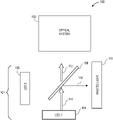
  • FIG. 1 is a block diagram of a light generation system providing high-intensity light to an optical system that is operable with a high-dimming ratio head-up avionics display.
  • display system 100 is configured such that a relatively high-intensity beam of light 112 is directed at optical system 102 .
  • this configuration is used in relatively bright lighting conditions, for example when an aircraft is being operated during the day in direct sunlight. It is understood that other less bright lighting conditions such as during the day in an overcast environment or even at dawn or dusk will still require a relatively bright beam of light from the light source, while typically not as bright as ambient light conditions when the aircraft is flying above clouds in direct sunlight or during the day when there is a clear sky.
  • the display may be projected forward at eye-level of a flight crew of an aircraft to serve as a head-up display for the flight crew, be integrated or mounted to a helmet for a helmet mounted display, or utilized in other similar configurations.
  • light generation system 101 is provided to produce the beam of light 112 through beam splitter 108 .
  • the beam splitter 108 is oriented at approximately 45 degrees between a first light emitting diode (“LED 1 ”) 104 and the optical system 102 .
  • LED 1 first light emitting diode
  • most of the light generated from the LED 1 104 in the form of a LED 1 light beam 114 will pass through the beam splitter 108 to become the beam of light 112 , nevertheless, a portion of the LED 1 light beam 114 will be reflected at the beam splitter 108 in the form of reflected light 116 which becomes wasted light 110 .
  • LED 2 106 is not energized and does not provide any light to the light generation system 101 . It is understood that the LED 2 106 , however, could be energized to provide an additional source of brightness if needed.
  • FIG. 2 is a block diagram of a light generation system providing low-intensity light to an optical system that is operable with a high-dimming ratio head-up avionics display.
  • display system 200 is configured such that a relatively lower-intensity beam of light 210 is directed at the optical system 102 of FIG. 1 .
  • this configuration is used in relatively lower lighting conditions, for example when an aircraft is being operated at night or in other low-light conditions. It is understood that other more intensely bright lighting conditions such as around the time of sunset or sunrise will still require a relatively lower intensity beam of light from the light source than at night.
  • embodiments of the present invention provide visibility in outside ambient conditions of direct sunlight and in outside ambient conditions of darkness.
  • light generation system 201 produces the beam of light 210 by reflecting off the beam splitter 108 .
  • the beam splitter 108 is oriented at approximately 45 degrees between the LED 2 106 and the optical system 102 . In such embodiments, most of the light generated from the LED 2 106 in the form of a LED 2 light beam 214 will pass through the beam splitter 108 to become the wasted beam of light 212 which becomes wasted light 110 .
  • LED 1 104 is not energized and does not provide any light to the light generation system 101 .
  • LED 1 104 could be energized to provide an additional source of brightness if needed, for example when transitioning from a low light condition to one that requires brighter light. Additionally or alternatively LED 1 and LED 2 may be used at all times with varying duty cycles to achieve a desired brightness and dimming ratio.
  • LED 2 106 only contributes a small percentage of its light into the light generation system 201 . Nevertheless, it has a similarly large dimming ratio as the LED 1 104 as further described in connection with FIG. 5 . For instance, if there are 1000 dimming steps between 97% brightness and 3%, there will also be 1000 dimming steps between 3% and 0.093% brightness, which is important as the logarithmic response of the eye is more sensitive to changes in dark conditions.
  • the specific relationship between the percentage transmitted to the percentage reflected is selected to optimize between the dimming range, providing sufficient overlap to allow for calibration of components (i.e. LEDs) that are received with divergent specifications due to manufacturing variations, as well as being able to work with lower rated electrical components, which provides a potential cost savings.
  • FIG. 3 is a schematic depiction of elements of a high-dimming ratio head-up avionics display 300 .
  • the overall display 300 is made of several components.
  • a digital light projector 302 is provided that reflects green light 310 from the light source 101 (of FIG. 1 ) by way of a micro mirror array 304 .
  • green light is selected because it is a standard in the avionics industry due to human perception factors. And also due to the complexity of resolving chromatic related aberrations for conventional off-axis HUD's. However, any colors, including a color display, may be utilized.
  • this reflected light 312 is directed to a lens 308 which projects a desired image onto a combiner 306 which reflects desired wavelengths of light so as to provide a clear head-up display of a desired brightness to a user of the overall display 300 .
  • FIG. 4 is a schematic depiction of electronics system 400 in a high-dimming ratio head-up avionics display.
  • Electronics system 400 is made up of a processing element 404 which may be implemented using any appropriate technology and design, and may include processors, microprocessors, microcontrollers, digital signal processors (DSPs), field-programmable gate arrays (FPGAs), analog and/or digital application-specific integrated circuits (ASICs), or the like, or combinations thereof.
  • the processing element 404 may generally execute, process, or run instructions, code, code segments, software, firmware, programs, applications, apps, processes, services, daemons, or the like, or may step through the states of a finite-state machine.
  • the processing element 404 is communicatively coupled to, among other things, a memory 412 which may be implemented using any appropriate technology and design, and may include data storage components such as read-only memory (ROM), programmable ROM, erasable programmable ROM, random-access memory (RAM), disks, flash memory, thumb drives, universal serial bus (USB) drives, or the like, or combinations thereof.
  • the memory 412 may include, or may constitute, a “computer-readable medium.”
  • the memory 412 may store instructions, code, code segments, software, firmware, programs, applications, apps, services, daemons, or the like that are executed by the processing element 404 .
  • the memory 412 may also store settings, data, documents, sound files, photographs, movies, images, databases, and the like.
  • the electronics system 400 is provided operating power by power supply 402 . This may be connected into the operating power system of the aircraft and conditioned to a voltage level as needed by components of the electronics system 400 . It is understood that the power supply 402 could also be provided by any other source such as batteries, a USB connection, or the like. In various embodiments, power is also provided to the processing element 404 and any other part of the electrical system 400 .
  • a DLP 408 is provided the DLP 408 having an associated digital micromirror device (“DMD”) 410 . As set forth in connection with FIG. 3 . The DLP controls how the DMD is manipulated to selectively reflect light from a light source (such as those illustrated in FIGS. 1 and 2 ) to further parts of an optical system (such as the lens 308 of FIG. 3 ).
  • FIG. 5 is a schematic diagram of an LED driver circuit operable in connection with a light generation system providing high-intensity light to an optical system that is operable with a high-dimming ratio head-up avionics display.
  • the LED drive circuit 500 should be able to illuminate the LED 502 with a wide dimming ratio. Possible methods of dimming include adjusting the LED current and toggling the LED on and off using Pulse Width Modulation (PWM). Commercially available LED drivers will allow for current dimming on the order of 10:1. Alternatives to DLP projection, such as an LCD based design, would allow the use of PWM LED dimming drivers that can achieve a sufficiently high dimming ratio when the PWM is operated at low frequency. With such a system, current and PWM dimming would therefore provide the required dimming ratio but the use of an LCD projection system would be highly inefficient and would not be sufficiently bright for an aviation display.
  • PWM Pulse Width Modulation
  • the DLP mirrors toggle at relatively high frequency (on the order of 30 microseconds).
  • PWM dimming must be performed at a frequency higher than the DLP mirror operating frequency. This limits the pulse width for PWM and therefore dimming ratio of the PWM to around 100:1. Accordingly, when the current and PWM dimming are both applied to the DLP, a dimming ratio of only 1,000:1 per LED. As set forth above, this limitation is overcome by way of the dual LED approach of the present teachings.
  • the LEDs In addition to limitations in LED drive circuits, the LEDs have maximum and minimum current limits. LEDs are available with a maximum current limit on the order of 15 amps. Those LEDs have a minimum current requirement of 200 mA. Therefore even if a suitable LED driver could be deployed, by modulating current alone, the LED itself would be limited to a (current variation) dimming ratio of 75:1. Another benefit of the present teachings is to allow a narrower range of current variations in the driven LEDs, which can expand the usable life of the LEDs and therefore of the overall avionics display product.
  • FIG. 6 is a line graph 600 of reflectance percentage to wavelength (expressed in nm) for a combiner (such as the combiner 306 of FIG. 3 ) to reflect a displayed image in a high-dimming ratio head-up avionics display.
  • Displays consistent with the present teachings should perform in a consistent and repeatable manner without causing distraction to the user as brightness is adjusted or as ambient light changes. Accordingly, in various embodiments, at the time of manufacture, each of the transitions points can be calibrated, i.e. between LED drive circuits and between the two LED's in the system for switching from one LED to the other, due too practical limitations in the manufacture of LEDs which introduce slight variations in the produced wavelength, sometimes known as LED binning.
  • an image of wavelength shown at wide-dashed line 604 which falls squarely within the notch of light as shown by line 610 that is reflected by the combiner and therefore visible at the display.
  • the associated image is produced at the combiner by the avionics display as described in connection with the present teachings.
  • light produced in connection with the high-dimming-ratio display will have its intensity varied in part by adjusting the current in various LEDs associated with a light source in the display.
  • the adjusted current will result in a shift of the wavelength of the generated light. As illustrated in FIG.
  • the notch of visible light is approximately 510 nm to 530 nm, although any portions of the spectrum may be employed.
  • An additional benefit of the present teachings is an ability to optimize the width of the notch coating on the combiner with the brightness of the display.
  • the requirement of needing to adjust, or make wider, the range of wavelengths reflected by the notch coating increases the cost and complexity of the combiner, which has a critical impact on the system brightness, uniformity and perception of the field of view on the other side of the windscreen.
  • Producing a very narrow notch coating can be more complex and costly than a wider notch but have the benefit of better transmissivity and system performance.
  • Simply using drive currents to achieve dimming ratios would not only fail to produce a sufficiently great dimming ratio but would also add cost and complexity to the design of an avionics display, as the wavelength shift of the LED must be taken into consideration when designing the combiner.
  • each LED can operate over a smaller range of currents (and corresponding wavelength shifts). This lowers the wavelength shift thus reducing the complexity of the notch coating design and thereby reducing cost in the overall system as well as increasing visibility through the combiner since it has a narrower notch of reflected wavelengths. It is understood that the design is independent of the optical beam splitter orientation i.e. It is equally valid to design the system with a high % reflection and low % transmission splitter. Additionally, embodiments of the present invention may employ techniques other than reflective notch coatings. For instance, waveguides or broadband reflection coated combiners may be employed.

Landscapes

  • Physics & Mathematics (AREA)
  • General Physics & Mathematics (AREA)
  • Optics & Photonics (AREA)
  • Engineering & Computer Science (AREA)
  • Multimedia (AREA)
  • Signal Processing (AREA)
  • Instrument Panels (AREA)
  • Illuminated Signs And Luminous Advertising (AREA)

Abstract

Disclosed are dual-light-source, high dimming-ratio avionics displays with digital light processing projector technology for rendering a visual display from generated light. The dual light sources are directed towards a beam splitter adapted to pass a substantial portion of the light from the first light source and to reflect a minority portion of the light from the second light source. An image is rendered at a substantially transparent, selectively reflective substrate adapted to reflect light of a range of visible wavelengths toward a viewer of the displays.

Description

BACKGROUND
It's desirable for avionics displays to exhibit a proper range of brightness. At one extreme, when an aircraft is flying above the clouds and the sun is shining down on the aircraft and reflecting on the surface of the clouds, the ambient light is so bright that to be seen a display must be extremely bright. At the opposite extreme, when an aircraft is being piloted at night, the display should be quite dim. Accordingly, augmented reality technologies such as Head-Up Displays (HUD's) or Head Mounted Displays (HMD's) are required to operate in a range of environments. These displays must be able to reach high luminance levels and low luminance levels, with a smooth transition for all points in between.
SUMMARY
Techniques are disclosed to enable production and operation of a high-dimming-ratio avionics display with a digital light processing projector for rendering a visual display from generated light. The display has a first light source comprising a first light emitting diode and a first light emitting diode drive circuit, the first light source projecting light of a first light source intensity in the direction of the digital light processing projector. The display further includes a second light source comprising a second light emitting diode and a second light emitting diode drive circuit, the second light source projecting light in a direction that is angularly disposed to that of the first light source projection, the second light source having a second light source intensity that is lower than the first light source intensity. In addition, disclosed is a beam splitter adapted to pass a substantial portion of the light from the first light emitting diode and to reflect a minority portion of the light from the second light emitting diode and a substantially transparent, selectively reflective substrate adapted to reflect light within a notch of visible wavelengths to reflect the rendered visual display toward a viewer of the display.
This summary is provided to introduce a selection of concepts in a simplified form that are further described below in the detailed description. This summary is not intended to identify key features or essential features of the claimed subject matter, nor is it intended to be used to limit the scope of the claimed subject matter. Other aspects and advantages of the present technology will be apparent from the following detailed description of the embodiments and the accompanying drawing figures.
BRIEF DESCRIPTION OF THE DRAWINGS
The figures described below depict various embodiments of the present invention. It is understood that these figures depict exemplary embodiments. The exemplary features illustrated in the figures are intended to represent these aspects of the various disclosed embodiments and not intended to limit the claimed scope to any particular feature. Further, whenever possible, the following description refers to the reference numerals included in the figures, in which features depicted in multiple figures are designated with consistent reference numerals.
FIG. 1 is a block diagram of a light generation system providing high-intensity light to an optical system that is operable with a high-dimming ratio head-up avionics display;
FIG. 2 is a block diagram of a light generation system providing low-intensity light to an optical system that is operable with a high-dimming ratio head-up avionics display;
FIG. 3 is a schematic depiction of elements of a high-dimming ratio head-up avionics display;
FIG. 4 is a schematic depiction of electronic elements of a high-dimming ratio head-up avionics display;
FIG. 5 is a schematic diagram of an LED driver circuit operable in connection with a light generation system providing high-intensity light to an optical system that is operable with a high-dimming ratio head-up avionics display; and
FIG. 6 is a line graph of reflectance percentage to wavelength (expressed in nm) for a combiner to reflect a displayed image in a high-dimming ratio head-up avionics display.
DETAILED DESCRIPTION
The following text sets forth a detailed description of numerous different embodiments. However, it is understood that the detailed description is to be construed as exemplary only and does not describe every possible embodiment since describing every possible embodiment would be impractical. In light of the teachings and disclosures herein, numerous alternative embodiments may be implemented.
It is understood that, unless a term is expressly defined in this patent application using the sentence “As used herein, the term ‘______’ is hereby defined to mean . . . ” or a similar sentence, there is no intent to limit the meaning of that term, either expressly or by implication, beyond its plain or ordinary meaning, and such term should not be interpreted to be limited in scope based on any statement made in any section of this patent application.
The following detailed description of the technology references the accompanying drawings that illustrate specific embodiments in which the technology may be practiced. The embodiments are intended to describe aspects of the technology in sufficient detail to enable those skilled in the art to practice the technology. Other embodiments may be utilized and changes may be made without departing from the scope of the present technology. The following detailed description is, therefore, not to be taken in a limiting sense. The scope of the present technology is defined only by the appended claims, along with the full scope of equivalents to which such claims are entitled.
In this description, references to “one embodiment”, “an embodiment”, or “embodiments” mean that the feature or features being referred to are included in at least one embodiment of the technology. Separate references to “one embodiment”, “an embodiment”, or “embodiments” in this description do not necessarily refer to the same embodiment and are also not mutually exclusive unless so stated and/or except as will be readily apparent to those skilled in the art from the description. For example, a feature, structure, act, etc. described in one embodiment may also be included in other embodiments, but is not necessarily included. Thus, the present technology may include a variety of combinations and/or integrations of the embodiments described herein.
Embodiments of the technology apply to the field of avionics displays, and more specifically, to high-dimming-ratio avionics displays. As set forth herein, an “optical system” relates to a receiver of a light source that is used to project a display. A “combiner” relates to a film or coating that is selectively reflective of a range or ranges of wavelengths of light and non-reflective of others. In this way, a combiner can be used to reflect a display on an otherwise substantially transparent surface such as the cockpit windscreen of an aircraft or another optical element.
Disclosed are techniques that allow the avionics displays to achieve a sufficiently high dimming ratio required for maximum and minimum luminance, while also providing sufficient dimming steps at low luminance levels to noticeably adjust the brightness in dim lighting conditions, thereby satisfying the human eye response, which is more sensitive in lower lighting conditions. When adjusting the luminance levels of actual LEDs, as the current in the LED is varied, the wavelength of the produced light shifts, which impacts system design, i.e. the range of wavelengths that need to be reflected to the user. As set forth below in connection with FIG. 6, in various embodiments, the use of reflective notch coatings on the combiner cover the wavelength shift of the LED so as to reflect the shifted wavelengths and thereby still adequately display the desired image to a user of the avionics display. While observed “brightness” is relative, typical brightness values encountered in aviation as outside ambient light conditions range between about 34,262 cd/m{circumflex over ( )}2 and pitch dark. By way of reference, a typical photographic scene in full sunlight is about 5,000 cd/m{circumflex over ( )}2.
As further described below, in order to increase dimming ratio, a second LED and driver are provided with a calibrated crossover point between illumination of the first and second LEDs. This can achieve a dimming ratio of up to the value of the dimming ratio of a single drive to the second power (squared). These are coupled into the illumination system using a beam splitter, which allows for a high percentage (e.g. 97%) of the first LED to pass through the beam splitter, this providing a high-level of brightness. Only a small percentage of light (e. g. 3%) is wasted by the beam splitter. In embodiments, a dimming ratio of at least 200,000:1 may be achieved.
FIG. 1 is a block diagram of a light generation system providing high-intensity light to an optical system that is operable with a high-dimming ratio head-up avionics display. In various embodiments, display system 100 is configured such that a relatively high-intensity beam of light 112 is directed at optical system 102. Typically, this configuration is used in relatively bright lighting conditions, for example when an aircraft is being operated during the day in direct sunlight. It is understood that other less bright lighting conditions such as during the day in an overcast environment or even at dawn or dusk will still require a relatively bright beam of light from the light source, while typically not as bright as ambient light conditions when the aircraft is flying above clouds in direct sunlight or during the day when there is a clear sky. The display may be projected forward at eye-level of a flight crew of an aircraft to serve as a head-up display for the flight crew, be integrated or mounted to a helmet for a helmet mounted display, or utilized in other similar configurations.
In various embodiments, light generation system 101 is provided to produce the beam of light 112 through beam splitter 108. In various embodiments, the beam splitter 108 is oriented at approximately 45 degrees between a first light emitting diode (“LED1”) 104 and the optical system 102. In such embodiments, most of the light generated from the LED1 104 in the form of a LED1 light beam 114 will pass through the beam splitter 108 to become the beam of light 112, nevertheless, a portion of the LED1 light beam 114 will be reflected at the beam splitter 108 in the form of reflected light 116 which becomes wasted light 110. In various embodiments, LED2 106 is not energized and does not provide any light to the light generation system 101. It is understood that the LED2 106, however, could be energized to provide an additional source of brightness if needed.
FIG. 2 is a block diagram of a light generation system providing low-intensity light to an optical system that is operable with a high-dimming ratio head-up avionics display. In various embodiments, display system 200 is configured such that a relatively lower-intensity beam of light 210 is directed at the optical system 102 of FIG. 1. Typically, this configuration is used in relatively lower lighting conditions, for example when an aircraft is being operated at night or in other low-light conditions. It is understood that other more intensely bright lighting conditions such as around the time of sunset or sunrise will still require a relatively lower intensity beam of light from the light source than at night. Thus, embodiments of the present invention provide visibility in outside ambient conditions of direct sunlight and in outside ambient conditions of darkness.
In various embodiments, light generation system 201 produces the beam of light 210 by reflecting off the beam splitter 108. In various embodiments similar to the configuration described in connection with FIG. 1, the beam splitter 108 is oriented at approximately 45 degrees between the LED2 106 and the optical system 102. In such embodiments, most of the light generated from the LED2 106 in the form of a LED2 light beam 214 will pass through the beam splitter 108 to become the wasted beam of light 212 which becomes wasted light 110. In various embodiments, LED1 104 is not energized and does not provide any light to the light generation system 101. It is understood that the LED1 104, however, could be energized to provide an additional source of brightness if needed, for example when transitioning from a low light condition to one that requires brighter light. Additionally or alternatively LED1 and LED2 may be used at all times with varying duty cycles to achieve a desired brightness and dimming ratio.
In various embodiments, LED2 106 only contributes a small percentage of its light into the light generation system 201. Nevertheless, it has a similarly large dimming ratio as the LED1 104 as further described in connection with FIG. 5. For instance, if there are 1000 dimming steps between 97% brightness and 3%, there will also be 1000 dimming steps between 3% and 0.093% brightness, which is important as the logarithmic response of the eye is more sensitive to changes in dark conditions. In various embodiments, the specific relationship between the percentage transmitted to the percentage reflected is selected to optimize between the dimming range, providing sufficient overlap to allow for calibration of components (i.e. LEDs) that are received with divergent specifications due to manufacturing variations, as well as being able to work with lower rated electrical components, which provides a potential cost savings.
FIG. 3 is a schematic depiction of elements of a high-dimming ratio head-up avionics display 300. In various embodiments, the overall display 300 is made of several components. A digital light projector 302 is provided that reflects green light 310 from the light source 101 (of FIG. 1) by way of a micro mirror array 304. In various embodiments, green light is selected because it is a standard in the avionics industry due to human perception factors. And also due to the complexity of resolving chromatic related aberrations for conventional off-axis HUD's. However, any colors, including a color display, may be utilized.
In various embodiments, this reflected light 312 is directed to a lens 308 which projects a desired image onto a combiner 306 which reflects desired wavelengths of light so as to provide a clear head-up display of a desired brightness to a user of the overall display 300.
FIG. 4 is a schematic depiction of electronics system 400 in a high-dimming ratio head-up avionics display. Electronics system 400 is made up of a processing element 404 which may be implemented using any appropriate technology and design, and may include processors, microprocessors, microcontrollers, digital signal processors (DSPs), field-programmable gate arrays (FPGAs), analog and/or digital application-specific integrated circuits (ASICs), or the like, or combinations thereof. The processing element 404 may generally execute, process, or run instructions, code, code segments, software, firmware, programs, applications, apps, processes, services, daemons, or the like, or may step through the states of a finite-state machine. In various embodiments, the processing element 404 is communicatively coupled to, among other things, a memory 412 which may be implemented using any appropriate technology and design, and may include data storage components such as read-only memory (ROM), programmable ROM, erasable programmable ROM, random-access memory (RAM), disks, flash memory, thumb drives, universal serial bus (USB) drives, or the like, or combinations thereof. The memory 412 may include, or may constitute, a “computer-readable medium.” The memory 412 may store instructions, code, code segments, software, firmware, programs, applications, apps, services, daemons, or the like that are executed by the processing element 404. The memory 412 may also store settings, data, documents, sound files, photographs, movies, images, databases, and the like.
In various embodiments, the electronics system 400 is provided operating power by power supply 402. This may be connected into the operating power system of the aircraft and conditioned to a voltage level as needed by components of the electronics system 400. It is understood that the power supply 402 could also be provided by any other source such as batteries, a USB connection, or the like. In various embodiments, power is also provided to the processing element 404 and any other part of the electrical system 400. In various embodiments, a DLP 408 is provided the DLP 408 having an associated digital micromirror device (“DMD”) 410. As set forth in connection with FIG. 3. The DLP controls how the DMD is manipulated to selectively reflect light from a light source (such as those illustrated in FIGS. 1 and 2) to further parts of an optical system (such as the lens 308 of FIG. 3).
FIG. 5 is a schematic diagram of an LED driver circuit operable in connection with a light generation system providing high-intensity light to an optical system that is operable with a high-dimming ratio head-up avionics display. The LED drive circuit 500 should be able to illuminate the LED 502 with a wide dimming ratio. Possible methods of dimming include adjusting the LED current and toggling the LED on and off using Pulse Width Modulation (PWM). Commercially available LED drivers will allow for current dimming on the order of 10:1. Alternatives to DLP projection, such as an LCD based design, would allow the use of PWM LED dimming drivers that can achieve a sufficiently high dimming ratio when the PWM is operated at low frequency. With such a system, current and PWM dimming would therefore provide the required dimming ratio but the use of an LCD projection system would be highly inefficient and would not be sufficiently bright for an aviation display.
However, in a DLP based system, the DLP mirrors toggle at relatively high frequency (on the order of 30 microseconds). To avoid visual artifacts, PWM dimming must be performed at a frequency higher than the DLP mirror operating frequency. This limits the pulse width for PWM and therefore dimming ratio of the PWM to around 100:1. Accordingly, when the current and PWM dimming are both applied to the DLP, a dimming ratio of only 1,000:1 per LED. As set forth above, this limitation is overcome by way of the dual LED approach of the present teachings.
In addition to limitations in LED drive circuits, the LEDs have maximum and minimum current limits. LEDs are available with a maximum current limit on the order of 15 amps. Those LEDs have a minimum current requirement of 200 mA. Therefore even if a suitable LED driver could be deployed, by modulating current alone, the LED itself would be limited to a (current variation) dimming ratio of 75:1. Another benefit of the present teachings is to allow a narrower range of current variations in the driven LEDs, which can expand the usable life of the LEDs and therefore of the overall avionics display product.
FIG. 6 is a line graph 600 of reflectance percentage to wavelength (expressed in nm) for a combiner (such as the combiner 306 of FIG. 3) to reflect a displayed image in a high-dimming ratio head-up avionics display. Displays consistent with the present teachings should perform in a consistent and repeatable manner without causing distraction to the user as brightness is adjusted or as ambient light changes. Accordingly, in various embodiments, at the time of manufacture, each of the transitions points can be calibrated, i.e. between LED drive circuits and between the two LED's in the system for switching from one LED to the other, due too practical limitations in the manufacture of LEDs which introduce slight variations in the produced wavelength, sometimes known as LED binning. In addition to the variation of LED performance it is also important to understand how the LED operates under certain conditions. As the current used to drive an LED varies, the varied current will cause a shift in the center wavelength emitted. The manufacture-time calibration must factor this in and drive each transition point (from one LED circuit to the other) in a consistent manner. This results a seamless transition, so that the user does not even notice a flicker or transition from one LED circuit to the other.
In various embodiments, an image of wavelength shown at wide-dashed line 604 which falls squarely within the notch of light as shown by line 610 that is reflected by the combiner and therefore visible at the display. In this way, the associated image is produced at the combiner by the avionics display as described in connection with the present teachings. In various embodiments, light produced in connection with the high-dimming-ratio display will have its intensity varied in part by adjusting the current in various LEDs associated with a light source in the display. In various embodiments, the adjusted current will result in a shift of the wavelength of the generated light. As illustrated in FIG. 6, if this shift in wavelength is of a sufficient magnitude as shown at dotted line 608 it will fall outside of the notch for which light is reflected by the combiner. In such a situation, the display would not be visible or at most only faintly visible. Alternatively, if the shift in wavelength is minimized as shown in dashed-line 606, the shifted wavelength will still fall within the notch of reflected wavelengths for the combiner and it will, therefore, still be visible at the display. In one embodiment, the notch of visible light is approximately 510 nm to 530 nm, although any portions of the spectrum may be employed.
An additional benefit of the present teachings is an ability to optimize the width of the notch coating on the combiner with the brightness of the display. The requirement of needing to adjust, or make wider, the range of wavelengths reflected by the notch coating increases the cost and complexity of the combiner, which has a critical impact on the system brightness, uniformity and perception of the field of view on the other side of the windscreen. Producing a very narrow notch coating can be more complex and costly than a wider notch but have the benefit of better transmissivity and system performance. Simply using drive currents to achieve dimming ratios would not only fail to produce a sufficiently great dimming ratio but would also add cost and complexity to the design of an avionics display, as the wavelength shift of the LED must be taken into consideration when designing the combiner. By using the dual LED approach of the present teachings, each LED can operate over a smaller range of currents (and corresponding wavelength shifts). This lowers the wavelength shift thus reducing the complexity of the notch coating design and thereby reducing cost in the overall system as well as increasing visibility through the combiner since it has a narrower notch of reflected wavelengths. It is understood that the design is independent of the optical beam splitter orientation i.e. It is equally valid to design the system with a high % reflection and low % transmission splitter. Additionally, embodiments of the present invention may employ techniques other than reflective notch coatings. For instance, waveguides or broadband reflection coated combiners may be employed.
Although the technology has been described with reference to the embodiments illustrated in the attached drawing figures, it is noted that equivalents may be employed and substitutions made herein without departing from the scope of the technology as recited in the claims.
Having thus described various embodiments of the technology, what is claimed as new and desired to be protected by Letters Patent includes the following:
Claims (16)

What is claimed is:
1. An avionics display comprising:
a digital light processing projector for rendering a visual display from generated light;
a first light source comprising a first light emitting diode and a first light emitting diode drive circuit, the first light source projecting light of a first light source intensity in the direction of the digital light processing projector;
a second light source comprising a second light emitting diode and a second light emitting diode drive circuit, the second light source projecting light in a direction that is angularly disposed to that of the first light source projection, the second light source having a second light source intensity that is lower than the first light source intensity;
a beam splitter adapted to pass a substantial portion of the light from the first light emitting diode and to reflect a minority portion of the light from the second light emitting diode; and
a reflective substrate adapted to reflect the rendered visual display toward a viewer of the display;
wherein the beam splitter passes at least 97% of the light from the first light emitting diode and reflects no more than 3% of the light from the second light emitting diode.
2. The avionics display of claim 1, wherein the display is projected forward at eye-level of a flight crew of an aircraft to serve as a head-up display for the flight crew.
3. The avionics display of claim 1, wherein the beam splitter is orientated at a 45 degree angle to the first light emitting diode.
4. The avionics display of claim 1, wherein the reflective substrate includes a notch filter operable to reflect visible light between approximately 510 nm to 530 nm.
5. The avionics display of claim 1, wherein the first and second light emitting diode drive circuits control the brightness of the first and second light emitting diodes by varying the current in the first and second light emitting diodes.
6. The avionics display of claim 5, wherein the first and second light emitting diode drive circuits control the brightness of the first and second light emitting diodes by means of pulse width modulation.
7. An avionics display comprising:
a digital light processing projector for rendering a visual display from generated light;
a first light source comprising a first light emitting diode and a first light emitting diode drive circuit, the first light source projecting light of a first light source intensity in the direction of the digital light processing projector;
a second light source comprising a second light emitting diode and a second light emitting diode drive circuit, the second light source projecting light in a direction that is angularly disposed to that of the first light source projection, the second light source having a second light source intensity that is lower than the first light source intensity, wherein the first and second light emitting diode drive circuits control the brightness of the first and second light emitting diodes by varying the current in the first and second light emitting diodes and by means of pulse width modulation;
a beam splitter adapted to pass a substantial portion of the light from the first light emitting diode and to reflect a minority portion of the light from the second light emitting diode; and
a substantially transparent, selectively reflective substrate adapted to reflect light within a notch of visible wavelengths to reflect the rendered visual display toward a viewer of the display;
wherein the beam splitter passes at least 97% of the light from the first light emitting diode and reflects no more than 3% of the light from the second light emitting diode.
8. The avionics display of claim 7, wherein the display is projected forward at eye-level of a flight crew of an aircraft to serve as a head-up display for the flight crew.
9. The avionics display of claim 7, wherein the beam splitter is orientated at a 45 degree angle to the first light emitting diode.
10. The avionics display of claim 7, wherein the notch of visible light is approximately 510 nm to 530 nm.
11. An high dimming ratio, head up avionics display comprising:
a digital light processing projector for rendering a visual display from generated light;
a first light source comprising a first light emitting diode and a first light emitting diode drive circuit, the first light source projecting light of a first light source intensity through a beam splitter in the direction of an array of micro-mirrors associated with the digital light processing projector;
a second light source comprising a second light emitting diode and a second light emitting diode drive circuit, the second light source projecting light in a direction that is angularly disposed to that of the first light source projection, the second light source having a second light source intensity that is lower than the first light source intensity, wherein the first and second light emitting diode drive circuits control the brightness of the first and second light emitting diodes by varying the current in the first and second light emitting diodes and by means of pulse width modulation, and wherein the beam splitter is adapted to pass a substantial portion of the light from the first light emitting diode and to reflect a minority portion of the light from the second light emitting diode; and
a substantially transparent substrate with a coating adapted to reflect green light of a range of wavelengths to reflect the rendered visual display toward a viewer of the display;
wherein the beam splitter passes at least 97% of the light from the first light emitting diode and reflects no more than 3% of the light from the second light emitting diode.
12. The avionics display of claim 11, wherein the display is projected forward at eye-level of a flight crew of an aircraft to serve as a head-up display for the flight crew.
13. The avionics display of claim 11, wherein the beam splitter is orientated at a 45 degree angle to the first light emitting diode.
14. The avionics display of claim 11, wherein the notch of visible light is approximately 510 nm to 530 nm.
15. The avionics display of claim 11, wherein the display is visible to the pilot of an aircraft in outside ambient conditions of direct sunlight.
16. The avionics display of claim 11, wherein the display is visible in outside ambient conditions of darkness.
US16/837,712 2020-04-01 2020-04-01 High-dimming-ratio avionics display Active 2040-09-24 US11428940B2 (en)

Priority Applications (2)

Application Number Priority Date Filing Date Title
US16/837,712 US11428940B2 (en) 2020-04-01 2020-04-01 High-dimming-ratio avionics display
US17/814,885 US20220365350A1 (en) 2020-04-01 2022-07-26 High-dimming-ratio avionics display

Applications Claiming Priority (1)

Application Number Priority Date Filing Date Title
US16/837,712 US11428940B2 (en) 2020-04-01 2020-04-01 High-dimming-ratio avionics display

Related Child Applications (1)

Application Number Title Priority Date Filing Date
US17/814,885 Continuation US20220365350A1 (en) 2020-04-01 2022-07-26 High-dimming-ratio avionics display

Publications (2)

Publication Number Publication Date
US20210311309A1 US20210311309A1 (en) 2021-10-07
US11428940B2 true US11428940B2 (en) 2022-08-30

Family

ID=77921948

Family Applications (2)

Application Number Title Priority Date Filing Date
US16/837,712 Active 2040-09-24 US11428940B2 (en) 2020-04-01 2020-04-01 High-dimming-ratio avionics display
US17/814,885 Abandoned US20220365350A1 (en) 2020-04-01 2022-07-26 High-dimming-ratio avionics display

Family Applications After (1)

Application Number Title Priority Date Filing Date
US17/814,885 Abandoned US20220365350A1 (en) 2020-04-01 2022-07-26 High-dimming-ratio avionics display

Country Status (1)

Country Link
US (2) US11428940B2 (en)

Citations (16)

* Cited by examiner, † Cited by third party
Publication number Priority date Publication date Assignee Title
US6215680B1 (en) 2000-05-24 2001-04-10 Garmin Corporation Circuit for obtaining a wide dimming ratio from a royer inverter
US20020154277A1 (en) * 2001-04-02 2002-10-24 Hiroshi Mukawa Image display device
US6504518B1 (en) 1996-10-09 2003-01-07 Shimadzu Corporation Head-up display
US20030156330A1 (en) * 2002-02-19 2003-08-21 Johannes Edlinger System for projecting an image using narrow band light sources
US20050013132A1 (en) * 2003-05-27 2005-01-20 Samsung Electronics Co., Ltd. Illumination apparatus employing auxiliary light source and projection system including illumination apparatus
US6864927B1 (en) 1996-12-31 2005-03-08 Micron Technology, Inc. Head up display with adjustable transparency screen
US6987787B1 (en) 2004-06-28 2006-01-17 Rockwell Collins LED brightness control system for a wide-range of luminance control
US20160154244A1 (en) 2014-01-21 2016-06-02 Osterhout Group, Inc. Compact optical system for head-worn computer
US20170099469A1 (en) * 2015-10-05 2017-04-06 Funai Electric Co., Ltd. Projection device
US20170276546A1 (en) * 2016-03-28 2017-09-28 Kohji Sakai Wavelength estimation device, light-source device, image display apparatus, object apparatus, wavelength estimation method, and light-source control method
US20170371236A1 (en) * 2015-01-20 2017-12-28 Appotronics China Corporation Light source system and projection system
US20180067308A1 (en) * 2016-09-08 2018-03-08 Kohji Sakai Light-source device, image display apparatus, and object apparatus
US20190097396A1 (en) * 2016-04-25 2019-03-28 Kohji Sakai Semiconductor laser, light source device, image forming apparatus, image display device, object device, and colored-light generation method
US20190324179A1 (en) * 2018-04-24 2019-10-24 Palo Alto Research Center Incorporated Angle-insensitive multi-wavelength optical filters with hue control
US20210162924A1 (en) * 2018-08-30 2021-06-03 Jvckenwood Corporation Display apparatus, display method, and program
US20210168339A1 (en) * 2018-08-30 2021-06-03 Jvckenwood Corporation Display apparatus, display method, and program

Family Cites Families (3)

* Cited by examiner, † Cited by third party
Publication number Priority date Publication date Assignee Title
JP2013041236A (en) * 2011-07-01 2013-02-28 Hitachi Media Electoronics Co Ltd Scan-type image display device and scan-type projection device
JP5790811B2 (en) * 2014-02-27 2015-10-07 ウシオ電機株式会社 Light source device and projector
JP5900806B2 (en) * 2014-08-08 2016-04-06 ウシオ電機株式会社 Light source device and projector

Patent Citations (16)

* Cited by examiner, † Cited by third party
Publication number Priority date Publication date Assignee Title
US6504518B1 (en) 1996-10-09 2003-01-07 Shimadzu Corporation Head-up display
US6864927B1 (en) 1996-12-31 2005-03-08 Micron Technology, Inc. Head up display with adjustable transparency screen
US6215680B1 (en) 2000-05-24 2001-04-10 Garmin Corporation Circuit for obtaining a wide dimming ratio from a royer inverter
US20020154277A1 (en) * 2001-04-02 2002-10-24 Hiroshi Mukawa Image display device
US20030156330A1 (en) * 2002-02-19 2003-08-21 Johannes Edlinger System for projecting an image using narrow band light sources
US20050013132A1 (en) * 2003-05-27 2005-01-20 Samsung Electronics Co., Ltd. Illumination apparatus employing auxiliary light source and projection system including illumination apparatus
US6987787B1 (en) 2004-06-28 2006-01-17 Rockwell Collins LED brightness control system for a wide-range of luminance control
US20160154244A1 (en) 2014-01-21 2016-06-02 Osterhout Group, Inc. Compact optical system for head-worn computer
US20170371236A1 (en) * 2015-01-20 2017-12-28 Appotronics China Corporation Light source system and projection system
US20170099469A1 (en) * 2015-10-05 2017-04-06 Funai Electric Co., Ltd. Projection device
US20170276546A1 (en) * 2016-03-28 2017-09-28 Kohji Sakai Wavelength estimation device, light-source device, image display apparatus, object apparatus, wavelength estimation method, and light-source control method
US20190097396A1 (en) * 2016-04-25 2019-03-28 Kohji Sakai Semiconductor laser, light source device, image forming apparatus, image display device, object device, and colored-light generation method
US20180067308A1 (en) * 2016-09-08 2018-03-08 Kohji Sakai Light-source device, image display apparatus, and object apparatus
US20190324179A1 (en) * 2018-04-24 2019-10-24 Palo Alto Research Center Incorporated Angle-insensitive multi-wavelength optical filters with hue control
US20210162924A1 (en) * 2018-08-30 2021-06-03 Jvckenwood Corporation Display apparatus, display method, and program
US20210168339A1 (en) * 2018-08-30 2021-06-03 Jvckenwood Corporation Display apparatus, display method, and program

Also Published As

Publication number Publication date
US20220365350A1 (en) 2022-11-17
US20210311309A1 (en) 2021-10-07

Similar Documents

Publication Publication Date Title
JP5683690B2 (en) Displays, especially vehicle head-up displays
US8730581B2 (en) Head-up display for night vision goggles
EP2905647B1 (en) Laser scanning display device
EP3064984B1 (en) Display device
US20070171623A1 (en) Night vision compatible display backlight
CN105900167B (en) Light source driving device and display device
CN111247795B (en) Enhanced white light for projection lighting
US9470891B2 (en) Head-up display for night vision goggles
US11428940B2 (en) High-dimming-ratio avionics display
US10725285B2 (en) Display device
CN110764349B (en) Projection system
US10715769B2 (en) Projector
JP7338636B2 (en) Display device
JP2017227806A (en) Display device
US12474578B1 (en) Narrowband reflective optical combiner with narrowband display device having multi-coloured backlight unit
US20250233967A1 (en) Head-up display device
WO2022270343A1 (en) Head-up display
JP7480709B2 (en) Display device
Wisely All digital technology as a viable alternative to cathode ray tube technology in head up display applications
CN208027073U (en) Miniature two-dimensional laser scanning image source and projection system
JP5862619B2 (en) Vehicle display device

Legal Events

Date Code Title Description
FEPP Fee payment procedure

Free format text: ENTITY STATUS SET TO UNDISCOUNTED (ORIGINAL EVENT CODE: BIG.); ENTITY STATUS OF PATENT OWNER: LARGE ENTITY

STPP Information on status: patent application and granting procedure in general

Free format text: DOCKETED NEW CASE - READY FOR EXAMINATION

STPP Information on status: patent application and granting procedure in general

Free format text: NON FINAL ACTION MAILED

STPP Information on status: patent application and granting procedure in general

Free format text: RESPONSE TO NON-FINAL OFFICE ACTION ENTERED AND FORWARDED TO EXAMINER

STPP Information on status: patent application and granting procedure in general

Free format text: NOTICE OF ALLOWANCE MAILED -- APPLICATION RECEIVED IN OFFICE OF PUBLICATIONS

AS Assignment

Owner name: GARMIN INTERNATIONAL, INC., KANSAS

Free format text: ASSIGNMENT OF ASSIGNORS INTEREST;ASSIGNORS:GILLAN, IAIN P.;STRINGFELLOW, STEVEN A.;EAKIN, RYAN K.;SIGNING DATES FROM 20200320 TO 20200330;REEL/FRAME:060598/0760

STPP Information on status: patent application and granting procedure in general

Free format text: PUBLICATIONS -- ISSUE FEE PAYMENT VERIFIED

STCF Information on status: patent grant

Free format text: PATENTED CASE