US11414367B2 - Method of preparing and method of using tetracarbonyl cyclobutene dihydrate compound - Google Patents

Method of preparing and method of using tetracarbonyl cyclobutene dihydrate compound Download PDF

Info

Publication number
US11414367B2
US11414367B2 US17/518,190 US202117518190A US11414367B2 US 11414367 B2 US11414367 B2 US 11414367B2 US 202117518190 A US202117518190 A US 202117518190A US 11414367 B2 US11414367 B2 US 11414367B2
Authority
US
United States
Prior art keywords
tetracarbonyl
cyclobutene
dihydrate compound
compound
reaction
Prior art date
Legal status (The legal status is an assumption and is not a legal conclusion. Google has not performed a legal analysis and makes no representation as to the accuracy of the status listed.)
Active
Application number
US17/518,190
Other versions
US20220144743A1 (en
Inventor
Mei Luo
Current Assignee (The listed assignees may be inaccurate. Google has not performed a legal analysis and makes no representation or warranty as to the accuracy of the list.)
Intelligent Manufacturing Technology Research Institute Hefei University Of Technology
Inielligent Manufacturing Technology Research Institute Hefei University Of Technology
Original Assignee
Inielligent Manufacturing Technology Research Institute Hefei University Of Technology
Priority date (The priority date is an assumption and is not a legal conclusion. Google has not performed a legal analysis and makes no representation as to the accuracy of the date listed.)
Filing date
Publication date
Application filed by Inielligent Manufacturing Technology Research Institute Hefei University Of Technology filed Critical Inielligent Manufacturing Technology Research Institute Hefei University Of Technology
Assigned to Intelligent Manufacturing Technology Research Institute, Hefei University of Technology reassignment Intelligent Manufacturing Technology Research Institute, Hefei University of Technology ASSIGNMENT OF ASSIGNORS INTEREST (SEE DOCUMENT FOR DETAILS). Assignors: LUO, Mei
Publication of US20220144743A1 publication Critical patent/US20220144743A1/en
Application granted granted Critical
Publication of US11414367B2 publication Critical patent/US11414367B2/en
Active legal-status Critical Current
Anticipated expiration legal-status Critical

Links

Images

Classifications

    • CCHEMISTRY; METALLURGY
    • C07ORGANIC CHEMISTRY
    • C07CACYCLIC OR CARBOCYCLIC COMPOUNDS
    • C07C49/00Ketones; Ketenes; Dimeric ketenes; Ketonic chelates
    • C07C49/587Unsaturated compounds containing a keto groups being part of a ring
    • C07C49/593Unsaturated compounds containing a keto groups being part of a ring of a three- or four-membered ring
    • CCHEMISTRY; METALLURGY
    • C07ORGANIC CHEMISTRY
    • C07CACYCLIC OR CARBOCYCLIC COMPOUNDS
    • C07C45/00Preparation of compounds having >C = O groups bound only to carbon or hydrogen atoms; Preparation of chelates of such compounds
    • C07C45/002Preparation of compounds having >C = O groups bound only to carbon or hydrogen atoms; Preparation of chelates of such compounds by dehydrogenation
    • BPERFORMING OPERATIONS; TRANSPORTING
    • B01PHYSICAL OR CHEMICAL PROCESSES OR APPARATUS IN GENERAL
    • B01JCHEMICAL OR PHYSICAL PROCESSES, e.g. CATALYSIS OR COLLOID CHEMISTRY; THEIR RELEVANT APPARATUS
    • B01J31/00Catalysts comprising hydrides, coordination complexes or organic compounds
    • B01J31/02Catalysts comprising hydrides, coordination complexes or organic compounds containing organic compounds or metal hydrides
    • B01J31/0201Oxygen-containing compounds
    • B01J31/0205Oxygen-containing compounds comprising carbonyl groups or oxygen-containing derivatives, e.g. acetals, ketals, cyclic peroxides
    • B01J31/0208Ketones or ketals
    • CCHEMISTRY; METALLURGY
    • C07ORGANIC CHEMISTRY
    • C07CACYCLIC OR CARBOCYCLIC COMPOUNDS
    • C07C201/00Preparation of esters of nitric or nitrous acid or of compounds containing nitro or nitroso groups bound to a carbon skeleton
    • C07C201/06Preparation of nitro compounds
    • C07C201/12Preparation of nitro compounds by reactions not involving the formation of nitro groups
    • CCHEMISTRY; METALLURGY
    • C07ORGANIC CHEMISTRY
    • C07CACYCLIC OR CARBOCYCLIC COMPOUNDS
    • C07C45/00Preparation of compounds having >C = O groups bound only to carbon or hydrogen atoms; Preparation of chelates of such compounds
    • C07C45/27Preparation of compounds having >C = O groups bound only to carbon or hydrogen atoms; Preparation of chelates of such compounds by oxidation
    • C07C45/29Preparation of compounds having >C = O groups bound only to carbon or hydrogen atoms; Preparation of chelates of such compounds by oxidation of hydroxy groups
    • BPERFORMING OPERATIONS; TRANSPORTING
    • B01PHYSICAL OR CHEMICAL PROCESSES OR APPARATUS IN GENERAL
    • B01JCHEMICAL OR PHYSICAL PROCESSES, e.g. CATALYSIS OR COLLOID CHEMISTRY; THEIR RELEVANT APPARATUS
    • B01J2231/00Catalytic reactions performed with catalysts classified in B01J31/00
    • B01J2231/30Addition reactions at carbon centres, i.e. to either C-C or C-X multiple bonds
    • B01J2231/34Other additions, e.g. Monsanto-type carbonylations, addition to 1,2-C=X or 1,2-C-X triplebonds, additions to 1,4-C=C-C=X or 1,4-C=-C-X triple bonds with X, e.g. O, S, NH/N
    • B01J2231/3411,2-additions, e.g. aldol or Knoevenagel condensations
    • CCHEMISTRY; METALLURGY
    • C07ORGANIC CHEMISTRY
    • C07BGENERAL METHODS OF ORGANIC CHEMISTRY; APPARATUS THEREFOR
    • C07B2200/00Indexing scheme relating to specific properties of organic compounds
    • C07B2200/13Crystalline forms, e.g. polymorphs
    • CCHEMISTRY; METALLURGY
    • C07ORGANIC CHEMISTRY
    • C07CACYCLIC OR CARBOCYCLIC COMPOUNDS
    • C07C2601/00Systems containing only non-condensed rings
    • C07C2601/04Systems containing only non-condensed rings with a four-membered ring

Definitions

  • the present application relates to a new compound and use thereof, and particular to a method of preparing and a method of using a carbonyl compound, and more particularly to a method of preparing and a method of using a tetracarbonyl cyclobutene dihydrate compound.
  • Tetracarbonyl cyclobutene compound is an important pharmaceutical intermediate. Synthesis and use of the tetracarbonyl cyclobutene compound have been reported in literatures (1-2).
  • the tetracarbonyl cyclobutene dihydrate compound of the present application is prepared by reacting squaric acid with ammonium acetate and has a structure represented by chemical formula (I).
  • tetracarbonyl cyclobutene dihydrate compound herein also called compound (I).
  • the compound has shown good catalytic performance in the Henry reaction of ethyl pyruvate, and a conversion rate of ethyl pyruvate is 96.1%.
  • the preparation method of the tetracarbonyl cyclobutene dihydrate compound includes a synthesis step and a separation step.
  • the synthesis step comprises: collecting and dissolving 0.5728 g of squaric acid, 2.7948 g of ammonium formate, and 0.0480 g of a palladium complex into 100 mL of anhydrous methanol, heating and stirring a resulting mixture for 48 hrs, and stopping reaction.
  • the separation step comprises: adding 10 mL of 1 M HCl to a resulting reacted mixture, and extracting with dichloromethane 15 mL for three times; combining extracts, washing a resulting first combined extract with 15 mL of 12 M NaOH solution; and extracting with 15 mL of dichloromethane for three times, and combining extracts to yield a second combined extract; and performing rotary evaporation and column chromatography on the second combined extract for separation, whereby obtaining a colorless crystal compound.
  • the target product can be obtained by one step, the process is simple, and the operation is convenient.
  • reaction mechanism of this reaction can be inferred that squaric acid undergoes a series of complex changes from an enol form to a ketone form under combined action of the palladium complex as a catalyst and excess ammonium formate, and the target tetracarbonyl compound is formed.

Landscapes

  • Chemical & Material Sciences (AREA)
  • Organic Chemistry (AREA)
  • Chemical Kinetics & Catalysis (AREA)
  • Engineering & Computer Science (AREA)
  • Materials Engineering (AREA)
  • Organic Low-Molecular-Weight Compounds And Preparation Thereof (AREA)

Abstract

A tetracarbonyl cyclobutene dihydrate compound, having a chemical formula (I).A method of synthesizing the tetracarbonyl cyclobutene dihydrate compound, includes: a synthesis step, a separation step, and a purification step. The synthesis step includes: collecting and dissolving 0.5728 g of squaric acid, 2.7948 g of ammonium formate, and 0.0480 g of the palladium complex in 100 mL of anhydrous methanol, heating and stirring a resulting mixture to reflux for 48 hrs, and stopping the reaction. The separation step includes: performing column chromatography analysis on reaction products according to a volume ratio of dichloromethane to anhydrous methanol of 8:2, to obtain a target product. A method of using the tetracarbonyl cyclobutene dihydrate compound, includes: using tetracarbonyl cyclobutene dihydrate compound as a catalyst in addition reaction between ethyl pyruvate and nitromethane, where a conversion rate of ethyl pyruvate reaches 96.1%.

Description

CROSS-REFERENCE TO RELATED APPLICATIONS
Pursuant to 35 U.S.C. § 119 and the Paris Convention, this application claims the benefit of Chinese Patent Application No. 202011247410.8 filed Nov. 10, 2020, the contents of which are incorporated herein by reference.
TECHNICAL FIELD
The present application relates to a new compound and use thereof, and particular to a method of preparing and a method of using a carbonyl compound, and more particularly to a method of preparing and a method of using a tetracarbonyl cyclobutene dihydrate compound.
BACKGROUND
Tetracarbonyl cyclobutene compound is an important pharmaceutical intermediate. Synthesis and use of the tetracarbonyl cyclobutene compound have been reported in literatures (1-2).
CITED LITERATURES
  • 1. Farnia, Giuseppe; Sandona, Giancarlo; Marcuzzi, Franco, Electrochemical behavior of 1,2-dihydroxycyclo-buten-3,4-dione in dimethyl formamide, Journal of Electroanalytical Chemistry (1993), 348, (1-2), 339-54.
  • 2 Horii, Hideo; Abe, Yasuo; Taniguchi, Setsuo, Absorption spectrum of the squaric acid radical. Chemistry Express (1986), 1, (2), 83-6.
SUMMARY
In view of the above technical problems, it is an objective of the present application to provide a tetracarbonyl cyclobutene dihydrate compound, which is able to obtain the target product by one-step synthesis.
The tetracarbonyl cyclobutene dihydrate compound of the present application is prepared by reacting squaric acid with ammonium acetate and has a structure represented by chemical formula (I).
Figure US11414367-20220816-C00002
Chemical name: tetracarbonyl cyclobutene dihydrate compound, herein also called compound (I). The compound has shown good catalytic performance in the Henry reaction of ethyl pyruvate, and a conversion rate of ethyl pyruvate is 96.1%.
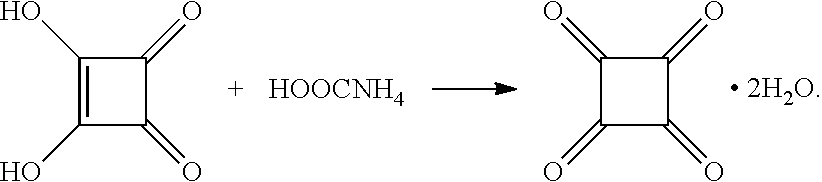
The preparation method of the tetracarbonyl cyclobutene dihydrate compound includes a synthesis step and a separation step. The synthesis step comprises: collecting and dissolving 0.5728 g of squaric acid, 2.7948 g of ammonium formate, and 0.0480 g of a palladium complex into 100 mL of anhydrous methanol, heating and stirring a resulting mixture for 48 hrs, and stopping reaction. The separation step comprises: adding 10 mL of 1 M HCl to a resulting reacted mixture, and extracting with dichloromethane 15 mL for three times; combining extracts, washing a resulting first combined extract with 15 mL of 12 M NaOH solution; and extracting with 15 mL of dichloromethane for three times, and combining extracts to yield a second combined extract; and performing rotary evaporation and column chromatography on the second combined extract for separation, whereby obtaining a colorless crystal compound.
The synthesis reaction is shown as follows:
Figure US11414367-20220816-C00003
By adopting the synthesis method, the target product can be obtained by one step, the process is simple, and the operation is convenient.
The reaction mechanism of this reaction can be inferred that squaric acid undergoes a series of complex changes from an enol form to a ketone form under combined action of the palladium complex as a catalyst and excess ammonium formate, and the target tetracarbonyl compound is formed.
BRIEF DESCRIPTION OF THE DRAWINGS
The present application is described hereinbelow with reference to accompanying drawings, in which the sole FIGURE is an X-ray diffraction analysis chart of compound I.
DETAILED DESCRIPTION OF THE EMBODIMENTS
To further illustrate the present application, experiments detailing a method of preparing and a method of using a tetracarbonyl cyclobutene dihydrate compound are described below. It should be noted that the following examples are intended to describe and not to limit the present application.
Preparation of a palladium complex is described as follows.
Example 1. Preparation of Chiral Palladium Complex (1) Preparation of [1,4-(4R)-diisopropyl-2-oxazolinyl]benzene
1.4054 g (10.64 mmol) of anhydrous ZnCl2, 40 mL of chlorobenzene, 5.0236 g (39.2 mmol) of 1,4-dicyanobenzene, 16.2075 g of L-valinol were added in a 100 mL two-neck flask under an anhydrous and oxygen-free condition. A resulting mixture was refluxed at a high temperature for 60 hrs. The reaction was stopped, and then a solvent was removed under a reduced pressure to obtain a residue. After that, the residue was dissolved in water and extracted with CHCl3 (20 mL×2). An organic phase was dried by anhydrous sodium sulfate, rotatory filtration was then performed to remove the solvent, and a crude product was performed with column chromatography with petroleum ether/dichloromethane (4:1) to obtain a light green viscous liquid with a yield of 52%. An obtained white crystal has a melting point of 48-50° C., [a]5 D=+111.9° (c=0.429, CHCl3); 1H NMR (500 MHz, CDCl3, 27° C.), δ (ppm)=7.97 (s, 4H), 4.39-4.43 (t, 3.18 Hz, 1H), 4.09-4.15 (m, 2H), 1.85-1.86 (m, 1H), (d, J=6.24 Hz, 6H), 0.86-0.96 (d, J=6.24 Hz, 6H). 13C NMR 18.13, 19.03, 32.85, 70.26, 72.76, 128.10, 128.16, 130.32, 162.82. IR: 3273, 2976, 2960, 2932, 2889, 2869, 1643, 1512, 1469, 1408, 1382, 1366, 1350, 1320, 1296, 1276, 1214, 1180, 1108, 1077, 1047, 1014, 971, 955, 900, 891, 838, 726, 698, 675, 659, 540. HRMS (EI): m/z (%): calcd for C18H24N2O2: 300.1838; found: 300.1833.
(2) Preparation of bis{[1,4-(4S)-diisopropyl-2-oxazolinylbenzene]palladium Chloride} Complex
1.5603 g (4.92 mmol) of palladium chloride, 1.0435 g (3.48 mmol) of 1,4-(4R)-diisopropyl-2-oxazolinylbenzene, and 30 mL of chlorobenzene were added to a 100 mL two-neck flask under an anhydrous and oxygen-free condition. A resulting mixture was refluxed at a high temperature for 48 hrs. The reaction was then stopped, and a solvent was removed under a reduced pressure. A resulting residue chloroform and ethanol were dissolved and naturally volatized to obtain a crystal of a reddish-brown complex, with a yield of 92%. m.p.: >200° C., [a]5 D=+512.8° (c 0.0564, CH3OH); 1H NMR (600 MHz, CDCl3), δ′ ppm 8.81 (s, 8H, ArH), 4.61-4.63 (m, 4H, CH×4), 4.53 (t, J=9.6 Hz, 4H, CH×4), 4.44 (t, J=8.5 Hz, 4H, CH×4), 3.07-3.10 (m, 4H), 1.18 and 1.15 (dd, J=6.7, 7.2 Hz, 24H, CH3×4); 13C NMR (150 MHz, CDCl3) δ ppm 166.8, 130.1 (×2), 129.3, 72.0, 69.1, 30.7, 19.0, 15.6; νmax (cm−1) 3487, 3049, 2957, 2929, 2872, 1642, 1609, 1572, 1509, 1480, 1464, 1416, 1379, 1331, 1288, 1246, 1178, 1141, 1123, 1099, 1045, 1018, 959, 933, 899, 854, 804, 770, 722, 693, 438. Elemental analysis: C36H48N4Cl4O4Pd2: Test value: C, 45.26%, H, 5.06%, and N, 5.86%; and theoretical value: C, 45.32%, H, 5.24%, and N, 5.48%.
Example 2 Preparation of Tetracarbonyl Compound
0.5728 g of squaric acid, 2.7948 g of ammonium formate, and 0.0480 g of the palladium complex were collected and dissolved in 100 mL of anhydrous methanol. A resulting mixture was heated and stirred to reflux for 48 hrs, and the reaction was then stopped. Reaction products were performed with column chromatography analysis according to a volume ratio of dichloromethane to anhydrous methanol of 8:2 to obtain 0.3481 g of a target product, the yield was 68%, and a melting point of the target product was >250° C. Elemental analysis: (C4H4O6); theoretical value: 32.45% of C and 2.72% of H; and measured value: 32.67% of C and 2.68% of H; HRMS: Theoretical value: 148.0008; Measured value: 148.0012; 13CNMR (125 MHz, CDCl3, 27° C.): 196.5, IR (KBr): 3019, 2854, 2177, 1652, 1500, 1418, 1364, 1088.
Crystal data of the compound
Empirical formula C4H4O6
Molecular weight 148.07
Temperature 291(2) K
wavelength 0.71073 Å
Crystal system, space group Monoclinic, C 2/c
Unit cell dimensions a = 3.70690(10) Å alpha =
90 deg.
b = 7.2586(3) Å beta =
97.897 deg.
c = 11.9274(5) Å gamma =
90 deg.
volume 317.71 (2) Å3
charge density 2 , 1.548 Mg/m3
Absorption correction parameter 1.376 mm−1
Number of electrons in a unit cell 152.0
Crystal size 0.220 × 0.180 × 0.170 mm
Theta range 14.322 to 139.478
Collection range of HKL's indicator −3 <= h <= 4, −8 <= k < 8,
−14 <= 1 <= 14
Reflections collected/unique 998/583 [R(int) = 0.0162]
Completeness to theta = 30.5 1.098%
Absorption correction method Multi-layer scanning
Maximum and minimum 0.7456 and 0.5760
transmittance
Refinement method Full-matrix least-square on F2
Data number/restraint number/ 583/2/54
parameter number
Refinement method 1.098
Uniformity factor of diffraction point R1 = 0.0678, wR2 = 0.1678
Observable diffraction fit factor R1 = 0.0702, wR2 = 0.1693
Largest peak and hole on the 0.610 and −0.55 e.Å−3
difference Fourier diagram
TABLE 4
Typical bond length data of crystal
Bond Lengths for LM-200915.
Atom Atom Length/Å Atom Atom Length/Å
O1 C2 1.252(4) C1 C2 1.465(4)
O2 C1 1.257(4) C2 C11 1.462(4)
C1 C21 1.462(4)
Bond angle data of crystal
Atom Atom Atom Angle/° Atom Atom Atom Angle/°
O2 C1  C21 133.8 (3) O1 C2  C11 133.7 (3)
O2 C1 C2 136.1 (3) O1 C2 C1 136.4 (3)
 C21 C1 C2  90.2 (2)  C11 C2 C1  89.8 (2)
Example 3 Application in Henry Reaction
Figure US11414367-20220816-C00004
0.05 mmol of the compound (I) was placed in a 25 mL flask, and 1 mL tetrahydrofuran, 0.3 mL nitromethane and 0.5 mmol of ethyl pyruvate were added sequentially to the flask, a resulting mixture were stirred for reaction for 20 hrs. Samples were taken for 1HNMR detection. The conversion rate was 96.1%; 1H NMR (600 MHz, CDCl3): δ) 4.86 (d, J=13.8 Hz, 1H), 4.58 (d, J=13.8 Hz, 1H), 4.34 (m, 2H), 3.85 (s, 1H), 1.46 (s, 3H), 1.33 (t, J=7.2 Hz, 3H). 13 C NMR (150 MHz, CDCl 3): δ=173.4, 80.9, 72.4, 63.0, 23.8, 13.9.

Claims (4)

What is claimed is:
1. A tetracarbonyl cyclobutene dihydrate compound, prepared by reacting squaric acid with ammonium formate, and having a chemical formula (I):
Figure US11414367-20220816-C00005
2. The tetracarbonyl cyclobutene dihydrate compound of claim 1, prepared into a form of a crystal, wherein
when being diffracted with a MoKα ray, which is monochromated by a graphite monochromator and has a wavelength of λ=0.71073 Å, in an ω-θ scanning mode on an Oxford X-ray single crystal diffractometer at a temperature of 293(2)K, the crystal of the tetracarbonyl cyclobutene dihydrate compound belongs to a monoclinic system, C 2/c, and has unit cell dimensions as follows: a=3.70690(10) Å alpha=90 deg.; b=7.2586(3) Å beta=97.897 deg.; and c=11.9274(5) Å gamma=90 deg.
3. A method of synthesizing the tetracarbonyl cyclobutene dihydrate compound of claim 1, comprising: a synthesis step, a separation step, and a purification step;
wherein
the synthesis step comprises: collecting and dissolving 0.5728 g of squaric acid, 2.7948 g of ammonium formate, and 0.0480 g of a palladium complex in 100 mL of anhydrous methanol, heating and stirring a resulting mixture to reflux for 48 hrs, and stopping the reaction; and
the separation step comprises: performing column chromatography analysis on reaction products according to a volume ratio of dichloromethane to anhydrous methanol of 8:2, to obtain a target product.
4. A method of using the tetracarbonyl cyclobutene dihydrate compound of claim 1, as a catalyst in addition reaction between ethyl pyruvate and nitromethane; wherein a conversion rate of ethyl pyruvate reaches 96.1%.
US17/518,190 2020-11-10 2021-11-03 Method of preparing and method of using tetracarbonyl cyclobutene dihydrate compound Active US11414367B2 (en)

Applications Claiming Priority (2)

Application Number Priority Date Filing Date Title
CN202011247410.8A CN112225652B (en) 2020-11-10 2020-11-10 Preparation and application of tetracarbonyl cyclobutane compound dihydrate
CN202011247410.8 2020-11-10

Publications (2)

Publication Number Publication Date
US20220144743A1 US20220144743A1 (en) 2022-05-12
US11414367B2 true US11414367B2 (en) 2022-08-16

Family

ID=74122566

Family Applications (1)

Application Number Title Priority Date Filing Date
US17/518,190 Active US11414367B2 (en) 2020-11-10 2021-11-03 Method of preparing and method of using tetracarbonyl cyclobutene dihydrate compound

Country Status (2)

Country Link
US (1) US11414367B2 (en)
CN (1) CN112225652B (en)

Families Citing this family (2)

* Cited by examiner, † Cited by third party
Publication number Priority date Publication date Assignee Title
CN112430241A (en) * 2020-11-20 2021-03-02 合肥工业大学 Sodium squarate hexahydrate complex
CN112480126B (en) * 2020-12-11 2022-03-11 合肥工业大学 Preparation and application of 5-alkyl quinazoline derivative

Family Cites Families (5)

* Cited by examiner, † Cited by third party
Publication number Priority date Publication date Assignee Title
CN1258510C (en) * 1997-09-05 2006-06-07 协和油化株式会社 Process for preparing cyclobutanone derivative
CN103450098B (en) * 2013-09-13 2015-04-01 罗梅 Method for synthesizing 2, 5-diphenyl pyrazine
CN110544793A (en) * 2019-07-25 2019-12-06 珠海冠宇电池有限公司 Electrolyte, preparation method thereof and lithium ion battery
CN111675629A (en) * 2020-06-30 2020-09-18 合肥工业大学 A kind of synthetic method and use of 4,5-diphenylimidazoline
CN111662236A (en) * 2020-07-29 2020-09-15 合肥工业大学 Synthesis method and application of 2-hydroxyphenyl-5-pyrazinyl ketone

Non-Patent Citations (1)

* Cited by examiner, † Cited by third party
Title
Rodes et al. On the electrochemical behaviour of squaric acid on Pt(hkl) electrodes in acid solutions: a voltammetric and in situ FTIRS study. Journal of Electroanalytical Chemistry 421, 195-204. (Year: 1997). *

Also Published As

Publication number Publication date
CN112225652A (en) 2021-01-15
CN112225652B (en) 2023-07-25
US20220144743A1 (en) 2022-05-12

Similar Documents

Publication Publication Date Title
US11840537B2 (en) Preparation and application of a 5-bromoquinazoline derivative
US11414367B2 (en) Method of preparing and method of using tetracarbonyl cyclobutene dihydrate compound
US11746092B2 (en) Synthetic method and application of 2-hydroxyphenyl-5-pyrazinyl ketone
US12110273B2 (en) Method of preparing indolin-2-one compound and method of using indolin-2-one
US11708373B2 (en) 5-alkylquinazoline derivative, method of preparing the same, and method of using the same
Zhang et al. Synthesis and structure of an air-stable hypervalent organobismuth (III) perfluorooctanesulfonate and its use as high-efficiency catalyst for Mannich-type reactions in water
US20220089614A1 (en) Sodium squarate hexahydrate complex
CN111995544B (en) A kind of synthetic method and application of 4,5-diphenylimidazoline
CN113816973B (en) Preparation method of medical intermediate benzothiazole [2, 3-b ] quinazolinedione derivative
US11225499B2 (en) Chiral platinum complex, method for preparing the same, and method for using the same
CN112174893B (en) A kind of synthesis method and use of 2,4,5-trimethyl-1H-imidazolecarboxylate
CN111253415B (en) Norcantharidin carboxylic acid trifluoro benzyl ester and synthetic method and application thereof
CN112979563B (en) Preparation method of medical intermediate 2, 3-diaryl-2, 3-dihydroquinazoline-4 [1H ] -ketone
CN1224013A (en) Method for preparing bicyclohexyl-18-crown-6
RU2833785C1 (en) Method of producing 1-(3-(trimethoxysilyl)propyl)benzimidazole
CN111718337B (en) A kind of [2]rotaxane based on pillar aromatics and its preparation and application
MX2013008426A (en) Method of preparation of metaxalone.
CN121087502A (en) 4-(iodomethyl)-1-phenyl-3-toluenesulfonylimidazolidine-2-one derivatives and their preparation methods
CN119504515A (en) A method for synthesizing 1-adamantaneacetic acid-2,2-difluoro-2-ethylsulfonate
CN119504421A (en) Synthesis and application of 2-fluorobenzamide sodium hydroxide complex
CN120923476A (en) Preparation method of Orforglipron key intermediate
CN115872935A (en) A kind of synthetic method of 1,3-dialkyl imidazolium dicyanamide salt ionic liquid
CN113292503A (en) Preparation method of 2-bromo-3-aminonaphthoquinone compound
CN120943795A (en) A method for preparing N-(4-(tert-butyl)thiazolyl-2-yl)-3-fluorobenzamide
CN102807480A (en) A kind of CTV-I3 derivative and preparation method thereof

Legal Events

Date Code Title Description
FEPP Fee payment procedure

Free format text: ENTITY STATUS SET TO UNDISCOUNTED (ORIGINAL EVENT CODE: BIG.); ENTITY STATUS OF PATENT OWNER: SMALL ENTITY

AS Assignment

Owner name: INTELLIGENT MANUFACTURING TECHNOLOGY RESEARCH INSTITUTE, HEFEI UNIVERSITY OF TECHNOLOGY, CHINA

Free format text: ASSIGNMENT OF ASSIGNORS INTEREST;ASSIGNOR:LUO, MEI;REEL/FRAME:058115/0136

Effective date: 20211020

FEPP Fee payment procedure

Free format text: ENTITY STATUS SET TO SMALL (ORIGINAL EVENT CODE: SMAL); ENTITY STATUS OF PATENT OWNER: SMALL ENTITY

STPP Information on status: patent application and granting procedure in general

Free format text: NOTICE OF ALLOWANCE MAILED -- APPLICATION RECEIVED IN OFFICE OF PUBLICATIONS

STPP Information on status: patent application and granting procedure in general

Free format text: PUBLICATIONS -- ISSUE FEE PAYMENT VERIFIED

STCF Information on status: patent grant

Free format text: PATENTED CASE