US11409252B2 - Vehicle control device and vehicle control simulation device - Google Patents
Vehicle control device and vehicle control simulation device Download PDFInfo
- Publication number
- US11409252B2 US11409252B2 US16/620,762 US201816620762A US11409252B2 US 11409252 B2 US11409252 B2 US 11409252B2 US 201816620762 A US201816620762 A US 201816620762A US 11409252 B2 US11409252 B2 US 11409252B2
- Authority
- US
- United States
- Prior art keywords
- information
- arithmetic
- control model
- delay
- control
- Prior art date
- Legal status (The legal status is an assumption and is not a legal conclusion. Google has not performed a legal analysis and makes no representation as to the accuracy of the status listed.)
- Active, expires
Links
Images




Classifications
-
- G—PHYSICS
- G06—COMPUTING OR CALCULATING; COUNTING
- G06F—ELECTRIC DIGITAL DATA PROCESSING
- G06F8/00—Arrangements for software engineering
- G06F8/30—Creation or generation of source code
- G06F8/35—Creation or generation of source code model driven
-
- B—PERFORMING OPERATIONS; TRANSPORTING
- B60—VEHICLES IN GENERAL
- B60W—CONJOINT CONTROL OF VEHICLE SUB-UNITS OF DIFFERENT TYPE OR DIFFERENT FUNCTION; CONTROL SYSTEMS SPECIALLY ADAPTED FOR HYBRID VEHICLES; ROAD VEHICLE DRIVE CONTROL SYSTEMS FOR PURPOSES NOT RELATED TO THE CONTROL OF A PARTICULAR SUB-UNIT
- B60W50/00—Details of control systems for road vehicle drive control not related to the control of a particular sub-unit, e.g. process diagnostic or vehicle driver interfaces
- B60W50/04—Monitoring the functioning of the control system
-
- G—PHYSICS
- G05—CONTROLLING; REGULATING
- G05B—CONTROL OR REGULATING SYSTEMS IN GENERAL; FUNCTIONAL ELEMENTS OF SUCH SYSTEMS; MONITORING OR TESTING ARRANGEMENTS FOR SUCH SYSTEMS OR ELEMENTS
- G05B17/00—Systems involving the use of models or simulators of said systems
- G05B17/02—Systems involving the use of models or simulators of said systems electric
-
- G—PHYSICS
- G06—COMPUTING OR CALCULATING; COUNTING
- G06F—ELECTRIC DIGITAL DATA PROCESSING
- G06F11/00—Error detection; Error correction; Monitoring
- G06F11/30—Monitoring
- G06F11/34—Recording or statistical evaluation of computer activity, e.g. of down time, of input/output operation ; Recording or statistical evaluation of user activity, e.g. usability assessment
- G06F11/3404—Recording or statistical evaluation of computer activity, e.g. of down time, of input/output operation ; Recording or statistical evaluation of user activity, e.g. usability assessment for parallel or distributed programming
-
- G—PHYSICS
- G06—COMPUTING OR CALCULATING; COUNTING
- G06F—ELECTRIC DIGITAL DATA PROCESSING
- G06F11/00—Error detection; Error correction; Monitoring
- G06F11/30—Monitoring
- G06F11/34—Recording or statistical evaluation of computer activity, e.g. of down time, of input/output operation ; Recording or statistical evaluation of user activity, e.g. usability assessment
- G06F11/3409—Recording or statistical evaluation of computer activity, e.g. of down time, of input/output operation ; Recording or statistical evaluation of user activity, e.g. usability assessment for performance assessment
- G06F11/3419—Recording or statistical evaluation of computer activity, e.g. of down time, of input/output operation ; Recording or statistical evaluation of user activity, e.g. usability assessment for performance assessment by assessing time
-
- G—PHYSICS
- G06—COMPUTING OR CALCULATING; COUNTING
- G06F—ELECTRIC DIGITAL DATA PROCESSING
- G06F11/00—Error detection; Error correction; Monitoring
- G06F11/30—Monitoring
- G06F11/34—Recording or statistical evaluation of computer activity, e.g. of down time, of input/output operation ; Recording or statistical evaluation of user activity, e.g. usability assessment
- G06F11/3447—Performance evaluation by modeling
-
- G—PHYSICS
- G06—COMPUTING OR CALCULATING; COUNTING
- G06F—ELECTRIC DIGITAL DATA PROCESSING
- G06F11/00—Error detection; Error correction; Monitoring
- G06F11/30—Monitoring
- G06F11/34—Recording or statistical evaluation of computer activity, e.g. of down time, of input/output operation ; Recording or statistical evaluation of user activity, e.g. usability assessment
- G06F11/3457—Performance evaluation by simulation
-
- G—PHYSICS
- G06—COMPUTING OR CALCULATING; COUNTING
- G06F—ELECTRIC DIGITAL DATA PROCESSING
- G06F30/00—Computer-aided design [CAD]
- G06F30/10—Geometric CAD
- G06F30/15—Vehicle, aircraft or watercraft design
-
- G—PHYSICS
- G06—COMPUTING OR CALCULATING; COUNTING
- G06F—ELECTRIC DIGITAL DATA PROCESSING
- G06F30/00—Computer-aided design [CAD]
- G06F30/30—Circuit design
- G06F30/32—Circuit design at the digital level
- G06F30/33—Design verification, e.g. functional simulation or model checking
- G06F30/3308—Design verification, e.g. functional simulation or model checking using simulation
-
- G—PHYSICS
- G06—COMPUTING OR CALCULATING; COUNTING
- G06F—ELECTRIC DIGITAL DATA PROCESSING
- G06F30/00—Computer-aided design [CAD]
- G06F30/30—Circuit design
- G06F30/32—Circuit design at the digital level
- G06F30/33—Design verification, e.g. functional simulation or model checking
- G06F30/3308—Design verification, e.g. functional simulation or model checking using simulation
- G06F30/3312—Timing analysis
-
- H—ELECTRICITY
- H04—ELECTRIC COMMUNICATION TECHNIQUE
- H04L—TRANSMISSION OF DIGITAL INFORMATION, e.g. TELEGRAPHIC COMMUNICATION
- H04L67/00—Network arrangements or protocols for supporting network services or applications
- H04L67/01—Protocols
- H04L67/12—Protocols specially adapted for proprietary or special-purpose networking environments, e.g. medical networks, sensor networks, networks in vehicles or remote metering networks
-
- G—PHYSICS
- G06—COMPUTING OR CALCULATING; COUNTING
- G06F—ELECTRIC DIGITAL DATA PROCESSING
- G06F2115/00—Details relating to the type of the circuit
- G06F2115/10—Processors
Definitions
- the present invention relates to a vehicle control device and a vehicle control simulation device.
- An embedded control device that controls a control target with so-called embedded software, is used in the technical field of automobiles, elevators, construction machines, and the like.
- embedded software enables achievement of more flexible and advanced control than a conventional system with a mechanical mechanism or an electric circuit.
- Such an embedded control device for example, a control device in a vehicle controls an engine and brakes with a plurality of electronic control units (ECUs), to control the entirety of the vehicle.
- ECUs electronice control units
- One ECU such as an ECU for engine control, achieves intricate control with a plurality of built-in processor cores.
- An object of the present invention is to provide a vehicle control device and a vehicle control simulation device that enable, even for parallel processing with a plurality of arithmetic devices, approximation in act between at verification of simulation operation on a model base and at verification of operation on an actual vehicle.
- control model information for control of a system includes hardware information for operation of a control model; arithmetic-device allocation information as to which arithmetic device in hardware is allocated to perform arithmetic processing to a control program in the control model; delay time information regarding a case where the control model operates on the hardware; and a delay-time adding unit configured to create delay-inclusive control model information in which the delay time information is inserted in the control model, based on at least either the arithmetic-device allocation information or the hardware information.
- FIG. 1 is a system block diagram of a vehicle control simulation device according to an embodiment of the present invention.
- FIG. 2 is a model diagram of a control model according to the embodiment of the present invention.
- FIG. 3 is a data table of the control model according to the embodiment of the present invention.
- FIG. 4 is block diagram of an HW configuration according to the embodiment of the present invention.
- FIG. 5 is a data table of the HW configuration according to the embodiment of the present invention.
- FIG. 6 is a data table of arithmetic-device allocation according to the embodiment of the present invention.
- FIG. 7 is a data table of delay time according to the embodiment of the present invention.
- FIG. 8 is a flowchart of the act of a delay-time adding unit according to the embodiment of the present invention.
- FIG. 9 is a model diagram of a delay-inclusive control model according to the embodiment of the present invention.
- FIG. 10 illustrates waveform charts of simulation results of the control model and the delay-inclusive control model according to the embodiment of the present invention.
- the present embodiment relates to an embedded system including a computer system embedded for achievement of a specific function of a product requiring electronic control, such as household equipment, industrial equipment, or medical equipment.
- the present embodiment relates to a vehicle control device and a vehicle control simulation device each that control a system with a plurality of arithmetic devices, for example, a system in which required functions are various, for transport equipment, such as automobiles, railways, and elevators, or a large-scale system having a combination of a plurality of pieces of hardware and a plurality of pieces of software.
- FIG. 1 is a system block diagram of a vehicle control simulation device according to the embodiment of the present invention.
- the vehicle control simulation device 1 includes a control model 101 , an HW configuration 102 , arithmetic-device allocation 103 , delay time 104 , and a delay-time adding unit 105 .
- the delay-time adding unit 105 generates a delay-inclusive control model 106 , on the basis of the control model 101 , the HW configuration 102 , the arithmetic-device allocation 103 , and the delay time 104 .
- a waveform chart 108 indicating a simulation result based on the delay-inclusive control model 106 after application of the present embodiment indicates that the waveform has changed due to the influence of the delay time 104 .
- FIG. 2 is a model diagram of the control model according to the embodiment of the present invention.
- the control model 101 includes input ports 10101 and 10102 , an output port 10106 , and functional blocks 10103 , 10104 , and 10105 . Transmission and reception of label information 1 and label information 2 are indicated between the functional block 10103 and the functional block 10105 through wiring lines 10107 and 10108 indicating data dependent relationship. Similarly, transmission and reception of label information 3 are performed between the functional block 10104 and the functional block 10105 through a wiring line 10109 indicating data dependent relationship.
- the functional block 10103 inputs sensor information from the input port 10101 , and outputs the label 1 information and the label 2 information to the functional block 10105 .
- the functional block 10104 inputs sensor 2 information from the input port 10102 , and outputs the label 3 information to the functional block 10105 .
- the functional block 10105 inputs the label 1 information and the label 2 information output from the functional block 10103 and the label 3 information output from the functional block 10104 , and outputs actuator 1 information to the output port 10106 .
- FIG. 3 is a data table of the control model according to the embodiment of the present invention.
- the data table 1011 of the control model includes information regarding ID, label, data dependent source function, and data dependent destination function. Specifically, the data table 1011 indicates the data dependent source function and the data dependent destination function of the label 1 , label 2 , and label 3 information to be transmitted and received between the functional blocks 10103 , 10104 , and 10105 indicated in the control model 101 .
- the data dependent source function indicates a function 1 that is the functional block 10103 in the control model 101
- the data dependent destination function indicates a function 3 that is the functional block 10105 in the control model 101 .
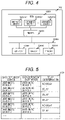
- FIG. 4 is a block diagram of the HW configuration according to the embodiment of the present invention.
- the HW configuration 102 indicates an HW configuration for arithmetic processing of control software written in the control model 101 .
- the HW configuration 102 includes an ECU 10201 , an actuator 10202 , sensors 10203 and 10204 , and a bus 10205 .
- the ECU 10201 includes arithmetic devices 1020101 , 1020102 , and 1020103 , and a memory 10201 .
- FIG. 5 is a data table of the HW configuration according to the embodiment of the present invention.
- the data table 1021 of the HW configuration includes data dependent source, data dependent destination, and delay determination information.
- the data table 1021 includes the delay determination information that is criterial for determination of whether delay occurs in data communication between the arithmetic devices 1020101 , 1020102 , and 1020103 .
- the arithmetic device 1020101 is an arithmetic device 1 indicated as the data dependent source and the arithmetic device 1020101 is the arithmetic device 1 indicated as the data dependent destination
- the data table 1021 indicates that no delay time occurs because the delay determination indicates no delay.
- the data table 1021 indicates that delay time occurs because the delay determination indicates delay.
- FIG. 6 is a data table of the arithmetic-device allocation according to the embodiment of the present invention.
- the data table 103 of the arithmetic-device allocation includes function and allocation information. Specifically, the data table 103 indicates which arithmetic device indicated in the HW configuration 102 performs arithmetic processing to each function indicated in the control model 101 . For example, the data table 103 indicates that the functional block 10103 indicated as the function 1 in the control model 101 is to be subjected to arithmetic processing by the arithmetic device 1020101 indicated as the arithmetic device 1 in the HW configuration 102 .
- the data table 103 indicates that the functional block 10104 indicated as the function 2 in the control model 101 is to be subjected to arithmetic processing by the arithmetic device 1020102 indicated as the arithmetic device 2 in the HW configuration 102 .
- FIG. 7 is a data table of the delay time according to the embodiment of the present invention.
- the data table 104 of the delay time includes function and delay time information. Specifically, the data table 104 indicates the processing time necessary in a case where each function indicated in the control model 101 is subjected to the arithmetic processing by the arithmetic device in the HW configuration 102 . For example, in a case where the functional block 10103 indicated as the function 1 in the control model 101 is processed by the arithmetic device in the HW configuration 102 , the data table 104 indicates that the processing time is 2.20 ⁇ s.
- FIG. 8 is a flowchart of the act of the delay-time adding unit according to the embodiment of the present invention.
- the delay-time adding unit 105 generates the delay-inclusive control model 106 in which the delay information 104 is added to the control model 101 , on the basis of the HW configuration 102 , the arithmetic-device allocation 103 , and the delay time 104 information.
- the processing starts from step S 10501 as the act of the delay-time adding unit 105 .
- step S 10502 label information in the control model 1011 is acquired and then the data dependent source function and the data dependent destination function related to the label are specified.
- the arithmetic-device allocation 103 is acquired, and then it is specified to which arithmetic devices the data dependent source function and the data dependent destination function related to the label in the control model information are allocated.
- the HW configuration 1021 information is acquired, and then it is specified whether the delay determination indicates delay or no delay, from a combination of the arithmetic devices to which the data dependent source function and the data dependent destination function related to the label in the control model information are allocated.
- step S 10506 the processing proceeds to step S 10506 .
- step S 10507 the delay time information from the delay time 104 is acquired, and then the delay time necessary for arithmetic processing of the data dependent source function related to the label, is specified.
- step S 10508 a delay block based on the delay time 104 information is inserted in the wiring portion related to the label in the delay model 101 .
- step S 10509 it is determined whether the determination at step S 10505 has been performed to all the labels in the control model 1011 .
- step S 1020110 the processing proceeds to step S 1020110 , to finish.
- step S 10507 the processing proceeds to step S 10507 , to continue.
- step S 10507 the data dependent source function and the data dependent destination function related to the next label in the control model 1011 , are specified.
- FIG. 9 is a model diagram of the delay-inclusive control model according to the embodiment of the present invention.
- the delay-inclusive control model 1011 results from addition of the delay time 104 to the control model 101 by the delay-time adding unit 105 .
- the present embodiment indicates the result of addition of the delay time information to wiring lines 10117 and 10118 related to the label 1 and the label 2 to be subjected to data transmission and reception between a functional block 10113 and a functional block 10115 .
- FIG. 10 illustrates waveform charts of simulation results of the control model and the delay-inclusive control model according to the embodiment of the present invention.
- the waveform chart 108 indicating the simulation result of the delay-inclusive control model 1011 clearly indicates that the waveform has changed because of the insertion of the delay blocks, in comparison to the waveform chart 107 indicating the simulation result of the control model 101 .
- This arrangement enables taking account of the influence of the synchronous processing time between pieces of arithmetic processing due to parallel processing with a plurality of arithmetic devices or the influence of delay time due to data communication between pieces of arithmetic processing, having not been considered in the existing model-based development. Thus, disagreement is inhibited from occurring between at verification of simulation operation on a model base and at verification of operation on an actual vehicle, so that the performance estimated at design can be secured.
Landscapes
- Engineering & Computer Science (AREA)
- Theoretical Computer Science (AREA)
- Physics & Mathematics (AREA)
- General Engineering & Computer Science (AREA)
- General Physics & Mathematics (AREA)
- Computer Hardware Design (AREA)
- Automation & Control Theory (AREA)
- Geometry (AREA)
- Quality & Reliability (AREA)
- Evolutionary Computation (AREA)
- Software Systems (AREA)
- Signal Processing (AREA)
- Computer Networks & Wireless Communication (AREA)
- Medical Informatics (AREA)
- General Health & Medical Sciences (AREA)
- Computing Systems (AREA)
- Mechanical Engineering (AREA)
- Health & Medical Sciences (AREA)
- Transportation (AREA)
- Human Computer Interaction (AREA)
- Pure & Applied Mathematics (AREA)
- Mathematical Optimization (AREA)
- Mathematical Analysis (AREA)
- Computational Mathematics (AREA)
- Aviation & Aerospace Engineering (AREA)
- Life Sciences & Earth Sciences (AREA)
- Bioinformatics & Cheminformatics (AREA)
- Bioinformatics & Computational Biology (AREA)
- Evolutionary Biology (AREA)
- Debugging And Monitoring (AREA)
- Stored Programmes (AREA)
- Feedback Control In General (AREA)
Abstract
Description
Claims (7)
Applications Claiming Priority (4)
| Application Number | Priority Date | Filing Date | Title |
|---|---|---|---|
| JP2017-132367 | 2017-07-06 | ||
| JPJP2017-132367 | 2017-07-06 | ||
| JP2017132367A JP7017871B2 (en) | 2017-07-06 | 2017-07-06 | Vehicle control simulation device |
| PCT/JP2018/023942 WO2019009114A1 (en) | 2017-07-06 | 2018-06-25 | Vehicle control device, and vehicle control simulation device |
Publications (2)
| Publication Number | Publication Date |
|---|---|
| US20200103839A1 US20200103839A1 (en) | 2020-04-02 |
| US11409252B2 true US11409252B2 (en) | 2022-08-09 |
Family
ID=64950869
Family Applications (1)
| Application Number | Title | Priority Date | Filing Date |
|---|---|---|---|
| US16/620,762 Active 2039-07-19 US11409252B2 (en) | 2017-07-06 | 2018-06-25 | Vehicle control device and vehicle control simulation device |
Country Status (4)
| Country | Link |
|---|---|
| US (1) | US11409252B2 (en) |
| EP (1) | EP3637263A4 (en) |
| JP (1) | JP7017871B2 (en) |
| WO (1) | WO2019009114A1 (en) |
Families Citing this family (2)
| Publication number | Priority date | Publication date | Assignee | Title |
|---|---|---|---|---|
| EP3861439A4 (en) * | 2019-12-20 | 2021-12-15 | Baidu.com Times Technology (Beijing) Co., Ltd. | Dynamic model with actuation latency |
| JP7572819B2 (en) * | 2020-09-14 | 2024-10-24 | Azapa株式会社 | Model Creation System |
Citations (9)
| Publication number | Priority date | Publication date | Assignee | Title |
|---|---|---|---|---|
| JPH1114507A (en) | 1997-06-19 | 1999-01-22 | Denso Corp | Vehicle simulation device |
| US20070254772A1 (en) * | 2006-04-27 | 2007-11-01 | Hitachi, Ltd. | Engine Controller |
| JP2008186057A (en) | 2007-01-26 | 2008-08-14 | Mitsubishi Electric Corp | Vehicle travel support evaluation device |
| US20120102175A1 (en) | 2010-10-26 | 2012-04-26 | Hitachi, Ltd. | Computer System, Simulation Method and Program |
| US20140081508A1 (en) * | 2012-09-18 | 2014-03-20 | Hitachi Automotive Systems, Ltd. | Automotive Control Unit and Automotive Control System |
| WO2014129354A1 (en) | 2013-02-21 | 2014-08-28 | トヨタ自動車株式会社 | Control device design method and control device |
| US20160321037A1 (en) * | 2015-04-28 | 2016-11-03 | Renesas Electronics Corporation | Performance verification device for verifying performance of program, method, and recording medium having program recorded thereon for causing computer to perform the method |
| US20170357560A1 (en) * | 2015-01-21 | 2017-12-14 | Hitachi Automotive Systems, Ltd. | Vehicle control device |
| US10964130B1 (en) * | 2018-10-18 | 2021-03-30 | Northrop Grumman Systems Corporation | Fleet level prognostics for improved maintenance of vehicles |
Family Cites Families (4)
| Publication number | Priority date | Publication date | Assignee | Title |
|---|---|---|---|---|
| JPH07281925A (en) * | 1994-04-06 | 1995-10-27 | Fujitsu Ltd | Multiprocessor simulation device |
| JPH09162169A (en) | 1995-12-05 | 1997-06-20 | Yasuhiro Horiike | Method and system for plasma processing |
| JP5251586B2 (en) | 2009-02-19 | 2013-07-31 | 富士通セミコンダクター株式会社 | Verification support program, verification support apparatus, and verification support method |
| US10406537B2 (en) | 2011-11-02 | 2019-09-10 | 3M Innovative Properties Company | Method of making a nozzle |
-
2017
- 2017-07-06 JP JP2017132367A patent/JP7017871B2/en active Active
-
2018
- 2018-06-25 WO PCT/JP2018/023942 patent/WO2019009114A1/en not_active Ceased
- 2018-06-25 US US16/620,762 patent/US11409252B2/en active Active
- 2018-06-25 EP EP18828170.3A patent/EP3637263A4/en active Pending
Patent Citations (12)
| Publication number | Priority date | Publication date | Assignee | Title |
|---|---|---|---|---|
| JPH1114507A (en) | 1997-06-19 | 1999-01-22 | Denso Corp | Vehicle simulation device |
| US20070254772A1 (en) * | 2006-04-27 | 2007-11-01 | Hitachi, Ltd. | Engine Controller |
| JP2008186057A (en) | 2007-01-26 | 2008-08-14 | Mitsubishi Electric Corp | Vehicle travel support evaluation device |
| US20120102175A1 (en) | 2010-10-26 | 2012-04-26 | Hitachi, Ltd. | Computer System, Simulation Method and Program |
| JP2012093899A (en) | 2010-10-26 | 2012-05-17 | Hitachi Ltd | Computer system, simulation method, and program |
| US20140081508A1 (en) * | 2012-09-18 | 2014-03-20 | Hitachi Automotive Systems, Ltd. | Automotive Control Unit and Automotive Control System |
| WO2014129354A1 (en) | 2013-02-21 | 2014-08-28 | トヨタ自動車株式会社 | Control device design method and control device |
| US20150378335A1 (en) * | 2013-02-21 | 2015-12-31 | National University Corporation Nagoya University | Control device design method and control device |
| US20170357560A1 (en) * | 2015-01-21 | 2017-12-14 | Hitachi Automotive Systems, Ltd. | Vehicle control device |
| US20160321037A1 (en) * | 2015-04-28 | 2016-11-03 | Renesas Electronics Corporation | Performance verification device for verifying performance of program, method, and recording medium having program recorded thereon for causing computer to perform the method |
| JP2016207166A (en) | 2015-04-28 | 2016-12-08 | ルネサスエレクトロニクス株式会社 | Performance verification apparatus, system, method, and program for causing computer to execute the method |
| US10964130B1 (en) * | 2018-10-18 | 2021-03-30 | Northrop Grumman Systems Corporation | Fleet level prognostics for improved maintenance of vehicles |
Non-Patent Citations (7)
| Title |
|---|
| Bucaioni et al., "Technology-Preserving Transition from Single-Core to Multi-Core in Modelling Vehicular Systems", Big Data Analytics in the Social and Ubiquitous Context: 5th International Workshop on Modeling Social Media, MSM 2014 / 5th International Workshop on Mining Ubiquitous and Social Environments (MUSE) 2014 / 1st International Workshop on Machine LE, pp. 285-299 (2017), Retrieved Jun. 20, 2017. |
| Extended European Search Report issued in corresponding European Patent Application No. 18828170.3 dated Dec. 10, 2020. |
| Hashimoto et al., "Vehicle Guidance System by Using Outside Sensing", Technical report of the Institute of Image Information and Television Engineers, vol. 30 No. 14, 2006, pp. 47-51. |
| International Search Report with English translation and Written Opinion issued in corresponding application No. PCT/JP2018/023942 dated Oct. 23, 2018. |
| Macher et al., "Automotive Embedded Software: Migration Challenges to Multi-Core Computing Platforms", 2015 IEEE 13th International Conference on Industrial Informatics (INDIN), IEEE, Jul. 22, 2015, pp. 1386-1393. |
| Matsubara et al., "Hierarchical Scheduling with Delayed Activation of Tasks for Temporal Protection", Proceeding Journal of Information Processing Society of Japan, 52, 2011, pp. 2387-2401. |
| Office Action issued in corresponding Japanese Patent Application No. 2017-132367 dated May 25, 2021 with English translation. |
Also Published As
| Publication number | Publication date |
|---|---|
| EP3637263A1 (en) | 2020-04-15 |
| US20200103839A1 (en) | 2020-04-02 |
| EP3637263A4 (en) | 2021-01-13 |
| JP2019016121A (en) | 2019-01-31 |
| JP7017871B2 (en) | 2022-02-09 |
| WO2019009114A1 (en) | 2019-01-10 |
Similar Documents
| Publication | Publication Date | Title |
|---|---|---|
| JP6289778B2 (en) | Test case generation apparatus and test case generation program | |
| US11989535B2 (en) | Simulation method and recording medium | |
| WO2009085118A3 (en) | System and method for architecture-adaptable automatic parallelization of computing code | |
| JP2012506091A (en) | Interrupt approval in data processing systems | |
| US20200103839A1 (en) | Vehicle control device and vehicle control simulation device | |
| CN102576325B (en) | Simulation method, system and program | |
| EP3249534A1 (en) | Vehicle control device | |
| US20130253706A1 (en) | Safety signal processing system | |
| JP2010282617A5 (en) | ||
| US12578990B2 (en) | Simulation system and method | |
| US20190370196A1 (en) | Information processing system, information processing device, peripheral device, data tansfer method, and non-transitory storage medium storing data transfer program | |
| CN113169925A (en) | Computing device and method for operating a computing device | |
| US20110144771A1 (en) | Safety control apparatus | |
| US10430231B2 (en) | Method for creating a hypervisor unit for embedded systems | |
| US12554826B2 (en) | System, vehicle, and method | |
| EP3637262B1 (en) | Verification device for vehicle control device and vehicle control device | |
| CN110457071B (en) | Method and apparatus for activating tasks in an operating system | |
| CN110161835A (en) | The method and apparatus of the data model in system for calculating safety-critical | |
| US11097857B2 (en) | Multiple core motor controller processor with embedded prognostic/diagnostic capabilities | |
| Senthilkumar et al. | Designing multicore ECU architecture in vehicle networks using AUTOSAR | |
| US20160371010A1 (en) | Memory unit for automatically multiplying the content of a memory location, and data network having a memory unit | |
| JP2016017472A (en) | Control device for internal combustion engine | |
| KR20140140192A (en) | Apparatus for processing of signal equipped on the ground for railway car | |
| JP4382128B2 (en) | Information processing apparatus and error calculation detection method thereof | |
| JP4356650B2 (en) | Data communication method and data communication system |
Legal Events
| Date | Code | Title | Description |
|---|---|---|---|
| AS | Assignment |
Owner name: HITACHI AUTOMOTIVE SYSTEMS, LTD., JAMAICA Free format text: ASSIGNMENT OF ASSIGNORS INTEREST;ASSIGNORS:FUKUDA, TAKESHI;IRIE, TORU;SUZUKI, TAKAFUMI;AND OTHERS;SIGNING DATES FROM 20190917 TO 20190927;REEL/FRAME:051220/0061 |
|
| FEPP | Fee payment procedure |
Free format text: ENTITY STATUS SET TO UNDISCOUNTED (ORIGINAL EVENT CODE: BIG.); ENTITY STATUS OF PATENT OWNER: LARGE ENTITY |
|
| AS | Assignment |
Owner name: HITACHI AUTOMOTIVE SYSTEMS, LTD., JAPAN Free format text: CORRECTIVE ASSIGNMENT TO CORRECT THE RECEIVING PARTY COUNTY PREVIOUSLY RECORDED ON REEL 051220 FRAME 0061. ASSIGNOR(S) HEREBY CONFIRMS THE ASSIGNMENT;ASSIGNORS:FUKUDA, TAKESHI;IRIE, TORU;SUZUKI, TAKAFUMI;AND OTHERS;SIGNING DATES FROM 20190917 TO 20190927;REEL/FRAME:051696/0889 |
|
| STPP | Information on status: patent application and granting procedure in general |
Free format text: DOCKETED NEW CASE - READY FOR EXAMINATION |
|
| AS | Assignment |
Owner name: HITACHI ASTEMO, LTD., JAPAN Free format text: CHANGE OF NAME;ASSIGNOR:HITACHI AUTOMOTIVE SYSTEMS, LTD.;REEL/FRAME:057655/0824 Effective date: 20210101 |
|
| STPP | Information on status: patent application and granting procedure in general |
Free format text: NOTICE OF ALLOWANCE MAILED -- APPLICATION RECEIVED IN OFFICE OF PUBLICATIONS |
|
| STCF | Information on status: patent grant |
Free format text: PATENTED CASE |
|
| MAFP | Maintenance fee payment |
Free format text: PAYMENT OF MAINTENANCE FEE, 4TH YEAR, LARGE ENTITY (ORIGINAL EVENT CODE: M1551); ENTITY STATUS OF PATENT OWNER: LARGE ENTITY Year of fee payment: 4 |