US11404352B2 - Semiconductor device with through-substrate via and its method of manufacture - Google Patents
Semiconductor device with through-substrate via and its method of manufacture Download PDFInfo
- Publication number
- US11404352B2 US11404352B2 US16/968,815 US201916968815A US11404352B2 US 11404352 B2 US11404352 B2 US 11404352B2 US 201916968815 A US201916968815 A US 201916968815A US 11404352 B2 US11404352 B2 US 11404352B2
- Authority
- US
- United States
- Prior art keywords
- substrate
- metallizations
- dielectric layer
- contact area
- via holes
- Prior art date
- Legal status (The legal status is an assumption and is not a legal conclusion. Google has not performed a legal analysis and makes no representation as to the accuracy of the status listed.)
- Active, expires
Links
Images


Classifications
-
- H01L23/481—
-
- H01L21/76802—
-
- H01L21/76877—
-
- H01L21/76898—
-
- H01L23/5226—
-
- H—ELECTRICITY
- H10—SEMICONDUCTOR DEVICES; ELECTRIC SOLID-STATE DEVICES NOT OTHERWISE PROVIDED FOR
- H10W—GENERIC PACKAGES, INTERCONNECTIONS, CONNECTORS OR OTHER CONSTRUCTIONAL DETAILS OF DEVICES COVERED BY CLASS H10
- H10W20/00—Interconnections in chips, wafers or substrates
- H10W20/01—Manufacture or treatment
- H10W20/021—Manufacture or treatment of interconnections within wafers or substrates
- H10W20/023—Manufacture or treatment of interconnections within wafers or substrates the interconnections being through-semiconductor vias
-
- H—ELECTRICITY
- H10—SEMICONDUCTOR DEVICES; ELECTRIC SOLID-STATE DEVICES NOT OTHERWISE PROVIDED FOR
- H10W—GENERIC PACKAGES, INTERCONNECTIONS, CONNECTORS OR OTHER CONSTRUCTIONAL DETAILS OF DEVICES COVERED BY CLASS H10
- H10W20/00—Interconnections in chips, wafers or substrates
- H10W20/01—Manufacture or treatment
- H10W20/021—Manufacture or treatment of interconnections within wafers or substrates
- H10W20/023—Manufacture or treatment of interconnections within wafers or substrates the interconnections being through-semiconductor vias
- H10W20/0234—Manufacture or treatment of interconnections within wafers or substrates the interconnections being through-semiconductor vias comprising etching via holes that stop on pads or on electrodes
-
- H—ELECTRICITY
- H10—SEMICONDUCTOR DEVICES; ELECTRIC SOLID-STATE DEVICES NOT OTHERWISE PROVIDED FOR
- H10W—GENERIC PACKAGES, INTERCONNECTIONS, CONNECTORS OR OTHER CONSTRUCTIONAL DETAILS OF DEVICES COVERED BY CLASS H10
- H10W20/00—Interconnections in chips, wafers or substrates
- H10W20/01—Manufacture or treatment
- H10W20/021—Manufacture or treatment of interconnections within wafers or substrates
- H10W20/023—Manufacture or treatment of interconnections within wafers or substrates the interconnections being through-semiconductor vias
- H10W20/0242—Manufacture or treatment of interconnections within wafers or substrates the interconnections being through-semiconductor vias comprising etching via holes from the back sides of the chips, wafers or substrates
-
- H—ELECTRICITY
- H10—SEMICONDUCTOR DEVICES; ELECTRIC SOLID-STATE DEVICES NOT OTHERWISE PROVIDED FOR
- H10W—GENERIC PACKAGES, INTERCONNECTIONS, CONNECTORS OR OTHER CONSTRUCTIONAL DETAILS OF DEVICES COVERED BY CLASS H10
- H10W20/00—Interconnections in chips, wafers or substrates
- H10W20/01—Manufacture or treatment
- H10W20/031—Manufacture or treatment of conductive parts of the interconnections
- H10W20/056—Manufacture or treatment of conductive parts of the interconnections by filling conductive material into holes, grooves or trenches
-
- H—ELECTRICITY
- H10—SEMICONDUCTOR DEVICES; ELECTRIC SOLID-STATE DEVICES NOT OTHERWISE PROVIDED FOR
- H10W—GENERIC PACKAGES, INTERCONNECTIONS, CONNECTORS OR OTHER CONSTRUCTIONAL DETAILS OF DEVICES COVERED BY CLASS H10
- H10W20/00—Interconnections in chips, wafers or substrates
- H10W20/01—Manufacture or treatment
- H10W20/071—Manufacture or treatment of dielectric parts thereof
- H10W20/081—Manufacture or treatment of dielectric parts thereof by forming openings in the dielectric parts
-
- H—ELECTRICITY
- H10—SEMICONDUCTOR DEVICES; ELECTRIC SOLID-STATE DEVICES NOT OTHERWISE PROVIDED FOR
- H10W—GENERIC PACKAGES, INTERCONNECTIONS, CONNECTORS OR OTHER CONSTRUCTIONAL DETAILS OF DEVICES COVERED BY CLASS H10
- H10W20/00—Interconnections in chips, wafers or substrates
- H10W20/20—Interconnections within wafers or substrates, e.g. through-silicon vias [TSV]
-
- H—ELECTRICITY
- H10—SEMICONDUCTOR DEVICES; ELECTRIC SOLID-STATE DEVICES NOT OTHERWISE PROVIDED FOR
- H10W—GENERIC PACKAGES, INTERCONNECTIONS, CONNECTORS OR OTHER CONSTRUCTIONAL DETAILS OF DEVICES COVERED BY CLASS H10
- H10W20/00—Interconnections in chips, wafers or substrates
- H10W20/20—Interconnections within wafers or substrates, e.g. through-silicon vias [TSV]
- H10W20/211—Through-semiconductor vias, e.g. TSVs
- H10W20/212—Top-view shapes or dispositions, e.g. top-view layouts of the vias
-
- H—ELECTRICITY
- H10—SEMICONDUCTOR DEVICES; ELECTRIC SOLID-STATE DEVICES NOT OTHERWISE PROVIDED FOR
- H10W—GENERIC PACKAGES, INTERCONNECTIONS, CONNECTORS OR OTHER CONSTRUCTIONAL DETAILS OF DEVICES COVERED BY CLASS H10
- H10W20/00—Interconnections in chips, wafers or substrates
- H10W20/20—Interconnections within wafers or substrates, e.g. through-silicon vias [TSV]
- H10W20/211—Through-semiconductor vias, e.g. TSVs
- H10W20/212—Top-view shapes or dispositions, e.g. top-view layouts of the vias
- H10W20/2125—Top-view shapes
-
- H—ELECTRICITY
- H10—SEMICONDUCTOR DEVICES; ELECTRIC SOLID-STATE DEVICES NOT OTHERWISE PROVIDED FOR
- H10W—GENERIC PACKAGES, INTERCONNECTIONS, CONNECTORS OR OTHER CONSTRUCTIONAL DETAILS OF DEVICES COVERED BY CLASS H10
- H10W20/00—Interconnections in chips, wafers or substrates
- H10W20/20—Interconnections within wafers or substrates, e.g. through-silicon vias [TSV]
- H10W20/211—Through-semiconductor vias, e.g. TSVs
- H10W20/217—Through-semiconductor vias, e.g. TSVs comprising ring-shaped isolation structures outside of the via holes
-
- H—ELECTRICITY
- H10—SEMICONDUCTOR DEVICES; ELECTRIC SOLID-STATE DEVICES NOT OTHERWISE PROVIDED FOR
- H10W—GENERIC PACKAGES, INTERCONNECTIONS, CONNECTORS OR OTHER CONSTRUCTIONAL DETAILS OF DEVICES COVERED BY CLASS H10
- H10W20/00—Interconnections in chips, wafers or substrates
- H10W20/40—Interconnections external to wafers or substrates, e.g. back-end-of-line [BEOL] metallisations or vias connecting to gate electrodes
- H10W20/41—Interconnections external to wafers or substrates, e.g. back-end-of-line [BEOL] metallisations or vias connecting to gate electrodes characterised by their conductive parts
- H10W20/42—Vias, e.g. via plugs
Definitions
- the present invention relates to semiconductor devices comprising a through-substrate via.
- Through-substrate vias are used for electric interconnections between electric conductors that are arranged on opposite surfaces of semiconductor wafers or substrates.
- the electrically conductive material forming the electric interconnection of such a through-substrate via is usually insulated from the semiconductor material of the substrate by an insulating layer on the sidewall of the via hole. A cleft in the insulating layer may short-circuit the electric interconnection to the semiconductor substrate and thus cause malfunction of the device. If the electrically conductive material is only applied as a thin layer, a crack of the layer may interrupt the electric interconnection.
- the semiconductor device comprises a substrate of semiconductor material, a dielectric layer on a main surface of the substrate, a metal layer embedded in the dielectric layer, a contact area of the metal layer, a top metal on an opposite main surface of the substrate, and an electrically conductive interconnection through the substrate, the electrically conductive interconnection connecting the contact area with the top metal.
- the electrically conductive interconnection comprises a plurality of metallizations arranged in a plurality of via holes, and the plurality of metallizations is surrounded by an insulating layer penetrating the substrate.
- the metallizations are electrically interconnected by the top metal.
- the metallizations are separated from one another by the semiconductor material of the substrate.
- the metallizations may be in contact with the semiconductor material of the substrate.
- the method of producing such a semiconductor device comprises providing a substrate of semiconductor material with a dielectric layer on a main surface and with a metal layer having a contact area embedded in the dielectric layer, etching a trench into the substrate from an opposite main surface of the substrate after the dielectric layer and the metal layer comprising the contact area are formed, the etching of the trench stopping on the dielectric layer, so that the trench reaches to the dielectric layer and completely surrounds a region of the substrate, filling the trench with an electrically insulating material, thus forming an insulating layer, etching a plurality of via holes from the opposite main surface to the contact area within the region surrounded by the insulating layer, arranging metallizations in the via holes, each of the metallizations contacting the contact area, and applying a top metal contacting each of the metallizations above the opposite main surface of the substrate.
- voids in the via holes are filled with a filling material.
- the metallizations are arranged immediately on the semiconductor material of the substrate that is exposed in the via holes.
- a further dielectric layer is arranged on the opposite main surface of the substrate, and the top metal is applied on the further dielectric layer.
- an integrated circuit is formed in the semiconductor material of the substrate, and a plurality of metal layers is formed in the dielectric layer as a wiring of the integrated circuit, the metallizations being connected to the wiring through the contact area.
- the via holes and metallizations are arranged on the contact area at vertices of a square grid.
- FIG. 1 is a cross section of a semiconductor device comprising a plurality of metallizations forming an interconnection through the substrate.
- FIG. 2 shows a pattern of the arrangement of the metallizations.
- FIG. 3 shows a further pattern of the arrangement of the metallizations.
- FIG. 4 is a cross section according to FIG. 1 for an intermediate product of the method.
- FIG. 5 is a cross section according to FIG. 4 for a further intermediate product comprising via holes.
- FIG. 1 is a cross section of a semiconductor device with an electric interconnection through the substrate.
- the substrate 1 comprises semiconductor material, especially silicon, for instance.
- a dielectric layer 2 is applied on a main surface 10 of the substrate 1 .
- a metal layer 3 with a contact area 4 is embedded in the dielectric layer 2 .
- the metal layer 3 may especially be one layer of a plurality of metal layers 13 , which can be structured and connected by vertical interconnections 14 to form a wiring for an integrated circuit 19 in the substrate 1 , in particular a CMOS circuit, for instance.
- the dielectric layer 3 may be covered by a passivation layer 15 .
- a top metal 5 is applied above the opposite main surface 11 of the substrate 1 .
- the top metal 5 can be insulated from the semiconductor material by a further dielectric layer 12 .
- the top metal 5 and the optional further dielectric layer 12 may be covered by a further passivation layer 16 .
- the interconnection 6 comprises a plurality of via holes 17 in the substrate 1 and metallizations 7 , which are arranged in the via holes 17 in electric contact with the contact area 4 .
- An insulating layer 8 which penetrates the substrate 1 , surrounds a region including the interconnection 6 and insulates the plurality of metallizations 7 from a portion of the substrate 1 that is outside the surrounded region.
- the individual metallizations 7 may be separated from one another by semiconductor material of the substrate 1 inside the surrounded region.
- the insulating layer 8 can be formed by a trench 18 in the semiconductor material of the substrate 1 .
- the trench 18 may be cylindrical, for instance.
- a dielectric material in the trench 18 provides the electric insulation.
- a filling material 9 may fill remaining voids in the via holes 17 .
- FIG. 1 shows that the insulating layer 8 can be arranged spatially separated from the individual metallizations 7 , which form the electrically conductive part of the interconnection 6 through the substrate. This is different from conventional through-substrate vias, wherein the electric conductor of the electric interconnection through the substrate is applied immediately on an insulating layer or an insulating region at the sidewall of a via hole. Furthermore, the arrangement of the via holes 17 and the trench 18 shown in FIG. 1 allows to provide the interconnection 6 with more than one individual metallization 7 , so that a plurality of electric conductors can contribute to the interconnection 6 instead of only a single conductor.
- FIG. 2 shows a pattern of the arrangement of the metallizations in the top view that is indicated in FIG. 1 by the horizontal broken line and arrows.
- each of the metallizations 7 has the shape of a right circular hollow cylinder.
- the axes of the metallizations 7 are arranged at vertices of a square grid.
- the metallizations 7 may instead have other shapes, and their arrangement can differ from the examples shown in the appended figures.
- the arrangement of the metallizations 7 may especially be irregular.
- the metallizations 7 may completely fill the via holes 17 , or remaining voids may be filled with the filling material 9 shown in FIG. 2 .
- FIG. 2 shows that the insulating layer 8 , which is also a right circular hollow cylinder in this example, surrounds a cylindrical region of the substrate 1 where the plurality of metallizations 7 is arranged.
- the individual metallizations 7 are separated from one another by semiconductor material of the substrate 1 inside the surrounded region.
- the horizontal broken line and arrows in FIG. 2 indicate the position of the cross section shown in FIG. 1 .
- FIG. 3 shows a further pattern of the arrangement of the metallizations in the top view that is indicated in FIG. 1 by the horizontal broken line and arrows.
- the metallizations 7 are also cylindrical and arranged at vertices of a square grid.
- the metallizations 7 may completely fill the via holes 17 , or remaining voids may be filled with a filling material 9 .
- FIG. 3 shows that, in this example, the insulating layer 8 comprises flat sections connected by rounded edges in a framelike fashion. It surrounds the region of the substrate 1 where the plurality of metallizations 7 is arranged. The individual metallizations 7 are separated from one another by semiconductor material of the substrate 1 inside the surrounded region.
- the horizontal broken line and arrows in FIG. 3 indicate the position of the cross section shown in FIG. 1 .
- FIG. 4 is a cross section according to FIG. 1 for an intermediate product of the method. Elements corresponding to elements shown in FIG. 1 are indicated with the same reference numerals.
- FIG. 4 shows the substrate 1 , the dielectric layer 2 on the main surface 10 , the metal layer 3 of the plurality of metal layers 13 embedded in the dielectric layer 2 , the contact area 4 , the vertical interconnections 14 , and the passivation layer 15 .
- a trench 18 which surrounds a region of the substrate 1 opposite the contact area 4 , is etched into the substrate 1 from the opposite main surface 11 . The trench 18 penetrates the substrate 1 and reaches the dielectric layer 2 . The etching of the trench 18 stops on the dielectric layer 2 .
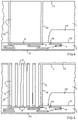
- FIG. 5 is a cross section according to FIG. 4 for a further intermediate product of the method. Elements corresponding to elements shown in FIG. 4 are indicated with the same reference numerals.
- the trench 18 is filled with dielectric material, which may be an oxide of the semiconductor material, for instance, to form the insulating layer 8 .
- the dielectric material can also be used to form the further dielectric layer 12 on the opposite main surface 11 of the substrate 1 .
- the via holes 17 are etched into the substrate 1 until the contact area 4 is exposed in the via holes 17 .
- the metallizations 7 are arranged in the via holes 17 to form a plurality of electric contacts on the contact area 4 .
- the top metal 5 can be formed in the same method step together with the metallizations 7 , or it may be applied as a further metal layer, which is electrically connected to the metallizations 7 .
- the remaining voids of the via holes 17 are optionally filled with a filling material 9 , especially if the top metal 5 is provided as a separate metal layer continuously covering the interconnection 6 .
- the further layers shown in FIG. 1 are applied, and thus the device according to FIG. 1 is obtained.
- the described structure of the through-substrate via has the advantages that the insulating layer surrounding the plurality of metallizations provides a secure electric insulation from the outer portion of the semiconductor substrate and that cracks of individual metallizations will not entirely interrupt the electric interconnection through the substrate. Moreover, the electrical conductivity of the interconnection is enhanced by the use of a plurality of metallizations.
Landscapes
- Internal Circuitry In Semiconductor Integrated Circuit Devices (AREA)
Abstract
Description
Claims (6)
Applications Claiming Priority (4)
| Application Number | Priority Date | Filing Date | Title |
|---|---|---|---|
| EP18157371 | 2018-02-19 | ||
| EP18157371.8 | 2018-02-19 | ||
| EP18157371.8A EP3528281A1 (en) | 2018-02-19 | 2018-02-19 | Semiconductor device with through-substrate via and its method of manufacture |
| PCT/EP2019/053847 WO2019158706A1 (en) | 2018-02-19 | 2019-02-15 | Semiconductor device with through-substrate via and its method of manufacture |
Publications (2)
| Publication Number | Publication Date |
|---|---|
| US20210005534A1 US20210005534A1 (en) | 2021-01-07 |
| US11404352B2 true US11404352B2 (en) | 2022-08-02 |
Family
ID=61249511
Family Applications (1)
| Application Number | Title | Priority Date | Filing Date |
|---|---|---|---|
| US16/968,815 Active 2039-03-07 US11404352B2 (en) | 2018-02-19 | 2019-02-15 | Semiconductor device with through-substrate via and its method of manufacture |
Country Status (4)
| Country | Link |
|---|---|
| US (1) | US11404352B2 (en) |
| EP (2) | EP3528281A1 (en) |
| CN (1) | CN112005365B (en) |
| WO (1) | WO2019158706A1 (en) |
Families Citing this family (1)
| Publication number | Priority date | Publication date | Assignee | Title |
|---|---|---|---|---|
| KR20240120450A (en) * | 2023-01-31 | 2024-08-07 | 에스케이하이닉스 주식회사 | Semiconductor device with through vias of various shapes and method for manufacturing the same |
Citations (7)
| Publication number | Priority date | Publication date | Assignee | Title |
|---|---|---|---|---|
| WO2007024009A1 (en) | 2005-08-26 | 2007-03-01 | Honda Motor Co., Ltd. | Semiconductor integrated circuit device and method for manufacturing same |
| WO2009050207A1 (en) | 2007-10-15 | 2009-04-23 | Interuniversitair Microelectronica Centrum Vzw | Method for producing electrical interconnects and devices made thereof |
| US20130321680A1 (en) * | 2012-05-31 | 2013-12-05 | Canon Kabushiki Kaisha | Manufacturing method for semiconductor device and semiconductor device |
| US20140054743A1 (en) * | 2012-08-24 | 2014-02-27 | Newport Fab, Llc Dba Jazz Semiconductor | Isolated Through Silicon Vias in RF Technologies |
| WO2015185354A2 (en) | 2014-06-06 | 2015-12-10 | Robert Bosch Gmbh | Semiconductor component having at least one via in the carrier substrate and method for producing such a via |
| US20160293487A1 (en) | 2015-04-03 | 2016-10-06 | International Business Machines Corporation | Protected through semiconductor via (tsv) |
| US20170221796A1 (en) | 2016-01-29 | 2017-08-03 | United Microelectronics Corp. | Through-silicon via structure |
Family Cites Families (2)
| Publication number | Priority date | Publication date | Assignee | Title |
|---|---|---|---|---|
| DE102013208816A1 (en) * | 2013-05-14 | 2014-11-20 | Robert Bosch Gmbh | A method of creating a via in a CMOS substrate |
| US9786618B2 (en) * | 2015-11-16 | 2017-10-10 | Taiwan Semiconductor Manufacturing Company Ltd. | Semiconductor structure and manufacturing method thereof |
-
2018
- 2018-02-19 EP EP18157371.8A patent/EP3528281A1/en not_active Withdrawn
-
2019
- 2019-02-15 CN CN201980011331.6A patent/CN112005365B/en active Active
- 2019-02-15 WO PCT/EP2019/053847 patent/WO2019158706A1/en not_active Ceased
- 2019-02-15 US US16/968,815 patent/US11404352B2/en active Active
- 2019-02-15 EP EP19705355.6A patent/EP3756216B1/en active Active
Patent Citations (7)
| Publication number | Priority date | Publication date | Assignee | Title |
|---|---|---|---|---|
| WO2007024009A1 (en) | 2005-08-26 | 2007-03-01 | Honda Motor Co., Ltd. | Semiconductor integrated circuit device and method for manufacturing same |
| WO2009050207A1 (en) | 2007-10-15 | 2009-04-23 | Interuniversitair Microelectronica Centrum Vzw | Method for producing electrical interconnects and devices made thereof |
| US20130321680A1 (en) * | 2012-05-31 | 2013-12-05 | Canon Kabushiki Kaisha | Manufacturing method for semiconductor device and semiconductor device |
| US20140054743A1 (en) * | 2012-08-24 | 2014-02-27 | Newport Fab, Llc Dba Jazz Semiconductor | Isolated Through Silicon Vias in RF Technologies |
| WO2015185354A2 (en) | 2014-06-06 | 2015-12-10 | Robert Bosch Gmbh | Semiconductor component having at least one via in the carrier substrate and method for producing such a via |
| US20160293487A1 (en) | 2015-04-03 | 2016-10-06 | International Business Machines Corporation | Protected through semiconductor via (tsv) |
| US20170221796A1 (en) | 2016-01-29 | 2017-08-03 | United Microelectronics Corp. | Through-silicon via structure |
Non-Patent Citations (1)
| Title |
|---|
| European Patent Office, International Search Report for PCT/EP2019/053847 dated Apr. 8, 2019. |
Also Published As
| Publication number | Publication date |
|---|---|
| US20210005534A1 (en) | 2021-01-07 |
| CN112005365A (en) | 2020-11-27 |
| EP3528281A1 (en) | 2019-08-21 |
| WO2019158706A1 (en) | 2019-08-22 |
| EP3756216B1 (en) | 2026-05-20 |
| EP3756216A1 (en) | 2020-12-30 |
| CN112005365B (en) | 2024-03-01 |
Similar Documents
| Publication | Publication Date | Title |
|---|---|---|
| US8415807B2 (en) | Semiconductor structure and method for making the same | |
| TWI571983B (en) | Electronic package and its manufacturing method | |
| TWI786352B (en) | Semiconductor structure | |
| US9093411B2 (en) | Pad structure having contact bars extending into substrate and wafer having the pad structure | |
| US20150264813A1 (en) | Chip-stack interposer structure including passive device and method for fabricating the same | |
| KR20100045836A (en) | A semiconductor wafer and a semiconductor devices including merged guard ring patterns and a process monitoring pattern | |
| US10559543B2 (en) | Semiconductor device having a protection trench, semiconductor wafer including the same, and semiconductor package | |
| US20140131882A1 (en) | Through-silicon via structure with patterned surface, patterned sidewall and local isolation | |
| KR20170104045A (en) | Semiconductor devices having through electrodes and methods for fabricating the same | |
| US10340231B2 (en) | Semiconductor package structure and method for forming the same | |
| US8288270B2 (en) | Enhanced electromigration resistance in TSV structure and design | |
| CN109390353A (en) | Semiconductor element and manufacturing method thereof | |
| US20210005534A1 (en) | Semiconductor device with through-substrate via and its method of manufacture | |
| CN105489581B (en) | Semiconductor structure and preparation method thereof | |
| JP2010205921A (en) | Semiconductor apparatus, and method of manufacturing semiconductor apparatus | |
| CN110301044B (en) | Semiconductor device with a semiconductor layer having a plurality of semiconductor layers | |
| CN113437042B (en) | Pad structure, semiconductor test structure and semiconductor test method | |
| US10276493B2 (en) | Semiconductor structure and method for fabricating the same | |
| US20180122721A1 (en) | Plug structure of a semiconductor chip and method of manufacturing the same | |
| EP2648214B1 (en) | Methods of producing a semiconductor device with a through-substrate via | |
| CN115332258B (en) | A semiconductor structure and a method for manufacturing the same | |
| US20060160339A1 (en) | Soi contact structure(s) and corresponding production method | |
| US6884662B1 (en) | Enhanced adhesion strength between mold resin and polyimide | |
| CN118471932B (en) | Semiconductor device and method for manufacturing the same | |
| KR101113327B1 (en) | Semiconductor device having through via and method of fabricating the same |
Legal Events
| Date | Code | Title | Description |
|---|---|---|---|
| FEPP | Fee payment procedure |
Free format text: ENTITY STATUS SET TO UNDISCOUNTED (ORIGINAL EVENT CODE: BIG.); ENTITY STATUS OF PATENT OWNER: LARGE ENTITY |
|
| STPP | Information on status: patent application and granting procedure in general |
Free format text: APPLICATION DISPATCHED FROM PREEXAM, NOT YET DOCKETED |
|
| STPP | Information on status: patent application and granting procedure in general |
Free format text: DOCKETED NEW CASE - READY FOR EXAMINATION |
|
| STPP | Information on status: patent application and granting procedure in general |
Free format text: NON FINAL ACTION MAILED |
|
| STPP | Information on status: patent application and granting procedure in general |
Free format text: FINAL REJECTION MAILED |
|
| STPP | Information on status: patent application and granting procedure in general |
Free format text: RESPONSE AFTER FINAL ACTION FORWARDED TO EXAMINER |
|
| STPP | Information on status: patent application and granting procedure in general |
Free format text: NOTICE OF ALLOWANCE MAILED -- APPLICATION RECEIVED IN OFFICE OF PUBLICATIONS |
|
| AS | Assignment |
Owner name: AMS AG, AUSTRIA Free format text: ASSIGNMENT OF ASSIGNORS INTEREST;ASSIGNORS:SIDOROV, VICTOR;JESSENIG, STEFAN;PARTEDER, GEORG;SIGNING DATES FROM 20201008 TO 20220602;REEL/FRAME:060094/0545 |
|
| STCF | Information on status: patent grant |
Free format text: PATENTED CASE |
|
| MAFP | Maintenance fee payment |
Free format text: PAYMENT OF MAINTENANCE FEE, 4TH YEAR, LARGE ENTITY (ORIGINAL EVENT CODE: M1551); ENTITY STATUS OF PATENT OWNER: LARGE ENTITY Year of fee payment: 4 |