US11401465B2 - Thermally activated delayed fluorescent and synthesizing method thereof - Google Patents
Thermally activated delayed fluorescent and synthesizing method thereof Download PDFInfo
- Publication number
- US11401465B2 US11401465B2 US16/475,979 US201816475979A US11401465B2 US 11401465 B2 US11401465 B2 US 11401465B2 US 201816475979 A US201816475979 A US 201816475979A US 11401465 B2 US11401465 B2 US 11401465B2
- Authority
- US
- United States
- Prior art keywords
- mixture
- monomer compound
- catalyst
- bromo
- synthesizing method
- Prior art date
- Legal status (The legal status is an assumption and is not a legal conclusion. Google has not performed a legal analysis and makes no representation as to the accuracy of the status listed.)
- Active, expires
Links
- HXORUSADPJGCDO-UHFFFAOYSA-N C=Cc1ccc(OCCCCCCOc2ccc(S(=O)(=O)c3ccc(-n4c5ccc(C(C)(C)C)cc5c5cc(C(C)(C)C)ccc54)cc3)cc2)cc1 Chemical compound C=Cc1ccc(OCCCCCCOc2ccc(S(=O)(=O)c3ccc(-n4c5ccc(C(C)(C)C)cc5c5cc(C(C)(C)C)ccc54)cc3)cc2)cc1 HXORUSADPJGCDO-UHFFFAOYSA-N 0.000 description 5
- ATVKALHCOYYPRH-UHFFFAOYSA-N C=Cc1ccc(OCCCCCCOc2ccc(S(=O)(=O)c3ccc(N4c5ccc(OC)cc5Oc5cc(OC)ccc54)cc3)cc2)cc1 Chemical compound C=Cc1ccc(OCCCCCCOc2ccc(S(=O)(=O)c3ccc(N4c5ccc(OC)cc5Oc5cc(OC)ccc54)cc3)cc2)cc1 ATVKALHCOYYPRH-UHFFFAOYSA-N 0.000 description 5
- GSAKCHGBIKCUSG-UHFFFAOYSA-N C=Cc1ccc(OCCCCCCOc2ccc(S(=O)(=O)c3ccc(N4c5ccccc5C(c5ccccc5)(c5ccccc5)c5ccccc54)cc3)cc2)cc1 Chemical compound C=Cc1ccc(OCCCCCCOc2ccc(S(=O)(=O)c3ccc(N4c5ccccc5C(c5ccccc5)(c5ccccc5)c5ccccc54)cc3)cc2)cc1 GSAKCHGBIKCUSG-UHFFFAOYSA-N 0.000 description 5
- LMZYAICDMOTJTJ-UHFFFAOYSA-N C=Cc1ccc(OCCCCCCOc2ccc(S(=O)(=O)c3ccc(N4c5ccccc5Oc5ccccc54)cc3)cc2)cc1 Chemical compound C=Cc1ccc(OCCCCCCOc2ccc(S(=O)(=O)c3ccc(N4c5ccccc5Oc5ccccc54)cc3)cc2)cc1 LMZYAICDMOTJTJ-UHFFFAOYSA-N 0.000 description 5
- VDYXSMFOBZXMCY-UHFFFAOYSA-N CCc1ccc2c(c1)Oc1cc(OC)ccc1N2c1ccc(S(=O)(=O)c2ccc(OCCCCCCOc3ccc(C(C)CC(CC(CC(CC)c4ccc(OCCCCCCOc5ccc(S(=O)(=O)c6ccc(-n7c8ccc(C(C)(C)C)cc8c8cc(C(C)(C)C)ccc87)cc6)cc5)cc4)c4ccc(OCCCCCCOc5ccc(S(=O)(=O)c6ccc(N7c8ccccc8C(c8ccccc8)(c8ccccc8)c8ccccc87)cc6)cc5)cc4)c4ccc(OCCCCCCOc5ccc(S(=O)(=O)c6ccc(N7c8ccccc8Oc8ccccc87)cc6)cc5)cc4)cc3)cc2)cc1 Chemical compound CCc1ccc2c(c1)Oc1cc(OC)ccc1N2c1ccc(S(=O)(=O)c2ccc(OCCCCCCOc3ccc(C(C)CC(CC(CC(CC)c4ccc(OCCCCCCOc5ccc(S(=O)(=O)c6ccc(-n7c8ccc(C(C)(C)C)cc8c8cc(C(C)(C)C)ccc87)cc6)cc5)cc4)c4ccc(OCCCCCCOc5ccc(S(=O)(=O)c6ccc(N7c8ccccc8C(c8ccccc8)(c8ccccc8)c8ccccc87)cc6)cc5)cc4)c4ccc(OCCCCCCOc5ccc(S(=O)(=O)c6ccc(N7c8ccccc8Oc8ccccc87)cc6)cc5)cc4)cc3)cc2)cc1 VDYXSMFOBZXMCY-UHFFFAOYSA-N 0.000 description 4
- ZQIPGCZSLMADOW-UUWRZZSWSA-N CC[C@@H](C)c1ccc(OCCCCCCOc2ccc(S(=O)(=O)c3ccc(-n4c5ccc(C(C)(C)C)cc5c5cc(C(C)(C)C)ccc54)cc3)cc2)cc1 Chemical compound CC[C@@H](C)c1ccc(OCCCCCCOc2ccc(S(=O)(=O)c3ccc(-n4c5ccc(C(C)(C)C)cc5c5cc(C(C)(C)C)ccc54)cc3)cc2)cc1 ZQIPGCZSLMADOW-UUWRZZSWSA-N 0.000 description 2
- BRQNTGAPTZPLBS-SSEXGKCCSA-N CC[C@@H](C)c1ccc(OCCCCCCOc2ccc(S(=O)(=O)c3ccc(N4c5ccc(OC)cc5Oc5cc(OC)ccc54)cc3)cc2)cc1 Chemical compound CC[C@@H](C)c1ccc(OCCCCCCOc2ccc(S(=O)(=O)c3ccc(N4c5ccc(OC)cc5Oc5cc(OC)ccc54)cc3)cc2)cc1 BRQNTGAPTZPLBS-SSEXGKCCSA-N 0.000 description 2
- OMTCQNWZRWQZCP-RRHRGVEJSA-N CC[C@@H](C)c1ccc(OCCCCCCOc2ccc(S(=O)(=O)c3ccc(N4c5ccccc5C(c5ccccc5)(c5ccccc5)c5ccccc54)cc3)cc2)cc1 Chemical compound CC[C@@H](C)c1ccc(OCCCCCCOc2ccc(S(=O)(=O)c3ccc(N4c5ccccc5C(c5ccccc5)(c5ccccc5)c5ccccc54)cc3)cc2)cc1 OMTCQNWZRWQZCP-RRHRGVEJSA-N 0.000 description 2
- WOQWNJUAOGUSRI-SSEXGKCCSA-N CC[C@@H](C)c1ccc(OCCCCCCOc2ccc(S(=O)(=O)c3ccc(N4c5ccccc5Oc5ccccc54)cc3)cc2)cc1 Chemical compound CC[C@@H](C)c1ccc(OCCCCCCOc2ccc(S(=O)(=O)c3ccc(N4c5ccccc5Oc5ccccc54)cc3)cc2)cc1 WOQWNJUAOGUSRI-SSEXGKCCSA-N 0.000 description 2
- CAFXTMGEXJTDRD-UHFFFAOYSA-N C=Cc1ccc(OCCCCCCOc2ccc(S(=O)(=O)c3ccc(-n4c5ccc(C(C)(C)C)cc5c5cc(C(C)(C)C)ccc54)cc3)cc2)cc1.C=Cc1ccc(OCCCCCCOc2ccc(S(=O)(=O)c3ccc(Br)cc3)cc2)cc1.CC(C)(C)c1ccc2[nH]c3ccc(C(C)(C)C)cc3c2c1 Chemical compound C=Cc1ccc(OCCCCCCOc2ccc(S(=O)(=O)c3ccc(-n4c5ccc(C(C)(C)C)cc5c5cc(C(C)(C)C)ccc54)cc3)cc2)cc1.C=Cc1ccc(OCCCCCCOc2ccc(S(=O)(=O)c3ccc(Br)cc3)cc2)cc1.CC(C)(C)c1ccc2[nH]c3ccc(C(C)(C)C)cc3c2c1 CAFXTMGEXJTDRD-UHFFFAOYSA-N 0.000 description 1
- VEQISHOFDJDPOY-UHFFFAOYSA-N C=Cc1ccc(OCCCCCCOc2ccc(S(=O)(=O)c3ccc(-n4c5ccc(C(C)(C)C)cc5c5cc(C(C)(C)C)ccc54)cc3)cc2)cc1.C=Cc1ccc(OCCCCCCOc2ccc(S(=O)(=O)c3ccc(N4c5ccc(OC)cc5Oc5cc(OC)ccc54)cc3)cc2)cc1.C=Cc1ccc(OCCCCCCOc2ccc(S(=O)(=O)c3ccc(N4c5ccccc5C(c5ccccc5)(c5ccccc5)c5ccccc54)cc3)cc2)cc1.C=Cc1ccc(OCCCCCCOc2ccc(S(=O)(=O)c3ccc(N4c5ccccc5Oc5ccccc54)cc3)cc2)cc1.CCC(CC(CC(CC(C)c1ccc(OCCCCCCOc2ccc(S(=O)(=O)c3ccc(N4c5ccc(OC)cc5Oc5cc(OC)ccc54)cc3)cc2)cc1)c1ccc(OCCCCCCOc2ccc(S(=O)(=O)c3ccc(N4c5ccccc5Oc5ccccc54)cc3)cc2)cc1)c1ccc(OCCCCCCOc2ccc(S(=O)(=O)c3ccc(N4c5ccccc5C(c5ccccc5)(c5ccccc5)c5ccccc54)cc3)cc2)cc1)c1ccc(OCCCCCCOc2ccc(S(=O)(=O)c3ccc(-n4c5ccc(C(C)(C)C)cc5c5cc(C(C)(C)C)ccc54)cc3)cc2)cc1 Chemical compound C=Cc1ccc(OCCCCCCOc2ccc(S(=O)(=O)c3ccc(-n4c5ccc(C(C)(C)C)cc5c5cc(C(C)(C)C)ccc54)cc3)cc2)cc1.C=Cc1ccc(OCCCCCCOc2ccc(S(=O)(=O)c3ccc(N4c5ccc(OC)cc5Oc5cc(OC)ccc54)cc3)cc2)cc1.C=Cc1ccc(OCCCCCCOc2ccc(S(=O)(=O)c3ccc(N4c5ccccc5C(c5ccccc5)(c5ccccc5)c5ccccc54)cc3)cc2)cc1.C=Cc1ccc(OCCCCCCOc2ccc(S(=O)(=O)c3ccc(N4c5ccccc5Oc5ccccc54)cc3)cc2)cc1.CCC(CC(CC(CC(C)c1ccc(OCCCCCCOc2ccc(S(=O)(=O)c3ccc(N4c5ccc(OC)cc5Oc5cc(OC)ccc54)cc3)cc2)cc1)c1ccc(OCCCCCCOc2ccc(S(=O)(=O)c3ccc(N4c5ccccc5Oc5ccccc54)cc3)cc2)cc1)c1ccc(OCCCCCCOc2ccc(S(=O)(=O)c3ccc(N4c5ccccc5C(c5ccccc5)(c5ccccc5)c5ccccc54)cc3)cc2)cc1)c1ccc(OCCCCCCOc2ccc(S(=O)(=O)c3ccc(-n4c5ccc(C(C)(C)C)cc5c5cc(C(C)(C)C)ccc54)cc3)cc2)cc1 VEQISHOFDJDPOY-UHFFFAOYSA-N 0.000 description 1
- ORQNKWFGZACEOL-UHFFFAOYSA-N C=Cc1ccc(OCCCCCCOc2ccc(S(=O)(=O)c3ccc(Br)cc3)cc2)cc1.C=Cc1ccc(OCCCCCCOc2ccc(S(=O)(=O)c3ccc(N4c5ccc(OC)cc5Oc5cc(OC)ccc54)cc3)cc2)cc1.COc1ccc2c(c1)Oc1cc(OC)ccc1C2 Chemical compound C=Cc1ccc(OCCCCCCOc2ccc(S(=O)(=O)c3ccc(Br)cc3)cc2)cc1.C=Cc1ccc(OCCCCCCOc2ccc(S(=O)(=O)c3ccc(N4c5ccc(OC)cc5Oc5cc(OC)ccc54)cc3)cc2)cc1.COc1ccc2c(c1)Oc1cc(OC)ccc1C2 ORQNKWFGZACEOL-UHFFFAOYSA-N 0.000 description 1
- AIQQXFWFTZPGSR-UHFFFAOYSA-N C=Cc1ccc(OCCCCCCOc2ccc(S(=O)(=O)c3ccc(Br)cc3)cc2)cc1.C=Cc1ccc(OCCCCCCOc2ccc(S(=O)(=O)c3ccc(N4c5ccccc5C(c5ccccc5)(c5ccccc5)c5ccccc54)cc3)cc2)cc1.c1ccc(C2(c3ccccc3)c3ccccc3Cc3ccccc32)cc1 Chemical compound C=Cc1ccc(OCCCCCCOc2ccc(S(=O)(=O)c3ccc(Br)cc3)cc2)cc1.C=Cc1ccc(OCCCCCCOc2ccc(S(=O)(=O)c3ccc(N4c5ccccc5C(c5ccccc5)(c5ccccc5)c5ccccc54)cc3)cc2)cc1.c1ccc(C2(c3ccccc3)c3ccccc3Cc3ccccc32)cc1 AIQQXFWFTZPGSR-UHFFFAOYSA-N 0.000 description 1
- XWEUNCFLCPNSMZ-UHFFFAOYSA-N C=Cc1ccc(OCCCCCCOc2ccc(S(=O)(=O)c3ccc(Br)cc3)cc2)cc1.C=Cc1ccc(OCCCCCCOc2ccc(S(=O)(=O)c3ccc(N4c5ccccc5Oc5ccccc54)cc3)cc2)cc1.c1ccc2c(c1)Cc1ccccc1O2 Chemical compound C=Cc1ccc(OCCCCCCOc2ccc(S(=O)(=O)c3ccc(Br)cc3)cc2)cc1.C=Cc1ccc(OCCCCCCOc2ccc(S(=O)(=O)c3ccc(N4c5ccccc5Oc5ccccc54)cc3)cc2)cc1.c1ccc2c(c1)Cc1ccccc1O2 XWEUNCFLCPNSMZ-UHFFFAOYSA-N 0.000 description 1
- ZQIPGCZSLMADOW-UHFFFAOYSA-N CCC(C)c1ccc(OCCCCCCOc2ccc(S(=O)(=O)c3ccc(-n4c5ccc(C(C)(C)C)cc5c5cc(C(C)(C)C)ccc54)cc3)cc2)cc1 Chemical compound CCC(C)c1ccc(OCCCCCCOc2ccc(S(=O)(=O)c3ccc(-n4c5ccc(C(C)(C)C)cc5c5cc(C(C)(C)C)ccc54)cc3)cc2)cc1 ZQIPGCZSLMADOW-UHFFFAOYSA-N 0.000 description 1
- BRQNTGAPTZPLBS-UHFFFAOYSA-N CCC(C)c1ccc(OCCCCCCOc2ccc(S(=O)(=O)c3ccc(N4c5ccc(OC)cc5Oc5cc(OC)ccc54)cc3)cc2)cc1 Chemical compound CCC(C)c1ccc(OCCCCCCOc2ccc(S(=O)(=O)c3ccc(N4c5ccc(OC)cc5Oc5cc(OC)ccc54)cc3)cc2)cc1 BRQNTGAPTZPLBS-UHFFFAOYSA-N 0.000 description 1
- OMTCQNWZRWQZCP-UHFFFAOYSA-N CCC(C)c1ccc(OCCCCCCOc2ccc(S(=O)(=O)c3ccc(N4c5ccccc5C(c5ccccc5)(c5ccccc5)c5ccccc54)cc3)cc2)cc1 Chemical compound CCC(C)c1ccc(OCCCCCCOc2ccc(S(=O)(=O)c3ccc(N4c5ccccc5C(c5ccccc5)(c5ccccc5)c5ccccc54)cc3)cc2)cc1 OMTCQNWZRWQZCP-UHFFFAOYSA-N 0.000 description 1
- WOQWNJUAOGUSRI-UHFFFAOYSA-N CCC(C)c1ccc(OCCCCCCOc2ccc(S(=O)(=O)c3ccc(N4c5ccccc5Oc5ccccc54)cc3)cc2)cc1 Chemical compound CCC(C)c1ccc(OCCCCCCOc2ccc(S(=O)(=O)c3ccc(N4c5ccccc5Oc5ccccc54)cc3)cc2)cc1 WOQWNJUAOGUSRI-UHFFFAOYSA-N 0.000 description 1
- WJPTZUBLKLWJLP-UHFFFAOYSA-N CCc1ccc2c(c1)Cc1cc(OC)ccc1N2c1ccc(S(=O)(=O)c2ccc(OCCCCCCOc3ccc(C(C)CC(CC(CC(CC)c4ccc(OCCCCCCOc5ccc(S(=O)(=O)c6ccc(-n7c8ccc(C(C)(C)C)cc8c8cc(C(C)(C)C)ccc87)cc6)cc5)cc4)c4ccc(OCCCCCCOc5ccc(S(=O)(=O)c6ccc(N7c8ccccc8C(c8ccccc8)(c8ccccc8)c8ccccc87)cc6)cc5)cc4)c4ccc(OCCCCCCOc5ccc(S(=O)(=O)c6ccc(N7c8ccccc8Oc8ccccc87)cc6)cc5)cc4)cc3)cc2)cc1 Chemical compound CCc1ccc2c(c1)Cc1cc(OC)ccc1N2c1ccc(S(=O)(=O)c2ccc(OCCCCCCOc3ccc(C(C)CC(CC(CC(CC)c4ccc(OCCCCCCOc5ccc(S(=O)(=O)c6ccc(-n7c8ccc(C(C)(C)C)cc8c8cc(C(C)(C)C)ccc87)cc6)cc5)cc4)c4ccc(OCCCCCCOc5ccc(S(=O)(=O)c6ccc(N7c8ccccc8C(c8ccccc8)(c8ccccc8)c8ccccc87)cc6)cc5)cc4)c4ccc(OCCCCCCOc5ccc(S(=O)(=O)c6ccc(N7c8ccccc8Oc8ccccc87)cc6)cc5)cc4)cc3)cc2)cc1 WJPTZUBLKLWJLP-UHFFFAOYSA-N 0.000 description 1
Images


Classifications
-
- C—CHEMISTRY; METALLURGY
- C09—DYES; PAINTS; POLISHES; NATURAL RESINS; ADHESIVES; COMPOSITIONS NOT OTHERWISE PROVIDED FOR; APPLICATIONS OF MATERIALS NOT OTHERWISE PROVIDED FOR
- C09K—MATERIALS FOR MISCELLANEOUS APPLICATIONS, NOT PROVIDED FOR ELSEWHERE
- C09K11/00—Luminescent materials, e.g. electroluminescent or chemiluminescent
- C09K11/06—Luminescent materials, e.g. electroluminescent or chemiluminescent containing organic luminescent materials
-
- C—CHEMISTRY; METALLURGY
- C08—ORGANIC MACROMOLECULAR COMPOUNDS; THEIR PREPARATION OR CHEMICAL WORKING-UP; COMPOSITIONS BASED THEREON
- C08F—MACROMOLECULAR COMPOUNDS OBTAINED BY REACTIONS ONLY INVOLVING CARBON-TO-CARBON UNSATURATED BONDS
- C08F212/00—Copolymers of compounds having one or more unsaturated aliphatic radicals, each having only one carbon-to-carbon double bond, and at least one being terminated by an aromatic carbocyclic ring
- C08F212/02—Monomers containing only one unsaturated aliphatic radical
- C08F212/04—Monomers containing only one unsaturated aliphatic radical containing one ring
- C08F212/14—Monomers containing only one unsaturated aliphatic radical containing one ring substituted by heteroatoms or groups containing heteroatoms
- C08F212/22—Oxygen
-
- C—CHEMISTRY; METALLURGY
- C08—ORGANIC MACROMOLECULAR COMPOUNDS; THEIR PREPARATION OR CHEMICAL WORKING-UP; COMPOSITIONS BASED THEREON
- C08F—MACROMOLECULAR COMPOUNDS OBTAINED BY REACTIONS ONLY INVOLVING CARBON-TO-CARBON UNSATURATED BONDS
- C08F212/00—Copolymers of compounds having one or more unsaturated aliphatic radicals, each having only one carbon-to-carbon double bond, and at least one being terminated by an aromatic carbocyclic ring
- C08F212/02—Monomers containing only one unsaturated aliphatic radical
- C08F212/04—Monomers containing only one unsaturated aliphatic radical containing one ring
- C08F212/14—Monomers containing only one unsaturated aliphatic radical containing one ring substituted by heteroatoms or groups containing heteroatoms
- C08F212/26—Nitrogen
-
- C—CHEMISTRY; METALLURGY
- C08—ORGANIC MACROMOLECULAR COMPOUNDS; THEIR PREPARATION OR CHEMICAL WORKING-UP; COMPOSITIONS BASED THEREON
- C08F—MACROMOLECULAR COMPOUNDS OBTAINED BY REACTIONS ONLY INVOLVING CARBON-TO-CARBON UNSATURATED BONDS
- C08F212/00—Copolymers of compounds having one or more unsaturated aliphatic radicals, each having only one carbon-to-carbon double bond, and at least one being terminated by an aromatic carbocyclic ring
- C08F212/02—Monomers containing only one unsaturated aliphatic radical
- C08F212/04—Monomers containing only one unsaturated aliphatic radical containing one ring
- C08F212/14—Monomers containing only one unsaturated aliphatic radical containing one ring substituted by heteroatoms or groups containing heteroatoms
- C08F212/30—Sulfur
-
- C—CHEMISTRY; METALLURGY
- C08—ORGANIC MACROMOLECULAR COMPOUNDS; THEIR PREPARATION OR CHEMICAL WORKING-UP; COMPOSITIONS BASED THEREON
- C08F—MACROMOLECULAR COMPOUNDS OBTAINED BY REACTIONS ONLY INVOLVING CARBON-TO-CARBON UNSATURATED BONDS
- C08F212/00—Copolymers of compounds having one or more unsaturated aliphatic radicals, each having only one carbon-to-carbon double bond, and at least one being terminated by an aromatic carbocyclic ring
- C08F212/02—Monomers containing only one unsaturated aliphatic radical
- C08F212/32—Monomers containing only one unsaturated aliphatic radical containing two or more rings
-
- C—CHEMISTRY; METALLURGY
- C09—DYES; PAINTS; POLISHES; NATURAL RESINS; ADHESIVES; COMPOSITIONS NOT OTHERWISE PROVIDED FOR; APPLICATIONS OF MATERIALS NOT OTHERWISE PROVIDED FOR
- C09D—COATING COMPOSITIONS, e.g. PAINTS, VARNISHES OR LACQUERS; FILLING PASTES; CHEMICAL PAINT OR INK REMOVERS; INKS; CORRECTING FLUIDS; WOODSTAINS; PASTES OR SOLIDS FOR COLOURING OR PRINTING; USE OF MATERIALS THEREFOR
- C09D125/00—Coating compositions based on homopolymers or copolymers of compounds having one or more unsaturated aliphatic radicals, each having only one carbon-to-carbon double bond, and at least one being terminated by an aromatic carbocyclic ring; Coating compositions based on derivatives of such polymers
- C09D125/18—Homopolymers or copolymers of aromatic monomers containing elements other than carbon and hydrogen
-
- H01L51/0035—
-
- H01L51/0043—
-
- H—ELECTRICITY
- H10—SEMICONDUCTOR DEVICES; ELECTRIC SOLID-STATE DEVICES NOT OTHERWISE PROVIDED FOR
- H10K—ORGANIC ELECTRIC SOLID-STATE DEVICES
- H10K50/00—Organic light-emitting devices
-
- H—ELECTRICITY
- H10—SEMICONDUCTOR DEVICES; ELECTRIC SOLID-STATE DEVICES NOT OTHERWISE PROVIDED FOR
- H10K—ORGANIC ELECTRIC SOLID-STATE DEVICES
- H10K85/00—Organic materials used in the body or electrodes of devices covered by this subclass
- H10K85/10—Organic polymers or oligomers
- H10K85/111—Organic polymers or oligomers comprising aromatic, heteroaromatic, or aryl chains, e.g. polyaniline, polyphenylene or polyphenylene vinylene
-
- H—ELECTRICITY
- H10—SEMICONDUCTOR DEVICES; ELECTRIC SOLID-STATE DEVICES NOT OTHERWISE PROVIDED FOR
- H10K—ORGANIC ELECTRIC SOLID-STATE DEVICES
- H10K85/00—Organic materials used in the body or electrodes of devices covered by this subclass
- H10K85/10—Organic polymers or oligomers
- H10K85/141—Organic polymers or oligomers comprising aliphatic or olefinic chains, e.g. poly N-vinylcarbazol, PVC or PTFE
-
- H—ELECTRICITY
- H10—SEMICONDUCTOR DEVICES; ELECTRIC SOLID-STATE DEVICES NOT OTHERWISE PROVIDED FOR
- H10K—ORGANIC ELECTRIC SOLID-STATE DEVICES
- H10K85/00—Organic materials used in the body or electrodes of devices covered by this subclass
- H10K85/10—Organic polymers or oligomers
- H10K85/151—Copolymers
-
- C—CHEMISTRY; METALLURGY
- C09—DYES; PAINTS; POLISHES; NATURAL RESINS; ADHESIVES; COMPOSITIONS NOT OTHERWISE PROVIDED FOR; APPLICATIONS OF MATERIALS NOT OTHERWISE PROVIDED FOR
- C09K—MATERIALS FOR MISCELLANEOUS APPLICATIONS, NOT PROVIDED FOR ELSEWHERE
- C09K2211/00—Chemical nature of organic luminescent or tenebrescent compounds
- C09K2211/14—Macromolecular compounds
- C09K2211/1408—Carbocyclic compounds
- C09K2211/1416—Condensed systems
-
- C—CHEMISTRY; METALLURGY
- C09—DYES; PAINTS; POLISHES; NATURAL RESINS; ADHESIVES; COMPOSITIONS NOT OTHERWISE PROVIDED FOR; APPLICATIONS OF MATERIALS NOT OTHERWISE PROVIDED FOR
- C09K—MATERIALS FOR MISCELLANEOUS APPLICATIONS, NOT PROVIDED FOR ELSEWHERE
- C09K2211/00—Chemical nature of organic luminescent or tenebrescent compounds
- C09K2211/14—Macromolecular compounds
- C09K2211/1408—Carbocyclic compounds
- C09K2211/1433—Carbocyclic compounds bridged by heteroatoms, e.g. N, P, Si or B
-
- C—CHEMISTRY; METALLURGY
- C09—DYES; PAINTS; POLISHES; NATURAL RESINS; ADHESIVES; COMPOSITIONS NOT OTHERWISE PROVIDED FOR; APPLICATIONS OF MATERIALS NOT OTHERWISE PROVIDED FOR
- C09K—MATERIALS FOR MISCELLANEOUS APPLICATIONS, NOT PROVIDED FOR ELSEWHERE
- C09K2211/00—Chemical nature of organic luminescent or tenebrescent compounds
- C09K2211/14—Macromolecular compounds
- C09K2211/1441—Heterocyclic
- C09K2211/1466—Heterocyclic containing nitrogen as the only heteroatom
-
- C—CHEMISTRY; METALLURGY
- C09—DYES; PAINTS; POLISHES; NATURAL RESINS; ADHESIVES; COMPOSITIONS NOT OTHERWISE PROVIDED FOR; APPLICATIONS OF MATERIALS NOT OTHERWISE PROVIDED FOR
- C09K—MATERIALS FOR MISCELLANEOUS APPLICATIONS, NOT PROVIDED FOR ELSEWHERE
- C09K2211/00—Chemical nature of organic luminescent or tenebrescent compounds
- C09K2211/14—Macromolecular compounds
- C09K2211/1441—Heterocyclic
- C09K2211/1475—Heterocyclic containing nitrogen and oxygen as heteroatoms
-
- H—ELECTRICITY
- H10—SEMICONDUCTOR DEVICES; ELECTRIC SOLID-STATE DEVICES NOT OTHERWISE PROVIDED FOR
- H10K—ORGANIC ELECTRIC SOLID-STATE DEVICES
- H10K2101/00—Properties of the organic materials covered by group H10K85/00
- H10K2101/20—Delayed fluorescence emission
-
- H—ELECTRICITY
- H10—SEMICONDUCTOR DEVICES; ELECTRIC SOLID-STATE DEVICES NOT OTHERWISE PROVIDED FOR
- H10K—ORGANIC ELECTRIC SOLID-STATE DEVICES
- H10K50/00—Organic light-emitting devices
- H10K50/10—OLEDs or polymer light-emitting diodes [PLED]
- H10K50/11—OLEDs or polymer light-emitting diodes [PLED] characterised by the electroluminescent [EL] layers
-
- Y—GENERAL TAGGING OF NEW TECHNOLOGICAL DEVELOPMENTS; GENERAL TAGGING OF CROSS-SECTIONAL TECHNOLOGIES SPANNING OVER SEVERAL SECTIONS OF THE IPC; TECHNICAL SUBJECTS COVERED BY FORMER USPC CROSS-REFERENCE ART COLLECTIONS [XRACs] AND DIGESTS
- Y02—TECHNOLOGIES OR APPLICATIONS FOR MITIGATION OR ADAPTATION AGAINST CLIMATE CHANGE
- Y02B—CLIMATE CHANGE MITIGATION TECHNOLOGIES RELATED TO BUILDINGS, e.g. HOUSING, HOUSE APPLIANCES OR RELATED END-USER APPLICATIONS
- Y02B20/00—Energy efficient lighting technologies, e.g. halogen lamps or gas discharge lamps
Definitions
- the present disclosure relates to displays, and more particularly to a thermally activated delayed fluorescent material and a synthesizing method thereof.
- OLEDs Organic light-emitting diodes
- advantages of having a high contrast, thin thickness, wide viewing angles, fast response times, and low energy consumption. They are widely used in display and illumination.
- Photoelectric conversion efficiency is one of important parameters for evaluating performance of the OLED.
- various fluorescent-based and phosphorescent-based luminescent materials have been developed.
- the fluorescent material-based OLED has a high stability, but a ratio of singlet-excited excitons to triplet-excited excitons is 1:3 under electrical activation.
- An internal electroluminescence quantum efficiency of the fluorescent material is only 25%.
- the phosphorescent material-based OLED because the phosphorescent material has a spin-orbit coupling effect of heavy atoms, singlet-excited excitons, and triplet-excited excitons can be utilized simultaneously, where a theoretical quantum luminescence efficiency can reach 100%.
- most of the phosphorescent materials use precious metals, which has a relatively high cost and is not environmentally friendly.
- the conventional thermally activated delayed fluorescent polymer material has a low photoluminescence quantum yield, and the reverse intersystem crossing constant is relatively small, which leads to a low external quantum efficiency of the light-emitting device prepared using a thermally activated delayed fluorescent polymer material.
- the present disclosure provides a thermally activated delayed fluorescent material to solve technical problems of influence displays due to a low external quantum efficiency of OLED light-emitting devices induced by a relatively low photoluminescence quantum yield, and a relatively small reverse intersystem crossing constant.
- the present disclosure provides a synthesizing method of a thermally activated delayed fluorescent material, the thermally activated delayed fluorescent material having a structural formula as follows:
- the synthesizing method comprising: a step S 10 of performing a heating reaction to a mixture of tert-butylcarbazole, 4-bromo-diphenylsulfone chain styrene, and a first catalyst, and then cooling and separating the mixture of tert-butylcarbazole, 4-bromo-diphenylsulfone chain styrene, and the first catalyst to obtain a first monomer compound, wherein the first monomer compound has a structural formula as follows:
- the first catalyst is a mixture of cesium carbonate, cuprous iodide, 18-crown-6 ether, and N,N′-dimethylpropylene urea; a step S 20 of performing a heating reaction to a mixture of 9,10-dihydro-9,9-diphenyl acridine, 4-bromo-diphenylsulfone chain styrene, and a second catalyst, cooling the mixture of 9,10-dihydro-9,9-diphenyl acridine, 4-bromo-diphenylsulfone chain styrene, and the second catalyst, and removing impurity therein to obtain a second monomer compound, wherein the second monomer compound has a structural formula as follows:
- the second catalyst is a mixture of palladium acetate, tri-tert-butylphosphine tetrafluoroborate, sodium t-butoxide, and toluene; a step S 30 of performing a heating reaction to a mixture of phenoxazine, 4-bromo-diphenyl sulfone chain styrene, and the second catalyst, and then cooling and separating the mixture of phenoxazine, the 4-bromo-diphenyl sulfone chain styrene, and the second catalyst to obtain a third monomer compound, wherein the third monomer compound has a structural formula as follows:
- step S 50 of performing a high pressure reaction to a mixture of the first monomer compound, the second monomer compound, the third monomer compound, the fourth monomer compound, and a third catalyst, and then separating and drying the mixture of the first monomer compound, the second monomer compound, the third monomer compound, the fourth monomer compound, and the third catalyst to obtain the thermally activated delayed fluorescent material.
- the third catalyst is tetrahydrofuran.
- step S 50 comprises:
- the high pressure reaction in the step S 502 has a temperature of 65° C., a pressure of 2000 kPa, and a time of 24 hours.
- the first solvent in the step S 503 is a mixture of methanol and acetone.
- the step S 504 comprises: extracting the third mixture with n-hexane for 72 hours, and then extracting the third mixture with acetone for 72 hours.
- the present disclosure further provides a thermally activated delayed fluorescent material, comprising a structural formula as follows:
- group A, group B, group C, and group D are all structural groups in the thermally activated delayed fluorescent material; and wherein x, y and z are molar ratios of the group B, the group C, and the group D in the thermally activated delayed fluorescent material, respectively; wherein the group A has a structural formula as follows:
- the present disclosure provides another synthesizing method of a thermally activated delayed fluorescent material, the thermally activated delayed fluorescent material having a structural formula as follows:
- step S 50 of performing a high pressure reaction to a mixture of the first monomer compound, the second monomer compound, the third monomer compound, the fourth monomer compound, and a third catalyst, and then separating and drying the mixture of the first monomer compound, the second monomer compound, the third monomer compound, the fourth monomer compound, and the third catalyst to obtain the thermally activated delayed fluorescent material.
- the first catalyst is a mixture of cesium carbonate, cuprous iodide, 18-crown-6 ether, and N, N′-dimethylpropylene urea.
- the second catalyst is a mixture of palladium acetate, tri-tert-butylphosphine tetrafluoroborate, sodium t-butoxide, and toluene, and wherein the third catalyst is tetrahydrofuran.
- the heating reaction in the step S 10 has a temperature of 180° C. and a reaction time of 24 hours.
- the heating reaction in the step S 20 has a temperature of 110° C. and a reaction time of 24 hours.
- the heating reaction in the step S 30 has a temperature of 110° C. and a reaction time of 24 hours.
- step S 50 comprises:
- the high pressure reaction in the step S 502 has a temperature of 65° C., a pressure of 2000 kPa, and a time of 24 hours.
- the first solvent in the step S 503 is a mixture of methanol and acetone.
- the step S 504 comprises: extracting the third mixture with n-hexane for 72 hours, and then extracting the third mixture with acetone for 72 hours.
- the disclosure has beneficial effects that a white light polymer material with high luminous efficiency is synthesized by using polystyrene as a main chain, and connecting red, green, and blue light-emitting structural units to side chains thereof.
- An OLED light-emitting layer prepared by using the thermally activated delayed fluorescent material has relatively high lifespan and good light-emitting performance.
- FIG. 1 is a flow chart showing steps of a synthesizing method of a thermally activated delayed fluorescent material of the present disclosure
- FIG. 2 is a photoluminescence spectrum of a second monomer compound, a third monomer compound, and a fourth monomer compound of the present disclosure.
- FIG. 3 is a structurally schematic diagram of an OLED light-emitting device of the present disclosure.
- the disclosure is directed to the conventional thermally activated delayed fluorescent material. Since a photoluminescence quantum yield of the existing conventional thermally activated delayed fluorescent material is not high and the reverse intersystem crossing constant is relatively small, so that an external quantum efficiency of an OLED light-emitting device prepared by the corresponding polymer material is low, such that influence the technical problems of displays.
- This present embodiment can solve the drawbacks.
- thermally activated delayed fluorescent material comprising a structural formula as follows:
- group A, group B, group C, and group D are all structural groups in the thermally activated delayed fluorescent material; and wherein x, y, and z are molar ratios of the group B, the group C, and the group D in the thermally activated delayed fluorescent material, respectively; wherein the group A has a structural formula as follows:
- the group B corresponds to a blue light-emitting unit
- the group C corresponds to a green light-emitting unit
- the group D corresponds to a red light-emitting unit.
- a spectrum of the thermally activated delayed fluorescent material is adjusted to achieve chromatographic coordinates of white light by adjusting values of the x, the y, and the z.
- the present disclosure further provides a synthesizing method of the above thermally activated delayed fluorescent material.
- the thermally activated delayed fluorescent material having a structural formula as follows:
- the synthesizing method comprises following steps:
- step S 10 a heating reaction is performed to a mixture of tert-butylcarbazole, 4-bromo-diphenylsulfone chain styrene, and a first catalyst, and then the mixture of tert-butylcarbazole, 4-bromo-diphenylsulfone chain styrene, and the first catalyst is cooled and separated to obtain a first monomer compound, wherein the first monomer compound has a structural formula as follows:
- the first catalyst is a mixture of cesium carbonate (CsCO 3 ), cuprous iodide (CuI), 18-crown-6 ether, and N,N′-dimethylpropylene urea (DMPU).
- CsCO 3 cesium carbonate
- CuI cuprous iodide
- DMPU N,N′-dimethylpropylene urea
- a synthesizing route of the first monomer compound is as follows:
- a first container such as a 100 ml two-neck bottle
- a first container such as a 100 ml two-neck bottle
- Tert-butylcarbazole (2.79 g, 10 mmol)
- 4-bromo-diphenylsulfone chain styrene (5.14 g, 10 mmol)
- CsCO 3 (2.31 g, 12 mmol)
- CuI (0.11 g, 0.6 mmol
- 18-Crown-6 ether 52 mg, 0.2 mmol
- the first silica gel is separated and purified by column chromatography to obtain 4.7 g of a blue-white powder in a yield of 66%, wherein an eluting agent used in the column chromatography includes dichloromethane and n-hexane with a volume ratio being 1:3.
- an eluting agent used in the column chromatography includes dichloromethane and n-hexane with a volume ratio being 1:3.
- the blue-white powder is purified by a sublimation instrument to obtain the first monomer compound.
- Nuclear magnetic resonance spectroscopy of the first monomer compound is measured by using a nuclear magnetic resonance apparatus with an alternating frequency conversion rate of 300 Hz and a deuterated reagent of deuterated methylene chloride.
- the first monomer compound has a singlet peak and 2 hydrogens at a chemical shift of 8.89 ppm, doublet peaks and 2 hydrogens at a chemical shift of 8.37 ppm, doublet peaks and 2 hydrogens at a chemical shift of 8.18 ppm, doublet peaks and 2 hydrogens at a chemical shift of 7.93 ppm, multiple peaks and 2 hydrogens at a chemical shift ranging from 7.60 to 7.53 ppm, multiple peaks and 2 hydrogens at a chemical shift ranging from 7.05 to 7.00 ppm, doublet peaks and 2 hydrogens at a chemical shift of 6.89 ppm, triplet peaks and 2 hydrogens at a chemical shift of 4.03 ppm, multiple peaks and 6 hydrogens at a chemical shift ranging from 1.89 to 1.73 ppm,
- An ideal chemical formula of the first monomer compound is C 46 H 51 NO 4 S.
- a theoretical calculated value of a relative molecular mass is 713.35, and an experimental test value is 713.27, which has a relatively small difference.
- a theoretical content of carbon, hydrogen, and nitrogen of the first monomer compound is: 77.38% of carbon, 7.20% of hydrogen, and 1.96% of nitrogen by nuclear magnetic carbon spectrum, mass spectrometry, and elemental analysis.
- Experimental test values are: 77.28% of carbon, 7.17% of hydrogen, and 1.93% of nitrogen. Compared with the theoretical value, mass content of each element has a relatively small difference.
- the experimentally synthesized first monomer compound is identical to a target monomer compound desired to be synthesized.
- step S 20 a heating reaction is performed to a mixture of 9,10-dihydro-9,9-diphenyl acridine, 4-bromo-diphenylsulfone chain styrene, and a second catalyst, and the mixture of 9,10-dihydro-9,9-diphenyl acridine, 4-bromo-diphenylsulfone chain styrene, and the second catalyst is cooled and impurity-removed to obtain a second monomer compound, wherein the second monomer compound has a structural formula as follows:
- the second catalyst is a mixture of palladium acetate (Pd(OAc) 2 ), tri-tert-butylphosphine tetrafluoroborate([(t-Bu) 3 P]HBF 4 ), sodium t-butoxide (NaOt-Bu), and toluene (TOL).
- a synthesizing route of the second monomer compound is as follows:
- a second container such as a 100 ml two-neck bottle
- 9,10-dihydro-9,9-diphenyl acridine (4.00 g, 12 mmol)
- 4-bromo-diphenylsulfone chain styrene (5.14 g, 10 mmol)
- palladium acetate 90 mg, 10 mmol
- tri-tert-butylphosphine tetrafluoroborate (0.34 g, 1.2 mmol) are added into the second container.
- the second container is placed in a glove box filled with a protective gas, and the protective gas is one of nitrogen or an inert gas.
- toluene (1.12 g, 12 mmol) which water and oxygen is previously removed is added to the second container.
- NaOt-Bu is added thereto after the second container is placed in the glove box, due to NaOt-Bu being sensitive to water and oxygen.
- the second container is then heated to a temperature of 110° C. and maintained at a constant temperature, and reacted at this temperature for 24 hours.
- a second reaction liquid is obtained by cooling to room temperature.
- the second reaction liquid is added to 50 ml of ice water and is extracted three times with dichloromethane to obtain an organic phase.
- the organic phase is spun into a second silica gel.
- the second silica gel is separated and purified by column chromatography to obtain 4.3 g of a light blue powder in a yield of 56%, wherein dichloromethane and n-hexane used in the column chromatography has a volume ratio of 1:5. Finally, the light blue powder is purified by a sublimation instrument to obtain 2.5 grams of the second monomer compound.
- Nuclear magnetic resonance spectroscopy of the second monomer compound is measured by using a nuclear magnetic resonance apparatus with an alternating frequency conversion rate of 300 Hz and a deuterated reagent of deuterated methylene chloride.
- the second monomer compound has doublet peaks and 2 hydrogens at a chemical shift of 8.96 ppm, doublet peaks and 2 hydrogens at a chemical shift of 8.78 ppm, doublet peaks and 2 hydrogens at a chemical shift of 8.53 ppm, doublet peaks and 2 hydrogens at a chemical shift of 8.23 ppm, multiple peaks and 2 hydrogens at a chemical shift of 7.98 ppm, multiple peaks and 2 hydrogens at a chemical shift of 7.72 ppm, multiple peaks and 12 hydrogens at a chemical shift ranging from 7.36 to 7.08 ppm, multiple peaks and 4 hydrogens at a chemical shift ranging from 6.96 to 6.84 ppm, triplet peaks and 2 hydrogens at a chemical shift of 4.02 ppm, multiple peaks and 6 hydrogens
- An ideal chemical formula of the second monomer compound is C 51 H 45 NO 4 S.
- a theoretical calculated value of a relative molecular mass is 767.31, and an experimental test value is 767.30, which has a relatively small difference.
- a theoretical content of carbon, hydrogen, and nitrogen of the second monomer compound is: 79.76% of carbon, 5.91% of hydrogen, and 1.82% of nitrogen by nuclear magnetic carbon spectrum, mass spectrometry and elemental analysis.
- Experimental test values are: 79.71% of carbon, 5.87% of hydrogen, and 1.80% of nitrogen. Compared with the theoretical value, mass content of each element has a relatively small difference.
- the experimentally synthesized second monomer compound is identical to a target monomer compound desired to be synthesized.
- step S 30 a heating reaction is performed to a mixture of phenoxazine, the 4-bromo-diphenyl sulfone chain styrene, and the second catalyst, and then the mixture of phenoxazine, the 4-bromo-diphenyl sulfone chain styrene and the second catalyst is cooled and separated to obtain a third monomer compound, wherein the third monomer compound has a structural formula as follows:
- a synthesizing route of the third monomer compound is as follows:
- a third container such as a 100 ml two-neck bottle, is provided.
- Phenoxazine 2.2 g, 12 mmol
- 4-bromo-diphenyl sulfone chain styrene 5.14 g, 10 mmol
- palladium acetate 90 mg, 10 mmol
- tri-tert-butylphosphine tetrafluoroborate (0.34 g, 1.2 mmol) are added into the third container.
- the third container is placed in a glove box filled with an argon gas. Further, NaOt-Bu (1.12 g, 12 mmol) is added into the third container.
- Nuclear magnetic resonance spectroscopy of the third monomer compound is measured by using a nuclear magnetic resonance apparatus with an alternating frequency conversion rate of 300 Hz and a deuterated reagent of deuterated methylene chloride.
- the third monomer compound has doublet peaks and 2 hydrogens at a chemical shift of 9.13 ppm, doublet peaks and 2 hydrogens at a chemical shift of 8.68 ppm, doublet peaks and 2 hydrogens at a chemical shift of 8.51 ppm, doublet peaks and 2 hydrogens at a chemical shift of 8.13 ppm, multiple peaks and 2 hydrogens at a chemical shift of 7.98 ppm, multiple peaks and 2 hydrogens at a chemical shift ranging from 7.36 to 7.08 ppm, multiple peaks and 6 hydrogens at a chemical shift ranging from 7.36 to 7.08 ppm, multiple peaks and 4 hydrogens at a chemical shift ranging from 6.96 to 6.84 ppm, triplet peaks and 2 hydrogens at a chemical shift of 4.02 ppm, multiple
- An ideal chemical formula of the third monomer compound is C 38 H 35 NO 5 S.
- a theoretical calculated value of a relative molecular mass is 617.22, and an experimental test value is 617.20, which has a relatively small difference.
- a theoretical content of carbon, hydrogen, and nitrogen of the third monomer compound is: 73.88% of carbon, 5.71% of hydrogen, and 2.27% of nitrogen by nuclear magnetic carbon spectrum, mass spectrometry, and elemental analysis.
- Experimental test values are: 73.80% of carbon, 5.77% of hydrogen, and 2.20% of nitrogen. Compared with the theoretical value, mass content of each element has a relatively small difference.
- the experimentally synthesized third monomer compound is identical to a target monomer compound desired to be synthesized.
- step S 40 a heating reaction is performed to a mixture of 3,6-dimethoxyphenoxazine, 4-bromo-diphenylsulfone chain styrene, and the second catalyst, and then the mixture of 3,6-dimethoxyphenoxazine, 4-bromo-diphenylsulfone chain styrene, and the second catalyst is cooled and separated to obtain a fourth monomer compound, wherein the fourth monomer compound has a structural formula as follows:
- a synthesizing route of the fourth monomer compound is as follows:
- a fourth container such as a 100 ml two-neck bottle, is provided.
- 4-bromo-diphenylsulfone chain styrene (5.14 g, 10 mmol)
- palladium acetate 90 mg, 10 mmol
- tri-tert-butylphosphine tetrafluoroborate (0.34 g, 1.2 mmol).
- NaOt-Bu (1.12 g, 12 mmol) is added into the fourth container.
- 40 ml of toluene which water and oxygen is previously removed is added to the fourth container.
- the fourth container is then heated to a temperature of 110° C.
- a fourth reaction liquid is obtained by cooling to room temperature.
- the fourth reaction liquid is added to 50 ml of ice water and is extracted three times with dichloromethane to obtain an organic phase.
- the organic phase is spun into a third silica gel.
- the third silica gel is separated and purified by column chromatography to obtain 2.8 g of a light red powder in a yield of 41%.
- the light red powder is purified by a sublimation instrument to obtain 1.53 grams of the fourth monomer compound.
- Nuclear magnetic resonance spectroscopy of the fourth monomer compound is measured by using a nuclear magnetic resonance apparatus with an alternating frequency conversion rate of 300 Hz and a deuterated reagent of deuterated methylene chloride.
- the fourth monomer compound has a singlet peak and 2 hydrogens at a chemical shift of 9.23 ppm, doublet peaks and 2 hydrogens at a chemical shift of 8.78 ppm, doublet peaks and 2 hydrogens at a chemical shift of 8.53 ppm, doublet peaks and 2 hydrogens at a chemical shift of 8.13 ppm, multiple peaks and 2 hydrogens at a chemical shift of 7.98 ppm, multiple peaks and 4 hydrogens at a chemical shift ranging from 7.36 to 7.08 ppm, multiple peaks and 6 hydrogens at a chemical shift ranging from 7.36 to 7.08 ppm, multiple peaks and 4 hydrogens at a chemical shift ranging from 6.96 to 6.84 ppm; triplet peaks and 2 hydrogens at a chemical shift of 4.02 ppm, multiple
- An ideal chemical formula of the fourth monomer compound is C 40 H 39 NO 7 S.
- a theoretical calculated value of a relative molecular mass is 677.24, and an experimental test value is 677.20, which has a relatively small difference.
- a theoretical content of carbon, hydrogen, and nitrogen of the fourth monomer compound is 70.88% of carbon, 5.80% of hydrogen, and 2.07% of nitrogen by nuclear magnetic carbon spectrum, mass spectrometry, and elemental analysis.
- Experimental test values are: 70.96% of carbon, 5.77% of hydrogen, and 2.00% of nitrogen. Compared with the theoretical value, mass content of each element has a relatively small difference.
- step S 50 a high pressure reaction is performed to a mixture of the first monomer compound, the second monomer compound, the third monomer compound, the fourth monomer compound, and a third catalyst, and then the mixture of the first monomer compound, the second monomer compound, the third monomer compound, the fourth monomer compound, and the third catalyst is separated and dried to obtain the thermally activated delayed fluorescent material, wherein the third catalyst is tetrahydrofuran.
- a synthesizing route of the polymer material is as follows:
- a 200 ml high pressure reaction flask is provided.
- a first monomer compound (1.14 g, 1.6 mmol), a second monomer compound (0.23 g, 0.3 mmol), a third monomer compound (30.8 mg, 0.05 mmol), and a fourth monomer compound (33.8 mg, 0.05 mmol) are added into the 200 ml high pressure reaction flask, and 50 ml of tetrahydrofuran is further added thereto to obtain a first mixture. Further, the first mixture is placed in an environment of 65° C. and 2000 kPa. After reacting for 24 hours, a second mixture is obtained by cooling to room temperature.
- the second mixture is precipitated with a first solvent to obtain a third mixture, wherein the first solvent is a mixture of methanol and acetone.
- the methanol is 250 ml, and the acetone is 30 ml.
- the third mixture is extracted with n-hexane for 72 hours and then extracted with acetone for 72 hours to obtain a fourth mixture.
- the fourth mixture is vacuum-dried to obtain a white flocculent polymer, i.e., the polymer material, which has a weight of 0.98 g and a yield of 68%.
- the polymer has a number average molecular weight of 376 kg/mol, a weight average molecular weight of 583 g/mol, and a Polymer Dispersity Index (PDI) of 1.55, wherein a ratio of the weight average molecular weight and the number average molecular weight is referred to a polydispersity index and has a value greater than 1.
- PDI Polymer Dispersity Index
- the smaller the PDI the more uniform the molecular weight distribution.
- FIG. 2 is a photoluminescence spectrum of a second monomer compound, a third monomer compound, and a fourth monomer compound of the present disclosure. Curves from left to right in the figure are photoluminescence spectrum curves of the second monomer compound, the third monomer compound, and the fourth monomer compound.
- a lowest singlet state energy level of the second monomer compound is 2.89 eV, and a lowest triplet state energy level is 2.82 eV, which has a small singlet-triplet state energy level difference, and triplet state excitons can pass back to a singlet state through the reverse intersystem crossing.
- the photoluminescence spectrum of the second monomer compound at room temperature has a peak of light intensity near a wavelength of 435 nm, and the wavelength of blue light is 435-450 nm, which indicates that the second monomer compound controls the blue light emitting unit in the synthesized polymer material.
- a lowest singlet state energy level of the third monomer compound is 2.35 eV, and a lowest triplet state energy level is 2.30 eV, which has a small singlet-triplet state energy level difference, and triplet state excitons can pass back to a singlet state through the reverse intersystem crossing.
- the photoluminescence spectrum of the third monomer compound at room temperature has a peak of light intensity near a wavelength of 530 nm, and the wavelength of green light is 492-577 nm, which indicates that the third monomer compound controls the green light emitting unit in the synthesized polymer material.
- a lowest singlet state energy level of the fourth monomer compound is 2.35 eV, and a lowest triplet state energy level is 1.98 eV, which has a small singlet-triplet state energy level difference, and triplet state excitons can pass back to a singlet state through the reverse intersystem crossing.
- the photoluminescence spectrum of the fourth monomer compound at room temperature has a peak of light intensity near a wavelength of 640 nm, and the wavelength of red light is 622-760 nm, which indicates that the fourth monomer compound controls the red light emitting unit in the synthesized polymer material.
- the present disclosure further provides an OLED light-emitting device comprising a substrate 100 , a hole injection transport layer 200 , a light emitting layer 300 , an electron injection transport layer 400 , and a cathode layer 500 .
- the substrate 100 includes a glass substrate and an anode layer, and the anode layer is made of an indium tin oxide (ITO) material.
- ITO indium tin oxide
- the hole injection transport layer 200 is spin-coated on the substrate 100 , and the hole injection transport layer 200 is prepared by co-doping with a poly 3,4-ethylenedioxythiophene material and a polystyrene sulfonate material.
- the hole injection transport layer 200 has a thickness of 50 nm.
- the light emitting layer 300 is spin-coated on the hole injection transport layer 200 .
- the light emitting layer 300 is prepared by using the above-mentioned thermally activated delayed fluorescent material or a polymer material synthesized by the above synthesizing method.
- the luminescent layer 300 has a thickness is 40 nm.
- the electron injection transport layer 400 is vacuum-deposited on the light emitting layer 300 , and the electron injection transport layer 400 is prepared by using 1,3,5-tris(3-(3-pyridyl)phenyl)benzene material.
- the electron injection transport layer 400 has a thickness of 40 nm.
- the cathode layer 500 is prepared on the electron injection transport layer 400 by vacuum evaporation.
- the cathode layer 500 is prepared by using an alloy of lithium fluoride and aluminum, wherein the lithium fluoride has a thickness of 1 nm, and the aluminum has a thickness of 100 nm.
- a current-luminance-voltage characteristic measurement is performed on the OLED light-emitting device, the device has a maximum brightness of 2395 cd/m 2 , a starting voltage of 4.3 V, a maximum external quantum efficiency of 12.3%, and chromatogram coordinates of (0.34, 0.36).
- the chromatogram coordinates of a general warm white light are (0.33, 0.36).
- the present disclosure also provides a display device, including the above OLED light emitting device, which will not be described herein.
- a thermally activated delayed fluorescent material and a synthesizing method thereof provided by the present disclosure have beneficial effects that: a white light polymer material with high luminous efficiency is synthesized by using polystyrene as a main chain, and connecting red, green and blue light-emitting structural units to side chains thereof.
- An OLED light emitting device and a display device prepared by using the thermally activated delayed fluorescent material has relatively high lifespan and good light-emitting performance.
Landscapes
- Chemical & Material Sciences (AREA)
- Organic Chemistry (AREA)
- Engineering & Computer Science (AREA)
- Materials Engineering (AREA)
- Health & Medical Sciences (AREA)
- Medicinal Chemistry (AREA)
- Chemical Kinetics & Catalysis (AREA)
- Polymers & Plastics (AREA)
- Life Sciences & Earth Sciences (AREA)
- Wood Science & Technology (AREA)
- Emergency Medicine (AREA)
- Physics & Mathematics (AREA)
- Optics & Photonics (AREA)
- Electroluminescent Light Sources (AREA)
Abstract
Description

wherein x, y, and z are mole fractions; and the synthesizing method comprising:
a step S10 of performing a heating reaction to a mixture of tert-butylcarbazole, 4-bromo-diphenylsulfone chain styrene, and a first catalyst, and then cooling and separating the mixture of tert-butylcarbazole, 4-bromo-diphenylsulfone chain styrene, and the first catalyst to obtain a first monomer compound, wherein the first monomer compound has a structural formula as follows:

wherein the first catalyst is a mixture of cesium carbonate, cuprous iodide, 18-crown-6 ether, and N,N′-dimethylpropylene urea;
a step S20 of performing a heating reaction to a mixture of 9,10-dihydro-9,9-diphenyl acridine, 4-bromo-diphenylsulfone chain styrene, and a second catalyst, cooling the mixture of 9,10-dihydro-9,9-diphenyl acridine, 4-bromo-diphenylsulfone chain styrene, and the second catalyst, and removing impurity therein to obtain a second monomer compound, wherein the second monomer compound has a structural formula as follows:

wherein the second catalyst is a mixture of palladium acetate, tri-tert-butylphosphine tetrafluoroborate, sodium t-butoxide, and toluene; a step S30 of performing a heating reaction to a mixture of phenoxazine, 4-bromo-diphenyl sulfone chain styrene, and the second catalyst, and then cooling and separating the mixture of phenoxazine, the 4-bromo-diphenyl sulfone chain styrene, and the second catalyst to obtain a third monomer compound, wherein the third monomer compound has a structural formula as follows:

a step S40 of performing a heating reaction to a mixture of 3,6-dimethoxyphenoxazine, 4-bromo-diphenylsulfone chain styrene, and the second catalyst, and then cooling and separating the mixture of 3,6-dimethoxyphenoxazine, 4-bromo-diphenylsulfone chain styrene, and the second catalyst to obtain a fourth monomer compound, wherein the fourth monomer compound has a structural formula as follows:

and
a step S50 of performing a high pressure reaction to a mixture of the first monomer compound, the second monomer compound, the third monomer compound, the fourth monomer compound, and a third catalyst, and then separating and drying the mixture of the first monomer compound, the second monomer compound, the third monomer compound, the fourth monomer compound, and the third catalyst to obtain the thermally activated delayed fluorescent material.
-
- a step S501 of mixing the first monomer compound, the second monomer compound, the third monomer compound, the fourth monomer compound, and the third catalyst to obtain a first mixture;
- a step S502 of performing the high pressure reaction to the first mixture to obtain a second mixture;
- a step S503 of precipitating the second mixture with a first solvent to obtain a third mixture;
- a step S504 of extracting the third mixture to obtain a fourth mixture; and a step S505 of vacuum-drying the fourth mixture to obtain the thermally activated delayed fluorescent material.

wherein group A, group B, group C, and group D are all structural groups in the thermally activated delayed fluorescent material; and wherein x, y and z are molar ratios of the group B, the group C, and the group D in the thermally activated delayed fluorescent material, respectively; wherein the group A has a structural formula as follows:
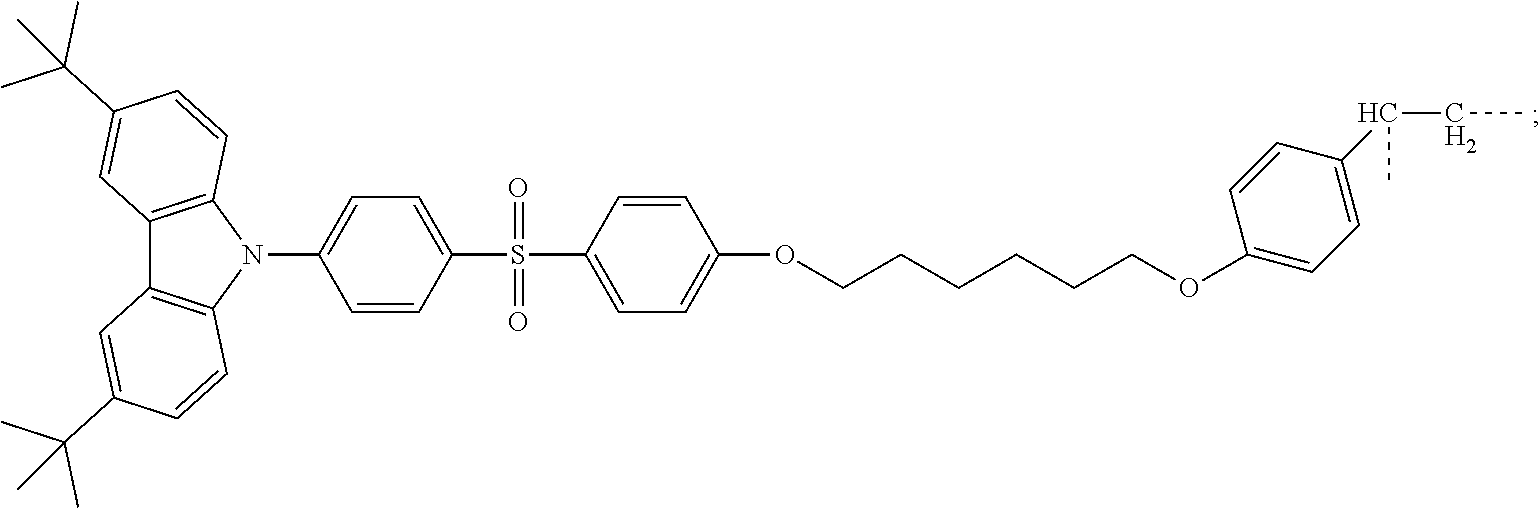
wherein the group B has a structural formula as follows:

wherein the group C has a structural formula as follows:

and wherein the group D has a structural formula as follows:


wherein x, y, and z are mole fractions; and the synthesizing method comprising:
a step S10 of performing a heating reaction to a mixture of tert-butylcarbazole, 4-bromo-diphenylsulfone chain styrene, and a first catalyst, and then cooling and separating the mixture of tert-butylcarbazole, 4-bromo-diphenylsulfone chain styrene, and the first catalyst to obtain a first monomer compound, wherein the first monomer compound has a structural formula as follows:

a step S20 of performing a heating reaction to a mixture of 9,10-dihydro-9,9-diphenyl acridine, 4-bromo-diphenylsulfone chain styrene, and a second catalyst, cooling the mixture of 9,10-dihydro-9,9-diphenyl acridine, 4-bromo-diphenylsulfone chain styrene, and the second catalyst, and removing impurity therein to obtain a second monomer compound, wherein the second monomer compound has a structural formula as follows:

a step S30 of performing a heating reaction to a mixture of phenoxazine, the 4-bromo-diphenyl sulfone chain styrene, and the second catalyst, and then cooling and separating the mixture of phenoxazine, the 4-bromo-diphenyl sulfone chain styrene, and the second catalyst to obtain a third monomer compound, wherein the third monomer compound has a structural formula as follows:

a step S40 of performing a heating reaction to a mixture of 3,6-dimethoxyphenoxazine, 4-bromo-diphenylsulfone chain styrene, and the second catalyst, and then cooling and separating the mixture of 3,6-dimethoxyphenoxazine, 4-bromo-diphenylsulfone chain styrene, and the second catalyst to obtain a fourth monomer compound, wherein the fourth monomer compound has a structural formula as follows:

and
a step S50 of performing a high pressure reaction to a mixture of the first monomer compound, the second monomer compound, the third monomer compound, the fourth monomer compound, and a third catalyst, and then separating and drying the mixture of the first monomer compound, the second monomer compound, the third monomer compound, the fourth monomer compound, and the third catalyst to obtain the thermally activated delayed fluorescent material.
-
- a step S501 of mixing the first monomer compound, the second monomer compound, the third monomer compound, the fourth monomer compound, and the third catalyst to obtain a first mixture;
- a step S502 of performing the high pressure reaction to the first mixture to obtain a second mixture;
- a step S503 of precipitating the second mixture with a first solvent to obtain a third mixture;
- a step S504 of extracting the third mixture to obtain a fourth mixture; and a step S505 of vacuum-drying the fourth mixture to obtain the thermally activated delayed fluorescent material.

wherein group A, group B, group C, and group D are all structural groups in the thermally activated delayed fluorescent material; and wherein x, y, and z are molar ratios of the group B, the group C, and the group D in the thermally activated delayed fluorescent material, respectively;
wherein the group A has a structural formula as follows:

wherein the group B has a structural formula as follows:

wherein the group C has a structural formula as follows:

and wherein the group D has a structural formula as follows:


and

wherein the first catalyst is a mixture of cesium carbonate (CsCO3), cuprous iodide (CuI), 18-crown-6 ether, and N,N′-dimethylpropylene urea (DMPU).


wherein the second catalyst is a mixture of palladium acetate (Pd(OAc)2), tri-tert-butylphosphine tetrafluoroborate([(t-Bu)3P]HBF4), sodium t-butoxide (NaOt-Bu), and toluene (TOL).


Claims (17)


Applications Claiming Priority (3)
| Application Number | Priority Date | Filing Date | Title |
|---|---|---|---|
| CN201810949560.XA CN108864350A (en) | 2018-08-20 | 2018-08-20 | Thermal activation delayed fluorescence material, synthetic method, OLED luminescent device, display device |
| CN201810949560.X | 2018-08-20 | ||
| PCT/CN2018/117099 WO2020037856A1 (en) | 2018-08-20 | 2018-11-23 | Thermally activated delayed fluorescence material and synthesis method therefor |
Publications (2)
| Publication Number | Publication Date |
|---|---|
| US20200318000A1 US20200318000A1 (en) | 2020-10-08 |
| US11401465B2 true US11401465B2 (en) | 2022-08-02 |
Family
ID=64321204
Family Applications (1)
| Application Number | Title | Priority Date | Filing Date |
|---|---|---|---|
| US16/475,979 Active 2040-09-05 US11401465B2 (en) | 2018-08-20 | 2018-11-23 | Thermally activated delayed fluorescent and synthesizing method thereof |
Country Status (3)
| Country | Link |
|---|---|
| US (1) | US11401465B2 (en) |
| CN (1) | CN108864350A (en) |
| WO (1) | WO2020037856A1 (en) |
Families Citing this family (11)
| Publication number | Priority date | Publication date | Assignee | Title |
|---|---|---|---|---|
| CN108864350A (en) * | 2018-08-20 | 2018-11-23 | 武汉华星光电半导体显示技术有限公司 | Thermal activation delayed fluorescence material, synthetic method, OLED luminescent device, display device |
| CN109627265A (en) * | 2018-11-26 | 2019-04-16 | 武汉华星光电半导体显示技术有限公司 | A kind of preparation method and Organic Light Emitting Diode of sensitized material |
| CN109824558B (en) * | 2019-01-24 | 2020-10-09 | 浙江农林大学暨阳学院 | A kind of method for preparing diphenylsulfone compound by palladium acetate catalysis |
| CN109970642A (en) * | 2019-04-16 | 2019-07-05 | 武汉华星光电半导体显示技术有限公司 | Bipolarity thermal activation delayed fluorescence material and preparation method thereof and organic electroluminescent diode apparatus |
| CN113004216B (en) * | 2019-12-20 | 2023-10-03 | 湖南超亟检测技术有限责任公司 | Preparation method and application of benzoxazine hypochlorous acid fluorescent molecular probe |
| CN111269344B (en) * | 2020-02-25 | 2023-07-04 | 中国科学院长春应用化学研究所 | A white light fluorescent polymer compound based on space charge transfer effect and its preparation method and application |
| CN113698523B (en) * | 2021-09-03 | 2022-09-06 | 中国科学院长春应用化学研究所 | High molecular compound containing space charge transfer polymer sensitizer and condensed ring unit with resonance structure and organic electroluminescent device |
| CN114057922B (en) * | 2021-12-09 | 2023-09-05 | 江苏海洋大学 | Thermal activation delayed fluorescence polymer main body material with aggregation-induced fluorescence property |
| CN114409840B (en) * | 2022-01-26 | 2023-08-22 | 安徽秀朗新材料科技有限公司 | Polymer luminescent material and preparation method and application thereof |
| CN115926036B (en) * | 2022-04-15 | 2025-09-12 | 黑龙江大学 | A non-conjugated polymer thermally excited delayed fluorescence material, preparation method and application thereof |
| CN116082236A (en) * | 2022-12-24 | 2023-05-09 | 江汉大学 | TADF luminescent material suitable for full solution process treatment technology and preparation method thereof |
Citations (7)
| Publication number | Priority date | Publication date | Assignee | Title |
|---|---|---|---|---|
| CN1822410A (en) | 2006-01-24 | 2006-08-23 | 吉林大学 | Preparing organic light emitting film by electrochemical deposition and use in electroluminescence device |
| JP2006249283A (en) | 2005-03-11 | 2006-09-21 | Toyo Ink Mfg Co Ltd | Material for organic electroluminescence device and organic electroluminescence device using the same |
| WO2007074499A1 (en) | 2005-12-26 | 2007-07-05 | Toyo Ink Mfg. Co., Ltd. | Organic electroluminescent device |
| CN103180406A (en) | 2010-10-14 | 2013-06-26 | 默克专利有限公司 | Materials for organic electroluminescence devices |
| CN105038764A (en) | 2015-06-17 | 2015-11-11 | 中山大学 | Asymmetrical thermal-activation-delayed aggregation-induced emission material based on diphenyl sulfone phenoxazine, as well as synthesis method and application of material |
| CN107142103A (en) * | 2017-04-21 | 2017-09-08 | 中节能万润股份有限公司 | A kind of conjugated polymer electroluminescent organic material and its application and device comprising TADF monomers by skeleton of acridine |
| CN108864350A (en) | 2018-08-20 | 2018-11-23 | 武汉华星光电半导体显示技术有限公司 | Thermal activation delayed fluorescence material, synthetic method, OLED luminescent device, display device |
-
2018
- 2018-08-20 CN CN201810949560.XA patent/CN108864350A/en active Pending
- 2018-11-23 WO PCT/CN2018/117099 patent/WO2020037856A1/en not_active Ceased
- 2018-11-23 US US16/475,979 patent/US11401465B2/en active Active
Patent Citations (9)
| Publication number | Priority date | Publication date | Assignee | Title |
|---|---|---|---|---|
| JP2006249283A (en) | 2005-03-11 | 2006-09-21 | Toyo Ink Mfg Co Ltd | Material for organic electroluminescence device and organic electroluminescence device using the same |
| WO2007074499A1 (en) | 2005-12-26 | 2007-07-05 | Toyo Ink Mfg. Co., Ltd. | Organic electroluminescent device |
| CN1822410A (en) | 2006-01-24 | 2006-08-23 | 吉林大学 | Preparing organic light emitting film by electrochemical deposition and use in electroluminescence device |
| CN103180406A (en) | 2010-10-14 | 2013-06-26 | 默克专利有限公司 | Materials for organic electroluminescence devices |
| US9653687B2 (en) | 2010-10-14 | 2017-05-16 | Merck Patent Gmbh | Materials for organic electroluminescent devices |
| CN105038764A (en) | 2015-06-17 | 2015-11-11 | 中山大学 | Asymmetrical thermal-activation-delayed aggregation-induced emission material based on diphenyl sulfone phenoxazine, as well as synthesis method and application of material |
| CN107142103A (en) * | 2017-04-21 | 2017-09-08 | 中节能万润股份有限公司 | A kind of conjugated polymer electroluminescent organic material and its application and device comprising TADF monomers by skeleton of acridine |
| CN108864350A (en) | 2018-08-20 | 2018-11-23 | 武汉华星光电半导体显示技术有限公司 | Thermal activation delayed fluorescence material, synthetic method, OLED luminescent device, display device |
| US20200318000A1 (en) | 2018-08-20 | 2020-10-08 | Wuhan China Star Optoelectronics Semiconductor Display Technology Co., Ltd. | Thermally activated delayed fluorescent and synthesizing method thereof |
Also Published As
| Publication number | Publication date |
|---|---|
| CN108864350A (en) | 2018-11-23 |
| US20200318000A1 (en) | 2020-10-08 |
| WO2020037856A1 (en) | 2020-02-27 |
Similar Documents
| Publication | Publication Date | Title |
|---|---|---|
| US11401465B2 (en) | Thermally activated delayed fluorescent and synthesizing method thereof | |
| US11279873B2 (en) | Thermally activated delayed fluorescent and synthesizing method thereof | |
| US10851292B2 (en) | Dark blue light thermally activated delayed fluorescence (TADF) material and application thereof | |
| US20200224088A1 (en) | Green light thermally activated delayed fluorescent material and synthesizing method thereof, and electroluminescent device | |
| US20210355376A1 (en) | Near-infrared thermal activated delayed fluorescent material, preparation method thereof, and display device | |
| WO2016115726A1 (en) | Hyperbranched white light conjugated polymer and preparation method and use thereof | |
| TW200844107A (en) | Cyclic siloxane compound, organic electroluminescent element, and use thereof | |
| US20230240127A1 (en) | Electroluminescent polymer based on phenanthroimidazole units, preparation method therefor, and use thereof | |
| CN110183475A (en) | Double boron oxa- pyrene compounds and its application based on donor-receiver | |
| WO2020073527A1 (en) | Macromolecular thermally activated delayed fluorescence material and preparation method therefor | |
| US20100026172A1 (en) | Organic light-emitting device | |
| US11205756B2 (en) | Green light thermally activated delayed fluorescence (TADF) material and application thereof | |
| JP5638175B2 (en) | Electroactive polymer, device and method of manufacturing the same | |
| US20200161561A1 (en) | Acridine derivatives and organic electroluminescent device | |
| US11678570B2 (en) | Hole transport material, preparation method thereof, and electroluminescent device | |
| Hwang et al. | Light-emitting properties of a germyl-substituted PPV derivative synthesized via a soluble precursor | |
| US11220627B2 (en) | Thermally activated delayed fluorescent monomolecular white light material, method of manufacturing thereof, and organic electroluminescence device | |
| US11926772B2 (en) | High-performance sky blue thermally activated delayed fluorescent material, manufacturing method thereof, and application thereof | |
| CN108276436B (en) | Organic electroluminescent compound, application thereof and organic electroluminescent device | |
| Yang et al. | Pure blue light-emitting fluorene-based conjugated polymer with excellent thermal, photophysical, and electroluminescent properties | |
| US10826007B2 (en) | Blue thermally activated delayed fluorescence material and application thereof | |
| US11552254B2 (en) | Thermally activated delayed fluorescent molecular material, a synthesizing method therefor, and an electroluminescent device | |
| RU2501123C1 (en) | Dendronised polyaryl silane-based organic light-emitting diodes | |
| US11326096B2 (en) | Red light thermally activated delayed fluorescence material, method for preparing the same, and organic light emitting diode device | |
| CN114380865A (en) | A kind of bismuth-containing compound, preparation method and application |
Legal Events
| Date | Code | Title | Description |
|---|---|---|---|
| AS | Assignment |
Owner name: WUHAN CHINA STAR OPTOELECTRONICS SEMICONDUCTOR DISPLAY TECHNOLOGY CO., LTD., CHINA Free format text: ASSIGNMENT OF ASSIGNORS INTEREST;ASSIGNOR:LUO, JIAJIA;REEL/FRAME:049666/0877 Effective date: 20190603 |
|
| FEPP | Fee payment procedure |
Free format text: ENTITY STATUS SET TO UNDISCOUNTED (ORIGINAL EVENT CODE: BIG.); ENTITY STATUS OF PATENT OWNER: LARGE ENTITY |
|
| STPP | Information on status: patent application and granting procedure in general |
Free format text: APPLICATION DISPATCHED FROM PREEXAM, NOT YET DOCKETED |
|
| STPP | Information on status: patent application and granting procedure in general |
Free format text: DOCKETED NEW CASE - READY FOR EXAMINATION |
|
| STPP | Information on status: patent application and granting procedure in general |
Free format text: NOTICE OF ALLOWANCE MAILED -- APPLICATION RECEIVED IN OFFICE OF PUBLICATIONS |
|
| STCF | Information on status: patent grant |
Free format text: PATENTED CASE |
|
| MAFP | Maintenance fee payment |
Free format text: PAYMENT OF MAINTENANCE FEE, 4TH YEAR, LARGE ENTITY (ORIGINAL EVENT CODE: M1551); ENTITY STATUS OF PATENT OWNER: LARGE ENTITY Year of fee payment: 4 |