US11396014B2 - Microfluidic movement control method utilizing light - Google Patents
Microfluidic movement control method utilizing light Download PDFInfo
- Publication number
- US11396014B2 US11396014B2 US16/265,931 US201916265931A US11396014B2 US 11396014 B2 US11396014 B2 US 11396014B2 US 201916265931 A US201916265931 A US 201916265931A US 11396014 B2 US11396014 B2 US 11396014B2
- Authority
- US
- United States
- Prior art keywords
- actuator
- microchannel
- micro
- fluid
- light
- Prior art date
- Legal status (The legal status is an assumption and is not a legal conclusion. Google has not performed a legal analysis and makes no representation as to the accuracy of the status listed.)
- Active, expires
Links
- 0 CNC(=O)[3*]C(=O)OC.CNC(C)=O.COC(=O)[3*]C(=O)OC.COC(C)=O Chemical compound CNC(=O)[3*]C(=O)OC.CNC(C)=O.COC(=O)[3*]C(=O)OC.COC(C)=O 0.000 description 7
- BLCQRYOYUYOMJC-UHFFFAOYSA-N C=C(Nc1ccc(C)cc1)c1ccc(-c2ccc(C)cc2)cc1.Cc1ccc(-c2ccc(-c3ccc(C)cc3)cc2)cc1.Cc1ccc(-c2ccc(C)cc2)cc1.Cc1ccc(NC(=O)c2ccc(C)cc2)cc1.Cc1ccc(OC(=O)c2ccc(-c3ccc(C)cc3)cc2)cc1.Cc1ccc(OC(=O)c2ccc(C)cc2)cc1 Chemical compound C=C(Nc1ccc(C)cc1)c1ccc(-c2ccc(C)cc2)cc1.Cc1ccc(-c2ccc(-c3ccc(C)cc3)cc2)cc1.Cc1ccc(-c2ccc(C)cc2)cc1.Cc1ccc(NC(=O)c2ccc(C)cc2)cc1.Cc1ccc(OC(=O)c2ccc(-c3ccc(C)cc3)cc2)cc1.Cc1ccc(OC(=O)c2ccc(C)cc2)cc1 BLCQRYOYUYOMJC-UHFFFAOYSA-N 0.000 description 2
- RWJCUELGZPATKM-ODZAUARKSA-N FC1CC/C=C\CCC1.FC1CC2C=CC1C2 Chemical compound FC1CC/C=C\CCC1.FC1CC2C=CC1C2 RWJCUELGZPATKM-ODZAUARKSA-N 0.000 description 2
- TUKWSUZJIWZTEV-CYYJNZCTSA-N C=CC1CC(C=C)C(C(=O)OCOc2ccc(/N=N/c3ccc(OCC)cc3)cc2)C1 Chemical compound C=CC1CC(C=C)C(C(=O)OCOc2ccc(/N=N/c3ccc(OCC)cc3)cc2)C1 TUKWSUZJIWZTEV-CYYJNZCTSA-N 0.000 description 1
- LUTVNYKBBPVXNC-UHFFFAOYSA-N Cc1ccc(-c2ccc(-c3ccc(C)cc3)cc2)cc1.Cc1ccc(-c2ccc(C)cc2)cc1.Cc1ccc(NC(=O)c2ccc(-c3ccc(C)cc3)cc2)cc1.Cc1ccc(NC(=O)c2ccc(C)cc2)cc1.Cc1ccc(OC(=O)c2ccc(-c3ccc(C)cc3)cc2)cc1.Cc1ccc(OC(=O)c2ccc(C)cc2)cc1 Chemical compound Cc1ccc(-c2ccc(-c3ccc(C)cc3)cc2)cc1.Cc1ccc(-c2ccc(C)cc2)cc1.Cc1ccc(NC(=O)c2ccc(-c3ccc(C)cc3)cc2)cc1.Cc1ccc(NC(=O)c2ccc(C)cc2)cc1.Cc1ccc(OC(=O)c2ccc(-c3ccc(C)cc3)cc2)cc1.Cc1ccc(OC(=O)c2ccc(C)cc2)cc1 LUTVNYKBBPVXNC-UHFFFAOYSA-N 0.000 description 1
Images



Classifications
-
- B—PERFORMING OPERATIONS; TRANSPORTING
- B01—PHYSICAL OR CHEMICAL PROCESSES OR APPARATUS IN GENERAL
- B01L—CHEMICAL OR PHYSICAL LABORATORY APPARATUS FOR GENERAL USE
- B01L3/00—Containers or dishes for laboratory use, e.g. laboratory glassware; Droppers
- B01L3/50—Containers for the purpose of retaining a material to be analysed, e.g. test tubes
- B01L3/502—Containers for the purpose of retaining a material to be analysed, e.g. test tubes with fluid transport, e.g. in multi-compartment structures
- B01L3/5027—Containers for the purpose of retaining a material to be analysed, e.g. test tubes with fluid transport, e.g. in multi-compartment structures by integrated microfluidic structures, i.e. dimensions of channels and chambers are such that surface tension forces are important, e.g. lab-on-a-chip
- B01L3/50273—Containers for the purpose of retaining a material to be analysed, e.g. test tubes with fluid transport, e.g. in multi-compartment structures by integrated microfluidic structures, i.e. dimensions of channels and chambers are such that surface tension forces are important, e.g. lab-on-a-chip characterised by the means or forces applied to move the fluids
-
- F—MECHANICAL ENGINEERING; LIGHTING; HEATING; WEAPONS; BLASTING
- F16—ENGINEERING ELEMENTS AND UNITS; GENERAL MEASURES FOR PRODUCING AND MAINTAINING EFFECTIVE FUNCTIONING OF MACHINES OR INSTALLATIONS; THERMAL INSULATION IN GENERAL
- F16K—VALVES; TAPS; COCKS; ACTUATING-FLOATS; DEVICES FOR VENTING OR AERATING
- F16K99/00—Subject matter not provided for in other groups of this subclass
- F16K99/0001—Microvalves
- F16K99/0003—Constructional types of microvalves; Details of the cutting-off member
- F16K99/0032—Constructional types of microvalves; Details of the cutting-off member using phase transition or influencing viscosity
-
- B—PERFORMING OPERATIONS; TRANSPORTING
- B01—PHYSICAL OR CHEMICAL PROCESSES OR APPARATUS IN GENERAL
- B01L—CHEMICAL OR PHYSICAL LABORATORY APPARATUS FOR GENERAL USE
- B01L3/00—Containers or dishes for laboratory use, e.g. laboratory glassware; Droppers
-
- C—CHEMISTRY; METALLURGY
- C08—ORGANIC MACROMOLECULAR COMPOUNDS; THEIR PREPARATION OR CHEMICAL WORKING-UP; COMPOSITIONS BASED THEREON
- C08F—MACROMOLECULAR COMPOUNDS OBTAINED BY REACTIONS ONLY INVOLVING CARBON-TO-CARBON UNSATURATED BONDS
- C08F232/00—Copolymers of cyclic compounds containing no unsaturated aliphatic radicals in a side chain, and having one or more carbon-to-carbon double bonds in a carbocyclic ring system
- C08F232/02—Copolymers of cyclic compounds containing no unsaturated aliphatic radicals in a side chain, and having one or more carbon-to-carbon double bonds in a carbocyclic ring system having no condensed rings
- C08F232/04—Copolymers of cyclic compounds containing no unsaturated aliphatic radicals in a side chain, and having one or more carbon-to-carbon double bonds in a carbocyclic ring system having no condensed rings having one carbon-to-carbon double bond
-
- C—CHEMISTRY; METALLURGY
- C08—ORGANIC MACROMOLECULAR COMPOUNDS; THEIR PREPARATION OR CHEMICAL WORKING-UP; COMPOSITIONS BASED THEREON
- C08G—MACROMOLECULAR COMPOUNDS OBTAINED OTHERWISE THAN BY REACTIONS ONLY INVOLVING UNSATURATED CARBON-TO-CARBON BONDS
- C08G61/00—Macromolecular compounds obtained by reactions forming a carbon-to-carbon link in the main chain of the macromolecule
- C08G61/02—Macromolecular compounds containing only carbon atoms in the main chain of the macromolecule, e.g. polyxylylenes
- C08G61/04—Macromolecular compounds containing only carbon atoms in the main chain of the macromolecule, e.g. polyxylylenes only aliphatic carbon atoms
- C08G61/06—Macromolecular compounds containing only carbon atoms in the main chain of the macromolecule, e.g. polyxylylenes only aliphatic carbon atoms prepared by ring-opening of carbocyclic compounds
- C08G61/08—Macromolecular compounds containing only carbon atoms in the main chain of the macromolecule, e.g. polyxylylenes only aliphatic carbon atoms prepared by ring-opening of carbocyclic compounds of carbocyclic compounds containing one or more carbon-to-carbon double bonds in the ring
-
- C—CHEMISTRY; METALLURGY
- C08—ORGANIC MACROMOLECULAR COMPOUNDS; THEIR PREPARATION OR CHEMICAL WORKING-UP; COMPOSITIONS BASED THEREON
- C08L—COMPOSITIONS OF MACROMOLECULAR COMPOUNDS
- C08L27/00—Compositions of homopolymers or copolymers of compounds having one or more unsaturated aliphatic radicals, each having only one carbon-to-carbon double bond, and at least one being terminated by a halogen; Compositions of derivatives of such polymers
- C08L27/02—Compositions of homopolymers or copolymers of compounds having one or more unsaturated aliphatic radicals, each having only one carbon-to-carbon double bond, and at least one being terminated by a halogen; Compositions of derivatives of such polymers not modified by chemical after-treatment
- C08L27/12—Compositions of homopolymers or copolymers of compounds having one or more unsaturated aliphatic radicals, each having only one carbon-to-carbon double bond, and at least one being terminated by a halogen; Compositions of derivatives of such polymers not modified by chemical after-treatment containing fluorine atoms
-
- F—MECHANICAL ENGINEERING; LIGHTING; HEATING; WEAPONS; BLASTING
- F16—ENGINEERING ELEMENTS AND UNITS; GENERAL MEASURES FOR PRODUCING AND MAINTAINING EFFECTIVE FUNCTIONING OF MACHINES OR INSTALLATIONS; THERMAL INSULATION IN GENERAL
- F16K—VALVES; TAPS; COCKS; ACTUATING-FLOATS; DEVICES FOR VENTING OR AERATING
- F16K99/00—Subject matter not provided for in other groups of this subclass
-
- F—MECHANICAL ENGINEERING; LIGHTING; HEATING; WEAPONS; BLASTING
- F16—ENGINEERING ELEMENTS AND UNITS; GENERAL MEASURES FOR PRODUCING AND MAINTAINING EFFECTIVE FUNCTIONING OF MACHINES OR INSTALLATIONS; THERMAL INSULATION IN GENERAL
- F16K—VALVES; TAPS; COCKS; ACTUATING-FLOATS; DEVICES FOR VENTING OR AERATING
- F16K99/00—Subject matter not provided for in other groups of this subclass
- F16K99/0001—Microvalves
- F16K99/0034—Operating means specially adapted for microvalves
- F16K99/0036—Operating means specially adapted for microvalves operated by temperature variations
- F16K99/004—Operating means specially adapted for microvalves operated by temperature variations using radiation
-
- B—PERFORMING OPERATIONS; TRANSPORTING
- B01—PHYSICAL OR CHEMICAL PROCESSES OR APPARATUS IN GENERAL
- B01L—CHEMICAL OR PHYSICAL LABORATORY APPARATUS FOR GENERAL USE
- B01L2300/00—Additional constructional details
- B01L2300/12—Specific details about materials
-
- B—PERFORMING OPERATIONS; TRANSPORTING
- B01—PHYSICAL OR CHEMICAL PROCESSES OR APPARATUS IN GENERAL
- B01L—CHEMICAL OR PHYSICAL LABORATORY APPARATUS FOR GENERAL USE
- B01L2400/00—Moving or stopping fluids
- B01L2400/04—Moving fluids with specific forces or mechanical means
- B01L2400/0403—Moving fluids with specific forces or mechanical means specific forces
- B01L2400/0406—Moving fluids with specific forces or mechanical means specific forces capillary forces
-
- B—PERFORMING OPERATIONS; TRANSPORTING
- B01—PHYSICAL OR CHEMICAL PROCESSES OR APPARATUS IN GENERAL
- B01L—CHEMICAL OR PHYSICAL LABORATORY APPARATUS FOR GENERAL USE
- B01L2400/00—Moving or stopping fluids
- B01L2400/04—Moving fluids with specific forces or mechanical means
- B01L2400/0475—Moving fluids with specific forces or mechanical means specific mechanical means and fluid pressure
- B01L2400/0481—Moving fluids with specific forces or mechanical means specific mechanical means and fluid pressure squeezing of channels or chambers
-
- B—PERFORMING OPERATIONS; TRANSPORTING
- B01—PHYSICAL OR CHEMICAL PROCESSES OR APPARATUS IN GENERAL
- B01L—CHEMICAL OR PHYSICAL LABORATORY APPARATUS FOR GENERAL USE
- B01L2400/00—Moving or stopping fluids
- B01L2400/04—Moving fluids with specific forces or mechanical means
- B01L2400/0493—Specific techniques used
-
- C—CHEMISTRY; METALLURGY
- C08—ORGANIC MACROMOLECULAR COMPOUNDS; THEIR PREPARATION OR CHEMICAL WORKING-UP; COMPOSITIONS BASED THEREON
- C08G—MACROMOLECULAR COMPOUNDS OBTAINED OTHERWISE THAN BY REACTIONS ONLY INVOLVING UNSATURATED CARBON-TO-CARBON BONDS
- C08G2261/00—Macromolecular compounds obtained by reactions forming a carbon-to-carbon link in the main chain of the macromolecule
- C08G2261/10—Definition of the polymer structure
- C08G2261/12—Copolymers
- C08G2261/122—Copolymers statistical
-
- C—CHEMISTRY; METALLURGY
- C08—ORGANIC MACROMOLECULAR COMPOUNDS; THEIR PREPARATION OR CHEMICAL WORKING-UP; COMPOSITIONS BASED THEREON
- C08G—MACROMOLECULAR COMPOUNDS OBTAINED OTHERWISE THAN BY REACTIONS ONLY INVOLVING UNSATURATED CARBON-TO-CARBON BONDS
- C08G2261/00—Macromolecular compounds obtained by reactions forming a carbon-to-carbon link in the main chain of the macromolecule
- C08G2261/10—Definition of the polymer structure
- C08G2261/14—Side-groups
- C08G2261/142—Side-chains containing oxygen
- C08G2261/1426—Side-chains containing oxygen containing carboxy groups (COOH) and/or -C(=O)O-moieties
-
- C—CHEMISTRY; METALLURGY
- C08—ORGANIC MACROMOLECULAR COMPOUNDS; THEIR PREPARATION OR CHEMICAL WORKING-UP; COMPOSITIONS BASED THEREON
- C08G—MACROMOLECULAR COMPOUNDS OBTAINED OTHERWISE THAN BY REACTIONS ONLY INVOLVING UNSATURATED CARBON-TO-CARBON BONDS
- C08G2261/00—Macromolecular compounds obtained by reactions forming a carbon-to-carbon link in the main chain of the macromolecule
- C08G2261/10—Definition of the polymer structure
- C08G2261/14—Side-groups
- C08G2261/143—Side-chains containing nitrogen
-
- C—CHEMISTRY; METALLURGY
- C08—ORGANIC MACROMOLECULAR COMPOUNDS; THEIR PREPARATION OR CHEMICAL WORKING-UP; COMPOSITIONS BASED THEREON
- C08G—MACROMOLECULAR COMPOUNDS OBTAINED OTHERWISE THAN BY REACTIONS ONLY INVOLVING UNSATURATED CARBON-TO-CARBON BONDS
- C08G2261/00—Macromolecular compounds obtained by reactions forming a carbon-to-carbon link in the main chain of the macromolecule
- C08G2261/10—Definition of the polymer structure
- C08G2261/14—Side-groups
- C08G2261/146—Side-chains containing halogens
-
- C—CHEMISTRY; METALLURGY
- C08—ORGANIC MACROMOLECULAR COMPOUNDS; THEIR PREPARATION OR CHEMICAL WORKING-UP; COMPOSITIONS BASED THEREON
- C08G—MACROMOLECULAR COMPOUNDS OBTAINED OTHERWISE THAN BY REACTIONS ONLY INVOLVING UNSATURATED CARBON-TO-CARBON BONDS
- C08G2261/00—Macromolecular compounds obtained by reactions forming a carbon-to-carbon link in the main chain of the macromolecule
- C08G2261/10—Definition of the polymer structure
- C08G2261/14—Side-groups
- C08G2261/148—Side-chains having aromatic units
-
- C—CHEMISTRY; METALLURGY
- C08—ORGANIC MACROMOLECULAR COMPOUNDS; THEIR PREPARATION OR CHEMICAL WORKING-UP; COMPOSITIONS BASED THEREON
- C08G—MACROMOLECULAR COMPOUNDS OBTAINED OTHERWISE THAN BY REACTIONS ONLY INVOLVING UNSATURATED CARBON-TO-CARBON BONDS
- C08G2261/00—Macromolecular compounds obtained by reactions forming a carbon-to-carbon link in the main chain of the macromolecule
- C08G2261/10—Definition of the polymer structure
- C08G2261/16—End groups
- C08G2261/164—End groups comprising organic end groups
- C08G2261/1642—End groups comprising organic end groups comprising reactive double bonds or triple bonds
-
- C—CHEMISTRY; METALLURGY
- C08—ORGANIC MACROMOLECULAR COMPOUNDS; THEIR PREPARATION OR CHEMICAL WORKING-UP; COMPOSITIONS BASED THEREON
- C08G—MACROMOLECULAR COMPOUNDS OBTAINED OTHERWISE THAN BY REACTIONS ONLY INVOLVING UNSATURATED CARBON-TO-CARBON BONDS
- C08G2261/00—Macromolecular compounds obtained by reactions forming a carbon-to-carbon link in the main chain of the macromolecule
- C08G2261/30—Monomer units or repeat units incorporating structural elements in the main chain
- C08G2261/33—Monomer units or repeat units incorporating structural elements in the main chain incorporating non-aromatic structural elements in the main chain
- C08G2261/332—Monomer units or repeat units incorporating structural elements in the main chain incorporating non-aromatic structural elements in the main chain containing only carbon atoms
- C08G2261/3322—Monomer units or repeat units incorporating structural elements in the main chain incorporating non-aromatic structural elements in the main chain containing only carbon atoms derived from cyclooctene
-
- C—CHEMISTRY; METALLURGY
- C08—ORGANIC MACROMOLECULAR COMPOUNDS; THEIR PREPARATION OR CHEMICAL WORKING-UP; COMPOSITIONS BASED THEREON
- C08G—MACROMOLECULAR COMPOUNDS OBTAINED OTHERWISE THAN BY REACTIONS ONLY INVOLVING UNSATURATED CARBON-TO-CARBON BONDS
- C08G2261/00—Macromolecular compounds obtained by reactions forming a carbon-to-carbon link in the main chain of the macromolecule
- C08G2261/30—Monomer units or repeat units incorporating structural elements in the main chain
- C08G2261/33—Monomer units or repeat units incorporating structural elements in the main chain incorporating non-aromatic structural elements in the main chain
- C08G2261/332—Monomer units or repeat units incorporating structural elements in the main chain incorporating non-aromatic structural elements in the main chain containing only carbon atoms
- C08G2261/3323—Monomer units or repeat units incorporating structural elements in the main chain incorporating non-aromatic structural elements in the main chain containing only carbon atoms derived from other monocyclic systems
-
- C—CHEMISTRY; METALLURGY
- C08—ORGANIC MACROMOLECULAR COMPOUNDS; THEIR PREPARATION OR CHEMICAL WORKING-UP; COMPOSITIONS BASED THEREON
- C08G—MACROMOLECULAR COMPOUNDS OBTAINED OTHERWISE THAN BY REACTIONS ONLY INVOLVING UNSATURATED CARBON-TO-CARBON BONDS
- C08G2261/00—Macromolecular compounds obtained by reactions forming a carbon-to-carbon link in the main chain of the macromolecule
- C08G2261/40—Polymerisation processes
- C08G2261/41—Organometallic coupling reactions
- C08G2261/418—Ring opening metathesis polymerisation [ROMP]
Definitions
- the invention belongs to the field of microfluidics, in particular to a microchannel actuator for light-controlled microfluidic movement.
- micro-liquid movement has broad industrial applications, such as in biomedical device, micro-liquid transport, microfluidic system, and the like.
- light-controlled microfluidic movement especially micro-liquid movement driven by light-induced capillary force
- Liquid movement driven by light depends on two forces: optical force and light-induced capillary force.
- optical force When the micro-liquid movement is driven by light-induced capillary force, no special optical devices and complicated micro-assembly processes are needed, which greatly simplifies the movement control of the liquid.
- the light-induced capillary force when driving the micro-liquid movement, the light-induced capillary force is subjected to the resistance from the three-phase contact line, which limits the micro-liquid movement to a large extent and seriously restricts its practical application.
- the light-induced capillary force can be generated by the light-induced wetting gradient or Marangoni effect.
- the capillary force generated by the light-induced wetting gradient is difficult to overcome the resistance of the three-phase contact line. Therefore, such driving method is only applicable to a specific liquid, and the liquid moves slowly and the movement track is limited to linear movement.
- the light-induced Marangoni effect often leads to an increase in the temperature of the driven liquid or a need to add a photosensitive surfactant, which is detrimental to the application in the biomedical field or leads to the contamination of the driven liquid.
- An object of the present invention is to provide a microchannel actuator for light-controlled microfluidic movement.
- Another object of the present invention is to provide an apparatus for light-controlled microfluidic movement.
- Another object of the present invention is to provide a method for light-controlled microfluidic movement.
- a method for light-controlled microfluidic movement comprising the steps of:
- microchannel actuator microtubule actuator
- the microchannel actuator has an outer diameter of 0.01-2 mm or 0.0012-2 mm and an inner diameter of 0.001-1.99 mm
- the wall material of the channel of the microchannel actuator is a polymer containing an azobenzene or an azo group
- micro-fluid-loaded microchannel actuator illuminating one end of the micro-fluid-loaded microchannel actuator by a light source to drive the micro-fluid to move toward the other end of the microchannel actuator.
- a method for light-controlled microfluidic movement comprising the steps of:
- microchannel actuator has an outer diameter of 0.01-2 mm or 0.0012-2 mm and an inner diameter of 0.001-1.99 mm, and the wall material of the channel of the microchannel actuator is a polymer containing an azobenzene or an azo group;
- micro-fluid-loaded microchannel actuator illuminating the micro-fluid-loaded microchannel actuator with light sources of different intensities to drive the micro-fluid to move from the end with high light intensity in the direction of low light intensity.
- the whole or part of the wall material of the channel is a polymer material containing an azobenzene group or an azo group.
- the channel wall also contain one or more materials other than polymer material containing an azobenzene group or an azo group between the channel and above polymer.
- the microchannel actuator comprises a substrate having a groove and a film, and the groove and the film together form a fluid channel; wherein the substrate and/or the film contain an effective amount of the wall material of the channel.
- the effective amount refers to an amount sufficient to cause deformation of the substrate and/or the film under illumination by a light source.
- the outer diameter of the microchannel actuator is the sum of the width (depth) of the groove and the thickness of the film of the wall material of the channel, and the inner diameter of the microchannel actuator is the width of the groove (depth).
- the microchannel actuator further includes a composite layer wrapped around the inside and/or outside of the channel wall.
- the wall material of the channel is prepared by homopolymerization or copolymerization of CAB monomers, wherein the chemical structure of the monomer CAB is:
- R 2 is H, a C1, C2, C3, C4, C5, or C6 hydrocarbyl or alkoxy, or a terminal group with polarity selected from one of the group consisting of a cyano, an isocyano, a hydroxyl, a halogen, an ester group, a carboxyl, a nitro, an amino and an amide group;
- R 1 is a C3, C4, C5, C6, C7, C8, C9, C10, C11, or C12 hydrocarbyl or alkoxy;
- D is selected from one of the following structure formula (1)-structure formula (4):
- R 3 is a C2, C3, C4, C5, or C6 hydrocarbyl or alkoxy; or is not present in the monomer.
- the wall material of the channel is prepared by copolymerizing a CAB monomer with a CF monomer, and the chemical structure formula of the monomer CF is selected from the group consisting of:
- F represents: -D-R 1 -G-R 2 , D, R 1 and R 2 are the same as the group represented by the chemical formula in CAB, and the structure of G is selected from one or more of the following structures:
- the wall material of the channel comprises structural units as follows:
- R 2 is H, a C1, C2, C3, C4, C5, or C6 hydrocarbyl or alkoxy, or a terminal group with polarity selected from one of the group consisting of a cyano, an isocyano, a hydroxyl, a halogen, an ester group, a carboxyl, a nitro, an amino and an amide group;
- R 1 is a C3, C4, C5, C6, C7, C8, C9, C10, C11, or C12 hydrocarbyl or alkoxy;
- D is selected from one of the following structure formula (1)-structure formula (4):
- R 3 is a C2, C3, C4, C5 or C6 alkylene, alkenylene, alkynylene or an alkyleneoxy group.
- the light sources of different intensities are produced by an attenuator.
- the light sources of different intensities are produced by illuminating the micro-fluid.
- the micro-fluid is a hydrophilic micro-fluid or a hydrophobic micro-fluid.
- the inner wall of the microchannel actuator is coated with a hydrophilic coating.
- the inner wall of the microchannel actuator is coated with or without a hydrophobic coating.
- the micro-fluid is selected from the group consisting of an organic liquid, water, aqueous solution, gas-liquid fluid, liquid-solid fluid and emulsion.
- the micro-fluid is an organic liquid, preferably an organic liquid selected from the group consisting of silicone oil, n-hexane, petroleum ether, ethyl acetate, acetone, methanol, ethanol, isopropanol, toluene, pentane, octane, cyclohexanone, diethyl ether, propylene oxide, methyl butanone, methyl isobutyl ketone, ethylene glycol monomethyl ether, ethylene glycol monoethyl ether, ethylene glycol monobutyl ether, acetonitrile, pyridine, gasoline and a combination thereof.
- organic liquid selected from the group consisting of silicone oil, n-hexane, petroleum ether, ethyl acetate, acetone, methanol, ethanol, isopropanol, toluene, pentane, octane, cyclohexanone, diethyl
- the micro-fluid is an aqueous phase liquid, preferably an aqueous phase liquid selected from the group consisting of water and a salt solution.
- the micro-fluid is a biochemical liquid, preferably a biochemical liquid selected from the group consisting of a protein solution, a phosphate buffer solution, a cell culture fluid, a cytosol and a combination thereof.
- the micro-fluid is a complex fluid, preferably a complex fluid selected from the group consisting of a gas-liquid fluid, emulsion, liquid-solid fluid and a combination thereof.
- the light source is ultraviolet light or visible light.
- the illumination position of the light source is movable.
- the method controls the direction of the microfluidic movement by controlling the direction of movement of the light or the direction of attenuation of the light.
- the micro-fluid moves along the interior of the microchannel actuator as the light moves in a direction along the exterior of the microchannel actuator.
- the micro-fluid is always moved from the end with a high light intensity in the direction in which the light intensity is low, regardless of the change in the direction of attenuation of the light.
- the method adjusts the driving rate of the micro-fluid by controlling the intensity of the light source.
- the light source has a light intensity of 0.01 to 10 W cm ⁇ 2 .
- the micro-fluid has a rate of movement of 0-10 mm s ⁇ 1 .
- the inner and outer diameters of the channel being illuminated are enlarged to drive the micro-fluid to move toward the thinner end of the microchannel actuator.
- the microchannel actuator is in a straight, serpentine or spiral form.
- the method drives the microfluidic movement over a long distance.
- the method drives a micro-fluid to climb.
- the method drives the micro-fluid to climb at a slope of 0-60 degrees.
- the method drives the micro-fluid to produce a helical three-dimensional movement track.
- a device for light-controlled microfluidic movement comprising a light source and a microchannel actuator; wherein the microchannel actuator has an outer diameter of 0.01-2 mm or 0.0012-2 mm, the inner diameter is 0.001 to 1.99 mm, and the wall material of the channel of the microchannel actuator is a polymer material containing an azobenzene or azo group.
- the inner wall of the microchannel actuator is coated with a hydrophilic coating.
- the inner wall of the microchannel actuator is coated with or without a hydrophobic coating.
- the light source can be moved along the microchannel actuator; and/or an attenuator is placed between the light source and the microchannel actuator.
- the attenuator is used to generate an attenuated light.
- a microchannel actuator for light-controlled microfluidic movement wherein the microchannel actuator has an outer diameter of 0.01-2 mm or 0.0012-2 mm and an inner diameter of 0.001-1.99 mm, and the wall material of the channel of the microchannel actuator is a polymer material containing an azobenzene or azo group.
- the inner wall of the microchannel actuator is coated with a hydrophilic coating.
- the inner wall of the microchannel actuator is coated with or without a hydrophobic coating.
- the microchannel actuator is in a straight, serpentine or spiral form.
- the microchannel actuator is circular, rectangular, square, other polygonal or irregular in cross section, preferably circular and square.
- the microchannel actuator is prepared by a method (a) or (b) selected from the group consisting of:
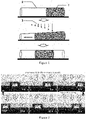
- FIG. 1 is a schematic illustration showing a microchannel actuator driving a liquid movement by light-induced deformation. Reference numerals in the figure: 1 —driven liquid, 2 —microchannel actuator, 3 —attenuated light.
- FIG. 2 shows that a straight microchannel actuator drives microfluidic movement under stimulation from an attenuated light.
- FIG. 3 shows the curve of the movement distance of micro-fluid versus time when the microchannel actuator is illuminated under lights having different intensities.
- FIG. 4 shows that the microchannel actuator drives microfluidic movement when one end of micro-fluid is stimulated by an attenuated light.
- FIG. 5 shows that the microchannel actuator drives the liquid to climb against gravity under the stimulation of an attenuated light.
- FIG. 6 shows the helical microchannel actuator drives liquid to move with helical trajectories under the stimulation of an attenuated light.
- FIG. 7 shows that the micro-fluid move with an S-shaped trajectories in a serpentine microchannel actuator under the stimulation of an attenuated light.
- FIG. 8 shows that the straight microchannel actuator drives the movement of a complex fluid, such as an emulsion under the stimulation of an attenuated light.
- FIG. 9 shows that the micro-fluid is driven in the grooves formed by the substrate and the film under the stimulation of a moving light source.
- microchannel actuator using a light-induced deformation smart polymer material, the diameter of which can be changed under the stimulation of a light, and the inventors can use light to manipulate the fluid movement in the microchannel.
- Such microchannel actuator can undergo asymmetric deformation under a light stimulation, inducing capillary forces to drive microfluidic movement.
- the technique of the present invention can not only drive micro-fluid having various polarities and compositions, but also drive micro-liquid to climb, and even drive liquid to generate a three-dimensional movement track. This is a brand new light-controlled microfluidic apparatus or device with considerable potential applications in controllable microfluidic transport, microreaction systems, micromechanical systems, and lab-on-a-chip. On this basis, the inventors have completed the present invention.
- the invention provides a microchannel actuator for light-controlled microfluidic movement, and the inventors have prepared the microchannel actuator of the present invention by using a light-induced deformation polymer material containing an azobenzene or azo group, the diameter of which can be changed under the stimulation of a light, thereby manipulating fluid movement in the microchannels.
- This microchannel actuator undergoes asymmetric deformation under the stimulation of a light, inducing capillary force to drive microfluidic movement.
- the schematic is shown in FIG. 1 .
- the microchannel actuator of the present invention has an outer diameter of 0.01-2 mm or 0.0012-2 mm and an inner diameter of 0.001-1.99 mm, and the wall material of the channel of the microchannel actuator is a polymer material containing an azobenzene or azo group.
- the microchannel actuator has an outer diameter of 0.05-2 mm; preferably 0.1-1.9 mm; more preferably 0.5-1.5 mm.
- the microchannel actuator has an outer diameter of 0.0012-2 mm; preferably from 0.005-1.9 mm; more preferably from 0.11-1.5 mm.
- the microchannel actuator has an inner diameter of from 0.001-1.99 mm; preferably from 0.01-1.8 mm; more preferably from 0.1-1.3 mm.
- the microchannel actuator can be in a straight, serpentine or spiral form.
- the microchannel actuator of the present invention can be used in the light-controlled microfluidic movement.
- the micro-fluid is a hydrophilic micro-fluid
- the inner wall of the microchannel actuator is coated with a hydrophilic coating.
- the micro-fluid is a hydrophobic micro-fluid
- the inner wall of the microchannel actuator is coated with or without a hydrophobic coating.
- the wall material of the channel of the microchannel actuator is a polymer having a butadiene-ethylene-functional group substituted ethylene ternary alternating polymer or a norbornene as a main chain, and a side chain containing an azobenzene or azo group.
- the wall material of the channel of the microchannel actuator is obtained by homopolymerization or copolymerization of CAB monomer or CAB monomer and CF monomer by ring opening metathesis polymerization, and the chemical structure formula of the CAB monomer is:
- R 2 is H, a C1, C2, C3, C4, C5, or C6 hydrocarbyl or alkoxy, or a terminal group with polarity selected from one of the group consisting of a cyano, an isocyano, a hydroxyl, a halogen, an ester group, a carboxyl, a nitro, an amino, or an amide group;
- R 1 is a C3, C4, C5, C6, C7, C8, C9, C10, C11, or C12 hydrocarbyl or alkoxy;
- R 3 is a C2, C3, C4, C5, or C6 hydrocarbyl or alkoxy
- the chemical structure formula of the monomer CF is:
- the wall material of the channel is preferably of the structure shown below:
- the wall material of the channel is preferably of the structure shown below:
- the wall material of the channel is preferably of the structure shown below:
- the wall material of the channel is preferably of the structure shown below:
- the method for preparing the wall material of the channel of the microchannel actuator is referred to CN103087296A.
- the invention also provides a device for light-controlled microfluidic movement, comprising a light source and the microchannel actuator of the invention, wherein the microchannel actuator has an outer diameter of 0.01-2 mm or 0.0012-2 mm and an inner diameter of 0.001-1.99 mm, and the wall material of the channel of the microchannel actuator is a polymer material containing an azobenzene or azo group.
- the inner wall of the microchannel actuator is coated with a hydrophilic coating.
- the inner wall of the microchannel actuator is coated with or without a hydrophobic coating.
- the illumination position of the light source can move along the microchannel actuator.
- An attenuator may also be placed between the light source and the microchannel actuator for generating attenuated light.
- the “ ” or similar illustration is used to indicate the direction of attenuation of light, and both indicate that the light intensity is from strong to weak. Similarly, “ ” indicates that the light intensity is from weak to strong.
- the present invention provides a method for light-controlled microfluidic movement comprising the steps of:
- microchannel actuator of the present invention, wherein the microchannel actuator has an outer diameter of 0.01-2 mm or 0.0012-2 mm, an inner diameter of 0.001-1.99 mm, and a material of the channel wall of the microchannel actuator contains an azobenzene or azo group;
- micro-fluid-loaded microchannel actuator illuminating one end of the micro-fluid-loaded microchannel actuator with a light source to drive the micro-fluid to move toward the other end of the microchannel actuator.
- the present invention provides a method for light-controlled microfluidic movement comprising the steps of:
- microchannel actuator of the present invention, wherein the microchannel actuator has an outer diameter of 0.01-2 mm or 0.0012-2 mm, an inner diameter of 0.001-1.99 mm, and a material of the channel wall of the microchannel actuator contains an azobenzene or azo group;
- micro-fluid-loaded microchannel actuator illuminating the micro-fluid-loaded microchannel actuator with light sources having different intensities to drive the micro-fluid to move from the end with high light intensity in the direction of low light intensity.
- the lights having different intensities can be generated by methods commonly used in the art, and in a preferred embodiment of the invention, the light is produced by an attenuator. In another preferred embodiment, the lights having different intensities can be generated by illuminating one end of the liquid.
- the micro-fluid is a hydrophilic micro-fluid or a hydrophobic micro-fluid.
- the inner wall of the microchannel actuator is coated with a hydrophilic coating.
- the micro-fluid is a hydrophobic micro-fluid
- the inner wall of the microchannel actuator is coated with or without a hydrophobic coating.
- the micro-fluid is silicone oil, n-hexane, petroleum ether, ethyl acetate, acetone, methanol, ethanol, water, isopropanol, toluene, pentane, octane, cyclohexanone, diethyl ether, propylene oxide, methyl butanone, methyl isobutyl ketone, ethylene glycol monomethyl ether, ethylene glycol monoethyl ether, ethylene glycol monobutyl ether, acetonitrile, pyridine, gas-liquid fluid, emulsion, liquid-solid fluid, gasoline, biochemical liquid, aqueous solution, and a mixed liquid of the above liquids.
- the micro-fluid is any one of silicone oil, n-hexane, ethyl acetate, acetone, methanol, ethanol, water, isopropanol, gas-liquid fluid, emulsion, liquid-solid fluid, gasoline, biochemical liquid.
- the light source is any one of ultraviolet light, visible light, and near-infrared light, or a combination thereof.
- the illumination position of the light source is movable.
- the method controls the direction of microfluidics movement by controlling the direction of movement of the light or the direction of attenuation of the light.
- the micro-fluid When the light moves in a certain direction along the exterior of the microchannel actuator, the micro-fluid will move along the interior of the microchannel actuator. When an attenuator is used, the micro-fluid always moves in a direction from the end with high light intensity to the end with low light intensity, regardless of the direction of attenuation of the light.
- the method adjusts the driving rate of the micro-fluid by controlling the intensity of the light source.
- the light source has a light intensity of 0.01-10 W cm ⁇ 2 (preferably 0.02-5 W cm ⁇ 2 ; more preferably 0.03-1 or 0.03-0.5 W cm ⁇ 2 ).
- the micro-fluid has a rate of movement of 0-10 mm s ⁇ 1 (preferably 0.001-8 mm s ⁇ 1 ; more preferably 0.01-6 or 0.01-1 mm s ⁇ 1 ).
- the cross-sectional area of microchannel at the position of illumination will change, thereby driving the micro-fluid to move toward the thinner end of the microchannel actuator.
- the microchannel actuator is in a straight, serpentine or spiral form.
- the microchannel actuator has a circular, rectangular, square, other polygonal or irregular shape in cross section.
- the method is capable of driving microfluidic movement over a long distance, driving microfluidic to climb (which can drive micro-fluid to climb at a slope of 0-60 degrees), and also driving micro-fluid to move with spiral three-dimensional trajectories.
- the hydrophilic coating or the hydrophobic coating may be coated with a material commonly used on the market such as polyvinyl alcohol, polyacrylamide, silica sol-gel, or the like.
- the present invention provides a method for light-controlled microfluidic movement.
- a light-controlled microchannel actuator is successfully fabricated using an azo-containing liquid crystal polymer, and a capillary force is generated by utilizing changes in the cross-sectional area of the light-induced microchannel actuator, thereby driving the microfluidic movement. This is a new approach for light-driven liquid movement.
- This method is suitable for light-controlling various types of microfluidic movement. It not only can handle a variety of non-polar and polar liquids, such as silicone oil, n-hexane, petroleum ether, ethyl acetate, acetone, methanol, ethanol, water, etc., but also manipulate complex fluids such as gas-liquid fluid, emulsion, liquid solid fluid, gasoline, and biochemical liquid.
- non-polar and polar liquids such as silicone oil, n-hexane, petroleum ether, ethyl acetate, acetone, methanol, ethanol, water, etc.
- complex fluids such as gas-liquid fluid, emulsion, liquid solid fluid, gasoline, and biochemical liquid.
- the method can precisely control the direction and rate of movement of the liquid, even over a long-distance, and can also drive liquid to climb and generate three-dimensional movement track.
- the method has great application potential in the fields of microfluidic system, micro-optical mechanical system and the like.
- the light-controlled microchannel actuator can be not only a straight microchannel actuator, but also a complex serpentine, spiral microchannel actuator, or a combination thereof.
- the specific preparation method refers to the procedure of Example 1 of CN103087296A.
- a solution of PCmABn in dichloromethane (0.1-20% by weight) was sucked into a straight glass capillary, and then the capillary filled with the solution was placed in an oven until the solvent was evaporated.
- the inner wall of the capillary was uniformly covered by PCmABn.
- the straight capillary coated with PCmABn on the inner wall was placed in hydrofluoric acid to etch away the glass to obtain a straight microchannel actuator.
- a solution of PCmABn in dichloromethane (0.1-20% by weight) was sucked into a serpentine glass capillary, and then the capillary filled with the solution was placed in an oven until the solvent was evaporated.
- the inner wall of the capillary was uniformly covered by PCmABn.
- the serpentine capillary coated with PCmABn on the inner wall was placed in hydrofluoric acid to etch away the glass to obtain a serpentine microchannel actuator.
- a solution of PCmABn in dichloromethane (0.1-20% by weight) was sucked into a spiral glass capillary, and then the capillary filled with the solution was placed in an oven until the solvent was evaporated.
- the inner wall of the capillary was uniformly covered by PCmABn.
- the spiral capillary coated with PCmABn on the inner wall was placed in hydrofluoric acid to etch away the glass to obtain a spiral microchannel actuator.
- a solution of PCmABn in dichloromethane (0.1-20% by weight) was filled into an EVA (ethylene-vinyl acetate copolymer) hose with an inner diameter of 0.01-1.99 mm and a wall thickness of 0.001-0.2 mm. Then the EVA hose filled with the solution was placed in an oven. After the solvent volatilized, the EVA hose wall was evenly covered with PCmABn to obtain a PCmABn-EVA composite channel actuator.
- EVA ethylene-vinyl acetate copolymer
- the prepared straight microchannel actuator has an inner diameter of 0.001-1.99 mm and an outer diameter of 0.01-2 mm.
- the prepared serpentine microchannel actuator has an inner diameter of 0.001-1.99 mm and an outer diameter of 0.01-2 mm.
- the prepared spiral microchannel actuator has an inner diameter of 0.001-1.99 mm and an outer diameter of 0.01-2 mm.
- the prepared composite microchannel actuator has an inner diameter of 0.001-1.99 mm and an outer diameter of 0.01-2 mm.
- the specific preparation method refers to the procedure of Example 1 of CN103087296A.
- a solution of P(CmABn)x(CpBPq)y in dichloromethane (0.1-30% by weight) was sucked into a straight glass capillary, and then the capillary filled with the solution was placed in an oven until the solvent was evaporated.
- the inner wall of the capillary was uniformly covered by P(CmABn)x(CpBPq)y.
- the straight capillary coated with P(CmABn)x(CpBPq)y on the inner wall was placed in hydrofluoric acid to etch away the glass to obtain a straight microchannel actuator.
- a solution of P(CmABn)x(CpBPq)y in dichloromethane (0.1-30% by weight) was sucked into a serpentine glass capillary, and then the capillary filled with the solution was placed in an oven until the solvent was evaporated.
- the inner wall of the capillary was uniformly covered by P(CmABn)x(CpBPq)y.
- the serpentine capillary coated with P(CmABn)x(CpBPq)y on the inner wall was placed in hydrofluoric acid to etch away the glass to obtain a serpentine microchannel actuator.
- a solution of P(CmABn)x(CpBPq)y in dichloromethane (0.1-30% by weight) was sucked into a Y-shaped glass capillary, and then the capillary filled with the solution was placed in an oven until the solvent was evaporated.
- the inner wall of the capillary was uniformly covered by P(CmABn)x(CpBPq)y.
- the spiral capillary coated with P(CmABn)x(CpBPq)y on the inner wall was placed in hydrofluoric acid to etch away the glass to obtain a Y-shaped microchannel actuator.
- a solution of P(CmABn)x(CpBPq)y obtained in preparation example 2 in dichloromethane (0.1-20% by weight) was filled into an EVA (ethylene-vinyl acetate copolymer) hose with an inner diameter of 0.01-1.99 mm and a wall thickness of 0.001-0.2 mm. Then the EVA hose filled with the solution was placed in an oven. After the solvent volatilized, the EVA hose wall was evenly covered with P(CmABn)x(CpBPq)y to obtain a P(CmABn)x(CpBPq)y-EVA composite channel actuator.
- EVA ethylene-vinyl acetate copolymer
- the specific preparation method refers to the procedure of Example 1 of CN103087296A.
- a certain molar amount of the azo group-containing norbornene monomer CAB was added to the Schlenk flask, and a sufficient amount of methylene chloride was added to dissolve it.
- a certain amount of Grubbs second generation catalyst was added at 40° C. to initiate polymerization. After 10 hours, the polymerization was terminated using vinyl ethyl ether to obtain PNmABn.
- a solution of PNmABn in dichloromethane (0.1-30% by weight) was sucked into a straight glass capillary, and then the capillary filled with the solution was placed in an oven until the solvent was evaporated.
- the inner wall of the capillary was uniformly covered by PNmABn.
- the straight capillary coated with PNmABn on the inner wall was placed in hydrofluoric acid to etch away the glass to obtain a straight microchannel actuator.
- a solution of PNmABn in dichloromethane (0.1-30% by weight) was sucked into a serpentine glass capillary, and then the capillary filled with the solution was placed in an oven until the solvent was evaporated.
- the inner wall of the capillary was uniformly covered by PNmABn.
- the serpentine capillary coated with PNmABn on the inner wall was placed in hydrofluoric acid to etch away the glass to obtain a serpentine microchannel actuator.
- a solution of PNmABn in dichloromethane (0.1-30% by weight) was sucked into a Y-shaped glass capillary, and then the capillary filled with the solution was placed in an oven until the solvent was evaporated.
- the inner wall of the capillary was uniformly covered by PNmABn.
- the spiral capillary coated with PNmABn on the inner wall was placed in hydrofluoric acid to etch away the glass to obtain a Y-shaped microchannel actuator.
- the straight microchannel actuators (inner diameter 0.5 mm, outer diameter 0.51 mm) prepared in Preparation Examples 1, 2, and 3 were fixed on a horizontal table top.
- a small amount of fluid such as silicone oil, ethyl acetate, ethylene glycol monobutyl ether or emulsion was sucked into the microchannel actuator by capillary action.
- a light source was placed above the microchannel actuator with an attenuator placed in the middle for generating attenuated light. The light source was turned on, and the intensity of the light source was 125-140 mW cm ⁇ 2 .
- the process of driving the emulsion is shown in FIG. 8 .
- FIG. 1 A schematic diagram of the entire process is shown in FIG. 1 .
- Microchannel Actuator Controls the Direction of Microfluidic Movement
- Example 1 The experiment of Example 1 was repeated except that when the microchannel actuator was irradiated with a light, the direction of the attenuation of the light was adjusted by changing the direction in which the attenuator was placed.
- Microchannel Actuator Controls the Speed of Microfluidic Movement
- Microchannel Actuator Drives Microfluidic Movement Over a Long Distance
- Example 1 The experiment of Example 1 was repeated, and the liquid was controlled always in the radiation area of the light source. It was found that the liquid moved all the time and the distance of movement was unlimited.
- Light Source Illuminates a Local Position of Liquid to Drive Microfluidic Movement
- Example 1 The experiment of Example 1 was repeated. The liquid was changed to a longer length of silicone oil and the attenuated light was controlled to illuminate a local position of one end of liquid. It was found that the liquid can be driven by the attenuated light without illuminating the entire liquid, as shown in FIG. 4 .
- the straight microchannel actuators (inner diameter 0.5 mm, outer diameter 0.51 mm) prepared in Preparation Examples 1, 2, and 3 were fixed on a slope of 17 degrees. A small amount of silicone oil, n-hexane, ethyl acetate, or acetone was sucked into the microchannel actuator by capillary action. As in Example 1, the microchannel actuator was irradiated using an attenuated light source.
- microchannel actuator drove the micro-liquid to climb along the slope as shown in FIG. 5 .
- the spiral microchannel actuator (inner diameter 0.6 mm, outer diameter 0.61 mm) prepared in Preparation Example 1 was fixed on a cylinder. A small amount of silicone oil was sucked into the spiral microchannel actuator by capillary action. The attenuated light source was used to radiate the micro-fluid in a direction perpendicular to the wall of the microchannel.
- the serpentine microchannel actuators (inner diameter 0.6 mm, outer diameter 0.61 mm) prepared in Preparation Examples 1, 2, and 3 were fixed on a horizontal table top.
- the attenuated light source was used to radiate the micro-fluid in a direction perpendicular to the wall of the microchannel.
- Grooves were etched by chemical or physical means on a substrate, and then an azo polymer film was pasted on the substrate, so that fluid channels were formed between the substrate and the film.
- a point source was used to radiate one end of the micro-fluid.
- Results shows that the micro-fluid moved in a direction opposite to the source in the channel and can achieve long-range movement through U-turns, as shown in FIG. 9 .
- the inner wall of the straight microchannel actuator (inner diameter 0.5 mm, outer diameter 0.51 mm) prepared in Preparation Example 1 was coated with an aqueous solution of polyvinyl alcohol (0.01-9 wt %), and the microchannel actuator was fixed on the horizontal desktop after the solvent was evaporated. A trace amount of ethanol was drawn into the microchannel actuator by capillary action. A light source was placed above the microchannel actuator with an attenuator placed in the middle for generating an attenuated light. The light source was turned on, and the intensity of the light source was 125-140 mW cm ⁇ 2 .
- Results show that an asymmetrical deformation was generated in the straight microchannel actuator and drove the trace ethanol to move in the direction of light attenuation.
- aqueous solution of polyvinyl alcohol was replaced by a polyacrylamide aqueous solution or a silica sol-gel, results were the same as those in Example 8.
- An asymmetrical deformation was generated in the straight microchannel actuator and drove the trace amount of ethanol to move in the direction of light attenuation.
- the composite microchannel actuator (inner diameter 0.5 mm, outer diameter 0.51 mm) prepared in Preparation Example 2 was fixed on a horizontal table top.
- a trace amount of fluid such as silicone oil, ethyl acetate, ethylene glycol monobutyl ether or emulsion was sucked into the microchannel actuator by capillary action.
- a light source was placed above the microchannel actuator with an attenuator placed in the middle for generating an attenuated light. The light source was turned on, and the intensity of the light source was 125-140 mW cm ⁇ 2 .
- Results show that an asymmetrical deformation was generated in the straight microchannel actuator and drove the liquid to move in the direction of light attenuation.
Landscapes
- Chemical & Material Sciences (AREA)
- Health & Medical Sciences (AREA)
- General Engineering & Computer Science (AREA)
- Engineering & Computer Science (AREA)
- Chemical Kinetics & Catalysis (AREA)
- Polymers & Plastics (AREA)
- Medicinal Chemistry (AREA)
- Organic Chemistry (AREA)
- Dispersion Chemistry (AREA)
- Mechanical Engineering (AREA)
- Clinical Laboratory Science (AREA)
- Hematology (AREA)
- General Health & Medical Sciences (AREA)
- Analytical Chemistry (AREA)
- Toxicology (AREA)
- Micromachines (AREA)
- Physical Or Chemical Processes And Apparatus (AREA)
Abstract
Description


| Inner diameter | Outer diameter | ||
| Straight | 0.001-1.99 mm | 0.0012-2 mm |
| Serpentine | 0.001-1.99 mm | 0.0012-2 mm |
| Spiral | 0.001-1.99 mm | 0.0012-2 mm |
| Composite microchannel actuator | 0.001-1.99 mm | 0.0012-2 mm |
| Straight | 0.001-1.99 mm | 0.01-2 mm |
| Serpentine | 0.001-1.99 mm | 0.01-2 mm |
| Spiral | 0.001-1.99 mm | 0.01-2 mm |
| Composite microchannel actuator | 0.001-1.99 mm | 0.01-2 mm |
Claims (19)


Applications Claiming Priority (3)
| Application Number | Priority Date | Filing Date | Title |
|---|---|---|---|
| CN201610623513.7 | 2016-08-02 | ||
| CN201610623513.7A CN107676541B (en) | 2016-08-02 | 2016-08-02 | Method for optically controlling movement of microfluid |
| PCT/CN2017/095435 WO2018024194A1 (en) | 2016-08-02 | 2017-08-01 | Microfluidic movement control method utilizing light |
Related Parent Applications (1)
| Application Number | Title | Priority Date | Filing Date |
|---|---|---|---|
| PCT/CN2017/095435 Continuation-In-Part WO2018024194A1 (en) | 2016-08-02 | 2017-08-01 | Microfluidic movement control method utilizing light |
Publications (2)
| Publication Number | Publication Date |
|---|---|
| US20190232278A1 US20190232278A1 (en) | 2019-08-01 |
| US11396014B2 true US11396014B2 (en) | 2022-07-26 |
Family
ID=61074118
Family Applications (1)
| Application Number | Title | Priority Date | Filing Date |
|---|---|---|---|
| US16/265,931 Active 2039-01-01 US11396014B2 (en) | 2016-08-02 | 2019-02-01 | Microfluidic movement control method utilizing light |
Country Status (3)
| Country | Link |
|---|---|
| US (1) | US11396014B2 (en) |
| CN (2) | CN107676541B (en) |
| WO (1) | WO2018024194A1 (en) |
Families Citing this family (15)
| Publication number | Priority date | Publication date | Assignee | Title |
|---|---|---|---|---|
| CN107676541B (en) * | 2016-08-02 | 2020-06-05 | 复旦大学 | Method for optically controlling movement of microfluid |
| CN108587898B (en) * | 2018-05-07 | 2022-04-29 | 东莞东阳光医疗智能器件研发有限公司 | A kind of preparation device and preparation method of digital PCR droplet |
| CN108704679B (en) * | 2018-05-24 | 2020-09-08 | 北京大学 | Optical micro-fluidic composite tube type channel |
| CN108514901B (en) * | 2018-06-01 | 2024-06-18 | 东莞东阳光医疗智能器件研发有限公司 | Digital micro-fluidic chip |
| CN108688153B (en) * | 2018-06-26 | 2024-04-19 | 珠海天威增材有限公司 | Printing head, three-dimensional printer and printing method thereof |
| CN108620143B (en) | 2018-06-28 | 2020-05-05 | 京东方科技集团股份有限公司 | Digital microfluidic chip and driving method thereof |
| CN111255778B (en) * | 2018-11-30 | 2021-06-01 | 西湖大学 | Light-operated liquid drop movement method, light-operated liquid drop movement microtube and manufacturing method thereof |
| CN109541249A (en) * | 2018-12-20 | 2019-03-29 | 复旦大学 | A kind of light-operated micro-fluidic high-volume sampling device |
| CN111774106B (en) * | 2020-06-11 | 2021-12-07 | 复旦大学 | Protein enrichment detection device based on light-operated fluid transportation and magnetic control sample separation |
| CN115401720B (en) * | 2021-05-26 | 2025-03-14 | 西湖大学 | Fiber actuator with multi-mode and high degree of freedom deformation and its preparation and application |
| CN116212987B (en) * | 2022-12-12 | 2026-06-19 | 苏州大学 | Method for controlling microtubes and optically controlling droplet motions by droplet motions |
| CN116651520B (en) * | 2023-05-08 | 2026-07-14 | 复旦大学 | Microfluidic chip and microfluidic device |
| CN116474850B (en) * | 2023-05-08 | 2025-12-02 | 复旦大学 | Microfluidic chips and microfluidic devices with annular reaction channels |
| CN116764700B (en) * | 2023-05-08 | 2025-12-09 | 复旦大学 | Microfluidic chip with mixing chamber and microfluidic device |
| CN118904408B (en) * | 2023-06-20 | 2025-05-13 | 西湖大学 | Dynamically reconfigurable and programmable microfluidic systems and their applications |
Citations (5)
| Publication number | Priority date | Publication date | Assignee | Title |
|---|---|---|---|---|
| US20050221281A1 (en) | 2003-01-08 | 2005-10-06 | Ho Winston Z | Self-contained microfluidic biochip and apparatus |
| CN101481440A (en) | 2009-01-22 | 2009-07-15 | 复旦大学 | Liquid crystal polymer material and composite material realizing photo-induced deformation by visible light irradiation |
| US20110272644A1 (en) | 2010-05-04 | 2011-11-10 | State of Oregon acting by and through the State Board of Higher Education on behalf of OSU | Fluidic devices comprising photocontrollable units |
| CN103087296A (en) | 2013-01-29 | 2013-05-08 | 复旦大学 | Side chained linear azobenzene liquid crystal polymer material and preparation method thereof |
| CN104481850A (en) | 2014-11-13 | 2015-04-01 | 常州大学 | Light driven micro-fluid pump |
Family Cites Families (6)
| Publication number | Priority date | Publication date | Assignee | Title |
|---|---|---|---|---|
| US8771612B2 (en) * | 2008-03-11 | 2014-07-08 | Sekisui Chemical Co., Ltd. | Photoresponsive gas-generating material, micropump and microfluid device |
| CN101709695B (en) * | 2009-11-19 | 2011-12-14 | 复旦大学 | Driving micro pump of photoinduced bending film |
| IT1397819B1 (en) * | 2009-12-17 | 2013-02-04 | Silicon Biosystems Spa | MICROFLUID SYSTEM |
| WO2013072790A1 (en) * | 2011-11-16 | 2013-05-23 | International Business Machines Corporation | Microfluidic device with deformable valve |
| CN104110355B (en) * | 2014-07-02 | 2016-04-20 | 南京理工大学 | The Micropump device that a kind of photo-induced telescopic material drives |
| CN107676541B (en) * | 2016-08-02 | 2020-06-05 | 复旦大学 | Method for optically controlling movement of microfluid |
-
2016
- 2016-08-02 CN CN201610623513.7A patent/CN107676541B/en active Active
-
2017
- 2017-08-01 WO PCT/CN2017/095435 patent/WO2018024194A1/en not_active Ceased
- 2017-08-01 CN CN201780043706.8A patent/CN109790944B/en active Active
-
2019
- 2019-02-01 US US16/265,931 patent/US11396014B2/en active Active
Patent Citations (5)
| Publication number | Priority date | Publication date | Assignee | Title |
|---|---|---|---|---|
| US20050221281A1 (en) | 2003-01-08 | 2005-10-06 | Ho Winston Z | Self-contained microfluidic biochip and apparatus |
| CN101481440A (en) | 2009-01-22 | 2009-07-15 | 复旦大学 | Liquid crystal polymer material and composite material realizing photo-induced deformation by visible light irradiation |
| US20110272644A1 (en) | 2010-05-04 | 2011-11-10 | State of Oregon acting by and through the State Board of Higher Education on behalf of OSU | Fluidic devices comprising photocontrollable units |
| CN103087296A (en) | 2013-01-29 | 2013-05-08 | 复旦大学 | Side chained linear azobenzene liquid crystal polymer material and preparation method thereof |
| CN104481850A (en) | 2014-11-13 | 2015-04-01 | 常州大学 | Light driven micro-fluid pump |
Non-Patent Citations (3)
| Title |
|---|
| Jiuan Lv, Photocontrol of Fluid Slugs in Liquid Crystal Polymer Microactuators, Nature, vol. 537, No. 7619, pp. 179-184, (Sep. 7, 2016). |
| Wang et al (Light Driven Soft Actuators Based on Photoresponsive Polymer Materials, Progress in Chemistry, 2011, 23, 6, pp. 1166-1171, as cited in the IDS dated Feb. 1, 2019 and based on the examiner provided machine translation) (Year: 2011). * |
| Wei Wang, "Light Driven Soft Actuators Based on Photoresponsive Polymer Materials", Progress in Chemsitry, vol. 23, No. 6, pp. 1166 to 1171 (Jun. 24, 2011). |
Also Published As
| Publication number | Publication date |
|---|---|
| WO2018024194A1 (en) | 2018-02-08 |
| CN109790944A (en) | 2019-05-21 |
| CN109790944B (en) | 2021-05-18 |
| CN107676541B (en) | 2020-06-05 |
| US20190232278A1 (en) | 2019-08-01 |
| CN107676541A (en) | 2018-02-09 |
Similar Documents
| Publication | Publication Date | Title |
|---|---|---|
| US20190232278A1 (en) | Microfluidic Movement Control Method Utilizing Light | |
| ES2687684T3 (en) | Generation of droplets on demand at high speed and encapsulation of individual cells directed by induced cavitation | |
| US20220339620A1 (en) | Method for preparing micro-channel array plate, device for obtaining liquid drops using the micro-channel array plate, and method for generating liquid drops | |
| US9975117B2 (en) | Apparatus and method for controlling droplet | |
| Manabe et al. | Light-driven liquid conveyors: Manipulating liquid mobility and transporting solids on demand | |
| US6865939B2 (en) | Fluorinated silica microchannel surfaces | |
| EP2665957B1 (en) | Method of controlling a flow | |
| Singha et al. | Surfactant-mediated collapse of liquid marbles and directed assembly of particles at the liquid surface | |
| CN112076807B (en) | Micro-fluidic chip and device for spontaneously forming water-in-oil droplets | |
| CN110234422A (en) | The method of fluid-mixing and the device and system for it in microfluidic devices | |
| Yang et al. | Photothermal-driven droplet manipulation: A perspective | |
| Caballero et al. | Motion in microfluidic ratchets | |
| Sun et al. | Flexible and precise droplet manipulation by a laser-induced shape temperature field on a lubricant-infused surface | |
| US7172682B2 (en) | Enzyme immobilization for electroosmotic flow | |
| CN106582900B (en) | A kind of duct-like micro-fluidic device and preparation method thereof based on electrowetting principle | |
| CN111255778B (en) | Light-operated liquid drop movement method, light-operated liquid drop movement microtube and manufacturing method thereof | |
| CN119186340A (en) | Double emulsion generation system and generation method | |
| Dunne et al. | Stimuli-controlled fluid control and microvehicle movement in microfluidic channels | |
| Liu et al. | Effect of bubble interface position on propulsion and its control for oscillating-bubble powered microswimmer | |
| CN110209204A (en) | A kind of method in liquid drop movement path in controllable microchannel | |
| CN116212987A (en) | A method for liquid droplet motion to control microtubules and light-controlled droplet motion | |
| Wu et al. | An open-configuration electrowetting-based biofluidics actuation for preventing biomolecular adsorption | |
| Motosuke et al. | Optical methodology for flexible bubble manipulation in microfluidic device based on photothermal Marangoni effect | |
| TW201325724A (en) | A novel method and device for manipulation of droplets |
Legal Events
| Date | Code | Title | Description |
|---|---|---|---|
| FEPP | Fee payment procedure |
Free format text: ENTITY STATUS SET TO UNDISCOUNTED (ORIGINAL EVENT CODE: BIG.); ENTITY STATUS OF PATENT OWNER: LARGE ENTITY |
|
| AS | Assignment |
Owner name: FUDAN UNIVERSITY, CHINA Free format text: ASSIGNMENT OF ASSIGNORS INTEREST;ASSIGNORS:YU, YANLEI;LV, JIUAN;WEI, JIA;AND OTHERS;REEL/FRAME:048327/0699 Effective date: 20190118 |
|
| FEPP | Fee payment procedure |
Free format text: ENTITY STATUS SET TO SMALL (ORIGINAL EVENT CODE: SMAL); ENTITY STATUS OF PATENT OWNER: LARGE ENTITY |
|
| STPP | Information on status: patent application and granting procedure in general |
Free format text: DOCKETED NEW CASE - READY FOR EXAMINATION |
|
| STPP | Information on status: patent application and granting procedure in general |
Free format text: NON FINAL ACTION MAILED |
|
| STPP | Information on status: patent application and granting procedure in general |
Free format text: RESPONSE TO NON-FINAL OFFICE ACTION ENTERED AND FORWARDED TO EXAMINER |
|
| STPP | Information on status: patent application and granting procedure in general |
Free format text: FINAL REJECTION MAILED |
|
| STPP | Information on status: patent application and granting procedure in general |
Free format text: DOCKETED NEW CASE - READY FOR EXAMINATION |
|
| STPP | Information on status: patent application and granting procedure in general |
Free format text: NOTICE OF ALLOWANCE MAILED -- APPLICATION RECEIVED IN OFFICE OF PUBLICATIONS |
|
| STPP | Information on status: patent application and granting procedure in general |
Free format text: PUBLICATIONS -- ISSUE FEE PAYMENT RECEIVED |
|
| FEPP | Fee payment procedure |
Free format text: ENTITY STATUS SET TO UNDISCOUNTED (ORIGINAL EVENT CODE: BIG.); ENTITY STATUS OF PATENT OWNER: LARGE ENTITY |
|
| STCF | Information on status: patent grant |
Free format text: PATENTED CASE |
|
| FEPP | Fee payment procedure |
Free format text: ENTITY STATUS SET TO SMALL (ORIGINAL EVENT CODE: SMAL); ENTITY STATUS OF PATENT OWNER: SMALL ENTITY |
|
| MAFP | Maintenance fee payment |
Free format text: PAYMENT OF MAINTENANCE FEE, 4TH YR, SMALL ENTITY (ORIGINAL EVENT CODE: M2551); ENTITY STATUS OF PATENT OWNER: SMALL ENTITY Year of fee payment: 4 |