US11389334B2 - Apparatus for applying a compression bandage - Google Patents
Apparatus for applying a compression bandage Download PDFInfo
- Publication number
- US11389334B2 US11389334B2 US16/576,761 US201916576761A US11389334B2 US 11389334 B2 US11389334 B2 US 11389334B2 US 201916576761 A US201916576761 A US 201916576761A US 11389334 B2 US11389334 B2 US 11389334B2
- Authority
- US
- United States
- Prior art keywords
- opening
- residual limb
- bandage
- diameter
- user
- Prior art date
- Legal status (The legal status is an assumption and is not a legal conclusion. Google has not performed a legal analysis and makes no representation as to the accuracy of the status listed.)
- Active, expires
Links
Images




Classifications
-
- A—HUMAN NECESSITIES
- A61—MEDICAL OR VETERINARY SCIENCE; HYGIENE
- A61F—FILTERS IMPLANTABLE INTO BLOOD VESSELS; PROSTHESES; DEVICES PROVIDING PATENCY TO, OR PREVENTING COLLAPSING OF, TUBULAR STRUCTURES OF THE BODY, e.g. STENTS; ORTHOPAEDIC, NURSING OR CONTRACEPTIVE DEVICES; FOMENTATION; TREATMENT OR PROTECTION OF EYES OR EARS; BANDAGES, DRESSINGS OR ABSORBENT PADS; FIRST-AID KITS
- A61F2/00—Filters implantable into blood vessels; Prostheses, i.e. artificial substitutes or replacements for parts of the body; Appliances for connecting them with the body; Devices providing patency to, or preventing collapsing of, tubular structures of the body, e.g. stents
- A61F2/50—Prostheses not implantable in the body
- A61F2/78—Means for protecting prostheses or for attaching them to the body, e.g. bandages, harnesses, straps, or stockings for the limb stump
- A61F2/7812—Interface cushioning members placed between the limb stump and the socket, e.g. bandages or stockings for the limb stump
-
- A—HUMAN NECESSITIES
- A61—MEDICAL OR VETERINARY SCIENCE; HYGIENE
- A61F—FILTERS IMPLANTABLE INTO BLOOD VESSELS; PROSTHESES; DEVICES PROVIDING PATENCY TO, OR PREVENTING COLLAPSING OF, TUBULAR STRUCTURES OF THE BODY, e.g. STENTS; ORTHOPAEDIC, NURSING OR CONTRACEPTIVE DEVICES; FOMENTATION; TREATMENT OR PROTECTION OF EYES OR EARS; BANDAGES, DRESSINGS OR ABSORBENT PADS; FIRST-AID KITS
- A61F13/00—Bandages or dressings; Absorbent pads
- A61F13/00051—Accessories for dressings
- A61F13/00085—Accessories for dressings having means for facilitating the application on the skin, e.g. single hand handling facilities
-
- A—HUMAN NECESSITIES
- A61—MEDICAL OR VETERINARY SCIENCE; HYGIENE
- A61F—FILTERS IMPLANTABLE INTO BLOOD VESSELS; PROSTHESES; DEVICES PROVIDING PATENCY TO, OR PREVENTING COLLAPSING OF, TUBULAR STRUCTURES OF THE BODY, e.g. STENTS; ORTHOPAEDIC, NURSING OR CONTRACEPTIVE DEVICES; FOMENTATION; TREATMENT OR PROTECTION OF EYES OR EARS; BANDAGES, DRESSINGS OR ABSORBENT PADS; FIRST-AID KITS
- A61F13/00—Bandages or dressings; Absorbent pads
- A61F13/06—Bandages or dressings; Absorbent pads specially adapted for feet or legs; Corn-pads; Corn-rings
-
- A—HUMAN NECESSITIES
- A61—MEDICAL OR VETERINARY SCIENCE; HYGIENE
- A61F—FILTERS IMPLANTABLE INTO BLOOD VESSELS; PROSTHESES; DEVICES PROVIDING PATENCY TO, OR PREVENTING COLLAPSING OF, TUBULAR STRUCTURES OF THE BODY, e.g. STENTS; ORTHOPAEDIC, NURSING OR CONTRACEPTIVE DEVICES; FOMENTATION; TREATMENT OR PROTECTION OF EYES OR EARS; BANDAGES, DRESSINGS OR ABSORBENT PADS; FIRST-AID KITS
- A61F15/00—Auxiliary appliances for wound dressings; Dispensing containers for dressings or bandages
- A61F15/005—Bandage applicators
-
- A—HUMAN NECESSITIES
- A61—MEDICAL OR VETERINARY SCIENCE; HYGIENE
- A61F—FILTERS IMPLANTABLE INTO BLOOD VESSELS; PROSTHESES; DEVICES PROVIDING PATENCY TO, OR PREVENTING COLLAPSING OF, TUBULAR STRUCTURES OF THE BODY, e.g. STENTS; ORTHOPAEDIC, NURSING OR CONTRACEPTIVE DEVICES; FOMENTATION; TREATMENT OR PROTECTION OF EYES OR EARS; BANDAGES, DRESSINGS OR ABSORBENT PADS; FIRST-AID KITS
- A61F2/00—Filters implantable into blood vessels; Prostheses, i.e. artificial substitutes or replacements for parts of the body; Appliances for connecting them with the body; Devices providing patency to, or preventing collapsing of, tubular structures of the body, e.g. stents
- A61F2/50—Prostheses not implantable in the body
- A61F2002/5016—Prostheses not implantable in the body adjustable
- A61F2002/5026—Prostheses not implantable in the body adjustable for adjusting a diameter
-
- A—HUMAN NECESSITIES
- A61—MEDICAL OR VETERINARY SCIENCE; HYGIENE
- A61F—FILTERS IMPLANTABLE INTO BLOOD VESSELS; PROSTHESES; DEVICES PROVIDING PATENCY TO, OR PREVENTING COLLAPSING OF, TUBULAR STRUCTURES OF THE BODY, e.g. STENTS; ORTHOPAEDIC, NURSING OR CONTRACEPTIVE DEVICES; FOMENTATION; TREATMENT OR PROTECTION OF EYES OR EARS; BANDAGES, DRESSINGS OR ABSORBENT PADS; FIRST-AID KITS
- A61F2/00—Filters implantable into blood vessels; Prostheses, i.e. artificial substitutes or replacements for parts of the body; Appliances for connecting them with the body; Devices providing patency to, or preventing collapsing of, tubular structures of the body, e.g. stents
- A61F2/50—Prostheses not implantable in the body
- A61F2002/5016—Prostheses not implantable in the body adjustable
- A61F2002/5027—Prostheses not implantable in the body adjustable for adjusting cross-section
-
- A—HUMAN NECESSITIES
- A61—MEDICAL OR VETERINARY SCIENCE; HYGIENE
- A61F—FILTERS IMPLANTABLE INTO BLOOD VESSELS; PROSTHESES; DEVICES PROVIDING PATENCY TO, OR PREVENTING COLLAPSING OF, TUBULAR STRUCTURES OF THE BODY, e.g. STENTS; ORTHOPAEDIC, NURSING OR CONTRACEPTIVE DEVICES; FOMENTATION; TREATMENT OR PROTECTION OF EYES OR EARS; BANDAGES, DRESSINGS OR ABSORBENT PADS; FIRST-AID KITS
- A61F2/00—Filters implantable into blood vessels; Prostheses, i.e. artificial substitutes or replacements for parts of the body; Appliances for connecting them with the body; Devices providing patency to, or preventing collapsing of, tubular structures of the body, e.g. stents
- A61F2/50—Prostheses not implantable in the body
- A61F2/78—Means for protecting prostheses or for attaching them to the body, e.g. bandages, harnesses, straps, or stockings for the limb stump
- A61F2/7812—Interface cushioning members placed between the limb stump and the socket, e.g. bandages or stockings for the limb stump
- A61F2002/7818—Stockings or socks for the limb stump
- A61F2002/7825—Devices for putting-on or pulling-off stockings
-
- A—HUMAN NECESSITIES
- A61—MEDICAL OR VETERINARY SCIENCE; HYGIENE
- A61F—FILTERS IMPLANTABLE INTO BLOOD VESSELS; PROSTHESES; DEVICES PROVIDING PATENCY TO, OR PREVENTING COLLAPSING OF, TUBULAR STRUCTURES OF THE BODY, e.g. STENTS; ORTHOPAEDIC, NURSING OR CONTRACEPTIVE DEVICES; FOMENTATION; TREATMENT OR PROTECTION OF EYES OR EARS; BANDAGES, DRESSINGS OR ABSORBENT PADS; FIRST-AID KITS
- A61F2/00—Filters implantable into blood vessels; Prostheses, i.e. artificial substitutes or replacements for parts of the body; Appliances for connecting them with the body; Devices providing patency to, or preventing collapsing of, tubular structures of the body, e.g. stents
- A61F2/50—Prostheses not implantable in the body
- A61F2/78—Means for protecting prostheses or for attaching them to the body, e.g. bandages, harnesses, straps, or stockings for the limb stump
- A61F2/7812—Interface cushioning members placed between the limb stump and the socket, e.g. bandages or stockings for the limb stump
- A61F2002/7837—Sleeves for attaching or protecting, i.e. open ended hoses
-
- A—HUMAN NECESSITIES
- A61—MEDICAL OR VETERINARY SCIENCE; HYGIENE
- A61F—FILTERS IMPLANTABLE INTO BLOOD VESSELS; PROSTHESES; DEVICES PROVIDING PATENCY TO, OR PREVENTING COLLAPSING OF, TUBULAR STRUCTURES OF THE BODY, e.g. STENTS; ORTHOPAEDIC, NURSING OR CONTRACEPTIVE DEVICES; FOMENTATION; TREATMENT OR PROTECTION OF EYES OR EARS; BANDAGES, DRESSINGS OR ABSORBENT PADS; FIRST-AID KITS
- A61F2/00—Filters implantable into blood vessels; Prostheses, i.e. artificial substitutes or replacements for parts of the body; Appliances for connecting them with the body; Devices providing patency to, or preventing collapsing of, tubular structures of the body, e.g. stents
- A61F2/50—Prostheses not implantable in the body
- A61F2/78—Means for protecting prostheses or for attaching them to the body, e.g. bandages, harnesses, straps, or stockings for the limb stump
- A61F2002/7875—Means for protecting prostheses or for attaching them to the body, e.g. bandages, harnesses, straps, or stockings for the limb stump with releasable ratchets or pegs
-
- A—HUMAN NECESSITIES
- A61—MEDICAL OR VETERINARY SCIENCE; HYGIENE
- A61F—FILTERS IMPLANTABLE INTO BLOOD VESSELS; PROSTHESES; DEVICES PROVIDING PATENCY TO, OR PREVENTING COLLAPSING OF, TUBULAR STRUCTURES OF THE BODY, e.g. STENTS; ORTHOPAEDIC, NURSING OR CONTRACEPTIVE DEVICES; FOMENTATION; TREATMENT OR PROTECTION OF EYES OR EARS; BANDAGES, DRESSINGS OR ABSORBENT PADS; FIRST-AID KITS
- A61F13/00—Bandages or dressings; Absorbent pads
- A61F2013/00089—Wound bandages
- A61F2013/0028—Wound bandages applying of mechanical pressure; passive massage
Definitions
- This disclosure relates to medical devices. Specifically, this disclosure relates to applying compressive bandages to injured and/or amputated limbs.
- Compression bandages are typically applied over injured limbs to reduce, prevent, or control swelling (edema) of the limb.
- Stump shrinkers are most commonly applied after surgery. But, they are also applied over a limb whenever a user wishes to use a prosthetic limb. When used in such a manner, the stump shrinker serves an intermediate layer between a residual limb and a prosthetic.
- Stump shrinkers typically look like compression socks and are notoriously difficult to wear. Patients who have undergone an amputation typically have limited mobility and range, and thus, find it difficult to apply a stump shrinker. For example, a patient who has lost an arm may find it very difficult to apply a stump shrinker with only one available arm. Moreover, amputees who have recently undergone surgery, or have experienced loss of strength, often do not have requisite strength of pull a stump shrinker over a residual limb. Some even find it painful to apply a compression bandage because of the difficulties involved. These patients are therefore extremely frustrated with the process of applying a stump shrinker.
- Amputees therefore, typically have to rely on others to help them with compression bandages, or, if assistance is not available, they often have to make the difficult choice of foregoing bandages altogether, which may cause medical complications.
- the present invention overcomes many of the issues described above by providing an applicator apparatus for applying a compressive bandage around a user's residual limb. Specifically, the present invention may insert his or her residual limb within an opening within the apparatus to apply the apparatus.
- a feature of the present invention is that it is capable of single user operation.
- the present invention permits an individual with an amputated limb to apply a compression bandage by himself or herself without assistance from someone else. This is a significant improvement over the prior art, which typically requires assistance from a physical therapist or an assistance.
- the inventive apparatus significantly improves the quality of life of the amputee.
- the apparatus is comprised of an assistance mechanism that permits a user use the apparatus to apply a compressive bandage on himself or herself.
- the assistance mechanism may be comprised of a handle that may be disposed on the exterior of the device.
- the design of the device itself enables self-administration without assistance from others.
- Another feature of the present invention is that it permits pain-free application of the compressive bandage around a residual limb.
- the prior art method of application causes significant discomfort and pain to the amputee because it is difficult to apply a compressive bandage to an amputated limb, especially while it is healing or if the user is trying to fit a new prosthetic.
- the present invention enables a user to apply a compressive bandage without requiring significant additional readjustment or painful applicators.
- the present invention is for an apparatus for applying a compressive bandage on a residual limb that has been amputated, the apparatus comprising a housing having an interior portion, an exterior portion, an entrance portion, and an exit portion, the interior portion defining an opening that is accessible from the entrance portion and the exit portion, the opening being large enough to accommodate a residual limb, an attachment mechanism for attaching a compressive bandage to the housing, the attachment mechanism enabling an attached compressive bandage to extend across the interior portion of the housing, and a release mechanism for releasing the attached compressive bandage from the attachment mechanism, the release mechanism configured to release the attached compressive bandage once the garment has sufficiently enveloped a residual limb that may be travelling through the opening defined by the interior portion.
- the apparatus may be further comprised of an adjustment mechanism for expanding and/or contracting the diameter of the opening.
- the adjustment mechanism may expand and/or contract the diameter of the entrance portion.
- adjustment mechanism may expand and/or contract the diameter of the exit portion.
- the adjustment mechanism is comprised of a ratcheting system that may be manipulated with a handle. The ratcheting system may be manipulated to increase and/or decrease the diameter of the of the opening of the apparatus.
- the interior portion of the apparatus is tapered such that the diameter of the entrance portion is greater than the diameter of the exit portion. In one embodiment, the interior portion is tapered such that the diameter of the exit portion is greater than the diameter of the entrance portion.
- the apparatus is further comprised of an assistance mechanism to assist a user in passing a residual limb through the opening.
- the assistance mechanism may be comprised of a handle that may be pulled and/or pushed to help a user pass a residual limb through the opening.
- the assistance mechanism may be comprised of a ring that a user can slide his or her finger or hand through. Other assistance mechanisms that may be used to pull the apparatus towards the user and/or push the apparatus away from the user may be used without departing from the scope of invention.
- the assistance mechanism may be disposed on the exterior portion of the apparatus. In one embodiments, the assistance mechanism may be disposed on the entrance portion and/or the exit portion of the apparatus.
- FIG. 1 illustrates an exemplary embodiment of the inventive apparatus from a top perspective view.
- FIG. 2 illustrates an exemplary embodiment of the inventive apparatus from a bottom perspective view.
- FIG. 3 illustrates, in accordance with an embodiment of the invention, a residual limb travelling through an opening of the inventive apparatus.
- FIG. 4 illustrates, in accordance with an embodiment of the invention, a residual limb travelling through an opening of the inventive apparatus.
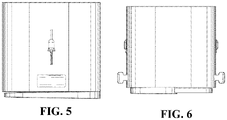
- FIG. 5 illustrates an exemplary embodiment of the inventive apparatus from a front view.
- FIG. 6 illustrates an exemplary embodiment of the inventive apparatus from a side view.
- FIG. 7 illustrates an exemplary embodiment of the inventive apparatus from a top view.
- FIG. 8 illustrates an exemplary embodiment of the inventive apparatus from a bottom view.
- FIG. 9 illustrates an adjustment mechanism in an open configuration, in accordance with an exemplary embodiment of the invention.
- FIG. 10 illustrates an adjustment mechanism in a closed configuration, in accordance with an exemplary embodiment of the invention.
- the present invention is for an apparatus for applying a compressive bandage on a residual limb that has been amputated, the apparatus comprising a housing having an interior portion, an exterior portion, an entrance portion, and an exit portion, the interior portion defining an opening that is accessible from the entrance portion and the exit portion, the opening being large enough to accommodate a residual limb, an attachment mechanism for attaching a compressive bandage to the housing, the attachment mechanism enabling an attached compressive bandage to extend across the interior portion of the housing, and a release mechanism for releasing the attached compressive bandage from the attachment mechanism, the release mechanism configured to release the attached compressive bandage once the garment has sufficiently enveloped a residual limb that may be travelling through the opening defined by the interior portion.
- Devices and parts that are connected to each other need not be in continuous connection with each other, unless expressly specified otherwise.
- devices and parts that are connected with each other may be connected directly or indirectly through one or more connection means or intermediaries.
- steps may be performed simultaneously despite being described or implied as occurring non-simultaneously (e.g., because one step is described after the other step).
- the illustration of a process by its depiction in a drawing does not imply that the illustrated process is exclusive of other variations and modifications thereto, does not imply that the illustrated process or any of its steps are necessary to one or more of the embodiments, and does not imply that the illustrated process is preferred.
- steps are generally described once per aspect, but this does not mean they must occur once, or that they may only occur once each time a process, or method is carried out or executed. Some steps may be omitted in some embodiments or some occurrences, or some steps may be executed more than once in a given aspect or occurrence.
- system significantly reduces the time, difficulty, and frustration associated with applying a stump shrinker on a residual limb.
- the inventive apparatus may be comprised of a variety of elements.
- the apparatus 100 may be comprised of an housing 101 , comprising an interior portion 202 , an exterior portion 204 , an entrance portion 206 , and an exit portion 208 , the housing defining an opening 102 within the interior portion 202 , an attachment mechanism 103 , an assistance mechanism 104 , a release mechanism 106 , and an adjustment mechanism 108 .
- Some components may be added, removed, or substituted, as described in the specification, and as would be understood by a person of ordinary skill in the art.
- the components described in FIG. 1 and FIG. 2 are for illustration purposes only. Certain components may be added, modified, changed, or removed in accordance with this description, and as would be apparent to a person of ordinary skill in the art without departing from the scope of the invention.
- a user may use the apparatus 100 by moving his or her residual limb through the opening from the entrance portion 206 through the exit portion 208 of the apparatus 100 .
- a compression bandage extending across the entire surface area of the entrance portion 206 would envelope the user's residual limb as it moves through the opening and against the compression bandage.
- the user may release the compression bandage from the apparatus to fully apply the bandage to the residual limb. Thereafter, the user may remove the apparatus 100 (which is now without any compression bandage) by simply sliding the apparatus off the user's limb.
- the apparatus 100 includes a housing 101 .
- the housing may be comprised of an interior portion 202 , an exterior portion 204 , an entrance portion 206 , and an exit portion 208 , the housing defining an opening 102 within the interior portion 202 .
- the various figures provided herein disclose a circular or an oval shaped housing 101 , a variety of different shapes and sizes may be deployed, as would be readily understood by a person of ordinary skill in the art, without departing from the scope of the invention.
- the housing 101 may be comprised of a variety of different materials without departing from the scope of the invention including, but not limited to metal, aluminum, steel, tin, etc. In one embodiment, the housing 101 may be washable and reusable.
- the housing 101 is comprised of sufficient strength to resist compression or deformation that may be caused by a user pulling the apparatus towards or away from the user as the user applies force against a compressive bandage.
- the interior portion 202 of the housing 101 defines an opening 102 that is bound by an entrance portion 206 on one side, and an exit portion 208 on the other end.
- the opening 102 may be an aperture or a cavity, wherein a user may extend his or her limb through the opening from the entrance portion 206 to the exit portion 208 (or vice versa).
- the diameter of the opening 102 may be variable and can be as large or as small as necessary to accommodate various residual limbs.
- the opening 102 may be cylindrical in shape, and may extend the entire length of the apparatus 100 . In other embodiments, the opening may be circular or toroidal in shape. In certain embodiments, the opening 102 may also be tapered in shape such that the opening or aperture on one end is larger than the opening or aperture on the other end.
- the apparatus 100 includes an attachment mechanism 103 for attaching a compression bandage to the apparatus 100 .
- the attachment mechanism is next to and parallel to the exit portion 208 .
- the compression bandage extends across the diameter that is defined by the attachment mechanism 103 .
- the attachment mechanism 103 also includes a mechanism for permitting the compression bandage to slide out of the attachment mechanism when sufficient force is applied to the compression bandage that is extending across surface plane defined by the opening (when the force is applied in a direction that is orthogonal to the surface place).
- the apparatus 100 also includes a release mechanism 106 .
- the release mechanism 106 when activated by the user, releases the compression bandage that was previously attached to the apparatus 100 via the attachment mechanism 103 .
- the release mechanism 106 once a user activates the release mechanism 106 , the compression bandage is released from the apparatus 100 .
- the released compression bandage will envelop the user's limb once the release mechanism 106 is activated.
- the release mechanism 106 is comprised of a slideably movable pin that travels through the length of the apparatus 100 in a direction.
- the slideably movable pin may move in the same direction as a user's residual limb as it (the limb) pushes against the compression bandage.
- the slideably movable pin may move in the opposite direction as a user's residual limb as it (the limb) pushes against the compression bandage.
- the adjustment mechanism 108 permits a user to change the diameter or the size of the aperture/opening 102 .
- the adjustment mechanism 108 is comprised of a ratcheting system with interlocking teeth and a handle, wherein the interlocking teeth click or lock into place when a user manipulates the handle.
- the specific operation of the ratcheting system would be readily understood by a person of ordinary skill in the art.
- any mechanism used to change the diameter/size of the aperture may be used, as would be understood by a person of ordinary skill in the art, without departing from the scope of the invention.
- the apparatus 100 may also include an assistance mechanism 104 that helps a user manipulate the apparatus 100 and makes it easier to apply a compression bandage as described herein.
- the apparatus 100 includes a handle 104 .
- only a singular handle or assistance mechanism 104 may be disposed on the inventive apparatus.
- additional assistance mechanisms 104 may be provided.
- the assistance mechanism 104 permits a user to pull the apparatus closer to the user's body, while, at the same time, permitting a residual limb to travel through the opening in the direction that is away from the user's body.
- the assistance mechanism 104 therefore, makes it easier to use the inventive apparatus 100 .
- the assistance mechanism 104 may include a variety of different shapes/designs, as would be readily understood by a person of ordinary skill in the art, including, handles wherein a user may slide his or her fingers within a handle opening, soft edge foam handles, handles with rubberized or texturized grip for a better grip, a bar type extension that a user may grasp within the palm of his or her hand, etc.
- the assistance mechanism 104 may connect to another stationary platform or an object so that a user may apply a compression bandage around his or her residual limb by simply moving his or her limb through the opening without having to push the apparatus closer or away from his or her body.
- the assistance mechanism 104 may be comprised of an external support frame, which permits hands-free operation.
- the assistance mechanism 104 may include a stand or a mount that may attach to another object such that the user can simply push his or her residual limb through the opening 102 without having to otherwise hold the apparatus 100 .
- stand/mounting systems include clamps or clips that may attach to a table, coupling grommets that may attach to a base unit or some other surface, etc.
- the invention disclosed herein also includes a method for using the apparatus 100 described in the specification above.
- the method is comprised of the following steps: attaching a compression bandage to the attachment mechanism of the apparatus, moving a residual limb through the opening of the apparatus and pushing against the compression bandage that is extending across the bottom portion of the opening, releasing the compression bandage via a release mechanism once the residual limb is sufficiently through the inner opening, thereby causing the compression bandage to thoroughly envelop the residual limb.
- any reference to “one embodiment” or “an embodiment” means that a particular element, feature, structure, or characteristic described in connection with the embodiment is included in at least one embodiment.
- the appearances of the phrase “in one embodiment” in various places in the specification are not necessarily all referring to the same embodiment.
- Coupled and “connected” along with their derivatives.
- some embodiments be described using the term “coupled” to indicate that two or more elements are in direct physical or electrical contact.
- the term “coupled,” however, may also mean that two or more elements are not in direct contact with each other, but yet still co-operate or interact with each other.
- the embodiments are not limited in this context.
- the terms “comprises,” “comprising,” “includes,” “including,” “has,” “having” or any other variation thereof, are intended to cover a non-exclusive inclusion.
- a process, method, article, or apparatus that comprises a list of elements is not necessarily limited to only those elements but may include other elements not expressly listed or inherent to such process, method, article, or apparatus.
- “or” refers to an inclusive or and not to an exclusive or. For example, a condition A or B is satisfied by any one of the following: A is true (or present) and B is false (or not present), A is false (or not present) and B is true (or present), and both A and B are true (or present).
Landscapes
- Health & Medical Sciences (AREA)
- Engineering & Computer Science (AREA)
- Biomedical Technology (AREA)
- Heart & Thoracic Surgery (AREA)
- Vascular Medicine (AREA)
- Life Sciences & Earth Sciences (AREA)
- Animal Behavior & Ethology (AREA)
- General Health & Medical Sciences (AREA)
- Public Health (AREA)
- Veterinary Medicine (AREA)
- Cardiology (AREA)
- Oral & Maxillofacial Surgery (AREA)
- Transplantation (AREA)
- Epidemiology (AREA)
- Orthopedics, Nursing, And Contraception (AREA)
Abstract
Description
Claims (10)
Priority Applications (1)
| Application Number | Priority Date | Filing Date | Title |
|---|---|---|---|
| US16/576,761 US11389334B2 (en) | 2018-09-19 | 2019-09-19 | Apparatus for applying a compression bandage |
Applications Claiming Priority (2)
| Application Number | Priority Date | Filing Date | Title |
|---|---|---|---|
| US201862733597P | 2018-09-19 | 2018-09-19 | |
| US16/576,761 US11389334B2 (en) | 2018-09-19 | 2019-09-19 | Apparatus for applying a compression bandage |
Publications (2)
| Publication Number | Publication Date |
|---|---|
| US20200085631A1 US20200085631A1 (en) | 2020-03-19 |
| US11389334B2 true US11389334B2 (en) | 2022-07-19 |
Family
ID=69772684
Family Applications (1)
| Application Number | Title | Priority Date | Filing Date |
|---|---|---|---|
| US16/576,761 Active 2040-09-17 US11389334B2 (en) | 2018-09-19 | 2019-09-19 | Apparatus for applying a compression bandage |
Country Status (1)
| Country | Link |
|---|---|
| US (1) | US11389334B2 (en) |
Citations (15)
| Publication number | Priority date | Publication date | Assignee | Title |
|---|---|---|---|---|
| US1992344A (en) * | 1934-02-05 | 1935-02-26 | Alhadate Alejandro | Bandage applying device |
| US2571946A (en) * | 1949-08-06 | 1951-10-16 | Scholl Mfg Co Inc | Tubular bandage |
| US2739587A (en) * | 1952-09-26 | 1956-03-27 | Scholl Mfg Co Inc | Tubular bandage applicator |
| GB858821A (en) * | 1958-07-29 | 1961-01-18 | Vernon & Company Ltd | Improvements in or relating to applicators for tubular dressings |
| US3358682A (en) * | 1965-03-23 | 1967-12-19 | Preston Norman Roy | Tubular bandage applicator and cut-off |
| US3941125A (en) * | 1975-02-28 | 1976-03-02 | Arvel Drake | Tubular gauze bandage applicator |
| GB2211740A (en) * | 1987-11-04 | 1989-07-12 | Martin Brown | Tubular bandage applicator |
| DE4228916A1 (en) * | 1992-08-28 | 1994-03-03 | Weihermueller & Voigtmann | Adjustable fitting aid for stocking - useful for pulling medical compression stocking onto pain sensitive patient |
| CA2272661A1 (en) * | 1999-05-04 | 2000-11-04 | Wilbur Randall Lindgren | The stocking applicator |
| US6869410B1 (en) * | 2002-07-30 | 2005-03-22 | Robert L. Mosemiller | Compression garment fitting device |
| US20090120975A1 (en) * | 2007-11-09 | 2009-05-14 | Schoepe Erich G | Sock donning device |
| US20100147908A1 (en) * | 2006-01-30 | 2010-06-17 | Robert Graham Mitchell Skerman | Applicator for compression stockings and the like |
| US20140039362A1 (en) * | 2012-08-03 | 2014-02-06 | Advanced Orthopedic Products and Services, Inc. | Shrinker donner device and method |
| US9635967B1 (en) * | 2015-11-03 | 2017-05-02 | Charles Hopper | Sock-donning tripod stand for use with amputee |
| US10568769B2 (en) * | 2016-05-27 | 2020-02-25 | Evadne I. Hutchful | Fabric sleeves covering toe and finger blemishes and treating said blemishes |
-
2019
- 2019-09-19 US US16/576,761 patent/US11389334B2/en active Active
Patent Citations (15)
| Publication number | Priority date | Publication date | Assignee | Title |
|---|---|---|---|---|
| US1992344A (en) * | 1934-02-05 | 1935-02-26 | Alhadate Alejandro | Bandage applying device |
| US2571946A (en) * | 1949-08-06 | 1951-10-16 | Scholl Mfg Co Inc | Tubular bandage |
| US2739587A (en) * | 1952-09-26 | 1956-03-27 | Scholl Mfg Co Inc | Tubular bandage applicator |
| GB858821A (en) * | 1958-07-29 | 1961-01-18 | Vernon & Company Ltd | Improvements in or relating to applicators for tubular dressings |
| US3358682A (en) * | 1965-03-23 | 1967-12-19 | Preston Norman Roy | Tubular bandage applicator and cut-off |
| US3941125A (en) * | 1975-02-28 | 1976-03-02 | Arvel Drake | Tubular gauze bandage applicator |
| GB2211740A (en) * | 1987-11-04 | 1989-07-12 | Martin Brown | Tubular bandage applicator |
| DE4228916A1 (en) * | 1992-08-28 | 1994-03-03 | Weihermueller & Voigtmann | Adjustable fitting aid for stocking - useful for pulling medical compression stocking onto pain sensitive patient |
| CA2272661A1 (en) * | 1999-05-04 | 2000-11-04 | Wilbur Randall Lindgren | The stocking applicator |
| US6869410B1 (en) * | 2002-07-30 | 2005-03-22 | Robert L. Mosemiller | Compression garment fitting device |
| US20100147908A1 (en) * | 2006-01-30 | 2010-06-17 | Robert Graham Mitchell Skerman | Applicator for compression stockings and the like |
| US20090120975A1 (en) * | 2007-11-09 | 2009-05-14 | Schoepe Erich G | Sock donning device |
| US20140039362A1 (en) * | 2012-08-03 | 2014-02-06 | Advanced Orthopedic Products and Services, Inc. | Shrinker donner device and method |
| US9635967B1 (en) * | 2015-11-03 | 2017-05-02 | Charles Hopper | Sock-donning tripod stand for use with amputee |
| US10568769B2 (en) * | 2016-05-27 | 2020-02-25 | Evadne I. Hutchful | Fabric sleeves covering toe and finger blemishes and treating said blemishes |
Also Published As
| Publication number | Publication date |
|---|---|
| US20200085631A1 (en) | 2020-03-19 |
Similar Documents
| Publication | Publication Date | Title |
|---|---|---|
| CN102811690B (en) | hand rehabilitation device | |
| EP2111200B1 (en) | Applicator for compression stockings and the like | |
| CN101505698B (en) | A compression stocking applicator | |
| JPH0197456A (en) | Device or artificial member for adjusting movement of member | |
| US10456162B2 (en) | Disposable apparatus for fitly circumcising a penis | |
| KR101835159B1 (en) | Garment donner and doffer | |
| US20070252096A1 (en) | Pinch clamp | |
| US3727812A (en) | Device for applying stockings and the like | |
| ITFI20130277A1 (en) | MANIPULATOR FOR CATHETERS OR CANNULA FOR MEDICAL USE. | |
| US20060076372A1 (en) | Device for fitting a support stocking on a person and for taking off the same | |
| EP3441105B1 (en) | Packaged urinary catheter with dispensing device | |
| JP2019521817A (en) | Penis traction device | |
| US20120228343A1 (en) | Sock hand | |
| US11389334B2 (en) | Apparatus for applying a compression bandage | |
| JP2821216B2 (en) | Orthodontic ligature gun | |
| WO2019186524A1 (en) | Hemostatic device | |
| KR100567588B1 (en) | Device for correcting phimosis | |
| CA2297217A1 (en) | Device for combined urinary drainage and catheterization of incontinent male human beings | |
| NZ540912A (en) | An hand orthosis including a hand part, a thumb part and a forearm part, with a flexible connection which draws a user's thumb toward their index finger when the wrist is extended | |
| US10278881B1 (en) | Devices and methods for assisting pronation and/or supination | |
| NL9000361A (en) | Stocking fitting and removal aid - has annular component round which stocking end fits, and clamp | |
| US11590012B2 (en) | Orthopedic device | |
| US20160044999A1 (en) | Devices, systems, and methods for combining mobility and reaching aids | |
| CA3228017A1 (en) | Tampon insertion device and method | |
| FR3070850B1 (en) | ARTERIAL HEMOSTATIC COMPRESSION DEVICE |
Legal Events
| Date | Code | Title | Description |
|---|---|---|---|
| FEPP | Fee payment procedure |
Free format text: ENTITY STATUS SET TO UNDISCOUNTED (ORIGINAL EVENT CODE: BIG.); ENTITY STATUS OF PATENT OWNER: SMALL ENTITY |
|
| FEPP | Fee payment procedure |
Free format text: ENTITY STATUS SET TO SMALL (ORIGINAL EVENT CODE: SMAL); ENTITY STATUS OF PATENT OWNER: SMALL ENTITY |
|
| STPP | Information on status: patent application and granting procedure in general |
Free format text: DOCKETED NEW CASE - READY FOR EXAMINATION |
|
| STPP | Information on status: patent application and granting procedure in general |
Free format text: NON FINAL ACTION MAILED |
|
| STPP | Information on status: patent application and granting procedure in general |
Free format text: RESPONSE TO NON-FINAL OFFICE ACTION ENTERED AND FORWARDED TO EXAMINER |
|
| STPP | Information on status: patent application and granting procedure in general |
Free format text: NOTICE OF ALLOWANCE MAILED -- APPLICATION RECEIVED IN OFFICE OF PUBLICATIONS |
|
| STPP | Information on status: patent application and granting procedure in general |
Free format text: PUBLICATIONS -- ISSUE FEE PAYMENT VERIFIED |
|
| STCF | Information on status: patent grant |
Free format text: PATENTED CASE |
|
| MAFP | Maintenance fee payment |
Free format text: PAYMENT OF MAINTENANCE FEE, 4TH YR, SMALL ENTITY (ORIGINAL EVENT CODE: M2551); ENTITY STATUS OF PATENT OWNER: SMALL ENTITY Year of fee payment: 4 |