US11371131B2 - Powder for film formation and material for film formation - Google Patents

Powder for film formation and material for film formation Download PDF

Info

Publication number
US11371131B2
US11371131B2 US16/882,050 US202016882050A US11371131B2 US 11371131 B2 US11371131 B2 US 11371131B2 US 202016882050 A US202016882050 A US 202016882050A US 11371131 B2 US11371131 B2 US 11371131B2
Authority
US
United States
Prior art keywords
coating
powder
rare earth
coating powder
rays
Prior art date
Legal status (The legal status is an assumption and is not a legal conclusion. Google has not performed a legal analysis and makes no representation as to the accuracy of the status listed.)
Active
Application number
US16/882,050
Other versions
US20200283881A1 (en
Inventor
Ryuichi Sato
Naoki Fukagawa
Yuji SHIGEYOSHI
Kento MATSUKURA
Current Assignee (The listed assignees may be inaccurate. Google has not performed a legal analysis and makes no representation or warranty as to the accuracy of the list.)
Mitsui Kinzoku Co Ltd
Original Assignee
Nippon Yttrium Co Ltd
Priority date (The priority date is an assumption and is not a legal conclusion. Google has not performed a legal analysis and makes no representation as to the accuracy of the date listed.)
Filing date
Publication date
Family has litigation
First worldwide family litigation filed litigation Critical https://patents.darts-ip.com/?family=56614697&utm_source=google_patent&utm_medium=platform_link&utm_campaign=public_patent_search&patent=US11371131(B2) "Global patent litigation dataset” by Darts-ip is licensed under a Creative Commons Attribution 4.0 International License.
Application filed by Nippon Yttrium Co Ltd filed Critical Nippon Yttrium Co Ltd
Priority to US16/882,050 priority Critical patent/US11371131B2/en
Publication of US20200283881A1 publication Critical patent/US20200283881A1/en
Application granted granted Critical
Publication of US11371131B2 publication Critical patent/US11371131B2/en
Assigned to MITSUI MINING & SMELTING CO., LTD. reassignment MITSUI MINING & SMELTING CO., LTD. MERGER (SEE DOCUMENT FOR DETAILS). Assignors: NIPPON YTTRIUM CO., LTD.
Active legal-status Critical Current
Anticipated expiration legal-status Critical

Links

Images

Classifications

    • CCHEMISTRY; METALLURGY
    • C23COATING METALLIC MATERIAL; COATING MATERIAL WITH METALLIC MATERIAL; CHEMICAL SURFACE TREATMENT; DIFFUSION TREATMENT OF METALLIC MATERIAL; COATING BY VACUUM EVAPORATION, BY SPUTTERING, BY ION IMPLANTATION OR BY CHEMICAL VAPOUR DEPOSITION, IN GENERAL; INHIBITING CORROSION OF METALLIC MATERIAL OR INCRUSTATION IN GENERAL
    • C23CCOATING METALLIC MATERIAL; COATING MATERIAL WITH METALLIC MATERIAL; SURFACE TREATMENT OF METALLIC MATERIAL BY DIFFUSION INTO THE SURFACE, BY CHEMICAL CONVERSION OR SUBSTITUTION; COATING BY VACUUM EVAPORATION, BY SPUTTERING, BY ION IMPLANTATION OR BY CHEMICAL VAPOUR DEPOSITION, IN GENERAL
    • C23C4/00Coating by spraying the coating material in the molten state, e.g. by flame, plasma or electric discharge
    • C23C4/04Coating by spraying the coating material in the molten state, e.g. by flame, plasma or electric discharge characterised by the coating material
    • C23C4/10Oxides, borides, carbides, nitrides or silicides; Mixtures thereof
    • CCHEMISTRY; METALLURGY
    • C04CEMENTS; CONCRETE; ARTIFICIAL STONE; CERAMICS; REFRACTORIES
    • C04BLIME, MAGNESIA; SLAG; CEMENTS; COMPOSITIONS THEREOF, e.g. MORTARS, CONCRETE OR LIKE BUILDING MATERIALS; ARTIFICIAL STONE; CERAMICS; REFRACTORIES; TREATMENT OF NATURAL STONE
    • C04B35/00Shaped ceramic products characterised by their composition; Ceramics compositions; Processing powders of inorganic compounds preparatory to the manufacturing of ceramic products
    • C04B35/50Shaped ceramic products characterised by their composition; Ceramics compositions; Processing powders of inorganic compounds preparatory to the manufacturing of ceramic products based on rare-earth compounds
    • CCHEMISTRY; METALLURGY
    • C04CEMENTS; CONCRETE; ARTIFICIAL STONE; CERAMICS; REFRACTORIES
    • C04BLIME, MAGNESIA; SLAG; CEMENTS; COMPOSITIONS THEREOF, e.g. MORTARS, CONCRETE OR LIKE BUILDING MATERIALS; ARTIFICIAL STONE; CERAMICS; REFRACTORIES; TREATMENT OF NATURAL STONE
    • C04B35/00Shaped ceramic products characterised by their composition; Ceramics compositions; Processing powders of inorganic compounds preparatory to the manufacturing of ceramic products
    • C04B35/515Shaped ceramic products characterised by their composition; Ceramics compositions; Processing powders of inorganic compounds preparatory to the manufacturing of ceramic products based on non-oxide ceramics
    • C04B35/5156Shaped ceramic products characterised by their composition; Ceramics compositions; Processing powders of inorganic compounds preparatory to the manufacturing of ceramic products based on non-oxide ceramics based on rare earth compounds
    • CCHEMISTRY; METALLURGY
    • C04CEMENTS; CONCRETE; ARTIFICIAL STONE; CERAMICS; REFRACTORIES
    • C04BLIME, MAGNESIA; SLAG; CEMENTS; COMPOSITIONS THEREOF, e.g. MORTARS, CONCRETE OR LIKE BUILDING MATERIALS; ARTIFICIAL STONE; CERAMICS; REFRACTORIES; TREATMENT OF NATURAL STONE
    • C04B35/00Shaped ceramic products characterised by their composition; Ceramics compositions; Processing powders of inorganic compounds preparatory to the manufacturing of ceramic products
    • C04B35/515Shaped ceramic products characterised by their composition; Ceramics compositions; Processing powders of inorganic compounds preparatory to the manufacturing of ceramic products based on non-oxide ceramics
    • C04B35/553Shaped ceramic products characterised by their composition; Ceramics compositions; Processing powders of inorganic compounds preparatory to the manufacturing of ceramic products based on non-oxide ceramics based on fluorides
    • CCHEMISTRY; METALLURGY
    • C23COATING METALLIC MATERIAL; COATING MATERIAL WITH METALLIC MATERIAL; CHEMICAL SURFACE TREATMENT; DIFFUSION TREATMENT OF METALLIC MATERIAL; COATING BY VACUUM EVAPORATION, BY SPUTTERING, BY ION IMPLANTATION OR BY CHEMICAL VAPOUR DEPOSITION, IN GENERAL; INHIBITING CORROSION OF METALLIC MATERIAL OR INCRUSTATION IN GENERAL
    • C23CCOATING METALLIC MATERIAL; COATING MATERIAL WITH METALLIC MATERIAL; SURFACE TREATMENT OF METALLIC MATERIAL BY DIFFUSION INTO THE SURFACE, BY CHEMICAL CONVERSION OR SUBSTITUTION; COATING BY VACUUM EVAPORATION, BY SPUTTERING, BY ION IMPLANTATION OR BY CHEMICAL VAPOUR DEPOSITION, IN GENERAL
    • C23C14/00Coating by vacuum evaporation, by sputtering or by ion implantation of the coating forming material
    • C23C14/06Coating by vacuum evaporation, by sputtering or by ion implantation of the coating forming material characterised by the coating material
    • CCHEMISTRY; METALLURGY
    • C23COATING METALLIC MATERIAL; COATING MATERIAL WITH METALLIC MATERIAL; CHEMICAL SURFACE TREATMENT; DIFFUSION TREATMENT OF METALLIC MATERIAL; COATING BY VACUUM EVAPORATION, BY SPUTTERING, BY ION IMPLANTATION OR BY CHEMICAL VAPOUR DEPOSITION, IN GENERAL; INHIBITING CORROSION OF METALLIC MATERIAL OR INCRUSTATION IN GENERAL
    • C23CCOATING METALLIC MATERIAL; COATING MATERIAL WITH METALLIC MATERIAL; SURFACE TREATMENT OF METALLIC MATERIAL BY DIFFUSION INTO THE SURFACE, BY CHEMICAL CONVERSION OR SUBSTITUTION; COATING BY VACUUM EVAPORATION, BY SPUTTERING, BY ION IMPLANTATION OR BY CHEMICAL VAPOUR DEPOSITION, IN GENERAL
    • C23C14/00Coating by vacuum evaporation, by sputtering or by ion implantation of the coating forming material
    • C23C14/06Coating by vacuum evaporation, by sputtering or by ion implantation of the coating forming material characterised by the coating material
    • C23C14/0694Halides
    • CCHEMISTRY; METALLURGY
    • C23COATING METALLIC MATERIAL; COATING MATERIAL WITH METALLIC MATERIAL; CHEMICAL SURFACE TREATMENT; DIFFUSION TREATMENT OF METALLIC MATERIAL; COATING BY VACUUM EVAPORATION, BY SPUTTERING, BY ION IMPLANTATION OR BY CHEMICAL VAPOUR DEPOSITION, IN GENERAL; INHIBITING CORROSION OF METALLIC MATERIAL OR INCRUSTATION IN GENERAL
    • C23CCOATING METALLIC MATERIAL; COATING MATERIAL WITH METALLIC MATERIAL; SURFACE TREATMENT OF METALLIC MATERIAL BY DIFFUSION INTO THE SURFACE, BY CHEMICAL CONVERSION OR SUBSTITUTION; COATING BY VACUUM EVAPORATION, BY SPUTTERING, BY ION IMPLANTATION OR BY CHEMICAL VAPOUR DEPOSITION, IN GENERAL
    • C23C14/00Coating by vacuum evaporation, by sputtering or by ion implantation of the coating forming material
    • C23C14/22Coating by vacuum evaporation, by sputtering or by ion implantation of the coating forming material characterised by the process of coating
    • C23C14/24Vacuum evaporation
    • C23C14/26Vacuum evaporation by resistance or inductive heating of the source
    • CCHEMISTRY; METALLURGY
    • C23COATING METALLIC MATERIAL; COATING MATERIAL WITH METALLIC MATERIAL; CHEMICAL SURFACE TREATMENT; DIFFUSION TREATMENT OF METALLIC MATERIAL; COATING BY VACUUM EVAPORATION, BY SPUTTERING, BY ION IMPLANTATION OR BY CHEMICAL VAPOUR DEPOSITION, IN GENERAL; INHIBITING CORROSION OF METALLIC MATERIAL OR INCRUSTATION IN GENERAL
    • C23CCOATING METALLIC MATERIAL; COATING MATERIAL WITH METALLIC MATERIAL; SURFACE TREATMENT OF METALLIC MATERIAL BY DIFFUSION INTO THE SURFACE, BY CHEMICAL CONVERSION OR SUBSTITUTION; COATING BY VACUUM EVAPORATION, BY SPUTTERING, BY ION IMPLANTATION OR BY CHEMICAL VAPOUR DEPOSITION, IN GENERAL
    • C23C14/00Coating by vacuum evaporation, by sputtering or by ion implantation of the coating forming material
    • C23C14/22Coating by vacuum evaporation, by sputtering or by ion implantation of the coating forming material characterised by the process of coating
    • C23C14/24Vacuum evaporation
    • C23C14/32Vacuum evaporation by explosion; by evaporation and subsequent ionisation of the vapours, e.g. ion-plating
    • CCHEMISTRY; METALLURGY
    • C23COATING METALLIC MATERIAL; COATING MATERIAL WITH METALLIC MATERIAL; CHEMICAL SURFACE TREATMENT; DIFFUSION TREATMENT OF METALLIC MATERIAL; COATING BY VACUUM EVAPORATION, BY SPUTTERING, BY ION IMPLANTATION OR BY CHEMICAL VAPOUR DEPOSITION, IN GENERAL; INHIBITING CORROSION OF METALLIC MATERIAL OR INCRUSTATION IN GENERAL
    • C23CCOATING METALLIC MATERIAL; COATING MATERIAL WITH METALLIC MATERIAL; SURFACE TREATMENT OF METALLIC MATERIAL BY DIFFUSION INTO THE SURFACE, BY CHEMICAL CONVERSION OR SUBSTITUTION; COATING BY VACUUM EVAPORATION, BY SPUTTERING, BY ION IMPLANTATION OR BY CHEMICAL VAPOUR DEPOSITION, IN GENERAL
    • C23C14/00Coating by vacuum evaporation, by sputtering or by ion implantation of the coating forming material
    • C23C14/22Coating by vacuum evaporation, by sputtering or by ion implantation of the coating forming material characterised by the process of coating
    • C23C14/34Sputtering
    • CCHEMISTRY; METALLURGY
    • C23COATING METALLIC MATERIAL; COATING MATERIAL WITH METALLIC MATERIAL; CHEMICAL SURFACE TREATMENT; DIFFUSION TREATMENT OF METALLIC MATERIAL; COATING BY VACUUM EVAPORATION, BY SPUTTERING, BY ION IMPLANTATION OR BY CHEMICAL VAPOUR DEPOSITION, IN GENERAL; INHIBITING CORROSION OF METALLIC MATERIAL OR INCRUSTATION IN GENERAL
    • C23CCOATING METALLIC MATERIAL; COATING MATERIAL WITH METALLIC MATERIAL; SURFACE TREATMENT OF METALLIC MATERIAL BY DIFFUSION INTO THE SURFACE, BY CHEMICAL CONVERSION OR SUBSTITUTION; COATING BY VACUUM EVAPORATION, BY SPUTTERING, BY ION IMPLANTATION OR BY CHEMICAL VAPOUR DEPOSITION, IN GENERAL
    • C23C14/00Coating by vacuum evaporation, by sputtering or by ion implantation of the coating forming material
    • C23C14/22Coating by vacuum evaporation, by sputtering or by ion implantation of the coating forming material characterised by the process of coating
    • C23C14/34Sputtering
    • C23C14/3407Cathode assembly for sputtering apparatus, e.g. Target
    • C23C14/3414Metallurgical or chemical aspects of target preparation, e.g. casting, powder metallurgy
    • CCHEMISTRY; METALLURGY
    • C23COATING METALLIC MATERIAL; COATING MATERIAL WITH METALLIC MATERIAL; CHEMICAL SURFACE TREATMENT; DIFFUSION TREATMENT OF METALLIC MATERIAL; COATING BY VACUUM EVAPORATION, BY SPUTTERING, BY ION IMPLANTATION OR BY CHEMICAL VAPOUR DEPOSITION, IN GENERAL; INHIBITING CORROSION OF METALLIC MATERIAL OR INCRUSTATION IN GENERAL
    • C23CCOATING METALLIC MATERIAL; COATING MATERIAL WITH METALLIC MATERIAL; SURFACE TREATMENT OF METALLIC MATERIAL BY DIFFUSION INTO THE SURFACE, BY CHEMICAL CONVERSION OR SUBSTITUTION; COATING BY VACUUM EVAPORATION, BY SPUTTERING, BY ION IMPLANTATION OR BY CHEMICAL VAPOUR DEPOSITION, IN GENERAL
    • C23C14/00Coating by vacuum evaporation, by sputtering or by ion implantation of the coating forming material
    • C23C14/22Coating by vacuum evaporation, by sputtering or by ion implantation of the coating forming material characterised by the process of coating
    • C23C14/34Sputtering
    • C23C14/35Sputtering by application of a magnetic field, e.g. magnetron sputtering
    • CCHEMISTRY; METALLURGY
    • C23COATING METALLIC MATERIAL; COATING MATERIAL WITH METALLIC MATERIAL; CHEMICAL SURFACE TREATMENT; DIFFUSION TREATMENT OF METALLIC MATERIAL; COATING BY VACUUM EVAPORATION, BY SPUTTERING, BY ION IMPLANTATION OR BY CHEMICAL VAPOUR DEPOSITION, IN GENERAL; INHIBITING CORROSION OF METALLIC MATERIAL OR INCRUSTATION IN GENERAL
    • C23CCOATING METALLIC MATERIAL; COATING MATERIAL WITH METALLIC MATERIAL; SURFACE TREATMENT OF METALLIC MATERIAL BY DIFFUSION INTO THE SURFACE, BY CHEMICAL CONVERSION OR SUBSTITUTION; COATING BY VACUUM EVAPORATION, BY SPUTTERING, BY ION IMPLANTATION OR BY CHEMICAL VAPOUR DEPOSITION, IN GENERAL
    • C23C24/00Coating starting from inorganic powder
    • C23C24/02Coating starting from inorganic powder by application of pressure only
    • C23C24/04Impact or kinetic deposition of particles
    • CCHEMISTRY; METALLURGY
    • C23COATING METALLIC MATERIAL; COATING MATERIAL WITH METALLIC MATERIAL; CHEMICAL SURFACE TREATMENT; DIFFUSION TREATMENT OF METALLIC MATERIAL; COATING BY VACUUM EVAPORATION, BY SPUTTERING, BY ION IMPLANTATION OR BY CHEMICAL VAPOUR DEPOSITION, IN GENERAL; INHIBITING CORROSION OF METALLIC MATERIAL OR INCRUSTATION IN GENERAL
    • C23CCOATING METALLIC MATERIAL; COATING MATERIAL WITH METALLIC MATERIAL; SURFACE TREATMENT OF METALLIC MATERIAL BY DIFFUSION INTO THE SURFACE, BY CHEMICAL CONVERSION OR SUBSTITUTION; COATING BY VACUUM EVAPORATION, BY SPUTTERING, BY ION IMPLANTATION OR BY CHEMICAL VAPOUR DEPOSITION, IN GENERAL
    • C23C24/00Coating starting from inorganic powder
    • C23C24/08Coating starting from inorganic powder by application of heat or pressure and heat
    • C23C24/082Coating starting from inorganic powder by application of heat or pressure and heat without intermediate formation of a liquid in the layer
    • CCHEMISTRY; METALLURGY
    • C23COATING METALLIC MATERIAL; COATING MATERIAL WITH METALLIC MATERIAL; CHEMICAL SURFACE TREATMENT; DIFFUSION TREATMENT OF METALLIC MATERIAL; COATING BY VACUUM EVAPORATION, BY SPUTTERING, BY ION IMPLANTATION OR BY CHEMICAL VAPOUR DEPOSITION, IN GENERAL; INHIBITING CORROSION OF METALLIC MATERIAL OR INCRUSTATION IN GENERAL
    • C23CCOATING METALLIC MATERIAL; COATING MATERIAL WITH METALLIC MATERIAL; SURFACE TREATMENT OF METALLIC MATERIAL BY DIFFUSION INTO THE SURFACE, BY CHEMICAL CONVERSION OR SUBSTITUTION; COATING BY VACUUM EVAPORATION, BY SPUTTERING, BY ION IMPLANTATION OR BY CHEMICAL VAPOUR DEPOSITION, IN GENERAL
    • C23C4/00Coating by spraying the coating material in the molten state, e.g. by flame, plasma or electric discharge
    • C23C4/04Coating by spraying the coating material in the molten state, e.g. by flame, plasma or electric discharge characterised by the coating material
    • CCHEMISTRY; METALLURGY
    • C23COATING METALLIC MATERIAL; COATING MATERIAL WITH METALLIC MATERIAL; CHEMICAL SURFACE TREATMENT; DIFFUSION TREATMENT OF METALLIC MATERIAL; COATING BY VACUUM EVAPORATION, BY SPUTTERING, BY ION IMPLANTATION OR BY CHEMICAL VAPOUR DEPOSITION, IN GENERAL; INHIBITING CORROSION OF METALLIC MATERIAL OR INCRUSTATION IN GENERAL
    • C23CCOATING METALLIC MATERIAL; COATING MATERIAL WITH METALLIC MATERIAL; SURFACE TREATMENT OF METALLIC MATERIAL BY DIFFUSION INTO THE SURFACE, BY CHEMICAL CONVERSION OR SUBSTITUTION; COATING BY VACUUM EVAPORATION, BY SPUTTERING, BY ION IMPLANTATION OR BY CHEMICAL VAPOUR DEPOSITION, IN GENERAL
    • C23C4/00Coating by spraying the coating material in the molten state, e.g. by flame, plasma or electric discharge
    • C23C4/04Coating by spraying the coating material in the molten state, e.g. by flame, plasma or electric discharge characterised by the coating material
    • C23C4/10Oxides, borides, carbides, nitrides or silicides; Mixtures thereof
    • C23C4/11Oxides
    • CCHEMISTRY; METALLURGY
    • C04CEMENTS; CONCRETE; ARTIFICIAL STONE; CERAMICS; REFRACTORIES
    • C04BLIME, MAGNESIA; SLAG; CEMENTS; COMPOSITIONS THEREOF, e.g. MORTARS, CONCRETE OR LIKE BUILDING MATERIALS; ARTIFICIAL STONE; CERAMICS; REFRACTORIES; TREATMENT OF NATURAL STONE
    • C04B2111/00Mortars, concrete or artificial stone or mixtures to prepare them, characterised by specific function, property or use
    • C04B2111/00474Uses not provided for elsewhere in C04B2111/00
    • C04B2111/00482Coating or impregnation materials
    • CCHEMISTRY; METALLURGY
    • C04CEMENTS; CONCRETE; ARTIFICIAL STONE; CERAMICS; REFRACTORIES
    • C04BLIME, MAGNESIA; SLAG; CEMENTS; COMPOSITIONS THEREOF, e.g. MORTARS, CONCRETE OR LIKE BUILDING MATERIALS; ARTIFICIAL STONE; CERAMICS; REFRACTORIES; TREATMENT OF NATURAL STONE
    • C04B2235/00Aspects relating to ceramic starting mixtures or sintered ceramic products
    • C04B2235/02Composition of constituents of the starting material or of secondary phases of the final product
    • C04B2235/30Constituents and secondary phases not being of a fibrous nature
    • C04B2235/32Metal oxides, mixed metal oxides, or oxide-forming salts thereof, e.g. carbonates, nitrates, (oxy)hydroxides, chlorides
    • C04B2235/3224Rare earth oxide or oxide forming salts thereof, e.g. scandium oxide
    • YGENERAL TAGGING OF NEW TECHNOLOGICAL DEVELOPMENTS; GENERAL TAGGING OF CROSS-SECTIONAL TECHNOLOGIES SPANNING OVER SEVERAL SECTIONS OF THE IPC; TECHNICAL SUBJECTS COVERED BY FORMER USPC CROSS-REFERENCE ART COLLECTIONS [XRACs] AND DIGESTS
    • Y10TECHNICAL SUBJECTS COVERED BY FORMER USPC
    • Y10TTECHNICAL SUBJECTS COVERED BY FORMER US CLASSIFICATION
    • Y10T428/00Stock material or miscellaneous articles
    • Y10T428/29Coated or structually defined flake, particle, cell, strand, strand portion, rod, filament, macroscopic fiber or mass thereof

Definitions

  • This invention relates to a coating powder containing a rare earth element and a coating material.
  • a halogen gas is used in an etching step in the fabrication of semiconductor devices.
  • the inner side of the etching apparatus is usually coated with a highly anti-corrosive substance by various coating techniques, such as thermal spraying. Materials containing a rare earth element as one type of such substances are often used.
  • Coating materials containing a rare earth element are usually granulated into flowable granules.
  • To use the coating material in the form of non-granulated powder or slurry containing non-granulated powder has also been under study.
  • thermal spray material comprising a particulate rare earth oxyfluoride having an aspect ratio of 2 or smaller, an average particle size of 10 to 100 ⁇ n, and a bulk density of 0.8 to 2 g/cm 3 and containing not more than 0.5% by mass of carbon and 3 to 15% by mass of oxygen. It is known that this thermal spray material can be prepared by granulation (see Patent Literature 1).
  • a rare earth-containing compound particles for thermal spraying having a polygonal shape with an average particle diameter of 3 to 100 ⁇ m, a dispersion index of up to 0.5, and an aspect ratio of up to 2 is also known.
  • the particles are not granulated so that incorporation of impurities, such as iron, is avoided (see Patent Literature 2).
  • Patent Literature 3 teaches a method for producing an anti-corrosive part composed of a substrate made of ceramics, quartz, or silicon and an anti-corrosive coating of Y 2 O 3 . According to the method, a Y 2 O 3 anti-corrosive coating having a thickness of 1 to 100 ⁇ m is formed on the substrate by physical vapor deposition (PVD), such as ion plating.
  • PVD physical vapor deposition
  • Patent Literature 1 US 2014057078A1
  • Patent Literature 2 US 2002177014A1
  • Patent Literature 3 JP 2005-97685A
  • the rare earth oxyfluoride thermal spray material of Patent Literature 1 provides a thermal spray coating exhibiting very good anti-corrosion properties. However, because the thermal spray material is prepared by granulation, the resulting thermal spray coating tends to be less dense.
  • the rare earth element-containing compound particles for thermal spraying of Patent Literature 2 substantially consist of a rare earth oxide, so that the resulting thermal spray coating, while satisfactory in resistance to corrosion by a fluorine-based plasma, tends to have insufficient resistance to corrosion by a chlorine-based plasma.
  • the anti-corrosive coating formed by PVD according to Patent Literature 3 which is made of yttrium oxide, exhibits high resistance to corrosion by a fluorine-based plasma but tends to be unsatisfactory against corrosion by a chlorine-based plasma.
  • An object of the invention is to provide a coating powder that eliminates various disadvantages of the aforementioned conventional techniques and a coating material containing the powder.
  • a coating powder containing a rare earth oxyfluoride and having a specific particle size and a specific pore volume measured by mercury intrusion porosimetry provides a very dense and uniform coating having high resistance to corrosion by a chlorine-based plasma, and thus completed the invention.
  • the present invention has been completed on the basis of the above findings and provide a coating powder including a rare earth oxyfluoride (Ln-O—F) and having: an average particle size (D 50 ) of 0.1 to 10 ⁇ m; a pore volume of pores having a diameter of 10 ⁇ m or smaller of 0.1 to 0.5 cm 3 /g as measured by mercury intrusion porosimetry; and a ratio of the maximum peak intensity (S0) assigned to a rare earth oxide (Ln x O y ) in the 2 ⁇ angle range of from 20° to 40° to the maximum peak intensity (S1) assigned to the rare earth oxyfluoride (Ln-O—F) in the same range, S0/S1, of 1.0 or smaller in powder X-ray diffractometry using Cu-K ⁇ rays or Cu-K ⁇ 1 rays.
  • S0/S1 of 1.0 or smaller in powder X-ray diffractometry using Cu-K ⁇ rays or Cu-K ⁇ 1 rays.
  • the invention also provides a coating material comprising the coating powder.
  • the coating powder and the coating material according to the invention form a dense and uniform coating having high resistance to corrosion by not only a fluorine-based plasma but a chlorine-based plasma and less prone to particle shedding during plasma etching.
  • FIG. 1 is an X-ray diffraction pattern of the coating powder of Example 3.
  • FIG. 2 is an X-ray diffraction pattern of the coating powder of Example 10.
  • FIG. 3 is an X-ray diffraction pattern of the coating powder of Example 15.
  • the coating powder of the invention (hereinafter also referred to as “the powder of the invention”) will be described first.
  • the coating powder of the invention is characterized by containing a rare earth oxyfluoride (hereinafter also referred to as Ln-O—F).
  • the rare earth oxyfluoride (Ln-O—F) of the invention is a compound composed of a rare earth element (Ln), oxygen (O), and fluorine (F).
  • the Ln-O—F includes not only a compound having a molar ratio between a rare earth element (Ln), oxygen (O), and fluorine (F), Ln:O:F, of 1:1:1 but a compound having an Ln:O:F molar ratio other than 1:1:1.
  • examples of the Ln-O—F include Y 5 O 4 F 7 , Y 5 O 6 F 7 , Y 7 O 6 F 9 , Y 4 O 6 F 9 , Y 6 O 5 F 8 , Y 17 O 14 F 23 , and (YO 0.826 F 0.17 )F 1.174 as well as YOF, and the coating powder of the invention can contain at least one of these oxyfluorides.
  • the Ln-O—F is preferably a compound represented by LnO x F y (0.3 ⁇ x ⁇ 1.7, 0.1 ⁇ y ⁇ 1.9) in view of ease of preparation of the oxyfluoride and for ensured effects of the invention, i.e., denseness, uniformity, and high corrosion resistance of the resulting coating.
  • x in the above chemical formula is preferably 0.35 ⁇ x ⁇ 1.65, more preferably 0.4 ⁇ x ⁇ 1.6; and y in the formula is preferably 0.2 ⁇ y ⁇ 1.8, more preferably 0.5 ⁇ y ⁇ 1.5.
  • a coating powder having a desired composition of Ln-O—F can be prepared by adjusting the molar ratio of the rare earth fluoride (LnF 3 ) to a rare earth oxide (Ln*) or a rare earth compound that becomes an oxide on firing (Ln*), i.e., LnF 3 /Ln*, used in step 1 or the conditions of firing in step 2 of a preferred process of preparation hereinafter described.
  • Rare earth elements include 16 elements: scandium (Sc), yttrium (Y), lanthanum (La), cerium (Ce), praseodymium (Pr), neodymium (Nd), samarium (Sm), europium (Eu), gadolinium (Gd), terbium (Tb), dysprosium (Dy), holmium (Ho), erbium (Er), thulium (Tm), ytterbium (Yb), and lutetium (Lu).
  • the coating powder of the invention contains at least one of the 16 rare earth elements.
  • yttrium Y
  • Ce cerium
  • Sm samarium
  • Gd gadolinium
  • Dy dysprosium
  • Er erbium
  • Yb ytterbium
  • the powder of the invention containing Ln-O—F may further contain a rare earth fluoride (LnF 3 ).
  • LnF 3 a rare earth fluoride
  • the Ln-O—F-containing particles of the powder of the invention be composed solely of Ln-O—F, but the presence of LnF 3 is acceptable as long as the effects of the invention are not impaired.
  • the LnF 3 content in the Ln-O—F is adjustable by the mixing ratio in step 1 in the hereinafter described process for producing the coating powder of the invention. It is not easy to accurately determine the fluorine content in the powder of the invention.
  • the content of LnF 3 is estimated from the relative intensity of the main peak assigned to LnF 3 with respect to the main peak assigned to Ln-O—F in X-ray diffractometry of the particles of the powder of the invention.
  • the particles are analyzed by X-ray diffractometry using CuK ⁇ or Cu-K ⁇ 1 rays, and a ratio of the maximum peak intensity (S1) assigned to Ln-O—F in the 2 ⁇ angle range of from 20° to 40° to the maximum peak intensity (S2) assigned to LnF 3 in the same range, S1/S2, is obtained.
  • the ratio, S1/S2 is 0.01 or greater, the resulting coating tends to be denser and more uniform and be prevented from generating dust particles (particle shedding) in plasma etching more effectively.
  • the S1/S2 is more preferably 0.02 or greater.
  • the powder of the invention may contain LnF 3 in addition to Ln-O—F as discussed above, it is preferred for the powder not to contain, or as little as possible, Ln x O y , which is an oxide of a rare earth element alone, in view of anti-corrosion properties, particularly resistance to a chlorine-containing gas, of the coating.
  • Ln x O y content in the coating powder of the invention can be minimized by, for example, selecting properly the mixing ratio in step 1 and the firing conditions in step 2 in the hereinafter described process for producing the coating powder.
  • the Ln x O y content is estimated from the intensity of peaks in X-ray diffractometry of the coating powder in the invention.
  • the coating powder of the invention is analyzed by X-ray diffractometry using Cu-K ⁇ rays or Cu-K ⁇ 1 rays, and a ratio of the maximum peak intensity (S0) assigned to a rare earth oxide in the 2 ⁇ angle range of from 20° to 40° to the maximum peak intensity (S1) assigned to a rare earth oxyfluoride in the same range, S0/S1, is obtained.
  • S0 maximum peak intensity
  • S1 maximum peak intensity assigned to a rare earth oxide in the 2 ⁇ angle range of from 20° to 40°
  • S1 maximum peak intensity assigned to a rare earth oxyfluoride in the same range
  • the S0/S1 be 1.0 or smaller.
  • the S0/S1 is preferably 0.20 or smaller, more preferably 0.10 or smaller, even more preferably 0.05 or smaller.
  • the S0/S1 is most preferably 0. With the S0/S1 being as small as 1.0 or less, the coating is highly resistant to not only corrosion by a fluorine-based plasma but corrosion by a chlorine-based plasma.
  • the maximum diffraction peaks assigned to a rare earth oxyfluoride (Ln-O—F), a rare earth oxide (Ln x O y ), and a rare earth fluoride (LnF 3 ) usually appear at a 2 ⁇ angle ranging from 20° to 40°.
  • the maximum diffraction peak assigned to yttrium oxide (Y 2 O 3 ) appears at a 2 ⁇ angle of around 29.10.
  • the S0/S1 should be in the range described above in X-ray diffractometry using Cu-K ⁇ or Cu-K ⁇ 1 rays, it is only necessary that the requirement be satisfied in X-ray diffractometry using either Cu-K ⁇ rays or Cu-K ⁇ 1 rays. It does not mean that the S0/S1 should be in that range in both X-ray diffractometry using Cu-K ⁇ rays and X-ray diffractometry using Cu-K ⁇ 1 rays (the same applies to the S1/S2).
  • Oxides of other forms, such as Ce 2 O 3 , Pr 2 O 3 , PrO 2 , and EuO could be produced under specific conditions but are converted to the above described usual forms when allowed to stand in the air. Therefore, the above described usual oxide forms are preferred.
  • the Ln-O—F-containing particles in the coating powder of the invention have an average particle size of 0.1 to 10 ⁇ m. Having an average particle size of 0.1 ⁇ m or greater, the powder is capable of forming a dense and uniform coating. Having an average particle size of 10 ⁇ m or smaller, the powder is capable of forming a coating dense and less prone to cracking. From these viewpoints, the average particle size of the Ln-O—F-containing powder is preferably 0.2 to 8 ⁇ m, more preferably 0.5 to 6 ⁇ m. As used herein, the term “average particle size” is a diameter at 50% cumulative volume in the particle size distribution (hereinafter also simply referred to as D 50 ).
  • D 50 can be determined by laser diffraction/scattering particle size distribution analysis. Details of the D 50 measurement will be described later.
  • the powder is previously subjected to ultrasonic dispersion treatment at an ultrasonic power of 300 W for 5 minutes (this also applies to the measurement of D 90 and D 10 hereinafter described). Powder whose average particle size is in the range recited can be obtained by properly selecting the grinding conditions in step 3 of the hereinafter described process for producing the coating powder of the invention.
  • the coating powder of the invention prefferably has a dispersion index of 0.7 or smaller as well as the above discussed specific D 50 .
  • the dispersion index is defined to be [(D 90 ⁇ D 10 )/(D 90 +D 10 )], wherein D 90 and D 10 are diameters at 90% and 10% cumulative volumes, respectively, counted from the smallest side in the laser diffraction/scattering particle size distribution.
  • the dispersion index is preferably 0.6 or smaller, even more preferably 0.5 or smaller.
  • the dispersion index is preferably 0.15 or greater, more preferably or greater, even more preferably 0.2 or greater, in view of ease of preparation.
  • Powder of which the dispersion index falls within the above range can be prepared by carrying out the grinding in step 3 in the hereinafter described process of preparation by at least wet grinding or in two or more stages.
  • the coating powder of the invention is also characterized by having a specific volume of pores of 10 ⁇ m or smaller diameter as measured by mercury intrusion porosimetry (hereinafter also simply referred to as the pore volume).
  • the pore volume is a volume of spaces between particles of the coating powder with a given pressure applied thereon.
  • the inventors have extensively investigated into the relation between the physical properties of the powder containing a rare earth oxyfluoride and the density of a coating obtained therefrom and found, as a result, that the pore volume is an important factor for obtaining a dense coating.
  • the pore volume depends on not only the particle size and specific surface area of the coating powder but also the shape and the like of particles constituting the coating powder.
  • the coating powder of the invention it is important for the coating powder of the invention to have a pore volume of pores having a diameter of 10 ⁇ m or smaller of 0.1 to 0.5 cm 3 /g.
  • the inventors have proved that a coating powder having the pore volume in that range can provide a coating which is dense and highly resistant to corrosion by a halogen plasma.
  • the pore volume of the coating powder of the invention is preferably 0.12 to 0.48 cm 3 /g, more preferably 0.15 to 0.45 cm 3 /g.
  • the pore size distribution of the coating powder of the invention as measured by mercury intrusion porosimetry (pore size plotted as abscissa, and log differential pore volume as ordinate) show a peak in a specific range.
  • the coating powder of the invention preferably shows a peak in the range of from 0.1 ⁇ m to 5 ⁇ m in the pore size distribution measured by mercury intrusion porosimetry.
  • the coating powder of the invention which shows a pore size peak in that range forms a coating that is less porous and therefore denser and less liable to cracking on cooling.
  • the pore size peak is preferably observed within a range of from 0.3 to 4 ⁇ m, more preferably from 0.5 to 3 ⁇ m.
  • the results of mercury intrusion porosimetry are usually plotted with the pore size as abscissa and the log differential pore volume as the ordinate. In the invention, too, the results are plotted in that way, and the peak position is obtained from the plots.
  • the pore volume and pore size peak can be adjusted to fall within the respective ranges discussed above by properly selecting various conditions in steps 1 to 3 in the hereinafter described process for preparing the coating powder of the invention, particularly the average particle size (D 50 ) of a rare earth oxide or a rare earth compound capable of becoming an oxide on firing and that of a rare earth fluoride that are to be mixed in step 1, the firing conditions in step 2, and the wet grinding conditions in step 3.
  • the pore volume and the pore size peak can be determined by the methods described in Examples hereinafter given.
  • the coating powder of the invention has a BET specific surface area within a specific range. Specifically, the BET specific surface area of the coating powder of the invention ranges from 1 to 10 m 2 /g.
  • the powder containing the rare earth oxyfluoride moderately melts or vaporizes due to the BET specific surface area in that range thereby to form a dense coating.
  • the BET specific surface area of the coating powder is preferably 1.2 to 9 m 2 /g, more preferably 1.5 to 8 m 2 /g.
  • Coating powder whose BET specific surface area is in that range can be obtained by properly selecting the firing temperature in step 2 of the hereinafter described process for preparation.
  • the BET specific surface area can be determined by the method described in Examples given infra.
  • the coating powder of the invention preferably has a molar ratio of oxygen element (O) to rare earth element (Ln) per kg, an O/Ln molar ratio, of 0.03 to 1.1.
  • O/Ln molar ratio being in that range, the resulting coating exhibits further improved resistance to corrosion by a chlorine-based plasma, and the coating tends to be denser, more uniform, and less liable to particle shedding during plasma etching.
  • the O/Ln molar ratio is more preferably 0.04 to 1.08, even more preferably 0.05 to 1.05.
  • compositions of coating powders identified by X-ray diffractometry include: a composition containing LnF 3 and Ln 7 O 6 F 9 when 0 ⁇ O/Ln ⁇ 0.6; a composition containing Ln 5 O 4 F 7 when 0.6 ⁇ O/Ln ⁇ 0.83; a composition containing Ln 7 O 6 F 9 when 0.83 ⁇ O/Ln ⁇ 0.95; a composition containing LnOF when 0.95 ⁇ O/Ln ⁇ 1.05; and a composition containing LnOF and Ln 2 O 3 when 1.05 ⁇ O/Ln ⁇ 1.45.
  • the above examples of the compositions of coating powders are for illustrative purposes only but not for limitation.
  • the O/Ln molar ratio is calculated from the oxygen content of the coating powder measured by inert gas fusion-IR absorption spectrometry and the rare earth content of the powder measured by acid digestion/ICP-AES.
  • the O/Ln molar ratio can be adjusted to be in the above range by properly selecting the LnF 3 /Ln* molar ratio in step 1, the firing conditions in step 2, and so on in the hereinafter described preferred process for preparation.
  • the coating powder of the invention preferably has an aspect ratio of 1.0 to 5.0 in view of capability of forming a dense and uniform coating. From this viewpoint, the aspect ratio is more preferably 1.0 to 4.0, even more preferably 1.0 to 3.0.
  • the aspect ratio can be determined by the method described in the Examples below. Powder having the above aspect ratio can be obtained by adjusting the size of the grinding medium or the grinding time or by the use of a grinding machine capable of applying a high energy in step 3 described below.
  • the coating material of the invention contains the coating powder of the invention.
  • the coating powder of the invention can be mixed or shaped with other components to provide a coating material that is fed to a coating apparatus more easily.
  • the coating material of the invention preferably has the form of slurry for obtaining a dense coating.
  • the coating material in the form of slurry will also be called a coating slurry.
  • the D 50 , D 90 , D 10 , and dispersion index of the powder particles may be determined as they are suspended in the form of slurry, but the BET specific surface area, pore volume, pore size peak, aspect ratio, and fluorine concentration (described later) of the powder particles are measured after the slurry is thoroughly dried at 110° C.
  • the dispersion medium of the coating slurry may be one of, or a combination of two or more of, water and various organic solvents.
  • An organic solvent having a water solubility of 5 mass % or more or a mixture of such an organic solvent and water is preferred in terms of forming a denser and more uniform coating.
  • the organic solvent with a water solubility of 5 mass % or more may be a freely water-miscible organic solvent.
  • the mixture of the organic solvent having a water solubility of 5 mass % or more and water preferably has an organic solvent to water ratio within the water solubility limit of the organic solvent.
  • the proportion of the organic solvent having a water solubility of 5 mass % or more in the dispersion medium is preferably 5 mass % or more, more preferably 10 mass % or more, even more preferably 12 mass % or more.
  • organic solvent having a water solubility of 5 mass % or more examples include alcohols, ketones, cyclic ethers, formamides, and sulfoxides.
  • the alcohols include monohydric alcohols, such as methanol (methyl alcohol), ethanol (ethyl alcohol), 1-propanol (n-propyl alcohol), 2-propanol (isopropyl alcohol, IPA), 2-methyl-1-propanol (isobutyl alcohol), 2-methyl-2-propanol (tert-butyl alcohol), 1-butanol (n-butyl alcohol), and 2-butanol (sec-butyl alcohol); and polyhydric alcohols, such as 1,2-ethanediol (ethylene glycol), 1,2-propanediol (propylene glycol), 1,3-propanediol (trimethylene glycol), and 1,2,3-propanetriol (glycerol).
  • monohydric alcohols such as methanol (methyl alcohol), ethanol (ethyl alcohol), 1-propanol (n-propyl alcohol), 2-propanol (isopropyl alcohol, IPA), 2-methyl-1-propanol (isobut
  • ketones for use in the invention are propanone (acetone) and 2-butanone (methyl ethyl ketone, MEK).
  • cyclic ethers are tetrahydrofuran (THF) and 1,4-dioxane.
  • formamides include N,N-dimethylformamide (DMF).
  • sulfoxides include dimethyl sulfoxide (DMSO). These organic solvents may be used either individually or as a mixture thereof.
  • organic solvents having a water solubility of 5 mass % or more are alcohols.
  • Monohydric alcohols are more preferred, with at least one of methanol, ethanol, 1-propanol and 2-propanol being particularly preferred.
  • the ethanol concentration is preferably not more than 24 vol % (not more than 20 mass %) so as to be excluded from the list of dangerous goods based on United Nations Recommendations on Transport.
  • the concentration of the coating powder in the coating slurry is preferably 10 to 50 mass %, more preferably 12 to 45 mass %, even more preferably 15 to 40 mass %. With the powder concentration being in that range, the formation of a coating from the slurry can be achieved in a relatively short time with good coating efficiency, and the resulting coating exhibits good uniformity.
  • the coating material in the form of slurry preferably has a viscosity of 100 cP (mPa ⁇ s) or less at 25° C. so that it may be fed stably in thermal spraying to form a uniform coating.
  • the viscosity is more preferably 70 cP (mPa ⁇ s) or less, even more preferably 50 cP (mPa ⁇ s) or less.
  • the lower limit of the viscosity of the coating slurry at 25° C. is not particularly limited but, in view of ease of preparation, is preferably 0.5 cP or more, more preferably 1.0 cP (mPa ⁇ s) or more, even more preferably 1.5 cP (mPa ⁇ s) or more.
  • the coating slurry whose viscosity is in that range may be obtained by properly selecting the amount of the rare earth oxyfluoride particles to be used, the type of the dispersion medium, and the like.
  • the viscosity can be measured by the method described in Examples below.
  • the coating slurry may contain components other than the rare earth oxyfluoride-containing powder and the dispersion medium, such as pH adjustors, dispersants, viscosity modifiers, and bactericides, as long as the effect of the invention is not impaired.
  • the solid matter of the coating slurry may comprise particles other than the rare earth oxyfluoride-containing powder but is preferably composed solely of the rare earth oxyfluoride-containing powder in terms of forming a dense and uniform coating.
  • the coating material of the invention may include sintered compact, which is also preferred for obtaining a dense coating.
  • the coating material in the form of sintered compact is obtained by firing the coating powder of the invention.
  • a coating material comprising a sintered compact of the coating powder of the invention will also be called a coating material in the form of sintered compact.
  • the coating material in the form of sintered compact preferably has the same composition as the coating powder of the invention. Accordingly, the above described preference with respect to the ranges of S0/S1, S 1/S2, and O/Ln molar ratio of the coating powder equally applies to the powder obtained by grinding the coating material in the form of sintered compact.
  • a preferred range of the fluorine concentration is the same as that of the coating powder of the invention as determined by the same method.
  • Coating methods applicable to the invention include thermal spraying, aerosol deposition (AD), and physical vapor deposition (PVD).
  • Thermal spray techniques that can be applied to the coating powder of the invention and the coating material in the form of slurry include flame spraying, high velocity flame spraying (also called high velocity oxygen fuel spraying), detonation spraying, laser thermal spraying, plasma thermal spraying, and laser plasma hybrid spraying.
  • the coating powder of the invention and the coating material containing the powder form a dense and uniform thermal spray coating is believed to be because the coating powder of the invention and the coating material containing the powder are readily fused uniformly when sprayed.
  • the coating powder of the invention is also used in the AD process.
  • the reason why the coating powder of the invention forms a dense and uniform coating by the AD process is considered to be because the coating powder of the invention is readily aerosolized uniformly in the AD process.
  • the AD process is a technique in which an aerosol obtained by mixing the coating powder and a carrier gas at room temperature is jetted from a nozzle at a high velocity and made to collide with a substrate to form a coating film on the substrate. Because the coating powder used in the AD process is especially required to achieve more uniform and denser film formation, it is required to be microfine and uniform in shape, being free from acicular or irregularly shaped particles.
  • the coating powder of the invention for use in the AD process to have an average particle size (D 50 ) of 0.2 to 5 ⁇ m, more preferably 0.5 to 2 ⁇ m, a dispersion index of 0.7 or smaller, more preferably 0.5 or smaller, and an aspect ratio of 1.0 to 3.0, more preferably 1.0 to 2.0.
  • D 50 average particle size
  • PVD Physical Vapor Deposition
  • PVD is largely classified into sputtering, vacuum evaporation, and ion plating (see Patent Map: Chemistry 16: Physical Vapor Deposition, FIG. 4.1 . 1 - 3 , available on the JPO website).
  • the coating powder of the invention can be used in vacuum evaporation and ion plating.
  • Vacuum evaporation is a process in which a coating material is evaporated or sublimated in vacuo, and the vapor of the material reaches and deposits on a substrate to form a coating.
  • Electron beam or laser evaporation processes are preferred because a sufficiently large amount of energy for vaporizing the powder containing the rare earth oxyfluoride is provided.
  • the ion plating process is based on almost the same principle as vacuum evaporation, with the difference being that the evaporant is passed through a plasma to be positively charged, and is attracted to a negatively charged substrate, and deposited on the substrate to form a coating layer.
  • the coating material in the form of sintered compact can be used in vacuum evaporation, sputtering, and ion plating.
  • Sputtering is a process in which high-energy particles in a plasma, etc. are bombarded against a target material to eject particles from the target, and the ejected particles of the target deposit on a substrate to form a coating layer.
  • the coating powder desirably has a composition with a minimized fluoride content whether it is used as such or in the form of sintered compact.
  • the powder prefferably has a small fluorine concentration, specifically not more than 30 mass %, more preferably not more than 25 mass %. While there is no particular lower limit to the fluorine concentration, a fluorine concentration of 5 mass % or more is preferred so as to give a sufficient oxyfluoride content.
  • the fluorine concentration can be determined by the method described in the Examples.
  • the coating powder having the fluorine concentration adjusted within the above range can be obtained by properly selecting the mixing ratio between the rare earth oxide (Ln x O y ) or a rare earth compound capable becoming an oxide on firing and a rare earth fluoride (LnF 3 ) in step 1, the conditions of firing in step 2 of a preferred process of preparation described below, and the like.
  • the reason why the coating powder of the invention or the coating material in the form of sintered compact provides a dense and uniform coating when used to form a coating by the PVD processes is considered to be because they vaporizes uniformly in the PVD processes.
  • a suitable process for preparing the coating powder of the invention will then be described.
  • the process includes the following three essential steps and, as the case may be, an additional step, which will be described in sequence.
  • the rare earth oxide (Ln x O y ) or a rare earth compound capable of becoming an oxide on firing to be subjected to mixing preferably have an average particle size (D 50 ) of 0.1 to 10 ⁇ m, more preferably 0.15 to 8 ⁇ m, even more preferably 0.2 to 7 ⁇ m.
  • the rare earth fluoride (LnF 3 ) to be subjected to mixing preferably has an average particle size (D 50 ) of greater than 5 ⁇ m and not greater than 500 ⁇ m, more preferably greater than 5 ⁇ m and not greater than 100 ⁇ m, even more preferably 5.5 to 50 ⁇ m. Measurements of D 50 of these components are taken after ultrasonication, and specifically, taken in the same manner as described above with respect to the D 50 of the coating powder.
  • the grinding labor will be saved particularly in grinding the rare earth fluoride that needs much labor to grind while securing the reactivity in the firing of step 2, and it is easier to control the pore volume and the peak of the pore size distribution of the finally obtained coating powder within the respective preferred ranges described above.
  • the compound capable of becoming an oxide on firing include an oxalate and a carbonate of a rare earth element.
  • the mixing ratio is preferably such that the molar ratio of the rare earth fluoride (LnF 3 ) to a rare earth oxide (Ln*) or a rare earth compound that becomes an oxide on firing (Ln*), i.e., LnF 3 /Ln* molar ratio, is 0.4 to 55, more preferably 0.42 to 40, even more preferably 0.45 to 30.
  • the mixture obtained in step 1 is fired preferably at a temperature of 750° to 1400° C. When fired at a temperature within that range, the mixture sufficiently produces an oxyfluoride of the rare earth element. Although the rare earth fluoride or a small amount of the rare earth oxide may remain, the reaction may have been insufficient if both the rare earth fluoride and the rare earth oxide remain.
  • the firing temperature is more preferably 800° to 1300° C., even more preferably 850° to 1200° C.
  • the firing time is preferably 1 to 72 hours, more preferably 2 to 60 hours, even more preferably 3 to 48 hours, provided that the firing temperature is in the range recited above. Within these firing time ranges, a rare earth oxyfluoride is sufficiently produced while holding down the energy consumption.
  • the firing may be carried out in an oxygen-containing atmosphere, such as the air.
  • an inert gas atmosphere such as argon gas, or a vacuum atmosphere is preferred, because the rare earth oxyfluoride once formed is liable to decompose to a rare earth oxide in an oxygen-containing atmosphere.
  • the grinding operation may be carried out by any of dry grinding, wet grinding, and a combination of dry grinding and wet grinding.
  • dry grinding may be carried out using a dry ball mill, a dry bead mill, a high-speed rotor impact mill, a jet mill, a grindstone type grinder, a roll mill, or so forth.
  • Wet grinding is preferably carried out in a wet grinding machine using a spherical, cylindrical, or other shaped grinding medium, such as a ball mill, a vibration mill, a bead mill, or Attritor®.
  • the grinding is conducted so as to give ground particles having a D 50 of 0.1 to 10 ⁇ m, preferably 0.2 to 8 ⁇ m, more preferably 0.5 to 6 ⁇ m.
  • the D 50 of the ground particles can be controlled by adjusting the size of the grinding medium used, the grinding time, the number of times of passages, and the like.
  • Materials of the grinding media include zirconia, alumina, silicon nitride, silicon carbide, tungsten carbide, wear resistant steel, and stainless steel. Zirconia may be metal oxide-stabilized zirconia.
  • the dispersion medium used in wet grinding may be selected from those described as the dispersion medium of the coating material in the form of slurry.
  • the dispersion medium used in step 3 and that of the slurry obtained in step 3 may be the same or different.
  • a coating powder having a dispersion index of 0.6 or smaller, particularly 0.5 or smaller is desired, it is preferred to conduct the grinding by dry grinding followed by wet grinding or to conduct wet grinding in two or more stages, i.e., a plurality of stages.
  • the grinding media used in the second and subsequent stages be smaller in size than those used in the preceding stage.
  • the number of the grinding stages is preferably greater, in view of obtaining a powder having the smaller dispersion index. In view of cost and labor, however, two-stage grinding is the most preferred.
  • the ground product as obtained in step 3 is supplied as the coating powder of the invention.
  • the dispersion medium of the slurry to be dried may be water.
  • an organic solvent examples include alcohols, such as methanol, ethanol, 1-propanol, and 2-propanol, and acetone.
  • the drying temperature is preferably 80° to 200° C.
  • the dried product may be lightly disintegrated in dry mode.
  • the coating powder of the invention is thus obtained.
  • the coating material in the form of slurry is obtained through, for example, the following two routes: (1) the coating powder of the invention is mixed with a dispersion medium and (2) the slurry obtained by wet grinding in step 3 above is used as such without drying.
  • the coating powder to be mixed with a dispersion medium may be lightly disintegrated.
  • the coating material in the form of sintered compact is prepared through, for example, the following two methods: (a) the coating powder, either as such or, where needed, after being mixed with, e.g., an organic binder, such as PVC (polyvinyl alcohol), an acrylic resin, or methyl cellulose, and/or water, is shaped by pressing and sintered by firing and (b) the coating powder is sintered by firing while a pressure is applied thereto using, for example, a hot press (HP). While it is the most preferred not to add an organic binder to the powder to be fired, the amount of the organic binder to be added, if used, is preferably 5 mass % or less, more preferably 2 mass % or less.
  • an organic binder such as PVC (polyvinyl alcohol), an acrylic resin, or methyl cellulose, and/or water
  • HP hot press
  • the pressing of the powder is achieved by, for example, die pressing, rubber pressing (cold isotactic pressing), sheet forming, extrusion, or slip casting.
  • the pressure applied in these pressing processes is preferably 30 to 500 MPa, more preferably 50 to 300 MPa.
  • the pressure sintering is achieved by, for example, hot press sintering, pulse current pressure sintering (SPS), or hot isotactic pressing (HIP) sintering.
  • the pressure applied in these pressing processes is preferably 30 to 500 MPa, more preferably 50 to 300 MPa.
  • the firing temperature is preferably 1000 to 1800° C., more preferably 1100° to 1700° C.
  • the firing is preferably conducted in an inert gas (e.g., argon) atmosphere so as to prevent the rare earth oxyfluoride from decomposing to a rare earth oxide.
  • an inert gas e.g., argon
  • the resulting sintered compact may be subjected to machining, such as polishing using, e.g., a fixed abrasive polisher, a silicon carbide slurry, or a diamond slurry, or cutting to a prescribed size using, e.g., a lathe.
  • the thus obtained coating material including the coating powder, is suitably used in the aforementioned various coating techniques.
  • substrates to be coated include metals such as aluminum, metal alloys such as aluminum alloys, ceramics such as alumina, and quartz.
  • a coating powder was prepared in accordance with steps (i) to (iv) below.
  • Yttrium oxide (Y 2 O 3 ) fine powder available from Nippon Yttrium Co., Ltd. (D 50 : 0.24 ⁇ m) and yttrium fluoride (YF 3 ) from Nippon Yttrium Co., Ltd. (D 50 : 7.4 ⁇ m) were mixed at an LnF 3 /Ln* molar ratio shown in Table1.
  • step 1 The mixture obtained in step 1 was put in an alumina boat and fired in an electric oven in the atmosphere at 950° C. for 8 hours.
  • the fired product obtained in step 2 was dry ground in an atomizer (indicated by “A” in Table 1), mixed with an equal mass of pure water, and wet ground first in a bead mill using 2 mm-diameter yttria-stabilized zirconia (YSZ) balls for 2 hours and then in a bead mill using 1.2 mm-diameter YSZ balls for 0.5 hours to make a slurry.
  • YSZ yttria-stabilized zirconia
  • the slurry obtained in step 3 was dried at 120° C. for 12 hours to obtain a coating powder of the invention.
  • the particle size distribution of the resulting coating powder was analyzed to determine D 50 , D 90 , D 10 , and dispersion index by the method below.
  • the resulting coating powder was further analyzed for BET specific surface area by the method below.
  • the pore size distribution of the coating powder was determined to calculate the pore volume by the method below.
  • the coating powder was analyzed by powder X-ray diffractometry under the conditions below to obtain the maximum peak intensities (cps) of LnF 3 , Ln-O—F, and Ln x O y .
  • the intensities were expressed relatively taking the highest intensity as 100.
  • the compound to which the observed maximum diffraction peak of Ln-O—F was assigned in the X-ray diffractometry is shown in Table 2B, and the maximum diffraction peak assigned to Ln x O y , when observed, corresponded to that of the rare earth oxide of the above discussed ordinary form (these apply equally to Examples 16 to 49 and Comparative Examples 1 to 10; and the compound to which the observed maximum diffraction peak of Ln-O—F was assigned in Examples 26 to 49 and Comparative Examples 7 to 10 is shown in Table 2C).
  • the ordinary form of the oxide of, for example, yttrium is Y 2 O 3 .
  • the X-ray diffraction patterns of the coating powders obtained in Examples 3, 10, and 15 are shown in FIGS. 1 to 3 , respectively.
  • the oxygen content and the rare earth content of the resulting coating powder were determined by the methods below to obtain the O/Ln molar ratio.
  • the aspect ratio of the coating powder was measured by the method below.
  • the BET specific surface area was determined using an automatic surface area analyzer Macsorb model-1201 from Mountech Co., Ltd. according to the single point BET method.
  • a nitrogen-helium mixed gas (N 2 : 30 vol %) was used for the measurement.
  • the oxygen content (mass %) was measured by inert gas fusion-IR absorption spectrometry, and the measured value was converted to the number of moles of oxygen per kg of the powder.
  • the rare earth content (mass %) was measured by perchloric acid digestion/ICP-AES, and the measured value was converted to the number of moles of the rare earth per kg of the powder.
  • the O/Ln molar ratio was calculated by dividing the number of moles of oxygen per kg of the powder by the number of moles of the rare earth element per kg of the powder.
  • the aspect ratio was obtained by photographing an SEM (scanning electron microscope) image of the powder.
  • the magnifications were 1000/D 50 to 50000/D 50 , and SEM images of at least 20 particles that did not overlap with one another were photographed, from, where needed, different fields of view.
  • the micrograph was enlarged if necessary.
  • the length and breadth of the 20 or more particles were measured, from which the aspect ratio, i.e., the length/the breadth, of the individual particles was calculated. After calculating the aspect ratio of the individual particles, the arithmetic mean thereof was obtained, which was taken as the aspect ratio of the powder.
  • a coating was formed using each of the coating powders obtained in Examples and Comparative Examples by the method below.
  • Coating Formation 1 Plasma Thermal Spraying (Coating Powder)
  • An 100 mm square aluminum alloy plate was used as a substrate.
  • a coating was formed on the substrate by plasma thermal spraying.
  • a powder feeder TPP-5000 available from Kyuyou-Giken Co., Ltd. was use for feeding the coating powder (the powder for thermal spraying).
  • 100HE available from Progressive Surface Inc. was used as a plasma thermal spraying apparatus.
  • Plasma thermal spraying was carried out under the following conditions to form a thermal spray coating having a thickness of about 150 to 200 ⁇ m: argon gas flow rate, 84.6 L/min; nitrogen gas flow rate, 56.6 L/min; hydrogen gas flow rate, 56.6 L/min; output power, 105 kW; gun-to-substrate distance, 70 mm; and powder feed rate, 10 g/min.
  • the plasma thermal spraying process is abbreviated as “PS” in Table 3 below.
  • a coating powder was prepared in the same manner as in Example 9, except that the firing temperature was changed as shown in Table 1 and that, when the firing temperature was 1150° C. or higher, the firing was performed in an argon gas atmosphere.
  • the resulting powder was evaluated in the same manner as in Example 9, and a thermal spray coating was formed using the resulting powder in the same manner as in Example 9.
  • a coating powder was prepared in the same manner as in Example 9, except for using yttrium fluoride having a D 50 as shown in Table 1 as the yttrium fluoride to be used in the mixing step of step 1. Evaluation of the resulting coating powder and coating formation using the powder were conducted in the same manner as in Example 9.
  • a coating powder was prepared in the same manner as in Example 9, except for using yttrium oxide (D 50 : 3.1 ⁇ m) available from Nippon Yttrium Co., Ltd. as the yttrium oxide to be used in the mixing step of step 1. Evaluation of the resulting coating powder and coating formation using the powder were conducted in the same manner as in Example 9.
  • yttrium oxide D 50 : 3.1 ⁇ m
  • a coating powder was prepared in the same manner as in Example 9, except for changing the firing temperature in step 2 to 800° C. and changing the wet grinding conditions in step 3 as shown in Table 1A. Evaluation of the resulting coating powder and coating formation using the powder were conducted in the same manner as in Example 9.
  • a coating powder was prepared in the same manner as in Example 9, except that the grinding in step 3 was performed only by dry grinding in a ball mill. Evaluation of the resulting coating powder and coating formation using the powder were conducted in the same manner as in Example 9.
  • a coating powder was prepared in the same manner as in Example 9, except that the grinding in step 3 was performed only by dry grinding in Supermasscolloider (indicated by “M” in Table 1A). Evaluation of the resulting coating powder and coating formation using the powder were conducted in the same manner as in Example 9.
  • a coating powder was prepared in the same manner as in Example 9, except that the grinding in step 3 was performed only by single-stage wet grinding in a wet ball mill using balls of 3 mm in diameter for 6 hours (dry grinding was not conducted). Evaluation of the resulting coating powder and coating formation using the powder were conducted in the same manner as in Example 9.
  • a coating powder was prepared in the same manner as in Example 9, except for replacing the yttrium oxide used in step 1 with yttrium carbonate (Y 2 (CO 3 ) 3 , D 50 : 6.5 ⁇ m) as a compound capable of becoming an oxide on firing. Evaluation of the resulting coating powder and coating formation using the powder were conducted in the same manner as in Example 9.
  • Example 35 Coating Material in the Form of Slurry; Plasma Thermal Spraying
  • the coating powder obtained in Example 9 was mixed with a water/ethanol mixture (ethanol 15 vol %) to prepare a coating material in the form of slurry having the coating powder content of 35 mass %.
  • the viscosity of the resulting slurry at 25° C. was found to be 4 cp as measured using SV-10 from A & D Co.
  • the coating slurry was sprayed by plasma spraying to form a thermal spray coating in the same manner as described supra (Coating formation 1: plasma thermal spraying), except that the slurry was fed using a liquid feeder HE from Progressive Surface Inc. at a rate of 36 ml/min.
  • Example 36 Coating Powder of Example 9, High Velocity Oxygen Fuel Spraying (HVOF)
  • a thermal spray coating was formed using the coating powder of Example 9 by high velocity oxygen fuel spraying (HVOF).
  • a thermal spray coating was formed by high velocity oxygen fuel spraying (HVOF).
  • HVOF high velocity oxygen fuel spraying
  • a powder feeder TPP-5000 from Kyuyou-Giken Co., Ltd. was used for feeding the coating powder (the powder for thermal spraying).
  • HVOF high velocity oxygen fuel spraying
  • TopGun from GTV GmbH was used as a high velocity oxygen fuel spraying (HVOF) apparatus.
  • High velocity oxygen fuel spraying (HVOF) was conducted under the following conditions to obtain a thermal spray coating with a thickness of about 150 to 200 ⁇ m: acetylene gas flow rate, 70 L/min; oxygen gas flow rate, 250 L/min; gun-to-substrate distance, 100 mm; and powder feed rate, 10 g/min.
  • HVOF high velocity oxygen fuel spraying process
  • Example 37 Coating Powder of Example 9, Electron Beam Vacuum Evaporation
  • a coating was formed using the coating powder of Example 9 by electron beam vacuum evaporation.
  • a 100 mm square aluminum alloy plate was used as a substrate.
  • electron beam vacuum evaporation was carried out.
  • EB-680 from Eiko Engineering Co., Ltd. was used as an electron beam vacuum evaporation system.
  • the deposition chamber pressure was about 1 ⁇ 10 ⁇ 3 Pa and the electron beam output power was 4 kW.
  • a coating with a deposit thickness of 20 to 30 ⁇ m was prepared.
  • Example 38 Coating Powder of Example 9, Ion Plating
  • a coating was formed using the coating powder of Example 9 by radiofrequency ion plating under the conditions described below.
  • the fluorine concentration of the coating powder was found to be 19.8 mass % as measured by the method below.
  • a 100 mm square aluminum alloy plate was used as a substrate. On this substrate, radiofrequency ion plating was carried out.
  • the ion plating conditions were as follows: argon gas pressure, 0.02 Pa; EB output power, 0.6 kW; RF power, 1 kW; DC accelerating voltage, 1.5 kV; and source-to-substrate distance, 300 mm. A coating with a thickness of 20 to 30 ⁇ m was prepared.
  • IP ion plating process
  • the fluorine concentration was measured by X-ray fluorescence spectroscopy (XRF) using Rigaku ZSX Primus II.
  • Example 39 Coating Powder of Example 28, Aerosol Deposition (AD))
  • a coating was formed by aerosol deposition (AD) using the coating powder obtained in Example 28.
  • a substrate a 100 mm square aluminum alloy plate was used. On this substrate, aerosol deposition was carried out.
  • Aerosol deposition conditions were as follows: argon gas: 5 L/min; oscillation frequency of oscillator for aerosolization: 30 Hz; oscillation amplitude of oscillator for aerosolization: 1 mm; aerosolization pressure: 40 kPa; and deposition chamber pressure: 100 Pa.
  • a coating with a thickness of 150 to 200 ⁇ m was prepared.
  • the aerosol deposition process is abbreviated as “AD” in Table 3A.
  • Example 40 Preparation Conditions of Example 39, Aerosol Deposition (AD)
  • a coating was formed by aerosol deposition using the coating powder obtained under the same preparation conditions as in Example 39.
  • the substrate and the coating conditions were the same as in Example 39.
  • a coating was formed by aerosol deposition using a coating powder prepared in exactly the same manner as in Example 39 up to the step of dry grinding, but in this case, the wet grinding was carried in a single stage in a wet ball mill using 2 mm diameter balls for 150 hours.
  • the substrate and the coating conditions were the same as in Example 39.
  • Example 41 Coating Material in the Form of Sintered Compact, Electron Beam Vacuum Evaporation Deposition (EBVD)
  • Example 9 The coating powder of Example 9 was compacted by die pressing under a pressure of 49 MPa, followed by isotactic pressing under a pressure of 294 MPa.
  • the resulting green body was fired in an electric oven at 1500° C. for 2 hours in an argon atmosphere and spontaneously cooled in the oven down to 150° C. to obtain a sintered compact, which was machined to 150 mm in diameter and 5 mm in thickness.
  • a coating was formed using the resulting coating material in the form of sintered compact by electron beam evaporation deposition.
  • a 100 mm square aluminum plate was used as a substrate.
  • electron beam vacuum evaporation was carried out.
  • Remodeled EBAD-1000 from AOV Co., Ltd. was used as an electron beam vacuum deposition system.
  • the deposition chamber pressure was about 1 ⁇ 10 ⁇ 3 Pa and the electron beam output power was 4 kW.
  • a coating with a thickness of 20 to 30 ⁇ m was prepared.
  • Example 42 Coating Material in the Form of Sintered Compact, Ion Plating
  • a coating was formed by radiofrequency ion plating using a coating material in the form of sintered compact prepared in the same manner as in Example 41.
  • the coating material in the form of sintered compact was prepared from the coating powder of Example 9.
  • the fluorine concentration of the coating material was measured again and was found to be 21.4 mass %.
  • Ion plating conditions were as follows: argon gas pressure, 0.02 Pa; EB output power, 0.6 kW; RF output power, 1 kW; DC accelerating voltage, 1.5 kV; and source-to-substrate distance, 300 mm. A coating with a thickness of 20 to 30 ⁇ m was prepared.
  • Example 43 Coating Material in the Form of Sintered Compact, Sputtering
  • the coating material in the form of sintered compact prepared in the same manner as in Example 41, except for its size.
  • the sintered body was lathed to a disk of 180 mm in diameter and 5 mm in thickness.
  • a coating was formed on a 100 mm by 100 mm aluminum alloy plate using the resulting coating material by RF magnetron sputtering.
  • the sputtering conditions were as follows: argon gas pressure, 5 Pa; RF frequency, 13.56 MHz; plate voltage, 200 V; and RF power, 200 W.
  • a coating with a thickness of 20 to 30 ⁇ m was prepared.
  • the sputtering process is abbreviated as “SP” in Table 3A.
  • a coating material in the form of sintered compact was prepared from the powder of Comparative Example 1 in the same manner as in Example 42.
  • a coating was formed using the resulting coating material by RF ion plating (IP process).
  • the fluorine concentration of the coating powder obtained in Comparative Example 1 was 38.7 mass %.
  • the substrate and the coating conditions were the same as in Example 42.
  • a rare earth element other than Y was used as shown in Table 1A (Ce, Sm, Gd, Dy, Er, or Yb).
  • a coating material was prepared in the same manner as in Example 9, except that fine powder of a rare earth oxide (Ln x O y ) containing a rare earth element other than Y (available from Nippon Yttrium Co., Ltd; having the D 50 shown in Table 1A) and a rare earth fluoride containing a rare earth element other than Y (LnF 3 : available from Nippon Yttrium Co., Ltd; having the D 50 shown in Table 1A) were used in step 1.
  • the resulting coating powder was evaluated in the same manner as in Example 9, and a thermal spray coating was formed using the resulting powder in the same manner as in Example 9.
  • Ln x O y When the rare earth element was Ce, CeO 2 was used as Ln x O y , and when the rare earth element was Sm, Gd, Dy, Er, or Yb, a sesquioxide (Ln 2 O 3 ) was used as Ln x O y .
  • the coatings obtained in Examples and Comparative Examples were evaluated for denseness by measuring the number of cracks and porosity by the methods described below.
  • the coatings were also evaluated for resistance to corrosion by plasma by the method below.
  • the surface roughness of the coatings was evaluated by the method below. The results of evaluation are shown in Tables 3 and 3A.
  • the coatings formed by various processes were each cut to a 2 cm square with a diamond wet cutter.
  • the cut piece was buried in an epoxy resin, and a cut surface was abraded using a diamond slurry.
  • the abraded surface was observed under an FE-SEM at a magnification of 500.
  • the number of cracks appearing in a 100 ⁇ m square (corresponding to a 50 mm square in magnified view at a magnification of 500) freely chosen from the observed surface (the abraded cut surface of the coating) was counted.
  • the coating was rated according to the following scale on the basis of the number of cracks.
  • Each coating was cut to a 2 cm square with a diamond wet cutter and buried in an epoxy resin.
  • a cut surface of the coating was abraded with a diamond slurry, and the abraded surface was observed under an optical microscope.
  • the porosity (vol %) was calculated through image analysis of the optical micrograph. A smaller porosity indicates higher denseness of the coating.
  • the each coating formed on the 100 mm square aluminum alloy plate was subjected to plasma etching.
  • a 3-inch diameter silicon wafer was placed in the chamber before carrying out plasma etching.
  • the number of particles having a particle size of about 0.2 ⁇ m or greater out of the particles shed from the coating due to the etching action and attached to the surface of the silicon wafer was counted using a magnifier.
  • the plasma etching was conducted using a fluorine-based plasma under the following conditions:
  • the plasma etching and counting the number of particles were conducted in the same manner, except for replacing the atmosphere gas CHF 3 with HCl to create a chlorine-based plasma.
  • the surface roughness of each coating formed on the 100 mm square aluminum alloy plate was measured.
  • An arithmetic average roughness Ra and maximum height roughness Rz (both specified by JIS B0601:2001) were determined using a stylus profilometer (specified in JIS B0651:2001).
  • Example 2 0.20
  • Example 16 Y oxide 0.24 7.4 0.87 750 8 A 2 2 1.2 0.5
  • Example 17 850
  • Example 18 1050
  • Example 19 1150
  • Example 20 1250
  • Example 21 1400 Compara.
  • Example 3 650 Compara.
  • Example 4 1450
  • Example 22 Y oxide 0.24 6.0 0.87 950 8 A 2 2 1.2 0.5
  • Example 23 49
  • Example 24 96
  • Example 5 3.0 Compara.
  • Example 6 620 *Dry grinding machine A: atomizer
  • Example 7 20 Example 30 Y oxide 0.24 7.4 0.87 950 8 B3 — — — — Example 31 B5 — — — — Compara.
  • Example 8 B10 — — — — — Example 32 8 M — — — — Example 33 8 — 3 6 — — Example 34 Y carbonate 6.5 7.4 0.87 950 8 A 2 2 1.2 0.5
  • Example 35 Y oxide 0.24 7.4 0.87 950 8 A 2 2 1.2 0.5
  • Example 37 Example 38
  • Example 9 2 150 — — Example 41 950 8 A 2 2 1.2 0.5
  • Example 42 Example 43 Comp.
  • Example 10 Y oxide 0.24 7.4 100
  • Example 44 Ce oxide 0.33 8.5 0.87 950 8 A 2 2 1.2 0.5
  • Example 45 Sm oxide 0.42 7.2
  • Example 46 Gd oxide 0.22 6.7
  • Example 47 Dy oxide 0.27 10.2
  • Example 48 Er oxide 0.18 8.5
  • Example 49 Yb oxide 0.29 9.2 Dry grinding machine: A: atomizer B3: dry ball mill (3 mm diameter balls)
  • B5 dry ball mill (5 mm diameter balls)
  • B10 dry ball mill (10 mm diameter balls)
  • M Supermasscolloider
  • Example 1 3.5 2.3 4.7 0.34 0.25 2.4 2.0 100 0 0 — 0 0.01 1.0
  • Example 2 3.4 2.2 4.7 0.36 0.40 2.8 2.5 0 91 100 1.1 — 1.3 1.2
  • Example 16 2.0 1.3 2.7 0.35 0.48 4.2 7.1 0 100 0 0 — 0.82 1.3
  • Example 17 2.6 2.0 3.9 0.32 0.41 3.4 4.3 0 100 0 0 — 0.82 1.2
  • Example 18 4.2 2.7 5.5 0.34 0.29 1.4 1.5 0 100 0 0 — 0.84 1.1
  • Example 19 5.9 3.3 8.9 0.46 0.25 0.73 1.2 0 100 0 0 — 0.85 1.0
  • Example 20 7.7 4.0 12 0.50 0.20 0.43 1.1 0 100 0 0 — 0.83 1.2
  • Example 21 9.2 4.6 21 0.64 0.10 0.21 0.91 0 100 0 0 — 0.83 1.3
  • Example 3 1.7 1.1 2.6 0.41 0.60 6.1 13 0 100 0 0 — 0.82 1.1 Comp.
  • Example 4 12.3 5.8 30 0.68 0.04 0.06 0.65 0 100 0 0 — 0.83 1.4
  • Example 22 2.8 1.9 4.1 0.37 0.12 0.95 1.5 0 100 0 0 — 0.83 1.2
  • Example 23 3.5 2.2 5.0 0.39 0.37 2.5 1.6 0 100 0 0 — 0.82 1.1
  • Example 24 4.2 2.7 8.2 0.50 0.41 3.5 1.6 0 100 0 0 — 0.81 1.3
  • Example 25 5.7 3.1 12 0.59 0.48 4.7 1.8 0 100 0 0 — 0.81 1.2
  • Example 5 2.5 1.5 3.8 0.43 0.57 0.15 1.4 0 100 0 0 — 0.84 1.3
  • Example 6 7.1 3.8 25 0.74 0.05 5.8 2.2 0 100 0 0 — 0.81 1.2
  • Example 7 0.044 0.033 0.064 0.32 0.62 0.04 15 0 100 0 0 — 0.84 1.3
  • Example 30 7.2 3.1 42 0.86 0.27 2.9 1.5 0 100 0 0 — 0.83
  • Example 31 9.6 5.3 68 0.86 0.24 3.4 1.4 0 100 0 0 — 0.82 1.1 Comp.
  • Example 8 12.5 6.9 87 0.85 0.20 3.6 1.3 0 100 0 0 — 0.81 1.1
  • Example 32 6.2 2.4 54 0.91 0.29 2.7 1.5 0 100 0 0 — 0.82
  • Example 33 4.1 2.1 12 0.70 0.31 2.5 1.5 0 100 0 0 — 0.82 1.1
  • Example 34 3.6 2.7 5.1 0.31 0.32 2.2 1.5 0 100 0 0 — 0.82 1.3
  • Example 35 3.2 2.4 4.5 0.30 0.33 2.0 1.6 0 100 0 0 — 0.83 1.3
  • Example 36 1.0
  • Example 37 1.1
  • Example 39 0.55 0.37 0.76 0.35 0.23 0.55 6.3 0 100 0 0 — 0.82
  • Example 40 0.55 0.38 0.85 0.38 0.24 0.55 5.4 0 100 0 0 — 0.82 1.3
  • Example 9 0.55 0.1 4.00 0.95 0.51 0.65 2.1 0 100 0 0 — 0.82 8.0
  • Example 10 3.2 2.4 4.5 0.30 0.33 2.0 1.6 100 0 0 — 0 0.01 1.4
  • Example 44 3.4 2.5 4.9 0.32 0.35 2.0 1.9 0 100 0 0 — 0.84 1.2
  • Example 45 3.3 2.3 4.7 0.34 0.35 1.9 1.7 0 100 0 0 — 0.82 1.2
  • Example 46 3.1 2.0 4.2 0.35 0.33 2.1 1.8 0 100 0 0 — 0.83 1.1
  • Example 47 3.2 2.3 4.5 0.32 0.33 2.2 1.8 0 100 0 0 — 0.83 1.4
  • Example 48 3.1 2.1 4.2 0.33 0.34 2.3 1.6 0 100 0 0 — 0.82 1.3
  • Example 49 3.3 2.4 4.5 0.30 0.35 2.2 1.7 0 100 0 0 — 0.83 1.2
  • Example 2 YOF Example 16 Y 5 O 4 F 7
  • Example 17 Y 5 O 4 F 7
  • Example 18 Y 7 O 6 F 9
  • Example 19 Y 7 O 6 F 9
  • Example 20 Y 5 O 4 F 7
  • Example 21 Y 5 O 4 F 7 Compara.
  • Example 3 Y 5 O 4 F 7 Compara.
  • Example 4 Y 5 O 4 F 7 Example 22 Y 5 O 4 F 7
  • Example 23 Y 5 O 4 F 7
  • Example 24 Y 5 O 4 F 7
  • Example 25 Y 5 O 4 F 7 Compara.
  • Example 6 Y 5 O 4 F 7
  • Example 8 Y 5 O 4 F 7
  • Example 32 Y 5 O 4 F 7
  • Example 33 Y 5 O 4 F 7
  • Example 34 Y 5 O 4 F 7
  • Example 35 Y 5 O 4 F 7
  • Example 36 Y 5 O 4 F 7
  • Example 37 Y 5 O 4 F 7
  • Example 38 Y 5 O 4 F 7
  • Example 39 Y 5 O 4 F 7
  • Example 40 Y 5 O 4 F 7 Compara.
  • Example 9 Y 5 O 4 F 7
  • Example 41 Y 5 O 4 F 7
  • Example 42 Y 5 O 4 F 7
  • Example 43 Y 5 O 4 F 7 Compara.
  • Example 10 Example 44 Ce 7 O 6 F 9
  • Example 45 Sm 5 O 4 F 7
  • Example 46 Gd 5 O 4 F 7
  • Example 47 Dy 5 O 4 F 7
  • Example 48 Er 5 O 4 F 7
  • Example 49 Yb 5 O 4 F 7
  • Example 8 D 12 35 47 4.5 12.0
  • Example 32 B ⁇ 3 15 17 1.1 1.9
  • Example 33 A ⁇ 3 9 10 1.4 1.9
  • Example 34 A ⁇ 3 3 3 1.5 1.2
  • Example 35 slurry A ⁇ 3 1 1 1.0 1.8
  • Example 36 powder HVOF A 9 5 7 1.2 1.9
  • Example 37 EBVD A ⁇ 3 13 12 1.1 1.9
  • Example 38 IP A ⁇ 3 2 3 1.1 1.8
  • Example 39 AD A ⁇ 3 0 0 1.0 1.5
  • Example 40 A ⁇ 3 0 0 1.0 1.5 Compara.
  • Example 41 Sintered EBVD A 10 7 8 1.4 1.3
  • Example 42 compact IP A ⁇ 3 2 1 1.5 1.2
  • Example 43 SP A 5 3 5 1.0 1.7 Compara.
  • Example 10 Sintered IP A ⁇ 3 21 21 1.4 1.7 compact Example 44 powder PS A ⁇ 3 2 2 1.1 1.5 Example 45 A ⁇ 3 1 2 1.2 1.6 Example 46 A ⁇ 3 2 1 1.0 1.5 Example 47 A ⁇ 3 2 2 1.1 1.8 Example 48 A ⁇ 3 1 2 1.4 1.5 Example 49 A ⁇ 3 1 0 1.2 1.4 *Coating process: PS: plasma thermal spraying HVOF: high velocity oxygen fuel spraying EBVD: electron beam vacuum evaporation deposition IP: ion plating SP: sputtering AD: aerosol deposition

Landscapes

  • Chemical & Material Sciences (AREA)
  • Engineering & Computer Science (AREA)
  • Materials Engineering (AREA)
  • Organic Chemistry (AREA)
  • Metallurgy (AREA)
  • Mechanical Engineering (AREA)
  • Chemical Kinetics & Catalysis (AREA)
  • Plasma & Fusion (AREA)
  • Physics & Mathematics (AREA)
  • Ceramic Engineering (AREA)
  • Structural Engineering (AREA)
  • Manufacturing & Machinery (AREA)
  • Compounds Of Alkaline-Earth Elements, Aluminum Or Rare-Earth Metals (AREA)
  • Coating By Spraying Or Casting (AREA)
  • Other Surface Treatments For Metallic Materials (AREA)
  • Physical Vapour Deposition (AREA)
  • Powder Metallurgy (AREA)

Abstract

The present invention relates a coating powder comprising a rare earth oxyfluoride (Ln-O—F) and having: an average particle size (D50) of 0.1 to 10 μm, a pore volume of pores having a diameter of 10 μm or smaller of 0.1 to 0.5 cm3/g as measured by mercury intrusion porosimetry, and a ratio of the maximum peak intensity (S0) assigned to a rare earth oxide (LnxOy) in the 2θ angle range of from 20° to 40° to the maximum peak intensity (S1) assigned to the rare earth oxyfluoride (Ln-O—F) in the same range, S0/S1, of 1.0 or smaller in powder X-ray diffractometry using Cu-Kα rays or Cu-Kα1 rays.

Description

CROSS-REFERENCE TO RELATED APPLICATIONS
This application is a Continuation application of co-pending application Ser. No. 15/536,886, filed on Jun. 16, 2017, which is the National Phase under 35 U.S.C. § 371 of International Application No. PCT/JP2016/053064, filed on Feb. 2, 2016, which claims the benefit under 35 U.S.C. § 119(a) to Patent Application No. 2015-024627, filed in Japan on Feb. 10, 2015, and Patent Application No. 2015-184844, filed in Japan on Sep. 18, 2015, all of which are hereby expressly incorporated by reference into the present application.
TECHNICAL FIELD
This invention relates to a coating powder containing a rare earth element and a coating material.
BACKGROUND ART
A halogen gas is used in an etching step in the fabrication of semiconductor devices. In order to prevent halogen gas corrosion of an etching apparatus, the inner side of the etching apparatus is usually coated with a highly anti-corrosive substance by various coating techniques, such as thermal spraying. Materials containing a rare earth element as one type of such substances are often used.
Coating materials containing a rare earth element are usually granulated into flowable granules. To use the coating material in the form of non-granulated powder or slurry containing non-granulated powder has also been under study.
Among known coating materials containing a rare earth element is a thermal spray material comprising a particulate rare earth oxyfluoride having an aspect ratio of 2 or smaller, an average particle size of 10 to 100 μn, and a bulk density of 0.8 to 2 g/cm3 and containing not more than 0.5% by mass of carbon and 3 to 15% by mass of oxygen. It is known that this thermal spray material can be prepared by granulation (see Patent Literature 1).
A rare earth-containing compound particles for thermal spraying, having a polygonal shape with an average particle diameter of 3 to 100 μm, a dispersion index of up to 0.5, and an aspect ratio of up to 2 is also known. The particles are not granulated so that incorporation of impurities, such as iron, is avoided (see Patent Literature 2).
Coating techniques other than thermal spraying are also studied. For example, Patent Literature 3 teaches a method for producing an anti-corrosive part composed of a substrate made of ceramics, quartz, or silicon and an anti-corrosive coating of Y2O3. According to the method, a Y2O3 anti-corrosive coating having a thickness of 1 to 100 μm is formed on the substrate by physical vapor deposition (PVD), such as ion plating.
CITATION LIST Patent Literature
Patent Literature 1: US 2014057078A1
Patent Literature 2: US 2002177014A1
Patent Literature 3: JP 2005-97685A
SUMMARY OF THE INVENTION Technical Problem
The rare earth oxyfluoride thermal spray material of Patent Literature 1 provides a thermal spray coating exhibiting very good anti-corrosion properties. However, because the thermal spray material is prepared by granulation, the resulting thermal spray coating tends to be less dense.
The rare earth element-containing compound particles for thermal spraying of Patent Literature 2 substantially consist of a rare earth oxide, so that the resulting thermal spray coating, while satisfactory in resistance to corrosion by a fluorine-based plasma, tends to have insufficient resistance to corrosion by a chlorine-based plasma.
The anti-corrosive coating formed by PVD according to Patent Literature 3, which is made of yttrium oxide, exhibits high resistance to corrosion by a fluorine-based plasma but tends to be unsatisfactory against corrosion by a chlorine-based plasma.
An object of the invention is to provide a coating powder that eliminates various disadvantages of the aforementioned conventional techniques and a coating material containing the powder.
Means for Solving the Problem
As a result of extensive studies with a view to solving the above problem, the inventors have surprisingly found that a coating powder containing a rare earth oxyfluoride and having a specific particle size and a specific pore volume measured by mercury intrusion porosimetry provides a very dense and uniform coating having high resistance to corrosion by a chlorine-based plasma, and thus completed the invention.
The present invention has been completed on the basis of the above findings and provide a coating powder including a rare earth oxyfluoride (Ln-O—F) and having: an average particle size (D50) of 0.1 to 10 μm; a pore volume of pores having a diameter of 10 μm or smaller of 0.1 to 0.5 cm3/g as measured by mercury intrusion porosimetry; and a ratio of the maximum peak intensity (S0) assigned to a rare earth oxide (LnxOy) in the 2θ angle range of from 20° to 40° to the maximum peak intensity (S1) assigned to the rare earth oxyfluoride (Ln-O—F) in the same range, S0/S1, of 1.0 or smaller in powder X-ray diffractometry using Cu-Kα rays or Cu-Kα1 rays.
The invention also provides a coating material comprising the coating powder.
Advantageous Effects of Invention
The coating powder and the coating material according to the invention form a dense and uniform coating having high resistance to corrosion by not only a fluorine-based plasma but a chlorine-based plasma and less prone to particle shedding during plasma etching.
BRIEF DESCRIPTION OF DRAWINGS
FIG. 1 is an X-ray diffraction pattern of the coating powder of Example 3.
FIG. 2 is an X-ray diffraction pattern of the coating powder of Example 10.
FIG. 3 is an X-ray diffraction pattern of the coating powder of Example 15.
DESCRIPTION OF EMBODIMENTS
The invention will be described on the basis of preferred embodiments.
I. The coating powder of the invention (hereinafter also referred to as “the powder of the invention”) will be described first.
(1) Rare Earth Oxyfluoride
The coating powder of the invention is characterized by containing a rare earth oxyfluoride (hereinafter also referred to as Ln-O—F). The rare earth oxyfluoride (Ln-O—F) of the invention is a compound composed of a rare earth element (Ln), oxygen (O), and fluorine (F). The Ln-O—F includes not only a compound having a molar ratio between a rare earth element (Ln), oxygen (O), and fluorine (F), Ln:O:F, of 1:1:1 but a compound having an Ln:O:F molar ratio other than 1:1:1. For example, when Ln=Y, examples of the Ln-O—F include Y5O4F7, Y5O6F7, Y7O6F9, Y4O6F9, Y6O5F8, Y17O14F23, and (YO0.826F0.17)F1.174 as well as YOF, and the coating powder of the invention can contain at least one of these oxyfluorides. The Ln-O—F is preferably a compound represented by LnOxFy (0.3≤x≤1.7, 0.1≤y≤1.9) in view of ease of preparation of the oxyfluoride and for ensured effects of the invention, i.e., denseness, uniformity, and high corrosion resistance of the resulting coating. From the same point of view, x in the above chemical formula is preferably 0.35≤x≤1.65, more preferably 0.4≤x≤1.6; and y in the formula is preferably 0.2≤y≤1.8, more preferably 0.5≤y≤1.5. The relation between x and y in the formula is preferably 2.3≤2x+y≤5.3, more preferably 2.35≤2x+y≤5.1, even more preferably 2x+y=3.
A coating powder having a desired composition of Ln-O—F can be prepared by adjusting the molar ratio of the rare earth fluoride (LnF3) to a rare earth oxide (Ln*) or a rare earth compound that becomes an oxide on firing (Ln*), i.e., LnF3/Ln*, used in step 1 or the conditions of firing in step 2 of a preferred process of preparation hereinafter described.
Rare earth elements (Ln) include 16 elements: scandium (Sc), yttrium (Y), lanthanum (La), cerium (Ce), praseodymium (Pr), neodymium (Nd), samarium (Sm), europium (Eu), gadolinium (Gd), terbium (Tb), dysprosium (Dy), holmium (Ho), erbium (Er), thulium (Tm), ytterbium (Yb), and lutetium (Lu). The coating powder of the invention contains at least one of the 16 rare earth elements. To further increase the heat resistance, the wear resistance, and the corrosion resistance of the coating formed by using the coating powder or a coating material containing the powder according to the coating method hereinafter described, it is preferred to use at least one of yttrium (Y), cerium (Ce), samarium (Sm), gadolinium (Gd), dysprosium (Dy), erbium (Er), and ytterbium (Yb), particularly yttrium (Y).
(2) In the Case that Rare Earth Fluoride (LnF3) is Further Contained
The powder of the invention containing Ln-O—F may further contain a rare earth fluoride (LnF3). Taking into consideration ability to form a uniform coating, resistance to corrosion of a coating to oxygen radicals, and the like, it is preferred that the Ln-O—F-containing particles of the powder of the invention be composed solely of Ln-O—F, but the presence of LnF3 is acceptable as long as the effects of the invention are not impaired. The LnF3 content in the Ln-O—F is adjustable by the mixing ratio in step 1 in the hereinafter described process for producing the coating powder of the invention. It is not easy to accurately determine the fluorine content in the powder of the invention. Therefore, in the invention, the content of LnF3 is estimated from the relative intensity of the main peak assigned to LnF3 with respect to the main peak assigned to Ln-O—F in X-ray diffractometry of the particles of the powder of the invention. In detail, the particles are analyzed by X-ray diffractometry using CuKα or Cu-Kα1 rays, and a ratio of the maximum peak intensity (S1) assigned to Ln-O—F in the 2θ angle range of from 20° to 40° to the maximum peak intensity (S2) assigned to LnF3 in the same range, S1/S2, is obtained. For example, when the ratio, S1/S2, is 0.01 or greater, the resulting coating tends to be denser and more uniform and be prevented from generating dust particles (particle shedding) in plasma etching more effectively. From this viewpoint, the S1/S2 is more preferably 0.02 or greater.
(3) Rare Earth Oxide
While the powder of the invention may contain LnF3 in addition to Ln-O—F as discussed above, it is preferred for the powder not to contain, or as little as possible, LnxOy, which is an oxide of a rare earth element alone, in view of anti-corrosion properties, particularly resistance to a chlorine-containing gas, of the coating. The LnxOy content in the coating powder of the invention can be minimized by, for example, selecting properly the mixing ratio in step 1 and the firing conditions in step 2 in the hereinafter described process for producing the coating powder.
Because it is not easy to quantitatively determine the LnxOy content in the coating powder of the invention by chemical analyses, the LnxOy content is estimated from the intensity of peaks in X-ray diffractometry of the coating powder in the invention. In detail, the coating powder of the invention is analyzed by X-ray diffractometry using Cu-Kα rays or Cu-Kα1 rays, and a ratio of the maximum peak intensity (S0) assigned to a rare earth oxide in the 2θ angle range of from 20° to 40° to the maximum peak intensity (S1) assigned to a rare earth oxyfluoride in the same range, S0/S1, is obtained. X-ray diffractometry adopted in the invention is powder X-ray diffractometry.
It is required, in the invention, that the S0/S1 be 1.0 or smaller. The S0/S1 is preferably 0.20 or smaller, more preferably 0.10 or smaller, even more preferably 0.05 or smaller. The smaller the S0/S1, the better. The S0/S1 is most preferably 0. With the S0/S1 being as small as 1.0 or less, the coating is highly resistant to not only corrosion by a fluorine-based plasma but corrosion by a chlorine-based plasma.
In powder X-ray diffractometry, the maximum diffraction peaks assigned to a rare earth oxyfluoride (Ln-O—F), a rare earth oxide (LnxOy), and a rare earth fluoride (LnF3) usually appear at a 2θ angle ranging from 20° to 40°. For example, the maximum diffraction peak assigned to yttrium oxide (Y2O3) appears at a 2θ angle of around 29.10.
In saying that the S0/S1 should be in the range described above in X-ray diffractometry using Cu-Kα or Cu-Kα1 rays, it is only necessary that the requirement be satisfied in X-ray diffractometry using either Cu-Kα rays or Cu-Kα1 rays. It does not mean that the S0/S1 should be in that range in both X-ray diffractometry using Cu-Kα rays and X-ray diffractometry using Cu-Kα1 rays (the same applies to the S1/S2). Note that, however, because both the values S0/S1 and S1/S2 do not substantially vary depending on which of Cu-Kα rays and Cu-Kα1 rays are used, it does not matter which X-rays are used unless these values are extremely close to the boundary values of the above ranges. X-ray diffractometry for obtaining S0, S1, and S2 is carried out under the conditions described in Examples given later.
In general, a rare earth oxide (LnxOy), when produced by firing an oxalate or a carbonate in the air, is a sesquioxide Ln2O3 (x=2 and y=3), except for cerium (Ce), praseodymium (Pr), terbium (Tb). A cerium oxide is usually obtained as CeO2 (x=1 and y=2), a praseodymium oxide is usually obtained as Pr6O11 (x=6 and y=11), and a terbium oxide is usually obtained as Tb4O7 (x=4 and y=7). Oxides of other forms, such as Ce2O3, Pr2O3, PrO2, and EuO, could be produced under specific conditions but are converted to the above described usual forms when allowed to stand in the air. Therefore, the above described usual oxide forms are preferred.
(4) Average Particle Size (D50) of Powder
The Ln-O—F-containing particles in the coating powder of the invention have an average particle size of 0.1 to 10 μm. Having an average particle size of 0.1 μm or greater, the powder is capable of forming a dense and uniform coating. Having an average particle size of 10 μm or smaller, the powder is capable of forming a coating dense and less prone to cracking. From these viewpoints, the average particle size of the Ln-O—F-containing powder is preferably 0.2 to 8 μm, more preferably 0.5 to 6 μm. As used herein, the term “average particle size” is a diameter at 50% cumulative volume in the particle size distribution (hereinafter also simply referred to as D50).
D50 can be determined by laser diffraction/scattering particle size distribution analysis. Details of the D50 measurement will be described later. In carrying out laser diffraction/scattering particle size distribution analysis for the measurement of D50, the powder is previously subjected to ultrasonic dispersion treatment at an ultrasonic power of 300 W for 5 minutes (this also applies to the measurement of D90 and D10 hereinafter described). Powder whose average particle size is in the range recited can be obtained by properly selecting the grinding conditions in step 3 of the hereinafter described process for producing the coating powder of the invention.
(5) Dispersion Index
It is preferred for the coating powder of the invention to have a dispersion index of 0.7 or smaller as well as the above discussed specific D50. The dispersion index is defined to be [(D90−D10)/(D90+D10)], wherein D90 and D10 are diameters at 90% and 10% cumulative volumes, respectively, counted from the smallest side in the laser diffraction/scattering particle size distribution. To have a dispersion index of 0.7 or smaller is preferred in the interests of obtaining a denser coating that is less prone to particle shedding in plasma etching. From the same viewpoint, the dispersion index is preferably 0.6 or smaller, even more preferably 0.5 or smaller. Although a dispersion index closer to zero is more preferred, the dispersion index is preferably 0.15 or greater, more preferably or greater, even more preferably 0.2 or greater, in view of ease of preparation. Powder of which the dispersion index falls within the above range can be prepared by carrying out the grinding in step 3 in the hereinafter described process of preparation by at least wet grinding or in two or more stages.
(6) Volume of Pores Having a Diameter of 10 μm or Smaller Measured by Mercury Intrusion Porosimetry
The coating powder of the invention is also characterized by having a specific volume of pores of 10 μm or smaller diameter as measured by mercury intrusion porosimetry (hereinafter also simply referred to as the pore volume). The pore volume is a volume of spaces between particles of the coating powder with a given pressure applied thereon. The inventors have extensively investigated into the relation between the physical properties of the powder containing a rare earth oxyfluoride and the density of a coating obtained therefrom and found, as a result, that the pore volume is an important factor for obtaining a dense coating. The pore volume depends on not only the particle size and specific surface area of the coating powder but also the shape and the like of particles constituting the coating powder. Therefore, powders having the same particle size and the same BET specific surface area do not always have the same pore volume. Specifically, it is important for the coating powder of the invention to have a pore volume of pores having a diameter of 10 μm or smaller of 0.1 to 0.5 cm3/g. The inventors have proved that a coating powder having the pore volume in that range can provide a coating which is dense and highly resistant to corrosion by a halogen plasma. To ensure the denseness of the resulting coating, the pore volume of the coating powder of the invention is preferably 0.12 to 0.48 cm3/g, more preferably 0.15 to 0.45 cm3/g.
(7) Peak of Pore Size Distribution (Abscissa: Pore Size; Ordinate: Log Differential Pore Volume)
In order to further enhance the effects of the invention, it is preferred that the pore size distribution of the coating powder of the invention as measured by mercury intrusion porosimetry (pore size plotted as abscissa, and log differential pore volume as ordinate) show a peak in a specific range. Specifically, the coating powder of the invention preferably shows a peak in the range of from 0.1 μm to 5 μm in the pore size distribution measured by mercury intrusion porosimetry. The coating powder of the invention which shows a pore size peak in that range forms a coating that is less porous and therefore denser and less liable to cracking on cooling. To further enhance these effects, the pore size peak is preferably observed within a range of from 0.3 to 4 μm, more preferably from 0.5 to 3 μm. The results of mercury intrusion porosimetry are usually plotted with the pore size as abscissa and the log differential pore volume as the ordinate. In the invention, too, the results are plotted in that way, and the peak position is obtained from the plots.
(8) Adjustment of Pore Volume and Pore Size Peak
The pore volume and pore size peak can be adjusted to fall within the respective ranges discussed above by properly selecting various conditions in steps 1 to 3 in the hereinafter described process for preparing the coating powder of the invention, particularly the average particle size (D50) of a rare earth oxide or a rare earth compound capable of becoming an oxide on firing and that of a rare earth fluoride that are to be mixed in step 1, the firing conditions in step 2, and the wet grinding conditions in step 3. The pore volume and the pore size peak can be determined by the methods described in Examples hereinafter given.
(9) BET Specific Surface Area
The coating powder of the invention has a BET specific surface area within a specific range. Specifically, the BET specific surface area of the coating powder of the invention ranges from 1 to 10 m2/g. When the coating powder of the invention is used for forming a coating, the powder containing the rare earth oxyfluoride moderately melts or vaporizes due to the BET specific surface area in that range thereby to form a dense coating. To obtain a denser coating, the BET specific surface area of the coating powder is preferably 1.2 to 9 m2/g, more preferably 1.5 to 8 m2/g. Coating powder whose BET specific surface area is in that range can be obtained by properly selecting the firing temperature in step 2 of the hereinafter described process for preparation. The BET specific surface area can be determined by the method described in Examples given infra.
(10) O/Ln Molar Ratio
The coating powder of the invention preferably has a molar ratio of oxygen element (O) to rare earth element (Ln) per kg, an O/Ln molar ratio, of 0.03 to 1.1. With the O/Ln molar ratio being in that range, the resulting coating exhibits further improved resistance to corrosion by a chlorine-based plasma, and the coating tends to be denser, more uniform, and less liable to particle shedding during plasma etching. To ensure these effects, the O/Ln molar ratio is more preferably 0.04 to 1.08, even more preferably 0.05 to 1.05.
Examples of typical compositions of coating powders identified by X-ray diffractometry include: a composition containing LnF3 and Ln7O6F9 when 0≤O/Ln≤0.6; a composition containing Ln5O4F7 when 0.6<O/Ln≤0.83; a composition containing Ln7O6F9 when 0.83<O/Ln≤0.95; a composition containing LnOF when 0.95<O/Ln≤1.05; and a composition containing LnOF and Ln2O3 when 1.05<O/Ln≤1.45. The above examples of the compositions of coating powders are for illustrative purposes only but not for limitation.
The O/Ln molar ratio is calculated from the oxygen content of the coating powder measured by inert gas fusion-IR absorption spectrometry and the rare earth content of the powder measured by acid digestion/ICP-AES. The O/Ln molar ratio can be adjusted to be in the above range by properly selecting the LnF3/Ln* molar ratio in step 1, the firing conditions in step 2, and so on in the hereinafter described preferred process for preparation.
(11) Aspect Ratio
The coating powder of the invention preferably has an aspect ratio of 1.0 to 5.0 in view of capability of forming a dense and uniform coating. From this viewpoint, the aspect ratio is more preferably 1.0 to 4.0, even more preferably 1.0 to 3.0. The aspect ratio can be determined by the method described in the Examples below. Powder having the above aspect ratio can be obtained by adjusting the size of the grinding medium or the grinding time or by the use of a grinding machine capable of applying a high energy in step 3 described below.
II. The Coating Material According to the Invention Will Next be Described.
The coating material of the invention contains the coating powder of the invention. As stated earlier, the coating powder of the invention can be mixed or shaped with other components to provide a coating material that is fed to a coating apparatus more easily.
(1) Coating Material in the Form of Slurry
The coating material of the invention preferably has the form of slurry for obtaining a dense coating. The coating material in the form of slurry will also be called a coating slurry. In the case where the coating material of the invention has the form of slurry, the D50, D90, D10, and dispersion index of the powder particles may be determined as they are suspended in the form of slurry, but the BET specific surface area, pore volume, pore size peak, aspect ratio, and fluorine concentration (described later) of the powder particles are measured after the slurry is thoroughly dried at 110° C.
The dispersion medium of the coating slurry may be one of, or a combination of two or more of, water and various organic solvents. An organic solvent having a water solubility of 5 mass % or more or a mixture of such an organic solvent and water is preferred in terms of forming a denser and more uniform coating. The organic solvent with a water solubility of 5 mass % or more may be a freely water-miscible organic solvent. The mixture of the organic solvent having a water solubility of 5 mass % or more and water preferably has an organic solvent to water ratio within the water solubility limit of the organic solvent. In view of the dispersibility of the particles containing a rare earth oxide, the proportion of the organic solvent having a water solubility of 5 mass % or more in the dispersion medium is preferably 5 mass % or more, more preferably 10 mass % or more, even more preferably 12 mass % or more.
Examples of the organic solvent having a water solubility of 5 mass % or more (including a freely water-miscible one) include alcohols, ketones, cyclic ethers, formamides, and sulfoxides.
Examples of the alcohols include monohydric alcohols, such as methanol (methyl alcohol), ethanol (ethyl alcohol), 1-propanol (n-propyl alcohol), 2-propanol (isopropyl alcohol, IPA), 2-methyl-1-propanol (isobutyl alcohol), 2-methyl-2-propanol (tert-butyl alcohol), 1-butanol (n-butyl alcohol), and 2-butanol (sec-butyl alcohol); and polyhydric alcohols, such as 1,2-ethanediol (ethylene glycol), 1,2-propanediol (propylene glycol), 1,3-propanediol (trimethylene glycol), and 1,2,3-propanetriol (glycerol).
Examples of ketones for use in the invention are propanone (acetone) and 2-butanone (methyl ethyl ketone, MEK). Examples of the cyclic ethers are tetrahydrofuran (THF) and 1,4-dioxane. Examples of the formamides include N,N-dimethylformamide (DMF). Examples of the sulfoxides include dimethyl sulfoxide (DMSO). These organic solvents may be used either individually or as a mixture thereof.
Preferred of the organic solvents having a water solubility of 5 mass % or more are alcohols. Monohydric alcohols are more preferred, with at least one of methanol, ethanol, 1-propanol and 2-propanol being particularly preferred.
In using a water/ethanol mixture as a dispersion medium, the ethanol concentration is preferably not more than 24 vol % (not more than 20 mass %) so as to be excluded from the list of dangerous goods based on United Nations Recommendations on Transport.
The concentration of the coating powder in the coating slurry is preferably 10 to 50 mass %, more preferably 12 to 45 mass %, even more preferably 15 to 40 mass %. With the powder concentration being in that range, the formation of a coating from the slurry can be achieved in a relatively short time with good coating efficiency, and the resulting coating exhibits good uniformity.
The coating material in the form of slurry preferably has a viscosity of 100 cP (mPa·s) or less at 25° C. so that it may be fed stably in thermal spraying to form a uniform coating. From that viewpoint, the viscosity is more preferably 70 cP (mPa·s) or less, even more preferably 50 cP (mPa·s) or less. The lower limit of the viscosity of the coating slurry at 25° C. is not particularly limited but, in view of ease of preparation, is preferably 0.5 cP or more, more preferably 1.0 cP (mPa·s) or more, even more preferably 1.5 cP (mPa·s) or more. The coating slurry whose viscosity is in that range may be obtained by properly selecting the amount of the rare earth oxyfluoride particles to be used, the type of the dispersion medium, and the like. The viscosity can be measured by the method described in Examples below.
The coating slurry may contain components other than the rare earth oxyfluoride-containing powder and the dispersion medium, such as pH adjustors, dispersants, viscosity modifiers, and bactericides, as long as the effect of the invention is not impaired. The solid matter of the coating slurry may comprise particles other than the rare earth oxyfluoride-containing powder but is preferably composed solely of the rare earth oxyfluoride-containing powder in terms of forming a dense and uniform coating.
(2) Coating Material in the Form of Sintered Compact
The coating material of the invention may include sintered compact, which is also preferred for obtaining a dense coating. The coating material in the form of sintered compact is obtained by firing the coating powder of the invention. A coating material comprising a sintered compact of the coating powder of the invention will also be called a coating material in the form of sintered compact. The coating material in the form of sintered compact preferably has the same composition as the coating powder of the invention. Accordingly, the above described preference with respect to the ranges of S0/S1, S 1/S2, and O/Ln molar ratio of the coating powder equally applies to the powder obtained by grinding the coating material in the form of sintered compact. When the fluorine concentration of the powder obtained by grinding the coating material in the form of sintered compact is determined by the method described below, a preferred range of the fluorine concentration is the same as that of the coating powder of the invention as determined by the same method.
III. Method for Forming Coating
Coating methods that can be used to form a coating using the coating powder or coating material of the invention will be described.
Coating methods applicable to the invention include thermal spraying, aerosol deposition (AD), and physical vapor deposition (PVD).
(1) Thermal Spraying
Thermal spray techniques that can be applied to the coating powder of the invention and the coating material in the form of slurry include flame spraying, high velocity flame spraying (also called high velocity oxygen fuel spraying), detonation spraying, laser thermal spraying, plasma thermal spraying, and laser plasma hybrid spraying.
The reason why the coating powder of the invention and the coating material containing the powder form a dense and uniform thermal spray coating is believed to be because the coating powder of the invention and the coating material containing the powder are readily fused uniformly when sprayed.
(2) Aerosol Deposition (AD)
The coating powder of the invention is also used in the AD process. The reason why the coating powder of the invention forms a dense and uniform coating by the AD process is considered to be because the coating powder of the invention is readily aerosolized uniformly in the AD process.
The AD process is a technique in which an aerosol obtained by mixing the coating powder and a carrier gas at room temperature is jetted from a nozzle at a high velocity and made to collide with a substrate to form a coating film on the substrate. Because the coating powder used in the AD process is especially required to achieve more uniform and denser film formation, it is required to be microfine and uniform in shape, being free from acicular or irregularly shaped particles.
Specifically, it is preferred for the coating powder of the invention for use in the AD process to have an average particle size (D50) of 0.2 to 5 μm, more preferably 0.5 to 2 μm, a dispersion index of 0.7 or smaller, more preferably 0.5 or smaller, and an aspect ratio of 1.0 to 3.0, more preferably 1.0 to 2.0.
(3) Physical Vapor Deposition (PVD)
PVD is largely classified into sputtering, vacuum evaporation, and ion plating (see Patent Map: Chemistry 16: Physical Vapor Deposition, FIG. 4.1.1-3, available on the JPO website).
The coating powder of the invention can be used in vacuum evaporation and ion plating. Vacuum evaporation is a process in which a coating material is evaporated or sublimated in vacuo, and the vapor of the material reaches and deposits on a substrate to form a coating. Electron beam or laser evaporation processes are preferred because a sufficiently large amount of energy for vaporizing the powder containing the rare earth oxyfluoride is provided. The ion plating process is based on almost the same principle as vacuum evaporation, with the difference being that the evaporant is passed through a plasma to be positively charged, and is attracted to a negatively charged substrate, and deposited on the substrate to form a coating layer.
The coating material in the form of sintered compact can be used in vacuum evaporation, sputtering, and ion plating. Sputtering is a process in which high-energy particles in a plasma, etc. are bombarded against a target material to eject particles from the target, and the ejected particles of the target deposit on a substrate to form a coating layer.
In the case of the ion plating process, in particular, in order to enable the application to substrates in various shapes, the coating powder desirably has a composition with a minimized fluoride content whether it is used as such or in the form of sintered compact.
It is preferred for the powder to have a small fluorine concentration, specifically not more than 30 mass %, more preferably not more than 25 mass %. While there is no particular lower limit to the fluorine concentration, a fluorine concentration of 5 mass % or more is preferred so as to give a sufficient oxyfluoride content. The fluorine concentration can be determined by the method described in the Examples. The coating powder having the fluorine concentration adjusted within the above range can be obtained by properly selecting the mixing ratio between the rare earth oxide (LnxOy) or a rare earth compound capable becoming an oxide on firing and a rare earth fluoride (LnF3) in step 1, the conditions of firing in step 2 of a preferred process of preparation described below, and the like.
The reason why the coating powder of the invention or the coating material in the form of sintered compact provides a dense and uniform coating when used to form a coating by the PVD processes is considered to be because they vaporizes uniformly in the PVD processes.
IV. Process of Preparation
(1) Process for Preparing Coating Powder
A suitable process for preparing the coating powder of the invention will then be described. The process includes the following three essential steps and, as the case may be, an additional step, which will be described in sequence.
    • Step 1: mixing a rare earth oxide (LnxOy) or a rare earth compound capable of becoming an oxide on firing and a rare earth fluoride (LnF3) to prepare a mixture.
    • Step 2: firing the mixture obtained in step 1 to form a rare earth oxyfluoride.
    • Step 3: grinding the fired product obtained in step 2.
    • Additional step (when the grinding of step 3 is wet grinding): drying the resulting wet-ground product to give a dry product.
      Step 1:
The rare earth oxide (LnxOy) or a rare earth compound capable of becoming an oxide on firing to be subjected to mixing preferably have an average particle size (D50) of 0.1 to 10 μm, more preferably 0.15 to 8 μm, even more preferably 0.2 to 7 μm.
The rare earth fluoride (LnF3) to be subjected to mixing preferably has an average particle size (D50) of greater than 5 μm and not greater than 500 μm, more preferably greater than 5 μm and not greater than 100 μm, even more preferably 5.5 to 50 μm. Measurements of D50 of these components are taken after ultrasonication, and specifically, taken in the same manner as described above with respect to the D50 of the coating powder.
When the average particle sizes (D50) of the rare earth oxide (LnxOy) or the rare earth compound capable of becoming an oxide on firing and the rare earth fluoride (LnF3) are in their respective preferred ranges, the grinding labor will be saved particularly in grinding the rare earth fluoride that needs much labor to grind while securing the reactivity in the firing of step 2, and it is easier to control the pore volume and the peak of the pore size distribution of the finally obtained coating powder within the respective preferred ranges described above. Examples of the compound capable of becoming an oxide on firing include an oxalate and a carbonate of a rare earth element.
The mixing ratio is preferably such that the molar ratio of the rare earth fluoride (LnF3) to a rare earth oxide (Ln*) or a rare earth compound that becomes an oxide on firing (Ln*), i.e., LnF3/Ln* molar ratio, is 0.4 to 55, more preferably 0.42 to 40, even more preferably 0.45 to 30.
Step 2:
The mixture obtained in step 1 is fired preferably at a temperature of 750° to 1400° C. When fired at a temperature within that range, the mixture sufficiently produces an oxyfluoride of the rare earth element. Although the rare earth fluoride or a small amount of the rare earth oxide may remain, the reaction may have been insufficient if both the rare earth fluoride and the rare earth oxide remain.
The firing temperature is more preferably 800° to 1300° C., even more preferably 850° to 1200° C.
The firing time is preferably 1 to 72 hours, more preferably 2 to 60 hours, even more preferably 3 to 48 hours, provided that the firing temperature is in the range recited above. Within these firing time ranges, a rare earth oxyfluoride is sufficiently produced while holding down the energy consumption.
The firing may be carried out in an oxygen-containing atmosphere, such as the air. However, when the firing temperature is 1100° C. or higher, particularly 1200° C. or higher, an inert gas atmosphere, such as argon gas, or a vacuum atmosphere is preferred, because the rare earth oxyfluoride once formed is liable to decompose to a rare earth oxide in an oxygen-containing atmosphere.
It is not impossible to obtain a product equal to that obtained in step 2 by firing only the rare earth fluoride. However, in the cases where an O/Ln molar ratio of, e.g., 0.5 or higher is desired, the firing must be at high temperatures, the resulting product tends to have a small pore volume, and it would be difficult to obtain a final product falling within the scope of the invention.
Step 3:
The grinding operation may be carried out by any of dry grinding, wet grinding, and a combination of dry grinding and wet grinding. In order to produce a coating powder having a dispersion index of 0.7 or smaller, it is preferred to perform at least wet grinding. Dry grinding may be carried out using a dry ball mill, a dry bead mill, a high-speed rotor impact mill, a jet mill, a grindstone type grinder, a roll mill, or so forth. Wet grinding is preferably carried out in a wet grinding machine using a spherical, cylindrical, or other shaped grinding medium, such as a ball mill, a vibration mill, a bead mill, or Attritor®. The grinding is conducted so as to give ground particles having a D50 of 0.1 to 10 μm, preferably 0.2 to 8 μm, more preferably 0.5 to 6 μm. The D50 of the ground particles can be controlled by adjusting the size of the grinding medium used, the grinding time, the number of times of passages, and the like. Materials of the grinding media include zirconia, alumina, silicon nitride, silicon carbide, tungsten carbide, wear resistant steel, and stainless steel. Zirconia may be metal oxide-stabilized zirconia. The dispersion medium used in wet grinding may be selected from those described as the dispersion medium of the coating material in the form of slurry. The dispersion medium used in step 3 and that of the slurry obtained in step 3 may be the same or different.
When a coating powder having a dispersion index of 0.6 or smaller, particularly 0.5 or smaller is desired, it is preferred to conduct the grinding by dry grinding followed by wet grinding or to conduct wet grinding in two or more stages, i.e., a plurality of stages. When the grinding is conducted in a plurality of states, it is preferred that the grinding media used in the second and subsequent stages be smaller in size than those used in the preceding stage. The number of the grinding stages is preferably greater, in view of obtaining a powder having the smaller dispersion index. In view of cost and labor, however, two-stage grinding is the most preferred.
In the cases where the grinding is carried out by only dry grinding, the ground product as obtained in step 3 is supplied as the coating powder of the invention.
Additional Step:
When the grinding operation of step 3 involves wet grinding, it is necessary to dry the slurry after the wet grinding to obtain the coating powder of the invention. When the slurry after the wet grinding is dried to obtain a powder, the dispersion medium of the slurry to be dried may be water. However, it is preferred to exchange water with an organic solvent before drying because the powder obtained from a slurry having an organic solvent as a dispersion medium is less liable to agglomerate. Examples of suitable organic solvents include alcohols, such as methanol, ethanol, 1-propanol, and 2-propanol, and acetone. The drying temperature is preferably 80° to 200° C.
The dried product may be lightly disintegrated in dry mode.
The coating powder of the invention is thus obtained.
(2) Process for Preparing Coating Material
The coating material in the form of slurry is obtained through, for example, the following two routes: (1) the coating powder of the invention is mixed with a dispersion medium and (2) the slurry obtained by wet grinding in step 3 above is used as such without drying. In the case of (1), the coating powder to be mixed with a dispersion medium may be lightly disintegrated.
The coating material in the form of sintered compact is prepared through, for example, the following two methods: (a) the coating powder, either as such or, where needed, after being mixed with, e.g., an organic binder, such as PVC (polyvinyl alcohol), an acrylic resin, or methyl cellulose, and/or water, is shaped by pressing and sintered by firing and (b) the coating powder is sintered by firing while a pressure is applied thereto using, for example, a hot press (HP). While it is the most preferred not to add an organic binder to the powder to be fired, the amount of the organic binder to be added, if used, is preferably 5 mass % or less, more preferably 2 mass % or less. In method (a), the pressing of the powder is achieved by, for example, die pressing, rubber pressing (cold isotactic pressing), sheet forming, extrusion, or slip casting. The pressure applied in these pressing processes is preferably 30 to 500 MPa, more preferably 50 to 300 MPa. In method (b), the pressure sintering is achieved by, for example, hot press sintering, pulse current pressure sintering (SPS), or hot isotactic pressing (HIP) sintering. The pressure applied in these pressing processes is preferably 30 to 500 MPa, more preferably 50 to 300 MPa. In methods (a) and (b), the firing temperature is preferably 1000 to 1800° C., more preferably 1100° to 1700° C. The firing is preferably conducted in an inert gas (e.g., argon) atmosphere so as to prevent the rare earth oxyfluoride from decomposing to a rare earth oxide. Before use as a coating material, the resulting sintered compact may be subjected to machining, such as polishing using, e.g., a fixed abrasive polisher, a silicon carbide slurry, or a diamond slurry, or cutting to a prescribed size using, e.g., a lathe.
The thus obtained coating material, including the coating powder, is suitably used in the aforementioned various coating techniques. Examples of substrates to be coated include metals such as aluminum, metal alloys such as aluminum alloys, ceramics such as alumina, and quartz.
EXAMPLES
The invention will now be illustrated in greater detail by way of Examples, but it should be understood that the invention is not deemed to be limited thereto. Unless otherwise noted, all the percents are given by mass. The preparation conditions of Examples 1 through 49 and Comparative Examples 1 through 10 are summarized in Tables 1 and 1A below.
Examples 1 to 15 and Comparative Examples 1 and 2
A coating powder was prepared in accordance with steps (i) to (iv) below.
(i) Step 1: mixing
Yttrium oxide (Y2O3) fine powder available from Nippon Yttrium Co., Ltd. (D50: 0.24 μm) and yttrium fluoride (YF3) from Nippon Yttrium Co., Ltd. (D50: 7.4 μm) were mixed at an LnF3/Ln* molar ratio shown in Table1.
(ii) Step 2: Firing
The mixture obtained in step 1 was put in an alumina boat and fired in an electric oven in the atmosphere at 950° C. for 8 hours.
(iii) Step 3: Grinding
The fired product obtained in step 2 was dry ground in an atomizer (indicated by “A” in Table 1), mixed with an equal mass of pure water, and wet ground first in a bead mill using 2 mm-diameter yttria-stabilized zirconia (YSZ) balls for 2 hours and then in a bead mill using 1.2 mm-diameter YSZ balls for 0.5 hours to make a slurry.
(iv) Additional Step: Drying
The slurry obtained in step 3 was dried at 120° C. for 12 hours to obtain a coating powder of the invention.
The particle size distribution of the resulting coating powder was analyzed to determine D50, D90, D10, and dispersion index by the method below.
The resulting coating powder was further analyzed for BET specific surface area by the method below. The pore size distribution of the coating powder was determined to calculate the pore volume by the method below.
The coating powder was analyzed by powder X-ray diffractometry under the conditions below to obtain the maximum peak intensities (cps) of LnF3, Ln-O—F, and LnxOy. The intensities were expressed relatively taking the highest intensity as 100. The compound to which the observed maximum diffraction peak of Ln-O—F was assigned in the X-ray diffractometry is shown in Table 2B, and the maximum diffraction peak assigned to LnxOy, when observed, corresponded to that of the rare earth oxide of the above discussed ordinary form (these apply equally to Examples 16 to 49 and Comparative Examples 1 to 10; and the compound to which the observed maximum diffraction peak of Ln-O—F was assigned in Examples 26 to 49 and Comparative Examples 7 to 10 is shown in Table 2C). As is understood from the above description, the ordinary form of the oxide of, for example, yttrium is Y2O3. The X-ray diffraction patterns of the coating powders obtained in Examples 3, 10, and 15 are shown in FIGS. 1 to 3, respectively.
The oxygen content and the rare earth content of the resulting coating powder were determined by the methods below to obtain the O/Ln molar ratio. The aspect ratio of the coating powder was measured by the method below.
[Method of X-Ray Diffractometry]
Apparatus: Ultima IV (from Rigaku Corp.)
Source: CuKα rays
Tube voltage: 40 kV
Tube current: 40 mA
Scanning speed: 2°/min
Step size: 0.02°
Measurement range: 2θ=20° to 40°
[Method of Measurement of D50, D90, D10, and Dispersion Index]
In a 100 ml glass beaker was put about 0.4 g of the coating powder, and pure water was added thereto as a dispersion medium to the scale of 100 ml. The beaker containing the particles and dispersion medium was set on an ultrasonic homogenizer US-300T (output power: 300 W) available from Nihonseiki Kaisha Ltd. and ultrasonicated for 5 minutes to prepare a slurry to be analyzed. The slurry was dropped into the pure water-containing chamber of the sample circulator of Microtrac 3300EXII from Nikkiso Co., Ltd. until the instrument judged the concentration to be adequate, and D50, D90, and D10 were determined. The dispersion index was calculated from the measured D10 and D90 values from formula: dispersion index=(D90−D10)/(D90+D10).
[Method of Measurement of BET Specific Surface Area]
The BET specific surface area was determined using an automatic surface area analyzer Macsorb model-1201 from Mountech Co., Ltd. according to the single point BET method. A nitrogen-helium mixed gas (N2: 30 vol %) was used for the measurement.
[Method of Measurement of Pore Volume and Pore Size Peak]
AutoPore IV from Micromeritics was used. A pore size range of from 0.001 to 100 μm was covered. The cumulative volume of pores of 10 μm or smaller was taken as the pore volume.
[Method of Measuring O/Ln Molar Ratio]
The oxygen content (mass %) was measured by inert gas fusion-IR absorption spectrometry, and the measured value was converted to the number of moles of oxygen per kg of the powder. The rare earth content (mass %) was measured by perchloric acid digestion/ICP-AES, and the measured value was converted to the number of moles of the rare earth per kg of the powder. The O/Ln molar ratio was calculated by dividing the number of moles of oxygen per kg of the powder by the number of moles of the rare earth element per kg of the powder.
[Method of Measuring Aspect Ratio]
The aspect ratio was obtained by photographing an SEM (scanning electron microscope) image of the powder. The magnifications were 1000/D50 to 50000/D50, and SEM images of at least 20 particles that did not overlap with one another were photographed, from, where needed, different fields of view. The micrograph was enlarged if necessary. The length and breadth of the 20 or more particles were measured, from which the aspect ratio, i.e., the length/the breadth, of the individual particles was calculated. After calculating the aspect ratio of the individual particles, the arithmetic mean thereof was obtained, which was taken as the aspect ratio of the powder.
A coating was formed using each of the coating powders obtained in Examples and Comparative Examples by the method below.
Coating Formation 1: Plasma Thermal Spraying (Coating Powder)
An 100 mm square aluminum alloy plate was used as a substrate. A coating was formed on the substrate by plasma thermal spraying. A powder feeder TPP-5000 available from Kyuyou-Giken Co., Ltd. was use for feeding the coating powder (the powder for thermal spraying). As a plasma thermal spraying apparatus, 100HE available from Progressive Surface Inc. was used. Plasma thermal spraying was carried out under the following conditions to form a thermal spray coating having a thickness of about 150 to 200 μm: argon gas flow rate, 84.6 L/min; nitrogen gas flow rate, 56.6 L/min; hydrogen gas flow rate, 56.6 L/min; output power, 105 kW; gun-to-substrate distance, 70 mm; and powder feed rate, 10 g/min. The plasma thermal spraying process is abbreviated as “PS” in Table 3 below.
Examples 16 to 21 and Comparative Examples 3 and 4
A coating powder was prepared in the same manner as in Example 9, except that the firing temperature was changed as shown in Table 1 and that, when the firing temperature was 1150° C. or higher, the firing was performed in an argon gas atmosphere. The resulting powder was evaluated in the same manner as in Example 9, and a thermal spray coating was formed using the resulting powder in the same manner as in Example 9.
Examples 22 to 25 and Comparative Examples 5 and 6
A coating powder was prepared in the same manner as in Example 9, except for using yttrium fluoride having a D50 as shown in Table 1 as the yttrium fluoride to be used in the mixing step of step 1. Evaluation of the resulting coating powder and coating formation using the powder were conducted in the same manner as in Example 9.
The yttrium fluoride used in step 1, whose D50 was as shown in Table 1, was prepared by grinding yttrium fluoride having a size of several millimeters (coarse particles to be ground to obtain the aforementioned yttrium fluoride product available from Nippon Yttrium Co., Ltd.) in a dry ball mill to the D50 shown in Table 1 using grinding balls having an adjusted size (3 to 10 mm in diameter) for an adjusted grinding time.
Example 26
A coating powder was prepared in the same manner as in Example 9, except for using yttrium oxide (D50: 3.1 μm) available from Nippon Yttrium Co., Ltd. as the yttrium oxide to be used in the mixing step of step 1. Evaluation of the resulting coating powder and coating formation using the powder were conducted in the same manner as in Example 9.
Examples 27 to 29 and Comparative Example 7
A coating powder was prepared in the same manner as in Example 9, except for changing the firing temperature in step 2 to 800° C. and changing the wet grinding conditions in step 3 as shown in Table 1A. Evaluation of the resulting coating powder and coating formation using the powder were conducted in the same manner as in Example 9.
Example 30 and 31 and Comparative Example 8
A coating powder was prepared in the same manner as in Example 9, except that the grinding in step 3 was performed only by dry grinding in a ball mill. Evaluation of the resulting coating powder and coating formation using the powder were conducted in the same manner as in Example 9.
In Table 1A, “B3”, “B5”, and “B10” indicate that YSZ balls having diameters of 3 mm, 5 mm, and 10 mm, respectively, were used. The grinding time was 6 hours.
Example 32
A coating powder was prepared in the same manner as in Example 9, except that the grinding in step 3 was performed only by dry grinding in Supermasscolloider (indicated by “M” in Table 1A). Evaluation of the resulting coating powder and coating formation using the powder were conducted in the same manner as in Example 9.
Example 33
A coating powder was prepared in the same manner as in Example 9, except that the grinding in step 3 was performed only by single-stage wet grinding in a wet ball mill using balls of 3 mm in diameter for 6 hours (dry grinding was not conducted). Evaluation of the resulting coating powder and coating formation using the powder were conducted in the same manner as in Example 9.
Example 34
A coating powder was prepared in the same manner as in Example 9, except for replacing the yttrium oxide used in step 1 with yttrium carbonate (Y2(CO3)3, D50: 6.5 μm) as a compound capable of becoming an oxide on firing. Evaluation of the resulting coating powder and coating formation using the powder were conducted in the same manner as in Example 9.
Example 35 (Coating Material in the Form of Slurry; Plasma Thermal Spraying)
The coating powder obtained in Example 9 was mixed with a water/ethanol mixture (ethanol 15 vol %) to prepare a coating material in the form of slurry having the coating powder content of 35 mass %. The viscosity of the resulting slurry at 25° C. was found to be 4 cp as measured using SV-10 from A & D Co. The coating slurry was sprayed by plasma spraying to form a thermal spray coating in the same manner as described supra (Coating formation 1: plasma thermal spraying), except that the slurry was fed using a liquid feeder HE from Progressive Surface Inc. at a rate of 36 ml/min.
Example 36 (Coating Powder of Example 9, High Velocity Oxygen Fuel Spraying (HVOF))
A thermal spray coating was formed using the coating powder of Example 9 by high velocity oxygen fuel spraying (HVOF).
As a substrate, a 100 mm square aluminum alloy plate was used. On this substrate, a thermal spray coating was formed by high velocity oxygen fuel spraying (HVOF). A powder feeder TPP-5000 from Kyuyou-Giken Co., Ltd. was used for feeding the coating powder (the powder for thermal spraying). As a high velocity oxygen fuel spraying (HVOF) apparatus, TopGun from GTV GmbH was used. High velocity oxygen fuel spraying (HVOF) was conducted under the following conditions to obtain a thermal spray coating with a thickness of about 150 to 200 μm: acetylene gas flow rate, 70 L/min; oxygen gas flow rate, 250 L/min; gun-to-substrate distance, 100 mm; and powder feed rate, 10 g/min.
The high velocity oxygen fuel spraying process is abbreviated as “HVOF” in Table 3A below.
Example 37 (Coating Powder of Example 9, Electron Beam Vacuum Evaporation)
A coating was formed using the coating powder of Example 9 by electron beam vacuum evaporation.
As a substrate, a 100 mm square aluminum alloy plate was used. On this substrate, electron beam vacuum evaporation was carried out. EB-680 from Eiko Engineering Co., Ltd. was used as an electron beam vacuum evaporation system.
The deposition chamber pressure was about 1×10⁻³ Pa and the electron beam output power was 4 kW. A coating with a deposit thickness of 20 to 30 μm was prepared.
In Table 3A, “EBVD” indicates electron beam vacuum evaporation deposition.
Example 38 (Coating Powder of Example 9, Ion Plating)
A coating was formed using the coating powder of Example 9 by radiofrequency ion plating under the conditions described below.
The fluorine concentration of the coating powder was found to be 19.8 mass % as measured by the method below.
As a substrate, a 100 mm square aluminum alloy plate was used. On this substrate, radiofrequency ion plating was carried out.
The ion plating conditions were as follows: argon gas pressure, 0.02 Pa; EB output power, 0.6 kW; RF power, 1 kW; DC accelerating voltage, 1.5 kV; and source-to-substrate distance, 300 mm. A coating with a thickness of 20 to 30 μm was prepared.
The ion plating process is abbreviated as “IP” in Table 3A.
Method for Measuring Fluorine Concentration:
The fluorine concentration was measured by X-ray fluorescence spectroscopy (XRF) using Rigaku ZSX Primus II.
Example 39 (Coating Powder of Example 28, Aerosol Deposition (AD))
A coating was formed by aerosol deposition (AD) using the coating powder obtained in Example 28. As a substrate, a 100 mm square aluminum alloy plate was used. On this substrate, aerosol deposition was carried out.
Aerosol deposition conditions were as follows: argon gas: 5 L/min; oscillation frequency of oscillator for aerosolization: 30 Hz; oscillation amplitude of oscillator for aerosolization: 1 mm; aerosolization pressure: 40 kPa; and deposition chamber pressure: 100 Pa. A coating with a thickness of 150 to 200 μm was prepared.
The aerosol deposition process is abbreviated as “AD” in Table 3A.
Example 40 (Preparation Conditions of Example 39, Aerosol Deposition (AD))
A coating was formed by aerosol deposition using the coating powder obtained under the same preparation conditions as in Example 39. The substrate and the coating conditions were the same as in Example 39.
Comparative Example 9 (Preparation Condition of Dry Grinding of Example 39, Aerosol Deposition (AD))
A coating was formed by aerosol deposition using a coating powder prepared in exactly the same manner as in Example 39 up to the step of dry grinding, but in this case, the wet grinding was carried in a single stage in a wet ball mill using 2 mm diameter balls for 150 hours. The substrate and the coating conditions were the same as in Example 39.
Example 41 (Coating Material in the Form of Sintered Compact, Electron Beam Vacuum Evaporation Deposition (EBVD))
(1) Preparation of Sintered Compact
The coating powder of Example 9 was compacted by die pressing under a pressure of 49 MPa, followed by isotactic pressing under a pressure of 294 MPa.
The resulting green body was fired in an electric oven at 1500° C. for 2 hours in an argon atmosphere and spontaneously cooled in the oven down to 150° C. to obtain a sintered compact, which was machined to 150 mm in diameter and 5 mm in thickness.
(2) Coating
A coating was formed using the resulting coating material in the form of sintered compact by electron beam evaporation deposition.
As a substrate, a 100 mm square aluminum plate was used. On this substrate, electron beam vacuum evaporation was carried out. Remodeled EBAD-1000 from AOV Co., Ltd. was used as an electron beam vacuum deposition system.
The deposition chamber pressure was about 1×10⁻³ Pa and the electron beam output power was 4 kW. A coating with a thickness of 20 to 30 μm was prepared.
Example 42 (Coating Material in the Form of Sintered Compact, Ion Plating)
A coating was formed by radiofrequency ion plating using a coating material in the form of sintered compact prepared in the same manner as in Example 41.
The coating material in the form of sintered compact was prepared from the coating powder of Example 9. The fluorine concentration of the coating material was measured again and was found to be 21.4 mass %.
Ion plating conditions were as follows: argon gas pressure, 0.02 Pa; EB output power, 0.6 kW; RF output power, 1 kW; DC accelerating voltage, 1.5 kV; and source-to-substrate distance, 300 mm. A coating with a thickness of 20 to 30 μm was prepared.
Example 43 (Coating Material in the Form of Sintered Compact, Sputtering)
The coating material in the form of sintered compact prepared in the same manner as in Example 41, except for its size. The sintered body was lathed to a disk of 180 mm in diameter and 5 mm in thickness. A coating was formed on a 100 mm by 100 mm aluminum alloy plate using the resulting coating material by RF magnetron sputtering.
The sputtering conditions were as follows: argon gas pressure, 5 Pa; RF frequency, 13.56 MHz; plate voltage, 200 V; and RF power, 200 W. A coating with a thickness of 20 to 30 μm was prepared.
The sputtering process is abbreviated as “SP” in Table 3A.
Comparative Example 10 (Coating Material in the Form of Sintered Compact, Ion Plating)
A coating material in the form of sintered compact was prepared from the powder of Comparative Example 1 in the same manner as in Example 42. A coating was formed using the resulting coating material by RF ion plating (IP process).
The fluorine concentration of the coating powder obtained in Comparative Example 1 was 38.7 mass %. The substrate and the coating conditions were the same as in Example 42.
Examples 44 to Example 49 (Coating Powder Other than Y, Plasma Thermal Spraying)
In these Examples, a rare earth element other than Y was used as shown in Table 1A (Ce, Sm, Gd, Dy, Er, or Yb).
A coating material was prepared in the same manner as in Example 9, except that fine powder of a rare earth oxide (LnxOy) containing a rare earth element other than Y (available from Nippon Yttrium Co., Ltd; having the D50 shown in Table 1A) and a rare earth fluoride containing a rare earth element other than Y (LnF3: available from Nippon Yttrium Co., Ltd; having the D50 shown in Table 1A) were used in step 1. The resulting coating powder was evaluated in the same manner as in Example 9, and a thermal spray coating was formed using the resulting powder in the same manner as in Example 9. When the rare earth element was Ce, CeO2 was used as LnxOy, and when the rare earth element was Sm, Gd, Dy, Er, or Yb, a sesquioxide (Ln2O3) was used as LnxOy.
The results of evaluation of the coating powders obtained in Examples 1 to 49 and Comparative Examples 1 to 10 are shown in Tables 2, 2A, 2B, and 2C.
Evaluation of Coating:
The coatings obtained in Examples and Comparative Examples were evaluated for denseness by measuring the number of cracks and porosity by the methods described below. The coatings were also evaluated for resistance to corrosion by plasma by the method below. The surface roughness of the coatings was evaluated by the method below. The results of evaluation are shown in Tables 3 and 3A.
[Method for Measuring Number of Cracks]
The coatings formed by various processes were each cut to a 2 cm square with a diamond wet cutter. The cut piece was buried in an epoxy resin, and a cut surface was abraded using a diamond slurry. The abraded surface was observed under an FE-SEM at a magnification of 500. The number of cracks appearing in a 100 μm square (corresponding to a 50 mm square in magnified view at a magnification of 500) freely chosen from the observed surface (the abraded cut surface of the coating) was counted. The coating was rated according to the following scale on the basis of the number of cracks.
A: No cracks are observed.
B: One to two cracks are observed.
C: Three to five cracks are observed.
D: More than five cracks are observed.
[Method for Measuring Porosity]
Each coating was cut to a 2 cm square with a diamond wet cutter and buried in an epoxy resin. A cut surface of the coating was abraded with a diamond slurry, and the abraded surface was observed under an optical microscope. The porosity (vol %) was calculated through image analysis of the optical micrograph. A smaller porosity indicates higher denseness of the coating.
[Method for Evaluating Resistance to Particle Shedding]
The each coating formed on the 100 mm square aluminum alloy plate was subjected to plasma etching. A 3-inch diameter silicon wafer was placed in the chamber before carrying out plasma etching. The number of particles having a particle size of about 0.2 μm or greater out of the particles shed from the coating due to the etching action and attached to the surface of the silicon wafer was counted using a magnifier. The plasma etching was conducted using a fluorine-based plasma under the following conditions:
Atmosphere gas, CHF3:Ar:O2=80:160:100 ml/min
RF power, 1300 W
Pressure, 4 Pa
Temperature, 60° C.
Etching time, 50 hours.
The plasma etching and counting the number of particles were conducted in the same manner, except for replacing the atmosphere gas CHF3 with HCl to create a chlorine-based plasma.
[Method for Measuring Surface Roughness]
The surface roughness of each coating formed on the 100 mm square aluminum alloy plate was measured. An arithmetic average roughness Ra and maximum height roughness Rz (both specified by JIS B0601:2001) were determined using a stylus profilometer (specified in JIS B0651:2001).
TABLE 1
Preparation Conditions
Oxide/Compound Wet Grinding
That Becomes 1st Stage 2nd Stage
Rare Oxide on Firing Fluoride Firing Conditions Bead Bead
Earth D50 D50 LnF3/Ln* Temp. Time Dry Diameter Time Diameter Time
Element Kind (μm) (μm) Molar Ratio (° C.) (hr) Grinding (mm) (hr) (mm) (hr)
Example 1 Y oxide 0.24 7.4 55 950 8 A 2 2 1.2 0.5
Example 2 30
Example 3 20
Example 4 10
Example 5 5.0
Example 6 3.0
Example 7 1.5
Example 8 1.0
Example 9 0.87
Example 10 0.80
Example 11 0.70
Example 12 0.60
Example 13 0.50
Example 14 0.45
Example 15 0.40
Compara. Example 1 100
Compara. Example 2 0.20
Example 16 Y oxide 0.24 7.4 0.87 750 8 A 2 2 1.2 0.5
Example 17 850
Example 18 1050
Example 19 1150
Example 20 1250
Example 21 1400
Compara. Example 3 650
Compara. Example 4 1450
Example 22 Y oxide 0.24 6.0 0.87 950 8 A 2 2 1.2 0.5
Example 23 49
Example 24 96
Example 25 470
Compara. Example 5 3.0
Compara. Example 6 620
*Dry grinding machine A: atomizer
TABLE 1A
Preparation Conditions
Oxide/Compound Wet Grinding
That Becomes 1st Stage 2nd Stage
Rare Oxide on Firing Fluoride Firing Conditions Bead Bead
Earth D50 D50 LnF3/Ln* Temp. Time Dry Diameter Time Diameter Time
Element Kind (μm) (μm) Molar Ratio (° C.) (hr) Grinding (mm) (hr) (mm) (hr)
Example 26 Y oxide 3.1 7.4 0.87 950 8 A 2 2 1.2 0.5
Example 27 Y Oxide 0.24 7.4 0.87 800 8 A 0.8 4 0.4 10
Example 28 3
Example 29 2
Compara. Example 7 20
Example 30 Y oxide 0.24 7.4 0.87 950 8 B3
Example 31 B5
Compara. Example 8 B10
Example 32 8 M
Example 33 8 3 6
Example 34 Y carbonate 6.5 7.4 0.87 950 8 A 2 2 1.2 0.5
Example 35 Y oxide 0.24 7.4 0.87 950 8 A 2 2 1.2 0.5
Example 36
Example 37
Example 38
Example 39 800 8 A 0.8 4 0.4 3
Example 40
Compara. Example 9 2 150 
Example 41 950 8 A 2 2 1.2 0.5
Example 42
Example 43
Comp. Example 10 Y oxide 0.24 7.4 100
Example 44 Ce oxide 0.33 8.5 0.87 950 8 A 2 2 1.2 0.5
Example 45 Sm oxide 0.42 7.2
Example 46 Gd oxide 0.22 6.7
Example 47 Dy oxide 0.27 10.2
Example 48 Er oxide 0.18 8.5
Example 49 Yb oxide 0.29 9.2
Dry grinding machine:
A: atomizer
B3: dry ball mill (3 mm diameter balls)
B5: dry ball mill (5 mm diameter balls)
B10: dry ball mill (10 mm diameter balls)
M: Supermasscolloider
TABLE 2
Coating Powder
Pore
Volume of BET
Pores with Pore Specific XRD Peak Intensity & Peak
Particle Size Disper- Diameter Size Surface Intensity Ratio O/Ln
Distribution (μm) sion of ≤10 μm Peak Area LnF3 Ln-O—F LnxOy Molar Aspect
D50 D10 D90 Index (cm3/g) (μm) (m2/g) (S2) (S1) (S0) S0/S1 S1/S2 Ratio Ratio
Example 1 3.3 2.2 4.5 0.34 0.27 2.5 2.2 100 4 0 0 0.04 0.03 1.2
Example 2 3.4 2.2 4.5 0.34 0.30 2.3 1.9 100 7 0 0 0.07 0.05 1.1
Example 3 3.3 2.3 4.4 0.31 0.28 2.2 1.7 100 11 0 0 0.11 0.07 1.4
Example 4 3.2 2.3 4.4 0.31 0.26 2.4 1.6 100 21 0 0 0.21 0.14 1.2
Example 5 3.3 2.2 4.4 0.33 0.32 2.4 2.0 100 45 0 0 0.45 0.26 1.0
Example 6 3.3 2.4 4.5 0.30 0.30 2.3 1.8 100 93 0 0 0.93 0.40 1.0
Example 7 3.2 2.2 4.3 0.32 0.34 2.4 1.8 0 100 0 0 0.63 1.3
Example 8 3.3 2.3 4.3 0.30 0.31 2.2 1.7 0 100 0 0 0.77 1.2
Example 9 3.2 2.4 4.5 0.30 0.33 2.0 1.6 0 100 0 0 0.83 1.2
Example 10 3.1 2.3 4.5 0.32 0.32 2.3 1.7 0 100 0 0 0.86 1.4
Example 11 3.2 2.3 4.4 0.31 0.30 2.1 1.7 0 100 0 0 0.90 1.2
Example 12 3.1 2.2 4.3 0.32 0.34 2.2 1.8 0 100 0 0 0.96 1.3
Example 13 3.3 2.4 4.4 0.29 0.35 2.3 1.9 0 100 0 0 1.02 1.2
Example 14 3.3 2.3 4.4 0.31 0.37 2.1 1.7 0 100 4 0.04 1.05 1.3
Example 15 3.4 2.3 4.5 0.32 0.34 2.1 1.8 0 100 15 0.15 1.10 1.2
Comp. Example 1 3.5 2.3 4.7 0.34 0.25 2.4 2.0 100 0 0 0   0.01 1.0
Comp. Example 2 3.4 2.2 4.7 0.36 0.40 2.8 2.5 0 91 100 1.1 1.3 1.2
Example 16 2.0 1.3 2.7 0.35 0.48 4.2 7.1 0 100 0 0 0.82 1.3
Example 17 2.6 2.0 3.9 0.32 0.41 3.4 4.3 0 100 0 0 0.82 1.2
Example 18 4.2 2.7 5.5 0.34 0.29 1.4 1.5 0 100 0 0 0.84 1.1
Example 19 5.9 3.3 8.9 0.46 0.25 0.73 1.2 0 100 0 0 0.85 1.0
Example 20 7.7 4.0 12 0.50 0.20 0.43 1.1 0 100 0 0 0.83 1.2
Example 21 9.2 4.6 21 0.64 0.10 0.21 0.91 0 100 0 0 0.83 1.3
Comp. Example 3 1.7 1.1 2.6 0.41 0.60 6.1 13 0 100 0 0 0.82 1.1
Comp. Example 4 12.3 5.8 30 0.68 0.04 0.06 0.65 0 100 0 0 0.83 1.4
Example 22 2.8 1.9 4.1 0.37 0.12 0.95 1.5 0 100 0 0 0.83 1.2
Example 23 3.5 2.2 5.0 0.39 0.37 2.5 1.6 0 100 0 0 0.82 1.1
Example 24 4.2 2.7 8.2 0.50 0.41 3.5 1.6 0 100 0 0 0.81 1.3
Example 25 5.7 3.1 12 0.59 0.48 4.7 1.8 0 100 0 0 0.81 1.2
Comp. Example 5 2.5 1.5 3.8 0.43 0.57 0.15 1.4 0 100 0 0 0.84 1.3
Comp. Example 6 7.1 3.8 25 0.74 0.05 5.8 2.2 0 100 0 0 0.81 1.2
TABLE 2A
Coating Powder
Pore
Volume of BET
Pores with Pore Specific XRD Peak Intensity & Peak
Particle Size Disper- Diameter Size Surface Intensity Ratio O/Ln
Distribution (μm) sion of ≤10 μm Peak Area LnF3 Ln-O—F LnxOy Molar Aspect
D50 D10 D90 Index (cm3/g) (μm) (m2/g) (S2) (S1) (S0) S0/S1 S1/S2 Ratio Ratio
Example 26 3.8 2.7 5.4 0.33 0.30 2.5 1.4 0 100 0 0 0.83 1.2
Example 27 0.12 0.079 0.16 0.34 0.46 0.18 9.5 0 100 0 0 0.82 1.1
Example 28 0.55 0.37 0.76 0.35 0.23 0.55 6.3 0 100 0 0 0.82 1.3
Example 29 1.3 0.82 1.7 0.35 0.11 1.1 2.6 0 100 0 0 0.81 1.2
Comp. Example 7 0.044 0.033 0.064 0.32 0.62 0.04 15 0 100 0 0 0.84 1.3
Example 30 7.2 3.1 42 0.86 0.27 2.9 1.5 0 100 0 0 0.83 1.0
Example 31 9.6 5.3 68 0.86 0.24 3.4 1.4 0 100 0 0 0.82 1.1
Comp. Example 8 12.5 6.9 87 0.85 0.20 3.6 1.3 0 100 0 0 0.81 1.1
Example 32 6.2 2.4 54 0.91 0.29 2.7 1.5 0 100 0 0 0.82 1.0
Example 33 4.1 2.1 12 0.70 0.31 2.5 1.5 0 100 0 0 0.82 1.1
Example 34 3.6 2.7 5.1 0.31 0.32 2.2 1.5 0 100 0 0 0.82 1.3
Example 35 3.2 2.4 4.5 0.30 0.33 2.0 1.6 0 100 0 0 0.83 1.3
Example 36 1.0
Example 37 1.1
Example 38 1.2
Example 39 0.55 0.37 0.76 0.35 0.23 0.55 6.3 0 100 0 0 0.82 1.0
Example 40 0.55 0.38 0.85 0.38 0.24 0.55 5.4 0 100 0 0 0.82 1.3
Comp. Example 9 0.55 0.1 4.00 0.95 0.51 0.65 2.1 0 100 0 0 0.82 8.0
Example 41 3.2 2.4 4.5 0.30 0.33 2.0 1.6 0 100 0 0 0.83 1.2
Example 42 1.2
Example 43 3.2 2.4 4.5 0.30 0.33 2.0 1.6 0 100 0 0 0.83 1.3
Comp. Example 10 3.2 2.4 4.5 0.30 0.33 2.0 1.6 100 0 0 0 0.01 1.4
Example 44 3.4 2.5 4.9 0.32 0.35 2.0 1.9 0 100 0 0 0.84 1.2
Example 45 3.3 2.3 4.7 0.34 0.35 1.9 1.7 0 100 0 0 0.82 1.2
Example 46 3.1 2.0 4.2 0.35 0.33 2.1 1.8 0 100 0 0 0.83 1.1
Example 47 3.2 2.3 4.5 0.32 0.33 2.2 1.8 0 100 0 0 0.83 1.4
Example 48 3.1 2.1 4.2 0.33 0.34 2.3 1.6 0 100 0 0 0.82 1.3
Example 49 3.3 2.4 4.5 0.30 0.35 2.2 1.7 0 100 0 0 0.83 1.2
TABLE 2B
Ln-O—F Detected by XRD
(assignment of max. peak of Ln-O—F)
Example 1 Y7O6F9
Example 2 Y7O6F9
Example 3 Y7O6F9
Example 4 Y7O6F9
Example 5 Y7O6F9
Example 6 Y7O6F9
Example 7 Y5O4F7
Example 8 Y5O4F7
Example 9 Y5O4F7
Example 10 Y7O6F9
Example 11 Y7O6F9
Example 12 YOF
Example 13 YOF
Example 14 YOF
Example 15 YOF
Compara. Example 1
Compara. Example 2 YOF
Example 16 Y5O4F7
Example 17 Y5O4F7
Example 18 Y7O6F9
Example 19 Y7O6F9
Example 20 Y5O4F7
Example 21 Y5O4F7
Compara. Example 3 Y5O4F7
Compara. Example 4 Y5O4F7
Example 22 Y5O4F7
Example 23 Y5O4F7
Example 24 Y5O4F7
Example 25 Y5O4F7
Compara. Example 5 Y7O6F9
Compara. Example 6 Y5O4F7
TABLE 2C
Ln-O—F Detected by XRD
(assignment of max. peak of Ln-O—F)
Example 26 Y5O4F7
Example 27 Y5O4F7
Example 28 Y5O4F7
Example 29 Y5O4F7
Compara. Example 7 Y7O6F9
Example 30 Y5O4F7
Example 31 Y5O4F7
Compara. Example 8 Y5O4F7
Example 32 Y5O4F7
Example 33 Y5O4F7
Example 34 Y5O4F7
Example 35 Y5O4F7
Example 36 Y5O4F7
Example 37 Y5O4F7
Example 38 Y5O4F7
Example 39 Y5O4F7
Example 40 Y5O4F7
Compara. Example 9 Y5O4F7
Example 41 Y5O4F7
Example 42 Y5O4F7
Example 43 Y5O4F7
Compara. Example 10
Example 44 Ce7O6F9
Example 45 Sm5O4F7
Example 46 Gd5O4F7
Example 47 Dy5O4F7
Example 48 Er5O4F7
Example 49 Yb5O4F7
TABLE 3
Evaluation of Coating
Number of Particles
Coating Porosity F-based Cl-based Surface Roughness (μm)
Form of Feed Process Cracking (vol %) Plasma Plasma Ra Rz
Example 1 powder PS B 5 15 20 1.5 1.7
Example 2 A <3 7 9 1.3 1.9
Example 3 A <3 5 4 1.2 1.6
Example 4 A <3 5 5 1.1 1.6
Example 5 A <3 3 4 1.3 1.7
Example 6 A <3 4 3 1.2 1.8
Example 7 A <3 3 3 1.2 1.9
Example 8 A <3 1 2 1.3 1.8
Example 9 A <3 0 1 1.2 1.7
Example 10 A <3 3 1 1.3 1.9
Example 11 A <3 2 3 1.4 1.6
Example 12 A <3 3 5 1.2 1.5
Example 13 A <3 4 7 1.4 1.9
Example 14 A <3 7 10 1.2 1.5
Example 15 B 5 9 20 1.2 1.9
Compara. Example 1 C 7 25 29 1.1 1.5
Compara. Example 2 D 21 35 97 1.2 1.6
Example 16 powder PS A <3 17 19 1.1 1.9
Example 17 A 9 9 10 1.4 1.8
Example 18 A <3 4 5 1.1 1.6
Example 19 A 5 4 4 1.4 1.8
Example 20 A 9 6 5 1.4 1.9
Example 21 A <3 4 5 1.1 1.5
Compara. Example 3 B 12 32 38 5.4 8.5
Compara. Example 4 D 42 38 44 2.1 5.6
Example 22 powder PS A 5 1 2 1.1 1.9
Example 23 A <3 3 5 1.4 1.8
Example 24 A <3 10 13 1.2 1.9
Example 25 A <3 15 20 1.4 1.6
Compara. Example 5 C 23 21 25 1.1 1.6
Compara. Example 6 C 27 28 35 5.4 9.5
*Coating process
PS: plasma thermal spraying
TABLE 3A
Evaluation of Coating
Number of Particles
Coating Porosity F-based Cl-based Surface Roughness (μm)
Form of Feed Process Cracking (vol % 5) Plasma Plasma Ra Rz
Example 26 powder PS A 5 5 4 1.4 1.9
Example 27 powder PS A 4 16 18 1.2 1.8
Example 28 A 10 10 9 1.2 1.5
Example 29 A 5 5 5 1.2 1.9
Compara. Example 7 A 20 38 42 1.4 1.9
Example 30 B <3 13 11 1.1 1.9
Example 31 B 6 16 18 1.4 1.8
Compara. Example 8 D 12 35 47 4.5 12.0
Example 32 B <3 15 17 1.1 1.9
Example 33 A <3 9 10 1.4 1.9
Example 34 A <3 3 3 1.5 1.2
Example 35 slurry A <3 1 1 1.0 1.8
Example 36 powder HVOF A 9 5 7 1.2 1.9
Example 37 EBVD A <3 13 12 1.1 1.9
Example 38 IP A <3 2 3 1.1 1.8
Example 39 AD A <3 0 0 1.0 1.5
Example 40 A <3 0 0 1.0 1.5
Compara. Example 9 A 12 45 34 1.5 3.0
Example 41 Sintered EBVD A 10 7 8 1.4 1.3
Example 42 compact IP A <3 2 1 1.5 1.2
Example 43 SP A 5 3 5 1.0 1.7
Compara. Example 10 Sintered IP A <3 21 21 1.4 1.7
compact
Example 44 powder PS A <3 2 2 1.1 1.5
Example 45 A <3 1 2 1.2 1.6
Example 46 A <3 2 1 1.0 1.5
Example 47 A <3 2 2 1.1 1.8
Example 48 A <3 1 2 1.4 1.5
Example 49 A <3 1 0 1.2 1.4
*Coating process:
PS: plasma thermal spraying
HVOF: high velocity oxygen fuel spraying
EBVD: electron beam vacuum evaporation deposition
IP: ion plating
SP: sputtering
AD: aerosol deposition
As is apparent from the results shown in Tables 3 and 3A, all the coatings formed by using the coating powders and coating materials prepared in Examples exhibit no or little cracking, low porosity, small surface roughness, and low particle shedding when exposed to each of fluorine-based plasma and chlorine-based plasma. In contrast, the coatings of Comparative Examples show considerable cracking and/or high porosity, indicating poor denseness, and/or exhibit high particle shedding. As can be seen from the results of Comparative Examples 3, 4, 6, 8, and 9, coatings of many of Comparative Examples, in which the pore volume and the average particle size are out of the scope of the invention, revealed to be inferior in denseness in terms of surface roughness. In particular, when comparison is made between Examples 39 and 40 and Comparative Example 9, in which the coating was formed by the AD process, the coating of Comparative Example 9 is inferior to that of Examples 39 and 40 in surface roughness.
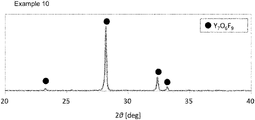
Claims (14)

The invention claimed is:
1. A coating powder, being a non-granulated powder, comprising a rare earth oxyfluoride (Ln-O—F) and having:
an average particle size (D50) of 0.1 to 9.6 μm,
a cumulative volume of all pores having a diameter of 10 μm or smaller and 0.001 μm or larger of 0.1 to 0.5 cm3/g as measured by mercury intrusion porosimetry, and
a ratio of the maximum peak intensity (S0) assigned to a rare earth oxide (LnxOy) in the 2θ angle range of from 20° to 40° to the maximum peak intensity (S1) assigned to the rare earth oxyfluoride (Ln-O—F) in the same range, S0/S1, of 1.0 or smaller in powder X-ray diffractometry using Cu-Kα rays or Cu-Kα1 rays,
wherein said coating powder has a pore size peak in the range of from 2.2 μm to 5 μm in the pore size distribution of pores having a diameter of 10 μm or smaller measured by mercury intrusion porosimetry with pore size as abscissa and log differential pore volume as ordinate, and the BET specific surface area of said coating powder is 1.2 to 10 m2/g,
wherein Ln-O—F is a compound represented by LnOxFy, and
wherein x and y are 0.35≤x≤1.65, 0.5≤y≤1.5, 2.35≤2x+y≤5.1, and Ln is selected from the group consisting of Y, Sm, Gd, Ce, Er and Yb.
2. The coating powder according to claim 1, comprising a rare earth fluoride (LnF3) in addition to the rare earth oxyfluoride (Ln-O—F).
3. The coating powder according to claim 1, having a ratio of the maximum peak intensity (S0) assigned to a rare earth oxide (LnxOy) in the 2θ angle range of from 20° to 40° to the maximum peak intensity (S1) assigned to the rare earth oxyfluoride (Ln-O—F) in the same range, S0/S1, of 0.10 or smaller in powder X-ray diffractometry using Cu-Kα rays or Cu-Kα1 rays.
4. The coating powder according to claim 1, having a ratio of the number of moles of oxygen (O) per kg of the powder to the number of moles of the rare earth (Ln) per kg of the powder, O/Ln by mole, of 0.03 to 1.1.
5. The coating powder according to claim 1, wherein the rare earth is yttrium (Y).
6. A method of forming a coating comprising carrying out physical vapor deposition, aerosol deposition, or thermal spraying of the coating powder according to claim 1.
7. The method according to claim 6, wherein the physical vapor deposition is vacuum evaporation or ion plating.
8. A coating material comprising the coating powder according to claim 1.
9. The coating material according to claim 8, being in the form of slurry.
10. A method of forming a coating comprising carrying out thermal spraying of the coating material according to claim 9.
11. A coating material comprising a sintered compact of the coating powder according to claim 1.
12. The coating material according to claim 11, being used to form a coating by physical vapor deposition.
13. The coating material according to claim 12, wherein the physical vapor deposition is vacuum evaporation, ion plating, or sputtering.
14. The coating powder according to claim 1, having a ratio of the maximum peak intensity (S0) assigned to a rare earth oxide (LnxOy) in the 2θ angle range of from 20° to 40° to the maximum peak intensity (S1) assigned to the rare earth oxy fluoride (Ln-O—F) in the same range, S0/S1, of 0.05 or smaller in powder X-ray diffractometry using Cu-Kα rays or Cu-Kα1 rays,
having a BET specific surface area of 1.5 to 8 m2/g,
having an aspect ratio of 1.0 to 3.0, and
having a dispersion index of 0.2 to 0.5.
US16/882,050 2015-02-10 2020-05-22 Powder for film formation and material for film formation Active US11371131B2 (en)

Priority Applications (1)

Application Number Priority Date Filing Date Title
US16/882,050 US11371131B2 (en) 2015-02-10 2020-05-22 Powder for film formation and material for film formation

Applications Claiming Priority (7)

Application Number Priority Date Filing Date Title
JP2015-024627 2015-02-10
JP2015024627 2015-02-10
JP2015-184844 2015-09-18
JP2015184844 2015-09-18
PCT/JP2016/053064 WO2016129457A1 (en) 2015-02-10 2016-02-02 Powder for film formation and material for film formation
US201715536886A 2017-06-16 2017-06-16
US16/882,050 US11371131B2 (en) 2015-02-10 2020-05-22 Powder for film formation and material for film formation

Related Parent Applications (2)

Application Number Title Priority Date Filing Date
PCT/JP2016/053064 Continuation WO2016129457A1 (en) 2015-02-10 2016-02-02 Powder for film formation and material for film formation
US15/536,886 Continuation US20170342539A1 (en) 2015-02-10 2016-02-02 Powder for film formation and material for film formation

Publications (2)

Publication Number Publication Date
US20200283881A1 US20200283881A1 (en) 2020-09-10
US11371131B2 true US11371131B2 (en) 2022-06-28

Family

ID=56614697

Family Applications (2)

Application Number Title Priority Date Filing Date
US15/536,886 Abandoned US20170342539A1 (en) 2015-02-10 2016-02-02 Powder for film formation and material for film formation
US16/882,050 Active US11371131B2 (en) 2015-02-10 2020-05-22 Powder for film formation and material for film formation

Family Applications Before (1)

Application Number Title Priority Date Filing Date
US15/536,886 Abandoned US20170342539A1 (en) 2015-02-10 2016-02-02 Powder for film formation and material for film formation

Country Status (6)

Country Link
US (2) US20170342539A1 (en)
JP (2) JP6128362B2 (en)
KR (1) KR101865232B1 (en)
CN (1) CN107109611B (en)
TW (1) TWI598300B (en)
WO (1) WO2016129457A1 (en)

Families Citing this family (28)

* Cited by examiner, † Cited by third party
Publication number Priority date Publication date Assignee Title
JP6578106B2 (en) * 2015-02-24 2019-09-18 株式会社フジミインコーポレーテッド Thermal spray powder
JP6955601B2 (en) * 2015-10-20 2021-10-27 株式会社フジミインコーポレーテッド Method for forming thermal spray slurry, thermal spray coating and thermal spray coating
US10934174B2 (en) * 2015-12-28 2021-03-02 Nippon Yttrium Co., Ltd. Film-forming material
US10538845B2 (en) * 2016-06-22 2020-01-21 Ngk Spark Plug Co., Ltd. Yttrium oxyfluoride sprayed coating and method for producing the same, and sprayed member
TWM563652U (en) * 2016-10-13 2018-07-11 美商應用材料股份有限公司 Chamber component for a plasma processing apparatus and apparatus therefor
WO2018083854A1 (en) 2016-11-02 2018-05-11 日本イットリウム株式会社 Film-forming material and film
JP6650385B2 (en) * 2016-11-07 2020-02-19 東京エレクトロン株式会社 Thermal spray material, thermal spray coating and member with thermal spray coating
JP6918996B2 (en) * 2016-11-07 2021-08-11 東京エレクトロン株式会社 Thermal spraying material, thermal spray coating and member with thermal spray coating
TW201932435A (en) * 2016-11-10 2019-08-16 日商Toto股份有限公司 Structure
TWI638795B (en) * 2016-11-10 2018-10-21 Toto股份有限公司 Structure
US11034622B2 (en) 2016-12-20 2021-06-15 Mitsui Mining & Smelting Co., Ltd. Rare earth oxyfluoride sintered body and method for producing same
WO2018217062A1 (en) * 2017-05-26 2018-11-29 아이원스 주식회사 A method for forming yttrium oxide fluoride coating film and yttrium oxide fluoride coating film prepared thereby
KR102395660B1 (en) 2017-12-19 2022-05-10 (주)코미코 Powder for thermal spray and thermal spray coating using the same
WO2019132550A1 (en) * 2017-12-29 2019-07-04 아이원스 주식회사 Coating film forming method and coating film formed thereby
JP7124798B2 (en) * 2018-07-17 2022-08-24 信越化学工業株式会社 Membrane-forming powder, method for forming coating, and method for producing membrane-forming powder
US11668198B2 (en) 2018-08-03 2023-06-06 Raytheon Technologies Corporation Fiber-reinforced self-healing environmental barrier coating
JP6939853B2 (en) * 2018-08-15 2021-09-22 信越化学工業株式会社 Thermal spray coating, method of manufacturing thermal spray coating, and thermal spraying member
US11535571B2 (en) * 2018-08-16 2022-12-27 Raytheon Technologies Corporation Environmental barrier coating for enhanced resistance to attack by molten silicate deposits
US11505506B2 (en) 2018-08-16 2022-11-22 Raytheon Technologies Corporation Self-healing environmental barrier coating
WO2020090528A1 (en) * 2018-10-31 2020-05-07 日本イットリウム株式会社 Material for cold spraying
JP7331762B2 (en) * 2019-04-12 2023-08-23 信越化学工業株式会社 Thermal spray material, method for producing same, and method for forming thermal spray coating
CN112053929A (en) * 2019-06-06 2020-12-08 中微半导体设备(上海)股份有限公司 Component for plasma chamber interior and method of making same
CN111410562B (en) * 2019-09-10 2022-12-30 包头稀土研究院 Preparation method of alkaline earth oxide crucible with rare earth oxyfluoride coating
US11424140B2 (en) 2019-10-10 2022-08-23 Samsung Electronics Co., Ltd. Member, method of manufacturing the same, apparatus for manufacturing the same, and semiconductor manufacturing apparatus
JP7426796B2 (en) * 2019-10-10 2024-02-02 三星電子株式会社 Components, their manufacturing methods, their manufacturing equipment, and semiconductor manufacturing equipment
CN113707525A (en) * 2020-05-20 2021-11-26 中微半导体设备(上海)股份有限公司 Component, method for forming plasma-resistant coating and plasma reaction device
JP7283026B1 (en) * 2022-02-24 2023-05-30 日本イットリウム株式会社 Materials for sintered bodies and sintered bodies
CN117701044B (en) * 2023-12-08 2024-09-03 北矿新材科技有限公司 Multiphase dysprosium doped zirconia sealing coating, preparation method thereof and device with high abrasion performance

Citations (11)

* Cited by examiner, † Cited by third party
Publication number Priority date Publication date Assignee Title
US20020018902A1 (en) 2000-06-29 2002-02-14 Toshihiko Tsukatani Method for thermal spray coating and rare earth oxide powder used therefor
US20020160189A1 (en) 2001-03-08 2002-10-31 Kazuhiro Wataya Thermal spray spherical particles, and sprayed components
US20020177014A1 (en) * 2001-04-06 2002-11-28 Masami Kaneyoshi Thermal spray particles and sprayed components
US20020192429A1 (en) 2001-03-21 2002-12-19 Yasushi Takai Thermal spray rare earth oxide particles, sprayed components, and corrosion resistant components
TW200426206A (en) 2003-04-17 2004-12-01 Mitsui Mining & Smelting Co Cerium-based abrasive
JP2005097685A (en) 2002-11-27 2005-04-14 Kyocera Corp Corrosion resistant member and manufacturing method thereof
US20060006250A1 (en) * 2004-07-08 2006-01-12 Marshall Daniel S Method of dispersing fine particles in a spray
US20060182969A1 (en) * 2005-02-15 2006-08-17 Junya Kitamura Thermal spraying powder
US20070077363A1 (en) 2005-09-30 2007-04-05 Junya Kitamura Thermal spray powder and method for forming a thermal spray coating
US20140057078A1 (en) 2012-08-22 2014-02-27 Shin-Etsu Chemical Co., Ltd. Rare earth element oxyflouride powder spray material and sprayed article
WO2014112171A1 (en) 2013-01-18 2014-07-24 日本イットリウム株式会社 Thermal spray material

Family Cites Families (2)

* Cited by examiner, † Cited by third party
Publication number Priority date Publication date Assignee Title
JP5669353B2 (en) * 2008-12-25 2015-02-12 株式会社フジミインコーポレーテッド Thermal spray slurry, thermal spray coating formation method, and thermal spray coating
JP6443380B2 (en) * 2016-04-12 2018-12-26 信越化学工業株式会社 Yttrium-based fluoride sprayed coating and corrosion resistant coating containing the sprayed coating

Patent Citations (15)

* Cited by examiner, † Cited by third party
Publication number Priority date Publication date Assignee Title
US20020018902A1 (en) 2000-06-29 2002-02-14 Toshihiko Tsukatani Method for thermal spray coating and rare earth oxide powder used therefor
US20020160189A1 (en) 2001-03-08 2002-10-31 Kazuhiro Wataya Thermal spray spherical particles, and sprayed components
US20020192429A1 (en) 2001-03-21 2002-12-19 Yasushi Takai Thermal spray rare earth oxide particles, sprayed components, and corrosion resistant components
US20020177014A1 (en) * 2001-04-06 2002-11-28 Masami Kaneyoshi Thermal spray particles and sprayed components
JP2005097685A (en) 2002-11-27 2005-04-14 Kyocera Corp Corrosion resistant member and manufacturing method thereof
TW200426206A (en) 2003-04-17 2004-12-01 Mitsui Mining & Smelting Co Cerium-based abrasive
US20060006250A1 (en) * 2004-07-08 2006-01-12 Marshall Daniel S Method of dispersing fine particles in a spray
US20060182969A1 (en) * 2005-02-15 2006-08-17 Junya Kitamura Thermal spraying powder
US20070077363A1 (en) 2005-09-30 2007-04-05 Junya Kitamura Thermal spray powder and method for forming a thermal spray coating
US20140057078A1 (en) 2012-08-22 2014-02-27 Shin-Etsu Chemical Co., Ltd. Rare earth element oxyflouride powder spray material and sprayed article
JP2014040634A (en) 2012-08-22 2014-03-06 Shin Etsu Chem Co Ltd Powder thermal spray material of rare-earth element oxyfluoride, and thermal spray member of rare-earth element oxyfluoride
US20150361540A1 (en) 2012-08-22 2015-12-17 Shin-Etsu Chemical Co., Ltd. Rare earth element oxyflouride powder spray material and sprayed article
WO2014112171A1 (en) 2013-01-18 2014-07-24 日本イットリウム株式会社 Thermal spray material
JP2014136835A (en) 2013-01-18 2014-07-28 Nippon Yttrium Co Ltd Thermal spray material
US20150111037A1 (en) 2013-01-18 2015-04-23 Nippon Yttrium Co., Ltd. Thermal spray material

Non-Patent Citations (4)

* Cited by examiner, † Cited by third party
Title
"Yttrium Oxide Y2O3 Yttria target," Cathay Advanced Materials Limited, Accessed on May 24, 2018 at http://www.cathaymaterials.com/sdp/122091/4/pd-1069404/1925831-2801197/Yttrium_Oxide_Y2O3_Yttria_target.html., 2007, pp. 1-3 (4 pages total).
International Search Report for PCT/JP2016/053064 (PCT/ISA/210) dated Apr. 5, 2016.
Machine Translation of JP 4401353 B2 (Japanese counterpart to TW 200426206 A).
U.S. Appl. No. 15/536,886, filed Jun. 16, 2017.

Also Published As

Publication number Publication date
JP2017150083A (en) 2017-08-31
KR101865232B1 (en) 2018-06-08
US20200283881A1 (en) 2020-09-10
TWI598300B (en) 2017-09-11
TW201634392A (en) 2016-10-01
WO2016129457A1 (en) 2016-08-18
CN107109611B (en) 2019-07-26
JPWO2016129457A1 (en) 2017-04-27
CN107109611A (en) 2017-08-29
US20170342539A1 (en) 2017-11-30
KR20170078842A (en) 2017-07-07
JP6128362B2 (en) 2017-05-17

Similar Documents

Publication Publication Date Title
US11371131B2 (en) Powder for film formation and material for film formation
US20230406719A1 (en) Film-forming material
US10173929B2 (en) Sintering material, and powder for manufacturing sintering material
US10766822B2 (en) Thermal spray material and thermal spray coated article
JP6510824B2 (en) Thermal spray powder and thermal spray material
CN109477199B (en) Slurry for suspension plasma thermal spraying, method for forming rare earth oxyfluoride thermal spraying film, and thermal spraying member
US11987503B2 (en) Powder for film formation or sintering
KR20230136165A (en) Film forming materials, film forming slurry, thermal spray coating, and thermal spraying members
JP2017071843A (en) Film forming materials
US20250353757A1 (en) Material for film formation and method for producing coating film
JP2019148010A (en) Spray deposit

Legal Events

Date Code Title Description
FEPP Fee payment procedure

Free format text: ENTITY STATUS SET TO UNDISCOUNTED (ORIGINAL EVENT CODE: BIG.); ENTITY STATUS OF PATENT OWNER: LARGE ENTITY

STPP Information on status: patent application and granting procedure in general

Free format text: NON FINAL ACTION MAILED

STPP Information on status: patent application and granting procedure in general

Free format text: RESPONSE TO NON-FINAL OFFICE ACTION ENTERED AND FORWARDED TO EXAMINER

STPP Information on status: patent application and granting procedure in general

Free format text: NON FINAL ACTION MAILED

STPP Information on status: patent application and granting procedure in general

Free format text: RESPONSE TO NON-FINAL OFFICE ACTION ENTERED AND FORWARDED TO EXAMINER

STPP Information on status: patent application and granting procedure in general

Free format text: FINAL REJECTION MAILED

STPP Information on status: patent application and granting procedure in general

Free format text: NOTICE OF ALLOWANCE MAILED -- APPLICATION RECEIVED IN OFFICE OF PUBLICATIONS

STPP Information on status: patent application and granting procedure in general

Free format text: PUBLICATIONS -- ISSUE FEE PAYMENT VERIFIED

STCF Information on status: patent grant

Free format text: PATENTED CASE

AS Assignment

Owner name: MITSUI MINING & SMELTING CO., LTD., JAPAN

Free format text: MERGER;ASSIGNOR:NIPPON YTTRIUM CO., LTD.;REEL/FRAME:071377/0038

Effective date: 20250516

MAFP Maintenance fee payment

Free format text: PAYMENT OF MAINTENANCE FEE, 4TH YEAR, LARGE ENTITY (ORIGINAL EVENT CODE: M1551); ENTITY STATUS OF PATENT OWNER: LARGE ENTITY

Year of fee payment: 4