US11370864B2 - Polyfluorene-based polymer-polyvinylidene fluoride graft copolymer and element including the same - Google Patents
Polyfluorene-based polymer-polyvinylidene fluoride graft copolymer and element including the same Download PDFInfo
- Publication number
- US11370864B2 US11370864B2 US17/106,427 US202017106427A US11370864B2 US 11370864 B2 US11370864 B2 US 11370864B2 US 202017106427 A US202017106427 A US 202017106427A US 11370864 B2 US11370864 B2 US 11370864B2
- Authority
- US
- United States
- Prior art keywords
- substituted
- group
- carbon atoms
- polyfluorene
- unsubstituted
- Prior art date
- Legal status (The legal status is an assumption and is not a legal conclusion. Google has not performed a legal analysis and makes no representation as to the accuracy of the status listed.)
- Active, expires
Links
- 0 [1*]c1ccc2c(c1)C(CCCCCCOC(=O)CCC([H])([H])C([6*])(F)F)(CCCCCCOC(=O)CCC([H])([H])C([7*])(F)F)c1cc(-c3ccc4c(c3)C([3*])([4*])c3cc([5*][2*])ccc3-4)ccc1-2 Chemical compound [1*]c1ccc2c(c1)C(CCCCCCOC(=O)CCC([H])([H])C([6*])(F)F)(CCCCCCOC(=O)CCC([H])([H])C([7*])(F)F)c1cc(-c3ccc4c(c3)C([3*])([4*])c3cc([5*][2*])ccc3-4)ccc1-2 0.000 description 8
- KGCCKJWQKCQMTG-UHFFFAOYSA-N [H]C([H])(CCC(=O)OCCCCCCC1(CCCCCCOC(=O)CCC([H])([H])C(F)(F)C(F)(F)C([H])([H])SC(=S)OCC)c2cc(-c3ccccc3)ccc2-c2ccc(-c3ccc4c(c3)C(CCCCCCCC)(CCCCCCCC)c3cc(-c5ccc6c(c5)C(CCCCCCCC)(CCCCCCCC)c5cc(-c7ccc(-c8ccc(-c9ccc(-c%10ccccc%10)s9)c9nsnc89)s7)ccc5-6)ccc3-4)cc21)C(F)(F)C(F)(F)C([H])([H])SC(=S)OCC.[H]C([H])(CCC(=O)OCCCCCCC1(CCCCCCOC(=O)CCC([H])([H])C(F)(F)C(F)(F)C([H])([H])SC(=S)OCC)c2cc(-c3ccccc3)ccc2-c2ccc(-c3ccc4c(c3)C(CCCCCCCC)(CCCCCCCC)c3cc(-c5ccc6c(c5)C(CCCCCCCC)(CCCCCCCC)c5cc(-c7ccc(-c8ccccc8)c8nsnc78)ccc5-6)ccc3-4)cc21)C(F)(F)C(F)(F)C([H])([H])SC(=S)OCC.[H]C([H])(CCC(=O)OCCCCCCC1(CCCCCCOC(=O)CCC([H])([H])C(F)(F)C(F)(F)C([H])([H])SC(=S)OCC)c2cc(-c3ccccc3)ccc2-c2ccc(-c3ccc4c(c3)C(CCCCCCCC)(CCCCCCCC)c3cc(-c5ccc6c(c5)C(CCCCCCCC)(CCCCCCCC)c5cc(-c7ccc8c(c7)C(CCCCCCCC)(CCCCCCCC)c7cc(-c9ccccc9)ccc7-8)ccc5-6)ccc3-4)cc21)C(F)(F)C(F)(F)C([H])([H])SC(=S)OC Chemical compound [H]C([H])(CCC(=O)OCCCCCCC1(CCCCCCOC(=O)CCC([H])([H])C(F)(F)C(F)(F)C([H])([H])SC(=S)OCC)c2cc(-c3ccccc3)ccc2-c2ccc(-c3ccc4c(c3)C(CCCCCCCC)(CCCCCCCC)c3cc(-c5ccc6c(c5)C(CCCCCCCC)(CCCCCCCC)c5cc(-c7ccc(-c8ccc(-c9ccc(-c%10ccccc%10)s9)c9nsnc89)s7)ccc5-6)ccc3-4)cc21)C(F)(F)C(F)(F)C([H])([H])SC(=S)OCC.[H]C([H])(CCC(=O)OCCCCCCC1(CCCCCCOC(=O)CCC([H])([H])C(F)(F)C(F)(F)C([H])([H])SC(=S)OCC)c2cc(-c3ccccc3)ccc2-c2ccc(-c3ccc4c(c3)C(CCCCCCCC)(CCCCCCCC)c3cc(-c5ccc6c(c5)C(CCCCCCCC)(CCCCCCCC)c5cc(-c7ccc(-c8ccccc8)c8nsnc78)ccc5-6)ccc3-4)cc21)C(F)(F)C(F)(F)C([H])([H])SC(=S)OCC.[H]C([H])(CCC(=O)OCCCCCCC1(CCCCCCOC(=O)CCC([H])([H])C(F)(F)C(F)(F)C([H])([H])SC(=S)OCC)c2cc(-c3ccccc3)ccc2-c2ccc(-c3ccc4c(c3)C(CCCCCCCC)(CCCCCCCC)c3cc(-c5ccc6c(c5)C(CCCCCCCC)(CCCCCCCC)c5cc(-c7ccc8c(c7)C(CCCCCCCC)(CCCCCCCC)c7cc(-c9ccccc9)ccc7-8)ccc5-6)ccc3-4)cc21)C(F)(F)C(F)(F)C([H])([H])SC(=S)OC KGCCKJWQKCQMTG-UHFFFAOYSA-N 0.000 description 4
- MABPPTDUWMLEOJ-QERAOWCYSA-N Brc1ccc(-c2ccc(-c3ccc(Br)s3)c3nsnc23)s1.Brc1ccc(Br)c2nsnc12.CCCCCCCCC1(CCCCCCCC)c2cc(B3OC(C)C(C)O3)ccc2-c2ccc(B3OC(C)(C)C(C)(C)O3)cc21.CCCCCCCCC1(CCCCCCCC)c2cc(Br)ccc2-c2ccc(Br)cc21.FF.FF.FF.FF.FF.FF.FF.O.OCCCCCCC1(CCCCCCO)c2cc(Br)ccc2-c2ccc(Br)cc21.[2H]B([3H])B.[2H]B([3H])B[3H] Chemical compound Brc1ccc(-c2ccc(-c3ccc(Br)s3)c3nsnc23)s1.Brc1ccc(Br)c2nsnc12.CCCCCCCCC1(CCCCCCCC)c2cc(B3OC(C)C(C)O3)ccc2-c2ccc(B3OC(C)(C)C(C)(C)O3)cc21.CCCCCCCCC1(CCCCCCCC)c2cc(Br)ccc2-c2ccc(Br)cc21.FF.FF.FF.FF.FF.FF.FF.O.OCCCCCCC1(CCCCCCO)c2cc(Br)ccc2-c2ccc(Br)cc21.[2H]B([3H])B.[2H]B([3H])B[3H] MABPPTDUWMLEOJ-QERAOWCYSA-N 0.000 description 1
- RCDFFALQCOIDCC-UHFFFAOYSA-N C.C.CCCCCCCCC1(CCCCCCCC)c2cc(-c3ccc4c(c3)C(CCCCCCO)(CCCCCCO)c3cc(-c5ccccc5)ccc3-4)ccc2-c2ccc(-c3ccc(-c4ccc(-c5ccc(-c6ccccc6)s5)c5nsnc45)s3)cc21.CCCCCCCCC1(CCCCCCCC)c2cc(-c3ccc4c(c3)C(CCCCCCO)(CCCCCCO)c3cc(-c5ccccc5)ccc3-4)ccc2-c2ccc(-c3ccc(-c4ccccc4)c4nsnc34)cc21.CCCCCCCCC1(CCCCCCCC)c2cc(-c3ccccc3)ccc2-c2ccc(-c3ccc4c(c3)C(CCCCCCO)(CCCCCCO)c3cc(-c5ccccc5)ccc3-4)cc21 Chemical compound C.C.CCCCCCCCC1(CCCCCCCC)c2cc(-c3ccc4c(c3)C(CCCCCCO)(CCCCCCO)c3cc(-c5ccccc5)ccc3-4)ccc2-c2ccc(-c3ccc(-c4ccc(-c5ccc(-c6ccccc6)s5)c5nsnc45)s3)cc21.CCCCCCCCC1(CCCCCCCC)c2cc(-c3ccc4c(c3)C(CCCCCCO)(CCCCCCO)c3cc(-c5ccccc5)ccc3-4)ccc2-c2ccc(-c3ccc(-c4ccccc4)c4nsnc34)cc21.CCCCCCCCC1(CCCCCCCC)c2cc(-c3ccccc3)ccc2-c2ccc(-c3ccc4c(c3)C(CCCCCCO)(CCCCCCO)c3cc(-c5ccccc5)ccc3-4)cc21 RCDFFALQCOIDCC-UHFFFAOYSA-N 0.000 description 1
- WGQRPZLMTARAPA-UHFFFAOYSA-N C.C.CCCCCCCCC1(CCCCCCCC)c2cc(-c3ccc4c(c3)C(CCCCCCOC(=O)CSC(=S)OCC)(CCCCCCOC(=O)CSC(=S)OCC)c3cc(-c5ccccc5)ccc3-4)ccc2-c2ccc(-c3ccc(-c4ccc(-c5ccc(-c6ccccc6)s5)c5nsnc45)s3)cc21.CCCCCCCCC1(CCCCCCCC)c2cc(-c3ccc4c(c3)C(CCCCCCOC(=O)CSC(=S)OCC)(CCCCCCOC(=O)CSC(=S)OCC)c3cc(-c5ccccc5)ccc3-4)ccc2-c2ccc(-c3ccc(-c4ccccc4)c4nsnc34)cc21.CCCCCCCCC1(CCCCCCCC)c2cc(-c3ccccc3)ccc2-c2ccc(-c3ccc4c(c3)C(CCCCCCOC(=O)CSC(=S)OCC)(CCCCCCOC(=O)CSC(=S)OCC)c3cc(-c5ccccc5)ccc3-4)cc21 Chemical compound C.C.CCCCCCCCC1(CCCCCCCC)c2cc(-c3ccc4c(c3)C(CCCCCCOC(=O)CSC(=S)OCC)(CCCCCCOC(=O)CSC(=S)OCC)c3cc(-c5ccccc5)ccc3-4)ccc2-c2ccc(-c3ccc(-c4ccc(-c5ccc(-c6ccccc6)s5)c5nsnc45)s3)cc21.CCCCCCCCC1(CCCCCCCC)c2cc(-c3ccc4c(c3)C(CCCCCCOC(=O)CSC(=S)OCC)(CCCCCCOC(=O)CSC(=S)OCC)c3cc(-c5ccccc5)ccc3-4)ccc2-c2ccc(-c3ccc(-c4ccccc4)c4nsnc34)cc21.CCCCCCCCC1(CCCCCCCC)c2cc(-c3ccccc3)ccc2-c2ccc(-c3ccc4c(c3)C(CCCCCCOC(=O)CSC(=S)OCC)(CCCCCCOC(=O)CSC(=S)OCC)c3cc(-c5ccccc5)ccc3-4)cc21 WGQRPZLMTARAPA-UHFFFAOYSA-N 0.000 description 1
- HRFNCVAVBBWKTJ-UHFFFAOYSA-N [H]C([H])(CC(=O)OCCCCCCC1(CCCCCCOC(=O)CC([H])([H])C(F)(F)C(F)(F)C([H])([H])SC(=S)OCC)c2cc(-c3ccccc3)ccc2-c2ccc(-c3ccc4c(c3)C(CCCCCCCC)(CCCCCCCC)c3cc(-c5ccc(-c6ccc(-c7ccc(-c8ccccc8)s7)c7nsnc67)s5)ccc3-4)cc21)C(F)(F)C(F)(F)C([H])([H])SC(=S)OCC.[H]C([H])(CC(=O)OCCCCCCC1(CCCCCCOC(=O)CC([H])([H])C(F)(F)C(F)(F)C([H])([H])SC(=S)OCC)c2cc(-c3ccccc3)ccc2-c2ccc(-c3ccc4c(c3)C(CCCCCCCC)(CCCCCCCC)c3cc(-c5ccc(-c6ccccc6)c6nsnc56)ccc3-4)cc21)C(F)(F)C(F)(F)C([H])([H])SC(=S)OCC.[H]C([H])(CC(=O)OCCCCCCC1(CCCCCCOC(=O)CC([H])([H])C(F)(F)C(F)(F)C([H])([H])SC(=S)OCC)c2cc(-c3ccccc3)ccc2-c2ccc(-c3ccc4c(c3)C(CCCCCCCC)(CCCCCCCC)c3cc(-c5ccccc5)ccc3-4)cc21)C(F)(F)C(F)(F)C([H])([H])SC(=S)OC Chemical compound [H]C([H])(CC(=O)OCCCCCCC1(CCCCCCOC(=O)CC([H])([H])C(F)(F)C(F)(F)C([H])([H])SC(=S)OCC)c2cc(-c3ccccc3)ccc2-c2ccc(-c3ccc4c(c3)C(CCCCCCCC)(CCCCCCCC)c3cc(-c5ccc(-c6ccc(-c7ccc(-c8ccccc8)s7)c7nsnc67)s5)ccc3-4)cc21)C(F)(F)C(F)(F)C([H])([H])SC(=S)OCC.[H]C([H])(CC(=O)OCCCCCCC1(CCCCCCOC(=O)CC([H])([H])C(F)(F)C(F)(F)C([H])([H])SC(=S)OCC)c2cc(-c3ccccc3)ccc2-c2ccc(-c3ccc4c(c3)C(CCCCCCCC)(CCCCCCCC)c3cc(-c5ccc(-c6ccccc6)c6nsnc56)ccc3-4)cc21)C(F)(F)C(F)(F)C([H])([H])SC(=S)OCC.[H]C([H])(CC(=O)OCCCCCCC1(CCCCCCOC(=O)CC([H])([H])C(F)(F)C(F)(F)C([H])([H])SC(=S)OCC)c2cc(-c3ccccc3)ccc2-c2ccc(-c3ccc4c(c3)C(CCCCCCCC)(CCCCCCCC)c3cc(-c5ccccc5)ccc3-4)cc21)C(F)(F)C(F)(F)C([H])([H])SC(=S)OC HRFNCVAVBBWKTJ-UHFFFAOYSA-N 0.000 description 1
- GVSYYFUDFNDLAR-UHFFFAOYSA-N [H]C([H])(CC(=O)OCCCCCCC1(CCCCCCOC(=O)CC([H])([H])C(F)(F)C(F)(F)C([H])([H])SC(=S)OCC)c2cc(-c3ccccc3)ccc2-c2ccc(-c3ccc4c(c3)C(CCCCCCCC)(CCCCCCCC)c3cc(-c5ccc(-c6ccc(-c7ccc(-c8ccccc8)s7)c7nsnc67)s5)ccc3-4)cc21)C(F)(F)C(F)(F)C([H])([H])SC(=S)OCC.[H]C([H])(CC(=O)OCCCCCCC1(CCCCCCOC(=O)CC([H])([H])C(F)(F)C(F)(F)C([H])([H])SC(=S)OCC)c2cc(-c3ccccc3)ccc2-c2ccc(-c3ccc4c(c3)C(CCCCCCCC)(CCCCCCCC)c3cc(-c5ccc(-c6ccccc6)c6nsnc56)ccc3-4)cc21)C(F)(F)C(F)(F)C([H])([H])SC(=S)OCC.[H]C([H])(CC(=O)OCCCCCCC1(CCCCCCOC(=O)CC([H])([H])C(F)(F)C(F)(F)C([H])([H])SC(=S)OCC)c2cc(-c3ccccc3)ccc2-c2ccc(-c3ccc4c(c3)C(CCCCCCCC)(CCCCCCCC)c3cc(-c5ccccc5)ccc3-4)cc21)C(F)(F)C(F)(F)C([H])([H])SC(=S)OCC Chemical compound [H]C([H])(CC(=O)OCCCCCCC1(CCCCCCOC(=O)CC([H])([H])C(F)(F)C(F)(F)C([H])([H])SC(=S)OCC)c2cc(-c3ccccc3)ccc2-c2ccc(-c3ccc4c(c3)C(CCCCCCCC)(CCCCCCCC)c3cc(-c5ccc(-c6ccc(-c7ccc(-c8ccccc8)s7)c7nsnc67)s5)ccc3-4)cc21)C(F)(F)C(F)(F)C([H])([H])SC(=S)OCC.[H]C([H])(CC(=O)OCCCCCCC1(CCCCCCOC(=O)CC([H])([H])C(F)(F)C(F)(F)C([H])([H])SC(=S)OCC)c2cc(-c3ccccc3)ccc2-c2ccc(-c3ccc4c(c3)C(CCCCCCCC)(CCCCCCCC)c3cc(-c5ccc(-c6ccccc6)c6nsnc56)ccc3-4)cc21)C(F)(F)C(F)(F)C([H])([H])SC(=S)OCC.[H]C([H])(CC(=O)OCCCCCCC1(CCCCCCOC(=O)CC([H])([H])C(F)(F)C(F)(F)C([H])([H])SC(=S)OCC)c2cc(-c3ccccc3)ccc2-c2ccc(-c3ccc4c(c3)C(CCCCCCCC)(CCCCCCCC)c3cc(-c5ccccc5)ccc3-4)cc21)C(F)(F)C(F)(F)C([H])([H])SC(=S)OCC GVSYYFUDFNDLAR-UHFFFAOYSA-N 0.000 description 1
Images




Classifications
-
- C—CHEMISTRY; METALLURGY
- C08—ORGANIC MACROMOLECULAR COMPOUNDS; THEIR PREPARATION OR CHEMICAL WORKING-UP; COMPOSITIONS BASED THEREON
- C08F—MACROMOLECULAR COMPOUNDS OBTAINED BY REACTIONS ONLY INVOLVING CARBON-TO-CARBON UNSATURATED BONDS
- C08F293/00—Macromolecular compounds obtained by polymerisation on to a macromolecule having groups capable of inducing the formation of new polymer chains bound exclusively at one or both ends of the starting macromolecule
- C08F293/005—Macromolecular compounds obtained by polymerisation on to a macromolecule having groups capable of inducing the formation of new polymer chains bound exclusively at one or both ends of the starting macromolecule using free radical "living" or "controlled" polymerisation, e.g. using a complexing agent
-
- C—CHEMISTRY; METALLURGY
- C08—ORGANIC MACROMOLECULAR COMPOUNDS; THEIR PREPARATION OR CHEMICAL WORKING-UP; COMPOSITIONS BASED THEREON
- C08F—MACROMOLECULAR COMPOUNDS OBTAINED BY REACTIONS ONLY INVOLVING CARBON-TO-CARBON UNSATURATED BONDS
- C08F259/00—Macromolecular compounds obtained by polymerising monomers on to polymers of halogen containing monomers as defined in group C08F14/00
- C08F259/08—Macromolecular compounds obtained by polymerising monomers on to polymers of halogen containing monomers as defined in group C08F14/00 on to polymers containing fluorine
-
- C—CHEMISTRY; METALLURGY
- C08—ORGANIC MACROMOLECULAR COMPOUNDS; THEIR PREPARATION OR CHEMICAL WORKING-UP; COMPOSITIONS BASED THEREON
- C08F—MACROMOLECULAR COMPOUNDS OBTAINED BY REACTIONS ONLY INVOLVING CARBON-TO-CARBON UNSATURATED BONDS
- C08F283/00—Macromolecular compounds obtained by polymerising monomers on to polymers provided for in subclass C08G
-
- C—CHEMISTRY; METALLURGY
- C08—ORGANIC MACROMOLECULAR COMPOUNDS; THEIR PREPARATION OR CHEMICAL WORKING-UP; COMPOSITIONS BASED THEREON
- C08F—MACROMOLECULAR COMPOUNDS OBTAINED BY REACTIONS ONLY INVOLVING CARBON-TO-CARBON UNSATURATED BONDS
- C08F2/00—Processes of polymerisation
- C08F2/38—Polymerisation using regulators, e.g. chain terminating agents, e.g. telomerisation
-
- C—CHEMISTRY; METALLURGY
- C08—ORGANIC MACROMOLECULAR COMPOUNDS; THEIR PREPARATION OR CHEMICAL WORKING-UP; COMPOSITIONS BASED THEREON
- C08F—MACROMOLECULAR COMPOUNDS OBTAINED BY REACTIONS ONLY INVOLVING CARBON-TO-CARBON UNSATURATED BONDS
- C08F214/00—Copolymers of compounds having one or more unsaturated aliphatic radicals, each having only one carbon-to-carbon double bond, and at least one being terminated by a halogen
- C08F214/18—Monomers containing fluorine
- C08F214/22—Vinylidene fluoride
-
- C—CHEMISTRY; METALLURGY
- C08—ORGANIC MACROMOLECULAR COMPOUNDS; THEIR PREPARATION OR CHEMICAL WORKING-UP; COMPOSITIONS BASED THEREON
- C08F—MACROMOLECULAR COMPOUNDS OBTAINED BY REACTIONS ONLY INVOLVING CARBON-TO-CARBON UNSATURATED BONDS
- C08F8/00—Chemical modification by after-treatment
- C08F8/34—Introducing sulfur atoms or sulfur-containing groups
- C08F8/36—Sulfonation; Sulfation
-
- C—CHEMISTRY; METALLURGY
- C08—ORGANIC MACROMOLECULAR COMPOUNDS; THEIR PREPARATION OR CHEMICAL WORKING-UP; COMPOSITIONS BASED THEREON
- C08G—MACROMOLECULAR COMPOUNDS OBTAINED OTHERWISE THAN BY REACTIONS ONLY INVOLVING UNSATURATED CARBON-TO-CARBON BONDS
- C08G61/00—Macromolecular compounds obtained by reactions forming a carbon-to-carbon link in the main chain of the macromolecule
- C08G61/02—Macromolecular compounds containing only carbon atoms in the main chain of the macromolecule, e.g. polyxylylenes
-
- C—CHEMISTRY; METALLURGY
- C08—ORGANIC MACROMOLECULAR COMPOUNDS; THEIR PREPARATION OR CHEMICAL WORKING-UP; COMPOSITIONS BASED THEREON
- C08G—MACROMOLECULAR COMPOUNDS OBTAINED OTHERWISE THAN BY REACTIONS ONLY INVOLVING UNSATURATED CARBON-TO-CARBON BONDS
- C08G61/00—Macromolecular compounds obtained by reactions forming a carbon-to-carbon link in the main chain of the macromolecule
- C08G61/02—Macromolecular compounds containing only carbon atoms in the main chain of the macromolecule, e.g. polyxylylenes
- C08G61/10—Macromolecular compounds containing only carbon atoms in the main chain of the macromolecule, e.g. polyxylylenes only aromatic carbon atoms, e.g. polyphenylenes
-
- C—CHEMISTRY; METALLURGY
- C08—ORGANIC MACROMOLECULAR COMPOUNDS; THEIR PREPARATION OR CHEMICAL WORKING-UP; COMPOSITIONS BASED THEREON
- C08G—MACROMOLECULAR COMPOUNDS OBTAINED OTHERWISE THAN BY REACTIONS ONLY INVOLVING UNSATURATED CARBON-TO-CARBON BONDS
- C08G61/00—Macromolecular compounds obtained by reactions forming a carbon-to-carbon link in the main chain of the macromolecule
- C08G61/12—Macromolecular compounds containing atoms other than carbon in the main chain of the macromolecule
-
- C—CHEMISTRY; METALLURGY
- C08—ORGANIC MACROMOLECULAR COMPOUNDS; THEIR PREPARATION OR CHEMICAL WORKING-UP; COMPOSITIONS BASED THEREON
- C08G—MACROMOLECULAR COMPOUNDS OBTAINED OTHERWISE THAN BY REACTIONS ONLY INVOLVING UNSATURATED CARBON-TO-CARBON BONDS
- C08G61/00—Macromolecular compounds obtained by reactions forming a carbon-to-carbon link in the main chain of the macromolecule
- C08G61/12—Macromolecular compounds containing atoms other than carbon in the main chain of the macromolecule
- C08G61/122—Macromolecular compounds containing atoms other than carbon in the main chain of the macromolecule derived from five- or six-membered heterocyclic compounds, other than imides
- C08G61/123—Macromolecular compounds containing atoms other than carbon in the main chain of the macromolecule derived from five- or six-membered heterocyclic compounds, other than imides derived from five-membered heterocyclic compounds
-
- C—CHEMISTRY; METALLURGY
- C08—ORGANIC MACROMOLECULAR COMPOUNDS; THEIR PREPARATION OR CHEMICAL WORKING-UP; COMPOSITIONS BASED THEREON
- C08G—MACROMOLECULAR COMPOUNDS OBTAINED OTHERWISE THAN BY REACTIONS ONLY INVOLVING UNSATURATED CARBON-TO-CARBON BONDS
- C08G61/00—Macromolecular compounds obtained by reactions forming a carbon-to-carbon link in the main chain of the macromolecule
- C08G61/12—Macromolecular compounds containing atoms other than carbon in the main chain of the macromolecule
- C08G61/122—Macromolecular compounds containing atoms other than carbon in the main chain of the macromolecule derived from five- or six-membered heterocyclic compounds, other than imides
- C08G61/123—Macromolecular compounds containing atoms other than carbon in the main chain of the macromolecule derived from five- or six-membered heterocyclic compounds, other than imides derived from five-membered heterocyclic compounds
- C08G61/126—Macromolecular compounds containing atoms other than carbon in the main chain of the macromolecule derived from five- or six-membered heterocyclic compounds, other than imides derived from five-membered heterocyclic compounds with a five-membered ring containing one sulfur atom in the ring
-
- C—CHEMISTRY; METALLURGY
- C08—ORGANIC MACROMOLECULAR COMPOUNDS; THEIR PREPARATION OR CHEMICAL WORKING-UP; COMPOSITIONS BASED THEREON
- C08J—WORKING-UP; GENERAL PROCESSES OF COMPOUNDING; AFTER-TREATMENT NOT COVERED BY SUBCLASSES C08B, C08C, C08F, C08G or C08H
- C08J5/00—Manufacture of articles or shaped materials containing macromolecular substances
- C08J5/18—Manufacture of films or sheets
-
- C—CHEMISTRY; METALLURGY
- C09—DYES; PAINTS; POLISHES; NATURAL RESINS; ADHESIVES; COMPOSITIONS NOT OTHERWISE PROVIDED FOR; APPLICATIONS OF MATERIALS NOT OTHERWISE PROVIDED FOR
- C09D—COATING COMPOSITIONS, e.g. PAINTS, VARNISHES OR LACQUERS; FILLING PASTES; CHEMICAL PAINT OR INK REMOVERS; INKS; CORRECTING FLUIDS; WOODSTAINS; PASTES OR SOLIDS FOR COLOURING OR PRINTING; USE OF MATERIALS THEREFOR
- C09D165/00—Coating compositions based on macromolecular compounds obtained by reactions forming a carbon-to-carbon link in the main chain; Coating compositions based on derivatives of such polymers
-
- C—CHEMISTRY; METALLURGY
- C09—DYES; PAINTS; POLISHES; NATURAL RESINS; ADHESIVES; COMPOSITIONS NOT OTHERWISE PROVIDED FOR; APPLICATIONS OF MATERIALS NOT OTHERWISE PROVIDED FOR
- C09K—MATERIALS FOR MISCELLANEOUS APPLICATIONS, NOT PROVIDED FOR ELSEWHERE
- C09K11/00—Luminescent materials, e.g. electroluminescent or chemiluminescent
- C09K11/06—Luminescent materials, e.g. electroluminescent or chemiluminescent containing organic luminescent materials
-
- H—ELECTRICITY
- H10—SEMICONDUCTOR DEVICES; ELECTRIC SOLID-STATE DEVICES NOT OTHERWISE PROVIDED FOR
- H10K—ORGANIC ELECTRIC SOLID-STATE DEVICES
- H10K85/00—Organic materials used in the body or electrodes of devices covered by this subclass
- H10K85/10—Organic polymers or oligomers
- H10K85/111—Organic polymers or oligomers comprising aromatic, heteroaromatic, or aryl chains, e.g. polyaniline, polyphenylene or polyphenylene vinylene
- H10K85/115—Polyfluorene; Derivatives thereof
-
- H—ELECTRICITY
- H10—SEMICONDUCTOR DEVICES; ELECTRIC SOLID-STATE DEVICES NOT OTHERWISE PROVIDED FOR
- H10K—ORGANIC ELECTRIC SOLID-STATE DEVICES
- H10K85/00—Organic materials used in the body or electrodes of devices covered by this subclass
- H10K85/10—Organic polymers or oligomers
- H10K85/151—Copolymers
-
- H—ELECTRICITY
- H10—SEMICONDUCTOR DEVICES; ELECTRIC SOLID-STATE DEVICES NOT OTHERWISE PROVIDED FOR
- H10N—ELECTRIC SOLID-STATE DEVICES NOT OTHERWISE PROVIDED FOR
- H10N30/00—Piezoelectric or electrostrictive devices
- H10N30/80—Constructional details
- H10N30/85—Piezoelectric or electrostrictive active materials
- H10N30/857—Macromolecular compositions
-
- C—CHEMISTRY; METALLURGY
- C08—ORGANIC MACROMOLECULAR COMPOUNDS; THEIR PREPARATION OR CHEMICAL WORKING-UP; COMPOSITIONS BASED THEREON
- C08F—MACROMOLECULAR COMPOUNDS OBTAINED BY REACTIONS ONLY INVOLVING CARBON-TO-CARBON UNSATURATED BONDS
- C08F2438/00—Living radical polymerisation
- C08F2438/03—Use of a di- or tri-thiocarbonylthio compound, e.g. di- or tri-thioester, di- or tri-thiocarbamate, or a xanthate as chain transfer agent, e.g . Reversible Addition Fragmentation chain Transfer [RAFT] or Macromolecular Design via Interchange of Xanthates [MADIX]
-
- C—CHEMISTRY; METALLURGY
- C08—ORGANIC MACROMOLECULAR COMPOUNDS; THEIR PREPARATION OR CHEMICAL WORKING-UP; COMPOSITIONS BASED THEREON
- C08G—MACROMOLECULAR COMPOUNDS OBTAINED OTHERWISE THAN BY REACTIONS ONLY INVOLVING UNSATURATED CARBON-TO-CARBON BONDS
- C08G2261/00—Macromolecular compounds obtained by reactions forming a carbon-to-carbon link in the main chain of the macromolecule
- C08G2261/10—Definition of the polymer structure
- C08G2261/12—Copolymers
-
- C—CHEMISTRY; METALLURGY
- C08—ORGANIC MACROMOLECULAR COMPOUNDS; THEIR PREPARATION OR CHEMICAL WORKING-UP; COMPOSITIONS BASED THEREON
- C08G—MACROMOLECULAR COMPOUNDS OBTAINED OTHERWISE THAN BY REACTIONS ONLY INVOLVING UNSATURATED CARBON-TO-CARBON BONDS
- C08G2261/00—Macromolecular compounds obtained by reactions forming a carbon-to-carbon link in the main chain of the macromolecule
- C08G2261/10—Definition of the polymer structure
- C08G2261/12—Copolymers
- C08G2261/122—Copolymers statistical
-
- C—CHEMISTRY; METALLURGY
- C08—ORGANIC MACROMOLECULAR COMPOUNDS; THEIR PREPARATION OR CHEMICAL WORKING-UP; COMPOSITIONS BASED THEREON
- C08G—MACROMOLECULAR COMPOUNDS OBTAINED OTHERWISE THAN BY REACTIONS ONLY INVOLVING UNSATURATED CARBON-TO-CARBON BONDS
- C08G2261/00—Macromolecular compounds obtained by reactions forming a carbon-to-carbon link in the main chain of the macromolecule
- C08G2261/10—Definition of the polymer structure
- C08G2261/12—Copolymers
- C08G2261/128—Copolymers graft
-
- C—CHEMISTRY; METALLURGY
- C08—ORGANIC MACROMOLECULAR COMPOUNDS; THEIR PREPARATION OR CHEMICAL WORKING-UP; COMPOSITIONS BASED THEREON
- C08G—MACROMOLECULAR COMPOUNDS OBTAINED OTHERWISE THAN BY REACTIONS ONLY INVOLVING UNSATURATED CARBON-TO-CARBON BONDS
- C08G2261/00—Macromolecular compounds obtained by reactions forming a carbon-to-carbon link in the main chain of the macromolecule
- C08G2261/10—Definition of the polymer structure
- C08G2261/14—Side-groups
- C08G2261/141—Side-chains having aliphatic units
- C08G2261/1412—Saturated aliphatic units
-
- C—CHEMISTRY; METALLURGY
- C08—ORGANIC MACROMOLECULAR COMPOUNDS; THEIR PREPARATION OR CHEMICAL WORKING-UP; COMPOSITIONS BASED THEREON
- C08G—MACROMOLECULAR COMPOUNDS OBTAINED OTHERWISE THAN BY REACTIONS ONLY INVOLVING UNSATURATED CARBON-TO-CARBON BONDS
- C08G2261/00—Macromolecular compounds obtained by reactions forming a carbon-to-carbon link in the main chain of the macromolecule
- C08G2261/10—Definition of the polymer structure
- C08G2261/14—Side-groups
- C08G2261/142—Side-chains containing oxygen
- C08G2261/1422—Side-chains containing oxygen containing OH groups
-
- C—CHEMISTRY; METALLURGY
- C08—ORGANIC MACROMOLECULAR COMPOUNDS; THEIR PREPARATION OR CHEMICAL WORKING-UP; COMPOSITIONS BASED THEREON
- C08G—MACROMOLECULAR COMPOUNDS OBTAINED OTHERWISE THAN BY REACTIONS ONLY INVOLVING UNSATURATED CARBON-TO-CARBON BONDS
- C08G2261/00—Macromolecular compounds obtained by reactions forming a carbon-to-carbon link in the main chain of the macromolecule
- C08G2261/10—Definition of the polymer structure
- C08G2261/14—Side-groups
- C08G2261/142—Side-chains containing oxygen
- C08G2261/1426—Side-chains containing oxygen containing carboxy groups (COOH) and/or -C(=O)O-moieties
-
- C—CHEMISTRY; METALLURGY
- C08—ORGANIC MACROMOLECULAR COMPOUNDS; THEIR PREPARATION OR CHEMICAL WORKING-UP; COMPOSITIONS BASED THEREON
- C08G—MACROMOLECULAR COMPOUNDS OBTAINED OTHERWISE THAN BY REACTIONS ONLY INVOLVING UNSATURATED CARBON-TO-CARBON BONDS
- C08G2261/00—Macromolecular compounds obtained by reactions forming a carbon-to-carbon link in the main chain of the macromolecule
- C08G2261/10—Definition of the polymer structure
- C08G2261/14—Side-groups
- C08G2261/145—Side-chains containing sulfur
-
- C—CHEMISTRY; METALLURGY
- C08—ORGANIC MACROMOLECULAR COMPOUNDS; THEIR PREPARATION OR CHEMICAL WORKING-UP; COMPOSITIONS BASED THEREON
- C08G—MACROMOLECULAR COMPOUNDS OBTAINED OTHERWISE THAN BY REACTIONS ONLY INVOLVING UNSATURATED CARBON-TO-CARBON BONDS
- C08G2261/00—Macromolecular compounds obtained by reactions forming a carbon-to-carbon link in the main chain of the macromolecule
- C08G2261/10—Definition of the polymer structure
- C08G2261/14—Side-groups
- C08G2261/146—Side-chains containing halogens
-
- C—CHEMISTRY; METALLURGY
- C08—ORGANIC MACROMOLECULAR COMPOUNDS; THEIR PREPARATION OR CHEMICAL WORKING-UP; COMPOSITIONS BASED THEREON
- C08G—MACROMOLECULAR COMPOUNDS OBTAINED OTHERWISE THAN BY REACTIONS ONLY INVOLVING UNSATURATED CARBON-TO-CARBON BONDS
- C08G2261/00—Macromolecular compounds obtained by reactions forming a carbon-to-carbon link in the main chain of the macromolecule
- C08G2261/10—Definition of the polymer structure
- C08G2261/16—End groups
- C08G2261/164—End groups comprising organic end groups
- C08G2261/1646—End groups comprising organic end groups comprising aromatic or heteroaromatic end groups
-
- C—CHEMISTRY; METALLURGY
- C08—ORGANIC MACROMOLECULAR COMPOUNDS; THEIR PREPARATION OR CHEMICAL WORKING-UP; COMPOSITIONS BASED THEREON
- C08G—MACROMOLECULAR COMPOUNDS OBTAINED OTHERWISE THAN BY REACTIONS ONLY INVOLVING UNSATURATED CARBON-TO-CARBON BONDS
- C08G2261/00—Macromolecular compounds obtained by reactions forming a carbon-to-carbon link in the main chain of the macromolecule
- C08G2261/30—Monomer units or repeat units incorporating structural elements in the main chain
- C08G2261/31—Monomer units or repeat units incorporating structural elements in the main chain incorporating aromatic structural elements in the main chain
- C08G2261/314—Condensed aromatic systems, e.g. perylene, anthracene or pyrene
- C08G2261/3142—Condensed aromatic systems, e.g. perylene, anthracene or pyrene fluorene-based, e.g. fluorene, indenofluorene, or spirobifluorene
-
- C—CHEMISTRY; METALLURGY
- C08—ORGANIC MACROMOLECULAR COMPOUNDS; THEIR PREPARATION OR CHEMICAL WORKING-UP; COMPOSITIONS BASED THEREON
- C08G—MACROMOLECULAR COMPOUNDS OBTAINED OTHERWISE THAN BY REACTIONS ONLY INVOLVING UNSATURATED CARBON-TO-CARBON BONDS
- C08G2261/00—Macromolecular compounds obtained by reactions forming a carbon-to-carbon link in the main chain of the macromolecule
- C08G2261/30—Monomer units or repeat units incorporating structural elements in the main chain
- C08G2261/32—Monomer units or repeat units incorporating structural elements in the main chain incorporating heteroaromatic structural elements in the main chain
- C08G2261/322—Monomer units or repeat units incorporating structural elements in the main chain incorporating heteroaromatic structural elements in the main chain non-condensed
- C08G2261/3223—Monomer units or repeat units incorporating structural elements in the main chain incorporating heteroaromatic structural elements in the main chain non-condensed containing one or more sulfur atoms as the only heteroatom, e.g. thiophene
-
- C—CHEMISTRY; METALLURGY
- C08—ORGANIC MACROMOLECULAR COMPOUNDS; THEIR PREPARATION OR CHEMICAL WORKING-UP; COMPOSITIONS BASED THEREON
- C08G—MACROMOLECULAR COMPOUNDS OBTAINED OTHERWISE THAN BY REACTIONS ONLY INVOLVING UNSATURATED CARBON-TO-CARBON BONDS
- C08G2261/00—Macromolecular compounds obtained by reactions forming a carbon-to-carbon link in the main chain of the macromolecule
- C08G2261/30—Monomer units or repeat units incorporating structural elements in the main chain
- C08G2261/32—Monomer units or repeat units incorporating structural elements in the main chain incorporating heteroaromatic structural elements in the main chain
- C08G2261/322—Monomer units or repeat units incorporating structural elements in the main chain incorporating heteroaromatic structural elements in the main chain non-condensed
- C08G2261/3229—Monomer units or repeat units incorporating structural elements in the main chain incorporating heteroaromatic structural elements in the main chain non-condensed containing nitrogen and sulfur as heteroatoms
-
- C—CHEMISTRY; METALLURGY
- C08—ORGANIC MACROMOLECULAR COMPOUNDS; THEIR PREPARATION OR CHEMICAL WORKING-UP; COMPOSITIONS BASED THEREON
- C08G—MACROMOLECULAR COMPOUNDS OBTAINED OTHERWISE THAN BY REACTIONS ONLY INVOLVING UNSATURATED CARBON-TO-CARBON BONDS
- C08G2261/00—Macromolecular compounds obtained by reactions forming a carbon-to-carbon link in the main chain of the macromolecule
- C08G2261/30—Monomer units or repeat units incorporating structural elements in the main chain
- C08G2261/32—Monomer units or repeat units incorporating structural elements in the main chain incorporating heteroaromatic structural elements in the main chain
- C08G2261/324—Monomer units or repeat units incorporating structural elements in the main chain incorporating heteroaromatic structural elements in the main chain condensed
- C08G2261/3246—Monomer units or repeat units incorporating structural elements in the main chain incorporating heteroaromatic structural elements in the main chain condensed containing nitrogen and sulfur as heteroatoms
-
- C—CHEMISTRY; METALLURGY
- C08—ORGANIC MACROMOLECULAR COMPOUNDS; THEIR PREPARATION OR CHEMICAL WORKING-UP; COMPOSITIONS BASED THEREON
- C08G—MACROMOLECULAR COMPOUNDS OBTAINED OTHERWISE THAN BY REACTIONS ONLY INVOLVING UNSATURATED CARBON-TO-CARBON BONDS
- C08G2261/00—Macromolecular compounds obtained by reactions forming a carbon-to-carbon link in the main chain of the macromolecule
- C08G2261/40—Polymerisation processes
- C08G2261/41—Organometallic coupling reactions
- C08G2261/411—Suzuki reactions
-
- C—CHEMISTRY; METALLURGY
- C08—ORGANIC MACROMOLECULAR COMPOUNDS; THEIR PREPARATION OR CHEMICAL WORKING-UP; COMPOSITIONS BASED THEREON
- C08G—MACROMOLECULAR COMPOUNDS OBTAINED OTHERWISE THAN BY REACTIONS ONLY INVOLVING UNSATURATED CARBON-TO-CARBON BONDS
- C08G2261/00—Macromolecular compounds obtained by reactions forming a carbon-to-carbon link in the main chain of the macromolecule
- C08G2261/50—Physical properties
- C08G2261/52—Luminescence
-
- C—CHEMISTRY; METALLURGY
- C08—ORGANIC MACROMOLECULAR COMPOUNDS; THEIR PREPARATION OR CHEMICAL WORKING-UP; COMPOSITIONS BASED THEREON
- C08G—MACROMOLECULAR COMPOUNDS OBTAINED OTHERWISE THAN BY REACTIONS ONLY INVOLVING UNSATURATED CARBON-TO-CARBON BONDS
- C08G2261/00—Macromolecular compounds obtained by reactions forming a carbon-to-carbon link in the main chain of the macromolecule
- C08G2261/90—Applications
- C08G2261/95—Use in organic luminescent diodes
-
- C—CHEMISTRY; METALLURGY
- C08—ORGANIC MACROMOLECULAR COMPOUNDS; THEIR PREPARATION OR CHEMICAL WORKING-UP; COMPOSITIONS BASED THEREON
- C08J—WORKING-UP; GENERAL PROCESSES OF COMPOUNDING; AFTER-TREATMENT NOT COVERED BY SUBCLASSES C08B, C08C, C08F, C08G or C08H
- C08J2327/00—Characterised by the use of homopolymers or copolymers of compounds having one or more unsaturated aliphatic radicals, each having only one carbon-to-carbon double bond, and at least one being terminated by a halogen; Derivatives of such polymers
- C08J2327/02—Characterised by the use of homopolymers or copolymers of compounds having one or more unsaturated aliphatic radicals, each having only one carbon-to-carbon double bond, and at least one being terminated by a halogen; Derivatives of such polymers not modified by chemical after-treatment
- C08J2327/12—Characterised by the use of homopolymers or copolymers of compounds having one or more unsaturated aliphatic radicals, each having only one carbon-to-carbon double bond, and at least one being terminated by a halogen; Derivatives of such polymers not modified by chemical after-treatment containing fluorine atoms
- C08J2327/16—Homopolymers or copolymers of vinylidene fluoride
-
- H01L33/26—
-
- H01L41/18—
-
- H—ELECTRICITY
- H10—SEMICONDUCTOR DEVICES; ELECTRIC SOLID-STATE DEVICES NOT OTHERWISE PROVIDED FOR
- H10H—INORGANIC LIGHT-EMITTING SEMICONDUCTOR DEVICES HAVING POTENTIAL BARRIERS
- H10H20/00—Individual inorganic light-emitting semiconductor devices having potential barriers, e.g. light-emitting diodes [LED]
- H10H20/80—Constructional details
- H10H20/81—Bodies
- H10H20/822—Materials of the light-emitting regions
-
- H—ELECTRICITY
- H10—SEMICONDUCTOR DEVICES; ELECTRIC SOLID-STATE DEVICES NOT OTHERWISE PROVIDED FOR
- H10K—ORGANIC ELECTRIC SOLID-STATE DEVICES
- H10K50/00—Organic light-emitting devices
- H10K50/10—OLEDs or polymer light-emitting diodes [PLED]
- H10K50/11—OLEDs or polymer light-emitting diodes [PLED] characterised by the electroluminescent [EL] layers
-
- H—ELECTRICITY
- H10—SEMICONDUCTOR DEVICES; ELECTRIC SOLID-STATE DEVICES NOT OTHERWISE PROVIDED FOR
- H10K—ORGANIC ELECTRIC SOLID-STATE DEVICES
- H10K85/00—Organic materials used in the body or electrodes of devices covered by this subclass
- H10K85/10—Organic polymers or oligomers
- H10K85/111—Organic polymers or oligomers comprising aromatic, heteroaromatic, or aryl chains, e.g. polyaniline, polyphenylene or polyphenylene vinylene
- H10K85/113—Heteroaromatic compounds comprising sulfur or selene, e.g. polythiophene
Definitions
- the present disclosure is directed to a polyfluorene-based polymer-poly vinylidene fluoride (PVDF) graft copolymer, and an element including the same.
- PVDF polyfluorene-based polymer-poly vinylidene fluoride
- a polyfluorene-based polymer containing a hydroxyl group and emitting light of three colors of red, green and blue was synthesized; a macro chain transfer agent (Macro CTA) was synthesized by introducing a xanthate group into the polyfluorene-based polymer through Steglich esterification; and a graft copolymer containing the polyfluorene-based polymer emitting light as a main chain and a PVDF capable of exhibiting piezoelectric properties as a side chain was synthesized by using a reversible addition-fragmentation chain transfer polymerization (RAFT) method.
- the prepared copolymer may increase the miscibility between two different polymers. Further, it is expected that the prepared copolymer will be able to exhibit both luminescence properties and piezoelectric properties with a single material.
- a synchronized piezoelectric-luminescence element refers to an element that operates by an external stimulus such as sound, pressure, and vibration, unlike a conventional element that operates (emits light, sounds, etc.) by injection of electrical energy. If the element may operate by the external stimulus, the element may be driven with low power and an overall weight of the element will be reduced, compared to existing electrical equipment. For example, a wearable device developed till now has been used only as a restrictive function due to low power efficiency and heavy weight, and has played an auxiliary role of hardware such as a smartphone. However, if the SPL element is used, an ultra-low power element may be implemented and a weight may be light.
- a composite of a material exhibiting piezoelectric properties and a material exhibiting luminescence properties has been mainly used as a material for such an SPL element.
- a high fluorine-based polymer such as the PVDF has been used as an organic material exhibiting piezoelectric properties.
- the PVDF has been widely used because it may easily form a crystal structure of a ⁇ -phase with a polarity to cause a potential difference even by a minute stimulus such as vibration and pressure, thereby exhibiting piezoelectric properties.
- the PVDF has more excellent thermal and mechanical properties than an inorganic material having a perovskite structure used as an existing piezoelectric material, does not have chemical invasion to a general organic electronic material, and may therefore be used as an important material for manufacturing a flexible and foldable electric device.
- the PVDF may be prepared by radical polymerization, and may be synthesized by a free radical polymerization, reversible addition-fragmentation chain-transfer polymerization (RAFT polymerization) or iodine transfer polymerization (ITP polymerization) method.
- RAFT polymerization reversible addition-fragmentation chain-transfer polymerization
- ITP polymerization iodine transfer polymerization
- Examples of a light emitting material may include inorganic and organic materials.
- Typical examples of the inorganic light emitting material include a composite of zinc and selenium, which has an advantage that mechanical strength, thermal stability, and color purity are excellent, but has a disadvantage that a high driving voltage is required and a weight is heavy.
- Examples of the organic polymer light emitting materials include a polyfluorene-based polymer, which has an advantage that ductility is more excellent than that of an existing inorganic light emitting material and various types of devices may be manufactured because the polyfluorene-based polymer may be used to manufacture an element through a solution process.
- a band-gap may be adjusted by changing a monomer used for synthesis of a polymer and serving as a donor-acceptor, and as the band-gap is adjusted, a wavelength of light emitted by the element may be changed, and all of three colors of red, green and blue may thus be implemented.
- Polyfluorene-based polymers are generally polymerized by palladium catalyzed Suzuki coupling.
- a composite of a high fluorine-based polymer and an inorganic material such as ZnS has been mainly used as a material for the SPL element studied till now, but the composite has a form in which the polymer and the inorganic material are mixed with each other by physical bonding, and thus, has a limitation that it exhibits low performance in terms of miscibility, mechanical properties, and stability.
- an object of the present disclosure is to provide a polyfluorene-based polymer-polyvinylidene fluoride graft copolymer, which is a single SPL material having both piezoelectric properties and luminescence properties, and an element including the same.
- PVDF which is a high fluorine-based polymer having excellent piezoelectric properties
- a polyfluorene-based polymer having excellent luminescence properties is very poor, and solubility properties between them are very different, such that it is difficult to form a composite of the PVDF and the polyfluorene-based polymer.
- the PVDF and the polyfluorene-based polymer may not exhibit excellent performance because it is difficult to form a thin film having a uniform form even in the manufacture of the element. Accordingly, in the present disclosure a technology for combining advantages of these two materials with each other has been developed.
- a material capable of increasing miscibility between the PVDF and the polyfluorene-based polymer is synthesized by synthesizing a copolymer of the PVDF and the polyfluorene-based polymer, and furthermore, a single material that implements piezoelectric-luminescence properties is manufactured. Synthesis and operation processes will be briefly described. (1) A polyfluorene-based polymer containing a hydroxy group is synthesized through Suzuki coupling. (2) A xhanthate group is introduced so that the polyfluorene-based polymer may be used as a macro chain transfer agent (Macro CTA).
- Macro CTA macro chain transfer agent
- a PVDF-polyfluorene-based copolymer is synthesized by a RAFT polymerization method using the Macro CTA synthesized in (2). It is possible to manufacture an SPL element having excellent performance using the synthesized copolymer, and the composite of the PVDF-based polymer and the polyfluorene-based polymer, and furthermore, it is possible to manufacture an SPL element with a single material to implement both piezoelectric properties and luminescence properties.
- the present disclosure provides a polyfluorene-based polymer-polyvinylidene fluoride graft copolymer represented by the following Formula 1:
- R 1 and R 2 are each independently a hydrogen atom, a deuterium atom, a halogen atom, a cyano group, a substituted or unsubstituted aryl group having 6 to 30 ring carbon atoms, or a substituted or unsubstituted heteroaryl group having 2 to 30 ring carbon atoms,
- R 3 and R 4 are each independently a hydrogen atom, a deuterium atom, a halogen atom, a cyano group, a substituted or unsubstituted alkyl group having 1 to 10 carbon atoms, or a substituted or unsubstituted aryl group having 6 to 30 ring carbon atoms,
- R 5 is a direct linkage, a substituted or unsubstituted arylene group having 6 to 30 ring carbon atoms, or a substituted or unsubstituted heteroarylene group having 2 to 30 ring carbon atoms,
- R 6 and R 7 are each independently a hydrogen atom, a deuterium atom, a halogen atom, a cyano group, a substituted or unsubstituted alkyl group having 1 to 10 carbon atoms, a substituted or unsubstituted alkyl xanthate group having 1 to 10 carbon atoms, or a substituted or unsubstituted aryl group having 6 to 30 ring carbon atoms,
- a, b, c, and d are each independently an integer of 1 to 3, and n is an integer of 1 to 5.
- R 5 may be a direct linkage, or a substituted or unsubstituted benzothiadiazolylene group.
- R 6 and R 7 may each independently be an alkyl xanthate group having 1 to 10 carbon atoms substituted by a fluorine atom.
- Formula 1 may be represented by any one of the following Formulas 1-1 to 1-3:
- R 1 to R 4 , a to d, and n are as defined in Formula 1.
- R 1 and R 2 may each independently be a substituted or unsubstituted phenyl group
- R 3 and R 4 may each independently be a substituted or unsubstituted octyl group.
- Formula 1 may be represented by any one of the following Formulas 1-4 to 1-6:
- a copolymer represented by Formula 1-4 may emit blue light
- a copolymer represented by Formula 1-5 may emit green light
- a copolymer represented by Formula 1-6 may emit red light.
- the present disclosure provides an element comprising: a substrate; a first electrode disposed on the substrate; a light emitting layer disposed on the first electrode; and a second electrode disposed on the light emitting layer, wherein the light emitting layer includes a polyfluorene-based polymer-polyvinylidene fluoride graft copolymer represented by Formula 1.
- a polyfluorene-based polymer containing a hydroxy group was synthesized, and a xanthate group was introduced into the polyfluorene-based polymer to synthesize a Macro CTA.
- a RAFT polymerization method using the xanthate group of the Macro CTA allowed a PVDF to grow in a side chain.
- a graft copolymer (polyfluorene-based polymer-g-PVDF) was synthesized, which contains a polyfluorene-based polymer exhibiting luminescence properties as a main chain and a PVDF exhibiting piezoelectric properties as a side chain.
- the synthesized graft copolymer may increase the miscibility between the polyfluorene-based polymer and the PVDF, the synthesized graft copolymer may prepare a composite having excellent performance and was expected to help to form a thin film having excellent uniformity.
- the synthesized graft copolymer contains both a polymer having piezoelectric properties and a polymer having luminescence properties together, and thus may be used as a single piezoelectric-luminescence material.
- the element including the material may visualize input signals to perform efficient communication, and thus may be usefully used in the field of future-oriented synesthesia technology.
- the element including the material is an all-in-one element, so the element is economically competitive because no additional parts and processes are required, which will greatly contribute to the commercialization of a synesthesia element.
- FIG. 1 is a diagram illustrating a synthesis reaction scheme of a fluorene monomer (2,7-dibromo-9H-fluorene-9,9-dioctane, F8) containing an alkyl chain.
- FIG. 2 is a diagram illustrating an NMR graph of a fluorene monomer (2,7-dibromo-9H-fluorene-9,9-dioctane, F8) containing an alkyl chain, synthesized according to Example 1.
- FIG. 3 is a diagram illustrating a synthesis reaction scheme of a fluorene monomer (9,9-dioctylfluorene-2,7-diboronic acid bis(pinacol) ester, F8-pinB) containing an alkyl chain and oxabrolane.
- FIG. 4 is a diagram illustrating an NMR graph of a fluorene monomer (9,9-dioctylfluorene-2,7-diboronic acid bis(pinacol) ester, F8-pinB) containing an alkyl chain and oxabrolane, synthesized according to Example 2.
- FIG. 5 is a diagram illustrating a synthetic reaction scheme of a fluorene monomer (2,7-dibromo-9H-fluorene-9,9-dihexanol, F6OH) containing a hydroxy group.
- FIG. 6 is a diagram illustrating an NMR graph of a fluorene monomer (2,7-dibromo-9H-fluorene-9,9-dihexanol, F6OH) containing a hydroxy group, synthesized according to Example 3.
- FIG. 7 is a diagram illustrating a synthesis reaction scheme of a benzothidiazole monomer (4,7-dibromo-2,1,3-benzothiadiazole, DBBT) used for the polymerization of a polyfluorene-based polymer emitting green light.
- DBBT benzothidiazole monomer
- FIG. 8 is a diagram illustrating an NMR graph of a benzothidiazole monomer (4,7-dibromo-2,1,3-benzothiadiazole, DBBT) used for the polymerization of a polyfluorene-based polymer emitting green light, synthesized according to Example 4.
- DBBT benzothidiazole monomer
- FIG. 9 is a diagram illustrating a synthesis reaction scheme of thiophene-benzothidiazole-thiophene (4,7-di-2-thienyl-2,1,3-benzothiadiazole, TBT) for synthesizing a monomer, 4,7-bis(5-bromo-2-thienyl)-2,1,3-benzothiadiazole (DBTBT).
- FIG. 10 is a diagram illustrating an NMR graph of thiophene-benzothidiazole-thiophene (4,7-di-2-thienyl-2,1,3-benzothiadiazole, TBT) synthesized according to Example 5.
- FIG. 11 is a diagram illustrating the synthesis reaction scheme of a thiophene-benzothidiazole-thiophene monomer (4,7-bis(5-bromo-2-thienyl)-2,1,3-benzothiadiazole, DBTBT) used for polymerization of a polyfluorene-based polymer emitting red light.
- a thiophene-benzothidiazole-thiophene monomer (4,7-bis(5-bromo-2-thienyl)-2,1,3-benzothiadiazole, DBTBT) used for polymerization of a polyfluorene-based polymer emitting red light.
- FIG. 12 is a diagram illustrating an NMR graph of a thiophene-benzothidiazole-thiophene monomer (4,7-bis(5-bromo-2-thienyl)-2,1,3-benzothiadiazole, DBTBT) used for the polymerization of a polyfluorene-based polymer that emits red light, synthesized according to Example 6.
- FIG. 13 is a diagram illustrating a synthesis reaction scheme of a polyfluorene-based polymer [polydihexanol fluorene-dioctyl fluorene-(thiophenebenzothiadiazole-thiophene), P(F6OH—F8-TBT)] that contains a hydroxy group and emits red light.
- FIG. 14 is a diagram illustrating an NMR graph of P(F6OH—F8-TBT) synthesized according to Example 7.
- FIG. 15 is a diagram showing a synthesis reaction scheme of a polyfluorene-based polymer [poly(dihexanolfluorene-dioctyl fluorene-benzothiadiazole), P(F6OH—F8-BT) that contains a hydroxy group and emits green light.
- FIG. 16 is a diagram illustrating an NMR graph of P(F6OH—F8-BT) synthesized according to Example 8.
- FIG. 17 is a diagram illustrating a synthesis reaction scheme of a polyfluorene-based polymer [poly(dihexanol fluorene-dioctyl fluorene), P(F6OH—F8)] that contains a hydroxy group and emits blue light.
- FIG. 18 is a diagram illustrating an NMR graph of P(F6OH—F8) synthesized according to Example 9.
- FIG. 19 is a diagram illustrating a synthesis reaction scheme of a macro chain transfer agent [polydihexyl xanthate fluorene-dioctyl fluorene-(thiophenebenzothiadiazole-thiophene), Macro CTA (red)] that contains a xanthate group and emits red light.
- a macro chain transfer agent polydihexyl xanthate fluorene-dioctyl fluorene-(thiophenebenzothiadiazole-thiophene), Macro CTA (red)
- FIG. 20 is a diagram illustrating an NMR graph of a Macro CTA (red) synthesized according to Example 10.
- FIG. 21 is a diagram illustrating a synthesis reaction scheme of a macro chain transfer agent [poly(dihexyl xanthate fluorene-dioctyl fluorenebenzothiadiazole), Macro CTA (green)] that contains the xanthate group and emits green light.
- a macro chain transfer agent poly(dihexyl xanthate fluorene-dioctyl fluorenebenzothiadiazole), Macro CTA (green)
- FIG. 22 is a diagram illustrating an NMR graph of a Macro CTA (green) synthesized according to Example 11.
- FIG. 23 is a diagram illustrating a synthesis reaction scheme of a macro chain transfer agent [poly(dihexyl xanthate fluorene-dioctyl fluorene), Macro CTA (blue)] that contains the xanthate group and emits blue light.
- FIG. 24 is a diagram illustrating an NMR graph of a Macro CTA (blue) synthesized according to Example 12.
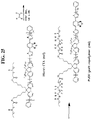
- FIG. 25 is a diagram illustrating a synthesis reaction scheme of a polyfluorene-based polymer-PVDF graft copolymer [polydihexyl xanthate fluorene-dioctyl fluorene-(thiophenebenzothiadiazole-thiophene)-g-PVDF, PVDF graft copolymer (red)] emitting red light.
- FIG. 26 is a diagram illustrating a synthesis reaction scheme of a polyfluorene-based polymer-PVDF graft copolymer [poly(dihexyl xanthate fluorene-dioctyl fluorenebenzothiadiazole)-g-PVDF, PVDF graft copolymer (green)] emitting red light.
- FIG. 27 is a diagram illustrating an NMR graph of a PVDF graft copolymer (green) synthesized according to Example 14.
- FIG. 28 is a diagram illustrating a synthesis reaction scheme of a polyfluorene-based polymer-PVDF graft copolymer [poly(dihexyl xanthate fluorene-dioctyl fluorene)-g-PVDF, PVDF graft copolymer (blue)] emitting blue light.
- FIG. 29 is a diagram illustrating an NMR graph of a PVDF graft copolymer (blue) synthesized according to Example 15.
- FIG. 30 illustrates electroluminescence performance data in direct current and alternating current of the PVDF graft copolymer (green) synthesized according to Example 14.
- FIG. 31 is the data of hysteresis loop of the PVDF graft copolymer (green) prepared according to Example 14.
- single SPL synchronized piezoelectric & luminescence material
- single SPL synchronized piezoelectric & luminescence
- aryl(ene) having 6 to 30 ring carbon atoms refers to a monocyclic or fused-ring system radical derived from an aromatic hydrocarbon having 6 to 30 ring carbon atoms, and preferably 6 to 20 ring carbon atoms. Examples thereof include phenyl, biphenyl, naphthyl, phenylnaphthyl, fluorenyl, phenanthrenyl, anthracenyl, indenyl, etc.
- heteroaryl(ene) having 2 to 30 ring carbon atoms refers to an aryl group having 2 to 30 ring carbon atoms and one or more heteroatoms selected from N, O, S, and Si, and it may be a monocyclic system or a fused ring system, and may also be partially saturated.
- the number of ring atoms including carbon may be 5 to 30, where the number of heteroatoms may be 1 to 4.
- the heteroaryl(ene) also includes a form in which one or more heteroaryl or aryl groups are linked to a heteroaryl group by a single linkage.
- heteroaryl(ene) examples include furyl, thiophenyl, imidazolyl, pyrazolyl, thiazolyl, thiadiazolyl, isothiazolyl, isoxazolyl, benzothiadiazolyl, benzothiophenyl, dibenzofuranyl, benzonaphthothiophenyl, benzothiazolyl, benzoisothiazolyl, benzoisoxazolyl, quinazolinyl, etc.
- substituted in the expression “substituted or unsubstituted” means that that a hydrogen atom in a functional group is replaced with another atom or another functional group (i.e., a substituent).
- substituent may include a halogen atom, a cyano group, a carboxyl group, a hydroxy group, an alkyl group having 1 to 30 carbon atoms, an alkyl group having 1 to 30 carbon atoms substituted by a halogen atom, an alkenyl group having 2 to 30 carbon atoms, an alkynyl group having 2 to 30 carbon atoms, etc.
- a macro chain transfer agent (Macro CTA) was synthesized, and a polyfluorene-PVDF graft copolymer that maintains luminescence properties was polymerized through RAFT polymerization.
- a copolymer containing the PVDF as a side branch was developed while maintaining excellent luminescence properties of the polyfluorene-based polymer emitting light of red, green, and blue light.
- the polymerization method of the present disclosure is not limited thereto.
- This polymer may increase miscibility between two polymers when a composite is formed, because the polyfluorene-based polymer and the PVDF having poor miscibility exists in one molecule. Therefore, it is possible to form the composite with excellent performance and form a film having excellent uniformity in forming a film through a solution process.
- the PVDF exhibiting piezoelectricity and the polyfluorene exhibiting luminescence properties are present in one molecule, which may result in a single piezoelectric-luminescence property.
- miscibility between these two polymers is poor, it is very difficult to form a composite and a film, and a device manufactured using the two polymers has poor performance. Thus, it is necessary to have excellent miscibility when the two polymers are formed into a composite or a film is manufactured.
- There are several ways to increase the miscibility between two polymers one of which is to increase the miscibility by using a polymerized copolymer by introducing a monomer that has affinity and servers as dispersants or surfactants into the two polymers.
- a synthesis method of the graft copolymer includes: “graft-to” that links the previously synthesized side chain to the main chain, “graft from” that allows the side chain to grow in the main chain, and “graft-through” that links a monomer having a large molecular weight due to the side chain attached thereto to a monomer having a small size.
- the graftform method which allows the side chain to grow in the main chain, was suitable in order to introduce the PVDF into the linear alkyl chain of a fluorene monomer.
- the PVDF is synthesized through radical polymerization in a high-pressure reactor using a vapor-phase vinylidene fluoride (VDF) monomer.
- the radical polymerization uses various types of polymerization method such as free radical, reversible addition-fragmentation chain transfer (RAFT) polymerization, and iodine transfer polymerization (ITP).
- RAFT reversible addition-fragmentation chain transfer
- ITP iodine transfer polymerization
- PDI polydispersity index
- a polymerization method such as RAFT polymerization or ITP, in which the molecular weight and molecular weight distribution of the polymer may be easily controlled, is often used.
- the xanthate group which is the chain transfer agent used in the RAFT polymerization of the PVDF, needs to exist in the polyfluorene-based polymer, which is the main chain. It was determined that the graft copolymer may be synthesized through the radical polymerization in the high-pressure reactor by using the polyfluorene-based polymer in which the xanthate group is introduced as a Macro CTA.
- polyfluorene-based polymer-polyvinylidene fluoride graft copolymer is represented by the following Formula 1:
- R 1 and R 2 may each independently be a hydrogen atom, a deuterium atom, a halogen atom, a cyano group, a substituted or unsubstituted aryl group having 6 to 30 ring carbon atoms, or a substituted or unsubstituted heteroaryl group having 2 to 30 ring carbon atoms; specifically, R 1 and R 2 may each independently be a substituted or unsubstituted aryl group having 6 to 30 ring carbon atoms, more specifically, an aryl group which has 6 to 20 carbon atoms and is unsubstituted or substituted by a halogen atom or an alkyl group having 1 to 10 carbon atoms; and still more particularly, a substituted or unsubstituted phenyl group.
- R 1 and R 2 may be the same as each other.
- R 3 and R 4 may each independently be a hydrogen atom, a deuterium atom, a halogen atom, a cyano group, a substituted or unsubstituted alkyl group having 1 to 10 carbon atoms, or a substituted or unsubstituted aryl group having 6 to 30 ring carbon atoms; specifically, a substituted or unsubstituted alkyl group having 1 to 10 carbon atoms, more specifically, an alkyl group which has 1 to 10 carbon atoms and is unsubstituted or substituted by a halogen atom; and still more specifically, a substituted or unsubstituted octyl group.
- R 3 and R 4 may be the same as each other. According to an embodiment, R 3 and R 4 are may be the same as each other, and may be an alkyl group which has 1 to 10 carbon atoms and is unsubstituted or substituted by a halogen atom.
- R 5 may be a direct linkage, a substituted or unsubstituted arylene group having 6 to 30 ring carbon atoms, or a substituted or unsubstituted heteroarylene group having 2 to 30 ring carbon atoms; specifically, a direct linkage, or a substituted or unsubstituted heteroarylene group having 2 to 30 ring carbon atoms; more specifically, a direct linkage, or a heteroaylene group unsubstituted or substituted by a halogen atom or an alkyl group having 1 to 10 carbon atoms, and has 2 to 30 ring carbon atoms and 1 to 4 heteroatoms, wherein the heteroatom is at least one selected from N and S; and still more specifically, a direct linkage, or a substituted or unsubstituted benzothiadiazolylene group or a substituted or unsubstituted benzothiadiazolylene group in which a substituted or unsubstituted thiophenyl is linked to
- R 6 and R 7 may each independently be a hydrogen atom, a deuterium atom, a halogen atom, a cyano group, a substituted or unsubstituted alkyl group having 1 to 10 carbon atoms, a substituted or unsubstituted alkyl xanthate group having 1 to 10 carbon atoms, or a substituted or unsubstituted aryl group having 6 to 30 ring carbon atoms; specifically, an alkyl xanthate group which has 1 to 10 carbon atoms and is unsubstituted or substituted by a halogen atom or an alkyl group having 1 to 10 carbon atoms; and more specifically, R 6 and R 7 may be the same as each other, and may be an alkyl xanthate group which has 1 to 10 carbon atoms and is substituted by a halogen atom, for example, a fluorine atom.
- a, b, c, and d may each independently be an integer of 1 to 3, and n may be an integer of 1 to 5.
- polyfluorene-based polymer-polyvinylidene fluoride graft copolymer according to an embodiment represented by Formula 1 may be represented by any one of the following Formulas 1-1 to 1-3:
- R 1 to R 4 , a to d, and n may be as described in Formula 1.
- polyfluorene-based polymer-polyvinylidene fluoride graft copolymer according to an embodiment represented by Formula 1 may be represented by any one of the following Formulas 1-4 to 1-6. However, the embodiment is not limited thereto.
- c, d, and n may be as described in Formula 1.
- the polyfluorene-based polymer-polyvinylidene fluoride graft copolymer of the above-described embodiment has both the piezoelectric properties and the luminescence properties
- the polyfluorene-based polymer-polyvinylidene fluoride graft copolymer may visualize various input signals, such as sound, touch, and temperature, and apply the various input signals to efficient communication. Therefore, the polyfluorene-based polymer-polyvinylidene fluoride graft copolymer may be usefully used for the next-generation future-oriented wearable synesthesia element.
- Such a synesthesia element includes various elements used in all fields such as industrial and commercial fields, a medical field, a vehicle, and a personal computer (PC).
- Examples of the synesthesia element may include a stretchable element. Since the stretchable element may be operated even when the substrate is contracted or stretched by manufacturing an existing photoelectric element on a stretched substrate, it may create various application fields and may be variously used as a core component material for implementing a wearable electronic element, an electronic skin, Internet of things (IoT), an electronic element for a vehicle, and an artificial intelligence (AI) robot.
- IoT Internet of things
- AI artificial intelligence
- Formula 1 may be represented by any one of the following Formulas 1 ⁇ 4 to 1-6:
- the first electrode layer and the second electrode layer may be selected from the group consisting of gold, silver, copper, graphene, silicon nanowires, carbon nanotubes, and indium tin oxide.
- the element may exhibit both piezoelectricity and luminescence.
- reaction mixture extracted with diethyl ether and washed with water and a saturated aqueous sodium chloride solution. Anhydrous MgSO 4 was added to the separated organic solution and stirred to remove moisture in the product. After filtration, the concentrated product was recrystallized three times with acetone to obtain 9,9-dioctylfluorene-2,7-diboronic acid bis(pinacol) ester, (F8-pinB) (4.00 g, 82%) as a white solid.
- a P(F6OH—F8-TBT) emitting red light, a P(F6OH—F8-BT) emitting green light, and a P(F6OH—F8) emitting blue light were synthesized through palladiumcatalyzed Suzuki coupling using the monomers synthesized in Examples 1 to 6. In addition, each monomer was synthesized by setting the ratio to 1:3 (F6OH:ther monomers).
- the precipitate was subjected to a Soxhlet process for 48 hours or more using acetone to remove a low molecular weight polymer and dried to obtain a polymer, [poly(dihexanol fluorene-dioctyl fluorene-(thiophene-benzothiadiazole-thiophene)] [P(F6OH—F8-TBT)] (0.4700 g, 53%) as a red solid.
- the precipitate was subjected to a Soxhlet process for 48 hours or more using acetone to remove a low molecular weight polymer and dried to obtain a polymer, poly(dihexanol fluorene-dioctyl fluorene-benzothiadiazole) [P(F6OH—F8-BT)] (1.800 g, 55%) as a yellow thread-shape.
- the precipitate was subjected to a Soxhlet process for 48 hours or more using acetone, and the low molecular weight polymer was removed and dried to obtain a polymer, poly(dihexanol fluorene-dioctyl fluorene) [P(F6OH—F8)] (2.400 g, 52%) as a green thread-shape.
- Ethyl xanthogenacetic acid was added to the three polymers synthesized in Examples 7 to 9 through Steglich esterification using N,N′-dicylohexyl carbodiimide (DCC) or 1-ethyl-3-(3-dimethylaminopropyl)carbodiimide (EDC).
- DCC N,N′-dicylohexyl carbodiimide
- EDC 1-ethyl-3-(3-dimethylaminopropyl)carbodiimide
- Example 10 Synthesis of Macro Chain Transfer Agent [Macro CTA (Red)] Containing Xanthate Group and Emitting Red Light
- the reaction mixture was extracted with dichloromethane and washed with water and a saturated aqueous sodium chloride solution. Anhydrous MgSO 4 was added to the separated organic solution and stirred to remove moisture in the product.
- the reaction mixture was filtered, concentrated, and methanol was added dropwise to the mixture, resulting in precipitation.
- the precipitate was subjected to a Soxhlet process for 48 hours or more using methanol to remove impurities and dried to obtain a polymer, poly[dihexyl xanthate fluorene-dioctyl fluorene-(thiophenebenzothiadiazole-thiophene)] [Macro CTA (red)] (0.27 g) as a red solid.
- Example 11 Synthesis of Macro Chain Transfer Agent [Macro CTA (Green)] Containing Xanthate Group and Emitting Green Light
- the reaction mixture was extracted with dichloromethane and washed with water and a saturated aqueous sodium chloride solution. Anhydrous MgSO 4 was added to the separated organic solution and stirred to remove moisture in the product.
- the reaction mixture was filtered, concentrated, and methanol was added dropwise to the mixture, resulting in precipitation.
- the precipitate was subjected to a Soxhlet process for 48 hours or more using methanol to remove impurities and dried to obtain a polymer poly(dihexyl xanthate fluorene-dioctyl fluorenebenzothiadiazole) [Macro CTA (green)] (1.83 g) as a yellow thread-shape.
- Example 12 Synthesis Macro Chain Transfer Agent [Macro CTA (Blue)] Containing Xanthate Group and Emitting Blue Light
- the precipitate was subjected to a Soxhlet process for 48 hours or more using methanol to remove impurities and dried to obtain a polymer poly(dihexyl xanthate fluorene-dioctyl fluorene) [Macro CTA (blue)] (2.30 g) as a yellow thread-shape.
- RAFT polymerization of a PVDF was carried out in a high-pressure reactor using a Macro CTA (blue) and a Macro CTA (green). Since a VDF, which is a monomer of the PVDF, produced an electron-deficient radical when radical reaction proceeded, it is appropriate to generate an electron-rich radical as a suitable initiator. Thus, di-tert-butyl peroxide (DTBP), which can provide an electron-rich, tert-butyl radical, was used as an initiator, and the reaction was carried out at 120° C., which is an appropriate initiation temperature for DTBP.
- DTBP di-tert-butyl peroxide
- the reaction mixture was cooled down to room temperature and residual vinylidene fluoride gas was removed.
- the reaction mixture was concentrated and added dropwise to methanol, resulting in precipitation.
- the precipitate was subjected to a Soxhlet process for 24 hours or more using chloroform to remove an unreacted Macro CTA (red), dissolved in an excess of cyclohexanone, and removed an undissolved PVDF homopolymer by using a centrifuge.
- a cyclohexanone solution in which the reactant was dissolved was concentrated and methanol was added dropwise to the solution, resulting in precipitation.
- the precipitate was filtered and dried to obtain poly [dihexyl xanthate fluorene-dioctyl fluorene-(thiophene-benzothiadiazole-thiophene)]-g-PVDF [PVDF graft copolymer (red)] (3.50 g).
- the reaction mixture was cooled down to room temperature and residual vinylidene fluoride gas was removed.
- the reaction mixture was concentrated and added dropwise to methanol, resulting in precipitation.
- the precipitate was subjected to a Soxhlet process for 24 hours or more using chloroform to remove an unreacted Macro CTA (green), dissolved in an excess of cyclohexanone, and removed an undissolved PVDF homopolymer by using a centrifuge.
- a cyclohexanone solution in which the reactant was dissolved was concentrated and methanol was added dropwise to the solution, resulting in precipitation.
- the reaction mixture was cooled down to room temperature and residual vinylidene fluoride gas was removed.
- the reaction mixture was concentrated and added dropwise to methanol, resulting in a precipitate.
- the precipitate was subjected to a Soxhlet process for 24 hours or more using chloroform to remove unreacted Macro CTA (blue), dissolved in an excess of cyclohexanone, and removed an undissolved PVDF homopolymer by using a centrifuge.
- a cyclohexanone solution in which the reactant was dissolved was concentrated and methanol was added dropwise to the solution, resulting in a precipitate.
- the precipitate was filtered and dried to obtain a poly(dihexyl xanthate fluorene-dioctyl fluorene)-g-PVDF [PVDF graft copolymer (blue)] (2.30 g).
- the PVDF graft copolymer (green) synthesized in Example 14 was manufactured as an element, and electroluminescence and hysteresis loop were measured.
- the element has a lower driving voltage in alternating current (AC) than in direct current (DC), and has a luminescence performance of up to 209.94 cd/m 2 in AC, as shown in FIG. 30 .
- the hysteresis loop was measured to check whether the element has piezoelectric properties, and as a result, it was confirmed that a schematic graph in the form of a closed curve appeared, as shown in FIG.
- the PVDF graft copolymer will be available as a single material that exhibits both the piezoelectric properties and the luminescence properties.
Landscapes
- Chemical & Material Sciences (AREA)
- Organic Chemistry (AREA)
- Chemical Kinetics & Catalysis (AREA)
- Polymers & Plastics (AREA)
- Health & Medical Sciences (AREA)
- Medicinal Chemistry (AREA)
- Engineering & Computer Science (AREA)
- Materials Engineering (AREA)
- Manufacturing & Machinery (AREA)
- General Chemical & Material Sciences (AREA)
- Life Sciences & Earth Sciences (AREA)
- Wood Science & Technology (AREA)
- Physics & Mathematics (AREA)
- Spectroscopy & Molecular Physics (AREA)
- Electroluminescent Light Sources (AREA)
Abstract
Description


Claims (16)


Applications Claiming Priority (2)
| Application Number | Priority Date | Filing Date | Title |
|---|---|---|---|
| KR10-2020-0093281 | 2020-07-27 | ||
| KR1020200093281A KR102290296B1 (en) | 2020-07-27 | 2020-07-27 | Polyfluorene derivatives and polyvinylidene fluoride graft copolymers and device including the same |
Publications (2)
| Publication Number | Publication Date |
|---|---|
| US20220025095A1 US20220025095A1 (en) | 2022-01-27 |
| US11370864B2 true US11370864B2 (en) | 2022-06-28 |
Family
ID=77466106
Family Applications (1)
| Application Number | Title | Priority Date | Filing Date |
|---|---|---|---|
| US17/106,427 Active 2040-12-31 US11370864B2 (en) | 2020-07-27 | 2020-11-30 | Polyfluorene-based polymer-polyvinylidene fluoride graft copolymer and element including the same |
Country Status (2)
| Country | Link |
|---|---|
| US (1) | US11370864B2 (en) |
| KR (1) | KR102290296B1 (en) |
Families Citing this family (1)
| Publication number | Priority date | Publication date | Assignee | Title |
|---|---|---|---|---|
| KR20240068082A (en) | 2022-11-10 | 2024-05-17 | 현대자동차주식회사 | An ionomer for a fuel cell having densed sulfonic acid group and manufacturing method thereof |
Citations (4)
| Publication number | Priority date | Publication date | Assignee | Title |
|---|---|---|---|---|
| US20040079924A1 (en) * | 2002-10-25 | 2004-04-29 | Korea Kumho Petrochemical Co., Ltd. | Blue light-emitting, ladder-type polymer with excellent heat stability |
| WO2005100437A1 (en) * | 2004-04-14 | 2005-10-27 | Kanazawa University Technology Licensing Organization Ltd. | Polyfluorene derivative having peculiar luminescence and processes for producing the same |
| KR20080043160A (en) * | 2006-11-13 | 2008-05-16 | 경성대학교 산학협력단 | Blue light emitting polymer, method for manufacturing the same, and polymer organic electroluminescent device employing the same |
| US20190023834A1 (en) * | 2016-01-19 | 2019-01-24 | Chromition Limited | Nanoparticles for use in light emitting applications |
-
2020
- 2020-07-27 KR KR1020200093281A patent/KR102290296B1/en active Active
- 2020-11-30 US US17/106,427 patent/US11370864B2/en active Active
Patent Citations (4)
| Publication number | Priority date | Publication date | Assignee | Title |
|---|---|---|---|---|
| US20040079924A1 (en) * | 2002-10-25 | 2004-04-29 | Korea Kumho Petrochemical Co., Ltd. | Blue light-emitting, ladder-type polymer with excellent heat stability |
| WO2005100437A1 (en) * | 2004-04-14 | 2005-10-27 | Kanazawa University Technology Licensing Organization Ltd. | Polyfluorene derivative having peculiar luminescence and processes for producing the same |
| KR20080043160A (en) * | 2006-11-13 | 2008-05-16 | 경성대학교 산학협력단 | Blue light emitting polymer, method for manufacturing the same, and polymer organic electroluminescent device employing the same |
| US20190023834A1 (en) * | 2016-01-19 | 2019-01-24 | Chromition Limited | Nanoparticles for use in light emitting applications |
Also Published As
| Publication number | Publication date |
|---|---|
| US20220025095A1 (en) | 2022-01-27 |
| KR102290296B1 (en) | 2021-08-17 |
Similar Documents
| Publication | Publication Date | Title |
|---|---|---|
| TWI638823B (en) | Organic light-emitting element | |
| Zou et al. | Unexpected Propeller‐Like Hexakis (fluoren‐2‐yl) benzene Cores for Six‐Arm Star‐Shaped Oligofluorenes: Highly Efficient Deep‐Blue Fluorescent Emitters and Good Hole‐Transporting Materials | |
| TWI447163B (en) | Novel polythiophene-polyanion complexes in non-polar organic solvents | |
| JP5618175B2 (en) | New heterocyclic aromatic polymers | |
| Chuang et al. | Polymers with alkyl main chain pendent biphenyl carbazole or triphenylamine unit as host for polymer light emitting diodes | |
| US11370864B2 (en) | Polyfluorene-based polymer-polyvinylidene fluoride graft copolymer and element including the same | |
| WO2010007648A1 (en) | Novel heterocyclic aromatic compound and polymer | |
| JP4904002B2 (en) | Spirocyclopentaphenanthrenefluorene compound and organic EL device using the same | |
| KR102114177B1 (en) | Novel compound, its production method and organic electronic device using them | |
| JP4767547B2 (en) | Thieno [3,2-b] indole polymer and organic electroluminescence device using the same | |
| JP2004143426A (en) | Ladder-type blue light-emitting polymer with excellent thermal stability | |
| CN111148791A (en) | Novel polymer and organic light emitting device comprising the same | |
| Chen et al. | Novel fluorene-alt-thienylenevinylene-based copolymers: tuning luminescent wavelength via thiophene substitution position | |
| JP5618174B2 (en) | Method for producing heterocycle-containing aromatic compound | |
| EP1434813B1 (en) | Polymers , their synthesis, and electronic devices incorporating same | |
| JP2017059668A (en) | Polymer and organic thin film solar cell using the same | |
| JP7682928B2 (en) | Organic light-emitting device | |
| Gulfidan et al. | Neutral state colorless electrochromic polymer networks: Spacer effect on electrochromic performance | |
| KR100244160B1 (en) | Electroluminescence display type of a luminous polymer | |
| JP6977922B2 (en) | Polymers and organic solar cells containing them | |
| KR100241114B1 (en) | Polymer composition for emitting layer of light emitting electrochemical display | |
| CN106800640A (en) | A kind of polymer, its preparation method and application in solar cells | |
| Ghase et al. | Efficient blue light-emitting polydibenzofluorenes through the integration of an anthracene unit | |
| KR101535186B1 (en) | fullerene derivative having pyrrolidine and organic electronic devices containing them | |
| US7884175B2 (en) | Method for controlling the molecular weight during poly(arylene vinylene) synthesis, and polymers produced therewith |
Legal Events
| Date | Code | Title | Description |
|---|---|---|---|
| AS | Assignment |
Owner name: INDUSTRY-ACADEMIC COOPERATION FOUNDATION, YONSEI UNIVERSITY, KOREA, REPUBLIC OF Free format text: ASSIGNMENT OF ASSIGNORS INTEREST;ASSIGNORS:LEE, JINKYUN;LEE, SEJIN;KIM, JIYEON;AND OTHERS;REEL/FRAME:054488/0037 Effective date: 20201125 |
|
| FEPP | Fee payment procedure |
Free format text: ENTITY STATUS SET TO UNDISCOUNTED (ORIGINAL EVENT CODE: BIG.); ENTITY STATUS OF PATENT OWNER: SMALL ENTITY |
|
| FEPP | Fee payment procedure |
Free format text: ENTITY STATUS SET TO SMALL (ORIGINAL EVENT CODE: SMAL); ENTITY STATUS OF PATENT OWNER: SMALL ENTITY |
|
| STPP | Information on status: patent application and granting procedure in general |
Free format text: NOTICE OF ALLOWANCE MAILED -- APPLICATION RECEIVED IN OFFICE OF PUBLICATIONS |
|
| STPP | Information on status: patent application and granting procedure in general |
Free format text: AWAITING TC RESP., ISSUE FEE NOT PAID |
|
| STPP | Information on status: patent application and granting procedure in general |
Free format text: NOTICE OF ALLOWANCE MAILED -- APPLICATION RECEIVED IN OFFICE OF PUBLICATIONS |
|
| STPP | Information on status: patent application and granting procedure in general |
Free format text: PUBLICATIONS -- ISSUE FEE PAYMENT RECEIVED |
|
| STPP | Information on status: patent application and granting procedure in general |
Free format text: PUBLICATIONS -- ISSUE FEE PAYMENT VERIFIED |
|
| STCF | Information on status: patent grant |
Free format text: PATENTED CASE |
|
| MAFP | Maintenance fee payment |
Free format text: PAYMENT OF MAINTENANCE FEE, 4TH YR, SMALL ENTITY (ORIGINAL EVENT CODE: M2551); ENTITY STATUS OF PATENT OWNER: SMALL ENTITY Year of fee payment: 4 |