US11369384B2 - Systems for venous occlusion for the treatment of venous insufficiency - Google Patents
Systems for venous occlusion for the treatment of venous insufficiency Download PDFInfo
- Publication number
- US11369384B2 US11369384B2 US16/884,951 US202016884951A US11369384B2 US 11369384 B2 US11369384 B2 US 11369384B2 US 202016884951 A US202016884951 A US 202016884951A US 11369384 B2 US11369384 B2 US 11369384B2
- Authority
- US
- United States
- Prior art keywords
- vein
- syringe
- catheter
- adapter
- plunger
- Prior art date
- Legal status (The legal status is an assumption and is not a legal conclusion. Google has not performed a legal analysis and makes no representation as to the accuracy of the status listed.)
- Active, expires
Links
Images




Classifications
-
- A—HUMAN NECESSITIES
- A61—MEDICAL OR VETERINARY SCIENCE; HYGIENE
- A61B—DIAGNOSIS; SURGERY; IDENTIFICATION
- A61B17/00—Surgical instruments, devices or methods
- A61B17/12—Surgical instruments, devices or methods for ligaturing or otherwise compressing tubular parts of the body, e.g. blood vessels or umbilical cord
- A61B17/12022—Occluding by internal devices, e.g. balloons or releasable wires
-
- A—HUMAN NECESSITIES
- A61—MEDICAL OR VETERINARY SCIENCE; HYGIENE
- A61B—DIAGNOSIS; SURGERY; IDENTIFICATION
- A61B17/00—Surgical instruments, devices or methods
- A61B17/00234—Surgical instruments, devices or methods for minimally invasive surgery
-
- A—HUMAN NECESSITIES
- A61—MEDICAL OR VETERINARY SCIENCE; HYGIENE
- A61B—DIAGNOSIS; SURGERY; IDENTIFICATION
- A61B17/00—Surgical instruments, devices or methods
- A61B17/00491—Surgical glue applicators
-
- A—HUMAN NECESSITIES
- A61—MEDICAL OR VETERINARY SCIENCE; HYGIENE
- A61B—DIAGNOSIS; SURGERY; IDENTIFICATION
- A61B17/00—Surgical instruments, devices or methods
- A61B17/12—Surgical instruments, devices or methods for ligaturing or otherwise compressing tubular parts of the body, e.g. blood vessels or umbilical cord
- A61B17/12022—Occluding by internal devices, e.g. balloons or releasable wires
- A61B17/12027—Type of occlusion
- A61B17/12031—Type of occlusion complete occlusion
-
- A—HUMAN NECESSITIES
- A61—MEDICAL OR VETERINARY SCIENCE; HYGIENE
- A61B—DIAGNOSIS; SURGERY; IDENTIFICATION
- A61B17/00—Surgical instruments, devices or methods
- A61B17/12—Surgical instruments, devices or methods for ligaturing or otherwise compressing tubular parts of the body, e.g. blood vessels or umbilical cord
- A61B17/12022—Occluding by internal devices, e.g. balloons or releasable wires
- A61B17/12099—Occluding by internal devices, e.g. balloons or releasable wires characterised by the location of the occluder
- A61B17/12109—Occluding by internal devices, e.g. balloons or releasable wires characterised by the location of the occluder in a blood vessel
-
- A—HUMAN NECESSITIES
- A61—MEDICAL OR VETERINARY SCIENCE; HYGIENE
- A61B—DIAGNOSIS; SURGERY; IDENTIFICATION
- A61B17/00—Surgical instruments, devices or methods
- A61B17/12—Surgical instruments, devices or methods for ligaturing or otherwise compressing tubular parts of the body, e.g. blood vessels or umbilical cord
- A61B17/12022—Occluding by internal devices, e.g. balloons or releasable wires
- A61B17/12131—Occluding by internal devices, e.g. balloons or releasable wires characterised by the type of occluding device
- A61B17/12136—Balloons
-
- A—HUMAN NECESSITIES
- A61—MEDICAL OR VETERINARY SCIENCE; HYGIENE
- A61B—DIAGNOSIS; SURGERY; IDENTIFICATION
- A61B17/00—Surgical instruments, devices or methods
- A61B17/12—Surgical instruments, devices or methods for ligaturing or otherwise compressing tubular parts of the body, e.g. blood vessels or umbilical cord
- A61B17/12022—Occluding by internal devices, e.g. balloons or releasable wires
- A61B17/12131—Occluding by internal devices, e.g. balloons or releasable wires characterised by the type of occluding device
- A61B17/12168—Occluding by internal devices, e.g. balloons or releasable wires characterised by the type of occluding device having a mesh structure
- A61B17/12172—Occluding by internal devices, e.g. balloons or releasable wires characterised by the type of occluding device having a mesh structure having a pre-set deployed three-dimensional shape
-
- A—HUMAN NECESSITIES
- A61—MEDICAL OR VETERINARY SCIENCE; HYGIENE
- A61B—DIAGNOSIS; SURGERY; IDENTIFICATION
- A61B17/00—Surgical instruments, devices or methods
- A61B17/12—Surgical instruments, devices or methods for ligaturing or otherwise compressing tubular parts of the body, e.g. blood vessels or umbilical cord
- A61B17/12022—Occluding by internal devices, e.g. balloons or releasable wires
- A61B17/12131—Occluding by internal devices, e.g. balloons or releasable wires characterised by the type of occluding device
- A61B17/12181—Occluding by internal devices, e.g. balloons or releasable wires characterised by the type of occluding device formed by fluidized, gelatinous or cellular remodelable materials, e.g. embolic liquids, foams or extracellular matrices
- A61B17/12186—Occluding by internal devices, e.g. balloons or releasable wires characterised by the type of occluding device formed by fluidized, gelatinous or cellular remodelable materials, e.g. embolic liquids, foams or extracellular matrices liquid materials adapted to be injected
-
- A—HUMAN NECESSITIES
- A61—MEDICAL OR VETERINARY SCIENCE; HYGIENE
- A61B—DIAGNOSIS; SURGERY; IDENTIFICATION
- A61B17/00—Surgical instruments, devices or methods
- A61B17/12—Surgical instruments, devices or methods for ligaturing or otherwise compressing tubular parts of the body, e.g. blood vessels or umbilical cord
- A61B17/12022—Occluding by internal devices, e.g. balloons or releasable wires
- A61B17/12131—Occluding by internal devices, e.g. balloons or releasable wires characterised by the type of occluding device
- A61B17/12181—Occluding by internal devices, e.g. balloons or releasable wires characterised by the type of occluding device formed by fluidized, gelatinous or cellular remodelable materials, e.g. embolic liquids, foams or extracellular matrices
- A61B17/1219—Occluding by internal devices, e.g. balloons or releasable wires characterised by the type of occluding device formed by fluidized, gelatinous or cellular remodelable materials, e.g. embolic liquids, foams or extracellular matrices expandable in contact with liquids
-
- A—HUMAN NECESSITIES
- A61—MEDICAL OR VETERINARY SCIENCE; HYGIENE
- A61B—DIAGNOSIS; SURGERY; IDENTIFICATION
- A61B17/00—Surgical instruments, devices or methods
- A61B17/12—Surgical instruments, devices or methods for ligaturing or otherwise compressing tubular parts of the body, e.g. blood vessels or umbilical cord
- A61B17/12022—Occluding by internal devices, e.g. balloons or releasable wires
- A61B17/12131—Occluding by internal devices, e.g. balloons or releasable wires characterised by the type of occluding device
- A61B17/12181—Occluding by internal devices, e.g. balloons or releasable wires characterised by the type of occluding device formed by fluidized, gelatinous or cellular remodelable materials, e.g. embolic liquids, foams or extracellular matrices
- A61B17/12195—Occluding by internal devices, e.g. balloons or releasable wires characterised by the type of occluding device formed by fluidized, gelatinous or cellular remodelable materials, e.g. embolic liquids, foams or extracellular matrices comprising a curable material
-
- A—HUMAN NECESSITIES
- A61—MEDICAL OR VETERINARY SCIENCE; HYGIENE
- A61B—DIAGNOSIS; SURGERY; IDENTIFICATION
- A61B17/00—Surgical instruments, devices or methods
- A61B17/12—Surgical instruments, devices or methods for ligaturing or otherwise compressing tubular parts of the body, e.g. blood vessels or umbilical cord
- A61B17/132—Tourniquets
- A61B17/1322—Tourniquets comprising a flexible encircling member
- A61B17/1325—Tourniquets comprising a flexible encircling member with means for applying local pressure
-
- A—HUMAN NECESSITIES
- A61—MEDICAL OR VETERINARY SCIENCE; HYGIENE
- A61B—DIAGNOSIS; SURGERY; IDENTIFICATION
- A61B90/00—Instruments, implements or accessories specially adapted for surgery or diagnosis and not covered by any of the groups A61B1/00 - A61B50/00, e.g. for luxation treatment or for protecting wound edges
- A61B90/39—Markers, e.g. radio-opaque or breast lesions markers
-
- A—HUMAN NECESSITIES
- A61—MEDICAL OR VETERINARY SCIENCE; HYGIENE
- A61L—METHODS OR APPARATUS FOR STERILISING MATERIALS OR OBJECTS IN GENERAL; DISINFECTION, STERILISATION OR DEODORISATION OF AIR; CHEMICAL ASPECTS OF BANDAGES, DRESSINGS, ABSORBENT PADS OR SURGICAL ARTICLES; MATERIALS FOR BANDAGES, DRESSINGS, ABSORBENT PADS OR SURGICAL ARTICLES
- A61L24/00—Surgical adhesives or cements; Adhesives for colostomy devices
-
- A—HUMAN NECESSITIES
- A61—MEDICAL OR VETERINARY SCIENCE; HYGIENE
- A61B—DIAGNOSIS; SURGERY; IDENTIFICATION
- A61B17/00—Surgical instruments, devices or methods
- A61B2017/00004—(bio)absorbable, (bio)resorbable or resorptive
-
- A—HUMAN NECESSITIES
- A61—MEDICAL OR VETERINARY SCIENCE; HYGIENE
- A61B—DIAGNOSIS; SURGERY; IDENTIFICATION
- A61B17/00—Surgical instruments, devices or methods
- A61B17/00234—Surgical instruments, devices or methods for minimally invasive surgery
- A61B2017/00292—Surgical instruments, devices or methods for minimally invasive surgery mounted on or guided by flexible, e.g. catheter-like, means
-
- A—HUMAN NECESSITIES
- A61—MEDICAL OR VETERINARY SCIENCE; HYGIENE
- A61B—DIAGNOSIS; SURGERY; IDENTIFICATION
- A61B17/00—Surgical instruments, devices or methods
- A61B2017/00367—Details of actuation of instruments, e.g. relations between pushing buttons, or the like, and activation of the tool, working tip, or the like
-
- A—HUMAN NECESSITIES
- A61—MEDICAL OR VETERINARY SCIENCE; HYGIENE
- A61B—DIAGNOSIS; SURGERY; IDENTIFICATION
- A61B17/00—Surgical instruments, devices or methods
- A61B17/00491—Surgical glue applicators
- A61B2017/005—Surgical glue applicators hardenable using external energy source, e.g. laser, ultrasound
-
- A—HUMAN NECESSITIES
- A61—MEDICAL OR VETERINARY SCIENCE; HYGIENE
- A61B—DIAGNOSIS; SURGERY; IDENTIFICATION
- A61B17/00—Surgical instruments, devices or methods
- A61B2017/00831—Material properties
- A61B2017/00867—Material properties shape memory effect
- A61B2017/00871—Material properties shape memory effect polymeric
-
- A—HUMAN NECESSITIES
- A61—MEDICAL OR VETERINARY SCIENCE; HYGIENE
- A61B—DIAGNOSIS; SURGERY; IDENTIFICATION
- A61B17/00—Surgical instruments, devices or methods
- A61B2017/00831—Material properties
- A61B2017/00884—Material properties enhancing wound closure
-
- A—HUMAN NECESSITIES
- A61—MEDICAL OR VETERINARY SCIENCE; HYGIENE
- A61B—DIAGNOSIS; SURGERY; IDENTIFICATION
- A61B17/00—Surgical instruments, devices or methods
- A61B2017/00831—Material properties
- A61B2017/00951—Material properties adhesive
-
- A—HUMAN NECESSITIES
- A61—MEDICAL OR VETERINARY SCIENCE; HYGIENE
- A61B—DIAGNOSIS; SURGERY; IDENTIFICATION
- A61B17/00—Surgical instruments, devices or methods
- A61B17/12—Surgical instruments, devices or methods for ligaturing or otherwise compressing tubular parts of the body, e.g. blood vessels or umbilical cord
- A61B17/12022—Occluding by internal devices, e.g. balloons or releasable wires
- A61B2017/1205—Introduction devices
- A61B2017/12054—Details concerning the detachment of the occluding device from the introduction device
-
- A—HUMAN NECESSITIES
- A61—MEDICAL OR VETERINARY SCIENCE; HYGIENE
- A61B—DIAGNOSIS; SURGERY; IDENTIFICATION
- A61B17/00—Surgical instruments, devices or methods
- A61B17/12—Surgical instruments, devices or methods for ligaturing or otherwise compressing tubular parts of the body, e.g. blood vessels or umbilical cord
- A61B17/12022—Occluding by internal devices, e.g. balloons or releasable wires
- A61B2017/1205—Introduction devices
- A61B2017/12054—Details concerning the detachment of the occluding device from the introduction device
- A61B2017/12095—Threaded connection
-
- A—HUMAN NECESSITIES
- A61—MEDICAL OR VETERINARY SCIENCE; HYGIENE
- A61B—DIAGNOSIS; SURGERY; IDENTIFICATION
- A61B17/00—Surgical instruments, devices or methods
- A61B17/22—Implements for squeezing-off ulcers or the like on inner organs of the body; Implements for scraping-out cavities of body organs, e.g. bones; for invasive removal or destruction of calculus using mechanical vibrations; for removing obstructions in blood vessels, not otherwise provided for
- A61B17/22004—Implements for squeezing-off ulcers or the like on inner organs of the body; Implements for scraping-out cavities of body organs, e.g. bones; for invasive removal or destruction of calculus using mechanical vibrations; for removing obstructions in blood vessels, not otherwise provided for using mechanical vibrations, e.g. ultrasonic shock waves
- A61B17/22012—Implements for squeezing-off ulcers or the like on inner organs of the body; Implements for scraping-out cavities of body organs, e.g. bones; for invasive removal or destruction of calculus using mechanical vibrations; for removing obstructions in blood vessels, not otherwise provided for using mechanical vibrations, e.g. ultrasonic shock waves in direct contact with, or very close to, the obstruction or concrement
- A61B2017/22014—Implements for squeezing-off ulcers or the like on inner organs of the body; Implements for scraping-out cavities of body organs, e.g. bones; for invasive removal or destruction of calculus using mechanical vibrations; for removing obstructions in blood vessels, not otherwise provided for using mechanical vibrations, e.g. ultrasonic shock waves in direct contact with, or very close to, the obstruction or concrement the ultrasound transducer being outside patient's body; with an ultrasound transmission member; with a wave guide; with a vibrated guide wire
-
- A—HUMAN NECESSITIES
- A61—MEDICAL OR VETERINARY SCIENCE; HYGIENE
- A61B—DIAGNOSIS; SURGERY; IDENTIFICATION
- A61B90/00—Instruments, implements or accessories specially adapted for surgery or diagnosis and not covered by any of the groups A61B1/00 - A61B50/00, e.g. for luxation treatment or for protecting wound edges
- A61B90/36—Image-producing devices or illumination devices not otherwise provided for
- A61B90/37—Surgical systems with images on a monitor during operation
- A61B2090/378—Surgical systems with images on a monitor during operation using ultrasound
-
- A—HUMAN NECESSITIES
- A61—MEDICAL OR VETERINARY SCIENCE; HYGIENE
- A61B—DIAGNOSIS; SURGERY; IDENTIFICATION
- A61B90/00—Instruments, implements or accessories specially adapted for surgery or diagnosis and not covered by any of the groups A61B1/00 - A61B50/00, e.g. for luxation treatment or for protecting wound edges
- A61B90/39—Markers, e.g. radio-opaque or breast lesions markers
- A61B2090/3925—Markers, e.g. radio-opaque or breast lesions markers ultrasonic
-
- A—HUMAN NECESSITIES
- A61—MEDICAL OR VETERINARY SCIENCE; HYGIENE
- A61L—METHODS OR APPARATUS FOR STERILISING MATERIALS OR OBJECTS IN GENERAL; DISINFECTION, STERILISATION OR DEODORISATION OF AIR; CHEMICAL ASPECTS OF BANDAGES, DRESSINGS, ABSORBENT PADS OR SURGICAL ARTICLES; MATERIALS FOR BANDAGES, DRESSINGS, ABSORBENT PADS OR SURGICAL ARTICLES
- A61L2430/00—Materials or treatment for tissue regeneration
- A61L2430/36—Materials or treatment for tissue regeneration for embolization or occlusion, e.g. vaso-occlusive compositions or devices
Definitions
- Healthy leg veins contain valves that allow blood to move in one direction from the lower limbs toward the heart. These valves open when blood is flowing toward the heart, and close to prevent venous reflux, or the backward flow of blood. When veins weaken and become enlarged, their valves cannot close properly, which leads to venous reflux and impaired drainage of venous blood from the legs. Venous reflux is most common in the superficial veins. The largest superficial vein is the great saphenous vein, which runs from the top of the foot to the groin, where it originates at a deep vein.
- Factors that contribute to venous reflux disease include female gender, heredity, obesity, lack of physical activity, multiple pregnancies, age, past history of blood clots in the legs and professions that involve long periods of standing. According to population studies, the prevalence of visible tortuous varicose veins, a common indicator of venous reflux disease, is up to 15% for adult men and 25% for adult women. A clinical registry of over 1,000 patients shows that the average age of patients treated for venous reflux is 48 and over 75% of the patients are women.
- Venous reflux can be classified as either asymptomatic or symptomatic, depending on the degree of severity.
- Symptomatic venous reflux disease is a more advanced stage of the disease and can have a profound impact on the patient's quality of life. People with symptomatic venous reflux disease may seek treatment due to a combination of symptoms and signs, which may include leg pain and swelling; painful varicose veins; skin changes such as discoloration or inflammation; and open skin ulcers.
- a primary goal of treating symptomatic venous reflux is to eliminate the reflux at its source, such as, for example, the great saphenous vein. If a diseased vein is either closed or removed, blood can automatically reroute into other veins without any known negative consequences to the patient.
- the current non-invasive methods for treatment of reflux in the greater saphenous vein include radiofrequency (RF) ablation, laser endothermal ablation, and sclerotherapy, including foam sclerotherapy.
- Radiofrequency ablation and laser ablation require tumescent anesthesia which produce both bruising and pain along the inner thigh and upper inner calf for several weeks, and both can have side effects of burns and nerve damage.
- Radiofrequency ablation and laser ablation also require capital purchases of a radiofrequency device or laser box, often at costs of more than $50,000, in addition to expensive disposal mechanisms.
- foam sclerotherapy is relatively non-invasive, it has a high rate of recurrence and potential side effects. All of the methods require wearing compression stockings for 2-4 weeks.
- a method of treating a vein comprising the steps of: advancing a catheter distally across a treatment zone in a vein; creating a first occlusion in the vein at a distal end of the treatment zone; introducing a first bolus of media into the vein against a proximal side of the first occlusion; creating at least a second occlusion in the vein, spaced proximally apart from the first occlusion; introducing a second bolus of media into the vein against a proximal side of the second occlusion; and withdrawing the catheter from the vein.
- Also disclosed is a method of treating a vein comprising the steps of: creating an occlusion in a vein; positioning the distal end of a catheter to define a first volume within the vein between the occlusion and the catheter; and introducing a second volume of media from the catheter into the vein; wherein the second volume is at least about 110% of the first volume.
- a method of treating a vein comprising the steps of creating an occlusion in a vein; positioning the distal end of a catheter within the vein, the catheter having a distal opening and a side wall; and introducing media through the distal opening in a volume sufficient to advance proximally around the catheter between the sidewall of the catheter and the wall of the vein.
- a system for treating a vein comprising: an injector for delivering a vein-occluding substance into a vein.
- the injector can be operably connected to a control.
- the control could, for example, have a dial, button, footpad, or the like operably configured to actuate the injector a preset amount, and could include electronics such as a processor, and/or software.
- Activation of the control results in the injector delivering a bolus of between about 0.05 mL and 3 mL of the vein-occluding substance into the vein.
- the system is configured to deliver a plurality of spaced-apart boluses of the vein-occluding substance.
- a catheter having a distal opening and a side wall, the catheter configured operably to be connected to the injector, wherein the catheter is configured to advance distally across a treatment zone in the vein.
- the injector can include a glue gun, which may also include an adapter, which can be as described below.
- the catheter can include a luer lock for operable connection to the injector.
- the system can also include a volume of vein-occluding substance, such as between about 1 mL to 20 mL of vein-occluding substance in some embodiments.
- the vein-occluding substance could be cyanoacrylate, and further include a compression element configured to externally compress the vein.
- the control can be configured to actuate the injector to introduce media through the distal opening in a volume sufficient to advance proximally around the catheter between the sidewall of the catheter and the wall of the vein.
- the system can also include an occluder comprising a frame portion and a barrier portion, examples of which are described further in detail below.
- a system for treating a vein that includes a catheter comprising a proximal opening, a distal opening, and a sidewall, the catheter configured to deliver a vein-occluding substance within a vein, the catheter having a length sufficient to extend from a distal superficial leg vein to the superficial femoral vein junction; a sheath configured to house the catheter at least partially therethrough, the sheath having a length of from about 25 cm to about 100 cm and an inside diameter of from about 3 French to about 7 French; and an injector carrying a vein-occluding substance, the injector operably connectable to the catheter and comprising a control, wherein actuation of the control causes injection of a predetermined volume of vein-occluding substance, wherein the predetermined volume of vein-occluding substance is between about 0.05 mL and 0.5 mL.
- a catheter comprising a proximal opening, a distal end having a distal opening, and a sidewall, the catheter configured to deliver a vein-occluding substance within a vein, the catheter having a length sufficient to extend from a distal superficial leg vein to the superficial femoral vein junction; a sheath configured to house the catheter at least partially therethrough, the sheath having a length of from about 25 cm to about 100 cm; and an injector carrying a vein-occluding substance, the injector operably connectable to the catheter and comprising a control, wherein actuation of the control when the distal end of the catheter is positioned within the vein proximal to an occlusion in the vein causes injection of a predetermined volume of vein-occluding substance into the catheter and out the catheter distal opening, wherein the predetermined volume is sufficient to advance the vein-occluding substance proximally around the catheter between the sidewall of the catheter and the wall of the vein
- FIGS. 1-11 schematically illustrate a method for occluding a vein, such as the great saphenous vein, using a vein-occluding substance and an imaging tool, according to one embodiment of the invention.
- FIGS. 12-16 schematically illustrate a method for occluding a vein, such as the great saphenous vein, according to another embodiment of the invention.
- FIGS. 17-21E schematically illustrate methods for occluding a vein, such as the great saphenous vein, according to another embodiment of the invention.
- FIGS. 22-32 illustrate various views and components of a vein-occluding dispensing system according to some embodiments of the invention.
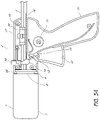
- FIGS. 33-34 schematically illustrate a glue gun and adapter assembly.
- FIG. 35 schematically illustrates a front view of a glue gun, according to one embodiment of the invention.
- FIG. 36 illustrates schematically major components of a vascular occlusion system, according to one embodiment of the invention.
- FIGS. 37A-37D illustrate various views of a vascular occlusion device, according to one embodiment of the invention.
- FIGS. 38A-38D illustrate various views of the occlusion device of FIGS. 2A-2D in an expanded configuration.
- FIGS. 39A-39B illustrate an embodiment of the frame portion of the delivery device described above in connection with FIGS. 2A-3D with the barrier portion omitted for clarity.
- FIG. 40 is a side cross-sectional view of an occlusion device in an expanded configuration and implanted within a vessel, according to one embodiment of the invention.
- FIG. 41 is a cross-sectional view of an occlusion device in an undeployed configuration within a delivery catheter, according to one embodiment of the invention.
- FIGS. 42-44 illustrate perspective, cross-sectional views of an occlusion device in varying stages of deployment out of a delivery catheter, according to one embodiment of the invention.
- proximal can refer to toward the access insertion site into a blood vessel, while distal refers to away from the access insertion site and in the direction of the patient.
- an occlusive device is deployed to block the saphenous vein just distal to the Superficial Femoral Vein Junction (SFJ) and create a flattened shape so the vein can be treated further using either a substance to alter the vein such that blood flow is prevented therein, such as sclerosing solution or medical adhesive.
- SFJ Superficial Femoral Vein Junction
- complete vein closure is the desired clinical result of all treatments to mitigate the effects of venous hypertension caused by retrograde venous flow.
- the occlusion device and medical adhesive can be delivered through a catheter utilizing a “single stick” method. This approach is designed to produce less pain and fewer skin injections than used in current treatment approaches, as well as to mitigate or eliminate the need for patients to wear uncomfortable compression stockings after treatment.
- a deployment catheter is percutaneously introduced into a vein at an access site, and translumenally distally advanced across a treatment zone within a vein.
- External compression is applied to collapse the vein distally of the deployment catheter. Then the distal end of the catheter advances to the very beginning of the occluded vein at the proximal side of the occlusion to minimize the “trapped” blood between the catheter and the occluded vein. After a bolus of plug forming media is expressed from the distal end of the catheter, the occlusion at the end of the catheter forces the vein-occluding substance to flow retrograde (proximally) toward the catheter insertion point into the vein and reduce the distal flow force and mixing with blood within the vessel.
- This method also allows the vein-occluding media to replace any existing blood “trapped” between the catheter and the occluded vein and forms an occlusive plug within the vein while minimizing mixing with the blood.
- This reduction in mixing can be advantageous in certain embodiments because it can increase the bonding strength between the vein-occluding media and the vein.
- External compression distally to the treatment zone optionally may be removed, or may remain throughout all or a portion of the procedure. External compression can also occur around the area of the vein where the plug forming media is expressed in order to collapse the vein as noted above.
- the catheter is thereafter proximally retracted while dispensing a vein occluding substance, either continuously or via discrete boluses spaced apart from the initial bolus at regular or irregular intervals across the treatment zone. External compression can continue proximally where the vein occluding substance is being dispensed in order to ensure collapse of the vein as noted above.
- the catheter is thereafter withdrawn, and the access site closed using conventional techniques. The method is described in greater detail below.
- the vein closure system can enter the vein such as the greater saphenous or lesser saphenous vein or other vessel using fluoroscopy, ultrasound, or other guidance means.
- a micro-catheter system can be placed over a wire for introduction of an outer catheter or introduction sheath into the vein.
- the vein is entered as distal as possible or as clinically relevant in the abnormal vein.
- the closure method comprises advancement of an introducing sheath and/or dilator over a guide wire to the sapheno-femoral junction below the anterior-inferior epigastric vein, which in some embodiments, can be approximately 1.5 to 2.5 cm from the sapheno-femoral junction.
- an inner catheter is introduced through the sheath and is luer-locked or otherwise secured to the sheath to maintain a fixed position with the tip extending approximately 5 cm from the end of the sheath.
- the occlusion method comprises providing an injector such as a glue gun 300 that assists in injecting a vein-occluding substance to occlude vessel 400 .
- the distal end 302 of the glue gun 300 includes a syringe that is operably connected to an inner catheter 204 by a luer lock 602 .
- a sheath or outer catheter 202 surrounds the inner catheter 204 , and assists in providing access to a target site within the vessel 400 interior.
- the outer catheter 202 is introduced first followed by the inner catheter 204 , while in other embodiments, the outer catheter 202 and inner catheter 204 are introduced simultaneously. As shown in FIG.
- the outer catheter 202 and inner catheter 204 are introduced near the proximal end 402 of the vessel 400 and are directed towards the distal end 401 of the vessel, where the vein-occluding substance will be released.
- the inner catheter 204 will extend beyond the distal end of the outer catheter 202 , such as by between about 3 cm and 7 cm, to prevent any vein-occluding substance from contacting the outer catheter 202 .
- an imaging tool such as an ultrasound transducer 630 can also be provided that could be multifunctional, including guiding one or more catheters, serving as a compression element, and/or identifying areas in the interior of the vessel that may need further occlusion or closure.
- the ultrasound transducer 630 can be placed into contact with an external surface of a patient's skin prior to placing the outer catheter 202 and/or inner catheter 204 through the vessel 400 .
- the ultrasound transducer 630 can assist in generating images to help guide one or more catheters to a site where a vein-occluding substance will be introduced.
- the ultrasound transducer 630 can also serve as a compression element prior to, during or after introducing a vein-occluding substance to assist in closure of the vessel 400 .
- the ultrasound transducer can help to flatten and/or reduce the size of the vessel 400 .
- the ultrasound transducer 630 can include a Doppler flow detection capability, and help to identify areas in the interior of the vessel 400 that may need further closure or occlusion and thus, further application of a vein-occluding substance.
- vein occluding substances including liquid adhesives such as glues including cyanoacrylates, or any substances described elsewhere herein or known in the art, are injected into the vein.
- the vein can then be collapsed using compression, such as external compression to assist in coapting the vein and adhering the internal walls of the vein to the vein-occluding substance in a solid, permanent bond.
- an additional compression device can be provided in addition to the ultrasound transducer or probe (either proximally or distally) to assist in collapsing the vein.
- the compression device can be a sequential compression device configured to apply compressive pressure from a compressor against the patient's limb through a flexible pressurized sleeve.
- the compression can be configured to deliver uniform compression along its length, distal-to-proximal compression in a peristaltic wave or other modes depending on the desired clinical result.
- the compressive device could be configured to deliver a pressure of at least about 30, 40, 50, 60, 70, 80, 90, 100, 125, 150, or more mm Hg, or between about 30-150 or 50-100 mm Hg in some embodiments.
- an external device delivering energy to create a controlled vasospasm of the vein is used.
- the energy could be, for example, electrical stimulation, cryotherapy, infrared, visible, or UV light, microwave, RF energy, ultrasound energy, magnetic energy, thermal energy, or a combination of the energy sources.
- the tip of the inner catheter 204 is placed at a site adjacent to the blocked or distal end 401 of the vessel 400 with a minimum distance between them.
- the glue gun 300 can inject a vein-occluding substance 502 that is released from the inner catheter 204 .
- the inner catheter 204 can release at least 1, 2, 3, 4, 5, 7, 10, 12, 15, 20, or more boluses of vein-occluding media along a treatment site within a vein.
- a single continuous flow of vein-occluding media can be introduced across a treatment site, while in other embodiments, multiple spaced-apart boluses of vein-occluding media can be introduced at regular or irregular intervals across a treatment site.
- the treatment site can be a total length of between 2 cm and 50 cm, or between about 5 cm and 40 cm in some embodiments.
- one or more boluses of vein-occluding media can be introduced at spaced-apart intervals, such as between every 1 cm and 7 cm, more preferably between every 3 cm and 5 cm. The intervals need not be evenly spaced.
- Each bolus of media can occlude and treat at least a portion of the treatment site.
- a single bolus of media can occlude and treat a length of the vein that is between 0.5 cm to 5 cm, such that at least about 0.5 cm, 1 cm, 2 cm, 3 cm, 4 cm, or 5 cm of the vein can be treated.
- the length of the treatment site within the vein will be greater than 5 cm by a single bolus of media.
- each bolus of media can have a volume of between 0.01 to 3 cc of a vein-occluding substance (e.g., cyanoacrylate compound), such as between 0.01 cc to 1 cc of a vein-occluding substance.
- the rate of injection can be controlled manually, or by a mechanical and/or electronic controller configured to release a pre-determined volume of vein-occluding substance at a specified flow rate. While in some embodiments the injection rate can be relatively constant throughout the procedure in some embodiments, in other embodiments, the injection rate can be variable, releasing periodic boluses of vein-occluding substance at specified time and/or distance intervals.
- the injection rate is between 0.002 cc/sec and 6 cc/sec, such as between about 0.02 cc/sec and 0.2 cc/sec. Controlling the volume and flow rate of the bolus of media to levels described herein advantageously prevents unnecessary overflow or undertreatment of the media within the vein.
- an injector is provided that is configured to precisely deliver a predetermined volume of media, such as between about 0.05 mL and 0.5 mL, or between about 0.1 mL and 0.2 mL, into the vein when a physician actuates a control, such as a button, switch, dial, or foot pedal, for example.
- the injector includes a safety feature, such as an electronic lockout that prevents unintended multiple bolus injections of glue within a specified period of time, such as, for example, requires that bolus injections be spaced apart by at least about 0.5, 1, 2, 3, 4, 5 seconds, or more.
- a safety feature such as an electronic lockout that prevents unintended multiple bolus injections of glue within a specified period of time, such as, for example, requires that bolus injections be spaced apart by at least about 0.5, 1, 2, 3, 4, 5 seconds, or more.
- the vein-occluding substance 502 flows against the distal end of the proximal side of the occluded vessel 400 and then reverses flow proximally traveling along the outside of the catheter track while displacing the blood content along the target area of the vessel 400 . Then, the outer catheter 202 and inner catheter 204 can be pulled back or withdrawn to target a different site along the vessel 400 . For example, the outer catheter 202 and inner catheter 204 can be moved in a direction towards the proximal end 402 of the vessel 400 prior to injecting additional vein-occluding substance 502 into the vessel 400 .
- an optional compression element e.g., an operator's hand 640 , a sequential compression device, or the ultrasound transducer 630 can be used to apply pressure on the external surface of the patient's body and compress the interior walls of the vessel 400 .
- the optional compression element can be used to compress portions of the vessel prior to, during or after the introduction of the vein-occluding substance.
- the compression element compresses portions of the vessel during or after the introduction of the vein-occluding substance, the vessel is compressed against the vein-occluding substance 502 , as shown in FIG. 4 . This compression assists in occlusion as well as collapse of the vessel.
- the target regions can be compressed immediately following, or no more than about 5 minutes, 4 minutes, 3 minutes, 2 minutes, 1 minute, 30 seconds, 15 seconds, or less following injection of the vein-occluding substance in some embodiments.
- FIGS. 5-6 illustrate the ultrasound transducer 630 guided or moved from a first location to a second location following injection of the vein-occluding substance 502 at the first site.
- the ultrasound transducer 630 can be moved to a second location, e.g., a location closer towards the proximal end 402 of the vessel 400 , to assist in collapse of the vessel 400 at a different site.
- the ultrasound transducer by moving the ultrasound transducer 630 along the length of the vessel 400 in a proximal direction, can serve as a compression element that provides a compression that follows the length of the vessel 400 in a proximal direction to better ensure collapse of the vessel.
- the ultrasound transducer or other external compression element can be moved a distance between the first location to a second location spaced apart between 0.5 cm to 5 cm with respect to the first location.
- the ultrasound transducer can be moved a distance between the first location to a second location that is between 3% and 50%, such as between 3% and 20% of the total length of the treatment site.
- the glue gun 300 can inject a vein-occluding substance 502 at the different site of the vessel 400 , as shown in FIG. 6 .
- a compression element e.g., the hand 640
- the ultrasound transducer 630 can once again be guided or moved along the vessel 400 to different locations to assist in closure or occlusion of the vessel 400 , providing a moveable compression element in some instances.
- the ultrasound transducer 630 and/or additional compression element as described above, which can move along the length of the vessel 400 and serve as a compression element and/or image generator, it is possible to collapse the vessel 400 along the entire treatment length.
- the ultrasound transducer 630 is guided to the second location along the vein 400 to assist in collapse of the vessel 400 at the different location.
- the application of the ultrasound probe and/or additional compression device can be repeated at multiple locations along the greater saphenous vein, as shown in FIGS. 10-11 , until the vein is partially or entirely co-aptd and closed in a flattened state.
- the inner catheter can then be removed, and a band-aid or other dressing can be placed over the entrance site.
- the ultrasound probe can generate images that reconfirm the closure or co-apting of the flattened vein.
- the injector is removed from the access site, and the procedure then is completed. In one embodiment, only a small amount of local anesthesia at the entrance site is used. No tumescent anesthesia is required. No general or conscious sedation is required as the procedure produces no significant heat or other types of damage to surrounding tissues.
- venous insufficiency/varicose veins of the upper and/or lower extremities esophageal varices, gastric varices, hemorrhoidal varices, venous lakes, Klippel-Trenanay syndrome, telangiectasias, aneurysms, arterio-venous malformations, embolization of tumors or bleeding vessels, lymphedema, vascular and non-vascular fistulas, closure of fallopian tubes for sterilization, etc.
- the vein-occluding substance can be injected into the vein using an automated process in order to minimize undesired over-injection or under-injection of the vein-occluding substance, injection at undesired intervals or injection of undesired bolus sizes.
- the outer catheter member of the catheter can be made easily compressible (e.g., with a thin wall). The column strength needed for catheter placement can thus be supplied predominantly with the inner tube. Once the inner catheter has been withdrawn from the vein, the remaining outer catheter is filled with the vein-occluding substance.
- the proximal end of the outer catheter just distally of the luer lock, manifold, or other coupling to the vein-occluding substance injector can carry a compression element such as a clamp, parallel rollers, or a slideable element with the catheter extending transversely between two portions of the slideable element. Actuating the compression element will radially compress the outer catheter. An operator can then hold the clamp in place while the catheter is pulled proximally through the clamp. The clamp thus slides, rolls, or otherwise moves along the tube, while the catheter is compressed to precisely express the volume of the catheter as a function of the distance the catheter is withdrawn proximally from the vein.
- a compression element such as a clamp, parallel rollers, or a slideable element with the catheter extending transversely between two portions of the slideable element. Actuating the compression element will radially compress the outer catheter. An operator can then hold the clamp in place while the catheter is pulled proximally through the clamp. The clamp thus slides, rolls, or otherwise moves along the tube,
- FIGS. 12-16 schematically illustrate a method for occluding a vein, such as the great saphenous vein, according to one embodiment of the invention.
- Ultrasonographic vein mapping, contrast venography, or other technique, for example can be used prior to the occlusion procedure to better visualize a patient's particular vascular anatomy in some embodiments.
- the entry site is prepped and draped in a sterile fashion, and local anesthesia such as Lidocaine can be provided, although may not be required.
- the vascular system such as a superficial vein in the foot, ankle, or calf, for example, a dorsal digital vein, intercapitular vein, common digital vein, dorsal venous arch, medial marginal vein, lateral marginal vein, plantar cutaneous venous arch, or a vein of the plantar cutaneous venous network is cannulated, such as percutaneously or alternatively through a cut-down procedure. Any of these veins can also be occluded using the systems and methods described herein. Imaging such as ultrasound or fluoroscopy, for example, can be used for access assistance. A guidewire (not shown) can then be inserted into the vessel.
- a guidewire (not shown) can then be inserted into the vessel.
- a sheath or introducer, such as a needle, can also be placed to facilitate catheter entry into the appropriate vein.
- a delivery catheter 200 including inner catheter member and outer catheter member, as well as housing an occlusion device such as described above can be inserted into the vessel as shown in FIG. 12 via, for example, the Seldinger technique over a guidewire.
- the catheter 200 is then advanced distally into the venous system to a desired location, such as within the great saphenous vein (or small saphenous vein or accessory saphenous vein) as shown in FIG. 13 .
- the inner catheter can then be actuated relative to the outer catheter to deploy an occlusion device 100 to its expanded configuration within the desired location within the vein 400 .
- the occlusion device can in some embodiments include components as described, for example, in U.S. Provisional Application No. 61/154,322, filed on Feb. 20, 2009, and herein incorporated by reference in its entirety, including (but not limited to) those having tissue anchors or bars or other features for engaging vessel walls.
- the occlusion device can include components as described with respect to FIGS. 36-44 .
- FIG. 14 illustrates the inner catheter being advanced in preparation to deploy an occlusion device 100 . Once desired placement is confirmed, the detachment mechanism such as a suture (not shown) is then actuated to release the occlusion device 100 within the vessel. Deployed anchors on the frame portion of the occlusion device 100 , can prevent migration of the occlusion device 100 from the desired location within the vein 400 . Next, the inner catheter can be withdrawn, as illustrated in FIG. 15 .
- a vein-occluding substance such as described above can be injected through the outer catheter into the vein 400 proximal to the deployed occlusion device.
- the outer catheter can then be withdrawn while the vein-occluding substance continues to be injected, in order to occlude the vein in a proximal direction relative to the occlusion device.
- the outer catheter can then be fully withdrawn, and an external compression stocking applied, completing the procedure.
- Percutaneous closure methods can also be utilized in some embodiments.
- 0.01 cc to 1 cc of vein-occluding substance e.g., a cyanoacrylate compound
- a distance of 0.5 cm to 5 cm of vein such as at least about 0.5 cm, 1 cm, 2 cm, 3 cm, 4 cm, or 5 cm of vein to be treated.
- the injection rate can be relatively constant throughout the procedure in some embodiments, or variable, releasing periodic boluses of vein-occluding substance at specified time and/or distance intervals.
- Withdrawal through the vein to be treated can take place, for example, over a period of 30 seconds to 5 minutes in some embodiments, or about equal to, or less than about 10, 9, 8, 7, 6, 5, 4, 3, 2, 1 minute, 45 seconds, or 30 seconds in some embodiments.
- a catheter can be deployed to a desired location in a tubular structure such as a vein as illustrated and described in connection with FIGS. 12 and 13 above.
- the vein 400 can then optionally be compressed, either before or after placing the catheter, such as by, for example, external manual compression of the leg or with a tourniquet or other type of compression device at a distal location as shown schematically with arrows in FIG. 17 .
- a vein-occluding substance can be injected at a first location within the vein 400 to serve as an occluder 500 , as shown in FIG.
- the distance from the exit port on the catheter where the vein-occluding substance is ejected to the area of the vein that is collapsed from compression is no more than about 3 cm, 2.5 cm, 2 cm, 1.5 cm, 1 cm, 0.75 cm, 0.5 cm, 0.25 cm, or less.
- the vein-occluding substance serving as an occluder 500 can be, for example, a larger-volume bolus of a vein-occluding substance compared to a volume of vein-occluding substance injected more proximally over a specified period of time and/or length of vein, of which specific ranges are described above.
- the initial bolus can be at least about 0.1 cc, 0.25 cc, 0.5 cc, 0.75 cc, 1 cc, 1.5 cc, or more in some embodiments, or between about 0.05 mL and about 0.9 mL, between about 0.05 mL and about 0.5 mL, or between about 0.1 mL and about 0.2 mL in other embodiments
- the initial bolus can be at least about 10%, 25%, 50%, 75%, 100%, 150%, 200%, or more greater than a volume of vein-occluding substance injected more proximally over a similar length of vein.
- a second vein-occluding substance with different properties than a first vein-occluding substance used to treat the vein more proximally can also be used as an occluder.
- the second vein occluding substance is deployed first, to form the distal vein block.
- the first vein occluding substance is then dispensed along the length of the treatment site as the catheter is proximally retracted.
- the second vein-occluding substance can be, for example, a glue or other occlusive medium that expands to a greater volume, hardens more rapidly, and/or has a shorter polymerization time relative to the first vein-occluding substance.
- the second vein-occluding substance can be partially or completely bioresorbable. If multiple different vein-occluding substances are used, the catheter can be configured to have two or more lumens to accommodate delivery of the different vein-occluding substances. Alternatively the first and second occluding substances can be deployed sequentially via a common lumen.
- the catheter 200 can be withdrawn and the same or a different vein-occluding substance 502 as described above can be injected along the length of the vein segment to be treated to occlude the rest of the vein 400 to be treated while the catheter is withdrawn partially, and fully proximally as shown in FIGS. 20-21 , respectively.
- 2, 3, 4, or more veins that may be in some cases a branch of the first vein
- 2, 3, 4, or more punctures can be treated during the procedure using a single puncture, or with 2, 3, 4, or more punctures.
- a deployment catheter 200 is percutaneously introduced into a vein at an access site, and translumenally distally advanced across a treatment zone within a vein.
- External compression such as manual compression, is applied to collapse the vein distally of the deployment catheter and create a first occlusion.
- a bolus of plug forming media is expressed from the distal end of the catheter against a proximal side of the first occlusion, to form an occlusive plug 500 within the vein.
- External compression optionally may be removed, or may remain throughout the procedure.
- the catheter 200 is thereafter proximally retracted while dispensing a vein occluding substance 502 across the treatment zone, either continuously as a long stream, or intermittently at spaced apart intervals, where a second occlusion in the vein can be created, spaced apart from the first occlusion, and then a second bolus of media is introduced against the proximal side of the second occlusion External compression may be applied proximally, anywhere along the length of the vein, to ensure complete filling of the vein with the vein occluding substance 502 .
- a second, third, or more boluses of plug-forming media are progressively released into the vein more proximally at desired intervals, and external compression can be applied just distal to the point in which the catheter releases the plug forming media as described above.
- the catheter 200 is thereafter withdrawn, and the access site closed using conventional techniques.
- FIG. 21A illustrates a vein 400 that is compressed distally at point 440 to create a first occlusion, such as with external compression. Also shown is catheter 200 with distal end 201 . After the creation of an occlusion 440 in a vein, a first volume V 1 within the vein 400 can be defined between the distal end 201 of the catheter 200 and the occlusion 440 , as illustrated in FIG. 21B . Media having a second volume V 2 , such as in a bolus, can then be injected from the distal end 201 of the catheter 200 into the vein 400 .
- the second volume V 2 (of the media injected) is at least about 100%, 105%, 110%, 120%, 125%, 130%, 140%, 150%, 175%, 200%, 250%, or more of the first volume V 1 (of the vein in between the occlusion and the distal end of the catheter), such that a proximally advancing meniscus of media V 2 passes proximally past the distal end 201 of the catheter 200 , as illustrated in FIG. 21C .
- the catheter 200 is then withdrawn proximally, as illustrated in FIG. 21D , and a second more proximal occlusion 440 ′ can be created, such as via external compression.
- Media can then be injected to create a volume of media V 2 ′ greater than the volume within the vein 400 between the distal end 201 of the catheter 200 and the occlusion 440 ′, as illustrated in FIG. 21E .
- the process can then be repeated for a total of at least 2, 3, 4, 5, 6, 7, 8, 9, 10, or more times depending on the desired clinical result.
- an occlusion in a vein can be created as described herein.
- a deployment catheter having a distal opening and side wall is provided. The distal end of the deployment catheter can be positioned within the vein at the desired location. Media can then be introduced through the distal opening in a volume sufficient to advance proximally around the catheter between the sidewall of the catheter and the wall of the vein.
- the volume sufficient to advance proximally around the catheter between the sidewall of the catheter and the wall of the vein is at least about 0.05 mL, 0.1 mL, 0.2 mL, 0.3 mL, 0.5 mL, 0.7 mL, 0.8 mL, 1 mL, 1.5 mL, 2 mL, 3 mL, or more.
- the distal plug 500 may be formed by a bolus of the same material as used for the vein occluding substance 502 .
- the distal plug 500 may be formed from a material that polymerizes more rapidly than vein occluding substance 502 , or solidifies through a mechanism other than polymerization to form an occlusive plug.
- Plug 500 may alternatively be formed by a self-expanding preformed material, such as a foam or woven or non-woven fiber based material, which may be displaced distally from the catheter such as by distally advancing a push wire, or utilizing the pressure of vein occluding substance 502 .
- the self-expanding foam or other plug material 500 may be a bioabsorbable material, so that no long term implant is left behind in the body.
- Proximal retraction of the deployment catheter 200 may be accomplished in either a steady, continuous fashion, or in an intermittent, stepped manner.
- extrusion of vein occluding substance 502 may be accomplished in a continuous manner as the catheter 200 is proximally retracted.
- vein occluding substance 502 may be dispensed in a plurality of bolus ejections along the length of the treatment zone, spaced apart by a predetermined or clinically determined distance. Spacing between adjacent injected volumes of vein occluding substance 502 may be at least about 0.5 cm, at least about 1 cm, at least about 2 cm, and, in some implementations, at least about 4 cm. This procedure minimizes the total volume of injected vein occluding substance 502 , while providing a plurality of distinct bonding points along the length of the treatment zone.
- Also disclosed herein is a method of obliterating a hollow structure, such as a vein, including the steps of reducing an interior cross-sectional area of the hollow structure near the obliterating site by applying a pressure to an exterior of the hollow structure; and placing a catheter in the hollow structure and advancing it to the obliterating site, where the obliterating site is next to the reduced cross-sectional area.
- a medical adhesive can then be injected at the obliterating site.
- the interior cross-sectional area of the medical adhesive at the obliterating site can then be reduced by compressing an exterior of the hollow structure to form an occlusion in the hollow structure.
- Compression can be achieved, for example, via an imaging probe such as an ultrasound transducer, manual pressure, or a harness.
- the medical adhesive can then solidify, forming an occlusion in the hollow structure.
- the method can also include the step of identifying an obliterating site prior to reducing an interior cross-sectional area of the hollow structure. In some embodiments, the catheter is removed from the obliterating site before compression.
- the substance can include an adhesive such as cyanoacrylate, e.g., 2-octyl cyanoacrylate, and/or a sclerosing agent such as hypertonic saline, sodium tetradecyl sulfate, chromated glycerol, tetracycline, talc, bleomycin, or polydocanol.
- a cyanoacrylate can be an aliphatic 2-cyanoacrylate ester such as an alkyl, cycloalkyl, alkenyl or alkoxyalkyl 2-cyanoacrylate ester.
- the alkyl group may have from 1 to 16 carbon atoms in some embodiments, and can be a C1-C8 alkyl ester or a C1-C4 alkyl ester.
- Some possible esters include the methyl, ethyl, n-propyl, isopropyl, n-butyl, isobutyl, pentyl, hexyl, cyclohexyl, heptyl, octyl, 2-methoxyethyl and 2-ethoxyethyl esters of cyanoacrylic acid.
- a biological glue such as a bovine serum albumin-gluteraldehyde combination (e.g., BIOGLUE, Cryolife, Atlanta, Ga.), PVA, Biogard, collagen, fibrinogen, fibronectin, vitronectin, laminin, thrombin, gelatin, mixtures thereof, or other biocompatible adhesives.
- a foam generated from, for example, one or more of the above components can be used to enhance ablation and closure of the vein.
- the viscosity and air bubble mixture can also be controlled while taking into account the desired clinical result.
- the chosen adhesive will not produce a significant thermal effect or significant local tissue abnormal effect, but rather produces an initial vessel co-aption/adhesion which will withstand physiological venous pressures within the immediate post-procedure period. Since the adhesive will not produce a significant thermal reaction, no tumescent anesthesia is needed. In some embodiments, the chosen adhesive induces an inflammatory reaction which scars. The inflammatory reaction can be followed by permanent closure of the abnormal greater or less saphenous vein. In some embodiments, the chosen adhesive is hardened after the first few moments (e.g., seconds or minutes) of application and therefore, compression stockings may not be required. With the chosen adhesive, there can be minimal or no danger to surrounding nerves or tissue.
- the amount of chosen adhesive delivered to a target site in a vessel will vary depending on the size of the vessel itself, in some embodiments, the amount of adhesive or other vein-occluding substance delivered in a single injection can be between about 0.05 mL and about 0.9 mL, between about 0.05 mL and about 0.5 mL, or between about 0.1 mL and about 0.2 mL in other embodiments. In some embodiments, the amount delivered in a single injection could be more than about 0.4 mL, 0.6 mL, 0.8 mL, 0.9 mL, 1 mL, or more. In some embodiments, the amount delivered in a single injection could be less than about 0.8 mL, 0.6 mL, 0.4 mL, 0.3 mL, 0.2 mL, 0.1 mL, 0.05 mL, or less.
- the cyanoacrylate preparation will contain any additives necessary to impart the desired properties to the preparation as viscosity, color, X-ray opacity, etc. Certain examples of additives such as thickening agents and polymerization inhibitors are discussed further below.
- the chosen adhesive can also be mixed with a thickening agent, including various cyanoacrylate polymers, cyanoacrylate oligmers and biocompatible polymers.
- the biocompatible polymers can include, for example, PLA, PLLA, PGA, PCL, PDLLA, PLDGA, PMMA, PET, nylon, PE, PP, or PEEK, and in some embodiments, the biocompatible polymers are soluble in a cyanoacrylate monomer.
- the thickening agent can comprise glucose, sugar, starch or hydrogel.
- the thickening agent can also comprise various particulates, ranging in size between about 0.001 microns to 100 microns.
- the particulates can be provided in dry solid form and can disperse throughout a liquid adhesive to thicken the adhesive prior to use.
- the particulate comprises any of the biocompatible polymers above, such as PLA, PLLA, PGA, PCL, PDLLA, PLDGA, PMMA, PET, nylon, PE, PP, CAB and PEEK, while in other embodiments, the particulate comprises a silica material with or without an acrylic polymer.
- the thickening agent can assist in providing a suitable viscosity for the adhesive as it flows through the catheter to a target site.
- the chosen adhesive can also be mixed with one or more polymerization inhibitors, which could be, for example, an anionic or a free-radical polymerization inhibitor.
- Anionic polymerization inhibitors can include soluble acidic gases such as sulfur dioxide, or a biocompatible acid including, but not limited to, acetic acid, sulfuric acid, sulfonic acid, hydrochloric acid, phosphoric acid, carboxylic acid, nitric acid, or combinations thereof.
- the acid can be from 0.01% to about 10% by weight, such as between about 0.01% and 1% by weight.
- Free-radical polymerization inhibitors include hydroquinone, t-butyl catechol, hydroxyanisole, butylated hydroxyanisole and butylated hydroxytoluene.
- the addition of one or more polymerization inhibitors such as a biocompatible acid helps to change the curing rate of the adhesive to prevent the adhesive from sticking prematurely to the catheter and prevent premature curing of the adhesive prior to binding to the vein wall.
- the acid helps to delay the curing and/or polymerization of the adhesive to prevent the glue from sticking to sections of the catheter.
- a composition of adhesive comprises from about 0.01 to about 50.0 weight percent of cyanoacrylate polymer, from about 0.01 to about 50.0 weight percent of a thickening agent selected from the group consisting of cyanoacrylate polymer, cyanoacrylate oligmer and biocompatible polymers, and from about 0.01 to about 10.0 weight percent of a biocompatible acid.
- the adhesive can also include a therapeutic agent such as an anti-inflammatory agent, an anti-infective agent, an anesthetic, a pro-inflammatory agent, a cell proliferative agent, or combinations thereof.
- a therapeutic agent such as an anti-inflammatory agent, an anti-infective agent, an anesthetic, a pro-inflammatory agent, a cell proliferative agent, or combinations thereof.
- the medical adhesives can have select properties.
- the medical adhesives can have a setting time of between about 5 to 60 seconds.
- the medical adhesives can also have a viscosity of between about 40 to 3000 cp. In some embodiments, the viscosity could be at least about 500 cp, at least about 1,000 cp, at least about 1,500 cp, at least about 2,000 cp, at least about 2,500 cp, or more.
- the viscosity could be no more than about 2,000 cp, no more than about 1,500 cp, no more than about 1,000 cp, no more than about 500 cp, no more than about 300 cp, or less.
- type of adhesive is not limited to these particular characteristics, and that other adhesives having different properties may also be applicable.
- a vein closure system that does not require capital purchases for a radiofrequency device or laser box. Simple and non-invasive methods of using the vein closure system are provided, and in some embodiments, the methods do not require application of a tumescent anesthesia or wearing compression stockings. The acceptance by and demand from patients of the vein closure system described herein will be much higher over existing devices and techniques.
- the closure system comprises at least two major components.
- One is a vein closure device which precisely delivers an adhesive to the abnormal saphenous vein under ultrasound guidance.
- the other component is a unique intravascular adhesive which allows for co-aptation and closure of the abnormal saphenous vein in a flattened, closed position.
- the closure system comprises three major components. The first is a vein closure device which precisely delivers an adhesive to the abnormal saphenous vein under ultrasound guidance.
- the second is a unique intravascular adhesive which allows for co-aptation and closure of the saphenous vein just distal to the Superficial Femoral Vein Junction, such as within about 5 cm, 4 cm, 3 cm, 2 cm, 1 cm, or less in a flattened, closed position.
- the third is a solution that can have adhesive and/or sclerosing properties which allows for co-aptation and closure of the rest of the saphenous vein to alter the vein such that blood flow is prevented therein.
- the vein closure device which delivers the vein-occluding substance comprises three components.
- the first component is an outer catheter or introducer sheath that allows for placement under precise ultrasound guidance into the saphenous vein from as low a position as possible in the greater saphenous vein or lesser saphenous vein.
- the vein closure device is also configured for precise distal tip placement into the vein to be occluded.
- the sheath is available in multiple size ranges and includes ID of 3 fr-7 fr and a length from 25 cm to 100 cm depending on the placement site.
- the sheath is echogenic under ultrasound observation and therefore can be precisely placed below the sapheno-femoral junction.
- the sheath can have multiple graduations, as well measurement markings that indicate increments along the sheath, such as 0.2, 1, 2, or 5 cm increments. The graduations and markings assist in providing precise, monitored pull-back motions along the saphenous vein.
- the inner catheter has an echogenic tip that assists in advancement through the introducer sheath.
- the inner catheter can be attached to the introducer sheath, such as by luer lock or other locking mechanism.
- the inner catheter protrudes from the introduction sheath at its distal end approximately 0.5-10 cm. and is visible under ultrasound due to its echogenic tip.
- the inner catheter is used for precise delivery of a vein-occluding substance into the vein for co-apting and occluding the vein into a flattened configuration.
- the outer catheter and/or inner catheter can be coupled to or extend from a syringe designed to dispense a vein-occluding substance.
- the third portion of the vein closure system is the glue gun or other adhesive introducing device that attaches to the inner catheter.
- the adhesive introducing device is a manual liquid dispenser gun that can dispense an adhesive into a vessel with control and accuracy.
- a manual liquid dispenser gun that can dispense an adhesive into a vessel with control and accuracy.
- One such dispenser gun is disclosed in U.S. Pat. No. 6,260,737 to Gruendeman et al., which is incorporated by reference herein in its entirety.
- Other embodiments of the glue gun are discussed in more detail below.
- the glue gun 2 includes a handle 31 and a pull trigger 12 .
- the pull trigger 12 is used in connection with internal mechanisms of the glue gun 2 (shown in FIGS. 33 and 34 and described further below) and the plunger 3 to provide controlled dispensation of a vein-occluding substance through syringe 36 .
- the plunger 3 comprises a solid rail-like segment that extends from outside the body of the glue gun 2 and through the internal body of the glue gun 2 .
- the plunger 3 includes teeth that work in conjunction with a spring pawl mechanism (shown in FIG. 34 ) to lock the position of the plunger 3 and provide controlled dispensation of glue.
- the distal end of the plunger 3 makes contact with the proximal end of the syringe 36 such that the plunger 3 is capable of pushing the syringe to dispense a vein-occluding substance such as an adhesive.
- FIG. 23 illustrates a perspective view of the adapter 1 in FIG. 22 .
- the adapter 1 includes an adapter lock end 4 , a syringe lock end 5 , a holding slot 6 and a hollow body 7 .
- the adapter lock end 4 includes one or more collars or flanges 25 that are receivable into a holding segment of the dispenser gun upon rotation.
- the adapter lock end 4 is configured such that upon rotation of the adapter 1 , the flanges 25 are received in and secured in the holding segment 33 .
- the adapter lock end 4 includes an opening or slot (shown in FIG. 25 ) through which the distal end of the plunger 3 can be inserted.
- the syringe can then be rotated so that it is securely received in the holding slot 6 .
- the holding slot 6 and the proximal end of the syringe need not be shaped similarly.
- FIG. 26 illustrates a cross-sectional view of the adapter 1 and its hollow body 7 . From this view, it is possible to see the adapter 1 as having at least two separate diameters, an inner diameter (formed at the openings to the hollow body 7 ) and an outer diameter (formed in the hollow body 7 itself). In some embodiments, the inner diameter is between 0.5 and 0.9 inches, while the outer diameter is between 0.7 and 1.1 inches.
- FIG. 27 illustrates a side view of a glue gun system including an adapter 1 , a glue gun 2 , and a plunger 3 according to another embodiment.
- the system includes an adapter lock end 4 and a syringe lock end 5 having a syringe 36 attached thereto.
- the glue gun system in FIG. 27 does not include an adapter lock end 4 having an exposed collar or flange that is placed in a holding segment of the gun 2 .
- the adapter lock end 4 includes a flange 25 (shown in FIG. 29 ) that mates with the glue gun 2 and remains unexposed upon final assembly.
- FIG. 29 illustrates a perspective view of the adapter 1 in FIG. 27 having an adapter lock end 4 , a syringe lock end 5 , a hollow body 7 and a fit-in notch 8 located near the adapter lock end 4 .
- the fit-in notch 8 is capable of receiving a mateable collar or flange located on the glue gun 2 that will lock the adapter 1 to the glue gun 2 upon rotation of the adapter.
- FIG. 30 illustrates a front perspective view of the adapter 1 of FIG. 27 , including the syringe lock end 5 .
- An opening 41 located on the syringe lock end 5 is also shown.
- the opening 41 which is configured to receive a dispenser plunger 3 , is T-shaped in some embodiments, although single slit, “I”, arcuate, or other shaped openings are also possible.
- the advantage of the T-shaped opening 41 is that it can provide better guidance for a dispenser plunger 3 that is received through the syringe lock end 5 , as the T-shaped opening provides specific paths along the “T” shape for the plunger 3 to move.
- the T shape can also add strength to the plunger 3 , such as in the longitudinal direction, for more efficient dispensing.
- the T shape also could add stability to the plunger 3 in the transverse direction to increase its buckling strength so that it will be less likely to buckle during the dispensing of high viscosity materials.
- FIG. 31 illustrates a rear perspective view of the adapter 1 of FIG. 27 , including the adapter lock end 4 .
- the adapter lock end 4 includes its own T-shaped opening 9 , similar to the T-shaped opening 41 in the syringe lock end 41 , through which dispenser plunger 3 can pass.
- FIG. 32 illustrates a cross-sectional view of the adapter 1 of FIG. 27 and its hollow body 7 .
- the adapter 1 includes a central lumen 7 with open proximal and/or distal ends and designed to allow the syringe plunger 3 to move through during the injection process.
- the adapter 1 also can optionally include one, two, or more side lumens 10 defined between walls 70 and 72 , which can provide the adapter 1 with a reduced weight, which can be beneficial in some circumstances.
- the side lumens 10 define a closed free space volume that is at least about 10%, 20%, 30%, 40%, 50%, 60%, 70%, 80%, 90%, or more of the entire enclosed volume between walls 70 , 72 .
- the adapter 1 can include regions besides or in addition to the second hollow space 10 that are removed or cut-out of the adapter 1 to provide additional weight reduction.
- FIG. 33 illustrates an adapter 1 and glue gun 2 prior to assembly.
- the glue gun 2 includes extensions 66 that enclose an open space 67 for receiving the adapter lock end 4 of the adapter 1 . While the adapter lock end 4 is placed in the open space 67 , the extensions 66 of the glue gun 2 enclose the fit-in notch 8 of the adapter 1 , thereby forming a secure connection between the adapter 1 and glue gun 2 , as shown in FIG. 34 .
- FIG. 34 illustrates the adapter 1 and glue gun 2 of FIG. 33 following assembly. Included in the assembly within the hollow body 17 of the glue gun are plunger 3 with teeth 16 , stopper 11 , spring mechanism 15 including spring pin 13 and spring pawl 14 , plunger release button 18 , floating gripper 19 , plunger pocket 20 and spring stop 21 .
- the assembly includes a glue gun 2 having a trigger 12 for controlling the dispensation of glue from the gun.
- the trigger 12 of the glue gun is integrated with the gun body by a spring pin 13 , which is part of a spring mechanism 15 .
- the spring mechanism 15 also includes a spring pawl 14 designed to interact with teeth 16 of the plunger 3 to precisely lock the position of the plunger. Movement of the spring pawl 14 is controlled by the trigger 12 .
- the spring pawl 14 is adjusted to allow one or more teeth 16 of the plunger 3 to move forward through the adapter 1 and press against a syringe (not shown) to dispense a glue or adhesive.
- a floating gripper 19 that engages with the plunger 3 to stop rearward movement by frictional force.
- Plunger pocket 20 can allow movement (both forward and backward) of floating gripper 19 in the pocket.
- the floating gripper 19 moves with the plunger 3 (because of the friction between them) assisted by the plunger pocket 20 .
- the plunger pocket 20 sets the limit for the movement of the plunger 3 .
- the plunger release button 18 allows the disengagement between the plunger 3 and the spring pawl 14 . Pushing the plunger release button 18 will move the spring pawl 14 downward and release the plunger 3 from the spring pawl 14 . Then the plunger 3 will be free to move in either backward or forward directions.
- the spring mechanism 15 is accompanied by a stopper 11 .
- the stopper 11 serves as a physical barrier to the movement of the spring mechanism, thereby providing for greater control over dispensation of the glue or adhesive.
- FIG. 35 is a front view of the glue gun 2 that illustrates the gun hollow body 17 .
- the mechanisms within the gun hollow body 17 includes the plunger 3 , which is displaced within the hollow body by the pull of the gun trigger.
- the embodiments of the glue gun system described in FIGS. 22-35 are designed to deliver precise amounts of adhesive or similar vein-occluding substance and can be used with the methods described above.
- the glue gun system can deliver the vein-occluding substance continuously or in discrete injectable quantities, such as 0.1 ml to 1.0 ml per injection, thereby advantageously reducing the risk of overflow and back-clogging of the delivery system.
- the amount of vein-occluding substance used can depend on the size of the vein, the compression pressure, and surrounding environment.
- the glue gun will allow for exact increments of adhesive to be extruded or discharged from a catheter. This will allow a vein to be sealed shut at multiple sites along its length.
- FIGS. 37A-D illustrate various views of one embodiment of a vascular occlusion device 100 , according to one embodiment of the invention.
- a vascular occlusion device 100 can be transformable from a first, reduced cross-sectional configuration for transluminal advance to the deployment site, to a second, radially enlarged or transversely enlarged configuration for occluding the vein.
- Transformation of the occlusion device may be accomplished in any of a variety of ways, such as by releasing a restraint on a frame which is biased in the direction of the enlarged configuration.
- the occlusion device may be transformed to the enlarged configuration under active force, such as by axial shortening to achieve radial expansion.
- occlusion devices for use with the system of the present invention may include detachable inflatable balloons, open cell or closed cell foam, sponge, embolic coil meshes having either a randomized or predetermined pattern, or other structures depending upon the desired clinical performance.
- the occlusion device may be provided with one or two or more tissue anchors or barbs, for engaging the vessel wall, or other anti-migration surface features such as a roughened or adhesive surface, and/or enhanced surface area for contact with the vessel wall in a manner sufficient to inhibit migration.
- FIG. 37A is a perspective view of an occlusion device 100 that includes a frame portion 102 and a barrier portion 106 .
- the occlusion device is shown in a reduced, low crossing profile configuration for delivery, such as within a catheter 200 .
- the frame portion 102 as shown has a proximal end 103 and a distal end 105 , and can include at least 2 or 3 or 6 or 8 or more interconnected struts 106 as shown.
- the frame 102 may have a wide variety of wall patterns depending on the desired clinical result, or have a continuous sidewall in some embodiments.
- the wall pattern comprises a generally sinusoidal framework including a plurality of proximally facing apexes 112 and distal apexes 110 interconnected by a plurality of struts 114 . This can be clearly seen, for example, in FIG. 39B .
- the frame portion 102 can be laser-cut out of a tube. If the frame portion 102 is biodegradable, it can be configured to fully degrade over a period of time depending on the desired clinical result and the properties of the vein-occluding substance (e.g., hardening or polymerization time of a glue), such as, for example, less than about 1 year, 6 months, 3 months, 1 month, 2 weeks, 1 week, 3 days, 1 day, 12 hours, 6 hours, 3 hours, or less.
- the vein-occluding substance e.g., hardening or polymerization time of a glue
- FIG. 37B illustrates a side view of the occluder illustrated in FIG. 37A .
- FIG. 37C illustrates a section through line A-A of FIG. 37B , showing the barrier 104 as well as frame 102 .
- FIG. 37D is an end view of the device illustrated in FIGS. 37A-37C .
- occlusion device 100 is described as having a frame portion 102 and a barrier portion 104
- various other occlusion devices to prevent blood flow through the vessel lumen are also within the scope of the invention, such as plugs, sponges, coils, adhesives, prothrombotic agents, and the like.
- FIGS. 39A-39B illustrate an embodiment of the frame 102 portion of the delivery device described above in connection with FIGS. 2A-3D in its undeployed ( FIG. 39A ) and deployed ( FIG. 39B ) configurations with the barrier portion 104 omitted for clarity.
- FIG. 41 is a longitudinal cross-sectional view of an occlusion device 100 such as that illustrated in FIG. 40 , and in an undeployed configuration within a delivery catheter 200 .
- Delivery catheter 200 includes an inner catheter member 204 and an outer catheter member 202 .
- Occlusion device resides within a lumen of outer catheter member 202 .
- Relative movement of inner catheter member 204 relative to outer catheter member 202 such as retraction of outer catheter member 202 relative to inner catheter member 204 or pushing of inner catheter member 204 distally relative to outer catheter member 202 can facilitate deployment of the occlusion device 100 within the vessel 400 .
- Inner catheter member 204 may comprise a concentric tube, a push wire, or other structure capable of transmitting a deployment activating force.
- FIGS. 42-44 illustrate a cross-section of occlusion device 100 (with barrier portion 104 not shown for clarity) in varying stages of deployment caused by relative movement of inner catheter 204 relative to outer catheter 202 .
- Using the systems and methods described herein provides little to no risk of injury to surrounding nerves or tissue, because the length of the treated vessel can be clearly identified without unnecessary overtreatment. This is in contrast to many other procedures which require, for example, that a catheter is placed superior to nerves which may be juxtaposed to the saphenous vein.
Landscapes
- Health & Medical Sciences (AREA)
- Surgery (AREA)
- Life Sciences & Earth Sciences (AREA)
- Animal Behavior & Ethology (AREA)
- Veterinary Medicine (AREA)
- Public Health (AREA)
- General Health & Medical Sciences (AREA)
- Biomedical Technology (AREA)
- Molecular Biology (AREA)
- Medical Informatics (AREA)
- Heart & Thoracic Surgery (AREA)
- Engineering & Computer Science (AREA)
- Nuclear Medicine, Radiotherapy & Molecular Imaging (AREA)
- Reproductive Health (AREA)
- Vascular Medicine (AREA)
- Oral & Maxillofacial Surgery (AREA)
- Pathology (AREA)
- Epidemiology (AREA)
- Surgical Instruments (AREA)
- Infusion, Injection, And Reservoir Apparatuses (AREA)
Abstract
Description
Claims (19)
Priority Applications (1)
| Application Number | Priority Date | Filing Date | Title |
|---|---|---|---|
| US16/884,951 US11369384B2 (en) | 2009-02-20 | 2020-05-27 | Systems for venous occlusion for the treatment of venous insufficiency |
Applications Claiming Priority (7)
| Application Number | Priority Date | Filing Date | Title |
|---|---|---|---|
| US15432209P | 2009-02-20 | 2009-02-20 | |
| US28592609P | 2009-12-11 | 2009-12-11 | |
| PCT/US2010/024820 WO2010096717A1 (en) | 2009-02-20 | 2010-02-19 | Methods and devices for venous occlusion for the treatment of venous insufficiency |
| US12/710,274 US9011486B2 (en) | 2009-02-20 | 2010-02-22 | Systems for venous occlusion for the treatment of venous insufficiency |
| US14/676,238 US9592037B2 (en) | 2009-02-20 | 2015-04-01 | Systems for venous occlusion for the treatment of venous insufficiency |
| US15/427,317 US10702276B2 (en) | 2009-02-20 | 2017-02-08 | Systems for venous occlusion for the treatment of venous insufficiency |
| US16/884,951 US11369384B2 (en) | 2009-02-20 | 2020-05-27 | Systems for venous occlusion for the treatment of venous insufficiency |
Related Parent Applications (1)
| Application Number | Title | Priority Date | Filing Date |
|---|---|---|---|
| US15/427,317 Continuation US10702276B2 (en) | 2009-02-20 | 2017-02-08 | Systems for venous occlusion for the treatment of venous insufficiency |
Publications (2)
| Publication Number | Publication Date |
|---|---|
| US20200281604A1 US20200281604A1 (en) | 2020-09-10 |
| US11369384B2 true US11369384B2 (en) | 2022-06-28 |
Family
ID=42634229
Family Applications (5)
| Application Number | Title | Priority Date | Filing Date |
|---|---|---|---|
| US12/710,274 Active 2030-08-28 US9011486B2 (en) | 2009-02-20 | 2010-02-22 | Systems for venous occlusion for the treatment of venous insufficiency |
| US12/710,318 Active 2031-10-21 US8475492B2 (en) | 2009-02-20 | 2010-02-22 | Methods for venous occlusion for the treatment of venous insufficiency |
| US14/676,238 Active US9592037B2 (en) | 2009-02-20 | 2015-04-01 | Systems for venous occlusion for the treatment of venous insufficiency |
| US15/427,317 Active 2031-04-02 US10702276B2 (en) | 2009-02-20 | 2017-02-08 | Systems for venous occlusion for the treatment of venous insufficiency |
| US16/884,951 Active 2030-04-09 US11369384B2 (en) | 2009-02-20 | 2020-05-27 | Systems for venous occlusion for the treatment of venous insufficiency |
Family Applications Before (4)
| Application Number | Title | Priority Date | Filing Date |
|---|---|---|---|
| US12/710,274 Active 2030-08-28 US9011486B2 (en) | 2009-02-20 | 2010-02-22 | Systems for venous occlusion for the treatment of venous insufficiency |
| US12/710,318 Active 2031-10-21 US8475492B2 (en) | 2009-02-20 | 2010-02-22 | Methods for venous occlusion for the treatment of venous insufficiency |
| US14/676,238 Active US9592037B2 (en) | 2009-02-20 | 2015-04-01 | Systems for venous occlusion for the treatment of venous insufficiency |
| US15/427,317 Active 2031-04-02 US10702276B2 (en) | 2009-02-20 | 2017-02-08 | Systems for venous occlusion for the treatment of venous insufficiency |
Country Status (10)
| Country | Link |
|---|---|
| US (5) | US9011486B2 (en) |
| EP (2) | EP2398402B1 (en) |
| JP (1) | JP5717100B2 (en) |
| KR (1) | KR101781653B1 (en) |
| CN (2) | CN102481153B (en) |
| AU (1) | AU2010215821B2 (en) |
| BR (1) | BRPI1008909B8 (en) |
| CA (1) | CA2753207C (en) |
| IL (1) | IL214763A0 (en) |
| WO (1) | WO2010096717A1 (en) |
Cited By (2)
| Publication number | Priority date | Publication date | Assignee | Title |
|---|---|---|---|---|
| US12357365B2 (en) | 2021-03-19 | 2025-07-15 | Verge Medical Inc. | Vascular ablation |
| US12629278B2 (en) | 2024-04-26 | 2026-05-19 | Nervana Inc. | Transvenous cryoneurolysis system, devices and methods |
Families Citing this family (70)
| Publication number | Priority date | Publication date | Assignee | Title |
|---|---|---|---|---|
| US9955994B2 (en) | 2002-08-02 | 2018-05-01 | Flowcardia, Inc. | Ultrasound catheter having protective feature against breakage |
| US7335180B2 (en) | 2003-11-24 | 2008-02-26 | Flowcardia, Inc. | Steerable ultrasound catheter |
| US7758510B2 (en) | 2003-09-19 | 2010-07-20 | Flowcardia, Inc. | Connector for securing ultrasound catheter to transducer |
| JP5286612B2 (en) | 2006-09-13 | 2013-09-11 | ヴァスキュラー インサイツ エルエルシー | Vascular treatment instrument |
| EP2326255B1 (en) * | 2008-05-19 | 2020-05-06 | Anaesthetic Care Limited | Varicose vein treatment |
| US10143455B2 (en) * | 2011-07-20 | 2018-12-04 | Covidien LLP | Enhanced ultrasound visualization of intravascular devices |
| JP5717100B2 (en) * | 2009-02-20 | 2015-05-13 | コヴィディエン リミテッド パートナーシップ | Device for vein closure for the treatment of venous insufficiency |
| US9247942B2 (en) | 2010-06-29 | 2016-02-02 | Artventive Medical Group, Inc. | Reversible tubal contraceptive device |
| WO2012002944A1 (en) | 2010-06-29 | 2012-01-05 | Artventive Medical Group, Inc. | Reducing flow through a tubular structure |
| US9149277B2 (en) | 2010-10-18 | 2015-10-06 | Artventive Medical Group, Inc. | Expandable device delivery |
| US9585667B2 (en) | 2010-11-15 | 2017-03-07 | Vascular Insights Llc | Sclerotherapy catheter with lumen having wire rotated by motor and simultaneous withdrawal from vein |
| US8795319B2 (en) | 2011-03-02 | 2014-08-05 | Cook Medical Technologies Llc | Embolization coil |
| AU2012253748B2 (en) * | 2011-05-06 | 2015-07-30 | W.L. Gore & Associates, Inc. | Echogenic sleeve |
| US8758427B2 (en) | 2011-12-02 | 2014-06-24 | Vascular Solutions, Inc. | Elongated expandable member for occluding varicose veins |
| US20120109191A1 (en) * | 2011-12-13 | 2012-05-03 | Vascular Insights Llc | Adhesive-based varicose vein treatment |
| US8808620B1 (en) | 2012-02-22 | 2014-08-19 | Sapheon, Inc. | Sterilization process design for a medical adhesive |
| US20130258814A1 (en) * | 2012-03-30 | 2013-10-03 | Sonetics Ultrasound, Inc. | Ultrasound System and Method of Manufacture |
| EP2656869B1 (en) * | 2012-04-24 | 2020-10-14 | angioclinic AG | Composition for treating venous insufficiency and varicose veins |
| WO2014018954A1 (en) | 2012-07-27 | 2014-01-30 | Venovation Inc. | Apparatus and methods for closing vessels |
| WO2014022716A2 (en) | 2012-08-02 | 2014-02-06 | Flowcardia, Inc. | Ultrasound catheter system |
| US9095344B2 (en) | 2013-02-05 | 2015-08-04 | Artventive Medical Group, Inc. | Methods and apparatuses for blood vessel occlusion |
| US8984733B2 (en) | 2013-02-05 | 2015-03-24 | Artventive Medical Group, Inc. | Bodily lumen occlusion |
| US9737308B2 (en) | 2013-06-14 | 2017-08-22 | Artventive Medical Group, Inc. | Catheter-assisted tumor treatment |
| US9636116B2 (en) | 2013-06-14 | 2017-05-02 | Artventive Medical Group, Inc. | Implantable luminal devices |
| US9737306B2 (en) | 2013-06-14 | 2017-08-22 | Artventive Medical Group, Inc. | Implantable luminal devices |
| US10149968B2 (en) | 2013-06-14 | 2018-12-11 | Artventive Medical Group, Inc. | Catheter-assisted tumor treatment |
| US20230018664A1 (en) * | 2013-07-12 | 2023-01-19 | Vasoinnovations, Inc. | Method to stop bleeding after a catheterization procedure using a large bore sheath |
| US9883856B2 (en) | 2014-01-09 | 2018-02-06 | Covidien Lp | Systems and methods for treatment of perforator veins for venous insufficiency |
| JP6362895B2 (en) * | 2014-03-24 | 2018-07-25 | テルモ株式会社 | Therapy device |
| KR102566318B1 (en) * | 2014-03-28 | 2023-08-10 | 스위스 브이엑스 베넨쎄라피 운트 포르스청 게엠베하 | Compositions and devices for sclerotherapy using light hardening glues |
| US20150305892A1 (en) * | 2014-04-25 | 2015-10-29 | Abbott Cardiovascular Systems Inc. | Methods and Devices for Treating a Bodily Lumen with In Situ Generated Structural Support |
| US10363043B2 (en) | 2014-05-01 | 2019-07-30 | Artventive Medical Group, Inc. | Treatment of incompetent vessels |
| US20160030023A1 (en) * | 2014-07-31 | 2016-02-04 | Terumo Kabushiki Kaisha | Method for treating varicose veins and intraluminal device used in such method |
| US9457153B2 (en) | 2014-08-29 | 2016-10-04 | Vascular Insights Llc | Syringe accessory |
| BR112017012429B1 (en) | 2014-12-12 | 2022-09-13 | Wake Forest University Health Sciences | SYRINGE AND SUBCOMBINATION |
| US9943314B2 (en) | 2015-04-14 | 2018-04-17 | Teleflex Innovations S.À.R.L. | Magnetically-driven delivery assembly and method |
| WO2017010953A1 (en) * | 2015-07-15 | 2017-01-19 | Dinc Rasit | Surgical glue application gun |
| WO2017027789A1 (en) | 2015-08-12 | 2017-02-16 | Sonectics Ultrasound, Inc. | Method and system for measuring pressure using ultrasound |
| US10238495B2 (en) * | 2015-10-09 | 2019-03-26 | Evalve, Inc. | Delivery catheter handle and methods of use |
| US10813644B2 (en) | 2016-04-01 | 2020-10-27 | Artventive Medical Group, Inc. | Occlusive implant and delivery system |
| US10682128B2 (en) * | 2016-08-12 | 2020-06-16 | Arrow International, Inc. | Vascular closure device with locking assembly for a tamper |
| US20180140321A1 (en) * | 2016-11-23 | 2018-05-24 | C. R. Bard, Inc. | Catheter With Retractable Sheath And Methods Thereof |
| US11596726B2 (en) | 2016-12-17 | 2023-03-07 | C.R. Bard, Inc. | Ultrasound devices for removing clots from catheters and related methods |
| US10582983B2 (en) | 2017-02-06 | 2020-03-10 | C. R. Bard, Inc. | Ultrasonic endovascular catheter with a controllable sheath |
| US11497507B2 (en) | 2017-02-19 | 2022-11-15 | Orpheus Ventures, Llc | Systems and methods for closing portions of body tissue |
| CN107308486A (en) * | 2017-05-09 | 2017-11-03 | 天津市肿瘤医院 | The new application of cyanoacrylate system medical adhesive |
| JP7293132B2 (en) | 2017-05-25 | 2023-06-19 | テルモ株式会社 | adhesive occlusion system |
| US10542996B2 (en) | 2017-06-27 | 2020-01-28 | Covidien Lp | Vessel closure device |
| TR201710921A2 (en) * | 2017-07-26 | 2019-02-21 | Rd Global Arastirma Gelistirme Saglik Ilac Insaat Yatirimlari Sanayi Ve Ticaret Anonim Sirketi | INTERNAL COMPRESSION TREATMENT (ICT) |
| US10874402B2 (en) | 2017-10-10 | 2020-12-29 | Boston Scientific Scimed, Inc. | Detachable RF energized occlusive device |
| WO2019178579A1 (en) | 2018-03-16 | 2019-09-19 | Boston Scientific Scimed, Inc. | Devices for vein closure |
| WO2020093012A1 (en) | 2018-11-01 | 2020-05-07 | Terumo Corporation | Occlusion systems |
| RU2720742C2 (en) * | 2018-12-27 | 2020-05-13 | Алексей Игоревич Надвиков | Vacuum-assisted glue obliteration of varicose veins of lower extremities |
| KR102080330B1 (en) | 2019-07-18 | 2020-02-24 | 박용범 | Varicose vein surgery kit and surgical method using the same |
| CN211856471U (en) | 2019-08-22 | 2020-11-03 | 贝克顿·迪金森公司 | Quantitative testing system for echogenicity of echogenic medical instrument |
| CN211884905U (en) | 2019-08-22 | 2020-11-10 | 贝克顿·迪金森公司 | Balloon dilatation catheter and balloon thereof |
| CN112401971B (en) | 2019-08-23 | 2025-09-09 | 贝克顿·迪金森公司 | Stone extraction for percutaneous nephroscope surgical design kit |
| US11185338B2 (en) | 2019-08-26 | 2021-11-30 | Covidien Lp | Compression cuff |
| US11364367B2 (en) * | 2019-08-26 | 2022-06-21 | Covidien Lp | Medical fluid delivery |
| CN111281447A (en) * | 2020-03-30 | 2020-06-16 | 江苏伊凯医疗器械有限公司 | Endovascular closure system for varicose veins of lower extremities |
| CN115515510A (en) * | 2020-04-28 | 2022-12-23 | 泰尔茂株式会社 | Plugging system |
| KR102438221B1 (en) * | 2020-05-13 | 2022-09-01 | 유펙스메드 주식회사 | A device for treating intravenous disease that injects chemical solutions with electronic control |
| KR102202701B1 (en) * | 2020-11-06 | 2021-01-13 | 박용범 | Varicose veins surgical instruments |
| CN113476665B (en) * | 2021-07-21 | 2023-03-24 | 郑州大学第一附属医院 | Preparation method of 3D printing support with antibacterial and osseointegration promoting functions |
| KR102856651B1 (en) * | 2021-09-30 | 2025-09-08 | 고려대학교 산학협력단 | Filament device for vascular occlusion and drug delivery in microvascular |
| CN114796707B (en) * | 2021-09-30 | 2024-10-08 | 上海恩盛医疗科技有限公司 | Injection pump, injection system and injection control method |
| CN115120298A (en) * | 2022-08-02 | 2022-09-30 | 为泰医疗器械(深圳)有限公司 | Double-cavity blocking balloon catheter and using method thereof |
| US11911581B1 (en) | 2022-11-04 | 2024-02-27 | Controlled Delivery Systems, Inc. | Catheters and related methods for the aspiration controlled delivery of closure agents |
| CN116250886B (en) * | 2022-12-30 | 2026-07-03 | 安隽医疗科技(南京)有限公司 | Medical rubber sealing system for varicose veins of lower limbs |
| KR20250155730A (en) | 2024-04-24 | 2025-10-31 | 경희대학교 산학협력단 | Venous High Closure System and Advanced Mechano-Chemical Ablation System |
Citations (171)
| Publication number | Priority date | Publication date | Assignee | Title |
|---|---|---|---|---|
| US3699127A (en) | 1969-10-10 | 1972-10-17 | Loctite Ireland Ltd | Plasticized cyanoacrylate adhesive compositions |
| US3834394A (en) | 1969-11-21 | 1974-09-10 | R Sessions | Occlusion device and method and apparatus for inserting the same |
| US4038345A (en) | 1971-01-06 | 1977-07-26 | Loctite (Ireland), Limited | High viscosity cyanoacrylate adhesive compositions, and process for their preparation |
| US4039665A (en) | 1975-05-20 | 1977-08-02 | William T. Foley Foundation, Inc. | Method for the eradication of venous blemishes |
| US4085757A (en) | 1976-04-29 | 1978-04-25 | P Pevsner | Miniature balloon catheter method and apparatus |
| US4102945A (en) | 1976-07-14 | 1978-07-25 | Loctite (Ireland) Limited | Filled cyanoacrylate adhesive compositions |
| US4125494A (en) | 1977-08-12 | 1978-11-14 | National Starch And Chemical Corporation | Adhesion promoter for 2-cyanoacrylate adhesive compositions |
| US4213461A (en) | 1977-09-15 | 1980-07-22 | Pevsner Paul H | Miniature balloon catheter |
| US4268495A (en) | 1979-01-08 | 1981-05-19 | Ethicon, Inc. | Injectable embolization and occlusion solution |
| US4582061A (en) | 1981-11-18 | 1986-04-15 | Indianapolis Center For Advanced Research, Inc. | Needle with ultrasonically reflective displacement scale |
| WO1986006738A1 (en) | 1985-05-17 | 1986-11-20 | Warren Gregory Lazar | Composition and method for inhibiting the cure of cyanoacrylate adhesives and cure inhibted cyanoacrylate adhesive compositions |
| USRE32348E (en) | 1976-04-29 | 1987-02-10 | Miniature balloon catheter method and apparatus | |
| US4654027A (en) * | 1985-10-30 | 1987-03-31 | Dragan William B | Vascular dilating device |
| US4705517A (en) | 1985-09-03 | 1987-11-10 | Becton, Dickinson And Company | Percutaneously deliverable intravascular occlusion prosthesis |
| US4805628A (en) | 1982-12-06 | 1989-02-21 | Indianapolis Center For Advanced Research, Inc. | Ultrasound contrast media for medically implantable and insertable devices |
| US4994069A (en) | 1988-11-02 | 1991-02-19 | Target Therapeutics | Vaso-occlusion coil and method |
| US4997861A (en) | 1987-12-14 | 1991-03-05 | Linger & Fischer Gmbh | Adhesive |
| US5022399A (en) | 1989-05-10 | 1991-06-11 | Biegeleisen Ken P | Venoscope |
| US5034456A (en) | 1989-03-24 | 1991-07-23 | Takeda Chemical Industries, Ltd. | Adhesive composition |
| US5092390A (en) | 1990-08-31 | 1992-03-03 | Cmi International, Inc. | Method and mold for sand casting varying thickness articles |
| EP0567186A1 (en) | 1992-04-21 | 1993-10-27 | Nycomed Imaging As | Hand-held syringe driver |
| US5327891A (en) | 1992-07-30 | 1994-07-12 | Rammler David H | Catheter track and catheter for diagnosis and treatment |
| WO1994021324A1 (en) | 1993-03-23 | 1994-09-29 | Focal, Inc. | Apparatus and method for local application of polymeric material to tissue |
| US5382261A (en) | 1992-09-01 | 1995-01-17 | Expandable Grafts Partnership | Method and apparatus for occluding vessels |
| US5383466A (en) | 1993-05-14 | 1995-01-24 | Becton, Dickinson And Company | Instrument having enhanced ultrasound visibility |
| US5456693A (en) | 1992-09-21 | 1995-10-10 | Vitaphore Corporation | Embolization plugs for blood vessels |
| US5480935A (en) | 1994-09-01 | 1996-01-02 | Medlogic Global Corporation | Cyanoacrylate adhesive compositions |
| US5520653A (en) | 1995-09-01 | 1996-05-28 | Medrad, Inc. | Syringe adapter for front-loading medical injector |
| US5536490A (en) | 1991-03-28 | 1996-07-16 | Nycomed Imaging As | Contrast agents |
| WO1996040347A1 (en) | 1995-06-07 | 1996-12-19 | Heartport, Inc. | Endovascular system for arresting the heart |
| WO1996040327A1 (en) | 1995-06-07 | 1996-12-19 | River Medical, Inc. | Vial adaptor for a liquid delivery device |
| US5667767A (en) | 1995-07-27 | 1997-09-16 | Micro Therapeutics, Inc. | Compositions for use in embolizing blood vessels |
| US5676962A (en) | 1993-06-23 | 1997-10-14 | Cabrera Garrido; Juan | Injectable microfoam containing a sclerosing agent |
| WO1997048337A1 (en) | 1996-06-19 | 1997-12-24 | Imarx Pharmaceutical Corp. | Improved methods for diagnostic imaging by regulating the administration rate of a contrast agent |
| US5733294A (en) | 1996-02-28 | 1998-03-31 | B. Braun Medical, Inc. | Self expanding cardiovascular occlusion device, method of using and method of making the same |
| US5830178A (en) | 1996-10-11 | 1998-11-03 | Micro Therapeutics, Inc. | Methods for embolizing vascular sites with an emboilizing composition comprising dimethylsulfoxide |
| US5830222A (en) | 1995-10-13 | 1998-11-03 | Transvascular, Inc. | Device, system and method for intersititial transvascular intervention |
| US5868703A (en) | 1996-04-10 | 1999-02-09 | Endoscopic Technologies, Inc. | Multichannel catheter |
| US5874044A (en) | 1995-11-02 | 1999-02-23 | Kotzev; Dimiter Lubomirov | Heat sterilization of cyanoacrylate |
| US5981621A (en) | 1996-02-29 | 1999-11-09 | Closure Medical Corporation | Monomeric compositions effective as wound closure devices |
| US6013053A (en) | 1996-05-17 | 2000-01-11 | Qlt Photo Therapeutics Inc. | Balloon catheter for photodynamic therapy |
| US6053870A (en) | 1997-11-08 | 2000-04-25 | Angiodynamics, Inc. | Ultrasonic visible surgical needle |
| US6121341A (en) | 1995-03-23 | 2000-09-19 | Board Of Regents, The University Of Texas System | Redox and photoinitiator systems for priming and improved adherence of gels to substrates |
| JP2000290600A (en) | 1999-04-07 | 2000-10-17 | Toagosei Co Ltd | 2-cyanoacrylate-based adhesive composition |
| US6143352A (en) | 1994-06-28 | 2000-11-07 | Closure Medical Corporation | pH-modified biocompatible monomer and polymer compositions |
| US6143805A (en) | 1998-02-18 | 2000-11-07 | Closure Medical Corporation | Electron beam sterilization of liquid adhesive compositions |
| WO2001008727A1 (en) | 1999-07-30 | 2001-02-08 | Medrad, Inc. | Injector systems and syringe adapters for use therewith |
| US6190353B1 (en) | 1995-10-13 | 2001-02-20 | Transvascular, Inc. | Methods and apparatus for bypassing arterial obstructions and/or performing other transvascular procedures |
| WO2001032795A1 (en) | 1999-10-29 | 2001-05-10 | Closure Medical Corporation | Cyanoacrylate solutions containing preservatives |
| US6260737B1 (en) | 1999-12-29 | 2001-07-17 | Tah Industries, Inc. | Manual viscous liquid dispensing device |
| US6322548B1 (en) | 1995-05-10 | 2001-11-27 | Eclipse Surgical Technologies | Delivery catheter system for heart chamber |
| US6323275B2 (en) | 1992-05-28 | 2001-11-27 | Toagosei Co., Ltd. | Cyanoacrylate adhesive composition |
| US6412639B1 (en) | 2000-04-28 | 2002-07-02 | Closure Medical Corporation | Medical procedure kit having medical adhesive |
| US6433096B1 (en) | 1999-08-12 | 2002-08-13 | Closure Medical Corporation | Sterilized cyanoacrylate solutions containing thickeners |
| US6443941B1 (en) | 1988-08-24 | 2002-09-03 | Endoluminal Therapeutics, Inc. | Biodegradable polymeric endoluminal sealing process, apparatus and polymeric products for use therein |
| US20020177772A1 (en) | 1997-03-13 | 2002-11-28 | Altman Peter A. | Drug delivery catheters that attach to tissue and methods for their use |
| US20020188195A1 (en) | 2001-06-07 | 2002-12-12 | Mills Stanley L. | Echogenic medical device |
| US20030050531A1 (en) | 2001-09-08 | 2003-03-13 | Field Stephen James | Medico-surgical devices |
| US20030055386A1 (en) * | 1999-05-21 | 2003-03-20 | Micro Therapeutics, Inc. | Threaded syringe with quick stop |
| US20030065266A1 (en) | 2001-10-02 | 2003-04-03 | Russell Jeremy Colin | Medico-surgical devices |
| US6572873B1 (en) | 1999-05-26 | 2003-06-03 | Btg International Limited | Generation of therapeutic microfoam |
| US6579916B1 (en) | 2000-11-21 | 2003-06-17 | Medlogic Global Corporation | Methods for sterilizing cyanoacrylate compositions |
| US6579311B1 (en) | 1996-02-02 | 2003-06-17 | Transvascular, Inc. | Method for interstitial transvascular intervention |
| US6602241B2 (en) | 2001-01-17 | 2003-08-05 | Transvascular, Inc. | Methods and apparatus for acute or chronic delivery of substances or apparatus to extravascular treatment sites |
| US6607512B2 (en) | 2001-01-09 | 2003-08-19 | Genzyme Corporation | Device for delivery of liquid and gel-like surgical materials and methods for use thereof |
| US6616675B1 (en) | 1996-02-02 | 2003-09-09 | Transvascular, Inc. | Methods and apparatus for connecting openings formed in adjacent blood vessels or other anatomical structures |
| US20030171645A1 (en) * | 1998-12-11 | 2003-09-11 | Silverman David E. | Method for augmenting wall forming gastrointestinal tract and kit for use therewith |
| US20030186005A1 (en) | 1999-07-15 | 2003-10-02 | Andres Rivera | Applicator for a polymerizable monomer compound |
| US6638293B1 (en) | 1996-02-02 | 2003-10-28 | Transvascular, Inc. | Methods and apparatus for blocking flow through blood vessels |
| US20030206864A1 (en) | 2000-03-06 | 2003-11-06 | Scimed Life Systems, Inc., A Minnesota Corporation | Embolic agents visible under ultrasound |
| US6695787B2 (en) | 2000-08-25 | 2004-02-24 | Neoseed Technology Llc. | Prostate visualization device and methods of use |
| US6699928B2 (en) | 1997-08-22 | 2004-03-02 | Micron Technology, Inc. | Adhesive composition for use in packaging applications |
| US6699261B1 (en) | 1992-01-07 | 2004-03-02 | Cch Associates, Inc. | Blood vessel sealing system |
| US20040068190A1 (en) | 2002-10-04 | 2004-04-08 | Cespedes Eduardo Ignacio | Imaging catheter with indicia and methods of use |
| US6726674B2 (en) | 2001-09-04 | 2004-04-27 | Jomed Gmbh | Methods for minimally invasive, localized delivery of sclerotherapeutic agents |
| US20040143212A1 (en) | 2000-10-18 | 2004-07-22 | Trombley Frederick W. | Powered injector systems and injector control |
| WO2004071612A2 (en) | 2003-02-05 | 2004-08-26 | Vein Rx, Inc. | Methods and apparatus for treating the interior of a blood vessel |
| US20040193055A1 (en) | 2003-03-29 | 2004-09-30 | Field Stephen James | Medical devices |
| US20040230119A1 (en) | 2003-05-15 | 2004-11-18 | Brustad John R. | Echogenic stent |
| US20050113798A1 (en) | 2000-07-21 | 2005-05-26 | Slater Charles R. | Methods and apparatus for treating the interior of a blood vessel |
| US20050137575A1 (en) | 2003-12-18 | 2005-06-23 | Duke University | Minimally invasive injection devices and methods |
| US20050154370A1 (en) * | 1999-10-29 | 2005-07-14 | Medtronic, Inc. | Methods and systems for providing therapies into the pericardial space |
| CN2735942Y (en) | 2004-10-26 | 2005-10-26 | 孙波 | Device for treating varicose vein |
| US20050273074A1 (en) | 2004-06-03 | 2005-12-08 | Lewis Joseph G | Intravascular catheter delivery system |
| US20060030808A1 (en) | 2004-08-09 | 2006-02-09 | Aso Corporation | Liquid bandage and tissue sealant |
| US20060052823A1 (en) * | 2004-08-31 | 2006-03-09 | Mirizzi Michael S | Apparatus, material compositions, and methods for permanent occlusion of a hollow anatomical structure |
| US20060062687A1 (en) | 2004-09-17 | 2006-03-23 | Morales Carlos R | Process for sterilization of and cyanoacrylate adhesives compositions and devices |
| US20060095015A1 (en) * | 2002-04-04 | 2006-05-04 | Angiodynamics, Inc. | Venous insufficiency treatment method |
| US7077836B2 (en) | 2000-07-21 | 2006-07-18 | Vein Rx, Inc. | Methods and apparatus for sclerosing the wall of a varicose vein |
| US7083634B2 (en) | 1998-11-12 | 2006-08-01 | Poly Med Inc | Stabilized polyester/cyanoacrylate tissue adhesive formulation |
| US20060189940A1 (en) * | 2005-02-24 | 2006-08-24 | Kirsch Andrew J | Implant positioning system and method |
| US20060195134A1 (en) | 2005-02-28 | 2006-08-31 | Medtronic Vascular, Inc. | Device, system, and method for aiding valve annuloplasty |
| US20060191962A1 (en) * | 2005-01-12 | 2006-08-31 | Heinz Redl | Hand triggered tissue sealant spray apparatus and system |
| US20060276743A1 (en) | 2001-07-17 | 2006-12-07 | Kerberos Proximal Solutions, Inc. | Fluid exchange system for controlled and localized irrigation and aspiration |
| US7166570B2 (en) | 2003-11-10 | 2007-01-23 | Angiotech International Ag | Medical implants and fibrosis-inducing agents |
| US20070021730A1 (en) * | 1995-10-13 | 2007-01-25 | Medtronic Vascular, Inc. | Systems and Methods for Delivering Drugs to Selected Locations Within the Body |
| US20070078207A1 (en) | 2005-09-30 | 2007-04-05 | Jonn Jerry Y | Stabilizer cyanoacrylate formulations |
| US7201758B2 (en) | 2003-11-26 | 2007-04-10 | Alejandro Hector Farmache | Repairing procedure for the treatment of superficial and/or perforant venous insufficiency of the lower limbs by means of the application of clips, stoppers and/or artificial valves |
| US20070100405A1 (en) | 2005-07-21 | 2007-05-03 | Thompson Russell B | Systems and methods for treating a hollow anatomical structure |
| US7229413B2 (en) | 1996-11-06 | 2007-06-12 | Angiotech Biocoatings Corp. | Echogenic coatings with overcoat |
| US7235052B2 (en) | 1999-04-28 | 2007-06-26 | Btg International Limited | Ultrasound detectable instrument with bubble generator |
| US20070208417A1 (en) | 2006-03-01 | 2007-09-06 | Cook Incorporated | Methods of reducing retrograde flow |
| US20070248486A1 (en) | 2006-04-24 | 2007-10-25 | Clast Trading Ltd | Process for Sterilization of Cyanoacrylate Adhesive Compositions and Devices |
| US20070265370A1 (en) | 2003-12-26 | 2007-11-15 | Biotechnology Institute Bti I+D | Cyanoacrylic-Based Adhesive Composition for Sealing Biological Tissues |
| US20070292472A1 (en) | 2006-06-15 | 2007-12-20 | Paul Ram H | Methods, systems and devices for the delivery of endoluminal prostheses |
| US7314466B2 (en) | 2003-10-02 | 2008-01-01 | Lary G Banning | Minimally invasive vascular surgery |
| US20080021139A1 (en) | 2006-07-18 | 2008-01-24 | Blacklock Donald S | Cyanoacrylate compositions having increased stability under irradiation |
| US20080039548A1 (en) | 2006-08-09 | 2008-02-14 | Joseph Zavatsky | Moisture activated latent curing adhesive or sealant |
| US7351426B2 (en) | 1998-11-12 | 2008-04-01 | Poly-Med, Inc. | Polyester/cyanoacrylate tissue adhesive compositions |
| US20080103564A1 (en) | 2005-08-17 | 2008-05-01 | Burkinshaw Brian D | Method for repairing intervertebral discs |
| US20080103456A1 (en) | 2006-10-30 | 2008-05-01 | Johnson Benjamin A | Infusion catheter |
| US7371345B2 (en) | 2002-12-23 | 2008-05-13 | Closure Medical Corporation | Sterilization of medical adhesive kits |
| US20080154136A1 (en) | 2005-12-02 | 2008-06-26 | Abbott Cardiovascular Systems Inc. | Visualization of a catheter viewed under ultrasound imaging |
| CN201101549Y (en) | 2007-11-23 | 2008-08-20 | 贺西麦·麦杰莱斯 | Vein cutter |
| US20080213463A1 (en) | 2002-05-31 | 2008-09-04 | Cook Alonzo D | Implantable product with improved aqueous interface characteristics and method for making and using same |
| US20080241249A1 (en) | 2007-03-30 | 2008-10-02 | Closure Medical Corporation | Cyanoacrylate composite |
| US20080269720A1 (en) | 2007-04-11 | 2008-10-30 | Sabbah Hani N | Cardiac repair, resizing and reshaping using the venous system of the heart |
| US20080311323A1 (en) | 2007-06-12 | 2008-12-18 | Chemence, Inc. | Cyanoacrylate Adhesive Compositions and Devices and Process for Sterilization Thereof |
| WO2009003017A1 (en) | 2007-06-25 | 2008-12-31 | Adhezion Biomedical | Curing accelerator and method of making |
| US20090054773A1 (en) | 2005-04-11 | 2009-02-26 | Toshihiro Shizuka | Medical Treatment Device |
| US20090093839A1 (en) | 2007-10-04 | 2009-04-09 | Brian Kelleher | Devices and methods for augmenting extragastric banding |
| US20090131948A1 (en) * | 2007-11-16 | 2009-05-21 | Osseon Therapeutics, Inc. | Steerable vertebroplasty system |
| US20090131938A1 (en) | 2007-11-19 | 2009-05-21 | Khatri Chetan A | Derivatized tertiary amines and uses thereof |
| US20090234380A1 (en) * | 2008-03-17 | 2009-09-17 | Ethicon, Inc. | Applicator instruments having protective carriers for hemostats and methods therefor |
| US20090257976A1 (en) | 2007-11-12 | 2009-10-15 | Valor Medical, Inc. | Single vial formulation for medical grade cyanoacrylate |
| US20090264831A1 (en) * | 2008-04-21 | 2009-10-22 | Medtronic Vascular, Inc. | Dual Syringe Injector System |
| US20090264769A1 (en) | 2008-04-17 | 2009-10-22 | Boston Scientific Scimed, Inc. | Intravascular ultrasound imaging systems with sealed catheters filled with an acoustically-favorable medium and methods of making and using |
| WO2009155589A2 (en) | 2008-06-20 | 2009-12-23 | Adhezion Biomedical, Llc. | Stable and sterile tissue adhesive composition with a controlled high viscosity |
| US20090317353A1 (en) | 2008-06-20 | 2009-12-24 | Adhezion Biomedical, Llc., | Method of preparing adhesive compositions for medical use: single additive as both the thickening agent and the accelerator |
| WO2010033406A2 (en) | 2008-09-18 | 2010-03-25 | University Of Florida Research Foundation, Inc. | Needle having ultrasound opaque elements |
| US7687053B2 (en) | 2001-08-20 | 2010-03-30 | Boston Scientific Scimed, Inc. | Embolic compositions with non-cyanoacrylate rheology modifying agents |
| US20100094335A1 (en) | 2008-09-05 | 2010-04-15 | Pulsar Vascular, Inc. | Systems and methods for supporting or occluding a physiological opening or cavity |
| US20100114130A1 (en) | 2003-12-09 | 2010-05-06 | Meade John C | Intestinal sleeve |
| US20100174370A1 (en) | 2007-05-31 | 2010-07-08 | Svip 1 Llc | Palatal implant |
| US20100191215A1 (en) * | 2007-06-12 | 2010-07-29 | By-Pass ,Inc. | Pressure pulse actuating device for delivery systems |
| US20100217306A1 (en) | 2009-02-20 | 2010-08-26 | Sapheon, Inc. | Methods for venous occlusion for the treatment of venous insufficiency |
| US20100213096A1 (en) | 2007-06-12 | 2010-08-26 | Clast Trading Limited | Cyanoacrylate Adhesive Compositions and Devices and Process for Sterilization Thereof |
| US20100239505A1 (en) | 2009-03-17 | 2010-09-23 | Ruger Medical Gmbh | Apparatus with an echogenic coating and echogenic layer |
| US20100249719A1 (en) * | 2007-10-01 | 2010-09-30 | Covidien Ag | Methods for Manually Injecting/Aspirating Fluids Through Small Diameter Catheters and Needles and Manual Injection/Aspiration Systems Including Small Diameter Catheters and Needles |
| US20100274279A1 (en) * | 2006-01-17 | 2010-10-28 | Yves Delmotte | Device, System and Method for Mixing |
| US20100286791A1 (en) * | 2006-11-21 | 2010-11-11 | Goldsmith David S | Integrated system for the ballistic and nonballistic infixion and retrieval of implants |
| US20110046607A1 (en) * | 2005-05-02 | 2011-02-24 | Resqmedical Ltd. | Self-withdrawing catheter for injecting into body passageways and kit containing same |
| US20110060277A1 (en) | 2008-05-19 | 2011-03-10 | Jean-Pierre Lilley | Varicose vein treatment |
| US7932305B2 (en) | 2008-06-27 | 2011-04-26 | Ethicon, Inc. | Viscous α-cyanoacrylate compositions |
| US20110098564A1 (en) | 2009-10-26 | 2011-04-28 | Larson Marian L | Method and apparatus for diagnosing and treating vascular disease |
| US20110172488A1 (en) | 2001-08-24 | 2011-07-14 | Smiths Group Plc | Medico-surgical devices |
| US20110178399A1 (en) | 2008-08-13 | 2011-07-21 | Andrea Del Corso | Occlusion device for vascular surgery |
| US20110224538A1 (en) | 2006-07-13 | 2011-09-15 | Luis Linares | Echo-Opaque Catheter and method of use |
| US20110224723A1 (en) | 2007-11-14 | 2011-09-15 | Jeoung Soo Lee | Cyanoacrylate tissue adhesives |
| US8029560B2 (en) | 2007-09-12 | 2011-10-04 | Cook Medical Technologies Llc | Enhanced remodelable materials for occluding bodily vessels |
| US20110251318A1 (en) | 2008-12-25 | 2011-10-13 | Toagosei Co., Ltd. | Adhesive composition |
| US20110269870A1 (en) | 2008-09-04 | 2011-11-03 | Daniel Cohn | Novel biodegradable adhesive compositions |
| US20120027821A1 (en) | 2009-03-03 | 2012-02-02 | Public University Corporation Yokohama City University | Amino acid-conjugated cyanoacrylate polymer particles |
| US20120064027A1 (en) | 2010-09-09 | 2012-03-15 | Shalaby Shalaby W | Absorbable adhesive paste |
| US20120109191A1 (en) | 2011-12-13 | 2012-05-03 | Vascular Insights Llc | Adhesive-based varicose vein treatment |
| US8173722B2 (en) | 2008-07-10 | 2012-05-08 | Aesculap Ag | Adhesive compositions for use in surgical therapy |
| US8192731B2 (en) | 2005-10-25 | 2012-06-05 | Loctite (R&D) Limited | Thickened cyanoacrylate compositions |
| US8287687B1 (en) | 2008-10-22 | 2012-10-16 | Henkel Corporation | Cyanoacrylate compositions incorporating organic micropulp |
| US8313533B2 (en) | 2007-12-10 | 2012-11-20 | Aesculap Ag | Sheathing for restoring the function of valves of varicose veins and use of the sheathing in surgery |
| WO2013013080A1 (en) | 2011-07-20 | 2013-01-24 | Sapheon, Inc. | Enhanced ultrasound visualization of intravascular devices |
| US20130052152A1 (en) | 2011-08-25 | 2013-02-28 | Scott Alan Keplinger | Protective wound dressing device for oral and pharyngeal space |
| US8398596B2 (en) | 2007-11-15 | 2013-03-19 | Smiths Group Plc | Needle assemblies and methods |
| US20130150712A1 (en) | 2007-11-15 | 2013-06-13 | Smiths Medical International Limited | Assemblies and methods |
| US8491881B2 (en) | 2005-08-17 | 2013-07-23 | Rochal Industries, Llp | Conformable solvent-based bandage and coating material |
| US20130204232A1 (en) | 2012-01-13 | 2013-08-08 | Juergen Wieser | Unknown |
| US20130211182A1 (en) | 2006-09-08 | 2013-08-15 | Hani N. Sabbah | Cardiac Patterning for Improving Diastolic Function |
| US20130225640A1 (en) | 2010-11-02 | 2013-08-29 | Intuitive Medi Corp Inc. | Cyanoacrylate-based bio-adhesive composition |
| US20130267942A1 (en) | 2012-03-16 | 2013-10-10 | Richard Eustis Fulton, III | Surgical Needle with Enhanced Ultrasound Reflectivity |
| US8617079B2 (en) | 2008-07-29 | 2013-12-31 | Coco Research PTY Ltd. | Echogenic medical needle |
| US8808620B1 (en) | 2012-02-22 | 2014-08-19 | Sapheon, Inc. | Sterilization process design for a medical adhesive |
| US20150044091A1 (en) | 2013-08-06 | 2015-02-12 | Sapheon, Inc. | Microwave sterilization of pharmaceutical cyanoacrylate esters compositions |
Family Cites Families (4)
| Publication number | Priority date | Publication date | Assignee | Title |
|---|---|---|---|---|
| JPH067440B2 (en) | 1983-09-16 | 1994-01-26 | セイコーエプソン株式会社 | Thin film shift register circuit |
| JP3486437B2 (en) * | 1992-12-09 | 2004-01-13 | テルモ株式会社 | Embolization catheter |
| AU765063B2 (en) * | 1999-09-17 | 2003-09-04 | Silverbrook Research Pty Ltd | Method and system for instruction of a computer |
| US20110192488A1 (en) * | 2010-02-09 | 2011-08-11 | Yong Sun | Method for manufacturing towels of low-twist yarns |
-
2010
- 2010-02-19 JP JP2011551260A patent/JP5717100B2/en active Active
- 2010-02-19 CN CN201080017353.2A patent/CN102481153B/en active Active
- 2010-02-19 BR BRPI1008909A patent/BRPI1008909B8/en not_active IP Right Cessation
- 2010-02-19 WO PCT/US2010/024820 patent/WO2010096717A1/en not_active Ceased
- 2010-02-19 AU AU2010215821A patent/AU2010215821B2/en active Active
- 2010-02-19 KR KR1020117021752A patent/KR101781653B1/en active Active
- 2010-02-19 EP EP10744403.6A patent/EP2398402B1/en active Active
- 2010-02-19 EP EP16153219.7A patent/EP3028650B1/en active Active
- 2010-02-19 CA CA2753207A patent/CA2753207C/en active Active
- 2010-02-19 CN CN201510587299.XA patent/CN105212984B/en active Active
- 2010-02-22 US US12/710,274 patent/US9011486B2/en active Active
- 2010-02-22 US US12/710,318 patent/US8475492B2/en active Active
-
2011
- 2011-08-21 IL IL214763A patent/IL214763A0/en unknown
-
2015
- 2015-04-01 US US14/676,238 patent/US9592037B2/en active Active
-
2017
- 2017-02-08 US US15/427,317 patent/US10702276B2/en active Active
-
2020
- 2020-05-27 US US16/884,951 patent/US11369384B2/en active Active
Patent Citations (238)
| Publication number | Priority date | Publication date | Assignee | Title |
|---|---|---|---|---|
| US3699127A (en) | 1969-10-10 | 1972-10-17 | Loctite Ireland Ltd | Plasticized cyanoacrylate adhesive compositions |
| US3834394A (en) | 1969-11-21 | 1974-09-10 | R Sessions | Occlusion device and method and apparatus for inserting the same |
| US4038345A (en) | 1971-01-06 | 1977-07-26 | Loctite (Ireland), Limited | High viscosity cyanoacrylate adhesive compositions, and process for their preparation |
| US4039665A (en) | 1975-05-20 | 1977-08-02 | William T. Foley Foundation, Inc. | Method for the eradication of venous blemishes |
| USRE32348E (en) | 1976-04-29 | 1987-02-10 | Miniature balloon catheter method and apparatus | |
| US4085757A (en) | 1976-04-29 | 1978-04-25 | P Pevsner | Miniature balloon catheter method and apparatus |
| US4102945A (en) | 1976-07-14 | 1978-07-25 | Loctite (Ireland) Limited | Filled cyanoacrylate adhesive compositions |
| US4125494A (en) | 1977-08-12 | 1978-11-14 | National Starch And Chemical Corporation | Adhesion promoter for 2-cyanoacrylate adhesive compositions |
| US4213461A (en) | 1977-09-15 | 1980-07-22 | Pevsner Paul H | Miniature balloon catheter |
| US4268495A (en) | 1979-01-08 | 1981-05-19 | Ethicon, Inc. | Injectable embolization and occlusion solution |
| US4582061A (en) | 1981-11-18 | 1986-04-15 | Indianapolis Center For Advanced Research, Inc. | Needle with ultrasonically reflective displacement scale |
| US4805628A (en) | 1982-12-06 | 1989-02-21 | Indianapolis Center For Advanced Research, Inc. | Ultrasound contrast media for medically implantable and insertable devices |
| WO1986006738A1 (en) | 1985-05-17 | 1986-11-20 | Warren Gregory Lazar | Composition and method for inhibiting the cure of cyanoacrylate adhesives and cure inhibted cyanoacrylate adhesive compositions |
| US4705517A (en) | 1985-09-03 | 1987-11-10 | Becton, Dickinson And Company | Percutaneously deliverable intravascular occlusion prosthesis |
| US4654027A (en) * | 1985-10-30 | 1987-03-31 | Dragan William B | Vascular dilating device |
| US4997861A (en) | 1987-12-14 | 1991-03-05 | Linger & Fischer Gmbh | Adhesive |
| US6443941B1 (en) | 1988-08-24 | 2002-09-03 | Endoluminal Therapeutics, Inc. | Biodegradable polymeric endoluminal sealing process, apparatus and polymeric products for use therein |
| US4994069A (en) | 1988-11-02 | 1991-02-19 | Target Therapeutics | Vaso-occlusion coil and method |
| US5034456A (en) | 1989-03-24 | 1991-07-23 | Takeda Chemical Industries, Ltd. | Adhesive composition |
| US5022399A (en) | 1989-05-10 | 1991-06-11 | Biegeleisen Ken P | Venoscope |
| US5092390A (en) | 1990-08-31 | 1992-03-03 | Cmi International, Inc. | Method and mold for sand casting varying thickness articles |
| US5536490A (en) | 1991-03-28 | 1996-07-16 | Nycomed Imaging As | Contrast agents |
| US6106806A (en) | 1991-03-28 | 2000-08-22 | Nycomed Imaging As | Microbubble-containing contrast agents having a non-proteinaceous crosslinked or polymerised amphiphilic shell |
| US5814016A (en) | 1991-07-16 | 1998-09-29 | Heartport, Inc. | Endovascular system for arresting the heart |
| US20040172060A1 (en) | 1992-01-07 | 2004-09-02 | Cates Christopher U. | Blood vessel sealing system |
| US6699261B1 (en) | 1992-01-07 | 2004-03-02 | Cch Associates, Inc. | Blood vessel sealing system |
| US5269762A (en) | 1992-04-21 | 1993-12-14 | Sterling Winthrop, Inc. | Portable hand-held power assister device |
| EP0567186A1 (en) | 1992-04-21 | 1993-10-27 | Nycomed Imaging As | Hand-held syringe driver |
| US6323275B2 (en) | 1992-05-28 | 2001-11-27 | Toagosei Co., Ltd. | Cyanoacrylate adhesive composition |
| US5327891A (en) | 1992-07-30 | 1994-07-12 | Rammler David H | Catheter track and catheter for diagnosis and treatment |
| US5656036A (en) | 1992-09-01 | 1997-08-12 | Expandable Grafts Partnership | Apparatus for occluding vessels |
| US5382261A (en) | 1992-09-01 | 1995-01-17 | Expandable Grafts Partnership | Method and apparatus for occluding vessels |
| US5456693A (en) | 1992-09-21 | 1995-10-10 | Vitaphore Corporation | Embolization plugs for blood vessels |
| WO1994021324A1 (en) | 1993-03-23 | 1994-09-29 | Focal, Inc. | Apparatus and method for local application of polymeric material to tissue |
| US5383466A (en) | 1993-05-14 | 1995-01-24 | Becton, Dickinson And Company | Instrument having enhanced ultrasound visibility |
| US5676962A (en) | 1993-06-23 | 1997-10-14 | Cabrera Garrido; Juan | Injectable microfoam containing a sclerosing agent |
| US6143352A (en) | 1994-06-28 | 2000-11-07 | Closure Medical Corporation | pH-modified biocompatible monomer and polymer compositions |
| US5665817A (en) | 1994-09-01 | 1997-09-09 | Medlogic Global Corporation | Cyanoacrylate adhesive compositions |
| US5480935A (en) | 1994-09-01 | 1996-01-02 | Medlogic Global Corporation | Cyanoacrylate adhesive compositions |
| US6191202B1 (en) | 1994-09-01 | 2001-02-20 | Medlogic Global Corporation | Cyanoacrylate adhesive compositions |
| US6121341A (en) | 1995-03-23 | 2000-09-19 | Board Of Regents, The University Of Texas System | Redox and photoinitiator systems for priming and improved adherence of gels to substrates |
| US6322548B1 (en) | 1995-05-10 | 2001-11-27 | Eclipse Surgical Technologies | Delivery catheter system for heart chamber |
| WO1996040327A1 (en) | 1995-06-07 | 1996-12-19 | River Medical, Inc. | Vial adaptor for a liquid delivery device |
| WO1996040347A1 (en) | 1995-06-07 | 1996-12-19 | Heartport, Inc. | Endovascular system for arresting the heart |
| US5851508A (en) | 1995-07-27 | 1998-12-22 | Microtherapeutics, Inc. | Compositions for use in embolizing blood vessels |
| US5667767A (en) | 1995-07-27 | 1997-09-16 | Micro Therapeutics, Inc. | Compositions for use in embolizing blood vessels |
| US5520653A (en) | 1995-09-01 | 1996-05-28 | Medrad, Inc. | Syringe adapter for front-loading medical injector |
| US20070021730A1 (en) * | 1995-10-13 | 2007-01-25 | Medtronic Vascular, Inc. | Systems and Methods for Delivering Drugs to Selected Locations Within the Body |
| US7134438B2 (en) | 1995-10-13 | 2006-11-14 | Medtronic Vascular, Inc. | Methods and apparatus for bypassing arterial obstructions and/or performing other transvascular procedures |
| US6655386B1 (en) | 1995-10-13 | 2003-12-02 | Transvascular, Inc. | Transluminal method for bypassing arterial obstructions |
| US5830222A (en) | 1995-10-13 | 1998-11-03 | Transvascular, Inc. | Device, system and method for intersititial transvascular intervention |
| US6190353B1 (en) | 1995-10-13 | 2001-02-20 | Transvascular, Inc. | Methods and apparatus for bypassing arterial obstructions and/or performing other transvascular procedures |
| US5874044A (en) | 1995-11-02 | 1999-02-23 | Kotzev; Dimiter Lubomirov | Heat sterilization of cyanoacrylate |
| US6136326A (en) | 1995-11-02 | 2000-10-24 | Chemence, Inc. | Heat sterilization of cyanoacrylate |
| US20040098030A1 (en) | 1996-02-02 | 2004-05-20 | Trans Vascular, Inc. | Methods and apparatus for blocking flow through blood vessels |
| US20040073238A1 (en) | 1996-02-02 | 2004-04-15 | Transvascular, Inc. | Device, system and method for interstitial transvascular intervention |
| US6638293B1 (en) | 1996-02-02 | 2003-10-28 | Transvascular, Inc. | Methods and apparatus for blocking flow through blood vessels |
| US6579311B1 (en) | 1996-02-02 | 2003-06-17 | Transvascular, Inc. | Method for interstitial transvascular intervention |
| US6616675B1 (en) | 1996-02-02 | 2003-09-09 | Transvascular, Inc. | Methods and apparatus for connecting openings formed in adjacent blood vessels or other anatomical structures |
| US20080045996A1 (en) | 1996-02-02 | 2008-02-21 | Medtronic Vascular, Inc. | Methods and Apparatus for Blocking Flow Through Blood Vessel |
| US7303571B2 (en) | 1996-02-02 | 2007-12-04 | Medtronic Vascular, Inc. | Methods and apparatus for blocking flow through blood vessels |
| US5733294A (en) | 1996-02-28 | 1998-03-31 | B. Braun Medical, Inc. | Self expanding cardiovascular occlusion device, method of using and method of making the same |
| US6565840B1 (en) | 1996-02-29 | 2003-05-20 | Closure Medical Corporation | Monomeric compositions effective as wound closure devices |
| US5981621A (en) | 1996-02-29 | 1999-11-09 | Closure Medical Corporation | Monomeric compositions effective as wound closure devices |
| US20030202956A1 (en) | 1996-02-29 | 2003-10-30 | Closure Medical Corporation | Monomeric compositions effective as wound closure devices |
| US5868703A (en) | 1996-04-10 | 1999-02-09 | Endoscopic Technologies, Inc. | Multichannel catheter |
| US6013053A (en) | 1996-05-17 | 2000-01-11 | Qlt Photo Therapeutics Inc. | Balloon catheter for photodynamic therapy |
| US20030012735A1 (en) | 1996-06-19 | 2003-01-16 | Unger Evan C. | Methods for diagnostic imaging by regulating the administration rate of contrast agent |
| WO1997048337A1 (en) | 1996-06-19 | 1997-12-24 | Imarx Pharmaceutical Corp. | Improved methods for diagnostic imaging by regulating the administration rate of a contrast agent |
| US5830178A (en) | 1996-10-11 | 1998-11-03 | Micro Therapeutics, Inc. | Methods for embolizing vascular sites with an emboilizing composition comprising dimethylsulfoxide |
| US20070255140A1 (en) | 1996-11-06 | 2007-11-01 | Angiotech Biocoatings Corp. | Echogenic coatings with overcoat |
| US7229413B2 (en) | 1996-11-06 | 2007-06-12 | Angiotech Biocoatings Corp. | Echogenic coatings with overcoat |
| US20020177772A1 (en) | 1997-03-13 | 2002-11-28 | Altman Peter A. | Drug delivery catheters that attach to tissue and methods for their use |
| US6699928B2 (en) | 1997-08-22 | 2004-03-02 | Micron Technology, Inc. | Adhesive composition for use in packaging applications |
| US6053870A (en) | 1997-11-08 | 2000-04-25 | Angiodynamics, Inc. | Ultrasonic visible surgical needle |
| US6143805A (en) | 1998-02-18 | 2000-11-07 | Closure Medical Corporation | Electron beam sterilization of liquid adhesive compositions |
| US7351426B2 (en) | 1998-11-12 | 2008-04-01 | Poly-Med, Inc. | Polyester/cyanoacrylate tissue adhesive compositions |
| US7083634B2 (en) | 1998-11-12 | 2006-08-01 | Poly Med Inc | Stabilized polyester/cyanoacrylate tissue adhesive formulation |
| US20030171645A1 (en) * | 1998-12-11 | 2003-09-11 | Silverman David E. | Method for augmenting wall forming gastrointestinal tract and kit for use therewith |
| JP2000290600A (en) | 1999-04-07 | 2000-10-17 | Toagosei Co Ltd | 2-cyanoacrylate-based adhesive composition |
| US7235052B2 (en) | 1999-04-28 | 2007-06-26 | Btg International Limited | Ultrasound detectable instrument with bubble generator |
| US20030055386A1 (en) * | 1999-05-21 | 2003-03-20 | Micro Therapeutics, Inc. | Threaded syringe with quick stop |
| US6572873B1 (en) | 1999-05-26 | 2003-06-03 | Btg International Limited | Generation of therapeutic microfoam |
| US20030186005A1 (en) | 1999-07-15 | 2003-10-02 | Andres Rivera | Applicator for a polymerizable monomer compound |
| WO2001008727A1 (en) | 1999-07-30 | 2001-02-08 | Medrad, Inc. | Injector systems and syringe adapters for use therewith |
| EP1206291B1 (en) | 1999-08-12 | 2005-10-12 | Closure Medical Corporation | Sterilized cyanoacrylate solutions containing thickeners |
| US6433096B1 (en) | 1999-08-12 | 2002-08-13 | Closure Medical Corporation | Sterilized cyanoacrylate solutions containing thickeners |
| US6743858B2 (en) | 1999-08-12 | 2004-06-01 | Closure Medical Corporation | Sterilized cyanoacrylate solutions containing thickeners |
| US20050154370A1 (en) * | 1999-10-29 | 2005-07-14 | Medtronic, Inc. | Methods and systems for providing therapies into the pericardial space |
| EP1230313A1 (en) | 1999-10-29 | 2002-08-14 | Closure Medical Corporation | Cyanoacrylate solutions containing preservatives |
| WO2001032795A1 (en) | 1999-10-29 | 2001-05-10 | Closure Medical Corporation | Cyanoacrylate solutions containing preservatives |
| US6260737B1 (en) | 1999-12-29 | 2001-07-17 | Tah Industries, Inc. | Manual viscous liquid dispensing device |
| US20030206864A1 (en) | 2000-03-06 | 2003-11-06 | Scimed Life Systems, Inc., A Minnesota Corporation | Embolic agents visible under ultrasound |
| US6412639B1 (en) | 2000-04-28 | 2002-07-02 | Closure Medical Corporation | Medical procedure kit having medical adhesive |
| US20050113798A1 (en) | 2000-07-21 | 2005-05-26 | Slater Charles R. | Methods and apparatus for treating the interior of a blood vessel |
| US7077836B2 (en) | 2000-07-21 | 2006-07-18 | Vein Rx, Inc. | Methods and apparatus for sclerosing the wall of a varicose vein |
| US6695787B2 (en) | 2000-08-25 | 2004-02-24 | Neoseed Technology Llc. | Prostate visualization device and methods of use |
| US20040143212A1 (en) | 2000-10-18 | 2004-07-22 | Trombley Frederick W. | Powered injector systems and injector control |
| US7094216B2 (en) | 2000-10-18 | 2006-08-22 | Medrad, Inc. | Injection system having a pressure isolation mechanism and/or a handheld controller |
| US6579916B1 (en) | 2000-11-21 | 2003-06-17 | Medlogic Global Corporation | Methods for sterilizing cyanoacrylate compositions |
| US6607512B2 (en) | 2001-01-09 | 2003-08-19 | Genzyme Corporation | Device for delivery of liquid and gel-like surgical materials and methods for use thereof |
| US6602241B2 (en) | 2001-01-17 | 2003-08-05 | Transvascular, Inc. | Methods and apparatus for acute or chronic delivery of substances or apparatus to extravascular treatment sites |
| US6723052B2 (en) | 2001-06-07 | 2004-04-20 | Stanley L. Mills | Echogenic medical device |
| US20020188195A1 (en) | 2001-06-07 | 2002-12-12 | Mills Stanley L. | Echogenic medical device |
| US20060276743A1 (en) | 2001-07-17 | 2006-12-07 | Kerberos Proximal Solutions, Inc. | Fluid exchange system for controlled and localized irrigation and aspiration |
| US7687053B2 (en) | 2001-08-20 | 2010-03-30 | Boston Scientific Scimed, Inc. | Embolic compositions with non-cyanoacrylate rheology modifying agents |
| US20100144895A1 (en) | 2001-08-20 | 2010-06-10 | Boston Scientific Scimed, Inc. | Embolic compositions with non-cyanoacrylate rheology modifying agents |
| US8092390B2 (en) | 2001-08-24 | 2012-01-10 | Smiths Group Plc | Medico-surgical devices |
| US20130144159A1 (en) | 2001-08-24 | 2013-06-06 | Smiths Group Plc | Medical-surgical devices |
| US20110172488A1 (en) | 2001-08-24 | 2011-07-14 | Smiths Group Plc | Medico-surgical devices |
| US20130085384A1 (en) | 2001-08-24 | 2013-04-04 | Smiths Group Plc | Medical-surgical devices |
| US6726674B2 (en) | 2001-09-04 | 2004-04-27 | Jomed Gmbh | Methods for minimally invasive, localized delivery of sclerotherapeutic agents |
| US20030050531A1 (en) | 2001-09-08 | 2003-03-13 | Field Stephen James | Medico-surgical devices |
| US20030065266A1 (en) | 2001-10-02 | 2003-04-03 | Russell Jeremy Colin | Medico-surgical devices |
| US7258669B2 (en) | 2001-10-02 | 2007-08-21 | Smiths Group Plc | Medico-surgical devices |
| US20060095015A1 (en) * | 2002-04-04 | 2006-05-04 | Angiodynamics, Inc. | Venous insufficiency treatment method |
| US20080213463A1 (en) | 2002-05-31 | 2008-09-04 | Cook Alonzo D | Implantable product with improved aqueous interface characteristics and method for making and using same |
| US20040068190A1 (en) | 2002-10-04 | 2004-04-08 | Cespedes Eduardo Ignacio | Imaging catheter with indicia and methods of use |
| US7371345B2 (en) | 2002-12-23 | 2008-05-13 | Closure Medical Corporation | Sterilization of medical adhesive kits |
| US20060149218A1 (en) | 2003-02-05 | 2006-07-06 | Slater Charles R | Methods and apparatus for treating the interior of a blood vessel |
| JP2006523471A (en) | 2003-02-05 | 2006-10-19 | ベインアールエックス,インコーポレイティド | Method and apparatus for treating the interior of a blood vessel |
| WO2004071612A2 (en) | 2003-02-05 | 2004-08-26 | Vein Rx, Inc. | Methods and apparatus for treating the interior of a blood vessel |
| US20040193055A1 (en) | 2003-03-29 | 2004-09-30 | Field Stephen James | Medical devices |
| US20130281835A1 (en) | 2003-03-29 | 2013-10-24 | Smiths Group Plc | Medical devices |
| US20040230119A1 (en) | 2003-05-15 | 2004-11-18 | Brustad John R. | Echogenic stent |
| US7314466B2 (en) | 2003-10-02 | 2008-01-01 | Lary G Banning | Minimally invasive vascular surgery |
| US7166570B2 (en) | 2003-11-10 | 2007-01-23 | Angiotech International Ag | Medical implants and fibrosis-inducing agents |
| US7201758B2 (en) | 2003-11-26 | 2007-04-10 | Alejandro Hector Farmache | Repairing procedure for the treatment of superficial and/or perforant venous insufficiency of the lower limbs by means of the application of clips, stoppers and/or artificial valves |
| US20100114130A1 (en) | 2003-12-09 | 2010-05-06 | Meade John C | Intestinal sleeve |
| US20050137575A1 (en) | 2003-12-18 | 2005-06-23 | Duke University | Minimally invasive injection devices and methods |
| US20070265370A1 (en) | 2003-12-26 | 2007-11-15 | Biotechnology Institute Bti I+D | Cyanoacrylic-Based Adhesive Composition for Sealing Biological Tissues |
| US20050273074A1 (en) | 2004-06-03 | 2005-12-08 | Lewis Joseph G | Intravascular catheter delivery system |
| US20060030808A1 (en) | 2004-08-09 | 2006-02-09 | Aso Corporation | Liquid bandage and tissue sealant |
| US20060052822A1 (en) | 2004-08-31 | 2006-03-09 | Mirizzi Michael S | Apparatus and material composition for permanent occlusion of a hollow anatomical structure |
| US20060052823A1 (en) * | 2004-08-31 | 2006-03-09 | Mirizzi Michael S | Apparatus, material compositions, and methods for permanent occlusion of a hollow anatomical structure |
| US7402320B2 (en) | 2004-08-31 | 2008-07-22 | Vnus Medical Technologies, Inc. | Apparatus, material compositions, and methods for permanent occlusion of a hollow anatomical structure |
| US20130095262A2 (en) | 2004-09-17 | 2013-04-18 | Chemence Medical, Inc. | Cyanoacrylate Adhesive Compositions, Methods of Sterilization of the Compositions, and Articles of Manufacture Containing Such Compositions |
| US20130011589A1 (en) | 2004-09-17 | 2013-01-10 | Chemence Medical, Inc. | Cyanoacrylate Adhesive Compositions, Methods of Sterilization of the Compositions, and Articles of Manufacture Containing Such Compositions |
| US8110144B2 (en) | 2004-09-17 | 2012-02-07 | Chemence Medical, Inc. | Process for sterilization of and cyanoacrylate adhesives compositions and devices |
| US20120128903A1 (en) | 2004-09-17 | 2012-05-24 | Chemence Medical, Inc. | Cyanoacrylate Adhesive Compositions, Methods of Sterilization of the Compositions, and Articles of Manufacture Containing Such Compositions |
| US20060062687A1 (en) | 2004-09-17 | 2006-03-23 | Morales Carlos R | Process for sterilization of and cyanoacrylate adhesives compositions and devices |
| CN2735942Y (en) | 2004-10-26 | 2005-10-26 | 孙波 | Device for treating varicose vein |
| US20060191962A1 (en) * | 2005-01-12 | 2006-08-31 | Heinz Redl | Hand triggered tissue sealant spray apparatus and system |
| US20060189940A1 (en) * | 2005-02-24 | 2006-08-24 | Kirsch Andrew J | Implant positioning system and method |
| US20060195134A1 (en) | 2005-02-28 | 2006-08-31 | Medtronic Vascular, Inc. | Device, system, and method for aiding valve annuloplasty |
| US20090054773A1 (en) | 2005-04-11 | 2009-02-26 | Toshihiro Shizuka | Medical Treatment Device |
| US20110046607A1 (en) * | 2005-05-02 | 2011-02-24 | Resqmedical Ltd. | Self-withdrawing catheter for injecting into body passageways and kit containing same |
| US8852178B2 (en) | 2005-07-21 | 2014-10-07 | Covidien Lp | Systems for treating a hollow anatomical structure |
| US20070100405A1 (en) | 2005-07-21 | 2007-05-03 | Thompson Russell B | Systems and methods for treating a hollow anatomical structure |
| US20130303654A1 (en) | 2005-08-17 | 2013-11-14 | Rochal Industries Llp | Conformable solvent-based bandage and coating material |
| US8491881B2 (en) | 2005-08-17 | 2013-07-23 | Rochal Industries, Llp | Conformable solvent-based bandage and coating material |
| US20080103564A1 (en) | 2005-08-17 | 2008-05-01 | Burkinshaw Brian D | Method for repairing intervertebral discs |
| US20070078207A1 (en) | 2005-09-30 | 2007-04-05 | Jonn Jerry Y | Stabilizer cyanoacrylate formulations |
| US8192731B2 (en) | 2005-10-25 | 2012-06-05 | Loctite (R&D) Limited | Thickened cyanoacrylate compositions |
| US20080154136A1 (en) | 2005-12-02 | 2008-06-26 | Abbott Cardiovascular Systems Inc. | Visualization of a catheter viewed under ultrasound imaging |
| US20100274279A1 (en) * | 2006-01-17 | 2010-10-28 | Yves Delmotte | Device, System and Method for Mixing |
| US7648527B2 (en) | 2006-03-01 | 2010-01-19 | Cook Incorporated | Methods of reducing retrograde flow |
| US20070208417A1 (en) | 2006-03-01 | 2007-09-06 | Cook Incorporated | Methods of reducing retrograde flow |
| US20070248486A1 (en) | 2006-04-24 | 2007-10-25 | Clast Trading Ltd | Process for Sterilization of Cyanoacrylate Adhesive Compositions and Devices |
| US20070292472A1 (en) | 2006-06-15 | 2007-12-20 | Paul Ram H | Methods, systems and devices for the delivery of endoluminal prostheses |
| US20110224538A1 (en) | 2006-07-13 | 2011-09-15 | Luis Linares | Echo-Opaque Catheter and method of use |
| US7772306B2 (en) | 2006-07-18 | 2010-08-10 | Glustitch, Inc. | Cyanoacrylate compositions having increased stability under irradiation |
| US20080021139A1 (en) | 2006-07-18 | 2008-01-24 | Blacklock Donald S | Cyanoacrylate compositions having increased stability under irradiation |
| US20080039548A1 (en) | 2006-08-09 | 2008-02-14 | Joseph Zavatsky | Moisture activated latent curing adhesive or sealant |
| US20130211182A1 (en) | 2006-09-08 | 2013-08-15 | Hani N. Sabbah | Cardiac Patterning for Improving Diastolic Function |
| US20080103456A1 (en) | 2006-10-30 | 2008-05-01 | Johnson Benjamin A | Infusion catheter |
| US20100286791A1 (en) * | 2006-11-21 | 2010-11-11 | Goldsmith David S | Integrated system for the ballistic and nonballistic infixion and retrieval of implants |
| US20080241249A1 (en) | 2007-03-30 | 2008-10-02 | Closure Medical Corporation | Cyanoacrylate composite |
| US20080269720A1 (en) | 2007-04-11 | 2008-10-30 | Sabbah Hani N | Cardiac repair, resizing and reshaping using the venous system of the heart |
| US7875017B2 (en) | 2007-04-11 | 2011-01-25 | Henry Ford Health System | Cardiac repair, resizing and reshaping using the venous system of the heart |
| US8419711B2 (en) | 2007-04-11 | 2013-04-16 | Henry Ford Health System | Cardiac repair, resizing and reshaping using the venous system of the heart |
| US20100174370A1 (en) | 2007-05-31 | 2010-07-08 | Svip 1 Llc | Palatal implant |
| US20100191215A1 (en) * | 2007-06-12 | 2010-07-29 | By-Pass ,Inc. | Pressure pulse actuating device for delivery systems |
| US20100213096A1 (en) | 2007-06-12 | 2010-08-26 | Clast Trading Limited | Cyanoacrylate Adhesive Compositions and Devices and Process for Sterilization Thereof |
| US20080311323A1 (en) | 2007-06-12 | 2008-12-18 | Chemence, Inc. | Cyanoacrylate Adhesive Compositions and Devices and Process for Sterilization Thereof |
| WO2009003017A1 (en) | 2007-06-25 | 2008-12-31 | Adhezion Biomedical | Curing accelerator and method of making |
| EP2162139A1 (en) | 2007-06-25 | 2010-03-17 | Adhezion Biomedical | Curing accelerator and method of making |
| US8518104B2 (en) | 2007-09-12 | 2013-08-27 | Cook Medical Technologies Llc | Methods for occluding bodily vessels |
| US8029560B2 (en) | 2007-09-12 | 2011-10-04 | Cook Medical Technologies Llc | Enhanced remodelable materials for occluding bodily vessels |
| US20100249719A1 (en) * | 2007-10-01 | 2010-09-30 | Covidien Ag | Methods for Manually Injecting/Aspirating Fluids Through Small Diameter Catheters and Needles and Manual Injection/Aspiration Systems Including Small Diameter Catheters and Needles |
| US20090093839A1 (en) | 2007-10-04 | 2009-04-09 | Brian Kelleher | Devices and methods for augmenting extragastric banding |
| US20090257976A1 (en) | 2007-11-12 | 2009-10-15 | Valor Medical, Inc. | Single vial formulation for medical grade cyanoacrylate |
| US20110224723A1 (en) | 2007-11-14 | 2011-09-15 | Jeoung Soo Lee | Cyanoacrylate tissue adhesives |
| US8398596B2 (en) | 2007-11-15 | 2013-03-19 | Smiths Group Plc | Needle assemblies and methods |
| US20130150712A1 (en) | 2007-11-15 | 2013-06-13 | Smiths Medical International Limited | Assemblies and methods |
| US20090131948A1 (en) * | 2007-11-16 | 2009-05-21 | Osseon Therapeutics, Inc. | Steerable vertebroplasty system |
| US20090131938A1 (en) | 2007-11-19 | 2009-05-21 | Khatri Chetan A | Derivatized tertiary amines and uses thereof |
| CN201101549Y (en) | 2007-11-23 | 2008-08-20 | 贺西麦·麦杰莱斯 | Vein cutter |
| US8313533B2 (en) | 2007-12-10 | 2012-11-20 | Aesculap Ag | Sheathing for restoring the function of valves of varicose veins and use of the sheathing in surgery |
| US20090234380A1 (en) * | 2008-03-17 | 2009-09-17 | Ethicon, Inc. | Applicator instruments having protective carriers for hemostats and methods therefor |
| US20090264769A1 (en) | 2008-04-17 | 2009-10-22 | Boston Scientific Scimed, Inc. | Intravascular ultrasound imaging systems with sealed catheters filled with an acoustically-favorable medium and methods of making and using |
| US20090264831A1 (en) * | 2008-04-21 | 2009-10-22 | Medtronic Vascular, Inc. | Dual Syringe Injector System |
| US20110060277A1 (en) | 2008-05-19 | 2011-03-10 | Jean-Pierre Lilley | Varicose vein treatment |
| WO2009155589A2 (en) | 2008-06-20 | 2009-12-23 | Adhezion Biomedical, Llc. | Stable and sterile tissue adhesive composition with a controlled high viscosity |
| EP2303342A2 (en) | 2008-06-20 | 2011-04-06 | Adhezion Biomedical, LLC | Stable and sterile tissue adhesive composition with a controlled high viscosity |
| US8198344B2 (en) | 2008-06-20 | 2012-06-12 | Adhezion Biomedical, Llc | Method of preparing adhesive compositions for medical use: single additive as both the thickening agent and the accelerator |
| US20090317353A1 (en) | 2008-06-20 | 2009-12-24 | Adhezion Biomedical, Llc., | Method of preparing adhesive compositions for medical use: single additive as both the thickening agent and the accelerator |
| US8293838B2 (en) | 2008-06-20 | 2012-10-23 | Adhezion Biomedical, Llc | Stable and sterile tissue adhesive composition with a controlled high viscosity |
| EP2303343A2 (en) | 2008-06-20 | 2011-04-06 | Adhezion Biomedical, LLC | Method of preparing adhesive compositions for medical use: single additive as both the thickening agent and the accelerator |
| US7932305B2 (en) | 2008-06-27 | 2011-04-26 | Ethicon, Inc. | Viscous α-cyanoacrylate compositions |
| US8173722B2 (en) | 2008-07-10 | 2012-05-08 | Aesculap Ag | Adhesive compositions for use in surgical therapy |
| US8617079B2 (en) | 2008-07-29 | 2013-12-31 | Coco Research PTY Ltd. | Echogenic medical needle |
| US20110178399A1 (en) | 2008-08-13 | 2011-07-21 | Andrea Del Corso | Occlusion device for vascular surgery |
| US20110269870A1 (en) | 2008-09-04 | 2011-11-03 | Daniel Cohn | Novel biodegradable adhesive compositions |
| US20100094335A1 (en) | 2008-09-05 | 2010-04-15 | Pulsar Vascular, Inc. | Systems and methods for supporting or occluding a physiological opening or cavity |
| WO2010033406A2 (en) | 2008-09-18 | 2010-03-25 | University Of Florida Research Foundation, Inc. | Needle having ultrasound opaque elements |
| US8287687B1 (en) | 2008-10-22 | 2012-10-16 | Henkel Corporation | Cyanoacrylate compositions incorporating organic micropulp |
| US8541495B2 (en) | 2008-12-25 | 2013-09-24 | Toagosei Co., Ltd. | Adhesive composition |
| US20110251318A1 (en) | 2008-12-25 | 2011-10-13 | Toagosei Co., Ltd. | Adhesive composition |
| US20150018867A1 (en) | 2009-02-20 | 2015-01-15 | Sapheon, Inc. | Enhanced ultrasound visualization of intravascular devices |
| US8845614B2 (en) | 2009-02-20 | 2014-09-30 | Sapheon, Inc. | Enhanced ultrasound visualization of intravascular devices |
| US20150265264A1 (en) | 2009-02-20 | 2015-09-24 | Covidien Lp | Systems for venous occlusion for the treatment of venous insufficiency |
| US9592037B2 (en) | 2009-02-20 | 2017-03-14 | Covidien Lp | Systems for venous occlusion for the treatment of venous insufficiency |
| US8475492B2 (en) | 2009-02-20 | 2013-07-02 | Sapheon, Inc. | Methods for venous occlusion for the treatment of venous insufficiency |
| US20130116633A1 (en) | 2009-02-20 | 2013-05-09 | Sapheon, Inc. | Enhanced ultrasound visualization of intravascular devices |
| US9011486B2 (en) | 2009-02-20 | 2015-04-21 | Covidien Lp | Systems for venous occlusion for the treatment of venous insufficiency |
| US20100217313A1 (en) | 2009-02-20 | 2010-08-26 | Sapheon, Inc. | Systems for venous occlusion for the treatment of venous insufficiency |
| US20170143349A1 (en) | 2009-02-20 | 2017-05-25 | Covidien Lp | Systems for venous occlusion for the treatment of venous insufficiency |
| US20100217306A1 (en) | 2009-02-20 | 2010-08-26 | Sapheon, Inc. | Methods for venous occlusion for the treatment of venous insufficiency |
| US9561023B2 (en) | 2009-02-20 | 2017-02-07 | Covidien Lp | Enhanced ultrasound visualization of intravascular devices |
| US10702276B2 (en) | 2009-02-20 | 2020-07-07 | Covidien Lp | Systems for venous occlusion for the treatment of venous insufficiency |
| US20120027821A1 (en) | 2009-03-03 | 2012-02-02 | Public University Corporation Yokohama City University | Amino acid-conjugated cyanoacrylate polymer particles |
| US20100239505A1 (en) | 2009-03-17 | 2010-09-23 | Ruger Medical Gmbh | Apparatus with an echogenic coating and echogenic layer |
| US20110098564A1 (en) | 2009-10-26 | 2011-04-28 | Larson Marian L | Method and apparatus for diagnosing and treating vascular disease |
| US20120064027A1 (en) | 2010-09-09 | 2012-03-15 | Shalaby Shalaby W | Absorbable adhesive paste |
| US20130225640A1 (en) | 2010-11-02 | 2013-08-29 | Intuitive Medi Corp Inc. | Cyanoacrylate-based bio-adhesive composition |
| WO2013013080A1 (en) | 2011-07-20 | 2013-01-24 | Sapheon, Inc. | Enhanced ultrasound visualization of intravascular devices |
| US20190099171A1 (en) | 2011-07-20 | 2019-04-04 | Covidien Lp | Enhanced ultrasound visualization of intravascular devices |
| US20130072907A1 (en) * | 2011-07-20 | 2013-03-21 | Sapheon, Inc. | Enhanced ultrasound visualization of intravascular devices |
| US20130052152A1 (en) | 2011-08-25 | 2013-02-28 | Scott Alan Keplinger | Protective wound dressing device for oral and pharyngeal space |
| US20130156824A1 (en) | 2011-08-25 | 2013-06-20 | Ethicon, Inc. | Protective wound dressing device for oral and pharyngeal space |
| US20120109191A1 (en) | 2011-12-13 | 2012-05-03 | Vascular Insights Llc | Adhesive-based varicose vein treatment |
| US20130204232A1 (en) | 2012-01-13 | 2013-08-08 | Juergen Wieser | Unknown |
| US8808620B1 (en) | 2012-02-22 | 2014-08-19 | Sapheon, Inc. | Sterilization process design for a medical adhesive |
| US9084835B2 (en) | 2012-02-22 | 2015-07-21 | Covidien Lp | Sterilization process design for a medical adhesive |
| US20150037200A1 (en) | 2012-02-22 | 2015-02-05 | Sapheon, Inc. | Sterilization process design for a medical adhesive |
| US20130267942A1 (en) | 2012-03-16 | 2013-10-10 | Richard Eustis Fulton, III | Surgical Needle with Enhanced Ultrasound Reflectivity |
| US20150044091A1 (en) | 2013-08-06 | 2015-02-12 | Sapheon, Inc. | Microwave sterilization of pharmaceutical cyanoacrylate esters compositions |
Non-Patent Citations (54)
| Title |
|---|
| "Bacillus Atrophaeus Spores" Autoclave Testing Service Inc., www.autoclavesporetesting.com-Bacillus_Atrophaeus_Spores.htm, Jul. 6, 2010, webpage from Internet Archive Wayback Machine: https:--archive.org-web-., 3 pp. |
| "Biological Indicators and Inoculated Carriers" NAMSA—Medical Device Testing Laboratory and Contract Research Organization, www.namsa.com-products-biological.com, Jul. 30, 2010 webpage from Internet Archive Wayback Machine: https:--archive.orq-web-., 2 pp. |
| "Dry Heat Sterilizers" Autoclave Testing Service Inc., www.autoclavesporetesting.com-dry_heat_sterilization.com, Jul. 4, 2010, webpage from Internet Archive Wayback Machine: https:--archive.org-web-., 3 pp. |
| "Monitoring the Effectiveness of the Sterilization Process," Sterile Processing University 2007, www.spdceus.com-monitoring_sterilization_process.com, accessed on Nov. 28, 2010, webpage from Internet Archive Wayback Machine: https:--archive.org-web-, 6 pp. (although there is no available date of publication, the year of publication of 2007 is sufficiently earlier than the effective U.S. filing date so that the particular month of publication is not an issue). |
| "Process Validation: Moist Heat Sterilization for Pharmaceuticals," Health Canada, Health Products and Food Branch Inspectorate, www.hc-sc.gc.ca-dhp-mps-compli-conform-gmp-bpf- validation-mhsp-schpp_tc-tm- eng.php, Mar. 1, 2001, 20 pp. |
| "Steps of Dry-Heat Sterilization" Engender Health, www.engenderhealth.org-ip-instrum-inm11.com, Aug. 13, 2010, webpage from Internet Archive Wayback Machine: https:-- archive.org-web-., 2 pp. |
| "Sterility Assurance for Industry & Healthcare" Raven Labs Products and services Mesa Laboratories Inc., www.mesalabs.com-products-services-raven-labs.com, Jul. 30, 2010, webpage from Internet Archive Wayback Machine: https:--archive.org-web-, 4 pp. |
| "Sterilization—An Overview," Pacific BioLabs, 2004 PowerPoint presentation, www.pacificbiolabs.com-tech_downloads.asp, Sep. 26, 2010, from Internet Archive Wayback Machine: https:--archive.org-web-, 37 pp. |
| "Validating Heat Sterilization" Pacific BioLabs, 2007 PowerPoint presentation, www.pacificbiolabs.com-tech_downloads.asp, Sep. 26, 2010, from Internet Archive Wayback Machine: https:--archive.orq-web-., 38 pp. |
| Case et al., "Dry Heat Sterilization and Depyrogenation Validation and Monitoring" Agalloco et al. ed.,Validation of Pharmaceutical Processes, Informa Healthcare USA, Inc., Sep. 2007, pp. 223-240. |
| Chieppo et al., "Sterilization: Dry Heat" Swarbrick ed., Encyclopedia of Pharmaceutical Technology, 3rd Ed., vol. 6, Informa Healthcare USA, Inc., Chapter 252, Oct. 2006, pp. 3512-3518. |
| Chinese Office Action and Search Report dated Jan. 12, 2014 from CN Patent Application No. 201080017353.2 (PSTCH.002CN) (15 pages). |
| Darmady et al., "Sterilization by Dry Heat" J. Clin. Path. 14, (1961) lecture given on Feb. 2, 1960, pp. 38-44. |
| Examination Report from counterpart European Application No. 10744403.6, dated May 22, 2015, 6 pp. |
| Examination Report from counterpart European Application No. 16153219.7, dated Jun. 3, 2016, 7 pp. |
| Examination Report from counterpart European Application No. 16153219.7, dated Oct. 21, 2016, 5 pp. |
| Examination Report from counterpart Indian Application No. 7129/DELNP/2011, dated Jul. 10, 2018, 5 pp. |
| Extended European Search Report, from counterpart European Patent Application No. 10744403.6, dated Jan. 27, 2014, 6 pages. |
| First Examination Report from counterpart Australian Application No. 2015203861, dated Apr. 29, 2016, 3 pp. |
| Gillis et al., "Understanding Biological Indicator Grow-Out Times," Pharmaceutical Technology, vol. 34, No. 1, Jan. 2010, 9 pp. |
| International Preliminary Report on Patentability from counterpart International Patent Application Number for PCT/US2010-024820, dated Aug. 23, 2011, 6 pp. |
| International Search Report and Written Opinion from counterpart International Patent Application Number for PCT/US2010-024820, dated May 11, 2010, 7 pp. |
| Japanese Office Action (Notice of Reasons for Rejection) dated Apr. 7, 2014 for Application No. 2011-551260 (PSTCH.002JP). |
| Japanese Office Action dated Oct. 8, 2013 from JP Patent Application No. 2011-551260 (PSTCH.002JP). |
| Joslyn, "Sterilization by Heat" Block, ed., Disinfection, Sterilization, and Preservation, 51 Ed. Lippincott Williams & Wilkins, Chapter 36, Jan. 2001, pp. 695-728. |
| Merritt, "Sterilization Process for a Medical Adhesive" Senior Project submitted in partial fulfillment for Bachelor of Science in Manufacturing Engineering, California Polytechnic State University, San Luis Obispo, Jul. 11, 2011, 45 pp. |
| Notice of Acceptance from Australian Application No. 2019200639, dated Apr. 28, 2020 3 pp. |
| Notice of Preliminary Rejection, and translation thereof, from counterpart Korean Application No. 10-2011-7021752, dated Nov. 11, 2016, 15 pp. |
| Notice of Reasons for Rejection, and translation thereof, from counterpart Japanese Patent Application No. 2011-551260, dated Apr. 7, 2014, 8 pp. |
| Notice of Reasons for Rejection, and translation thereof, from counterpart Japanese Patent Application No. 2011-551260, dated Oct. 8, 2013, 4 pp. |
| Notification of the First Office Action, and machine translation thereof, from counterpart Chinese Patent Application No. 201510587299.X, dated Feb. 8, 2017, 8 pp. |
| Notification of the First Office Action, and translation thereof, from counterpart Chinese Patent Application No. 201080017353.2, dated Dec. 4, 2013, 15 pp. |
| Notification of the Second Office Action, and machine translation thereof, from counterpart Chinese Patent Application No. 201080017353.2, dated Jul. 3, 2014, 12 pp. |
| Notification of the Third Office Action, and machine translation thereof, from counterpart Chinese Patent Application No. 201080017353.2, dated Jan. 6, 2015, 15 pp. |
| Office Action from counterpart Canadian Application No. 2,753,207 dated Jan. 28, 2016, 4 pp. |
| Office Action, and translation thereof, from counterpart Brazilian Application No. PI 100 8909-8, dated Sep. 26, 2019, 10 pp. |
| Patent Examination Report from counterpart Australian Patent Application No. 2010215821, dated Jun. 16, 2014, 4 pp. |
| Pistolesi, "Sterilization: Moist Heat" Swarbrick, ed., Encyclopedia of Pharmaceutical Technology, 3rd Ed., vol. 6, Informa Healthcare USA, Inc., Chapter 252, Oct. 2006, pp. 3529-3539. |
| Prosecution History from U.S. Appl. No. 12/710,274, dated from Feb. 28, 2012 through Dec. 19, 2014, 86 pp. |
| Prosecution History from U.S. Appl. No. 14/676,238, dated from Apr. 8, 2016 through Oct. 28, 2016, 24 pp. |
| Prosecution History from U.S. Appl. No. 15/427,317, dated from Jun. 5, 2019 through Feb. 24, 2020, 36 pp. |
| Sasaki et al., "Evaluation of High-Temperature and Short-Time Sterilization of Injection Ampules by Microwave Heating," Abstract, PDA Journal of Pharmaceutical Science and Technology, vol. 52(1), Jan./Feb. 1998, 1 pp. |
| Sasaki et al., "Microwave Continuous Sterilization of Injection Ampoules" PDA Journal of Pharmaceutical Science and Technology. May-Jun. 1996 50(3):172-9: Abstract., 1 pp. |
| Sasaki et al., "Validation of a Microwave Sterilizer for Injection Ampules" PDA Journal of Pharmaceutical Science and Technology. Mar.-Apr. 1999 53: pp. 60-69. |
| Second Office Action and, translation thereof, from counterpart Chinese Application No. 201510587299.X, dated Jun. 28, 2017, 12 pp. |
| Solanki et al., "Microwave Technology—A Potential Tool in Pharmaceutical Science" International Journal of PharmTech Research. Jul.-Sep. 2010 2(3): pp. 1754-1761. |
| Supplementary European Search Report from counterpart European Application No. 16153219.7, dated Apr. 25, 2016, 4 pp. |
| Third Examination Report from counterpart Australian Application No. 2010215821, dated Jun. 4, 2015, 3 pp. |
| Tietjen et al., "Sterilization," Infection Prevention Guidelines for Healthcare Facilities with Limited Resources, Chapter 11, 1992, JHPIEGO Corporation, 2003, www.reproline.jhu.edu- english-4morerh-4ip-1Pmanual-11 Sterilization.pdf, 14 pp. (Applicant points out, in accordance with MPEP 609.04(a), that the year of publication, 2003, is sufficiently earlier than the effective U.S. filing date, Feb. 8, 2017, so that the particular month of publication is not in issue.). |
| U.S. Appl. No. 13/470,200, by Jack Chu, filed May 11, 2012. |
| U.S. Appl. No. 13/842,722, by Choi et al., filed Mar. 15, 2013. |
| U.S. Appl. No. 13/842,722, filed Mar. 15, 2013, by Choi et al. |
| Written Opinion from International Patent Application No. PCT/US2010/024820, dated May 11, 2010, 5 pp. |
| Written Opinion, and translation thereof, from counterpart Brazilian Application No. PI1008909-8, dated Jun. 12, 2019, 6 pp. |
Cited By (2)
| Publication number | Priority date | Publication date | Assignee | Title |
|---|---|---|---|---|
| US12357365B2 (en) | 2021-03-19 | 2025-07-15 | Verge Medical Inc. | Vascular ablation |
| US12629278B2 (en) | 2024-04-26 | 2026-05-19 | Nervana Inc. | Transvenous cryoneurolysis system, devices and methods |
Also Published As
| Publication number | Publication date |
|---|---|
| IL214763A0 (en) | 2011-11-30 |
| AU2010215821A1 (en) | 2011-09-08 |
| US9011486B2 (en) | 2015-04-21 |
| US20200281604A1 (en) | 2020-09-10 |
| EP3028650B1 (en) | 2018-07-04 |
| CA2753207C (en) | 2017-07-11 |
| EP3028650A1 (en) | 2016-06-08 |
| US9592037B2 (en) | 2017-03-14 |
| KR20120021299A (en) | 2012-03-08 |
| US20100217313A1 (en) | 2010-08-26 |
| US20100217306A1 (en) | 2010-08-26 |
| WO2010096717A1 (en) | 2010-08-26 |
| JP2012518482A (en) | 2012-08-16 |
| KR101781653B1 (en) | 2017-09-25 |
| US10702276B2 (en) | 2020-07-07 |
| AU2010215821B2 (en) | 2015-09-10 |
| CN105212984B (en) | 2017-12-22 |
| BRPI1008909B8 (en) | 2021-06-22 |
| CN102481153B (en) | 2015-11-25 |
| CN105212984A (en) | 2016-01-06 |
| JP5717100B2 (en) | 2015-05-13 |
| US20170143349A1 (en) | 2017-05-25 |
| CA2753207A1 (en) | 2010-08-26 |
| BRPI1008909B1 (en) | 2020-03-31 |
| CN102481153A (en) | 2012-05-30 |
| EP2398402B1 (en) | 2016-04-20 |
| US20150265264A1 (en) | 2015-09-24 |
| US8475492B2 (en) | 2013-07-02 |
| EP2398402A1 (en) | 2011-12-28 |
| BRPI1008909A2 (en) | 2017-06-06 |
| EP2398402A4 (en) | 2014-02-26 |
Similar Documents
| Publication | Publication Date | Title |
|---|---|---|
| US20200281604A1 (en) | Systems for venous occlusion for the treatment of venous insufficiency | |
| US9561023B2 (en) | Enhanced ultrasound visualization of intravascular devices | |
| AU2017200597B2 (en) | Systems and methods for treatment of perforator veins for venous insufficiency | |
| US20160346423A1 (en) | Cyanoacrylate compositions including non-agglomerating radiopaque nanoparticles | |
| AU2019200639B2 (en) | Methods and devices for venous occlusion for the treatment of venous insufficiency | |
| AU2015203861B2 (en) | Methods and devices for venous occlusion for the treatment of venous insufficiency | |
| HK1171637A (en) | Methods and devices for venous occlusion for the treatment of venous insufficiency | |
| BR112020021542A2 (en) | DEVICE FOR BUDDING A BODY LUMEN |
Legal Events
| Date | Code | Title | Description |
|---|---|---|---|
| AS | Assignment |
Owner name: SAPHEON, INC., CALIFORNIA Free format text: ASSIGNMENT OF ASSIGNORS INTEREST;ASSIGNORS:RAABE, RODNEY D.;CHU, JACK;CRAWFORD, DON;AND OTHERS;REEL/FRAME:052765/0624 Effective date: 20100413 Owner name: COVIDIEN LP, MASSACHUSETTS Free format text: ASSIGNMENT OF ASSIGNORS INTEREST;ASSIGNOR:SAPHEON LLC;REEL/FRAME:052765/0805 Effective date: 20140927 Owner name: SAPHEON LLC, MASSACHUSETTS Free format text: CHANGE OF NAME;ASSIGNOR:SAPHEON, INC.;REEL/FRAME:053315/0106 Effective date: 20140926 |
|
| FEPP | Fee payment procedure |
Free format text: ENTITY STATUS SET TO UNDISCOUNTED (ORIGINAL EVENT CODE: BIG.); ENTITY STATUS OF PATENT OWNER: LARGE ENTITY |
|
| STPP | Information on status: patent application and granting procedure in general |
Free format text: DOCKETED NEW CASE - READY FOR EXAMINATION |
|
| STPP | Information on status: patent application and granting procedure in general |
Free format text: NON FINAL ACTION MAILED |
|
| STPP | Information on status: patent application and granting procedure in general |
Free format text: RESPONSE TO NON-FINAL OFFICE ACTION ENTERED AND FORWARDED TO EXAMINER |
|
| STPP | Information on status: patent application and granting procedure in general |
Free format text: FINAL REJECTION MAILED |
|
| STPP | Information on status: patent application and granting procedure in general |
Free format text: RESPONSE AFTER FINAL ACTION FORWARDED TO EXAMINER |
|
| STPP | Information on status: patent application and granting procedure in general |
Free format text: NOTICE OF ALLOWANCE MAILED -- APPLICATION RECEIVED IN OFFICE OF PUBLICATIONS |
|
| STPP | Information on status: patent application and granting procedure in general |
Free format text: PUBLICATIONS -- ISSUE FEE PAYMENT RECEIVED |
|
| STPP | Information on status: patent application and granting procedure in general |
Free format text: PUBLICATIONS -- ISSUE FEE PAYMENT VERIFIED |
|
| STCF | Information on status: patent grant |
Free format text: PATENTED CASE |
|
| MAFP | Maintenance fee payment |
Free format text: PAYMENT OF MAINTENANCE FEE, 4TH YEAR, LARGE ENTITY (ORIGINAL EVENT CODE: M1551); ENTITY STATUS OF PATENT OWNER: LARGE ENTITY Year of fee payment: 4 |