US11368303B2 - System and method for calculating faster ECC scalar multiplication on FPGA - Google Patents

System and method for calculating faster ECC scalar multiplication on FPGA Download PDF

Info

Publication number
US11368303B2
US11368303B2 US17/510,844 US202117510844A US11368303B2 US 11368303 B2 US11368303 B2 US 11368303B2 US 202117510844 A US202117510844 A US 202117510844A US 11368303 B2 US11368303 B2 US 11368303B2
Authority
US
United States
Prior art keywords
stage
modular
multiplication
bit
calculated
Prior art date
Legal status (The legal status is an assumption and is not a legal conclusion. Google has not performed a legal analysis and makes no representation as to the accuracy of the status listed.)
Active
Application number
US17/510,844
Other versions
US20220166619A1 (en
Inventor
Howon Kim
Asep Muhamad Awaludin
Youngyeo YUN
Current Assignee (The listed assignees may be inaccurate. Google has not performed a legal analysis and makes no representation or warranty as to the accuracy of the list.)
University Industry Cooperation Foundation of Pusan National University
Original Assignee
University Industry Cooperation Foundation of Pusan National University
Priority date (The priority date is an assumption and is not a legal conclusion. Google has not performed a legal analysis and makes no representation as to the accuracy of the date listed.)
Filing date
Publication date
Application filed by University Industry Cooperation Foundation of Pusan National University filed Critical University Industry Cooperation Foundation of Pusan National University
Assigned to PUSAN NATIONAL UNIVERSITY INDUSTRY-UNIVERSITY COOPERATION FOUNDATION reassignment PUSAN NATIONAL UNIVERSITY INDUSTRY-UNIVERSITY COOPERATION FOUNDATION ASSIGNMENT OF ASSIGNORS INTEREST (SEE DOCUMENT FOR DETAILS). Assignors: AWALUDIN, ASEP MUHAMAD, KIM, HOWON, YUN, YOUNGYEO
Publication of US20220166619A1 publication Critical patent/US20220166619A1/en
Application granted granted Critical
Publication of US11368303B2 publication Critical patent/US11368303B2/en
Active legal-status Critical Current
Anticipated expiration legal-status Critical

Links

Images

Classifications

    • GPHYSICS
    • G06COMPUTING OR CALCULATING; COUNTING
    • G06FELECTRIC DIGITAL DATA PROCESSING
    • G06F21/00Security arrangements for protecting computers, components thereof, programs or data against unauthorised activity
    • G06F21/70Protecting specific internal or peripheral components, in which the protection of a component leads to protection of the entire computer
    • G06F21/71Protecting specific internal or peripheral components, in which the protection of a component leads to protection of the entire computer to assure secure computing or processing of information
    • G06F21/72Protecting specific internal or peripheral components, in which the protection of a component leads to protection of the entire computer to assure secure computing or processing of information in cryptographic circuits
    • GPHYSICS
    • G06COMPUTING OR CALCULATING; COUNTING
    • G06FELECTRIC DIGITAL DATA PROCESSING
    • G06F21/00Security arrangements for protecting computers, components thereof, programs or data against unauthorised activity
    • G06F21/70Protecting specific internal or peripheral components, in which the protection of a component leads to protection of the entire computer
    • G06F21/71Protecting specific internal or peripheral components, in which the protection of a component leads to protection of the entire computer to assure secure computing or processing of information
    • G06F21/76Protecting specific internal or peripheral components, in which the protection of a component leads to protection of the entire computer to assure secure computing or processing of information in application-specific integrated circuits [ASIC] or field-programmable devices, e.g. field-programmable gate arrays [FPGA] or programmable logic devices [PLD]
    • GPHYSICS
    • G06COMPUTING OR CALCULATING; COUNTING
    • G06FELECTRIC DIGITAL DATA PROCESSING
    • G06F7/00Methods or arrangements for processing data by operating upon the order or content of the data handled
    • G06F7/60Methods or arrangements for performing computations using a digital non-denominational number representation, i.e. number representation without radix; Computing devices using combinations of denominational and non-denominational quantity representations, e.g. using difunction pulse trains, STEELE computers, phase computers
    • G06F7/72Methods or arrangements for performing computations using a digital non-denominational number representation, i.e. number representation without radix; Computing devices using combinations of denominational and non-denominational quantity representations, e.g. using difunction pulse trains, STEELE computers, phase computers using residue arithmetic
    • G06F7/722Modular multiplication
    • GPHYSICS
    • G06COMPUTING OR CALCULATING; COUNTING
    • G06FELECTRIC DIGITAL DATA PROCESSING
    • G06F7/00Methods or arrangements for processing data by operating upon the order or content of the data handled
    • G06F7/60Methods or arrangements for performing computations using a digital non-denominational number representation, i.e. number representation without radix; Computing devices using combinations of denominational and non-denominational quantity representations, e.g. using difunction pulse trains, STEELE computers, phase computers
    • G06F7/72Methods or arrangements for performing computations using a digital non-denominational number representation, i.e. number representation without radix; Computing devices using combinations of denominational and non-denominational quantity representations, e.g. using difunction pulse trains, STEELE computers, phase computers using residue arithmetic
    • G06F7/724Finite field arithmetic
    • G06F7/725Finite field arithmetic over elliptic curves
    • HELECTRICITY
    • H04ELECTRIC COMMUNICATION TECHNIQUE
    • H04LTRANSMISSION OF DIGITAL INFORMATION, e.g. TELEGRAPHIC COMMUNICATION
    • H04L9/00Cryptographic mechanisms or cryptographic arrangements for secret or secure communications; Network security protocols
    • H04L9/002Countermeasures against attacks on cryptographic mechanisms
    • HELECTRICITY
    • H04ELECTRIC COMMUNICATION TECHNIQUE
    • H04LTRANSMISSION OF DIGITAL INFORMATION, e.g. TELEGRAPHIC COMMUNICATION
    • H04L9/00Cryptographic mechanisms or cryptographic arrangements for secret or secure communications; Network security protocols
    • H04L9/002Countermeasures against attacks on cryptographic mechanisms
    • H04L9/003Countermeasures against attacks on cryptographic mechanisms for power analysis, e.g. differential power analysis [DPA] or simple power analysis [SPA]
    • HELECTRICITY
    • H04ELECTRIC COMMUNICATION TECHNIQUE
    • H04LTRANSMISSION OF DIGITAL INFORMATION, e.g. TELEGRAPHIC COMMUNICATION
    • H04L9/00Cryptographic mechanisms or cryptographic arrangements for secret or secure communications; Network security protocols
    • H04L9/30Public key, i.e. encryption algorithm being computationally infeasible to invert or user's encryption keys not requiring secrecy
    • H04L9/3066Public key, i.e. encryption algorithm being computationally infeasible to invert or user's encryption keys not requiring secrecy involving algebraic varieties, e.g. elliptic or hyper-elliptic curves
    • GPHYSICS
    • G06COMPUTING OR CALCULATING; COUNTING
    • G06FELECTRIC DIGITAL DATA PROCESSING
    • G06F2207/00Indexing scheme relating to methods or arrangements for processing data by operating upon the order or content of the data handled
    • G06F2207/38Indexing scheme relating to groups G06F7/38 - G06F7/575
    • G06F2207/3804Details
    • G06F2207/386Special constructional features
    • G06F2207/3884Pipelining
    • GPHYSICS
    • G06COMPUTING OR CALCULATING; COUNTING
    • G06FELECTRIC DIGITAL DATA PROCESSING
    • G06F2207/00Indexing scheme relating to methods or arrangements for processing data by operating upon the order or content of the data handled
    • G06F2207/72Indexing scheme relating to groups G06F7/72 - G06F7/729
    • G06F2207/7219Countermeasures against side channel or fault attacks

Definitions

  • the present disclosure relates to an elliptic curve cryptography system and, more particularly, to a system and method for calculating ECC scalar multiplication using an FPGA (Field Programmable Gate Array), the system and method scheduling calculation, which is used in a Montgomery ladder Algorithm, and enabling efficient calculation through an improved modular arithmetic calculation method.
  • FPGA Field Programmable Gate Array
  • Public-key encryption algorithm such as RSA and ECC
  • RSA and ECC has been used in internet and finance to keep data secure by using two mathematically related keys (asymmetric).
  • ECC uses a small key size and has the same security level, as compared with other public-key encryption system. Since a smaller key is used, there is an advantage in terms of calculation time, power consumption, and storage space.
  • Elliptic curve scalar multiplication obtains a point Q on an elliptic curve by multiplying a point P on the elliptic curve by a scalar constant k.
  • Multiplying P by k is the same as performing k times of elliptical curve addition on P.
  • the ECC system of the related art has limitation in resistance against a side-channel attack calculation speed, and cost, so improvement is required.
  • Patent Document 1 Korean Patent Application Publication No. 10-2012-0028432
  • Patent Document 2 Korean Patent No. 10-1925614
  • Patent Document 3 Korean Patent Application Publication No. 10-2010-0098017
  • the present disclosure has been made in an effort to solve the problems of the ECC system of the related art and an object of the present disclosure is to provide a system and method for calculating ECC scalar multiplication using an FPGA (Field Programmable Gate Array), the system and method scheduling calculation, which is used in a Montgomery ladder algorithm, and enabling efficient calculation through an improved modular arithmetic calculation method.
  • FPGA Field Programmable Gate Array
  • Another object of the present invention is to provide a system and method for calculating ECC scalar multiplication using an FPGA (Field Programmable Gate Array), the system and method increasing resistance against a side-channel attack by performing elliptic curve scalar multiplication using a Montgomery ladder.
  • FPGA Field Programmable Gate Array
  • Another object of the present invention is to provide a system and method for calculating ECC scalar multiplication using an FPGA (Field Programmable Gate Array), the system and method enabling efficient calculation by reducing the number of times of calculation that takes long time by changing a coordinate system.
  • FPGA Field Programmable Gate Array
  • Another object of the present invention is to provide a system and method for calculating ECC scalar multiplication using an FPGA (Field Programmable Gate Array), the system and method improving the safety of an encryption system and making it easy to change an internal algorithm by using an FPGA.
  • FPGA Field Programmable Gate Array
  • Another object of the present invention is to provide a system and method for calculating ECC scalar multiplication using an FPGA (Field Programmable Gate Array), the system and method improving performance by implementing modular arithmetic calculation used for a Montgomery ladder algorithm into a pipeline structure, and providing a flexible structure that can be replaced at a low cost and has a safe structure in comparison to the case of implementing it as software by implementing an FPGA.
  • FPGA Field Programmable Gate Array
  • a system for calculating elliptic curve cryptography (ECC) scalar multiplication using an FPGA includes an improved Montgomery ladder scheduling; a pipeline modular adder/subtractor implementing n-bit modular addition in a d-stage pipeline structure; and a modular multiplier implementing n-bit modular multiplication in a 10-stage pipeline structure up to maximum 256 bits.
  • a method for calculating ECC scalar multiplication using an FPGA includes: partial product of a mixed Karatsuba algorithm using a digital signal processor by means of the multiplier; an accumulation step of mapping intermediate multiplication results; and a step of reducing the accumulated results into a modular space, in order for Montgomery ladder step calculation in a system for calculating ECC scalar multiplication including a Montgomery algorithm scheduler, a modular adder, and a modular multiplier.
  • the system and method for calculating ECC scalar multiplication using an FPGA according to the present disclosure have the following effects.
  • FIG. 1 is a configuration diagram of a calculation system for ECC scalar multiplication using an FPGA according to the present disclosure.
  • FIG. 2 is a configuration diagram showing a Montgomery ladder calculation scheduling method according to an embodiment of the present disclosure.
  • FIG. 3 is a configuration diagram of a pipeline modular addition/subtraction according to an embodiment of the present disclosure.
  • FIG. 4 is a configuration diagram of a pipeline modular multiplication calculator according to an embodiment of the present disclosure.
  • FIG. 5 is a configuration diagram showing a mapping method for accumulating intermediate multiplication results of a modular multiplication process according to an embodiment of the present disclosure.
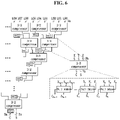
  • FIG. 6 is a configuration diagram showing a CSAT (Carry Save Adder Tree) of a modular multiplication process according to an embodiment of the present disclosure.
  • CSAT Carry Save Adder Tree
  • FIG. 1 is a configuration diagram of a calculation system for ECC scalar multiplication using an FPGA according to the present disclosure.
  • the system and method for calculating ECC scalar multiplication are configured with compact scheduling, which is used in a Montgomery ladder algorithm, and to enable efficient calculation through an improved modular arithmetic calculation method.
  • the present disclosure improves performance by implementing modular arithmetic calculation used for a Montgomery ladder algorithm into a pipeline structure, and provides a flexible structure that can be replaced at a low cost and has a safe structure in comparison to the case of implementing it as software by implementing an FPGA.
  • the system ECC scalar multiplication includes a compact scheduler of Montgomery ladder algorithm, a modular adder/subtractor, and a modular multiplier.
  • the modular multiplier performs an intermediate multiplication step of a mixed Karatsuba algorithm using a digital signal processor; and an accumulation step of mapping intermediate multiplication results; and a step of reducing the accumulated results into a modular space.
  • a Montgomery ladder calculation system 100 for ECC scalar multiplication includes; a scheduler 110 implementing Montgomery ladder step calculation in a pipeline structure; a pipeline modular adder/subtractor 120 implementing n-bit modular addition in a d-stage pipeline structure; and a modular multiplier 130 implementing n-bit modular multiplication in a 10-stage pipeline structure up to maximum 256 bits.
  • a method for calculating ECC scalar multiplication using an FPGA according to the present disclosure is as follows.
  • the system for calculating ECC scalar multiplication includes a Montgomery algorithm scheduler, a modular adder/subtractor, and a modular multiplier, may include partial product of a mixed Karatsuba algorithm using a digital signal processor by means of the multiplier, an accumulation step of mapping intermediate multiplication results; and a step of reducing the accumulated results into a modular space.
  • the Montgomery ladder calculation system for ECC scalar multiplication includes the scheduler 110 , the modular adder/subtractor 120 , and the modular multiplier 130 , and the detailed calculation process is as follows.
  • the scheduler 110 schedules Montgomery ladder step calculation (4 and 5 processes) in a pipeline structure in the Montgomery ladder algorithm shown in Table 1.
  • x QP (x Q ⁇ x P ) ⁇ Z 2
  • X RP (x R ⁇ x P ) ⁇ Z 2
  • G (x R ⁇ x Q ) 2 ⁇ Z 4
  • y Q 2y Q Z 3
  • Y R 2y R Z 3 .
  • the modular adder/subtractor 120 is a calculation system configuring n-bit modular addition into a d-stage pipeline structure.
  • the modular multiplier 130 which is an n-bit modular multiplier, can calculate maximum 256 bits in a 10-stage pipeline structure, and the number of stages should be added for calculation of larger bits.
  • FIG. 2 is a configuration diagram showing a Montgomery ladder calculation scheduling method according to an embodiment of the present disclosure.
  • FIG. 2 is a diagram for the scheduler 110 , in which Montgomery ladder step is calculated with a total of 46 clock cycles by scheduling the algorithm of the formula of Table 2 in 4-stage modular addition/subtraction and 10-stage modular multiplication.
  • FIG. 3 is a configuration diagram of a pipeline modular addition/subtraction according to an embodiment of the present disclosure.
  • FIG. 3 is a diagram showing in detail the modular adder/subtractor 120 , in which n-bit addition/subtraction is calculated in a d-stage pipeline structure.
  • Each pipeline stage takes m-bit input sliced from n-bit input A and B, performs an ALU operation according to the op value, and stores m-bit result in n-bit output res0 and res1 with 1-bit cin.
  • the offset of m-bit input/output in n-bit input/output are determined according to the stage number.
  • the final result (A ⁇ B mod p) is calculated at the last stage by selecting res from res0 or res1, by which the value is positive.
  • FIG. 4 is a configuration diagram of a pipeline modular multiplication calculator according to an embodiment of the present disclosure.
  • FIG. 4 is a detailed diagram of the modular multiplier 130 , in which an example of n-bit modular multiplication using Formula 1 is shown in a total of 10-stage pipeline structure up to maximum 256 bits.
  • stage 1 It is composed of partial product (stage 1 ⁇ 4) using a DSP (digital signal processing) device; accumulation of intermediate multiplication results (stage 5 ⁇ 7); and reduction of accumulated result into a modular space (stage 8 ⁇ 10).
  • DSP digital signal processing
  • stage 4 (x i +x j )(y i +y j ) ⁇ x i y i ⁇ x j y j in Formula 1 is calculated by calculating x j y j on the result calculated by 17-bit MACC in stage 2-3 using a 34-bit adder.
  • stage 8-10 the multiplication result is reduced in accordance with a modular space.
  • FIG. 5 is a configuration diagram showing a mapping method for accumulating intermediate multiplication results of a modular multiplication process according to an embodiment of the present disclosure
  • FIG. 6 is a configuration diagram showing a CSAT (Carry Save Adder Tree) of a modular multiplication process according to an embodiment of the present disclosure.
  • CSAT Carry Save Adder Tree
  • FIG. 5 expresses a calculation result of x i y i and (x i +x j )(y i +y j ) ⁇ x i y i ⁇ x j y j in Formula 1 in blocks.
  • the calculation result of x i y i has a size of 32 bits and the calculation result of (x i +x j )(y i +y j ) ⁇ x i y i ⁇ x j y j has a size of 33 bits.
  • the maximum size of the final result is 33 bits.
  • the calculated x i y i result is L00.
  • An MSB (Most Significant Bit) that is the 33-th bit of the calculation result of (x i +x j )(y i +y j ) ⁇ x i y i ⁇ x j y j is collected in the last layer, and the intermediate layers are blocks of calculation result of the other 32 bits.
  • the magnitude of the final accumulation result using the CSAT is 2n bits.
  • FIG. 5 shows a mapping method of outputting 512 bits using L00 ⁇ L16 layers.
  • the CSAT may be a 3:2 compressor composed of 2n full adders.
  • the system and method for calculating elliptic curve cryptography multiplication using an FPGA according to the present disclosure described above improves performance by implementing modular calculation, which is used in a Montgomery ladder algorithm, in a pipeline structure, has a safe structure in comparison to implementing it as software by implementing an FPGA, and can be replaced at a low cost, thereby having a flexible structure.

Landscapes

  • Engineering & Computer Science (AREA)
  • Physics & Mathematics (AREA)
  • Theoretical Computer Science (AREA)
  • General Physics & Mathematics (AREA)
  • Mathematical Analysis (AREA)
  • Mathematical Physics (AREA)
  • Pure & Applied Mathematics (AREA)
  • Computer Hardware Design (AREA)
  • Mathematical Optimization (AREA)
  • Computer Security & Cryptography (AREA)
  • Computational Mathematics (AREA)
  • General Engineering & Computer Science (AREA)
  • Computing Systems (AREA)
  • Computer Networks & Wireless Communication (AREA)
  • Signal Processing (AREA)
  • Software Systems (AREA)
  • Algebra (AREA)
  • Microelectronics & Electronic Packaging (AREA)
  • Complex Calculations (AREA)

Abstract

Disclosed are a system and method for calculating elliptic curve cryptography scalar multiplication using an FPGA (Field Programmable Gate Array), the system and method scheduling calculation, which is used in a Montgomery ladder Algorithm, and enabling efficient calculation through an improved modular arithmetic calculation method. The system for calculating elliptic curve cryptography (ECC) scalar multiplication using an FPGA includes: a scheduler implementing Montgomery ladder step calculation in a pipeline structure; a pipeline modular adder/subtractor implementing n-bit modular addition in a d-stage pipeline structure; and a modular multiplier implementing n-bit modular multiplication in a 10-stage pipeline structure up to maximum 256 bits.

Description

CROSS-REFERENCE TO RELATED APPLICATION
This application claims priority to Korean Patent Application No. 10-2020-0158242 (filed on Nov. 23, 2020), which is hereby incorporated by reference in its entirety.
BACKGROUND
The present disclosure relates to an elliptic curve cryptography system and, more particularly, to a system and method for calculating ECC scalar multiplication using an FPGA (Field Programmable Gate Array), the system and method scheduling calculation, which is used in a Montgomery ladder Algorithm, and enabling efficient calculation through an improved modular arithmetic calculation method.
With the advent of an information-oriented society, it is increasingly important to protect information using encryption algorithms and encryption protocols.
Public-key encryption algorithm, such as RSA and ECC, has been used in internet and finance to keep data secure by using two mathematically related keys (asymmetric).
ECC uses a small key size and has the same security level, as compared with other public-key encryption system. Since a smaller key is used, there is an advantage in terms of calculation time, power consumption, and storage space.
Elliptic curve scalar multiplication obtains a point Q on an elliptic curve by multiplying a point P on the elliptic curve by a scalar constant k.
Multiplying P by k is the same as performing k times of elliptical curve addition on P.
This is defined as Q=kP=P+P+ . . . +P (k times)
However, the ECC system of the related art has limitation in resistance against a side-channel attack calculation speed, and cost, so improvement is required.
Accordingly, it is required to develop a new technology that enables efficient calculation by increasing resistance against a side-channel attack and reducing the number of times of calculation that takes long time.
PRIOR ART DOCUMENT Patent Document
(Patent Document 1) Korean Patent Application Publication No. 10-2012-0028432
(Patent Document 2) Korean Patent No. 10-1925614
(Patent Document 3)) Korean Patent Application Publication No. 10-2010-0098017
SUMMARY
The present disclosure has been made in an effort to solve the problems of the ECC system of the related art and an object of the present disclosure is to provide a system and method for calculating ECC scalar multiplication using an FPGA (Field Programmable Gate Array), the system and method scheduling calculation, which is used in a Montgomery ladder algorithm, and enabling efficient calculation through an improved modular arithmetic calculation method.
Another object of the present invention is to provide a system and method for calculating ECC scalar multiplication using an FPGA (Field Programmable Gate Array), the system and method increasing resistance against a side-channel attack by performing elliptic curve scalar multiplication using a Montgomery ladder.
Another object of the present invention is to provide a system and method for calculating ECC scalar multiplication using an FPGA (Field Programmable Gate Array), the system and method enabling efficient calculation by reducing the number of times of calculation that takes long time by changing a coordinate system.
Another object of the present invention is to provide a system and method for calculating ECC scalar multiplication using an FPGA (Field Programmable Gate Array), the system and method improving the safety of an encryption system and making it easy to change an internal algorithm by using an FPGA.
Another object of the present invention is to provide a system and method for calculating ECC scalar multiplication using an FPGA (Field Programmable Gate Array), the system and method improving performance by implementing modular arithmetic calculation used for a Montgomery ladder algorithm into a pipeline structure, and providing a flexible structure that can be replaced at a low cost and has a safe structure in comparison to the case of implementing it as software by implementing an FPGA.
The objects of the present disclosure are not limited to those described above and other objects may be made apparent to those skilled in the art from claims.
In order to achieve an object, a system for calculating elliptic curve cryptography (ECC) scalar multiplication using an FPGA according to the present disclosure includes an improved Montgomery ladder scheduling; a pipeline modular adder/subtractor implementing n-bit modular addition in a d-stage pipeline structure; and a modular multiplier implementing n-bit modular multiplication in a 10-stage pipeline structure up to maximum 256 bits.
In order to achieve another object, a method for calculating ECC scalar multiplication using an FPGA according to the present disclosure includes: partial product of a mixed Karatsuba algorithm using a digital signal processor by means of the multiplier; an accumulation step of mapping intermediate multiplication results; and a step of reducing the accumulated results into a modular space, in order for Montgomery ladder step calculation in a system for calculating ECC scalar multiplication including a Montgomery algorithm scheduler, a modular adder, and a modular multiplier.
The system and method for calculating ECC scalar multiplication using an FPGA according to the present disclosure have the following effects.
First, it is possible to schedule calculation, which is used in a Montgomery ladder algorithm, and enable efficient calculation through an improved arithmetic calculation method.
Second, it is possible to increase resistance against a side-channel attack by performing elliptic curve scalar multiplication using a Montgomery ladder algorithm.
Third, it is possible to enable efficient calculation by reducing the number of times of calculation that takes long time by changing a coordinate system.
Fourth, it is possible to improve safety of an encryption system and make it easy to change an internal algorithm by using an FPGA.
Fifth, it is possible to improve performance by implementing modular arithmetic calculation used for a Montgomery ladder algorithm into a pipeline structure, and provide a flexible structure that can be replaced at a low cost and has a safe structure in comparison to the case of implementing it as software by implementing an FPGA.
BRIEF DESCRIPTION OF THE DRAWINGS
FIG. 1 is a configuration diagram of a calculation system for ECC scalar multiplication using an FPGA according to the present disclosure.
FIG. 2 is a configuration diagram showing a Montgomery ladder calculation scheduling method according to an embodiment of the present disclosure.
FIG. 3 is a configuration diagram of a pipeline modular addition/subtraction according to an embodiment of the present disclosure.
FIG. 4 is a configuration diagram of a pipeline modular multiplication calculator according to an embodiment of the present disclosure.
FIG. 5 is a configuration diagram showing a mapping method for accumulating intermediate multiplication results of a modular multiplication process according to an embodiment of the present disclosure.
FIG. 6 is a configuration diagram showing a CSAT (Carry Save Adder Tree) of a modular multiplication process according to an embodiment of the present disclosure.
DETAILED DESCRIPTION
Hereafter, a preferred embodiment of a system and method for calculating ECC scalar multiplication using an FPGA according to the present disclosure is described in detail.
The characteristics and advantages of the system and method for calculating ECC scalar multiplication using an FPGA according to the present disclosure will be made clear through the following detailed description of each embodiment.
FIG. 1 is a configuration diagram of a calculation system for ECC scalar multiplication using an FPGA according to the present disclosure.
The system and method for calculating ECC scalar multiplication are configured with compact scheduling, which is used in a Montgomery ladder algorithm, and to enable efficient calculation through an improved modular arithmetic calculation method.
The present disclosure improves performance by implementing modular arithmetic calculation used for a Montgomery ladder algorithm into a pipeline structure, and provides a flexible structure that can be replaced at a low cost and has a safe structure in comparison to the case of implementing it as software by implementing an FPGA.
The system ECC scalar multiplication according to an embodiment of the present disclosure includes a compact scheduler of Montgomery ladder algorithm, a modular adder/subtractor, and a modular multiplier.
The modular multiplier performs an intermediate multiplication step of a mixed Karatsuba algorithm using a digital signal processor; and an accumulation step of mapping intermediate multiplication results; and a step of reducing the accumulated results into a modular space.
In the system for calculating elliptic curve cryptography (ECC) scalar multiplication using an FPGA according to the present invention, as shown in FIG. 1, a Montgomery ladder calculation system 100 for ECC scalar multiplication includes; a scheduler 110 implementing Montgomery ladder step calculation in a pipeline structure; a pipeline modular adder/subtractor 120 implementing n-bit modular addition in a d-stage pipeline structure; and a modular multiplier 130 implementing n-bit modular multiplication in a 10-stage pipeline structure up to maximum 256 bits.
A method for calculating ECC scalar multiplication using an FPGA according to the present disclosure is as follows.
The system for calculating ECC scalar multiplication includes a Montgomery algorithm scheduler, a modular adder/subtractor, and a modular multiplier, may include partial product of a mixed Karatsuba algorithm using a digital signal processor by means of the multiplier, an accumulation step of mapping intermediate multiplication results; and a step of reducing the accumulated results into a modular space.
The Montgomery ladder calculation system for ECC scalar multiplication according to an embodiment of the present disclosure includes the scheduler 110, the modular adder/subtractor 120, and the modular multiplier 130, and the detailed calculation process is as follows.
TABLE 1
Montgomery ladder
1 (Q, R) ← (P, 2P)
2 (kn−1, . . . , k0) = (k)2
3 For i = n − 1 down to 0:
4  If ki = 0: (Q, R) ← (2Q, Q + R)
5  Else: (Q, R) ← (Q + R, 2R)
6 Output Q = k · P
The scheduler 110 schedules Montgomery ladder step calculation (4 and 5 processes) in a pipeline structure in the Montgomery ladder algorithm shown in Table 1.
Further, in the 4 and 5 processes, the scheduler maps calculation for points P, Q, and R to points (P, Q+R, 2R)=(P, S, T) and schedules them in the algorithm of Table 2 changed into a Jacobian coordinate system.
TABLE 2
Montgomery ladder. Input: ladder state (XQP, XRP, G, YQ, YR)
 1 XQP′ = XQP · G
 2 XRP′ = XRP · G
 3 L = YQ · YR
 4 H = YR 2
 5 J = XRP′ − L
 6 M = J + XRP′ − H
 7 XSP = H · L
 8 V = H · (XQP′ − L)
 9 XTS = XRP′ · J + V
10 YS =(J · L + V) · H
11 XTP = XTS + XSP
12 YT = M · XTS + YS
13 G′ = XTS 2
Output: ladder state (XSP, XTP, G′, YS, YT)
when P=(xP,yp), Q=(xQ,yQ), R=(xR,yR), S=(xS,yS), T=(xT,yT), input of the formula of Table 2 is
xQP=(xQ−xP)·Z2, XRP=(xR−xP)·Z2, G=(xR−xQ)2·Z4, yQ=2yQZ3, YR=2yRZ3.
Calculation is finished by changing again the coordinate system into S(=Q+R), T(=2R) for output XSP, XTP, G′, YS, YT of the formula of Table 2.
The modular adder/subtractor 120 is a calculation system configuring n-bit modular addition into a d-stage pipeline structure.
In the example, it is seen that modular addition of 256 bits is calculated in a 4-stage pipeline structure.
The modular multiplier 130, which is an n-bit modular multiplier, can calculate maximum 256 bits in a 10-stage pipeline structure, and the number of stages should be added for calculation of larger bits.
FIG. 2 is a configuration diagram showing a Montgomery ladder calculation scheduling method according to an embodiment of the present disclosure.
FIG. 2 is a diagram for the scheduler 110, in which Montgomery ladder step is calculated with a total of 46 clock cycles by scheduling the algorithm of the formula of Table 2 in 4-stage modular addition/subtraction and 10-stage modular multiplication.
FIG. 3 is a configuration diagram of a pipeline modular addition/subtraction according to an embodiment of the present disclosure.
FIG. 3 is a diagram showing in detail the modular adder/subtractor 120, in which n-bit addition/subtraction is calculated in a d-stage pipeline structure.
Each pipeline stage takes m-bit input sliced from n-bit input A and B, performs an ALU operation according to the op value, and stores m-bit result in n-bit output res0 and res1 with 1-bit cin. The offset of m-bit input/output in n-bit input/output are determined according to the stage number.
When op is add, the ALU calculates (res0, res1)=(cin+a+b, cin+a+b−p), and when op is sub, ALU calculates (res0, rest)=(a−b−cin, a−b+p−cin). The final result (A±B mod p) is calculated at the last stage by selecting res from res0 or res1, by which the value is positive.
FIG. 4 is a configuration diagram of a pipeline modular multiplication calculator according to an embodiment of the present disclosure.
FIG. 4 is a detailed diagram of the modular multiplier 130, in which an example of n-bit modular multiplication using Formula 1 is shown in a total of 10-stage pipeline structure up to maximum 256 bits.
It is composed of partial product (stage 1˜4) using a DSP (digital signal processing) device; accumulation of intermediate multiplication results (stage 5˜7); and reduction of accumulated result into a modular space (stage 8˜10).
Let n - bit multiplication , m = 2 n / b xy = i = 0 m - 1 x i y i b 2 i + i = 0 m - 2 j = i + 1 m - 2 [ ( x i + x j ) ( y i + y j ) - x i y i - x j y j ] b ( i + j ) [ Formula 1 ]
In stage 1, xi+xj and yi+yj are calculated for i=(0, 1 . . . , m−2) and j=(i+1, i+2, . . . m−2) in Formula 1 using a 16-bit RCA (ripple carry adder).
In formula 1, m=2n/b, wherein b is 216 which is DSP data size.
In stage 1-2, xiyi is calculated for i=(0, 1, . . . m−1) using a 16-bit multiplier.
In stage 2-3, xi+xj and yi+yj calculated using the 16-bit RCA in stage 1 are multiplied using a 17-bit MACC (multiply and accumulate) and (xi+xj)(yi+yj)−xiyi in Formula 1 is calculated finally for i=(0, 1, . . . , m−2) and j=(i+1, i+2, . . . m−2) by calculating with xiyi calculated in stage 1-2.
In stage 4, (xi+xj)(yi+yj)−xiyi−xjyj in Formula 1 is calculated by calculating xjyj on the result calculated by 17-bit MACC in stage 2-3 using a 34-bit adder.
In stage 5-7,
i = 0 m - 1 x i y i b 2 i + i = 0 m - 2 j = i + 1 m - 2 [ ( x i + x j ) ( y i + y j ) - x i y i - x j y j ] b ( i + j )
in Formula 1 is finally calculated by arranging and adding the result of xiyi calculated and the intermediate multiplication result calculated on (xi+xj)(yi+yj)−xiyi−xjyj in stage 1-2.
It is possible to use a CSAT (Carry Save Adder Tree) when accumulating intermediate multiplication results.
In stage 8-10, the multiplication result is reduced in accordance with a modular space. When n=256, as in the example, in n-bit modular multiplication, the size of output in stage 7 is 512 bits.
As an example of reducing into a modular space, there is a method of reducing 512-bit input into 256 bits, as in the formula in Table 3.
TABLE 3
Fast reduction modulo p256 = 2256 − 2224 + 2192 + 296 − 1
Input: An integer c = (c15, . . . , c0) in base 232 with 0 ≤ c ≤ p 256 2
1. Define 256-bit integers:
s1 = c7, c6, c5, c4, c3, c2, c1, c0),
s2 = (c15, c14, c13, c12, c11, 0,0,0 ),
s3 = (0, c15, c14, c13, c12, 0,0,0),
s4 = (c15, c14, 0,0,0, c10, c9, c8),
s5 = (c8, c13, c15, c14, c13, c11, c10, c9),
s6 = (c10, c8, 0,0,0, c13, c12, c11),
s7 = (c11, c9, 0,0, c15, c14, c13, c12),
s8 = (c12, 0, c11, c10, c9, 0, c15, c14),
s9 = (c13, 0, c11, c10, c9, 0, c15, c14),
2. Return (s1 + 2s2 + 2s3 + s4 + s5 − s6 − s7 − s8 − s9 mod p256)
In the formula of Table 3, a final calculation result is output and reduced in a p256 space in stage 9-10 by inputting a result, which is obtained by inputting the result of adding s1+2s2+2s3+s4+s5 and 4p256 as the first CSAT input in stage 8 and inputting −s6−s7−s8=s9 as a second CSAT input in order to implement the result in the formula of Table 3 using only addition.
FIG. 5 is a configuration diagram showing a mapping method for accumulating intermediate multiplication results of a modular multiplication process according to an embodiment of the present disclosure and FIG. 6 is a configuration diagram showing a CSAT (Carry Save Adder Tree) of a modular multiplication process according to an embodiment of the present disclosure.
FIG. 5 expresses a calculation result of xiyi and (xi+xj)(yi+yj)−xiyi−xjyj in Formula 1 in blocks.
The calculation result of xiyi has a size of 32 bits and the calculation result of (xi+xj)(yi+yj)−xiyi−xjyj has a size of 33 bits.
That is, it was calculated by 34-bit RCA, but according to the final result of subtraction and the formula, the maximum size of the final result is 33 bits.
The calculated xiyi result is L00. An MSB (Most Significant Bit) that is the 33-th bit of the calculation result of (xi+xj)(yi+yj)−xiyi−xjyj is collected in the last layer, and the intermediate layers are blocks of calculation result of the other 32 bits.
When the values in a block are calculated vertically, the magnitude of the final accumulation result using the CSAT is 2n bits.
The example of FIG. 5 shows a mapping method of outputting 512 bits using L00˜L16 layers.
Referring to FIG. 6, it is possible to output a result by performing addition in accordance with the layers to which intermediate multiplication results are mapped, as shown in FIG. 5. When 2n is input, the CSAT may be a 3:2 compressor composed of 2n full adders.
The system and method for calculating elliptic curve cryptography multiplication using an FPGA according to the present disclosure described above improves performance by implementing modular calculation, which is used in a Montgomery ladder algorithm, in a pipeline structure, has a safe structure in comparison to implementing it as software by implementing an FPGA, and can be replaced at a low cost, thereby having a flexible structure.
It would be understood that the present disclosure was implemented in a modification type without departing from the essential characteristic of the present disclosure, as described above.
Accordingly, the embodiments stated herein should be considered in terms of not limitative viewpoint, but explanatory view point, the range of the present disclosure is described not in the above description, but claims, and all differences should be construed as being included in the present disclosure.

Claims (7)

What is claimed is:
1. A system for calculating ECC (Elliptic Curve Cryptography) scalar multiplication using an FPGA, the system comprising a Montgomery ladder step calculator scheduling for ECC scalar multiplication,
wherein the Montgomery ladder step calculator includes:
a scheduler implementing Montgomery ladder step calculation in a pipeline structure;
a pipeline modular adder/subtractor implementing n-bit modular addition in a d-stage pipeline structure; and
a modular multiplier implementing n-bit modular multiplication in a 10-stage pipeline structure up to maximum 256 bits,
wherein the scheduler
schedules Montgomery ladder step calculation (4 and 5 processes) in a pipeline structure in the Montgomery ladder algorithm of
1 (Q,R)←(P,2P)
2 (kn-1, . . . k0)=(k)2
3 For i=n−1 down to 0:
4 If ki=0: (Q,R)←(2Q,Q+R)
5 Else: (Q,R)←(Q+R,2R)
6 Output Q=k·P, and
maps calculation for points P, Q, and R to points (P, Q+R, 2R)=(P, S, T) and schedules them in the algorithm changed into a Jacobian coordinate system in the 4 and 5 processes.
2. The system of claim 1, wherein the modular multiplier performs intermediate multiplication of a mixed Karatsuba algorithm using a digital signal processor, accumulation by mapping intermediate multiplication results; and reducing the accumulated results into a modular space.
3. A method for calculating ECC scalar multiplication using an FPGA, the method comprising:
partial product of a mixed Karatsuba algorithm using a digital signal processor by means of the modular multiplier;
an accumulation step of mapping intermediate multiplication results; and
a step of reducing the accumulated results into a modular space, in order for Montgomery ladder step calculation in a system for calculating ECC scalar multiplication including a Montgomery algorithm scheduler, a modular adder, and a modular multiplier,
wherein the modular multiplier has a 10-stage pipeline structure composed of partial product (stage 1˜4) using a DSP (digital signal processing) device; accumulation of intermediate multiplication results (stage 5˜7); and reduction of accumulated result into a modular space (stage 8˜10),
wherein the modular multiplier calculates
Let n - bit multiplication , m = 2 n / b xy = i = 0 m - 1 x i y i b 2 i + i = 0 m - 2 j = i + 1 m - 2 [ ( x i + x j ) ( y i + y j ) - x i y i - x j y j ] b ( i + j ) ,
and
calculates xi+xj and yi+yj for i=(0, 1, . . . , m−2) and j=(i+1, t+2, m−2) using a 16-bit RCA (Ripple Carry Adder) in stage 1, wherein m=2n/b and b is 216 which is DSP data size.
4. The method of claim 3, wherein
in the stage 1-2, xiyi is calculated for i=(0, 1, . . . , m−1) using 16-bit multiplier, and
in the stage 2-3, xi+xj and yi+yj calculated using the 16-bit RCA in stage 1 are multiplied using a 17-bit MACC (multiply and accumulate) and (xi+xj)(yi+yj)−xiyi is calculated finally for i=(0, 1, . . . , m−2) and j=(i+1, i+2, . . . m−2) by calculating with xiyi calculated in the stage 1-2.
5. The method of claim 4, wherein, in the stage 4, (xixj)(yi+yj)−xiyi−xiyj is calculated by calculating xjyj on the result calculated by 17-bit MACC in the stage 2-3 using a 34-bit adder.
6. The method of claim 5, wherein, in the stage 5-7,
i = 0 m - 1 x i y i b 2 i + i = 0 m - 2 j = i + 1 m - 2 [ ( x i + x j ) ( y i + y j ) - x i y i - x j y j ] b ( i + j )
is finally calculated by arranging and adding the result of xiyi calculated and the intermediate multiplication result calculated on (xi+xj)(yi+yj)−xiyi−xjyj in the stage 1-2.
7. The method of claim 6, wherein a CSAT (Carry Save Adder Tree) is used when accumulating intermediate multiplication results, and
in the stage 8-10, the multiplication result is reduced in accordance with a modular space.
US17/510,844 2020-11-23 2021-10-26 System and method for calculating faster ECC scalar multiplication on FPGA Active US11368303B2 (en)

Applications Claiming Priority (2)

Application Number Priority Date Filing Date Title
KR10-2020-0158242 2020-11-23
KR1020200158242A KR102457163B1 (en) 2020-11-23 2020-11-23 System and Method for Calculating Faster ECC scalar multiplication on FPGA

Publications (2)

Publication Number Publication Date
US20220166619A1 US20220166619A1 (en) 2022-05-26
US11368303B2 true US11368303B2 (en) 2022-06-21

Family

ID=81657424

Family Applications (1)

Application Number Title Priority Date Filing Date
US17/510,844 Active US11368303B2 (en) 2020-11-23 2021-10-26 System and method for calculating faster ECC scalar multiplication on FPGA

Country Status (2)

Country Link
US (1) US11368303B2 (en)
KR (1) KR102457163B1 (en)

Families Citing this family (2)

* Cited by examiner, † Cited by third party
Publication number Priority date Publication date Assignee Title
KR102696254B1 (en) * 2023-05-03 2024-08-20 성균관대학교산학협력단 Method of controling integer multiplier and apparatus thereof
KR102612588B1 (en) * 2023-05-15 2023-12-12 메티스엑스 주식회사 Programmable semiconductor device, electronic device including same, and method for performing operation by programmable semiconductor device

Citations (7)

* Cited by examiner, † Cited by third party
Publication number Priority date Publication date Assignee Title
US7509486B1 (en) * 1999-07-08 2009-03-24 Broadcom Corporation Encryption processor for performing accelerated computations to establish secure network sessions connections
KR20100098017A (en) 2009-02-27 2010-09-06 고려대학교 산학협력단 Method for scalar multiplication using extended montgomery ladder
US7995752B2 (en) * 1998-12-24 2011-08-09 Certicom Corp. Method for accelerating cryptographic operations on elliptic curves
KR20120028432A (en) 2010-09-15 2012-03-23 고려대학교 산학협력단 Calculating apparatus and method for elliptic curve cryptography
US8750500B2 (en) * 2007-06-27 2014-06-10 Certicom Corp. Multi-dimensional montgomery ladders for elliptic curves
US20150092941A1 (en) * 2013-09-27 2015-04-02 Santosh Ghosh Fault tolerant apparatus and method for elliptic curve cryptography
KR101925614B1 (en) 2017-11-08 2018-12-05 부산대학교 산학협력단 Method for processing scalar multiplication in elliptic curve cryptosystem, and elliptic curve cryptosystem

Patent Citations (7)

* Cited by examiner, † Cited by third party
Publication number Priority date Publication date Assignee Title
US7995752B2 (en) * 1998-12-24 2011-08-09 Certicom Corp. Method for accelerating cryptographic operations on elliptic curves
US7509486B1 (en) * 1999-07-08 2009-03-24 Broadcom Corporation Encryption processor for performing accelerated computations to establish secure network sessions connections
US8750500B2 (en) * 2007-06-27 2014-06-10 Certicom Corp. Multi-dimensional montgomery ladders for elliptic curves
KR20100098017A (en) 2009-02-27 2010-09-06 고려대학교 산학협력단 Method for scalar multiplication using extended montgomery ladder
KR20120028432A (en) 2010-09-15 2012-03-23 고려대학교 산학협력단 Calculating apparatus and method for elliptic curve cryptography
US20150092941A1 (en) * 2013-09-27 2015-04-02 Santosh Ghosh Fault tolerant apparatus and method for elliptic curve cryptography
KR101925614B1 (en) 2017-11-08 2018-12-05 부산대학교 산학협력단 Method for processing scalar multiplication in elliptic curve cryptosystem, and elliptic curve cryptosystem

Non-Patent Citations (3)

* Cited by examiner, † Cited by third party
Title
Dong-Seong Kim et al., "Montgomery Multiplier Supporting Dual-Field Modular Multiplication", JKIICE Journal of the Korea Institute of Information and Communication Engineering, Jun. 24, 2020, pp. 736-743, vol. 24, No. 6.
Korean Office Action for related KR Application No. 10-2020-0158242 dated Dec. 6, 2021 from Korean Intellectual Property Office.
Lijuan Li and Shuguo Li, High-Performance Pipelined Architecture of Elliptic Curve Scalar Multiplication Over GF (2m), IEEE Transaction On Very Large Scale Integration (VLSI) Systems, vol. 24, No. 4, Apr. 2016, p. 1223-1232. (Year: 2016). *

Also Published As

Publication number Publication date
US20220166619A1 (en) 2022-05-26
KR20220071047A (en) 2022-05-31
KR102457163B1 (en) 2022-10-20

Similar Documents

Publication Publication Date Title
Ding et al. High-speed ECC processor over NIST prime fields applied with Toom–Cook multiplication
Mehrabi et al. Elliptic curve cryptography point multiplication core for hardware security module
Erdem et al. A general digit-serial architecture for Montgomery modular multiplication
Montgomery Five, six, and seven-term Karatsuba-like formulae
Öztürk Design and implementation of a low-latency modular multiplication algorithm
US11368303B2 (en) System and method for calculating faster ECC scalar multiplication on FPGA
Großschädl A bit-serial unified multiplier architecture for finite fields GF (p) and GF (2m)
Liu et al. High performance modular multiplication for SIDH
US7412474B2 (en) Montgomery modular multiplier using a compressor and multiplication method
Chang et al. Low complexity bit-parallel multiplier for GF (2/sup m/) defined by all-one polynomials using redundant representation
KR20060104823A (en) Fast set verification method and device
Al-Khaleel et al. Efficient ECC processor designs for IoT using edwards curves and exploiting FPGA embedded components
Abdulrahman et al. New regular radix-8 scheme for elliptic curve scalar multiplication without pre-computation
Ding et al. A reconfigurable high-speed ECC processor over NIST primes
Das et al. Hybrid recursive Karatsuba multiplications on FPGAs
US9164732B2 (en) Multiplication method and modular multiplier using redundant form recoding
Öztürk Modular multiplication algorithm suitable for low-latency circuit implementations
Batina et al. Balanced point operations for side-channel protection of elliptic curve cryptography
WO2022115108A1 (en) An architecture for small and efficient modular multiplication using carry-save adders
Mohammadi et al. Efficient design of elliptic curve point multiplication based on fast montgomery modular multiplication
Gutub Fast 160-bits GF (p) elliptic curve crypto hardware of high-radix scalable multipliers
KR20060037941A (en) Hybrid Multiplication Computing Device and Method in Finite Field
Al Saffar et al. Speeding up the Elliptic Curve Scalar Multiplication Using the Window-w Non Adjacent Form.
Chang et al. A non-redundant and efficient architecture for Karatsuba-Ofman algorithm
Kobayashi et al. Fast inversion algorithm in GF (2 m) suitable for implementation with a polynomial multiply instruction on GF (2)

Legal Events

Date Code Title Description
AS Assignment

Owner name: PUSAN NATIONAL UNIVERSITY INDUSTRY-UNIVERSITY COOPERATION FOUNDATION, KOREA, REPUBLIC OF

Free format text: ASSIGNMENT OF ASSIGNORS INTEREST;ASSIGNORS:KIM, HOWON;AWALUDIN, ASEP MUHAMAD;YUN, YOUNGYEO;REEL/FRAME:058300/0401

Effective date: 20211022

FEPP Fee payment procedure

Free format text: ENTITY STATUS SET TO UNDISCOUNTED (ORIGINAL EVENT CODE: BIG.); ENTITY STATUS OF PATENT OWNER: SMALL ENTITY

FEPP Fee payment procedure

Free format text: ENTITY STATUS SET TO SMALL (ORIGINAL EVENT CODE: SMAL); ENTITY STATUS OF PATENT OWNER: SMALL ENTITY

STCF Information on status: patent grant

Free format text: PATENTED CASE

MAFP Maintenance fee payment

Free format text: PAYMENT OF MAINTENANCE FEE, 4TH YR, SMALL ENTITY (ORIGINAL EVENT CODE: M2551); ENTITY STATUS OF PATENT OWNER: SMALL ENTITY

Year of fee payment: 4