US11359422B2 - Adjustable dead-latching bolt mechanisms - Google Patents
Adjustable dead-latching bolt mechanisms Download PDFInfo
- Publication number
- US11359422B2 US11359422B2 US16/596,355 US201916596355A US11359422B2 US 11359422 B2 US11359422 B2 US 11359422B2 US 201916596355 A US201916596355 A US 201916596355A US 11359422 B2 US11359422 B2 US 11359422B2
- Authority
- US
- United States
- Prior art keywords
- latch
- link
- slot
- displacement
- rod
- Prior art date
- Legal status (The legal status is an assumption and is not a legal conclusion. Google has not performed a legal analysis and makes no representation as to the accuracy of the status listed.)
- Active, expires
Links
Images




Classifications
-
- E—FIXED CONSTRUCTIONS
- E05—LOCKS; KEYS; WINDOW OR DOOR FITTINGS; SAFES
- E05C—BOLTS OR FASTENING DEVICES FOR WINGS, SPECIALLY FOR DOORS OR WINDOWS
- E05C9/00—Arrangements of simultaneously actuated bolts or other securing devices at well-separated positions on the same wing
- E05C9/04—Arrangements of simultaneously actuated bolts or other securing devices at well-separated positions on the same wing with two sliding bars moved in opposite directions when fastening or unfastening
-
- E—FIXED CONSTRUCTIONS
- E05—LOCKS; KEYS; WINDOW OR DOOR FITTINGS; SAFES
- E05B—LOCKS; ACCESSORIES THEREFOR; HANDCUFFS
- E05B63/00—Locks or fastenings with special structural characteristics
- E05B63/0056—Locks with adjustable or exchangeable lock parts
-
- E—FIXED CONSTRUCTIONS
- E05—LOCKS; KEYS; WINDOW OR DOOR FITTINGS; SAFES
- E05B—LOCKS; ACCESSORIES THEREFOR; HANDCUFFS
- E05B65/00—Locks or fastenings for special use
- E05B65/10—Locks or fastenings for special use for panic or emergency doors
- E05B65/1006—Locks or fastenings for special use for panic or emergency doors of the vertical rod type
-
- E—FIXED CONSTRUCTIONS
- E05—LOCKS; KEYS; WINDOW OR DOOR FITTINGS; SAFES
- E05C—BOLTS OR FASTENING DEVICES FOR WINGS, SPECIALLY FOR DOORS OR WINDOWS
- E05C9/00—Arrangements of simultaneously actuated bolts or other securing devices at well-separated positions on the same wing
- E05C9/18—Details of fastening means or of fixed retaining means for the ends of bars
- E05C9/1825—Fastening means
- E05C9/1833—Fastening means performing sliding movements
- E05C9/185—Fastening means performing sliding movements parallel with actuating bar
-
- E—FIXED CONSTRUCTIONS
- E05—LOCKS; KEYS; WINDOW OR DOOR FITTINGS; SAFES
- E05B—LOCKS; ACCESSORIES THEREFOR; HANDCUFFS
- E05B17/00—Accessories in connection with locks
- E05B17/20—Means independent of the locking mechanism for preventing unauthorised opening, e.g. for securing the bolt in the fastening position
- E05B17/2007—Securing, deadlocking or "dogging" the bolt in the fastening position
- E05B17/203—Securing, deadlocking or "dogging" the bolt in the fastening position not following the movement of the bolt
- E05B17/2034—Securing, deadlocking or "dogging" the bolt in the fastening position not following the movement of the bolt moving pivotally or rotatively
-
- E—FIXED CONSTRUCTIONS
- E05—LOCKS; KEYS; WINDOW OR DOOR FITTINGS; SAFES
- E05C—BOLTS OR FASTENING DEVICES FOR WINGS, SPECIALLY FOR DOORS OR WINDOWS
- E05C9/00—Arrangements of simultaneously actuated bolts or other securing devices at well-separated positions on the same wing
- E05C9/02—Arrangements of simultaneously actuated bolts or other securing devices at well-separated positions on the same wing with one sliding bar for fastening when moved in one direction and unfastening when moved in opposite direction; with two sliding bars moved in the same direction when fastening or unfastening
-
- E—FIXED CONSTRUCTIONS
- E05—LOCKS; KEYS; WINDOW OR DOOR FITTINGS; SAFES
- E05C—BOLTS OR FASTENING DEVICES FOR WINGS, SPECIALLY FOR DOORS OR WINDOWS
- E05C9/00—Arrangements of simultaneously actuated bolts or other securing devices at well-separated positions on the same wing
- E05C9/04—Arrangements of simultaneously actuated bolts or other securing devices at well-separated positions on the same wing with two sliding bars moved in opposite directions when fastening or unfastening
- E05C9/042—Arrangements of simultaneously actuated bolts or other securing devices at well-separated positions on the same wing with two sliding bars moved in opposite directions when fastening or unfastening with pins engaging slots
-
- E—FIXED CONSTRUCTIONS
- E05—LOCKS; KEYS; WINDOW OR DOOR FITTINGS; SAFES
- E05C—BOLTS OR FASTENING DEVICES FOR WINGS, SPECIALLY FOR DOORS OR WINDOWS
- E05C9/00—Arrangements of simultaneously actuated bolts or other securing devices at well-separated positions on the same wing
- E05C9/04—Arrangements of simultaneously actuated bolts or other securing devices at well-separated positions on the same wing with two sliding bars moved in opposite directions when fastening or unfastening
- E05C9/043—Arrangements of simultaneously actuated bolts or other securing devices at well-separated positions on the same wing with two sliding bars moved in opposite directions when fastening or unfastening with crank pins and connecting rods
-
- Y—GENERAL TAGGING OF NEW TECHNOLOGICAL DEVELOPMENTS; GENERAL TAGGING OF CROSS-SECTIONAL TECHNOLOGIES SPANNING OVER SEVERAL SECTIONS OF THE IPC; TECHNICAL SUBJECTS COVERED BY FORMER USPC CROSS-REFERENCE ART COLLECTIONS [XRACs] AND DIGESTS
- Y10—TECHNICAL SUBJECTS COVERED BY FORMER USPC
- Y10T—TECHNICAL SUBJECTS COVERED BY FORMER US CLASSIFICATION
- Y10T292/00—Closure fasteners
- Y10T292/08—Bolts
-
- Y—GENERAL TAGGING OF NEW TECHNOLOGICAL DEVELOPMENTS; GENERAL TAGGING OF CROSS-SECTIONAL TECHNOLOGIES SPANNING OVER SEVERAL SECTIONS OF THE IPC; TECHNICAL SUBJECTS COVERED BY FORMER USPC CROSS-REFERENCE ART COLLECTIONS [XRACs] AND DIGESTS
- Y10—TECHNICAL SUBJECTS COVERED BY FORMER USPC
- Y10T—TECHNICAL SUBJECTS COVERED BY FORMER US CLASSIFICATION
- Y10T292/00—Closure fasteners
- Y10T292/08—Bolts
- Y10T292/0801—Multiple
-
- Y—GENERAL TAGGING OF NEW TECHNOLOGICAL DEVELOPMENTS; GENERAL TAGGING OF CROSS-SECTIONAL TECHNOLOGIES SPANNING OVER SEVERAL SECTIONS OF THE IPC; TECHNICAL SUBJECTS COVERED BY FORMER USPC CROSS-REFERENCE ART COLLECTIONS [XRACs] AND DIGESTS
- Y10—TECHNICAL SUBJECTS COVERED BY FORMER USPC
- Y10T—TECHNICAL SUBJECTS COVERED BY FORMER US CLASSIFICATION
- Y10T292/00—Closure fasteners
- Y10T292/08—Bolts
- Y10T292/0801—Multiple
- Y10T292/0834—Sliding
-
- Y—GENERAL TAGGING OF NEW TECHNOLOGICAL DEVELOPMENTS; GENERAL TAGGING OF CROSS-SECTIONAL TECHNOLOGIES SPANNING OVER SEVERAL SECTIONS OF THE IPC; TECHNICAL SUBJECTS COVERED BY FORMER USPC CROSS-REFERENCE ART COLLECTIONS [XRACs] AND DIGESTS
- Y10—TECHNICAL SUBJECTS COVERED BY FORMER USPC
- Y10T—TECHNICAL SUBJECTS COVERED BY FORMER US CLASSIFICATION
- Y10T292/00—Closure fasteners
- Y10T292/08—Bolts
- Y10T292/0801—Multiple
- Y10T292/0834—Sliding
- Y10T292/0836—Operating means
-
- Y—GENERAL TAGGING OF NEW TECHNOLOGICAL DEVELOPMENTS; GENERAL TAGGING OF CROSS-SECTIONAL TECHNOLOGIES SPANNING OVER SEVERAL SECTIONS OF THE IPC; TECHNICAL SUBJECTS COVERED BY FORMER USPC CROSS-REFERENCE ART COLLECTIONS [XRACs] AND DIGESTS
- Y10—TECHNICAL SUBJECTS COVERED BY FORMER USPC
- Y10T—TECHNICAL SUBJECTS COVERED BY FORMER US CLASSIFICATION
- Y10T292/00—Closure fasteners
- Y10T292/08—Bolts
- Y10T292/096—Sliding
- Y10T292/1014—Operating means
- Y10T292/1016—Cam
-
- Y—GENERAL TAGGING OF NEW TECHNOLOGICAL DEVELOPMENTS; GENERAL TAGGING OF CROSS-SECTIONAL TECHNOLOGIES SPANNING OVER SEVERAL SECTIONS OF THE IPC; TECHNICAL SUBJECTS COVERED BY FORMER USPC CROSS-REFERENCE ART COLLECTIONS [XRACs] AND DIGESTS
- Y10—TECHNICAL SUBJECTS COVERED BY FORMER USPC
- Y10T—TECHNICAL SUBJECTS COVERED BY FORMER US CLASSIFICATION
- Y10T292/00—Closure fasteners
- Y10T292/54—Trippers
-
- Y—GENERAL TAGGING OF NEW TECHNOLOGICAL DEVELOPMENTS; GENERAL TAGGING OF CROSS-SECTIONAL TECHNOLOGIES SPANNING OVER SEVERAL SECTIONS OF THE IPC; TECHNICAL SUBJECTS COVERED BY FORMER USPC CROSS-REFERENCE ART COLLECTIONS [XRACs] AND DIGESTS
- Y10—TECHNICAL SUBJECTS COVERED BY FORMER USPC
- Y10T—TECHNICAL SUBJECTS COVERED BY FORMER US CLASSIFICATION
- Y10T292/00—Closure fasteners
- Y10T292/54—Trippers
- Y10T292/546—Sliding detent
Definitions
- Exit devices including vertical rod exit devices, often have a latch device that extends into, and out of, the top and bottom edges of a door.
- the latch device is configured to extend away from the door and into a mating recess in a door frame so as to provide a locking engagement that may maintain the door in a closed position.
- the latch device may also be connected to a push bar or trim by a rod or cable. When the door is to be displaced, the push bar or trim is displaced, which may cause the rod or cable to provide a pushing or pulling force that retracts the latch device from the mating recess in the adjacent structure.
- Operation of exit devices often requires that the latch device extend a sufficient distance into the mating recess so that the latch device attains a locked position within the mating recess.
- the extent to which the latch device is to operably extend away from the door and into a mating recess may differ for different doors and/or different door frames. For example, differences in door heights and/or the depths of mating recesses may alter the distance that the latch device is to extend into the mating recess to reach the locked position. Further, over time, the position of the door relative to the door frame may change. Such changes, which may be due, for example, to door sag and general wear and tear on the door, may also alter the degree to which the latch device is to extend into the mating recess.
- the door installer often determines the extended position of the latch device before the door is installed, such as, for example, before the door is hung to the door frame.
- the degree to which the latch device will at least initially extend away from the door is typically initially set while the door is laying in a horizontal orientation.
- the actual degree of the extension of the latch device typically is not known until after the door has been hung to the door frame.
- the extent to which the latch device extends from the door is at least initially positioned by inserting a pin through one of a plurality of holes in a housing that is mounted to the door, and into a hole of the latch device.
- the degree of extension of the latch device is to be adjusted, the pin is removed from the hole of the latch device and the hole of the housing, and placed, again by feel, into another hole in the housing before being reinserted into the hole of the pin.
- the degree that the latch device may be adjusted or trimmed is generally limited to the number and positioning of the holes in the housing.
- such adjustments to the degree that the latch device extends from the door generally occur along the same axis as the latch device travels into and out of the mating recess. Yet, reliance on the same axis for these adjustments may preclude the latch device from providing dead-latching capabilities. Further, the absence of dead-latching capabilities may increase the opportunity for unauthorized displacement of the latch device and the resulting unauthorized unlocking of the exit device and/or displacement of the associated door to an open position. For example, the absence of dead-locking capabilities may allow for the latch device to be forcibly retracted by an item, such as, for example, by tools, fingers, or cards, among other items, that engage the latch device through a door gap.
- An aspect of the present invention is directed to an apparatus that includes a displacement rod having a rod protrusion and an aperture, the displacement rod being adapted for displacement between a first rod position and a second rod position.
- the apparatus further includes a lever member that is pivotally coupled to the displacement rod, the lever member having an abutment member and a foot portion. The abutment member extends from the lever member toward the displacement rod.
- the rod protrusion is structured to engage the abutment member to pivotally displace the lever member from a first position to a second position as the displacement rod is displaced from the first rod position to the second rod position.
- the apparatus further includes a latch bolt having a bolt protrusion, at least a portion of the latch bolt being structured for slideable insertion into the aperture.
- the foot portion is structured to impede the displacement of at least the bolt protrusion from an extended position to a retracted position when the lever member is in the first position.
- Another aspect of the present invention is directed to an apparatus that includes a displacement rod that is structured for displacement between a retracted rod position and an extended rod position.
- the apparatus also includes at least one first link that has a first end and a link slot. The first end of the at least one first link is pivotally coupled to the displacement rod by a first link pin.
- the apparatus includes at least one second link that has a first end and a second end. The first end of the at least one second link is pivotally coupled to the at least one first link by a second link pin that extends into the link slot.
- the apparatus further includes a latch bolt that has a first latch slot and a second latch slot, the first latch slot being structured to receive insertion of a latch pin, the second latch slot being adapted to receive a static latch pin.
- the latch bolt is structured for displacement between an extended position and a retracted position.
- Another aspect of the present invention is directed to an apparatus that includes a displacement rod that is structure for displacement between a retracted rod position and an extended rod position.
- the apparatus further includes a link that is coupled to the displacement rod by at least one link pin, the link having a cam opening having a cam surface.
- the cam opening is configured to receive the placement of at least a portion of a cam pin, while the cam surface is adapted to facilitate the displacement of the cam pin in a first direction when the cam pin abuts the cam surface.
- the apparatus also includes a latch bolt having a latch slot, the latch slot being sized to receive the slideable insertion of the cam pin. Additionally, the latch slot extends along an axis that is offset from, and not perpendicular to, a longitudinal axis of a body portion of the latch bolt.
- FIG. 1 illustrates a front view of an exit device that is attached to a door.
- FIG. 2 illustrates a side perspective partial phantom view of a latch mechanism having a latch bolt in an extended, locked position according to an illustrated embodiment of the present invention.
- FIG. 3 illustrates a side perspective partial phantom view of the latch mechanism shown in FIG. 2 .
- FIG. 4 illustrates a side perspective view of an actuator mechanism for the latch mechanism shown in FIG. 2 according to an illustrated embodiment of the present invention.
- FIG. 5 illustrates a side cross-sectional view of the latch mechanism shown in FIG. 2 taken along line A-A.
- FIG. 6 illustrates a side view of a portion of the latch mechanism shown in FIG. 2 with the latch bolt at a transition position between the extended, locked position and the retracted, unlocked position.
- FIGS. 7 a and 7 b illustrate a cross-sectional view and an inside side view, respectively, of the latch mechanism shown in FIG. 2 with the actuator mechanism, including the latch bolt, in a retracted, unlocked position.
- FIGS. 8 a and 8 b illustrate a cross-sectional side view and an inside side view, respectively, of the latch mechanism shown in FIG. 2 with the latch bolt in a retracted, unlocked position while at least the displacement rod is in the extended, locked position.
- FIGS. 9 a and 9 b illustrate a side perspective and side partial phantom view, respectively, of a latch mechanism having a latch bolt in an extended, locked position according to an illustrated embodiment of the present invention.
- FIG. 9 c illustrates a side perspective view of an actuator mechanism for the latch mechanism shown in FIG. 9 a according to an illustrated embodiment of the present invention.
- FIG. 10 a illustrates a cross-sectional side view of a portion of the latch mechanism shown in FIG. 9 a with the latch bolt and associated components of the actuator mechanism in an extended, locked position.
- FIG. 10 b illustrates a side view the latch mechanism illustrated in FIG. 10 a.
- FIG. 11 a illustrates a side view of the latch mechanism shown in FIG. 9 a with the actuator mechanism, including the latch bolt, in a retracted, unlocked position.
- FIG. 11 b illustrates a cross-sectional side view of the latch mechanism shown in FIG. 11 a.
- FIG. 12 illustrates a cross-sectional side view of the latch mechanism shown in FIG. 9 a in which the latch bolt has remained in the retracted, unlocked position while other components of the actuator mechanism have returned to their extended, locked positions.
- FIG. 13 a illustrates a side view of the latch mechanism shown in FIG. 9 a with the actuator mechanism, including the latch bolt, in an extended, locked position.
- FIG. 13 b illustrates a cross-sectional side view of the latch mechanism shown in FIG. 9 a with the actuator mechanism, including the latch bolt, in an extended, locked position.
- FIG. 14 illustrates a side view of a first side of the housing of the latch mechanism shown in FIG. 9 a.
- FIG. 15 a illustrates a side view of a latch mechanism having a latch bolt in an extended, locked position according to an illustrated embodiment of the present invention.
- FIG. 15 b illustrates a side perspective partial phantom view of the latch mechanism illustrated in FIG. 15 a.
- FIG. 16 illustrates a side perspective view of an actuator mechanism for the latch mechanism shown in FIG. 15 a according to an illustrated embodiment of the present invention.
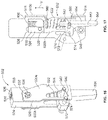
- FIG. 17 illustrates a side cross-sectional view of the latch mechanism shown in FIG. 15 a.
- FIG. 18 illustrates a side view within the housing of the latch mechanism shown in FIG. 15 a with the actuator mechanism, including the latch bolt, in an extended, locked position.
- FIGS. 19, 20 a , and 20 b illustrate interior and exterior views of the housing of the latch mechanism shown in FIG. 18 , with the actuator mechanism, including the latch bolt, at different positions between an extended, locked position and a retracted, unlocked position.
- FIG. 21 illustrates a side partial phantom view of the latch mechanism shown in FIG. 15 a with the actuator mechanism in the retracted, unlocked position.
- FIGS. 22 a and 22 b illustrate a side partial phantom view and a side view, respectively, of the latch mechanism shown in FIG. 15 a with a portion of the actuator mechanism in the extended, locked position while the latch bolt remains in the retracted, unlocked position.
- FIG. 23 illustrates a side view of the latch mechanism shown in FIG. 15 a with the actuator mechanism in the extended, locked position.
- FIG. 24 illustrates a side view of a sidewall of a housing of the latch mechanism shown in FIG. 15 a.
- FIG. 25 illustrates a perspective side view of a mounting bracket for adjustably securing a latch mechanism to a door according an embodiment of the present invention.
- FIG. 26 illustrates a side perspective view of the mounting bracket shown in FIG. 25 secured to a door and with a latch mechanism secured to the mounting bracket at a first position.
- FIG. 27 illustrates a side perspective view of the mounting bracket shown in FIG. 25 secured to a door and with a latch mechanism secured to the mounting bracket at a second position.
- FIG. 1 illustrates a front view of an exit device 100 that is attached to a door 102 .
- the door 102 includes at least two edges at opposing sides of the door 102 , such as, for example, a first edge 104 and a second edge 106 .
- the exit device 100 may include a push bar or trim 108 that is operably connected to at least one latch mechanism 110 by one or more rods or cables 112 .
- the exit device 100 includes a first latch mechanism 110 a positioned at, or adjacent to, the first edge 104 , and a second latch mechanism 110 b positioned at, or adjacent to, the second edge 106 .
- the exit device 100 may include only a first latch mechanism 110 a that is positioned along the first edge 104 , with the first edge 104 corresponding to the top edge 106 or the bottom edge 104 of the door 102 .
- one or more latch mechanisms 110 may be positioned in a cavity 114 in the door 102 .
- the cavity 114 may have a variety of different shapes and sizes.
- the cavity 114 may have a first portion that is configured to receive at least a portion of the latch mechanism 110 , such as, for example, an outer housing 118 of the latch mechanism 110 , and a second portion that is sized to receive placement of the rod or cable 112 .
- the latch mechanism 110 may be secured to the door 102 through the use of one or more fasteners 122 , such as, for example, screws, bolts, or pins, among other fasteners.
- the latch mechanism 110 and/or rod or cable 112 may be positioned along an outer, exterior surface 124 of the door 102 .
- one or more edges of the door 102 may be in relatively close proximity to an adjacent surface or structure, such as, for example, a door frame, wall, or floor, among other surfaces or structures.
- an adjacent surface or structure such as, for example, a door frame, wall, or floor, among other surfaces or structures.
- a third edge 128 of the door 102 that is generally perpendicular to the first and second edges 104 , 106 , may be adjacent to a side portion of a door frame, while the first edge 104 may be adjacent to a bottom portion of the door frame or the floor.
- the bottom portion of the door frame or the floor may include at least a portion of a recess that is configured to receive the removable insertion of a latch bolt from the first latch mechanism 110 a .
- a latch bolt from the second latch mechanism 110 b may extend away from the second edge 106 and into an adjacent recess positioned in at least an upper portion of the door frame or an adjacent wall.
- the exit device 100 may include at least a third latch mechanism positioned at, or adjacent to, the third edge 128 of the door 102 , and which extends into a recess in the side portion of the door frame.
- the outer housing 118 may be operably connected to one or more extensions 150 that are configured to extend about a first end 144 of the outer housing 118 and along an adjacent edge, or a recess in an edge, of the door 102 , such as, for example, along the first or second edges 104 , 106 or a recess in the first edge 104 or second edge 106 .
- the one or more extensions 150 may include an aperture that is configured to receive the insertion of one or more fasteners 122 that secure the latch mechanism 110 b to the door 102 , as previously discussed.
- the first end 144 may also include an opening 154 that is configured to allow the slideable displacement of at least a portion of the latch bolt 138 into, and out of, at least the inner region of the outer housing 118 .
- FIGS. 2 and 3 illustrate a latch mechanism 300 according to an illustrated embodiment of the present invention.
- the latch mechanism 300 may be used as, or as part of, the first latch mechanism 110 a and/or the second latch mechanism 110 b .
- the latch mechanism 300 may include a housing 302 having a sidewall 304 .
- the sidewall 304 may include opposing first and second sidewalls 306 a , 306 b that are interconnected to each other by a third sidewall 306 c .
- the third sidewall 306 c may include one or more gaps 308 between segments 310 of the third sidewall 306 c .
- the sidewalls 306 a , 306 b , 306 c may generally define an inner area 312 of the latch mechanism 300 that may be sized to house at least a portion of an actuator mechanism 314 of the latch mechanism 300 , as shown, for example, in FIG. 5 .
- the actuator mechanism 314 may include a displacement rod or connector 316 , a latch bolt 317 , a lever member 318 , a lever biasing element 320 , and a latch biasing element 322 .
- the displacement rod 316 may include an outer wall 324 having a first end 326 and a second end 328 .
- the first end 326 may be configured for operable connection to a rod or cable 112 of the exit device 100 .
- the latch bolt 317 is to be displaced from an extended, locked position, as shown for example, in FIG. 5 , to a retracted, unlocked position, as shown for example in FIG.
- activation of the push bar or trim 108 may cause the rod or cable 112 to exert a pulling force on the displacement rod 316 that causes displacement of the displacement rod 316 generally in a vertical direction (“V” direction in FIG. 2 ).
- V vertical direction in FIG. 2
- at least a portion of the latch bolt 317 is positioned so that the latch bolt 317 does not protrude from the latch mechanism 300 in a manner that would prevent the door 102 from being displaced from a closed position to an open position.
- the first end 326 of the displacement rod 316 may be connected to the rod or cable 112 in a number of different manners.
- the displacement rod 316 may be adapted to be secured to the rod or cable 112 using a mechanical connection, including, for example, a bolt, screw, pin, clamp, or threaded connection, among other connections.
- the displacement rod 316 includes a first aperture 330 having an internal thread that is adapted to mate an external thread of, or that is coupled to, the rod or cable 112 .
- the second end 328 of the displacement rod 316 includes a second aperture 332 that is configured to receive the slideable insertion of at least a portion of the latch bolt 317 .
- the second aperture 332 may be configured to receive the slideable insertion of at least a portion of the latch bolt 317 .
- the second aperture 332 may have a length along a longitudinal centerline 334 of the displacement rod 316 that allows for the second aperture 332 to receive the slideable insertion of at least a portion of the latch bolt 317 , as discussed below and as shown in FIG. 5 .
- a body segment 336 of the displacement rod 316 may also include at least one slot 338 that is in fluid communication with the second aperture 332 .
- the displacement rod 316 includes opposing first and second slots 338 a , 338 b .
- the slots 338 a , 338 b of the displacement rod 316 are generally elongated along a central axis that is generally parallel to the longitudinal centerline 334 of the displacement rod 316 .
- the elongated slots 338 , 338 b may extend between first and second ends 340 a , 340 b of the slot 338 a , 338 b .
- One or more of the slots 338 a , 338 b are adapted to receive at least one static pin 342 that is operably connected to the sidewall 306 a , 306 b of the housing 302 .
- the position of the static pin 342 may remain relatively static relative to the sidewall 306 a , 306 b of the housing 302 .
- the slots 338 a , 338 b however are configured such that the position of the slots 338 a , 338 b relative to the static pin 342 changes as the displacement rod 316 is displaced.
- the displacement rod 316 may include an upper protrusion 344 and a lower protrusion 346 .
- the upper and lower protrusions 344 , 346 are positioned on the same side of the displacement rod 316 .
- the upper and lower protrusions 344 , 346 may be positioned on different sides of the displacement rod 316 .
- the upper protrusion 344 may be configured to at least assist in limiting the distance that the displacement rod 316 may travel generally toward a distal end 348 of the housing 302 as the displacement rod 316 moves to its extended, locked position.
- the upper protrusion 344 may include an inclined wall 350 and a base wall 352 .
- the base wall 352 may be sized such that at least a portion of the base wall 352 projects a distance away from the body segment 336 of the displacement rod 316 to a degree that allows the base wall 352 to abut against at least a portion of an upper pin structure 354 when the displacement rod 316 is displaced to the extended, locked position of the displacement rod 316 .
- the displacement rod 316 may be configured to prevent, or other otherwise limit, instances in which the displacement rod 316 is displaced to a degree that may cause the base wall 352 to contact the upper pin structure 354 .
- the lower protrusion 346 of the displacement rod 316 may be configured to engage at least a portion of the lever member 318 at least when the displacement rod 316 is being displaced from the extended, locked position, to a retracted, unlocked position.
- the lever member 318 may include a body portion 356 having a proximate end 358 and a distal end 360 .
- the proximate end 358 includes an aperture 362 that receives or otherwise engages at least a portion of an upper pin 364 .
- the lever member 318 may be pivotally displaced about the upper pin 364 from an extended, locked position, as shown, for example, in FIG.
- the upper pin 364 may be at least a portion of, and/or at least partially housed within or extended from, the upper pin structure 354 .
- the distal end 360 of the lever member 318 may include a foot portion 366 that extends away from the body portion 356 of the lever member 318 .
- the foot portion 366 may extend from an interior sidewall 368 of the body portion 356 of the lever member 318 .
- the foot portion 366 when the lever member 318 is in a first position, the foot portion 366 may extend along a foot axis 370 that is generally perpendicular to the longitudinal centerline 334 of the displacement rod 316 . Further, the foot portion 366 may be biased toward the first position by a lever biasing element 320 .
- the foot portion 366 is adapted to prevent the latch bolt 317 from being displaced or lifted to a retracted, unlocked position without the displacement rod 316 also being operably retracted from an extended, locked position.
- the foot portion 366 of the lever member 318 may provide a security mechanism that prevents unauthorized lifting or displacement of the latch bolt 317 in a manner that may displace the latch bolt 317 for a locking engagement with an adjacent structure.
- the lever member 318 may also include an abutment member 372 that extends from a portion of the interior sidewall 368 away from the body portion 356 of the lever member 318 .
- the abutment member 372 is adapted to be engaged or abutted by the lower protrusion 346 of the displacement rod 316 as the displacement rod 316 is displaced generally in a vertical direction (“V” direction in FIG. 2 ) from the extended, locked position to the retracted, unlocked position.
- the abutment member 372 may include a lower transition surface 374 that extends away from the interior sidewall 368 until reaching an abutment apex 376 .
- the abutment apex 376 may be positioned on the abutment member 372 at the location at which the abutment member 372 is extended outwardly the furthest from the interior sidewall 368 or body portion 356 of the lever member 318 .
- the lower transition surface 374 may have a variety of different configurations, including, for example, being a curved and/or relatively flat inclined surface.
- the abutment member 372 may include an upper transition surface 378 that outwardly extends from the body portion 356 toward the abutment apex 376 , and which is joined to, or intersects, the lower transition surface 374 at the abutment apex 376 .
- the latch bolt 317 includes an upper portion 380 and a lower portion 382 . At least a portion of the upper portion 380 of the latch bolt 317 is configured to be received in the second aperture 332 of the displacement rod 316 during operation of the actuator mechanism 314 . Additionally, the upper portion 380 of the latch bolt 317 may include a protrusion, such as, for example, a pin 384 , that extends from or through the latch bolt 317 and into one or more of the first slot 338 a and/or the second slot 338 b of the displacement rod 316 .
- a protrusion such as, for example, a pin 384
- the pin 384 may be positioned within one or more of the first and second slots 338 a , 338 b so as to least assist in retaining the latch bolt 317 in engagement with the displacement rod 316 . Further, the pin 384 may be adapted for displacement within the corresponding slot(s) 338 a , 338 b as the latch bolt 317 is displaced between retracted and extended positions.
- a latch biasing element 322 may be adapted to bias a position of the latch bolt 317 relative to the displacement rod 316 .
- the latch biasing element 322 may be structured and/or positioned to bias the latch bolt 317 in and/or toward the extended, locked position.
- the latch biasing element 322 is a spring that is positioned within the second aperture 332 of the displacement rod 316 and extends from an upper wall 386 of the second aperture 332 to an upper surface 388 of the latch bolt 317 .
- the latch biasing element 322 may be positioned at a variety of other locations, and/or be operably coupled to the latch bolt 317 in a number of other manners.
- FIGS. 5-7 b illustrate the latch mechanism 300 in different stages of displacement of the displacement rod 316 and the actuator mechanism 314 , including the latch bolt 317 .
- the lower protrusion 346 of the displacement rod 316 is positioned at a distance below the abutment apex 376 of the lever member 318 such that engagement between the lower protrusion 346 and the abutment member 372 , if any, maintains the foot portion 366 at a position in which the foot portion 366 impedes, or otherwise prevents, the displacement of the latch bolt 317 to a retracted, unlocked position. More specifically, according to the embodiment shown in FIGS.
- the latch bolt 317 includes a bolt protrusion 390 having an upper surface 392 that is positioned on at least one side of the latch bolt 317 , and which is configured to engage at least a lower region 394 of the foot portion 366 of the lever member 318 when the latch bolt 317 is not to be displaced to the retracted from the extended, locked position to the retracted, unlocked position. Moreover, as shown in FIG.
- the foot portion 366 of the lever member 318 when the latch mechanism 300 is in the locked position, the foot portion 366 of the lever member 318 is positioned such that, in the event there is unauthorized attempt to lift the latch bolt 317 to the retracted, unlocked position, such as, for example, attempting to displace the latch bolt 317 with a tool or finger, the foot portion 366 of the lever member 318 is positioned to be engaged by the bolt protrusion 390 in a manner that prevents the latch bolt 317 from reaching the retracted, unlocked position.
- operation of the exit device 100 may cause a rod or cable 112 to provide a pushing or pulling force that displaces the displacement rod 316 , and thus the latch bolt 317 , toward the retracted, unlocked position.
- the lower protrusion 346 may be displaced along at least a portion of the lever member 318 .
- the lower protrusion 346 may travel toward and/or contact the abutment apex 376 .
- Such contact may pivotally displace at least a portion of the lever member 318 , and more particularly the foot portion 366 , from the first position to a second position away from the latch bolt 317 , as shown in FIG. 6 .
- the engagement between the lower protrusion 346 of the displacement rod 316 and the abutment apex 376 may overcome the biasing force of the lever biasing element 320 such that the lever member 318 may be displaced to the second position.
- the foot portion 366 With the lever member 318 in the second position, the foot portion 366 is not in a position to be engaged by the bolt protrusion 390 or otherwise impede the displacement of the latch bolt 317 .
- the displacement rod 316 and latch bolt 317 may then continue to be displaced to the retracted, unlocked position, as shown, for example, in FIGS. 7 a and 7 b.
- FIGS. 8 a and 8 b illustrate a situation in which an exit device 100 having an inter-related top or upper latch mechanism (not shown) and a bottom or lower latch mechanism has been deactivated but the latch bolt 317 of one or more of those latch mechanisms 300 has not returned to its extended, locked position.
- the latch mechanism 300 is configured to at least attempt to prevent situations in which the failure of the latch bolt 317 of the top and/or bottom latch mechanism to return to the extended, locked position from interfering with the ability of the latch bolt of the other of the top and/or bottom latch from returning to an extended, locked position.
- the second aperture 332 may have a generally elongated configuration that is sized to receive a portion of the latch bolt 317 .
- the second aperture 332 is sized to receive insertion of at least a portion of the latch bolt 317 that extends from the upper portion 380 of the latch bolt 317 to about the lower portion 382 of the latch bolt 317 .
- the displacement rod 316 may slide over at least a portion of the relatively static or stuck latch bolt 317 .
- the second aperture 332 may slide around the latch bolt 317 until the displacement rod 316 , and the associated rod or cable 112 , returns to their extended, locked positions. Further, as the distance between the upper surface 388 of the latch bolt 317 and the upper wall 386 of the second aperture 332 decreases, the biasing force exerted by the latch biasing element 322 against the latch bolt 317 may increase, which may further facilitate the displacement of the latch bolt 317 to the extended, locked position. Further, the return of the displacement rod 316 and associated rod or cable 112 to their extended locked positions prevents those components from interfering with the ability of the other, inter-related latch and associated rod or cable 112 from returning to their extended, locked positions.
- FIGS. 9 a - 14 illustrate another embodiment of the latch mechanism 400 having an actuator mechanism 402 that includes a latch bolt 404 .
- the latch mechanism 400 may be used as, or as part of, the first latch mechanism 110 a and/or the second latch mechanism 110 b .
- the latch mechanism 400 may include a housing 406 having a sidewall 408 .
- the sidewall 408 may include opposing first and second sidewalls 408 a , 408 b that are interconnected to each other by a third sidewall 408 c . As shown, for example, in FIG.
- the third sidewall 408 c may include one or more gaps 410 between segments 412 of the third sidewall 408 c .
- the sidewalls 408 a , 408 b , 408 c may generally define an inner area 414 of the latch mechanism 400 that may be sized to house at least a portion of an actuator mechanism 402 of the latch mechanism 400 , as shown, for example, in FIG. 9 b.
- the actuator mechanism 402 may include a displacement rod or connector 416 , a latch bolt 404 , a first link 418 , a biasing element 420 , and one or more second links 422 a , 422 b .
- the displacement rod 416 may include an outer wall 424 having a first end 426 a and a second end 426 b .
- the first end 426 a may be configured for operable connection to a rod or cable 112 of the exit device 100 .
- the latch bolt 404 is to be displaced from an extended, locked position, as shown for example, in FIG.
- activation of the push bar or trim 108 may cause the rod or cable 112 to exert a pulling force on the displacement rod 416 that causes displacement of the displacement rod 416 generally in a vertical direction (“V” direction in FIG. 10 a ).
- V vertical direction in FIG. 10 a
- at least a portion of the latch bolt 404 is positioned so that the latch bolt 404 does not protrude from the latch mechanism 400 in a manner that would prevent the door 102 from being displaced from a closed position to an open position.
- the first end 426 a of the displacement rod 416 may be connected to the rod or cable 112 in a number of different manners.
- the displacement rod 416 may be adapted to be secured to the rod or cable 112 using a mechanical connection, including, for example, a bolt, screw, pin, clamp, or threaded connection, among other connections.
- the displacement rod 416 includes a first aperture 428 having an internal thread that is adapted to mate an external thread of, or that is operably coupled to, the rod or cable 112 .
- a first end 430 of a body portion 432 of the first link 418 may be pivotally connected to the displacement rod 416 .
- the first link 418 may be pivotally connected to a first link pin 434 that extends or protrudes from the displacement rod 416 .
- the first end 430 of the first link 418 may include a first leg 436 a and a second leg 436 b that are spaced apart such that at least a portion of the displacement rod 416 may be positioned there-between.
- the first link pin 434 may comprise one or more pins or protrusions that pivotally couple the displacement rod 416 to the first and second legs 436 a , 436 b . Additionally, as shown in FIG. 10 b , according to certain embodiments, the first link pin 434 may extend into a first housing slot 438 in the first and/or second sidewall 408 a , 408 b of the housing 406 . According to the illustrated embodiment, as shown in FIG.
- the first housing slot 438 may have an elongated configuration that generally extends along an axis 440 that is parallel to the direction of movement of the displacement rod 414 when the displacement rod 416 is displaced by actuation of the exit device 100 , such as, for example, when the latch bolt 404 is being moved between the extended, locked position and the retracted, unlocked positions.
- the body portion 432 of the first link 418 may include a generally elongated link slot 442 that extends along at least a portion of the first link 418 .
- the link slot 442 may be configured to permit the slideable displacement of a second link pin 444 along the link slot 442 .
- the second link pin 444 may extend through or protrude from a first end 446 of the second links 422 a , 422 b .
- the first link 418 and the second links 422 a , 422 b may be pivotally coupled to the second link pin 444 .
- the second link pin 444 may be configured for slideable displacement along one or more second housing slots 448 that are positioned along the first and/or second sidewall 408 a , 408 b of the housing 406 .
- the second housing slot 448 may have a dog-legged configuration.
- a first portion 450 a of the second housing slot 448 may extend along a first axis 452 a
- a second portion 450 b of the second housing slot 448 extends along a second axis 452 b
- the first axis 452 a extending away from the second axis 452 b by an angle ( ⁇ ) that is greater than 90 degrees, as shown, for example, in FIG.
- the second axis 452 b may be generally parallel to the direction of travel of the displacement rod 416 when the displacement rod 416 is displaced between the extended, locked position and the retracted, unlocked position.
- the second axis 452 b of the second portion 450 b of the second housing slot 448 may be generally parallel to the axis 440 of the first housing slot 438 .
- a second end 454 of the second links 422 a , 422 b may be pivotally coupled to a first latch pin 456 that extends into and/or through a first latch slot 458 in the latch bolt 404 .
- the first latch slot 458 is sized to accommodate the slideable displacement of the first latch pin 456 within the first latch slot 458 .
- the first latch slot 458 may extend along an axis 460 arranged generally parallel to the first axis 452 a of the first portion 450 a of the second housing slot 448 . Additionally, as shown in FIG.
- the first latch pin 456 may extend into a third housing slot 462 in the first and/or second sidewall 408 a , 408 b of the housing 406 .
- the third housing slot 462 may have a generally elongated shape that extends along an axis 464 that is not parallel to the axis 440 of the first housing slot 438 .
- the axis 464 of the third housing slot 462 may be generally perpendicular to, and non-intersecting with, the axis 460 of the first latch slot 458 .
- the latch bolt 404 may also include a second latch slot 466 that also has a generally elongated shape that is sized to accommodate the slideable displacement of the latch bolt 404 about a static latch pin 468 .
- the static latch pin 468 may be in a generally fixed position relative to the housing 406 .
- the static latch pin 468 may extend from a generally fixed location in the housing 406 .
- the second latch slot 466 may extend along an axis 470 that is generally parallel to the second axis 452 b of the second portion 450 b of the second housing slot 448 , as well as the axis 440 of the first housing slot 438 .
- the axis 470 of the second latch slot 466 may be generally parallel to at least the direction of displacement of the latch bolt 404 as the latch bolt 404 moves between the extended, locked position and the retracted, unlocked position.
- the biasing element 420 is adapted to exert a force that biases the first link 418 to the position that the first link 418 typically is at when the latch bolt 404 is in the extended, locked position.
- the biasing element 420 extends along or about the body portion 432 of the first link 418 and is coupled at a first end 472 to the housing 406 and coupled to the second link pin 444 at a second end 474 of the biasing element 420 .
- the biasing element 420 may be positioned at a number of other locations.
- the biasing element 420 may be coupled to the latch bolt 404 such that the biasing element 420 exerts a force directly on the latch bolt 404 that biases the latch bolt 404 toward the extended, locked position.
- the second link pin 444 may be positioned about a region of the first portion 450 a of the second housing slot 448 that is spaced away from the second portion 450 b of the second housing slot 448 .
- illicit attempts to unlock the latch mechanism 400 such as, for example, using a tool(s) or a finger(s) to apply a force directly against the latch bolt 404 to vertically lift the latch bolt 404 will result in the force being transferred to the second link pin 444 .
- the second link pin 444 cannot be vertically displaced to a position that may otherwise allow the latch bolt 404 to be lifted to the retracted, unlocked position. Instead, the vertical nature of lifting force being directly applied to the latch bolt 404 may result in the second link pin 444 pressing against a portion of the first and/or second sidewall 408 a , 408 b of the housing 406 that is adjacent to the second link pin 444 , thereby transferring the lifting force to the housing 106 .
- the latch bolt 404 will generally remain in the extended, locked position, as shown in FIGS. 13 a and 13 b.
- a rod or cable 112 that is operably connected to the displacement rod 416 may vertically pull or push the displacement rod 416 in a direction away from the latch bolt 404 .
- the first link pin 434 that is coupled to the displacement rod 416 may also be displaced in generally the same direction as the displacement rod 416 .
- the first link pin 434 may exert at least a pulling force on the first link 418 that may result in the first link 418 being generally displaced at least in the direction of the displacement rod 416 , as well as being pivotally displaced about the first link pin 434 in a direction wherein the first link 418 moves to being closer to being parallel to the axis 440 of the first housing slot 438 .
- the first portion 450 a of the second housing slot 448 may be at least angularly oriented along the axis 440 to accommodate both the displacement of the first link 418 generally toward an upper surface 476 of the housing 406 and the pivotal displacement of the first link 418 .
- the second link pin 444 may be displaced along the second portion 450 b in a direction generally toward the upper surface 476 of the housing 406 .
- the displacement of the first link 418 , as well as the associated displacement of the second link pin 444 along the first and second portions 450 a , 450 b of the second housing slot 448 may result in a surface at a bottom region of the link slot 442 in the body portion 432 of the first link 418 exerting a pushing and/or pulling force on the second links 422 a , 422 b , thereby causing both pivotal and vertical displacement of the second links 422 a , 422 b from an extended, locked position, as shown in at least FIG. 10 a , a retracted, unlocked position, as shown in FIG. 11 b.
- the displacement of the second link pin 444 along the first portion 450 a of the second housing slot 448 and toward the second portion 450 b of the second housing slot 448 may cause at least the pivotal displacement of the second links 422 a , 422 b .
- the first latch pin 456 may be displaced along the first latch slot 458 from a first, upper position, as shown in FIG. 10 a , to a second, lower position about the first latch slot 458 , as shown in FIG. 11 b .
- the first latch pin 456 may also be displaced along the third housing slot 462 from a lower position about the third housing slot 462 , as shown, for example, in FIGS. 9 a and 13 a , to an upper position about the third housing slot 462 , as shown, for example, in FIG. 11 a .
- the engagement between the first latch pin 456 and the first latch slot 458 may result in the latch bolt 404 being displaced generally in the same direction as the displacement rod 416 .
- the second latch slot 466 may travel about the static latch pin 468 such that the static latch pin 468 goes from being positioned in an upper region 480 to a lower region 482 of the second latch slot 466 , and the latch bolt 404 may be displaced to the retracted, unlocked position.
- the pulling or pushing force exerted by the cable or rod 112 on the displacement rod 416 may be released.
- the first link pin 434 , second link pin 444 , and first latch pin 456 , as well as the associated first and second links 418 , 422 may be displaced so as to return to their associated extended, locked positions.
- the displacement of at least the first link 418 back to its extended, locked position may be influenced by the biasing force provided by the biasing element 420 . In such situations, the return of the displacement rod 416 and the first and second links 418 , 422 may influence the return of the latch bolt 404 to its extended, locked position.
- the latch bolt 404 may remain in the retracted, unlocked position despite the release of the pulling or pushing force that had displaced the displacement rod 416 to the retracted, unlocked position.
- at least the link slot 442 of the latch mechanism 400 that has the retracted latch bolt 404 is adapted to allow at least the displacement rod 416 and associated rod or cable 112 to return to their extended, locked positions. For example, as illustrated in FIG.
- the link slot 442 of the body portion 432 of the first link 418 may be sized to allow the link slot 442 to slide around the second link pin 444 as the displacement rod 416 returns to its extended, locked position.
- the second link pin 444 may be closer to an upper region of the link slot 442 , as shown in FIG. 12 , then when the latch bolt 404 is in the extended, locked position, as shown in FIG. 13 b.
- FIGS. 15-24 illustrate another embodiment of a latch mechanism 500 having an actuator mechanism 502 that includes a latch bolt 504 .
- the latch mechanism 500 may be used as, or as part of, the first latch mechanism 110 a and/or the second latch mechanism 110 b .
- the latch mechanism 500 may include a housing 506 having a sidewall 508 .
- the sidewall 508 may include opposing first and second sidewalls 510 a , 510 b that are interconnected to each other by a third sidewall 510 c .
- the third sidewall 510 c may include one or more gaps 512 between segments 514 of the third sidewall 510 c .
- the sidewalls 510 a , 510 b , 510 c may generally define an inner area 516 of the latch mechanism 500 that may be sized to house at least a portion of an actuator mechanism 502 of the latch mechanism 500 , as shown, for example, in FIG. 15 b.
- the actuator mechanism 502 may include a displacement rod or connector 518 , a latch bolt 504 , a link 520 , and a biasing element 522 .
- the displacement rod 518 may include an outer wall 524 having a first end 526 and a second end 528 .
- the first end 526 may be configured for operable connection to a rod or cable 112 of the exit device 100 .
- the latch bolt 504 is to be displaced from an extended, locked position, as shown for example, in FIGS. 15, 17 and 23 , to a retracted, unlocked position, as shown for example in FIGS.
- activation of the push bar or trim 108 may cause the rod or cable 112 to exert a pulling force on displacement rod 518 that causes the displacement of the displacement rod 518 generally in a vertical direction (“V” direction in FIG. 17 ).
- V vertical direction in FIG. 17
- the latch bolt 504 When in the retracted, unlocked position, at least a portion of the latch bolt 504 is positioned so that the latch bolt 504 does not protrude from the latch mechanism 500 in a manner that would prevent the door 102 from being displaced from a closed position to an open position.
- the first end 526 of the displacement rod 518 may be connected to the rod or cable 112 in a number of different manners.
- the displacement rod 518 may be adapted to be secured to the rod or cable 112 using a mechanical connection, including, for example, a bolt, screw, pin, clamp, or threaded connection, among other connections.
- the displacement rod 518 includes a first aperture 530 having an internal thread that is adapted to mate an external thread of, or operably coupled to, the rod or cable 112 .
- the link 520 may comprise two links 520 a , 520 b , a first end 532 of each of the links 520 a , 520 b being coupled to a side of the displacement rod 518 , as shown, for example, in FIG. 17 .
- one or more link pins 534 may extend or protrude from the displacement rod 518 and into at least a portion of the links 520 a , 520 b .
- the link 520 may be displaced in the same general direction as the displacement rod 518 as the displacement rod 518 moves between its extended, locked position and retracted, unlocked positions.
- the links 520 a , 520 b and the displacement rod 518 are shown as separate components that are coupled together by at least the link pin 534 , according to other embodiments, the links 520 a , 520 b and displacement rod 518 may be part of a monolithic structure. Additionally, as illustrated in FIGS. 15 a and 15 b , the link pin 534 may at least extend into a first housing slot 536 in the adjacent first and/or second sidewall 510 a , 510 b . As shown in FIG.
- the first housing slot 536 may have an elongated shape that extends along an axis 538 that is generally parallel to the direction of movement of at least the displacement rod 518 when the displacement rod 518 is displaced between its extended, locked position and retracted, unlocked position.
- the links 520 a , 520 b may include a cam surface 540 that may be abutted by a cam pin 542 .
- the cam surface 540 may define at least a portion of an outer perimeter of a cam opening 544 in the link 520 .
- the cam surface 540 may be configured to facilitate the displacement of the cam pin 542 along the cam surface 540 in a first direction, such as, for example, toward a first side 546 of the housing 506 as the latch bolt 504 is displaced toward the retracted, unlocked position.
- the cam surface 540 may have a sloped or descending configuration that at least assists in the cam surface 540 at least influencing the displacement of the cam pin 542 generally in the direction of the first side 546 of the housing 506 when the link 520 is being displaced by the displacement of the displacement rod 518 toward a retracted, unlocked position.
- the cam pin 542 may extend through the cam opening 544 and into a latch slot 548 in the latch bolt 504 .
- the latch slot 548 may have an elongated shape that generally extends along an axis 550 that is angularly offset from a longitudinal axis 552 of a body portion 554 of the latch bolt 504 .
- the latch slot 548 may be angled upwardly towards the first side 546 of the housing 506 .
- the cam pin 542 may also extend to and/or through a second housing slot 558 in the first and/or second sidewall 510 a , 510 b of the housing 506 .
- the second housing slot 558 may have an “L” or dog-legged shape or configuration.
- a first portion 560 of the second housing slot 558 may have an elongated shape that extends along a first axis 562
- a second portion 564 of the second housing slot 558 has an elongated shape that extends along a second axis 566 , the first axis 562 extending away from the second axis 566 by an angle ( ⁇ ) that is about 90 degrees.
- the second axis 566 may be generally parallel to the direction of travel of the displacement rod 518 when the displacement rod 518 is displaced between the extended, locked position and the retracted, unlocked position.
- the second axis 566 of the second portion 564 of the second housing slot 558 may be generally parallel to the axis 538 of the first housing slot 536 .
- the second housing slot 558 may include a third portion 568 that provides a transition between the first and second portions 560 , 564 of the second housing slot 558 .
- the third portion 568 may extend along a third axis 570 that is not parallel to either the first or second axes 562 , 566 of the first or second portions 560 , 564 .
- the third axis 570 may be at about a 45 degree angle to the first and/or second axes 562 , 566 .
- the latch bolt 504 may include a projection 572 that extends from the body portion 554 of the latch bolt 504 .
- the projection 572 may include, or be coupled to, a latch pin 574 that extends into a third housing slot 576 .
- the third housing slot 576 may have an elongated shape that extends generally long an axis 578 that is generally parallel to the axis 538 of the first housing slot 536 and the second axis 566 of the second portion 564 of the second housing slot 558 .
- the latch pin 574 may be displaced about the third housing slot 576 in a direction that is generally parallel to the direction of the vertical displacement (as indicated by “V” direction in FIG. 17 ) of the latch bolt 504 .
- the biasing element 522 is adapted to exert a force upon at least the latch bolt 504 that biases the latch bolt 504 to and/or toward the extended, locked position.
- a first end 580 of the biasing element 522 may be coupled to the housing 506 at a generally static location.
- a second end 582 of the biasing element 522 may be coupled to, or abut against, a portion of the latch bolt 504 .
- the biasing element 522 is a spring
- at least a portion of the biasing element 522 may extend over at least a portion of the body portion 554 of the latch bolt 504 such that the second end 582 of the biasing element 522 abuts against the projection 572 .
- the latch bolt 504 may include a shoulder region 584 on a side of the latch bolt 504 that is opposite of the side from which the projection 572 extends, and which, in addition to the projection 572 , provides a surface against which the second end 582 of the biasing element 522 may also abut.
- a rod or cable 112 that is operably connected to the displacement rod 518 may vertically pull or push the displacement rod 518 in a direction away from the latch bolt 504 .
- the link 520 is coupled to the displacement rod 518 via the link pin 534 , or alternatively part of, the displacement of the displacement rod 518 may cause the link 520 to also be displaced with the displacement rod 518 in a generally vertical direction (as indicated by “V” in FIG. 17 ).
- Such displacement of the link 520 may cause the cam surface 540 of the link 520 to facilitate, the displacement of the cam pin 542 , such as, for example, push the cam pin 542 , along the cam surface 540 in a first direction, such as, for example, toward a first side 507 of the housing 506 . Additionally, as the cam pin 542 is pushed along the cam surface 540 , the cam pin 542 may travel along from the first portion 560 to the third portion 568 of the second housing slot 558 , as well as be displaced within the latch slot 548 in the latch bolt 504 .
- Such displacement of the cam pin 542 along at least the latch slot 548 may at least assist in facilitating the displacement of the latch bolt 504 in a direction that is generally parallel to the direction of displacement of the displacement rod 518 .
- Such vertical displacement of the latch bolt (as indicated by the “V” direction in FIG. 17 ) may also result in the latch pin 574 being displaced along the third housing slot 576 until the latch bolt 504 reaches the retracted, unlocked position.
- the displacement of the latch bolt 504 toward the retracted, unlocked position may result in the compression of the biasing element 522 .
- the biasing element 522 may provide a force that biases the latch bolt 504 back toward, and to, the extended, locked position.
- the displacement rod 518 and other components of the actuator mechanism may therefore begin returning to their extended, locked positions.
- the link pin 534 , cam pin 542 , and latch pin 574 may be displaced along their respective openings in the link 520 , latch bolt 504 , and/or housing 506 until reaching their associated extended, locked positions.
- the latch bolt 504 may remain in the retracted, unlocked position despite the release of the pulling or pushing force that had displaced the displacement rod 518 to the retracted, unlocked position.
- the cam opening 544 in the link 520 may be sized to accommodate the vertical displacement of at least the displacement rod 518 to its extended, locked position while the latch bolt 504 remains in the retracted, unlocked position, as shown, for example, in FIGS. 22 a and 22 b . For example, as shown in FIG.
- the cam opening 544 may have an elongated length in a direction that generally parallel to the direction of displacement of the displacement rod 518 when the displacement rod 518 moves between its extended and retracted positions.
- Such an elongated configuration of the cam opening 544 may be sized so that the cam opening 546 may accommodate the vertical displacement of the link pin 534 along the first housing slot 536 such that the link pin 534 , as well as the associated displacement rod 518 may return to their respective extended, locked positions despite the latch bolt 504 remaining in its retracted, unlocked position.
- the link pin 534 is generally positioned within an upper region of the first housing slot 536 , as shown in FIG.
- the cam opening 544 is sized to allow the link pin 534 to return to the lower region of the first housing slot 536 when the actuator mechanism 502 is to be returned to the extended, locked position, even in the event that the latch bolt 504 fails be return with the remainder of the actuator mechanism 502 to the extended, locked position.
- FIGS. 25-27 illustrate a mounting bracket 600 for adjustably mounting a variety of different types of latch mechanisms 602 to a door 604 . Further the depicted mounting bracket 600 may be adapted to permit adjustments as to the position of latch mechanisms 602 relative to the associated door 604 . Additionally, the mounting bracket 600 is adapted to be mounted directly to the door 604 such that the latch mechanism 602 may be directly mounted to the mounting bracket rather than the door 604 .
- the mounting bracket 600 includes opposing first and second sidewalls 606 a , 606 b that are joined together by at least a rear wall 606 c .
- the sidewalls 606 a , 606 b and rear wall 606 c may generally define an inner region 608 of the mounting bracket 600 .
- the inner region 608 of the mounting bracket 600 may be generally sized to receive the placement of at least a portion of the latch mechanism 602 within the mounting bracket 600 .
- the rear wall 606 c may be adapted to be secured to the door 604 , such as, for example, via one or more mechanical fasteners that may pass through one or more apertures 614 in the rear wall 606 c .
- front legs 610 a , 610 b may extend from a front portion 612 of the mounting bracket 600 .
- the legs 610 a , 610 b may extend from an upper region 616 of the first and second sidewalls 606 a , 606 b and may be configured to retain the latch mechanism 602 in the inner region 608 of the mounting bracket 600 .
- the first and second sidewalls 606 a , 606 b of the mounting bracket 600 may include a plurality of mounting orifices 618 that are adapted to accommodate the passage of a mechanical fastener(s) 620 , such as, for example, a screw, bolt, or pin, among other fasteners.
- the plurality of mounting orifices 618 may be arranged so as to accommodate the different locations of mounting holes on different latch mechanisms 602 , thereby increasing the number of latch mechanisms 602 that may be mounted to the door 604 via use of the mounting bracket 600 . Additionally, the plurality of mounting orifices 618 may be arranged to improve the precision at which the latch mechanism 602 is positioned relative to the adjacent door frame or floor.
- mounting orifices 618 may allow for adjustments as to the location at which the latch mechanism 602 is mounted to the mounting bracket 600 , such as, for example, at a first, lower position, as shown in FIG. 26 , or at a second, higher position, as shown in FIG. 27 . Additionally, use of the mounting bracket 600 and the versatility provided by the inclusion of the plurality of mounting orifices 618 may improve the ease of installation for at least retrofit applications.
Landscapes
- Engineering & Computer Science (AREA)
- Mechanical Engineering (AREA)
- Business, Economics & Management (AREA)
- Emergency Management (AREA)
- Structural Engineering (AREA)
- Lock And Its Accessories (AREA)
Abstract
Description
Claims (20)
Priority Applications (1)
| Application Number | Priority Date | Filing Date | Title |
|---|---|---|---|
| US16/596,355 US11359422B2 (en) | 2015-01-20 | 2019-10-08 | Adjustable dead-latching bolt mechanisms |
Applications Claiming Priority (3)
| Application Number | Priority Date | Filing Date | Title |
|---|---|---|---|
| US201562105312P | 2015-01-20 | 2015-01-20 | |
| US15/002,296 US10435927B2 (en) | 2015-01-20 | 2016-01-20 | Adjust dead-latching bolt mechanisms |
| US16/596,355 US11359422B2 (en) | 2015-01-20 | 2019-10-08 | Adjustable dead-latching bolt mechanisms |
Related Parent Applications (1)
| Application Number | Title | Priority Date | Filing Date |
|---|---|---|---|
| US15/002,296 Division US10435927B2 (en) | 2015-01-20 | 2016-01-20 | Adjust dead-latching bolt mechanisms |
Publications (2)
| Publication Number | Publication Date |
|---|---|
| US20200109581A1 US20200109581A1 (en) | 2020-04-09 |
| US11359422B2 true US11359422B2 (en) | 2022-06-14 |
Family
ID=56407423
Family Applications (2)
| Application Number | Title | Priority Date | Filing Date |
|---|---|---|---|
| US15/002,296 Active 2038-05-06 US10435927B2 (en) | 2015-01-20 | 2016-01-20 | Adjust dead-latching bolt mechanisms |
| US16/596,355 Active 2036-09-29 US11359422B2 (en) | 2015-01-20 | 2019-10-08 | Adjustable dead-latching bolt mechanisms |
Family Applications Before (1)
| Application Number | Title | Priority Date | Filing Date |
|---|---|---|---|
| US15/002,296 Active 2038-05-06 US10435927B2 (en) | 2015-01-20 | 2016-01-20 | Adjust dead-latching bolt mechanisms |
Country Status (3)
| Country | Link |
|---|---|
| US (2) | US10435927B2 (en) |
| CA (2) | CA2974363C (en) |
| WO (1) | WO2016118667A1 (en) |
Families Citing this family (10)
| Publication number | Priority date | Publication date | Assignee | Title |
|---|---|---|---|---|
| US10081967B2 (en) | 2014-07-03 | 2018-09-25 | Schlage Lock Company Llc | Deadbolt assembly |
| US10794084B2 (en) * | 2017-06-15 | 2020-10-06 | Hanchett Entry Systems, Inc. | Latch mechanism reinforcing assembly |
| DE102017214978A1 (en) * | 2017-08-28 | 2019-02-28 | Geze Gmbh | Locking arrangement for a wing |
| DE102018203293B4 (en) * | 2018-03-06 | 2019-12-24 | Geze Gmbh | Lock for a grand piano |
| US20190352937A1 (en) * | 2018-05-15 | 2019-11-21 | Schlage Lock Company Llc | Exit device coordination mechanisms |
| US11686134B2 (en) * | 2019-04-18 | 2023-06-27 | Rockwell Security, Inc. | Multi-pocket lock set |
| US11284527B2 (en) * | 2020-03-03 | 2022-03-22 | Hewlett Packard Enterprise Development Lp | Latch assembly for a modular device |
| CA3131549A1 (en) * | 2020-10-09 | 2022-04-09 | Assa Abloy Access And Egress Hardware Group, Inc. | Exit device rod adjustment |
| KR102512911B1 (en) * | 2022-11-02 | 2023-03-23 | 제룡전기 주식회사 | Locking device for cable box of pad transformer |
| EP4707522A1 (en) * | 2024-09-06 | 2026-03-11 | Metalglas Bonomi S.r.l. | Door or window unit |
Citations (90)
| Publication number | Priority date | Publication date | Assignee | Title |
|---|---|---|---|---|
| US1071656A (en) * | 1913-01-14 | 1913-08-26 | Henry G Voight | Fire-door lock. |
| US1203116A (en) | 1916-04-08 | 1916-10-31 | American Hardware Corp | Top-latch mechanism for panic-bolts. |
| US1203115A (en) | 1916-03-23 | 1916-10-31 | American Hardware Corp | Top-latch mechanism for panic-bolts. |
| US1282320A (en) | 1917-09-20 | 1918-10-22 | Irvin R Timlin | Latch mechanism for doors. |
| US1282787A (en) | 1916-09-23 | 1918-10-29 | David D Evans | Door-lock. |
| US1324181A (en) * | 1919-12-09 | new jebsey | ||
| US1338713A (en) | 1917-11-13 | 1920-05-04 | Toney Jay | Door-lock |
| US1677271A (en) | 1923-08-29 | 1928-07-17 | Sargent & Co | Panic bolt |
| US1708078A (en) | 1924-11-24 | 1929-04-09 | William B Bolles | Antipanic door-fastener-operating mechanism |
| US1721489A (en) | 1929-07-16 | Concealed emekgency-exit latch | ||
| US2079895A (en) | 1933-02-10 | 1937-05-11 | Irene G Brooks | Supplemental catch mechanism for locks |
| US2202916A (en) | 1938-08-03 | 1940-06-04 | Marcel V Mussa | Catch |
| US2535947A (en) | 1947-05-02 | 1950-12-26 | Newell Arthur | Latch and lock |
| US2752773A (en) | 1954-09-28 | 1956-07-03 | Sargent & Greenleaf | Escape door lock |
| US2762642A (en) | 1953-12-28 | 1956-09-11 | Detroit Hardware Mfg Company | Deadlock mechanism for panic exit lock |
| US2836451A (en) | 1956-03-13 | 1958-05-27 | American Art Metals Company | Door latch mechanism |
| US2887336A (en) | 1954-03-16 | 1959-05-19 | Independent Lock Co | Exit door and latch mechanism therefor |
| US3029096A (en) | 1958-08-26 | 1962-04-10 | American Hardware Corp | Deadlocking latch unit for door locks |
| US3083560A (en) | 1960-07-22 | 1963-04-02 | Brasco Mfg Company | Locking mechanism and panic actuating device |
| US3097007A (en) | 1959-09-10 | 1963-07-09 | Vonnegut Hardware Company | Panic exit device |
| US3123387A (en) | 1964-03-03 | Panic exit lock | ||
| US3124378A (en) | 1964-03-10 | figure | ||
| US3214947A (en) | 1963-05-06 | 1965-11-02 | Republic Industries | Panic exit lock |
| US3319986A (en) | 1965-02-18 | 1967-05-16 | Emhart Corp | Top latch unit |
| US3455591A (en) | 1967-07-03 | 1969-07-15 | Precision Hardware Inc | Automatic latching flush bolt assembly |
| US3563585A (en) | 1964-09-03 | 1971-02-16 | Emhart Corp | A latch unit for a door lock |
| US3582122A (en) | 1969-09-10 | 1971-06-01 | Von Duprin Inc | Automatic flush bolt |
| US3776582A (en) | 1971-06-04 | 1973-12-04 | Emhart Corp | Latch assembly |
| US3788687A (en) * | 1972-05-04 | 1974-01-29 | Duprin Inc Van | Safety exit latch bolt retainer |
| US4099753A (en) | 1977-01-24 | 1978-07-11 | Mckinney Manufacturing Company | Automatic locking mechanism for one of a pair of hinged doors |
| US4218903A (en) * | 1978-04-17 | 1980-08-26 | Adams Rite Manufacturing Co. | Lock mechanism |
| US4283882A (en) * | 1979-10-17 | 1981-08-18 | Kawneer Company, Inc. | Safety flush bolt entrance door system |
| US4368905A (en) | 1980-07-21 | 1983-01-18 | Adams Rite Manufacturing Co. | Exit door locking mechanism having multiple bolts |
| US4418949A (en) * | 1980-05-22 | 1983-12-06 | Blumcraft Of Pittsburgh | Panic handle for doors |
| US4796931A (en) | 1987-08-07 | 1989-01-10 | Yale Security Inc. | Exit device having adjustable backset |
| US4819976A (en) | 1987-04-20 | 1989-04-11 | American Device Manufacturing Company | Door latch |
| US4875722A (en) * | 1986-09-02 | 1989-10-24 | Emhart Industries, Inc. | Exit device actuator and dogger |
| US4921290A (en) | 1988-11-04 | 1990-05-01 | Masco Building Products Corp. | Backset adjustable door latch |
| US4961330A (en) | 1989-09-12 | 1990-10-09 | Sargent & Greenleaf, Inc. | High security panic exit system |
| US4974890A (en) | 1989-06-22 | 1990-12-04 | Von Duprin, Inc. | Universal assembly for top and bottom latches, in vertical-rod exit devices, and top and bottom latches for such devices |
| US5022691A (en) | 1990-08-17 | 1991-06-11 | Whiting Roll-Up Door Mfg. Corp. | Side lock for a roll-up door |
| US5114192A (en) | 1991-03-05 | 1992-05-19 | Thomas Industries, Inc. | Latching system |
| US5177988A (en) | 1991-07-31 | 1993-01-12 | Bushnell Raymond B | Security lock mechanism incorporating hydraulic dead locking |
| US5464259A (en) | 1993-06-01 | 1995-11-07 | Von Duprin, Inc. | Door latch assembly with meltable fuse mechanism |
| US5566991A (en) | 1994-10-28 | 1996-10-22 | R R Brink Locking Systems, Inc. | Lock with cam operated mechanism |
| US5603534A (en) | 1992-10-30 | 1997-02-18 | Fuller; Mark W. | Lock mechanism |
| US5605362A (en) | 1993-11-01 | 1997-02-25 | Yale Security Inc. | Exit device having a deadbolt as its securing member |
| US5673949A (en) | 1995-12-26 | 1997-10-07 | Von Duprin, Inc. | Push pad trigger release for a vertical rod exit device |
| US5702134A (en) | 1996-10-03 | 1997-12-30 | Ming Wei Industrial Co., Ltd. | Door lock system |
| US5816017A (en) | 1996-02-02 | 1998-10-06 | Yale Security Inc. | Fire retardant door and exit device for same |
| US5931515A (en) | 1995-02-17 | 1999-08-03 | Stendals Elektriska Ab | Locking device for doors |
| US6185773B1 (en) | 2000-03-06 | 2001-02-13 | Kirby R. Goedde | Remote control mechanism for a locker |
| US6217087B1 (en) | 1994-12-07 | 2001-04-17 | Mark Weston Fuller | Lock mechanism |
| US6409231B1 (en) | 1999-09-30 | 2002-06-25 | Architectural Builders Hardware Manufacturing Inc. | Flush bolt mechanism |
| US20030057714A1 (en) | 2001-09-27 | 2003-03-27 | Brown Peter Edward | Door latch device |
| US7287784B2 (en) | 2003-05-14 | 2007-10-30 | Ching-Tien Lin | Fire-blocking door lock structure |
| US20080034818A1 (en) | 2006-08-09 | 2008-02-14 | Aimone Balbo Di Vinadio | Auxiliary safety module for doors provided with anti-panic opening device |
| US20080143121A1 (en) | 2006-12-14 | 2008-06-19 | Eagle Window & Door, Inc. | Exit door mechanism |
| US20080141740A1 (en) | 2005-02-28 | 2008-06-19 | Assa Abloy Inc. | Independenty interactive interconnected lock |
| US20080156048A1 (en) | 2006-12-16 | 2008-07-03 | Carl Fuhr Gmbh & Co. Kg | Multipoint door/window lock with panic override |
| US20080156049A1 (en) | 2006-12-16 | 2008-07-03 | Carl Fuhr Gmbh & Co.Kg | Multipoint door/window lock with panic override |
| US20090194999A1 (en) | 2008-01-31 | 2009-08-06 | Chun-Meng Shen | Universal Assembly for Top and Bottom Latches |
| US20100066102A1 (en) * | 2008-09-17 | 2010-03-18 | Chun-Meng Shen | Adjustable Sliding Device for Panic Exit Door Lock |
| US20100066101A1 (en) | 2008-09-17 | 2010-03-18 | Chun-Meng Shen | Connecting Device for Concealed-Type Top or Bottom Latch for Panic Exit Door Lock |
| US20100109349A1 (en) | 2008-11-03 | 2010-05-06 | Joshua Todd Peabody | Rotating latch for latching and unlatching a door |
| US7712799B2 (en) | 2007-12-03 | 2010-05-11 | Fu Chang Locks Mfg Corp. | Hidden lock locked to an inner side of a doorplate |
| US20100117376A1 (en) | 2008-09-17 | 2010-05-13 | Chun-Meng Shen | Connecting Device for Concealed-Type Top or Bottom Latch for Panic Exit Door Lock |
| US20100259052A1 (en) | 2009-04-09 | 2010-10-14 | Thase Enterprise Co., Ltd. | Automatic Hidden Latch Structure |
| US7849718B2 (en) * | 2007-11-06 | 2010-12-14 | C.R. Laurence Company, Inc. | Deadbolt device for a door |
| US20110192089A1 (en) | 2010-02-10 | 2011-08-11 | Milgard Manufacturing Incorporated | Window tilt latch system |
| US20110198869A1 (en) | 2008-07-09 | 2011-08-18 | Shih-Min Lu | Fire door lock structure and latch assembly thereof |
| US20110198871A1 (en) | 2008-07-09 | 2011-08-18 | Shih-Min Lu | Latch structure of fire door lock |
| US8011702B2 (en) * | 2008-11-04 | 2011-09-06 | I-Tek Metal Mfg. Co., Ltd. | Outer operational device for panic exit door lock |
| US20110309641A1 (en) | 2009-03-27 | 2011-12-22 | Juha Raatikainen | Lower lock of the passive door blade of a double door |
| US8267441B2 (en) * | 2010-02-09 | 2012-09-18 | I-Tek Metal Mfg. Co., Ltd. | Operating device for lock |
| US8382166B2 (en) | 2008-12-19 | 2013-02-26 | Amesbury Group, Inc. | High security lock for door |
| US20130093195A1 (en) | 2011-10-13 | 2013-04-18 | Hung-Jen Tien | Latch Assembly with a Safety Device for a Fireproof Door Lock |
| US20130106119A1 (en) | 2010-07-05 | 2013-05-02 | Stendals El Ab | Locking Device with Striking Arrangement and Automatic Locking |
| US20130127184A1 (en) | 2011-11-17 | 2013-05-23 | Hung-Jen Tien | Latch Assembly for a Passageway Door Lock |
| US20130154283A1 (en) | 2011-08-23 | 2013-06-20 | Paul R. Arlinghaus | Exit device assembly |
| US8556306B1 (en) | 2012-05-21 | 2013-10-15 | I-Tek Metal Mfg. Co., Ltd. | Anti-pick latch assembly |
| US8562032B1 (en) | 2012-05-21 | 2013-10-22 | I-Tek Metal Mfg. Co., Ltd. | Latch assembly with automatic locking function |
| US20140265355A1 (en) | 2013-03-12 | 2014-09-18 | Hung-Jen Tien | Latch with an Automatic Locking Function for a Double Door |
| US9151093B2 (en) | 2014-03-10 | 2015-10-06 | I-Tek Metal Mfg. Co., Ltd. | Latch assembly for a double door |
| US20160153218A1 (en) | 2014-07-03 | 2016-06-02 | Schlage Lock Company Llc | Adjustable dead-latching bolt mechanism |
| US20160298367A1 (en) | 2013-11-21 | 2016-10-13 | Planet Gdz Ag | Flush bolt and door-sealing system |
| US20160368543A1 (en) | 2015-06-22 | 2016-12-22 | Ford Global Technologies, Llc | Tailgate latching architecture for cost and performance |
| US20160376816A1 (en) | 2014-07-03 | 2016-12-29 | Schlage Lock Company Llc | Transverse concealed latch system |
| US20170191288A1 (en) | 2016-01-05 | 2017-07-06 | Thase Enterprise Co., Ltd. | Door latch assembly |
| US10081967B2 (en) | 2014-07-03 | 2018-09-25 | Schlage Lock Company Llc | Deadbolt assembly |
-
2016
- 2016-01-20 CA CA2974363A patent/CA2974363C/en active Active
- 2016-01-20 WO PCT/US2016/014188 patent/WO2016118667A1/en not_active Ceased
- 2016-01-20 CA CA3052571A patent/CA3052571C/en active Active
- 2016-01-20 US US15/002,296 patent/US10435927B2/en active Active
-
2019
- 2019-10-08 US US16/596,355 patent/US11359422B2/en active Active
Patent Citations (100)
| Publication number | Priority date | Publication date | Assignee | Title |
|---|---|---|---|---|
| US1721489A (en) | 1929-07-16 | Concealed emekgency-exit latch | ||
| US3123387A (en) | 1964-03-03 | Panic exit lock | ||
| US1324181A (en) * | 1919-12-09 | new jebsey | ||
| US3124378A (en) | 1964-03-10 | figure | ||
| US1071656A (en) * | 1913-01-14 | 1913-08-26 | Henry G Voight | Fire-door lock. |
| US1203115A (en) | 1916-03-23 | 1916-10-31 | American Hardware Corp | Top-latch mechanism for panic-bolts. |
| US1203116A (en) | 1916-04-08 | 1916-10-31 | American Hardware Corp | Top-latch mechanism for panic-bolts. |
| US1282787A (en) | 1916-09-23 | 1918-10-29 | David D Evans | Door-lock. |
| US1282320A (en) | 1917-09-20 | 1918-10-22 | Irvin R Timlin | Latch mechanism for doors. |
| US1338713A (en) | 1917-11-13 | 1920-05-04 | Toney Jay | Door-lock |
| US1677271A (en) | 1923-08-29 | 1928-07-17 | Sargent & Co | Panic bolt |
| US1708078A (en) | 1924-11-24 | 1929-04-09 | William B Bolles | Antipanic door-fastener-operating mechanism |
| US2079895A (en) | 1933-02-10 | 1937-05-11 | Irene G Brooks | Supplemental catch mechanism for locks |
| US2202916A (en) | 1938-08-03 | 1940-06-04 | Marcel V Mussa | Catch |
| US2535947A (en) | 1947-05-02 | 1950-12-26 | Newell Arthur | Latch and lock |
| US2762642A (en) | 1953-12-28 | 1956-09-11 | Detroit Hardware Mfg Company | Deadlock mechanism for panic exit lock |
| US2887336A (en) | 1954-03-16 | 1959-05-19 | Independent Lock Co | Exit door and latch mechanism therefor |
| US2752773A (en) | 1954-09-28 | 1956-07-03 | Sargent & Greenleaf | Escape door lock |
| US2836451A (en) | 1956-03-13 | 1958-05-27 | American Art Metals Company | Door latch mechanism |
| US3029096A (en) | 1958-08-26 | 1962-04-10 | American Hardware Corp | Deadlocking latch unit for door locks |
| US3097007A (en) | 1959-09-10 | 1963-07-09 | Vonnegut Hardware Company | Panic exit device |
| US3083560A (en) | 1960-07-22 | 1963-04-02 | Brasco Mfg Company | Locking mechanism and panic actuating device |
| US3214947A (en) | 1963-05-06 | 1965-11-02 | Republic Industries | Panic exit lock |
| US3563585A (en) | 1964-09-03 | 1971-02-16 | Emhart Corp | A latch unit for a door lock |
| US3319986A (en) | 1965-02-18 | 1967-05-16 | Emhart Corp | Top latch unit |
| US3455591A (en) | 1967-07-03 | 1969-07-15 | Precision Hardware Inc | Automatic latching flush bolt assembly |
| US3582122A (en) | 1969-09-10 | 1971-06-01 | Von Duprin Inc | Automatic flush bolt |
| US3776582A (en) | 1971-06-04 | 1973-12-04 | Emhart Corp | Latch assembly |
| US3788687A (en) * | 1972-05-04 | 1974-01-29 | Duprin Inc Van | Safety exit latch bolt retainer |
| US4099753A (en) | 1977-01-24 | 1978-07-11 | Mckinney Manufacturing Company | Automatic locking mechanism for one of a pair of hinged doors |
| US4218903A (en) * | 1978-04-17 | 1980-08-26 | Adams Rite Manufacturing Co. | Lock mechanism |
| US4283882A (en) * | 1979-10-17 | 1981-08-18 | Kawneer Company, Inc. | Safety flush bolt entrance door system |
| US4418949A (en) * | 1980-05-22 | 1983-12-06 | Blumcraft Of Pittsburgh | Panic handle for doors |
| US4368905A (en) | 1980-07-21 | 1983-01-18 | Adams Rite Manufacturing Co. | Exit door locking mechanism having multiple bolts |
| US4875722A (en) * | 1986-09-02 | 1989-10-24 | Emhart Industries, Inc. | Exit device actuator and dogger |
| US4819976A (en) | 1987-04-20 | 1989-04-11 | American Device Manufacturing Company | Door latch |
| US4796931A (en) | 1987-08-07 | 1989-01-10 | Yale Security Inc. | Exit device having adjustable backset |
| US4921290A (en) | 1988-11-04 | 1990-05-01 | Masco Building Products Corp. | Backset adjustable door latch |
| US4974890A (en) | 1989-06-22 | 1990-12-04 | Von Duprin, Inc. | Universal assembly for top and bottom latches, in vertical-rod exit devices, and top and bottom latches for such devices |
| US4961330A (en) | 1989-09-12 | 1990-10-09 | Sargent & Greenleaf, Inc. | High security panic exit system |
| US5022691A (en) | 1990-08-17 | 1991-06-11 | Whiting Roll-Up Door Mfg. Corp. | Side lock for a roll-up door |
| US5114192A (en) | 1991-03-05 | 1992-05-19 | Thomas Industries, Inc. | Latching system |
| US5177988A (en) | 1991-07-31 | 1993-01-12 | Bushnell Raymond B | Security lock mechanism incorporating hydraulic dead locking |
| US5603534A (en) | 1992-10-30 | 1997-02-18 | Fuller; Mark W. | Lock mechanism |
| US5464259A (en) | 1993-06-01 | 1995-11-07 | Von Duprin, Inc. | Door latch assembly with meltable fuse mechanism |
| US5605362A (en) | 1993-11-01 | 1997-02-25 | Yale Security Inc. | Exit device having a deadbolt as its securing member |
| US5566991A (en) | 1994-10-28 | 1996-10-22 | R R Brink Locking Systems, Inc. | Lock with cam operated mechanism |
| US6217087B1 (en) | 1994-12-07 | 2001-04-17 | Mark Weston Fuller | Lock mechanism |
| US5931515A (en) | 1995-02-17 | 1999-08-03 | Stendals Elektriska Ab | Locking device for doors |
| US5762385A (en) | 1995-12-26 | 1998-06-09 | Von Duprin, Inc. | Push pad trigger release exit device with infinite deadlocking |
| US5673949A (en) | 1995-12-26 | 1997-10-07 | Von Duprin, Inc. | Push pad trigger release for a vertical rod exit device |
| US5816017A (en) | 1996-02-02 | 1998-10-06 | Yale Security Inc. | Fire retardant door and exit device for same |
| US5702134A (en) | 1996-10-03 | 1997-12-30 | Ming Wei Industrial Co., Ltd. | Door lock system |
| US6409231B1 (en) | 1999-09-30 | 2002-06-25 | Architectural Builders Hardware Manufacturing Inc. | Flush bolt mechanism |
| US6185773B1 (en) | 2000-03-06 | 2001-02-13 | Kirby R. Goedde | Remote control mechanism for a locker |
| US20030057714A1 (en) | 2001-09-27 | 2003-03-27 | Brown Peter Edward | Door latch device |
| US6641183B2 (en) | 2001-09-27 | 2003-11-04 | Jackson Corporation | Door latch device |
| US7287784B2 (en) | 2003-05-14 | 2007-10-30 | Ching-Tien Lin | Fire-blocking door lock structure |
| US20080141740A1 (en) | 2005-02-28 | 2008-06-19 | Assa Abloy Inc. | Independenty interactive interconnected lock |
| US20080034818A1 (en) | 2006-08-09 | 2008-02-14 | Aimone Balbo Di Vinadio | Auxiliary safety module for doors provided with anti-panic opening device |
| US20080143121A1 (en) | 2006-12-14 | 2008-06-19 | Eagle Window & Door, Inc. | Exit door mechanism |
| US20080156048A1 (en) | 2006-12-16 | 2008-07-03 | Carl Fuhr Gmbh & Co. Kg | Multipoint door/window lock with panic override |
| US20080156049A1 (en) | 2006-12-16 | 2008-07-03 | Carl Fuhr Gmbh & Co.Kg | Multipoint door/window lock with panic override |
| US7849718B2 (en) * | 2007-11-06 | 2010-12-14 | C.R. Laurence Company, Inc. | Deadbolt device for a door |
| US7712799B2 (en) | 2007-12-03 | 2010-05-11 | Fu Chang Locks Mfg Corp. | Hidden lock locked to an inner side of a doorplate |
| US20090194999A1 (en) | 2008-01-31 | 2009-08-06 | Chun-Meng Shen | Universal Assembly for Top and Bottom Latches |
| US7887107B2 (en) | 2008-01-31 | 2011-02-15 | I-Tek Metal Mfg. Co., Ltd. | Universal assembly for top and bottom latches |
| US20110198871A1 (en) | 2008-07-09 | 2011-08-18 | Shih-Min Lu | Latch structure of fire door lock |
| US20110198869A1 (en) | 2008-07-09 | 2011-08-18 | Shih-Min Lu | Fire door lock structure and latch assembly thereof |
| US8146962B2 (en) * | 2008-07-09 | 2012-04-03 | Taiwan Fu Hsing Industrial Co., Ltd. | Latch structure of fire door lock |
| US20100117376A1 (en) | 2008-09-17 | 2010-05-13 | Chun-Meng Shen | Connecting Device for Concealed-Type Top or Bottom Latch for Panic Exit Door Lock |
| US20100066101A1 (en) | 2008-09-17 | 2010-03-18 | Chun-Meng Shen | Connecting Device for Concealed-Type Top or Bottom Latch for Panic Exit Door Lock |
| US20100066102A1 (en) * | 2008-09-17 | 2010-03-18 | Chun-Meng Shen | Adjustable Sliding Device for Panic Exit Door Lock |
| US20100109349A1 (en) | 2008-11-03 | 2010-05-06 | Joshua Todd Peabody | Rotating latch for latching and unlatching a door |
| US8011702B2 (en) * | 2008-11-04 | 2011-09-06 | I-Tek Metal Mfg. Co., Ltd. | Outer operational device for panic exit door lock |
| US8382166B2 (en) | 2008-12-19 | 2013-02-26 | Amesbury Group, Inc. | High security lock for door |
| US9567782B2 (en) | 2009-03-27 | 2017-02-14 | Abloy Oy | Lower lock of the passive door blade of a double door |
| US20110309641A1 (en) | 2009-03-27 | 2011-12-22 | Juha Raatikainen | Lower lock of the passive door blade of a double door |
| US20100259052A1 (en) | 2009-04-09 | 2010-10-14 | Thase Enterprise Co., Ltd. | Automatic Hidden Latch Structure |
| US8267441B2 (en) * | 2010-02-09 | 2012-09-18 | I-Tek Metal Mfg. Co., Ltd. | Operating device for lock |
| US8550507B2 (en) | 2010-02-10 | 2013-10-08 | Milgard Manufacturing Incorporated | Window tilt latch system |
| US20110192089A1 (en) | 2010-02-10 | 2011-08-11 | Milgard Manufacturing Incorporated | Window tilt latch system |
| US20130106119A1 (en) | 2010-07-05 | 2013-05-02 | Stendals El Ab | Locking Device with Striking Arrangement and Automatic Locking |
| US20130154283A1 (en) | 2011-08-23 | 2013-06-20 | Paul R. Arlinghaus | Exit device assembly |
| US20130093195A1 (en) | 2011-10-13 | 2013-04-18 | Hung-Jen Tien | Latch Assembly with a Safety Device for a Fireproof Door Lock |
| US20130127184A1 (en) | 2011-11-17 | 2013-05-23 | Hung-Jen Tien | Latch Assembly for a Passageway Door Lock |
| US8702132B2 (en) | 2011-11-17 | 2014-04-22 | I-Tek Metal Mfg., Co., Ltd. | Latch assembly for a passageway door lock |
| US8556306B1 (en) | 2012-05-21 | 2013-10-15 | I-Tek Metal Mfg. Co., Ltd. | Anti-pick latch assembly |
| US8562032B1 (en) | 2012-05-21 | 2013-10-22 | I-Tek Metal Mfg. Co., Ltd. | Latch assembly with automatic locking function |
| US8979140B2 (en) | 2013-03-12 | 2015-03-17 | I-Tek Metal Mfg. Co., Ltd. | Latch with an automatic locking function for a double door |
| US20140265355A1 (en) | 2013-03-12 | 2014-09-18 | Hung-Jen Tien | Latch with an Automatic Locking Function for a Double Door |
| US20160298367A1 (en) | 2013-11-21 | 2016-10-13 | Planet Gdz Ag | Flush bolt and door-sealing system |
| US9151093B2 (en) | 2014-03-10 | 2015-10-06 | I-Tek Metal Mfg. Co., Ltd. | Latch assembly for a double door |
| US20160153218A1 (en) | 2014-07-03 | 2016-06-02 | Schlage Lock Company Llc | Adjustable dead-latching bolt mechanism |
| US20160376816A1 (en) | 2014-07-03 | 2016-12-29 | Schlage Lock Company Llc | Transverse concealed latch system |
| US10081967B2 (en) | 2014-07-03 | 2018-09-25 | Schlage Lock Company Llc | Deadbolt assembly |
| US10094142B2 (en) | 2014-07-03 | 2018-10-09 | Schlage Lock Company Llc | Adjustable dead-latching bolt mechanism |
| US20160368543A1 (en) | 2015-06-22 | 2016-12-22 | Ford Global Technologies, Llc | Tailgate latching architecture for cost and performance |
| US9656697B2 (en) | 2015-06-22 | 2017-05-23 | Ford Global Technologies, Llc | Tailgate latching architecture for cost and performance |
| US20170191288A1 (en) | 2016-01-05 | 2017-07-06 | Thase Enterprise Co., Ltd. | Door latch assembly |
Non-Patent Citations (5)
| Title |
|---|
| Canadian Office Action; Canadian Intellectual Property Office; Canadian Application No. 2,974,363; dated Jun. 14, 2018; 3 pages. |
| Canadian Office Action; Canadian Intellectual Property Office; Canadian Patent Application No. 3,052,571; dated Oct. 1, 2020; 4 pages. |
| International Preliminary Report on Patentability; International Bureau of WIPO; International Application No. PCT/US2016/014188; dated Jul. 25, 2017; 7 pages. |
| International Search Report; International Searching Authority; US Patent and Trademark Office; International Application No. PCT/US2016/014188; dated Jun. 24, 2016; 4 pages. |
| Written Opinion; International Searching Authority; US Patent and Trademark Office; International Application No. PCT/US2016/014188; dated Jun. 24, 2016; 6 pages. |
Also Published As
| Publication number | Publication date |
|---|---|
| WO2016118667A1 (en) | 2016-07-28 |
| CA2974363C (en) | 2019-10-15 |
| CA3052571A1 (en) | 2016-07-28 |
| US10435927B2 (en) | 2019-10-08 |
| CA2974363A1 (en) | 2016-07-28 |
| US20160208525A1 (en) | 2016-07-21 |
| US20200109581A1 (en) | 2020-04-09 |
| CA3052571C (en) | 2021-09-28 |
Similar Documents
| Publication | Publication Date | Title |
|---|---|---|
| US20200109581A1 (en) | Adjustable dead-latching bolt mechanisms | |
| US12098575B2 (en) | Transverse concealed latch system | |
| US10858861B2 (en) | Adjustable dead-latching bolt mechanism | |
| US11828088B2 (en) | Door latch | |
| US20240076907A1 (en) | Multi-point exit device | |
| US4159838A (en) | Door latch bolt locking device | |
| US20050194797A1 (en) | Closure Latch Assembly | |
| US12559983B2 (en) | Box construction lock | |
| KR101755219B1 (en) | Manual Release Device for Unmanned Delivery Locker | |
| BR102014002369B1 (en) | SAFETY LOCKING DEVICE AGAINST INCORRECT OPERATION FOR SLIDING DOORS OR WINDOWS | |
| KR20180000246U (en) | Locking device of a lifting type doors and windows | |
| CA2875425C (en) | Multi-point lock assembly | |
| US10107018B2 (en) | Locking post with an adjustable lock rod | |
| KR102433813B1 (en) | Sliding door closer set | |
| JP7489890B2 (en) | Hinge structure of door body in electrical equipment storage box | |
| CN211714841U (en) | Active and passive automatic door bolt | |
| JP6521145B2 (en) | Suspension type slide door device and locking device therefor | |
| AU2007201008A1 (en) | Improvements in Locks | |
| JP3229807B2 (en) | Door natural opening prevention device | |
| JPS62121288A (en) | Hinge | |
| GB2586334A (en) | A panic hardware system | |
| GB2543582A (en) | A panic hardware system and a link for a panic hardware system |
Legal Events
| Date | Code | Title | Description |
|---|---|---|---|
| FEPP | Fee payment procedure |
Free format text: ENTITY STATUS SET TO UNDISCOUNTED (ORIGINAL EVENT CODE: BIG.); ENTITY STATUS OF PATENT OWNER: LARGE ENTITY |
|
| AS | Assignment |
Owner name: SCHLAGE LOCK COMPANY LLC, INDIANA Free format text: ASSIGNMENT OF ASSIGNORS INTEREST;ASSIGNORS:ARLINGHAUS, PAUL RAYMOND;ALI, MOHAMMED MAKSOOD;PATTAR, JONAH M.;AND OTHERS;SIGNING DATES FROM 20140526 TO 20151123;REEL/FRAME:050742/0848 |
|
| STPP | Information on status: patent application and granting procedure in general |
Free format text: DOCKETED NEW CASE - READY FOR EXAMINATION |
|
| STPP | Information on status: patent application and granting procedure in general |
Free format text: RESPONSE TO NON-FINAL OFFICE ACTION ENTERED AND FORWARDED TO EXAMINER |
|
| STPP | Information on status: patent application and granting procedure in general |
Free format text: NON FINAL ACTION MAILED |
|
| STPP | Information on status: patent application and granting procedure in general |
Free format text: RESPONSE TO NON-FINAL OFFICE ACTION ENTERED AND FORWARDED TO EXAMINER |
|
| STPP | Information on status: patent application and granting procedure in general |
Free format text: FINAL REJECTION MAILED |
|
| STPP | Information on status: patent application and granting procedure in general |
Free format text: NOTICE OF ALLOWANCE MAILED -- APPLICATION RECEIVED IN OFFICE OF PUBLICATIONS |
|
| STPP | Information on status: patent application and granting procedure in general |
Free format text: PUBLICATIONS -- ISSUE FEE PAYMENT RECEIVED |
|
| STPP | Information on status: patent application and granting procedure in general |
Free format text: PUBLICATIONS -- ISSUE FEE PAYMENT VERIFIED |
|
| STCF | Information on status: patent grant |
Free format text: PATENTED CASE |
|
| MAFP | Maintenance fee payment |
Free format text: PAYMENT OF MAINTENANCE FEE, 4TH YEAR, LARGE ENTITY (ORIGINAL EVENT CODE: M1551); ENTITY STATUS OF PATENT OWNER: LARGE ENTITY Year of fee payment: 4 |