US11357828B2 - Releasable GLP-1 conjugates - Google Patents
Releasable GLP-1 conjugates Download PDFInfo
- Publication number
- US11357828B2 US11357828B2 US16/568,935 US201916568935A US11357828B2 US 11357828 B2 US11357828 B2 US 11357828B2 US 201916568935 A US201916568935 A US 201916568935A US 11357828 B2 US11357828 B2 US 11357828B2
- Authority
- US
- United States
- Prior art keywords
- compound
- formula
- optionally substituted
- group
- alkyl
- Prior art date
- Legal status (The legal status is an assumption and is not a legal conclusion. Google has not performed a legal analysis and makes no representation as to the accuracy of the status listed.)
- Active
Links
- 0 *C(CC)CP(=O)(OC)OC([2*])C([1*])*([3*])C Chemical compound *C(CC)CP(=O)(OC)OC([2*])C([1*])*([3*])C 0.000 description 116
- ZVSGZORIEHXCDY-UHFFFAOYSA-N CC(C)CSSC(C)(C)C Chemical compound CC(C)CSSC(C)(C)C ZVSGZORIEHXCDY-UHFFFAOYSA-N 0.000 description 4
- KPDBJZUAABGPIN-KKHOPBGESA-N C[C@@H]1O[C@H](CO)C(O)C1O Chemical compound C[C@@H]1O[C@H](CO)C(O)C1O KPDBJZUAABGPIN-KKHOPBGESA-N 0.000 description 4
- ZVMXOAHYOPSWCM-UHFFFAOYSA-N C#CCC(C)C.CC(C)CN1C(=O)C=CC1=O.CC(C)CN=[N+]=[N-] Chemical compound C#CCC(C)C.CC(C)CN1C(=O)C=CC1=O.CC(C)CN=[N+]=[N-] ZVMXOAHYOPSWCM-UHFFFAOYSA-N 0.000 description 3
- IVPZFRGPNMTYBJ-UHFFFAOYSA-N CC(C)C(=O)OCc1ccc2c(c1)C(=O)c1ccccc1C2=O Chemical compound CC(C)C(=O)OCc1ccc2c(c1)C(=O)c1ccccc1C2=O IVPZFRGPNMTYBJ-UHFFFAOYSA-N 0.000 description 3
- FICLGLJKOJOATD-IVVXQDEDSA-N CC(C)C1C(C(C)C)[C@@H](CO[W])O[C@H]1C Chemical compound CC(C)C1C(C(C)C)[C@@H](CO[W])O[C@H]1C FICLGLJKOJOATD-IVVXQDEDSA-N 0.000 description 3
- MRIJPVYEEVHOOS-UHFFFAOYSA-N C#CCC(C)C.CC(=O)CC(C)C.CC(C)CC(=O)CN.CC(C)CN1C(=O)C=CC1=O.CC(C)CN=[N+]=[N-].CC(C)CNN.CC(C)CON.[H]C(=O)CC(C)C Chemical compound C#CCC(C)C.CC(=O)CC(C)C.CC(C)CC(=O)CN.CC(C)CN1C(=O)C=CC1=O.CC(C)CN=[N+]=[N-].CC(C)CNN.CC(C)CON.[H]C(=O)CC(C)C MRIJPVYEEVHOOS-UHFFFAOYSA-N 0.000 description 2
- KRMLTNLPADFJAU-UHFFFAOYSA-N C.CC(C)C.CC(C)n1ccnn1 Chemical compound C.CC(C)C.CC(C)n1ccnn1 KRMLTNLPADFJAU-UHFFFAOYSA-N 0.000 description 2
- UFAJARVYRRZYLB-UHFFFAOYSA-N C1#CCCCCCC1.CC(C)CN1Cc2ccccc2C#Cc2ccccc21.CCC(C)C.[H]C12CCC#CCCC1([H])C2CC(C)C Chemical compound C1#CCCCCCC1.CC(C)CN1Cc2ccccc2C#Cc2ccccc21.CCC(C)C.[H]C12CCC#CCCC1([H])C2CC(C)C UFAJARVYRRZYLB-UHFFFAOYSA-N 0.000 description 2
- DBTRMYPTYWODEX-UHFFFAOYSA-N CC(=O)N1CCN(CCCC(=O)C2C3C=CC(C3)C2C(=O)C(C)C)CC1.CC(C)C(=O)C1C2C=CC(C2)C1C(=O)CCCN(C)C.CC(C)C(=O)C1C2C=CC(C2)C1C(=O)CCCN1CCCC1.CC(C)C(=O)C1C2C=CC(C2)C1C(=O)CCCN1CCCCC1.CC(C)C(=O)C1C2C=CC(C2)C1C(=O)CCCN1CCCCC1.CC(C)C(=O)C1C2C=CC(C2)C1C(=O)CCCN1CCCCC1.CCN(CC)CCCC(=O)C1C2C=CC(C2)C1C(=O)C(C)C Chemical compound CC(=O)N1CCN(CCCC(=O)C2C3C=CC(C3)C2C(=O)C(C)C)CC1.CC(C)C(=O)C1C2C=CC(C2)C1C(=O)CCCN(C)C.CC(C)C(=O)C1C2C=CC(C2)C1C(=O)CCCN1CCCC1.CC(C)C(=O)C1C2C=CC(C2)C1C(=O)CCCN1CCCCC1.CC(C)C(=O)C1C2C=CC(C2)C1C(=O)CCCN1CCCCC1.CC(C)C(=O)C1C2C=CC(C2)C1C(=O)CCCN1CCCCC1.CCN(CC)CCCC(=O)C1C2C=CC(C2)C1C(=O)C(C)C DBTRMYPTYWODEX-UHFFFAOYSA-N 0.000 description 2
- QYAJYAKPQZNRLX-LEGJIBCFSA-N CC(=O)N1CCN(CCCC(=O)C2CCCCC2C(=O)C(C)C)CC1.CC(C)C(=O)C1CCCCC1C(=O)CCCN1CCCC1.CC(C)C(=O)C1CCCCC1C(=O)CCCN1CCCCC1.CC(C)C(=O)C1CCCCC1C(=O)CCCN1CCCCC1.CC(C)C(=O)C1CCCCC1C(=O)CCCN1CCCCC1.CC(C)C(=O)[C@H]1CCCC[C@H]1C(=O)CCCN(C)C.CCCCC(=O)[C@@H]1CCCC[C@@H]1C(=O)C(C)C.CCN(CC)CCCC(=O)[C@@H]1CCCC[C@@H]1C(=O)C(C)C Chemical compound CC(=O)N1CCN(CCCC(=O)C2CCCCC2C(=O)C(C)C)CC1.CC(C)C(=O)C1CCCCC1C(=O)CCCN1CCCC1.CC(C)C(=O)C1CCCCC1C(=O)CCCN1CCCCC1.CC(C)C(=O)C1CCCCC1C(=O)CCCN1CCCCC1.CC(C)C(=O)C1CCCCC1C(=O)CCCN1CCCCC1.CC(C)C(=O)[C@H]1CCCC[C@H]1C(=O)CCCN(C)C.CCCCC(=O)[C@@H]1CCCC[C@@H]1C(=O)C(C)C.CCN(CC)CCCC(=O)[C@@H]1CCCC[C@@H]1C(=O)C(C)C QYAJYAKPQZNRLX-LEGJIBCFSA-N 0.000 description 2
- DBQWHPPQGZHPOQ-UHFFFAOYSA-N CC(=O)N1CCN(CCCC(=O)c2ccccc2C(=O)C(C)C)CC1.CC(C)C(=O)c1ccccc1C(=O)CCCN(C)C.CC(C)C(=O)c1ccccc1C(=O)CCCN1CCCC1.CC(C)C(=O)c1ccccc1C(=O)CCCN1CCCCC1.CC(C)C(=O)c1ccccc1C(=O)CCCN1CCCCC1.CC(C)C(=O)c1ccccc1C(=O)CCCN1CCCCC1.CCCCC(=O)c1ccccc1C(=O)C(C)C.CCN(CC)CCCC(=O)c1ccccc1C(=O)C(C)C Chemical compound CC(=O)N1CCN(CCCC(=O)c2ccccc2C(=O)C(C)C)CC1.CC(C)C(=O)c1ccccc1C(=O)CCCN(C)C.CC(C)C(=O)c1ccccc1C(=O)CCCN1CCCC1.CC(C)C(=O)c1ccccc1C(=O)CCCN1CCCCC1.CC(C)C(=O)c1ccccc1C(=O)CCCN1CCCCC1.CC(C)C(=O)c1ccccc1C(=O)CCCN1CCCCC1.CCCCC(=O)c1ccccc1C(=O)C(C)C.CCN(CC)CCCC(=O)c1ccccc1C(=O)C(C)C DBQWHPPQGZHPOQ-UHFFFAOYSA-N 0.000 description 2
- LGAJNKYBNDCTLM-VMPITWQZSA-N CC(C)/C=N/OC(C)C Chemical compound CC(C)/C=N/OC(C)C LGAJNKYBNDCTLM-VMPITWQZSA-N 0.000 description 2
- BZPRVBAGUYXGDX-UHFFFAOYSA-N CC(C)C(=O)N(C)CCN(C)C(C)C Chemical compound CC(C)C(=O)N(C)CCN(C)C(C)C BZPRVBAGUYXGDX-UHFFFAOYSA-N 0.000 description 2
- NFLHLRSGZRWIPN-UHFFFAOYSA-N CC(C)C.CC(C)N1Cc2ccccc2-c2c(nnn2C(C)C)-c2ccccc21.CC(C)N1Cc2ccccc2-c2nnn(C(C)C)c2-c2ccccc21.CC(C)n1nnc2c1CCCCCC2.[H]C12CCc3nnn(C(C)C)c3CCC1([H])C2C(C)C Chemical compound CC(C)C.CC(C)N1Cc2ccccc2-c2c(nnn2C(C)C)-c2ccccc21.CC(C)N1Cc2ccccc2-c2nnn(C(C)C)c2-c2ccccc21.CC(C)n1nnc2c1CCCCCC2.[H]C12CCc3nnn(C(C)C)c3CCC1([H])C2C(C)C NFLHLRSGZRWIPN-UHFFFAOYSA-N 0.000 description 2
- CHNOFHVMOXHCMH-UHFFFAOYSA-N CC(C)C1=CC(=O)CCN1C(C)C.CC(C)C1=CCC=CN1C(C)C.CC(C)C1=NCN=CN1C(C)C.CC(C)C1C(=O)CCN1C(C)C.CC(C)C1CC(=O)CCN1C(C)C.CC(C)C1CC(=O)CN1C(C)C.CC(C)C1CCCCN1C(C)C.CC(C)C1CCCCN1C(C)C.CC(C)C1CCCN1C(C)C.CC(C)C1CCON1C(C)C.CC(C)C1CN=CN1C(C)C.CC(C)C1COCCN1C(C)C.CC(C)C1COCN1C(C)C.CC(C)C1CSCN1C(C)C.CC(C)C1Cc2ccccc2CN1C(C)C.CC(C)C1OCCN1C(C)C.CC(C)C1c2ccccc2CN1C(C)C.CC(C)c1cc(=O)ccn1C(C)C.CC(C)c1cc2ccccc2n1C(C)C.CC(C)c1nccn1C(C)C Chemical compound CC(C)C1=CC(=O)CCN1C(C)C.CC(C)C1=CCC=CN1C(C)C.CC(C)C1=NCN=CN1C(C)C.CC(C)C1C(=O)CCN1C(C)C.CC(C)C1CC(=O)CCN1C(C)C.CC(C)C1CC(=O)CN1C(C)C.CC(C)C1CCCCN1C(C)C.CC(C)C1CCCCN1C(C)C.CC(C)C1CCCN1C(C)C.CC(C)C1CCON1C(C)C.CC(C)C1CN=CN1C(C)C.CC(C)C1COCCN1C(C)C.CC(C)C1COCN1C(C)C.CC(C)C1CSCN1C(C)C.CC(C)C1Cc2ccccc2CN1C(C)C.CC(C)C1OCCN1C(C)C.CC(C)C1c2ccccc2CN1C(C)C.CC(C)c1cc(=O)ccn1C(C)C.CC(C)c1cc2ccccc2n1C(C)C.CC(C)c1nccn1C(C)C CHNOFHVMOXHCMH-UHFFFAOYSA-N 0.000 description 2
- RUDOHUMHMFSTEV-HOMRNBAOSA-N CC(C)C1C(C(C)C)[C@H](n2ccc(=O)n(C)c2=O)O[C@@H]1CO[W] Chemical compound CC(C)C1C(C(C)C)[C@H](n2ccc(=O)n(C)c2=O)O[C@@H]1CO[W] RUDOHUMHMFSTEV-HOMRNBAOSA-N 0.000 description 2
- XSCTVYMEMYZPMK-UHFFFAOYSA-N CC(C)C1CC(=O)N(C(C)C)C1=O.CC(C)c1cn(C(C)C)nn1 Chemical compound CC(C)C1CC(=O)N(C(C)C)C1=O.CC(C)c1cn(C(C)C)nn1 XSCTVYMEMYZPMK-UHFFFAOYSA-N 0.000 description 2
- VFTGLSWXJMRZNB-UHFFFAOYSA-N CC(C)CCOC(=O)C(C)C Chemical compound CC(C)CCOC(=O)C(C)C VFTGLSWXJMRZNB-UHFFFAOYSA-N 0.000 description 2
- JNUBCDPVGYYDES-UHFFFAOYSA-N CC(C)CSSC(C)(C)C.COC1CSSCC1OC(=O)C(C)C Chemical compound CC(C)CSSC(C)(C)C.COC1CSSCC1OC(=O)C(C)C JNUBCDPVGYYDES-UHFFFAOYSA-N 0.000 description 2
- WVRPFQGZHKZCEB-UHFFFAOYSA-N CC(C)OC(=O)C(C)C Chemical compound CC(C)OC(=O)C(C)C WVRPFQGZHKZCEB-UHFFFAOYSA-N 0.000 description 2
- QQNHTLXBVZAXRT-UHFFFAOYSA-N COCCOCCOCCC(C)(C)C Chemical compound COCCOCCOCCC(C)(C)C QQNHTLXBVZAXRT-UHFFFAOYSA-N 0.000 description 2
- CZHGPKQSSYKPFY-UHFFFAOYSA-N Cc1ccc(S(=O)(=O)CCOC(=O)C(C)C)cc1 Chemical compound Cc1ccc(S(=O)(=O)CCOC(=O)C(C)C)cc1 CZHGPKQSSYKPFY-UHFFFAOYSA-N 0.000 description 2
- BBOXGAKBCIMGMI-DYCDLGHISA-N [2H]NC(=O)OCc1ccc(OP(=O)(OCCOC)OCCOCCOCCOC)cc1 Chemical compound [2H]NC(=O)OCc1ccc(OP(=O)(OCCOC)OCCOCCOCCOC)cc1 BBOXGAKBCIMGMI-DYCDLGHISA-N 0.000 description 2
- USCSRAJGJYMJFZ-UHFFFAOYSA-N C#CC(C)C Chemical compound C#CC(C)C USCSRAJGJYMJFZ-UHFFFAOYSA-N 0.000 description 1
- CZZSLMDGRGHQND-LXCBQHBKSA-N C.C=C1NC(=O)C(C)=CN1[C@@H]1O[C@H](CO[W])C(C(C)C)C1C(C)C.C=C1NC(=O)C=CN1[C@@H]1O[C@H](CO[W])C(C(C)C)C1C(C)C.C=C1NC(N)C=CN1[C@@H]1O[C@H](CO[W])C(C(C)C)C1C(C)C.CC(C)C1C(C(C)C)[C@H](n2cnc3c(N)ccnc32)O[C@@H]1CO[W].Cc1nc2c(ncn2[C@@H]2O[C@H](CO[W])C(C(C)C)C2C(C)C)c(=O)[nH]1 Chemical compound C.C=C1NC(=O)C(C)=CN1[C@@H]1O[C@H](CO[W])C(C(C)C)C1C(C)C.C=C1NC(=O)C=CN1[C@@H]1O[C@H](CO[W])C(C(C)C)C1C(C)C.C=C1NC(N)C=CN1[C@@H]1O[C@H](CO[W])C(C(C)C)C1C(C)C.CC(C)C1C(C(C)C)[C@H](n2cnc3c(N)ccnc32)O[C@@H]1CO[W].Cc1nc2c(ncn2[C@@H]2O[C@H](CO[W])C(C(C)C)C2C(C)C)c(=O)[nH]1 CZZSLMDGRGHQND-LXCBQHBKSA-N 0.000 description 1
- IYSWEDQPSKKCBN-UHFFFAOYSA-N C.CC(C)=O.CC(C)=O Chemical compound C.CC(C)=O.CC(C)=O IYSWEDQPSKKCBN-UHFFFAOYSA-N 0.000 description 1
- PJADAXRWBBPKAJ-UHFFFAOYSA-N C.CC(C)CC1(F)C#CCCCCC1.CC(C)CC1Cc2ccccc2C#Cc2ccccc21.CC(C)CN1CCC#CC(C)C(C)C1.COC1C#CCCCN(CC(C)C)C1OC Chemical compound C.CC(C)CC1(F)C#CCCCCC1.CC(C)CC1Cc2ccccc2C#Cc2ccccc21.CC(C)CN1CCC#CC(C)C(C)C1.COC1C#CCCCN(CC(C)C)C1OC PJADAXRWBBPKAJ-UHFFFAOYSA-N 0.000 description 1
- MFGYPGHRLVUONF-UHFFFAOYSA-N C1#CCCCCCC1.CC(C)C.CC(C)N1Cc2ccccc2C#Cc2ccccc21.[H]C12CCC#CCCC1([H])C2C(C)C Chemical compound C1#CCCCCCC1.CC(C)C.CC(C)N1Cc2ccccc2C#Cc2ccccc21.[H]C12CCC#CCCC1([H])C2C(C)C MFGYPGHRLVUONF-UHFFFAOYSA-N 0.000 description 1
- LNTCCVOPFYUMGO-CFGLSBJVSA-N C1CC1.CC.O=C=O.[2H]CC(=O)OCCCC(C)C Chemical compound C1CC1.CC.O=C=O.[2H]CC(=O)OCCCC(C)C LNTCCVOPFYUMGO-CFGLSBJVSA-N 0.000 description 1
- QGRUNHGHDWXZJL-USBIFCQUSA-N C=C1C=CC(=O)C=C1.CC[C@H]1O[C@@H]([U])C(C)C1OP(=O)(OC)Oc1ccc(COC(=O)NCCCCCCCC(C)=O)cc1.COP(=O)(O)OC1C(O)[C@H]([U])O[C@@H]1CO.O=C=O Chemical compound C=C1C=CC(=O)C=C1.CC[C@H]1O[C@@H]([U])C(C)C1OP(=O)(OC)Oc1ccc(COC(=O)NCCCCCCCC(C)=O)cc1.COP(=O)(O)OC1C(O)[C@H]([U])O[C@@H]1CO.O=C=O QGRUNHGHDWXZJL-USBIFCQUSA-N 0.000 description 1
- OQJMLHDHXHWHCI-SCLHQRKXSA-O C=C1C=CC(=O)C=C1.CC[C@H]1O[C@@H](n2ccc(=O)[nH]c2=O)C(OC(=O)c2ccccc2)C1OP(=O)(OCCOCCOCCOC)Oc1ccc(COC(C)=O)cc1.COCCOCCOCCOP(=O)(Oc1ccc(COC(C)=O)cc1)OC1C(O)[C@H](n2ccc(=O)[nH]c2=O)O[C@@H]1CO.COCCOCCOCCOP1(=O)OC2C(O1)[C@H](n1ccc(=O)[nH]c1=O)O[C@@H]2CO.O=C=O.[H+] Chemical compound C=C1C=CC(=O)C=C1.CC[C@H]1O[C@@H](n2ccc(=O)[nH]c2=O)C(OC(=O)c2ccccc2)C1OP(=O)(OCCOCCOCCOC)Oc1ccc(COC(C)=O)cc1.COCCOCCOCCOP(=O)(Oc1ccc(COC(C)=O)cc1)OC1C(O)[C@H](n2ccc(=O)[nH]c2=O)O[C@@H]1CO.COCCOCCOCCOP1(=O)OC2C(O1)[C@H](n1ccc(=O)[nH]c1=O)O[C@@H]2CO.O=C=O.[H+] OQJMLHDHXHWHCI-SCLHQRKXSA-O 0.000 description 1
- PQLYRVZRJWMSME-FUINLQRFSA-O C=C1C=CC(=O)C=C1.CN.CNC(=O)OCc1ccc(OP(=O)(OC)OC2C(OC)[C@H](n3ccc(=O)[nH]c3=O)O[C@@H]2CO)cc1.COP1(=O)OC2C(O1)[C@H](n1ccc(=O)[nH]c1=O)O[C@@H]2CO.O.O=C=O.[H+] Chemical compound C=C1C=CC(=O)C=C1.CN.CNC(=O)OCc1ccc(OP(=O)(OC)OC2C(OC)[C@H](n3ccc(=O)[nH]c3=O)O[C@@H]2CO)cc1.COP1(=O)OC2C(O1)[C@H](n1ccc(=O)[nH]c1=O)O[C@@H]2CO.O.O=C=O.[H+] PQLYRVZRJWMSME-FUINLQRFSA-O 0.000 description 1
- OMFPPOYPHFZHSJ-ZSJDYOACSA-N C=CS(=O)(=O)c1ccc(Cl)cc1.CN1CCN(C)C1=O.O=C=O.[2H]NC(=O)OCc1ccc(OP(=O)(OC)OCCO)cc1.[2H]NC(=O)OCc1ccc(OP(=O)(OC)OCCOC(=O)N(C)CCN(C)C(=O)OCCS(=O)(=O)c2ccc(Cl)cc2)cc1 Chemical compound C=CS(=O)(=O)c1ccc(Cl)cc1.CN1CCN(C)C1=O.O=C=O.[2H]NC(=O)OCc1ccc(OP(=O)(OC)OCCO)cc1.[2H]NC(=O)OCc1ccc(OP(=O)(OC)OCCOC(=O)N(C)CCN(C)C(=O)OCCS(=O)(=O)c2ccc(Cl)cc2)cc1 OMFPPOYPHFZHSJ-ZSJDYOACSA-N 0.000 description 1
- JOGYBTSMXLZICD-CFGLSBJVSA-N C=c1ccc(=C)cc1.CC.O=C=O.[2H]CC(=O)OCc1ccc(CC(C)C)cc1 Chemical compound C=c1ccc(=C)cc1.CC.O=C=O.[2H]CC(=O)OCc1ccc(CC(C)C)cc1 JOGYBTSMXLZICD-CFGLSBJVSA-N 0.000 description 1
- WOSHLHUFGJIARJ-UHFFFAOYSA-N CC(=O)N1CCN(CCCC(=O)C2C3C=CC(C3)C2C(=O)C(C)C)CC1.CC(C)C(=O)C1C2C=CC(C2)C1C(=O)CCCN(C)C.CC(C)C(=O)C1C2C=CC(C2)C1C(=O)CCCN1CCCC1.CC(C)C(=O)C1C2C=CC(C2)C1C(=O)CCCN1CCCCC1.CC(C)C(=O)C1C2C=CC(C2)C1C(=O)CCCN1CCCCC1.CC(C)C(=O)C1C2C=CC(C2)C1C(=O)CCCN1CCCCC1.CC(C)C(=O)C1C2C=CC(C2)C1C(=O)CCCN1CCCCC1.CCN(CC)CCCC(=O)C1C2C=CC(C2)C1C(=O)C(C)C Chemical compound CC(=O)N1CCN(CCCC(=O)C2C3C=CC(C3)C2C(=O)C(C)C)CC1.CC(C)C(=O)C1C2C=CC(C2)C1C(=O)CCCN(C)C.CC(C)C(=O)C1C2C=CC(C2)C1C(=O)CCCN1CCCC1.CC(C)C(=O)C1C2C=CC(C2)C1C(=O)CCCN1CCCCC1.CC(C)C(=O)C1C2C=CC(C2)C1C(=O)CCCN1CCCCC1.CC(C)C(=O)C1C2C=CC(C2)C1C(=O)CCCN1CCCCC1.CC(C)C(=O)C1C2C=CC(C2)C1C(=O)CCCN1CCCCC1.CCN(CC)CCCC(=O)C1C2C=CC(C2)C1C(=O)C(C)C WOSHLHUFGJIARJ-UHFFFAOYSA-N 0.000 description 1
- SXSNNEIUHDOYMG-IJLNQAINSA-N CC(=O)N1CCN(CCCC(=O)C2CCCCC2C(=O)C(C)C)CC1.CC(C)C(=O)C1CCCC=C1C(=O)CCCN1CCCC1.CC(C)C(=O)C1CCCCC1C(=O)CCCN1CCCCC1.CC(C)C(=O)C1CCCCC1C(=O)CCCN1CCCCC1.CC(C)C(=O)C1CCCCC1C(=O)CCCN1CCCCC1.CC(C)C(=O)[C@H]1CCCC[C@H]1C(=O)CCCN(C)C.CCN(CC)CCCC(=O)[C@@H]1CCCC[C@@H]1C(=O)C(C)C Chemical compound CC(=O)N1CCN(CCCC(=O)C2CCCCC2C(=O)C(C)C)CC1.CC(C)C(=O)C1CCCC=C1C(=O)CCCN1CCCC1.CC(C)C(=O)C1CCCCC1C(=O)CCCN1CCCCC1.CC(C)C(=O)C1CCCCC1C(=O)CCCN1CCCCC1.CC(C)C(=O)C1CCCCC1C(=O)CCCN1CCCCC1.CC(C)C(=O)[C@H]1CCCC[C@H]1C(=O)CCCN(C)C.CCN(CC)CCCC(=O)[C@@H]1CCCC[C@@H]1C(=O)C(C)C SXSNNEIUHDOYMG-IJLNQAINSA-N 0.000 description 1
- XGFUOWNRZVFBSI-UHFFFAOYSA-N CC(=O)N1CCN(CCCC(=O)c2ccccc2C(=O)C(C)C)CC1.CC(C)C(=O)c1ccccc1C(=O)CCCN(C)C.CC(C)C(=O)c1ccccc1C(=O)CCCN1CCCC1.CC(C)C(=O)c1ccccc1C(=O)CCCN1CCCCC1.CC(C)C(=O)c1ccccc1C(=O)CCCN1CCCCC1.CC(C)C(=O)c1ccccc1C(=O)CCCN1CCCCC1.CCCCC(=O)c1ccccc1C(=O)C(C)C.CCCCC(=O)c1ccccc1C(=O)C(C)C.CCN(CC)CCCC(=O)c1ccccc1C(=O)C(C)C Chemical compound CC(=O)N1CCN(CCCC(=O)c2ccccc2C(=O)C(C)C)CC1.CC(C)C(=O)c1ccccc1C(=O)CCCN(C)C.CC(C)C(=O)c1ccccc1C(=O)CCCN1CCCC1.CC(C)C(=O)c1ccccc1C(=O)CCCN1CCCCC1.CC(C)C(=O)c1ccccc1C(=O)CCCN1CCCCC1.CC(C)C(=O)c1ccccc1C(=O)CCCN1CCCCC1.CCCCC(=O)c1ccccc1C(=O)C(C)C.CCCCC(=O)c1ccccc1C(=O)C(C)C.CCN(CC)CCCC(=O)c1ccccc1C(=O)C(C)C XGFUOWNRZVFBSI-UHFFFAOYSA-N 0.000 description 1
- ZIAKQABVOABLGL-UHFFFAOYSA-N CC(=O)NC(Cc1ccc(C(C)C)cc1)C(C)C Chemical compound CC(=O)NC(Cc1ccc(C(C)C)cc1)C(C)C ZIAKQABVOABLGL-UHFFFAOYSA-N 0.000 description 1
- HDONZZFQAJCHSY-PWJHNLFRSA-N CC(=O)OCc1ccc(OP(C)(=O)OC2C(NC(=O)OC(C)C3c4ccccc4-c4ccccc43)[C@H](C)O[C@@H]2COC(=O)C(C)(C)C)cc1.CC(OC(=O)NC1C(O)[C@@H](CO)O[C@H]1C)C1c2ccccc2-c2ccccc21.CC(OC(=O)NC1C(O)[C@@H](COC(=O)C(C)(C)C)O[C@H]1C)C1c2ccccc2-c2ccccc21.CC(OC(=O)NC1C(OP(C)(=O)Oc2ccc(CO)cc2)[C@@H](COC(=O)C(C)(C)C)O[C@H]1C)C1c2ccccc2-c2ccccc21.CC(OC(=O)NC1C(OP(C)(=O)Oc2ccc(COC(=O)ON3C(=O)CCC3=O)cc2)[C@@H](COC(=O)C(C)(C)C)O[C@H]1C)C1c2ccccc2-c2ccccc21.COc1ccc(C(OCc2ccc(OP(=O)(O)OC3C(NC(=O)OC(C)C4c5ccccc5-c5ccccc54)[C@H](C)O[C@@H]3COC(=O)C(C)(C)C)cc2)(c2ccccc2)c2ccc(OC)cc2)cc1.COc1ccc(C(OCc2ccc(OP(C)(=O)OC3C(NC(=O)OC(C)C4c5ccccc5-c5ccccc54)[C@H](C)O[C@@H]3COC(=O)C(C)(C)C)cc2)(c2ccccc2)c2ccc(OC)cc2)cc1.C[C@@H]1O[C@H](CO)C(O)C1N Chemical compound CC(=O)OCc1ccc(OP(C)(=O)OC2C(NC(=O)OC(C)C3c4ccccc4-c4ccccc43)[C@H](C)O[C@@H]2COC(=O)C(C)(C)C)cc1.CC(OC(=O)NC1C(O)[C@@H](CO)O[C@H]1C)C1c2ccccc2-c2ccccc21.CC(OC(=O)NC1C(O)[C@@H](COC(=O)C(C)(C)C)O[C@H]1C)C1c2ccccc2-c2ccccc21.CC(OC(=O)NC1C(OP(C)(=O)Oc2ccc(CO)cc2)[C@@H](COC(=O)C(C)(C)C)O[C@H]1C)C1c2ccccc2-c2ccccc21.CC(OC(=O)NC1C(OP(C)(=O)Oc2ccc(COC(=O)ON3C(=O)CCC3=O)cc2)[C@@H](COC(=O)C(C)(C)C)O[C@H]1C)C1c2ccccc2-c2ccccc21.COc1ccc(C(OCc2ccc(OP(=O)(O)OC3C(NC(=O)OC(C)C4c5ccccc5-c5ccccc54)[C@H](C)O[C@@H]3COC(=O)C(C)(C)C)cc2)(c2ccccc2)c2ccc(OC)cc2)cc1.COc1ccc(C(OCc2ccc(OP(C)(=O)OC3C(NC(=O)OC(C)C4c5ccccc5-c5ccccc54)[C@H](C)O[C@@H]3COC(=O)C(C)(C)C)cc2)(c2ccccc2)c2ccc(OC)cc2)cc1.C[C@@H]1O[C@H](CO)C(O)C1N HDONZZFQAJCHSY-PWJHNLFRSA-N 0.000 description 1
- ZPVWAFHEUYLXCD-QWPZRNGUSA-N CC(=O)OCc1ccc(OP(C)(=O)OC2C(NC(=O)OC(C)CS(=O)(=O)c3ccc(Cl)cc3)[C@H](C)O[C@@H]2COC(=O)C(C)(C)C)cc1.CC(CS(=O)(=O)c1ccc(Cl)cc1)OC(=O)NC1C(O)[C@@H](CO)O[C@H]1C.CC(CS(=O)(=O)c1ccc(Cl)cc1)OC(=O)NC1C(O)[C@@H](COC(=O)C(C)(C)C)O[C@H]1C.CC(CS(=O)(=O)c1ccc(Cl)cc1)OC(=O)NC1C(OP(C)(=O)Oc2ccc(CO)cc2)[C@@H](COC(=O)C(C)(C)C)O[C@H]1C.CC(CS(=O)(=O)c1ccc(Cl)cc1)OC(=O)NC1C(OP(C)(=O)Oc2ccc(COC(=O)ON3C(=O)CCC3=O)cc2)[C@@H](COC(=O)C(C)(C)C)O[C@H]1C.COc1ccc(C(OCc2ccc(OP(=O)(O)OC3C(NC(=O)OC(C)CS(=O)(=O)c4ccc(Cl)cc4)[C@H](C)O[C@@H]3COC(=O)C(C)(C)C)cc2)(c2ccccc2)c2ccc(OC)cc2)cc1.COc1ccc(C(OCc2ccc(OP(C)(=O)OC3C(NC(=O)OC(C)CS(=O)(=O)c4ccc(Cl)cc4)[C@H](C)O[C@@H]3COC(=O)C(C)(C)C)cc2)(c2ccccc2)c2ccc(OC)cc2)cc1.C[C@@H]1O[C@H](CO)C(O)C1N Chemical compound CC(=O)OCc1ccc(OP(C)(=O)OC2C(NC(=O)OC(C)CS(=O)(=O)c3ccc(Cl)cc3)[C@H](C)O[C@@H]2COC(=O)C(C)(C)C)cc1.CC(CS(=O)(=O)c1ccc(Cl)cc1)OC(=O)NC1C(O)[C@@H](CO)O[C@H]1C.CC(CS(=O)(=O)c1ccc(Cl)cc1)OC(=O)NC1C(O)[C@@H](COC(=O)C(C)(C)C)O[C@H]1C.CC(CS(=O)(=O)c1ccc(Cl)cc1)OC(=O)NC1C(OP(C)(=O)Oc2ccc(CO)cc2)[C@@H](COC(=O)C(C)(C)C)O[C@H]1C.CC(CS(=O)(=O)c1ccc(Cl)cc1)OC(=O)NC1C(OP(C)(=O)Oc2ccc(COC(=O)ON3C(=O)CCC3=O)cc2)[C@@H](COC(=O)C(C)(C)C)O[C@H]1C.COc1ccc(C(OCc2ccc(OP(=O)(O)OC3C(NC(=O)OC(C)CS(=O)(=O)c4ccc(Cl)cc4)[C@H](C)O[C@@H]3COC(=O)C(C)(C)C)cc2)(c2ccccc2)c2ccc(OC)cc2)cc1.COc1ccc(C(OCc2ccc(OP(C)(=O)OC3C(NC(=O)OC(C)CS(=O)(=O)c4ccc(Cl)cc4)[C@H](C)O[C@@H]3COC(=O)C(C)(C)C)cc2)(c2ccccc2)c2ccc(OC)cc2)cc1.C[C@@H]1O[C@H](CO)C(O)C1N ZPVWAFHEUYLXCD-QWPZRNGUSA-N 0.000 description 1
- ZWEMPYFUPSOFCX-BFENCHNXSA-N CC(=O)OCc1ccc(OP(C)(=O)OC2C(NC(=O)OC(Cc3ccccc3)C3c4ccccc4-c4ccccc43)[C@H](C)O[C@@H]2COC(=O)C(C)(C)C)cc1.COc1ccc(C(OCc2ccc(OP(=O)(O)OC3C(NC(=O)OC(Cc4ccccc4)C4c5ccccc5-c5ccccc54)[C@H](C)O[C@@H]3COC(=O)C(C)(C)C)cc2)(c2ccccc2)c2ccc(OC)cc2)cc1.COc1ccc(C(OCc2ccc(OP(C)(=O)OC3C(NC(=O)OC(Cc4ccccc4)C4c5ccccc5-c5ccccc54)[C@H](C)O[C@@H]3COC(=O)C(C)(C)C)cc2)(c2ccccc2)c2ccc(OC)cc2)cc1.C[C@@H]1O[C@H](CO)C(O)C1N.C[C@@H]1O[C@H](COC(=O)C(C)(C)C)C(O)C1NC(=O)OC(Cc1ccccc1)C1c2ccccc2-c2ccccc21.C[C@@H]1O[C@H](COC(=O)C(C)(C)C)C(OP(C)(=O)Oc2ccc(CO)cc2)C1NC(=O)OC(Cc1ccccc1)C1c2ccccc2-c2ccccc21.Cc1ccc(S(=O)(=O)CC(Cc2ccccc2)OC(=O)NC2C(OP(C)(=O)Oc3ccc(COC(=O)ON4C(=O)CCC4=O)cc3)[C@@H](COC(=O)C(C)(C)C)O[C@H]2C)cc1.O=C(NC1C(O)[C@@H](CO)O[C@H]1n1ccc(=O)[nH]c1=O)OC(Cc1ccccc1)C1c2ccccc2-c2ccccc21 Chemical compound CC(=O)OCc1ccc(OP(C)(=O)OC2C(NC(=O)OC(Cc3ccccc3)C3c4ccccc4-c4ccccc43)[C@H](C)O[C@@H]2COC(=O)C(C)(C)C)cc1.COc1ccc(C(OCc2ccc(OP(=O)(O)OC3C(NC(=O)OC(Cc4ccccc4)C4c5ccccc5-c5ccccc54)[C@H](C)O[C@@H]3COC(=O)C(C)(C)C)cc2)(c2ccccc2)c2ccc(OC)cc2)cc1.COc1ccc(C(OCc2ccc(OP(C)(=O)OC3C(NC(=O)OC(Cc4ccccc4)C4c5ccccc5-c5ccccc54)[C@H](C)O[C@@H]3COC(=O)C(C)(C)C)cc2)(c2ccccc2)c2ccc(OC)cc2)cc1.C[C@@H]1O[C@H](CO)C(O)C1N.C[C@@H]1O[C@H](COC(=O)C(C)(C)C)C(O)C1NC(=O)OC(Cc1ccccc1)C1c2ccccc2-c2ccccc21.C[C@@H]1O[C@H](COC(=O)C(C)(C)C)C(OP(C)(=O)Oc2ccc(CO)cc2)C1NC(=O)OC(Cc1ccccc1)C1c2ccccc2-c2ccccc21.Cc1ccc(S(=O)(=O)CC(Cc2ccccc2)OC(=O)NC2C(OP(C)(=O)Oc3ccc(COC(=O)ON4C(=O)CCC4=O)cc3)[C@@H](COC(=O)C(C)(C)C)O[C@H]2C)cc1.O=C(NC1C(O)[C@@H](CO)O[C@H]1n1ccc(=O)[nH]c1=O)OC(Cc1ccccc1)C1c2ccccc2-c2ccccc21 ZWEMPYFUPSOFCX-BFENCHNXSA-N 0.000 description 1
- GDPDINZSNXAYHZ-OGGRNHOOSA-N CC(=O)OCc1ccc(OP(C)(=O)OC2C(NC(=O)OCC(c3ccc(F)cc3)c3ccc(F)cc3)[C@H](C)O[C@@H]2COC(=O)C(C)(C)C)cc1.COc1ccc(C(OCc2ccc(OP(=O)(O)OC3C(NC(=O)OCC(c4ccc(F)cc4)c4ccc(F)cc4)[C@H](C)O[C@@H]3COC(=O)C(C)(C)C)cc2)(c2ccccc2)c2ccc(OC)cc2)cc1.COc1ccc(C(OCc2ccc(OP(C)(=O)OC3C(NC(=O)OCC(c4ccc(F)cc4)c4ccc(F)cc4)[C@H](C)O[C@@H]3COC(=O)C(C)(C)C)cc2)(c2ccccc2)c2ccc(OC)cc2)cc1.C[C@@H]1O[C@H](CO)C(O)C1N.C[C@@H]1O[C@H](COC(=O)C(C)(C)C)C(O)C1NC(=O)OCC(c1ccc(F)cc1)c1ccc(F)cc1.C[C@@H]1O[C@H](COC(=O)C(C)(C)C)C(OP(C)(=O)Oc2ccc(CO)cc2)C1NC(=O)OCC(c1ccc(F)cc1)c1ccc(F)cc1.C[C@@H]1O[C@H](COC(=O)C(C)(C)C)C(OP(C)(=O)Oc2ccc(COC(=O)ON3C(=O)CCC3=O)cc2)C1NC(=O)OCC(c1ccc(F)cc1)c1ccc(F)cc1.O=C(NC1C(O)[C@@H](CO)O[C@H]1n1ccc(=O)[nH]c1=O)OCC(c1ccc(F)cc1)c1ccc(F)cc1 Chemical compound CC(=O)OCc1ccc(OP(C)(=O)OC2C(NC(=O)OCC(c3ccc(F)cc3)c3ccc(F)cc3)[C@H](C)O[C@@H]2COC(=O)C(C)(C)C)cc1.COc1ccc(C(OCc2ccc(OP(=O)(O)OC3C(NC(=O)OCC(c4ccc(F)cc4)c4ccc(F)cc4)[C@H](C)O[C@@H]3COC(=O)C(C)(C)C)cc2)(c2ccccc2)c2ccc(OC)cc2)cc1.COc1ccc(C(OCc2ccc(OP(C)(=O)OC3C(NC(=O)OCC(c4ccc(F)cc4)c4ccc(F)cc4)[C@H](C)O[C@@H]3COC(=O)C(C)(C)C)cc2)(c2ccccc2)c2ccc(OC)cc2)cc1.C[C@@H]1O[C@H](CO)C(O)C1N.C[C@@H]1O[C@H](COC(=O)C(C)(C)C)C(O)C1NC(=O)OCC(c1ccc(F)cc1)c1ccc(F)cc1.C[C@@H]1O[C@H](COC(=O)C(C)(C)C)C(OP(C)(=O)Oc2ccc(CO)cc2)C1NC(=O)OCC(c1ccc(F)cc1)c1ccc(F)cc1.C[C@@H]1O[C@H](COC(=O)C(C)(C)C)C(OP(C)(=O)Oc2ccc(COC(=O)ON3C(=O)CCC3=O)cc2)C1NC(=O)OCC(c1ccc(F)cc1)c1ccc(F)cc1.O=C(NC1C(O)[C@@H](CO)O[C@H]1n1ccc(=O)[nH]c1=O)OCC(c1ccc(F)cc1)c1ccc(F)cc1 GDPDINZSNXAYHZ-OGGRNHOOSA-N 0.000 description 1
- FKJDSHHIGMELFS-YBUDZCLNSA-N CC(=O)OCc1ccc(OP(C)(=O)OC2C(NC(=O)OCC(c3ccccc3)c3ccccc3)[C@H](C)O[C@@H]2COC(=O)C(C)(C)C)cc1.COc1ccc(C(OCc2ccc(OP(=O)(O)OC3C(NC(=O)OCC(c4ccccc4)c4ccccc4)[C@H](C)O[C@@H]3COC(=O)C(C)(C)C)cc2)(c2ccccc2)c2ccc(OC)cc2)cc1.COc1ccc(C(OCc2ccc(OP(C)(=O)OC3C(NC(=O)OCC(c4ccccc4)c4ccccc4)[C@H](C)O[C@@H]3COC(=O)C(C)(C)C)cc2)(c2ccccc2)c2ccc(OC)cc2)cc1.C[C@@H]1O[C@H](CO)C(O)C1N.C[C@@H]1O[C@H](COC(=O)C(C)(C)C)C(O)C1NC(=O)OCC(c1ccccc1)c1ccccc1.C[C@@H]1O[C@H](COC(=O)C(C)(C)C)C(OP(C)(=O)Oc2ccc(CO)cc2)C1NC(=O)OCC(c1ccccc1)c1ccccc1.C[C@@H]1O[C@H](COC(=O)C(C)(C)C)C(OP(C)(=O)Oc2ccc(COC(=O)ON3C(=O)CCC3=O)cc2)C1NC(=O)OCC(c1ccccc1)c1ccccc1.O=C(NC1C(O)[C@@H](CO)O[C@H]1n1ccc(=O)[nH]c1=O)OCC(c1ccccc1)c1ccccc1 Chemical compound CC(=O)OCc1ccc(OP(C)(=O)OC2C(NC(=O)OCC(c3ccccc3)c3ccccc3)[C@H](C)O[C@@H]2COC(=O)C(C)(C)C)cc1.COc1ccc(C(OCc2ccc(OP(=O)(O)OC3C(NC(=O)OCC(c4ccccc4)c4ccccc4)[C@H](C)O[C@@H]3COC(=O)C(C)(C)C)cc2)(c2ccccc2)c2ccc(OC)cc2)cc1.COc1ccc(C(OCc2ccc(OP(C)(=O)OC3C(NC(=O)OCC(c4ccccc4)c4ccccc4)[C@H](C)O[C@@H]3COC(=O)C(C)(C)C)cc2)(c2ccccc2)c2ccc(OC)cc2)cc1.C[C@@H]1O[C@H](CO)C(O)C1N.C[C@@H]1O[C@H](COC(=O)C(C)(C)C)C(O)C1NC(=O)OCC(c1ccccc1)c1ccccc1.C[C@@H]1O[C@H](COC(=O)C(C)(C)C)C(OP(C)(=O)Oc2ccc(CO)cc2)C1NC(=O)OCC(c1ccccc1)c1ccccc1.C[C@@H]1O[C@H](COC(=O)C(C)(C)C)C(OP(C)(=O)Oc2ccc(COC(=O)ON3C(=O)CCC3=O)cc2)C1NC(=O)OCC(c1ccccc1)c1ccccc1.O=C(NC1C(O)[C@@H](CO)O[C@H]1n1ccc(=O)[nH]c1=O)OCC(c1ccccc1)c1ccccc1 FKJDSHHIGMELFS-YBUDZCLNSA-N 0.000 description 1
- RULHBFLYBLDMIR-AFFGXWRYSA-N CC(=O)OCc1ccc(OP(C)(=O)OC2C(NC(=O)OCC3c4cc(C(C)(C)C)ccc4-c4ccc(C(C)(C)C)cc43)[C@H](C)O[C@@H]2COC(=O)C(C)(C)C)cc1.COc1ccc(C(OCc2ccc(OP(=O)(O)OC3C(NC(=O)OCC4c5cc(C(C)(C)C)ccc5-c5ccc(C(C)(C)C)cc54)[C@H](C)O[C@@H]3COC(=O)C(C)(C)C)cc2)(c2ccccc2)c2ccc(OC)cc2)cc1.COc1ccc(C(OCc2ccc(OP(C)(=O)OC3C(NC(=O)OCC4c5cc(C(C)(C)C)ccc5-c5ccc(C(C)(C)C)cc54)[C@H](C)O[C@@H]3COC(=O)C(C)(C)C)cc2)(c2ccccc2)c2ccc(OC)cc2)cc1.C[C@@H]1O[C@H](CO)C(O)C1N.C[C@@H]1O[C@H](CO)C(O)C1NC(=O)OCC1c2cc(C(C)(C)C)ccc2-c2ccc(C(C)(C)C)cc21.C[C@@H]1O[C@H](COC(=O)C(C)(C)C)C(O)C1NC(=O)OCC1c2cc(C(C)(C)C)ccc2-c2ccc(C(C)(C)C)cc21.C[C@@H]1O[C@H](COC(=O)C(C)(C)C)C(OP(C)(=O)Oc2ccc(CO)cc2)C1NC(=O)OCC1c2cc(C(C)(C)C)ccc2-c2ccc(C(C)(C)C)cc21.C[C@@H]1O[C@H](COC(=O)C(C)(C)C)C(OP(C)(=O)Oc2ccc(COC(=O)ON3C(=O)CCC3=O)cc2)C1NC(=O)OCC1c2cc(C(C)(C)C)ccc2-c2ccc(C(C)(C)C)cc21 Chemical compound CC(=O)OCc1ccc(OP(C)(=O)OC2C(NC(=O)OCC3c4cc(C(C)(C)C)ccc4-c4ccc(C(C)(C)C)cc43)[C@H](C)O[C@@H]2COC(=O)C(C)(C)C)cc1.COc1ccc(C(OCc2ccc(OP(=O)(O)OC3C(NC(=O)OCC4c5cc(C(C)(C)C)ccc5-c5ccc(C(C)(C)C)cc54)[C@H](C)O[C@@H]3COC(=O)C(C)(C)C)cc2)(c2ccccc2)c2ccc(OC)cc2)cc1.COc1ccc(C(OCc2ccc(OP(C)(=O)OC3C(NC(=O)OCC4c5cc(C(C)(C)C)ccc5-c5ccc(C(C)(C)C)cc54)[C@H](C)O[C@@H]3COC(=O)C(C)(C)C)cc2)(c2ccccc2)c2ccc(OC)cc2)cc1.C[C@@H]1O[C@H](CO)C(O)C1N.C[C@@H]1O[C@H](CO)C(O)C1NC(=O)OCC1c2cc(C(C)(C)C)ccc2-c2ccc(C(C)(C)C)cc21.C[C@@H]1O[C@H](COC(=O)C(C)(C)C)C(O)C1NC(=O)OCC1c2cc(C(C)(C)C)ccc2-c2ccc(C(C)(C)C)cc21.C[C@@H]1O[C@H](COC(=O)C(C)(C)C)C(OP(C)(=O)Oc2ccc(CO)cc2)C1NC(=O)OCC1c2cc(C(C)(C)C)ccc2-c2ccc(C(C)(C)C)cc21.C[C@@H]1O[C@H](COC(=O)C(C)(C)C)C(OP(C)(=O)Oc2ccc(COC(=O)ON3C(=O)CCC3=O)cc2)C1NC(=O)OCC1c2cc(C(C)(C)C)ccc2-c2ccc(C(C)(C)C)cc21 RULHBFLYBLDMIR-AFFGXWRYSA-N 0.000 description 1
- YVWBDSJTWXISHO-ZEASOISMSA-N CC(=O)OCc1ccc(OP(C)(=O)OC2C(NC(=O)OCC3c4ccccc4-c4ccccc43)[C@H](C)O[C@@H]2COC(=O)C(C)(C)C)cc1.COc1ccc(C(OCc2ccc(OP(=O)(O)OC3C(NC(=O)OCC4c5ccccc5-c5ccccc54)[C@H](C)O[C@@H]3COC(=O)C(C)(C)C)cc2)(c2ccccc2)c2ccc(OC)cc2)cc1.COc1ccc(C(OCc2ccc(OP(C)(=O)OC3C(NC(=O)OCC4c5ccccc5-c5ccccc54)[C@H](C)O[C@@H]3COC(=O)C(C)(C)C)cc2)(c2ccccc2)c2ccc(OC)cc2)cc1.C[C@@H]1O[C@H](CO)C(O)C1N.C[C@@H]1O[C@H](CO)C(O)C1NC(=O)OCC1c2ccccc2-c2ccccc21.C[C@@H]1O[C@H](COC(=O)C(C)(C)C)C(O)C1NC(=O)OCC1c2ccccc2-c2ccccc21.C[C@@H]1O[C@H](COC(=O)C(C)(C)C)C(OP(C)(=O)Oc2ccc(CO)cc2)C1NC(=O)OCC1c2ccccc2-c2ccccc21.C[C@@H]1O[C@H](COC(=O)C(C)(C)C)C(OP(C)(=O)Oc2ccc(COC(=O)ON3C(=O)CCC3=O)cc2)C1NC(=O)OCC1c2ccccc2-c2ccccc21 Chemical compound CC(=O)OCc1ccc(OP(C)(=O)OC2C(NC(=O)OCC3c4ccccc4-c4ccccc43)[C@H](C)O[C@@H]2COC(=O)C(C)(C)C)cc1.COc1ccc(C(OCc2ccc(OP(=O)(O)OC3C(NC(=O)OCC4c5ccccc5-c5ccccc54)[C@H](C)O[C@@H]3COC(=O)C(C)(C)C)cc2)(c2ccccc2)c2ccc(OC)cc2)cc1.COc1ccc(C(OCc2ccc(OP(C)(=O)OC3C(NC(=O)OCC4c5ccccc5-c5ccccc54)[C@H](C)O[C@@H]3COC(=O)C(C)(C)C)cc2)(c2ccccc2)c2ccc(OC)cc2)cc1.C[C@@H]1O[C@H](CO)C(O)C1N.C[C@@H]1O[C@H](CO)C(O)C1NC(=O)OCC1c2ccccc2-c2ccccc21.C[C@@H]1O[C@H](COC(=O)C(C)(C)C)C(O)C1NC(=O)OCC1c2ccccc2-c2ccccc21.C[C@@H]1O[C@H](COC(=O)C(C)(C)C)C(OP(C)(=O)Oc2ccc(CO)cc2)C1NC(=O)OCC1c2ccccc2-c2ccccc21.C[C@@H]1O[C@H](COC(=O)C(C)(C)C)C(OP(C)(=O)Oc2ccc(COC(=O)ON3C(=O)CCC3=O)cc2)C1NC(=O)OCC1c2ccccc2-c2ccccc21 YVWBDSJTWXISHO-ZEASOISMSA-N 0.000 description 1
- VWUSBSSNFFIJAA-UHFFFAOYSA-N CC(C#N)COC(=O)C(C)C.CC(C)C(=O)OC(C)C1c2ccccc2-c2ccccc21.CC(C)C(=O)OC(CS(=O)(=O)c1ccccc1)c1ccccc1.CC(C)C(=O)OC(CS(C)(=O)=O)c1ccccc1.CC(C)C(=O)OCC1Cc2ccccc2C1=O.CC(C)C(=O)OCCS(C)(=O)=O.CC(CS(=O)(=O)c1ccccc1)OC(=O)C(C)C Chemical compound CC(C#N)COC(=O)C(C)C.CC(C)C(=O)OC(C)C1c2ccccc2-c2ccccc21.CC(C)C(=O)OC(CS(=O)(=O)c1ccccc1)c1ccccc1.CC(C)C(=O)OC(CS(C)(=O)=O)c1ccccc1.CC(C)C(=O)OCC1Cc2ccccc2C1=O.CC(C)C(=O)OCCS(C)(=O)=O.CC(CS(=O)(=O)c1ccccc1)OC(=O)C(C)C VWUSBSSNFFIJAA-UHFFFAOYSA-N 0.000 description 1
- ULZMWAXQPMTYPS-UHFFFAOYSA-N CC(C#N)COC(=O)C(C)C.CC(C)C(=O)OC(CS(=O)(=O)c1ccccc1)c1ccccc1.CC(C)C(=O)OC(CS(C)(=O)=O)c1ccccc1.CC(C)C(=O)OCC(C#N)c1ccccc1.CC(C)C(=O)OCC1Cc2ccccc2C1=O.CC(C)C(=O)OCC1c2ccccc2-c2ccccc21.CC(C)C(=O)OCCS(C)(=O)=O Chemical compound CC(C#N)COC(=O)C(C)C.CC(C)C(=O)OC(CS(=O)(=O)c1ccccc1)c1ccccc1.CC(C)C(=O)OC(CS(C)(=O)=O)c1ccccc1.CC(C)C(=O)OCC(C#N)c1ccccc1.CC(C)C(=O)OCC1Cc2ccccc2C1=O.CC(C)C(=O)OCC1c2ccccc2-c2ccccc21.CC(C)C(=O)OCCS(C)(=O)=O ULZMWAXQPMTYPS-UHFFFAOYSA-N 0.000 description 1
- ZIHKZHCBDCGFOL-UHFFFAOYSA-N CC(C#N)COC(=O)C(C)C.CC(C)C(=O)OC(CS(=O)(=O)c1ccccc1)c1ccccc1.CC(C)C(=O)OC(CS(C)(=O)=O)c1ccccc1.CC(C)C(=O)OCC(C#N)c1ccccc1.CC(C)C(=O)OCC1Cc2ccccc2C1=O.CC(C)C(=O)OCCS(C)(=O)=O.CC(CS(=O)(=O)c1ccccc1)OC(=O)C(C)C Chemical compound CC(C#N)COC(=O)C(C)C.CC(C)C(=O)OC(CS(=O)(=O)c1ccccc1)c1ccccc1.CC(C)C(=O)OC(CS(C)(=O)=O)c1ccccc1.CC(C)C(=O)OCC(C#N)c1ccccc1.CC(C)C(=O)OCC1Cc2ccccc2C1=O.CC(C)C(=O)OCCS(C)(=O)=O.CC(CS(=O)(=O)c1ccccc1)OC(=O)C(C)C ZIHKZHCBDCGFOL-UHFFFAOYSA-N 0.000 description 1
- DXNZBZVWSQUKMR-UHFFFAOYSA-N CC(C)C(=O)N(C)CCN(C)C(=O)OCc1ccc(C(C)C)cc1 Chemical compound CC(C)C(=O)N(C)CCN(C)C(=O)OCc1ccc(C(C)C)cc1 DXNZBZVWSQUKMR-UHFFFAOYSA-N 0.000 description 1
- UJMLTSDOVWOPJA-UHFFFAOYSA-N CC(C)C(=O)OC(C)(C)c1ccc(C(C)C)cc1 Chemical compound CC(C)C(=O)OC(C)(C)c1ccc(C(C)C)cc1 UJMLTSDOVWOPJA-UHFFFAOYSA-N 0.000 description 1
- HDPLKQIEEVFJNR-UHFFFAOYSA-N CC(C)C(=O)OC(C)C1c2ccccc2-c2ccccc21.CC(C)C(=O)OC(Cc1ccccc1)C1c2ccccc2-c2ccccc21.CC(C)C(=O)OCC1c2cc(C(C)(C)C)ccc2-c2ccc(C(C)(C)C)cc21.CC(CS(=O)(=O)c1ccccc1)OC(=O)C(C)C.Cc1ccc(C(COC(=O)C(C)C)c2ccc(F)cc2)cc1.Cc1ccc(S(=O)(=O)CC(C)OC(=O)C(C)C)cc1 Chemical compound CC(C)C(=O)OC(C)C1c2ccccc2-c2ccccc21.CC(C)C(=O)OC(Cc1ccccc1)C1c2ccccc2-c2ccccc21.CC(C)C(=O)OCC1c2cc(C(C)(C)C)ccc2-c2ccc(C(C)(C)C)cc21.CC(CS(=O)(=O)c1ccccc1)OC(=O)C(C)C.Cc1ccc(C(COC(=O)C(C)C)c2ccc(F)cc2)cc1.Cc1ccc(S(=O)(=O)CC(C)OC(=O)C(C)C)cc1 HDPLKQIEEVFJNR-UHFFFAOYSA-N 0.000 description 1
- JTEGFJHMSOTHPM-UHFFFAOYSA-N CC(C)C(=O)OC(C)C1c2ccccc2-c2ccccc21.CC(C)C(=O)OC(Cc1ccccc1)C1c2ccccc2-c2ccccc21.CC(C)C(=O)OCC1c2cc(C(C)(C)C)ccc2-c2ccc(C(C)(C)C)cc21.Cc1ccc(C(COC(=O)C(C)C)c2ccc(F)cc2)cc1.Cc1ccc(S(=O)(=O)CC(C)OC(=O)C(C)C)cc1 Chemical compound CC(C)C(=O)OC(C)C1c2ccccc2-c2ccccc21.CC(C)C(=O)OC(Cc1ccccc1)C1c2ccccc2-c2ccccc21.CC(C)C(=O)OCC1c2cc(C(C)(C)C)ccc2-c2ccc(C(C)(C)C)cc21.Cc1ccc(C(COC(=O)C(C)C)c2ccc(F)cc2)cc1.Cc1ccc(S(=O)(=O)CC(C)OC(=O)C(C)C)cc1 JTEGFJHMSOTHPM-UHFFFAOYSA-N 0.000 description 1
- SJNWOIAMGGFERT-UHFFFAOYSA-N CC(C)C(=O)OC(CS(C)(=O)=O)c1ccccc1.CC(C)C(=O)OCC(C#N)c1ccccc1.CC(C)C(=O)OCC(c1ccccc1)c1ccccc1.CC(C)C(=O)OCC1c2ccccc2-c2ccccc21.CC(C)C(=O)OCC1c2ccccc2Cc2ccccc21.CC(C)C(=O)OCCS(=O)(=O)c1ccccc1.CCC(OC(=O)C(C)C)c1ccccc1 Chemical compound CC(C)C(=O)OC(CS(C)(=O)=O)c1ccccc1.CC(C)C(=O)OCC(C#N)c1ccccc1.CC(C)C(=O)OCC(c1ccccc1)c1ccccc1.CC(C)C(=O)OCC1c2ccccc2-c2ccccc21.CC(C)C(=O)OCC1c2ccccc2Cc2ccccc21.CC(C)C(=O)OCCS(=O)(=O)c1ccccc1.CCC(OC(=O)C(C)C)c1ccccc1 SJNWOIAMGGFERT-UHFFFAOYSA-N 0.000 description 1
- LRBBNVKTDUNUMW-UHFFFAOYSA-N CC(C)C(=O)OC(CS(C)(=O)=O)c1ccccc1.CC(C)C(=O)OCC(c1ccccc1)c1ccccc1.CC(C)C(=O)OCC1c2ccccc2-c2ccccc21.CC(C)C(=O)OCC1c2ccccc2S(=O)(=O)c2ccccc21.CC(C)C(=O)OCCS(=O)(=O)c1ccccc1.CCC(OC(=O)C(C)C)c1ccccc1 Chemical compound CC(C)C(=O)OC(CS(C)(=O)=O)c1ccccc1.CC(C)C(=O)OCC(c1ccccc1)c1ccccc1.CC(C)C(=O)OCC1c2ccccc2-c2ccccc21.CC(C)C(=O)OCC1c2ccccc2S(=O)(=O)c2ccccc21.CC(C)C(=O)OCCS(=O)(=O)c1ccccc1.CCC(OC(=O)C(C)C)c1ccccc1 LRBBNVKTDUNUMW-UHFFFAOYSA-N 0.000 description 1
- MCEYNXAOGDRIHL-UHFFFAOYSA-N CC(C)C(=O)OC(CS(C)(=O)=O)c1ccccc1.CC(C)C(=O)OCC(c1ccccc1)c1ccccc1.CC(C)C(=O)OCC1c2ccccc2S(=O)(=O)c2ccccc21.CC(C)C(=O)OCCS(=O)(=O)c1ccccc1.CCC(OC(=O)C(C)C)c1ccccc1 Chemical compound CC(C)C(=O)OC(CS(C)(=O)=O)c1ccccc1.CC(C)C(=O)OCC(c1ccccc1)c1ccccc1.CC(C)C(=O)OCC1c2ccccc2S(=O)(=O)c2ccccc21.CC(C)C(=O)OCCS(=O)(=O)c1ccccc1.CCC(OC(=O)C(C)C)c1ccccc1 MCEYNXAOGDRIHL-UHFFFAOYSA-N 0.000 description 1
- RZTHBOFITUUUNS-UHFFFAOYSA-N CC(C)C(=O)OC(Cc1ccccc1)C1c2ccccc2-c2ccccc21.CC(C)C(=O)OCC1c2cc(C(C)(C)C)ccc2-c2ccc(C(C)(C)C)cc21 Chemical compound CC(C)C(=O)OC(Cc1ccccc1)C1c2ccccc2-c2ccccc21.CC(C)C(=O)OCC1c2cc(C(C)(C)C)ccc2-c2ccc(C(C)(C)C)cc21 RZTHBOFITUUUNS-UHFFFAOYSA-N 0.000 description 1
- MISMUBTUMJFFSE-UHFFFAOYSA-N CC(C)C(=O)OCC1c2ccccc2S(=O)(=O)c2ccccc21 Chemical compound CC(C)C(=O)OCC1c2ccccc2S(=O)(=O)c2ccccc21 MISMUBTUMJFFSE-UHFFFAOYSA-N 0.000 description 1
- GHSNATJGJRJOTB-UHFFFAOYSA-N CC(C)C(=O)OCCS(=O)(=O)c1ccc(Cl)cc1.Cc1ccc(S(=O)(=O)CC(C)OC(=O)C(C)C)cc1 Chemical compound CC(C)C(=O)OCCS(=O)(=O)c1ccc(Cl)cc1.Cc1ccc(S(=O)(=O)CC(C)OC(=O)C(C)C)cc1 GHSNATJGJRJOTB-UHFFFAOYSA-N 0.000 description 1
- BLVXWWPQDVLQIH-UHFFFAOYSA-N CC(C)C(=O)OCc1cc2ccc(C(C)C)cc2oc1=O Chemical compound CC(C)C(=O)OCc1cc2ccc(C(C)C)cc2oc1=O BLVXWWPQDVLQIH-UHFFFAOYSA-N 0.000 description 1
- WVKYKVIWRWJTSY-UHFFFAOYSA-N CC(C)C(=O)OCc1ccc(C(C)C)cc1 Chemical compound CC(C)C(=O)OCc1ccc(C(C)C)cc1 WVKYKVIWRWJTSY-UHFFFAOYSA-N 0.000 description 1
- GWWGXNSWSAKGAE-UHFFFAOYSA-N CC(C)C(=O)OCc1ccccc1C(C)C Chemical compound CC(C)C(=O)OCc1ccccc1C(C)C GWWGXNSWSAKGAE-UHFFFAOYSA-N 0.000 description 1
- JKPXLZQGRDOMCK-UHFFFAOYSA-N CC(C)C1=CC(=O)CCN1C(C)C.CC(C)C1=CCC=CN1C(C)C.CC(C)C1=NCN=CN1C(C)C.CC(C)C1Cc2ccccc2CN1C(C)C Chemical compound CC(C)C1=CC(=O)CCN1C(C)C.CC(C)C1=CCC=CN1C(C)C.CC(C)C1=NCN=CN1C(C)C.CC(C)C1Cc2ccccc2CN1C(C)C JKPXLZQGRDOMCK-UHFFFAOYSA-N 0.000 description 1
- CFRGRGLVWVOZIO-UHFFFAOYSA-N CC(C)C1C(=O)CCN1C(C)C.CC(C)C1CC(=O)CCN1C(C)C.CC(C)C1CC(=O)CN1C(C)C.CC(C)C1CCCCN1C(C)C.CC(C)C1CCCCN1C(C)C.CC(C)C1CCCN1C(C)C.CC(C)C1CCON1C(C)C.CC(C)C1CN=CN1C(C)C.CC(C)C1COCCN1C(C)C.CC(C)C1COCN1C(C)C.CC(C)C1CSCN1C(C)C.CC(C)C1OCCN1C(C)C.CC(C)C1c2ccccc2CN1C(C)C.CC(C)c1cc(=O)ccn1C(C)C.CC(C)c1cc2ccccc2n1C(C)C.CC(C)c1nccn1C(C)C Chemical compound CC(C)C1C(=O)CCN1C(C)C.CC(C)C1CC(=O)CCN1C(C)C.CC(C)C1CC(=O)CN1C(C)C.CC(C)C1CCCCN1C(C)C.CC(C)C1CCCCN1C(C)C.CC(C)C1CCCN1C(C)C.CC(C)C1CCON1C(C)C.CC(C)C1CN=CN1C(C)C.CC(C)C1COCCN1C(C)C.CC(C)C1COCN1C(C)C.CC(C)C1CSCN1C(C)C.CC(C)C1OCCN1C(C)C.CC(C)C1c2ccccc2CN1C(C)C.CC(C)c1cc(=O)ccn1C(C)C.CC(C)c1cc2ccccc2n1C(C)C.CC(C)c1nccn1C(C)C CFRGRGLVWVOZIO-UHFFFAOYSA-N 0.000 description 1
- MFJJILVHTUCEKF-BVWNHJFWSA-N CC(C)C1C(C(C)C)[C@H](n2ccc(=O)n(C)c2=O)O[C@@H]1CO[W].CC(C)C1C(C(C)C)[C@H](n2ccc(=O)n(C)c2=O)O[C@@H]1CO[W].COCCOCCOCCn1c(=O)ccn([C@@H]2O[C@H](CO[W])C(C(C)C)C2C(C)C)c1=O Chemical compound CC(C)C1C(C(C)C)[C@H](n2ccc(=O)n(C)c2=O)O[C@@H]1CO[W].CC(C)C1C(C(C)C)[C@H](n2ccc(=O)n(C)c2=O)O[C@@H]1CO[W].COCCOCCOCCn1c(=O)ccn([C@@H]2O[C@H](CO[W])C(C(C)C)C2C(C)C)c1=O MFJJILVHTUCEKF-BVWNHJFWSA-N 0.000 description 1
- NRFXJTNYLSUPMZ-UHFFFAOYSA-N CC(C)C1CCc2c(nnn2C(C)C)C(F)(F)CC1.CC(C)C1CCc2nnn(C(C)C)c2C(F)(F)CC1 Chemical compound CC(C)C1CCc2c(nnn2C(C)C)C(F)(F)CC1.CC(C)C1CCc2nnn(C(C)C)c2C(F)(F)CC1 NRFXJTNYLSUPMZ-UHFFFAOYSA-N 0.000 description 1
- ZMNKYLOEOZSBKN-UHFFFAOYSA-N CC(C)C1Cc2ccccc2-c2c(nnn2C(C)C)-c2ccccc21.CC(C)C1Cc2ccccc2-c2nnn(C(C)C)c2-c2ccccc21 Chemical compound CC(C)C1Cc2ccccc2-c2c(nnn2C(C)C)-c2ccccc21.CC(C)C1Cc2ccccc2-c2nnn(C(C)C)c2-c2ccccc21 ZMNKYLOEOZSBKN-UHFFFAOYSA-N 0.000 description 1
- DNUITYOIJIFTDB-UHFFFAOYSA-N CC(C)CC1=CCN=N1.CC(C)CN1C(=O)CC(C)C1=O.CC(C)CSC1CC(=O)CC1=O.Cc1cn(CC(C)C)nn1 Chemical compound CC(C)CC1=CCN=N1.CC(C)CN1C(=O)CC(C)C1=O.CC(C)CSC1CC(=O)CC1=O.Cc1cn(CC(C)C)nn1 DNUITYOIJIFTDB-UHFFFAOYSA-N 0.000 description 1
- BLQQDPXUQZGZEP-UHFFFAOYSA-N CC(C)CN(C)C(=O)OCc1ccc(C(C)C)cc1 Chemical compound CC(C)CN(C)C(=O)OCc1ccc(C(C)C)cc1 BLQQDPXUQZGZEP-UHFFFAOYSA-N 0.000 description 1
- TZPAICBAWMQEMO-UHFFFAOYSA-N CC(C)CN1Cc2ccccc2-c2c(nnn2C)-c2ccccc21.CC(C)Cn1nnc2c1-c1ccccc1N(C)Cc1ccccc1-2 Chemical compound CC(C)CN1Cc2ccccc2-c2c(nnn2C)-c2ccccc21.CC(C)Cn1nnc2c1-c1ccccc1N(C)Cc1ccccc1-2 TZPAICBAWMQEMO-UHFFFAOYSA-N 0.000 description 1
- OSRQNGFTZXLEHA-UHFFFAOYSA-N CC(C)CN1Cc2ccccc2C#Cc2ccccc21 Chemical compound CC(C)CN1Cc2ccccc2C#Cc2ccccc21 OSRQNGFTZXLEHA-UHFFFAOYSA-N 0.000 description 1
- NQDOCLXQTQYUDH-UHFFFAOYSA-N CC(C)N1C(=O)C=CC1=O Chemical compound CC(C)N1C(=O)C=CC1=O NQDOCLXQTQYUDH-UHFFFAOYSA-N 0.000 description 1
- GWFADQMYGMANIR-UHFFFAOYSA-N CC(C)N1Cc2ccccc2-c2c(nnn2C(C)C)-c2ccccc21.CC(C)N1Cc2ccccc2-c2nnn(C(C)C)c2-c2ccccc21 Chemical compound CC(C)N1Cc2ccccc2-c2c(nnn2C(C)C)-c2ccccc21.CC(C)N1Cc2ccccc2-c2nnn(C(C)C)c2-c2ccccc21 GWFADQMYGMANIR-UHFFFAOYSA-N 0.000 description 1
- WSLREUCQKOICTL-UHFFFAOYSA-N CC(C)n1nnc2c1C(F)(C(C)C)CCCCC2.CC(C)n1nnc2c1CCCCCC2(F)C(C)C Chemical compound CC(C)n1nnc2c1C(F)(C(C)C)CCCCC2.CC(C)n1nnc2c1CCCCCC2(F)C(C)C WSLREUCQKOICTL-UHFFFAOYSA-N 0.000 description 1
- ASAPNBITTLDWGK-XVRLDEDDSA-N CC(CS(=O)(=O)c1ccc(Cl)cc1)OC(=O)NC1C(O)[C@@H](CO)O[C@H]1[U] Chemical compound CC(CS(=O)(=O)c1ccc(Cl)cc1)OC(=O)NC1C(O)[C@@H](CO)O[C@H]1[U] ASAPNBITTLDWGK-XVRLDEDDSA-N 0.000 description 1
- LTMJOPXLUFJECU-NZUAHXENSA-N CC(CS(=O)(=O)c1ccccc1)OC(=O)NC1C(O)[C@@H](CO)O[C@H]1[U] Chemical compound CC(CS(=O)(=O)c1ccccc1)OC(=O)NC1C(O)[C@@H](CO)O[C@H]1[U] LTMJOPXLUFJECU-NZUAHXENSA-N 0.000 description 1
- XIBGEFXAQOOPJC-UHFFFAOYSA-N CC1CN(C(C)C)CCc2c(nnn2C(C)C)C1C.CC1c2nnn(C(C)C)c2CCCN(C(C)C)C1C Chemical compound CC1CN(C(C)C)CCc2c(nnn2C(C)C)C1C.CC1c2nnn(C(C)C)c2CCCN(C(C)C)C1C XIBGEFXAQOOPJC-UHFFFAOYSA-N 0.000 description 1
- KPDBJZUAABGPIN-UHFFFAOYSA-N CC1OC(CO)C(O)C1O Chemical compound CC1OC(CO)C(O)C1O KPDBJZUAABGPIN-UHFFFAOYSA-N 0.000 description 1
- ATUOYWHBWRKTHZ-UHFFFAOYSA-N CCC Chemical compound CCC ATUOYWHBWRKTHZ-UHFFFAOYSA-N 0.000 description 1
- OZQAXYBXZXAEOZ-KVMALAMDSA-N CCC(=O)OCc1ccc(OP(=O)(OC)O[C@@H]2C(NC(=O)OC(C)CS(=O)(=O)c3ccc(Cl)cc3)[C@H]([U])O[C@@H]2COC(=O)C(C)(C)C)cc1 Chemical compound CCC(=O)OCc1ccc(OP(=O)(OC)O[C@@H]2C(NC(=O)OC(C)CS(=O)(=O)c3ccc(Cl)cc3)[C@H]([U])O[C@@H]2COC(=O)C(C)(C)C)cc1 OZQAXYBXZXAEOZ-KVMALAMDSA-N 0.000 description 1
- UCOQFXBOCRBYNG-UHFFFAOYSA-N CCC(=O)OCc1ccc(OP(=O)(OCCOC)OCCOCCN2C(=O)CC(C)C2=O)cc1 Chemical compound CCC(=O)OCc1ccc(OP(=O)(OCCOC)OCCOCCN2C(=O)CC(C)C2=O)cc1 UCOQFXBOCRBYNG-UHFFFAOYSA-N 0.000 description 1
- AFFPPZZIAQNJFM-JYILFCOLSA-O CCC(=O)OCc1ccc(O[PH]([U])(OC)O[C@@H]2C(NC(=O)OC(C)CS(=O)(=O)c3ccc(C)cc3)[C@H]([U])O[C@@H]2COC(=O)C(C)(C)C)cc1 Chemical compound CCC(=O)OCc1ccc(O[PH]([U])(OC)O[C@@H]2C(NC(=O)OC(C)CS(=O)(=O)c3ccc(C)cc3)[C@H]([U])O[C@@H]2COC(=O)C(C)(C)C)cc1 AFFPPZZIAQNJFM-JYILFCOLSA-O 0.000 description 1
- NWUXKAWKCFEDSZ-GZXFNUPRSA-N CCNC(=O)OCc1ccc(OP(C)(=O)OC2C(NC(=O)OC(C)C3c4ccccc4-c4ccccc43)[C@H](C)O[C@@H]2COC(=O)C(C)(C)C)cc1 Chemical compound CCNC(=O)OCc1ccc(OP(C)(=O)OC2C(NC(=O)OC(C)C3c4ccccc4-c4ccccc43)[C@H](C)O[C@@H]2COC(=O)C(C)(C)C)cc1 NWUXKAWKCFEDSZ-GZXFNUPRSA-N 0.000 description 1
- GLHOXAHNBUIGQP-FOGNGBPLSA-N CCNC(=O)OCc1ccc(OP(C)(=O)OC2C(NC(=O)OC(C)C3c4ccccc4-c4ccccc43)[C@H](C)O[C@@H]2COC(=O)C(C)(C)C)cc1.CCNC(=O)OCc1ccc(OP(C)(=O)OC2C(NC(=O)OC(C)CS(=O)(=O)c3ccc(Cl)cc3)[C@H](C)O[C@@H]2COC(=O)C(C)(C)C)cc1.CCNC(=O)OCc1ccc(OP(C)(=O)OC2C(NC(=O)OCC(c3ccccc3)c3ccccc3)[C@H](C)O[C@@H]2COC(=O)C(C)(C)C)cc1.CCNC(=O)OCc1ccc(OP(C)(=O)OC2C(NC(=O)OCC3c4ccccc4-c4ccccc43)[C@H](C)O[C@@H]2COC(=O)C(C)(C)C)cc1 Chemical compound CCNC(=O)OCc1ccc(OP(C)(=O)OC2C(NC(=O)OC(C)C3c4ccccc4-c4ccccc43)[C@H](C)O[C@@H]2COC(=O)C(C)(C)C)cc1.CCNC(=O)OCc1ccc(OP(C)(=O)OC2C(NC(=O)OC(C)CS(=O)(=O)c3ccc(Cl)cc3)[C@H](C)O[C@@H]2COC(=O)C(C)(C)C)cc1.CCNC(=O)OCc1ccc(OP(C)(=O)OC2C(NC(=O)OCC(c3ccccc3)c3ccccc3)[C@H](C)O[C@@H]2COC(=O)C(C)(C)C)cc1.CCNC(=O)OCc1ccc(OP(C)(=O)OC2C(NC(=O)OCC3c4ccccc4-c4ccccc43)[C@H](C)O[C@@H]2COC(=O)C(C)(C)C)cc1 GLHOXAHNBUIGQP-FOGNGBPLSA-N 0.000 description 1
- LJTKBFGGGOZCJJ-MWPWFCEZSA-N CCNC(=O)OCc1ccc(OP(C)(=O)OC2C(NC(=O)OC(C)CS(=O)(=O)c3ccc(Cl)cc3)[C@H](C)O[C@@H]2COC(=O)C(C)(C)C)cc1 Chemical compound CCNC(=O)OCc1ccc(OP(C)(=O)OC2C(NC(=O)OC(C)CS(=O)(=O)c3ccc(Cl)cc3)[C@H](C)O[C@@H]2COC(=O)C(C)(C)C)cc1 LJTKBFGGGOZCJJ-MWPWFCEZSA-N 0.000 description 1
- FPTCGYXFKSDTGB-VGEWOLJXSA-N CCNC(=O)OCc1ccc(OP(C)(=O)OC2C(NC(=O)OC(Cc3ccccc3)C3c4ccccc4-c4ccccc43)[C@H](C)O[C@@H]2COC(=O)C(C)(C)C)cc1 Chemical compound CCNC(=O)OCc1ccc(OP(C)(=O)OC2C(NC(=O)OC(Cc3ccccc3)C3c4ccccc4-c4ccccc43)[C@H](C)O[C@@H]2COC(=O)C(C)(C)C)cc1 FPTCGYXFKSDTGB-VGEWOLJXSA-N 0.000 description 1
- FMKJARHTXFFSPI-QDVKWXELSA-N CCNC(=O)OCc1ccc(OP(C)(=O)OC2C(NC(=O)OCC(c3ccc(F)cc3)c3ccc(F)cc3)[C@H](C)O[C@@H]2COC(=O)C(C)(C)C)cc1 Chemical compound CCNC(=O)OCc1ccc(OP(C)(=O)OC2C(NC(=O)OCC(c3ccc(F)cc3)c3ccc(F)cc3)[C@H](C)O[C@@H]2COC(=O)C(C)(C)C)cc1 FMKJARHTXFFSPI-QDVKWXELSA-N 0.000 description 1
- KCUJKGXHSLDWKI-GVXMRBNMSA-N CCNC(=O)OCc1ccc(OP(C)(=O)OC2C(NC(=O)OCC(c3ccccc3)c3ccccc3)[C@H](C)O[C@@H]2COC(=O)C(C)(C)C)cc1 Chemical compound CCNC(=O)OCc1ccc(OP(C)(=O)OC2C(NC(=O)OCC(c3ccccc3)c3ccccc3)[C@H](C)O[C@@H]2COC(=O)C(C)(C)C)cc1 KCUJKGXHSLDWKI-GVXMRBNMSA-N 0.000 description 1
- MPXOJJWAOGEPCH-UMZUPJCISA-N CCNC(=O)OCc1ccc(OP(C)(=O)OC2C(NC(=O)OCC3c4cc(C(C)(C)C)ccc4-c4ccc(C(C)(C)C)cc43)[C@H](C)O[C@@H]2COC(=O)C(C)(C)C)cc1 Chemical compound CCNC(=O)OCc1ccc(OP(C)(=O)OC2C(NC(=O)OCC3c4cc(C(C)(C)C)ccc4-c4ccc(C(C)(C)C)cc43)[C@H](C)O[C@@H]2COC(=O)C(C)(C)C)cc1 MPXOJJWAOGEPCH-UMZUPJCISA-N 0.000 description 1
- GQJOSNKKAIFJJN-NAKKYPMZSA-N CCNC(=O)OCc1ccc(OP(C)(=O)OC2C(NC(=O)OCC3c4ccccc4-c4ccccc43)[C@H](C)O[C@@H]2COC(=O)C(C)(C)C)cc1 Chemical compound CCNC(=O)OCc1ccc(OP(C)(=O)OC2C(NC(=O)OCC3c4ccccc4-c4ccccc43)[C@H](C)O[C@@H]2COC(=O)C(C)(C)C)cc1 GQJOSNKKAIFJJN-NAKKYPMZSA-N 0.000 description 1
- ONZOLEQRXOBIIT-HMXYMZLLSA-O CC[C@H]1O[C@@H]([U])C(C)C1OP(=O)(OC)Oc1ccc(COC(c2ccccc2)(c2ccc(OC)cc2)c2ccc(OC)cc2)cc1.COP1(=O)OC2C(O1)[C@@H](CO)O[C@H]2[U].COc1ccc(C(OCc2ccc(O)cc2)(c2ccccc2)c2ccc(OC)cc2)cc1.COc1ccc(C(OCc2ccc(OP(=O)(OC)OC3C(O)[C@H]([U])O[C@@H]3CO)cc2)(c2ccccc2)c2ccc(OC)cc2)cc1.[H+] Chemical compound CC[C@H]1O[C@@H]([U])C(C)C1OP(=O)(OC)Oc1ccc(COC(c2ccccc2)(c2ccc(OC)cc2)c2ccc(OC)cc2)cc1.COP1(=O)OC2C(O1)[C@@H](CO)O[C@H]2[U].COc1ccc(C(OCc2ccc(O)cc2)(c2ccccc2)c2ccc(OC)cc2)cc1.COc1ccc(C(OCc2ccc(OP(=O)(OC)OC3C(O)[C@H]([U])O[C@@H]3CO)cc2)(c2ccccc2)c2ccc(OC)cc2)cc1.[H+] ONZOLEQRXOBIIT-HMXYMZLLSA-O 0.000 description 1
- XGQKLSYNEOBXIF-CEHJNNCJSA-N CC[C@H]1O[C@@H]([U])C(C)C1OP(=O)(OC)Oc1ccc2ccc(=O)oc2c1.COP(=O)(O)OC1C(O)[C@H]([U])O[C@@H]1CO.O=c1ccc2ccc(O)cc2o1 Chemical compound CC[C@H]1O[C@@H]([U])C(C)C1OP(=O)(OC)Oc1ccc2ccc(=O)oc2c1.COP(=O)(O)OC1C(O)[C@H]([U])O[C@@H]1CO.O=c1ccc2ccc(O)cc2o1 XGQKLSYNEOBXIF-CEHJNNCJSA-N 0.000 description 1
- DIWLEKPRCCYJRI-ILGGXGFNSA-N CC[C@H]1O[C@@H](n2ccc(=O)[nH]c2=O)[C@@H](OC(=O)c2ccccc2)C1OP(=O)(OCCOCCOCCOC)OCCC(=O)NC.CNC(=O)CCOP(=O)(OCCOCCOCCOC)OC1[C@H](O)[C@H](n2ccc(=O)[nH]c2=O)O[C@@H]1CO.CNC(=O)CCOP(=O)(OCCOCCOCCOC)OC1[C@H](O)[C@H](n2ccc(=O)[nH]c2=O)O[C@@H]1CO.[H]O[H].[H]O[H] Chemical compound CC[C@H]1O[C@@H](n2ccc(=O)[nH]c2=O)[C@@H](OC(=O)c2ccccc2)C1OP(=O)(OCCOCCOCCOC)OCCC(=O)NC.CNC(=O)CCOP(=O)(OCCOCCOCCOC)OC1[C@H](O)[C@H](n2ccc(=O)[nH]c2=O)O[C@@H]1CO.CNC(=O)CCOP(=O)(OCCOCCOCCOC)OC1[C@H](O)[C@H](n2ccc(=O)[nH]c2=O)O[C@@H]1CO.[H]O[H].[H]O[H] DIWLEKPRCCYJRI-ILGGXGFNSA-N 0.000 description 1
- CYSGHNMQYZDMIA-UHFFFAOYSA-N CN1CCN(C)C1=O Chemical compound CN1CCN(C)C1=O CYSGHNMQYZDMIA-UHFFFAOYSA-N 0.000 description 1
- UJWKJWMDKFLUKH-ZCTVIVNISA-N CNC(=O)OCc1ccc(OP(C)(=O)OC2C(NC(=O)OC(C)C3c4ccccc4-c4ccccc43)[C@H](C)O[C@@H]2COC(=O)C(C)(C)C)cc1.CNC(=O)OCc1ccc(OP(C)(=O)OC2C(NC(=O)OC(C)CS(=O)(=O)c3ccc(Cl)cc3)[C@H](C)O[C@@H]2COC(=O)C(C)(C)C)cc1.CNC(=O)OCc1ccc(OP(C)(=O)OC2C(NC(=O)OCC(c3ccccc3)c3ccccc3)[C@H](C)O[C@@H]2COC(=O)C(C)(C)C)cc1.CNC(=O)OCc1ccc(OP(C)(=O)OC2C(NC(=O)OCC3c4ccccc4-c4ccccc43)[C@H](C)O[C@@H]2COC(=O)C(C)(C)C)cc1 Chemical compound CNC(=O)OCc1ccc(OP(C)(=O)OC2C(NC(=O)OC(C)C3c4ccccc4-c4ccccc43)[C@H](C)O[C@@H]2COC(=O)C(C)(C)C)cc1.CNC(=O)OCc1ccc(OP(C)(=O)OC2C(NC(=O)OC(C)CS(=O)(=O)c3ccc(Cl)cc3)[C@H](C)O[C@@H]2COC(=O)C(C)(C)C)cc1.CNC(=O)OCc1ccc(OP(C)(=O)OC2C(NC(=O)OCC(c3ccccc3)c3ccccc3)[C@H](C)O[C@@H]2COC(=O)C(C)(C)C)cc1.CNC(=O)OCc1ccc(OP(C)(=O)OC2C(NC(=O)OCC3c4ccccc4-c4ccccc43)[C@H](C)O[C@@H]2COC(=O)C(C)(C)C)cc1 UJWKJWMDKFLUKH-ZCTVIVNISA-N 0.000 description 1
- OWQNRLMACLYJIE-AOZGUHTFSA-N COCCOCCOCCn1c(=O)ccn([C@@H]2O[C@H](CO[W])C(C(C)(C)C)C2C(C)(C)C)c1=O Chemical compound COCCOCCOCCn1c(=O)ccn([C@@H]2O[C@H](CO[W])C(C(C)(C)C)C2C(C)(C)C)c1=O OWQNRLMACLYJIE-AOZGUHTFSA-N 0.000 description 1
- SSYZTVLZXLBAQS-MUEQVLKESA-N COc1ccc(S(=O)(=O)CCOC(=O)NC2C(O)[C@@H](CO)O[C@H]2[U])cc1 Chemical compound COc1ccc(S(=O)(=O)CCOC(=O)NC2C(O)[C@@H](CO)O[C@H]2[U])cc1 SSYZTVLZXLBAQS-MUEQVLKESA-N 0.000 description 1
- PZGRBVBTSVFDLV-PSQCCDSISA-N CS(=O)(=O)CCOC(=O)NC1C(O)[C@@H](CO)O[C@H]1[U] Chemical compound CS(=O)(=O)CCOC(=O)NC1C(O)[C@@H](CO)O[C@H]1[U] PZGRBVBTSVFDLV-PSQCCDSISA-N 0.000 description 1
- SIKRAOHVTHTKJA-HJBJYVOXSA-N Cc1cc(C)c(S(=O)(=O)CC(C)OC(=O)NC2C(O)[C@@H](CO)O[C@H]2[U])c(C)c1 Chemical compound Cc1cc(C)c(S(=O)(=O)CC(C)OC(=O)NC2C(O)[C@@H](CO)O[C@H]2[U])c(C)c1 SIKRAOHVTHTKJA-HJBJYVOXSA-N 0.000 description 1
- NKDAXVHCXWCCNX-UHFFFAOYSA-N Cc1ccc(C(COC(=O)C(C)C)c2ccc(F)cc2)cc1 Chemical compound Cc1ccc(C(COC(=O)C(C)C)c2ccc(F)cc2)cc1 NKDAXVHCXWCCNX-UHFFFAOYSA-N 0.000 description 1
- MCSLXNVWZUGAKU-UXPNHBKWSA-N Cc1ccc(S(=O)(=O)CC(C)OC(=O)NC2C(O)[C@@H](CO)O[C@H]2[U])c(C)c1 Chemical compound Cc1ccc(S(=O)(=O)CC(C)OC(=O)NC2C(O)[C@@H](CO)O[C@H]2[U])c(C)c1 MCSLXNVWZUGAKU-UXPNHBKWSA-N 0.000 description 1
- BDXHXMZUUOUSCY-AHBZNHFXSA-N Cc1ccc(S(=O)(=O)CC(C)OC(=O)NC2C(O)[C@@H](CO)O[C@H]2[U])cc1 Chemical compound Cc1ccc(S(=O)(=O)CC(C)OC(=O)NC2C(O)[C@@H](CO)O[C@H]2[U])cc1 BDXHXMZUUOUSCY-AHBZNHFXSA-N 0.000 description 1
- JTFNWALXYOKQEU-HXWWODBDSA-N O=C(NC1C(O)[C@@H](CO)O[C@H]1[U])OCC1c2ccccc2-c2ccccc21 Chemical compound O=C(NC1C(O)[C@@H](CO)O[C@H]1[U])OCC1c2ccccc2-c2ccccc21 JTFNWALXYOKQEU-HXWWODBDSA-N 0.000 description 1
- YXZYZKRZFXIXBS-YKZSTEGZSA-N O=C(NC1C(O)[C@@H](CO)O[C@H]1[U])OCCS(=O)(=O)c1ccc(Cl)cc1 Chemical compound O=C(NC1C(O)[C@@H](CO)O[C@H]1[U])OCCS(=O)(=O)c1ccc(Cl)cc1 YXZYZKRZFXIXBS-YKZSTEGZSA-N 0.000 description 1
- KJKWBAIDHYAZMH-YKZSTEGZSA-N O=C(NC1C(O)[C@@H](CO)O[C@H]1[U])OCCS(=O)(=O)c1ccccc1 Chemical compound O=C(NC1C(O)[C@@H](CO)O[C@H]1[U])OCCS(=O)(=O)c1ccccc1 KJKWBAIDHYAZMH-YKZSTEGZSA-N 0.000 description 1
- SHQSVMDWKBRBGB-UHFFFAOYSA-N O=C1CCC1 Chemical compound O=C1CCC1 SHQSVMDWKBRBGB-UHFFFAOYSA-N 0.000 description 1
- BHFGOIPEHLTYJA-PDGMBQPTSA-N [2H]C(=O)OC(C)(C)c1ccc(OP(=O)(OCCOCCOCCOC)OC2C(OC(=O)c3ccccc3)[C@H](n3ccc(=O)[nH]c3=O)O[C@@H]2CO[W])cc1 Chemical compound [2H]C(=O)OC(C)(C)c1ccc(OP(=O)(OCCOCCOCCOC)OC2C(OC(=O)c3ccccc3)[C@H](n3ccc(=O)[nH]c3=O)O[C@@H]2CO[W])cc1 BHFGOIPEHLTYJA-PDGMBQPTSA-N 0.000 description 1
- FZSDABKRSMNIEU-UMDCCCNLSA-N [2H]CC(=O)OCc1ccc(OP(=O)(OCCOCCOCCOC)OC2C(OC(=O)c3ccccc3)[C@H](n3ccc(=O)[nH]c3=O)O[C@@H]2CC)cc1 Chemical compound [2H]CC(=O)OCc1ccc(OP(=O)(OCCOCCOCCOC)OC2C(OC(=O)c3ccccc3)[C@H](n3ccc(=O)[nH]c3=O)O[C@@H]2CC)cc1 FZSDABKRSMNIEU-UMDCCCNLSA-N 0.000 description 1
- XOUGORZEEWIZDU-FUNVUKJBSA-N [H][C@@]12CCC#CCC[C@]1([H])C2CC(C)C Chemical compound [H][C@@]12CCC#CCC[C@]1([H])C2CC(C)C XOUGORZEEWIZDU-FUNVUKJBSA-N 0.000 description 1
- YOGWHRRLGJDLDD-ZVORSSOTSA-N [H][C@@]12CCc3nnn(C(C)C)c3CC[C@]1([H])C2C(C)C Chemical compound [H][C@@]12CCc3nnn(C(C)C)c3CC[C@]1([H])C2C(C)C YOGWHRRLGJDLDD-ZVORSSOTSA-N 0.000 description 1
Images




Classifications
-
- A—HUMAN NECESSITIES
- A61—MEDICAL OR VETERINARY SCIENCE; HYGIENE
- A61K—PREPARATIONS FOR MEDICAL, DENTAL OR TOILETRY PURPOSES
- A61K47/00—Medicinal preparations characterised by the non-active ingredients used, e.g. carriers or inert additives; Targeting or modifying agents chemically bound to the active ingredient
- A61K47/50—Medicinal preparations characterised by the non-active ingredients used, e.g. carriers or inert additives; Targeting or modifying agents chemically bound to the active ingredient the non-active ingredient being chemically bound to the active ingredient, e.g. polymer-drug conjugates
- A61K47/51—Medicinal preparations characterised by the non-active ingredients used, e.g. carriers or inert additives; Targeting or modifying agents chemically bound to the active ingredient the non-active ingredient being chemically bound to the active ingredient, e.g. polymer-drug conjugates the non-active ingredient being a modifying agent
- A61K47/56—Medicinal preparations characterised by the non-active ingredients used, e.g. carriers or inert additives; Targeting or modifying agents chemically bound to the active ingredient the non-active ingredient being chemically bound to the active ingredient, e.g. polymer-drug conjugates the non-active ingredient being a modifying agent the modifying agent being an organic macromolecular compound, e.g. an oligomeric, polymeric or dendrimeric molecule
- A61K47/59—Medicinal preparations characterised by the non-active ingredients used, e.g. carriers or inert additives; Targeting or modifying agents chemically bound to the active ingredient the non-active ingredient being chemically bound to the active ingredient, e.g. polymer-drug conjugates the non-active ingredient being a modifying agent the modifying agent being an organic macromolecular compound, e.g. an oligomeric, polymeric or dendrimeric molecule obtained otherwise than by reactions only involving carbon-to-carbon unsaturated bonds, e.g. polyureas or polyurethanes
- A61K47/60—Medicinal preparations characterised by the non-active ingredients used, e.g. carriers or inert additives; Targeting or modifying agents chemically bound to the active ingredient the non-active ingredient being chemically bound to the active ingredient, e.g. polymer-drug conjugates the non-active ingredient being a modifying agent the modifying agent being an organic macromolecular compound, e.g. an oligomeric, polymeric or dendrimeric molecule obtained otherwise than by reactions only involving carbon-to-carbon unsaturated bonds, e.g. polyureas or polyurethanes the organic macromolecular compound being a polyoxyalkylene oligomer, polymer or dendrimer, e.g. PEG, PPG, PEO or polyglycerol
-
- A—HUMAN NECESSITIES
- A61—MEDICAL OR VETERINARY SCIENCE; HYGIENE
- A61K—PREPARATIONS FOR MEDICAL, DENTAL OR TOILETRY PURPOSES
- A61K38/00—Medicinal preparations containing peptides
- A61K38/16—Peptides having more than 20 amino acids; Gastrins; Somatostatins; Melanotropins; Derivatives thereof
- A61K38/17—Peptides having more than 20 amino acids; Gastrins; Somatostatins; Melanotropins; Derivatives thereof from animals; from humans
- A61K38/22—Hormones
- A61K38/26—Glucagons
-
- A—HUMAN NECESSITIES
- A61—MEDICAL OR VETERINARY SCIENCE; HYGIENE
- A61K—PREPARATIONS FOR MEDICAL, DENTAL OR TOILETRY PURPOSES
- A61K47/00—Medicinal preparations characterised by the non-active ingredients used, e.g. carriers or inert additives; Targeting or modifying agents chemically bound to the active ingredient
- A61K47/50—Medicinal preparations characterised by the non-active ingredients used, e.g. carriers or inert additives; Targeting or modifying agents chemically bound to the active ingredient the non-active ingredient being chemically bound to the active ingredient, e.g. polymer-drug conjugates
- A61K47/51—Medicinal preparations characterised by the non-active ingredients used, e.g. carriers or inert additives; Targeting or modifying agents chemically bound to the active ingredient the non-active ingredient being chemically bound to the active ingredient, e.g. polymer-drug conjugates the non-active ingredient being a modifying agent
- A61K47/54—Medicinal preparations characterised by the non-active ingredients used, e.g. carriers or inert additives; Targeting or modifying agents chemically bound to the active ingredient the non-active ingredient being chemically bound to the active ingredient, e.g. polymer-drug conjugates the non-active ingredient being a modifying agent the modifying agent being an organic compound
- A61K47/549—Sugars, nucleosides, nucleotides or nucleic acids
-
- A—HUMAN NECESSITIES
- A61—MEDICAL OR VETERINARY SCIENCE; HYGIENE
- A61P—SPECIFIC THERAPEUTIC ACTIVITY OF CHEMICAL COMPOUNDS OR MEDICINAL PREPARATIONS
- A61P25/00—Drugs for disorders of the nervous system
-
- A—HUMAN NECESSITIES
- A61—MEDICAL OR VETERINARY SCIENCE; HYGIENE
- A61P—SPECIFIC THERAPEUTIC ACTIVITY OF CHEMICAL COMPOUNDS OR MEDICINAL PREPARATIONS
- A61P3/00—Drugs for disorders of the metabolism
- A61P3/04—Anorexiants; Antiobesity agents
-
- A—HUMAN NECESSITIES
- A61—MEDICAL OR VETERINARY SCIENCE; HYGIENE
- A61P—SPECIFIC THERAPEUTIC ACTIVITY OF CHEMICAL COMPOUNDS OR MEDICINAL PREPARATIONS
- A61P3/00—Drugs for disorders of the metabolism
- A61P3/08—Drugs for disorders of the metabolism for glucose homeostasis
- A61P3/10—Drugs for disorders of the metabolism for glucose homeostasis for hyperglycaemia, e.g. antidiabetics
-
- A—HUMAN NECESSITIES
- A61—MEDICAL OR VETERINARY SCIENCE; HYGIENE
- A61P—SPECIFIC THERAPEUTIC ACTIVITY OF CHEMICAL COMPOUNDS OR MEDICINAL PREPARATIONS
- A61P7/00—Drugs for disorders of the blood or the extracellular fluid
- A61P7/02—Antithrombotic agents; Anticoagulants; Platelet aggregation inhibitors
-
- C—CHEMISTRY; METALLURGY
- C07—ORGANIC CHEMISTRY
- C07K—PEPTIDES
- C07K14/00—Peptides having more than 20 amino acids; Gastrins; Somatostatins; Melanotropins; Derivatives thereof
- C07K14/435—Peptides having more than 20 amino acids; Gastrins; Somatostatins; Melanotropins; Derivatives thereof from animals; from humans
- C07K14/575—Hormones
- C07K14/605—Glucagons
-
- A—HUMAN NECESSITIES
- A61—MEDICAL OR VETERINARY SCIENCE; HYGIENE
- A61K—PREPARATIONS FOR MEDICAL, DENTAL OR TOILETRY PURPOSES
- A61K38/00—Medicinal preparations containing peptides
Definitions
- the releasable conjugates provided herein are based on the discovery that 3′ phosphotriester groups of a ribonucleoside are unstable in the presence of free vicinal 2′ hydroxyl moieties and can decompose following intramolecular nucleophilic attack of a 2′ hydroxyl moiety at the 3′ phosphotriester group.
- the subsequent decomposition reaction is thought to be controlled by the geometry of the attacking nucleophile and the phosphorus atom, with the vicinal configuration being the most reactive species and analog arabino-geometries being practically unreactive.
- the conjugates provided herein advantageously provide release of a GLP-1 polypeptide or analogs thereof from a PEG or similar hydrophilic polymer-containing conjugate with little to no trace of the previously existing linker and polymer system on the GLP-1 polypeptide or analogs thereof.
- One such example is shown in Scheme 1 as follows:
- the use of non-substituted trigger groups offers the potential for better control over the kinetics of prodrug disintegration and liberation of the free biologically active molecule in vivo.
- the releasable conjugates provided herein exhibit substantial synthetic freedom. For example, looking at Scheme 1 above, it is not required to have the E moiety introduced selectively on the 2′ hydroxyl along with introduction of the phosphotriester on the 3′ hydroxyl of the linker moiety. In fact, the opposite placement behaves similarly, making both positional isomers, whether alone or in combination, suitable and useful as releasable conjugates.
- the aliphatic moiety is selected from a polymer, R P , and a group selected from:
- x denotes a point of attachment to Z 1 and y denotes a point of attachment to Z 3 ;
- composition comprising a compound of Formula (I) or Formula (II), or a pharmaceutically acceptable salt thereof, and a pharmaceutically acceptable carrier.
- FIG. 9 is graph plotting the amount of biological activity of liraglutide detected for the indicated amounts of liraglutide (SEQ ID NO:3) and compound 7.
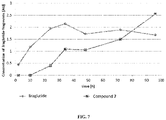
- FIG. 12 contains graphs plotting the amount (nmol/L) of active liraglutide detected in samples collected at the indicated times from rats administered liraglutide (SEQ ID NO:3; Group 1) or compound 7 (Group 2). The half-life for each is provided.
- C n-m alkoxy refers to a group of formula —O-alkyl, wherein the alkyl group has n to m carbons.
- Example alkoxy groups include, but are not limited to, methoxy, ethoxy, propoxy (e.g., n-propoxy and isopropoxy), butoxy (e.g., n-butoxy and tert-butoxy), and the like.
- the alkyl group has 1 to 6, 1 to 4, or 1 to 3 carbon atoms.
- C n-m alkylamino refers to a group of formula —NH(alkyl), wherein the alkyl group has n to m carbon atoms. In some embodiments, the alkyl group has 1 to 6, 1 to 4, or 1 to 3 carbon atoms.
- alkylamino groups include, but are not limited to, N-methylamino, N-ethylamino, N-propylamino (e.g., N-(n-propyl)amino and N-isopropylamino), N-butylamino (e.g., N-(n-butyl)amino and N-(tert-butyl)amino), and the like.
- the cycloalkyl is a C 3-7 monocyclic cycloalkyl.
- cycloalkyl groups include cyclopropyl, cyclobutyl, cyclopentyl, cyclohexyl, cycloheptyl, cyclopentenyl, cyclohexenyl, cyclohexadienyl, cycloheptatrienyl, norbornyl, norpinyl, norcarnyl, cyclooctyl, cyclooctenyl, and the like.
- aromatic refers to a carbocycle or heterocycle having one or more polyunsaturated rings having aromatic character (i.e., having (4n+2) delocalized ⁇ (pi) electrons where n is an integer).
- aryl refers to an aromatic hydrocarbon group, which may be monocyclic or polycyclic (e.g., having 2, 3 or 4 fused rings).
- C n-m aryl refers to an aryl group having from n to m ring carbon atoms.
- Aryl groups include, e.g., phenyl, naphthyl, anthracenyl, phenanthrenyl, indanyl, indenyl and the like. In some embodiments, aryl groups have from 6 to about 20 carbon atoms, from 6 to about 15 carbon atoms, or from 6 to about 10 carbon atoms. In some embodiments, the aryl group is phenyl.
- arylene refers to a divalent aryl linking group.
- self-immolative refers to a moiety or residue that provides stable bond formation between two groups of a compound or conjugate, but which becomes labile upon activation (e.g., nucleophilic attack) leading to rapid cleavage of the moiety or residue and separation of the two groups.
- the chemistry of self-immolative groups is described, for example, in Alouane, A. et al., “Self-immolative spacers: kinetic aspects, structure-property relationships, and applications”, Angew. Chem. Int. Ed., 2015, 54, 7492-7509 and Kolakowski, R. V.
- R P is selected from optionally substituted C 1-6 alkyl, optionally substituted C 1-3 alkyl-O—(CH 2 —CH 2 —O) p —(CH 2 ) m —, and optionally substituted C 3-7 cycloalkyl;
- x denotes a point of attachment to Z 1 and y denotes a point of attachment to Z 3 ;
- E is a cleavable moiety.
- a group comprising the —Z 1 -M A - fragment is a better leaving group than the aliphatic moiety (e.g., a polyethylene glycol), such that under similar conditions as compared to Scheme 2, upon nucleophilic attack on the phosphorus atom by the 2′ hydroxyl group of the ribose unit, the polyethylene glycol fragment remains covalently attached to the phosphorus atom, while the group comprising the —Z L -M A - fragment is selectively cleaved.
- the aliphatic moiety e.g., a polyethylene glycol
- the group HZ 1 -M A -Z 3 D has a lower pKa value than a polyethylene glycol or an alcohol.
- Z 1 is oxygen and M A comprises an aromatic moiety (e.g., M A comprises a phenylene).
- Z 1 is nitrogen and M A comprises an aromatic moiety (e.g., M A comprises a phenylene), and the conjugated base of the compound of formula HZ 1 -M A -Z 3 -D is a better leaving group than any one of the aliphatic moieties described herein due to delocalization of the lone pair of electrons on the nitrogen atom of Z 1 into the aromatic ring of M A .
- the self-immolative group of formula (b) has the formula (b-2):
- the 2-amino alcohol is an 2-amino alcohol which is not serine or a derivative thereof, threonine or a derivative thereof, or cis-amino indanol or a derivative thereof.
- the 2-amino alcohol is not aminoethanol.
- R E is selected from the group consisting of C 1-6 alkyl and benzyl. In some embodiments, R E is C 1-6 alkyl. In some embodiments, R E is benzyl.
- E is a cleavable moiety of any one of formulae (E-1) to (E-12).
- E is not (E-38).
- E is cleavable at acidic pH.
- D comprises a residue of any one of the glucagon-like-peptide 1 (GLP-1) polypeptide or analogs thereof described herein.
- GLP-1 polypeptide or analogs thereof in Formula (I) or Formula (II) may be shown as “D” or “Drug”, which symbols are used herein interchangeably.
- the GLP-1 polypeptide or analogs thereof when Z 3 is absent, prior to being conjugated to form the compound of Formula (I) or Formula (II), the GLP-1 polypeptide or analogs thereof may be described as a compound of formula H 2 N-D.
- the GLP-1 polypeptide or analogs thereof when the GLP-1 polypeptide or analogs thereof has the formula H 2 N-D, the moiety H 2 N— represents a terminal amine group of the GLP-1 polypeptide or analog thereof, and D comprises a residue of the GLP-1 polypeptide or analogs thereof.
- FIG. 8 Illustrations of a selection of GLP-1 analogs are provided in FIG. 8 . See also Dods, R. L. and Donnelly, D. Bioscience Reports 36(1) e2085 (Jan. 15, 2016); and Li, Y et al. Reviews in Neurosciences 27(7): 689-711 (2016).
- any of the above sequences can be present in polypeptides having at least 80% sequence identity to any of the sequences above.
- a compound provided herein can have comprise a polypeptide having at least 80%, at least 85%, at least 88%, at least 90%, at least 95%, at least 96%, at least 97%, at least 98%, at least 99% sequence identity to the recited sequence.
- the poly(ethylene glycol) molecule is a linear polymer.
- Linear PEG can be alkylated (e.g., methylated or ethylated), at one termini, but they can by incorporated to the conjugate of any one of the formulae disclosed herein using the free terminus in the non-derivatized hydroxyl form.
- the molecular weight of the linear chain PEG may be between about 1,000 Da and about 100,000 Da.
- a linear chain PEG used herein can have a molecular weight of about 100,000 Da, 95,000 Da, 90,000 Da, 85,000 Da, 80,000 Da, 75,000 Da, 70,000 Da, 65,000 Da, 60,000 Da, 55,000 Da, 50,000 Da, 45,000 Da, 40,000 Da, 35,000 Da, 30,000 Da, 25,000 Da, 20,000 Da, 15,000 Da, 10,000 Da, 9,000 Da, 8,000 Da, 7,000 Da, 6,000 Da, 5,000 Da, 5,000 Da, 4,000 Da, 3,000 Da, 2,000 Da, and 1,000 Da.
- the molecular weight of the linear chain PEG is between about 1,000 Da and about 50,000 Da.
- the molecular weight of the linear chain PEG is between about 1,000 Da and about 40,000 Da.
- the molecular weight of the linear chain PEG is between about 5,000 Da and about 40,000 Da.
- the molecular weight of the linear chain PEG is between about 5,000 Da and about 20,000 Da.
- the polymer e.g., the polyethylene glycol
- the polymer has the following structural formula:
- Non-limiting examples of the compounds provided herein include:
- liraglutide is the residue of liraglutide; and Ura is uracil.
- the release cascade may occur according to the mechanism shown in Scheme 7:
- an aliphatic moiety e.g., polymer
- a reactive hydroxyl group e.g., polymer
- the reaction is carried out in the presence of an activating reagent (e.g., a reagent that reacts stoichiometrically with phosphate forming a mixed anhydride, which, in turn, is converted to, e.g., a methylimidazolide, that finally reacts with the OH group of the polymer).
- an activating reagent e.g., a reagent that reacts stoichiometrically with phosphate forming a mixed anhydride, which, in turn, is converted to, e.g., a methylimidazolide, that finally reacts with the OH group of the polymer.
- the activating reagent is mesitylene sulfonyl chloride, mesitylene sulfonyl nitro triazole (MSNT) or tosyl chloride.
- the compound of Formula (II-VIa) is prepared by deprotecting the compound of Formula (II-VIb):
- compositions and formulations described herein may conveniently be presented in a unit dosage form, e.g., tablets, sustained release capsules, and in liposomes, and may be prepared by any methods well known in the art of pharmacy. See, for example, Remington: The Science and Practice of Pharmacy, Lippincott Williams & Wilkins, Baltimore, Md. (20th ed. 2000). Such preparative methods include the step of bringing into association with the molecule to be administered ingredients such as the carrier that constitutes one or more accessory ingredients. In general, the compositions are prepared by uniformly and intimately bringing into association the active ingredients with liquid carriers, liposomes or finely divided solid carriers, or both, and then, if necessary, shaping the product.
- carriers that are commonly used include lactose, sucrose, glucose, mannitol, and silicic acid and starches.
- Other acceptable excipients may include: a) fillers or extenders such as starches, lactose, sucrose, glucose, mannitol, and silicic acid, b) binders such as, for example, carboxymethylcellulose, alginates, gelatin, polyvinylpyrrolidinone, sucrose, and acacia, c) humectants such as glycerol, d) disintegrating agents such as agar-agar, calcium carbonate, potato or tapioca starch, alginic acid, certain silicates, and sodium carbonate, e) solution retarding agents such as paraffin, f) absorption accelerators such as quaternary ammonium compounds, g) wetting agents such as, for example, cetyl alcohol and glycerol monostearate, h) absorbents such as ka
- compositions of the present application may be administered by nasal aerosol or inhalation.
- Such compositions are prepared according to techniques well-known in the art of pharmaceutical formulation and may be prepared as solutions in saline, employing benzyl alcohol or other suitable preservatives, absorption promoters to enhance bioavailability, fluorocarbons, and/or other solubilizing or dispersing agents known in the art. See, for example, U.S. Pat. No. 6,803,031. Additional formulations and methods for intranasal administration are found in Ilium, L., J Pharm Pharmacol, 56:3-17, 2004 and Ilium, L., Eur J Pharm Sci 11:1-18, 2000.
- the coatings may optionally be further covered by a suitable topcoat of fluorosilicone, polysaccharides, polyethylene glycol, phospholipids or combinations thereof to impart controlled release characteristics in the composition.
- Coatings for invasive devices are to be included within the definition of pharmaceutically acceptable carrier, adjuvant or vehicle, as those terms are used herein.
- the present application provides an implantable drug release device impregnated with or containing a compound or a composition comprising a compound of the present application, such that said compound is released from said device and is therapeutically active.
- a compound of Formula (I) or Formula (II) disclosed herein is present in an effective amount (e.g., a therapeutically effective amount).
- the crude solid was analyzed by C 18 RP-HPLC to verify presence of the triester product 4.
- the main UV-Vis side product was the mesitylenesulfonylated mPEG which had a shorter R t than the product triester 4.
- the C 18 RP HPCL column available to the organic chemist one can batch wise separate the triester 4 from the side products with following solvent mixtures and gradient:
- TMS-Cl Chlorotrimethylsilane
- benzoyl chloride (2 eq.) was added, and the mixture was stirred for 2 days.
- the reaction mixture was quenched with methanol, and after 15 minutes, it was concentrated on rotavapor and partitioned between saturated aqueous sodium bicarbonate and dichloromethane. After evaporation of the organic phase, the remaining oil was co-evaporated with toluene to remove traces of pyridine.
- FIG. 6 shows the concentration of liraglutide fragments after digestion of compound 7 with DPP-IV
- liraglutide AA9-37 was generated by digestion with DPP-IV. This observation suggests that compound 7 was digested differently than liraglutide.
- the generation of liraglutide AA13-37 and liraglutide AA25-37 was significantly reduced here.
- liraglutide (SEQ ID NO:3) and compound 7 were successfully digested in vitro with pepsin and analyzed by mass spectrometry with MALDI-TOF-MS.
- the spectra for compound 7 digested with pepsin were compared to intact compound 7 and liraglutide (SEQ ID NO:3) digested with pepsin. From these comparisons, the N-terminus of liraglutide was determined to be the site of PEGylation for compound 7. Also, a significantly lower intensity for the N-terminal peptides for compound 7 confirmed that the N-terminus is protected by pegylation.
- drugs e.g., liraglutide
- PEG poly(ethylene glycol)
- the linkers provided herein can allow one to select a desired release time or desired half-life for an adminstered drug.
- LG is a leaving group, with the GLP-1 polypeptide or an analog thereof of formula HZ 3 -D.
Landscapes
- Health & Medical Sciences (AREA)
- Life Sciences & Earth Sciences (AREA)
- Chemical & Material Sciences (AREA)
- Medicinal Chemistry (AREA)
- General Health & Medical Sciences (AREA)
- Veterinary Medicine (AREA)
- Bioinformatics & Cheminformatics (AREA)
- Pharmacology & Pharmacy (AREA)
- Engineering & Computer Science (AREA)
- Animal Behavior & Ethology (AREA)
- Public Health (AREA)
- Diabetes (AREA)
- Epidemiology (AREA)
- Organic Chemistry (AREA)
- Endocrinology (AREA)
- General Chemical & Material Sciences (AREA)
- Nuclear Medicine, Radiotherapy & Molecular Imaging (AREA)
- Chemical Kinetics & Catalysis (AREA)
- Hematology (AREA)
- Gastroenterology & Hepatology (AREA)
- Proteomics, Peptides & Aminoacids (AREA)
- Zoology (AREA)
- Obesity (AREA)
- Molecular Biology (AREA)
- Biochemistry (AREA)
- Immunology (AREA)
- Emergency Medicine (AREA)
- Child & Adolescent Psychology (AREA)
- Biophysics (AREA)
- Neurology (AREA)
- Neurosurgery (AREA)
- Biomedical Technology (AREA)
- Toxicology (AREA)
- Genetics & Genomics (AREA)
- Medicinal Preparation (AREA)
- Medicines That Contain Protein Lipid Enzymes And Other Medicines (AREA)
- Peptides Or Proteins (AREA)
- Pharmaceuticals Containing Other Organic And Inorganic Compounds (AREA)
- Saccharide Compounds (AREA)
Abstract
Description

In this example, cleavage of group E, the trigger moiety, results in a nucleophilic attack of the liberated hydroxyl on the phosphorus atom leading to the formation of a cyclic phosphotriester, quinone methide, carbon dioxide (CO2), and the GLP-1 polypeptide or analog thereof. The cyclic phosphotriester may be further hydrolyzed at physiological pH resulting in the opening of the 5-membered ring and formation of both isomeric phosphodiesters. Quinone methide may also be further hydrolyzed (e.g., reacting with water) at physiological pH to form 4-(hydroxymethyl)phenol.

or a pharmaceutically acceptable salt thereof, wherein:
the aliphatic moiety is selected from a polymer, RP, and a group selected from:
-
- polymer-L-(CH2)m— and polymer-L-(CH2—CH2—O)p—(CH2)m—;
- RP is selected from optionally substituted C1-6 alkyl, optionally substituted C1-3 alkyl-O—(CH2—CH2—O)p—(CH2)m—, and optionally substituted C3-7 cycloalkyl;
- L is a linking group;
- m and p are each independently an integer from 1 to 10;
- D comprises a residue of a GLP-1 polypeptide or an analog thereof;
- Z1 is selected from O, S, and N(RN);
- Z3 is selected from O and N(RN), or Z3 is absent;
- A is O or N, wherein when A is O then R3 is absent;
- RN is selected from H and optionally substituted C1-6 alkyl;
- R3 is selected from H and C1-6 alkyl, or
- R3 and R1, together with A and the carbon atom to which R1 is attached, form an optionally substituted 4 to 7 membered aliphatic heterocyclic ring; or
- R3 and R2, together with A, the carbon atom to which R1 is attached, and the carbon atom to which R2 is attached, form an optionally substituted 4 to 8 membered aliphatic heterocyclic ring;
- MA is a self-immolative group having any one of formulae (a)-(i):

wherein x denotes a point of attachment to Z1 and y denotes a point of attachment to Z3;
- R1 and R2 are independently selected from the group consisting of hydrogen, optionally substituted C1-6 alkyl, optionally substituted C6-10 aryl and optionally substituted 5- to 14-membered heteroaryl;
- or R1 and R2 are joined together with the carbon atoms to which they are attached to form an optionally substituted C3-7 cycloalkyl ring, an optionally substituted 4 to 7 membered aliphatic heterocyclic ring, an optionally substituted C6-10 aryl or an optionally substituted 5- to 14-membered heteroaryl;
- or R1 and R2 are joined together to form a ribose ring system;
- R7 and R8 are independently selected from H and C1-6 alkyl; and
- E is a cleavable moiety.

or a pharmaceutically acceptable salt thereof, wherein:
the aliphatic moiety is selected from a polymer, RP, and a group selected from:
-
- polymer-L-(CH2)m— and polymer-L-(CH2—CH2—O)p—(CH2)m—;
- RP is selected from optionally substituted C1-6 alkyl, optionally substituted C1-3 alkyl-O—(CH2—CH2—O)p—(CH2)m—, and optionally substituted C3-7 cycloalkyl;
- L is a linking group;
- m and p are each independently an integer from 1 to 10;
- D comprises a residue of a biologically active drug;
- Z1 is selected from O, S, and N(RN);
- Z3 is selected from O and N(RN), or Z3 is absent;
- Z4 is selected from O and S;
- A is selected from O and N(RN);
- RN is selected from H and optionally substituted C1-4 alkyl;
- MA is a diradical selected from:
- i. a self-immolative group having any one of formulae (a)-(i):

-
- ii. a stable diradical selected from any one of formulae (j)-(l):

wherein x denotes a point of attachment to Z1 and y denotes a point of attachment to Z3;
- R1 and R2 are independently selected from the group consisting of hydrogen, optionally substituted C1-6 alkyl, optionally substituted C6-10 aryl and optionally substituted 5- to 14-membered heteroaryl;
- or R1 and R2 are joined together with the carbon atoms to which they are attached to form an optionally substituted C3-7 cycloalkyl ring, an optionally substituted 4 to 7 membered aliphatic heterocyclic ring, an optionally substituted C6-10 aryl or an optionally substituted 5- to 14-membered heteroaryl;
- or R1 and R2 are joined together to form a ribose ring system;
- R7 and R8 are independently selected from H, C1-6 alkyl, amino, (C1-6 alkyl)amino, di-(C1-6 alkyl)amino, acylamino, and a protected amino group; and
- E is a cleavable moiety.


In some embodiments, the nucleobase in a ribonucleoside, arabinonucleoside, xylonucleoside or a lyxonucleoside is adenine, cytosine, guanine, thymine or uracil covalently attached to the ribose/lyxose ring at


-
- polymer-L-(CH2)m— and polymer-L-(CH2—CH2—O)p—(CH2)m—;


or a pharmaceutically acceptable salt thereof.

-
- polymer-L-(CH2)m— and polymer-L-(CH2—CH2—O)p—(CH2)m—;
-
- a) a self-immolative group having any one of formulae (a)-(i):

-
- b) a stable diradical selected from any one of formulae (j)-(l):


wherein


wherein

wherein ring C is selected from the group consisting of an optionally substituted C8-16 cycloalkyl and an optionally substituted 8-16-membered heterocycloalkyl, and


wherein p is an integer from 1 to 6. For example, p is 1, 2, 3, 4, 5 or 6. In some embodiments, p is an integer from 1 to 4.


wherein p is an integer from 1 to 6.


wherein x denotes a point of attachment to Z1 and y denotes a point of attachment to Z3.
-
- i) release of the conjugate base of the compound HZ3-D when Z3 is present; or
- ii) release of the conjugate base of the compound HO—(C═O)-D when Z3 is absent.


wherein x denotes a point of attachment to Z1 and y denotes a point of attachment to Z3.

wherein x denotes a point of attachment to Z1 and y denotes a point of attachment to Z3.

wherein x denotes a point of attachment to Z1 and y denotes a point of attachment to Z3.


wherein x denotes a point of attachment to Z1 and y denotes a point of attachment to Z3.

wherein x denotes a point of attachment to Z1 and y denotes a point of attachment to Z3.

wherein x denotes a point of attachment to Z1 and y denotes a point of attachment to Z3.

wherein x denotes a point of attachment to Z1 and y denotes a point of attachment to Z3.

wherein x denotes a point of attachment to Z1 and y denotes a point of attachment to Z3.

wherein x denotes a point of attachment to Z1 and y denotes a point of attachment to Z3.

wherein x denotes a point of attachment to Z1 and y denotes a point of attachment to Z3.

wherein x denotes a point of attachment to Z1 and y denotes a point of attachment to Z3. In some aspects of these embodiments, Z1 and Z3 are independently O or NH (e.g., Z1 is O and Z3 is NH). In some embodiments, when MA is a stable diradical of formula (j), Z1 is O. In some embodiments, when MA is a stable diradical of formula (j), Z1 is NH.

wherein x denotes a point of attachment to Z1 and y denotes a point of attachment to Z3. In some aspects of these embodiments, Z1 and Z3 are independently O or NH (e.g., Z1 is O and Z3 is NH). In some embodiments, when MA is a stable diradical of formula (m), Z1 is O and R7 and R8 are each hydrogen.

wherein x denotes a point of attachment to Z1 and y denotes a point of attachment to Z3.

wherein either a denotes a point of attachment to O and b denotes a point of attachment to A, or a denotes a point of attachment to A and b denotes a point of attachment to O, and wherein W is selected from the group consisting of H, an acyl group and a protecting group (e.g., a protecting group other than acyl). Without being bound by any theory, it is believed that a lyxofuranose-based nucleotide has similar reactivity when compared to the ribofuranose analogues described herein.

wherein either a denotes a point of attachment to O and b denotes a point of attachment to A, or a denotes a point of attachment to A and b denotes a point of attachment to O, and wherein W is selected from the group consisting of H, an acyl group and a protecting group (e.g., a protecting group other than acyl).

wherein either a denotes a point of attachment to O and b denotes a point of attachment to A, or a denotes a point of attachment to A and b denotes a point of attachment to O, and wherein W is selected from the group consisting of H, an acyl group and a protecting group (e.g., a protecting group other than acyl).

wherein either a denotes a point of attachment to O and b denotes a point of attachment to A, or a denotes a point of attachment to A and b denotes a point of attachment to O, and wherein W is selected from the group consisting of H, an acyl group and a protecting group (e.g., a protecting group other than acyl). In some aspects of the above embodiments, the aliphatic moiety is RP. For example, RP is C1-6 alkyl (e.g., ethyl or isopropyl). In another example, RP is cyanoethyl. In other aspects of the above embodiments, the aliphatic moiety is a polymer (e.g., polyethylene glycol). In other aspects of the above embodiments, the aliphatic moiety is a group of formula: polymer-L-(CH2)m—.


is an 2-amino alcohol which is not serine or a derivative thereof, threonine or a derivative thereof, or cis-amino indanol or a derivative thereof. In some embodiments, the 2-amino alcohol is not aminoethanol.

or a pharmaceutically acceptable salt thereof.

or a pharmaceutically acceptable salt thereof.

or a pharmaceutically acceptable salt thereof.

or a pharmaceutically acceptable salt thereof.

or a pharmaceutically acceptable salt thereof.

or a pharmaceutically acceptable salt thereof.

or a pharmaceutically acceptable salt thereof.

or a pharmaceutically acceptable salt thereof.

or a pharmaceutically acceptable salt thereof.

wherein for (II-7), A is O,

or a pharmaceutically acceptable salt thereof.

or a pharmaceutically acceptable salt thereof.

or a pharmaceutically acceptable salt thereof.

or a pharmaceutically acceptable salt thereof.

or a pharmaceutically acceptable salt thereof.

or a pharmaceutically acceptable salt thereof.

or a pharmaceutically acceptable salt thereof.

or a pharmaceutically acceptable salt thereof.

or a pharmaceutically acceptable salt thereof.

or a pharmaceutically acceptable salt thereof.

or a pharmaceutically acceptable salt thereof.

or a pharmaceutically acceptable salt thereof. In some aspects of these embodiments, RP is an optionally substituted C1-6 alkyl (e.g., isopropyl or cyanoethyl).

or a pharmaceutically acceptable salt thereof.

or a pharmaceutically acceptable salt thereof.

or a pharmaceutically acceptable salt thereof.

or a pharmaceutically acceptable salt thereof, wherein U is uracil.

-
- a) For example, moiety E may be a fluorenylmethyl carbamide-type trigger having the following formula:

wherein R is selected from H, C1-10 alkyl, OH, NO2, CN, halogen and acetyl. Introduction of electron-withdrawing substituents R can increase the rate of β-elimination and liberation of free AH. In another example, the following moiety E possesses the electron withdrawing —SO2— group:

-
- b) Substituted β-phenylsulfonyl ethyl carbamates and carbonates:

wherein R is selected from H, C1-10 alkyl, OH, NO2, CN, halogen and acetyl. These functional groups cleave via a β-elimination mechanism at about pH 7.4 and the rate of this process can be controlled by the substituent R on the phenyl ring.

wherein RE is selected from the group consisting of C1-6 alkyl and benzyl. In some embodiments, RE is C1-6 alkyl. In some embodiments, RE is benzyl.


wherein R is selected from H, C1-10 alkyl, OH, NO2, CN, halogen and acetyl. In another example of moieties cleavable at physiological pH, E is an acyl group (e.g., any one of acyl groups described herein, such as pivaloyl or benzoyl).

wherein:


wherein any one of the phenyl rings in the formulae (E-1) to (E-12), (E-37) and (E-39) to (E-41) is optionally substituted with 1, 2, 3, 4, or 5 substituents selected from C1-10 alkyl, C1-10 haloalkyl, C1-10 alkoxy, OH, NO2, CN, halogen and acyl. In some aspects of these embodiments, E is a cleavable moiety of any one of formulae (E-1) to (E-12). In some embodiments, the substituents on the phenyl rings of the formulae (E-1) to (E-12), (E-37), and (E-39) to (E-41) modify stability and lability for the cleavable groups. In one example, cleavable moiety E may be a fluorenylmethyl carbamide-type having the following formula:


wherein the substituent X is selected from the group consisting of H, C1-10 alkyl, C1-10 haloalkyl, C1-10 alkoxy, OH, NO2, CN, halogen and acyl. In some embodiments, X is selected from H, Cl and methoxy.


wherein R is as described herein.

wherein a denotes a point of attachment to A, and b denotes a point of attachment to E. In some aspects of these embodiments, A is O. In other aspects of these embodiments, upon cleavage of the moiety E, the group of formula LE undergoes decomposition reaction to yield CO2 and a compound of formula:

thus liberating a free A− group, which may then undergo a nucleophilic attack on the poshorus atom in the compound of Formula (I) or Formula (II). The A− group may also be protonated to yield the group AH prior to the nucleophilic attack.


in the self-immolative group MA of any one of the formulae (a)-(g) represents the part of the drug, after the drug is being conjugated to form the compound of Formula (I) or Formula (II). In this moiety, x represents a point of attachment to MA′ (as described herein) of the self-immolative group, or to the H— of the drug H2N-D prior to conjugation, and y represents a point of attachment to D.
| GLP-1 (1-37): | |
| (SEQ ID NO: 1) | |
| HDEFERHAEGTFTSDV SSYLEGQAAK EFIAWLVKGR G | |
| GLP-1 (7-37): | |
| (SEQ ID NO: 2) | |
| HAEGTFTSDV SSYLEGQAAK EFIAWLVKGR G |
wherein this sequence corresponds to amino acids 7-37 of the GLP-1 (1-37) polypeptide sequence.
Liraglutide (VICTOZA®; K26 liraglutide) is a GLP-1 polypeptide analog with a C16 fatty (palmitic) acid chain via a glutamyl spacer off of the lysine residue and is represented as:
| (SEQ ID NO: 3) |
| HAEGTFTSDV SSYLEGQAAK(γ-Glu-palmitoyl) EFIAWLVRGR G |
wherein this sequence is an analog of amino acids 7-37 of the GLP-1 (1-37) polypeptide sequence.
| Liraglutide fragment 1: | |
| (SEQ ID NO: 4) | |
| HAEGTFTSDV SSYLEGQAAK EFIAWLVRGR G | |
| Liraglutide fragment 2: | |
| (SEQ ID NO: 5) | |
| EGTFTSDV SSYLEGQAAK EFIAWLVRGR G | |
| Liraglutide fragment 3: | |
| (SEQ ID NO: 6) | |
| TSDV SSYLEGQAAK EFIAWLVRGR G | |
| Liraglutide fragment 4: | |
| (SEQ ID NO: 7) | |
| AK EFIAWLVRGR G |
Dulaglutide (LY2189265, TRULICITY®), which is a molecule consisting of two identical, disulfide-linked chains, each containing a human GLP-1 analog sequence covalently linked to a modified human immunoglobulin G4 (IgG4) heavy chain fragment (Fc) by a small peptide linker.
The GLP-1 analog sequence is represented as:
| (SEQ ID NO: 8) | |
| HGEGTFTSDV SSYLEEQAAK EFIAWLVKGG G |
The immunoglobulin sequence is represented as:
| (SEQ ID NO: 9) |
| ESK YGPPCPPCPA PEAAGGPSVF LFPPKPKDTL MISRTPEVTC |
| VVVDVSQEDP EVQFNWYVDG VEVHNAKTKP REEQFNSTYR |
| VVSVLTVLHQ DWLNGKEYKC KVSNKGLPSS IEKTISKAKG |
| QPREPQVYTL PPSQEEMTKN QVSLTCLVKG FYPSDIAVEW |
| ESNGQPENNY KTTPPVLDSD GSFFLYSRLT VDKSRWQEGN |
| VFSCSVMHEA LHNHYTQKSL SLSLG |
The small peptide linker is represented as:
| (SEQ ID NO: 10) | |
| GGGGSGGGG SGGGGSA |
The full sequence for one monomer of Dulaglutide (LY2189265, TRULICITY®) is represented as:
| (SEQ ID NO: 11) | |
| HGEGTFTSDV SSYLEEQAAK EFIAWLVKGG GGGGGSGGGG | |
| SGGGGSAESK YGPPCPPCPA PEAAGGPSVF LFPPKPKDTL | |
| MISRTPEVTC VVVDVSQEDP EVQFNWYVDG VEVHNAKTKP | |
| REEQFNSTYR VVSVLTVLHQ DWLNGKEYKC KVSNKGLPSS | |
| IEKTISKAKG QPREPQVYTL PPSQEEMTKN QVSLTCLVKG | |
| FYPSDIAVEW ESNGQPENNY KTTPPVLDSD GSFFLYSRLT | |
| VDKSRWQEGN VFSCSVMHEA LHNHYTQKSL SLSLG* |
*Disulfide bridges locations:
55-55′ 58-58′ 90-150 90′-150′ 196-254 196′-254′
Exenatide (BYETTA®, BYDUREON, Exendin-4) and Exenatide LAR (GLP-1 portion is same):
| (SEQ ID NO: 12) | |
| HGEGTFTSDL SKQMEEEAVR LFIEWLKNGG PSSGAPPPS |
Taspoglutide:
| (SEQ ID NO: 13) | |
| HXEGTFTSDV SSYLEGQAAK EFIAWLVKXR |
wherein X is 2-methyl alanine
Lixisenatide (LYXUMIA®):
| (SEQ ID NO: 14) |
| HGEGTFTSDL SKQMEEEAVR LFIEWLKNGG PSSGAPPSKK KKKK |
wherein T is threonine and I is isoleucine
Albiglutide (TANZEUM®) is a polypeptide consisting of 645 proteinogenic amino acids with 17 disulfide bridges. Amino acids 1-30 and 31-60 constitute two copies of modified human GLP-1.
The GLP1 fragment is represented by:
| (SEQ ID NO: 15) | |
| HGEGTFTSDV SSYLEGQAAK EFIAWLVKGR |
The full sequence of albiglutide is represented as:
| (SEQ ID NO: 16) | |
| HGEGTFTSDV SSYLEGQAAK EFIAWLVKGR HGEGTFTSDV | |
| SSYLEGQAAK EFIAWLVKGR DAHKSEVAHR FKDLGEENFK | |
| ALVLIAFAQY LQQCPFEDHV KLVNEVTEFA KTCVADESAE | |
| NCDKSLHTLF GDKLCTVATL RETYGEMADC CAKQEPERNE | |
| CFLQHKDDNP NLPRLVRPEV DVMCTAFHDN EETFLKKYLY | |
| EIARRHPYFY APELLFFAKR YKAAFTECCQ AADKAACLLP | |
| KLDELRDEGK ASSAKQRLKC ASLQKFGERA FKAWAVARLS | |
| QRFPKAEFAE VSKLVTDLTK VHTECCHGDL LECADDRADL | |
| AKYICENQDS ISSKLKECCE KPLLEKSHCI AEVENDEMPA | |
| DLPSLAADFV ESKDVCKNYA EAKDVFLGMF LYEYARRHPD | |
| YSVVLLLRLA KTYETTLEKC CAAADPHECY AKVFDEFKPL | |
| VEEPQNLIKQ NCELFEQLGE YKFQNALLVR YTKKVPQVST | |
| PTLVEVSRNL GKVGSKCCKH PEAKRMPCAE DYLSVVLNQL | |
| CVLHEKTPVS DRVTKCCTES LVNRRPCFSA LEVDETYVPK | |
| EFNAETFTFH ADICTLSEKE RQIKKQTALV ELVKHKPKAT | |
| KEQLKAVMDD FAAFVEKCCK ADDKETCFAE EGKKLVAASQ | |
| AALGL |
| (SEQ ID NO: 17) |
| H-Aib-EGTFTSDV SSYLEGQAAK(AEEAc-AEEAc-γ-Glu-17- |
| carboxyheptadecanoyl) EFIAWLVRGR G |
wherein Aib is α-aminoisobutyric acid.
| GLP-2: | |
| (SEQ ID NO: 18) | |
| HADGSFSDEM NTILDNLAAR DFINWLIQTK ITD | |
| Teduglutide (GATTEX ®): | |
| (SEQ ID NO: 19) | |
| HGDGSFSDEM NTILDNLAAR DFINWLIQTK ITD | |
| FE203799: | |
| (SEQ ID NO: 20) | |
| HGDGSFSDENle[d-Phe]TILDLLAARDFINWLIQTKITD | |
| Glepaglutide (ZP1848): | |
| (SEQ ID NO: 21) | |
| HGEGTFSSEL ATILDALAAR DFIAWLIATK ITD-KKKKKK | |
| Elsiglutide (ZP1846): | |
| (SEQ ID NO: 22) | |
| HGEGSFSSELSTILDALAARDFIAWLIATKITDKKKKKK |


or a pharmaceutically acceptable salt thereof, wherein liraglutide is the residue of liraglutide; and Ura is uracil.


Exemplary Methods for Studies of Cleavage Reaction Ratios


-
- i) deprotecting a compound of Formula (II-Va):


-
- ii) reacting the compound of Formula (II-Vb) with a compound comprising a leaving group to prepare a compound of Formula (II-IV).


with an aliphatic moiety (e.g., polymer) comprising a reactive hydroxyl group.


with a compound of Formula (II-VIIb):
HZ1—MA′—O—PG1 (VIIb),
wherein each R is independently a C1-C6-alkyl, or the two R-groups jointly form a 5- or 6-membered ring with the N to which they are bonded. In some embodiments, each R is isopropyl. In some embodiments, the two R-groups together form a morpholine ring.

with a compound of Formula (VIIIb):

wherein Hal is a halogen atom (e.g., Cl, Br or I) and R is as described herein. In some embodiments, Hal is Cl.


and


and


In Tris buffer at pH 8, 37° C., compound 8 has a pH triggered T1/2 of ˜2.5 h (measured as in the method described in Example 1).


Hydrolysis of


-
- Liraglutide showed a half-life of approximately 25-35 hours.
-
Compound 7 showed an increase of non-PEGylated liraglutide in the first 34 hours which is generated by release of PEGylation due to the slightly alkaline pH. - After 34 hours, the released liraglutide in the sample of
compound 7 showed a slower decline in concentration compared to liraglutide in the first 34 hours. This might be partly explained by a decline of enzyme activity after incubation at 37° C., however the unmodified liraglutide control study indicates that significant enzyme activity should still have been present. Therefore, the results appear to indicate proteolytic cleavage of the PEG-liraglutide was reduced. - The results indicate a much higher proteolytic stability of
compound 7 compared to liraglutide.
| TABLE 1 |
| Concentration of liraglutide and sum of all observed liraglutide fragments in |
| arbitrary units for liraglutide (SEQ ID NO: 3; PQ001-2018-001) and Compound 7 (PEG- |
| liraglutide; PQ001-2018-003) after digestion with 50 mU/mL DPP-IV in 10 mM |
| Na2HPO4 pH 7.4 at 37° C. |
| Concentration of all | ||||
| Concentration of | Concentration of | Concentration of all | liraglutide | |
| full size liraglutide | full size liraglutide | liraglutide | fragments for PEG- | |
| for liraglutide | for PEG-liraglutide | fragments for | liraglutide | |
| Time | (PQ001-2018-001) | (PQ001-2018-0030 | liraglutide (PQ001- | (PQ001-2018-003) |
| [h] | [AU] | [AU] | 2018-001) [AU] | [AU] |
| 2 | 13.40 | 0.34 | 0.44 | 0.00 |
| 10 | 10.70 | 2.51 | 1.17 | 0.00 |
| 24 | 7.64 | 7.56 | 1.95 | 0.40 |
| 34 | 5.58 | 14.52 | 2.14 | 1.09 |
| 48 | 3.96 | 12.28 | 1.72 | 1.05 |
| 72 | 2.56 | 11.06 | 1.90 | 1.50 |
| 96 | 1.41 | 10.79 | 1.67 | 2.55 |
| TABLE 2 |
| Concentration of liraglutide fragments in arbitrary units for liraglutide (SEQ |
| ID NO: 3; PQ001-2018-001) and Compound 7 (PEG-liraglutide; PQ001-2018-003) after digestion |
| with 50 mU/mL DPP-IV in 10 mM Na2HPO4 pH 7.4 at 37° C. |
| Concentration | Concentration | |||||
| Concentration | Concentration | Concentration | of liraglutide | Concentration | of liraglutide | |
| of liraglutide | of liraglutide | of liraglutide | AA13-37 for | of liraglutide | AA25-37 for | |
| AA9-37 for | AA9-37 for | AA13-37 for | PEG- | AA25-37 for | PEG- | |
| liraglutide | liraglutide | liraglutide | liraglutide | liraglutide | liraglutide | |
| (PQ001- | (PQ001- | (PQ001- | (PQ001- | (PQ001- | (PQ001- | |
| Time | 2018-001) | 2018-003) | 2018-001) | 2018-003) | 2018-001) | 2018-003 |
| [h] | [AU] | [AU] | [AU] | [AU] | [AU] | [AU] |
| 2 | 0.21 | 0.00 | 0.23 | 0.00 | 0.00 | 0.00 |
| 10 | 0.65 | 0.00 | 0.52 | 0.00 | 0.00 | 0.00 |
| 24 | 0.88 | 0.40 | 0.85 | 0.00 | 0.21 | 0.00 |
| 34 | 0.85 | 0.69 | 1.09 | 0.39 | 0.20 | 0.00 |
| 48 | 0.85 | 1.05 | 0.67 | 0.00 | 0.20 | 0.00 |
| 72 | 0.79 | 1.50 | 0.69 | 0.00 | 0.42 | 0.00 |
| 96 | 0.68 | 2.55 | 0.50 | 0.00 | 0.49 | 0.00 |
| T1/2 at ph 8.0 | T1/2 at pH 7.4 | |
 |
1.6 h | 6.4 h (calculated) |
 |
2.4 h | 9.6 h (calculated) |
 |
3.2 h | 12.8 h (calculated) |
 |
3.3 h | 13 h (calculated) |
 |
8.0 h | 32 h (calculated) |
 |
12.5 h | 48 h (actual) |
 |
— | 50 h (actual) |
 |
— | 56 h (actual) |
 |
19 h | 77 h (actual) |
 |
7.3 day | 29 day (calculated) |
 |
Stable | Stable |

or a pharmaceutically acceptable salt thereof, wherein:
the aliphatic moiety is selected from a polymer, RP, and a group selected from:
-
- polymer-L-(CH2)m— and polymer-L-(CH2—CH2—O)p—(CH2)m—;
- RP is selected from optionally substituted C1-6 alkyl, optionally substituted C1-3 alkyl-O—(CH2—CH2—O)p—(CH2)m—, and optionally substituted C3-7 cycloalkyl;
- L is a linking group;
- m and p are each independently an integer from 1 to 10;
- D is a residue of a GLP-1 polypeptide or an analog thereof;
- Z1 is selected from O, S, and N(RN);
- Z3 is selected from O and N(RN), or Z3 is absent;
- A is O or N, wherein when A is O then R3 is absent;
- RN is selected from H and optionally substituted C1-6 alkyl;
- R3 is selected from H and C1-6 alkyl, or
- R3 and R1, together with A and the carbon atom to which R1 is attached, form an optionally substituted 4 to 7 membered aliphatic heterocyclic ring; or
- R3 and R2, together with A, the carbon atom to which R1 is attached, and the carbon atom to which R2 is attached, form an optionally substituted 4 to 8 membered aliphatic heterocyclic ring;
- MA is a self-immolative group having any one of formulae (a)-(i):

wherein x denotes a point of attachment to Z1 and y denotes a point of attachment to Z3;
- R1 and R2 are independently selected from the group consisting of hydrogen, optionally substituted C1-6 alkyl, optionally substituted C6-10 aryl and optionally substituted 5- to 14-membered heteroaryl;
- or R1 and R2 are joined together with the carbon atoms to which they are attached to form an optionally substituted C3-7 cycloalkyl ring, an optionally substituted 4 to 7 membered aliphatic heterocyclic ring, an optionally substituted C6-10 aryl or an optionally substituted 5- to 14-membered heteroaryl;
- or R1 and R2 are joined together to form a ribose ring system;
- R7 and R8 are independently selected from H and C1-6 alkyl; and
- E is a cleavable moiety.
Paragraph 2. A compound of Formula (II):

or a pharmaceutically acceptable salt thereof, wherein:
the aliphatic moiety is selected from a polymer, RP, and a group selected from:
-
- polymer-L-(CH2)m— and polymer-L-(CH2—CH2—O)p—(CH2)m—;
- RP is selected from optionally substituted C1-6 alkyl, optionally substituted C1-3 alkyl-O—(CH2—CH2—O)p—(CH2)m—, and optionally substituted C3-7 cycloalkyl;
- L is a linking group;
- m and p are each independently an integer from 1 to 10;
- D is a residue of a biologically active drug;
- Z1 is selected from O, S, and N(RN);
- Z3 is selected from O and N(RN), or Z3 is absent;
- Z4 is selected from O and S;
- A is selected from O and N(RN);
- RN is selected from H and optionally substituted C1-4 alkyl;
- MA is a diradical selected from:

and

wherein x denotes a point of attachment to Z1 and y denotes a point of attachment to Z3;
- R1 and R2 are independently selected from the group consisting of hydrogen, optionally substituted C1-6 alkyl, optionally substituted C6-10 aryl and optionally substituted 5- to 14-membered heteroaryl;
- or R1 and R2 are joined together with the carbon atoms to which they are attached to form an optionally substituted C3-7 cycloalkyl ring, an optionally substituted 4 to 7 membered aliphatic heterocyclic ring, an optionally substituted C6-10 aryl or an optionally substituted 5- to 14-membered heteroaryl;
- or R1 and R2 are joined together to form a ribose ring system;
- R7 and R8 are independently selected from H, C1-6 alkyl, amino, (C1-6 alkyl)amino, di-(C1-6 alkyl)amino, acylamino, and a protected amino group; and
- E is a cleavable moiety.
Paragraph 3. The compound of any one of the above paragraphs, wherein the aliphatic moiety is selected from a polymer, RP, and a group of formula:
polymer-L-(CH2)m—;
RP is selected from optionally substituted C1-6 alkyl and optionally substituted C3-7 cycloalkyl; and m is an integer from 1 to 10.
Paragraph 4. The compound of any one of the above paragraphs, wherein the aliphatic moiety is a group of formula: polymer-L-(CH2)m—.
Paragraph 5. The compound of any one of the above paragraphs, wherein L is a linking group comprising a heterocycloakylene or a heteroarylene.
Paragraph 6. The compound of any one of the above paragraphs, wherein L is a linking group comprising a succinimide or a triazole.
Paragraph 7. The compound of any one of the above paragraphs, wherein L is a linking group of any one of the following formulae:

wherein
Paragraph 8. The compound of any one of the above paragraphs, wherein the linking group L is a linking group of formulae:

wherein
Paragraph 9. The compound of any one of the above paragraphs, wherein the linking group L comprises a group of formula (L1):

wherein ring C is selected from the group consisting of an optionally substituted C8-16 cycloalkyl and an optionally substituted 8-16-membered heterocycloalkyl, and
Paragraph 10. The compound any one of the above paragraphs, wherein the group of formula (L) is selected from any one of the following formulae:

Paragraph 11. The compound of any one of the above paragraphs, wherein m is an integer from 1 to 6.
Paragraph 12. The compound of any one of the above paragraphs, wherein m is an integer from 1 to 4.
Paragraph 13. The compound of any one of the above paragraphs, wherein the aliphatic moiety is a polymer.
Paragraph 14. The compound of any one of the above paragraphs, wherein the polymer is selected from the group consisting of poly(alkylene glycol), poly(oxyethylated polyol), poly(olefinic alcohol), poly(α-hydroxy acid), poly(vinyl alcohol), polyoxazoline, and copolymers thereof.
Paragraph 15. The compound of any one of the above paragraphs, wherein the polymer is a polyethylene glycol.
Paragraph 16. The compound of any one of the above paragraphs, wherein the polyethylene glycol is linear.
Paragraph 17. The compound of any one of the above paragraphs, wherein the polyethylene glycol is branched.
Paragraph 18. The compound of any one of the above paragraphs, wherein the polyethylene glycol has an average molecular weight from about 500 Da to about 40,000 Da.
Paragraph 19. The compound of any one of the above paragraphs, wherein the polyethylene glycol has an average molecular weight from about 1,000 Da to about 30,000 Da.
Paragraph 21. The compound of any one of the above paragraphs, wherein the polyethylene glycol has an average molecular weight from about 5,000 Da to about 20,000 Da.
Paragraph 22. The compound of any one of the above paragraphs, wherein the polyethylene glycol has the following structural formula:

Paragraph 23. The compound of any one of the above paragraphs, wherein n is an integer from 1 to 1,000.
Paragraph 24. The compound of any one of the above paragraphs, wherein n is an integer from 1 to 800.
Paragraph 25. The compound of any one of the above paragraphs, wherein n is an integer from 1 to 300.
Paragraph 26. The compound of any one of the above paragraphs, wherein n is an integer from 1 to 100.
Paragraph 27. The compound of any one of the above paragraphs, wherein n is selected from 10, 20, 50, 100, 200, 250, 300, 500, 600, and 1000.
Paragraph 28. The compound of any one of the above paragraphs, wherein the aliphatic moiety is RP.
Paragraph 29. The compound of any one of the above paragraphs, wherein RP is an optionally substituted C1-6 alkyl.
Paragraph 31. The compound of any one of the above paragraphs, wherein RP is cyanoethyl.
Paragraph 32. The compound of any one of the above paragraphs, wherein RP is selected from the group of any one of the following formulae:

Paragraph 33. The compound of any one of the above paragraphs, wherein RP is selected from the group of any one of the following formulae: Paragraph 34.

Paragraph 35. The compound of any one of the above paragraphs, wherein RP is selected from any one of the following formulae:

Paragraph 36. The compound of any one of the above paragraphs, wherein Z1 is S and MA is a self-immolative group of formula (a):

wherein x denotes a point of attachment to Z1 and y denotes a point of attachment to Z3.
Paragraph 37. The compound of any one of the above paragraphs, wherein R7 and R8 are independently selected from H and methyl.
Paragraph 38. The compound of any one of the above paragraphs, wherein R1 and R2 are each hydrogen.
Paragraph 39. The compound of any one of the above paragraphs, wherein R1 and R2 together form C3-7 cycloalkyl ring.
Paragraph 41. The compound of any one of the above paragraphs, wherein R1 and R2 together form a 4 to 7 membered aliphatic heterocyclic ring.
Paragraph 42. The compound of any one of the above paragraphs, wherein the 4 to 7 membered aliphatic heterocyclic ring is selected from the group consisting of pyrrolidine, piperidine, tetrahydrofuran and tetrahydropyran.
Paragraph 43. The compound of any one of the above paragraphs, wherein R1 and R2 together form a ribose ring system of a ribonucleoside.
Paragraph 44. The compound of any one of the above paragraphs, wherein R1 and R2 together form a ribose ring system of formula:

wherein either a denotes a point of attachment to O and b denotes a point of attachment to A, a denotes a point of attachment to A and b denotes a point of attachment to O, and wherein W is selected from the group consisting of H, an acyl group and a protecting group.
Paragraph 45. The compound of any one of the above paragraphs, wherein the nucleobase is selected from the group consisting of adenine, cytosine, guanine, thymine, uracil, and other natural and non-natural nucleobases.
Paragraph 46. The compound of any one of the above paragraphs, wherein the nucleobase is selected from the group consisting of adenine, cytosine, guanine, thymine and uracil.
Paragraph 47. The compound of any one of the above paragraphs, wherein the nucleobase is selected from the group consisting of 5-methylcytosine, pseudouridine, dihydrouridine, inosine, 7-methylguanosine, hypoxanthine and xanthine.
Paragraph 48. The compound of any one of the above paragraphs, wherein the nucleobase comprises a fluorescent group.
Paragraph 49. The compound of any one of the above paragraphs, wherein the nucleobase comprises a polymer.
Paragraph 50. The compound of any one of the above paragraphs, wherein R1 and R2 together form a ribose ring system of formula:

Paragraph 51. The compound of any one of the above paragraphs, wherein R1 and R2 together form a ribose ring system of formula:

Paragraph 52. The compound of any one of the above paragraphs, wherein A is O.
Paragraph 53. The compound of any one of the above paragraphs, wherein A is NR3.
Paragraph 54. The compound of any one of the above paragraphs, wherein R3 and R1, together with A and the carbon atom to which R1 is attached, form an optionally substituted 4 to 7 membered aliphatic heterocyclic ring.
Paragraph 55. The compound of any one of the above paragraphs, wherein the 4 to 7 membered aliphatic heterocyclic ring is selected from the group consisting of:

wherein x denotes a point of attachment to E, and y denotes a point of attachment to the carbon atom to which R1 is attached.
Paragraph 56. The compound of any one of the above paragraphs, wherein R3 and R2, together with A, the carbon atom to which R1 is attached, and the carbon atom to which R2 is attached, form an optionally substituted 4 to 8 membered aliphatic heterocyclic ring.
Paragraph 57. The compound of any one of the above paragraphs, wherein A is NH.
Paragraph 58. The compound of any one of the above paragraphs, wherein A is N(C1-6 alkyl).
Paragraph 59. The compound of any one of the above paragraphs, wherein E is cleavable by an enzyme selected from the group consisting of an esterase, a specific or an unspecific peptidase, a reductase, an oxidase, a glycosidase, a hydrolase, a glycosyl transferase, and a transaminase.
Paragraph 61. The compound of any one of the above paragraphs, wherein E is non-enzymatically cleavable at acidic or physiological pH.
Paragraph 62. The compound of any one of the above paragraphs, wherein E is an acyl group, a O-methyl-acyl group, a methyl azido group, a sugar residue, a protected acetal, or a carbonate ester.
Paragraph 63. The compound of any one of the above paragraphs, wherein E is cleavable by a reductase enzyme.
Paragraph 64. The compound of any one of the above paragraphs, wherein A is O and E is a group of formula:

Paragraph 65. The compound of any one of the above paragraphs, wherein E contains a dithio group which is cleavable by a biogenic thiol.
Paragraph 66. The compound of any one of the above paragraphs, wherein E is cleavable by a glutathione.
Paragraph 67. The compound of any one of the above paragraphs, wherein E is a group of any one of the following formulae:

wherein RE is selected from the group consisting of C1-6 alkyl and benzyl.
Paragraph 68. The compound of any one of the above paragraphs, wherein A is O, and E is a group of formula:

Paragraph 69. The compound of any one of the above paragraphs, wherein E is cleavable by glycoside hydrolase enzyme.
Paragraph 71. The compound of any one of the above paragraphs, wherein E is cleavable by an esterase enzyme.
Paragraph 72. The compound of any one of the above paragraphs, wherein E is selected from an acyl group, a carbonate ester and a O-methyl-acyl ester.
Paragraph 73. The compound of any one of the above paragraphs, wherein E is cleavable by hydrolysis at physiological pH.
Paragraph 74. The compound of any one of the above paragraphs, wherein E is an acyl group.
Paragraph 75. The compound of any one of the above paragraphs, wherein A is NRN or NR3, and E is a cleavable moiety of formula:

wherein:
- R9 is selected from H, an optionally substituted C6-10 aryl, and an optionally substituted C1-6 alkyl;
- R10 and R11 are each independently selected from H, CN, NO2, COR12, SOR12 or SO2R12, an optionally substituted C1-6 alkyl, an optionally substituted C6-10 aryl, and an optionally substituted 5- to 14-membered heteroaryl; or
- R10 and R11 together with the carbon atom to which they are attached form an optionally substituted C3-7 cycloalkyl ring which is fused with one or more optionally substituted C6-10 aryl rings;
- R12 is selected from an optionally substituted C1-6 alkyl and an optionally substituted C6-10 aryl.
Paragraph 76. The compound of any one of the above paragraphs, wherein A is NH, and R9 is selected from H and an optionally substituted C6-10 aryl.
Paragraph 77. The compound of any one of the above paragraphs, wherein E is a cleavable moiety of any one of the following formulae (E-1) to (E-12) and (E-37) to (E-42):


wherein any one of the phenyl rings in the formulae (E-1) to (E-12), (E-37) or (E-39) to (E-41) is optionally substituted with 1, 2, 3, 4, or 5 substituents selected from C1-10 alkyl, C1-10 haloalkyl, C1-10 alkoxy, OH, NO2, CN, halogen and acyl.
Paragraph 78. The compound of any one of the above paragraphs, wherein E is a cleavable moiety of any one of the following formulae (E-1) to (E-12), (E-37), or (E-39) to (E-41).
Paragraph 79. The compound of any one of the above paragraphs, wherein any one of the phenyl rings in the formulae (E-1) to (E-12), (E-37), or (E-39) to (E-41) is optionally substituted with 1, 2, 3, or 4 substituents selected from F, Cl, CN, acetyl, NO2 and CF3.
Paragraph 80. The compound of any one of the above paragraphs, wherein E is a group of any one of the following formulae (E-13) to (E-36):


wherein R is C1-6 alkyl.
Paragraph 81. The compound of any one of the above paragraphs wherein E is cleavable at acidic pH.
Paragraph 82. The compound of any one of the above paragraphs, wherein E is a group selected from an acetal, an ortho-ester, and substituted triphenyl methylethers.
Paragraph 83. The compound of any one of the above paragraphs, wherein E is selected from tetrahydrofuranyl, 4-methoxytetrahydropyran-4-yl, 1,5-dicarbo-methoxypentanyl, methoxy isopropyl acetal, methoxy cyclohexenyl acetal, dimethoxytrityl, trimethoxytrityl and pixyl.
Paragraph 84. The compound of any one of the above paragraphs, wherein a cleavable moiety E is attached to A using a group of formula (LE):

wherein a denotes a point of attachment to A, and b denotes a point of attachment to E.
Paragraph 85. The compound of any one of the above paragraphs, wherein D is a residue of a GLP-1 polypeptide.
Paragraph 86. The compound of any one of the above paragraphs, wherein D is a residue of a GLP-1 polypeptide analog.
Paragraph 87. The compound of any one of the above paragraphs, wherein the GLP-1 polypeptide analog is liraglutide.
Paragraph 88. The compound of any one of the above paragraphs, wherein the compound of Formula (I) has any one of the following formulae:


or a pharmaceutically acceptable salt thereof.
Paragraph 89. The compound of any one of claims 2-87, wherein the compound of Formula (II) has Formula (II-1):

or a pharmaceutically acceptable salt thereof.
Paragraph 90. The compound of any one of the above paragraphs, wherein the compound of Formula (II) has Formula (II-2):

or a pharmaceutically acceptable salt thereof.
Paragraph 91. The compound of any one of the above paragraphs, wherein the compound of Formula (II) has Formula (II-3):

or a pharmaceutically acceptable salt thereof.
Paragraph 92. The compound of any one of the above paragraphs, wherein the compound of Formula (II) has Formula (II-4):

or a pharmaceutically acceptable salt thereof.
Paragraph 93. The compound of any one of the above paragraphs, wherein the compound of Formula (II) has any one of the following Formulae (II-5) to (II-7):

or a pharmaceutically acceptable salt thereof,
wherein when the compound has Formula II-7, A is O.
Paragraph 94. The compound of any one of the above paragraphs, wherein the compound of Formula (II) has Formula (II-8):

or a pharmaceutically acceptable salt thereof.
Paragraph 95. The compound of any one of the above paragraphs, wherein the compound of Formula (II) has any one of the following Formulae:

or a pharmaceutically acceptable salt thereof.
Paragraph 96. The compound of any one of the above paragraphs, wherein the compound of Formula (II) has Formula (II-10a):

or a pharmaceutically acceptable salt thereof.
Paragraph 97. The compound of any one of the above paragraphs, wherein the compound of Formula (II) has Formula (II-10):

or a pharmaceutically acceptable salt thereof.
Paragraph 98. The compound of any one of the above paragraphs, wherein the compound of Formula (II) has Formula (II-11a):

or a pharmaceutically acceptable salt thereof.
Paragraph 99. The compound of any one of the above paragraphs, wherein the compound of Formula (II) has Formula (II-11):

or a pharmaceutically acceptable salt thereof.
Paragraph 100. The compound of any one of the above paragraphs, wherein the compound of Formula (II) has Formula (II-12):

or a pharmaceutically acceptable salt thereof.
Paragraph 101. The compound of any one of the above paragraphs, wherein the compound of Formula (II) has Formula (II-14):

or a pharmaceutically acceptable salt thereof.
Paragraph 102. The compound of any one of the above paragraphs, wherein the compound of Formula (II) has Formula (II-15):

or a pharmaceutically acceptable salt thereof.
Paragraph 103. The compound of any one of the above paragraphs, wherein the compound of Formula (II) has Formula (II-16):

or a pharmaceutically acceptable salt thereof.
Paragraph 104. The compound of any one of the above paragraphs, wherein RP is C1-6 alkyl.
Paragraph 105. The compound of any one of the above paragraphs, wherein Re is isopropyl.
Paragraph 106. The compound of any one of the above paragraphs, wherein RP is cyanoethyl.
Paragraph 107. The compound of any one of the above paragraphs wherein the compound of Formula (I) is:

or a pharmaceutically acceptable salt thereof, wherein liraglutide is the residue of liraglutide.
Paragraph 108. The compound of any one of the above paragraphs, wherein the compound of Formula (I) is:

or a pharmaceutically acceptable salt thereof, wherein liragludide is the residue of liragludide.
Paragraph 109. The compound of any one of the above paragraphs, wherein the compound of Formula (I) is:

or a pharmaceutically acceptable salt thereof, wherein liragludide is the residue of liragludide.
Paragraph 110. The compound of any one of the above paragraphs, wherein the compound of Formula (I) is:

or a pharmaceutically acceptable salt thereof, wherein liragludide is the residue of liragludide.
Paragraph 111. The compound of any one of the above paragraphs, wherein the compound of Formula (I) is:

or a pharmaceutically acceptable salt thereof, wherein liragludide is the residue of liragludide.
Paragraph 112. The compound of any one of the above paragraphs, wherein the compound of Formula (I) is:

or a pharmaceutically acceptable salt thereof, wherein liragludide is the residue of liragludide.
Paragraph 113. The compound of any one of the above paragraphs, wherein the compound of Formula (I) is:

or a pharmaceutically acceptable salt thereof, wherein liragludide is the residue of
Paragraph 114. The compound of any one of the above paragraphs, wherein the compound is not:

or a pharmaceutically acceptable salt thereof, wherein U is uracil.
Paragraph 115. The compound of any one of the above paragraphs, wherein E is not (E-38).
Paragraph 116. The compound of any one of the above paragraphs, wherein the compound is

or a pharmaceutically acceptable salt thereof.
Paragraph 117. The compound of any one of the above paragraphs, wherein the compound is

or a pharmaceutically acceptable salt thereof.

or a pharmaceutically acceptable salt thereof.
Paragraph 119. The compound of any one of the above paragraphs, wherein the Drug (e.g., liraglutide, a GLP-1 polypeptide, or an analog thereof) is inactive or weakly biologically active when conjugated in the compound Formula (I) or Formula (II), as compared to free, unconjugated form of the Drug, and regains its biological activity after the Drug is released from the compound of Formula (I) or Formula (II).
Paragraph 120. A pharmaceutical composition comprising the compound of any one of the above paragraphs, or a pharmaceutically acceptable salt thereof, and a pharmaceutically acceptable carrier.
Paragraph 121. A method of treating a disease or condition in a subject in need thereof, the method comprising administering to the subject a therapeutically effective amount of the compound of any one of any one of the above paragraphs, or a pharmaceutically acceptable salt thereof, or a pharmaceutical composition of paragraph 116.
Paragraph 122. The method of paragraph 117, wherein the disease or condition is selected from diabetes and obesity.
Paragraph 123. A method of making a compound of any one of the above paragraphs having the formula:


is obtained by the method comprising:
-
- (i) deprotecting a compound of formula:

wherein PG1 is a protecting group, to obtain a compound of formula:

and
-
- (ii) reacting the compound obtained in step (i) with a compound comprising a leaving group.
Paragraph 125. The method of the above paragraph, wherein the compound of formula:
- (ii) reacting the compound obtained in step (i) with a compound comprising a leaving group.

-
- (i) reducing a compound of formula:


and
-
- (ii) reacting the compound obtained in step (i) with a compound comprising a leaving group.
Paragraph 126. The method of any one of the above paragraphs, wherein D is a residue of liraglutide.
- (ii) reacting the compound obtained in step (i) with a compound comprising a leaving group.
Claims (23)


Priority Applications (3)
| Application Number | Priority Date | Filing Date | Title |
|---|---|---|---|
| US16/568,935 US11357828B2 (en) | 2018-09-12 | 2019-09-12 | Releasable GLP-1 conjugates |
| US17/559,692 US11957735B2 (en) | 2018-09-12 | 2021-12-22 | Releasable GLP-1 conjugates |
| US18/444,317 US20240181017A1 (en) | 2018-09-12 | 2024-02-16 | Releasable glp-1 conjugates |
Applications Claiming Priority (4)
| Application Number | Priority Date | Filing Date | Title |
|---|---|---|---|
| US201862730341P | 2018-09-12 | 2018-09-12 | |
| US201862730935P | 2018-09-13 | 2018-09-13 | |
| US201862771972P | 2018-11-27 | 2018-11-27 | |
| US16/568,935 US11357828B2 (en) | 2018-09-12 | 2019-09-12 | Releasable GLP-1 conjugates |
Related Child Applications (1)
| Application Number | Title | Priority Date | Filing Date |
|---|---|---|---|
| US17/559,692 Continuation US11957735B2 (en) | 2018-09-12 | 2021-12-22 | Releasable GLP-1 conjugates |
Publications (2)
| Publication Number | Publication Date |
|---|---|
| US20200108124A1 US20200108124A1 (en) | 2020-04-09 |
| US11357828B2 true US11357828B2 (en) | 2022-06-14 |
Family
ID=68382464
Family Applications (3)
| Application Number | Title | Priority Date | Filing Date |
|---|---|---|---|
| US16/568,935 Active US11357828B2 (en) | 2018-09-12 | 2019-09-12 | Releasable GLP-1 conjugates |
| US17/559,692 Active 2040-02-01 US11957735B2 (en) | 2018-09-12 | 2021-12-22 | Releasable GLP-1 conjugates |
| US18/444,317 Pending US20240181017A1 (en) | 2018-09-12 | 2024-02-16 | Releasable glp-1 conjugates |
Family Applications After (2)
| Application Number | Title | Priority Date | Filing Date |
|---|---|---|---|
| US17/559,692 Active 2040-02-01 US11957735B2 (en) | 2018-09-12 | 2021-12-22 | Releasable GLP-1 conjugates |
| US18/444,317 Pending US20240181017A1 (en) | 2018-09-12 | 2024-02-16 | Releasable glp-1 conjugates |
Country Status (10)
| Country | Link |
|---|---|
| US (3) | US11357828B2 (en) |
| EP (1) | EP3849660A1 (en) |
| JP (2) | JP7675648B2 (en) |
| KR (1) | KR20210057130A (en) |
| CN (1) | CN112955216A (en) |
| AU (2) | AU2019340472A1 (en) |
| BR (1) | BR112021004689A2 (en) |
| CA (1) | CA3112473A1 (en) |
| TW (1) | TWI834720B (en) |
| WO (1) | WO2020053815A1 (en) |
Families Citing this family (8)
| Publication number | Priority date | Publication date | Assignee | Title |
|---|---|---|---|---|
| AU2018231832A1 (en) * | 2017-03-10 | 2019-08-08 | Quiapeg Pharmaceuticals Ab | Releasable conjugates |
| EP3849660A1 (en) | 2018-09-12 | 2021-07-21 | QuiaPEG Pharmaceuticals AB | Releasable glp-1 conjugates |
| EP4192508A1 (en) | 2020-08-05 | 2023-06-14 | Ascendis Pharma A/S | Conjugates comprising reversible linkers and uses thereof |
| BR112023003310A2 (en) * | 2020-08-24 | 2023-05-02 | Univ Pennsylvania | VIRAL VECTORS ENCODING GLP-1 RECEPTOR AGONIST FUSIONS AND THEIR USES IN THE TREATMENT OF METABOLIC DISEASES |
| CN113430154A (en) * | 2021-05-21 | 2021-09-24 | 深圳市前海金卓生物技术有限公司 | GLP-1 secretion protein expression system and preparation method and application thereof |
| US12533321B2 (en) * | 2022-10-14 | 2026-01-27 | Bhami's Research Laboratory, Pvt. Ltd. | Polypeptide formulations for oral delivery |
| KR20250108634A (en) * | 2022-11-10 | 2025-07-15 | 룩스나 바이오테크 가부시키가이샤 | Modified nucleoside having a guanidino structure in the cross-linking portion and method for producing an oligonucleotide using the same |
| AU2024232125A1 (en) * | 2023-03-06 | 2025-08-28 | Ascendis Pharma A/S | Compounds of drugs with an albumin binding moiety |
Citations (62)
| Publication number | Priority date | Publication date | Assignee | Title |
|---|---|---|---|---|
| US4647447A (en) | 1981-07-24 | 1987-03-03 | Schering Aktiengesellschaft | Diagnostic media |
| US4946778A (en) | 1987-09-21 | 1990-08-07 | Genex Corporation | Single polypeptide chain binding molecules |
| US5208020A (en) | 1989-10-25 | 1993-05-04 | Immunogen Inc. | Cytotoxic agents comprising maytansinoids and their therapeutic use |
| US5304121A (en) | 1990-12-28 | 1994-04-19 | Boston Scientific Corporation | Drug delivery system making use of a hydrogel polymer coating |
| US5395619A (en) | 1993-03-03 | 1995-03-07 | Liposome Technology, Inc. | Lipid-polymer conjugates and liposomes |
| WO1995023160A1 (en) | 1994-02-23 | 1995-08-31 | Isis Pharmaceuticals, Inc. | Novel phosphoramidate and phophorothioamidate oligomeric compounds |
| US5475092A (en) | 1992-03-25 | 1995-12-12 | Immunogen Inc. | Cell binding agent conjugates of analogues and derivatives of CC-1065 |
| JPH10175987A (en) | 1996-12-13 | 1998-06-30 | Nof Corp | Polymerizable group-containing organic phosphate compound and its production |
| US5830600A (en) | 1996-05-24 | 1998-11-03 | Sri International | Nonflammable/self-extinguishing electrolytes for batteries |
| US5886026A (en) | 1993-07-19 | 1999-03-23 | Angiotech Pharmaceuticals Inc. | Anti-angiogenic compositions and methods of use |
| US5922897A (en) | 1998-05-29 | 1999-07-13 | Xerox Corporation | Surfactant processes |
| US6099562A (en) | 1996-06-13 | 2000-08-08 | Schneider (Usa) Inc. | Drug coating with topcoat |
| US6165501A (en) | 1995-12-11 | 2000-12-26 | Yissum Research Development Company Of The Hebrew University Of Jerusalem | Radiation-protective phospholipid and method |
| US6180095B1 (en) | 1997-12-17 | 2001-01-30 | Enzon, Inc. | Polymeric prodrugs of amino- and hydroxyl-containing bioactive agents |
| US6211244B1 (en) | 1994-10-21 | 2001-04-03 | Nps Pharmaceuticals, Inc. | Calcium receptor-active compounds |
| US6267958B1 (en) | 1995-07-27 | 2001-07-31 | Genentech, Inc. | Protein formulation |
| US6320041B1 (en) | 2001-04-13 | 2001-11-20 | Trilink Biotechnologies, Inc. | Pre-activated carbonyl linkers for the modification of oligonucleotides |
| WO2002083954A1 (en) | 2001-04-16 | 2002-10-24 | Applera Corporation | Mobility-modified nucleobase polymers and methods of using same |
| US20030165849A1 (en) | 2000-11-28 | 2003-09-04 | Biliang Zhang | Methods and reagents for introducing a sulfhydryl group into the 5'-terminus of RNA |
| WO2004030617A2 (en) | 2002-09-30 | 2004-04-15 | Mountain View Pharmaceuticals, Inc. | Polymer conjugates with decreased antigenicity, methods of preparation and uses thereof |
| WO2004073620A2 (en) | 2003-02-14 | 2004-09-02 | Quanta Biodesign, Ltd | The selective and specific preparation of discrete peg compounds |
| US6803031B2 (en) | 2001-05-24 | 2004-10-12 | Alexza Molecular Delivery Corporation | Delivery of erectile dysfunction drugs through an inhalation route |
| US20060063147A1 (en) | 2004-09-21 | 2006-03-23 | Chernov Boris K | Omega-amino-PEG-phosphoramidites and conjugates thereof |
| US20060079486A1 (en) | 2004-10-08 | 2006-04-13 | Samuel Zalipsky | Lipopolymer conjugates |
| US20070092486A1 (en) | 2005-10-21 | 2007-04-26 | Avigenics, Inc. | Glycolated and glycosylated poultry derived therapeutic proteins |
| WO2007059912A1 (en) | 2005-11-23 | 2007-05-31 | Roche Diagnostics Gmbh | Polynucleotide labelling reagent |
| WO2007075534A2 (en) | 2005-12-16 | 2007-07-05 | Nektar Therapeutics Al, Corporation | Polymer conjugates of glp-1 |
| JP2007284402A (en) | 2006-04-19 | 2007-11-01 | Univ Of Tokyo | Lysophosphatidylthreonine and its derivatives |
| US20070276139A1 (en) | 2004-02-10 | 2007-11-29 | Quanlai Song | Substituted Pixyl Protecting Groups for Oligonucleotide Synthesis |
| US20080113027A1 (en) | 2006-11-09 | 2008-05-15 | Alcon Manufacturing Ltd. | Water insoluble polymer matrix for drug delivery |
| WO2009095479A2 (en) | 2008-02-01 | 2009-08-06 | Ascendis Pharma As | Prodrug comprising a self-cleavable linker |
| US20090312236A1 (en) | 2008-06-13 | 2009-12-17 | John Michael Beals | Pegylated insulin lispro compounds |
| WO2010006282A2 (en) | 2008-07-10 | 2010-01-14 | Serina Therapeutics, Inc. | Polyoxazolines with inert terminating groups, polyoxazolines prepared from protected initiating groups and related compounds |
| WO2010033217A1 (en) | 2008-09-19 | 2010-03-25 | Nektar Therapeutics | Polymer conjugates of cd-np peptides |
| US7745394B2 (en) | 2003-11-06 | 2010-06-29 | Seattle Genetics, Inc. | Monomethylvaline compounds capable of conjugation to ligands |
| US20100240730A1 (en) | 2002-02-20 | 2010-09-23 | Merck Sharp And Dohme Corp. | RNA Interference Mediated Inhibition of Gene Expression Using Chemically Modified Short Interfering Nucleic Acid (siNA) |
| WO2010135541A2 (en) | 2009-05-20 | 2010-11-25 | Biomarin Pharmaceutical Inc. | Variants of c-type natriuretic peptide |
| US8043833B2 (en) | 2005-10-31 | 2011-10-25 | Novo Nordisk A/S | Expression of soluble therapeutic proteins |
| WO2012080836A2 (en) | 2010-12-13 | 2012-06-21 | Marek Kwiatkowski | Functionalized polymers |
| US8349910B2 (en) | 2006-09-21 | 2013-01-08 | The Regents Of The University Of California | Aldehyde tags, uses thereof in site-specific protein modification |
| US8377917B2 (en) | 2004-03-23 | 2013-02-19 | Complex Biosystems Gmbh | Polymeric prodrug with a self-immolative linker |
| US8410047B2 (en) * | 2004-06-11 | 2013-04-02 | Novo Nordisk A/S | Counteracting drug-induced obesity using GLP-1 agonists |
| US20130195888A1 (en) | 2007-11-30 | 2013-08-01 | Abbvie | Ultrafiltration and diafiltration formulation methods for protein processing |
| WO2013186632A2 (en) | 2012-06-12 | 2013-12-19 | Quiapeg Ab | Conjugates of biologically active molecules to functionalized polymers |
| US8754190B2 (en) | 2010-05-05 | 2014-06-17 | Prolynx Llc | Controlled release from macromolecular conjugates |
| WO2014130064A1 (en) | 2013-02-22 | 2014-08-28 | Abbvie Inc. | Ultrafiltration and diafiltration formulation methods for protein processing |
| US20140249093A1 (en) | 2011-08-12 | 2014-09-04 | Ascendis Pharma A/S | Carrier-Linked Prodrugs Having Reversible Carboxylic Ester Linkages |
| US9062094B2 (en) | 2010-01-22 | 2015-06-23 | Ascendis Pharma As | Dipeptide-based prodrug linkers for aliphatic amine-containing drugs |
| WO2015095755A1 (en) | 2013-12-19 | 2015-06-25 | Seattle Genetics, Inc. | Methylene carbamate linkers for use with targeted-drug conjugates |
| US9173953B2 (en) | 2009-07-31 | 2015-11-03 | Ascendis Pharma As | Prodrugs containing an aromatic amine connected by an amido bond to a linker |
| WO2015195904A1 (en) | 2014-06-20 | 2015-12-23 | Abgenomics International Inc. | Her2 antibody-drug conjugates |
| US9387245B2 (en) | 2010-08-06 | 2016-07-12 | University Of Colorado, A Body Corporate | Methods and compositions for the inhibition of fructokinase |
| WO2016110577A1 (en) | 2015-01-09 | 2016-07-14 | Ascendis Pharma A/S | Cnp prodrugs |
| WO2017031034A2 (en) | 2015-08-14 | 2017-02-23 | Rc Biotechnologies, Inc. | Covalent linkers in antibody-drug conjugates and methods of making and using the same |
| WO2017118698A1 (en) | 2016-01-08 | 2017-07-13 | Ascendis Pharma Growth Disorders A/S | Cnp prodrugs with carrier attachment at the ring moiety |
| WO2017118693A1 (en) | 2016-01-08 | 2017-07-13 | Ascendis Pharma Growth Disorders A/S | Cnp prodrugs with large carrier moieties |
| WO2017191460A1 (en) | 2016-05-04 | 2017-11-09 | Bicycle Therapeutics Limited | Bicyclic peptide-toxin conjugates specific for mt1-mmp |
| US9856278B2 (en) | 2014-07-04 | 2018-01-02 | The University Of Tokyo | Lysophosphatidylserine derivative |
| US9872924B2 (en) | 2012-10-19 | 2018-01-23 | Daiichi Sankyo Company, Limited | Antibody-drug conjugate produced by binding through linker having hydrophilic structure |
| US20180200378A1 (en) | 2017-01-06 | 2018-07-19 | Bicycle Therapeutics Limited | Compounds for treating cancer |
| WO2018163131A1 (en) | 2017-03-10 | 2018-09-13 | Quiapeg Pharmaceuticals Ab | Releasable conjugates |
| WO2019171358A1 (en) | 2018-03-09 | 2019-09-12 | Quiapeg Pharmaceuticals Ab | Releasable antibody conjugates |
Family Cites Families (8)
| Publication number | Priority date | Publication date | Assignee | Title |
|---|---|---|---|---|
| CA2797133C (en) * | 2010-04-27 | 2019-08-06 | Zealand Pharma A/S | Peptide conjugates of glp-1 receptor agonists and gastrin and their use |
| US9605019B2 (en) | 2011-07-19 | 2017-03-28 | Wave Life Sciences Ltd. | Methods for the synthesis of functionalized nucleic acids |
| CN102321170B (en) * | 2011-09-14 | 2013-11-13 | 深圳翰宇药业股份有限公司 | Liraglutide variant and conjugate thereof |
| AR100639A1 (en) * | 2014-05-29 | 2016-10-19 | Hanmi Pharm Ind Co Ltd | COMPOSITION TO TREAT DIABETES THAT INCLUDES CONJUGATES OF PROLONGED INSULIN ANALOGS AND CONJUGATES OF PROLONGED INSULINOTROPIC PEPTIDES |
| CN104725628B (en) | 2014-10-01 | 2018-04-17 | 厦门赛诺邦格生物科技股份有限公司 | A kind of single functionalization branched polyethylene glycol, preparation method and its bio-related substance containing degradable group |
| CA2979895A1 (en) | 2015-03-18 | 2016-09-22 | Immunobiochem Corporation | Conjugates for the treatment of cancer targeted at intracellular tumor-associated antigens |
| BR102017004833A2 (en) * | 2017-03-10 | 2018-10-30 | Leite Miguel | bactericidal / germicidal / fungicidal / sporocidal product extracted from fatty acids to be administered orally to monogastric and / or ruminant farms and method of obtaining |
| EP3849660A1 (en) | 2018-09-12 | 2021-07-21 | QuiaPEG Pharmaceuticals AB | Releasable glp-1 conjugates |
-
2019
- 2019-09-12 EP EP19795047.0A patent/EP3849660A1/en active Pending
- 2019-09-12 AU AU2019340472A patent/AU2019340472A1/en not_active Abandoned
- 2019-09-12 CA CA3112473A patent/CA3112473A1/en active Pending
- 2019-09-12 JP JP2021513792A patent/JP7675648B2/en active Active
- 2019-09-12 CN CN201980059931.XA patent/CN112955216A/en active Pending
- 2019-09-12 WO PCT/IB2019/057715 patent/WO2020053815A1/en not_active Ceased
- 2019-09-12 BR BR112021004689-5A patent/BR112021004689A2/en not_active IP Right Cessation
- 2019-09-12 TW TW108133127A patent/TWI834720B/en active
- 2019-09-12 US US16/568,935 patent/US11357828B2/en active Active
- 2019-09-12 KR KR1020217010754A patent/KR20210057130A/en not_active Ceased
-
2021
- 2021-12-22 US US17/559,692 patent/US11957735B2/en active Active
-
2024
- 2024-02-16 US US18/444,317 patent/US20240181017A1/en active Pending
- 2024-10-10 AU AU2024227217A patent/AU2024227217A1/en not_active Abandoned
- 2024-10-17 JP JP2024182071A patent/JP2025023928A/en active Pending
Patent Citations (82)
| Publication number | Priority date | Publication date | Assignee | Title |
|---|---|---|---|---|
| US4647447A (en) | 1981-07-24 | 1987-03-03 | Schering Aktiengesellschaft | Diagnostic media |
| US4946778A (en) | 1987-09-21 | 1990-08-07 | Genex Corporation | Single polypeptide chain binding molecules |
| US5208020A (en) | 1989-10-25 | 1993-05-04 | Immunogen Inc. | Cytotoxic agents comprising maytansinoids and their therapeutic use |
| US5304121A (en) | 1990-12-28 | 1994-04-19 | Boston Scientific Corporation | Drug delivery system making use of a hydrogel polymer coating |
| US5585499A (en) | 1992-03-25 | 1996-12-17 | Immunogen Inc. | Cyclopropylbenzindole-containing cytotoxic drugs |
| US5846545A (en) | 1992-03-25 | 1998-12-08 | Immunogen, Inc. | Targeted delivery of cyclopropylbenzindole-containing cytotoxic drugs |
| US5475092A (en) | 1992-03-25 | 1995-12-12 | Immunogen Inc. | Cell binding agent conjugates of analogues and derivatives of CC-1065 |
| US5395619A (en) | 1993-03-03 | 1995-03-07 | Liposome Technology, Inc. | Lipid-polymer conjugates and liposomes |
| US5886026A (en) | 1993-07-19 | 1999-03-23 | Angiotech Pharmaceuticals Inc. | Anti-angiogenic compositions and methods of use |
| WO1995023160A1 (en) | 1994-02-23 | 1995-08-31 | Isis Pharmaceuticals, Inc. | Novel phosphoramidate and phophorothioamidate oligomeric compounds |
| US6211244B1 (en) | 1994-10-21 | 2001-04-03 | Nps Pharmaceuticals, Inc. | Calcium receptor-active compounds |
| US6267958B1 (en) | 1995-07-27 | 2001-07-31 | Genentech, Inc. | Protein formulation |
| US6165501A (en) | 1995-12-11 | 2000-12-26 | Yissum Research Development Company Of The Hebrew University Of Jerusalem | Radiation-protective phospholipid and method |
| US5830600A (en) | 1996-05-24 | 1998-11-03 | Sri International | Nonflammable/self-extinguishing electrolytes for batteries |
| US6099562A (en) | 1996-06-13 | 2000-08-08 | Schneider (Usa) Inc. | Drug coating with topcoat |
| JPH10175987A (en) | 1996-12-13 | 1998-06-30 | Nof Corp | Polymerizable group-containing organic phosphate compound and its production |
| US6180095B1 (en) | 1997-12-17 | 2001-01-30 | Enzon, Inc. | Polymeric prodrugs of amino- and hydroxyl-containing bioactive agents |
| US5922897A (en) | 1998-05-29 | 1999-07-13 | Xerox Corporation | Surfactant processes |
| US20030165849A1 (en) | 2000-11-28 | 2003-09-04 | Biliang Zhang | Methods and reagents for introducing a sulfhydryl group into the 5'-terminus of RNA |
| US6320041B1 (en) | 2001-04-13 | 2001-11-20 | Trilink Biotechnologies, Inc. | Pre-activated carbonyl linkers for the modification of oligonucleotides |
| WO2002083954A1 (en) | 2001-04-16 | 2002-10-24 | Applera Corporation | Mobility-modified nucleobase polymers and methods of using same |
| US6803031B2 (en) | 2001-05-24 | 2004-10-12 | Alexza Molecular Delivery Corporation | Delivery of erectile dysfunction drugs through an inhalation route |
| US20100240730A1 (en) | 2002-02-20 | 2010-09-23 | Merck Sharp And Dohme Corp. | RNA Interference Mediated Inhibition of Gene Expression Using Chemically Modified Short Interfering Nucleic Acid (siNA) |
| WO2004030617A2 (en) | 2002-09-30 | 2004-04-15 | Mountain View Pharmaceuticals, Inc. | Polymer conjugates with decreased antigenicity, methods of preparation and uses thereof |
| WO2004073620A2 (en) | 2003-02-14 | 2004-09-02 | Quanta Biodesign, Ltd | The selective and specific preparation of discrete peg compounds |
| US7745394B2 (en) | 2003-11-06 | 2010-06-29 | Seattle Genetics, Inc. | Monomethylvaline compounds capable of conjugation to ligands |
| US20070276139A1 (en) | 2004-02-10 | 2007-11-29 | Quanlai Song | Substituted Pixyl Protecting Groups for Oligonucleotide Synthesis |
| US8377917B2 (en) | 2004-03-23 | 2013-02-19 | Complex Biosystems Gmbh | Polymeric prodrug with a self-immolative linker |
| US8410047B2 (en) * | 2004-06-11 | 2013-04-02 | Novo Nordisk A/S | Counteracting drug-induced obesity using GLP-1 agonists |
| US20060063147A1 (en) | 2004-09-21 | 2006-03-23 | Chernov Boris K | Omega-amino-PEG-phosphoramidites and conjugates thereof |
| US20060079486A1 (en) | 2004-10-08 | 2006-04-13 | Samuel Zalipsky | Lipopolymer conjugates |
| US20070092486A1 (en) | 2005-10-21 | 2007-04-26 | Avigenics, Inc. | Glycolated and glycosylated poultry derived therapeutic proteins |
| US8043833B2 (en) | 2005-10-31 | 2011-10-25 | Novo Nordisk A/S | Expression of soluble therapeutic proteins |
| WO2007059912A1 (en) | 2005-11-23 | 2007-05-31 | Roche Diagnostics Gmbh | Polynucleotide labelling reagent |
| WO2007075534A2 (en) | 2005-12-16 | 2007-07-05 | Nektar Therapeutics Al, Corporation | Polymer conjugates of glp-1 |
| JP2007284402A (en) | 2006-04-19 | 2007-11-01 | Univ Of Tokyo | Lysophosphatidylthreonine and its derivatives |
| US8349910B2 (en) | 2006-09-21 | 2013-01-08 | The Regents Of The University Of California | Aldehyde tags, uses thereof in site-specific protein modification |
| US20080113027A1 (en) | 2006-11-09 | 2008-05-15 | Alcon Manufacturing Ltd. | Water insoluble polymer matrix for drug delivery |
| US20130195888A1 (en) | 2007-11-30 | 2013-08-01 | Abbvie | Ultrafiltration and diafiltration formulation methods for protein processing |
| US8906847B2 (en) | 2008-02-01 | 2014-12-09 | Ascendis Pharma A/S | Prodrug comprising a drug linker conjugate |
| US20150057221A1 (en) | 2008-02-01 | 2015-02-26 | Ascendis Pharma A/S | Prodrug comprising a drug linker conjugate |
| WO2009095479A2 (en) | 2008-02-01 | 2009-08-06 | Ascendis Pharma As | Prodrug comprising a self-cleavable linker |
| US20090312236A1 (en) | 2008-06-13 | 2009-12-17 | John Michael Beals | Pegylated insulin lispro compounds |
| WO2010006282A2 (en) | 2008-07-10 | 2010-01-14 | Serina Therapeutics, Inc. | Polyoxazolines with inert terminating groups, polyoxazolines prepared from protected initiating groups and related compounds |
| WO2010033217A1 (en) | 2008-09-19 | 2010-03-25 | Nektar Therapeutics | Polymer conjugates of cd-np peptides |
| US8198242B2 (en) | 2009-05-20 | 2012-06-12 | Biomarin Pharmaceutical Inc. | Variants of C-type natriuretic peptide |
| WO2010135541A2 (en) | 2009-05-20 | 2010-11-25 | Biomarin Pharmaceutical Inc. | Variants of c-type natriuretic peptide |
| US9173953B2 (en) | 2009-07-31 | 2015-11-03 | Ascendis Pharma As | Prodrugs containing an aromatic amine connected by an amido bond to a linker |
| US9062094B2 (en) | 2010-01-22 | 2015-06-23 | Ascendis Pharma As | Dipeptide-based prodrug linkers for aliphatic amine-containing drugs |
| US8754190B2 (en) | 2010-05-05 | 2014-06-17 | Prolynx Llc | Controlled release from macromolecular conjugates |
| US9387245B2 (en) | 2010-08-06 | 2016-07-12 | University Of Colorado, A Body Corporate | Methods and compositions for the inhibition of fructokinase |
| US8846941B2 (en) | 2010-12-13 | 2014-09-30 | Quiapeg Ab | Functionalized polymers |
| US9790324B2 (en) | 2010-12-13 | 2017-10-17 | Quiapeg Ab | Functionalized polymers |
| WO2012080836A2 (en) | 2010-12-13 | 2012-06-21 | Marek Kwiatkowski | Functionalized polymers |
| US20180251598A1 (en) | 2010-12-13 | 2018-09-06 | Quiapeg Pharmaceuticals Ab | Functionalized polymers |
| US20120178940A1 (en) | 2010-12-13 | 2012-07-12 | Marek Kwiatkowski | Functionalized Polymers |
| US20150232615A1 (en) | 2010-12-13 | 2015-08-20 | Quiapeg Ab | Functionalized Polymers |
| US20140249093A1 (en) | 2011-08-12 | 2014-09-04 | Ascendis Pharma A/S | Carrier-Linked Prodrugs Having Reversible Carboxylic Ester Linkages |
| US20160354477A1 (en) | 2012-06-12 | 2016-12-08 | Quiapeg Pharmaceuticals Ab | Conjugates of tumor necrosis factor inhibitors to functionalized polymers |
| US20140030278A1 (en) | 2012-06-12 | 2014-01-30 | Quiapeg Ab | Conjugates of tumor necrosis factor inhibitors to functionalized polymers |
| US9220789B2 (en) | 2012-06-12 | 2015-12-29 | Quiapeg Pharmaceuticals Ab | Conjugates of tumor necrosis factor inhibitors to functionalized polymers |
| WO2013186632A2 (en) | 2012-06-12 | 2013-12-19 | Quiapeg Ab | Conjugates of biologically active molecules to functionalized polymers |
| US9849187B2 (en) | 2012-06-12 | 2017-12-26 | Quiapeg Pharmaceuticals Ab | Conjugates of tumor necrosis factor inhibitors to functionalized polymers |
| US10010621B2 (en) | 2012-06-12 | 2018-07-03 | Quiapeg Pharmaceuticals Ab | Conjugates of biologically active molecules to functionalized polymers |
| US20180369402A1 (en) | 2012-06-12 | 2018-12-27 | Quiapeg Pharmaceuticals Ab | Conjugates of tumor necrosis factor inhibitors to functionalized polymers |
| US20190125887A1 (en) | 2012-06-12 | 2019-05-02 | Quiapeg Pharmaceuticals Ab | Conjugates of biologically active molecules to functionalized polymers |
| US9872924B2 (en) | 2012-10-19 | 2018-01-23 | Daiichi Sankyo Company, Limited | Antibody-drug conjugate produced by binding through linker having hydrophilic structure |
| WO2014130064A1 (en) | 2013-02-22 | 2014-08-28 | Abbvie Inc. | Ultrafiltration and diafiltration formulation methods for protein processing |
| WO2015095755A1 (en) | 2013-12-19 | 2015-06-25 | Seattle Genetics, Inc. | Methylene carbamate linkers for use with targeted-drug conjugates |
| WO2015195904A1 (en) | 2014-06-20 | 2015-12-23 | Abgenomics International Inc. | Her2 antibody-drug conjugates |
| US9856278B2 (en) | 2014-07-04 | 2018-01-02 | The University Of Tokyo | Lysophosphatidylserine derivative |
| WO2016110577A1 (en) | 2015-01-09 | 2016-07-14 | Ascendis Pharma A/S | Cnp prodrugs |
| WO2017031034A2 (en) | 2015-08-14 | 2017-02-23 | Rc Biotechnologies, Inc. | Covalent linkers in antibody-drug conjugates and methods of making and using the same |
| WO2017118693A1 (en) | 2016-01-08 | 2017-07-13 | Ascendis Pharma Growth Disorders A/S | Cnp prodrugs with large carrier moieties |
| WO2017118698A1 (en) | 2016-01-08 | 2017-07-13 | Ascendis Pharma Growth Disorders A/S | Cnp prodrugs with carrier attachment at the ring moiety |
| US10835578B2 (en) | 2016-01-08 | 2020-11-17 | Ascendis Pharma Growth Disorders A/S | CNP prodrugs with large carrier moieties |
| WO2017191460A1 (en) | 2016-05-04 | 2017-11-09 | Bicycle Therapeutics Limited | Bicyclic peptide-toxin conjugates specific for mt1-mmp |
| US20180200378A1 (en) | 2017-01-06 | 2018-07-19 | Bicycle Therapeutics Limited | Compounds for treating cancer |
| WO2018163131A1 (en) | 2017-03-10 | 2018-09-13 | Quiapeg Pharmaceuticals Ab | Releasable conjugates |
| US20180360974A1 (en) | 2017-03-10 | 2018-12-20 | Quiapeg Pharmaceuticals Ab | Releasable conjugates |
| WO2019171358A1 (en) | 2018-03-09 | 2019-09-12 | Quiapeg Pharmaceuticals Ab | Releasable antibody conjugates |
| US20210170045A1 (en) | 2018-03-09 | 2021-06-10 | Quiapeg Pharmaceuticals Ab | Releasable antibody conjugates |
Non-Patent Citations (130)
Also Published As
| Publication number | Publication date |
|---|---|
| EP3849660A1 (en) | 2021-07-21 |
| US20200108124A1 (en) | 2020-04-09 |
| US20220118055A1 (en) | 2022-04-21 |
| US20240181017A1 (en) | 2024-06-06 |
| JP2021535920A (en) | 2021-12-23 |
| BR112021004689A2 (en) | 2021-06-08 |
| US11957735B2 (en) | 2024-04-16 |
| WO2020053815A1 (en) | 2020-03-19 |
| CA3112473A1 (en) | 2020-03-19 |
| AU2024227217A1 (en) | 2024-10-31 |
| AU2019340472A1 (en) | 2021-04-01 |
| JP2025023928A (en) | 2025-02-19 |
| JP7675648B2 (en) | 2025-05-13 |
| TWI834720B (en) | 2024-03-11 |
| CN112955216A (en) | 2021-06-11 |
| KR20210057130A (en) | 2021-05-20 |
| TW202034947A (en) | 2020-10-01 |
Similar Documents
| Publication | Publication Date | Title |
|---|---|---|
| US11957735B2 (en) | Releasable GLP-1 conjugates | |
| US11752211B2 (en) | Fatty acids and their use in conjugation to biomolecules | |
| JP7407845B2 (en) | Antibody-drug conjugates, intermediates thereof, manufacturing methods and uses | |
| US20230110095A1 (en) | Novel compound and application thereof | |
| BR112019017103A2 (en) | releasable conjugates | |
| BRPI0607248A2 (en) | conjugate of a polypeptide and an oligosaccharide, pharmaceutical composition, use of the conjugate, and process for the preparation of a conjugate | |
| KR20230121842A (en) | Antibody drug conjugate targeting TROP2, manufacturing method and use thereof | |
| US11903958B2 (en) | Therapeutic agents and methods of producing same | |
| TW202516005A (en) | Sirna, conjugate which contain sirna, pharmaceutical composition and uses thereof | |
| CA3232726A1 (en) | Conjugates of glucagon and ampk activators | |
| US11820805B2 (en) | Conjugate based systems for controlled insulin delivery | |
| US20140094429A1 (en) | Fgf receptor-activating 3-o-alkyl oligosaccharides, preparation thereof and therapeutic use thereof | |
| US8440634B2 (en) | Bicyclic derivatives of morphine-6-glucuronide, preparation method thereof and use of same in therapeutics | |
| JP2026508972A (en) | Compounds and methods for the treatment, remission, or prevention of arthritis | |
| BR112016028884B1 (en) | CONJUGATE COMPRISING A BIOMOLECULE BOUND TO A FATTY ACID, ITS USE, MIXTURE, COMBINATION, PHARMACEUTICAL COMPOSITION, AND COMPOUND |
Legal Events
| Date | Code | Title | Description |
|---|---|---|---|
| FEPP | Fee payment procedure |
Free format text: ENTITY STATUS SET TO UNDISCOUNTED (ORIGINAL EVENT CODE: BIG.); ENTITY STATUS OF PATENT OWNER: SMALL ENTITY |
|
| FEPP | Fee payment procedure |
Free format text: ENTITY STATUS SET TO SMALL (ORIGINAL EVENT CODE: SMAL); ENTITY STATUS OF PATENT OWNER: SMALL ENTITY |
|
| AS | Assignment |
Owner name: QUIAPEG PHARMACEUTICALS AB, SWEDEN Free format text: ASSIGNMENT OF ASSIGNORS INTEREST;ASSIGNORS:KWIATKOWSKI, MAREK;SUND, CHRISTIAN;REEL/FRAME:050965/0876 Effective date: 20190924 |
|
| STPP | Information on status: patent application and granting procedure in general |
Free format text: NON FINAL ACTION MAILED |
|
| STPP | Information on status: patent application and granting procedure in general |
Free format text: RESPONSE TO NON-FINAL OFFICE ACTION ENTERED AND FORWARDED TO EXAMINER |
|
| STPP | Information on status: patent application and granting procedure in general |
Free format text: NON FINAL ACTION MAILED |
|
| STPP | Information on status: patent application and granting procedure in general |
Free format text: RESPONSE TO NON-FINAL OFFICE ACTION ENTERED AND FORWARDED TO EXAMINER |
|
| STPP | Information on status: patent application and granting procedure in general |
Free format text: NOTICE OF ALLOWANCE MAILED -- APPLICATION RECEIVED IN OFFICE OF PUBLICATIONS |
|
| STPP | Information on status: patent application and granting procedure in general |
Free format text: PUBLICATIONS -- ISSUE FEE PAYMENT RECEIVED |
|
| STPP | Information on status: patent application and granting procedure in general |
Free format text: PUBLICATIONS -- ISSUE FEE PAYMENT VERIFIED |
|
| STPP | Information on status: patent application and granting procedure in general |
Free format text: NOTICE OF ALLOWANCE MAILED -- APPLICATION RECEIVED IN OFFICE OF PUBLICATIONS |
|
| STPP | Information on status: patent application and granting procedure in general |
Free format text: AWAITING TC RESP., ISSUE FEE NOT PAID |
|
| STPP | Information on status: patent application and granting procedure in general |
Free format text: PUBLICATIONS -- ISSUE FEE PAYMENT RECEIVED |
|
| STPP | Information on status: patent application and granting procedure in general |
Free format text: PUBLICATIONS -- ISSUE FEE PAYMENT VERIFIED |
|
| STCF | Information on status: patent grant |
Free format text: PATENTED CASE |
|
| CC | Certificate of correction | ||
| AS | Assignment |
Owner name: FISH & RICHARDSON PC, MINNESOTA Free format text: LIEN;ASSIGNOR:QUIAPEG AB;REEL/FRAME:065714/0116 Effective date: 20231129 |
|
| FEPP | Fee payment procedure |
Free format text: MAINTENANCE FEE REMINDER MAILED (ORIGINAL EVENT CODE: REM.); ENTITY STATUS OF PATENT OWNER: SMALL ENTITY |