US11352349B2 - Type II topoisomerase inhibitors and methods of making and using thereof - Google Patents
Type II topoisomerase inhibitors and methods of making and using thereof Download PDFInfo
- Publication number
- US11352349B2 US11352349B2 US16/606,044 US201816606044A US11352349B2 US 11352349 B2 US11352349 B2 US 11352349B2 US 201816606044 A US201816606044 A US 201816606044A US 11352349 B2 US11352349 B2 US 11352349B2
- Authority
- US
- United States
- Prior art keywords
- inhibitor
- nmr
- mhz
- cdcl
- alkyl
- Prior art date
- Legal status (The legal status is an assumption and is not a legal conclusion. Google has not performed a legal analysis and makes no representation as to the accuracy of the status listed.)
- Active, expires
Links
- 0 *C([1*]):C([2*])C1OCC(CB[2H])CO1 Chemical compound *C([1*]):C([2*])C1OCC(CB[2H])CO1 0.000 description 27
- XVSVEPVSDXQWAX-UHFFFAOYSA-N CC(C)(C)C[Y] Chemical compound CC(C)(C)C[Y] XVSVEPVSDXQWAX-UHFFFAOYSA-N 0.000 description 2
- LIXBTHUHZBBZTH-PBTJLBQASA-N COc1ccc2nccc(/C=C/[C@H]3OC[C@H](NCc4ccc5c(c4)OCCO5)CO3)c2c1 Chemical compound COc1ccc2nccc(/C=C/[C@H]3OC[C@H](NCc4ccc5c(c4)OCCO5)CO3)c2c1 LIXBTHUHZBBZTH-PBTJLBQASA-N 0.000 description 2
- CRSOQBOWXPBRES-UHFFFAOYSA-N CC(C)(C)C Chemical compound CC(C)(C)C CRSOQBOWXPBRES-UHFFFAOYSA-N 0.000 description 1
- UTANQSFQWIJYKN-UHFFFAOYSA-N CC(C)(C)CC1COC(C(C)(C)C)OC1 Chemical compound CC(C)(C)CC1COC(C(C)(C)C)OC1 UTANQSFQWIJYKN-UHFFFAOYSA-N 0.000 description 1
- MLFRBAVBBWCDRS-AKRGDJNRSA-N CCOC(=O)CNc1ccc(C)cc1[N+](=O)[O-].CS(=O)(=O)OCC[C@H]1OC[C@H](N2C(=O)c3ccccc3C2=O)CO1.Cc1ccc(N)c([N+](=O)[O-])c1.Cc1ccc2c(c1)CC(=O)CN2.Cc1ccc2c(c1)CC(=O)CN2.NC(CO)CO.O=C1c2ccccc2C(=O)N1C(CO)CO.O=C1c2ccccc2C(=O)N1[C@H]1CO[C@H](CCO)OC1.O=C1c2ccccc2C(=O)N1[C@H]1CO[C@H](CCOCc2ccccc2)OC1.O=CCCOCc1ccccc1.OCCCOCc1ccccc1 Chemical compound CCOC(=O)CNc1ccc(C)cc1[N+](=O)[O-].CS(=O)(=O)OCC[C@H]1OC[C@H](N2C(=O)c3ccccc3C2=O)CO1.Cc1ccc(N)c([N+](=O)[O-])c1.Cc1ccc2c(c1)CC(=O)CN2.Cc1ccc2c(c1)CC(=O)CN2.NC(CO)CO.O=C1c2ccccc2C(=O)N1C(CO)CO.O=C1c2ccccc2C(=O)N1[C@H]1CO[C@H](CCO)OC1.O=C1c2ccccc2C(=O)N1[C@H]1CO[C@H](CCOCc2ccccc2)OC1.O=CCCOCc1ccccc1.OCCCOCc1ccccc1 MLFRBAVBBWCDRS-AKRGDJNRSA-N 0.000 description 1
- COQNEGGPYDLGJU-OGAOHHHESA-N COc1ccc(CN[C@H]2CO[C@H](CCc3ccnc4ccc(OC)cc34)OC2)cc1 Chemical compound COc1ccc(CN[C@H]2CO[C@H](CCc3ccnc4ccc(OC)cc34)OC2)cc1 COQNEGGPYDLGJU-OGAOHHHESA-N 0.000 description 1
- ZABKNBYHDHXWEU-ZGDKQAOXSA-N COc1ccc(CN[C@H]2CO[C@H](CCc3ccnc4ccc(OC)cc34)OC2)cc1.COc1ccc2nccc(CC[C@H]3OC[C@H](NCc4cc5c(cn4)OCCC5)CO3)c2c1.COc1ccc2nccc(CC[C@H]3OC[C@H](NCc4cc5c(cn4)OCCO5)CO3)c2c1.COc1ccc2nccc(CC[C@H]3OC[C@H](NCc4ccccc4C)CO3)c2c1.COc1ccc2nccc(CC[C@H]3OC[C@H](NCc4ccccc4F)CO3)c2c1 Chemical compound COc1ccc(CN[C@H]2CO[C@H](CCc3ccnc4ccc(OC)cc34)OC2)cc1.COc1ccc2nccc(CC[C@H]3OC[C@H](NCc4cc5c(cn4)OCCC5)CO3)c2c1.COc1ccc2nccc(CC[C@H]3OC[C@H](NCc4cc5c(cn4)OCCO5)CO3)c2c1.COc1ccc2nccc(CC[C@H]3OC[C@H](NCc4ccccc4C)CO3)c2c1.COc1ccc2nccc(CC[C@H]3OC[C@H](NCc4ccccc4F)CO3)c2c1 ZABKNBYHDHXWEU-ZGDKQAOXSA-N 0.000 description 1
- HLSUPZPMKNAFOC-UHFFFAOYSA-N COc1ccc2ncc(=O)n(CC(O)C3OCC(NCc4ccc5c(n4)CC(=O)CO5)CO3)c2c1 Chemical compound COc1ccc2ncc(=O)n(CC(O)C3OCC(NCc4ccc5c(n4)CC(=O)CO5)CO3)c2c1 HLSUPZPMKNAFOC-UHFFFAOYSA-N 0.000 description 1
- YZLJSVCUVSXXTF-UBRHGNOQSA-N COc1ccc2ncc(=O)n(CC(O)[C@H]3OC[C@H](NCc4cc5c(cn4)OCCO5)CO3)c2c1 Chemical compound COc1ccc2ncc(=O)n(CC(O)[C@H]3OC[C@H](NCc4cc5c(cn4)OCCO5)CO3)c2c1 YZLJSVCUVSXXTF-UBRHGNOQSA-N 0.000 description 1
- QUWZSVULPIPRLF-BOOPSHPLSA-N COc1ccc2ncc(=O)n(CC(O)[C@H]3OC[C@H](NCc4cc5c(cn4)OCCO5)CO3)c2c1.COc1ccc2ncc(=O)n(CC(O)[C@H]3OC[C@H](NCc4ccc5c(c4)OCCO5)CO3)c2c1.COc1ccc2ncc(=O)n(CC[C@H]3OC[C@H](NCc4cc5c(cn4)OCCO5)CO3)c2c1.COc1ccc2ncc(=O)n(CC[C@H]3OC[C@H](NCc4ccc5c(c4)OCCO5)CO3)c2c1 Chemical compound COc1ccc2ncc(=O)n(CC(O)[C@H]3OC[C@H](NCc4cc5c(cn4)OCCO5)CO3)c2c1.COc1ccc2ncc(=O)n(CC(O)[C@H]3OC[C@H](NCc4ccc5c(c4)OCCO5)CO3)c2c1.COc1ccc2ncc(=O)n(CC[C@H]3OC[C@H](NCc4cc5c(cn4)OCCO5)CO3)c2c1.COc1ccc2ncc(=O)n(CC[C@H]3OC[C@H](NCc4ccc5c(c4)OCCO5)CO3)c2c1 QUWZSVULPIPRLF-BOOPSHPLSA-N 0.000 description 1
- OYMANMFQDCXOBU-PXNQZCDOSA-N COc1ccc2ncc(=O)n(CC(O)[C@H]3OC[C@H](NCc4ccc5c(c4)OCCO5)CO3)c2c1 Chemical compound COc1ccc2ncc(=O)n(CC(O)[C@H]3OC[C@H](NCc4ccc5c(c4)OCCO5)CO3)c2c1 OYMANMFQDCXOBU-PXNQZCDOSA-N 0.000 description 1
- OJIKOLVEGQRPGC-UYRTWULGSA-N COc1ccc2ncc(=O)n(CC(O)[C@H]3OC[C@H](NCc4ccc5c(n4)NC(=O)CO5)CO3)c2c1.COc1ccc2ncc(=O)n(CC[C@H]3OC[C@H](NCc4cc5c(cn4)OCCC5)CO3)c2c1.COc1ccc2ncc(=O)n(CC[C@H]3OC[C@H](NCc4ccc(Cl)c(Cl)c4)CO3)c2c1.COc1ccc2nccc(/C=C/[C@H]3OC[C@H](NCc4ccc(Cl)c(Cl)c4)CO3)c2c1 Chemical compound COc1ccc2ncc(=O)n(CC(O)[C@H]3OC[C@H](NCc4ccc5c(n4)NC(=O)CO5)CO3)c2c1.COc1ccc2ncc(=O)n(CC[C@H]3OC[C@H](NCc4cc5c(cn4)OCCC5)CO3)c2c1.COc1ccc2ncc(=O)n(CC[C@H]3OC[C@H](NCc4ccc(Cl)c(Cl)c4)CO3)c2c1.COc1ccc2nccc(/C=C/[C@H]3OC[C@H](NCc4ccc(Cl)c(Cl)c4)CO3)c2c1 OJIKOLVEGQRPGC-UYRTWULGSA-N 0.000 description 1
- XYTGCWYNCHLWLS-QFMRLBMFSA-N COc1ccc2ncc(=O)n(CC[C@H]3OC[C@H](CCc4cc5c(cn4)OCCC5)CO3)c2c1 Chemical compound COc1ccc2ncc(=O)n(CC[C@H]3OC[C@H](CCc4cc5c(cn4)OCCC5)CO3)c2c1 XYTGCWYNCHLWLS-QFMRLBMFSA-N 0.000 description 1
- DUXWWEGIHZZBJA-BCTVQRCUSA-N COc1ccc2ncc(=O)n(CC[C@H]3OC[C@H](CCc4cc5c(cn4)OCCO5)CO3)c2c1 Chemical compound COc1ccc2ncc(=O)n(CC[C@H]3OC[C@H](CCc4cc5c(cn4)OCCO5)CO3)c2c1 DUXWWEGIHZZBJA-BCTVQRCUSA-N 0.000 description 1
- MOUJSNLNFQPTIQ-QXONSOMPSA-N COc1ccc2ncc(=O)n(CC[C@H]3OC[C@H](CCc4ccc(Cl)c(Cl)c4)CO3)c2c1 Chemical compound COc1ccc2ncc(=O)n(CC[C@H]3OC[C@H](CCc4ccc(Cl)c(Cl)c4)CO3)c2c1 MOUJSNLNFQPTIQ-QXONSOMPSA-N 0.000 description 1
- AIAXXYOEFYNXRO-YGFACIEFSA-N COc1ccc2ncc(=O)n(CC[C@H]3OC[C@H](CCc4ccc5c(c4)OCCO5)CO3)c2c1 Chemical compound COc1ccc2ncc(=O)n(CC[C@H]3OC[C@H](CCc4ccc5c(c4)OCCO5)CO3)c2c1 AIAXXYOEFYNXRO-YGFACIEFSA-N 0.000 description 1
- GAVVZGGRDKNVIM-YEBJSOMBSA-N COc1ccc2ncc(F)c(Br)c2n1.COc1ccc2ncc(F)c(C(O)C[C@H]3OC[C@H](N)CO3)c2n1.COc1ccc2ncc(F)c(C(O)C[C@H]3OC[C@H](N4C(=O)c5ccccc5C4=O)CO3)c2n1.COc1ccc2ncc(F)c(C(O)C[C@H]3OC[C@H](NCc4cc5c(cn4)OCCO5)CO3)c2n1 Chemical compound COc1ccc2ncc(F)c(Br)c2n1.COc1ccc2ncc(F)c(C(O)C[C@H]3OC[C@H](N)CO3)c2n1.COc1ccc2ncc(F)c(C(O)C[C@H]3OC[C@H](N4C(=O)c5ccccc5C4=O)CO3)c2n1.COc1ccc2ncc(F)c(C(O)C[C@H]3OC[C@H](NCc4cc5c(cn4)OCCO5)CO3)c2n1 GAVVZGGRDKNVIM-YEBJSOMBSA-N 0.000 description 1
- FKWMWUKUACBSLC-HQPPYZJXSA-N COc1ccc2ncc(F)c(C(O)C[C@H]3OC[C@H](CCc4cc5c(cn4)OCCO5)CO3)c2n1 Chemical compound COc1ccc2ncc(F)c(C(O)C[C@H]3OC[C@H](CCc4cc5c(cn4)OCCO5)CO3)c2n1 FKWMWUKUACBSLC-HQPPYZJXSA-N 0.000 description 1
- UGAZPSFESGAUEB-QNZOZJLISA-N COc1ccc2ncc(F)c(C(O)C[C@H]3OC[C@H](NCc4cc5c(cn4)OCCC5)CO3)c2c1 Chemical compound COc1ccc2ncc(F)c(C(O)C[C@H]3OC[C@H](NCc4cc5c(cn4)OCCC5)CO3)c2c1 UGAZPSFESGAUEB-QNZOZJLISA-N 0.000 description 1
- CDGAXQNOOUWAEG-GZKKMZNRSA-N COc1ccc2ncc(F)c(C(O)C[C@H]3OC[C@H](NCc4cc5c(cn4)OCCC5)CO3)c2c1.COc1ccc2ncc(F)c(C(O)C[C@H]3OC[C@H](NCc4cc5c(cn4)OCCO5)CO3)c2n1.COc1ccc2ncc(F)c(C(O)C[C@H]3OC[C@H](NCc4ccc5c(c4)OCCO5)CO3)c2c1.COc1ccc2ncc(F)c(CC[C@H]3OC[C@H](NCc4ccc(F)c(F)c4)CO3)c2n1.COc1ccc2ncc(F)c(CC[C@H]3OC[C@H](NCc4ccc5c(n4)NC(=O)CS5)CO3)c2n1 Chemical compound COc1ccc2ncc(F)c(C(O)C[C@H]3OC[C@H](NCc4cc5c(cn4)OCCC5)CO3)c2c1.COc1ccc2ncc(F)c(C(O)C[C@H]3OC[C@H](NCc4cc5c(cn4)OCCO5)CO3)c2n1.COc1ccc2ncc(F)c(C(O)C[C@H]3OC[C@H](NCc4ccc5c(c4)OCCO5)CO3)c2c1.COc1ccc2ncc(F)c(CC[C@H]3OC[C@H](NCc4ccc(F)c(F)c4)CO3)c2n1.COc1ccc2ncc(F)c(CC[C@H]3OC[C@H](NCc4ccc5c(n4)NC(=O)CS5)CO3)c2n1 CDGAXQNOOUWAEG-GZKKMZNRSA-N 0.000 description 1
- LYHIOGOWOBGMBW-UNDGMBGUSA-N COc1ccc2ncc(F)c(C(O)C[C@H]3OC[C@H](NCc4cc5c(cn4)OCCO5)CO3)c2c1 Chemical compound COc1ccc2ncc(F)c(C(O)C[C@H]3OC[C@H](NCc4cc5c(cn4)OCCO5)CO3)c2c1 LYHIOGOWOBGMBW-UNDGMBGUSA-N 0.000 description 1
- VCMQBTPHYIPWTD-REPKVVGCSA-N COc1ccc2ncc(F)c(C(O)C[C@H]3OC[C@H](NCc4cc5c(cn4)OCCO5)CO3)c2c1.COc1ccc2ncc(F)c(C(O)C[C@H]3OC[C@H](NCc4ccc(Cl)c(Cl)c4)CO3)c2c1.COc1ccc2nccc(CC[C@H]3OC[C@H](NCc4ccc(Cl)c(Cl)c4)CO3)c2c1.COc1ccc2nccc(CC[C@H]3OC[C@H](NCc4ccc(Cl)c(F)c4)CO3)c2c1.COc1ccc2nccc(CC[C@H]3OC[C@H](NCc4ccc5c(c4)OCCO5)CO3)c2c1 Chemical compound COc1ccc2ncc(F)c(C(O)C[C@H]3OC[C@H](NCc4cc5c(cn4)OCCO5)CO3)c2c1.COc1ccc2ncc(F)c(C(O)C[C@H]3OC[C@H](NCc4ccc(Cl)c(Cl)c4)CO3)c2c1.COc1ccc2nccc(CC[C@H]3OC[C@H](NCc4ccc(Cl)c(Cl)c4)CO3)c2c1.COc1ccc2nccc(CC[C@H]3OC[C@H](NCc4ccc(Cl)c(F)c4)CO3)c2c1.COc1ccc2nccc(CC[C@H]3OC[C@H](NCc4ccc5c(c4)OCCO5)CO3)c2c1 VCMQBTPHYIPWTD-REPKVVGCSA-N 0.000 description 1
- XMEXMBWRTDMDET-ARLJFZIGSA-N COc1ccc2ncc(F)c(C(O)C[C@H]3OC[C@H](NCc4ccc(Cl)c(Cl)c4)CO3)c2c1 Chemical compound COc1ccc2ncc(F)c(C(O)C[C@H]3OC[C@H](NCc4ccc(Cl)c(Cl)c4)CO3)c2c1 XMEXMBWRTDMDET-ARLJFZIGSA-N 0.000 description 1
- OWUGLCKBNARAPP-VPCYUHQDSA-N COc1ccc2ncc(F)c(C(O)C[C@H]3OC[C@H](NCc4ccc5c(c4)OCCO5)CO3)c2c1 Chemical compound COc1ccc2ncc(F)c(C(O)C[C@H]3OC[C@H](NCc4ccc5c(c4)OCCO5)CO3)c2c1 OWUGLCKBNARAPP-VPCYUHQDSA-N 0.000 description 1
- PLMXELYODOTAEE-BCTVQRCUSA-N COc1ccc2ncc(F)c(CC[C@H]3OC[C@H](CCc4cc5c(cn4)OCCC5)CO3)c2n1 Chemical compound COc1ccc2ncc(F)c(CC[C@H]3OC[C@H](CCc4cc5c(cn4)OCCC5)CO3)c2n1 PLMXELYODOTAEE-BCTVQRCUSA-N 0.000 description 1
- HXQVJBCQUONJEI-CWSKOGRWSA-N COc1ccc2ncc(F)c(CC[C@H]3OC[C@H](CCc4cc5c(cn4)OCCO5)CO3)c2n1 Chemical compound COc1ccc2ncc(F)c(CC[C@H]3OC[C@H](CCc4cc5c(cn4)OCCO5)CO3)c2n1 HXQVJBCQUONJEI-CWSKOGRWSA-N 0.000 description 1
- MVGNNDCCZZDBBK-VVONHTQRSA-N COc1ccc2ncc(F)c(CC[C@H]3OC[C@H](CCc4ccc(Cl)c(Cl)c4)CO3)c2n1 Chemical compound COc1ccc2ncc(F)c(CC[C@H]3OC[C@H](CCc4ccc(Cl)c(Cl)c4)CO3)c2n1 MVGNNDCCZZDBBK-VVONHTQRSA-N 0.000 description 1
- IMZDHANFKXGPCR-WVQHILGCSA-N COc1ccc2ncc(F)c(CC[C@H]3OC[C@H](CCc4ccc5c(c4)OCCO5)CO3)c2n1 Chemical compound COc1ccc2ncc(F)c(CC[C@H]3OC[C@H](CCc4ccc5c(c4)OCCO5)CO3)c2n1 IMZDHANFKXGPCR-WVQHILGCSA-N 0.000 description 1
- UPWOVKASYHFYFV-MMMFSMTESA-N COc1ccc2ncc(F)c(CC[C@H]3OC[C@H](NCc4cc5c(cn4)OCCC5)CO3)c2n1.COc1ccc2ncc(F)c(CC[C@H]3OC[C@H](NCc4cc5c(cn4)OCCO5)CO3)c2n1.COc1ccc2ncc(F)c(CC[C@H]3OC[C@H](NCc4ccc(Cl)c(Cl)c4)CO3)c2n1.COc1ccc2ncc(F)c(CC[C@H]3OC[C@H](NCc4ccc5c(c4)OCCO5)CO3)c2n1.COc1ccc2ncc(F)c(CC[C@H]3OC[C@H](NCc4ccc5c(n4)NC(=O)CO5)CO3)c2n1 Chemical compound COc1ccc2ncc(F)c(CC[C@H]3OC[C@H](NCc4cc5c(cn4)OCCC5)CO3)c2n1.COc1ccc2ncc(F)c(CC[C@H]3OC[C@H](NCc4cc5c(cn4)OCCO5)CO3)c2n1.COc1ccc2ncc(F)c(CC[C@H]3OC[C@H](NCc4ccc(Cl)c(Cl)c4)CO3)c2n1.COc1ccc2ncc(F)c(CC[C@H]3OC[C@H](NCc4ccc5c(c4)OCCO5)CO3)c2n1.COc1ccc2ncc(F)c(CC[C@H]3OC[C@H](NCc4ccc5c(n4)NC(=O)CO5)CO3)c2n1 UPWOVKASYHFYFV-MMMFSMTESA-N 0.000 description 1
- SKDGCCJSARGWEN-HNSKJHPRSA-N COc1ccc2ncc(F)c(CC[C@H]3OC[C@H](NCc4ccc(F)c(F)c4)CO3)c2n1 Chemical compound COc1ccc2ncc(F)c(CC[C@H]3OC[C@H](NCc4ccc(F)c(F)c4)CO3)c2n1 SKDGCCJSARGWEN-HNSKJHPRSA-N 0.000 description 1
- FLJJTCAGDXEGOK-HNSKJHPRSA-N COc1ccc2ncc(F)c(CC[C@H]3OC[C@H](NCc4ccc5c(n4)NC(=O)CO5)CO3)c2n1 Chemical compound COc1ccc2ncc(F)c(CC[C@H]3OC[C@H](NCc4ccc5c(n4)NC(=O)CO5)CO3)c2n1 FLJJTCAGDXEGOK-HNSKJHPRSA-N 0.000 description 1
- QJUOQLOCUYYFJA-HNSKJHPRSA-N COc1ccc2ncc(F)c(CC[C@H]3OC[C@H](NCc4ccc5c(n4)NC(=O)CS5)CO3)c2n1 Chemical compound COc1ccc2ncc(F)c(CC[C@H]3OC[C@H](NCc4ccc5c(n4)NC(=O)CS5)CO3)c2n1 QJUOQLOCUYYFJA-HNSKJHPRSA-N 0.000 description 1
- IROBSLIBFFAFKY-WAXVNEAZSA-N COc1ccc2ncc(F)c(C[C@H](O)[C@H]3OC[C@H](NCc4cc5c(nn4)OCCS5)CO3)c2n1.COc1ccc2ncc(F)c(C[C@H](O)[C@H]3OC[C@H](NCc4ccc5c(c4)OCCO5)CO3)c2n1.COc1ccc2ncc(F)c(C[C@H](O)[C@H]3OC[C@H](NCc4ccc5c(n4)NC(=O)CO5)CO3)c2n1.COc1ccc2ncc(F)c(C[C@H](O)[C@H]3OC[C@H](NCc4ccc5c(n4)NC(=O)CS5)CO3)c2n1 Chemical compound COc1ccc2ncc(F)c(C[C@H](O)[C@H]3OC[C@H](NCc4cc5c(nn4)OCCS5)CO3)c2n1.COc1ccc2ncc(F)c(C[C@H](O)[C@H]3OC[C@H](NCc4ccc5c(c4)OCCO5)CO3)c2n1.COc1ccc2ncc(F)c(C[C@H](O)[C@H]3OC[C@H](NCc4ccc5c(n4)NC(=O)CO5)CO3)c2n1.COc1ccc2ncc(F)c(C[C@H](O)[C@H]3OC[C@H](NCc4ccc5c(n4)NC(=O)CS5)CO3)c2n1 IROBSLIBFFAFKY-WAXVNEAZSA-N 0.000 description 1
- NUKWZHSXUUPKTI-RAZYQBGXSA-N COc1ccc2nccc(/C=C/[C@H]3OC[C@H](NCc4ccc(Cl)c(Cl)c4)CO3)c2c1 Chemical compound COc1ccc2nccc(/C=C/[C@H]3OC[C@H](NCc4ccc(Cl)c(Cl)c4)CO3)c2c1 NUKWZHSXUUPKTI-RAZYQBGXSA-N 0.000 description 1
- YRAJJHXSZICXJJ-GBWRQWNLSA-N COc1ccc2nccc(CC[C@H]3OC[C@H](CCc4ccc(C(C)(C)C)cc4)CO3)c2c1 Chemical compound COc1ccc2nccc(CC[C@H]3OC[C@H](CCc4ccc(C(C)(C)C)cc4)CO3)c2c1 YRAJJHXSZICXJJ-GBWRQWNLSA-N 0.000 description 1
- IFZGYICWWATGRK-XZMJRDFISA-N COc1ccc2nccc(CC[C@H]3OC[C@H](CCc4ccc(C(F)(F)F)cc4)CO3)c2c1 Chemical compound COc1ccc2nccc(CC[C@H]3OC[C@H](CCc4ccc(C(F)(F)F)cc4)CO3)c2c1 IFZGYICWWATGRK-XZMJRDFISA-N 0.000 description 1
- MQNIPCCUGAMKMR-XZMJRDFISA-N COc1ccc2nccc(CC[C@H]3OC[C@H](CCc4ccc(C(F)F)cc4)CO3)c2c1 Chemical compound COc1ccc2nccc(CC[C@H]3OC[C@H](CCc4ccc(C(F)F)cc4)CO3)c2c1 MQNIPCCUGAMKMR-XZMJRDFISA-N 0.000 description 1
- PQJHEGSQNUZGJZ-XZMJRDFISA-N COc1ccc2nccc(CC[C@H]3OC[C@H](CCc4ccc(C)cn4)CO3)c2c1 Chemical compound COc1ccc2nccc(CC[C@H]3OC[C@H](CCc4ccc(C)cn4)CO3)c2c1 PQJHEGSQNUZGJZ-XZMJRDFISA-N 0.000 description 1
- JFLVZSVGBCQKHG-QXONSOMPSA-N COc1ccc2nccc(CC[C@H]3OC[C@H](CCc4ccc(Cl)cn4)CO3)c2c1 Chemical compound COc1ccc2nccc(CC[C@H]3OC[C@H](CCc4ccc(Cl)cn4)CO3)c2c1 JFLVZSVGBCQKHG-QXONSOMPSA-N 0.000 description 1
- ZWAPETMPYBVXBI-XZMJRDFISA-N COc1ccc2nccc(CC[C@H]3OC[C@H](CCc4ccc(OC(F)(F)F)cc4)CO3)c2c1 Chemical compound COc1ccc2nccc(CC[C@H]3OC[C@H](CCc4ccc(OC(F)(F)F)cc4)CO3)c2c1 ZWAPETMPYBVXBI-XZMJRDFISA-N 0.000 description 1
- RRESKOBIJJPTPL-XZMJRDFISA-N COc1ccc2nccc(CC[C@H]3OC[C@H](CCc4ccc(OC(F)F)cc4)CO3)c2c1 Chemical compound COc1ccc2nccc(CC[C@H]3OC[C@H](CCc4ccc(OC(F)F)cc4)CO3)c2c1 RRESKOBIJJPTPL-XZMJRDFISA-N 0.000 description 1
- WUKYRGZGWVAQBC-WVQHILGCSA-N COc1ccc2nccc(CC[C@H]3OC[C@H](CCc4ccc5c(c4)OC(F)(F)O5)CO3)c2c1 Chemical compound COc1ccc2nccc(CC[C@H]3OC[C@H](CCc4ccc5c(c4)OC(F)(F)O5)CO3)c2c1 WUKYRGZGWVAQBC-WVQHILGCSA-N 0.000 description 1
- PZXMSQUQYVKIBJ-YGFACIEFSA-N COc1ccc2nccc(CC[C@H]3OC[C@H](CCc4ccc5c(c4)OCO5)CO3)c2c1 Chemical compound COc1ccc2nccc(CC[C@H]3OC[C@H](CCc4ccc5c(c4)OCO5)CO3)c2c1 PZXMSQUQYVKIBJ-YGFACIEFSA-N 0.000 description 1
- ZCCQPOJAEYPDRY-CIEDQVTBSA-N COc1ccc2nccc(CC[C@H]3OC[C@H](NC(=O)c4ccc(Cl)c(Cl)c4)CO3)c2c1 Chemical compound COc1ccc2nccc(CC[C@H]3OC[C@H](NC(=O)c4ccc(Cl)c(Cl)c4)CO3)c2c1 ZCCQPOJAEYPDRY-CIEDQVTBSA-N 0.000 description 1
- ULRWHZGFJZTVCK-BYVGHDADSA-N COc1ccc2nccc(CC[C@H]3OC[C@H](NC(=O)c4ccc(Cl)c(Cl)c4)CO3)c2c1.COc1ccc2nccc(CC[C@H]3OC[C@H](NC(=O)c4ccc5c(c4)OCCO5)CO3)c2c1.COc1ccc2nccc(CC[C@H]3OC[C@H](NCc4ccc5c(c4)NC(=O)CO5)CO3)c2c1.COc1cncc(CN[C@H]2CO[C@H](CCc3ccnc4ccc(OC)cc34)OC2)c1 Chemical compound COc1ccc2nccc(CC[C@H]3OC[C@H](NC(=O)c4ccc(Cl)c(Cl)c4)CO3)c2c1.COc1ccc2nccc(CC[C@H]3OC[C@H](NC(=O)c4ccc5c(c4)OCCO5)CO3)c2c1.COc1ccc2nccc(CC[C@H]3OC[C@H](NCc4ccc5c(c4)NC(=O)CO5)CO3)c2c1.COc1cncc(CN[C@H]2CO[C@H](CCc3ccnc4ccc(OC)cc34)OC2)c1 ULRWHZGFJZTVCK-BYVGHDADSA-N 0.000 description 1
- MWGJNNJHMCWFRO-XZMJRDFISA-N COc1ccc2nccc(CC[C@H]3OC[C@H](NC(=O)c4ccc5c(c4)OCCO5)CO3)c2c1 Chemical compound COc1ccc2nccc(CC[C@H]3OC[C@H](NC(=O)c4ccc5c(c4)OCCO5)CO3)c2c1 MWGJNNJHMCWFRO-XZMJRDFISA-N 0.000 description 1
- UBHANBMXVBDKIM-LBZQVFOQSA-N COc1ccc2nccc(CC[C@H]3OC[C@H](NC(=O)c4ccccc4)CO3)c2c1 Chemical compound COc1ccc2nccc(CC[C@H]3OC[C@H](NC(=O)c4ccccc4)CO3)c2c1 UBHANBMXVBDKIM-LBZQVFOQSA-N 0.000 description 1
- HGKQCGFXYCCJPQ-ZQQPNNGISA-N COc1ccc2nccc(CC[C@H]3OC[C@H](NC(=O)c4ccccc4)CO3)c2c1.COc1ccc2nccc(CC[C@H]3OC[C@H](NCCc4ccccc4)CO3)c2c1.COc1ccc2nccc(CC[C@H]3OC[C@H](NCc4ccc(C#N)cc4)CO3)c2c1.COc1ccc2nccc(CC[C@H]3OC[C@H](NCc4ccc(C(F)(F)F)cc4)CO3)c2c1 Chemical compound COc1ccc2nccc(CC[C@H]3OC[C@H](NC(=O)c4ccccc4)CO3)c2c1.COc1ccc2nccc(CC[C@H]3OC[C@H](NCCc4ccccc4)CO3)c2c1.COc1ccc2nccc(CC[C@H]3OC[C@H](NCc4ccc(C#N)cc4)CO3)c2c1.COc1ccc2nccc(CC[C@H]3OC[C@H](NCc4ccc(C(F)(F)F)cc4)CO3)c2c1 HGKQCGFXYCCJPQ-ZQQPNNGISA-N 0.000 description 1
- FVXOHSJIJCHMOA-MUWCUJKESA-N COc1ccc2nccc(CC[C@H]3OC[C@H](NC/C=C/c4ccccc4)CO3)c2c1 Chemical compound COc1ccc2nccc(CC[C@H]3OC[C@H](NC/C=C/c4ccccc4)CO3)c2c1 FVXOHSJIJCHMOA-MUWCUJKESA-N 0.000 description 1
- MJHYHGGIQDBLJT-WWPJVJIWSA-N COc1ccc2nccc(CC[C@H]3OC[C@H](NC/C=C/c4ccccc4)CO3)c2c1.COc1ccc2nccc(CC[C@H]3OC[C@H](NCc4ccc(C(C)(C)C)cc4)CO3)c2c1.COc1ccc2nccc(CC[C@H]3OC[C@H](NCc4ccc(Cl)cc4)CO3)c2c1.COc1ccc2nccc(CC[C@H]3OC[C@H](NCc4ccc(OC(F)(F)F)cc4)CO3)c2c1 Chemical compound COc1ccc2nccc(CC[C@H]3OC[C@H](NC/C=C/c4ccccc4)CO3)c2c1.COc1ccc2nccc(CC[C@H]3OC[C@H](NCc4ccc(C(C)(C)C)cc4)CO3)c2c1.COc1ccc2nccc(CC[C@H]3OC[C@H](NCc4ccc(Cl)cc4)CO3)c2c1.COc1ccc2nccc(CC[C@H]3OC[C@H](NCc4ccc(OC(F)(F)F)cc4)CO3)c2c1 MJHYHGGIQDBLJT-WWPJVJIWSA-N 0.000 description 1
- VIAMOXBLQCQHCH-LSNLESRRSA-N COc1ccc2nccc(CC[C@H]3OC[C@H](NCCc4ccccc4)CO3)c2c1 Chemical compound COc1ccc2nccc(CC[C@H]3OC[C@H](NCCc4ccccc4)CO3)c2c1 VIAMOXBLQCQHCH-LSNLESRRSA-N 0.000 description 1
- GDSSZOHTAUPXTC-QXONSOMPSA-N COc1ccc2nccc(CC[C@H]3OC[C@H](NCc4c(F)cccc4F)CO3)c2c1 Chemical compound COc1ccc2nccc(CC[C@H]3OC[C@H](NCc4c(F)cccc4F)CO3)c2c1 GDSSZOHTAUPXTC-QXONSOMPSA-N 0.000 description 1
- SSQAPQACRXLYEG-OPZYZFIVSA-N COc1ccc2nccc(CC[C@H]3OC[C@H](NCc4c(F)cccc4F)CO3)c2c1.COc1ccc2nccc(CC[C@H]3OC[C@H](NCc4ccc(F)c(F)c4)CO3)c2c1.COc1ccc2nccc(CC[C@H]3OC[C@H](NCc4cccc(Cl)c4)CO3)c2c1.COc1ccc2nccc(CC[C@H]3OC[C@H](NCc4ccccc4)CO3)c2c1.COc1ccc2nccc(CC[C@H]3OC[C@H](NCc4cccs4)CO3)c2c1 Chemical compound COc1ccc2nccc(CC[C@H]3OC[C@H](NCc4c(F)cccc4F)CO3)c2c1.COc1ccc2nccc(CC[C@H]3OC[C@H](NCc4ccc(F)c(F)c4)CO3)c2c1.COc1ccc2nccc(CC[C@H]3OC[C@H](NCc4cccc(Cl)c4)CO3)c2c1.COc1ccc2nccc(CC[C@H]3OC[C@H](NCc4ccccc4)CO3)c2c1.COc1ccc2nccc(CC[C@H]3OC[C@H](NCc4cccs4)CO3)c2c1 SSQAPQACRXLYEG-OPZYZFIVSA-N 0.000 description 1
- HAOFCLPGGCMNBF-UILWBTOOSA-N COc1ccc2nccc(CC[C@H]3OC[C@H](NCc4cc(F)cc(F)c4)CO3)c2c1 Chemical compound COc1ccc2nccc(CC[C@H]3OC[C@H](NCc4cc(F)cc(F)c4)CO3)c2c1 HAOFCLPGGCMNBF-UILWBTOOSA-N 0.000 description 1
- IWQJSIAFEGLWJC-KDRQMYEUSA-N COc1ccc2nccc(CC[C@H]3OC[C@H](NCc4cc(F)cc(F)c4)CO3)c2c1.COc1ccc2nccc(CC[C@H]3OC[C@H](NCc4ccc(F)cc4)CO3)c2c1.COc1ccc2nccc(CC[C@H]3OC[C@H](NCc4cccc(C)c4)CO3)c2c1.COc1ccc2nccc(CC[C@H]3OC[C@H](NCc4cccc(F)c4F)CO3)c2c1 Chemical compound COc1ccc2nccc(CC[C@H]3OC[C@H](NCc4cc(F)cc(F)c4)CO3)c2c1.COc1ccc2nccc(CC[C@H]3OC[C@H](NCc4ccc(F)cc4)CO3)c2c1.COc1ccc2nccc(CC[C@H]3OC[C@H](NCc4cccc(C)c4)CO3)c2c1.COc1ccc2nccc(CC[C@H]3OC[C@H](NCc4cccc(F)c4F)CO3)c2c1 IWQJSIAFEGLWJC-KDRQMYEUSA-N 0.000 description 1
- IMRPXYZNFMXTOC-RXAXNXDRSA-N COc1ccc2nccc(CC[C@H]3OC[C@H](NCc4cc(F)ccc4F)CO3)c2c1 Chemical compound COc1ccc2nccc(CC[C@H]3OC[C@H](NCc4cc(F)ccc4F)CO3)c2c1 IMRPXYZNFMXTOC-RXAXNXDRSA-N 0.000 description 1
- ZZRIMTFURCPQKC-BNWOUTBYSA-N COc1ccc2nccc(CC[C@H]3OC[C@H](NCc4cc(F)ccc4F)CO3)c2c1.COc1ccc2nccc(CC[C@H]3OC[C@H](NCc4ccc(F)c(Cl)c4)CO3)c2c1.COc1ccc2nccc(CC[C@H]3OC[C@H](NCc4ccc5c(n4)NC(=O)CS5)CO3)c2c1.COc1ccc2nccc(CC[C@H]3OC[C@H](NCc4ccsc4)CO3)c2c1.COc1cccc(CN[C@H]2CO[C@H](CCc3ccnc4ccc(OC)cc34)OC2)c1 Chemical compound COc1ccc2nccc(CC[C@H]3OC[C@H](NCc4cc(F)ccc4F)CO3)c2c1.COc1ccc2nccc(CC[C@H]3OC[C@H](NCc4ccc(F)c(Cl)c4)CO3)c2c1.COc1ccc2nccc(CC[C@H]3OC[C@H](NCc4ccc5c(n4)NC(=O)CS5)CO3)c2c1.COc1ccc2nccc(CC[C@H]3OC[C@H](NCc4ccsc4)CO3)c2c1.COc1cccc(CN[C@H]2CO[C@H](CCc3ccnc4ccc(OC)cc34)OC2)c1 ZZRIMTFURCPQKC-BNWOUTBYSA-N 0.000 description 1
- XSXONJWDSRZBAF-WBANQOEISA-N COc1ccc2nccc(CC[C@H]3OC[C@H](NCc4cc5c(cn4)OCCC5)CO3)c2c1 Chemical compound COc1ccc2nccc(CC[C@H]3OC[C@H](NCc4cc5c(cn4)OCCC5)CO3)c2c1 XSXONJWDSRZBAF-WBANQOEISA-N 0.000 description 1
- NIYHGMQLZAKUHX-XZMJRDFISA-N COc1ccc2nccc(CC[C@H]3OC[C@H](NCc4cc5c(cn4)OCCO5)CO3)c2c1 Chemical compound COc1ccc2nccc(CC[C@H]3OC[C@H](NCc4cc5c(cn4)OCCO5)CO3)c2c1 NIYHGMQLZAKUHX-XZMJRDFISA-N 0.000 description 1
- CLQPPCIIGQIHOW-LSNLESRRSA-N COc1ccc2nccc(CC[C@H]3OC[C@H](NCc4ccc(C#N)cc4)CO3)c2c1 Chemical compound COc1ccc2nccc(CC[C@H]3OC[C@H](NCc4ccc(C#N)cc4)CO3)c2c1 CLQPPCIIGQIHOW-LSNLESRRSA-N 0.000 description 1
- WTHIYADDLDLFRH-ZQBVQUNGSA-N COc1ccc2nccc(CC[C@H]3OC[C@H](NCc4ccc(C(F)F)cc4)CO3)c2c1.COc1ccc2nccc(CC[C@H]3OC[C@H](NCc4ccc(OC(F)F)cc4)CO3)c2c1.COc1ccc2nccc(CC[C@H]3OC[C@H](NCc4ccc(OC)nc4)CO3)c2c1.COc1ccc2nccc(CC[C@H]3OC[C@H](NCc4ccc5c(n4)NC(=O)CO5)CO3)c2c1 Chemical compound COc1ccc2nccc(CC[C@H]3OC[C@H](NCc4ccc(C(F)F)cc4)CO3)c2c1.COc1ccc2nccc(CC[C@H]3OC[C@H](NCc4ccc(OC(F)F)cc4)CO3)c2c1.COc1ccc2nccc(CC[C@H]3OC[C@H](NCc4ccc(OC)nc4)CO3)c2c1.COc1ccc2nccc(CC[C@H]3OC[C@H](NCc4ccc5c(n4)NC(=O)CO5)CO3)c2c1 WTHIYADDLDLFRH-ZQBVQUNGSA-N 0.000 description 1
- QHPFVAJLUWBYIZ-LSNLESRRSA-N COc1ccc2nccc(CC[C@H]3OC[C@H](NCc4ccc(C)cc4)CO3)c2c1 Chemical compound COc1ccc2nccc(CC[C@H]3OC[C@H](NCc4ccc(C)cc4)CO3)c2c1 QHPFVAJLUWBYIZ-LSNLESRRSA-N 0.000 description 1
- GIWBNTAGXSSBPF-GHZBHYFKSA-N COc1ccc2nccc(CC[C@H]3OC[C@H](NCc4ccc(C)cc4)CO3)c2c1.COc1ccc2nccc(CC[C@H]3OC[C@H](NCc4ccc(C)cn4)CO3)c2c1.COc1ccc2nccc(CC[C@H]3OC[C@H](NCc4ccc(Cl)cn4)CO3)c2c1.COc1ccc2nccc(CC[C@H]3OC[C@H](NCc4ccccc4Cl)CO3)c2c1 Chemical compound COc1ccc2nccc(CC[C@H]3OC[C@H](NCc4ccc(C)cc4)CO3)c2c1.COc1ccc2nccc(CC[C@H]3OC[C@H](NCc4ccc(C)cn4)CO3)c2c1.COc1ccc2nccc(CC[C@H]3OC[C@H](NCc4ccc(Cl)cn4)CO3)c2c1.COc1ccc2nccc(CC[C@H]3OC[C@H](NCc4ccccc4Cl)CO3)c2c1 GIWBNTAGXSSBPF-GHZBHYFKSA-N 0.000 description 1
- GGBBBGOHXWJLMT-QBNMFFNISA-N COc1ccc2nccc(CC[C@H]3OC[C@H](NCc4ccc(Cl)c(Cl)c4)CO3)c2c1 Chemical compound COc1ccc2nccc(CC[C@H]3OC[C@H](NCc4ccc(Cl)c(Cl)c4)CO3)c2c1 GGBBBGOHXWJLMT-QBNMFFNISA-N 0.000 description 1
- SZZOMOYUXAEFBW-QBNMFFNISA-N COc1ccc2nccc(CC[C@H]3OC[C@H](NCc4ccc(Cl)c(F)c4)CO3)c2c1 Chemical compound COc1ccc2nccc(CC[C@H]3OC[C@H](NCc4ccc(Cl)c(F)c4)CO3)c2c1 SZZOMOYUXAEFBW-QBNMFFNISA-N 0.000 description 1
- PMWFWVQXXPHBLZ-UILWBTOOSA-N COc1ccc2nccc(CC[C@H]3OC[C@H](NCc4ccc(Cl)cc4)CO3)c2c1 Chemical compound COc1ccc2nccc(CC[C@H]3OC[C@H](NCc4ccc(Cl)cc4)CO3)c2c1 PMWFWVQXXPHBLZ-UILWBTOOSA-N 0.000 description 1
- CSUPWAPDTPDZBZ-QBNMFFNISA-N COc1ccc2nccc(CC[C@H]3OC[C@H](NCc4ccc(F)c(Cl)c4)CO3)c2c1 Chemical compound COc1ccc2nccc(CC[C@H]3OC[C@H](NCc4ccc(F)c(Cl)c4)CO3)c2c1 CSUPWAPDTPDZBZ-QBNMFFNISA-N 0.000 description 1
- MSFLDDPXVQTEGN-QBNMFFNISA-N COc1ccc2nccc(CC[C@H]3OC[C@H](NCc4ccc(F)c(F)c4)CO3)c2c1 Chemical compound COc1ccc2nccc(CC[C@H]3OC[C@H](NCc4ccc(F)c(F)c4)CO3)c2c1 MSFLDDPXVQTEGN-QBNMFFNISA-N 0.000 description 1
- GARCOCQDMGYQTC-RXAXNXDRSA-N COc1ccc2nccc(CC[C@H]3OC[C@H](NCc4ccc(F)cc4F)CO3)c2c1 Chemical compound COc1ccc2nccc(CC[C@H]3OC[C@H](NCc4ccc(F)cc4F)CO3)c2c1 GARCOCQDMGYQTC-RXAXNXDRSA-N 0.000 description 1
- CVJYRRDMXHYUBM-ISNHDWEOSA-N COc1ccc2nccc(CC[C@H]3OC[C@H](NCc4ccc(F)cc4F)CO3)c2c1.COc1ccc2nccc(CC[C@H]3OC[C@H](NCc4cccc(C#N)c4)CO3)c2c1.COc1ccc2nccc(CC[C@H]3OC[C@H](NCc4cccc(OC)n4)CO3)c2c1.COc1ccc2nccc(CC[C@H]3OC[C@H](NCc4ccccc4C)CO3)c2c1 Chemical compound COc1ccc2nccc(CC[C@H]3OC[C@H](NCc4ccc(F)cc4F)CO3)c2c1.COc1ccc2nccc(CC[C@H]3OC[C@H](NCc4cccc(C#N)c4)CO3)c2c1.COc1ccc2nccc(CC[C@H]3OC[C@H](NCc4cccc(OC)n4)CO3)c2c1.COc1ccc2nccc(CC[C@H]3OC[C@H](NCc4ccccc4C)CO3)c2c1 CVJYRRDMXHYUBM-ISNHDWEOSA-N 0.000 description 1
- HLHIYBKDZBXWTJ-LBZQVFOQSA-N COc1ccc2nccc(CC[C@H]3OC[C@H](NCc4ccc(F)cn4)CO3)c2c1 Chemical compound COc1ccc2nccc(CC[C@H]3OC[C@H](NCc4ccc(F)cn4)CO3)c2c1 HLHIYBKDZBXWTJ-LBZQVFOQSA-N 0.000 description 1
- PAQDBTZZZPIATR-RXAXNXDRSA-N COc1ccc2nccc(CC[C@H]3OC[C@H](NCc4ccc(OC)nc4)CO3)c2c1 Chemical compound COc1ccc2nccc(CC[C@H]3OC[C@H](NCc4ccc(OC)nc4)CO3)c2c1 PAQDBTZZZPIATR-RXAXNXDRSA-N 0.000 description 1
- NUDDJAUGGKLCBR-YGFACIEFSA-N COc1ccc2nccc(CC[C@H]3OC[C@H](NCc4ccc5c(c4)NC(=O)CO5)CO3)c2c1 Chemical compound COc1ccc2nccc(CC[C@H]3OC[C@H](NCc4ccc5c(c4)NC(=O)CO5)CO3)c2c1 NUDDJAUGGKLCBR-YGFACIEFSA-N 0.000 description 1
- OANGKNLRMCRLPP-YULUKVIQSA-N COc1ccc2nccc(CC[C@H]3OC[C@H](NCc4ccc5c(c4)OC(F)(F)O5)CO3)c2c1.COc1ccc2nccc(CC[C@H]3OC[C@H](NCc4ccc5c(c4)OCO5)CO3)c2c1.COc1ccc2nccc(CC[C@H]3OC[C@H](NCc4cccc(F)c4)CO3)c2c1.COc1ccc2nccc(CC[C@H]3OC[C@H](NCc4ccccn4)CO3)c2c1.COc1ccc2nccc(CC[C@H]3OC[C@H](NCc4cccnc4)CO3)c2c1 Chemical compound COc1ccc2nccc(CC[C@H]3OC[C@H](NCc4ccc5c(c4)OC(F)(F)O5)CO3)c2c1.COc1ccc2nccc(CC[C@H]3OC[C@H](NCc4ccc5c(c4)OCO5)CO3)c2c1.COc1ccc2nccc(CC[C@H]3OC[C@H](NCc4cccc(F)c4)CO3)c2c1.COc1ccc2nccc(CC[C@H]3OC[C@H](NCc4ccccn4)CO3)c2c1.COc1ccc2nccc(CC[C@H]3OC[C@H](NCc4cccnc4)CO3)c2c1 OANGKNLRMCRLPP-YULUKVIQSA-N 0.000 description 1
- WMNKVDSSYPIFBR-FEHRVWHQSA-N COc1ccc2nccc(CC[C@H]3OC[C@H](NCc4ccc5c(c4)OCCO5)CO3)c2c1 Chemical compound COc1ccc2nccc(CC[C@H]3OC[C@H](NCc4ccc5c(c4)OCCO5)CO3)c2c1 WMNKVDSSYPIFBR-FEHRVWHQSA-N 0.000 description 1
- NSFHKEHMHBXTJK-QBNMFFNISA-N COc1ccc2nccc(CC[C@H]3OC[C@H](NCc4ccc5c(n4)NC(=O)CO5)CO3)c2c1 Chemical compound COc1ccc2nccc(CC[C@H]3OC[C@H](NCc4ccc5c(n4)NC(=O)CO5)CO3)c2c1 NSFHKEHMHBXTJK-QBNMFFNISA-N 0.000 description 1
- GIWUNNJISQFQLW-QBNMFFNISA-N COc1ccc2nccc(CC[C@H]3OC[C@H](NCc4ccc5c(n4)NC(=O)CS5)CO3)c2c1 Chemical compound COc1ccc2nccc(CC[C@H]3OC[C@H](NCc4ccc5c(n4)NC(=O)CS5)CO3)c2c1 GIWUNNJISQFQLW-QBNMFFNISA-N 0.000 description 1
- OSVJAPHUGXCFPY-LSNLESRRSA-N COc1ccc2nccc(CC[C@H]3OC[C@H](NCc4cccc(C#N)c4)CO3)c2c1 Chemical compound COc1ccc2nccc(CC[C@H]3OC[C@H](NCc4cccc(C#N)c4)CO3)c2c1 OSVJAPHUGXCFPY-LSNLESRRSA-N 0.000 description 1
- ZFEFAGJCFYRYTD-LSNLESRRSA-N COc1ccc2nccc(CC[C@H]3OC[C@H](NCc4cccc(C)c4)CO3)c2c1 Chemical compound COc1ccc2nccc(CC[C@H]3OC[C@H](NCc4cccc(C)c4)CO3)c2c1 ZFEFAGJCFYRYTD-LSNLESRRSA-N 0.000 description 1
- QJGIREKLKPXRGX-UILWBTOOSA-N COc1ccc2nccc(CC[C@H]3OC[C@H](NCc4cccc(Cl)c4)CO3)c2c1 Chemical compound COc1ccc2nccc(CC[C@H]3OC[C@H](NCc4cccc(Cl)c4)CO3)c2c1 QJGIREKLKPXRGX-UILWBTOOSA-N 0.000 description 1
- ABQIVVZFSLTXSC-UILWBTOOSA-N COc1ccc2nccc(CC[C@H]3OC[C@H](NCc4cccc(F)c4)CO3)c2c1 Chemical compound COc1ccc2nccc(CC[C@H]3OC[C@H](NCc4cccc(F)c4)CO3)c2c1 ABQIVVZFSLTXSC-UILWBTOOSA-N 0.000 description 1
- GFKMMHDOADUVBW-VVOJOOEHSA-N COc1ccc2nccc(CC[C@H]3OC[C@H](NCc4cccc(F)c4F)CO3)c2c1 Chemical compound COc1ccc2nccc(CC[C@H]3OC[C@H](NCc4cccc(F)c4F)CO3)c2c1 GFKMMHDOADUVBW-VVOJOOEHSA-N 0.000 description 1
- PVQDQOHZDAMTJV-RXAXNXDRSA-N COc1ccc2nccc(CC[C@H]3OC[C@H](NCc4cccc(OC)n4)CO3)c2c1 Chemical compound COc1ccc2nccc(CC[C@H]3OC[C@H](NCc4cccc(OC)n4)CO3)c2c1 PVQDQOHZDAMTJV-RXAXNXDRSA-N 0.000 description 1
- PLONZPLBSCFTCE-UILWBTOOSA-N COc1ccc2nccc(CC[C@H]3OC[C@H](NCc4ccccc4)CO3)c2c1 Chemical compound COc1ccc2nccc(CC[C@H]3OC[C@H](NCc4ccccc4)CO3)c2c1 PLONZPLBSCFTCE-UILWBTOOSA-N 0.000 description 1
- FVFTZVKBHRFUHI-LSNLESRRSA-N COc1ccc2nccc(CC[C@H]3OC[C@H](NCc4ccccc4C)CO3)c2c1 Chemical compound COc1ccc2nccc(CC[C@H]3OC[C@H](NCc4ccccc4C)CO3)c2c1 FVFTZVKBHRFUHI-LSNLESRRSA-N 0.000 description 1
- YZRPKNNJMRWHIL-RXAXNXDRSA-N COc1ccc2nccc(CC[C@H]3OC[C@H](NCc4ccccc4Cl)CO3)c2c1 Chemical compound COc1ccc2nccc(CC[C@H]3OC[C@H](NCc4ccccc4Cl)CO3)c2c1 YZRPKNNJMRWHIL-RXAXNXDRSA-N 0.000 description 1
- FTKAFOAKFMIMPR-RXAXNXDRSA-N COc1ccc2nccc(CC[C@H]3OC[C@H](NCc4ccccc4F)CO3)c2c1 Chemical compound COc1ccc2nccc(CC[C@H]3OC[C@H](NCc4ccccc4F)CO3)c2c1 FTKAFOAKFMIMPR-RXAXNXDRSA-N 0.000 description 1
- FLNGKEBGKAOTQQ-OGAOHHHESA-N COc1ccc2nccc(CC[C@H]3OC[C@H](NCc4ccccc4OC)CO3)c2c1 Chemical compound COc1ccc2nccc(CC[C@H]3OC[C@H](NCc4ccccc4OC)CO3)c2c1 FLNGKEBGKAOTQQ-OGAOHHHESA-N 0.000 description 1
- BZFHSEUZEBKXGQ-LBZQVFOQSA-N COc1ccc2nccc(CC[C@H]3OC[C@H](NCc4ccccn4)CO3)c2c1 Chemical compound COc1ccc2nccc(CC[C@H]3OC[C@H](NCc4ccccn4)CO3)c2c1 BZFHSEUZEBKXGQ-LBZQVFOQSA-N 0.000 description 1
- GBHCDVJULHNNQA-LBZQVFOQSA-N COc1ccc2nccc(CC[C@H]3OC[C@H](NCc4cccnc4)CO3)c2c1 Chemical compound COc1ccc2nccc(CC[C@H]3OC[C@H](NCc4cccnc4)CO3)c2c1 GBHCDVJULHNNQA-LBZQVFOQSA-N 0.000 description 1
- NNUXPEAIQXIKMZ-OQIWPSSASA-N COc1ccc2nccc(CC[C@H]3OC[C@H](NCc4cccs4)CO3)c2c1 Chemical compound COc1ccc2nccc(CC[C@H]3OC[C@H](NCc4cccs4)CO3)c2c1 NNUXPEAIQXIKMZ-OQIWPSSASA-N 0.000 description 1
- VHTOZLBTQPPKBZ-CYWCHRQTSA-N COc1ccc2nccc(CC[C@H]3OC[C@H](NCc4ccsc4)CO3)c2c1 Chemical compound COc1ccc2nccc(CC[C@H]3OC[C@H](NCc4ccsc4)CO3)c2c1 VHTOZLBTQPPKBZ-CYWCHRQTSA-N 0.000 description 1
- SFAYXZGQSZXLOI-OGAOHHHESA-N COc1cccc(CN[C@H]2CO[C@H](CCc3ccnc4ccc(OC)cc34)OC2)c1 Chemical compound COc1cccc(CN[C@H]2CO[C@H](CCc3ccnc4ccc(OC)cc34)OC2)c1 SFAYXZGQSZXLOI-OGAOHHHESA-N 0.000 description 1
- QDVDIZKEZAUCKD-RXAXNXDRSA-N COc1cncc(CN[C@H]2CO[C@H](CCc3ccnc4ccc(OC)cc34)OC2)c1 Chemical compound COc1cncc(CN[C@H]2CO[C@H](CCc3ccnc4ccc(OC)cc34)OC2)c1 QDVDIZKEZAUCKD-RXAXNXDRSA-N 0.000 description 1
Images


Classifications
-
- C—CHEMISTRY; METALLURGY
- C07—ORGANIC CHEMISTRY
- C07D—HETEROCYCLIC COMPOUNDS
- C07D405/00—Heterocyclic compounds containing both one or more hetero rings having oxygen atoms as the only ring hetero atoms, and one or more rings having nitrogen as the only ring hetero atom
- C07D405/14—Heterocyclic compounds containing both one or more hetero rings having oxygen atoms as the only ring hetero atoms, and one or more rings having nitrogen as the only ring hetero atom containing three or more hetero rings
-
- A—HUMAN NECESSITIES
- A61—MEDICAL OR VETERINARY SCIENCE; HYGIENE
- A61P—SPECIFIC THERAPEUTIC ACTIVITY OF CHEMICAL COMPOUNDS OR MEDICINAL PREPARATIONS
- A61P31/00—Antiinfectives, i.e. antibiotics, antiseptics, chemotherapeutics
- A61P31/04—Antibacterial agents
-
- C—CHEMISTRY; METALLURGY
- C07—ORGANIC CHEMISTRY
- C07D—HETEROCYCLIC COMPOUNDS
- C07D405/00—Heterocyclic compounds containing both one or more hetero rings having oxygen atoms as the only ring hetero atoms, and one or more rings having nitrogen as the only ring hetero atom
- C07D405/02—Heterocyclic compounds containing both one or more hetero rings having oxygen atoms as the only ring hetero atoms, and one or more rings having nitrogen as the only ring hetero atom containing two hetero rings
- C07D405/06—Heterocyclic compounds containing both one or more hetero rings having oxygen atoms as the only ring hetero atoms, and one or more rings having nitrogen as the only ring hetero atom containing two hetero rings linked by a carbon chain containing only aliphatic carbon atoms
-
- C—CHEMISTRY; METALLURGY
- C07—ORGANIC CHEMISTRY
- C07D—HETEROCYCLIC COMPOUNDS
- C07D409/00—Heterocyclic compounds containing two or more hetero rings, at least one ring having sulfur atoms as the only ring hetero atoms
- C07D409/14—Heterocyclic compounds containing two or more hetero rings, at least one ring having sulfur atoms as the only ring hetero atoms containing three or more hetero rings
-
- C—CHEMISTRY; METALLURGY
- C07—ORGANIC CHEMISTRY
- C07D—HETEROCYCLIC COMPOUNDS
- C07D413/00—Heterocyclic compounds containing two or more hetero rings, at least one ring having nitrogen and oxygen atoms as the only ring hetero atoms
- C07D413/14—Heterocyclic compounds containing two or more hetero rings, at least one ring having nitrogen and oxygen atoms as the only ring hetero atoms containing three or more hetero rings
-
- C—CHEMISTRY; METALLURGY
- C07—ORGANIC CHEMISTRY
- C07D—HETEROCYCLIC COMPOUNDS
- C07D471/00—Heterocyclic compounds containing nitrogen atoms as the only ring hetero atoms in the condensed system, at least one ring being a six-membered ring with one nitrogen atom, not provided for by groups C07D451/00 - C07D463/00
- C07D471/02—Heterocyclic compounds containing nitrogen atoms as the only ring hetero atoms in the condensed system, at least one ring being a six-membered ring with one nitrogen atom, not provided for by groups C07D451/00 - C07D463/00 in which the condensed system contains two hetero rings
- C07D471/04—Ortho-condensed systems
-
- C—CHEMISTRY; METALLURGY
- C07—ORGANIC CHEMISTRY
- C07D—HETEROCYCLIC COMPOUNDS
- C07D491/00—Heterocyclic compounds containing in the condensed ring system both one or more rings having oxygen atoms as the only ring hetero atoms and one or more rings having nitrogen atoms as the only ring hetero atoms, not provided for by groups C07D451/00 - C07D459/00, C07D463/00, C07D477/00 or C07D489/00
- C07D491/02—Heterocyclic compounds containing in the condensed ring system both one or more rings having oxygen atoms as the only ring hetero atoms and one or more rings having nitrogen atoms as the only ring hetero atoms, not provided for by groups C07D451/00 - C07D459/00, C07D463/00, C07D477/00 or C07D489/00 in which the condensed system contains two hetero rings
- C07D491/04—Ortho-condensed systems
- C07D491/044—Ortho-condensed systems with only one oxygen atom as ring hetero atom in the oxygen-containing ring
- C07D491/052—Ortho-condensed systems with only one oxygen atom as ring hetero atom in the oxygen-containing ring the oxygen-containing ring being six-membered
-
- C—CHEMISTRY; METALLURGY
- C07—ORGANIC CHEMISTRY
- C07D—HETEROCYCLIC COMPOUNDS
- C07D491/00—Heterocyclic compounds containing in the condensed ring system both one or more rings having oxygen atoms as the only ring hetero atoms and one or more rings having nitrogen atoms as the only ring hetero atoms, not provided for by groups C07D451/00 - C07D459/00, C07D463/00, C07D477/00 or C07D489/00
- C07D491/02—Heterocyclic compounds containing in the condensed ring system both one or more rings having oxygen atoms as the only ring hetero atoms and one or more rings having nitrogen atoms as the only ring hetero atoms, not provided for by groups C07D451/00 - C07D459/00, C07D463/00, C07D477/00 or C07D489/00 in which the condensed system contains two hetero rings
- C07D491/04—Ortho-condensed systems
- C07D491/056—Ortho-condensed systems with two or more oxygen atoms as ring hetero atoms in the oxygen-containing ring
-
- C—CHEMISTRY; METALLURGY
- C07—ORGANIC CHEMISTRY
- C07D—HETEROCYCLIC COMPOUNDS
- C07D498/00—Heterocyclic compounds containing in the condensed system at least one hetero ring having nitrogen and oxygen atoms as the only ring hetero atoms
- C07D498/02—Heterocyclic compounds containing in the condensed system at least one hetero ring having nitrogen and oxygen atoms as the only ring hetero atoms in which the condensed system contains two hetero rings
- C07D498/04—Ortho-condensed systems
-
- C—CHEMISTRY; METALLURGY
- C07—ORGANIC CHEMISTRY
- C07D—HETEROCYCLIC COMPOUNDS
- C07D513/00—Heterocyclic compounds containing in the condensed system at least one hetero ring having nitrogen and sulfur atoms as the only ring hetero atoms, not provided for in groups C07D463/00, C07D477/00 or C07D499/00 - C07D507/00
- C07D513/02—Heterocyclic compounds containing in the condensed system at least one hetero ring having nitrogen and sulfur atoms as the only ring hetero atoms, not provided for in groups C07D463/00, C07D477/00 or C07D499/00 - C07D507/00 in which the condensed system contains two hetero rings
- C07D513/04—Ortho-condensed systems
-
- C—CHEMISTRY; METALLURGY
- C07—ORGANIC CHEMISTRY
- C07D—HETEROCYCLIC COMPOUNDS
- C07D519/00—Heterocyclic compounds containing more than one system of two or more relevant hetero rings condensed among themselves or condensed with a common carbocyclic ring system not provided for in groups C07D453/00 or C07D455/00
Definitions
- G-pos. Gram-positive bacteria possess a comparatively thick peptidoglycan cell wall
- Gram-neg. Gram-negative bacteria possess a thinner peptidoglycan layer further surrounded by an outer membrane. Both categories give rise to life-threatening infections, and both have been associated with the emergence of multidrug resistance.
- Enterococcus faecium and Methicillin Resistant Staphylococcus aureus (MRSA) represent important examples of G-pos. pathogens.
- the Centers for Disease Control (CDC) estimates that MRSA alone causes >11,000 fatalities per year in the United States. G-neg.
- pathogens include Klebsiella pneumoniae, Acinetobacter baumannii, Pseudomonas aeruginosa , and various Enterobacter species among many others. Together, these six types of G-pos. and G-neg. bacteria, known by the acronym ESKAPE pathogens, comprise some of the most significant causes of multidrug-resistant (MDR) infections today. Effective antibacterial therapy typically abrogates a process that bacteria require to survive (an “essential” target).
- MDR multidrug-resistant
- Such processes include the synthesis and maintenance of proteins, DNA, and the bacterial cell wall (Kohanski, M. A., et al. Nature Rev. Microbiol. 2010, 8, 423). These targets are largely intracellular, meaning that most antibiotics need to penetrate the bacterial cell in order to exert their effect.
- the outer membrane of G-neg. bacteria constitutes a particularly significant barrier to cell entry, and scientists currently lack a sufficient understanding of the molecular features that govern G-neg. cell penetration (vide infra) (Scorciapino, M. A., et al. Future Med. Chem. 2016, 8, 1047). This fact, coupled with the robust set of resistance mechanisms employed by G-neg. microorganisms (Ruppe, E., et al. Ann. Intensive Care 2015, 5, 21), renders the cure of infections caused by these bacteria particularly challenging.
- DNA replication is essential for the survival of bacteria, and the heterotetrameric (A2B2) bacterial type II topoisomerases DNA gyrase and Topoisomerase IV (TopoIV) are important to this process (Mayer, C., et al. Chem. Rev. 2014, 114, 2313; Collin, F., et al. Appl. Microbiol. Biotechnol. 2011, 92, 479; Bisacchi, G. S., et al. Annual Rep. Med. Chem. 2009, 44, 379; Black, M. T., et al. Curr. Opin. Invest. Drugs 2009, 10, 804; Bradbury, B. J., et al. Curr. Opin. Pharmacol.
- FQ fluoroquinolone
- the widely used fluoroquinolone (FQ) class of antibiotics targets this mechanism.
- the commercially successful and medically important FQ class of antibacterial agents exemplifies the enormous potential of disrupting these targets and reveals the possibility of achieving both Gram-positive and Gram-negative spectrum (Bax, B. D., et al. Nature 2010, 466, 935).
- FQ resistance has emerged via a number of mechanisms (Blumberg, H. M., et al. J. Inf. Dis. 1991, 163, 1279; Hooper, D.
- the disclosed subject matter in one aspect, relates to compounds, compositions and methods of making and using compounds and compositions.
- the disclosed subject matter relates to Non-FQ Bacterial Type II Topoisomerase Inhibitors (NBTIs), analogs thereof, pharmaceutical compositions thereof, and methods of making and using these compounds and compositions.
- NBTIs Non-FQ Bacterial Type II Topoisomerase Inhibitors
- the disclosed subject matter relates to NBTIs with both gyrase and TopoIV activity, analogs thereof, pharmaceutical compositions thereof, and methods of making and using these compounds and compositions.
- the disclosed compounds can have potent and balanced inhibition of gyrase and TopoIV (to maximize bacterial killing and slow resistance emergence), minimal hERG inhibition (to reduce cardiotoxicity liabilities), and physicochemical properties consistent with desirable pharmacokinetic (PK) properties.
- Methods of using the disclosed compounds to treat infections, such as MRSA, MDR P. aeruginosa , and other pathogens are also described herein.
- FIG. 1 shows examples of some NBTIs.
- FIG. 2 shows an exemplary architecture of compounds disclosed herein with examples of different LHS, RHS, and linker substitutions.
- a composition includes mixtures of two or more such compositions
- an inhibitor includes mixtures of two or more such inhibitors
- the kinase includes mixtures of two or more such kinases, and the like.
- reduce or other forms of the word, such as “reducing” or “reduction,” is meant lowering of an event or characteristic (e.g., bacterial growth or infection). It is understood that this is typically in relation to some standard or expected value, in other words it is relative, but that it is not always necessary for the standard or relative value to be referred to. For example, “reduces bacterial growth” means decreasing the amount of bacteria cells relative to a standard or a control.
- prevent or other forms of the word, such as “preventing” or “prevention,” is meant to stop a particular event or characteristic, to stabilize or delay the development or progression of a particular event or characteristic, or to minimize the chances that a particular event or characteristic will occur. Prevent does not require comparison to a control as it is typically more absolute than, for example, reduce. As used herein, something could be reduced but not prevented, but something that is reduced could also be prevented. Likewise, something could be prevented but not reduced, but something that is prevented could also be reduced. It is understood that where reduce or prevent are used, unless specifically indicated otherwise, the use of the other word is also expressly disclosed.
- treatment refers to obtaining beneficial or desired clinical results.
- beneficial or desired clinical results include, but are not limited to, any one or more of: alleviation of one or more symptoms (such as bacterial growth or infection), diminishment of extent of infection, stabilized (i.e., not worsening) state of infection, preventing or delaying spread of the infection, preventing or delaying occurrence or recurrence of infection, delay or slowing of infection progression, and amelioration of the infected state.
- patient preferably refers to a human in need of treatment for any purpose, and more preferably a human in need of a treatment to treat infection.
- patient can also refer to non-human animals, preferably mammals such as dogs, cats, horses, cows, pigs, sheep and non-human primates, among others, that are in need of treatment with a compound as disclosed herein.
- composition is intended to encompass a product comprising the specified ingredients in the specified amounts, as well as any product which results, directly or indirectly, from combination of the specified ingredients in the specified amounts.
- references in the specification and concluding claims to parts by weight of a particular element or component in a composition denotes the weight relationship between the element or component and any other elements or components in the composition or article for which a part by weight is expressed.
- X and Y are present at a weight ratio of 2:5, and are present in such ratio regardless of whether additional components are contained in the mixture.
- a weight percent (wt. %) of a component is based on the total weight of the formulation or composition in which the component is included.
- the term “substituted” is contemplated to include all permissible substituents of organic compounds.
- the permissible substituents include acyclic and cyclic, branched and unbranched, carbocyclic and heterocyclic, and aromatic and nonaromatic substituents of organic compounds.
- Illustrative substituents include, for example, those described below.
- the permissible substituents can be one or more and the same or different for appropriate organic compounds.
- the heteroatoms, such as nitrogen can have hydrogen substituents and/or any permissible substituents of organic compounds described herein which satisfy the valencies of the heteroatoms.
- substitution or “substituted with” include the implicit proviso that such substitution is in accordance with permitted valence of the substituted atom and the substituent, and that the substitution results in a stable compound, e.g., a compound that does not spontaneously undergo transformation such as by rearrangement, cyclization, elimination, etc.
- aliphatic refers to a non-aromatic hydrocarbon group and includes branched and unbranched, alkyl, alkenyl, or alkynyl groups.
- alkyl as used herein is a branched or unbranched saturated hydrocarbon group of 1 to 24 carbon atoms, such as methyl, ethyl, n-propyl, isopropyl, n-butyl, isobutyl, t-butyl, pentyl, hexyl, heptyl, octyl, nonyl, decyl, dodecyl, tetradecyl, hexadecyl, eicosyl, tetracosyl, and the like.
- the alkyl group can also be substituted or unsubstituted.
- the alkyl group can be substituted with one or more groups including, but not limited to, alkyl, halogenated alkyl, alkoxy, alkenyl, alkynyl, aryl, heteroaryl, aldehyde, amino, carboxylic acid, ester, ether, halide, hydroxy, ketone, nitro, silyl, sulfo-oxo, sulfonyl, sulfone, sulfoxide, or thiol, as described below.
- groups including, but not limited to, alkyl, halogenated alkyl, alkoxy, alkenyl, alkynyl, aryl, heteroaryl, aldehyde, amino, carboxylic acid, ester, ether, halide, hydroxy, ketone, nitro, silyl, sulfo-oxo, sulfonyl, sulfone, sulfoxide, or thiol, as described below
- alkoxy as used herein is an alkyl group bound through a single, terminal ether linkage; that is, an “alkoxy” group can be defined as —OA 1 where A 1 is alkyl as defined above.
- alkenyl as used herein is a hydrocarbon group of from 2 to 24 carbon atoms with a structural formula containing at least one carbon-carbon double bond.
- Asymmetric structures such as (A 1 A 2 )C ⁇ C(A 3 A 4 ) are intended to include both the E and Z isomers. This may be presumed in structural formulae herein wherein an asymmetric alkene is present, or it may be explicitly indicated by the bond symbol C ⁇ C.
- the alkenyl group can be substituted with one or more groups including, but not limited to, alkyl, halogenated alkyl, alkoxy, alkenyl, alkynyl, aryl, heteroaryl, aldehyde, amino, carboxylic acid, ester, ether, halide, hydroxy, ketone, nitro, silyl, sulfo-oxo, sulfonyl, sulfone, sulfoxide, or thiol, as described below.
- groups including, but not limited to, alkyl, halogenated alkyl, alkoxy, alkenyl, alkynyl, aryl, heteroaryl, aldehyde, amino, carboxylic acid, ester, ether, halide, hydroxy, ketone, nitro, silyl, sulfo-oxo, sulfonyl, sulfone, sulfoxide, or thiol, as described
- alkynyl as used herein is a hydrocarbon group of 2 to 24 carbon atoms with a structural formula containing at least one carbon-carbon triple bond.
- the alkynyl group can be substituted with one or more groups including, but not limited to, alkyl, halogenated alkyl, alkoxy, alkenyl, alkynyl, aryl, heteroaryl, aldehyde, amino, carboxylic acid, ester, ether, halide, hydroxy, ketone, nitro, silyl, sulfo-oxo, sulfonyl, sulfone, sulfoxide, or thiol, as described below.
- aryl as used herein is a group that contains any carbon-based aromatic group including, but not limited to, benzene, naphthalene, phenyl, biphenyl, phenoxybenzene, and the like.
- heteroaryl is defined as a group that contains an aromatic group that has at least one heteroatom incorporated within the ring of the aromatic group. Examples of heteroatoms include, but are not limited to, nitrogen, oxygen, sulfur, and phosphorus.
- non-heteroaryl which is included in the term “aryl.” defines a group that contains an aromatic group that does not contain a heteroatom. The aryl and heteroaryl group can be substituted or unsubstituted.
- the aryl and heteroaryl group can be substituted with one or more groups including, but not limited to, alkyl, halogenated alkyl, alkoxy, alkenyl, alkynyl, aryl, heteroaryl, aldehyde, amino, carboxylic acid, ester, ether, halide, hydroxy, ketone, nitro, silyl, sulfo-oxo, sulfonyl, sulfone, sulfoxide, or thiol as described herein.
- the term “biaryl” is a specific type of aryl group and is included in the definition of aryl. Biaryl refers to two aryl groups that are bound together via a fused ring structure, as in naphthalene, or are attached via one or more carbon-carbon bonds, as in biphenyl.
- cycloalkyl as used herein is a non-aromatic carbon-based ring composed of at least three carbon atoms.
- examples of cycloalkyl groups include, but are not limited to, cyclopropyl, cyclobutyl, cyclopentyl, cyclohexyl, etc.
- heterocycloalkyl is a cycloalkyl group as defined above where at least one of the carbon atoms of the ring is substituted with a heteroatom such as, but not limited to, nitrogen, oxygen, sulfur, or phosphorus.
- the cycloalkyl group and heterocycloalkyl group can be substituted or unsubstituted.
- the cycloalkyl group and heterocycloalkyl group can be substituted with one or more groups including, but not limited to, alkyl, alkoxy, alkenyl, alkynyl, aryl, heteroaryl, aldehyde, amino, carboxylic acid, ester, ether, halide, hydroxy, ketone, nitro, silyl, sulfo-oxo, sulfonyl, sulfone, sulfoxide, or thiol as described herein.
- cycloalkenyl as used herein is a non-aromatic carbon-based ring composed of at least three carbon atoms and containing at least one double bound, i.e., C ⁇ C.
- cycloalkenyl groups include, but are not limited to, cyclopropenyl, cyclobutenyl, cyclopentenyl, cyclopentadienyl, cyclohexenyl, cyclohexadienyl, and the like.
- heterocycloalkenyl is a type of cycloalkenyl group as defined above where at least one of the carbon atoms of the ring is substituted with a heteroatom such as, but not limited to, nitrogen, oxygen, sulfur, or phosphorus.
- the cycloalkenyl group and heterocycloalkenyl group can be substituted or unsubstituted.
- the cycloalkenyl group and heterocycloalkenyl group can be substituted with one or more groups including, but not limited to, alkyl, alkoxy, alkenyl, alkynyl, aryl, heteroaryl, aldehyde, amino, carboxylic acid, ester, ether, halide, hydroxy, ketone, nitro, silyl, sulfo-oxo, sulfonyl, sulfone, sulfoxide, or thiol as described herein.
- cyclic group is used herein to refer to either aryl groups, non-aryl groups (i.e., cycloalkyl, heterocycloalkyl, cycloalkenyl, and heterocycloalkenyl groups), or both. Cyclic groups have one or more ring systems that can be substituted or unsubstituted. A cyclic group can contain one or more aryl groups, one or more non-aryl groups, or one or more aryl groups and one or more non-aryl groups.
- aldehyde as used herein is represented by the formula —C(O)H.
- C(O) is a short hand notation for C ⁇ O, which is also referred to as oxo.
- amine or “amino” as used herein are represented by the formula NA 1 A 2 A 3 , where A 1 , A 2 , and A 3 can be, independently, hydrogen, an alkyl, halogenated alkyl, alkenyl, alkynyl, aryl, heteroaryl, cycloalkyl, cycloalkenyl, heterocycloalkyl, or heterocycloalkenyl group described above.
- carboxylic acid as used herein is represented by the formula —C(O)OH.
- a “carboxylate” as used herein is represented by the formula —C(O)O ⁇ .
- esters as used herein is represented by the formula —OC(O)A 1 or —C(O)OA 1 , where A 1 can be an alkyl, halogenated alkyl, alkenyl, alkynyl, aryl, heteroaryl, cycloalkyl, cycloalkenyl, heterocycloalkyl, or heterocycloalkenyl group described above.
- ether as used herein is represented by the formula A 1 OA 2 , where A 1 and A 2 can be, independently, an alkyl, halogenated alkyl, alkenyl, alkynyl, aryl, heteroaryl, cycloalkyl, cycloalkenyl, heterocycloalkyl, or heterocycloalkenyl group described above.
- ketone as used herein is represented by the formula A 1 C(O)A 2 , where A 1 and A 2 can be, independently, an alkyl, halogenated alkyl, alkenyl, alkynyl, aryl, heteroaryl, cycloalkyl, cycloalkenyl, heterocycloalkyl, or heterocycloalkenyl group described above.
- halide refers to the halogens fluorine, chlorine, bromine, and iodine.
- hydroxyl as used herein is represented by the formula —OH.
- nitro as used herein is represented by the formula —NO 2 .
- sulfonyl is used herein to refer to the sulfo-oxo group represented by the formula —S(O) 2 A 1 , where A 1 can be hydrogen, an alkyl, halogenated alkyl, alkenyl, alkynyl, aryl, heteroaryl, cycloalkyl, cycloalkenyl, heterocycloalkyl, or heterocycloalkenyl group described above.
- sulfoxide is used herein to refer to the sulfo-oxo group represented by the formula —OS(O) 2 A 1 , where A 1 can be hydrogen, an alkyl, halogenated alkyl, alkenyl, alkynyl, aryl, heteroaryl, cycloalkyl, cycloalkenyl, heterocycloalkyl, or heterocycloalkenyl group described above.
- sulfonylamino or “sulfonamide” as used herein is represented by the formula —S(O) 2 NH 2 .
- thiol as used herein is represented by the formula —SH.
- a point of attachment bond denotes a bond that is a point of attachment between two chemical entities, one of which is depicted as being attached to the point of attachment bond and the other of which is not depicted as being attached to the point of attachment bond.
- the compounds provided herein may contain chiral centers. Such chiral centers may be of either the (R-) or (S-) configuration.
- the compounds provided herein may either be enantiomerically pure, or be diastereomeric or enantiomeric mixtures. It is to be understood that the chiral centers of the compounds provided herein may undergo epimerization in vivo. As such, one of skill in the art will recognize that administration of a compound in its (R-) form is equivalent, for compounds that undergo epimerization in vivo, to administration of the compound in its (S-) form.
- substantially pure means sufficiently homogeneous to appear free of readily detectable impurities as determined by standard methods of analysis, such as thin layer chromatography (TLC), nuclear magnetic resonance (NMR), gel electrophoresis, high performance liquid chromatography (HPLC) and mass spectrometry (MS), gas-chromatography mass spectrometry (GC-MS), and similar, used by those of skill in the art to assess such purity, or sufficiently pure such that further purification would not detectably alter the physical and chemical properties, such as enzymatic and biological activities, of the substance.
- TLC thin layer chromatography
- NMR nuclear magnetic resonance
- HPLC high performance liquid chromatography
- MS mass spectrometry
- GC-MS gas-chromatography mass spectrometry
- a formula with chemical bonds shown only as solid lines and not as wedges or dashed lines contemplates each possible isomer, e.g., each enantiomer, diastereomer, and meso compound, and a mixture of isomers, such as a racemic or scalemic mixture.
- a “pharmaceutically acceptable” component is one that is suitable for use with humans and/or animals without undue adverse side effects (such as toxicity, irritation, and allergic response) commensurate with a reasonable benefit/risk ratio.
- “Pharmaceutically acceptable salt” refers to a salt that is pharmaceutically acceptable and has the desired pharmacological properties. Such salts include those that may be formed where acidic protons present in the compounds are capable of reacting with inorganic or organic bases. Suitable inorganic salts include those formed with the alkali metals, e.g., sodium, potassium, magnesium, calcium, and aluminum. Suitable organic salts include those formed with organic bases such as the amine bases, e.g., ethanolamine, diethanolamine, triethanolamine, tromethamine, N-methylglucamine, and the like.
- Such salts also include acid addition salts formed with inorganic acids (e.g., hydrochloric and hydrobromic acids) and organic acids (e.g., acetic acid, citric acid, maleic acid, and the alkane- and arene-sulfonic acids such as methanesulfonic acid and benzenesulfonic acid).
- inorganic acids e.g., hydrochloric and hydrobromic acids
- organic acids e.g., acetic acid, citric acid, maleic acid, and the alkane- and arene-sulfonic acids such as methanesulfonic acid and benzenesulfonic acid.
- a pharmaceutically acceptable salt may be a mono-acid-mono-salt or a di-salt; similarly, where there are more than two acidic groups present, some or all of such groups can be converted into salts.
- “Pharmaceutically acceptable excipient” refers to an excipient that is conventionally useful in preparing a pharmaceutical composition that is generally safe, non-toxic, and desirable, and includes excipients that are acceptable for veterinary use as well as for human pharmaceutical use. Such excipients can be solid, liquid, semisolid, or, in the case of an aerosol composition, gaseous.
- a “pharmaceutically acceptable carrier” is a carrier, such as a solvent, suspending agent or vehicle, for delivering the disclosed compounds to the patient.
- the carrier can be liquid or solid and is selected with the planned manner of administration in mind.
- Liposomes are also a pharmaceutical carrier.
- carrier includes any and all solvents, dispersion media, vehicles, coatings, diluents, antibacterial and antifungal agents, isotonic and absorption delaying agents, buffers, carrier solutions, suspensions, colloids, and the like. The use of such media and agents for pharmaceutical active substances is well known in the art. Except insofar as any conventional media or agent is incompatible with the active ingredient, its use in the therapeutic compositions is contemplated.
- an effective amount means that amount of active compound or pharmaceutical agent that elicits the biological or medicinal response in a tissue, system, animal or human that is being sought by a researcher, veterinarian, medical doctor or other clinician.
- an effective amount comprises an amount sufficient to cause a bacterial cell to shrink and/or to decrease the growth rate of the bacterial cells or to prevent or delay other unwanted infection.
- an effective amount is an amount sufficient to delay development.
- an effective amount is an amount sufficient to prevent or delay occurrence and/or recurrence.
- An effective amount can be administered in one or more doses.
- the effective amount of the drug or composition may: (i) reduce the number of bacterial cells; (ii) reduce bacterial cell size; (iii) inhibit, retard, slow to some extent and preferably stop bacterial cell infiltration into peripheral organs; (iv) inhibit bacterial growth; (vi) prevent or delay occurrence and/or recurrence of bacterial infection; and/or (vii) relieve to some extent one or more of the symptoms associated with the infection.
- Effective amounts of a compound or composition described herein for treating a mammalian subject can include about 0.1 to about 1000 mg/Kg of body weight of the subject/day, such as from about 1 to about 100 mg/Kg/day, especially from about 10 to about 100 mg/Kg/day.
- the doses can be acute or chronic.
- a broad range of disclosed composition dosages are believed to be both safe and effective.
- NBTIs examples of some NBTIs in the literature are provided in FIG. 1 .
- GSK299423 (1) Box, B. D., et al. Nature 2010, 466, 935
- Singh summarized by Singh (Singh, S. B., et al. ACS Med. Chem. Lett. 2014, 5, 609)
- NBTIs share three common structural domains: a) a left-hand side (LHS) usually comprising a fused bicyclic or tricyclic ring system, b) a linker domain with an amine positioned to interact with D83 of gyrase, and c) a right-hand side (RHS) comprising an aromatic or heteroaromatic ring.
- LHS left-hand side
- RHS right-hand side
- the LHS binds with uncleaved DNA
- the RHS generally containing an aromatic or heteroaromatic ring
- gyrase Commonly observed gyrase mutations conferring resistance to NBTIs, such as substitutions at D83 and M121, occur at this interface.
- Extensive previous efforts have optimized the LHS and RHS moieties and illustrated the tolerance for structural variety and innovation in the linker (Mitton-Fry, M. J. Med. Chem. Rev. 2017, 52, 281; Tan, C. M., et al. Antimicrob. Agents Chemother. 2016, 60, 4830; Black, M. T., et al. Antimicrob. Agents Chemother.
- the largely solvent-exposed linker domain serves to bridge the LHS and RHS and does not itself play a critical role in binding, evidenced by the linker diversity tolerated in compounds 1-7.
- a new linker moiety is introduced, which has been found to modulate the physicochemical properties.
- the structural simplicity and synthetic accessibility of the linker moiety disclosed herein can also result in improved synthetic efficiency and cost effectiveness.
- the disclosed compounds have a 5-amino-1,3-dioxane linker moiety, shown below.
- the 1,3-dioxane represents a rather uncommon design feature, owing to concerns about potential hydrolytic instability of the acetal.
- this linker moiety can reduce lipophilicity and amine basicity, improving pharmacokinetic and cardiac safety properties (Pasternak, A., et al. Bioorg. Med. Chem. Lett. 1999, 9, 491; Ndubaku, C. O., et al. ACS Med. Chem. Lett. 2015, 6, 1241).
- Formula I the dashed line represents a bond and Formula I can thus be represented as Formula IA (R 1 and R 2 are trans) or IB (R 1 and R 2 are cis).
- stereochemistry of the dioxane moiety can be trans, which is shown in Formula ID.
- the stereochemistry of the dioxane moiety can be cis.
- the variables R 1 , R 2 , R 3 , A, B, D are as defined herein. Further, unless specifically stated, reference to Formula I herein includes individual references to each of Formulas IA-ID.
- the disclosed compounds can have potent and balanced inhibition of gyrase and TopoIV (to maximize bacterial killing and slow resistance emergence), minimal hERG inhibition (to reduce cardiotoxicity liabilities), and physicochemical properties consistent with desirable pharmacokinetic (PK) properties (Lipinski, C. A., et al. Adv. Drug Delivery Rev. 1997, 23, 3; Veber, D. F., et al. J. Med. Chem. 2002, 45, 2615; Gleeson, M. P. J. Med. Chem. 2008, 51, 817; Leeson, P. D., et al. Nature Rev. Drug Disc. 2007, 6, 881), and ease of synthesis. Further, these compounds can utilize a mechanistically distinct form of topoisomerase inhibition resulting in antibacterial activity even against highly FQ-resistant strains.
- NXL-101 2 , FIG. 1
- NBTIs demonstrate superior inhibition of gyrase as compared to TopoIV, at least in S. aureus , permitting resistance by means of single-step mutations to the gyrase target.
- TopoIV has been associated with diminished resistance (Surivet, J-P., et al. J. Med. Chem. 2013, 56, 7396; Surivet, J-P., et al. J. Med. Chem. 2015, 58, 927).
- hERG inhibition from NBTIs often correlates strongly with lipophilicity and amine basicity. While not wishing to be bound by theory, the disclosed 5-amino-1,3-dioxane linker moiety can minimize hERG inhibition via reduced amine basicity and lipophilicity (Pasternak, A., et al. Bioorg. Med. Chem. Lett. 1999, 9, 491; Ndubaku, C. O., et al. ACS Med. Chem. Lett. 2015, 6, 1241) and provide ready synthetic accessibility across a wide range of derivatives.
- the readily accessible achiral dioxane linker also enhances synthetic efficiency compared to tetrahydropyran (THP) and oxabicyclooctane linkers ( FIG. 1 ).
- THPs 5, 6, and oxabicylooctane 7 all display excellent antibacterial activity, reinforcing the tolerance for structural changes to the linker, provided that the overall molecular topology is maintained.
- synthesis of the linker alone for 7 required 14 steps, and 5 and 6 suffer from synthetic and stereochemical complexity.
- the disclosed compounds can be used to explore a breadth of physicochemical properties, including C Log P and topological polar surface area (TPSA). Variations in LHS, linker substitution, and RHS can be explored systematically.
- the LHS plays a key role in interacting with DNA.
- Quinoline LHS A FIG. 2
- has been used successfully by several teams (Wiles, J. A., et al. J. Med. Chem. 2011, 54, 3418; Mitton-Fry, M. J. Novel, Non-quinolone Inhibitors of DNA Gyrase and Topoisomerase IV: Antibacterial Activity and Resistance Mechanisms.
- RHS 2-4 have shown reduced hERG inhibition as compared to RHS 5 and RHS 6 (Surivet, J-P., et al. J. Med. Chem. 2015, 58, 927).
- RHS 1 is a key feature of Phase 2 clinical candidate GSK2140944
- RHS 2 was used for an earlier candidate GSK966587
- RHS 7 constitutes the RHS of the analog used in breakthrough crystallographic studies.
- the choice of RHS also enables variation in lipophilicity, hydrogen bond donor/acceptor number, and TPSA.
- RHS 8 is isosteric to but more lipophilic than RHS 2.
- A can have Formula II, wherein R 4 and R 5 are, independently, chosen from H, Cl, F, Br, I, CN, OH, and unsubstituted C 1 -C 6 alkyl or C 1 -C 6 alkoxyl. In further examples, R 4 and R 5 are, independently, chosen from H, Cl, F, CN, OH, and methoxyl. In further examples, R 4 and R 5 are, independently, chosen from F and methoxyl.
- all X's are CH. In yet further examples, one X is CH and the other two X's are N. In yet further examples, two X's are CH and the other X is N. In still further examples, all X's are N.
- A can have Formula III, wherein R 4 is chosen from H, Cl, F, Br, I, CN, OH, and unsubstituted C 1 -C 6 alkyl or C 1 -C 6 alkoxyl. In further examples, R 4 is chosen from H, Cl, F, CN, OH, and methoxyl. In further examples, R 4 is chosen from F and methoxyl.
- each X is N. In other examples, two X's are CH and the other X is N. In other examples, two X's are N and the other X is CH.
- A is a bicyclic aryl or bicyclic heteroaryl that together with R L forms a tricyclic ring.
- R 1 is a CH 2
- this can be shown by Formula IX, X, XI, or XII.
- A can be Formula IX:
- A can be Formula X:
- A can be Formula XI:
- A can be Formula XII:
- each of R 4 , R 5 , and R 9 can be independently, chosen from Cl, F, CN, OH, OCH 3 , CH 3 , or NH 2 .
- R 5 can be F.
- B is a C 1 -C 6 alkyl or C 4 -C 6 cycloalkyl chosen from unsubstituted methyl, ethyl, propyl, butyl, cyclobutyl, or cyclopentyl.
- B is CH 2 , —C( ⁇ O)—, or cyclobutyl.
- B can also be CONH or CH 2 NH—.
- D can have Formula IV-VIII or XIII, wherein R 6 and R 7 are, independently, chosen from H, Cl, F, Br, I, CN, OH, and unsubstituted C 1 -C 6 alkyl or C 1 -C 6 alkoxyl.
- R 6 and R 7 are, independently, chosen from H, Cl, F, CN, OH, or methoxyl.
- R 6 and R 7 are, independently, chosen from F or methoxyl.
- R 6 and R 7 are both H.
- both Y are O.
- one Y is S and the other is O.
- one Y is NH and the other is O.
- R 1 and R 2 are, independently, chosen from H, F, OH, or NH 2 .
- R 2 is NH 2 .
- R 2 is H or OH.
- R 1 is H or OH.
- R 2 is oxo (i.e., ⁇ O).
- R 1 is oxo (i.e., ⁇ O). Incorporation of a hydroxyl substituent (at R 1 or R 2 ) reduces lipophilicity by ca. 1.5 C Log P units and has been shown in some cases to impact hERG inhibition and other properties.
- the compounds disclosed herein can be used to treat infections and inhibit the growth of bacteria.
- methods of treating an infection in a patient comprising administering to the patient a therapeutically effective amount of any of the compounds disclosed herein.
- infections include, but are not limited to, Actinobacter, Actinomycetes, Bacilli, Bortedellen, Clostridia, Corynebacteria, Enterobacter, Enterococci, Helicobacter, Haemophilus, Klebsiella, Listeria, Alycobacteria, Neisseria, Shigella, Salmonella , tuberculosis bacteria, and Yersinia.
- the disclosed compounds can be used to treat infections caused by resistant G-pos. bacteria such as Methicillin Resistant Staphylococcus aureus (MRSA).
- MRSA Methicillin Resistant Staphylococcus aureus
- these disclosed methods can involve administering a compound disclosed herein to the infected human or animal or the human or animal at risk of being infected.
- the infected individual has cyctic fibrosis.
- the disclosed compounds can be used to treat infections caused by resistant G-neg. pathogens such as P. aeruginosa .
- Infections caused by G-neg. bacteria in general, and MDR P. aeruginosa in particular represent a key need in antibacterial drug discovery that is currently underrepresented by approaches in clinical development.
- the additional permeability barrier imposed by the outer membrane of G-neg. organisms (Zgurskaya, H. I., et al. ACS Infect. Dis. 2015, 1, 512), as well as other resistance mechanisms such as robust multidrug efflux transporters, make the identification of potential new therapies particularly challenging.
- These disclosed methods can involve administering a compound disclosed herein to the infected human or animal or the human or animal at risk of being infected.
- the disclosed compounds can be used to treat infections caused by Enterococcus faecium, Klebsiella pneumoniae, Acinetobacter baumannii , various Enterobacter , and Neisseria gonorrhoeae .
- Further examples include the following diseases include: tuberculosis; Pneumonia; Typhoid; Paratyphoid; Syphilis, Gastritis; Gastroenteritis; Ruhr; Pestilence; Enteritis; extraintestinal infections, peritonitis and appendicitis with E.
- disclosed herein are methods of treating an infection in a patient, comprising administering to the patient a therapeutically effective amount of any of the compounds disclosed herein.
- livestock honey, cows, pigs, sheep, goats etc.
- poultry and companion animals (dogs, cats, rabbits, etc.).
- companion animals dogss, cats, rabbits, etc.
- the compositions or organisms can be administered alone or in combination with other therapeutics or nutritional supplements, for example the composition can be combined into a feed.
- the disclosed compounds can also be combined with additional antimicrobial agents.
- the disclosed compounds can be combined with one or more of Acedapsone; Acetosulfone Sodium; Alamecin; Alexidine; Amdinocillin; Amdinocillin Pivoxil; Amicycline; Amifloxacin; Amifloxacin Mesylate; Amikacin; Amikacin Sulfate; Aminosalicylic acid; Aminosalicylate sodium; Amoxicillin; Amphomycin; Ampicillin; Ampicillin Sodium; Apalcillin Sodium; Apramycin; Aspartocin; Astromicin Sulfate; Avilamycin; Avoparcin; Azithromycin; Azlocillin; Azlocillin Sodium; Bacampicillin Hydrochloride; Bacitracin; Bacitracin Methylene Disalicylate; Bacitracin Zinc; Bambermycins; Benzoylpas Calcium; Berythromycin; Betamicin Sulfate; Biapenem
- the disclosed compounds can also be combined with foaming agents such as sodium laureth ether sulfate (SLES), sodium lauryl dodecyl sulfate (SDS), disodium laureth sulfosuccinate, ammonium lauryl sulfate (ALS), sodium pareth sulfate, and sodium coceth sulfate.
- foaming agents such as sodium laureth ether sulfate (SLES), sodium lauryl dodecyl sulfate (SDS), disodium laureth sulfosuccinate, ammonium lauryl sulfate (ALS), sodium pareth sulfate, and sodium coceth sulfate.
- Foaming agents can be present at from about 1% to about 70%, about 5% to about 50%, about 10% to about 30%, or about 1% to about 5% by weight.
- the disclosed compounds can, in some examples, further comprise one or more antibiotics.
- antibiotics include amikacin, gentamicin, kanamycin, neomycin, streptomycin, tobramycin, bacitracin, clindamycin, daptomycin, lincomycin, linezolid, metronidazole, polymyxin, rifaximin, vancomycin, penicillin, cephalosporin, cephazolin, cephalexin, erythromycin, azithromycin, ciprofloxacin, levofloxacin, sulfadiazine, minocycline, tetracycline, and rifampin.
- the proportion of antibiotics can be about 0.001% to about 10%, about 0.01% to about 5%, about 0.1% to about 10%, or about 1% to about 5% by weight.
- the disclosed compounds can, in some examples, further comprise additional agents such as acyclovir, cephradine, malphalen, procaine, ephedrine, adriamycin, dauno, mycin, plumbagin, atropine, quinine, digoxin, and quinidine, cephradine, cephalothin, cishydroxy-L-proline, melphalan, nicotinic acid, nitric oxide, nitroglycerin, chemodeoxycholic acid, chlorambucil, paclitaxel, sirolimus, 5-flurouracil, paclitaxel, mercaptoethanesulfonate, verapamil, or antifungal agents.
- the proportion of these additional agents can be about 0.001% to about 10%, about 0.01% to about 5%, about 0.1% to about 10%, or about 1% to about 5% by weight.
- the disclosed compounds can further comprise anti-inflammatory agents.
- anti-inflammatory agents include acetaminophen, aspirin, celecoxib, diclofenac, diflunisal, flurbiprofen, ibuprofen, indomethacin, ketoprofen, ketorolac, meclofenamate, meloxicam, methyl salicylate, nabumetone, naproxen, oxaprozin, piroxicam, sulindac, tolmetin, trolamine.
- the proportion of these anti-inflammatory agents can be present in the formulation at from about 1% to about 70%, about 5% to about 50%, about 10% to about 30%, or about 1% to about 5% by weight.
- the disclosed compounds can be administered either sequentially or simultaneously in separate or combined pharmaceutical formulations.
- dose of each compound can be either the same as or differ from that when the compound is used alone. Appropriate doses will be readily appreciated by those skilled in the art.
- administration means introducing the compound or a prodrug of the compound into the system of the animal in need of treatment.
- a compound of the invention or prodrug thereof is provided in combination with one or more other active agents (e.g., a cytotoxic agent, etc.)
- administration and its variants are each understood to include concurrent and sequential introduction of the compound or prodrug thereof and other agents.
- the disclosed compounds can be formulated in a physiologically- or pharmaceutically-acceptable form and administered by any suitable route known in the art including, for example, oral, nasal, rectal, topical, and parenteral routes of administration.
- parenteral includes subcutaneous, intradermal, intravenous, intramuscular, intraperitoneal, and intrasternal administration, such as by injection.
- Administration of the disclosed compounds or compositions can be a single administration, or at continuous or distinct intervals as can be readily determined by a person skilled in the art.
- the compounds disclosed herein, and compositions comprising them can also be administered utilizing liposome technology, slow release capsules, implantable pumps, and biodegradable containers. These delivery methods can, advantageously, provide a uniform dosage over an extended period of time.
- the compounds can also be administered in their salt derivative forms or crystalline forms.
- the compounds disclosed herein can be formulated according to known methods for preparing pharmaceutically acceptable compositions. Formulations are described in detail in a number of sources which are well known and readily available to those skilled in the art. For example, Remington's Pharmaceutical Science by E. W. Martin (1995) describes formulations that can be used in connection with the disclosed methods. In general, the compounds disclosed herein can be formulated such that an effective amount of the compound is combined with a suitable carrier in order to facilitate effective administration of the compound.
- the compositions used can also be in a variety of forms. These include, for example, solid, semi-solid, and liquid dosage forms, such as tablets, pills, powders, liquid solutions or suspension, suppositories, injectable and infusible solutions, and sprays.
- compositions also preferably include conventional pharmaceutically-acceptable carriers and diluents which are known to those skilled in the art.
- carriers or diluents for use with the compounds include ethanol, dimethyl sulfoxide, glycerol, alumina, starch, saline, and equivalent carriers and diluents.
- compositions disclosed herein can advantageously comprise between about 0.1% and 99%, and especially, 1 and 15% by weight of the total of one or more of the subject compounds based on the weight of the total composition including carrier or diluent.
- Formulations suitable for administration include, for example, aqueous sterile injection solutions, which can contain antioxidants, buffers, bacteriostats, and solutes that render the formulation isotonic with the blood of the intended recipient; and aqueous and nonaqueous sterile suspensions, which can include suspending agents and thickening agents.
- the formulations can be presented in unit-dose or multi-dose containers, for example sealed ampoules and vials, and can be stored in a freeze dried (lyophilized) condition requiring only the condition of the sterile liquid carrier, for example, water for injections, prior to use.
- Extemporaneous injection solutions and suspensions can be prepared from sterile powder, granules, tablets, etc. It should be understood that in addition to the ingredients particularly mentioned above, the compositions disclosed herein can include other agents conventional in the art having regard to the type of formulation in question.
- Compounds disclosed herein, and compositions comprising them can be delivered to a cell either through direct contact with the cell or via a carrier means.
- Carrier means for delivering compounds and compositions to cells are known in the art and include, for example, encapsulating the composition in a liposome moiety.
- Another means for delivery of compounds and compositions disclosed herein to a cell comprises attaching the compounds to a protein or nucleic acid that is targeted for delivery to the target cell.
- U.S. Pat. No. 6,960,648 and U.S. Application Publication Nos. 20030032594 and 20020120100 disclose amino acid sequences that can be coupled to another composition and that allows the composition to be translocated across biological membranes.
- compositions for transporting biological moieties across cell membranes for intracellular delivery can also be incorporated into polymers, examples of which include poly (D-L lactide-co-glycolide) polymer, poly[bis(p-carboxyphenoxy) propane:sebacic acid] in a 20:80 molar ratio (as used in GLIADEL); chondroitin; chitin; and chitosan.
- poly (D-L lactide-co-glycolide) polymer poly[bis(p-carboxyphenoxy) propane:sebacic acid] in a 20:80 molar ratio (as used in GLIADEL); chondroitin; chitin; and chitosan.
- Examples AB-0002, 0003, 0006, and 0007 can be prepared from compound 13 and the requisite aldehyde according to Scheme 1.
- Examples AB-0009 and 0010 can be prepared from compound 20 and the requisite aldehyde according to Scheme 2.
- the vent to the gas trap was 15 min after the completion of addition, and the reaction was stirred vigorously for an additional h 45 min, then quenched by pouring onto 150 g ice in 150 mL water. After brief stirring, Na 2 CO 3 (20 g) was added in small portions (bubbling!), and the mixture was stirred for 15 min, whereupon the pH was approximately 7.
- the taupe-colored product was isolated by vacuum filtration on a Buchner funnel, washing extensively with water. After drying for several days in a vacuum desiccator, the title compound was obtained in ca. 95% purity as a light tan, powdery solid (15.58 g, 65.44 mmol, 95%).
- Examples AB-0011 to 0014, 0021 to 0045, 0047-0052, 0055-0058, 0069-0071, 0079-0082, 0084, and 0085 can be prepared from compound 24 and the requisite aldehyde according to Scheme 3.
- Examples AB-0015, 0017, 0018, and 0059 to 0062 can be prepared from compound 28 and the requisite aldehyde according to Scheme 4.
- Example 60 N-((2,3-dihydro-[1,4]dioxino[2,3-c]pyridin-7-yl)methyl)-2-(2-(3-fluoro-6-methoxy-1,5-naphthyridin-4-yl)ethyl)-trans-1,3-dioxan-5-amine
- Examples AB-0016, 0017, 0019, 0020, and 0046 can be prepared from compound 34 and the requisite aldehyde according to Scheme 5.
- Examples AB-0076, 0077, and 0078 can be prepared from compound 37 and the requisite aldehyde according to Scheme 6.
- the aqueous phase was extracted with DCM.
- the combined organic phase was dried and concentrated, the crude product was purified by chromatography on silica gel with hexane/ethyl acetate (gradient 0% to 100%) to give the desired compound.
- Example AB-0083 can be prepared according to Scheme 8.
- Example 72 [AB-0083] 2-(5-(((2,3-dihydro-[1,4]dioxino[2,3-c]pyridin-7-yl)methyl)amino)-trans-1,3-dioxan-2-yl)-1-(3-fluoro-6-methoxy-1,5-naphthyridin-4-yl)ethanol
- Tricyclic NBTI's may be synthesized as shown in Scheme 9, 10, or 11.
- the alcohol A (WO2009/141398) can be oxidized to aldehyde B.
- Aldehyde B can be cyclized to a dioxane under dehydrating conditions, followed by N-deprotection, and reductive amination to afford compounds C.
- alkene G (Miles, T. J., et al. Bioorg. Med Chem. Lett. 2013, 23, 5437) can be subjected to cross-metathesis with compound 21 and an appropriate metathesis catalyst to afford alkene H. Reduction of the alkene, deprotection of the phthalimide, and reductive amination can provide compounds F.
- DMSO concentration was 1%.
- 10 mM stocks of the compounds were serially diluted into 10% DMSO at 1 mM, 0.5 mM, 0.25 mM, 0.1 mM, 0.05 mM, 0.01 mM, 0.005 mM, 0.001 mM, 0.0005 mM, 0.0001 mM and 0.00005 mM. 3.0 ⁇ l of each dilution was added to a 30 ⁇ l assay.
- Topo IV was incubated with 200 ng kDNA DNA in a 30 ⁇ l reaction at 37° C. for 30 minutes under the following conditions: 50 mM Tris.HCl (7.5), 5 mM MgCl 2 , 5 mM DTT, 1.5 mM ATP, 350 mM potassium glutamate and 0.05 mg/ml BSA.
Landscapes
- Chemical & Material Sciences (AREA)
- Organic Chemistry (AREA)
- Health & Medical Sciences (AREA)
- Communicable Diseases (AREA)
- Oncology (AREA)
- Chemical Kinetics & Catalysis (AREA)
- General Chemical & Material Sciences (AREA)
- Medicinal Chemistry (AREA)
- Nuclear Medicine, Radiotherapy & Molecular Imaging (AREA)
- Pharmacology & Pharmacy (AREA)
- Life Sciences & Earth Sciences (AREA)
- Animal Behavior & Ethology (AREA)
- General Health & Medical Sciences (AREA)
- Public Health (AREA)
- Veterinary Medicine (AREA)
- Pharmaceuticals Containing Other Organic And Inorganic Compounds (AREA)
Abstract
Description

(hereinafter can be referred to as “a point of attachment bond”) denotes a bond that is a point of attachment between two chemical entities, one of which is depicted as being attached to the point of attachment bond and the other of which is not depicted as being attached to the point of attachment bond. For example

indicates that the chemical entity “XY” is bonded to another chemical entity via the point of attachment bond. Furthermore, the specific point of attachment to the non-depicted chemical entity can be specified by inference. For example, the compound CH3—R3, wherein R3 is H or

infers that when R3 is “XY”, the point of attachment bond is the same bond as the bond by which R3 is depicted as being bonded to CH3.

The 1,3-dioxane represents a rather uncommon design feature, owing to concerns about potential hydrolytic instability of the acetal. However, in the disclosed compounds, this linker moiety can reduce lipophilicity and amine basicity, improving pharmacokinetic and cardiac safety properties (Pasternak, A., et al. Bioorg. Med. Chem. Lett. 1999, 9, 491; Ndubaku, C. O., et al. ACS Med. Chem. Lett. 2015, 6, 1241).

- wherein
- the dashed line represents a bond that is present or absent, and when the bond is present, R1 and R2 can be cis or trans;
- A is a fused bicyclic aryl or bicyclic heteroaryl ring optionally substituted with alkoxy, alkenyl, alkynyl, aryl, heteroaryl, aldehyde, amino, carboxylic acid, ester, ether, halide, hydroxy, ketone, cyano, nitro, silyl, sulfo-oxo, sulfonyl, sulfone, sulfoxide, or thiol; or A and R1 together form a tricyclic ring optionally substituted with alkoxy, alkenyl, alkynyl, aryl, heteroaryl, aldehyde, amino, carboxylic acid, ester, ether, halide, hydroxy, ketone, cyano, nitro, silyl, sulfo-oxo, sulfonyl, sulfone, sulfoxide, or thiol;
- B is C1-C6 alkyl or C4-C6 cycloalkyl optionally substituted with one or more oxo, alkoxy, alkenyl, alkynyl, aryl, heteroaryl, aldehyde, amino, carboxylic acid, ester, ether, halide, hydroxy, ketone, cyano, nitro, silyl, sulfo-oxo, sulfonyl, sulfone, sulfoxide, or thiol;
- D is a mono or bicyclic aryl or heteroaryl ring optionally substituted with alkyl, heteroalkyl, alkoxy, alkenyl, alkynyl, aryl, heteroaryl, aldehyde, amino, carboxylic acid, ester, ether, halide, hydroxy, ketone, nitro, oxo, silyl, sulfo-oxo, sulfonyl, sulfone, sulfoxide, or thiol;
- R1 and R2 are, independently, chosen from H, OH, Cl, F, Br, I, CN, NO2, NH2, CF3, CO2H, CO2NH2, CO2NHR3, CO2R3, C(O)R3, C(O)NH2, C(O)NHR3, oxo (i.e., ═O), and C1-C6 alkyl or C1-C6 alkoxyl optionally substituted with alkoxy, alkenyl, alkynyl, aryl, heteroaryl, aldehyde, amino, carboxylic acid, ester, ether, halide, hydroxy, ketone, cyano, nitro, silyl, sulfo-oxo, sulfonyl, sulfone, sulfoxide, or thiol; or R1 is a C1-C3 alkyl or C2-C3 alkenyl, optionally substituted with R9, also bound to A;
- each R3 is, independently, chosen from C1-C6 alkyl, C1-C6 cycloalkyl, aryl, heteroaryl, heterocycloalkyl, and heteroalkyl, any of which are optionally substituted with C1-C6 alkyl, C1-C6 alkoxyl, alkenyl, alkynyl, aryl, heteroaryl, aldehyde, amino, carboxylic acid, ester, ether, halide, hydroxy, ketone, cyano, nitro, silyl, sulfo-oxo, sulfonyl, sulfone, sulfoxide, or thiol; and
- R9 is H, Cl, F, Br, I, CN, OH, NO2, NH2, CF3, CO2H, CO2NH2, CO2NHR3, CO2R3, C(O)R3, C(O)NH2, C(O)NHR3, or C1-C6 alkyl or C1-C6 alkoxyl optionally substituted with alkoxy, alkenyl, alkynyl, aryl, heteroaryl, aldehyde, amino, carboxylic acid, ester, ether, halide, hydroxy, ketone, cyano, nitro, silyl, sulfo-oxo, sulfonyl, sulfone, sulfoxide, or thiol;
- or a pharmaceutically acceptable salt thereof.

In still other examples, the dashed line in Formula I is absent and Formula I can thus be represented as Formula IC.


- wherein
- each X is, independently, CH or N; and
- R4 and R5 are, independently, chosen from H, Cl, F, Br, I, CN, OH, NO2, NH2, CF3, CO2H, CO2NH2, CO2NHR3, CO2R3, C(O)R3, C(O)NH2, C(O)NHR3, and C1-C6 alkyl or C1-C6 alkoxyl optionally substituted with alkoxy, alkenyl, alkynyl, aryl, heteroaryl, aldehyde, amino, carboxylic acid, ester, ether, halide, hydroxy, ketone, cyano, nitro, silyl, sulfo-oxo, sulfonyl, sulfone, sulfoxide, or thiol.

- wherein
- each X is, independently, CH or N;
- R4 is chosen from H, Cl, F, Br, I, CN, OH, NO2, NH2, CF3, CO2H, CO2NH2, CO2NHR3, CO2R3, C(O)R3, C(O)NH2, C(O)NHR3, and C1-C6 alkyl or C1-C6 alkoxyl optionally substituted with alkoxy, alkenyl, alkynyl, aryl, heteroaryl, aldehyde, amino, carboxylic acid, ester, ether, halide, hydroxy, ketone, cyano, nitro, silyl, sulfo-oxo, sulfonyl, sulfone, sulfoxide, or thiol.

- wherein
- X is CH, N, or CR8;
- R4 and R5 are, independently, chosen from H, Cl, F, Br, I, CN, OH, NO2, NH2, CF3, CO2H, CO2NH2, CO2NHR3, CO2R3, C(O)R3, C(O)NH2, C(O)NHR3, and C1-C6 alkyl or C1-C6 alkoxyl optionally substituted with alkoxy, alkenyl, alkynyl, aryl, heteroaryl, aldehyde, amino, carboxylic acid, ester, ether, halide, hydroxy, ketone, cyano, nitro, silyl, sulfo-oxo, sulfonyl, sulfone, sulfoxide, or thiol;
- R8 is Cl, F, CN, OH, OCH3, CH3, or NH2; and
- R9 is H, Cl, F, Br, I, CN, OH, NO2, NH2, CF3, CO2H, CO2NH2, CO2NHR3, CO2R3, C(O)R3, C(O)NH2, C(O)NHR3, or C1-C6 alkyl or C1-C6 alkoxyl optionally substituted with alkoxy, alkenyl, alkynyl, aryl, heteroaryl, aldehyde, amino, carboxylic acid, ester, ether, halide, hydroxy, ketone, cyano, nitro, silyl, sulfo-oxo, sulfonyl, sulfone, sulfoxide, or thiol.

- wherein
- each X is, independently, CH, N, or CRS;
- R4 and R5 are, independently, chosen from H, Cl, F, Br, I, CN, OH, NO2, NH2, CF3, CO2H, CO2NH2, CO2NHR3, CO2R3, C(O)R3, C(O)NH2, C(O)NHR3, and C1-C6 alkyl or C1-C6 alkoxyl optionally substituted with alkoxy, alkenyl, alkynyl, aryl, heteroaryl, aldehyde, amino, carboxylic acid, ester, ether, halide, hydroxy, ketone, cyano, nitro, silyl, sulfo-oxo, sulfonyl, sulfone, sulfoxide, or thiol;
- each R8 is, independently, Cl, F, CN, OH, OCH3, CH3, or NH2; and
- R9 is H, Cl, F, Br, I, CN, OH, NO2, NH2, CF3, CO2H, CO2NH2, CO2NHR3, CO2R3, C(O)R3, C(O)NH2, C(O)NHR3, or C1-C6 alkyl or C1-C6 alkoxyl optionally substituted with alkoxy, alkenyl, alkynyl, aryl, heteroaryl, aldehyde, amino, carboxylic acid, ester, ether, halide, hydroxy, ketone, cyano, nitro, silyl, sulfo-oxo, sulfonyl, sulfone, sulfoxide, or thiol.

- wherein
- each X is, independently, CH, N, or CR8;
- R4 and R5 are, independently, chosen from H, Cl, F, Br, I, CN, OH, NO2, NH2, CF3, CO2H, CO2NH2, CO2NHR3, CO2R3, C(O)R3, C(O)NH2, C(O)NHR3, and C1-C6 alkyl or C1-C6 alkoxyl optionally substituted with alkoxy, alkenyl, alkynyl, aryl, heteroaryl, aldehyde, amino, carboxylic acid, ester, ether, halide, hydroxy, ketone, cyano, nitro, silyl, sulfo-oxo, sulfonyl, sulfone, sulfoxide, or thiol;
- each R8 is, independently, Cl, F, CN, OH, OCH3, CH3, or NH2 and
- R9 is H or C—C6 alkyl.

- wherein
- each X is, independently, CH, N, or CR8;
- R4 and R5 are, independently, chosen from H, Cl, F, Br, I, CN, OH, NO2, NH2, CF3, CO2H, CO2NH2, CO2NHR3, CO2R3, C(O)R3, C(O)NH2, C(O)NHR3, and C1-C6 alkyl or C1-C6 alkoxyl optionally substituted with alkoxy, alkenyl, alkynyl, aryl, heteroaryl, aldehyde, amino, carboxylic acid, ester, ether, halide, hydroxy, ketone, cyano, nitro, silyl, sulfo-oxo, sulfonyl, sulfone, sulfoxide, or thiol; and
- each R8 is Cl, F, CN, OH, OCH3, CH3, or NH2; and
- R9 is H or C1-C6 alkyl.

wherein each of R4, R5, and R9 can be independently, chosen from Cl, F, CN, OH, OCH3, CH3, or NH2.

- wherein
- each X is, independently, chosen from CH or N;
- each Y is, independently, chosen from O, S, NH, or CH2; and
- R6 and R7 are, independently, chosen from H, Cl, F, Br, I, CN, OH, NO2, NH2, CF3, CO2H, CO2NH2, CO2NHR3, CO2R3, C(O)R3, C(O)NH2, C(O)NHR3, and C1-C6 alkyl or C1-C6 alkoxyl optionally substituted with alkoxy, alkenyl, alkynyl, aryl, heteroaryl, aldehyde, amino, carboxylic acid, ester, ether, halide, hydroxy, ketone, cyano, nitro, silyl, sulfo-oxo, sulfonyl, sulfone, sulfoxide, or thiol.


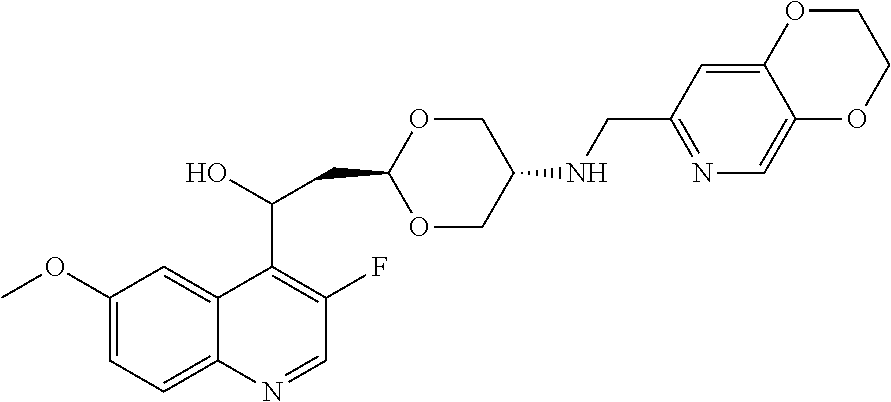


Biological Activity of Examples 1-72
| TABLE 1 |
| Biological Activity of Example Compounds 1-72 |
| MIC | Gyrase | TopolV | hTopoll (% | ||
| MIC 29213 | USA300 | IC50 | Decat IC50 | activity remaining | |
| AB # | (μg/mL) | (μg/mL) | (μM) | (μM) | at 100 μM) |
| 0002 | 4 | ND | 2.01 | >100 | 97.51 |
| 0003 | 8 | ND | ND | ND | ND |
| 0006 | 8 | ND | ND | ND | ND |
| 0007 | 4 | ND | ND | ND | ND |
| 0009 | <=0.25, 0.5, 0.5 | 0.5 | ND | ND | ND |
| 0010 | 1, 2, 1 | 1 | ND | ND | ND |
| 0011 | 0.25, 0.5, 1, 1 | 0.5 | 0.1 | 13.8 | 84.18 |
| 0012 | <=0.25, 0.5, 1, 1, 1 | 0.5 | 0.28 | >100 | 93.22 |
| 0013 | 1, 2 | 2 | 0.36 | 50 | 95.12 |
| 0014 | 1, 1 | 2 | 0.33 | 25-50 | 93.81 |
| 0015 | <=0.25, 0.25 | 0.125 | 0.03 | 0.98 | 54.96 |
| 0016 | 0.125, <=0.25, | 0.25, <=0.25, | 0.09 | 7.98 | 77.43 |
| 0.25 | 0.25 | ||||
| 0017 | 0.25 | 0.125 | ND | ND | ND |
| 0018 | <=0.25, 0.125 | 0.25 | 0.16 | 5.33 | 79.78 |
| 0019 | <=0.25, 0.25 | 0.5 | ND | ND | ND |
| 0020 | 0.5, 0.5 | 1 | 0.13 | 15.16 | 92.88 |
| 0021 | 0.5 | 0.5 | 0.59 | >100 | 91.14 |
| 0022 | 64 | ND | ND | ND | ND |
| 0023 | 8 | ND | 2.1 | >100 | 97.7 |
| 0024 | 64 | ND | ND | ND | ND |
| 0025 | >64 | ND | ND | ND | ND |
| 0026 | 64 | ND | ND | ND | ND |
| 0027 | >64 | ND | ND | ND | ND |
| 0028 | 64 | ND | ND | ND | ND |
| 0029 | 16 | ND | ND | ND | ND |
| 0030 | 2 | 1 | 0.95 | >100 | 97.82 |
| 0031 | 4 | 1.53 | >100 | 98.74 | |
| 0032 | >64 | ND | ND | ND | ND |
| 0033 | >64 | ND | ND | ND | ND |
| 0034 | 16 | ND | ND | ND | ND |
| 0035 | >64 | ND | ND | ND | ND |
| 0036 | >64 | ND | ND | ND | ND |
| 0037 | 32 | ND | ND | ND | ND |
| 0038 | >64 | ND | ND | ND | ND |
| 0039 | 64 | ND | ND | ND | ND |
| 0040 | >64 | ND | ND | ND | ND |
| 0041 | >64 | ND | ND | ND | ND |
| 0042 | 16 | ND | ND | ND | ND |
| 0043 | >64 | ND | ND | ND | ND |
| 0044 | 1 | 1 | ND | ND | ND |
| 0045 | 64 | ND | ND | ND | ND |
| 0046 | 0.5 | 1 | 0.6 | 100 | 88.33 |
| 0047 | >64 | ND | 13.3 | >100 | 88.38 |
| 0048 | 8 | ND | ND | ND | ND |
| 0049 | >64 | ND | ND | ND | ND |
| 0050 | 32 | ND | ND | ND | ND |
| 0051 | 1 | 1 | 0.42 | 50-100 | 93.73 |
| 0052 | 1 | 4 | 1.16 | >100 | 97.84 |
| 0055 | 0.5 | 1 | 0.78 | >100 | 99.06 |
| 0056 | 32 | ND | ND | ND | ND |
| 0057 | 1, 2 | 1 | 0.74 | >100 | 92.97 |
| 0058 | >64 | ND | ND | ND | ND |
| 0059 | <=0.5 | 0.25 | 0.17 | >100 | 95.72 |
| 0060 | 0.125 | 0.25 | 0.13 | 5.0-10 | 83.08 |
| 0061 | 0.125 | 0.25 | 0.42 | 61 | 69.61 |
| 0062 | 2 | 4 | 4.43 | >100 | 90.68 |
| 0069 | 8 | ND | ND | ND | ND |
| 0070 | 4 | ND | ND | ND | ND |
| 0071 | 1 | 2 | ND | ND | ND |
| 0075 | 16,32 | ND | ND | ND | ND |
| 0076 | <=0.5, 0.125 | 1 | ND | ND | ND |
| 0077 | 1 | 2 | ND | ND | ND |
| 0078 | 4 | ND | ND | ND | ND |
| 0079 | 2 | 4 | ND | ND | ND |
| 0080 | 1 | 2 | ND | ND | ND |
| 0081 | 2 | 4 | ND | ND | ND |
| 0082 | 2 | 4 | ND | ND | ND |
| 0083 | 0.5 | 1 | ND | ND | ND |
| 0084 | 4 | ND | ND | ND | ND |
| 0085 | 2 | 4 | ND | ND | ND |
| 0088 | 8 | ND | ND | ND | ND |
| 0089 | <=0.5 | ND | ND | ND | ND |
| ND = not determined; | |||||
| multiple values provided when multiple MIC assays were conducted | |||||
Claims (35)


Priority Applications (1)
| Application Number | Priority Date | Filing Date | Title |
|---|---|---|---|
| US16/606,044 US11352349B2 (en) | 2017-04-17 | 2018-04-17 | Type II topoisomerase inhibitors and methods of making and using thereof |
Applications Claiming Priority (4)
| Application Number | Priority Date | Filing Date | Title |
|---|---|---|---|
| US201762486227P | 2017-04-17 | 2017-04-17 | |
| US201762568075P | 2017-10-04 | 2017-10-04 | |
| PCT/US2018/028001 WO2018195098A1 (en) | 2017-04-17 | 2018-04-17 | Type ii topoisomerase inhibitors and methods of making and using thereof |
| US16/606,044 US11352349B2 (en) | 2017-04-17 | 2018-04-17 | Type II topoisomerase inhibitors and methods of making and using thereof |
Publications (2)
| Publication Number | Publication Date |
|---|---|
| US20200131158A1 US20200131158A1 (en) | 2020-04-30 |
| US11352349B2 true US11352349B2 (en) | 2022-06-07 |
Family
ID=63856838
Family Applications (1)
| Application Number | Title | Priority Date | Filing Date |
|---|---|---|---|
| US16/606,044 Active 2038-11-04 US11352349B2 (en) | 2017-04-17 | 2018-04-17 | Type II topoisomerase inhibitors and methods of making and using thereof |
Country Status (5)
| Country | Link |
|---|---|
| US (1) | US11352349B2 (en) |
| EP (1) | EP3612513A4 (en) |
| AU (1) | AU2018255283B2 (en) |
| CA (1) | CA3060545A1 (en) |
| WO (1) | WO2018195098A1 (en) |
Families Citing this family (4)
| Publication number | Priority date | Publication date | Assignee | Title |
|---|---|---|---|---|
| CN114173789A (en) * | 2019-07-05 | 2022-03-11 | 葛兰素史克知识产权发展有限公司 | Combinations for treating infections caused by mycoplasma genitalium |
| CN113292574B (en) * | 2020-02-21 | 2022-05-03 | 四川大学 | Chiral polycyclic tropane compounds, preparation method and application thereof |
| CN111257478B (en) * | 2020-03-24 | 2022-07-12 | 上海峰林生物科技有限公司 | Method for analyzing fosfomycin trometamol genotoxic impurities |
| WO2024173781A1 (en) * | 2023-02-16 | 2024-08-22 | Ohio State Innovation Foundation | Type ii topoisomerase inhibitors and methods of making and using thereof |
Citations (7)
| Publication number | Priority date | Publication date | Assignee | Title |
|---|---|---|---|---|
| WO1997002264A1 (en) | 1995-06-30 | 1997-01-23 | Hoechst Schering Agrevo Gmbh | Substituted 1,3-dioxan-5-ylamino heterocyclic compounds, methods for preparing them and their use as pesticides |
| US6002006A (en) | 1996-02-28 | 1999-12-14 | Hoechst Marion Roussel | 1(2H) quinoline carboxylic acid derivatives, method for preparing same, and use thereof for synthesizing substances having antibiotic properties |
| WO2008128942A1 (en) | 2007-04-20 | 2008-10-30 | Glaxo Group Limited | Tricyclic nitrogen containing compounds as antibacterial agents |
| US20090162478A1 (en) | 2005-08-15 | 2009-06-25 | Dylon Abend | High melt lipids |
| US20120183660A1 (en) | 2009-07-02 | 2012-07-19 | Senomyx, Inc. | Isomannide derivatives and their use as tastants |
| US20130295261A1 (en) | 2008-03-03 | 2013-11-07 | Senomyx, Inc. | Isosorbide derivatives and their use as flavor modifiers, tastants, and taste enhancers |
| WO2018021447A1 (en) * | 2016-07-28 | 2018-02-01 | 塩野義製薬株式会社 | Nitrogen-containing condensed ring compound having dopamine d3 receptor antagonistic effect |
-
2018
- 2018-04-17 WO PCT/US2018/028001 patent/WO2018195098A1/en not_active Ceased
- 2018-04-17 US US16/606,044 patent/US11352349B2/en active Active
- 2018-04-17 AU AU2018255283A patent/AU2018255283B2/en active Active
- 2018-04-17 EP EP18787285.8A patent/EP3612513A4/en active Pending
- 2018-04-17 CA CA3060545A patent/CA3060545A1/en active Pending
Patent Citations (8)
| Publication number | Priority date | Publication date | Assignee | Title |
|---|---|---|---|---|
| WO1997002264A1 (en) | 1995-06-30 | 1997-01-23 | Hoechst Schering Agrevo Gmbh | Substituted 1,3-dioxan-5-ylamino heterocyclic compounds, methods for preparing them and their use as pesticides |
| AU704176B2 (en) | 1995-06-30 | 1999-04-15 | Hoechst Schering Agrevo Gmbh | Substituted 1,3-dioxan-5-ylamino heterocyclic compounds, processes for their preparation and their use as pest control compositions |
| US6002006A (en) | 1996-02-28 | 1999-12-14 | Hoechst Marion Roussel | 1(2H) quinoline carboxylic acid derivatives, method for preparing same, and use thereof for synthesizing substances having antibiotic properties |
| US20090162478A1 (en) | 2005-08-15 | 2009-06-25 | Dylon Abend | High melt lipids |
| WO2008128942A1 (en) | 2007-04-20 | 2008-10-30 | Glaxo Group Limited | Tricyclic nitrogen containing compounds as antibacterial agents |
| US20130295261A1 (en) | 2008-03-03 | 2013-11-07 | Senomyx, Inc. | Isosorbide derivatives and their use as flavor modifiers, tastants, and taste enhancers |
| US20120183660A1 (en) | 2009-07-02 | 2012-07-19 | Senomyx, Inc. | Isomannide derivatives and their use as tastants |
| WO2018021447A1 (en) * | 2016-07-28 | 2018-02-01 | 塩野義製薬株式会社 | Nitrogen-containing condensed ring compound having dopamine d3 receptor antagonistic effect |
Non-Patent Citations (95)
| Title |
|---|
| Abdel-Magid, Ahmed F., and Steven J. Mehrman. "A review on the use of sodium triacetoxyborohydride in the reductive amination of ketones and aldehydes." Organic process research & development 10.5 (2006): 971-1031. |
| Alanis, Alfonso J. "Resistance to antibiotics: are we in the post-antibiotic era?" Archives of medical research 36.6 (2005): 697-705. |
| Aldred, Katie J., Robert J. Kerns, and Neil Osheroff. "Mechanism of quinolone action and resistance." Biochemistry 53.10 (2014): 1565-1574. |
| Alexander Fleming, Penicillin, Nobel Lecture, Dec. 11, 1945 Accessed Jul. 29, 2016 http://www.nobelprize.org/nobel_prizes/medicine/laureates/1945/fleming-lecture.html. |
| Australian Intellectual Property Office. Examination Report. Issued in Australian Application No. 2018255283 dated May 11, 2021. 2 pages. |
| Bax, Benjamin D., et al. "Type IIA topoisomerase inhibition by a new class of antibacterial agents." Nature 466.7309 (2010): 935. |
| Bax, Benjamin D., et al. "Type IIA topoisomerase inhibition by a new class of antibacterial agents." Nature 466.7309 (2010): 935-940. |
| Bisacchi, G. S., et al., "Recent Advances in the Inhibition of Bacterial Type II Topoisomerases", Annual Rep. Med. Chem. 2009, 44, 379. |
| Black, Michael T., and Kenneth Coleman. "New inhibitors of bacterial topoisomerase GyrA/ParC subunits." Curr. Opin. Invest. Drugs 10.8 (2009): 804-810. |
| Black, Michael T., et al. "Mechanism of action of the antibiotic NXL101, a novel nonfluoroquinolone inhibitor of bacterial type II topoisomerases." Antimicrobial agents and chemotherapy 52.9 (2008): 3339-3349. |
| Blumberg, Henry M., et al. "Rapid development of ciprofloxacin resistance in methicillin-susceptible and-resistant Staphylococcus aureus." Journal of Infectious Diseases 163.6 (1991): 1279-1285. |
| Boucher, Helen W., et al. "Bad bugs, no drugs: No. ESKAPE! An update from the Infectious Diseases Society of America." Clinical infectious diseases 48.1 (2009): 1-12. |
| Bradbury, Barton J., and Michael J. Pucci. "Recent advances in bacterial topoisomerase inhibitors." Current opinion in pharmacology 8.5 (2008): 574-581. |
| CDC, Biggest Threats and Data http://www.cdc.gov/drugresistance/biggest_threats.html. Accessed Jul. 29, 2016. |
| Cheng, Jijun, et al. "Dual targeting of DNA gyrase and topoisomerase IV: target interactions of heteroaryl isothiazolones in Staphylococcus aureus." Antimicrobial agents and chemotherapy 51.7 (2007): 2445-2453. |
| Cinquin, Bertrand, et al. "Microspectrometric insights on the uptake of antibiotics at the single bacterial cell level." Scientific reports 5 (2015): 17968. |
| Clinical Trial NCT02045797 https://clinicaltrials.gov/ct2/show/NCT02045797?term=2140944&rank=6. Accessed Jul. 28, 2016. |
| Clinical Trial NCT02294682 https://clinicaltrials.gov/ct2/show/NCT02294682?term=2140944&rank=8. Accessed Jul. 28, 2016. |
| Collin, Frédéric, Shantanu Karkare, and Anthony Maxwell. "Exploiting bacterial DNA gyrase as a drug target: current state and perspectives." Applied microbiology and biotechnology 92.3 (2011): 479-497. |
| D'Costa, Vanessa M., et al. "Antibiotic resistance is ancient." Nature 477.7365 (2011): 457. |
| Dougherty, T. J., et al. "NBTI 5463 Is a Novel Bacterial Type II Topoisomerase Inhibitor with Activity against Gram-Negative Bacteria and In Vivo Efficacy" Antimicrob. Agents Chemother. 2014, 58, 4250. |
| Dougherty, Thomas J., et al. "NBTI 5463 is a novel bacterial type II topoisomerase inhibitor with activity against Gram-negative bacteria and in vivo efficacy." Antimicrobial agents and chemotherapy 58.5 (2014): 2657-2664. |
| Douglas, Jr., Introduction to Viral Diseases, Cecil Textbook of Medicine, 20th Edition, vol. 2, pp. 1739-1742 (1996). * |
| European Search Report issued by the European Patent Office in Application No. EP 18787285.8 dated Sep. 2, 2020. 7 pages. |
| Geng, Bolin, et al. "Exploring Left-Hand-Side substitutions in the benzoxazinone series of 4-amino-piperidine bacterial type IIa topoisomerase inhibitors." Bioorganic & medicinal chemistry letters 21.18 (2011): 5432-5435. |
| Gleeson, M. Paul. "Generation of a set of simple, interpretable ADMET rules of thumb." Journal of medicinal chemistry 51.4 (2008): 817-834. |
| Høiby, Niels, Oana Ciofu, and Thomas Bjarnsholt. "Pseudomonas aeruginosa biofilms in cystic fibrosis." Future microbiology 5.11 (2010): 1663-1674. |
| Hooper, David C. "Emerging mechanisms of fluoroquinolone resistance." Emerging infectious diseases 7.2 (2001): 337. |
| Hooper, David C. "Mechanisms of action and resistance of older and newer fluoroquinolones." Clinical Infectious Diseases 31. Supplement 2 (2000): S24-S28. |
| International Preliminary Report on Patentability issued for Application No. PCT/US2018/028001, dated Oct. 31, 2019. |
| International Search Report and Written Opinion issued by the International Searching Authority (ISA/US) in PCT Application No. PCT/US2018/028001 dated Jul. 26, 2018. 8 pages. |
| International Search Report and Written Opinion. Issued by the International Searching Authority (US/ISA) in PCT Application No. PCT/US2021/014708 dated Apr. 15, 2021. 8 pages. |
| Jacoby, George A. "Mechanisms of resistance to quinolones." Clinical Infectious Diseases 41. Supplement 2 (2005): S120-S126. |
| Jones, Jesse A., et al. "Recent advances in the rational design and optimization of antibacterial agents." MedChemComm 7.9 (2016): 1694-1715. DOI:10.1039/C6MD00232C. |
| Kohanski, Michael A., Daniel J. Dwyer, and James J. Collins. "How antibiotics kill bacteria: from targets to networks." Nature Reviews Microbiology 8.6 (2010): 423-435. |
| Lahiri, Sushmita D., et al. "Insights into the mechanism of inhibition of novel bacterial topoisomerase inhibitors from characterization of resistant mutants of Staphylococcus aureus." Antimicrobial agents and chemotherapy 59.9 (2015): 5278-5287. |
| Leeson, Paul D., and Brian Springthorpe. "The influence of drug-like concepts on decision-making in medicinal chemistry." Nature Reviews Drug Discovery 6.11 (2007): 881-890. |
| Li et al., Synthesis and anti-staphylococcal activity of novel bacterial topoisomerase inhibitors with a 5-amino-1,3-dioxane linker moiety, Biorg. & Med. Chem. Letters, 28 (2018), pp. 2477-2480. * |
| Lipinski, Christopher A., et al. "Experimental and computational approaches to estimate solubility and permeability in drug discovery and development settings." Advanced drug delivery reviews 23.1-3 (1997): 3-25. |
| Liu, Yi-Yun, et al. "Emergence of plasmid-mediated colistin resistance mechanism MCR-1 in animals and human beings in China: a microbiological and molecular biological study." The Lancet infectious diseases 16.2 (2016): 161-168. |
| Mayer, Claudine, and Yves L. Janin. "Non-quinolone inhibitors of bacterial type IIA topoisomerases: a feat of bioisosterism." Chemical reviews 114.4 (2014): 2313-2342. |
| Miles, Timothy J., et al. "Novel amino-piperidines as potent antibacterials targeting bacterial type IIA topoisomerases." Bioorganic & medicinal chemistry letters 21.24 (2011): 7489-7495. |
| Miles, Timothy J., et al. "Novel cyclohexyl-amides as potent antibacterials targeting bacterial type IIA topoisomerases." Bioorganic & medicinal chemistry letters 21.24 (2011): 7483-7488. |
| Miles, Timothy J., et al. "Novel hydroxyl tricyclics (eg, GSK966587) as potent inhibitors of bacterial type IIA topoisomerases." Bioorganic & medicinal chemistry letters 23.19 (2013): 5437-5441. |
| Mitscher, Lester A. "Bacterial topoisomerase inhibitors: quinolone and pyridone antibacterial agents." Chemical reviews 105.2 (2005): 559-592. |
| Mitton-Fry, M. J. Novel, Non-quinolone Inhibitors of DNA Gyrase and Topoisomerase IV: Antibacterial Activity and Resistance Mechanisms. Presented at the 243rd National Meeting of the American Chemical Society, San Diego, CA, 2012, Paper MEDI-257. |
| Mitton-Fry, Mark J., et al. "Novel quinoline derivatives as inhibitors of bacterial DNA gyrase and topoisomerase IV." Bioorganic & medicinal chemistry letters 23.10 (2013): 2955-2961. |
| Morrill, Haley J., et al. "Treatment options for carbapenem-resistant Enterobacteriaceae infections." Open forum infectious diseases. vol. 2. No. 2. 5;2(2):ofv050 2015. |
| Morrow, Brian J., et al. "Antistaphylococcal activities of the new fluoroquinolone JNJ-Q2." Antimicrobial agents and chemotherapy 55.12 (2011): 5512-5521. |
| Nayar, Asha S., et al. "Target-based resistance in Pseudomonas aeruginosa and Escherichia coli to NBTI 5463, a novel bacterial type II topoisomerase inhibitor." Antimicrobial agents and chemotherapy 59.1 (2015): 331-337. |
| Ndubaku, Chudi O., et al. "Design of selective PAK1 inhibitor G-5555: improving properties by employing an unorthodox low-p K a polar moiety." ACS medicinal chemistry letters 6.12 (2015): 1241-1246. |
| New York Times, Infection Raises Specter of Superbugs Resistant to All Antibiotics. Accessed Jul. 29, 2016 https://www.nytimes.com/2016/05/27/health/infection-raises-specter-of-superbugs-resistant-to-all-antibiotics.html. |
| Okumu, Antony, et al. "Novel bacterial topoisomerase inhibitors derived from isomannide." European journal of medicinal chemistry. Apr. 28, 2020. 199, 1-17. |
| Onodera, Yoshikuni, et al. "Dual inhibitory activity of sitafloxacin (DU-6859a) against DNA gyrase and topoisomerase IV of Streptococcus pneumoniae." Journal of Antimicrobial Chemotherapy 44.4 (1999): 533-536. |
| O'Shea, Rosemarie, and Heinz E. Moser. "Physicochemical properties of antibacterial compounds: implications for drug discovery." Journal of medicinal chemistry 51.10 (2008): 2871-2878. |
| Pasternak, Alexander, et al. "Potent, orally bioavailable somatostatin agonists: good absorption achieved by urea backbone cyclization." Bioorganic & medicinal chemistry letters 9.3 (1999): 491-496. |
| Payne, David J., et al. "Drugs for bad bugs: confronting the challenges of antibacterial discovery." Nature reviews Drug discovery 6.1 (2007): 29-40. |
| Payne, David J., et al. "Time for a change: addressing R&D and commercialization challenges for antibacterials." Philosophical Transactions of the Royal Society B: Biological Sciences 370.1670 (2015): 20140086. |
| PewTrust, A Scientific Roadmap for Antibiotic Discovery, May 2016. Accessed Jul. 29, 2016. http://www.pewtrusts.org/en/research-and-analysis/reports/2016/05/a-scientific-roadmap-for-antibioticdiscovery. |
| Phillips, John W., et al. "Discovery of kibdelomycin, a potent new class of bacterial type II topoisomerase inhibitor by chemical-genetic profiling in Staphylococcus aureus." Chemistry & biology 18.8 (2011): 955-965. |
| Piddock, Laura, Sylvie Gameau-Tsodikova, and Colin Garner. "Ask the experts: how to curb antibiotic resistance and plug the antibiotics gap?." Future medicinal chemistry 8.10 (2016): 1027-1032. |
| Reck, Folkert, et al. "Novel N-linked aminopiperidine inhibitors of bacterial topoisomerase type II with reduced p K a: antibacterial agents with an improved safety profile." Journal of medicinal chemistry 55.15 (2012): 6916-6933. |
| Reck, Folkert, et al. "Novel N-linked aminopiperidine inhibitors of bacterial topoisomerase type II: broad-spectrum antibacterial agents with reduced hERG activity." Journal of medicinal chemistry 54.22 (2011): 7834-7847. |
| Reck, Folkert, et al. "Optimization of physicochemical properties and safety profile of novel bacterial topoisomerase type II inhibitors (NBTIs) with activity against Pseudomonas aeruginosa." Bioorganic & Medicinal Chemistry 22.19 (2014): 5392-5409. |
| Rice, Louis B. "Federal funding for the study of antimicrobial resistance in nosocomial pathogens: no ESKAPE." (2008): 1079-1081. |
| Ross, James E., et al. "Determination of disk diffusion and MIC quality control guidelines for GSK2140944, a novel bacterial type II topoisomerase inhibitor antimicrobial agent." Journal of Clinical Microbiology 52.7 (2014): 2629-2632. |
| Ruppé, Étienne, Paul-Louis Woerther, and François Barbier. "Mechanisms of antimicrobial resistance in Gram-negative bacilli." Annals of intensive care 5.1 (2015): 21. |
| Schwarz, Stefan, and Alan P. Johnson. "Transferable resistance to colistin: a new but old threat." Journal of Antimicrobial Chemotherapy 71.8 (2016): 2066-2070. |
| Scorciapino, Mariano Andrea, et al. "Exploiting the porin pathway for polar compound delivery into Gram-negative bacteria." Future Medicinal Chemistry 8.10 (2016): 1047-1062. |
| Servick, Kelly. "The drug push." Science, (2015): 850-853. |
| Silver, Lynn L. "A Gestalt approach to Gram-negative entry." Bioorganic & medicinal chemistry 24.24 (2016): 6379-6389. http://dx.doi.org/10.1016/j.bmc.2016.06.044. |
| Singh, Sheo B. "Confronting the challenges of discovery of novel antibacterial agents." Bioorganic & medicinal chemistry letters 24.16 (2014): 3683-3689. |
| Singh, Sheo B., et al. "C1-C2-linker substituted 1, 5-naphthyridine analogues of oxabicyclooctane-linked NBTIs as broad-spectrum antibacterial agents (part 7)." Medchemcomm 6.10 (2015): 1773-1780. |
| Singh, Sheo B., et al. "Hydroxy tricyclic 1, 5-naphthyridinone oxabicyclooctane-linked novel bacterial topoisomerase inhibitors as broad-spectrum antibacterial agents—SAR of RHS moiety (Part—3)." Bioorganic & Medicinal Chemistry Letters 25.12 (2015): 2473-2478. |
| Singh, Sheo B., et al. "Oxabicyclooctane-linked novel bacterial topoisomerase inhibitors as broad spectrum antibacterial agents." ACS medicinal chemistry letters 5.5 (2014): 609-614. |
| Singh, Sheo B., et al. "Structure activity relationship of pyridoxazinone substituted RHS analogs of oxabicyclooctane-linked 1, 5-naphthyridinyl novel bacterial topoisomerase inhibitors as broad-spectrum antibacterial agents (Part—6)." Bioorganic & Medicinal Chemistry Letters 25.17 (2015): 3636-3643. |
| Singh, Sheo B., et al. "Structure activity relationship of substituted 1, 5-naphthyridine analogs of oxabicyclooctane-linked novel bacterial topoisomerase inhibitors as broad-spectrum antibacterial agents (Part—4)." Bioorganic & Medicinal Chemistry Letters 25.11 (2015): 2409-2415. |
| Singh, Sheo B., et al. "Tricyclic 1, 5-naphthyridinone oxabicyclooctane-linked novel bacterial topoisomerase inhibitors as broad-spectrum antibacterial agents—SAR of left-hand-side moiety (Part—2)." Bioorganic & Medicinal Chemistry Letters 25.9 (2015): 1831-1835. |
| So, Wonhee, Jared L. Crandon, and David P. Nicolau. "Pharmacodynamic profile of GSK2140944 against methicillin-resistant Staphylococcus aureus in a murine lung infection model." Antimicrobial Agents and Chemotherapy 59.8 (2015): 4956-4961. |
| Spellberg, Brad, John G. Bartlett, and David N. Gilbert. "The future of antibiotics and resistance." New England Journal of Medicine 368.4 (2013): 299-302. |
| Surivet, Jean-Philippe, et al. "Design, synthesis, and characterization of novel tetrahydropyran-based bacterial topoisomerase inhibitors with potent anti-gram-positive activity." Journal of medicinal chemistry 56.18 (2013): 7396-7415. |
| Surivet, Jean-Philippe, et al. "Novel tetrahydropyran-based bacterial topoisomerase inhibitors with potent anti-gram positive activity and improved safety profile." Journal of medicinal chemistry 58.2 (2015): 927-942. |
| Tan, Christopher M., et al. "In vitro and in vivo characterization of the novel oxabicyclooctane-linked bacterial topoisomerase inhibitor AM-8722, a selective, potent inhibitor of bacterial DNA gyrase." Antimicrobial agents and chemotherapy 60.8 (2016): 4830-4839. |
| Tommasi, Ruben, et al. "ESKAPEing the labyrinth of antibacterial discovery." Nature reviews Drug discovery 14.8 (2015): 529-542. |
| Tse-Dinh, Yuk-Ching. "Targeting bacterial topoisomerases: how to counter mechanisms of resistance." Future Medicinal Chemistry 8.10 (2016): 1085-1100. |
| Van Bambeke, Françoise, et al. "Antibiotic efflux pumps in prokaryotic cells: occurrence, impact on resistance and strategies for the future of antimicrobial therapy." Journal of Antimicrobial Chemotherapy 51.5 (2003): 1055-1065. |
| Veber, Daniel F., et al. "Molecular properties that influence the oral bioavailability of drug candidates." Journal of medicinal chemistry 45.12 (2002): 2615-2623. |
| Wagner, Stefanie, et al. "Novel strategies for the treatment of Pseudomonas aeruginosa infections." Journal of medicinal chemistry 59.13 (2016): 5929-5969. |
| WHO, The top 10 causes of death. http://www.who.int/mediacentre/factsheets/fs310/en/. Accessed Jul. 29, 2016. |
| Widdowson, Katherine, and Alan Hennessy. "Advances in structure-based drug design of novel bacterial topoisomerase inhibitors." Future medicinal chemistry 2.11 (2010): 1619-1622. |
| Wiles, Jason A., et al. "Selenophene-containing inhibitors of type IIA bacterial topoisomerases." Journal of medicinal chemistry 54.9 (2011): 3418-3425. |
| Wise, Richard, et al. "The urgent need for new antibacterial agents." Journal of antimicrobial chemotherapy 66.9 (2011): 1939-1940. |
| Wohlkonig, Alexandre, et al. "Structural basis of quinolone inhibition of type IIA topoisomerases and target-mediated resistance." Nature structural & molecular biology 17.9 (2010): 1152-1153. |
| Zgurskaya, Helen I., Cesar A. Lopez, and Sandrasegaram Gnanakaran. "Permeability barrier of Gram-negative cell envelopes and approaches to bypass it." ACS infectious diseases 1.11 (2015): 512-522. |
| Zhou, Ying, et al. "Thinking outside the "bug": a unique assay to measure intracellular drug penetration in gram-negative bacteria." Analytical chemistry 87.7 (2015): 3579-3584. |
Also Published As
| Publication number | Publication date |
|---|---|
| AU2018255283B2 (en) | 2022-05-26 |
| WO2018195098A1 (en) | 2018-10-25 |
| EP3612513A4 (en) | 2020-09-30 |
| AU2018255283A1 (en) | 2019-11-07 |
| EP3612513A1 (en) | 2020-02-26 |
| US20200131158A1 (en) | 2020-04-30 |
| CA3060545A1 (en) | 2018-10-25 |
Similar Documents
| Publication | Publication Date | Title |
|---|---|---|
| US11352349B2 (en) | Type II topoisomerase inhibitors and methods of making and using thereof | |
| AU2012211299B2 (en) | Small molecule RNase inhibitors and methods of use | |
| AU2012211299A1 (en) | Small molecule RNase inhibitors and methods of use | |
| AU2012211253A1 (en) | Small molecule RNase inhibitors and methods of use | |
| US20180369258A1 (en) | Anti-bacterial compounds based on amino-gold phosphine complexes | |
| US9700044B2 (en) | Symmetrical marinopyrrole derivatives as potential antibiotic agents | |
| US20180360856A1 (en) | Anti-bacterial compounds | |
| US20230097866A1 (en) | Bacterial topoisomerase inhibitors derived from isomannide | |
| US20260027101A1 (en) | Bacterial topoisomerase inhibitors | |
| WO2024173781A1 (en) | Type ii topoisomerase inhibitors and methods of making and using thereof | |
| WO2017093544A1 (en) | Alkynyl phosphine gold complexes for treating bacterial infections | |
| AU2016225942B2 (en) | Small molecule RNase inhibitors and methods of use | |
| WO2025174820A1 (en) | Heteroaryl topoisomerase inhibitors and uses thereof |
Legal Events
| Date | Code | Title | Description |
|---|---|---|---|
| FEPP | Fee payment procedure |
Free format text: ENTITY STATUS SET TO UNDISCOUNTED (ORIGINAL EVENT CODE: BIG.); ENTITY STATUS OF PATENT OWNER: SMALL ENTITY |
|
| AS | Assignment |
Owner name: OHIO STATE INNOVATION FOUNDATION, OHIO Free format text: ASSIGNMENT OF ASSIGNORS INTEREST;ASSIGNOR:MITTON-FRY, MARK;REEL/FRAME:050759/0349 Effective date: 20180601 |
|
| FEPP | Fee payment procedure |
Free format text: ENTITY STATUS SET TO SMALL (ORIGINAL EVENT CODE: SMAL); ENTITY STATUS OF PATENT OWNER: SMALL ENTITY |
|
| STPP | Information on status: patent application and granting procedure in general |
Free format text: DOCKETED NEW CASE - READY FOR EXAMINATION |
|
| STPP | Information on status: patent application and granting procedure in general |
Free format text: NON FINAL ACTION MAILED |
|
| STPP | Information on status: patent application and granting procedure in general |
Free format text: NOTICE OF ALLOWANCE MAILED -- APPLICATION RECEIVED IN OFFICE OF PUBLICATIONS |
|
| STPP | Information on status: patent application and granting procedure in general |
Free format text: PUBLICATIONS -- ISSUE FEE PAYMENT VERIFIED |
|
| STCF | Information on status: patent grant |
Free format text: PATENTED CASE |
|
| CC | Certificate of correction | ||
| MAFP | Maintenance fee payment |
Free format text: PAYMENT OF MAINTENANCE FEE, 4TH YR, SMALL ENTITY (ORIGINAL EVENT CODE: M2551); ENTITY STATUS OF PATENT OWNER: SMALL ENTITY Year of fee payment: 4 |