US11299581B2 - Conjugated polymer and application thereof - Google Patents
Conjugated polymer and application thereof Download PDFInfo
- Publication number
- US11299581B2 US11299581B2 US16/668,782 US201916668782A US11299581B2 US 11299581 B2 US11299581 B2 US 11299581B2 US 201916668782 A US201916668782 A US 201916668782A US 11299581 B2 US11299581 B2 US 11299581B2
- Authority
- US
- United States
- Prior art keywords
- alkyl
- conjugated polymer
- group
- mmol
- membered heterocyclic
- Prior art date
- Legal status (The legal status is an assumption and is not a legal conclusion. Google has not performed a legal analysis and makes no representation as to the accuracy of the status listed.)
- Active, expires
Links
- 0 *N1C(=O)c2c(C)sc(C)c2C1=O Chemical compound *N1C(=O)c2c(C)sc(C)c2C1=O 0.000 description 67
- RVYSVCFFUMMUSI-MCZZZRJESA-N C.C.CC.CCC.CCC.CCC.CCC.[2HH].[2H][2H] Chemical compound C.C.CC.CCC.CCC.CCC.CCC.[2HH].[2H][2H] RVYSVCFFUMMUSI-MCZZZRJESA-N 0.000 description 3
- CNCDIJFHVSYOKD-UHFFFAOYSA-N Cc1cccc2c(C)cccc12.Cc1cccc2c(C)nccc12.Cc1ccnc2c(C)cccc12.Cc1ccnc2c(C)ccnc12.Cc1ccnc2c(C)ccnc12.Cc1ccnc2c(C)cncc12.Cc1cncc2c(C)cccc12 Chemical compound Cc1cccc2c(C)cccc12.Cc1cccc2c(C)nccc12.Cc1ccnc2c(C)cccc12.Cc1ccnc2c(C)ccnc12.Cc1ccnc2c(C)ccnc12.Cc1ccnc2c(C)cncc12.Cc1cncc2c(C)cccc12 CNCDIJFHVSYOKD-UHFFFAOYSA-N 0.000 description 2
- KTTRYFRTDWMJSS-UHFFFAOYSA-N C#CC(CCCC)CN1C(=O)c2c(-c3ccc(C)s3)sc(-c3ccc(-c4cc5c(-c6ccc(CC(CCCCCC)CCCCCCCC)s6)c6sc(-c7ccc(-c8sc(-c9ccc(-c%10cc%11c(-c%12ccc(CC(CCCCCC)CCCCCCCC)s%12)c%12sc(C)cc%12c(-c%12ccc(CC(CCCCCC)CCCCCCCC)s%12)c%11s%10)s9)c9c8C(=O)N(C)C9=O)s7)cc6c(-c6ccc(CC(CCCCCC)CCCCCCCC)s6)c5s4)s3)c2C1=O.CCCCC(CC)CN1C(=O)c2c(-c3ccc(Br)s3)sc(-c3ccc(Br)s3)c2C1=O.CCCCCCCCC(CCCCCC)Cc1ccc(-c2c3cc([Sn](C)(C)C)sc3c(-c3ccc(CC(CCCCCC)CCCCCCCC)s3)c3cc([Sn](C)(C)C)sc23)s1.CCCCCCCCN1C(=O)c2c(-c3ccc(Br)s3)sc(-c3ccc(Br)s3)c2C1=O.[HH].[HH] Chemical compound C#CC(CCCC)CN1C(=O)c2c(-c3ccc(C)s3)sc(-c3ccc(-c4cc5c(-c6ccc(CC(CCCCCC)CCCCCCCC)s6)c6sc(-c7ccc(-c8sc(-c9ccc(-c%10cc%11c(-c%12ccc(CC(CCCCCC)CCCCCCCC)s%12)c%12sc(C)cc%12c(-c%12ccc(CC(CCCCCC)CCCCCCCC)s%12)c%11s%10)s9)c9c8C(=O)N(C)C9=O)s7)cc6c(-c6ccc(CC(CCCCCC)CCCCCCCC)s6)c5s4)s3)c2C1=O.CCCCC(CC)CN1C(=O)c2c(-c3ccc(Br)s3)sc(-c3ccc(Br)s3)c2C1=O.CCCCCCCCC(CCCCCC)Cc1ccc(-c2c3cc([Sn](C)(C)C)sc3c(-c3ccc(CC(CCCCCC)CCCCCCCC)s3)c3cc([Sn](C)(C)C)sc23)s1.CCCCCCCCN1C(=O)c2c(-c3ccc(Br)s3)sc(-c3ccc(Br)s3)c2C1=O.[HH].[HH] KTTRYFRTDWMJSS-UHFFFAOYSA-N 0.000 description 1
- CEMJVIKKBDFBRC-WMYBHVDZSA-N C.C.C.C#CC#CC#CC#CC#CC#CC(CCCCCC)Cc1ccc(-c2c3ccsc3c(-c3ccc(CC(C)CCCCCCCC)s3)c3ccsc23)s1.C#CC#CC#CC#CC#CC#CC(CCCCCCCC)Cc1cccs1.CCCCCCC(C)CI.CCCCCCCCC(CCCCCC)Cc1ccc(-c2c3cc([Sn](C)(C)C)sc3c(-c3ccc(CC(CCCCCC)CCCCCCCC)s3)c3cc([Sn](C)(C)C)sc23)s1.O=C1c2ccsc2C(=O)c2ccsc21.[2H]B[3H].[HH].[HH].[HH].[HH].[HH].[HH].[HH].[HH].[HH].[HH].[HH].[HH].[HH].[HH].c1ccsc1 Chemical compound C.C.C.C#CC#CC#CC#CC#CC#CC(CCCCCC)Cc1ccc(-c2c3ccsc3c(-c3ccc(CC(C)CCCCCCCC)s3)c3ccsc23)s1.C#CC#CC#CC#CC#CC#CC(CCCCCCCC)Cc1cccs1.CCCCCCC(C)CI.CCCCCCCCC(CCCCCC)Cc1ccc(-c2c3cc([Sn](C)(C)C)sc3c(-c3ccc(CC(CCCCCC)CCCCCCCC)s3)c3cc([Sn](C)(C)C)sc23)s1.O=C1c2ccsc2C(=O)c2ccsc21.[2H]B[3H].[HH].[HH].[HH].[HH].[HH].[HH].[HH].[HH].[HH].[HH].[HH].[HH].[HH].[HH].c1ccsc1 CEMJVIKKBDFBRC-WMYBHVDZSA-N 0.000 description 1
- JNDRJEGUMANRQR-NMOJHCKESA-N CC.CC.[C-]#[N+]/C(C#N)=C1C(=C\c2cc3sc4c(c3s2)C(c2ccc(CCCCCC)cc2)(c2ccc(CCCCCC)cc2)c2cc3c(cc2-4)C(c2ccc(CCCCCC)cc2)(c2ccc(CCCCCC)cc2)c2c-3sc3cc(/C=C4\C(=O)c5cc(F)c(F)cc5\C4=C(\C#N)[N+]#[C-])sc23)\C(=O)c2cc(F)c(F)cc2\1.[C-]#[N+]/C(C#N)=C1C(=C\c2cc3sc4c(c3s2)C(c2ccc(CCCCCC)cc2)(c2ccc(CCCCCC)cc2)c2cc3c(cc2-4)C(c2ccc(CCCCCC)cc2)(c2ccc(CCCCCC)cc2)c2c-3sc3cc(/C=C4\C(=O)c5ccccc5\C4=C(\C#N)[N+]#[C-])sc23)\C(=O)c2ccccc2\1.[C-]#[N+]/C(C#N)=C1C(=C\c2cc3sc4c(c3s2)C(c2cccc(OCCCCCC)c2)(c2cccc(OCCCCCC)c2)c2cc3c(cc2-4)C(c2cccc(OCCCCCC)c2)(c2cccc(OCCCCCC)c2)c2c-3sc3cc(/C=C4\C(=O)c5ccccc5\C4=C(\C#N)[N+]#[C-])sc23)\C(=O)c2ccccc2\1 Chemical compound CC.CC.[C-]#[N+]/C(C#N)=C1C(=C\c2cc3sc4c(c3s2)C(c2ccc(CCCCCC)cc2)(c2ccc(CCCCCC)cc2)c2cc3c(cc2-4)C(c2ccc(CCCCCC)cc2)(c2ccc(CCCCCC)cc2)c2c-3sc3cc(/C=C4\C(=O)c5cc(F)c(F)cc5\C4=C(\C#N)[N+]#[C-])sc23)\C(=O)c2cc(F)c(F)cc2\1.[C-]#[N+]/C(C#N)=C1C(=C\c2cc3sc4c(c3s2)C(c2ccc(CCCCCC)cc2)(c2ccc(CCCCCC)cc2)c2cc3c(cc2-4)C(c2ccc(CCCCCC)cc2)(c2ccc(CCCCCC)cc2)c2c-3sc3cc(/C=C4\C(=O)c5ccccc5\C4=C(\C#N)[N+]#[C-])sc23)\C(=O)c2ccccc2\1.[C-]#[N+]/C(C#N)=C1C(=C\c2cc3sc4c(c3s2)C(c2cccc(OCCCCCC)c2)(c2cccc(OCCCCCC)c2)c2cc3c(cc2-4)C(c2cccc(OCCCCCC)c2)(c2cccc(OCCCCCC)c2)c2c-3sc3cc(/C=C4\C(=O)c5ccccc5\C4=C(\C#N)[N+]#[C-])sc23)\C(=O)c2ccccc2\1 JNDRJEGUMANRQR-NMOJHCKESA-N 0.000 description 1
- NODQLDCFDOANEU-UHFFFAOYSA-N CCCCC(CC)Cc1sc(CC(CC)CCCC)c2c1C(=O)c1c(-c3ccc(Br)s3)sc(-c3ccc(Br)s3)c1C2=O.CCCCCCCCC(CCCCCC)Cc1ccc(-c2c3cc(-c4ccc(-c5sc(-c6ccc(-c7cc8c(-c9ccc(CC(CCCCCC)CCCCCCCC)s9)c9sc(-c%10ccc(-c%11sc(-c%12ccc(C)s%12)c%12c%11C(=O)c%11c(CC(CC)CCCC)sc(CC(CC)CCCC)c%11C%12=O)s%10)cc9c(-c9ccc(CC(CCCCCC)CCCCCCCC)s9)c8s7)s6)c6c5C(=O)N(CCCCCCCC)C6=O)s4)sc3c(-c3ccc(CC(CCCCCC)CCCCCCCC)s3)c3cc(C)sc23)s1.CCCCCCCCC(CCCCCC)Cc1ccc(-c2c3cc([Sn](C)(C)C)sc3c(-c3ccc(CC(CCCCCC)CCCCCCCC)s3)c3cc([Sn](C)(C)C)sc23)s1.CCCCCCCCN1C(=O)c2c(-c3ccc(Br)s3)sc(-c3ccc(Br)s3)c2C1=O Chemical compound CCCCC(CC)Cc1sc(CC(CC)CCCC)c2c1C(=O)c1c(-c3ccc(Br)s3)sc(-c3ccc(Br)s3)c1C2=O.CCCCCCCCC(CCCCCC)Cc1ccc(-c2c3cc(-c4ccc(-c5sc(-c6ccc(-c7cc8c(-c9ccc(CC(CCCCCC)CCCCCCCC)s9)c9sc(-c%10ccc(-c%11sc(-c%12ccc(C)s%12)c%12c%11C(=O)c%11c(CC(CC)CCCC)sc(CC(CC)CCCC)c%11C%12=O)s%10)cc9c(-c9ccc(CC(CCCCCC)CCCCCCCC)s9)c8s7)s6)c6c5C(=O)N(CCCCCCCC)C6=O)s4)sc3c(-c3ccc(CC(CCCCCC)CCCCCCCC)s3)c3cc(C)sc23)s1.CCCCCCCCC(CCCCCC)Cc1ccc(-c2c3cc([Sn](C)(C)C)sc3c(-c3ccc(CC(CCCCCC)CCCCCCCC)s3)c3cc([Sn](C)(C)C)sc23)s1.CCCCCCCCN1C(=O)c2c(-c3ccc(Br)s3)sc(-c3ccc(Br)s3)c2C1=O NODQLDCFDOANEU-UHFFFAOYSA-N 0.000 description 1
- PQHGGWRSUMBZKR-UHFFFAOYSA-N CCCCCCCCC(CCCCCC)Cc1ccc(-c2c3cc(-c4ccc(-c5sc(-c6ccc(-c7cc8c(-c9ccc(CC(CCCCCC)CCCCCCCC)s9)c9sc(-c%10ccc(-c%11c(F)c(F)c(-c%12ccc(C)s%12)c%12nn(CC(CCCCCC)CCCCCCCC)nc%11%12)s%10)cc9c(-c9ccc(CC(CCCCCC)CCCCCCCC)s9)c8s7)s6)c6c5C(=O)N(CCCCCCCC)C6=O)s4)sc3c(-c3ccc(CC(CCCCCC)CCCCCCCC)s3)c3cc(C)sc23)s1.CCCCCCCCC(CCCCCC)Cc1ccc(-c2c3cc(-c4ccc(-c5sc(-c6ccc(-c7cc8c(-c9ccc(CC(CCCCCC)CCCCCCCC)s9)c9sc(-c%10ccc(-c%11sc(-c%12ccc(C)s%12)c%12c%11C(=O)N(CC(CC)CCCC)C%12=O)s%10)cc9c(-c9ccc(CC(CCCCCC)CCCCCCCC)s9)c8s7)s6)c6c5C(=O)N(CCCCCCCC)C6=O)s4)sc3c(-c3ccc(CC(CCCCCC)CCCCCCCC)s3)c3cc(C)sc23)s1 Chemical compound CCCCCCCCC(CCCCCC)Cc1ccc(-c2c3cc(-c4ccc(-c5sc(-c6ccc(-c7cc8c(-c9ccc(CC(CCCCCC)CCCCCCCC)s9)c9sc(-c%10ccc(-c%11c(F)c(F)c(-c%12ccc(C)s%12)c%12nn(CC(CCCCCC)CCCCCCCC)nc%11%12)s%10)cc9c(-c9ccc(CC(CCCCCC)CCCCCCCC)s9)c8s7)s6)c6c5C(=O)N(CCCCCCCC)C6=O)s4)sc3c(-c3ccc(CC(CCCCCC)CCCCCCCC)s3)c3cc(C)sc23)s1.CCCCCCCCC(CCCCCC)Cc1ccc(-c2c3cc(-c4ccc(-c5sc(-c6ccc(-c7cc8c(-c9ccc(CC(CCCCCC)CCCCCCCC)s9)c9sc(-c%10ccc(-c%11sc(-c%12ccc(C)s%12)c%12c%11C(=O)N(CC(CC)CCCC)C%12=O)s%10)cc9c(-c9ccc(CC(CCCCCC)CCCCCCCC)s9)c8s7)s6)c6c5C(=O)N(CCCCCCCC)C6=O)s4)sc3c(-c3ccc(CC(CCCCCC)CCCCCCCC)s3)c3cc(C)sc23)s1 PQHGGWRSUMBZKR-UHFFFAOYSA-N 0.000 description 1
- JONFTOIDQUCTKZ-UHFFFAOYSA-N CCCCCCCCC(CCCCCC)Cc1ccc(-c2c3cc(-c4ccc(-c5sc(-c6ccc(-c7cc8c(-c9ccc(CC(CCCCCC)CCCCCCCC)s9)c9sc(-c%10ccc(-c%11c(F)c(F)c(-c%12ccc(C)s%12)c%12nn(CC(CCCCCC)CCCCCCCC)nc%11%12)s%10)cc9c(-c9ccc(CC(CCCCCC)CCCCCCCC)s9)c8s7)s6)c6c5C(=O)N(CCCCCCCC)C6=O)s4)sc3c(-c3ccc(CC(CCCCCC)CCCCCCCC)s3)c3cc(C)sc23)s1.CCCCCCCCC(CCCCCC)Cc1ccc(-c2c3cc([Sn](C)(C)C)sc3c(-c3ccc(CC(CCCCCC)CCCCCCCC)s3)c3cc([Sn](C)(C)C)sc23)s1.CCCCCCCCC(CCCCCC)Cn1nc2c(-c3ccc(Br)s3)c(F)c(F)c(-c3ccc(Br)s3)c2n1.CCCCCCCCN1C(=O)c2c(-c3ccc(Br)s3)sc(-c3ccc(Br)s3)c2C1=O Chemical compound CCCCCCCCC(CCCCCC)Cc1ccc(-c2c3cc(-c4ccc(-c5sc(-c6ccc(-c7cc8c(-c9ccc(CC(CCCCCC)CCCCCCCC)s9)c9sc(-c%10ccc(-c%11c(F)c(F)c(-c%12ccc(C)s%12)c%12nn(CC(CCCCCC)CCCCCCCC)nc%11%12)s%10)cc9c(-c9ccc(CC(CCCCCC)CCCCCCCC)s9)c8s7)s6)c6c5C(=O)N(CCCCCCCC)C6=O)s4)sc3c(-c3ccc(CC(CCCCCC)CCCCCCCC)s3)c3cc(C)sc23)s1.CCCCCCCCC(CCCCCC)Cc1ccc(-c2c3cc([Sn](C)(C)C)sc3c(-c3ccc(CC(CCCCCC)CCCCCCCC)s3)c3cc([Sn](C)(C)C)sc23)s1.CCCCCCCCC(CCCCCC)Cn1nc2c(-c3ccc(Br)s3)c(F)c(F)c(-c3ccc(Br)s3)c2n1.CCCCCCCCN1C(=O)c2c(-c3ccc(Br)s3)sc(-c3ccc(Br)s3)c2C1=O JONFTOIDQUCTKZ-UHFFFAOYSA-N 0.000 description 1
- PAKWBLAEUNKAPF-UHFFFAOYSA-N CCCCCCCCC(CCCCCC)Cc1ccc(-c2c3cc(-c4ccc(-c5sc(-c6ccc(-c7cc8c(-c9ccc(CC(CCCCCC)CCCCCCCC)s9)c9sc(-c%10ccc(-c%11sc(-c%12ccc(C)s%12)c%12c%11C(=O)c%11c(CC(CC)CCCC)sc(CC(CC)CCCC)c%11C%12=O)s%10)cc9c(-c9ccc(CC(CCCCCC)CCCCCCCC)s9)c8s7)s6)c6c5C(=O)N(CCCCCCCC)C6=O)s4)sc3c(-c3ccc(CC(CCCCCC)CCCCCCCC)s3)c3cc(C)sc23)s1 Chemical compound CCCCCCCCC(CCCCCC)Cc1ccc(-c2c3cc(-c4ccc(-c5sc(-c6ccc(-c7cc8c(-c9ccc(CC(CCCCCC)CCCCCCCC)s9)c9sc(-c%10ccc(-c%11sc(-c%12ccc(C)s%12)c%12c%11C(=O)c%11c(CC(CC)CCCC)sc(CC(CC)CCCC)c%11C%12=O)s%10)cc9c(-c9ccc(CC(CCCCCC)CCCCCCCC)s9)c8s7)s6)c6c5C(=O)N(CCCCCCCC)C6=O)s4)sc3c(-c3ccc(CC(CCCCCC)CCCCCCCC)s3)c3cc(C)sc23)s1 PAKWBLAEUNKAPF-UHFFFAOYSA-N 0.000 description 1
- QMHROKYIZZEBJI-UHFFFAOYSA-N CCCCCCCCC(CCCCCC)Cc1ccc(-c2c3cc(-c4ccc(-c5sc(-c6ccc(-c7cc8sc(-c9ccc(-c%10sc(-c%11ccc(C)s%11)c%11c%10C(=O)N(CCCCCCCC)C%11=O)s9)cc8s7)s6)c6c5C(=O)N(CCCCCCCC)C6=O)s4)sc3c(-c3ccc(CC(CCCCCC)CCCCCCCC)s3)c3cc(C)sc23)s1 Chemical compound CCCCCCCCC(CCCCCC)Cc1ccc(-c2c3cc(-c4ccc(-c5sc(-c6ccc(-c7cc8sc(-c9ccc(-c%10sc(-c%11ccc(C)s%11)c%11c%10C(=O)N(CCCCCCCC)C%11=O)s9)cc8s7)s6)c6c5C(=O)N(CCCCCCCC)C6=O)s4)sc3c(-c3ccc(CC(CCCCCC)CCCCCCCC)s3)c3cc(C)sc23)s1 QMHROKYIZZEBJI-UHFFFAOYSA-N 0.000 description 1
- LVTAZFLSCFEWPG-UHFFFAOYSA-N CCCCCCCCC(CCCCCC)Cc1ccc(-c2c3cc(-c4ccc(-c5sc(-c6ccc(-c7cc8sc(-c9ccc(-c%10sc(-c%11ccc(C)s%11)c%11c%10C(=O)N(CCCCCCCC)C%11=O)s9)cc8s7)s6)c6c5C(=O)N(CCCCCCCC)C6=O)s4)sc3c(-c3ccc(CC(CCCCCC)CCCCCCCC)s3)c3cc(C)sc23)s1.CCCCCCCCC(CCCCCC)Cc1ccc(-c2c3cc([Sn](C)(C)C)sc3c(-c3ccc(CC(C)CCCCCC)s3)c3cc([Sn](C)(C)C)sc23)s1.CCCCCCCCN1C(=O)c2c(-c3ccc(Br)s3)sc(-c3ccc(Br)s3)c2C1=O.C[Sn](C)(C)c1cc2sc([Sn](C)(C)C)cc2s1 Chemical compound CCCCCCCCC(CCCCCC)Cc1ccc(-c2c3cc(-c4ccc(-c5sc(-c6ccc(-c7cc8sc(-c9ccc(-c%10sc(-c%11ccc(C)s%11)c%11c%10C(=O)N(CCCCCCCC)C%11=O)s9)cc8s7)s6)c6c5C(=O)N(CCCCCCCC)C6=O)s4)sc3c(-c3ccc(CC(CCCCCC)CCCCCCCC)s3)c3cc(C)sc23)s1.CCCCCCCCC(CCCCCC)Cc1ccc(-c2c3cc([Sn](C)(C)C)sc3c(-c3ccc(CC(C)CCCCCC)s3)c3cc([Sn](C)(C)C)sc23)s1.CCCCCCCCN1C(=O)c2c(-c3ccc(Br)s3)sc(-c3ccc(Br)s3)c2C1=O.C[Sn](C)(C)c1cc2sc([Sn](C)(C)C)cc2s1 LVTAZFLSCFEWPG-UHFFFAOYSA-N 0.000 description 1
- OHAQOXJLEQZNDI-UHFFFAOYSA-N CCCCCCCCC(CCCCCC)Cc1ccc(-c2c3cc(-c4ccc(-c5sc(-c6ccc(-c7cc8sc(-c9ccc(-c%10sc(-c%11ccc(C)s%11)c%11c%10C(=O)N(CCCCCCCC)C%11=O)s9)cc8s7)s6)c6c5C(=O)N(CCCCCCCC)C6=O)s4)sc3c(-c3ccc(CC(CCCCCC)CCCCCCCC)s3)c3cc(C)sc23)s1.CCCCCCCCC(CCCCCC)Cc1ccc(-c2c3cc([Sn](C)(C)C)sc3c(-c3ccc(CC(CCCCCC)CCCCCCCC)s3)c3cc([Sn](C)(C)C)sc23)s1.CCCCCCCCN1C(=O)c2c(-c3ccc(Br)s3)sc(-c3ccc(Br)s3)c2C1=O.C[Sn](C)(C)c1cc2sc([Sn](C)(C)C)cc2s1 Chemical compound CCCCCCCCC(CCCCCC)Cc1ccc(-c2c3cc(-c4ccc(-c5sc(-c6ccc(-c7cc8sc(-c9ccc(-c%10sc(-c%11ccc(C)s%11)c%11c%10C(=O)N(CCCCCCCC)C%11=O)s9)cc8s7)s6)c6c5C(=O)N(CCCCCCCC)C6=O)s4)sc3c(-c3ccc(CC(CCCCCC)CCCCCCCC)s3)c3cc(C)sc23)s1.CCCCCCCCC(CCCCCC)Cc1ccc(-c2c3cc([Sn](C)(C)C)sc3c(-c3ccc(CC(CCCCCC)CCCCCCCC)s3)c3cc([Sn](C)(C)C)sc23)s1.CCCCCCCCN1C(=O)c2c(-c3ccc(Br)s3)sc(-c3ccc(Br)s3)c2C1=O.C[Sn](C)(C)c1cc2sc([Sn](C)(C)C)cc2s1 OHAQOXJLEQZNDI-UHFFFAOYSA-N 0.000 description 1
- KJVZTBQJSRPPJG-UHFFFAOYSA-N Cc1ccc(C)c2[se]nnc12.Cc1ccc(C)c2snnc12.Cc1ncc(C)c2[se]nnc12.Cc1ncc(C)c2onnc12.Cc1ncc(C)c2snnc12 Chemical compound Cc1ccc(C)c2[se]nnc12.Cc1ccc(C)c2snnc12.Cc1ncc(C)c2[se]nnc12.Cc1ncc(C)c2onnc12.Cc1ncc(C)c2snnc12 KJVZTBQJSRPPJG-UHFFFAOYSA-N 0.000 description 1
- SGWNTXIHOCYLRR-UHFFFAOYSA-N Cc1cccc2c(C)cccc12.Cc1cccc2c(C)nccc12.Cc1ccnc2c(C)cccc12.Cc1ccnc2c(C)ccnc12.Cc1ccnc2c(C)cncc12.Cc1ccnc2c(C)nccc12.Cc1cncc2c(C)cccc12 Chemical compound Cc1cccc2c(C)cccc12.Cc1cccc2c(C)nccc12.Cc1ccnc2c(C)cccc12.Cc1ccnc2c(C)ccnc12.Cc1ccnc2c(C)cncc12.Cc1ccnc2c(C)nccc12.Cc1cncc2c(C)cccc12 SGWNTXIHOCYLRR-UHFFFAOYSA-N 0.000 description 1
- QGGANMFJGWMPFS-ZNOQDTTGSA-N [C-]#[N+]/C(C#N)=C1C(=C\c2cc3sc4c(c3s2)C(c2ccc(CCCCCC)cc2)(c2ccc(CCCCCC)cc2)c2cc3c(cc2-4)C(c2ccc(CCCCCC)cc2)(c2ccc(CCCCCC)cc2)c2c-3sc3cc(/C=C4\C(=O)c5ccccc5\C4=C(\C#N)[N+]#[C-])sc23)\C(=O)c2ccccc2\1.[C-]#[N+]/C(C#N)=C1C(=C\c2cc3sc4c(c3s2)C(c2ccc(CCCCCC)s2)(c2ccc(CCCCCC)s2)c2cc3c(cc2-4)C(c2ccc(C)s2)(c2ccc(CCCCCC)s2)c2c-3sc3cc(/C=C4\C(=O)c5ccccc5\C4=C(\C#N)[N+]#[C-])sc23)\C(=O)c2ccccc2\1.[C-]#[N+]/C(C#N)=C1C(=C\c2cc3sc4c(c3s2)C(c2cccc(CCCCCC)c2)(c2cccc(CCCCCC)c2)c2cc3c(cc2-4)C(c2cccc(CCCCCC)c2)(c2cccc(CCCCCC)c2)c2c-3sc3cc(/C=C4\C(=O)c5ccccc5\C4=C(\C#N)[N+]#[C-])sc23)\C(=O)c2ccccc2\1 Chemical compound [C-]#[N+]/C(C#N)=C1C(=C\c2cc3sc4c(c3s2)C(c2ccc(CCCCCC)cc2)(c2ccc(CCCCCC)cc2)c2cc3c(cc2-4)C(c2ccc(CCCCCC)cc2)(c2ccc(CCCCCC)cc2)c2c-3sc3cc(/C=C4\C(=O)c5ccccc5\C4=C(\C#N)[N+]#[C-])sc23)\C(=O)c2ccccc2\1.[C-]#[N+]/C(C#N)=C1C(=C\c2cc3sc4c(c3s2)C(c2ccc(CCCCCC)s2)(c2ccc(CCCCCC)s2)c2cc3c(cc2-4)C(c2ccc(C)s2)(c2ccc(CCCCCC)s2)c2c-3sc3cc(/C=C4\C(=O)c5ccccc5\C4=C(\C#N)[N+]#[C-])sc23)\C(=O)c2ccccc2\1.[C-]#[N+]/C(C#N)=C1C(=C\c2cc3sc4c(c3s2)C(c2cccc(CCCCCC)c2)(c2cccc(CCCCCC)c2)c2cc3c(cc2-4)C(c2cccc(CCCCCC)c2)(c2cccc(CCCCCC)c2)c2c-3sc3cc(/C=C4\C(=O)c5ccccc5\C4=C(\C#N)[N+]#[C-])sc23)\C(=O)c2ccccc2\1 QGGANMFJGWMPFS-ZNOQDTTGSA-N 0.000 description 1
Images


Classifications
-
- C—CHEMISTRY; METALLURGY
- C08—ORGANIC MACROMOLECULAR COMPOUNDS; THEIR PREPARATION OR CHEMICAL WORKING-UP; COMPOSITIONS BASED THEREON
- C08G—MACROMOLECULAR COMPOUNDS OBTAINED OTHERWISE THAN BY REACTIONS ONLY INVOLVING UNSATURATED CARBON-TO-CARBON BONDS
- C08G61/00—Macromolecular compounds obtained by reactions forming a carbon-to-carbon link in the main chain of the macromolecule
- C08G61/12—Macromolecular compounds containing atoms other than carbon in the main chain of the macromolecule
- C08G61/122—Macromolecular compounds containing atoms other than carbon in the main chain of the macromolecule derived from five- or six-membered heterocyclic compounds, other than imides
- C08G61/123—Macromolecular compounds containing atoms other than carbon in the main chain of the macromolecule derived from five- or six-membered heterocyclic compounds, other than imides derived from five-membered heterocyclic compounds
- C08G61/126—Macromolecular compounds containing atoms other than carbon in the main chain of the macromolecule derived from five- or six-membered heterocyclic compounds, other than imides derived from five-membered heterocyclic compounds with a five-membered ring containing one sulfur atom in the ring
-
- H—ELECTRICITY
- H10—SEMICONDUCTOR DEVICES; ELECTRIC SOLID-STATE DEVICES NOT OTHERWISE PROVIDED FOR
- H10K—ORGANIC ELECTRIC SOLID-STATE DEVICES
- H10K85/00—Organic materials used in the body or electrodes of devices covered by this subclass
- H10K85/10—Organic polymers or oligomers
-
- H—ELECTRICITY
- H10—SEMICONDUCTOR DEVICES; ELECTRIC SOLID-STATE DEVICES NOT OTHERWISE PROVIDED FOR
- H10K—ORGANIC ELECTRIC SOLID-STATE DEVICES
- H10K85/00—Organic materials used in the body or electrodes of devices covered by this subclass
- H10K85/10—Organic polymers or oligomers
- H10K85/111—Organic polymers or oligomers comprising aromatic, heteroaromatic, or aryl chains, e.g. polyaniline, polyphenylene or polyphenylene vinylene
- H10K85/113—Heteroaromatic compounds comprising sulfur or selene, e.g. polythiophene
-
- H—ELECTRICITY
- H10—SEMICONDUCTOR DEVICES; ELECTRIC SOLID-STATE DEVICES NOT OTHERWISE PROVIDED FOR
- H10K—ORGANIC ELECTRIC SOLID-STATE DEVICES
- H10K85/00—Organic materials used in the body or electrodes of devices covered by this subclass
- H10K85/10—Organic polymers or oligomers
- H10K85/151—Copolymers
-
- C—CHEMISTRY; METALLURGY
- C08—ORGANIC MACROMOLECULAR COMPOUNDS; THEIR PREPARATION OR CHEMICAL WORKING-UP; COMPOSITIONS BASED THEREON
- C08G—MACROMOLECULAR COMPOUNDS OBTAINED OTHERWISE THAN BY REACTIONS ONLY INVOLVING UNSATURATED CARBON-TO-CARBON BONDS
- C08G2261/00—Macromolecular compounds obtained by reactions forming a carbon-to-carbon link in the main chain of the macromolecule
- C08G2261/10—Definition of the polymer structure
- C08G2261/12—Copolymers
- C08G2261/122—Copolymers statistical
-
- C—CHEMISTRY; METALLURGY
- C08—ORGANIC MACROMOLECULAR COMPOUNDS; THEIR PREPARATION OR CHEMICAL WORKING-UP; COMPOSITIONS BASED THEREON
- C08G—MACROMOLECULAR COMPOUNDS OBTAINED OTHERWISE THAN BY REACTIONS ONLY INVOLVING UNSATURATED CARBON-TO-CARBON BONDS
- C08G2261/00—Macromolecular compounds obtained by reactions forming a carbon-to-carbon link in the main chain of the macromolecule
- C08G2261/10—Definition of the polymer structure
- C08G2261/12—Copolymers
- C08G2261/124—Copolymers alternating
-
- C—CHEMISTRY; METALLURGY
- C08—ORGANIC MACROMOLECULAR COMPOUNDS; THEIR PREPARATION OR CHEMICAL WORKING-UP; COMPOSITIONS BASED THEREON
- C08G—MACROMOLECULAR COMPOUNDS OBTAINED OTHERWISE THAN BY REACTIONS ONLY INVOLVING UNSATURATED CARBON-TO-CARBON BONDS
- C08G2261/00—Macromolecular compounds obtained by reactions forming a carbon-to-carbon link in the main chain of the macromolecule
- C08G2261/10—Definition of the polymer structure
- C08G2261/14—Side-groups
- C08G2261/141—Side-chains having aliphatic units
- C08G2261/1412—Saturated aliphatic units
-
- C—CHEMISTRY; METALLURGY
- C08—ORGANIC MACROMOLECULAR COMPOUNDS; THEIR PREPARATION OR CHEMICAL WORKING-UP; COMPOSITIONS BASED THEREON
- C08G—MACROMOLECULAR COMPOUNDS OBTAINED OTHERWISE THAN BY REACTIONS ONLY INVOLVING UNSATURATED CARBON-TO-CARBON BONDS
- C08G2261/00—Macromolecular compounds obtained by reactions forming a carbon-to-carbon link in the main chain of the macromolecule
- C08G2261/10—Definition of the polymer structure
- C08G2261/14—Side-groups
- C08G2261/146—Side-chains containing halogens
-
- C—CHEMISTRY; METALLURGY
- C08—ORGANIC MACROMOLECULAR COMPOUNDS; THEIR PREPARATION OR CHEMICAL WORKING-UP; COMPOSITIONS BASED THEREON
- C08G—MACROMOLECULAR COMPOUNDS OBTAINED OTHERWISE THAN BY REACTIONS ONLY INVOLVING UNSATURATED CARBON-TO-CARBON BONDS
- C08G2261/00—Macromolecular compounds obtained by reactions forming a carbon-to-carbon link in the main chain of the macromolecule
- C08G2261/10—Definition of the polymer structure
- C08G2261/14—Side-groups
- C08G2261/149—Side-chains having heteroaromatic units
-
- C—CHEMISTRY; METALLURGY
- C08—ORGANIC MACROMOLECULAR COMPOUNDS; THEIR PREPARATION OR CHEMICAL WORKING-UP; COMPOSITIONS BASED THEREON
- C08G—MACROMOLECULAR COMPOUNDS OBTAINED OTHERWISE THAN BY REACTIONS ONLY INVOLVING UNSATURATED CARBON-TO-CARBON BONDS
- C08G2261/00—Macromolecular compounds obtained by reactions forming a carbon-to-carbon link in the main chain of the macromolecule
- C08G2261/10—Definition of the polymer structure
- C08G2261/18—Definition of the polymer structure conjugated
-
- C—CHEMISTRY; METALLURGY
- C08—ORGANIC MACROMOLECULAR COMPOUNDS; THEIR PREPARATION OR CHEMICAL WORKING-UP; COMPOSITIONS BASED THEREON
- C08G—MACROMOLECULAR COMPOUNDS OBTAINED OTHERWISE THAN BY REACTIONS ONLY INVOLVING UNSATURATED CARBON-TO-CARBON BONDS
- C08G2261/00—Macromolecular compounds obtained by reactions forming a carbon-to-carbon link in the main chain of the macromolecule
- C08G2261/30—Monomer units or repeat units incorporating structural elements in the main chain
- C08G2261/32—Monomer units or repeat units incorporating structural elements in the main chain incorporating heteroaromatic structural elements in the main chain
- C08G2261/322—Monomer units or repeat units incorporating structural elements in the main chain incorporating heteroaromatic structural elements in the main chain non-condensed
- C08G2261/3223—Monomer units or repeat units incorporating structural elements in the main chain incorporating heteroaromatic structural elements in the main chain non-condensed containing one or more sulfur atoms as the only heteroatom, e.g. thiophene
-
- C—CHEMISTRY; METALLURGY
- C08—ORGANIC MACROMOLECULAR COMPOUNDS; THEIR PREPARATION OR CHEMICAL WORKING-UP; COMPOSITIONS BASED THEREON
- C08G—MACROMOLECULAR COMPOUNDS OBTAINED OTHERWISE THAN BY REACTIONS ONLY INVOLVING UNSATURATED CARBON-TO-CARBON BONDS
- C08G2261/00—Macromolecular compounds obtained by reactions forming a carbon-to-carbon link in the main chain of the macromolecule
- C08G2261/30—Monomer units or repeat units incorporating structural elements in the main chain
- C08G2261/32—Monomer units or repeat units incorporating structural elements in the main chain incorporating heteroaromatic structural elements in the main chain
- C08G2261/324—Monomer units or repeat units incorporating structural elements in the main chain incorporating heteroaromatic structural elements in the main chain condensed
- C08G2261/3241—Monomer units or repeat units incorporating structural elements in the main chain incorporating heteroaromatic structural elements in the main chain condensed containing one or more nitrogen atoms as the only heteroatom, e.g. carbazole
-
- C—CHEMISTRY; METALLURGY
- C08—ORGANIC MACROMOLECULAR COMPOUNDS; THEIR PREPARATION OR CHEMICAL WORKING-UP; COMPOSITIONS BASED THEREON
- C08G—MACROMOLECULAR COMPOUNDS OBTAINED OTHERWISE THAN BY REACTIONS ONLY INVOLVING UNSATURATED CARBON-TO-CARBON BONDS
- C08G2261/00—Macromolecular compounds obtained by reactions forming a carbon-to-carbon link in the main chain of the macromolecule
- C08G2261/30—Monomer units or repeat units incorporating structural elements in the main chain
- C08G2261/32—Monomer units or repeat units incorporating structural elements in the main chain incorporating heteroaromatic structural elements in the main chain
- C08G2261/324—Monomer units or repeat units incorporating structural elements in the main chain incorporating heteroaromatic structural elements in the main chain condensed
- C08G2261/3243—Monomer units or repeat units incorporating structural elements in the main chain incorporating heteroaromatic structural elements in the main chain condensed containing one or more sulfur atoms as the only heteroatom, e.g. benzothiophene
-
- C—CHEMISTRY; METALLURGY
- C08—ORGANIC MACROMOLECULAR COMPOUNDS; THEIR PREPARATION OR CHEMICAL WORKING-UP; COMPOSITIONS BASED THEREON
- C08G—MACROMOLECULAR COMPOUNDS OBTAINED OTHERWISE THAN BY REACTIONS ONLY INVOLVING UNSATURATED CARBON-TO-CARBON BONDS
- C08G2261/00—Macromolecular compounds obtained by reactions forming a carbon-to-carbon link in the main chain of the macromolecule
- C08G2261/30—Monomer units or repeat units incorporating structural elements in the main chain
- C08G2261/32—Monomer units or repeat units incorporating structural elements in the main chain incorporating heteroaromatic structural elements in the main chain
- C08G2261/324—Monomer units or repeat units incorporating structural elements in the main chain incorporating heteroaromatic structural elements in the main chain condensed
- C08G2261/3246—Monomer units or repeat units incorporating structural elements in the main chain incorporating heteroaromatic structural elements in the main chain condensed containing nitrogen and sulfur as heteroatoms
-
- C—CHEMISTRY; METALLURGY
- C08—ORGANIC MACROMOLECULAR COMPOUNDS; THEIR PREPARATION OR CHEMICAL WORKING-UP; COMPOSITIONS BASED THEREON
- C08G—MACROMOLECULAR COMPOUNDS OBTAINED OTHERWISE THAN BY REACTIONS ONLY INVOLVING UNSATURATED CARBON-TO-CARBON BONDS
- C08G2261/00—Macromolecular compounds obtained by reactions forming a carbon-to-carbon link in the main chain of the macromolecule
- C08G2261/30—Monomer units or repeat units incorporating structural elements in the main chain
- C08G2261/34—Monomer units or repeat units incorporating structural elements in the main chain incorporating partially-aromatic structural elements in the main chain
- C08G2261/344—Monomer units or repeat units incorporating structural elements in the main chain incorporating partially-aromatic structural elements in the main chain containing heteroatoms
-
- C—CHEMISTRY; METALLURGY
- C08—ORGANIC MACROMOLECULAR COMPOUNDS; THEIR PREPARATION OR CHEMICAL WORKING-UP; COMPOSITIONS BASED THEREON
- C08G—MACROMOLECULAR COMPOUNDS OBTAINED OTHERWISE THAN BY REACTIONS ONLY INVOLVING UNSATURATED CARBON-TO-CARBON BONDS
- C08G2261/00—Macromolecular compounds obtained by reactions forming a carbon-to-carbon link in the main chain of the macromolecule
- C08G2261/30—Monomer units or repeat units incorporating structural elements in the main chain
- C08G2261/36—Oligomers, i.e. comprising up to 10 repeat units
- C08G2261/364—Oligomers, i.e. comprising up to 10 repeat units containing hetero atoms
-
- C—CHEMISTRY; METALLURGY
- C08—ORGANIC MACROMOLECULAR COMPOUNDS; THEIR PREPARATION OR CHEMICAL WORKING-UP; COMPOSITIONS BASED THEREON
- C08G—MACROMOLECULAR COMPOUNDS OBTAINED OTHERWISE THAN BY REACTIONS ONLY INVOLVING UNSATURATED CARBON-TO-CARBON BONDS
- C08G2261/00—Macromolecular compounds obtained by reactions forming a carbon-to-carbon link in the main chain of the macromolecule
- C08G2261/40—Polymerisation processes
- C08G2261/41—Organometallic coupling reactions
- C08G2261/414—Stille reactions
-
- C—CHEMISTRY; METALLURGY
- C08—ORGANIC MACROMOLECULAR COMPOUNDS; THEIR PREPARATION OR CHEMICAL WORKING-UP; COMPOSITIONS BASED THEREON
- C08G—MACROMOLECULAR COMPOUNDS OBTAINED OTHERWISE THAN BY REACTIONS ONLY INVOLVING UNSATURATED CARBON-TO-CARBON BONDS
- C08G2261/00—Macromolecular compounds obtained by reactions forming a carbon-to-carbon link in the main chain of the macromolecule
- C08G2261/90—Applications
- C08G2261/91—Photovoltaic applications
-
- H—ELECTRICITY
- H10—SEMICONDUCTOR DEVICES; ELECTRIC SOLID-STATE DEVICES NOT OTHERWISE PROVIDED FOR
- H10K—ORGANIC ELECTRIC SOLID-STATE DEVICES
- H10K30/00—Organic devices sensitive to infrared radiation, light, electromagnetic radiation of shorter wavelength or corpuscular radiation
- H10K30/50—Photovoltaic [PV] devices
-
- H—ELECTRICITY
- H10—SEMICONDUCTOR DEVICES; ELECTRIC SOLID-STATE DEVICES NOT OTHERWISE PROVIDED FOR
- H10K—ORGANIC ELECTRIC SOLID-STATE DEVICES
- H10K85/00—Organic materials used in the body or electrodes of devices covered by this subclass
- H10K85/60—Organic compounds having low molecular weight
- H10K85/649—Aromatic compounds comprising a hetero atom
- H10K85/657—Polycyclic condensed heteroaromatic hydrocarbons
- H10K85/6576—Polycyclic condensed heteroaromatic hydrocarbons comprising only sulfur in the heteroaromatic polycondensed ring system, e.g. benzothiophene
-
- Y—GENERAL TAGGING OF NEW TECHNOLOGICAL DEVELOPMENTS; GENERAL TAGGING OF CROSS-SECTIONAL TECHNOLOGIES SPANNING OVER SEVERAL SECTIONS OF THE IPC; TECHNICAL SUBJECTS COVERED BY FORMER USPC CROSS-REFERENCE ART COLLECTIONS [XRACs] AND DIGESTS
- Y02—TECHNOLOGIES OR APPLICATIONS FOR MITIGATION OR ADAPTATION AGAINST CLIMATE CHANGE
- Y02E—REDUCTION OF GREENHOUSE GAS [GHG] EMISSIONS, RELATED TO ENERGY GENERATION, TRANSMISSION OR DISTRIBUTION
- Y02E10/00—Energy generation through renewable energy sources
- Y02E10/50—Photovoltaic [PV] energy
- Y02E10/549—Organic PV cells
Definitions
- the present invention relates to a novel conjugated polymer, a preparation process and application thereof, and in particular, to an organic photovoltaic device made from the said conjugated polymer.
- organic photovoltaic devices Compared to existing silicon solar cells, organic photovoltaic devices have the advantages of lower cost, flexibility, lower toxicity, and large area production. These advantages enhance the competitive advantage of organic photovoltaic devices (also known as macromolecule solar cells or polymer solar cells) in the solar field, thereby addressing the energy and environmental crisis.
- organic photovoltaic devices also known as macromolecule solar cells or polymer solar cells
- active layer materials play an important role in high efficiency polymer solar cells.
- the active layer materials are divided into two parts: donors and acceptors.
- acceptor materials most of them are mainly fullerene derivatives [6,6]-phenyl-C61-butyric acid methyl ester (PCBM) in the early stage, and in recent years, they are mainly non-fullerene materials (IC-based ladder molecules, and IC is an abbreviation for 1,1-dicyanomethylene-3-indanone).
- D-A type conjugated polymer For donor materials, the development of D-A type conjugated polymer is the mainstream, and push-pull electron effect of multi-electron units and electron-deficient units in the conjugated polymer can be used to regulate the energy level and energy gap of the conjugated polymer. Different D-A type conjugated polymers are used to cooperate with different acceptors.
- a light absorption range of PCBM is in a range from 400 to 600 nm, which is suitable for low energy gap conjugated polymers.
- a light absorption range of the IC-based ladder molecules are in the range from 700 to 900 nm, which is suitable for cooperating with medium energy gap conjugated polymers. Both of the above combinations can reach photoelectric conversion efficiency more than 10%.
- a conjugated polymer of a donor material is dominated by an alternating conjugated polymer.
- the present invention discloses a random conjugated polymer which is a random copolymer.
- the advantage of the random conjugated polymer is that different multi-electron units or electron-deficient units can be added to the random conjugated polymer. According to the different ratios of the multi-electron units or electron-deficient units added into the random conjugated polymer, the light absorption range and electron energy level can be slightly adjusted, the solubility can be improved, the carrier mobility can be increased, and the advantages of the original alternating conjugated polymer can be preserved, so as to cooperating the acceptor material well to obtain a higher photoelectric conversion efficiency.
- N-alkylthieno[3,4-c]pyrrole-4,6-dione is a structurally symmetrical and planar material with a functional group containing imide. It is widely used as an acceptor unit with strong electron pulling capability in the field of photovoltaic materials.
- the polymer containing a TPD unit has high electron mobility, excellent electrochemical reduction properties, and the like.
- the nitrogen atom of TPD has chemical modification, to introduce different alkyl groups to effectively improve the solubility, and then TPD can be used as a building unit of the donor material to show good performance in the solar cell.
- the synthesis of TPD is simple for mass production, and it is very helpful for commercialization.
- An object of the present invention is to provide a random conjugated polymer containing TPD and a preparation method thereof.
- Another object of the present invention is to provide a medium energy gap conjugated polymer material which is a conjugated polymer donor having an optical energy gap ranging from 1.85 to 2.5 eV.
- Photoelectric conversion efficiency of the conjugated polymer donor cooperating with a non-fullerene acceptor can easily reach more than 10% to improve the problem of low conversion efficiency of polymer solar cells.
- FIG. 1 shows a 1 H NMR spectrum of material M3.
- FIG. 2 shows a 1 H NMR spectrum of material M6.
- FIG. 3 shows a 1 H NMR spectrum of material M9.
- FIG. 4 shows a representative configuration of an organic photovoltaic device using the conjugated polymer of the present invention as an active layer material.
- donor material refers to a semiconductor material, such as an organic semiconductor material, having electron holes as a primary current or charge carrier.
- a p-type semiconductor material when deposited on a substrate, it can provide the electron holes with a hole mobility greater than about 10-5 cm 2 /Vs. In the case of field effect devices, current on/off ratio of the p-type semiconductor material exhibits more than about 10.
- acceptor material refers to the semiconductor material, such as the organic semiconductor material, having electrons as the primary current or the charge carrier.
- acceptor material refers to the semiconductor material, such as the organic semiconductor material, having electrons as the primary current or the charge carrier.
- a n-type semiconductor material when deposited on a substrate, it can provide the electrons with an electron mobility greater than about 10-5 cm 2 /Vs. In the case of field effect devices, current on/off ratio of the n-type semiconductor material exhibits more than about 10.
- mobility refers to a speed rate of the charge carrier moving through the material under the influence of an electric field.
- the charge carrier is the electron hole (positive charge) in the p-type semiconductor material and the electron (negative charge) in the n-type semiconductor material. This parameter depends on architecture of component and can be measured by field effect component or space charge limiting current.
- the compound as used herein is considered as“environmentally stable” or “stabilized under ambient conditions” and refers to that the carrier mobility of the transistor of the semiconductor material utilized the compound is maintained at initial value while the transistor has been exposed to an environmental condition such as air, environmental temperature and humidity for a duration.
- a compound may be considered to be environmentally stable if the change in carrier mobility of a transistor incorporating the compound is less than 20% 10% of the initial value after being exposed to the environmental conditions including air, humidity and temperature for 3, 5 or 10 days.
- FF Fill factor
- the J mp and V mp respectively represent the current density and voltage at the maximum power point (P m ), which is obtained by varying the resistance in the circuit to the maximum value of J*V.J sc and V oc represent open circuit current and open circuit voltage, respectively.
- the fill factor is a key parameter for evaluating solar cells.
- the fill factor of commercial solar cells typically is greater than about 0.60%.
- V oc The open circuit voltage (V oc ) used herein is the potential difference between the anode and the cathode of the component without connecting the external load.
- the power conversion efficiency (PCE) of solar cells used herein refers to the conversion percentage of power from the incident light to the electricity power.
- the power conversion efficiency (PCE) of solar cells can be calculated by dividing the maximum power point (P m ) by the incident light irradiance (E; W/m 2 ) under the standard test conditions (STC) and the surface area (Ac; m 2 ) of the solar cells.
- STC generally refers to the conditions of temperature of 25° C., irradiance of 1000 W/m 2 , and air mass (AM) 1.5 spectrum.
- the member e.g., a thin film layer
- photoactive if it contains one or more compounds capable of absorbing photons to generate excitons for producing photocurrents.
- solution proceeding refers to a process in which a compound (e.g., a polymer), material, or composition can be used in a solution state, such as spin coating, printing (e.g., inkjet printing, gravure printing, lithography printing, etc.), spray coating, slit coating, drop casting, dip coating, and knife coating.
- a compound e.g., a polymer
- printing e.g., inkjet printing, gravure printing, lithography printing, etc.
- spray coating e.g., slit coating, drop casting, dip coating, and knife coating.
- annealing refers to a post-deposition heat treatment to a semi-crystalline polymer film for a duration of more than 100 seconds in general environment or under decompressed or pressurized environment.
- Annealing temperature means the maximum temperature at which the polymer film is exposed for at least 60 seconds during the annealing process. Without limitation by any particular theory, it is believed that annealing may result in increasing the crystallinity in the polymer film, thereby increasing field effect mobility. The increase in crystallinity can be detected by several methods, such as comparing the measurements of deposited and annealed members by differential scanning calorimetry (DSC) or by x-ray diffraction analysis (XRD).
- DSC differential scanning calorimetry
- XRD x-ray diffraction analysis
- polymeric compound refers to a molecule comprising a plurality of one or more repeating units bonded by covalent bond.
- a polymeric compound (polymer) can be represented by the following general formula (I). *-(-(Ma) x -(Mb) y -) z* general formula (I) wherein each of Ma and Mb is a repeating unit or a monomer.
- the polymer may comprise only one type of repeating units and comprise two or more than two types of repeating units. When the polymeric compound comprises only one type of repeating units, it may be referred to as a homopolymer.
- the polymeric compound comprises two or more than two types of repeating units, it may be referred to as “copolymer” or “copolymeric compound”.
- the copolmeric compound can comprise different repeating units Ma and Mb.
- the assembly of the repeating units in the copolymer can be head to tail, head to head or tail to tail.
- the copolymer may be a random copolymer, an alternating copolymer or a block copolymer unless otherwise indicated.
- the general formula (I) can be used to represent the copolymer having Ma with x molar fraction and Mb with y mole fraction, wherein the comonomers of Ma and Mb can be repeated in alternately, irregular, regional regiorandom, regional rules or blocks, and the comonomers of Ma and Mb can exist up to z comonomers.
- a polymeric compound according to measurement techniques, can be described by degree of polymerization (n) or molar mass (e.g., number average molecular weight (Mn), and/or weight average molecular weight (Mw)).
- halo or “halogen” means fluoro, chloro, bromo and iodo.
- alkyl refers to a straight or branched saturated hydrocarbon.
- alkyl includes methyl (Me), ethyl (Et), propyl (e.g. n-propyl and iso-propyl), butyl (e.g. n-butyl, iso-butyl, t-butyl, tert-butyl), pentyl (e.g. n-pentyl, iso-pentyl), hexyl, and the like.
- the alkyl can have 1 to 40 carbon atoms (i.e., C1-40 alkyl), such as 1 to 30 carbon atoms (i.e., C1-30 alkyl).
- the alkyl can have 1 to 6 carbon atoms and can be referred to as a “lower alkyl.”
- the lower alkyl includes methyl, ethyl, propyl (e.g., n-propyl and iso-propyl), and butyl (e.g., n-butyl, iso-butyl, t-butyl, and tert-butyl),
- alkyl can be substituted as described herein.
- Alkyl would not be substituted by another alkyl, alkenyl or alkynyl.
- alkenyl refers to straight or branched carbon chain having one or more carbon-carbon double bonds.
- alkenyl includes vinyl, propenyl, butenyl, pentenyl, hexenyl, butadienyl, pentadienyl, hexadienyl and the like.
- One or more carbon-carbon double bond may be located in internal (e.g., 2-butene) or terminal (e.g., 1-butene).
- alkenyl can have 2 to 40 carbon atoms (i.e., C2-40 alkenyl) or 2 to 20 carbon atoms (i.e., C2-20 alkenyl).
- alkenyl can be substituted as described herein. Generally, Alkenyl would not be substituted by another alkenyl, alkyl or alkynyl.
- fused ring or “fused ring group” refers to a polycyclic system having at least two rings, and at least one of which is aromatic ring, wherein the aromatic ring (carbocyclic or heterocyclic) shares a bond with at least one aromatic or non-aromatic ring (carbocyclic or heterocyclic).
- the polycyclic systems can be highly ⁇ -conjugated systems as described herein, or be selectively substituted as described herein.
- heteroatom means an atom of any element other than carbon and hydrogen, such as nitrogen, oxygen, helium, sulfur, phosphorus, and selenium.
- aryl refers to an aromatic monocyclic hydrocarbon ring system, or polycyclic system which is fused by one or more aromatic hydrogen rings, or fused by at least one aromatic monocyclic hydrocarbon ring with one or more cycloalkyl rings and/or heterocyclic rings.
- the aryl may contain 6 to 24 carbon atoms (e.g., C6-C24 aryl) and may include a plurality of fused rings.
- the polycyclic aromatic group can have 8 to 24 carbon atoms. Any suitable ring position in the aryl can be covalently bonded to a defined chemical structure.
- aromatic groups having an aromatic carbocyclic ring examples include phenyl, 1-naphthyl (bicyclic), 2-naphthyl (bicyclic), fluorenyl (tricyclic), phenanthryl (tricyclic), and pentacyl (five rings) and so on.
- Examples of the polycyclic system in which at least one aromatic monocyclic hydrocarbon ring is fused to one or more cycloalkyl rings and/or heterocyclic rings comprises benzene derivatives containing cyclopentane (i.e., fluorenyl, and 5,6-bicycloalkyl/aromatic ring system), benzene derivatives containing cyclohexane (i.e., tetrahydronaphthyl, and 6,6-biscycloalkane/aromatic ring system), benzene derivatives containing imidazolines (i.e., benzimidazolinyl, 5,6-bicyclic heterocyclyl/aromatic ring system), and benzene derivatives containing pyran (i.e., benzopyranyl, and 6,6-bicyclic heterocyclic/aromatic ring system).
- cyclopentane i.e., fluorenyl, and 5,6-bicy
- aryl group examples include benzodioxanyl, benzodioxolyl, chromanyl, porphyrin, and the like.
- aryl can be substituted as described herein.
- aryl can have one or more halogen substituent also referred to as halogen aryl.
- Perhaloaryl which is included in the halogen substituent, is that all of hydrogen atoms in aryl are replaced by halogen atom (for example, C 6 F 5 ).
- one of the substituent of the aryl is substituted with another aryl and may be referred to as diaryl. Each aryl of diaryl can be substituted as disclosed herein.
- heteromatic refers to an aromatic monocyclic system containing ring heteroatom selected from the group consisting of oxygen (O), nitrogen (N), sulfur (S), cerium (Si), and selenium (Se), or a polycyclic system with at least one ring is aromatic and containing at least one ring heteroatom.
- Polycyclic heteroaryl contains one or more aromatic carbocyclic ring, non-aromatic carbocyclic ring and/or non-aromatic heterocyclic rings.
- Heteroaryl may have, for example, aromatic ring containing 5 to 24 atoms, wherein the atoms including 1 to 5 hetero atoms (such as heteroaryl containing 5 to 20 members).
- Heteroaryl can be attached to a defined chemical structure at any heteroatom or carbon atom to form stable structure.
- Heteromatic ring usually does not contain linkages of O—O, S—S or S—O.
- one or more N or S atoms of the heteroaromatic may be oxidized (e.g., pyridine N-oxide, thiophene S-oxide, thiophene S,S-dioxide).
- heteroaromatic includes monocyclic of 5 or 6 members and 5-6 bicyclic systems, wherein heteroaromatic may contain O, S, NH, N-alkyl, N-aryl, N-(arylalkane) (e.g., N-benzyl), SiH 2 , SiH(alkyl), Si(alkyl) 2 , SiH(arylalkyl), Si(arylalkyl) 2 , or Si(alkyl)(arylalkyl).
- heteroaromatic may contain O, S, NH, N-alkyl, N-aryl, N-(arylalkane) (e.g., N-benzyl), SiH 2 , SiH(alkyl), Si(alkyl) 2 , SiH(arylalkyl), Si(arylalkyl) 2 , or Si(alkyl)(arylalkyl).
- heteroaromatic rings examples include pyrrolyl, furyl, thienyl, pyridyl, pyrimidinyl, pyridazinyl, pyrazinyl, triazolyl, tetrazolyl, pyrazolyl, imidazolyl, isothiazolyl, thiazolyl, thiadiazolyl, isoxazolyl, oxazolyl, oxadiazolyl, fluorenyl, isodecyl, benzofuranyl, benzothienyl, quinolinyl, 2-methylquinolyl, isoquinolyl, quinoxalyl, quinazolyl, benzotriazolyl, benzimidazolyl, benzothiazolyl, benzene isothiazolyl, benzisoxazole, benzoxazolyl, benzoxazolyl, cinnolinyl, 1H-carbazolyl, 2H-carbazo
- heteroaromatic examples include 4,5,6,7-tetrahydroindenyl, tetrahydroquinolyl, benzothienopyridinyl, benzofuropyridinyl, and the like.
- heteroaryl can be substituted as disclosed herein.
- a first embodiment of the present invention discloses a conjugated polymer, which is a random copolymer, with the following formula (Formula I):
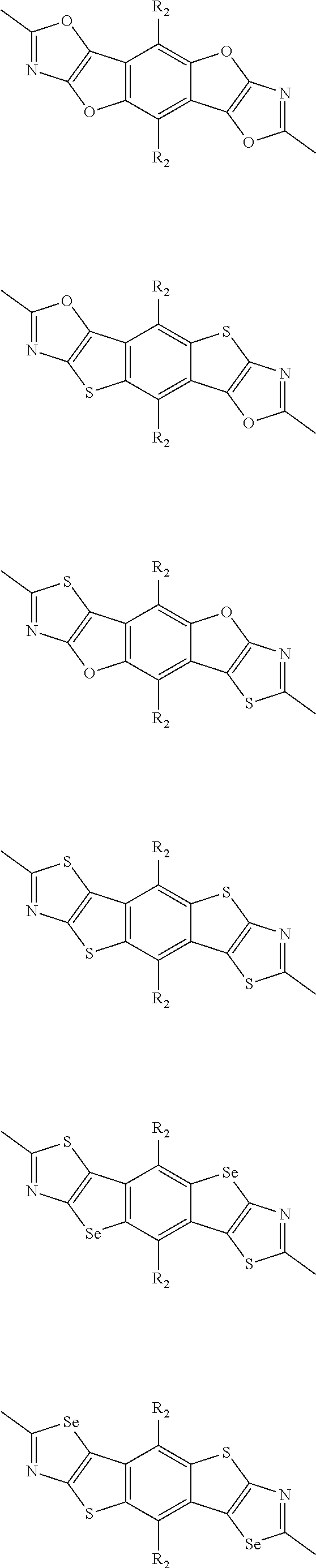
- R 2 is one selected from the group consisting of C1-C30 alkyl, C1-C30 branched alkyl, C1-C30 silane, C1-C30 ester, C1-C30 alkoxy, C1-C30 alkylthio, C1-C30 haloalkyl, C1-C30 carbon chain containing double bond or triple bond, C1-C30 alkyl chain substituted by cyano, nitro, hydroxyl or keto, and halo group; wherein Ar 1 is one selected from the group consisting of fused aromatic hydrocarbons, benzene fused heterocylic compounds, fused heterocylic compounds, benzene, five-membered heterocyclic ring and six-membered heterocyclic ring, wherein the benzene, the five-membered heterocyclic ring and the six-membered heterocyclic ring comprise C1-C30 alkyl groups, C1-C30 branched alkane, C1-C30 si
- Ar 1 is selected from the group consisting of C8-C30 fused aromatic hydrocarbons, C6-C30 benzene fused heterocylic compounds, C5-C30 fused heterocylic compounds, C1-C30 benzene, C1-C30 five-membered heterocyclic ring and C1-C30 six-membered heterocyclic ring, wherein the C1-C30 benzene, the C1-C30 five-membered heterocyclic ring and the C1-C30 six-membered heterocyclic ring comprise C1-C30 alkyl groups, C1-C30 branched alkane, C1-C30 silane, C1-C30 ester, C1-C30 alkoxy, C1-C30 alkylthio, C1-C30 haloalkyl, C1-C30 carbon chain containing double bond or triple bond, C1-C30 alkyl chain containing cyano, nitro, hydroxyl or keto,
- the A2 is selected from the group consisting of:
- R3 is selected from the group consisting of C1-C30 alkyl, C1-C30 branched alkyl, C1-C30 silane, C1-C30 ester, C1-C30 alkoxy, C1-C30 alkylthio, C1-C30 haloalkyl, C1-C30 carbon chain containing double bond or triple bond, C1-C30 alkyl chain substituted by cyano, nitro, hydroxyl or keto and halo group; and wherein Ar 2 is selected from the group consisting of fused aromatic hydrocarbons, benzene fused heterocylic compounds, fused heterocylic compounds, benzene, five-membered heterocyclic ring and six-membered heterocyclic ring, wherein the benzene, the five-membered heterocyclic ring and the six-membered heterocyclic ring comprise C1-C30 alkyl groups, C1-C30 branched alkane, C1-C30 silane,
- Ar 2 is selected from the group consisting of C8-C30 fused aromatic hydrocarbons, C6-C30 benzene fused heterocylic compounds, C5-C30 fused heterocylic compounds, C1-C30 benzene, C1-C30 five-membered heterocyclic ring and C1-C30 six-membered heterocyclic ring, wherein the C1-C30 benzene, the C1-C30 five-membered heterocyclic ring and the C1-C30 six-membered heterocyclic ring comprise C1-C30 alkyl groups, C1-C30 branched alkane, C1-C30 silane, C1-C30 ester, C1-C30 alkoxy, C1-C30 alkylthio, C1-C30 haloalkyl, C1-C30 carbon chain containing alkene or alkyne, C1-C30 alkyl chain containing cyano, nitro, hydroxyl
- each ⁇ is independently selected from one of the following groups
- R 4 is selected from the group consisting of C1-C30 alkyl, C1-C30 branched alkyl, C1-C30 silane, C1-C30 ester, C1-C30 alkoxy, C1-C30 alkylthio, C1-C30 haloalkyl, C1-C30 carbon chain containing double bond or triple bond, C1-C30 alkyl chain substituted by cyano, nitro, hydroxyl or keto and halo group.
- an optical energy gap of the conjugated polymer is in a range from 1.85 to 2.5 eV.
- At least one of the conditions of A1 ⁇ A2 and D1 ⁇ D2 is established.
- a second embodiment of the present invention discloses an organic photovoltaic device comprising a first electrode, a second electrode, and an active layer material.
- the active layer material is disposed between the first electrode and the second electrode, wherein the active layer material comprises a non-fullerene acceptor and a donor, and the donor is the conjugated polymer of the first embodiment.
- an optical energy gap of the non-fullerene acceptor is less than or equal to 1.7 eV.
- an optical energy gap of the donor is in a range from 1.85 to 2.5 eV.
- M1 (13.37 g, 43.33 mmol) in a 500 mL three-necked flask under argon; adding 134 mL anhydrous Tetrahydrofuran (THF) to dissolve the M1 and cooling to 8° C. with stirring; adding dropwise 17.33 mL n-BuLi slowly, and stirring the reaction at 8° C. for 1 hour; adding benzo[1,2-b:4,5-b]dithiophene-4,8-dione (BTD) (4.66 g, 21.13 mmol) in one portion and stirring at 8° C.
- THF Tetrahydrofuran
- a glass coated by a pre-patterned Indium Tin Oxides (ITO) with a sheet resistance of ⁇ 11 ⁇ /sq is used as a substrate.
- the substrate is ultrasonically oscillated in neutral detergent, deionized water, acetone, and isopropanol in sequence, and washed in each step for 15 minutes.
- the washed substrate is further treated with a UV-O 3 cleaner for 15 minutes.
- a top coating layer of ZnO diethylzinc solution, 15 wt % in toluene, diluted with tetrahydrofuran
- ZnO diethylzinc solution, 15 wt % in toluene, diluted with tetrahydrofuran
- the active layer solution is prepared in o-xylene or chlorobenzene (CB), and 0.5% (v/v) 1,8-diiodoocatne (DIO) is added as an additive to adjust the film morphology (polymer: IC trapezoid molecular weight ratio is 1:1 ⁇ 1:1.25).
- the IC trapezoidal molecule also contain Indacenodithienothiophene (IDTT) derivative, such as:
- the concentration of the polymer is 8-10 mg/mL.
- the active layer solution is stirred on a hot plate at 100° C. for at least 3 hours. Then, the polymer solution is returned to the room temperature for spin coating, wherein the film thickness is controlled about 100 nm by coating speed.
- the mixed film is annealed at 120° C. for 5 minutes, and then is transferred to a hot vaporizer.
- a thin layer (8 nm) of MoO 3 is deposited as an anode intermediate layer under a vacuum of 3 ⁇ 10 ⁇ 6 Torr, and then a silver layer with a thickness of 100 nm is deposited as an upper electrode. All batteries are encapsulated with epoxy resin in a glove box.
- the J-V characteristics of the components is measured by a solar simulator (having a xenon lamp with an AM 1.5 G filter) in air and at room temperature and under AM 1.5 G (100 mW cm ⁇ 2 ).
- a standard ruthenium dipole with a KG5 filter is used as a reference cell to calibrate the light intensity to make the mismatch portion of the spectrum consistent.
- the J-V characteristics are recorded by a Keithley 2400 source meter instrument.
- a typical battery has an element area of 4 mm 2 , which is defined by the area of the metal mask aligning element with the aperture.
- Each element has 4 effective points, and the average of these 4 points is PCE AVE .
- Each element has 4 effective points, and the highest value of these is PCE BEsT .
- FIG. 4 shows a representative configuration of an organic photovoltaic device, comprising a substrate 20 (e.g., glass), an anode 22 (e.g., ITO), a cathode 26 (e.g., aluminum or calcium), and an active layer 24 between the anode and cathode, and material of the active layer is the conjugated polymer of the present invention.
- a substrate 20 e.g., glass
- an anode 22 e.g., ITO
- a cathode 26 e.g., aluminum or calcium
- an active layer 24 between the anode and cathode, and material of the active layer is the conjugated polymer of the present invention.
- P5 and P6 are the same except the ratio of m to n.
- the best power conversion efficiency (PCE BEST ) of components prepared with P5 and P6 is 9.58% and 8.55%, respectively.
- P1 and P2 are the same except the ratios of m to n.
- the best power conversion efficiency (PCE BEST ) of components prepared with P1 and P2 is 12.5% and 12.45%, respectively.
- the best power conversion efficiency (PCE BEST ) of P3 and P4 is 12.45% and 10.88%, respectively.
- the ratio of m to n in the low energy gap copolymer disclosed in the prior art usually greatly affects the power conversion efficiency (PCE).
- PCE power conversion efficiency
- the ratio of m to n must be very precise, which makes the process difficult and not conducive to industrial mass production.
- the doping ratio of m to n of P1 to P4 is from 0.9:0.1 to 0.5:0.5, and the best power conversion efficiency (PCE BEST ) of the prepared component can be maintained above 10%. Therefore, the manufacturing process of the device with the conjugated polymer of the present invention is flexible and conducive to industrial mass production.
- D1 D2 ACL Spin thick- Accep- Speed V oc J sc F.F. PCE AVE PCE BEST ness Donor tor (rpm) (V) (mA/cm 2 ) (%) (%) (%) (%) (nm) P1 IDTT 1300 0.8 20.32 76.02 12.29 12.5 123 P2 deriv- 900 0.8 20.02 74.79 11.94 12.45 110 P3 ative 1600 0.796 20.27 75.6 12.18 12.45 106 P4 1050 0.78 19.33 72.74 10.93 10.88 113
Landscapes
- Chemical & Material Sciences (AREA)
- Engineering & Computer Science (AREA)
- Materials Engineering (AREA)
- Health & Medical Sciences (AREA)
- Chemical Kinetics & Catalysis (AREA)
- Medicinal Chemistry (AREA)
- Polymers & Plastics (AREA)
- Organic Chemistry (AREA)
- Photovoltaic Devices (AREA)
Abstract
Description
FF=(V mp *J mp)/(V oc *J sc)
*-(-(Ma)x-(Mb)y-)z* general formula (I)
wherein each of Ma and Mb is a repeating unit or a monomer. The polymer may comprise only one type of repeating units and comprise two or more than two types of repeating units. When the polymeric compound comprises only one type of repeating units, it may be referred to as a homopolymer. When the polymeric compound comprises two or more than two types of repeating units, it may be referred to as “copolymer” or “copolymeric compound”. For example, the copolmeric compound can comprise different repeating units Ma and Mb. Unless otherwise indicated, the assembly of the repeating units in the copolymer can be head to tail, head to head or tail to tail. Further, the copolymer may be a random copolymer, an alternating copolymer or a block copolymer unless otherwise indicated. For example, the general formula (I) can be used to represent the copolymer having Ma with x molar fraction and Mb with y mole fraction, wherein the comonomers of Ma and Mb can be repeated in alternately, irregular, regional regiorandom, regional rules or blocks, and the comonomers of Ma and Mb can exist up to z comonomers. In addition to its composition, a polymeric compound, according to measurement techniques, can be described by degree of polymerization (n) or molar mass (e.g., number average molecular weight (Mn), and/or weight average molecular weight (Mw)).


-
- wherein R1 is one selected from the group consisting of C1-C30 alkyl, C1-C30 branched alkyl, C1-C30 silane, C1-C30 ester, C1-C30 alkoxy, C1-C30 alkylthio, C1-C30 haloalkyl, C1-C30 carbon chain containing double bond or triple bond, C1-C30 alkyl chain substituted by cyano, nitro, hydroxyl or keto, and halo group;
- D1 and D2 are respectively selected from the group consisting of


wherein R2 is one selected from the group consisting of C1-C30 alkyl, C1-C30 branched alkyl, C1-C30 silane, C1-C30 ester, C1-C30 alkoxy, C1-C30 alkylthio, C1-C30 haloalkyl, C1-C30 carbon chain containing double bond or triple bond, C1-C30 alkyl chain substituted by cyano, nitro, hydroxyl or keto, and halo group;
wherein Ar1 is one selected from the group consisting of fused aromatic hydrocarbons, benzene fused heterocylic compounds, fused heterocylic compounds, benzene, five-membered heterocyclic ring and six-membered heterocyclic ring, wherein the benzene, the five-membered heterocyclic ring and the six-membered heterocyclic ring comprise C1-C30 alkyl groups, C1-C30 branched alkane, C1-C30 silane, C1-C30 ester, C1-C30 alkoxy, C1-C30 alkylthio, C1-C30 haloalkyl, C1-C30 carbon chain containing double bond or triple bond, C1-C30 alkyl chain containing cyano, nitro, hydroxyl or keto, or halo group; and
m and n are any integers selected from 2 to 200, respectively.


wherein R3 is selected from the group consisting of C1-C30 alkyl, C1-C30 branched alkyl, C1-C30 silane, C1-C30 ester, C1-C30 alkoxy, C1-C30 alkylthio, C1-C30 haloalkyl, C1-C30 carbon chain containing double bond or triple bond, C1-C30 alkyl chain substituted by cyano, nitro, hydroxyl or keto and halo group; and
wherein Ar2 is selected from the group consisting of fused aromatic hydrocarbons, benzene fused heterocylic compounds, fused heterocylic compounds, benzene, five-membered heterocyclic ring and six-membered heterocyclic ring, wherein the benzene, the five-membered heterocyclic ring and the six-membered heterocyclic ring comprise C1-C30 alkyl groups, C1-C30 branched alkane, C1-C30 silane, C1-C30 ester, C1-C30 alkoxy, C1-C30 alkylthio, C1-C30 haloalkyl, C1-C30 carbon chain containing alkene or alkyne, C1-C30 alkyl chain containing cyano, nitro, hydroxyl or keto, and or halo group.


wherein R4 is selected from the group consisting of C1-C30 alkyl, C1-C30 branched alkyl, C1-C30 silane, C1-C30 ester, C1-C30 alkoxy, C1-C30 alkylthio, C1-C30 haloalkyl, C1-C30 carbon chain containing double bond or triple bond, C1-C30 alkyl chain substituted by cyano, nitro, hydroxyl or keto and halo group.


| TABLE 1 |
| the structures of D1 ≠ D2 |
| ACL | ||||||||
| Spin | thick- | |||||||
| Accep- | Speed | Voc | Jsc | F.F. | PCEAVE | PCEBEST | ness | |
| Donor | tor | (rpm) | (V) | (mA/cm2) | (%) | (%) | (%) | (nm) |
| P5 | IDTT | 1100 | 0.8 | 18.57 | 63.3 | 9.44 | 9.58 | 100 |
| P6 | deriv- | 1000 | 0.78 | 18.29 | 59.4 | 8.5 | 8.55 | 97 |
| ative | ||||||||
| TABLE 2 |
| the structures of D1 = D2 |
| ACL | ||||||||
| Spin | thick- | |||||||
| Accep- | Speed | Voc | Jsc | F.F. | PCEAVE | PCEBEST | ness | |
| Donor | tor | (rpm) | (V) | (mA/cm2) | (%) | (%) | (%) | (nm) |
| P1 | IDTT | 1300 | 0.8 | 20.32 | 76.02 | 12.29 | 12.5 | 123 |
| P2 | deriv- | 900 | 0.8 | 20.02 | 74.79 | 11.94 | 12.45 | 110 |
| P3 | ative | 1600 | 0.796 | 20.27 | 75.6 | 12.18 | 12.45 | 106 |
| P4 | 1050 | 0.78 | 19.33 | 72.74 | 10.93 | 10.88 | 113 | |
Claims (7)




Priority Applications (1)
| Application Number | Priority Date | Filing Date | Title |
|---|---|---|---|
| US16/668,782 US11299581B2 (en) | 2018-10-30 | 2019-10-30 | Conjugated polymer and application thereof |
Applications Claiming Priority (2)
| Application Number | Priority Date | Filing Date | Title |
|---|---|---|---|
| US201862752791P | 2018-10-30 | 2018-10-30 | |
| US16/668,782 US11299581B2 (en) | 2018-10-30 | 2019-10-30 | Conjugated polymer and application thereof |
Publications (2)
| Publication Number | Publication Date |
|---|---|
| US20200140605A1 US20200140605A1 (en) | 2020-05-07 |
| US11299581B2 true US11299581B2 (en) | 2022-04-12 |
Family
ID=70459432
Family Applications (1)
| Application Number | Title | Priority Date | Filing Date |
|---|---|---|---|
| US16/668,782 Active 2039-12-17 US11299581B2 (en) | 2018-10-30 | 2019-10-30 | Conjugated polymer and application thereof |
Country Status (3)
| Country | Link |
|---|---|
| US (1) | US11299581B2 (en) |
| CN (1) | CN111116872B (en) |
| TW (1) | TWI727401B (en) |
Families Citing this family (2)
| Publication number | Priority date | Publication date | Assignee | Title |
|---|---|---|---|---|
| CN113061235B (en) * | 2021-03-22 | 2023-08-08 | 位速科技股份有限公司 | Copolymer and organic photovoltaic element |
| CN114437316B (en) * | 2021-12-31 | 2025-01-28 | 中国科学院重庆绿色智能技术研究院 | A ternary polymer donor material and its preparation and application |
Citations (2)
| Publication number | Priority date | Publication date | Assignee | Title |
|---|---|---|---|---|
| US20130048075A1 (en) * | 2009-11-30 | 2013-02-28 | Universite Laval | Novel photoactive polymers |
| TW201518336A (en) | 2013-07-15 | 2015-05-16 | Lg化學股份有限公司 | Copolymer and organic solar cell containing the same |
Family Cites Families (2)
| Publication number | Priority date | Publication date | Assignee | Title |
|---|---|---|---|---|
| EP2467412A2 (en) * | 2009-09-04 | 2012-06-27 | Plextronics, Inc. | Organic electronic devices and polymers, including photovoltaic cells and diketone-based and diketopyrrolopyrrole-based polymers |
| CN105504234B (en) * | 2016-01-18 | 2019-01-29 | 福建师范大学 | A kind of D-A1-D-A2Polymer and its preparation method and application |
-
2019
- 2019-08-20 TW TW108129635A patent/TWI727401B/en active
- 2019-10-22 CN CN201911008853.9A patent/CN111116872B/en active Active
- 2019-10-30 US US16/668,782 patent/US11299581B2/en active Active
Patent Citations (2)
| Publication number | Priority date | Publication date | Assignee | Title |
|---|---|---|---|---|
| US20130048075A1 (en) * | 2009-11-30 | 2013-02-28 | Universite Laval | Novel photoactive polymers |
| TW201518336A (en) | 2013-07-15 | 2015-05-16 | Lg化學股份有限公司 | Copolymer and organic solar cell containing the same |
Non-Patent Citations (2)
| Title |
|---|
| Taiwan Intellectual Property Office, "Office Action", dated Mar. 24, 2020. |
| Taiwan Intellectual Property Office, "Office Action", dated Nov. 3, 2020. |
Also Published As
| Publication number | Publication date |
|---|---|
| CN111116872B (en) | 2022-12-27 |
| TWI727401B (en) | 2021-05-11 |
| CN111116872A (en) | 2020-05-08 |
| US20200140605A1 (en) | 2020-05-07 |
| TW202017964A (en) | 2020-05-16 |
Similar Documents
| Publication | Publication Date | Title |
|---|---|---|
| US10263190B2 (en) | Difluorobithiophene-based donor-acceptor polymers for electronic and photonic applications | |
| US8835598B2 (en) | Conjugated polymers and their use in optoelectronic devices | |
| US8816035B2 (en) | Photoactive polymers | |
| US8772442B2 (en) | Conjugated polymers and their use in optoelectronic devices | |
| JP5311936B2 (en) | Diketopyrrolopyrrole polymer and method for forming the same | |
| US10516111B2 (en) | Polymer/fullerene formations and their use in electronic/photonic devices | |
| CN102482421B (en) | Conjugated polymers with carbonyl substituted thieno [3,4-b] thiophene units for polymer solar cell active layer materials | |
| US9184392B2 (en) | Polymer and organic solar cell including same | |
| US20120186652A1 (en) | Conjugated Polymers and Their Use in Optoelectronic Devices | |
| Chen et al. | A new benzo [1, 2-b: 4, 5-b′] difuran-based copolymer for efficient polymer solar cells | |
| US9035004B2 (en) | Semiconducting compounds and devices incorporating same | |
| KR101743241B1 (en) | Naphthalene diimide based copolymers with high electron mobility and synthesizing method of the same | |
| Hai et al. | Design and synthesis of triazoloquinoxaline polymers with positioning alkyl or alkoxyl chains for organic photovoltaics cells | |
| US20200140605A1 (en) | Conjugated polymer and application thereof | |
| US9708346B2 (en) | Semiconducting compounds and related devices | |
| WO2018068721A1 (en) | Randomly polymerized conjugated polymers containing random distribution of different side chains | |
| Lim et al. | Synthesis and photovoltaic properties of a thienylenevinylene and diketopyrrolopyrrole copolymer with high mobility | |
| US20180355099A1 (en) | Fluorinated Benzoxadiazole-Based Donor-Acceptor Polymers for Electronic and Photonic Applications | |
| KR101960782B1 (en) | Diketopyrrolopyrrole polymer and method manufacturing the same | |
| Yoon et al. | Solution-Processable Field-Effect Transistors Fabricated Using Aryl Phenoxazine Based Polymers as the Active Layer | |
| US9666805B2 (en) | Bithiophene sulfonamide-based molecular and polymeric semiconductors | |
| US20250366360A1 (en) | Organic random polymer and organic optoelectronic device using the same | |
| Song et al. | Synthesis and photovoltaic properties of polymers based on cyclopentadithiophene and benzimidazole units | |
| Wang et al. | The effect of intramolecular donor-acceptor moieties with donor-π-bridge-acceptor structure on the solar photovoltaic performance. |
Legal Events
| Date | Code | Title | Description |
|---|---|---|---|
| AS | Assignment |
Owner name: RAYNERGY TEK INC., TAIWAN Free format text: ASSIGNMENT OF ASSIGNORS INTEREST;ASSIGNORS:LIAO, CHUANG-YI;LI, WEI-LONG;LEE, CHIA-HAO;REEL/FRAME:050866/0977 Effective date: 20191007 |
|
| FEPP | Fee payment procedure |
Free format text: ENTITY STATUS SET TO UNDISCOUNTED (ORIGINAL EVENT CODE: BIG.); ENTITY STATUS OF PATENT OWNER: SMALL ENTITY |
|
| FEPP | Fee payment procedure |
Free format text: ENTITY STATUS SET TO SMALL (ORIGINAL EVENT CODE: SMAL); ENTITY STATUS OF PATENT OWNER: SMALL ENTITY |
|
| STPP | Information on status: patent application and granting procedure in general |
Free format text: DOCKETED NEW CASE - READY FOR EXAMINATION |
|
| STPP | Information on status: patent application and granting procedure in general |
Free format text: NON FINAL ACTION MAILED |
|
| STPP | Information on status: patent application and granting procedure in general |
Free format text: RESPONSE TO NON-FINAL OFFICE ACTION ENTERED AND FORWARDED TO EXAMINER |
|
| STPP | Information on status: patent application and granting procedure in general |
Free format text: NON FINAL ACTION MAILED |
|
| STPP | Information on status: patent application and granting procedure in general |
Free format text: RESPONSE TO NON-FINAL OFFICE ACTION ENTERED AND FORWARDED TO EXAMINER |
|
| STPP | Information on status: patent application and granting procedure in general |
Free format text: FINAL REJECTION MAILED |
|
| STPP | Information on status: patent application and granting procedure in general |
Free format text: DOCKETED NEW CASE - READY FOR EXAMINATION |
|
| STPP | Information on status: patent application and granting procedure in general |
Free format text: PUBLICATIONS -- ISSUE FEE PAYMENT RECEIVED |
|
| STPP | Information on status: patent application and granting procedure in general |
Free format text: PUBLICATIONS -- ISSUE FEE PAYMENT VERIFIED |
|
| STPP | Information on status: patent application and granting procedure in general |
Free format text: PUBLICATIONS -- ISSUE FEE PAYMENT VERIFIED |
|
| STCF | Information on status: patent grant |
Free format text: PATENTED CASE |
|
| MAFP | Maintenance fee payment |
Free format text: PAYMENT OF MAINTENANCE FEE, 4TH YR, SMALL ENTITY (ORIGINAL EVENT CODE: M2551); ENTITY STATUS OF PATENT OWNER: SMALL ENTITY Year of fee payment: 4 |