US11278439B2 - Ankle-foot orthosis - Google Patents
Ankle-foot orthosis Download PDFInfo
- Publication number
- US11278439B2 US11278439B2 US15/063,079 US201615063079A US11278439B2 US 11278439 B2 US11278439 B2 US 11278439B2 US 201615063079 A US201615063079 A US 201615063079A US 11278439 B2 US11278439 B2 US 11278439B2
- Authority
- US
- United States
- Prior art keywords
- foot
- boot
- ankle
- user
- inner boot
- Prior art date
- Legal status (The legal status is an assumption and is not a legal conclusion. Google has not performed a legal analysis and makes no representation as to the accuracy of the status listed.)
- Active, expires
Links
Images





Classifications
-
- A—HUMAN NECESSITIES
- A61—MEDICAL OR VETERINARY SCIENCE; HYGIENE
- A61F—FILTERS IMPLANTABLE INTO BLOOD VESSELS; PROSTHESES; DEVICES PROVIDING PATENCY TO, OR PREVENTING COLLAPSING OF, TUBULAR STRUCTURES OF THE BODY, e.g. STENTS; ORTHOPAEDIC, NURSING OR CONTRACEPTIVE DEVICES; FOMENTATION; TREATMENT OR PROTECTION OF EYES OR EARS; BANDAGES, DRESSINGS OR ABSORBENT PADS; FIRST-AID KITS
- A61F5/00—Orthopaedic methods or devices for non-surgical treatment of bones or joints; Nursing devices ; Anti-rape devices
- A61F5/01—Orthopaedic devices, e.g. long-term immobilising or pressure directing devices for treating broken or deformed bones such as splints, casts or braces
- A61F5/0102—Orthopaedic devices, e.g. long-term immobilising or pressure directing devices for treating broken or deformed bones such as splints, casts or braces specially adapted for correcting deformities of the limbs or for supporting them; Ortheses, e.g. with articulations
- A61F5/0127—Orthopaedic devices, e.g. long-term immobilising or pressure directing devices for treating broken or deformed bones such as splints, casts or braces specially adapted for correcting deformities of the limbs or for supporting them; Ortheses, e.g. with articulations for the feet
-
- A—HUMAN NECESSITIES
- A61—MEDICAL OR VETERINARY SCIENCE; HYGIENE
- A61F—FILTERS IMPLANTABLE INTO BLOOD VESSELS; PROSTHESES; DEVICES PROVIDING PATENCY TO, OR PREVENTING COLLAPSING OF, TUBULAR STRUCTURES OF THE BODY, e.g. STENTS; ORTHOPAEDIC, NURSING OR CONTRACEPTIVE DEVICES; FOMENTATION; TREATMENT OR PROTECTION OF EYES OR EARS; BANDAGES, DRESSINGS OR ABSORBENT PADS; FIRST-AID KITS
- A61F5/00—Orthopaedic methods or devices for non-surgical treatment of bones or joints; Nursing devices ; Anti-rape devices
- A61F5/01—Orthopaedic devices, e.g. long-term immobilising or pressure directing devices for treating broken or deformed bones such as splints, casts or braces
- A61F5/0102—Orthopaedic devices, e.g. long-term immobilising or pressure directing devices for treating broken or deformed bones such as splints, casts or braces specially adapted for correcting deformities of the limbs or for supporting them; Ortheses, e.g. with articulations
- A61F2005/0132—Additional features of the articulation
- A61F2005/0137—Additional features of the articulation with two parallel pivots
-
- A—HUMAN NECESSITIES
- A61—MEDICAL OR VETERINARY SCIENCE; HYGIENE
- A61F—FILTERS IMPLANTABLE INTO BLOOD VESSELS; PROSTHESES; DEVICES PROVIDING PATENCY TO, OR PREVENTING COLLAPSING OF, TUBULAR STRUCTURES OF THE BODY, e.g. STENTS; ORTHOPAEDIC, NURSING OR CONTRACEPTIVE DEVICES; FOMENTATION; TREATMENT OR PROTECTION OF EYES OR EARS; BANDAGES, DRESSINGS OR ABSORBENT PADS; FIRST-AID KITS
- A61F5/00—Orthopaedic methods or devices for non-surgical treatment of bones or joints; Nursing devices ; Anti-rape devices
- A61F5/01—Orthopaedic devices, e.g. long-term immobilising or pressure directing devices for treating broken or deformed bones such as splints, casts or braces
- A61F5/0102—Orthopaedic devices, e.g. long-term immobilising or pressure directing devices for treating broken or deformed bones such as splints, casts or braces specially adapted for correcting deformities of the limbs or for supporting them; Ortheses, e.g. with articulations
- A61F2005/0132—Additional features of the articulation
- A61F2005/0169—Additional features of the articulation with damping means
Definitions
- the present invention relates generally to orthoses and, more particularly, to ankle-foot orthoses.
- An orthosis is an externally applied mechanical or electromechanical device used to modify the structural and functional characteristics of a patient's neuromuscular and/or skeletal system.
- Orthoses can be used to aid individuals who suffer the physiological effects resulting from many different events, conditions and/or ailments, such as trauma, disease, genetic disorder or neurological impairment such as stroke, spinal cord injury and peripheral neuropathy.
- orthoses can be used to control and/or restrict movement in a given direction, assist movement, reduce weight-bearing forces, correct the shape and function of portions of the body, facilitate movement generally and control, guide, limit or immobilize a joint or extremity.
- An orthosis is customarily adapted for a particular anatomical region.
- Upper-extremity orthoses for example, can be used to restore or improve the function or structural characteristics of the arm segments of an individual.
- lower-extremity orthoses are applied to lower-body joints and limbs.
- Lower-extremity orthoses are frequently used to assist an individual with walking by stabilizing gait, transferring loads and correcting or preventing the progression of deformities.
- Lower-extremity orthoses include foot orthoses, knee orthoses, ankle-foot orthoses (also known as AFOs) and knee-ankle-foot orthoses.
- AFOs are particularly useful for assisting individuals affected by injury, abnormality or other adverse condition in or around the lower leg, ankle and foot.
- the function of the ankle-foot is very complex, providing stability, strength and accommodating a wide variety of physical activities.
- An AFO is typically designed to deal with at least one condition which is creating problems.
- foot drop also known as drop foot
- foot drop is a gait abnormality characterized by the inability or impaired ability to raise the forefoot from the ankle (dorsiflexion).
- Foot drop may be temporary or permanent depending upon the cause, which can include nerve damage, muscle trauma, anatomical abnormalities, disease or toxins.
- first rocker phase the period in the gait cycle, when the foot initially makes contact with the ground surface
- the foot of a drop-foot individual will often slap the ground surface or be planted all at once rather than achieve a normal heel-toe foot strike.
- third rocker phase a drop-foot individual may not be able to support his or her body weight.
- the individual is not able to push off or extend his or her foot during the third rocker phase. As recognized, this extension is required for any running or jumping activities. As such, it can be beneficial to provide dorsiflexion assistance in the third rocker phase as the foot is lifted from the ground surface.
- AFOs can ameliorate drop foot and other adverse conditions by limiting the range of downward extension of a foot away from the leg (plantar flexion).
- many AFOs are made from a rigid or semi-rigid material that resists deformation of the AFO within the plane of dorsiflexion/plantar flexion (i.e., the sagittal plane).
- Other AFOs incorporate a mechanical stop designed to prevent plantar flexion beyond a pre-determined angle.
- the ankle-foot orthosis of the present invention substantially meet the aforementioned needs.
- the ankle-foot orthosis includes an outer boot and an inner boot.
- the outer boot includes an upper portion coupled to a lower portion.
- Each of the upper and lower portions includes a tensioner.
- the outer boot may also include a plantar flexion stop and a hinge coupling the upper portion to the lower portion.
- Upper and lower portions of the outer boot are made from a substantially stiff material, whereas the inner boot is made from a substantially flexible material.
- the outer boot substantially supports, and the inner boot substantially conforms to, the foot-ankle joint and part the lower-leg region of a user.
- the inherent stiffness of the outer boot inhibits torsion of a foot within the transverse, or coronal, plane, while a hinge and/or joint permits flexion in the sagittal plane about the axis defined by the user's ankle.
- Tensioners impede buckling of the inner boot during dorsiflexion.
- the hinges and/or joints enhance cooperation between the upper and lower portions of the outer boot to provide functionality and enhanced comfort.
- the upper and lower portions of the outer boot can be tailored to provide customized levels of therapy and support to a user.
- the shape and inherent elasticity of the inner boot, as well as the foot plate of the outer boot facilitate energy storage during dorsiflexion as the user transitions through stance phase from second rocker to third rocker. This stored energy can then be released during plantar flexion to facilitate the transition from stance phase to swing phase.
- the AFO of the present invention helps to the user to achieve a substantially normal gait cycle.
- FIG. 1 is a side view of an embodiment of an ankle-foot orthosis
- FIG. 2 is a side view of an embodiment of an ankle-foot orthosis
- FIG. 3 is a front perspective view of the ankle-foot orthosis illustrated in FIG. 2 ;
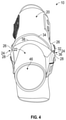
- FIG. 4 is a rear perspective view of the ankle-foot orthosis illustrated in FIG. 2 ;
- FIG. 5A is a side view of an outer boot of the ankle-foot orthosis illustrated in FIG. 2 ;
- FIG. 5B is a side view of an inner boot of the ankle-foot orthosis illustrated in FIG. 2 ;
- FIG. 6A is a side view of an outer boot of the ankle-foot orthosis illustrated in FIG. 2 ;
- FIG. 6B is a side view of an inner boot of the ankle-foot orthosis illustrated in FIG. 2 ;
- FIG. 7 is a bottom perspective view of an outer boot of the ankle-foot orthosis illustrated in FIG. 2 ;
- FIG. 8 is a top perspective view of the ankle-foot orthosis illustrated in FIG. 2 ;
- FIG. 9 is a side view of an outer boot of the ankle-foot orthosis illustrated in FIG. 2 ;
- FIG. 10 is a top perspective view of an inner boot of the ankle-foot orthosis illustrated in FIG. 2 ;
- FIG. 11 is a diagram of the anatomical planes
- FIG. 12 is a diagram of the ankle-foot region
- FIG. 13 is a diagram of the ankle joint
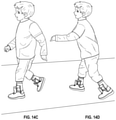
- FIGS. 14A-D illustrate use of an embodiment of an ankle-foot orthosis during the gait cycle
- FIG. 15A is a top plan view of a joint for an ankle-foot orthosis
- FIG. 15B is a side view of the joint illustrated in FIG. 15A ;
- FIG. 15C is a bottom plan view of the joint illustrated in FIG. 15A ;
- FIG. 15D is a top perspective view of the joint illustrated in FIG. 15A ;
- FIG. 15E is a bottom perspective view of the joint illustrated in FIG. 15A ;
- FIG. 15F is a front elevation view of the joint illustrated in FIG. 15A .
- FIGS. 1-4 An ankle-foot orthosis (or AFO) 10 is depicted generally in FIGS. 1-4 .
- AFO 10 can be used for any number of purposes, the illustrated embodiments are especially suitable for use as an orthotic device to assist with walking, as generally shown in FIGS. 14A-D .
- AFO 10 may be particularly suitable for counteracting foot drop while facilitating foot lift during the gait cycle.
- AFO 10 can be used to provide assistance during swing phase, the combination of hinged outer boot made of a relatively harder material and an interior boot made of a substantially softer, more elastic material allows AFO 10 to provide assistance during stance phase as well.
- AFO 10 includes outer boot 12 and inner boot 14 .
- Outer boot 12 includes upper portion 20 and lower portion 22 .
- Upper portion 20 and lower portion 22 can be operably connected by at least one hinge assembly 24 .
- upper portion 20 and lower portion 22 are generally operably connected by two hinge assemblies 24 positioned proximal user's ankle joint.
- hinge assemblies 24 are positioned medially and laterally with respect to a user's ankle.
- hinge assemblies 24 define an axis of rotation substantially aligned with the anatomical axis of rotation of the user's talocrural joint.
- upper portion 20 and lower portion 22 may include upper recesses 26 and lower recesses 28 , respectively.
- Upper and lower recesses 26 , 28 are generally adapted to receive a portion of hinge assembly 24 .
- upper and lower recesses 26 , 28 are generally sufficiently deep in relation to the thickness of hinge assembly 24 so as not to protrude beyond the inner surface of outer boot 12 . In this manner, contact between inner boot 14 and hinge assemblies 24 can be minimized or eliminated, and hinge assembly 24 does not extend a significant distance beyond an outer surface of outer boot 12 .
- hinge assembly 24 may be in the form of a joint 90 , as depicted in FIGS. 15A-F .
- Joint 90 includes first member 92 and second member 94 .
- First member 92 generally has structure, such as flanges 96 , adapted to grasp second member 94 .
- First and second member 92 , 94 may be attached to outer boot 12 by any number of fastening members, such as, for example, rivets.
- second member 94 defines aperture 98 such that flanges 96 clasp an end portion of second end 94 proximal aperture 98 .
- the respective ends of first member 92 and second member 94 are thereby attached to each other at what becomes the central portion of joint 90 to form a pivoting single-axis hinge.
- joint 90 can maintain a relatively thin profile, which enhance comfort, reduce overall weight and facilitate overall operability of AFO 10 .
- joint 90 offers a streamlined profile that reduces obstruction and/or interference with a shoe or other footwear worn or donned by a user.
- Outer boot 12 may also include posterior stop 30 , as shown in FIG. 1 .
- Posterior stop 30 is generally adapted to limit a user's range of plantar flexion when fitted with AFO 10 .
- Posterior stop 30 can be any number of stops known to one skilled in the art, such as, for example, the stop mechanisms described in U.S. Pat. No. 7,018,350, US 2003/0153852, US 2003/0153858, US 2003/0153858 and US 2003/0158506. In the embodiment shown in FIGS.
- upper portion 20 and lower portion 22 of outer boot 12 may include complementary surfaces, such as upper and lower recess edges 32 , 36 and upper and lower posterior edges 34 , 38 , that limit plantar flexion of a user fitted with AFO 10 .
- upper recess edges 32 of upper recesses 26 can be shifted into abutment with lower recess edges 36 of lower recesses 28 .
- upper portion 20 presents upper posterior edge 34 that can be shifted into abutment with lower posterior edge 38 of lower portion 22 in the sagittal plane.
- outer boot 12 Due to the rigidity of the material of outer boot 12 , contact between upper recess edge 32 and lower recess edge 36 , and/or contact between upper posterior edge 34 and lower posterior edge 38 , substantially inhibits, or prevents, further plantar flexion of AFO 10 .
- outer boot 12 is constructed such that contact between upper recess edges 32 and lower recess edges 36 occurs simultaneously at medial and lateral locations of outer boot 12 .
- upper portion 20 and lower portion 22 form an angle ⁇ .
- Angle ⁇ decreases during plantar flexion and increases during dorsiflexion. Plantar flexion is effectively limited, or stopped, when angle ⁇ reaches its minimum, angle ⁇ min .
- the range of flexion permitted by AFO 10 and which is defined by ⁇ min can be varied by changing the configuration of various upper portion 20 and lower portion 22 .
- angle ⁇ reaches angle ⁇ min when upper recess edges 32 abut with lower recess edges 36 .
- angle ⁇ reaches angle ⁇ min when the stopping bumper and the bumper rest of posterior stop are in abutment. Therefore, when angle ⁇ reaches angle ⁇ min , upper portion 20 cannot be further rotated posteriorly with respect to lower portion 22 and plantar flexion is effectively stopped.
- outer boot 12 includes a number of features adapted to enhance overall comfort and functionality of AFO 10 .
- Upper portion 20 includes upper forewalls 40 and lower portion 22 includes lower forewalls 42 .
- Upper forewalls 40 and lower forewalls 42 allow outer boot 12 to substantially surround the ankle-foot region of a user while providing sufficient space for the insertion of inner boot 14 .
- upper forewalls 40 extend partially around the anterior portion of the lower tibial region of the user's leg
- lower forewalls 42 extend partially around the superior/dorsum portion of the metatarsal region of the user's leg (i.e., a portion of the user's foot and lower portion of a user's ankle).
- upper forewalls 40 extend approximately 45% to 75% around the lower tibial region of the user's leg, or approximately 60% around the lower tibial region of the user's leg, while lower forewalls 42 extend approximately 70% to 90% around the metatarsal region of the user's foot, or approximately 80% around the lower metatarsal region of the user's foot.
- upper forewalls 40 define a gap of between approximately one inch (1′′) to approximately one and one-half inches (11 ⁇ 2′′) around the lower tibial region of the user's leg, while lower forewalls 42 extend approximately one inch (1′′) to approximately one and one-half inches (11 ⁇ 2′′) around the metatarsal region of the user's foot.
- the configuration of forewalls 40 , 42 are particularly configured to achieve a desired a desired relationship with other components.
- Lower portion 22 includes extension 44 .
- Extension 44 generally extends distally from the base of lower portion 22 in a substantially transverse plane. In an embodiment, extension 44 extends sufficiently to support the phalangeal region, or toes, of a user's foot.
- Upper portion 20 and lower portion 22 may be characterized by relief openings, or cutouts, to enhance comfort at anticipated pressure points and zones of AFO 10 and to augment motion control.
- the term “cutout” refers to the general shape of a relief opening rather than to a process or method of forming the relief opening.
- lower portion 22 defines heel opening 46 .
- the size of heel opening 46 relative to size of lower portion 22 can vary, but is generally adapted to accommodate the heel of a user. Specifically, the heel of a user can protrude through heel opening 46 without causing impingement upon the region of the heel at or around heel opening 46 in lower portion 22 .
- Including heel opening 46 in lower portion 22 substantially reduces and can eliminate a fulcrum effect that occurs at the heel strike when a user wears any type of AFO/boot or device that substantially immobilizes the user's foot in relation to the user's lower leg.
- This fulcrum effect is generally best illustrated when a user is walking in a rigid orthosis or ski boot. Specifically, this fulcrum effect occurs when a user enters heel-strike (first rocker) phase as the rigid portion of the outer boot 14 makes contact with the ground surface.
- the rotation about the contact point creates an anterior force that pulls at the knee joint, thereby causing the user to draw his or her knee forward at a faster than normal during the gait cycle, as the user transitions from first rocker of the stance phase to second rocker of the stance phase.
- the presence of heel opening 46 allows for a more fluid and normal transition from first rocker of the stance phase to second rocker of the stance phase for the user by reducing the anterior force pulling at the knee joint.
- lower portion 22 also defines inner cutout 48 and outer cutout 50 .
- the sizes of inner cutout 48 and outer cutout 50 can vary.
- inner cutout 48 is sized to accommodate the area of a user's foot proximal the navicular and the outer cutout 50 is sized to accommodate the area of a user's foot proximal the fifth metatarsal.
- inner cutout 48 and outer cutout 50 can reduce callusing around these areas.
- Inner boot 14 is generally disposed intermediate outer boot 12 and user such that inner boot 14 functions, in part, as a liner for outer boot 12 .
- inner boot 14 is generally more dynamic in that it permits greater freedom of movement.
- inner boot 14 includes first layer 52 , and may include second layer 54 as well.
- Second layer 54 may be of a different material than first layer 52 so as to provide additional padding.
- second layer 54 (which may be made of padding) may be included in only a portion of inner boot 14 .
- First layer 52 is generally a continuous piece of substantially flexible material that can be conformingly situated in the interior space defined by outer boot 12 . As discussed below, first layer 52 of inner boot 14 generally helps to curtail movement.
- First layer 52 of inner boot 14 also stores and releases energy during the gait cycle to provide resistance, or a binding effect, as the user transitions from second rocker to third rocker of the stance phase.
- Second layer 54 generally enhances overall comfort by providing added cushioning at select pressure points.
- Inner boot 14 includes vertical section 56 , flexion section 58 and distal section 60 .
- Vertical section 56 extends above flexion section 58 and substantially around Achilles region of user.
- Distal section 60 extends distally from flexion section toward the phalangeal region of a user's foot.
- Flexion section 58 substantially conforms to and surrounds the central portion of a user's foot and ankle.
- a portion of vertical section 56 may be separated from flexion section 58 by upper opening 62 .
- no upper opening 62 is present such that vertical section 56 is not separated from flexion section 58 . Referring to FIG.
- dorsal opening 64 divides flexion section 58 of inner boot 14 into outer portion 66 and inner portion 68 .
- Dorsal opening 64 allows outer and inner portions 66 , 68 to be separated so as to accommodate insertion of the user's foot in multiple positions. Once the user's foot is inserted, outer and inner portions 66 , 68 of flexion section 58 substantially conform around metatarsal and talus region of the user's ankle.
- inner boot 14 is sized and configured so that dorsal opening 64 will be carefully sized to help accommodate particular functions of AFO 10 .
- AFO 10 generally also includes a mechanism for securing outer boot 12 and inner boot 14 to the ankle-foot region of a user.
- AFO 10 includes upper strap 70 and lower strap 72 .
- tensioning devices could also be used without departing from the spirit or scope of the present invention, such as, for example, laces or ratcheting buckles.
- FIGS. 11-13 illustrate various well understood reference points. More specifically, FIG. 11 shows the Median/saggital plane 110 , the frontal/coronal plane 112 and the transverse/horizontal plane 114 of the human body 100 . Similarly, FIGS. 12 and 13 show the well-known components of the human ankle.
- the ankle 120 includes a tibia 122 , fibula 124 , talus 126 , achilles tendon 128 , posterior inferior tibiofibular ligament 131 , anterior inferior tibiofibular ligament 132 , posterior talofibular ligament 133 , anterior talofibular ligament 134 , and calcaneofibular ligament 136 . Also shown is the lateral malleolus 142 and talocrural joint 144 .
- Upper and lower straps 70 , 72 are secured to upper and lower portions 20 , 22 , respectively, such as by rivets 74 .
- Each strap 70 , 72 may be secured medially or laterally and with one or more rivets 74 .
- upper strap 70 is secured to medial side of upper portion 20 with two rivets 74
- lower strap 72 is secured to medial side of lower portion 22 with one rivet 74 .
- lower strap 72 is positioned proximal the instep of the user.
- upper and lower portions 20 , 22 may include one or more attachment rings 76 , such as metallic d-rings or other, similar hardware.
- attachment rings can be secured to medial or lateral locations on upper and lower portions 20 , 22 and with one or multiple with rivets 74 .
- upper strap 70 is pulled over dorsal opening 64 , inserted through attachment ring 76 and pulled back over dorsal opening 64 , thereby drawing upper forewalls 40 toward each other.
- lower strap 72 is pulled over dorsal opening 64 , inserted through attachment ring 76 and pulled back over dorsal opening 64 , thereby drawing lower forewalls 40 toward each other.
- upper strap 70 is positioned substantially parallel to the transverse plane and lower strap 72 is positioned at an angle ⁇ between approximately 30° and approximately 60° in relation to the transverse plane.
- lower strap 72 is positioned at an angle ⁇ of approximately 45° in relation to the transverse plane.
- Tensioned upper and lower straps 70 , 72 can be secured in place by any number of methods. In an embodiment, tensioned upper and lower straps 70 , 72 are secured in place with integrated hook-and-loop fasteners. Upper and lower straps 70 , 72 may also include pads 78 , as shown in FIGS. 2, 3, 5A, 6A, and 7-9 . Pads 78 enhance user comfort by distributing the inward force of tensioned straps 70 , 72 over a larger surface area. In generally, pads 78 are large enough such that when upper and lower straps 70 , 72 are tensioned, a portion of the pads are positioned beneath the upper forewalls 40 of upper portion 20 and lower forewalls 42 of lower portion 22 .
- Pads 78 may also be made from a softer material than the material used to construct upper and lower straps 70 , 72 . Pads 78 may also be made from a relatively stiff material to enhance other features of operability, such as storing energy, resisting buckling of inner boot 14 and further resisting undesirable movement at ankle-foot joint.
- pad 78 for upper strap 70 abuts pad 78 for lower strap 72 when upper and lower straps 70 , 72 are tensioned and secured. Such abutment substantially reduces or eliminates buckling of the inner boot 14 when the user's tibia rotates over the foot during the transition from second rocker to third rocker of the stance phase of the gait cycle.
- AFO 10 utilizes a single pad 78 that can be tensioned by both upper and lower straps 70 , 72 .
- outer boot 12 should be made from a relatively stiff material, while inner boot 14 should be made from a relatively elastic material.
- outer boot 12 is made from a polypropylene material or copolymer material.
- the polypropylene material should be relatively stiff.
- the thickness of outer boot 12 can be in the range of approximately one-sixteenth of an inch ( 1/16′′) to approximately one-fourth of an inch (1 ⁇ 4′′). In an embodiment, the thickness of outer boot 12 is approximately one-sixteenth of an inch ( 1/16′′). Outer boot 12 can be vacuum-formed.
- inner boot 14 is made from an elastomer, such as a silicone-based orthoflex material.
- the thickness of inner boot 14 can be in the range of approximately one-sixteenth of an inch ( 1/16′′) to approximately one-half inch (1 ⁇ 2′′). In an embodiment the thickness of inner boot 14 is approximately three-sixteenths of an inch ( 3/16′′).
- Inner boot 14 can be formed through standard vacuum forming processes used to manufacture articles such as drape form, blister form and bubble form.
- joint 90 is made from plastic or a metallic material, such as steel or aluminum.
- the length of joint may be between one inch (1′′) and five inches (5′′), or approximately 3.10 inches.
- the width of joint may be between 0.25 inches and 3 inches, or approximately 0.63 inches.
- the ends of joint 90 are curved upwards such that joint 90 has the properties of a leaf spring.
- AFO 10 can be used to treat a wide range of pathologies that cause lower extremity weakness of the dorsiflexors and plantarflexors at the ankle that result in an impaired gait.
- Embodiments of AFO 10 as described herein can be used to control and/or treat various combination of motions that include poor foot posture and sagittal plane deficits such as foot drop (swing phase). and foot slap (stance phase) recurvatum (hyperextension at the knee) and crouch-knee positions.
- AFO 10 utilizes inner boot 14 seated inside articulated outer boot 12 to dynamically assist and resist users with transverse, sagittal and/or coronal plane comprise at the foot and ankle.
- AFO 10 allows and assists dorsiflexion while also limiting plantar flexion and maintaining a neutralized or corrected alignment at the foot and ankle.
- AFO 10 can also assist and resist forward movement.
- the combination of inner boot 14 made from a unitary piece of flexible material and rigid, articulated outer boot 12 effectively controls unwanted sagittal plane alignments (such as recurvatum, crouch or knee flexion instabilities) while creating a spring effect that can be directed. This spring effect substantially eliminates the need for stop motion.
- a single-boot articulated AFO requires a plantarflexion stop and a single-boot solid ankle AFO provides sagittal plane stop motion for both plantar flexion and dorsiflexion.
- the combination of both a flexible inner boot and rigid outer boot allows a user to effectively control unwanted sagittal plane alignments such as recurvatum, crouch or knee flexion instabilities.
- the inner boot 14 is adapted to receive and substantially surround a foot of a user and to allow some level of flexion of the foot of the user about a flexion axis and the outer boot 12 is adapted to receive the inner boot and further help to control movement.
- outer boot 12 has upper portion 20 and lower portion 22 hingeably coupled to one another. Upper portion 20 and lower portion 22 are less flexible than the inner boot 14 .
- AFO 10 is rotatable between plantar-flexed and dorsiflexed positions, with an equilibrium position located there between. When in the equilibrium position the inner boot and the outer boot cooperate to hold a user's foot in a substantially static or neutral position.
- the inner boot and the outer boot cooperate with one another to produce a force designed to urge the user's foot to the dorsiflexed position.
- the inner boot and the outer boot create a force to urge the user's foot to plantar flexed position.
- AFO 10 can thereby provide powered walking assistance in the sagittal plane while preventing unwanted end-range dorsiflexion and plantar flexion motion at the ankle during the stance phase of the gait cycle. This is achieved by establishing soft and hard zones that eliminate the push-pull effect during the at the end of the stance phase while still providing functional control of the lower limb, thereby enhancing ambulatory performance.
- heel opening 46 of outer boot 12 exposes the softer material of inner boot 14 . This substantially reduces, or eliminates, anterior draw at the user's knee as the patient transitions to mid-stance, or second rocker position.
- inner boot 14 decelerates dorsiflexion of the user's foot. Specifically, inner boot 14 resists tibial progression over the foot of the user as the material of inner boot loads. This, in turn, prevents foot slap and enhances single-limb stance stability, while one or more pads 78 impede or substantially eliminate buckling of inner boot 14 .
- the deformation of inner boot 14 that occurs during the initial transition from second rocker to third rocker causes inner boot 14 to store elastic energy.
- extension 44 is deformed, thereby also creating stored energy.
- Elastic energy stored by inner boot 14 and extension 44 is then released at the end of the transition from second rocker to third rocker as the heel, and later the toes, of the user are lifted off the ground surface.
- This release of elastic energy by inner boot 14 provides plantar flexion-power assistance as the user transitions from stance phase to swing phase, facilitating longer step lengths and normal foot clearance.
- the power generated by AFO 10 during third rocker phase thereby produces a more natural stepping motion and step lengths even accommodating jumping and/or running gaits, such as depicted in FIGS. 14A-D .
- AFO 10 can be pre-positioned when obtaining a negative cast or during the modification or fitting process with respect to a user's limb in a desired sagittal alignment to optimize control of the limb. For example, if a user presents an undesirable low-tone crouch knee position, AFO 10 can be positioned such that upper portion 20 defines a substantially vertical axis. In contrast, if the user has a hyperextended knee, upper portion 20 can be positioned at an acute angle in relation to the transverse plane to oppose the compromised postural alignment of the hyperextended knee.
Landscapes
- Health & Medical Sciences (AREA)
- Nursing (AREA)
- Orthopedic Medicine & Surgery (AREA)
- Engineering & Computer Science (AREA)
- Biomedical Technology (AREA)
- Heart & Thoracic Surgery (AREA)
- Vascular Medicine (AREA)
- Life Sciences & Earth Sciences (AREA)
- Animal Behavior & Ethology (AREA)
- General Health & Medical Sciences (AREA)
- Public Health (AREA)
- Veterinary Medicine (AREA)
- Orthopedics, Nursing, And Contraception (AREA)
Abstract
Description
Claims (13)
Priority Applications (1)
| Application Number | Priority Date | Filing Date | Title |
|---|---|---|---|
| US15/063,079 US11278439B2 (en) | 2016-03-07 | 2016-03-07 | Ankle-foot orthosis |
Applications Claiming Priority (1)
| Application Number | Priority Date | Filing Date | Title |
|---|---|---|---|
| US15/063,079 US11278439B2 (en) | 2016-03-07 | 2016-03-07 | Ankle-foot orthosis |
Publications (2)
| Publication Number | Publication Date |
|---|---|
| US20170252197A1 US20170252197A1 (en) | 2017-09-07 |
| US11278439B2 true US11278439B2 (en) | 2022-03-22 |
Family
ID=59723050
Family Applications (1)
| Application Number | Title | Priority Date | Filing Date |
|---|---|---|---|
| US15/063,079 Active 2038-11-14 US11278439B2 (en) | 2016-03-07 | 2016-03-07 | Ankle-foot orthosis |
Country Status (1)
| Country | Link |
|---|---|
| US (1) | US11278439B2 (en) |
Cited By (2)
| Publication number | Priority date | Publication date | Assignee | Title |
|---|---|---|---|---|
| USD954276S1 (en) * | 2021-07-02 | 2022-06-07 | Chao Li | Plantar fascitis night splint |
| USD965155S1 (en) * | 2022-05-09 | 2022-09-27 | Chengfei Liu | Plantar fasciitis night splint |
Families Citing this family (6)
| Publication number | Priority date | Publication date | Assignee | Title |
|---|---|---|---|---|
| US11963897B2 (en) * | 2018-02-16 | 2024-04-23 | Orthotic Care Services, LLP | Extension control member for use with an ankle-foot orthosis |
| JP7023508B2 (en) * | 2018-05-01 | 2022-02-22 | 有限会社出水義肢装具製作所 | Manufacturing method of ankle foot orthotic device and ankle foot orthotic device |
| CN115212527B (en) * | 2022-06-07 | 2023-08-22 | 中山大学附属第一医院 | Rehabilitation training equipment for limited ankle joint dorsiflexion/back extension |
| USD1057178S1 (en) * | 2023-04-14 | 2025-01-07 | Kathleen Marie Halat | Splint |
| CZ2024192A3 (en) * | 2024-05-13 | 2025-11-26 | Invent Medical Group, S.R.O. | Lower limb orthosis with inner and outer shell |
| USD1106665S1 (en) | 2024-10-11 | 2025-12-23 | Ariat International, Inc. | Boot with ankle brace |
Citations (70)
| Publication number | Priority date | Publication date | Assignee | Title |
|---|---|---|---|---|
| US3896503A (en) | 1973-02-09 | 1975-07-29 | Nat Res Dev | Endosphosthetic ankle joint devices |
| US3896502A (en) | 1973-01-12 | 1975-07-29 | Nat Res Dev | Endoprosthetic bone joint devices |
| US4289122A (en) | 1979-04-23 | 1981-09-15 | Mason Randy D F | Ankle-foot orthosis |
| USD286183S (en) | 1984-06-04 | 1986-10-14 | Scott Orthopedics, Inc. | Adjustable joint for a knee brace |
| US4665904A (en) | 1985-06-19 | 1987-05-19 | Max Lerman | Circular hinge for orthotic braces |
| US4693239A (en) | 1986-01-21 | 1987-09-15 | Orthomedics, Inc. | Orthosis |
| USD297368S (en) | 1986-08-15 | 1988-08-23 | Scott Orthotic Labs, Inc. | Combined ankle and foot orthosis |
| US4771768A (en) | 1986-12-16 | 1988-09-20 | United States Manufacturing Company | Controlled motion ankle fracture walker |
| US4869267A (en) * | 1988-05-10 | 1989-09-26 | Royce Medical Company | Adjustable tension ankle support |
| US4974583A (en) | 1990-04-10 | 1990-12-04 | Excell Medical Systems, Inc. | Leg and ankle brace |
| USD316150S (en) | 1988-01-22 | 1991-04-09 | Gillette Children's Hospital Association | Orthotic ankle flexure |
| US5022390A (en) | 1990-05-11 | 1991-06-11 | Whiteside Stacey A | Orthotic device for limiting limb notion at a joint |
| US5066305A (en) | 1988-10-25 | 1991-11-19 | Model & Instrument Development Corporation | Prosthetic foot having a low profile cantilever spring keel |
| US5326364A (en) | 1992-12-16 | 1994-07-05 | Wright Medical Technology, Inc. | Trapezial implant |
| US5328444A (en) | 1993-02-11 | 1994-07-12 | Whiteside Stacey A | Orthotic device for limiting limb motion at a joint |
| US5501659A (en) | 1993-02-08 | 1996-03-26 | Smith & Nephew Donjoy, Inc. | Ankle brace |
| US5545127A (en) | 1995-04-24 | 1996-08-13 | Detoro; William | Laterally adjustable ankle and foot orthosis |
| USD385358S (en) | 1995-03-21 | 1997-10-21 | Tamarack Habilitation Technologies, Inc. | Orthotic ankle flexure |
| US5716336A (en) | 1996-07-26 | 1998-02-10 | Hines; Kevin L. | Adjustable foot brace |
| US5799659A (en) | 1995-01-05 | 1998-09-01 | Stano; William S. | Ankle foot orthosis night splint with orthowedge |
| US5826304A (en) | 1993-08-06 | 1998-10-27 | Carlson; J. Martin | Composite flexure unit |
| US5853380A (en) | 1994-02-02 | 1998-12-29 | Boston Brace International Inc. | Soft ankle/foot orthosis |
| US5897514A (en) | 1998-02-09 | 1999-04-27 | Currier; Mark R. | Range of motion limiter |
| US5944679A (en) | 1998-01-27 | 1999-08-31 | Detoro; William W. | Adjustable ankle and foot orthosis brace |
| US5961477A (en) | 1998-05-08 | 1999-10-05 | Turtzo; Craig H. | Ankle/foot orthosis |
| US6207092B1 (en) | 1999-05-28 | 2001-03-27 | K. Jabat, Inc. | Process for making a drag shield for a power mower |
| US6409695B1 (en) | 1999-07-27 | 2002-06-25 | John D. Connelly | Ankle-foot orthotic |
| FR2827158A1 (en) | 2001-07-12 | 2003-01-17 | Jean Christophe Christ Mignard | DEVICE FOR CONTROLLING THE ANGULAR DISPLACEMENT OF TWO PARTS OF THE BODY |
| US20030125653A1 (en) | 2001-12-28 | 2003-07-03 | Meyer Grant C. | D-DAFO (DeRoss-dynamic ankle foot orthosis) |
| WO2003063730A2 (en) | 2002-01-28 | 2003-08-07 | Patrick Scott Hinshon | Ankle-foot orthosis |
| EP1374810A1 (en) | 2002-06-28 | 2004-01-02 | Tamarack Habilitation Technologies, Inc. | Adjustable mounting housing for prosthetic ankle flexure joint |
| USD487512S1 (en) | 2003-04-08 | 2004-03-09 | Scott Orthotic Labs, Inc. | Joint for an orthosis |
| WO2004066890A1 (en) | 2003-01-28 | 2004-08-12 | Trulife Limited | Orthopaedic device |
| US6787223B2 (en) | 2002-03-06 | 2004-09-07 | Foster-Miller, Inc. | Flexure and precision clamp |
| US6827696B1 (en) | 2002-05-30 | 2004-12-07 | Mark T. Maguire | Ankle-foot orthosis |
| US6929614B1 (en) | 2003-03-25 | 2005-08-16 | Timothy D. Jackovitch | Flexion control ankle joint hinge |
| US6945946B2 (en) | 2002-05-17 | 2005-09-20 | John E. Rooney | Method and apparatus for the treatment of plantar ulcers and foot deformities |
| US7018352B2 (en) | 2003-05-23 | 2006-03-28 | Pressman Martin M | Modular ankle-foot orthosis |
| US7044926B2 (en) | 2004-02-24 | 2006-05-16 | Tamarack Habilitation Technologies, Inc. | Spherical joint orthosis |
| GB2420716A (en) | 2004-12-06 | 2006-06-07 | Robert John Watts | Ankle foot orthosis |
| US7112180B2 (en) | 2001-05-31 | 2006-09-26 | F. Gottinger Orthopaedie-Technik Gmbh | Below-knee orthotic device |
| US7182743B2 (en) | 2003-03-04 | 2007-02-27 | Fla Orthopedics, Inc. | Orthopedic night foot splint |
| US7270644B2 (en) | 2003-09-05 | 2007-09-18 | Ossur Hf | Ankle-foot orthosis having an orthotic footplate |
| US7335177B2 (en) | 2004-04-23 | 2008-02-26 | Ronan Reynolds | Ankle-foot orthosis |
| US7468004B2 (en) | 2006-12-14 | 2008-12-23 | Buhm Soo Kim | Device for correcting golf swing posture |
| US7476208B1 (en) * | 2005-02-16 | 2009-01-13 | Frank Shirley | Method of fabricating an ankle brace |
| USD596301S1 (en) | 2008-04-25 | 2009-07-14 | Ossur Hf | Orthopedic device |
| US7572241B2 (en) | 2003-03-04 | 2009-08-11 | Bsn Medical, Inc. | Orthopedic night foot splint |
| US7678067B1 (en) | 2006-04-07 | 2010-03-16 | Smith Cleveland C | Apparatus for providing dorsiflexion assistance in ankle foot orthoses and night splints |
| US7682322B2 (en) | 2005-02-15 | 2010-03-23 | Engelman Ian K | Articulated orthosis providing lift support |
| US7753866B2 (en) | 2007-09-07 | 2010-07-13 | Timothy Jackovitch | Flexion control ankle joint with spherical hinge |
| US7967768B2 (en) | 2003-04-14 | 2011-06-28 | Watts Robert J | Ankle-foot orthosis |
| US20110196276A1 (en) * | 2010-02-10 | 2011-08-11 | Jeffrey Andrew Kuhn | Custom ankle brace system |
| US8007456B2 (en) | 2003-08-14 | 2011-08-30 | Stano William S | Variously adjustable night splint with adjustable spacers and lock-out hinge |
| WO2011137999A1 (en) | 2010-05-05 | 2011-11-10 | Consiglio Nazionale Delle Ricerche | Joint for articulations with pseudo-elastic elements |
| WO2011141283A1 (en) | 2010-05-11 | 2011-11-17 | Wilhelm Julius Teufel Gmbh | Orthosis and production method |
| US8251935B2 (en) | 2006-03-17 | 2012-08-28 | Bonutti Research, Inc. | Ankle orthosis |
| US8282588B2 (en) | 2008-12-03 | 2012-10-09 | Ossur Hf | Orthopedic device having hybrid frame elements |
| US8328745B2 (en) | 2008-05-14 | 2012-12-11 | Ossur Hf | Leg support |
| US20130000245A1 (en) | 2011-06-30 | 2013-01-03 | Jesse Tarr | Anchor bolt tensioning process and improvements to structural maintenance therefrom |
| USD693471S1 (en) | 2013-03-12 | 2013-11-12 | Scott Orthotics, LLC | Ankle-foot orthotic |
| US20140213953A1 (en) * | 2013-01-30 | 2014-07-31 | Bracemasters International, Llc | Ankle Foot Orthosis (AFO) and Method of Making the Same |
| US20140257162A1 (en) | 2011-10-21 | 2014-09-11 | Flexbrace International Ab | Ankle-Foot Orthosis Element and a Manufacturing Method Therefor |
| US20140276314A1 (en) * | 2013-03-15 | 2014-09-18 | Bracemasters International, Llc | Ankle Foot Orthosis (AFO) and Method of Making the Same |
| US20140288475A1 (en) | 2011-03-01 | 2014-09-25 | Robert John Watts | Ankle-foot orthoses |
| US20150094637A1 (en) | 2011-04-07 | 2015-04-02 | Nathan Schwartz | Ankle-Foot Orthosis |
| US9022762B2 (en) | 2011-07-06 | 2015-05-05 | Beacon Innovations, Llc | Orthosis modification tool |
| US9078735B2 (en) | 2012-01-25 | 2015-07-14 | Coyote Design & Manufacturing, Inc | Ankle-foot orthotic device |
| US9168270B2 (en) | 2006-01-31 | 2015-10-27 | Opko Ireland Global Holdings, Ltd. | Water-insoluble, iron-containing mixed metal, granular material |
| US9192502B2 (en) | 2012-08-21 | 2015-11-24 | Robert C. Drillio | Ankle-foot orthotic |
-
2016
- 2016-03-07 US US15/063,079 patent/US11278439B2/en active Active
Patent Citations (82)
| Publication number | Priority date | Publication date | Assignee | Title |
|---|---|---|---|---|
| US3896502A (en) | 1973-01-12 | 1975-07-29 | Nat Res Dev | Endoprosthetic bone joint devices |
| US3896503A (en) | 1973-02-09 | 1975-07-29 | Nat Res Dev | Endosphosthetic ankle joint devices |
| US4289122A (en) | 1979-04-23 | 1981-09-15 | Mason Randy D F | Ankle-foot orthosis |
| USD286183S (en) | 1984-06-04 | 1986-10-14 | Scott Orthopedics, Inc. | Adjustable joint for a knee brace |
| US4665904A (en) | 1985-06-19 | 1987-05-19 | Max Lerman | Circular hinge for orthotic braces |
| US4693239A (en) | 1986-01-21 | 1987-09-15 | Orthomedics, Inc. | Orthosis |
| USD297368S (en) | 1986-08-15 | 1988-08-23 | Scott Orthotic Labs, Inc. | Combined ankle and foot orthosis |
| US4771768A (en) | 1986-12-16 | 1988-09-20 | United States Manufacturing Company | Controlled motion ankle fracture walker |
| USD316150S (en) | 1988-01-22 | 1991-04-09 | Gillette Children's Hospital Association | Orthotic ankle flexure |
| US4869267A (en) * | 1988-05-10 | 1989-09-26 | Royce Medical Company | Adjustable tension ankle support |
| US5066305A (en) | 1988-10-25 | 1991-11-19 | Model & Instrument Development Corporation | Prosthetic foot having a low profile cantilever spring keel |
| US4974583A (en) | 1990-04-10 | 1990-12-04 | Excell Medical Systems, Inc. | Leg and ankle brace |
| US5022390A (en) | 1990-05-11 | 1991-06-11 | Whiteside Stacey A | Orthotic device for limiting limb notion at a joint |
| US5326364A (en) | 1992-12-16 | 1994-07-05 | Wright Medical Technology, Inc. | Trapezial implant |
| US5501659A (en) | 1993-02-08 | 1996-03-26 | Smith & Nephew Donjoy, Inc. | Ankle brace |
| US5328444A (en) | 1993-02-11 | 1994-07-12 | Whiteside Stacey A | Orthotic device for limiting limb motion at a joint |
| US5826304A (en) | 1993-08-06 | 1998-10-27 | Carlson; J. Martin | Composite flexure unit |
| US5853380A (en) | 1994-02-02 | 1998-12-29 | Boston Brace International Inc. | Soft ankle/foot orthosis |
| US5799659A (en) | 1995-01-05 | 1998-09-01 | Stano; William S. | Ankle foot orthosis night splint with orthowedge |
| USD385358S (en) | 1995-03-21 | 1997-10-21 | Tamarack Habilitation Technologies, Inc. | Orthotic ankle flexure |
| US5545127A (en) | 1995-04-24 | 1996-08-13 | Detoro; William | Laterally adjustable ankle and foot orthosis |
| US5716336A (en) | 1996-07-26 | 1998-02-10 | Hines; Kevin L. | Adjustable foot brace |
| US5944679A (en) | 1998-01-27 | 1999-08-31 | Detoro; William W. | Adjustable ankle and foot orthosis brace |
| US5897514A (en) | 1998-02-09 | 1999-04-27 | Currier; Mark R. | Range of motion limiter |
| US5961477A (en) | 1998-05-08 | 1999-10-05 | Turtzo; Craig H. | Ankle/foot orthosis |
| US6447889B2 (en) | 1999-05-28 | 2002-09-10 | K. Jabot, Inc. | Drag shield for a power mower |
| US6207092B1 (en) | 1999-05-28 | 2001-03-27 | K. Jabat, Inc. | Process for making a drag shield for a power mower |
| US6355335B1 (en) | 1999-05-28 | 2002-03-12 | K. Jabat, Inc. | Flexible hinge |
| US6409695B1 (en) | 1999-07-27 | 2002-06-25 | John D. Connelly | Ankle-foot orthotic |
| US7112180B2 (en) | 2001-05-31 | 2006-09-26 | F. Gottinger Orthopaedie-Technik Gmbh | Below-knee orthotic device |
| FR2827158A1 (en) | 2001-07-12 | 2003-01-17 | Jean Christophe Christ Mignard | DEVICE FOR CONTROLLING THE ANGULAR DISPLACEMENT OF TWO PARTS OF THE BODY |
| US20030125653A1 (en) | 2001-12-28 | 2003-07-03 | Meyer Grant C. | D-DAFO (DeRoss-dynamic ankle foot orthosis) |
| US6860864B2 (en) | 2001-12-28 | 2005-03-01 | Grant C. Meyer | D-DAFO (DeRoss-dynamic ankle foot orthosis) |
| WO2003063730A2 (en) | 2002-01-28 | 2003-08-07 | Patrick Scott Hinshon | Ankle-foot orthosis |
| US20030153852A1 (en) | 2002-01-28 | 2003-08-14 | Hinshon Patrick Scott | Methods of making and using an ankle-foot orthosis |
| US20030153859A1 (en) | 2002-01-28 | 2003-08-14 | Hinshon Patrick Scott | Articulating ankle-foot orthosis |
| US20030158506A1 (en) | 2002-01-28 | 2003-08-21 | Hinshon Patrick Scott | Compact posterior stop for an ankle-foot orthosis |
| US7018350B2 (en) | 2002-01-28 | 2006-03-28 | Patrick Scott Hinshon | Methods of making and using an ankle-foot orthosis |
| US6787223B2 (en) | 2002-03-06 | 2004-09-07 | Foster-Miller, Inc. | Flexure and precision clamp |
| US6945946B2 (en) | 2002-05-17 | 2005-09-20 | John E. Rooney | Method and apparatus for the treatment of plantar ulcers and foot deformities |
| US6827696B1 (en) | 2002-05-30 | 2004-12-07 | Mark T. Maguire | Ankle-foot orthosis |
| EP1374810A1 (en) | 2002-06-28 | 2004-01-02 | Tamarack Habilitation Technologies, Inc. | Adjustable mounting housing for prosthetic ankle flexure joint |
| US6824523B2 (en) | 2002-06-28 | 2004-11-30 | Tamarack Habilitation Technologies, Inc. | Adjustable mounting housing for orthotic ankle flexure joint |
| WO2004066890A1 (en) | 2003-01-28 | 2004-08-12 | Trulife Limited | Orthopaedic device |
| US7572241B2 (en) | 2003-03-04 | 2009-08-11 | Bsn Medical, Inc. | Orthopedic night foot splint |
| US7182743B2 (en) | 2003-03-04 | 2007-02-27 | Fla Orthopedics, Inc. | Orthopedic night foot splint |
| US6929614B1 (en) | 2003-03-25 | 2005-08-16 | Timothy D. Jackovitch | Flexion control ankle joint hinge |
| USD487512S1 (en) | 2003-04-08 | 2004-03-09 | Scott Orthotic Labs, Inc. | Joint for an orthosis |
| US7967768B2 (en) | 2003-04-14 | 2011-06-28 | Watts Robert J | Ankle-foot orthosis |
| US7018352B2 (en) | 2003-05-23 | 2006-03-28 | Pressman Martin M | Modular ankle-foot orthosis |
| US8007456B2 (en) | 2003-08-14 | 2011-08-30 | Stano William S | Variously adjustable night splint with adjustable spacers and lock-out hinge |
| US7270644B2 (en) | 2003-09-05 | 2007-09-18 | Ossur Hf | Ankle-foot orthosis having an orthotic footplate |
| US7044926B2 (en) | 2004-02-24 | 2006-05-16 | Tamarack Habilitation Technologies, Inc. | Spherical joint orthosis |
| US7335177B2 (en) | 2004-04-23 | 2008-02-26 | Ronan Reynolds | Ankle-foot orthosis |
| GB2420716A (en) | 2004-12-06 | 2006-06-07 | Robert John Watts | Ankle foot orthosis |
| US7682322B2 (en) | 2005-02-15 | 2010-03-23 | Engelman Ian K | Articulated orthosis providing lift support |
| US7476208B1 (en) * | 2005-02-16 | 2009-01-13 | Frank Shirley | Method of fabricating an ankle brace |
| US7896828B1 (en) | 2005-02-16 | 2011-03-01 | Frank Shirley | Orthosis |
| US9168270B2 (en) | 2006-01-31 | 2015-10-27 | Opko Ireland Global Holdings, Ltd. | Water-insoluble, iron-containing mixed metal, granular material |
| US8251935B2 (en) | 2006-03-17 | 2012-08-28 | Bonutti Research, Inc. | Ankle orthosis |
| US7678067B1 (en) | 2006-04-07 | 2010-03-16 | Smith Cleveland C | Apparatus for providing dorsiflexion assistance in ankle foot orthoses and night splints |
| US7468004B2 (en) | 2006-12-14 | 2008-12-23 | Buhm Soo Kim | Device for correcting golf swing posture |
| US20120310121A1 (en) | 2007-03-16 | 2012-12-06 | Bonutti Boris P | Ankle orthosis |
| US7753866B2 (en) | 2007-09-07 | 2010-07-13 | Timothy Jackovitch | Flexion control ankle joint with spherical hinge |
| USD596301S1 (en) | 2008-04-25 | 2009-07-14 | Ossur Hf | Orthopedic device |
| US8328745B2 (en) | 2008-05-14 | 2012-12-11 | Ossur Hf | Leg support |
| US8282588B2 (en) | 2008-12-03 | 2012-10-09 | Ossur Hf | Orthopedic device having hybrid frame elements |
| US20110196276A1 (en) * | 2010-02-10 | 2011-08-11 | Jeffrey Andrew Kuhn | Custom ankle brace system |
| WO2011137999A1 (en) | 2010-05-05 | 2011-11-10 | Consiglio Nazionale Delle Ricerche | Joint for articulations with pseudo-elastic elements |
| WO2011141283A1 (en) | 2010-05-11 | 2011-11-17 | Wilhelm Julius Teufel Gmbh | Orthosis and production method |
| US20140288475A1 (en) | 2011-03-01 | 2014-09-25 | Robert John Watts | Ankle-foot orthoses |
| US20150094637A1 (en) | 2011-04-07 | 2015-04-02 | Nathan Schwartz | Ankle-Foot Orthosis |
| US20130000245A1 (en) | 2011-06-30 | 2013-01-03 | Jesse Tarr | Anchor bolt tensioning process and improvements to structural maintenance therefrom |
| US8584430B2 (en) | 2011-06-30 | 2013-11-19 | Jesse Tarr | Anchor bolt tensioning process |
| US9022762B2 (en) | 2011-07-06 | 2015-05-05 | Beacon Innovations, Llc | Orthosis modification tool |
| US20140257162A1 (en) | 2011-10-21 | 2014-09-11 | Flexbrace International Ab | Ankle-Foot Orthosis Element and a Manufacturing Method Therefor |
| US9078735B2 (en) | 2012-01-25 | 2015-07-14 | Coyote Design & Manufacturing, Inc | Ankle-foot orthotic device |
| US9192502B2 (en) | 2012-08-21 | 2015-11-24 | Robert C. Drillio | Ankle-foot orthotic |
| US20140213953A1 (en) * | 2013-01-30 | 2014-07-31 | Bracemasters International, Llc | Ankle Foot Orthosis (AFO) and Method of Making the Same |
| USD693471S1 (en) | 2013-03-12 | 2013-11-12 | Scott Orthotics, LLC | Ankle-foot orthotic |
| US9168166B2 (en) | 2013-03-12 | 2015-10-27 | Scott Orthotics, LLC | Ankle-foot orthosis |
| US20140276314A1 (en) * | 2013-03-15 | 2014-09-18 | Bracemasters International, Llc | Ankle Foot Orthosis (AFO) and Method of Making the Same |
Cited By (2)
| Publication number | Priority date | Publication date | Assignee | Title |
|---|---|---|---|---|
| USD954276S1 (en) * | 2021-07-02 | 2022-06-07 | Chao Li | Plantar fascitis night splint |
| USD965155S1 (en) * | 2022-05-09 | 2022-09-27 | Chengfei Liu | Plantar fasciitis night splint |
Also Published As
| Publication number | Publication date |
|---|---|
| US20170252197A1 (en) | 2017-09-07 |
Similar Documents
| Publication | Publication Date | Title |
|---|---|---|
| US11278439B2 (en) | Ankle-foot orthosis | |
| US8529484B2 (en) | Orthotic foot brace | |
| US8226589B2 (en) | Night splint with digital dorsiflexion | |
| US11951027B2 (en) | Customizable knee brace intended for patients with osteoarthritis | |
| US10357390B2 (en) | Ankle foot tensioned orthosis | |
| US10105252B2 (en) | Orthotic device | |
| US7722556B2 (en) | Ankle foot orthosis and method therefor | |
| US20160158053A1 (en) | Device for mitigating plantar fasciitis | |
| DK2533734T3 (en) | ORTHOPEDIC FOOTWEAR TO REMOVE DROP FOOT SYMPTOMS | |
| EP2242460B1 (en) | Ankle foot orthosis for counteracting the supination/pronation of the foot | |
| US9452077B2 (en) | Foot and ankle orthoses that enable natural movement of the foot | |
| Murphy et al. | Lower limb orthoses | |
| US7147612B2 (en) | Apparatus for correction of leg deformities | |
| US10835409B1 (en) | Apparatus for correction of leg deformities | |
| CN113924069B (en) | Lower limb orthosis | |
| JPH0753608Y2 (en) | Short leg brace | |
| CA2692534A1 (en) | Orthotic foot brace | |
| Joint et al. | Orthotic Management for Children with Cerebral Palsy | |
| EP1634553A1 (en) | Dorsal brace for ankle joint |
Legal Events
| Date | Code | Title | Description |
|---|---|---|---|
| AS | Assignment |
Owner name: ORTHOTIC CARE SERVICES, LLP, MINNESOTA Free format text: ASSIGNMENT OF ASSIGNORS INTEREST;ASSIGNOR:HINSHON, PATRICK SCOTT;REEL/FRAME:040394/0128 Effective date: 20161115 |
|
| STPP | Information on status: patent application and granting procedure in general |
Free format text: NON FINAL ACTION MAILED |
|
| STPP | Information on status: patent application and granting procedure in general |
Free format text: RESPONSE TO NON-FINAL OFFICE ACTION ENTERED AND FORWARDED TO EXAMINER |
|
| STPP | Information on status: patent application and granting procedure in general |
Free format text: NON FINAL ACTION MAILED |
|
| STPP | Information on status: patent application and granting procedure in general |
Free format text: NON FINAL ACTION MAILED |
|
| STPP | Information on status: patent application and granting procedure in general |
Free format text: RESPONSE TO NON-FINAL OFFICE ACTION ENTERED AND FORWARDED TO EXAMINER |
|
| STPP | Information on status: patent application and granting procedure in general |
Free format text: FINAL REJECTION MAILED |
|
| STPP | Information on status: patent application and granting procedure in general |
Free format text: DOCKETED NEW CASE - READY FOR EXAMINATION |
|
| STPP | Information on status: patent application and granting procedure in general |
Free format text: NON FINAL ACTION MAILED |
|
| STPP | Information on status: patent application and granting procedure in general |
Free format text: RESPONSE TO NON-FINAL OFFICE ACTION ENTERED AND FORWARDED TO EXAMINER |
|
| STPP | Information on status: patent application and granting procedure in general |
Free format text: NOTICE OF ALLOWANCE MAILED -- APPLICATION RECEIVED IN OFFICE OF PUBLICATIONS |
|
| STCF | Information on status: patent grant |
Free format text: PATENTED CASE |
|
| MAFP | Maintenance fee payment |
Free format text: PAYMENT OF MAINTENANCE FEE, 4TH YR, SMALL ENTITY (ORIGINAL EVENT CODE: M2551); ENTITY STATUS OF PATENT OWNER: SMALL ENTITY Year of fee payment: 4 |