US11277832B2 - Dynamic allocation of resources to support split processing of wireless network communication layers - Google Patents
Dynamic allocation of resources to support split processing of wireless network communication layers Download PDFInfo
- Publication number
- US11277832B2 US11277832B2 US16/789,915 US202016789915A US11277832B2 US 11277832 B2 US11277832 B2 US 11277832B2 US 202016789915 A US202016789915 A US 202016789915A US 11277832 B2 US11277832 B2 US 11277832B2
- Authority
- US
- United States
- Prior art keywords
- processing unit
- protocol processing
- layer protocol
- layer
- network
- Prior art date
- Legal status (The legal status is an assumption and is not a legal conclusion. Google has not performed a legal analysis and makes no representation as to the accuracy of the status listed.)
- Active
Links
Images




Classifications
-
- H04W72/0433—
-
- H—ELECTRICITY
- H04—ELECTRIC COMMUNICATION TECHNIQUE
- H04W—WIRELESS COMMUNICATION NETWORKS
- H04W88/00—Devices specially adapted for wireless communication networks, e.g. terminals, base stations or access point devices
- H04W88/08—Access point devices
- H04W88/085—Access point devices with remote components
-
- H—ELECTRICITY
- H04—ELECTRIC COMMUNICATION TECHNIQUE
- H04W—WIRELESS COMMUNICATION NETWORKS
- H04W72/00—Local resource management
- H04W72/20—Control channels or signalling for resource management
- H04W72/29—Control channels or signalling for resource management between an access point and the access point controlling device
-
- H—ELECTRICITY
- H04—ELECTRIC COMMUNICATION TECHNIQUE
- H04W—WIRELESS COMMUNICATION NETWORKS
- H04W36/00—Hand-off or reselection arrangements
- H04W36/24—Reselection being triggered by specific parameters
- H04W36/26—Reselection being triggered by specific parameters by agreed or negotiated communication parameters
-
- H—ELECTRICITY
- H04—ELECTRIC COMMUNICATION TECHNIQUE
- H04W—WIRELESS COMMUNICATION NETWORKS
- H04W36/00—Hand-off or reselection arrangements
- H04W36/34—Reselection control
- H04W36/38—Reselection control by fixed network equipment
-
- H—ELECTRICITY
- H04—ELECTRIC COMMUNICATION TECHNIQUE
- H04W—WIRELESS COMMUNICATION NETWORKS
- H04W80/00—Wireless network protocols or protocol adaptations to wireless operation
- H04W80/08—Upper layer protocols
Definitions
- LTE Long Term Evolution
- RAN Radio Access Network
- user equipment such as a mobile phone, a computer, or any remotely controlled machine and provides connection with its core network (CN).
- CN core network
- the radio access network provides respective user equipment access (such as Internet access) via the core network.
- Communication processing layers in a RAN architecture can include an RF (Radio Frequency) layer, a physical layer, a physical layer, a MAC (Multi-media Access Control) layer, a RLC (Radio Link Control) layer, a PDCP (Packet Data Converge Protocol) layer, an RRC (Radio Resource Control) layer, a data layer, etc.
- RF Radio Frequency
- a physical layer a physical layer
- MAC Multi-media Access Control
- RLC Radio Link Control
- PDCP Packet Data Converge Protocol
- RRC Radio Resource Control
- a conventional wireless network can include multiple different types of resources to handle processing at the different communication layers.
- first resources such as so-called CUs (Centralized Units) can be configured to support processing of upper-layers of wireless network communications such as at the PDCP layer, RRC layer, etc.
- Second resources such as so-called DUs (Distributed Units) can be configured to support processing of lower-layers of the wireless communications such as the RF layer, physical layer, MAC layer, etc.
- the split of which layers the CUs and DUs support may vary depending on a respective implementation.
- LTE cellular networks e.g., 3G, 4G, 5G.
- conventional cellular networks including CUs and DUs supporting split layer processing of wireless communications require that user equipment move from one location to another or require a change in availability of a CU or DU in order to be reallocated a new combination of upper-layer and/or lower-layer processing units to provide a higher quality communication service.
- Embodiments herein provide novel ways of dynamically allocating upper and lower communication layer processing resources to support different wireless services in a network environment.
- a wireless network includes a first candidate pool of upper-layer communication processing units (such as CUs or Centralized Units) and a second candidate pool of lower-layer communication processing units (such as DUs) or Distributed Units) to support split-layer communication processing at different locations.
- the first candidate pool of multiple upper-layer communication processing units (each of which is potentially disposed at different geographical locations) can include a first upper-layer processing unit, a second upper-layer processing unit, a third upper-layer processing unit etc.
- the second pool of multiple lower-layer communication processing units (each of which is potentially disposed at different geographical locations) can include a first lower-layer processing unit, a second lower-layer processing unit, a third lower-layer processing unit, etc.
- Each of the multiple upper-layer processing units supports processing of upper wireless communication layers; each of the multiple lower-layer processing units supports processing of lower wireless communication layers such as in an LTE (Long Terminal Evolution) network.
- LTE Long Terminal Evolution
- different combinations of an upper-layer processing unit and lower-layer processing unit support different services.
- a specific combination of an upper-layer processing unit and lower-layer processing unit may be required to provide a respective communication service to a requesting communication device.
- selection of an upper-layer processing unit disposed close to a lower-layer processing unit provides a higher level of quality communication service to respective user equipment.
- a combination of a first upper-layer processing unit and a first lower-layer processing unit in the network support a first communication service over a wireless communication link established between a wireless access point and a communication device in a network.
- the first upper-layer processing unit performs communication processing at the upper-layers of the multiple network communication layers; the first lower-layer processing unit performs communication processing at the lower-layers of the multiple network communication layers.
- the communication device user equipment
- a second wireless service such as a high quality of service
- the network (such as a management resource of the core network) notifies the currently allocated first upper-layer processing unit of the request for operation of the second service.
- the first upper-layer processing unit and the first lower-layer processing unit are used to support the requested second communication service.
- the first upper-layer processing unit determines whether the combination of the original allocation of the first upper-layer processing unit and the first lower-layer processing unit is able to provide the second service. If so, the first upper-layer processing unit selects itself in lieu of another upper-layer processing unit (second upper-layer processing unit, third upper-layer processing unit, etc.) to support the second service over the wireless communication link.
- another upper-layer processing unit second upper-layer processing unit, third upper-layer processing unit, etc.
- the first upper-layer processing unit selects a second upper-layer processing unit (which becomes a replacement to itself) in furtherance of supporting the second communication service.
- the first upper-layer processing unit (or other suitable resource) is operable to select the second upper-layer processing unit to provide processing at the upper-layers if it is unable to support a desired service. If the new combination of the (newly selected) second upper-layer processing unit and the first lower-layer processing unit supports the requested second service, the selected second upper-layer-processing unit selected from the first candidate pool of upper-layer processing units is used in conjunction with the first lower-layer processing unit to support the second service over the wireless communication link.
- the second upper-layer processing unit (or other suitable resource) can be configured to select a second lower-layer processing unit to be used instead of the first lower-layer processing unit to support the requested service.
- the communication device and wireless communication link can be handed off from the first lower-layer processing unit to the second lower-layer processing unit such that the new combination (of the second upper-layer processing unit and the second lower-layer processing unit) supports the requested second wireless service.
- selection of a replacement upper-layer processing unit can include: selecting an upper-layer processing unit (such as a second upper-layer processing unit) because it is physically closer to the first lower-layer processing unit than the first upper-layer processing unit.
- an upper-layer processing unit such as a second upper-layer processing unit
- the nearness of the second upper-layer processing unit to the first lower-layer processing unit and use of such a combination of processing units reduces latencies associated with processing at the different layers. This, in turn, makes it possible to perform higher-level communication services.
- the upper-layer processing units process upper-layers associated with communications conveyed over the wireless communication link; the lower-layer processing units process lower-layers associated with the communications conveyed over the wireless communication link. Dynamic allocation of an upper-layer processing unit and/or lower-layer processing unit supports variations in quality of service.
- the split between the upper-layers and lower-layers occurs between the PDCP (Packet Data Convergence Protocol) layer and RLC (Radio Link Control) layer.
- the PDCP (Packet Data Convergence Protocol) layer is included in the upper-layers and the RLC (Radio Link Control) layer is included in the lower-layers.
- any of the resources as discussed herein can include one or more computerized devices, mobile communication devices, servers, base stations, wireless communication equipment, communication management systems, workstations, user equipment, handheld or laptop computers, or the like to carry out and/or support any or all of the method operations disclosed herein.
- one or more computerized devices or processors can be programmed and/or configured to operate as explained herein to carry out the different embodiments as described herein.
- One such embodiment comprises a computer program product including a non-transitory computer-readable storage medium (i.e., any computer readable hardware storage medium) on which software instructions are encoded for subsequent execution.
- the instructions when executed in a computerized device (hardware) having a processor, program and/or cause the processor (hardware) to perform the operations disclosed herein.
- Such arrangements are typically provided as software, code, instructions, and/or other data (e.g., data structures) arranged or encoded on a non-transitory computer readable storage medium such as an optical medium (e.g., CD-ROM), floppy disk, hard disk, memory stick, memory device, etc., or other a medium such as firmware in one or more ROM, RAM, PROM, etc., or as an Application Specific Integrated Circuit (ASIC), etc.
- the software or firmware or other such configurations can be installed onto a computerized device to cause the computerized device to perform the techniques explained herein.
- embodiments herein are directed to a method, system, computer program product, etc., that supports operations as discussed herein.
- One embodiment includes a computer readable storage medium and/or system having instructions stored thereon to facilitate control of a device.
- the instructions when executed by computer processor hardware, cause the computer processor hardware (such as one or more co-located or disparately processor devices) to: establish a wireless communication link between a wireless access point and a communication device, the wireless communication link initially supported by a combination of a first upper-layer communication processing unit and a first lower-layer communication processing unit in the network; notify the first upper-layer communication processing unit of a requested service to be provided to the communication device over the wireless communication link; and at the upper-layer communication processing unit, select an upper-layer communication processing unit from a candidate pool of multiple available upper-layer processing units to support the requested service over the wireless communication link.
- system, method, apparatus, instructions on computer readable storage media, etc., as discussed herein also can be embodied strictly as a software program, firmware, as a hybrid of software, hardware and/or firmware, or as hardware alone such as within a processor (hardware or software), or within an operating system or a within a software application.
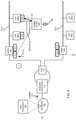
- FIG. 1 is an example diagram illustrating split communication processing at multiple network communication layers amongst multiple resources to support communications over a wireless communication link according to embodiments herein.
- FIG. 2 is an example diagram illustrating network layers and corresponding splits according to embodiments herein.
- FIG. 3 is an example diagram illustrating different companion upper and lower-layer processing options according to embodiments herein.
- FIG. 4 is an example diagram illustrating communications associated with a request for use of an upgraded wireless communication service (session) according to embodiments herein.
- FIG. 5 is an example diagram illustrating response communications associated with a request for use of an upgraded wireless communication service according to embodiments herein.
- FIG. 6 is an example diagram illustrating a transfer of upper-layer processing from a first upper-layer processing unit to a second upper-layer processing unit according to embodiments herein.
- FIG. 7 is an example diagram illustrating communications initiating a transfer of lower-layer processing from a first lower-layer processing unit to a second lower-layer processing unit according to embodiments herein.
- FIG. 8 is an example diagram illustrating results of transferring lower-layer processing from a first lower-layer processing unit to a second lower-layer processing unit to provide an upgraded wireless communication service to respective user equipment according to embodiments herein.
- FIG. 9 is a diagram illustrating an example computer architecture to execute one or more operations according to embodiments herein.
- FIG. 10 is an example diagram illustrating a method according to embodiments herein.
- a network includes a first candidate pool of multiple upper-layer communication processing units (CUs) and a second candidate pool of lower-layer communication processing units (DUs) to support split-layer processing. That is, each upper-layer processing unit processes the upper-layers of communications over the wireless communication link; each lower-layer processing unit processes lower-layers of communications over the wireless communication link.
- CUs upper-layer communication processing units
- DUs lower-layer communication processing units
- a first upper-layer processing unit and a first lower-layer processing unit in the network provide a first service over a wireless communication link established between a wireless access point and a communication device in a network.
- the network In response to receiving a request to support a second wireless service (higher Quality of Service), the network notifies the first upper-layer processing unit of the requested second service.
- the first upper-layer processing unit selects a second upper-layer processing unit.
- the selected second upper-layer-processing unit selected from the first candidate pool is used in conjunction with the first lower-layer processing unit to support the second service.
- the communication device and wireless communication link can be handed off from a first lower-layer processing unit to a second lower-layer processing unit if the combination of a currently selected upper-layer processing unit and a currently selected lower-layer processing unit are unable to support the second service.
- FIG. 1 is an example diagram illustrating a network environment supporting different levels of quality of wireless service to one or more communication devices according to embodiments herein.
- network environment 100 includes core network 190 - 1 (which includes or provides access to the Internet or other networks), head-end resource 110 , hub 115 , content distribution node 121 , shared communication link 131 , tap 125 - 1 , tap 125 - 2 , content distribution node 122 , shared communication link 132 , tap 126 - 1 , tap 126 - 2 , etc.
- the network environment 100 can include any combination or number of resources (hubs, distribution nodes, shared communication links, taps, etc.) to provide data delivery access to one or more communication devices.
- resources hubs, distribution nodes, shared communication links, taps, etc.
- network environment 100 can be any suitable type of network supporting wired and wireless communications.
- the network environment 100 is a DOCSIS (Data Over Cable Service Interface Specification) network, which supports high-bandwidth data transfer to an existing cable TV (CATV) system.
- DOCSIS Data Over Cable Service Interface Specification
- CATV cable TV
- HFC hybrid fiber-coaxial
- network environment 100 supports LTE communications (such as based on 3G, 4G, 5G, etc.).
- the components or resources in network environment 100 collectively provide each respective user (such as user 108 operating mobile communication device 120 ) wireless access to a remote network such as network 190 .
- the user 108 operates the communication device 120 to establish a wireless communication link 127 with a respective wireless access point interface or base station at tap 125 - 2 .
- the wireless communication link 127 supports LTE communications (such as based on 3G, 4G, 5G, etc.).
- the communication device 120 is able to transmit upstream communications over the wireless communication link 127 to tap 125 - 2 .
- Tap 125 - 1 forwards the upstream communications over shared communication link 131 (such as a coaxial cable, fiber, hard-wired link, etc.) to node 121 .
- Node 121 forwards the upstream communications over a respective communication link to hub 115 .
- Hub 115 forwards the upstream communications through the head end resource 110 to and through network 190 for delivery to a destination (network address) as specified by the communication device 120 .
- the network 190 forwards downstream communications (addressed to the communication device 120 ) through the head end resource 110 and hub 115 to node 121 .
- Node 121 further forwards the respective downstream communications over the shared communication link 131 to tap 125 - 2 .
- the base station at tap 125 - 2 forwards the communications over wireless communication link 127 to the communication device 120 .
- network environment 100 supports bi-directional communications between the communication device 120 and resources in network 190 .
- network environment 100 includes multiple different types of resources to handle processing of communications at different communication layers.
- first resources such as so-called CUs (Centralized Units or upper-layer communication processing units) are operable to support processing of upper-layers such as at the PDCP layer, RRC layer, etc., associated with wireless communications.
- Second resources such as DUs (Distributed Units or lower-layer communication processing units) are operable to support processing of lower-layers of the wireless communications such as the RF layer, physical layer, MAC layer, etc.
- each of the Centralized Units can further include or support a further split of a respective CU-CP (Centralized Unit-Control Plane) and a CU-UP (Centralized Unit-User Plane).
- CU-CP Centralized Unit-Control Plane
- CU-UP Centralized Unit-User Plane
- eMBB enhanced Mobile BroadBand
- URLLC Ultra-Reliable and Low-Latency Communications
- the core management resource 140 decides, based on information such as location of a respective communication device, capabilities of the communication device, received wireless power signal levels from the communication device at the base stations, etc., whether and which CU-DU pair is initially assigned for use by the communication device.
- the split of which layers the CUs and DUs support may vary depending on an implementation.
- the upper-layer communication processing units process upper-layers associated with communications conveyed over the wireless communication link 127 ; the lower-layer communication processing units (DUs) process lower-layers associated with the communications conveyed over the wireless communication link 127 .
- dynamic allocation of an upper-layer processing unit and/or lower-layer processing unit supports variations in quality of service.
- the split between the upper-layer processing (via an allocated CU) and lower-layer processing (via an allocated DUs) occurs between the PDCP (Packet Data Convergence Protocol) layer 230 and RLC (Radio Link Control) layer 240 .
- the PDCP (Packet Data Convergence Protocol) layer 230 is included in the upper-layers (as processed by the allocated CU) and the RLC (Radio Link Control) layer 240 is included in the lower-layers (as processed by the allocated DU).
- the split between upper and lower-layers can be adjusted up or down in the network layering order such as between the RRC layer 210 and the PDPC layer 230 ; between the RLC layer 240 and the MAC layer 250 ; and so on.
- embodiments herein provide novel ways of dynamically allocating upper and/or lower communication layer processing resources to support different wireless services in a network environment.
- a first pool of multiple candidate upper-layer communication processing units can include a first upper-layer processing unit CU 1 , a second upper-layer processing unit CU 2 , a third upper-layer processing unit CU 3 , etc.
- a second pool of multiple candidate lower-layer communication processing units can include a first lower-layer processing unit DU 1 , a second lower-layer processing unit DU 2 , a third lower-layer processing unit DU 3 , etc.
- Embodiments herein include dynamically allocating a CU-DU pair to support processing associated with wireless communications to provide a communication device network 120 access in network environment 100 .
- each of the multiple upper-layer processing units supports processing of upper wireless communication layers
- each of the multiple lower-layer processing units supports processing of lower wireless communication layers such as in a 5G implementation of a LTE (Long Terminal Evolution) network.
- LTE Long Terminal Evolution
- each of the upper-layer processing units includes both computer processor hardware and corresponding software (set of executable instructions) to perform any of the operations as discussed herein; each of the lower-layer processing units (DUs) includes both computer processor hardware and corresponding software (set of executable instructions) to perform any of the operations as discussed herein.
- allocation of a combination (such as a CU-DU pair) of an upper-layer processing unit (from the first candidate pool) and a lower-layer processing unit (from the second candidate pool) can be used to provide appropriate processing of communications over the wireless communication link.
- the communication device 120 establishes a respective wireless communication link 127 with a base station at 125 - 2 to use a first wireless service such as service # 1 (such as a PDU Session Establishment for an eMBBB DN). Assume that this is a low-level communication service that doesn't require tight latencies on either control or user plane.
- service # 1 such as a PDU Session Establishment for an eMBBB DN
- the lower-layer processing unit DU 3 is allocated at tap 125 - 2 to support processing of the wireless communications associated with communication device 120 .
- the upper-layer processing unit CU 1 at node 121 is allocated to support upper-layer processing associated with the wireless communications. Accordingly, the combination of CU 1 /DU 3 supports wireless service # 1 on behalf of communication device 120 .
- upper-layer processing units and lower-layer processing units support different levels of services.
- an appropriate combination of an upper-layer processing unit and lower-layer processing unit is required to provide a respective communication service.
- an upper-layer processing unit disposed close to a lower-layer processing unit provides a higher level of quality communication service to respective user equipment to provide tight latencies.
- a combination of a first allocated upper-layer processing unit CU 1 and a first allocated lower-layer processing unit DU 3 in the network environment 100 support a first communication service (service # 1 ) over a wireless communication link 127 established between a wireless access point and a communication device 120 .
- a first communication service service # 1
- the first allocated upper-layer processing unit CU 1 performs communication processing at the upper-layers of the multiple network communication layers
- the first allocated lower-layer processing unit DU 3 performs communication processing at the lower-layers of the multiple network communication layers.
- FIG. 3 is an example diagram illustrating different companion upper and lower-layer processing options according to embodiments herein.
- configuration information 375 indicates different available processing resources and corresponding locations in which they reside. More specifically, configuration information 375 indicates that upper-layer processing unit CU 1 can be allocated to provide upper-layer processing for base stations implementing lower-layer processing DU 1 at node 121 , DU 2 at node 122 , and DU 3 at tap 125 - 2 ; upper-layer processing unit CU 2 can be allocated to provide upper-layer processing for base stations implementing lower-layer processing DU 1 at node 121 , and DU 3 at tap 125 - 2 ; upper-layer processing unit CU 3 can be allocated to provide upper-layer processing for base stations implementing lower-layer processing DU 1 at node 121 and DU 2 at node 122 . Configuration information can include further information indicating the different level of communications service supported by the different selectable DU/CU pairings.
- FIG. 4 is an example diagram illustrating communications associated with a request for use of an upgraded wireless communication service according to embodiments herein.
- the communication device 120 (user equipment) generates and transmits a request (via communication 410 ) to use a second wireless service (such a service # 2 ) instead of original service # 1 .
- a second wireless service such as a service # 2
- the communication device 120 - 1 requests a PDU Session Establishment for an URLLC DN.
- Such services a.k.a., service # 2
- Embodiments herein include a technique of potentially selecting a newly allocated CU that is closer to a currently allocated DU.
- the communication device 120 transmits the communication 410 over the wireless communication link 127 to tap 125 - 2 ; 125 - 2 forwards the communication 410 over the shared communication link 131 to node 121 ; node 121 further forwards the communication 410 through hub 115 and headend resource 110 to the manager resource 140 .
- the manager resource 140 determines whether or not the communication device 120 and corresponding user 108 are entitled to use of the service # 2 .
- FIG. 5 is an example diagram illustrating response communications associated with a request for use of an upgraded wireless communication session according to embodiments herein.
- the manager resource 140 of the core network 190 In response to receiving the communication 410 (such as generated by the manager resource 140 ) indicating a request to use the second communication service (which provides a lower latency of communication processing than the first service), the manager resource 140 of the core network 190 notifies the currently allocated first upper-layer processing unit CU 1 of the request for use of the second service. Notification can include transmitting communication 510 from the management resource 140 to the upper-layer processing unit CU 1 .
- the communication 510 from management resource 140 includes a command that notifies and forces the CU 1 to perform a selection of itself or another CU or DU or both to support the requested service # 2 .
- embodiments herein include communicating a command from the management resource 140 (such as core network) to the upper-layer processing unit CU 1 ; the command in communication 510 notifies the first upper-layer processing unit to select an upper-layer processing unit to provide the service.
- the communication 510 can include one or more parameters (service parameters) indicating attributes such as a level of quality of wireless service associated with service # 2 to be provided to the communication device 120 . Accordingly, via communication 510 , the first allocated upper-layer processing unit CU 1 is notified that the communication device 120 is to be provided with wireless service # 2 instead of current wireless service # 1 .
- service parameters service parameters
- FIG. 6 is an example diagram illustrating a transfer of upper-layer processing from a first upper-layer processing unit CU 1 to a second upper-layer processing unit CU 2 according to embodiments herein.
- the initially allocated upper-layer processing unit CU 1 determines whether the combination of currently allocated upper-layer processing unit CU 1 and lower-layer processing unit DU 3 have the ability to provide service # 2 over the wireless communication link 127 to the communication device 120 .
- the upper-layer processing unit CU 1 determines that a combination of the currently allocated upper-layer processing unit CU 1 and lower-layer processing unit DU 3 is able to support the requested second service. In such an instance, there is no need to select a new upper-layer processing unit or a new lower-layer processing unit. In this instance, the upper-layer processing unit CU 1 selects itself in lieu of another upper-layer processing unit to process the wireless communications. The currently allocated upper-layer processing unit CU 1 and the lower-layer processing unit DU 3 are then used to support the second communication service (service # 2 ).
- the currently allocated upper-layer processing unit CU 1 selects upper-layer processing unit CU 2 (which becomes a replacement to itself) in furtherance of supporting the second communication service.
- the upper-layer processing unit CU 1 is operable to select the upper-layer processing unit CU 2 to provide processing at the upper-layers if CU 1 is unable to support a desired service.
- the upper-layer processing unit CU 1 (or other suitable resource) sends a notification (via communication 610 ) to the upper-layer processing unit CU 2 to initiate a transfer of processing.
- the communication 610 can include any suitable information.
- the communication 610 indicates that the upper-layer processing unit CU 2 has been selected to support processing of the upper-layers of communications associated with the wireless communication link 127 in lieu of the currently allocated upper-layer processing unit CU 1 .
- the communication 610 further can be generated to indicate that lower-layer processing unit DU 3 is currently allocated to process the lower level layers associated with communications over the wireless communication link 127 .
- the communication 610 can include additional criteria such as appropriate parameters or information indicating that the second requested service is to be provided to the communication device 120 .
- the communications 610 can include state information associated with the wireless communication link 127 that facilitates a switchover to use of upper-layer processing unit CU 2 instead of upper-layer processing unit CU 1 .
- the upper-layer processing unit CU 2 receives notification that the lower-layer processing unit DU 3 is currently selected to support processing at the lower-layers.
- the upper-layer processing unit CU 2 (or other suitable resource) receiving the communications 610 can be configured to evaluate whether the combination of CU 2 and DU 3 is able to support the requested service # 2 (higher level of quality service).
- the upper-layer-processing unit CU 2 (selected from a candidate pool of upper-layer processing units) is used in conjunction with the lower-layer processing unit DU 3 to support the second service over the wireless communication link 127 .
- selection of the replacement of upper-layer processing unit CU 1 with selection of CU 2 can include: selecting an upper-layer processing unit CU 2 based on criteria such as that the selected upper-layer processing unit CU 2 is physically closer in proximity to the currently allocated lower-layer processing unit DU 3 than the first allocated upper-layer processing unit CU 1 . In other words, CU 2 is closer to DU 3 than CU 2 .
- the nearness of the upper-layer processing unit CU 2 to the currently allocated lower-layer processing unit DU 3 and use of such a combination (CU 2 /DU 3 ) of processing units reduces latencies associated with processing of the communications associated with wireless communication link 127 at the different layers. This, in turn, makes it possible to provide higher-level communication services such as service # 2 to communication device 120 over wireless communication link 127 .
- the upper-layer-processing unit CU 2 (selected from the candidate pool of upper-layer processing units) performs operations to select a corresponding lower-layer processing unit that is able to support the second service as shown in FIG. 7 .
- FIG. 7 is an example diagram illustrating communications initiating a transfer of lower-layer processing from a first lower-layer processing unit to a second lower-layer processing unit according to embodiments herein.
- the upper-layer processing unit CU 2 selects a new lower-layer processing unit to perform processing at the lower-layers in lieu of the currently allocated lower-layer processing unit DU 3 .
- the upper-layer processing unit CU 2 detects that the combination of upper-layer processing unit CU 2 and lower-layer processing unit DU 1 do not have the ability to support the requested second service. CU 2 selects DU 1 to handle processing of lower communication layers. In such an instance, the upper-layer processing unit CU 2 or other suitable resource initiates a handoff of the wireless communication link 127 from DU 3 to DU 1 , results of which are shown in FIG. 8 .
- FIG. 8 is an example diagram illustrating results of transferring lower-layer communication processing from a first lower-layer processing unit to a second lower-layer processing unit to provide an upgraded wireless communication service to respective user equipment according to embodiments herein.
- the combination of upper-layer processing unit CU 2 and lower-layer processing unit DU 1 are sufficiently close in proximity to each other to provide requested service # 2 to the communication device 120 and corresponding user 108 .
- FIG. 9 is an example block diagram of a computer system for implementing any of the operations as discussed herein according to embodiments herein.
- Any of the resources can be configured to include computer processor hardware and corresponding executable instructions to carry out the different operations as discussed herein.
- computer system 950 of the present example can include an interconnect 911 that couples computer readable storage media 912 such as a non-transitory type of media (i.e., any type of hardware storage medium) in which digital information can be stored and retrieved, a processor 913 , I/O interface 914 , and a communications interface 917 .
- computer readable storage media 912 such as a non-transitory type of media (i.e., any type of hardware storage medium) in which digital information can be stored and retrieved
- processor 913 such as a non-transitory type of media (i.e., any type of hardware storage medium) in which digital information can be stored and retrieved
- I/O interface 914 I/O interface 914
- communications interface 917 i.e., any type of hardware storage medium
- I/O interface 914 supports connectivity to repository 980 and input resource 992 .
- Computer readable storage medium 912 can be any hardware storage device such as memory, optical storage, hard drive, floppy disk, etc. In one embodiment, the computer readable storage medium 912 stores instructions and/or data.
- computer readable storage media 912 can be encoded with management application 140 - 1 (e.g., including instructions) to carry out any of the operations as discussed herein.
- processor 913 accesses computer readable storage media 912 via the use of interconnect 911 in order to launch, run, execute, interpret or otherwise perform the instructions in management application 140 - 1 stored on computer readable storage medium 912 .
- Execution of the management application 140 - 1 produces playback process 140 - 2 to carry out any of the operations and/or processes as discussed herein.
- the computer system 950 can include other processes and/or software and hardware components, such as an operating system that controls allocation and use of hardware resources to playback application 140 - 1 .
- computer system may be or included in any of various types of devices, including, but not limited to, a mobile computer, a personal computer system, a wireless device, base station, phone device, desktop computer, laptop, notebook, netbook computer, mainframe computer system, handheld computer, workstation, network computer, application server, storage device, a consumer electronics device such as a camera, camcorder, set top box, mobile device, video game console, handheld video game device, a peripheral device such as a switch, modem, router, set-top box, content management device, handheld remote control device, any type of computing or electronic device, etc.
- the computer system 950 may reside at any location or can be included in any suitable resource in any network environment to implement functionality as discussed herein.
- FIG. 10 is a flowchart 1000 illustrating an example method according to embodiments. Note that there will be some overlap with respect to concepts as discussed above.
- the system establishes a wireless communication link 127 between a wireless access point and a communication device 120 in a network, the wireless communication link 127 initially supported by a combination of a first upper-layer processing unit CU 1 and a first lower-layer processing unit D 3 in the network environment 100 .
- processing operation 1020 the system notifies the first upper-layer processing unit of a service to be provided to the communication device 120 over the wireless communication link 127 .
- the first upper-layer processing unit CU 1 selects a replacement upper-layer processing unit from a candidate pool of multiple available upper-layer processing units to support the service over the wireless communication link 127 .
- An algorithm as described herein, and generally, is considered to be a self-consistent sequence of operations or similar processing leading to a desired result.
- operations or processing involve physical manipulation of physical quantities.
- quantities may take the form of electrical or magnetic signals capable of being stored, transferred, combined, compared or otherwise manipulated. It has been convenient at times, principally for reasons of common usage, to refer to such signals as bits, data, values, elements, symbols, characters, terms, numbers, numerals or the like. It should be understood, however, that all of these and similar terms are to be associated with appropriate physical quantities and are merely convenient labels.
Landscapes
- Engineering & Computer Science (AREA)
- Computer Networks & Wireless Communication (AREA)
- Signal Processing (AREA)
- Mobile Radio Communication Systems (AREA)
Abstract
Description
Claims (34)
Priority Applications (1)
| Application Number | Priority Date | Filing Date | Title |
|---|---|---|---|
| US16/789,915 US11277832B2 (en) | 2017-09-27 | 2020-02-13 | Dynamic allocation of resources to support split processing of wireless network communication layers |
Applications Claiming Priority (2)
| Application Number | Priority Date | Filing Date | Title |
|---|---|---|---|
| US15/717,143 US10616879B2 (en) | 2017-09-27 | 2017-09-27 | Dynamic allocation of resources to support split processing of wireless network communication layers |
| US16/789,915 US11277832B2 (en) | 2017-09-27 | 2020-02-13 | Dynamic allocation of resources to support split processing of wireless network communication layers |
Related Parent Applications (1)
| Application Number | Title | Priority Date | Filing Date |
|---|---|---|---|
| US15/717,143 Continuation US10616879B2 (en) | 2017-09-27 | 2017-09-27 | Dynamic allocation of resources to support split processing of wireless network communication layers |
Publications (2)
| Publication Number | Publication Date |
|---|---|
| US20200187203A1 US20200187203A1 (en) | 2020-06-11 |
| US11277832B2 true US11277832B2 (en) | 2022-03-15 |
Family
ID=65808316
Family Applications (2)
| Application Number | Title | Priority Date | Filing Date |
|---|---|---|---|
| US15/717,143 Active 2037-12-27 US10616879B2 (en) | 2017-09-27 | 2017-09-27 | Dynamic allocation of resources to support split processing of wireless network communication layers |
| US16/789,915 Active US11277832B2 (en) | 2017-09-27 | 2020-02-13 | Dynamic allocation of resources to support split processing of wireless network communication layers |
Family Applications Before (1)
| Application Number | Title | Priority Date | Filing Date |
|---|---|---|---|
| US15/717,143 Active 2037-12-27 US10616879B2 (en) | 2017-09-27 | 2017-09-27 | Dynamic allocation of resources to support split processing of wireless network communication layers |
Country Status (1)
| Country | Link |
|---|---|
| US (2) | US10616879B2 (en) |
Families Citing this family (7)
| Publication number | Priority date | Publication date | Assignee | Title |
|---|---|---|---|---|
| US10708968B2 (en) * | 2017-08-25 | 2020-07-07 | Kt Corporation | Method of controlling mobility of UE and apparatus therefor |
| JP2019205001A (en) * | 2018-05-21 | 2019-11-28 | シャープ株式会社 | User device, control device, and communication control method |
| US10959137B2 (en) * | 2019-02-07 | 2021-03-23 | Cisco Technology, Inc. | Procedures for interaction between the radio controller and the subordinated base station |
| US20220191094A1 (en) * | 2019-03-08 | 2022-06-16 | Nokia Solutions And Networks Oy | Handling of Antenna line Devices in High Layer Split Architecture |
| US11388615B2 (en) | 2019-08-14 | 2022-07-12 | Cisco Technology, Inc. | Interaction between radio controller platform and third party applications |
| US11122339B1 (en) | 2020-10-05 | 2021-09-14 | Charter Communications Operating, Llc | Intelligent tap with dynamically configurable amplifier gain |
| WO2024237722A1 (en) * | 2023-05-18 | 2024-11-21 | Samsung Electronics Co., Ltd. | Methods and apparatus for hosting real time layer and non-real time layer in a wireless communication system |
Citations (11)
| Publication number | Priority date | Publication date | Assignee | Title |
|---|---|---|---|---|
| US20050245267A1 (en) * | 2004-04-30 | 2005-11-03 | Guethaus Roland J | Methods of allocating a channel to baseband processing units in a communication system |
| US20070177552A1 (en) * | 2005-01-12 | 2007-08-02 | Wangjun Wu | Distributed based station system and method for networking thereof and base band unit |
| US20150043435A1 (en) | 2013-08-09 | 2015-02-12 | Blackberry Limited | Method and system for protocol layer enhancements in data offload over small cells |
| US20150063373A1 (en) | 2013-09-03 | 2015-03-05 | Cellos Software Ltd | System for Converting Between Higher-Layer Packets and Lower-Layer Packets, A Method and A Base Station Server Thereof |
| US20150237571A1 (en) | 2012-09-21 | 2015-08-20 | Telefonaktiebolaget L M Ericsson (Publ) | Network node and method performed by a network node for controlling connectivity of a radio resource unit to a base band unit |
| US20160192181A1 (en) * | 2013-09-10 | 2016-06-30 | Lg Electronics Inc. | Method of obtaining rru information by bbu, and bbu |
| US20170117996A1 (en) * | 2015-10-27 | 2017-04-27 | Telefonica, S.A. | Method to perform joint scheduling in the downlink or in the uplink of a centralized ofdm radio access network for a plurality of users considering time, frequency and space domains, scheduler device thereof and computer program products |
| EP2753143B1 (en) | 2013-01-08 | 2017-08-23 | Alcatel Lucent | Apparatus, method and computer program for splitting baseband data processing between a plurality of baseband processing units |
| US20170367097A1 (en) | 2016-06-17 | 2017-12-21 | Electronics And Telecommunications Research Institute | Method and apparatus for handling radio link failure in mobile communication system |
| US20180248787A1 (en) | 2017-02-27 | 2018-08-30 | Mavenir Networks, Inc. | System and method for supporting low latency applications in a cloud radio access network |
| US20180287696A1 (en) * | 2015-10-22 | 2018-10-04 | Phluido, Inc. | Virtualization and orchestration of a radio access network |
-
2017
- 2017-09-27 US US15/717,143 patent/US10616879B2/en active Active
-
2020
- 2020-02-13 US US16/789,915 patent/US11277832B2/en active Active
Patent Citations (11)
| Publication number | Priority date | Publication date | Assignee | Title |
|---|---|---|---|---|
| US20050245267A1 (en) * | 2004-04-30 | 2005-11-03 | Guethaus Roland J | Methods of allocating a channel to baseband processing units in a communication system |
| US20070177552A1 (en) * | 2005-01-12 | 2007-08-02 | Wangjun Wu | Distributed based station system and method for networking thereof and base band unit |
| US20150237571A1 (en) | 2012-09-21 | 2015-08-20 | Telefonaktiebolaget L M Ericsson (Publ) | Network node and method performed by a network node for controlling connectivity of a radio resource unit to a base band unit |
| EP2753143B1 (en) | 2013-01-08 | 2017-08-23 | Alcatel Lucent | Apparatus, method and computer program for splitting baseband data processing between a plurality of baseband processing units |
| US20150043435A1 (en) | 2013-08-09 | 2015-02-12 | Blackberry Limited | Method and system for protocol layer enhancements in data offload over small cells |
| US20150063373A1 (en) | 2013-09-03 | 2015-03-05 | Cellos Software Ltd | System for Converting Between Higher-Layer Packets and Lower-Layer Packets, A Method and A Base Station Server Thereof |
| US20160192181A1 (en) * | 2013-09-10 | 2016-06-30 | Lg Electronics Inc. | Method of obtaining rru information by bbu, and bbu |
| US20180287696A1 (en) * | 2015-10-22 | 2018-10-04 | Phluido, Inc. | Virtualization and orchestration of a radio access network |
| US20170117996A1 (en) * | 2015-10-27 | 2017-04-27 | Telefonica, S.A. | Method to perform joint scheduling in the downlink or in the uplink of a centralized ofdm radio access network for a plurality of users considering time, frequency and space domains, scheduler device thereof and computer program products |
| US20170367097A1 (en) | 2016-06-17 | 2017-12-21 | Electronics And Telecommunications Research Institute | Method and apparatus for handling radio link failure in mobile communication system |
| US20180248787A1 (en) | 2017-02-27 | 2018-08-30 | Mavenir Networks, Inc. | System and method for supporting low latency applications in a cloud radio access network |
Also Published As
| Publication number | Publication date |
|---|---|
| US20200187203A1 (en) | 2020-06-11 |
| US10616879B2 (en) | 2020-04-07 |
| US20190098624A1 (en) | 2019-03-28 |
Similar Documents
| Publication | Publication Date | Title |
|---|---|---|
| US11277832B2 (en) | Dynamic allocation of resources to support split processing of wireless network communication layers | |
| US9578352B2 (en) | Multi-format distribution of content | |
| US10165620B2 (en) | Network management and wireless channel termination | |
| US11812278B2 (en) | Monitoring and switchover of shared spectrum allocation manager to provide improved wireless service | |
| US11558761B2 (en) | Monitoring and switchover of shared spectrum allocation manager in a wireless network | |
| US20160373342A1 (en) | Method and apparatus for multipath media delivery | |
| US10743051B1 (en) | Tuning efficiency and delivery of content | |
| US11395201B2 (en) | Wireless communication management and handoffs | |
| US12238642B2 (en) | System and method to detect and manage wireless tethering | |
| US20250039694A1 (en) | Network slice replacement for multimedia services | |
| US10091667B2 (en) | Upstream/downstream network control, management of mobile communication devices and corresponding communications through one or more wireless access points | |
| US20170156090A1 (en) | Wireless communication management and handoffs | |
| US9900822B2 (en) | Wireless gateway, network handoffs, and link management | |
| US9467720B2 (en) | Tuning efficiency and delivery of content | |
| US12022298B2 (en) | Bandwidth allocation and management in a wireless network | |
| US11438768B2 (en) | Dynamic split of communication layer processing | |
| US20250374319A1 (en) | Wireless communication system and wireless channel allocation management | |
| US20250310821A1 (en) | Wireless communication system and service flow control | |
| US20250374252A1 (en) | Wireless communication system and dynamic allocation of frequency index values | |
| US20220159756A1 (en) | Dual wireless connection mode, control, and bandwidth adjustment | |
| US20230058257A1 (en) | Power budget control via wireless communication management |
Legal Events
| Date | Code | Title | Description |
|---|---|---|---|
| AS | Assignment |
Owner name: CHARTER COMMUNICATIONS OPERATING, LLC, MISSOURI Free format text: ASSIGNMENT OF ASSIGNORS INTEREST;ASSIGNORS:VAIDYA, MAULIK V.;WONG, CURT C.;DAS, PRATIK;REEL/FRAME:051812/0355 Effective date: 20170920 |
|
| FEPP | Fee payment procedure |
Free format text: ENTITY STATUS SET TO UNDISCOUNTED (ORIGINAL EVENT CODE: BIG.); ENTITY STATUS OF PATENT OWNER: LARGE ENTITY |
|
| STPP | Information on status: patent application and granting procedure in general |
Free format text: NON FINAL ACTION MAILED |
|
| STPP | Information on status: patent application and granting procedure in general |
Free format text: RESPONSE TO NON-FINAL OFFICE ACTION ENTERED AND FORWARDED TO EXAMINER |
|
| STPP | Information on status: patent application and granting procedure in general |
Free format text: FINAL REJECTION MAILED |
|
| STPP | Information on status: patent application and granting procedure in general |
Free format text: RESPONSE AFTER FINAL ACTION FORWARDED TO EXAMINER |
|
| STPP | Information on status: patent application and granting procedure in general |
Free format text: NOTICE OF ALLOWANCE MAILED -- APPLICATION RECEIVED IN OFFICE OF PUBLICATIONS |
|
| STCF | Information on status: patent grant |
Free format text: PATENTED CASE |
|
| AS | Assignment |
Owner name: BANK OF AMERICA, N.A., AS ADMINISTRATIVE AGENT, NEW YORK Free format text: SUPPLEMENTAL SECURITY AGREEMENT;ASSIGNORS:CHARTER COMMUNICATIONS OPERATING, LLC;TIME WARNER CABLE ENTERPRISES LLC;REEL/FRAME:061633/0069 Effective date: 20220803 |
|
| AS | Assignment |
Owner name: WELLS FARGO TRUST COMPANY, N.A., UTAH Free format text: SECURITY INTEREST;ASSIGNORS:CHARTER COMMUNICATIONS OPERATING, LLC;TIME WARNER CABLE ENTERPRISES, LLC;REEL/FRAME:061503/0937 Effective date: 20220919 Owner name: THE BANK OF NEW YORK MELLON TRUST COMPANY, N.A., CALIFORNIA Free format text: SECURITY INTEREST;ASSIGNORS:CHARTER COMMUNICATIONS OPERATING, LLC;TIME WARNER CABLE ENTERPRISES, LLC;REEL/FRAME:061504/0307 Effective date: 20220908 |
|
| MAFP | Maintenance fee payment |
Free format text: PAYMENT OF MAINTENANCE FEE, 4TH YEAR, LARGE ENTITY (ORIGINAL EVENT CODE: M1551); ENTITY STATUS OF PATENT OWNER: LARGE ENTITY Year of fee payment: 4 |