US11274178B2 - High performance wide-bandgap polymers for organic photovoltaics - Google Patents
High performance wide-bandgap polymers for organic photovoltaics Download PDFInfo
- Publication number
- US11274178B2 US11274178B2 US16/038,364 US201816038364A US11274178B2 US 11274178 B2 US11274178 B2 US 11274178B2 US 201816038364 A US201816038364 A US 201816038364A US 11274178 B2 US11274178 B2 US 11274178B2
- Authority
- US
- United States
- Prior art keywords
- copolymer
- repeat unit
- group
- alkyl
- mmol
- Prior art date
- Legal status (The legal status is an assumption and is not a legal conclusion. Google has not performed a legal analysis and makes no representation as to the accuracy of the status listed.)
- Active
Links
- 0 [1*]C1=C(C2=C([3*])C(C)=C([2*])S2)SC(C)=C1[4*].[5*]C1=C2C=C(C)SC2=C([6*])C2=C1SC(C)=C2 Chemical compound [1*]C1=C(C2=C([3*])C(C)=C([2*])S2)SC(C)=C1[4*].[5*]C1=C2C=C(C)SC2=C([6*])C2=C1SC(C)=C2 0.000 description 25
- FBKZCGUYLBBHES-VSBQSISVSA-N C[2H]/C1=C(\C)C2=C3N=C(C)C(C)=NC3=C3C(C)=C(C)SC3=C2S1 Chemical compound C[2H]/C1=C(\C)C2=C3N=C(C)C(C)=NC3=C3C(C)=C(C)SC3=C2S1 FBKZCGUYLBBHES-VSBQSISVSA-N 0.000 description 8
- GZTZXCZZVVRGCH-UHFFFAOYSA-N C.C.C.C.C.C.CC.CC.CC.CC.CC1=C(C)C(C)=C(C)C(C)=C1C.CC1=C(C)C(C)=C(C)C2=NSN=C21.CC1=C(C)C(C)=C(C2=C(C)C(C)=C(C3=C(C)C(C)=C(C)S3)C3=NSN=C32)S1.CC1=C(C)C2=C(C)SC(C)=C2S1.CC1=CC2=C(C=CC3=C4/C=C(/C)SC4=CC=C23)S1.CC1=CC2=C(S1)C1=CC=C3/C=C(/C)SC3=C1C=C2.CC1=CC2=NSN=C2C2=C1C1=NSN=C1C=C2C.CC1=CC=C(C2=C3C=C(C)SC3=C(C3=CC=C(C)S3)C3=C2SC(C)=C3)S1 Chemical compound C.C.C.C.C.C.CC.CC.CC.CC.CC1=C(C)C(C)=C(C)C(C)=C1C.CC1=C(C)C(C)=C(C)C2=NSN=C21.CC1=C(C)C(C)=C(C2=C(C)C(C)=C(C3=C(C)C(C)=C(C)S3)C3=NSN=C32)S1.CC1=C(C)C2=C(C)SC(C)=C2S1.CC1=CC2=C(C=CC3=C4/C=C(/C)SC4=CC=C23)S1.CC1=CC2=C(S1)C1=CC=C3/C=C(/C)SC3=C1C=C2.CC1=CC2=NSN=C2C2=C1C1=NSN=C1C=C2C.CC1=CC=C(C2=C3C=C(C)SC3=C(C3=CC=C(C)S3)C3=C2SC(C)=C3)S1 GZTZXCZZVVRGCH-UHFFFAOYSA-N 0.000 description 4
- BQJZFBJWHONQDK-ATHCOJSVSA-N C.C.C.C.C.C.CC.CC.CC1=C(C)C2=C(S1)C(C)=C(C)S2.CC1=C(C)C2=C(S1)C1=C(S2)C(C)=C(C)S1.CC1=CC(C)=C(/C=C/C2=C(C)C=C(C)S2)S1.CC1=CC(C)=C(C)S1.CC1=CC(C)=C(C2=C(C)C=C(C)S2)S1.CC1=CC(C)=C(C2=CC=C(C3=C(C)C=C(C)S3)S2)S1.CC1=CC(C)=C(C2=CC=C(C3=CC=C(C4=C(C)C=C(C)S4)S3)S2)S1.CC1=CC2=C(C)C3=C(C=C(C)S3)C(C)=C2S1.CC1=CC2=C(S1)C1=C(C=C(C)S1)C2(C)C.CC1=CC2=CC3=CC4=C(C=C(C)S4)C=C3C=C2S1.CC1=CC=C(C2=C(C)C=C(C)S2)S1.CC1=CC=C2C(=C1)C(C)(C)C1=C2C=CC(C)=C1 Chemical compound C.C.C.C.C.C.CC.CC.CC1=C(C)C2=C(S1)C(C)=C(C)S2.CC1=C(C)C2=C(S1)C1=C(S2)C(C)=C(C)S1.CC1=CC(C)=C(/C=C/C2=C(C)C=C(C)S2)S1.CC1=CC(C)=C(C)S1.CC1=CC(C)=C(C2=C(C)C=C(C)S2)S1.CC1=CC(C)=C(C2=CC=C(C3=C(C)C=C(C)S3)S2)S1.CC1=CC(C)=C(C2=CC=C(C3=CC=C(C4=C(C)C=C(C)S4)S3)S2)S1.CC1=CC2=C(C)C3=C(C=C(C)S3)C(C)=C2S1.CC1=CC2=C(S1)C1=C(C=C(C)S1)C2(C)C.CC1=CC2=CC3=CC4=C(C=C(C)S4)C=C3C=C2S1.CC1=CC=C(C2=C(C)C=C(C)S2)S1.CC1=CC=C2C(=C1)C(C)(C)C1=C2C=CC(C)=C1 BQJZFBJWHONQDK-ATHCOJSVSA-N 0.000 description 4
- VHLJYSHOBKYZAK-UHFFFAOYSA-N CC1=NC2=C3C(C)=C(C)SC3=C3S/C(C)=C(/C)C3=C2N=C1C Chemical compound CC1=NC2=C3C(C)=C(C)SC3=C3S/C(C)=C(/C)C3=C2N=C1C VHLJYSHOBKYZAK-UHFFFAOYSA-N 0.000 description 4
- ULEQLPVDLFBSOW-UHFFFAOYSA-N CCC(=O)CCCC1(C2=CC=CC=C2)C23C4=C5/C=C\C2=C2/C=C\C6=C7C=CC8=C9C7=C7/C%10=C(/C%11=C4C4=C5C=CC5=C4/C4=C%11/C%10=C/9C9=C8C=CC5=C94)C13C2C67 Chemical compound CCC(=O)CCCC1(C2=CC=CC=C2)C23C4=C5/C=C\C2=C2/C=C\C6=C7C=CC8=C9C7=C7/C%10=C(/C%11=C4C4=C5C=CC5=C4/C4=C%11/C%10=C/9C9=C8C=CC5=C94)C13C2C67 ULEQLPVDLFBSOW-UHFFFAOYSA-N 0.000 description 2
- HWAZAOCMHINQPG-UHFFFAOYSA-N CCCC.CCCN(C)C.CCCOCCOCCOC Chemical compound CCCC.CCCN(C)C.CCCOCCOCCOC HWAZAOCMHINQPG-UHFFFAOYSA-N 0.000 description 1
- BMIHTENHNDAJBD-UHFFFAOYSA-N CCCCC(CC)CC1=NC2=C(N=C1CC(CC)CCCC)C1=C(SC(C3=CC4=C(S3)C3=C(C=C4)C4=C(C=C3)C=C(C)S4)=C1)C1=C2C=C(C)S1 Chemical compound CCCCC(CC)CC1=NC2=C(N=C1CC(CC)CCCC)C1=C(SC(C3=CC4=C(S3)C3=C(C=C4)C4=C(C=C3)C=C(C)S4)=C1)C1=C2C=C(C)S1 BMIHTENHNDAJBD-UHFFFAOYSA-N 0.000 description 1
- KWUZGMHCQUUQBG-UHFFFAOYSA-N CCCCCCCCC(CCCCCC)CC1=C(C2=CC=C(/C3=C/C4=C(S3)C3=C(C=C(C5=CC=C(C6=C(CC(CCCCCC)CCCCCCCC)C=C(/C7=C/C8=C(S7)C7=C(C=C(C9=CC%10=C(S9)C(C9=CC=C(CC(CC)CCCC)S9)=C9C=C(C)SC9=C%10C9=CC=C(CC(CC)CCCC)S9)S7)C7=C8N=C(CC(CC)CCCC)C(CC(CC)CCCC)=N7)S6)S5)S3)C3=C4N=C(CC(CC)CCCC)C(CC(CC)CCCC)=N3)S2)SC(C2=CC3=C(S2)C2=C(C=C(C)S2)C2=C3N=C(CC(CC)CCCC)C(CC(CC)CCCC)=N2)=C1 Chemical compound CCCCCCCCC(CCCCCC)CC1=C(C2=CC=C(/C3=C/C4=C(S3)C3=C(C=C(C5=CC=C(C6=C(CC(CCCCCC)CCCCCCCC)C=C(/C7=C/C8=C(S7)C7=C(C=C(C9=CC%10=C(S9)C(C9=CC=C(CC(CC)CCCC)S9)=C9C=C(C)SC9=C%10C9=CC=C(CC(CC)CCCC)S9)S7)C7=C8N=C(CC(CC)CCCC)C(CC(CC)CCCC)=N7)S6)S5)S3)C3=C4N=C(CC(CC)CCCC)C(CC(CC)CCCC)=N3)S2)SC(C2=CC3=C(S2)C2=C(C=C(C)S2)C2=C3N=C(CC(CC)CCCC)C(CC(CC)CCCC)=N2)=C1 KWUZGMHCQUUQBG-UHFFFAOYSA-N 0.000 description 1
- UVPICEUTFAAZEC-UHFFFAOYSA-N CCCCCCCCC(CCCCCC)CC1=C(C2=CC=C(/C3=C/C4=C(S3)C3=C(C=C(C5=CC=C(C6=C(CC(CCCCCC)CCCCCCCC)C=C(/C7=C/C8=C(S7)C7=C(C=C(C9=CC(F)=C(C%10=C(F)C=C(C)S%10)S9)S7)C7=C8N=C(CC(CC)CCCC)C(CC(CC)CCCC)=N7)S6)S5)S3)C3=C4N=C(CC(CC)CCCC)C(CC(CC)CCCC)=N3)S2)SC(C2=CC3=C(S2)C2=C(C=C(C)S2)C2=C3N=C(CC(CC)CCCC)C(CC(CC)CCCC)=N2)=C1 Chemical compound CCCCCCCCC(CCCCCC)CC1=C(C2=CC=C(/C3=C/C4=C(S3)C3=C(C=C(C5=CC=C(C6=C(CC(CCCCCC)CCCCCCCC)C=C(/C7=C/C8=C(S7)C7=C(C=C(C9=CC(F)=C(C%10=C(F)C=C(C)S%10)S9)S7)C7=C8N=C(CC(CC)CCCC)C(CC(CC)CCCC)=N7)S6)S5)S3)C3=C4N=C(CC(CC)CCCC)C(CC(CC)CCCC)=N3)S2)SC(C2=CC3=C(S2)C2=C(C=C(C)S2)C2=C3N=C(CC(CC)CCCC)C(CC(CC)CCCC)=N2)=C1 UVPICEUTFAAZEC-UHFFFAOYSA-N 0.000 description 1
- RXMPWAUKMDLIPL-UHFFFAOYSA-N CCCCCCCCC(CCCCCC)CC1=C(C2=CC=C(C3=CC4=C(S3)C3=C(/C=C(/C5=CC=C(C6=C(CC(CCCCCC)CCCCCCCC)C=C(C7=CC8=C(S7)C7=C(C=C(C)S7)C7=C8N=C(CC(CC)CCCC)C(CC(CC)CCCC)=N7)S6)S5)S3)C3=C4N=C(CC(CC)CCCC)C(CC(CC)CCCC)=N3)S2)SC(C)=C1 Chemical compound CCCCCCCCC(CCCCCC)CC1=C(C2=CC=C(C3=CC4=C(S3)C3=C(/C=C(/C5=CC=C(C6=C(CC(CCCCCC)CCCCCCCC)C=C(C7=CC8=C(S7)C7=C(C=C(C)S7)C7=C8N=C(CC(CC)CCCC)C(CC(CC)CCCC)=N7)S6)S5)S3)C3=C4N=C(CC(CC)CCCC)C(CC(CC)CCCC)=N3)S2)SC(C)=C1 RXMPWAUKMDLIPL-UHFFFAOYSA-N 0.000 description 1
- RBHPIROTQGGPBI-UHFFFAOYSA-N CCCCCCCCCCC(CCCCCCCC)CC1=C(C)SC(C2=C(F)C(F)=C(C3=CC(CC(CCCCCCCC)CCCCCCCCCC)=C(C4=CC5=C(S4)C4=C(C=C(C)S4)C4=C5N=C(CC(CC)CCCC)C(CC(CC)CCCC)=N4)S3)C3=NSN=C32)=C1 Chemical compound CCCCCCCCCCC(CCCCCCCC)CC1=C(C)SC(C2=C(F)C(F)=C(C3=CC(CC(CCCCCCCC)CCCCCCCCCC)=C(C4=CC5=C(S4)C4=C(C=C(C)S4)C4=C5N=C(CC(CC)CCCC)C(CC(CC)CCCC)=N4)S3)C3=NSN=C32)=C1 RBHPIROTQGGPBI-UHFFFAOYSA-N 0.000 description 1
- DRXYNVQPFKBEIB-UHFFFAOYSA-N CCCCCCCCCCC(CCCCCCCC)CC1=C(C2=CC=C(C3=CC=C(C4=C(CC(CCCCCCCC)CCCCCCCCCC)C=C(C5=CC6=C(S5)C5=C(C=C(C)S5)C5=C6N=C(CC(CC)CCCC)C(CC(CC)CCCC)=N5)S4)S3)S2)SC(C)=C1 Chemical compound CCCCCCCCCCC(CCCCCCCC)CC1=C(C2=CC=C(C3=CC=C(C4=C(CC(CCCCCCCC)CCCCCCCCCC)C=C(C5=CC6=C(S5)C5=C(C=C(C)S5)C5=C6N=C(CC(CC)CCCC)C(CC(CC)CCCC)=N5)S4)S3)S2)SC(C)=C1 DRXYNVQPFKBEIB-UHFFFAOYSA-N 0.000 description 1
Images


Classifications
-
- C—CHEMISTRY; METALLURGY
- C08—ORGANIC MACROMOLECULAR COMPOUNDS; THEIR PREPARATION OR CHEMICAL WORKING-UP; COMPOSITIONS BASED THEREON
- C08G—MACROMOLECULAR COMPOUNDS OBTAINED OTHERWISE THAN BY REACTIONS ONLY INVOLVING UNSATURATED CARBON-TO-CARBON BONDS
- C08G61/00—Macromolecular compounds obtained by reactions forming a carbon-to-carbon link in the main chain of the macromolecule
- C08G61/12—Macromolecular compounds containing atoms other than carbon in the main chain of the macromolecule
- C08G61/122—Macromolecular compounds containing atoms other than carbon in the main chain of the macromolecule derived from five- or six-membered heterocyclic compounds, other than imides
- C08G61/123—Macromolecular compounds containing atoms other than carbon in the main chain of the macromolecule derived from five- or six-membered heterocyclic compounds, other than imides derived from five-membered heterocyclic compounds
- C08G61/126—Macromolecular compounds containing atoms other than carbon in the main chain of the macromolecule derived from five- or six-membered heterocyclic compounds, other than imides derived from five-membered heterocyclic compounds with a five-membered ring containing one sulfur atom in the ring
-
- C—CHEMISTRY; METALLURGY
- C08—ORGANIC MACROMOLECULAR COMPOUNDS; THEIR PREPARATION OR CHEMICAL WORKING-UP; COMPOSITIONS BASED THEREON
- C08G—MACROMOLECULAR COMPOUNDS OBTAINED OTHERWISE THAN BY REACTIONS ONLY INVOLVING UNSATURATED CARBON-TO-CARBON BONDS
- C08G61/00—Macromolecular compounds obtained by reactions forming a carbon-to-carbon link in the main chain of the macromolecule
- C08G61/12—Macromolecular compounds containing atoms other than carbon in the main chain of the macromolecule
- C08G61/122—Macromolecular compounds containing atoms other than carbon in the main chain of the macromolecule derived from five- or six-membered heterocyclic compounds, other than imides
-
- H01L51/0036—
-
- H01L51/0043—
-
- H—ELECTRICITY
- H10—SEMICONDUCTOR DEVICES; ELECTRIC SOLID-STATE DEVICES NOT OTHERWISE PROVIDED FOR
- H10K—ORGANIC ELECTRIC SOLID-STATE DEVICES
- H10K85/00—Organic materials used in the body or electrodes of devices covered by this subclass
- H10K85/10—Organic polymers or oligomers
- H10K85/111—Organic polymers or oligomers comprising aromatic, heteroaromatic, or aryl chains, e.g. polyaniline, polyphenylene or polyphenylene vinylene
- H10K85/113—Heteroaromatic compounds comprising sulfur or selene, e.g. polythiophene
-
- H—ELECTRICITY
- H10—SEMICONDUCTOR DEVICES; ELECTRIC SOLID-STATE DEVICES NOT OTHERWISE PROVIDED FOR
- H10K—ORGANIC ELECTRIC SOLID-STATE DEVICES
- H10K85/00—Organic materials used in the body or electrodes of devices covered by this subclass
- H10K85/10—Organic polymers or oligomers
- H10K85/151—Copolymers
-
- C—CHEMISTRY; METALLURGY
- C08—ORGANIC MACROMOLECULAR COMPOUNDS; THEIR PREPARATION OR CHEMICAL WORKING-UP; COMPOSITIONS BASED THEREON
- C08G—MACROMOLECULAR COMPOUNDS OBTAINED OTHERWISE THAN BY REACTIONS ONLY INVOLVING UNSATURATED CARBON-TO-CARBON BONDS
- C08G2261/00—Macromolecular compounds obtained by reactions forming a carbon-to-carbon link in the main chain of the macromolecule
- C08G2261/10—Definition of the polymer structure
- C08G2261/12—Copolymers
- C08G2261/124—Copolymers alternating
-
- C—CHEMISTRY; METALLURGY
- C08—ORGANIC MACROMOLECULAR COMPOUNDS; THEIR PREPARATION OR CHEMICAL WORKING-UP; COMPOSITIONS BASED THEREON
- C08G—MACROMOLECULAR COMPOUNDS OBTAINED OTHERWISE THAN BY REACTIONS ONLY INVOLVING UNSATURATED CARBON-TO-CARBON BONDS
- C08G2261/00—Macromolecular compounds obtained by reactions forming a carbon-to-carbon link in the main chain of the macromolecule
- C08G2261/10—Definition of the polymer structure
- C08G2261/14—Side-groups
- C08G2261/141—Side-chains having aliphatic units
- C08G2261/1412—Saturated aliphatic units
-
- C—CHEMISTRY; METALLURGY
- C08—ORGANIC MACROMOLECULAR COMPOUNDS; THEIR PREPARATION OR CHEMICAL WORKING-UP; COMPOSITIONS BASED THEREON
- C08G—MACROMOLECULAR COMPOUNDS OBTAINED OTHERWISE THAN BY REACTIONS ONLY INVOLVING UNSATURATED CARBON-TO-CARBON BONDS
- C08G2261/00—Macromolecular compounds obtained by reactions forming a carbon-to-carbon link in the main chain of the macromolecule
- C08G2261/10—Definition of the polymer structure
- C08G2261/14—Side-groups
- C08G2261/146—Side-chains containing halogens
-
- C—CHEMISTRY; METALLURGY
- C08—ORGANIC MACROMOLECULAR COMPOUNDS; THEIR PREPARATION OR CHEMICAL WORKING-UP; COMPOSITIONS BASED THEREON
- C08G—MACROMOLECULAR COMPOUNDS OBTAINED OTHERWISE THAN BY REACTIONS ONLY INVOLVING UNSATURATED CARBON-TO-CARBON BONDS
- C08G2261/00—Macromolecular compounds obtained by reactions forming a carbon-to-carbon link in the main chain of the macromolecule
- C08G2261/10—Definition of the polymer structure
- C08G2261/18—Definition of the polymer structure conjugated
-
- C—CHEMISTRY; METALLURGY
- C08—ORGANIC MACROMOLECULAR COMPOUNDS; THEIR PREPARATION OR CHEMICAL WORKING-UP; COMPOSITIONS BASED THEREON
- C08G—MACROMOLECULAR COMPOUNDS OBTAINED OTHERWISE THAN BY REACTIONS ONLY INVOLVING UNSATURATED CARBON-TO-CARBON BONDS
- C08G2261/00—Macromolecular compounds obtained by reactions forming a carbon-to-carbon link in the main chain of the macromolecule
- C08G2261/10—Definition of the polymer structure
- C08G2261/22—Molecular weight
- C08G2261/228—Polymers, i.e. more than 10 repeat units
-
- C—CHEMISTRY; METALLURGY
- C08—ORGANIC MACROMOLECULAR COMPOUNDS; THEIR PREPARATION OR CHEMICAL WORKING-UP; COMPOSITIONS BASED THEREON
- C08G—MACROMOLECULAR COMPOUNDS OBTAINED OTHERWISE THAN BY REACTIONS ONLY INVOLVING UNSATURATED CARBON-TO-CARBON BONDS
- C08G2261/00—Macromolecular compounds obtained by reactions forming a carbon-to-carbon link in the main chain of the macromolecule
- C08G2261/30—Monomer units or repeat units incorporating structural elements in the main chain
- C08G2261/32—Monomer units or repeat units incorporating structural elements in the main chain incorporating heteroaromatic structural elements in the main chain
- C08G2261/322—Monomer units or repeat units incorporating structural elements in the main chain incorporating heteroaromatic structural elements in the main chain non-condensed
- C08G2261/3223—Monomer units or repeat units incorporating structural elements in the main chain incorporating heteroaromatic structural elements in the main chain non-condensed containing one or more sulfur atoms as the only heteroatom, e.g. thiophene
-
- C—CHEMISTRY; METALLURGY
- C08—ORGANIC MACROMOLECULAR COMPOUNDS; THEIR PREPARATION OR CHEMICAL WORKING-UP; COMPOSITIONS BASED THEREON
- C08G—MACROMOLECULAR COMPOUNDS OBTAINED OTHERWISE THAN BY REACTIONS ONLY INVOLVING UNSATURATED CARBON-TO-CARBON BONDS
- C08G2261/00—Macromolecular compounds obtained by reactions forming a carbon-to-carbon link in the main chain of the macromolecule
- C08G2261/30—Monomer units or repeat units incorporating structural elements in the main chain
- C08G2261/32—Monomer units or repeat units incorporating structural elements in the main chain incorporating heteroaromatic structural elements in the main chain
- C08G2261/324—Monomer units or repeat units incorporating structural elements in the main chain incorporating heteroaromatic structural elements in the main chain condensed
- C08G2261/3241—Monomer units or repeat units incorporating structural elements in the main chain incorporating heteroaromatic structural elements in the main chain condensed containing one or more nitrogen atoms as the only heteroatom, e.g. carbazole
-
- C—CHEMISTRY; METALLURGY
- C08—ORGANIC MACROMOLECULAR COMPOUNDS; THEIR PREPARATION OR CHEMICAL WORKING-UP; COMPOSITIONS BASED THEREON
- C08G—MACROMOLECULAR COMPOUNDS OBTAINED OTHERWISE THAN BY REACTIONS ONLY INVOLVING UNSATURATED CARBON-TO-CARBON BONDS
- C08G2261/00—Macromolecular compounds obtained by reactions forming a carbon-to-carbon link in the main chain of the macromolecule
- C08G2261/30—Monomer units or repeat units incorporating structural elements in the main chain
- C08G2261/32—Monomer units or repeat units incorporating structural elements in the main chain incorporating heteroaromatic structural elements in the main chain
- C08G2261/324—Monomer units or repeat units incorporating structural elements in the main chain incorporating heteroaromatic structural elements in the main chain condensed
- C08G2261/3243—Monomer units or repeat units incorporating structural elements in the main chain incorporating heteroaromatic structural elements in the main chain condensed containing one or more sulfur atoms as the only heteroatom, e.g. benzothiophene
-
- C—CHEMISTRY; METALLURGY
- C08—ORGANIC MACROMOLECULAR COMPOUNDS; THEIR PREPARATION OR CHEMICAL WORKING-UP; COMPOSITIONS BASED THEREON
- C08G—MACROMOLECULAR COMPOUNDS OBTAINED OTHERWISE THAN BY REACTIONS ONLY INVOLVING UNSATURATED CARBON-TO-CARBON BONDS
- C08G2261/00—Macromolecular compounds obtained by reactions forming a carbon-to-carbon link in the main chain of the macromolecule
- C08G2261/30—Monomer units or repeat units incorporating structural elements in the main chain
- C08G2261/32—Monomer units or repeat units incorporating structural elements in the main chain incorporating heteroaromatic structural elements in the main chain
- C08G2261/324—Monomer units or repeat units incorporating structural elements in the main chain incorporating heteroaromatic structural elements in the main chain condensed
- C08G2261/3246—Monomer units or repeat units incorporating structural elements in the main chain incorporating heteroaromatic structural elements in the main chain condensed containing nitrogen and sulfur as heteroatoms
-
- C—CHEMISTRY; METALLURGY
- C08—ORGANIC MACROMOLECULAR COMPOUNDS; THEIR PREPARATION OR CHEMICAL WORKING-UP; COMPOSITIONS BASED THEREON
- C08G—MACROMOLECULAR COMPOUNDS OBTAINED OTHERWISE THAN BY REACTIONS ONLY INVOLVING UNSATURATED CARBON-TO-CARBON BONDS
- C08G2261/00—Macromolecular compounds obtained by reactions forming a carbon-to-carbon link in the main chain of the macromolecule
- C08G2261/90—Applications
- C08G2261/91—Photovoltaic applications
-
- H01L51/42—
-
- H—ELECTRICITY
- H10—SEMICONDUCTOR DEVICES; ELECTRIC SOLID-STATE DEVICES NOT OTHERWISE PROVIDED FOR
- H10K—ORGANIC ELECTRIC SOLID-STATE DEVICES
- H10K30/00—Organic devices sensitive to infrared radiation, light, electromagnetic radiation of shorter wavelength or corpuscular radiation
-
- H—ELECTRICITY
- H10—SEMICONDUCTOR DEVICES; ELECTRIC SOLID-STATE DEVICES NOT OTHERWISE PROVIDED FOR
- H10K—ORGANIC ELECTRIC SOLID-STATE DEVICES
- H10K85/00—Organic materials used in the body or electrodes of devices covered by this subclass
- H10K85/20—Carbon compounds, e.g. carbon nanotubes or fullerenes
- H10K85/211—Fullerenes, e.g. C60
- H10K85/215—Fullerenes, e.g. C60 comprising substituents, e.g. PCBM
-
- Y—GENERAL TAGGING OF NEW TECHNOLOGICAL DEVELOPMENTS; GENERAL TAGGING OF CROSS-SECTIONAL TECHNOLOGIES SPANNING OVER SEVERAL SECTIONS OF THE IPC; TECHNICAL SUBJECTS COVERED BY FORMER USPC CROSS-REFERENCE ART COLLECTIONS [XRACs] AND DIGESTS
- Y02—TECHNOLOGIES OR APPLICATIONS FOR MITIGATION OR ADAPTATION AGAINST CLIMATE CHANGE
- Y02E—REDUCTION OF GREENHOUSE GAS [GHG] EMISSIONS, RELATED TO ENERGY GENERATION, TRANSMISSION OR DISTRIBUTION
- Y02E10/00—Energy generation through renewable energy sources
- Y02E10/50—Photovoltaic [PV] energy
- Y02E10/549—Organic PV cells
Definitions
- This invention relates to high performance wide-bandgap polymers for organic photovoltaics.
- Solar energy using photovoltaics requires active semiconducting materials to convert light into electricity.
- solar cells based on silicon are the dominating technology due to their high-power conversion efficiency.
- solar cells based on organic materials showed interesting features, especially on the potential of low cost in materials and processing.
- Organic photovoltaic cells have many potential advantages when compared to traditional silicon-based devices.
- Organic photovoltaic cells are light weight, economical in the materials used, and can be deposited on low cost substrates, such as flexible plastic foils.
- organic photovoltaic devices typically have relatively low power conversion efficiency (the ratio of incident photons to energy generated). This is, in part, thought to be due to the morphology of the active layer.
- the charge carriers generated must migrate to their respective electrodes before recombination or quenching occurs.
- the diffusion length of an exciton is typically much less than the optical absorption length, requiring a tradeoff between using a thick, and therefore resistive, cell with multiple or highly folded interfaces, or a thin cell with a low optical absorption efficiency.
- quinoxalinedithiophene co-polymer for organic photovoltaics was in 2008.
- One attractive feature of the quinoxalinedithiophene structure is that it can easily be functionalized with either bromine atoms or trimethylstannyl groups, thus allowing it to be copolymerized with a wide variety of co-monomers.
- quinoxalinedithiophene co-polymers that are able to increase open circuit voltage.
- a copolymer comprising a repeat unit A, wherein repeat unit A comprises
- repeat unit B comprises
- repeat unit D comprises an aryl group.
- X 1 , X 2 , X 3 , and X 4 are independently selected from the group consisting of: H, Cl, F, CN, alkyl, alkoxy, ester, ketone, amide and aryl groups and R 1 , R 2 , R 3 , R 4 , R 5 and R 6 are independently selected from the group consisting of: H, Cl, F, CN, alkyl, alkoxy, alkylthio, ester, ketone and aryl groups.
- a copolymer comprising a repeat unit E, wherein repeat unit E comprises
- repeat unit H comprises
- a repeat unit J comprises
- a repeat unit K comprises
- X 1 , X 2 , X 3 , and X 4 are independently selected from the group consisting of: H, Cl, F, CN, alkyl, alkoxy, ester, ketone, amide and aryl groups; R 1 , R 2 , R 3 , and R 4 are independently selected from the group consisting of: H, Cl, F, CN, alkyl, alkoxy, alkylthio, ester, ketone and aryl groups; and D comprises an aryl group.
- a copolymer comprising a repeat unit F, wherein repeat unit F comprises
- repeat unit G comprises
- a repeat unit J comprises
- a repeat unit K comprises
- X 1 , X 2 , X 3 , and X 4 are independently selected from the group consisting of: H, Cl, F, CN, alkyl, alkoxy, ester, ketone, amide and aryl groups; R 5 , and R 6 are independently selected from the group consisting of: H, Cl, F, CN, alkyl, alkoxy, alkylthio, ester, ketone and aryl groups; and D comprises an aryl group.
- FIG. 1 depicts a conventional device architecture and an inverted device architecture.
- FIG. 2 depicts the formation of a functionalized QDT monomer.
- FIG. 3 depicts the 1 H NMR spectrum of compound 1
- FIG. 4 depicts the 1 H NMR spectrum of compound 2
- FIG. 5 depicts the 1 H NMR spectrum of compound 3
- FIG. 6 depicts the 1 H NMR spectrum of compound 4.
- FIG. 7 depicts the 1 H NMR spectrum of QDT-Br.
- FIG. 8 depicts the 1 H NMR spectrum of QDT-SnMe 3 .
- FIG. 9 depicts the NMR spectrum of the first step of forming an asymmetrical bithiophene monomer.
- FIG. 10 depicts the NMR spectrum of the second step of forming an asymmetrical bithiophene monomer.
- FIG. 11 depicts the NMR spectrum of the third step of forming an asymmetrical bithiophene monomer.
- FIG. 12 depicts the NMR spectrum of an asymmetrical bithiophene monomer.
- FIG. 13 depicts different methods of forming benzodithiophene.
- FIG. 14 depicts the UV-Visible absorption of different polymers.
- Alkyl refers to an aliphatic hydrocarbon chains.
- the aliphatic hydrocarbon chains are of 1 to about 100 carbon atoms, preferably 1 to 30 carbon atoms, more preferably, 1 to 20 carbon atoms, and includes straight and branched chains such as methyl, ethyl, n-propyl, isopropyl, n-butyl, isobutyl, sec-butyl, t-butyl, n-pentyl, isopentyl, neo-pentyl, n-hexyl, and isohexyl.
- alkyl groups can include the possibility of substituted and unsubstituted alkyl groups.
- Alkoxy refers to the group R—O— where R is an alkyl group of 1 to 100 carbon atoms.
- alkoxy groups can include the possibility of substituted and unsubstituted alkoxy groups.
- Aryl refers to an optionally substituted, mono-, di-, tri-, or other multicyclic aromatic ring system having from about 5 to about 50 carbon atoms (and all combinations and subcombinations of ranges and specific numbers of carbon atoms therein), with from about 6 to about 10 carbons being preferred.
- Non-limiting examples include, for example, phenyl, naphthyl, anthracenyl, and phenanthrenyl.
- Aryl groups can be optionally substituted with one or with one or more Rx.
- aryl groups can include the possibility of substituted aryl groups, bridged aryl groups and fused aryl groups.
- Ester represents a group of formula —COOR wherein R represents an “alkyl”, “aryl”, a “heterocycloalkyl” or “heteroaryl” moiety, or the same substituted as defined above
- Ketone represents an organic compound having a carbonyl group linked to a carbon atom such as —C(O)Rx wherein Rx can be alkyl, aryl, cycloalkyl, cycloalkenyl or heterocycle.
- “Amide” as used herein, represents a group of formula “—C(O)NR x R y ,” wherein R x and R y can be the same or independently H, alkyl, aryl, cycloalkyl, cycloalkenyl or heterocycle.
- the architecture When used as a photovoltaic device the architecture may be a conventional architecture device, while in others it may be an inverted architecture device.
- a conventional architecture device typically comprised of multilayered structure with a transparent anode as a substrate to collect positive charge (holes) and a cathode to collect negative charge (electrons), and a photo-active layer sandwiched in between two electrodes.
- An additional charge transport interlayer is inserted in between active layer and electrode for facile hole and electron transport.
- Each charge transport layer can be consisted of one or more layers.
- An inverted device has the same multilayered structure as the conventional architecture device whereas it uses a transparent cathode as a substrate to collect electrons and a cathode to collect holes.
- the inverted device also has the photo-active layer and additional charge transport layers sandwiched in between two electrodes.
- FIG. 1 depicts a conventional device architecture and an inverted device architecture.
- repeat unit A are quinoxalinedithiophene (QDT) monomers
- X 1 , X 2 , X 3 , and X 4 are independently selected from the group consisting of: H, Cl, F, CN, alkyl, alkoxy, ester, ketone, amide and aryl groups.
- the QDT monomer can be functionalized with a variety of halides and stannanes in order to prepare it for the eventual polymerization reaction.
- the formation of a functionalized QDT monomer is shown in FIG. 2 .
- compound 1 begins by forming a 2-ethylhexylmagnesium bromide solution prepared by adding 2-ethylhexyl bromide (17.3 mL, 0.097 mol) dropwise to a mixture of freshly ground magnesium (2.61 g, 0.107 mol) in dry tetrahydrofuran (250 mL). Once the addition was complete, the 2-ethylhexylmagnesium bromide solution was stirred at room temperature for around 2 hours.
- compound 2 can be formed by charging a hot, oven-dried Schlenk flask with FeCl 3 (10.9 g, 67.481 mmol) then evacuated and refilled with argon (3 ⁇ ). Dry dichloromethane (140 mL) was added to the flask via cannula, and then 3,3′-thenil (5 g, 22.494 mmol) was added in one portion. The reaction stirred at room temperature under argon. After around 2 hours, the reaction was quenched with water ( ⁇ 100 mL) and stirred. The solvent was removed via rotovap, and the solid was suspended in water and left at room temperature overnight.
- compound 3 is formed by adding compound 2 (2 g, 0.009 mol), 200-proof ethanol (100 mL), and hydroxylamine hydrochloride (1.577 g, 0.023 mol) to a 250 mL round bottom flask under the flow of argon. The flask can then be topped with a water condenser and argon inlet, and the reaction was heated to refluxed for 22 hours. The reaction can then be cooled to room temperature and 10% palladium on carbon (200 mg) is added. An addition funnel was added to the top of the condenser and the funnel was filled with a solution of hydrazine monohydrate (15 mL) in ethanol (25 mL).
- compound 4 is formed by combining compound 3 (1.6 g, 7.262 mmol) and compound 1 (2.154 g, 7.625 mmol) in a 50 mL Schlenk flask. The flask was evacuated and refilled with argon, then acetic acid was added, and the reaction was heated to 100° C. for 16 h. The reaction mixture was cooled to room temperature, then diluted with water and transferred to a separatory funnel. The aqueous layer was extracted with dichloromethane. The aqueous layer was neutralized with Na 2 CO 3 and extracted with dichloromethane. The combined organic extracts were dried (MgSO 4 ), filtered, and concentrated.
- QDT-Br The formation of QDT-Br was formed by dissolving compound 4 (400 mg, 0.857 mmol) was dissolved in tetrahydrofuran (9 mL), then treated with N-bromosuccinimide (0.32 g, 0.002 mol) and stirred at room temperature for 16 h. The reaction mixture was poured into water and extracted with dichloromethane (3 ⁇ ). The combined organic extracts were dried (MgSO 4 ), filtered, and concentrated. The crude material was dissolved in dichloromethane, adsorbed onto silica gel, and purified on a 100 g Biotage column with a 0-50% dichloromethane/hexanes gradient. Fractions from the main peak were concentrated to afford a yellow solid (440 mg, 82% yield). The 1 H NMR spectrum of QDT-Br is shown in FIG. 7 .
- QDT-SnMe 3 was formed by combining in an argon-filled Schlenk flask, compound 4 (1.15 g, 2.464 mmol) and dry tetrahydrofuran (25 mL). The solution was cooled to ⁇ 78° C., then treated dropwise with a solution of n-BuLi (2.5 M in hexanes, 2.4 mL, 5.913 mmol). The reaction was stirred at ⁇ 78° C. for 1 h, followed by 1.5 h at room temperature. The reaction mixture was again cooled to ⁇ 78° C. and treated slowly with a SnMe 3 Cl solution (1 M in hexanes, 7.392 mL, 7.392 mol).
- R 1 , R 2 , R 3 , R 4 , R 5 and R 6 are independently selected from the group consisting of, Cl, F, CN, alkyl, alkoxy, alkylthio, ester, ketone and aryl groups.
- the formation of the asymmetrical bithiophene monomer are is described below.
- the formation of the asymmetrical bithiophene monomer can begin with the synthesis of 3-(2-hexyldecyl)thiophene.
- magnesium turnings (3.184 g, 0.131 mol) were added.
- 7-(Bromomethyl)pentadecane (20 g, 0.066 mol) was added into an addition funnel.
- the system was vacuumed and backfilled with argon three times. A small amount of iodine was added before 10 mL of anhydrous THF was added to flask and 90 mL of anhydrous THF was added into the addition funnel.
- the reaction was initiated by heating to refluxing after the first 10 mL of 7-(bromomethyl)pentadecane solution was added. After refluxing for 2 h, it was cooled down to room temperature.
- 3-bromothiophene (10.68 g, 0.066 mol) and Ni(dppp) Cl2 (1.78 g, 3.3 mmol) was solubilized in 100 mL of anhydrous THF and then transferred into the reaction mixture slowly.
- the reaction mixture was further refluxed 70° C. for 3 hours before stirred at room temperature overnight.
- the reaction was quenched by pouring onto crushed ice. A cold HCl aq. solution was added to dissolve the solid.
- the product was extracted with hexane and dried over anhydrous MgSO 4 .
- the crude product was purified by column chromatography using hexane as the eluent, and then by vacuum distillation, to give a clear colorless liquid as product (6.80 g, 33.6%).
- the NMR spectrum is shown in FIG. 9 .
- the second step of the formation of the asymmetrical bithiophene monomer can begin with the synthesis of 2-bromo-3-(2-hexyldecyl)thiophene.
- 3-(2-Hexyldecyl)thiophene (5 g, 0.016 mol) was added to a 200 mL Schlenk flask. The system was vacuumed and backfilled with argon three times before 200 mL of anhydrous THF was added. The solution was cooled down to ⁇ 78° C. before N-bromosuccinimide (2.884 g, 0.016 mol) was added in portions in the absence of light. The reaction mixture was stirred overnight. The reaction was quenched by adding an aqueous solution of Na 2 CO 3 .
- the product was extracted with hexane and then dried over anhydrous MgSO 4 before the removal of solvent.
- the product was further purified with silica gel column with hexane as eluent and colorless liquid (5.48 g, yield of 87.3%) was obtained after dried in vacuum.
- the NMR spectrum is shown in FIG. 10 .
- the third step of the formation of the asymmetrical bithiophene monomer can begin with the synthesis of 3-(2-hexyldecyl)-2,2′-bithiophene.
- 2-Bromo-3-(2-hexyldecyl)thiophene (5.68 g, 0.015 mol), tributyl(thiophen-2-yl)stannane (5.471 g, 0.015 mol) and Pd2(dba)3 (0.268 g, 0.293 mmol), P(o-tol) 3 (0.357 g, 1.173 mmol) were combined in 200 mL Schlenk flask.
- the last step of the formation of the asymmetrical bithiophene monomer can begin with the synthesis of (3-(2-hexyldecyl)-[2,2′-bithiophene]-5,5′-diyl)bis(trimethylstannane)(HDTT).
- 3-(2-Hexyldecyl)-2-(thiophen-2-yl)thiophene (4.15 g, 10.6 mmol) was added to a 200 mL Schlenk flask. The system was vacuumed and backfilled with argon three times before 100 mL of anhydrous THF was added. The solution was cooled down to ⁇ 78° C.
- FIG. 13 depicts different methods of forming benzodithiophene. While conventional methods are shown in FIG. 13 , the invention is not limited to any one specific method of forming benzodithiophene.
- FIG. 13 (i) Oxalyl Chloride; (ii) Diethylamine; (iii) n-Butyllithium then water; (iv) Alkyne Lithium; (v) SnCl 2 , HCl; (vi) Pd/C, H2; (vii) Zn, NaOH, H 2 O; (viii) Bromoalkane, TBAB; (ix) Aromatic Lithium; (x) n-Butyllithium, Chlorotrimethylstannane or 2-Isopropoxy-4,4,5,5-tetramethyl-1,3,2-dioxaborolane; and (xi) PdCatalyst.
- At least one optional repeat unit D refers to an optionally substituted, mono-, di-, tri-, or other multicyclic aromatic ring system having from about 5 to about 50 carbon atoms (and all combinations and subcombinations of ranges and specific numbers of carbon atoms therein), with from about 6 to about 20 carbons being preferred.
- Non-limiting examples include, for example, phenyl, naphthyl, anthracenyl, and phenanthrenyl.
- Aryl groups can be optionally substituted with one or with one or more Rx.
- aryl groups can include the possibility of substituted aryl groups, bridged aryl groups and fused aryl groups. While it is feasible that there is only one repeat unit D in the copolymer, it is also envisioned that multiple repeat unit D's can exist within the copolymer.
- R′, R′′, R′′′ and R′′′′ are independently selected from the group consisting of: H, Cl, F, CN, alkyl, alkoxy, alkylthio, ester, ketone and aryl groups.
- the aryl group is a 3,3′difluror-2,2′-bithiophene.
- repeat unit A, repeat unit B and optional repeat unit D produce a copolymer.
- the copolymer can be regio-random or regio-regular. It is envisioned that the copolymer can be used as a photovoltaic material. It is also envisioned that the copolymer can be used in the active layer in an electronic device. In one embodiment the number of repeat units A, B and C can range from about 3 to about 10,000 in the copolymer. In an alternate embodiment, the copolymer can form a polymer bandgap greater than 1.8 eV.
- the copolymer can contain a combination of repeat units A and B as repeat unit E:
- the copolymer can contain a combination of repeat units A and B as repeat unit F:
- the copolymer can contain a combination of repeat units A and D as repeat unit G:
- the copolymer can contain a combination of repeat units A and D as repeat unit H:
- the amount of repeat unit A in the copolymer can range from 1 wt % to 99 wt %.
- the amount of repeat unit B in the copolymer can range from 1 wt % to 99 wt %.
- the amount of repeat unit D in the copolymer can range from 0 wt % to 99 wt. %.
- the copolymer When used in an organic photovoltaic device the copolymer can be used in conjunction with an anode.
- the anode for the organic photovoltaic device can be any conventionally known anode capable of operating as an organic photovoltaic device. Examples of anodes that can be used include: indium tin oxide, aluminum, carbon, graphite, graphene, PEDOT:PSS, copper, metal nanowires, Zn 99 InO x , Zn 98 In 2 O x , Zn 97 In 3 O x , Zn 95 Mg 5 O x , Zn 90 Mg 10 O x , and Zn 85 Mg 15 O x .
- the copolymer When used in an organic photovoltaic device the copolymer can be used in conjunction with a cathode.
- the cathode for the organic photovoltaic device can be any conventionally known cathode capable of operating as an organic photovoltaic device. Examples of cathodes that can be used include: indium tin oxide, carbon, graphite, graphene, PEDOT:PSS, copper, silver, gold, metal nanowires.
- the copolymer When used in an organic photovoltaic device the copolymer can be deposited onto an electron transport layer. Any commercially available electron transport layer can be used that is optimized for organic photovoltaic devices.
- the electron transport layer can comprise (AO x ) y BO (1-y) .
- (AO x ) y and BO (1-y) are metal oxides.
- a and B can be different metals selected to achieve ideal electron transport layers.
- A can be aluminum, indium, zinc, tin, copper, nickel, cobalt, iron, ruthenium, rhodium, osmium, tungsten, magnesium, indium, vanadium, titanium and molybdenum.
- B can be aluminum, indium, zinc, tin, copper, nickel, cobalt, iron, ruthenium, rhodium, osmium, tungsten, vanadium, titanium and molybdenum.
- Examples of (AO x ) y BO (1-y) include: (SnO x ) y ZnO (1-y) , (AlO x ) y ZnO (1-y) , (AlO x ) y InO z(1-y) , (AlO x ) y SnO z(1-y) , (AlO x ) y CuO z(1-y) , (AlO x WO z(1-y) , (InO x ) y ZnO (1-y) , (InO x ) y SnO z(1-y) , (InO x ) y NiO z(1-y) , (ZnO x ) y CuO z(1-y) , (ZnO x ) y NiO z(1-y) , (ZnO x ) y FeO z(1-
- fullerene dopants can be combined with (AO x ) y BO (1-y) to make an electron transport layer for the organic photovoltaic device.
- fullerene dopants that can be combined include
- R′ can be selected from either N, O, S, C, or B.
- R′′ can be alkyl chains or substituted alkyl chains. Examples of substitutions for the substituted alkyl chains include halogens, N, Br, O, Si, or S. In one example R′′ can be selected from
- fullerene dopants that can be used include: [6,6]-phenyl-C 60 -butyric-N-(2-aminoethyl)acetamide, [6,6]-phenyl-C 60 -butyric-N-triethyleneglycol ester and [6,6]-phenyl-C 60 -butyric-N-2-dimethylaminoethyl ester.
- the solution was then heated to 125° C. and stirred for 21 h under argon atmosphere.
- the reaction mixture was cooled to room temperature, poured into methanol (50 mL), and the polymer was collected by filtration.
- the polymer was purified by Soxhlet extraction, washing sequentially with acetone and hexanes.
- the polymer, Sample A was recovered in the hexanes fraction (62 mg, 82% yield).
- the solution was then heated to 125° C. and stirred for 23 h under argon atmosphere.
- the reaction mixture was cooled to room temperature, poured into methanol (50 mL), and the polymer was collected by filtration.
- the polymer was purified by Soxhlet extraction, washing sequentially with acetone, hexanes, and chloroform.
- the polymer, Sample C was recovered in the chloroform fraction (22 mg, 37% yield).
- Zinc/tin oxide (ZTO):phenyl-C60-butyric-N-(2-hydroxyethyl)acetamide (PCBNOH) sol-gel solution was prepared by dissolving zinc acetate dihydrate or tin(II) acetate in 2-methoxyethanol and ethanolamine.
- the ZTO:PCBNOH sol-gel electron transport layer solution was prepared by mixing 3.98 g of Zn(OAc) 2 , 398 mg of Sn(OAc) 2 and 20.0 mg PCBNOH in 54 mL of 2-methoxyethanol with adding 996 ⁇ L of ethanolamine. Solutions were then further diluted to 65% by adding more 2-methoxyethanol and stirred for at least an hour before spin casting onto indium tin oxide substrate to form the electron transport layer.
- the polymer and the acceptor, PC 70 BM and a non-fullerene acceptor 3,9-bis(2-methylene-(3-(1,1-dicyanomethylene)-indanone))-5,5,11,11-tetrakis(4-hexylphenyl)-dithieno[2,3-d:2′,3′-d′]-s-indaceno[1,2-b:5,6-b′]dithiophene (ITIC) in a ratio of 1:1.2 were dissolved in chlorobenzene at the concentration of 26 mg/mL to obtain the photoactive layer solution. The solution was stirred and heated at 80° C. overnight in a nitrogen filled glove box. The next day 3.0 vol % of 1,8-diiodooctane (DIO) was added before spin-coating of the photoactive layer.
- DIO 1,8-diiodooctane
- Indium tin oxide patterned glass substrates were cleaned by successive ultra-sonications in acetone and isopropanol. Each 15-min step was repeated twice and the freshly cleaned substrates were left to dry overnight at 60° C. Preceding fabrication, the substrates were further cleaned for 1.5 min in a UV-ozone chamber and the electron transport layer was immediately spin coated on top.
- Sol-gel electron transport layer solution was filtered directly onto the indium tin oxide with a 0.25 ⁇ m poly(vinylidene fluoride) filter and spin cast at 4000 rpm for 40 s. Films were then annealed at 250° C. for 15 min, and directly transferred into a nitrogen filled glove box.
- the photoactive layer was deposited on the electron transport layer via spin coating at 600 rpm for 40 s with the solution and the substrate being preheated at 110° C. and directly transferred into a glass petri dish for overnight solvent annealing.
- the substrates were loaded into the vacuum evaporator where MoO 3 (hole transport layer) and Ag (anode) were sequentially deposited by thermal evaporation. Deposition occurred at a pressure of ⁇ 4 ⁇ 10 ⁇ 6 torr. MoO 3 and Ag had thicknesses of 5.0 nm and 120 nm, respectively. Samples were then encapsulated with glass using an epoxy binder and treated with UV light for 3 min.
- FIG. 14 depicts the UV-Visible absorption spectra of the polymers.
- Jsc Short-circuit current density
- V oc Open-circuit voltage
- V oc Open-circuit voltage
- FF fill factor
- PCE PCE
- PCE power conversion efficiency of a photovoltaic cell is the percentage of the solar energy shining on a photovoltaic device that is converted into usable electricity.
- Rsh ( ⁇ cm 2 ) parallel resistance though the photovoltaic cell.
Landscapes
- Chemical & Material Sciences (AREA)
- Health & Medical Sciences (AREA)
- Chemical Kinetics & Catalysis (AREA)
- Medicinal Chemistry (AREA)
- Polymers & Plastics (AREA)
- Organic Chemistry (AREA)
- Engineering & Computer Science (AREA)
- Materials Engineering (AREA)
- Photovoltaic Devices (AREA)
Abstract
Description

a repeat unit B, wherein repeat unit B comprises

and
at least one optional repeat unit D, wherein repeat unit D comprises an aryl group. In this copolymer, X1, X2, X3, and X4 are independently selected from the group consisting of: H, Cl, F, CN, alkyl, alkoxy, ester, ketone, amide and aryl groups and R1, R2, R3, R4, R5 and R6 are independently selected from the group consisting of: H, Cl, F, CN, alkyl, alkoxy, alkylthio, ester, ketone and aryl groups.

a repeat unit H, wherein repeat unit H comprises

an optional repeat unit J, wherein a repeat unit J comprises

and a repeat unit K, wherein a repeat unit K comprises

In this copolymer, X1, X2, X3, and X4 are independently selected from the group consisting of: H, Cl, F, CN, alkyl, alkoxy, ester, ketone, amide and aryl groups; R1, R2, R3, and R4 are independently selected from the group consisting of: H, Cl, F, CN, alkyl, alkoxy, alkylthio, ester, ketone and aryl groups; and D comprises an aryl group.

a repeat unit G, wherein repeat unit G comprises
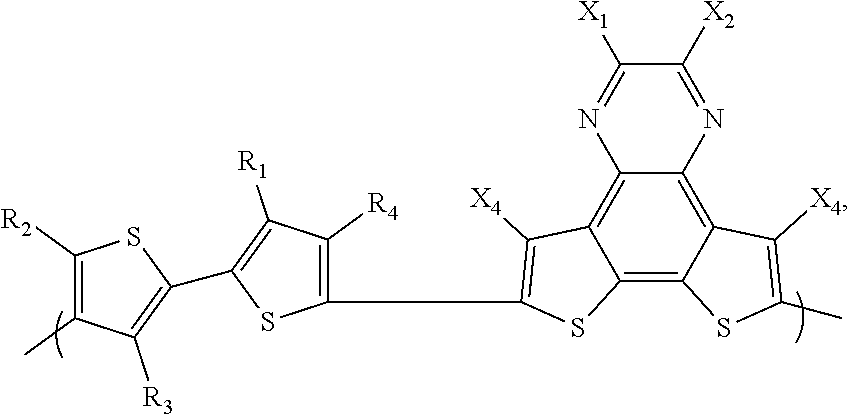
an optional repeat unit J, wherein a repeat unit J comprises

and a repeat unit K, wherein a repeat unit K comprises

In this copolymer, X1, X2, X3, and X4 are independently selected from the group consisting of: H, Cl, F, CN, alkyl, alkoxy, ester, ketone, amide and aryl groups; R5, and R6 are independently selected from the group consisting of: H, Cl, F, CN, alkyl, alkoxy, alkylthio, ester, ketone and aryl groups; and D comprises an aryl group.

In repeat unit A, X1, X2, X3, and X4 are independently selected from the group consisting of: H, Cl, F, CN, alkyl, alkoxy, ester, ketone, amide and aryl groups.

or benzodithiophene

In repeat unit B, R1, R2, R3, R4, R5 and R6 are independently selected from the group consisting of, Cl, F, CN, alkyl, alkoxy, alkylthio, ester, ketone and aryl groups.


and combinations thereof, wherein R′, R″, R′″ and R″″ are independently selected from the group consisting of: H, Cl, F, CN, alkyl, alkoxy, alkylthio, ester, ketone and aryl groups. In another embodiment, the aryl group is a 3,3′difluror-2,2′-bithiophene.


and [6,6]-phenyl-C60-butyric-N-2-trimethylammonium ethyl ester iodide.

R′ can be selected from either N, O, S, C, or B. In other embodiment R″ can be alkyl chains or substituted alkyl chains. Examples of substitutions for the substituted alkyl chains include halogens, N, Br, O, Si, or S. In one example R″ can be selected from

Other examples of fullerene dopants that can be used include: [6,6]-phenyl-C60-butyric-N-(2-aminoethyl)acetamide, [6,6]-phenyl-C60-butyric-N-triethyleneglycol ester and [6,6]-phenyl-C60-butyric-N-2-dimethylaminoethyl ester.


| TABLE 1 | ||
| Sample | Jsc | |
| with | (mA/cm2) | Voc (V) | FF (%) | PCE (%) | Rs (Ω cm2) | Rsh (Ω cm2) |
| PCBM | Avg | Max | Avg | Max | Avg | Max | Avg | Max | Avg | Max | Avg | Max |
| A | 9.82 | 11.4 | 0.76 | 0.78 | 72.0 | 73.2 | 5.4 | 6.01 | 7.34 | 8.01 | 3280 | 5630 |
| B | 4.45 | 4.55 | 0.69 | 0.80 | 45.2 | 49.2 | 1.38 | 1.69 | 52.6 | 70.5 | 858 | 1300 |
| C | 3.19 | 3.65 | 0.56 | 0.63 | 35.8 | 41.7 | 0.63 | 0.69 | 89.4 | 131 | 352 | 388 |
| D | 1.99 | 2.24 | 0.84 | 0.88 | 36.1 | 41.6 | 0.60 | 0.72 | 165 | 201 | 916 | 1250 |
| E | 12.2 | 13 | 0.82 | 0.83 | 65.8 | 67.8 | 6.60 | 6.79 | 6.12 | 7.98 | 2013 | 2586 |
| F | 13.23 | 13.66 | 0.70 | 0.71 | 57.6 | 58.9 | 5.36 | 5.59 | 5.30 | 8.23 | 640.3 | 996.9 |
| TABLE 2 | ||||||
| Sample | Jsc | |||||
| with | (mA/cm2) | Voc (V) | FF (%) | PCE (%) | Rs (Ω cm2) | Rsh (Ω cm2) |
| ITIC | Avg | Max | Avg | Max | Avg | Max | Avg | Max | Avg | Max | Avg | Max |
| A | 11.36 | 13.05 | 0.935 | 0.943 | 64.2 | 65.8 | 6.79 | 7.41 | 6.89 | 7.57 | 961 | 1099 |
| E | 13.85 | 14.66 | 0.934 | 0.937 | 61.1 | 62.8 | 7.90 | 8.47 | 8.66 | 9.58 | 1015 | 1269 |
Claims (15)


Priority Applications (5)
| Application Number | Priority Date | Filing Date | Title |
|---|---|---|---|
| BR112020001847-3A BR112020001847A2 (en) | 2017-07-28 | 2018-07-18 | high performance forbidden polymers of high performance for organic photovoltaic |
| JP2020504368A JP7182606B2 (en) | 2017-07-28 | 2018-07-18 | High Performance Wide Bandgap Polymers for Organic Photovoltaics |
| PCT/US2018/042724 WO2019023025A1 (en) | 2017-07-28 | 2018-07-18 | High performance wide-bandgap polymers for organic photovoltaics |
| CA3071093A CA3071093A1 (en) | 2017-07-28 | 2018-07-18 | High performance wide-bandgap polymers for organic photovoltaics |
| US16/038,364 US11274178B2 (en) | 2018-07-18 | 2018-07-18 | High performance wide-bandgap polymers for organic photovoltaics |
Applications Claiming Priority (1)
| Application Number | Priority Date | Filing Date | Title |
|---|---|---|---|
| US16/038,364 US11274178B2 (en) | 2018-07-18 | 2018-07-18 | High performance wide-bandgap polymers for organic photovoltaics |
Publications (2)
| Publication Number | Publication Date |
|---|---|
| US20200024386A1 US20200024386A1 (en) | 2020-01-23 |
| US11274178B2 true US11274178B2 (en) | 2022-03-15 |
Family
ID=69162827
Family Applications (1)
| Application Number | Title | Priority Date | Filing Date |
|---|---|---|---|
| US16/038,364 Active US11274178B2 (en) | 2017-07-28 | 2018-07-18 | High performance wide-bandgap polymers for organic photovoltaics |
Country Status (1)
| Country | Link |
|---|---|
| US (1) | US11274178B2 (en) |
Citations (5)
| Publication number | Priority date | Publication date | Assignee | Title |
|---|---|---|---|---|
| US20120071617A1 (en) | 2009-05-27 | 2012-03-22 | Basf Se | Diketopyrrolopyrrole polymers for use in organic semiconductor devices |
| US20130092912A1 (en) | 2010-06-08 | 2013-04-18 | Wei You | Polymers with tunable band gaps for photonic and electronic applications |
| US20130144065A1 (en) | 2010-08-05 | 2013-06-06 | Polyera Corporation | Semiconductor materials prepared from bridged bithiazole copolymers |
| US20150041726A1 (en) * | 2012-02-03 | 2015-02-12 | The University Of Chicago | Semiconducting polymers |
| US20150349261A1 (en) | 2014-05-30 | 2015-12-03 | Solarmer Energy, Inc. | Difluorothienothiophene based conjugated polymers |
-
2018
- 2018-07-18 US US16/038,364 patent/US11274178B2/en active Active
Patent Citations (5)
| Publication number | Priority date | Publication date | Assignee | Title |
|---|---|---|---|---|
| US20120071617A1 (en) | 2009-05-27 | 2012-03-22 | Basf Se | Diketopyrrolopyrrole polymers for use in organic semiconductor devices |
| US20130092912A1 (en) | 2010-06-08 | 2013-04-18 | Wei You | Polymers with tunable band gaps for photonic and electronic applications |
| US20130144065A1 (en) | 2010-08-05 | 2013-06-06 | Polyera Corporation | Semiconductor materials prepared from bridged bithiazole copolymers |
| US20150041726A1 (en) * | 2012-02-03 | 2015-02-12 | The University Of Chicago | Semiconducting polymers |
| US20150349261A1 (en) | 2014-05-30 | 2015-12-03 | Solarmer Energy, Inc. | Difluorothienothiophene based conjugated polymers |
Non-Patent Citations (3)
| Title |
|---|
| Huaxing Zhou, Liquiang Yang, Shubin Liu, and Wei You, "A Tale of Current and Voltage: Interplay of Band Gap and Energy Levels of Conjugated Polymers in Bulk Heterojunction Solar Cells", Macromolecules Article 2010, vol. 43, pp. 1039010396. |
| PCT Notification of Transmittal of the International Search Report and the Written Opinion of the International Searching Authority, or the Declaration, International Application No. PCT/US2018/042724, International Filing Date Jul. 18, 2018, 11 pages. |
| Zu-Sheng Huang, Xu-Feng Zang, Tao Hua, Lingyun Wang, Hebert Meier, and Derong Cao, 2,3-Dipentyldithieno[3,2-f:2′,3′-h]quinoxaline-Based Organic Dyes for Efficient Dye-Sensitized Solar Cells: Effect of π-Bridges and Electron Donors on Solar Cell Performance, Applied Materials & Interfaces, Research Article, 2015 American Chemical Society, vol. 7, pp. 20418-20429. |
Also Published As
| Publication number | Publication date |
|---|---|
| US20200024386A1 (en) | 2020-01-23 |
Similar Documents
| Publication | Publication Date | Title |
|---|---|---|
| EP3658600A1 (en) | High performance wide-bandgap polymers for organic photovoltaics | |
| US9908857B2 (en) | Method of producing benzo[1,2-B:4,5-B′]dithiophene and benzothiadiazole-based molecular complexes | |
| US20190233578A1 (en) | Polymers for organic photovoltaics | |
| US10361370B2 (en) | Unsymmetrical benzothiadiazole-based molecular complexes in organic photovoltaic devices | |
| US11332579B1 (en) | Fused dithieno benzothiadiazole polymers for organic photovoltaics | |
| US11274178B2 (en) | High performance wide-bandgap polymers for organic photovoltaics | |
| US11091585B2 (en) | Polymers containing 3′-(alkoxy)-[2,2′-bithiophene]-3-carbonitrile for high performance organic photovoltaics | |
| US11211562B2 (en) | Method of synthesis for organic semiconducting polymers | |
| US20180026194A1 (en) | Unsymmetrical benzo[1,2-b:4,5-b']dithiophene and benzothiadiazole-based molecular complexes | |
| US10787537B2 (en) | Synthesis of polymers for organic photovoltaics | |
| JP7182606B2 (en) | High Performance Wide Bandgap Polymers for Organic Photovoltaics | |
| US20210061946A1 (en) | Method of synthesis for organic semiconducting polymers | |
| US11326019B1 (en) | Fused dithieno benzothiadiazole polymers for organic photovoltaics | |
| US11690283B2 (en) | Fused dithieno benzothiadiazole polymers for organic photovoltaics | |
| US11849629B2 (en) | Fused dithieno benzothiadiazole polymers for organic photovolatics | |
| US12344704B2 (en) | Repeat units for photovoltaic applications | |
| US12505934B2 (en) | Polymers for photovoltaic applications | |
| US12439812B2 (en) | Monomers for photovoltaic applications | |
| US20220359827A1 (en) | Polymers for photovoltaic applications | |
| US10647851B2 (en) | 1,2,5,6-Naphthalenediimide co-polymer | |
| US11437580B2 (en) | Organic semiconducting polymers | |
| US20210066608A1 (en) | Organic semiconducting polymers | |
| WO2020018257A1 (en) | Polymers containing 3'-(alkoxy)-[2,2'-bithiophene]-3carbonitrile for high performance organic photovoltaics | |
| WO2021041450A1 (en) | Organic semiconducting comonomer |
Legal Events
| Date | Code | Title | Description |
|---|---|---|---|
| FEPP | Fee payment procedure |
Free format text: ENTITY STATUS SET TO UNDISCOUNTED (ORIGINAL EVENT CODE: BIG.); ENTITY STATUS OF PATENT OWNER: LARGE ENTITY |
|
| AS | Assignment |
Owner name: PHILLIPS 66 COMPANY, TEXAS Free format text: ASSIGNMENT OF ASSIGNORS INTEREST;ASSIGNORS:WOODY, KATHY;NIELSEN, LAURA;PAN, HUALONG;AND OTHERS;SIGNING DATES FROM 20180806 TO 20180808;REEL/FRAME:046820/0805 |
|
| STPP | Information on status: patent application and granting procedure in general |
Free format text: NON FINAL ACTION MAILED |
|
| STPP | Information on status: patent application and granting procedure in general |
Free format text: RESPONSE TO NON-FINAL OFFICE ACTION ENTERED AND FORWARDED TO EXAMINER |
|
| STPP | Information on status: patent application and granting procedure in general |
Free format text: FINAL REJECTION MAILED |
|
| STPP | Information on status: patent application and granting procedure in general |
Free format text: FINAL REJECTION MAILED |
|
| STPP | Information on status: patent application and granting procedure in general |
Free format text: NON FINAL ACTION MAILED |
|
| STPP | Information on status: patent application and granting procedure in general |
Free format text: RESPONSE TO NON-FINAL OFFICE ACTION ENTERED AND FORWARDED TO EXAMINER |
|
| STPP | Information on status: patent application and granting procedure in general |
Free format text: FINAL REJECTION MAILED |
|
| STCF | Information on status: patent grant |
Free format text: PATENTED CASE |
|
| MAFP | Maintenance fee payment |
Free format text: PAYMENT OF MAINTENANCE FEE, 4TH YEAR, LARGE ENTITY (ORIGINAL EVENT CODE: M1551); ENTITY STATUS OF PATENT OWNER: LARGE ENTITY Year of fee payment: 4 |