US11262126B2 - Drying system for a vehicle - Google Patents

Drying system for a vehicle Download PDF

Info

Publication number
US11262126B2
US11262126B2 US16/539,301 US201916539301A US11262126B2 US 11262126 B2 US11262126 B2 US 11262126B2 US 201916539301 A US201916539301 A US 201916539301A US 11262126 B2 US11262126 B2 US 11262126B2
Authority
US
United States
Prior art keywords
airflow
duct
vehicle
window
intake duct
Prior art date
Legal status (The legal status is an assumption and is not a legal conclusion. Google has not performed a legal analysis and makes no representation as to the accuracy of the status listed.)
Active, expires
Application number
US16/539,301
Other versions
US20210048248A1 (en
Inventor
Paxton S. Williams
Scott Louis Frederick
Current Assignee (The listed assignees may be inaccurate. Google has not performed a legal analysis and makes no representation or warranty as to the accuracy of the list.)
Toyota Motor Corp
Original Assignee
Toyota Motor Engineering and Manufacturing North America Inc
Priority date (The priority date is an assumption and is not a legal conclusion. Google has not performed a legal analysis and makes no representation as to the accuracy of the date listed.)
Filing date
Publication date
Application filed by Toyota Motor Engineering and Manufacturing North America Inc filed Critical Toyota Motor Engineering and Manufacturing North America Inc
Priority to US16/539,301 priority Critical patent/US11262126B2/en
Assigned to TOYOTA MOTOR ENGINEERING & MANUFACTURING NORTH AMERICA, INC. reassignment TOYOTA MOTOR ENGINEERING & MANUFACTURING NORTH AMERICA, INC. ASSIGNMENT OF ASSIGNORS INTEREST (SEE DOCUMENT FOR DETAILS). Assignors: FREDERICK, Scott Louis, WILLIAMS, PAXTON S.
Publication of US20210048248A1 publication Critical patent/US20210048248A1/en
Application granted granted Critical
Publication of US11262126B2 publication Critical patent/US11262126B2/en
Assigned to TOYOTA JIDOSHA KABUSHIKI KAISHA reassignment TOYOTA JIDOSHA KABUSHIKI KAISHA ASSIGNMENT OF ASSIGNORS INTEREST (SEE DOCUMENT FOR DETAILS). Assignors: TOYOTA MOTOR ENGINEERING & MANUFACTURING NORTH AMERICA, INC.
Active legal-status Critical Current
Adjusted expiration legal-status Critical

Links

Images

Classifications

    • FMECHANICAL ENGINEERING; LIGHTING; HEATING; WEAPONS; BLASTING
    • F26DRYING
    • F26BDRYING SOLID MATERIALS OR OBJECTS BY REMOVING LIQUID THEREFROM
    • F26B19/00Machines or apparatus for drying solid materials or objects not covered by groups F26B9/00 - F26B17/00
    • F26B19/005Self-contained mobile devices, e.g. for agricultural produce
    • FMECHANICAL ENGINEERING; LIGHTING; HEATING; WEAPONS; BLASTING
    • F26DRYING
    • F26BDRYING SOLID MATERIALS OR OBJECTS BY REMOVING LIQUID THEREFROM
    • F26B21/00Arrangements or duct systems, e.g. in combination with pallet boxes, for supplying and controlling air or gases for drying solid materials or objects
    • F26B21/001Drying-air generating units, e.g. movable, independent of drying enclosure
    • F26B21/50
    • FMECHANICAL ENGINEERING; LIGHTING; HEATING; WEAPONS; BLASTING
    • F26DRYING
    • F26BDRYING SOLID MATERIALS OR OBJECTS BY REMOVING LIQUID THEREFROM
    • F26B3/00Drying solid materials or objects by processes involving the application of heat
    • F26B3/02Drying solid materials or objects by processes involving the application of heat by convection, i.e. heat being conveyed from a heat source to the materials or objects to be dried by a gas or vapour, e.g. air
    • F26B3/06Drying solid materials or objects by processes involving the application of heat by convection, i.e. heat being conveyed from a heat source to the materials or objects to be dried by a gas or vapour, e.g. air the gas or vapour flowing through the materials or objects to be dried
    • FMECHANICAL ENGINEERING; LIGHTING; HEATING; WEAPONS; BLASTING
    • F26DRYING
    • F26BDRYING SOLID MATERIALS OR OBJECTS BY REMOVING LIQUID THEREFROM
    • F26B9/00Machines or apparatus for drying solid materials or objects at rest or with only local agitation; Domestic airing cupboards
    • F26B9/003Small self-contained devices, e.g. portable

Definitions

  • the present invention relates to vehicle accessories and, more particularly, to a system mountable in a vehicle interior for drying wet articles.
  • Items such as towels and clothing may become wet due to rain or participation of a user in recreational activities.
  • the user may wish to dry such items as rapidly and as conveniently as possible.
  • an extended period of time may elapse before the user can drive home or move to an area where wet items of clothing can be dried in a conventional, possibly time-consuming manner.
  • a drying system for a vehicle includes an airflow intake duct structured to be mountable to the vehicle so as to reside exterior of the vehicle.
  • the airflow intake duct includes an intake duct airflow passage structured to receive an airflow therein from outside the vehicle when the vehicle is moving.
  • An airflow duct is structured to be coupled to the intake duct so as to reside in an interior of the vehicle and so as to receive therein the airflow from the intake duct when the intake duct is mounted exterior of the vehicle.
  • the airflow duct includes a plurality of holes structured to enable discharge a portion of the airflow from the airflow duct into the interior of the vehicle.
  • FIG. 1 is a schematic perspective view of a vehicle incorporating a system structured for drying articles in an interior of a vehicle, in accordance with an embodiment described herein.
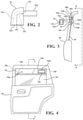
  • FIG. 2 is a schematic plan view of an airflow intake duct in accordance with an embodiment described herein.
  • FIG. 3 is a schematic edge view of a portion of a vehicle door viewed from in front of the vehicle, showing mounting of a window adapter on the door and an airflow intake duct on the window adapter.
  • FIG. 4 is a schematic side view of the door shown in FIG. 3 .
  • FIG. 5 is a schematic end view of a vehicle including opposed vehicle doors with window adapters mounted on the door windows for supporting a drying airflow duct therebetween, as viewed from in front of the vehicle.
  • Embodiments described herein relate to a drying system for a vehicle.
  • the drying system may include an airflow intake duct structured to be mountable to the vehicle so as to reside exterior of the vehicle.
  • the airflow intake duct may include an intake duct airflow passage structured to receive an airflow therein from outside the vehicle when the vehicle is moving.
  • An airflow duct is structured to be coupled to the intake duct so as to reside in an interior of the vehicle and so as to receive therein the airflow from the intake duct when the intake duct is mounted exterior of the vehicle.
  • the airflow duct may include a plurality of holes structured to enable discharge a portion of the airflow from the airflow duct into the interior of the vehicle.
  • Wet items such as towels or clothing may be hung over or near the airflow duct in the vehicle interior, to be dried by air flowing from the airflow duct holes.
  • an impeller or fan may be incorporated into the drying system to increase air circulation.
  • FIG. 1 is a schematic perspective view of a vehicle incorporating a system 20 structured for drying articles in an interior of a vehicle, in accordance with an embodiment described herein.
  • the drying system 20 may include an airflow intake duct 22 .
  • the airflow intake duct 22 may define an intake duct airflow passage 22 a structured to receive an airflow therein from outside the vehicle 18 when the vehicle is moving.
  • Airflow intake duct 22 may define an intake duct entrance 22 b structured to receive the airflow therein.
  • An intake duct exit 22 c may be spaced apart from the intake duct entrance 22 b .
  • the intake duct airflow passage 22 a may extend between the intake duct entrance 22 b and the intake duct exit 22 c.
  • a cross-sectional area of the intake duct airflow passage 22 a may decrease proceeding in a direction D 1 from the intake duct entrance toward the intake duct exit 22 c .
  • This narrowing of the intake duct airflow passage 22 a may have the effect of increasing the speed of the airflow entering the airflow duct 50 (described in greater detail below).
  • a valve may be mounted on the airflow intake duct 22 to control the airflow 99 into the intake duct.
  • the valve may be in the form of a rolling, shutter-type door 22 e positionable to block the intake duct entrance 22 b .
  • the door 22 e may be securable in any of a variety of positions to control an open size of the intake duct entrance 22 b , thereby controlling a flow rate of air into the airflow intake duct 22 .
  • other types of valves may be used to control airflow into the airflow intake duct 22 or through the airflow intake duct 22 into the airflow duct 50 .
  • the airflow intake duct 22 may be structured to be mountable to the vehicle 18 so as to reside exterior of the vehicle, in a location selected to immerse the airflow intake duct 22 in an airflow passing over the vehicle 18 when the vehicle is moving. A portion 99 of the airflow passing over the vehicle 18 may then enter intake duct airflow passage 22 a through intake duct entrance 22 b.
  • the airflow intake duct 22 may be mounted to the vehicle 18 using a first window adapter 24 .
  • the first window adapter 24 may be structured to be mountable to a first vehicle window 26 so as to extend between the first vehicle window 26 and an uppermost portion 28 a of a first vehicle door 28 containing the first vehicle window, when the first vehicle window 26 is partially open.
  • the first window adapter 24 may be structured to form a substantially airtight seal with the vehicle door 28 and the window 26 when the first window adapter 24 is mounted in the partially open window.
  • the first window adapter 24 may include a planar body portion 24 a having a thickness equal to that of the window glass so that a first (upper) edge 24 b of the first window adapter 24 can fit into an existing window groove 28 b of the vehicle door 28 .
  • a second edge 24 c of the first window adapter 24 may have a groove or slot 24 d formed therein. Groove 24 d may be structured to receive an uppermost edge of the window 26 therein in a slight interference fit.
  • Other (i.e., front and rear) edges 24 e , 24 f FIG.
  • the first window adapter 24 may be similarly structured to fit inside associated front and rear portions of the window groove 28 b of the vehicle door 28 .
  • the first window adapter 24 may be formed from a suitable polymer, enabling edges of the adapters to be bent slightly to facilitate user insertion of the adapter edges into the window groove.
  • the first window adapter 24 may also include a first window adapter airflow passage 24 m extending from a first side of the first window adapter through the first window adapter to a second side of the first window adapter opposite the first side.
  • the first window adapter 24 may also include an intake duct mounting sleeve 24 p extending from the first window adapter 24 along the first side of the first window adapter and defining a portion of the first window adapter airflow passage 24 m .
  • the intake duct mounting sleeve 24 p may be structured to receive therein a portion of the airflow intake duct 22 (for example, an intake duct nozzle 22 n ) for mounting the airflow intake duct 22 to the first window adapter 24 .
  • the intake duct mounting sleeve 24 p may be structured to form a gas-tight seal with the intake duct nozzle 22 n when the airflow intake duct 22 is coupled to the intake duct mounting sleeve 24 p.
  • the first window adapter 24 may also include an airflow duct mounting sleeve 24 s extending from the first window adapter 24 along the second side of the first window adapter and defining a portion of the first window adapter airflow passage 24 m .
  • the airflow duct mounting sleeve 24 s may be structured to receive therein a first portion of the airflow duct 50 for mounting the airflow duct 50 to the first window adapter 24 .
  • the first vehicle window 26 may be rolled partially down. Then, an upper edge of the window 26 may be inserted into adapter groove 24 d and adapter edges 24 e and 24 f may be inserted into the door window groove 28 b . The window 26 may then be rolled up until the upper edge 24 b of the adapter enters into the existing window groove 28 b of the vehicle door 28 .
  • adapters having other structures may be used as long as they act to fill the gap between the partially-open window and the uppermost portion of the vehicle door, provide an airflow passage therethrough, and also enable mounting of an intake duct and an airflow duct thereto, either directly or indirectly.
  • Airflow duct 50 may be structured to be coupled to the airflow intake duct 22 via airflow duct mounting sleeve 24 s and may be structured to form a gas-tight seal with the airflow duct mounting sleeve 24 s .
  • the airflow duct 50 When coupled to airflow duct mounting sleeve 24 s , the airflow duct 50 may extend through an interior of the vehicle as shown in FIG. 5 . Airflow duct 50 may then receive the airflow 99 from the airflow intake duct 22 when the airflow intake duct 22 is mounted exterior of the vehicle 18 .
  • the airflow duct 50 may include a plurality of holes 50 a structured to enable discharge of at least a portion of the airflow 99 from the airflow duct 50 into the interior of the vehicle. Thus, a portion of the airflow 99 may be discharged through holes 50 a to dry an item positioned proximate the airflow duct (for example, an item of clothing positioned to hang over the airflow duct 50 ).
  • the airflow duct 50 may have a telescoping structure including at least a pair of telescoping members. This enables the length of the airflow duct 50 to be adjusted for different vehicle widths.
  • airflow duct 50 may extend from first window adapter 24 into the vehicle interior in cantilever fashion. In this case, portions of the aiflow 99 not discharged through the airflow duct openings 50 a may be discharged from a free, open end of airflow duct 50 , into the vehicle interior and/or out of the vehicle through another open window.
  • an end 50 b of the airflow duct 50 may be supported by engagement with a second window adapter 52 mounted on a second window 54 of the vehicle 18 .
  • Second window 54 may be mounted in a second door 29 located opposite first door 28 . As shown in FIG.
  • the second window adapter 52 may be structured to be mountable to second vehicle window 54 so as to extend between the second vehicle window 54 and a groove 29 b of an uppermost portion 29 a of a second vehicle door 29 containing the second vehicle window, when the second vehicle window 54 is partially open.
  • the second window adapter 52 may be structured and mounted to the second vehicle window in the manner previously described with respect to the first window adapter 24 .
  • the second window adapter 52 may be structured to form a substantially airtight seal with the second vehicle door 29 and the second window 54 when the adapter 52 is mounted in the partially open window.
  • the second window adapter 52 may include a planar body 52 a portion a having a thickness equal to that of the window glass so that a first (upper) edge 52 b of the second window adapter 52 can fit into an existing window groove 29 b of the vehicle door 29 .
  • a second edge 52 c of the second window adapter 52 may have a groove or slot 52 d formed therein. Groove 52 d may be structured to receive an uppermost edge of the window 54 therein in a slight interference fit.
  • edges 52 e , 52 f may be similarly structured to fit inside associated front and rear portions of the window groove 29 b of the vehicle door 29 , as descried previously with respect to first window 26 of shown in FIG. 4 .
  • the adapter 52 may be formed from a suitable polymer, enabling edges of the adapters to be bent slightly to facilitate user insertion of the adapter edges into the window groove.
  • the second window adapter 52 may also include a second window adapter airflow passage 52 m extending from a first side of the second window adapter 52 through the second window adapter to a second side of the second window adapter opposite the first side.
  • the second window adapter 52 may also include an airflow duct mounting sleeve 52 p extending from the second window adapter 52 along the first side of the second window adapter and defining a portion of the second window adapter airflow passage 52 m .
  • the airflow duct mounting sleeve 52 p may be structured to receive therein a portion of the airflow duct 50 for mounting the airflow duct 50 to the second window adapter 52 .
  • the airflow duct mounting sleeve 52 p may be structured to form a gas-tight seal with the airflow duct 50 when the airflow duct 50 is coupled to the airflow duct mounting sleeve 52 p .
  • the second window adapter 52 may also include a discharge duct mounting sleeve 52 s extending from the second window adapter along the second side of the second window adapter and defining a portion of the second window adapter airflow passage 52 m .
  • the airflow duct mounting sleeve 52 s may be structured to receive therein a portion of a discharge duct 60 (described below) for mounting the discharge duct 60 to the second window adapter 52 .
  • the second vehicle window 54 may be rolled partially down. Then, an upper edge of the window 54 may be inserted into adapter groove 52 d and the adapter front and rear edges may be inserted into the window groove 29 b . The window 54 may then be rolled up until the upper edge 52 b of the adapter enters into the existing window groove 29 b of the vehicle door 29 .
  • the portion of airflow 99 not discharged through airflow duct holes 50 a may be discharged through the second adapter airflow passage 52 m to the vehicle exterior.
  • the portion of airflow 99 not discharged through airflow duct holes 50 a may be discharged through the discharge duct 60 .
  • the discharge duct 60 may be mounted to the vehicle 18 using the second window adapter 52 .
  • the discharge duct 60 may include a discharge duct nozzle 60 n structured to be received in discharge duct mounting sleeve 52 s so as to for a gas-tight seal.
  • the airflow discharge duct 60 may include an airflow passage 60 a extending therethrough. A portion of the airflow passage 60 a may be defined by discharge duct nozzle 60 n .
  • the airflow discharge duct 60 may be structured to be coupled to the airflow duct 50 (via second adapter 52 ) so as to receive a portion of the airflow from the airflow duct 50 into the discharge duct airflow passage 60 a .
  • the airflow discharge duct 60 may be structured to discharge the airflow from the discharge duct airflow passage 60 a to the outside of the vehicle when the vehicle is moving.
  • the airflow discharge duct 60 may be structured to be mountable to the second window adapter 52 so that the airflow in the second window adapter airflow passage 52 m is received in the airflow discharge duct airflow passage 60 a.
  • the airflow discharge duct airflow passage 60 a may be structured to discharge air toward a rear of the vehicle.
  • an impeller or fan 70 may be incorporated into the airflow discharge duct 60 to aid in drawing air through the airflow duct 50 and into the discharge duct 60 .
  • the impeller may be positioned in the airflow discharge duct airflow passage 60 a and may be structured to urge a portion of airflow 99 in a direction from the airflow duct 50 toward the discharge duct airflow passage.
  • the drying system 20 may be installed in the vehicle as previously described.
  • the airflow duct 50 may extend cantilever fashion into the vehicle interior, or the airflow duct may be supported at each end by an associated window adapter. After installation, articles such as clothing or towels (elements 95 in FIG. 1 , for example) may be hung over the airflow duct 50 .
  • Air discharged from the airflow duct holes 50 a may operate to dry the suspended article(s) and may also act to help circulate the air inside the vehicle occupant compartment, which may further aid in drying the article(s).
  • An opening through the second window adapter 52 or in the form of an open vehicle window 54 may provide an exit path for the air from the vehicle interior, thereby facilitating airflow through the interior.
  • the impeller 70 may also be used to facilitate a greater rate of airflow.
  • the terms “a” and “an,” as used herein, are defined as one or more than one.
  • the term “plurality,” as used herein, is defined as two or more than two.
  • the term “another,” as used herein, is defined as at least a second or more.
  • the terms “including” and/or “having,” as used herein, are defined as comprising (i.e. open language).
  • the phrase “at least one of . . . and . . . ” as used herein refers to and encompasses any and all possible combinations of one or more of the associated listed items.
  • the phrase “at least one of A, B and C” includes A only, B only, C only, or any combination thereof (e.g. AB, AC, BC or ABC).

Landscapes

  • Engineering & Computer Science (AREA)
  • Mechanical Engineering (AREA)
  • General Engineering & Computer Science (AREA)
  • Life Sciences & Earth Sciences (AREA)
  • Agronomy & Crop Science (AREA)
  • Microbiology (AREA)
  • Drying Of Solid Materials (AREA)

Abstract

A drying system for a vehicle includes an airflow intake duct structured to be mountable to the vehicle so as to reside exterior of the vehicle. The airflow intake duct includes an intake duct airflow passage structured to receive an airflow therein from outside the vehicle when the vehicle is moving. An airflow duct is structured to be coupled to the intake duct so as to reside in an interior of the vehicle and so as to receive therein the airflow from the intake duct when the intake duct is mounted exterior of the vehicle. The airflow duct includes a plurality of holes structured to enable discharge of a portion of the airflow from the airflow duct into the interior of the vehicle.

Description

TECHNICAL FIELD
The present invention relates to vehicle accessories and, more particularly, to a system mountable in a vehicle interior for drying wet articles.
BACKGROUND
Items such as towels and clothing may become wet due to rain or participation of a user in recreational activities. The user may wish to dry such items as rapidly and as conveniently as possible. However, an extended period of time may elapse before the user can drive home or move to an area where wet items of clothing can be dried in a conventional, possibly time-consuming manner.
SUMMARY
In one aspect of the embodiments described herein, a drying system for a vehicle is provided. The drying system includes an airflow intake duct structured to be mountable to the vehicle so as to reside exterior of the vehicle. The airflow intake duct includes an intake duct airflow passage structured to receive an airflow therein from outside the vehicle when the vehicle is moving. An airflow duct is structured to be coupled to the intake duct so as to reside in an interior of the vehicle and so as to receive therein the airflow from the intake duct when the intake duct is mounted exterior of the vehicle. The airflow duct includes a plurality of holes structured to enable discharge a portion of the airflow from the airflow duct into the interior of the vehicle.
BRIEF DESCRIPTION OF THE DRAWINGS
FIG. 1 is a schematic perspective view of a vehicle incorporating a system structured for drying articles in an interior of a vehicle, in accordance with an embodiment described herein.
FIG. 2 is a schematic plan view of an airflow intake duct in accordance with an embodiment described herein.
FIG. 3 is a schematic edge view of a portion of a vehicle door viewed from in front of the vehicle, showing mounting of a window adapter on the door and an airflow intake duct on the window adapter.
FIG. 4 is a schematic side view of the door shown in FIG. 3.
FIG. 5 is a schematic end view of a vehicle including opposed vehicle doors with window adapters mounted on the door windows for supporting a drying airflow duct therebetween, as viewed from in front of the vehicle.
DETAILED DESCRIPTION
Embodiments described herein relate to a drying system for a vehicle. The drying system may include an airflow intake duct structured to be mountable to the vehicle so as to reside exterior of the vehicle. The airflow intake duct may include an intake duct airflow passage structured to receive an airflow therein from outside the vehicle when the vehicle is moving. An airflow duct is structured to be coupled to the intake duct so as to reside in an interior of the vehicle and so as to receive therein the airflow from the intake duct when the intake duct is mounted exterior of the vehicle. The airflow duct may include a plurality of holes structured to enable discharge a portion of the airflow from the airflow duct into the interior of the vehicle. As the vehicle moves, air is drawn into the intake duct and passes into the airflow duct. Wet items such as towels or clothing may be hung over or near the airflow duct in the vehicle interior, to be dried by air flowing from the airflow duct holes. If desired, an impeller or fan may be incorporated into the drying system to increase air circulation.
It will be appreciated that for simplicity and clarity of illustration, where appropriate, reference numerals have been repeated among the different figures to indicate corresponding or analogous elements. In addition, numerous specific details are set forth in order to provide a thorough understanding of the embodiments described herein. However, it will be understood by those of ordinary skill in the art that the embodiments described herein can be practiced without these specific details. Unless otherwise noted, similar reference characters are used to describe similar features on separate elements and/or embodiments. In addition, each of the components described herein may be formed from a material (or materials) suitable for the purposes and structure of the component as described.
FIG. 1 is a schematic perspective view of a vehicle incorporating a system 20 structured for drying articles in an interior of a vehicle, in accordance with an embodiment described herein. Referring to FIGS. 1 and 2, in one or more arrangements, the drying system 20 may include an airflow intake duct 22. The airflow intake duct 22 may define an intake duct airflow passage 22 a structured to receive an airflow therein from outside the vehicle 18 when the vehicle is moving. Airflow intake duct 22 may define an intake duct entrance 22 b structured to receive the airflow therein. An intake duct exit 22 c may be spaced apart from the intake duct entrance 22 b. The intake duct airflow passage 22 a may extend between the intake duct entrance 22 b and the intake duct exit 22 c.
In one or more particular embodiments, a cross-sectional area of the intake duct airflow passage 22 a may decrease proceeding in a direction D1 from the intake duct entrance toward the intake duct exit 22 c. This narrowing of the intake duct airflow passage 22 a may have the effect of increasing the speed of the airflow entering the airflow duct 50 (described in greater detail below).
A valve may be mounted on the airflow intake duct 22 to control the airflow 99 into the intake duct. In one or more arrangements, the valve may be in the form of a rolling, shutter-type door 22 e positionable to block the intake duct entrance 22 b. The door 22 e may be securable in any of a variety of positions to control an open size of the intake duct entrance 22 b, thereby controlling a flow rate of air into the airflow intake duct 22. Alternatively, other types of valves may be used to control airflow into the airflow intake duct 22 or through the airflow intake duct 22 into the airflow duct 50.
As shown in FIGS. 1, 3, and 5, the airflow intake duct 22 may be structured to be mountable to the vehicle 18 so as to reside exterior of the vehicle, in a location selected to immerse the airflow intake duct 22 in an airflow passing over the vehicle 18 when the vehicle is moving. A portion 99 of the airflow passing over the vehicle 18 may then enter intake duct airflow passage 22 a through intake duct entrance 22 b.
In one or more arrangements, the airflow intake duct 22 may be mounted to the vehicle 18 using a first window adapter 24. As shown in FIGS. 3-5, the first window adapter 24 may be structured to be mountable to a first vehicle window 26 so as to extend between the first vehicle window 26 and an uppermost portion 28 a of a first vehicle door 28 containing the first vehicle window, when the first vehicle window 26 is partially open.
The first window adapter 24 may be structured to form a substantially airtight seal with the vehicle door 28 and the window 26 when the first window adapter 24 is mounted in the partially open window. In one or more embodiments, the first window adapter 24 may include a planar body portion 24 a having a thickness equal to that of the window glass so that a first (upper) edge 24 b of the first window adapter 24 can fit into an existing window groove 28 b of the vehicle door 28. A second edge 24 c of the first window adapter 24 may have a groove or slot 24 d formed therein. Groove 24 d may be structured to receive an uppermost edge of the window 26 therein in a slight interference fit. Other (i.e., front and rear) edges 24 e, 24 f (FIG. 4) of the first window adapter 24 may be similarly structured to fit inside associated front and rear portions of the window groove 28 b of the vehicle door 28. The first window adapter 24 may be formed from a suitable polymer, enabling edges of the adapters to be bent slightly to facilitate user insertion of the adapter edges into the window groove.
Referring to FIGS. 3 and 4, the first window adapter 24 may also include a first window adapter airflow passage 24 m extending from a first side of the first window adapter through the first window adapter to a second side of the first window adapter opposite the first side. The first window adapter 24 may also include an intake duct mounting sleeve 24 p extending from the first window adapter 24 along the first side of the first window adapter and defining a portion of the first window adapter airflow passage 24 m. The intake duct mounting sleeve 24 p may be structured to receive therein a portion of the airflow intake duct 22 (for example, an intake duct nozzle 22 n) for mounting the airflow intake duct 22 to the first window adapter 24. The intake duct mounting sleeve 24 p may be structured to form a gas-tight seal with the intake duct nozzle 22 n when the airflow intake duct 22 is coupled to the intake duct mounting sleeve 24 p.
The first window adapter 24 may also include an airflow duct mounting sleeve 24 s extending from the first window adapter 24 along the second side of the first window adapter and defining a portion of the first window adapter airflow passage 24 m. The airflow duct mounting sleeve 24 s may be structured to receive therein a first portion of the airflow duct 50 for mounting the airflow duct 50 to the first window adapter 24.
To mount the first window adapter 24 to the first vehicle door 28, the first vehicle window 26 may be rolled partially down. Then, an upper edge of the window 26 may be inserted into adapter groove 24 d and adapter edges 24 e and 24 f may be inserted into the door window groove 28 b. The window 26 may then be rolled up until the upper edge 24 b of the adapter enters into the existing window groove 28 b of the vehicle door 28. Alternatively, adapters having other structures may be used as long as they act to fill the gap between the partially-open window and the uppermost portion of the vehicle door, provide an airflow passage therethrough, and also enable mounting of an intake duct and an airflow duct thereto, either directly or indirectly.
Airflow duct 50 may be structured to be coupled to the airflow intake duct 22 via airflow duct mounting sleeve 24 s and may be structured to form a gas-tight seal with the airflow duct mounting sleeve 24 s. When coupled to airflow duct mounting sleeve 24 s, the airflow duct 50 may extend through an interior of the vehicle as shown in FIG. 5. Airflow duct 50 may then receive the airflow 99 from the airflow intake duct 22 when the airflow intake duct 22 is mounted exterior of the vehicle 18.
The airflow duct 50 may include a plurality of holes 50 a structured to enable discharge of at least a portion of the airflow 99 from the airflow duct 50 into the interior of the vehicle. Thus, a portion of the airflow 99 may be discharged through holes 50 a to dry an item positioned proximate the airflow duct (for example, an item of clothing positioned to hang over the airflow duct 50). In one or more arrangements, the airflow duct 50 may have a telescoping structure including at least a pair of telescoping members. This enables the length of the airflow duct 50 to be adjusted for different vehicle widths.
In one or more arrangements, airflow duct 50 may extend from first window adapter 24 into the vehicle interior in cantilever fashion. In this case, portions of the aiflow 99 not discharged through the airflow duct openings 50 a may be discharged from a free, open end of airflow duct 50, into the vehicle interior and/or out of the vehicle through another open window. In other arrangements, an end 50 b of the airflow duct 50 may be supported by engagement with a second window adapter 52 mounted on a second window 54 of the vehicle 18. Second window 54 may be mounted in a second door 29 located opposite first door 28. As shown in FIG. 5, the second window adapter 52 may be structured to be mountable to second vehicle window 54 so as to extend between the second vehicle window 54 and a groove 29 b of an uppermost portion 29 a of a second vehicle door 29 containing the second vehicle window, when the second vehicle window 54 is partially open. The second window adapter 52 may be structured and mounted to the second vehicle window in the manner previously described with respect to the first window adapter 24.
The second window adapter 52 may be structured to form a substantially airtight seal with the second vehicle door 29 and the second window 54 when the adapter 52 is mounted in the partially open window. In one or more embodiments, the second window adapter 52 may include a planar body 52 a portion a having a thickness equal to that of the window glass so that a first (upper) edge 52 b of the second window adapter 52 can fit into an existing window groove 29 b of the vehicle door 29. A second edge 52 c of the second window adapter 52 may have a groove or slot 52 d formed therein. Groove 52 d may be structured to receive an uppermost edge of the window 54 therein in a slight interference fit. Other (i.e., front and rear) edges 52 e, 52 f (not shown) of the adapter 52 may be similarly structured to fit inside associated front and rear portions of the window groove 29 b of the vehicle door 29, as descried previously with respect to first window 26 of shown in FIG. 4. The adapter 52 may be formed from a suitable polymer, enabling edges of the adapters to be bent slightly to facilitate user insertion of the adapter edges into the window groove.
The second window adapter 52 may also include a second window adapter airflow passage 52 m extending from a first side of the second window adapter 52 through the second window adapter to a second side of the second window adapter opposite the first side.
The second window adapter 52 may also include an airflow duct mounting sleeve 52 p extending from the second window adapter 52 along the first side of the second window adapter and defining a portion of the second window adapter airflow passage 52 m. The airflow duct mounting sleeve 52 p may be structured to receive therein a portion of the airflow duct 50 for mounting the airflow duct 50 to the second window adapter 52. The airflow duct mounting sleeve 52 p may be structured to form a gas-tight seal with the airflow duct 50 when the airflow duct 50 is coupled to the airflow duct mounting sleeve 52 p. When the airflow duct is thus coupled to the second adapter 52, a portion of the airflow 99 from the airflow duct may be received in the second window adapter airflow passage 52 m.
The second window adapter 52 may also include a discharge duct mounting sleeve 52 s extending from the second window adapter along the second side of the second window adapter and defining a portion of the second window adapter airflow passage 52 m. The airflow duct mounting sleeve 52 s may be structured to receive therein a portion of a discharge duct 60 (described below) for mounting the discharge duct 60 to the second window adapter 52.
To mount the second window adapter 52 to the second vehicle door 29, the second vehicle window 54 may be rolled partially down. Then, an upper edge of the window 54 may be inserted into adapter groove 52 d and the adapter front and rear edges may be inserted into the window groove 29 b. The window 54 may then be rolled up until the upper edge 52 b of the adapter enters into the existing window groove 29 b of the vehicle door 29.
In one or more arrangements, the portion of airflow 99 not discharged through airflow duct holes 50 a may be discharged through the second adapter airflow passage 52 m to the vehicle exterior. Alternatively, the portion of airflow 99 not discharged through airflow duct holes 50 a may be discharged through the discharge duct 60.
In one or more arrangements, the discharge duct 60 may be mounted to the vehicle 18 using the second window adapter 52. For example, the discharge duct 60 may include a discharge duct nozzle 60 n structured to be received in discharge duct mounting sleeve 52 s so as to for a gas-tight seal. The airflow discharge duct 60 may include an airflow passage 60 a extending therethrough. A portion of the airflow passage 60 a may be defined by discharge duct nozzle 60 n. The airflow discharge duct 60 may be structured to be coupled to the airflow duct 50 (via second adapter 52) so as to receive a portion of the airflow from the airflow duct 50 into the discharge duct airflow passage 60 a. The airflow discharge duct 60 may be structured to discharge the airflow from the discharge duct airflow passage 60 a to the outside of the vehicle when the vehicle is moving. Thus, the airflow discharge duct 60 may be structured to be mountable to the second window adapter 52 so that the airflow in the second window adapter airflow passage 52 m is received in the airflow discharge duct airflow passage 60 a.
In one or more arrangements, the airflow discharge duct airflow passage 60 a may be structured to discharge air toward a rear of the vehicle. In one or more arrangements, an impeller or fan 70 may be incorporated into the airflow discharge duct 60 to aid in drawing air through the airflow duct 50 and into the discharge duct 60. The impeller may be positioned in the airflow discharge duct airflow passage 60 a and may be structured to urge a portion of airflow 99 in a direction from the airflow duct 50 toward the discharge duct airflow passage.
The drying system 20 may be installed in the vehicle as previously described. The airflow duct 50 may extend cantilever fashion into the vehicle interior, or the airflow duct may be supported at each end by an associated window adapter. After installation, articles such as clothing or towels (elements 95 in FIG. 1, for example) may be hung over the airflow duct 50. Air discharged from the airflow duct holes 50 a may operate to dry the suspended article(s) and may also act to help circulate the air inside the vehicle occupant compartment, which may further aid in drying the article(s). An opening through the second window adapter 52 or in the form of an open vehicle window 54 may provide an exit path for the air from the vehicle interior, thereby facilitating airflow through the interior. The impeller 70 may also be used to facilitate a greater rate of airflow.
In the above detailed description, reference is made to the accompanying figures, which form a part hereof. In the figures, similar symbols typically identify similar components, unless context dictates otherwise. The illustrative embodiments described in the detailed description, figures, and claims are not meant to be limiting. Other embodiments may be utilized, and other changes may be made, without departing from the scope of the subject matter presented herein. It will be readily understood that the aspects of the present disclosure, as generally described herein, and illustrated in the figures, can be arranged, substituted, combined, separated, and designed in a wide variety of different configurations, all of which are explicitly contemplated herein.
The terms “a” and “an,” as used herein, are defined as one or more than one. The term “plurality,” as used herein, is defined as two or more than two. The term “another,” as used herein, is defined as at least a second or more. The terms “including” and/or “having,” as used herein, are defined as comprising (i.e. open language). The phrase “at least one of . . . and . . . ” as used herein refers to and encompasses any and all possible combinations of one or more of the associated listed items. As an example, the phrase “at least one of A, B and C” includes A only, B only, C only, or any combination thereof (e.g. AB, AC, BC or ABC).
Aspects herein can be embodied in other forms without departing from the spirit or essential attributes thereof. Accordingly, reference should be made to the following claims, rather than to the foregoing specification, as indicating the scope of the invention.

Claims (10)

What is claimed is:
1. A drying system for a vehicle, the drying system comprising:
an airflow intake duct structured to be mountable to the vehicle so as to reside exterior of the vehicle, the airflow intake duct including an intake duct airflow passage structured to receive an airflow therein from outside the vehicle when the vehicle is moving;
an airflow duct structured to be coupled to the intake duct so as to reside in an interior of the vehicle and so as to receive therein the airflow from the intake duct when the intake duct is mounted exterior of the vehicle, the airflow duct including a plurality of holes structured to enable discharge a portion of the airflow from the airflow duct into the interior of the vehicle; and
a first window adapter structured to be connectible to the airflow intake duct and the airflow duct, the first window adapter being structured to be mountable to a first vehicle window so as to extend between the first vehicle window and an uppermost portion of a first vehicle door containing the first vehicle window when the first vehicle window is partially open, the first window adapter including a first window adapter airflow passage extending from a first side of the first window adapter through the first window adapter to a second side of the first window adapter opposite the first side.
2. The drying system of claim 1 wherein the airflow intake duct defines an intake duct entrance structured to receive the airflow therein, and an intake duct exit spaced apart from the intake duct entrance, wherein the intake duct airflow passage extends between the intake duct entrance and the intake duct exit, wherein a cross-sectional area of the intake duct airflow passage decreases proceeding in a direction from the intake duct entrance toward the intake duct exit.
3. The drying system of claim 1 wherein the first window adapter includes an intake duct mounting sleeve extending from the first window adapter along the first side of the first window adapter and defining a portion of the first window adapter airflow passage, the intake duct mounting sleeve being structured to receive therein a portion of the airflow intake duct for mounting the airflow intake duct to the first window adapter.
4. The drying system of claim 1 wherein the first window adapter includes an airflow duct mounting sleeve extending from the first window adapter along the second side of the first window adapter and defining a portion of the first window adapter airflow passage, the airflow duct mounting sleeve being structured to receive therein a first portion of the airflow duct for mounting the airflow duct to the first window adapter.
5. The drying system of claim 1 further comprising a second window adapter structured to be mountable to a second vehicle window so as to extend between the second vehicle window and an uppermost portion of a second vehicle door containing the second vehicle window when the second vehicle window is partially open, the second window adapter including a second window adapter airflow passage extending from a first side of the second window adapter through the second window adapter to a second side of the second window adapter opposite the first side, wherein the second window adapter is structured to be coupled to the airflow duct so that a portion of the airflow from the airflow duct is received in the second window adapter airflow passage.
6. The drying system of claim 5, further comprising an airflow discharge duct connected to the airflow duct, and wherein the airflow discharge duct is structured to be mountable to the second window adapter so that the portion of the airflow in the second window adapter airflow passage is received in the airflow discharge duct.
7. A drying system for a vehicle, the drying system comprising:
an airflow intake duct structured to be mountable to the vehicle so as to reside exterior of the vehicle, the airflow intake duct including an intake duct airflow passage structured to receive an airflow therein from outside the vehicle when the vehicle is moving;
an airflow discharge duct including an airflow passage extending therethrough and structured to be mountable to the vehicle so as to reside exterior of the vehicle; and
an airflow duct extending between the intake duct and the discharge duct so as to reside in an interior of the vehicle and so as to receive therein the airflow from the intake duct, the airflow duct including a plurality of holes structured to enable discharge a portion of the airflow from the airflow duct into the interior of the vehicle,
wherein the airflow discharge duct is connected to the airflow duct so as to receive a portion of the airflow from the airflow duct into the discharge duct airflow passage and to discharge the portion of the airflow from the discharge duct airflow passage to the exterior of the vehicle when the vehicle is moving.
8. The drying system of claim 7 further comprising an impeller positioned in the airflow discharge duct airflow passage and structured to urge the portion of the airflow in a direction from the airflow duct toward the discharge duct airflow passage.
9. The drying system of claim 7 wherein the airflow discharge duct is structured to discharge the portion of the airflow received in the airflow discharge duct in a direction toward a rear of the vehicle when the airflow discharge duct is mounted to the second window adapter.
10. A drying system for a vehicle, the drying system comprising:
an intake duct mounted along a first vehicle window exterior of the vehicle;
a discharge duct mounted along a second vehicle window exterior of the vehicle; and
an airflow duct connecting the intake duct and the discharge duct and residing in an interior of the vehicle.
US16/539,301 2019-08-13 2019-08-13 Drying system for a vehicle Active 2040-07-03 US11262126B2 (en)

Priority Applications (1)

Application Number Priority Date Filing Date Title
US16/539,301 US11262126B2 (en) 2019-08-13 2019-08-13 Drying system for a vehicle

Applications Claiming Priority (1)

Application Number Priority Date Filing Date Title
US16/539,301 US11262126B2 (en) 2019-08-13 2019-08-13 Drying system for a vehicle

Publications (2)

Publication Number Publication Date
US20210048248A1 US20210048248A1 (en) 2021-02-18
US11262126B2 true US11262126B2 (en) 2022-03-01

Family

ID=74568054

Family Applications (1)

Application Number Title Priority Date Filing Date
US16/539,301 Active 2040-07-03 US11262126B2 (en) 2019-08-13 2019-08-13 Drying system for a vehicle

Country Status (1)

Country Link
US (1) US11262126B2 (en)

Families Citing this family (1)

* Cited by examiner, † Cited by third party
Publication number Priority date Publication date Assignee Title
CN118906759B (en) * 2024-08-28 2025-09-16 重庆长安汽车股份有限公司 Automobile air drying system, automobile and automobile control method

Citations (8)

* Cited by examiner, † Cited by third party
Publication number Priority date Publication date Assignee Title
US3481483A (en) 1969-04-01 1969-12-02 Federated Merchandisers Inc Automobile clothes rack
US4941602A (en) 1987-12-29 1990-07-17 Wells Todd A Air drying air chilling container attachable to a car window
US20100162588A1 (en) * 2007-01-22 2010-07-01 Peter Newman Device for drying clothes
US20110201263A1 (en) * 2008-09-25 2011-08-18 Karthik Srinivasan Natural air ventilation system for a vehicle cab
US9290133B1 (en) 2014-05-23 2016-03-22 Jerry W Bishop Vehicle garment hanging device
US10093150B2 (en) * 2016-09-09 2018-10-09 Maple Grove Plastics Inc. Pressurization system and kit for pressurizing pickup truck bed closed at its top by a cover
US20190118725A1 (en) 2017-10-24 2019-04-25 Ronald L. Strahan Vehicle Garment Rack
US10807452B2 (en) * 2018-03-16 2020-10-20 Inalfa Roof Systems Group B.V. Roof system for a vehicle

Patent Citations (8)

* Cited by examiner, † Cited by third party
Publication number Priority date Publication date Assignee Title
US3481483A (en) 1969-04-01 1969-12-02 Federated Merchandisers Inc Automobile clothes rack
US4941602A (en) 1987-12-29 1990-07-17 Wells Todd A Air drying air chilling container attachable to a car window
US20100162588A1 (en) * 2007-01-22 2010-07-01 Peter Newman Device for drying clothes
US20110201263A1 (en) * 2008-09-25 2011-08-18 Karthik Srinivasan Natural air ventilation system for a vehicle cab
US9290133B1 (en) 2014-05-23 2016-03-22 Jerry W Bishop Vehicle garment hanging device
US10093150B2 (en) * 2016-09-09 2018-10-09 Maple Grove Plastics Inc. Pressurization system and kit for pressurizing pickup truck bed closed at its top by a cover
US20190118725A1 (en) 2017-10-24 2019-04-25 Ronald L. Strahan Vehicle Garment Rack
US10807452B2 (en) * 2018-03-16 2020-10-20 Inalfa Roof Systems Group B.V. Roof system for a vehicle

Also Published As

Publication number Publication date
US20210048248A1 (en) 2021-02-18

Similar Documents

Publication Publication Date Title
AU2017315205B2 (en) Attachment profile member allowing the passage of air and ceiling assembly comprising such a profile member
CN106604664B (en) An open refrigerated display cabinet and airflow stabilization device
US11262126B2 (en) Drying system for a vehicle
KR101201894B1 (en) Ventilating fan for indoor parking lot
TW201829084A (en) Fume cupboard with wall jets
WO2017198056A1 (en) Air-outflow assembly and air conditioner having same
CN104053849B (en) Ventilation device for profile frame of wing leaf and method of air exchange at windows
EP3715730B1 (en) Ceiling embedded air conditioner
ITVI20110053A1 (en) AUTOMATIC SIDE SLIDING DOOR
CN105189245B (en) Air removal unit
KR20090107980A (en) Air curtain
CN207159641U (en) A kind of wind scooper and lift clothes airing machine
KR20200097431A (en) Booth apparatus for dry room
KR100485000B1 (en) Air duct connection type wind-control device mounted on the roof of clean room
JP7272017B2 (en) AIR CURTAIN DEVICE AND AIR CURTAIN FORMING METHOD
JP5660874B2 (en) Indoor dehumidifier
JP6462094B1 (en) Indoor circulation air conditioning system
US12312090B2 (en) Reducing condensate precipitate on inner surfaces of an outer skin of an aircraft
CN101618388A (en) Negative-pressure working platform
CN220202953U (en) balcony
KR200374993Y1 (en) The wind disturbutor of cross flow fan using cloth dryhanger
CN220417616U (en) Indoor diffusion type air supply device
KR102052838B1 (en) Window type ventilation induction device
CN218812730U (en) Clothes-drying structure of air conditioner inner unit and air conditioner
JP2008134030A (en) Line type blowout port device

Legal Events

Date Code Title Description
FEPP Fee payment procedure

Free format text: ENTITY STATUS SET TO UNDISCOUNTED (ORIGINAL EVENT CODE: BIG.); ENTITY STATUS OF PATENT OWNER: LARGE ENTITY

AS Assignment

Owner name: TOYOTA MOTOR ENGINEERING & MANUFACTURING NORTH AMERICA, INC., TEXAS

Free format text: ASSIGNMENT OF ASSIGNORS INTEREST;ASSIGNORS:WILLIAMS, PAXTON S.;FREDERICK, SCOTT LOUIS;REEL/FRAME:050398/0636

Effective date: 20190809

STPP Information on status: patent application and granting procedure in general

Free format text: DOCKETED NEW CASE - READY FOR EXAMINATION

STPP Information on status: patent application and granting procedure in general

Free format text: NON FINAL ACTION MAILED

STPP Information on status: patent application and granting procedure in general

Free format text: RESPONSE TO NON-FINAL OFFICE ACTION ENTERED AND FORWARDED TO EXAMINER

STPP Information on status: patent application and granting procedure in general

Free format text: NOTICE OF ALLOWANCE MAILED -- APPLICATION RECEIVED IN OFFICE OF PUBLICATIONS

STCF Information on status: patent grant

Free format text: PATENTED CASE

AS Assignment

Owner name: TOYOTA JIDOSHA KABUSHIKI KAISHA, JAPAN

Free format text: ASSIGNMENT OF ASSIGNORS INTEREST;ASSIGNOR:TOYOTA MOTOR ENGINEERING & MANUFACTURING NORTH AMERICA, INC.;REEL/FRAME:059398/0205

Effective date: 20220301

MAFP Maintenance fee payment

Free format text: PAYMENT OF MAINTENANCE FEE, 4TH YEAR, LARGE ENTITY (ORIGINAL EVENT CODE: M1551); ENTITY STATUS OF PATENT OWNER: LARGE ENTITY

Year of fee payment: 4