US11240041B2 - Blockchain-based transaction verification - Google Patents
Blockchain-based transaction verification Download PDFInfo
- Publication number
- US11240041B2 US11240041B2 US17/201,181 US202117201181A US11240041B2 US 11240041 B2 US11240041 B2 US 11240041B2 US 202117201181 A US202117201181 A US 202117201181A US 11240041 B2 US11240041 B2 US 11240041B2
- Authority
- US
- United States
- Prior art keywords
- verifier
- transaction
- verified
- public key
- designated
- Prior art date
- Legal status (The legal status is an assumption and is not a legal conclusion. Google has not performed a legal analysis and makes no representation as to the accuracy of the status listed.)
- Active
Links
Images




Classifications
-
- H—ELECTRICITY
- H04—ELECTRIC COMMUNICATION TECHNIQUE
- H04L—TRANSMISSION OF DIGITAL INFORMATION, e.g. TELEGRAPHIC COMMUNICATION
- H04L9/00—Cryptographic mechanisms or cryptographic arrangements for secret or secure communications; Network security protocols
- H04L9/32—Cryptographic mechanisms or cryptographic arrangements for secret or secure communications; Network security protocols including means for verifying the identity or authority of a user of the system or for message authentication, e.g. authorization, entity authentication, data integrity or data verification, non-repudiation, key authentication or verification of credentials
- H04L9/3236—Cryptographic mechanisms or cryptographic arrangements for secret or secure communications; Network security protocols including means for verifying the identity or authority of a user of the system or for message authentication, e.g. authorization, entity authentication, data integrity or data verification, non-repudiation, key authentication or verification of credentials using cryptographic hash functions
- H04L9/3239—Cryptographic mechanisms or cryptographic arrangements for secret or secure communications; Network security protocols including means for verifying the identity or authority of a user of the system or for message authentication, e.g. authorization, entity authentication, data integrity or data verification, non-repudiation, key authentication or verification of credentials using cryptographic hash functions involving non-keyed hash functions, e.g. modification detection codes [MDCs], MD5, SHA or RIPEMD
-
- G—PHYSICS
- G06—COMPUTING OR CALCULATING; COUNTING
- G06F—ELECTRIC DIGITAL DATA PROCESSING
- G06F16/00—Information retrieval; Database structures therefor; File system structures therefor
- G06F16/20—Information retrieval; Database structures therefor; File system structures therefor of structured data, e.g. relational data
- G06F16/23—Updating
- G06F16/2365—Ensuring data consistency and integrity
-
- G—PHYSICS
- G06—COMPUTING OR CALCULATING; COUNTING
- G06F—ELECTRIC DIGITAL DATA PROCESSING
- G06F16/00—Information retrieval; Database structures therefor; File system structures therefor
- G06F16/90—Details of database functions independent of the retrieved data types
- G06F16/901—Indexing; Data structures therefor; Storage structures
- G06F16/9024—Graphs; Linked lists
-
- H—ELECTRICITY
- H04—ELECTRIC COMMUNICATION TECHNIQUE
- H04L—TRANSMISSION OF DIGITAL INFORMATION, e.g. TELEGRAPHIC COMMUNICATION
- H04L9/00—Cryptographic mechanisms or cryptographic arrangements for secret or secure communications; Network security protocols
- H04L9/14—Cryptographic mechanisms or cryptographic arrangements for secret or secure communications; Network security protocols using a plurality of keys or algorithms
-
- H—ELECTRICITY
- H04—ELECTRIC COMMUNICATION TECHNIQUE
- H04L—TRANSMISSION OF DIGITAL INFORMATION, e.g. TELEGRAPHIC COMMUNICATION
- H04L9/00—Cryptographic mechanisms or cryptographic arrangements for secret or secure communications; Network security protocols
- H04L9/30—Public key, i.e. encryption algorithm being computationally infeasible to invert or user's encryption keys not requiring secrecy
-
- H—ELECTRICITY
- H04—ELECTRIC COMMUNICATION TECHNIQUE
- H04L—TRANSMISSION OF DIGITAL INFORMATION, e.g. TELEGRAPHIC COMMUNICATION
- H04L9/00—Cryptographic mechanisms or cryptographic arrangements for secret or secure communications; Network security protocols
- H04L9/32—Cryptographic mechanisms or cryptographic arrangements for secret or secure communications; Network security protocols including means for verifying the identity or authority of a user of the system or for message authentication, e.g. authorization, entity authentication, data integrity or data verification, non-repudiation, key authentication or verification of credentials
- H04L9/3247—Cryptographic mechanisms or cryptographic arrangements for secret or secure communications; Network security protocols including means for verifying the identity or authority of a user of the system or for message authentication, e.g. authorization, entity authentication, data integrity or data verification, non-repudiation, key authentication or verification of credentials involving digital signatures
-
- H—ELECTRICITY
- H04—ELECTRIC COMMUNICATION TECHNIQUE
- H04L—TRANSMISSION OF DIGITAL INFORMATION, e.g. TELEGRAPHIC COMMUNICATION
- H04L9/00—Cryptographic mechanisms or cryptographic arrangements for secret or secure communications; Network security protocols
- H04L9/50—Cryptographic mechanisms or cryptographic arrangements for secret or secure communications; Network security protocols using hash chains, e.g. blockchains or hash trees
Definitions
- the present application relates the field of blockchain technologies, and in particular, to transaction verification.
- Blockchain technology uses a linked data structure to verify and store data, uses a distributed node consensus algorithm to generate and update data, and uses a cryptographic method to ensure data transmission and access security.
- a transaction initiated by a client can be executed only after the transaction is verified successfully, thereby ensuring transaction security.
- the present application provides a transaction verification method and device. With the method and device, a customized transaction verification process can be provided for each transaction, and data access amount can be reduced in the verification process.
- a transaction verification device including: receiving transaction data to be verified, where the transaction to be verified includes transaction information presented in plaintext and at least one piece of verifier signature data, the transaction information presented in plaintext includes a designated-verifier information set, the designated-verifier information set includes verifier information of at least one verifier designated to verify the transaction information presented in plaintext, and the verifier signature data includes a verifier signature; for the verifier signature in the at least one piece of verifier signature data, verifying the verifier signature in the verifier signature data based on the verifier signature data and the transaction information presented in plaintext, to obtain a verified-verifier information set; and determining that the data to be verified is verified successfully when the verified-verifier information set includes a pre-determined quantity of pieces of designated-verifier information in the designated-verifier information set.
- each designated verifier can have a respective designated-verifier weight, and determining that the data to be verified is verified successfully when the verified-verifier information set includes a pre-determined quantity of pieces of designated-verifier information in the designated-verifier information set includes: determining that the data to be verified is verified successfully when the verified-verifier information set includes a pre-determined quantity of pieces of designated-verifier information in the designated-verifier information set, and the sum of designated-verifier weights corresponding to the pre-determined quantity of pieces of designated-verifier information is not less than a first pre-determined value.
- each of the at least one designated verifier can have a respective public key weight, and determining that the data to be verified is verified successfully when the verified-verifier information set includes a pre-determined quantity of pieces of designated-verifier information in the designated-verifier information set includes: determining that the data to be verified is verified successfully when the verified-verifier information set includes a pre-determined quantity of pieces of designated-verifier information in the designated-verifier information set, and the sum of designated-verifier weights corresponding to the pre-determined quantity of pieces of designated-verifier information is not less than a second pre-determined value.
- the verifier signature data can further include a verifier public key
- verifying the verifier signature in the verifier signature data based on the verifier signature data and the transaction information presented in plaintext includes: decrypting the verifier signature in the verifier signature data by using the verifier public key in the verifier signature data, to obtain transaction information in the verifier signature; and determining that the verifier signature is verified successfully when the transaction information in the verifier signature is the same as the transaction information presented in plaintext.
- the designated-verifier information can include a designated-verifier public key
- the verified-verifier information set includes a verified-verifier public key set.
- the designated-verifier information can include a designated-verifier account
- the verified-verifier information set includes a verified-verifier account set
- the method can further include: obtaining a corresponding designated-verifier public key in a blockchain system based on at least one designated-verifier account in the designated-verifier account set, to obtain a designated-verifier public key set; and determining that the data to be verified is verified successfully when the verified-verifier information set includes a pre-determined quantity of pieces of designated-verifier information in the designated-verifier information set includes: determining that the data to be verified is verified successfully when the verified-verifier public key set includes a pre-determined quantity of designated-verifier public keys.
- the verifier signature data can further include a verifier account
- verifying the verifier signature in the verifier signature data based on the verifier signature data and the transaction information presented in plaintext includes: decrypting the verifier signature in the verifier signature data by using the obtained verifier account, to obtain transaction information in the verifier signature; and determining that the verifier signature is verified successfully when the transaction information in the verifier signature is the same as the transaction information presented in plaintext.
- the designated-verifier information can include a designated-verifier public key
- the verified-verifier information set includes a verified-verifier public key set.
- the designated-verifier information can include a designated-verifier account
- the verified-verifier information set can include a verified-verifier account set
- the data to be verified can further include transaction initiator signature data specific to the transaction information presented in plaintext, the transaction initiator signature data includes a transaction initiator signature, and the method further can further include: verifying the transaction initiator signature data based on the transaction information presented in plaintext and the transaction initiator signature data; and determining that the data to be verified is verified successfully when the verified-verifier information set includes a pre-determined quantity of pieces of designated-verifier information in the designated-verifier information set can include: determining that the data to be verified is verified successfully when the verified-verifier information set includes a pre-determined quantity of pieces of designated-verifier information in the designated-verifier information set, and the transaction initiator signature data is verified successfully.
- the transaction initiator signature data can further include a transaction initiator public key, and verifying the transaction initiator signature data based on the transaction information presented in plaintext and the transaction initiator signature data can include: decrypting the transaction initiator signature by using the transaction initiator public key in the transaction initiator signature data, to obtain transaction information in the transaction initiator signature; obtaining a transaction initiator public key in the blockchain system based on the transaction initiator account in the transaction information presented in plaintext; and determining that the transaction initiator signature data is verified successfully when the transaction information in the transaction initiator signature is the same as the transaction information presented in plaintext, and transaction initiator public key in the transaction initiator signature data is the same as the transaction initiator public key in the blockchain system.
- verifying the transaction initiator based on the transaction information presented in plaintext and the transaction initiator signature data includes: obtaining the transaction initiator public key in the blockchain system based on the transaction initiator account in the transaction information presented in plaintext; decrypting the transaction initiator signature by using the transaction initiator public key, to obtain transaction information in the transaction initiator signature; and determining that the transaction initiator signature is verified successfully when the transaction information in the transaction initiator signature is the same as the transaction information presented in plaintext.
- a transaction verification device including: a unit for receiving transaction data to be verified, configured to receive the transaction data to be verified, where the transaction to be verified includes transaction information presented in plaintext and at least one piece of verifier signature data, the transaction information presented in plaintext includes a designated-verifier information set, the designated-verifier information set includes verifier information of at least one verifier designated to verify the transaction information presented in plaintext, and the verifier signature data includes a verifier signature; a verifier signature verification unit, configured to: for the verifier signature in the at least one piece of verifier signature data, verify the verifier signature in the verifier signature data based on the verifier signature data and the transaction information presented in plaintext, to obtain a verified-verifier information set; and a unit for verifying data to be verified, configured to determine that the data to be verified is verified successfully when the verified-verifier information set includes a pre-determined quantity of pieces of designated-verifier information in the designated-verifier information set.
- each designated verifier can have a respective designated-verifier weight
- the unit for verifying data to be verified can be configured to: determine that the data to be verified is verified successfully when the verified-verifier information set includes a pre-determined quantity of pieces of designated-verifier information in the designated-verifier information set, and the sum of designated-verifier weights corresponding to the pre-determined quantity of pieces of designated-verifier information is not less than a first pre-determined value.
- each designated verifier can have a respective designated-verifier weight
- the unit for verifying data to be verified can be configured to: determine that the data to be verified is verified successfully when the verified-verifier information set includes a pre-determined quantity of pieces of designated-verifier information in the designated-verifier information set, and the sum of designated-verifier weights corresponding to the pre-determined quantity of pieces of designated-verifier information is not less than a second pre-determined value.
- the verifier signature data can further include a verifier public key
- the verifier signature verification unit can include: a verifier signature decryption module, configured to decrypt the verifier signature in the verifier signature data by using the verifier public key in the verifier signature data, to obtain transaction information in the verifier signature; and a verifier signature verification module, configured to determine that the verifier signature is verified successfully when the transaction information in the verifier signature is the same as the transaction information presented in plaintext.
- the verifier information can include a designated-verifier account
- the verified-verifier information set includes a verified-verifier account set
- the device can further include: a designated-verifier public key set acquisition unit, configured to obtain a corresponding designated-verifier public key in a blockchain system based on at least one designated-verifier account in the designated-verifier account set, to obtain a designated-verifier public key set; and the unit for verifying data to be verified is configured to: determine that the data to be verified is verified successfully when the verified-verifier public key set includes a pre-determined quantity of designated-verifier public keys.
- the verifier signature data can further include a verifier account
- the verifier signature verification unit can include: a verifier public key acquisition module, configured to obtain a verifier public key in the blockchain system based on the verifier account; a verifier signature decryption module, configured to decrypt the verifier signature in the verifier signature data by using the verifier public key in the verifier signature data, to obtain transaction information in the verifier signature; and a verifier signature verification module, configured to determine that the verifier signature is verified successfully when the transaction information in the verifier signature is the same as the transaction information presented in plaintext.
- the data to be verified can further include transaction initiator signature data specific to the transaction information presented in plaintext, the transaction initiator signature data includes a transaction initiator signature, and the device can further include: a transaction initiator signature data verification unit, configured to verify the transaction initiator signature data based on the transaction information presented in plaintext and the transaction initiator signature data; and the unit for verifying data to be verified is configured to: determine that the data to be verified is verified successfully when the verified-verifier information set includes a pre-determined quantity of pieces of designated-verifier information in the designated-verifier information set, and the transaction initiator signature data is verified successfully.
- a transaction initiator signature data verification unit configured to verify the transaction initiator signature data based on the transaction information presented in plaintext and the transaction initiator signature data
- the unit for verifying data to be verified is configured to: determine that the data to be verified is verified successfully when the verified-verifier information set includes a pre-determined quantity of pieces of designated-verifier information in the designated-verifier information set, and the transaction initiator signature data is verified successfully.
- the transaction initiator signature data can further include a transaction initiator public key
- the transaction initiator signature data verification unit can include: a transaction initiator signature decryption module, configured to decrypt the transaction initiator signature by using the transaction initiator public key in the transaction initiator signature data, to obtain transaction information in the transaction initiator signature; a public key acquisition module, configured to obtain a transaction initiator public key in the blockchain system based on the transaction initiator account in the transaction information presented in plaintext; and a transaction initiator signature verification module, configured to determine that the transaction initiator signature data is verified successfully when the transaction information in the transaction initiator signature is the same as the transaction information presented in plaintext, and transaction initiator public key in the transaction initiator signature data is the same as the transaction initiator public key in the blockchain system.
- the transaction initiator signature data verification unit can include: a public key acquisition module, configured to obtain a transaction initiator public key in the blockchain system based on the transaction initiator account in the transaction information presented in plaintext; a transaction initiator signature decryption module, configured to decrypt the transaction initiator signature by using the transaction initiator public key in the transaction initiator signature data, to obtain transaction information in the transaction initiator signature; and a transaction initiator signature verification module, configured to determine that the transaction initiator signature is verified successfully when the transaction information in the transaction initiator signature is the same as the transaction information presented in plaintext.
- a computing device including: at least one processor; and a storage device, where the storage device stores an instruction, and when the instruction is executed by the at least one processor, the at least one processor is enabled to perform the method described above.
- a non-transitory machine readable storage medium is further provided, where the medium stores a computer program, and when the computer program is executed by a machine, the machine is enabled to perform the method described above.
- a designated verifier is designated to verify a transaction, and after the at least one verifier signature in the data to be verified is verified, it is determined that the data to be verified is verified successfully when the verified-verifiers include a pre-determined quantity of designated verifiers.
- a transaction verifier can be designated based on a property of the transaction, to provide a customized transaction verification process for the transaction. In addition, data access amount is reduced in the verification process.
- each designated verifier is assigned a designated-verifier weight, and it is determined that the data to be verified is verified successfully when the verified-verifiers include a pre-determined quantity of designated verifiers, and the sum of designated-verifier weights of the pre-determined quantity of designated verifiers reaches the first pre-determined value, thereby further improving transaction security.
- each designated verifier is assigned a public key weight, and it is determined that the data to be verified is verified successfully when the verified-verifier information set includes a pre-determined quantity of designated-verifier public keys, and the sum of designated-verifier public key weights corresponding to the pre-determined quantity of designated public keys is not less than a second pre-determined value, thereby further improving transaction security.
- the transaction data to be verified includes a designated-verifier public key set, and the verified-verifier public keys and the designated-verifier public key set are analyzed to determine whether the verified verifiers include a pre-determined quantity of designated verifiers, thereby simplifying the verification process.
- the transaction initiator is verified, and it is determined that the data to be verified is verified successfully when the transaction initiator is verified successfully and the information set of the successfully verified verifiers include a pre-determined quantity of pieces of designated-verifier information.
- the transaction initiator is an authorized initiator, it is determined that the transaction data to be verified is verified successfully, thereby improving transaction security.
- FIG. 1 is a schematic diagram illustrating an example environment for performing a transaction verification method, according to the present application
- FIG. 2 is a schematic diagram illustrating an example system architecture for performing a transaction verification method, according to the present application
- FIG. 3 is a flowchart illustrating a transaction verification method, according to an implementation of the present application.
- FIG. 4 is flowchart illustrating an example process of generating data to be verified in a transaction verification method, according to an implementation of the present application
- FIG. 5 is flowchart illustrating a process of verifying a transaction initiator and a process of verifying data to be verified in a transaction verification method, according to an implementation of the present application
- FIG. 6 is a flowchart illustrating an example process of verifying signature data of a transaction initiator in a transaction verification method, according to an implementation of the present application
- FIG. 7 is flowchart illustrating another example process of verifying signature data of a transaction initiator in a transaction verification method, according to an implementation of the present application
- FIG. 8 is flowchart illustrating an example process of verifying a signature of a transaction initiator in a transaction verification method, according to an implementation of the present application
- FIG. 9 is flowchart illustrating another example process of verifying a signature of a transaction initiator in a transaction verification method, according to an implementation of the present application.
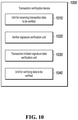
- FIG. 10 is a structural block diagram illustrating a transaction verification device, according to an implementation of the present application.
- FIG. 11 is a structural block diagram illustrating an example of a transaction initiator signature data verification unit in the transaction verification device illustrated in FIG. 10 ;
- FIG. 12 is a structural block diagram illustrating another example of a transaction initiator signature data verification unit in the transaction verification device illustrated in FIG. 10 ;
- FIG. 13 is a structural block diagram illustrating an example of a verifier signature verification unit in the transaction verification device illustrated in FIG. 10 ;
- FIG. 15 is a structural block diagram illustrating a computing device, according to an implementation of the present application.
- the terms “include” and “comprise” and their variants means “including but not limited to”.
- the term “based on” means “at least partially based on”.
- the term “an implementation” means “at least one implementation”.
- the term “another implementation” means “at least one of other implementations”.
- the terms such as “first” and “second” can indicate different or identical objects. Other explicit and implicit definitions can be included below. The definition of a term is consistent throughout the present specification, unless the context clearly indicates otherwise.
- a blockchain is a linked data structure that is obtained by combining data blocks in chronological order and uses a cryptographic method to prevent the data blocks from being tampered and faked.
- a blockchain includes one or more blocks. Each block in the blockchain is linked to a preceding block in the blockchain by using the cryptographic hash that includes the preceding block. Each block further includes a timestamp, a cryptographic hash of the block, and one or more transactions.
- a Merkle tree is formed by hashing transactions that are already verified by the nodes in the blockchain network. In the Merkle tree, data of each leaf node is hashed; and for each branch of the Merkle tree, all hash values of the branch are concatenated at the root of the branch.
- a blockchain is a data structure for storing transactions.
- a blockchain network is a computing node network for managing, updating, and maintaining one or more blockchain structures.
- Blockchain networks include a public blockchain network, a private blockchain network, and a consortium blockchain network.
- a public blockchain network In a public blockchain network, the consensus process is controlled by nodes in a consensus network. For example, in a public blockchain network, thousands of entities can perform collaborative processing, and each entity processes at least one node in the public blockchain network. Therefore, the public blockchain network can be considered as a public network of participating entities. In some examples, most entities (nodes) need to sequentially add signatures on all blocks, and add the blocks with the signatures to blockchains in the blockchain network.
- An example of the public blockchain network is a specific peer-to-peer payment network.
- the term “blockchain” used here does not represent any specific blockchain.
- the public blockchain network supports public transactions.
- a public transaction is shared among all nodes in the public blockchain network and stored in a global blockchain.
- the global blockchain is a blockchain that can perform copying across all nodes.
- a consensus protocol is implemented in the public blockchain network. Examples of the consensus protocol include but are not limited to proof-of-work (POW), proof-of-stake (POS), and proof-of-authority (POA).
- POW is used as a non-limiting example.
- a private blockchain network is used to serve a specific entity.
- the read permission and write permission of each node in the private blockchain network are strictly controlled. Therefore, the private blockchain network is usually called a grant-based network, which limits the participants of the network and the participation levels of the participants (for example, only in some transaction scenarios).
- various access control mechanisms can be used (for example, existing participants vote on adding an entity, or controlling permissions by a monitoring organization).
- a blockchain is a tamper-proofing shared digital ledger, and is used to record transactions in a public or private peer-to-peer network.
- the ledger is distributed to all member nodes in the network, and historical asset transactions that have happened in the network are permanently recorded in blocks.
- a consensus mechanism ensures all network nodes in a distributed blockchain network execute transactions in a same order and write the transactions into a same ledger.
- a consensus model is intended to resolve the Byzantine problem.
- a component for example, a server or a node
- a service of a second entity can be installed on the computing device/system 108 , for example, a service that is used by the second entity to manage transactions between the second entity and one or more of other entities (for example, other users).
- the blockchain network 102 is a peer-to-peer network, and the computing system/device 106 and the computing system/device 108 respectively serve as the nodes of the first entity and the second entity that participate in the blockchain network 102 .
- a blockchain (for example, the blockchain 216 in FIG. 2 ) include a string of blocks, and each block stores data.
- An example of data can be transaction data related to a transaction between two or more participants.
- a transaction is used as anon-limiting example. It can be anticipated that any suitable data (for example, a document, an image, a video, or audio) can be stored in a blockchain. Examples of the transaction can include but are not limited to exchange of valuable objects (for example, assets, products, services, or currencies).
- Transaction data is stored in the blockchain and cannot be changed.
- Transaction data of a plurality of transactions is hashed and stored in blocks. For example, the data of two transactions is hashed to obtain two hash values, and then the two obtained hash values are hashed to obtain another hash value. This process is repeated until a single hash value is obtained for all transactions that need to be stored in blocks.
- the hash value is called the Merkle root hash value and stored in the head of a block. A change to any transaction will change hash values and finally change the Merkle root hash value.
- Blocks are added to a blockchain by using a consensus protocol.
- a plurality of participating nodes in the blockchain network participate in the consensus protocol, and contend to add blocks to the blockchain.
- Such a node is called a miner node (or a ledger node).
- the POW described above is used as an example.
- a miner node generates a block head, hashes all transactions in the block, and combines hash values in pairs to generate further hash values until a single hash value (Merkle root hash value) is obtained for all the transactions in the block. Then, the Merkle root hash value is added to the block head.
- the miner node also determines the hash value of a latest block in the blockchain (that is, the last block added to the blockchain).
- the miner node can also add a nonce value and a timestamp to the block head. In the mining process, the miner node attempts to find a hash value that meets required parameters. The miner node constantly changes the nonce value until the hash value that meet the required parameters is found.
- Each miner node in the blockchain network contend to find a hash value that meets the required parameters. Finally, one miner node finds the hash value that meets the required parameters, and advertise the hash value to all other miner nodes in the blockchain network. Other miner nodes verify the hash value. If the hash value is correct, other nodes verify each transaction in the blockchain, accepts the block, and appends the block to their blockchain copies. As such, all miner nodes in the blockchain network reach a consensus on the global status of the blockchain. The foregoing process is specific to the POW consensus protocol.
- a cryptographic technology is implemented to protect privacy of the transaction. For example, if two nodes need to protect transaction privacy so that other nodes in the blockchain network cannot know transaction details, the nodes can encrypt the transaction data.
- the encryption method include but are not limited to symmetrical encryption and asymmetrical encryption. Symmetrical encryption means that a single key is used for encryption (generating plaintext based on ciphertext) and decryption (generating ciphertext based on plaintext). In symmetrical encryption, a plurality of nodes can use the same key, and therefore each node can encrypt/decrypt the transaction data.
- Symmetrical encryption means that a key pair is used for encryption. Each key pair includes a private key and a public key. The private key is known to a corresponding node, and the public key is known to any node or all other nodes in the blockchain network.
- a node can use a public key of another node to encrypt data, and can use a private key of another node to decrypt encrypted data. For example, refer to FIG. 1 again.
- Participate A can use a public key of participant B to encrypt data, and send the encrypted data to participant B.
- Participant B can use a private key of participant B to decrypt the encrypted data (ciphertext) to extract original data (plaintext).
- a message that is encrypted by using a public key of a node can be decrypted by using only a private key of the node.
- Asymmetric encryption is used to provide a digital signature, so that a participant in a transaction can determine other participants in the transaction and verify validity of the transaction. For example, a node can add a digital signature on a message, and another node can determine, based on the digital signature of participant A, that the message is sent by the node.
- a digital signature can be further used to ensure that a message is not tampered with during transmission. For example, refer to FIG. 1 again.
- Participant A sends a message to participant B.
- Participant A generates a hash value of the message, and uses a private key of participant A to encrypt the hash value to generate a digital signature.
- Participant A appends the digital signature to the message, and sends the message with the digital signature to participant B.
- Participant B uses a public key of participant A to decrypt the digital signature to obtain the corresponding hash value. Participant B hashes the received message to obtain another hash value, and then compares the two hash values. If the two hash values are the same, participant determines that the message is received from participant A and is not tampered with.
- the data to be verified includes transaction information presented in plaintext and at least one piece of verifier signature data, and the transaction information presented in plaintext includes a designated-verifier information set.
- the transaction information presented in plaintext refers to transaction information that is not encrypted. If the transaction information presented in plaintext is not tampered with or no information is lost, substantial content of the transaction information presented in plaintext is the same as the transaction information.
- each transaction involves a transaction initiator and a verifier of the transaction.
- the conformer can verify whether the transaction is authorized, whether to allow the transaction to proceed, etc.
- Transaction parties can negotiate a transaction verification rule, and verify a transaction based on the transaction verification rule when the transaction is performed.
- transaction parties other than the initiator of the transaction can be considered as verifiers, and a verifier that is designated to verify the transaction is a designated verifier.
- the designated verifier of each transaction can be designated by the transaction initiator.
- the designated verifier can be determined based on a rule negotiated by affiliated transaction parties of the transaction or based on a designated list.
- Each transaction may have one or more designated verifiers. The quantity of designated verifiers can be determined based on service scenarios.
- the transaction initiator When the transaction initiator initiates a transaction, after adding a digital signature, the transaction initiator can send the transaction to each designated verifier, so that the designated verifier can add a digital signature. After the signature data of the transaction initiator and the signature data of each verifier are received, the transaction data to be verified can be generated and sent to the blockchain system for verification of the transaction.
- the blockchain system can the system shown in FIG. 1 and FIG. 2 .
- FIG. 4 is flowchart illustrating an example process of generating data to be verified in a transaction verification method, according to an implementation of the present application.
- a transaction initiator generates transaction information when initiating a transaction.
- the transaction information can include a transaction initiator account, a transaction object account, a transaction amount, a transaction summary, a timestamp, etc.
- the transaction information can further include a designated-verifier information set.
- the designated-verifier information set includes designated-verifier information of at least one designated verifiers that are designated to verify the transaction.
- the designated-verifier information can be a designated-verifier public key or a designated-verifier account.
- the transaction initiator After the transaction information is generated, at block 404 , the transaction initiator adds a digital signature on the transaction information by using a private key of the transaction initiator, to obtain a signature of the transaction initiator. Then, in the transaction sending processes such as block 406 and block 412 , the transaction information (including transaction information presented in plaintext and transaction initiator signature data) is sent to each verifier.
- the transaction initiator signature data can include a transaction initiator public key and a transaction initiator signature.
- the transaction initiator can send the transaction information presented in plaintext and the transaction initiator signature data to only the designated verifier.
- the transaction initiator can send the transaction information presented in plaintext and the transaction initiator signature to all verifiers. After receiving the data, each verifier can determine, based on the designated-verifier information set in the transaction information presented in plaintext, whether the verifier is the designated verifier of the corresponding transaction.
- each verifier or a designated verifier may not include the transaction initiator signature data.
- each designated verifier does not need to verify the transaction initiator signature.
- each verifier can verify the signature and add a signature when determining that the verifier is a designated verifier of the corresponding transaction.
- each verifier can verify the signature of and add a signature on all the received transaction data, or determine whether to verify the signature of and add a signature on all the received transaction data based on a rule of the verifier.
- each verifier sends the verifier signature data to the transaction initiator. Then, at block 418 , the transaction initiator generates the transaction data to be verified, and at block 420 , sends the transaction data to be verified to the blockchain system. After the blockchain system receives the transaction data to be verified, at block 422 , the blockchain system verifies the transaction data to be verified.
- the verifier signature data may include only the designated-verifier signature data.
- a verifier that is not a designated verifier may also add a signature on the received transaction data.
- the verifier signature data in the transaction data to be verified that is sent to the blockchain system includes the designated-verifier signature data and undesignated-verifier signature data.
- the transaction data to be verified can be in the following data format: [Payload, [PubA, SignA], [PubB, signB], [PubC, signC].
- Payment represents transaction information presented in plaintext, and its data format can be [XX, XX, XX, [PubB, PubC]].
- PubA is a transaction initiator signature;
- PubB and “PubC” are respectively a signature of designated verifier B and a signature of designated verifier C;
- “[PubB, PubC]” is a designated-verifier information set.
- the verifier signature in the verifier signature data is verified based on the verifier signature data and the transaction information presented in plaintext, to obtain a verified-verifier information set.
- the verified-verifier information set includes verifier information of each verifier whose verifier signature is verified as authorized. The verification process of the verifier signature is described below with reference to FIG. 8 and FIG. 9 .
- the verified-verifier information set is received, at block 306 , it is determined whether the verified-verifier information set includes a pre-determined quantity of pieces of designated-verifier information in the designated-verifier information set.
- the verified-verifier information set includes a pre-determined quantity of pieces of designated-verifier information in the designated-verifier information set.
- it is determined that the data to be verified is verified successfully; otherwise, at block 310 , it is determined that the corresponding transaction is unauthorized, and the transaction fails.
- the verified-verifier information set includes a pre-determined quantity of pieces of designated-verifier information in the designated-verifier information set, it can be determined that the data to be verified is verified successfully.
- the condition for successful verification is that all designated verifiers have added a signature on the transaction information presented in plaintext, and all the signatures of the designated verifiers are verified as authorized.
- the affiliated parties can negotiate a rule for successful verification. That is, when most of the designated verifiers add a signature on the transaction information presented in plaintext, and all the signatures of the designated verifiers are verified as authorized, it is determined that transaction data to be verified is verified successfully (that is, the corresponding transaction is accepted by most of the designated verifiers).
- each designated verifier information can have a respective designated-verifier weight.
- the verified-verifier information set includes a pre-determined quantity of pieces of designated-verifier information in the designated-verifier information set
- each verifier can encrypt the designated-verifier weight, add encrypted designated-verifier weight in the verifier signature data, and send the verifier signature data with the encrypted designated-verifier weight to the transaction initiator.
- the blockchain system can execute a smart contract, to execute a transaction corresponding to the transaction data to be verified.
- the smart contract can be designated by the transaction initiator. Alternatively, the smart contract can be designated in the blockchain system.
- FIG. 5 is flowchart illustrating a process of verifying a transaction initiator and a process of verifying data to be verified in a transaction verification method, according to an implementation of the present application.
- transaction initiator signature data is verified based on transaction information presented in plaintext and transaction initiator signature data. Then, at block 504 , it is determined whether transaction initiator signature data is verified successfully.
- the transaction initiator signature data can include a transaction initiator signature and a transaction initiator public key. Verification of the transaction initiator signature data can include verification of the transaction initiator signature and verification of the transaction initiator public key. The verification process of the transaction initiator signature data is described below with reference to FIG. 6 and FIG. 7 .
- the transaction initiator data is verified successfully
- the transaction initiator data is verified successfully and it is determined that the verified-verifier information set includes a pre-determined quantity of pieces of designated-verifier information
- it is determined that the transaction data to be verified is verified successfully; otherwise, at block 510 , it is determined that the corresponding transaction is unauthorized, and the corresponding transaction fails.
- FIG. 6 is a flowchart illustrating an example process of verifying signature data of a transaction initiator in a transaction verification method, according to an implementation of the present application.
- transaction initiator signature data can include a transaction initiator public key and a transaction initiator signature.
- the transaction initiator signature is decrypted by using the transaction initiator public key in the transaction initiator signature data, to obtain transaction information in the transaction initiator signature. Then, at block 604 , it is determined whether the transaction information obtained through decryption is the same as transaction information presented in plaintext in transaction data to be verified. In an example, the transaction information obtained through decryption and the transaction information presented in plaintext can be separately hashed to obtain two hash values, and then the two hash values are compared to determine whether they are the same.
- a transaction initiator public key in the blockchain system is obtained based on a transaction initiator account in the transaction information presented in plaintext.
- the public key of the transaction party is sent to and stored in the blockchain system.
- the transaction initiator account can be obtained from the transaction information presented in plaintext, and then a corresponding transaction initiator public key can be obtained from the blockchain system based on the transaction initiator account.
- a blockchain system that is implemented based on Ethernet is used as an example.
- the transaction initiator public key can be obtained from the world state of the blockchain.
- the transaction initiator public key obtained from the blockchain system is the same as the transaction initiator public key from the transaction initiator signature.
- the transaction initiator public key obtained from the blockchain system and the transaction initiator public key from the transaction initiator signature are the same, it indicates that the transaction initiator is an authorized user of the transaction initiator public key.
- the transaction initiator signature data is verified successfully.
- the transaction initiator public key obtained from the blockchain system and the transaction initiator public key from the transaction initiator signature are different, it indicates that the transaction initiator is not an authorized user of the transaction initiator public key.
- it is determined that the transaction initiator signature data is not verified successfully, and the corresponding transaction fails.
- the processes in FIG. 6 can alternatively be arranged in another order. For example, when it is determined that the transaction initiator public key in the blockchain system is the same as the transaction initiator public key in the transaction initiator data, the transaction initiator signature is verified by using the transaction initiator public key.
- FIG. 7 is flowchart illustrating another example process of verifying signature data of a transaction initiator in a transaction verification method, according to an implementation of the present application.
- transaction initiator signature data includes a transaction initiator signature.
- a transaction initiator public key in a blockchain system is obtained based on a transaction initiator account in transaction information presented in plaintext.
- a transaction initiator signature is decrypted by using the transaction initiator public key, to obtain transaction information in the transaction initiator signature. Then, at block 706 , it is determined whether the transaction information obtained through decryption is the same as transaction information presented in plaintext in transaction data to be verified. When the transaction information obtained through decryption is the same as the transaction information presented in plaintext in the transaction data to be verified are the same, it indicates that the transaction initiator is an authorized user of the transaction initiator public key. As such, at block 708 , it is determined that the transaction initiator signature data is verified successfully.
- the transaction information obtained through decryption is the same as the transaction information presented in plaintext in the transaction data to be verified are different, it indicates that the transaction initiator is not an authorized user of the transaction initiator public key. As such, at block 710 , it is determined that the transaction initiator signature data is not verified successfully, and the corresponding transaction fails.
- FIG. 8 is flowchart illustrating an example process of verifying a signature of a transaction initiator in a transaction verification method, according to an implementation of the present application.
- transaction initiator signature data includes a transaction initiator public key.
- the verifier signature in the verifier signature data is decrypted by using the verifier public key in the verifier signature data, to obtain transaction information in the verifier signature.
- the transaction information obtained by encrypting the verifier signature is the same as transaction information presented in plaintext in transaction data to be verified.
- the transaction information obtained by encrypting the verifier signature and the transaction information presented in plaintext can be separately hashed to obtain two hash values, and then the two hash values are compared to determine whether they are the same.
- a verified-verifier public key set can be generated based on the verifier public keys of the successfully verified verifiers.
- the designated-verifier information in the transaction data to be verified can include a designated-verifier public key.
- the designated-verifier information set can be a designated-verifier public key set.
- the verifier signature data includes a verifier public key
- the designated-verifier information can further include a designated-verifier account.
- the designated-verifier information set is a designated-verifier account set.
- the verified-verifier public key set and the designated-verifier public key set can be compared to determine whether the verified-verifier public key set includes a pre-determined quantity of designated-verifier public keys in the designated-verifier public key set.
- the verified-verifier public key set includes a pre-determined quantity of designated-verifier public keys, it is determined that the transaction data to be verified is verified successfully.
- a designated verifier can have a plurality of public keys.
- the designated verifier can select the private key corresponding to one of the public keys to add the signature, and add the corresponding public key into the verifier signature data.
- Each public key of the designated verifier can have a respective public key weight, and the designated verifier can determine to use a public key with a greater weight or a smaller weight based on service scenarios.
- the verified-verifier information set includes a pre-determined quantity of pieces of designated-verifier information in the designated-verifier information set, it can be determined whether the sum of the public key weights of the public keys used by the designated quantity of designated verifiers is not less than a second pre-determined value. When the sum of the public key weights of the public keys used by the designated quantity of designated verifiers is not less than the second pre-determined value, it can be determined that the data to be verified is verified successfully.
- the pubic key weights of the designated-verifier public keys can be stored in the blockchain system as indexes, so that a corresponding public key weight can be queried based on a designated-verifier public key.
- a public key weight can alternatively be included in a designated verifier signature.
- the public keys of the successfully verified designated verifiers can be stored locally for use during execution of a smart contract.
- the smart contract can be configured based on service scenarios.
- the smart contract can include a rule for using a designated-verifier public key.
- the public key query process can be omitted in the execution process of the smart contract.
- the verifier signature data can include a verifier account. Verification of the verifier signature is described based on the example shown in FIG. 9 .
- FIG. 9 is flowchart illustrating another example process of verifying a signature of a transaction initiator in a transaction verification method, according to an implementation of the present application.
- a verifier public key in a verifier blockchain system is obtained based on a verifier account in verifier signature data. Because each transaction party has stored a public key in the blockchain system when participating in the blockchain network, the verifier public key can be obtained based on the verifier account. For example, the verifier public key can be obtained from the world state.
- the verifier signature in the verifier signature data is decrypted by using the obtained verifier public key, to obtain transaction information in the verifier signature.
- the transaction information obtained by decrypting the verifier signature is the same as transaction information presented in plaintext in transaction data to be verified.
- the transaction information obtained by decrypting the verifier signature and the transaction information presented in plaintext in transaction data to be verified are the same, at block 908 , it is determined that the verifier signature is verified successfully.
- the transaction information obtained by decrypting the verifier signature and the transaction information presented in plaintext in transaction data to be verified are different, at block 910 , it is determined that the verifier signature is not verified successfully.
- a verified-verifier account set can be generated based on the verifier accounts of the successfully verified verifiers.
- the designated-verifier information in the transaction data to be verified can include a designated-verifier account.
- the verified-verifier public key set and the designated-verifier public key set can be compared to determine whether the verified-verifier public key set includes a pre-determined quantity of designated-verifier public keys. As such, it can be determined whether the quantity of designated verifiers of the corresponding transaction meets the requirement.
- a verified-verifier public key set can be generated based on the verifier public keys of the successfully verified verifiers.
- the designated-verifier information in the transaction data to be verified can include a designated-verifier public key, and the designated-verifier information set is a designated-verifier public key set.
- the verified-verifier account set is obtained, the verified-verifier public key set and the designated-verifier public key set can be compared to determine whether the verified-verifier public key set includes a pre-determined quantity of designated-verifier public keys.
- FIG. 10 is a structural block diagram illustrating a transaction verification device, according to an implementation of the present application.
- the transaction verification device 1000 includes a unit for receiving transaction data to be verified 1010 , a verifier signature verification unit 1020 , a transaction initiator signature data verification unit 1030 , and a unit for verifying data to be verified 1040 .
- the verifier signature verification unit 1020 is configured to: for the verifier signature in the at least one piece of verifier signature data, verify the verifier signature in the verifier signature data based on the verifier signature data and the transaction information presented in plaintext, to obtain a verified-verifier information set.
- the transaction initiator signature data verification unit 1030 is configured to verify the transaction initiator signature data based on the transaction information presented in plaintext and the transaction initiator signature data.
- the unit for verifying data to be verified 1040 is configured to: determine that the data to be verified is verified successfully when the verified-verifier information set includes a pre-determined quantity of pieces of designated-verifier information in the designated-verifier information set, and the transaction initiator signature data is verified successfully.
- the transaction verification device may not include the transaction initiator signature data verification unit.
- the unit for verifying data to be verified 1040 can be configured to: determine that the data to be verified is verified successfully when the verified-verifier information set includes a pre-determined quantity of pieces of designated-verifier information in the designated-verifier information set.
- each designated verifier can have a respective designated-verifier weight
- the unit for verifying data to be verified 1040 can be configured to: determine that the data to be verified is verified successfully when the verified-verifier information set includes a pre-determined quantity of pieces of designated-verifier information in the designated-verifier information set, and the sum of designated-verifier weights corresponding to the pre-determined quantity of pieces of designated-verifier information is not less than a first pre-determined value.
- FIG. 11 is a structural block diagram illustrating an example of a transaction initiator signature data verification unit in the transaction verification device illustrated in FIG. 10 .
- the transaction initiator signature data verification unit 1030 includes a transaction initiator signature decryption module 1031 , a public key acquisition module 1032 , and a transaction initiator signature verification module 1033 .
- transaction initiator signature data can further include a transaction initiator public key.
- the transaction initiator signature decryption module 1031 is configured to decrypt the transaction initiator signature by using the transaction initiator public key in the transaction initiator signature data, to obtain transaction information in the transaction initiator signature.
- the public key acquisition module 1032 is configured to obtain a transaction initiator public key in the blockchain system based on the transaction initiator account in the transaction information presented in plaintext.
- the transaction initiator signature verification module 1033 is configured to determine that the transaction initiator signature data is verified successfully when the transaction information in the transaction initiator signature is the same as the transaction information presented in plaintext, and transaction initiator public key in the transaction initiator signature data is the same as the transaction initiator public key in the blockchain system.
- the verifier signature decryption module 1021 is configured to decrypt the verifier signature in the verifier signature data by using the verifier public key in the verifier signature data, to obtain transaction information in the verifier signature.
- the verifier signature verification module 1022 is configured to determine that the verifier signature is verified successfully when the transaction information in the verifier signature is the same as the transaction information presented in plaintext.
- the designated-verifier information can include a designated-verifier account
- the verified-verifier information set can include a verified-verifier account set
- the transaction verification device can further include a designated-verifier public key set acquisition unit (not shown in the figure).
- the designated-verifier public key set acquisition unit is configured to obtain a corresponding designated-verifier public key in a blockchain system based on at least one designated-verifier account in the designated-verifier account set, to obtain a designated-verifier public key set.
- the unit for verifying data to be verified is configured to: determine that the data to be verified is verified successfully when the verified-verifier public key set includes a pre-determined quantity of designated-verifier public keys.
- the designated verifier public key of the at least one designated verifier can have a designated-verifier weight
- the unit for verifying data to be verified can be configured to: determine that the data to be verified is verified successfully when the verified-verifier information set includes a pre-determined quantity of pieces of designated-verifier information in the designated-verifier information set, and the sum of the public key weights corresponding to the pre-determined quantity of pieces of designated-verifier information is not less than a second pre-determined value.
- FIG. 14 is a structural block diagram illustrating another example of a verifier signature verification unit in the transaction verification device illustrated in FIG. 10 .
- the verifier signature verification unit 1020 includes a verifier public key acquisition module 1023 , a verifier signature decryption module 1024 , and a verifier signature verification module 1025 .
- the verifier signature data can further include a verifier account.
- the verifier public key acquisition module 1023 is configured to obtain a verifier public key in the blockchain system based on the verifier account.
- the verifier signature decryption module 1024 is configured to decrypt the verifier signature in the verifier signature data by using the verifier public key in the verifier signature data, to obtain transaction information in the verifier signature.
- the verifier signature verification module 1025 is configured to determine that the verifier signature is verified successfully when the transaction information in the verifier signature is the same as the transaction information presented in plaintext.
- the transaction verification device in the present application can be implemented by using hardware, software, or a combination of hardware and software.
- the implementations of the present specification are described in a progressive way. For same or similar parts of the implementations, mutual references can be made to the implementations.
- the transaction verification device in the present application can be implemented by using hardware, software, or a combination of hardware and software.
- the software-based implementation is used as an example.
- the transaction verification device is formed by reading, by the processor in a device where the transaction verification device is located, corresponding instructions from a storage device to a memory for running.
- the transaction verification device is implemented by using a computing device.
- the computing device 1500 can include at least one processor 1510 , where the at least one processor 1510 executes at least one computer readable instruction (that is, the foregoing elements that are implemented in a form of software) that is stored or coded in the computer readable storage medium (that is, the storage device 1520 ).
- the at least one processor 1510 executes at least one computer readable instruction (that is, the foregoing elements that are implemented in a form of software) that is stored or coded in the computer readable storage medium (that is, the storage device 1520 ).
- computer readable instructions are stored in the storage device 1520 , and when the instructions are executed, the at least one processor 1510 is enabled to perform the following operations: receiving transaction data to be verified, where the transaction to be verified includes transaction information presented in plaintext and at least one piece of verifier signature data, the transaction information presented in plaintext includes a designated-verifier information set, the designated-verifier information set includes verifier information of at least one verifier designated to verify the transaction information presented in plaintext, and the verifier signature data includes a verifier signature; for the verifier signature in the at least one piece of verifier signature data, verifying the verifier signature in the verifier signature data based on the verifier signature data and the transaction information presented in plaintext, to obtain a verified-verifier information set; and determining that the data to be verified is verified successfully when the verified-verifier information set includes a pre-determined quantity of pieces of designated-verifier information in the designated-verifier information set.
- the at least one processor 1510 is enabled to perform the operations and functions that are described above with reference to FIG. 1 to FIG. 15 in the implementations in the present application.
- a system or device equipped with a readable storage medium can be provided, and the readable storage medium stores software program code used for implementing the functions described in any one of the foregoing implementations, and the computer or processor of the system or device is enabled to read execute the instructions stored in the readable storage medium.
- any one of the foregoing implementations can be implemented by using the program code read from the readable storage medium. Therefore, the computer readable code and the readable storage medium that stores the computer readable code constitute a part of the present application.
- Examples of the readable storage medium include a floppy disk, a hard disk, a magneto-optical disk, a compact disc (for example, CD-ROM, CD-R, CD-RW, DVD-ROM, DVD-RAM, DVD-RW, or DVD-RW) a magnetic tape, a volatile memory card, and ROM.
- program code can be downloaded from a server or a cloud through a communications network.
- the device structures described in the foregoing implementations may be logical structure. That is, some units may be implemented by using one physical entity, may be implemented by using a plurality of physical entities, or may be jointly implemented by some components in a plurality of independent devices.
- example used through the present specification means “being used as an example”, and does not mean “being preferred over” or “being advantageous over” other implementations.
- Specific implementations include specific details provided to facilitate understanding of the described technologies. However, these technologies can be implemented with these specific details. In some examples, well-known structures and devices are illustrated by using block diagrams to facilitate understanding of the concepts described in the implementations.
Landscapes
- Engineering & Computer Science (AREA)
- Computer Security & Cryptography (AREA)
- Computer Networks & Wireless Communication (AREA)
- Signal Processing (AREA)
- Theoretical Computer Science (AREA)
- Databases & Information Systems (AREA)
- Data Mining & Analysis (AREA)
- Physics & Mathematics (AREA)
- General Engineering & Computer Science (AREA)
- General Physics & Mathematics (AREA)
- Computing Systems (AREA)
- Software Systems (AREA)
- Financial Or Insurance-Related Operations Such As Payment And Settlement (AREA)
Abstract
Description
Claims (21)
Priority Applications (1)
| Application Number | Priority Date | Filing Date | Title |
|---|---|---|---|
| US17/201,181 US11240041B2 (en) | 2019-07-12 | 2021-03-15 | Blockchain-based transaction verification |
Applications Claiming Priority (5)
| Application Number | Priority Date | Filing Date | Title |
|---|---|---|---|
| CN201910630854.0A CN110458560B (en) | 2019-07-12 | 2019-07-12 | Method and apparatus for transaction verification |
| CN201910630854.0 | 2019-07-12 | ||
| PCT/CN2020/071740 WO2021008117A1 (en) | 2019-07-12 | 2020-01-13 | Method and apparatus for performing transaction verification |
| US16/779,201 US10951417B2 (en) | 2019-07-12 | 2020-01-31 | Blockchain-based transaction verification |
| US17/201,181 US11240041B2 (en) | 2019-07-12 | 2021-03-15 | Blockchain-based transaction verification |
Related Parent Applications (1)
| Application Number | Title | Priority Date | Filing Date |
|---|---|---|---|
| US16/779,201 Continuation US10951417B2 (en) | 2019-07-12 | 2020-01-31 | Blockchain-based transaction verification |
Publications (2)
| Publication Number | Publication Date |
|---|---|
| US20210203511A1 US20210203511A1 (en) | 2021-07-01 |
| US11240041B2 true US11240041B2 (en) | 2022-02-01 |
Family
ID=71516882
Family Applications (2)
| Application Number | Title | Priority Date | Filing Date |
|---|---|---|---|
| US16/779,201 Active US10951417B2 (en) | 2019-07-12 | 2020-01-31 | Blockchain-based transaction verification |
| US17/201,181 Active US11240041B2 (en) | 2019-07-12 | 2021-03-15 | Blockchain-based transaction verification |
Family Applications Before (1)
| Application Number | Title | Priority Date | Filing Date |
|---|---|---|---|
| US16/779,201 Active US10951417B2 (en) | 2019-07-12 | 2020-01-31 | Blockchain-based transaction verification |
Country Status (1)
| Country | Link |
|---|---|
| US (2) | US10951417B2 (en) |
Families Citing this family (10)
| Publication number | Priority date | Publication date | Assignee | Title |
|---|---|---|---|---|
| US10951417B2 (en) | 2019-07-12 | 2021-03-16 | Advanced New Technologies Co., Ltd. | Blockchain-based transaction verification |
| CN112184441B (en) * | 2020-09-29 | 2024-01-19 | 平安科技(深圳)有限公司 | Data processing method, device, node equipment and storage medium |
| US12294656B2 (en) | 2021-03-12 | 2025-05-06 | Michael Ira Kanovitz | Authenticated modification of blockchain-based data |
| KR102568418B1 (en) * | 2021-08-26 | 2023-08-18 | 하이파이브랩 주식회사 | Electronic authentication system and method supporting multi-signature |
| CN113888131B (en) * | 2021-10-11 | 2024-05-14 | 平安国际智慧城市科技股份有限公司 | Block chain-based man-hour information processing method, device, equipment and storage medium |
| US11947523B2 (en) | 2022-03-17 | 2024-04-02 | International Business Machines Corporation | Multi-party transactions in a computerized database |
| CN114692207B (en) * | 2022-05-31 | 2022-09-20 | 蓝象智联(杭州)科技有限公司 | Data processing method and device for privacy protection and storage medium |
| US12314938B2 (en) * | 2022-12-06 | 2025-05-27 | Franklin Resources | Multilayer system and method for securing a blockchain-based token using random temporal windowing |
| KR20260014264A (en) * | 2024-07-23 | 2026-01-30 | 주식회사 잇핀 | Chain-type data storage technology that guarantees individual data ownership and control in a very high-security environment |
| TWI894120B (en) * | 2025-05-16 | 2025-08-11 | 美商奧丁丁美國股份有限公司 | Payment management system using asymmetric cryptography to ensure information accuracy |
Citations (22)
| Publication number | Priority date | Publication date | Assignee | Title |
|---|---|---|---|---|
| US7751567B2 (en) | 2001-01-05 | 2010-07-06 | Qualcomm Incorporated | Local authentication of mobile subscribers outside their home systems |
| CN105608588A (en) | 2016-01-04 | 2016-05-25 | 布比(北京)网络技术有限公司 | Tracing record processing method and apparatus |
| CN106656974A (en) | 2016-10-17 | 2017-05-10 | 江苏通付盾科技有限公司 | Block chain grouping consensus method and system |
| CN107330787A (en) | 2017-05-24 | 2017-11-07 | 智牛股权投资基金(平潭)合伙企业(有限合伙) | High frequency transaction payment method, system under a kind of block chain chain of highly effective and safe |
| US20180019993A1 (en) * | 2016-07-12 | 2018-01-18 | International Business Machines Corporation | Template-based distributed certificate issuance in a mult-tenant environment |
| US20180068280A1 (en) * | 2015-02-17 | 2018-03-08 | Silvio Micali | Verifying electronic transactions |
| CN108023729A (en) | 2017-10-13 | 2018-05-11 | 中国银联股份有限公司 | Block chain network and its method of commerce |
| US20180240107A1 (en) * | 2015-03-27 | 2018-08-23 | Black Gold Coin, Inc. | Systems and methods for personal identification and verification |
| US10063572B2 (en) * | 2016-03-28 | 2018-08-28 | Accenture Global Solutions Limited | Antivirus signature distribution with distributed ledger |
| CN108596619A (en) | 2018-04-26 | 2018-09-28 | 深圳怡化电脑股份有限公司 | For the method for commerce of block catenary system, device, Centroid and system |
| CN108848148A (en) | 2018-06-04 | 2018-11-20 | 立旃(上海)科技有限公司 | Transaction Information confirmation method and device based on block chain |
| CN109067543A (en) | 2018-07-24 | 2018-12-21 | 腾讯科技(深圳)有限公司 | Digital certificate management method, device, computer equipment and storage medium |
| CN109165944A (en) | 2018-08-21 | 2019-01-08 | 北京京东金融科技控股有限公司 | Multiple party signatures authentication method, device, equipment and storage medium based on block chain |
| US20190123895A1 (en) | 2017-10-23 | 2019-04-25 | Cygnetise Limited | Methods and apparatus for verifying a user transaction |
| CN109936457A (en) | 2019-02-20 | 2019-06-25 | 深圳前海微众银行股份有限公司 | Blockchain multi-party witness method, apparatus, device and computer-readable storage medium |
| US20190295050A1 (en) * | 2018-03-22 | 2019-09-26 | R3 Ltd. | Weighted multiple authorizations |
| CN110458560A (en) | 2019-07-12 | 2019-11-15 | 阿里巴巴集团控股有限公司 | For carrying out the method and device of transaction verification |
| US20200026700A1 (en) * | 2017-03-28 | 2020-01-23 | Alibaba Group Holding Limited | Blockchain-based data storage and query method and device |
| US20200076571A1 (en) | 2018-08-29 | 2020-03-05 | International Business Machines Corporation | Checkpointing for increasing efficiency of a blockchain |
| US20200228348A1 (en) | 2019-07-12 | 2020-07-16 | Alibaba Group Holding Limited | Blockchain-based transaction verification |
| US10725803B1 (en) | 2019-06-21 | 2020-07-28 | Alibaba Group Holding Limited | Methods and systems for automatic blockchain deployment based on cloud platform |
| US10790976B1 (en) * | 2018-08-01 | 2020-09-29 | Bloomio Ag | System and method of blockchain wallet recovery |
-
2020
- 2020-01-31 US US16/779,201 patent/US10951417B2/en active Active
-
2021
- 2021-03-15 US US17/201,181 patent/US11240041B2/en active Active
Patent Citations (23)
| Publication number | Priority date | Publication date | Assignee | Title |
|---|---|---|---|---|
| US7751567B2 (en) | 2001-01-05 | 2010-07-06 | Qualcomm Incorporated | Local authentication of mobile subscribers outside their home systems |
| US20180068280A1 (en) * | 2015-02-17 | 2018-03-08 | Silvio Micali | Verifying electronic transactions |
| US20180240107A1 (en) * | 2015-03-27 | 2018-08-23 | Black Gold Coin, Inc. | Systems and methods for personal identification and verification |
| CN105608588A (en) | 2016-01-04 | 2016-05-25 | 布比(北京)网络技术有限公司 | Tracing record processing method and apparatus |
| US10063572B2 (en) * | 2016-03-28 | 2018-08-28 | Accenture Global Solutions Limited | Antivirus signature distribution with distributed ledger |
| US20180019993A1 (en) * | 2016-07-12 | 2018-01-18 | International Business Machines Corporation | Template-based distributed certificate issuance in a mult-tenant environment |
| CN106656974A (en) | 2016-10-17 | 2017-05-10 | 江苏通付盾科技有限公司 | Block chain grouping consensus method and system |
| US20200026700A1 (en) * | 2017-03-28 | 2020-01-23 | Alibaba Group Holding Limited | Blockchain-based data storage and query method and device |
| CN107330787A (en) | 2017-05-24 | 2017-11-07 | 智牛股权投资基金(平潭)合伙企业(有限合伙) | High frequency transaction payment method, system under a kind of block chain chain of highly effective and safe |
| CN108023729A (en) | 2017-10-13 | 2018-05-11 | 中国银联股份有限公司 | Block chain network and its method of commerce |
| US20190123895A1 (en) | 2017-10-23 | 2019-04-25 | Cygnetise Limited | Methods and apparatus for verifying a user transaction |
| US20190295050A1 (en) * | 2018-03-22 | 2019-09-26 | R3 Ltd. | Weighted multiple authorizations |
| CN108596619A (en) | 2018-04-26 | 2018-09-28 | 深圳怡化电脑股份有限公司 | For the method for commerce of block catenary system, device, Centroid and system |
| CN108848148A (en) | 2018-06-04 | 2018-11-20 | 立旃(上海)科技有限公司 | Transaction Information confirmation method and device based on block chain |
| CN109067543A (en) | 2018-07-24 | 2018-12-21 | 腾讯科技(深圳)有限公司 | Digital certificate management method, device, computer equipment and storage medium |
| US10790976B1 (en) * | 2018-08-01 | 2020-09-29 | Bloomio Ag | System and method of blockchain wallet recovery |
| CN109165944A (en) | 2018-08-21 | 2019-01-08 | 北京京东金融科技控股有限公司 | Multiple party signatures authentication method, device, equipment and storage medium based on block chain |
| US20200076571A1 (en) | 2018-08-29 | 2020-03-05 | International Business Machines Corporation | Checkpointing for increasing efficiency of a blockchain |
| CN109936457A (en) | 2019-02-20 | 2019-06-25 | 深圳前海微众银行股份有限公司 | Blockchain multi-party witness method, apparatus, device and computer-readable storage medium |
| US10725803B1 (en) | 2019-06-21 | 2020-07-28 | Alibaba Group Holding Limited | Methods and systems for automatic blockchain deployment based on cloud platform |
| CN110458560A (en) | 2019-07-12 | 2019-11-15 | 阿里巴巴集团控股有限公司 | For carrying out the method and device of transaction verification |
| US20200228348A1 (en) | 2019-07-12 | 2020-07-16 | Alibaba Group Holding Limited | Blockchain-based transaction verification |
| US10951417B2 (en) | 2019-07-12 | 2021-03-16 | Advanced New Technologies Co., Ltd. | Blockchain-based transaction verification |
Non-Patent Citations (4)
| Title |
|---|
| Crosby et al., "BlockChain Technology: Beyond Bitcoin," Sutardja Center for Entrepreneurship & Technology Technical Report, Oct. 16, 2015, 35 pages. |
| Nakamoto, "Bitcoin: A Peer-to-Peer Electronic Cash System," www.bitcoin.org, 2005, 9 pages. |
| PCT International Search Report and Written Opinion in International Application No. PCT/CN2020/071740, dated Apr. 13, 2020, 20 pages (with machine translation). |
| Researchgate.net [online], "Efficient Weighted Threshold ECDSA for Securing Bitcoin Wallet," Jan. 2017, retrieved on Apr. 8, 2021, retrieved from UPL<https://www.researchgate.netpublication/318409550_Efficient_weighted_threshold_ECDSA_for_securing_bitcoin_wallet>, 10 pages. |
Also Published As
| Publication number | Publication date |
|---|---|
| US20200228348A1 (en) | 2020-07-16 |
| US20210203511A1 (en) | 2021-07-01 |
| US10951417B2 (en) | 2021-03-16 |
Similar Documents
| Publication | Publication Date | Title |
|---|---|---|
| US11240041B2 (en) | Blockchain-based transaction verification | |
| CN111062716B (en) | Method and device for generating block chain signature data and block chain transaction initiating system | |
| CN110458560B (en) | Method and apparatus for transaction verification | |
| US11934549B2 (en) | Invoice access method and apparatus based on blockchain, and electronic device | |
| US12021993B2 (en) | Blockchain-based transaction method and apparatus, and remitter device | |
| US11050549B2 (en) | Blockchain-based transaction method and apparatus, and remitter device | |
| CN111242617B (en) | Method and apparatus for performing transaction correctness verification | |
| CN111047324B (en) | Method and apparatus for updating a set of public keys at a blockchain node | |
| CN111080292B (en) | Method and device for acquiring block chain transaction signature data | |
| US11386426B2 (en) | Invoice invalidation method and apparatus based on blockchain, and electronic device | |
| WO2021135857A1 (en) | Method and device for updating trusted node information | |
| US20250094969A1 (en) | Enabling confidential and non-confidential transactions on a digital token architecture | |
| CN110827034B (en) | Method and apparatus for initiating a blockchain transaction | |
| CN111144894B (en) | UTXO processing method and device | |
| CN111211876B (en) | Method and device for sending response message aiming at data request and block chain system | |
| CN110852887B (en) | Method and device for acquiring transaction processing state in decentralized application cluster | |
| CN111143381B (en) | Method and device for updating trust points in multi-layer block chain structure | |
| CN111159286B (en) | Method and apparatus for generating multi-layer block chain structure | |
| US12081670B1 (en) | Validation of electronic document using distributed ledgers | |
| HK40023532B (en) | Method and device for initiating blockchain transaction | |
| HK40023532A (en) | Method and device for initiating blockchain transaction | |
| HK40029914B (en) | Method and apparatus for updating trust point in multi-layer block chain structure |
Legal Events
| Date | Code | Title | Description |
|---|---|---|---|
| FEPP | Fee payment procedure |
Free format text: ENTITY STATUS SET TO UNDISCOUNTED (ORIGINAL EVENT CODE: BIG.); ENTITY STATUS OF PATENT OWNER: LARGE ENTITY |
|
| AS | Assignment |
Owner name: ADVANCED NEW TECHNOLOGIES CO., LTD., CAYMAN ISLANDS Free format text: ASSIGNMENT OF ASSIGNORS INTEREST;ASSIGNOR:ADVANTAGEOUS NEW TECHNOLOGIES CO., LTD.;REEL/FRAME:056151/0231 Effective date: 20200910 Owner name: ADVANTAGEOUS NEW TECHNOLOGIES CO., LTD., CAYMAN ISLANDS Free format text: ASSIGNMENT OF ASSIGNORS INTEREST;ASSIGNOR:ALIBABA GROUP HOLDING LIMITED;REEL/FRAME:056151/0171 Effective date: 20200826 Owner name: ALIBABA GROUP HOLDING LIMITED, CAYMAN ISLANDS Free format text: ASSIGNMENT OF ASSIGNORS INTEREST;ASSIGNOR:QI, PENGTAO;REEL/FRAME:056145/0724 Effective date: 20201201 |
|
| STPP | Information on status: patent application and granting procedure in general |
Free format text: NON FINAL ACTION MAILED |
|
| STPP | Information on status: patent application and granting procedure in general |
Free format text: RESPONSE TO NON-FINAL OFFICE ACTION ENTERED AND FORWARDED TO EXAMINER |
|
| STPP | Information on status: patent application and granting procedure in general |
Free format text: NOTICE OF ALLOWANCE MAILED -- APPLICATION RECEIVED IN OFFICE OF PUBLICATIONS |
|
| STPP | Information on status: patent application and granting procedure in general |
Free format text: NOTICE OF ALLOWANCE MAILED -- APPLICATION RECEIVED IN OFFICE OF PUBLICATIONS |
|
| STPP | Information on status: patent application and granting procedure in general |
Free format text: PUBLICATIONS -- ISSUE FEE PAYMENT VERIFIED |
|
| STCF | Information on status: patent grant |
Free format text: PATENTED CASE |
|
| MAFP | Maintenance fee payment |
Free format text: PAYMENT OF MAINTENANCE FEE, 4TH YEAR, LARGE ENTITY (ORIGINAL EVENT CODE: M1551); ENTITY STATUS OF PATENT OWNER: LARGE ENTITY Year of fee payment: 4 |