US11236849B2 - Pressing tool and method for a re-pressing operation - Google Patents
Pressing tool and method for a re-pressing operation Download PDFInfo
- Publication number
- US11236849B2 US11236849B2 US16/559,896 US201916559896A US11236849B2 US 11236849 B2 US11236849 B2 US 11236849B2 US 201916559896 A US201916559896 A US 201916559896A US 11236849 B2 US11236849 B2 US 11236849B2
- Authority
- US
- United States
- Prior art keywords
- motor
- microcontroller
- jaws
- pressing tool
- output shaft
- Prior art date
- Legal status (The legal status is an assumption and is not a legal conclusion. Google has not performed a legal analysis and makes no representation as to the accuracy of the status listed.)
- Active, expires
Links
Images



Classifications
-
- F—MECHANICAL ENGINEERING; LIGHTING; HEATING; WEAPONS; BLASTING
- F16—ENGINEERING ELEMENTS AND UNITS; GENERAL MEASURES FOR PRODUCING AND MAINTAINING EFFECTIVE FUNCTIONING OF MACHINES OR INSTALLATIONS; THERMAL INSULATION IN GENERAL
- F16L—PIPES; JOINTS OR FITTINGS FOR PIPES; SUPPORTS FOR PIPES, CABLES OR PROTECTIVE TUBING; MEANS FOR THERMAL INSULATION IN GENERAL
- F16L13/00—Non-disconnectable pipe joints, e.g. soldered, adhesive, or caulked joints
- F16L13/14—Non-disconnectable pipe joints, e.g. soldered, adhesive, or caulked joints made by plastically deforming the material of the pipe, e.g. by flanging, rolling
- F16L13/141—Non-disconnectable pipe joints, e.g. soldered, adhesive, or caulked joints made by plastically deforming the material of the pipe, e.g. by flanging, rolling by crimping or rolling from the outside
-
- B—PERFORMING OPERATIONS; TRANSPORTING
- B25—HAND TOOLS; PORTABLE POWER-DRIVEN TOOLS; MANIPULATORS
- B25B—TOOLS OR BENCH DEVICES NOT OTHERWISE PROVIDED FOR, FOR FASTENING, CONNECTING, DISENGAGING, OR HOLDING
- B25B27/00—Hand tools, specially adapted for fitting together or separating parts or objects whether or not involving some deformation, not otherwise provided for
- B25B27/02—Hand tools, specially adapted for fitting together or separating parts or objects whether or not involving some deformation, not otherwise provided for for connecting objects by press fit or detaching same
- B25B27/10—Hand tools, specially adapted for fitting together or separating parts or objects whether or not involving some deformation, not otherwise provided for for connecting objects by press fit or detaching same inserting fittings into hoses
-
- B—PERFORMING OPERATIONS; TRANSPORTING
- B21—MECHANICAL METAL-WORKING WITHOUT ESSENTIALLY REMOVING MATERIAL; PUNCHING METAL
- B21D—WORKING OR PROCESSING OF SHEET METAL OR METAL TUBES, RODS OR PROFILES WITHOUT ESSENTIALLY REMOVING MATERIAL; PUNCHING METAL
- B21D39/00—Application of procedures in order to connect objects or parts, e.g. coating with sheet metal otherwise than by plating; Tube expanders
- B21D39/04—Application of procedures in order to connect objects or parts, e.g. coating with sheet metal otherwise than by plating; Tube expanders of tubes with tubes; of tubes with rods
- B21D39/046—Connecting tubes to tube-like fittings
-
- B—PERFORMING OPERATIONS; TRANSPORTING
- B21—MECHANICAL METAL-WORKING WITHOUT ESSENTIALLY REMOVING MATERIAL; PUNCHING METAL
- B21D—WORKING OR PROCESSING OF SHEET METAL OR METAL TUBES, RODS OR PROFILES WITHOUT ESSENTIALLY REMOVING MATERIAL; PUNCHING METAL
- B21D39/00—Application of procedures in order to connect objects or parts, e.g. coating with sheet metal otherwise than by plating; Tube expanders
- B21D39/04—Application of procedures in order to connect objects or parts, e.g. coating with sheet metal otherwise than by plating; Tube expanders of tubes with tubes; of tubes with rods
- B21D39/048—Application of procedures in order to connect objects or parts, e.g. coating with sheet metal otherwise than by plating; Tube expanders of tubes with tubes; of tubes with rods using presses for radially crimping tubular elements
-
- B—PERFORMING OPERATIONS; TRANSPORTING
- B25—HAND TOOLS; PORTABLE POWER-DRIVEN TOOLS; MANIPULATORS
- B25F—COMBINATION OR MULTI-PURPOSE TOOLS NOT OTHERWISE PROVIDED FOR; DETAILS OR COMPONENTS OF PORTABLE POWER-DRIVEN TOOLS NOT PARTICULARLY RELATED TO THE OPERATIONS PERFORMED AND NOT OTHERWISE PROVIDED FOR
- B25F5/00—Details or components of portable power-driven tools not particularly related to the operations performed and not otherwise provided for
-
- Y—GENERAL TAGGING OF NEW TECHNOLOGICAL DEVELOPMENTS; GENERAL TAGGING OF CROSS-SECTIONAL TECHNOLOGIES SPANNING OVER SEVERAL SECTIONS OF THE IPC; TECHNICAL SUBJECTS COVERED BY FORMER USPC CROSS-REFERENCE ART COLLECTIONS [XRACs] AND DIGESTS
- Y10—TECHNICAL SUBJECTS COVERED BY FORMER USPC
- Y10T—TECHNICAL SUBJECTS COVERED BY FORMER US CLASSIFICATION
- Y10T29/00—Metal working
- Y10T29/53—Means to assemble or disassemble
- Y10T29/5367—Coupling to conduit
Definitions
- the present application relates to pressing tools, and more particularly to the operation of pressing tools, such as crimping and clamping tools.
- PEX tubing is often used for domestic water piping to replace traditional copper piping.
- PEX tubing is typically attached to fittings using compression rings. In its nominal (uncompressed) state, a compression ring can be slid over the PEX tubing and fitting, then compressed using a pressing tool to clamp the PEX tubing to the fitting.
- Manual pressing tools including clamping tools for use with clamp rings and crimping tools for use with crimp rings, typically include a pair of handles coupled to pressing jaws by a pivoting linkage arrangement. Automatic or electric pressing tools may be used as well.
- Automatic or electric pressing tools may be configured to detect when a pressing operation (e.g., a crimp or clamp operation) has occurred improperly, and release the pressing jaws. Furthermore, when the electric pressing tool releases the pressing jaws, delays are introduced in completing the pressing operation as the pressing jaws are fully opened before the operation can begin again. Thus, it would be desirable to have an electric pressing tool that could initiate an automatic re-pressing operation (e.g., a re-crimp or re-clamp operation).
- a pressing operation e.g., a crimp or clamp operation
- a pressing tool in one embodiment, includes a motor, a sensor, and a microcontroller coupled to the motor and the sensor.
- the microcontroller is configured to cause the motor to operate in a first direction, and obtain a motor parameter from the sensor.
- the microcontroller is further configured to determine an occurrence of a fault condition of the motor when the motor parameter satisfies a threshold.
- the microcontroller is further configured to cause the motor to change from operation in the first direction to operate in a second direction, pause operation of the motor in the second direction, and resume operation of the motor in the first direction.
- a method of operating a pressing tool includes causing, by a microcontroller, an operation of a motor in a first direction, and obtaining, by the microcontroller, a motor parameter from a sensor.
- the method further includes determining, by the microcontroller, a fault condition from the motor parameter received.
- the method includes causing, by the microcontroller, operation of the motor from the first direction to a second direction, pausing, by the microcontroller, operation of the motor, and resuming, by the microcontroller, operation of the motor in the first direction.
- a pressing tool in another embodiment, includes a housing and first and second jaws extending from the housing, wherein the first and second jaws are pivotable relative to a portion of the housing between a closed position and an open position.
- the pressing tool further include a motor supported within the housing and configured to drive the first and second jaws between the closed position and the open position.
- the pressing tool also includes a current sensor and a microcontroller.
- the microcontroller is configured to cause the motor to operate in a first direction, obtain a motor current from the current sensor, and determine a fault condition of the motor based on the received motor current.
- the microcontroller is further configured to, in response to determining the fault condition, change operation of the motor from the first direction to a second direction, pause operation of the motor, and resume operating the motor in the first direction.
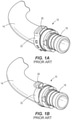
- FIG. 1A is a perspective view illustrating a clamp ring in an uncompressed state.
- FIG. 1B is a perspective view illustrating the clamp ring of FIG. 1A in a compressed state.
- FIG. 2A is a perspective view illustrating a crimp ring in an uncompressed state.
- FIGS. 2B and 2C are perspective views illustrating the crimp ring of FIG. 2A in a compressed state.
- FIG. 3 is a side view of a clamping tool according to an embodiment.
- FIG. 4 is a cross-sectional view of the clamping tool of FIG. 3 , with jaws of the clamping tool in an open position.
- FIG. 5 is a cross-sectional view of the clamping tool of FIG. 3 , with the jaws of the clamping tool in a closed position.
- FIG. 6 is a block diagram of the pressing tool according to one embodiment.
- FIG. 7 is a flowchart of a method for a re-press operation of the pressing tool according to one embodiment.
- processors central processing unit and CPU
- CPU central processing unit
- a clamp ring 10 is one type of compression ring that can be used to attach PEX tubing 14 to a fitting 18 .
- Clamp rings 10 are typically made of stainless steel and include an outer band 22 with an integral tab 26 . In use, the tab 26 is deformed inwardly to reduce the diameter of the outer band 22 and thereby clamp the PEX tubing 14 to the fitting 18 .
- Another type of compression ring that can be used to attach PEX tubing 14 to a fitting 18 is a crimp ring 30 , illustrated in FIGS. 2A-2C .
- a crimp ring 30 is a continuous ring that is typically made of copper. In use, the crimp ring 30 is compressed on all sides to reduce its diameter ( FIG. 2B ) and thereby crimp and/or clamp the PEX tubing 14 to the fitting 18 ( FIG. 2C ).
- FIG. 3 illustrates a pressing tool 50 , which is a PEX clamping tool 50 in the illustrated embodiment.
- the clamping tool 50 includes a housing 54 having a battery support portion 58 , a head portion 62 , and a handle portion 66 configured to be gripped by a user during operation of the clamping tool 50 .
- the handle portion 66 is generally cylindrical or barrel-shaped and defines a longitudinal axis 70 extending centrally through the handle portion 66 .
- the handle portion 66 is positioned between the battery support portion 58 and the head portion 62 , such that the PEX clamping tool 50 has an in-line configuration.
- the battery support portion 58 , the handle portion 66 , and the head portion 62 are arranged in series along the longitudinal axis 70 .
- the in-line arrangement of the clamping tool 50 advantageously provides the clamping tool 50 with a relatively compact shape and size, increasing its usability in tight spaces. In this way, the clamping tool 50 may be more easily maneuvered and/or handled during use.
- the head portion 62 may be configured at a 90-degree angle to the handle portion 66 and the battery support portion 58 .
- the perpendicular arrangement of the clamping tool 50 may allow for the clamping tool 50 to be used in applications where there the length of the clamping tool would not be able to reach the workpiece.
- the handle portion 66 may be positioned at a 90-degree angle to the longitudinal axis 70 , thereby providing a pistol-grip type handle portion 66 to allow the user to maintain greater control of the clamping tool 50 .
- the battery support portion 58 is configured to support a battery 74 that includes a battery housing 78 enclosing an array of battery cells (e.g., lithium-based rechargeable cells; not shown).
- a stem 82 extends from the battery housing 78 and includes electrically conductive contacts 86 that are electrically connected to the battery cells.
- the stem 82 is insertable into a receptacle 90 ( FIG. 4 ) in the battery support portion 58 of the housing 54 along a battery insertion axis 94 ( FIG. 3 ).
- the battery insertion axis 94 is parallel to the longitudinal axis 70 .
- the battery insertion axis 94 may be coaxial with the longitudinal axis 70 , perpendicular to the longitudinal axis 70 , or obliquely oriented with respect to the longitudinal axis 70 .
- the receptacle 90 includes electrically conductive contacts 98 ( FIG. 4 ) that engage the contacts 86 on the stem 82 ( FIG. 3 ) when the stem 82 is inserted into the receptacle 90 to transmit power from the battery 74 to the clamping tool 50 .
- the battery housing 78 may have a number of electrical contacts on one side of the battery housing 78 .
- the electrical contracts and mechanical interface of the battery housing 78 may be configured to allow for the battery to slide into the battery support portion 58 along an axis perpendicular to the battery insertion axis 94 illustrated in FIG. 3 .
- the battery support portion 58 can be configured to have corresponding electrical contacts to the electrical contacts on the battery housing 78 , along with a latching mechanism for securing the battery 74 into the battery support portion 58 .
- the battery support portion 58 may be configured to accept other applicable battery types as well, such as pod and stick type battery types.
- the clamping tool 50 has a drive assembly 102 including a motor 106 , a transmission 110 , and an output shaft 114 .
- the motor 106 is a brushed DC electric motor 106 having a motor shaft 118 that is coaxial with the longitudinal axis 70 .
- the motor 106 may be a brushless motor controllably driven by a FET bridge receiving control signals from a microprocessor or any other suitable electric motor.
- the motor shaft 118 provides a rotational input to the transmission 110 at one end, and an opposite end of the motor shaft 118 is coupled to a fan 122 .
- the fan 122 overlaps the battery receptacle 90 in a direction parallel to the longitudinal axis 70 .
- a plane can be drawn transverse to the longitudinal axis 70 that intersects both the fan 122 and the battery receptacle 90 . This arrangement allows the overall length of the clamping tool 50 to be shortened.
- a printed circuit board or PCB 126 is located within the battery support portion 58 of the housing 54 .
- the PCB 126 may include a suitable controller or microprocessor, switching electronics (e.g., MOSFETs, IGBTs, or the like), and other components for controlling the operation of the motor 106 , controlling the delivery of power from the battery 74 to the motor 106 , obtaining signals from sensors (e.g., Hall effect sensors, and/or the like) and/or switches, controlling the motor 106 based on the signals obtained from the sensors and/or switches, and/or the like.
- switching electronics e.g., MOSFETs, IGBTs, or the like
- sensors e.g., Hall effect sensors, and/or the like
- switches controlling the motor 106 based on the signals obtained from the sensors and/or switches, and/or the like.
- a switch 130 for energizing the motor 106 and, in some embodiments, for controlling a rotational direction and/or operating speed of the motor 106 is located on the handle portion 66 of the housing 54 .
- the switch 130 may be configured as a trigger, push-button, rotary dial, and/or the like.
- the transmission 110 is at least partially housed within a transmission housing or gear case 134 located within the handle portion 66 .
- the transmission 110 includes a planetary transmission 110 having three planetary stages, though any number of planetary stages (e.g., more than three, less than three, and/or the like) may be used.
- the transmission 110 includes a last stage carrier 138 (i.e., the carrier of the third planetary stage) that provides a rotational output from the transmission 110 .
- the last stage carrier 138 may be coupled to the output shaft 114 , which may extend into the head portion 62 of the housing 54 .
- the drive assembly 102 may include other types of transmissions, gear reductions, or the like; or, the output shaft 114 may be directly driven by the motor 106 .
- the output shaft 114 may extend coaxially with the longitudinal axis 70 .
- the output shaft 114 may include a bearing seat 142 , a radially-extending flange 146 , and a threaded portion 150 .
- the flange 146 may be positioned between the bearing seat 142 and the threaded portion 150 .
- a roller bearing 154 may be fixed to the bearing seat 142 to rotatably support the output shaft 114 in the housing 54 .
- the drive assembly 102 may further include a thrust bearing 158 disposed axially between the flange 146 and a front wall 162 of the gear case 134 .
- the output shaft 114 thus, may be axially fixed relative to the gear case 134 .
- the head portion 62 of the housing 54 is configured to support a working assembly 166 that includes a pair of jaws 170 (e.g., comprised of a first jaw and a second jaw).
- the jaws 170 are pivotable about respective parallel pins 174 between an open position ( FIG. 4 ) and a closed position ( FIG. 5 ).
- Each of the jaws 170 may include a distal clamping tip 178 and a proximal arm 182 located on opposite sides of the pin 174 .
- the clamping tips 178 are sized and shaped to engage with clamp rings, such as the clamp ring 10 described above with reference to FIGS. 1A and 1B .
- crimping dies with other configurations are pivotably coupled to the housing 54 (e.g., in part via the pins 174 ).
- the clamping tips 178 may be replaced with a semi-circular crimping die as shown in FIGS. 2A and 2B or other crimping dies.
- Each of the arms 182 may include a cam surface 186 .
- the jaws 170 may be biased toward the open position by a biasing member (not shown), such as a coil spring or a torsion spring. Alternatively, the jaws 170 may be biased toward the closed position, or the jaws 170 may not be spring-biased.
- the drive assembly 102 may additionally include a roller carriage 190 coupled to the threaded portion 150 of the output shaft 114 .
- the roller carriage 190 includes a threaded bore 194 through which the threaded portion 150 of the output shaft 114 extends, such that rotation of the output shaft 114 relative to the roller carriage 190 advances or retracts the roller carriage 190 along the output shaft 114 (and thus, along the longitudinal axis 70 ).
- the roller carriage 190 includes a main body 198 that rotatably supports two rollers 202 .
- the roller carriage may additionally, or alternatively, support bushings and/or bearings.
- the rollers 202 are positioned on opposite sides of the longitudinal axis 70 in the illustrated embodiment.
- the rollers 202 are engageable with the cam surfaces 186 on the respective jaws 170 to exert a closing force on the jaws 170 when the clamping tool 50 performs a clamping operation. Because the axially-fixed output shaft 114 (which is directly coupled to the transmission 110 ) is in direct threaded engagement with the roller carriage 190 , the length of the drive assembly 102 can be minimized, improving the usability of the clamping tool 50 in tight spaces.
- the roller carriage 190 may include one or more magnets 400 that are in communication with one or more magnetic sensors 402 , such as Hall effect sensors.
- the Hall effect sensors may be in communication with a controller, such as described below.
- the Hall effect sensors may detect a change in a magnetic field from the magnets as the roller carriage 190 moves along the output shaft 114 .
- the controller may be configured to determine a position of the roller carriage 190 and/or direction of the roller carriage 190 based on the received signals from the Hall effect sensor.
- the Hall effect sensors may provide an output signal proportional to the proximity of the magnet(s) to the sensors, and which may be correlated (e.g., in a look up table) to position of the roller carriage 190 , to allow the controller to determine whether the jaws 170 of the clamping tool are opening or closing.
- the magnets 400 may be located on the output shaft 114 , such as on the threaded portion 150 . In other embodiments, the magnets 400 may be positioned on or near the threaded bore 194 of the roller carriage.
- the magnets 400 are positioned on the roller carriage 190 , and the magnetic sensors 402 may be located on a stationary portion of the pressing tool such that they can detect a magnetic field generated by the magnets 400 that varies as the roller carriage 190 advances along the longitudinal axis 70 .
- the clamping tips 178 of the jaws 170 may be positioned over the tab 26 on a clamp ring 10 ( FIG. 1A ).
- a user may depress the switch 130 to provide and/or induce power transfer from the battery 74 to the motor 106 , which rotates the motor shaft 118 ( FIG. 4 ).
- the motor shaft 118 in turn may actuate or drive the transmission 110
- the transmission 110 may actuate or drive the output shaft 114 .
- the engagement between the threaded portion 150 of the axially-fixed output shaft 114 and the threaded bore 194 of the roller carriage 190 may cause the roller carriage 190 to advance along the longitudinal axis 70 toward the working assembly 166 (i.e. to the right in FIG. 4 ).
- the rollers 202 are configured to bear against the cam surfaces 186 on the jaws 170 , forcing the jaws 170 toward the closed position ( FIG. 5 ).
- the axial reaction force exerted back on the output shaft 114 is born by the thrust bearing 158 , which prevents the output shaft 114 from binding.
- the roller carriage 190 continues to advance until the jaws 170 reach the closed position ( FIG. 5 ), and the clamp ring 10 , or a portion thereof (e.g., tab 26 ), is properly compressed ( FIG. 1B ). Once the clamping operation is complete, the motor 106 reverses direction and retracts the roller carriage 190 .
- the clamping tool 50 is controlled such that the motor 106 automatically reverses direction when the jaws 170 reach the closed position, as indicated by a first position sensor 230 (e.g., a Hall-effect sensor) supported within the head portion 62 .
- the first position sensor 230 may detect a position of the roller carriage 190 (e.g., by way of magnets positioned therein) to determine when the roller carriage 190 reaches its fully extended position, corresponding with the closed position of the jaws 170 .
- a second position sensor 232 shown in FIG. 6
- a rotation sensor may additionally or alternatively be provided to determine the position of the roller carriage 190 by counting revolutions of the motor shaft 118 or the output shaft 114 .
- one or more limit switches e.g. solid state, mechanical, etc. may be configured to interface with the roller carriage 190 such that the switches are actuated when the roller carriage 190 reaches the fully open or fully closed position.
- FIGS. 3-5 illustrate the pressing tool 50 as a PEX clamping tool
- the clamping tips 178 of the pressing tool 50 are replaced within different jaws, such as jaws that form a semi-circular crimping die, as illustrated in FIGS. 2A-B .
- the pressing tool 50 is a PEX crimping tool.
- FIG. 6 shows a block diagram of the pressing tool 50 according to an embodiment.
- the pressing tool 50 is configured as a clamping tool (see, e.g., jaws of FIGS. 3-5 ) or a crimping tool (see, e.g., jaws of FIGS. 2A-B ), depending on the jaws attached to the pressing tool 50 .
- the pressing tool 50 may include a microcontroller 700 , a memory 705 , a power source 710 (e.g., the battery 74 ), a FET bridge 715 , a motor 106 , and/or sensors 720 .
- the microcontroller 700 and memory 705 are mounted on the PCB 126 .
- the microcontroller 700 includes an electronic processor, and the memory 705 stores the program code executable by the electronic processor of the microcontroller 700 to perform operations of the pressing tool 50 , including a re-pressing operation as described later with reference to FIG. 7 .
- the microcontroller 700 and the memory 705 may be collectively referred to as a microcontroller including an electronic processor and memory.
- the sensors 720 contain a plurality of sensors, for example, the first position sensor 230 , the second position sensor 232 , a current sensor 725 that detects a motor current, and a rotational direction sensor 730 that detects the driving direction of the motor 106 as either forward or reverse.
- the rotational direction sensor 730 is one or more Hall effect sensors.
- the rotational direction sensor 730 may include a plurality of Hall effect sensors axially spaced from an end of the motor 106 and positioned to detect a magnet of the rotor of the motor 106 as the rotor rotates.
- the Hall effect sensors are configured to output a digital pulse or analog signal indicative of the magnet of the rotor passing across the face of the sensor, and the microcontroller 700 is configured to determine the direction of rotation of the motor 106 based on the sequence of the pulses received from the Hall effect sensors.
- the rotational direction sensor 730 includes the magnet 400 and Hall effect sensor 402 associated with the roller carriage 190 . Similar to above, the Hall effect sensor 402 is positioned to detect the magnet 400 as the roller carriage 190 moves during operation, and the microcontroller 700 is configured to determine the direction of rotation of the motor 106 based on the sequence of the pulses received from the Hall effect sensor 402 .
- more than one magnet and/or Hall sensor may be installed on the roller carriage to allow the microcontroller to determine a position of the roller carriage 190 (e.g. position sensors 230 , 232 ).
- the sensors 720 may include a variety of other sensors and/or switches that detect other types of motor information, including but not limited to motor current, motor torque, motor voltage, motor position, motor speed, motor operating time, etc. Some embodiments may further use a different number of sensors to obtain the motor information necessary to execute a re-crimp/clamp operation of the pressing tool 50 .
- the power source 710 provides power to the microcontroller 700 and the FET bridge 715 .
- the FET bridge 715 includes one or more power switching devices (e.g., MOSFETs, BJTs, or other transistors) that are respectively activated by control signals from the microcontroller 700 to control the forward and reverse rotation of the motor 106 .
- the microcontroller 700 is coupled to the motor 106 via the FET bridge 715 .
- the microcontroller 700 initiates operation of the pressing tool 50 after receiving a trigger actuation signal from a trigger input 735 , signifying that the user has actuated the trigger 130 .
- the microcontroller 700 obtain (e.g., receive) motor information from sensors 720 including the current sensor 725 and the rotational direction sensor 730 . Based on the received motor information, the microcontroller 700 controls the FET bridge 715 to operate the motor 106 according to various operation methods of the pressing tool 50 , such as a crimping or clamping operation. In some embodiments, to operate the FET bridge 715 , the microcontroller 700 provides a pulse width modulated (PWM) signal to each power switching device therein. By varying the duty cycle (e.g., between 0-100%), the microcontroller 700 is operable to vary the power supplied to the motor 106 and, thereby, the motor speed, motor torque, or both.
- PWM pulse width modulated
- the motor 106 is controlled by the microcontroller 700 to selectively rotate in a forward direction or reverse direction.
- Some embodiments may include fewer or additional components than those shown in FIG. 6 .
- the pressing tool 50 may further include an indicator 740 .
- the indicator 740 is controlled by the microcontroller 700 to provide an indication to a user related to the status of a crimping/clamping operation.
- the microcontroller 700 may instruct the indicator 740 to provide a first indication when the pressing tool 50 successfully completes a crimping/clamping cycle.
- the microcontroller 700 may instruct the indicator 740 to provide a second indication when the pressing tool 50 is unsuccessful in completing a crimping/clamping cycle (e.g., in the case of a jam or other fault).
- the indicator 740 is a multi-color LED.
- a first indication may be a green light and a second indication may be a red light.
- the indicator 740 may be a graphical display capable of displaying text or images to provide indications.
- the indicator 740 may be a sound emitting device (e.g. a speaker) for providing an audio indication to a user.
- the indictor 740 may provide both visual and audio indication to a user.
- FIG. 7 illustrates a flowchart of a process 800 for a re-press operation of the pressing tool 50 according to an embodiment.
- the re-pressing operation may be a re-clamping operation (when clamping jaws are attached, such as in FIGS. 3A-C ) or a re-crimping operation (when crimping jaws are attached, such as in FIGS. 2A-B ).
- the process 800 enables the pressing tool 50 to detect when the pressing tool 50 becomes jammed during a pressing and to automatically reverse and then resume a pressing operation.
- the microcontroller 700 determines whether a trigger activation signal is received from the trigger input 735 . Based upon determining that the trigger input 735 was not received, the microcontroller 700 continues to monitor to determine whether the trigger input 735 has been received. In response to determining that the trigger input 735 has been received, the microcontroller 700 causes or initiates operation of the motor 106 in a first direction at process block 810 . In one embodiment, the microcontroller 700 controls the FET bridge 715 to supply power from the power source 710 and initiate forward operation of the motor 106 . As described above, forward operation of the motor 106 results in the jaws 170 advancing towards the closed position
- the microcontroller 700 receives one or more motor parameters (also referred to as motor information) from the sensors 720 , such as motor current and motor direction.
- the microcontroller 700 obtains (e.g., calls, receives, retrieves, and/or the like) the motor information from the sensors 720 , such as the current sensor 725 and the rotational direction sensor 730 .
- the microcontroller 700 is configured to identify and/or determine whether a fault condition exits based on the received motor information.
- the fault condition may indicate a jam which, as noted, may occur when the clamp ring 10 (or crimp ring 30 ) is oriented incorrectly within the jaws 170 , resulting in improper clamping (or crimping).
- the fault condition is determined when the current sensor 725 detects a motor current exceeds a threshold.
- the fault condition may be identified when the current sensor 725 detects a motor current being at or above a predetermined overcurrent threshold value.
- the memory 705 may store one or more tables of current values (e.g., predetermined overcurrent threshold values) for comparison with sensed values to identify fault conditions.
- the predetermined overcurrent threshold value is lower, or less than, a predetermined battery overcurrent threshold value.
- the battery 74 may be configured to monitor current discharge and shut down in response to detecting that the current discharge from the battery 74 exceeds a predetermined battery overcurrent threshold value.
- the microcontroller 700 will detect a fault condition before the battery 74 shuts down due to overcurrent and/or an overcurrent event. In this way, the microcontroller 700 may prevent the battery 74 from detecting and/or experiencing a fault condition (e.g., overcurrent) and shutting down because of the fault condition, such as a jam.
- a fault condition e.g., overcurrent
- motor information such as motor speed (e.g., falling below an expected speed threshold value), motor torque (e.g., exceeding an expected torque threshold value), motor rotor position (e.g., not changing indicating a stall condition), and/or the like, may be used to detect the fault condition in some embodiments.
- motor speed e.g., falling below an expected speed threshold value
- motor torque e.g., exceeding an expected torque threshold value
- motor rotor position e.g., not changing indicating a stall condition
- the microcontroller 700 may determine if the operation is completed at process block 825 . In one embodiment, the microcontroller 700 determines that the clamping is completed based on a sensed current level (from the current sensor 725 ) and/or a position of the jaws 170 (from the first sensor 230 ). For example, in a clamping operation, the current may steadily increase, and then decrease quickly once the clamping operation is completed. The microcontroller 700 may compare the sensed current level over time to various thresholds to determine whether the current approximates a completed clamping current signal curve (e.g., steady increase followed by quick decrease). In some embodiments, the microcontroller 700 determines that the process is completed based on a rotational direction of the motor changing from the forward direction to a reverse direction (e.g., as indicated by the rotational direction sensor 730 ).
- a rotational direction of the motor changing from the forward direction to a reverse direction (e.g., as indicated by the rotational direction sensor 730 ).
- the microcontroller 700 is configured to automatically initiate an automatic re-press process 830 .
- the automatic re-press process 830 is performed quickly such that a user does not notice that a re-press operation has occurred.
- the jaws 170 may only open a minimal amount prior to the re-press operation being executed, thereby making the re-press operation imperceptible or nearly imperceptible to a user.
- the automatic re-press process 830 allows a user to reposition the pressing tool 50 , and/or the clamp ring 10 (or crimp ring 30 ) within the jaws 170 of the pressing tool 50 .
- the microcontroller 700 pauses forward operation of the motor 106 for a first predetermined time period at process block 840 .
- the first predetermined time period may be one second. However, values of more than one second and less than one second are also contemplated.
- the microcontroller 700 reverses the direction of the motor 106 for a second predetermined time period at process block 845 .
- the second predetermined time period may be configured to be a time to allow the jaws 170 to open a sufficient amount so as to allow for a user to reposition the pressing tool 50 , or the clamp ring 10 (or crimp ring 30 ) within the jaws 170 .
- the microcontroller 700 pauses reverse operation of the motor 106 for a third predetermined time period at process block 850 .
- the third predetermined time period is equal to the first predetermined time period.
- the third predetermined time period may be greater than the first time period to allow the user sufficient time to repositions the pressing tool 50 and/or the clamp ring 10 (or crimp ring 30 ) within the jaws 170 .
- the microcontroller 700 controls the motor 106 to resume forward operation to attempt to complete the clamping operation at process block 855 .
- the microcontroller 700 the resumes receiving motor data at process block 815 .
- one or more of the process blocks of process 800 are bypassed, executed in another order than presented, are executed in parallel or partially in parallel.
- the process block 840 is bypassed such that, in response to a fault condition being detected in process block 820 , the microcontroller 700 proceeds directly to process block 845 to begin reversing the motor operation.
Landscapes
- Engineering & Computer Science (AREA)
- Mechanical Engineering (AREA)
- General Engineering & Computer Science (AREA)
- Manufacturing Of Electrical Connectors (AREA)
- Portable Power Tools In General (AREA)
- Control Of Electric Motors In General (AREA)
Abstract
Description
Claims (20)
Priority Applications (2)
| Application Number | Priority Date | Filing Date | Title |
|---|---|---|---|
| US16/559,896 US11236849B2 (en) | 2019-09-04 | 2019-09-04 | Pressing tool and method for a re-pressing operation |
| CA3092034A CA3092034A1 (en) | 2019-09-04 | 2020-09-03 | Pressing tool and method for a re-pressing operation |
Applications Claiming Priority (1)
| Application Number | Priority Date | Filing Date | Title |
|---|---|---|---|
| US16/559,896 US11236849B2 (en) | 2019-09-04 | 2019-09-04 | Pressing tool and method for a re-pressing operation |
Publications (2)
| Publication Number | Publication Date |
|---|---|
| US20210062942A1 US20210062942A1 (en) | 2021-03-04 |
| US11236849B2 true US11236849B2 (en) | 2022-02-01 |
Family
ID=74680808
Family Applications (1)
| Application Number | Title | Priority Date | Filing Date |
|---|---|---|---|
| US16/559,896 Active 2039-11-14 US11236849B2 (en) | 2019-09-04 | 2019-09-04 | Pressing tool and method for a re-pressing operation |
Country Status (2)
| Country | Link |
|---|---|
| US (1) | US11236849B2 (en) |
| CA (1) | CA3092034A1 (en) |
Cited By (4)
| Publication number | Priority date | Publication date | Assignee | Title |
|---|---|---|---|---|
| US20230076354A1 (en) * | 2020-02-28 | 2023-03-09 | Nippon Telegraph And Telephone Corporation | Fiber optic cable gripping device |
| US20230390913A1 (en) * | 2022-06-06 | 2023-12-07 | Enerpac Tool Group Corp. | Hydraulic tools |
| US20230405779A1 (en) * | 2020-11-27 | 2023-12-21 | Hilti Aktiengesellschaft | Power tool with threaded spindle drive |
| US12611754B2 (en) | 2022-07-29 | 2026-04-28 | Black & Decker Inc. | Crimping and/or pinching accessory for power tool |
Families Citing this family (4)
| Publication number | Priority date | Publication date | Assignee | Title |
|---|---|---|---|---|
| US12255501B2 (en) | 2022-05-19 | 2025-03-18 | Milwaukee Electric Tool Corporation | Power tool including a printed circuit board with a high impedance trace |
| JP7850605B2 (en) * | 2022-05-31 | 2026-04-23 | マクセルイズミ株式会社 | power tools |
| US20240246215A1 (en) * | 2023-01-25 | 2024-07-25 | Milwaukee Electric Tool Corporation | Systems and methods for identification of power tool accessories |
| US20240399552A1 (en) * | 2023-06-01 | 2024-12-05 | Hubbell Incorporated | Tool drive assembly with integrated magnetic displacement monitoring system |
Citations (45)
| Publication number | Priority date | Publication date | Assignee | Title |
|---|---|---|---|---|
| US2646304A (en) | 1948-03-22 | 1953-07-21 | Wellington S Chadwick | Insulated electrical tool |
| US3469434A (en) | 1968-01-05 | 1969-09-30 | Robert H Davis | Power-driven crimping tool |
| US5307664A (en) | 1991-03-18 | 1994-05-03 | Hewing Gmbh | Jointing clamp for pressing pipe connections |
| DE29502032U1 (en) | 1995-02-08 | 1995-03-23 | Rems-Werk Christian Föll und Söhne GmbH & Co, 71332 Waiblingen | Press tool |
| US5553478A (en) | 1994-04-08 | 1996-09-10 | Burndy Corporation | Hand-held compression tool |
| US5611228A (en) | 1994-11-16 | 1997-03-18 | Pamag Ag | Pressing tool |
| DE19826110A1 (en) | 1998-06-12 | 1999-12-23 | Siegfried Leverberg | Electro-hydraulic device for pressing pipe connections |
| US6035690A (en) | 1998-07-21 | 2000-03-14 | Meiho Co., Ltd | Hog ring clamping device |
| US6035775A (en) | 1997-02-21 | 2000-03-14 | Novopres Gmbh Pressen Und Presswerkzeuge & Co. Kg | Pressing device having a control device adapted to control the pressing device in accordance with a servocontrol system of the control device |
| US6116118A (en) | 1998-07-15 | 2000-09-12 | Wesch, Jr.; William E. | Gripping apparatus for power tongs and backup tools |
| US6138346A (en) | 1998-12-21 | 2000-10-31 | Connectool Inc. | Portable hand-held battery-powered crimping tool |
| US6202290B1 (en) | 1997-02-21 | 2001-03-20 | Novopress Gmbh Pressen Und Presswerkzeuge & Co. Kg | Pressing device for joining workpieces |
| US6240626B1 (en) | 1997-02-21 | 2001-06-05 | Novopress Gmbh Pressen Und Presswerkzauge & Co. Kg | Pressing device |
| US6244085B1 (en) | 1999-02-11 | 2001-06-12 | Von Arx Ag | Pressing tool |
| US6662620B1 (en) | 2000-09-12 | 2003-12-16 | Black & Decker Inc. | Steel stud crimper |
| US20030230132A1 (en) | 2002-06-17 | 2003-12-18 | Emerson Electric Co. | Crimping apparatus |
| US6739172B2 (en) | 2001-01-15 | 2004-05-25 | REMS-WERK Christian Föll und Söhne GmbH & Co. | Pressing tongs |
| US6923037B2 (en) | 2002-06-17 | 2005-08-02 | Emerson Electric Co. | Assembly for articulating crimp ring and actuator |
| US7036806B2 (en) | 2001-06-19 | 2006-05-02 | Von Arx Ag | Press tool comprising a spindle for moulding coupling elements |
| US20060236743A1 (en) | 2005-04-20 | 2006-10-26 | Murray Corporation | Heavy-duty PEX clamp installation tool |
| US7216523B2 (en) | 2004-07-02 | 2007-05-15 | Gustav Klauke Gmbh | Pair of pressing jaws for hydraulic or electric pressing tools, and insulating covering for a pressing jaw |
| US20080016939A1 (en) | 2004-07-02 | 2008-01-24 | Egbert Frenken | Pair of pressing jaws for hydraulic or electric pressing tools |
| US20080087141A1 (en) | 2006-10-13 | 2008-04-17 | Herman Myburgh | Adjustable, torque compensating powered pipe wrench |
| US7363799B2 (en) | 2006-07-25 | 2008-04-29 | Emerson Electric Co. | Dual operation crimp and press jawset |
| US20080190246A1 (en) | 2007-02-13 | 2008-08-14 | Chih-Hua Hsu | Rechargeable motor-driven ratchet wrench having power-off protection |
| US7530294B2 (en) | 2006-10-13 | 2009-05-12 | Herman Myburgh | Powered adjustable pipe wrench |
| USD598259S1 (en) | 2006-07-25 | 2009-08-18 | Emerson Electric Co. | Dual operation crimp and press jawset |
| US7633246B2 (en) | 2004-07-20 | 2009-12-15 | Virax | Portable linear actuator and a method of limiting the maximum force of a motor of such an actuator |
| US7634859B2 (en) | 2003-03-06 | 2009-12-22 | Von Arx Ag | Press device |
| US8056473B2 (en) | 2007-05-16 | 2011-11-15 | Gustav Klauke Gmbh | Method for the operation of a motor-driven hand-held pressing apparatus, and hand-held pressing apparatus |
| US8141459B2 (en) | 2006-10-13 | 2012-03-27 | Herman Myburgh | Powered adjustable pipe wrench |
| US8336362B2 (en) | 2006-09-07 | 2012-12-25 | Gustav Klauke Gmbh | Pair of pressing jaws for hydraulic or electric pressing tool |
| EP2586569A2 (en) | 2011-10-27 | 2013-05-01 | Etablissements Pierre Grehal et Cie SA | Tool with jaws for a hand-held power tool with rotary motor |
| FR3010254A1 (en) | 2013-08-27 | 2015-03-06 | Virax Sa | LINEAR ACTUATOR WITH ONLINE ARCHITECTURE |
| EP2902153A1 (en) | 2014-01-31 | 2015-08-05 | Georg Fischer JRG AG | Plieres |
| US20150251256A1 (en) | 2012-07-10 | 2015-09-10 | Gustav Klauke Gmbh | Pressing tool |
| US20150364889A1 (en) | 2013-01-09 | 2015-12-17 | Gustav Klauke Gmbh | Hydraulically actuatable crimping device, method for carrying out a crimping operation, method for producing an electroconductive compression joint, electroconductively crimped compression sleeve, method for clamping a workpiece and hydraulic device |
| US9227240B2 (en) | 2013-06-05 | 2016-01-05 | Conbraco Industries, Inc. | Crimping head for impact wrench |
| US20170057040A1 (en) * | 2015-08-27 | 2017-03-02 | Hubbell Incorporated | Remotely activated portable hand tool |
| US9808851B2 (en) | 2015-04-02 | 2017-11-07 | Milwaukee Electric Tool Corporation | PEX crimping tool |
| US20180131151A1 (en) * | 2016-09-22 | 2018-05-10 | Airlane Technologies - Sarl | Dieless Crimping Tool |
| US20180161844A1 (en) | 2016-12-14 | 2018-06-14 | Ridge Tool Company | Electrically powered crimp tool |
| US20180161968A1 (en) | 2016-12-14 | 2018-06-14 | Ridge Tool Company | Electrically powered crimp tool |
| US20200070329A1 (en) | 2018-08-31 | 2020-03-05 | Techtronic Cordless Gp | Pressing tool |
| US10618151B2 (en) * | 2015-06-15 | 2020-04-14 | Milwaukee Electric Tool Corporation | Hydraulic crimper tool |
-
2019
- 2019-09-04 US US16/559,896 patent/US11236849B2/en active Active
-
2020
- 2020-09-03 CA CA3092034A patent/CA3092034A1/en active Pending
Patent Citations (50)
| Publication number | Priority date | Publication date | Assignee | Title |
|---|---|---|---|---|
| US2646304A (en) | 1948-03-22 | 1953-07-21 | Wellington S Chadwick | Insulated electrical tool |
| US3469434A (en) | 1968-01-05 | 1969-09-30 | Robert H Davis | Power-driven crimping tool |
| US5307664A (en) | 1991-03-18 | 1994-05-03 | Hewing Gmbh | Jointing clamp for pressing pipe connections |
| US5377400A (en) | 1991-03-18 | 1995-01-03 | Hewing Gmbh | Jointing clamp and method for pressing pipe connections |
| US5553478A (en) | 1994-04-08 | 1996-09-10 | Burndy Corporation | Hand-held compression tool |
| US5611228A (en) | 1994-11-16 | 1997-03-18 | Pamag Ag | Pressing tool |
| DE29502032U1 (en) | 1995-02-08 | 1995-03-23 | Rems-Werk Christian Föll und Söhne GmbH & Co, 71332 Waiblingen | Press tool |
| US6202290B1 (en) | 1997-02-21 | 2001-03-20 | Novopress Gmbh Pressen Und Presswerkzeuge & Co. Kg | Pressing device for joining workpieces |
| US6035775A (en) | 1997-02-21 | 2000-03-14 | Novopres Gmbh Pressen Und Presswerkzeuge & Co. Kg | Pressing device having a control device adapted to control the pressing device in accordance with a servocontrol system of the control device |
| US6240626B1 (en) | 1997-02-21 | 2001-06-05 | Novopress Gmbh Pressen Und Presswerkzauge & Co. Kg | Pressing device |
| DE19826110A1 (en) | 1998-06-12 | 1999-12-23 | Siegfried Leverberg | Electro-hydraulic device for pressing pipe connections |
| US6116118A (en) | 1998-07-15 | 2000-09-12 | Wesch, Jr.; William E. | Gripping apparatus for power tongs and backup tools |
| US6035690A (en) | 1998-07-21 | 2000-03-14 | Meiho Co., Ltd | Hog ring clamping device |
| US6138346A (en) | 1998-12-21 | 2000-10-31 | Connectool Inc. | Portable hand-held battery-powered crimping tool |
| US6244085B1 (en) | 1999-02-11 | 2001-06-12 | Von Arx Ag | Pressing tool |
| US6662620B1 (en) | 2000-09-12 | 2003-12-16 | Black & Decker Inc. | Steel stud crimper |
| US6739172B2 (en) | 2001-01-15 | 2004-05-25 | REMS-WERK Christian Föll und Söhne GmbH & Co. | Pressing tongs |
| US7036806B2 (en) | 2001-06-19 | 2006-05-02 | Von Arx Ag | Press tool comprising a spindle for moulding coupling elements |
| US20030230132A1 (en) | 2002-06-17 | 2003-12-18 | Emerson Electric Co. | Crimping apparatus |
| US6923037B2 (en) | 2002-06-17 | 2005-08-02 | Emerson Electric Co. | Assembly for articulating crimp ring and actuator |
| US7634859B2 (en) | 2003-03-06 | 2009-12-22 | Von Arx Ag | Press device |
| US7434441B2 (en) | 2004-07-02 | 2008-10-14 | Gustav Klauke Gmbh | Pair of pressing jaws for hydraulic or electric pressing tools |
| US20080016939A1 (en) | 2004-07-02 | 2008-01-24 | Egbert Frenken | Pair of pressing jaws for hydraulic or electric pressing tools |
| US7216523B2 (en) | 2004-07-02 | 2007-05-15 | Gustav Klauke Gmbh | Pair of pressing jaws for hydraulic or electric pressing tools, and insulating covering for a pressing jaw |
| US7409846B2 (en) | 2004-07-02 | 2008-08-12 | Gustav Klauke Gmbh | Pair of pressing jaws for hydraulic or electric pressing tools, and insulating covering for a pressing jaw |
| US7633246B2 (en) | 2004-07-20 | 2009-12-15 | Virax | Portable linear actuator and a method of limiting the maximum force of a motor of such an actuator |
| US20060236743A1 (en) | 2005-04-20 | 2006-10-26 | Murray Corporation | Heavy-duty PEX clamp installation tool |
| US7363799B2 (en) | 2006-07-25 | 2008-04-29 | Emerson Electric Co. | Dual operation crimp and press jawset |
| USD598259S1 (en) | 2006-07-25 | 2009-08-18 | Emerson Electric Co. | Dual operation crimp and press jawset |
| US8336362B2 (en) | 2006-09-07 | 2012-12-25 | Gustav Klauke Gmbh | Pair of pressing jaws for hydraulic or electric pressing tool |
| US7530294B2 (en) | 2006-10-13 | 2009-05-12 | Herman Myburgh | Powered adjustable pipe wrench |
| US20080087141A1 (en) | 2006-10-13 | 2008-04-17 | Herman Myburgh | Adjustable, torque compensating powered pipe wrench |
| US8141459B2 (en) | 2006-10-13 | 2012-03-27 | Herman Myburgh | Powered adjustable pipe wrench |
| US20080190246A1 (en) | 2007-02-13 | 2008-08-14 | Chih-Hua Hsu | Rechargeable motor-driven ratchet wrench having power-off protection |
| US8056473B2 (en) | 2007-05-16 | 2011-11-15 | Gustav Klauke Gmbh | Method for the operation of a motor-driven hand-held pressing apparatus, and hand-held pressing apparatus |
| US9180583B2 (en) | 2007-05-16 | 2015-11-10 | Gustav Klauke Gmbh | Hand-held pressing apparatus |
| EP2586569A2 (en) | 2011-10-27 | 2013-05-01 | Etablissements Pierre Grehal et Cie SA | Tool with jaws for a hand-held power tool with rotary motor |
| US20150251256A1 (en) | 2012-07-10 | 2015-09-10 | Gustav Klauke Gmbh | Pressing tool |
| US20150364889A1 (en) | 2013-01-09 | 2015-12-17 | Gustav Klauke Gmbh | Hydraulically actuatable crimping device, method for carrying out a crimping operation, method for producing an electroconductive compression joint, electroconductively crimped compression sleeve, method for clamping a workpiece and hydraulic device |
| US9227240B2 (en) | 2013-06-05 | 2016-01-05 | Conbraco Industries, Inc. | Crimping head for impact wrench |
| FR3010254A1 (en) | 2013-08-27 | 2015-03-06 | Virax Sa | LINEAR ACTUATOR WITH ONLINE ARCHITECTURE |
| EP2902153A1 (en) | 2014-01-31 | 2015-08-05 | Georg Fischer JRG AG | Plieres |
| US9808851B2 (en) | 2015-04-02 | 2017-11-07 | Milwaukee Electric Tool Corporation | PEX crimping tool |
| US10618151B2 (en) * | 2015-06-15 | 2020-04-14 | Milwaukee Electric Tool Corporation | Hydraulic crimper tool |
| US20170057040A1 (en) * | 2015-08-27 | 2017-03-02 | Hubbell Incorporated | Remotely activated portable hand tool |
| US20180131151A1 (en) * | 2016-09-22 | 2018-05-10 | Airlane Technologies - Sarl | Dieless Crimping Tool |
| US20180161844A1 (en) | 2016-12-14 | 2018-06-14 | Ridge Tool Company | Electrically powered crimp tool |
| US20180161968A1 (en) | 2016-12-14 | 2018-06-14 | Ridge Tool Company | Electrically powered crimp tool |
| US10675805B2 (en) * | 2016-12-14 | 2020-06-09 | Ridge Tool Company | Electrically powered crimp tool and method of using |
| US20200070329A1 (en) | 2018-08-31 | 2020-03-05 | Techtronic Cordless Gp | Pressing tool |
Non-Patent Citations (4)
| Title |
|---|
| ASTM International, "Standard Specifications for Stainless Steel Clamps for Securing SDR9 Cross-linked Polyethylene (PEX) Tubing to Metal Insert and Plastic Insert Fittings", Jun. 28, 2017 (4 pages). |
| Conbraco Industries, "Apollo PEX One Hand Pinch Clamp Fastening Tool" Instruction Sheet, <www.apolloflow.com>, published Jun. 9, 2017 (2 pages). |
| European Patent Office Extended Search Report for Application No. 19194621.9 dated Jan. 31, 2020 (5 pages). |
| Sharkbite, "PEX Installation Guide", publicly available before Aug. 22, 2018 (13 pages). |
Cited By (7)
| Publication number | Priority date | Publication date | Assignee | Title |
|---|---|---|---|---|
| US20230076354A1 (en) * | 2020-02-28 | 2023-03-09 | Nippon Telegraph And Telephone Corporation | Fiber optic cable gripping device |
| US20230405779A1 (en) * | 2020-11-27 | 2023-12-21 | Hilti Aktiengesellschaft | Power tool with threaded spindle drive |
| US12257676B2 (en) * | 2020-11-27 | 2025-03-25 | Hilti Aktiengesellschaft | Power tool with threaded spindle drive |
| US20230390913A1 (en) * | 2022-06-06 | 2023-12-07 | Enerpac Tool Group Corp. | Hydraulic tools |
| US12263570B2 (en) * | 2022-06-06 | 2025-04-01 | Enerpac Tool Group Corp. | Hydraulic tools |
| US20250196307A1 (en) * | 2022-06-06 | 2025-06-19 | Enerpac Tool Group Corp. | Hydraulic tools |
| US12611754B2 (en) | 2022-07-29 | 2026-04-28 | Black & Decker Inc. | Crimping and/or pinching accessory for power tool |
Also Published As
| Publication number | Publication date |
|---|---|
| US20210062942A1 (en) | 2021-03-04 |
| CA3092034A1 (en) | 2021-03-04 |
Similar Documents
| Publication | Publication Date | Title |
|---|---|---|
| US20210062942A1 (en) | Pressing tool and method for a re-pressing operation | |
| US10213821B2 (en) | PEX crimping tool | |
| EP3616845B1 (en) | Pressing tool | |
| US11491616B2 (en) | Power tools with user-selectable operational modes | |
| US9630302B2 (en) | Electric screwdriver | |
| CN108215225B (en) | Electric crimping tool | |
| US10512964B2 (en) | Electrically powered crimp tool | |
| US9227240B2 (en) | Crimping head for impact wrench | |
| CN106660197B (en) | Nut fastening machine | |
| EP1329294A1 (en) | Rotary motor driven tool | |
| JP2008183643A (en) | Constant torque electric screwdriver | |
| US20240217077A1 (en) | Impact tool | |
| EP3302882A1 (en) | Power tools with user-selectable operational modes | |
| JP6484918B2 (en) | Electric working machine | |
| US20250332697A1 (en) | Power tool with externally adjustable clutch mechanism and clutch sensor therefor | |
| US20260097475A1 (en) | Portable electric pressing tool | |
| US20220302857A1 (en) | Easy hole start operation for drilling power tools | |
| ITBO990657A1 (en) | ELECTRONIC CONTROL DEVICE FOR MECHANICAL SCREWDRIVERS. |
Legal Events
| Date | Code | Title | Description |
|---|---|---|---|
| FEPP | Fee payment procedure |
Free format text: ENTITY STATUS SET TO UNDISCOUNTED (ORIGINAL EVENT CODE: BIG.); ENTITY STATUS OF PATENT OWNER: LARGE ENTITY |
|
| AS | Assignment |
Owner name: TECHTRONIC CORDLESS GP, SOUTH CAROLINA Free format text: ASSIGNMENT OF ASSIGNORS INTEREST;ASSIGNORS:BESSER, D. BLAKE;MOYLAN, JULIA H.;GREGORICH, BRENT N.;AND OTHERS;SIGNING DATES FROM 20190904 TO 20190910;REEL/FRAME:051768/0652 |
|
| STPP | Information on status: patent application and granting procedure in general |
Free format text: NON FINAL ACTION MAILED |
|
| STPP | Information on status: patent application and granting procedure in general |
Free format text: RESPONSE TO NON-FINAL OFFICE ACTION ENTERED AND FORWARDED TO EXAMINER |
|
| STPP | Information on status: patent application and granting procedure in general |
Free format text: NON FINAL ACTION MAILED |
|
| STPP | Information on status: patent application and granting procedure in general |
Free format text: RESPONSE TO NON-FINAL OFFICE ACTION ENTERED AND FORWARDED TO EXAMINER |
|
| STPP | Information on status: patent application and granting procedure in general |
Free format text: NOTICE OF ALLOWANCE MAILED -- APPLICATION RECEIVED IN OFFICE OF PUBLICATIONS |
|
| STPP | Information on status: patent application and granting procedure in general |
Free format text: AWAITING TC RESP., ISSUE FEE NOT PAID |
|
| STPP | Information on status: patent application and granting procedure in general |
Free format text: NOTICE OF ALLOWANCE MAILED -- APPLICATION RECEIVED IN OFFICE OF PUBLICATIONS |
|
| STPP | Information on status: patent application and granting procedure in general |
Free format text: PUBLICATIONS -- ISSUE FEE PAYMENT VERIFIED |
|
| STCF | Information on status: patent grant |
Free format text: PATENTED CASE |
|
| MAFP | Maintenance fee payment |
Free format text: PAYMENT OF MAINTENANCE FEE, 4TH YEAR, LARGE ENTITY (ORIGINAL EVENT CODE: M1551); ENTITY STATUS OF PATENT OWNER: LARGE ENTITY Year of fee payment: 4 |