US11228657B2 - Hybrid proxying with user space hold - Google Patents
Hybrid proxying with user space hold Download PDFInfo
- Publication number
- US11228657B2 US11228657B2 US16/701,287 US201916701287A US11228657B2 US 11228657 B2 US11228657 B2 US 11228657B2 US 201916701287 A US201916701287 A US 201916701287A US 11228657 B2 US11228657 B2 US 11228657B2
- Authority
- US
- United States
- Prior art keywords
- connection
- message
- synchronize message
- target server
- user space
- Prior art date
- Legal status (The legal status is an assumption and is not a legal conclusion. Google has not performed a legal analysis and makes no representation as to the accuracy of the status listed.)
- Active, expires
Links
Images




Classifications
-
- H04L67/2819—
-
- G—PHYSICS
- G06—COMPUTING OR CALCULATING; COUNTING
- G06F—ELECTRIC DIGITAL DATA PROCESSING
- G06F9/00—Arrangements for program control, e.g. control units
- G06F9/06—Arrangements for program control, e.g. control units using stored programs, i.e. using an internal store of processing equipment to receive or retain programs
- G06F9/46—Multiprogramming arrangements
- G06F9/54—Interprogram communication
- G06F9/546—Message passing systems or structures, e.g. queues
-
- H—ELECTRICITY
- H04—ELECTRIC COMMUNICATION TECHNIQUE
- H04L—TRANSMISSION OF DIGITAL INFORMATION, e.g. TELEGRAPHIC COMMUNICATION
- H04L67/00—Network arrangements or protocols for supporting network services or applications
- H04L67/50—Network services
- H04L67/56—Provisioning of proxy services
- H04L67/564—Enhancement of application control based on intercepted application data
-
- G—PHYSICS
- G06—COMPUTING OR CALCULATING; COUNTING
- G06F—ELECTRIC DIGITAL DATA PROCESSING
- G06F9/00—Arrangements for program control, e.g. control units
- G06F9/06—Arrangements for program control, e.g. control units using stored programs, i.e. using an internal store of processing equipment to receive or retain programs
- G06F9/46—Multiprogramming arrangements
- G06F9/54—Interprogram communication
- G06F9/545—Interprogram communication where tasks reside in different layers, e.g. user- and kernel-space
Definitions
- the present disclosure relates generally to managing network traffic through proxies deployed in a cloud computing cluster. More specifically, but not by way of limitation, this disclosure relates to provisioning the network connection to use a kernel space process of a proxy in order to improve performance.
- a cloud computing system such as one based on Kubernetes® or OpenShift® includes clusters to which various applications are deployed. Requests for services are routed to the applications.
- a request might be a request from a remote client to set up a connection to one of the applications. Such a connection is typically made using transmission control protocol (TCP).
- TCP transmission control protocol
- IP internet protocol
- IP traffic may be forwarded between or among proxies in order to route the traffic to its intended destination as efficiently as possible.
- IP traffic may be forwarded between or among proxies in order to route the traffic to its intended destination as efficiently as possible.
- a proxy is a communication function deployed within the cluster.
- a proxy routes external requests to services deployed in a cluster in order to provide a consistent external interface to services in the cluster. By using proxies, changes to how the services are deployed or addressed in the cluster are transparent to external users.
- one proxy instance resides at each node in the cluster.
- FIG. 1 is an entity block diagram showing an example of messaging related to hybrid proxying with a user space hold according to some aspects of the disclosure.
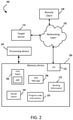
- FIG. 2 is a block diagram of an example of a system that provides hybrid proxying with a user space hold according to some aspects of the disclosure.
- FIG. 3 is a flowchart of an example of a process for providing hybrid proxying with a user space hold according to some aspects of the disclosure.
- FIG. 4 is a flowchart of another example of a process for providing hybrid proxying with a user space hold according to some aspects of the disclosure.
- IP traffic may be forwarded between or among proxies.
- a proxy is a communication function deployed within the cluster, typically one proxy instance for each node in the cluster.
- a proxy routes external requests to services deployed in a cluster in order to provide a consistent external interface.
- a proxy includes a number of processes, some of which run in the user space of the operating system while others run in the kernel space of the operating system.
- User space processes are typically responsible for more complex signaling and control, while the kernel space can be used for traffic routing that requires minimal decisioning, for example, traffic routing after a connection is defined and its parameters are known.
- Kernel space processes execute with higher performance and are more secure since the operating system kernel is more closely connected with the processing hardware of the node.
- the complexity of initiating a connection requires a proxy controller that resides in user space, traffic handling once the connection is established and defined would ideally be handled in kernel space, both for performance reasons and for security reasons.
- a remote client requests a connection
- a reply to the remote client requires routing information, such as a sequence number, which will be generated by the controller in the proxy, which is in user space and is therefore sometimes called the user space controller.
- the target server once available, in the case of a delay, generates its own, different routing information when it is finally is reachable, and the ongoing traffic using the two sets of information can only be handled in the user space controller due to the complexity introduced by having different information on each end of the connection (e.g., the routing information generated by the target server and the routing information generated by the proxy that is forwarding traffic from the remote client to the target server).
- Some examples of the present disclosure overcome the issues mentioned above by providing a proxy user space controller that holds the packet used by a remote client to initiate a connection until the target (backend) server is up and ready.
- this packet is typically referred to as a connection synchronize message or SYN packet, although this terminology and the described technique could be applied to any protocol.
- the user space controller When the user space controller receives the SYN packet, it notifies the server that a connection is being established and holds the SYN packet until it receives a notification that the server is ready.
- the user space controller of the proxy then writes routing information to memory, where the routing information may in some examples be open vSwitch (OVS) information or an IP routing table.
- OVS open vSwitch
- the user space controller then reinjects the SYN packet into the networking layer so that the SYN packet is delivered to the newly-ready backend server.
- Subsequent packets, including the acknowledgement (ACK) packet that is part of the initial handshake when the connection finally completes, will now have the same routing information as in the SYN packet, will flow through kernel space without involvement of the user space controller.
- ACK acknowledgement
- Kernel-based connections are also more secure, since the kernel is reserved for privileged processes it is difficult to use nefarious techniques to retrieve connection information from the kernel.
- a processing device in a system can capture a connection synchronize message in a proxy.
- the connection synchronize message originates from a remote client and is captured from a networking layer in a cloud computing cluster.
- the processing device routes the connection synchronize message to a user space process of the proxy, and then starts, using user space processes, a target server process for a transmission control protocol (TCP) connection corresponding to the connection synchronize message and stores the connection synchronize message.
- TCP transmission control protocol
- the processing device stores routing information defining the TCP connection for a kernel space process and reinserts the connection synchronize message into the networking layer, so as to direct the connection synchronize message to the target server process and establish the TCP connection using the kernel space process and the original information in the SYN packet.
- connection is established for a kernel space process because the connection is defined around a single set of routing information, and the connection synchronize message is held in the user space process until the target server process is live and ready so that the information can be unified.
- connection synchronize message in the user space process is replaced when the remote client retries the TCP connection.
- connection synchronize message can be captured from various parts of the network layer.
- the connection synchronize message is captured from a local resource.
- a local resource is a network layer resource within the cluster.
- the local resource can be a local kernel or a local virtual switch.
- the connection synchronize message can also be captured from a remote resource such as a remote switch.
- FIG. 1 is an entity block diagram of an example of a system 100 that includes the messaging related to initiating a TCP connection according to features and aspects of this disclosure.
- the system 100 includes proxy 102 serving as an intermediary between a remote client 108 and a target server 110 .
- Proxy 102 includes a collection of kernel space processes 104 and a collection of user space processes 106 , which for purposes of this disclosure may be referred to as kernel space and user space, respectively.
- User space 106 includes a controller 107 that can process messaging through the proxy 102 .
- the remote client 108 initiates a TCP connection with target server 110 through the proxy 102 .
- the remote client 108 sends a SYN message to the proxy 102 via signaling path 112 .
- the SYN message is routed from kernel space 104 to the user space 106 of the proxy 102 via path 114 , which is internal to the node running this particular instance of the proxy 102 .
- the SYN message is initially received in kernel space 104 because the operating system kernel interfaces with hardware such as the network adapters and I/O.
- the SYN message is sent to user space 106 and is held in user space 106 until target server 110 is up and ready to service the TCP connection.
- the SYN message is routed back to the kernel space 104 via signaling path 116 .
- Proxy 102 then reinserts the SYN message into the networking layer of the cluster so it is forwarded to target server 110 via signaling path 118 , setting up the TCP connection using the routing information from the original SYN message at both the client and server ends of the connection. While this example involves initiating a TCP connection using SYN messages, other examples may involve initiating other types of connections using other types of messages and protocols.
- FIG. 2 is a block diagram of an example of a system 200 that provides hybrid proxying with a user space hold according to some aspects of the disclosure.
- the system 200 includes a processing device 204 communicatively coupled to a memory device 206 .
- the processing device 204 can execute computer program code, also referred to as software, instructions, or program code instructions 205 , for performing operations related to providing hybrid proxying with a user space hold according to some aspects of the disclosure.
- the processing device 204 can include one processing device or multiple processing devices. Non-limiting examples of the processing device 204 include a field-programmable gate array (FPGA), an application-specific integrated circuit (ASIC), a microprocessor, etc.
- Software can include computer-readable instructions that are executable by a processing device 204 , such as program code instructions 205 .
- the system can be programmed in any suitable programming language, such as Java, C++, C, and Python.
- the processing device 204 of FIG. 2 can capture, store, and hold SYN message 208 in memory device 206 .
- the SYN message originates from remote client 108 .
- a process in target server 110 for a transmission control protocol (TCP) connection corresponding to the SYN message 208 is initiated by forwarding a copy of the SYN message to the target server, but processing device 204 holds SYN message 208 in memory device 206 until target server 110 is up and ready.
- TCP transmission control protocol
- the processing device 204 also reinserts the SYN message 208 into the networking layer 250 to direct the SYN message to the target server 110 and establish the TCP connection using the kernel space 104 . While this example involves initiating a TCP connection using SYN messages, other examples may involve initiating other types of connections using other types of messages and protocols.
- the networking layer 250 can include virtual and real switches that serve to interconnect nodes, servers, and clients, as well as cluster-internal kernel resources involved in messaging.
- the networking layer 250 may include a portion of the kernel processes for the proxy being run by processing device 204 as well as portions of kernel processes running in other nodes of the cluster
- the memory device 206 can include one memory device or multiple memory devices.
- the memory device 206 can be non-volatile and may include any type of memory device that retains stored information when powered off.
- at least some of the memory device can include a non-transitory computer-readable medium from which the processing device 204 can read instructions 205 .
- a computer-readable medium can include electronic, optical, magnetic, or other storage devices capable of providing the processing device with computer-readable instructions 205 or other program code.
- Non-limiting examples of the memory device 206 include electrically erasable and programmable read-only memory (EEPROM), flash memory, or any other type of non-volatile memory.
- Non-limiting examples of a computer-readable medium include magnetic disk(s), memory chip(s), ROM, random-access memory (RAM), an ASIC, a configured processor, optical storage, or any other medium from which a computer processor can read instructions.
- the memory device and the processing device shown may be a portion of a server or similar computer system or multiple computer systems that also include an input/output (I/O) module or modules 210 , a random-access memory (RAM, not shown), and a bus or interconnect (not shown) to allow for inter- and intra-device communications.
- I/O module 210 can include a network interface (not shown), which in turn communicates with the network. I/O module 210 can also receive input from a user.
- the processing device 204 can perform one or more of the operations shown in FIG. 3 to provide hybrid proxying with a user space hold according to some aspects of the disclosure.
- the computing device can implement more operations, fewer operations, different operations, or a different order of the operations depicted in FIG. 3 .
- Process 300 of FIG. 3 is described below with reference to components discussed above.
- processing device 204 captures a connection synchronize (SYN) message in a proxy, where the SYN message is from a remote client 108 and is captured from a networking layer 250 in a cloud computing cluster.
- the SYN message is routed to a user space controller 107 of the proxy.
- the proxy under the control of processing device 204 , starts the target server process for a transmission control protocol (TCP) connection corresponding to the SYN message.
- TCP transmission control protocol
- processing device 204 stores the SYN message 208 in memory device 206 while waiting for the target server 110 to become ready to handle the connection.
- processing device 204 reinserts the SYN message into networking layer 250 to direct the SYN message to the target server 110 and establish the TCP connection using the kernel space process of the proxy.
- a server or similar computer system like that shown in FIG. 2 running a proxy can perform the operations of process 400 shown in FIG. 4 to provide hybrid proxying with a user space hold according to some aspects of the disclosure.
- the process 400 of FIG. 4 is described below with reference to software entities already discussed in FIG. 1 .
- the server running proxy 102 captures the SYN message from the networking layer.
- the SYN message originates from remote client 108 and is captured from the networking layer.
- the SYN message can for example be captured from a local resource such as a local kernel or local virtual switch.
- the SYN message could also be captured from a remote switch.
- the SYN message is routed to user space controller 107 of proxy 102 .
- proxy 102 starts a target server process for the TCP connection that corresponds to the SYN message.
- Proxy 102 also stores and holds the SYN message.
- the user space controller 107 stores routing information defining the TCP connection for kernel space processes 104 .
- the routing information can be an IP routing table stored with a privilege level that allows access only by the kernel.
- the proxy 102 now holds the SYN message until the target server 110 is up and ready. During the hold, the proxy 102 also monitors for retries by the remote client 108 at block 412 . If proxy 102 receives a SYN retry at block 412 , the system replaces the stored SYN message with the new message at block 416 . Stored routing information is updated at block 410 if necessary, and the proxy 102 continues to monitor for retry messages or a message that indicates the target server 110 is ready.
- the system waits for a notification from the target server 110 that the server is ready to service a TCP connection.
- the readiness of the target server in this example is indicated by an acknowledgment (ACK) message.
- ACK acknowledgment
- the ACK message is part of the TCP connection handshake.
- proxy 102 reinserts the SYN message into the networking layer and establishes the TCP connection using its kernel space processes.
- a client will retry the connection and thus send a new SYN message at an interval that doubles with each retry, starting at two seconds. After the first retry, the second retry would be at four seconds, the third retry at eight seconds, etc., up until a final 64-second interval until a time out.
- the SYN messages are time-stamped and a new one may have changed routing information, therefore the SYN message being held in user space by the proxy needs to be updated. Allowing for typical processing delays, a typical node should have at least 62 second to complete a connection using the techniques described herein, and the connection would typically be completed in significantly less time.
Landscapes
- Engineering & Computer Science (AREA)
- Software Systems (AREA)
- Theoretical Computer Science (AREA)
- Physics & Mathematics (AREA)
- General Engineering & Computer Science (AREA)
- General Physics & Mathematics (AREA)
- Computer Networks & Wireless Communication (AREA)
- Signal Processing (AREA)
- Computer And Data Communications (AREA)
- Information Transfer Between Computers (AREA)
Abstract
Description
Claims (20)
Priority Applications (1)
| Application Number | Priority Date | Filing Date | Title |
|---|---|---|---|
| US16/701,287 US11228657B2 (en) | 2019-12-03 | 2019-12-03 | Hybrid proxying with user space hold |
Applications Claiming Priority (1)
| Application Number | Priority Date | Filing Date | Title |
|---|---|---|---|
| US16/701,287 US11228657B2 (en) | 2019-12-03 | 2019-12-03 | Hybrid proxying with user space hold |
Publications (2)
| Publication Number | Publication Date |
|---|---|
| US20210168220A1 US20210168220A1 (en) | 2021-06-03 |
| US11228657B2 true US11228657B2 (en) | 2022-01-18 |
Family
ID=76090991
Family Applications (1)
| Application Number | Title | Priority Date | Filing Date |
|---|---|---|---|
| US16/701,287 Active 2040-03-23 US11228657B2 (en) | 2019-12-03 | 2019-12-03 | Hybrid proxying with user space hold |
Country Status (1)
| Country | Link |
|---|---|
| US (1) | US11228657B2 (en) |
Families Citing this family (1)
| Publication number | Priority date | Publication date | Assignee | Title |
|---|---|---|---|---|
| CN114884947B (en) * | 2022-04-28 | 2024-03-12 | 阿里巴巴(中国)有限公司 | Cluster management method, device, equipment, storage medium and program |
Citations (6)
| Publication number | Priority date | Publication date | Assignee | Title |
|---|---|---|---|---|
| US20180275997A1 (en) * | 2016-02-25 | 2018-09-27 | Wangsu Science & Technology Co.,Ltd. | Method and system for restarting network service |
| US10127091B1 (en) * | 2016-12-22 | 2018-11-13 | Juniper Networks, Inc. | Intercepting socket metadata |
| US20190222559A1 (en) | 2018-01-12 | 2019-07-18 | Vmware, Inc. | Per-application vpn in container based environments |
| US10361921B2 (en) | 2015-06-03 | 2019-07-23 | Openwave Mobility Inc. | Method and apparatus for managing connections in a communication network |
| US20190260837A1 (en) * | 2017-04-20 | 2019-08-22 | Wangsu Science & Technology Co., Ltd. | Method and system of data packet transmission |
| US20190306282A1 (en) * | 2018-03-28 | 2019-10-03 | Apple Inc. | Methods and apparatus for virtualized hardware optimizations for user space networking |
-
2019
- 2019-12-03 US US16/701,287 patent/US11228657B2/en active Active
Patent Citations (6)
| Publication number | Priority date | Publication date | Assignee | Title |
|---|---|---|---|---|
| US10361921B2 (en) | 2015-06-03 | 2019-07-23 | Openwave Mobility Inc. | Method and apparatus for managing connections in a communication network |
| US20180275997A1 (en) * | 2016-02-25 | 2018-09-27 | Wangsu Science & Technology Co.,Ltd. | Method and system for restarting network service |
| US10127091B1 (en) * | 2016-12-22 | 2018-11-13 | Juniper Networks, Inc. | Intercepting socket metadata |
| US20190260837A1 (en) * | 2017-04-20 | 2019-08-22 | Wangsu Science & Technology Co., Ltd. | Method and system of data packet transmission |
| US20190222559A1 (en) | 2018-01-12 | 2019-07-18 | Vmware, Inc. | Per-application vpn in container based environments |
| US20190306282A1 (en) * | 2018-03-28 | 2019-10-03 | Apple Inc. | Methods and apparatus for virtualized hardware optimizations for user space networking |
Non-Patent Citations (5)
| Title |
|---|
| "Concepts: Service—Kubernetes," The Kubernetes Authors, 2019, https://kubernetes.io/docs/concepts/services-networking/service/. |
| "Control Network Traffic with Iptables," Linode, LLC, Jun. 23, 2018, https://www.linode.com/docs/security/firewalls/control-network-traffic-with-iptables/. |
| Goltsman, K., "Understanding Kubernetes Kube—Proxy," Qbox Inc., Apr. 11, 2019, https://supergiant.io/blog/understanding-kubernetes-kube-proxy/. |
| Gunaratne, I., "A Beginner's Guide to Kubernetes," May 23, 2018, https://medium.com/containermind/a-beginners-guide-to-kubernetes-7e8ca56420b6. |
| Kirill Goltsman, Understanding Kubernetes Kube-Proxy, Apr. 11, 2019, pp. 1-10 (Year: 2019). * |
Also Published As
| Publication number | Publication date |
|---|---|
| US20210168220A1 (en) | 2021-06-03 |
Similar Documents
| Publication | Publication Date | Title |
|---|---|---|
| CN110609746B (en) | Method, apparatus and computer readable medium for managing network system | |
| US12468657B2 (en) | Message forwarding method and apparatus based on remote direct data storage, and network card and device | |
| US9880870B1 (en) | Live migration of virtual machines using packet duplication | |
| CN112631788B (en) | Data transmission method and data transmission server | |
| JP2023543831A (en) | Microservices-based service mesh system and service-oriented architecture management method | |
| US20170124021A1 (en) | Methods for enabling direct memory access (dma) capable devices for remote dma (rdma) usage and devices thereof | |
| US11218358B2 (en) | Network connection and termination system | |
| US10097442B2 (en) | Methods, systems, and computer readable media for receiving test configuration information | |
| US11689564B2 (en) | Method and apparatus for processing data in cleaning device | |
| CN111638891A (en) | Device upgrade method, device, terminal device and storage medium | |
| CN113364804A (en) | Method and device for processing flow data | |
| US12369202B2 (en) | Data processing method and apparatus, related device, and storage medium | |
| CN102984138B (en) | A kind of methods, devices and systems obtaining object | |
| CN117397232B (en) | Method and system for proxy-less protocol | |
| CN109417507B (en) | A method and system for accessing memory through partial direct memory access DMA | |
| US10212259B2 (en) | Management of transmission control blocks (TCBs) supporting TCP connection requests in multiprocessing environments | |
| US10735294B2 (en) | Integrating a communication bridge into a data processing system | |
| US8527661B1 (en) | Gateway for connecting clients and servers utilizing remote direct memory access controls to separate data path from control path | |
| US20210168220A1 (en) | Hybrid proxying with user space hold | |
| EP1589424A2 (en) | Vertical perimeter framework for providing application services in multi-CPU environments | |
| US12408047B2 (en) | Management orchestrator for a content-centric network in a 6G network | |
| US11909609B1 (en) | Methods for managing insertion of metadata into a data stream to assist with analysis of network traffic and devices thereof | |
| CN109257227B (en) | Coupling management method, device and system in data transmission | |
| CN113806091A (en) | Data processing method, device and equipment | |
| CN113824808A (en) | Method and system for network address translation traversal using an intermediary encounter agent |
Legal Events
| Date | Code | Title | Description |
|---|---|---|---|
| AS | Assignment |
Owner name: RED HAT, INC., NORTH CAROLINA Free format text: ASSIGNMENT OF ASSIGNORS INTEREST;ASSIGNORS:BENNETT, BENJAMIN;CONOLE, AARON PATRICK;SIGNING DATES FROM 20191106 TO 20191122;REEL/FRAME:051159/0176 |
|
| FEPP | Fee payment procedure |
Free format text: ENTITY STATUS SET TO UNDISCOUNTED (ORIGINAL EVENT CODE: BIG.); ENTITY STATUS OF PATENT OWNER: LARGE ENTITY |
|
| AS | Assignment |
Owner name: RED HAT, INC., NORTH CAROLINA Free format text: ASSIGNMENT OF ASSIGNORS INTEREST;ASSIGNOR:ROSS, SOLOMON;REEL/FRAME:051675/0856 Effective date: 20150605 |
|
| STPP | Information on status: patent application and granting procedure in general |
Free format text: NON FINAL ACTION MAILED |
|
| STPP | Information on status: patent application and granting procedure in general |
Free format text: RESPONSE TO NON-FINAL OFFICE ACTION ENTERED AND FORWARDED TO EXAMINER |
|
| STPP | Information on status: patent application and granting procedure in general |
Free format text: NOTICE OF ALLOWANCE MAILED -- APPLICATION RECEIVED IN OFFICE OF PUBLICATIONS |
|
| STPP | Information on status: patent application and granting procedure in general |
Free format text: PUBLICATIONS -- ISSUE FEE PAYMENT VERIFIED |
|
| STCF | Information on status: patent grant |
Free format text: PATENTED CASE |
|
| MAFP | Maintenance fee payment |
Free format text: PAYMENT OF MAINTENANCE FEE, 4TH YEAR, LARGE ENTITY (ORIGINAL EVENT CODE: M1551); ENTITY STATUS OF PATENT OWNER: LARGE ENTITY Year of fee payment: 4 |