US11228598B2 - Offline mode user authorization device and method - Google Patents
Offline mode user authorization device and method Download PDFInfo
- Publication number
- US11228598B2 US11228598B2 US16/503,715 US201916503715A US11228598B2 US 11228598 B2 US11228598 B2 US 11228598B2 US 201916503715 A US201916503715 A US 201916503715A US 11228598 B2 US11228598 B2 US 11228598B2
- Authority
- US
- United States
- Prior art keywords
- user account
- task
- offline
- super
- executed
- Prior art date
- Legal status (The legal status is an assumption and is not a legal conclusion. Google has not performed a legal analysis and makes no representation as to the accuracy of the status listed.)
- Active, expires
Links
Images


Classifications
-
- H—ELECTRICITY
- H04—ELECTRIC COMMUNICATION TECHNIQUE
- H04L—TRANSMISSION OF DIGITAL INFORMATION, e.g. TELEGRAPHIC COMMUNICATION
- H04L63/00—Network architectures or network communication protocols for network security
- H04L63/10—Network architectures or network communication protocols for network security for controlling access to devices or network resources
- H04L63/102—Entity profiles
-
- H—ELECTRICITY
- H04—ELECTRIC COMMUNICATION TECHNIQUE
- H04L—TRANSMISSION OF DIGITAL INFORMATION, e.g. TELEGRAPHIC COMMUNICATION
- H04L63/00—Network architectures or network communication protocols for network security
- H04L63/10—Network architectures or network communication protocols for network security for controlling access to devices or network resources
- H04L63/105—Multiple levels of security
-
- G—PHYSICS
- G06—COMPUTING OR CALCULATING; COUNTING
- G06F—ELECTRIC DIGITAL DATA PROCESSING
- G06F21/00—Security arrangements for protecting computers, components thereof, programs or data against unauthorised activity
- G06F21/30—Authentication, i.e. establishing the identity or authorisation of security principals
- G06F21/45—Structures or tools for the administration of authentication
-
- G—PHYSICS
- G06—COMPUTING OR CALCULATING; COUNTING
- G06F—ELECTRIC DIGITAL DATA PROCESSING
- G06F21/00—Security arrangements for protecting computers, components thereof, programs or data against unauthorised activity
- G06F21/30—Authentication, i.e. establishing the identity or authorisation of security principals
- G06F21/31—User authentication
-
- G—PHYSICS
- G06—COMPUTING OR CALCULATING; COUNTING
- G06F—ELECTRIC DIGITAL DATA PROCESSING
- G06F21/00—Security arrangements for protecting computers, components thereof, programs or data against unauthorised activity
- G06F21/60—Protecting data
- G06F21/604—Tools and structures for managing or administering access control systems
-
- H—ELECTRICITY
- H04—ELECTRIC COMMUNICATION TECHNIQUE
- H04L—TRANSMISSION OF DIGITAL INFORMATION, e.g. TELEGRAPHIC COMMUNICATION
- H04L63/00—Network architectures or network communication protocols for network security
- H04L63/10—Network architectures or network communication protocols for network security for controlling access to devices or network resources
- H04L63/101—Access control lists [ACL]
Definitions
- the subject matter herein generally relates to computing devices, and more particularly to an offline mode user authorization device and method.
- FIG. 1 is a flowchart of an offline mode user authorization method.
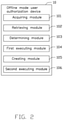
- FIG. 2 is a block diagram of an embodiment of functional modules of an offline mode user authorization device.
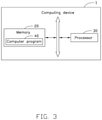
- FIG. 3 is a block diagram of a computing device implementing a computer program.
- Coupled is defined as connected, whether directly or indirectly through intervening components, and is not necessarily limited to physical connections.
- the connection can be such that the objects are permanently connected or releasably connected.
- comprising means “including, but not necessarily limited to”; it specifically indicates open-ended inclusion or membership in a so-described combination, group, series and the like.
- module refers to logic embodied in hardware or firmware, or to a collection of software instructions, written in a programming language such as, for example, Java, C, or assembly.
- One or more software instructions in the modules may be embedded in firmware such as in an erasable-programmable read-only memory (EPROM).
- EPROM erasable-programmable read-only memory
- the modules may comprise connected logic units, such as gates and flip-flops, and may comprise programmable units, such as programmable gate arrays or processors.
- the modules described herein may be implemented as either software and/or hardware modules and may be stored in any type of computer-readable medium or other computer storage device.
- FIG. 1 shows a flowchart of an offline mode user account authorization method.
- the order of blocks in the flowchart may be changed according to different requirements, and some blocks may be omitted.
- an access privilege of a user account is obtained, and an offline task access privilege of the user account is set according to the access privilege.
- Offline task information can include one or more of a task ID, a user ID, a user account name, task contents, task parameters, and a task execution scheduling plan.
- a user account is registered in the Oauth2.0 system, and an Oauth2.0 server allocates a corresponding access privilege to the user account according to information filled in by a user and according to preset system specifications.
- offline tasks are set according to a scope of the access privilege and according to a scope of tasks to be handled.
- implementation of tasks in the Oauth2.0 system is performed by an asynchronous queue, and multiple tasks can be implemented concurrently.
- the system retrieves the user account information of the user account that created the task from the task information comparison table.
- Whether the user account is online is determined by searching, in a user account login information table, whether login information of the user account exists according to user account name information, and determining whether the user account is online according to the search result.
- the system when the task to be executed is implemented, the system retrieves the user account information of the user account that created the task from the task information comparison table and retrieves the login information of the system. If the user account is logged in, the user account is determined to be online according to a login status.
- the implemented task to be executed is executed with the user ID of the user account.
- a login token is directly obtained with the user ID to execute the task.
- the user account information is obtained from the task information comparison table, and the offline task scope of the user account is retrieved according to the user account information.
- the access privilege of the offline task scope is assigned to the super offline user account, so that the offline task can be completed.
- the system since the user account is in an offline state, the login token of the user account cannot be obtained to execute the implemented offline task. At this time, the system creates a super offline user account, and the access privilege of the super offline user account is assigned according to the offline task set by the user account.
- user account A creates tasks 001 and 002, and user account B creates task 003.
- Task contents corresponding to task 001, task 002, and task 003 are task A, task B, and task C, respectively.
- the Oauth2.0 system opens three threads to create super offline user account 1, super offline user account 2, and super offline user account 3 to complete the tasks 001, 002, and 003, respectively.
- Super offline user account 1 and super offline user account 2 obtain all of the access privilege of user account A
- super offline user account 3 obtains all of the access privilege of user account B.
- super offline user account 1 obtains all of the access privilege of user account A and executes tasks 001 and 002.
- super offline user account 3 obtains all of the access privilege of user account B and executes task 003.
- the implemented task to be executed by the super offline user account is executed by creating a temporary login token for the super offline user account and allowing the super offline user account to execute the implemented task to be executed with the temporary login token.
- the temporary login token is valid for a preset time duration.
- the super offline user account When the task has completed being executed, the super offline user account is logged out, and information of the super offline user account that executed the task is recorded.
- the information includes one or more of execution time, the user account that completed the task, and an execution result.
- a temporary login token is generated, and the temporary login token is only used to perform the current implemented task and becomes invalid once the current implemented task has been completed.
- the temporary login token has an expiration time. If the expiration time is exceeded, the temporary login token must be applied for again.
- the login token corresponding to the task is logged out.
- the Oauth2.0 system automatically records information of the task, such as execution time, the user account that performed the task, and the execution result. A new temporary login token is generated for a next task that requires a super offline user account to complete.
- FIG. 2 shows a diagram of an embodiment of an offline mode user authorization device 10 .
- the offline mode user authorization device 10 operates in a computing device communicatively coupled to a plurality of user account terminals through a network.
- the offline mode user authorization device 10 can include a plurality of functional modules, which are a plurality of program instructions stored in a memory of the computing device and executed by at least one processor to implement the offline mode user account authorization functions.
- the offline mode user authorization device 10 can be divided into a plurality of functional modules, such as an acquiring module 101 , a retrieving module 102 , a determining module 103 , a first executing module 104 , a creating module 105 , and a second executing module 106 .
- the acquiring module 101 is configured to acquire the access privilege of a user account and set an offline task access privilege of the user account according to the access privilege.
- Contents of an offline task include one or more of a task ID, a user ID, a user account name, task contents, task parameters, and a task execution scheduling plan.
- a user account is registered in the Oauth2.0 system, and an Oauth2.0 server allocates a corresponding access privilege to the user account according to information filled in by a user and according to preset system specifications.
- offline tasks are set according to a scope of the access privilege and according to a scope of tasks to be handled.
- the retrieving module 102 is configured to retrieve user account information corresponding to a task to be executed from a preset task information comparison table when the task to be executed is implemented.
- implementation of the task in the Oauth2.0 system is performed by an asynchronous queue, and multiple tasks can be implemented concurrently at the same time.
- the system retrieves the user account information of the user account that created the task from the task information comparison table.
- the determining module 103 is configured to determine whether the user account is online.
- Whether the user account is online is determined by searching, in a user account login information table, whether the login information of the user account exists according to the user account name information, and determining whether the user account is online according to the search result.
- the system when the task to be executed is implemented, the system retrieves the user account information of the user account that created the task from the task information comparison table and retrieves the login information of the system. If the user account is logged in, the user account is determined to be online according to a login status.
- the first executing module 104 is configured to execute the implemented task to be executed with the user ID of the user account when the user account is online.
- a login token is directly obtained with the user ID to execute the task.
- the creating module 105 is configured to create a super offline user account if the user account is not online, and assign the offline task access privilege of the user account to the super offline user account.
- the user account information is obtained from the task information comparison table, and the offline task scope of the user account is retrieved according to the user account information.
- the access privilege of the offline task scope is assigned to the super offline user account, so that the offline task can be completed.
- the system since the user account is in an offline state, the login token of the user account cannot be obtained to execute the implemented offline task. At this time, the system creates a super offline user account, and the access privilege of the super offline user account is assigned according to the offline task set by the user account.
- user account A creates tasks 001 and 002, and user account B creates task 003.
- Task contents corresponding to task 001, task 002, and task 003 are task A, task B, and task C, respectively.
- the Oauth2.0 system opens three threads to create super offline user account 1, super offline user account 2, and super offline user account 3 to complete the tasks 001, 002, and 003, respectively.
- Super offline user account 1 and super offline user account 2 obtain all of the access privilege of user account A
- super offline user account 3 obtains all of the access privilege of user account B.
- super offline user account 1 obtains all of the access privilege of user account A and executes tasks 001 and 002.
- super offline user account 3 obtains all of the access privilege of user account B and executes task 003.
- the second executing module 106 is configured to execute the implemented task to be executed by the super offline user account.
- the implemented task to be executed by the super offline user account is executed by creating a temporary login token for the super offline user account and allowing the super offline user account to execute the implemented task to be executed with the temporary login token.
- the temporary login token is valid for a preset time duration.
- the super offline user account When the task has completed being executed, the super offline user account is logged out, and information of the super offline user account that executed the task is recorded.
- the information includes one or more of execution time, the user account that completed the task, and an execution result.
- a temporary login token is generated, and the temporary login token is only used to perform the current implemented task and becomes invalid once the current implemented task has been completed.
- the temporary login token has an expiration time. If the expiration time is exceeded, the temporary login token must be applied for again.
- the login token corresponding to the task is logged out.
- the Oauth2.0 system automatically records information of the task, such as execution time, the user account that performed the task, and the execution result. A new temporary login token is generated for a next task that requires a super offline user account to complete.
- FIG. 3 shows a diagram of an embodiment of a computing device 1 .
- the computing device 1 includes a memory 20 and a processor 30 , and a computer program 40 , such as an offline mode user account authorization program, is stored in the memory 20 and executable by the processor 30 .
- the processor 30 executes the computer program 40
- the offline mode user account authorization method may be implemented, that is blocks S 1 to S 6 shown in FIG.
- the processor 30 executes the computer program 40
- the functional modules of the offline mode user authorization device 10 shown in FIG. 2 are implemented.
- the computer program 40 can be partitioned into one or more modules/units that are stored in the memory 20 and executed by the processor 30 .
- the one or more modules/units may be a series of computer program instructions capable of performing particular functions of the computer program 40 .
- the computer program 40 can be divided into the acquiring module 101 , the retrieving module 102 , the determining module 103 , the first executing module 104 , the creating module 105 , and the second executing module 106 .
- the computing device 1 may be a desktop computer, a notebook computer, a cloud server, or the like.
- the computing device 1 may include more or less components than those illustrated, and some components may be combined.
- the computing device 1 may also include input and output devices, network access devices, buses, and the like.
- the processor 30 may be a central processing unit (CPU), or may be other general-purpose processors, a digital signal processor (DSP), an application specific integrated circuit (ASIC), a Field-Programmable Gate Array (FPGA), or other programmable logic device, discrete gate or transistor logic device, discrete hardware components, or the like.
- the processor 30 may be a microprocessor or other processor known in the art.
- the memory 20 can be used to store the computer program 40 and/or modules/units by running or executing computer programs and/or modules/units stored in the memory 20 .
- the memory 20 may include a storage program area and a storage data area.
- the memory 20 may include a high-speed random access memory, a non-volatile memory such as a hard disk, a plug-in hard disk, a smart memory card (SMC), and a secure digital (SD) card, flash card, at least one disk storage device, flash device, or other volatile solid state storage device.
- a non-volatile memory such as a hard disk, a plug-in hard disk, a smart memory card (SMC), and a secure digital (SD) card
- flash card at least one disk storage device, flash device, or other volatile solid state storage device.
Landscapes
- Engineering & Computer Science (AREA)
- Computer Security & Cryptography (AREA)
- Computer Hardware Design (AREA)
- General Engineering & Computer Science (AREA)
- Theoretical Computer Science (AREA)
- Computing Systems (AREA)
- Computer Networks & Wireless Communication (AREA)
- Signal Processing (AREA)
- Physics & Mathematics (AREA)
- Software Systems (AREA)
- General Physics & Mathematics (AREA)
- Bioethics (AREA)
- General Health & Medical Sciences (AREA)
- Health & Medical Sciences (AREA)
- Automation & Control Theory (AREA)
- Storage Device Security (AREA)
- Stored Programmes (AREA)
- Signal Processing For Digital Recording And Reproducing (AREA)
- Television Signal Processing For Recording (AREA)
Abstract
Description
| TABLE 1 | ||||
| Super offline user | ||||
| Username | Task name | Task contents | account | Time |
| User A | 001 | Task A | Super offline user | 8:00 am |
| |
||||
| User A | 002 | Task B | Super offline user | 8:00 am |
| account 2 | ||||
| User B | 003 | Task C | Super offline user | 8:00 am |
| account 3 | ||||
Claims (12)
Applications Claiming Priority (2)
| Application Number | Priority Date | Filing Date | Title |
|---|---|---|---|
| CN201910256290.9 | 2019-04-01 | ||
| CN201910256290.9A CN111767533B (en) | 2019-04-01 | 2019-04-01 | Offline mode user authorization method, device, electronic device and storage medium |
Publications (2)
| Publication Number | Publication Date |
|---|---|
| US20200314105A1 US20200314105A1 (en) | 2020-10-01 |
| US11228598B2 true US11228598B2 (en) | 2022-01-18 |
Family
ID=72605142
Family Applications (1)
| Application Number | Title | Priority Date | Filing Date |
|---|---|---|---|
| US16/503,715 Active 2040-02-09 US11228598B2 (en) | 2019-04-01 | 2019-07-05 | Offline mode user authorization device and method |
Country Status (3)
| Country | Link |
|---|---|
| US (1) | US11228598B2 (en) |
| CN (1) | CN111767533B (en) |
| TW (1) | TWI791820B (en) |
Families Citing this family (3)
| Publication number | Priority date | Publication date | Assignee | Title |
|---|---|---|---|---|
| US11451396B2 (en) * | 2019-11-05 | 2022-09-20 | Microsoft Technology Licensing, Llc | False positive reduction in electronic token forgery detection |
| KR102369960B1 (en) * | 2021-07-30 | 2022-03-04 | 쿠팡 주식회사 | Electronic apparatus for providing information based on existence of a user account and method thereof |
| CN117113379B (en) * | 2023-09-22 | 2024-02-09 | 苏州保也信息服务有限公司 | User offline authorization management method for information system |
Citations (17)
| Publication number | Priority date | Publication date | Assignee | Title |
|---|---|---|---|---|
| US20030174648A1 (en) * | 2001-10-17 | 2003-09-18 | Mea Wang | Content delivery network by-pass system |
| US20040168066A1 (en) * | 2003-02-25 | 2004-08-26 | Alden Kathryn A. | Web site management system and method |
| US20060121992A1 (en) * | 2004-12-07 | 2006-06-08 | Microsoft Corporation | Ubiquitous unified player identity tracking system |
| US20060183462A1 (en) * | 2005-02-11 | 2006-08-17 | Nokia Corporation | Managing an access account using personal area networks and credentials on a mobile device |
| US20070157292A1 (en) * | 2006-01-03 | 2007-07-05 | Netiq Corporation | System, method, and computer-readable medium for just in time access through dynamic group memberships |
| US20070174283A1 (en) * | 2006-01-24 | 2007-07-26 | Hon Hai Precision Industry Co., Ltd. | System and method for managing access control list of computer systems |
| US7353231B1 (en) * | 2005-10-21 | 2008-04-01 | At&T Corp. | Flip-flap mechanism for high availability, online analytical processing databases |
| US20130091274A1 (en) * | 2011-10-06 | 2013-04-11 | Family Signal, LLC | Process for Monitoring, Analyzing, and Alerting an Adult of a Ward's Activity on a Personal Electronic Device (PED) |
| US20140150080A1 (en) * | 2010-09-24 | 2014-05-29 | Pixelmags Inc. | Authorizing access to digital content |
| US20140208220A1 (en) * | 2012-03-01 | 2014-07-24 | Aditya Watal | System and Method for Contextual and Collaborative Knowledge Generation and Management Through an Integrated Online-Offline Workspace |
| US20140359709A1 (en) * | 2013-06-04 | 2014-12-04 | Google Inc. | Maintaining Video Conference Session Continuity During Transfer of Session to Alternative Device |
| US20150150142A1 (en) * | 2013-10-23 | 2015-05-28 | Avecto Limited | Computer device and method for isolating untrusted content |
| US20150262174A1 (en) * | 2014-03-17 | 2015-09-17 | Starbucks Corporation D/B/A Starbucks Coffee Company | Offline access of a network based application |
| US20180157535A1 (en) * | 2015-06-15 | 2018-06-07 | Datto, Inc. | Methods, systems and apparatuses for managing prioritization of time-based processes |
| US20180337906A1 (en) * | 2017-05-17 | 2018-11-22 | Microsoft Technology Licensing, Llc | Impersonating target account via account redirection |
| US20180375886A1 (en) * | 2017-06-22 | 2018-12-27 | Oracle International Corporation | Techniques for monitoring privileged users and detecting anomalous activities in a computing environment |
| US20190238548A1 (en) * | 2018-01-31 | 2019-08-01 | T-Mobile Usa, Inc. | Virtual profile instantiations via an access privilege control system |
Family Cites Families (8)
| Publication number | Priority date | Publication date | Assignee | Title |
|---|---|---|---|---|
| CN101453398A (en) * | 2007-12-06 | 2009-06-10 | 怀特威盛软件公司 | Novel distributed grid super computer system and method |
| TW201218015A (en) * | 2010-10-29 | 2012-05-01 | Inventec Besta Co Ltd | Off-line authentication device, off-line authentication method, digital content use device, digital content use method, computer readable storage medium and computer program product thereof |
| CN102479304B (en) * | 2010-11-26 | 2014-05-07 | 深圳市硅格半导体有限公司 | Software permission control method, client and system |
| CN103646198A (en) * | 2013-12-24 | 2014-03-19 | 北京奇虎科技有限公司 | Method, system and device for locking working region of mobile terminal |
| US9756041B2 (en) * | 2015-04-30 | 2017-09-05 | Rockwell Automation Technologies, Inc. | Offline access control for an application |
| CN107016267B (en) * | 2016-12-19 | 2020-09-29 | 创新先进技术有限公司 | Resource operation method and system in offline state |
| CN108268796B (en) * | 2017-01-04 | 2022-06-28 | 珠海金山办公软件有限公司 | A kind of offline management method and device based on offline password |
| CN109286633A (en) * | 2018-10-26 | 2019-01-29 | 深圳市华云中盛科技有限公司 | Single sign-on method, device, computer equipment and storage medium |
-
2019
- 2019-04-01 CN CN201910256290.9A patent/CN111767533B/en active Active
- 2019-04-17 TW TW108113466A patent/TWI791820B/en active
- 2019-07-05 US US16/503,715 patent/US11228598B2/en active Active
Patent Citations (17)
| Publication number | Priority date | Publication date | Assignee | Title |
|---|---|---|---|---|
| US20030174648A1 (en) * | 2001-10-17 | 2003-09-18 | Mea Wang | Content delivery network by-pass system |
| US20040168066A1 (en) * | 2003-02-25 | 2004-08-26 | Alden Kathryn A. | Web site management system and method |
| US20060121992A1 (en) * | 2004-12-07 | 2006-06-08 | Microsoft Corporation | Ubiquitous unified player identity tracking system |
| US20060183462A1 (en) * | 2005-02-11 | 2006-08-17 | Nokia Corporation | Managing an access account using personal area networks and credentials on a mobile device |
| US7353231B1 (en) * | 2005-10-21 | 2008-04-01 | At&T Corp. | Flip-flap mechanism for high availability, online analytical processing databases |
| US20070157292A1 (en) * | 2006-01-03 | 2007-07-05 | Netiq Corporation | System, method, and computer-readable medium for just in time access through dynamic group memberships |
| US20070174283A1 (en) * | 2006-01-24 | 2007-07-26 | Hon Hai Precision Industry Co., Ltd. | System and method for managing access control list of computer systems |
| US20140150080A1 (en) * | 2010-09-24 | 2014-05-29 | Pixelmags Inc. | Authorizing access to digital content |
| US20130091274A1 (en) * | 2011-10-06 | 2013-04-11 | Family Signal, LLC | Process for Monitoring, Analyzing, and Alerting an Adult of a Ward's Activity on a Personal Electronic Device (PED) |
| US20140208220A1 (en) * | 2012-03-01 | 2014-07-24 | Aditya Watal | System and Method for Contextual and Collaborative Knowledge Generation and Management Through an Integrated Online-Offline Workspace |
| US20140359709A1 (en) * | 2013-06-04 | 2014-12-04 | Google Inc. | Maintaining Video Conference Session Continuity During Transfer of Session to Alternative Device |
| US20150150142A1 (en) * | 2013-10-23 | 2015-05-28 | Avecto Limited | Computer device and method for isolating untrusted content |
| US20150262174A1 (en) * | 2014-03-17 | 2015-09-17 | Starbucks Corporation D/B/A Starbucks Coffee Company | Offline access of a network based application |
| US20180157535A1 (en) * | 2015-06-15 | 2018-06-07 | Datto, Inc. | Methods, systems and apparatuses for managing prioritization of time-based processes |
| US20180337906A1 (en) * | 2017-05-17 | 2018-11-22 | Microsoft Technology Licensing, Llc | Impersonating target account via account redirection |
| US20180375886A1 (en) * | 2017-06-22 | 2018-12-27 | Oracle International Corporation | Techniques for monitoring privileged users and detecting anomalous activities in a computing environment |
| US20190238548A1 (en) * | 2018-01-31 | 2019-08-01 | T-Mobile Usa, Inc. | Virtual profile instantiations via an access privilege control system |
Also Published As
| Publication number | Publication date |
|---|---|
| US20200314105A1 (en) | 2020-10-01 |
| CN111767533B (en) | 2025-01-07 |
| CN111767533A (en) | 2020-10-13 |
| TW202109321A (en) | 2021-03-01 |
| TWI791820B (en) | 2023-02-11 |
Similar Documents
| Publication | Publication Date | Title |
|---|---|---|
| US11336583B2 (en) | Background processes in update load balancers of an auto scaling group | |
| US9189524B2 (en) | Obtaining partial results from a database query | |
| US20230054683A1 (en) | Correspondence of external operations to containers and mutation events | |
| US20160323188A1 (en) | Managing state for updates to load balancers of an auto scaling group | |
| US20190324845A1 (en) | Management of foreground and background processes in a storage controller | |
| CN111831408A (en) | Asynchronous task processing method, device, electronic device and medium | |
| US20200314105A1 (en) | Offline mode user authorization device and method | |
| EP3123299A1 (en) | Initialization trace of a computing device | |
| US20210224131A1 (en) | Dynamic container-based application resource tuning and resizing | |
| CN110554917A (en) | Method, system, terminal and storage medium for efficiently traversing a large data set | |
| US20220075771A1 (en) | Dynamically deploying execution nodes using system throughput | |
| US20240202587A1 (en) | Un-learning of training data for machine learning models | |
| US20160373523A1 (en) | Profile management method and apparatus for running of virtual desktop in heterogeneous server | |
| EP3779720B1 (en) | Transaction processing method and system, and server | |
| US20220164168A1 (en) | Generating mock services based on log entries | |
| US20230237186A1 (en) | Access Control Framework For Graph Entities | |
| US8554798B2 (en) | Asynchronous state engine with plug-ins for flexible application development | |
| US9600508B1 (en) | Data layer service availability | |
| WO2024129224A1 (en) | Un-learning of training data for machine learning models | |
| US10254962B2 (en) | Asynchronously clearing page frames | |
| US11461268B2 (en) | Information processing system and control method | |
| CN117745254B (en) | Course generation method, course generation device, computer equipment and readable storage medium | |
| US12445537B2 (en) | Scheduler for transaction processing system, and system incorporating such scheduler | |
| CN114840865A (en) | Method and device for setting database row and column permission | |
| CN115883556A (en) | Signal processing method, device, equipment and storage medium |
Legal Events
| Date | Code | Title | Description |
|---|---|---|---|
| AS | Assignment |
Owner name: HON HAI PRECISION INDUSTRY CO., LTD., TAIWAN Free format text: ASSIGNMENT OF ASSIGNORS INTEREST;ASSIGNORS:GUO, PENG-FEI;YAO, ZE;ZHOU, YUE-PING;AND OTHERS;SIGNING DATES FROM 20190611 TO 20190612;REEL/FRAME:049674/0805 Owner name: FU TAI HUA INDUSTRY (SHENZHEN) CO., LTD., CHINA Free format text: ASSIGNMENT OF ASSIGNORS INTEREST;ASSIGNORS:GUO, PENG-FEI;YAO, ZE;ZHOU, YUE-PING;AND OTHERS;SIGNING DATES FROM 20190611 TO 20190612;REEL/FRAME:049674/0805 |
|
| FEPP | Fee payment procedure |
Free format text: ENTITY STATUS SET TO UNDISCOUNTED (ORIGINAL EVENT CODE: BIG.); ENTITY STATUS OF PATENT OWNER: LARGE ENTITY |
|
| STPP | Information on status: patent application and granting procedure in general |
Free format text: NON FINAL ACTION MAILED |
|
| STPP | Information on status: patent application and granting procedure in general |
Free format text: RESPONSE TO NON-FINAL OFFICE ACTION ENTERED AND FORWARDED TO EXAMINER |
|
| STPP | Information on status: patent application and granting procedure in general |
Free format text: NOTICE OF ALLOWANCE MAILED -- APPLICATION RECEIVED IN OFFICE OF PUBLICATIONS |
|
| STPP | Information on status: patent application and granting procedure in general |
Free format text: PUBLICATIONS -- ISSUE FEE PAYMENT VERIFIED |
|
| STCF | Information on status: patent grant |
Free format text: PATENTED CASE |
|
| MAFP | Maintenance fee payment |
Free format text: PAYMENT OF MAINTENANCE FEE, 4TH YEAR, LARGE ENTITY (ORIGINAL EVENT CODE: M1551); ENTITY STATUS OF PATENT OWNER: LARGE ENTITY Year of fee payment: 4 |