US11227539B2 - Display apparatus and pixel circuit thereof - Google Patents

Display apparatus and pixel circuit thereof Download PDF

Info

Publication number
US11227539B2
US11227539B2 US17/092,314 US202017092314A US11227539B2 US 11227539 B2 US11227539 B2 US 11227539B2 US 202017092314 A US202017092314 A US 202017092314A US 11227539 B2 US11227539 B2 US 11227539B2
Authority
US
United States
Prior art keywords
terminal
light
emitting diode
reference voltage
time period
Prior art date
Legal status (The legal status is an assumption and is not a legal conclusion. Google has not performed a legal analysis and makes no representation as to the accuracy of the status listed.)
Active
Application number
US17/092,314
Other versions
US20210390900A1 (en
Inventor
Peng-Bo Xi
Yan-Ru Chen
Current Assignee (The listed assignees may be inaccurate. Google has not performed a legal analysis and makes no representation or warranty as to the accuracy of the list.)
AUO Corp
Original Assignee
AU Optronics Corp
Priority date (The priority date is an assumption and is not a legal conclusion. Google has not performed a legal analysis and makes no representation as to the accuracy of the date listed.)
Filing date
Publication date
Application filed by AU Optronics Corp filed Critical AU Optronics Corp
Assigned to AU OPTRONICS CORPORATION reassignment AU OPTRONICS CORPORATION ASSIGNMENT OF ASSIGNORS INTEREST (SEE DOCUMENT FOR DETAILS). Assignors: CHEN, YAN-RU, XI, PENG-BO
Publication of US20210390900A1 publication Critical patent/US20210390900A1/en
Application granted granted Critical
Publication of US11227539B2 publication Critical patent/US11227539B2/en
Active legal-status Critical Current
Anticipated expiration legal-status Critical

Links

Images

Classifications

    • GPHYSICS
    • G09EDUCATION; CRYPTOGRAPHY; DISPLAY; ADVERTISING; SEALS
    • G09GARRANGEMENTS OR CIRCUITS FOR CONTROL OF INDICATING DEVICES USING STATIC MEANS TO PRESENT VARIABLE INFORMATION
    • G09G3/00Control arrangements or circuits, of interest only in connection with visual indicators other than cathode-ray tubes
    • G09G3/20Control arrangements or circuits, of interest only in connection with visual indicators other than cathode-ray tubes for presentation of an assembly of a number of characters, e.g. a page, by composing the assembly by combination of individual elements arranged in a matrix no fixed position being assigned to or needed to be assigned to the individual characters or partial characters
    • G09G3/22Control arrangements or circuits, of interest only in connection with visual indicators other than cathode-ray tubes for presentation of an assembly of a number of characters, e.g. a page, by composing the assembly by combination of individual elements arranged in a matrix no fixed position being assigned to or needed to be assigned to the individual characters or partial characters using controlled light sources
    • G09G3/30Control arrangements or circuits, of interest only in connection with visual indicators other than cathode-ray tubes for presentation of an assembly of a number of characters, e.g. a page, by composing the assembly by combination of individual elements arranged in a matrix no fixed position being assigned to or needed to be assigned to the individual characters or partial characters using controlled light sources using electroluminescent panels
    • G09G3/32Control arrangements or circuits, of interest only in connection with visual indicators other than cathode-ray tubes for presentation of an assembly of a number of characters, e.g. a page, by composing the assembly by combination of individual elements arranged in a matrix no fixed position being assigned to or needed to be assigned to the individual characters or partial characters using controlled light sources using electroluminescent panels semiconductive, e.g. using light-emitting diodes [LED]
    • GPHYSICS
    • G09EDUCATION; CRYPTOGRAPHY; DISPLAY; ADVERTISING; SEALS
    • G09GARRANGEMENTS OR CIRCUITS FOR CONTROL OF INDICATING DEVICES USING STATIC MEANS TO PRESENT VARIABLE INFORMATION
    • G09G3/00Control arrangements or circuits, of interest only in connection with visual indicators other than cathode-ray tubes
    • G09G3/20Control arrangements or circuits, of interest only in connection with visual indicators other than cathode-ray tubes for presentation of an assembly of a number of characters, e.g. a page, by composing the assembly by combination of individual elements arranged in a matrix no fixed position being assigned to or needed to be assigned to the individual characters or partial characters
    • G09G3/2092Details of a display terminals using a flat panel, the details relating to the control arrangement of the display terminal and to the interfaces thereto
    • GPHYSICS
    • G09EDUCATION; CRYPTOGRAPHY; DISPLAY; ADVERTISING; SEALS
    • G09GARRANGEMENTS OR CIRCUITS FOR CONTROL OF INDICATING DEVICES USING STATIC MEANS TO PRESENT VARIABLE INFORMATION
    • G09G2300/00Aspects of the constitution of display devices
    • G09G2300/08Active matrix structure, i.e. with use of active elements, inclusive of non-linear two terminal elements, in the pixels together with light emitting or modulating elements
    • G09G2300/0809Several active elements per pixel in active matrix panels
    • G09G2300/0819Several active elements per pixel in active matrix panels used for counteracting undesired variations, e.g. feedback or autozeroing
    • GPHYSICS
    • G09EDUCATION; CRYPTOGRAPHY; DISPLAY; ADVERTISING; SEALS
    • G09GARRANGEMENTS OR CIRCUITS FOR CONTROL OF INDICATING DEVICES USING STATIC MEANS TO PRESENT VARIABLE INFORMATION
    • G09G2300/00Aspects of the constitution of display devices
    • G09G2300/08Active matrix structure, i.e. with use of active elements, inclusive of non-linear two terminal elements, in the pixels together with light emitting or modulating elements
    • G09G2300/0809Several active elements per pixel in active matrix panels
    • G09G2300/0842Several active elements per pixel in active matrix panels forming a memory circuit, e.g. a dynamic memory with one capacitor
    • GPHYSICS
    • G09EDUCATION; CRYPTOGRAPHY; DISPLAY; ADVERTISING; SEALS
    • G09GARRANGEMENTS OR CIRCUITS FOR CONTROL OF INDICATING DEVICES USING STATIC MEANS TO PRESENT VARIABLE INFORMATION
    • G09G2300/00Aspects of the constitution of display devices
    • G09G2300/08Active matrix structure, i.e. with use of active elements, inclusive of non-linear two terminal elements, in the pixels together with light emitting or modulating elements
    • G09G2300/0809Several active elements per pixel in active matrix panels
    • G09G2300/0842Several active elements per pixel in active matrix panels forming a memory circuit, e.g. a dynamic memory with one capacitor
    • G09G2300/0861Several active elements per pixel in active matrix panels forming a memory circuit, e.g. a dynamic memory with one capacitor with additional control of the display period without amending the charge stored in a pixel memory, e.g. by means of additional select electrodes
    • GPHYSICS
    • G09EDUCATION; CRYPTOGRAPHY; DISPLAY; ADVERTISING; SEALS
    • G09GARRANGEMENTS OR CIRCUITS FOR CONTROL OF INDICATING DEVICES USING STATIC MEANS TO PRESENT VARIABLE INFORMATION
    • G09G2310/00Command of the display device
    • G09G2310/02Addressing, scanning or driving the display screen or processing steps related thereto
    • G09G2310/0264Details of driving circuits
    • G09G2310/0275Details of drivers for data electrodes, other than drivers for liquid crystal, plasma or OLED displays, not related to handling digital grey scale data or to communication of data to the pixels by means of a current
    • GPHYSICS
    • G09EDUCATION; CRYPTOGRAPHY; DISPLAY; ADVERTISING; SEALS
    • G09GARRANGEMENTS OR CIRCUITS FOR CONTROL OF INDICATING DEVICES USING STATIC MEANS TO PRESENT VARIABLE INFORMATION
    • G09G2330/00Aspects of power supply; Aspects of display protection and defect management
    • G09G2330/04Display protection
    • GPHYSICS
    • G09EDUCATION; CRYPTOGRAPHY; DISPLAY; ADVERTISING; SEALS
    • G09GARRANGEMENTS OR CIRCUITS FOR CONTROL OF INDICATING DEVICES USING STATIC MEANS TO PRESENT VARIABLE INFORMATION
    • G09G2330/00Aspects of power supply; Aspects of display protection and defect management
    • G09G2330/10Dealing with defective pixels
    • GPHYSICS
    • G09EDUCATION; CRYPTOGRAPHY; DISPLAY; ADVERTISING; SEALS
    • G09GARRANGEMENTS OR CIRCUITS FOR CONTROL OF INDICATING DEVICES USING STATIC MEANS TO PRESENT VARIABLE INFORMATION
    • G09G2330/00Aspects of power supply; Aspects of display protection and defect management
    • G09G2330/12Test circuits or failure detection circuits included in a display system, as permanent part thereof
    • GPHYSICS
    • G09EDUCATION; CRYPTOGRAPHY; DISPLAY; ADVERTISING; SEALS
    • G09GARRANGEMENTS OR CIRCUITS FOR CONTROL OF INDICATING DEVICES USING STATIC MEANS TO PRESENT VARIABLE INFORMATION
    • G09G3/00Control arrangements or circuits, of interest only in connection with visual indicators other than cathode-ray tubes
    • G09G3/20Control arrangements or circuits, of interest only in connection with visual indicators other than cathode-ray tubes for presentation of an assembly of a number of characters, e.g. a page, by composing the assembly by combination of individual elements arranged in a matrix no fixed position being assigned to or needed to be assigned to the individual characters or partial characters
    • G09G3/22Control arrangements or circuits, of interest only in connection with visual indicators other than cathode-ray tubes for presentation of an assembly of a number of characters, e.g. a page, by composing the assembly by combination of individual elements arranged in a matrix no fixed position being assigned to or needed to be assigned to the individual characters or partial characters using controlled light sources
    • G09G3/30Control arrangements or circuits, of interest only in connection with visual indicators other than cathode-ray tubes for presentation of an assembly of a number of characters, e.g. a page, by composing the assembly by combination of individual elements arranged in a matrix no fixed position being assigned to or needed to be assigned to the individual characters or partial characters using controlled light sources using electroluminescent panels
    • G09G3/32Control arrangements or circuits, of interest only in connection with visual indicators other than cathode-ray tubes for presentation of an assembly of a number of characters, e.g. a page, by composing the assembly by combination of individual elements arranged in a matrix no fixed position being assigned to or needed to be assigned to the individual characters or partial characters using controlled light sources using electroluminescent panels semiconductive, e.g. using light-emitting diodes [LED]
    • G09G3/3208Control arrangements or circuits, of interest only in connection with visual indicators other than cathode-ray tubes for presentation of an assembly of a number of characters, e.g. a page, by composing the assembly by combination of individual elements arranged in a matrix no fixed position being assigned to or needed to be assigned to the individual characters or partial characters using controlled light sources using electroluminescent panels semiconductive, e.g. using light-emitting diodes [LED] organic, e.g. using organic light-emitting diodes [OLED]
    • G09G3/3225Control arrangements or circuits, of interest only in connection with visual indicators other than cathode-ray tubes for presentation of an assembly of a number of characters, e.g. a page, by composing the assembly by combination of individual elements arranged in a matrix no fixed position being assigned to or needed to be assigned to the individual characters or partial characters using controlled light sources using electroluminescent panels semiconductive, e.g. using light-emitting diodes [LED] organic, e.g. using organic light-emitting diodes [OLED] using an active matrix
    • G09G3/3233Control arrangements or circuits, of interest only in connection with visual indicators other than cathode-ray tubes for presentation of an assembly of a number of characters, e.g. a page, by composing the assembly by combination of individual elements arranged in a matrix no fixed position being assigned to or needed to be assigned to the individual characters or partial characters using controlled light sources using electroluminescent panels semiconductive, e.g. using light-emitting diodes [LED] organic, e.g. using organic light-emitting diodes [OLED] using an active matrix with pixel circuitry controlling the current through the light-emitting element

Definitions

  • the disclosure relates to a display apparatus and a pixel circuit thereof, and particularly to a display apparatus having an anti-short circuit function and a pixel circuit thereof.
  • the disclosure provides a display apparatus and a pixel circuit thereof, which effectively stop the laser operation of the damaged light-emitting diode and prevent the occurrence of a short circuit.
  • the pixel circuit of the present disclosure is configured to drive a light-emitting diode.
  • the pixel circuit includes a driving transistor, a switch, and a data writing circuit.
  • the driving transistor has a first terminal coupled to a first terminal of the light-emitting diode.
  • the switch is coupled between the first terminal and a control terminal of the driving transistor, and the switch is turned on during the data-writing time period and cut off during the laser time period.
  • the data writing circuit transmits data voltage to a control terminal of the driving transistor during the data-writing time period.
  • a second terminal of the light-emitting diode receives a first reference voltage.
  • the second terminal of the light-emitting diode receives a second reference voltage.
  • the first reference voltage and the second reference voltage are not the same.
  • the display apparatus of the present disclosure includes multiple pixel circuits and at least one voltage selector.
  • the pixel circuits are configured to drive multiple light-emitting diodes respectively.
  • Each of the pixel circuits includes a driving transistor, a switch, and a data writing circuit.
  • the driving transistor has a first terminal coupled to a first terminal of the corresponding light-emitting diode.
  • the switch is coupled between the first terminal and a control terminal of the driving transistor, and the switch is turned on during the data-writing time period and cut off during the laser time period.
  • the data writing circuit transmits a data voltage to a control terminal of the driving transistor during the data-writing time period.
  • the voltage selector transmits the first reference voltage to a second terminal of the first light-emitting diode during the data-writing time period, and transmits the second reference voltage to the second terminal of the first light-emitting diode during the laser time period.
  • the first reference voltage and the second reference voltage in the above description are different from each other.
  • the pixel circuit of the embodiment of the present disclosure has the driving transistor coupled to the first terminal of the light-emitting diode during the data writing time interval through the switch, causing a short circuit with the control terminal of the driving transistor, and the second terminal of the light-emitting diode receives the first reference voltage.
  • the first reference voltage may be transmitted to the control terminal of the driving transistor through the switch. Therefore, during the laser time period, when the light-emitting diode is damaged, the driving transistor may be cut off based on the first reference voltage to prevent the light-emitting diode from short-circuiting.
  • FIG. 1 is a schematic view of a pixel circuit according to an embodiment of the present disclosure.
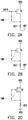
  • FIG. 2A to FIG. 2C are operational diagrams of a pixel circuit when a light-emitting diode is damaged according to an embodiment of the present disclosure.
  • FIG. 3 is a schematic view of a pixel circuit according to another embodiment of the present disclosure.
  • FIG. 4 is a schematic view of a pixel circuit according to another embodiment of the present disclosure.
  • FIG. 5 is an operational waveform of a pixel circuit according to an embodiment of the present disclosure.
  • FIG. 6 is a schematic view of a pixel circuit according to another embodiment of the present disclosure.
  • FIG. 7 is a schematic view of a display apparatus according to an embodiment of the present disclosure.
  • FIG. 1 is a schematic view of a pixel circuit according to an embodiment of the present disclosure.
  • a pixel circuit 100 includes a driving transistor TD, a switch SW 1 , a data writing circuit 110 , and a voltage selector 120 .
  • the pixel circuit 100 is configured to drive a light-emitting diode LED, and the light-emitting diode LED may be a micro LED or an LED in any other form.
  • a first terminal of the driving transistor TD is coupled to a first terminal of the light-emitting diode LED.
  • a second terminal of the driving transistor TD receives a supply voltage VDD.
  • a control terminal of the driving transistor TD is coupled to the data writing circuit 110 and the switch SW 1 .
  • the switch SW 1 bridges across the control terminal of the driving transistor TD and the first terminal of the light-emitting diode LED.
  • the switch SW 1 is controlled by a scanning signal G[n] to be turned on or cut off.
  • a second terminal of the light-emitting diode LED is coupled to the voltage selector 120 .
  • the voltage selector 120 receives a reference voltage VR 1 and a reference voltage VSS, and selects one of the reference voltage VR 1 and the reference voltage VSS to be transmitted to the second terminal of the light-emitting diode LED.
  • the first terminal of the light-emitting diode LED is its anode terminal
  • the second terminal of the light-emitting diode LED is its cathode terminal.
  • the voltage selector 120 may be provided in the pixel circuit 100 ; or, in other embodiments, the voltage selector 120 may also be provided outside the pixel circuit 100 .
  • the voltage selector 120 is provided outside the pixel circuit 100 , multiple pixel circuits that may enter the data-writing time period and the laser time period at the same time may share the same voltage selector 120 .
  • the data writing circuit 110 may write a data voltage DATA into the control terminal of the driving transistor TD.
  • the switch SW 1 is turned on based on the scanning signal G[n].
  • the data voltage DATA may be transmitted to the first terminal of the light-emitting diode LED through the switch SW 1 .
  • the voltage selector 120 selects the reference voltage VR 1 having a relatively high voltage value to provide the same to the second terminal of the light-emitting diode LED. At this time, the light-emitting diode LED does not emit light.
  • the switch SW 1 is cut off based on the scanning signal G[n].
  • the voltage selector 120 changes to provide the reference voltage VSS to the second terminal of the light-emitting diode LED.
  • the reference voltage VSS may have a relatively low voltage value (comparing with the first reference voltage VR 1 ), and the reference voltage VSS may be a ground voltage.
  • the driving transistor TD provides a driving current based on the data voltage DATA to drive the light-emitting diode LED, such that the light-emitting diode LED may emit light successfully.
  • the driving transistor TD is a P-type transistor.
  • the terminal opposite to the driven terminal of the light-emitting diode LED may receive a variable voltage.
  • the driving transistor TD is a P-type transistor
  • the driven terminal of the light-emitting diode LED is the anode terminal
  • the terminal opposite to the driven terminal of the light-emitting diode LED is the cathode terminal.
  • the terminal opposite to the driven terminal of the light-emitting diode LED may also receive a variable voltage.
  • the voltage selector 120 provides selectively the reference voltage VR 1 or the reference voltage VSS to the cathode terminal of the light-emitting diode LED.
  • FIG. 2A to FIG. 2C show the operational diagrams of a pixel circuit when a light-emitting diode is damaged according to an embodiment of the present disclosure.
  • the light-emitting diode LED may be equivalent to a resistor RST.
  • the switch SW 1 is turned on, and the data voltage DATA is provided to be written into the control terminal of the driving transistor TD. Furthermore, the voltage selector 120 provides the reference voltage VR 1 to the second terminal of the equivalent resistor RST. At this time, the resistance value based on the resistor RST is much lower than the output impedance of the data writing circuit 110 . Therefore, the resistor RST forms a pull-up resistance with a strong drive capability, pulling up the voltage value of the control terminal of the driving transistor TD to a voltage value close to (or equal to) the reference voltage VR 1 .
  • the switch SW 1 is cut off, and the voltage value of the control terminal of the driving transistor TD is maintained at a voltage value close to (or equal to) the reference voltage VR 1 .
  • the voltage selector 120 changes to provide the reference voltage VSS which has a relatively low voltage value to the second terminal of the resistor RST.
  • the driving transistor TD is cut off effectively. Therefore, as the current path between the power supply voltage VDD and the light-emitting diode LED is cut off, the short circuit may be prevented effectively.
  • FIG. 3 is a schematic view of a pixel circuit according to another embodiment of the present disclosure.
  • a pixel circuit 300 includes a driving transistor TD, a switch SW 1 , a data writing circuit 310 , and a voltage selector 320 . Its differences between the embodiment in FIG. 1 are that the driving transistor TD in the present embodiment is an N-type transistor, the voltage selector 320 is coupled to the anode terminal of a light-emitting diode LED, the driving transistor TD is coupled to the cathode terminal of the light-emitting diode LED, and that the driving transistor TD is coupled between the cathode terminal of the light-emitting diode LED and a reference voltage VSS.
  • the driving transistor TD in the present embodiment is an N-type transistor
  • the voltage selector 320 is coupled to the anode terminal of a light-emitting diode LED
  • the driving transistor TD is coupled to the cathode terminal of the light-emitting diode LED
  • the pixel circuit 300 and the pixel circuit 100 are complementary embodiments which share the similar operational details, which are not repeated hereunder.
  • the voltage selector 320 provides the reference voltage VSS to the anode terminal of the light-emitting diode LED during the data-writing time period, adopts a supply voltage VDD as the reference voltage during the laser time period, and provides the supply voltage VDD to the anode terminal of the light-emitting diode LED.
  • FIG. 4 is a schematic view of a pixel circuit according to another embodiment of the present disclosure.
  • a pixel circuit 400 includes a driving transistor TD, a switch constructed by a transistor TSW, a data writing circuit 410 , a voltage selector 420 , and an auxiliary circuit 430 .
  • the data writing circuit 410 includes a transistor T 1 .
  • One terminal of the transistor T 1 receives a data voltage DATA[m]
  • the other terminal of the transistor T 1 is coupled to the driving transistor TD
  • a control terminal of the transistor T 1 receives a scanning signal G[n].
  • the voltage selector 420 includes a transistor T 2 and a transistor T 3 .
  • the transistor T 2 is coupled to the cathode terminal of a light-emitting diode LED, and the transistor T 2 receives a reference voltage VSS.
  • the transistor T 2 is controlled by a laser control signal EM to be turned on or cut off.
  • the transistor T 3 is also coupled to the cathode terminal of the light-emitting diode LED, and the transistor T 3 receives the supply voltage VDD.
  • the transistor T 3 is controlled by the scanning signal G[n] to be turned on or cut off.
  • the transistor TSW is coupled between the anode terminal of the light-emitting diode LED and the control terminal of the driving transistor TD, and the transistor TSW is controlled by the scanning signal G[n] to be turned on or cut off.
  • the driving transistor TD is an N-type transistor
  • the driven terminal of the light-emitting diode LED is the cathode terminal.
  • the terminal opposite to the driven terminal is the anode terminal.
  • the voltage selector 420 may selectively provide the reference voltage VDD or the reference voltage VSS to the anode terminal of the light-emitting diode LED.
  • the transistors T 1 , T 3 , and TSW may be turned on based on the scanning signal G[n], and the transistor T 2 is cut off.
  • the data voltage DATA[m] is written into the control terminal of the driving transistor TD through the transistor T 1 , the driving transistor TD, and the transistor TSW which are turned on.
  • the supply voltage VDD as the reference voltage may be transmitted to the cathode terminal of the light-emitting diode LED through the turned on transistor T 3 .
  • the transistor T 2 is turned on based on a laser control signal EM, and the transistors T 1 and T 3 are cut off.
  • the reference voltage VSS may be transmitted to the cathode terminal of the light-emitting diode LED through the turned on transistor T 2 .
  • the auxiliary circuit 430 is coupled to the path on which the driving transistor TD receives the supply voltage VDD.
  • the auxiliary circuit 430 includes a transistor T 41 , a transistor T 42 , and a capacitor C 1 .
  • One terminal of the transistor T 41 receives the supply voltage VDD.
  • the other terminal of the transistor T 41 is coupled to the coupling endpoint of the driving transistor TD and the transistor T 1 .
  • the control terminal of the transistor T 41 receives the laser control signal EM.
  • One terminal of the transistor T 42 receives a reset voltage RES_DC.
  • the other terminal of the transistor T 42 is coupled to the control terminal of the driving transistor TD.
  • the control terminal of the transistor T 42 receives a reset control signal RES.
  • the capacitor C 1 is turned on in series between the supply voltage VDD and the control terminal of the driving transistor TD.
  • the transistor T 41 may be configured to control the laser brightness of the light-emitting diode LED.
  • the laser signal EM is a pulse width modulation signal
  • the transistor T 41 may adjust the laser brightness of the light-emitting diode LED based on the duty cycle of the laser signal EM.
  • a voltage VG 1 of the control terminal of the driving transistor TD may be reset based on the reset voltage RES_DC.
  • the transistors T 1 to T 3 , T 41 , T 42 , and TSW are all P-type transistors.
  • FIG. 5 is an operational waveform of a pixel circuit according to an embodiment of the present disclosure.
  • the n pixel circuits enter the data-writing time period based on scanning signals G[ 1 ] to G[n].
  • the scanning signal G[ 1 ] is enabled (the voltage level is pulled low)
  • the pixel circuit corresponding to the scanning signal G[ 1 ] is written into data D 1 .
  • the scanning signal G[n] is enabled (the voltage level is pulled low)
  • the pixel circuit corresponding to the scanning signal G[n] is written into data Dn.
  • the driving transistor may be cut off or generate a driving current based on the voltage VG 1 or the voltage VG 1 ′ of its control terminal.
  • the pixel circuit of the embodiment of the present disclosure may automatically cut off the driving transistor when the light-emitting diode is damaged, so as to prevent the occurrence of a short circuit.
  • the pixel circuits corresponding to the scanning signals G[ 1 ] to G[n] may perform lasers simultaneously during the same laser time period EMP.
  • FIG. 6 is a schematic view of a pixel circuit according to another embodiment of the present disclosure.
  • a pixel circuit 600 is an embodiment of a circuit complementary to the pixel circuit 500 .
  • the pixel circuit 600 includes a transistor TSW, a driving transistor TD, a data writing circuit 610 , a voltage selector 620 , and an auxiliary circuit 630 .
  • the voltage selector 620 is coupled between a supply voltage VDD and the anode terminal of a light-emitting diode LED, and the auxiliary circuit 630 is coupled to the path on which the driving transistor TD receives a reference voltage VSS.
  • the voltage selector 620 may select the supply voltage VDD or a reference voltage DC_L during different time periods to provide the same to the anode terminal of the light-emitting diode LED.
  • the reference voltage DC_L is lower than the supply voltage VDD, and the voltage values of the reference voltage DC_L and the reference voltage VSS may be the same with or different from each other.
  • the transistor TSW, the driving transistor TD, and the transistor constructing the data writing circuit 610 may all be N-type transistors.
  • FIG. 7 is a schematic view of a display apparatus according to an embodiment of the present disclosure.
  • a display apparatus 700 includes multiple pixel circuits P 11 to Pnm.
  • the pixel circuits P 11 to Pnm may be divided into multiple pixel rows, and receive scanning signals G[ 1 ] to G[n] respectively.
  • the pixel circuits P 11 to Pnm may be implemented based on the pixel circuits of the foregoing embodiments.
  • the pixel circuits P 11 to Pnm may receive the same laser control signal to perform a simultaneous laser operation.
  • the pixel circuits P 11 to Pnm may be divided into multiple partitions based on the corresponding scanning signals G[ 1 ] to G[n], and these partitions may respectively receive multiple laser control signals that are enabled sequentially to perform a progressive laser operation.
  • the pixel circuit of the present disclosure adopts the voltage selector and the switch to set the voltage of the control terminal of the driving transistor during the data-writing time period based on the condition of the light-emitting diode.
  • the driving transistor may be cut off during the laser time period to prevent a short circuit.

Landscapes

  • Engineering & Computer Science (AREA)
  • Physics & Mathematics (AREA)
  • Computer Hardware Design (AREA)
  • General Physics & Mathematics (AREA)
  • Theoretical Computer Science (AREA)
  • Control Of Indicators Other Than Cathode Ray Tubes (AREA)
  • Led Devices (AREA)

Abstract

A display apparatus and a pixel circuit thereof are provided. The pixel circuit is configured to drive a light-emitting diode (LED). The pixel circuit includes a driving transistor, a switch, a data writing circuit, and a voltage selector. The switch is turned on during a data-writing time period, and cut-off during a laser time period. The data writing circuit transports a data voltage to a control terminal of the driving transistor during the data-writing time period. During the data-writing time period, a second terminal of the LED receives a first reference voltage, and during the laser time period, the second terminal of the LED receives a second reference voltage. The first reference voltage and the second reference voltage are different.

Description

CROSS-REFERENCE TO RELATED APPLICATION
This application claims the priority benefit of Taiwan application serial no. 109120253, filed on Jun. 16, 2020. The entirety of the above-mentioned patent application is hereby incorporated by reference herein and made a part of this specification.
BACKGROUND Technical Field
The disclosure relates to a display apparatus and a pixel circuit thereof, and particularly to a display apparatus having an anti-short circuit function and a pixel circuit thereof.
Description of Related Art
With the progress made with the process of light-emitting diodes, it has become a mainstream to use micro-light-emitting diodes to produce high-resolution display apparatus. As the number of the light-emitting diodes disposed on the display apparatus has been increasing, when part of the light-emitting diodes are damaged, the display quality may also be damaged. And when a small number of light-emitting diodes are damaged, not only is it difficult but it also takes a certain amount of time to perform maintenance on the display apparatus. More importantly, when a damaged light-emitting diode is driven, a short circuit may occur on the light-emitting diode. In addition to causing unnecessary power consumption, this could also lead a high current to flow through a certain part of the circuit.
SUMMARY
Accordingly, the disclosure provides a display apparatus and a pixel circuit thereof, which effectively stop the laser operation of the damaged light-emitting diode and prevent the occurrence of a short circuit.
The pixel circuit of the present disclosure is configured to drive a light-emitting diode. The pixel circuit includes a driving transistor, a switch, and a data writing circuit. The driving transistor has a first terminal coupled to a first terminal of the light-emitting diode. The switch is coupled between the first terminal and a control terminal of the driving transistor, and the switch is turned on during the data-writing time period and cut off during the laser time period. The data writing circuit transmits data voltage to a control terminal of the driving transistor during the data-writing time period. During the data-writing time period, a second terminal of the light-emitting diode receives a first reference voltage. And during the laser time period, the second terminal of the light-emitting diode receives a second reference voltage. The first reference voltage and the second reference voltage are not the same.
The display apparatus of the present disclosure includes multiple pixel circuits and at least one voltage selector. The pixel circuits are configured to drive multiple light-emitting diodes respectively. Each of the pixel circuits includes a driving transistor, a switch, and a data writing circuit. The driving transistor has a first terminal coupled to a first terminal of the corresponding light-emitting diode. The switch is coupled between the first terminal and a control terminal of the driving transistor, and the switch is turned on during the data-writing time period and cut off during the laser time period. The data writing circuit transmits a data voltage to a control terminal of the driving transistor during the data-writing time period. The voltage selector transmits the first reference voltage to a second terminal of the first light-emitting diode during the data-writing time period, and transmits the second reference voltage to the second terminal of the first light-emitting diode during the laser time period. And the first reference voltage and the second reference voltage in the above description are different from each other.
Based on the above, the pixel circuit of the embodiment of the present disclosure has the driving transistor coupled to the first terminal of the light-emitting diode during the data writing time interval through the switch, causing a short circuit with the control terminal of the driving transistor, and the second terminal of the light-emitting diode receives the first reference voltage. When the light-emitting diode is damaged, the first reference voltage may be transmitted to the control terminal of the driving transistor through the switch. Therefore, during the laser time period, when the light-emitting diode is damaged, the driving transistor may be cut off based on the first reference voltage to prevent the light-emitting diode from short-circuiting.
BRIEF DESCRIPTION OF THE DRAWINGS
FIG. 1 is a schematic view of a pixel circuit according to an embodiment of the present disclosure.
FIG. 2A to FIG. 2C are operational diagrams of a pixel circuit when a light-emitting diode is damaged according to an embodiment of the present disclosure.
FIG. 3 is a schematic view of a pixel circuit according to another embodiment of the present disclosure.
FIG. 4 is a schematic view of a pixel circuit according to another embodiment of the present disclosure.
FIG. 5 is an operational waveform of a pixel circuit according to an embodiment of the present disclosure.
FIG. 6 is a schematic view of a pixel circuit according to another embodiment of the present disclosure.
FIG. 7 is a schematic view of a display apparatus according to an embodiment of the present disclosure.
DESCRIPTION OF THE EMBODIMENTS
FIG. 1 is a schematic view of a pixel circuit according to an embodiment of the present disclosure. A pixel circuit 100 includes a driving transistor TD, a switch SW1, a data writing circuit 110, and a voltage selector 120. The pixel circuit 100 is configured to drive a light-emitting diode LED, and the light-emitting diode LED may be a micro LED or an LED in any other form. A first terminal of the driving transistor TD is coupled to a first terminal of the light-emitting diode LED. A second terminal of the driving transistor TD receives a supply voltage VDD. A control terminal of the driving transistor TD is coupled to the data writing circuit 110 and the switch SW1. The switch SW1 bridges across the control terminal of the driving transistor TD and the first terminal of the light-emitting diode LED. The switch SW1 is controlled by a scanning signal G[n] to be turned on or cut off. On the other hand, a second terminal of the light-emitting diode LED is coupled to the voltage selector 120. The voltage selector 120 receives a reference voltage VR1 and a reference voltage VSS, and selects one of the reference voltage VR1 and the reference voltage VSS to be transmitted to the second terminal of the light-emitting diode LED. In the present embodiment, the first terminal of the light-emitting diode LED is its anode terminal, and the second terminal of the light-emitting diode LED is its cathode terminal.
In the present embodiment, the voltage selector 120 may be provided in the pixel circuit 100; or, in other embodiments, the voltage selector 120 may also be provided outside the pixel circuit 100. When the voltage selector 120 is provided outside the pixel circuit 100, multiple pixel circuits that may enter the data-writing time period and the laser time period at the same time may share the same voltage selector 120.
Regarding the operational details, during the data-writing time period, the data writing circuit 110 may write a data voltage DATA into the control terminal of the driving transistor TD. During the data-writing time period, the switch SW1 is turned on based on the scanning signal G[n]. Please note here that if the light-emitting diode LED is in a normal and undamaged condition, the data voltage DATA may be transmitted to the first terminal of the light-emitting diode LED through the switch SW1. Correspondingly, also during the data-writing time period, the voltage selector 120 selects the reference voltage VR1 having a relatively high voltage value to provide the same to the second terminal of the light-emitting diode LED. At this time, the light-emitting diode LED does not emit light.
Then, during the laser time period which is after the data-writing time period, the switch SW1 is cut off based on the scanning signal G[n]. At this time, the voltage selector 120 changes to provide the reference voltage VSS to the second terminal of the light-emitting diode LED. The reference voltage VSS may have a relatively low voltage value (comparing with the first reference voltage VR1), and the reference voltage VSS may be a ground voltage. Meanwhile, the driving transistor TD provides a driving current based on the data voltage DATA to drive the light-emitting diode LED, such that the light-emitting diode LED may emit light successfully.
Incidentally, in the present embodiment, the driving transistor TD is a P-type transistor. In addition, in the embodiment of the present disclosure, the terminal opposite to the driven terminal of the light-emitting diode LED may receive a variable voltage. And when the driving transistor TD is a P-type transistor, the driven terminal of the light-emitting diode LED is the anode terminal, and the terminal opposite to the driven terminal of the light-emitting diode LED is the cathode terminal. Furthermore, the terminal opposite to the driven terminal of the light-emitting diode LED may also receive a variable voltage. In other words, the voltage selector 120 provides selectively the reference voltage VR1 or the reference voltage VSS to the cathode terminal of the light-emitting diode LED.
On the other hand, if the light-emitting diode LED is damaged, please refer to FIG. 1 and FIG. 2A to FIG. 2C at the same time. FIG. 2A to FIG. 2C show the operational diagrams of a pixel circuit when a light-emitting diode is damaged according to an embodiment of the present disclosure. In FIG. 2A, based on the condition that the light-emitting diode LED is damaged, the light-emitting diode LED may be equivalent to a resistor RST.
During the data-writing time period, the switch SW1 is turned on, and the data voltage DATA is provided to be written into the control terminal of the driving transistor TD. Furthermore, the voltage selector 120 provides the reference voltage VR1 to the second terminal of the equivalent resistor RST. At this time, the resistance value based on the resistor RST is much lower than the output impedance of the data writing circuit 110. Therefore, the resistor RST forms a pull-up resistance with a strong drive capability, pulling up the voltage value of the control terminal of the driving transistor TD to a voltage value close to (or equal to) the reference voltage VR1.
Then, in FIG. 2B, when the data-writing time period ends, the switch SW1 is cut off, and the voltage value of the control terminal of the driving transistor TD is maintained at a voltage value close to (or equal to) the reference voltage VR1. And in FIG. 2C, when entering the laser time period, the voltage selector 120 changes to provide the reference voltage VSS which has a relatively low voltage value to the second terminal of the resistor RST. However, based on the fact that the control terminal of the driving transistor TD has a relatively high voltage value, the driving transistor TD is cut off effectively. Therefore, as the current path between the power supply voltage VDD and the light-emitting diode LED is cut off, the short circuit may be prevented effectively.
FIG. 3 is a schematic view of a pixel circuit according to another embodiment of the present disclosure. A pixel circuit 300 includes a driving transistor TD, a switch SW1, a data writing circuit 310, and a voltage selector 320. Its differences between the embodiment in FIG. 1 are that the driving transistor TD in the present embodiment is an N-type transistor, the voltage selector 320 is coupled to the anode terminal of a light-emitting diode LED, the driving transistor TD is coupled to the cathode terminal of the light-emitting diode LED, and that the driving transistor TD is coupled between the cathode terminal of the light-emitting diode LED and a reference voltage VSS.
The pixel circuit 300 and the pixel circuit 100 are complementary embodiments which share the similar operational details, which are not repeated hereunder. Note that the voltage selector 320 provides the reference voltage VSS to the anode terminal of the light-emitting diode LED during the data-writing time period, adopts a supply voltage VDD as the reference voltage during the laser time period, and provides the supply voltage VDD to the anode terminal of the light-emitting diode LED.
FIG. 4 is a schematic view of a pixel circuit according to another embodiment of the present disclosure. A pixel circuit 400 includes a driving transistor TD, a switch constructed by a transistor TSW, a data writing circuit 410, a voltage selector 420, and an auxiliary circuit 430. The data writing circuit 410 includes a transistor T1. One terminal of the transistor T1 receives a data voltage DATA[m], the other terminal of the transistor T1 is coupled to the driving transistor TD, and a control terminal of the transistor T1 receives a scanning signal G[n]. The voltage selector 420 includes a transistor T2 and a transistor T3. The transistor T2 is coupled to the cathode terminal of a light-emitting diode LED, and the transistor T2 receives a reference voltage VSS. The transistor T2 is controlled by a laser control signal EM to be turned on or cut off. The transistor T3 is also coupled to the cathode terminal of the light-emitting diode LED, and the transistor T3 receives the supply voltage VDD. The transistor T3 is controlled by the scanning signal G[n] to be turned on or cut off. The transistor TSW is coupled between the anode terminal of the light-emitting diode LED and the control terminal of the driving transistor TD, and the transistor TSW is controlled by the scanning signal G[n] to be turned on or cut off.
In the present embodiment, the driving transistor TD is an N-type transistor, and the driven terminal of the light-emitting diode LED is the cathode terminal. In the light-emitting diode LED, the terminal opposite to the driven terminal is the anode terminal. Here, the voltage selector 420 may selectively provide the reference voltage VDD or the reference voltage VSS to the anode terminal of the light-emitting diode LED.
In the present embodiment, during the data-writing time period, the transistors T1, T3, and TSW may be turned on based on the scanning signal G[n], and the transistor T2 is cut off. The data voltage DATA[m] is written into the control terminal of the driving transistor TD through the transistor T1, the driving transistor TD, and the transistor TSW which are turned on. In addition, the supply voltage VDD as the reference voltage may be transmitted to the cathode terminal of the light-emitting diode LED through the turned on transistor T3. During the laser time period, the transistor T2 is turned on based on a laser control signal EM, and the transistors T1 and T3 are cut off. The reference voltage VSS may be transmitted to the cathode terminal of the light-emitting diode LED through the turned on transistor T2.
Furthermore, the auxiliary circuit 430 is coupled to the path on which the driving transistor TD receives the supply voltage VDD. The auxiliary circuit 430 includes a transistor T41, a transistor T42, and a capacitor C1. One terminal of the transistor T41 receives the supply voltage VDD. The other terminal of the transistor T41 is coupled to the coupling endpoint of the driving transistor TD and the transistor T1. And the control terminal of the transistor T41 receives the laser control signal EM. One terminal of the transistor T42 receives a reset voltage RES_DC. The other terminal of the transistor T42 is coupled to the control terminal of the driving transistor TD. And the control terminal of the transistor T42 receives a reset control signal RES. Also, the capacitor C1 is turned on in series between the supply voltage VDD and the control terminal of the driving transistor TD.
Here, the transistor T41 may be configured to control the laser brightness of the light-emitting diode LED. Simply put, when the laser signal EM is a pulse width modulation signal, the transistor T41 may adjust the laser brightness of the light-emitting diode LED based on the duty cycle of the laser signal EM. Furthermore, when the transistor T42 is turned on, a voltage VG1 of the control terminal of the driving transistor TD may be reset based on the reset voltage RES_DC.
In the present embodiment, the transistors T1 to T3, T41, T42, and TSW are all P-type transistors.
Please refer to FIG. 4 and FIG. 5 at the same time. FIG. 5 is an operational waveform of a pixel circuit according to an embodiment of the present disclosure. When the number of the pixel circuits is n, the n pixel circuits enter the data-writing time period based on scanning signals G[1] to G[n]. When the scanning signal G[1] is enabled (the voltage level is pulled low), the pixel circuit corresponding to the scanning signal G[1] is written into data D1. And when the scanning signal G[n] is enabled (the voltage level is pulled low), the pixel circuit corresponding to the scanning signal G[n] is written into data Dn.
Take the pixel circuit corresponding to the scanning signal G[1] as an example. If the light-emitting diode is in a normal condition, the voltage VG1 of the control terminal of the driving transistor may be written as a voltage value lower than that of the supply voltage VDD. But if the light-emitting diode is damaged, a voltage VG1′ of the control terminal of the driving transistor is pulled up to a voltage value substantially equal to that of the supply voltage VDD. Therefore, during a laser time period EMP (the voltage value of the laser control signal EM is pulled down), the driving transistor may be cut off or generate a driving current based on the voltage VG1 or the voltage VG1′ of its control terminal. In other words, the pixel circuit of the embodiment of the present disclosure may automatically cut off the driving transistor when the light-emitting diode is damaged, so as to prevent the occurrence of a short circuit.
Incidentally, in the present embodiment, the pixel circuits corresponding to the scanning signals G[1] to G[n] may perform lasers simultaneously during the same laser time period EMP.
FIG. 6 is a schematic view of a pixel circuit according to another embodiment of the present disclosure. A pixel circuit 600 is an embodiment of a circuit complementary to the pixel circuit 500. The pixel circuit 600 includes a transistor TSW, a driving transistor TD, a data writing circuit 610, a voltage selector 620, and an auxiliary circuit 630. The voltage selector 620 is coupled between a supply voltage VDD and the anode terminal of a light-emitting diode LED, and the auxiliary circuit 630 is coupled to the path on which the driving transistor TD receives a reference voltage VSS. The voltage selector 620 may select the supply voltage VDD or a reference voltage DC_L during different time periods to provide the same to the anode terminal of the light-emitting diode LED. And the reference voltage DC_L is lower than the supply voltage VDD, and the voltage values of the reference voltage DC_L and the reference voltage VSS may be the same with or different from each other.
In the present embodiment, the transistor TSW, the driving transistor TD, and the transistor constructing the data writing circuit 610 may all be N-type transistors.
FIG. 7 is a schematic view of a display apparatus according to an embodiment of the present disclosure. A display apparatus 700 includes multiple pixel circuits P11 to Pnm. In the present embodiment, the pixel circuits P11 to Pnm may be divided into multiple pixel rows, and receive scanning signals G[1] to G[n] respectively. The pixel circuits P11 to Pnm may be implemented based on the pixel circuits of the foregoing embodiments. In addition, the pixel circuits P11 to Pnm may receive the same laser control signal to perform a simultaneous laser operation. Alternatively, the pixel circuits P11 to Pnm may be divided into multiple partitions based on the corresponding scanning signals G[1] to G[n], and these partitions may respectively receive multiple laser control signals that are enabled sequentially to perform a progressive laser operation.
Of course, it is not necessarily for the method of partitioning the pixel circuits P11 to Pnm to be carried out based on the scanning signals G[1] to G[n], as the above description is only an example which does not limit the scope of implementation of the present disclosure.
In summary, the pixel circuit of the present disclosure adopts the voltage selector and the switch to set the voltage of the control terminal of the driving transistor during the data-writing time period based on the condition of the light-emitting diode. With such configuration, when the light-emitting diode is damaged, the driving transistor may be cut off during the laser time period to prevent a short circuit.

Claims (11)

What is claimed is:
1. A pixel circuit, configured to drive a light-emitting diode, the pixel circuit comprising:
a driving transistor, comprising a first terminal coupled to a first terminal of the light-emitting diode;
a switch, coupled between the first terminal and a control terminal of the driving transistor, turned on during a data-writing time period and cut off during a laser time period;
a data writing circuit, transmitting a data voltage to the control terminal of the driving transistor during the data-writing time period,
wherein during the data-writing time period, a second terminal of the light-emitting diode receives a first reference voltage, and during the laser time period, the second terminal of the light-emitting diode receives a second reference voltage,
wherein the first reference voltage and the second reference voltage are not the same; and
a voltage selector, transmitting the first reference voltage to the second terminal of the light-emitting diode during the data-writing time period, and transmitting the second reference voltage to the second terminal of the light-emitting diode during the laser time period, wherein the voltage selector comprises:
a first transistor, comprising a first terminal coupled to the second terminal of the light-emitting diode, a control terminal receiving a scanning signal, and a second terminal receiving the first reference voltage; and
a second transistor, comprising a first terminal coupled to the second terminal of the light-emitting diode, a control terminal receiving a laser control signal, and a second terminal receiving the second reference voltage.
2. The pixel circuit according to claim 1, wherein when the first terminal of the light-emitting diode is an anode terminal and the second terminal of the light-emitting diode is a cathode terminal, the first reference voltage is higher than the second reference voltage.
3. The pixel circuit according to claim 1, wherein when the first terminal of the light-emitting diode is a cathode terminal and the second terminal of the light-emitting diode is an anode terminal, the first reference voltage is lower than the second reference voltage.
4. The pixel circuit according to claim 1, wherein the data writing circuit comprises:
a transistor, comprising a first terminal for receiving the data voltage, a second terminal coupled to a second terminal of the driving transistor, and a control terminal receiving a scanning signal.
5. The pixel circuit according to claim 1, further comprising:
an auxiliary circuit, coupled between a second terminal of the driving transistor and the first reference voltage, receiving a laser control signal, and controlling a time period for transmitting the first reference voltage to the second terminal of the driving transistor based on the laser control signal.
6. The pixel circuit according to claim 5, wherein the auxiliary circuit is further coupled to the control terminal of the driving transistor, and the auxiliary circuit receives a reset control signal and transmits a reset voltage to the control terminal of the driving transistor based on the reset control signal.
7. The pixel circuit according to claim 6, wherein the auxiliary circuit comprises:
a first transistor, comprising a first terminal receiving the first reference voltage, a second terminal coupled to the second terminal of the driving transistor, and a control terminal receiving the laser control signal; and
a second transistor, comprising a first terminal receiving the reset voltage, a second terminal coupled to the control terminal of the driving transistor, and a control terminal receiving the reset control signal.
8. A display apparatus, comprising:
a plurality of pixel circuits, configured to drive a plurality of light-emitting diodes respectively, wherein each of the pixel circuits comprises:
a driving transistor, comprising a first terminal coupled to a first terminal of a corresponding first light-emitting diode;
a switch, coupled between the first terminal and a control terminal of the driving transistor, turned on during a data-writing time period and cut off during a laser time period;
a data writing circuit, transmitting a data voltage to the control terminal of the driving transistor during the data-writing time period;
at least one voltage selector, transmitting a first reference voltage to a second terminal of the first light-emitting diode during the data-writing time period, and transmitting a second reference voltage to the second terminal of the first light-emitting diode during the laser time period,
wherein the first reference voltage and the second reference voltage are not the same; and
a voltage selector, transmitting the first reference voltage to the second terminal of the light-emitting diode during the data-writing time period, and transmitting the second reference voltage to the second terminal of the light-emitting diode during the laser time period, wherein the voltage selector comprises:
a first transistor, comprising a first terminal coupled to the second terminal of the light-emitting diode, a control terminal receiving a scanning signal, and a second terminal receiving the first reference voltage; and
a second transistor, comprising a first terminal coupled to the second terminal of the light-emitting diode, a control terminal receiving a laser control signal, and a second terminal receiving the second reference voltage.
9. The display apparatus according to claim 8, wherein when a first terminal of the first light-emitting diode is an anode terminal and the second terminal of the first light-emitting diode is a cathode terminal, the first reference voltage is higher than the second reference voltage, and when the first terminal of the first light-emitting diode is a cathode terminal and the second terminal of the first light-emitting diode is an anode terminal, the first reference voltage is lower than the second reference voltage.
10. The display apparatus according to claim 8, wherein some of the pixel circuits are divided into a plurality of partitions, and the partitions perform a progressive laser operation.
11. The electronic apparatus according to claim 8, wherein some of the light-emitting diodes emit laser simultaneously.
US17/092,314 2020-06-16 2020-11-08 Display apparatus and pixel circuit thereof Active US11227539B2 (en)

Applications Claiming Priority (2)

Application Number Priority Date Filing Date Title
TW109120253A TWI757766B (en) 2020-06-16 2020-06-16 Display apparatus and pixel circuit thereof
TW109120253 2020-06-16

Publications (2)

Publication Number Publication Date
US20210390900A1 US20210390900A1 (en) 2021-12-16
US11227539B2 true US11227539B2 (en) 2022-01-18

Family

ID=74996173

Family Applications (1)

Application Number Title Priority Date Filing Date
US17/092,314 Active US11227539B2 (en) 2020-06-16 2020-11-08 Display apparatus and pixel circuit thereof

Country Status (3)

Country Link
US (1) US11227539B2 (en)
CN (1) CN112530362B (en)
TW (1) TWI757766B (en)

Families Citing this family (2)

* Cited by examiner, † Cited by third party
Publication number Priority date Publication date Assignee Title
TWI796723B (en) * 2021-07-06 2023-03-21 友達光電股份有限公司 Display device
TWI797870B (en) * 2021-12-03 2023-04-01 友達光電股份有限公司 Driving circuit

Citations (6)

* Cited by examiner, † Cited by third party
Publication number Priority date Publication date Assignee Title
US20120007848A1 (en) * 2010-07-06 2012-01-12 Han Sang-Myeon Organic light emitting display
US20140132583A1 (en) * 2012-11-12 2014-05-15 Su-Weon KIM Pixel, display device including the same, and driving method thereof
US20140306945A1 (en) * 2011-11-17 2014-10-16 Sharp Kabushiki Kaisha Display device and drive method thereof
CN108320701A (en) 2018-03-07 2018-07-24 昆山国显光电有限公司 A kind of pixel circuit, organic EL display panel and display device
CN110520922A (en) 2018-09-20 2019-11-29 京东方科技集团股份有限公司 Display driver circuit, method and display equipment
US20200251046A1 (en) 2019-01-31 2020-08-06 Au Optronics Corporation Pixel circuit and repair method thereof

Family Cites Families (4)

* Cited by examiner, † Cited by third party
Publication number Priority date Publication date Assignee Title
CN106448526B (en) * 2015-08-13 2019-11-05 群创光电股份有限公司 Driving circuit
CN106920801B (en) * 2015-12-24 2020-07-14 群创光电股份有限公司 Display device
TWI653618B (en) * 2017-03-14 2019-03-11 鴻海精密工業股份有限公司 Pixel driving circuit and display device with pixel driving circuit
CN106910460B (en) * 2017-04-28 2019-07-19 深圳市华星光电半导体显示技术有限公司 Pixel-driving circuit and display panel

Patent Citations (6)

* Cited by examiner, † Cited by third party
Publication number Priority date Publication date Assignee Title
US20120007848A1 (en) * 2010-07-06 2012-01-12 Han Sang-Myeon Organic light emitting display
US20140306945A1 (en) * 2011-11-17 2014-10-16 Sharp Kabushiki Kaisha Display device and drive method thereof
US20140132583A1 (en) * 2012-11-12 2014-05-15 Su-Weon KIM Pixel, display device including the same, and driving method thereof
CN108320701A (en) 2018-03-07 2018-07-24 昆山国显光电有限公司 A kind of pixel circuit, organic EL display panel and display device
CN110520922A (en) 2018-09-20 2019-11-29 京东方科技集团股份有限公司 Display driver circuit, method and display equipment
US20200251046A1 (en) 2019-01-31 2020-08-06 Au Optronics Corporation Pixel circuit and repair method thereof

Also Published As

Publication number Publication date
TW202201371A (en) 2022-01-01
CN112530362A (en) 2021-03-19
TWI757766B (en) 2022-03-11
US20210390900A1 (en) 2021-12-16
CN112530362B (en) 2022-09-06

Similar Documents

Publication Publication Date Title
US11551606B2 (en) LED driving circuit, display panel, and pixel driving device
US20220215797A1 (en) Pixel driving circuit, driving method thereof, display panel and display device
CN110689840B (en) Pixel circuit, short circuit detection method and display panel
CN104464638B (en) Pixel drive circuit and method, array substrate and display device
TWI433111B (en) Pixel unit and display panel of organic light emitting diode containing the same
CN104200778B (en) Image element circuit and its driving method, display floater, display device
US20240221630A1 (en) Display panel and driving method for the same, and display device
CN115985249A (en) Pixel circuit, driving method thereof, and display device
US11475861B2 (en) Scan driver and display device including scan driver
CN116597772B (en) Pixel circuits and display panels
US11227539B2 (en) Display apparatus and pixel circuit thereof
TWI766639B (en) Self-luminous pixel circuit
US20140332775A1 (en) Pixel circuit and display apparatus using the same
KR20230094693A (en) Pixel circuit and pixel driving apparatus
CN116580662A (en) LED display panel and operation method, method for reducing LED voltage swing
US11783756B1 (en) Display driving circuit and display device
CN204348301U (en) Pixel-driving circuit, array base palte and display device
US12125435B2 (en) Pixel circuit with pulse width compensation and operation method thereof
CN104766566A (en) Pixel structure
CN109448636B (en) Pixel driving circuit, display device and driving method of pixel driving circuit
US12277893B2 (en) Shift register and driving method thereof, gate driver and display device
KR102646885B1 (en) Pixel and display device having the same
US11922863B1 (en) Display panel and pixel circuit thereof
CN113129807B (en) Light emitting diode pixel display unit, light emitting diode display device and brightness adjusting method thereof
US12211432B2 (en) Display panel and display apparatus

Legal Events

Date Code Title Description
FEPP Fee payment procedure

Free format text: ENTITY STATUS SET TO UNDISCOUNTED (ORIGINAL EVENT CODE: BIG.); ENTITY STATUS OF PATENT OWNER: LARGE ENTITY

AS Assignment

Owner name: AU OPTRONICS CORPORATION, TAIWAN

Free format text: ASSIGNMENT OF ASSIGNORS INTEREST;ASSIGNORS:XI, PENG-BO;CHEN, YAN-RU;REEL/FRAME:054318/0748

Effective date: 20201019

STPP Information on status: patent application and granting procedure in general

Free format text: PUBLICATIONS -- ISSUE FEE PAYMENT VERIFIED

STCF Information on status: patent grant

Free format text: PATENTED CASE

MAFP Maintenance fee payment

Free format text: PAYMENT OF MAINTENANCE FEE, 4TH YEAR, LARGE ENTITY (ORIGINAL EVENT CODE: M1551); ENTITY STATUS OF PATENT OWNER: LARGE ENTITY

Year of fee payment: 4