US11227073B2 - Anti-theft device - Google Patents

Anti-theft device Download PDF

Info

Publication number
US11227073B2
US11227073B2 US17/162,902 US202117162902A US11227073B2 US 11227073 B2 US11227073 B2 US 11227073B2 US 202117162902 A US202117162902 A US 202117162902A US 11227073 B2 US11227073 B2 US 11227073B2
Authority
US
United States
Prior art keywords
theft device
alarm state
display
theft
computing device
Prior art date
Legal status (The legal status is an assumption and is not a legal conclusion. Google has not performed a legal analysis and makes no representation as to the accuracy of the status listed.)
Active
Application number
US17/162,902
Other versions
US20210256169A1 (en
Inventor
Niloy Roy
Current Assignee (The listed assignees may be inaccurate. Google has not performed a legal analysis and makes no representation or warranty as to the accuracy of the list.)
Individual
Original Assignee
Individual
Priority date (The priority date is an assumption and is not a legal conclusion. Google has not performed a legal analysis and makes no representation as to the accuracy of the date listed.)
Filing date
Publication date
Priority claimed from US16/150,983 external-priority patent/US10956624B2/en
Application filed by Individual filed Critical Individual
Priority to US17/162,902 priority Critical patent/US11227073B2/en
Publication of US20210256169A1 publication Critical patent/US20210256169A1/en
Application granted granted Critical
Publication of US11227073B2 publication Critical patent/US11227073B2/en
Active legal-status Critical Current
Anticipated expiration legal-status Critical

Links

Images

Classifications

    • GPHYSICS
    • G06COMPUTING OR CALCULATING; COUNTING
    • G06FELECTRIC DIGITAL DATA PROCESSING
    • G06F21/00Security arrangements for protecting computers, components thereof, programs or data against unauthorised activity
    • G06F21/70Protecting specific internal or peripheral components, in which the protection of a component leads to protection of the entire computer
    • G06F21/88Detecting or preventing theft or loss
    • GPHYSICS
    • G08SIGNALLING
    • G08BSIGNALLING OR CALLING SYSTEMS; ORDER TELEGRAPHS; ALARM SYSTEMS
    • G08B13/00Burglar, theft or intruder alarms
    • G08B13/02Mechanical actuation
    • G08B13/14Mechanical actuation by lifting or attempted removal of hand-portable articles
    • G08B13/1427Mechanical actuation by lifting or attempted removal of hand-portable articles with transmitter-receiver for distance detection
    • GPHYSICS
    • G08SIGNALLING
    • G08BSIGNALLING OR CALLING SYSTEMS; ORDER TELEGRAPHS; ALARM SYSTEMS
    • G08B13/00Burglar, theft or intruder alarms
    • G08B13/18Actuation by interference with heat, light, or radiation of shorter wavelength; Actuation by intruding sources of heat, light, or radiation of shorter wavelength
    • G08B13/189Actuation by interference with heat, light, or radiation of shorter wavelength; Actuation by intruding sources of heat, light, or radiation of shorter wavelength using passive radiation detection systems
    • G08B13/194Actuation by interference with heat, light, or radiation of shorter wavelength; Actuation by intruding sources of heat, light, or radiation of shorter wavelength using passive radiation detection systems using image scanning and comparing systems
    • G08B13/196Actuation by interference with heat, light, or radiation of shorter wavelength; Actuation by intruding sources of heat, light, or radiation of shorter wavelength using passive radiation detection systems using image scanning and comparing systems using television cameras
    • G08B13/19602Image analysis to detect motion of the intruder, e.g. by frame subtraction
    • GPHYSICS
    • G08SIGNALLING
    • G08BSIGNALLING OR CALLING SYSTEMS; ORDER TELEGRAPHS; ALARM SYSTEMS
    • G08B13/00Burglar, theft or intruder alarms
    • G08B13/18Actuation by interference with heat, light, or radiation of shorter wavelength; Actuation by intruding sources of heat, light, or radiation of shorter wavelength
    • G08B13/189Actuation by interference with heat, light, or radiation of shorter wavelength; Actuation by intruding sources of heat, light, or radiation of shorter wavelength using passive radiation detection systems
    • G08B13/194Actuation by interference with heat, light, or radiation of shorter wavelength; Actuation by intruding sources of heat, light, or radiation of shorter wavelength using passive radiation detection systems using image scanning and comparing systems
    • G08B13/196Actuation by interference with heat, light, or radiation of shorter wavelength; Actuation by intruding sources of heat, light, or radiation of shorter wavelength using passive radiation detection systems using image scanning and comparing systems using television cameras
    • G08B13/19654Details concerning communication with a camera
    • G08B13/19656Network used to communicate with a camera, e.g. WAN, LAN, Internet
    • GPHYSICS
    • G08SIGNALLING
    • G08BSIGNALLING OR CALLING SYSTEMS; ORDER TELEGRAPHS; ALARM SYSTEMS
    • G08B27/00Alarm systems in which the alarm condition is signalled from a central station to a plurality of substations
    • G08B27/005Alarm systems in which the alarm condition is signalled from a central station to a plurality of substations with transmission via computer network
    • HELECTRICITY
    • H05ELECTRIC TECHNIQUES NOT OTHERWISE PROVIDED FOR
    • H05KPRINTED CIRCUITS; CASINGS OR CONSTRUCTIONAL DETAILS OF ELECTRIC APPARATUS; MANUFACTURE OF ASSEMBLAGES OF ELECTRICAL COMPONENTS
    • H05K5/00Casings, cabinets or drawers for electric apparatus
    • H05K5/02Details
    • H05K5/0208Interlock mechanisms; Means for avoiding unauthorised use or function, e.g. tamperproof
    • HELECTRICITY
    • H05ELECTRIC TECHNIQUES NOT OTHERWISE PROVIDED FOR
    • H05KPRINTED CIRCUITS; CASINGS OR CONSTRUCTIONAL DETAILS OF ELECTRIC APPARATUS; MANUFACTURE OF ASSEMBLAGES OF ELECTRICAL COMPONENTS
    • H05K5/00Casings, cabinets or drawers for electric apparatus
    • H05K5/02Details
    • H05K5/0217Mechanical details of casings
    • H05K5/0221Locks; Latches
    • GPHYSICS
    • G08SIGNALLING
    • G08BSIGNALLING OR CALLING SYSTEMS; ORDER TELEGRAPHS; ALARM SYSTEMS
    • G08B21/00Alarms responsive to a single specified undesired or abnormal condition and not otherwise provided for
    • G08B21/02Alarms for ensuring the safety of persons
    • G08B21/0202Child monitoring systems using a transmitter-receiver system carried by the parent and the child
    • G08B21/0269System arrangements wherein the object is to detect the exact location of child or item using a navigation satellite system, e.g. GPS
    • GPHYSICS
    • G08SIGNALLING
    • G08BSIGNALLING OR CALLING SYSTEMS; ORDER TELEGRAPHS; ALARM SYSTEMS
    • G08B21/00Alarms responsive to a single specified undesired or abnormal condition and not otherwise provided for
    • G08B21/02Alarms for ensuring the safety of persons
    • G08B21/0202Child monitoring systems using a transmitter-receiver system carried by the parent and the child
    • G08B21/0272System arrangements wherein the object is to detect exact location of child or item using triangulation other than GPS
    • GPHYSICS
    • G08SIGNALLING
    • G08BSIGNALLING OR CALLING SYSTEMS; ORDER TELEGRAPHS; ALARM SYSTEMS
    • G08B21/00Alarms responsive to a single specified undesired or abnormal condition and not otherwise provided for
    • G08B21/02Alarms for ensuring the safety of persons
    • G08B21/0202Child monitoring systems using a transmitter-receiver system carried by the parent and the child
    • G08B21/0288Attachment of child unit to child/article
    • GPHYSICS
    • G08SIGNALLING
    • G08BSIGNALLING OR CALLING SYSTEMS; ORDER TELEGRAPHS; ALARM SYSTEMS
    • G08B25/00Alarm systems in which the location of the alarm condition is signalled to a central station, e.g. fire or police telegraphic systems
    • G08B25/008Alarm setting and unsetting, i.e. arming or disarming of the security system

Definitions

  • a method can comprise: determining, by an anti-theft device, a reference point; determining that a distance of the anti-theft device relative to the reference point satisfies a threshold; entering, based on the distance satisfying the threshold, an alarm state; and causing, based on the alarm state, one or more pins to extend from a retracted position within an internal cavity of the anti-theft device, wherein the extension of the one or more pins from the retracted position cause an interlock between a computing device and the anti-theft device.
  • An apparatus can comprise: a protective enclosure; a display; a controller housed within the protective enclosure, wherein the controller is configured to at least: determine a reference point; determine that a distance of the apparatus relative to the reference point satisfies a threshold; exit, based on the distance satisfying the threshold, an alarm state; and cause, based on the alarm state, one or more pins to extend from a retracted position within an internal cavity of the anti-theft device, wherein the extension of the one or more pins from the retracted position cause an interlock between a computing device and the apparatus.
  • FIG. 1 is an example diagram of an anti-theft device
  • FIG. 2A is an example diagram of an anti-theft device
  • FIG. 2B is an example diagram of an anti-theft device
  • FIG. 3A is a pictorial depiction of an exemplary use of an anti-theft device
  • FIG. 3B is a pictorial depiction of an exemplary use of an anti-theft device
  • FIG. 4 is an example diagram of a secondary clip component of an anti-theft device
  • FIG. 5 is a pictorial depiction of an exemplary use of a secondary clip
  • FIG. 6 is a pictorial depiction of an exemplary use of an anti-theft device
  • FIG. 7A is a pictorial depiction of a lock component of an anti-theft device
  • FIG. 7B is a pictorial depiction of a lock component of an anti-theft device
  • FIG. 8 is a pictorial depiction of an exemplary use of an anti-theft device
  • FIG. 9 is a pictorial depiction of an exemplary use of an anti-theft device.
  • FIG. 10 is a block diagram of an example controller
  • FIG. 11 is a flowchart of an example method.
  • the word “comprise” and variations of the word, such as “comprising” and “comprises,” means “including but not limited to,” and is not intended to exclude, for example, other components, integers or steps.
  • “Exemplary” means “an example of” and is not intended to convey an indication of a preferred or ideal embodiment. “Such as” is not used in a restrictive sense, but for explanatory purposes.
  • the methods and systems may take the form of an entirely hardware embodiment, an entirely software embodiment, or an embodiment combining software and hardware aspects.
  • the methods and systems may take the form of a computer program product on a computer-readable storage medium having computer-readable program instructions (e.g., computer software) embodied in the storage medium.
  • the present methods and systems may take the form of web-implemented computer software. Any suitable computer-readable storage medium may be utilized including hard disks, CD-ROMs, optical storage devices, or magnetic storage devices.
  • These computer program instructions may also be stored in a computer-readable memory that can direct a computer or other programmable data processing apparatus to function in a particular manner, such that the instructions stored in the computer-readable memory produce an article of manufacture including computer-readable instructions for implementing the function specified in the flowchart block or blocks.
  • the computer program instructions may also be loaded onto a computer or other programmable data processing apparatus to cause a series of operational steps to be performed on the computer or other programmable apparatus to produce a computer-implemented process such that the instructions that execute on the computer or other programmable apparatus provide steps for implementing the functions specified in the flowchart block or blocks.
  • blocks of the block diagrams and flowchart illustrations support combinations of means for performing the specified functions, combinations of steps for performing the specified functions and program instruction means for performing the specified functions. It will also be understood that each block of the block diagrams and flowchart illustrations, and combinations of blocks in the block diagrams and flowchart illustrations, can be implemented by special purpose hardware-based computer systems that perform the specified functions or steps, or combinations of special purpose hardware and computer instructions.
  • this detailed disclosure may refer to a given entity performing some action. It should be understood that this language may in some cases mean that a system (e.g., a computer) owned and/or controlled by the given entity is actually performing the action.
  • a system e.g., a computer
  • the present disclosure relates to an anti-theft device.
  • the anti-theft device can be used to prevent the theft of laptop or tablet computing devices.
  • the anti-theft device can be affixed to a computing device by one or more clips.
  • the clips can be connected to each other using a zip tie, cable, strap, or other securing mechanism.
  • the anti-theft device can determine whether a distance between the anti-theft device and a reference point exceeds a threshold.
  • the anti-theft device can use a Global Positioning System (GPS) radio to establish the reference point as an initial location of the anti-theft device. The anti-theft device can then use the GPS radio to compare a current location to the reference point.
  • GPS Global Positioning System
  • the anti-theft device can be paired or otherwise in communication with a user device, such as a tablet computer or mobile phone.
  • the current location of the user device can then be considered the reference point.
  • the anti-theft device can then compare a current location of the anti-theft device to the current location of the user device. As a further example, the anti-theft device can determine whether a distance between the anti-theft device and a reference point exceeds a threshold by measuring a signal strength to the user device and determining whether the signal strength falls below a threshold. When the distance between the anti-theft device and a reference point exceeds a threshold, an alarm can be triggered.
  • FIG. 1 is an example diagram of an anti-theft device 100 .
  • the diagram of FIG. 1 depicts the anti-theft device 100 disassembled to show the component parts.
  • the rear outer shell 102 and front outer shell 104 serve to encase one or more components of the anti-theft device 100 .
  • the rear outer shell 102 and front outer shell 104 can be composed of plastic, metal, or another sufficiently durable and tamper-resistant material.
  • the rear outer shell 102 can include a transparent portion, gap, or hole, allowing an optional logo light 114 to be seen.
  • the logo light 114 can include one or more light emitting diodes (LEDs) or other illuminating components. The inclusion of a visible logo light 114 notifies persons viewing the anti-theft device 100 is present, thereby deterring theft.
  • LEDs light emitting diodes
  • the front outer shell 104 can include a hole or gap allowing physical access to a display device 108 .
  • the front outer shell 104 can include a transparent layer, such as a transparent capacitive later, allowing for physical interaction with the display device 108 .
  • the display device 108 can include a touch screen display that can accept one or more user inputs.
  • the display device 108 can include a biometric sensor facilitating an arming of the anti-theft device 100 .
  • the biometric sensor can include, for example, a finger print reader, camera configured to perform facial recognition, an infrared scanner, or other biometric sensor. All or a portion of the display device 108 can be encased by the rear outer shell 102 and front outer shell 104 .
  • the controller 110 can include a computing device, embedded computing device, printed circuit board (PCB), or other components facilitating the operation of the anti-theft device. Detailed descriptions of the controller 110 and its functions are set forth below. Also encased by the rear outer shell 102 and front outer shell 104 is a battery 112 coupled to the controller 110 , display device 108 , and/or the logo light 114 .
  • a clip 106 interlocks with the front outer shell 104 and serves to affix the anti-theft device 100 to a laptop or tablet computing device. In an aspect, the interlock between the clip 106 and front outer shell 104 can allow a rotation of the anti-theft device, e.g., by ninety degrees, or by one hundred and eighty degrees.
  • FIG. 2A is an example view of an anti-theft device 100 . Shown is the rear outer shell 102 and front outer shell 104 interlocked to form a protective shell around the internal components.
  • the display device 108 is visible and/or accessible by virtue of a hole or transparent layer in the front outer shell 104 .
  • the clip 106 is shown as interlocked with the front outer shell 104 .
  • FIG. 2B is an example view of an anti-theft device 100 . Shown is the rear outer shell 102 and front outer shell 104 interlocked to form a protective shell around the internal components.
  • the logo light 114 is visible by virtue of a hole or transparent layer in the rear outer shell 102 .
  • the clip 106 is shown as interlocked with the front outer shell 104 .
  • FIG. 3A is a view of an example use of an anti-theft device 100 .
  • the clip 106 anti-theft device 100 is secured to a laptop screen 304 .
  • a securing mechanism 302 serves to secure the clip 106 to the laptop screen 304 .
  • the securing strap 304 can include a zip tie, cable, strap, or other inelastic securing mechanisms 302 as can be appreciated. As the clip 106 is affixed to the laptop screen 304 by the securing mechanism 302 , the anti-theft device 100 cannot be easily removed from the computing device.
  • FIG. 3B is a view of an example use of an anti-theft device 100 .
  • the clip 106 anti-theft device 100 is secured to a laptop screen 304 .
  • a securing mechanism 302 serves to secure the clip 106 to the laptop screen 304 .
  • the interlock between the clip 106 and the front outer shell 104 has allowed for a one hundred and eighty-degree rotation of the anti-theft device 100 , thereby allowing a user access to the display device 108 . This can facilitate an arming or other interaction with the anti-theft device.
  • FIG. 4 is an example diagram of a secondary clip 400 , use of which is set forth in FIG. 5 .
  • the secondary clip 400 serves to provide an additional point of attachment between a securing mechanism 302 , the anti-theft device 100 , and a computing device.
  • the secondary clip 400 includes an inner face 402 .
  • the inner face 402 of the secondary clip 400 will be flush to a font and rear face of a laptop screen or tablet.
  • the secondary clip 400 can include loops 404 a/b , through which a securing mechanism 302 can be run, thereby attaching the clip 400 to the securing mechanism 302 .
  • FIG. 5 is a view of an example use of the secondary clip 400 .
  • a securing mechanism 302 has been looped through the loop 404 a .
  • the secondary clip 400 is secured to a laptop screen 304 .
  • the securing mechanism 302 can also be attached to an unshown clip 106 of an anti-theft device 100 .
  • the secondary clip 400 then serves to provide an additional interlock between the laptop screen 304 and the securing mechanism 302 .
  • the securing mechanism 302 cannot be removed from the laptop screen 304 by sliding the securing mechanism 302 to the top of the laptop screen 304 .
  • FIG. 6 shows an alternative embodiment of an anti-theft device 600 .
  • the logical and functional components e.g., a controller 110 , a battery 112
  • the enclosure 604 can be connected to, clipped to, locked to, or otherwise affixed to the rear portion of a laptop 602 display (e.g., the portion of the laptop 602 casing opposite to and containing the screen portion of the display).
  • the enclosure 604 can be molded or configured to connect to a particular shape and/or style of display depending on the make and/or model of the laptop 602 .
  • the anti-theft device 600 can be attached to the laptop 602 while substantially preserving the width and height of the laptop 602 form factor, only increasing the thickness to as to encase the functional components of the anti-theft device 600 .
  • the internal components of the anti-theft device 600 can include components similar and/or identical in functionality to the anti-theft device 100 (see FIG. 1 ).
  • the anti-theft device 600 can also include one or more locking mechanisms 606 to affix the anti-theft device 600 to the display of the laptop 602 .
  • the locking mechanisms 606 can include mechanical or electromechanical locks or other detents to prevent movement of one or more components of the locking mechanisms 606 .
  • FIG. 6 shows the anti-theft device with two locking mechanisms 606 , it is understood that additional locking mechanisms 606 can also be used.
  • the anti-theft device 600 can also include a display 611 .
  • the display 611 can include and/or be a liquid crystal display (LCD) screen (e.g., passive matrix, active matrix, etc.), light-emitting diode (LED) display, and/or any other display.
  • LCD liquid crystal display
  • LED light-emitting diode
  • the display 611 can display and/or indicate messages and/or notifications, such as a text messaging, an advertisement, an application notification, combinations thereof, and/or the like.
  • the display 611 may be of any dimensions.
  • the display 611 may include dimensions ranging from 3 ⁇ 3 inches (e.g., a three inch length and a three inch width, etc.) to 12 ⁇ 12 inches.
  • the display 611 can be used to present advertising, branding, or other messages to observers.
  • the anti-theft device 600 can also include a biometric sensor 608 , which can include a finger print scanner or other type of sensor as can be appreciated. An input from the biometric sensor 608 can transition the anti-theft device 600 to or from an “armed” state.
  • the anti-theft device 600 can also include a camera 610 .
  • the camera 610 can be configured to take one or more images. For example, if the anti-theft device 600 is in an “alarm” state, the camera 610 can capture images (e.g., at a predefined interval) to help show the current location of the laptop 602 . The captured images can then be transmitted by the anti-theft device 600 to a server, user device, or other device as can be appreciated.
  • the anti-theft device 600 can also include additional components.
  • the anti-theft device 600 can include a port (not shown), such as a Universal Serial Bus (USB) port, Thunderbolt port, or other port corresponding to a peripheral port of the laptop 602 .
  • the port can be connected to the corresponding peripheral port of the laptop 602 to draw power from the laptop 602 battery or power system in order to power the anti-theft device 600 and/or charge the battery 112 .
  • FIG. 7A is a diagram of a locking mechanism 606 in an open or unlocked state.
  • the locking mechanism 606 is part of an anti-theft device 600 affixed to a laptop display 304 .
  • the locking mechanism can include a first attachment component 702 , which can include a tooth, clip, ridge, or other component to securely attach the locking mechanism 606 to the laptop display 304 when the locking mechanism 606 is in a closed or locked state.
  • a second attachment component 704 e.g., a shaped piece of plastic, metal, or other suitably tamper-resistant material
  • the locking mechanism can also include a corner component 706 to connect the locking mechanism 606 to the anti-theft device 600 enclosure 604 .
  • the corner component 706 can be interlocked with one or more rotational components 708 , which can include pins, axels, ratchets, or other rotational means allowing the locking mechanism to rotate into a closed or locked position,
  • FIG. 7B shows the locking mechanism 606 in a closed or locked state.
  • the first attachment components 702 are positioned behind the laptop display 304
  • the second attachment components 704 rest in front of the laptop display 304 .
  • the locking mechanism 606 has been rotated around the rotational component(s) 706 such that the corner component 706 is substantially perpendicular to the locking mechanism 606 (e.g., the second attachment component 704 and the enclosure 604 .
  • FIG. 10 is a block diagram illustrating an exemplary operating environment for performing the disclosed methods.
  • This exemplary operating environment is only an example of an operating environment and is not intended to suggest any limitation as to the scope of use or functionality of operating environment architecture. Neither should the operating environment be interpreted as having any dependency or requirement relating to any one or combination of components illustrated in the exemplary operating environment.
  • FIG. 8 shows a side view of an anti-theft device 600 attached to a laptop display 304 of a laptop 602 .
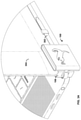
  • the laptop display 304 is shown resting in an indentation or socket of the enclosure 604 , held in place by the locking mechanism 606 .
  • the second attachment component 704 of the locking mechanism 606 holds the laptop display 304 in the indentation, preventing removal of the anti-theft device 600 .
  • FIG. 9 shows an alternative embodiment of an anti-theft device 900 .
  • the logical and functional components e.g., a controller 110 , a battery 112
  • the enclosure 604 can be connected to, clipped to, locked to, or otherwise affixed to the rear portion of the laptop 602 display (e.g., the portion of the laptop 602 casing opposite to and containing the screen portion of the display).
  • the enclosure 604 can be molded or configured to connect to a particular shape and/or style of display depending on the make and/or model of the laptop 602 .
  • the anti-theft device 900 can be attached to the laptop 602 while substantially preserving the width and height of the laptop 602 form factor, only increasing the thickness to as to encase the functional components of the anti-theft device 600 .
  • the internal components of the anti-theft device 900 can include components similar and/or identical in functionality to the anti-theft device 100 (see FIG. 1 ) and/or the anti-theft device 600 (see FIG. 6 ).
  • the anti-theft device 900 can also include locking elements 906 A- 906 C (e.g., pins, hinges, retractable extensions, etc.) that secure the anti-theft device 900 to the display of the laptop 602 .
  • the locking elements 906 A- 906 D can include metal (or any other hard material) extensions from rods/poles internal to the anti-theft device 900 .
  • locking elements 906 A and 906 D may be configured with and/or extend from a rod 920 A
  • the locking element 906 B may be configured with and/or extend from a rod 920 B
  • the locking element 906 CA may be configured with and/or extend from a rod 920 C.
  • the locking elements 906 A- 906 D include a curved shape that corresponds to the curvature of the rods 906 A- 906 D, respectively. Turning the rods 920 A- 920 C in a direction may cause a portion of the locking elements 906 A- 906 D to extend from the internal cavity of the anti-theft device 900 .
  • each of the locking elements 906 A- 906 D may cause the locking elements 906 A- 906 D to contact a portion of the laptop 602 , such as a portion of the display of the laptop 602 .
  • the locking elements 906 A- 906 D may include a protective and/or soft coating, such a silicone and/or the like, to prevent damage to the display of the laptop 602 .
  • the locking elements 906 A- 906 D contacting the portion of the laptop 602 may prevent the anti-theft device 900 from being removed and/or separated from the laptop 602 .
  • the rods 920 A- 920 C may each end at a cradle housing component (not shown) that may be fused/welded to a central T-frame 930 and also an outer frame of the anti-theft device 900 to enable the rods 920 A- 920 C and/or gears of the rods 920 A- 920 C to rotate, for example, 360 degrees.
  • the anti-theft device 900 may include a knob 922 .
  • the knob 922 may be attached to the rod 920 A.
  • Each of the rods 920 A- 920 C may be mechanically coupled to each other. For example, turning the rod 920 A in a direction may cause the rods 920 B- 920 C to turn in a direction.
  • the rod 920 A may be mounted to a spring 924 . Pressing the knob 922 may cause the spring 924 to depress. When the spring 924 is depressed, a gear of the rod 920 A may engage a gear of a rod 920 D.
  • the gear of the rod 920 D may be mechanically coupled to gears of the rods 920 B- 920 C.
  • the anti-theft device 900 may include a locking element 930 .
  • the locking element 930 may be, for example, a combination lock, a key-based lock, an electromechanical lock, a bio-sensor (e.g., fingerprint, voice print, facial recognition, etc.) enabled lock, and/or any other type of locking element.
  • the locking element 930 when engaged, may prevent the knob 922 from being depressed and/or turned.
  • the locking element 930 when not engaged, may enable the knob 922 to be depressed and/or turned.
  • the locking element 930 and/or the locking elements 906 A- 906 C can be engaged (e.g., by the controller 110 ) to prevent unlocking and/or removal of the anti-theft device 900 .
  • the anti-theft device 900 when the anti-theft device 900 is in an “armed” state, the locking element 930 and/or the locking elements 906 A- 906 C can be engaged (e.g., by the controller 110 ) to prevent unlocking and/or removal of the anti-theft device 900 .
  • the anti-theft device 900 when the anti-theft device 900 is in an “armed” state, the locking element 930 and/or the locking elements 906 A- 906 C can be engaged (e.g., by the controller 110 ) to prevent unlocking and/or removal of the anti-theft device 900 .
  • the anti-theft device 900 when the anti-theft device 900 is in an “armed” state, the locking element 930 and/or the locking elements 906 A- 906
  • the present methods and systems can be operational with numerous other general purpose or special purpose computing system environments or configurations.
  • Examples of well-known computing systems, environments, and/or configurations that can be suitable for use with the systems and methods comprise, but are not limited to, personal computers, server computers, laptop devices, and multiprocessor systems. Additional examples comprise set-top boxes, programmable consumer electronics, network PCs, minicomputers, mainframe computers, distributed computing environments that comprise any of the above systems or devices, and the like.
  • the processing of the disclosed methods and systems can be performed by software components.
  • the disclosed systems and methods can be described in the general context of computer-executable instructions, such as program modules, being executed by one or more computers or other devices.
  • program modules comprise computer code, routines, programs, objects, components, data structures, etc. that perform particular tasks or implement particular abstract data types.
  • the disclosed methods can also be practiced in grid-based and distributed computing environments where tasks are performed by remote processing devices that are linked through a communications network.
  • program modules can be located in both local and remote computer storage media including memory storage devices.
  • the components of the computer 1001 can comprise, but are not limited to, one or more processors 1003 , a system memory 1012 , and a system bus 1013 that couples various system components including the one or more processors 1003 to the system memory 1012 .
  • the system can utilize parallel computing.
  • the system bus 1013 represents one or more of several possible types of bus structures, including a memory bus or memory controller, a peripheral bus, an accelerated graphics port, or local bus using any of a variety of bus architectures.
  • bus architectures can comprise an Industry Standard Architecture (ISA) bus, a Micro Channel Architecture (MCA) bus, an Enhanced ISA
  • EISA Video Electronics Standards Association
  • AGP Accelerated Graphics Port
  • PCI Peripheral Component Interconnects
  • PCMCIA Personal Computer Memory Card Industry Association
  • USB Universal Serial Bus
  • the bus 1013 and all buses specified in this description can also be implemented over a wired or wireless network connection and each of the subsystems, including the one or more processors 1003 , a mass storage device 1004 , an operating system 1005 , alarm software 1006 , alarm data 1007 , a network adapter 1008 , the system memory 1012 , a Global Positioning System (GPS) radio 1010 , a display adapter 1009 , a display device 1008 , and a human machine interface 1002 , can be connected through buses of this form.
  • GPS Global Positioning System
  • the computer 1001 typically comprises a variety of computer readable media. Exemplary readable media can be any available media that is accessible by the computer 1001 and comprises, for example and not meant to be limiting, both volatile and non-volatile media, removable and non-removable media.
  • the system memory 1012 comprises computer readable media in the form of volatile memory, such as random access memory (RAM), and/or non-volatile memory, such as read only memory (ROM).
  • RAM random access memory
  • ROM read only memory
  • the system memory 1012 typically contains data such as the alarm data 1007 and/or program modules such as the operating system 1005 and the alarm software 1006 that are immediately accessible to and/or are presently operated on by the one or more processors 1003 .
  • the computer 1001 can also comprise other removable/non-removable, volatile/non-volatile computer storage media.
  • FIG. 10 illustrates the mass storage device 1004 which can provide non-volatile storage of computer code, computer readable instructions, data structures, program modules, and other data for the computer 1001 .
  • the mass storage device 1004 can be a hard disk, a removable magnetic disk, a removable optical disk, magnetic cassettes or other magnetic storage devices, flash memory cards, CD-ROM, digital versatile disks (DVD) or other optical storage, random access memories (RAM), read only memories (ROM), electrically erasable programmable read-only memory (EEPROM), and the like.
  • any number of program modules can be stored on the mass storage device 1004 , including by way of example, the operating system 1005 and the alarm software 1006 .
  • Each of the operating system 1005 and the alarm software 1006 (or some combination thereof) can comprise elements of the programming and the alarm software 1006 .
  • the alarm data 1007 can also be stored on the mass storage device 1004 .
  • the alarm data 1007 can be stored in any of one or more databases known in the art. Examples of such databases comprise, DB2®, Microsoft® Access, Microsoft® SQL Server, Oracle®, mySQL, PostgreSQL, and the like.
  • the databases can be centralized or distributed across multiple systems.
  • the user can enter commands and information into the computer 1004 via an input device (not shown).
  • input devices can be connected to the one or more processors 1003 via the human-machine interface 1002 that is coupled to the system bus 1013 , but can be connected by other interface and bus structures, such as a parallel port, game port, an IEEE 1394 Port (also known as a Firewire port), a serial port, or a universal serial bus (USB).
  • the display device 1008 can also be connected to the system bus 1013 via an interface, such as the display adapter 1009 .
  • the computer 1001 can have more than one display adapter 1009 and the computer 1001 can have more than one display device 1008 .
  • the display device 1008 can be a monitor or a touch screen interface.
  • the display adapter 1009 can provide user inputs via the human-machine interface 1002 .
  • the display device 1008 can also comprise one or more biometric sensors.
  • a GPS radio 1010 can be connected to the system bus 1013 .
  • Any step and/or result of the methods can be output in any form to an output device.
  • Such output can be any form of visual representation, including, but not limited to, textual, graphical, animation, audio, tactile, and the like.
  • the display device 1008 and computer 1001 can be part of one device, or separate devices.
  • the computer 1001 can operate in a networked environment using logical connections to a user device 1014 .
  • a user device can be a personal computer, portable computer, smartphone, a server, a router, a network computer, a peer device or other common network node, and so on.
  • Logical connections between the computer 1001 and a user device 1014 can be made via a network 1015 , such as a local area network (LAN) and/or a personal area network.
  • LAN local area network
  • Such network connections can be through the network adapter 1008 .
  • the network adapter 1008 is implemented wireless environments.
  • the network adapter 1008 can include a BluetoothTM adapter.
  • the network adapter 1008 a may include an adapter and/or component that supports a connection and/or communication via a light-based technology (e.g., fiber optics, etc.), or a connection and/or communication associated with a fifth generation (5G) communication standard, and/or any other wireless communication standard.
  • the network 1015 connection can comprise one or more of a BluetoothTM connection, a connection associated light-based technology (e.g., fiber optics, etc.), a connection associated with a fifth-generation (5G) communication standard, and/or a connection associated with any other wireless communication standard.
  • application programs and other executable program components such as the operating system 1005 are illustrated herein as discrete blocks, although it is recognized that such programs and components reside at various times in different storage components of the computing device 1001 , and are executed by the one or more processors 1003 of the computer.
  • An implementation of the alarm software 1006 can be stored on or transmitted across some form of computer-readable media. Any of the disclosed methods can be performed by computer readable instructions embodied on computer-readable media. Computer-readable media can be any available media that can be accessed by a computer.
  • Computer-readable media can comprise “computer storage media” and “communications media.”
  • “Computer storage media” comprise volatile and non-volatile, removable and non-removable media implemented in any methods or technology for storage of information such as computer-readable instructions, data structures, program modules, or other data.
  • Exemplary computer storage media comprises, but is not limited to, RAM, ROM, EEPROM, flash memory or other memory technology, CD-ROM, digital versatile disks (DVD) or other optical storage, magnetic cassettes, magnetic tape, magnetic disk storage or other magnetic storage devices, or any other medium which can be used to store the desired information and which can be accessed by a computer.
  • FIG. 11 is a flowchart 1100 of an example method.
  • an anti-theft device e.g., a controller 110 of an anti-theft device 100 , 600 , and/or 900
  • receives an arming signal thereby placing the anti-theft device in an armed state.
  • receiving an arming signal can comprise receiving a user input.
  • the user input can comprise a selection of a button or other user interface element displayed on a display (e.g., the display 608 , a display device 1008 , etc.).
  • the user input can comprise a passcode, password, or other authorization credentials.
  • the user input can comprise biometric data.
  • the display e.g., the display 608 , a display device 1008 , etc.
  • the controller e.g., controller 110 , etc.
  • the anti-theft device can enter the armed state.
  • the user input can also comprise an input to an application, website, or other service associated with the anti-theft device.
  • the anti-theft device can be associated with a user account of an application or service.
  • a user input to a user interface can cause the arming signal (or a disarming signal) to be transmitted.
  • the anti-theft device can comprise a camera and/or infrared scanner coupled to the controller (e.g., controller 110 , etc.).
  • the controller via the camera and/or infrared scanner, can detect a face.
  • the controller can then compare a detected face to one or more authorized faces.
  • the anti-theft device can enter the armed state.
  • the anti-theft device can comprise a physical button, lock and key mechanism, or switch.
  • receiving the arming signal can comprise detecting an activation of the physical button, lock and key mechanism, or switch.
  • the anti-theft device can be in network communication (i.e., “paired”) with a user device (e.g., user device 914 , etc.), e.g., by a BluetoothTM connection, a light-based connection (e.g., fiber optics), a 5G connection, and/or any other wireless network connection.
  • receiving the arming signal can include receiving a transmission, data, or other signals from the user device indicating that the anti-theft device should enter the armed state.
  • one or more locking mechanisms can be engaged.
  • the controller can transmit a signal to one or more electromechanical locks or detents of the locking mechanisms to prevent movement of one or more components of the locking mechanisms and/or prevent removal of an anti-theft device (e.g., the anti-theft device 600 , etc.) from a device (e.g., the laptop 602 , a tablet, a smart device, etc.).
  • an anti-theft device e.g., the anti-theft device 600 , etc.
  • a reference point can be determined, e.g., by a controller (e.g., the controller 110 , etc.).
  • determining a reference point can comprise global positioning and/or geolocation (e.g., determining a location using a Global Positioning System (GPS) radio 610 , etc.). Determining the reference point can be performed in response to a user input, e.g., to the display (e.g., the display 608 , the display device 1008 , etc.). Thus, the anti-theft device can be considered “pinned” to the reference point.
  • determining the reference point can comprise determining a location of a user device (e.g., the user device 1014 , etc.).
  • the controller can receive, e.g., via a network adapter (e.g., the network adapter 1008 ), and the location of the user device from the user device.
  • the user device can be a paired user device having a network connection to the anti-theft device (e.g., a controller 110 of an anti-theft device 100 and/or 600 ).
  • the threshold can be predetermined.
  • the threshold can be determined by a user, e.g., of the anti-theft device or a user device (e.g., the user device 914 , etc.). In an aspect, this can include determining a current location of the anti-theft device. For example, the controller, via [[the]] a GPS radio, can determine the current location of the anti-theft device. The current location can then be compared to the reference point to determine if the threshold has been exceeded. As another example, the controller can communicate with a user device to determine a distance relative to the user device when the user device defines the reference point.
  • the anti-theft device may exit an alarm state.
  • the alarm state may have been previously entered by the anti-theft device, e.g., by the controller (e.g., the controller 110 , etc.).
  • Entering the alarm state can comprise generating, by the anti-theft device, a noise or other audible sound.
  • Entering the alarm state can comprise transmitting/sending a notification to a user device (e.g., the user device 914 , a mobile device, a smart device, a computing device, etc.), such as a paired user device and/or any other device such as a server and/or the like.
  • a user device e.g., the user device 914 , a mobile device, a smart device, a computing device, etc.
  • Entering the alarm state can comprise transmitting/sending a current location of the anti-theft device a user device, e.g., a paired user device, or another device such as a server. Entering the alarm state can also comprise transmitting/sending a notification to one or more associated user devices.
  • the one or more associated user devices can each correspond to a user account, and each of the accounts can be associated via blockchain, social networking, or otherwise associated.
  • the notification can be transmitted to the one or more associated devices within a predefined distance of the reference point, thereby notifying other users of possible theft.
  • Exiting the alarm state may be based on the determining, e.g., by the controller, that the distance of the anti-theft device relative to the reference point does not and/or no longer exceeds the threshold. Exiting the alarm state may be based on the anti-theft device receiving user credentials, login information, manual/user control, and/or the like.
  • the anti-theft device e.g., by the controller (e.g., the controller 110 , etc.), may cause, based on the alarm state, one or more pins to extend from a retracted position within an internal cavity of the anti-theft device, wherein the extension of the one or more pins from the retracted position cause an interlock between a computing device and the anti-theft device.
  • the controller e.g., the controller 110 , etc.

Landscapes

  • Engineering & Computer Science (AREA)
  • General Physics & Mathematics (AREA)
  • Physics & Mathematics (AREA)
  • Computer Hardware Design (AREA)
  • Theoretical Computer Science (AREA)
  • Computer Security & Cryptography (AREA)
  • Microelectronics & Electronic Packaging (AREA)
  • General Engineering & Computer Science (AREA)
  • Software Systems (AREA)
  • Business, Economics & Management (AREA)
  • Emergency Management (AREA)
  • Computer Vision & Pattern Recognition (AREA)
  • Burglar Alarm Systems (AREA)

Abstract

Disclosed are methods and apparatuses relating to an anti-theft device. An anti-theft device can be affixed to a tablet or laptop. The anti-theft device can determine if a distance relative to a reference point exceeds a threshold. An alarm state can be entered.

Description

CROSS-REFERENCE TO RELATED APPLICATION
This application claims priority to U.S. Provisional Application No. 62/620,760, filed Jan. 23, 2018, and is a continuation-in-part of U.S. application Ser. No. 16/150,983, filed Oct. 3, 2018, which are both incorporated herein by reference in their entirety.
BACKGROUND
Laptops, tablet computers, and other devices are vulnerable to theft. The risk of theft arises when a user or owner of these devices leaves these devices unattended.
SUMMARY
It is to be understood that both the following general description and the following detailed description are exemplary and explanatory only and are not restrictive. Provided are methods and apparatuses relating to an anti-theft device. A method can comprise: determining, by an anti-theft device, a reference point; determining that a distance of the anti-theft device relative to the reference point satisfies a threshold; entering, based on the distance satisfying the threshold, an alarm state; and causing, based on the alarm state, one or more pins to extend from a retracted position within an internal cavity of the anti-theft device, wherein the extension of the one or more pins from the retracted position cause an interlock between a computing device and the anti-theft device.
An apparatus can comprise: a protective enclosure; a display; a controller housed within the protective enclosure, wherein the controller is configured to at least: determine a reference point; determine that a distance of the apparatus relative to the reference point satisfies a threshold; exit, based on the distance satisfying the threshold, an alarm state; and cause, based on the alarm state, one or more pins to extend from a retracted position within an internal cavity of the anti-theft device, wherein the extension of the one or more pins from the retracted position cause an interlock between a computing device and the apparatus.
Additional advantages will be set forth in the description which follows or may be learned by practice. The advantages will be realized and attained by means of the elements and combinations particularly pointed out in the appended claims.
BRIEF DESCRIPTION OF THE DRAWINGS
The accompanying drawings, which are incorporated in and constitute a part of this specification, illustrate embodiments and together with the description, serve to explain the principles of the methods and systems:
FIG. 1 is an example diagram of an anti-theft device;
FIG. 2A is an example diagram of an anti-theft device;
FIG. 2B is an example diagram of an anti-theft device;
FIG. 3A is a pictorial depiction of an exemplary use of an anti-theft device;
FIG. 3B is a pictorial depiction of an exemplary use of an anti-theft device;
FIG. 4 is an example diagram of a secondary clip component of an anti-theft device;
FIG. 5 is a pictorial depiction of an exemplary use of a secondary clip;
FIG. 6 is a pictorial depiction of an exemplary use of an anti-theft device;
FIG. 7A is a pictorial depiction of a lock component of an anti-theft device;
FIG. 7B is a pictorial depiction of a lock component of an anti-theft device;
FIG. 8 is a pictorial depiction of an exemplary use of an anti-theft device;
FIG. 9 is a pictorial depiction of an exemplary use of an anti-theft device;
FIG. 10 is a block diagram of an example controller; and
FIG. 11 is a flowchart of an example method.
DETAILED DESCRIPTION
Before the present methods and systems are disclosed and described, it is to be understood that the methods and systems are not limited to specific methods, specific components, or to particular implementations. It is also to be understood that the terminology used herein is for the purpose of describing particular embodiments only and is not intended to be limiting.
As used in the specification and the appended claims, the singular forms “a,” “an” and “the” include plural referents unless the context clearly dictates otherwise. Ranges may be expressed herein as from “about” one particular value, and/or to “about” another particular value. When such a range is expressed, another embodiment includes from the one particular value and/or to the other particular value. Similarly, when values are expressed as approximations, by use of the antecedent “about,” it will be understood that the particular value forms another embodiment. It will be further understood that the endpoints of each of the ranges are significant both in relation to the other endpoint, and independently of the other endpoint.
“Optional” or “optionally” means that the subsequently described event or circumstance may or may not occur, and that the description includes instances where said event or circumstance occurs and instances where it does not.
Throughout the description and claims of this specification, the word “comprise” and variations of the word, such as “comprising” and “comprises,” means “including but not limited to,” and is not intended to exclude, for example, other components, integers or steps. “Exemplary” means “an example of” and is not intended to convey an indication of a preferred or ideal embodiment. “Such as” is not used in a restrictive sense, but for explanatory purposes.
Disclosed are components that can be used to perform the disclosed methods and systems. These and other components are disclosed herein, and it is understood that when combinations, subsets, interactions, groups, etc. of these components are disclosed that while specific reference of each various individual and collective combinations and permutation of these may not be explicitly disclosed, each is specifically contemplated and described herein, for all methods and systems. This applies to all aspects of this application including, but not limited to, steps in disclosed methods. Thus, if there are a variety of additional steps that can be performed it is understood that each of these additional steps can be performed with any specific embodiment or combination of embodiments of the disclosed methods.
The present methods and systems may be understood more readily by reference to the following detailed description of preferred embodiments and the examples included therein and to the Figures and their previous and following description.
As will be appreciated by one skilled in the art, the methods and systems may take the form of an entirely hardware embodiment, an entirely software embodiment, or an embodiment combining software and hardware aspects. Furthermore, the methods and systems may take the form of a computer program product on a computer-readable storage medium having computer-readable program instructions (e.g., computer software) embodied in the storage medium. More particularly, the present methods and systems may take the form of web-implemented computer software. Any suitable computer-readable storage medium may be utilized including hard disks, CD-ROMs, optical storage devices, or magnetic storage devices.
Embodiments of the methods and systems are described below with reference to block diagrams and flowchart illustrations of methods, systems, apparatuses and computer program products. It will be understood that each block of the block diagrams and flowchart illustrations, and combinations of blocks in the block diagrams and flowchart illustrations, respectively, can be implemented by computer program instructions. These computer program instructions may be loaded onto a general purpose computer, special purpose computer, or other programmable data processing apparatus to produce a machine, such that the instructions which execute on the computer or other programmable data processing apparatus create a means for implementing the functions specified in the flowchart block or blocks.
These computer program instructions may also be stored in a computer-readable memory that can direct a computer or other programmable data processing apparatus to function in a particular manner, such that the instructions stored in the computer-readable memory produce an article of manufacture including computer-readable instructions for implementing the function specified in the flowchart block or blocks. The computer program instructions may also be loaded onto a computer or other programmable data processing apparatus to cause a series of operational steps to be performed on the computer or other programmable apparatus to produce a computer-implemented process such that the instructions that execute on the computer or other programmable apparatus provide steps for implementing the functions specified in the flowchart block or blocks.
Accordingly, blocks of the block diagrams and flowchart illustrations support combinations of means for performing the specified functions, combinations of steps for performing the specified functions and program instruction means for performing the specified functions. It will also be understood that each block of the block diagrams and flowchart illustrations, and combinations of blocks in the block diagrams and flowchart illustrations, can be implemented by special purpose hardware-based computer systems that perform the specified functions or steps, or combinations of special purpose hardware and computer instructions.
Note that in various instances this detailed disclosure may refer to a given entity performing some action. It should be understood that this language may in some cases mean that a system (e.g., a computer) owned and/or controlled by the given entity is actually performing the action.
The present disclosure relates to an anti-theft device. In a preferred embodiment, the anti-theft device can be used to prevent the theft of laptop or tablet computing devices.
The anti-theft device can be affixed to a computing device by one or more clips. The clips can be connected to each other using a zip tie, cable, strap, or other securing mechanism. When armed, the anti-theft device can determine whether a distance between the anti-theft device and a reference point exceeds a threshold. For example, the anti-theft device can use a Global Positioning System (GPS) radio to establish the reference point as an initial location of the anti-theft device. The anti-theft device can then use the GPS radio to compare a current location to the reference point. As another example, the anti-theft device can be paired or otherwise in communication with a user device, such as a tablet computer or mobile phone. The current location of the user device can then be considered the reference point. The anti-theft device can then compare a current location of the anti-theft device to the current location of the user device. As a further example, the anti-theft device can determine whether a distance between the anti-theft device and a reference point exceeds a threshold by measuring a signal strength to the user device and determining whether the signal strength falls below a threshold. When the distance between the anti-theft device and a reference point exceeds a threshold, an alarm can be triggered. These and other features are set forth below.
FIG. 1 is an example diagram of an anti-theft device 100. The diagram of FIG. 1 depicts the anti-theft device 100 disassembled to show the component parts. The rear outer shell 102 and front outer shell 104 serve to encase one or more components of the anti-theft device 100. In an aspect, the rear outer shell 102 and front outer shell 104 can be composed of plastic, metal, or another sufficiently durable and tamper-resistant material. In an example aspect, the rear outer shell 102 can include a transparent portion, gap, or hole, allowing an optional logo light 114 to be seen. The logo light 114 can include one or more light emitting diodes (LEDs) or other illuminating components. The inclusion of a visible logo light 114 notifies persons viewing the anti-theft device 100 is present, thereby deterring theft.
The front outer shell 104 can include a hole or gap allowing physical access to a display device 108. In the alternative, the front outer shell 104 can include a transparent layer, such as a transparent capacitive later, allowing for physical interaction with the display device 108. In an aspect, the display device 108 can include a touch screen display that can accept one or more user inputs. The display device 108 can include a biometric sensor facilitating an arming of the anti-theft device 100. The biometric sensor can include, for example, a finger print reader, camera configured to perform facial recognition, an infrared scanner, or other biometric sensor. All or a portion of the display device 108 can be encased by the rear outer shell 102 and front outer shell 104.
Encased by the rear outer shell 102 and front outer shell 104 is a controller 110. The controller 110 can include a computing device, embedded computing device, printed circuit board (PCB), or other components facilitating the operation of the anti-theft device. Detailed descriptions of the controller 110 and its functions are set forth below. Also encased by the rear outer shell 102 and front outer shell 104 is a battery 112 coupled to the controller 110, display device 108, and/or the logo light 114. A clip 106 interlocks with the front outer shell 104 and serves to affix the anti-theft device 100 to a laptop or tablet computing device. In an aspect, the interlock between the clip 106 and front outer shell 104 can allow a rotation of the anti-theft device, e.g., by ninety degrees, or by one hundred and eighty degrees.
FIG. 2A is an example view of an anti-theft device 100. Shown is the rear outer shell 102 and front outer shell 104 interlocked to form a protective shell around the internal components. The display device 108 is visible and/or accessible by virtue of a hole or transparent layer in the front outer shell 104. The clip 106 is shown as interlocked with the front outer shell 104.
FIG. 2B is an example view of an anti-theft device 100. Shown is the rear outer shell 102 and front outer shell 104 interlocked to form a protective shell around the internal components. The logo light 114 is visible by virtue of a hole or transparent layer in the rear outer shell 102. The clip 106 is shown as interlocked with the front outer shell 104.
FIG. 3A is a view of an example use of an anti-theft device 100. In this example use, the clip 106 anti-theft device 100 is secured to a laptop screen 304. A securing mechanism 302 serves to secure the clip 106 to the laptop screen 304. In an aspect, the securing strap 304 can include a zip tie, cable, strap, or other inelastic securing mechanisms 302 as can be appreciated. As the clip 106 is affixed to the laptop screen 304 by the securing mechanism 302, the anti-theft device 100 cannot be easily removed from the computing device.
FIG. 3B is a view of an example use of an anti-theft device 100. In this example use, the clip 106 anti-theft device 100 is secured to a laptop screen 304. A securing mechanism 302 serves to secure the clip 106 to the laptop screen 304. In this example view, the interlock between the clip 106 and the front outer shell 104 has allowed for a one hundred and eighty-degree rotation of the anti-theft device 100, thereby allowing a user access to the display device 108. This can facilitate an arming or other interaction with the anti-theft device.
FIG. 4 is an example diagram of a secondary clip 400, use of which is set forth in FIG. 5. The secondary clip 400 serves to provide an additional point of attachment between a securing mechanism 302, the anti-theft device 100, and a computing device. The secondary clip 400 includes an inner face 402. In a preferred embodiment, on use, the inner face 402 of the secondary clip 400 will be flush to a font and rear face of a laptop screen or tablet. The secondary clip 400 can include loops 404 a/b, through which a securing mechanism 302 can be run, thereby attaching the clip 400 to the securing mechanism 302.
FIG. 5 is a view of an example use of the secondary clip 400. Here, a securing mechanism 302 has been looped through the loop 404 a. The secondary clip 400 is secured to a laptop screen 304. In this example use, the securing mechanism 302 can also be attached to an unshown clip 106 of an anti-theft device 100. The secondary clip 400 then serves to provide an additional interlock between the laptop screen 304 and the securing mechanism 302. Thus, the securing mechanism 302 cannot be removed from the laptop screen 304 by sliding the securing mechanism 302 to the top of the laptop screen 304.
FIG. 6 shows an alternative embodiment of an anti-theft device 600. In the anti-theft device 600, the logical and functional components (e.g., a controller 110, a battery 112) are encased in an enclosure 604. The enclosure 604 can be connected to, clipped to, locked to, or otherwise affixed to the rear portion of a laptop 602 display (e.g., the portion of the laptop 602 casing opposite to and containing the screen portion of the display). Accordingly, the enclosure 604 can be molded or configured to connect to a particular shape and/or style of display depending on the make and/or model of the laptop 602. Thus, the anti-theft device 600 can be attached to the laptop 602 while substantially preserving the width and height of the laptop 602 form factor, only increasing the thickness to as to encase the functional components of the anti-theft device 600.
The internal components of the anti-theft device 600 can include components similar and/or identical in functionality to the anti-theft device 100 (see FIG. 1). The anti-theft device 600 can also include one or more locking mechanisms 606 to affix the anti-theft device 600 to the display of the laptop 602. For example, the locking mechanisms 606 can include mechanical or electromechanical locks or other detents to prevent movement of one or more components of the locking mechanisms 606. Although FIG. 6 shows the anti-theft device with two locking mechanisms 606, it is understood that additional locking mechanisms 606 can also be used. When the anti-theft device 600 is in an “armed” state, the locks can be engaged (e.g., by the controller 110) to prevent unlocking and/or removal of the anti-theft device 600. The anti-theft device 600 can also include a display 611. The display 611 can include and/or be a liquid crystal display (LCD) screen (e.g., passive matrix, active matrix, etc.), light-emitting diode (LED) display, and/or any other display. The display 611 can display and/or indicate messages and/or notifications, such as a text messaging, an advertisement, an application notification, combinations thereof, and/or the like. The display 611 may be of any dimensions. For example, the display 611 may include dimensions ranging from 3×3 inches (e.g., a three inch length and a three inch width, etc.) to 12×12 inches.
The display 611 can be used to present advertising, branding, or other messages to observers. The anti-theft device 600 can also include a biometric sensor 608, which can include a finger print scanner or other type of sensor as can be appreciated. An input from the biometric sensor 608 can transition the anti-theft device 600 to or from an “armed” state. The anti-theft device 600 can also include a camera 610. The camera 610 can be configured to take one or more images. For example, if the anti-theft device 600 is in an “alarm” state, the camera 610 can capture images (e.g., at a predefined interval) to help show the current location of the laptop 602. The captured images can then be transmitted by the anti-theft device 600 to a server, user device, or other device as can be appreciated.
The anti-theft device 600 can also include additional components. For example the anti-theft device 600 can include a port (not shown), such as a Universal Serial Bus (USB) port, Thunderbolt port, or other port corresponding to a peripheral port of the laptop 602. The port can be connected to the corresponding peripheral port of the laptop 602 to draw power from the laptop 602 battery or power system in order to power the anti-theft device 600 and/or charge the battery 112.
FIG. 7A is a diagram of a locking mechanism 606 in an open or unlocked state. Here, the locking mechanism 606 is part of an anti-theft device 600 affixed to a laptop display 304. The locking mechanism can include a first attachment component 702, which can include a tooth, clip, ridge, or other component to securely attach the locking mechanism 606 to the laptop display 304 when the locking mechanism 606 is in a closed or locked state. A second attachment component 704 (e.g., a shaped piece of plastic, metal, or other suitably tamper-resistant material) will rest in front of the laptop display 304 in the closed or locked state. Thus, in a closed or locked state, a portion of the laptop display 304 will sit between the first attachment component 702 and the second attachment component 704, thereby attaching the anti-theft device 600 to the laptop display 304. The locking mechanism can also include a corner component 706 to connect the locking mechanism 606 to the anti-theft device 600 enclosure 604. The corner component 706 can be interlocked with one or more rotational components 708, which can include pins, axels, ratchets, or other rotational means allowing the locking mechanism to rotate into a closed or locked position,
FIG. 7B shows the locking mechanism 606 in a closed or locked state. Here, the first attachment components 702 are positioned behind the laptop display 304, while the second attachment components 704 rest in front of the laptop display 304. The locking mechanism 606 has been rotated around the rotational component(s) 706 such that the corner component 706 is substantially perpendicular to the locking mechanism 606 (e.g., the second attachment component 704 and the enclosure 604.
In an exemplary aspect, the methods and systems can be implemented on a computer 1001 as illustrated in FIG. 10 and described below. By way of example, the controller 110 of FIG. 1 can be a computer as illustrated in FIG. 10. FIG. 10 is a block diagram illustrating an exemplary operating environment for performing the disclosed methods. This exemplary operating environment is only an example of an operating environment and is not intended to suggest any limitation as to the scope of use or functionality of operating environment architecture. Neither should the operating environment be interpreted as having any dependency or requirement relating to any one or combination of components illustrated in the exemplary operating environment.
FIG. 8 shows a side view of an anti-theft device 600 attached to a laptop display 304 of a laptop 602. Here, the laptop display 304 is shown resting in an indentation or socket of the enclosure 604, held in place by the locking mechanism 606. The second attachment component 704 of the locking mechanism 606 holds the laptop display 304 in the indentation, preventing removal of the anti-theft device 600.
FIG. 9 shows an alternative embodiment of an anti-theft device 900. In the anti-theft device 900, the logical and functional components (e.g., a controller 110, a battery 112) are encased in an enclosure 604. The enclosure 604 can be connected to, clipped to, locked to, or otherwise affixed to the rear portion of the laptop 602 display (e.g., the portion of the laptop 602 casing opposite to and containing the screen portion of the display). Accordingly, the enclosure 604 can be molded or configured to connect to a particular shape and/or style of display depending on the make and/or model of the laptop 602. Thus, the anti-theft device 900 can be attached to the laptop 602 while substantially preserving the width and height of the laptop 602 form factor, only increasing the thickness to as to encase the functional components of the anti-theft device 600.
The internal components of the anti-theft device 900 can include components similar and/or identical in functionality to the anti-theft device 100 (see FIG. 1) and/or the anti-theft device 600 (see FIG. 6). The anti-theft device 900 can also include locking elements 906A-906C (e.g., pins, hinges, retractable extensions, etc.) that secure the anti-theft device 900 to the display of the laptop 602. For example, the locking elements 906A-906D can include metal (or any other hard material) extensions from rods/poles internal to the anti-theft device 900. For example, locking elements 906A and 906D may be configured with and/or extend from a rod 920A, the locking element 906B may be configured with and/or extend from a rod 920B, and the locking element 906CA may be configured with and/or extend from a rod 920C. The locking elements 906A-906D include a curved shape that corresponds to the curvature of the rods 906A-906D, respectively. Turning the rods 920A-920C in a direction may cause a portion of the locking elements 906A-906D to extend from the internal cavity of the anti-theft device 900. When the locking elements 906A-906D are extended from the internal cavity of the anti-theft device 900, the curved shape of each of the locking elements 906A-906D may cause the locking elements 906A-906D to contact a portion of the laptop 602, such as a portion of the display of the laptop 602. The locking elements 906A-906D may include a protective and/or soft coating, such a silicone and/or the like, to prevent damage to the display of the laptop 602. The locking elements 906A-906D contacting the portion of the laptop 602 may prevent the anti-theft device 900 from being removed and/or separated from the laptop 602. In an aspect, the rods 920A-920C may each end at a cradle housing component (not shown) that may be fused/welded to a central T-frame 930 and also an outer frame of the anti-theft device 900 to enable the rods 920A-920C and/or gears of the rods 920A-920C to rotate, for example, 360 degrees.
To turn the rods 920A-920C in a direction, the anti-theft device 900 may include a knob 922. The knob 922 may be attached to the rod 920A. Each of the rods 920A-920C may be mechanically coupled to each other. For example, turning the rod 920A in a direction may cause the rods 920B-920C to turn in a direction. For example, the rod 920A may be mounted to a spring 924. Pressing the knob 922 may cause the spring 924 to depress. When the spring 924 is depressed, a gear of the rod 920A may engage a gear of a rod 920D. The gear of the rod 920D may be mechanically coupled to gears of the rods 920B-920C. When the gears are engaged, any rotation of the rod 920A is translated to the rods 920B-920C. The anti-theft device 900 may include a locking element 930. The locking element 930 may be, for example, a combination lock, a key-based lock, an electromechanical lock, a bio-sensor (e.g., fingerprint, voice print, facial recognition, etc.) enabled lock, and/or any other type of locking element. The locking element 930, when engaged, may prevent the knob 922 from being depressed and/or turned. The locking element 930, when not engaged, may enable the knob 922 to be depressed and/or turned. In an aspect, when the anti-theft device 900 is in an “armed” state, the locking element 930 and/or the locking elements 906A-906C can be engaged (e.g., by the controller 110) to prevent unlocking and/or removal of the anti-theft device 900. The anti-theft device 900.
The present methods and systems can be operational with numerous other general purpose or special purpose computing system environments or configurations. Examples of well-known computing systems, environments, and/or configurations that can be suitable for use with the systems and methods comprise, but are not limited to, personal computers, server computers, laptop devices, and multiprocessor systems. Additional examples comprise set-top boxes, programmable consumer electronics, network PCs, minicomputers, mainframe computers, distributed computing environments that comprise any of the above systems or devices, and the like.
The processing of the disclosed methods and systems can be performed by software components. The disclosed systems and methods can be described in the general context of computer-executable instructions, such as program modules, being executed by one or more computers or other devices. Generally, program modules comprise computer code, routines, programs, objects, components, data structures, etc. that perform particular tasks or implement particular abstract data types. The disclosed methods can also be practiced in grid-based and distributed computing environments where tasks are performed by remote processing devices that are linked through a communications network. In a distributed computing environment, program modules can be located in both local and remote computer storage media including memory storage devices.
Further, one skilled in the art will appreciate that the systems and methods disclosed herein can be implemented via a general-purpose computing device in the form of a computer 1001. The components of the computer 1001 can comprise, but are not limited to, one or more processors 1003, a system memory 1012, and a system bus 1013 that couples various system components including the one or more processors 1003 to the system memory 1012. The system can utilize parallel computing.
The system bus 1013 represents one or more of several possible types of bus structures, including a memory bus or memory controller, a peripheral bus, an accelerated graphics port, or local bus using any of a variety of bus architectures. By way of example, such architectures can comprise an Industry Standard Architecture (ISA) bus, a Micro Channel Architecture (MCA) bus, an Enhanced ISA
(EISA) bus, a Video Electronics Standards Association (VESA) local bus, an Accelerated Graphics Port (AGP) bus, and a Peripheral Component Interconnects (PCI), a PCI-Express bus, a Personal Computer Memory Card Industry Association (PCMCIA), Universal Serial Bus (USB) and the like. The bus 1013, and all buses specified in this description can also be implemented over a wired or wireless network connection and each of the subsystems, including the one or more processors 1003, a mass storage device 1004, an operating system 1005, alarm software 1006, alarm data 1007, a network adapter 1008, the system memory 1012, a Global Positioning System (GPS) radio 1010, a display adapter 1009, a display device 1008, and a human machine interface 1002, can be connected through buses of this form.
The computer 1001 typically comprises a variety of computer readable media. Exemplary readable media can be any available media that is accessible by the computer 1001 and comprises, for example and not meant to be limiting, both volatile and non-volatile media, removable and non-removable media. The system memory 1012 comprises computer readable media in the form of volatile memory, such as random access memory (RAM), and/or non-volatile memory, such as read only memory (ROM). The system memory 1012 typically contains data such as the alarm data 1007 and/or program modules such as the operating system 1005 and the alarm software 1006 that are immediately accessible to and/or are presently operated on by the one or more processors 1003.
In another aspect, the computer 1001 can also comprise other removable/non-removable, volatile/non-volatile computer storage media. By way of example, FIG. 10 illustrates the mass storage device 1004 which can provide non-volatile storage of computer code, computer readable instructions, data structures, program modules, and other data for the computer 1001. For example and not meant to be limiting, the mass storage device 1004 can be a hard disk, a removable magnetic disk, a removable optical disk, magnetic cassettes or other magnetic storage devices, flash memory cards, CD-ROM, digital versatile disks (DVD) or other optical storage, random access memories (RAM), read only memories (ROM), electrically erasable programmable read-only memory (EEPROM), and the like.
Optionally, any number of program modules can be stored on the mass storage device 1004, including by way of example, the operating system 1005 and the alarm software 1006. Each of the operating system 1005 and the alarm software 1006 (or some combination thereof) can comprise elements of the programming and the alarm software 1006. The alarm data 1007 can also be stored on the mass storage device 1004. The alarm data 1007 can be stored in any of one or more databases known in the art. Examples of such databases comprise, DB2®, Microsoft® Access, Microsoft® SQL Server, Oracle®, mySQL, PostgreSQL, and the like. The databases can be centralized or distributed across multiple systems.
In another aspect, the user can enter commands and information into the computer 1004 via an input device (not shown). These and other input devices can be connected to the one or more processors 1003 via the human-machine interface 1002 that is coupled to the system bus 1013, but can be connected by other interface and bus structures, such as a parallel port, game port, an IEEE 1394 Port (also known as a Firewire port), a serial port, or a universal serial bus (USB).
In yet another aspect, the display device 1008 can also be connected to the system bus 1013 via an interface, such as the display adapter 1009. It is contemplated that the computer 1001 can have more than one display adapter 1009 and the computer 1001 can have more than one display device 1008. For example, the display device 1008 can be a monitor or a touch screen interface. In such an example, the display adapter 1009 can provide user inputs via the human-machine interface 1002. The display device 1008 can also comprise one or more biometric sensors. A GPS radio 1010 can be connected to the system bus 1013.
Any step and/or result of the methods can be output in any form to an output device. Such output can be any form of visual representation, including, but not limited to, textual, graphical, animation, audio, tactile, and the like. The display device 1008 and computer 1001 can be part of one device, or separate devices.
The computer 1001 can operate in a networked environment using logical connections to a user device 1014. By way of example, a user device can be a personal computer, portable computer, smartphone, a server, a router, a network computer, a peer device or other common network node, and so on. Logical connections between the computer 1001 and a user device 1014 can be made via a network 1015, such as a local area network (LAN) and/or a personal area network. Such network connections can be through the network adapter 1008. The network adapter 1008 is implemented wireless environments. For example, the network adapter 1008 can include a Bluetooth™ adapter. The network adapter 1008 a may include an adapter and/or component that supports a connection and/or communication via a light-based technology (e.g., fiber optics, etc.), or a connection and/or communication associated with a fifth generation (5G) communication standard, and/or any other wireless communication standard. The network 1015 connection can comprise one or more of a Bluetooth™ connection, a connection associated light-based technology (e.g., fiber optics, etc.), a connection associated with a fifth-generation (5G) communication standard, and/or a connection associated with any other wireless communication standard. For purposes of illustration, application programs and other executable program components such as the operating system 1005 are illustrated herein as discrete blocks, although it is recognized that such programs and components reside at various times in different storage components of the computing device 1001, and are executed by the one or more processors 1003 of the computer. An implementation of the alarm software 1006 can be stored on or transmitted across some form of computer-readable media. Any of the disclosed methods can be performed by computer readable instructions embodied on computer-readable media. Computer-readable media can be any available media that can be accessed by a computer. By way of example and not meant to be limiting, computer-readable media can comprise “computer storage media” and “communications media.” “Computer storage media” comprise volatile and non-volatile, removable and non-removable media implemented in any methods or technology for storage of information such as computer-readable instructions, data structures, program modules, or other data. Exemplary computer storage media comprises, but is not limited to, RAM, ROM, EEPROM, flash memory or other memory technology, CD-ROM, digital versatile disks (DVD) or other optical storage, magnetic cassettes, magnetic tape, magnetic disk storage or other magnetic storage devices, or any other medium which can be used to store the desired information and which can be accessed by a computer.
FIG. 11 is a flowchart 1100 of an example method. Beginning at 1002 an anti-theft device (e.g., a controller 110 of an anti-theft device 100, 600, and/or 900) receives an arming signal, thereby placing the anti-theft device in an armed state. In an aspect, receiving an arming signal can comprise receiving a user input. For example, the user input can comprise a selection of a button or other user interface element displayed on a display (e.g., the display 608, a display device 1008, etc.). As another example, the user input can comprise a passcode, password, or other authorization credentials.
In an aspect, the user input can comprise biometric data. For example, the display (e.g., the display 608, a display device 1008, etc.) can comprise a fingerprint reader. The controller (e.g., controller 110, etc.) can then compare a detected fingerprint to one or more authorized fingerprints. In response to the detected fingerprint matching at least one of the one or more authorized fingerprints, the anti-theft device can enter the armed state.
The user input can also comprise an input to an application, website, or other service associated with the anti-theft device. For example, the anti-theft device can be associated with a user account of an application or service. A user input to a user interface can cause the arming signal (or a disarming signal) to be transmitted.
As a further example, the anti-theft device can comprise a camera and/or infrared scanner coupled to the controller (e.g., controller 110, etc.). The controller, via the camera and/or infrared scanner, can detect a face. The controller can then compare a detected face to one or more authorized faces. In response to the detected face matching at least one of the one or more authorized faces, the anti-theft device can enter the armed state.
In a further aspect, the anti-theft device can comprise a physical button, lock and key mechanism, or switch. In such an aspect, receiving the arming signal can comprise detecting an activation of the physical button, lock and key mechanism, or switch. In another aspect, the anti-theft device can be in network communication (i.e., “paired”) with a user device (e.g., user device 914, etc.), e.g., by a Bluetooth™ connection, a light-based connection (e.g., fiber optics), a 5G connection, and/or any other wireless network connection. In such an aspect, receiving the arming signal can include receiving a transmission, data, or other signals from the user device indicating that the anti-theft device should enter the armed state. In response to entering the armed state, one or more locking mechanisms (e.g., the locking mechanism 606, etc.) can be engaged. For example, the controller can transmit a signal to one or more electromechanical locks or detents of the locking mechanisms to prevent movement of one or more components of the locking mechanisms and/or prevent removal of an anti-theft device (e.g., the anti-theft device 600, etc.) from a device (e.g., the laptop 602, a tablet, a smart device, etc.).
In step 1104 a reference point can be determined, e.g., by a controller (e.g., the controller 110, etc.). In an aspect, determining a reference point can comprise global positioning and/or geolocation (e.g., determining a location using a Global Positioning System (GPS) radio 610, etc.). Determining the reference point can be performed in response to a user input, e.g., to the display (e.g., the display 608, the display device 1008, etc.). Thus, the anti-theft device can be considered “pinned” to the reference point. In another aspect, determining the reference point can comprise determining a location of a user device (e.g., the user device 1014, etc.). For example, the controller can receive, e.g., via a network adapter (e.g., the network adapter 1008), and the location of the user device from the user device. In an aspect, the user device can be a paired user device having a network connection to the anti-theft device (e.g., a controller 110 of an anti-theft device 100 and/or 600).
It can be determined, e.g., by the controller, that the distance of the anti-theft device relative to the reference point exceeds a threshold. In an aspect, the threshold can be predetermined. In another aspect, the threshold can be determined by a user, e.g., of the anti-theft device or a user device (e.g., the user device 914, etc.). In an aspect, this can include determining a current location of the anti-theft device. For example, the controller, via [[the]] a GPS radio, can determine the current location of the anti-theft device. The current location can then be compared to the reference point to determine if the threshold has been exceeded. As another example, the controller can communicate with a user device to determine a distance relative to the user device when the user device defines the reference point.
At step 1106 the anti-theft device, e.g., by the controller (e.g., the controller 110, etc.), may exit an alarm state. For example, the alarm state may have been previously entered by the anti-theft device, e.g., by the controller (e.g., the controller 110, etc.). Entering the alarm state can comprise generating, by the anti-theft device, a noise or other audible sound. Entering the alarm state can comprise transmitting/sending a notification to a user device (e.g., the user device 914, a mobile device, a smart device, a computing device, etc.), such as a paired user device and/or any other device such as a server and/or the like. Entering the alarm state can comprise transmitting/sending a current location of the anti-theft device a user device, e.g., a paired user device, or another device such as a server. Entering the alarm state can also comprise transmitting/sending a notification to one or more associated user devices. For example, the one or more associated user devices can each correspond to a user account, and each of the accounts can be associated via blockchain, social networking, or otherwise associated. The notification can be transmitted to the one or more associated devices within a predefined distance of the reference point, thereby notifying other users of possible theft.
Exiting the alarm state may be based on the determining, e.g., by the controller, that the distance of the anti-theft device relative to the reference point does not and/or no longer exceeds the threshold. Exiting the alarm state may be based on the anti-theft device receiving user credentials, login information, manual/user control, and/or the like.
At step 1108 the anti-theft device, e.g., by the controller (e.g., the controller 110, etc.), may cause, based on the alarm state, one or more pins to extend from a retracted position within an internal cavity of the anti-theft device, wherein the extension of the one or more pins from the retracted position cause an interlock between a computing device and the anti-theft device.
While the methods and systems have been described in connection with preferred embodiments and specific examples, it is not intended that the scope be limited to the particular embodiments set forth, as the embodiments herein are intended in all respects to be illustrative rather than restrictive.
Unless otherwise expressly stated, it is in no way intended that any method set forth herein be construed as requiring that its steps be performed in a specific order. Accordingly, where a method claim does not actually recite an order to be followed by its steps or it is not otherwise specifically stated in the claims or descriptions that the steps are to be limited to a specific order, it is in no way intended that an order be inferred, in any respect. This holds for any possible non-express basis for interpretation, including: matters of logic with respect to arrangement of steps or operational flow; plain meaning derived from grammatical organization or punctuation; the number or type of embodiments described in the specification.
It will be apparent to those skilled in the art that various modifications and variations can be made without departing from the scope or spirit. Other embodiments will be apparent to those skilled in the art from consideration of the specification and practice disclosed herein. It is intended that the specification and examples be considered as exemplary only, with a true scope and spirit being indicated by the following claims.

Claims (20)

What is claimed is:
1. A method, comprising:
determining, by an anti-theft device, a reference point;
determining that a distance of the anti-theft device relative to the reference point satisfies a threshold;
entering, based on the distance satisfying the threshold, an alarm state; and
causing, based on the alarm state, one or more pins to extend from a retracted position within an internal cavity of the anti-theft device, wherein the extension of the one or more pins from the retracted position cause an interlock between a computing device and the anti-theft device.
2. The method of claim 1, wherein determining the reference point comprises determining a location of one or more of the computing device or the anti-theft device.
3. The method of claim 1, further comprising sending, based on the alarm state, a notification to another computing device.
4. The method of claim 1 further comprising sending, based on the alarm state, a notification via a display, wherein the display comprises a length ranging from three inches to twelve inches and a width ranging from three inches to twelve inches.
5. The method of claim 4, wherein determining the current location of the anti-theft device is facilitated by one or more of a Global Positioning System (GPS) radio, or a Bluetooth™ transceiver of the anti-theft device.
6. The method of claim 4, wherein the alarm state causes a camera to capture one or more images.
7. The method of claim 1, wherein causing the one or more pins to extend from the retracted position is further based on a rotation of a knob of a locking element of the anti-theft device.
8. The method of claim 4, wherein determining the current location of the anti-theft device is in response to a user input.
9. The method of claim 1, further comprising outputting, based on the alarm state, an audible notification.
10. The method of claim 1, wherein entering the alarm state comprises sending a current location of the anti-theft device to a user device.
11. An apparatus, comprising:
a protective enclosure;
a display;
a controller housed within the protective enclosure, wherein the controller is configured to at least:
determine a reference point;
determine that a distance of the apparatus relative to the reference point satisfies a threshold;
exit, based on the distance satisfying the threshold, an alarm state; and
cause, based on the alarm state, one or more pins to extend from a retracted position within an internal cavity of the anti-theft device, wherein the extension of the one or more pins from the retracted position cause an interlock between a computing device and the apparatus.
12. The apparatus of claim 11, wherein the alarm state causes a camera to capture one or more images that are sent to a network server.
13. The apparatus of claim 11, further comprising a network adapter, wherein the controller is configured to establish a network connection with one or more of the computing device, a mobile device, or a smart device.
14. The apparatus of claim 13, wherein the controller is configured to:
send, via the network connection, a location of the computing device to one or more of the mobile device or the smart device; and
determine, as the reference point, the location of one or more of the computing device, the mobile device, or the smart device.
15. The apparatus of claim 13, wherein the network connection comprises a personal area network connection.
16. The apparatus of claim 15, wherein the personal area network connection comprises one or more of a Bluetooth™ connection, a connection associated with a light-based technology, or a connection associated with a fifth generation (5G) communication standard.
17. The apparatus of claim 13, wherein exiting the alarm state comprises sending a notification to one or more of the computing device, a mobile device, or a smart device via the network connection.
18. The apparatus of claim 11, wherein the interlock between the computing device and the apparatus is configured to prevent removal of the computing device from the apparatus.
19. The apparatus of claim 11, wherein the controller configured to cause the one or more pins to extend from the retracted position is further configured to cause the one or more pins to extend from the retracted position based on a rotation of a knob of a locking element of the apparatus.
20. The apparatus of claim 11, where the display comprises one or more of a light-emitting diode (LED) display, a liquid crystal display (LCD), or a biometric sensor.
US17/162,902 2018-01-23 2021-01-29 Anti-theft device Active US11227073B2 (en)

Priority Applications (1)

Application Number Priority Date Filing Date Title
US17/162,902 US11227073B2 (en) 2018-01-23 2021-01-29 Anti-theft device

Applications Claiming Priority (3)

Application Number Priority Date Filing Date Title
US201862620760P 2018-01-23 2018-01-23
US16/150,983 US10956624B2 (en) 2018-01-23 2018-10-03 Anti-theft device
US17/162,902 US11227073B2 (en) 2018-01-23 2021-01-29 Anti-theft device

Related Parent Applications (1)

Application Number Title Priority Date Filing Date
US16/150,983 Continuation-In-Part US10956624B2 (en) 2018-01-23 2018-10-03 Anti-theft device

Publications (2)

Publication Number Publication Date
US20210256169A1 US20210256169A1 (en) 2021-08-19
US11227073B2 true US11227073B2 (en) 2022-01-18

Family

ID=77272087

Family Applications (1)

Application Number Title Priority Date Filing Date
US17/162,902 Active US11227073B2 (en) 2018-01-23 2021-01-29 Anti-theft device

Country Status (1)

Country Link
US (1) US11227073B2 (en)

Families Citing this family (1)

* Cited by examiner, † Cited by third party
Publication number Priority date Publication date Assignee Title
IT202300004923A1 (en) 2023-03-15 2024-09-15 Domenico Simone Di ALARM AND GEOLOCATION SYSTEM FOR ANALOGUE CLOCKS

Citations (7)

* Cited by examiner, † Cited by third party
Publication number Priority date Publication date Assignee Title
US20040040350A1 (en) * 2002-08-30 2004-03-04 Kensington Technology Group Computer physical security devices
US20080168807A1 (en) * 2007-01-17 2008-07-17 Dominique Dion Coin operated entertainment system
US20140362517A1 (en) * 2013-06-11 2014-12-11 Invue Security Products Inc. Anti-theft device for portable electronic device
US20180118294A1 (en) * 2015-04-29 2018-05-03 Haveltec Gmbh Anti-theft lock for two-wheel vehicles
US20180215280A1 (en) * 2015-08-28 2018-08-02 Lg Electronics Inc. Charging control apparatus and control method therefor
US20210008691A1 (en) * 2019-07-09 2021-01-14 Techiok Solutions, LLC Locking assembly
US10899316B1 (en) * 2019-08-07 2021-01-26 Keep Technologies, Inc. Automobile access and intrusion detection

Patent Citations (9)

* Cited by examiner, † Cited by third party
Publication number Priority date Publication date Assignee Title
US20040040350A1 (en) * 2002-08-30 2004-03-04 Kensington Technology Group Computer physical security devices
US20080168807A1 (en) * 2007-01-17 2008-07-17 Dominique Dion Coin operated entertainment system
US20140362517A1 (en) * 2013-06-11 2014-12-11 Invue Security Products Inc. Anti-theft device for portable electronic device
US20180118294A1 (en) * 2015-04-29 2018-05-03 Haveltec Gmbh Anti-theft lock for two-wheel vehicles
US20180215280A1 (en) * 2015-08-28 2018-08-02 Lg Electronics Inc. Charging control apparatus and control method therefor
US20210008691A1 (en) * 2019-07-09 2021-01-14 Techiok Solutions, LLC Locking assembly
US10899316B1 (en) * 2019-08-07 2021-01-26 Keep Technologies, Inc. Automobile access and intrusion detection
US20210039598A1 (en) * 2019-08-07 2021-02-11 Neuromatic Devices, Inc. Vehicle monitoring and theft detection
US10981540B2 (en) * 2019-08-07 2021-04-20 Keep Technologies, Inc. Remote engagement of coupling mechanism for vehicle intrusion detection device

Also Published As

Publication number Publication date
US20210256169A1 (en) 2021-08-19

Similar Documents

Publication Publication Date Title
US9706406B1 (en) Security measures for an electronic device
US8447273B1 (en) Hand-held user-aware security device
US10956624B2 (en) Anti-theft device
US8966597B1 (en) Electronic signatures
US20190042717A1 (en) Method for authenticating a user of an electronic device
US12227968B2 (en) Smart lock and method for automatically locking smart lock
US20180011973A1 (en) An integrated mobile personal electronic device and a system to securely store, measure and manage users health data
US20240187407A1 (en) Methods and apparatus for facilitating nfc transactions
US20210312027A1 (en) Methods and systems for identity confirmation
KR20150080736A (en) Method for executing a function and Electronic device using the same
CN106664301B (en) Mobile device and control method thereof
US11562054B2 (en) Authorized gesture control methods and apparatus
KR101576557B1 (en) Apparatus for anti-hacking fingerprint recognition means of cell-phone and surface means and method of the same
US11227073B2 (en) Anti-theft device
CN107195045A (en) Gate inhibition's door bell and button system and safety-protection system
US10380377B2 (en) Prevention of shoulder surfing
CN114792003A (en) Method and device for verifying lock password and lock equipment
US20220215081A1 (en) Authentication based integrated lock mechanism on computing devices for enhanced user experience
US20150326576A1 (en) Secure asset management system
BE1026342B1 (en) DEVICE AND METHOD FOR SECURE INDENTIFICATION OF A USER
US20200184047A1 (en) Authenticate a first and second user
Tiwari et al. Smart security: remotely controllable doorlock
Churi et al. E-zip: An electronic lock for secured system
US20160300052A1 (en) Portable electronic device with security system
CN107707692A (en) The antitheft mobile phone and its alarm method of software and hardware combining

Legal Events

Date Code Title Description
FEPP Fee payment procedure

Free format text: ENTITY STATUS SET TO UNDISCOUNTED (ORIGINAL EVENT CODE: BIG.); ENTITY STATUS OF PATENT OWNER: MICROENTITY

FEPP Fee payment procedure

Free format text: ENTITY STATUS SET TO MICRO (ORIGINAL EVENT CODE: MICR); ENTITY STATUS OF PATENT OWNER: MICROENTITY

STPP Information on status: patent application and granting procedure in general

Free format text: DOCKETED NEW CASE - READY FOR EXAMINATION

STPP Information on status: patent application and granting procedure in general

Free format text: NOTICE OF ALLOWANCE MAILED -- APPLICATION RECEIVED IN OFFICE OF PUBLICATIONS

STPP Information on status: patent application and granting procedure in general

Free format text: PUBLICATIONS -- ISSUE FEE PAYMENT VERIFIED

STCF Information on status: patent grant

Free format text: PATENTED CASE

FEPP Fee payment procedure

Free format text: MAINTENANCE FEE REMINDER MAILED (ORIGINAL EVENT CODE: REM.); ENTITY STATUS OF PATENT OWNER: MICROENTITY

FEPP Fee payment procedure

Free format text: SURCHARGE FOR LATE PAYMENT, MICRO ENTITY (ORIGINAL EVENT CODE: M3554); ENTITY STATUS OF PATENT OWNER: MICROENTITY

MAFP Maintenance fee payment

Free format text: PAYMENT OF MAINTENANCE FEE, 4TH YEAR, MICRO ENTITY (ORIGINAL EVENT CODE: M3551); ENTITY STATUS OF PATENT OWNER: MICROENTITY

Year of fee payment: 4