US11226043B2 - Ball valve - Google Patents

Ball valve Download PDF

Info

Publication number
US11226043B2
US11226043B2 US16/944,802 US202016944802A US11226043B2 US 11226043 B2 US11226043 B2 US 11226043B2 US 202016944802 A US202016944802 A US 202016944802A US 11226043 B2 US11226043 B2 US 11226043B2
Authority
US
United States
Prior art keywords
ball
ball seat
depression
main body
ball valve
Prior art date
Legal status (The legal status is an assumption and is not a legal conclusion. Google has not performed a legal analysis and makes no representation as to the accuracy of the status listed.)
Active
Application number
US16/944,802
Other versions
US20210033202A1 (en
Inventor
Tomohiro Mouri
Koji Hiramatsu
Tadayuki Yakushijin
Current Assignee (The listed assignees may be inaccurate. Google has not performed a legal analysis and makes no representation or warranty as to the accuracy of the list.)
Fujikin Inc
Original Assignee
Fujikin Inc
Priority date (The priority date is an assumption and is not a legal conclusion. Google has not performed a legal analysis and makes no representation as to the accuracy of the date listed.)
Filing date
Publication date
Application filed by Fujikin Inc filed Critical Fujikin Inc
Assigned to FUJIKIN INCORPORATED reassignment FUJIKIN INCORPORATED ASSIGNMENT OF ASSIGNORS INTEREST (SEE DOCUMENT FOR DETAILS). Assignors: YAKUSHIJIN, TADAYUKI, HIRAMATSU, KOJI, MOURI, TOMOHIRO
Publication of US20210033202A1 publication Critical patent/US20210033202A1/en
Application granted granted Critical
Publication of US11226043B2 publication Critical patent/US11226043B2/en
Active legal-status Critical Current
Anticipated expiration legal-status Critical

Links

Images

Classifications

    • FMECHANICAL ENGINEERING; LIGHTING; HEATING; WEAPONS; BLASTING
    • F16ENGINEERING ELEMENTS AND UNITS; GENERAL MEASURES FOR PRODUCING AND MAINTAINING EFFECTIVE FUNCTIONING OF MACHINES OR INSTALLATIONS; THERMAL INSULATION IN GENERAL
    • F16KVALVES; TAPS; COCKS; ACTUATING-FLOATS; DEVICES FOR VENTING OR AERATING
    • F16K5/00Plug valves; Taps or cocks comprising only cut-off apparatus having at least one of the sealing faces shaped as a more or less complete surface of a solid of revolution, the opening and closing movement being predominantly rotary
    • F16K5/06Plug valves; Taps or cocks comprising only cut-off apparatus having at least one of the sealing faces shaped as a more or less complete surface of a solid of revolution, the opening and closing movement being predominantly rotary with plugs having spherical surfaces; Packings therefor
    • F16K5/0663Packings
    • F16K5/0689Packings between housing and plug
    • FMECHANICAL ENGINEERING; LIGHTING; HEATING; WEAPONS; BLASTING
    • F16ENGINEERING ELEMENTS AND UNITS; GENERAL MEASURES FOR PRODUCING AND MAINTAINING EFFECTIVE FUNCTIONING OF MACHINES OR INSTALLATIONS; THERMAL INSULATION IN GENERAL
    • F16KVALVES; TAPS; COCKS; ACTUATING-FLOATS; DEVICES FOR VENTING OR AERATING
    • F16K5/00Plug valves; Taps or cocks comprising only cut-off apparatus having at least one of the sealing faces shaped as a more or less complete surface of a solid of revolution, the opening and closing movement being predominantly rotary
    • F16K5/08Details
    • F16K5/14Special arrangements for separating the sealing faces or for pressing them together
    • F16K5/20Special arrangements for separating the sealing faces or for pressing them together for plugs with spherical surfaces
    • F16K5/201Special arrangements for separating the sealing faces or for pressing them together for plugs with spherical surfaces with the housing or parts of the housing mechanically pressing the seal against the plug
    • FMECHANICAL ENGINEERING; LIGHTING; HEATING; WEAPONS; BLASTING
    • F16ENGINEERING ELEMENTS AND UNITS; GENERAL MEASURES FOR PRODUCING AND MAINTAINING EFFECTIVE FUNCTIONING OF MACHINES OR INSTALLATIONS; THERMAL INSULATION IN GENERAL
    • F16KVALVES; TAPS; COCKS; ACTUATING-FLOATS; DEVICES FOR VENTING OR AERATING
    • F16K5/00Plug valves; Taps or cocks comprising only cut-off apparatus having at least one of the sealing faces shaped as a more or less complete surface of a solid of revolution, the opening and closing movement being predominantly rotary
    • F16K5/06Plug valves; Taps or cocks comprising only cut-off apparatus having at least one of the sealing faces shaped as a more or less complete surface of a solid of revolution, the opening and closing movement being predominantly rotary with plugs having spherical surfaces; Packings therefor
    • F16K5/0605Plug valves; Taps or cocks comprising only cut-off apparatus having at least one of the sealing faces shaped as a more or less complete surface of a solid of revolution, the opening and closing movement being predominantly rotary with plugs having spherical surfaces; Packings therefor with particular plug arrangements, e.g. particular shape or built-in means
    • FMECHANICAL ENGINEERING; LIGHTING; HEATING; WEAPONS; BLASTING
    • F16ENGINEERING ELEMENTS AND UNITS; GENERAL MEASURES FOR PRODUCING AND MAINTAINING EFFECTIVE FUNCTIONING OF MACHINES OR INSTALLATIONS; THERMAL INSULATION IN GENERAL
    • F16KVALVES; TAPS; COCKS; ACTUATING-FLOATS; DEVICES FOR VENTING OR AERATING
    • F16K5/00Plug valves; Taps or cocks comprising only cut-off apparatus having at least one of the sealing faces shaped as a more or less complete surface of a solid of revolution, the opening and closing movement being predominantly rotary
    • F16K5/06Plug valves; Taps or cocks comprising only cut-off apparatus having at least one of the sealing faces shaped as a more or less complete surface of a solid of revolution, the opening and closing movement being predominantly rotary with plugs having spherical surfaces; Packings therefor
    • F16K5/0647Spindles or actuating means

Definitions

  • the present invention relates to a ball valve configured to achieve communication and cutoff by rotating a ball.
  • a well-known ball valve in the related art, including: a main body having a fluid inlet passage, a fluid outlet passage, and a communication part provided between these passages; a ball including a fluid communication passage and being disposed at the communication part of the main body so as to be rotatable about a reference axis: and a ball seat having a substantially cylindrical shape provided with a required opening on a peripheral wall thereof and disposed between the ball and the main body, in which communication and cutoff between the fluid inlet passage and the fluid outlet passage are achieved by rotating the ball about the reference axis (JP-A-2011-174598).
  • seal is effected by tightening a packing pressing screw and applying a sufficient load from a ball seat presser to the ball seat, so that leakage of a fluid from between the ball and the ball seat and between the ball seat and the main body is prevented.
  • a packing pressing screw it is necessary to increase a force of tightening with the packing pressing screw and apply a larger load to the ball seat in order to effect seal. This may cause problems that a torque required for an opening and closing operation is increased and a retainer to be fitted into the ball seat is deformed.
  • the ball valve is assembled by fitting the ball into an internal space of the ball seat having an outline of a column shape and then press-fitting the ball seat into the main body. Reduction of the load applied to the ball seat due to the tightening of the packing pressing screw is expected by increasing a diameter of the ball seat. However, it may cause another problem that the ball seat cannot be press-fitted into the main body.
  • a ball valve including: a main body having a fluid inlet passage, a fluid outlet passage, and a column-shaped depression communicating with the fluid inlet passage and the fluid outlet passage and opening upward; a ball including a fluid communication passage and being disposed at the column-shaped depression of the main body so as to be rotatable about a reference axis, the ball being rotated about reference axis to achieve communication and cutoff between the fluid inlet passage and the fluid outlet passage: an operating mechanism configured to cause the ball to rotate about the reference axis; a ball seat provided with a required opening on a peripheral wall thereof and disposed between the ball and the main body; a ball seat presser provided above the ball seat and configured to press the ball seat; and a pressing screw configured to engage an inner periphery of the depression and press the ball seat presser downward, in which the ball seat has a substantially frustoconical shape having a bottom surface larger than a bottom of the depression in diameter, and an upper surface slightly smaller than the
  • An outline of the ball seat of the ball valve in the related art is a column shape, and a side surface of the ball seat is provided with an opening communicating with the fluid inlet passage and the fluid outlet passage, and the ball seat is provided with a spherical space for accommodating the ball in an interior thereof, and is provided with a hole on an axially upper side thereof for fitting a stem.
  • a thickness of the ball seat in a vicinity of an axially center is thinner than other parts to allow easy resilient deformation.
  • the ball seat is formed of a synthetic resin material, and more specifically, preferably formed of PTFE (polytetrafluoroethylene), PFA (Tetrafluoroethylene-Perfluoroalkylvinylether Copolymer), PEEK (Poly Ether Ether Ketone), Ultra High Molecular Weight Polyethylene and the equivalent.
  • PTFE polytetrafluoroethylene
  • PFA Tetrafluoroethylene-Perfluoroalkylvinylether Copolymer
  • PEEK Poly Ether Ether Ketone
  • the ball seat has a substantially frustoconical shape having a bottom surface larger than a bottom of the depression of the main body in diameter, and an upper surface slightly smaller than the bottom surface in diameter.
  • An aspect (2) of the invention provides the ball valve according to the aspect (1) of the invention further including a retainer internally fitted into the opening of the ball seat.
  • the retainer internally fitted into the opening of the ball seat is further provided.
  • the retainer is preferably made of stainless steel in terms of corrosion resistance and strength. With the provision of the retainer, the probability of deformation of the ball seat is reduced, and an aperture serving as a fluid passage is secured.
  • An aspect (3) of the invention provides a ball valve according to the aspect (1) or (2) of the invention characterized in that a spring member is provided between the ball seat presser and the pressing screw.
  • the load applied to the ball seat from above may be maintained by a repulsive force of the spring member against the load from above.
  • the ball seat having the ball fitted therein can easily assembled to the main body, and a positional distribution of a contact surface pressure between the ball seat and the ball and between the ball seat and the main body may be uniformized to prevent the leakage of the fluid from between the ball seat and the ball even though the fluid at high pressure is flowed.
  • FIG. 1 illustrates an appearance view of a first example of a ball valve according to the invention
  • FIGS. 2A to 2C are enlarged views illustrating a ball seat, a ball, and a stem of the ball valve according to the invention
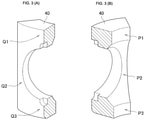
  • FIGS. 3A and 3B are partial perspective views of the ball seat used in the ball valve of the invention.
  • FIG. 4 illustrates surface pressures between the ball seat and the main body of a ball valve of the related art and the ball valve of the invention
  • FIG. 5 illustrates surface pressures between the ball seat and the ball of the ball valve in the related art and the ball valve of the invention.
  • FIG. 6 illustrates a relationship between a disc spring load and a seal pressure of the ball valve in the related art and the ball valve of the invention.
  • FIG. 1 illustrates an example of a ball valve 1 of the invention.
  • the ball valve 1 is provided with a main body 10 .
  • the main body includes a fluid inlet passage 11 , a fluid outlet passage 12 , and a depression 13 configured to communicate the fluid inlet passage 11 and the fluid outlet passage 12 .
  • the fluid inlet passage 11 and the fluid outlet passage 12 each are provided with a joint member 14 .
  • the depression 13 receives therein a ball 20 configured to cut off and communicate a fluid, and the ball 20 is provided with a fluid communication passage 21 configured to serve as a fluid passage.
  • a bottom surface of the depression 13 is subjected to surface roughening.
  • a retainer 50 formed of a metal into a substantially ring shape is disposed at each of two openings which serve as inlet and outlet of the ball seat 40 .
  • the retainer 50 serves to prevent the ball seat 40 from being deformed and blocking the passage and is made of stainless steel.
  • a stem 22 continuing from the ball 20 is formed above the ball 20 , and an upper end portion of the stem 22 is coupled to a handle 31 of an operating mechanism 30 . By rotating the handle 31 , the ball 20 rotates and communication and cutoff of the fluid are achieved.
  • the operating mechanism is not limited to those of a manual type, and other types that rotate with an electrical appliance or by air pressure is also applicable.
  • a cylindrical protrusion 16 protrudes upward from an upper part of the main body 10 , and in an internal space of the protrusion 16 and the depression 13 , a ring-shaped ball seat presser 41 that comes into contact with the ball seat, a disc spring 43 , and a ball seat pressing screw 42 are arranged from the bottom.
  • a protrusion female thread 16 b is formed on an inner surface of the protrusion 16 and engages a ball seat pressing screw male thread 42 a formed on an outer surface of the ball seat pressing screw 42 .
  • the ball seat pressing screw 42 is rotated to apply a load from above and compress the disc spring 43 , then a repulsive force of the disc spring 43 applies a load to the ball seat presser 41 from above, which is in turn transmitted to the ball seat 40 , so that the ball seat 40 is compressed by the load applied from above.
  • a protrusion male thread 16 a is formed on an outer surface of the protrusion 16 and engages a panel nut female screw 15 a formed on an inner surface of a panel nut 15 .
  • a panel or the like can be sandwiched between the panel nut 15 and an upper surface of the main body 10 .
  • FIG. 2A to 2C illustrate the enlarged ball 20 , the stem 22 , and the ball seat 40 .
  • the ball seat 40 is provided with retainer accommodating spaces 45 for accommodating the retainers 50 at the openings 44 and is provided with an upper opening 46 formed in an upper portion thereof.
  • a notch 22 a is formed at an upper end portion of the stem 22 , and the notch 22 a engages the handle 31 , so that the stem 22 and the ball 20 is rotated by the rotation of the handle 31 , and the communication and cutoff of the fluid are achieved.
  • FIG. 2A illustrates a state in which a fluid communicates
  • FIG. 2B illustrates a state in which the fluid is cut off
  • FIG. 2C is a side view of the state illustrated in FIG. 2A .
  • reference sign D 1 denotes a diameter of a bottom surface of the ball seat 40
  • reference sign D 2 denotes a diameter of an upper surface of the ball seat 40
  • the diameter D 2 is slightly smaller than the diameter D 1 in the ball valve of the invention.
  • the diameter D 1 is larger than the depression 13 of the main body 10
  • the diameter D 2 is the same as a diameter of the depression 13 of the main body 10 . Therefore, there is no gap present between a side surface of the ball seat 40 and an inner peripheral surface of the depression 13 .
  • an outer shape of the ball seat is a frustoconical shape.
  • a ball seat having a slight vertical rising part at a lower end portion and a frustoconical-shaped part formed upward therefrom is also applicable.
  • the shape of the ball seat is a substantially frustoconical shape.
  • FIGS. 3A and 3B illustrate models for calculating a surface pressure distribution in a case where the load is applied to the ball seat from above.
  • FIG. 3A illustrates an outer side of the ball seat
  • FIG. 3B illustrates an inner side of the ball seat.
  • Tables 1 and 2 shows values of the surface pressure resulted from application of a load 9000 N from above to respective types of the ball seat. Respective rows correspond to positions P 1 to P 3 shown in FIGS. 3B and Q 1 to Q 3 shown in FIG. 3A .
  • FIG. 4 is a graph showing the value in Table 1.
  • the new type ( ⁇ 27-27.2) has the surface pressure of 20.6 MPa, which is 8.1 MPa higher
  • the new type ( ⁇ 27-27.5) has the surface pressure of 21.1 MPa, which is 8.6 MPa higher.
  • FIG. 5 is a graph showing the value in Table 2.
  • the new type ( ⁇ 27-27.2) has the surface pressure of 24.5 MPa, which is 9.2 MPa higher
  • the new type ( ⁇ 27-27.5) has the surface pressure of 25.9 MPa, which is 10.6 MPa higher.
  • FIG. 6 illustrates a relationship between the disc spring load (N) and the seal pressure (MPa).
  • the seal pressure is a pressure at which leakage from the ball seat occurred when a pressure is applied in a state in which the interior of the ball valve 1 is sealed
  • the disc spring load is a load applied from the disc spring 43 to the ball seat.
  • the disc spring load was calculated from an amount of deflection and a spring constant of the disc spring 43 .
  • Reference signs a 1 , a 2 , and a 3 represent the ball seats 40 of the conventional type, and diameters of an upper surface and a lower surface thereof are both 27.0 mm, whereas reference signs b 1 , b 2 , and b 3 represent the ball seats of the new type and diameters of the upper surface and the lower surface thereof are 27.0 mm and 27.5 mm, respectively. Three each of samples are prepared for the conventional type and the new type.
  • the disc spring load required for achieving the same seal pressure is smaller for the new type after improvement than for the conventional type. Therefore, the disc spring load for preventing leakage of the fluid can be reduced, and deformation of the components such as a retainer is avoided correspondingly.
  • a load close to 10000 N is required for those of the conventional type, whereas only on the order of 8000 N is required for those of the new type after improvement.
  • the ball valve of the invention contributes to uniformization of positional distribution of the contact surface pressures between the ball seat and the ball and between the ball seat and the main body. Therefore, in comparison with the ball valve in the related art, leakage of the fluid from between the ball seat and the ball and between the ball seat and the main body is prevented even without increasing the load from above.

Landscapes

  • Engineering & Computer Science (AREA)
  • General Engineering & Computer Science (AREA)
  • Mechanical Engineering (AREA)
  • Taps Or Cocks (AREA)
  • Valve Housings (AREA)
  • Details Of Valves (AREA)

Abstract

A ball valve includes: a main body having a fluid inlet passage, a fluid outlet passage, and a column-shaped depression communicating with these passages and opening upward; a ball including a fluid communication passage and disposed at the column-shaped depression of the main body rotatably about a reference axis; an operating mechanism configured to cause the ball to rotate about the reference axis; a ball seat having a required opening on a peripheral wall thereof and disposed between the ball and the main body; a ball seat presser configured to press the ball seat; and a pressing screw configured to press the ball seat presser downward. The ball is rotated to achieve communication and cutoff. The ball seat has a substantially frustoconical shape having a bottom surface larger than a bottom of the depression in diameter, and an upper surface slightly smaller than the bottom surface in diameter.

Description

BACKGROUND OF THE INVENTION Field of the Invention
The present invention relates to a ball valve configured to achieve communication and cutoff by rotating a ball.
Description of Related Art
There is a well-known ball valve, in the related art, including: a main body having a fluid inlet passage, a fluid outlet passage, and a communication part provided between these passages; a ball including a fluid communication passage and being disposed at the communication part of the main body so as to be rotatable about a reference axis: and a ball seat having a substantially cylindrical shape provided with a required opening on a peripheral wall thereof and disposed between the ball and the main body, in which communication and cutoff between the fluid inlet passage and the fluid outlet passage are achieved by rotating the ball about the reference axis (JP-A-2011-174598).
In the valve described in JP-A-2011-174598, seal is effected by tightening a packing pressing screw and applying a sufficient load from a ball seat presser to the ball seat, so that leakage of a fluid from between the ball and the ball seat and between the ball seat and the main body is prevented. However, in a case where a large amount of fluid is flowed or where a fluid at high pressure is flowed, it is necessary to increase a force of tightening with the packing pressing screw and apply a larger load to the ball seat in order to effect seal. This may cause problems that a torque required for an opening and closing operation is increased and a retainer to be fitted into the ball seat is deformed.
The ball valve is assembled by fitting the ball into an internal space of the ball seat having an outline of a column shape and then press-fitting the ball seat into the main body. Reduction of the load applied to the ball seat due to the tightening of the packing pressing screw is expected by increasing a diameter of the ball seat. However, it may cause another problem that the ball seat cannot be press-fitted into the main body.
SUMMARY OF THE INVENTION
It is an object of the present invention to provide a ball valve configured to achieve communication and cutoff by rotating a ball, in which a ball seat with the ball fitted therein can easily be assembled to a main body and a load to be applied to the ball from a ball seat presser is small.
According to an aspect (1) of the invention, there is provided a ball valve including: a main body having a fluid inlet passage, a fluid outlet passage, and a column-shaped depression communicating with the fluid inlet passage and the fluid outlet passage and opening upward; a ball including a fluid communication passage and being disposed at the column-shaped depression of the main body so as to be rotatable about a reference axis, the ball being rotated about reference axis to achieve communication and cutoff between the fluid inlet passage and the fluid outlet passage: an operating mechanism configured to cause the ball to rotate about the reference axis; a ball seat provided with a required opening on a peripheral wall thereof and disposed between the ball and the main body; a ball seat presser provided above the ball seat and configured to press the ball seat; and a pressing screw configured to engage an inner periphery of the depression and press the ball seat presser downward, in which the ball seat has a substantially frustoconical shape having a bottom surface larger than a bottom of the depression in diameter, and an upper surface slightly smaller than the bottom surface in diameter.
An outline of the ball seat of the ball valve in the related art is a column shape, and a side surface of the ball seat is provided with an opening communicating with the fluid inlet passage and the fluid outlet passage, and the ball seat is provided with a spherical space for accommodating the ball in an interior thereof, and is provided with a hole on an axially upper side thereof for fitting a stem. A thickness of the ball seat in a vicinity of an axially center is thinner than other parts to allow easy resilient deformation.
The ball seat is formed of a synthetic resin material, and more specifically, preferably formed of PTFE (polytetrafluoroethylene), PFA (Tetrafluoroethylene-Perfluoroalkylvinylether Copolymer), PEEK (Poly Ether Ether Ketone), Ultra High Molecular Weight Polyethylene and the equivalent. In the case of the ball valve of the related art, a portion in the vicinity of the axially center of the ball seat having less thickness has a lower surface pressure, and thus the fluid is more likely to leak from the portion in the vicinity of the axially center of the ball seat.
In contrast, with the ball valve according to the aspect (1) of the invention, the ball seat has a substantially frustoconical shape having a bottom surface larger than a bottom of the depression of the main body in diameter, and an upper surface slightly smaller than the bottom surface in diameter. With this structure, the problem that the ball seat having the ball fitted therein cannot be fitted into the main body does not occur. In addition, it is estimated that the probability of leakage of the fluid from between the ball and the ball seat and between the ball seat and the main body is reduced because the resilient deformation of the portion of the ball seat in the vicinity of the axial center portion is reduced and decrease in surface pressure between the ball and the ball seat and between the ball seat and the main body is suppressed.
An aspect (2) of the invention provides the ball valve according to the aspect (1) of the invention further including a retainer internally fitted into the opening of the ball seat.
According to the aspect (2) of the invention, the retainer internally fitted into the opening of the ball seat is further provided. The retainer is preferably made of stainless steel in terms of corrosion resistance and strength. With the provision of the retainer, the probability of deformation of the ball seat is reduced, and an aperture serving as a fluid passage is secured.
In the ball valve of the related art, an excessive load needs to be applied from above to let the fluid at high pressure flow in order to prevent the leakage of the fluid between the ball seat and the ball and between the ball seat and the main body. Consequently, even the retainer may be deformed, which may lead to a risk of malfunctioning. In the case of the ball valve of the invention, since the necessity of application of the excessive load from above is avoided, the deformation of the retainer is avoided correspondingly.
An aspect (3) of the invention provides a ball valve according to the aspect (1) or (2) of the invention characterized in that a spring member is provided between the ball seat presser and the pressing screw.
According to the aspect (3) of the invention, since the spring member is provided, the load applied to the ball seat from above may be maintained by a repulsive force of the spring member against the load from above.
According to the ball valve of the invention, the ball seat having the ball fitted therein can easily assembled to the main body, and a positional distribution of a contact surface pressure between the ball seat and the ball and between the ball seat and the main body may be uniformized to prevent the leakage of the fluid from between the ball seat and the ball even though the fluid at high pressure is flowed.
BRIEF DESCRIPTION OF DRAWINGS
FIG. 1 illustrates an appearance view of a first example of a ball valve according to the invention;
FIGS. 2A to 2C are enlarged views illustrating a ball seat, a ball, and a stem of the ball valve according to the invention;
FIGS. 3A and 3B are partial perspective views of the ball seat used in the ball valve of the invention;
FIG. 4 illustrates surface pressures between the ball seat and the main body of a ball valve of the related art and the ball valve of the invention;
FIG. 5 illustrates surface pressures between the ball seat and the ball of the ball valve in the related art and the ball valve of the invention; and
FIG. 6 illustrates a relationship between a disc spring load and a seal pressure of the ball valve in the related art and the ball valve of the invention.
DETAILED DESCRIPTION OF THE INVENTION
Embodiments of the invention will be described below with reference to the drawings. In the following description, expressions “upper and lower” correspond to “upper and lower” of the drawings. The expressions “upper and lower” are used for the sake of convenience, and the apparatus may be installed upside down or horizontally depending on circumstances.
FIG. 1 illustrates an example of a ball valve 1 of the invention. The ball valve 1 is provided with a main body 10. The main body includes a fluid inlet passage 11, a fluid outlet passage 12, and a depression 13 configured to communicate the fluid inlet passage 11 and the fluid outlet passage 12. The fluid inlet passage 11 and the fluid outlet passage 12 each are provided with a joint member 14.
The depression 13 receives therein a ball 20 configured to cut off and communicate a fluid, and the ball 20 is provided with a fluid communication passage 21 configured to serve as a fluid passage. A bottom surface of the depression 13 is subjected to surface roughening. A ball seat 40 formed of PTFE (polytetrafluoroethylene), which is a synthetic resin material, is disposed between the ball 20 and the main body 10. Leakage of the fluid is prevented by applying a compression load to the ball seat 40 from above.
A retainer 50 formed of a metal into a substantially ring shape is disposed at each of two openings which serve as inlet and outlet of the ball seat 40. The retainer 50 serves to prevent the ball seat 40 from being deformed and blocking the passage and is made of stainless steel. A stem 22 continuing from the ball 20 is formed above the ball 20, and an upper end portion of the stem 22 is coupled to a handle 31 of an operating mechanism 30. By rotating the handle 31, the ball 20 rotates and communication and cutoff of the fluid are achieved. However, the operating mechanism is not limited to those of a manual type, and other types that rotate with an electrical appliance or by air pressure is also applicable.
A cylindrical protrusion 16 protrudes upward from an upper part of the main body 10, and in an internal space of the protrusion 16 and the depression 13, a ring-shaped ball seat presser 41 that comes into contact with the ball seat, a disc spring 43, and a ball seat pressing screw 42 are arranged from the bottom.
A protrusion female thread 16 b is formed on an inner surface of the protrusion 16 and engages a ball seat pressing screw male thread 42 a formed on an outer surface of the ball seat pressing screw 42. The ball seat pressing screw 42 is rotated to apply a load from above and compress the disc spring 43, then a repulsive force of the disc spring 43 applies a load to the ball seat presser 41 from above, which is in turn transmitted to the ball seat 40, so that the ball seat 40 is compressed by the load applied from above.
A protrusion male thread 16 a is formed on an outer surface of the protrusion 16 and engages a panel nut female screw 15 a formed on an inner surface of a panel nut 15. A panel or the like can be sandwiched between the panel nut 15 and an upper surface of the main body 10.
FIG. 2A to 2C illustrate the enlarged ball 20, the stem 22, and the ball seat 40. The ball seat 40 is provided with retainer accommodating spaces 45 for accommodating the retainers 50 at the openings 44 and is provided with an upper opening 46 formed in an upper portion thereof. A notch 22 a is formed at an upper end portion of the stem 22, and the notch 22 a engages the handle 31, so that the stem 22 and the ball 20 is rotated by the rotation of the handle 31, and the communication and cutoff of the fluid are achieved. FIG. 2A illustrates a state in which a fluid communicates, FIG. 2B illustrates a state in which the fluid is cut off, and FIG. 2C is a side view of the state illustrated in FIG. 2A.
In FIG. 2C, reference sign D1 denotes a diameter of a bottom surface of the ball seat 40, and reference sign D2 denotes a diameter of an upper surface of the ball seat 40. The diameter D2 is slightly smaller than the diameter D1 in the ball valve of the invention. The diameter D1 is larger than the depression 13 of the main body 10, and the diameter D2 is the same as a diameter of the depression 13 of the main body 10. Therefore, there is no gap present between a side surface of the ball seat 40 and an inner peripheral surface of the depression 13. In this example, an outer shape of the ball seat is a frustoconical shape. For example, however, a ball seat having a slight vertical rising part at a lower end portion and a frustoconical-shaped part formed upward therefrom is also applicable. In this sense, the shape of the ball seat is a substantially frustoconical shape.
FIGS. 3A and 3B illustrate models for calculating a surface pressure distribution in a case where the load is applied to the ball seat from above. FIG. 3A illustrates an outer side of the ball seat, and FIG. 3B illustrates an inner side of the ball seat. Calculations were performed for three types of the ball seat, including a conventional type (the diameter of the upper surface: 27.0 mm, the diameter of the lower surface: 27.0 mm) and two new types (the diameter of the upper surface: 27.0 mm, the diameter of the lower surface: 27.2 mm) and (the diameter of the upper surface: 27.0 mm and the diameter of the lower surface: 27.5 mm). The results are shown in Table 1 and Table 2. These Tables 1 and 2 shows values of the surface pressure resulted from application of a load 9000 N from above to respective types of the ball seat. Respective rows correspond to positions P1 to P3 shown in FIGS. 3B and Q1 to Q3 shown in FIG. 3A.
TABLE 1
Conventional
type New Type New Type
(φ27) (φ27-27.2) (φ27-27.5)
Upper 18.7 19.2 20.3
position (Q1)
Middle 12.5 20.6 21.1
position (Q2)
Lower 16.2 16.2 16.4
position (Q3)
(Unit: MPa)
TABLE 2
Conventional
type New Type New Type
(φ27) (φ27-27.2) (φ27-27.5)
Upper 16.7 20.5 20.6
position (P1)
Middle 15.3 24.5 25.9
position (P2)
Lower 21.1 20.2 21.5
position (P3)
(Unit: MPa)
FIG. 4 is a graph showing the value in Table 1. In contrast to the surface pressure of 12.5 MPa at the middle position (Q2) of the conventional type, the new type (φ27-27.2) has the surface pressure of 20.6 MPa, which is 8.1 MPa higher, and the new type (φ27-27.5) has the surface pressure of 21.1 MPa, which is 8.6 MPa higher.
FIG. 5 is a graph showing the value in Table 2. In contrast to the surface pressure of 15.3 MPa at the middle position (P2) of the conventional type, the new type (φ27-27.2) has the surface pressure of 24.5 MPa, which is 9.2 MPa higher, and the new type (φ27-27.5) has the surface pressure of 25.9 MPa, which is 10.6 MPa higher.
From FIG. 4 and FIG. 5, the fact that the surface pressure of the ball seat of the conventional type varies, whereas the surface pressures of the ball seat of the new types are subjected to less variation, so that portions having low surface pressure, which may cause leakage occurred in the conventional type, may be eliminated.
FIG. 6 illustrates a relationship between the disc spring load (N) and the seal pressure (MPa). The seal pressure is a pressure at which leakage from the ball seat occurred when a pressure is applied in a state in which the interior of the ball valve 1 is sealed, and the disc spring load is a load applied from the disc spring 43 to the ball seat. The disc spring load was calculated from an amount of deflection and a spring constant of the disc spring 43.
Reference signs a1, a2, and a3 represent the ball seats 40 of the conventional type, and diameters of an upper surface and a lower surface thereof are both 27.0 mm, whereas reference signs b1, b2, and b3 represent the ball seats of the new type and diameters of the upper surface and the lower surface thereof are 27.0 mm and 27.5 mm, respectively. Three each of samples are prepared for the conventional type and the new type.
The disc spring load required for achieving the same seal pressure is smaller for the new type after improvement than for the conventional type. Therefore, the disc spring load for preventing leakage of the fluid can be reduced, and deformation of the components such as a retainer is avoided correspondingly. In order to achieve the seal pressure of 19 MPa, a load close to 10000 N is required for those of the conventional type, whereas only on the order of 8000 N is required for those of the new type after improvement.
The ball valve of the invention contributes to uniformization of positional distribution of the contact surface pressures between the ball seat and the ball and between the ball seat and the main body. Therefore, in comparison with the ball valve in the related art, leakage of the fluid from between the ball seat and the ball and between the ball seat and the main body is prevented even without increasing the load from above.

Claims (8)

What is claimed is:
1. A ball valve comprising:
a main body having a fluid inlet passage, a fluid outlet passage, and a column-shaped depression communicating with the fluid inlet passage and the fluid outlet passage and opening upward;
a ball including a fluid communication passage and being disposed at the column-shaped depression of the main body so as to be rotatable about a reference axis, the ball being rotated about the reference axis to achieve communication and cutoff between the fluid inlet passage and the fluid outlet passage:
an operating mechanism configured to cause the ball to rotate about the reference axis;
a ball seat provided with a required opening on a peripheral wall thereof and disposed between the ball and the main body;
a ball seat presser provided above the ball seat and configured to press the ball seat; and
a pressing screw configured to engage an inner periphery of the depression and press the ball seat presser downward,
wherein the ball seat has a frustoconical shape having a bottom surface larger than a bottom of the depression in diameter, and an upper surface smaller than the bottom surface in diameter.
2. The ball valve according to claim 1, further comprising a retainer internally fitted into the opening of the ball seat.
3. The ball valve according to claim 1, wherein a spring member is provided between the ball seat presser and the pressing screw.
4. The ball valve according to claim 1, wherein a bottom surface of the depression is subjected to surface roughening.
5. The ball valve according to claim 2, wherein a spring member is provided between the ball seat presser and the pressing screw.
6. The ball valve according to claim 2, wherein a bottom surface of the depression is subjected to surface roughening.
7. The ball valve according to claim 3, wherein a bottom surface of the depression is subjected to surface roughening.
8. The ball valve according to claim 5, wherein a bottom surface of the depression is subjected to surface roughening.
US16/944,802 2019-07-31 2020-07-31 Ball valve Active US11226043B2 (en)

Applications Claiming Priority (3)

Application Number Priority Date Filing Date Title
JPJP2019-141188 2019-07-31
JP2019-141188 2019-07-31
JP2019141188A JP7449552B2 (en) 2019-07-31 2019-07-31 ball valve

Publications (2)

Publication Number Publication Date
US20210033202A1 US20210033202A1 (en) 2021-02-04
US11226043B2 true US11226043B2 (en) 2022-01-18

Family

ID=74260013

Family Applications (1)

Application Number Title Priority Date Filing Date
US16/944,802 Active US11226043B2 (en) 2019-07-31 2020-07-31 Ball valve

Country Status (2)

Country Link
US (1) US11226043B2 (en)
JP (1) JP7449552B2 (en)

Cited By (2)

* Cited by examiner, † Cited by third party
Publication number Priority date Publication date Assignee Title
US20240035578A1 (en) * 2022-07-27 2024-02-01 Otto Egelhof Gmbh & Co. Kg Ball valve
US20250052328A1 (en) * 2023-08-08 2025-02-13 James D. Bower Oil Drain Apparatus

Citations (4)

* Cited by examiner, † Cited by third party
Publication number Priority date Publication date Assignee Title
US4834340A (en) * 1987-07-10 1989-05-30 Henry Vogt Machine Co. Quarter-turn plug valve having adjustable bonnet and tapered raised valve seats
US20010045231A1 (en) * 1999-06-14 2001-11-29 Gilles Monod Ball valve with replaceable cartridge insert
JP2011174598A (en) 2010-02-26 2011-09-08 Fujikin Inc Ball valve
US20180149275A1 (en) * 2016-11-28 2018-05-31 Red-White Valve Corp. Ball valve with components integrated into the ball member

Family Cites Families (6)

* Cited by examiner, † Cited by third party
Publication number Priority date Publication date Assignee Title
JPS4635760Y1 (en) * 1968-08-23 1971-12-08
JPS4836537B1 (en) * 1970-12-28 1973-11-05
JPS63158368A (en) * 1986-12-18 1988-07-01 Toshiyuki Kitayama Ball valve
JP3434486B2 (en) * 2000-04-04 2003-08-11 株式会社一ノ瀬 Ball valve
CN101067458B (en) * 2002-01-18 2011-01-19 斯瓦戈洛克公司 Ball valve with monoblock type caulking piece
JP6041298B2 (en) * 2012-09-26 2016-12-07 株式会社フジキン Ball valve

Patent Citations (5)

* Cited by examiner, † Cited by third party
Publication number Priority date Publication date Assignee Title
US4834340A (en) * 1987-07-10 1989-05-30 Henry Vogt Machine Co. Quarter-turn plug valve having adjustable bonnet and tapered raised valve seats
US20010045231A1 (en) * 1999-06-14 2001-11-29 Gilles Monod Ball valve with replaceable cartridge insert
JP2011174598A (en) 2010-02-26 2011-09-08 Fujikin Inc Ball valve
US20130037738A1 (en) 2010-02-26 2013-02-14 Fujikin Incorporated Ball valve
US20180149275A1 (en) * 2016-11-28 2018-05-31 Red-White Valve Corp. Ball valve with components integrated into the ball member

Cited By (2)

* Cited by examiner, † Cited by third party
Publication number Priority date Publication date Assignee Title
US20240035578A1 (en) * 2022-07-27 2024-02-01 Otto Egelhof Gmbh & Co. Kg Ball valve
US20250052328A1 (en) * 2023-08-08 2025-02-13 James D. Bower Oil Drain Apparatus

Also Published As

Publication number Publication date
JP2021025540A (en) 2021-02-22
US20210033202A1 (en) 2021-02-04
JP7449552B2 (en) 2024-03-14

Similar Documents

Publication Publication Date Title
US11226043B2 (en) Ball valve
CN1329682C (en) Ball valve with integral packing
US8931760B2 (en) Ball valve
KR101956090B1 (en) Trunnion-type ball valve
US20100200791A1 (en) Valve Having High Pressure and Low Pressure Seals
US20050258386A1 (en) Ball valve
GB2298023A (en) Adjustable ball valve
CN100380031C (en) Fluid controller
CN1425112A (en) Ball valve seat seal
WO2011104976A1 (en) Ball valve
US20220074518A1 (en) High Pressure Auto Drain Ball Valve
US3948480A (en) Rotary ball valve
US11920699B2 (en) High pressure auto drain ball valve
US11009136B2 (en) Bidirectional cryogenic firesafe floating ball valve
JP2008185113A (en) Ball valve
US20200386324A1 (en) Ball valve with cryogenic seat
JP2012013141A (en) Trunnion type ball valve
US3044743A (en) Valve construction
US10267424B2 (en) Butterfly valve seat with seat cover
KR20190139947A (en) Valve body for annular valve and annular valve
JP2021055736A (en) Ball valve
US4057883A (en) Method of assembling rotary ball valve
KR20140123412A (en) Ball valve
JP7195278B2 (en) butterfly valve
KR20180090042A (en) A ball valve

Legal Events

Date Code Title Description
AS Assignment

Owner name: FUJIKIN INCORPORATED, JAPAN

Free format text: ASSIGNMENT OF ASSIGNORS INTEREST;ASSIGNORS:MOURI, TOMOHIRO;HIRAMATSU, KOJI;YAKUSHIJIN, TADAYUKI;SIGNING DATES FROM 20200729 TO 20200730;REEL/FRAME:053370/0636

FEPP Fee payment procedure

Free format text: ENTITY STATUS SET TO UNDISCOUNTED (ORIGINAL EVENT CODE: BIG.); ENTITY STATUS OF PATENT OWNER: LARGE ENTITY

STPP Information on status: patent application and granting procedure in general

Free format text: DOCKETED NEW CASE - READY FOR EXAMINATION

STPP Information on status: patent application and granting procedure in general

Free format text: NON FINAL ACTION MAILED

STPP Information on status: patent application and granting procedure in general

Free format text: RESPONSE TO NON-FINAL OFFICE ACTION ENTERED AND FORWARDED TO EXAMINER

STPP Information on status: patent application and granting procedure in general

Free format text: NOTICE OF ALLOWANCE MAILED -- APPLICATION RECEIVED IN OFFICE OF PUBLICATIONS

STPP Information on status: patent application and granting procedure in general

Free format text: PUBLICATIONS -- ISSUE FEE PAYMENT VERIFIED

STCF Information on status: patent grant

Free format text: PATENTED CASE

MAFP Maintenance fee payment

Free format text: PAYMENT OF MAINTENANCE FEE, 4TH YEAR, LARGE ENTITY (ORIGINAL EVENT CODE: M1551); ENTITY STATUS OF PATENT OWNER: LARGE ENTITY

Year of fee payment: 4