US11224223B2 - Feeding deterrence of pests such as Hemiptera, Lepidoptera and Coleoptera - Google Patents

Feeding deterrence of pests such as Hemiptera, Lepidoptera and Coleoptera Download PDF

Info

Publication number
US11224223B2
US11224223B2 US16/531,446 US201916531446A US11224223B2 US 11224223 B2 US11224223 B2 US 11224223B2 US 201916531446 A US201916531446 A US 201916531446A US 11224223 B2 US11224223 B2 US 11224223B2
Authority
US
United States
Prior art keywords
group
carbon atoms
compounds
bond
pests
Prior art date
Legal status (The legal status is an assumption and is not a legal conclusion. Google has not performed a legal analysis and makes no representation as to the accuracy of the status listed.)
Active, expires
Application number
US16/531,446
Other versions
US20200022367A1 (en
Inventor
Robert H. Bedoukian
Current Assignee (The listed assignees may be inaccurate. Google has not performed a legal analysis and makes no representation or warranty as to the accuracy of the list.)
Bedoukian Research Inc
Original Assignee
Bedoukian Research Inc
Priority date (The priority date is an assumption and is not a legal conclusion. Google has not performed a legal analysis and makes no representation as to the accuracy of the date listed.)
Filing date
Publication date
Priority claimed from PCT/US2013/000120 external-priority patent/WO2013165476A1/en
Application filed by Bedoukian Research Inc filed Critical Bedoukian Research Inc
Priority to US16/531,446 priority Critical patent/US11224223B2/en
Assigned to BEDOUKIAN RESEARCH, INC. reassignment BEDOUKIAN RESEARCH, INC. ASSIGNMENT OF ASSIGNORS INTEREST (SEE DOCUMENT FOR DETAILS). Assignors: BEDOUKIAN, ROBERT H.
Publication of US20200022367A1 publication Critical patent/US20200022367A1/en
Application granted granted Critical
Publication of US11224223B2 publication Critical patent/US11224223B2/en
Active legal-status Critical Current
Adjusted expiration legal-status Critical

Links

Images

Classifications

    • AHUMAN NECESSITIES
    • A01AGRICULTURE; FORESTRY; ANIMAL HUSBANDRY; HUNTING; TRAPPING; FISHING
    • A01NPRESERVATION OF BODIES OF HUMANS OR ANIMALS OR PLANTS OR PARTS THEREOF; BIOCIDES, e.g. AS DISINFECTANTS, AS PESTICIDES OR AS HERBICIDES; PEST REPELLANTS OR ATTRACTANTS; PLANT GROWTH REGULATORS
    • A01N43/00Biocides, pest repellants or attractants, or plant growth regulators containing heterocyclic compounds
    • A01N43/02Biocides, pest repellants or attractants, or plant growth regulators containing heterocyclic compounds having rings with one or more oxygen or sulfur atoms as the only ring hetero atoms
    • A01N43/04Biocides, pest repellants or attractants, or plant growth regulators containing heterocyclic compounds having rings with one or more oxygen or sulfur atoms as the only ring hetero atoms with one hetero atom
    • A01N43/14Biocides, pest repellants or attractants, or plant growth regulators containing heterocyclic compounds having rings with one or more oxygen or sulfur atoms as the only ring hetero atoms with one hetero atom six-membered rings
    • A01N43/16Biocides, pest repellants or attractants, or plant growth regulators containing heterocyclic compounds having rings with one or more oxygen or sulfur atoms as the only ring hetero atoms with one hetero atom six-membered rings with oxygen as the ring hetero atom
    • AHUMAN NECESSITIES
    • A01AGRICULTURE; FORESTRY; ANIMAL HUSBANDRY; HUNTING; TRAPPING; FISHING
    • A01NPRESERVATION OF BODIES OF HUMANS OR ANIMALS OR PLANTS OR PARTS THEREOF; BIOCIDES, e.g. AS DISINFECTANTS, AS PESTICIDES OR AS HERBICIDES; PEST REPELLANTS OR ATTRACTANTS; PLANT GROWTH REGULATORS
    • A01N31/00Biocides, pest repellants or attractants, or plant growth regulators containing organic oxygen or sulfur compounds
    • A01N31/06Oxygen or sulfur directly attached to a cycloaliphatic ring system
    • AHUMAN NECESSITIES
    • A01AGRICULTURE; FORESTRY; ANIMAL HUSBANDRY; HUNTING; TRAPPING; FISHING
    • A01NPRESERVATION OF BODIES OF HUMANS OR ANIMALS OR PLANTS OR PARTS THEREOF; BIOCIDES, e.g. AS DISINFECTANTS, AS PESTICIDES OR AS HERBICIDES; PEST REPELLANTS OR ATTRACTANTS; PLANT GROWTH REGULATORS
    • A01N35/00Biocides, pest repellants or attractants, or plant growth regulators containing organic compounds containing a carbon atom having two bonds to hetero atoms with at the most one bond to halogen, e.g. aldehyde radical
    • A01N35/06Biocides, pest repellants or attractants, or plant growth regulators containing organic compounds containing a carbon atom having two bonds to hetero atoms with at the most one bond to halogen, e.g. aldehyde radical containing keto or thioketo groups as part of a ring, e.g. cyclohexanone, quinone; Derivatives thereof, e.g. ketals
    • AHUMAN NECESSITIES
    • A01AGRICULTURE; FORESTRY; ANIMAL HUSBANDRY; HUNTING; TRAPPING; FISHING
    • A01NPRESERVATION OF BODIES OF HUMANS OR ANIMALS OR PLANTS OR PARTS THEREOF; BIOCIDES, e.g. AS DISINFECTANTS, AS PESTICIDES OR AS HERBICIDES; PEST REPELLANTS OR ATTRACTANTS; PLANT GROWTH REGULATORS
    • A01N37/00Biocides, pest repellants or attractants, or plant growth regulators containing organic compounds containing a carbon atom having three bonds to hetero atoms with at the most two bonds to halogen, e.g. carboxylic acids
    • A01N37/02Saturated carboxylic acids or thio analogues thereof; Derivatives thereof
    • AHUMAN NECESSITIES
    • A01AGRICULTURE; FORESTRY; ANIMAL HUSBANDRY; HUNTING; TRAPPING; FISHING
    • A01NPRESERVATION OF BODIES OF HUMANS OR ANIMALS OR PLANTS OR PARTS THEREOF; BIOCIDES, e.g. AS DISINFECTANTS, AS PESTICIDES OR AS HERBICIDES; PEST REPELLANTS OR ATTRACTANTS; PLANT GROWTH REGULATORS
    • A01N37/00Biocides, pest repellants or attractants, or plant growth regulators containing organic compounds containing a carbon atom having three bonds to hetero atoms with at the most two bonds to halogen, e.g. carboxylic acids
    • A01N37/06Unsaturated carboxylic acids or thio analogues thereof; Derivatives thereof
    • AHUMAN NECESSITIES
    • A01AGRICULTURE; FORESTRY; ANIMAL HUSBANDRY; HUNTING; TRAPPING; FISHING
    • A01NPRESERVATION OF BODIES OF HUMANS OR ANIMALS OR PLANTS OR PARTS THEREOF; BIOCIDES, e.g. AS DISINFECTANTS, AS PESTICIDES OR AS HERBICIDES; PEST REPELLANTS OR ATTRACTANTS; PLANT GROWTH REGULATORS
    • A01N37/00Biocides, pest repellants or attractants, or plant growth regulators containing organic compounds containing a carbon atom having three bonds to hetero atoms with at the most two bonds to halogen, e.g. carboxylic acids
    • A01N37/18Biocides, pest repellants or attractants, or plant growth regulators containing organic compounds containing a carbon atom having three bonds to hetero atoms with at the most two bonds to halogen, e.g. carboxylic acids containing the group —CO—N<, e.g. carboxylic acid amides or imides; Thio analogues thereof
    • AHUMAN NECESSITIES
    • A01AGRICULTURE; FORESTRY; ANIMAL HUSBANDRY; HUNTING; TRAPPING; FISHING
    • A01NPRESERVATION OF BODIES OF HUMANS OR ANIMALS OR PLANTS OR PARTS THEREOF; BIOCIDES, e.g. AS DISINFECTANTS, AS PESTICIDES OR AS HERBICIDES; PEST REPELLANTS OR ATTRACTANTS; PLANT GROWTH REGULATORS
    • A01N37/00Biocides, pest repellants or attractants, or plant growth regulators containing organic compounds containing a carbon atom having three bonds to hetero atoms with at the most two bonds to halogen, e.g. carboxylic acids
    • A01N37/36Biocides, pest repellants or attractants, or plant growth regulators containing organic compounds containing a carbon atom having three bonds to hetero atoms with at the most two bonds to halogen, e.g. carboxylic acids containing at least one carboxylic group or a thio analogue, or a derivative thereof, and a singly bound oxygen or sulfur atom attached to the same carbon skeleton, this oxygen or sulfur atom not being a member of a carboxylic group or of a thio analogue, or of a derivative thereof, e.g. hydroxy-carboxylic acids
    • AHUMAN NECESSITIES
    • A01AGRICULTURE; FORESTRY; ANIMAL HUSBANDRY; HUNTING; TRAPPING; FISHING
    • A01NPRESERVATION OF BODIES OF HUMANS OR ANIMALS OR PLANTS OR PARTS THEREOF; BIOCIDES, e.g. AS DISINFECTANTS, AS PESTICIDES OR AS HERBICIDES; PEST REPELLANTS OR ATTRACTANTS; PLANT GROWTH REGULATORS
    • A01N37/00Biocides, pest repellants or attractants, or plant growth regulators containing organic compounds containing a carbon atom having three bonds to hetero atoms with at the most two bonds to halogen, e.g. carboxylic acids
    • A01N37/42Biocides, pest repellants or attractants, or plant growth regulators containing organic compounds containing a carbon atom having three bonds to hetero atoms with at the most two bonds to halogen, e.g. carboxylic acids containing within the same carbon skeleton a carboxylic group or a thio analogue, or a derivative thereof, and a carbon atom having only two bonds to hetero atoms with at the most one bond to halogen, e.g. keto-carboxylic acids
    • AHUMAN NECESSITIES
    • A01AGRICULTURE; FORESTRY; ANIMAL HUSBANDRY; HUNTING; TRAPPING; FISHING
    • A01NPRESERVATION OF BODIES OF HUMANS OR ANIMALS OR PLANTS OR PARTS THEREOF; BIOCIDES, e.g. AS DISINFECTANTS, AS PESTICIDES OR AS HERBICIDES; PEST REPELLANTS OR ATTRACTANTS; PLANT GROWTH REGULATORS
    • A01N43/00Biocides, pest repellants or attractants, or plant growth regulators containing heterocyclic compounds
    • A01N43/02Biocides, pest repellants or attractants, or plant growth regulators containing heterocyclic compounds having rings with one or more oxygen or sulfur atoms as the only ring hetero atoms
    • A01N43/04Biocides, pest repellants or attractants, or plant growth regulators containing heterocyclic compounds having rings with one or more oxygen or sulfur atoms as the only ring hetero atoms with one hetero atom
    • A01N43/06Biocides, pest repellants or attractants, or plant growth regulators containing heterocyclic compounds having rings with one or more oxygen or sulfur atoms as the only ring hetero atoms with one hetero atom five-membered rings
    • A01N43/08Biocides, pest repellants or attractants, or plant growth regulators containing heterocyclic compounds having rings with one or more oxygen or sulfur atoms as the only ring hetero atoms with one hetero atom five-membered rings with oxygen as the ring hetero atom
    • AHUMAN NECESSITIES
    • A01AGRICULTURE; FORESTRY; ANIMAL HUSBANDRY; HUNTING; TRAPPING; FISHING
    • A01NPRESERVATION OF BODIES OF HUMANS OR ANIMALS OR PLANTS OR PARTS THEREOF; BIOCIDES, e.g. AS DISINFECTANTS, AS PESTICIDES OR AS HERBICIDES; PEST REPELLANTS OR ATTRACTANTS; PLANT GROWTH REGULATORS
    • A01N49/00Biocides, pest repellants or attractants, or plant growth regulators, containing compounds containing the group, wherein m+n>=1, both X together may also mean —Y— or a direct carbon-to-carbon bond, and the carbon atoms marked with an asterisk are not part of any ring system other than that which may be formed by the atoms X, the carbon atoms in square brackets being part of any acyclic or cyclic structure, or the group, wherein A means a carbon atom or Y, n>=0, and not more than one of these carbon atoms being a member of the same ring system, e.g. juvenile insect hormones or mimics thereof

Definitions

  • This disclosure relates to the use of compounds as agents that deter feeding by pest arthropods such as Hemiptera, Lepidoptera and Coleoptera including, but not limited to, insect pests of the following genera: Tineola, Sitotroga, Sitophilus, Cydia, Grapholita, Ostrinia, Plodia, Galleria, Manduca, Hyphantria, Lymantria, Agrotis, Trichoplusia, Spodoptera, Helicoverpa, Heliothis, Leptinotarsa, Popillia, Anthonomus, Crioceris, Oryzaephilus, Oulema, Stegobium, Agroites, Epilachna, Dermestes, Lygus, Blissus, Euschistus, Nezara, Homalodisca, Circulifer, Typhlocyba, Diaphorina, Bactericera, Bemisia, Trialeurodes, Myzus, Aphis, Macrosiphum,
  • Lepidopteran, Coleopteran, and Hemipteran pests including the genera: Tineola, Sitotroga, Sitophilus, Cydia, Grapholita, Ostrinia, Plodia, Galleria, Manduca, Hyphantria, Lymantria, Agrotis, Trichoplusia, Spodoptera, Helicoverpa, Heliothis, Leptinotarsa, Popillia, Anthonomus, Crioceris, Oryzaephilus, Oulema, Stegobium, Agroites, Epilachna, Dermestes, Lygus, Blissus, Euschistus, Nezara, Homalodisca, Circulifer, Typhlocyba, Diaphorina, Bactericera, Bemisia, Trialeurodes, Myzus, Aphis, Macrosiphum, Eriosoma, Dysaphis , are known to feed on various products of importance to humans.
  • Pest arthropods may damage these products at any stage of the product life, from in the field where they damage the leaves, stem, bark, or flowers of intact plants, to post harvest transport, storage or processing. The cost of this damage is extensive and leads to hardship among growers, manufacturers, warehouse managers, and to consumers.
  • Hemipteran pests include stink bugs, true bugs, aphids, whiteflies, psyllids, and others. In the Mid-Atlantic region, where brown marmorated stink bugs are well established, they caused an estimated $37 million in damage in apple crops alone in 2010, the most recent year for which data are available. [Darryl Fears, “Stink bugs migrating to deep south”, Washington Post, Mar. 16, 2012]. Aside from apples, the bug will feed on nearly anything, including cherries, tomatoes, grapes, lima beans, soybeans, green peppers and peaches. Like brown marmorated stink bugs, Euchistus spp.
  • bugs are significant pests of agricultural crops, notably cowpea, cotton, and soybean, are capable of significantly damaging these crops in tropical and subtropical regions.
  • Aphids including, but not limited to the genera Myzus, Aphis, Macrosiphum, Eriosoma, Dysaphis , can multiply rapidly through parthenogenesis where a single female foundress can produce hundreds of offspring. They are often cryptic pests, which are hard to detect, and vector several serious plant viruses, like barley yellow dwarf virus, cucumber mosaic virus, and potato virus.
  • the aphids In addition to vectoring viruses to plants, the aphids also excrete honeydew a sugar-rich waste product, which promotes the growth of opportunistic fungi, like mildews.
  • whiteflies and psyllids are both serious pests of agriculture, both capable of transmitting viruses and bacterial pathogens.
  • Whiteflies including the genera Bemisia , and Trialeurodes are particularly damaging to tomatoes and greenhouse plants.
  • Psyllids including the genera Diaphorina , and Bactericera , can significantly affect agricultural crops.
  • Such pests include the Asian citrus psyllid, a serious threat to the citrus industry because these insects vector causal agent of greening disease. This disease causes the trees to become unproductive, produce off-flavor fruit, and die prematurely.
  • Lepidopteran pests are often serious pests in crops, turf, ornamentals, stored products, fibers and even in beeswax production.
  • the clothes moth, Tineola spp. is a major pest of wool and other natural fibers.
  • the clothes moth can cause damage to products made from wool or other natural fibers, such as clothing, carpets, furniture, animal-hair bristles, and animal-fur clothing.
  • this pest can also infest stored grains.
  • Other serious Lepidopteran pests of stored grains and other processed food products include Indian meal moth and Angoumois grain moth.
  • lepidopteran pests pose serious threats to agricultural production, including species of the genera Cydia, Grapholita, Ostrinia, Manduca, Hyphantria, Lymantria, Agrotis, Trichoplusia, Spodoptera, Helicoverpa , and Heliothis . All of these juvenile insects feed on the plant tissues, potentially including stems, leaves and fruits, which cause direct and indirect crop losses in agricultural production or in gardening. Ostrinia, Helicoverpa, Heliothis, Agrotis and Spodoptera genera include the most serious Lepidopteran pest species of corn and other row crops.
  • Species in the genera of Hyphantria , and Lymantria are the most serious Lepidopteran forest pests, often defoliated their host trees from feeding on the leaves during period of outbreak.
  • Manduca spp. are specialist herbivores of Solanaceous plants, which include agriculturally important crops like tomato, eggplant, tobacco, peppers, and potato.
  • Trichoplusia sp. are specialists, and these larva attach commercially important crops like cabbage and other brassica crops. Codling moth larvae penetrate into apples, pears, and nut crops and tunnel to the core, leaving holes in the fruit or nut that are filled with reddish-brown, crumbly droppings. If left uncontrolled, larvae can cause substantial damage, often infesting 20 to 90% of the fruit, depending on the variety and location. Late maturing varieties are more likely to suffer severe damage than early varieties. [J. L. Caprile and P. M. Vossen, Pest Notes : Codling Moth UC ANR Publication 7412, May 2011.
  • Phosmet a phthalimide-derived, non-systemic, organophosphate insecticide is the primary means of controlling codling moth damage to apples. This material is on the U.S. Emergency Planning list of extremely hazardous substances and is highly toxic to bees. The materials covered in this disclosure would be a much gentler means of deterring the larvae and controlling moth infestation.
  • Coleopteran pests are beetles that can attack crops, stored products, and animal products. Dermestes beetles are a significant pest of dry-preserved animal collections, such as taxidermy or insect collections. Dermestes beetles consume the remaining flesh, hair, horn, ligaments, and other soft tissues. Toxic fumigants such as mothballs are typically used to control infestations. However, the active ingredient in mothballs is volatile, resulting in ineffectiveness and increased exposure to people who work or live in proximity to the application. Around food, mothballs are unacceptable, such as the case with Granary weevils, including Oryzaephilus spp. Stegobium spp., and Sitophilus spp.
  • the Japanese beetle is a serious pest in the North Eastern United States where it will swarm mid-summer, often defoliated plants with a characteristic pattern of holes in the leaves.
  • Another beetle species, the Colorado potato beetle, in the genus Leptinotarsa is a serious pest of tomato, potato, and egg plant where both the adult and larva will feed on the leaves, reducing the productivity of the plants.
  • insects are pests of grains, asparagus, and beans respectively, reducing yield from these crops.
  • Anthonomus species most notably boll weevil and strawberry weevil feed on the reproductive parts of the plants (e.g., cotton and strawberry, respectively), reducing the yields of these important crops.
  • feeding deterrence by pests such as Hemipteran, Lepidopteran and Coleopteran, and other pests, is obtained by contact of the pests with at least one of the compounds of the structure (I)
  • R is selected from —OH, ⁇ O, —OC(O)R 4 , —OR 6 , and —(OR 6 ) 2 , wherein each R 6 is independently selected from an alkyl group containing from 1 to 4 carbon atoms and R 4 is a branched or straight chain, saturated or unsaturated, hydrocarbyl group with zero to two double bonds and from 1 to 15 carbon atoms;
  • X is O or CH 2 with the proviso that when X is O, R can only be ⁇ O;
  • each Z is independently selected from (CH) and (CH 2 );
  • y is a numeral selected from 1 and 2;
  • R 1 is selected from H or a branched or straight chain, saturated or unsaturated hydrocarbyl group with zero to two double bonds and from 1 to 15 carbon atoms;
  • R 2 is selected from H and a branched or straight chain, saturated or unsaturated hydrocarbyl group with zero to three double bonds and from 1 to 15 carbon atoms;
  • the active feeding deterrence agents of this disclosure are an effective control agent against pests such as Hemiptera, Lepidoptera and Coleoptera.
  • Hemiptera sometimes differentiated into Heteroptera and homoptera, includes Lygus, Blissus, Euschistus, Nezara, Homalodisca, Circulifer, Typhlocyba, Diaphorina, Bactericera, Bemisia, Trialeurodes, Myzus, Aphis, Macrosiphum, Eriosoma, Dysaphis , and other genera.
  • Lepidoptera includes butterflies and moths such as Tineola, Sitotroga, Cydia, Grapholita, Ostrinia, Plodia, Galleria, Manduca, Hyphantria, Lymantria, Agrotis, Trichoplusia, Spodoptera, Helicoverpa, Heliothis , and other genera.
  • Coleoptera are beetles and the order contains Leptinotarsa, Sitophilus, Popillia, Anthonomus, Crioceris, Oryzaephilus, Oulema, Stegobium, Agroites, Epilachna, Dermestes , and other genera.
  • the feeding deterrence compounds of this disclosure which could be applied directly to crops, seeds, agricultural or ornamental trees, plants, vegetation, produce or packaging materials for crops, or stored grains or fibers, have low mammalian toxicity and are similar to naturally occurring materials used in flavor/fragrance applications. Therefore, these provide a better method of control for farmers, manufacturers, transporters, storage facilities, and home owners. Additionally, the feeding deterrence compounds of this disclosure have the potential to be used on organic crops.
  • the compounds of structure (I) may be employed to deter feeding by pests, such as Hemipteran, Lepidopteran and Coleopteran, and other pests, which include, but are not limited to, Tineola, Sitotroga, Sitophilus, Cydia, Grapholita, Ostrinia, Plodia, Galleria, Manduca, Hyphantria, Lymantria, Agrotis, Trichoplusia, Spodoptera, Helicoverpa, Heliothis, Leptinotarsa, Popillia, Anthonomus, Crioceris, Oryzaephilus, Oulema, Stegobium, Epilachna, Dermestes, Lygus, Blissus, Euschistus, Nezara, Homalodisca, Circulifer, Typhlocyba, Diaphorina, Bactericera, Bemisia, Trialeurodes.
  • pests such as Hemipteran, Lepidopteran and Coleopteran
  • the active compounds of structure (I) may be employed in any suitable formulation, such as, but not limited to, direct spray formulations, fogger formulations, microencapsulated formulations, soil treatment formulations, seed treatment formulations, injectable formulations for injection into the plant, granular pellets, release devices, clay-based powders and formulations for use in evaporative devices.
  • suitable formulation such as, but not limited to, direct spray formulations, fogger formulations, microencapsulated formulations, soil treatment formulations, seed treatment formulations, injectable formulations for injection into the plant, granular pellets, release devices, clay-based powders and formulations for use in evaporative devices.
  • FIG. 1 graphically shows test results of the effects of certain test compounds on the larval feeding activity of European corn borer ( Ostrinia nubialis ), in accordance with the Examples.
  • FIG. 2 graphically shows test results of the effects of certain test compounds on the larval feeding activity of fall armyworm ( Spodoptera frugiperda ), in accordance with the Examples.
  • FIG. 3 graphically shows test results of the effects of certain test compounds on the larval feeding activity of black cutworm ( Agrotis ipsilon ) in accordance with the Examples.
  • FIG. 4 graphically shows test results for repellency of certain test compounds against whitefly settling, in accordance with the Examples.
  • FIG. 5 graphically shows test results for repellency of certain test compounds against whitefly settling, in accordance with the Examples.
  • FIG. 6 graphically shows test results for repellency of certain test compounds against aphid settling, in accordance with the Examples.
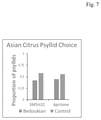
  • FIG. 7 graphically shows test results for repellency of certain test compounds against psyllid settling, in accordance with the Examples.
  • pests such as Hemipteran, Lepidopteran and Coleopteran
  • pests including, but not limited to, Tineola, Sitotroga, Sitophilus, Cydia, Grapholita, Ostrinia, Plodia, Galleria, Manduca, Hyphantria, Lymantria, Agrotis, Trichoplusia, Spodoptera, Helicoverpa, Heliothis, Leptinotarsa, Popillia, Ips, Anthonomus, Cyclas, Crioceris, Oryzaephilus, Oulema, Anoplophora, Stegobium, Agroites, Agrilus, Epilachna, Dermestes, Lygus, Blissus, Euschistus, Nezara, Homalodisca, Circulifer, Typhlocyba, Diaphorina, Bactericera, Bemisia, Trialeurodes, Myzus, Aphis, Macros
  • R is selected from —OH, ⁇ O, —OC(O)R 4 , —OR 6 , and —(OR 6 ) 2 , wherein each R 6 is independently selected from an alkyl group containing from 1 to 4 carbon atoms and R 4 is a branched or straight chain, saturated or unsaturated hydrocarbyl group with zero to two double bonds and from 1 to 15 carbon atoms;
  • X is O or CH 2 with the proviso that when X is O, R can only be ⁇ O;
  • each Z is independently selected from (CH) and (CH 2 );
  • y is a numeral selected from 1 and 2;
  • R 1 is selected from H or a branched or straight chain, saturated or unsaturated hydrocarbyl group with zero to two double bonds and from 1 to 15 carbon atoms;
  • R 2 is selected from H and a branched or straight chain, saturated or unsaturated hydrocarbyl group with zero to three double bonds and from 1 to 15 carbon atoms;
  • a preferred group of feeding deterrence compounds are those compounds of structure (I) wherein R is selected from —OH and ⁇ O, X is CH 2 , y is 1 or 2, each Z is selected from (CH) and (CH 2 ), the bond between positions 2 and 3 in the ring is a single bond, one of R 1 and R 2 is H or —CH 3 and the other of R 1 and R 2 is a branched or straight chain, saturated or unsaturated hydrocarbyl group containing from 9 to 15 carbon atoms and 0 to 3 double bonds, and R 3 is H.
  • Another preferred group of feeding deterrence compounds are those compounds of structure (I) wherein R is selected from —OH and ⁇ O, more preferably ⁇ O, X is CH 2 , y is 1 or 2, more preferably 1, each Z is selected from (CH) and (CH 2 ), the bond between positions 2 and 3 in the ring is a single or double bond, more preferably a single bond, one of R 1 and R 2 is H and the other of R 1 and R 2 is a branched or straight chain, saturated or unsaturated hydrocarbyl group containing from 9 to 15 carbon atoms and 0 to 3 double bonds, and R is selected from —C(O)OR 5 and —CH 2 C(O)R 8 where R 5 and R 8 are each selected from a straight chain or branched, saturated or unsaturated hydrocarbyl group containing from 1 to 6 carbon atoms, and more preferably 3 to 5 carbon atoms and still more preferably —CH 3 .
  • Another preferred group of feeding deterrence compounds are those compounds of structure (I) wherein R is ⁇ O, X is O, y is 1 or 2, each Z is selected from (CH) and (CH 2 ), the bond between positions 2 and 3 of the rings is a single or double bond, more preferably a single bond, one of R 1 and R 2 is H and the other of R 1 and R 2 is a branched or straight chain, saturated or unsaturated hydrocarbyl group containing from 9 to 15 carbon atoms and 0 to 3 double bonds, and R 3 is selected from —C(O)OR 5 and —CH 2 C(O)R 8 where R 5 and R 7 are each selected from a hydrocarbyl group containing from 1 to 6 carbon atoms, and more preferably 3 to 5 carbon atoms and still more preferably-CH 3 and wherein the total number of carbon atoms in the compounds of structure (I) is from 9 to 20, more preferably from 9 to 14 total carbon atoms.
  • Another preferred group of feeding deterrence compounds are those compounds of structure (I) wherein R is ⁇ O, X is O, y is 1 or 2, each Z is selected from (CH) and (CH 2 ), the bond between positions 2 and 3 in the ring is a single bond, R 1 is a branched or straight chain, saturated or unsaturated alkyl group containing from 5 to 13 carbon atoms, R 2 is H or —CH 3 , R 3 is H, and more preferably where R 1 is an alkyl group of from 5 to 10 carbon atoms such that the compound of structure (I) contains from 11 to 14 total carbon atoms.
  • the active compounds of structure (I) may be employed in any suitable formulation, such as, but not limited to, direct spray formulations, fogger formulations, microencapsulated formulations, soil treatment formulations, seed treatment formulations, injectable formulation for injection into the plant, granular pellets, release devices, clay-based powders, and formulations for use in evaporative devices.
  • the formulations of the active compounds will be such that the areas or materials being treated will have from about 0.05 to about 500 mg/sq. in., preferably about 0.25 to about 50 mg/sq. in., of the active compounds thereon.
  • Representative examples of compounds of structure (I) include, but are not limited to,
  • Preferred compounds of structure (I) include apritone, methyl apritone, methyl dihydrojasmonate, methyl dihydrojasmolate, propyl dihydrojasmonate, gamma-dodecalactone, gamma-tridecalactone, gamma methyl dodecalactone, delta dodecalactone, gamma methyl tridecalactone, 3-methyl-5-propyl-2-cyclohexenone, 3-methyl-5-isobutyl-2-cyclohexenone, 3-methyl-5-isobutyl-2-cyclohexenol, 3-methyl-5-pentyl-2-cyclohexenone, 3-methyl-5-hexyl-2-cyclohexenone, and 3-methyl-5-heptyl-2-cyclohexenone.
  • BMSB brown marmorated stink bugs
  • Each of the 8 treatment groups consisted of 4 replicates of 6 third-instar larvae for each insect (24 larvae per treatment per species). Larvae were provided the treated and untreated artificial diet for 24 h. Following the exposure period, the total weight of treated or untreated artificial diet consumed was recorded to the nearest milligram and subtracted from the total weight of each artificial diet at the start of the experiments.
  • Statistical analysis of differences in artificial diet consumption based on treatment was conducted using a one-way analysis of variance and Dunnett's multiple comparison test. All calculations and statistical analysis were conducted using GraphPad Prism 8 at a significance level (a) of 0.05.
  • Behavioral assays were conducted within an arena consisting of a 20 ⁇ 20 ⁇ 20 cm mesh cage. The cage borders were covered by non-reflective white screen to remove any potential visual cues. A single light was disposed above the arena. With a luxmeter, the luminosity was checked and it did not vary significantly in the different portions of the arena. Two plants (either a citrus branches or potted tomato) were placed 15 cm apart on each end of the arena. The experimental insects (whiteflies, Asian citrus psyllid or winged aphids) were collected by a mouth aspirator in a plastic vial. The vial was placed in the center of the arena at equal distance from each experimental plant. The vial was open and the insects were allowed to select the plant for 24 hours. After 24 hours, the insects were counted on each plant by the experimenter.
  • Potato plants are sprayed with either a 3% solution of repellent chemical in a 5%:95% ETOH:Water or only 5%:95% ETOH:Water as a control.
  • Two plants are placed in a screen cage, either a treatment vs control tree or a control vs control tree, 100 psyllids are released into each cage. The number of psyllids choosing each leaf is counted for both choice tests. The number of psyllids choosing each treatment is compared to the control to determine if there is a repellent effect. The results are set forth in Table 6.
  • Citrus seedlings are sprayed with either a 3% solution of repellent chemical in a 5%:95% ETOH:Water or only 5%:95% ETOH:Water as a control.
  • Two seedlings are placed in a screen cage, either a treatment vs control tree or a control vs control tree. 100 sharpshooters are released into each cage. The number of sharpshooters choosing each leaf is counted for both choice tests. The number of sharpshooters choosing each treatment is compared to the control to determine if there is a repellent effect. The results are set forth in Table 7.
  • the selective antifeeding rate (%) formula is [(C ⁇ T)/(C+T)] ⁇ 100
  • the non-selective antifeeding rate (%) formula is [(C ⁇ T)/C)] ⁇ 100, where C and T are the numbers of feeding damages on the control and treated plant pods, respectively.
  • the results are set forth in Table 8.
  • 3% alcohol solutions of the tested compounds are prepared. Disks (4.0 cm in diameter) are cut from potato leaves and are dipped in the test solutions or alcohol alone as a control. After the complete evaporation of the solvent, the disks are offered to 10 larvae. Control and treated disks are placed at alternate corners in Petri dishes (150 by 20 mm) lined with moistened filter paper (choice test). All dishes are placed in an incubator. Four replicates and 40 larva are used for each chemical. In each replicate, the insects are allowed to feed ad libitum for 24 h at 24 C under a 16:8 (L:D) photoperiod. After 24 h, the remaining uneaten area of each potato leaf disk is measured using a scanner and software.
  • the selective antifeeding rate (%) formula is [(C ⁇ T)/(C+T)] ⁇ 100
  • the non-selective antifeeding rate (%) formula is [(C ⁇ T)/C)] ⁇ 100, where C and T are the areas consumed by the control and treated leaf disks, respectively.
  • the results are set forth in Table 9.
  • the feeding deterrent compounds of this disclosure may be blended with active repellents or toxicants including, but not limited to, N,N-Diethyl-m-toluamide (DEET®) and p-Menthane-3,8-diol (PMD).
  • active repellents or toxicants including, but not limited to, N,N-Diethyl-m-toluamide (DEET®) and p-Menthane-3,8-diol (PMD).

Landscapes

  • Life Sciences & Earth Sciences (AREA)
  • Dentistry (AREA)
  • Plant Pathology (AREA)
  • Health & Medical Sciences (AREA)
  • Engineering & Computer Science (AREA)
  • Agronomy & Crop Science (AREA)
  • General Health & Medical Sciences (AREA)
  • Wood Science & Technology (AREA)
  • Zoology (AREA)
  • Environmental Sciences (AREA)
  • Pest Control & Pesticides (AREA)
  • Insects & Arthropods (AREA)
  • Agricultural Chemicals And Associated Chemicals (AREA)
  • Catching Or Destruction (AREA)

Abstract

Compounds are used as agents that deter feeding by insect pests, such as Hemiptera, Lepidoptera and Coleoptera. Feeding deterrence is obtained by contact of the insect pests with at least one of the compounds of the structure (I)wherein R is —OH, ═O, —OC(O)R4, —OR6, or —(OR6)2, each R6 is independently an alkyl group containing from 1 to 4 carbon atoms and R4 is a branched or straight chain, saturated or unsaturated, hydrocarbyl group with zero to two double bonds and from 1 to 15 carbon atoms; X is O or CH2 with the proviso that when X is O, R can only be ═O; each Z is independently (CH) or (CH2); y is a numeral selected from 1 and 2; R1 is H or a branched or straight chain, saturated or unsaturated hydrocarbyl group with zero to two double bonds and from 1 to 15 carbon atoms; R2 is H or a branched or straight chain, saturated or unsaturated hydrocarbyl group with zero to three double bonds and from 1 to 15 carbon atoms; R3 is selected from H, a branched or straight chain, saturated or unsaturated hydrocarbyl group with zero to three double bonds and from 1 to 15 carbon atoms, —(CH2)nOH, —C(O)OR5, —CH2C(O)OR7, —CH2C(O)R8, —C(O)NR9R10, and —CH2C(O)NR11R12 where each of R5, R7, R8, R9, R10, R11 and R12 is independently selected from H and a branched or straight chain, saturated or unsaturated hydrocarbyl group with zero to three double bonds and from 1 to 15 carbon atoms and n is an integer of from 1 to 12; the bond between the 2 and 3 positions in the ring structure may be a single or a double bond; and wherein the compounds of structure (I) contain from 9 to 20 total carbon atoms in the compounds.

Description

CROSS-REFERENCED APPLICATIONS
This application is a continuation-in-part of U.S. patent application Ser. No. 16/131,412, filed Sep. 14, 2018, which is a continuation of U.S. patent application Ser. No. 14/390,826, filed Oct. 6, 2014, which claims priority to international application PCT/US13/00120, filed Apr. 30, 2013, and U.S. Application Ser. No. 61/687,920, filed May 2, 2012, all of which are incorporated herein by reference.
BACKGROUND 1. Field of the Disclosure
This disclosure relates to the use of compounds as agents that deter feeding by pest arthropods such as Hemiptera, Lepidoptera and Coleoptera including, but not limited to, insect pests of the following genera: Tineola, Sitotroga, Sitophilus, Cydia, Grapholita, Ostrinia, Plodia, Galleria, Manduca, Hyphantria, Lymantria, Agrotis, Trichoplusia, Spodoptera, Helicoverpa, Heliothis, Leptinotarsa, Popillia, Anthonomus, Crioceris, Oryzaephilus, Oulema, Stegobium, Agroites, Epilachna, Dermestes, Lygus, Blissus, Euschistus, Nezara, Homalodisca, Circulifer, Typhlocyba, Diaphorina, Bactericera, Bemisia, Trialeurodes, Myzus, Aphis, Macrosiphum, Eriosoma, and Dysaphis.
2. Discussion of the Background Art
Lepidopteran, Coleopteran, and Hemipteran pests, including the genera: Tineola, Sitotroga, Sitophilus, Cydia, Grapholita, Ostrinia, Plodia, Galleria, Manduca, Hyphantria, Lymantria, Agrotis, Trichoplusia, Spodoptera, Helicoverpa, Heliothis, Leptinotarsa, Popillia, Anthonomus, Crioceris, Oryzaephilus, Oulema, Stegobium, Agroites, Epilachna, Dermestes, Lygus, Blissus, Euschistus, Nezara, Homalodisca, Circulifer, Typhlocyba, Diaphorina, Bactericera, Bemisia, Trialeurodes, Myzus, Aphis, Macrosiphum, Eriosoma, Dysaphis, are known to feed on various products of importance to humans. These products can include, for example, crops, forest trees and plants, ornamental plants, turf, and garden plants, or these products may be processed from plant or animal-based materials, such as seeds, processed grains, fibers, or woven fibers. Pest arthropods may damage these products at any stage of the product life, from in the field where they damage the leaves, stem, bark, or flowers of intact plants, to post harvest transport, storage or processing. The cost of this damage is extensive and leads to hardship among growers, manufacturers, warehouse managers, and to consumers.
Hemipteran pests include stink bugs, true bugs, aphids, whiteflies, psyllids, and others. In the Mid-Atlantic region, where brown marmorated stink bugs are well established, they caused an estimated $37 million in damage in apple crops alone in 2010, the most recent year for which data are available. [Darryl Fears, “Stink bugs migrating to deep south”, Washington Post, Mar. 16, 2012]. Aside from apples, the bug will feed on nearly anything, including cherries, tomatoes, grapes, lima beans, soybeans, green peppers and peaches. Like brown marmorated stink bugs, Euchistus spp. and Nezara spp., bugs are significant pests of agricultural crops, notably cowpea, cotton, and soybean, are capable of significantly damaging these crops in tropical and subtropical regions. Aphids, including, but not limited to the genera Myzus, Aphis, Macrosiphum, Eriosoma, Dysaphis, can multiply rapidly through parthenogenesis where a single female foundress can produce hundreds of offspring. They are often cryptic pests, which are hard to detect, and vector several serious plant viruses, like barley yellow dwarf virus, cucumber mosaic virus, and potato virus. In addition to vectoring viruses to plants, the aphids also excrete honeydew a sugar-rich waste product, which promotes the growth of opportunistic fungi, like mildews. Similarly, whiteflies and psyllids are both serious pests of agriculture, both capable of transmitting viruses and bacterial pathogens. Whiteflies including the genera Bemisia, and Trialeurodes, are particularly damaging to tomatoes and greenhouse plants. Psyllids, including the genera Diaphorina, and Bactericera, can significantly affect agricultural crops. Such pests include the Asian citrus psyllid, a serious threat to the citrus industry because these insects vector causal agent of greening disease. This disease causes the trees to become unproductive, produce off-flavor fruit, and die prematurely.
Lepidopteran pests are often serious pests in crops, turf, ornamentals, stored products, fibers and even in beeswax production. The clothes moth, Tineola spp. is a major pest of wool and other natural fibers. The clothes moth can cause damage to products made from wool or other natural fibers, such as clothing, carpets, furniture, animal-hair bristles, and animal-fur clothing. In addition, this pest can also infest stored grains. Other serious Lepidopteran pests of stored grains and other processed food products include Indian meal moth and Angoumois grain moth.
Several lepidopteran pests pose serious threats to agricultural production, including species of the genera Cydia, Grapholita, Ostrinia, Manduca, Hyphantria, Lymantria, Agrotis, Trichoplusia, Spodoptera, Helicoverpa, and Heliothis. All of these juvenile insects feed on the plant tissues, potentially including stems, leaves and fruits, which cause direct and indirect crop losses in agricultural production or in gardening. Ostrinia, Helicoverpa, Heliothis, Agrotis and Spodoptera genera include the most serious Lepidopteran pest species of corn and other row crops. Species in the genera of Hyphantria, and Lymantria are the most serious Lepidopteran forest pests, often defoliated their host trees from feeding on the leaves during period of outbreak. Manduca spp. are specialist herbivores of Solanaceous plants, which include agriculturally important crops like tomato, eggplant, tobacco, peppers, and potato. Trichoplusia sp. are specialists, and these larva attach commercially important crops like cabbage and other brassica crops. Codling moth larvae penetrate into apples, pears, and nut crops and tunnel to the core, leaving holes in the fruit or nut that are filled with reddish-brown, crumbly droppings. If left uncontrolled, larvae can cause substantial damage, often infesting 20 to 90% of the fruit, depending on the variety and location. Late maturing varieties are more likely to suffer severe damage than early varieties. [J. L. Caprile and P. M. Vossen, Pest Notes: Codling Moth UC ANR Publication 7412, May 2011.
Phosmet, a phthalimide-derived, non-systemic, organophosphate insecticide is the primary means of controlling codling moth damage to apples. This material is on the U.S. Emergency Planning list of extremely hazardous substances and is highly toxic to bees. The materials covered in this disclosure would be a much gentler means of deterring the larvae and controlling moth infestation.
Coleopteran pests are beetles that can attack crops, stored products, and animal products. Dermestes beetles are a significant pest of dry-preserved animal collections, such as taxidermy or insect collections. Dermestes beetles consume the remaining flesh, hair, horn, ligaments, and other soft tissues. Toxic fumigants such as mothballs are typically used to control infestations. However, the active ingredient in mothballs is volatile, resulting in ineffectiveness and increased exposure to people who work or live in proximity to the application. Around food, mothballs are unacceptable, such as the case with Granary weevils, including Oryzaephilus spp. Stegobium spp., and Sitophilus spp. These beetles are attracted to and will attack all kinds of grains and grain products. These products will include such materials as wheat, corn, barley, or rice. In stored food products, they may be found in materials like macaroni or spaghetti. Adult weevils will feed on the same foods as the larvae. However, because they do not need to develop in the inside of whole grains like larvae do, they are not limited to just one grain or in other words, they are not restricted in their diets. [http://www.pestmall.com/blog/pest-info/other-pestsigranary-weevil-biology]
Some beetle pests attack hundreds of host plants, including crops, ornamentals, and garden plants, such as the case of pests like the Japanese beetle, a species of Popillia. The Japanese beetle is a serious pest in the North Eastern United States where it will swarm mid-summer, often defoliated plants with a characteristic pattern of holes in the leaves. Another beetle species, the Colorado potato beetle, in the genus Leptinotarsa, is a serious pest of tomato, potato, and egg plant where both the adult and larva will feed on the leaves, reducing the productivity of the plants. Leaf beetles, including Crioceris, Oulema, and Epilachna feed on the seeds of their respective host plants. These insects are pests of grains, asparagus, and beans respectively, reducing yield from these crops. Similarly, Anthonomus species, most notably boll weevil and strawberry weevil feed on the reproductive parts of the plants (e.g., cotton and strawberry, respectively), reducing the yields of these important crops.
Control of beetles is quite difficult as they live and breed in our food sources. Use of pyrethrins is an option, but food shouldn't be sprayed directly. Use of our materials may be sprayed directly on crops, seeds, agricultural or ornamental trees, plants, vegetation, produce or packaging materials so they provide a better alternative to traditional insecticides.
SUMMARY
In accordance with this disclosure, feeding deterrence by pests such as Hemipteran, Lepidopteran and Coleopteran, and other pests, is obtained by contact of the pests with at least one of the compounds of the structure (I)
Figure US11224223-20220118-C00002

wherein:
R is selected from —OH, ═O, —OC(O)R4, —OR6, and —(OR6)2, wherein each R6 is independently selected from an alkyl group containing from 1 to 4 carbon atoms and R4 is a branched or straight chain, saturated or unsaturated, hydrocarbyl group with zero to two double bonds and from 1 to 15 carbon atoms;
X is O or CH2 with the proviso that when X is O, R can only be ═O;
each Z is independently selected from (CH) and (CH2);
y is a numeral selected from 1 and 2;
R1 is selected from H or a branched or straight chain, saturated or unsaturated hydrocarbyl group with zero to two double bonds and from 1 to 15 carbon atoms;
R2 is selected from H and a branched or straight chain, saturated or unsaturated hydrocarbyl group with zero to three double bonds and from 1 to 15 carbon atoms;
R3 is selected from H, a branched or straight chain, saturated or unsaturated hydrocarbyl group with zero to three double bonds and from 1 to 15 carbon atoms, —(CH2)nOH, —C(O)OR5, —CH2C(O)OR7, —CH2C(O)R8, —C(O)NR9R10, and —CH2C(O)NR11R12 where each of R5, R7, R8, R9, R10, R11 and R12 is independently selected from H and a branched or straight chain, saturated or unsaturated hydrocarbyl group with zero to three double bonds and from 1 to 15 carbon atoms and n is an integer of from 1 to 12;
the bond between the 2 and 3 positions in the ring structure may be a single or a double bond; and
wherein the compounds of structure (I) contain from 9 to 20 total carbon atoms in the compounds. The disclosure also includes optical isomers, diastereomers and enantiomers of the compounds of structure (I). Thus, at all stereocenters where stereochemistry is not explicitly defined, all possible epimers are envisioned.
The active feeding deterrence agents of this disclosure are an effective control agent against pests such as Hemiptera, Lepidoptera and Coleoptera. Hemiptera, sometimes differentiated into Heteroptera and homoptera, includes Lygus, Blissus, Euschistus, Nezara, Homalodisca, Circulifer, Typhlocyba, Diaphorina, Bactericera, Bemisia, Trialeurodes, Myzus, Aphis, Macrosiphum, Eriosoma, Dysaphis, and other genera. Lepidoptera includes butterflies and moths such as Tineola, Sitotroga, Cydia, Grapholita, Ostrinia, Plodia, Galleria, Manduca, Hyphantria, Lymantria, Agrotis, Trichoplusia, Spodoptera, Helicoverpa, Heliothis, and other genera. Coleoptera are beetles and the order contains Leptinotarsa, Sitophilus, Popillia, Anthonomus, Crioceris, Oryzaephilus, Oulema, Stegobium, Agroites, Epilachna, Dermestes, and other genera.
The feeding deterrence compounds of this disclosure, which could be applied directly to crops, seeds, agricultural or ornamental trees, plants, vegetation, produce or packaging materials for crops, or stored grains or fibers, have low mammalian toxicity and are similar to naturally occurring materials used in flavor/fragrance applications. Therefore, these provide a better method of control for farmers, manufacturers, transporters, storage facilities, and home owners. Additionally, the feeding deterrence compounds of this disclosure have the potential to be used on organic crops.
The compounds of structure (I) may be employed to deter feeding by pests, such as Hemipteran, Lepidopteran and Coleopteran, and other pests, which include, but are not limited to, Tineola, Sitotroga, Sitophilus, Cydia, Grapholita, Ostrinia, Plodia, Galleria, Manduca, Hyphantria, Lymantria, Agrotis, Trichoplusia, Spodoptera, Helicoverpa, Heliothis, Leptinotarsa, Popillia, Anthonomus, Crioceris, Oryzaephilus, Oulema, Stegobium, Epilachna, Dermestes, Lygus, Blissus, Euschistus, Nezara, Homalodisca, Circulifer, Typhlocyba, Diaphorina, Bactericera, Bemisia, Trialeurodes. Myzus, Aphis, Macrosiphum, Eriosoma, and Dysaphis. The active compounds of structure (I) may be employed in any suitable formulation, such as, but not limited to, direct spray formulations, fogger formulations, microencapsulated formulations, soil treatment formulations, seed treatment formulations, injectable formulations for injection into the plant, granular pellets, release devices, clay-based powders and formulations for use in evaporative devices.
BRIEF DESCRIPTION OF THE DRAWINGS
FIG. 1 graphically shows test results of the effects of certain test compounds on the larval feeding activity of European corn borer (Ostrinia nubialis), in accordance with the Examples.
FIG. 2 graphically shows test results of the effects of certain test compounds on the larval feeding activity of fall armyworm (Spodoptera frugiperda), in accordance with the Examples.
FIG. 3 graphically shows test results of the effects of certain test compounds on the larval feeding activity of black cutworm (Agrotis ipsilon) in accordance with the Examples.
FIG. 4 graphically shows test results for repellency of certain test compounds against whitefly settling, in accordance with the Examples.
FIG. 5 graphically shows test results for repellency of certain test compounds against whitefly settling, in accordance with the Examples.
FIG. 6 graphically shows test results for repellency of certain test compounds against aphid settling, in accordance with the Examples.
FIG. 7 graphically shows test results for repellency of certain test compounds against psyllid settling, in accordance with the Examples.
DETAILED DESCRIPTION OF EMBODIMENTS
Deterrence of feeding by pests, such as Hemipteran, Lepidopteran and Coleopteran, and other pests, including, but not limited to, Tineola, Sitotroga, Sitophilus, Cydia, Grapholita, Ostrinia, Plodia, Galleria, Manduca, Hyphantria, Lymantria, Agrotis, Trichoplusia, Spodoptera, Helicoverpa, Heliothis, Leptinotarsa, Popillia, Ips, Anthonomus, Cyclas, Crioceris, Oryzaephilus, Oulema, Anoplophora, Stegobium, Agroites, Agrilus, Epilachna, Dermestes, Lygus, Blissus, Euschistus, Nezara, Homalodisca, Circulifer, Typhlocyba, Diaphorina, Bactericera, Bemisia, Trialeurodes, Myzus, Aphis, Macrosiphum, Eriosoma, and Dysaphis, is obtained by contact of the pests with at least one of the compounds of the structure (I)
Figure US11224223-20220118-C00003

wherein
R is selected from —OH, ═O, —OC(O)R4, —OR6, and —(OR6)2, wherein each R6 is independently selected from an alkyl group containing from 1 to 4 carbon atoms and R4 is a branched or straight chain, saturated or unsaturated hydrocarbyl group with zero to two double bonds and from 1 to 15 carbon atoms;
X is O or CH2 with the proviso that when X is O, R can only be ═O;
each Z is independently selected from (CH) and (CH2);
y is a numeral selected from 1 and 2;
R1 is selected from H or a branched or straight chain, saturated or unsaturated hydrocarbyl group with zero to two double bonds and from 1 to 15 carbon atoms;
R2 is selected from H and a branched or straight chain, saturated or unsaturated hydrocarbyl group with zero to three double bonds and from 1 to 15 carbon atoms;
R3 is selected from H, a branched or straight chain, saturated or unsaturated hydrocarbyl group with zero to three double bonds and from 1 to 15 carbon atoms —(CH2)uOH, —C(O)OR5, —CH2C(O)OR7, —CH2C(O)R8, —C(O)NR9R10, and —CH2C(O)NR11R12 where each of R5, R7, R8, R9, R10, R11 and R12 is independently selected from H and a branched or straight chain, saturated or unsaturated hydrocarbyl group with zero to three double bonds and from 1 to 15 carbon atoms, and n is n integer of from 1 to 12;
the bond between the 2 and 3 positions in the ring structure may be a single or a double bond; and
wherein the compounds of structure (I) contain from 11 to 20 total carbon atoms in the compounds. The disclosure also includes optical isomers, diastereomers and enantiomers of the named structures. Thus, at all stereocenters where stereochemistry is not explicitly defined, all possible epimers are envisioned.
A preferred group of feeding deterrence compounds are those compounds of structure (I) wherein R is selected from —OH and ═O, X is CH2, y is 1 or 2, each Z is selected from (CH) and (CH2), the bond between positions 2 and 3 in the ring is a single bond, one of R1 and R2 is H or —CH3 and the other of R1 and R2 is a branched or straight chain, saturated or unsaturated hydrocarbyl group containing from 9 to 15 carbon atoms and 0 to 3 double bonds, and R3 is H.
Another preferred group of feeding deterrence compounds are those compounds of structure (I) wherein R is selected from —OH and ═O, more preferably ═O, X is CH2, y is 1 or 2, more preferably 1, each Z is selected from (CH) and (CH2), the bond between positions 2 and 3 in the ring is a single or double bond, more preferably a single bond, one of R1 and R2 is H and the other of R1 and R2 is a branched or straight chain, saturated or unsaturated hydrocarbyl group containing from 9 to 15 carbon atoms and 0 to 3 double bonds, and R is selected from —C(O)OR5 and —CH2C(O)R8 where R5 and R8 are each selected from a straight chain or branched, saturated or unsaturated hydrocarbyl group containing from 1 to 6 carbon atoms, and more preferably 3 to 5 carbon atoms and still more preferably —CH3.
Another preferred group of feeding deterrence compounds are those compounds of structure (I) wherein R is ═O, X is O, y is 1 or 2, each Z is selected from (CH) and (CH2), the bond between positions 2 and 3 of the rings is a single or double bond, more preferably a single bond, one of R1 and R2 is H and the other of R1 and R2 is a branched or straight chain, saturated or unsaturated hydrocarbyl group containing from 9 to 15 carbon atoms and 0 to 3 double bonds, and R3 is selected from —C(O)OR5 and —CH2C(O)R8 where R5 and R7 are each selected from a hydrocarbyl group containing from 1 to 6 carbon atoms, and more preferably 3 to 5 carbon atoms and still more preferably-CH3 and wherein the total number of carbon atoms in the compounds of structure (I) is from 9 to 20, more preferably from 9 to 14 total carbon atoms.
Another preferred group of feeding deterrence compounds are those compounds of structure (I) wherein R is ═O, X is O, y is 1 or 2, each Z is selected from (CH) and (CH2), the bond between positions 2 and 3 in the ring is a single bond, R1 is a branched or straight chain, saturated or unsaturated alkyl group containing from 5 to 13 carbon atoms, R2 is H or —CH3, R3 is H, and more preferably where R1 is an alkyl group of from 5 to 10 carbon atoms such that the compound of structure (I) contains from 11 to 14 total carbon atoms.
The active compounds of structure (I) may be employed in any suitable formulation, such as, but not limited to, direct spray formulations, fogger formulations, microencapsulated formulations, soil treatment formulations, seed treatment formulations, injectable formulation for injection into the plant, granular pellets, release devices, clay-based powders, and formulations for use in evaporative devices. The formulations of the active compounds will be such that the areas or materials being treated will have from about 0.05 to about 500 mg/sq. in., preferably about 0.25 to about 50 mg/sq. in., of the active compounds thereon.
Representative examples of compounds of structure (I) include, but are not limited to,
Figure US11224223-20220118-C00004
Figure US11224223-20220118-C00005
Figure US11224223-20220118-C00006
Figure US11224223-20220118-C00007
Figure US11224223-20220118-C00008
Figure US11224223-20220118-C00009
Figure US11224223-20220118-C00010
Figure US11224223-20220118-C00011
Figure US11224223-20220118-C00012
Preferred compounds of structure (I) include apritone, methyl apritone, methyl dihydrojasmonate, methyl dihydrojasmolate, propyl dihydrojasmonate, gamma-dodecalactone, gamma-tridecalactone, gamma methyl dodecalactone, delta dodecalactone, gamma methyl tridecalactone, 3-methyl-5-propyl-2-cyclohexenone, 3-methyl-5-isobutyl-2-cyclohexenone, 3-methyl-5-isobutyl-2-cyclohexenol, 3-methyl-5-pentyl-2-cyclohexenone, 3-methyl-5-hexyl-2-cyclohexenone, and 3-methyl-5-heptyl-2-cyclohexenone.
A test was designed to measure the repellency as feeding deterrence in brown marmorated stink bugs (BMSB). Five replicates of 5 BMSBs were introduced into test arenas, containing one 60 mm×15 mm Petri dish with treated filter papers in which a food source (green bean) was attached, at the start of the test. The small Petri dishes containing the treated filter paper and food source were covered with a fitted Petri dish lid in between observation times, and were removed 5 minutes before each observation time to prevent stink bugs from feeding until sated. The distribution of the BMSBs was observed and documented hourly for 5 hours. The results are set forth in Table 1.
TABLE 1
Repellency averaged
Compound in a 57% Ethanol:43% water solution over 5 hours
Control (57% Ethanol:43% water solution) 38%
Methyl Dihydrojasmonate (3.5%) 90%
Methyl Dihydrojasmonate - Low epi (2.5%) 58%
Methyl Dihydrojasmonate - High epi (2.5%) 39%
Propyl Dihydrojasmonate (3.5%) 100% 
Propyl Dihydrojasmonate - Low epi (2.5%) 74%
Propyl Dihydrojasmonate - High epi (2.5%) 49%
Para-Menthanediol (3.5%) 91%
Gamma-Dodecalactone (3.5%) 82%
Gamma-Methyl Tridecalactone (3.5%) 67%
Another test was designed to measure the repellency as feeding deterrence in Codling Moth larvae. The treatment was applied to the surface of a proprietary laboratory media in a tray with wells for each compound. The media was allowed to dry for 30-60 minutes so that larvae were not exposed to it as a liquid. One first instar codling moth larva was then placed on the treated media. The cover film was placed on the tray to prevent escapes. Ten additional replicates treated with a 57% ethanol solution were prepared to serve as controls. The larvae were observed at 24 hours to determine if they burrowed into the media. After the 24 hour reading, the larvae were extracted from the media to record any mortality. The results are set forth in Table 2.
TABLE 2
Compound at 3.5% in a 57% Ethanol:43% water Repellency at
solution 24 hours
Control (57% Ethanol:43% water solution)  8%
Para-Menthanediol 10%
Propyl Dihydrojasmonate 59%
Prenyl Dihydrojasmonate 79%
Gamma-Dodecalactone 46%
Methyl Apritone
100% 
3-Methyl-5-Propyl-2-Cyclohexenone 21%
3-Methyl-5-Propyl-2-Cyclohexenol 30%
3-Methyl-5-Heptyl-2-Cyclohexenone 95%
Mortality observations were also made for the above protocol. The control was the 57% ethanol:43% water solution. The results are set forth in Table 3.
TABLE 3
Increased Mortality
Compound at 3.5% in a 57% Ethanol:43% water over Control Mortality
solution at 24 hours
Para-Menthanediol  3%
Propyl Dihydrojasmonate 18%
Prenyl Dihydrojasmonate 34%
Gamma-Dodecalactone 37%
Methyl Apritone 95%
3-Methyl-5-Propyl-2-Cyclohexenone  1%
3-Methyl-5-Propyl-2-Cyclohexenol  9%
3-Methyl-5-Heptyl-2-Cyclohexenone 93%
Ten replicates of 30 kernels of wheat were immersed into the test compound and allowed to dry for 24 hours. The grains were then transferred to a test container, and 10 granary weevils were released. Test containers were secured and left for a 3 week period. At the end of this time, the wheat grains were examined for developing larvae and damage by larvae. The number of grains that contained developing larvae or that showed damage was recorded. Ten additional replicates treated with isopropyl alcohol were prepared to serve as controls. The results are set forth in Table 4.
TABLE 4
Increased Increased
Repellency Mortality
Test compound, diluted in isopropyl vs. Control over Control
alcohol Repellency Mortality
Methyl Apritone (5%) 11% N/A
Propyl Dihydrojasmonate (5%)  8% N/A
Gamma Tridecalactone (5%) 40% N/A
3-Methyl-5-Propyl-2-Cyclohexenone (5%) 66% 57%
3-Methyl-5-Isobutyl-2-Cyclohexenol (5%) 86% 93%

Effects of Formulations of this Disclosure (BRI) on the Feeding Activity of Agricultural Pest Insects
The effects of celery ketone (3ME5HCS), BRIMIX (PBRMIX01), high delta (KDBRIMIX), delta dodecalactone (463), methyl dihydro jasmolate (MDJSMLT), propyl dihydro jasmonate (PRPYLDJ), and apritone (499) on the larval feeding activity of European corn borer (Ostrinia mibialis), fall armyworm (Spodoptera frugiperda), and black cutworm (Agrotis ipsilon) was examined by exposing the larvae to an artificial diet treated (100% solution undiluted), or untreated (control), with the BRI formulations. Each of the 8 treatment groups consisted of 4 replicates of 6 third-instar larvae for each insect (24 larvae per treatment per species). Larvae were provided the treated and untreated artificial diet for 24 h. Following the exposure period, the total weight of treated or untreated artificial diet consumed was recorded to the nearest milligram and subtracted from the total weight of each artificial diet at the start of the experiments. Statistical analysis of differences in artificial diet consumption based on treatment was conducted using a one-way analysis of variance and Dunnett's multiple comparison test. All calculations and statistical analysis were conducted using GraphPad Prism 8 at a significance level (a) of 0.05.
Bars represent mean diet consumed (%)±standard deviation (n=4). Asterisks indicate a significant difference between the formulation treatment and the respective untreated control based on a one-way analysis of variance and Dunnett's multiple comparison test where P<0.05 was considered significant.
Test results showing the effects of celery ketone (3ME5HCX), BRIMIX (PBRMIX01), high delta (KDBRIMIX), delta dodecalactone (463), methyl dihydro jasmolate (MDJSMLT), propyl dihydro jasmonate (PRPYLDJ), and apritone (499) on the larval feeding activity of European corn borer (Ostrinia nubialis) are graphically shown in FIG. 1.
Test results showing the effects of celery ketone (3ME5HCX), BRIMIX (PBRMIX01), high delta (KDBRIMIX), delta dodecalactone (463), methyl dihydro jasmolate (MDJSMLT), propyl dihydro jasmonate (PRPYLDJ), and apritone (499) on the larval feeding activity of fall armyworm (Spodoptera frugiperda) are graphically shown in FIG. 2.
Test results showing the effects of celery ketone (3ME5HCX), BRIMIX (PBRMIX01), high delta (KDBRIMIX), delta dodecalactone (463), methyl dihydro jasmolate (MDJSMLT), propyl dihydro jasmonate (PRPYLDJ), and apritone (499) on the larval feeding activity of black cutworm (Agrotis ipsilon) are graphically shown in FIG. 3.
Behavioral assays were conducted within an arena consisting of a 20×20×20 cm mesh cage. The cage borders were covered by non-reflective white screen to remove any potential visual cues. A single light was disposed above the arena. With a luxmeter, the luminosity was checked and it did not vary significantly in the different portions of the arena. Two plants (either a citrus branches or potted tomato) were placed 15 cm apart on each end of the arena. The experimental insects (whiteflies, Asian citrus psyllid or winged aphids) were collected by a mouth aspirator in a plastic vial. The vial was placed in the center of the arena at equal distance from each experimental plant. The vial was open and the insects were allowed to select the plant for 24 hours. After 24 hours, the insects were counted on each plant by the experimenter.
Repellency of Test Compounds Against Whitefly Settling
Forty whiteflies were placed in an arena with two tomato plants. Whitefly were allowed to choose between a tomato plant sprayed with a solution of 1% repellent chemical+tween 20 (1:1 ratio) in distilled water, and a control plant sprayed with of a solution of 1% tween 20 only. The results are graphically shown in FIG. 4.
Forty whiteflies were placed in an arena with two tomato plants. Whiteflies were allowed to choose between a tomato plant treated with 0.5% repellent chemical in a carrier of kaolin clay. (3M5H2C=3-methyl-5-hexyl-2-cyclohexanone, DDL=delta dodecalactone, MDJ=Methyl dihydrojasmonate, Apritone=Apritone, Mix=mixture of delta dodecalactone, methyl dihydrojasmolate, propyl dihydrojasmonate). The results are graphically shown in FIG. 5.
Repellency of Test Compounds Against Aphid Settling
Forty aphids were placed in an arena with two tomato plants. The aphids were allowed to choose between a tomato plant sprayed with a solution of 1% repellent chemical+tween 20 (1:1 ratio) in distilled water, and a control plant sprayed with of a solution of 1% tween 20 only. (3M5H2C=3-methyl-5-hexyl-2-cyclohexanone, DDL=delta dodecalactone, Apritone=Apritone, Mix=mixture of delta dodecalactone, methyl dihydrojasmolate, propyl dihydrojasmonate). The results are graphically shown in FIG. 6.
Repellency of Test Compounds Against Psyllid Settling
Forty Asian citrus psyllids were placed in an arena with two citrus cuttings. The psyllid were allowed to choose between a citrus cutting sprayed with a solution of 1% repellent chemical+tween 20 (1:1 ratio) in distilled water, and a control cutting sprayed with of a solution of 1% tween 20 only. (3M5H2C=3-methyl-5-hexyl-2-cyclohexanone, Apritone=Apritone). The results are graphically shown in FIG. 7.
Melon Aphid Repellency on Leaf Choice Assays
Aphis gossypii are maintained on squash plants. Individual aphids (n=100) are given the choice between leaves with and without repellent treatments. A separate group of aphids are given a choice between untreated vs. untreated leaves as a control. The number of aphids choosing each leaf is counted both choice tests. The number of aphids choosing each treatment is compared to the control to determine the repellent effect. The results are set forth in Table 5.
TABLE 5
Number of Aphids
Treatments vs Control Choosing each Treatment
3% Compound in a Triton X:Water solution Untreated Treated
Control (Triton X:water solution) 50 50
Apritone 70 30
Methyl Apritone 70 30
Apritol 70 30
Methyl dihydrojasmolate 70 30
Methyl dihydrojasmonate 70 30
Propyl dihydrojasmonate 70 30
3-methyl-5-hexyl-2-cyclohexanone 70 30
Gamma Tridecalactone 80 20
Delta-dodecalactone 80 20

Psyllid Repellency on Potato Choice Assays
Potato plants are sprayed with either a 3% solution of repellent chemical in a 5%:95% ETOH:Water or only 5%:95% ETOH:Water as a control. Two plants are placed in a screen cage, either a treatment vs control tree or a control vs control tree, 100 psyllids are released into each cage. The number of psyllids choosing each leaf is counted for both choice tests. The number of psyllids choosing each treatment is compared to the control to determine if there is a repellent effect. The results are set forth in Table 6.
TABLE 6
Number of Psyllids
Treatments vs Control Choosing each Treatment
3% Compound in a Triton X:Water solution Untreated Treated
Control (Triton X:water solution) 50 50
Apritone 70 30
Methyl Apritone 70 30
Apritol 70 30
Methyl dihydrojasmolate 70 30
Methyl dihydrojasmonate 70 30
Propyl dihydrojasmonate 70 30
3-methyl-5-hexyl-2-cyclohexanone 70 30
Gamma Tridecalactone 80 20
Delta-dodecalactone 80 20

Leafhopper Repellency on Citrus Choice Assays
Citrus seedlings are sprayed with either a 3% solution of repellent chemical in a 5%:95% ETOH:Water or only 5%:95% ETOH:Water as a control. Two seedlings are placed in a screen cage, either a treatment vs control tree or a control vs control tree. 100 sharpshooters are released into each cage. The number of sharpshooters choosing each leaf is counted for both choice tests. The number of sharpshooters choosing each treatment is compared to the control to determine if there is a repellent effect. The results are set forth in Table 7.
TABLE 7
Number of Psyllids
Treatments vs Control Choosing each Treatment
3% Compound in a Triton X:Water solution Untreated Treated
Control (Triton X:water solution) 50 50
Apritone 70 30
Methyl Apritone 70 30
Apritol 70 30
Methyl dihydrojasmolate 70 30
Methyl dihydrojasmonate 70 30
Propyl dihydrojasmonate 70 30
3-methyl-5-hexyl-2-cyclohexanone 70 30
Gamma Tridecalactone 80 20
Delta-dodecalactone 80 20
To compare the feeding/resting preference of stink bug adults for different plant parts, 10 pots with soybean plants at the R6 (pod-filling) stage of development are used. 5 pots of soybeans are sprayed with 3% of treatment in a 2% Triton X:water solution and 5 pots of soybean are treated with 2% Triton X:water solution as controls. Thirty stink bugs are placed individually in each cage and allowed to feed for 48 hours. Insects are removed and plant parts are collected for visual analysis of damage. Feeding damage on the pods is counted for both treatments. The selective antifeeding rate (%) formula is [(C−T)/(C+T)]×100, and the non-selective antifeeding rate (%) formula is [(C−T)/C)]×100, where C and T are the numbers of feeding damages on the control and treated plant pods, respectively. The results are set forth in Table 8.
TABLE 8
Euschistus heros-Neotropical Brown Stink Bugs
% Antifeedent
3% Compound in a 5% Ethanol:95% water solution Activity
Control (Triton X:water solution) 0
Apritone 60
Methyl Apritone 60
Apritol 60
Methyl dihydrojasmolate 90
Methyl dihydrojasmonate 90
Propyl dihydrojasmonate 100
3-methyl-5-hexyl-2-cyclohexanone 60
Gamma Tridecalactone 80
Delta-dodecalactone 80
For choice feeding assays, 3% alcohol solutions of the tested compounds are prepared. Disks (4.0 cm in diameter) are cut from potato leaves and are dipped in the test solutions or alcohol alone as a control. After the complete evaporation of the solvent, the disks are offered to 10 larvae. Control and treated disks are placed at alternate corners in Petri dishes (150 by 20 mm) lined with moistened filter paper (choice test). All dishes are placed in an incubator. Four replicates and 40 larva are used for each chemical. In each replicate, the insects are allowed to feed ad libitum for 24 h at 24 C under a 16:8 (L:D) photoperiod. After 24 h, the remaining uneaten area of each potato leaf disk is measured using a scanner and software. The selective antifeeding rate (%) formula is [(C−T)/(C+T)]×100, and the non-selective antifeeding rate (%) formula is [(C−T)/C)]×100, where C and T are the areas consumed by the control and treated leaf disks, respectively. The results are set forth in Table 9.
TABLE 9
Leptinotarsa decemlineata-Colorado Potatoe Beetles
3% Compound in a 5% Ethanol:95% water solution % Repellency
Control (Triton X:water solution) 0
Apritone 15
Methyl Apritone 15
Apritol 15
Methyl dihydrojasmolate 15
Methyl dihydrojasmonate 15
Propyl dihydrojasmonate 15
3-methyl-5-hexyl-2-cyclohexanone 80
Gamma Tridecalactone 40
Delta-dodecalactone 40

Japanese Beetle Feeding Damage on Basil
For choice feeding assays, 3% alcohol solutions of the tested compounds are prepared. Disks (4.0 cm in diameter) are cut from basil leaves and are dipped in the test solutions or alcohol alone as a control. After the complete evaporation of the solvent, the disks are offered to 1 adult beetle. All dishes are placed in an incubator. Four replicates are used for each chemical. After 24 h, the remaining uneaten area of each basil leaf disk is measured using a scanner and software. The selective antifeeding rate (%) formula is [(C−T)/(C+T)]×100, and the non-selective antifeeding rate (%) formula is [(C−T)/C)]×100, where C and T are the areas consumed by the control and treated leaf disks, respectively. The results are set forth in Table 10.
TABLE 10
Popillia japonica
3% Compound in a 5% Ethanol:95% water solution % Repellency
Control (Triton X:water solution) 0
Apritone 15
Methyl Apritone 15
Apritol 15
Methyl dihydrojasmolate 15
Methyl dihydrojasmonate 15
Propyl dihydrojasmonate 15
3-methyl-5-hexyl-2-cyclohexanone 80
Gamma Tridecalactone 40
Delta-dodecalactone 40

Dermestid Beetle Feeding Damage on Silk Fabric
For feeding assays, 3% alcohol solutions of the tested compounds are prepared. Disks (4.0 cm in diameter) of undyed silk fabric are dipped in the test solutions or alcohol alone as a control. After the complete evaporation of the solvent, the disks are offered to 10 late instar larvae. All dishes are placed in an incubator. Four replicates are used for each chemical. After 1 week, the remaining uneaten area of each silk disk is measured using a scanner and software. The selective antifeeding rate (%) formula is [(C−T)/(C+T)]×100, and the non-selective antifeeding rate (%) formula is [(C−T)/C)]×100, where C and T are the areas consumed by the control and treated silk disks, respectively. The results are set forth in Table 11.
TABLE 11
Dermestid spp.
3% Compound in a 5% Ethanol:95% water solution % Repellency
Control (Triton X:water solution) 0
Apritone 15
Methyl Apritone 15
Apritol 15
Methyl dihydrojasmolate 15
Methyl dihydrojasmonate 15
Propyl dihydrojasmonate 15
3-methyl-5-hexyl-2-cyclohexanone 80
Gamma Tridecalactone 40
Delta-dodecalactone 40
Ten replicates of 30 kernels of corn are immersed into the test compound and allowed to dry for 24 hours. The kernels are then transferred to a test container, and 10 saw tooth grain beetles are released. Test containers are secured and left for a 3 week period. At the end of this time, the wheat grains are examined for feeding damage. The number of grains that showed damage is recorded. Ten additional replicates treated with isopropyl alcohol are prepared to serve as controls. The results are set forth in Table 12.
TABLE 12
Repellency of Test Compounds on Grain Beetles
Increased Repellency
Test compound, diluted in isopropyl alcohol vs. Control Repellency
Methyl Apritone (5%) 10%
Propyl Dihydrojasmonate (5%) 10%
Gamma Tridecalactone (5%) 40%
3-Methyl-5-Propyl-2-Cyclohexenone (5%) 60%
3-Methyl-5-Isobutyl-2-Cyclohexenol (5%) 85%
For feeding assays, 3% alcohol solutions of the tested compounds are prepared. Disks (2.0 cm in diameter) of undyed silk fabric are dipped in the test solutions or alcohol alone as a control. After the complete evaporation of the solvent, the disks are presented in a choice test to 10 late instar Tineola spp. larvae. All dishes are placed in an incubator in the dark. Four replicates are used for each chemical. After 24 hours, the number of individuals choosing to feed on each disk are counted. The results are set forth in Table 13.
TABLE 13
Clothes Moth Feeding Damage on Silk Fabric
Tineola spp.
3% Compound in a 5% Ethanol:95% water
solution Untreated Treated
Control (Triton X:water solution) 50 50
Apritone 80 20
Methyl Apritone 80 20
Apritol 80 20
Methyl dihydrojasmolate 80 20
Methyl dihydrojasmonate 80 20
Propyl dihydrojasmonate 80 20
3-methyl-5-hexyl-2-cyclohexanone 80 20
Gamma Tridecalactone 90 10
Delta-dodecalactone 90 10

Feeding Repellent Assay for Indian Meal Moth Larva
One gram of rice is weighed and treated with 2% by weight of each test chemical or ethanol as a control for each treatment and replicate. The grains are allowed to dry and then weighed again. Treated or control rice grains are placed in a petri dish. Third instar larvae are starved for 8 h and gently introduced into the center of each compartment. 20 larva are screened per treatment, and each experiment is repeated three times. The weight of rice grains is measured again after 1 week. The selective antifeeding rate (%) formula is [(C−T)/(C+T)]×100, and the non-selective antifeeding rate (%) formula is [(C−T)/C)]×100, where C and T are the areas consumed by the control and treated leaf disks, respectively. The results are set forth in Table 14.
TABLE 14
Plodia interpunctella
% Antifeedent
10% Compound in a 5% Ethanol:95% water solution Activity
Control (Triton X:water solution) 0
Apritone 70
Methyl Apritone 70
Apritol 70
Methyl dihydrojasmolate 60
Methyl dihydrojasmonate 60
Propyl dihydrojasmonate 60
3-methyl-5-hexyl-2-cyclohexanone 60
Gamma Tridecalactone 70
Delta-dodecalactone 70

Feeding Repellent Assay for Angoumois Larva
One gram of rice is weighed and treated with 2% by weight of each test chemical or ethanol as a control for each treatment and replicate. The grains are allowed to dry and then weighed again. Treated or control rice grains are placed in a petri dish. Third instar larvae are starved for 8 h and gently introduced into the center of each compartment. 20 larva are screened per treatment, and each experiment is repeated three times. The weight of rice grains is measured again after 1 week. The selective antifeeding rate (%) formula is [(C−T)/(C+T)]×100, and the non-selective antifeeding rate (%) formula is [(C−T)/C)]×100, where C and T are the areas consumed by the control and treated leaf disks, respectively. The results are set forth in Table 15.
TABLE 15
Sitostroga cerealella
% Antifeedent
10% Compound in a 5% Ethanol:95% water solution Activity
Control (Triton X:water solution) 0
Apritone 70
Methyl Apritone 70
Apritol 70
Methyl dihydrojasmolate 60
Methyl dihydrojasmonate 60
Propyl dihydrojasmonate 60
3-methyl-5-hexyl-2-cyclohexanone 60
Gamma Tridecalactone 70
Delta-dodecalactone 70
The feeding deterrent compounds of this disclosure may be blended with active repellents or toxicants including, but not limited to, N,N-Diethyl-m-toluamide (DEET®) and p-Menthane-3,8-diol (PMD).
While the disclosure has been described herein with reference to the specific embodiments thereof, it will be appreciated that changes, modification and variations can be made without departing from the spirit and scope of the inventive concept disclosed herein. Accordingly, it is intended to embrace all such changes, modification and variations that fall with the spirit and scope of the appended claims.

Claims (20)

I claim:
1. A method for deterring the feeding of one or more insect pests selected from the group consisting of the genera: Tineola, Sitotroga, Sitophilus, Cydia, Grapholita, Ostrinia, Plodia, Galleria, Manduca, Hyphantria, Lymantria, Agrotis, Trichoplusia, Spodoptera, Helicoverpa, Heliothis, Leptinotarsa, Popillia, Ips, Anthonomus, Cyclas, Crioceris, Oryzaephilus, Oulema, Anoplophora, Stegobium, Agroites, Agrilus, Epilachna, Dermestes, Lygus, Blissus, Euschistus, Nezara, Homalodisca, Circulifer, Typhlocyba, Diaphorina, Bactericera, Bemisia, Trialeurodes, Myzus, Aphis, Macrosiphum, Eriosoma, and Dysaphis, said method comprising:
contacting of the pests with an effective amount of a formulation comprising at least one of the compounds selected from the group consisting of:
Figure US11224223-20220118-C00013
Figure US11224223-20220118-C00014
Figure US11224223-20220118-C00015
2. A method for deterring the feeding of one or more insect pests selected from the group consisting of the genera: Tineola, Sitotroga, Sitophilus, Cydia, Grapholita, Ostrinia, Plodia, Galleria, Manduca, Hyphantria, Lymantria, Agrotis, Trichoplusia, Spodoptera, Helicoverpa, Heliothis, Leptinotarsa, Popillia, Ips, Anthonomus, Cyclas, Crioceris, Oryzaephilus, Oulema, Anoplophora, Stegobium, Agroites, Agrilus, Epilachna, Dermestes, Lygus, Blissus, Euschistus, Nezara, Homalodisca, Circulifer, Typhlocyba, Diaphorina, Bactericera, Bemisia, Trialeurodes, Myzus, Aphis, Macrosiphum, Eriosoma, and Dysaphis, said method comprising:
contacting of the pests with an effective amount of a formulation comprising at least one of the compounds of the structure (I)
Figure US11224223-20220118-C00016
wherein:
R is ═O;
X is O;
each Z is independently selected from the group consisting of (CH) and (CH2);
y is a numeral selected from 1 and 2;
R1 is selected from the group consisting of H and a branched or straight chain, saturated or unsaturated hydrocarbyl group with zero to two double bonds and from 1 to 15 carbon atoms;
R2 is selected from the group consisting of H and a branched or straight chain, saturated or unsaturated hydrocarbyl group with zero to three double bonds and from 1 to 15 carbon atoms;
R3 is selected from the group consisting of H and a branched or straight chain, saturated or unsaturated hydrocarbyl group with zero to three double bonds and from 1 to 15 carbon atoms;
the bond between the 2 and 3 positions in the ring structure is a single bond, and
wherein the compounds of structure (I) contain from 9 to 20 total carbon atoms in the compounds.
3. The method according to claim 2 wherein the compound comprises:
R is ═O, X is O, y is 1 or 2, each Z is selected from the group consisting of (CH) and (CH2), the bond between positions 2 and 3 in the ring is a single bond, one of R1 and R2 is H or —CH3 and the other of R1 and R2 is a hydrocarbyl group containing from 9 to 15 carbon atoms and 0 to 3 double bonds, and R3 is H.
4. The method of claim 2 wherein the compound comprises:
R is ═O, X is O, y is 1 or 2, each Z is selected from (CH) and (CH2), the bond between positions 2 and 3 in the ring is a single or double bond, one of R1 and R2 is H and the other of R1 and R2 is a hydrocarbyl group containing from 9 to 15 carbon atoms and 0 to 3 double bonds, and R3 is selected from the group consisting of —C(O)OR5 and —CH2C(O)R8 where R5 and R8 are each selected from a hydrocarbyl group containing from 1 to 6 carbon atoms.
5. The method according to claim 4 wherein R is ═O, y is 1, the bond between positions 2 and 3 in the ring is a single bond, and R2 and R5 are each —CH3.
6. The method according to claim 2 wherein the compound comprises:
R is ═O, X is O, y is 1 or 2, each Z is selected from the group consisting of (CH) and (CH2), the bond between positions 2 and 3 of the rings is a single or double bond, one of R1 and R2 is H and the other of R1 and R2 is a hydrocarbyl group containing group containing from 9 to 15 carbon atoms and 0 to 3 double bonds, and R3 is selected from the group consisting of —C(O)OR5 and —CH2C(O)R8 where R5 and R8 are each selected from a hydrocarbyl group containing from 1 to 6 carbon atoms and wherein the total number of carbon atoms in the compounds of structure (I) is from 11 to 17.
7. The method according to claim 6 wherein the bond between positions 2 and 3 of the rings is a single bond and R5 and R7 are each selected from a hydrocarbyl group containing from 3 to 5 carbon atoms.
8. The method according to claim 6 wherein the bond between positions 2 and 3 of the rings is a single bond and R5 and R7 are each —CH3.
9. The method according to claim 2 wherein the at least one compound of structure (I) is a compound wherein:
R is ═O, X is O, y is 1 or 2, each Z is selected from (CH) and (CH2), the bond between positions 2 and 3 in the ring is a single bond, R1 is an alkyl group containing from 5 to 13 carbon atoms, R2 is selected from the group consisting of H or —CH3, and R3 is H.
10. The method according to claim 9 wherein:
R1 is an alkyl group of from 5 to 10 carbon atoms such that the compound of structure (I) contains from 11 to 14 total carbon atoms.
11. A method for deterring the feeding of one or more insect pests selected from the group consisting of the genera: Tineola, Sitotroga, Sitophilus, Cydia, Grapholita, Ostrinia, Plodia, Galleria, Manduca, Hyphantria, Lymantria, Agrotis, Trichoplusia, Spodoptera, Helicoverpa, Heliothis, Leptinotarsa, Popillia, Ips, Anthonomus, Cyclas, Crioceris, Oryzaephilus, Oulema, Anoplophora, Stegobium, Agroites, Agrilus, Epilachna, Dermestes, Lygus, Blissus, Euschistus, Nezara, Homalodisca, Circulifer, Typhlocyba, Diaphorina, Bactericera, Bemisia, Trialeurodes, Myzus, Aphis, Macrosiphum, Eriosoma, and Dysaphis, said method comprising:
contacting of the pests with an effective amount of a formulation comprising at least one of the compounds selected from the group consisting of:
Figure US11224223-20220118-C00017
Figure US11224223-20220118-C00018
12. The method according to claim 2 wherein the at least one compound of structure (I) is selected from the group consisting of:
Figure US11224223-20220118-C00019
Figure US11224223-20220118-C00020
13. A method for deterring the feeding of one or more insect pests selected from the group consisting of the genera: Tineola, Sitotroga, Sitophilus, Cydia, Grapholita, Ostrinia, Plodia, Galleria, Manduca, Hyphantria, Lymantria, Agrotis, Trichoplusia, Spodoptera, Helicoverpa, Heliothis, Leptinotarsa, Popillia, Ips, Anthonomus, Cyclas, Crioceris, Oryzaephilus, Oulema, Anoplophora, Stegobium, Agroites, Agrilus, Epilachna, Dermestes, Lygus, Blissus, Euschistus, Nezara, Homalodisca, Circulifer, Typhlocyba, Diaphorina, Bactericera, Bemisia, Trialeurodes, Myzus, Aphis, Macrosiphum, Eriosoma, and Dysaphis, said method comprising:
contacting of the pests with an effective amount of a formulation comprising at least one of the compounds selected from the group consisting of:
Figure US11224223-20220118-C00021
Figure US11224223-20220118-C00022
14. A method for deterring the feeding of one or more insect pests selected from the group consisting of the genera: Tineola, Sitotroga, Sitophilus, Cydia, Grapholita, Ostrinia, Plodia, Galleria, Manduca, Hyphantria, Lymantria, Agrotis, Trichoplusia, Spodoptera, Helicoverpa, Heliothis, Leptinotarsa, Popillia, Ips, Anthonomus, Cyclas, Crioceris, Oryzaephilus, Oulema, Anoplophora, Stegobium, Agroites, Agrilus, Epilachna, Dermestes, Lygus, Blissus, Euschistus, Nezara, Homalodisca, Circulifer, Typhlocyba, Diaphorina, Bactericera, Bemisia, Trialeurodes, Myzus, Aphis, Macrosiphum, Eriosoma, and Dysaphis, said method comprising:
contacting of the pests with an effective amount of a formulation comprising at least one of the compounds selected from the group consisting of:
Figure US11224223-20220118-C00023
Figure US11224223-20220118-C00024
Figure US11224223-20220118-C00025
15. A method for deterring the feeding of one or more insect pests selected from the group consisting of the genera: Tineola, Sitotroga, Sitophilus, Cydia, Grapholita, Ostrinia, Plodia, Galleria, Manduca, Hyphantria, Lymantria, Agrotis, Trichoplusia, Spodoptera, Helicoverpa, Heliothis, Leptinotarsa, Popillia, Ips, Anthonomus, Cyclas, Crioceris, Oryzaephilus, Oulema, Anoplophora, Stegobium, Agroites, Agrilus, Epilachna, Dermestes, Lygus, Blissus, Euschistus, Nezara, Homalodisca, Circulifer, Typhlocyba, Diaphorina, Bactericera, Bemisia, Trialeurodes, Myzus, Aphis, Macrosiphum, Eriosoma, and Dysaphis, said method comprising:
contacting of the pests with an effective amount of a formulation comprising at least one of the compounds selected from the group consisting of:
Figure US11224223-20220118-C00026
16. The method according to claim 1 wherein the compound is applied to or near crops, seeds, agricultural or ornamental trees, plants, vegetation, fibers, woven fibers, grains, processed grain, produce or packaging materials, by way of a formulation selected from the group consisting of direct spray formulations, fogger formulations, microencapsulated formulations, soil treatment formulations, seed treatment formulations, injectable formulations for injection into or onto plants or crops, granular pellets, release devices, clay-based powders, and formulations for evaporative devices.
17. The method of claim 2 wherein the at least one compound of structure (I) is selected from the group consisting of: gamma-dodecalactone, gamma-tridecalactone, gamma methyl dodecalactone, delta dodecalactone, and gamma methyl tridecalactone.
18. The method according to claim 1 wherein the compound is present in the formulation in an amount sufficient to provide increased pest repellency or mortality over control pest repellency or mortality of at least 1%.
19. The method of claim 1 wherein the formulation is used to treat food or crops such that the treated food or crops have from about 0.05 to about 500 mg/sq. in. of at least one of the compounds thereon.
20. The method according to claim 2 wherein the compounds of structure (I) have from 10 to 16 carbon atoms in the compound.
US16/531,446 2012-05-02 2019-08-05 Feeding deterrence of pests such as Hemiptera, Lepidoptera and Coleoptera Active 2033-05-11 US11224223B2 (en)

Priority Applications (1)

Application Number Priority Date Filing Date Title
US16/531,446 US11224223B2 (en) 2012-05-02 2019-08-05 Feeding deterrence of pests such as Hemiptera, Lepidoptera and Coleoptera

Applications Claiming Priority (4)

Application Number Priority Date Filing Date Title
US201261687920P 2012-05-02 2012-05-02
PCT/US2013/000120 WO2013165476A1 (en) 2012-05-02 2013-04-30 Feeding deterrence in agricultural pests such as hemiptera, lepidoptera and coleoptera
US16/131,412 US20190082690A1 (en) 2012-05-02 2018-09-14 Feeding deterrence in agricultural pests such as hemiptera, lepidoptera and coleoptera
US16/531,446 US11224223B2 (en) 2012-05-02 2019-08-05 Feeding deterrence of pests such as Hemiptera, Lepidoptera and Coleoptera

Related Parent Applications (1)

Application Number Title Priority Date Filing Date
US16/131,412 Continuation-In-Part US20190082690A1 (en) 2012-05-02 2018-09-14 Feeding deterrence in agricultural pests such as hemiptera, lepidoptera and coleoptera

Publications (2)

Publication Number Publication Date
US20200022367A1 US20200022367A1 (en) 2020-01-23
US11224223B2 true US11224223B2 (en) 2022-01-18

Family

ID=69162242

Family Applications (1)

Application Number Title Priority Date Filing Date
US16/531,446 Active 2033-05-11 US11224223B2 (en) 2012-05-02 2019-08-05 Feeding deterrence of pests such as Hemiptera, Lepidoptera and Coleoptera

Country Status (1)

Country Link
US (1) US11224223B2 (en)

Families Citing this family (2)

* Cited by examiner, † Cited by third party
Publication number Priority date Publication date Assignee Title
US11849727B2 (en) 2013-11-13 2023-12-26 Bedoukian Research, Inc. Synergistic formulations for control and repellency of biting arthropods
CN114073253A (en) * 2020-08-11 2022-02-22 贝杜基昂研究股份有限公司 Synergistic formulation for controlling and repelling biting arthropods

Citations (24)

* Cited by examiner, † Cited by third party
Publication number Priority date Publication date Assignee Title
US4332941A (en) 1979-10-13 1982-06-01 Hoechst Aktiengesellschaft Cyclohexanones and cyclohexenones
JPS6348203A (en) 1986-08-19 1988-02-29 Sumitomo Chem Co Ltd Vermin repellent
JPH02131405A (en) 1988-07-08 1990-05-21 T Hasegawa Co Ltd cockroach repellent
US5118711A (en) 1990-09-27 1992-06-02 International Flavors & Fragrances Inc. Ketone, ketoesters and alcohol in repelling insects; use of aliphatic ester in attracting insects and process and apparatus for determination of insect repellency and attractancy
JPH04164079A (en) 1990-10-26 1992-06-09 Japan Tobacco Inc Production of (r,z)-5-tetradecen-4-olide
JPH05178706A (en) 1991-12-27 1993-07-20 Sumitomo Chem Co Ltd Repellent for harmful arthropod
JPH07138102A (en) 1993-11-11 1995-05-30 Kanebo Ltd Harmful organism repellent
US6060507A (en) 1994-02-07 2000-05-09 Horticulture And Food Research Institute Of New Zealand Limited Use of massoialactone for inhibition of fungal growth
WO2001041568A2 (en) 1999-12-10 2001-06-14 Btg International Limited Cis-jasmone as semiochemical
JP2002356404A (en) 2001-03-29 2002-12-13 Kao Corp Mite controller
WO2004100971A1 (en) 2003-04-24 2004-11-25 Vanderbilt University Compositions and methods for controlling insects
JP2005041805A (en) 2003-07-25 2005-02-17 Kao Corp Aphid repellent
JP2005162730A (en) 2003-11-10 2005-06-23 Kao Corp Mite attractant, tick attracting material, and mite attracting method
WO2008007100A2 (en) 2006-07-13 2008-01-17 Plant Bioscience Limited Improvements in and relating to plant protection
WO2008012756A2 (en) 2006-07-21 2008-01-31 Activetrad (Proprietary) Limited Pest attractant composition
WO2009049378A1 (en) 2007-10-17 2009-04-23 Qbiotics Limited Lactone derivatives
JP2009256311A (en) 2008-03-27 2009-11-05 Institute Of Physical & Chemical Research Agent and method for controlling thysanoptera
US7622498B2 (en) 2004-07-30 2009-11-24 Instituto Politecnico de Santarem/Escoal Superior Agraria Sugar derivatives comprising oxiranes or α, β-unsaturated δ-lactones, process for their preparation and their utilisation as pesticides
US20100278755A1 (en) 2007-09-13 2010-11-04 Ian Thomas Dell Composition containing p-menthane-3, 8-diol and its use as insect repellant
US20110124877A1 (en) 2008-08-26 2011-05-26 Kureha Corporation 5-benzyl-4-azolylmethyl-4-spiro[2.4]heptanol derivatives, methods for producing the same, and agro-horticultural agents and industrial material protecting agents thereof
US20120046359A1 (en) 2009-04-28 2012-02-23 Bedoukian Robert H Bed bug control and repellency
US20120076674A1 (en) 2010-09-24 2012-03-29 Aisin Aw Co., Ltd. Liquid pressure generating apparatus and driving apparatus
US20120077674A1 (en) 2010-09-28 2012-03-29 Becker-Underwood, Inc. Methods and compositions containing jasmonates or related compounds for promoting biodefense activity in plants
JP2013126960A (en) 2011-12-17 2013-06-27 Dainippon Jochugiku Co Ltd Ant control agent

Patent Citations (29)

* Cited by examiner, † Cited by third party
Publication number Priority date Publication date Assignee Title
US4332941A (en) 1979-10-13 1982-06-01 Hoechst Aktiengesellschaft Cyclohexanones and cyclohexenones
JPS6348203A (en) 1986-08-19 1988-02-29 Sumitomo Chem Co Ltd Vermin repellent
JPH02131405A (en) 1988-07-08 1990-05-21 T Hasegawa Co Ltd cockroach repellent
US5118711A (en) 1990-09-27 1992-06-02 International Flavors & Fragrances Inc. Ketone, ketoesters and alcohol in repelling insects; use of aliphatic ester in attracting insects and process and apparatus for determination of insect repellency and attractancy
JPH04164079A (en) 1990-10-26 1992-06-09 Japan Tobacco Inc Production of (r,z)-5-tetradecen-4-olide
JPH05178706A (en) 1991-12-27 1993-07-20 Sumitomo Chem Co Ltd Repellent for harmful arthropod
JPH07138102A (en) 1993-11-11 1995-05-30 Kanebo Ltd Harmful organism repellent
US6060507A (en) 1994-02-07 2000-05-09 Horticulture And Food Research Institute Of New Zealand Limited Use of massoialactone for inhibition of fungal growth
WO2001041568A2 (en) 1999-12-10 2001-06-14 Btg International Limited Cis-jasmone as semiochemical
JP2002356404A (en) 2001-03-29 2002-12-13 Kao Corp Mite controller
WO2004100971A1 (en) 2003-04-24 2004-11-25 Vanderbilt University Compositions and methods for controlling insects
JP2007502860A (en) 2003-04-24 2007-02-15 ヴァンダービルト ユニバースィティ Compositions and methods for controlling insects
JP2005041805A (en) 2003-07-25 2005-02-17 Kao Corp Aphid repellent
JP2005162730A (en) 2003-11-10 2005-06-23 Kao Corp Mite attractant, tick attracting material, and mite attracting method
US7622498B2 (en) 2004-07-30 2009-11-24 Instituto Politecnico de Santarem/Escoal Superior Agraria Sugar derivatives comprising oxiranes or α, β-unsaturated δ-lactones, process for their preparation and their utilisation as pesticides
WO2008007100A2 (en) 2006-07-13 2008-01-17 Plant Bioscience Limited Improvements in and relating to plant protection
JP2009542789A (en) 2006-07-13 2009-12-03 プラント・バイオサイエンス・リミテッド Improvements in and on plant protection
WO2008012756A3 (en) 2006-07-21 2009-03-19 Activetrad Proprietary Ltd Pest attractant composition
WO2008012756A2 (en) 2006-07-21 2008-01-31 Activetrad (Proprietary) Limited Pest attractant composition
US20100278755A1 (en) 2007-09-13 2010-11-04 Ian Thomas Dell Composition containing p-menthane-3, 8-diol and its use as insect repellant
WO2009049378A1 (en) 2007-10-17 2009-04-23 Qbiotics Limited Lactone derivatives
JP2009256311A (en) 2008-03-27 2009-11-05 Institute Of Physical & Chemical Research Agent and method for controlling thysanoptera
US20110124877A1 (en) 2008-08-26 2011-05-26 Kureha Corporation 5-benzyl-4-azolylmethyl-4-spiro[2.4]heptanol derivatives, methods for producing the same, and agro-horticultural agents and industrial material protecting agents thereof
US20120046359A1 (en) 2009-04-28 2012-02-23 Bedoukian Robert H Bed bug control and repellency
US8551510B2 (en) 2009-04-28 2013-10-08 Bedoukian Research, Inc. Bed bug control and repellency
US20120076674A1 (en) 2010-09-24 2012-03-29 Aisin Aw Co., Ltd. Liquid pressure generating apparatus and driving apparatus
US20120077674A1 (en) 2010-09-28 2012-03-29 Becker-Underwood, Inc. Methods and compositions containing jasmonates or related compounds for promoting biodefense activity in plants
WO2012047608A2 (en) 2010-09-28 2012-04-12 Becker-Underwood, Inc. Methods and compositions containing jasmonates or related compounds for promoting biodefense activity in plants
JP2013126960A (en) 2011-12-17 2013-06-27 Dainippon Jochugiku Co Ltd Ant control agent

Non-Patent Citations (27)

* Cited by examiner, † Cited by third party
Title
"Granary Weevil Biology" http://www.pestmall.com/blog/pest-info/other-pests/granary-weevil-biology.
Barsev{hacek over (s)}kis et al"Elater ferrugineus Linnaeus 1758 (Coleoptera Elateridae)—a new species for the fauna of Latvia" Dec. 31, 2011 URL: https://www.reserachgate.net/profile/Arvds_Barsevskis/publication/236003007_Elater-ferrugineus_Linnaeus-1758-(Coleoptera-Elateridae)-a-new-species-for-the-fauna-of- Latvia.pdf (retrieved on Feb. 8, 2018.
Brunissen et al.; "Effects of systemic potato response to wounding and jasmonate on the aphid Macrosiphum euphorbiae (Sternorryncha: Aphididae)", J Appl Entomol, 134, 2010, pp. 562-571.
Caprile et al"Codling Moth" Pest Notes, Publication 7412, May 2011, pp. 1-6, University of California Agriculture and Natural Resources.
Chinese Office Action dated May 4, 2016 from corresponding Chinese Patent Application No. 201380022820.4, 12 pages.
Chinese Third Office Action dated Oct. 10, 2016 from corresponding Chinese Patent Application No. 201380022820.4, 18 pages.
Chunfu et al.; "Effect of Induced Resistance of Larix gmelinii on Growth and Development of Lymantria dispar"; Journal of Northeast Forestry University; May 2010; vol. 38, No. 5, 2 pages.
Dancewicz et al.; "Effect of Oxygen Incorporation Into Cyclohexanone Ring on Antifeedant Activity", Journal of Plant Protection Research, vol. 51, No. 1, 2011, pp. 23-28.
Dancewicz et al.; "Feeding Deterrent Activity of α-Methylenelactones to PEA Aphid Acyrthosiphon Pisum (Harris) and Green Peach Aphid Myzus Persicae (Sulzer)"; Polish Journal of Natural Sciences, 2006, No. 20(1); pp. 23-31.
Dettner et al; "Defensive Secretions of Three Oxytelinae Rove Beetles (Coleoptera: Staphylinidae)"; Journal of Chemical Ecology; Mar. 1982; vol. 8, No. 11, 10 pages.
Devanand Lakshmichand Luthria et al. "Insect Antifeedant Activity of Furochromones: Structure-Activity Relationships" Journal of Natural Products., vol. 56, No. 5 May 1, 1993 pp. 671-675, American Chemical Society, Washington, D.C. US.
EP Communication Pursuant to Article 94(3) EPC for the corresponding European application EP 13784833.9, dated Oct. 19, 2018, 5 pages.
European Extended Search Report dated Oct. 21, 2016 from corresponding European Patent Application No. 13784833.9, 16 pages.
Extended European Search Report for the corresponding European application 17 18 0427.1, dated Feb. 28, 2018, 17 pages.
First Office Action, with translation, dated Oct. 27, 2015 from corresponding Chinese Application No. 201380022820.4, 16 pages.
Frears "Stink Bugs Migrating to the Deep South" Washington Post, Mar. 16, 2012.
Gabrys et al.; "Environmentally Safe Insect Control: Feeding Deterrent Activity of Alkyl-Substituted γ- and δ-Lactones to Peach Potato Aphid (Myzus persicae [Sulz.]) and Colorado Potato Beetle (Leptinotarsa decemlineata Say)", Polish Journal of Environmental Studies, vol. 15, No. 4, 2006, pp. 549-556.
International Search Report dated Jul. 10, 2013 from PCT/US2013/000120, 3 pages.
IPRP dated Nov. 13, 2014 from corresponding PCT Application No. PCT/US2013/000120, 10 pages.
Japanese Office Action dated Feb. 23, 2016 from corresponding Japanese Application No. JP-2015-510248, 10 pages.
Mosandl et al.; "Stereoisomeric Flavor Compounds. 20.1 Structure and Properties of γ-Lactone Enantiomers"; J. Agric. Food. Chem., 1989, 37, pp. 413-418.
Nauen et al. "Thiamethoxam is a neonicotinoid precurser converted to clothianidin in insects and plants." Pesticide Biochemistry and Physiology, 2003, vol. 76 pp. 55-69.
Noshita et al."Total Synthesis of Natural (+)-Phomopsolide B, an Antifeedant against Elm Bark Beetle", Bioscience Biotechnology Biochemiostry, vol. 58, No. 4 Jan. 1, 1994, pp. 740-744, Taylor and Francis, New York, US.
Ômura et al. "Floral Scent of Osmathus fragrans Discourages Foraging Behavior of Cabbage Butterfly, Pieris rapae", Journal of Chemical Ecology, Mar. 1, 2000, pp. 655-666, Springer, New York, US.
Sheridan R.P. "The Most Common Chemical Replacements in Drug-Like Compounds" J. Chem. Inf. Comput. Sci., 2002, vol. 42, pp. 103-108.
Tian, et al. "Electroantennographic Responses and Field Attraction to Peach Fruit Odors in the Fruit-Piercing Moth, Oraesia excavata (Butler) (Lepidoptera:Noctuidae)", Applied Entomology and Zoology, vol. 43, No. 1 Jan. 1, 2008 pp. 265-269, Springer, US.
Written Opinion dated Jul. 10, 2013 from PCT/US2013/000120, 15 pages.

Also Published As

Publication number Publication date
US20200022367A1 (en) 2020-01-23

Similar Documents

Publication Publication Date Title
Rajeswaran et al. Role of spiders in agriculture and horticulture ecosystem
Dippenaar-Schoeman et al. Current knowledge of spiders in South African agroecosystems (Arachnida, Araneae)
Grewal et al. Entomopathogenic nematodes as tools in integrated pest management
US10111429B2 (en) Feeding deterrence in agricultural pests such as hemiptera, lepidoptera and coleoptera
Haseeb Current status of insect pest problems in guava
US11224223B2 (en) Feeding deterrence of pests such as Hemiptera, Lepidoptera and Coleoptera
Srivastava et al. Insect pest management practices in litchi
Khan et al. Insect pests of walnut and their management
González-Fernández et al. Pest and diseases in mango (Mangifera indica L.)
Shankar et al. Integrated pest management in vegetable eco-system
Blatt et al. Use of Trichogramma and Bt for control of Pieris rapae in cabbage on Prince Edward Island.
Gauraha Studies on insect pests and associated defenders on cabbage, Brassica oleracea var. capitata at Raipur, Chhattisgarh
McQuate et al. Population biology and prospects for suppression of the solanaceous fruit fly, Bactrocera latifrons (Diptera: Tephritidae).
Maloney The Ecology of Wolf Spiders (Lydosidae) in Low Bush Bluberry (Vaccinium angustifolium) Agroecosystems
Prasad et al. Pests and predators activity on new variety of dolichos bean [Lablab purpureus (L.) Sweet].
Patel Studies on Insect Pest Complex of Brinjal, Solanum melongena (Linn.) and their control with insecticides and biopesticides
Ferreira Rearing of the banded fruit weevil, Phlyctinus callosus (Schonherr)(Coleoptera: Curculionidae) and control with entomopathogenic nematodes
El Arnaouty et al. Release strategy of Chrysoperla carnea (Stephens) used against aphids in an IPM perspective
YESMIN EFFICACY OF THREE INSECTICIDES AGAINST MANGO MEALYBUGS MEALYBUGS (Drosicha mangiferae GREEN)
Taleb et al. Prevalence of Natural Enemies of Red Mite, Tetranychus bioculatus (Wood-Mason) in Marigold Gardens
RAHMAN DAMAGE ASSESSMENT AND MANAGEMENT OF INSECT PESTS OF BROCCOLI
Chaitanya Bioecology and management of pod borers in redgram
Das Bionomics and control of mushroom mites
Hays et al. Observations on the Biology of the Southern Corn Rootworm and Insecticidal Tests for Its Control on Peanuts in Georgia
Prasanna et al. Biology of cryptolaemus montrouzieri mulsant and management of grapevine mealybug, Maconellicoccus hirsutus (Green)

Legal Events

Date Code Title Description
FEPP Fee payment procedure

Free format text: ENTITY STATUS SET TO UNDISCOUNTED (ORIGINAL EVENT CODE: BIG.); ENTITY STATUS OF PATENT OWNER: SMALL ENTITY

AS Assignment

Owner name: BEDOUKIAN RESEARCH, INC., CONNECTICUT

Free format text: ASSIGNMENT OF ASSIGNORS INTEREST;ASSIGNOR:BEDOUKIAN, ROBERT H.;REEL/FRAME:049987/0473

Effective date: 20190805

FEPP Fee payment procedure

Free format text: ENTITY STATUS SET TO SMALL (ORIGINAL EVENT CODE: SMAL); ENTITY STATUS OF PATENT OWNER: SMALL ENTITY

STPP Information on status: patent application and granting procedure in general

Free format text: APPLICATION DISPATCHED FROM PREEXAM, NOT YET DOCKETED

STPP Information on status: patent application and granting procedure in general

Free format text: DOCKETED NEW CASE - READY FOR EXAMINATION

STPP Information on status: patent application and granting procedure in general

Free format text: NON FINAL ACTION MAILED

STPP Information on status: patent application and granting procedure in general

Free format text: RESPONSE TO NON-FINAL OFFICE ACTION ENTERED AND FORWARDED TO EXAMINER

STPP Information on status: patent application and granting procedure in general

Free format text: FINAL REJECTION MAILED

STPP Information on status: patent application and granting procedure in general

Free format text: RESPONSE AFTER FINAL ACTION FORWARDED TO EXAMINER

STPP Information on status: patent application and granting procedure in general

Free format text: NOTICE OF ALLOWANCE MAILED -- APPLICATION RECEIVED IN OFFICE OF PUBLICATIONS

STPP Information on status: patent application and granting procedure in general

Free format text: PUBLICATIONS -- ISSUE FEE PAYMENT VERIFIED

STCF Information on status: patent grant

Free format text: PATENTED CASE

MAFP Maintenance fee payment

Free format text: PAYMENT OF MAINTENANCE FEE, 4TH YR, SMALL ENTITY (ORIGINAL EVENT CODE: M2551); ENTITY STATUS OF PATENT OWNER: SMALL ENTITY

Year of fee payment: 4