US11223390B2 - Power feeding unit and power feeding system - Google Patents
Power feeding unit and power feeding system Download PDFInfo
- Publication number
- US11223390B2 US11223390B2 US16/190,989 US201816190989A US11223390B2 US 11223390 B2 US11223390 B2 US 11223390B2 US 201816190989 A US201816190989 A US 201816190989A US 11223390 B2 US11223390 B2 US 11223390B2
- Authority
- US
- United States
- Prior art keywords
- power feeding
- section
- power
- electrodes
- communication
- Prior art date
- Legal status (The legal status is an assumption and is not a legal conclusion. Google has not performed a legal analysis and makes no representation as to the accuracy of the status listed.)
- Expired - Fee Related, expires
Links
Images




Classifications
-
- H—ELECTRICITY
- H04—ELECTRIC COMMUNICATION TECHNIQUE
- H04B—TRANSMISSION
- H04B5/00—Near-field transmission systems, e.g. inductive or capacitive transmission systems
- H04B5/70—Near-field transmission systems, e.g. inductive or capacitive transmission systems specially adapted for specific purposes
- H04B5/79—Near-field transmission systems, e.g. inductive or capacitive transmission systems specially adapted for specific purposes for data transfer in combination with power transfer
-
- H04B5/0037—
-
- H—ELECTRICITY
- H02—GENERATION; CONVERSION OR DISTRIBUTION OF ELECTRIC POWER
- H02J—ELECTRIC POWER NETWORKS; CIRCUIT ARRANGEMENTS OR SYSTEMS FOR SUPPLYING OR DISTRIBUTING ELECTRIC POWER; SYSTEMS FOR STORING ELECTRIC ENERGY
- H02J50/00—Circuit arrangements or systems for wireless supply or distribution of electric power
- H02J50/05—Circuit arrangements or systems for wireless supply or distribution of electric power using capacitive coupling
-
- H—ELECTRICITY
- H02—GENERATION; CONVERSION OR DISTRIBUTION OF ELECTRIC POWER
- H02J—ELECTRIC POWER NETWORKS; CIRCUIT ARRANGEMENTS OR SYSTEMS FOR SUPPLYING OR DISTRIBUTING ELECTRIC POWER; SYSTEMS FOR STORING ELECTRIC ENERGY
- H02J50/00—Circuit arrangements or systems for wireless supply or distribution of electric power
- H02J50/10—Circuit arrangements or systems for wireless supply or distribution of electric power using inductive coupling
-
- H—ELECTRICITY
- H02—GENERATION; CONVERSION OR DISTRIBUTION OF ELECTRIC POWER
- H02J—ELECTRIC POWER NETWORKS; CIRCUIT ARRANGEMENTS OR SYSTEMS FOR SUPPLYING OR DISTRIBUTING ELECTRIC POWER; SYSTEMS FOR STORING ELECTRIC ENERGY
- H02J50/00—Circuit arrangements or systems for wireless supply or distribution of electric power
- H02J50/60—Circuit arrangements or systems for wireless supply or distribution of electric power responsive to the presence of foreign objects, e.g. detection of living beings
-
- H—ELECTRICITY
- H02—GENERATION; CONVERSION OR DISTRIBUTION OF ELECTRIC POWER
- H02J—ELECTRIC POWER NETWORKS; CIRCUIT ARRANGEMENTS OR SYSTEMS FOR SUPPLYING OR DISTRIBUTING ELECTRIC POWER; SYSTEMS FOR STORING ELECTRIC ENERGY
- H02J50/00—Circuit arrangements or systems for wireless supply or distribution of electric power
- H02J50/80—Circuit arrangements or systems for wireless supply or distribution of electric power involving the exchange of data, concerning supply or distribution of electric power, between transmitting devices and receiving devices
-
- H—ELECTRICITY
- H02—GENERATION; CONVERSION OR DISTRIBUTION OF ELECTRIC POWER
- H02J—ELECTRIC POWER NETWORKS; CIRCUIT ARRANGEMENTS OR SYSTEMS FOR SUPPLYING OR DISTRIBUTING ELECTRIC POWER; SYSTEMS FOR STORING ELECTRIC ENERGY
- H02J50/00—Circuit arrangements or systems for wireless supply or distribution of electric power
- H02J50/90—Circuit arrangements or systems for wireless supply or distribution of electric power involving detection or optimisation of position, e.g. alignment
-
- H02J7/0042—
-
- H—ELECTRICITY
- H02—GENERATION; CONVERSION OR DISTRIBUTION OF ELECTRIC POWER
- H02J—ELECTRIC POWER NETWORKS; CIRCUIT ARRANGEMENTS OR SYSTEMS FOR SUPPLYING OR DISTRIBUTING ELECTRIC POWER; SYSTEMS FOR STORING ELECTRIC ENERGY
- H02J7/00—Circuit arrangements for charging or discharging batteries or for supplying loads from batteries
- H02J7/70—Circuit arrangements for charging or discharging batteries or for supplying loads from batteries characterised by the mechanical construction
Definitions
- the present disclosure relates to a power feeding unit and a power feeding system configured to wirelessly supply power.
- a power feeding system configured to wirelessly supply power to consumer electronics (CE) devices such as a mobile phone and a portable music player.
- CE consumer electronics
- a mobile phone power receiving unit
- a power feeding tray power feeding unit
- power feeding is performed without connecting a power feeding unit to a power receiving unit via a cable.
- Examples of a method of performing such wireless power feeding include a magnetic field coupling method such as an electromagnetic induction method, an electric field coupling method, an electromagnetic wave transmission method, and the like.
- the electric field coupling method has advantages such as a high degree of freedom of layout of the power receiving unit in power feeding, small leakage of an electromagnetic field, and low heat generation.
- Japanese Unexamined Patent Application Publication (Translation of PCT Application) No. 2009-53209 discloses a power feeding unit of the electric field coupling method.
- the power feeding system is also expected to be highly safe.
- a power feeding unit including: an electrode array including a plurality of power feeding electrodes arranged side by side; a power feeding section configured to supply power to a power receiving unit via the electrode array; and a setting section configured to set a power feeding condition for each of the power feeding electrodes.
- a power feeding system including: a power feeding unit; and a power receiving unit, wherein the power feeding unit includes an electrode array including a plurality of power feeding electrodes arranged side by side, a power feeding section configured to supply power to the power receiving unit via the electrode array, and a setting section configured to set a power feeding condition for each of the electrodes.
- power is supplied to the power receiving unit via the electrode array.
- a power supply condition is set for each of the power feeding electrodes arranged in parallel to the electrode array.
- FIG. 1 is an explanatory diagram illustrating an exemplary configuration of a power feeding system according to a first embodiment of the present disclosure.
- FIGS. 2A and 2B are a plan diagram and a sectional diagram, respectively, illustrating an exemplary configuration of a power feeding unit illustrated in FIG. 1 .
- FIGS. 3A and 3B are a plan diagram and a sectional diagram, respectively, illustrating an exemplary configuration of a mobile battery illustrated in FIG. 1 .
- FIGS. 4A and 4B are explanatory diagrams for explaining one state of the power feeding system illustrated in FIG. 1 .
- FIG. 5 is a block diagram illustrating an exemplary configuration of the power feeding unit illustrated in FIG. 1 .
- FIG. 6 is a block diagram illustrating an exemplary configuration of the mobile battery illustrated in FIG. 1 .
- FIG. 7 is a flowchart illustrating an exemplary operation of the power feeding system illustrated in FIG. 1 .
- FIG. 8 is an explanatory diagram for explaining an exemplary operation of the power feeding system illustrated in FIG. 1 .
- FIG. 9 is an explanatory diagram for explaining another state of the power feeding system illustrated in FIG. 1 .
- FIG. 10 is an explanatory diagram for explaining another state of the power feeding system illustrated in FIG. 1 .
- FIG. 11 is a block diagram illustrating an exemplary configuration of a power feeding unit according to a modification of the first embodiment.
- FIG. 12 is an explanatory diagram illustrating an exemplary configuration of a power feeding system according to a second embodiment.
- FIGS. 13A and 13B are a plan diagram and a sectional diagram, respectively, illustrating an exemplary configuration of a power feeding unit illustrated in FIG. 12 .
- FIG. 14 is a block diagram illustrating an exemplary configuration of the power feeding unit illustrated in FIG. 12 .
- FIG. 15 is an explanatory diagram for explaining an exemplary operation of the power feeding system illustrated in FIG. 12 .
- FIG. 16 is an explanatory diagram illustrating an exemplary configuration of a power feeding system according to a third embodiment.
- FIG. 17 is a block diagram illustrating an exemplary configuration of a power feeding unit illustrated in FIG. 16 .
- FIG. 18 is an explanatory diagram for explaining an exemplary operation of the power feeding system illustrated in FIG. 16 .
- FIG. 19 is an explanatory diagram illustrating an exemplary configuration of a power feeding system according to a fourth embodiment.
- FIG. 20 is a block diagram illustrating an exemplary configuration of a power feeding unit illustrated in FIG. 19 .
- FIG. 21 is an explanatory diagram for explaining an exemplary operation of the power feeding system illustrated in FIG. 19 .
- FIG. 22 is an explanatory diagram illustrating an exemplary configuration of a power feeding system according to a fifth embodiment.
- FIG. 23 is a block diagram illustrating an exemplary configuration of a mobile battery illustrated in FIG. 22 .
- FIG. 24 is a block diagram illustrating an exemplary configuration of the power feeding unit illustrated in FIG. 22 .
- FIG. 25 is an explanatory diagram illustrating an exemplary configuration of a power feeding system according to a sixth embodiment.
- FIG. 26 is a block diagram illustrating an exemplary configuration of a power feeding unit illustrated in FIG. 25 .
- FIG. 27 is a flowchart illustrating an exemplary operation of the power feeding system illustrated in FIG. 25 .
- FIG. 28 is an explanatory diagram for explaining an exemplary operation of the power feeding system illustrated in FIG. 25 .
- FIG. 29 is a block diagram illustrating an exemplary configuration of a power feeding unit according to a modification of the six embodiment.
- FIG. 30 is an explanatory diagram illustrating an exemplary configuration of a power feeding system according to a seventh embodiment.
- FIG. 31 is a block diagram illustrating an exemplary configuration of a power feeding unit illustrated in FIG. 30 .
- FIG. 32 is a block diagram illustrating an exemplary configuration of a mobile battery illustrated in FIG. 30 .
- FIG. 33 is a flowchart illustrating an exemplary operation of the power feeding system illustrated in FIG. 30 .
- FIG. 34 is an explanatory diagram illustrating an application example of an embodiment.
- FIG. 35 is a plan diagram illustrating an exemplary configuration of a power feeding unit according to a modification.
- FIG. 1 illustrates an exemplary configuration of a power feeding system according to a first embodiment.
- a power feeding system 1 is a power feeding system configured to wirelessly supply power. It is to be noted that a power feeding unit according to an embodiment of the present disclosure is embodied by the first embodiment, and is therefore described together.
- the power feeding system 1 includes a power feeding unit 10 and a mobile battery 20 .
- the power feeding unit 10 is a tray-type unit.
- the mobile battery 20 on the power feeding unit 10 is placed on the power feeding unit 10 , thereby a battery 27 (described later) incorporated in the mobile battery 20 is charged.
- a plurality of power feeding electrodes 11 are disposed on a top (a side to be in contact with the mobile battery 20 ) of the power feeding unit 10
- power receiving electrodes 21 A and 21 B are disposed on a bottom (a side to be in contact with the power feeding unit 10 ) of the mobile battery 20 .
- the power feeding unit 10 uses such electrodes to supply power to the mobile battery 20 through electric field coupling.
- FIG. 2A illustrates a plan diagram of the power feeding unit 10 .
- FIG. 2B illustrates a sectional configuration in a II-II arrow direction of the power feeding unit 10 illustrated in FIG. 2A .
- Power feeding electrode arrays 12 A and 12 B and eight antennas 14 are disposed on the side, which is to be in contact with the mobile battery 20 , of the power feeding unit 10 .
- the power feeding electrode arrays 12 A and 12 B are each configured of a plurality of power feeding electrodes 11 arranged in parallel.
- the power feeding electrodes 11 are electrodes that supply power to the mobile battery 20 .
- the power feeding electrodes 11 are arranged in a checkerboard pattern in each of the power feeding electrode arrays 12 A and 12 B.
- the power feeding electrodes 11 may be arranged in any of other patterns without being limited thereto in each of the power feeding electrode arrays 12 A and 12 B.
- Each of the power feeding electrode arrays 12 A and 12 B is covered with an insulator 13 . Consequently, the power feeding electrodes 11 are coupled by an electric field with the power receiving electrodes 21 A and 21 B of the mobile battery 20 through the insulator 13 and the like.
- An antenna 14 is an antenna for wireless communication of a wireless communication section 15 (described later) of the power feeding unit 10 with an access point 100 .
- four of the eight antennas 14 are disposed so as to enclose the power feeding electrode array 12 A, and the remaining four antennas 14 are disposed so as to enclose the power feeding electrode array 12 B.
- FIG. 3A illustrates a plan diagram of the mobile battery 20 .
- FIG. 3B illustrates a sectional configuration in a arrow direction of the mobile battery 20 illustrated in FIG. 3A .
- Two power receiving electrodes 21 A and 21 B are disposed on a side, which is to be in contact with the power feeding unit 10 , of the mobile battery 20 .
- the power receiving electrodes 21 A and 21 B are electrodes configured to receive power from the power feeding unit 10 .
- the power receiving electrode 21 A is disposed at a position corresponding to the power feeding electrode array 12 A of the power feeding unit 10 .
- the power receiving electrode 21 B is disposed at a position corresponding to the power feeding electrode array 12 B of the power feeding unit 10 .
- Each of the power receiving electrodes 21 A and 21 B is covered with an insulator 23 . Consequently, the power receiving electrodes 21 A and 21 B are each coupled by an electric field with the power feeding electrodes 11 of the power feeding unit 10 through the insulator 23 and the like.
- FIGS. 4A and 4B illustrate a case where the mobile battery 20 is placed on the power feeding unit 10 , in which FIG. 4A illustrates a sectional view, and FIG. 4B illustrates a relative positional relationship between the power feeding electrode arrays 12 A and 12 B and the power receiving electrodes 21 A and 21 B.
- area of the power receiving electrode 21 A is smaller than area of the power feeding electrode array 12 A.
- area of the power receiving electrode 21 B is smaller than area of the power feeding electrode array 12 B.
- power feeding electrodes 11 in a region RA corresponding to the power receiving electrode 21 A among the power feeding electrodes 11 in the power feeding electrode array 12 A are opposed to the power receiving electrode 21 A.
- the power feeding unit 10 supplies power to the mobile battery 20 mainly using the power feeding electrodes 11 opposed to the power receiving electrodes 21 A and 21 B among the power feeding electrodes 11 in the power feeding electrode arrays 12 A and 12 B.
- the power feeding unit 10 supplies power to the mobile battery 20 without using the power feeding electrodes 11 in the portion P 1 . Consequently, the power feeding system 1 performs power feeding more safely.
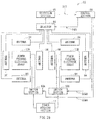
- FIG. 5 illustrates an exemplary configuration of the power feeding unit 10 .
- the power feeding unit 10 includes the power feeding electrode arrays 12 A and 12 B, the antennas 14 , a selector 16 , a wireless communication section 15 , a power feeding section 17 , switch sections 18 A and 18 B, and a control section 19 .
- the selector 16 sequentially selects one of the eight antennas 14 based on a selector control signal SSEL, and connects the selected antenna 14 to the wireless communication section 15 .
- the wireless communication section 15 performs wireless communication with the access point 100 using the antenna 14 selected by the selector 16 . Specifically, in this exemplary case, the wireless communication section 15 performs wireless communication with the access point 100 having two antennas 100 A and 100 B via wireless local area network (LAN). The wireless communication section 15 then acquires field intensity RP at reception and a transfer function H at transmission.
- the field intensity RP indicates received power (a scalar value), for example, so-called received signal strength indication (RSSI).
- the transfer function H is a transfer function (vector values) when an electromagnetic wave W transmitted from each of the eight antennas 14 is received by each of the two antennas 100 A and 100 B of the access point 100 .
- the transfer function H is expressed by the following formula.
- h11 to h28 each represent a matrix component of the transfer function H
- T1 to T8 each represent a transmission signal when the electromagnetic wave W is transmitted from each of the eight antennas 14
- R1 and R2 each represent a received signal when the transmission signal is received by the two antennas 100 A and 100 B of the access point 100 .
- the wireless communication section 15 supplies the field intensity RP and the transfer function H to the control section 19 .
- wireless communication section 15 performs wireless communication with the access point 100 via wireless LAN in this exemplary case, this is not limitative.
- wireless communication may be performed with a base station of a mobile phone via Long Term Evolution (LTE), for example.
- LTE Long Term Evolution
- wireless communication may be performed with another electronic apparatus via Bluetooth (registered trademark), for example.
- the power feeding section 17 generates an AC power signal SP between two ends thereof.
- a first end of the power feeding section 17 is connected to the switch section 18 A, and a second end thereof is connected to the switch section 18 B.
- voltage amplitude of the power signal SP may be 1000 [Vpp], and frequency thereof may be 50 [kHz].
- the switch section 18 A selects one or more power feeding electrodes 11 to be used for power feeding among the power feeding electrodes 11 in the power feeding electrode array 12 A based on the switch control signal SSWA, and connects the selected power feeding electrodes 11 to the first end of the power feeding section 17 .
- the switch section 18 B selects one or more power feeding electrodes 11 to be used for power feeding among the power feeding electrodes 11 in the power feeding electrode array 12 B based on the switch control signal SSWB, and connects the selected power feeding electrodes 11 to the second end of the power feeding section 17 .
- the control section 19 controls the selector 16 via the selector control signal SSEL to acquire the field intensity RP and the transfer function H from the wireless communication section 15 , and controls the switch sections 18 A and 18 B via the switch control signals SSWA and SSWB based on the field intensity RP and the transfer function H. Specifically, as described later, first, the control section 19 controls the selector 16 via the selector control signal SSEL, and thus sequentially connects one of the eight antennas 14 to the wireless communication section 15 to acquire the field intensity RP and the transfer function H from the wireless communication section 15 . As described later, the field intensity RP and the transfer function H are each in accordance with a relative positional relationship between the power feeding unit 10 and the mobile battery 20 on the power feeding unit 10 .
- the control section 19 determines the power feeding electrodes 11 to be used for power feeding among the power feeding electrodes 11 in the power feeding electrode arrays 12 A and 12 B based on the field intensity RP and the transfer function H, and controls the switch sections 18 A and 18 B via the switch control signals SSWA and SSWB to connect the power feeding electrodes 11 to be used for power feeding to the power feeding section 17 .
- FIG. 6 illustrates an exemplary configuration of the mobile battery 20 .
- the mobile battery 20 includes a power supply circuit 25 and the battery 27 in addition to the power receiving electrodes 21 A and 21 B.
- the power supply circuit 25 generates a voltage suitable for charge of the battery 27 based on a voltage generated between the power receiving electrodes 21 A and 21 B.
- the power supply circuit 25 includes a rectifier circuit 26 .
- the rectifier circuit 26 rectifies a voltage (an AC signal) generated between the power receiving electrodes 21 A and 21 B, and is configured of a diode, for example.
- the power supply circuit 25 generates a voltage suitable for charge of the battery 27 based on the rectified signal, and charges the battery 27 .
- the battery 27 stores power supplied from the power supply circuit 25 , and is configured of a rechargeable battery (secondary battery) such as, for example, a lithium ion battery.
- secondary battery such as, for example, a lithium ion battery.
- the power feeding electrode arrays 12 A and 12 B each correspond to a specific but not limitative example of “electrode array” in one embodiment of the disclosure.
- the control section 19 corresponds to a specific but not limitative example of “setting section” in one embodiment of the disclosure.
- the wireless communication section 15 corresponds to a specific but not limitative example of “communication section” in one embodiment of the disclosure.
- the selector 16 sequentially selects one of the eight antennas 14 based on the selector control signal SSEL, and connects the selected antenna 14 to the wireless communication section 15 .
- the wireless communication section 15 performs wireless communication with the access point 100 using the selected antenna 14 to acquire the field intensity RP and the transfer function H.
- the power feeding section 17 generates the AC power signal SP between the two ends thereof.
- the switch section 18 A selects one or more power feeding electrodes 11 to be used for power feeding among the power feeding electrodes 11 in the power feeding electrode array 12 A based on the switch control signal SSWA, and connects the selected power feeding electrodes 11 to the first end of the power feeding section 17 .
- the switch section 18 B selects one or more power feeding electrodes 11 to be used for power feeding among the power feeding electrodes 11 in the power feeding electrode array 12 B based on the switch control signal SSWB, and connects the selected power feeding electrodes 11 to the second end of the power feeding section 17 .
- the control section 19 controls the selector 16 via the selector control signal SSEL to acquire the field intensity RP and the transfer function H from the wireless communication section 15 , and controls the switch sections 18 A and 18 B via the switch control signals SSWA and SSWB based on the field intensity RP and the transfer function H. Consequently, the power feeding unit 10 supplies power to the mobile battery 20 using the selected power feeding electrodes 11 in each of the power feeding electrode arrays 12 A and 12 B.
- the power receiving electrodes 21 A and 21 B receive power from the mobile battery 20 .
- the power supply circuit 25 generates a voltage suitable for charge of the battery 27 based on a voltage generated between the power receiving electrodes 21 A and 21 B.
- the battery 27 stores power supplied from the power supply circuit 25 .
- FIG. 7 is a flowchart illustrating an exemplary operation of the power feeding system 1 .
- the wireless communication section 15 of the power feeding unit 10 performs wireless communication with the access point 100 using the antennas 14 , and acquires the field intensity RP and the transfer function H.
- the control section 19 determines the power feeding electrodes 11 to be used for power feeding among the power feeding electrodes 11 in the power feeding electrode arrays 12 A and 12 B based on the field intensity RP and the transfer function H. This is described in detail below.
- control section 19 controls the selector 16 via the selector control signal SSEL to connect one of the eight antennas 14 to the wireless communication section 15 (step S 1 ).
- the wireless communication section 15 performs wireless communication with the access point 100 using the antenna 14 selected in step S 1 (step S 2 ).
- the wireless communication section 15 acquires field intensity RP and transfer function H through wireless communication in step S 2 , and supplies the field intensity RP and the transfer function H to the control section 19 (step S 3 ).
- control section 19 checks whether or not communication is performed using all the eight antennas 14 (step S 4 ).
- the process is advanced to step S 5 .
- the process is returned to step S 1 , and another antenna 14 is selected. In this way, steps S 1 to S 4 are repeated until communication is performed using all the antennas 14 .
- the control section 19 determines the power feeding electrodes 11 to be used for power feeding based on the field intensity RP and the transfer function H acquired in steps S 1 to S 4 (step S 5 ). Specifically, since the field intensity RP and the transfer function H are each varied depending on a relative positional relationship between the power feeding unit 10 and the mobile battery 20 on the power feeding unit 10 , the control section 19 grasps the positional relationship based on the field intensity RP and the transfer function H, and determines the power feeding electrodes 11 to be used for power feeding.
- FIG. 8 illustrates operation of determining the power feeding electrodes 11 .
- an antenna disposed on an upper side of the power feeding electrode array 12 A is denoted as antenna 141
- an antenna disposed on a left side of the power feeding electrode array 12 A is denoted as antenna 142
- an antenna disposed on a lower side of the power feeding electrode array 12 A is denoted as antenna 143
- an antenna disposed on a right side of the power feeding electrode array 12 A is denoted as antenna 144 .
- the mobile battery 20 is disposed while being slightly shifted in a lower left direction of FIG. 8 on the power feeding unit 10 .
- the region RA corresponding to the power receiving electrode 21 A is located at the lower left in a region of the power feeding electrode array 12 A.
- the region RB corresponding to the power receiving electrode 21 B is located at the lower left in a region of the power feeding electrode array 12 B.
- the wireless communication section 15 receives the electromagnetic wave W coming from the upper left direction of FIG. 8 using the antennas 141 to 144 .
- the field intensity RP of the electromagnetic wave W received by the antennas 143 and 144 is lower than the field intensity RP of the electromagnetic wave W received by the antennas 141 and 142 , respectively, since part of the electromagnetic wave W is interrupted by the mobile battery 20 placed on the power feeding unit 10 . Furthermore, since propagation characteristics of the electromagnetic wave are varied by such interruption of the electromagnetic wave, amplitude and a phase of each matrix component of the transfer function H are also varied depending on a placed position of the mobile battery 20 .
- the control section 19 determines a place, at which the power receiving electrode 21 A is disposed, within a region of the power feeding electrode array 12 A based on the field intensity RP and the transfer function H. The control section 19 then determines power feeding electrodes 11 in the region RA, in which the power receiving electrode 21 A is determined to be disposed, as the power feeding electrodes 11 to be used for power feeding among the power feeding electrodes 11 in the power feeding electrode array 12 A. Similarly, the control section 19 determines power feeding electrodes 11 in the region RB, in which the power receiving electrode 21 B is determined to be disposed, as the power feeding electrodes 11 to be used for power feeding among the power feeding electrodes 11 in the power feeding electrode array 12 B.
- control section 19 determines whether or not the power feeding electrodes 11 to be used for power feeding are normally determined in step S 5 (step S 6 ). In other words, the control section 19 determines whether or not the mobile battery 20 is placed on the power feeding unit 10 .
- the field intensity RP concerning any of the antennas 141 to 144 are high, and an amplitude value of any of matrix components of the transfer function H is a high value.
- Such field intensity RP and transfer function H each have a special pattern different from that of each of the field intensity RP and the transfer function H in the case where the mobile battery 20 is placed on the power feeding unit 10 .
- field intensity RP and a transfer function H are different from the field intensity RP and the transfer function H, respectively, in the case where the mobile battery 20 is placed on the power feeding unit 10 .
- FIG. 9 illustrates a case where a conductor C 1 exists on the power feeding electrode array 12 B.
- FIG. 10 illustrates a case where a human finger exists on the power feeding electrode array 12 B.
- field intensity RP and a transfer function H each have a special pattern.
- field intensity RP concerning any of the antennas 141 to 144 has a low value
- an amplitude value of any of the matrix components of the transfer function H has a low value.
- field intensity RP and matrix components of a transfer function H concerning two opposed antennas among the antennas 141 to 144 are different from field intensity RP and matrix components of a transfer function H, respectively, concerning other two antennas.
- control section 19 determines that the power feeding electrodes 11 to be used for power feeding are not allowed to be normally determined.
- step S 7 the process is advanced to step S 7 , and steps S 21 to S 26 are repeated after waiting for a predetermined time.
- step S 8 the process is advanced to step S 8 .
- control section 19 controls the switch section 18 A via the switch control signal SSWA to connect the power feeding electrodes 11 to be used for power feeding among the power feeding electrodes 11 in the power feeding electrode array 12 A to the first end of the power feeding section 17 , and controls the switch section 18 B via the switch control signal SSWB to connect the power feeding electrodes 11 to be used for power feeding among the power feeding electrodes 11 in the power feeding electrode array 12 B to the second end of the power feeding section 17 (step S 8 ).
- the power feeding section 17 generates an AC power signal SP between the two ends thereof, and the power feeding unit 10 supplies power to the mobile battery 20 (step S 9 ).
- the power feeding electrode arrays 12 A and 12 B are larger than the power receiving electrodes 21 A and 21 B, respectively. Consequently, even if a user places the mobile battery 20 on the power feeding unit 10 in such a manner that each of the power receiving electrodes 21 A and 21 B is slightly displaced from the center of each of the power feeding electrode arrays 12 A and 12 B, the power receiving electrodes 21 A and 21 B are allowed to be easily opposed to the power feeding electrodes 11 in the power feeding electrode arrays 12 A and 12 B, respectively, and thus user convenience is improved.
- the wireless communication section 15 performs wireless communication with the access point 100 using the antennas 14 to acquire the field intensity RP and the transfer function H, and the control section 19 determines the power feeding electrodes 11 to be used for power feeding based on the field intensity RP and the transfer function H. Consequently, for example, as illustrated in FIG. 4 , even if the mobile battery 20 is placed such that each of the power receiving electrodes 21 A and 21 B is slightly displaced from the center of each of the power feeding electrode arrays 12 A and 12 B, safety is improved during power feeding.
- the control section 19 is allowed to control such that the power feeding electrodes 11 opposed to the power receiving electrodes 21 A and 21 B are mainly used for power feeding among the power feeding electrodes 11 in the power feeding electrode arrays 12 A and 12 B, and the power feeding electrodes 11 (near the portion P 1 in FIG. 4 ) that are not opposed to the power receiving electrodes 21 A and 21 B are not used for power feeding. Consequently, in the power feeding system 1 , even if a user touches the portion P 1 by mistake, it is possible to reduce a possibility of an electric shock of the user, and improve safety during power feeding.
- the wireless communication section 15 performs wireless communication with the access point 100 using wireless LAN to acquire the field intensity RP and the transfer function H. Specifically, since existing standardized communication technique is allowed to be used, it is possible to reduce development cost, and reduce component cost through using general-purpose products.
- the power feeding electrode array is larger than the power receiving electrode, and the power feeding electrodes to be used for power feeding are selected among the power feeding electrodes in each power feeding electrode array; hence, it is possible to improve user convenience, and improve safety during power feeding.
- the field intensity RP and the transfer function H are acquired through wireless communication with the access point 100 using wireless LAN; hence, it is possible to reduce development cost and component cost.
- wireless communication section 15 performs wireless communication with the access point 100 before power feeding, this is not limitative. For example, wireless communication may be performed during power feeding. Modification 1-1 is now described in detail.
- FIG. 11 illustrates an exemplary configuration of a power feeding unit 10 B according to the Modification 1-1.
- the power feeding unit 10 B includes a wireless communication section 15 B and a power feeding section 17 B. Before power feeding, the wireless communication section 15 B performs operation similar to that of the wireless communication section 15 according to the first embodiment.
- the wireless communication section 15 B also performs wireless communication with the access point 100 using the antennas 14 during power feeding, and detects whether or not a person exists around the power feeding unit 10 B based on a state of the wireless communication (for example, the field intensity RP and the transfer function H), and generates a control signal CTL corresponding to results of the detection.
- a state of the wireless communication for example, the field intensity RP and the transfer function H
- the power feeding section 17 B performs operation similar to that of the power feeding section 17 according to the first embodiment before power feeding, and performs or stops power feeding based on the control signal CTL during power feeding. According to such a configuration, if a person exists around the power feeding unit 10 B during power feeding, power feeding is allowed to be stopped; hence, it is possible to improve safety during power feeding.
- the power feeding unit 10 may acquire photograph data from the digital camera during power feeding, and may transfer the photograph data to, for example, network attached storage (NAS) via the access point 100 .
- NAS network attached storage
- the first embodiment is configured such that the power feeding electrodes 11 to be used for power feeding are selected among the power feeding electrodes 11 in the power feeding electrode arrays 12 A and 12 B, this is not limitative.
- a power feeding condition may be set for each of the power feeding electrodes 11 in the power feeding electrode arrays 12 A and 12 B.
- it may be configured that, among the power feeding electrodes 11 in the power feeding electrode arrays 12 A and 12 B, the power feeding electrodes 11 opposed to the power receiving electrodes 21 A and 21 B supply large power, while the power feeding electrodes 11 that are not opposed to the power receiving electrodes 21 A and 21 B supply small power.
- antennas 14 are disposed so as to enclose the power feeding electrode array 12 A and four antennas 14 are disposed so as to enclose the power feeding electrode array 12 B in the first embodiment, this is not limitative. Alternatively, for example, three or less or five or more antennas 14 may be disposed so as to enclose the power feeding electrode array 12 A, and three or less or five or more antennas 14 may be disposed so as to enclose the power feeding electrode array 12 B.
- the access point 100 includes the two antennas 100 A and 100 B in the first embodiment, this is not limitative. Alternatively, for example, the access point 100 may include one antenna or three or more antennas.
- control section 19 selects the power feeding electrodes 11 to be used for power feeding among the power feeding electrodes 11 in the power feeding electrode arrays 12 A and 12 B based on the field intensity RP and the transfer function H in the first embodiment, this is not limitative.
- the power feeding electrodes 11 to be used for power feeding may be selected based on one of the field intensity RP and the transfer function H.
- the wireless communication section 15 acquires the field intensity RP at reception in the first embodiment, this is not limitative.
- the wireless communication section 15 may acquire a transfer function at reception.
- the transfer function at reception is similar to the transfer function H at transmission (Formula (1)), and corresponds to a transfer function when an electromagnetic wave W transmitted from each of the two antennas 100 A and 100 B of the access point 100 is received by each of the eight antennas 14 .
- a power feeding system 2 according to a second embodiment is now described.
- the second embodiment is configured such that the wireless communication section 15 performs wireless communication using the power feeding electrodes 11 as antennas. It is to be noted that substantially the same components as those of the power feeding system 1 according to the first embodiment are designated by the same numerals, and description of them is appropriately omitted.
- FIG. 12 illustrates an exemplary configuration of a power feeding system 2 according to the second embodiment.
- the power feeding system 2 includes a power feeding unit 30 .
- the wireless communication section 15 performs wireless communication with the access point 100 using the power feeding electrodes 11 in the power feeding electrode arrays 12 A and 12 B.
- the wireless communication section 15 according to the first embodiment performs wireless communication using the antennas 14
- the wireless communication section 15 according to the second embodiment performs wireless communication using the power feeding electrodes 11 as antennas.
- FIG. 13A illustrates a plan diagram of the power feeding unit 30
- FIG. 13B illustrates a sectional configuration of the power feeding unit 30 illustrated in FIG. 13A along a XIII-XIII arrow direction.
- the power feeding unit 30 includes power feeding electrode arrays 12 A and 12 B.
- the power feeding unit 30 has a configuration similar to the configuration of the power feeding unit 10 according the first embodiment except that the antennas 14 are omitted.
- the power feeding electrodes 11 in the power feeding electrode arrays 12 A and 12 B supply power to the mobile battery 20 , and serve as antennas when the wireless communication section 15 performs wireless communication before power feeding.
- FIG. 14 illustrates an exemplary configuration of the power feeding unit 30 .
- the power feeding unit 30 includes a selector 36 and a control section 39 .
- the selector 36 sequentially selects one of a plurality of power feeding electrodes 11 in the power feeding electrode arrays 12 A and 12 B based on the selector control signal SSEL, and connects the selected power feeding electrode 11 to the wireless communication section 15 .
- the wireless communication section 15 performs wireless communication with the access point 100 using, as an antenna, the power feeding electrode 11 selected by the selector 36 , thereby acquires field intensity RP and a transfer function H, and supplies the field intensity RP and the transfer function H to the control section 39 .
- control section 39 controls the selector 36 via the selector control signal SSEL to acquire the field intensity RP and the transfer function H from the wireless communication section 15 , and controls the switch sections 18 A and 18 B via the switch control signals SSWA and SSWB based on the field intensity RP and the transfer function H.
- FIG. 15 illustrates operation of determining the power feeding electrodes 11 .
- the region RA corresponding to the power receiving electrode 21 A is located at the lower left in a region of the power feeding electrode array 12 A.
- the region RB is located at the lower left in a region of the power feeding electrode array 12 B.
- field intensity RP of an electromagnetic wave W received by a power feeding electrode 11 for example, a power feeding electrode 111
- field intensity RP of an electromagnetic wave W received by a power feeding electrode 11 is lower than field intensity RP of an electromagnetic wave W received by a power feeding electrode 11 (for example, a power feeding electrode 112 ) that is not opposed to the power receiving electrode 21 A.
- the field intensity RP of the power feeding electrode 111 becomes lower. Furthermore, since propagation characteristics of the electromagnetic wave are varied by such interruption of the electromagnetic wave, amplitude and a phase of each matrix component of the transfer function H are also varied depending on a placed position of the mobile battery 20 .
- the control section 39 determines a place, at which the power receiving electrode 21 A is disposed, within a region of the power feeding electrode array 12 A based on the field intensity RP and the transfer function H.
- the control section 39 determines the power feeding electrodes 11 in the region RA, in which the power receiving electrode 21 A is determined to be disposed, as power feeding electrodes 11 to be used for power feeding among the power feeding electrodes 11 in the power feeding electrode array 12 A.
- the wireless communication section 15 performs wireless communication using the power feeding electrode 11 as an antenna. Consequently, the antennas 14 are allowed to be omitted; hence, it is possible to reduce component cost and make appearance to be simpler. Moreover, since the power feeding electrodes 11 that perform power feeding are also used as antennas for wireless communication, it is possible to highly accurately determine the power feeding electrodes 11 opposed to the power receiving electrodes 21 A and 21 B, and therefore possible to perform power feeding control more finely.
- the wireless communication section performs wireless communication using the power feeding electrodes as antennas, it is possible to reduce component cost and make appearance to be simpler.
- the power feeding electrodes that perform power feeding are also used as antennas for wireless communication, it is possible to highly accurately determine the power feeding electrodes opposed to the power receiving electrodes and perform power feeding control more finely.
- a power feeding system 3 according to a third embodiment is now described.
- the third embodiment is configured such that a power feeding unit has two wireless communication sections that perform wireless communication with each other using antennas 14 different from each other. It is to be noted that substantially the same components as those of the power feeding system 1 according to the first embodiment are designated by the same numerals, and description of them is appropriately omitted.
- FIG. 16 illustrates an exemplary configuration of a power feeding system 3 according to the third embodiment.
- the power feeding system 3 includes a power feeding unit 40 .
- two wireless communication sections 45 A and 45 B (described later) perform wireless communication with each other using antennas 14 different from each other.
- the wireless communication section 15 according to the first embodiment performs wireless communication with the access point 100
- the wireless communication sections 45 A and 45 B according to the third embodiment perform wireless communication with each other.
- FIG. 17 illustrates an exemplary configuration of the power feeding unit 40 .
- the power feeding unit 40 includes a selector 46 , the wireless communication sections 45 A and 45 B, and a control section 49 .
- the selector 46 sequentially selects two antennas 14 of the eight antennas 14 based on the selector control signal SSEL, and connects a first antenna 14 to the wireless communication section 45 A while connecting a second antenna 14 to the wireless communication section 45 B.
- the wireless communication sections 45 A and 45 B use the antennas 14 different from each other selected by the selector 46 to perform wireless communication with each other, thereby each acquire field intensity RP and a transfer function H.
- the wireless communication sections 45 A and 45 B each supply the acquired field intensity RP and transfer function H to the control section 49 .
- control section 49 controls the selector 46 via the selector control signal SSEL to acquire the field intensity RP and the transfer function H from each of the wireless communication sections 45 A and 45 B, and controls each of the switch sections 18 A and 18 B via the switch control signals SSWA and SSWB based on the field intensity RP and the transfer function H.
- FIG. 18 illustrates operation of determining the power feeding electrodes 11 .
- the wireless communication sections 45 A and 45 B perform wireless communication with each other using antennas 14 different from each other among the eight antennas 14 .
- the wireless communication section 45 A connected to the antenna 141 and the wireless communication section 45 B connected to the antenna 142 may perform wireless communication with each other.
- the wireless communication section 45 A connected to the antenna 141 and the wireless communication section 45 B connected to the antenna 144 may perform wireless communication with each other.
- the wireless communication section 45 A connected to the antenna 141 and the wireless communication section 45 B connected to one of the antennas 14 disposed in the periphery of the power feeding electrode array 12 B may perform wireless communication with each other. In this way, the wireless communication sections 45 A and 45 B perform wireless communication with each other using two antennas 14 in various combinations.
- the electromagnetic wave is interrupted by the mobile battery 20 at a condition different from others. Consequently, the field intensity RP has a value different from others depending on combinations of the antennas 14 used for wireless communication among the antennas 141 to 144 . Similarly, amplitude and a phase of each matrix component of the transfer function H are also varied depending on a placed position of the mobile battery 20 .
- the control section 49 determines a place, at which the power receiving electrode 21 A is disposed, within a region of the power feeding electrode array 12 A based on the field intensity RP and the transfer function H.
- the control section 49 determines power feeding electrodes 11 in the region RA, in which the power receiving electrode 21 A is determined to be disposed, as the power feeding electrodes 11 to be used for power feeding among the power feeding electrodes 11 in the power feeding electrode array 12 A.
- the two wireless communication sections 45 A and 45 B perform wireless communication with each other.
- the power feeding unit 40 is therefore allowed to operate even in a circumstance without the access point 100 unlike in the case of the first embodiment, and therefore user convenience is improved.
- the two wireless communication sections perform wireless communication with each other, user convenience is improved.
- Other effects are similar to those in the case of the first embodiment.
- a power feeding system 4 according to a fourth embodiment is now described.
- the fourth embodiment is configured such that a power feeding unit has two wireless communication sections that perform wireless communication with each other using power feeding electrodes 11 different from each other as antennas. It is to be noted that substantially the same components as those of the power feeding system 3 according to the third embodiment are designated by the same numerals, and description of them is appropriately omitted.
- FIG. 19 illustrates an exemplary configuration of a power feeding system 4 according to the fourth embodiment.
- the power feeding system 4 includes a power feeding unit 50 .
- two wireless communication sections 45 A and 45 B perform wireless communication with each other using power feeding electrodes 11 different from each other.
- the wireless communication sections 45 A and 45 B according to the third embodiment perform wireless communication with each other using the antennas 14
- the wireless communication sections 45 A and 45 B according to the fourth embodiment perform wireless communication using the power feeding electrodes 11 as antennas.
- FIG. 20 illustrates an exemplary configuration of the power feeding unit 50 .
- the power feeding unit 50 includes a selector 56 and a control section 59 .
- the selector 56 sequentially selects two power feeding electrodes 11 among a plurality of power feeding electrodes 11 in the power feeding electrode arrays 12 A and 12 B based on the selector control signal SSEL, and connects a first power feeding electrode 11 to the wireless communication section 45 A while connecting a second power feeding electrode 11 to the wireless communication section 45 B.
- the wireless communication sections 45 A and 45 B perform wireless communication with each other using the respective different power feeding electrodes 11 selected by the selector 56 as antennas, thereby each acquire field intensity RP and a transfer function H and supply the field intensity RP and the transfer function H to the control section 19 .
- control section 59 controls the selector 56 via the selector control signal SSEL to acquire the field intensity RP and the transfer function H from each of the wireless communication sections 45 A and 45 B, and controls each of the switch sections 18 A and 18 B via the switch control signals SSWA and SSWB based on the field intensity RP and the transfer function H.
- FIG. 21 illustrates operation of determining the power feeding electrodes 11 .
- the wireless communication sections 45 A and 45 B use the power feeding electrodes 11 different from each other as antennas among the plurality of power feeding electrodes 11 in the power feeding electrode arrays 12 A and 12 B to perform wireless communication with each other.
- the wireless communication section 45 A connected to a power feeding electrode 11 for example, a power feeding electrode 111
- the wireless communication section 45 B connected to another power feeding electrode 11 for example, a power feeding electrode 113
- the wireless communication section 45 A connected to a power feeding electrode 11 (for example, a power feeding electrode 112 ) that is not located under the mobile battery 20 and the wireless communication section 45 B connected to a power feeding electrode 11 (for example, the power feeding electrode 113 ) located under the mobile battery 20 may perform wireless communication with each other.
- the wireless communication section 45 A connected to a power feeding electrode 11 (for example, a power feeding electrode 112 ) that is not located under the mobile battery 20 and the wireless communication section 45 B connected to one of the power feeding electrodes 11 in the power feeding electrode array 12 B may perform wireless communication with each other.
- the wireless communication sections 45 A and 45 B perform wireless communication with each other using, as antennas, two power feeding electrodes 11 in any of various combinations.
- field intensity RP is lower in the case of wireless communication using the power feeding electrodes 111 and 113 than in the case of wireless communication using the power feeding electrodes 112 and 113 .
- the power feeding electrodes 111 and 113 are located under the mobile battery 20
- the power feeding electrode 112 is not located under the mobile battery 20 . Consequently, an electromagnetic wave is more easily interrupted by the mobile battery 20 and therefore field intensity RP is lower in wireless communication using the power feeding electrodes 111 and 113 than in wireless communication using the power feeding electrodes 112 and 113 .
- a transfer function H concerning the wireless communication between the power feeding electrodes 111 and 113 has a smaller amplitude component than a transfer function H concerning the wireless communication between the power feeding electrodes 112 and 113 .
- the control section 59 determines a place, at which the power receiving electrode 21 A is disposed, within a region of the power feeding electrode array 12 A based on the field intensity RP and the transfer function H.
- the control section 59 determines power feeding electrodes 11 in the region RA, in which the power receiving electrode 21 A is determined to be disposed, as the power feeding electrodes 11 to be used for power feeding among the power feeding electrodes 11 in the power feeding electrode array 12 A.
- the two wireless communication sections 45 A and 45 B perform wireless communication with each other using the power feeding electrodes 11 different from each other as antennas. Consequently, the antennas 14 used in the third embodiment are allowed to be omitted; hence, it is possible to reduce component cost and make appearance to be simpler. Moreover, since the power feeding electrodes 11 that perform power feeding are also used as antennas for wireless communication, it is possible to highly accurately determine the power feeding electrodes 11 opposed to the power receiving electrodes 21 A and 21 B, and therefore possible to perform power feeding control more finely.
- the wireless communication section performs wireless communication using the power feeding electrodes as antennas; hence, it is possible to reduce component cost and make appearance to be simpler.
- the power feeding electrodes that perform power feeding are also used as antennas for wireless communication, it is possible to highly accurately determine the power feeding electrodes opposed to the power receiving electrodes and perform power feeding control more finely.
- a power feeding system 5 according to a fifth embodiment is now described.
- the fifth embodiment is configured such that a wireless communication section is provided on a mobile battery side, and the wireless communication section performs wireless communication with the access point 100 using power receiving electrodes as antennas.
- substantially the same components as those of the power feeding system 1 and the like according to the first embodiment and the like are designated by the same numerals, and description of them is appropriately omitted.
- FIG. 22 illustrates an exemplary configuration of a power feeding system 5 according to the fifth embodiment.
- the power feeding system 5 includes a mobile battery 70 and a power feeding unit 60 .
- the mobile battery 70 has a wireless communication section 75 (described later) that performs wireless communication with the access point 100 using the power receiving electrodes 21 A and 21 B as antennas.
- the wireless communication section 15 of the power feeding unit 10 performs wireless communication with the access point 100 in the power feeding system 1 according to the first embodiment
- the wireless communication section 75 of the mobile battery 70 performs wireless communication with the access point 100 in the power feeding system 5 according to the fifth embodiment.
- the mobile battery 70 transmits field intensity RP and a transfer function H acquired by the wireless communication section 75 to a power feeding unit 60 via a communication section 71 (described later).
- FIG. 23 illustrates an exemplary configuration of the mobile battery 70 .
- the mobile battery 70 includes a selector 76 , a wireless communication section 75 , a control section 79 , and a communication section 71 .
- the selector 76 sequentially selects one of the power receiving electrodes 21 A and 21 B based on a selector control signal SSEL 2 , and connects the selected power receiving electrode to the wireless communication section 75 .
- the wireless communication section 75 performs wireless communication with the access point 100 using, as an antenna, the power receiving electrode selected by the selector 76 between the power receiving electrodes 21 A and 21 B, and acquires field intensity RP and a transfer function H. The wireless communication section 75 then supplies the field intensity RP and the transfer function H to the control section 79 .
- the control section 79 controls the selector 76 via the selector control signal SSEL to acquire the field intensity RP and the transfer function H from the wireless communication section 75 , and supplies the field intensity RP and the transfer function H to the communication section 71 .
- the communication section 71 supplies the field intensity RP and the transfer function H supplied from the control section 79 to a communication section 61 (described later) of the power feeding unit 60 .
- a communication method for example, wired or wireless communication may be used.
- wired communication for example, universal serial bus (USB) (registered trademark) may be used.
- wireless communication for example, near field communication (NFC) such as FeliCa (registered trademark) and TransferJet (registered trademark) may be used.
- NFC near field communication
- the power receiving electrodes 21 A and 21 B may be used as antennas.
- FIG. 24 illustrates an exemplary configuration of the power feeding unit 60 .
- the power feeding unit 60 includes a communication section 61 and a control section 69 .
- the communication section 61 performs communication with the communication section 71 of the mobile battery 70 to receive the field intensity RP and the transfer function H, and supplies the field intensity RP and the transfer function H to the control section 69 .
- the control section 69 controls the switch sections 18 A and 18 B via the switch control signals SSWA and SSWB based on the supplied field intensity RP and transfer function H.
- the wireless communication section is provided on the mobile battery side, and the wireless communication section performs wireless communication with the access point using the power feeding electrodes as antennas. According to such a configuration, it is also possible to obtain effects similar to those of the first embodiment and the like.
- a power feeding system 6 is now described.
- the sixth embodiment is configured such that a power feeding unit beforehand performs power feeding (pre-power feeding) to the mobile battery 20 using power feeding electrodes 11 in the power feeding electrode arrays 12 A and 12 B, and determines power feeding electrodes 11 to be used for main power feeding based on a detection value detected by an antenna during the pre-power feeding.
- pre-power feeding power feeding
- substantially the same components as those of the power feeding system 1 and the like according to the first embodiment and the like are designated by the same numerals, and description of them is appropriately omitted.
- FIG. 25 illustrates an exemplary configuration of a power feeding system 6 according to the sixth embodiment.
- the power feeding system 6 includes a power feeding unit 80 .
- the power feeding unit 80 sequentially selects one of the power feeding electrodes 11 in the power feeding electrode arrays 12 A and 12 B to perform pre-power feeding before performing main power feeding to the mobile battery 20 .
- FIG. 26 illustrates an exemplary configuration of the power feeding unit 80 .
- the power feeding unit 80 includes eight antennas 84 , a selector 86 , a detection section 85 , and a control section 89 .
- Each antenna 84 is a sensor that detects the harmonic component of the radiation electromagnetic field emitted from each power feeding electrode 11 while the power feeding unit 80 sequentially selects one of the power feeding electrodes 11 in the power feeding electrode arrays 12 A and 12 B to perform the pre-power feeding to the mobile battery 20 , and includes, for example, a magnetic field probe or a micro-loop antenna.
- four of the eight antennas 84 are disposed so as to enclose the power feeding electrode array 12 A, while the remaining four antennas 84 are disposed so as to enclose the power feeding electrode array 12 B.
- the selector 86 sequentially selects one of the eight antennas 84 based on the selector control signal SSEL, and connects the selected antenna 84 to the detection section 85 .
- the detection section 85 detects the harmonic component of the radiation electromagnetic field based on the detection signal output from the antenna 84 selected by the selector 86 .
- the control section 89 controls the switch sections 18 A and 18 B via the switch control signals SSWA and SSWB to sequentially connect one of the power feeding electrodes 11 in the power feeding electrode array 12 A to a first end of the power feeding section 17 , and sequentially connect one of the power feeding electrodes 11 in the power feeding electrode array 12 B to a second end of the power feeding section 17 , and thus performs pre-power feeding to the mobile battery 20 .
- the control section 89 controls the selector 86 via the selector control signal SSEL to sequentially connect the eight antennas 84 to the detection section 85 , and acquires the detection result DET of the harmonic component of the radiation electromagnetic field from the detection section 85 .
- the harmonic component varies in accordance with a relative positional relationship between the power feeding unit 80 and the mobile battery 20 on the power feeding unit 80 .
- the control section 89 determines power feeding electrodes 11 to be used for main power feeding among the power feeding electrodes 11 in the power feeding electrode arrays 12 A and 12 B based on the detection result DET.
- the antenna 84 corresponds to a specific but not limitative example of “electromagnetic field sensor” in one embodiment of the disclosure.
- FIG. 27 is a flowchart illustrating an exemplary operation of the power feeding system 6 .
- control section 89 controls the switch sections 18 A and 18 B via the switch control signals SSWA and SSWB to connect one of the power feeding electrodes 11 in the power feeding electrode array 12 A to the first end of the power feeding section 17 , and connect one of the power feeding electrodes 11 in the power feeding electrode array 12 B to a second end of the power feeding section 17 (step S 21 ).
- the power feeding section 17 performs pre-power feeding to the mobile battery 20 (step S 22 ).
- the detection section 85 detects the harmonic component of the radiation electromagnetic field (step S 23 ). Specifically, the control section 89 controls the selector 86 via the selector control signal SSEL to sequentially connect the detection section 85 to one of the eight antennas 84 . The detection section 85 detects the harmonic component of the radiation electromagnetic field based on the detection signal supplied from that antenna 84 , and supplies the detection result DET to the control section 89 .
- the control section 89 checks whether or not the pre-power feeding is performed using all the power feeding electrodes 11 in the power feeding electrode arrays 12 A and 12 B (step S 24 ).
- the process is advanced to step S 25 .
- the control section 89 selects another power feeding electrode 11 . In this way, steps S 21 to S 24 are repeated until the pre-power feeding is performed using all the power feeding electrodes 11 .
- the control section 89 determines power feeding electrodes 11 to be used for main power feeding based on the detection result DET of the harmonic component of the radiation electromagnetic field acquired in steps S 21 to S 24 (step S 25 ). Specifically, since the harmonic component varies in accordance with a relative positional relationship between the power feeding unit 80 and the mobile battery 20 on the power feeding unit 80 as described below, the control section 89 grasps the positional relationship based on the detection result DET of the harmonic component, and determines the power feeding electrodes 11 to be used for main power feeding.
- FIG. 28 illustrates operation of determining the power feeding electrodes 11 .
- an antenna disposed on an upper side of the power feeding electrode array 12 A is denoted as antenna 841
- an antenna disposed on a left side of the power feeding electrode array 12 A is denoted as antenna 842
- an antenna disposed on a lower side of the power feeding electrode array 12 A is denoted as antenna 843
- an antenna disposed on a right side of the power feeding electrode array 12 A is denoted as antenna 844 .
- a region RA corresponding to the power receiving electrode 21 A is located at the lower left in a region of the power feeding electrode array 12 A.
- a region RB corresponding to the power receiving electrode 21 B is located at the lower left in a region of the power feeding electrode array 12 B.
- a harmonic component of a radiation electromagnetic field detected by the antenna 842 has a higher intensity than a harmonic component of a radiation electromagnetic field detected by the antenna 842 when pre-power feeding is performed using a power feeding electrode 11 (for example, a power feeding electrode 116 ) that is not opposed to the power receiving electrode 21 A.
- the control section 89 determines a place, at which the power receiving electrode 21 A is disposed, within a region of the power feeding electrode array 12 A based on the detection result DET of the harmonic component of the radiation electromagnetic field. The control section 89 then determines power feeding electrodes 11 in the region RA, in which the power receiving electrode 21 A is determined to be disposed, as the power feeding electrodes 11 to be used for main power feeding among the power feeding electrodes 11 in the power feeding electrode array 12 A.
- the control section 89 determines whether or not the power feeding electrodes 11 to be used for main power feeding are normally determined, as in step S 6 in the first embodiment (step S 26 ).
- the process is advanced to step S 7 , and steps S 21 to S 26 are repeated again after waiting for a predetermined time.
- the control section 89 selects power feeding electrodes 11 (step S 8 ), performs main power feeding to the mobile battery 20 (step S 9 ), and finishes the flow, as in the case of the first embodiment.
- pre-power feeding is performed every power feeding electrode 11 before main power feeding, and the power feeding electrodes 11 to be used for main power feeding are determined based on the harmonic component of the radiation electromagnetic field formed during the pre-power feeding. Consequently, in the power feeding system 6 , since the power feeding unit or the mobile battery is not necessary to have a wireless communication section unlike in the case of each of the first to fifth embodiments, a simple configuration is achieved.
- the harmonic component (a high-frequency electromagnetic field) of the radiation electromagnetic field is used, the electromagnetic wave is emitted to a more distant point than in the case of using a fundamental wave component of the radiation electromagnetic field. It is therefore possible to improve detection sensibility and increase a degree of freedom of layout of the antennas 81 to 84 and the like. Consequently, since the power feeding electrodes 11 opposed to the power receiving electrodes 21 A and 21 B are allowed to be accurately determined, it is possible to perform power feeding control more finely.
- the harmonic component of the radiation electromagnetic field is used in this exemplary case, this is not limitative.
- an electromagnetic field of a fundamental wave component may be detected in place of the harmonic component.
- the power feeding electrodes to be used for main power feeding are determined based on the harmonic component of the radiation electromagnetic field formed by pre-power feeding, a simple configuration is achieved.
- the harmonic component since the harmonic component is used, it is possible to improve detection sensibility and perform power feeding control more finely.
- the detection section 85 detects the harmonic component of the radiation electromagnetic field formed by pre-power feeding before main power feeding in the sixth embodiment, this is not limitative.
- the harmonic component of the radiation electromagnetic field may be detected during main power feeding. Modification 6-1 is now described in detail.
- FIG. 29 illustrates an exemplary configuration of a power feeding unit 80 B according to the Modification 6-1.
- the power feeding unit 80 B includes the detection section 85 B, a frequency variable filter 81 , an antiphase signal generation section 82 , and a power feeding section 87 .
- the detection section 85 B operates in the same way as the detection section 85 according to the sixth embodiment before main power feeding, and supplies a detection signal supplied from each antenna 84 to the frequency variable filter 81 .
- the frequency variable filter 81 is a bandpass filter that allows passing of a signal in a special frequency range in the detection signal supplied from the detection section 85 B.
- the frequency variable filter 81 may be set so as to allow passing of the strongest harmonic component.
- the antiphase signal generation section 82 generates a signal having a phase opposite to a phase of an output signal of the frequency variable filter 81 .
- the power feeding section 87 includes a signal addition section 83 .
- the signal addition section 83 adds an output signal of the antiphase signal generation section 82 to an AC power signal.
- the power feeding section 87 outputs the added signal as a power signal SP.
- the power feeding unit 80 B it is possible to suppress the harmonic component of the radiation electromagnetic field during main power feeding. Hence, it is possible to reduce a possibility of influence of the harmonic component of the radiation electromagnetic field on a human, and improve safety during power feeding.
- a power feeding system 7 according to a seventh embodiment is now described.
- the seventh embodiment is configured such that a power feeding unit performs pre-power feeding using each of the power feeding electrodes 11 in the power feeding electrode arrays 12 A and 12 B, and determines power feeding electrodes 11 to be used for main power feeding based on whether the pre-power feeding is possible or not.
- a power feeding unit performs pre-power feeding using each of the power feeding electrodes 11 in the power feeding electrode arrays 12 A and 12 B, and determines power feeding electrodes 11 to be used for main power feeding based on whether the pre-power feeding is possible or not.
- FIG. 30 illustrates an exemplary configuration of a power feeding system 7 according to the seventh embodiment.
- the power feeding system 7 includes a power feeding unit 90 and a mobile battery 120 .
- the power feeding unit 90 sequentially selects one of the power feeding electrodes 11 in the power feeding electrode arrays 12 A and 12 B to perform the pre-power feeding before performing the main power feeding to the mobile battery 120 .
- a modulation section 93 (described later) modulates the power signal SP with an address code ADR for identifying the selected power feeding electrode 11 to generate a modulated power signal SP 2 .
- a demodulation section 123 demodulates the power signal SP to acquire an address code ADR, and the address code ADR is supplied to the power feeding unit 90 .
- the power feeding unit 90 determines power feeding electrodes 11 to be used for main power feeding based on the address code ADR.
- FIG. 31 illustrates an exemplary configuration of the power feeding unit 90 .
- the power feeding unit 90 includes a power feeding section 97 , a communication section 91 , and a control section 99 .
- the power feeding section 97 includes the modulation section 93 .
- the modulation section 93 modulates the power signal SP to generate the modulated power signal SP 2 based on an address code ADR for a power feeding electrode 11 selected by the switch section 18 A among the power feeding electrodes 11 in the power feeding electrode array 12 A, and an address code ADR for a power feeding electrode 11 selected by the switch section 18 B among the power feeding electrodes 11 in the power feeding electrode array 12 B.
- the power feeding section 97 supplies the modulated power signal SP 2 to the power feeding electrodes 11 via the switch sections 18 A and 18 B.
- the communication section 91 performs communication with a communication section 121 (described later) of the mobile battery 120 to receive the address code ADR, and supplies the address code ADR to the control section 99 .
- a communication method for example, wired or wireless communication may be used as in the case of the communication sections 61 and 71 according to the fifth embodiment.
- the control section 99 controls the switch sections 18 A and 18 B via the switch control signals SSWA and SSWB to sequentially connect one of the power feeding electrodes 11 in the power feeding electrode array 12 A to a first end of the power feeding section 17 , and sequentially connect one of the power feeding electrodes 11 in the power feeding electrode array 12 B to a second end of the power feeding section 17 , and thus performs pre-power feeding to the mobile battery 20 .
- the control section 99 controls the modulation section 93 via the switch control signals SSWA and SSWB to modulate an AC power signal with an address code ADR for the power feeding electrode 11 selected by the switch sections 18 A and 18 B.
- the control section 99 determines power feeding electrodes 11 to be used for main power feeding among the power feeding electrodes 11 in the power feeding electrode arrays 12 A and 12 B based on the address code ADR supplied from the communication section 91 .
- FIG. 32 illustrates an exemplary configuration of the mobile battery 120 .
- the mobile battery 120 includes the demodulation section 123 and the communication section 121 .
- the demodulation section 123 performs demodulation processing based on a voltage (an AC signal) generated between the power receiving electrodes 21 A and 21 B to acquire the address code ADR.
- the demodulation section 123 supplies the address code ADR to the communication section 121 .
- the communication section 121 supplies the address code ADR supplied from the demodulation section 123 to the communication section 91 of the power feeding unit 90 .
- FIG. 33 is a flowchart illustrating an exemplary operation of the power feeding system 7 .
- control section 99 controls the switch sections 18 A and 18 B via the switch control signals SSWA and SSWB to connect one of the power feeding electrodes 11 in the power feeding electrode array 12 A to a first end of the power feeding section 97 , and connect one of the power feeding electrodes 11 in the power feeding electrode array 12 B to a second end of the power feeding section 97 (step S 41 ).
- the power feeding section 97 generates the modulated power signal SP 2 based on the switch control signals SSWA and SSWB, and performs pre-power feeding to the mobile battery 120 using the modulated power signal SP 2 (step S 42 ).
- the demodulation section 123 acquires the address code ADR (step S 43 ).
- the communication section 121 of the mobile battery 120 supplies the address code ADR to the control section 99 via the communication section 91 of the power feeding unit 90 .
- the control section 99 checks whether or not the pre-power feeding is performed using all the power feeding electrodes 11 in the power feeding electrode arrays 12 A and 12 B (step S 44 ).
- the process is advanced to step S 45 .
- the control section 99 selects another power feeding electrode 11 . In this way, steps S 41 to S 44 are repeated until the pre-power feeding is performed using all the power feeding electrodes 11 .
- control section 99 determines power feeding electrodes 11 to be used for main power feeding based on the address code ADR acquired in steps S 41 to S 44 (step S 45 ). Specifically, for example, the control section 99 may determine a power feeding electrode 11 , the address code ADR for which has been acquired, as the power feeding electrode 11 to be used for main power feeding.
- control section 99 determines whether or not the power feeding electrodes 11 to be used for main power feeding are normally determined in step S 45 as with step S 6 in the first embodiment (step S 46 ).
- the process is advanced to step S 7 , and steps S 41 to S 46 are repeated after waiting for a predetermined time.
- control section 99 selects power feeding electrodes 11 (step S 8 ), performs main power feeding to the mobile battery 120 (step S 9 ), and finishes the flow, as in the case of the first embodiment.
- pre-power feeding is performed every power feeding electrodes 11 before actual power feeding, and the power feeding electrodes 11 to be used for main power feeding are determined based on whether the address code ADR is acquired or not, i.e., based on whether the pre-power feeding is possible or not. Consequently, in the power feeding system 7 , since the power feeding unit or the mobile battery is not necessary to have a wireless communication section unlike in the case of each of the first to fifth embodiments, a simple configuration is achieved.
- the power feeding electrodes to be used for main power feeding are determined based on whether the address code ADR is acquired or not, a simple configuration is achieved. Other effects are similar to those in the case of the first embodiment, etc.
- FIG. 34 illustrates an application example of the power feeding system according to any of the embodiments and the Modifications.
- a tray-type power feeding unit and a mobile phone 220 incorporating a battery are used to configure a power feeding system.
- the power feeding unit 210 and the mobile phone 220 are each configured of the power feeding system according to any of the embodiments and the Modifications.
- the power supply system according to any of the embodiments and the Modifications is applicable to an electronic apparatus in any field.
- examples of the electronic apparatus may include a digital camera, a video camcorder, a portable video game player, and a mobile storage.
- the power supply system according to any of the embodiments and the Modifications is applicable to an electronic apparatus including a battery in any field.
- the two power feeding electrode arrays 12 A and 12 B are provided in the embodiments and the Modifications, this is not limitative.
- one power feeding electrode array 312 may be provided.
- power feeding may also be performed to the mobile battery 20 only using the power feeding electrodes 11 opposed to the power receiving electrodes 21 A and 21 B of the mobile battery 20 among the power feeding electrodes 11 in the power feeding electrode array 312 .
- a power feeding unit including:
- an electrode array including a plurality of power feeding electrodes arranged side by side;
- a power feeding section configured to supply power to a power receiving unit via the electrode array
- a setting section configured to set a power feeding condition for each of the power feeding electrodes.
- a communication section configured to sequentially select one of the plurality of antennas to perform communication with a wireless unit
- the setting section sets the power feeding condition based on a communication state between the wireless unit and the communication section.
- the power feeding unit according to any one of (1) to (3), further including a communication section configured to sequentially select one of the plurality of power feeding electrodes to perform communication with a wireless unit using the selected power feeding electrode as an antenna,
- the setting section sets the power feeding condition based on a communication state between the wireless unit and the communication section.
- a first communication section and a second communication section being configured to sequentially select respective mutually-different antennas of the plurality of antennas to perform communication with each other
- the setting section sets the power feeding condition based on a communication state between the first communication section and the second communication section.
- the power feeding unit according to any one of (1) to (3), further including a first communication section and a second communication section being configured to sequentially select respective mutually-different power feeding electrodes of the plurality of power feeding electrodes to perform communication with each other using the selected power feeding electrodes as antennas,
- the setting section sets the power feeding condition based on a communication state between the first communication section and the second communication section.
- the power feeding section performs pre-power feeding while sequentially selected one of the plurality of power feeding electrodes before performing main power feeding
- the setting section sets the power feeding condition based on detection results of the plurality of electromagnetic field sensors during the pre-power feeding.
- a power feeding system including:
- the power feeding unit includes
- an electrode array including a plurality of power feeding electrodes arranged side by side
- a power feeding section configured to supply power to the power receiving unit via the electrode array
- a setting section configured to set a power feeding condition for each of the electrodes.
- a first communication section configured to sequentially select one of the plurality of power receiving electrodes to perform communication with a wireless unit using the selected power receiving electrode as an antenna
- a second communication section configured to transmit a communication state between the wireless unit and the first communication section to the setting section of the power feeding unit
- the setting section sets the power feeding condition based on the communication state.
- the power feeding section performs the pre-power feeding by supplying a power signal to the power receiving unit, the power signal being modulated based on the electrode identification information.
- the power receiving unit includes:
- an identification information acquisition section configured to acquire the electrode identification information
- a communication section configured to transmit the electrode identification information to the setting section of the power feeding unit
- the setting section sets the power feeding condition based on the electrode identification information.
- the power feeding unit includes a predetermined number of electrode arrays
- the power receiving unit includes the predetermined number of power receiving electrodes, and
- area of each of the electrode arrays is larger than area of each of the power receiving electrodes.
Landscapes
- Engineering & Computer Science (AREA)
- Computer Networks & Wireless Communication (AREA)
- Power Engineering (AREA)
- Signal Processing (AREA)
- Charge And Discharge Circuits For Batteries Or The Like (AREA)
- Mobile Radio Communication Systems (AREA)
- Telephone Function (AREA)
Abstract
Description
(10) The power feeding unit according to any one of (1) to (3), further including a plurality of electromagnetic field sensors,
(17) The power feeding system according to (16), wherein the power feeding section performs the pre-power feeding by supplying a power signal to the power receiving unit, the power signal being modulated based on the electrode identification information.
(18) The power feeding system according to (16) or (17), wherein the power receiving unit includes:
Claims (20)
Priority Applications (1)
| Application Number | Priority Date | Filing Date | Title |
|---|---|---|---|
| US16/190,989 US11223390B2 (en) | 2013-06-28 | 2018-11-14 | Power feeding unit and power feeding system |
Applications Claiming Priority (4)
| Application Number | Priority Date | Filing Date | Title |
|---|---|---|---|
| JP2013-136223 | 2013-06-28 | ||
| JP2013136223A JP6127777B2 (en) | 2013-06-28 | 2013-06-28 | Power supply device and power supply system |
| US14/301,097 US10277281B2 (en) | 2013-06-28 | 2014-06-10 | Power feeding unit and power feeding system |
| US16/190,989 US11223390B2 (en) | 2013-06-28 | 2018-11-14 | Power feeding unit and power feeding system |
Related Parent Applications (1)
| Application Number | Title | Priority Date | Filing Date |
|---|---|---|---|
| US14/301,097 Continuation US10277281B2 (en) | 2013-06-28 | 2014-06-10 | Power feeding unit and power feeding system |
Publications (2)
| Publication Number | Publication Date |
|---|---|
| US20190089418A1 US20190089418A1 (en) | 2019-03-21 |
| US11223390B2 true US11223390B2 (en) | 2022-01-11 |
Family
ID=52114911
Family Applications (2)
| Application Number | Title | Priority Date | Filing Date |
|---|---|---|---|
| US14/301,097 Active 2037-10-15 US10277281B2 (en) | 2013-06-28 | 2014-06-10 | Power feeding unit and power feeding system |
| US16/190,989 Expired - Fee Related US11223390B2 (en) | 2013-06-28 | 2018-11-14 | Power feeding unit and power feeding system |
Family Applications Before (1)
| Application Number | Title | Priority Date | Filing Date |
|---|---|---|---|
| US14/301,097 Active 2037-10-15 US10277281B2 (en) | 2013-06-28 | 2014-06-10 | Power feeding unit and power feeding system |
Country Status (3)
| Country | Link |
|---|---|
| US (2) | US10277281B2 (en) |
| JP (2) | JP6127777B2 (en) |
| CN (2) | CN104253490B (en) |
Families Citing this family (10)
| Publication number | Priority date | Publication date | Assignee | Title |
|---|---|---|---|---|
| US20160119880A1 (en) * | 2014-10-27 | 2016-04-28 | Hsuan-Chih HONG | Wireless beacon device |
| US10880357B2 (en) * | 2014-12-23 | 2020-12-29 | Adobe Inc. | Reducing requests for media segments in streaming of multimedia content |
| DE112015006065T5 (en) * | 2015-02-27 | 2017-10-12 | Olympus Corporation | Medical power supply system |
| US10486538B2 (en) * | 2015-11-02 | 2019-11-26 | Hyundai America Technical Center, Inc. | Electromagnetic field controlling system and method for vehicle wireless charging system |
| KR102084532B1 (en) * | 2018-05-09 | 2020-03-17 | 숭실대학교산학협력단 | Smart far-field wireless power transfer system and method thereof |
| JP2019213427A (en) * | 2018-06-08 | 2019-12-12 | 福井県 | Battery device with connector for high voltage that can be easily attached and detached |
| WO2022094556A1 (en) * | 2020-10-30 | 2022-05-05 | Tennessee Technological University | System and method for generating electric based non-linear waves in natural terrestrial environments |
| JP7468378B2 (en) | 2021-01-26 | 2024-04-16 | 株式会社デンソー | Wireless power supply system |
| CN113991893B (en) * | 2021-11-03 | 2023-10-13 | 重庆蓝岸通讯技术有限公司 | A wireless charging system, equipment and method |
| EP4693816A1 (en) * | 2023-03-28 | 2026-02-11 | Ntt Docomo, Inc. | Terminal and power supply method |
Citations (31)
| Publication number | Priority date | Publication date | Assignee | Title |
|---|---|---|---|---|
| JP2005168232A (en) | 2003-12-04 | 2005-06-23 | Takenaka Komuten Co Ltd | Cordless power supply method |
| US20060176015A1 (en) * | 2005-02-04 | 2006-08-10 | Research In Motion Limited | Portable electronic device and capacitive charger therefor and associated methods |
| US20060202665A1 (en) | 2005-03-10 | 2006-09-14 | Microsoft Corporation | Inductive powering surface for powering portable devices |
| JP2008295274A (en) | 2007-05-28 | 2008-12-04 | Sony Ericsson Mobilecommunications Japan Inc | Non-contact power transmission coil unit, portable terminal, power transmission device, and non-contact power transmission system |
| JP2008312294A (en) | 2007-06-12 | 2008-12-25 | Ntt Docomo Inc | Charger, Charger, Charging System and Method |
| US20090001941A1 (en) * | 2007-06-29 | 2009-01-01 | Microsoft Corporation | Inductive Powering Surface for Powering Portable Devices |
| US20090033280A1 (en) * | 2006-01-31 | 2009-02-05 | Sung-Uk Choi | Contact-less power supply, contact-less charger systems and method for charging rechargeable battery cell |
| JP2009053209A (en) | 2003-02-06 | 2009-03-12 | Koh Young Technology Inc | Three-dimensional shape measuring apparatus |
| JP2009089520A (en) | 2007-09-28 | 2009-04-23 | Takenaka Komuten Co Ltd | Power supply system |
| US20090146608A1 (en) * | 2007-12-06 | 2009-06-11 | Lg Electronics Inc. | Non-contact charging apparatus having charging information display function and method thereof |
| JP2009531009A (en) | 2006-03-21 | 2009-08-27 | Tmms株式会社 | Energy carrier with partial influence through a dielectric medium |
| US20100224725A1 (en) | 2005-05-24 | 2010-09-09 | Rearden, Llc | System and method for powering an aircraft using radio frequency signals and feedback |
| JP2010200497A (en) | 2009-02-25 | 2010-09-09 | Toshiba Corp | Charger and charging system |
| JP2010273472A (en) | 2009-05-22 | 2010-12-02 | Canon Inc | Charger |
| US20110133691A1 (en) * | 2007-11-20 | 2011-06-09 | Nokia Corporation | Wireless Galvanic Charging Device,Method of Operation Thereof and Mobile Electric Device to be Charged |
| US20110234019A1 (en) * | 2007-08-17 | 2011-09-29 | Tmms Co., Ltd. | Method and device for transporting, distributing and managing electrical energy by remote longitudinal coupling in near field between electric dipoles |
| JP2012034546A (en) | 2010-08-03 | 2012-02-16 | Panasonic Corp | Wireless power transmission system |
| US20120212070A1 (en) * | 2011-02-22 | 2012-08-23 | Canon Kabushiki Kaisha | Power supply apparatus, method, and storage medium |
| US20120280788A1 (en) * | 2011-05-05 | 2012-11-08 | Juergen Nowottnick | Communications apparatus and method therefor |
| JP2013078238A (en) | 2011-09-30 | 2013-04-25 | Takenaka Komuten Co Ltd | Power supply system |
| JP2014096956A (en) | 2012-11-12 | 2014-05-22 | Panasonic Corp | Power transmission device, electronic equipment and wireless power transmission system |
| US20140175907A1 (en) * | 2011-10-12 | 2014-06-26 | Murata Manufacturing Co., Ltd. | Wireless power transmission system |
| US20140210276A1 (en) * | 2011-10-28 | 2014-07-31 | Murata Manufacturing Co., Ltd. | Power reception device, power transmission device and wireless power transmission system |
| US20140375515A1 (en) * | 2013-06-20 | 2014-12-25 | Blackberry Limited | Frequency tunable antenna |
| US20150002446A1 (en) * | 2013-06-28 | 2015-01-01 | Synaptics Incorporated | Wireless communication enabling capacitive imaging sensor assembly |
| US20150015083A1 (en) * | 2012-02-24 | 2015-01-15 | Nec Corporation | Power receiving apparatus, power supplying apparatus, and communication apparatus |
| US20150022014A1 (en) * | 2013-07-22 | 2015-01-22 | Funai Electric Co., Ltd. | Power Supply Device and Method for Detecting Presence of Foreign Object |
| US20150054347A1 (en) * | 2013-08-22 | 2015-02-26 | Canon Kabushiki Kaisha | Power transmitting apparatus, method of controlling the same, and non-transitory computer-readable storage medium |
| US20150249358A1 (en) * | 2012-10-26 | 2015-09-03 | Google Inc. | Charging mechanism with ground contact and non-contact coupling |
| US20150256228A1 (en) * | 2013-01-21 | 2015-09-10 | Murata Manufacturing Co., Ltd. | Power reception device, power transmission device, and power transmission system |
| US20150340874A1 (en) * | 2012-12-28 | 2015-11-26 | Panasonic Intellectual Property Management Co., Ltd. | Non-contact power supply apparatus |
Family Cites Families (2)
| Publication number | Priority date | Publication date | Assignee | Title |
|---|---|---|---|---|
| JP5152298B2 (en) * | 2010-06-24 | 2013-02-27 | 株式会社村田製作所 | Power transmission device, power reception device, and wireless power transmission system |
| US8698350B2 (en) * | 2010-10-08 | 2014-04-15 | Panasonic Corporation | Wireless power transmission unit and power generator with the wireless power transmission unit |
-
2013
- 2013-06-28 JP JP2013136223A patent/JP6127777B2/en not_active Expired - Fee Related
-
2014
- 2014-06-10 US US14/301,097 patent/US10277281B2/en active Active
- 2014-06-20 CN CN201410281399.5A patent/CN104253490B/en not_active Expired - Fee Related
- 2014-06-20 CN CN201810876464.7A patent/CN109004692B/en not_active Expired - Fee Related
-
2017
- 2017-03-27 JP JP2017061392A patent/JP6390738B2/en not_active Expired - Fee Related
-
2018
- 2018-11-14 US US16/190,989 patent/US11223390B2/en not_active Expired - Fee Related
Patent Citations (31)
| Publication number | Priority date | Publication date | Assignee | Title |
|---|---|---|---|---|
| JP2009053209A (en) | 2003-02-06 | 2009-03-12 | Koh Young Technology Inc | Three-dimensional shape measuring apparatus |
| JP2005168232A (en) | 2003-12-04 | 2005-06-23 | Takenaka Komuten Co Ltd | Cordless power supply method |
| US20060176015A1 (en) * | 2005-02-04 | 2006-08-10 | Research In Motion Limited | Portable electronic device and capacitive charger therefor and associated methods |
| US20060202665A1 (en) | 2005-03-10 | 2006-09-14 | Microsoft Corporation | Inductive powering surface for powering portable devices |
| US20100224725A1 (en) | 2005-05-24 | 2010-09-09 | Rearden, Llc | System and method for powering an aircraft using radio frequency signals and feedback |
| US20090033280A1 (en) * | 2006-01-31 | 2009-02-05 | Sung-Uk Choi | Contact-less power supply, contact-less charger systems and method for charging rechargeable battery cell |
| JP2009531009A (en) | 2006-03-21 | 2009-08-27 | Tmms株式会社 | Energy carrier with partial influence through a dielectric medium |
| JP2008295274A (en) | 2007-05-28 | 2008-12-04 | Sony Ericsson Mobilecommunications Japan Inc | Non-contact power transmission coil unit, portable terminal, power transmission device, and non-contact power transmission system |
| JP2008312294A (en) | 2007-06-12 | 2008-12-25 | Ntt Docomo Inc | Charger, Charger, Charging System and Method |
| US20090001941A1 (en) * | 2007-06-29 | 2009-01-01 | Microsoft Corporation | Inductive Powering Surface for Powering Portable Devices |
| US20110234019A1 (en) * | 2007-08-17 | 2011-09-29 | Tmms Co., Ltd. | Method and device for transporting, distributing and managing electrical energy by remote longitudinal coupling in near field between electric dipoles |
| JP2009089520A (en) | 2007-09-28 | 2009-04-23 | Takenaka Komuten Co Ltd | Power supply system |
| US20110133691A1 (en) * | 2007-11-20 | 2011-06-09 | Nokia Corporation | Wireless Galvanic Charging Device,Method of Operation Thereof and Mobile Electric Device to be Charged |
| US20090146608A1 (en) * | 2007-12-06 | 2009-06-11 | Lg Electronics Inc. | Non-contact charging apparatus having charging information display function and method thereof |
| JP2010200497A (en) | 2009-02-25 | 2010-09-09 | Toshiba Corp | Charger and charging system |
| JP2010273472A (en) | 2009-05-22 | 2010-12-02 | Canon Inc | Charger |
| JP2012034546A (en) | 2010-08-03 | 2012-02-16 | Panasonic Corp | Wireless power transmission system |
| US20120212070A1 (en) * | 2011-02-22 | 2012-08-23 | Canon Kabushiki Kaisha | Power supply apparatus, method, and storage medium |
| US20120280788A1 (en) * | 2011-05-05 | 2012-11-08 | Juergen Nowottnick | Communications apparatus and method therefor |
| JP2013078238A (en) | 2011-09-30 | 2013-04-25 | Takenaka Komuten Co Ltd | Power supply system |
| US20140175907A1 (en) * | 2011-10-12 | 2014-06-26 | Murata Manufacturing Co., Ltd. | Wireless power transmission system |
| US20140210276A1 (en) * | 2011-10-28 | 2014-07-31 | Murata Manufacturing Co., Ltd. | Power reception device, power transmission device and wireless power transmission system |
| US20150015083A1 (en) * | 2012-02-24 | 2015-01-15 | Nec Corporation | Power receiving apparatus, power supplying apparatus, and communication apparatus |
| US20150249358A1 (en) * | 2012-10-26 | 2015-09-03 | Google Inc. | Charging mechanism with ground contact and non-contact coupling |
| JP2014096956A (en) | 2012-11-12 | 2014-05-22 | Panasonic Corp | Power transmission device, electronic equipment and wireless power transmission system |
| US20150340874A1 (en) * | 2012-12-28 | 2015-11-26 | Panasonic Intellectual Property Management Co., Ltd. | Non-contact power supply apparatus |
| US20150256228A1 (en) * | 2013-01-21 | 2015-09-10 | Murata Manufacturing Co., Ltd. | Power reception device, power transmission device, and power transmission system |
| US20140375515A1 (en) * | 2013-06-20 | 2014-12-25 | Blackberry Limited | Frequency tunable antenna |
| US20150002446A1 (en) * | 2013-06-28 | 2015-01-01 | Synaptics Incorporated | Wireless communication enabling capacitive imaging sensor assembly |
| US20150022014A1 (en) * | 2013-07-22 | 2015-01-22 | Funai Electric Co., Ltd. | Power Supply Device and Method for Detecting Presence of Foreign Object |
| US20150054347A1 (en) * | 2013-08-22 | 2015-02-26 | Canon Kabushiki Kaisha | Power transmitting apparatus, method of controlling the same, and non-transitory computer-readable storage medium |
Also Published As
| Publication number | Publication date |
|---|---|
| JP2017143732A (en) | 2017-08-17 |
| CN104253490A (en) | 2014-12-31 |
| JP6390738B2 (en) | 2018-09-19 |
| CN109004692B (en) | 2022-09-02 |
| JP2015012689A (en) | 2015-01-19 |
| CN109004692A (en) | 2018-12-14 |
| US20190089418A1 (en) | 2019-03-21 |
| US10277281B2 (en) | 2019-04-30 |
| JP6127777B2 (en) | 2017-05-17 |
| CN104253490B (en) | 2018-08-31 |
| US20150001967A1 (en) | 2015-01-01 |
Similar Documents
| Publication | Publication Date | Title |
|---|---|---|
| US11223390B2 (en) | Power feeding unit and power feeding system | |
| US20230396103A1 (en) | Apparatus and method for detecting foreign object in wireless power transmitting system | |
| KR100736053B1 (en) | Apparatus and method for sharing power wirelessly by induction | |
| US9588163B2 (en) | Apparatus and method for detecting foreign object in wireless power transmitting system | |
| JP6321120B2 (en) | Transmitting coil module for wireless power transmitter | |
| Jadidian et al. | Magnetic MIMO: How to charge your phone in your pocket | |
| US9837847B2 (en) | Wireless charging transmitter and method thereof | |
| US9423439B2 (en) | Apparatus and method for detecting foreign object in wireless power transmitting system | |
| KR101253670B1 (en) | Apparatus for wireless power transmission using multi antenna and Method for controlling thereof | |
| US20140375258A1 (en) | Wireless charger for electronic device | |
| KR20140031783A (en) | Wireless power transmitter for excluding cross connected wireless power receiver and method for controlling thereof | |
| US20180166905A1 (en) | Wireless power transmission apparatus and control method therefor, method for controlling wireless power reception apparatus, and wireless power transmission system and wireless power transmission method therefor | |
| KR20170050991A (en) | Wireless Power Transmitter | |
| KR102452017B1 (en) | Apparatus for transmitting and receiving wireless power | |
| US12562593B2 (en) | Wireless power transfer device | |
| KR101804409B1 (en) | Wireless Power Transmitter | |
| KR102099444B1 (en) | Transmitting Coil Module For Wireless Power Transmitter | |
| JP2012143093A (en) | Proximity wireless charging ac adapter | |
| KR101902400B1 (en) | Transmitting Coil Module For Wireless Power Transmitter | |
| KR20170068164A (en) | Transmitting Coil Module Of Wireless Power Transmitter, And Method Of Manufacturing The Same |
Legal Events
| Date | Code | Title | Description |
|---|---|---|---|
| FEPP | Fee payment procedure |
Free format text: ENTITY STATUS SET TO UNDISCOUNTED (ORIGINAL EVENT CODE: BIG.); ENTITY STATUS OF PATENT OWNER: LARGE ENTITY |
|
| STPP | Information on status: patent application and granting procedure in general |
Free format text: APPLICATION DISPATCHED FROM PREEXAM, NOT YET DOCKETED |
|
| STPP | Information on status: patent application and granting procedure in general |
Free format text: DOCKETED NEW CASE - READY FOR EXAMINATION |
|
| STPP | Information on status: patent application and granting procedure in general |
Free format text: RESPONSE TO NON-FINAL OFFICE ACTION ENTERED AND FORWARDED TO EXAMINER |
|
| STPP | Information on status: patent application and granting procedure in general |
Free format text: FINAL REJECTION MAILED |
|
| STPP | Information on status: patent application and granting procedure in general |
Free format text: RESPONSE AFTER FINAL ACTION FORWARDED TO EXAMINER |
|
| STPP | Information on status: patent application and granting procedure in general |
Free format text: NOTICE OF ALLOWANCE MAILED -- APPLICATION RECEIVED IN OFFICE OF PUBLICATIONS |
|
| STPP | Information on status: patent application and granting procedure in general |
Free format text: PUBLICATIONS -- ISSUE FEE PAYMENT VERIFIED |
|
| STCF | Information on status: patent grant |
Free format text: PATENTED CASE |
|
| FEPP | Fee payment procedure |
Free format text: MAINTENANCE FEE REMINDER MAILED (ORIGINAL EVENT CODE: REM.); ENTITY STATUS OF PATENT OWNER: LARGE ENTITY |
|
| LAPS | Lapse for failure to pay maintenance fees |
Free format text: PATENT EXPIRED FOR FAILURE TO PAY MAINTENANCE FEES (ORIGINAL EVENT CODE: EXP.); ENTITY STATUS OF PATENT OWNER: LARGE ENTITY |
|
| STCH | Information on status: patent discontinuation |
Free format text: PATENT EXPIRED DUE TO NONPAYMENT OF MAINTENANCE FEES UNDER 37 CFR 1.362 |
|
| FP | Lapsed due to failure to pay maintenance fee |
Effective date: 20260111 |