US11222930B2 - Array substrate and display panel - Google Patents
Array substrate and display panel Download PDFInfo
- Publication number
- US11222930B2 US11222930B2 US16/620,572 US201916620572A US11222930B2 US 11222930 B2 US11222930 B2 US 11222930B2 US 201916620572 A US201916620572 A US 201916620572A US 11222930 B2 US11222930 B2 US 11222930B2
- Authority
- US
- United States
- Prior art keywords
- component
- organic electroluminescence
- photoelectric conversion
- layer
- array substrate
- Prior art date
- Legal status (The legal status is an assumption and is not a legal conclusion. Google has not performed a legal analysis and makes no representation as to the accuracy of the status listed.)
- Expired - Fee Related
Links
Images




Classifications
-
- H01L27/3227—
-
- H—ELECTRICITY
- H10—SEMICONDUCTOR DEVICES; ELECTRIC SOLID-STATE DEVICES NOT OTHERWISE PROVIDED FOR
- H10K—ORGANIC ELECTRIC SOLID-STATE DEVICES
- H10K59/00—Integrated devices, or assemblies of multiple devices, comprising at least one organic light-emitting element covered by group H10K50/00
- H10K59/30—Devices specially adapted for multicolour light emission
- H10K59/35—Devices specially adapted for multicolour light emission comprising red-green-blue [RGB] subpixels
- H10K59/352—Devices specially adapted for multicolour light emission comprising red-green-blue [RGB] subpixels the areas of the RGB subpixels being different
-
- H01L27/288—
-
- H01L27/3246—
-
- H—ELECTRICITY
- H10—SEMICONDUCTOR DEVICES; ELECTRIC SOLID-STATE DEVICES NOT OTHERWISE PROVIDED FOR
- H10K—ORGANIC ELECTRIC SOLID-STATE DEVICES
- H10K19/00—Integrated devices, or assemblies of multiple devices, comprising at least one organic element specially adapted for rectifying, amplifying, oscillating or switching, covered by group H10K10/00
- H10K19/20—Integrated devices, or assemblies of multiple devices, comprising at least one organic element specially adapted for rectifying, amplifying, oscillating or switching, covered by group H10K10/00 comprising components having an active region that includes an inorganic semiconductor
-
- H—ELECTRICITY
- H10—SEMICONDUCTOR DEVICES; ELECTRIC SOLID-STATE DEVICES NOT OTHERWISE PROVIDED FOR
- H10K—ORGANIC ELECTRIC SOLID-STATE DEVICES
- H10K39/00—Integrated devices, or assemblies of multiple devices, comprising at least one organic radiation-sensitive element covered by group H10K30/00
- H10K39/10—Organic photovoltaic [PV] modules; Arrays of single organic PV cells
-
- H—ELECTRICITY
- H10—SEMICONDUCTOR DEVICES; ELECTRIC SOLID-STATE DEVICES NOT OTHERWISE PROVIDED FOR
- H10K—ORGANIC ELECTRIC SOLID-STATE DEVICES
- H10K59/00—Integrated devices, or assemblies of multiple devices, comprising at least one organic light-emitting element covered by group H10K50/00
- H10K59/10—OLED displays
- H10K59/12—Active-matrix OLED [AMOLED] displays
- H10K59/122—Pixel-defining structures or layers, e.g. banks
-
- H—ELECTRICITY
- H10—SEMICONDUCTOR DEVICES; ELECTRIC SOLID-STATE DEVICES NOT OTHERWISE PROVIDED FOR
- H10K—ORGANIC ELECTRIC SOLID-STATE DEVICES
- H10K59/00—Integrated devices, or assemblies of multiple devices, comprising at least one organic light-emitting element covered by group H10K50/00
- H10K59/30—Devices specially adapted for multicolour light emission
- H10K59/35—Devices specially adapted for multicolour light emission comprising red-green-blue [RGB] subpixels
- H10K59/353—Devices specially adapted for multicolour light emission comprising red-green-blue [RGB] subpixels characterised by the geometrical arrangement of the RGB subpixels
-
- H—ELECTRICITY
- H10—SEMICONDUCTOR DEVICES; ELECTRIC SOLID-STATE DEVICES NOT OTHERWISE PROVIDED FOR
- H10K—ORGANIC ELECTRIC SOLID-STATE DEVICES
- H10K59/00—Integrated devices, or assemblies of multiple devices, comprising at least one organic light-emitting element covered by group H10K50/00
- H10K59/60—OLEDs integrated with inorganic light-sensitive elements, e.g. with inorganic solar cells or inorganic photodiodes
-
- H—ELECTRICITY
- H10—SEMICONDUCTOR DEVICES; ELECTRIC SOLID-STATE DEVICES NOT OTHERWISE PROVIDED FOR
- H10K—ORGANIC ELECTRIC SOLID-STATE DEVICES
- H10K59/00—Integrated devices, or assemblies of multiple devices, comprising at least one organic light-emitting element covered by group H10K50/00
- H10K59/60—OLEDs integrated with inorganic light-sensitive elements, e.g. with inorganic solar cells or inorganic photodiodes
- H10K59/65—OLEDs integrated with inorganic image sensors
-
- H—ELECTRICITY
- H10—SEMICONDUCTOR DEVICES; ELECTRIC SOLID-STATE DEVICES NOT OTHERWISE PROVIDED FOR
- H10K—ORGANIC ELECTRIC SOLID-STATE DEVICES
- H10K65/00—Integrated devices, or assemblies of multiple devices, comprising at least one organic light-emitting element and at least one organic radiation-sensitive element, e.g. organic opto-couplers
-
- H01L27/323—
-
- H01L51/0036—
-
- H01L51/42—
-
- H—ELECTRICITY
- H10—SEMICONDUCTOR DEVICES; ELECTRIC SOLID-STATE DEVICES NOT OTHERWISE PROVIDED FOR
- H10K—ORGANIC ELECTRIC SOLID-STATE DEVICES
- H10K30/00—Organic devices sensitive to infrared radiation, light, electromagnetic radiation of shorter wavelength or corpuscular radiation
-
- H—ELECTRICITY
- H10—SEMICONDUCTOR DEVICES; ELECTRIC SOLID-STATE DEVICES NOT OTHERWISE PROVIDED FOR
- H10K—ORGANIC ELECTRIC SOLID-STATE DEVICES
- H10K59/00—Integrated devices, or assemblies of multiple devices, comprising at least one organic light-emitting element covered by group H10K50/00
- H10K59/10—OLED displays
- H10K59/12—Active-matrix OLED [AMOLED] displays
- H10K59/131—Interconnections, e.g. wiring lines or terminals
-
- H—ELECTRICITY
- H10—SEMICONDUCTOR DEVICES; ELECTRIC SOLID-STATE DEVICES NOT OTHERWISE PROVIDED FOR
- H10K—ORGANIC ELECTRIC SOLID-STATE DEVICES
- H10K59/00—Integrated devices, or assemblies of multiple devices, comprising at least one organic light-emitting element covered by group H10K50/00
- H10K59/40—OLEDs integrated with touch screens
-
- H—ELECTRICITY
- H10—SEMICONDUCTOR DEVICES; ELECTRIC SOLID-STATE DEVICES NOT OTHERWISE PROVIDED FOR
- H10K—ORGANIC ELECTRIC SOLID-STATE DEVICES
- H10K85/00—Organic materials used in the body or electrodes of devices covered by this subclass
- H10K85/10—Organic polymers or oligomers
- H10K85/111—Organic polymers or oligomers comprising aromatic, heteroaromatic, or aryl chains, e.g. polyaniline, polyphenylene or polyphenylene vinylene
- H10K85/113—Heteroaromatic compounds comprising sulfur or selene, e.g. polythiophene
Definitions
- the present disclosure relates to the technical field of display, in particular to an array substrate and a display panel.
- red light a set of red sub-pixel, green sub-pixel and blue sub-pixel that may emit red light, green light and blue light constitute a minimum display element. Any color on the display panel may be recorded and expressed by a set of RGB values, thus the red light, green light and blue light are also called three primary color lights.
- OLED Organic Electroluminescence Display
- LCD Liquid Crystal Display
- the OLED has a broader color gamut and a wider viewing angle.
- the wide color gamut of the OLED comes from luminescent characteristics of the material thereof.
- Organic luminaries of different materials may emit three primary color spectrum of red light, green light and blue light with pure hue; the wide viewing angle of the OLED benefits from the characteristics of the area source composed of light-emitting devices in the sub-pixel and irradiating light around.
- the self-illumination utilization ratio of the OLED is low.
- Embodiments of the present disclosure provide an array substrate and a display panel to convert a light of the second waveband independent of brightness and tone purity in self-illumination of a display panel into electric energy, so as to improve the self-illumination utilization rate and display effect of the OLED.
- the electric energy obtained from the conversion may be used for self-charging to save energy consumption.
- the embodiment of the present disclosure provides an array substrate, including: a base substrate; a plurality of organic electroluminescence components arranged on the base substrate in an array, where a luminescent spectrum of each organic electroluminescence component includes a first waveband and a second waveband, the first waveband is determined by an emission peak of the luminescent spectrum and is used to determine brightness and tone purity of light emitted by the organic electroluminescence component; at least one photoelectric conversion component corresponding to the organic electroluminescence component and at least used to convert the light of the second waveband emitted by the corresponding organic electroluminescence component into electric energy.
- the photoelectric conversion component is located at an edge of an area where the corresponding organic electroluminescence component is located, or located at a gap between two adjacent organic electroluminescence components.
- the photoelectric conversion component is located on a side of the organic electroluminescence component away from the base substrate.
- the array substrate further includes a thermoelectric/piezoelectric conversion component located between the photoelectric conversion component and the organic electroluminescence component.
- the thermoelectric/piezoelectric conversion component is used to convert thermal energy emitted by the photoelectric conversion component and pressure of the thermoelectric/piezoelectric conversion component into electric energy.
- the thermoelectric/piezoelectric conversion component and the organic electroluminescence component are insulated with each other.
- thermoelectric/piezoelectric conversion component on the base substrate coincides with positive projection of the photoelectric conversion component on the base substrate.
- the thermoelectric/piezoelectric conversion component includes a first transparent electrode, a thermoelectric/piezoelectric material layer and a second transparent electrode arranged successively in a stackup manner.
- the second transparent electrode is located on a side of the thermoelectric/piezoelectric material layer facing toward the photoelectric conversion component.
- the photoelectric conversion component includes a poly-3-hexylthiophene layer, a zinc oxide layer and a third transparent electrode successively located on a side of the second transparent electrode away from the thermoelectric/piezoelectric material layer.
- the photoelectric conversion component is located between the base substrate and a layer where the organic electroluminescence component is located.
- the photoelectric conversion component is used to convert light of the first waveband and the second waveband emitted by the organic electroluminescence component and irradiating in a direction of the base substrate.
- the array substrate further includes: a pixel defining layer for defining an area where each organic electroluminescence component is located.
- the pixel defining layer has a groove at a position corresponding to the photoelectric conversion component on a face away from the base substrate, and a side of the groove includes a light guiding layer.
- the groove is used for guiding the light from the organic electroluminescence component irradiating the light guiding layer and light from outside irradiating the bottom of the groove to the photoelectric conversion component.
- the photoelectric conversion component is further used to convert the light guided out through the groove and the received light from the outside into electric energy.
- a cross section of the groove perpendicular to a direction of the base substrate is a trapezoid structure with a wide top and a narrow bottom.
- an included angle between a side of the groove and a surface of the pixel defining layer away from the base substrate is 10 to 80 degrees.
- depth of the groove is two-thirds of thickness of the pixel defining layer.
- a material of the light guiding layer is a metal with a reflective property.
- positive projection of the groove on the base substrate coincides with positive projection of the photoelectric conversion component on the base substrate.
- the array substrate further includes a transistor layer located between the base substrate and a layer where the organic electroluminescence component is located.
- the photoelectric conversion component is located between the base substrate and the transistor layer.
- the photoelectric conversion component is located on a side of the organic electroluminescence component away from the base substrate.
- the photoelectric conversion component is used to convert the light of the second waveband emitted by the organic electroluminescence component and irradiating a display side into electric energy.
- the photoelectric conversion component includes a fourth transparent electrode, a P-type semiconductor layer, an intrinsic semiconductor layer, an N-type semiconductor layer and a fifth transparent electrode arranged in the stackup manner.
- a material of the intrinsic semiconductor layer corresponding to the organic electroluminescence component emitting red light is amorphous silicon.
- a material of the intrinsic semiconductor layer corresponding to the organic electroluminescence component emitting green light is amorphous silicon doped with 5*10 14 carbon particles.
- a material of the intrinsic semiconductor layer corresponding to the organic electroluminescence component emitting blue light is amorphous silicon doped with 9*10 13 carbon particles.
- the array substrate further includes a first insulating layer and wiring located on a side of the fifth transparent electrode away from the N-type semiconductor layer; the first insulating layer covers side surfaces of the fourth transparent electrode, the P-type semiconductor layer, the intrinsic semiconductor layer, the N-type semiconductor layer and the fifth transparent electrode that are respectively perpendicular to the base substrate.
- the wiring is connected to the fifth transparent electrode through a via hole penetrating through the first insulating layer.
- the array substrate further includes a packaging layer arranged between the organic electroluminescence component and the photoelectric conversion component.
- the array substrate further includes a touch component located at a gap of each organic electroluminescence component.
- the touch component includes a first touch electrode, a second insulating layer and a second touch electrode arranged in the stackup manner.
- the touch component is located on a side of the organic electroluminescence component away from the base substrate.
- the first touch electrode and the fourth transparent electrode are arranged in the same layer, the first insulating layer is reused as the second insulating layer, and the second touch electrode and the wiring are arranged in the same layer.
- the embodiment of the present disclosure further provides a display panel, including an array substrate and a protection cover plate which are oppositely arranged, where the array substrate is the array substrate of the embodiments of the present disclosure.
- the embodiments of the present disclosure include at least the following advantageous effects.
- the embodiment of the present disclosure provides an array substrate and a display panel.
- the array substrate includes: a base substrate, organic electroluminescence components arranged in an array on the base substrate, and at least one photoelectric conversion component corresponding to each of the organic electroluminescence components, where a luminescent spectrum of the organic electroluminescence component includes a first waveband and a second waveband; the first waveband is determined by an emission peak of the luminescent spectrum and is used to determine brightness and tone purity of light emitted by the organic electroluminescence component; and the photoelectric conversion component is at least used to convert light of the second waveband emitted by the corresponding organic electroluminescence component into electric energy.
- the present disclosure additionally arranges the photoelectric conversion component corresponding to the organic electroluminescence component on the array substrate, the light of the second waveband emitted by the organic electroluminescent component and independent of the brightness and tone purity may be converted into electric energy through the corresponding photoelectric conversion component, and the electric energy may be used for self-charging. Therefore, the self-illumination utilization ratio of the display panel is improved.
- a display effect of the display panel can be improved. Meanwhile, energy consumption is saved.
- FIG. 1 is a structural diagram showing an array substrate according to embodiments of the present disclosure.
- FIG. 2 is a diagram showing a luminescent spectrum of a red light emitting component.
- FIG. 3 is a diagram showing a luminescent spectrum of a green light emitting component.
- FIG. 4 is a diagram showing a luminescent spectrum of a blue light emitting component.
- FIG. 5 is a structural diagram showing an array substrate according to a first embodiment of the present disclosure.
- FIG. 6 is a structural diagram showing an array substrate according to a second embodiment of the present disclosure.
- FIG. 7 is a wiring diagram showing wiring according to the second embodiment of the present disclosure.
- FIG. 8 is another wiring diagram showing wiring according to the second embodiment of the present disclosure.
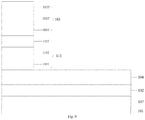
- FIG. 9 is a structural diagram showing an array substrate according to a third embodiment of the present disclosure.
- FIG. 10 is a structural diagram showing an array substrate according to a fourth embodiment of the present disclosure.
- FIG. 11 is a structural diagram showing an array substrate according to a fifth embodiment of the present disclosure.
- the embodiment of the present disclosure provides an array substrate.
- the array substrate includes a base substrate 101 , a plurality of organic electroluminescence components 102 , and at least one photoelectric conversion component 103 .
- the plurality of organic electroluminescence components 102 are arranged in an array on the base substrate 101 .
- the at least one photoelectric conversion component 103 corresponds to the organic electroluminescence components 102 and at least used to convert light of the second waveband emitted by the corresponding organic electroluminescence component 102 into electric energy.
- each organic electroluminescence component 102 may correspond to at least one photoelectric conversion component 103 .
- a luminescent spectrum of the organic electroluminescence component 102 includes a first waveband and a second waveband.
- the first waveband is determined by an emission peak of the luminescent spectrum and is used to determine brightness and tone purity of the light emitted by the organic electromechanical component.
- the organic electroluminescence component 102 may be a red light emitting component R, a green light emitting component G or a blue light emitting component B.
- the organic electroluminescence component 102 may also be a yellow light emitting component, which is not limited here.
- the organic electroluminescence component 102 is a red light emitting component R
- the corresponding luminescent spectrum is shown in FIG. 2 . It can be seen from FIG. 2 that an emission peak EL peak of the red light emitting component R is 618 nm, and a half peak width FWHM is 40 nm.
- the emission peak EL peak of the luminescent spectrum determines luminescent brightness and tone purity of the organic electroluminescence component 102 .
- the first waveband of the red light emitting component R may be a waveband near the emission peak EL peak, for example, 580 nm-638 nm, and the corresponding second waveband may be 639 nm-730 nm.
- the photoelectric conversion component 103 corresponding to the red light emitting component R converts light of the second waveband ranging in 639 nm-730 nm into electric energy.
- the self-illumination utilization ratio of the red light emitting component R is improved, the self-illumination brightness and tone purity of the red light emitting component R are further ensured simultaneously, and a display effect can be improved.
- the electric energy obtained from the conversion can also be used for self-charging, such that energy consumption is saved.
- the organic electroluminescence component 102 is a green light emitting component G
- the corresponding luminescent spectrum is shown in FIG. 3 .
- an emission peak EL peak of the green light emitting component G is 532 nm
- a half peak width FWHM is 40 nm.
- the first waveband of the green light emitting component G may be a waveband near the emission peak EL peak, for example, 480 nm-552 nm
- the corresponding second waveband may be 553 nm-630 nm.
- the photoelectric conversion component 103 corresponding to the green light emitting component G converts light of the second waveband light ranging within 553 nm-630 nm into electric energy.
- the self-illumination utilization ratio of the green light emitting component G is improved, the self-illumination brightness and tone purity of the green light emitting component G are further ensured simultaneously, and a display effect is improved.
- the electric energy obtained from the conversion can also be used for self-charging, such that energy consumption is saved.
- the organic electroluminescence component 102 is a blue light emitting component B
- the corresponding luminescent spectrum is shown in FIG. 4 .
- an emission peak EL peak of the blue light emitting component B is 460 nm
- a half peak width FWHM is 20 nm.
- the first waveband of the blue light emitting component B may be a waveband near the emission peak EL peak, for example, 430 nm-470 nm
- the corresponding second waveband may be 471 nm-530 nm.
- the photoelectric conversion component 103 corresponding to the blue light emitting component B converts light of the second waveband ranging within 471 nm-530 nm into electric energy.
- the self-illumination utilization ratio of the blue light emitting component B is improved, and the self-illumination brightness and tone purity of the blue light emitting component B are further ensured simultaneously, and a display effect is improved.
- the electric energy obtained from the conversion can also be used for self-charging, such that energy consumption is saved.
- ranges of the first waveband and the second waveband of the red light emitting component R, the green light emitting component G and the blue light emitting component B may be flexibly set as required, which are not limited to the above exemplary ranges.
- the photoelectric conversion component 103 converts the light of the second waveband in light emitted from the corresponding organic electroluminescence component 102 to a display side into electric energy.
- the organic electroluminescence component 102 includes an anode 1021 , a light-emitting layer 1022 and a cathode 1023 .
- the light-emitting layer 1022 includes a hole injection layer, a hole transport layer, a luminescent material layer, an electron transport layer and an electron injection layer.
- the organic electroluminescence component 102 may be a top-emitting-structured organic electroluminescence component 102 or a bottom-emitting-structured organic electroluminescence component 102 .
- the top-emitting-structured organic electroluminescence component 102 is adopted, in which the anode 1021 is an opaque total reflection electrode and the cathode 1023 located above the anode 1021 is a transparent or semi-transparent electrode.
- a top transparent or semitransparent electrode i.e. the cathode 1023
- a part of the light will be reflected to the base substrate 101 by the cathode 1023 , resulting in light leakage at the bottom.
- a part of the light emitted by the organic electroluminescence component 102 further irradiates a pixel defining layer for defining an area where the organic electroluminescence component 102 is located, resulting in light leakage on a side of the display panel. Therefore, the part of the light may further be guided to a direction of the base substrate 101 .
- the photoelectric conversion component 103 may further be provided on the base substrate 101 , and the photoelectric conversion component 103 may be used to convert the light emitted by the organic electroluminescence component 102 and reflected by the cathode 1023 and the light irradiating the pixel defining layer and guided to the base substrate 101 (i.e. including light of the first waveband light and the second waveband) into electric energy, thus improving the self-illumination utilization ratio of the organic electroluminescence component 102 while avoiding light leakage at the bottom and the side, and enhancing stability of the display panel without affecting the display performance.
- the photoelectric conversion component 103 corresponding to the organic electroluminescence component 102 in the array substrate, the light of the second waveband emitted by the organic electroluminescence component 102 and independent of the brightness and tone purity may be converted into electric energy through the corresponding photoelectric conversion component 103 . Therefore, the self-illumination utilization ratio of the display panel is improved without affecting its display performance. Moreover, the electric energy obtained from the conversion by the photoelectric conversion component 103 can charge a battery at any time, such that energy consumption can be saved.
- the embodiment of the present disclosure provides an array substrate, as shown in FIG. 5 , including a base substrate 101 , organic electroluminescence components 102 located on the base substrate 101 , and at least one photoelectric conversion component 103 corresponding to each of the organic electroluminescence components 102 .
- a luminescent spectrum of the organic electroluminescence component 102 includes a first waveband and a second waveband. The first waveband is determined by an emission peak of the luminescent spectrum and is used to determine brightness and tone purity of light emitted by the organic electroluminescence component.
- the photoelectric conversion component 103 is used to convert the light of the second waveband emitted by the corresponding organic electroluminescence component 102 and irradiating a display side (that is, one side of the organic electroluminescence component 102 away from the base substrate 101 ) into electric energy.
- the photoelectric conversion component 103 is located at an edge of an area where the corresponding organic electroluminescence component 102 (as shown in FIG. 1 ) is located, or located at a gap between adjacent two organic electroluminescence components 102 .
- the array substrate provided by the embodiment of the present disclosure further includes a packaging layer 104 located on one side of the organic electroluminescence component 102 away from the base substrate 101 .
- the photoelectric conversion component 103 is located on one side of the packaging layer 104 away from the organic electroluminescence component 102 , that is, on an upper surface of the packaging layer 104 in FIG. 2 .
- the array substrate provided by the embodiment of the present disclosure further includes a polyimide layer 105 , a first buffer layer 106 , a transistor layer 107 and a first flat layer 108 , and a pixel defining layer 109 for defining an area where the organic electroluminescence component 103 is located.
- the transistor layer 107 includes an active layer 1071 , a first gate insulating layer 1072 , a first gate 1073 , a second gate insulating layer 1074 , a second gate 1075 , an interlayer dielectric layer 1076 , and a source drain electrode 1077 .
- the photoelectric conversion component 103 includes a fourth transparent electrode 1031 , a P-type semiconductor layer 1032 , an intrinsic semiconductor layer 1033 , an N-type semiconductor layer 1034 , and a fifth transparent electrode 1035 arranged in the stackup manner.
- the array substrate may be further provided with a first insulating layer 1036 and a wiring 1037 on one side of the fifth transparent electrode 1035 away from the N-type semiconductor layer 1034 , and the wiring 1037 is connected to the fifth transparent electrode 1035 through a via hole penetrating through the first insulating layer 1036 .
- the first insulating layer 1036 covers side surfaces of the fourth transparent electrode 1031 , the P-type semiconductor layer 1032 , the intrinsic semiconductor layer 1033 , the N-type semiconductor layer 1034 , and the fifth transparent electrode 1035 , that are respectively perpendicular to the base substrate 101 , and a side surface of the packaging layer 104 away from the organic electroluminescence component 102 .
- the P-type semiconductor layer 1032 , the intrinsic semiconductor layer 1033 and the N-type semiconductor layer 1034 may be semiconductor layers based on materials such as gallium nitride, copper indium gallium selenium or silicon-based materials, which are not specifically defined herein.
- materials of the fourth transparent electrode 1031 , the fifth transparent electrode 1036 and the wiring 1037 may be ITO, IZO, etc.
- the absorption rate of red light by the intrinsic semiconductor layer 1033 such as the silicon-based amorphous silicon ( ⁇ -Si) semiconductor layer itself is low (less than 5%), thus when the organic electroluminescence component 102 is a red light emitting component R, it is unnecessary to dope the intrinsic semiconductor layer 1033 .
- the organic electroluminescence component 102 is a green light emitting component G or a blue light emitting component B, in order to enable the corresponding photoelectric conversion component 103 to absorb the light of the second waveband, a preset number of carbon particles need to be doped into the intrinsic semiconductor layer 1033 .
- the organic electroluminescence component 102 when the organic electroluminescence component 102 is a green light emitting component G, 5*10 14 carbon particles may be doped into the ⁇ -Si semiconductor layer to increase band gap of ⁇ -Si and realize absorption and conversion of the light of the second waveband by the blue light emitting component B.
- the organic electroluminescence component 102 is a blue light emitting component B
- 9*10 13 carbon particles may be doped into the ⁇ -Si semiconductor layer to increase the band gap of ⁇ -Si and realize the absorption and conversion of the light of the second waveband light by the blue light emitting component B.
- the fifth transparent electrode 1031 of each photoelectric conversion component 103 may be connected with each other, and the wiring 1037 of each photoelectric conversion component 103 may be connected with each other.
- the wiring 1037 of each photoelectric conversion component 103 may be interconnected in a manner as shown in FIG. 6 and FIG. 7 .
- the embodiment of the present disclosure provides an array substrate, as shown in FIG. 8 . Since the array substrate provided by the embodiment of the present disclosure is only integrated with a touch function in the array substrate provided by the embodiment of the present disclosure as compared with an array substrate provided by the corresponding embodiment of FIG. 5 . Therefore, the content of the array substrate realizing the touch function provided by the embodiment of the present disclosure will be introduced, and the repetition of the embodiment corresponding to FIG. 5 will be omitted herein.
- the array substrate provided by the embodiment of the present disclosure further includes: a touch component 110 located at a gap of each organic electroluminescence component 102 .
- the touch component 110 includes a first touch electrode 1101 , a second insulating layer 1102 and a second touch electrode 1103 successively located on one side of the packaging layer 104 away from the organic electroluminescence component 102 .
- the first touch electrode 1101 may be provided in the same layer with the fourth transparent electrode 1031 in the photoelectric conversion component 103
- the second insulating layer 1102 may be multiplexed with the first insulating layer 1036 in the photoelectric conversion component 103
- the second touch electrode 1103 may be provided in the same layer with the wiring 1037 .
- the embodiment of the present disclosure provides an array substrate as shown in FIG. 9 .
- the difference thereof lies in that the structures of the photoelectric conversion component 103 in the two array substrates are different, and the function of thermoelectric and piezoelectric conversion may be realized by the array substrate provided by the embodiment of the present disclosure. Therefore, only the differences between the embodiments of the present disclosure and the corresponding embodiment of FIG. 5 will be described below, and the repetition will be omitted herein.
- the array substrate provided by the embodiment of the present disclosure further includes a thermoelectric/piezoelectric conversion component 111 located between the packaging layer 104 and the photoelectric conversion component 103 .
- the thermoelectric/piezoelectric conversion component 111 is used to convert thermal energy emitted by the photoelectric conversion component 103 and pressure of the thermoelectric/piezoelectric conversion component 111 into electric energy.
- thermoelectric/piezoelectric conversion component 111 on the base substrate 101 coincides with positive projection of the photoelectric conversion component 103 on the base substrate 101 .
- the thermoelectric/piezoelectric conversion component 111 includes a first transparent electrode 1111 , a thermoelectric/piezoelectric material layer 1112 and a second transparent electrode 1113 successively located on one side of the packaging layer 104 facing toward the photoelectric conversion component 103 .
- the material of the thermoelectric/piezoelectric material layer 1112 may be materials with thermoelectric and piezoelectric properties, such as PZT, PVDF or ZnO.
- the photoelectric conversion component 103 includes a poly-3-hexylthiophene layer 1031 ′, a zinc oxide layer 1032 ′ and a third transparent electrode 1033 ′ successively located on one side of the second transparent electrode 1113 away from the thermoelectric/piezoelectric material layer 1112 .
- the display panel may be powered at any time and place by integrating the thermoelectric/piezoelectric function and the photoelectric conversion function.
- the thermoelectric/piezoelectric conversion component 111 is made of the same material. The component 111 has the advantages of low manufacturing cost and small overall size.
- the embodiment of the present disclosure provides an array substrate shown in FIG. 10 .
- the difference thereof mainly lies in a specific setting position and different functions of the photoelectric conversion component 103 . Therefore, the differences between the embodiment of the present disclosure and the corresponding embodiment of FIG. 5 will be described below, and the repetition will be omitted herein.
- the photoelectric conversion component 103 is arranged between the base substrate 101 and a layer where the organic electroluminescence component 102 is located.
- the photoelectric conversion component 103 is used to convert light of the first and second waveband emitted by the organic electroluminescence component 102 , reflected by the cathode 1023 of the top-emitting-structured organic electroluminescence component 102 and irradiating in a direction of the base substrate 101 into electric energy, so as to increase the self-illumination utilization ratio of the display panel, save energy consumption, avoid light leakage at the bottom, and improve the stability of the display panel.
- the photoelectric conversion components 103 may be evenly distributed on the base substrate 101 .
- the array substrate provided by the embodiment of the present disclosure may further include a transistor layer 107 located between the base substrate 101 and a layer where the organic electroluminescence component 102 is located.
- the photoelectric conversion component 103 may be arranged between the base substrate 101 and the transistor layer 107 . In this way, after the photoelectric conversion component 103 is manufactured on the base substrate 101 , other film layers in the array substrate are formed by the existing manufacturing process, resulting in less change on the process and reduction of the production cost as much as possible.
- the photoelectric conversion component 103 includes a fourth metal electrode 1031 ′′, a P-type semiconductor layer 1032 , an intrinsic semiconductor layer 1033 , an N-type semiconductor layer 1034 , a fifth transparent electrode 1035 , a first insulating layer 1036 , and a wiring 1037 that are arranged in the stackup manner.
- the wiring 1037 is connected to the fifth transparent electrode 1035 through a via hole penetrating through the first insulating layer 1036 .
- the fourth metal electrode 1031 ′′ is in contact with the base substrate 101 .
- the first insulating layer 1036 also covers surfaces of the fourth metal electrode 1031 ′′, the P-type semiconductor layer 1032 , the intrinsic semiconductor layer 1033 , the N-type semiconductor layer 1034 , and the fifth transparent electrode 1035 , that are respectively perpendicular to the base substrate 101 , and a surface of the base substrate 101 facing toward one side of the organic electroluminescence component 102 .
- the fourth metal electrode 1031 ′′ is in contact with the first buffer layer 106
- the first insulating layer 1036 covers surface of the first buffer layer 106 facing toward one side of the organic electroluminescence component 102 .
- the array substrate provided in the embodiment of the present disclosure may further include a flat layer 112 and a buffer layer 113 successively arranged on one side of a layer where the wiring 1037 is located and faces toward the transistor layer 107 .
- the embodiment of the present disclosure provides an array substrate shown in FIG. 11 .
- embodiment 5 of the present disclosure is provided with a groove at a position corresponding to the photoelectric conversion component 103 on one face of the pixel defining layer 109 away from the base substrate 101 (i.e. an upper surface of the pixel defining layer 109 in FIG. 11 ), and a side of the groove is provided with a light guiding layer 114 .
- the groove is used to guide light from the organic electroluminescence component 102 irradiating the light guiding layer 114 and light from the outside irradiating the bottom of the groove to the photoelectric conversion component 103 .
- the photoelectric conversion component 103 is not only used to convert the light of the first waveband and the second waveband emitted by the organic electroluminescence component 102 , reflected by the cathode 1023 , guided by the light guiding layer 114 and irradiating the base substrate 101 into electric energy, but also used to convert the light guided out through the groove and the received light from the outside into electric energy.
- the cross section of the groove perpendicular to the direction of the base substrate 101 may be a trapezoid structure with a wide top and a narrow bottom.
- the cross section of the groove perpendicular to the direction of the base substrate 101 may further be other structures as long as the light from the organic electroluminescence component 102 irradiating the light guiding layer 114 in the pixel defining layer 109 may be guided to the photoelectric conversion component 103 , which is not specifically limited here.
- the included angle ⁇ between the side of the groove and the surface of the pixel defining layer 109 away from the base substrate 101 is 10 to 80 degrees.
- the depth d 1 of the groove is two-thirds of the thickness d 2 of the pixel defining layer 109 .
- the material of the light guiding layer 114 may be a metal with a reflective property.
- the positive projection of the groove on the base substrate 101 coincides with the positive projection of the photoelectric conversion component 103 on the base substrate 101 .
- touch component 110 in the array substrate provided by the embodiment corresponding to FIG. 8 of the present disclosure may also be applied to the array substrate provided by the embodiments corresponding to FIG. 9 , FIG. 10 and FIG. 11 of the present disclosure.
- each film layer of the touch component 110 does not relate to the problem of multiplexing the film layer or on the same layer of the photoelectric conversion component 103 .
- the embodiment of the present disclosure further provides a display panel, including an array substrate and a protection cover plate which are oppositely arranged.
- the array substrate is the array substrate provided by the embodiments of the present disclosure.
- the display panel may be a mobile phone, a tablet computer, a TV, a display, a laptop, a digital camera, a navigator, a smart watch, a fitness wrist strap, a personal digital assistant, a self-service deposit/withdrawal machine and any other product or part with a display function.
- the display panel please refer to the embodiment of the array substrate above, as the repetition will be omitted.
Landscapes
- Chemical & Material Sciences (AREA)
- Inorganic Chemistry (AREA)
- Life Sciences & Earth Sciences (AREA)
- Sustainable Development (AREA)
- Engineering & Computer Science (AREA)
- Microelectronics & Electronic Packaging (AREA)
- Electroluminescent Light Sources (AREA)
- Devices For Indicating Variable Information By Combining Individual Elements (AREA)
Abstract
Description
Claims (18)
Applications Claiming Priority (3)
| Application Number | Priority Date | Filing Date | Title |
|---|---|---|---|
| CN201811086394.1 | 2018-09-18 | ||
| CN201811086394.1A CN109346498B (en) | 2018-09-18 | 2018-09-18 | Array substrate and display panel |
| PCT/CN2019/090928 WO2020057185A1 (en) | 2018-09-18 | 2019-06-12 | Array substrate and display panel |
Publications (2)
| Publication Number | Publication Date |
|---|---|
| US20210057495A1 US20210057495A1 (en) | 2021-02-25 |
| US11222930B2 true US11222930B2 (en) | 2022-01-11 |
Family
ID=65305396
Family Applications (1)
| Application Number | Title | Priority Date | Filing Date |
|---|---|---|---|
| US16/620,572 Expired - Fee Related US11222930B2 (en) | 2018-09-18 | 2019-06-12 | Array substrate and display panel |
Country Status (3)
| Country | Link |
|---|---|
| US (1) | US11222930B2 (en) |
| CN (1) | CN109346498B (en) |
| WO (1) | WO2020057185A1 (en) |
Cited By (1)
| Publication number | Priority date | Publication date | Assignee | Title |
|---|---|---|---|---|
| US11502138B2 (en) * | 2019-06-27 | 2022-11-15 | Chengdu Boe Optoelectronics Technology Co., Ltd. | Electronic substrate, manufacturing method thereof, and display panel |
Families Citing this family (7)
| Publication number | Priority date | Publication date | Assignee | Title |
|---|---|---|---|---|
| CN109346498B (en) | 2018-09-18 | 2020-06-16 | 京东方科技集团股份有限公司 | Array substrate and display panel |
| CN110767726B (en) * | 2019-10-29 | 2022-07-15 | 昆山国显光电有限公司 | Method for improving color cast, display panel and display device |
| CN111524937B (en) * | 2020-04-23 | 2021-08-24 | 深圳市华星光电半导体显示技术有限公司 | OLED display panel and display device |
| WO2021240291A1 (en) * | 2020-05-29 | 2021-12-02 | 株式会社半導体エネルギー研究所 | Optical functional device, functional panel, display device, input/output device, information processing device |
| KR102870048B1 (en) | 2020-07-22 | 2025-10-14 | 삼성디스플레이 주식회사 | Heat dissipation composite, lower panel sheet, and display device including the same |
| KR102866124B1 (en) * | 2021-12-31 | 2025-09-30 | 엘지디스플레이 주식회사 | Light Emitting Display Device and Compensating Method for the Same |
| CN116193938B (en) * | 2023-02-28 | 2025-10-14 | 京东方科技集团股份有限公司 | Display substrate and display panel |
Citations (16)
| Publication number | Priority date | Publication date | Assignee | Title |
|---|---|---|---|---|
| US20130285046A1 (en) * | 2012-04-25 | 2013-10-31 | Semiconductor Energy Laboratory Co., Ltd. | Semiconductor device and method of manufacturing the same |
| CN104201187A (en) | 2014-08-18 | 2014-12-10 | 京东方科技集团股份有限公司 | Organic light emitting diode (OLED) display device |
| CN104752462A (en) | 2013-12-27 | 2015-07-01 | 昆山国显光电有限公司 | Organic light emitting diode (OLED) display with touch panel |
| US20150279884A1 (en) * | 2014-03-28 | 2015-10-01 | Semiconductor Energy Laboratory Co., Ltd. | Imaging device |
| US20150364527A1 (en) * | 2014-06-11 | 2015-12-17 | Samsung Display Co., Ltd. | Organic light emitting diode display including sensors |
| US20160155782A1 (en) * | 2014-12-01 | 2016-06-02 | Japan Display Inc. | Display device |
| US20170357641A1 (en) * | 2016-06-10 | 2017-12-14 | Semiconductor Energy Laboratory Co., Ltd. | Information terminal |
| CN107506728A (en) * | 2017-08-23 | 2017-12-22 | 京东方科技集团股份有限公司 | Photosensitive unit, photosensitive module and photosensitive device |
| US20180060641A1 (en) * | 2016-08-23 | 2018-03-01 | Samsung Display Co., Ltd. | Method and apparatus to detect three-dimensional pattern information of a touch object |
| US20180074614A1 (en) * | 2016-09-13 | 2018-03-15 | Japan Display Inc. | Display device and electric device |
| CN109346498A (en) | 2018-09-18 | 2019-02-15 | 京东方科技集团股份有限公司 | Array substrate and display panel |
| US20190384428A1 (en) * | 2016-07-21 | 2019-12-19 | Dongwoo Fine-Chem Co., Ltd. | Film touch sensor |
| US20200242324A1 (en) * | 2018-07-20 | 2020-07-30 | Boe Technology Group Co., Ltd. | Array substrate, method of manufacturing array substrate, and display apparatus |
| US20200350374A1 (en) * | 2018-08-01 | 2020-11-05 | Boe Technology Group Co., Ltd. | Display panel, manufacturing method thereof, and display device |
| US20210124441A1 (en) * | 2019-10-23 | 2021-04-29 | Boe Technology Group Co., Ltd. | Display substrate, display device and detection method by using display device |
| US20210134896A1 (en) * | 2019-01-30 | 2021-05-06 | Boe Technology Group Co., Ltd. | Display panel and display apparatus |
Family Cites Families (1)
| Publication number | Priority date | Publication date | Assignee | Title |
|---|---|---|---|---|
| CN107589576B (en) * | 2017-09-30 | 2020-11-06 | 武汉华星光电技术有限公司 | Array substrate, manufacturing method thereof and touch display panel |
-
2018
- 2018-09-18 CN CN201811086394.1A patent/CN109346498B/en active Active
-
2019
- 2019-06-12 US US16/620,572 patent/US11222930B2/en not_active Expired - Fee Related
- 2019-06-12 WO PCT/CN2019/090928 patent/WO2020057185A1/en not_active Ceased
Patent Citations (17)
| Publication number | Priority date | Publication date | Assignee | Title |
|---|---|---|---|---|
| US20130285046A1 (en) * | 2012-04-25 | 2013-10-31 | Semiconductor Energy Laboratory Co., Ltd. | Semiconductor device and method of manufacturing the same |
| CN104752462A (en) | 2013-12-27 | 2015-07-01 | 昆山国显光电有限公司 | Organic light emitting diode (OLED) display with touch panel |
| US20150279884A1 (en) * | 2014-03-28 | 2015-10-01 | Semiconductor Energy Laboratory Co., Ltd. | Imaging device |
| US20150364527A1 (en) * | 2014-06-11 | 2015-12-17 | Samsung Display Co., Ltd. | Organic light emitting diode display including sensors |
| CN104201187A (en) | 2014-08-18 | 2014-12-10 | 京东方科技集团股份有限公司 | Organic light emitting diode (OLED) display device |
| US20160293100A1 (en) | 2014-08-18 | 2016-10-06 | Boe Technology Group Co., Ltd. | Organic light-emitting diode display apparatus, display device, and method for testing the organic light-emitting diode display apparatus |
| US20160155782A1 (en) * | 2014-12-01 | 2016-06-02 | Japan Display Inc. | Display device |
| US20170357641A1 (en) * | 2016-06-10 | 2017-12-14 | Semiconductor Energy Laboratory Co., Ltd. | Information terminal |
| US20190384428A1 (en) * | 2016-07-21 | 2019-12-19 | Dongwoo Fine-Chem Co., Ltd. | Film touch sensor |
| US20180060641A1 (en) * | 2016-08-23 | 2018-03-01 | Samsung Display Co., Ltd. | Method and apparatus to detect three-dimensional pattern information of a touch object |
| US20180074614A1 (en) * | 2016-09-13 | 2018-03-15 | Japan Display Inc. | Display device and electric device |
| CN107506728A (en) * | 2017-08-23 | 2017-12-22 | 京东方科技集团股份有限公司 | Photosensitive unit, photosensitive module and photosensitive device |
| US20200242324A1 (en) * | 2018-07-20 | 2020-07-30 | Boe Technology Group Co., Ltd. | Array substrate, method of manufacturing array substrate, and display apparatus |
| US20200350374A1 (en) * | 2018-08-01 | 2020-11-05 | Boe Technology Group Co., Ltd. | Display panel, manufacturing method thereof, and display device |
| CN109346498A (en) | 2018-09-18 | 2019-02-15 | 京东方科技集团股份有限公司 | Array substrate and display panel |
| US20210134896A1 (en) * | 2019-01-30 | 2021-05-06 | Boe Technology Group Co., Ltd. | Display panel and display apparatus |
| US20210124441A1 (en) * | 2019-10-23 | 2021-04-29 | Boe Technology Group Co., Ltd. | Display substrate, display device and detection method by using display device |
Non-Patent Citations (1)
| Title |
|---|
| First Chinese Office Action issued in Chinese Patent Application No. 201811086394.1 dated Dec. 20, 2019. |
Cited By (1)
| Publication number | Priority date | Publication date | Assignee | Title |
|---|---|---|---|---|
| US11502138B2 (en) * | 2019-06-27 | 2022-11-15 | Chengdu Boe Optoelectronics Technology Co., Ltd. | Electronic substrate, manufacturing method thereof, and display panel |
Also Published As
| Publication number | Publication date |
|---|---|
| CN109346498B (en) | 2020-06-16 |
| WO2020057185A1 (en) | 2020-03-26 |
| US20210057495A1 (en) | 2021-02-25 |
| CN109346498A (en) | 2019-02-15 |
Similar Documents
| Publication | Publication Date | Title |
|---|---|---|
| US11222930B2 (en) | Array substrate and display panel | |
| US10535719B2 (en) | Color film substrate for WOLED display and WOLED display | |
| US9960212B2 (en) | Organic light emitting diode display panel | |
| US20170271418A1 (en) | Oled display substrate and manufacturing method thereof and display apparatus | |
| US8476622B2 (en) | Active matrix organic light emitting diode | |
| KR20120092507A (en) | Light-emitting device and electronic device using light-emitting device | |
| KR20120044655A (en) | Organic light emitting diode display | |
| US9660219B2 (en) | Methods of manufacturing display devices | |
| WO2020056865A1 (en) | Display panel and display device | |
| US11950450B2 (en) | Display substrate and method of manufacturing the same and electronic device | |
| US20210167319A1 (en) | Anode, light emitting device, display substrate and method of manufacturing the same, and display device | |
| US20250241179A1 (en) | Display panel and manufacturing method therefor, and display apparatus | |
| CN107634084B (en) | Top-emitting white light OLED display device | |
| JP2014086314A (en) | Organic electroluminescent display device | |
| US11189674B2 (en) | Anode structure, method of forming the same and organic light emitting diode display device including the same | |
| US10367038B2 (en) | Organic light-emitting diode display device and manufacturing method thereof, and organic light-emitting diode display | |
| KR101068395B1 (en) | An organic light emitting display device having a top emission type and a method of manufacturing the same | |
| US20210336236A1 (en) | Display panel and manufacturing method thereof | |
| CN100521849C (en) | double-sided display device and manufacturing method thereof | |
| US9324770B2 (en) | Organic light emitting display devices and methods of manufacturing organic light emitting display devices | |
| US12324343B2 (en) | Top emitting display panels and display devices | |
| CN206610812U (en) | Organic Light Emitting Diode Display Device | |
| CN115312679A (en) | Laminated electroluminescent device, display panel and display device | |
| CN115605057A (en) | Display panel, display device and preparation method | |
| CN115440779A (en) | Display panel, manufacturing method thereof and display device |
Legal Events
| Date | Code | Title | Description |
|---|---|---|---|
| AS | Assignment |
Owner name: BOE TECHNOLOGY GROUP CO., LTD., CHINA Free format text: ASSIGNMENT OF ASSIGNORS INTEREST;ASSIGNORS:YUAN, GUANGCAI;GUO, KANG;GU, XIN;AND OTHERS;REEL/FRAME:051214/0810 Effective date: 20191203 |
|
| FEPP | Fee payment procedure |
Free format text: ENTITY STATUS SET TO UNDISCOUNTED (ORIGINAL EVENT CODE: BIG.); ENTITY STATUS OF PATENT OWNER: LARGE ENTITY |
|
| STPP | Information on status: patent application and granting procedure in general |
Free format text: DOCKETED NEW CASE - READY FOR EXAMINATION |
|
| STPP | Information on status: patent application and granting procedure in general |
Free format text: NON FINAL ACTION MAILED |
|
| STPP | Information on status: patent application and granting procedure in general |
Free format text: RESPONSE TO NON-FINAL OFFICE ACTION ENTERED AND FORWARDED TO EXAMINER |
|
| STPP | Information on status: patent application and granting procedure in general |
Free format text: NOTICE OF ALLOWANCE MAILED -- APPLICATION RECEIVED IN OFFICE OF PUBLICATIONS |
|
| STPP | Information on status: patent application and granting procedure in general |
Free format text: PUBLICATIONS -- ISSUE FEE PAYMENT RECEIVED |
|
| STPP | Information on status: patent application and granting procedure in general |
Free format text: PUBLICATIONS -- ISSUE FEE PAYMENT VERIFIED |
|
| STCF | Information on status: patent grant |
Free format text: PATENTED CASE |
|
| FEPP | Fee payment procedure |
Free format text: MAINTENANCE FEE REMINDER MAILED (ORIGINAL EVENT CODE: REM.); ENTITY STATUS OF PATENT OWNER: LARGE ENTITY |
|
| LAPS | Lapse for failure to pay maintenance fees |
Free format text: PATENT EXPIRED FOR FAILURE TO PAY MAINTENANCE FEES (ORIGINAL EVENT CODE: EXP.); ENTITY STATUS OF PATENT OWNER: LARGE ENTITY |
|
| STCH | Information on status: patent discontinuation |
Free format text: PATENT EXPIRED DUE TO NONPAYMENT OF MAINTENANCE FEES UNDER 37 CFR 1.362 |
|
| FP | Lapsed due to failure to pay maintenance fee |
Effective date: 20260111 |