US11220522B2 - Cytotoxic platinum complex, its preparation and therapeutic use - Google Patents
Cytotoxic platinum complex, its preparation and therapeutic use Download PDFInfo
- Publication number
- US11220522B2 US11220522B2 US16/558,546 US201916558546A US11220522B2 US 11220522 B2 US11220522 B2 US 11220522B2 US 201916558546 A US201916558546 A US 201916558546A US 11220522 B2 US11220522 B2 US 11220522B2
- Authority
- US
- United States
- Prior art keywords
- platinum
- complex
- formula
- cancer
- atom
- Prior art date
- Legal status (The legal status is an assumption and is not a legal conclusion. Google has not performed a legal analysis and makes no representation as to the accuracy of the status listed.)
- Active
Links
- 0 *O[Pt](C)(C)(C)(C)[Y] Chemical compound *O[Pt](C)(C)(C)(C)[Y] 0.000 description 41
- ZXKRKFLCKMCAIO-UHFFFAOYSA-N [H]C(=C)C1=CC=C(OCC(=O)ON2C(=O)CCC2=O)C=C1 Chemical compound [H]C(=C)C1=CC=C(OCC(=O)ON2C(=O)CCC2=O)C=C1 ZXKRKFLCKMCAIO-UHFFFAOYSA-N 0.000 description 4
- BTEIRELLDOKPSP-RUDMXATFSA-N CC1=C(Cl)C=CC(C(=O)/C=C/C2=CC=C(OCC(=O)ON3C(=O)CCC3=O)C=C2)=C1 Chemical compound CC1=C(Cl)C=CC(C(=O)/C=C/C2=CC=C(OCC(=O)ON3C(=O)CCC3=O)C=C2)=C1 BTEIRELLDOKPSP-RUDMXATFSA-N 0.000 description 3
- OIOQAYCPHCXHOH-UHFFFAOYSA-M C[Pt](C)(C)(C)(O)[Y] Chemical compound C[Pt](C)(C)(C)(O)[Y] OIOQAYCPHCXHOH-UHFFFAOYSA-M 0.000 description 3
- SVBNOOCWDPGLBH-UHFFFAOYSA-K C[Pt](N)(N)(O)(O)Cl Chemical compound C[Pt](N)(N)(O)(O)Cl SVBNOOCWDPGLBH-UHFFFAOYSA-K 0.000 description 3
- TVJDPJGWJPLQJY-UHFFFAOYSA-N [H]C(=C)C1=CC=C(OCC(=O)O)C=C1 Chemical compound [H]C(=C)C1=CC=C(OCC(=O)O)C=C1 TVJDPJGWJPLQJY-UHFFFAOYSA-N 0.000 description 3
- DITXLLCTZZCJEW-UHFFFAOYSA-B [H]C(=C)C1=CC=C(OCC(=O)O[Pt](N)(N)(Cl)(Cl)OC(=O)COC2=CC=C(C([H])=O)C=C2)C=C1.[H]C(=C)C1=CC=C(OCC(=O)O[Pt](N)(N)(O)(Cl)Cl)C=C1.[H]C(=C)C1=CC=C(OCC(=O)O[Pt]23(O)(CC4CCCCC4N2)OC(=O)C(=O)O3)C=C1 Chemical compound [H]C(=C)C1=CC=C(OCC(=O)O[Pt](N)(N)(Cl)(Cl)OC(=O)COC2=CC=C(C([H])=O)C=C2)C=C1.[H]C(=C)C1=CC=C(OCC(=O)O[Pt](N)(N)(O)(Cl)Cl)C=C1.[H]C(=C)C1=CC=C(OCC(=O)O[Pt]23(O)(CC4CCCCC4N2)OC(=O)C(=O)O3)C=C1 DITXLLCTZZCJEW-UHFFFAOYSA-B 0.000 description 3
- FAKCMRWNBZBDDA-UHFFFAOYSA-J C=C1O[Pt]2(O)(O)(CC3CCCCC3N2)OC1=O Chemical compound C=C1O[Pt]2(O)(O)(CC3CCCCC3N2)OC1=O FAKCMRWNBZBDDA-UHFFFAOYSA-J 0.000 description 2
- ZMVVCANUBHZKGW-BJMVGYQFSA-N CC(C)C(=O)COC1=CC=C(/C=C/C(=O)C2=CC(Cl)=C(Cl)C=C2)C=C1 Chemical compound CC(C)C(=O)COC1=CC=C(/C=C/C(=O)C2=CC(Cl)=C(Cl)C=C2)C=C1 ZMVVCANUBHZKGW-BJMVGYQFSA-N 0.000 description 2
- OPVINGLHJBMWMV-RUDMXATFSA-N CC1=C(Cl)C=CC(C(=O)/C=C/C2=CC=C(OCC(=O)O)C=C2)=C1 Chemical compound CC1=C(Cl)C=CC(C(=O)/C=C/C2=CC=C(OCC(=O)O)C=C2)=C1 OPVINGLHJBMWMV-RUDMXATFSA-N 0.000 description 2
- WOBWCEKQUBFSON-UHFFFAOYSA-L C[Pt](C)(C)(O)(O)[Y] Chemical compound C[Pt](C)(C)(O)(O)[Y] WOBWCEKQUBFSON-UHFFFAOYSA-L 0.000 description 2
- HTSLHLCJWPDJST-UPOIWUHESA-J N[Pt](N)(Cl)(Cl)(OC(=O)COC1=CC=C(/C=C/C(=O)C2=CC(Cl)=C(Cl)C=C2)C=C1)OC(=O)COC1=CC=C(/C=C/C(=O)C2=CC(Cl)=C(Cl)C=C2)C=C1 Chemical compound N[Pt](N)(Cl)(Cl)(OC(=O)COC1=CC=C(/C=C/C(=O)C2=CC(Cl)=C(Cl)C=C2)C=C1)OC(=O)COC1=CC=C(/C=C/C(=O)C2=CC(Cl)=C(Cl)C=C2)C=C1 HTSLHLCJWPDJST-UPOIWUHESA-J 0.000 description 2
- HYOGGAFSGVKVRU-UHFFFAOYSA-B C.C.[H]C(=C)C1=CC=C(OCC(=O)O[Pt](N)(N)(Cl)(Cl)OC(=O)COC2=CC=C(C([H])=O)C=C2)C=C1.[H]C(=C)C1=CC=C(OCC(=O)O[Pt](N)(N)(O)(Cl)Cl)C=C1.[H]C(=C)C1=CC=C(OCC(=O)O[Pt]23(O)(CC4CCCCC4N2)OC(=O)C(=O)O3)C=C1 Chemical compound C.C.[H]C(=C)C1=CC=C(OCC(=O)O[Pt](N)(N)(Cl)(Cl)OC(=O)COC2=CC=C(C([H])=O)C=C2)C=C1.[H]C(=C)C1=CC=C(OCC(=O)O[Pt](N)(N)(O)(Cl)Cl)C=C1.[H]C(=C)C1=CC=C(OCC(=O)O[Pt]23(O)(CC4CCCCC4N2)OC(=O)C(=O)O3)C=C1 HYOGGAFSGVKVRU-UHFFFAOYSA-B 0.000 description 1
- GATOFBOPXZWHAW-FAZFKGEPSA-F C.CC1=C(Cl)C=CC(C(=O)/C=C/C2=CC=C(OCC(=O)O[Pt](N)(N)(O)(Cl)Cl)C=C2)=C1.CC1=C(Cl)C=CC(C(=O)/C=C/C2=CC=C(OCC(=O)O[Pt]34(OC(=O)COC5=CC=C(/C=C/C(=O)C6=CC(Cl)=C(Cl)C=C6)C=C5)(CC5CCCCC5N3)OC(=O)C(=O)O4)C=C2)=C1 Chemical compound C.CC1=C(Cl)C=CC(C(=O)/C=C/C2=CC=C(OCC(=O)O[Pt](N)(N)(O)(Cl)Cl)C=C2)=C1.CC1=C(Cl)C=CC(C(=O)/C=C/C2=CC=C(OCC(=O)O[Pt]34(OC(=O)COC5=CC=C(/C=C/C(=O)C6=CC(Cl)=C(Cl)C=C6)C=C5)(CC5CCCCC5N3)OC(=O)C(=O)O4)C=C2)=C1 GATOFBOPXZWHAW-FAZFKGEPSA-F 0.000 description 1
- CEKYDVLEWJOOQP-SVYAQGATSA-A C.CC1=C(Cl)C=CC(C(=O)/C=C/C2=CC=C(OCC(=O)O[Pt](N)(N)(O)(Cl)Cl)C=C2)=C1.CC1=C(Cl)C=CC(C(=O)/C=C/C2=CC=C(OCC(=O)O[Pt]34(OC(=O)COC5=CC=C(/C=C/C(=O)C6=CC(Cl)=C(Cl)C=C6)C=C5)(CC5CCCCC5N3)OC(=O)C(=O)O4)C=C2)=C1.[H]C(=C)C1=CC=C(OCC(=O)O[Pt](N)(N)(O)(Cl)Cl)C=C1.[H]C(=C)C1=CC=C(OCC(=O)O[Pt]23(O)(CC4CCCCC4N2)OC(=O)C(=O)O3)C=C1.[H]C(=O)C1=CC=C(OCC(=O)O[Pt](N)(N)(Cl)(Cl)OC(=O)COC2=CC=C(C([H])=O)C=C2)C=C1 Chemical compound C.CC1=C(Cl)C=CC(C(=O)/C=C/C2=CC=C(OCC(=O)O[Pt](N)(N)(O)(Cl)Cl)C=C2)=C1.CC1=C(Cl)C=CC(C(=O)/C=C/C2=CC=C(OCC(=O)O[Pt]34(OC(=O)COC5=CC=C(/C=C/C(=O)C6=CC(Cl)=C(Cl)C=C6)C=C5)(CC5CCCCC5N3)OC(=O)C(=O)O4)C=C2)=C1.[H]C(=C)C1=CC=C(OCC(=O)O[Pt](N)(N)(O)(Cl)Cl)C=C1.[H]C(=C)C1=CC=C(OCC(=O)O[Pt]23(O)(CC4CCCCC4N2)OC(=O)C(=O)O3)C=C1.[H]C(=O)C1=CC=C(OCC(=O)O[Pt](N)(N)(Cl)(Cl)OC(=O)COC2=CC=C(C([H])=O)C=C2)C=C1 CEKYDVLEWJOOQP-SVYAQGATSA-A 0.000 description 1
- DNMYQCBJZBQEOO-MWFKXNDMSA-A CC1=C(Cl)C=CC(C(=O)/C=C/C2=CC=C(OCC(=O)O[Pt](N)(N)(O)(Cl)Cl)C=C2)=C1.CC1=C(Cl)C=CC(C(=O)/C=C/C2=CC=C(OCC(=O)O[Pt]34(OC(=O)COC5=CC=C(/C=C/C(=O)C6=CC(Cl)=C(Cl)C=C6)C=C5)(CC5CCCCC5N3)OC(=O)C(=O)O4)C=C2)=C1.[H]C(=C)C1=CC=C(OCC(=O)O[Pt](N)(N)(O)(Cl)Cl)C=C1.[H]C(=C)C1=CC=C(OCC(=O)O[Pt]23(O)(CC4CCCCC4N2)OC(=O)C(=O)O3)C=C1.[H]C(=O)C1=CC=C(OCC(=O)O[Pt](N)(N)(Cl)(Cl)OC(=O)COC2=CC=C(C([H])=O)C=C2)C=C1 Chemical compound CC1=C(Cl)C=CC(C(=O)/C=C/C2=CC=C(OCC(=O)O[Pt](N)(N)(O)(Cl)Cl)C=C2)=C1.CC1=C(Cl)C=CC(C(=O)/C=C/C2=CC=C(OCC(=O)O[Pt]34(OC(=O)COC5=CC=C(/C=C/C(=O)C6=CC(Cl)=C(Cl)C=C6)C=C5)(CC5CCCCC5N3)OC(=O)C(=O)O4)C=C2)=C1.[H]C(=C)C1=CC=C(OCC(=O)O[Pt](N)(N)(O)(Cl)Cl)C=C1.[H]C(=C)C1=CC=C(OCC(=O)O[Pt]23(O)(CC4CCCCC4N2)OC(=O)C(=O)O3)C=C1.[H]C(=O)C1=CC=C(OCC(=O)O[Pt](N)(N)(Cl)(Cl)OC(=O)COC2=CC=C(C([H])=O)C=C2)C=C1 DNMYQCBJZBQEOO-MWFKXNDMSA-A 0.000 description 1
Images


Classifications
-
- C—CHEMISTRY; METALLURGY
- C07—ORGANIC CHEMISTRY
- C07F—ACYCLIC, CARBOCYCLIC OR HETEROCYCLIC COMPOUNDS CONTAINING ELEMENTS OTHER THAN CARBON, HYDROGEN, HALOGEN, OXYGEN, NITROGEN, SULFUR, SELENIUM OR TELLURIUM
- C07F15/00—Compounds containing elements of Groups 8, 9, 10 or 18 of the Periodic Table
- C07F15/0006—Compounds containing elements of Groups 8, 9, 10 or 18 of the Periodic Table compounds of the platinum group
- C07F15/0086—Platinum compounds
- C07F15/0093—Platinum compounds without a metal-carbon linkage
Definitions
- the present invention relates to a novel platinum(IV) complex especially suitable for antitumor therapy and a method for preparing it. Further provided is a method for treating a subject, in particular a human, suffering from a disease comprising administering the platinum(IV) complex of the present invention. Said disease is especially preferably but not exclusively a cancer. Further provided is a method of inhibiting the growth of tumor cells by contacting the cells with the platinum(IV) complex of the present invention and a pharmaceutical composition comprising said platinum complex.
- Platinum-based chemotherapeutic compounds including cisplatin, carboplatin and oxaliplatin, have been widely applied for the treatment of different types of cancer in clinical trials for decades. These platinum complexes react in vivo, and they are proposed to bind to DNA and subsequently to cause crosslinking of DNA, which ultimately triggers apoptosis.
- the first aspect of the present invention relates to a platinum(IV) complex.
- Said platinum complex comprises a structure of Formula (I):
- X, X′, Y, Y′ and Z are independently selected from an electron donor ligand and may be linked to each other in any combination.
- n is selected from zero, any positive charge or any negative charge.
- R is an aryl-comprising moiety selected from the group consisting of:
- L and L′ being a linker group
- W being a linker atom
- W′ being an atom or group which can be attached by a double bond
- R 1 to R 9 being independently selected from a substituent or a hydrogen atom.
- the platinum(IV) complex of the present invention comprises a structure of Formula (I) with the provision that the platinum complex is not chalcoplatin.
- Said method comprises linking a platinum complex precursor comprising a structure of Formula (XI):
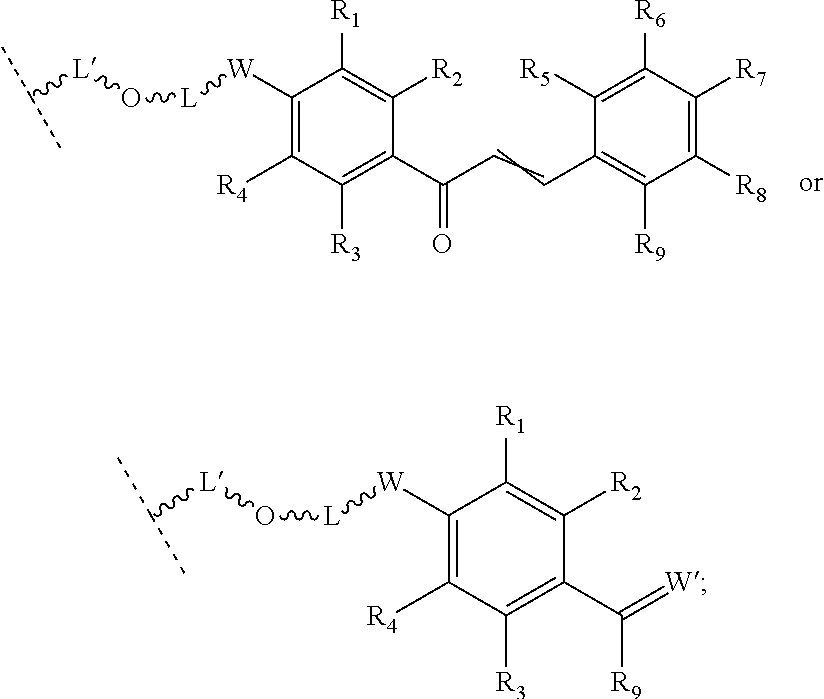
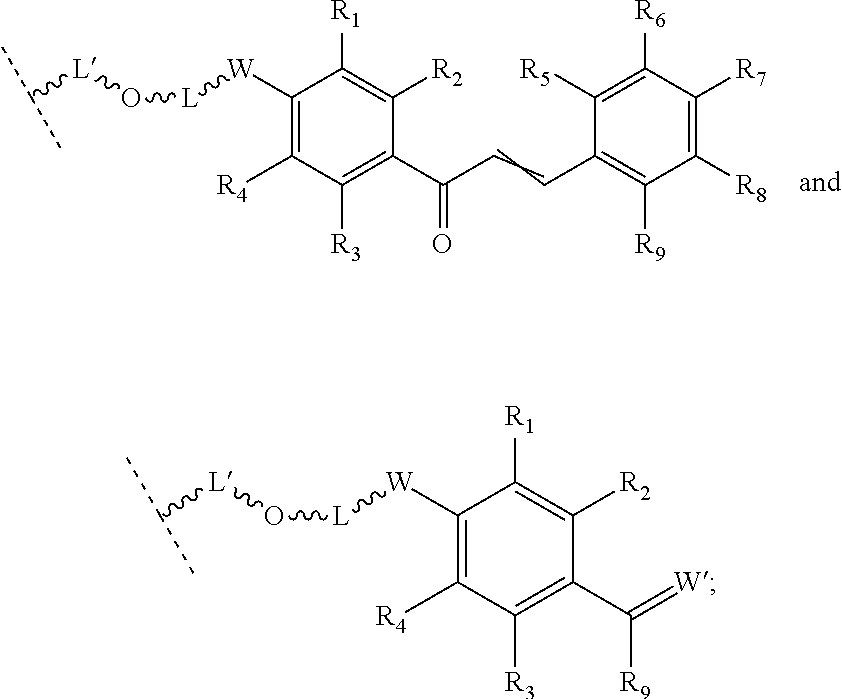
- a platinum(IV) complex precursor with an aryl-comprising moiety R to form the platinum(IV) complex as described above, wherein X, X′, Y, Y′ and Z are as defined above, n′ means zero or any positive or negative charge and wherein R is an aryl-comprising moiety selected from one of:
- the present invention in a third aspect refers to a method for treating a subject such as a human suffering from a disease such as a tumor, in particular a cancer, comprising administering an effective amount of a platinum(IV) complex as described above to said subject, i.e. comprising administering a platinum(IV) complex comprising a structure of Formula (I) to said subject:
- the present invention further provides a pharmaceutical composition comprising:
- a pharmaceutically tolerable excipient such as selected from a pharmaceutically tolerable carrier, salt, buffer, water, diluent, a filler, a binder, a disintegrant, a lubricant, a coloring agent, a surfactant or a preservative or a combination thereof.
- the platinum(IV) complex described above for use as a medicament for the treatment of cancer.
- the platinum(IV) complex can be used in an effective amount for treating a living organism like an animal or a human, in particular a mammal, preferably a human.
- Another aspect of the invention refers to the use of the platinum(IV) complex described above for preparing a medicament for treatment of cancer.
- the platinum(IV) complex described above may be used in monotherapy or in combination with at least a further chemotherapeutic compound.
- the invention provides a method of inhibiting the growth of tumor cells.
- Said method comprises the step of contacting a population of tumor cells such as a population of cancer cells with the platinum(IV) complex described above.
- the cell growth is reduced and/or cell death is induced.
- the platinum(IV) complex of the present invention represents a novel class of platinum anticancer prodrugs for the treatment of diseases especially cancer.
- the inventors could show that the platinum(IV) complexes of the present invention can have advantageously high cytotoxic activity against cancer cells, with the platinum(IV) complex of Formula (IIa) being among the most active platinum(IV) prodrugs known so far.
- said platinum(IV) complex is significantly more active than both cisplatin and chalcoplatin, and the IC 50 values of said complex are in the nanomolar range in cells from several cancer types.
- the complexes proved to be highly effective against cisplatin-resistant cancer cells.
- the platinum(IV) complex of Formula (IIa) proved to be able to overcome cisplatin resistance with reduced Resistant Factors compared to cisplatin.
- the platinum(IV) complexes of the present invention have the advantage of superior effectiveness, especially against cisplatin-resistant cancer cells and, thus, represent a highly promising treatment option such as for cancer therapy.
- FIG. 1 summarizes the synthesis route of monochalcoPt(IV);
- FIG. 2 summarizes the synthesis route of dichalco-oxaliPt(IV);
- FIG. 3 summarizes the synthesis route of mono4FP-Pt(IV).
- FIG. 4 summarizes the synthesis route of di4FP-Pt(IV).
- FIG. 5 summarizes the synthesis route of mono4FP-oxaliPt(IV).
- “comprising” means including the following elements but not excluding others. “Essentially consisting of” means that the material consists of the respective element along with usually and unavoidable impurities such as side products and components usually resulting from the respective preparation or method for obtaining the material such as traces of further components or solvents. “Consisting of” means that the material solely consists of, i.e. is formed by the respective element. As used herein, the forms “a,” “an,” and “the,” are intended to include the singular and plural forms unless the context clearly indicates otherwise.
- example or exemplary used in this invention are intended to serve as an example, instance, or illustration. Any aspect or design described in this disclosure as “exemplary” is not necessarily to be construed as preferred or advantageous over other aspects or designs. Rather, use of the words “example” or “exemplary” is intended to present concepts in a concrete fashion.
- the term “or” is intended to mean an inclusive “or” rather than an exclusive “or”. That is, unless specified otherwise, or clear from context, “X employs A or B” is intended to mean any of the natural inclusive permutations. That is, if X employs A; X employs B; or X employs both A and B, then “X employs A or B” is satisfied under any of the foregoing instances.
- the present invention provides a platinum(IV) complex.
- Said platinum(IV) complex comprises a structure of Formula (I):
- X, X′, Y, Y′ and Z are independently selected from an electron donor ligand and may be linked to each other in any combination.
- n is selected from zero, any positive charge or any negative charge.
- R is an aryl-comprising moiety selected from the group consisting of:
- L and L′ being a linker group
- W being a linker atom
- W′ being an atom or group which can be attached by a double bond
- R 1 to R 9 being independently selected from a substituent or a hydrogen atom, and is a double bond covering the (E) and (Z) configuration.
- the platinum(IV) complex of the present invention comprises a structure of Formula (I) with the provision that the platinum complex is not chalcoplatin, i.e. with the proviso that the platinum(IV) complex does not have the following structure:
- ligands Y and Y′ are ammine (NH 3 , i.e. amine (NH 3 ) as ligand) each and X and X′ are chlorido each or if Y and Y′ are chlorido each and X and X′ are ammine (NH 3 ) each, Z is not —OR.
- Said platinum(IV) complex can be present in form of a salt, i.e. suitable counterions may be present or in form of a solvate.
- a counterion might affect the solubility or other chemical or physical properties of the platinum(IV) complex, wherein the exact nature of the counterion is not critical.
- the counterion is preferably pharmaceutically acceptable, i.e. not with therapeutically relevant toxicity in the amounts used.
- Counterions can in particular be anions which are unlikely to bind directly to the platinum center, i.e. non-coordinating anions.
- the term “solvate” refers to a complex of variable stoichiometry formed by a solute, i.e. the platinum(IV) complex, and a solvent. If the solvent is water, the solvate formed is a hydrate.
- the platinum in the platinum complex of the present invention is in the oxidation state (IV), i.e. the platinum complex of the present invention is a platinum(IV) complex.
- R is an aryl-comprising moiety.
- aryl refers to an aromatic monocyclic ring system having 6 ring atoms, of which all the ring atoms are carbon, and which ring may be substituted with R 1 to R 9 .
- R comprises one or two aryl rings. Said part of R is also referenced as the “aromatic part”. “Aromatic” means the presence of a delocalized, conjugated ⁇ -electron system.
- R further comprises a linker atom W which is an atom directly attached to an aryl and can include, but is not limited to, a heteroatom such as oxygen (O) or sulfur (S).
- W is an oxygen atom.
- W′ can be any atom or a group which can be attached by a double bond provided that this results in the formation of a stable moiety, including, but not limited to, a heteroatom such as an oxygen atom, a sulfur atom or a nitrogen (N) atom or a heteroatom-containing group.
- W′ is an oxygen atom or a sulfur atom, in particular W′ is an oxygen atom.
- the linker group L is an organic unit of any lengths comprising atoms or groups to link, i.e. to connect, two parts of the platinum complex of the present invention, namely the ‘platinum part’ of the platinum complex and the ‘aromatic part’ of R together, it thus links the platinum part with the W-aromatic part of R.
- Not limiting examples include a straight chain or branched alkanediyl or alkenediyl chain.
- L is —(CH 2 ) m —, wherein m is an integer which is >0 for example m is 1, 2, 3 or 4, most preferably L is —CH 2 —, i.e. a methanediyl group.
- the linker group L′ is an organic unit of any lengths comprising atoms or groups to link, i.e. to connect, the two oxygen atoms together.
- L′ can be, for example, a straight chain or branched alkanediyl or alkenediyl chain or a carbon-oxygen chain.
- L′ is —(CH 2 ) m′ —i.e. a methanediyl group and m′ is an integer and >0 such as 1, 2 or 3, in particular m′ is 1.
- R 1 to R 9 are substituents which can be, for example, but not limited to, a nitrogen-containing group, an oxygen-containing group, a phosphorous(P)-containing group, a sulfur-containing group, alkyl groups, a halogen atom or a hydrogen atom or the like.
- R 1 to R 9 are in particular embodiments of the present invention selected from a hydrogen atom or a halogen atom, more preferably from a hydrogen atom or a chlorine atom.
- An electron donor ligand means a ligand which is electron donating, i.e. has a donor atom with electron-donating ability such as a nitrogen atom, an oxygen atom, a phosphorous (P) atom or a sulfur atom.
- Non-limiting examples of electron donor ligands are nitrogen-containing ligands, oxygen-containing ligands, phosphorous-containing ligands, sulfur-containing ligands and halogen containing ligands.
- Electron donor ligands can, for example, include, imine, aqua, halido (i.e.
- halide ions in particular including chlorido, bromido or fluorido), amines, diamines, triamines, ammine (NH 3 ), alkyl, cyanido, nitrato, hydroxido, alkoxy, phenoxy, anions of an alkyl mono- or poly-, such as di-, carboxylic acid such as oxalato or dianions of glycolic acid, an alcoholato ligand, alkylthio, thiolato, phosphito, phosphane, ⁇ -diketone, nitrato, a heterocycle such as pyridine or 2-methylpyridine or it can be —OR with R being an aryl-comprising moiety as defined above.
- alkyl refers to saturated, straight-chain or branched hydrocarbons which may, for example, contain between 1 and 20 carbon atoms such as 1 to 5 carbon atoms.
- the electron donor ligands in particular include ammine (NH 3 ), aqua, halido such as chlorido, hydroxido, oxalato, diamines such as 1,2-cyclohexanediamine or —OR with R being an aryl-comprising moiety as defined above.
- Y, Y′, X, X′ and Z may optionally be linked to each other in any combination to form polydentate ligands, in particular bidentate ligands.
- X and X′ are linked to each other to form a bidentate ligand and/or Y and Y′ are linked to each other to form a bidentate ligand.
- X, X′, Y and Y′ are independently selected from ammine (NH 3 ), aqua, halido such as chlorido, hydroxido, oxalato or diamines such as 1,2-cyclohexanediamine, in particular from ammine (NH 3 ), chlorido, hydroxido, oxalato or 1,2-cyclohexanediamine and Z is selected from ammine (NH 3 ), aqua, halido such as chlorido, hydroxido, oxalato or diamines such as 1,2-cyclohexanediamine or —OR with R being an aryl-comprising moiety as defined above, in particular Z is selected from ammine (NH 3 ), chlorido, hydroxido, oxalato, 1,2-cyclohexanediamine or —OR.
- 1,2-cyclohexanediamine means in particular trans-(1R,2R)-1,2-cyclohexanediamine
- n is zero or any positive or any negative charge.
- n is zero, i.e. the platinum complex is in particular a neutral platinum complex.
- the platinum(IV) complex of the present invention comprises a structure selected from one of Formulas (II) to (X):
- the platinum(IV) complex comprises a structure selected from Formula (II) or (III):
- the platinum(IV) complex comprises a structure of Formula (II):
- X, X′, Y, Y′, Z, L, W, n and R 1 to R 9 are as defined above.
- X, X′, Y and Y′ are independently selected from ammine (NH 3 ), aqua, halido, hydroxido, oxalato or diamines and Z is selected from ammine (NH 3 ), aqua, halido, hydroxido, oxalato or diamines or —OR with R being an aryl-comprising moiety as defined above.
- X, X′, Y and Y′ are independently selected from ammine (NH 3 ), oxalato, 1,2-cyclohexanediamine and a halido and Z is selected from hydroxido or —OR with R being an aryl-comprising moiety as described above, in particular R is:
- R in Formula (II) most preferably corresponds to the R in —OR of Z.
- L is preferably —(CH 2 ) m —, wherein m is an integer selected from 1, 2, 3 or 4, more preferably m is 1.
- W is preferably selected from an oxygen atom or a sulfur atom, more preferably W is an oxygen atom.
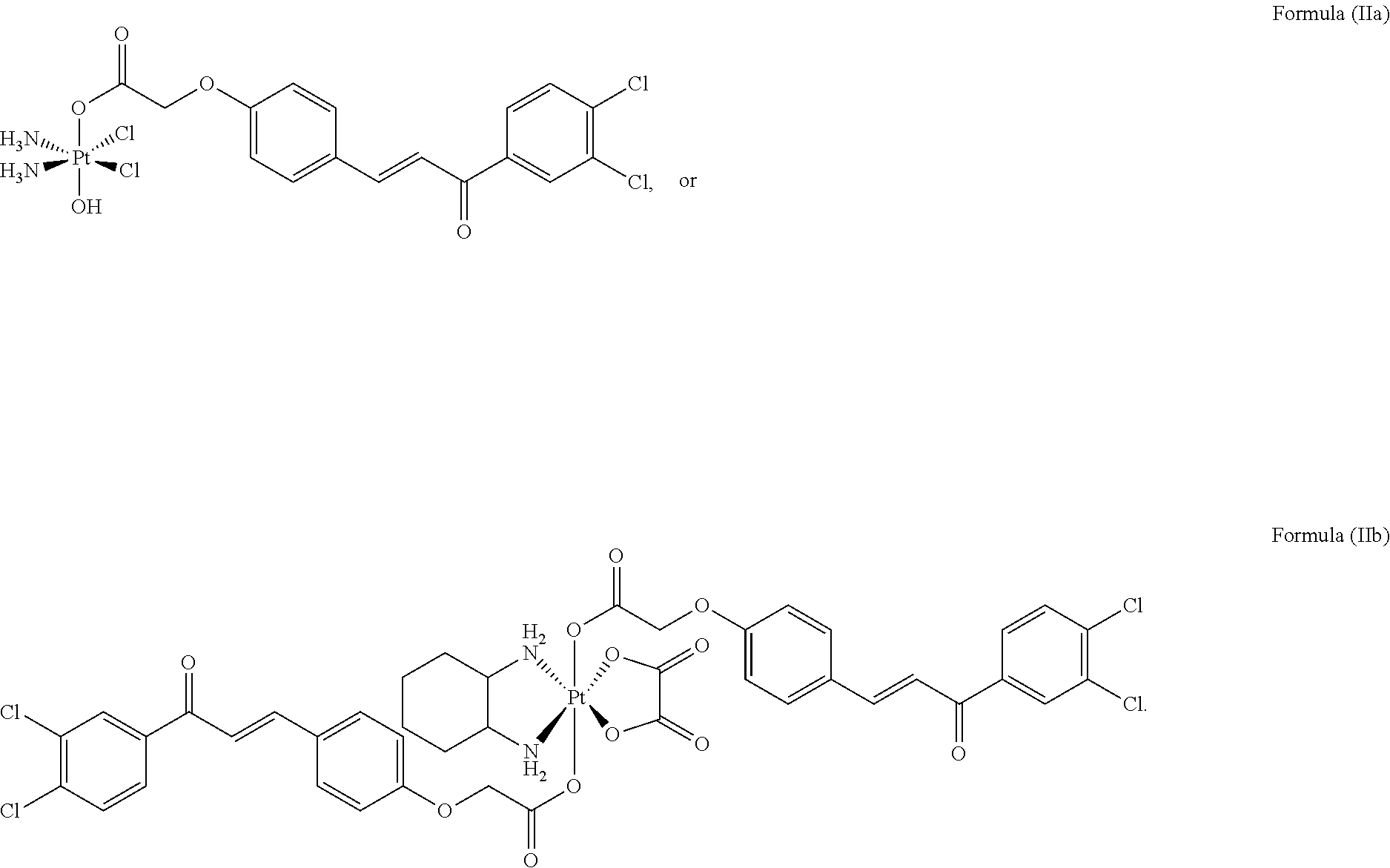
- R 1 to R 9 are preferably independently selected from a hydrogen atom or a halogen atom, more preferably R 1 to R 4 are hydrogen atoms and R 5 to R 9 are independently selected from a hydrogen atom or a halogen atom with most preferably R 7 and R 8 being a chloride atom each and R 5 , R 6 and R 9 being a hydrogen atom each.
- the platinum(IV) complex in such embodiments comprises a structure of Formula (IIa) or (IIb) and in particular essentially consists of a compound of Formula (IIa) or (IIb):
- the platinum(IV) complex comprises a structure of Formula (III):
- X, X′, Y, Y′, Z, L, W, W′, n and R 1 to R 5 are as defined above.
- X, X′, Y and Y′ are independently selected from ammine (NH 3 ), aqua, halido, hydroxido, oxalato or diamines and Z is selected from ammine (NH 3 ), aqua, halido, hydroxido, oxalato or diamines such as 1,2-cyclohexanediamine or —OR with R being an aryl-comprising moiety as described above.
- X, X′, Y and Y′ are independently selected from ammine (NH 3 ), a halido, oxalato and 1,2-cyclohexanediamine and Z is selected from hydroxido or —OR with R being an aryl-comprising moiety as described above, in particular R is:
- R in Formula (III) most preferably corresponds to the R in —OR of Z.
- L is preferably —(CH 2 ) m —, wherein m is an integer selected from 1, 2, 3 or 4, more preferably m is 1.
- W is preferably selected from an oxygen atom or a sulfur atom, more preferably W is an oxygen atom.
- W′ is preferably an oxygen atom.
- R 1 to R 4 are preferably independently selected from a hydrogen atom or a halogen atom and R 5 is a hydrogen atom, more preferably all of R 1 to R 5 are hydrogen atoms.
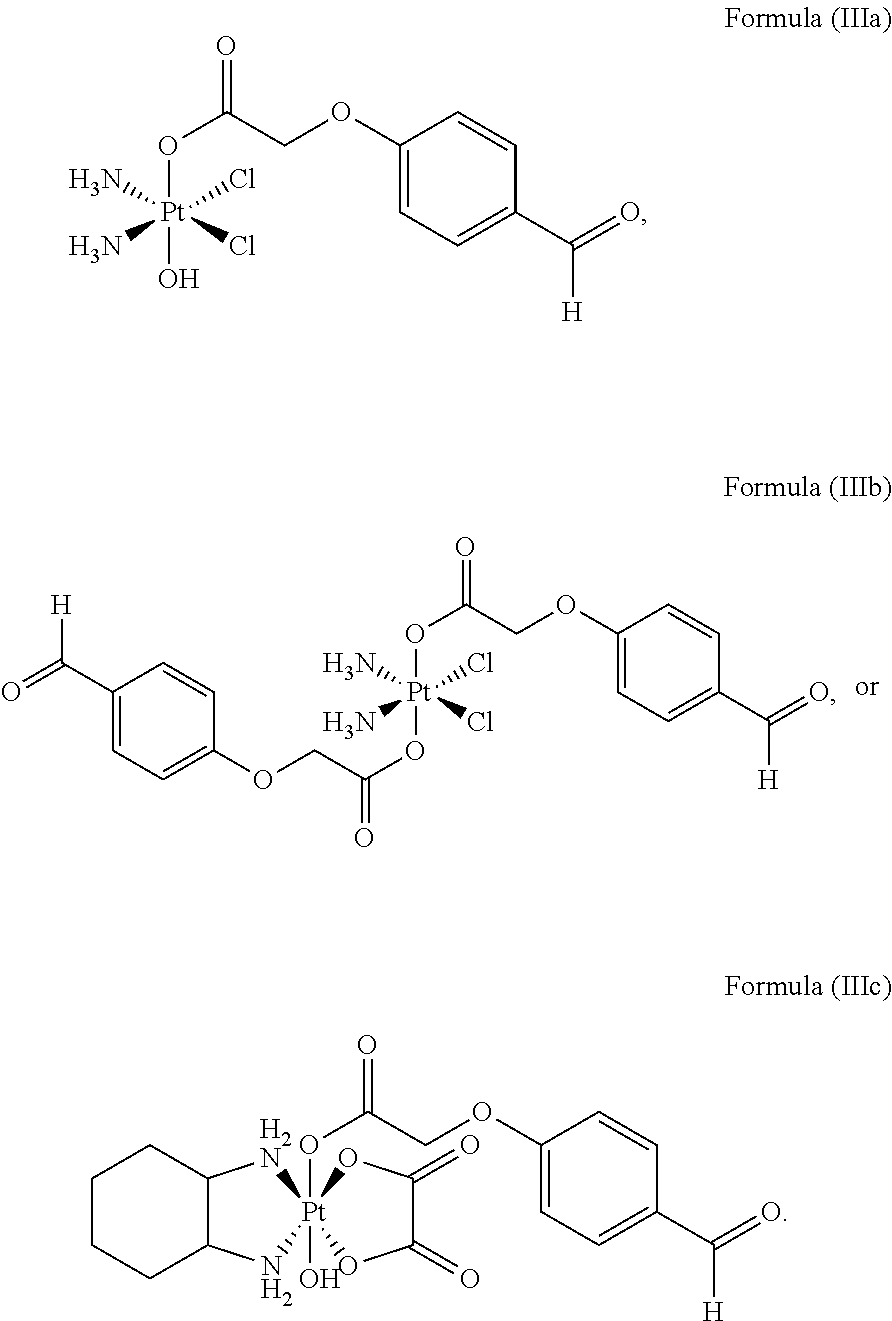
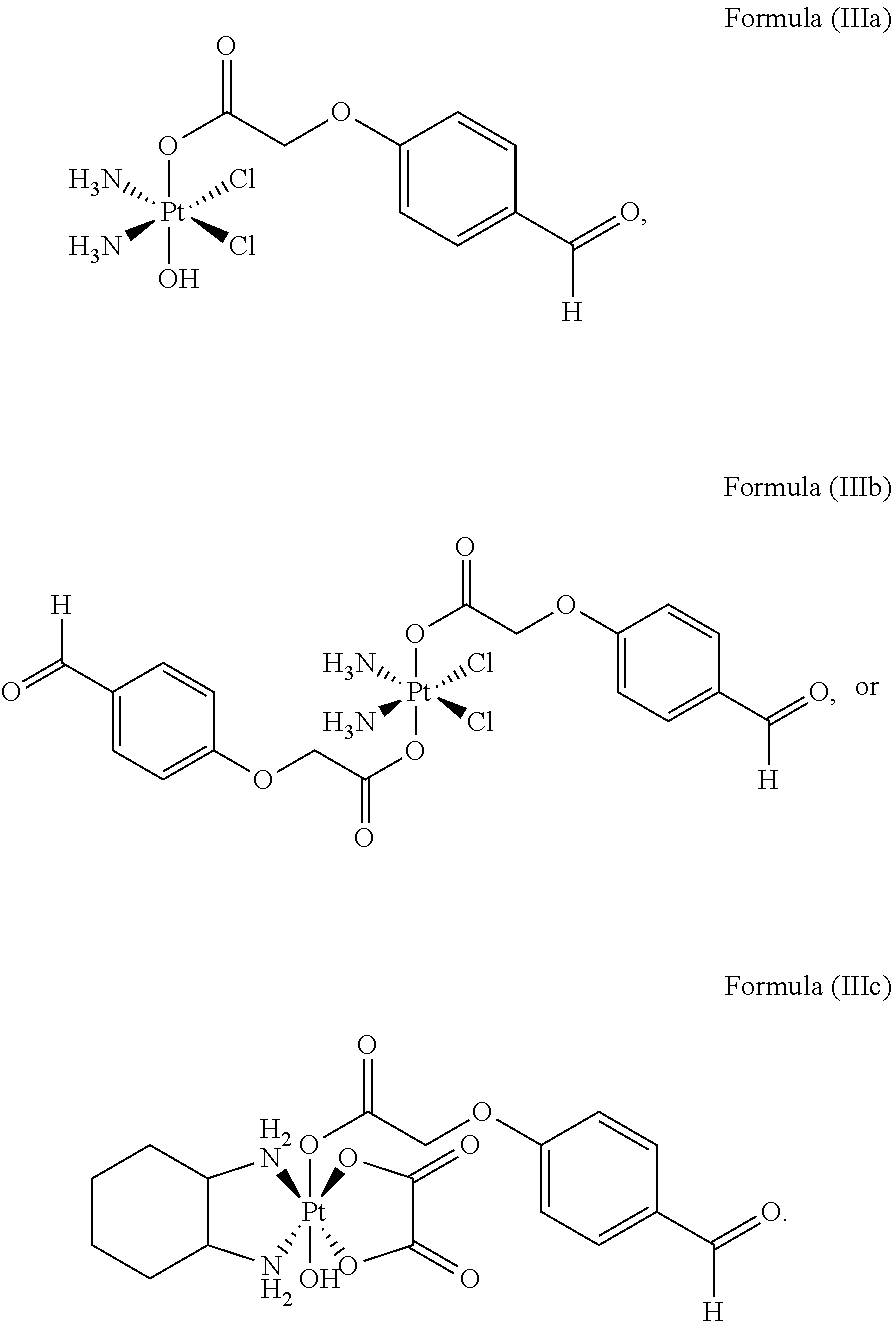
- the platinum complex in such embodiments comprises a structure of Formula (IIIa), (IIIb) or (IIIc) and in particular essentially consists of a compound of Formula (IIIa), (IIIb) or (IIIc):
- Said method comprises linking a platinum complex precursor which is in particular a platinum(IV) complex precursor and which comprises a structure of Formula (XI):
- aryl-comprising moiety R to form the platinum(IV) complex as described above, wherein X, X′, Y, Y′ and Z are as defined above, n′ means zero or any positive or negative charge and wherein R is selected from one of:
- L, L′, W, W′ and R 1 to R 9 are as defined above.
- platinum complex precursor in particular platinum(IV) complex precursor can comprise a structure of Formula (XIa):
- platinum complex precursors comprise a structure of Formula (XIb) or (XIc) given further below and are in particular platinum(IV) precursor complexes, i.e. most preferably the platinum complex precursor is a platinum(IV) complex precursor selected from a structure of Formula (XIb) or (XIc) given further below.
- the method is preferably carried out under inert atmosphere such as under argon.
- the method is for preparing a platinum(IV) complex comprising a structure of Formula (II) such as of Formula (IIa) or (IIb) comprising linking a platinum complex precursor of Formula (XI) such as of Formula (XIa) with an aryl-comprising moiety which is
- Step (ii) in particular comprises:
- step b) stirring the mixture after step a) for at least about 8 h at a temperature of at least about 20° C.
- “Isolating” the platinum(IV) complex means at least partially separating the platinum(IV) complex from other components such as side products, the reactants and the solvent present in the reaction mixture after step (ii).
- Step (iii) in particular comprises filtering the mixture for obtaining a filtrate, adding a precipitation solvent to the filtrate for obtaining a precipitate and washing the precipitate with a washing solvent.
- the reaction solvent in step a) is preferably dimethyl sulfoxide (DMSO).
- the NHS-ester is added in step a) in form of a mixture with at least a part of the reaction solvent, in particular DMSO.
- the precipitation solvent can be a halogenated hydrocarbon and/or a dialkyl ether, in particular dichloromethane, diethyl ether or a mixture of both.
- the washing solvent can be a halogenated hydrocarbon, in particular dichloromethane.
- the method is for preparing a platinum(IV) complex comprising a structure of Formula (III) such as of Formula (IIIa), (IIIb) or (IIIc) comprising linking a platinum complex precursor of Formula (XI) such as of Formula (XIa) with an aryl-comprising moiety which is
- Step (ii) in particular comprises:
- step b) stirring the mixture after step a) for at least about 8 h at a temperature of at least about 20° C.
- Step (iii) in particular comprises filtering the mixture for obtaining a filtrate, adding a precipitation solvent to the filtrate for obtaining a precipitate and washing the precipitate with a washing solvent.
- the reaction solvent in step a) is preferably dimethyl sulfoxide (DMSO).
- the NHS-ester is added in step a) in form of a mixture with at least a part of the reaction solvent, in particular DMSO.
- the precipitation solvent can be a halogenated hydrocarbon and/or a dialkyl ether, in particular dichloromethane, diethyl ether or a mixture of both.
- the washing solvent can be a halogenated hydrocarbon, in particular dichloromethane.
- the methods may optionally comprise the step (i) of preparing the NHS-ester.
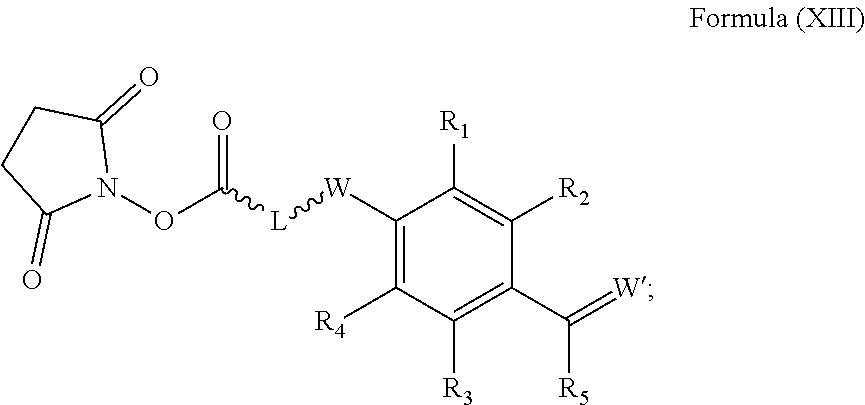
- the NHS-ester of Formula (XII) such as of Formula (XIIa) or of Formula (XIII) such as of Formula (XIIIa) may be prepared comprising steps of:
- Step a) is preferably carried out by stirring the mixture in a reaction solvent at a temperature between about 20° C. and about 30° C., such as at about 25 ⁇ 2° C., for at least about 8 h, in particular for at least about 10 h.
- the reaction solvent in this step a) is preferably an organic nitrile, in particular acetonitrile.
- “Isolating” the NHS-ester in step b) means at least partially separating the NHS-ester from other components such as side products, the reactants and the solvent present in the reaction mixture after step a).
- Step b) in particular comprises filtering the mixture for obtaining a residue and washing the residue with water and optionally freeze-drying the residue.
- the method is for preparing a platinum complex of Formula (IIa) and the method comprises steps of:
- reaction solvent such as acetonitrile
- a temperature between about 20° C. and about 30° C., such as at about 25 ⁇ 2° C., for at least about 8 h, in particular for at least about 10 h;
- N-hydroxysuccinimide(NHS)-ester of Formula (XIIa) comprising:
- step b) stirring the mixture after step a) for at least about 8 h, in particular for at least about 24 h and further preferred for at least about 72 h at a temperature between about 20° C. and about 30° C., such as at about 25 ⁇ 2° C.;
- the method is for preparing a platinum(IV) complex of Formula (IIb) and the method comprises steps of:
- reaction solvent such as acetonitrile
- a temperature between about 20° C. and about 30° C., such as at about 25 ⁇ 2° C., for at least about 8 h, in particular for at least about 10 h;
- N-hydroxysuccinimide(NHS)-ester of Formula (XIIa) comprising:
- step b) stirring the mixture after step a) for at least about 8 h, in particular for at least about 12 h such as for at least about 24 h at a temperature of at least 60° C. and in particular of between about 75° C. and about 85° C.;
- the method is for preparing a platinum(IV) complex of Formula (IIIa) and the method comprises steps of:
- reaction solvent such as acetonitrile
- a temperature between about 20° C. and about 30° C., such as at about 25 ⁇ 2° C., for at least about 8 h, in particular for at least about 10 h;
- step b) stirring the mixture after step a) for at least about 8 h, in particular for at least about 24 h and further preferred for at least about 72 h at a temperature between about 20° C. and about 30° C., such as at about 25 ⁇ 2° C.;
- the method is for preparing a platinum(IV) complex of Formula (IIIb) and the method comprises steps of:
- reaction solvent such as acetonitrile
- a temperature between about 20° C. and about 30° C., such as at about 25 ⁇ 2° C., for at least about 8 h, in particular for at least about 10 h;
- N-hydroxysuccinimide(NHS)-ester of Formula (XIIIa) comprising:
- step b) stirring the mixture after step a) for at least about 8 h, in particular for at least about 12 h such as for at least about 24 h at a temperature of at least 60° C. and in particular of between about 75° C. and about 85° C.;
- the method is for preparing a platinum(IV) complex of Formula (IIIc) and the method comprises steps of:
- reaction solvent such as acetonitrile
- a temperature between about 20° C. and about 30° C., such as at about 25 ⁇ 2° C., for at least about 8 h, in particular for at least about 10 h;
- N-hydroxysuccinimide(NHS)-ester of Formula (XIIIa) comprising:
- step b) stirring the mixture after step a) for at least about 8 h, in particular for at least about 24 h and further preferred for at least about 72 h at a temperature between about 20° C. and about 30° C., such as at about 25 ⁇ 2° C.;
- the present invention in a third aspect refers to a method for treating a subject suffering from a disease comprising administering an effective amount of a platinum complex as described above to said subject, i.e. comprising administering a platinum(IV) complex comprising a structure of Formula (I) to said subject:
- the platinum complex is not chalcoplatin, i.e. with the proviso that the platinum complex does not have the following structure:
- the disease is in particular a tumor and in particular a cancer, for example, but not limited to one of:
- tumor simply refers to all neoplastic cell growth and proliferation being of benign (generally harmless) or malignant (cancerous) growth, and all pre-cancerous and cancerous cells and tissues.
- cancer and “cancerous” describe a physiological condition in subjects in which a population of cells are characterized by unregulated malignant (cancerous) cell growth.
- the cancer can be a cancer which has a natural, i.e. intrinsic, or acquired resistance against one or more chemotherapeutic compounds in particular which has a natural or has an acquired, i.e. developed resistance against known coordination complexes of platinum such as cisplatin.
- a cancer is resistant against one or more chemotherapeutic compounds if it comprises cancer cells which are resistant against said chemotherapeutic compounds. Accordingly, the cancer cells with a resistant phenotype will be less sensitive or more tolerant to the one or more chemotherapeutic compounds.
- Such cancer or cancer cells can be detected in a subject, cancer or tissue by administering to the subject, tissue, or cell, the one or more chemotherapeutic compounds and determining the activity of the chemotherapeutic compounds such as the induction of cell death or the inhibition of the proliferation of cancer cells compared to a reference control, namely cells or tissue of the same cell or tissue type, a cancer or a subject that do not have the resistance against the chemotherapeutic compound or non-cancerous cells. This can be determined, for example, by means of an MTT assay.
- a cancer or cancer cells which have a natural (intrinsic) or acquired resistance against cisplatin are referenced herein as “cisplatin-resistant”.
- the cancer has a natural or an acquired resistance against cisplatin, also known as cDDP (cis-diamminedichloroplatinum).
- cDDP cis-diamminedichloroplatinum
- subject refers to a living organism and can include but is not limited to a human, a plant and an animal.
- the subject is preferably a human or an animal, in particular the subject is a mammal, preferably a human.
- the subject is preferably a human having a cancer.
- the platinum(IV) complex administered thus, comprises a structure selected from one of Formulas (II) to (X):
- platinum(IV) complex administered can comprise a structure selected from:
- the platinum(IV) complex comprises a structure of Formula (II), in particular of Formula (IIa):
- the platinum(IV) complex can be, for example, present in form of a pharmaceutically acceptable salt or a solvate.
- an effective amount and “effective dose” generally denote an amount sufficient to produce therapeutically desirable results, wherein the exact nature of the result varies depending on the specific disorder which is treated.
- the result is usually an inhibition or suppression of the proliferation of the cancer or tumor cells, a reduction of cancerous cells or the amelioration of symptoms related to the cancer cells.
- the effective amount of the platinum(IV) complex of the present invention may depend on the species, body weight, age and individual conditions of the subject and can be determined by standard procedures such as with cell cultures or experimental animals.
- a concentration of the platinum(IV) complex may, for example, be at least about 10 nm.
- the IC 50 of the platinum(IV) complex towards tumor cells such as cancer cells is at most 1000 nM, in particular it is less than 500 nM and further preferred less than 200 nM and most preferably less than 200 nM after about 72 h in particular towards cancer cells from one of an ovarian cancer, a lung cancer, a breast cancer, or a colorectal cancer including cisplatin resistant cancer.
- the Resistant Factor of the platinum(IV) complex of the present invention towards cisplatin-resistant cancer cells is preferably less than 10, more preferably less than 8 and in particular even less than 5.
- the Resistant Factor is calculated by dividing the IC 50 of the platinum complex towards cisplatin-resistant cells by its IC 50 towards cancer cells of the same cell type or tissue which do not have a cisplatin-resistant phenotype.
- the platinum(IV) complex can be present in solid, semisolid or liquid form.
- the platinum(IV) complex of the present invention can be administered by an oral or parenteral route to the subject, in particular by an oral route or an intravenous route.
- the platinum(IV) complex may be administered in form of a pharmaceutical composition
- a pharmaceutically tolerable excipient such as selected from a pharmaceutically tolerable carrier, salt, buffer, water, diluent, a filler, a binder, a disintegrant, a lubricant, a coloring agent, a surfactant or a preservative or a combination thereof.
- a pharmaceutically tolerable carrier such as selected from a pharmaceutically tolerable carrier, salt, buffer, water, diluent, a filler, a binder, a disintegrant, a lubricant, a coloring agent, a surfactant or a preservative or a combination thereof.
- suitable pharmaceutically tolerable excipients depending on the form of the pharmaceutical composition and is aware of methods for manufacturing pharmaceutical compositions as well as able to select a suitable method for preparing the pharmaceutical composition depending on the kind of pharmaceutically tolerable excipients and the form of the pharmaceutical composition.
- the pharmaceutical composition can be
- the platinum(IV) complex can be used as a single compound for treating the subjects in particular with cancer.
- the platinum(IV) complex is administered in combination with other therapeutically effective treatments such as one or more of:
- the present invention further provides a pharmaceutical composition comprising:
- a pharmaceutically tolerable excipient such as selected from a pharmaceutically tolerable carrier, salt, buffer, water, diluent, a filler, a binder, a disintegrant, a lubricant, a coloring agent, a surfactant or a preservative or a combination thereof.
- the pharmaceutical composition can be present in solid, semisolid or liquid form to be administered by an oral or parenteral route to a subject.
- “Pharmaceutically tolerable excipients” are those which can be taken by the subject without therapeutically relevant adverse effects and do not negatively influence the efficiency of the platinum complex.
- the platinum(IV) complex described above in particular of Formula (IIa), for use as a medicament for the treatment of cancer.
- the platinum(IV) complex such as of Formula (IIa) can be used in an effective amount for treating an animal or a human, in particular mammal, preferably a human.
- Another aspect of the invention refers to the use of the platinum(IV) complex described above in particular of Formula (IIa) for preparing a medicament for treatment of cancer.
- the platinum(IV) complex described above in particular of Formula (IIa) may be used in combination with at least a further chemotherapeutic compound.
- the invention provides a method for inhibiting the growth of tumor cells.
- Said method comprises the step of contacting a population of tumor cells such as a population of cancer cells with the platinum(IV) complex described above which can, for example, be a salt or solvate.
- the cell growth is reduced and/or cell death is induced.
- MTT assay can be used for confirming the effect on cell death and cell viability.
- inhibiting the growth of tumor cells can mean a decrease in the cell viability in particular a significant decrease and/or an increase in the number of apoptotic cells, in particular a significant increase.
- the skilled person is aware of methods for verifying such effects such as with cell viability measurement by means of a MTS proliferation assay, a MTT assay or by determination of the apoptosis rate by means of Annexin V flow cytometry measurement.
- the term “significant” means that is statistically significant as determined by Student's t-test or other art-accepted measures of statistical significance.
- platinum(IV) complex administered can comprise a structure selected from:
- the platinum(IV) complex comprises a structure of Formula (II), in particular of Formula (IIa):
- the cells can, for example, but not limited to be from one of:
- the cancer cells can have a natural or an acquired resistance against one or more chemotherapeutic compounds, in particular a natural or an acquired resistance against known coordination complexes of platinum such as cisplatin.
- the IC 50 of the platinum complex towards the cancer cells is less than 500 nM and further preferred less than 200 nM and most preferably less than 200 nM after about 72 h in particular towards one of an ovarian cancer, a lung cancer, a breast cancer, or a colorectal cancer including cisplatin-resistant cancers.
- the Resistant Factor of the platinum(IV) complex of the present invention towards cisplatin-resistant cancer cells is preferably less than 8 and in particular even less than 5.
- the step of contacting the tumor cells with the platinum(IV) complex of the present invention may be carried out by applying an incubation solution comprising the platinum(IV) complex to said cells which incubation solution may further comprise suitable excipients such as buffers or a suitable growth medium.
- contacting the tumor cells with the platinum(IV) complex of the present invention can be carried out by administering the platinum(IV) complex to a subject such as a mammal like a human, for example, by an oral or parenteral route in form of a pharmaceutical composition as described above.
- FIG. 1 summarizes the synthesis route of monochalcoPt(IV) wherein (2) is 4-formylphenoxyacetic acid (“4-formylphenoxyacetic”); i: 50% KOH solution, r.t., 12 h; ii: diluted HCl solution, r.t., 6 h. Pale powder, 80.0%.
- FIG. 2 summarizes the synthesis route of dichalco-oxaliPt(IV).
- FIG. 3 summarizes the synthesis route of mono4FP-Pt(IV).
- FIG. 4 summarizes the synthesis route of di4FP-Pt(IV).
- FIG. 5 summarizes the synthesis route of mono4FP-oxaliPt(IV).
- Human ovarian carcinoma A2780 and cisplatin-resistant A2780cisR cells were cultured in RPMI 1640 with 10% FBS and 100 units penicillin/streptomycin.
- Human breast adenocarcinoma MCF-7, human colorectal carcinoma HCT116, human lung carcinoma A549, and cisplatin-resistant A549cisR cells were cultured in DMEM containing 10% FBS and 100 units penicillin/streptomycin.
- Human fetal lung fibroblast MRC-5 cells were cultured in MEM with 10% FBS, 1% L-glutamine, 1% non-essential amino acids, and 1% sodium pyruvate.
- Cisplatin-resistant cells were generated from their parental A549 or A2780 cells. Briefly, A549 or A2780 cells were cultured in complete medium containing 0.5 ⁇ g/mL cisplatin at the beginning for the first screening, and the remaining cells were cultured in complete medium containing 1.0 ⁇ g/mL cisplatin for at least 4 weeks until the resistance was obtained. All cells were incubated at 37° C. in 5% CO 2 .
- cDDP cisplatin
- platinum(IV) complex of the present invention of Formula (IIa) monochalcoPt(IV)
- chalcoplatin and cDDP combined with one equivalent ligand chalcone against A2780, A2780cisR, A549, A549cisR, MFC-7 and MRC-5 cells.
- cells were seeded in 96-well plates at a certain density. For instance, A2780 cells were seeded in a 96-well plate at the density of 1,500 cells per well and incubated till the confluence reached about 30%. Cells were then treated with medium containing varying concentrations of compounds for 72 h at 37° C. in 5% CO 2 . DMF was used to increase the solubility of compounds, and the final concentration of DMF was 1% (V/V).
- MTT assay after incubation for 72 h, the medium containing compounds was replaced by FBS-free medium with 1 mg/mL MTT for 4 h incubation. DMSO was added to each well when the medium containing MTT was removed after incubation.
- the absorbance was measured at 570 and 630 nm.
- Cells incubated with medium containing 1% DMF only were used as controls.
- the seeded cell density for A549, MCF-7 and HCT116 was 1,500 cells/well, and for A2780cisR, A549cisR, and MRC-5 was 2,500 cells were seeded to each well.
- the absorbance was tested at 570 and 630 nm.
- the results of this assay are presented in Table 1 depicting the resulting cytotoxicity of monochalcoPt(IV) compared to the cytotoxicity of cDDP, chalcoplatin and cDDP combined with a chalcone ligand.
- the IC 50 values represent the concentration of the tested compound required to inhibit cell growth by 50% compared to controls run in the absence of added complexes, measured by the MTT assay following a 72 h exposure. Values are the average of the 96-wells for each tested compound, and the reported errors are the corresponding standard deviations.
- FI fold increase
- IC 50 cDDP
- IC 50 monochalcoPt(IV)
- RF resistant factor
- monochalcoPt(IV) is significantly more active than both cisplatin (cDDP) and chalcoplatin, and the IC 50 values of monochalcoplatin are in the nanomolar range in all the cells tested.
- the IC 50 values of chalcoplatin in A2780 and A549 cells are 830 and 1900 nM, respectively, while those of monochalcoPt(IV) are as low as 10 nM and 80 nM, respectively.
- monochalcoPt(IV) displays up to a 422-fold increase in cytotoxicity in the cells tested.
- monochalcoPt(IV) is able to overcome cisplatin resistance.
- MonochalcoPt(IV) displays nanomolar cytotoxicity in both A2780cisR and A549cisR cells.
- the RF value is 4.3 for cisplatin, and the value decreases to 1.8 for monochalcoPt(IV).
- a similar trend is also found in A2780 and A2780cisR cells.
- MonochalcoPt(IV) is also very active against the proliferation of MCF-7 and HCT116 cells, and the FI value for HCT116 cells is as high as 421.9.
- MRC-5 the human lung fibroblast cell line, was used to evaluate the cytotoxicity of monochalcoPt(IV) against normal cells.
- RF Resistant Factor
- IC 50 in A2780CisR/IC 50 in A2780 cells or as IC 50 in A549cisR/IC 50 in A549 cells
- b FI fold increase
Landscapes
- Chemical & Material Sciences (AREA)
- Organic Chemistry (AREA)
Abstract
Description

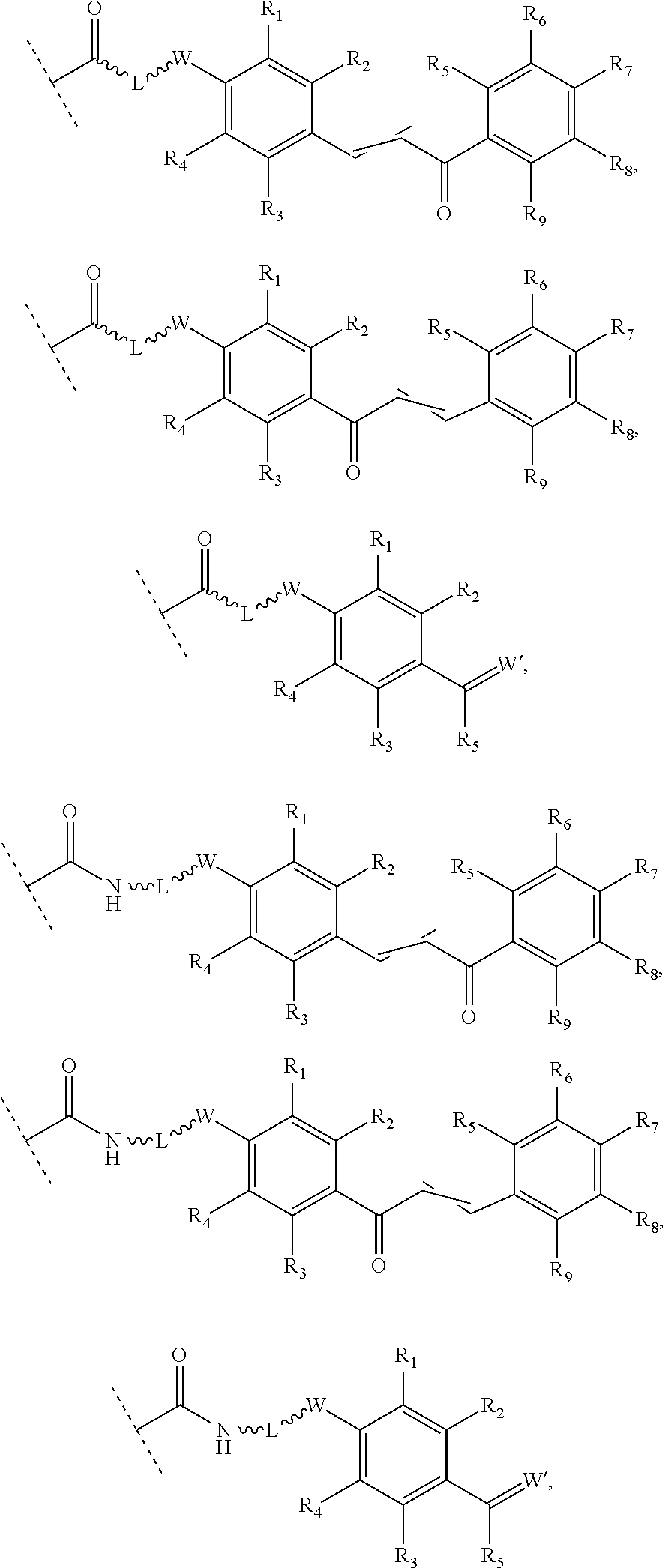
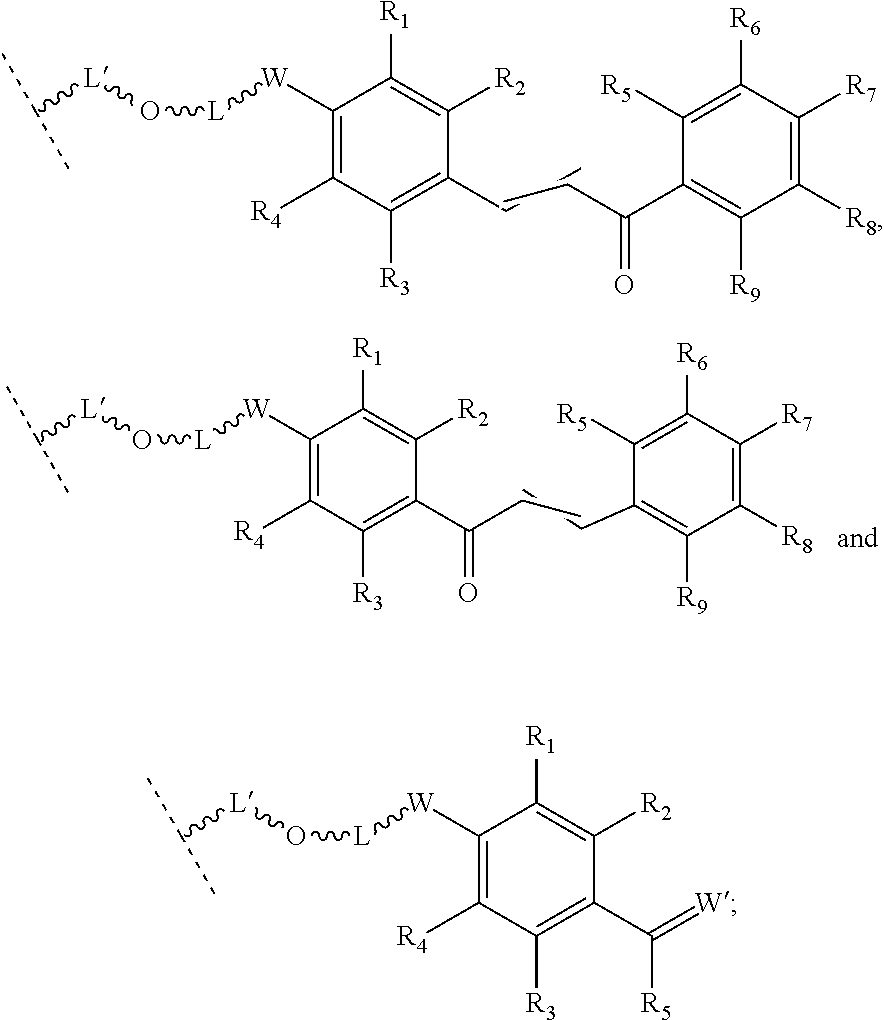
with L and L′ being a linker group, W being a linker atom, W′ being an atom or group which can be attached by a double bond and R1 to R9 being independently selected from a substituent or a hydrogen atom.


with X, X′, Y, Y′, Z, n and R as defined above.


with L, L′, W, W′ and R1 to R9 as defined above.

with X, X′, Y, Y′, Z, n and R as defined above and with the provision that the platinum complex is not chalcoplatin.

Where X, X′, Y, Y′ and Z are independently selected from an electron donor ligand and may be linked to each other in any combination.

with L and L′ being a linker group, W being a linker atom, W′ being an atom or group which can be attached by a double bond, R1 to R9 being independently selected from a substituent or a hydrogen atom, and

I.e. with the proviso that when R is
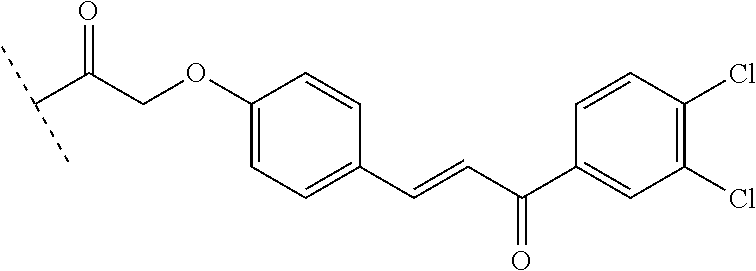
and either the ligands Y and Y′ are ammine (NH3, i.e. amine (NH3) as ligand) each and X and X′ are chlorido each or if Y and Y′ are chlorido each and X and X′ are ammine (NH3) each, Z is not —OR.


wherein X, X′, Y, Y′, Z, L, L′, W, W′, n and R1 to R9 are as defined above.
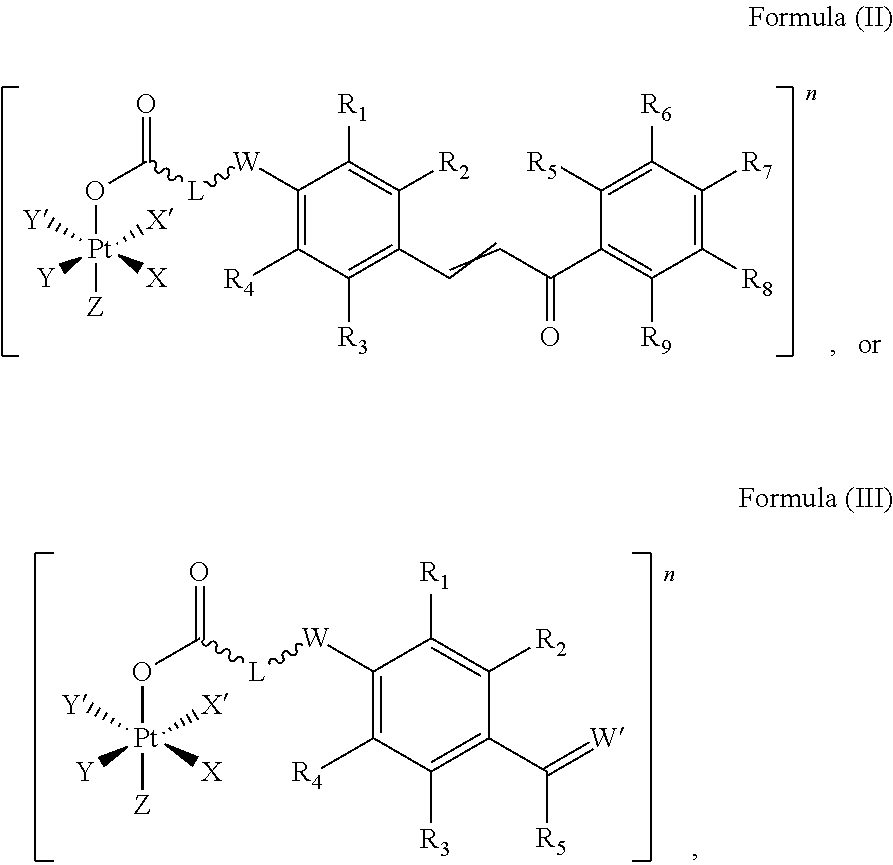
wherein X, X′, Y, Y′, Z, L, W, W′, n and R1 to R9 are as defined above.

wherein X, X′, Y, Y′, Z, L, W, n and R1 to R9 are as defined above. Preferably, X, X′, Y and Y′ are independently selected from ammine (NH3), aqua, halido, hydroxido, oxalato or diamines and Z is selected from ammine (NH3), aqua, halido, hydroxido, oxalato or diamines or —OR with R being an aryl-comprising moiety as defined above. Further preferred, X, X′, Y and Y′ are independently selected from ammine (NH3), oxalato, 1,2-cyclohexanediamine and a halido and Z is selected from hydroxido or —OR with R being an aryl-comprising moiety as described above, in particular R is:

with L, W and R1 to R9 as described within this embodiment, i.e. R in Formula (II) most preferably corresponds to the R in —OR of Z.

wherein X, X′, Y, Y′, Z, L, W, W′, n and R1 to R5 are as defined above. Preferably, X, X′, Y and Y′ are independently selected from ammine (NH3), aqua, halido, hydroxido, oxalato or diamines and Z is selected from ammine (NH3), aqua, halido, hydroxido, oxalato or diamines such as 1,2-cyclohexanediamine or —OR with R being an aryl-comprising moiety as described above. Further preferred, X, X′, Y and Y′ are independently selected from ammine (NH3), a halido, oxalato and 1,2-cyclohexanediamine and Z is selected from hydroxido or —OR with R being an aryl-comprising moiety as described above, in particular R is:

with L, W, W and R1 to R5 as described within this embodiment, i.e. R in Formula (III) most preferably corresponds to the R in —OR of Z.


with X, X′, Y, Y′ and Z, n and R as defined above.

with an aryl-comprising moiety R to form the platinum(IV) complex as described above, wherein X, X′, Y, Y′ and Z are as defined above, n′ means zero or any positive or negative charge and wherein R is selected from one of:


wherein L, L′, W, W′ and R1 to R9 are as defined above.

i.e. Z is hydroxido. Particular platinum complex precursors comprise a structure of Formula (XIb) or (XIc) given further below and are in particular platinum(IV) precursor complexes, i.e. most preferably the platinum complex precursor is a platinum(IV) complex precursor selected from a structure of Formula (XIb) or (XIc) given further below. The method is preferably carried out under inert atmosphere such as under argon.

which method comprises steps of:

with L, W and R1 to R9 as defined above, such as


which method comprises steps of:

with L, W, W′ and R1 to R5 as defined above, such as

and

with L, W, W′ and R1 to R9 as defined above;

comprising:

and stirring the mixture in a reaction solvent such as acetonitrile at a temperature between about 20° C. and about 30° C., such as at about 25±2° C., for at least about 8 h, in particular for at least about 10 h;

with the N-hydroxysuccinimide(NHS)-ester of Formula (XIIa) comprising:

comprising:

and stirring the mixture in a reaction solvent such as acetonitrile at a temperature between about 20° C. and about 30° C., such as at about 25±2° C., for at least about 8 h, in particular for at least about 10 h;

with an N-hydroxysuccinimide(NHS)-ester of Formula (XIIa) comprising:

comprising:

and stirring the mixture in a reaction solvent such as acetonitrile at a temperature between about 20° C. and about 30° C., such as at about 25±2° C., for at least about 8 h, in particular for at least about 10 h;

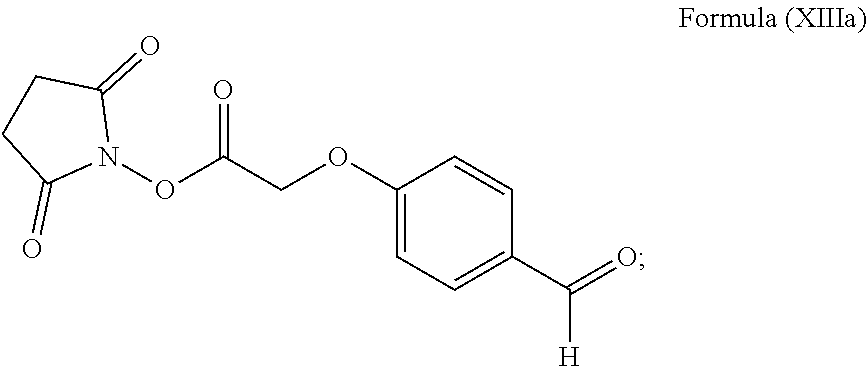
comprising:

and stirring the mixture in a reaction solvent such as acetonitrile at a temperature between about 20° C. and about 30° C., such as at about 25±2° C., for at least about 8 h, in particular for at least about 10 h;

with an N-hydroxysuccinimide(NHS)-ester of Formula (XIIIa) comprising:

comprising:

and stirring the mixture in a reaction solvent such as acetonitrile at a temperature between about 20° C. and about 30° C., such as at about 25±2° C., for at least about 8 h, in particular for at least about 10 h;

with an N-hydroxysuccinimide(NHS)-ester of Formula (XIIIa) comprising:

with X, X′, Y, Y′ and Z, n and R as defined above and with the provision that the platinum complex is not chalcoplatin, i.e. with the proviso that the platinum complex does not have the following structure:


and either the ligands Y and Y′ are ammine (NH3) each and X and X′ are chlorido each or if Y and Y′ are chlorido each and X and X′ are ammine (NH3) each, Z is not —OR.
-
- an ovarian cancer,
- a lung cancer,
- a breast cancer, or
- a colorectal cancer.


wherein X, X′, Y, Y′, Z, L, L′, W, W′, n and R1 to R9 are as defined above.


-
- other therapeutically effective compounds such as chemotherapeutic compounds including, for example, a topoisomerase-II inhibitor, an anthracycline, a coordination complex of platinum, a taxane, a protein kinase inhibitor, a vinca alkaloid or derivative thereof, a topoisomerase-I inhibitor and a nucleotide analog or precursor analog;
- radiation therapy;
- hormonal therapy; and/or
- targeted therapy including immunotherapy such as monoclonal antibody therapy.


-
- an ovarian cancer,
- a lung cancer,
- a breast cancer, or
- a colorectal cancer.
| TABLE 1 |
| Cytotoxicity of monochalcoPt(IV) compared to cisplatin (cDDP), |
| cDDP with a chalcone ligand and chalcoplatin upon 72 h |
| drug treatment in cancer cells by MTT assay (IC50 in nM) |
| cDDP + | ||||||
| Cell line | cDDP | Chalcone | chalcone | chalcoplatin | monochalcoPt(IV) | FIb |
| A2780 | 830 ± 270 | >35000 | 490 ± 320 | 830 ± 570 | 10 ± 3 | 83 |
| A2780cisR | 13050 ± 2300 | >35000 | >2000 | 1590 ± 250 | 70 ± 10 | 186 |
| RFa | 16 | — | — | 1.9 | 7.0 | — |
| A549 | 1380 ± 160 | >40000 | 580 ± 100 | 1900 ± 700 | 80 ± 10 | 17.3 |
| A549cisR | 5880 ± 420 | >40000 | 6860 ± 650 | 1600 ± 500 | 140 ± 10 | 42 |
| RF | 4.3 | — | 12 | 0.84 | 1.8 | — |
| MCF-7 | 18020 ± 400 | >50000 | 14060 ± 500 | 4800 ± 1000 | 240 ± 8 | 75.1 |
| HCT116 | 9703 ± 793 | N.D. | 8580 ± 653 | 1766 ± 141 | 23 ± 6 | 421.9 |
| MRC-5 | 4900 ± 200 | 65100 ± 9000 | 3090 ± 460 | 9000 ± 400 | 110 ± 30 | 44.5 |
| aRF (Resistant Factor) is defined as IC50 in A2780CisR/IC50 in A2780 cells or as IC50 in A549cisR/IC50 in A549 cells | ||||||
| bFI (fold increase) is defined as IC50(cDDP)/IC50(monochalcoPt(IV)) | ||||||
Claims (17)






Priority Applications (1)
| Application Number | Priority Date | Filing Date | Title |
|---|---|---|---|
| US16/558,546 US11220522B2 (en) | 2016-12-07 | 2019-09-03 | Cytotoxic platinum complex, its preparation and therapeutic use |
Applications Claiming Priority (2)
| Application Number | Priority Date | Filing Date | Title |
|---|---|---|---|
| US15/371,532 US10435424B2 (en) | 2016-12-07 | 2016-12-07 | Cytotoxic platinum complex, its preparation and therapeutic use |
| US16/558,546 US11220522B2 (en) | 2016-12-07 | 2019-09-03 | Cytotoxic platinum complex, its preparation and therapeutic use |
Related Parent Applications (1)
| Application Number | Title | Priority Date | Filing Date |
|---|---|---|---|
| US15/371,532 Division US10435424B2 (en) | 2016-12-07 | 2016-12-07 | Cytotoxic platinum complex, its preparation and therapeutic use |
Publications (2)
| Publication Number | Publication Date |
|---|---|
| US20200002366A1 US20200002366A1 (en) | 2020-01-02 |
| US11220522B2 true US11220522B2 (en) | 2022-01-11 |
Family
ID=62240570
Family Applications (2)
| Application Number | Title | Priority Date | Filing Date |
|---|---|---|---|
| US15/371,532 Active 2036-12-15 US10435424B2 (en) | 2016-12-07 | 2016-12-07 | Cytotoxic platinum complex, its preparation and therapeutic use |
| US16/558,546 Active US11220522B2 (en) | 2016-12-07 | 2019-09-03 | Cytotoxic platinum complex, its preparation and therapeutic use |
Family Applications Before (1)
| Application Number | Title | Priority Date | Filing Date |
|---|---|---|---|
| US15/371,532 Active 2036-12-15 US10435424B2 (en) | 2016-12-07 | 2016-12-07 | Cytotoxic platinum complex, its preparation and therapeutic use |
Country Status (1)
| Country | Link |
|---|---|
| US (2) | US10435424B2 (en) |
Families Citing this family (2)
| Publication number | Priority date | Publication date | Assignee | Title |
|---|---|---|---|---|
| CN111205331B (en) * | 2020-02-24 | 2021-06-15 | 南京大学 | A kind of anti-tumor tetravalent platinum complex with anti-drug resistance function and preparation method thereof |
| CN116675719B (en) * | 2023-05-30 | 2025-04-18 | 淮阴工学院 | A cisplatin (IV) prodrug with Chuanxiong-chalcone as ligand, and preparation method and application thereof |
-
2016
- 2016-12-07 US US15/371,532 patent/US10435424B2/en active Active
-
2019
- 2019-09-03 US US16/558,546 patent/US11220522B2/en active Active
Non-Patent Citations (3)
| Title |
|---|
| Ang et al., caplus an 2005:31552. |
| RN1656990-85-0; registry database compound, entry date Mar. 6, 2015. * |
| Wong et al., 2014, caplus an 2014:820312. * |
Also Published As
| Publication number | Publication date |
|---|---|
| US20200002366A1 (en) | 2020-01-02 |
| US20180155382A1 (en) | 2018-06-07 |
| US10435424B2 (en) | 2019-10-08 |
Similar Documents
| Publication | Publication Date | Title |
|---|---|---|
| US8247445B2 (en) | Platinum complexes and methods of use | |
| US10759820B2 (en) | Proliferative disease treatment methods with phosphaplatin complexes | |
| JP7304128B2 (en) | Texaphyrin-platinum(IV) conjugates and compositions for use in overcoming platinum resistance | |
| US8729286B2 (en) | Platinum compounds as treatment for cancers, and related methods, kits, and compositions | |
| EP3792268A1 (en) | Main-group metal complex, preparation method for same, and applications thereof | |
| US20200002366A1 (en) | Cytotoxic platinum complex, its preparation and therapeutic use | |
| Hammud et al. | Structure, DFT studies, magnetism and biological activity of bis [(µ-azido)-chloro-(1, 10-phenanthroline)-copper (II)] complex | |
| Stringer et al. | Synthesis and structural characterization of binuclear palladium (II) complexes of salicylaldimine dithiosemicarbazones | |
| US9650402B2 (en) | Heterodinuclear platinum-ruthenium complexes, preparation thereof and therapeutic use thereof | |
| US11884685B2 (en) | Rhenium complexes and methods of use for treating cancer | |
| Litecka et al. | Low-dimensional compounds containing bioactive ligands. Part XV: Antiproliferative activity of tris (5-nitro-8-quinolinolato) gallium (III) complex with noticeable selectivity against the cancerous cells | |
| US9220705B2 (en) | Method of treating colorectal cancer | |
| US10899781B2 (en) | Platinum complex, its preparation and therapeutic use | |
| US10973849B2 (en) | Rhenium complexes and methods of use for treating cancer | |
| US4853380A (en) | Coordination complexes of platinum useful as antiproliferative agents | |
| WO2023137518A1 (en) | Platinum complexes | |
| US12304920B2 (en) | Platinum complex, its preparation and therapeutic use | |
| US12152047B2 (en) | Anti-cancer gold compounds | |
| IL291110B1 (en) | New platinum IV complexes with significantly enhanced antitumor activity | |
| US20060258634A1 (en) | Ruthenium (II) complexes for the treatment of tumors | |
| CN110393714A (en) | A kind of antitumor drug, synthesis method and application | |
| Giria et al. | Current Chemistry Letters | |
| KARKI et al. | Synthesis, cytostatic and antiviral activity of some ruthenium (II) complexes | |
| EP2404925A1 (en) | New all trans platinum (IV) complexes, their preparation and their use as antitumor agents | |
| US20130018096A1 (en) | Platinum complex with antitumor activity |
Legal Events
| Date | Code | Title | Description |
|---|---|---|---|
| AS | Assignment |
Owner name: CITY UNIVERSITY OF HONG KONG, HONG KONG Free format text: ASSIGNMENT OF ASSIGNORS INTEREST;ASSIGNORS:ZHU, GUANGYU;MA, LILI;REEL/FRAME:050246/0916 Effective date: 20170210 |
|
| FEPP | Fee payment procedure |
Free format text: ENTITY STATUS SET TO UNDISCOUNTED (ORIGINAL EVENT CODE: BIG.); ENTITY STATUS OF PATENT OWNER: SMALL ENTITY |
|
| FEPP | Fee payment procedure |
Free format text: ENTITY STATUS SET TO SMALL (ORIGINAL EVENT CODE: SMAL); ENTITY STATUS OF PATENT OWNER: SMALL ENTITY |
|
| STPP | Information on status: patent application and granting procedure in general |
Free format text: DOCKETED NEW CASE - READY FOR EXAMINATION |
|
| STPP | Information on status: patent application and granting procedure in general |
Free format text: NON FINAL ACTION MAILED |
|
| STPP | Information on status: patent application and granting procedure in general |
Free format text: RESPONSE TO NON-FINAL OFFICE ACTION ENTERED AND FORWARDED TO EXAMINER |
|
| STPP | Information on status: patent application and granting procedure in general |
Free format text: NON FINAL ACTION MAILED |
|
| STPP | Information on status: patent application and granting procedure in general |
Free format text: RESPONSE TO NON-FINAL OFFICE ACTION ENTERED AND FORWARDED TO EXAMINER |
|
| STPP | Information on status: patent application and granting procedure in general |
Free format text: FINAL REJECTION MAILED |
|
| STPP | Information on status: patent application and granting procedure in general |
Free format text: RESPONSE AFTER FINAL ACTION FORWARDED TO EXAMINER |
|
| STPP | Information on status: patent application and granting procedure in general |
Free format text: ADVISORY ACTION MAILED |
|
| STPP | Information on status: patent application and granting procedure in general |
Free format text: NOTICE OF ALLOWANCE MAILED -- APPLICATION RECEIVED IN OFFICE OF PUBLICATIONS |
|
| STPP | Information on status: patent application and granting procedure in general |
Free format text: PUBLICATIONS -- ISSUE FEE PAYMENT RECEIVED |
|
| STPP | Information on status: patent application and granting procedure in general |
Free format text: PUBLICATIONS -- ISSUE FEE PAYMENT VERIFIED |
|
| STCF | Information on status: patent grant |
Free format text: PATENTED CASE |
|
| MAFP | Maintenance fee payment |
Free format text: PAYMENT OF MAINTENANCE FEE, 4TH YR, SMALL ENTITY (ORIGINAL EVENT CODE: M2551); ENTITY STATUS OF PATENT OWNER: SMALL ENTITY Year of fee payment: 4 |