US11217499B2 - Semiconductor package structure and method for manufacturing the same - Google Patents
Semiconductor package structure and method for manufacturing the same Download PDFInfo
- Publication number
- US11217499B2 US11217499B2 US16/448,970 US201916448970A US11217499B2 US 11217499 B2 US11217499 B2 US 11217499B2 US 201916448970 A US201916448970 A US 201916448970A US 11217499 B2 US11217499 B2 US 11217499B2
- Authority
- US
- United States
- Prior art keywords
- die
- semiconductor package
- encapsulant
- substrate
- package structure
- Prior art date
- Legal status (The legal status is an assumption and is not a legal conclusion. Google has not performed a legal analysis and makes no representation as to the accuracy of the status listed.)
- Active
Links
Images



Classifications
-
- H—ELECTRICITY
- H10—SEMICONDUCTOR DEVICES; ELECTRIC SOLID-STATE DEVICES NOT OTHERWISE PROVIDED FOR
- H10W—GENERIC PACKAGES, INTERCONNECTIONS, CONNECTORS OR OTHER CONSTRUCTIONAL DETAILS OF DEVICES COVERED BY CLASS H10
- H10W74/00—Encapsulations, e.g. protective coatings
- H10W74/10—Encapsulations, e.g. protective coatings characterised by their shape or disposition
- H10W74/111—Encapsulations, e.g. protective coatings characterised by their shape or disposition the semiconductor body being completely enclosed
- H10W74/121—Encapsulations, e.g. protective coatings characterised by their shape or disposition the semiconductor body being completely enclosed by multiple encapsulations, e.g. by a thin protective coating and a thick encapsulation
-
- H—ELECTRICITY
- H10—SEMICONDUCTOR DEVICES; ELECTRIC SOLID-STATE DEVICES NOT OTHERWISE PROVIDED FOR
- H10W—GENERIC PACKAGES, INTERCONNECTIONS, CONNECTORS OR OTHER CONSTRUCTIONAL DETAILS OF DEVICES COVERED BY CLASS H10
- H10W74/00—Encapsulations, e.g. protective coatings
- H10W74/10—Encapsulations, e.g. protective coatings characterised by their shape or disposition
- H10W74/111—Encapsulations, e.g. protective coatings characterised by their shape or disposition the semiconductor body being completely enclosed
- H10W74/127—Encapsulations, e.g. protective coatings characterised by their shape or disposition the semiconductor body being completely enclosed characterised by arrangements for sealing or adhesion
-
- B—PERFORMING OPERATIONS; TRANSPORTING
- B81—MICROSTRUCTURAL TECHNOLOGY
- B81B—MICROSTRUCTURAL DEVICES OR SYSTEMS, e.g. MICROMECHANICAL DEVICES
- B81B7/00—Microstructural systems ; Auxiliary parts of microstructural devices or systems
- B81B7/02—Microstructural systems ; Auxiliary parts of microstructural devices or systems containing distinct electrical or optical devices of particular relevance for their function, e.g. microelectro-mechanical systems [MEMS]
-
- H01L23/3142—
-
- B—PERFORMING OPERATIONS; TRANSPORTING
- B06—GENERATING OR TRANSMITTING MECHANICAL VIBRATIONS IN GENERAL
- B06B—METHODS OR APPARATUS FOR GENERATING OR TRANSMITTING MECHANICAL VIBRATIONS OF INFRASONIC, SONIC, OR ULTRASONIC FREQUENCY, e.g. FOR PERFORMING MECHANICAL WORK IN GENERAL
- B06B1/00—Methods or apparatus for generating mechanical vibrations of infrasonic, sonic, or ultrasonic frequency
- B06B1/02—Methods or apparatus for generating mechanical vibrations of infrasonic, sonic, or ultrasonic frequency making use of electrical energy
- B06B1/06—Methods or apparatus for generating mechanical vibrations of infrasonic, sonic, or ultrasonic frequency making use of electrical energy operating with piezoelectric effect or with electrostriction
- B06B1/0607—Methods or apparatus for generating mechanical vibrations of infrasonic, sonic, or ultrasonic frequency making use of electrical energy operating with piezoelectric effect or with electrostriction using multiple elements
- B06B1/0622—Methods or apparatus for generating mechanical vibrations of infrasonic, sonic, or ultrasonic frequency making use of electrical energy operating with piezoelectric effect or with electrostriction using multiple elements on one surface
- B06B1/0629—Square array
-
- B—PERFORMING OPERATIONS; TRANSPORTING
- B81—MICROSTRUCTURAL TECHNOLOGY
- B81B—MICROSTRUCTURAL DEVICES OR SYSTEMS, e.g. MICROMECHANICAL DEVICES
- B81B7/00—Microstructural systems ; Auxiliary parts of microstructural devices or systems
- B81B7/0032—Packages or encapsulation
- B81B7/0077—Other packages not provided for in groups B81B7/0035 - B81B7/0074
-
- B—PERFORMING OPERATIONS; TRANSPORTING
- B81—MICROSTRUCTURAL TECHNOLOGY
- B81C—PROCESSES OR APPARATUS SPECIALLY ADAPTED FOR THE MANUFACTURE OR TREATMENT OF MICROSTRUCTURAL DEVICES OR SYSTEMS
- B81C1/00—Manufacture or treatment of devices or systems in or on a substrate
- B81C1/00015—Manufacture or treatment of devices or systems in or on a substrate for manufacturing microsystems
- B81C1/00134—Manufacture or treatment of devices or systems in or on a substrate for manufacturing microsystems comprising flexible or deformable structures
- B81C1/00158—Diaphragms, membranes
-
- B—PERFORMING OPERATIONS; TRANSPORTING
- B81—MICROSTRUCTURAL TECHNOLOGY
- B81C—PROCESSES OR APPARATUS SPECIALLY ADAPTED FOR THE MANUFACTURE OR TREATMENT OF MICROSTRUCTURAL DEVICES OR SYSTEMS
- B81C1/00—Manufacture or treatment of devices or systems in or on a substrate
- B81C1/00015—Manufacture or treatment of devices or systems in or on a substrate for manufacturing microsystems
- B81C1/00222—Integrating an electronic processing unit with a micromechanical structure
- B81C1/00238—Joining a substrate with an electronic processing unit and a substrate with a micromechanical structure
-
- B—PERFORMING OPERATIONS; TRANSPORTING
- B81—MICROSTRUCTURAL TECHNOLOGY
- B81C—PROCESSES OR APPARATUS SPECIALLY ADAPTED FOR THE MANUFACTURE OR TREATMENT OF MICROSTRUCTURAL DEVICES OR SYSTEMS
- B81C1/00—Manufacture or treatment of devices or systems in or on a substrate
- B81C1/00015—Manufacture or treatment of devices or systems in or on a substrate for manufacturing microsystems
- B81C1/00261—Processes for packaging MEMS devices
-
- B—PERFORMING OPERATIONS; TRANSPORTING
- B81—MICROSTRUCTURAL TECHNOLOGY
- B81C—PROCESSES OR APPARATUS SPECIALLY ADAPTED FOR THE MANUFACTURE OR TREATMENT OF MICROSTRUCTURAL DEVICES OR SYSTEMS
- B81C1/00—Manufacture or treatment of devices or systems in or on a substrate
- B81C1/00015—Manufacture or treatment of devices or systems in or on a substrate for manufacturing microsystems
- B81C1/00261—Processes for packaging MEMS devices
- B81C1/00301—Connecting electric signal lines from the MEMS device with external electrical signal lines, e.g. through vias
-
- B—PERFORMING OPERATIONS; TRANSPORTING
- B81—MICROSTRUCTURAL TECHNOLOGY
- B81C—PROCESSES OR APPARATUS SPECIALLY ADAPTED FOR THE MANUFACTURE OR TREATMENT OF MICROSTRUCTURAL DEVICES OR SYSTEMS
- B81C1/00—Manufacture or treatment of devices or systems in or on a substrate
- B81C1/00015—Manufacture or treatment of devices or systems in or on a substrate for manufacturing microsystems
- B81C1/00261—Processes for packaging MEMS devices
- B81C1/00309—Processes for packaging MEMS devices suitable for fluid transfer from the MEMS out of the package or vice versa, e.g. transfer of liquid, gas, sound
-
- H01L21/565—
-
- H01L23/10—
-
- H—ELECTRICITY
- H10—SEMICONDUCTOR DEVICES; ELECTRIC SOLID-STATE DEVICES NOT OTHERWISE PROVIDED FOR
- H10N—ELECTRIC SOLID-STATE DEVICES NOT OTHERWISE PROVIDED FOR
- H10N30/00—Piezoelectric or electrostrictive devices
- H10N30/01—Manufacture or treatment
- H10N30/02—Forming enclosures or casings
-
- H—ELECTRICITY
- H10—SEMICONDUCTOR DEVICES; ELECTRIC SOLID-STATE DEVICES NOT OTHERWISE PROVIDED FOR
- H10N—ELECTRIC SOLID-STATE DEVICES NOT OTHERWISE PROVIDED FOR
- H10N30/00—Piezoelectric or electrostrictive devices
- H10N30/01—Manufacture or treatment
- H10N30/06—Forming electrodes or interconnections, e.g. leads or terminals
- H10N30/063—Forming interconnections, e.g. connection electrodes of multilayered piezoelectric or electrostrictive parts
-
- H—ELECTRICITY
- H10—SEMICONDUCTOR DEVICES; ELECTRIC SOLID-STATE DEVICES NOT OTHERWISE PROVIDED FOR
- H10N—ELECTRIC SOLID-STATE DEVICES NOT OTHERWISE PROVIDED FOR
- H10N30/00—Piezoelectric or electrostrictive devices
- H10N30/20—Piezoelectric or electrostrictive devices with electrical input and mechanical output, e.g. functioning as actuators or vibrators
-
- H—ELECTRICITY
- H10—SEMICONDUCTOR DEVICES; ELECTRIC SOLID-STATE DEVICES NOT OTHERWISE PROVIDED FOR
- H10N—ELECTRIC SOLID-STATE DEVICES NOT OTHERWISE PROVIDED FOR
- H10N30/00—Piezoelectric or electrostrictive devices
- H10N30/80—Constructional details
- H10N30/87—Electrodes or interconnections, e.g. leads or terminals
- H10N30/875—Further connection or lead arrangements, e.g. flexible wiring boards, terminal pins
-
- H—ELECTRICITY
- H10—SEMICONDUCTOR DEVICES; ELECTRIC SOLID-STATE DEVICES NOT OTHERWISE PROVIDED FOR
- H10N—ELECTRIC SOLID-STATE DEVICES NOT OTHERWISE PROVIDED FOR
- H10N30/00—Piezoelectric or electrostrictive devices
- H10N30/80—Constructional details
- H10N30/88—Mounts; Supports; Enclosures; Casings
-
- H—ELECTRICITY
- H10—SEMICONDUCTOR DEVICES; ELECTRIC SOLID-STATE DEVICES NOT OTHERWISE PROVIDED FOR
- H10W—GENERIC PACKAGES, INTERCONNECTIONS, CONNECTORS OR OTHER CONSTRUCTIONAL DETAILS OF DEVICES COVERED BY CLASS H10
- H10W74/00—Encapsulations, e.g. protective coatings
- H10W74/01—Manufacture or treatment
- H10W74/016—Manufacture or treatment using moulds
-
- H—ELECTRICITY
- H10—SEMICONDUCTOR DEVICES; ELECTRIC SOLID-STATE DEVICES NOT OTHERWISE PROVIDED FOR
- H10W—GENERIC PACKAGES, INTERCONNECTIONS, CONNECTORS OR OTHER CONSTRUCTIONAL DETAILS OF DEVICES COVERED BY CLASS H10
- H10W74/00—Encapsulations, e.g. protective coatings
- H10W74/10—Encapsulations, e.g. protective coatings characterised by their shape or disposition
- H10W74/111—Encapsulations, e.g. protective coatings characterised by their shape or disposition the semiconductor body being completely enclosed
- H10W74/114—Encapsulations, e.g. protective coatings characterised by their shape or disposition the semiconductor body being completely enclosed by a substrate and the encapsulations
-
- H—ELECTRICITY
- H10—SEMICONDUCTOR DEVICES; ELECTRIC SOLID-STATE DEVICES NOT OTHERWISE PROVIDED FOR
- H10W—GENERIC PACKAGES, INTERCONNECTIONS, CONNECTORS OR OTHER CONSTRUCTIONAL DETAILS OF DEVICES COVERED BY CLASS H10
- H10W74/00—Encapsulations, e.g. protective coatings
- H10W74/10—Encapsulations, e.g. protective coatings characterised by their shape or disposition
- H10W74/111—Encapsulations, e.g. protective coatings characterised by their shape or disposition the semiconductor body being completely enclosed
- H10W74/124—Encapsulations, e.g. protective coatings characterised by their shape or disposition the semiconductor body being completely enclosed the encapsulations having cavities other than that occupied by chips
-
- H—ELECTRICITY
- H10—SEMICONDUCTOR DEVICES; ELECTRIC SOLID-STATE DEVICES NOT OTHERWISE PROVIDED FOR
- H10W—GENERIC PACKAGES, INTERCONNECTIONS, CONNECTORS OR OTHER CONSTRUCTIONAL DETAILS OF DEVICES COVERED BY CLASS H10
- H10W76/00—Containers; Fillings or auxiliary members therefor; Seals
- H10W76/60—Seals
-
- B—PERFORMING OPERATIONS; TRANSPORTING
- B81—MICROSTRUCTURAL TECHNOLOGY
- B81B—MICROSTRUCTURAL DEVICES OR SYSTEMS, e.g. MICROMECHANICAL DEVICES
- B81B2201/00—Specific applications of microelectromechanical systems
- B81B2201/02—Sensors
- B81B2201/0271—Resonators; ultrasonic resonators
-
- B—PERFORMING OPERATIONS; TRANSPORTING
- B81—MICROSTRUCTURAL TECHNOLOGY
- B81B—MICROSTRUCTURAL DEVICES OR SYSTEMS, e.g. MICROMECHANICAL DEVICES
- B81B2207/00—Microstructural systems or auxiliary parts thereof
- B81B2207/07—Interconnects
-
- B—PERFORMING OPERATIONS; TRANSPORTING
- B81—MICROSTRUCTURAL TECHNOLOGY
- B81B—MICROSTRUCTURAL DEVICES OR SYSTEMS, e.g. MICROMECHANICAL DEVICES
- B81B7/00—Microstructural systems ; Auxiliary parts of microstructural devices or systems
- B81B7/0032—Packages or encapsulation
-
- B—PERFORMING OPERATIONS; TRANSPORTING
- B81—MICROSTRUCTURAL TECHNOLOGY
- B81C—PROCESSES OR APPARATUS SPECIALLY ADAPTED FOR THE MANUFACTURE OR TREATMENT OF MICROSTRUCTURAL DEVICES OR SYSTEMS
- B81C2203/00—Forming microstructural systems
- B81C2203/03—Bonding two components
- B81C2203/033—Thermal bonding
- B81C2203/035—Soldering
-
- B—PERFORMING OPERATIONS; TRANSPORTING
- B81—MICROSTRUCTURAL TECHNOLOGY
- B81C—PROCESSES OR APPARATUS SPECIALLY ADAPTED FOR THE MANUFACTURE OR TREATMENT OF MICROSTRUCTURAL DEVICES OR SYSTEMS
- B81C2203/00—Forming microstructural systems
- B81C2203/07—Integrating an electronic processing unit with a micromechanical structure
- B81C2203/0785—Transfer and j oin technology, i.e. forming the electronic processing unit and the micromechanical structure on separate substrates and joining the substrates
- B81C2203/0792—Forming interconnections between the electronic processing unit and the micromechanical structure
-
- H01L2924/1461—
-
- H—ELECTRICITY
- H10—SEMICONDUCTOR DEVICES; ELECTRIC SOLID-STATE DEVICES NOT OTHERWISE PROVIDED FOR
- H10W—GENERIC PACKAGES, INTERCONNECTIONS, CONNECTORS OR OTHER CONSTRUCTIONAL DETAILS OF DEVICES COVERED BY CLASS H10
- H10W74/00—Encapsulations, e.g. protective coatings
- H10W74/01—Manufacture or treatment
- H10W74/014—Manufacture or treatment using batch processing
-
- H—ELECTRICITY
- H10—SEMICONDUCTOR DEVICES; ELECTRIC SOLID-STATE DEVICES NOT OTHERWISE PROVIDED FOR
- H10W—GENERIC PACKAGES, INTERCONNECTIONS, CONNECTORS OR OTHER CONSTRUCTIONAL DETAILS OF DEVICES COVERED BY CLASS H10
- H10W74/00—Encapsulations, e.g. protective coatings
- H10W74/10—Encapsulations, e.g. protective coatings characterised by their shape or disposition
-
- H—ELECTRICITY
- H10—SEMICONDUCTOR DEVICES; ELECTRIC SOLID-STATE DEVICES NOT OTHERWISE PROVIDED FOR
- H10W—GENERIC PACKAGES, INTERCONNECTIONS, CONNECTORS OR OTHER CONSTRUCTIONAL DETAILS OF DEVICES COVERED BY CLASS H10
- H10W90/00—Package configurations
- H10W90/701—Package configurations characterised by the relative positions of pads or connectors relative to package parts
- H10W90/721—Package configurations characterised by the relative positions of pads or connectors relative to package parts of bump connectors
- H10W90/722—Package configurations characterised by the relative positions of pads or connectors relative to package parts of bump connectors between stacked chips
Definitions
- the present disclosure relates to a package of a micro-electro-mechanical system (MEMS) device, and more particularly to a package of a large die size MEMS device which provides better product yield.
- MEMS micro-electro-mechanical system
- PMUTs Piezoelectric micromachined ultrasonic transducers
- PMUTs are MEMS devices which operate in response to flexural motion of a thin membrane coupled with a thin piezoelectric film, instead of thickness-mode motion of a plate of piezoelectric ceramic as within bulk piezoelectric ultrasound transducers.
- PMUTs are a class of micromachined ultrasonic transducers (MUTs).
- MUTs micromachined ultrasonic transducers
- PMUTs can offer advantages such as increased bandwidth, flexible geometries, natural acoustic impedance match with water or air, reduced voltage demands, mixing of different resonant frequencies and potential for integration with supporting electronic circuits especially for miniaturized high frequency applications.
- the present disclosure provides a semiconductor package structure including a substrate; a first die on the substrate, wherein an active surface of the first die is facing away from the substrate; a second die on the active surface of the first die, electrically connected to the first die through a plurality of conductive terminals; and a sealing structure on the active surface of the first die, surrounding the plurality of conductive terminals and abutting the second die thereby forming a cavity between the first die and the second die.
- the present disclosure provides a semiconductor package structure including a substrate; a first die on the substrate; a second die on the first die, the second die having a plurality of cell regions, each of the cell regions having a membrane portion, a transmission portion connected to the membrane portion, and a receiving portion connected to the membrane portion; and a sealing structure surrounding the plurality of cell regions.
- the present disclosure provides a method for manufacturing a semiconductor package structure, the method including: (1) providing a first die and a second die; (2) bonding the second die to the first die through a plurality of conductive terminals; and (3) forming a sealing structure on the first die surrounding the plurality of conductive terminals and abutting the second die thereby forming a cavity between the first die and the second die.
- FIG. 1 illustrates a cross sectional view of a semiconductor package structure according to some embodiments of the present disclosure.
- FIG. 1A illustrates a top view of a semiconductor package structure viewing from interface AA of FIG. 1 according to some embodiments of the present disclosure.
- FIG. 1B illustrates a top view of a semiconductor package structure viewing from interface AA of FIG. 1 according to some embodiments of the present disclosure.
- FIG. 2 illustrates a cross sectional view of a semiconductor package structure according to some embodiments of the present disclosure.
- FIG. 3 illustrates a cross sectional view of a semiconductor package structure according to some embodiments of the present disclosure.
- FIG. 4 illustrates a cross sectional view of a semiconductor package structure according to some embodiments of the present disclosure.
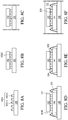
- FIG. 5A , FIG. 5B , FIG. 5C , FIG. 5D , and FIG. 5E illustrate cross sectional views of the semiconductor package structure of FIG. 1 according to some embodiments of the present disclosure.
- FIG. 6A , FIG. 6B , FIG. 6C , FIG. 6D , FIG. 6E and FIG. 6F illustrate cross sectional views of the semiconductor package structure of FIG. 2 according to some embodiments of the present disclosure.
- FIG. 7A , FIG. 7B , FIG. 7C , FIG. 7D , FIG. 7E , and FIG. 7F illustrate cross sectional views of the semiconductor package structure of FIG. 3 according to some embodiments of the present disclosure.
- FIG. 8A , FIG. 8B , FIG. 8C , FIG. 8D , FIG. 8E , and FIG. 8F illustrate cross sectional views of the semiconductor package structure of FIG. 4 according to some embodiments of the present disclosure.
- FIG. 9A , FIG. 9B , FIG. 9C , FIG. 9D , FIG. 9E , and FIG. 9F illustrate cross sectional views of the semiconductor package structure of FIG. 4 according to some embodiments of the present disclosure.
- Spatial descriptions such as “above,” “below,” “up,” “left,” “right,” “down,” “top,” “bottom,” “vertical,” “horizontal,” “side,” “higher,” “lower,” “upper,” “over,” “under,” and so forth, are specified with respect to a certain component or group of components, or a certain plane of a component or group of components, for the orientation of the component(s) as shown in the associated figure. It should be understood that the spatial descriptions used herein are for purposes of illustration only, and that practical implementations of the structures described herein can be spatially arranged in any orientation or manner, provided that the merits of embodiments of this disclosure are not deviated from by such arrangement.
- Comparative PMUT packaging operation utilizes eutectic wafer bonding, for example, AlGe, as signal connection between the PMUT die and CMOS die.
- Eutectic wafer bonding also provides vacuum cavity to individual PMUT cell including at least a membrane, a transducer surface including a transmission portion and a receiving portion.
- Present disclosure provides a eutectic bonding-free PMUT package structure.
- the eutectic bonding is replaced by bumping structure, for example, solder bumping and/or copper pillar.
- the layout of the PMUT package is also changed.
- air cavity is formed to cover a plurality of PMUT cells, whereas comparatively vacuum cavity is formed by eutectic bonding to cover a single PMUT cell.
- FIG. 1 illustrates a cross sectional view of a semiconductor package structure 10 according to some embodiments of the present disclosure.
- Semiconductor package structure 10 includes a substrate 100 , a die 101 disposed on the substrate 100 with a back surface 101 B in connection with the substrate 100 , for example.
- An active surface 101 A of the die 101 is opposite to the back surface 101 B and is facing away from the substrate 100 .
- an electrical connection such as a bonding wire 135 connects the active surface 101 A of the die 101 and a top surface of the underlying substrate 100 .
- the substrate 100 may include a circuitry and/or a redistribution layer (RDL) structure (not illustrated in FIG. 1 ).
- the substrate 100 may include a solder mask (SM) structure, conductive pad(s), patterned conductive trace(s), and interconnection(s) (e.g. via(s)).
- the substrate 100 may include ceramic, semiconductor material (e.g. silicon, high-resistance silicon, high-resistivity silicon, or other suitable semiconductor material), dielectric material, glass or other suitable materials.
- the die 101 in connection with the substrate 100 may include an application specific integrated circuit (ASIC) die.
- the semiconductor package structure 10 further includes a die 102 stacked over an active surface 101 A of the die 101 .
- Die 102 and die 101 are electrically connected through several conductive terminals 102 A disposed on a surface 102 A′ of the die 102 . Electrical signal generated from the die 102 can be transmitted to the die 101 through the conductive terminals 102 A.
- the die 102 is bonded to the die 101 through the conductive terminals 102 A.
- the die 102 may include piezoelectric material, which can be exemplified as Aluminum Nitride (AlN), however, it will be appreciated that numerous materials exhibiting piezoelectric behavior may be alternatively utilized without departing from the present teachings.
- piezoelectric material which can be exemplified as Aluminum Nitride (AlN), however, it will be appreciated that numerous materials exhibiting piezoelectric behavior may be alternatively utilized without departing from the present teachings.
- material may be selected for use from the group of materials exhibiting piezoelectric behavior comprising Apatite, Barium Titanate (BaTiO 3 ), Berlinite (AlPO 4 ), various Ceramic materials, Allium Phosphate, Gallium Nitride (GaN), Gallium Orthophosphate, Lanthanum Gallium Silicate, Lead Scandium Tantalate, Lead Magnesium Niobate (PMN), Lead Zirconate Titanate (PZT), Lithium Tantalate, Polyvinylidene Fluoride (PVDF), Potassium Sodium Tartrate, Quartz (SiO 2 ), Zinc Oxide (ZnO), and other materials and combinations as will be known to one of ordinary skill in the art.
- materials exhibiting piezoelectric behavior comprising Apatite, Barium Titanate (BaTiO 3 ), Berlinite (AlPO 4 ), various Ceramic materials, Allium Phosphate, Gallium Nitride (GaN), Gallium Orthophosphate, Lanthanum Gall
- one class of ceramics materials exhibiting piezo electric properties are ceramic structures exhibiting perovskite tungsten-bronze structures, including BaTiO 3 , KNbO 3 , Ba 2 NaNb 5 O 5 , LiNbO 3 , SrTiO 3 , Pb(ZrTi)O 3 , Pb 2 KNb 5 O 15 , LiTaO 3 , BiFeO 3 , Na x WO 3 .
- a vertical projection area of the die 102 is smaller than a vertical projection area of the die 101 , for example, a vertical projection area of a PMUT die is smaller than a vertical projection of an ASIC die.
- the semiconductor package structure 10 further includes a sealing structure 120 disposed on the active surface 101 A of the die 101 and abutting an edge of the die 102 at the surface 102 A′. From a cross sectional view as shown in FIG. 1 , the sealing structure 120 sandwiches or laterally surrounds the conductive terminals 102 A at the surface 102 A′ of the die 102 . Whereas from a top view perspective, as will be shown in FIG. 1A and FIG. 1B of the present disclosure, the sealing structure 120 may fully surround the conductive terminals 102 A from all sides of the die 102 .
- a height of the sealing structure 120 is greater than a separation between the die 101 and the die 102 , therefore, the sealing structure 120 may effectively seal the space between the die 101 and the die 102 from all sides of the die 102 .
- a cavity 130 can be defined by the surface 102 A′ of the die 102 , the active surface 101 A of the die 101 , and a sidewall of the sealing structure 120 .
- the plurality of the conductive terminals 102 A connecting the die 101 and the die 102 is accommodated in the cavity 130 , or sealed within the cavity 130 .
- the sealing structure 120 may be composed of high-viscosity dielectric materials, for example, high-viscosity polymers, which prevents contamination of the surface 102 A′ of the die 102 during application.
- the cavity 130 is air-filled, or an air cavity.
- the cavity 130 of present disclosure is an air cavity with pressure substantially higher than vacuum level.
- vacuum cavity is widely adopted in PMUT package in order to direct ultrasound propagating away from the vacuum cavity due to the fact that ultrasound can primarily or solely propagate through medium.
- Air cavity adopted in the present disclosure may proportionally propagate more ultrasound in the direction toward the cavity 130 compared to the vacuum cavity counterpart, thereby rendering reflection at material interfaces and in heterogeneous material.
- present disclosure further provides an absorption layer 131 between the back surface 101 B and the substrate 100 , configured to absorb ultrasound propagating toward the substrate 100 .
- a die attach layer (not shown in FIG. 1 ) may be used to connect the die 101 and the substrate 100 .
- a plurality of die attach layers (not shown in FIG. 1 ) are stacked with the absorption layer 131 , for example, one die attach layer may be disposed between the substrate 100 and the absorption layer 131 , and another die attach layer may be disposed between the absorption layer 131 and the die 101 .
- the sealing structure 120 can be a dam structure.
- conductive terminals 102 A can be composed of solder materials, for example, solder joints may be used to electrically and mechanically connect die 102 and die 101 .
- Semiconductor package structure 10 further includes an encapsulant 111 covering a back surface 102 B′ of the die 102 .
- the encapsulant 111 may further cover the sidewall of the die 102 and the sealing structure 120 .
- semiconductor package structure 10 may further include another encapsulant 112 on the substrate 100 , encapsulating the die 101 from its sidewall and a portion of the active surface 101 A.
- the encapsulant 112 may further in contact and surround the encapsulant 111 .
- the encapsulant 111 and the encapsulant 112 are both in contact with the sealing structure 120 .
- material of the encapsulant 111 may be different from the material of the encapsulant 112 , for example, encapsulant 112 may be composed of epoxy, resin, or molding compound with various fillers, whereas encapsulant 111 may be composed of silicone, or epoxy without any fillers
- materials of encapsulant 111 may be selected to have an impedance substantially close to human body impedance with respect to ultrasound.
- FIG. 1A illustrates a top view of a semiconductor package structure viewing from interface AA of FIG. 1 according to some embodiments of the present disclosure.
- the die 102 includes a plurality of cell regions 150 , each of the cell regions 150 includes a membrane portion 150 A, and a transducer interface having at least a receiving portion 1502 A/ 102 A and a transmission portion 1502 B/ 102 A.
- the receiving portion 1502 A/ 102 A may include a conductive wire 1502 A electrically coupling one layer of the membrane portion 150 A and a conductive terminal 102 A
- the transmission portion 1502 B/ 102 A may include a conductive wire 1502 B electrically coupling another layer of the membrane portion 150 A and a conductive terminal 102 A.
- the receiving portion 1502 A/ 102 A and the transmission portion 1502 B/ 102 A electrically connect the membrane portion 150 A to the active surface 101 A of the die 101 , so that the each of the PMUT cell may communicate with the die 101 independently.
- the conductive terminal 102 A can be composed of solder material.
- die 102 may include a five by two array of PMUT cell regions 150 , and a sealing structure 120 is surrounding said five by two array of PMUT cell regions 150 .
- the sealing structure encloses a plurality of PMUT cell regions 150 without separating adjacent PMUT cell regions 150 .
- the circular PMUT shape seen in FIG. 1A is shown by way of example, while the present disclosure may be implemented in a range of geometries without departing from the disclosure.
- FIG. 1B illustrates a top view of a semiconductor package structure viewing from interface AA of FIG. 1 according to some embodiments of the present disclosure.
- FIG. 1B is similar to FIG.
- the membrane portion 150 A may be in a tetragonal shape instead of a circular shape.
- the receiving portion 1502 A/ 102 A may be connected to a short side of the membrane portion 150 A
- the transmission portion 1502 B/ 102 A may be connected to a long side of the membrane portion 150 A.
- FIG. 2 illustrates a cross sectional view of a semiconductor package structure 20 according to some embodiments of the present disclosure.
- Semiconductor package structure 20 is similar to semiconductor package structure 10 but with a different sealing structure 120 / 120 ′ and different conductive terminals 102 A.
- the conductive terminal 102 A may further include a copper pillar 1021 A extending from an active surface 101 A of the die 101 toward the die 102 .
- one copper pillar 1021 A is in connection with one solder joint 1022 A, configured to electrically and mechanically connect die 102 and die 101 .
- Sealing structure 120 / 120 ′ of semiconductor package structure 20 include a dielectric wall 120 ′ disposed on the active surface 101 A of the die 101 and a dam structure 120 sealing between the dielectric wall 120 ′ and a sidewall or an edge of the die 102 .
- an aspect ratio of the dielectric wall 120 ′ is greater than an aspect ratio of the conductive terminals 102 A so as to seal the space between die 102 and die 101 together with the dam structure 120 .
- a height of the dielectric wall 120 ′ is greater than a height of the conductive terminals 102 A.
- the dam structure 120 , the dielectric wall 120 ′, the die 101 , and the die 102 altogether define a cavity 130 accommodating the plurality of conductive terminals 102 A. As previously described, the cavity 130 is air-filled, or an air cavity.
- FIG. 3 illustrates a cross sectional view of a semiconductor package structure 30 according to some embodiments of the present disclosure.
- Semiconductor package structure 30 is similar to semiconductor package structure 20 but with a different arrangement of the encapsulant 112 and the sealing structure 120 / 120 ′.
- a top surface of the encapsulant 112 is substantially coplanar with the dielectric wall 120 ′ of the sealing structure 120 / 120 ′.
- the encapsulant 111 of semiconductor package structure 30 is positioned on the substantially coplanar top surface of the encapsulant 112 and the dielectric wall 120 ′ of the sealing structure 120 / 120 ′.
- Encapsulant 111 may also cover the back surface 102 B′ of the die 102 , the sidewall of the die 102 , and the dam structure 120 of the sealing structure 120 / 120 ′.
- FIG. 4 illustrates a cross sectional view of a semiconductor package structure 40 according to some embodiments of the present disclosure.
- Semiconductor package structure 40 is similar to semiconductor package structure 30 but is free of the encapsulant 112 .
- encapsulant 111 covers the die 102 and also the die 101 underlying the die 102 .
- molding compound operation which may exert pressure on the object to be molded, is prevented from applying over the die 102 .
- softer encapsulant 111 such as silicone is adopted for the general molding of the semiconductor package structure 40 .
- FIG. 5A , FIG. 5B , FIG. 5C , FIG. 5D , and FIG. 5E illustrate cross sectional views of the semiconductor package structure 10 of FIG. 1 according to some embodiments of the present disclosure.
- a die 102 for example, a MEMS die, or a PMUT die, is provided and ball drop operation is conducted for PMUT die bumping.
- An array of conductive terminals 102 A is arranged on a surface 102 A′ of the die 102 according to positions of the plurality of cell regions 150 , as shown in FIG. 1A and FIG. 1B of the present disclosure.
- FIG. 5A a die 102 , for example, a MEMS die, or a PMUT die, is provided and ball drop operation is conducted for PMUT die bumping.
- An array of conductive terminals 102 A is arranged on a surface 102 A′ of the die 102 according to positions of the plurality of cell regions 150 , as shown in FIG. 1A and FIG. 1B of the present disclosure.
- another die 101 is bonded to a substrate 100 at its back surface 101 B by, for example, a die attach layer (not shown in FIG. 5B ).
- semiconductor substrate 100 may be in a form of a strip or panel.
- a plurality of the die 101 is pick-and-place over the substrate 100 .
- conductive wire 135 is formed by wire bonding operation to electrically connect the active surface 101 A of the die 101 and conductive pad or conductive traces (not shown) of the substrate 100 .
- an absorption layer 131 configured to absorb ultrasonic wave passing through the die 102 can be formed between the die 101 and the substrate 100 .
- an open cavity molding operation is applied to form encapsulant 112 on the substrate 100 , surrounding the die 101 and encapsulating the bonding wires 135 .
- An active surface 101 A of the die 101 is free from coverage of the encapsulant 112 and is ready for connection with the die 102 .
- encapsulant 112 formed through open cavity mode can be resin, epoxy, or molding compound with various fillers.
- a thickness of the encapsulant 112 is designed to be greater than a sum of the thickness of the die 101 and the die 102 .
- the die 102 planted with conductive terminals 102 A is bonded to the active surface 101 A of the die 101 through a reflow operation.
- the size of the die 102 is smaller than the size of the die 101 , so that all the conductive terminals 102 A on the die 102 can bonded to the corresponding conductive pads on the die 101 with a portion of the active surface 101 A of the die 101 being occupied by the encapsulant 112 .
- a low-residue flux or fluxless reflow e.g., formic acid reflow
- a sealing structure 120 is formed on the active surface 101 A of the die 101 and surrounding the conductive terminals 102 A.
- the sealing structure can be dam structure composed of high viscosity dielectric materials which do not flow under the die 102 and contaminate active components, such as piezoelectric surface, membrane surface, or transducer surface, of the die 102 .
- forming the sealing structure 120 includes performing a dispensing operation. More fluidic encapsulant 111 is then applied to cover a back surface of the die 102 and being confined by the encapsulant 112 .
- the sealing structure 120 is formed prior to the application of the encapsulant 111 , such encapsulant 111 may not enter the space between die 102 and die 101 , rendering a cavity 130 accommodating the plurality of the conductive terminals 102 A.
- the cavity 130 is an air cavity.
- FIG. 6A , FIG. 6B , FIG. 6C , FIG. 6D , and FIG. 6E illustrate cross sectional views of the semiconductor package structure 20 of FIG. 2 according to some embodiments of the present disclosure.
- a wafer for example, a wafer including a plurality of die 101 regions
- a copper pillar bumping operation is conducted at a wafer level to form a plurality of copper pillars 1021 A and solder paste on each of the copper pillars 1021 A in each of the die 101 regions.
- the solder paste is then reflowed to form solder bumps 1022 A.
- solder bumps 1022 A and the copper pillars 1021 A can be referred to the conductive terminals 102 A of semiconductor package structure 20 .
- reduced volume of the solder paste may be used.
- a patterned dielectric layer is formed on the wafer having a plurality of die 101 regions. From a cross sectional perspective, dielectric walls 120 ′ are formed by a photoresist patterning operation to surround the conductive terminals 102 A in each of the die 101 regions. Subsequently, the wafer is diced to form a plurality of separated dies 101 .
- the separated die 101 is bonded to a substrate 100 at its back surface 101 B.
- semiconductor substrate 100 may be in a form of a strip or panel.
- a plurality of the die 101 is pick-and-place over the substrate 100 .
- conductive wire 135 is formed by wire bonding operation to electrically connect the active surface 101 A of the die 101 and conductive pad or conductive traces (not shown) of the substrate 100 .
- an absorption layer 131 configured to absorb ultrasonic wave passing through the die 102 (shown in FIG. 6E ) can be formed between the die 101 and the substrate 100 .
- an open cavity molding operation is applied to form encapsulant 112 on the substrate 100 , surrounding the die 101 and encapsulating the bonding wires 135 .
- a height of the dielectric wall 120 ′ is greater than a height of the conductive terminal 102 A, therefore, a protrusion of the molding case used in open cavity molding operation can be abutted with the top of the dielectric wall 120 ′ without contacting the top of the conductive terminal 102 A.
- An active surface 101 A of the die 101 is free from coverage of the encapsulant 112 and is ready for connection with the die 102 (shown in FIG. 6E ).
- encapsulant 112 formed through open cavity mode can be resin, epoxy, or molding compound with various fillers.
- a thickness of the encapsulant 112 is designed to be greater than a sum of the thickness of the die 101 and the die 102 .
- another die 102 for example, a MEMS die, or a PMUT die, is bonded to the die 101 at its surface 102 A′ thorough a reflow operation.
- a plurality of die 102 is pick-and-place over the plurality of dies 101 on the substrate 100 .
- a low-residue flux or fluxless reflow e.g., formic acid reflow
- a dam structure 120 is formed to gap the dielectric wall 120 ′ and an edge or sidewall of the die 102 .
- the sealing structure 120 / 120 ′ surrounds the conductive terminals 102 A.
- the dam structure 120 may be composed of high viscosity dielectric materials which do not flow under the die 102 and contaminate active components, such as piezoelectric surface, membrane surface, or transducer surface, of the die 102 .
- forming the dam structure 120 includes performing a dispensing operation. More fluidic encapsulant 111 is then applied to cover a back surface of the die 102 and being confined by the encapsulant 112 . Because the sealing structure 120 / 120 ′ is formed prior to the application of the encapsulant 111 , such encapsulant 111 may not enter the space between die 102 and die 101 , rendering a cavity 130 accommodating the plurality of the conductive terminals 102 A. In some embodiments, the cavity 130 is an air cavity. Subsequently, the substrate 100 and the encapsulant 112 is separated through a package saw operation and the semiconductor package structure 20 of FIG. 2 is obtained.
- FIG. 7A , FIG. 7B , FIG. 7C , FIG. 7D , FIG. 7E , and FIG. 7F illustrate cross sectional views of the semiconductor package structure 30 of FIG. 3 according to some embodiments of the present disclosure.
- a wafer for example, a wafer including a plurality of die 101 regions
- a copper pillar bumping operation is conducted at a wafer level to form a plurality of copper pillars 1021 A and solder paste on each of the copper pillars 1021 A in each of the die 101 regions.
- the solder paste is then reflowed to form solder bumps 1022 A.
- solder bumps 1022 A and the copper pillars 1021 A can be referred to the conductive terminals 102 A of semiconductor package structure 30 .
- reduced volume of the solder paste may be used.
- a patterned dielectric layer is formed on the wafer having a plurality of die 101 regions. From a cross sectional perspective, dielectric walls 120 ′ are formed by a photoresist patterning operation to surround the conductive terminals 102 A in each of the die 101 regions. Subsequently, the wafer is diced to form a plurality of separated dies 101 .
- the separated die 101 is bonded to a substrate 100 at its back surface 101 B.
- semiconductor substrate 100 may be in a form of a strip or panel.
- a plurality of the die 101 is pick-and-place over the substrate 100 .
- conductive wire 135 is formed by wire bonding operation to electrically connect the active surface 101 A of the die 101 and conductive pad or conductive traces (not shown) of the substrate 100 .
- an absorption layer 131 configured to absorb ultrasonic wave passing through the die 102 (shown in FIG. 7E ) can be formed between the die 101 and the substrate 100 .
- a flat mold molding operation is applied to form encapsulant 112 on the substrate 100 , surrounding the die 101 and encapsulating the bonding wires 135 .
- a top surface of the encapsulant 112 is substantially coplanar with a top surface of the dielectric wall 120 ′.
- a top surface of the encapsulant 112 may not be coplanar with a top surface of the dielectric wall 120 ′, for example, by having a stair gap.
- An active surface 101 A of the die 101 is free from coverage of the encapsulant 112 and is ready for connection with the die 102 (shown in FIG. 7E ).
- encapsulant 112 formed through open cavity mode can be resin, epoxy, or molding compound with various fillers.
- a thickness of the encapsulant 112 is designed to be greater than a sum of the thickness of the die 101 and conductive terminals 102 A.
- another die 102 for example, a MEMS die, or a PMUT die, is bonded to the die 101 at its surface 102 A′ thorough a reflow operation.
- a plurality of die 102 is pick-and-place over the plurality of dies 101 on the substrate 100 .
- a low-residue flux or fluxless reflow e.g., formic acid reflow
- a dam structure 120 is formed to gap the dielectric wall 120 ′ and an edge or sidewall of the die 102 .
- the sealing structure 120 / 120 ′ surrounds the conductive terminals 102 A.
- the dam structure 120 may be composed of high viscosity dielectric materials which do not flow under the die 102 and contaminate active components, such as piezoelectric surface, membrane surface, or transducer surface, of the die 102 . More fluidic encapsulant 111 is then applied to cover a back surface of the die 102 and being confined by the encapsulant 112 . Because the sealing structure 120 / 120 ′ is formed prior to the application of the encapsulant 111 , such encapsulant 111 may not enter the space between die 102 and die 101 , rendering a cavity 130 accommodating the plurality of the conductive terminals 102 A. In some embodiments, the cavity 130 is an air cavity. Subsequently, the substrate 100 and the encapsulant 112 is separated through a package saw operation and the semiconductor package structure 30 of FIG. 3 is obtained.
- FIG. 8A , FIG. 8B , FIG. 8C , FIG. 8D , FIG. 8E , and FIG. 8F illustrate cross sectional views of the semiconductor package structure 40 of FIG. 4 according to some embodiments of the present disclosure.
- a wafer for example, a wafer including a plurality of die 101 regions, is provided and a copper pillar bumping operation is conducted at a wafer level to form a plurality of copper pillars 1021 A and solder paste on each of the copper pillars 1021 A in each of the die 101 regions. The solder paste is then reflowed to form solder bumps 1022 A.
- solder bumps 1022 A and the copper pillars 1021 A can be referred to the conductive terminals 102 A of semiconductor package structure 40 .
- reduced volume of the solder paste may be used.
- another die 102 for example, a MEMS die, or a PMUT die, is bonded to the wafer including a plurality of die 101 regions at its surface 102 A′ thorough a reflow operation. In some embodiments, the operation in FIG. 8B is performed under wafer-level.
- a flux cleaning operation can be conducted in current embodiment to remove the flux residue near the solder joints, as shown in FIG. 8C .
- the wafer having a plurality of die 101 regions 101 is then separated to form a plurality dies 101 , each of the dies 101 is bonded with at least a die 102 .
- the separated die 101 is bonded to a substrate 100 at its back surface 101 B.
- semiconductor substrate 100 may be in a form of a strip or panel.
- a plurality of the die 101 is pick-and-place over the substrate 100 .
- conductive wire 135 is formed by wire bonding operation to electrically connect the active surface 101 A of the die 101 and conductive pad or conductive traces (not shown) of the substrate 100 .
- an absorption layer 131 configured to absorb ultrasonic wave passing through the die 102 can be formed between the die 101 and the substrate 100 .
- a sealing structure 120 is formed on the active surface 101 A of the die 101 and surrounding the conductive terminals 102 A.
- the sealing structure can be dam structure composed of high viscosity dielectric materials which do not flow under the die 102 and contaminate active components, such as piezoelectric surface, membrane surface, or transducer surface, of the die 102 .
- active components such as piezoelectric surface, membrane surface, or transducer surface
- FIG. 8F more fluidic encapsulant 111 is then applied over the substrate 100 to encapsulate the die 101 and the die 102 . Because the sealing structure 120 is formed prior to the application of the encapsulant 111 , such encapsulant 111 may not enter the space between die 102 and die 101 , rendering a cavity 130 accommodating the plurality of the conductive terminals 102 A. In some embodiments, the cavity 130 is an air cavity. Subsequently, the substrate 100 and the encapsulant 111 is separated through a package saw operation and the semiconductor package structure 40 of FIG. 4 is obtained.
- FIG. 9A , FIG. 9B , FIG. 9C , FIG. 9D , FIG. 9E , and FIG. 9F illustrate cross sectional views of the semiconductor package structure 40 of FIG. 4 according to some embodiments of the present disclosure.
- a wafer for example, a wafer including a plurality of die 101 regions, is provided and a copper pillar bumping operation is conducted at a wafer level to form a plurality of copper pillars 1021 A and solder paste on each of the copper pillars 1021 A in each of the die 101 regions. The solder paste is then reflowed to form solder bumps 1022 A.
- the combination of the solder bumps 1022 A and the copper pillars 1021 A can be referred to the conductive terminals 102 A of semiconductor package structure 40 .
- reduced volume of the solder paste may be used.
- the wafer having a plurality of die 101 regions is separated to form a plurality of separated dies 101 .
- the separated die 101 is bonded to a substrate 100 at its back surface 101 B.
- semiconductor substrate 100 may be in a form of a strip or panel.
- a plurality of the separated die 101 is pick-and-place over the substrate 100 .
- an absorption layer 131 configured to absorb ultrasonic wave emitting from the die 102 (shown in FIG. 9C ) can be formed between the die 101 and the substrate 100 .
- FIG. 9C another die 102 , for example, a MEMS die, or a PMUT die, is bonded to each of the separated dies 101 at its surface 102 A′ thorough a reflow operation.
- a flux cleaning operation can be conducted in current embodiment to remove the flux residue near the solder joints, as shown in FIG. 9C .
- conductive wire 135 is formed by wire bonding operation to electrically connect the active surface 101 A of the die 101 and conductive pad or conductive traces (not shown) of the substrate 100 .
- a sealing structure 120 is formed on the active surface 101 A of the die 101 and surrounding the conductive terminals 102 A.
- the sealing structure can be dam structure composed of high viscosity dielectric material which do not flow under the die 102 and contaminate active components, such as piezoelectric surface, membrane surface, or transducer surface, of the die 102 .
- more fluidic encapsulant 111 is then applied over the substrate 100 to encapsulate the die 101 and the die 102 . Because the sealing structure 120 is formed prior to the application of the encapsulant 111 , such encapsulant 111 may not enter the space between die 102 and die 101 , rendering a cavity 130 accommodating the plurality of the conductive terminals 102 A. In some embodiments, the cavity 130 is an air cavity. Subsequently, the substrate 100 and the encapsulant 111 is separated through a package saw operation and the semiconductor package structure 40 of FIG. 4 is obtained.
- the terms “substantially,” “substantial,” “approximately” and “about” are used to describe and account for small variations. When used in conjunction with an event or circumstance, the terms can encompass instances in which the event or circumstance occurs precisely as well as instances in which the event or circumstance occurs to a close approximation.
- the terms when used in conjunction with a numerical value, can encompass a range of variation of less than or equal to ⁇ 10% of that numerical value, such as less than or equal to ⁇ 5%, less than or equal to ⁇ 4%, less than or equal to ⁇ 3%, less than or equal to ⁇ 2%, less than or equal to ⁇ 1%, less than or equal to ⁇ 0.5%, less than or equal to ⁇ 0.1%, or less than or equal to ⁇ 0.05%.
- substantially coplanar can refer to two surfaces within micrometers of lying along a same plane, such as within 40 within 30 within 20 within 10 or within 1 ⁇ m of lying along the same plane.
- a component provided “on” or “over” another component can encompass cases where the former component is directly on (e.g., in physical contact with) the latter component, as well as cases where one or more intervening components are located between the former component and the latter component.
Landscapes
- Engineering & Computer Science (AREA)
- Microelectronics & Electronic Packaging (AREA)
- Manufacturing & Machinery (AREA)
- Computer Hardware Design (AREA)
- Mechanical Engineering (AREA)
- Structures Or Materials For Encapsulating Or Coating Semiconductor Devices Or Solid State Devices (AREA)
- Micromachines (AREA)
Abstract
Description
Claims (4)
Priority Applications (3)
| Application Number | Priority Date | Filing Date | Title |
|---|---|---|---|
| US16/448,970 US11217499B2 (en) | 2019-06-21 | 2019-06-21 | Semiconductor package structure and method for manufacturing the same |
| CN202010401528.5A CN112110410B (en) | 2019-06-21 | 2020-05-12 | Semiconductor packaging structure and manufacturing method thereof |
| CN202510170866.5A CN120024865A (en) | 2019-06-21 | 2020-05-12 | Semiconductor packaging structure and manufacturing method thereof |
Applications Claiming Priority (1)
| Application Number | Priority Date | Filing Date | Title |
|---|---|---|---|
| US16/448,970 US11217499B2 (en) | 2019-06-21 | 2019-06-21 | Semiconductor package structure and method for manufacturing the same |
Publications (2)
| Publication Number | Publication Date |
|---|---|
| US20200402879A1 US20200402879A1 (en) | 2020-12-24 |
| US11217499B2 true US11217499B2 (en) | 2022-01-04 |
Family
ID=73799476
Family Applications (1)
| Application Number | Title | Priority Date | Filing Date |
|---|---|---|---|
| US16/448,970 Active US11217499B2 (en) | 2019-06-21 | 2019-06-21 | Semiconductor package structure and method for manufacturing the same |
Country Status (2)
| Country | Link |
|---|---|
| US (1) | US11217499B2 (en) |
| CN (2) | CN120024865A (en) |
Families Citing this family (2)
| Publication number | Priority date | Publication date | Assignee | Title |
|---|---|---|---|---|
| JP2023519917A (en) * | 2020-03-26 | 2023-05-15 | ウィメムス カンパニー リミテッド | Optical scanner package and manufacturing method |
| DE102022120750A1 (en) * | 2022-08-17 | 2024-02-22 | Infineon Technologies Ag | Device with ultrasonic transducer and method for producing the same |
Citations (10)
| Publication number | Priority date | Publication date | Assignee | Title |
|---|---|---|---|---|
| US20030134450A1 (en) * | 2002-01-09 | 2003-07-17 | Lee Teck Kheng | Elimination of RDL using tape base flip chip on flex for die stacking |
| US20070290364A1 (en) * | 2006-06-15 | 2007-12-20 | Pavan Gupta | Stacked die package for mems resonator system |
| US20080217708A1 (en) * | 2007-03-09 | 2008-09-11 | Skyworks Solutions, Inc. | Integrated passive cap in a system-in-package |
| US20090102060A1 (en) * | 2007-10-17 | 2009-04-23 | Analog Devices, Inc. | Wafer Level Stacked Die Packaging |
| US20120306074A1 (en) * | 2011-05-30 | 2012-12-06 | Elpida Memory, Inc. | Semiconductor chip having bump electrode, semiconductor device having the semiconductor chip, and method for manufacturing the semiconductor device |
| US20130075926A1 (en) * | 2011-09-23 | 2013-03-28 | JoHyun Bae | Integrated circuit packaging system with package stacking and method of manufacture thereof |
| US20150037914A1 (en) * | 2013-07-31 | 2015-02-05 | Micron Technology, Inc. | Method for manufacturing tested apparatus and method for manufacturing system including tested apparatus |
| US20190259932A1 (en) * | 2018-02-22 | 2019-08-22 | Stmicroelectronics S.R.L. | Micromachined ultrasonic transducer (mut), method for manufacturing the mut, and method for designing the mut |
| US20190393193A1 (en) * | 2018-06-21 | 2019-12-26 | Intel Corporation | Thermal management solutions for stacked integrated circuit devices using jumping drops vapor chambers |
| US20200287126A1 (en) * | 2019-03-07 | 2020-09-10 | Invensense, Inc. | Piezoelectric poling with temporary electrodes |
Family Cites Families (3)
| Publication number | Priority date | Publication date | Assignee | Title |
|---|---|---|---|---|
| US8451620B2 (en) * | 2009-11-30 | 2013-05-28 | Micron Technology, Inc. | Package including an underfill material in a portion of an area between the package and a substrate or another package |
| US9129929B2 (en) * | 2012-04-19 | 2015-09-08 | Sony Corporation | Thermal package with heat slug for die stacks |
| US10043730B2 (en) * | 2015-09-28 | 2018-08-07 | Xilinx, Inc. | Stacked silicon package assembly having an enhanced lid |
-
2019
- 2019-06-21 US US16/448,970 patent/US11217499B2/en active Active
-
2020
- 2020-05-12 CN CN202510170866.5A patent/CN120024865A/en active Pending
- 2020-05-12 CN CN202010401528.5A patent/CN112110410B/en active Active
Patent Citations (10)
| Publication number | Priority date | Publication date | Assignee | Title |
|---|---|---|---|---|
| US20030134450A1 (en) * | 2002-01-09 | 2003-07-17 | Lee Teck Kheng | Elimination of RDL using tape base flip chip on flex for die stacking |
| US20070290364A1 (en) * | 2006-06-15 | 2007-12-20 | Pavan Gupta | Stacked die package for mems resonator system |
| US20080217708A1 (en) * | 2007-03-09 | 2008-09-11 | Skyworks Solutions, Inc. | Integrated passive cap in a system-in-package |
| US20090102060A1 (en) * | 2007-10-17 | 2009-04-23 | Analog Devices, Inc. | Wafer Level Stacked Die Packaging |
| US20120306074A1 (en) * | 2011-05-30 | 2012-12-06 | Elpida Memory, Inc. | Semiconductor chip having bump electrode, semiconductor device having the semiconductor chip, and method for manufacturing the semiconductor device |
| US20130075926A1 (en) * | 2011-09-23 | 2013-03-28 | JoHyun Bae | Integrated circuit packaging system with package stacking and method of manufacture thereof |
| US20150037914A1 (en) * | 2013-07-31 | 2015-02-05 | Micron Technology, Inc. | Method for manufacturing tested apparatus and method for manufacturing system including tested apparatus |
| US20190259932A1 (en) * | 2018-02-22 | 2019-08-22 | Stmicroelectronics S.R.L. | Micromachined ultrasonic transducer (mut), method for manufacturing the mut, and method for designing the mut |
| US20190393193A1 (en) * | 2018-06-21 | 2019-12-26 | Intel Corporation | Thermal management solutions for stacked integrated circuit devices using jumping drops vapor chambers |
| US20200287126A1 (en) * | 2019-03-07 | 2020-09-10 | Invensense, Inc. | Piezoelectric poling with temporary electrodes |
Also Published As
| Publication number | Publication date |
|---|---|
| CN120024865A (en) | 2025-05-23 |
| US20200402879A1 (en) | 2020-12-24 |
| CN112110410B (en) | 2025-03-04 |
| CN112110410A (en) | 2020-12-22 |
Similar Documents
| Publication | Publication Date | Title |
|---|---|---|
| KR102667193B1 (en) | PMUT monolithic integration on CMOS | |
| US12295790B2 (en) | Integrated ultrasonic transducers | |
| US9975763B2 (en) | Integration of AIN ultrasonic transducer on a CMOS substrate using fusion bonding process | |
| CN104821798B (en) | Electronic Packaging and MEMS package | |
| US11217499B2 (en) | Semiconductor package structure and method for manufacturing the same | |
| WO2020134665A1 (en) | Control circuit, integration method for acoustic wave filter, and integration structure | |
| CN111003684A (en) | Packaging of MEMS devices with release holes in the packaging space | |
| CN106487350A (en) | Acoustic wave device and its manufacture method | |
| WO2020134668A1 (en) | Integrating method and integrating structure for control circuit and bulk acoustic wave filter | |
| KR101625450B1 (en) | Surface Acoustic Wave Filter and Method for manufacturing | |
| US12212299B2 (en) | Electronic device and formation method therefor | |
| JP7064433B2 (en) | Ultrasonic device | |
| JP2003264442A (en) | Method of manufacturing surface acoustic wave device and multiple base substrate | |
| CN116140171B (en) | Piezoelectric device | |
| US11897759B2 (en) | Semiconductor device and method for forming the same | |
| CN115424987B (en) | Packaging structure and manufacturing method thereof | |
| CN120263131A (en) | Bulk acoustic wave device manufacturing method, device and bulk acoustic wave device | |
| CN116893002A (en) | Ultrasonic sensor and method of manufacturing ultrasonic sensor | |
| JP2008147368A (en) | Semiconductor device | |
| JPWO2020137966A1 (en) | Ultrasonic device | |
| JP2007251391A (en) | Semiconductor device and manufacturing method thereof |
Legal Events
| Date | Code | Title | Description |
|---|---|---|---|
| FEPP | Fee payment procedure |
Free format text: ENTITY STATUS SET TO UNDISCOUNTED (ORIGINAL EVENT CODE: BIG.); ENTITY STATUS OF PATENT OWNER: LARGE ENTITY |
|
| AS | Assignment |
Owner name: ADVANCED SEMICONDUCTOR ENGINEERING, INC., TAIWAN Free format text: ASSIGNMENT OF ASSIGNORS INTEREST;ASSIGNORS:TSENG, CHI SHENG;LAI, LU-MING;LIU, HUI-CHUNG;REEL/FRAME:050346/0358 Effective date: 20190625 |
|
| STPP | Information on status: patent application and granting procedure in general |
Free format text: RESPONSE TO NON-FINAL OFFICE ACTION ENTERED AND FORWARDED TO EXAMINER |
|
| STPP | Information on status: patent application and granting procedure in general |
Free format text: FINAL REJECTION MAILED |
|
| STPP | Information on status: patent application and granting procedure in general |
Free format text: RESPONSE AFTER FINAL ACTION FORWARDED TO EXAMINER |
|
| STPP | Information on status: patent application and granting procedure in general |
Free format text: NOTICE OF ALLOWANCE MAILED -- APPLICATION RECEIVED IN OFFICE OF PUBLICATIONS |
|
| STPP | Information on status: patent application and granting procedure in general |
Free format text: PUBLICATIONS -- ISSUE FEE PAYMENT VERIFIED |
|
| STCF | Information on status: patent grant |
Free format text: PATENTED CASE |
|
| MAFP | Maintenance fee payment |
Free format text: PAYMENT OF MAINTENANCE FEE, 4TH YEAR, LARGE ENTITY (ORIGINAL EVENT CODE: M1551); ENTITY STATUS OF PATENT OWNER: LARGE ENTITY Year of fee payment: 4 |