US11216635B2 - Display panel - Google Patents

Display panel Download PDF

Info

Publication number
US11216635B2
US11216635B2 US16/477,698 US201816477698A US11216635B2 US 11216635 B2 US11216635 B2 US 11216635B2 US 201816477698 A US201816477698 A US 201816477698A US 11216635 B2 US11216635 B2 US 11216635B2
Authority
US
United States
Prior art keywords
fingerprint identification
display panel
units
disposed
linear polarized
Prior art date
Legal status (The legal status is an assumption and is not a legal conclusion. Google has not performed a legal analysis and makes no representation as to the accuracy of the status listed.)
Active, expires
Application number
US16/477,698
Other versions
US20210357609A1 (en
Inventor
Hui Chen
Current Assignee (The listed assignees may be inaccurate. Google has not performed a legal analysis and makes no representation or warranty as to the accuracy of the list.)
Wuhan China Star Optoelectronics Semiconductor Display Technology Co Ltd
Original Assignee
Wuhan China Star Optoelectronics Semiconductor Display Technology Co Ltd
Priority date (The priority date is an assumption and is not a legal conclusion. Google has not performed a legal analysis and makes no representation as to the accuracy of the date listed.)
Filing date
Publication date
Application filed by Wuhan China Star Optoelectronics Semiconductor Display Technology Co Ltd filed Critical Wuhan China Star Optoelectronics Semiconductor Display Technology Co Ltd
Assigned to WUHAN CHINA STAR OPTOELECTRONICS SEMICONDUCTOR DISPLAY TECHNOLOGY CO., LTD. reassignment WUHAN CHINA STAR OPTOELECTRONICS SEMICONDUCTOR DISPLAY TECHNOLOGY CO., LTD. ASSIGNMENT OF ASSIGNORS INTEREST (SEE DOCUMENT FOR DETAILS). Assignors: CHEN, HUI
Publication of US20210357609A1 publication Critical patent/US20210357609A1/en
Application granted granted Critical
Publication of US11216635B2 publication Critical patent/US11216635B2/en
Active legal-status Critical Current
Adjusted expiration legal-status Critical

Links

Images

Classifications

    • G06K9/0004
    • GPHYSICS
    • G06COMPUTING OR CALCULATING; COUNTING
    • G06VIMAGE OR VIDEO RECOGNITION OR UNDERSTANDING
    • G06V40/00Recognition of biometric, human-related or animal-related patterns in image or video data
    • G06V40/10Human or animal bodies, e.g. vehicle occupants or pedestrians; Body parts, e.g. hands
    • G06V40/12Fingerprints or palmprints
    • G06V40/13Sensors therefor
    • G06V40/1318Sensors therefor using electro-optical elements or layers, e.g. electroluminescent sensing
    • GPHYSICS
    • G02OPTICS
    • G02FOPTICAL DEVICES OR ARRANGEMENTS FOR THE CONTROL OF LIGHT BY MODIFICATION OF THE OPTICAL PROPERTIES OF THE MEDIA OF THE ELEMENTS INVOLVED THEREIN; NON-LINEAR OPTICS; FREQUENCY-CHANGING OF LIGHT; OPTICAL LOGIC ELEMENTS; OPTICAL ANALOGUE/DIGITAL CONVERTERS
    • G02F1/00Devices or arrangements for the control of the intensity, colour, phase, polarisation or direction of light arriving from an independent light source, e.g. switching, gating or modulating; Non-linear optics
    • G02F1/01Devices or arrangements for the control of the intensity, colour, phase, polarisation or direction of light arriving from an independent light source, e.g. switching, gating or modulating; Non-linear optics for the control of the intensity, phase, polarisation or colour 
    • G02F1/13Devices or arrangements for the control of the intensity, colour, phase, polarisation or direction of light arriving from an independent light source, e.g. switching, gating or modulating; Non-linear optics for the control of the intensity, phase, polarisation or colour  based on liquid crystals, e.g. single liquid crystal display cells
    • G02F1/133Constructional arrangements; Operation of liquid crystal cells; Circuit arrangements
    • G02F1/1333Constructional arrangements; Manufacturing methods
    • G02F1/1335Structural association of cells with optical devices, e.g. polarisers or reflectors
    • G02F1/133528Polarisers
    • GPHYSICS
    • G02OPTICS
    • G02FOPTICAL DEVICES OR ARRANGEMENTS FOR THE CONTROL OF LIGHT BY MODIFICATION OF THE OPTICAL PROPERTIES OF THE MEDIA OF THE ELEMENTS INVOLVED THEREIN; NON-LINEAR OPTICS; FREQUENCY-CHANGING OF LIGHT; OPTICAL LOGIC ELEMENTS; OPTICAL ANALOGUE/DIGITAL CONVERTERS
    • G02F1/00Devices or arrangements for the control of the intensity, colour, phase, polarisation or direction of light arriving from an independent light source, e.g. switching, gating or modulating; Non-linear optics
    • G02F1/01Devices or arrangements for the control of the intensity, colour, phase, polarisation or direction of light arriving from an independent light source, e.g. switching, gating or modulating; Non-linear optics for the control of the intensity, phase, polarisation or colour 
    • G02F1/13Devices or arrangements for the control of the intensity, colour, phase, polarisation or direction of light arriving from an independent light source, e.g. switching, gating or modulating; Non-linear optics for the control of the intensity, phase, polarisation or colour  based on liquid crystals, e.g. single liquid crystal display cells
    • G02F1/133Constructional arrangements; Operation of liquid crystal cells; Circuit arrangements
    • G02F1/136Liquid crystal cells structurally associated with a semi-conducting layer or substrate, e.g. cells forming part of an integrated circuit
    • G02F1/1362Active matrix addressed cells
    • G02F1/1368Active matrix addressed cells in which the switching element is a three-electrode device
    • GPHYSICS
    • G02OPTICS
    • G02FOPTICAL DEVICES OR ARRANGEMENTS FOR THE CONTROL OF LIGHT BY MODIFICATION OF THE OPTICAL PROPERTIES OF THE MEDIA OF THE ELEMENTS INVOLVED THEREIN; NON-LINEAR OPTICS; FREQUENCY-CHANGING OF LIGHT; OPTICAL LOGIC ELEMENTS; OPTICAL ANALOGUE/DIGITAL CONVERTERS
    • G02F1/00Devices or arrangements for the control of the intensity, colour, phase, polarisation or direction of light arriving from an independent light source, e.g. switching, gating or modulating; Non-linear optics
    • G02F1/01Devices or arrangements for the control of the intensity, colour, phase, polarisation or direction of light arriving from an independent light source, e.g. switching, gating or modulating; Non-linear optics for the control of the intensity, phase, polarisation or colour 
    • G02F1/13Devices or arrangements for the control of the intensity, colour, phase, polarisation or direction of light arriving from an independent light source, e.g. switching, gating or modulating; Non-linear optics for the control of the intensity, phase, polarisation or colour  based on liquid crystals, e.g. single liquid crystal display cells
    • G02F1/133Constructional arrangements; Operation of liquid crystal cells; Circuit arrangements
    • G02F1/1333Constructional arrangements; Manufacturing methods
    • G02F1/1335Structural association of cells with optical devices, e.g. polarisers or reflectors
    • G02F1/133528Polarisers
    • G02F1/133548Wire-grid polarisers

Definitions

  • the present application relates to a display technical field, and more particularly to a display panel.
  • Fingerprints are the identity of everyone, so fingerprint identification is used as a way to unlock many products on the market, such as mobile phones, tablets and smart wearable devices. In use, users only need to touch a fingerprint identification sensor of the device with their fingers to realize login, which greatly improves the accuracy and speed of authorization authentication.
  • Existing fingerprint identification devices are all set in a non-display area of a display panel or on the back of a light side of a display device. Users need to use their hands and touch the specific fingerprint identification sensors outside the screen, which gives users certain limitations.
  • the fingerprint identification sensor is placed in a non-display area of the display panel, which reduces the screen proportion, is not beautiful, and cannot achieve an absolute narrow border. If the fingerprint identification device is set on the display area of the display panel, this will greatly increase the screen proportion. In fact, this is the technology of fingerprint under the screen.
  • the optical fingerprint identification sensor will also receive the light reflected from the metal and the light leaked down from the EL luminescent material. These noises affect the accuracy of fingerprint identification.
  • the present application provides a display panel, which can reduce noises of a sensor for optical fingerprint identification under screen and further improve its accuracy.
  • the application provides a display panel, comprising:
  • a thin film transistor layer being disposed on the base substrate
  • a circular polarizer being disposed on the pixel units
  • a plurality of fingerprint identification units being disposed on one side of the base substrate away from the pixel units, and each of the fingerprint identification units disposing a linear polarized liquid crystal layer; the fingerprint identification units being arranged in a grid and each of the fingerprint identification units being corresponding to a gap between two adjacent pixel units;
  • a light emitted from each pixel unit is a linear polarized light
  • an absorption axis of the linear polarized liquid crystal layer is parallel to a polarization direction of the light emitted from the pixel unit
  • the display panel further includes a sensor on each of the fingerprint identification units; the linear polarized liquid crystal layer is disposed on the sensor; the sensor is used to convert the light, which passes through the linear polarized liquid crystal layer to the sensor, into an electrical signal and transmits the electrical signal to the fingerprint identification unit.
  • the fingerprint identification unit is corresponding to the gap between the two adjacent pixel units, and the light reflected from the finger is transmitted to the linear polarized liquid crystal layer via the gap between the two adjacent pixel units.
  • widths of the linear polarized liquid crystal layer and the sensor are greater than a width of the gap between the two adjacent pixel units.
  • the display panel further includes an encapsulation layer disposed on the pixel units;
  • the circular polarizer includes a quarter wave plate attached to a surface of the encapsulation layer and a linear polarizer disposed on the quarter wave plate.
  • an absorption axis of the linear polarizer is perpendicular to a polarization direction of the light emitted from the pixel unit.
  • the fingerprint identification units are disposed on an external surface or an internal surface of the encapsulating layer and each of the fingerprint identification units is corresponding to the gap between the two adjacent pixel units.
  • the fingerprint identification units are disposed in the base substrate and each of the fingerprint identification units is corresponding to the gap between the two adjacent pixel units.
  • the fingerprint identification units and the pixel units are set in the same layer, and each fingerprint identification unit is corresponding to the gap between the two adjacent pixel units.
  • the application further provides a display panel, comprising:
  • a thin film transistor layer being disposed on the base substrate
  • a circular polarizer being disposed on the pixel units
  • a plurality of fingerprint identification units being disposed on one side of the base substrate away from the pixel units, and each of the fingerprint identification units disposing a linear polarized liquid crystal layer;
  • a light emitted from each pixel unit is a linear polarized light
  • an absorption axis of the linear polarized liquid crystal layer is parallel to a polarization direction of the light emitted from the pixel unit
  • the display panel further includes a sensor on each of the fingerprint identification units; the linear polarized liquid crystal layer is disposed on the sensor; the sensor is used to convert the light, which passes through the linear polarized liquid crystal layer to the sensor, into an electrical signal and transmits the electrical signal to the fingerprint identification unit.
  • the fingerprint identification unit is corresponding to a gap between two adjacent pixel units, and the light reflected from the finger is transmitted to the linear polarized liquid crystal layer via the gap between the two adjacent pixel units.
  • widths of the linear polarized liquid crystal layer and the sensor are greater than a width of the gap between the two adjacent pixel units.
  • the display panel further includes an encapsulation layer disposed on the pixel units;
  • the circular polarizer includes a quarter wave plate attached to a surface of the encapsulation layer and a linear polarizer disposed on the quarter wave plate.
  • an absorption axis of the linear polarizer is perpendicular to a polarization direction of the light emitted from the pixel unit.
  • the fingerprint identification units are disposed on an external surface or an internal surface of the encapsulating layer and each of the fingerprint identification units is corresponding to a gap between two adjacent pixel units.
  • the fingerprint identification units are disposed in the base substrate and each of the fingerprint identification units is corresponding to a gap between two adjacent pixel units.
  • the fingerprint identification units and the pixel units are set in the same layer, and each fingerprint identification unit is corresponding to a gap between two adjacent pixel units.
  • the display panel provided by the application has the linear polarized liquid crystal layer coated on the sensor for optical fingerprint identification under screen.
  • the absorption axis of the linear polarized liquid crystal layer is parallel to the polarization direction of the light emitted by the organic light-emitting unit, so the sensor for optical fingerprint identification under screen cannot receive the noise from the organic light-emitting unit and directly irradiated to the sensor, and only receive the light reflected by the fingerprint.
  • the display panel can reduce noises and improve accuracy of the sensor for optical fingerprint identification under screen.
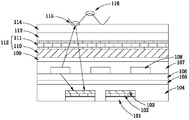
  • FIG. 1 is a structural schematic view of a display panel provided by one embodiment of the application.
  • FIG. 2 is a schematic diagram of the fingerprint identification principle of the display panel provided by one embodiment of the application.
  • the optical fingerprint identification sensor receives not only the light reflected by the fingerprint, but also the light reflected by the metal and the light leaked from the organic light-emitting material downward.
  • these noises will affect the technical problem of fingerprint identification accuracy.
  • the embodiment can solve this defect.
  • the display panel includes: a base substrate 105 ; a thin film transistor layer 106 being disposed on the base substrate 105 ; a pixel layer 107 being disposed on the thin film transistor layer 106 ; a plurality of pixel units 108 being distributed in array in the pixel layer 107 and including an anode layer, an organic luminescence layer and a cathode layer, which are arranged in layers; an encapsulation layer 109 being disposed on the pixel layer 107 ; a circular polarizer 112 being disposed on the encapsulation layer 109 and including a quarter wave plate 110 attached to a surface of the encapsulation layer 109 and a linear polarizer 111 disposed on the quarter wave plate 110 ; a touch layer 113 being disposed on the circular polarizer 112 ; a protection plate 114 being disposed on the touch layer 113 ; and a fingerprint identification film layer
  • a light emitted from each pixel unit 108 is a linear polarized light
  • the linear polarized liquid crystal layer 103 has an absorption axis parallel to a polarization direction of the light emitted from the pixel unit 108 .
  • the sensor 102 can receive the light, which is emitted from the pixel unit 108 , passes through the circular polarizer 112 to ridges 115 or valleys 116 of the finger, then is reflected back to the circular polarizer 112 from the finger, and transmits through the linear polarized liquid crystal layer 103 .
  • the light reaching the sensor 102 can be converted into an electrical signal by the sensor 102 and be transmitted to the fingerprint identification unit 101 for fingerprint identification.
  • the fingerprint identification unit 101 is arranged corresponding to a gap between two adjacent pixel units 108 , and the light reflected back from the finger directly reaches the linear polarized liquid crystal layer 103 via the gap between the two adjacent pixel units 108 .
  • the linear polarized liquid crystal layer 103 and the sensor 102 are corresponding to the fingerprint identification unit 101 and are arranged in array distribution.
  • the widths of the linear polarized liquid crystal layer 103 , the sensor 102 and the fingerprint identification unit 101 are greater than a width of the gap between the two adjacent pixel units 108 , so that the light via the gap between the two adjacent pixel units 108 can be more illuminated on the sensor 102 to enhance the fingerprint identification ability.
  • the linear polarizer 111 has an absorption axis perpendicular to the polarization direction of the light emitted from the pixel unit 108 , so the polarization direction of the light emitted from the pixel unit 108 remains unchanged after passing through the linear polarizer 111 .
  • the fingerprint identification units 101 may be also disposed on other layers of the display panel.
  • the fingerprint identification units 101 are disposed on an external surface or an internal surface of the encapsulating layer 109 and each of them is corresponding to the gap between the two adjacent pixel units 108 .
  • the sensor 102 and the linear polarized liquid crystal layer 103 are arranged in the same manner as in the above embodiment, and are disposed on the fingerprint identification unit 101 in turn. It is noteworthy that, the fingerprint identification unit 101 , the sensor 102 and the linear polarized liquid crystal layer 103 are falling within the range of the gap between the two adjacent pixel units 108 to avoid affecting a pixel opening of the pixel unit 108 .
  • the fingerprint identification units 101 and the pixel units 108 are set in the same layer, and each fingerprint identification unit 101 is corresponding to the gap between the two adjacent pixel units 108 .
  • Each fingerprint identification unit 101 is insulated from the surrounding pixel units 108 .
  • the sensor 102 and the linear polarized liquid crystal layer 103 are stacked on the corresponding fingerprint identification unit 101 .
  • the fingerprint identification units 101 are disposed in the base substrate 105 and each of them is corresponding to the gap between the two adjacent pixel units 108 .
  • the fingerprint identification unit 101 is insulated from the thin film transistor layer 106 .
  • the sensor 102 and the linear polarized liquid crystal layer 103 are stacked on the corresponding fingerprint identification unit 101 .
  • the fingerprint identification units 101 are arranged like a grid, and each of them is corresponding to the gap between the two adjacent pixel units 108 .
  • FIG. 2 it is a schematic diagram of the fingerprint identification principle of the display panel provided by one embodiment of the application, and way light travels are shown by the arrow in the figure.
  • the pixel unit 108 is an organic light-emitting material, and the pixel unit 108 emits a transverse linear polarized light.
  • the transverse linear polarized light can be transmitted upward through the quarter wave plate 110 of the circular polarizer 112 and becomes a circular polarized light; then the circular polarized light passes through the linear polarizer 111 and then becomes the transverse linear polarized light.
  • the transverse linear polarized light can be reflected when it is transmitted to the ridges or valleys of the finger fingerprint.
  • the transverse linear polarized light after reflected can pass through the linear polarizer 111 again and keep the polarization state of the transverse linear polarized light, then it passes through the quarter wave plate 110 for the second time and becomes the circular polarized light again.
  • the linear polarized liquid crystal layer 103 which is coated on the sensor 102 for optical fingerprint identification under screen, has the absorption axis parallel to the polarization direction of the light emitted from the pixel unit 108 , a vertical linear polarized light in the circular polarized light can be illuminated to the sensor 102 through the linear polarized liquid crystal layer 103 , and then can be recognized by a photoelectric converter as a signal.
  • the pixel unit 108 emits the transverse linear polarized light for example only, and of course it can also emit a vertical linear polarized light, so no restriction is made here, as long as the absorption axis of the linear polarized liquid crystal layer 103 is parallel to the polarization direction of the light emitted by the pixel unit 108 .
  • the present application provides the display panel, which has the linear polarized liquid crystal layer coated on the sensor for optical fingerprint identification under screen.
  • the absorption axis of the linear polarized liquid crystal layer is parallel to the polarization direction of the light emitted by the organic light-emitting unit, so the sensor for optical fingerprint identification under screen cannot receive the noise from the organic light-emitting unit and directly irradiated to the sensor, and only receive the light reflected by the fingerprint.
  • the display panel can reduce noises and improve accuracy of the sensor for optical fingerprint identification under screen.

Landscapes

  • Physics & Mathematics (AREA)
  • Engineering & Computer Science (AREA)
  • General Physics & Mathematics (AREA)
  • Nonlinear Science (AREA)
  • Human Computer Interaction (AREA)
  • Multimedia (AREA)
  • Theoretical Computer Science (AREA)
  • Crystallography & Structural Chemistry (AREA)
  • Optics & Photonics (AREA)
  • Chemical & Material Sciences (AREA)
  • Mathematical Physics (AREA)
  • Microelectronics & Electronic Packaging (AREA)
  • Image Input (AREA)
  • Devices For Indicating Variable Information By Combining Individual Elements (AREA)
  • Liquid Crystal (AREA)
  • Collating Specific Patterns (AREA)
  • Measurement Of The Respiration, Hearing Ability, Form, And Blood Characteristics Of Living Organisms (AREA)

Abstract

The application provides a display panel, including a plurality of pixel units, a circular polarizer and a plurality of fingerprint identification units disposed on the back of the base substrate. Each fingerprint identification unit disposes a linear polarized liquid crystal layer. A light emitted from each pixel unit is a linear polarized light, which is parallel to an absorption axis of the linear polarized liquid crystal layer. The fingerprint identification unit can realize the fingerprint identification according to the light being emitted from the pixel unit, passing through the circular polarizer to the finger, then being reflected back to the circular polarizer from the finger, and passing through the linear polarized liquid crystal layer.

Description

BACKGROUND OF THE INVENTION 1. Field of the Invention
The present application relates to a display technical field, and more particularly to a display panel.
2. Description of the Prior Art
Fingerprints are the identity of everyone, so fingerprint identification is used as a way to unlock many products on the market, such as mobile phones, tablets and smart wearable devices. In use, users only need to touch a fingerprint identification sensor of the device with their fingers to realize login, which greatly improves the accuracy and speed of authorization authentication.
Existing fingerprint identification devices are all set in a non-display area of a display panel or on the back of a light side of a display device. Users need to use their hands and touch the specific fingerprint identification sensors outside the screen, which gives users certain limitations. In addition, the fingerprint identification sensor is placed in a non-display area of the display panel, which reduces the screen proportion, is not beautiful, and cannot achieve an absolute narrow border. If the fingerprint identification device is set on the display area of the display panel, this will greatly increase the screen proportion. In fact, this is the technology of fingerprint under the screen. However, because most of the pixel circuits in the display area of the display panel are made of metal materials by evaporation, in addition to the light reflected by the patterns on the fingers, the optical fingerprint identification sensor will also receive the light reflected from the metal and the light leaked down from the EL luminescent material. These noises affect the accuracy of fingerprint identification.
Hence, the prior art is defective and in urgent need of improvement.
Technical Problem
The present application provides a display panel, which can reduce noises of a sensor for optical fingerprint identification under screen and further improve its accuracy.
BRIEF SUMMARY OF THE INVENTION Technical Solutions
In order to solve the above problems, the technical scheme provided in the application is as follows.
The application provides a display panel, comprising:
a base substrate;
a thin film transistor layer, being disposed on the base substrate;
a plurality of pixel units, being disposed on the thin film transistor layer;
a circular polarizer, being disposed on the pixel units;
a plurality of fingerprint identification units, being disposed on one side of the base substrate away from the pixel units, and each of the fingerprint identification units disposing a linear polarized liquid crystal layer; the fingerprint identification units being arranged in a grid and each of the fingerprint identification units being corresponding to a gap between two adjacent pixel units;
wherein, a light emitted from each pixel unit is a linear polarized light, and an absorption axis of the linear polarized liquid crystal layer is parallel to a polarization direction of the light emitted from the pixel unit; when a finger touches the display panel, the fingerprint identification unit is used for fingerprint identification according to the light being emitted from the pixel unit, passing through the circular polarizer to the finger, then being reflected back to the circular polarizer from the finger, and passing through the linear polarized liquid crystal layer.
In the display panel of the application, the display panel further includes a sensor on each of the fingerprint identification units; the linear polarized liquid crystal layer is disposed on the sensor; the sensor is used to convert the light, which passes through the linear polarized liquid crystal layer to the sensor, into an electrical signal and transmits the electrical signal to the fingerprint identification unit.
In the display panel of the application, the fingerprint identification unit is corresponding to the gap between the two adjacent pixel units, and the light reflected from the finger is transmitted to the linear polarized liquid crystal layer via the gap between the two adjacent pixel units.
In the display panel of the application, widths of the linear polarized liquid crystal layer and the sensor are greater than a width of the gap between the two adjacent pixel units.
In the display panel of the application, the display panel further includes an encapsulation layer disposed on the pixel units; the circular polarizer includes a quarter wave plate attached to a surface of the encapsulation layer and a linear polarizer disposed on the quarter wave plate.
In the display panel of the application, an absorption axis of the linear polarizer is perpendicular to a polarization direction of the light emitted from the pixel unit.
In the display panel of the application, the fingerprint identification units are disposed on an external surface or an internal surface of the encapsulating layer and each of the fingerprint identification units is corresponding to the gap between the two adjacent pixel units.
In the display panel of the application, the fingerprint identification units are disposed in the base substrate and each of the fingerprint identification units is corresponding to the gap between the two adjacent pixel units.
In the display panel of the application, the fingerprint identification units and the pixel units are set in the same layer, and each fingerprint identification unit is corresponding to the gap between the two adjacent pixel units.
In order to solve the above problems, the application further provides a display panel, comprising:
a base substrate;
a thin film transistor layer, being disposed on the base substrate;
a plurality of pixel units, being disposed on the thin film transistor layer;
a circular polarizer, being disposed on the pixel units;
a plurality of fingerprint identification units, being disposed on one side of the base substrate away from the pixel units, and each of the fingerprint identification units disposing a linear polarized liquid crystal layer;
wherein, a light emitted from each pixel unit is a linear polarized light, and an absorption axis of the linear polarized liquid crystal layer is parallel to a polarization direction of the light emitted from the pixel unit; when a finger touches the display panel, the fingerprint identification unit is used for fingerprint identification according to the light being emitted from the pixel unit, passing through the circular polarizer to the finger, then being reflected back to the circular polarizer from the finger, and passing through the linear polarized liquid crystal layer.
In the display panel of the application, the display panel further includes a sensor on each of the fingerprint identification units; the linear polarized liquid crystal layer is disposed on the sensor; the sensor is used to convert the light, which passes through the linear polarized liquid crystal layer to the sensor, into an electrical signal and transmits the electrical signal to the fingerprint identification unit.
In the display panel of the application, the fingerprint identification unit is corresponding to a gap between two adjacent pixel units, and the light reflected from the finger is transmitted to the linear polarized liquid crystal layer via the gap between the two adjacent pixel units.
In the display panel of the application, widths of the linear polarized liquid crystal layer and the sensor are greater than a width of the gap between the two adjacent pixel units.
In the display panel of the application, the display panel further includes an encapsulation layer disposed on the pixel units; the circular polarizer includes a quarter wave plate attached to a surface of the encapsulation layer and a linear polarizer disposed on the quarter wave plate.
In the display panel of the application, an absorption axis of the linear polarizer is perpendicular to a polarization direction of the light emitted from the pixel unit.
In the display panel of the application, the fingerprint identification units are disposed on an external surface or an internal surface of the encapsulating layer and each of the fingerprint identification units is corresponding to a gap between two adjacent pixel units.
In the display panel of the application, the fingerprint identification units are disposed in the base substrate and each of the fingerprint identification units is corresponding to a gap between two adjacent pixel units.
In the display panel of the application, the fingerprint identification units and the pixel units are set in the same layer, and each fingerprint identification unit is corresponding to a gap between two adjacent pixel units.
Beneficial Effect
The beneficial effects of the application are as follows: in comparison with the prior display panel, the display panel provided by the application has the linear polarized liquid crystal layer coated on the sensor for optical fingerprint identification under screen. The absorption axis of the linear polarized liquid crystal layer is parallel to the polarization direction of the light emitted by the organic light-emitting unit, so the sensor for optical fingerprint identification under screen cannot receive the noise from the organic light-emitting unit and directly irradiated to the sensor, and only receive the light reflected by the fingerprint. The display panel can reduce noises and improve accuracy of the sensor for optical fingerprint identification under screen.
BRIEF DESCRIPTION OF THE DRAWINGS
For more clearly illustrating the technical scheme in the embodiment or the prior art, the following text will briefly introduce the accompanying drawings used in the embodiment or the prior art. It is obvious that the accompanying drawings in the following description are only some embodiments of the present application. For the technical personnel of the field, other drawings can also be obtained from these drawings without paying creative work.
FIG. 1 is a structural schematic view of a display panel provided by one embodiment of the application; and
FIG. 2 is a schematic diagram of the fingerprint identification principle of the display panel provided by one embodiment of the application.
DETAILED DESCRIPTION OF THE PREFERRED EMBODIMENTS
The following description of every embodiment with reference to the accompanying drawings is used to exemplify a specific embodiment, which may be carried out in the application. Directional terms mentioned in the present invention, such as “up”, “down”, “front”, “back”, “left”, “right”, “inside”, “outside”, “side” etc., are only used with reference to the orientation of the accompanying drawings. Therefore, the used directional terms are intended to illustrate, but not to limit, the application. In the figure, units with similar structures are represented by the same label.
For the display panel of the prior art, the optical fingerprint identification sensor receives not only the light reflected by the fingerprint, but also the light reflected by the metal and the light leaked from the organic light-emitting material downward. However, these noises will affect the technical problem of fingerprint identification accuracy. The embodiment can solve this defect.
Referring to FIG. 1, it is a structural schematic view of a display panel provided by one embodiment of the application. The display panel includes: a base substrate 105; a thin film transistor layer 106 being disposed on the base substrate 105; a pixel layer 107 being disposed on the thin film transistor layer 106; a plurality of pixel units 108 being distributed in array in the pixel layer 107 and including an anode layer, an organic luminescence layer and a cathode layer, which are arranged in layers; an encapsulation layer 109 being disposed on the pixel layer 107; a circular polarizer 112 being disposed on the encapsulation layer 109 and including a quarter wave plate 110 attached to a surface of the encapsulation layer 109 and a linear polarizer 111 disposed on the quarter wave plate 110; a touch layer 113 being disposed on the circular polarizer 112; a protection plate 114 being disposed on the touch layer 113; and a fingerprint identification film layer 104 being disposed on one surface of the base substrate 105 away from the pixel units 108 and including a plurality of fingerprint identification units 101 in array distribution and each of the fingerprint identification unit 101 being successively stacked with a sensor 102 and a linear polarized liquid crystal layer 103. Wherein, a light emitted from each pixel unit 108 is a linear polarized light, and the linear polarized liquid crystal layer 103 has an absorption axis parallel to a polarization direction of the light emitted from the pixel unit 108. When a finger touches the display panel, the sensor 102 can receive the light, which is emitted from the pixel unit 108, passes through the circular polarizer 112 to ridges 115 or valleys 116 of the finger, then is reflected back to the circular polarizer 112 from the finger, and transmits through the linear polarized liquid crystal layer 103. The light reaching the sensor 102 can be converted into an electrical signal by the sensor 102 and be transmitted to the fingerprint identification unit 101 for fingerprint identification.
Wherein, the fingerprint identification unit 101 is arranged corresponding to a gap between two adjacent pixel units 108, and the light reflected back from the finger directly reaches the linear polarized liquid crystal layer 103 via the gap between the two adjacent pixel units 108. The linear polarized liquid crystal layer 103 and the sensor 102 are corresponding to the fingerprint identification unit 101 and are arranged in array distribution.
Wherein the widths of the linear polarized liquid crystal layer 103, the sensor 102 and the fingerprint identification unit 101 are greater than a width of the gap between the two adjacent pixel units 108, so that the light via the gap between the two adjacent pixel units 108 can be more illuminated on the sensor 102 to enhance the fingerprint identification ability.
Moreover, the linear polarizer 111 has an absorption axis perpendicular to the polarization direction of the light emitted from the pixel unit 108, so the polarization direction of the light emitted from the pixel unit 108 remains unchanged after passing through the linear polarizer 111.
In other embodiments, the fingerprint identification units 101 may be also disposed on other layers of the display panel. For example, the fingerprint identification units 101 are disposed on an external surface or an internal surface of the encapsulating layer 109 and each of them is corresponding to the gap between the two adjacent pixel units 108. Correspondingly, the sensor 102 and the linear polarized liquid crystal layer 103 are arranged in the same manner as in the above embodiment, and are disposed on the fingerprint identification unit 101 in turn. It is noteworthy that, the fingerprint identification unit 101, the sensor 102 and the linear polarized liquid crystal layer 103 are falling within the range of the gap between the two adjacent pixel units 108 to avoid affecting a pixel opening of the pixel unit 108.
Or, the fingerprint identification units 101 and the pixel units 108 are set in the same layer, and each fingerprint identification unit 101 is corresponding to the gap between the two adjacent pixel units 108. Each fingerprint identification unit 101 is insulated from the surrounding pixel units 108. The sensor 102 and the linear polarized liquid crystal layer 103 are stacked on the corresponding fingerprint identification unit 101.
Or maybe, the fingerprint identification units 101 are disposed in the base substrate 105 and each of them is corresponding to the gap between the two adjacent pixel units 108. The fingerprint identification unit 101 is insulated from the thin film transistor layer 106. The sensor 102 and the linear polarized liquid crystal layer 103 are stacked on the corresponding fingerprint identification unit 101.
Wherein, the fingerprint identification units 101 are arranged like a grid, and each of them is corresponding to the gap between the two adjacent pixel units 108.
As shown in FIG. 2, it is a schematic diagram of the fingerprint identification principle of the display panel provided by one embodiment of the application, and way light travels are shown by the arrow in the figure. The pixel unit 108 is an organic light-emitting material, and the pixel unit 108 emits a transverse linear polarized light. The transverse linear polarized light can be transmitted upward through the quarter wave plate 110 of the circular polarizer 112 and becomes a circular polarized light; then the circular polarized light passes through the linear polarizer 111 and then becomes the transverse linear polarized light. Next, the transverse linear polarized light can be reflected when it is transmitted to the ridges or valleys of the finger fingerprint. This reflection does not change the polarization state of the transverse linear polarized light. Therefore, the transverse linear polarized light after reflected can pass through the linear polarizer 111 again and keep the polarization state of the transverse linear polarized light, then it passes through the quarter wave plate 110 for the second time and becomes the circular polarized light again. Because the linear polarized liquid crystal layer 103, which is coated on the sensor 102 for optical fingerprint identification under screen, has the absorption axis parallel to the polarization direction of the light emitted from the pixel unit 108, a vertical linear polarized light in the circular polarized light can be illuminated to the sensor 102 through the linear polarized liquid crystal layer 103, and then can be recognized by a photoelectric converter as a signal.
Thus, only the light reflected by the fingerprint can enter into the sensor 102, while the light reflected by the light source and other metal electrodes cannot penetrate the linear polarized liquid crystal layer 103 into the sensor 102, thereby improving the accuracy of the sensor 102.
Wherein, the pixel unit 108 emits the transverse linear polarized light for example only, and of course it can also emit a vertical linear polarized light, so no restriction is made here, as long as the absorption axis of the linear polarized liquid crystal layer 103 is parallel to the polarization direction of the light emitted by the pixel unit 108.
The present application provides the display panel, which has the linear polarized liquid crystal layer coated on the sensor for optical fingerprint identification under screen. The absorption axis of the linear polarized liquid crystal layer is parallel to the polarization direction of the light emitted by the organic light-emitting unit, so the sensor for optical fingerprint identification under screen cannot receive the noise from the organic light-emitting unit and directly irradiated to the sensor, and only receive the light reflected by the fingerprint. The display panel can reduce noises and improve accuracy of the sensor for optical fingerprint identification under screen.
As described above, although the application has been disclosed in the preferred embodiments as above, the preferred embodiments mentioned above are not intended to limit the application. The ordinary technical personnel in the field may make various changes and embellishments without departing from the spirit and scope of the application. Therefore, the scope of protection of the application is subject to the scope defined by the claims.
Claims (18)

What is claimed is:
1. A display panel, comprising:
a base substrate;
a thin film transistor layer, being disposed on the base substrate;
a plurality of pixel units, being disposed on the thin film transistor layer;
a circular polarizer, being disposed on the pixel units;
a plurality of fingerprint identification units, being disposed on one side of the base substrate away from the pixel units, and each of the fingerprint identification units disposing a linear polarized liquid crystal layer; the fingerprint identification units being arranged in a grid and each of the fingerprint identification units being corresponding to a gap between two adjacent pixel units;
wherein, a light emitted from each pixel unit is a linear polarized light, and an absorption axis of the linear polarized liquid crystal layer is parallel to a polarization direction of the light emitted from the pixel unit; when a finger touches the display panel, the fingerprint identification unit is used for fingerprint identification according to the light being emitted from the pixel unit, passing through the circular polarizer to the finger, then being reflected back to the circular polarizer from the finger, and passing through the linear polarized liquid crystal layer.
2. The display panel as claimed in claim 1, wherein the display panel further includes a sensor on each of the fingerprint identification units; the linear polarized liquid crystal layer is disposed on the sensor; the sensor is used to convert the light, which passes through the linear polarized liquid crystal layer to the sensor, into an electrical signal and transmits the electrical signal to the fingerprint identification unit.
3. The display panel as claimed in claim 2, wherein the fingerprint identification unit is corresponding to the gap between the two adjacent pixel units, and the light reflected from the finger is transmitted to the linear polarized liquid crystal layer via the gap between the two adjacent pixel units.
4. The display panel as claimed in claim 3, wherein widths of the linear polarized liquid crystal layer and the sensor are greater than a width of the gap between the two adjacent pixel units.
5. The display panel as claimed in claim 1, wherein the display panel further includes an encapsulation layer disposed on the pixel units; the circular polarizer includes a quarter wave plate attached to a surface of the encapsulation layer and a linear polarizer disposed on the quarter wave plate.
6. The display panel as claimed in claim 5, wherein an absorption axis of the linear polarizer is perpendicular to a polarization direction of the light emitted from the pixel unit.
7. The display panel as claimed in claim 5, wherein the fingerprint identification units are disposed on an external surface or an internal surface of the encapsulating layer and each of the fingerprint identification units is corresponding to the gap between the two adjacent pixel units.
8. The display panel as claimed in claim 1, wherein the fingerprint identification units are disposed in the base substrate and each of the fingerprint identification units is corresponding to the gap between the two adjacent pixel units.
9. The display panel as claimed in claim 1, wherein the fingerprint identification units and the pixel units are set in the same layer, and each fingerprint identification unit is corresponding to the gap between the two adjacent pixel units.
10. A display panel, comprising:
a base substrate;
a thin film transistor layer, being disposed on the base substrate;
a plurality of pixel units, being disposed on the thin film transistor layer;
a circular polarizer, being disposed on the pixel units;
a plurality of fingerprint identification units, being disposed on one side of the base substrate away from the pixel units, and each of the fingerprint identification units disposing a linear polarized liquid crystal layer;
wherein, a light emitted from each pixel unit is a linear polarized light, and an absorption axis of the linear polarized liquid crystal layer is parallel to a polarization direction of the light emitted from the pixel unit; when a finger touches the display panel, the fingerprint identification unit is used for fingerprint identification according to the light being emitted from the pixel unit, passing through the circular polarizer to the finger, then being reflected back to the circular polarizer from the finger, and passing through the linear polarized liquid crystal layer.
11. The display panel as claimed in claim 10, wherein the display panel further includes a sensor on each of the fingerprint identification units; the linear polarized liquid crystal layer is disposed on the sensor; the sensor is used to convert the light, which passes through the linear polarized liquid crystal layer to the sensor, into an electrical signal and transmits the electrical signal to the fingerprint identification unit.
12. The display panel as claimed in claim 11, wherein the fingerprint identification unit is corresponding to a gap between two adjacent pixel units, and the light reflected from the finger is transmitted to the linear polarized liquid crystal layer via the gap between the two adjacent pixel units.
13. The display panel as claimed in claim 12, wherein widths of the linear polarized liquid crystal layer and the sensor are greater than a width of the gap between the two adjacent pixel units.
14. The display panel as claimed in claim 10, wherein the display panel further includes an encapsulation layer disposed on the pixel units; the circular polarizer includes a quarter wave plate attached to a surface of the encapsulation layer and a linear polarizer disposed on the quarter wave plate.
15. The display panel as claimed in claim 14, wherein an absorption axis of the linear polarizer is perpendicular to a polarization direction of the light emitted from the pixel unit.
16. The display panel as claimed in claim 14, wherein the fingerprint identification units are disposed on an external surface or an internal surface of the encapsulating layer and each of the fingerprint identification units is corresponding to a gap between two adjacent pixel units.
17. The display panel as claimed in claim 10, wherein the fingerprint identification units are disposed in the base substrate and each of the fingerprint identification units is corresponding to a gap between two adjacent pixel units.
18. The display panel as claimed in claim 10, wherein the fingerprint identification units and the pixel units are set in the same layer, and each fingerprint identification unit is corresponding to a gap between two adjacent pixel units.
US16/477,698 2018-10-15 2018-11-19 Display panel Active 2040-01-22 US11216635B2 (en)

Applications Claiming Priority (3)

Application Number Priority Date Filing Date Title
CN201811194368.0 2018-10-15
CN201811194368.0A CN109190599A (en) 2018-10-15 2018-10-15 A kind of display panel
PCT/CN2018/116083 WO2020077721A1 (en) 2018-10-15 2018-11-19 Display panel

Publications (2)

Publication Number Publication Date
US20210357609A1 US20210357609A1 (en) 2021-11-18
US11216635B2 true US11216635B2 (en) 2022-01-04

Family

ID=64944913

Family Applications (1)

Application Number Title Priority Date Filing Date
US16/477,698 Active 2040-01-22 US11216635B2 (en) 2018-10-15 2018-11-19 Display panel

Country Status (3)

Country Link
US (1) US11216635B2 (en)
CN (1) CN109190599A (en)
WO (1) WO2020077721A1 (en)

Cited By (1)

* Cited by examiner, † Cited by third party
Publication number Priority date Publication date Assignee Title
US12340616B2 (en) 2019-05-17 2025-06-24 Honor Device Co., Ltd. Laminated structure, display panel, and electronic device

Families Citing this family (20)

* Cited by examiner, † Cited by third party
Publication number Priority date Publication date Assignee Title
CN110785771B (en) * 2019-01-22 2023-09-08 深圳市汇顶科技股份有限公司 Under-screen optical fingerprint recognition system, fingerprint recognition display device and electronic equipment
CN209765526U (en) 2019-04-10 2019-12-10 深圳市汇顶科技股份有限公司 Optical fingerprint device and electronic device
CN110120460B (en) 2019-04-11 2021-02-26 武汉华星光电半导体显示技术有限公司 Display panel and electronic device
CN110096128B (en) * 2019-05-07 2021-10-26 京东方科技集团股份有限公司 Display panel, method for fingerprint identification by using display panel and display device
CN110770747B (en) * 2019-05-14 2023-08-22 深圳市汇顶科技股份有限公司 Fingerprint identification device and electronic equipment
CN110188672B (en) * 2019-05-29 2022-02-01 京东方科技集团股份有限公司 Touch display module and electronic equipment
CN110266847B (en) * 2019-06-24 2021-07-13 Oppo广东移动通信有限公司 Display device, electronic device, and image acquisition method
US12206061B2 (en) * 2019-07-30 2025-01-21 Apple Inc. Electronic device having display with internal light reflection suppression
CN110441944B (en) * 2019-07-31 2022-02-08 上海天马微电子有限公司 Display panel and display device
WO2021072768A1 (en) * 2019-10-18 2021-04-22 深圳市汇顶科技股份有限公司 Fingerprint recognition device and electronic apparatus
CN110850628B (en) * 2019-10-24 2022-02-22 武汉华星光电技术有限公司 Liquid crystal display panel and liquid crystal display device
CN111308767B (en) * 2019-11-27 2021-03-16 武汉华星光电技术有限公司 Liquid crystal display module
CN110928028A (en) * 2019-11-29 2020-03-27 武汉华星光电技术有限公司 Display panel
WO2021146955A1 (en) * 2020-01-21 2021-07-29 深圳市汇顶科技股份有限公司 Optical fingerprint detection apparatus, touch screen and electronic device
CN111341818A (en) * 2020-03-12 2020-06-26 京东方科技集团股份有限公司 a display device
TWI738488B (en) * 2020-09-01 2021-09-01 勝薪科技股份有限公司 Fingerprint identification assembly and display device
CN114138132B (en) * 2021-11-25 2023-06-27 武汉华星光电半导体显示技术有限公司 Display panel and display device
CN114518813B (en) * 2022-02-21 2025-01-14 维沃移动通信有限公司 Display screens and electronic devices
CN114527594B (en) * 2022-02-23 2023-11-03 京东方科技集团股份有限公司 Display panel, preparation method and display device
CN115840305B (en) * 2022-11-10 2025-08-22 昆山国显光电有限公司 Display panel and display device

Citations (7)

* Cited by examiner, † Cited by third party
Publication number Priority date Publication date Assignee Title
US20130120760A1 (en) 2011-11-11 2013-05-16 Daniel H. Raguin Ambient light rejection for non-imaging contact sensors
CN107025451A (en) 2017-04-27 2017-08-08 上海天马微电子有限公司 Display panel and display device
CN107656665A (en) 2016-07-25 2018-02-02 印象认知(北京)科技有限公司 Fingerprint collecting control method, device and electronic equipment based on display screen
US20180121703A1 (en) 2016-10-28 2018-05-03 Samsung Electronics Co., Ltd. Apparatus for reducing noise input to fingerprint sensor
CN108399352A (en) 2017-02-04 2018-08-14 上海箩箕技术有限公司 Fingerprint imaging module and electronic equipment
CN108596124A (en) 2018-04-28 2018-09-28 京东方科技集团股份有限公司 Fingerprint recognition panel, fingerprint identification method and display device
US20180357462A1 (en) * 2017-06-12 2018-12-13 Synaptics Incorporated Systems and methods for reducing unwanted reflections in display systems incorporating an under display biometric sensor

Patent Citations (10)

* Cited by examiner, † Cited by third party
Publication number Priority date Publication date Assignee Title
US20130120760A1 (en) 2011-11-11 2013-05-16 Daniel H. Raguin Ambient light rejection for non-imaging contact sensors
CN107656665A (en) 2016-07-25 2018-02-02 印象认知(北京)科技有限公司 Fingerprint collecting control method, device and electronic equipment based on display screen
US20200082145A1 (en) 2016-07-25 2020-03-12 Vkansee (Beijing) Technology Co., Ltd. Method and Apparatus for Controlling Fingerprint Acquisition Based on a Display Screen and Electronic Device
US20180121703A1 (en) 2016-10-28 2018-05-03 Samsung Electronics Co., Ltd. Apparatus for reducing noise input to fingerprint sensor
CN108021860A (en) 2016-10-28 2018-05-11 三星电子株式会社 Device for the noise inputs for reducing fingerprint sensor
CN108399352A (en) 2017-02-04 2018-08-14 上海箩箕技术有限公司 Fingerprint imaging module and electronic equipment
CN107025451A (en) 2017-04-27 2017-08-08 上海天马微电子有限公司 Display panel and display device
US20170372113A1 (en) * 2017-04-27 2017-12-28 Shanghai Tianma Micro-electronics Co., Ltd. Display panel and display device
US20180357462A1 (en) * 2017-06-12 2018-12-13 Synaptics Incorporated Systems and methods for reducing unwanted reflections in display systems incorporating an under display biometric sensor
CN108596124A (en) 2018-04-28 2018-09-28 京东方科技集团股份有限公司 Fingerprint recognition panel, fingerprint identification method and display device

Cited By (1)

* Cited by examiner, † Cited by third party
Publication number Priority date Publication date Assignee Title
US12340616B2 (en) 2019-05-17 2025-06-24 Honor Device Co., Ltd. Laminated structure, display panel, and electronic device

Also Published As

Publication number Publication date
CN109190599A (en) 2019-01-11
US20210357609A1 (en) 2021-11-18
WO2020077721A1 (en) 2020-04-23

Similar Documents

Publication Publication Date Title
US11216635B2 (en) Display panel
US10185861B2 (en) Display panel and electronic device
US10339359B2 (en) Display panel and display device
US10387712B2 (en) Display panel and display apparatus
US11003886B2 (en) Display apparatus including a fingerprint identification device
US10810398B2 (en) Display panel for fingerprint recognition and display device
US10437366B1 (en) Display module and using method therof
US10592722B2 (en) Photosensitive unit, photosensitive module and display device
CN108598109B (en) Display panel and display device
US20190172887A1 (en) Array substrate, display device and pattern recognition method thereof
CN106934384B (en) Fingerprint recognition device and control method, touch display panel, touch display unit
CN113314684B (en) Display substrate and display device
CN109273497A (en) OLED display substrate and display device
US10627550B2 (en) Fingerprint recognition sensor, manufacturing method thereof and display device
CN106024833B (en) A kind of display panel and its fingerprint identification method, display device
CN110534031A (en) Display device and fingerprint identification method
WO2018103195A1 (en) Display module and usage method thereof
WO2018103193A1 (en) Display module and usage method thereof
WO2021164108A1 (en) Display panel and electronic device
CN113777819A (en) Display panels and display devices
US11373429B2 (en) Fingerprint recognition substrate, fingerprint recognition apparatus and method for fabricating the same, fingerprint recognition method, and display device
CN112101270B (en) Display panel applied to under-screen fingerprint identification
WO2018103196A1 (en) Display module and usage method thereof
US10338420B2 (en) Fingerprint identification component and display apparatus
CN110647861B (en) A liquid crystal display panel and display device

Legal Events

Date Code Title Description
AS Assignment

Owner name: WUHAN CHINA STAR OPTOELECTRONICS SEMICONDUCTOR DISPLAY TECHNOLOGY CO., LTD., CHINA

Free format text: ASSIGNMENT OF ASSIGNORS INTEREST;ASSIGNOR:CHEN, HUI;REEL/FRAME:049737/0870

Effective date: 20181031

FEPP Fee payment procedure

Free format text: ENTITY STATUS SET TO UNDISCOUNTED (ORIGINAL EVENT CODE: BIG.); ENTITY STATUS OF PATENT OWNER: LARGE ENTITY

STPP Information on status: patent application and granting procedure in general

Free format text: NOTICE OF ALLOWANCE MAILED -- APPLICATION RECEIVED IN OFFICE OF PUBLICATIONS

STPP Information on status: patent application and granting procedure in general

Free format text: PUBLICATIONS -- ISSUE FEE PAYMENT VERIFIED

STCF Information on status: patent grant

Free format text: PATENTED CASE

MAFP Maintenance fee payment

Free format text: PAYMENT OF MAINTENANCE FEE, 4TH YEAR, LARGE ENTITY (ORIGINAL EVENT CODE: M1551); ENTITY STATUS OF PATENT OWNER: LARGE ENTITY

Year of fee payment: 4