US11214590B2 - Photoresponsive nucleotide analog capable of photocrosslinking in visible light region - Google Patents
Photoresponsive nucleotide analog capable of photocrosslinking in visible light region Download PDFInfo
- Publication number
- US11214590B2 US11214590B2 US16/631,653 US201816631653A US11214590B2 US 11214590 B2 US11214590 B2 US 11214590B2 US 201816631653 A US201816631653 A US 201816631653A US 11214590 B2 US11214590 B2 US 11214590B2
- Authority
- US
- United States
- Prior art keywords
- group
- nucleic acid
- formula
- compound according
- compound
- Prior art date
- Legal status (The legal status is an assumption and is not a legal conclusion. Google has not performed a legal analysis and makes no representation as to the accuracy of the status listed.)
- Active
Links
- 0 C=C1C=CC2=C/C3=C(\C=C/2O1)N([Y])C1=C3C=CC=C1.[1*]C.[2*]C Chemical compound C=C1C=CC2=C/C3=C(\C=C/2O1)N([Y])C1=C3C=CC=C1.[1*]C.[2*]C 0.000 description 27
- OTMSDBZUPAUEDD-UHFFFAOYSA-N CC Chemical compound CC OTMSDBZUPAUEDD-UHFFFAOYSA-N 0.000 description 3
- IMEIMEINSNAGKS-YLLDYFFPSA-N CC(C)[C@@H]1O[C@H](CO)[C@H](O)C1O.CC(C)[C@H]1C[C@@H](O)[C@@H](CO)O1 Chemical compound CC(C)[C@@H]1O[C@H](CO)[C@H](O)C1O.CC(C)[C@H]1C[C@@H](O)[C@@H](CO)O1 IMEIMEINSNAGKS-YLLDYFFPSA-N 0.000 description 2
- WZXYXDAHORNIRN-MTCWOMLNSA-N CC(=O)OC[C@H]1O[C@@H](N2C3=C(C=CC=C3)C3=C2/C=C2/OC(=O)C=C/C2=C/3)CC1OC(C)=O.CC[C@H]1O[C@@H](N2C3=C(C=CC=C3)C3=C2/C=C2/OC(=O)C=C/C2=C/3)CC1C.CC[C@H]1O[C@@H](N2C3=C(C=CC=C3)C3=C2/C=C2/OC(=S)C=C/C2=C/3)CC1O.CC[C@H]1O[C@@H](N2C3=C(C=CC=C3)C3=C2/C=C2/OC(=S)C=C/C2=C/3)CC1OP(CCC#N)C(C(C)C)C(C)C.O=C1C=CC2=C/C3=C(\C=C/2O1)N([C@H]1CC(O)[C@@H](CO)O1)C1=C3C=CC=C1.O=C1C=CC2=C/C3=C(\C=C/2O1)NC1=C3C=CC=C1.OC1=C/C2=C(\C=C/1)C1=C(C=CC=C1)N2.OC[C@H]1O[C@@H](N2C3=C(C=CC=C3)C3=C2/C=C2/OC(=S)C=C/C2=C/3)CC1O Chemical compound CC(=O)OC[C@H]1O[C@@H](N2C3=C(C=CC=C3)C3=C2/C=C2/OC(=O)C=C/C2=C/3)CC1OC(C)=O.CC[C@H]1O[C@@H](N2C3=C(C=CC=C3)C3=C2/C=C2/OC(=O)C=C/C2=C/3)CC1C.CC[C@H]1O[C@@H](N2C3=C(C=CC=C3)C3=C2/C=C2/OC(=S)C=C/C2=C/3)CC1O.CC[C@H]1O[C@@H](N2C3=C(C=CC=C3)C3=C2/C=C2/OC(=S)C=C/C2=C/3)CC1OP(CCC#N)C(C(C)C)C(C)C.O=C1C=CC2=C/C3=C(\C=C/2O1)N([C@H]1CC(O)[C@@H](CO)O1)C1=C3C=CC=C1.O=C1C=CC2=C/C3=C(\C=C/2O1)NC1=C3C=CC=C1.OC1=C/C2=C(\C=C/1)C1=C(C=CC=C1)N2.OC[C@H]1O[C@@H](N2C3=C(C=CC=C3)C3=C2/C=C2/OC(=S)C=C/C2=C/3)CC1O WZXYXDAHORNIRN-MTCWOMLNSA-N 0.000 description 1
- GNCQIWYEJIHXMG-SIOFKCSYSA-N CC(=O)OC[C@H]1O[C@@H](N2C3=C(C=CC=C3)C3=C2C=C2OC(=O)C=CC2=C3)CC1OC(C)=O.O=C1C=CC2=CC3=C(C=C2O1)N([C@H]1CC(O)[C@@H](CO)O1)C1=C3C=CC=C1 Chemical compound CC(=O)OC[C@H]1O[C@@H](N2C3=C(C=CC=C3)C3=C2C=C2OC(=O)C=CC2=C3)CC1OC(C)=O.O=C1C=CC2=CC3=C(C=C2O1)N([C@H]1CC(O)[C@@H](CO)O1)C1=C3C=CC=C1 GNCQIWYEJIHXMG-SIOFKCSYSA-N 0.000 description 1
- HTCIIWJFWYNDIK-SIOFKCSYSA-N CC(=O)OC[C@H]1O[C@@H](N2C3=C(C=CC=C3)C3=C2C=C2OC(=O)C=CC2=C3)CC1OC(C)=O.OC[C@H]1O[C@@H](N2C3=C(C=CC=C3)C3=C2C=C2OC(=S)C=CC2=C3)CC1O Chemical compound CC(=O)OC[C@H]1O[C@@H](N2C3=C(C=CC=C3)C3=C2C=C2OC(=O)C=CC2=C3)CC1OC(C)=O.OC[C@H]1O[C@@H](N2C3=C(C=CC=C3)C3=C2C=C2OC(=S)C=CC2=C3)CC1O HTCIIWJFWYNDIK-SIOFKCSYSA-N 0.000 description 1
- WNYRUFRNKFWYIC-UHFFFAOYSA-N COP(OC1=C(Cl)C=CC=C1)SC1=CC=CC=C1C Chemical compound COP(OC1=C(Cl)C=CC=C1)SC1=CC=CC=C1C WNYRUFRNKFWYIC-UHFFFAOYSA-N 0.000 description 1
- CNGHSAMLBDCFMY-VPUIJTBTSA-N CP1O[C@H](C2=CC=CC=C2)[C@@H]2CCCN21 Chemical compound CP1O[C@H](C2=CC=CC=C2)[C@@H]2CCCN21 CNGHSAMLBDCFMY-VPUIJTBTSA-N 0.000 description 1
- ONDLELFGAXIJJN-VOBHOPKGSA-N OC[C@H]1O[C@@H](N2C3=C(C=CC=C3)C3=C2C=C2OC(=S)C=CC2=C3)CC1O Chemical compound OC[C@H]1O[C@@H](N2C3=C(C=CC=C3)C3=C2C=C2OC(=S)C=CC2=C3)CC1O ONDLELFGAXIJJN-VOBHOPKGSA-N 0.000 description 1
Images


Classifications
-
- C—CHEMISTRY; METALLURGY
- C07—ORGANIC CHEMISTRY
- C07H—SUGARS; DERIVATIVES THEREOF; NUCLEOSIDES; NUCLEOTIDES; NUCLEIC ACIDS
- C07H19/00—Compounds containing a hetero ring sharing one ring hetero atom with a saccharide radical; Nucleosides; Mononucleotides; Anhydro-derivatives thereof
- C07H19/02—Compounds containing a hetero ring sharing one ring hetero atom with a saccharide radical; Nucleosides; Mononucleotides; Anhydro-derivatives thereof sharing nitrogen
- C07H19/04—Heterocyclic radicals containing only nitrogen atoms as ring hetero atom
- C07H19/23—Heterocyclic radicals containing two or more heterocyclic rings condensed among themselves or condensed with a common carbocyclic ring system, not provided for in groups C07H19/14 - C07H19/22
-
- C—CHEMISTRY; METALLURGY
- C07—ORGANIC CHEMISTRY
- C07H—SUGARS; DERIVATIVES THEREOF; NUCLEOSIDES; NUCLEOTIDES; NUCLEIC ACIDS
- C07H19/00—Compounds containing a hetero ring sharing one ring hetero atom with a saccharide radical; Nucleosides; Mononucleotides; Anhydro-derivatives thereof
- C07H19/02—Compounds containing a hetero ring sharing one ring hetero atom with a saccharide radical; Nucleosides; Mononucleotides; Anhydro-derivatives thereof sharing nitrogen
- C07H19/24—Heterocyclic radicals containing oxygen or sulfur as ring hetero atom
-
- C—CHEMISTRY; METALLURGY
- C07—ORGANIC CHEMISTRY
- C07D—HETEROCYCLIC COMPOUNDS
- C07D491/00—Heterocyclic compounds containing in the condensed ring system both one or more rings having oxygen atoms as the only ring hetero atoms and one or more rings having nitrogen atoms as the only ring hetero atoms, not provided for by groups C07D451/00 - C07D459/00, C07D463/00, C07D477/00 or C07D489/00
- C07D491/02—Heterocyclic compounds containing in the condensed ring system both one or more rings having oxygen atoms as the only ring hetero atoms and one or more rings having nitrogen atoms as the only ring hetero atoms, not provided for by groups C07D451/00 - C07D459/00, C07D463/00, C07D477/00 or C07D489/00 in which the condensed system contains two hetero rings
- C07D491/04—Ortho-condensed systems
- C07D491/044—Ortho-condensed systems with only one oxygen atom as ring hetero atom in the oxygen-containing ring
- C07D491/052—Ortho-condensed systems with only one oxygen atom as ring hetero atom in the oxygen-containing ring the oxygen-containing ring being six-membered
-
- C—CHEMISTRY; METALLURGY
- C07—ORGANIC CHEMISTRY
- C07H—SUGARS; DERIVATIVES THEREOF; NUCLEOSIDES; NUCLEOTIDES; NUCLEIC ACIDS
- C07H1/00—Processes for the preparation of sugar derivatives
-
- C—CHEMISTRY; METALLURGY
- C07—ORGANIC CHEMISTRY
- C07H—SUGARS; DERIVATIVES THEREOF; NUCLEOSIDES; NUCLEOTIDES; NUCLEIC ACIDS
- C07H21/00—Compounds containing two or more mononucleotide units having separate phosphate or polyphosphate groups linked by saccharide radicals of nucleoside groups, e.g. nucleic acids
- C07H21/04—Compounds containing two or more mononucleotide units having separate phosphate or polyphosphate groups linked by saccharide radicals of nucleoside groups, e.g. nucleic acids with deoxyribosyl as saccharide radical
-
- C—CHEMISTRY; METALLURGY
- C12—BIOCHEMISTRY; BEER; SPIRITS; WINE; VINEGAR; MICROBIOLOGY; ENZYMOLOGY; MUTATION OR GENETIC ENGINEERING
- C12N—MICROORGANISMS OR ENZYMES; COMPOSITIONS THEREOF; PROPAGATING, PRESERVING, OR MAINTAINING MICROORGANISMS; MUTATION OR GENETIC ENGINEERING; CULTURE MEDIA
- C12N15/00—Mutation or genetic engineering; DNA or RNA concerning genetic engineering, vectors, e.g. plasmids, or their isolation, preparation or purification; Use of hosts therefor
- C12N15/09—Recombinant DNA-technology
-
- Y—GENERAL TAGGING OF NEW TECHNOLOGICAL DEVELOPMENTS; GENERAL TAGGING OF CROSS-SECTIONAL TECHNOLOGIES SPANNING OVER SEVERAL SECTIONS OF THE IPC; TECHNICAL SUBJECTS COVERED BY FORMER USPC CROSS-REFERENCE ART COLLECTIONS [XRACs] AND DIGESTS
- Y02—TECHNOLOGIES OR APPLICATIONS FOR MITIGATION OR ADAPTATION AGAINST CLIMATE CHANGE
- Y02P—CLIMATE CHANGE MITIGATION TECHNOLOGIES IN THE PRODUCTION OR PROCESSING OF GOODS
- Y02P20/00—Technologies relating to chemical industry
- Y02P20/50—Improvements relating to the production of bulk chemicals
- Y02P20/55—Design of synthesis routes, e.g. reducing the use of auxiliary or protecting groups
Definitions
- the present invention relates to a photoresponsive nucleotide analog capable of photocrosslinking in visible light region.
- Basic techniques in the field of molecular biology include ligation of nucleic acids and crosslinking of nucleic acids.
- the ligation and crosslinking of nucleic acids are used for introduction of genes or detection of nucleotide sequences, or inhibition of gene expressions, for example, in combination with hybridization. Therefore, the techniques of the ligation and crosslinking of nucleic acids are very important techniques that are used in basic molecular biology researches, as well as, for example, diagnosis or treatment in the medical field, or development or production of therapeutic agents and diagnostic agents, or development or production of enzymes, microorganisms or the like in the industrial and agricultural fields.
- Patent Document 1 Japanese Patent No. 3753938 B
- Patent Document 2 Japanese Patent No. 3753942 B
- Patent Document 3 Japanese Patent No. 4814904 B
- Patent Document 4 Japanese Patent No. 4940311 B
- Non-Patent Document 1 discloses a technique for providing heat resistance to a nano-sheet consisting of oligo DNAs by photocrosslinking of nucleic acids.
- An object of the present invention is to provide a novel photoreactive compound that can be used for a photoreaction technique of nucleic acids, and a photoreactive crosslinking agent using the photoreactive compound.
- the compound according to the present invention has a characteristic pyranocarbazole structure and exhibits a photocrosslinking property due to such a relatively small structure. Therefore, the compound according to the present invention can be variously modified and used in various applications. Furthermore, the characteristic structure of the compound according to the present invention is similar to a base of nucleic acid. Therefore, the compound according to the present invention can be used as an artificial base (artificial nucleic acid base). That is, the characteristic structure of the compound according to the present invention can be introduced as an artificial base to produce an artificial nucleoside (a nucleoside analog) and an artificial nucleotide (a nucleotide analog), and also an artificial nucleic acid (a modified nucleic acid) containing such an artificial nucleotide.
- an artificial base artificial nucleic acid base
- the photoreactive nucleic acids can be used as double helix photo-crosslinkers capable of reaction that is specific to a desired sequence.
- a photoreactive crosslinking agent according to the present invention has a feature capable of being photocrosslinked by irradiation with light having a wavelength longer than that of the conventional one, for example, irradiation with light in the visible light region, which feature is derived from the characteristic pyranocarbazole structure. Therefore, when it is desired to avoid any damage to DNAs and cells as much as possible, the photoreactive crosslinking agent according to the present invention is particularly advantageous because it can be photocrosslinked by irradiation with light having a long wavelength.
- photoreactive compound according to the present invention initiates a photoreaction by light irradiation
- photoreactive may be referred to as “photoresponsive” for emphasizing the meaning that a compound which has previously been stable initiates reaction in response to a signal of the light irradiation.
- the present invention includes the following aspects (1) to (8):
- a photoreactive crosslinking agent comprising the compound according to any one of (1) to (6).
- the present invention provides a novel compound that will be a photoreactive crosslinking agent capable of being used for a photoreaction technique of nucleic acids. This is due to a novel chemical structure having no natural base structure.
- a photocrosslink can be formed by irradiation with light having a longer wavelength than the conventional photoreactive crosslinking agent, so that an inverse effect of irradiation with light on nucleic acids and cells can be minimized.
- FIG. 1 a is an explanatory diagram showing a flow of photocrosslinking reaction.
- FIG. 1 b is a chart for UPLC analysis when a light irradiation time is changed from 0 to 15 seconds.
- FIG. 1 c is a graph created by calculating a photocrosslinking rate at each light irradiation time when the light irradiation time is changed from 0 to 15 seconds.
- FIG. 2 a is an explanatory diagram showing a flow of photocrosslinking reaction.
- FIG. 2 b is a chart for UPLC analysis when an irradiation light wavelength is changed from 450 to 550 nm.
- FIG. 3 a is an explanatory diagram showing a flow of photocleavage reaction.
- FIG. 3 b is a chart for UPLC analysis when an irradiating light wavelength is changed from 320 to 340 nm.
- FIG. 3 c is a graph showing a ratio (a conversion rate %) of photocrosslinked products cleaved by irradiation with light having each wavelength.
- FIG. 4 is a graph comparing light irradiation time (seconds) with cell viability (%) at each wavelength.
- FIG. 5 is an explanatory diagram showing a flow of photocrosslinking reaction by SPC X.
- FIG. 6 is a chart for UPLC analysis of a photocrosslinking test with SPC X
- a compound of the present invention includes a compound represented by the formula I:
- X is an oxygen atom or a sulfur atom.
- R1 and R2 are each independently a group selected from the group consisting of a hydrogen atom, a halogen atom, a —OH group, an amino group, a nitro group, a methyl group, a methyl fluoride group, an ethyl group, an ethyl fluoride group, and a C1-C3 alkylsulfanyl group.
- the halogen atom include Br, Cl, F, and I atoms.
- the methyl fluoride group include —CH 2 F, —CHF 2 , and —CF 3 .
- Examples of the ethyl fluoride group include —CH 2 —CH 2 F, —CH 2 —CHF 2 , —CH 2 —CF 3 , —CHF—CH 3 , —CHF—CH 2 F, —CHF—CHF 2 , —CHF—CF 3 , —CF 2 —CH 3 , —CF 2 —CH 2 F, —CF 2 —CHF 2 , and —CF 2 —CF 3 .
- Examples of the C1-C3 alkylsulfanyl group include —CH 2 —SH, —CH 2 —CH 2 —SH, —CH(SH)—CH 3 , —CH 2 —CH 2 —CH 2 —SH, —CH 2 —CH(SH)—CH 3 and —CH(SH)—CH 2 —CH 3 groups.
- R1 and R2 can each independently be a hydrogen atom, a halogen atom, a —NH 2 group, a —OH group, a —CH 3 group, and preferably a hydrogen atom.
- R1 can be a hydrogen atom while at the same time R2 can be a group as defined above.
- R1 and R2 can each independently be a substituent for the carbon atom at any position of C2, C3, C4, and C5 positions.
- R1 and R2 can be substituents at the C3 and C4 positions, respectively.
- R1 can be a substituent at the C3 position and R2 can be a hydrogen atom at the C4 position.
- Y can be a hydrogen atom; a saccharide including ribose and deoxyribose; a polysaccharide including a polyribose chain and a polydeoxyribose chain of a nucleic acid; a polyether; a polyol; a polypeptide chain including a polypeptide chain of a peptide nucleic acid; or a water-soluble synthetic polymer.
- the compound of the formula I can be a compound represented by the following formula I′:
- X is the group as defined in the formula I
- R1 is the group as defined in the formula I
- Y is the group as define in the formula I.
- the compound of formula I can be a compound represented by the following formula I′′:
- R1 is the group as defined in the formula I
- Y is the group as defined in the formula I.
- the compound of the formula I can be a compound represented by the following formula I′′′:
- R1 is the group as defined in the formula I
- Y is the group as defined in the formula I.
- Y can be a hydrogen atom
- the compound of the formula I is a compound represented by the following formula VI:
- X is the group as defined in the formula I
- R1 and R2 are the groups as defined in the formula I and are located at the positions as defined in the formula I.
- Y can be a hydrogen atom
- the compound of the formula I′ is a compound represented by the following formula VI′:
- X is the group as defined in the formula I
- R1 is the group as defined in the formula I.
- Y can be a group represented by the following formula II, and in this case, the compound of the formula I will be a compound represented by the following formula V:
- X is the group as defined in the formula I
- R1 and R2 are the groups as defined in the formula I and are located at the positions as defined in Formula I
- R11, R12, and R13 are the groups as defined for the formula II.
- Y can be the group represented by the above formula II, and in this case, the compound of the formula I′ will be a compound represented by the following formula V′:
- X is the group as defined in the formula I
- R1 is the group as defined in the formula I
- R11, R12, and R13 are the groups as defined in the formula II.
- R11 is a hydrogen atom or a hydroxyl group
- R12 is a hydroxyl group or a —O-Q 1 group
- R13 is a hydroxyl group or a —O-Q 2 group.
- the above Q 1 can be a group selected from the group consisting of:
- a protecting group selected from:
- trityl group a monomethoxytrityl group, a dimethoxytrityl group, a trimethoxytrityl group, a trimethylsilyl group, a triethylsilyl group, a t-butyldimethylsilyl group, an acetyl group, and benzoyl group.
- the above Q 2 can be a group selected from the group consisting of:
- a protecting group selected from:
- a 2-cyanoethyl-N,N-dialkyl(C1-C4)phosphoramidite group a methylphosphonamidite group, an ethylphosphonamidite group, an oxazaphospholidine group, a thiophosphite group, a TEA salt of —PH( ⁇ O)OH, a DBU salt of —PH( ⁇ O)OH, a TEA salt of —PH( ⁇ S)OH, and a DBU salt of PH( ⁇ S)OH.
- the 2-cyanoethyl-N,N-dialkyl(C1-C4)phosphoramidite group has the following structure:
- Each of the groups R and R′ forming the dialkyl group as described above can be a C1-C4 alkyl group.
- Examples of such a 2-cyanoethyl-N,N-dialkyl(C1-C4)phosphoramidite group include a 2-cyanoethyl-N,N-dimethylphosphoramidite group, a 2-cyanoethyl-N,N-diethylphosphoroamidite group and a 2-cyanoethyl-N,N-diisopropylphosphoramidite group.
- the methylphosphonamidite group has the following structure:
- Each of the groups R and R′ as described above can be a hydrogen atom or a C1-C4 alkyl group.
- the ethylphosphonamidite group has the following structure:
- Each of the groups R and R′ can be a hydrogen atom or a C1-C4 alkyl group.
- the oxazaphospholidine group has the following structure:
- the thiophosphite group has the following structure:
- Each of the TEA salt of —PH( ⁇ O)OH and the TEA salt of —PH( ⁇ S)OH is a triethylamine (TEA) salt of each.
- Each of the DBU salt of —PH( ⁇ O)OH and the DBU salt of —PH( ⁇ S)OH is a diazabicycloundecene (DBU) salt of each.
- Q 1 can be a nucleotide or nucleic acid linked via a phosphodiester bond formed by a phosphate group formed together with O bonded to Q 1 .
- Q 1 can be the protecting group as described above, preferably a dimethoxytrityl group, a trityl group, a monomethoxytrityl group, a trimethoxytrityl group, and particularly preferably the dimethoxytrityl group.
- Q 2 can be a nucleotide or nucleic acid linked via a phosphodiester bond formed by a phosphate group formed together with O bonded to Q 2 .
- Q 2 can be the protecting group as described above, preferably a 2-cyanoethyl-N,N-dialkyl(C1-C4)phosphoramidite group, an oxazaphospholidine group, and a thiophosphite group, and more particularly 2-cyanoethyl-N, N-diisopropylphosphoramidite group.
- Y can be a deoxyribose, i.e., a group represented by the following formula III, and in this case, the compound of the formula I is a nucleoside (deoxyribonucleoside) analog represented by the following formula VII:
- X is the group as defined in the Formula I
- R1 and R2 are the groups as defined in the formula I and are located at the positions as defined in the formula I.
- Y can be a deoxyribose, i.e., the group represented by the above formula III, and in this case, the compound of the formula I′ is a nucleoside (deoxyribonucleoside) analog represented by the following formula VII′:
- X is the group as defined in the formula I
- R1 is the group as defined in the formula I.
- Y can be a ribose, i.e., a group represented by the following Formula IV, and in this case, the compound of the formula I is a nucleoside (ribonucleoside) analog represented by the following formula VIII:
- X is the group as defined in the formula I
- R1 and R2 are the group as defined in the formula I and are located at the positions as defined in the formula I.
- Y can be a ribose, i.e., a group represented by the following Formula IV, and in this case, the compound of the formula I′ is a nucleoside (ribonucleoside) analog represented by the following formula VIII′:
- X is the group as defined in the formula I
- R1 is the group as defined in the formula I.
- nucleoside (ribonucleoside) analogs represented by the above formulae VII and VIII can refer to nucleosides (nucleoside analogs) each having a group represented by the following formula Ib, as a base moiety:
- X is the group as defined in the formula I
- R1 and R2 are the groups as defined in the formula I and are located at the positions as defined in the formula I.
- nucleoside (ribonucleoside) analogs represented by the above formulas VII′ and VIII′ can refer to nucleosides (nucleoside analogs) each having a group represented by the following formula Ib′, as a base moiety:
- X is the group as defined in the formula I
- R1 is the group as defined in the formula I.
- the present invention also relates to a nucleotide (nucleotide analog) having a group represented by the above formula Ib or formula Ib′ as a base moiety. Furthermore, the present invention also relates to a nucleic acid (modified nucleic acid) or a peptide nucleic acid (modified peptide nucleic acid) having a group represented by the above formula Ib or Ib′ as a base moiety.
- Q 1 can be a phosphate group formed together with O bonded to Q 1
- Q 2 can be a hydrogen atom. That is, the compound represented by the above formula I can be a photoresponsive artificial nucleotide analog molecule having the characteristic structure.
- Q 1 can be a nucleotide or nucleic acid linked via a phosphodiester bond formed by a phosphate group formed together with O bonded to Q 1
- Q 2 can be a nucleotide or nucleic acid linked via a phosphodiester bond formed by a phosphate group formed together with O bonded to Q 2
- the compound represented by the above formula I can be a modified nucleic acid or modified oligonucleotide in which a photoresponsive artificial nucleotide analog having a characteristic structure is incorporated into the sequence.
- the photoresponsive modified nucleic acid and the photoresponsive modified oligonucleotide thus prepared may be collectively referred to as a photoresponsive modified nucleic acid.
- the photoresponsive artificial nucleotide analog having the characteristic structure may be located at the terminal in the sequence. In this case, it will be a modified nucleotide or modified nucleic acid in which only a side of Q 1 or Q 2 is linked via a phosphodiester bond formed by a phosphate group formed together with O bonded to Q 1 or Q 2 .
- a peptide nucleic acid can be used in place of the nucleic acid as described above to provide a photoresponsive modified peptide nucleic acid in which the photoresponsive artificial nucleotide analog having the characteristic structure is incorporated into the sequence.
- the compound according to the present invention does not have a base structure of purine bases or pyrimidine bases that should be possessed by a natural nucleoside and nucleotide, in the formula I or the like. Nevertheless, when the compound according to the present invention is formed as a single-stranded modified nucleic acid, it can form a double helix with a complementary single-stranded nucleic acid. A pyranocarbazole moiety can then form a crosslink by photoreaction.
- Q 1 can be the protecting group as defined above
- Q 2 can be a phosphate group formed together with O bonded to Q 2 , or a nucleotide or nucleic acid linked via a phosphodiester bond formed by a phosphate group formed together with O bonded to Q 2 , or the protecting group as defined above. That is, the compounds represented by the above formulae I, I′′ and I′′′ can be producing reagents (synthetic reagents) for the photoreactive modified nucleic acid.
- Q 1 can be the protecting group as defined above
- Q 2 can be a phosphate group formed together with O bonded to Q 2 , or the protecting group as defined above.
- the compound having such a structure can be used as a monomer for nucleic acid synthesis, and can be used as a reagent that can be employed by a known DNA synthesizer, for example, a reagent for synthesizing modified nucleic acids (a monomer for synthesizing modified nucleic acids), which can be employed by a phosphoramidite method and an H-phosphonate method.
- Q 1 is the protecting group as defined above and Q 2 is a nucleotide or nucleic acid linked via a phosphodiester bond formed by a phosphate group formed together with O bonded to Q 2
- Q 2 can be a modified nucleic acid, rather than a so-called monomer.
- it can be used as a producing reagent (synthesizing reagent) for extending the chain length.
- Examples of the reagent for producing photoreactive modified nucleic acids include monomers described as Compound 5 and Compound 6 in Scheme 1 as described below, and a monomer described in Scheme 2 as described below.
- the pyranocarbazole moiety can form a crosslink by photoreaction.
- the compound according to the present invention can form a double helix with a complementary single-stranded nucleic acid, and the pyranocarbazole moiety can form a crosslink by photoreaction, so that a photocrosslink can be formed between the strands formed from one strand of the double helix to the other strand. That is, the compound according to the present invention can be used as a photoreactive crosslinking agent.
- the modified nucleic acid according to the present invention when used as a single-stranded nucleic acid, it can hybridize with a complementary single-stranded nucleic acid to form a double helix.
- the nucleic acid bases at positions where base pairs should be formed in the complementary strand with the pyranocarbazole structure portion can be freely selected without any particular limitation.
- a crosslink can be formed by a photoreaction between the nucleic acid strands forming the double helix.
- the photocrosslink is formed between a nucleic acid base and the pyranocarbazole structural, the nucleic acid base being located at a position where a base pair is formed in the complementary strand, with a nucleic acid base located on the 5′ terminal side by one base in the sequence from a position where the pyranocarbazole structural moiety is located as a nucleic acid base.
- the photocrosslink is formed between a nucleic acid base and the pyranocarbazole structure, the nucleic acid base being located at the 3′ terminal side by one base in the sequence from a nucleic acid base at a position where a base pair should be formed with the pyranocarbazole structure moiety in the complementary strand moiety.
- the counterpart base with which the pyranocarbazole structure can form a photocrosslink is a base having a pyrimidine ring.
- the pyranocarbazole structure does not form a photocrosslink with a base having a purine ring.
- the photocrosslinkable compound according to the present invention has specificity that it forms photocrosslinks with cytosine, uracil, and thymine as natural nucleic acid bases, whereas it does not form photocrosslinks with guanine and adenine.
- the photoreactive modified nucleic acid (photocrosslinkable modified nucleic acid) according to the present invention can be photocrosslinked after hybridizing with a sequence having a base sequence complementary to the modified nucleic acid to form a double helix. This can allow photocrosslinking reaction to be performed only on the target specific sequence.
- the photoreactive crosslinking agent according to the present invention can impart very high base sequence selectivity by designing a sequence as needed.
- a wavelength of light irradiated for photocrosslinking can be, for example, in a range of from 350 to 600 nm, and preferably in a range of from 400 to 600 nm, and more preferably in a range of from 400 to 550 nm, and even more preferably in a range of from 400 to 500 nm, and still more preferably in a range of from 400 to 450 nm.
- light containing a wavelength of 400 nm is preferable.
- single wavelength laser light in these wavelength ranges can be used.
- a photocrosslink can be formed by irradiation with light having a wavelength in the visible light region.
- the conventional photoreactive crosslinking agents require irradiation with light having a wavelength shorter than these ranges.
- a photocrosslink can be formed by irradiation with light having a longer wavelength than the conventional photoreactive crosslinking agents, which is advantageous in that adverse effects on nucleic acids and cells due to light irradiation can be minimized.
- photocleavage can be further carried out by irradiation with light. That is, the photoreactive compound according to the present invention enables reversible photocrosslinking, and can be used as a reversible photocrosslinking agent.
- the use of the reversible photocrosslinking agent of the compound according to the present invention can allow the nucleic acid having a specific base sequence to be separated, recovered or detected under physiological conditions. Therefore, the present invention also relates to a method for separating, recovering, or detecting a nucleic acid having a desired base sequence using the reversible photocrosslinking agent.
- the wavelength of light irradiated for photocleavage can be, for example, in a range of from 300 to 350 nm, and preferably in a range of from 300 to 340 nm. In particular, light containing a wavelength of 312 nm is preferable. In a preferred embodiment, single wavelength laser light in these wavelength ranges can be used.
- irradiation with light is generally carried out at a temperature in a range from 0 to 50° C., and preferably from 0 to 40° C., and more preferably from 0 to 30° C., and even more preferably from 0 to 20° C., and still more preferably from 0 to 10° C., and still more preferably from 0 to 5° C.
- irradiation with light is generally carried out at a temperature in a range from 55 to 100° C., and preferably from 60 to 100° C., and further preferably from 60 to 90° C., and more preferably from 60 to 80° C.
- the photocrosslinking and photocleavage according to the present invention have no particular restriction on a pH, a salt concentration or the like, and can be carried out by irradiation with light in a solution having a pH and a salt concentration where biopolymers such as nucleic acids can be stably present.
- the photocrosslinking and photocleavage according to the present invention proceed very rapidly.
- the photoreaction requires several hours (by irradiation with light having 350 nm), whereas, in the present invention, the photoreaction proceeds by irradiation with light having a much longer wavelength, for example, for only 10 seconds to 60 seconds (by irradiation with light having 400 nm) to causes photocrosslinking. That is, by using the photocrosslinking agent according to the present invention, the photoreaction can be allowed to proceed by irradiation with light, for example, for 1 to 120 seconds, or 1 to 60 seconds, to form a photocrosslink.
- the photoreaction can be allowed to proceed by irradiation with light, for example, for 1 to 120 seconds or 1 to 60 seconds, using the above wave length and temperature, to cleave the photocrosslink.
- a synthesizing monomer (producing reagent) for obtaining the modified nucleic acid according to the present invention can be obtained from a compound having a pyranocarbazole structure (for example, compound 2 in Scheme 1 as described below) using a method as shown in Scheme 1 or Scheme 2 as described below or a method known to one of ordinary skill in the art.
- the structure of the synthesizing monomer for the modified nucleic acid according to the present invention is as described above.
- the use of the monomer as a nucleic acid synthesizing reagent in a known method such as a phosphoramidite method and an H-phosphonate method can provide a nucleic acid or oligonucleotide in which the photoresponsive artificial nucleoside analog molecule (the compound of the formula VII or the formula VIII) is incorporated into the sequence (the modified nucleic acid according to the present invention) or a peptide nucleic acid.
- the synthesizing monomer for the modified nucleic acid according to the present invention is excellent in that it can be used as a nucleic acid synthesizing reagent in known techniques such as the phosphoramidite method and the H-phosphonate method.
- a photoresponsive artificial nucleoside analog molecule (which may be referred to as a nucleoside analog or a photoreactive element or a photocrosslinking element) and a modified nucleic acid synthesizing monomer were synthesized along a synthetic route as shown in the following Scheme 1.
- a modified DNA was synthesized using an automatic DNA synthesizer (ABI 3400).
- the modified DNA was cut out with a 28% aqueous ammonia solution, and then heated at 65° C. for 4 hours to achieve de-protection.
- the ammonia was removed by SpeedVac and purified by HPLC. Analysis with MALDI-TOF-MS was then performed to identify a target product.
- FIG. 1 a is an explanatory diagram showing the flow of the photocrosslinking reaction.
- FIG. 1 b is a chart for UPLC analysis when a light irradiation time is changed from 0 to 15 seconds.
- the horizontal axis in FIG. 1 b is a retention time [minutes].
- the positions of the peaks of the complementary strand ODN, the modified ODN, and the photocrosslinked ODN are shown in FIG. 1 b .
- FIG. 1 c is a graph created by calculating a photocrosslinking rate at each light irradiation time when the light irradiation time is changed from 0 to 15 seconds.
- the horizontal axis of FIG. 1 c shows the light irradiation time [sec], and the vertical axis shows the crosslinking rate [%].
- a photocrosslinkable wavelength of the photoresponsive artificial nucleoside analog molecule (photocrosslinking element having a pyranocarbazole structure) (PyranoCarbazole Photo-Cross-Linker) ( PC X) was studied as follows:
- FIG. 2 a is an explanatory diagram showing the flow of the photocrosslinking reaction.
- FIG. 2 b summarizes the results.
- FIG. 2 b is a chart for UPLC analysis when the irradiation light wavelength is changed from 450 to 550 nm.
- the horizontal axis in FIG. 2 b is a retention time [minutes].
- the positions of the peaks of the complementary strand ODN (cODN), the modified ODN (ODN ( PC X)), and the photocrosslinked ODN (*) are shown in FIG. 2 b .
- a photocleavable wavelength was studied for a photocrosslinked product of the photoresponsive artificial nucleoside analog molecule ( PC X).
- FIG. 3 a is an explanatory diagram showing the flow of the photocleavage reaction.
- FIGS. 3 b and 3 c collectively show the results.
- FIG. 3 b is a chart for UPLC analysis when the irradiating light wavelength is changed from 320 to 340 nm.
- the horizontal axis in FIG. 3 b is a retention time [minutes].
- the positions of the peaks of the complementary ODN (cODN) and the modified ODN (ODN ( PC X)) are shown in FIG. 3 b .
- the peak of the photocrosslinked ODN is located between 4.5 and 5 minutes of the retention time.
- FIG. 3 c is a graph showing a ratio (a photocleavage rate % or conversion rate %) of the photocrosslinked products cleaved by irradiation with light having each wavelength.
- FIG. 4 is a graph comparing the light irradiation time (seconds) with the cell viability (%) at each wavelength. This result demonstrates that the cell viability is greatly reduced by light irradiation at 366 nm even for several seconds, whereas the cell viability is not almost reduced at 400 nm and 450 nm, even if light irradiation is carried out for several tens of seconds. That is, this also reveals that pyranocarbazole can be manipulated by long-wavelength light with less cytotoxicity.
- the measurement was carried out at a measurement wavelength of 260 nm and at a flow rate of 0.2 mL/min, using a mixed solution of ammonium formate and acetonitrile in which the initial conditions were 99% of ammonium formate and 15% of acetonitrile, and 85% of ammonium formate and 15% of acetonitrile at the end of the analysis (10 minutes).
- FIG. 5 is an explanatory diagram showing the flow of the photocrosslinking reaction.
- FIG. 6 shows the results of UPLC analysis in the photocrosslinking test.
- SPC X cODN and ODN
- S-Pyranocarbazole ( SPC X) had higher photoreactivity than that of pyranocarbazole ( PC X) because the former was photocrosslinked by irradiation with light having 450 nm for 10 seconds.
- the present invention provides a novel compound serving as a photoreactive crosslinking agent that can be used in nucleic acid photoreaction techniques.
- the present invention is industrially useful.
Landscapes
- Chemical & Material Sciences (AREA)
- Organic Chemistry (AREA)
- Health & Medical Sciences (AREA)
- Life Sciences & Earth Sciences (AREA)
- Biochemistry (AREA)
- Molecular Biology (AREA)
- Engineering & Computer Science (AREA)
- Biotechnology (AREA)
- General Health & Medical Sciences (AREA)
- Genetics & Genomics (AREA)
- Saccharide Compounds (AREA)
- Peptides Or Proteins (AREA)
Abstract
Description
- Patent Document 1: Japanese Patent No. 3753938 B
- Patent Document 2: Japanese Patent No. 3753942 B
- Patent Document 3: Japanese Patent No. 4814904 B
- Patent Document 4: Japanese Patent No. 4940311 B
- Non-Patent Document 1: J. Photopoly. S. Tech., 2014, 27, 485

in which formula I:
-
- X is an oxygen atom or a sulfur atom,
- R1 and R2 are each independently a group selected from the group consisting of a hydrogen atom, a halogen atom, a —OH group, an amino group, a nitro group, a methyl group, a methyl fluoride group, an ethyl group, an ethyl fluoride group, and a C3 alkylsulfanyl group;
- Y represents a hydrogen atom; a saccharide including ribose and deoxyribose; a polysaccharide including a polyribose chain and a polydeoxyribose chain of a nucleic acid; a polyether; a polyol; a polypeptide chain including a polypeptide chain of a peptide nucleic acid; or a water-soluble synthetic polymer.
(2)

in which formula II,
-
- R11 is a hydrogen atom or a hydroxyl group,
- R12 is a hydroxyl group or a —O-Q1 group,
- R13 is a hydroxyl group or an —O-Q2 group,
- Q1 is a group selected from the group consisting of:
- a phosphate group formed together with O bonded to Q1;
- a nucleotide, nucleic acid or peptide nucleic acid linked via a phosphodiester bond formed by a phosphate group formed together with O bonded to Q1; and
- a protecting group selected from:
- a trityl group, a monomethoxytrityl group, a dimethoxytrityl group, a trimethoxytrityl group, a trimethylsilyl group, a triethylsilyl group, a t-butyldimethylsilyl group, an acetyl group, and a benzoyl group;
- Q2 is a group selected from the group consisting of:
- a phosphate group formed together with O bonded to Q2;
- a nucleotide, nucleic acid or peptide nucleic acid linked via a phosphodiester bond formed by a phosphate group formed together with O bonded to Q2; and
- a protecting group selected from:
- a 2-cyanoethyl-N,N-dialkyl(C1-C4)phosphoramidite group, a methylphosphonamidite group, an ethylphosphonamidite group, an oxazaphospholidine group, a thiophosphite group, a TEA salt of —PH(═O)OH, a DBU salt of —PH(═O)OH, a TEA salt of —PH(═S)OH, and a DBU salt of —PH(═S)OH.
(3)

(4)
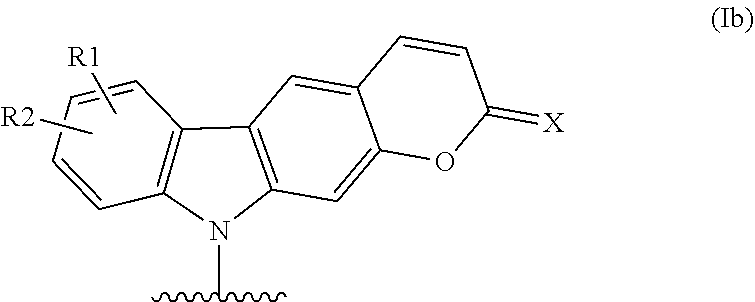
in which formula Ib,
-
- X is an oxygen atom or a sulfur atom,
- R1 and R2 are each independently a group selected from the group consisting of a hydrogen atom, a halogen atom, a —OH group, an amino group, a nitro group, a methyl group, a methyl fluoride group, an ethyl group, an ethyl fluoride group, and a C1-C3 alkylsulfanyl group.
(5)

in which formula Ib,
-
- X is an oxygen atom or a sulfur atom,
- R1 and R2 are each independently a group selected from the group consisting of a hydrogen atom, a halogen atom, a —OH group, an amino group, a nitro group, a methyl group, a methyl fluoride group, an ethyl group, an ethyl fluoride group, and a C1-C3 alkylsulfanyl group.
(6)

in which formula Ib,
-
- X is an oxygen atom or a sulfur atom,
- R1 and R2 are each independently a group selected from the group consisting of a hydrogen atom, a halogen atom, a —OH group, an amino group, a nitro group, a methyl group, a methyl fluoride group, an ethyl group, an ethyl fluoride group, and a C1-C3 alkylsulfanyl group.
(7)


and also includes a substituted body in which the hydrogen atom is substituted by a C1 to C4 alkyl group, in the above structure.

and also includes a substituted body in which the hydrogen atom is substituted by a C1 to C4 alkyl group, in the above structure.


[Synthesis of Compound 2]


| ODN(SPCX) | 5'-TGCASPCXCCGT-3' | |
| cODN | 5'-ACGGGGTGCA-3'. |
Claims (14)


Applications Claiming Priority (4)
| Application Number | Priority Date | Filing Date | Title |
|---|---|---|---|
| JP2017144897 | 2017-07-26 | ||
| JPJP2017-144897 | 2017-07-26 | ||
| JP2017-144897 | 2017-07-26 | ||
| PCT/JP2018/027961 WO2019022158A1 (en) | 2017-07-26 | 2018-07-25 | Photoresponsive nucleotide analog capable of photocrosslinking in visible light region |
Publications (2)
| Publication Number | Publication Date |
|---|---|
| US20200172563A1 US20200172563A1 (en) | 2020-06-04 |
| US11214590B2 true US11214590B2 (en) | 2022-01-04 |
Family
ID=65039614
Family Applications (1)
| Application Number | Title | Priority Date | Filing Date |
|---|---|---|---|
| US16/631,653 Active US11214590B2 (en) | 2017-07-26 | 2018-07-25 | Photoresponsive nucleotide analog capable of photocrosslinking in visible light region |
Country Status (5)
| Country | Link |
|---|---|
| US (1) | US11214590B2 (en) |
| EP (1) | EP3660022A4 (en) |
| JP (1) | JP7186165B2 (en) |
| CN (1) | CN110914278B (en) |
| WO (1) | WO2019022158A1 (en) |
Cited By (1)
| Publication number | Priority date | Publication date | Assignee | Title |
|---|---|---|---|---|
| US20230212178A1 (en) * | 2019-01-30 | 2023-07-06 | Japan Advanced Institute Of Science And Technology | Method of producing photoreactive nucleotide analog |
Families Citing this family (2)
| Publication number | Priority date | Publication date | Assignee | Title |
|---|---|---|---|---|
| JP6920689B2 (en) * | 2017-07-26 | 2021-08-18 | 日華化学株式会社 | Photoreactive nucleotide analogs that can be photocrosslinked in the visible light region |
| CN110914278B (en) | 2017-07-26 | 2022-06-24 | 国立大学法人北陆先端科学技术大学院大学 | Photoresponsive nucleotide analogs capable of photocrosslinking in the visible region |
Citations (15)
| Publication number | Priority date | Publication date | Assignee | Title |
|---|---|---|---|---|
| US5082934A (en) | 1989-04-05 | 1992-01-21 | Naxcor | Coumarin derivatives for use as nucleotide crosslinking reagents |
| WO1992002532A1 (en) | 1990-08-09 | 1992-02-20 | Genta Incorporated | Improved non-nucleotide-based linker reagents for oligomers |
| US6005094A (en) | 1986-10-28 | 1999-12-21 | Genta Incorporated | Oligonucleotide analogues having improved stability at acid pH |
| JP2001348398A (en) | 2000-03-10 | 2001-12-18 | Japan Science & Technology Corp | 5-pyrimidine-containing nucleic acid and reversible ligation method using the same |
| WO2005083073A1 (en) | 2004-02-27 | 2005-09-09 | Japan Science And Technology Agency | Dna enzyme and method of controlling the activity thereof |
| JP3753938B2 (en) | 2000-12-15 | 2006-03-08 | 独立行政法人科学技術振興機構 | Method for point mutation of base using photoligating nucleoside-containing DNA |
| WO2009066447A1 (en) | 2007-11-19 | 2009-05-28 | Japan Advanced Institute Of Science And Technology | Light-responsive artificial nucleotide having photo-crosslinking ability |
| WO2010147673A2 (en) | 2009-06-19 | 2010-12-23 | University Of Florida Research Foundation, Inc. | Single-dna molecule nanomotor regulated by photons |
| US20110034683A1 (en) | 2008-04-16 | 2011-02-10 | Japan Advanced Institute Of Science And Technology | Sequence-specific nucleic acid purification method manner |
| WO2014157565A1 (en) | 2013-03-28 | 2014-10-02 | 国立大学法人北陸先端科学技術大学院大学 | Photoresponsive nucleotide analogue having photocrosslinking ability |
| US20160326207A1 (en) | 2013-10-30 | 2016-11-10 | Japan Science And Technology Agency | Method of suppressing formation of photocrosslink, and photoreactive nucleic acid in which auto-crosslink formation is suppressed |
| CN107163169A (en) | 2017-05-25 | 2017-09-15 | 同济大学 | One class cumarin and carbazole type oxime ester compound and its preparation method and application |
| WO2019022158A1 (en) | 2017-07-26 | 2019-01-31 | 国立大学法人北陸先端科学技術大学院大学 | Photoresponsive nucleotide analog capable of photocrosslinking in visible light region |
| EP3660021A1 (en) | 2017-07-26 | 2020-06-03 | Japan Advanced Institute of Science and Technology | Photoresponsive nucleotide analog capable of photocrosslinking in visible light region |
| WO2020158687A1 (en) | 2019-01-30 | 2020-08-06 | 国立大学法人北陸先端科学技術大学院大学 | Method of producing photoreactive nucleotide analog |
Family Cites Families (2)
| Publication number | Priority date | Publication date | Assignee | Title |
|---|---|---|---|---|
| GB1297131A (en) | 1969-03-25 | 1972-11-22 | ||
| JPS4940311B1 (en) | 1970-11-14 | 1974-11-01 |
-
2018
- 2018-07-25 CN CN201880047217.4A patent/CN110914278B/en active Active
- 2018-07-25 EP EP18838876.3A patent/EP3660022A4/en active Pending
- 2018-07-25 WO PCT/JP2018/027961 patent/WO2019022158A1/en not_active Ceased
- 2018-07-25 US US16/631,653 patent/US11214590B2/en active Active
- 2018-07-25 JP JP2019532843A patent/JP7186165B2/en active Active
Patent Citations (27)
| Publication number | Priority date | Publication date | Assignee | Title |
|---|---|---|---|---|
| US6005094A (en) | 1986-10-28 | 1999-12-21 | Genta Incorporated | Oligonucleotide analogues having improved stability at acid pH |
| JPH04506206A (en) | 1989-04-05 | 1992-10-29 | ナクスコー | Coumarin derivatives for use as nucleotide crosslinking reagents |
| US5082934A (en) | 1989-04-05 | 1992-01-21 | Naxcor | Coumarin derivatives for use as nucleotide crosslinking reagents |
| WO1992002532A1 (en) | 1990-08-09 | 1992-02-20 | Genta Incorporated | Improved non-nucleotide-based linker reagents for oligomers |
| JPH05507419A (en) | 1990-08-09 | 1993-10-28 | ジンタ・インコーポレイテッド | Improved non-nucleotide linker reagents for oligomers |
| JP2001348398A (en) | 2000-03-10 | 2001-12-18 | Japan Science & Technology Corp | 5-pyrimidine-containing nucleic acid and reversible ligation method using the same |
| JP3753942B2 (en) | 2000-03-10 | 2006-03-08 | 独立行政法人科学技術振興機構 | 5-pyrimidine-containing nucleic acid and reversible ligation method using the same |
| JP3753938B2 (en) | 2000-12-15 | 2006-03-08 | 独立行政法人科学技術振興機構 | Method for point mutation of base using photoligating nucleoside-containing DNA |
| WO2005083073A1 (en) | 2004-02-27 | 2005-09-09 | Japan Science And Technology Agency | Dna enzyme and method of controlling the activity thereof |
| WO2009066447A1 (en) | 2007-11-19 | 2009-05-28 | Japan Advanced Institute Of Science And Technology | Light-responsive artificial nucleotide having photo-crosslinking ability |
| EP2216338A1 (en) | 2007-11-19 | 2010-08-11 | Japan Advanced Institute of Science and Technology | Light-responsive artificial nucleotide having photo-crosslinking ability |
| US20100274000A1 (en) | 2007-11-19 | 2010-10-28 | Japan Advanced Institute Of Science And Technology | Light-responsive artificial nucleotide having photo-crosslinking ability |
| JP4940311B2 (en) | 2007-11-19 | 2012-05-30 | 国立大学法人北陸先端科学技術大学院大学 | Photoresponsive artificial nucleotide with optical cross-linking ability |
| US20110034683A1 (en) | 2008-04-16 | 2011-02-10 | Japan Advanced Institute Of Science And Technology | Sequence-specific nucleic acid purification method manner |
| JP4814904B2 (en) | 2008-04-16 | 2011-11-16 | 国立大学法人北陸先端科学技術大学院大学 | Method for sequence-selective purification of nucleic acids |
| WO2010147673A2 (en) | 2009-06-19 | 2010-12-23 | University Of Florida Research Foundation, Inc. | Single-dna molecule nanomotor regulated by photons |
| WO2014157565A1 (en) | 2013-03-28 | 2014-10-02 | 国立大学法人北陸先端科学技術大学院大学 | Photoresponsive nucleotide analogue having photocrosslinking ability |
| EP2980073A1 (en) | 2013-03-28 | 2016-02-03 | Japan Advanced Institute of Science and Technology | Photoresponsive nucleotide analogue having photocrosslinking ability |
| US20160031918A1 (en) | 2013-03-28 | 2016-02-04 | Japan Advanced Institute Of Science And Technology | Photoresponsive nucleotide analogue having photocrosslinking ability |
| JP5925383B2 (en) | 2013-03-28 | 2016-05-25 | 国立研究開発法人科学技術振興機構 | Photoresponsive nucleotide analog with optical cross-linking ability |
| US10450334B2 (en) * | 2013-03-28 | 2019-10-22 | Japan Science And Technology Agency | Photoresponsive nucleotide analogue having photocrosslinking ability |
| US20160326207A1 (en) | 2013-10-30 | 2016-11-10 | Japan Science And Technology Agency | Method of suppressing formation of photocrosslink, and photoreactive nucleic acid in which auto-crosslink formation is suppressed |
| CN107163169A (en) | 2017-05-25 | 2017-09-15 | 同济大学 | One class cumarin and carbazole type oxime ester compound and its preparation method and application |
| WO2019022158A1 (en) | 2017-07-26 | 2019-01-31 | 国立大学法人北陸先端科学技術大学院大学 | Photoresponsive nucleotide analog capable of photocrosslinking in visible light region |
| EP3660021A1 (en) | 2017-07-26 | 2020-06-03 | Japan Advanced Institute of Science and Technology | Photoresponsive nucleotide analog capable of photocrosslinking in visible light region |
| US20200172563A1 (en) | 2017-07-26 | 2020-06-04 | Japan Advanced Institute Of Science And Technology | Photoresponsive nucleotide analog capable of photocrosslinking in visible light region |
| WO2020158687A1 (en) | 2019-01-30 | 2020-08-06 | 国立大学法人北陸先端科学技術大学院大学 | Method of producing photoreactive nucleotide analog |
Non-Patent Citations (22)
| Title |
|---|
| Extended (supplementary) European Search Report dated Oct. 31, 2016, issued in European Patent Application No. 14773781.1. (6 pages). |
| Extended European Search Report dated Feb. 17, 2021 in corresponding European Patent Application No. 18837260.1. |
| Extended European Search Report dated Mar. 24, 2021 in corresponding European Patent Application No. 18838876.3. |
| Fujimoto et al., "DNA photo-cross-linking using a pyranocarbazole-modified oligodeoxnynucleotide with a D-threoninol linker", The Royal Society of Chemistry, 2019, vol. 9, pp. 30693-30697. |
| Fujimoto et al., "DNA Photo-cross-linking Using Pyranocarbazole and Visible Light", Organic Letters, Apr. 27, 2018, vol. 20, pp. 2802-2805 Cited in Specification. (4 pages). |
| Gia et al., "Pyrrolocoumarin Derivatives: DNA-Binding Properties", Journal of Photochemishy and Photobiology, B; Biology, 1988, vol. 2, pp. 435-442. |
| Gupta et al., "Peptide nucleic acids: Advanced tools for biomedical applications", Journal of Biotechnology, 2017, vol. 259, pp. 148-159. |
| Haque et al., "Photoswitchable Formation of a DNA Interstrand Cross-Link by a Coumarin-Modified Nucleotide", Angew. Chem. Int. Ed., 2014, vol. 53, pp. 7001-7005 |
| International Search Report dated Aug. 28, 2018, issued in counterpart International Application No. PCT/JP2018/027961. (2 pages). |
| International Search Report dated Jun. 10, 2014, issued in Application No. PCT/JP2014/058988 (2 pages). |
| International Search Report dated Oct. 2, 2018, issued in counterpart International Application No. PCT/JP2018/027169 (2 pages). |
| Kashida et al., "Control of the Chirality and Helicity of Oligomers of Serinol Nucleic Acid (SNA) by Sequence Design" Agnew. Chem. Int. Ed. 2011, vol. 50, pp. 1285-1288 (2011). |
| Kean et al., "Photochemical Cross-Linking of Psoralen-Derivatized Oligonucleoside Methylphosphonates to Rabbit Globin Messenger RNA", Biochemistry, 1988, vol. 27, pp. 9113-9121. |
| Koshimura et al., "Ultrafast Reversible Photo-Cross-Linking Reaction: Toward in Situ DNA Manipulation", Organic Letters, (2008), vol. 10, pp. 3227-3230. Cited in Specification. (4 pages). |
| Lee et al., "Interaction of Psoralen-Derivatized Oligodeoxyribonucleoside Methylphosphonates with Single-Stranded DNA", Biochemistry, 1988, vol. 27, 3197-3203. |
| Nakamura et al., "Rapid Photopolymerization of Oligodeoxynucleotides by 3-Cyanovinylcarbazole mediated DNA Photocrosslinking", Journal of Photopolymer Science and Technology, (2014), vol. 27, No. 4, pp. 485-490. Cited in Specification. (6 pages). |
| Notification of Transmittal of Translation of the International Preliminary Report on Patentabililty (Form PCT/IB/338) issued in counterpart International Application No. PCT/JP2018/027169 dated Feb. 6, 2020 with Forms PCT/IB/373 and PCT/ISA/237. (5 pages). |
| Notification of Transmittal of Translation of the International Preliminary Report on Patentability (Form PCT/IB338) issued in International Application No. PCT/JP2014/058988.(16 pages). |
| Notification of Transmittal of Translation of the International Preliminary Report on Patentability (PCT/IPEA/Form 409) of International Application No. PCT/JP2018/027961 dated Jan. 30, 2020 (6 pages). |
| Rodighiero et al., "Pyrrolocoumarin Derivatives as Potential Photoreagents Toward DNA", Journal of Heterocyclic Chemistry, (1987), vol. 24, pp. 1041-1043. Cited in Specification. (3 pages). |
| Sakamoto et al., "DNA Photo-Cross-Linking Using 3-Cyanovinylcarbazole Modified Oligonucleotide with Threoninol Linker", Organic Letters, 2015, vol. 17, No. 4, pp. 936-939. |
| Vronteli et al., "Synthesis of fused pyranocarbazolones with biological interest", Arkivoc, (2015), No. 3, pp. 111-123. Cited in Specification. (13 pages). |
Cited By (1)
| Publication number | Priority date | Publication date | Assignee | Title |
|---|---|---|---|---|
| US20230212178A1 (en) * | 2019-01-30 | 2023-07-06 | Japan Advanced Institute Of Science And Technology | Method of producing photoreactive nucleotide analog |
Also Published As
| Publication number | Publication date |
|---|---|
| CN110914278B (en) | 2022-06-24 |
| EP3660022A4 (en) | 2021-04-21 |
| CN110914278A (en) | 2020-03-24 |
| JP7186165B2 (en) | 2022-12-08 |
| EP3660022A1 (en) | 2020-06-03 |
| WO2019022158A1 (en) | 2019-01-31 |
| US20200172563A1 (en) | 2020-06-04 |
| JPWO2019022158A1 (en) | 2020-06-25 |
Similar Documents
| Publication | Publication Date | Title |
|---|---|---|
| JP5427902B2 (en) | Photoresponsive artificial nucleotide with optical cross-linking ability | |
| US10450334B2 (en) | Photoresponsive nucleotide analogue having photocrosslinking ability | |
| US11214590B2 (en) | Photoresponsive nucleotide analog capable of photocrosslinking in visible light region | |
| US11078211B2 (en) | Photoresponsive nucleotide analog capable of photocrosslinking in visible light region | |
| JP6153116B2 (en) | Triazole-linked cyclic dinucleotide analogs | |
| JP4887500B2 (en) | Nucleoside analogue or salt thereof | |
| US20230212178A1 (en) | Method of producing photoreactive nucleotide analog | |
| JP2025116757A (en) | Thymine-selective photoresponsive nucleotide analogues | |
| JP2021020883A (en) | Photoresponsive nucleotide analog | |
| WO2004048376A1 (en) | Bicyclic naphthylidine nucleosides | |
| WO2024228396A1 (en) | Highly lipid-soluble nucleotide building block for oligonucleotide synthesis, and synthesis of oligonucleotides using same | |
| JP2007238462A (en) | Nucleoside derivatives having an ester bond | |
| JP2010254616A (en) | Method for producing ribonucleoside derivative and oligonucleic acid derivative |
Legal Events
| Date | Code | Title | Description |
|---|---|---|---|
| FEPP | Fee payment procedure |
Free format text: ENTITY STATUS SET TO UNDISCOUNTED (ORIGINAL EVENT CODE: BIG.); ENTITY STATUS OF PATENT OWNER: LARGE ENTITY |
|
| STPP | Information on status: patent application and granting procedure in general |
Free format text: APPLICATION DISPATCHED FROM PREEXAM, NOT YET DOCKETED |
|
| AS | Assignment |
Owner name: NICCA CHEMICAL CO., LTD., JAPAN Free format text: ASSIGNMENT OF ASSIGNORS INTEREST;ASSIGNOR:JAPAN ADVANCED INSTITUTE OF SCIENCE AND TECHNOLOGY;REEL/FRAME:055332/0047 Effective date: 20210217 Owner name: JAPAN ADVANCED INSTITUTE OF SCIENCE AND TECHNOLOGY, JAPAN Free format text: ASSIGNMENT OF ASSIGNORS INTEREST;ASSIGNOR:JAPAN ADVANCED INSTITUTE OF SCIENCE AND TECHNOLOGY;REEL/FRAME:055332/0047 Effective date: 20210217 |
|
| STPP | Information on status: patent application and granting procedure in general |
Free format text: DOCKETED NEW CASE - READY FOR EXAMINATION |
|
| STPP | Information on status: patent application and granting procedure in general |
Free format text: NON FINAL ACTION MAILED |
|
| STPP | Information on status: patent application and granting procedure in general |
Free format text: RESPONSE TO NON-FINAL OFFICE ACTION ENTERED AND FORWARDED TO EXAMINER |
|
| STPP | Information on status: patent application and granting procedure in general |
Free format text: NOTICE OF ALLOWANCE MAILED -- APPLICATION RECEIVED IN OFFICE OF PUBLICATIONS |
|
| STPP | Information on status: patent application and granting procedure in general |
Free format text: AWAITING TC RESP., ISSUE FEE NOT PAID |
|
| STPP | Information on status: patent application and granting procedure in general |
Free format text: AWAITING TC RESP, ISSUE FEE PAYMENT RECEIVED |
|
| STPP | Information on status: patent application and granting procedure in general |
Free format text: PUBLICATIONS -- ISSUE FEE PAYMENT RECEIVED |
|
| STPP | Information on status: patent application and granting procedure in general |
Free format text: AWAITING TC RESP, ISSUE FEE PAYMENT VERIFIED |
|
| STPP | Information on status: patent application and granting procedure in general |
Free format text: PUBLICATIONS -- ISSUE FEE PAYMENT VERIFIED |
|
| STCF | Information on status: patent grant |
Free format text: PATENTED CASE |
|
| MAFP | Maintenance fee payment |
Free format text: PAYMENT OF MAINTENANCE FEE, 4TH YEAR, LARGE ENTITY (ORIGINAL EVENT CODE: M1551); ENTITY STATUS OF PATENT OWNER: LARGE ENTITY Year of fee payment: 4 |