US11138815B2 - Vehicle management system - Google Patents
Vehicle management system Download PDFInfo
- Publication number
- US11138815B2 US11138815B2 US16/823,027 US202016823027A US11138815B2 US 11138815 B2 US11138815 B2 US 11138815B2 US 202016823027 A US202016823027 A US 202016823027A US 11138815 B2 US11138815 B2 US 11138815B2
- Authority
- US
- United States
- Prior art keywords
- vehicle
- control unit
- unit
- activation signal
- communication
- Prior art date
- Legal status (The legal status is an assumption and is not a legal conclusion. Google has not performed a legal analysis and makes no representation as to the accuracy of the status listed.)
- Active, expires
Links
- 238000004891 communication Methods 0.000 claims abstract description 119
- 230000004913 activation Effects 0.000 claims abstract description 91
- 238000012545 processing Methods 0.000 claims abstract description 37
- 230000003213 activating effect Effects 0.000 claims abstract description 12
- 230000004044 response Effects 0.000 claims abstract description 6
- KSWHNTPMGZKIOB-UHFFFAOYSA-N 5-hexyl-2-(2-methylphenoxy)phenol Chemical compound OC1=CC(CCCCCC)=CC=C1OC1=CC=CC=C1C KSWHNTPMGZKIOB-UHFFFAOYSA-N 0.000 description 40
- 239000000446 fuel Substances 0.000 description 17
- 238000010586 diagram Methods 0.000 description 10
- 230000006870 function Effects 0.000 description 6
- 238000012986 modification Methods 0.000 description 3
- 230000004048 modification Effects 0.000 description 3
- 230000009467 reduction Effects 0.000 description 3
- 230000001629 suppression Effects 0.000 description 3
- 230000008901 benefit Effects 0.000 description 2
- 230000008859 change Effects 0.000 description 2
- 230000005540 biological transmission Effects 0.000 description 1
- 238000012790 confirmation Methods 0.000 description 1
- 230000000694 effects Effects 0.000 description 1
- 239000002828 fuel tank Substances 0.000 description 1
- 238000012423 maintenance Methods 0.000 description 1
Images


Classifications
-
- G—PHYSICS
- G07—CHECKING-DEVICES
- G07F—COIN-FREED OR LIKE APPARATUS
- G07F17/00—Coin-freed apparatus for hiring articles; Coin-freed facilities or services
- G07F17/0042—Coin-freed apparatus for hiring articles; Coin-freed facilities or services for hiring of objects
- G07F17/0057—Coin-freed apparatus for hiring articles; Coin-freed facilities or services for hiring of objects for the hiring or rent of vehicles, e.g. cars, bicycles or wheelchairs
-
- G—PHYSICS
- G07—CHECKING-DEVICES
- G07C—TIME OR ATTENDANCE REGISTERS; REGISTERING OR INDICATING THE WORKING OF MACHINES; GENERATING RANDOM NUMBERS; VOTING OR LOTTERY APPARATUS; ARRANGEMENTS, SYSTEMS OR APPARATUS FOR CHECKING NOT PROVIDED FOR ELSEWHERE
- G07C5/00—Registering or indicating the working of vehicles
- G07C5/008—Registering or indicating the working of vehicles communicating information to a remotely located station
-
- B—PERFORMING OPERATIONS; TRANSPORTING
- B60—VEHICLES IN GENERAL
- B60R—VEHICLES, VEHICLE FITTINGS, OR VEHICLE PARTS, NOT OTHERWISE PROVIDED FOR
- B60R25/00—Fittings or systems for preventing or indicating unauthorised use or theft of vehicles
- B60R25/20—Means to switch the anti-theft system on or off
- B60R25/24—Means to switch the anti-theft system on or off using electronic identifiers containing a code not memorised by the user
- B60R25/241—Means to switch the anti-theft system on or off using electronic identifiers containing a code not memorised by the user whereby access privileges are related to the identifiers
-
- G—PHYSICS
- G07—CHECKING-DEVICES
- G07C—TIME OR ATTENDANCE REGISTERS; REGISTERING OR INDICATING THE WORKING OF MACHINES; GENERATING RANDOM NUMBERS; VOTING OR LOTTERY APPARATUS; ARRANGEMENTS, SYSTEMS OR APPARATUS FOR CHECKING NOT PROVIDED FOR ELSEWHERE
- G07C5/00—Registering or indicating the working of vehicles
- G07C5/08—Registering or indicating performance data other than driving, working, idle, or waiting time, with or without registering driving, working, idle or waiting time
- G07C5/0816—Indicating performance data, e.g. occurrence of a malfunction
- G07C5/0825—Indicating performance data, e.g. occurrence of a malfunction using optical means
-
- G—PHYSICS
- G07—CHECKING-DEVICES
- G07C—TIME OR ATTENDANCE REGISTERS; REGISTERING OR INDICATING THE WORKING OF MACHINES; GENERATING RANDOM NUMBERS; VOTING OR LOTTERY APPARATUS; ARRANGEMENTS, SYSTEMS OR APPARATUS FOR CHECKING NOT PROVIDED FOR ELSEWHERE
- G07C5/00—Registering or indicating the working of vehicles
- G07C5/08—Registering or indicating performance data other than driving, working, idle, or waiting time, with or without registering driving, working, idle or waiting time
- G07C5/0841—Registering performance data
-
- H—ELECTRICITY
- H04—ELECTRIC COMMUNICATION TECHNIQUE
- H04L—TRANSMISSION OF DIGITAL INFORMATION, e.g. TELEGRAPHIC COMMUNICATION
- H04L67/00—Network arrangements or protocols for supporting network services or applications
- H04L67/01—Protocols
- H04L67/12—Protocols specially adapted for proprietary or special-purpose networking environments, e.g. medical networks, sensor networks, networks in vehicles or remote metering networks
Definitions
- This invention relates to a vehicle management system for managing a vehicle using a communication control unit.
- JP2017-093289A Japanese Unexamined Patent Application Publication No. 2017-093289
- vehicle information that varies after the vehicle has been turned off e.g., during sleep mode
- the vehicle typically has to be turned on to update the vehicle information.
- frequently updating the vehicle information in accordance with requests from a user of the vehicle or the like would unnecessarily consume vehicle power and increase cost for communication between the vehicle and user terminals of the user.
- An aspect of the present invention is a vehicle management system, including: a vehicle including a control unit and a communication control unit; and a communication terminal configured to communicate with the vehicle.
- the communication terminal includes: an arithmetic processing unit configured to output an activation signal for activating the control unit when the communication terminal is turned on or when an application stored in the communication terminal is started; a communication unit configured to transmit the activation signal output by the arithmetic processing unit to the communication control unit; and a notification unit configured to notify a vehicle information output from the control unit activated in response to the activation signal.
- FIG. 1 is a drawing showing a schematic configuration of a vehicle management system according to an embodiment of the present invention
- FIG. 2 is a block diagram showing a configuration of main components of the vehicle management system according to the embodiment of the present invention
- FIG. 3 is a block diagram showing a configuration of main components of a user terminal of FIG. 2 ;
- FIG. 4 is a drawing showing an example of vehicle information displayed on a display of FIG. 3 ;
- FIG. 5 is a block diagram showing a configuration of main components of a server unit of FIG. 2 ;
- FIG. 6 is a block diagram showing a configuration of main components of a vehicle of FIG. 1 ;
- FIG. 7 is a block diagram showing a configuration of main components of an Electronic Control Unit of FIG. 6 .
- a vehicle management system can be used to provide services related to a vehicle having a communication control unit mounted thereon, for example, a service that allows the user to check vehicle information of today while being present at home.
- the vehicle information includes information about the vehicle itself, as well as information acquirable from sensors or the like disposed on the vehicle, such as information indicating the vehicle inside/outside temperatures.
- Examples of services provided using the vehicle management system according to the present embodiment include services provided by providers of vehicle rental services, such as car sharing services, such as a service that allows a vehicle rental user to check the vehicle information of the rental day of a rental vehicle having a communication control unit mounted thereon while being present at home.
- providers of vehicle rental services such as car sharing services
- this vehicle management system is used in a vehicle rental service provided by a car sharing service provider.
- FIG. 1 is a drawing showing a schematic configuration of a vehicle management system 100 according to the embodiment of the present invention.
- a communication control unit 10 is mounted on each of vehicles (rental vehicles; only one is shown) 1 owned by a car sharing service provider and used for car sharing services.
- the communication control unit 10 is a telematics control unit 2 (hereafter also simply referred to as the “TCU 2 ”), and the TCU 2 is able to communicate with user terminals 3 (only one is shown; to be discussed later) and a server unit 4 (to be discussed later).
- TCU 2 telematics control unit 2
- the vehicles 1 include different classes of four-wheel vehicles, such as sedans, wagons, minivans, SUVs, sports cars, coupes, compact cars, and light cars. Since the vehicles 1 are of various types, users of car sharing services have a large number of options, that is, user convenience is high. Note that the vehicles 1 may be of a type only for car sharing services.
- a station 200 used for car sharing services is the location in which the vehicles 1 used for car sharing services are rented and returned and is a location away from the home 5 of a user of a car sharing service. To use a vehicle 1 , the user rents and returns the vehicle 1 at the same station 200 .
- This car sharing service user is a person who has previously registered required information with the car sharing service provider.
- the user acquires vehicle information using his or her own user terminal 3 .
- the user terminal 3 is able to communicate with the TCU 2 and server unit 4 .
- the vehicle management system 100 may be configured such that the user acquires vehicle information using a dedicated car sharing service terminal.
- the communication terminal used by the user to acquire vehicle information may include, for example, a display or speaker-equipped device, such as a television 50 , a display or speaker-equipped home appliance, or a display-equipped smart speaker 51 , disposed in the home 5 and connected to a communication network, such as a wireless communication network, the Internet network, or a telephone line network. That is, the communication terminal may include a device connected to a home network and including a notification unit.
- Vehicle rental services such as car sharing services have problems associated with the state of the vehicle 1 on the rental day, and the like.
- Information indicating the state of the vehicle includes information that varies with time, and this time-varying information includes information that needs to be updated to detect the state of the vehicle on that day. For example, remaining fuel amount, remaining charge amount of the battery, air pressure of the tire, and the like may vary with time and correspond to information that needs to be updated.
- the vehicle When the user rents the vehicle 1 , the vehicle needs to have sufficient fuel amount and charge amount and a proper air pressure of the tire. If the vehicle 1 has an autonomous driving function or advanced driving assistance system, such a function or system has to be properly available. Also, if the user previously knows the temperature inside or outside the vehicle 1 parked at the station 200 , he or she is able to make a preparation suitable to that temperature before going to the station 200 .
- a control unit 11 of the vehicle 1 (e.g., an electronic control unit of the vehicle 1 ; hereafter simply referred to as the “ECU 11 ”) acquires such vehicle information, the power consumption of the vehicle 1 or the communication cost of the TCU 2 would be increased. Also, if the vehicle 1 is turned on by turning on an ignition switch and then server information is updated by gathering vehicle information using the ECU 11 , it takes time until the server information is updated. Consequently, necessary information may not be acquired when necessary.
- the vehicle management system is configured as follows: when the user turns on the user terminal 3 , the user terminal 3 turns on the vehicle 1 placed in a turned-off state (e.g., a sleep state) by outputting an ECU activation signal (control unit activation signal) for activating the ECU 11 and the activated ECU 11 acquires vehicle information. That is, when the user gets up in the morning and turns on the user terminal 3 (e.g., the user terminal 3 placed in a sleep state), the user terminal 3 outputs an ECU activation signal for activating the ECU 11 irrespective of the intention of the user and thus the vehicle information is updated.
- An ECU activation signal may also be outputted not through the user terminal 3 . For example, when the user gets up in the morning and turns on the television 50 or uses the smart speaker 51 in the home 5 , an ECU activation signal may be outputted so that the vehicle information is updated, irrespective of the intention of the user.
- the updated vehicle information is outputted to the user terminal 3 , or the television 50 or the display of the smart speaker 51 or the like in the home 5 and temporarily stored in such a device.
- the updated vehicle information includes vehicle information that may vary after the vehicle 1 is put into a turned-off state (e.g., a less power-consuming sleep state), such as the remaining fuel amount, the remaining charge amount of the battery, the air pressure of the tire, and the vehicle inside/outside temperatures. This allows for suppression of frequent access to the vehicle 1 for acquiring vehicle information, a reduction in the power consumption or communication cost of the vehicle 1 , and efficient acquisition of information that varies after the vehicle is put into a turned-off state (a sleep state).
- the term “turned-off state of the vehicle 1 ” refers to, for example, a less power-consuming rest state.
- FIG. 2 is a block diagram showing the configuration of main components of the vehicle management system 100 according to the present embodiment.
- the vehicle management system 100 includes the vehicle 1 owned by the car sharing service provider and having the TCU 2 mounted thereon, the user terminal 3 owned by the car sharing service user, and the server unit 4 disposed in the car sharing service provider.
- the TCU 2 , user terminal 3 , and server unit 4 are connected to a communication network 6 , such as a wireless communication network, the Internet network, or a telephone line network.
- a communication network 6 such as a wireless communication network, the Internet network, or a telephone line network.
- FIG. 2 shows one of the user terminals 3 that acquire the vehicle information of the vehicles 1 .
- the television 50 , smart speaker 51 , or the like in the home 5 shown in FIG. 1 may be used as a communication terminal.
- FIG. 3 is a block diagram showing the configuration of main components of the user terminal 3 .
- the user terminal 3 consists of a personal computer, a mobile wireless terminal, such as a smartphone, or the like operated by the user.
- the user terminal 3 includes a communication unit 30 , an input/output unit 31 , an arithmetic processing unit 32 , a memory unit 33 , and sensors 34 .
- the communication unit 30 is configured to be able to wirelessly communicate with the TCU 2 of the vehicle 1 and the server unit 4 through the communication network 6 .
- the communication unit 30 transmits a signal requesting reservation, cancelation, or the like of the vehicle 1 used for car sharing services to the server unit 4 along with a user ID identifying the user.
- the communication unit 30 transmits an ECU activation signal for activating the ECU of the vehicle 1 , to the TCU 2 through the server unit 4 or directly along with the user ID.
- the communication unit 30 may transmit an ECU activation signal when a predetermined application stored in the memory unit 33 is started rather than when the user terminal 3 is turned on.
- Examples of when the user terminal 3 is turned on include when the off-state user terminal 3 is turned on, as well as when the sleep-state user terminal 3 is put into an available state.
- the communication unit 30 may transmit an ECU activation signal in a predetermined time slot rather than always transmitting an ECU activation signal.
- the communication unit 30 may transmit an ECU activation signal only when the sleep-state user terminal 3 is put into an available state in a time slot from 6:00 AM to 8:00 AM.
- the input/output unit 31 includes a display 311 (notification unit), a speaker 312 (notification unit), an input unit 313 , such as a keyboard or touchscreen, and the like.
- the user inputs user information through the input unit 313 .
- the user information includes the address, name, contact information, and driver's license number of the user, information required for payment (e.g., the credit card number), and the like.
- the user is allowed to use car sharing services only after the user registers himself or herself as a member by inputting user information.
- the user When making a reservation of the vehicle, the user inputs vehicle reservation information through the input unit 313 .
- the user inputs the use dates/times (the use start date/time and use end date/time) of the vehicle 1 .
- the inputted information is transmitted to the server unit 4 , which then retrieves reservable vehicles 1 satisfying the use data/time conditions and transmits information about the retrieved vehicles 1 and the station 200 to the user terminal 3 .
- the transmitted vehicle information and station information are displayed on the display 311 .
- the user selects a desired vehicle 1 from among the displayed vehicles 1 or accepts the displayed single vehicle 1 through the input/output unit 313 , the vehicle reservation is confirmed.
- the vehicle information of the vehicle 1 to be rented is displayed on the display 311 .
- the vehicle information may be notified from the speaker 312 .
- the display 311 of the user terminal 3 displays an image of the vehicle 1 to be rented, as well as various types of vehicle information including vehicle information that may vary after the vehicle 1 is turned off.
- FIG. 4 is a drawing showing an example of the vehicle information outputted to the display 311 of the user terminal 3 .
- the display 311 displays the remaining fuel amount (%), the remaining charge amount (%) of the battery, the driving range (RANGE; km), the air pressure (kPa) of the tire, the vehicle inside temperature (° C.), the vehicle outside temperature (° C.), the air-conditioner setting temperature (° C.), the odometer (ODO; km), the average fuel efficiency (AVG; km), the state of the autonomous driving (AD) function, the state of the advanced driving assistance system (ADAS), and the like.
- RANGE driving range
- KPa air pressure
- OEO odometer
- AVG average fuel efficiency
- AD autonomous driving
- ADAS advanced driving assistance system
- the vehicle information displayed on the display 311 is not limited to that described above, and various types of vehicle information acquired by the ECU of the vehicle 1 can be displayed as necessary.
- the user may change the setting of the display form of these types of vehicle information displayed on the display 311 through the input unit 313 .
- a map indicating the location of the station 200 , the weather in and around the station 200 , or the like may be displayed. Since the vehicle information displayed on the display 311 can be changed in accordance with the user preferences, the user convenience of the vehicle management system 100 is high.
- the arithmetic processing unit 32 in FIG. 3 includes a CPU.
- the arithmetic processing unit 32 performs predetermined processing on the basis of signals inputted through the input/output unit 31 , signals received from outside the user terminal 3 (e.g., the TCU 2 or server unit 4 ) through the communication unit 30 , and programs, data, and the like stored in the memory unit 33 and outputs control signals to the communication unit 30 , input/output unit 31 , and memory unit 33 .
- the user is able to perform change, confirmation, or the like of the reservation of the vehicle 1 through the input/output unit 31 (the display, etc.).
- the arithmetic processing unit 32 includes a terminal activation signal output unit 321 , an ECU activation signal output unit 322 , and an output unit 323 as function elements.
- the terminal activation signal output unit 321 When an operation for turning on the user terminal 3 is detected or when start of a predetermined application is detected, the terminal activation signal output unit 321 outputs a signal for activating the user terminal 3 (a terminal activation signal).
- the ECU activation signal output unit 322 receives the terminal activation signal outputted from the terminal activation signal output unit 321 and outputs a signal for activating the ECU 11 of the vehicle 1 to be rented to the user (an ECU activation signal).
- the ECU activation signal output unit 322 outputs an ECU activation signal to an ECU 11 previously selected from among multiple ECUs 11 of the vehicle 1 . More specifically, the ECU activation signal output unit 322 outputs an ECU activation signal for activating an ECU 11 selected from among a battery ECU 111 , a fuel ECU 112 , a tire air pressure ECU 113 , an air-conditioner ECU 114 , a meter ECU 115 , an advanced driving assistance system (ADAS) ECU 116 , and an autonomous driving (AD) ECU 117 shown in FIG. 6 .
- ADAS advanced driving assistance system
- AD autonomous driving
- the display 311 of the input/output unit 31 displays vehicle information acquired by the selected ECU 11 . That is, the ECU activation signal output unit 322 selects an ECU 11 capable of acquiring desired vehicle information, from among the ECUs 11 and outputs an ECU activation signal to the selected ECU 11 .
- the vehicle information can be acquired by outputting the ECU activation signal from the ECU activation signal output unit 322 to the selected ECU 11 .
- the vehicle information can be acquired from vehicle information stored in the server unit 4 (a vehicle database 431 (to be discussed later)). This allows for efficiently acquiring the vehicle information.
- the first vehicle information (the remaining fuel amount, the remaining charge amount of the battery, the vehicle inside temperature, and the like) is vehicle information that has to be updated when turning on the vehicle 1
- the second vehicle information is vehicle information that does not have to be updated.
- the second vehicle information may be previously stored in the server unit 4 .
- the memory unit 33 includes a volatile memory or non-volatile memory (not shown).
- the memory unit 33 stores various types of programs executed by the arithmetic processing unit 32 and various types of data.
- the memory unit 33 includes a vehicle information database 331 and an application database 332 as functional elements.
- the vehicle information database 331 stores vehicle information transmitted through the communication unit 30 .
- the application database 332 stores programs for executing applications installed by the user or preinstalled.
- the sensors 34 includes various types of sensors that detect the location or state of the user terminal 3 , such as a GPS sensor 341 that detects the location of the user terminal 3 by receiving signals from a GPS satellite and a gyro sensor 342 that detects the posture of the user terminal 3 .
- the sensors 34 also include a battery capacity sensor that detects the remaining battery capacity of the user terminal 3 , a radio-wave receiving sensor that detects the radio-wave reception situation, and the like.
- the server unit 4 acquires location information of the user by receiving information detected by the GPS sensor 341 .
- the server unit 4 also acquires posture information of the user terminal 3 by receiving information detected by the gyro sensor 342 .
- FIG. 5 is a block diagram showing the configuration of main components of the server unit 4 in FIG. 2 .
- the server unit 4 is disposed in, for example, the car sharing service provider.
- the server unit 4 may be formed using virtual server functions on cloud computing.
- the server unit 4 includes a communication unit 40 , an input/output unit 41 , an arithmetic processing unit 42 , and a memory unit 43 .
- the input/output unit 41 includes, for example, a keyboard, a mouse, a display, a touchscreen, and the like and serves as an input/output interface.
- the user reservation management unit 421 accepts a reservation of the vehicle 1 inputted by the user through the input/output unit 31 of the user terminal 3 .
- the vehicle information acquisition unit 422 acquires the vehicle information of the vehicle 1 to be rented to the user, through the TCU 2 or from a vehicle database 431 .
- the output unit 424 When the communication unit 40 receives the ECU activation signal transmitted from the user terminal 3 , the output unit 424 outputs an ECU activation signal corresponding to this ECU activation signal, that is, an ECU activation signal for activating the previously selected ECU 11 .
- This ECU activation signal is transmitted to the TCU 2 through the communication unit 40 , leading to activation of the previously selected ECU 11 .
- the output unit 424 also outputs the vehicle information of the vehicle 1 acquired through the TCU 2 (the first vehicle information) and the vehicle information of the vehicle 1 acquired from the vehicle database 431 (the second vehicle information). These types of vehicle information are transmitted to the user terminal 3 through the communication unit 40 .
- the user is able to grasp the vehicle information of the vehicle 1 , that is, the previously selected vehicle information.
- the output unit 424 also outputs information indicating the use fee of the vehicle 1 to be rented to the user calculated by the fee calculation unit 423 .
- the use fee information is transmitted to the user terminal 3 through the communication unit 40 .
- the user is able to grasp the use fee of the vehicle 1 .
- the memory unit 43 includes a volatile memory or non-volatile memory (not shown).
- the memory unit 43 stores various types of programs executed by the arithmetic processing unit 42 and various types of data.
- the memory unit 43 includes the vehicle database 431 and a user database 432 as functional elements.
- the vehicle database 431 stores vehicle IDs identifying the multiple vehicles 1 used for car sharing services and the vehicle information of the vehicles 1 , including information specific to the vehicles 1 , such as the vehicle types, model years, body numbers, vehicle numbers of the vehicles 1 , and information indicating the states of the vehicles 1 , such as the remaining fuel amount, the remaining charge amount of the battery, the air pressure of the tire, the vehicle inside temperature, and the air-conditioner setting temperature of the vehicles 1 . That is, the vehicle database 431 stores the vehicle information of the vehicles such that the vehicle information corresponds to the vehicle IDs.
- the vehicle database 431 also stores information indicating the current and future time-series reservations, information indicating the plan of maintenance of the vehicles 1 performed between the reservations, and the like.
- the user database 432 stores the user IDs identifying the users inputted through the input/output units 31 of the user terminals 3 and user information, such as the addresses, names, contact information, and driver's license numbers of the users. That is, the user database 432 stores the user information of the users such that the user information corresponds to the user IDs.
- FIG. 6 is a block diagram showing the configuration of main components of the vehicle 1 used in the vehicle management system 100 according to the present embodiment.
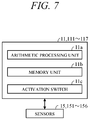
- FIG. 7 is a block diagram showing the configuration of main components of an ECU 11 .
- the vehicle 1 includes the TCU 2 and the multiple ECUs 11 .
- the TCU 2 includes a communication unit 20 , an arithmetic processing unit 21 , a memory unit 22 , and an activation switch 23 .
- the communication unit 20 is configured to be able to wirelessly communicate with the user terminal 3 and server unit 4 through the communication network 6 .
- the communication unit 20 receives the ECU activation signal transmitted from the server unit 4 .
- the communication unit 20 may receive the ECU activation signal transmitted from the user terminal 3 .
- the ECU activation signal is inputted to the TCU 2 through the communication unit 20 , power is supplied to the TCU 2 through the activation switch 23 . That is, when the ECU activation signal is inputted to the TCU 2 , the TCU 2 is activated.
- the ECU activation signal includes an electronic control unit ID (identification information) identifying an ECU 11 to be activated.
- the arithmetic processing unit 21 includes a CPU.
- the arithmetic processing unit 21 performs predetermined processing on the basis of signals received from outside the TCU 2 through the communication unit 20 and programs and data stored in the memory unit 22 and outputs control signals to the ECUs 11 of the vehicle 1 and the memory unit 22 .
- the arithmetic processing unit 21 also identifies an ECU to be activated on the basis of the ECU activation signal inputted through the communication unit 20 and, more specifically, on the basis of electronic control unit IDs identifying the multiple ECUs 11 included in the ECU activation signal and outputs an ECU activation signal to the identified ECU 11 through the communication bus 12 .
- the arithmetic processing unit 21 also controls transmission and reception of signals between the TCU 2 and server unit 4 by outputting control signals to the communication unit 20 . For example, when the ECU 11 outputs vehicle information, the arithmetic processing unit 21 transmits the outputted vehicle information to the server unit 4 through the communication unit 20 along with a vehicle ID. The server unit 4 determine a user corresponding to the received vehicle ID and transmits the vehicle information to the user terminal 3 of the determined user.
- the multiple ECUs 11 are connected through the communication bus 12 and form an in-vehicle communication network 13 of the vehicle 1 .
- the in-vehicle communication network 13 is, for example, a controller area network (CAN).
- CAN controller area network
- the in-vehicle network may be another communication standard, such as a local area interconnect network (LIN).
- LIN local area interconnect network
- each ECU 11 includes an arithmetic processing unit 11 a , a memory unit 11 b , and an activation switch 11 c .
- the sensors 15 are connected to the ECUs 11 .
- the identified ECU 11 receives the ECU activation signal through the communication unit 12 , power is supplied to the ECU 11 through the activation switch 11 c . That is, the identified ECU 11 is activated when it receives the ECU activation signal.
- the arithmetic processing unit 11 a includes a CPU.
- the arithmetic processing unit 11 a performs predetermined processing on the basis of signals inputted through the communication bus 12 , signals detected by the sensors 15 , and programs, data, and the like stored in the memory unit 11 b .
- the arithmetic processing unit 11 a then stores vehicle information in the memory unit 11 b and transmits it to the TCU 2 .
- the memory unit 11 b stores programs, data, control signals indicating the vehicle information outputted by the arithmetic processing unit 11 a , and the like.
- the in-vehicle communication network 13 includes the battery ECU 111 , the fuel ECU 112 , the tire air pressure ECU 113 , the air-conditioner ECU 114 , the meter ECU 115 , the advanced driving assistance system (ADAS) ECU 116 , the autonomous driving (AD) ECU 117 , and a gateway ECU 118 .
- ADAS advanced driving assistance system
- AD autonomous driving
- the battery ECU 111 Connected to the battery ECU 111 is a battery charge sensor 151 that detects the remaining charge amount of the battery (not shown) mounted on the vehicle 1 .
- the battery ECU 111 stores information indicating the remaining charge amount of the battery detected by the battery charge sensor 151 in the memory unit 11 b and transmits it to the TCU 2 .
- a fuel amount sensor 152 Connected to the fuel ECU 112 is a fuel amount sensor 152 that detects the amount of the fuel remaining in a fuel tank (not shown) of the vehicle 1 .
- the fuel ECU 112 stores information indicating the remaining fuel amount detected by the fuel amount sensor 152 in the memory unit 11 b and transmits it to the TCU 2 .
- the tire air pressure ECU 113 Connected to the tire air pressure ECU 113 is a tire air pressure sensor 153 that detects the air pressure of the tires (not shown) of the vehicle 1 .
- the tire air pressure ECU 113 stores information indicating the tire air pressure detected by the tire air pressure sensor 153 in the memory unit 11 b and transmits it to the TCU 2 .
- the air-conditioner ECU 114 Connected to the air-conditioner ECU 114 is a vehicle inside temperature sensor 154 that detects the inside temperature of the vehicle 1 and a vehicle outside temperature sensor 155 that detects the outside temperature of the vehicle 1 .
- the air-conditioner ECU 114 stores information indicating the vehicle inside/outside temperatures detected by the vehicle inside temperature sensor 154 and vehicle outside temperature sensor 155 in the memory unit 11 b and it to the TCU 2 .
- the meter ECU 115 Connected to the meter ECU 115 are meters (not shown) of the vehicle 1 . Examples of those meters include an odometer that detects the travel distance of the vehicle 1 and an average meter that detects the average fuel efficiency.
- the meter ECU 115 stores information indicating meter indications detected by the meters in the memory unit 11 b and transmits it to the TCU 2 .
- the advanced driving assistance system (ADAS) ECU 116 Connected to the advanced driving assistance system (ADAS) ECU 116 is the advanced driving assistance system (not shown) of the vehicle 1 .
- the advanced driving assistance system (ADAS) ECU 116 stores information indicating whether the advanced driving assistance system is functioning properly, in the memory unit 11 b and transmits it to the TCU 2 .
- the autonomous driving (AD) ECU 117 Connected to the autonomous driving (AD) ECU 117 is the autonomous driving (AD) system (not shown) of the vehicle 1 .
- the autonomous driving (AD) ECU 117 stores information indicating whether the autonomous driving system is functioning properly, in the memory unit 11 b and transmits it to the TCU 2 .
- the vehicle management system 100 is able to produce the following advantageous effects.
- the vehicle management system 100 includes the vehicles 1 each including the multiple ECUs 11 and the TCU 2 connected thereto and the user terminals 3 capable of communicating with the vehicles 1 ( FIG. 2 ).
- Each user terminal 3 includes the ECU activation signal output unit 322 that outputs an ECU activation signal for activating an ECU 11 when the user terminal 3 is turned on or when an application stored in the user terminal 3 is started, the communication unit 30 that transmits the ECU activation signal outputted by the ECU activation signal output unit 322 to the TCU 2 , and the input/output unit 31 (display 311 , speaker 312 ) that notifies vehicle information outputted from the ECU 11 activated in accordance with the activation signal ( FIG. 3 ).
- the vehicle management system 100 also includes the server unit 4 including the memory unit 43 that stores vehicle information acquired by the ECUs 11 ( FIGS. 2 and 5 ).
- the server unit 4 including the memory unit 43 that stores vehicle information acquired by the ECUs 11 ( FIGS. 2 and 5 ).
- the ECUs 11 to be activated are only the ECUs 11 that acquire information which varies after the vehicle is turned off. This allows for efficiently acquiring vehicle information while suppressing power consumption.
- the ECU activation signal output unit 322 outputs an ECU activation signal to an ECU 11 that acquires predetermined vehicle information to be notified by the input/output unit 31 (display 311 , speaker 312 ). This prevents useless activation of the ECUs 11 and allows for efficiently acquiring vehicle information while suppressing power consumption.
- Each vehicle 1 includes the multiple ECUs 11 ( FIG. 6 ).
- the ECU activation signal output unit 322 identifies ECUs 11 that acquire vehicle information previously selected by the user having the user terminal 3 , from among the multiple ECUs 11 and outputs ECU activation signals to the identified ECUs 11 . Thus, only some of the multiple ECUs 11 are activated, allowing for efficiently acquiring vehicle information while suppressing power consumption.
- the input/output unit 31 includes the display 311 that displays vehicle information previously selected by the user of the user terminal 3 ( FIG. 3 ). This allows the user to easily grasp the vehicle information.
- the user terminal 3 owned by the user or a device connected to the home network is used as a communication terminal capable of communicating with the vehicle 1 ( FIG. 1 ).
- the user is able to check the vehicle information of the vehicle 1 (e.g., a rental vehicle) while being present at home.
- the TCU 2 When the TCU 2 receives an ECU activation signal, it transmits ECU activation signals to multiple ECUs 11 to activate the ECUs 11 and transmits vehicle information acquired by the activated ECUs 11 to the user terminal 3 .
- the vehicle information is updated irrespective of the intention of the user. This allows for suppression of frequent access to the vehicle 1 for acquiring vehicle information, a reduction in the power consumption or communication cost of the vehicle 1 , and efficient acquisition of information that varies after the vehicle is turned off.
- the vehicle management system 100 includes the vehicles 1 , user terminals 3 , and server unit 4
- a vehicle management system may be configured otherwise.
- the vehicle management system only has to include a vehicle and a user terminal, and the user terminal may acquire vehicle information by directly accessing a communication control unit of the vehicle.
- the user terminal 3 transmits an ECU activation signal to the TCU 2 through the server unit 4
- the user terminal 3 may directly transmit the ECU activation signal to the TCU 2 .
- a notification unit may have any configuration as long as it is configured to be able to notify vehicle information.
- the speaker 312 of the input/output unit 31 may notify the vehicle information as a notification unit. By notifying the vehicle information through the speaker 312 , for example, the user is able to acquire the vehicle information without having to see the display 311 , that is, the user is able to more easily acquire the vehicle information.
- the present invention it becomes possible to efficiently acquire vehicle information including information varying after the vehicle is turned off while suppressing power consumption or communication cost of the vehicle.
Landscapes
- Physics & Mathematics (AREA)
- General Physics & Mathematics (AREA)
- Engineering & Computer Science (AREA)
- Mechanical Engineering (AREA)
- Health & Medical Sciences (AREA)
- Computing Systems (AREA)
- General Health & Medical Sciences (AREA)
- Medical Informatics (AREA)
- Computer Networks & Wireless Communication (AREA)
- Signal Processing (AREA)
- Traffic Control Systems (AREA)
Abstract
Description
Claims (17)
Applications Claiming Priority (3)
| Application Number | Priority Date | Filing Date | Title |
|---|---|---|---|
| JP2019062065A JP7164477B2 (en) | 2019-03-28 | 2019-03-28 | Vehicle management system |
| JPJP2019-062065 | 2019-03-28 | ||
| JP2019-062065 | 2019-03-28 |
Publications (2)
| Publication Number | Publication Date |
|---|---|
| US20200312051A1 US20200312051A1 (en) | 2020-10-01 |
| US11138815B2 true US11138815B2 (en) | 2021-10-05 |
Family
ID=72606048
Family Applications (1)
| Application Number | Title | Priority Date | Filing Date |
|---|---|---|---|
| US16/823,027 Active 2040-04-10 US11138815B2 (en) | 2019-03-28 | 2020-03-18 | Vehicle management system |
Country Status (3)
| Country | Link |
|---|---|
| US (1) | US11138815B2 (en) |
| JP (1) | JP7164477B2 (en) |
| CN (1) | CN111754688B (en) |
Families Citing this family (6)
| Publication number | Priority date | Publication date | Assignee | Title |
|---|---|---|---|---|
| US11368471B2 (en) * | 2019-07-01 | 2022-06-21 | Beijing Voyager Technology Co., Ltd. | Security gateway for autonomous or connected vehicles |
| JP7503018B2 (en) * | 2021-03-30 | 2024-06-19 | 本田技研工業株式会社 | In-vehicle electronic system, vehicle, control method, and program |
| EP4105898A1 (en) * | 2021-06-14 | 2022-12-21 | Valeo Comfort and Driving Assistance | Running a telematics service via a tcu |
| JP2023106133A (en) * | 2022-01-20 | 2023-08-01 | 株式会社Subaru | Vehicle communication system |
| JP2023142427A (en) * | 2022-03-25 | 2023-10-05 | パナソニックIpマネジメント株式会社 | Parking support method and parking support device |
| WO2024209664A1 (en) * | 2023-04-07 | 2024-10-10 | 三菱電機株式会社 | In-vehicle communication device, in-vehicle system, and application processing method for in-vehicle communication device |
Citations (8)
| Publication number | Priority date | Publication date | Assignee | Title |
|---|---|---|---|---|
| US20140065965A1 (en) * | 2012-09-06 | 2014-03-06 | Ford Global Technologies, Llc | Context adaptive content interaction platform for use with a nomadic device |
| JP2017093289A (en) | 2016-12-15 | 2017-05-25 | 本田技研工業株式会社 | Traveling management system by renewable energy |
| US20170346878A1 (en) * | 2016-05-27 | 2017-11-30 | GM Global Technology Operations LLC | Video activation button |
| US20180308293A1 (en) * | 2017-04-19 | 2018-10-25 | Ford Global Technologies, Llc | Control module activation to monitor vehicles in a key-off state |
| US20190116044A1 (en) * | 2017-10-17 | 2019-04-18 | Canon Kabushiki Kaisha | System and method for providing services via a network |
| US20190311618A1 (en) * | 2018-04-10 | 2019-10-10 | Bendix Commercial Vehicle Systems Llc | Apparatus and Method for Identifying an Over-Speed Condition of a Vehicle |
| US20200290536A1 (en) * | 2019-03-11 | 2020-09-17 | Toyota Jidosha Kabushiki Kaisha | Information processing system and information processing program |
| US20200344634A1 (en) * | 2019-04-24 | 2020-10-29 | Toyota Jidosha Kabushiki Kaisha | Information processing apparatus, information processing system, and information processing program |
Family Cites Families (5)
| Publication number | Priority date | Publication date | Assignee | Title |
|---|---|---|---|---|
| JP4113622B2 (en) * | 1998-09-09 | 2008-07-09 | 本田技研工業株式会社 | Electric vehicle |
| JP5841825B2 (en) | 2011-12-09 | 2016-01-13 | 富士通テン株式会社 | Vehicle control device and vehicle control system |
| CN105270507A (en) * | 2015-11-16 | 2016-01-27 | 谢瑞初 | Pile-site-free type parking management system and method |
| CN105761125A (en) * | 2016-02-03 | 2016-07-13 | 武汉天梯极客网络科技有限公司 | Vehicle renting method and cloud management server |
| CN108200179A (en) * | 2018-01-08 | 2018-06-22 | 东南(福建)汽车工业有限公司 | A kind of cell phone application remote monitoring and the method for controlling vehicle |
-
2019
- 2019-03-28 JP JP2019062065A patent/JP7164477B2/en active Active
-
2020
- 2020-03-17 CN CN202010186444.4A patent/CN111754688B/en active Active
- 2020-03-18 US US16/823,027 patent/US11138815B2/en active Active
Patent Citations (8)
| Publication number | Priority date | Publication date | Assignee | Title |
|---|---|---|---|---|
| US20140065965A1 (en) * | 2012-09-06 | 2014-03-06 | Ford Global Technologies, Llc | Context adaptive content interaction platform for use with a nomadic device |
| US20170346878A1 (en) * | 2016-05-27 | 2017-11-30 | GM Global Technology Operations LLC | Video activation button |
| JP2017093289A (en) | 2016-12-15 | 2017-05-25 | 本田技研工業株式会社 | Traveling management system by renewable energy |
| US20180308293A1 (en) * | 2017-04-19 | 2018-10-25 | Ford Global Technologies, Llc | Control module activation to monitor vehicles in a key-off state |
| US20190116044A1 (en) * | 2017-10-17 | 2019-04-18 | Canon Kabushiki Kaisha | System and method for providing services via a network |
| US20190311618A1 (en) * | 2018-04-10 | 2019-10-10 | Bendix Commercial Vehicle Systems Llc | Apparatus and Method for Identifying an Over-Speed Condition of a Vehicle |
| US20200290536A1 (en) * | 2019-03-11 | 2020-09-17 | Toyota Jidosha Kabushiki Kaisha | Information processing system and information processing program |
| US20200344634A1 (en) * | 2019-04-24 | 2020-10-29 | Toyota Jidosha Kabushiki Kaisha | Information processing apparatus, information processing system, and information processing program |
Also Published As
| Publication number | Publication date |
|---|---|
| JP2020161010A (en) | 2020-10-01 |
| CN111754688A (en) | 2020-10-09 |
| US20200312051A1 (en) | 2020-10-01 |
| CN111754688B (en) | 2022-05-10 |
| JP7164477B2 (en) | 2022-11-01 |
Similar Documents
| Publication | Publication Date | Title |
|---|---|---|
| US11138815B2 (en) | Vehicle management system | |
| CN108141710B (en) | Communication between the vehicle ECU and nearby external devices | |
| US8825354B2 (en) | System for supporting a user of an electrically driven vehicle | |
| US20190332371A1 (en) | On-board update apparatus, update system, and portable communication device | |
| US11074539B2 (en) | Vehicle usage assessment of drivers in a car sharing service | |
| CN111447590A (en) | Vehicle-to-vehicle file sharing system and method | |
| US11399268B2 (en) | Telematics offloading using V2V and blockchain as trust mechanism | |
| CN110288418B (en) | Automobile sharing system, method and non-transitory storage medium storing program | |
| JP7532199B2 (en) | Driver identification device and driver identification program | |
| JP6358286B2 (en) | Control device, program update method, and computer program | |
| CN201266999Y (en) | Multifunctional vehicle-mounted information interactive system | |
| US20210078441A1 (en) | Battery depletion prevention apparatus | |
| US11284232B2 (en) | Vehicle control system | |
| US20130307704A1 (en) | Parking restriction information | |
| US20200029190A1 (en) | Providing an item of information from a group of a plurality of motor vehicles | |
| CN112887406A (en) | Terminal, cloud, information pushing method of terminal, cloud, electronic equipment and storage medium | |
| US20190283532A1 (en) | Control device and control method | |
| CN102903153A (en) | Taxi monitoring and dispatching system combining vehicle-mounted device and intelligent mobile phone | |
| CN110298461A (en) | Information processing unit, information processing method and computer-readable recording medium | |
| JP6863517B1 (en) | Tire management system, tire management method | |
| CN110115016A (en) | Information of vehicles processing system, information of vehicles processing routine and mobile communication terminal | |
| JP2001296915A (en) | Remote self-diagnosis system | |
| JP2019096171A (en) | Vehicle allocation management system and vehicle allocation management method | |
| JP2003042046A (en) | Server for remote control for vehicle, remote control method for vehicle, program for remote control for vehicle, and on-vehicle remote control device | |
| JP2021039634A (en) | Coupon issuance device and oil exchange promotion system |
Legal Events
| Date | Code | Title | Description |
|---|---|---|---|
| FEPP | Fee payment procedure |
Free format text: ENTITY STATUS SET TO UNDISCOUNTED (ORIGINAL EVENT CODE: BIG.); ENTITY STATUS OF PATENT OWNER: LARGE ENTITY |
|
| AS | Assignment |
Owner name: HONDA MOTOR CO., LTD., JAPAN Free format text: ASSIGNMENT OF ASSIGNORS INTEREST;ASSIGNOR:NISHIKAWA, YUJI;REEL/FRAME:052168/0810 Effective date: 20200306 |
|
| STPP | Information on status: patent application and granting procedure in general |
Free format text: DOCKETED NEW CASE - READY FOR EXAMINATION |
|
| STPP | Information on status: patent application and granting procedure in general |
Free format text: NON FINAL ACTION MAILED |
|
| STPP | Information on status: patent application and granting procedure in general |
Free format text: RESPONSE TO NON-FINAL OFFICE ACTION ENTERED AND FORWARDED TO EXAMINER |
|
| STPP | Information on status: patent application and granting procedure in general |
Free format text: PUBLICATIONS -- ISSUE FEE PAYMENT VERIFIED |
|
| STCF | Information on status: patent grant |
Free format text: PATENTED CASE |
|
| MAFP | Maintenance fee payment |
Free format text: PAYMENT OF MAINTENANCE FEE, 4TH YEAR, LARGE ENTITY (ORIGINAL EVENT CODE: M1551); ENTITY STATUS OF PATENT OWNER: LARGE ENTITY Year of fee payment: 4 |