US11129825B2 - Polysubunit opioid prodrugs resistant to overdose and abuse - Google Patents
Polysubunit opioid prodrugs resistant to overdose and abuse Download PDFInfo
- Publication number
- US11129825B2 US11129825B2 US16/286,096 US201916286096A US11129825B2 US 11129825 B2 US11129825 B2 US 11129825B2 US 201916286096 A US201916286096 A US 201916286096A US 11129825 B2 US11129825 B2 US 11129825B2
- Authority
- US
- United States
- Prior art keywords
- enzyme
- composition
- amino acid
- opioid
- opioid agonist
- Prior art date
- Legal status (The legal status is an assumption and is not a legal conclusion. Google has not performed a legal analysis and makes no representation as to the accuracy of the status listed.)
- Active
Links
- 0 C*(CC1)[C@](C)[C@@]2(*)[C@]11c3c(C)ccc(OC)c3O[C@@]1C(OC(C(CCC(*1(CC1)[C@@](CC*)C(**CCC(*CCCCOc1ccc(*=O)cc1)=O)=O)=O)*1(CC1)C(C*C(C(CCCC*)*C(CCC(*C(C)(C)C(OC1=CC[C@@](*)([C@](C)*(CC3CC3)CC3)[C@]33c(c(C)ccc4*)c4O[C@]13)=O)=O)=O)=O)=O)=O)=CC2 Chemical compound C*(CC1)[C@](C)[C@@]2(*)[C@]11c3c(C)ccc(OC)c3O[C@@]1C(OC(C(CCC(*1(CC1)[C@@](CC*)C(**CCC(*CCCCOc1ccc(*=O)cc1)=O)=O)=O)*1(CC1)C(C*C(C(CCCC*)*C(CCC(*C(C)(C)C(OC1=CC[C@@](*)([C@](C)*(CC3CC3)CC3)[C@]33c(c(C)ccc4*)c4O[C@]13)=O)=O)=O)=O)=O)=O)=CC2 0.000 description 100
- DSOKWLKBYFUNEO-UHFFFAOYSA-N CC(C)(C)C1=CC=C(NC(=N)N)C=C1 Chemical compound CC(C)(C)C1=CC=C(NC(=N)N)C=C1 DSOKWLKBYFUNEO-UHFFFAOYSA-N 0.000 description 99
- PPSFMOVZSCLUGN-UHFFFAOYSA-N CC(C)(C)C1=CC2=CC=C(C(=N)N)C=C2C=C1 Chemical compound CC(C)(C)C1=CC2=CC=C(C(=N)N)C=C2C=C1 PPSFMOVZSCLUGN-UHFFFAOYSA-N 0.000 description 76
- NFNSHLXROFMSCN-UHFFFAOYSA-N CC(C)(C)C1=CC=C(C(=N)N)C=C1 Chemical compound CC(C)(C)C1=CC=C(C(=N)N)C=C1 NFNSHLXROFMSCN-UHFFFAOYSA-N 0.000 description 51
- QTUNVERJNPLQGR-UHFFFAOYSA-N CC(=O)C(C)N(C)C Chemical compound CC(=O)C(C)N(C)C QTUNVERJNPLQGR-UHFFFAOYSA-N 0.000 description 20
- DIGLKHYEHXYMBJ-UHFFFAOYSA-N CC(C)(C)C1=CC2=CC=C(C(=N)N)C=C2C=C1.CC(C)(C)C1=CC=C(C(=N)N)C=C1.CC(C)(C)C1=CC=C(NC(=N)N)C=C1 Chemical compound CC(C)(C)C1=CC2=CC=C(C(=N)N)C=C2C=C1.CC(C)(C)C1=CC=C(C(=N)N)C=C1.CC(C)(C)C1=CC=C(NC(=N)N)C=C1 DIGLKHYEHXYMBJ-UHFFFAOYSA-N 0.000 description 6
- BFWCNOJIFMNAPR-UHFFFAOYSA-N CC(C)C(C)c(cc1)ccc1NC(N)=N Chemical compound CC(C)C(C)c(cc1)ccc1NC(N)=N BFWCNOJIFMNAPR-UHFFFAOYSA-N 0.000 description 4
- VVSLEYHGTMOVNZ-UHFFFAOYSA-N *.B.CCC(=N)CC1=CC=C(OC(=O)C(C)(C)NC(=O)CCC(NC)C(=O)O)C=C1.CNC(=N)NC1=CC=C(OC(=O)C(C)(C)N)C=C1.CNC(=N)NC1=CC=C(OC(=O)C(C)(C)NC(=O)CCC(N)C(=O)OP)C=C1.CNC(=N)NC1=CC=C(OC(=O)C(C)(C)NC(=O)CCC(NC)C(=O)OP)C=C1.CNC(CCC(=O)O)C(=O)OP Chemical compound *.B.CCC(=N)CC1=CC=C(OC(=O)C(C)(C)NC(=O)CCC(NC)C(=O)O)C=C1.CNC(=N)NC1=CC=C(OC(=O)C(C)(C)N)C=C1.CNC(=N)NC1=CC=C(OC(=O)C(C)(C)NC(=O)CCC(N)C(=O)OP)C=C1.CNC(=N)NC1=CC=C(OC(=O)C(C)(C)NC(=O)CCC(NC)C(=O)OP)C=C1.CNC(CCC(=O)O)C(=O)OP VVSLEYHGTMOVNZ-UHFFFAOYSA-N 0.000 description 2
- XPYOPYTZWUCNIY-DABHJSEASA-N *.[H]NC(CCC(=O)NC(C)(C)C(=O)OC1=CC=C(NC(=N)N)C=C1)C(=O)CC(CCCCNC(=O)CCC(NC(=O)CCC(=O)[C@H](CCCCC(=N)N)NC(C)=O)C(=O)OC1=CC[C@@]2([H])[C@H]3CC4=C5C(=C(OC)C=C4)O[C@@H]1[C@]52CCN3C)C(=O)NC(CCC(=O)NC(C)(C)C(=O)OC1CC[C@@]2(O)[C@H]3CC4=C5C(=C(O)C=C4)O[C@@H]1[C@]52CCN3CC1CC1)C(=O)O Chemical compound *.[H]NC(CCC(=O)NC(C)(C)C(=O)OC1=CC=C(NC(=N)N)C=C1)C(=O)CC(CCCCNC(=O)CCC(NC(=O)CCC(=O)[C@H](CCCCC(=N)N)NC(C)=O)C(=O)OC1=CC[C@@]2([H])[C@H]3CC4=C5C(=C(OC)C=C4)O[C@@H]1[C@]52CCN3C)C(=O)NC(CCC(=O)NC(C)(C)C(=O)OC1CC[C@@]2(O)[C@H]3CC4=C5C(=C(O)C=C4)O[C@@H]1[C@]52CCN3CC1CC1)C(=O)O XPYOPYTZWUCNIY-DABHJSEASA-N 0.000 description 2
- MNQKLRUJTHBXGY-YDLRFURHSA-N *.[H][C@@]12C/C=C(/OC(=O)C(CCC(=O)NCCCCOC3=CC=C(C(=O)OC4=CC5=C(C=C4)C=C(C(=N)N)C=C5)C=C3)NC(=O)C(CCC(=O)CCCCCOC3=CC=C(C(=O)OC4=CC5=C(C=C4)C=C(C(=N)N)C=C5)C=C3)NC(=O)[C@@H](N)CCCCNC)[C@@H]3OC4=C(OC)C=CC5=C4[C@@]31CCN(C)[C@@H]2C5 Chemical compound *.[H][C@@]12C/C=C(/OC(=O)C(CCC(=O)NCCCCOC3=CC=C(C(=O)OC4=CC5=C(C=C4)C=C(C(=N)N)C=C5)C=C3)NC(=O)C(CCC(=O)CCCCCOC3=CC=C(C(=O)OC4=CC5=C(C=C4)C=C(C(=N)N)C=C5)C=C3)NC(=O)[C@@H](N)CCCCNC)[C@@H]3OC4=C(OC)C=CC5=C4[C@@]31CCN(C)[C@@H]2C5 MNQKLRUJTHBXGY-YDLRFURHSA-N 0.000 description 2
- NYKDNMRPQQSBKC-ZNHXRCNBSA-N C.C.CC.CC(C)(N)C(=O)OC1=C2O[C@@H]3C(=O)CC[C@]4(O)[C@@H]5CC(=C2[C@]34CCN5CC2CC2)C=C1.CNCCCC[C@@H](NC)C(=O)NCC(=O)NC(CCC(=O)NCCOCCOCCOCCN)C(=O)O/C1=C/C[C@]2(O)[C@@H]3CC4=C5C(=C(OC)C=C4)O[C@H]1[C@@]52CCN3C.COC1C(C)OC(COCC(=O)O)C(OC)C1OC.COCCOCCOCCOCCN.COCCOCCOCCOCCNC(=O)COCC1OC(C)C(OC)C(OC)C1OC1OC(COCC(=O)NC(C)(C)C(=O)OC2=C3O[C@H]4C(=O)CC[C@@]5(O)[C@H]6CC(=C3[C@@]45CCN6CC3CC3)C=C2)C(OC2OC(COCC(=O)NCCOCCOCCOCCNC(=O)CCC(NC(=O)CNC(=O)[C@@H](N)CCCCN)C(=O)O/C3=C/C[C@@]4(O)[C@H]5CC6=C7C(=C(OC)C=C6)O[C@@H]3[C@]74CCN5C)C(OC3OC(COCC(=O)NCCOCCOCCOC4=CC=C(C(=O)OC5=CC=C(C(=N)N)C=C5)C=C4)C(OC)C(OC)C3OC)C(OC)C2OC)C(OC)C1OC.N=C(N)C1=CC=C(OC(=O)C2=CC=C(OCCOCCOCCN)C=C2)C=C1 Chemical compound C.C.CC.CC(C)(N)C(=O)OC1=C2O[C@@H]3C(=O)CC[C@]4(O)[C@@H]5CC(=C2[C@]34CCN5CC2CC2)C=C1.CNCCCC[C@@H](NC)C(=O)NCC(=O)NC(CCC(=O)NCCOCCOCCOCCN)C(=O)O/C1=C/C[C@]2(O)[C@@H]3CC4=C5C(=C(OC)C=C4)O[C@H]1[C@@]52CCN3C.COC1C(C)OC(COCC(=O)O)C(OC)C1OC.COCCOCCOCCOCCN.COCCOCCOCCOCCNC(=O)COCC1OC(C)C(OC)C(OC)C1OC1OC(COCC(=O)NC(C)(C)C(=O)OC2=C3O[C@H]4C(=O)CC[C@@]5(O)[C@H]6CC(=C3[C@@]45CCN6CC3CC3)C=C2)C(OC2OC(COCC(=O)NCCOCCOCCOCCNC(=O)CCC(NC(=O)CNC(=O)[C@@H](N)CCCCN)C(=O)O/C3=C/C[C@@]4(O)[C@H]5CC6=C7C(=C(OC)C=C6)O[C@@H]3[C@]74CCN5C)C(OC3OC(COCC(=O)NCCOCCOCCOC4=CC=C(C(=O)OC5=CC=C(C(=N)N)C=C5)C=C4)C(OC)C(OC)C3OC)C(OC)C2OC)C(OC)C1OC.N=C(N)C1=CC=C(OC(=O)C2=CC=C(OCCOCCOCCN)C=C2)C=C1 NYKDNMRPQQSBKC-ZNHXRCNBSA-N 0.000 description 2
- YHNWPFACBSALAC-FPBIVWKLSA-N C.CNC(=N)NCCC[C@H](NC(C)=O)C(=O)CCC(=O)NC(CCC(=O)OP)C(=O)ON1C(=O)CCC1=O.CNC(CCCCN)C(=O)OP.[H][C@@]12CC=C(OC(=O)C(CCC(=O)NCCCCC(N)C(=O)OP)NC(=O)CCC(=O)C(CCCNC(=N)NC)NC(C)=O)[C@@H]3OC4=C(OC)C=CC5=C4[C@@]31CCN(C)[C@@H]2C5.[H][C@@]12CC=C(OC(=O)C(CCC(=O)O)NC(=O)CCC(=O)[C@H](CCCNC(=N)NC)NC(C)=O)[C@@H]3OC4=C(OC)C=CC5=C4[C@@]31CCN(C)[C@@H]2C5.[H][C@@]12CCC(=O)[C@@H]3OC4=C(OC)C=CC5=C4[C@@]31CCN(C)[C@@H]2C5 Chemical compound C.CNC(=N)NCCC[C@H](NC(C)=O)C(=O)CCC(=O)NC(CCC(=O)OP)C(=O)ON1C(=O)CCC1=O.CNC(CCCCN)C(=O)OP.[H][C@@]12CC=C(OC(=O)C(CCC(=O)NCCCCC(N)C(=O)OP)NC(=O)CCC(=O)C(CCCNC(=N)NC)NC(C)=O)[C@@H]3OC4=C(OC)C=CC5=C4[C@@]31CCN(C)[C@@H]2C5.[H][C@@]12CC=C(OC(=O)C(CCC(=O)O)NC(=O)CCC(=O)[C@H](CCCNC(=N)NC)NC(C)=O)[C@@H]3OC4=C(OC)C=CC5=C4[C@@]31CCN(C)[C@@H]2C5.[H][C@@]12CCC(=O)[C@@H]3OC4=C(OC)C=CC5=C4[C@@]31CCN(C)[C@@H]2C5 YHNWPFACBSALAC-FPBIVWKLSA-N 0.000 description 2
- GTINRIIFEQTOFO-UHFFFAOYSA-N CC(C)(C)CC1=CC=C(C(=O)OC2=CC3=CC=C(C(=N)N)C=C3C=C2)C=C1.CC(C)(C)CC1=CC=C(C(=O)OC2=CC=C(C(=N)N)C=C2)C=C1.CC(C)(C)CC1=CC=C(C(=O)OC2=CC=C(NC(=N)N)C=C2)C=C1 Chemical compound CC(C)(C)CC1=CC=C(C(=O)OC2=CC3=CC=C(C(=N)N)C=C3C=C2)C=C1.CC(C)(C)CC1=CC=C(C(=O)OC2=CC=C(C(=N)N)C=C2)C=C1.CC(C)(C)CC1=CC=C(C(=O)OC2=CC=C(NC(=N)N)C=C2)C=C1 GTINRIIFEQTOFO-UHFFFAOYSA-N 0.000 description 2
- BYRLKDSBOUWGMR-PKEFDVPLSA-N CC(C)(NP)C(=O)ON1C(=O)CCC1=O.CNC(CCC(=O)O)C(=O)OP.COC1=C2O[C@H]3C(=O)CC[C@@]4(O)[C@H]5CC(=C2[C@@]34CCN5CC2CC2)C=C1.COC1=C2O[C@H]3C(OC(=O)C(C)(C)NC(=O)CCC(N)C(=O)OP)=CC[C@@]4(O)[C@H]5CC(=C2[C@@]34CCN5CC2CC2)C=C1.[2HH] Chemical compound CC(C)(NP)C(=O)ON1C(=O)CCC1=O.CNC(CCC(=O)O)C(=O)OP.COC1=C2O[C@H]3C(=O)CC[C@@]4(O)[C@H]5CC(=C2[C@@]34CCN5CC2CC2)C=C1.COC1=C2O[C@H]3C(OC(=O)C(C)(C)NC(=O)CCC(N)C(=O)OP)=CC[C@@]4(O)[C@H]5CC(=C2[C@@]34CCN5CC2CC2)C=C1.[2HH] BYRLKDSBOUWGMR-PKEFDVPLSA-N 0.000 description 2
- GIJOFUJDYGKZGG-UHFFFAOYSA-N CC(C)c(cc1)ccc1C(N)=N Chemical compound CC(C)c(cc1)ccc1C(N)=N GIJOFUJDYGKZGG-UHFFFAOYSA-N 0.000 description 2
- LTVUTRIMAGDZCS-OUQWVSSWSA-N CC.CC.[2H]C(=O)N(C)C(C)(C)C1=CC=CC=C1C(C)(C)CC(=O)C(C)N(C)C.[2H]C(=O)N(C)C1=C(OC(=O)[C@H](C)N(C)C)C=CC=C1 Chemical compound CC.CC.[2H]C(=O)N(C)C(C)(C)C1=CC=CC=C1C(C)(C)CC(=O)C(C)N(C)C.[2H]C(=O)N(C)C1=C(OC(=O)[C@H](C)N(C)C)C=CC=C1 LTVUTRIMAGDZCS-OUQWVSSWSA-N 0.000 description 2
- WAINQPKLYWDCPM-ZWSGTDHZSA-N CCC(CCC(=O)OP)C(=O)ON1C(=O)CCC1=O.[H][C@@]12C/C=C(/OC(=O)C(CCC(=O)NCCCCOC3=CC=C(C(=O)OC4=CC5=C(C=C4)C=C(C(=N)N)C=C5)C=C3)NC(=O)C(CCC(=O)CCCCCOC3=CC=C(C(=O)OC4=CC5=C(C=C4)C=C(C(=N)N)C=C5)C=C3)NC(=O)[C@H](CCCCN)NC(=O)CCC(NC(=O)CNC(=O)C(CCCCN)NC(=O)CCC(=O)CC(C)(C)C(=O)OC3=CC[C@@]4(O)[C@H]5CC6=C7C(=C(O)C=C6)O[C@@H]3[C@]74CCN5CC3CC3)C(=O)OC3=CC[C@@]4([H])[C@H]5CC6=C7C(=C(OC)C=C6)O[C@@H]3[C@]74CCN5C)[C@@H]3OC4=C(OC)C=CC5=C4[C@@]31CCN[C@@H]2C5.[H][C@@]12CC=C(OC(=O)C(N)CCC(=O)OP)[C@@H]3OC4=C(OC)C=CC5=C4[C@@]31CCN(C)[C@@H]2C5.[H][C@@]12CCC(=O)[C@@H]3OC4=C(OC)C=CC5=C4[C@@]31CCN(C)[C@@H]2C5 Chemical compound CCC(CCC(=O)OP)C(=O)ON1C(=O)CCC1=O.[H][C@@]12C/C=C(/OC(=O)C(CCC(=O)NCCCCOC3=CC=C(C(=O)OC4=CC5=C(C=C4)C=C(C(=N)N)C=C5)C=C3)NC(=O)C(CCC(=O)CCCCCOC3=CC=C(C(=O)OC4=CC5=C(C=C4)C=C(C(=N)N)C=C5)C=C3)NC(=O)[C@H](CCCCN)NC(=O)CCC(NC(=O)CNC(=O)C(CCCCN)NC(=O)CCC(=O)CC(C)(C)C(=O)OC3=CC[C@@]4(O)[C@H]5CC6=C7C(=C(O)C=C6)O[C@@H]3[C@]74CCN5CC3CC3)C(=O)OC3=CC[C@@]4([H])[C@H]5CC6=C7C(=C(OC)C=C6)O[C@@H]3[C@]74CCN5C)[C@@H]3OC4=C(OC)C=CC5=C4[C@@]31CCN[C@@H]2C5.[H][C@@]12CC=C(OC(=O)C(N)CCC(=O)OP)[C@@H]3OC4=C(OC)C=CC5=C4[C@@]31CCN(C)[C@@H]2C5.[H][C@@]12CCC(=O)[C@@H]3OC4=C(OC)C=CC5=C4[C@@]31CCN(C)[C@@H]2C5 WAINQPKLYWDCPM-ZWSGTDHZSA-N 0.000 description 2
- DUTFVROVXLHMMG-QYKNYGDISA-N [2H]C(=O)C(C)N(C)C Chemical compound [2H]C(=O)C(C)N(C)C DUTFVROVXLHMMG-QYKNYGDISA-N 0.000 description 2
- SGWPDBLEZQJNJV-UICOGKGYSA-N [2H]C(=O)N(C)C(C)C(=O)CC Chemical compound [2H]C(=O)N(C)C(C)C(=O)CC SGWPDBLEZQJNJV-UICOGKGYSA-N 0.000 description 2
- MBKAWWAQRFBEDI-GYDFLCJWSA-N *.B.C.C.CC(=O)CCC(=O)N[C@@H](CCCNC(=N)NS(=O)(=O)C1=C(C)C2=C(OC(C)(C)C2)C(C)=C1C)C(=O)CCC1CC(C(=O)O)CCN1C(=O)OC(C)(C)C.CC(C)(C)OC(=O)NCCOC1=CC=C(C(=O)O)C=C1.COC(=O)C1=CC(CN)=NC=C1.COC(=O)C1=CC=NC(CCC(=O)[C@H](CCCNC(=N)NS(=O)(=O)C2=C(C)C3=C(OC(C)(C)C3)C(C)=C2C)NC(=O)CCC(C)=O)=C1.N=C(N)C1=CC=C2C=C(O)C=CC2=C1.O=C(O)C1=CC(Br)=NC=C1.[2HH] Chemical compound *.B.C.C.CC(=O)CCC(=O)N[C@@H](CCCNC(=N)NS(=O)(=O)C1=C(C)C2=C(OC(C)(C)C2)C(C)=C1C)C(=O)CCC1CC(C(=O)O)CCN1C(=O)OC(C)(C)C.CC(C)(C)OC(=O)NCCOC1=CC=C(C(=O)O)C=C1.COC(=O)C1=CC(CN)=NC=C1.COC(=O)C1=CC=NC(CCC(=O)[C@H](CCCNC(=N)NS(=O)(=O)C2=C(C)C3=C(OC(C)(C)C3)C(C)=C2C)NC(=O)CCC(C)=O)=C1.N=C(N)C1=CC=C2C=C(O)C=CC2=C1.O=C(O)C1=CC(Br)=NC=C1.[2HH] MBKAWWAQRFBEDI-GYDFLCJWSA-N 0.000 description 1
- WPTUFHHKYPICHO-GIXMIAHQSA-N *.B.CNC(=N)CCCCC[C@H](NC)C(=O)NCC(NC)C(=O)NCP.CNCCCCC[C@H](NC)C(=O)NCC1CCC(C(=O)CCP)CN1.CNCCCCC[C@H](NC)C(=O)NCC1CCC(C(=O)CCP)CN1C(=O)OC1=CC[C@@]2(O)[C@H]3CC4=C5C(=C(OC)C=C4)O[C@@H]1[C@]52CCN3C.[H][C@@]12CC=C(OC(=O)N(C)C(CNC(=O)[C@H](CCCCCC(=N)NC)NC)C(=O)NCP)[C@@H]3OC4=C(OC)C=CC5=C4[C@@]31CCN(C)[C@@H]2C5 Chemical compound *.B.CNC(=N)CCCCC[C@H](NC)C(=O)NCC(NC)C(=O)NCP.CNCCCCC[C@H](NC)C(=O)NCC1CCC(C(=O)CCP)CN1.CNCCCCC[C@H](NC)C(=O)NCC1CCC(C(=O)CCP)CN1C(=O)OC1=CC[C@@]2(O)[C@H]3CC4=C5C(=C(OC)C=C4)O[C@@H]1[C@]52CCN3C.[H][C@@]12CC=C(OC(=O)N(C)C(CNC(=O)[C@H](CCCCCC(=N)NC)NC)C(=O)NCP)[C@@H]3OC4=C(OC)C=CC5=C4[C@@]31CCN(C)[C@@H]2C5 WPTUFHHKYPICHO-GIXMIAHQSA-N 0.000 description 1
- XKDYPXXSPVEPGC-WFOVNODRSA-N *.CC(=O)OC(C)(C)C.CNC1=CC=C(C(=O)NCP)C=C1CCC(=O)C(CCCCN(C)C)NC.N#CC1=CC(C(=O)O)=CC=C1F.NCP.[H]CC.[H][C@@]12CC=C(OC(=O)N(C)C3=CC=C(C(=O)NCP)C=C3CCC(=O)C(CCCCN(C)C)NC)[C@@H]3OC4=C(OC)C=CC5=C4[C@@]31CCN(C)[C@@H]2C5 Chemical compound *.CC(=O)OC(C)(C)C.CNC1=CC=C(C(=O)NCP)C=C1CCC(=O)C(CCCCN(C)C)NC.N#CC1=CC(C(=O)O)=CC=C1F.NCP.[H]CC.[H][C@@]12CC=C(OC(=O)N(C)C3=CC=C(C(=O)NCP)C=C3CCC(=O)C(CCCCN(C)C)NC)[C@@H]3OC4=C(OC)C=CC5=C4[C@@]31CCN(C)[C@@H]2C5 XKDYPXXSPVEPGC-WFOVNODRSA-N 0.000 description 1
- QTIPFFKBQTVBHZ-VIDLSXPISA-N *.CNCCC[C@H](NC(C)=O)C(=O)NCC1CN(CP)CCN1.[HH].[HH].[HH].[H][C@@]12CC=C(OC(=O)N3CCN(CP)CC3CNC(=O)[C@H](CCCNC)NC(C)=O)[C@@H]3OC4=C(OC)C=CC5=C4[C@@]31CCN(C)[C@@H]2C5 Chemical compound *.CNCCC[C@H](NC(C)=O)C(=O)NCC1CN(CP)CCN1.[HH].[HH].[HH].[H][C@@]12CC=C(OC(=O)N3CCN(CP)CC3CNC(=O)[C@H](CCCNC)NC(C)=O)[C@@H]3OC4=C(OC)C=CC5=C4[C@@]31CCN(C)[C@@H]2C5 QTIPFFKBQTVBHZ-VIDLSXPISA-N 0.000 description 1
- LZPDNIXHTNIWBJ-AQTFLBHTSA-N B.CNC(C)(C)C(=O)ON1C(=O)CCC1=O.CNCCCC[C@H](CC(=O)CCC(=O)NC(C)(C)C(=O)OC1=CC[C@@]2(O)[C@H]3CC4=C5C(=C(OC)C=C4)O[C@@H]1[C@]52CCN3CC1CC1)C(=O)NCC(=O)O.CNCCCC[C@H](N)C(=O)NCC(=O)OP.COC1=C2O[C@H]3C(=O)CC[C@@]4(O)[C@H]5CC(=C2[C@@]34CCN5CC2CC2)C=C1.O=C1CCC(=O)O1 Chemical compound B.CNC(C)(C)C(=O)ON1C(=O)CCC1=O.CNCCCC[C@H](CC(=O)CCC(=O)NC(C)(C)C(=O)OC1=CC[C@@]2(O)[C@H]3CC4=C5C(=C(OC)C=C4)O[C@@H]1[C@]52CCN3CC1CC1)C(=O)NCC(=O)O.CNCCCC[C@H](N)C(=O)NCC(=O)OP.COC1=C2O[C@H]3C(=O)CC[C@@]4(O)[C@H]5CC(=C2[C@@]34CCN5CC2CC2)C=C1.O=C1CCC(=O)O1 LZPDNIXHTNIWBJ-AQTFLBHTSA-N 0.000 description 1
- CHLCTHJGOLLVQI-ZXHDXWDVSA-N B.CNC(C)(C)C(=O)ON1C(=O)CCC1=O.CNCCCC[C@H](CC(=O)CCC(=O)NC(C)(C)C(=O)OC1CC[C@@]2(O)[C@H]3CC4=C5C(=C(OC)C=C4)O[C@@H]1[C@]52CCN3CC1CC1)C(=O)NCC(=O)O.CNCCCC[C@H](N)C(=O)NCC(=O)OP.O=C1CCC(=O)O1.[H][C@@]12CCC(=O)[C@@H]3OC4=C(OC)C=CC5=C4[C@@]31CCN(CC1CC1)[C@@H]2C5 Chemical compound B.CNC(C)(C)C(=O)ON1C(=O)CCC1=O.CNCCCC[C@H](CC(=O)CCC(=O)NC(C)(C)C(=O)OC1CC[C@@]2(O)[C@H]3CC4=C5C(=C(OC)C=C4)O[C@@H]1[C@]52CCN3CC1CC1)C(=O)NCC(=O)O.CNCCCC[C@H](N)C(=O)NCC(=O)OP.O=C1CCC(=O)O1.[H][C@@]12CCC(=O)[C@@H]3OC4=C(OC)C=CC5=C4[C@@]31CCN(CC1CC1)[C@@H]2C5 CHLCTHJGOLLVQI-ZXHDXWDVSA-N 0.000 description 1
- YOAOQWMOLWBJND-UHFFFAOYSA-N C.C.C.C.C.CCC(CC)CC Chemical compound C.C.C.C.C.CCC(CC)CC YOAOQWMOLWBJND-UHFFFAOYSA-N 0.000 description 1
- ADEAFEMXTVQNKP-UHFFFAOYSA-N C.C.C.C.C.CC[SH](=S)(CC)CC Chemical compound C.C.C.C.C.CC[SH](=S)(CC)CC ADEAFEMXTVQNKP-UHFFFAOYSA-N 0.000 description 1
- VESZIPKYGZZGIR-UHFFFAOYSA-N C.C.C.C.CCC(CC)CC Chemical compound C.C.C.C.CCC(CC)CC VESZIPKYGZZGIR-UHFFFAOYSA-N 0.000 description 1
- QESVFCBBQCOISG-UHFFFAOYSA-N C.C.C.CCC(CC)CC Chemical compound C.C.C.CCC(CC)CC QESVFCBBQCOISG-UHFFFAOYSA-N 0.000 description 1
- NGKYDNFKCXRDLM-UHFFFAOYSA-N C.C.C.CC[SH](=S)(CC)CC Chemical compound C.C.C.CC[SH](=S)(CC)CC NGKYDNFKCXRDLM-UHFFFAOYSA-N 0.000 description 1
- GYIQVZCVJGJPPC-BSQLFKSSSA-N C.CN(CCCC(=O)[C@H](CCCNC(=N)NP)NCP)C(=O)OC1=C2O[C@H]3C(=O)CC[C@@]4(C)[C@H]5CC(=C2[C@@]34CCN5C)C=C1.CNCCCC(=O)[C@H](CCCNC(=N)NP)NCP Chemical compound C.CN(CCCC(=O)[C@H](CCCNC(=N)NP)NCP)C(=O)OC1=C2O[C@H]3C(=O)CC[C@@]4(C)[C@H]5CC(=C2[C@@]34CCN5C)C=C1.CNCCCC(=O)[C@H](CCCNC(=N)NP)NCP GYIQVZCVJGJPPC-BSQLFKSSSA-N 0.000 description 1
- UVRQXHGRCIOMAN-SMIPTBNCSA-N C.CN1CC[C@]23C4=C5C=CC(O)=C4O[C@H]2C(=O)CC[C@@]3(C)[C@H]1C5.CN1CC[C@]23C4=C5C=CC(OC(=O)OC6=CC=C([N+](=O)[O-])C=C6)=C4O[C@H]2C(=O)CC[C@@]3(C)[C@H]1C5.COC1=C2O[C@H]3C(=O)CC[C@@]4(C)[C@H]5CC(=C2[C@@]34CCN5C)C=C1.COC1=C2O[C@H]3C(OC(=O)OC4=CC=C([N+](=O)[O-])C=C4)=CC[C@@]4(C)[C@H]5CC(=C2[C@@]34CCN5C)C=C1.[NaH] Chemical compound C.CN1CC[C@]23C4=C5C=CC(O)=C4O[C@H]2C(=O)CC[C@@]3(C)[C@H]1C5.CN1CC[C@]23C4=C5C=CC(OC(=O)OC6=CC=C([N+](=O)[O-])C=C6)=C4O[C@H]2C(=O)CC[C@@]3(C)[C@H]1C5.COC1=C2O[C@H]3C(=O)CC[C@@]4(C)[C@H]5CC(=C2[C@@]34CCN5C)C=C1.COC1=C2O[C@H]3C(OC(=O)OC4=CC=C([N+](=O)[O-])C=C4)=CC[C@@]4(C)[C@H]5CC(=C2[C@@]34CCN5C)C=C1.[NaH] UVRQXHGRCIOMAN-SMIPTBNCSA-N 0.000 description 1
- QEIUGJPTHXGFNR-UHFFFAOYSA-N C/N=C(\NC)NC1=CC(CCP)=C(O)C=C1.C[W].C[W].C[W].C[W].N=C(N)C1=CC2=C(C=C1)C(CCP)=C(O)C=C2.N=C(N)C1=CC2=C(C=C1)C(CCP)=C(OC(=O)C1=CC=CC=C1)C=C2.N=C(N)NC1=CC(CCP)=C(OC(=O)C2=CC=CC=C2)C=C1.O=C(O)C1=CC=CC=C1.O=C(O)C1=CC=CC=C1 Chemical compound C/N=C(\NC)NC1=CC(CCP)=C(O)C=C1.C[W].C[W].C[W].C[W].N=C(N)C1=CC2=C(C=C1)C(CCP)=C(O)C=C2.N=C(N)C1=CC2=C(C=C1)C(CCP)=C(OC(=O)C1=CC=CC=C1)C=C2.N=C(N)NC1=CC(CCP)=C(OC(=O)C2=CC=CC=C2)C=C1.O=C(O)C1=CC=CC=C1.O=C(O)C1=CC=CC=C1 QEIUGJPTHXGFNR-UHFFFAOYSA-N 0.000 description 1
- CQERAIYWVSLYDU-UHFFFAOYSA-N C/N=C(\NC)NC1=CC=C(O)C=C1.C[W].C[W].N=C(N)C1=CC(CCP)=C(O)C=C1.N=C(N)C1=CC(CCP)=C(OC(=O)C2=CC=CC=C2)C=C1.N=C(N)C1=CC2=C(C=C1)C=C(O)C=C2.N=C(N)C1=CC2=C(C=C1)C=C(OC(=O)C1=CC=C(CCP)C=C1)C=C2.N=C(N)C1=CC=C(O)C=C1.N=C(N)C1=CC=C(OC(=O)C2=CC=C(CCP)C=C2)C=C1.N=C(N)NC1=CC=C(OC(=O)C2=CC=C(CCP)C=C2)C=C1.O=C(O)C1=CC=C(CCP)C=C1.O=C(O)C1=CC=C(CCP)C=C1.O=C(O)C1=CC=C(CCP)C=C1.O=C(O)C1=CC=CC=C1 Chemical compound C/N=C(\NC)NC1=CC=C(O)C=C1.C[W].C[W].N=C(N)C1=CC(CCP)=C(O)C=C1.N=C(N)C1=CC(CCP)=C(OC(=O)C2=CC=CC=C2)C=C1.N=C(N)C1=CC2=C(C=C1)C=C(O)C=C2.N=C(N)C1=CC2=C(C=C1)C=C(OC(=O)C1=CC=C(CCP)C=C1)C=C2.N=C(N)C1=CC=C(O)C=C1.N=C(N)C1=CC=C(OC(=O)C2=CC=C(CCP)C=C2)C=C1.N=C(N)NC1=CC=C(OC(=O)C2=CC=C(CCP)C=C2)C=C1.O=C(O)C1=CC=C(CCP)C=C1.O=C(O)C1=CC=C(CCP)C=C1.O=C(O)C1=CC=C(CCP)C=C1.O=C(O)C1=CC=CC=C1 CQERAIYWVSLYDU-UHFFFAOYSA-N 0.000 description 1
- VGFFWFGZANRLIG-UHFFFAOYSA-N C1=CC2=C(C=C1)C=CC=C2.C1=CC=CC=C1.CC.CC.CC(C)(C)CC1=CC=C(C(=O)OC2=CC3=CC=C(C(=N)N)C=C3C=C2)C=C1.CC(C)(C)CC1=CC=C(C(=O)OC2=CC=C(C(=N)N)C=C2)C=C1.CC(C)(C)CC1=CC=C(C(=O)OC2=CC=C(NC(=N)N)C=C2)C=C1.CCC(C)(C)C.CCC(C)(C)C.COC(=O)C1=CC=CC=C1.COC(=O)C1=CC=CC=C1.C[Y].C[Y] Chemical compound C1=CC2=C(C=C1)C=CC=C2.C1=CC=CC=C1.CC.CC.CC(C)(C)CC1=CC=C(C(=O)OC2=CC3=CC=C(C(=N)N)C=C3C=C2)C=C1.CC(C)(C)CC1=CC=C(C(=O)OC2=CC=C(C(=N)N)C=C2)C=C1.CC(C)(C)CC1=CC=C(C(=O)OC2=CC=C(NC(=N)N)C=C2)C=C1.CCC(C)(C)C.CCC(C)(C)C.COC(=O)C1=CC=CC=C1.COC(=O)C1=CC=CC=C1.C[Y].C[Y] VGFFWFGZANRLIG-UHFFFAOYSA-N 0.000 description 1
- MZBTWOASLDRKAG-UHFFFAOYSA-N C1=CC2=C(C=C1)C=CC=C2.C1=CC=CC=C1.CC.CC.CCC(C)(C)C.CCC(C)(C)C.COC(=O)C1=CC=CC=C1.COC(=O)C1=CC=CC=C1.C[Y].C[Y] Chemical compound C1=CC2=C(C=C1)C=CC=C2.C1=CC=CC=C1.CC.CC.CCC(C)(C)C.CCC(C)(C)C.COC(=O)C1=CC=CC=C1.COC(=O)C1=CC=CC=C1.C[Y].C[Y] MZBTWOASLDRKAG-UHFFFAOYSA-N 0.000 description 1
- UPOOQMAIDPYRFU-UHFFFAOYSA-N C1=CC2=C(C=C1)C=CC=C2.C1=CC=CC=C1.CC.CC.CCC(C)(C)C.CCC(C)(C)C.COC(=O)C1=CC=CC=C1.COCC1=CC=CC=C1.C[Y].C[Y] Chemical compound C1=CC2=C(C=C1)C=CC=C2.C1=CC=CC=C1.CC.CC.CCC(C)(C)C.CCC(C)(C)C.COC(=O)C1=CC=CC=C1.COCC1=CC=CC=C1.C[Y].C[Y] UPOOQMAIDPYRFU-UHFFFAOYSA-N 0.000 description 1
- QDWLIMPBYPVVDA-OUDVPVHSSA-N C=C(C)[Y].CCC(NC)C(=O)CCP.[H][C@@]12CC=C(OC(=O)N(C)C(CC)C(=O)CCP)[C@@H]3OC4=C(OC)C=CC5=C4[C@@]31CCN(C)[C@@H]2C5.[H][C@@]12CCC(=O)[C@@H]3OC4=C(OC)C=CC5=C4[C@@]31CCN(C)[C@@H]2C5 Chemical compound C=C(C)[Y].CCC(NC)C(=O)CCP.[H][C@@]12CC=C(OC(=O)N(C)C(CC)C(=O)CCP)[C@@H]3OC4=C(OC)C=CC5=C4[C@@]31CCN(C)[C@@H]2C5.[H][C@@]12CCC(=O)[C@@H]3OC4=C(OC)C=CC5=C4[C@@]31CCN(C)[C@@H]2C5 QDWLIMPBYPVVDA-OUDVPVHSSA-N 0.000 description 1
- DKSUQVOKGRYCER-KMPDWICFSA-N CC(C(=O)O)N(C)C.CC1(C)NC(=O)C(C)(C)C1(C)C.[2HH].[2H]C(=O)C(C)(C)C(C)(C)C(C)(C)N.[2H]C(=O)C(C)(C)C(C)(C)C(C)(C)NC(=O)C(C)N(C)C Chemical compound CC(C(=O)O)N(C)C.CC1(C)NC(=O)C(C)(C)C1(C)C.[2HH].[2H]C(=O)C(C)(C)C(C)(C)C(C)(C)N.[2H]C(=O)C(C)(C)C(C)(C)C(C)(C)NC(=O)C(C)N(C)C DKSUQVOKGRYCER-KMPDWICFSA-N 0.000 description 1
- VDHPALFRSKOXPL-TYWDYNJCSA-N CC(C(=O)O)N(C)C.CN1C(=O)NC(C)(C)C1(C)C.[2HH].[2H]C(=O)N(C)C(C)(C)C(C)(C)N.[2H]C(=O)N(C)C(C)(C)C(C)(C)NC(=O)C(C)N(C)C Chemical compound CC(C(=O)O)N(C)C.CN1C(=O)NC(C)(C)C1(C)C.[2HH].[2H]C(=O)N(C)C(C)(C)C(C)(C)N.[2H]C(=O)N(C)C(C)(C)C(C)(C)NC(=O)C(C)N(C)C VDHPALFRSKOXPL-TYWDYNJCSA-N 0.000 description 1
- NYIGNVCGQRBFDW-KMPDWICFSA-N CC(C(=O)O)N(C)C.CN1CCC2C(=O)NC(C)(C)C2C1.[2HH].[2H]C(=O)N1CCN(C)CC1C(C)(C)N.[2H]C(=O)N1CCN(C)CC1C(C)(C)NC(=O)C(C)N(C)C Chemical compound CC(C(=O)O)N(C)C.CN1CCC2C(=O)NC(C)(C)C2C1.[2HH].[2H]C(=O)N1CCN(C)CC1C(C)(C)N.[2H]C(=O)N1CCN(C)CC1C(C)(C)NC(=O)C(C)N(C)C NYIGNVCGQRBFDW-KMPDWICFSA-N 0.000 description 1
- SMHSTBWERBSRLI-HHNWVMRPSA-N CC(C(=O)O)N(C)C.[2HH].[2H]C(=O)C(C)N(C)C Chemical compound CC(C(=O)O)N(C)C.[2HH].[2H]C(=O)C(C)N(C)C SMHSTBWERBSRLI-HHNWVMRPSA-N 0.000 description 1
- FNHMJTUQUPQWJN-UHFFFAOYSA-N CC(C)(C)C(=N)N Chemical compound CC(C)(C)C(=N)N FNHMJTUQUPQWJN-UHFFFAOYSA-N 0.000 description 1
- MTNXUSVATJYZNS-UHFFFAOYSA-N CC(C)(C)C(=N)N.CC(C)(C)NC(=N)N Chemical compound CC(C)(C)C(=N)N.CC(C)(C)NC(=N)N MTNXUSVATJYZNS-UHFFFAOYSA-N 0.000 description 1
- GHCOERGXEYAKLK-SSRSMRTLSA-N CC(C)(C)C1CCCC1C(=O)C[C@@H](CCCNC(=N)N)C(=O)C1=NC2=C(C=CC=C2)S1.CC(C)(C)CC(=O)C[C@@H](CCCNC(=N)N)C(=O)C1=NC2=C(C=CC=C2)S1.CCC(C)(C)C.CCC(C)(C)C.N=C(N)NCCC[C@H](CC(=O)C1CCC[Y]1)C(=O)C1=NC2=C(C=CC=C2)S1.N=C(N)NCCC[C@H](CC(=O)C1CCC[Y]1)C(=O)C1=NC2=C(C=CC=C2)S1 Chemical compound CC(C)(C)C1CCCC1C(=O)C[C@@H](CCCNC(=N)N)C(=O)C1=NC2=C(C=CC=C2)S1.CC(C)(C)CC(=O)C[C@@H](CCCNC(=N)N)C(=O)C1=NC2=C(C=CC=C2)S1.CCC(C)(C)C.CCC(C)(C)C.N=C(N)NCCC[C@H](CC(=O)C1CCC[Y]1)C(=O)C1=NC2=C(C=CC=C2)S1.N=C(N)NCCC[C@H](CC(=O)C1CCC[Y]1)C(=O)C1=NC2=C(C=CC=C2)S1 GHCOERGXEYAKLK-SSRSMRTLSA-N 0.000 description 1
- GFPOMKJWFGRIAE-AVXUAEMFSA-N CC(C)(C)CC(=O)C1CCN(C(=O)[C@H](CCCCC(=N)N)NS(=O)(=O)C2=CC3=C(C=CC=C3)C=C2)CC1.CC(C)(C)CC(=O)N1CCN(C(=O)[C@H](CCCCC(=N)N)NS(=O)(=O)C2=CC3=C(C=CC=C3)C=C2)CC1.CC(C)(C)CN1CCN(C(=N)N)CC1.CC(C)C1=CC(C(C)C)=C(S(=O)(=O)N[C@@H](CCCCC(=N)N)C(=O)N2CCC(C(=O)CC(C)(C)C)CC2)C(C(C)C)=C1.CC(C)C1=CC(C(C)C)=C(S(=O)(=O)N[C@@H](CCCCC(=N)N)C(=O)N2CCN(C(=O)CC(C)(C)C)CC2)C(C(C)C)=C1.CCC(C)(C)C.CCC(C)(C)C.CCC(C)(C)C.CCC(C)(C)C.CCC(C)(C)C.N=C(N)C1=CC2=C/C=C\C=C\2C=C1.N=C(N)C1=CC=C(CCC(=O)[C@H](CCC(=O)O)NC(=O)[C@@H](CCC2=CC=CC=C2)CS(=O)(=O)CC2=CC=CC=C2)C=C1.N=C(N)C1=CC=C(OCCCOC2=CC=C(C(=N)N)C=C2)C=C1.N=C(N)C1=CC=CC=C1.N=C(N)NC1=CC=CC=C1 Chemical compound CC(C)(C)CC(=O)C1CCN(C(=O)[C@H](CCCCC(=N)N)NS(=O)(=O)C2=CC3=C(C=CC=C3)C=C2)CC1.CC(C)(C)CC(=O)N1CCN(C(=O)[C@H](CCCCC(=N)N)NS(=O)(=O)C2=CC3=C(C=CC=C3)C=C2)CC1.CC(C)(C)CN1CCN(C(=N)N)CC1.CC(C)C1=CC(C(C)C)=C(S(=O)(=O)N[C@@H](CCCCC(=N)N)C(=O)N2CCC(C(=O)CC(C)(C)C)CC2)C(C(C)C)=C1.CC(C)C1=CC(C(C)C)=C(S(=O)(=O)N[C@@H](CCCCC(=N)N)C(=O)N2CCN(C(=O)CC(C)(C)C)CC2)C(C(C)C)=C1.CCC(C)(C)C.CCC(C)(C)C.CCC(C)(C)C.CCC(C)(C)C.CCC(C)(C)C.N=C(N)C1=CC2=C/C=C\C=C\2C=C1.N=C(N)C1=CC=C(CCC(=O)[C@H](CCC(=O)O)NC(=O)[C@@H](CCC2=CC=CC=C2)CS(=O)(=O)CC2=CC=CC=C2)C=C1.N=C(N)C1=CC=C(OCCCOC2=CC=C(C(=N)N)C=C2)C=C1.N=C(N)C1=CC=CC=C1.N=C(N)NC1=CC=CC=C1 GFPOMKJWFGRIAE-AVXUAEMFSA-N 0.000 description 1
- YKIGEMVAJHUOOG-UHFFFAOYSA-N CC(C)(C)CC(C(=O)C(=O)O)C1=CC=C(C(=N)N)C=C1.CC(C)(C)CC1=C(CC(=O)C(=O)O)C=CC(C(=N)N)=C1.CC(C)(C)C[Y]C(=O)C(=O)CC1=CC=C(C(=N)N)C=C1 Chemical compound CC(C)(C)CC(C(=O)C(=O)O)C1=CC=C(C(=N)N)C=C1.CC(C)(C)CC1=C(CC(=O)C(=O)O)C=CC(C(=N)N)=C1.CC(C)(C)C[Y]C(=O)C(=O)CC1=CC=C(C(=N)N)C=C1 YKIGEMVAJHUOOG-UHFFFAOYSA-N 0.000 description 1
- OIPQJMUDISUPBT-UHFFFAOYSA-N CC(C)(C)CNC(C)(C)C(=O)OC1=CC=C(C(=N)N)C2=C1/C=C\C=C/2.CC(C)(C)CNC(C)(C)C(=O)OC1=CC=C(C(=N)N)C=C1.CC(C)(C)CNC(C)(C)C(=O)OC1=CC=C(NC(=N)N)C=C1.CC(C)(C)CNC(C)(C)C(=O)OC1=CC=C2C=C(C(=N)N)C=CC2=C1.CCC(C)(C)C.CCC(C)(C)C.CCC(C)(C)C.CCC(C)(C)C.N=C(N)C1=CC2=CC=C(OC(=O)C3=CC=CC=C3)C=C2C=C1.N=C(N)C1=CC=C(OC(=O)C2=CC=CC=C2)C2=C1/C=C\C=C/2.N=C(N)C1=CC=C(OC(=O)C2=CC=CC=C2)C=C1.N=C(N)NC1=CC=C(OC(=O)C2=CC=CC=C2)C=C1 Chemical compound CC(C)(C)CNC(C)(C)C(=O)OC1=CC=C(C(=N)N)C2=C1/C=C\C=C/2.CC(C)(C)CNC(C)(C)C(=O)OC1=CC=C(C(=N)N)C=C1.CC(C)(C)CNC(C)(C)C(=O)OC1=CC=C(NC(=N)N)C=C1.CC(C)(C)CNC(C)(C)C(=O)OC1=CC=C2C=C(C(=N)N)C=CC2=C1.CCC(C)(C)C.CCC(C)(C)C.CCC(C)(C)C.CCC(C)(C)C.N=C(N)C1=CC2=CC=C(OC(=O)C3=CC=CC=C3)C=C2C=C1.N=C(N)C1=CC=C(OC(=O)C2=CC=CC=C2)C2=C1/C=C\C=C/2.N=C(N)C1=CC=C(OC(=O)C2=CC=CC=C2)C=C1.N=C(N)NC1=CC=C(OC(=O)C2=CC=CC=C2)C=C1 OIPQJMUDISUPBT-UHFFFAOYSA-N 0.000 description 1
- AYHVJTSYOMHZHR-MZNKMHPQSA-N CC(C)(C)CN[C@@H](CCCCN)C(=O)CCl.CC(C)(C)CN[C@@H](CCCNC(=N)N)C(=O)CCl.CCC(C)(C)C.CCC(C)(C)C.CCC(C)(C)C.CCC(C)(C)C.N=C(N)NCCC[C@H](NS(=O)(=O)C1=CC=CC=C1)C(=O)CCl.NCCCC[C@H](NS(=O)(=O)C1=CC=CC=C1)C(=O)CCl.[H]C(=O)[C@H](CCCCN)NCC(C)(C)C.[H]C(=O)[C@H](CCCCN)NS(=O)(=O)C1=CC=CC=C1.[H]C(=O)[C@H](CCCNC(=N)N)NCC(C)(C)C.[H]C(=O)[C@H](CCCNC(=N)N)NS(=O)(=O)C1=CC=CC=C1 Chemical compound CC(C)(C)CN[C@@H](CCCCN)C(=O)CCl.CC(C)(C)CN[C@@H](CCCNC(=N)N)C(=O)CCl.CCC(C)(C)C.CCC(C)(C)C.CCC(C)(C)C.CCC(C)(C)C.N=C(N)NCCC[C@H](NS(=O)(=O)C1=CC=CC=C1)C(=O)CCl.NCCCC[C@H](NS(=O)(=O)C1=CC=CC=C1)C(=O)CCl.[H]C(=O)[C@H](CCCCN)NCC(C)(C)C.[H]C(=O)[C@H](CCCCN)NS(=O)(=O)C1=CC=CC=C1.[H]C(=O)[C@H](CCCNC(=N)N)NCC(C)(C)C.[H]C(=O)[C@H](CCCNC(=N)N)NS(=O)(=O)C1=CC=CC=C1 AYHVJTSYOMHZHR-MZNKMHPQSA-N 0.000 description 1
- CVNWTAXWQHMONY-UHFFFAOYSA-N CC(C)(C)NC(=N)N Chemical compound CC(C)(C)NC(=N)N CVNWTAXWQHMONY-UHFFFAOYSA-N 0.000 description 1
- XPHMNANOPPTLJD-JGCGQSQUSA-N CC(C)(C)OC(=O)NCCCC[C@H](CC(=O)OCC1=CC=CC=C1)C(=O)NCCOC1=CC=C(C(=O)OC2=CC3=CC=C(C(=N)N)C=C3C=C2)C=C1 Chemical compound CC(C)(C)OC(=O)NCCCC[C@H](CC(=O)OCC1=CC=CC=C1)C(=O)NCCOC1=CC=C(C(=O)OC2=CC3=CC=C(C(=N)N)C=C3C=C2)C=C1 XPHMNANOPPTLJD-JGCGQSQUSA-N 0.000 description 1
- CCQYGGNUTXITRM-UHFFFAOYSA-N CC(C)c1ccc(cc(cc2)C(N)=N)c2c1 Chemical compound CC(C)c1ccc(cc(cc2)C(N)=N)c2c1 CCQYGGNUTXITRM-UHFFFAOYSA-N 0.000 description 1
- ZZEHSAJXJDOZEY-UHFFFAOYSA-N CC.CC.CC(C)(C)CNC(C)(C)C(=O)OC1=CC=C(NC(=N)N)C2=C1/C=C\C=C/2.CC(C)(C)CNC(C)(C)C(=O)OC1=CC=C2C=C(NC(=N)N)C=CC2=C1.CCC(C)(C)C.CCC(C)(C)C.CCC(C)(C)C.CCC(C)(C)C.CCC(C)(C)C.CCC(C)(C)C.CNC(C)(C)C(=O)OC1=CC=C(C(=N)N)C=C1.CNC(C)(C)C(=O)OC1=CC=C(NC(=N)N)C=C1.N=C(N)C1=CC=C(OC(=O)C2=CC=CC=C2)C=C1.N=C(N)NC1=CC2=CC=C(OC(=O)C3=CC=CC=C3)C=C2C=C1.N=C(N)NC1=CC=C(OC(=O)C2=CC=CC=C2)C2=C1/C=C\C=C/2.N=C(N)NC1=CC=C(OC(=O)C2=CC=CC=C2)C=C1 Chemical compound CC.CC.CC(C)(C)CNC(C)(C)C(=O)OC1=CC=C(NC(=N)N)C2=C1/C=C\C=C/2.CC(C)(C)CNC(C)(C)C(=O)OC1=CC=C2C=C(NC(=N)N)C=CC2=C1.CCC(C)(C)C.CCC(C)(C)C.CCC(C)(C)C.CCC(C)(C)C.CCC(C)(C)C.CCC(C)(C)C.CNC(C)(C)C(=O)OC1=CC=C(C(=N)N)C=C1.CNC(C)(C)C(=O)OC1=CC=C(NC(=N)N)C=C1.N=C(N)C1=CC=C(OC(=O)C2=CC=CC=C2)C=C1.N=C(N)NC1=CC2=CC=C(OC(=O)C3=CC=CC=C3)C=C2C=C1.N=C(N)NC1=CC=C(OC(=O)C2=CC=CC=C2)C2=C1/C=C\C=C/2.N=C(N)NC1=CC=C(OC(=O)C2=CC=CC=C2)C=C1 ZZEHSAJXJDOZEY-UHFFFAOYSA-N 0.000 description 1
- NEOVDQKEWRLARR-PWKNKXAFSA-N CC.CC.CC.CC(C(=O)O)N(C)C.CC1(C)NC(=O)N2CCCCC21.[2HH].[2H]C(=O)N1CCCCC1C(C)(C)N.[2H]C(=O)N1CCCCC1C(C)(C)NC(=O)C(C)N(C)C Chemical compound CC.CC.CC.CC(C(=O)O)N(C)C.CC1(C)NC(=O)N2CCCCC21.[2HH].[2H]C(=O)N1CCCCC1C(C)(C)N.[2H]C(=O)N1CCCCC1C(C)(C)NC(=O)C(C)N(C)C NEOVDQKEWRLARR-PWKNKXAFSA-N 0.000 description 1
- YRPMKRBDNSLXKC-PVHJCDIQSA-N CC.CC.CC.CC.CC.CC.CC(C(=O)O)N(C)C.CC(C(=O)O)N(C)C.CN1C(=O)NC(C)(C)C2=C(C=CC=C2)C1(C)C.CN1C(=O)OC2=C1C=CC=C2.[2HH].[2HH].[2H]C(=O)N(C)C(C)(C)C1=CC=CC=C1C(C)(C)CC(=O)C(C)N(C)C.[2H]C(=O)N(C)C(C)(C)C1=CC=CC=C1C(C)(C)N.[2H]C(=O)N(C)C1=C(O)C=CC=C1.[2H]C(=O)N(C)C1=C(OC(=O)[C@@H](C)N(C)C)C=CC=C1 Chemical compound CC.CC.CC.CC.CC.CC.CC(C(=O)O)N(C)C.CC(C(=O)O)N(C)C.CN1C(=O)NC(C)(C)C2=C(C=CC=C2)C1(C)C.CN1C(=O)OC2=C1C=CC=C2.[2HH].[2HH].[2H]C(=O)N(C)C(C)(C)C1=CC=CC=C1C(C)(C)CC(=O)C(C)N(C)C.[2H]C(=O)N(C)C(C)(C)C1=CC=CC=C1C(C)(C)N.[2H]C(=O)N(C)C1=C(O)C=CC=C1.[2H]C(=O)N(C)C1=C(OC(=O)[C@@H](C)N(C)C)C=CC=C1 YRPMKRBDNSLXKC-PVHJCDIQSA-N 0.000 description 1
- XDABWVNOXWEFIE-UHFFFAOYSA-N CC.CC.CCC(C)(C)C.CCC(C)(C)C.CCCC(C)(C)C.CCCC(C)(C)C.CNC(C)(C)C(=O)OC1=CC=C(C(=N)N)C2=C1C=CC=C2.CNC(C)(C)C(=O)OC1=CC=C2C=C(C(=N)N)C=CC2=C1.N=C(N)C1=CC2=CC=C(OC(=O)C3=CC=CC=C3)C=C2C=C1.N=C(N)C1=CC=C(OC(=O)C2=CC=CC=C2)C2=C1C=CC=C2 Chemical compound CC.CC.CCC(C)(C)C.CCC(C)(C)C.CCCC(C)(C)C.CCCC(C)(C)C.CNC(C)(C)C(=O)OC1=CC=C(C(=N)N)C2=C1C=CC=C2.CNC(C)(C)C(=O)OC1=CC=C2C=C(C(=N)N)C=CC2=C1.N=C(N)C1=CC2=CC=C(OC(=O)C3=CC=CC=C3)C=C2C=C1.N=C(N)C1=CC=C(OC(=O)C2=CC=CC=C2)C2=C1C=CC=C2 XDABWVNOXWEFIE-UHFFFAOYSA-N 0.000 description 1
- NPPYRFAUATXAST-UHFFFAOYSA-N CC.CC.CCC(C)(C)C.CCC(C)(C)C.CCCC(C)(C)C.CCCC(C)(C)C.CNC(C)(C)C(=O)OC1=CC=C(NC(=N)N)C2=C1C=CC=C2.CNC(C)(C)C(=O)OC1=CC=C2C=C(NC(=N)N)C=CC2=C1.N=C(N)NC1=CC2=CC=C(OC(=O)C3=CC=CC=C3)C=C2C=C1.N=C(N)NC1=CC=C(OC(=O)C2=CC=CC=C2)C2=C1C=CC=C2 Chemical compound CC.CC.CCC(C)(C)C.CCC(C)(C)C.CCCC(C)(C)C.CCCC(C)(C)C.CNC(C)(C)C(=O)OC1=CC=C(NC(=N)N)C2=C1C=CC=C2.CNC(C)(C)C(=O)OC1=CC=C2C=C(NC(=N)N)C=CC2=C1.N=C(N)NC1=CC2=CC=C(OC(=O)C3=CC=CC=C3)C=C2C=C1.N=C(N)NC1=CC=C(OC(=O)C2=CC=CC=C2)C2=C1C=CC=C2 NPPYRFAUATXAST-UHFFFAOYSA-N 0.000 description 1
- GKLCPXAMHUNOEP-PPYOAASESA-N CC.CC.[2H]C(=O)C(C)(C)C(C)(C)C(C)(C)C(C)(C)NC(=O)C(C)N(C)C.[2H]C(=O)C(C)(C)C(C)(C)C(C)(C)NC(=O)C(C)N(C)C.[2H]C(=O)C(C)(C)C1CCCCC1NC(=O)[C@H](C)N(C)C.[2H]C(=O)C1CCCCC1CNC(=O)[C@H](C)N(C)C Chemical compound CC.CC.[2H]C(=O)C(C)(C)C(C)(C)C(C)(C)C(C)(C)NC(=O)C(C)N(C)C.[2H]C(=O)C(C)(C)C(C)(C)C(C)(C)NC(=O)C(C)N(C)C.[2H]C(=O)C(C)(C)C1CCCCC1NC(=O)[C@H](C)N(C)C.[2H]C(=O)C1CCCCC1CNC(=O)[C@H](C)N(C)C GKLCPXAMHUNOEP-PPYOAASESA-N 0.000 description 1
- KSOYXPWKNHHBNS-FPZFMCGGSA-N CC.CC.[2H]C(=O)N(C)C1CCCCC1NC(=O)[C@H](C)N(C)C.[2H]C(=O)N1CCCCC1C(C)(C)NC(=O)C(C)N(C)C Chemical compound CC.CC.[2H]C(=O)N(C)C1CCCCC1NC(=O)[C@H](C)N(C)C.[2H]C(=O)N1CCCCC1C(C)(C)NC(=O)C(C)N(C)C KSOYXPWKNHHBNS-FPZFMCGGSA-N 0.000 description 1
- JSUGLEZTVNNPBG-GCFNTDDMSA-N CC.CC1C(=O)OC(=O)N1C.CCC(C)C(=O)O.C[NH3+].O.O=C=O.[2HH].[2H]C(=O)N(C)C(C)C(=O)[O-].[H]N(C)C(=O)C(C)N(C)C([2H])=O Chemical compound CC.CC1C(=O)OC(=O)N1C.CCC(C)C(=O)O.C[NH3+].O.O=C=O.[2HH].[2H]C(=O)N(C)C(C)C(=O)[O-].[H]N(C)C(=O)C(C)N(C)C([2H])=O JSUGLEZTVNNPBG-GCFNTDDMSA-N 0.000 description 1
- WOHVUSQZSLREGD-LLUPHOFKSA-N CCC(=O)[C@H](CCCNC(=N)N)N(C)C(=O)OC1=CC[C@@]2(C)[C@H]3CC4=C5C(=C(OC)C=C4)O[C@@H]1[C@]52CCN3C.CCC(CCCNC(=N)N)C(=O)OC1=CC[C@@]2(C)[C@H]3CC4=C5C(=C(OC)C=C4)O[C@@H]1[C@]52CCN3C.CCCCCC[C@H](NC)C(=O)NCCCC[C@H](NC)C(=O)NCCCC[C@H](CC)C(=O)OC1=CC[C@@]2(C)[C@H]3CC4=C5C(=C(O)C=C4)O[C@@H]1[C@]52CCN3C.CC[C@@H](CCCCNC(=O)[C@H](CCCCC(=O)C(CCCCNC(=N)N)NC)NC)C(=O)OC1=CC[C@@]2(C)[C@H]3CC4=C5C(=C(OC)C=C4)O[C@@H]1[C@]52CCN3C.CC[C@@H](CCCCNC(=O)[C@H](CCCCN)NC)C(=O)OC1=CC[C@@]2(C)[C@H]3CC4=C5C(=C(OC)C=C4)O[C@@H]1[C@]52CCN3C.CN[C@@H](CCCCN)C(=O)NC(C)C(=O)N1CCCC1C(=O)OC1=CC[C@@]2(C)[C@H]3CC4=C5C(=C(OC)C=C4)O[C@@H]1[C@]52CCN3C.CN[C@@H](CCCNC(=N)N)C(=O)NC(C)C(=O)NC(C)(C)C(=O)OC1=CC[C@@]2(C)[C@H]3CC4=C5C(=C(OC)C=C4)O[C@@H]1[C@]52CCN3C Chemical compound CCC(=O)[C@H](CCCNC(=N)N)N(C)C(=O)OC1=CC[C@@]2(C)[C@H]3CC4=C5C(=C(OC)C=C4)O[C@@H]1[C@]52CCN3C.CCC(CCCNC(=N)N)C(=O)OC1=CC[C@@]2(C)[C@H]3CC4=C5C(=C(OC)C=C4)O[C@@H]1[C@]52CCN3C.CCCCCC[C@H](NC)C(=O)NCCCC[C@H](NC)C(=O)NCCCC[C@H](CC)C(=O)OC1=CC[C@@]2(C)[C@H]3CC4=C5C(=C(O)C=C4)O[C@@H]1[C@]52CCN3C.CC[C@@H](CCCCNC(=O)[C@H](CCCCC(=O)C(CCCCNC(=N)N)NC)NC)C(=O)OC1=CC[C@@]2(C)[C@H]3CC4=C5C(=C(OC)C=C4)O[C@@H]1[C@]52CCN3C.CC[C@@H](CCCCNC(=O)[C@H](CCCCN)NC)C(=O)OC1=CC[C@@]2(C)[C@H]3CC4=C5C(=C(OC)C=C4)O[C@@H]1[C@]52CCN3C.CN[C@@H](CCCCN)C(=O)NC(C)C(=O)N1CCCC1C(=O)OC1=CC[C@@]2(C)[C@H]3CC4=C5C(=C(OC)C=C4)O[C@@H]1[C@]52CCN3C.CN[C@@H](CCCNC(=N)N)C(=O)NC(C)C(=O)NC(C)(C)C(=O)OC1=CC[C@@]2(C)[C@H]3CC4=C5C(=C(OC)C=C4)O[C@@H]1[C@]52CCN3C WOHVUSQZSLREGD-LLUPHOFKSA-N 0.000 description 1
- VCLXCFLQDFWDQG-DQLWWNDTSA-N CCC(C(C)=O)N(C)CP.[H][C@@]12CC=C(OC(=O)C(CC)N(C)CP)[C@@H]3OC4=C(OC)C=CC5=C4[C@@]31CCN[C@@H]2C5.[H][C@@]12CCC(=O)[C@@H]3OC4=C(OC)C=CC5=C4[C@@]31CCN(C)[C@@H]2C5 Chemical compound CCC(C(C)=O)N(C)CP.[H][C@@]12CC=C(OC(=O)C(CC)N(C)CP)[C@@H]3OC4=C(OC)C=CC5=C4[C@@]31CCN[C@@H]2C5.[H][C@@]12CCC(=O)[C@@H]3OC4=C(OC)C=CC5=C4[C@@]31CCN(C)[C@@H]2C5 VCLXCFLQDFWDQG-DQLWWNDTSA-N 0.000 description 1
- JPEQRWYEKNZLPI-XQVRWSGCSA-N CCCCCC[C@H](NCNC(C)(C)C(=O)OC1=CC=C(NC(=N)N)C=C1)C(=O)NCCCC[C@H](NCNC(C)(C)C(=O)OC1=CC=C(NC(=N)N)C=C1)C(=O)NCCCC[C@H](CCCC(C)(C)C(=O)OC1=CC=C(NC(=N)N)C=C1)C(=O)OC1=CC[C@@]2(C)[C@H]3CC4=C5C(=C(O)C=C4)O[C@@H]1[C@]52CCN3C.[2H]C(=O)[C@@H](CCC)CCCCNC(=O)[C@H](CCCCNC(=O)C(C)NCS)NCS Chemical compound CCCCCC[C@H](NCNC(C)(C)C(=O)OC1=CC=C(NC(=N)N)C=C1)C(=O)NCCCC[C@H](NCNC(C)(C)C(=O)OC1=CC=C(NC(=N)N)C=C1)C(=O)NCCCC[C@H](CCCC(C)(C)C(=O)OC1=CC=C(NC(=N)N)C=C1)C(=O)OC1=CC[C@@]2(C)[C@H]3CC4=C5C(=C(O)C=C4)O[C@@H]1[C@]52CCN3C.[2H]C(=O)[C@@H](CCC)CCCCNC(=O)[C@H](CCCCNC(=O)C(C)NCS)NCS JPEQRWYEKNZLPI-XQVRWSGCSA-N 0.000 description 1
- RZKYSOPCQWHYIT-CCIXTUASSA-N CC[C@@H](CCCCNC)C(=O)NC(CCC(=O)OP)C(=O)CC(CCC(=O)OP)C(=O)ON1C(=O)CCC1=O.N=C(N)C1=CC2=C(C=C1)C=C(OC(=O)C1=CC=C(CCCCCN)C=C1)C=C2.[H][C@@]12C/C=C(/OC(=O)C(CCC(=O)O)CC(=O)C(CCC(=O)O)NC(=O)[C@@H](CC)CCCCNC)[C@@H]3OC4=C(OC)C=CC5=C4[C@@]31CCN(C)[C@@H]2C5.[H][C@@]12CCC(=O)[C@@H]3OC4=C(OC)C=CC5=C4[C@@]31CCN(C)[C@@H]2C5 Chemical compound CC[C@@H](CCCCNC)C(=O)NC(CCC(=O)OP)C(=O)CC(CCC(=O)OP)C(=O)ON1C(=O)CCC1=O.N=C(N)C1=CC2=C(C=C1)C=C(OC(=O)C1=CC=C(CCCCCN)C=C1)C=C2.[H][C@@]12C/C=C(/OC(=O)C(CCC(=O)O)CC(=O)C(CCC(=O)O)NC(=O)[C@@H](CC)CCCCNC)[C@@H]3OC4=C(OC)C=CC5=C4[C@@]31CCN(C)[C@@H]2C5.[H][C@@]12CCC(=O)[C@@H]3OC4=C(OC)C=CC5=C4[C@@]31CCN(C)[C@@H]2C5 RZKYSOPCQWHYIT-CCIXTUASSA-N 0.000 description 1
- ILSMQNNUPZKLGK-CCIXTUASSA-N CC[C@@H](CCCCNC)C(=O)NC(CCC(=O)OP)C(=O)CC(CCC(=O)OP)C(=O)ON1C(=O)CCC1=O.N=C(N)C1=CC2=C(C=C1)C=C(OC(=O)C1=CC=C(OCCCCN)C=C1)C=C2.[H][C@@]12C/C=C(/OC(=O)C(CCC(=O)O)CC(=O)C(CCC(=O)O)NC(=O)[C@@H](CC)CCCCNC)[C@@H]3OC4=C(OC)C=CC5=C4[C@@]31CCN(C)[C@@H]2C5.[H][C@@]12CCC(=O)[C@@H]3OC4=C(OC)C=CC5=C4[C@@]31CCN(C)[C@@H]2C5 Chemical compound CC[C@@H](CCCCNC)C(=O)NC(CCC(=O)OP)C(=O)CC(CCC(=O)OP)C(=O)ON1C(=O)CCC1=O.N=C(N)C1=CC2=C(C=C1)C=C(OC(=O)C1=CC=C(OCCCCN)C=C1)C=C2.[H][C@@]12C/C=C(/OC(=O)C(CCC(=O)O)CC(=O)C(CCC(=O)O)NC(=O)[C@@H](CC)CCCCNC)[C@@H]3OC4=C(OC)C=CC5=C4[C@@]31CCN(C)[C@@H]2C5.[H][C@@]12CCC(=O)[C@@H]3OC4=C(OC)C=CC5=C4[C@@]31CCN(C)[C@@H]2C5 ILSMQNNUPZKLGK-CCIXTUASSA-N 0.000 description 1
- GOPVBXXVRISUIX-UXJXAVDUSA-N CC[C@H](CCCCNC(=O)[C@@H](CCCCN)NCN[C@@H](CCCCN)C(=O)NCCCC[C@H](CCC1=C(OC(=O)C2=CC=CC=C2)C=CC(NC(=N)N)=C1)C(=O)OC1=CC[C@@]2(C)[C@H]3CC4=C5C(=C(OC)C=C4)O[C@@H]1[C@]52CCN3C)C(=O)OC1=CC[C@@]2(C)[C@H]3CC4=C5C(=C(OC)C=C4)O[C@@H]1[C@]52CCN3C.[2H]C(=O)[C@@H](CCC)CCCCNC(=O)C(C)NCNC(C)C(=O)NCCCC[C@@H](CC)C([2H])=O Chemical compound CC[C@H](CCCCNC(=O)[C@@H](CCCCN)NCN[C@@H](CCCCN)C(=O)NCCCC[C@H](CCC1=C(OC(=O)C2=CC=CC=C2)C=CC(NC(=N)N)=C1)C(=O)OC1=CC[C@@]2(C)[C@H]3CC4=C5C(=C(OC)C=C4)O[C@@H]1[C@]52CCN3C)C(=O)OC1=CC[C@@]2(C)[C@H]3CC4=C5C(=C(OC)C=C4)O[C@@H]1[C@]52CCN3C.[2H]C(=O)[C@@H](CCC)CCCCNC(=O)C(C)NCNC(C)C(=O)NCCCC[C@@H](CC)C([2H])=O GOPVBXXVRISUIX-UXJXAVDUSA-N 0.000 description 1
- JZNJMQCZKDULRR-UHFFFAOYSA-N CC[SH](=S)(CC)CC Chemical compound CC[SH](=S)(CC)CC JZNJMQCZKDULRR-UHFFFAOYSA-N 0.000 description 1
- SWHROWSRUIUVFV-ZWSHPJLDSA-N CN1CC[C@]23C4=C5C=CC(O)=C4O[C@H]2C(=O)CC[C@@]3(OC(C)(C)C)[C@H]1C5.CN1CC[C@]23C4=C5C=CC(O)=C4O[C@H]2C(OC(C)(C)C)=CC[C@@]3(C)[C@H]1C5.CN1CC[C@]23C4=C5C=CC(OC(C)(C)C)=C4O[C@H]2C(=O)CC[C@@]3(C)[C@H]1C5.COC1=C2O[C@H]3/C(OC(C)(C)C)=C\C[C@@]4(C)[C@H]5CC(=C2[C@@]34CCN5C)C=C1.COC1=C2O[C@H]3C(=O)CC[C@@]4(OC(C)(C)C)[C@H]5CC(=C2[C@@]34CCN5C)C=C1.[H][C@@]12C=C[C@H](O)[C@@H]3OC4=C(OC(C)(C)C)C=CC5=C4[C@@]31CCN(C)[C@@H]2C5.[H][C@@]12C=C[C@H](OC(C)(C)C)[C@@H]3OC4=C(O)C=CC5=C4[C@@]31CCN(C)[C@@H]2C5 Chemical compound CN1CC[C@]23C4=C5C=CC(O)=C4O[C@H]2C(=O)CC[C@@]3(OC(C)(C)C)[C@H]1C5.CN1CC[C@]23C4=C5C=CC(O)=C4O[C@H]2C(OC(C)(C)C)=CC[C@@]3(C)[C@H]1C5.CN1CC[C@]23C4=C5C=CC(OC(C)(C)C)=C4O[C@H]2C(=O)CC[C@@]3(C)[C@H]1C5.COC1=C2O[C@H]3/C(OC(C)(C)C)=C\C[C@@]4(C)[C@H]5CC(=C2[C@@]34CCN5C)C=C1.COC1=C2O[C@H]3C(=O)CC[C@@]4(OC(C)(C)C)[C@H]5CC(=C2[C@@]34CCN5C)C=C1.[H][C@@]12C=C[C@H](O)[C@@H]3OC4=C(OC(C)(C)C)C=CC5=C4[C@@]31CCN(C)[C@@H]2C5.[H][C@@]12C=C[C@H](OC(C)(C)C)[C@@H]3OC4=C(O)C=CC5=C4[C@@]31CCN(C)[C@@H]2C5 SWHROWSRUIUVFV-ZWSHPJLDSA-N 0.000 description 1
- HGPYYNKQNMUHAN-OXACKDGKSA-N CNC1[C@H](C)OC(CO)[C@@H](O[C@@H]2OC(CO)[C@@H](O[C@@H]3OC(CO)[C@@H](O[C@@H]4OC(CO)[C@@H](OC)[C@H](O)C4NCS)[C@H](O)C3NC[SH]=S)[C@H](O)C2NC[SH](=S)=S)[C@@H]1O Chemical compound CNC1[C@H](C)OC(CO)[C@@H](O[C@@H]2OC(CO)[C@@H](O[C@@H]3OC(CO)[C@@H](O[C@@H]4OC(CO)[C@@H](OC)[C@H](O)C4NCS)[C@H](O)C3NC[SH]=S)[C@H](O)C2NC[SH](=S)=S)[C@@H]1O HGPYYNKQNMUHAN-OXACKDGKSA-N 0.000 description 1
- RISDOXJMTFJRHD-GGQVVUJOSA-N CNCCCCC(C(=O)CCC1=C(C)C(C)=C(C)C(C)=C1N(C)C(=O)OC1=CC[C@@]2(C)[C@H]3CC4=C5C(=C(OC)C=C4)O[C@@H]1[C@]52CCN3C)N(C)C.CN[C@@H](CCCCCN)C(=O)NCC1C(C)C(C)C(C)C(C)N1C(=O)OC1=CC[C@@]2(C)[C@H]3CC4=C5C(=C(OC)C=C4)O[C@@H]1[C@]52CCN3C.COC1=C2O[C@H]3C(OC(=O)N(C)C4=C(OC(=O)[C@H](CCCCN)N(C)C)C(C)=C(C)C(C)=C4C)=CC[C@@]4(C)[C@H]5CC(=C2[C@@]34CCN5C)C=C1 Chemical compound CNCCCCC(C(=O)CCC1=C(C)C(C)=C(C)C(C)=C1N(C)C(=O)OC1=CC[C@@]2(C)[C@H]3CC4=C5C(=C(OC)C=C4)O[C@@H]1[C@]52CCN3C)N(C)C.CN[C@@H](CCCCCN)C(=O)NCC1C(C)C(C)C(C)C(C)N1C(=O)OC1=CC[C@@]2(C)[C@H]3CC4=C5C(=C(OC)C=C4)O[C@@H]1[C@]52CCN3C.COC1=C2O[C@H]3C(OC(=O)N(C)C4=C(OC(=O)[C@H](CCCCN)N(C)C)C(C)=C(C)C(C)=C4C)=CC[C@@]4(C)[C@H]5CC(=C2[C@@]34CCN5C)C=C1 RISDOXJMTFJRHD-GGQVVUJOSA-N 0.000 description 1
- BQNYOGSKARXJCN-UKADTRQXSA-N CNCCC[C@H](NC)C(=O)NCCC[C@H](NC[SH](=S)=S)C(=O)NCCC[C@H](NC[SH]=S)C(=O)NCCC[C@H](NCS)C(C)=O.[HH].[HH].[HH].[HH] Chemical compound CNCCC[C@H](NC)C(=O)NCCC[C@H](NC[SH](=S)=S)C(=O)NCCC[C@H](NC[SH]=S)C(=O)NCCC[C@H](NCS)C(C)=O.[HH].[HH].[HH].[HH] BQNYOGSKARXJCN-UKADTRQXSA-N 0.000 description 1
- OGFISCPTMVWOKX-FGOMORKPSA-N CN[C@@H](CCC(=O)N[C@@H](CCC(=O)N[C@@H](CCC(=O)N[C@@H](CCC(C)=O)C(C)=O)C(=O)NC[SH](=S)=S)C(=O)NC[SH]=S)C(=O)NCS.[HH].[HH].[HH] Chemical compound CN[C@@H](CCC(=O)N[C@@H](CCC(=O)N[C@@H](CCC(=O)N[C@@H](CCC(C)=O)C(C)=O)C(=O)NC[SH](=S)=S)C(=O)NC[SH]=S)C(=O)NCS.[HH].[HH].[HH] OGFISCPTMVWOKX-FGOMORKPSA-N 0.000 description 1
- PCDWGMKJLREXQI-ZDRLXUBBSA-N CN[C@@H](CCCCC(=N)N)C(=O)CCC(C)(C)C(C)(C)N(C)C(=O)OC1=C2O[C@H]3C(=O)CC[C@@]4(C)[C@H]5CC(=C2[C@@]34CCN5C)C=C1.CN[C@@H](CCCCCC(=N)N)C(=O)NCC(C)N(C)C(=O)OC1=CC[C@@]2(C)[C@H]3CC4=C5C(=C(OC)C=C4)O[C@@H]1[C@]52CCN3C.COC1=C2O[C@H]3C(OC(=O)N4CCN(C)CC4CNC(=O)[C@H](CCCN)N(C)C)=CC[C@@]4(C)[C@H]5CC(=C2[C@@]34CCN5C)C=C1.[H][C@@]12C=C[C@H](O)[C@@H]3OC4=C(OC(=O)N(C)C5C(C)C(C)C(C)C(C)C5NC(=O)[C@H](CCCNC(=N)N)N(C)C)C=CC5=C4[C@@]31CCN(C)[C@@H]2C5 Chemical compound CN[C@@H](CCCCC(=N)N)C(=O)CCC(C)(C)C(C)(C)N(C)C(=O)OC1=C2O[C@H]3C(=O)CC[C@@]4(C)[C@H]5CC(=C2[C@@]34CCN5C)C=C1.CN[C@@H](CCCCCC(=N)N)C(=O)NCC(C)N(C)C(=O)OC1=CC[C@@]2(C)[C@H]3CC4=C5C(=C(OC)C=C4)O[C@@H]1[C@]52CCN3C.COC1=C2O[C@H]3C(OC(=O)N4CCN(C)CC4CNC(=O)[C@H](CCCN)N(C)C)=CC[C@@]4(C)[C@H]5CC(=C2[C@@]34CCN5C)C=C1.[H][C@@]12C=C[C@H](O)[C@@H]3OC4=C(OC(=O)N(C)C5C(C)C(C)C(C)C(C)C5NC(=O)[C@H](CCCNC(=N)N)N(C)C)C=CC5=C4[C@@]31CCN(C)[C@@H]2C5 PCDWGMKJLREXQI-ZDRLXUBBSA-N 0.000 description 1
- MAZUDQKAEMKPOZ-HYJAQIOGSA-N CN[C@H](CCCCNC(=O)[C@@H](CCCCN)NC(C[C@H](CCCCN)C(=O)NCCCC[C@@H](NC)C(=O)OC1=CC[C@@]2(C)[C@H]3CC4=C5C(=C(OC)C=C4)O[C@@H]1[C@]52CCN3C)C[C@@H](CCCCN)C(=O)NCCCC[C@H](NCOC1=CC=C(C(=O)OC2=CC=C(C(=N)N)C=C2)C=C1)C(=O)OC1=CC[C@@]2(C)[C@H]3CC4=C5C(=C(OC)C=C4)O[C@@H]1[C@]52CCN3C)C(=O)OC1=CC[C@@]2(O)[C@H]3CC4=C5C(=C(OC)C=C4)O[C@@H]1[C@]52CCN3C.[2H]C(=O)[C@H](CCCCNC(=O)C(C)NC(CC(C)C(=O)NCCCC[C@@H](NC)C([2H])=O)NC(C)C(=O)NCCCC[C@@H](NC)C([2H])=O)NCS Chemical compound CN[C@H](CCCCNC(=O)[C@@H](CCCCN)NC(C[C@H](CCCCN)C(=O)NCCCC[C@@H](NC)C(=O)OC1=CC[C@@]2(C)[C@H]3CC4=C5C(=C(OC)C=C4)O[C@@H]1[C@]52CCN3C)C[C@@H](CCCCN)C(=O)NCCCC[C@H](NCOC1=CC=C(C(=O)OC2=CC=C(C(=N)N)C=C2)C=C1)C(=O)OC1=CC[C@@]2(C)[C@H]3CC4=C5C(=C(OC)C=C4)O[C@@H]1[C@]52CCN3C)C(=O)OC1=CC[C@@]2(O)[C@H]3CC4=C5C(=C(OC)C=C4)O[C@@H]1[C@]52CCN3C.[2H]C(=O)[C@H](CCCCNC(=O)C(C)NC(CC(C)C(=O)NCCCC[C@@H](NC)C([2H])=O)NC(C)C(=O)NCCCC[C@@H](NC)C([2H])=O)NCS MAZUDQKAEMKPOZ-HYJAQIOGSA-N 0.000 description 1
- RSPBKWTWOMGQJP-LGVURKRSSA-N COC1=C2O[C@H]3C(OC(=O)C(CCCNC(=N)N)CCOC4=CC=C(C(=O)OC5=C6/C=C\C=C/C6=C(CC(=N)N)C=C5)C=C4)=CC[C@@]4(C)[C@H]5CC(=C2[C@@]34CCN5C)C=C1.[2H]C(=O)C(C)CCC Chemical compound COC1=C2O[C@H]3C(OC(=O)C(CCCNC(=N)N)CCOC4=CC=C(C(=O)OC5=C6/C=C\C=C/C6=C(CC(=N)N)C=C5)C=C4)=CC[C@@]4(C)[C@H]5CC(=C2[C@@]34CCN5C)C=C1.[2H]C(=O)C(C)CCC RSPBKWTWOMGQJP-LGVURKRSSA-N 0.000 description 1
- JHTUKYNYZQGNNH-CAINXERCSA-N COC1=C2O[C@H]3C(OC(=O)C4CCCN4C(=O)C(COC4=CC=C(C(=O)OC5=CC=C(C(=N)N)C=C5)C=C4)NC(=O)[C@H](CCCCN)NCOC4=CC=C(C(=O)OC5=CC=C(C(=N)N)C=C5)C=C4)=CC[C@@]4(C)[C@H]5CC(=C2[C@@]34CCN5C)C=C1.[2H]C(=O)C1CCCN1C(=O)C(CS)NC(=O)C(C)NCS Chemical compound COC1=C2O[C@H]3C(OC(=O)C4CCCN4C(=O)C(COC4=CC=C(C(=O)OC5=CC=C(C(=N)N)C=C5)C=C4)NC(=O)[C@H](CCCCN)NCOC4=CC=C(C(=O)OC5=CC=C(C(=N)N)C=C5)C=C4)=CC[C@@]4(C)[C@H]5CC(=C2[C@@]34CCN5C)C=C1.[2H]C(=O)C1CCCN1C(=O)C(CS)NC(=O)C(C)NCS JHTUKYNYZQGNNH-CAINXERCSA-N 0.000 description 1
- YYTBULNCGIFBGH-CYQBSTIFSA-N COC1=C2O[C@H]3C(OC(=O)N(C)C(CNC(=O)[C@H](CCCCNC(=N)N)NCOC4=CC=C(C(=O)OC5=CC=C(C(=N)N)C=C5)C=C4)COC4=CC=C(C(=O)OC5=CC=C(C(=N)N)C=C5)C=C4)=CC[C@@]4(C)[C@H]5CC(=C2[C@@]34CCN5C)C=C1.[2H]C(=O)N(C)C(CC)CNC(=O)C(C)NS Chemical compound COC1=C2O[C@H]3C(OC(=O)N(C)C(CNC(=O)[C@H](CCCCNC(=N)N)NCOC4=CC=C(C(=O)OC5=CC=C(C(=N)N)C=C5)C=C4)COC4=CC=C(C(=O)OC5=CC=C(C(=N)N)C=C5)C=C4)=CC[C@@]4(C)[C@H]5CC(=C2[C@@]34CCN5C)C=C1.[2H]C(=O)N(C)C(CC)CNC(=O)C(C)NS YYTBULNCGIFBGH-CYQBSTIFSA-N 0.000 description 1
- PHUJNVUFUNGSFJ-VPQKEQLYSA-N COC1=C2O[C@H]3C(OC(=O)N(C)CCCC(=O)[C@H](CCCCN)NC(N[C@H](CCCCN)C(=O)NCCN(C)C(=O)OC4=CC[C@@]5(C)[C@H]6CC7=C8C(=C(OC)C=C7)O[C@@H]4[C@]85CCN6C)OC4=CC=C(C(=O)OC5=CC=C(C(=N)N)C=C5)C=C4)=CC[C@@]4(C)[C@H]5CC(=C2[C@@]34CCN5C)C=C1.[2H]C(=O)N(C)CCNC(=O)[C@H](C)NC(S)N[C@H](C)C(=O)NCCN(C)C([2H])=O Chemical compound COC1=C2O[C@H]3C(OC(=O)N(C)CCCC(=O)[C@H](CCCCN)NC(N[C@H](CCCCN)C(=O)NCCN(C)C(=O)OC4=CC[C@@]5(C)[C@H]6CC7=C8C(=C(OC)C=C7)O[C@@H]4[C@]85CCN6C)OC4=CC=C(C(=O)OC5=CC=C(C(=N)N)C=C5)C=C4)=CC[C@@]4(C)[C@H]5CC(=C2[C@@]34CCN5C)C=C1.[2H]C(=O)N(C)CCNC(=O)[C@H](C)NC(S)N[C@H](C)C(=O)NCCN(C)C([2H])=O PHUJNVUFUNGSFJ-VPQKEQLYSA-N 0.000 description 1
- SZMQCGACOIJAIZ-HTKJPKMUSA-N COC1=C2O[C@H]3C(OC(=O)N4CCN(CN5CCN(C(=O)OC6=CC[C@@]7(C)[C@H]8CC9=C%10C(=C(OC)C=C9)O[C@@H]6[C@]%107CCN8C)C(CNC(=O)[C@@H](CCCN)N(C)CCC(C)(C)C(=O)OC6=CC=C(CC(=N)N)C=C6)C5)CC4CNC(=O)[C@H](CCCN)N(C)CCC(C)(C)C(=O)OC4=CC=C(CC(=N)N)C=C4)=CC[C@@]4(C)[C@H]5CC(=C2[C@@]34CCN5C)C=C1.[2H]C(=O)N1CCN(CN2CCN(C([2H])=O)C(CNC(=O)C(C)N(C)CS)C2)CC1CNC(=O)C(C)N(C)CC Chemical compound COC1=C2O[C@H]3C(OC(=O)N4CCN(CN5CCN(C(=O)OC6=CC[C@@]7(C)[C@H]8CC9=C%10C(=C(OC)C=C9)O[C@@H]6[C@]%107CCN8C)C(CNC(=O)[C@@H](CCCN)N(C)CCC(C)(C)C(=O)OC6=CC=C(CC(=N)N)C=C6)C5)CC4CNC(=O)[C@H](CCCN)N(C)CCC(C)(C)C(=O)OC4=CC=C(CC(=N)N)C=C4)=CC[C@@]4(C)[C@H]5CC(=C2[C@@]34CCN5C)C=C1.[2H]C(=O)N1CCN(CN2CCN(C([2H])=O)C(CNC(=O)C(C)N(C)CS)C2)CC1CNC(=O)C(C)N(C)CC SZMQCGACOIJAIZ-HTKJPKMUSA-N 0.000 description 1
- UMRUSGSIAPTTCE-PPABUVIPSA-N COC1=CC=C2C[C@H]3N(C)CC[C@]45C2=C1O[C@H]4C(OC(=O)OC1=CC=C([N+](=O)[O-])C=C1)=CC[C@@]35O.N=C(N)C1=CC=C2C=C(OC(=O)C3=CC=C(OCCNC(=O)[C@H](CCCCN)CC(=O)[C@H](CCCCN)NC(=O)[C@H](CCCCN)CC(=O)OCC4=CC=CC=C4)C=C3)C=CC2=C1.[HH] Chemical compound COC1=CC=C2C[C@H]3N(C)CC[C@]45C2=C1O[C@H]4C(OC(=O)OC1=CC=C([N+](=O)[O-])C=C1)=CC[C@@]35O.N=C(N)C1=CC=C2C=C(OC(=O)C3=CC=C(OCCNC(=O)[C@H](CCCCN)CC(=O)[C@H](CCCCN)NC(=O)[C@H](CCCCN)CC(=O)OCC4=CC=CC=C4)C=C3)C=CC2=C1.[HH] UMRUSGSIAPTTCE-PPABUVIPSA-N 0.000 description 1
- YIKMHNYLTBYJOX-LIXUUPNNSA-N F.N=C(N)C1=CC=C2C=C(OC(=O)C3=CC=C(OCCNC(=O)[C@H](CCCCN)CC(=O)OCC4=CC=CC=C4)C=C3)C=CC2=C1.O=C(Cl)OC1=CC=C([N+](=O)[O-])C=C1.[H][C@]12CC=C(=O)[C@@H]3OC4=C5C(=CC=C4OC)C[C@H]1N(C)CC[C@]532.[H][C@]12CC=C(OC(=O)N3CCC(C(=O)NCCCC[C@H](CC(=O)CC)C(=O)NCCOC4=CC=C(C(=O)OC5=CC6=CC=C(C(=N)N)C=C6C=C5)C=C4)CC3CCC(=O)[C@@H](CCCNC(=N)N)NC(=O)CCC(C)=O)[C@@H]3OC4=C5C(=CC=C4OC)C[C@H]1N(C)CC[C@]532.[H][C@]12CC=C(OC(=O)N3CCC(C(=O)NCCCC[C@H](CC(=O)OCC4=CC=CC=C4)C(=O)NCCOC4=CC=C(C(=O)OC5=CC6=CC=C(C(=N)N)C=C6C=C5)C=C4)CC3CCC(=O)[C@@H](CCCNC(=N)NS(=O)(=O)C3=C(C)C4=C(OC(C)(C)C4)C(C)=C3C)NC(=O)CCC(C)=O)[C@@H]3OC4=C5C(=CC=C4OC)C[C@H]1N(C)CC[C@]532.[H][C@]12CC=C(OC(=O)OC3=CC=C([N+](=O)[O-])C=C3)[C@@H]3OC4=C5C(=CC=C4OC)C[C@H]1N(C)CC[C@]532 Chemical compound F.N=C(N)C1=CC=C2C=C(OC(=O)C3=CC=C(OCCNC(=O)[C@H](CCCCN)CC(=O)OCC4=CC=CC=C4)C=C3)C=CC2=C1.O=C(Cl)OC1=CC=C([N+](=O)[O-])C=C1.[H][C@]12CC=C(=O)[C@@H]3OC4=C5C(=CC=C4OC)C[C@H]1N(C)CC[C@]532.[H][C@]12CC=C(OC(=O)N3CCC(C(=O)NCCCC[C@H](CC(=O)CC)C(=O)NCCOC4=CC=C(C(=O)OC5=CC6=CC=C(C(=N)N)C=C6C=C5)C=C4)CC3CCC(=O)[C@@H](CCCNC(=N)N)NC(=O)CCC(C)=O)[C@@H]3OC4=C5C(=CC=C4OC)C[C@H]1N(C)CC[C@]532.[H][C@]12CC=C(OC(=O)N3CCC(C(=O)NCCCC[C@H](CC(=O)OCC4=CC=CC=C4)C(=O)NCCOC4=CC=C(C(=O)OC5=CC6=CC=C(C(=N)N)C=C6C=C5)C=C4)CC3CCC(=O)[C@@H](CCCNC(=N)NS(=O)(=O)C3=C(C)C4=C(OC(C)(C)C4)C(C)=C3C)NC(=O)CCC(C)=O)[C@@H]3OC4=C5C(=CC=C4OC)C[C@H]1N(C)CC[C@]532.[H][C@]12CC=C(OC(=O)OC3=CC=C([N+](=O)[O-])C=C3)[C@@H]3OC4=C5C(=CC=C4OC)C[C@H]1N(C)CC[C@]532 YIKMHNYLTBYJOX-LIXUUPNNSA-N 0.000 description 1
- WYONUZXOBIUVRW-LHZRBJPVSA-N I.[H][C@]12CCC(OC(=O)N3CCC(C(=O)NCCCC[C@H](CC(=O)OCC4=CC=CC=C4)C(=O)N[C@@H](CCCCNC(=O)C4CCN(C(=O)O/C5=C/C[C@@]6(O)C7CC8=CC=C(OC)C9=C8[C@@]6(CCN7C)[C@H]5O9)C(CNC(=O)[C@@H](CCCNC(=N)NS(=O)(=O)C5=C(C)C6=C(OC(C)(C)C6)C(C)=C5C)NC(C)=O)C4)C(=O)C[C@@H](CCCCNC(=O)C4CCN(C(=O)O/C5=C/C[C@@]6(O)[C@H]7CC8=CC=C(OC)C9=C8[C@@]6(CCN7C)C5O9)C(CCC(=O)[C@@H](CCCNC(=N)NS(=O)(=O)C5=C(C)C6=C(OC(C)(C)C6)C(C)=C5C)NC(C)=O)C4)C(=O)NCCOC4=CC=C(C(=O)OC5=CC6=CC=C(C(=N)N)C=C6C=C5)C=C4)CC3CNC(=O)C(CCCNC(=N)NS(=O)(=O)C3=C(C)C4=C(OC(C)(C)C4)C(C)=C3C)NC(C)=O)[C@@H]3OC4=C5C(=CC=C4OC)C[C@H]1N(C)CC[C@]532 Chemical compound I.[H][C@]12CCC(OC(=O)N3CCC(C(=O)NCCCC[C@H](CC(=O)OCC4=CC=CC=C4)C(=O)N[C@@H](CCCCNC(=O)C4CCN(C(=O)O/C5=C/C[C@@]6(O)C7CC8=CC=C(OC)C9=C8[C@@]6(CCN7C)[C@H]5O9)C(CNC(=O)[C@@H](CCCNC(=N)NS(=O)(=O)C5=C(C)C6=C(OC(C)(C)C6)C(C)=C5C)NC(C)=O)C4)C(=O)C[C@@H](CCCCNC(=O)C4CCN(C(=O)O/C5=C/C[C@@]6(O)[C@H]7CC8=CC=C(OC)C9=C8[C@@]6(CCN7C)C5O9)C(CCC(=O)[C@@H](CCCNC(=N)NS(=O)(=O)C5=C(C)C6=C(OC(C)(C)C6)C(C)=C5C)NC(C)=O)C4)C(=O)NCCOC4=CC=C(C(=O)OC5=CC6=CC=C(C(=N)N)C=C6C=C5)C=C4)CC3CNC(=O)C(CCCNC(=N)NS(=O)(=O)C3=C(C)C4=C(OC(C)(C)C4)C(C)=C3C)NC(C)=O)[C@@H]3OC4=C5C(=CC=C4OC)C[C@H]1N(C)CC[C@]532 WYONUZXOBIUVRW-LHZRBJPVSA-N 0.000 description 1
- OXURHJCVDGYLAJ-WNBQMVDGSA-N [2H]C(=O)N(C)C(C)(C)C(C)(C)C(C)(C)NC(=O)C(C)N(C)C.[2H]C(=O)N(C)C(C)(C)C(C)(C)NC(=O)C(C)N(C)C Chemical compound [2H]C(=O)N(C)C(C)(C)C(C)(C)C(C)(C)NC(=O)C(C)N(C)C.[2H]C(=O)N(C)C(C)(C)C(C)(C)NC(=O)C(C)N(C)C OXURHJCVDGYLAJ-WNBQMVDGSA-N 0.000 description 1
- HTROBFKZENUMGI-MMIHMFRQSA-N [2H]C(=O)N1CCN(C)CC1C(C)(C)NC(=O)C(C)N(C)C Chemical compound [2H]C(=O)N1CCN(C)CC1C(C)(C)NC(=O)C(C)N(C)C HTROBFKZENUMGI-MMIHMFRQSA-N 0.000 description 1
- JMCIXJXWIXZGJB-PQZGIKSLSA-N [H][C@@]12CC=C(OC(C)(C)C)[C@@H]3OC4=C5C(=CC=C4OC)C[C@@]4(C[C@]531)[C@H]2N4C Chemical compound [H][C@@]12CC=C(OC(C)(C)C)[C@@H]3OC4=C5C(=CC=C4OC)C[C@@]4(C[C@]531)[C@H]2N4C JMCIXJXWIXZGJB-PQZGIKSLSA-N 0.000 description 1
- UFIPUGVQWVJKST-GIRIDFKQSA-N [H][C@]12C/C=C(/OC(=O)N3CCC(C(=O)NCCCC[C@H](NC(=O)OCC4=CC=CC=C4)C(=O)NCCOC4=CC=C(C(=O)OC5=CC=C(NC(=N)N)C=C5)C=C4)CC3CNC(=O)[C@H](CCCNC(=N)N)NC(=O)CNC(C)=O)[C@@H]3OC4=C5C(=CC=C4OC)C[C@H]1N(C)CC[C@]532 Chemical compound [H][C@]12C/C=C(/OC(=O)N3CCC(C(=O)NCCCC[C@H](NC(=O)OCC4=CC=CC=C4)C(=O)NCCOC4=CC=C(C(=O)OC5=CC=C(NC(=N)N)C=C5)C=C4)CC3CNC(=O)[C@H](CCCNC(=N)N)NC(=O)CNC(C)=O)[C@@H]3OC4=C5C(=CC=C4OC)C[C@H]1N(C)CC[C@]532 UFIPUGVQWVJKST-GIRIDFKQSA-N 0.000 description 1
- YDRDVVHJIWTFHQ-JPFKBDCFSA-N [H][C@]12CC=C(OC(=O)N3CCC(C(=O)NCCCC[C@H](CC(=O)OCC4=CC=CC=C4)C(=O)NCCOC4=CC=C(C(=O)OC5=CC6=C(C=C5)C=C(C(=N)N)C=C6)C=C4)CC3CCC(=O)[C@@H](CCCNC(=N)N)NC(=O)CCC(C)=O)[C@@H]3OC4=C5C(=CC=C4OC)C[C@H]1N(C)CC[C@]532 Chemical compound [H][C@]12CC=C(OC(=O)N3CCC(C(=O)NCCCC[C@H](CC(=O)OCC4=CC=CC=C4)C(=O)NCCOC4=CC=C(C(=O)OC5=CC6=C(C=C5)C=C(C(=N)N)C=C6)C=C4)CC3CCC(=O)[C@@H](CCCNC(=N)N)NC(=O)CCC(C)=O)[C@@H]3OC4=C5C(=CC=C4OC)C[C@H]1N(C)CC[C@]532 YDRDVVHJIWTFHQ-JPFKBDCFSA-N 0.000 description 1
- QXGUIQQAVHMTSG-QHOKMQRQSA-N [H][C@]12CC=C(OC(=O)N3CCC(C(=O)NCCCC[C@H](CC(=O)OCC4=CC=CC=C4)C(=O)NCCOC4=CC=C(C(=O)OC5=CC6=CC=C(C(=N)N)C=C6C=C5)C=C4)CC3CCC(=O)[C@@H](CCCNC(=N)N)NC(=O)CCC(C)=O)[C@@H]3OC4=C5C(=CC=C4OC)C[C@H]1N(C)CC[C@]532.[H][C@]12CC=C(OC(=O)N3CCC(C(=O)NCCCC[C@H](CC(=O)OCC4=CC=CC=C4)C(=O)NCCOC4=CC=C(C(=O)OC5=CC6=CC=C(C(=N)N)C=C6C=C5)C=C4)CC3CCC(=O)[C@@H](CCCNC(=N)NS(=O)(=O)C3=C(C)C4=C(OC(C)(C)C4)C(C)=C3C)NC(=O)CCC(C)=O)[C@@H]3OC4=C5C(=CC=C4OC)C[C@H]1N(C)CC[C@]532 Chemical compound [H][C@]12CC=C(OC(=O)N3CCC(C(=O)NCCCC[C@H](CC(=O)OCC4=CC=CC=C4)C(=O)NCCOC4=CC=C(C(=O)OC5=CC6=CC=C(C(=N)N)C=C6C=C5)C=C4)CC3CCC(=O)[C@@H](CCCNC(=N)N)NC(=O)CCC(C)=O)[C@@H]3OC4=C5C(=CC=C4OC)C[C@H]1N(C)CC[C@]532.[H][C@]12CC=C(OC(=O)N3CCC(C(=O)NCCCC[C@H](CC(=O)OCC4=CC=CC=C4)C(=O)NCCOC4=CC=C(C(=O)OC5=CC6=CC=C(C(=N)N)C=C6C=C5)C=C4)CC3CCC(=O)[C@@H](CCCNC(=N)NS(=O)(=O)C3=C(C)C4=C(OC(C)(C)C4)C(C)=C3C)NC(=O)CCC(C)=O)[C@@H]3OC4=C5C(=CC=C4OC)C[C@H]1N(C)CC[C@]532 QXGUIQQAVHMTSG-QHOKMQRQSA-N 0.000 description 1
- IXBODZVFCAZTCH-PSYWEOHUSA-N [H][C@]12CC=C(OC(=O)N3CCC(C(=O)NCCCC[C@H](CC(=O)[C@H](CCCCNC(=O)C4CCN(C(=O)OC5=CC[C@@]6([H])[C@H]7CC8=CC=C(OC)C9=C8[C@@]6(CCN7C)[C@H]5O9)C(CNC(=O)[C@@H](CCCNC(=N)N)NC(=O)CNC(C)=O)C4)NC(=O)[C@H](CCCCNC(=O)C4CCN(C(=O)OC5=CC[C@@]6([H])[C@H]7CC8=CC=C(OC)C9=C8[C@@]6(CCN7C)[C@H]5O9)C(CNC(=O)[C@@H](CCCNC(=N)N)NC(=O)CNC(=C)C)C4)CC(=O)OCC4=CC=CC=C4)C(=O)NCCOC4=CC=C(C(=O)OC5=CC6=CC=C(C(=N)N)C=C6C=C5)C=C4)CC3CCC(=O)[C@@H](CCCNC(=N)N)NC(=O)CNC(C)=O)[C@@H]3OC4=C5C(=CC=C4OC)C[C@H]1N(C)CC[C@]532 Chemical compound [H][C@]12CC=C(OC(=O)N3CCC(C(=O)NCCCC[C@H](CC(=O)[C@H](CCCCNC(=O)C4CCN(C(=O)OC5=CC[C@@]6([H])[C@H]7CC8=CC=C(OC)C9=C8[C@@]6(CCN7C)[C@H]5O9)C(CNC(=O)[C@@H](CCCNC(=N)N)NC(=O)CNC(C)=O)C4)NC(=O)[C@H](CCCCNC(=O)C4CCN(C(=O)OC5=CC[C@@]6([H])[C@H]7CC8=CC=C(OC)C9=C8[C@@]6(CCN7C)[C@H]5O9)C(CNC(=O)[C@@H](CCCNC(=N)N)NC(=O)CNC(=C)C)C4)CC(=O)OCC4=CC=CC=C4)C(=O)NCCOC4=CC=C(C(=O)OC5=CC6=CC=C(C(=N)N)C=C6C=C5)C=C4)CC3CCC(=O)[C@@H](CCCNC(=N)N)NC(=O)CNC(C)=O)[C@@H]3OC4=C5C(=CC=C4OC)C[C@H]1N(C)CC[C@]532 IXBODZVFCAZTCH-PSYWEOHUSA-N 0.000 description 1
- JKHRWVRGZUTMIG-GJVQUELOSA-N [H][C@]12CC=C(OC(=O)N3CCC(C(=O)NCCCC[C@H](NC(=O)OCC4=CC=CC=C4)C(=O)NCCOC4=CC=C(C(=O)OC5=CC6=C(C=C5)C=C(C(=N)N)C=C6)C=C4)CC3CNC(=O)[C@H](CCCNC(=N)N)NC(=O)CNC(C)=O)[C@@H]3OC4=C5C(=CC=C4OC)C[C@H]1N(C)CC[C@]532 Chemical compound [H][C@]12CC=C(OC(=O)N3CCC(C(=O)NCCCC[C@H](NC(=O)OCC4=CC=CC=C4)C(=O)NCCOC4=CC=C(C(=O)OC5=CC6=C(C=C5)C=C(C(=N)N)C=C6)C=C4)CC3CNC(=O)[C@H](CCCNC(=N)N)NC(=O)CNC(C)=O)[C@@H]3OC4=C5C(=CC=C4OC)C[C@H]1N(C)CC[C@]532 JKHRWVRGZUTMIG-GJVQUELOSA-N 0.000 description 1
- PVKSTNGHHAZKFW-AUKWGBGVSA-N [H][C@]12CC=C(OC(C)(C)C)[C@@H]3OC4=C5C(=CC=C4OC)C[C@H]1N(C)CC[C@]532 Chemical compound [H][C@]12CC=C(OC(C)(C)C)[C@@H]3OC4=C5C(=CC=C4OC)C[C@H]1N(C)CC[C@]532 PVKSTNGHHAZKFW-AUKWGBGVSA-N 0.000 description 1
- WVHIBUHAVIVTOR-WOJWRNAVSA-N [H][C@]12CCC(OC(=O)N3CCC(C(=O)NCCCC[C@H](CC(=O)OCC4=CC=CC=C4)C(=O)N[C@@H](CCCCNC(=O)C4CCN(C(=O)O/C5=C/C[C@@]6(O)C7CC8=CC=C(OC)C9=C8[C@@]6(CCN7C)C5O9)C(CNC(=O)[C@@H](CCCNC(=N)N)NC(C)=O)C4)C(=O)C[C@@H](CCCCNC(=O)C4CCN(C(=O)O/C5=C/C[C@@]6(O)[C@H]7CC8=CC=C(OC)C9=C8[C@@]6(CCN7C)C5O9)C(CCC(=O)[C@@H](CCCNC(=N)N)NC(C)=O)C4)C(=O)NCCOC4=CC=C(C(=O)OC5=CC6=CC=C(C(=N)N)C=C6C=C5)C=C4)CC3CNC(=O)C(CCCNC(=N)N)NC(C)=O)[C@@H]3OC4=C5C(=CC=C4OC)C[C@H]1N(C)CC[C@]532 Chemical compound [H][C@]12CCC(OC(=O)N3CCC(C(=O)NCCCC[C@H](CC(=O)OCC4=CC=CC=C4)C(=O)N[C@@H](CCCCNC(=O)C4CCN(C(=O)O/C5=C/C[C@@]6(O)C7CC8=CC=C(OC)C9=C8[C@@]6(CCN7C)C5O9)C(CNC(=O)[C@@H](CCCNC(=N)N)NC(C)=O)C4)C(=O)C[C@@H](CCCCNC(=O)C4CCN(C(=O)O/C5=C/C[C@@]6(O)[C@H]7CC8=CC=C(OC)C9=C8[C@@]6(CCN7C)C5O9)C(CCC(=O)[C@@H](CCCNC(=N)N)NC(C)=O)C4)C(=O)NCCOC4=CC=C(C(=O)OC5=CC6=CC=C(C(=N)N)C=C6C=C5)C=C4)CC3CNC(=O)C(CCCNC(=N)N)NC(C)=O)[C@@H]3OC4=C5C(=CC=C4OC)C[C@H]1N(C)CC[C@]532 WVHIBUHAVIVTOR-WOJWRNAVSA-N 0.000 description 1
Images


Classifications
-
- A—HUMAN NECESSITIES
- A61—MEDICAL OR VETERINARY SCIENCE; HYGIENE
- A61K—PREPARATIONS FOR MEDICAL, DENTAL OR TOILETRY PURPOSES
- A61K47/00—Medicinal preparations characterised by the non-active ingredients used, e.g. carriers or inert additives; Targeting or modifying agents chemically bound to the active ingredient
- A61K47/50—Medicinal preparations characterised by the non-active ingredients used, e.g. carriers or inert additives; Targeting or modifying agents chemically bound to the active ingredient the non-active ingredient being chemically bound to the active ingredient, e.g. polymer-drug conjugates
- A61K47/51—Medicinal preparations characterised by the non-active ingredients used, e.g. carriers or inert additives; Targeting or modifying agents chemically bound to the active ingredient the non-active ingredient being chemically bound to the active ingredient, e.g. polymer-drug conjugates the non-active ingredient being a modifying agent
- A61K47/54—Medicinal preparations characterised by the non-active ingredients used, e.g. carriers or inert additives; Targeting or modifying agents chemically bound to the active ingredient the non-active ingredient being chemically bound to the active ingredient, e.g. polymer-drug conjugates the non-active ingredient being a modifying agent the modifying agent being an organic compound
- A61K47/55—Medicinal preparations characterised by the non-active ingredients used, e.g. carriers or inert additives; Targeting or modifying agents chemically bound to the active ingredient the non-active ingredient being chemically bound to the active ingredient, e.g. polymer-drug conjugates the non-active ingredient being a modifying agent the modifying agent being an organic compound the modifying agent being also a pharmacologically or therapeutically active agent, i.e. the entire conjugate being a codrug
-
- A—HUMAN NECESSITIES
- A61—MEDICAL OR VETERINARY SCIENCE; HYGIENE
- A61K—PREPARATIONS FOR MEDICAL, DENTAL OR TOILETRY PURPOSES
- A61K47/00—Medicinal preparations characterised by the non-active ingredients used, e.g. carriers or inert additives; Targeting or modifying agents chemically bound to the active ingredient
- A61K47/50—Medicinal preparations characterised by the non-active ingredients used, e.g. carriers or inert additives; Targeting or modifying agents chemically bound to the active ingredient the non-active ingredient being chemically bound to the active ingredient, e.g. polymer-drug conjugates
- A61K47/51—Medicinal preparations characterised by the non-active ingredients used, e.g. carriers or inert additives; Targeting or modifying agents chemically bound to the active ingredient the non-active ingredient being chemically bound to the active ingredient, e.g. polymer-drug conjugates the non-active ingredient being a modifying agent
- A61K47/56—Medicinal preparations characterised by the non-active ingredients used, e.g. carriers or inert additives; Targeting or modifying agents chemically bound to the active ingredient the non-active ingredient being chemically bound to the active ingredient, e.g. polymer-drug conjugates the non-active ingredient being a modifying agent the modifying agent being an organic macromolecular compound, e.g. an oligomeric, polymeric or dendrimeric molecule
- A61K47/61—Medicinal preparations characterised by the non-active ingredients used, e.g. carriers or inert additives; Targeting or modifying agents chemically bound to the active ingredient the non-active ingredient being chemically bound to the active ingredient, e.g. polymer-drug conjugates the non-active ingredient being a modifying agent the modifying agent being an organic macromolecular compound, e.g. an oligomeric, polymeric or dendrimeric molecule the organic macromolecular compound being a polysaccharide or a derivative thereof
-
- A—HUMAN NECESSITIES
- A61—MEDICAL OR VETERINARY SCIENCE; HYGIENE
- A61K—PREPARATIONS FOR MEDICAL, DENTAL OR TOILETRY PURPOSES
- A61K47/00—Medicinal preparations characterised by the non-active ingredients used, e.g. carriers or inert additives; Targeting or modifying agents chemically bound to the active ingredient
- A61K47/50—Medicinal preparations characterised by the non-active ingredients used, e.g. carriers or inert additives; Targeting or modifying agents chemically bound to the active ingredient the non-active ingredient being chemically bound to the active ingredient, e.g. polymer-drug conjugates
- A61K47/51—Medicinal preparations characterised by the non-active ingredients used, e.g. carriers or inert additives; Targeting or modifying agents chemically bound to the active ingredient the non-active ingredient being chemically bound to the active ingredient, e.g. polymer-drug conjugates the non-active ingredient being a modifying agent
- A61K47/62—Medicinal preparations characterised by the non-active ingredients used, e.g. carriers or inert additives; Targeting or modifying agents chemically bound to the active ingredient the non-active ingredient being chemically bound to the active ingredient, e.g. polymer-drug conjugates the non-active ingredient being a modifying agent the modifying agent being a protein, peptide or polyamino acid
- A61K47/64—Drug-peptide, drug-protein or drug-polyamino acid conjugates, i.e. the modifying agent being a peptide, protein or polyamino acid which is covalently bonded or complexed to a therapeutically active agent
-
- A—HUMAN NECESSITIES
- A61—MEDICAL OR VETERINARY SCIENCE; HYGIENE
- A61K—PREPARATIONS FOR MEDICAL, DENTAL OR TOILETRY PURPOSES
- A61K47/00—Medicinal preparations characterised by the non-active ingredients used, e.g. carriers or inert additives; Targeting or modifying agents chemically bound to the active ingredient
- A61K47/50—Medicinal preparations characterised by the non-active ingredients used, e.g. carriers or inert additives; Targeting or modifying agents chemically bound to the active ingredient the non-active ingredient being chemically bound to the active ingredient, e.g. polymer-drug conjugates
- A61K47/51—Medicinal preparations characterised by the non-active ingredients used, e.g. carriers or inert additives; Targeting or modifying agents chemically bound to the active ingredient the non-active ingredient being chemically bound to the active ingredient, e.g. polymer-drug conjugates the non-active ingredient being a modifying agent
- A61K47/62—Medicinal preparations characterised by the non-active ingredients used, e.g. carriers or inert additives; Targeting or modifying agents chemically bound to the active ingredient the non-active ingredient being chemically bound to the active ingredient, e.g. polymer-drug conjugates the non-active ingredient being a modifying agent the modifying agent being a protein, peptide or polyamino acid
- A61K47/65—Peptidic linkers, binders or spacers, e.g. peptidic enzyme-labile linkers
-
- A—HUMAN NECESSITIES
- A61—MEDICAL OR VETERINARY SCIENCE; HYGIENE
- A61P—SPECIFIC THERAPEUTIC ACTIVITY OF CHEMICAL COMPOUNDS OR MEDICINAL PREPARATIONS
- A61P25/00—Drugs for disorders of the nervous system
- A61P25/04—Centrally acting analgesics, e.g. opioids
-
- A—HUMAN NECESSITIES
- A61—MEDICAL OR VETERINARY SCIENCE; HYGIENE
- A61P—SPECIFIC THERAPEUTIC ACTIVITY OF CHEMICAL COMPOUNDS OR MEDICINAL PREPARATIONS
- A61P29/00—Non-central analgesic, antipyretic or antiinflammatory agents, e.g. antirheumatic agents; Non-steroidal antiinflammatory drugs [NSAID]
-
- A—HUMAN NECESSITIES
- A61—MEDICAL OR VETERINARY SCIENCE; HYGIENE
- A61P—SPECIFIC THERAPEUTIC ACTIVITY OF CHEMICAL COMPOUNDS OR MEDICINAL PREPARATIONS
- A61P43/00—Drugs for specific purposes, not provided for in groups A61P1/00-A61P41/00
-
- A—HUMAN NECESSITIES
- A61—MEDICAL OR VETERINARY SCIENCE; HYGIENE
- A61K—PREPARATIONS FOR MEDICAL, DENTAL OR TOILETRY PURPOSES
- A61K31/00—Medicinal preparations containing organic active ingredients
- A61K31/33—Heterocyclic compounds
- A61K31/395—Heterocyclic compounds having nitrogen as a ring hetero atom, e.g. guanethidine or rifamycins
- A61K31/435—Heterocyclic compounds having nitrogen as a ring hetero atom, e.g. guanethidine or rifamycins having six-membered rings with one nitrogen as the only ring hetero atom
- A61K31/47—Quinolines; Isoquinolines
- A61K31/485—Morphinan derivatives, e.g. morphine, codeine
Definitions
- the present invention relates to compounds, methods and formulations for the prevention and/or treatment of pain. More particularly, the invention relates to pharmaceutical agents that interact with analgesic receptors, methods of preparing these agents, and their use for analgesia, pain, and other conditions, while protecting against overdose and abuse.
- opioid agonists represent an important class of agents for the management of pain.
- the high abuse liability of opioid agonists often limits their use in the treatment of patients, and results in the under-treatment of pain, and severe social and financial costs.
- the U.S. Food and Drug Administration has recently described prescription opioid analgesics as being at the center of a major public health crisis of addiction, misuse, abuse, overdose, and death (FDA/Center for Drug Evaluation and Research, Joint Meeting of the Anesthetic and Life Support Drugs Advisory Committee and the Drug Safety and Risk Management Advisory Committee, Meeting Transcript, Jul. 23-4, 2010).
- opioid agonists or opioids
- opioid receptors The class of drugs exhibiting opium or morphine-like properties are referred to as opioid agonists, or opioids, and they interact with opioid receptors in the brain, the peripheral nervous system and other tissues.
- the three major opioid receptor subtypes are mu, delta, and kappa. Each of these receptors has a unique anatomical distribution in the central nervous system, the peripheral nervous system and the gastrointestinal tract. Most of the clinically used opioids exert their desired therapeutic action (i.e. analgesia) at the mu receptor subtype.
- Opioids include morphine, codeine, oxycodone, hydrocodone, hydromorphone, and the like. Examples of marketed opioid products in the United States include OxyContin®, Vicodin®, and Percocet®. Opioids have diverse effects, including analgesia, euphoria, drowsiness, changes in mood and alterations of the endocrine and autonomic nervous systems. Opioid analgesics comprise the major class of drugs used in the management of moderate to severe pain. As a class, opioids are among the most prescribed drugs in the US. Data provided by IMS Health, Inc. shows that about 9 billion hydrocodone containing pills are prescribed annually. However, several concerns exist regarding the nonmedical use and abuse of opioids. There exists a need for pharmaceutical products which provide the therapeutic benefits of opioids to a subject but that is not susceptible to abuse.
- unimolecular polysubunit compositions comprising at least one GI enzyme-labile opioid releasing subunit capable of releasing an opioid agonist upon the action of a GI enzyme, wherein the at least one GI enzyme-labile opioid releasing subunit is covalently linked to at least one non-opioid releasing GI enzyme subunit capable of being cleaved by said GI enzyme.
- the at least one GI enzyme-labile opioid releasing subunit and the at least one non-opioid releasing GI enzyme subunit are covalently linked via a scaffold moiety.
- the scaffold moiety comprises a peptide, polypeptide, or polysaccharide.
- compositions comprising at least one GI enzyme-labile opioid releasing subunit capable of releasing an opioid agonist upon the action of a GI enzyme, wherein the at least one GI enzyme-labile opioid releasing subunit is covalently linked to at least one GI enzyme inhibitor moiety.
- the at least one GI enzyme-labile opioid releasing subunit and the at least one GI enzyme inhibitor moiety are covalently linked via a scaffold moiety.
- the scaffold moiety can comprises a peptide, polypeptide, or polysaccharide.
- compositions comprising: an opioid prodrug; a gastrointestinal enzyme inhibitor; and a scaffold, wherein the opioid prodrug and the inhibitor are covalently attached to the scaffold.
- the at least one non-opioid releasing GI enzyme subunit is an inverse-substrate. In some embodiments, the at least one non-opioid releasing GI enzyme subunit is a GI enzyme inhibitor.
- the GI enzyme is trypsin or chymotrypsin.
- the GI enzyme-labile opioid releasing subunits release an opioid agonist.
- the opioid agonist encompasses full-, partial-, mixed-, inverse- or biased-agonists, and the like. They can include, without limitation, morphine, heroin, hydromorphone, oxymorphone, buprenorphine, levorphanol, butorphanol, codeine, dihydrocodeine, hydrocodone, oxycodone, meperidine, methadone, nalbulphine, opium, pentazocine, propoxyphene, as well as less widely employed compounds such as alfentanil, allylprodine, alphaprodine, anileridine, benzylmorphine, bezitramide, clonitazene, cyclazocine, desomorphine, dextromoramide, dezocine, diampromide, dihydromorphine, dimenoxadol, dimepheptanol, dimethylthiambuten
- the non-opioid releasing GI enzyme subunit is more susceptible to cleavage by the digestive enzyme than the GI enzyme-labile opioid releasing subunit and is capable of saturating or inhibiting the GI enzyme.
- the GI enzyme inhibitor subunit is capable of inhibiting the GI enzyme.
- the non-opioid releasing GI enzyme subunit is susceptible to cleavage by the GI enzyme and is capable of saturating the GI enzyme.
- the non-opioid releasing GI enzyme subunit is capable of reducing the expected systemic exposures of delivered opioid agonist when doses greater than the prescribed dose are orally co-ingested.
- the appended GI enzyme inhibitor is capable of inhibiting the digestive enzyme. In some embodiments, the GI enzyme inhibitor is capable of reducing the expected systemic exposures of delivered opioid agonist when doses greater than the prescribed dose are orally co-ingested.
- compounds of the invention have the formula:
- compounds of the invention have the formula:
- the S 1 —Z— subunit is selected from the group consisting of:
- Y is an amidine, guanidine, benzylamine, alkyl substituted amidine, alkyl substituted guanidine, alkyl substituted benzylamine, benzylamidine, benzylguanidine, alkyl substituted benzylamidine, or alkyl substituted benzylguanidine;
- Z is a linking moiety; each K o is independently hydrogen or methyl;
- A is an amino acid side chain;
- r is an integer from 0-10;
- m is an integer from 1-10;
- o is an integer from 0-6
- n is an integer from 0-10;
- each R is alkyl, alkylene, alkynyl, or aryl, or substituted alkyl, substituted alkylene, substituted alkynyl, substituted aryl group;
- each R′ is independently alkyl, aryl, substituted alkyl, substituted aryl, acyl, substituted acyl group
- At least one of Z and Ko comprises an electron donating or electron withdrawing group.
- the electron donating group is alkyl, substituted alkyl, —OH, —OR, —NH 2 , —NR 2 , —SH, —SR, or —NHC(O)R.
- the electron withdrawing group is: —C(O)OH, —C(O)OR, —C(O)NH 2 , —C(O)NR 2 , —NO 2 , —NR 3 + , —C(O)CF 3 , halogen, —CF 3 , cyano, —SO 3 H, —SO 3 R, —CHO, —COR, —C(NH)NH 2 , or —NHC( ⁇ NH)NH 2 .
- m is 1-10 and r and p are 0.
- the S 2 subunit can be a reversible or non-reversible (i.e. covalent bond forming) trypsin inhibitor.
- the S 2 subunit has the structure:
- D is an opioid agonist, for example wherein D is a morphone, a codone, or morphine; each R′′ is independently hydrogen, alkyl, aryl, substituted alkyl, substituted aryl, heteroalkyl, substituted heteroalkyl, acyl, substituted acyl group, polyethylene glycol containing acyl, polyethylene glycol containing moiety, or a natural or unnatural amino acid, an amino acid mimic, or a linking moiety (Z); and A 2 is an amino acid side chain or an amino acid side-chain mimic that is capable of being recognized by a GI enzyme.
- the S 2 subunit has the structure:
- D is an opioid agonist, for example wherein D is a morphone, a codone, or morphine; each R′′ is independently hydrogen, alkyl, aryl, substituted alkyl, substituted aryl, heteroalkyl, substituted heteroalkyl, acyl, substituted acyl group, polyethylene glycol containing acyl, polyethylene glycol containing moiety, or a natural or unnatural amino acid, an amino acid mimic, or a linking moiety (Z); and
- a 2 is an amino acid side chain or an amino acid side-chain mimic that is capable of being recognized by a GI enzyme.
- the S 2 subunit has the structure:
- D is an opioid agonist, for example wherein D is a morphone, a codone, or morphine;
- R 1 , R 2 and R 3 can be R′, or R 2 and R 3 can be joined to form an optionally substituted spirocyclic ring;
- R 2 or R 3 can be joined with R 1 to form an optionally substituted heterocyclic ring;
- R 2 or R 3 can be joined with R′ to form an optionally substituted ring, or R′ can be joined with a geminal R′ so as to from an optionally substituted spirocyclic ring;
- each R′ is independently hydrogen, alkyl, aryl, substituted alkyl, substituted aryl, heteroalkyl, substituted heteroalkyl, a polyethylene glycol, or polyethylene glycol containing moiety, or a linking moiety —Z; or —Z—(S 2 ) n , or —Z—(S x ) n
- a 2 is:
- the S 2 subunit has the structure:
- a 2 is:
- the S 3 —Z— subunit is selected from the group consisting of:
- R is cyclopropylmethyl or allyl
- R′ is hydrogen, methyl, alkyl, aryl, substituted alkyl, or substituted aryl, acyl or substituted acyl
- Z is a linker as defined herein.
- the opioid antagonist is naltrexone or naloxone.
- the S 2 subunit has a structure selected from the group consisting of:
- D is an opioid agonist, for example wherein D is a morphone, a codone, or morphine; each R 1 and R 2 is independently R or R′; or wherein R 1 and R 2 can be joined to form an optionally substituted spirocyclic ring; R 3 is R′′; or wherein R 3 is joined with R 1 or R 2 to form an optionally substituted heterocyclic ring; each R is independently hydrogen, methyl, or alkyl, for example lower alkyl; each R′ is independently hydrogen, alkyl, aryl, substituted alkyl, substituted aryl, heteroalkyl, substituted heteroalkyl, a natural or unnatural amino acid side chain, an amino acid side-chain mimic, or —Z—(S 2 ) n , or —Z—(S x ) n
- each A 2 independently an amino acid side chain or an amino acid side-chain mimic that is capable of being recognized by a digestive enzyme; n is an integer ranging from 1 to 10; and
- r is an integer ranging from 1 to 6.
- the S 2 subunit has a structure selected from the group consisting of:
- D is an opioid agonist, for example wherein D is a morphone, a codone, or morphine; each R 1 and R 2 is independently R or R′; or wherein R 1 and R 2 can be joined to form an optionally substituted spirocyclic ring; R 3 is R′′; or wherein R 3 is joined with R 1 or R 2 to form an optionally substituted heterocyclic ring; each R is independently hydrogen, methyl, or alkyl, for example lower alkyl; each R′ is independently hydrogen, alkyl, aryl, substituted alkyl, substituted aryl, heteroalkyl, substituted heteroalkyl, a natural or unnatural amino acid side chain, an amino acid side-chain mimic, or —Z—(S 2 ) n , or —Z—(S x ) n
- each A 2 independently an amino acid side chain or an amino acid side-chain mimic that is capable of being recognized by a digestive enzyme; n is an integer ranging from 1 to 10; and r is an integer ranging from 1 to 6.
- Z is represented by one of the formulae:
- each F is independently:
- each R is independently hydrogen, methyl, lower alkyl, aryl, or arylalkyl
- X can be carbon, oxygen, or nitrogen
- L can be a covalent bond or a linear, branched, or a multivalent scaffold comprised of alkyl, aryl, substituted alkyl, substituted aryl, heteroalkyl, substituted heteroalkyl, polyalkylene glycol, peptide, polypeptide, amide, polyamide, carbamate, polycarbamate, urea, polyurea, carbonate, polycarbonate, or a combination thereof.
- the linking moiety F forms a substituted ester, amide, amine, carbamate, ether, alkylane, arene, or urea; and L is a covalent bond or a linear, branched, or a multivalent scaffold comprised of alkyl, aryl, substituted alkyl, substituted aryl, heteroalkyl, polyalkylene glycol, polypeptide, or polyamide.
- D is a morphone, codone, or morphine.
- the scaffold is an oligomeric or polymeric scaffold.
- the scaffold is a polyalkylene oxide, a polypeptide, a polysaccharide or a biopolymer.
- the scaffold is a linear, branched, brush (or comb) polymer.
- the scaffold is polycationic.
- Also provided herein is a method of treating pain in a subject in need thereof, the method comprising administrating to the subject a therapeutically-effective amount of a unimolecular polysubstrate of the invention.
- a pharmaceutical composition comprising a polysubstrate.
- the present disclosure provides a compound represented by the structure of Formula (I): [R 1 -L 1 n Q L 2 -R 2 ] m (I) or a salt thereof, wherein:
- Q is independently selected from optionally substituted heteroalkyl and optionally substituted alkyl
- L 1 is independently at each occurrence absent or a cleavable or non-cleavable linker
- L 2 is independently at each occurrence absent or a cleavable or non-cleavable linker
- R 1 is independently selected at each occurrence from a GI enzyme substrate, a GI enzyme inhibitor, and an opioid antagonist;
- R 2 is an opioid agonist covalently bound to a GI enzyme substrate
- n and n are independently selected at each occurrence from 1 to 1,000,000.
- Q is an optionally substituted heteroalkyl group.
- Q is an optionally substituted peptide.
- Q is an optionally substituted peptide with from 1 to 500 amino acids. In some embodiments, for the compound or salt of Formula (I), Q is an optionally substituted peptide with from 1 to 50 amino acids. In some embodiments, for the compound or salt of Formula (I), Q is an optionally substituted peptide with from 1 to 10 amino acids. In some embodiments, for the compound or salt of Formula (I), Q is an optionally substituted peptide with from 1 to 3 amino acids.
- a compound or salt of Formula (I) is represented by a structure of Formula (IA), (IB), or (IC):
- W is selected from hydrogen, optionally substituted alkyl, optionally substituted acyl, and optionally substituted alkoxycarbonyl.
- a compound or salt of Formula (I) is represented by a structure of Formula (ID), (IE), or (IF):
- the compound or salt, wherein R 1 is independently selected at each occurrence from a GI enzyme inhibitor.
- R 1 at each occurrence is a serine protease inhibitor.
- Q at each occurrence is a trypsin inhibitor.
- R 1 -L 1 is independently selected at each occurrence from:
- Y is independently selected from an amidine, guanidine, benzylamine, alkyl substituted amidine, alkyl substituted guanidine, alkyl substituted benzylamine, benzylguanidine, alkyl substituted benzylamidine, or alkyl substituted benzyl; and
- Z is independently selected from hydrogen, cyano, nitro, halogen, alkyl and alkoxy.
- Y is amidine
- R 1 -L 1 is represented by the formula:
- L 1 at each occurrence is selected from a cleavable or non-cleavable linker including from 2 to 15 atoms.
- L 1 is —O—CH 2 ⁇ CH 2 —NH— or —O—CH 2 ⁇ CH 2 —O—.
- n is selected from 1 to 20. In some embodiments, for the compound or salt of Formula (I), n is selected from 1 to 10. In some embodiments, for the compound or salt of Formula (I), n is selected from 1 to 3.
- R 2 -L 2 is independently selected at each occurrence from:
- D is an opioid agonist
- R 101 and R 102 are independently selected from optionally substituted alkyl, an amino acid side chain and an amino acid side-chain mimic.
- R 101 is selected from an amino acid side chain and R 102 is optionally substituted alkyl. In some embodiments, for the compound or salt of Formula (I), R 101 is selected from an arginine or lysine side chain and R 102 is optionally substituted methyl. In some embodiments, for the compound or salt of Formula (I), R 102 is methyl substituted with —NH-acetyl.
- D is selected from morphine, hydromorphone, hydrocodone, oxycodone, codeine, levorphanol, meperidine, methadone, oxymorphone, dihydrocodeine, tramadol, tapentadol, and buprenorphine.
- D is represented by the formula:
- m is selected from 1 to 20. In some embodiments, for the compound or salt of Formula (I), m is selected from 1 to 10. In some embodiments, for the compound or salt of Formula (I), m is 1 to 3.
- the compound is represented by the formula:
- the compound is represented by the formula
- the present disclosure provides a method of treating pain in a subject in need thereof, the method comprising administrating to the subject a therapeutically-effective amount of the compound or salt of Formula (I).
- the present disclosure provides the compound or salt of Formula (I) and a pharmaceutically acceptable excipient.
- the present disclosure provides a pharmaceutical formulation comprising:
- the present disclosure provides a pharmaceutical composition, the composition comprising:
- an opioid prodrug comprising an opioid covalently bonded to a promoiety comprising a gastrointestinal enzyme-cleavable moiety
- a gastrointestinal enzyme inverse substrate wherein the opioid prodrug and the inverse substrate are covalently attached to a scaffold.
- FIG. 1 illustrates the effects of competitive enzyme inhibition.
- FIG. 2 illustrates the kinetics of enzyme saturation.
- FIG. 3 illustrates a predicted enzyme pathway when an intended dose of a polysubstrate of the disclosure is ingested (black font).
- FIG. 4 illustrates saturation of the predicted enzyme pathway when excessive doses of a polysubstrate of the disclosure are ingested (black font).
- FIG. 5 is a graph illustrating an example of the predicted pharmacodynamic and pharmacokinetic parameters of (A) an opioid agonist, and (B) an opioid agonist delivered by a polysubstrate of the disclosure.
- opioids pass rapidly through the blood-brain-barrier (BBB) and rapidly reach peak concentrations that produce the euphoria or “high” experienced by opioid abusers.
- Strategies to reduce opioid abuse have focused on formulation or alternative delivery strategies; such as orally administered delayed release tablets and transdermal patches. Abusers can easily defeat these formulations by crushing, chewing, or dissolving these formulations in commonly available household solvents, thereby enabling them to achieve the desired pharmacokinetic profile, and/or non-oral routes of administration, useful for achieving a “high”. None of these technologies address the primary route of prescription opioid abuse—oral overdose. Thus, there exists a need for opioid drug products with lower abuse potential than currently available opioid products used in analgesia.
- the present disclosure seeks to address these and other needs by providing a novel class of polysubstrate or polysubunit opioid analogs.
- the present disclosure provides unimolecular polysubstrate or polysubunit compositions comprising a GI enzyme-labile opioid releasing substrate or GI enzyme-labile opioid releasing substrates, covalently attached directly, or indirectly, via a molecular, oligomeric, or polymeric architecture, to a non-opioid releasing GI enzyme substrate or non-opioid releasing GI enzyme substrates, and an optional opioid antagonist releasing moiety or optional opioid antagonist releasing moieties.
- the present disclosure also provides unimolecular polysubunit compositions comprising a GI enzyme-labile opioid releasing substrate or GI enzyme-labile opioid releasing substrates, covalently attached directly, or indirectly, via a molecular, oligomeric, or polymeric architecture, to a non-opioid releasing GI enzyme inhibitor or non-opioid releasing GI enzyme inhibitors, and an optional opioid antagonist releasing moiety or optional opioid antagonist releasing moieties.
- novel unimolecular polysubunit molecules are designed to (i) release effective levels of the covalently attached opioid agonist for the treatment of pain when ingested by compliant patients at the intended dose, (ii) prevent oral overdose or abuse of the composition via novel enzyme saturation or inhibition processes when multiple pills containing the composition are co-ingested by potential abusers (or accidentally by children), and may (iii) produce a safe, non-abusable mixture of opioid agonist and opioid antagonist when potential abusers tamper with pills containing the composition.
- These polysubunit opioid analogs can be further designed to have a high molecular weight and/or possess a highly charged state at physiological pH ranges to prevent or minimize absorption from the GI tract, thereby (i) reducing their systemic exposures (and resulting safety risks) to the subject, and (ii) maximizing the efficiency of both the opioid delivery and overdose protection mechanisms.
- the invention provides a pharmaceutical composition
- a pharmaceutical composition comprising a GI enzyme-labile opioid releasing substrate or GI enzyme-labile opioid releasing substrates, and a non-opioid releasing GI enzyme substrate or non-opioid releasing GI enzyme substrates, wherein the GI enzyme-labile opioid releasing substrate(s), and the non-opioid releasing GI enzyme substrate(s) are covalently attached directly to each other or to a molecular scaffold.
- the invention provides a pharmaceutical composition
- a pharmaceutical composition comprising a GI enzyme-labile opioid releasing substrate or GI enzyme-labile opioid releasing substrates, and a non-opioid releasing GI enzyme inhibitor or non-opioid releasing GI enzyme inhibitors, wherein the GI enzyme-labile opioid releasing substrate(s), and the non-opioid releasing GI enzyme inhibitor(s) are covalently attached directly to each other or to a molecular scaffold.
- endogenous GI enzymes release targeted therapeutic levels of the opioid agonist.
- the GI enzyme that releases the opioid agonist becomes saturated or inhibited so that increases in doses ingested do not lead to proportional increases in the amount of opioid agonist released.
- the opioid agonist can be selected from the group consisting of morphine, hydromorphone, hydrocodone, oxycodone, codeine, levorphanol, meperidine, methadone, oxymorphone, dihydrocodeine, tramadol, tapentadol, and pharmaceutically acceptable salts, prodrugs, and mixtures thereof.
- the opioid antagonist is selected from naltrexone and naloxone.
- the molecular scaffold is an oligomeric scaffold. In other embodiments, the molecular scaffold is a polymeric scaffold.
- alkyl or “lower alkyl” means the monovalent branched or unbranched saturated hydrocarbon radical, consisting solely of carbon and hydrogen atoms, having from one to twelve carbon atoms inclusive, unless otherwise indicated.
- alkyl radicals include, but are not limited to, methyl, ethyl, propyl, isopropyl, butyl, isobutyl, sec-butyl, tert-butyl, pentyl, n-hexyl, octyl, dodecyl, and the like.
- alkylene as used herein means the divalent linear or branched saturated hydrocarbon radical, consisting solely of carbon and hydrogen atoms, having from one to eight carbon atoms inclusive, unless otherwise indicated.
- alkylene radicals include, but are not limited to, methylene, ethylene, trimethylene, propylene, tetramethylene, pentamethylene, ethylethylene, and the like.
- alkenylene means the divalent linear or branched unsaturated hydrocarbon radical, containing at least one double bond and having from two to eight carbon atoms inclusive, unless otherwise indicated.
- the alkenylene radical includes the cis or trans ((E) or (Z)) isomeric groups or mixtures thereof generated by the asymmetric carbons.
- Examples of alkenylene radicals include, but are not limited to ethenylene, 2-propenylene, 1-propenylene, 2-butenyl, 2-pentenylene, and the like.
- aryl means the monovalent monocyclic aromatic hydrocarbon radical consisting of one or more fused rings in which at least one ring is aromatic in nature, which can optionally be substituted with hydroxy, cyano, lower alkyl, lower alkoxy, thioalkyl, halogen, haloalkyl, hydroxyalkyl, nitro, alkoxycarbonyl, amino, alkylamino, dialkylamino, aminocarbonyl, carbonylamino, aminosulfonyl, sulfonylamino, and/or trifluoromethyl, unless otherwise indicated.
- aryl radicals include, but are not limited to, phenyl, naphthyl, biphenyl, indanyl, anthraquinolyl, and the like.
- agonist means a molecule such as a compound, a drug, an enzyme activator or a hormone that enhances the activity of another molecule or the activity of the target receptor.
- amino acid refers to either natural and/or unnatural or synthetic amino acids, and both the D - or L -optical isomers, the N-acyl and N-methyl derivatives thereof, and amino acid analogs, isosteres, and peptidomimetics.
- the natural amino acids include alanine, arginine, asparagine, cysteine, glutamic acid, glutamine, glycine, histidine, isoleucine, leucine, methionine, phenylalanine, proline, serine, threonine, tryptophan, tyrosine, valine, selenocysteine, and pyrrolysine.
- Naturally occurring amino acids are those encoded by the genetic code, as well as those amino acids that are later modified, e.g., hydroxyproline, carboxyglutamate, and O-phosphoserine.
- Amino acid analogs refers to compounds that have the same basic chemical structure as a naturally occurring amino acid, i.e., an ⁇ -carbon that is bound to a hydrogen, a carboxyl group, an amino group, and an R group, e.g., homoserine, norleucine, methionine sulfoxide, methionine, and methyl sulfonium.
- Such analogs have modified side-chain groups, such as norleucine, homoarginine, homolysine, ⁇ -N-methyl lysine, ⁇ , ⁇ -N,N-dimethyl lysine, ⁇ , ⁇ , ⁇ -N,N,N-trimethyl lysine, ornithine, and the like, or modified peptide backbones, but retain the same basic chemical structure as a naturally occurring amino acid.
- Amino acid mimetics refers to chemical compounds that have a structure that is different from the general chemical structure of an amino acid, but functions in a manner similar to a naturally occurring amino acid.
- the unnatural amino acid L-(7-hydroxycoumarin-4-yl)ethylglycine (or 7-hydroxycoumarin-ethylglycine) finds use with the invention.
- enzyme-labile refers to a molecular entity that is subject to degradation by one or more enzymes under ordinary physiological conditions.
- GI refers to “gastrointestinal.”
- gastrointestinal enzyme or “GI enzyme” refers to an enzyme located in, derived from, or on, the gastrointestinal tract (GI tract), such as trypsin, chymotrypsin, elastase, tryptase, and the like.
- polysubstrate or “polysubunit” refers to a compound of the invention designed to release an opioid agonist when administered to a subject.
- the release profile of the opioid agonist from a polysubstrate or polysubunit can be attenuated in vivo when overdoses are ingested via an enzyme saturation mechanism.
- polysubstrates or polysubunits of the invention may also release an opioid antagonist when subjected to chemical tampering by, or when administered via non-oral routes to, potential abusers.
- Gastrointestinal enzyme substrate or “GI enzyme substrate” refers to a group comprising a site susceptible to cleavage by a GI enzyme.
- a “trypsin-substrate” refers to a group comprising a site susceptible to cleavage by trypsin.
- GI enzyme hydrolysis of a non-opioid-releasing GI enzyme substrate does not result in opioid release, and enzyme-mediated hydrolysis of an opioid-releasing GI enzyme substrate results directly, or indirectly, in opioid release.
- opioid-releasing gastrointestinal enzyme substrate subunit or “opioid-releasing GI enzyme substrate subunit” refers to a group comprising an opioid and a site susceptible to cleavage by a GI enzyme.
- opioid releasing trypsin-substrate refers to a group comprising a site susceptible to cleavage by trypsin that directly, or indirectly, releases an opioid after being hydrolyzed by trypsin.
- non-opioid-releasing gastrointestinal enzyme substrate or “non-opioid-releasing GI enzyme substrate” refers to a group comprising a site susceptible to cleavage by a GI enzyme.
- a “non-opioid releasing trypsin-substrate” refers to a group comprising a site susceptible to cleavage by trypsin that does not directly, or indirectly, release an opioid after being hydrolyzed by trypsin.
- inverse substrates are also included. Inverse substrates refer to any agent capable of acting as an inverse substrate for a digestive enzyme.
- Inverse substrates are designed to bind to, and be hydrolyzed by, enzymes in a manner that is “inverse” to “normal” substrates.
- the amino acid (or amino acid mimic) recognized by the enzyme connects to the C-terminus of carbonyl containing group to be hydrolyzed (e.g. amide, ester, etc.), which is further connected to a leaving group (e.g. amine or alcohol, etc.).
- inverse substrates have the amino acid, or amino acid mimic, recognized by the enzyme directly connected to the leaving group of the carbonyl group undergoing hydrolysis by the enzyme.
- the term also encompasses salts of gastrointestinal enzyme inverse substrates.
- a “trypsin inverse substrate” refers to any agent capable of acting as an inverse substrate for trypsin.
- halogen refers to fluorine, bromine, chlorine and/or iodine.
- inhibitor refers to any agent capable of inhibiting the action of an enzyme on a substrate.
- a trypsin inhibitor refers to any agent capable of inhibiting the action of trypsin on a substrate.
- modulator means a molecule that interacts with a target.
- the interactions include, but are not limited to, agonist, antagonist, and the like, as defined herein.
- PEG or “polyethylene glycol,” as used herein, is meant to encompass any water-soluble poly(akylene oxide).
- PEG oligomers for use in the present invention contain —(CH 2 CH 2 O) n — or —(CH 2 CH 2 O) n —CH 2 CH 2 —, but can also include polyalkylene glycols including, but not limited to polypropylene- or polybutylene glycols where the number of monomer units can be from about 2 to 1000, or about 2 to about 200.
- treat and “treatment” are used interchangeably and are meant to indicate a postponement of development of diseases and/or a reduction in the severity of such symptoms that will or are expected to develop.
- the terms further include ameliorating existing symptoms, preventing additional symptoms, and ameliorating or preventing the underlying symptoms.
- the term “subject” encompasses mammals and non-mammals.
- mammals include, but are not limited to, any member of the Mammalian class: humans, non-human primates such as chimpanzees, and other apes and monkey species; farm animals such as cattle, horses, sheep, goats, swine; domestic animals such as rabbits, dogs, and cats; laboratory animals including rodents, such as rats, mice and guinea pigs, and the like.
- non-mammals include, but are not limited to, birds, fish and the like. The term does not denote a particular age or gender.
- compositions comprising a GI enzyme-labile opioid agonist releasing substrate (S 2 subunit) or GI enzyme-labile opioid agonist releasing substrates (S 2 subunits), and a non-opioid releasing GI enzyme substrate (S 1 subunit) or non-opioid releasing GI enzyme substrates (S 1 subunits), and an optional opioid antagonist releasing moiety (S 3 subunits), or optional opioid antagonist releasing moieties (S 3 subunits), are administered to a patient for the prevention and/or treatment of pain.
- the GI enzyme-labile opioid agonist releasing substrates (S 2 subunits) and the non-opioid releasing gastrointestinal (GI) enzyme substrates (S 1 subunits) and the optional opioid antagonist releasing moieties (S 3 subunits) can be covalently attached to each other via suitable linkers (Z), or assembled onto, or independently attached to, a suitably functionalized oligomer, macromolecule, or polymer via covalent linkages.
- the release of the opioid agonist is mediated by a specific GI enzyme, whereby the opioid agonist is released concomitant with, or subsequent to, the action of a specific GI enzyme on a specific portion of the polysubstrate molecule.
- compositions comprising a GI enzyme-labile opioid agonist releasing substrate (S 2 subunits) or GI enzyme-labile opioid agonist releasing substrates (S 2 subunits), and a non-opioid releasing GI enzyme inhibitor or non-opioid releasing GI enzyme inhibitors (S 1 subunits), and an optional opioid antagonist releasing moiety (S 3 subunits), or optional opioid antagonist releasing moieties (S 3 subunits), are administered to a patient for the prevention and/or treatment of pain.
- the GI enzyme-labile opioid agonist releasing substrates (S 2 subunits) and the non-opioid releasing gastrointestinal (GI) enzyme inhibitors (S 1 subunits) and the optional opioid antagonist releasing moieties (S 3 subunits) can be covalently attached to each other via suitable linkers (Z), or assembled onto, or independently attached to, a suitably functionalized oligomer, macromolecule, or polymer via covalent linkages.
- the release of the opioid agonist is mediated by a specific GI enzyme, whereby the opioid agonist is released concomitant with, or subsequent to, the action of a specific GI enzyme on a specific portion of the polysubstrate molecule.
- the opioid agonist releasing GI enzyme substrate (S 2 ) can release alfentanil, allylprodine, alphaprodine, anileridine, benzylmorphine, bezitramide, buprenorphine, butorphanol, clonitazene, codeine, desomorphine, dextromoramide, dezocine, diampromide, diamorphone, dihydrocodeine, dihydromorphine, dimenoxadol, dimepheptanol, dimethylthiambutene, dioxaphetyl butyrate, dipipanone, eptazocine, ethoheptazine, ethylmethylthiambutene, ethylmorphine, etonitazene, etorphine, dihydroetorphine, fentanyl and derivatives, heroin, hydrocodone, hydromorphone, hydroxypethidine, isomethadone, ketobemid
- the opioid agonist releasing substrates and the non-opioid releasing GI enzyme substrates or inhibitors can be targeted by trypsin, and can be an alkylguanidine, alkylamidine, alkylamine, arylguanidine, arylamidine, or arylamine-based substrate, and salts thereof.
- the GI enzyme labile opioid releasing S 2 substrates and the non-opioid releasing S 1 GI enzyme inverse-substrates or inhibitors are preferably covalently linked to each other directly, or linked to each other indirectly via attachment to the same molecular scaffold in a suitable ratio, or co-assembled via covalent attachment to the same oligomer or polymer, such as poly-amino acid, poly- D -amino acid, poly N-methyl ( D -, or L -) amino acid, a “biopolymer”, or polyalkylene glycol (e.g. PEG).
- Linking moieties, or linkers “Z”, are utilized for purposes of the invention for covalently conjoining one or more of the components defined herein (e.g. the S 1 , S 2 , S 3 , and I subunits; and the molecular, oligomeric, or polymeric scaffolds).
- the scope of useful linkers for the present invention is intended to be broad. In an effort to define the broad scope of useful linkers, and provide non-limiting specific examples of linkers of use for the in the present invention, an array of the terminal functionalities that may be present on representative linkers, and their chemical composition are presented below.
- linker unit, or units, incorporated into particular embodiments of the invention will vary based on the molecular structures of the entities that they conjoin, with specific regard to the available atoms or functional groups present on the specific elements that they covalently conjoin.
- composition of linking moieties useful for the invention can vary widely with regard to composition, size (i.e. length), geometry, valency, and functional groups present on their termini.
- Linking moieties can be divalent—covalently adjoining two polysubstrate components, or trivalent—adjoining several polysubstrate components, or can be multivalent—adjoining a multiplicity of polysubstrate components.
- linking moieties “Z” of use for the invention are described by the general formulae:
- terminal linker functionalities “F” can each or independently be as shown below:
- each R is independently hydrogen, methyl, lower alkyl, aryl, or arylalkyl
- X is carbon, oxygen, or nitrogen
- L is a linear, branched, or multivalent scaffold which is alkyl, aryl, substituted alkyl, substituted aryl, heteroalkyl, substituted heteroalkyl, polyalkylene glycol, polypeptide, polyamide, polycarbamate, polyurea, or polycarbonate.
- L is formed of 0-100 atoms. In some embodiments, L is formed of 1-50 non-hydrogen atoms as well as additional hydrogen atoms. Such atoms may be, for example, C, N, O, P or S. In other embodiments, L may connect two or more groups comprising 1 to 50 consecutive bonds between the groups. L may have 1 to 40, 1 to 30, 1 to 20, 1 to 10, 1 to 5, 5 to 25, or 5 to 20 such consecutive bonds.
- compounds or compositions of the invention may have the advantages that they and their post-enzyme hydrolysis products are minimally or not absorbed by the subject, and the expected enzymatic hydrolysis of compounds of the invention can be designed to produce systemic exposures of only the opioid analgesic, and generally regarded as safe (GRAS) metabolites following oral ingestion.
- GRAS safe
- compositions of the invention prevent overdose via the oral route. If multiple pharmaceutical oral dosage forms are co-ingested, such as co-ingestion of tablets or capsules containing compositions of the invention, the resulting concentration reaches a high enough level in the small intestine to effectively saturate or inhibit the digestive enzyme that mediates the release of the opioid. This saturation or inhibition of the digestive enzyme that mediates opioid release results from careful tuning of the kinetics attending the enzyme hydrolysis of, (i) the non-opioid releasing (S 1 ) substrate subunits, and (ii) the opioid releasing (S 2 ) substrate subunits that are covalently assembled.
- the digestive enzyme e.g.
- the non-opioid releasing substrate moieties much more rapidly than it recognizes and interacts with the opioid releasing substrate moieties.
- the resulting saturation of the digestive enzyme that mediates release of the opioid agonist under overdose conditions can be extensive and sustained due to the very low absorbability of the opioid releasing polysubstrate analogs, and the fact that the covalently assembled non-opioid releasing (S 1 ) substrate subunits and the (S 2 ) opioid-releasing substrate subunits cannot separately partition away from each other.
- intentional ingestion of multiple pills of the invention will not enable abusers to achieve the desired pharmacokinetic profile for achieving a “high” or euphoric state.
- accidental co-ingestion of multiple pills by young children, the elderly, or the subjects will be less likely to produce toxic or lethal effects.
- the current invention provides opioid releasing compositions that can protect individuals from opioid overdoses via an enzyme saturation mechanism.
- Enzyme inhibition and enzyme saturation are highly distinct processes that have been described in detail, for example, in: “Enzymes: A Practical Introduction to Structure, Mechanism, and Data Analysis by Robert A. Copeland, 2000, Wiley-VCH, Inc”; incorporated herein by reference in its entirety.
- FIG. 1 and FIG. 2 Mechanistic differences between enzyme inhibition and enzyme saturation are graphically illustrated in FIG. 1 and FIG. 2 .
- the solid “control” line in FIG. 1 shows the relationship between substrate concentration and enzyme activity (i.e. the rate or “velocity” at which substrate is processed by the enzyme) for a given enzyme plus substrate system.
- V max is the maximum velocity that the enzyme can achieve and is realized at substrate concentrations whereby the enzyme becomes saturated.
- K m refers to the concentration of substrate where the velocity of the enzyme is equal to V max /2, or when 50% of the enzyme active sites are occupied by substrate.
- the dashed line in FIG. 1 represents how enzyme activity as a function of substrate concentration is perturbed via the addition of a separate enzyme inhibitor molecule (e.g. competitive inhibitor). It is important to note that under the conditions of competitive inhibition, the value for Km is increased while the value for V max remains unchanged.
- a separate enzyme inhibitor molecule e.g. competitive inhibitor
- the process of enzyme saturation is distinct from enzyme inhibition.
- the rate i.e. velocity
- the rate at which a specific enzyme reacts with a specific substrate increases as the substrate concentration increases through the concentration defined as K m , at which point half of the enzyme active sites are occupied by substrate molecules and a rate of V max /2 is achieved, until the substrate concentration reaches a level at which the enzyme becomes “saturated” and the maximal rate of V max is realized.
- further increases in substrate concentration do not produce further increases in the rate that the enzyme can process the substrate and excess substrate molecules begin to accumulate.
- the opioid releasing polysubstrates of the present invention provide overdose protection via the mechanism of enzyme saturation.
- the rate at which the targeted digestive enzyme mediates opioid agonist release from the S 2 subunits will be sufficient to provide the compliant patient with the intended opioid agonist exposure.
- FIG. 3 and FIG. 4 The enzyme kinetics attending the digestive enzyme-mediated delivery of opioid agonist following ingestion of a single prescribed dose, and of an overdose, of polysubstrate are presented in FIG. 3 and FIG. 4 .
- recognition of the S 1 subunits by the targeted digestive enzyme proceeds at a significantly greater rate than recognition of the S 2 substrate subunit (k 1 >>k 2 ). This renders the pathway involving steps g, h, and k (shaded gray in FIGS. 3 and 4 ) as an unlikely, or very minor, pathway for the release of opioid agonist from the S 2 subunits of the polysubstrate following ingestion.
- release of opioid agonist from the S 2 subunits of a polysubstrate likely proceeds via the multistep pathway described by a, b, d, and e in FIG. 3 .
- the predominant pathway for enzyme hydrolysis of polysubstrates of the invention involve the hydrolysis of the S 1 subunits via the pathway defined as a, b, and c.
- An important aspect of the design of polysubstrates, more specifically the design of the S 1 substrate subunits, is that step c is a slow process (k 3 is very small).
- the concentration of the polysubstrate in the lumen of the gastrointestinal tract is such that there is a sufficient surplus of active enzyme available after steps b and c are completed to mediate steps d and e resulting in the efficient delivery of opioid agonist from the S 2 subunits of the polysubstrate molecule.
- the concentration of the polysubstrate in the lumen of the gastrointestinal tract is such that there is an insufficient surplus of active enzyme available after steps b and c are completed to effectively mediate steps d and e (now shaded gray in FIG. 4 ).
- the pathway defined by a, b, and c effectively saturates the enzyme.
- the delivery of opioid agonist from the S 2 subunits of the polysubstrate molecule is attenuated.
- the critical relationships between k 1 , k 2 , and k 3 can be tuned by chemical modifications (presented herein) to the S 1 and S 2 subunits, to provide meaningful oral overdose protection.
- the optional opioid antagonist releasing S 3 subunit that can be present in polysubstrates of the invention is not a digestive enzyme substrate and has been omitted from the polysubstrates illustrated in FIGS. 3 and 4 for mechanistic clarity.
- FIG. 5 graphically compares representative opioid agonist plasma exposures (Cmax) and pharmacodynamic effect profiles common to all current generic and emerging abuse-resistant opioid drug products (line A), to a representative polysubstrate of the invention that provides oral overdose protection (curve B).
- the overdose protection afforded by compounds of the invention can be persistent during the time required for transport through the gastrointestinal tract where the digestive enzymes capable of effecting opioid agonist release are present.
- the enzymatic pathways for hydrolysis of polysubstrates and polysubunits are chemoselective, and mediated primarily by the action of the digestive enzyme they are designed to target/saturate within the gastrointestinal tract.
- Compounds of the invention can be high molecular weight, and/or poly-charged molecules. In such embodiments, absorption of polysubstrates or polysubunits, or their resulting post-hydrolysis products, from the gastrointestinal tract into the systemic circulation is minimized.
- Compounds of the invention can be designed to release opioid antagonist molecules when subjected to chemical tampering methods by potential abusers, or when exposed to enzymes found in the plasma, blood, liver, or other systemically accessible tissues.
- the disclosure provides for compounds and compositions comprising subunits that interact with gastrointestinal (GI) or digestive enzymes.
- GI gastrointestinal
- Such a composition can be specifically hydrolyzed by at least one of any of the GI enzymes disclosed herein.
- the GI enzyme can be, for example, pepsin, trypsin, chymotrypsin, colipase, elastase, aminopeptidases, dipeptidylaminopeptidase IV, tripeptidase, enteropeptidases, carboxypeptidases, dipeptidal aminopeptidases, pteroyl polyglutamate hydrolyase, gamma-glutamyl transferase, aminoaspartate aminopeptidases, amino-oligopeptidase, membrane Gly-Leu peptidase, and zinc stable Asp-Lys peptidase).
- GI enzyme subunit is a protease substrate, such as a trypsin substrate, or a chymotrypsin substrate.
- trypsin substrate refers to any agent capable of being hydrolyzed by the action of trypsin, and includes salts of trypsin substrates.
- the ability of an agent to be a substrate for trypsin can be measured using assays well known in the art. For example, in a typical assay, one can directly measure the rate and extent of expected hydrolysis products formed in incubations containing specified concentrations of digestive enzymes and substrates using common HPLC or spectrophotometric detection methods.
- trypsin substrates or inhibitors There are many trypsin substrates or inhibitors known in the art, and include substrates or inhibitors that are specific to trypsin and those that are specific to other proteases such as chymotrypsin. Trypsin substrates or inhibitors include natural, synthetic, and semi-synthetic compounds. The disclosure provides for trypsin substrates or inhibitors that are proteins, peptides, and small molecules. The disclosure also provides for trypsin substrates that are hydrolyzed via “normal” or “inverse” substrate mechanisms. A trypsin substrate or inhibitor can be an arginine mimic or lysine mimic.
- the trypsin substrate or inhibitor is an arginine mimic or a lysine mimic, wherein the arginine mimic or lysine mimic is a synthetic compound.
- an arginine mimic or lysine mimic can include moieties capable of binding to the specificity pocket of trypsin and/or interacting with the trypsin active site functionalities.
- the arginine or lysine mimic can comprise a cleavable moiety. In some embodiments, cleavage of the cleavable moiety will directly, or indirectly result in release of an opioid agonist from the substrate moiety.
- cleavage of the cleavable moiety will not result in release of an opioid agonist from the substrate moiety.
- the cleavage of S 1 subunits will saturate the capacity of the enzyme to cleave the cleavable moieties that directly, or indirectly, release opioid agonists resulting in overdose protection.
- progressive enzyme inhibition by the S 1 subunits results in overdose protection.
- trypsin substrates which are arginine mimics and/or lysine mimics include a cationic specificity pocket binding moiety designed to bind to the negatively charged specificity pocket of the enzyme and a hydrolysable functionality that is cleaved by the active site of the enzyme.
- Cationic specificity pocket binding moieties include, but are not limited to, alkyl-amines, alkylguanidines, alkylamidines, arylguanidines, benzamidines, benzylamines, naphthylamidines, naphthylguanidines, naphthylamines, and the like.
- Hydrolysable functionalities include, but are not limited to, amide, ester, carbamate, thioester, carbonate, and the like.
- the opioid agonist releasing GI enzyme substrate S 2 subunit(s) and the non-opioid releasing GI enzyme substrate or enzyme inhibitor S 1 subunit(s) are covalently attached to a scaffold, for example a polymeric, oligomeric, or molecular scaffold.
- the S 1 or S 2 components can be linked directly, or indirectly, via a wide range of linkers as described herein.
- the particular linkage and linkage chemistry employed will depend upon the specific functional groups available on the S 1 , S 2 , and scaffold components.
- the presence of suitable functional groups within the S 1 , S 2 , and scaffold components, and useful chemistry for linking strategies involving these suitable functional groups can be readily determined by one skilled in the art based upon the guidance presented herein.
- Particular examples of unimolecular compositions comprised of linkers (Z), S 1 subunits, S 2 subunits, and/or S 3 subunits, and/or molecular, oligomeric or polymeric scaffolds are disclosed herein.
- compositions of the invention are not required to be, and preferably are not, orally bioavailable.
- a composition in accordance with the invention will demonstrate low (from about 0% to about 30%) oral bioavailability.
- Oral bioavailability can be determined using suitable in-vivo or in-vitro assays.
- a polysubstrate of the invention will possess oral bioavailability of about or less than about 0%, 0.25%, 0.5%, 0.75%, 1%, 2%, 5%, 10%, 15%, 25%, or 30%, when measured in a suitable model.
- composition of the invention is represented by the following formula:
- each S 1 is independently a non-opioid releasing GI enzyme substrate or GI enzyme inhibitor subunit; each S 2 is independently an opioid agonist releasing GI enzyme substrate; each S 3 is independently an opioid antagonist releasing moiety; each Z is independently a linking moiety; each n is independently an integer ranging from 1 to 10; m is an integer ranging from 1 to 10; and p and r are independently integers ranging from 0 to 10.
- composition of the invention is represented by the following formula:
- S 1 is a non-opioid releasing GI enzyme substrate or GI enzyme inhibitor subunit
- S 2 is an opioid agonist releasing GI enzyme substrate subunit
- S 3 is an optional opioid antagonist releasing moiety
- M is a covalent scaffold
- Z is a linking moiety
- each r, m, and n is independently an integer ranging from 1 to 10, 1 to 100, 1 to 1,000, 1 to 100,000, 1 to 1,000,000, or 1 to 1,000,000,000
- p is an integer ranging from 0 to 10, 0 to 100, 0 to 1,000, 0 to 100,000, 0 to 1,000,000, or 0 to 1,000,000,000.
- the linking moieties Z between the covalent scaffold M and the S 1 , S 2 , and S 3 subunits are sufficiently stable prior to, and subsequent to, administration to a subject.
- compositions of the invention are not required to have, and preferably do not have opioid agonist activity prior to enzymatic processing of the opioid agonist releasing GI enzyme substrate subunit.
- a composition in accordance with the invention will retain from about 0% to about 30% of the specific activity of the delivered opioid agonist compound.
- Such activity may be determined using suitable in-vivo, or in-vitro assays, depending upon the known activity of the particular opioid parent compound.
- a functional opioid receptor based assay, or an in vivo hot-plate or tail-flick analgesia assay can be used to assess the level of agonist activity of the polymer conjugates of the invention.
- compositions of the invention will possess a specific activity of about 0% or less than about 0.25%, 0.5%, 0.75%, 1% 2%, 5%, 10%, 15%, 25%, 30% or 50% relative to that of the delivered opioid agonist, when measured in a suitable model, such as those well known in the art.
- compositions of the invention are not required to be, and preferably are not, orally bioavailable and/or do not traverse the blood-brain barrier.
- compositions of the invention do not penetrate the central nervous system (CNS).
- CNS central nervous system
- a composition in accordance with the invention will retain from about 0% to about 30% of the oral bioavailability or CNS penetration of the delivered opioid agonist. Oral bioavailability and CNS penetration can be determined using suitable in-vivo assays.
- composition of the invention will possess oral bioavailability or CNS penetration of about 0% or less than about 0.25%, 0.5%, 0.75%, 1% 2%, 5%, 10%, 15%, 25%, or 30% relative to that of the unmodified parent opioid, when measured in a suitable model, such as those well known in the art.
- opioid agonist any opioid agonist known in the art may be used.
- opioid agonists useful in the present invention include, but are not limited to, alfentanil, allylprodine, alphaprodine, anileridine, benzylmorphine, bezitramide, buprenorphine, butorphanol, clonitazene, codeine, desomorphine, dextromoramide, dezocine, diampromide, diamorphone, dihydrocodeine, dihydromorphine, dimenoxadol, dimepheptanol, dimethylthiambutene, dioxaphetyl butyrate, dipipanone, eptazocine, ethoheptazine, ethylmethylthiambutene, ethylmorphine,
- the amount of the opioid agonist released can be from about 0.25 nmols to about 2.5 mmols.
- the specified amount of opioid released by polysubstrate compositions of the invention will likely vary as a function of the potency and bioavailability of the specific opioid agonist released.
- a pharmaceutical composition of the present invention includes one or more opioids such as hydrocodone, hydromorphone, morphine, oxycodone, oxymorphone, and/or salts or prodrugs thereof, as the therapeutically active ingredient.
- opioids such as hydrocodone, hydromorphone, morphine, oxycodone, oxymorphone, and/or salts or prodrugs thereof, as the therapeutically active ingredient.
- a unit dose form includes an amount of opioid agonist that is about 0.003 mmols, about 0.015 mmols, about 0.03 mmols, about 0.045 mmols, about 0.075 mmols, about 1.50 mmols, about 0.225 mmols, about 0.3 mmols, about 0.375 mmols, about 0.45 mmols, about 0.525 mmols or about 0.6 mmols. More typically, the drug can be present in an amount from about 0.003 mmols to about 1.66 mmols, preferably about 0.015 mmols to 0.6 mmols.
- a dosage form preferably contains an appropriate amount of drug to provide a therapeutic effect.
- Dose units of the invention may also include co-formulations with additional therapeutically active drugs such as acetaminophen, ibuprofen, naltrexone, etc.
- opioid antagonist refers to any molecule that blocks the action of an opioid agonist at one or more opioid receptor types.
- Opioid antagonists include so-called “agonist-antagonist” molecules that act as an antagonist for one opioid receptor type and an agonist for another receptor type, such as, for example, naloxone, naltrexone, nalorphine or pentazocine.
- opioid antagonists When co-administered with opioid agonists, opioid antagonists are capable of blocking the effects of the opioid agonist.
- Antagonists such as naltrexone, naloxone or buprenorphine are often used to combat the abuse and the overdose effects of an opioid agonist.
- naltrexone is commonly prescribed to help fight addiction to either alcohol or opioid drugs.
- Suitable opioid antagonists include, but are not limited to, buprenorphine, cyclazocine, cyclorphan, naloxone, N-methylnaloxone, naltrexone, N-methylnaltrexone, nalmephene, 6-amino-6-desoxo-naloxone, levallorphan, nalbuphine, naltrendol, naltrindole, nalorphine, nor-binaltorphimine, oxilorphan, pentazocine, piperidine-N-alkylcarboxylate opioid antagonists such as those described in U.S. Pat. Nos. 5,159,081, 5,250,542, 5,270,328, and 5,434,171, and derivatives, mixtures, salts, polymorphs, or prodrugs thereof.
- the opioid antagonist includes naltrexone, naloxone, nalmefene, cyclazacine, levallorphan and mixtures thereof.
- the opioid antagonist is naltrexone or naloxone.
- the antagonist is naloxone.
- Naloxone is almost devoid of agonist effects. Subcutaneous doses of up to 12 mg of naloxone produce no discernable subjective effects, and 24 mg naloxone causes only slight drowsiness. Small doses (0.4-0.8 mg) of naloxone given intramuscularly or intravenously, in man, prevent or reverse the effects of morphine-like opioid agonists.
- One mg of naloxone administered intravenously has been reported to completely block the effect of 25 mg of heroin.
- the effects of naloxone are seen almost immediately after intravenous administration.
- the drug is absorbed after oral administration but has been reported to be rapidly and extensively metabolized into an inactive form via first-pass metabolism. Therefore, it has been demonstrated to have significantly lower potency when delivered orally than when parenterally administered.
- exemplary opioid antagonists include cyclazocine and naltrexone, both of which have cyclopropylmethyl substitutions on the nitrogen, retain much of their efficacy by the oral route and their durations of action are much longer, approaching 24 hours after oral doses.
- the antagonist is naltrexone.
- Naltrexone works by blocking the opioid receptors in the brain and blocking the feeling of euphoria felt when alcohol or an opioid agonist is ingested. This in turn decreases the craving for the substance, according to the National Institute of Health.
- Naltrexone can be delivered both orally and by intravenous injection.
- Naltrexone is known as a synthetic congener of oxymorphone with no opioid agonist properties, and differs in structure from oxymorphone by replacement of the methyl group located on the nitrogen atom of oxymorphone with a cyclopropylmethyl group.
- naltrexone and chemically related antagonists
- HPLC high-performance liquid chromatography
- naltrexone blocks the development of physical dependence to opioid agonists, reduces “drug liking” by recreational abusers, can precipitate withdrawal symptoms in opioid dependent subjects, and can completely block the effects of the co-delivered opioid agonist.
- naltrexone has been used to prevent the euphorigenic effects of opioid agonists.
- Naltrexone is commercially available in oral tablet form (Revia®) for the treatment of alcohol dependence and for the blockade of exogenously administered opioids. An oral dosage of 50 mg Revia blocks the pharmacological effects of 25 mg of IV administered heroin for up to 24 hours.
- compositions of the invention can be from about 0.001:1 to about 10:1, preferably about 0.01:1 to about 3:1.
- compositions of the invention preferably contain an appropriate amount of opioid antagonist to provide the desired abuse-deterrent effects when released.
- compositions of the invention comprise a covalently linked non-opioid releasing digestive enzyme substrate or inhibitor S 1 subunit, or multiple non-opioid releasing digestive enzyme substrate or inhibitor S 1 subunits.
- the non-opioid releasing digestive enzyme substrate S 1 subunit is a GI enzyme inverse substrate ester.
- the non-opioid releasing substrate is attached to a linking moiety Z via the carboxylate-containing component of the ester and can be represented by one of the following moieties shown below:
- Y is an amidine, guanidine, benzylamine, alkyl substituted amidine, alkyl substituted guanidine, alkyl substituted benzylamine, benzylamidine, benzylguanidine, alkyl substituted benzylamidine, or alkyl substituted benzylguanidine;
- Z is a linking moiety; each K o is independently hydrogen or methyl;
- A is an amino acid side chain;
- r is an integer from 0-10;
- m is an integer from 1-10;
- p is an integer from 1-10;
- n is an integer from 0-10;
- each R′ is independently alkyl, aryl, substituted alkyl, substituted aryl, acyl, substituted acyl group, or polyethylene glycol containing acyl, aryl, or alkyl group; and
- each R′′ is independently a hydrogen, methyl, alkyl, or aryl group.
- At least one of Z and K o comprises an electron donating, or electron withdrawing, atom or functionality that influences the formation, or the hydrolysis, of the acyl enzyme intermediate resulting from the interaction of the S 1 subunit by the targeted digestive enzyme.
- electron donating groups include alkyl, substituted alkyl, —OH, —OR, —NH 2 , —NR 2 , —SH, —SR, and —NHC(O)R.
- electron withdrawing groups include —C(O)OH, —C(O)OR, —C(O)NH 2 , —C(O)NR 2 , —NO 2 , —NR 3 + , —C(O)CF 3 , halogen, —CCl 3 , cyano, —SO 3 H, —SO 3 R, —CHO, —COR, —C(NH)NH 2 , and —NHC(NH)NH 2 .
- the S 1 subunit is connected to a scaffold or linking moiety via the phenol component of the ester. Examples include, but are not limited to those described below:
- Y is an amidine, guanidine, benzylamine, alkyl substituted amidine, alkyl substituted guanidine, alkyl substituted benzylamine, benzylamidine, benzylguanidine, alkyl substituted benzylamidine, or alkyl substituted benzylguanidine;
- Z is a linking moiety; each K o is independently hydrogen or methyl;
- A is an amino acid side chain;
- r is an integer from 0-10;
- m is an integer from 1-10;
- p is an integer from 1-10;
- n is an integer from 0-10;
- each R is alkyl, alkylene, alkynyl, or aryl, or substituted alkyl, substituted alkylene, substituted alkynyl, substituted aryl group;
- each R′ is independently alkyl, aryl, substituted alkyl, substituted aryl, acyl, substituted acyl group
- At least one of Z and K o can comprises an electron donating, or electron withdrawing, atom or functionality that influences the formation, or the hydrolysis, of the acyl enzyme intermediate resulting from the interaction of the S 1 subunit by the targeted digestive enzyme.
- electron donating groups include alkyl, substituted alkyl, —OH, —OR, —NH 2 , —NR 2 , —SH, —SR, and —NHC(O)R.
- electron withdrawing groups include: —C(O)OH, —C(O)OR, —C(O)NH 2 , —C(O)NR 2 , —NO 2 , —NR 3 + , —C(O)CF 3 , halogen, —CCl 3 , cyano, —SO 3 H, —SO 3 R, —CHO, —COR, —C(NH)NH 2 , and —NHC(NH)NH 2 .
- GI enzyme hydrolysis e.g. by trypsin
- ester S 1 substrate subunits listed above results in the formation of a carboxylic acid, amino acid, or benzoic acid metabolites.
- GI enzyme hydrolysis e.g. by trypsin
- ester S 1 substrate subunits may be designed to produce an acid metabolite that is generally regarded as safe (GRAS).
- GRAS acid metabolite that is generally regarded as safe
- GRAS stands for “generally recognized as safe” and refers to a compound as defined by sections 201(s) and 409 of the Federal Food, Drug, and Cosmetic Act.
- exemplary GRAS acid metabolites include, but are not limited to: benzoic acid, salicylic acid, aspirin, 3-hydroxybenzoic acid, 4-hydroxybenzoic acid, gallic acid, 2,3,4-trihydroxybenzoic acid, 2,3,6-trihydroxybenzoic acid, 2,4,5-trihydroxy benzoic acid, 6-methylsalicylic acid, o-cresotinic acid, (alkyl)-anacardic acids, o-thymotic acid, 3-O-methylgallic acid, 4-O-methylgallic acid, syringic acid, 3,4,5-trimethoxybenzoic acid, diflusinal, p-anisic acid, 2,3-dihydroxybenzoic acid, alpha-resorcylic acid, anthranilic acid, 3-aminobenzoic acid, 4,5-di
- compositions, pharmaceutical formulations, and methods disclosed herein comprise S 1 inverse substrate ester subunits for GI enzymes, such as trypsin, chymotrypsin, or tryptase.
- trypsin is an exemplary GI enzyme
- trypsin cleaves C-terminal peptide bonds of arginine and lysine, both of which are positively charged amino acids.
- the specificity pocket of trypsin has an aspartic acid residue (Asp-189), which has a negative charge, resulting in a negative electrostatic field in the substrate binding pocket, thereby attracting the positively charged arginine and lysine substrate side chains.
- the negative electrostatic field in the substrate binding pocket also helps stabilize the positive charge in the enzyme-substrate complex.
- GI enzyme catalyzed hydrolysis of ester based inverse substrate S 1 subunits can be described using the following scheme:
- E is a GI enzyme.
- K s is the association constant of enzyme-substrate complex
- k 2 is the rate constant of the acylation step
- k 3 is the rate constant of the deacylation step.
- the ester substrate and the enzyme bind to form an enzyme-substrate complex.
- the inverse substrate ester S 1 subunit is then irreversibly hydrolyzed to produce an alcohol (or phenol) fragment and an active-site acyl-enzyme intermediate.
- the acyl-enzyme intermediate subsequently dissociates to a free enzyme (E) and an acid fragment with a rate constant of k 3 .
- the rate at which the deacylation step occurs, k 3 determines the lifetime of the acyl-enzyme intermediate and the proclivity of specific S 1 subunits to saturate trypsin.
- compositions, pharmaceutical formulations, and methods disclosed herein comprise a non-opioid releasing ester substrate, or non-opioid releasing ester substrates, where the ester substrate has an enzyme recognition moiety covalently linked to a carbonyl group that is capable of acylating the active site of the enzyme.
- the products produced by the hydrolysis of S 1 ester-based non-opioid releasing inverse substrates are an acid and an alcohol, such as a substituted phenol, where the phenol can remain covalently attached to a polysubstrate of the invention and as a result will generally not be systemically absorbed, but rather pass through the gastrointestinal system and are excreted.
- Such ester containing polysubstrates of the invention can be designed to release GRAS acids and thereby have the advantage that GRAS acids have well-characterized safety profiles.
- these ester substrates are chemically stable in vivo and are not easily hydrolyzed by acid in the stomach, nor hydrolyzed non-specifically by digestive enzymes, of the patient.
- S 1 subunit examples include:
- Z is a linking moiety as described herein; and X can be hydrogen, an amino acid, alkyl, heteroalkyl, aryl, substituted aryl, acyl, substituted acyl, terminally functionalized polyethylene glycol chain, or X is a substituent (or substituents) on a GRAS carboxylic acid as described above.
- the non-opioid releasing digestive enzyme S 1 subunit is a GI enzyme inhibitor.
- the non-opioid releasing S 1 GI enzyme inhibitor subunit is attached to a linking moiety Z as represented by any one of the following non-limiting examples described below.
- the S 1 subunit can be derived from amidinophenylpyruvate (APPA) including, but not limited to:
- Y can be O, NH, NR or S;
- Z is a linker as defined above.
- the S 1 subunit can be derived from an activated ketone derivative, including, but not limited to the following:
- Y is N, O, N—R, or carbon
- R is methyl, ethyl, alkyl, substituted alkyl, acyl, substituted acyl, aryl, substitutes aryl, a natural or non-natural amino acid, or a polypeptide chain comprising natural or non-natural amino acids.
- the arginine side chain in the above structure can be substituted for a lysine side chain, or a natural or non-natural lysine or arginine side chain mimic.
- the S 1 subunit can be derived from chloroketone or aldehyde analogs as shown below:
- the chloroketone and aldehyde analogs illustrated above can also comprise natural or non-natural lysine-mimic or arginine-mimic side-chain variants.
- the S 1 subunit inhibitor can have cycloheteroalkyl groups, naphthylamidines, arylguanidines, arylamidines, benzylamines, 4-guanidinopiperazines, and peptide based structures, as illustrated below:
- the S 1 subunits illustrated above can also comprise natural or non-natural lysine-mimic or arginine-mimic side-chain variants.
- Amidine substituted phenol synthons are commonly used in an unprotected salt form, while guanidine containing esters are often prepared via similar coupling reactions using a protected form (e.g. the bis-Cbz protected form) of the aryl guanidine synthon.
- Purification of the resulting esters can be accomplished using standard purification procedures involving normal or reverse phase HPLC, crystallization, trituration, etc.
- the chemical identity of the S 1 esters can be readily established by LC/MS and/or NMR analysis.
- each R′ is independently alkyl, aryl, substituted alkyl, substituted aryl, acyl, substituted acyl group, or polyethylene glycol containing acyl, aryl, or alkyl group; each R is independently a hydrogen, methyl, alkyl, or aryl group; W is hydrogen or an atom or substituent that renders the benzoic acid metabolite of the S 1 subunit a GRAS compound, or W is an electron donating or withdrawing atom or functionality that influences the formation, or the hydrolysis, of the acyl enzyme intermediate resulting from the interaction of the S 1 subunit by the targeted digestive enzyme.
- Z is a linking moiety
- X is a covalent bond or an atom such as oxygen or nitrogen, or a functional group suitable for the attachment of, or incorporated by, the linker group Z
- P is an optional protecting group present on the terminus of the linker Z distal to the S 1 subunit that may be employed to enhance the chemical efficiency of the desired ester forming coupling reaction.
- compositions of the invention comprise a covalently linked opioid agonist releasing digestive enzyme substrate S 2 subunit, or opioid agonist releasing digestive enzyme substrate S 2 subunits.
- the released opioid agonist can be morphine, a morphone or other phenol containing opioid agonist, or a codone or other ketone containing opioid agonist, such as illustrated by the formulae below.
- the opioid agonist releasing substrates may be linked via phenol, alcohol, or ketone (e.g. enol) functionalities as shown below.
- D is a phenol-linked opioid agonist.
- D is selected from buprenorphine, dihydroetorphine, diprenorphine, etorphine, hydromorphone, levorphanol, morphine, oxymorphone, tapentadol, and the like.
- D is an enol-linked opioid agonist.
- D is selected from acetylmorphone, hydrocodone, hydromorphone, oxycodone, oxymorphone, pentamorphone, ketobemidone, methadone, and the like.
- the invention provides pharmaceutical compositions that comprise an opioid agonist releasing digestive enzyme S 2 substrate.
- the disclosure provides novel digestive enzyme substrate moieties attached to an opioid agonist through a functional group present on the opioid agonist, where the functional group present on the opioid agonist comprises a reactive group.
- Any type of reactive group on an opioid agonist can provide a handle for a point of attachment to the S 2 substrate moiety.
- Examples of reactive groups on an opioid agonist include, but are not limited to, alcohol, phenol, ketone, amino, and amide.
- An alcohol or phenol on an opioid agonist can provide a point of attachment by reaction to form a linkage, such as a carbamate.
- a ketone on an opioid agonist can provide a point of attachment via reaction to form a linkage, such as an enol carbamate.
- An amino group on an opioid agonist can provide a point of attachment by reaction to form an amino linkage, including quaternary salts, or an amide.
- An amide on an opioid agonist can provide a point of attachment by reaction to form a linkage, such as an amide enol or an N-alkylated or N-acylated amide.
- a S 2 substrate moiety can be linked via an alcoholic or phenolic opioid agonist via modification of the alcohol or phenol moiety, through the enolic oxygen atom of the ketone moiety, to an amino-containing opioid agonist through the amino moiety, to an amide-containing opioid agonist through the enolic oxygen of the amide moiety or its imine tautomer.
- the opioid agonist releasing digestive enzyme substrate comprises an enzyme-cleavable moiety that is susceptible to cleavage by a GI enzyme. Release of the opioid agonist is mediated by enzymatic cleavage by a digestive enzyme. Such cleavage can initiate, contribute to, or immediately effect drug release.
- Examples of opioid agonist releasing digestive enzyme S 2 substrate moieties comprising releasable opioid agonists designated as D are shown below.
- the S 2 subunit has one of the formulas:
- the amino acid side-chain or amino acid side-chain mimic A 2 directs the regiospecific digestive enzyme mediated hydrolysis of the S 2 substrate prior to the release of the appended opioid agonist from the S 2 subunit.
- the amino acid side chain can be, but is not limited to, the amino acid side chain of arginine, homoarginine, lysine, homolysine, ⁇ -N-methyl lysine, ornithine, or structural/functional mimics thereof.
- the S 2 subunit has one of the formulas:
- the amino acid side-chain or amino acid side-chain mimic A 2 directs the regiospecific hydrolysis of the S 2 substrate prior to the release of the appended opioid agonist from the S 2 subunit.
- the amino acid side chain can be, but is not limited to, the amino acid side chain of arginine, homoarginine, lysine, homolysine, ⁇ -N-methyl lysine, ornithine, or structural/functional mimics thereof.
- the S 2 subunit has one of the formulas:
- the amino acid side-chain or amino acid side-chain mimic A 2 directs the regiospecific hydrolysis of the S 2 substrate prior to the release of the appended opioid agonist from the S 2 subunit.
- the amino acid side chain can be, but is not limited to, the amino acid side chain of arginine, homoarginine, lysine, homolysine, ⁇ -N-methyl lysine, ornithine, or structural/functional mimics thereof.
- the S 2 subunit has the formula:
- D is an opioid agonist, for example wherein D is a morphone, a codone, or morphine; each R′′ is independently hydrogen, alkyl, aryl, substituted alkyl, substituted aryl, heteroalkyl, substituted heteroalkyl, acyl, substituted acyl group, polyethylene glycol containing acyl, polyethylene glycol containing moiety, or a natural or unnatural amino acid, an amino acid mimic, or a linking moiety (Z); and A 2 is an amino acid side chain or an amino acid side-chain mimic that is capable of being recognized by a digestive enzyme.
- the amino acid side-chain or amino acid side-chain mimic A 2 directs the regiospecific hydrolysis of the S 2 substrate prior to the release of the appended opioid agonist from the S 2 subunit.
- the amino acid side chain can be, but is not limited to, the amino acid side chain of arginine, homoarginine, lysine, homolysine, ⁇ -N-methyl lysine, ornithine, or structural/functional mimics thereof.
- the S 2 subunit has the formula:
- D is an opioid agonist, for example wherein D is a morphone, a codone, or morphine; each R′′ is independently hydrogen, alkyl, aryl, substituted alkyl, substituted aryl, heteroalkyl, substituted heteroalkyl, acyl, substituted acyl group, polyethylene glycol containing acyl, polyethylene glycol containing moiety, or a natural or unnatural amino acid, an amino acid mimic, or a linking moiety (Z); and A 2 is an amino acid side chain or an amino acid side-chain mimic that is capable of being recognized by a digestive enzyme.
- the amino acid side-chain or amino acid side-chain mimic A 2 directs the regiospecific hydrolysis of the S 2 substrate prior to the release of the appended opioid agonist from the S 2 subunit.
- the amino acid side chain can be, but is not limited to, the amino acid side chain of arginine, homoarginine, lysine, homolysine, ⁇ -N-methyl lysine, ornithine, or structural/functional mimics thereof.
- the opioid agonist releasing digestive enzyme substrates can be covalently attached to form a polysubstrate of the invention via one or more linking moieties Z at any substitution point on the S 2 subunit as long as the attachment(s) do(es) not preclude either the requisite hydrolytic action of the digestive enzyme on, or the subsequent release of opioid agonist from, the S 2 substrate subunit.
- the opioid agonist is an alcohol, phenol or ketone containing opioid agonist. Accordingly, an alcohol, phenol, or ketone containing opioid agonist is attached through a hydroxylic, phenolic, or enolic oxygen to a linker, which is further attached to an enzyme cleavable moiety.
- a single enzymatic hydrolysis of a cleavable moiety, or a cascade of enzymatic hydrolyses of cleavable moieties may release the opioid agonist by (i) directly cleaving the bond between the enzyme cleavable moiety and the opioid agonist, or (ii) revealing a latent nucleophile, such as an amine or carboxylate, that subsequently undergoes an intramolecular cyclization-release reaction, or (iii) revealing an additional enzyme substrate, or substrates, that are further cleaved by the digestive enzyme ultimately resulting in release of the appended opioid agonist.
- a latent nucleophile such as an amine or carboxylate
- Representative non-limiting S 2 subunit examples include, but are not limited to:
- R′ and R′′ are as defined above and X is hydrogen or —OH.
- S 2 substrate subunits Representative synthetic routes useful for the preparation of S 2 substrate subunits are depicted below.
- the syntheses utilize readily obtained peptide-derived synthons, well-established peptide-based couplings, and known protecting group strategies. Enol-ester and enol-carbamate forming opioid attachment strategies are also employed.
- P is an optional protecting group present on the terminus of the linker Z distal to the S 2 subunit that may be employed to enhance chemical efficiency. Purification of the resulting S 2 subunits can be accomplished using standard purification procedures involving normal or reverse phase chromatography, crystallization, trituration, etc. The chemical identity of the S 2 subunits can be established by LC/MS and/or NMR analysis.
- the S 2 subunit has one of the formulas:
- D is an opioid agonist, for example wherein D is a morphone, a codone, or morphine; each R′ is independently hydrogen, alkyl, aryl, substituted alkyl, substituted aryl, heteroalkyl, substituted heteroalkyl, a natural or unnatural amino acid side chain, an amino acid side-chain mimic, a polyethylene glycol, or polyethylene glycol containing moiety, or a linking moiety Z; In some embodiments, R′ can also form a spirocyclic or fused aliphatic ring with a geminal or vicinal R′ group; each R′′ is independently hydrogen, alkyl, aryl, substituted alkyl, substituted aryl, heteroalkyl, substituted heteroalkyl, acyl, substituted acyl group, polyethylene glycol containing acyl, polyethylene glycol containing moiety, or a natural or unnatural amino acid, an amino acid functional or structural mimic, or a linking moiety Z; each A 2 is independently an opioid
- the amino acid side-chain or amino acid side-chain functional or structural mimic A 2 directs the regiospecific digestive enzyme mediated hydrolysis of the S 2 substrate prior to the release of the appended opioid agonist from the S 2 subunit.
- the amino acid side chain can be, but is not limited to, the amino acid side chain of arginine, homoarginine, lysine, homolysine, ⁇ -N-methyl lysine, ornithine, or structural/functional mimics thereof.
- the S 2 subunit has one of the formulas:
- a 2 is:
- the amino acid side-chain or amino acid side-chain mimic A 2 directs the regiospecific hydrolysis of the S 2 substrate prior to the release of the appended opioid agonist from the S 2 subunit.
- the amino acid side chain can be, but is not limited to, the amino acid side chain of arginine, homoarginine, lysine, homolysine, ⁇ -N-methyl lysine, ornithine, or structural/functional mimics thereof.
- the S 2 subunit has the formula:
- a 2 is:
- the amino acid side chain or amino acid side-chain mimic A 2 directs the regiospecific hydrolysis of the S 2 substrate prior to the release of the appended opioid agonist from the S 2 subunit.
- the amino acid side chain can be, but is not limited to, the amino acid side chain of arginine, homoarginine, lysine, homolysine, ⁇ -N-methyl lysine, ornithine, or structural/functional mimics thereof.
- the S 2 subunit has the formula:
- a 2 is:
- the amino acid side chain or amino acid side-chain mimic A 2 directs the regiospecific hydrolysis of the S 2 substrate prior to the release of the appended opioid agonist from the S 2 subunit.
- the amino acid side chain can be, but is not limited to, the amino acid side chain of arginine, homoarginine, lysine, homolysine, ⁇ -N-methyl lysine, ornithine, or structural/functional mimics thereof.
- the opioid agonist releasing digestive enzyme substrates can be covalently attached to form a polysubstrate of the invention via one or more linking moieties Z at any substitution point on the S 2 subunit as long as the attachment(s) do(es) not preclude either the requisite hydrolytic action of the digestive enzyme on, or the subsequent release of opioid agonist from, the S 2 substrate subunit.
- the opioid agonist is an alcohol, phenol or ketone containing opioid agonist. Accordingly, an alcohol, phenol, or ketone containing opioid agonist is attached through a hydroxylic, phenolic, or enolic oxygen to a linker, which is further attached to an enzyme cleavable moiety.
- a single enzymatic hydrolysis of a cleavable moiety, or a cascade of enzymatic hydrolyses of cleavable moieties may release the opioid agonist by (i) directly cleaving the bond between the enzyme cleavable moiety and the opioid agonist, or (ii) revealing a latent nucleophile, such as an amine or carboxylate, that subsequently undergoes an intramolecular cyclization-release reaction, or (iii) revealing an additional enzyme substrate, or substrates, that are further cleaved by the digestive enzyme ultimately resulting in release of the appended opioid agonist.
- a latent nucleophile such as an amine or carboxylate
- Representative non-limiting S 2 subunit examples include, but are not limited to:
- X is hydrogen or hydroxyl
- each R′ is independently hydrogen, methyl, alkyl, aryl, substituted alkyl, substituted aryl, heteroalkyl, substituted heteroalkyl, a natural or unnatural amino acid side chain, an amino acid side-chain mimic, a polyethylene glycol, or polyethylene glycol containing moiety, or a linking moiety Z
- each R′′ is independently hydrogen, alkyl, aryl, substituted alkyl, substituted aryl, heteroalkyl, substituted heteroalkyl, acyl, substituted acyl group, polyethylene glycol containing acyl, polyethylene glycol containing moiety, or a natural or unnatural amino acid side chain, an amino acid side-chain mimic, or a linking moiety Z.
- Phenol- and enol-carbamate forming opioid attachment strategies published in the art are also employed (see, for example: U.S. Pat. Nos. 8,802,681, 8,685,916, 8,217,005, and 8,163,701, 8,685,916, 8,569,228, 8,497,237 and U.S. Patent Application Nos. 2014016935).
- P is an optional protecting group present on the terminus of the linker Z distal to the S 2 subunit that may be employed to enhance chemical efficiency. Purification of the resulting S 2 subunits can be accomplished using standard purification procedures involving normal or reverse phase chromatography, crystallization, trituration, etc. The chemical identity of the S 2 subunits can be established by LC/MS and/or NMR analysis.
- R can be any organic radical
- R′ can be methyl, lower alkyl, substituted alkyl, aryl, substituted aryl, heteroalkyl, a natural or non-natural amino acid, a polypeptide chain comprising natural and/or non-natural amino acids up to 10 amino acids in length, a linear or branched polyethylene glycol chain up to 5 kDa, benzyloxy, and the like;
- R′′ can be an acetyl, substituted acyl, a natural or non-natural amino acid, or a polypeptide chain comprising natural and/or non-natural amino acids up to 10 amino acids in length;
- AA is a natural or non-natural amino acid side chain capable of being recognized by trypsin;
- X is hydrogen or OH.
- R can be any organic radical
- R′ can be methyl, lower alkyl, substituted alkyl, aryl, substituted aryl, heteroalkyl, a natural or non-natural amino acid, a polypeptide chain comprising natural and/or non-natural amino acids up to 10 amino acids in length, a linear polyethylene glycol chain up to 5 kDa, benzyloxy, and the like;
- R′′ can be an acetyl, substituted acyl, a natural or non-natural amino acid, or a polypeptide chain comprising natural and/or non-natural amino acids up to 10 amino acids in length;
- AA is a natural or non-natural amino acid side chain capable of being recognized by trypsin;
- X is hydrogen or OH.
- R can be any organic radical
- R′ can be methyl, lower alkyl, substituted alkyl, aryl, substituted aryl, heteroalkyl, a natural or non-natural amino acid, a polypeptide chain comprising natural and/or non-natural amino acids up to 10 amino acids in length, a linear polyethylene glycol chain up to 5 kDa, benzyloxy, and the like;
- R′′ can be an acetyl, substituted acyl, a natural or non-natural amino acid, or a polypeptide chain comprising natural and/or non-natural amino acids up to 10 amino acids in length;
- AA is a natural or non-natural amino acid side chain capable of being recognized by trypsin;
- X is hydrogen or OH.
- R can be
- R′ can be methyl or benzyloxy
- R′′ can be an acetyl or a substituted acyl, a natural or non-natural amino acid or a di- or tri-peptide comprising natural or non-natural amino acids
- AA is a natural or non-natural amino acid side chain capable of being recognized by trypsin
- X is hydrogen or OH.
- R can be
- R′ can be methyl or benzyloxy
- R′′ can be an acetyl, a natural or non-natural amino acid or a dipeptide comprising natural or non-natural amino acids
- AA is the side chain of lysine or arginine
- X is hydrogen or OH.
- R can be
- R′ can be methyl or benzyloxy
- R′′ can be acetyl, -Ala-NAc or -Gly-NAc
- AA is the side chain of lysine or arginine
- X is hydrogen or OH.
- Polysubstrates of the invention may optionally contain none, one, or more covalently linked opioid antagonist releasing S 3 subunits.
- the opioid antagonist releasing S 3 subunits preferably do not substantially release the appended opioid antagonist upon oral ingestion by a subject.
- S 3 subunits preferably are not digestive enzyme substrates, but may be substrates for enzymes found in blood, plasma, liver, or other systemically accessible tissues.
- the opioid antagonist releasing GI enzyme substrates are designed to efficiently release the appended opioid antagonist in the systemic circulation (i.e. upon exposure to enzymes found in the plasma, liver, red blood cells, or other tissues located outside the gastrointestinal tract) and/or when subjects attempt to abuse polysubstrates of the invention via unintended non-oral routes (e.g. intravenous injection and/or snorting).
- the opioid antagonist releasing substrates are designed to release the appended opioid antagonist upon chemical tampering by potential abusers.
- Chemical tampering methods capable of hydrolyzing the ester functionalities contained within the S 1 subunits in polysubstrates of the invention aimed at destroying the S 1 subunits that saturate the digestive enzyme that mediate the release of the opioid agonist when oral overdoses are ingested, will also efficiently liberate the opioid antagonist from the S 3 subunits.
- both non-oral routes of abuse and tampering methods aimed at liberating the opioid agonist or defeating the oral overdose protection can be effectively thwarted by the presence of S 3 subunits in polysubstrates of the invention.
- Suitable opioid antagonists include, but are not limited to, buprenorphine, cyclazocine, cyclorphan, naloxone, naltrexone, nalmephene, 6-amino-6-desoxo-naloxone, levallorphan, nalbuphine, naltrendol, naltrindole, nalorphine, nor-binaltorphimine, oxilorphan, pentazocine, piperidine-N-alkylcarboxylate opioid antagonists such as those described in U.S. Pat. Nos. 5,159,081, 5,250,542, 5,270,328, and 5,434,171, and derivatives, mixtures, salts, polymorphs, or prodrugs thereof.
- the opioid antagonist-releasing substrates may be linked via an ester, or alternative chemically labile functionality, to the phenol, alcohol, or ketone (e.g. enol) functionalities found in naltrexone or naloxone as illustrated below.
- Non-limiting generic examples of opioid antagonist releasing S 3 subunits comprising chemically releasable opioid antagonists designated as NX and a linking moiety Z are shown below:
- NX is an opioid antagonist as defined above and can preferably be naltrexone or naloxone; R is hydrogen or alkyl; and Z is a linking moiety.
- the S 3 —Z— subunit is selected from the group consisting of:
- R is cyclopropylmethyl or allyl
- R′ is hydrogen, methyl, alkyl, aryl, substituted alkyl, or substituted aryl, acyl or substituted acyl
- Z is a linker as defined herein.
- the opioid antagonist is naltrexone or naloxone.
- (P) is an optional protecting group present on the terminus of the linker Z distal to the S 3 subunit that may be employed to enhance chemical efficiency.
- Purification of the resulting S 3 subunits can be accomplished using standard purification procedures involving normal or reverse phase chromatography, crystallization, trituration, etc.
- the chemical identity of the S 3 subunits can be established by LC/MS and/or NMR analysis.
- scaffolds used in the preparation of compounds of the invention are oligomeric or polymeric, such as, for example, PEG (or other polyalkylene oxide), polypeptides, polysaccharides and biopolymers.
- Oligomers or polymers suitable for construction of polymeric analogs of the invention include, but are not limited to, linear, dendrimeric, branched, brush (or comb) polymers.
- the polymer can be a polycationic material including natural and unnatural polyamino acids having net positive charge at neutral pH, positively charged polysaccharides, and positively charged synthetic polymers.
- the polymers can be prepared from monomers including, N-vinylpyrrolidone, acrylamide, N,N-dimethylacrylamide, vinyl acetate, dextran, L-glutamic acid, L-aspartic acid, L-lysine, L-threonine, L-tyrosine, D-glutamic acid, D-aspartic acid, D-lysine, D-threonine, D-tyrosine, styrene, maleic anhydride, N-(2-hydroxypropyl)methacrylamide, N-(2-hydroxyethyl)methacryalte, N-(2-hydroxyethyl)methacrylamide, ethylene glycol, ethylene oxide, propylene glycol, propylene oxide, tetrahydrofuran, butylene glycol, tetrahydropyran, ethyl vinyl ether, nonpeptide polyamines such as poly(aminostyrene), poly(aminoacrylate), poly (
- the polymers may be isotactic, syndiotactic, or atactic as appropriate.
- Methods for synthesis of biopolymers and for conjugating them to biological materials are well known in the art (see, for example, published U.S. Patent Application 20040043030; U.S. Pat. Nos. 5,177,059; 6,716,821; 5,824,701; 6,664,331; 5,880,131; Kameda, Y. et al., Biomaterials 25: 3259-3266, 2004; Thanou, M. et al, Current Opinion in Investigational Drugs 4(6): 701-709, 2003; Veronese, F. M., et al., Il Farmaco 54: 497-516, 1999).
- dendritic polymers may be used for preparation of compounds of the invention.
- Appropriate dendrimers include, but are not limited to, polyamido amine (PAMAM) (Gunatillake et al., Macromolecules, 1988, 21, 1556; U.S. Pat. No. 4,507,466), polyethyleneimine (U.S. Pat. No. 4,631,337), polypropyleneimine (U.S. Pat. No. 5,530,092), and Frechet-type dendrimers (U.S. Pat. No. 5,041,516; Hawker et al., J. Am. Chem.
- the molecular weight of the scaffold polymer portion of a polymer conjugate of the invention is greater than about 500 Daltons (Da), and more preferably is greater than about 2,000 Da.
- the polymer has a molecular weight of about 10,000 Da to about 250,000 Da.
- the ranges of molecular weights for the polymer portion of the conjugate can be from about 2,000 Da to about 200,000 Da, preferably about 5,000 Da to about 50,000 Da, more preferably about 7,000 Da to about 50,000 Da, or from about 10,000 Da to about 50,000 Da.
- the polymer backbones having an average molecular weight of about 5,000 Da, about 7,000 Da, about 10,000, about 15,000 Da, about 17,500 Da, about 20,000 Da, about 30,000 Da, about 35,000 Da, about 40,000 Da, about 45,000 Da, and about 50,000 Da are particularly preferred.
- polymers suitable for use in the invention include, but are not limited to, mPEG-NH 2 (M w ⁇ 10 kDa, ⁇ 20 KDa), mPEG-OH (M w ⁇ 1 kDa, 2 KDa, ⁇ 3 KDa, ⁇ 5 KDa, ⁇ 10 KDa, ⁇ 12 KDa, ⁇ 20 KDa), 3-arm PEG-triol (M w ⁇ 10 kDa glycerol core, 15 kDa glycerol core, ⁇ 20 kDa glycerol core), 4-arm PEG-tetrol (M w ⁇ 2 kDa pentaerythritol core, ⁇ 10 kDa pentaerythritol core, ⁇ 15 kDa pentaerythritol core, ⁇ 20 kDa pentaerythritol core), 8-arm PEG-octol (M w ⁇ 2
- Non-limiting examples of polymers for use in the present invention include: polyesters, polyethers, poly(orthoesters), poly(vinyl alcohols), polyamides, polycarbonates, polyacrylamides, polyalkylene glycols, polyalkylene oxides, polyalkylene terephthalates, polyolefins, polyvinyl ethers, polyvinyl esters, polyvinyl halides, polyvinylpyrrolidone, polyglycolides, polysiloxanes, polylactides, polyurethanes, polyethylenes, polyanhydrides, polyhydroxyacids, polypropylfumerates, polycaprolactones, polyacetals, polyurethanes, polyphosphazenes, polyacrylates, polymethacrylates, polycyanoacrylates, polyureas, polystyrenes, polyamines, olefinic polymers derived from metatheses reactions with functionalized monomers, and block- or co-polymers thereof.
- Non-limiting examples of biopolymers for use in the present invention include: polyesters such as polyhyroxyalkanoates, polylactic acid and the like; proteins such as silks, collagens, gelatins, elastin, resilin, adhesives, polyamino acids, soy, zein, wheat gluten, casein, serum albumin and the like; polysaccharides such as xanthan, dextran, gellan, levan, curd ian, polygalactosamine, cellulose, pullulan, elsinan, yeast glucans, starch, agar, alginate, carrageenan, pectin, konjac, and various gums (e.g.
- guar chitin, chitosan, hyaluronic acid, and the like
- lipids/surfactants such as acetoglycerides, waxes, emulsions, and the like
- polyphenols such as lignin, tannin, humic acid and the like
- specialty polymers such as shellac, poly-gamma-glutamic acid, natural rubbers, synthetic rubbers from natural fats, and the like.
- chemically modified versions to enhance solubility/functionality in the drug product formulation, resist digestion/degradation, facilitate chemical modification with antagonist synthons, etc.
- the polymer is a “charged polymer” wherein the polymer can have one or more charged groups.
- Charged polymers can include a wide range of species, including polycations and their precursors (e.g., polybases, polysalts, etc.), polyanions and their precursors (e.g., polyacids, polysalts, etc.), polymers having multiple anionic and cationic groups (e.g., polymers having multiple acidic and basic groups such as are found in various proteins), ionomers (charged polymers in which a small but significant proportion of the constitutional units carry charges), and so forth.
- the number of charged groups is so large that the polymers are soluble in polar solvents (particularly water) when in ionically dissociated form (also called polyions).
- Some charged polymers have both anionic and cationic groups (e.g., proteins) and may have a net negative charge (e.g., because the anionic groups contribute more charge than the cationic groups—referred to herein as polyanions), a net positive charge (e.g., because the cationic groups contribute more charge than the anionic groups—referred to herein as polycations), or may have a neutral net charge (e.g., because the cationic groups and anionic groups contribute equal charge).
- the net charge of a particular charged polymer may change with the pH of its surrounding environment.
- Charged polymers containing both cationic and anionic groups may be categorized herein as either polycations or polyanions, depending on which groups predominate.
- suitable polycations may be selected, for instance, from the following: polyamines, including polyamidoamines, poly(amino methacrylates) including poly(dialkylaminoalkyl methacrylates) such as poly(dimethylaminoethyl methacrylate) and poly(diethylaminoethyl methacrylate), polyvinylamines, polyvinylpyridines including quaternary polyvinylpyridines such as poly(N-ethyl-4-vinylpyridine), poly(vinylbenzyltrimethylamines), polyallylamines such as poly(allylamine hydrochloride) (PAH) and poly(diallyidialklylamines) such as poly(diallyidimethylammonium chloride), spermine, spermidine, hexadimethrene bromide(polybrene), polyimines including polyalkyleneimines such as polyethyleneimines, polypropyleneimines and eth, poly
- the preferred polymers for use in the invention include poly(d-glutamic acid), poly(dl-glutamic acid), poly(l-aspartic acid), poly(d-aspartic acid), poly(dl-aspartic acid), poly(l-lysine), poly(d-lysine), poly(dl-lysine), and copolymers of the polyamino acids, and the polymers of the N-methyl derivatives of the amino acids.
- Other preferred polymers include polyethylene glycol (PEG), as well as poly(2-hydroxyethyl 1-glutamine), chitosan, carboxymethyl dextran, hyaluronic acid, human serum albumin and alginic acid.
- suitable polyanions may be selected, for instance, from the following: polysulfonates such as polyvinylsulfonates, poly(styrenesulfonates) such as poly(sodium styrenesulfonate) (PSS), sulfonated poly(tetrafluoroethylene), sulfonated polymers such as those described in U.S. Pat. No.
- polysulfonates such as polyvinylsulfonates, poly(styrenesulfonates) such as poly(sodium styrenesulfonate) (PSS), sulfonated poly(tetrafluoroethylene), sulfonated polymers such as those described in U.S. Pat. No.
- 5,840,387 including sulfonated styrene-ethylene/butylene-styrene triblock copolymers, sulfonated styrenic homopolymers and copolymers such as a sulfonated versions of the polystyrene-polyolefin copolymers described in U.S. Pat. No. 6,545,097 to Pinchuk et al., which polymers may be sulfonated, for example, using the processes described in U.S. Pat. Nos.
- polysulfates such as polyvinylsulfates, sulfated and non-sulfated glycosaminoglycans as well as certain proteoglycans, for example, heparin, heparin sulfate, chondroitin sulfate, keratan sulfate, dermatan sulfate, polycarboxylates such as acrylic acid polymers and salts thereof (e.g., ammonium, potassium, sodium, etc.), for instance, those available from Atofina and Polysciences Inc., methacrylic acid polymers and salts thereof (e.g., EUDRAGIT, a methacrylic acid and ethyl acrylate copolymer), carboxymethylcellulose, carboxymethylamylose and carboxylic acid derivatives of various other polymers, polyanionic peptides and proteins
- Exemplary natural polymers include naturally occurring polysaccharides, such as, for example, arabinans, fructans, fucans, galactans, galacturonans, glucans, mannans, xylans (such as, for example, inulin), levan, fucoidan, carrageenan, galatocarolose, pectic acid, pectins, including amylose, pullulan, glycogen, amylopectin, cellulose, dextran, dextrin, dextrose, glucose, polyglucose, polydextrose, pustulan, chitin, agarose, keratin, chondroitin, dermatan, hyaluronic acid, alginic acid, xanthan gum, starch and various other natural homopolymer or heteropolymers, such as those containing one or more of the following aldoses, ketoses, acids or amines: erythrose, threose, ribose, arabinose
- Non-limiting examples of polyesters include polylactic acid, polyglycolic acid, poly(lactide-co-glycolide), poly(e-caprolactone), polydioxanone, poly(ethylene terephthalate), poly(malic acid), poly(tartronic acid), polyphosphazenes, poly(orthoester), poly(valeric acid), poly(buteric acid), polyhydroxybutyrate, polyhydroxyvalerate, polyanhydride, and copolymers of the monomers used to synthesize any of the above-mentioned polymers, e.g., poly(lactic-co-glycolic acid) (PLGA) or the copolymer of polyhydroxy butyrate with hydroxyvaleric acid.
- PLGA poly(lactic-co-glycolic acid)
- Non-limiting examples of polyesters include polylactic acid, polyglycolic acid, poly(lactide-co-glycolide), poly( ⁇ -caprolactone), polydioxanone, poly(ethylene terephthalate), poly(malic acid), poly(tartronic acid), polyphosphazenes, poly(orthoester), poly(valeric acid), poly(buteric acid), polyhydroxybutyrate, polyhydroxyvalerate, polyanhydride, and copolymers of the monomers used to synthesize any of the above-mentioned polymers, e.g., poly(lactic-co-glycolic acid) (PLGA) or the copolymer of polyhydroxy butyrate with hydroxyvaleric acid.
- PLGA poly(lactic-co-glycolic acid)
- Polyethers and poly(orthoesters) can also be used in preparing the polymer conjugate for use in the present invention. These polymers can be incorporated into multi-blocks resulting in block polymers having diverse degradation rates, mechanical strengths, porosities, diffusivities, and inherent viscosities.
- polyethers include polyethylene glycol and polypropylene glycol.
- An example of a multi-block copolymer is poly(ether ester amide).
- triblock copolymers of poly(orthoesters) with various poly(ethylene glycol) contents are useful for their stability in water/oil (w/o) emulsions.
- block copolymers include diblock copolymers of poly (lactic-co-glycolic acid) and poly(ethylene glycol) (PEG), triblock copolymers of PEG-PLGA-PEG, copolymers of PLGA and polylysine, and poly (ester ether) block copolymers.
- the polymer is poly(ethylene glycol) (PEG) or a related poly(alkylene glycol).
- PEG includes poly(ethylene glycol) in any its forms, including linear forms (e.g., alkoxy PEG or bifunctional PEG), branched or multi-arm forms (e.g., forked PEG or PEG attached to a polyol core), pendant PEG, and the like.
- the general formula of PEG is —CH 2 CH 2 O—(CH 2 CH 2 O) n —CH 2 CH 2 — wherein n is from about 0 to about 500, typically from about 2 to about 200.
- Similar polymers can also be derived from polypropylene glycol and related poly(alkylene) glycols.
- Multi-armed or branched PEG molecules such as those described in U.S. Pat. No. 5,932,462 can also be used as the PEG polymer.
- a multi-armed, branched, or star or dendrimeric polymers possess two or more polymer arms extending from a central branch point that is covalently attached, either directly or indirectly via intervening connecting atoms, to one or more active moieties such as an opioid agonist, antagonist, or digestive enzyme inverse substrate.
- active moieties such as an opioid agonist, antagonist, or digestive enzyme inverse substrate.
- poly(ethylene glycol) or PEG represents or includes all the above forms of PEG or poly(alkylene glycols).
- Preferred scaffolds selected from those listed above most useful for the construction of polysubstrates of the invention are readily commercially available, (ii) comprise a sufficient number and type of chemically accessible functionalities (e.g. carboxylate, amine, thiol, alcohol, isocyanate, etc.), (iii) efficiently undergo the requisite coupling chemistry to attach the desired numbers of S 1 , S 2 , and optional S 3 subunits, and (iv) result in polysubstrate products with the desired physicochemical (e.g. solubility, stability, release of opioid antagonist upon chemical tampering in vitro, etc.) and biological (e.g. selective enzymatic release of opioid agonist in vivo, overdose protection via enzyme saturation, release of opioid antagonist in the systemic circulation, etc.) profiles.
- chemically accessible functionalities e.g. carboxylate, amine, thiol, alcohol, isocyanate, etc.
- iii) efficiently undergo the requisite coupling chemistry to attach the
- a compound of the invention has the Formula:
- S 1 is a non-opioid releasing enzyme substrate or enzyme inhibitor
- S 2 is an opioid agonist releasing enzyme substrate
- S 3 is an optional opioid antagonist-releasing moiety
- Z is a linker moiety as previously described
- n is an integer ranging from 1 to 10
- m is an integer ranging from 1 to 10
- each p and r is independently an integer ranging from 0 to 10.
- a compound of the invention is represented by one of the following structures:
- D is an opioid agonist, for example wherein D is a morphone, a codone, or morphine; each R 1 and R 2 is independently R or R′; or wherein R 1 and R 2 can be joined to form an optionally substituted spirocyclic ring; R 3 is R′′; or wherein R 3 is joined with R 1 or R 2 to form an optionally substituted heterocyclic ring; each R is independently hydrogen, methyl, or alkyl, for example lower alkyl; each R′ is independently hydrogen, alkyl, aryl, substituted alkyl, substituted aryl, heteroalkyl, substituted heteroalkyl, a natural or unnatural amino acid side chain, an amino acid side-chain mimic, —Z—(S 2 ) n , or —Z—(S x ) n ;
- each A 2 independently an amino acid side chain or an amino acid side-chain mimic that is capable of being recognized by a digestive enzyme; n is an integer ranging from 1 to 10; and r is an integer ranging from 1 to 6.
- a compound of the invention is represented by one of the following structures:
- D is an opioid agonist, for example wherein D is a morphone, a codone, or morphine;
- R 1 , R 2 and R 3 can be R′, or R 2 and R 3 can be joined to form an optionally substituted spirocyclic ring;
- R 2 or R 3 can be joined with R 1 to form an optionally substituted heterocyclic ring;
- R 2 or R 3 can be joined with R′ to form an optionally substituted ring, or R′ can be joined with a geminal R′ so as to from an optionally substituted spirocyclic ring;
- each R′ is independently hydrogen, alkyl, aryl, substituted alkyl, substituted aryl, heteroalkyl, substituted heteroalkyl, a polyethylene glycol, or polyethylene glycol containing moiety, or a linking moiety Z; or —Z—(S 2 ) n , or —Z—(S x ) n
- a 2 can be:
- a 2 directs the regiospecific hydrolysis of the S 2 substrate prior to the release of the appended opioid agonist from the S 2 subunit.
- a 2 is the amino acid side chain of arginine, homoarginine, lysine, homolysine, ⁇ -N-methyl lysine, ornithine, or structural/functional mimics thereof.
- Each compound of the invention may contain varying numbers of S 1 , S 2 , or S 3 subunits as described throughout.
- the molar ratio of S 1 to S 2 ranges from 1 to 2, from 1 to 4, from 1 to 8, or from 1 to 10 S 1 subunits from each S 2 subunit.
- compounds of the invention with different S 1 to S 2 and S 3 ratios can be readily accomplished and are included within the scope of the invention.
- compounds of the invention are represented by one of the following structures:
- D is an opioid agonist, for example wherein D is a morphone, a codone, or morphine;
- X is OH or hydrogen;
- S 1 is independently a non-opioid releasing GI enzyme substrate or GI enzyme inhibitor;
- a 2 is an amino acid side chain or an amino acid side-chain mimic that is capable of being recognized by a digestive enzyme; and each Z is independently a linking moiety.
- compounds of the invention are represented by one of the following structures:
- D is an opioid agonist, for example wherein D is a morphone, a codone, or morphine;
- X is OH or hydrogen;
- S 1 is independently a non-opioid releasing GI enzyme substrate or GI enzyme inhibitor;
- a 2 is an amino acid side chain or an amino acid side-chain mimic that is capable of being recognized by a digestive enzyme;
- each Z is independently a linking moiety;
- R is cyclopropylmethyl or allyl; and R′ are each or independently hydrogen or methyl.
- compounds of the invention are represented by one of the following structures:
- D is an opioid agonist, for example wherein D is a morphone, a codone, or morphine;
- X is OH or hydrogen;
- S 1 is a non-opioid releasing GI enzyme substrate or GI enzyme inhibitor subunit;
- a 2 is an amino acid side chain or an amino acid side-chain mimic that is capable of being recognized by a GI enzyme;
- each Z is a linking moiety;
- R′′ is hydrogen, alkyl, aryl, substituted alkyl, substituted aryl, heteroalkyl, substituted heteroalkyl, acyl, substituted acyl group, polyethylene glycol containing acyl, polyethylene glycol containing alkyl, or one or more amino acids or structural or functional mimics thereof.
- compounds of the invention are represented by one of the following structures:
- D is an opioid agonist, for example wherein D is a morphone, a codone, or morphine;
- X is OH or hydrogen;
- S 1 is a non-opioid releasing GI enzyme substrate or GI enzyme inhibitor subunit;
- S 3 is an opioid antagonist-releasing moiety;
- a 2 is an amino acid side chain or an amino acid side-chain mimic that is capable of being recognized by a digestive enzyme;
- R is cyclopropylmethyl or allyl; each Z is a linking moiety;
- R′′ is hydrogen, alkyl, aryl, substituted alkyl, substituted aryl, heteroalkyl, substituted heteroalkyl, acyl, substituted acyl group, polyethylene glycol containing acyl, polyethylene glycol containing alkyl, or one or more amino acids or structural or functional mimics thereof.
- compounds of the invention are represented by one of the following structures:
- D is an opioid agonist, for example wherein D is a morphone, a codone, or morphine;
- X is OH or hydrogen;
- each S 1 is independently a non-opioid releasing GI enzyme substrate or GI enzyme inhibitor;
- a 2 is an amino acid side chain or an amino acid side-chain mimic that is capable of being recognized by a digestive enzyme;
- each Z is a linking moiety;
- compounds of the invention are represented by one of the following structures:
- D is an opioid agonist, for example wherein D is a morphone, a codone, or morphine;
- X is OH or hydrogen;
- S 1 is a non-opioid releasing GI enzyme substrate or GI enzyme inhibitor subunit;
- a 2 is an amino acid side chain or an amino acid side-chain mimic that is capable of being recognized by a digestive enzyme;
- R′′ is hydrogen, alkyl, aryl, substituted alkyl, substituted aryl, heteroalkyl, substituted heteroalkyl, acyl, substituted acyl group, polyethylene glycol containing acyl, polyethylene glycol containing alkyl, or one or more amino acids or structural or functional mimics thereof.
- each Z is a linking moiety;
- compounds of the invention are represented by one of the following structures:
- D is an opioid agonist, for example wherein D is a morphone, a codone, or morphine;
- X is OH or hydrogen;
- S 1 is a non-opioid releasing GI enzyme substrate or GI enzyme inhibitor subunit;
- S 3 is an opioid antagonist-releasing moiety;
- a 2 is an amino acid side chain or an amino acid side-chain mimic that is capable of being recognized by a digestive enzyme;
- R is cyclopropylmethyl or allyl; each Z is a linking moiety;
- R′ is each or independently hydrogen or methyl.
- compounds of the invention are represented by one of the following structures:
- D is an opioid agonist, for example wherein D is a morphone, a codone, or morphine;
- X is OH or hydrogen;
- S 1 is a non-opioid releasing GI enzyme substrate or GI enzyme inhibitor subunit;
- a 2 is an amino acid side chain or an amino acid side-chain mimic that is capable of being recognized by a digestive enzyme;
- each Z is a linking moiety.
- compounds of the invention are represented by one of the following structures:
- D is an opioid agonist, for example wherein D is a morphone, a codone, or morphine;
- X is OH or hydrogen;
- S 1 is a non-opioid releasing GI enzyme substrate or GI enzyme inhibitor subunit;
- each Z is independently a linking moiety;
- each A 2 is independently an amino acid side chain or an amino acid side-chain mimic that is capable of being recognized by a digestive enzyme.
- a 2 can be:
- a 2 directs the regiospecific hydrolysis of the S 2 substrate prior to the release of the appended opioid agonist from the S 2 subunit.
- a 2 is the amino acid side chain of arginine, homoarginine, lysine, homolysine, ⁇ -N-methyl lysine, ornithine, or structural/functional mimics thereof.
- compounds of the invention are represented by one of the following structures:
- D is an opioid agonist, for example wherein D is a morphone, a codone, or morphine;
- X is OH or hydrogen;
- S 1 is a non-opioid releasing GI enzyme substrate or GI enzyme inhibitor subunit;
- S 3 is an opioid antagonist-releasing moiety;
- R is cyclopropylmethyl or allyl;
- each Z is independently a linking moiety;
- each R′ is independently hydrogen, alkyl, aryl, substituted alkyl, substituted aryl, heteroalkyl, substituted heteroalkyl, a polyethylene glycol, or polyethylene glycol containing moiety, or a linking moiety Z; or —Z—(S 2 ) n , or —Z—(S x ) n
- a 2 can be:
- a 2 directs the regiospecific hydrolysis of the S 2 substrate prior to the release of the appended opioid agonist from the S 2 subunit.
- a 2 is the amino acid side chain of arginine, homoarginine, lysine, homolysine, ⁇ -N-methyl lysine, ornithine, or structural/functional mimics thereof.
- compounds of the invention are represented by one of the following structures:
- D is an opioid agonist, for example wherein D is a morphone, a codone, or morphine;
- X is OH or hydrogen;
- S 1 is a non-opioid releasing GI enzyme substrate or GI enzyme inhibitor subunit;
- S 3 is an opioid antagonist releasing moiety;
- a 2 is independently an amino acid side chain or an amino acid side-chain mimic that is capable of being recognized by a digestive enzyme.
- a 2 can be:
- a 2 directs the regiospecific hydrolysis of the S 2 substrate prior to the release of the appended opioid agonist from the S 2 subunit.
- a 2 is the amino acid side chain of arginine, homoarginine, lysine, homolysine, ⁇ -N-methyl lysine, ornithine, or structural/functional mimics thereof.
- compounds of the invention are represented by one of the following structures:
- D is an opioid agonist, for example wherein D is a morphone, a codone, or morphine;
- X is OH or hydrogen;
- Each S 1 is a non-opioid releasing GI enzyme substrate or GI enzyme inhibitor subunit;
- each Z is independently a linking moiety;
- each R′′ is independently hydrogen, alkyl, aryl, substituted alkyl, substituted aryl, heteroalkyl, substituted heteroalkyl, acyl, substituted acyl group, polyethylene glycol containing acyl, polyethylene glycol containing alkyl, or a natural or unnatural amino acid, an amino acid mimic, or —Z—(S 2 ) n , or —Z—(S x ) n
- a 2 can be:
- a 2 directs the regiospecific hydrolysis of the S 2 substrate prior to the release of the appended opioid agonist from the S 2 subunit.
- a 2 is the amino acid side chain of arginine, homoarginine, lysine, homolysine, ⁇ -N-methyl lysine, ornithine, or structural/functional mimics thereof.
- compounds of the invention are represented by one of the following structures:
- D is an opioid agonist, for example wherein D is a morphone, a codone, or morphine;
- S 1 is a non-opioid releasing GI enzyme substrate or GI enzyme inhibitor subunit;
- S 3 is an opioid antagonist releasing moiety;
- each Z is independently a linking moiety;
- X is OH or hydrogen;
- R is cyclopropylmethyl or allyl; and
- R′ are each or independently hydrogen or methyl.
- each A 2 is independently an amino acid side chain or an amino acid side-chain mimic that is capable of being recognized by a digestive enzyme.
- a 2 can be:
- a 2 directs the regiospecific hydrolysis of the S 2 substrate prior to the release of the appended opioid agonist from the S 2 subunit.
- a 2 is the amino acid side chain of arginine, homoarginine, lysine, homolysine, ⁇ -N-methyl lysine, ornithine, or structural/functional mimics thereof.
- compounds of the invention are represented by one of the following structures:
- D is an opioid agonist, for example wherein D is a morphone, a codone, or morphine;
- X is OH or hydrogen;
- S 1 is a non-opioid releasing GI enzyme substrate or GI enzyme inhibitor subunit;
- Z is a linking moiety;
- each A 2 is independently an amino acid side chain or an amino acid side-chain mimic that is capable of being recognized by a digestive enzyme.
- a 2 can be:
- a 2 directs the regiospecific hydrolysis of the S 2 substrate prior to the release of the appended opioid agonist from the S 2 subunit.
- a 2 is the amino acid side chain of arginine, homoarginine, lysine, homolysine, ⁇ -N-methyl lysine, ornithine, or structural/functional mimics thereof.
- composition of the invention is represented by the following formula:
- S 1 is a non-opioid releasing enzyme substrate or enzyme inhibitor
- S 2 is an opioid agonist releasing enzyme substrate
- S 3 is an optional opioid antagonist-releasing moiety
- M is a covalent scaffold
- Z is a linker moiety as previously described
- each r, m, n is independently an integer ranging from 1 to 10, 1 to 100, 1 to 1,000, 1 to 100,000, 1 to 1,000,000, or 1 to 1,000,000,000
- p is an integer ranging from 0 to 10, 0 to 100, 0 to 1,000, 0 to 100,000, 0 to 1,000,000, or 0 to 1,000,000,000.
- M is a carboxymethylcellulose or a functionalized cellulose derivative, chitosan, or a poly[amino acid].
- a compound of the invention is represented by the structure:
- the carboxymethylcellulose polymer scaffold can have a molecular weight ranging from about 50-1000 kDa. In some embodiments, the scaffold comprises between 100 to 10,000, for example between 300 to 6,000 anhydroglucose subunits. In some embodiments, the scaffold has a degree of substitution of 0.65-0.85 carboxymethyl groups per anhydroglucose unit, for example resulting in a total of about 100 to 6,000 carboxymethyl substituted monomer units.
- the number of S 1 substituted monomer units, n can be from about 1 to 10, 20, 30, 40, or 50% of the total number of carboxymethyl substituted monomer units.
- the number of S 2 substituted monomer units, m can be from about 1 to 10, 20, 30, 40, or 50% of the total number of carboxymethyl substituted monomer units.
- the number of S 3 substituted monomer units, r can be from about 0 to 10, 20, 30, 40, or 50% of the total number of carboxymethyl substituted monomer units.
- the number of R′ substituted monomer units, x can be from about 0 to 10, 20, 30, 40, 50, or 90% of the total number of carboxymethyl substituted monomer units.
- covalent linkage of the S 1 , S 2 , S 3 , and R′ addends to the defined functional group contained in the monomer units of the polymeric scaffold occurs in a regiochemically random fashion, resulting in a random distribution of the S 1 , S 2 , S 3 , and R′ addends onto the polymer scaffold.
- a compound of the invention is represented by the structure:
- R′ is hydrogen, alkyl, aryl, substituted alkyl, substituted aryl, heteroalkyl, substituted heteroalkyl, acyl, substituted acyl group, polyethylene glycol containing acyl, polyethylene glycol containing alkyl, or one or more amino acids or structural mimics thereof;
- n is an integer such that n/(m+n+r+x) is between 0.01 and 0.5;
- m is an integer such that m/(m+n+r+x) is between 0.01 and 0.5;
- r is an integer such that r/(m+n+r+x) is between 0 and 0.5;
- x
- the scaffold can have a molecular weight ranging from about 30-300 kDa. In some embodiments, the scaffold comprises between about 100 and about 3,000 glucosamine subunits, for example about 150 to about 2,000 glucosamine subunits.
- the number of S 1 substituted monomer units, n can be from about 1 to 50% of the total number of glucosamine monomer units.
- the number of S 2 substituted monomer units, m can be from about 1 to 50% of the total number of glucosamine monomer units.
- the number of S 3 substituted monomer units, r can be from about 0 to 50% of the total number of glucosamine monomer units.
- the number of R′ substituted monomer units, x can be from about 0 to 90% of the total number of glucosamine monomer units.
- covalent linkage of the S 1 , S 2 , S 3 , and R′ addends to the defined functional group contained in the monomer units of the polymeric scaffold occurs in a regiochemically random fashion, resulting in a random distribution of the S 1 , S 2 , S 3 , and R′ addends onto the polymer scaffold.
- a compound of the invention is represented by the structure:
- each S 1 is independently a non-opioid releasing GI enzyme substrate or GI enzyme inhibitor
- each S 2 is independently an opioid agonist releasing GI enzyme substrate
- each S 3 is an opioid antagonist releasing substrate
- each Z is independently a linking moiety as previously defined
- R′ is —OR 1 , or —NR 1 R 2 where R 1 and R 2 are each or independently hydrogen, methyl, lower alkyl, terminally functionalized polyethylene glycol
- n is an integer such that n/(m+n+r+x) is between 0.01 and 0.5
- m is an integer such that m/(m+n+r+x) is between 0.01 and 0.5
- r is an integer such that r/(m+n+r+x) is between 0 and 0.5
- x is an integer such that x/(m+n+r+x) is between 0 and 0.9.
- the scaffold can have a molecular weight ranging from about 200-1000 kDa. In some embodiments, the scaffold comprises a range of about 1,000 to 7,000 polyglutamic acid subunits.
- the number of S 1 substituted monomer units, n can be from about 1 to 50% of the total number of polyglutamic acid monomer units.
- the number of S 2 substituted monomer units, m can be from about 1 to 50% of the total number of polyglutamic acid monomer units.
- the number of S 3 substituted monomer units, r can be from about 0 to 50% of the total number of polyglutamic acid monomer units.
- the number of R′ substituted monomer units, x can be from about 0 to 90% of the total number of polyglutamic acid monomer units.
- covalent linkage of the S 1 , S 2 , S 3 , and R′ addends to the defined functional group contained in the monomer units of the polymeric scaffold occurs in a regiochemically random fashion, resulting in a random distribution of the S 1 , S 2 , S 3 , and R′ addends onto the polymer scaffold.
- a compound of the invention is represented by the structure:
- the starting polylysine polymer can have a molecular weight ranging from about 30-300 kDa that contains a range of 150 to 2,000 lysine subunits.
- the number of S 1 substituted lysine monomer units, n can be from about 1 to 50% of the total number of lysine monomer units.
- the number of S 2 substituted monomer units, m can be from about 1 to 50% of the total number of lysine monomer units.
- the number of S 3 substituted monomer units, r can be from about 0 to 50% of the total number of lysine monomer units.
- the number of R′ substituted monomer units, x can be from about 0 to 90% of the total number of lysine monomer units.
- covalent linkage of the S 1 , S 2 , S 3 , and R′ addends to the defined functional group contained in the monomer units of the polymeric scaffold occurs in a regiochemically random fashion, resulting in a random distribution of the S 1 , S 2 , S 3 , and R′ addends onto the polymer scaffold.
- a compound of the invention is represented by the structure:
- the polypeptide scaffold can be comprised of a range of 2 to 40 natural or non-natural amino acid monomer units.
- the number of S 1 substituted monomer units, n can be from about 1 to 50% of the total number of monomer units.
- the number of S 2 substituted monomer units, m can be from about 1 to 50% of the total number of monomer units.
- the number of S 3 substituted monomer units, r can be from about 0 to 50% of the total number of monomer units.
- the number of R′ substituted monomer units, x can be from about 0 to 50% of the total number of monomer units.
- the S 1 , S 2 , S 3 , and R′ substituted monomer units can be distributed in a regiochemically random fashion.
- a compound of the invention is represented by one of the structures:
- D is an opioid agonist, for example wherein D is a morphone, a codone, or morphine;
- X is OH or hydrogen;
- each S 1 is a non-opioid releasing GI enzyme substrate subunit or GI enzyme inhibitor;
- each S 3 is an opioid antagonist releasing moiety;
- R is cyclopropylmethyl or allyl;
- each Z is a linking moiety;
- R′′ is hydrogen, alkyl, aryl, substituted alkyl, substituted aryl, heteroalkyl, substituted heteroalkyl, acyl, substituted acyl group, polyethylene glycol containing acyl, polyethylene glycol containing alkyl, or one or more amino acids or structural or functional mimics thereof
- R′ is H or —CH 2 COOH;
- W can be oxygen or nitrogen
- R′′′ is hydrogen, alkyl, aryl, substituted alkyl, substituted aryl, heteroalkyl, substituted heteroalkyl, polyethylene glycol containing alkyl, or one or more amino acids;
- a 2 is an amino acid side chain, or an amino acid side-chain mimic that is capable of being recognized by a digestive enzyme; for example, A 2 can be the amino acid side chain of arginine, homoarginine, lysine, homolysine, ⁇ -N-methyl lysine, ornithine, or structural/functional mimics thereof; n is an integer such that n/(m+n+r+x) is between 0.01 and 0.5; m is an integer such that m/(m+n+r+x) is between 0.01 and 0.5; r is an integer such that r/(m+n+r+x) is between 0 and 0.5; x is an integer such that x/(m+n+r+x) is between 0 and 0.9.
- the carboxymethylcellulose scaffold can have a molecular weight ranging from about 50-1000 kDa. In some embodiments, the scaffold comprises a range of 300 to 6,000 anhydroglucose subunits. In some embodiments, the scaffold has a degree of substitution of 0.65-0.85 carboxymethyl groups per anhydroglucose unit, resulting in a total of about 100 to 6,000 carboxymethyl substituted monomer units.
- the number of substituted monomer units, n can be from about 1 to 50% of the total number of carboxymethyl substituted monomer units.
- the number of substituted monomer units, m can be from about 1 to 50% of the total number of carboxymethyl substituted monomer units.
- the number of substituted monomer units, r can be from about 0 to 50% of the total number of carboxymethyl substituted monomer units.
- the number of substituted monomer units, x can be from about 0 to 90% of the total number of carboxymethyl substituted monomer units.
- covalent linkage of the defined addends to the monomer units of the polymeric scaffold occurs in a regiochemically random fashion, resulting in a random distribution of the addends onto the polymer scaffold.
- a compound of the invention is represented by the structure:
- R′ ⁇ H or —CH 2 COOH.
- R is cyclopropylmethyl or allyl, X is OH or hydrogen; each Z is independently a linking moiety as previously defined; each R′′ is independently hydrogen, alkyl, aryl, substituted alkyl, substituted aryl, heteroalkyl, substituted heteroalkyl, acyl, substituted acyl group, polyethylene glycol containing acyl, polyethylene glycol containing alkyl, or a natural or unnatural amino acid, an amino acid mimic, or —Z—(S 2 ) n , or —Z—(S x ) n
- a 2 can be:
- a 2 directs the regiospecific hydrolysis of the S 2 substrate prior to the release of the appended opioid agonist from the S 2 subunit.
- a 2 is the amino acid side chain of arginine, homoarginine, lysine, homolysine, ⁇ -N-methyl lysine, ornithine, or structural/functional mimics thereof.
- the carboxymethylcellulose scaffold can have a molecular weight ranging from about 50-1000 kDa.
- the scaffold comprises a range of 300 to 6,000 anhydroglucose subunits.
- the scaffold has a degree of substitution of 0.65-0.85 carboxymethyl groups per anhydroglucose unit, resulting in a total of about 100 to 6,000 carboxymethyl substituted monomer units.
- the number of substituted monomer units, n can be from about 1 to 50% of the total number of carboxymethyl substituted monomer units.
- the number of substituted monomer units, m can be from about 1 to 50% of the total number of carboxymethyl substituted monomer units.
- the number of substituted monomer units, r can be from about 0 to 50% of the total number of carboxymethyl substituted monomer units.
- the number of R′′ substituted monomer units, x can be from about 0 to 90% of the total number of carboxymethyl substituted monomer units.
- covalent linkage of the Z, and R′′ addends to the defined functional group contained in the monomer units of the polymeric scaffold occurs in a regiochemically random fashion, resulting in a random distribution of the addends onto the polymer scaffold.
- a compound of the invention is represented by one of the structures:
- D is an opioid agonist, for example wherein D is a morphone, a codone, or morphine;
- X is OH or hydrogen;
- each S 1 is independently a non-opioid releasing GI enzyme substrate or GI enzyme inhibitor;
- S 3 is an opioid antagonist-releasing moiety;
- R is cyclopropylmethyl or allyl;
- each Z is a linking moiety;
- R′′ is hydrogen, alkyl, aryl, substituted alkyl, substituted aryl, heteroalkyl, substituted heteroalkyl, acyl, substituted acyl group, polyethylene glycol containing acyl, polyethylene glycol containing alkyl, or one or more amino acids or structural or functional mimics thereof
- R′ is each or independently hydrogen or methyl;
- a 2 is an amino acid side chain, or an amino acid side-chain mimic that is capable of being recognized by a digestive enzyme; for example, A 2 can be the amino acid side chain of arginine, homoarginine
- the chitosan scaffold can have a molecular weight ranging from about 30-300 kDa that contains a range of 150 to 2,000 glucosamine subunits.
- the number of substituted monomer units, n can be from about 1 to 50% of the total number of glucosamine monomer units.
- the number of substituted monomer units, m can be from about 1 to 50% of the total number of glucosamine monomer units.
- the number of substituted monomer units, r can be from about 0 to 50% of the total number of glucosamine monomer units.
- the number of R′′ substituted monomer units, x can be from about 0 to 90% of the total number of glucosamine monomer units.
- covalent linkage of the S 1 , S 2 , S 3 , and R′′ addends to the defined functional group contained in the monomer units of the polymeric scaffold occurs in a regiochemically random fashion, resulting in a random distribution of the addends onto the polymer scaffold.
- a compound of the invention is represented by one of the structures:
- R′ are each of independently hydrogen or methyl, R is cyclopropylmethyl or allyl; each Z is independently a linking moiety as previously defined; each R′′ is independently hydrogen, alkyl, aryl, substituted alkyl, substituted aryl, heteroalkyl, substituted heteroalkyl, acyl, substituted acyl group, polyethylene glycol containing acyl, polyethylene glycol containing alkyl, or a natural or unnatural amino acid, an amino acid mimic, or —Z—(S 2 ), or —Z—(S x ) n
- a 2 can be:
- a 2 directs the regiospecific hydrolysis of the S 2 substrate prior to the release of the appended opioid agonist from the S 2 subunit.
- a 2 is the amino acid side chain of arginine, homoarginine, lysine, homolysine, ⁇ -N-methyl lysine, ornithine, or structural/functional mimics thereof.
- the chitosan scaffold polymer can have a molecular weight ranging from about 30-300 kDa that contains a range of 150 to 2,000 glucosamine subunits.
- the number of substituted monomer units, n can be from about 1 to 50% of the total number of glucosamine monomer units.
- the number of substituted monomer units, m can be from about 1 to 50% of the total number of glucosamine monomer units.
- the number of substituted monomer units, r can be from about 0 to 50% of the total number of glucosamine monomer units.
- the number of R′′ substituted monomer units, x can be from about 0 to 90% of the total number of glucosamine monomer units.
- R′ are each or independently hydrogen or methyl.
- covalent linkage of the Z, and R′′ addends to the defined functional group contained in the monomer units of the polymeric scaffold occurs in a regiochemically random fashion, resulting in a random distribution of the addends onto the polymer scaffold.
- a compound of the invention is represented by one of the structures:
- D is an opioid agonist, for example wherein D is a morphone, a codone, or morphine;
- X is OH or hydrogen;
- each S 1 is independently a non-opioid releasing GI enzyme substrate or GI enzyme inhibitor;
- S 3 is an opioid antagonist releasing moiety;
- R is cyclopropylmethyl or allyl;
- each Z is a linking moiety;
- R′′ is hydrogen, alkyl, aryl, substituted alkyl, substituted aryl, heteroalkyl, substituted heteroalkyl, acyl, substituted acyl group, polyethylene glycol containing acyl, polyethylene glycol containing alkyl, or one or more amino acids or structural or functional mimics thereof;
- a 2 is an amino acid side chain, or an amino acid side-chain mimic that is capable of being recognized by a digestive enzyme; for example, A 2 can be the amino acid side chain of arginine, homoarginine, lysine, homolysine,
- the polyglutamic acid polymer can have a molecular weight ranging from about 200-1000 kDa that contains a range of about 1000 to 7,000 polyglutamic acid subunits.
- the number of substituted monomer units, n can be from about 1 to 50% of the total number of polyglutamic acid monomer units.
- the number of substituted monomer units, m can be from about 1 to 50% of the total number of polyglutamic acid monomer units.
- the number of substituted monomer units, r can be from about 0 to 50% of the total number of polyglutamic acid monomer units.
- the number of R′′ substituted monomer units, x can be from about 0 to 90% of the total number of polyglutamic acid monomer units.
- covalent linkage of the Z and R′′ addends to the defined functional group contained in the monomer units of the polymeric scaffold occurs in a regiochemically random fashion, resulting in a random distribution of the addends onto the polymer scaffold.
- a compound of the invention is represented by one of the structures:
- X is OH or hydrogen; each Z is independently a linking moiety as previously defined; W is hydrogen or —OH; X′ is —OH, —OR′′ or —NH 2 , or —NHR′′, or —N(R′′) 2
- a 2 can be:
- a 2 directs the regiospecific hydrolysis of the S 2 substrate prior to the release of the appended opioid agonist from the S 2 subunit.
- a 2 is the amino acid side chain of arginine, homoarginine, lysine, homolysine, ⁇ -N-methyl lysine, ornithine, or structural/functional mimics thereof.
- the polyglutamic acid polymer can have a molecular weight ranging from about 200-1000 kDa that contains a range of about 1000 to 7,000 polyglutamic acid subunits.
- the number of substituted monomer units, n can be from about 1 to 50% of the total number of polyglutamic acid monomer units.
- the number of substituted monomer units, m can be from about 1 to 50% of the total number of polyglutamic acid monomer units.
- the number of substituted monomer units, r can be from about 0 to 50% of the total number of polyglutamic acid monomer units.
- the number of R′′ substituted monomer units, x can be from about 0 to 90% of the total number of polyglutamic acid monomer units.
- covalent linkage of the Z and R′′ addends to the defined functional group contained in the monomer units of the polymeric scaffold occurs in a regiochemically random fashion, resulting in a random distribution of the addends onto the polymer scaffold.
- a compound of the invention is represented by one of the structures:
- each Z is independently a linking moiety as previously defined;
- R′ are each or independently hydrogen or methyl;
- X is hydrogen or —OH;
- R is cyclopropylmethyl or allyl;
- R′′ is independently hydrogen, alkyl, aryl, substituted alkyl, substituted aryl, heteroalkyl, substituted heteroalkyl, acyl, substituted acyl group, polyethylene glycol containing acyl, polyethylene glycol containing alkyl, or a natural or unnatural amino acid, an amino acid mimic, or —Z—(S 2 ) n , or —Z—(S x ) n
- a 2 can be:
- a 2 directs the regiospecific hydrolysis of the S 2 substrate prior to the release of the appended opioid agonist from the S 2 subunit.
- a 2 is the amino acid side chain of arginine, homoarginine, lysine, homolysine, ⁇ -N-methyl lysine, ornithine, or structural/functional mimics thereof.
- the polylysine scaffold can have a molecular weight ranging from about 30-300 kDa that contains a range of 150 to 2,000 lysine subunits.
- the number of substituted lysine monomer units, n can be from about 1 to 50% of the total number of lysine monomer units.
- the number of substituted monomer units, m can be from about 1 to 50% of the total number of lysine monomer units.
- the number of substituted monomer units, r can be from about 0 to 50% of the total number of lysine monomer units.
- the number of R′′ substituted monomer units, x can be from about 0 to 90% of the total number of lysine monomer units.
- covalent linkage of the Z and R′′ addends to the defined functional group contained in the monomer units of the polymeric scaffold occurs in a regiochemically random fashion, resulting in a random distribution of the addends onto the polymer scaffold.
- a compound of the invention is represented by one of the structures:
- D is an opioid agonist, for example wherein D is a morphone, a codone, or morphine;
- X is OH or hydrogen;
- each S 1 is a non-opioid releasing GI enzyme substrate or GI enzyme inhibitor subunit;
- S 3 is an opioid antagonist releasing moiety;
- R is cyclopropylmethyl or allyl;
- each Z is a linking moiety;
- R′′ is hydrogen, alkyl, aryl, substituted alkyl, substituted aryl, heteroalkyl, substituted heteroalkyl, acyl, substituted acyl group, polyethylene glycol containing acyl, polyethylene glycol containing alkyl, or one or more amino acids or structural or functional mimics thereof;
- R′ is hydrogen, alkyl, aryl, substituted alkyl, substituted aryl, heteroalkyl, substituted heteroalkyl, acyl, substituted acyl group, polyethylene glycol containing acyl, polyethylene glycol
- the polypeptide scaffold can be comprised of a range of 2 to 40 natural or unnatural amino acid monomer units.
- the number of substituted monomer units, n can be from about 1 to 50% of the total number of monomer units.
- the number of substituted monomer units, m can be from about 1 to 50% of the total number of monomer units.
- the number of substituted monomer units, r can be from about 0 to 50% of the total number of monomer units.
- the number of R′ substituted monomer units, x can be from about 0 to 50% of the total number of monomer units. All possible regiochemical distributions of the Z and R′ containing addends on the peptide backbone are covered within the scope of the invention.
- a compound of the invention is represented by one of the structures:
- each Z is independently a linking moiety as previously defined;
- X is hydrogen or —OH;
- R is cyclopropylmethyl or allyl;
- R′ is independently hydrogen, alkyl, aryl, substituted alkyl, substituted aryl, heteroalkyl, substituted heteroalkyl, acyl, substituted acyl group, polyethylene glycol containing acyl, polyethylene glycol containing alkyl, or a natural or unnatural amino acid, an amino acid mimic, or Z, a linker moiety as previously defined;
- each R′′ is independently hydrogen, alkyl, aryl, substituted alkyl, substituted aryl, heteroalkyl, substituted heteroalkyl, acyl, substituted acyl group, polyethylene glycol containing acyl, polyethylene glycol containing alkyl, or a natural or unnatural amino acid, an amino acid mimic, or —Z—(S 2 ) n , or —Z—(S x ) n
- a 2 can be:
- a 2 directs the regiospecific hydrolysis of the S 2 substrate prior to the release of the appended opioid agonist from the S 2 subunit.
- a 2 is the amino acid side chain of arginine, homoarginine, lysine, homolysine, s-N-methyl lysine, ornithine, or structural/functional mimics thereof.
- the polypeptide scaffold can be comprised of a range of 2 to 20 natural or unnatural amino acid monomer units.
- the number of substituted monomer units, n can be from about 1 to 50% of the total number of monomer units.
- the number of substituted monomer units, m can be from about 1 to 50% of the total number of monomer units.
- the number of substituted monomer units, r can be from about 0 to 50% of the total number of monomer units.
- the number of R′ substituted monomer units, x can be from about 0 to 50% of the total number of monomer units. All possible regiochemical distributions of the Z and R′ addends on the peptide backbone are covered within the scope of the invention.
- the specification provides compounds wherein an opioid agonist is bound covalently to a GI enzyme inhibitor or substrate to attenuate the effects of the opioid agonist.
- the opioid agonist may be covalently bound to the GI enzyme inhibitor through a scaffold such as an optionally substituted alkyl or optionally substituted heteroalkyl scaffold.
- said scaffold includes from 1 to 100 atoms, such as from about 5 to 50 atoms.
- the scaffold is absent and the opioid agonist is bound directly to a GI enzyme inhibitor.
- a compound of the disclosure is represented by the structure of Formula (I): [R 1 -L 1 n Q L 2 -R 2 ] m (I) or a salt thereof, wherein:
- Q is independently selected from optionally substituted heteroalkyl and optionally substituted alkyl
- L 1 is independently at each occurrence absent or a cleavable or non-cleavable linker
- L 2 is independently at each occurrence absent or a cleavable or non-cleavable linker
- R 1 is independently selected at each occurrence from a GI enzyme substrate, a GI enzyme inhibitor,
- R 2 is an opioid agonist covalently bound to a GI enzyme substrate
- n and n are independently selected at each occurrence from 1 to 1,000,000.
- Q is an optionally substituted heteroalkyl group.
- Q is an optionally substituted peptide.
- Q is an optionally substituted heteroalkyl group.
- Heteroalkyl includes an alkyl chain that is interrupted by one or more heteroatoms, such as O, N, or S. Heteroalkyl chains can include form about 4 to about 100 atoms. A heteroalkyl chain may be optionally substituted by one or more substitutent. In certain embodiments, heteroalkyl is a peptide such as -ala-gly- or -arg-ala-.
- Q is an optionally substituted peptide with from 1 to 500 amino acids. In some embodiments, for the compound or salt of Formula (I), Q is an optionally substituted peptide with from 1 to 50 amino acids. In some embodiments, for the compound or salt of Formula (I), Q is an optionally substituted peptide with from 1 to 10 amino acids. In some embodiments, for the compound or salt of Formula (I), Q is an optionally substituted peptide with from 1 to 3 amino acids.
- a compound or salt of Formula (I) is represented by a structure of Formula (IA), (IB), or (IC):
- W is selected from hydrogen, optionally substituted alkyl, optionally substituted acyl, and optionally substituted alkoxycarbonyl.
- a compound or salt of Formula (I) is represented by a structure of Formula (ID), (IE), or (IF):
- the compound or salt, wherein R 1 is independently selected at each occurrence from a GI enzyme inhibitor.
- R 1 at each occurrence is a serine protease inhibitor.
- Q at each occurrence is a trypsin inhibitor.
- R 1 -L 1 is independently selected at each occurrence from:
- Y is independently selected from an amidine, guanidine, benzylamine, alkyl substituted amidine, alkyl substituted guanidine, alkyl substituted benzylamine, benzylguanidine, alkyl substituted benzylamidine, or alkyl substituted benzyl; and
- Z is independently selected from hydrogen, cyano, nitro, halogen, alkyl and alkoxy.
- Y is amidine
- R 1 -L 1 is represented by the formula:
- L 1 at each occurrence is selected from a cleavable or non-cleavable linker including from 2 to 15 atoms.
- L 1 is —O—CH 2 ⁇ CH 2 —NH— or —O—CH 2 ⁇ CH 2 —O—.
- n is selected from 1 to 20. In some embodiments, for the compound or salt of Formula (I), n is selected from 1 to 10. In some embodiments, for the compound or salt of Formula (I), n is selected from 1 to 3.
- R 2 -L 2 is independently selected at each occurrence from:
- D is an opioid agonist
- R 101 and R 102 are independently selected from optionally substituted alkyl, an amino acid side chain and an amino acid side-chain mimic.
- substituted refers to moieties having substituents replacing a hydrogen on one or more carbons or substitutable heteroatoms, e.g., NH, of the structure. It will be understood that “substitution” or “substituted with” includes the implicit proviso that such substitution is in accordance with permitted valence of the substituted atom and the substituent, and that the substitution results in a stable compound, i.e., a compound which does not spontaneously undergo transformation such as by rearrangement, cyclization, elimination, etc.
- substituted refers to moieties having substituents replacing two hydrogen atoms on the same carbon atom, such as substituting the two hydrogen atoms on a single carbon with an oxo, imino or thioxo group.
- substituted is contemplated to include all permissible substituents of organic compounds.
- the permissible substituents include acyclic and cyclic, branched and unbranched, carbocyclic and heterocyclic, aromatic and non-aromatic substituents of organic compounds.
- the permissible substituents can be one or more and the same or different for appropriate organic compounds.
- the heteroatoms such as nitrogen may have hydrogen substituents and/or any permissible substituents of organic compounds described herein which satisfy the valences of the heteroatoms.
- substituents may include any substituents described herein, for example: halogen, hydroxy, oxo ( ⁇ O), thioxo ( ⁇ S), cyano (—CN), nitro (—NO 2 ), imino ( ⁇ N—H), oximo ( ⁇ N—OH), hydrazino ( ⁇ N—
- a linker L 1 or L 2 is selected from a linker that is cleavable in vitro or in vivo.
- Cleavable linkers may include chemically or enzymatically unstable or degradable linkages.
- Cleavable linkers described herein rely on gastrointestinal processes, such as exposure to acidic conditions and exposure to GI enzymes to cleave the linkers.
- Cleavable linkers generally incorporate one or more chemical bonds that are either chemically or enzymatically cleavable while the remainder of the linker is noncleavable.
- a linker L 1 or L 2 is selected from non-cleavable linkers.
- noncleavable linkers are not cleaved by the gastrointestinal processes.
- Exemplary linkers of the disclosure include:
- each F is independently:
- Starting materials for the compounds of the invention can be obtained using standard techniques and commercially available precursor materials, such as those available from Aldrich Chemical Co. (Milwaukee, Wis.), Sigma Chemical Co. (St. Louis, Mo.), Lancaster Synthesis (Ward Hill, Mass.), Apin Chemicals, Ltd. (New Brunswick, N.J.), Ryan Scientific (Columbia, S.C.), Maybridge (Cornwall, England) and Trans World Chemicals (Rockville, Md.).
- the procedures described herein for synthesizing the compounds of the invention can include one or more steps of protection and deprotection (e.g., the formation and removal of suitable protecting groups).
- the synthetic procedures disclosed below can include various purifications, such as column chromatography, flash chromatography, thin-layer chromatography (TLC), recrystallization, distillation, high-pressure liquid chromatography (HPLC), dialysis, size-exclusion chromatography, and the like.
- the synthetic methods use polymeric scaffolds having multiple repeating functional groups, where the functional groups can react with a complementary functional Z group on the S 1 , S 2 or S 3 substrate subunits thereby providing a covalently-bonded unimolecular polysubstrate construct.
- the functional groups of the polymer scaffold can be, for example, a carboxylic acid, an ester, an aldehyde, an alcohol, an amine, an isocyanate, an epoxide, and the like.
- Compounds of the invention can be collected and purified using methods known in the art.
- compound of the invention as described herein can be purified by any of the means known in the art, including chromatographic means, such as high performance liquid chromatography (HPLC), preparative thin layer chromatography, flash column chromatography and ion exchange chromatography, size exclusion chromatography.
- HPLC high performance liquid chromatography
- Any suitable stationary phase can be used, including normal and reversed phases as well as ionic resins. See, e.g., Introduction to Modern Liquid Chromatography, 2nd Edition, ed. L. R. Snyder and J. J. Kirkland, John Wiley and Sons, 1979; and Thin Layer Chromatography, ed E. Stahl, Springer-Verlag, New York, 1969.
- Compound of the invention described herein can contain one or more chiral centers and/or double bonds and therefore, can exist as stereoisomers, such as double-bond isomers (i.e., geometric isomers), enantiomers or diastereomers. Accordingly, all possible enantiomers and stereoisomers of compound of the invention including the stereoisomerically pure forms (e.g., geometrically pure, enantiomerically pure or diastereomerically pure) and enantiomeric or stereoisomeric mixtures are included in the description of compound of the invention described herein. Enantiomeric and stereoisomeric mixtures can be resolved into their component enantiomers or stereoisomers using separation techniques or chiral synthesis techniques well known to the skilled artisan.
- the compounds can also exist in several tautomeric forms including the enol form, the keto form and mixtures thereof. Accordingly, the chemical structures depicted herein encompass all possible tautomeric forms of the illustrated compounds.
- the compounds described also include isotopically labeled compounds where one or more atoms have an atomic mass different from the atomic mass conventionally found in nature. Examples of isotopes that can be incorporated into the compounds disclosed herein include, but are not limited to, 2 H, 3 H, 11 C, 13 C, 14 C, 15 N, 18 O, 17 O, etc.
- Compounds can exist in unsolvated forms as well as solvated forms, including hydrated forms. In general, compounds can be hydrated or solvated. Certain compounds can exist in multiple crystalline or amorphous forms. In general, all physical forms are equivalent for the uses contemplated herein and are intended to be within the scope of the present disclosure.
- the crude product of the previous reaction (3.10 g, 3.3 mmol) was dissolved in EtOH (100 mL). 10% Pd(OH) 2 /C (0.3 g) and 4N HCl (in 1,4-Dioxane; 4 mL) was added to the reaction mixture. The mixture was hydrogenated at 40 psi for 4 h on a Parr hydrogenator. The mixture was then filtered through a celite pad and then the celite pad was washed with MeOH (3 ⁇ 25 mL). The reaction was condensed under vacuum.
- compositions comprising one or more compounds described above in association with one or more non-toxic, pharmaceutically acceptable carriers and/or diluents and/or adjuvants (collectively referred to herein as “carrier” materials) and, if desired, other active ingredients.
- carrier materials
- the compounds and compositions of the present invention can be administered orally, preferably in the form of a pharmaceutical composition adapted to oral administration, and in a dose effective for the prevention or treatment of pain.
- the pharmaceutical composition can be in the form of, for example, a tablet, capsule, a soft gelatin (softgel) capsule, a hard gelatin capsule, suspension or liquid.
- the amount of each therapeutically active compound that is administered and the dosage regimen for treating or preventing of pain with the compounds and/or compositions of this invention depends on a variety of factors, including the age, weight, sex and medical condition of the subject, the severity of the disease, the route and frequency of administration, and the particular compound employed, and thus may vary widely.
- the pharmaceutical compositions may contain compounds of the invention in the range of about 0.1 to 2000 mg, preferably in the range of about 0.5 to 1000 mg and most preferably between about 1 and 500 mg.
- a daily dose of about 0.01 to 100 mg/kg body weight, preferably between about 0.1 and about 50 mg/kg body weight and most preferably from about 0.5 to about 20 mg/kg body weight, may be appropriate.
- the daily dose can be administered in one to four to six to eight or more doses per day.
- the compounds of this invention are ordinarily combined with one or more excipients appropriate to the indicated route of administration.
- the compounds may be admixed with lactose, sucrose, starch powder, cellulose esters of alkanoic acids, cellulose alkyl esters, talc, stearic acid, magnesium stearate, magnesium oxide, sodium and calcium salts of phosphoric and sulfuric acids, gelatin, acacia gum, sodium alginate, polyvinylpyrrolidone, and/or polyvinyl alcohol, and then tableted or encapsulated for convenient administration.
- Such capsules or tablets may contain a controlled-release formulation as may be provided in a dispersion of active compound in hydroxypropylmethyl cellulose.
- the pharmaceutical composition of this invention may be prepared by uniformly mixing predetermined amounts of the active ingredient, the absorption aid and optionally the base, etc. in a stirrer or a grinding mill, if required.
- compositions disclosed herein comprise a compound of the invention disclosed herein with a suitable amount of a pharmaceutically acceptable vehicle, so as to provide a form for proper administration to a subject.
- Suitable pharmaceutical vehicles include excipients such as starch, glucose, lactose, sucrose, gelatin, malt, rice, flour, chalk, silica gel, sodium stearate, glycerol monostearate, talc, sodium chloride, dried skim milk, glycerol, propylene, glycol, water, ethanol and the like.
- the present pharmaceutical compositions can also contain minor amounts of wetting or emulsifying agents, or pH buffering agents.
- auxiliary, stabilizing, thickening, gelling, lubricating and coloring, and/or agents designed to deter oral and non-oral abuse may be used.
- compositions may be manufactured by means of conventional mixing, dissolving, granulating, dragee-making, levigating, emulsifying, encapsulating, entrapping or lyophilizing processes.
- Pharmaceutical compositions may be formulated in a conventional manner using one or more physiologically acceptable carriers, diluents, excipients or auxiliaries, which facilitate processing of compositions and compounds disclosed herein into preparations that can be used pharmaceutically.
- compositions can take the form of solutions, suspensions, emulsion, tablets, pills, pellets, capsules, capsules containing liquids, powders, sustained-release formulations, emulsions, suspensions or any other form suitable for use known to the skilled artisan.
- the pharmaceutically acceptable vehicle is a capsule (see e.g., Grosswald et al., U.S. Pat. No. 5,698,155).
- suitable pharmaceutical vehicles have been described in the art (see Remington's Pharmaceutical Sciences, Philadelphia College of Pharmacy and Science, 19th Edition, 1995).
- compositions for oral delivery may be in the form of tablets, lozenges, aqueous or oily suspensions, granules, powders, emulsions, capsules, syrups, slurries, suspensions or elixirs, for example.
- Orally administered compositions may contain one or more optional agents, for example, sweetening agents such as fructose, aspartame or saccharin, flavoring agents such as peppermint, oil of wintergreen, or cherry coloring agents and preserving agents, to provide a pharmaceutically palatable preparation.
- compositions when in tablet or pill form, may be coated to delay disintegration and absorption in the gastrointestinal tract, thereby providing a sustained action over an extended period of time.
- Oral compositions can include standard vehicles such as mannitol, lactose, starch, magnesium stearate, sodium saccharine, cellulose, magnesium carbonate, sucrose, sorbitol, maize starch, wheat starch, rice starch, potato starch, gelatin, gum tragacanth, methyl cellulose, hydroxypropylmethyl-cellulose, sodium carboxymethylcellulose, and/or polyvinylpyrrolidone (PVP), granulating agents, binding agents and disintegrating agents such as the cross-linked polyvinylpyrrolidone, agar, or alginic acid or a salt thereof such as sodium alginate etc.
- PVP polyvinylpyrrolidone
- the dosage form is comprised of beads that on dissolution or diffusion release compositions and/or compounds disclosed herein over an extended period of hours, preferably, over a period of at least 6 hours, more preferably, over a period of at least 8 hours and even more preferably, over a period of at least 12 hours and most preferably, over a period of at least 24 hours.
- the beads may have a central composition or core comprising compounds disclosed herein and pharmaceutically acceptable vehicles, including optional lubricants, antioxidants and buffers.
- the beads may be medical preparations with a diameter of about 1 to about 2 mm. Individual beads may comprise doses of the compounds disclosed herein.
- the beads in some embodiments, are formed of non-cross-linked materials to enhance their discharge from the gastrointestinal tract.
- the beads may be coated with a release rate-controlling polymer that gives a timed-release profile.
- the time-release beads may be manufactured into a tablet for therapeutically effective administration.
- the beads can be made into matrix tablets by direct compression of a plurality of beads coated with, for example, an acrylic resin and blended with excipients such as hydroxypropylmethyl cellulose.
- the manufacture of beads has been disclosed in the art (Lu, Int. J. Pharm. 1994, 112, 117-124; Pharmaceutical Sciences by Remington, 14 th ed, pp 1626-1628 (1970); Fincher, J. Pharm. Sci. 1968, 57, 1825-1835; Benedikt, U.S. Pat. No. 4,083,949) as has the manufacture of tablets (Pharmaceutical Sciences, by Remington, 17 th Ed, Ch. 90, pp 1603-1625 (1985).
- an oral sustained release pump may be used (Langer, supra; Sefton, 1987, CRC Crit Ref Biomed. Eng. 14:201; Saudek et al., 1989, N. Engl. J Med. 321:574).
- polymeric materials can be used (See “Medical Applications of Controlled Release,” Langer and Wise (eds.), CRC Press, Boca Raton, Fla. (1974); “Controlled Drug Bioavailability,” Drug Product Design and Performance, Smolen and Ball (eds.), Wiley, New York (1984); Langer et al., 1983, J Macromol. Sci. Rev. Macromol Chem. 23:61; Levy et al., 1985, Science 228: 190; During et al., 1989, Ann. Neurol. 25:351; Howard et al., 1989, J. Neurosurg. 71:105).
- polymeric materials are used for oral sustained release delivery.
- Such polymers include, for example, sodium carboxymethylcellulose, hydroxypropylcellulose, hydroxypropylmethylcellulose and hydroxyethylcellulose (most preferred, hydroxypropylmethylcellulose).
- Other cellulose ethers have been described (Alderman, Int. J. Pharm. Tech. & Prod. Mfr. 1984, 5(3) 1-9). Factors affecting drug release are well known to the skilled artisan and have been described in the art (Bamba et al., Int. J. Pharm. 1979, 2, 307).
- enteric-coated preparations can be used for oral sustained release administration.
- Coating materials include, for example, polymers with a pH-dependent solubility (i.e., pH-controlled release), polymers with a slow or pH-dependent rate of swelling, dissolution or erosion (i.e., time-controlled release), polymers that are degraded by enzymes (i.e., enzyme-controlled release) and polymers that form firm layers that are destroyed by an increase in pressure (i.e., pressure-controlled release).
- drug-releasing lipid matrices can be used for oral sustained release administration.
- solid microparticles of compositions and/or compounds disclosed herein may be coated with a thin controlled release layer of a lipid (e.g., glyceryl behenate and/or glyceryl palmitostearate) as disclosed in Farah et al., U.S. Pat. No. 6,375,987 and Joachim et al., U.S. Pat. No. 6,379,700.
- the lipid-coated particles can optionally be compressed to form a tablet.
- Another controlled release lipid-based matrix material which is suitable for sustained release oral administration comprises polyglycolized glycerides as disclosed in Roussin et al., U.S. Pat. No. 6,171,615.
- waxes can be used for oral sustained release administration.
- suitable sustained releasing waxes are disclosed in Cain et al., U.S. Pat. No. 3,402,240 (carnauba wax, candedilla wax, esparto wax and ouricury wax); Shtohryn et al., U.S. Pat. No. 4,820,523 (hydrogenated vegetable oil, bees wax, caranuba wax, paraffin, candelillia, ozokerite and mixtures thereof); and Walters, U.S. Pat. No. 4,421,736 (mixture of paraffin and castor wax).
- osmotic delivery systems are used for oral sustained release administration (Verma et al., Drug Dev. Ind. Pharm. 2000, 26:695-708).
- OROS® systems made by Alza Corporation, Mountain View, Calif. are used for oral sustained release delivery devices (Theeuwes et al., U.S. Pat. No. 3,845,770; Theeuwes et al., U.S. Pat. No. 3,916,899).
- the dosage form comprises compounds disclosed herein coated on a polymer substrate.
- the polymer can be an erodible or a nonerodible polymer.
- the coated substrate may be folded onto itself to provide a bilayer polymer drug dosage form.
- compounds disclosed herein can be coated onto a polymer such as a polypeptide, collagen, gelatin, polyvinyl alcohol, polyorthoester, polyacetyl, or a polyorthocarbonate and the coated polymer folded onto itself to provide a bilaminated dosage form.
- the bioerodible dosage form erodes at a controlled rate to dispense the compounds over a sustained release period.
- biodegradable polymers comprise a member selected from the group consisting of biodegradable poly(amides), poly (amino acids), poly(esters), poly(lactic acid), poly(glycolic acid), poly(carbohydrate), poly(orthoester), poly (orthocarbonate), poly(acetyl), poly(anhydrides), biodegradable poly(dihydropyrans), and poly(dioxinones) which are known in the art (Rosoff, Controlled Release of Drugs, Chap. 2, pp. 53-95 (1989); Heller et al., U.S. Pat. No. 3,811,444; Michaels, U.S. Pat. No. 3,962,414; Capozza, U.S. Pat.
- the dosage form comprises compounds disclosed herein loaded into a polymer that releases the drug(s) by diffusion through a polymer, or by flux through pores or by rupture of a polymer matrix.
- the drug delivery polymeric dosage form comprises a concentration of 10 mg to 2500 mg homogenously contained in or on a polymer.
- the dosage form comprises at least one exposed surface at the beginning of dose delivery. The non-exposed surface, when present, is coated with a pharmaceutically acceptable material impermeable to the passage of the drug(s).
- the dosage form may be manufactured by procedures known in the art.
- An example of providing a dosage form comprises blending a pharmaceutically acceptable carrier like polyethylene glycol, with a known dose of compositions and/or compounds disclosed herein at an elevated temperature, (e.g., 37° C.), and adding it to a silastic medical grade elastomer with a cross-linking agent, for example, octanoate, followed by casting in a mold. The step is repeated for each optional successive layer. The system is allowed to set for about 1 hour, to provide the dosage form.
- a pharmaceutically acceptable carrier like polyethylene glycol
- a known dose of compositions and/or compounds disclosed herein at an elevated temperature, (e.g., 37° C.)
- a silastic medical grade elastomer with a cross-linking agent for example, octanoate
- Representative polymers for manufacturing the dosage form comprise a member selected from the group consisting of olefin, and vinyl polymers, addition polymers, condensation polymers, carbohydrate polymers, and silicone polymers as represented by polyethylene, polypropylene, polyvinyl acetate, polymethylacrylate, polyisobutylmethacrylate, poly alginate, polyamide and polysilicone.
- the polymers and procedures for manufacturing them have been described in the art (Coleman et al., Polymers 1990, 31, 1187-1231; Roerdink et al., Drug Carrier Systems 1989, 9, 57-10; Leong et al., Adv. Drug Delivery Rev. 1987, 1, 199-233; Roff et al., Handbook of Common Polymers 1971, CRC Press; Chien et al., U.S. Pat. No. 3,992,518).
- the dosage form comprises a plurality of tiny pills.
- the tiny time-release pills provide a number of individual doses for providing various time doses for achieving a sustained-release drug delivery profile over an extended period of time up to 24 hours.
- the matrix comprises a hydrophilic polymer selected from the group consisting of a polysaccharide, agar, agarose, natural gum, alkali alginate including sodium alginate, carrageenan, fucoidan, furcellaran, laminaran, hypnea, gum arabic, gum ghatti, gum karaya, gum tragacanth, locust bean gum, pectin, amylopectin, gelatin, and a hydrophilic colloid.
- the hydrophilic matrix comprises a plurality of 4 to 50 tiny pills, each tiny pill comprises a dose population of from 10 ng, 0.5 mg, 1 mg, 1.2 mg, 1.4 mg, 1.6 mg, 5.0 mg, etc.
- the tiny pills comprise a release rate-controlling wall of 0.001 mm up to 10 mm thickness to provide for the timed release of drug(s).
- Representative wall forming materials include a triglyceryl ester selected from the group consisting of glyceryl tristearate, glyceryl monostearate, glyceryl dipalmitate, glyceryl laureate, glyceryl didecenoate and glyceryl tridenoate.
- Other wall forming materials comprise polyvinyl acetate, phthalate, methylcellulose phthalate and microporous olefins. Procedures for manufacturing tiny pills are disclosed in Urquhart et al., U.S. Pat. No. 4,434,153; Urquhart et al., U.S. Pat. No. 4,721,613; Theeuwes, U.S. Pat. No. 4,853,229; Barry, U.S. Pat. No. 2,996,431; Neville, U.S. Pat. No. 3,139,383; Mehta, U.S. Pat. No. 4,752,470.
- the dosage form comprises an osmotic dosage form, which comprises a semipermeable wall that surrounds a therapeutic composition comprising compounds disclosed herein.
- the osmotic dosage form comprising a homogenous composition, imbibes fluid through the semipermeable wall into the dosage form in response to the concentration gradient across the semipermeable wall.
- the therapeutic composition in the dosage form develops osmotic pressure differential that causes the therapeutic composition to be administered through an exit from the dosage form over a prolonged period of time up to 24 hours (or even in some cases up to 30 hours) to provide controlled and sustained release.
- These delivery platforms can provide an essentially zero order delivery profile as opposed to the spiked profiles of immediate release formulations.
- the dosage form comprises another osmotic dosage form comprising a wall surrounding a compartment, the wall comprising a semipermeable polymeric composition permeable to the passage of fluid and substantially impermeable to the passage of compounds disclosed herein present in the compartment, a drug-containing layer composition in the compartment, a hydrogel push layer composition in the compartment comprising an osmotic formulation for imbibing and absorbing fluid for expanding in size for pushing the drug composition layer from the dosage form, and at least one passageway in the wall for releasing the composition.
- the method delivers compounds disclosed herein by imbibing fluid through the semipermeable wall at a fluid imbibing rate determined by the permeability of the semipermeable wall and the osmotic pressure across the semipermeable wall causing the push layer to expand, thereby delivering the compounds disclosed herein from the dosage form through the exit passageway to a subject over a prolonged period of time (up to 24 or even 30 hours).
- the hydrogel layer composition may comprise 10 mg to 1000 mg of a hydrogel such as a member selected from the group consisting of a polyalkylene oxide of 1,000,000 to 8,000,000 weight-average molecular weight which are selected from the group consisting of a polyethylene oxide of 1,000,000 weight-average molecular weight, a polyethylene oxide of 2,000,000 molecular weight, a polyethylene oxide of 4,000,000 molecular weight, a polyethylene oxide of 5,000,000 molecular weight, a polyethylene oxide of 7,000,000 molecular weight and a polypropylene oxide of the 1,000,000 to 8,000,000 weight-average molecular weight; or 10 mg to 1000 mg of an alkali carboxymethylcellulose of 10,000 to 6,000,000 weight average molecular weight, such as sodium carboxymethylcellulose or potassium carboxymethylcellulose.
- a hydrogel such as a member selected from the group consisting of a polyalkylene oxide of 1,000,000 to 8,000,000 weight-average molecular weight which are selected from the group consisting of a polyethylene oxide of 1,000,000 weight-average molecular weight, a
- the hydrogel expansion layer comprises 0.0 mg to 350 mg, in present manufacture; 0.1 mg to 250 mg of a hydroxyalkylcellulose of 7,500 to 4,500,000 weight-average molecular weight (e.g., hydroxymethylcellulose, hydroxyethylcellulose, hydroxypropylcellulose, hydroxybutylcellulose or hydroxypentylcellulose) in present manufacture; 1 mg to 50 mg of an osmagent selected from the group consisting of sodium chloride, potassium chloride, potassium acid phosphate, tartaric acid, citric acid, raffinose, magnesium sulfate, magnesium chloride, urea, inositol, sucrose, glucose and sorbitol; 0 to 5 mg of a colorant, such as ferric oxide; 0 mg to 30 mg, in a present manufacture, 0.1 mg to 30 mg of a hydroxypropylalkylcellulose of 9,000 to 225,000 average-number molecular weight, selected from the group consisting of hydroxypropylethylcellulose, hydroxy
- the semipermeable wall comprises a composition that is permeable to the passage of fluid and impermeable to the passage of compounds disclosed herein.
- the wall is non-toxic and comprises a polymer selected from the group consisting of a cellulose acylate, cellulose diacylate, cellulose triacylate, cellulose acetate, cellulose diacetate and cellulose triacetate.
- the wall comprises 75 wt % (weight percent) to 100 wt % of the cellulosic wall-forming polymer; or, the wall can comprise additionally 0.01 wt % to 80 wt % of polyethylene glycol, or 1 wt % to 25 wt % of a cellulose ether selected from the group consisting of hydroxypropylcellulose or a hydroxypropylalkylcellulose such as hydroxypropylmethylcellulose.
- the total weight percent of all components comprising the wall is equal to 100 wt %.
- the internal compartment comprises the drug-containing composition alone or in layered position with an expandable hydrogel composition.
- the expandable hydrogel composition in the compartment increases in dimension by imbibing the fluid through the semipermeable wall, causing the hydrogel to expand and occupy space in the compartment, whereby the drug composition is pushed from the dosage form.
- the therapeutic layer and the expandable layer act together during the operation of the dosage form for the release of compounds disclosed herein to a subject over time.
- the dosage form comprises a passageway in the wall that connects the exterior of the dosage form with the internal compartment.
- the osmotic powered dosage form can be made to deliver drug from the dosage form to the subject at a zero order rate of release over a period of up to about 24 hours.
- the expression “passageway” as used herein comprises means and methods suitable for the metered release of the compounds disclosed herein from the compartment of the dosage form.
- the exit means comprises at least one passageway, including orifice, bore, aperture, pore, porous element, hollow fiber, capillary tube, channel, porous overlay, or porous element that provides for the osmotic controlled release of the compounds disclosed herein.
- the passageway includes a material that erodes or is leached from the wall in a fluid environment of use to produce at least one controlled-release dimensioned passageway.
- Representative materials suitable for forming a passageway, or a multiplicity of passageways comprise a leachable poly(glycolic) acid or poly(lactic) acid polymer in the wall, a gelatinous filament, poly(vinyl alcohol), leach-able polysaccharides, salts, and oxides.
- a pore passageway, or more than one pore passageway can be formed by leaching a leachable compound, such as sorbitol, from the wall.
- the passageway possesses controlled-release dimensions, such as round, triangular, square and elliptical, for the metered release of compositions and/or drugs from the dosage form.
- the dosage form can be constructed with one or more passageways in spaced apart relationship on a single surface or on more than one surface of the wall.
- fluid environment denotes an aqueous or biological fluid as in a human patient, including the gastrointestinal tract.
- Passageways and equipment for forming passageways are disclosed in Theeuwes et al., U.S. Pat. No. 3,845,770; Theeuwes et al., U.S. Pat. No. 3,916,899; Saunders et al., U.S. Pat. No. 4,063,064; Theeuwes et al., U.S. Pat. No. 4,088,864 and Ayer et al., U.S. Pat. No. 4,816,263.
- Passageways formed by leaching are disclosed in Ayer et al., U.S. Pat. No. 4,200,098 and Ayer et al., U.S. Pat. No. 4,285,987.
- the sustained release oral dosage form (regardless of the specific form of the sustained release dosage form) preferably, provides therapeutic concentrations of the compounds disclosed herein in the patient's blood over a period of at least about 6 hours, more preferably, over a period of at least about 8 hours, even preferably, over a period of at least about 12 hours and most preferably, over a period of at least 24 hours.
- suitable carriers, excipients or diluents include water, saline, alkyleneglycols (e.g., propylene glycol), polyalkylene glycols (e.g., polyethylene glycol) oils, alcohols, slightly acidic buffers between pH 4 and pH 6 (e.g., acetate, citrate, ascorbate at between about 5 mM to about 50 mM), etc.
- alkyleneglycols e.g., propylene glycol
- polyalkylene glycols e.g., polyethylene glycol
- slightly acidic buffers between pH 4 and pH 6 e.g., acetate, citrate, ascorbate at between about 5 mM to about 50 mM
- flavoring agents, preservatives, coloring agents, bile salts, acylcarnitines and the like may be added.
- the compounds disclosed herein and/or pharmaceutical compositions thereof may be administered alone or in combination with other pharmaceutical agents including compounds disclosed herein and/or pharmaceutical compositions thereof.
- the compounds disclosed herein may be administered or applied per se or as pharmaceutical compositions.
- the amount of compounds disclosed herein and/or pharmaceutical compositions thereof that will be effective in the treatment or prevention of diseases in a patient will depend on the specific nature of the condition and can be determined by standard clinical techniques known in the art.
- the amount of compounds disclosed herein and/or pharmaceutical compositions thereof administered will, of course, be dependent on, among other factors, the subject being treated, the weight of the subject, the severity of the affliction, and the judgment of the prescribing physician.
- compounds disclosed herein and/or pharmaceutical compositions thereof can be used in combination therapy with at least one other therapeutic agent.
- the compounds disclosed herein and/or pharmaceutical compositions thereof and the therapeutic agent can act additively or, more preferably, synergistically.
- compounds disclosed herein and/or pharmaceutical compositions thereof are administered concurrently with the administration of another therapeutic agent.
- compounds disclosed herein and/or pharmaceutical compositions thereof may be administered together with another therapeutic agent (e.g. including, but not limited to, peripheral opioid antagonists, laxatives, non-opioid analgesics and the like).
- compounds disclosed herein and/or pharmaceutical compositions thereof are administered prior or subsequent to administration of other therapeutic agents.
- the oral dosage form can contain one or more compounds of the invention and non-opioid drugs.
- non-opioid drugs would preferably provide additional analgesia and/or anti-inflammatory effects, and include, for example, aspirin, acetaminophen, non-steroidal anti-inflammatory drugs (“NSAIDS”) such as, for example, naproxen, ibuprofen, ketoprofen, N-methyl-D-aspartate (NMDA) receptor antagonists, such as, for example, a morphinan such as dextromethorphan or dextrorphan, or ketamine, a cycooxygenase-II inhibitors (“COX-II inhibitors”); and/or glycine receptor antagonists.
- NSAIDS non-steroidal anti-inflammatory drugs
- NMDA N-methyl-D-aspartate
- COX-II inhibitors a cycooxygenase-II inhibitors
- Pharmacokinetic and pharmacodynamic data can be obtained by various experimental techniques. Appropriate pharmacokinetic and pharmacodynamic profile components describing a particular composition can vary due to variations in drug metabolism in different subjects. Pharmacokinetic and pharmacodynamic profiles can be based on the determination of the mean parameters of a group of subjects.
- the group of subjects includes any reasonable number of subjects suitable for determining a representative mean, for example, 5 subjects, 10 subjects, 15 subjects, 20 subjects, 25 subjects, 30 subjects, 35 subjects, or more.
- the mean is determined by calculating the average of all subject's measurements for each parameter measured.
- a dose can be modulated to achieve a desired pharmacokinetic or pharmacodynamic profile, such as a desired or effective blood profile, as described herein.
- a compound of the invention can be present in a composition in a range of from about 1 mg to about 2000 mg; from about 5 mg to about 1000 mg, from about 10 mg to about 500 mg, from about 50 mg to about 250 mg, from about 100 mg to about 200 mg, from about 1 mg to about 50 mg, from about 50 mg to about 100 mg, from about 100 mg to about 150 mg, from about 150 mg to about 200 mg, from about 200 mg to about 250 mg, from about 250 mg to about 300 mg, from about 300 mg to about 350 mg, from about 350 mg to about 400 mg, from about 400 mg to about 450 mg, from about 450 mg to about 500 mg, from about 500 mg to about 550 mg, from about 550 mg to about 600 mg, from about 600 mg to about 650 mg, from about 650 mg to about 700 mg, from about 700 mg to about 750 mg, from about 750 mg to about 800 mg, from
- the pharmacokinetics parameters can be any parameters suitable for describing the plasma profiles of the opioid agonist delivered by a compound of the invention.
- the pharmacokinetic profile of an opioid agonist delivered by a compound of the invention can be obtained at a time after dosing of, for example, about zero minutes, about 1 minute, about 2 minutes, about 3 minutes, about 4 minutes, about 5 minutes, about 6 minutes, about 7 minutes, about 8 minutes, about 9 minutes, about 10 minutes, about 11 minutes, about 12 minutes, about 13 minutes, about 14 minutes, about 15 minutes, about 16 minutes, about 17 minutes, about 18 minutes, about 19 minutes, about 20 minutes, about 21 minutes, about 22 minutes, about 23 minutes, about 24 minutes, about 25 minutes, about 26 minutes, about 27 minutes, about 28 minutes, about 29 minutes, about 30 minutes, about 31 minutes, about 32 minutes, about 33 minutes, about 34 minutes, about 35 minutes, about 36 minutes, about 37 minutes, about 38 minutes, about 39 minutes, about 40 minutes, about 41 minutes, about 42 minutes, about 43 minutes, about 44 minutes, about 45 minutes, about
- the pharmacokinetic parameters can be any parameters suitable for describing an opioid agonist, or agonists, delivered from compounds of the invention.
- the C max can be, for example, not less than about 1 ng/mL; not less than about 5 ng/mL; not less than about 10 ng/mL; not less than about 15 ng/mL; not less than about 20 ng/mL; not less than about 25 ng/mL; not less than about 50 ng/mL; not less than about 75 ng/mL; not less than about 100 ng/mL; not less than about 200 ng/mL; or any other C max appropriate for describing a pharmacokinetic profile of an opioid agonist described herein.
- the C max can be, for example, about 1 ng/mL to about 5 ng/mL; about 1 ng/mL to about 10 ng/mL; about 1 ng/mL to about 30 ng/mL; about 1 ng/mL to about 50 ng/mL; about 1 ng/mL to about 75 ng/mL; about 1 ⁇ g/mL to about 100 ng/mL; about 1 ng/mL to about 150 ng/mL; about 1 ng/mL to about 200 ng/mL; or about 1 ng/mL to about 300 ng/mL.
- the AUC (0-inf) or AUC (0-.) of a compound of the invention, or opioid agonist, or agonists, delivered therefrom as described herein can be, for example, not less than about 10 ng ⁇ hr/mL, not less than about 25 ng ⁇ hr/mL, not less than about 50 ng ⁇ hr/mL, not less than about 100 ng ⁇ hr/mL, not less than about 150 ng ⁇ hr/mL, not less than about 200 ng ⁇ hr/mL, not less than about 300 ng ⁇ hr/mL, not less than about 350 ng ⁇ hr/mL, not less than about 400 ng ⁇ hr/mL, not less than about 500 ng ⁇ hr/mL, not less than about 600 ng ⁇ hr/mL, not less than about 700 ng ⁇ hr/mL, not less than about 800 ng ⁇ hr/mL, not less than about 900 ng ⁇ hr/mL, not less than about 1000 ng ⁇ hr/
- This example describes in vitro experiments with a compound of the disclosure to provide a mechanism of overdose protection. Specifically, this study was designed to assess the ability of increasing concentrations of compounds 2 and 3 to progressively inhibit trypsin activity.
Landscapes
- Health & Medical Sciences (AREA)
- Life Sciences & Earth Sciences (AREA)
- Engineering & Computer Science (AREA)
- Bioinformatics & Cheminformatics (AREA)
- Medicinal Chemistry (AREA)
- Public Health (AREA)
- Veterinary Medicine (AREA)
- Pharmacology & Pharmacy (AREA)
- Chemical & Material Sciences (AREA)
- Animal Behavior & Ethology (AREA)
- General Health & Medical Sciences (AREA)
- Epidemiology (AREA)
- Proteomics, Peptides & Aminoacids (AREA)
- Molecular Biology (AREA)
- Nuclear Medicine, Radiotherapy & Molecular Imaging (AREA)
- Chemical Kinetics & Catalysis (AREA)
- Organic Chemistry (AREA)
- General Chemical & Material Sciences (AREA)
- Pain & Pain Management (AREA)
- Emergency Medicine (AREA)
- Neurosurgery (AREA)
- Rheumatology (AREA)
- Neurology (AREA)
- Biomedical Technology (AREA)
- Pharmaceuticals Containing Other Organic And Inorganic Compounds (AREA)
- Medicines That Contain Protein Lipid Enzymes And Other Medicines (AREA)
- Medicinal Preparation (AREA)
- Acyclic And Carbocyclic Compounds In Medicinal Compositions (AREA)
- Peptides Or Proteins (AREA)
- Enzymes And Modification Thereof (AREA)
- Medicines Containing Plant Substances (AREA)
Abstract
Description

wherein:
each S1 is independently a non-opioid releasing GI enzyme subunit or GI enzyme inhibitor;
each S2 is independently an opioid agonist releasing GI enzyme subunit;
each S3 is an opioid antagonist releasing moiety;
M is a covalent scaffold;
each Z is independently a linking moiety;
each r, m, n, is independently an integer ranging from 1 to 10, 1 to 100, 1 to 1,000, 1 to 100,000, 1 to 1,000,000, or 1 to 1,000,000,000;
p is an integer ranging from 0 to 10, 0 to 100, 0 to 1,000, 0 to 100,000, 0 to 1,000,000, or 0 to 1,000,000,000

wherein:
each S1 is independently a non-opioid releasing GI enzyme subunit or GI enzyme inhibitor;
each S2 is independently an opioid agonist releasing GI enzyme subunit;
each S3 is an opioid antagonist releasing moiety;
each Z is independently a linking moiety;
each n is independently an integer ranging from 1 to 10;
m is an integer ranging from 1 to 10; and
p and r are independently integers ranging from 0 to 10.


Wherein:
Y is an amidine, guanidine, benzylamine, alkyl substituted amidine, alkyl substituted guanidine, alkyl substituted benzylamine, benzylamidine, benzylguanidine, alkyl substituted benzylamidine, or alkyl substituted benzylguanidine;
Z is a linking moiety;
each Ko is independently hydrogen or methyl;
A is an amino acid side chain;
r is an integer from 0-10;
m is an integer from 1-10;
o is an integer from 0-6
p is an integer from 1-10;
n is an integer from 0-10;
each R is alkyl, alkylene, alkynyl, or aryl, or substituted alkyl, substituted alkylene, substituted alkynyl, substituted aryl group;
each R′ is independently alkyl, aryl, substituted alkyl, substituted aryl, acyl, substituted acyl group, or polyethylene glycol containing acyl, aryl, or alkyl group; and
each R″ is independently a hydrogen, methyl, alkyl, or aryl group.

wherein:
D is an opioid agonist, for example wherein D is a morphone, a codone, or morphine;
each R″ is independently hydrogen, alkyl, aryl, substituted alkyl, substituted aryl, heteroalkyl, substituted heteroalkyl, acyl, substituted acyl group, polyethylene glycol containing acyl, polyethylene glycol containing moiety, or a natural or unnatural amino acid, an amino acid mimic, or a linking moiety (Z); and
A2 is an amino acid side chain or an amino acid side-chain mimic that is capable of being recognized by a GI enzyme.

wherein:
D is an opioid agonist, for example wherein D is a morphone, a codone, or morphine;
each R″ is independently hydrogen, alkyl, aryl, substituted alkyl, substituted aryl, heteroalkyl, substituted heteroalkyl, acyl, substituted acyl group, polyethylene glycol containing acyl, polyethylene glycol containing moiety, or a natural or unnatural amino acid, an amino acid mimic, or a linking moiety (Z); and

Wherein:
D is an opioid agonist, for example wherein D is a morphone, a codone, or morphine;
R1, R2 and R3 can be R′, or
R2 and R3 can be joined to form an optionally substituted spirocyclic ring;
R2 or R3 can be joined with R1 to form an optionally substituted heterocyclic ring;
R2 or R3 can be joined with R′ to form an optionally substituted ring, or
R′ can be joined with a geminal R′ so as to from an optionally substituted spirocyclic ring;
each R′ is independently hydrogen, alkyl, aryl, substituted alkyl, substituted aryl, heteroalkyl, substituted heteroalkyl, a polyethylene glycol, or polyethylene glycol containing moiety, or a linking moiety —Z; or —Z—(S2)n, or —Z—(Sx)n
-
- wherein:
- Z is as defined herein;
- each x is independently 1 or 3 (thereby designating each Sx as a S1 or S3 subunit);
- n is an integer ranging from 1-10;
each R″ is independently hydrogen, alkyl, aryl, substituted alkyl, substituted aryl, heteroalkyl, substituted heteroalkyl, acyl, substituted acyl group, polyethylene glycol containing acyl, polyethylene glycol containing alkyl, or a natural or unnatural amino acid, an amino acid mimic, or —Z—(S2)n, or —Z—(Sx)n - wherein:
- Z is a linker moiety as previously defined;
- each x is independently 1 or 3 (thereby designating each Sx as a S1 or S3 subunit);
- n is an integer ranging from 1-10; and
each A2 is independently an amino acid side chain or an amino acid side-chain mimic that is capable of being recognized by a digestive enzyme.

-
- wherein:
- R is each or independently hydrogen or methyl; R″ is independently hydrogen, alkyl, aryl, substituted alkyl, substituted aryl, heteroalkyl, substituted heteroalkyl, acyl, substituted acyl group, polyethylene glycol containing acyl, polyethylene glycol containing alkyl, or a natural or unnatural amino acid, an amino acid mimic, or —Z—(S2)n, or —Z—(Sx)n
- wherein:
- Z is a linker moiety as previously defined;
- each x is independently 1 or 3 (thereby designating each Sx as a S1 or S3 subunit);
- n is an integer ranging from 1-10;
- r is each or independently an integer from 1 to 6;
- n is an integer from 0 to 10;
- R′″ is hydrogen, methyl, or
- —C(═NR)—NR2 wherein R is each or independently hydrogen or methyl; or

-
- wherein A2 is a natural or unnatural amino acid side chain, or an amino acid side-chain mimic that is capable of being recognized by a digestive enzyme that directs the regiospecific hydrolysis of the S2 subunit prior to the release of the appended opioid agonist from the S2 subunit and can be, but is not limited to, the amino acid side chain of arginine, homoarginine, lysine, homolysine, ε-N-methyl lysine, ornithine, or structural/functional mimics thereof; R″ is as defined above.

Wherein:
D is an opioid agonist, for example wherein D is a morphone, a codone, or morphine;
each R′ is independently hydrogen, alkyl, aryl, substituted alkyl, substituted aryl, heteroalkyl, substituted heteroalkyl, a natural or unnatural amino acid side chain, an amino acid side-chain mimic, a polyethylene glycol, or polyethylene glycol containing moiety, or a linking moiety Z as previously defined;
each R″ is independently hydrogen, alkyl, aryl, substituted alkyl, substituted aryl, heteroalkyl, substituted heteroalkyl, acyl, substituted acyl group, polyethylene glycol containing acyl, polyethylene glycol containing moiety, or a natural or unnatural amino acid side chain, an amino acid side-chain mimic, or a linking moiety Z as defined herein; and
each A2 is independently an amino acid side chain or an amino acid side-chain mimic that is capable of being recognized by a digestive enzyme;

-
- Wherein R is each or independently hydrogen or methyl; R″ is as defined above; r is each or independently an integer from 1 to 6; n is an integer from 0 to 10; R′″ is hydrogen, methyl, —C(═NR)—NR2 wherein R is each or independently hydrogen or methyl; or

-
- wherein A2 is a natural or unnatural amino acid side chain, or an amino acid side-chain mimic that is capable of being recognized by a digestive enzyme that directs the regiospecific hydrolysis of the S2 subunit prior to the release of the appended opioid agonist from the S2 subunit and can be, but is not limited to, the amino acid side chain of arginine, homoarginine, lysine, homolysine, ε-N-methyl lysine, ornithine, or structural/functional mimics thereof; R″ is as defined above; and
m is an integer from 0 to 10
n is an integer from 0 to 10
p is an integer from 0 to 4.
- wherein A2 is a natural or unnatural amino acid side chain, or an amino acid side-chain mimic that is capable of being recognized by a digestive enzyme that directs the regiospecific hydrolysis of the S2 subunit prior to the release of the appended opioid agonist from the S2 subunit and can be, but is not limited to, the amino acid side chain of arginine, homoarginine, lysine, homolysine, ε-N-methyl lysine, ornithine, or structural/functional mimics thereof; R″ is as defined above; and


Wherein:
R is cyclopropylmethyl or allyl; R′ is hydrogen, methyl, alkyl, aryl, substituted alkyl, or substituted aryl, acyl or substituted acyl; and Z is a linker as defined herein.

wherein:
D is an opioid agonist, for example wherein D is a morphone, a codone, or morphine;
each R1 and R2 is independently R or R′; or wherein R1 and R2 can be joined to form an optionally substituted spirocyclic ring;
R3 is R″; or wherein R3 is joined with R1 or R2 to form an optionally substituted heterocyclic ring;
each R is independently hydrogen, methyl, or alkyl, for example lower alkyl;
each R′ is independently hydrogen, alkyl, aryl, substituted alkyl, substituted aryl, heteroalkyl, substituted heteroalkyl, a natural or unnatural amino acid side chain, an amino acid side-chain mimic, or —Z—(S2)n, or —Z—(Sx)n
-
- wherein:
- Z is a linking moiety;
- each x is independently 1 or 3 (thereby designating each Sx as a S1 or S3 subunit);
- n is an integer ranging from 1-10;
each R″ is independently hydrogen, alkyl, aryl, substituted alkyl, substituted aryl, heteroalkyl, substituted heteroalkyl, acyl, substituted acyl group, polyethylene glycol containing acyl, polyethylene glycol containing alkyl, or a natural or unnatural amino acid, an amino acid mimic, or —Z—(S2)n, or —Z—(Sx)n; - wherein:
- Z is a linking moiety;
- each x is independently 1 or 3 (thereby designating each Sx as a S1 or S3 subunit);
- n is an integer ranging from 1-10;
R4 is hydrogen, methyl, —C(═NR)—NR2 (where each R is independently hydrogen or methyl), or a group of formula:

each A2 independently an amino acid side chain or an amino acid side-chain mimic that is capable of being recognized by a digestive enzyme;
n is an integer ranging from 1 to 10; and

wherein:
D is an opioid agonist, for example wherein D is a morphone, a codone, or morphine;
each R1 and R2 is independently R or R′; or wherein R1 and R2 can be joined to form an optionally substituted spirocyclic ring;
R3 is R″; or wherein R3 is joined with R1 or R2 to form an optionally substituted heterocyclic ring;
each R is independently hydrogen, methyl, or alkyl, for example lower alkyl;
each R′ is independently hydrogen, alkyl, aryl, substituted alkyl, substituted aryl, heteroalkyl, substituted heteroalkyl, a natural or unnatural amino acid side chain, an amino acid side-chain mimic, or —Z—(S2)n, or —Z—(Sx)n
-
- wherein:
- Z is a linking moiety;
- each x is independently 1 or 3 (thereby designating each Sx as a S1 or S3 subunit);
- n is an integer ranging from 1-10;
each R″ is independently hydrogen, alkyl, aryl, substituted alkyl, substituted aryl, heteroalkyl, substituted heteroalkyl, acyl, substituted acyl group, polyethylene glycol containing acyl, polyethylene glycol containing alkyl, or a natural or unnatural amino acid, an amino acid mimic, or —Z—(S2)n, or —Z—(Sx)n; - wherein:
- Z is a linking moiety;
- each x is independently 1 or 3 (thereby designating each Sx as a S1 or S3 subunit);
- n is an integer ranging from 1-10;
R4 is hydrogen, methyl, —C(═NR)—NR2 (where each R is independently hydrogen or methyl), or a group of formula:

each A2 independently an amino acid side chain or an amino acid side-chain mimic that is capable of being recognized by a digestive enzyme;
n is an integer ranging from 1 to 10; and
r is an integer ranging from 1 to 6.

wherein:
each F is independently:

each R is independently hydrogen, methyl, lower alkyl, aryl, or arylalkyl;
X can be carbon, oxygen, or nitrogen;
L can be a covalent bond or a linear, branched, or a multivalent scaffold comprised of alkyl, aryl, substituted alkyl, substituted aryl, heteroalkyl, substituted heteroalkyl, polyalkylene glycol, peptide, polypeptide, amide, polyamide, carbamate, polycarbamate, urea, polyurea, carbonate, polycarbonate, or a combination thereof.
[R1-L1


or a salt thereof, wherein:

wherein W is selected from hydrogen, optionally substituted alkyl, optionally substituted acyl, and optionally substituted alkoxycarbonyl.


wherein:


wherein:


or a salt thereof.

or a salt thereof.

and can also be defined by

Exemplary terminal linker functionalities “F” can each or independently be as shown below:

wherein:
each R is independently hydrogen, methyl, lower alkyl, aryl, or arylalkyl;
X is carbon, oxygen, or nitrogen;
L is a linear, branched, or multivalent scaffold which is alkyl, aryl, substituted alkyl, substituted aryl, heteroalkyl, substituted heteroalkyl, polyalkylene glycol, polypeptide, polyamide, polycarbamate, polyurea, or polycarbonate.
(ii) Compounds of the invention are unimolecular and thereby prevent partitioning of the covalently linked S1 and S2 substrate subunits in vivo. Consequently, the overdose protection afforded by compounds of the invention can be persistent during the time required for transport through the gastrointestinal tract where the digestive enzymes capable of effecting opioid agonist release are present.
(iii) By design, the enzymatic pathways for hydrolysis of polysubstrates and polysubunits are chemoselective, and mediated primarily by the action of the digestive enzyme they are designed to target/saturate within the gastrointestinal tract.
(iv) Compounds of the invention can be high molecular weight, and/or poly-charged molecules. In such embodiments, absorption of polysubstrates or polysubunits, or their resulting post-hydrolysis products, from the gastrointestinal tract into the systemic circulation is minimized. This serves to maximize drug delivery efficiency as effective opioid agonist delivery requires that the polysubstrate or polysubunit be exposed to digestive enzymes accessed primarily in the lumen of the gastrointestinal tract. Further, minimizing the systemic exposure of polysubstrates and polysubunits can provide important benefits from both safety and clinical development perspectives.
(v) Compounds of the invention can be designed to release opioid antagonist molecules when subjected to chemical tampering methods by potential abusers, or when exposed to enzymes found in the plasma, blood, liver, or other systemically accessible tissues.

wherein:
each S1 is independently a non-opioid releasing GI enzyme substrate or GI enzyme inhibitor subunit;
each S2 is independently an opioid agonist releasing GI enzyme substrate;
each S3 is independently an opioid antagonist releasing moiety;
each Z is independently a linking moiety;
each n is independently an integer ranging from 1 to 10;
m is an integer ranging from 1 to 10; and
p and r are independently integers ranging from 0 to 10.

wherein:
S1 is a non-opioid releasing GI enzyme substrate or GI enzyme inhibitor subunit;
S2 is an opioid agonist releasing GI enzyme substrate subunit;
S3 is an optional opioid antagonist releasing moiety;
M is a covalent scaffold;
Z is a linking moiety;
each r, m, and n is independently an integer ranging from 1 to 10, 1 to 100, 1 to 1,000, 1 to 100,000, 1 to 1,000,000, or 1 to 1,000,000,000;
p is an integer ranging from 0 to 10, 0 to 100, 0 to 1,000, 0 to 100,000, 0 to 1,000,000, or 0 to 1,000,000,000.

wherein:
Y is an amidine, guanidine, benzylamine, alkyl substituted amidine, alkyl substituted guanidine, alkyl substituted benzylamine, benzylamidine, benzylguanidine, alkyl substituted benzylamidine, or alkyl substituted benzylguanidine;
Z is a linking moiety;
each Ko is independently hydrogen or methyl;
A is an amino acid side chain;
r is an integer from 0-10;
m is an integer from 1-10;
p is an integer from 1-10;
n is an integer from 0-10;
each R′ is independently alkyl, aryl, substituted alkyl, substituted aryl, acyl, substituted acyl group, or polyethylene glycol containing acyl, aryl, or alkyl group; and
each R″ is independently a hydrogen, methyl, alkyl, or aryl group.

wherein:
Y is an amidine, guanidine, benzylamine, alkyl substituted amidine, alkyl substituted guanidine, alkyl substituted benzylamine, benzylamidine, benzylguanidine, alkyl substituted benzylamidine, or alkyl substituted benzylguanidine;
Z is a linking moiety;
each Ko is independently hydrogen or methyl;
A is an amino acid side chain;
r is an integer from 0-10;
m is an integer from 1-10;
p is an integer from 1-10;
n is an integer from 0-10;
each R is alkyl, alkylene, alkynyl, or aryl, or substituted alkyl, substituted alkylene, substituted alkynyl, substituted aryl group;
each R′ is independently alkyl, aryl, substituted alkyl, substituted aryl, acyl, substituted acyl group, or polyethylene glycol containing acyl, aryl, or alkyl group; and
each R″ is independently a hydrogen, methyl, alkyl, or aryl group.


wherein Z is a linking moiety as described herein; and
X can be hydrogen, an amino acid, alkyl, heteroalkyl, aryl, substituted aryl, acyl, substituted acyl, terminally functionalized polyethylene glycol chain, or X is a substituent (or substituents) on a GRAS carboxylic acid as described above.
In some embodiments, the non-opioid releasing digestive enzyme S1 subunit is a GI enzyme inhibitor. The non-opioid releasing S1 GI enzyme inhibitor subunit is attached to a linking moiety Z as represented by any one of the following non-limiting examples described below.

Wherein Y can be O, NH, NR or S; Z is a linker as defined above.

Wherein Y is N, O, N—R, or carbon, and R is methyl, ethyl, alkyl, substituted alkyl, acyl, substituted acyl, aryl, substitutes aryl, a natural or non-natural amino acid, or a polypeptide chain comprising natural or non-natural amino acids. The arginine side chain in the above structure can be substituted for a lysine side chain, or a natural or non-natural lysine or arginine side chain mimic.

The chloroketone and aldehyde analogs illustrated above can also comprise natural or non-natural lysine-mimic or arginine-mimic side-chain variants.
In another non-limiting aspect of the invention, the S1 subunit inhibitor can have cycloheteroalkyl groups, naphthylamidines, arylguanidines, arylamidines, benzylamines, 4-guanidinopiperazines, and peptide based structures, as illustrated below:

The S1 subunits illustrated above can also comprise natural or non-natural lysine-mimic or arginine-mimic side-chain variants.


wherein:
each R′ is independently alkyl, aryl, substituted alkyl, substituted aryl, acyl, substituted acyl group, or polyethylene glycol containing acyl, aryl, or alkyl group;
each R is independently a hydrogen, methyl, alkyl, or aryl group;
W is hydrogen or an atom or substituent that renders the benzoic acid metabolite of the S1 subunit a GRAS compound, or W is an electron donating or withdrawing atom or functionality that influences the formation, or the hydrolysis, of the acyl enzyme intermediate resulting from the interaction of the S1 subunit by the targeted digestive enzyme.
Z is a linking moiety;
X is a covalent bond or an atom such as oxygen or nitrogen, or a functional group suitable for the attachment of, or incorporated by, the linker group Z; and
(P) is an optional protecting group present on the terminus of the linker Z distal to the S1 subunit that may be employed to enhance the chemical efficiency of the desired ester forming coupling reaction.


wherein:
D is an opioid agonist, for example wherein D is a morphone, a codone, or morphine;
each R is independently hydrogen, methyl, or alkyl, or a linking moiety Z;
each R′ is independently hydrogen, alkyl, aryl, substituted alkyl, substituted aryl, heteroalkyl, substituted heteroalkyl, a natural or unnatural amino acid side chain, an amino acid side-chain mimic, or a linking moiety Z;
each R″ is independently hydrogen, alkyl, aryl, substituted alkyl, substituted aryl, heteroalkyl, substituted heteroalkyl, acyl, substituted acyl group, polyethylene glycol containing acyl, polyethylene glycol containing moiety, or a natural or unnatural amino acid, an amino acid mimic, or a linking moiety Z;
each A2 is independently an amino acid side chain or an amino acid side-chain mimic that is capable of being recognized by a digestive enzyme; and
p is an integer from 0-10.

wherein:
D is an opioid agonist, for example wherein D is a morphone, a codone, or morphine;
each R′ is independently hydrogen, alkyl, aryl, substituted alkyl, substituted aryl, heteroalkyl, substituted heteroalkyl, a natural or unnatural amino acid side chain, an amino acid side-chain mimic, or a linking moiety Z;
each R″ is independently hydrogen, alkyl, aryl, substituted alkyl, substituted aryl, heteroalkyl, substituted heteroalkyl, acyl, substituted acyl group, polyethylene glycol containing acyl, polyethylene glycol containing moiety, or a natural or unnatural amino acid side chain, an amino acid side-chain mimic, or a linking moiety (Z);
each A2 is independently an amino acid side chain or an amino acid side-chain mimic that is capable of being recognized by a digestive enzyme; and
r is an integer from 0-10;
n is an integer that can range from 0-28.

wherein D is an opioid agonist, for example wherein D is a morphone, a codone, or morphine;
each R is independently hydrogen, methyl, or alkyl;
each R″ is independently hydrogen, alkyl, aryl, substituted alkyl, substituted aryl, heteroalkyl, substituted heteroalkyl, acyl, substituted acyl group, polyethylene glycol containing acyl, polyethylene glycol containing moiety, or a natural or unnatural amino acid, an amino acid mimic, or a linking moiety Z;
each A2 is independently an amino acid side chain or an amino acid side-chain mimic that is capable of being recognized by a digestive enzyme; and
R′″ is hydrogen or methyl or —C(═NR)—NR2 wherein R is each or independently hydrogen or methyl;
r is an integer from 1-6; and
n is an integer from 0 to 10.

wherein:
D is an opioid agonist, for example wherein D is a morphone, a codone, or morphine;
each R″ is independently hydrogen, alkyl, aryl, substituted alkyl, substituted aryl, heteroalkyl, substituted heteroalkyl, acyl, substituted acyl group, polyethylene glycol containing acyl, polyethylene glycol containing moiety, or a natural or unnatural amino acid, an amino acid mimic, or a linking moiety (Z); and
A2 is an amino acid side chain or an amino acid side-chain mimic that is capable of being recognized by a digestive enzyme.

wherein:
D is an opioid agonist, for example wherein D is a morphone, a codone, or morphine;
each R″ is independently hydrogen, alkyl, aryl, substituted alkyl, substituted aryl, heteroalkyl, substituted heteroalkyl, acyl, substituted acyl group, polyethylene glycol containing acyl, polyethylene glycol containing moiety, or a natural or unnatural amino acid, an amino acid mimic, or a linking moiety (Z); and
A2 is an amino acid side chain or an amino acid side-chain mimic that is capable of being recognized by a digestive enzyme.


wherein R′ and R″ are as defined above and X is hydrogen or —OH.


wherein:
D is an opioid agonist, for example wherein D is a morphone, a codone, or morphine;
each R′ is independently hydrogen, alkyl, aryl, substituted alkyl, substituted aryl, heteroalkyl, substituted heteroalkyl, a natural or unnatural amino acid side chain, an amino acid side-chain mimic, a polyethylene glycol, or polyethylene glycol containing moiety, or a linking moiety Z;
In some embodiments, R′ can also form a spirocyclic or fused aliphatic ring with a geminal or vicinal R′ group;
each R″ is independently hydrogen, alkyl, aryl, substituted alkyl, substituted aryl, heteroalkyl, substituted heteroalkyl, acyl, substituted acyl group, polyethylene glycol containing acyl, polyethylene glycol containing moiety, or a natural or unnatural amino acid, an amino acid functional or structural mimic, or a linking moiety Z;
each A2 is independently an amino acid side chain or an amino acid side-chain functional or structural mimic that is capable of being recognized by a digestive enzyme.

wherein:
D is an opioid agonist, for example wherein D is a morphone, a codone, or morphine;
each R′ is independently hydrogen, alkyl, aryl, substituted alkyl, substituted aryl, heteroalkyl, substituted heteroalkyl, a natural or unnatural amino acid side chain, an amino acid side-chain mimic, a polyethylene glycol, or polyethylene glycol containing moiety, or a linking moiety (Z);
each R″ is independently hydrogen, alkyl, aryl, substituted alkyl, substituted aryl, heteroalkyl, substituted heteroalkyl, acyl, substituted acyl group, polyethylene glycol containing acyl, polyethylene glycol containing moiety, or a natural or unnatural amino acid, an amino acid functional or structural mimic, or a linking moiety (Z);
each A2 is independently an amino acid side chain or an amino acid side-chain mimic that is capable of being recognized by a digestive enzyme;

-
- wherein:
- each R is independently hydrogen or methyl;
- each R″ is independently hydrogen, alkyl, aryl, substituted alkyl, substituted aryl, heteroalkyl, substituted heteroalkyl, acyl, substituted acyl group, polyethylene glycol containing acyl, polyethylene glycol containing moiety, or a natural or unnatural amino acid, an amino acid functional or structural mimic, or a linking moiety (Z);
- each r is independently an integer from 1 to 6;
- n is an integer from 0 to 10;
- R′″ is hydrogen, methyl, —C(═NR)—NR2 wherein R is each or independently hydrogen or methyl; or

-
- wherein A2 is a natural or unnatural amino acid side chain, or an amino acid side-chain mimic that is capable of being recognized by a digestive enzyme that directs the regiospecific hydrolysis of the S2 substrate prior to the release of the appended opioid agonist from the S2 subunit and can be, but is not limited to, the amino acid side chain of arginine, homoarginine, lysine, homolysine, ε-N-methyl lysine, ornithine, or structural/functional mimics thereof;
- R″ is as defined above; and
m is an integer from 0-10
r is an integer from 0-10
q is an integer from 0-27.

wherein:
D is an opioid agonist, for example wherein D is a morphone, a codone, or morphine;
each R′ is independently hydrogen, alkyl, aryl, substituted alkyl, substituted aryl, heteroalkyl, substituted heteroalkyl, a natural or unnatural amino acid side chain, an amino acid side-chain mimic, a polyethylene glycol, or polyethylene glycol containing moiety, or a linking moiety (Z);
each R″ is independently hydrogen, alkyl, aryl, substituted alkyl, substituted aryl, heteroalkyl, substituted heteroalkyl, acyl, substituted acyl group, polyethylene glycol containing acyl, polyethylene glycol containing moiety, or a natural or unnatural amino acid, an amino acid mimic, or a linking moiety (Z);
each A2 is independently an amino acid side chain or an amino acid side-chain mimic that is capable of being recognized by a digestive enzyme; and

each R is independently hydrogen or methyl;
each R″ is independently hydrogen, alkyl, aryl, substituted alkyl, substituted aryl, heteroalkyl, substituted heteroalkyl, acyl, substituted acyl group, polyethylene glycol containing acyl, polyethylene glycol containing moiety, or a natural or unnatural amino acid, an amino acid functional or structural mimic, or a linking moiety (Z);
each r is independently an integer from 1 to 6;
n is an integer from 0 to 10;
R′″ is hydrogen, methyl, —C(═NR)—NR2 wherein R is each or independently hydrogen or methyl; or

-
- wherein A2 is a natural or unnatural amino acid side chain, or an amino acid side-chain mimic that is capable of being recognized by a digestive enzyme that directs the regiospecific hydrolysis of the S2 substrate prior to the release of the appended opioid agonist from the S2 subunit and can be, but is not limited to, the amino acid side chain of arginine, homoarginine, lysine, homolysine, ε-N-methyl lysine, ornithine, or structural/functional mimics thereof; R″ is as defined above; and
n is an integer from 0 to 10.
- wherein A2 is a natural or unnatural amino acid side chain, or an amino acid side-chain mimic that is capable of being recognized by a digestive enzyme that directs the regiospecific hydrolysis of the S2 substrate prior to the release of the appended opioid agonist from the S2 subunit and can be, but is not limited to, the amino acid side chain of arginine, homoarginine, lysine, homolysine, ε-N-methyl lysine, ornithine, or structural/functional mimics thereof; R″ is as defined above; and

wherein
D is an opioid agonist, for example wherein D is a morphone, a codone, or morphine;
each R′ is independently hydrogen, alkyl, aryl, substituted alkyl, substituted aryl, heteroalkyl, substituted heteroalkyl, a natural or unnatural amino acid side chain, an amino acid side-chain mimic, a polyethylene glycol, or polyethylene glycol containing moiety, or a linking moiety Z as previously defined;
each R″ is independently hydrogen, alkyl, aryl, substituted alkyl, substituted aryl, heteroalkyl, substituted heteroalkyl, acyl, substituted acyl group, polyethylene glycol containing acyl, polyethylene glycol containing moiety, or a natural or unnatural amino acid side chain, an amino acid side-chain mimic, or a linking moiety Z as previously defined; and
each A2 is independently an amino acid side chain or an amino acid side-chain mimic that is capable of being recognized by a digestive enzyme;

-
- wherein:
- each R is independently hydrogen or methyl;
- each R″ is independently hydrogen, alkyl, aryl, substituted alkyl, substituted aryl, heteroalkyl, substituted heteroalkyl, acyl, substituted acyl group, polyethylene glycol containing acyl, polyethylene glycol containing moiety, or a natural or unnatural amino acid, an amino acid functional or structural mimic, or a linking moiety (Z);
- each r is independently an integer from 1 to 6;
- n is an integer from 0 to 10;
- R′″ is hydrogen, methyl, —C(═NR)—NR2 wherein R is each or independently hydrogen or methyl; or

-
- wherein A2 is a natural or unnatural amino acid side chain, or an amino acid side-chain mimic that is capable of being recognized by a digestive enzyme that directs the regiospecific hydrolysis of the S2 substrate prior to the release of the appended opioid agonist from the S2 subunit and can be, but is not limited to, the amino acid side chain of arginine, homoarginine, lysine, homolysine, ε-N-methyl lysine, ornithine, or structural/functional mimics thereof; R″ is as defined above; and
m is an integer from 0 to 10
n is an integer from 0 to 10
p is an integer from 0 to 4.
- wherein A2 is a natural or unnatural amino acid side chain, or an amino acid side-chain mimic that is capable of being recognized by a digestive enzyme that directs the regiospecific hydrolysis of the S2 substrate prior to the release of the appended opioid agonist from the S2 subunit and can be, but is not limited to, the amino acid side chain of arginine, homoarginine, lysine, homolysine, ε-N-methyl lysine, ornithine, or structural/functional mimics thereof; R″ is as defined above; and


wherein:
X is hydrogen or hydroxyl;
each R′ is independently hydrogen, methyl, alkyl, aryl, substituted alkyl, substituted aryl, heteroalkyl, substituted heteroalkyl, a natural or unnatural amino acid side chain, an amino acid side-chain mimic, a polyethylene glycol, or polyethylene glycol containing moiety, or a linking moiety Z;
each R″ is independently hydrogen, alkyl, aryl, substituted alkyl, substituted aryl, heteroalkyl, substituted heteroalkyl, acyl, substituted acyl group, polyethylene glycol containing acyl, polyethylene glycol containing moiety, or a natural or unnatural amino acid side chain, an amino acid side-chain mimic, or a linking moiety Z.


wherein:
R can be

R′ can be methyl, lower alkyl, substituted alkyl, aryl, substituted aryl, heteroalkyl, a natural or non-natural amino acid, a polypeptide chain comprising natural and/or non-natural amino acids up to 10 amino acids in length, a linear or branched polyethylene glycol chain up to 5 kDa, benzyloxy, and the like; R″ can be an acetyl, substituted acyl, a natural or non-natural amino acid, or a polypeptide chain comprising natural and/or non-natural amino acids up to 10 amino acids in length; AA is a natural or non-natural amino acid side chain capable of being recognized by trypsin; X is hydrogen or OH.

wherein:
R can be

R′ can be methyl, lower alkyl, substituted alkyl, aryl, substituted aryl, heteroalkyl, a natural or non-natural amino acid, a polypeptide chain comprising natural and/or non-natural amino acids up to 10 amino acids in length, a linear polyethylene glycol chain up to 5 kDa, benzyloxy, and the like; R″ can be an acetyl, substituted acyl, a natural or non-natural amino acid, or a polypeptide chain comprising natural and/or non-natural amino acids up to 10 amino acids in length; AA is a natural or non-natural amino acid side chain capable of being recognized by trypsin; X is hydrogen or OH.

wherein:
R can be

R′ can be methyl, lower alkyl, substituted alkyl, aryl, substituted aryl, heteroalkyl, a natural or non-natural amino acid, a polypeptide chain comprising natural and/or non-natural amino acids up to 10 amino acids in length, a linear polyethylene glycol chain up to 5 kDa, benzyloxy, and the like; R″ can be an acetyl, substituted acyl, a natural or non-natural amino acid, or a polypeptide chain comprising natural and/or non-natural amino acids up to 10 amino acids in length; AA is a natural or non-natural amino acid side chain capable of being recognized by trypsin; X is hydrogen or OH.

R′ can be methyl or benzyloxy; R″ can be an acetyl or a substituted acyl, a natural or non-natural amino acid or a di- or tri-peptide comprising natural or non-natural amino acids; AA is a natural or non-natural amino acid side chain capable of being recognized by trypsin; X is hydrogen or OH.

R′ can be methyl or benzyloxy; R″ can be an acetyl, a natural or non-natural amino acid or a dipeptide comprising natural or non-natural amino acids; AA is the side chain of lysine or arginine; X is hydrogen or OH.

R′ can be methyl or benzyloxy; R″ can be acetyl, -Ala-NAc or -Gly-NAc; AA is the side chain of lysine or arginine; X is hydrogen or OH.
| TABLE 3 | |||||
| AA (side | |||||
| Compound | R | R′ | R″ | chain) | X |
| 10 |
 |
Methyl | Acetyl | Lysine | Hydrogen |
| 11 |
 |
Methyl | Acetyl | Lysine | —OH |
| 12 |
 |
Methyl | Acetyl | Arginine | Hydrogen |
| 13 |
 |
Methyl | Acetyl | Arginine | —OH |
| 14 |
 |
Methyl | -Ala-NAc | Lysine | Hydrogen |
| 15 |
 |
Methyl | -Ala-NAc | Lysine | —OH |
| 16 |
 |
Methyl | -Ala-NAc | Arginine | Hydrogen |
| 17 |
 |
Methyl | -Ala-NAc | Arginine | —OH |
| 18 |
 |
Methyl | -Gly-NAc | Lysine | Hydrogen |
| 19 |
 |
Methyl | -Gly-NAc | Lysine | —OH |
| 20 |
 |
Methyl | -Gly-NAc | Arginine | Hydrogen |
| 21 |
 |
Methyl | -Gly-NAc | Arginine | —OH |
| 22 |
 |
Benzyloxy | Acetyl | Lysine | Hydrogen |
| 23 |
 |
Benzyloxy | Acetyl | Lysine | —OH |
| 24 |
 |
Benzyloxy | Acetyl | Arginine | Hydrogen |
| 25 |
 |
Benzyloxy | Acetyl | Arginine | —OH |
| 26 |
 |
Benzyloxy | -Ala-NAc | Lysine | Hydrogen |
| 27 |
 |
Benzyloxy | -Ala-NAc | Lysine | —OH |
| 28 |
 |
Benzyloxy | -Ala-NAc | Arginine | Hydrogen |
| 29 |
 |
Benzyloxy | -Ala-NAc | Arginine | —OH |
| 30 |
 |
Benzyloxy | -Gly-NAc | Lysine | Hydrogen |
| 31 |
 |
Benzyloxy | -Gly-NAc | Lysine | —OH |
| 32 |
 |
Benzyloxy | -Gly-NAc | Arginine | Hydrogen |
| 33 |
 |
Benzyloxy | -Gly-NAc | Arginine | —OH |
| 34 |
 |
Methyl | Acetyl | Lysine | Hydrogen |
| 35 |
 |
Methyl | Acetyl | Lysine | —OH |
| 36 |
 |
Methyl | Acetyl | Arginine | Hydrogen |
| 37 |
 |
Methyl | Acetyl | Arginine | —OH |
| 38 |
 |
Methyl | -Ala-NAc | Lysine | Hydrogen |
| 39 |
 |
Methyl | -Ala-NAc | Lysine | —OH |
| 40 |
 |
Methyl | -Ala-NAc | Arginine | Hydrogen |
| 41 |
 |
Methyl | -Ala-NAc | Arginine | —OH |
| 42 |
 |
Methyl | -Gly-NAc | Lysine | Hydrogen |
| 43 |
 |
Methyl | -Gly-NAc | Lysine | —OH |
| 44 |
 |
Methyl | -Gly-NAc | Arginine | Hydrogen |
| 45 |
 |
Methyl | -Gly-NAc | Arginine | —OH |
| 46 |
 |
Benzyloxy | Acetyl | Lysine | Hydrogen |
| 47 |
 |
Benzyloxy | Acetyl | Lysine | —OH |
| 48 |
 |
Benzyloxy | Acetyl | Arginine | Hydrogen |
| 49 |
 |
Benzyloxy | Acetyl | Arginine | —OH |
| 50 |
 |
Benzyloxy | -Ala-NAc | Lysine | Hydrogen |
| 51 |
 |
Benzyloxy | -Ala-NAc | Lysine | —OH |
| 52 |
 |
Benzyloxy | -Ala-NAc | Arginine | Hydrogen |
| 53 |
 |
Benzyloxy | -Ala-NAc | Arginine | —OH |
| 54 |
 |
Benzyloxy | -Gly-NAc | Lysine | Hydrogen |
| 55 |
 |
Benzyloxy | -Gly-NAc | Lysine | —OH |
| 56 |
 |
Benzyloxy | -Gly-NAc | Arginine | Hydrogen |
| 57 |
 |
Benzyloxy | -Gly-NAc | Arginine | —OH |
| 58 |
 |
Methyl | Acetyl | Lysine | Hydrogen |
| 59 |
 |
Methyl | Acetyl | Lysine | —OH |
| 60 |
 |
Methyl | Acetyl | Arginine | Hydrogen |
| 61 |
 |
Methyl | Acetyl | Arginine | —OH |
| 62 |
 |
Methyl | -Ala-NAc | Lysine | Hydrogen |
| 63 |
 |
Methyl | -Ala-NAc | Lysine | —OH |
| 64 |
 |
Methyl | -Ala-NAc | Arginine | Hydrogen |
| 65 |
 |
Methyl | -Ala-NAc | Arginine | —OH |
| 66 |
 |
Methyl | -Gly-NAc | Lysine | Hydrogen |
| 67 |
 |
Methyl | -Gly-NAc | Lysine | —OH |
| 68 |
 |
Methyl | -Gly-NAc | Arginine | Hydrogen |
| 69 |
 |
Methyl | -Gly-NAc | Arginine | —OH |
| 70 |
 |
Benzyloxy | Acetyl | Lysine | Hydrogen |
| 71 |
 |
Benzyloxy | Acetyl | Lysine | —OH |
| 72 |
 |
Benzyloxy | Acetyl | Arginine | Hydrogen |
| 73 |
 |
Benzyloxy | Acetyl | Arginine | —OH |
| 74 |
 |
Benzyloxy | -Ala-NAc | Lysine | Hydrogen |
| 75 |
 |
Benzyloxy | -Ala-NAc | Lysine | —OH |
| 76 |
 |
Benzyloxy | -Ala-NAc | Arginine | Hydrogen |
| 77 |
 |
Benzyloxy | -Ala-NAc | Arginine | —OH |
| 78 |
 |
Benzyloxy | -Gly-NAc | Lysine | Hydrogen |
| 79 |
 |
Benzyloxy | -Gly-NAc | Lysine | —OH |
| 80 |
 |
Benzyloxy | -Gly-NAc | Arginine | Hydrogen |
| 81 |
 |
Benzyloxy | -Gly-NAc | Arginine | —OH |
| 82 |
 |
Methyl | Acetyl | Lysine | Hydrogen |
| 83 |
 |
Methyl | Acetyl | Lysine | —OH |
| 84 |
 |
Methyl | Acetyl | Arginine | Hydrogen |
| 85 |
 |
Methyl | Acetyl | Arginine | —OH |
| 86 |
 |
Methyl | -Ala-NAc | Lysine | Hydrogen |
| 87 |
 |
Methyl | -Ala-NAc | Lysine | —OH |
| 88 |
 |
Methyl | -Ala-NAc | Arginine | Hydrogen |
| 89 |
 |
Methyl | -Ala-NAc | Arginine | —OH |
| 90 |
 |
Methyl | -Gly-NAc | Lysine | Hydrogen |
| 91 |
 |
Methyl | -Gly-NAc | Lysine | —OH |
| 92 |
 |
Methyl | -Gly-NAc | Arginine | Hydrogen |
| 93 |
 |
Methyl | -Gly-NAc | Arginine | —OH |
| 94 |
 |
Benzyloxy | Acetyl | Lysine | Hydrogen |
| 95 |
 |
Benzyloxy | Acetyl | Lysine | —OH |
| 96 |
 |
Benzyloxy | Acetyl | Arginine | Hydrogen |
| 97 |
 |
Benzyloxy | Acetyl | Arginine | —OH |
| 98 |
 |
Benzyloxy | -Ala-NAc | Lysine | Hydrogen |
| 99 |
 |
Benzyloxy | -Ala-NAc | Lysine | —OH |
| 100 |
 |
Benzyloxy | -Ala-NAc | Arginine | Hydrogen |
| 101 |
 |
Benzyloxy | -Ala-NAc | Arginine | —OH |
| 102 |
 |
Benzyloxy | -Gly-NAc | Lysine | Hydrogen |
| 103 |
 |
Benzyloxy | -Gly-NAc | Lysine | —OH |
| 104 |
 |
Benzyloxy | -Gly-NAc | Arginine | Hydrogen |
| 105 |
 |
Benzyloxy | -Gly-NAc | Arginine | —OH |
| 106 |
 |
Methyl | Acetyl | Lysine | Hydrogen |
| 107 |
 |
Methyl | Acetyl | Lysine | —OH |
| 108 |
 |
Methyl | Acetyl | Arginine | Hydrogen |
| 109 |
 |
Methyl | Acetyl | Arginine | —OH |
| 110 |
 |
Methyl | -Ala-NAc | Lysine | Hydrogen |
| 111 |
 |
Methyl | -Ala-NAc | Lysine | —OH |
| 112 |
 |
Methyl | -Ala-NAc | Arginine | Hydrogen |
| 113 |
 |
Methyl | -Ala-NAc | Arginine | —OH |
| 114 |
 |
Methyl | -Gly-NAc | Lysine | Hydrogen |
| 115 |
 |
Methyl | -Gly-NAc | Lysine | —OH |
| 116 |
 |
Methyl | -Gly-NAc | Arginine | Hydrogen |
| 117 |
 |
Methyl | -Gly-NAc | Arginine | —OH |
| 118 |
 |
Benzyloxy | Acetyl | Lysine | Hydrogen |
| 119 |
 |
Benzyloxy | Acetyl | Lysine | —OH |
| 120 |
 |
Benzyloxy | Acetyl | Arginine | Hydrogen |
| 121 |
 |
Benzyloxy | Acetyl | Arginine | —OH |
| 122 |
 |
Benzyloxy | -Ala-NAc | Lysine | Hydrogen |
| 123 |
 |
Benzyloxy | -Ala-NAc | Lysine | —OH |
| 124 |
 |
Benzyloxy | -Ala-NAc | Arginine | Hydrogen |
| 125 |
 |
Benzyloxy | -Ala-NAc | Arginine | —OH |
| 126 |
 |
Benzyloxy | -Gly-NAc | Lysine | Hydrogen |
| 127 |
 |
Benzyloxy | -Gly-NAc | Lysine | —OH |
| 128 |
 |
Benzyloxy | -Gly-NAc | Arginine | Hydrogen |
| 129 |
 |
Benzyloxy | -Gly-NAc | Arginine | —OH |
| 130 |
 |
Methyl | Acetyl | Lysine | Hydrogen |
| 131 |
 |
Methyl | Acetyl | Lysine | —OH |
| 132 |
 |
Methyl | Acetyl | Arginine | Hydrogen |
| 133 |
 |
Methyl | Acetyl | Arginine | —OH |
| 134 |
 |
Methyl | -Ala-NAc | Lysine | Hydrogen |
| 135 |
 |
Methyl | -Ala-NAc | Lysine | —OH |
| 136 |
 |
Methyl | -Ala-NAc | Arginine | Hydrogen |
| 137 |
 |
Methyl | -Ala-NAc | Arginine | —OH |
| 138 |
 |
Methyl | -Gly-NAc | Lysine | Hydrogen |
| 139 |
 |
Methyl | -Gly-NAc | Lysine | —OH |
| 140 |
 |
Methyl | -Gly-NAc | Arginine | Hydrogen |
| 141 |
 |
Methyl | -Gly-NAc | Arginine | —OH |
| 142 |
 |
Benzyloxy | Acetyl | Lysine | Hydrogen |
| 143 |
 |
Benzyloxy | Acetyl | Lysine | —OH |
| 144 |
 |
Benzyloxy | Acetyl | Arginine | Hydrogen |
| 145 |
 |
Benzyloxy | Acetyl | Arginine | —OH |
| 146 |
 |
Benzyloxy | -Ala-NAc | Lysine | Hydrogen |
| 147 |
 |
Benzyloxy | -Ala-NAc | Lysine | —OH |
| 148 |
 |
Benzyloxy | -Ala-NAc | Arginine | Hydrogen |
| 149 |
 |
Benzyloxy | -Ala-NAc | Arginine | —OH |
| 150 |
 |
Benzyloxy | -Gly-NAc | Lysine | Hydrogen |
| 151 |
 |
Benzyloxy | -Gly-NAc | Lysine | —OH |
| 152 |
 |
Benzyloxy | -Gly-NAc | Arginine | Hydrogen |
| 153 |
 |
Benzyloxy | -Gly-NAc | Arginine | —OH |
| 154 |
 |
Methyl | Acetyl | Lysine | Hydrogen |
| 155 |
 |
Methyl | Acetyl | Lysine | —OH |
| 156 |
 |
Methyl | Acetyl | Arginine | Hydrogen |
| 157 |
 |
Methyl | Acetyl | Arginine | —OH |
| 158 |
 |
Methyl | -Ala-NAc | Lysine | Hydrogen |
| 159 |
 |
Methyl | -Ala-NAc | Lysine | —OH |
| 160 |
 |
Methyl | -Ala-NAc | Arginine | Hydrogen |
| 161 |
 |
Methyl | -Ala-NAc | Arginine | —OH |
| 162 |
 |
Methyl | -Gly-NAc | Lysine | Hydrogen |
| 163 |
 |
Methyl | -Gly-NAc | Lysine | —OH |
| 164 |
 |
Methyl | -Gly-NAc | Arginine | Hydrogen |
| 165 |
 |
Methyl | -Gly-NAc | Arginine | —OH |
| 166 |
 |
Benzyloxy | Acetyl | Lysine | Hydrogen |
| 167 |
 |
Benzyloxy | Acetyl | Lysine | —OH |
| 168 |
 |
Benzyloxy | Acetyl | Arginine | Hydrogen |
| 169 |
 |
Benzyloxy | Acetyl | Arginine | —OH |
| 170 |
 |
Benzyloxy | -Ala-NAc | Lysine | Hydrogen |
| 171 |
 |
Benzyloxy | -Ala-NAc | Lysine | —OH |
| 172 |
 |
Benzyloxy | -Ala-NAc | Arginine | Hydrogen |
| 173 |
 |
Benzyloxy | -Ala-NAc | Arginine | —OH |
| 174 |
 |
Benzyloxy | -Gly-NAc | Lysine | Hydrogen |
| 175 |
 |
Benzyloxy | -Gly-NAc | Lysine | —OH |
| 176 |
 |
Benzyloxy | -Gly-NAc | Arginine | Hydrogen |
| 177 |
 |
Benzyloxy | -Gly-NAc | Arginine | —OH |
| 178 |
 |
Methyl | Acetyl | Lysine | Hydrogen |
| 179 |
 |
Methyl | Acetyl | Lysine | —OH |
| 180 |
 |
Methyl | Acetyl | Arginine | Hydrogen |
| 181 |
 |
Methyl | Acetyl | Arginine | —OH |
| 182 |
 |
Methyl | -Ala-NAc | Lysine | Hydrogen |
| 183 |
 |
Methyl | -Ala-NAc | Lysine | —OH |
| 184 |
 |
Methyl | -Ala-NAc | Arginine | Hydrogen |
| 185 |
 |
Methyl | -Ala-NAc | Arginine | —OH |
| 186 |
 |
Methyl | -Gly-NAc | Lysine | Hydrogen |
| 187 |
 |
Methyl | -Gly-NAc | Lysine | —OH |
| 188 |
 |
Methyl | -Gly-NAc | Arginine | Hydrogen |
| 189 |
 |
Methyl | -Gly-NAc | Arginine | —OH |
| 190 |
 |
Benzyloxy | Acetyl | Lysine | Hydrogen |
| 191 |
 |
Benzyloxy | Acetyl | Lysine | —OH |
| 192 |
 |
Benzyloxy | Acetyl | Arginine | Hydrogen |
| 193 |
 |
Benzyloxy | Acetyl | Arginine | —OH |
| 194 |
 |
Benzyloxy | -Ala-NAc | Lysine | Hydrogen |
| 195 |
 |
Benzyloxy | -Ala-NAc | Lysine | —OH |
| 196 |
 |
Benzyloxy | -Ala-NAc | Arginine | Hydrogen |
| 197 |
 |
Benzyloxy | -Ala-NAc | Arginine | —OH |
| 198 |
 |
Benzyloxy | -Gly-NAc | Lysine | Hydrogen |
| 199 |
 |
Benzyloxy | -Gly-NAc | Lysine | —OH |
| 200 |
 |
Benzyloxy | -Gly-NAc | Arginine | Hydrogen |
| 201 |
 |
Benzyloxy | -Gly-NAc | Arginine | —OH |
| 202 |
 |
Methyl | Acetyl | Lysine | Hydrogen |
| 203 |
 |
Methyl | Acetyl | Lysine | —OH |
| 204 |
 |
Methyl | Acetyl | Arginine | Hydrogen |
| 205 |
 |
Methyl | Acetyl | Arginine | —OH |
| 206 |
 |
Methyl | -Ala-NAc | Lysine | Hydrogen |
| 207 |
 |
Methyl | -Ala-NAc | Lysine | —OH |
| 208 |
 |
Methyl | -Ala-NAc | Arginine | Hydrogen |
| 209 |
 |
Methyl | -Ala-NAc | Arginine | —OH |
| 210 |
 |
Methyl | -Gly-NAc | Lysine | Hydrogen |
| 211 |
 |
Methyl | -Gly-NAc | Lysine | —OH |
| 212 |
 |
Methyl | -Gly-NAc | Arginine | Hydrogen |
| 213 |
 |
Methyl | -Gly-NAc | Arginine | —OH |
| 214 |
 |
Benzyloxy | Acetyl | Lysine | Hydrogen |
| 215 |
 |
Benzyloxy | Acetyl | Lysine | —OH |
| 216 |
 |
Benzyloxy | Acetyl | Arginine | Hydrogen |
| 217 |
 |
Benzyloxy | Acetyl | Arginine | —OH |
| 218 |
 |
Benzyloxy | -Ala-NAc | Lysine | Hydrogen |
| 219 |
 |
Benzyloxy | -Ala-NAc | Lysine | —OH |
| 220 |
 |
Benzyloxy | -Ala-NAc | Arginine | Hydrogen |
| 221 |
 |
Benzyloxy | -Ala-NAc | Arginine | —OH |
| 222 |
 |
Benzyloxy | -Gly-NAc | Lysine | Hydrogen |
| 223 |
 |
Benzyloxy | -Gly-NAc | Lysine | —OH |
| 224 |
 |
Benzyloxy | -Gly-NAc | Arginine | Hydrogen |
| 225 |
 |
Benzyloxy | -Gly-NAc | Arginine | —OH |


wherein:
NX is an opioid antagonist as defined above and can preferably be naltrexone or naloxone;
R is hydrogen or alkyl; and
Z is a linking moiety.


Wherein:
R is cyclopropylmethyl or allyl; R′ is hydrogen, methyl, alkyl, aryl, substituted alkyl, or substituted aryl, acyl or substituted acyl; and Z is a linker as defined herein.


wherein:
S1 is a non-opioid releasing enzyme substrate or enzyme inhibitor;
S2 is an opioid agonist releasing enzyme substrate;
S3 is an optional opioid antagonist-releasing moiety;
Z is a linker moiety as previously described;
n is an integer ranging from 1 to 10;
m is an integer ranging from 1 to 10; and
each p and r is independently an integer ranging from 0 to 10.

wherein:
D is an opioid agonist, for example wherein D is a morphone, a codone, or morphine;
each R1 and R2 is independently R or R′; or wherein R1 and R2 can be joined to form an optionally substituted spirocyclic ring;
R3 is R″; or wherein R3 is joined with R1 or R2 to form an optionally substituted heterocyclic ring;
each R is independently hydrogen, methyl, or alkyl, for example lower alkyl;
each R′ is independently hydrogen, alkyl, aryl, substituted alkyl, substituted aryl, heteroalkyl, substituted heteroalkyl, a natural or unnatural amino acid side chain, an amino acid side-chain mimic, —Z—(S2)n, or —Z—(Sx)n;
-
- wherein:
- Z is a linking moiety;
- each x is independently 1 or 3 (thereby designating each Sx as a S1 or S3 subunit);
- n is an integer ranging from 1-10;
each R″ is independently hydrogen, alkyl, aryl, substituted alkyl, substituted aryl, heteroalkyl, substituted heteroalkyl, acyl, substituted acyl group, polyethylene glycol containing acyl, polyethylene glycol containing alkyl, or a natural or unnatural amino acid, an amino acid mimic, —Z—(S2)n, or —Z—(Sx)n - wherein:
- Z is a linking moiety;
- each x is independently 1 or 3 (thereby designating each Sx as a S1 or S3 subunit);
- n is an integer ranging from 1-10;
R4 is hydrogen, methyl, —C(═NR)—NR2 (where each R is independently hydrogen or methyl), or a group of formula:

each A2 independently an amino acid side chain or an amino acid side-chain mimic that is capable of being recognized by a digestive enzyme;
n is an integer ranging from 1 to 10; and
r is an integer ranging from 1 to 6.

wherein:
D is an opioid agonist, for example wherein D is a morphone, a codone, or morphine;
R1, R2 and R3 can be R′, or
R2 and R3 can be joined to form an optionally substituted spirocyclic ring;
R2 or R3 can be joined with R1 to form an optionally substituted heterocyclic ring;
R2 or R3 can be joined with R′ to form an optionally substituted ring, or
R′ can be joined with a geminal R′ so as to from an optionally substituted spirocyclic ring;
each R′ is independently hydrogen, alkyl, aryl, substituted alkyl, substituted aryl, heteroalkyl, substituted heteroalkyl, a polyethylene glycol, or polyethylene glycol containing moiety, or a linking moiety Z; or —Z—(S2)n, or —Z—(Sx)n
-
- wherein:
- Z is as previously defined;
- each x is independently 1 or 3 (thereby designating each Sx as a S1 or S3 subunit);
- n is an integer ranging from 1-10;
each R″ is independently hydrogen, alkyl, aryl, substituted alkyl, substituted aryl, heteroalkyl, substituted heteroalkyl, acyl, substituted acyl group, polyethylene glycol containing acyl, polyethylene glycol containing alkyl, or a natural or unnatural amino acid, an amino acid mimic, or —Z—(S2)n, or —Z—(Sx)n
- n is an integer ranging from 1-10;
- wherein:
- Z is a linker moiety as previously defined;
- each x is independently 1 or 3 (thereby designating each Sx as a S1 or S3 subunit);
- n is an integer ranging from 1-10;
each A2 is independently an amino acid side chain or an amino acid side-chain mimic that is capable of being recognized by a digestive enzyme.
- n is an integer ranging from 1-10;

-
- wherein:
- R is each or independently hydrogen or methyl; R″ is independently hydrogen, alkyl, aryl, substituted alkyl, substituted aryl, heteroalkyl, substituted heteroalkyl, acyl, substituted acyl group, polyethylene glycol containing acyl, polyethylene glycol containing alkyl, or a natural or unnatural amino acid, an amino acid mimic, or —Z—(S2)n, or —Z—(Sx)n
- wherein:
- Z is a linker moiety as previously defined;
- each x is independently 1 or 3 (thereby designating each Sx as a S1 or S3 subunit);
- n is an integer ranging from 1-10;
- r is each or independently an integer from 1 to 6;
- n is an integer from 0 to 10;
- R′″ is hydrogen, methyl, or
- —C(═NR)—NR2 wherein R is each or independently hydrogen or methyl; or

-
-
- wherein A2 is a natural or unnatural amino acid side chain, or an amino acid side-chain mimic that is capable of being recognized by a digestive enzyme that directs the regiospecific hydrolysis of the S2 substrate prior to the release of the appended opioid agonist from the S2 subunit and can be, but is not limited to, the amino acid side chain of arginine, homoarginine, lysine, homolysine, ε-N-methyl lysine, ornithine, or structural/functional mimics thereof; R″ is as defined above.
-

wherein:
D is an opioid agonist, for example wherein D is a morphone, a codone, or morphine;
X is OH or hydrogen;
S1 is independently a non-opioid releasing GI enzyme substrate or GI enzyme inhibitor;
A2 is an amino acid side chain or an amino acid side-chain mimic that is capable of being recognized by a digestive enzyme; and
each Z is independently a linking moiety.

wherein:
D is an opioid agonist, for example wherein D is a morphone, a codone, or morphine;
X is OH or hydrogen;
S1 is independently a non-opioid releasing GI enzyme substrate or GI enzyme inhibitor;
A2 is an amino acid side chain or an amino acid side-chain mimic that is capable of being recognized by a digestive enzyme;
each Z is independently a linking moiety;
R is cyclopropylmethyl or allyl; and
R′ are each or independently hydrogen or methyl.

wherein:
D is an opioid agonist, for example wherein D is a morphone, a codone, or morphine;
X is OH or hydrogen;
S1 is a non-opioid releasing GI enzyme substrate or GI enzyme inhibitor subunit;
A2 is an amino acid side chain or an amino acid side-chain mimic that is capable of being recognized by a GI enzyme;
each Z is a linking moiety;
R″ is hydrogen, alkyl, aryl, substituted alkyl, substituted aryl, heteroalkyl, substituted heteroalkyl, acyl, substituted acyl group, polyethylene glycol containing acyl, polyethylene glycol containing alkyl, or one or more amino acids or structural or functional mimics thereof.

wherein:
D is an opioid agonist, for example wherein D is a morphone, a codone, or morphine;
X is OH or hydrogen;
S1 is a non-opioid releasing GI enzyme substrate or GI enzyme inhibitor subunit;
S3 is an opioid antagonist-releasing moiety;
A2 is an amino acid side chain or an amino acid side-chain mimic that is capable of being recognized by a digestive enzyme;
R is cyclopropylmethyl or allyl;
each Z is a linking moiety;
R″ is hydrogen, alkyl, aryl, substituted alkyl, substituted aryl, heteroalkyl, substituted heteroalkyl, acyl, substituted acyl group, polyethylene glycol containing acyl, polyethylene glycol containing alkyl, or one or more amino acids or structural or functional mimics thereof.

wherein:
D is an opioid agonist, for example wherein D is a morphone, a codone, or morphine;
X is OH or hydrogen;
each S1 is independently a non-opioid releasing GI enzyme substrate or GI enzyme inhibitor;
A2 is an amino acid side chain or an amino acid side-chain mimic that is capable of being recognized by a digestive enzyme;
each Z is a linking moiety;

wherein:
D is an opioid agonist, for example wherein D is a morphone, a codone, or morphine;
X is OH or hydrogen;
S1 is a non-opioid releasing GI enzyme substrate or GI enzyme inhibitor subunit;
A2 is an amino acid side chain or an amino acid side-chain mimic that is capable of being recognized by a digestive enzyme;
R″ is hydrogen, alkyl, aryl, substituted alkyl, substituted aryl, heteroalkyl, substituted heteroalkyl, acyl, substituted acyl group, polyethylene glycol containing acyl, polyethylene glycol containing alkyl, or one or more amino acids or structural or functional mimics thereof.
each Z is a linking moiety;

Wherein:
D is an opioid agonist, for example wherein D is a morphone, a codone, or morphine;
X is OH or hydrogen;
S1 is a non-opioid releasing GI enzyme substrate or GI enzyme inhibitor subunit;
S3 is an opioid antagonist-releasing moiety;
A2 is an amino acid side chain or an amino acid side-chain mimic that is capable of being recognized by a digestive enzyme;
R is cyclopropylmethyl or allyl;
each Z is a linking moiety;
R′ is each or independently hydrogen or methyl.

wherein:
D is an opioid agonist, for example wherein D is a morphone, a codone, or morphine;
X is OH or hydrogen;
S1 is a non-opioid releasing GI enzyme substrate or GI enzyme inhibitor subunit;
A2 is an amino acid side chain or an amino acid side-chain mimic that is capable of being recognized by a digestive enzyme; each Z is a linking moiety.

Wherein:
D is an opioid agonist, for example wherein D is a morphone, a codone, or morphine;
X is OH or hydrogen;
S1 is a non-opioid releasing GI enzyme substrate or GI enzyme inhibitor subunit;
each Z is independently a linking moiety;
each A2 is independently an amino acid side chain or an amino acid side-chain mimic that is capable of being recognized by a digestive enzyme.

-
- wherein:
- R is each or independently hydrogen or methyl; each R″ is independently hydrogen, alkyl, aryl, substituted alkyl, substituted aryl, heteroalkyl, substituted heteroalkyl, acyl, substituted acyl group, polyethylene glycol containing acyl, polyethylene glycol containing alkyl, or a natural or unnatural amino acid, an amino acid mimic, or —Z—(S2)n, or —Z—(Sx)n
- wherein:
- Z is a linker moiety as previously defined;
- each x is independently 1 or 3 (thereby designating each Sx as a S1 or S3 subunit);
- n is an integer ranging from 1-10; r is each or independently an integer from 1 to 6; n is an integer from 0 to 10; R′″ is hydrogen, methyl, or
- —C(═NR)—NR2 wherein R is each or independently hydrogen or methyl; or

-
-
-
- wherein:
- A2 is a natural or unnatural amino acid side chain, or an amino acid side-chain mimic that is capable of being recognized by a digestive enzyme that directs the regiospecific hydrolysis of the S2 substrate prior to the release of the appended opioid agonist from the S2 subunit and can be, but is not limited to, the amino acid side chain of arginine, homoarginine, lysine, homolysine, ε-N-methyl lysine, ornithine, or structural/functional mimics thereof; R″ is as defined above.
-
-

wherein:
D is an opioid agonist, for example wherein D is a morphone, a codone, or morphine;
X is OH or hydrogen;
S1 is a non-opioid releasing GI enzyme substrate or GI enzyme inhibitor subunit;
S3 is an opioid antagonist-releasing moiety;
R is cyclopropylmethyl or allyl;
each Z is independently a linking moiety;
each R′ is independently hydrogen, alkyl, aryl, substituted alkyl, substituted aryl, heteroalkyl, substituted heteroalkyl, a polyethylene glycol, or polyethylene glycol containing moiety, or a linking moiety Z; or —Z—(S2)n, or —Z—(Sx)n
-
- wherein:
- Z is as previously defined;
- each x is independently 1 or 3 (thereby designating each Sx as a S1 or S3 subunit);
- n is an integer ranging from 1-10;
each A2 is independently an amino acid side chain or an amino acid side-chain mimic that is capable of being recognized by a digestive enzyme.

-
- wherein:
- R is each or independently hydrogen or methyl; R″ is independently hydrogen, alkyl, aryl, substituted alkyl, substituted aryl, heteroalkyl, substituted heteroalkyl, acyl, substituted acyl group, polyethylene glycol containing acyl, polyethylene glycol containing alkyl, or a natural or unnatural amino acid, an amino acid mimic, or —Z—(S2)n, or —Z—(Sx)n
- wherein:
- Z is a linker moiety as previously defined;
- each x is independently 1 or 3 (thereby designating each Sx as a S1 or S3 subunit);
- n is an integer ranging from 1-10;
- r is each or independently an integer from 1 to 6;
- n is an integer from 0 to 10;
- R′″ is hydrogen, methyl, or
- —C(═NR)—NR2 wherein R is each or independently hydrogen or methyl; or

-
-
- wherein A2 is a natural or unnatural amino acid side chain, or an amino acid side-chain mimic that is capable of being recognized by a digestive enzyme that directs the regiospecific hydrolysis of the S2 substrate prior to the release of the appended opioid agonist from the S2 subunit and can be, but is not limited to, the amino acid side chain of arginine, homoarginine, lysine, homolysine, ε-N-methyl lysine, ornithine, or structural/functional mimics thereof; R″ is as defined above.
-

wherein:
D is an opioid agonist, for example wherein D is a morphone, a codone, or morphine;
X is OH or hydrogen;
S1 is a non-opioid releasing GI enzyme substrate or GI enzyme inhibitor subunit;
S3 is an opioid antagonist releasing moiety;
R is cyclopropylmethyl or allyl;
each Z is independently a linking moiety;
A2 is independently an amino acid side chain or an amino acid side-chain mimic that is capable of being recognized by a digestive enzyme.

-
- wherein:
- R is each or independently hydrogen or methyl; R″ is independently hydrogen, alkyl, aryl, substituted alkyl, substituted aryl, heteroalkyl, substituted heteroalkyl, acyl, substituted acyl group, polyethylene glycol containing acyl, polyethylene glycol containing alkyl, or a natural or unnatural amino acid, an amino acid mimic, or —Z—(S2)n, or —Z—(Sx)n
- wherein:
- Z is a linker moiety as previously defined;
- each x is independently 1 or 3 (thereby designating each Sx as a S1 or S3 subunit);
- n is an integer ranging from 1-10;
- r is each or independently an integer from 1 to 6;
- n is an integer from 0 to 10;
- R′″ is hydrogen, methyl, or
- —C(═NR)—NR2 wherein R is each or independently hydrogen or methyl; or

-
-
- wherein A2 is a natural or unnatural amino acid side chain, or an amino acid side-chain mimic that is capable of being recognized by a digestive enzyme that directs the regiospecific hydrolysis of the S2 substrate prior to the release of the appended opioid agonist from the S2 subunit and can be, but is not limited to, the amino acid side chain of arginine, homoarginine, lysine, homolysine, ε-N-methyl lysine, ornithine, or structural/functional mimics thereof; R″ is as defined above.
-

Wherein:
D is an opioid agonist, for example wherein D is a morphone, a codone, or morphine;
X is OH or hydrogen;
Each S1 is a non-opioid releasing GI enzyme substrate or GI enzyme inhibitor subunit;
each Z is independently a linking moiety;
each R″ is independently hydrogen, alkyl, aryl, substituted alkyl, substituted aryl, heteroalkyl, substituted heteroalkyl, acyl, substituted acyl group, polyethylene glycol containing acyl, polyethylene glycol containing alkyl, or a natural or unnatural amino acid, an amino acid mimic, or —Z—(S2)n, or —Z—(Sx)n
-
- wherein:
- Z is a linker moiety as previously defined;
- each x is independently 1 or 3 (thereby designating each Sx as a S1 or S3 subunit);
- n is an integer ranging from 1-10;
each A2 is independently an amino acid side chain or an amino acid side-chain mimic that is capable of being recognized by a digestive enzyme.
- n is an integer ranging from 1-10;

-
- wherein:
- R is each or independently hydrogen or methyl; R″ is independently hydrogen, alkyl, aryl, substituted alkyl, substituted aryl, heteroalkyl, substituted heteroalkyl, acyl, substituted acyl group, polyethylene glycol containing acyl, polyethylene glycol containing alkyl, or a natural or unnatural amino acid, an amino acid mimic, or —Z—(S2)n, or —Z—(Sx)n
- wherein:
- Z is a linker moiety as previously defined;
- each x is independently 1 or 3 (thereby designating each Sx as a S1 or S3 subunit);
- n is an integer ranging from 1-10;
- r is each or independently an integer from 1 to 6;
- n is an integer from 0 to 10;
- R′″ is hydrogen, methyl, or
- —C(═NR)—NR2 wherein R is each or independently hydrogen or methyl; or

-
-
- wherein A2 is a natural or unnatural amino acid side chain, or an amino acid side-chain mimic that is capable of being recognized by a digestive enzyme that directs the regiospecific hydrolysis of the S2 substrate prior to the release of the appended opioid agonist from the S2 subunit and can be, but is not limited to, the amino acid side chain of arginine, homoarginine, lysine, homolysine, ε-N-methyl lysine, ornithine, or structural/functional mimics thereof; R″ is as defined above.
-

Wherein:
D is an opioid agonist, for example wherein D is a morphone, a codone, or morphine;
S1 is a non-opioid releasing GI enzyme substrate or GI enzyme inhibitor subunit;
S3 is an opioid antagonist releasing moiety;
each Z is independently a linking moiety;
X is OH or hydrogen;
R is cyclopropylmethyl or allyl; and
R′ are each or independently hydrogen or methyl.
each A2 is independently an amino acid side chain or an amino acid side-chain mimic that is capable of being recognized by a digestive enzyme.

-
- wherein:
- R is each or independently hydrogen or methyl; R″ is independently hydrogen, alkyl, aryl, substituted alkyl, substituted aryl, heteroalkyl, substituted heteroalkyl, acyl, substituted acyl group, polyethylene glycol containing acyl, polyethylene glycol containing alkyl, or a natural or unnatural amino acid, an amino acid mimic, or —Z—(S2)n, or —Z—(Sx)n
- wherein:
- Z is a linker moiety as previously defined;
- each x is independently 1 or 3 (thereby designating each Sx as a S1 or S3 subunit);
- n is an integer ranging from 1-10;
- r is each or independently an integer from 1 to 6;
- n is an integer from 0 to 10;
- R′″ is hydrogen, methyl, or
- —C(═NR)—NR2 wherein R is each or independently hydrogen or methyl; or

-
-
- wherein A2 is a natural or unnatural amino acid side chain, or an amino acid side-chain mimic that is capable of being recognized by a digestive enzyme that directs the regiospecific hydrolysis of the S2 substrate prior to the release of the appended opioid agonist from the S2 subunit and can be, but is not limited to, the amino acid side chain of arginine, homoarginine, lysine, homolysine, ε-N-methyl lysine, ornithine, or structural/functional mimics thereof; R″ is as defined above.
-

wherein:
D is an opioid agonist, for example wherein D is a morphone, a codone, or morphine;
X is OH or hydrogen;
S1 is a non-opioid releasing GI enzyme substrate or GI enzyme inhibitor subunit;
Z is a linking moiety;
each A2 is independently an amino acid side chain or an amino acid side-chain mimic that is capable of being recognized by a digestive enzyme.

-
- wherein:
- R is each or independently hydrogen or methyl; R″ is independently hydrogen, alkyl, aryl, substituted alkyl, substituted aryl, heteroalkyl, substituted heteroalkyl, acyl, substituted acyl group, polyethylene glycol containing acyl, polyethylene glycol containing alkyl, or a natural or unnatural amino acid, an amino acid mimic, or —Z—(S2)n, or —Z—(Sx)n
- wherein:
- Z is a linker moiety as previously defined;
- each x is independently 1 or 3 (thereby designating each Sx as a S1 or S3 subunit);
- n is an integer ranging from 1-10;
- r is each or independently an integer from 1 to 6;
- n is an integer from 0 to 10;
- R′″ is hydrogen, methyl, or
- —C(═NR)—NR2 wherein R is each or independently hydrogen or methyl; or

-
-
- wherein A2 is a natural or unnatural amino acid side chain, or an amino acid side-chain mimic that is capable of being recognized by a digestive enzyme that directs the regiospecific hydrolysis of the S2 substrate prior to the release of the appended opioid agonist from the S2 subunit and can be, but is not limited to, the amino acid side chain of arginine, homoarginine, lysine, homolysine, ε-N-methyl lysine, ornithine, or structural/functional mimics thereof; R″ is as defined above.
-

wherein:
S1 is a non-opioid releasing enzyme substrate or enzyme inhibitor;
S2 is an opioid agonist releasing enzyme substrate;
S3 is an optional opioid antagonist-releasing moiety;
M is a covalent scaffold;
Z is a linker moiety as previously described;
each r, m, n, is independently an integer ranging from 1 to 10, 1 to 100, 1 to 1,000, 1 to 100,000, 1 to 1,000,000, or 1 to 1,000,000,000;
p is an integer ranging from 0 to 10, 0 to 100, 0 to 1,000, 0 to 100,000, 0 to 1,000,000, or 0 to 1,000,000,000.

wherein:
each S1 is independently a non-opioid releasing GI enzyme substrate or GI enzyme inhibitor;
each S2 is independently an opioid agonist releasing GI enzyme substrate;
each S3 is an optional opioid antagonist releasing substrate;
each R is independently —H or —CH2COOH;
each Z is independently a linking moiety as previously defined;
R′ is —OR1, or —NR1R2 where R1 and R2 are each or independently hydrogen, methyl, lower alkyl, or terminally functionalized polyethylene glycol;
n is an integer such that n/(m+n+r+x) is between 0.01 and 0.5;
m is an integer such that m/(m+n+r+x) is between 0.01 and 0.5;
r is an integer such that r/(m+n+r+x) is between 0 and 0.5;
x is an integer such that x/(m+n+r+x) is between 0 and 0.9.

wherein:
each S1 is independently a non-opioid releasing GI enzyme substrate or GI enzyme inhibitor;
each S2 is independently an opioid agonist releasing GI enzyme substrate;
each S1 is a non-opioid releasing GI enzyme substrate or GI enzyme inhibitor subunit;
each Z is independently a linking moiety as previously defined;
R′ is hydrogen, alkyl, aryl, substituted alkyl, substituted aryl, heteroalkyl, substituted heteroalkyl, acyl, substituted acyl group, polyethylene glycol containing acyl, polyethylene glycol containing alkyl, or one or more amino acids or structural mimics thereof;
n is an integer such that n/(m+n+r+x) is between 0.01 and 0.5;
m is an integer such that m/(m+n+r+x) is between 0.01 and 0.5;
r is an integer such that r/(m+n+r+x) is between 0 and 0.5;
x is an integer such that x/(m+n+r+x) is between 0 and 0.9.

wherein:
each S1 is independently a non-opioid releasing GI enzyme substrate or GI enzyme inhibitor;
each S2 is independently an opioid agonist releasing GI enzyme substrate;
each S3 is an opioid antagonist releasing substrate;
each Z is independently a linking moiety as previously defined;
R′ is —OR1, or —NR1R2 where R1 and R2 are each or independently hydrogen, methyl, lower alkyl, terminally functionalized polyethylene glycol;
n is an integer such that n/(m+n+r+x) is between 0.01 and 0.5;
m is an integer such that m/(m+n+r+x) is between 0.01 and 0.5;
r is an integer such that r/(m+n+r+x) is between 0 and 0.5;
x is an integer such that x/(m+n+r+x) is between 0 and 0.9.

wherein:
each S1 is independently a non-opioid releasing GI enzyme substrate or GI enzyme inhibitor;
each S2 is independently an opioid agonist releasing GI enzyme substrate;
each S3 is an opioid antagonist releasing substrate;
each Z is independently a linking moiety as previously defined;
R′ is hydrogen, alkyl, aryl, substituted alkyl, substituted aryl, heteroalkyl, substituted heteroalkyl, acyl, substituted acyl group, polyethylene glycol containing acyl, polyethylene glycol containing alkyl, or one or more amino acids or structural mimics thereof;
n is an integer such that n/(m+n+r+x) is between 0.01 and 0.5;
m is an integer such that m/(m+n+r+x) is between 0.01 and 0.5;
r is an integer such that r/(m+n+r+x) is between 0 and 0.5;
x is an integer such that x/(m+n+r+x) is between 0 and 0.9.

wherein:
each S1 is independently a non-opioid releasing GI enzyme substrate or GI enzyme inhibitor;
each S2 is independently an opioid agonist releasing GI enzyme substrate;
each S3 is an opioid antagonist releasing substrate;
each Z is independently a linking moiety as previously defined;
R is hydrogen, alkyl, aryl, substituted alkyl, substituted aryl, heteroalkyl, substituted heteroalkyl, acyl, substituted acyl group, polyethylene glycol containing acyl, polyethylene glycol containing alkyl, an amino acid side chain or an amino acid side-chain structural mimic;
X can be oxygen or nitrogen;
R′ is hydrogen, alkyl, aryl, substituted alkyl, substituted aryl, heteroalkyl, substituted heteroalkyl, polyethylene glycol containing alkyl, or one or more amino acids;
n is an integer from 1 to 10;
m is an integer from 1 to 10;
r is an integer from 0 to 10;
x is an integer from 0 to 10.

wherein:
D is an opioid agonist, for example wherein D is a morphone, a codone, or morphine;
X is OH or hydrogen;
each S1 is a non-opioid releasing GI enzyme substrate subunit or GI enzyme inhibitor;
each S3 is an opioid antagonist releasing moiety;
R is cyclopropylmethyl or allyl;
each Z is a linking moiety;
R″ is hydrogen, alkyl, aryl, substituted alkyl, substituted aryl, heteroalkyl, substituted heteroalkyl, acyl, substituted acyl group, polyethylene glycol containing acyl, polyethylene glycol containing alkyl, or one or more amino acids or structural or functional mimics thereof
R′ is H or —CH2COOH;
n is an integer such that n/(m+n+r+x) is between 0.01 and 0.5;
m is an integer such that m/(m+n+r+x) is between 0.01 and 0.5;
r is an integer such that r/(m+n+r+x) is between 0 and 0.5;
x is an integer such that x/(m+n+r+x) is between 0 and 0.9.

wherein:
R′═H or —CH2COOH.
R is cyclopropylmethyl or allyl,
X is OH or hydrogen;
each Z is independently a linking moiety as previously defined;
each R″ is independently hydrogen, alkyl, aryl, substituted alkyl, substituted aryl, heteroalkyl, substituted heteroalkyl, acyl, substituted acyl group, polyethylene glycol containing acyl, polyethylene glycol containing alkyl, or a natural or unnatural amino acid, an amino acid mimic, or —Z—(S2)n, or —Z—(Sx)n
-
- wherein:
- Z is a linker moiety as previously defined;
- each x is independently 1 or 3 (thereby designating each Sx as a S1 or S3 subunit);
- n is an integer ranging from 1-10;
n is an integer such that n/(m+n+r+x) is between 0.01 and 0.5;
m is an integer such that m/(m+n+r+x) is between 0.01 and 0.5;
r is an integer such that r/(m+n+r+x) is between 0 and 0.5;
x is an integer such that x/(m+n+r+x) is between 0 and 0.9;
A2 is independently an amino acid side chain or an amino acid side-chain mimic that is capable of being recognized by a digestive enzyme.
- n is an integer ranging from 1-10;

-
- wherein:
- R is each or independently hydrogen or methyl; R″ is independently hydrogen, alkyl, aryl, substituted alkyl, substituted aryl, heteroalkyl, substituted heteroalkyl, acyl, substituted acyl group, polyethylene glycol containing acyl, polyethylene glycol containing alkyl, or a natural or unnatural amino acid, an amino acid mimic, or —Z—(S2)n, or —Z—(Sx)n
- wherein:
- Z is a linker moiety as previously defined;
- each x is independently 1 or 3 (thereby designating each Sx as a S1 or S3 subunit);
- n is an integer ranging from 1-10;
- r is each or independently an integer from 1 to 6;
- n is an integer from 0 to 10;
- R′″ is hydrogen, methyl, or
- —C(═NR)—NR2 wherein R is each or independently hydrogen or methyl; or

-
-
- wherein A2 is a natural or unnatural amino acid side chain, or an amino acid side-chain mimic that is capable of being recognized by a digestive enzyme that directs the regiospecific hydrolysis of the S2 substrate prior to the release of the appended opioid agonist from the S2 subunit and can be, but is not limited to, the amino acid side chain of arginine, homoarginine, lysine, homolysine, ε-N-methyl lysine, ornithine, or structural/functional mimics thereof; R″ is as defined above.
-

wherein:
D is an opioid agonist, for example wherein D is a morphone, a codone, or morphine;
X is OH or hydrogen;
each S1 is independently a non-opioid releasing GI enzyme substrate or GI enzyme inhibitor;
S3 is an opioid antagonist-releasing moiety;
R is cyclopropylmethyl or allyl;
each Z is a linking moiety;
R″ is hydrogen, alkyl, aryl, substituted alkyl, substituted aryl, heteroalkyl, substituted heteroalkyl, acyl, substituted acyl group, polyethylene glycol containing acyl, polyethylene glycol containing alkyl, or one or more amino acids or structural or functional mimics thereof
R′ is each or independently hydrogen or methyl;
A2 is an amino acid side chain, or an amino acid side-chain mimic that is capable of being recognized by a digestive enzyme; for example, A2 can be the amino acid side chain of arginine, homoarginine, lysine, homolysine, ε-N-methyl lysine, ornithine, or structural/functional mimics thereof;
n is an integer such that n/(m+n+r+x) is between 0.01 and 0.5;
m is an integer such that m/(m+n+r+x) is between 0.01 and 0.5;
r is an integer such that r/(m+n+r+x) is between 0 and 0.5;
x is an integer such that x/(m+n+r+x) is between 0 and 0.9.

wherein:
R′ are each of independently hydrogen or methyl,
R is cyclopropylmethyl or allyl;
each Z is independently a linking moiety as previously defined;
each R″ is independently hydrogen, alkyl, aryl, substituted alkyl, substituted aryl, heteroalkyl, substituted heteroalkyl, acyl, substituted acyl group, polyethylene glycol containing acyl, polyethylene glycol containing alkyl, or a natural or unnatural amino acid, an amino acid mimic, or —Z—(S2), or —Z—(Sx)n
-
- wherein:
- Z is a linker moiety as previously defined;
- each x is independently 1 or 3 (thereby designating each Sx as a S1 or S3 subunit);
- n is an integer ranging from 1-10;
n is an integer such that n/(m+n+r+x) is between 0.01 and 0.5;
m is an integer such that m/(m+n+r+x) is between 0.01 and 0.5;
r is an integer such that r/(m+n+r+x) is between 0 and 0.5;
x is an integer such that x/(m+n+r+x) is between 0 and 0.9;
A2 is independently an amino acid side chain or an amino acid side-chain mimic that is capable of being recognized by a digestive enzyme.

-
- wherein:
- R is each or independently hydrogen or methyl; R″ is independently hydrogen, alkyl, aryl, substituted alkyl, substituted aryl, heteroalkyl, substituted heteroalkyl, acyl, substituted acyl group, polyethylene glycol containing acyl, polyethylene glycol containing alkyl, or a natural or unnatural amino acid, an amino acid mimic, or —Z—(S2)n, or —Z—(Sx)n
- wherein:
- Z is a linker moiety as previously defined;
- each x is independently 1 or 3 (thereby designating each Sx as a S1 or S3 subunit);
- n is an integer ranging from 1-10;
- r is each or independently an integer from 1 to 6;
- n is an integer from 0 to 10;
- R′″ is hydrogen, methyl, or
- —C(═NR)—NR2 wherein R is each or independently hydrogen or methyl; or

-
-
- wherein A2 is a natural or unnatural amino acid side chain, or an amino acid side-chain mimic that is capable of being recognized by a digestive enzyme that directs the regiospecific hydrolysis of the S2 substrate prior to the release of the appended opioid agonist from the S2 subunit and can be, but is not limited to, the amino acid side chain of arginine, homoarginine, lysine, homolysine, ε-N-methyl lysine, ornithine, or structural/functional mimics thereof; and
- R″ is as defined above.
-

wherein:
D is an opioid agonist, for example wherein D is a morphone, a codone, or morphine;
X is OH or hydrogen;
each S1 is independently a non-opioid releasing GI enzyme substrate or GI enzyme inhibitor;
S3 is an opioid antagonist releasing moiety;
R is cyclopropylmethyl or allyl;
each Z is a linking moiety;
R″ is hydrogen, alkyl, aryl, substituted alkyl, substituted aryl, heteroalkyl, substituted heteroalkyl, acyl, substituted acyl group, polyethylene glycol containing acyl, polyethylene glycol containing alkyl, or one or more amino acids or structural or functional mimics thereof;
A2 is an amino acid side chain, or an amino acid side-chain mimic that is capable of being recognized by a digestive enzyme; for example, A2 can be the amino acid side chain of arginine, homoarginine, lysine, homolysine, ε-N-methyl lysine, ornithine, or structural/functional mimics thereof;
n is an integer such that n/(m+n+r+x) is between 0.01 and 0.5;
m is an integer such that m/(m+n+r+x) is between 0.01 and 0.5;
r is an integer such that r/(m+n+r+x) is between 0 and 0.5;
x is an integer such that x/(m+n+r+x) is between 0 and 0.9.

wherein:
X is OH or hydrogen;
each Z is independently a linking moiety as previously defined;
W is hydrogen or —OH; X′ is —OH, —OR″ or —NH2, or —NHR″, or —N(R″)2
-
- R is cyclopropylmethyl or allyl;
R″ is independently hydrogen, alkyl, aryl, substituted alkyl, substituted aryl, heteroalkyl, substituted heteroalkyl, acyl, substituted acyl group, polyethylene glycol containing acyl, polyethylene glycol containing alkyl, or a natural or unnatural amino acid, an amino acid mimic, or —Z—(S2)—, or Z—(Sx)m - wherein:
- Z is a linker moiety as previously defined;
- each x is independently 1 or 3 (thereby designating each Sx as a S1 or S3 subunit);
- n is an integer ranging from 1-10;
n is an integer such that n/(m+n+r+x) is between 0.01 and 0.5;
m is an integer such that m/(m+n+r+x) is between 0.01 and 0.5;
r is an integer such that r/(m+n+r+x) is between 0 and 0.5;
x is an integer such that x/(m+n+r+x) is between 0 and 0.9;
A2 is independently an amino acid side chain or an amino acid side-chain mimic that is capable of being recognized by a digestive enzyme.
- R is cyclopropylmethyl or allyl;

-
- wherein:
- R is each or independently hydrogen or methyl; R″ is independently hydrogen, alkyl, aryl, substituted alkyl, substituted aryl, heteroalkyl, substituted heteroalkyl, acyl, substituted acyl group, polyethylene glycol containing acyl, polyethylene glycol containing alkyl, or a natural or unnatural amino acid, an amino acid mimic, or —Z—(S2)n, or —Z—(Sx)n
- wherein:
- Z is a linker moiety as previously defined;
- each x is independently 1 or 3 (thereby designating each Sx as a S1 or S3 subunit);
- n is an integer ranging from 1-10;
- r is each or independently an integer from 1 to 6;
- n is an integer from 0 to 10;
- R′″ is hydrogen, methyl, or
- —C(═NR)—NR2 wherein R is each or independently hydrogen or methyl; or

-
-
- wherein A2 is a natural or unnatural amino acid side chain, or an amino acid side-chain mimic that is capable of being recognized by a digestive enzyme that directs the regiospecific hydrolysis of the S2 substrate prior to the release of the appended opioid agonist from the S2 subunit and can be, but is not limited to, the amino acid side chain of arginine, homoarginine, lysine, homolysine, ε-N-methyl lysine, ornithine, or structural/functional mimics thereof; and
- R″ is as defined above.
-

wherein:
each Z is independently a linking moiety as previously defined;
R′ are each or independently hydrogen or methyl;
X is hydrogen or —OH;
R is cyclopropylmethyl or allyl;
R″ is independently hydrogen, alkyl, aryl, substituted alkyl, substituted aryl, heteroalkyl, substituted heteroalkyl, acyl, substituted acyl group, polyethylene glycol containing acyl, polyethylene glycol containing alkyl, or a natural or unnatural amino acid, an amino acid mimic, or —Z—(S2)n, or —Z—(Sx)n
-
- wherein:
- Z is a linker moiety as previously defined;
- each x is independently 1 or 3 (thereby designating each Sx as a S1 or S3 subunit);
- n is an integer ranging from 1-10;
n is an integer such that n/(m+n+r+x) is between 0.01 and 0.5;
m is an integer such that m/(m+n+r+x) is between 0.01 and 0.5;
r is an integer such that r/(m+n+r+x) is between 0 and 0.5;
x is an integer such that x/(m+n+r+x) is between 0 and 0.9;
A2 is independently an amino acid side chain or an amino acid side-chain mimic that is capable of being recognized by a digestive enzyme;
- n is an integer ranging from 1-10;

-
- wherein:
- R is each or independently hydrogen or methyl; R″ is independently hydrogen, alkyl, aryl, substituted alkyl, substituted aryl, heteroalkyl, substituted heteroalkyl, acyl, substituted acyl group, polyethylene glycol containing acyl, polyethylene glycol containing alkyl, or a natural or unnatural amino acid, an amino acid mimic, or —Z—(S2)n, or —Z—(Sx)n
- wherein:
- Z is a linker moiety as previously defined;
- each x is independently 1 or 3 (thereby designating each Sx as a S1 or S3 subunit);
- n is an integer ranging from 1-10;
- r is each or independently an integer from 1 to 6;
- n is an integer from 0 to 10;
- R′″ is hydrogen, methyl, or
- —C(═NR)—NR2 wherein R is each or independently hydrogen or methyl; or

-
-
- wherein A2 is a natural or unnatural amino acid side chain, or an amino acid side-chain mimic that is capable of being recognized by a digestive enzyme that directs the regiospecific hydrolysis of the S2 substrate prior to the release of the appended opioid agonist from the S2 subunit and can be, but is not limited to, the amino acid side chain of arginine, homoarginine, lysine, homolysine, ε-N-methyl lysine, ornithine, or structural/functional mimics thereof; R″ is as defined above.
-

Wherein:
D is an opioid agonist, for example wherein D is a morphone, a codone, or morphine;
X is OH or hydrogen;
each S1 is a non-opioid releasing GI enzyme substrate or GI enzyme inhibitor subunit;
S3 is an opioid antagonist releasing moiety;
R is cyclopropylmethyl or allyl;
each Z is a linking moiety;
R″ is hydrogen, alkyl, aryl, substituted alkyl, substituted aryl, heteroalkyl, substituted heteroalkyl, acyl, substituted acyl group, polyethylene glycol containing acyl, polyethylene glycol containing alkyl, or one or more amino acids or structural or functional mimics thereof;
R′ is hydrogen, alkyl, aryl, substituted alkyl, substituted aryl, heteroalkyl, substituted heteroalkyl, acyl, substituted acyl group, polyethylene glycol containing acyl, polyethylene glycol containing alkyl, an amino acid side chain or an amino acid side-chain structural mimic;
W is OH, O-alkyl, NH2, NHR″, or N(R″)2;
A2 is an amino acid side chain, or an amino acid side-chain mimic that is capable of being recognized by a digestive enzyme; for example, A2 can be the amino acid side chain of arginine, homoarginine, lysine, homolysine, ε-N-methyl lysine, ornithine, or structural/functional mimics thereof;
n is an integer from 1 to 10;
m is an integer from 1 to 10;
r is an integer from 0 to 10;
x is an integer from 0 to 10.

wherein:
each Z is independently a linking moiety as previously defined;
X is hydrogen or —OH;
R is cyclopropylmethyl or allyl;
R′ is independently hydrogen, alkyl, aryl, substituted alkyl, substituted aryl, heteroalkyl, substituted heteroalkyl, acyl, substituted acyl group, polyethylene glycol containing acyl, polyethylene glycol containing alkyl, or a natural or unnatural amino acid, an amino acid mimic, or Z, a linker moiety as previously defined;
each R″ is independently hydrogen, alkyl, aryl, substituted alkyl, substituted aryl, heteroalkyl, substituted heteroalkyl, acyl, substituted acyl group, polyethylene glycol containing acyl, polyethylene glycol containing alkyl, or a natural or unnatural amino acid, an amino acid mimic, or —Z—(S2)n, or —Z—(Sx)n
-
- wherein:
- Z is a linker moiety as previously defined;
- each x is independently 1 or 3 (thereby designating each Sx as a S1 or S3 subunit);
- n is an integer ranging from 1-10;
A2 is independently an amino acid side chain or an amino acid side-chain mimic that is capable of being recognized by a digestive enzyme.
- n is an integer ranging from 1-10;

-
- wherein:
- R is each or independently hydrogen or methyl; R″ is independently hydrogen, alkyl, aryl, substituted alkyl, substituted aryl, heteroalkyl, substituted heteroalkyl, acyl, substituted acyl group, polyethylene glycol containing acyl, polyethylene glycol containing alkyl, or a natural or unnatural amino acid, an amino acid mimic, or —Z—(S2)n, or —Z—(Sx)n
- wherein:
- Z is a linker moiety as previously defined;
- each x is independently 1 or 3 (thereby designating each Sx as a S1 or S3 subunit);
- n is an integer ranging from 1-10;
- r is each or independently an integer from 1 to 6;
- n is an integer from 0 to 10;
- R′″ is hydrogen, methyl, or
- —C(═NR)—NR2 wherein R is each or independently hydrogen or methyl; or

-
-
- wherein A2 is a natural or unnatural amino acid side chain, or an amino acid side-chain mimic that is capable of being recognized by a digestive enzyme that directs the regiospecific hydrolysis of the S2 substrate prior to the release of the appended opioid agonist from the S2 subunit and can be, but is not limited to, the amino acid side chain of arginine, homoarginine, lysine, homolysine, ε-N-methyl lysine, ornithine, or structural/functional mimics thereof; R″ is as defined above.
-
[R1-L1
or a salt thereof, wherein:

wherein W is selected from hydrogen, optionally substituted alkyl, optionally substituted acyl, and optionally substituted alkoxycarbonyl.


wherein:


wherein:
NH2), —Rb—ORa, —Rb—OC(O)—Ra, —Rb—OC(O)—ORa, —Rb—OC(O)—N(Ra)2, —Rb—N(Ra)2, —Rb—C(O)Ra, —Rb—C(O)ORa, —Rb—C(O)N(Ra)2, —Rb—O—Rc—C(O)N(Ra)2, —Rb—N(Ra)C(O)ORa, —Rb—N(Ra)C(O)Ra, —Rb—N(Ra)S(O)tRa (where t is 1 or 2), —Rb—S(O)tRa (where t is 1 or 2), —Rb—S(O)tORa (where t is 1 or 2) and —Rb—S(O)tN(Ra)2 (where t is 1 or 2); wherein each Ra is independently selected from hydrogen, alkyl, cycloalkyl, cycloalkylalkyl, aryl, aralkyl, heterocycloalkyl, heterocycloalkylalkyl, heteroaryl, or heteroarylalkyl, wherein each Ra, valence permitting, may be optionally substituted with alkyl, alkenyl, alkynyl, halogen, haloalkyl, haloalkenyl, haloalkynyl, oxo (═O), thioxo (═S), cyano (—CN), nitro (—NO2), imino (═N—H), oximo (═N—OH), hydrazine (═N—
NH2), —Rb—ORa, —Rb—OC(O)—Ra, —Rb—OC(O)—ORa, —Rb—OC(O)—N(Ra)2, —Rb—N(Ra)2, —Rb—C(O)Ra, —Rb—C(O)ORa, —Rb—C(O)N(Ra)2, —Rb—O—Rc—C(O)N(Ra)2, —Rb—N(Ra)C(O)ORa, —Rb—N(Ra)C(O)Ra, —Rb—N(Ra)S(O)tRa (where t is 1 or 2), —Rb—S(O)tRa (where t is 1 or 2), —Rb—S(O)tORa (where t is 1 or 2) and —Rb—S(O)tN(Ra)2 (where t is 1 or 2); and wherein each Rb is independently selected from a direct bond or a straight or branched alkylene, alkenylene, or alkynylene chain, and each Rc is a straight or branched alkylene, alkenylene or alkynylene chain.

wherein:
each F is independently:

wherein:
-
- each R is independently hydrogen, methyl, lower alkyl, aryl, or arylalkyl;
- X can be carbon, oxygen, or nitrogen;
L can be linear, branched, or a multivalent scaffold comprised of alkyl, aryl, substituted alkyl, substituted aryl, heteroalkyl, substituted heteroalkyl, polyalkylene glycol, polypeptide, polyamide, polycarbamate, polyurea, polycarbonate, or a combination thereof.


Specific synthetic routes used for the preparation of exemplary compounds of the invention are depicted below in the following schemes.


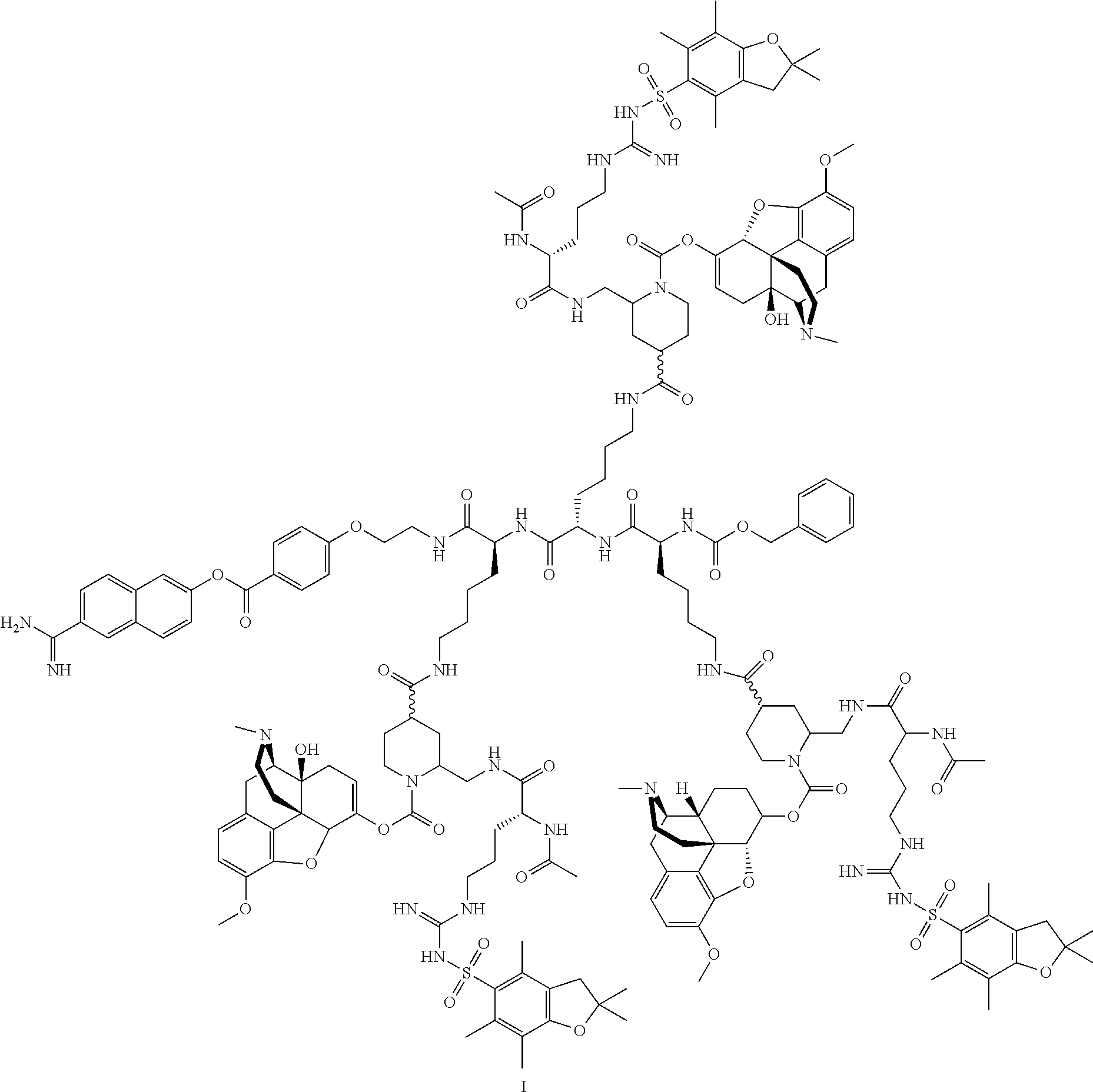
k) the peak plasma concentration of a drug after administration Cmax; l) the time taken by a drug to reach Cmax, Tmax; m) the lowest concentration that a drug reaches before the next dose is administered Cmin; and n) the peak trough fluctuation within one dosing interval at steady state, which can be represented as % PTF=100.
| TABLE 1 |
| Percent Nα-Benzoyl-L-arginine 4-nitroanilide |
| hydrochloride remaining vs. Time |
| Time (Minutes) |
| 2 | 13 | 24 | 80 | 102 | 119 | 234 |
| Com- | Concen- | Percent Nα-Benzoyl-L-arginine |
| pound | tration | 4-nitroanilide hydrochloride remaining |
| 2 | 1 | mM | 100 | 100 | 99 | 100 | 100 | 100 | 100 |
| 100 | uM | 100 | 98 | 100 | 99 | 99 | 99 | 99 | |
| 10 | uM | 100 | 98 | 96 | 94 | 93 | 94 | 87 | |
| 1 | uM | 100 | 39 | 0 | 0 | 0 | 0 | 0 |
| Trypsin Control | 100 | 0 | 0 | 0 | 0 | 0 | 0 |
| Buffer control | 100 | 100 | 99 | 99 | 99 | 99 | 98 |
| (no Trypsin) | |||||||
| TABLE 2 |
| Percent Nα-Benzoyl-L-arginine 4-nitroanilide hydrochloride remaining vs. Time |
| Time (Minutes) |
| 2 | 14 | 24 | 32 | 70 | 100 | 145 | 156 | 247 |
| Percent Nα-Benzoyl-L-arginine 4-nitroanilide |
| Compound | Concentration | hydrochloride remaining |
| 3 | 1 | mM | 100 | 99 | 98 | 99 | 99 | 98 | 98 | 97 | 96 |
| 100 | uM | 100 | 99 | 100 | 100 | 100 | 100 | 100 | 100 | 100 | |
| 10 | uM | 100 | 98 | 96 | 98 | 97 | 95 | 96 | 96 | 93 | |
| 1 | uM | 100 | 20 | 11 | 0 | 0 | 0 | 0 | 0 | 0 |
| Trypsin Control | 100 | 0 | 0 | 0 | 0 | 0 | 0 | 0 | 0 |
| Buffer control (no Trypsin) | 100 | 100 | 100 | 100 | 100 | 99 | 99 | 98 | 98 |
| PK Parameter | ||
| Maximum concentration | Time of maximum concentration | ||
| AUC0-8 h of hydrocodone | (Cmax) of hydrocodone | (Tmax) of hydrocodone | |
| in dog plasma | in dog plasma | in dog plasma |
| Dose | AUC0-8 h | Cmax | Tmax | ||||
| Compound | (umol/kg) | (ng · h/mL) | SD | (ng/mL HC) | SD | (h) | |
| 1 | 5 | 7.51 | 1.39 | 2.58 | 0.57 | 0.96 | 0.39 |
| 10 | 12.59 | 5.55 | 4 | 1.72 | 1.04 | 0.34 | |
| 35 | 27.8 | 1.76 | 6.76 | 0.88 | 2.25 | 0.96 | |
| 2 | 1.66 | 7.79 | 1.12 | 2.87 | 0.16 | 0.96 | 0.39 |
| 5 | 27 | 7.43 | 6.49 | 1.28 | 1.38 | 1.19 | |
| 10 | 37.68 | 9.25 | 8.37 | 1.94 | 2.08 | 1.69 | |
| 35 | 64.38 | 18.36 | 11.87 | 2.89 | 2.13 | 1.31 | |
Claims (43)
[R1-L1


Priority Applications (3)
| Application Number | Priority Date | Filing Date | Title |
|---|---|---|---|
| US16/286,096 US11129825B2 (en) | 2015-10-01 | 2019-02-26 | Polysubunit opioid prodrugs resistant to overdose and abuse |
| US17/884,305 US20230241054A1 (en) | 2015-10-01 | 2022-08-09 | Polysubunit opioid prodrugs resistant to overdose and abuse |
| US18/526,595 US20240165106A1 (en) | 2015-10-01 | 2023-12-01 | Polysubunit opioid prodrugs resistant to overdose and abuse |
Applications Claiming Priority (4)
| Application Number | Priority Date | Filing Date | Title |
|---|---|---|---|
| US201562236048P | 2015-10-01 | 2015-10-01 | |
| US15/284,269 US9808452B2 (en) | 2015-10-01 | 2016-10-03 | Polysubunit opioid prodrugs resistant to overdose and abuse |
| US15/683,356 US10251878B2 (en) | 2015-10-01 | 2017-08-22 | Polysubunit opioid prodrugs resistant to overdose and abuse |
| US16/286,096 US11129825B2 (en) | 2015-10-01 | 2019-02-26 | Polysubunit opioid prodrugs resistant to overdose and abuse |
Related Parent Applications (1)
| Application Number | Title | Priority Date | Filing Date |
|---|---|---|---|
| US15/683,356 Continuation US10251878B2 (en) | 2015-10-01 | 2017-08-22 | Polysubunit opioid prodrugs resistant to overdose and abuse |
Related Child Applications (1)
| Application Number | Title | Priority Date | Filing Date |
|---|---|---|---|
| US202117407037A Continuation | 2015-10-01 | 2021-08-19 |
Publications (2)
| Publication Number | Publication Date |
|---|---|
| US20190183884A1 US20190183884A1 (en) | 2019-06-20 |
| US11129825B2 true US11129825B2 (en) | 2021-09-28 |
Family
ID=58427994
Family Applications (5)
| Application Number | Title | Priority Date | Filing Date |
|---|---|---|---|
| US15/284,269 Active US9808452B2 (en) | 2015-10-01 | 2016-10-03 | Polysubunit opioid prodrugs resistant to overdose and abuse |
| US15/683,356 Active US10251878B2 (en) | 2015-10-01 | 2017-08-22 | Polysubunit opioid prodrugs resistant to overdose and abuse |
| US16/286,096 Active US11129825B2 (en) | 2015-10-01 | 2019-02-26 | Polysubunit opioid prodrugs resistant to overdose and abuse |
| US17/884,305 Abandoned US20230241054A1 (en) | 2015-10-01 | 2022-08-09 | Polysubunit opioid prodrugs resistant to overdose and abuse |
| US18/526,595 Pending US20240165106A1 (en) | 2015-10-01 | 2023-12-01 | Polysubunit opioid prodrugs resistant to overdose and abuse |
Family Applications Before (2)
| Application Number | Title | Priority Date | Filing Date |
|---|---|---|---|
| US15/284,269 Active US9808452B2 (en) | 2015-10-01 | 2016-10-03 | Polysubunit opioid prodrugs resistant to overdose and abuse |
| US15/683,356 Active US10251878B2 (en) | 2015-10-01 | 2017-08-22 | Polysubunit opioid prodrugs resistant to overdose and abuse |
Family Applications After (2)
| Application Number | Title | Priority Date | Filing Date |
|---|---|---|---|
| US17/884,305 Abandoned US20230241054A1 (en) | 2015-10-01 | 2022-08-09 | Polysubunit opioid prodrugs resistant to overdose and abuse |
| US18/526,595 Pending US20240165106A1 (en) | 2015-10-01 | 2023-12-01 | Polysubunit opioid prodrugs resistant to overdose and abuse |
Country Status (9)
| Country | Link |
|---|---|
| US (5) | US9808452B2 (en) |
| EP (1) | EP3355885B1 (en) |
| JP (4) | JP2018534269A (en) |
| AU (1) | AU2016332071B2 (en) |
| CA (1) | CA2998708C (en) |
| ES (1) | ES3070520T3 (en) |
| GB (1) | GB2556817B (en) |
| HK (1) | HK1259018A1 (en) |
| WO (1) | WO2017059459A1 (en) |
Families Citing this family (8)
| Publication number | Priority date | Publication date | Assignee | Title |
|---|---|---|---|---|
| US11634384B2 (en) | 2014-11-25 | 2023-04-25 | Concentric Analgesics, Inc. | Prodrugs of phenolic TRPV1 agonists |
| WO2017059459A1 (en) | 2015-10-01 | 2017-04-06 | Elysium Therapeutics, Inc. | Polysubunit opioid prodrugs resistant to overdose and abuse |
| US10335406B2 (en) | 2015-10-01 | 2019-07-02 | Elysium Therapeutics, Inc. | Opioid compositions resistant to overdose and abuse |
| CA3025268A1 (en) | 2016-05-25 | 2017-11-30 | Concentric Analgesics, Inc. | Prodrugs of phenolic trpv1 agonists in combination with local anesthetics and vasoconstrictors for improved local anesthesia |
| CA3056239C (en) * | 2017-03-17 | 2023-09-12 | Elysium Therapeutics, Inc. | Polysubunit opioid prodrugs resistant to overdose and abuse |
| US10717712B2 (en) | 2018-07-27 | 2020-07-21 | Concentric Analgesics, Inc. | Pegylated prodrugs of phenolic TRPV1 agonists |
| JP2023546137A (en) * | 2020-10-13 | 2023-11-01 | ザ ボード オブ リージェンツ オブ ザ ユニバーシティ オブ テキサス システム | Polymer conjugate microbubbles for large quantity drug/gene loading |
| CN113893384B (en) * | 2021-11-08 | 2022-06-21 | 山东省科学院生物研究所 | A kind of cross-linked chitosan microsphere and its application in wound hemostasis repair material |
Citations (95)
| Publication number | Priority date | Publication date | Assignee | Title |
|---|---|---|---|---|
| US2996431A (en) | 1953-12-16 | 1961-08-15 | Barry Richard Henry | Friable tablet and process for manufacturing same |
| US3139383A (en) | 1961-06-26 | 1964-06-30 | Norton Co | Encapsulated time release pellets and method for encapsulating the same |
| US3402240A (en) | 1957-06-25 | 1968-09-17 | Pfizer & Co C | Medicinal tablet and process of making same |
| US3811444A (en) | 1972-12-27 | 1974-05-21 | Alza Corp | Bioerodible ocular device |
| US3845770A (en) | 1972-06-05 | 1974-11-05 | Alza Corp | Osmatic dispensing device for releasing beneficial agent |
| US3916899A (en) | 1973-04-25 | 1975-11-04 | Alza Corp | Osmotic dispensing device with maximum and minimum sizes for the passageway |
| US3962414A (en) | 1972-04-27 | 1976-06-08 | Alza Corporation | Structured bioerodible drug delivery device |
| US3992518A (en) | 1974-10-24 | 1976-11-16 | G. D. Searle & Co. | Method for making a microsealed delivery device |
| US4063064A (en) | 1976-02-23 | 1977-12-13 | Coherent Radiation | Apparatus for tracking moving workpiece by a laser beam |
| US4066747A (en) | 1976-04-08 | 1978-01-03 | Alza Corporation | Polymeric orthoesters housing beneficial drug for controlled release therefrom |
| US4070347A (en) | 1976-08-16 | 1978-01-24 | Alza Corporation | Poly(orthoester) co- and homopolymers and poly(orthocarbonate) co- and homopolymers having carbonyloxy functionality |
| US4079038A (en) | 1976-03-05 | 1978-03-14 | Alza Corporation | Poly(carbonates) |
| US4083949A (en) | 1973-07-17 | 1978-04-11 | Byk Gulden Lomberg Chemische Fabrik Gmbh | New oral form of medicament and a method for producing it |
| US4088864A (en) | 1974-11-18 | 1978-05-09 | Alza Corporation | Process for forming outlet passageways in pills using a laser |
| US4093709A (en) | 1975-01-28 | 1978-06-06 | Alza Corporation | Drug delivery devices manufactured from poly(orthoesters) and poly(orthocarbonates) |
| US4200098A (en) | 1978-10-23 | 1980-04-29 | Alza Corporation | Osmotic system with distribution zone for dispensing beneficial agent |
| US4285987A (en) | 1978-10-23 | 1981-08-25 | Alza Corporation | Process for manufacturing device with dispersion zone |
| US4421736A (en) | 1982-05-20 | 1983-12-20 | Merrel Dow Pharmaceuticals Inc. | Sustained release diethylpropion compositions |
| US4434153A (en) | 1982-03-22 | 1984-02-28 | Alza Corporation | Drug delivery system comprising a reservoir containing a plurality of tiny pills |
| US4507466A (en) | 1983-01-07 | 1985-03-26 | The Dow Chemical Corporation | Dense star polymers having core, core branches, terminal groups |
| US4631337A (en) | 1983-01-07 | 1986-12-23 | The Dow Chemical Company | Hydrolytically-stable dense star polyamine |
| US4721613A (en) | 1982-12-13 | 1988-01-26 | Alza Corporation | Delivery system comprising means for shielding a multiplicity of reservoirs in selected environment of use |
| US4752470A (en) | 1986-11-24 | 1988-06-21 | Mehta Atul M | Controlled release indomethacin |
| US4765539A (en) | 1985-02-19 | 1988-08-23 | Imperial Chemical Industries Plc | Electrostatic spraying apparatus |
| US4816263A (en) | 1987-10-02 | 1989-03-28 | Alza Corporation | Dosage form for treating cardiovascular diseases comprising isradipine |
| US4820523A (en) | 1986-04-15 | 1989-04-11 | Warner-Lambert Company | Pharmaceutical composition |
| US4853229A (en) | 1987-10-26 | 1989-08-01 | Alza Corporation | Method for adminstering tiny pills |
| US4962885A (en) | 1978-04-17 | 1990-10-16 | Coffee Ronald A | Process and apparatus for spraying liquid |
| US5041516A (en) | 1989-06-21 | 1991-08-20 | Cornell Research Foundation, Inc. | Dendritic molecules and method of production |
| US5112598A (en) | 1988-05-04 | 1992-05-12 | Hermes Fabrik Pharmazeutischer Preparate Franz Gradinger Gmbh & Co. Kg | Vitamin a aerosol-inhalate preparations |
| US5159081A (en) | 1991-03-29 | 1992-10-27 | Eli Lilly And Company | Intermediates of peripherally selective n-carbonyl-3,4,4-trisubstituted piperidine opioid antagonists |
| US5177059A (en) | 1989-11-15 | 1993-01-05 | Sandoz Ltd. | Polymyxin B conjugates |
| US5250542A (en) | 1991-03-29 | 1993-10-05 | Eli Lilly And Company | Peripherally selective piperidine carboxylate opioid antagonists |
| US5270328A (en) | 1991-03-29 | 1993-12-14 | Eli Lilly And Company | Peripherally selective piperidine opioid antagonists |
| WO1994012285A2 (en) | 1992-12-01 | 1994-06-09 | Electrosols Ltd. | Dispensing device |
| WO1994014543A2 (en) | 1992-12-22 | 1994-07-07 | Electrosols Ltd. | Dispensing device |
| US5434171A (en) | 1993-12-08 | 1995-07-18 | Eli Lilly And Company | Preparation of 3,4,4-trisubstituted-piperidinyl-N-alkylcarboxylates and intermediates |
| WO1995026235A1 (en) | 1994-03-29 | 1995-10-05 | Electrosols Limited | Dispensing device |
| WO1995026234A1 (en) | 1994-03-29 | 1995-10-05 | Electrosols Limited | Dispensing device |
| US5468574A (en) | 1994-05-23 | 1995-11-21 | Dais Corporation | Fuel cell incorporating novel ion-conducting membrane |
| WO1995032807A1 (en) | 1994-05-27 | 1995-12-07 | Electrosols Ltd. | Dispensing device |
| US5530092A (en) | 1992-01-13 | 1996-06-25 | Dsm N.V. | Dendritic macromolecule and the preparation thereof |
| US5698155A (en) | 1991-05-31 | 1997-12-16 | Gs Technologies, Inc. | Method for the manufacture of pharmaceutical cellulose capsules |
| US5824701A (en) | 1993-10-20 | 1998-10-20 | Enzon, Inc. | Taxane-based prodrugs |
| US5840387A (en) | 1995-07-28 | 1998-11-24 | Aegis Biosciences L.L.C. | Sulfonated multiblock copolymer and uses therefor |
| US5880131A (en) | 1993-10-20 | 1999-03-09 | Enzon, Inc. | High molecular weight polymer-based prodrugs |
| US5932462A (en) | 1995-01-10 | 1999-08-03 | Shearwater Polymers, Inc. | Multiarmed, monofunctional, polymer for coupling to molecules and surfaces |
| US5950619A (en) | 1995-03-14 | 1999-09-14 | Siemens Aktiengesellschaft | Ultrasonic atomizer device with removable precision dosating unit |
| US5954047A (en) | 1997-10-17 | 1999-09-21 | Systemic Pulmonary Development, Ltd. | Methods and apparatus for delivering aerosolized medication |
| US5970974A (en) | 1995-03-14 | 1999-10-26 | Siemens Aktiengesellschaft | Dosating unit for an ultrasonic atomizer device |
| US6171615B1 (en) | 1998-07-06 | 2001-01-09 | Gattefoss{acute over (e)} | Sustained release theophylline formulations, excipient systems and methods of production |
| US6375987B1 (en) | 1996-10-01 | 2002-04-23 | Gattefossé, S.A. | Process for the manufacture of pharmaceutical composition with modified release of active principle comprising the matrix |
| US6379700B2 (en) | 1998-06-16 | 2002-04-30 | Gattefosse S.A. | Process for manufacturing tablets for the sustained release of active principle(s) |
| US6545097B2 (en) | 2000-12-12 | 2003-04-08 | Scimed Life Systems, Inc. | Drug delivery compositions and medical devices containing block copolymer |
| US6664331B2 (en) | 1998-03-12 | 2003-12-16 | Nektar Therapeutics Al, Corporation | Poly(ethylene glycol) derivatives with proximal reactive groups |
| US20040043030A1 (en) | 2001-07-31 | 2004-03-04 | Immunomedics, Inc. | Polymeric delivery systems |
| US6716821B2 (en) | 2001-12-21 | 2004-04-06 | Immunogen Inc. | Cytotoxic agents bearing a reactive polyethylene glycol moiety, cytotoxic conjugates comprising polyethylene glycol linking groups, and methods of making and using the same |
| WO2004041324A2 (en) | 2002-10-30 | 2004-05-21 | Mylan Pharmaceuticals, Inc. | Transdermal delivery of fentanyl |
| WO2004062614A2 (en) | 2003-01-13 | 2004-07-29 | New River Pharmaceuticals Inc. | Carbohydrate conjugates to prevent abuse of controlled substances |
| WO2004082620A2 (en) | 2003-03-13 | 2004-09-30 | Controlled Chemicals, Inc. | Oxycodone conjugates with lower the abuse potential and extended duration of action |
| US20050037059A1 (en) | 2003-08-15 | 2005-02-17 | Mylan Technologies, Inc. | Transdermal patch incorporating active agent migration barrier layer |
| US20050176644A1 (en) | 2003-09-30 | 2005-08-11 | New River Pharmaceuticals Inc. | Compounds and compositions for prevention of overdose of oxycodone |
| US7060290B1 (en) | 1999-02-18 | 2006-06-13 | Supergen, Inc. | Phosphocholine linked prodrug derivatives |
| WO2006073396A1 (en) | 2005-01-05 | 2006-07-13 | Regents Of The University Of Minnesota | Analgesic conjugates |
| WO2007120864A2 (en) | 2006-04-14 | 2007-10-25 | Shire Llc | Compositions and methods for enhancing analgesic potency of covalently bound compounds, attenuating its adverse side effects, and preventing their abuse |
| WO2007140272A2 (en) | 2006-05-26 | 2007-12-06 | Pharmacofore, Inc. | Controlled release of phenolic opioids |
| US7338939B2 (en) | 2003-09-30 | 2008-03-04 | New River Pharmaceuticals Inc. | Abuse-resistant hydrocodone compounds |
| US7375082B2 (en) | 2002-02-22 | 2008-05-20 | Shire Llc | Abuse-resistant hydrocodone compounds |
| WO2008101187A2 (en) | 2007-02-16 | 2008-08-21 | Pharmacofore, Inc. | Pro-drugs of peripheral phenolic opioid antagonists |
| US20090137618A1 (en) | 2007-11-26 | 2009-05-28 | Jenkins Thomas E | Pro-drugs for controlled release of biologically active compounds |
| US20090136980A1 (en) | 2001-06-11 | 2009-05-28 | Medarex, Inc. | CD10-activated prodrug compounds |
| WO2009092073A2 (en) | 2008-01-18 | 2009-07-23 | Shire Llc | Amino acid and peptide prodrugs of opioid analgesics with reduced gi side-effects |
| US20090209569A1 (en) | 2008-02-14 | 2009-08-20 | Alkermes, Inc. | Selective opioid compounds |
| US20100080797A1 (en) | 2005-08-26 | 2010-04-01 | Yeomans David C | Therapy procedure for drug delivery for trigeminal pain |
| WO2010045599A1 (en) | 2008-10-17 | 2010-04-22 | Pharmacofore, Inc. | Pharmaceutical compositions with attenuated release of phenolic opioids |
| WO2011002991A1 (en) | 2009-07-02 | 2011-01-06 | Kempharm, Inc. | Benzoic acid, benzoic acid derivatives and heteroaryl carboxylic acid conjugates of hydrocodone, prodrugs, methods of making and use thereof |
| WO2011002995A1 (en) | 2009-07-02 | 2011-01-06 | Kempharm, Inc. | Phenylethanoic acid, phenylpropanoic acid and phenylpropenoic acid conjugates and prodrugs of hydrocodone, methods of making and use thereof |
| US20110262360A1 (en) | 2010-04-21 | 2011-10-27 | Jenkins Thomas E | Compositions Comprising Enzyme-Cleavable Phenol-Modified Opioid Prodrugs and Inhibitors Thereof |
| WO2011133150A1 (en) | 2010-04-21 | 2011-10-27 | Pharmacofore, Inc. | Compositions comprising enzyme-cleavable prodrugs of active agents and inhibitors thereof |
| US20110262359A1 (en) | 2010-04-21 | 2011-10-27 | Jenkins Thomas E | Compositions comprising enzyme-cleavable prodrugs of active agents and inhibitors thereof |
| US8101661B2 (en) | 2006-12-11 | 2012-01-24 | Kempharm, Inc. | Polar hydrophilic prodrugs and non-standard amino acid conjugates of amphetamine and other stimulants and processes for making and using the same |
| US8133881B2 (en) | 2003-01-13 | 2012-03-13 | Shire Llc | Carbohydrate conjugates to prevent abuse of controlled substances |
| US8163701B2 (en) | 2005-08-19 | 2012-04-24 | Signature Therapeutics, Inc. | Prodrugs of active agents |
| US20120142718A1 (en) | 2007-02-16 | 2012-06-07 | Jenkins Thomas E | N-17-Alkylated Prodrugs of Opioids |
| US20120178773A1 (en) | 2011-01-11 | 2012-07-12 | Jenkins Thomas E | Compositions Comprising Enzyme-Cleavable Oxycodone Prodrug |
| WO2012109445A1 (en) | 2011-02-09 | 2012-08-16 | QRxPharma Ltd. | Hybrid opioid compounds and compositions |
| WO2012122420A2 (en) | 2011-03-09 | 2012-09-13 | Pharmacofore, Inc. | Opioid prodrugs with heterocyclic linkers |
| US8569228B2 (en) | 2011-01-11 | 2013-10-29 | Signature Therapeutics, Inc. | Compositions comprising enzyme-cleavable oxycodone prodrug |
| US20140016935A1 (en) | 2007-10-29 | 2014-01-16 | Lockheed Martin Corporation | Fiber optic network adjustment |
| US9040032B2 (en) | 2010-04-21 | 2015-05-26 | Signature Therapeutics, Inc. | Compositions comprising enzyme-cleavable opioid prodrugs and inhibitors thereof |
| US9139612B2 (en) | 2011-03-09 | 2015-09-22 | Signature Therapeutics, Inc. | Active agent prodrugs with heterocyclic linkers |
| US9217005B2 (en) | 2010-08-26 | 2015-12-22 | Takasago International Corporation | Ruthenium-diamine complexes and method for producing optically active compounds |
| WO2017059459A1 (en) | 2015-10-01 | 2017-04-06 | Elysium Therapeutics, Inc. | Polysubunit opioid prodrugs resistant to overdose and abuse |
| US20180085366A1 (en) | 2015-10-01 | 2018-03-29 | Elysium Therapeutics, Inc. | Opioid compositions resistant to overdose and abuse |
| WO2018170465A1 (en) | 2017-03-17 | 2018-09-20 | Elysium Therapeutics, Inc. | Polysubunit opioid prodrugs resistant to overdose and abuse |
-
2016
- 2016-10-03 WO PCT/US2016/055231 patent/WO2017059459A1/en not_active Ceased
- 2016-10-03 ES ES16852850T patent/ES3070520T3/en active Active
- 2016-10-03 JP JP2018517265A patent/JP2018534269A/en not_active Withdrawn
- 2016-10-03 EP EP16852850.3A patent/EP3355885B1/en active Active
- 2016-10-03 HK HK19101505.5A patent/HK1259018A1/en unknown
- 2016-10-03 AU AU2016332071A patent/AU2016332071B2/en active Active
- 2016-10-03 GB GB1804135.0A patent/GB2556817B/en active Active
- 2016-10-03 US US15/284,269 patent/US9808452B2/en active Active
- 2016-10-03 CA CA2998708A patent/CA2998708C/en active Active
-
2017
- 2017-08-22 US US15/683,356 patent/US10251878B2/en active Active
-
2019
- 2019-02-26 US US16/286,096 patent/US11129825B2/en active Active
- 2019-08-16 JP JP2019149399A patent/JP7621054B2/en active Active
-
2021
- 2021-03-02 JP JP2021032969A patent/JP2021080295A/en not_active Withdrawn
-
2022
- 2022-08-09 US US17/884,305 patent/US20230241054A1/en not_active Abandoned
-
2023
- 2023-04-06 JP JP2023062126A patent/JP2023076679A/en active Pending
- 2023-12-01 US US18/526,595 patent/US20240165106A1/en active Pending
Patent Citations (108)
| Publication number | Priority date | Publication date | Assignee | Title |
|---|---|---|---|---|
| US2996431A (en) | 1953-12-16 | 1961-08-15 | Barry Richard Henry | Friable tablet and process for manufacturing same |
| US3402240A (en) | 1957-06-25 | 1968-09-17 | Pfizer & Co C | Medicinal tablet and process of making same |
| US3139383A (en) | 1961-06-26 | 1964-06-30 | Norton Co | Encapsulated time release pellets and method for encapsulating the same |
| US3962414A (en) | 1972-04-27 | 1976-06-08 | Alza Corporation | Structured bioerodible drug delivery device |
| US3845770A (en) | 1972-06-05 | 1974-11-05 | Alza Corp | Osmatic dispensing device for releasing beneficial agent |
| US3811444A (en) | 1972-12-27 | 1974-05-21 | Alza Corp | Bioerodible ocular device |
| US3916899A (en) | 1973-04-25 | 1975-11-04 | Alza Corp | Osmotic dispensing device with maximum and minimum sizes for the passageway |
| US4083949A (en) | 1973-07-17 | 1978-04-11 | Byk Gulden Lomberg Chemische Fabrik Gmbh | New oral form of medicament and a method for producing it |
| US3992518A (en) | 1974-10-24 | 1976-11-16 | G. D. Searle & Co. | Method for making a microsealed delivery device |
| US4088864A (en) | 1974-11-18 | 1978-05-09 | Alza Corporation | Process for forming outlet passageways in pills using a laser |
| US4093709A (en) | 1975-01-28 | 1978-06-06 | Alza Corporation | Drug delivery devices manufactured from poly(orthoesters) and poly(orthocarbonates) |
| US4063064A (en) | 1976-02-23 | 1977-12-13 | Coherent Radiation | Apparatus for tracking moving workpiece by a laser beam |
| US4079038A (en) | 1976-03-05 | 1978-03-14 | Alza Corporation | Poly(carbonates) |
| US4066747A (en) | 1976-04-08 | 1978-01-03 | Alza Corporation | Polymeric orthoesters housing beneficial drug for controlled release therefrom |
| US4070347A (en) | 1976-08-16 | 1978-01-24 | Alza Corporation | Poly(orthoester) co- and homopolymers and poly(orthocarbonate) co- and homopolymers having carbonyloxy functionality |
| US4962885A (en) | 1978-04-17 | 1990-10-16 | Coffee Ronald A | Process and apparatus for spraying liquid |
| US4285987A (en) | 1978-10-23 | 1981-08-25 | Alza Corporation | Process for manufacturing device with dispersion zone |
| US4200098A (en) | 1978-10-23 | 1980-04-29 | Alza Corporation | Osmotic system with distribution zone for dispensing beneficial agent |
| US4434153A (en) | 1982-03-22 | 1984-02-28 | Alza Corporation | Drug delivery system comprising a reservoir containing a plurality of tiny pills |
| US4421736A (en) | 1982-05-20 | 1983-12-20 | Merrel Dow Pharmaceuticals Inc. | Sustained release diethylpropion compositions |
| US4721613A (en) | 1982-12-13 | 1988-01-26 | Alza Corporation | Delivery system comprising means for shielding a multiplicity of reservoirs in selected environment of use |
| US4507466A (en) | 1983-01-07 | 1985-03-26 | The Dow Chemical Corporation | Dense star polymers having core, core branches, terminal groups |
| US4631337A (en) | 1983-01-07 | 1986-12-23 | The Dow Chemical Company | Hydrolytically-stable dense star polyamine |
| US4765539A (en) | 1985-02-19 | 1988-08-23 | Imperial Chemical Industries Plc | Electrostatic spraying apparatus |
| US4820523A (en) | 1986-04-15 | 1989-04-11 | Warner-Lambert Company | Pharmaceutical composition |
| US4752470A (en) | 1986-11-24 | 1988-06-21 | Mehta Atul M | Controlled release indomethacin |
| US4816263A (en) | 1987-10-02 | 1989-03-28 | Alza Corporation | Dosage form for treating cardiovascular diseases comprising isradipine |
| US4853229A (en) | 1987-10-26 | 1989-08-01 | Alza Corporation | Method for adminstering tiny pills |
| US5112598A (en) | 1988-05-04 | 1992-05-12 | Hermes Fabrik Pharmazeutischer Preparate Franz Gradinger Gmbh & Co. Kg | Vitamin a aerosol-inhalate preparations |
| US5556611A (en) | 1988-05-04 | 1996-09-17 | Hermes Fabrik Pharmazeutischer Praparate | Vitamin A aerosol-inhalant preparations and method |
| US5041516A (en) | 1989-06-21 | 1991-08-20 | Cornell Research Foundation, Inc. | Dendritic molecules and method of production |
| US5177059A (en) | 1989-11-15 | 1993-01-05 | Sandoz Ltd. | Polymyxin B conjugates |
| US5250542A (en) | 1991-03-29 | 1993-10-05 | Eli Lilly And Company | Peripherally selective piperidine carboxylate opioid antagonists |
| US5270328A (en) | 1991-03-29 | 1993-12-14 | Eli Lilly And Company | Peripherally selective piperidine opioid antagonists |
| US5159081A (en) | 1991-03-29 | 1992-10-27 | Eli Lilly And Company | Intermediates of peripherally selective n-carbonyl-3,4,4-trisubstituted piperidine opioid antagonists |
| US5698155A (en) | 1991-05-31 | 1997-12-16 | Gs Technologies, Inc. | Method for the manufacture of pharmaceutical cellulose capsules |
| US5530092A (en) | 1992-01-13 | 1996-06-25 | Dsm N.V. | Dendritic macromolecule and the preparation thereof |
| WO1994012285A2 (en) | 1992-12-01 | 1994-06-09 | Electrosols Ltd. | Dispensing device |
| WO1994014543A2 (en) | 1992-12-22 | 1994-07-07 | Electrosols Ltd. | Dispensing device |
| US5880131A (en) | 1993-10-20 | 1999-03-09 | Enzon, Inc. | High molecular weight polymer-based prodrugs |
| US5824701A (en) | 1993-10-20 | 1998-10-20 | Enzon, Inc. | Taxane-based prodrugs |
| US5434171A (en) | 1993-12-08 | 1995-07-18 | Eli Lilly And Company | Preparation of 3,4,4-trisubstituted-piperidinyl-N-alkylcarboxylates and intermediates |
| WO1995026235A1 (en) | 1994-03-29 | 1995-10-05 | Electrosols Limited | Dispensing device |
| WO1995026234A1 (en) | 1994-03-29 | 1995-10-05 | Electrosols Limited | Dispensing device |
| US5468574A (en) | 1994-05-23 | 1995-11-21 | Dais Corporation | Fuel cell incorporating novel ion-conducting membrane |
| WO1995032807A1 (en) | 1994-05-27 | 1995-12-07 | Electrosols Ltd. | Dispensing device |
| US5932462A (en) | 1995-01-10 | 1999-08-03 | Shearwater Polymers, Inc. | Multiarmed, monofunctional, polymer for coupling to molecules and surfaces |
| US5950619A (en) | 1995-03-14 | 1999-09-14 | Siemens Aktiengesellschaft | Ultrasonic atomizer device with removable precision dosating unit |
| US5970974A (en) | 1995-03-14 | 1999-10-26 | Siemens Aktiengesellschaft | Dosating unit for an ultrasonic atomizer device |
| US5840387A (en) | 1995-07-28 | 1998-11-24 | Aegis Biosciences L.L.C. | Sulfonated multiblock copolymer and uses therefor |
| US6375987B1 (en) | 1996-10-01 | 2002-04-23 | Gattefossé, S.A. | Process for the manufacture of pharmaceutical composition with modified release of active principle comprising the matrix |
| US5954047A (en) | 1997-10-17 | 1999-09-21 | Systemic Pulmonary Development, Ltd. | Methods and apparatus for delivering aerosolized medication |
| US6664331B2 (en) | 1998-03-12 | 2003-12-16 | Nektar Therapeutics Al, Corporation | Poly(ethylene glycol) derivatives with proximal reactive groups |
| US6379700B2 (en) | 1998-06-16 | 2002-04-30 | Gattefosse S.A. | Process for manufacturing tablets for the sustained release of active principle(s) |
| US6171615B1 (en) | 1998-07-06 | 2001-01-09 | Gattefoss{acute over (e)} | Sustained release theophylline formulations, excipient systems and methods of production |
| US7060290B1 (en) | 1999-02-18 | 2006-06-13 | Supergen, Inc. | Phosphocholine linked prodrug derivatives |
| US6545097B2 (en) | 2000-12-12 | 2003-04-08 | Scimed Life Systems, Inc. | Drug delivery compositions and medical devices containing block copolymer |
| US20090136980A1 (en) | 2001-06-11 | 2009-05-28 | Medarex, Inc. | CD10-activated prodrug compounds |
| US20040043030A1 (en) | 2001-07-31 | 2004-03-04 | Immunomedics, Inc. | Polymeric delivery systems |
| US6716821B2 (en) | 2001-12-21 | 2004-04-06 | Immunogen Inc. | Cytotoxic agents bearing a reactive polyethylene glycol moiety, cytotoxic conjugates comprising polyethylene glycol linking groups, and methods of making and using the same |
| US7375082B2 (en) | 2002-02-22 | 2008-05-20 | Shire Llc | Abuse-resistant hydrocodone compounds |
| WO2004041324A2 (en) | 2002-10-30 | 2004-05-21 | Mylan Pharmaceuticals, Inc. | Transdermal delivery of fentanyl |
| US8133881B2 (en) | 2003-01-13 | 2012-03-13 | Shire Llc | Carbohydrate conjugates to prevent abuse of controlled substances |
| WO2004062614A2 (en) | 2003-01-13 | 2004-07-29 | New River Pharmaceuticals Inc. | Carbohydrate conjugates to prevent abuse of controlled substances |
| WO2004082620A2 (en) | 2003-03-13 | 2004-09-30 | Controlled Chemicals, Inc. | Oxycodone conjugates with lower the abuse potential and extended duration of action |
| US20050037059A1 (en) | 2003-08-15 | 2005-02-17 | Mylan Technologies, Inc. | Transdermal patch incorporating active agent migration barrier layer |
| US20050176644A1 (en) | 2003-09-30 | 2005-08-11 | New River Pharmaceuticals Inc. | Compounds and compositions for prevention of overdose of oxycodone |
| US7338939B2 (en) | 2003-09-30 | 2008-03-04 | New River Pharmaceuticals Inc. | Abuse-resistant hydrocodone compounds |
| WO2006073396A1 (en) | 2005-01-05 | 2006-07-13 | Regents Of The University Of Minnesota | Analgesic conjugates |
| US8163701B2 (en) | 2005-08-19 | 2012-04-24 | Signature Therapeutics, Inc. | Prodrugs of active agents |
| US20100080797A1 (en) | 2005-08-26 | 2010-04-01 | Yeomans David C | Therapy procedure for drug delivery for trigeminal pain |
| WO2007120864A2 (en) | 2006-04-14 | 2007-10-25 | Shire Llc | Compositions and methods for enhancing analgesic potency of covalently bound compounds, attenuating its adverse side effects, and preventing their abuse |
| WO2007140272A2 (en) | 2006-05-26 | 2007-12-06 | Pharmacofore, Inc. | Controlled release of phenolic opioids |
| US8217005B2 (en) | 2006-05-26 | 2012-07-10 | Signature Therapeutics, Inc. | Controlled release of phenolic opioids |
| US8101661B2 (en) | 2006-12-11 | 2012-01-24 | Kempharm, Inc. | Polar hydrophilic prodrugs and non-standard amino acid conjugates of amphetamine and other stimulants and processes for making and using the same |
| US20120142718A1 (en) | 2007-02-16 | 2012-06-07 | Jenkins Thomas E | N-17-Alkylated Prodrugs of Opioids |
| WO2008101187A2 (en) | 2007-02-16 | 2008-08-21 | Pharmacofore, Inc. | Pro-drugs of peripheral phenolic opioid antagonists |
| US20140016935A1 (en) | 2007-10-29 | 2014-01-16 | Lockheed Martin Corporation | Fiber optic network adjustment |
| US20090137618A1 (en) | 2007-11-26 | 2009-05-28 | Jenkins Thomas E | Pro-drugs for controlled release of biologically active compounds |
| WO2009092073A2 (en) | 2008-01-18 | 2009-07-23 | Shire Llc | Amino acid and peptide prodrugs of opioid analgesics with reduced gi side-effects |
| US20090209569A1 (en) | 2008-02-14 | 2009-08-20 | Alkermes, Inc. | Selective opioid compounds |
| US8802681B2 (en) | 2008-10-17 | 2014-08-12 | Signature Therapeutics, Inc. | Pharmaceutical compositions with attenuated release of phenolic opioids |
| WO2010045599A1 (en) | 2008-10-17 | 2010-04-22 | Pharmacofore, Inc. | Pharmaceutical compositions with attenuated release of phenolic opioids |
| US20110281886A1 (en) * | 2008-10-17 | 2011-11-17 | Jenkins Thomas E | Pharmaceutical Compositions with Attenuated Release of Phenolic Opioids |
| WO2011002995A1 (en) | 2009-07-02 | 2011-01-06 | Kempharm, Inc. | Phenylethanoic acid, phenylpropanoic acid and phenylpropenoic acid conjugates and prodrugs of hydrocodone, methods of making and use thereof |
| WO2011002991A1 (en) | 2009-07-02 | 2011-01-06 | Kempharm, Inc. | Benzoic acid, benzoic acid derivatives and heteroaryl carboxylic acid conjugates of hydrocodone, prodrugs, methods of making and use thereof |
| US20110262360A1 (en) | 2010-04-21 | 2011-10-27 | Jenkins Thomas E | Compositions Comprising Enzyme-Cleavable Phenol-Modified Opioid Prodrugs and Inhibitors Thereof |
| US9040032B2 (en) | 2010-04-21 | 2015-05-26 | Signature Therapeutics, Inc. | Compositions comprising enzyme-cleavable opioid prodrugs and inhibitors thereof |
| WO2011133150A1 (en) | 2010-04-21 | 2011-10-27 | Pharmacofore, Inc. | Compositions comprising enzyme-cleavable prodrugs of active agents and inhibitors thereof |
| US20110262359A1 (en) | 2010-04-21 | 2011-10-27 | Jenkins Thomas E | Compositions comprising enzyme-cleavable prodrugs of active agents and inhibitors thereof |
| US9217005B2 (en) | 2010-08-26 | 2015-12-22 | Takasago International Corporation | Ruthenium-diamine complexes and method for producing optically active compounds |
| US20120178773A1 (en) | 2011-01-11 | 2012-07-12 | Jenkins Thomas E | Compositions Comprising Enzyme-Cleavable Oxycodone Prodrug |
| US9499581B2 (en) | 2011-01-11 | 2016-11-22 | Signature Therapeutics, Inc. | Compositions comprising enzyme-cleavable oxycodone prodrug |
| US8497237B2 (en) | 2011-01-11 | 2013-07-30 | Signature Therapeutics, Inc. | Compositions comprising enzyme-cleavable oxycodone prodrug |
| US8569228B2 (en) | 2011-01-11 | 2013-10-29 | Signature Therapeutics, Inc. | Compositions comprising enzyme-cleavable oxycodone prodrug |
| WO2012109445A1 (en) | 2011-02-09 | 2012-08-16 | QRxPharma Ltd. | Hybrid opioid compounds and compositions |
| US9095627B2 (en) | 2011-03-09 | 2015-08-04 | Signature Therapeutics, Inc. | Opioid prodrugs with heterocyclic linkers |
| US9139612B2 (en) | 2011-03-09 | 2015-09-22 | Signature Therapeutics, Inc. | Active agent prodrugs with heterocyclic linkers |
| US8685916B2 (en) | 2011-03-09 | 2014-04-01 | Signature Therapeutics, Inc. | Opioid prodrugs with heterocyclic linkers |
| WO2012122420A2 (en) | 2011-03-09 | 2012-09-13 | Pharmacofore, Inc. | Opioid prodrugs with heterocyclic linkers |
| WO2017059459A1 (en) | 2015-10-01 | 2017-04-06 | Elysium Therapeutics, Inc. | Polysubunit opioid prodrugs resistant to overdose and abuse |
| US20170100390A1 (en) | 2015-10-01 | 2017-04-13 | Elysium Therapeutics, Inc. | Polysubunit opioid prodrugs resistant to overdose and abuse |
| US9808452B2 (en) | 2015-10-01 | 2017-11-07 | Elysium Therapeutics, Inc. | Polysubunit opioid prodrugs resistant to overdose and abuse |
| US20180085366A1 (en) | 2015-10-01 | 2018-03-29 | Elysium Therapeutics, Inc. | Opioid compositions resistant to overdose and abuse |
| US10335406B2 (en) | 2015-10-01 | 2019-07-02 | Elysium Therapeutics, Inc. | Opioid compositions resistant to overdose and abuse |
| US20200093817A1 (en) | 2015-10-01 | 2020-03-26 | Elysium Therapeutics, Inc. | Opioid compositions resistant to overdose and abuse |
| WO2018170465A1 (en) | 2017-03-17 | 2018-09-20 | Elysium Therapeutics, Inc. | Polysubunit opioid prodrugs resistant to overdose and abuse |
| US20200101166A1 (en) | 2017-03-17 | 2020-04-02 | Elysium Therapeutics, Inc. | Polysubunit opioid prodrugs resistant to overdose and abuse |
Non-Patent Citations (63)
| Title |
|---|
| Alderman, et al. A review of cellulose ethers in hydrophilic matrices for oral controlled-release dosage forms. Int. J. Pharm. Tech. Prod. Mfr 5.3 (1984): 1-9. |
| Aoyama, et al. Synthesis and structure-activity study of protease inhibitors. IV. Amidinonaphthols and related acyl derivatives. Chem Pharm Bull (Tokyo). Apr. 1985;33(4):1458-71. |
| Bak, et al. Acyloxyalkoxy-based Cyclic Prodrugs of Opioid Peptides: Evaluation of the Chemical and Enzymatic Stability as well as Their Transport Properties Across Caco-2 Cell Monolayers. Pharmaceutical Research, 1999, vol. 16, pp. 24-29. |
| Bamba, et al. Release mechanisms in gelforming sustained release preparations. International Journal of Pharmaceutics. vol. 2, Issues 5-6, Jun. 1979, pp. 307-315. |
| Birk, Y. Trypsin and chymotrypsin inhibitors from soybeans. Methods Enzymol. 1976;45:700-7. |
| Coleman, et al. Polymer Reviews: A Practical Guide to Polymer Miscibility. 1990, 31, 1187-1231. |
| Definition of "ex vivo" from thefreedictionary.com, accessed Oct. 7, 2014. |
| During, et al. Controlled release of dopamine from a polymeric brain implant: in vivo characterization. Ann Neurol. Apr. 1989;25(4):351-6. |
| EP16852850.3 The Extended European Search report dated Mar. 21, 2019. |
| EP18766937.9 The Extended European Search Report dated Dec. 14, 2020. |
| FDA Center for Drug Evaluation and Research, Joint Meeting of the Anesthetic and Life Support Drugs Advisory Committee and the Drug Safety and Risk Management Advisory Committee, Meeting Transcript, Jul. 23-4, 2010. |
| Fincher, JH. Particle size of drugs and its relationship to absorption and activity. J Pharm Sci. Nov. 1968;57(11):1825-35. |
| Geratz, et al. Novel Bis(benzamidine) Compounds with an Aromatic Central Link. Inhibitors of Thrombin, Pancreatic Kallkrein, I Trypsin, and Compliment. J. Medicinal Chemistry, 1976, vol. 19, pp. 634-639. |
| Goodson. Medical Applications of Controlled Release. vol. 2, pp. 115-138, 1984. |
| Gotoh, et al. The Advantages of the Ussing Chamber in Drug Absorption Studies. Journal of Biomolecular Screening 10(5), pp. 517-523, 2005. |
| Gunatillake, et al. Thermal polymerization of a 2-(carboxyalkyl)-2-oxazoline. Macromolecules, 1988, 21 (6), pp. 1556-1562. |
| Hawker, et al. One-step synthesis of hyperbranched dendritic polyesters. J. Am. Chem. Soc., 1991, 113 (12), pp. 4583-4588. |
| Howard, et al. Intracerebral drug delivery in rats with lesion-induced memory deficits. J Neurosurg. Jul. 1989;71(1):105-12. |
| International Search Report with Opinion dated Dec. 23, 2016 for PCT/US16/55231. |
| Ito et al. in Cancer Science 94(1), 3-8 (2003) (Year: 2003). * |
| Ito et al. in Cancer Science 94(1), 3-8 (2003) (Year: 2003). * |
| Ito, et al. A medium-term rat liver bioassay for rapid in vivo detection of carcinogenic potential of chemicals. Cancer Sci. Jan. 2003;94(1):3-8. |
| Kaneda, et al. The use of PVP as a polymeric carrier to improve the plasma half-life of drugs. Biomaterials. Jul. 2004;25(16):3259-66. |
| Kitayama, et al. A synthetic route to ultra-high molecular weight polystyrene ( 10 6) with narrow molecular weight distribution by emulsifier-free, emulsion organotellurium-mediated living radical polymerization (emulsion TERP). Polymer Chemistry 7.14 (2016): 2573-2580. |
| Langer, et al. Chemical and Physical Structure of Polymers as Carriers for Controlled Release of Bioactive Agents: A Review. J Macromol. Sci. Rev. Macromol. Chem. 1983, 23:61-126. |
| Langer, R. New methods of drug delivery. Science. Sep. 28, 1990;249(4976):1527-33. |
| Leong, et al. Polymeric controlled drug delivery. Advanced Drug Delivery Reviews, vol. 1, Issue 3, Sep. 1988, pp. 199-233. |
| Levy, et al. Inhibition of calcification of bioprosthetic heart valves by local controlled-release diphosphonate. Science. Apr. 12, 1985;228(4696):190-2. |
| Lin, et al. The 0.25-nm X-ray structure of the Bowman-Birk-type inhibitor from mun gean in ternary complex with porcine trypsin. Eur. J. Biochem, 1993, vol. 212, pp. 549-555. |
| Lu, et al. Dimensionless presentation for drug release from a coated pure drug bead: 2. Experiment. Int. J. Pharm. 1994, 112, 117-124. |
| Markwardt, et al. Comparative Studies on the Inhibition of Trypsin, Plasmin, and Thrombin, by Derivatives of Benzylamine and Benzylamidine. Eur. J. Biochem, 1968, vol. 6, pp. 502-506. |
| Notice of allowance dated Aug. 17, 2017 for U.S. Appl. No. 15/284,269. |
| Ozawa, et al. The reactive site of trypsin inhibitors. J Biol Chem. Sep. 10, 1966;241(17):3955-61. |
| PCT/US2018/022986 International Search Report dated May 31, 2018. |
| Raleigh, et al. American Association for Cancer Research Anuual Meeting. 1999, 40, 397. |
| Roerdink, et al. Drug Carrier Systems 1989, vol. 9, chapter 3, pp. 57-109. |
| Rosoff. Controlled Release of Drugs. Chapter 2, pp. 53-95, 1989. |
| Saudek, et al. A preliminary trial of the programmable implantable medication system for insulin delivery. N. Engl J Med. Aug. 31, 1989;321(9):574-9. |
| Schanker, et al. Absorption of drugs from the rat small intestine. Journal of Pharmacology and Experimental Therapeutics 123.1 (1958): 81-88. |
| Sefton, MV. Implantable pumps. Crit Rev Biomed Eng. 1987;14(3):201-40. |
| Sekizaki et al. "The Structural Requirements for an Inverse Substrate for Enzymatic Peptide Synthesis: Position Isomers of Guanidononaphthyl Esters as the Acyl Donor Component", Chem. Pharm. Bull. 1999. vol. 47(1), pp. 104-110. |
| Sekizaki, et al. Synthesis and tryptic hydrolysis of p-guanidinophenyl esters derived from amino acids and peptides. Chem Pharm Bull (Tokyo). Aug. 1996;44(8):1577-9. |
| Sekizaki, et al. Trypsin-catalyzed peptide synthesis and various p-guanidinophenyl esters as acyl donors. Chem Pharm Bull (Tokyo). Aug. 1996;44(8):1585-7. |
| Thanou, et al. Polymer-protein and polymer-drug conjugates in cancer therapy. Curr Opin Investig Drugs. Jun. 2003;4(6):701-9. |
| Thormann, et al. Protease-catalyzed hydrolysis of substrate mimetics (inverse substrates): A new approach reveals a new mechanism. Biochemistry. May 11, 1999;38(19):6056-62. |
| Tomalia, et al. Discovery of dendrimers and dendritic polymers: A brief historical perspective. Journal of Polymer Science Part A: Polymer Chemistry. vol. 40, Issue 16, pp. 2719-2728, Aug. 15, 2002. |
| U.S. Appl. No. 15/683,356 Notice of Allowance dated Feb. 8, 2019. |
| U.S. Appl. No. 15/683,356 Notice of Allowance dated Jan. 3, 2019. |
| U.S. Appl. No. 15/683,356 Notice of Allowance dated Jan. 9, 2019. |
| U.S. Appl. No. 15/683,356 Notice of Allowance dated Nov. 26, 2018. |
| U.S. Appl. No. 15/683,356 Office Action dated Aug. 16, 2018. |
| U.S. Appl. No. 15/795,126 Notice of Allowance dated Jan. 17, 2019. |
| U.S. Appl. No. 15/795,126 Office Action dated Jun. 22, 2018. |
| U.S. Appl. No. 16/386,671 Notice of Allowance dated Mar. 4, 2021. |
| U.S. Appl. No. 16/386,671 Office Action dated Sep. 4, 2020. |
| U.S. Appl. No. 16/572,408 Notice of Allowance dated Jan. 19, 2021. |
| U.S. Appl. No. 16/572,408 Office Action dated Jun. 15, 2020. |
| Umezawa, H. Structures and activities of protease inhibitors of microbial origin. Methods Enzymol. 1976;45:678-95. |
| Van Gelder, et al. Drug Metabolism and Disposition 30 (8) p. 924-930, 2002. |
| Verma, et al. Osmotically controlled oral drug delivery. Drug Dev Ind Pharm. Jul. 2000;26(7):695-708. |
| Veronese, et al. Bioconjugation in pharmaceutical chemistry. Farmaco. Aug. 30, 1999;54(8):497-516. |
| Verschoyle, et al. British J. Cancer, 1999, 80, Suppl. 2, 96. Poster Presentations. |
| Worthington Enzyme Manual, Trypsin Inhibitors—Worthington Enzyme Manual, available online at http://worthington-biochem.com/TI/default.html, accessed on Jun. 8, 2020. (Year: 2020). |
Also Published As
| Publication number | Publication date |
|---|---|
| HK1259018A1 (en) | 2019-11-22 |
| AU2016332071B2 (en) | 2019-04-18 |
| AU2016332071A1 (en) | 2018-04-12 |
| CA2998708C (en) | 2019-09-03 |
| JP2021080295A (en) | 2021-05-27 |
| US10251878B2 (en) | 2019-04-09 |
| JP2018534269A (en) | 2018-11-22 |
| WO2017059459A1 (en) | 2017-04-06 |
| US9808452B2 (en) | 2017-11-07 |
| US20170368058A1 (en) | 2017-12-28 |
| CA2998708A1 (en) | 2017-04-06 |
| EP3355885A1 (en) | 2018-08-08 |
| GB2556817B (en) | 2019-11-06 |
| EP3355885A4 (en) | 2019-04-24 |
| GB201804135D0 (en) | 2018-05-02 |
| JP2019199481A (en) | 2019-11-21 |
| US20190183884A1 (en) | 2019-06-20 |
| US20240165106A1 (en) | 2024-05-23 |
| JP2023076679A (en) | 2023-06-01 |
| EP3355885B1 (en) | 2026-02-25 |
| GB2556817A (en) | 2018-06-06 |
| US20230241054A1 (en) | 2023-08-03 |
| ES3070520T3 (en) | 2026-06-16 |
| JP7621054B2 (en) | 2025-01-24 |
| US20170100390A1 (en) | 2017-04-13 |
Similar Documents
| Publication | Publication Date | Title |
|---|---|---|
| US20240165106A1 (en) | Polysubunit opioid prodrugs resistant to overdose and abuse | |
| US20250161468A1 (en) | Polysubunit opioid prodrugs resistant to overdose and abuse | |
| US11318132B2 (en) | Diversion-resistant opioid formulations | |
| US11154549B2 (en) | Opioid compositions resistant to overdose and abuse | |
| US7622441B2 (en) | Sustained release pharmaceutical compounds to prevent abuse of controlled substances | |
| US7056500B2 (en) | Polymer conjugates of opioid antagonists | |
| US20110245287A1 (en) | Hybrid Opioid Compounds and Compositions |
Legal Events
| Date | Code | Title | Description |
|---|---|---|---|
| AS | Assignment |
Owner name: ELYSIUM THERAPEUTICS, INC., CALIFORNIA Free format text: ASSIGNMENT OF ASSIGNORS INTEREST;ASSIGNOR:JENKINS, THOMAS E.;REEL/FRAME:048445/0472 Effective date: 20161203 |
|
| FEPP | Fee payment procedure |
Free format text: ENTITY STATUS SET TO UNDISCOUNTED (ORIGINAL EVENT CODE: BIG.); ENTITY STATUS OF PATENT OWNER: SMALL ENTITY |
|
| FEPP | Fee payment procedure |
Free format text: ENTITY STATUS SET TO SMALL (ORIGINAL EVENT CODE: SMAL); ENTITY STATUS OF PATENT OWNER: SMALL ENTITY |
|
| STPP | Information on status: patent application and granting procedure in general |
Free format text: DOCKETED NEW CASE - READY FOR EXAMINATION |
|
| STPP | Information on status: patent application and granting procedure in general |
Free format text: NON FINAL ACTION MAILED |
|
| STPP | Information on status: patent application and granting procedure in general |
Free format text: NON FINAL ACTION MAILED |
|
| STPP | Information on status: patent application and granting procedure in general |
Free format text: NOTICE OF ALLOWANCE MAILED -- APPLICATION RECEIVED IN OFFICE OF PUBLICATIONS |
|
| STPP | Information on status: patent application and granting procedure in general |
Free format text: DOCKETED NEW CASE - READY FOR EXAMINATION |
|
| STPP | Information on status: patent application and granting procedure in general |
Free format text: NOTICE OF ALLOWANCE MAILED -- APPLICATION RECEIVED IN OFFICE OF PUBLICATIONS |
|
| STPP | Information on status: patent application and granting procedure in general |
Free format text: PUBLICATIONS -- ISSUE FEE PAYMENT RECEIVED |
|
| STPP | Information on status: patent application and granting procedure in general |
Free format text: PUBLICATIONS -- ISSUE FEE PAYMENT VERIFIED |
|
| STCF | Information on status: patent grant |
Free format text: PATENTED CASE |
|
| MAFP | Maintenance fee payment |
Free format text: PAYMENT OF MAINTENANCE FEE, 4TH YR, SMALL ENTITY (ORIGINAL EVENT CODE: M2551); ENTITY STATUS OF PATENT OWNER: SMALL ENTITY Year of fee payment: 4 |